Author: Elsa Ji

  • Why ChatGPT Won’t Mention Your Brand

    Why ChatGPT Won’t Mention Your Brand

    You search your own brand name on ChatGPT. Then you try the category question your customers actually ask: “What’s the best tool for [your space]?” A competitor shows up. You don’t. You try it again with slightly different phrasing. Same result.

    That’s not a glitch. Nearly 26% of leading global brands are entirely absent from AI-generated recommendations, even when they dominate traditional search results. The gap isn’t closing on its own. And the longer a competitor holds that position, the harder it becomes to take it back.

    AI brand visibility isn’t accidental. Here’s what’s actually blocking you, and what fixes it.

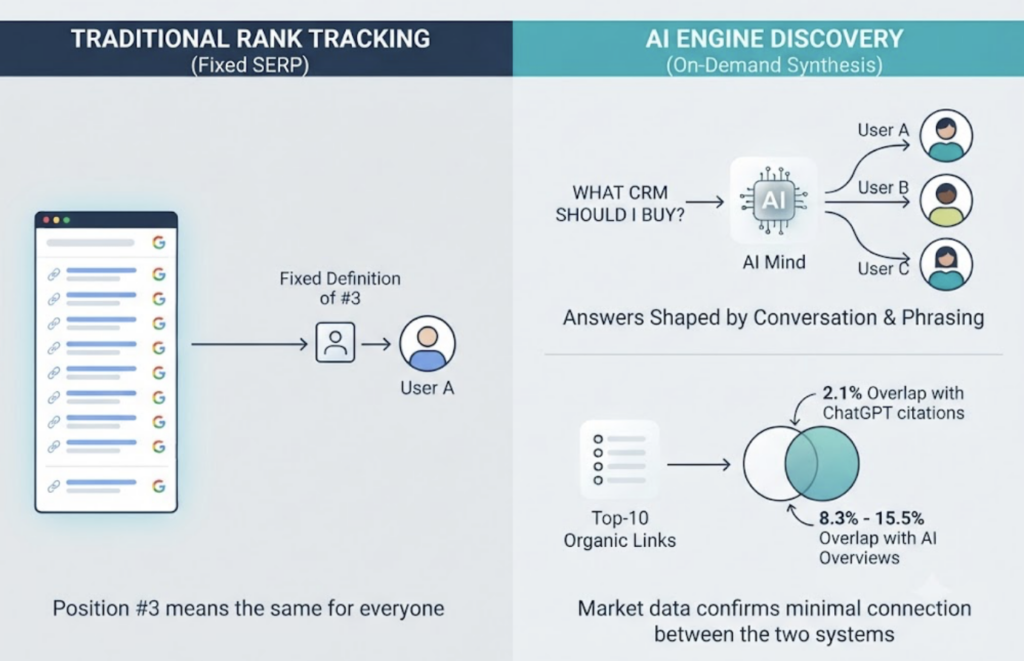
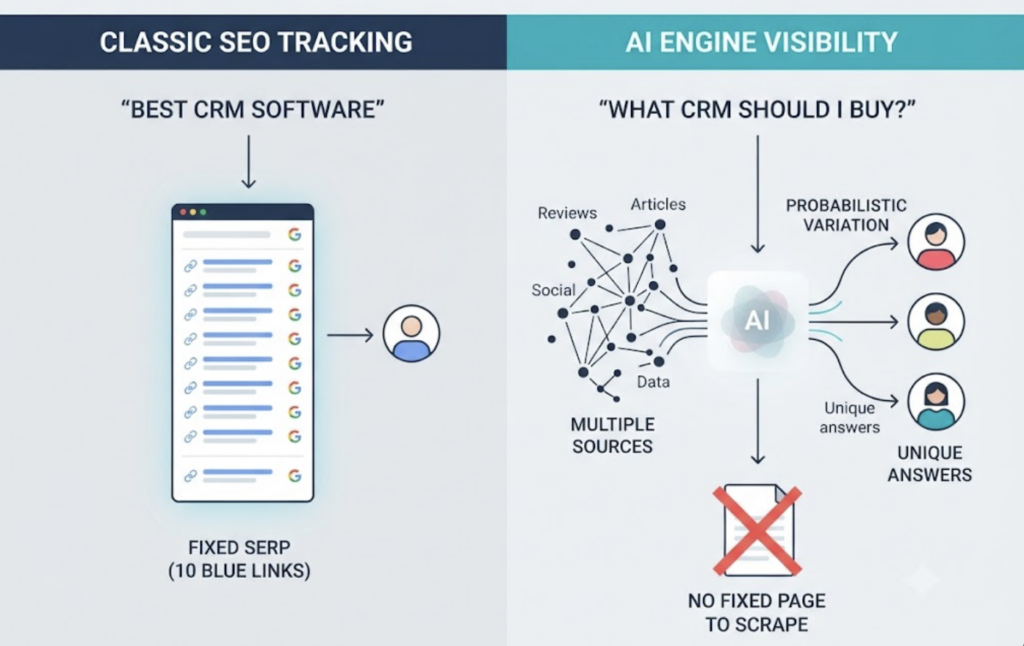
    ChatGPT Doesn’t Work Like Google. That’s the Whole Problem.

    Most brands assume AI search works the way web search does: publish content, get indexed, get found. It doesn’t.

    ChatGPT generates answers from two sources. The first is its parametric knowledge, which is information baked into the model’s weights during training. This is the AI’s long-term memory, a static snapshot of the internet built from hundreds of gigabytes of text data. If your brand didn’t have a meaningful digital footprint before the model’s training cutoff, you effectively don’t exist in this layer.

    The second source is real-time retrieval, often called RAG (Retrieval-Augmented Generation), where ChatGPT Search pulls live web results via Bing to supplement its base knowledge. But even here, the model doesn’t cite everything it finds. Research shows ChatGPT only cites roughly 15% of the pages it pulls into its context window. The other 85% of retrieved content is processed and discarded without attribution.

    The result is a “winner-take-all” model. While Google serves ten organic results per page, a typical AI response names 3 to 7 brands at most. Getting into that shortlist is significantly harder, and once a competitor claims a spot, they benefit from a self-reinforcing cycle: more citations build more authority in the model’s internal weights, which leads to more citations.

    5 Reasons Your Brand Isn’t Showing Up in ChatGPT

    You Don’t Have Enough Third-Party Validation

    AI models are trained to recognize consensus. A brand’s own website claiming it’s the industry leader carries almost no weight. What matters is whether credible third parties are saying it.

    A striking 85% of non-paid AI citations come from earned media, not brand-owned content. Sources like Wikipedia (which accounts for approximately 27% of citations across major AI platforms), Forbes, TechCrunch, G2, and industry review sites act as “trust anchors.” They tell the model that the brand has been verified by sources it already trusts. Without that coverage, the AI has no credible chain of evidence to draw from.

    Your Content Is Structured for Google, Not for AI

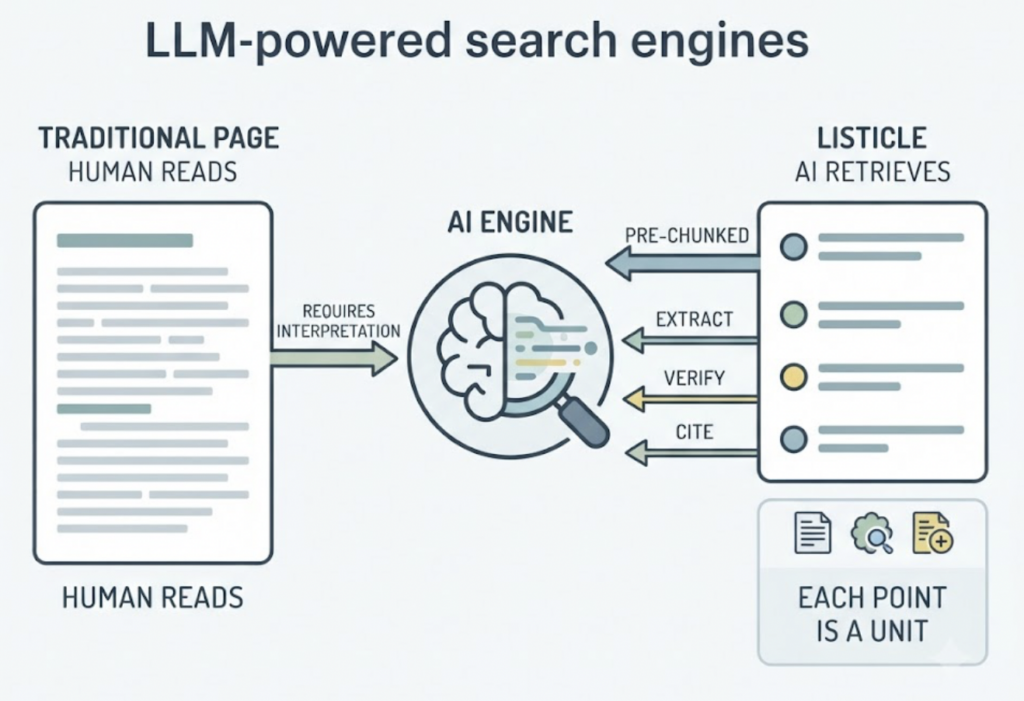
    Traditional SEO encourages narrative storytelling, long introductions, and building toward a conclusion, strategies designed to keep humans engaged and reduce bounce rate. AI crawlers work differently. They’re scanning for the most direct answer as efficiently as possible.

    Content that buries its key claims in long paragraphs, lacks semantic structure, or doesn’t implement Schema markup (FAQPage, HowTo, Product) creates extraction friction. The AI moves on to a competitor’s page where the answer appears cleanly in the first 200 words after a heading. The structure of your content is not a UX concern; it’s a visibility decision.

    Competitors Have Claimed the High-Authority Nodes

    AI search citations aren’t distributed evenly across the web. Just 50 domains supply 28.9% of all AI Overview citations, and competitors who have secured placements on those domains, through “best of” lists, Reddit threads, or analyst roundups, occupy the nodes that the model returns to repeatedly.

    This is what makes the gap compound over time. Every citation a competitor earns reinforces their position in the model’s training signal. You’re not just behind; you’re watching the distance increase.

    Your Content Doesn’t Match What People Actually Ask AI

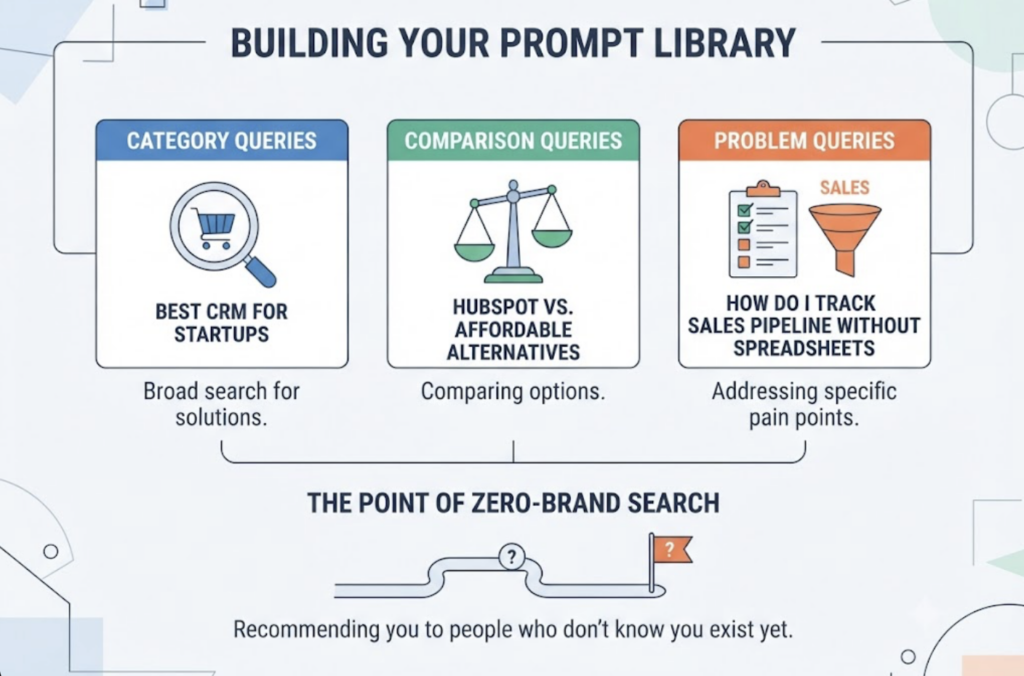
    There’s a significant gap between traditional keyword research and real AI prompt behavior. The average AI query is 23 words long, far more specific and conversational than a typical Google search.

    Someone asking ChatGPT isn’t typing “CRM software.” They’re asking something like, “What CRM works best for a 40-person B2B sales team that needs Salesforce integration and GDPR compliance?” If your content addresses the broad category but not the specific constraints, use cases, and persona-level details embedded in those prompts, the AI won’t surface you as a relevant match.

    Your Brand Postdates the Model’s Training

    New brands, recently renamed companies, or products that pivoted significantly after mid-2024 face a structural disadvantage. The AI’s internal knowledge layer simply hasn’t been trained on them. These brands must rely entirely on real-time retrieval, which is more volatile and closely tied to current Bing rankings. Research indicates that 87% of ChatGPT Search citations match the top 10 Bing results, making traditional search authority still relevant, but insufficient on its own.

    What “AI Brand Visibility” Actually Measures

    The instinct is to ask: “Does ChatGPT mention us?” That’s the wrong question, or at least an incomplete one.

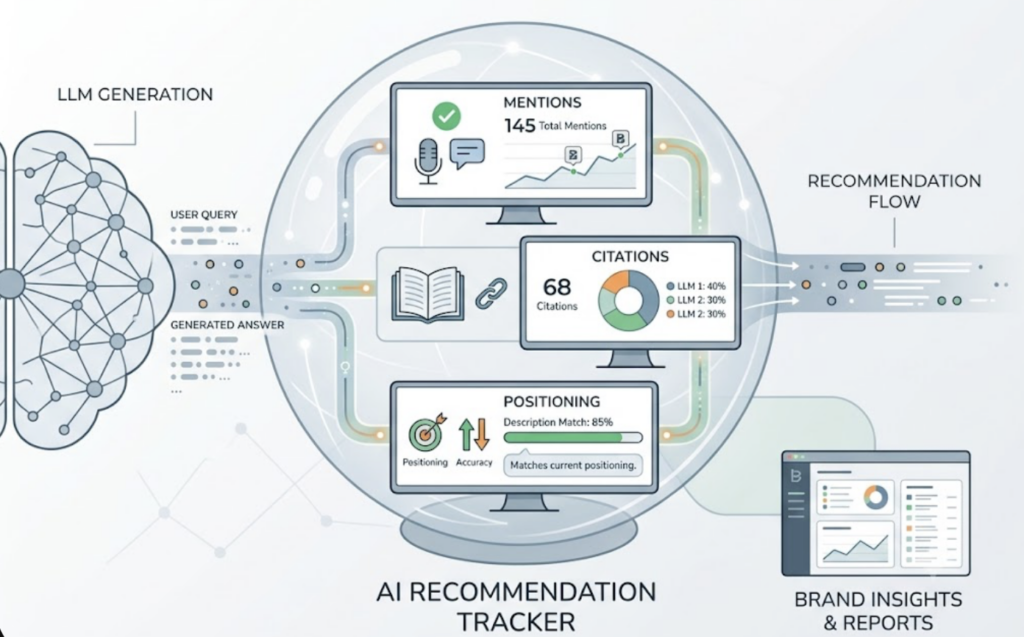
    AI brand visibility is a measurable system of performance indicators that go well beyond a binary yes/no. The key metrics are:

    MetricWhat It Measures
    Brand Mention Rate% of relevant prompts where the brand appears
    Recommendation Rate% of prompts where the AI actively endorses the brand
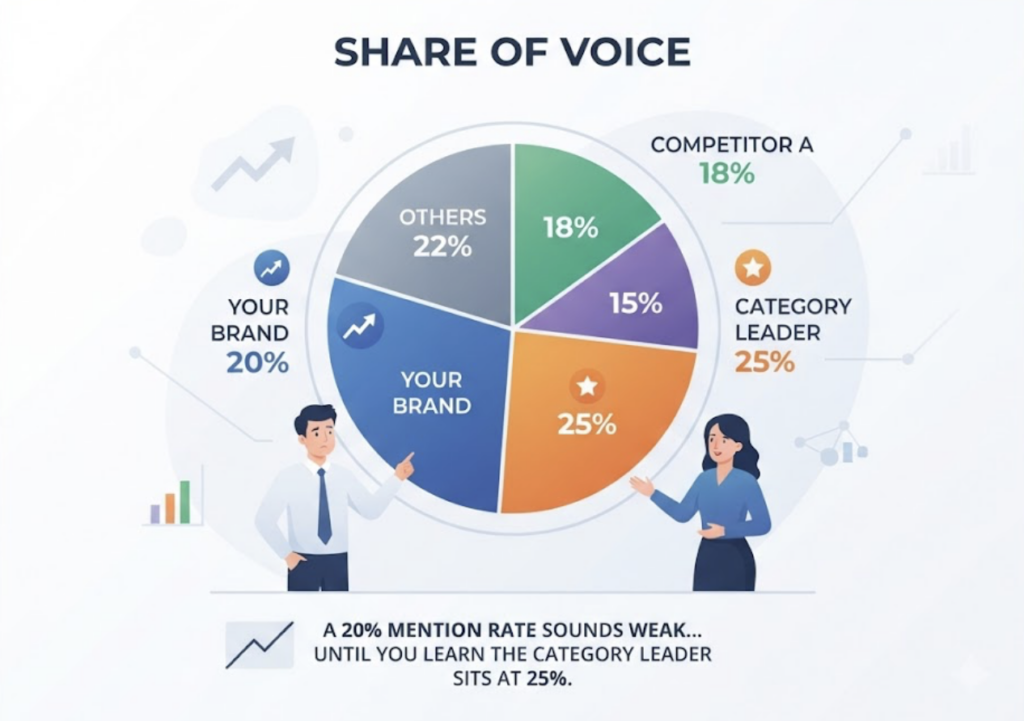
    Share of Model (SOM)Brand mentions vs. total competitor mentions in the category
    Citation PositionAverage rank in the AI’s citation list (1st vs. 5th matters)
    Sentiment ScoreWhether the AI frames the brand positively, neutrally, or negatively

    These metrics matter because the clicks that come from AI citations are worth significantly more than average. An AI-referred visitor is reportedly worth 4.4x more than a traditional organic visitor, with session durations averaging over 5 minutes compared to roughly 1 minute 24 seconds for standard search traffic. The AI is pre-qualifying users before they ever reach your site.

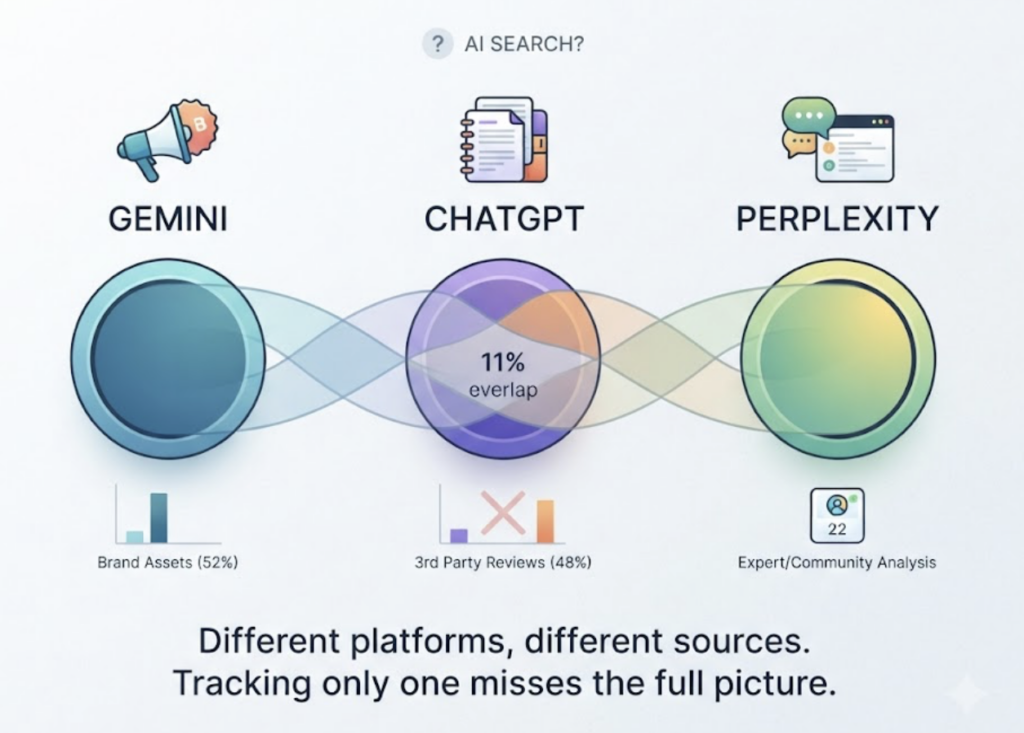
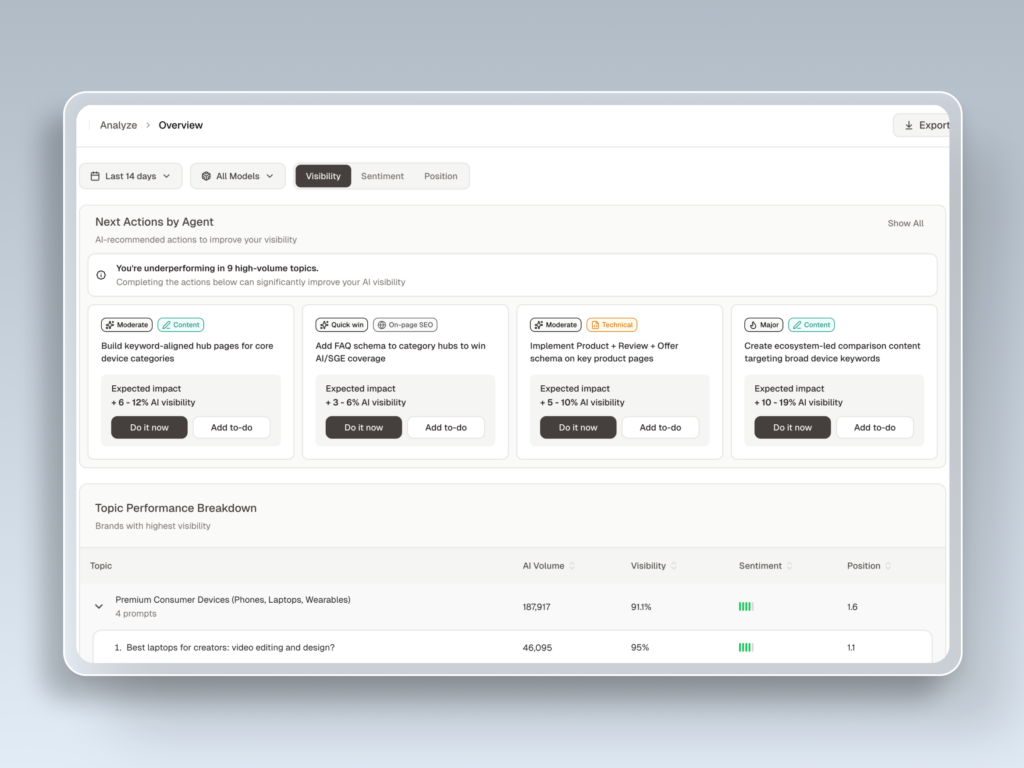
    Platforms like Topify surface all of these metrics in a single dashboard, tracking brand performance across ChatGPT, Gemini, Perplexity, and other major AI engines simultaneously. The point isn’t just to know the number; it’s to have enough data granularity to know why it changed.

    The Prompts That Actually Drive Decisions for Your Brand

    Not every AI query is worth optimizing for. The highest-value prompts are the ones that reflect genuine purchase intent, the questions users ask when they’re already narrowing down their options.

    For B2B SaaS brands, these tend to be integration-specific and use-case-specific: “Which supply chain tools support SAP integration for mid-sized manufacturers?” For consumer products, community consensus matters: “What do people on Reddit recommend for [category] under $100?” For professional services, it’s about methodology and reputation.

    The challenge is that these high-value prompts aren’t always obvious from traditional keyword tools, which are built around short-form search queries, not 23-word conversational questions.

    Topify’s High-Value Prompt Discovery surfaces the actual prompts driving AI-category conversations in your space, including emerging patterns that haven’t yet appeared in keyword databases. In practice, a supply chain analytics company using this feature might discover that the queries generating the most AI citations aren’t about “supply chain visibility” at all, but about tier-2 supplier risk during regional disruptions, a specific topic their content had never addressed.

    The goal is to map your content to the prompts that actually exist, not the prompts you assumed people were asking.

    How to Actually Get ChatGPT to Mention Your Brand

    There are two tracks to improving AI brand visibility, and both need to run in parallel.

    Track 1: Structural optimization (on-site)

    The Princeton and Georgia Tech GEO research found that targeted on-page edits can increase AI visibility by up to 40%. The changes aren’t cosmetic. They’re structural:

    Place a 30-to-40-word direct answer immediately after every H2 heading. Use the “Bottom Line Up Front” principle: state the conclusion before the explanation. Add specific statistics where you have them. Research shows that incorporating concrete data points increases citation probability by 37%, and citing authoritative third-party experts increases it by 40%. LLMs are trained heavily on academic and journalistic text, so content that mirrors that density signals higher information value.

    Also use tables and bulleted lists for comparative data. AI systems extract structured formats more efficiently than prose. A table comparing your product to the category standard is far more likely to be pulled into a response verbatim than a paragraph saying the same thing.

    Track 2: Authority seeding (off-site)

    Since AI models weight third-party sources heavily, off-site authority matters as much as on-site structure.

    Prioritize editorial placements on domains with high authority ratings: Forbes, TechCrunch, industry-specific publications, and review platforms like G2 or Capterra. A single editorial placement on a domain the AI trusts outweighs hundreds of low-quality backlinks.

    Wikipedia and Wikidata are worth separate attention. Wikipedia alone appears in roughly 27% of citations across major AI platforms and represents approximately 22% of LLM training data. Not every brand qualifies for a Wikipedia page, but maintaining accurate Wikidata entries and profiles on Crunchbase or G2 helps the model verify your brand’s entity status.

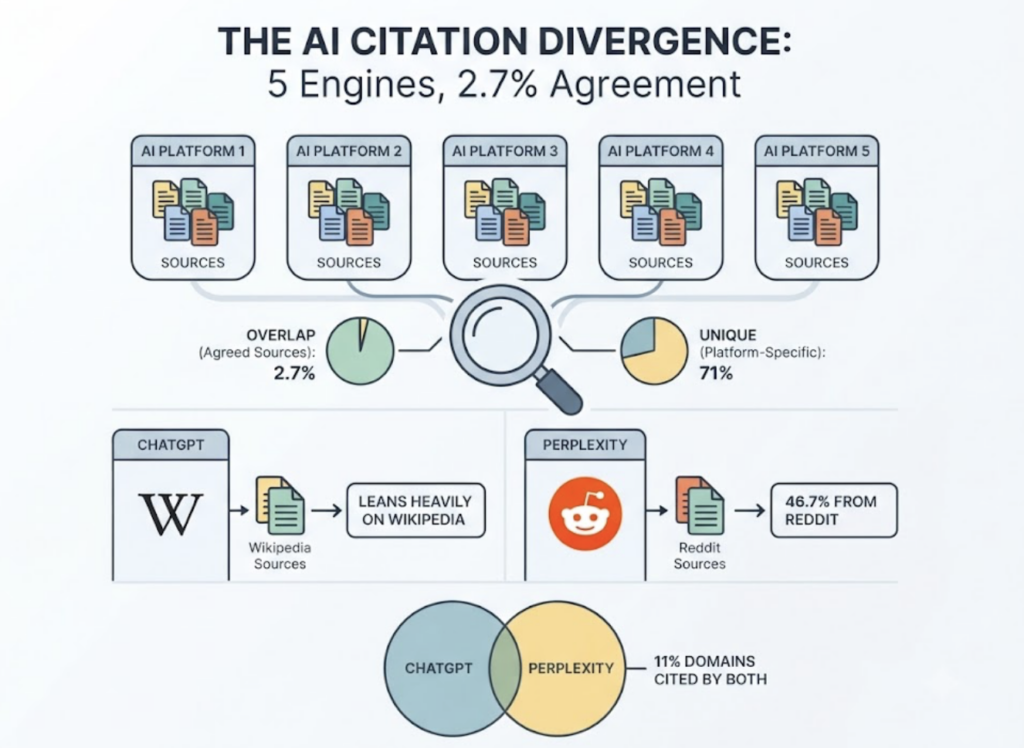
    Community platforms count too. Perplexity and Google AI Overviews cite Reddit threads extensively. Authentic participation in relevant communities creates the social-proof signal that models use to nuance their recommendations.

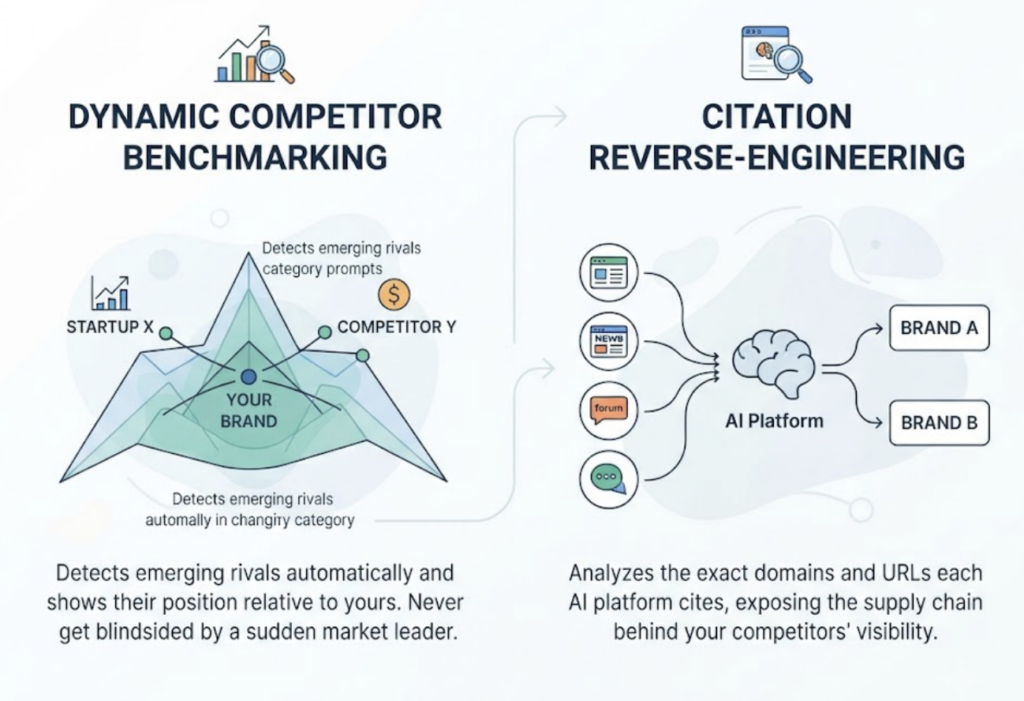
    Topify’s Source Analysis function shows exactly which domains and URLs your category’s AI responses are currently pulling from, and at what rate. One marketing team tracking visibility in the “AI rank trackers” category discovered Perplexity was citing Reddit threads 46% of the time, while ChatGPT was citing specialized industry publications. That’s not information you can reverse-engineer from a general SEO audit. Knowing the precise sources gives your team a concrete list of where to invest.

    How Long Does It Take to Show Up in ChatGPT?

    The timeline depends heavily on which part of ChatGPT you’re targeting.

    PlatformPathwayTypical Timeframe
    Perplexity AIReal-time retrieval48 hours to 1 week
    ChatGPT SearchBing index + RAG2 to 4 weeks
    Google AI OverviewGoogle Search index4 to 8 weeks
    ChatGPT (base model)Model retraining6 months to 1 year

    Perplexity responds to content changes fastest because it relies primarily on real-time retrieval. The base ChatGPT model, which forms most users’ default experience, only reflects new information when OpenAI runs a new training cycle, which is measured in months, not days.

    That said, speed also varies by starting point. Brands with an established Wikipedia presence or editorial footprint on high-authority domains see measurable results 3.2x faster than newer brands building from scratch. The prior work isn’t wasted; it’s the head start.

    The other lever is technical. Ensuring your site is crawlable by AI scrapers (not just Googlebot) and using IndexNow to notify Bing immediately after publishing can meaningfully compress the 2-to-4-week window for ChatGPT Search. Publishing 8 to 12 structured, data-dense pieces per month builds visibility faster than occasional long-form content.

    Visibility tracking across these different platforms requires watching separate signals simultaneously. Topify’s dashboard monitors brand performance across ChatGPT, Gemini, Perplexity, and others in a single view, so a drop in one platform’s mention rate doesn’t go unnoticed for weeks. If you want to get started, the Basic plan covers ChatGPT, Perplexity, and AI Overviews tracking across 100 prompts per month.

    Conclusion

    The visibility gap between brands that appear in AI recommendations and those that don’t is structural, not random. It’s driven by how AI models retrieve information, which sources they trust, and whether your content is formatted for machine extraction. None of those factors change on their own.

    The brands closing that gap aren’t guessing at what ChatGPT wants. They’re tracking exactly which prompts mention competitors, which sources the AI is citing in their category, and where the specific holes in their content are. That’s not a manual audit you run once. It’s a continuous monitoring loop. The brands that build that loop now are the ones competitors will be trying to catch up to next year.

    FAQ

    Q: Does ChatGPT show different brands to different users?

    A: To a degree. The base model produces relatively consistent answers for standard prompts, but when users include persona-specific context, such as their company size, budget, or region, the AI pulls different subsets of its knowledge. ChatGPT’s “Memory” feature also allows it to personalize recommendations based on prior conversations over time, making early visibility in standard queries increasingly important.

    Q: Does having a Wikipedia page help with AI brand visibility?

    A: Significantly. Wikipedia appears in roughly 27% of citations across major AI platforms and represents a primary source for LLM training data. Brands that don’t meet Wikipedia’s notability standards should focus on Wikidata entries and high-authority industry publications such as G2, Crunchbase, and trade-specific review sites as the next-best alternatives.

    Q: Can I pay to get mentioned in ChatGPT?

    A: Not in the organic answer. OpenAI has begun testing labeled sponsored placements in ChatGPT for free-tier users, but these are distinct from the AI’s generated responses and don’t influence organic citations. On Perplexity, there are currently no ad placements at all, meaning organic visibility is the only path on that platform.

    Q: What’s the difference between SEO and GEO for brand visibility?

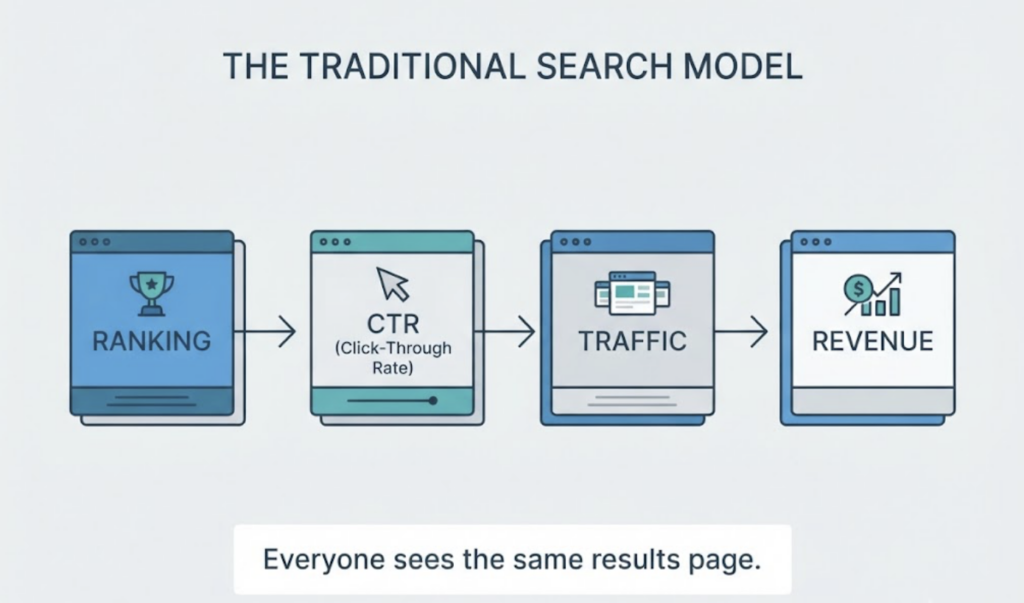
    A: Traditional SEO focuses on driving clicks from ranked URLs. GEO (Generative Engine Optimization) focuses on being part of the AI’s synthesized answer, regardless of whether the user ever clicks. The metrics are different: SEO tracks rankings and CTR, while GEO tracks mention rate, share of model, and citation position. Both matter, but they require different strategies and different types of content.

    Read More

  • Why AI Keeps Recommending Harness Engineering

    Why AI Keeps Recommending Harness Engineering

    Most CI/CD platforms don’t show up in AI answers. Not because they’re bad products, but because AI doesn’t know how to talk about them.

    Harness Engineering is different. Ask ChatGPT about reducing Kubernetes deployment failures, and Harness comes up. Ask Perplexity about progressive delivery tools, and it’s usually in the top two. That kind of consistent presence isn’t luck. It’s the result of a specific set of decisions that most SaaS dev tools haven’t made yet.

    Here’s what’s actually driving it.


    The Generative Filter Most Dev Tools Don’t Know Exists

    When an engineer asks an AI platform for “the best CI/CD tools,” the result isn’t a list of every product in the category. It’s a synthesized answer drawn from a hierarchy of trusted sources, filtered through layers of algorithmic selection.

    The research calls this the “Generative Filter.” And most dev tools never pass it.

    There are three layers of selection working against visibility. First, training data: if a tool wasn’t prominently discussed in the web crawls that trained the underlying model, it has no foundational “memory” in the system. Second, real-time retrieval: engines like Perplexity run live lookups to supplement training data. Websites blocked by robots.txt or lacking machine-readable structure are invisible during this phase. Third, authority signals: AI models cross-reference claims with third-party sources. A tool with no presence on G2, Stack Overflow, or GitHub has no way for the model to verify it’s trustworthy.

    That last layer is where most products fail. Not because their claims are wrong, but because there’s no external consensus to confirm them.


    How Harness Engineering Shows Up in AI Answers, Measured

    Harness doesn’t perform uniformly across all prompt types. Its visibility pattern reveals something more strategic than broad name recognition.

    On category-led prompts like “best CI/CD platforms for enterprises,” Harness typically lands in the third or fourth position, trailing GitHub Actions and GitLab. That’s expected. Those platforms have a decade of training-data advantage.

    But on problem-led and solution-led prompts, Harness punches well above its weight. For “how do I reduce deployment failures in Kubernetes,” it frequently surfaces as a top-two recommendation, cited specifically for its Continuous Verification feature. For “what tool offers automated rollbacks and canary releases,” it often leads.

    That specificity matters. AI models aren’t just listing Harness by name. They’re explaining why they’re recommending it, often citing specific customer outcomes. RisingWave Labs’ reported 80% reduction in build times using Harness Test Intelligence is the kind of concrete, verifiable data point that gets embedded in training data and referenced repeatedly.

    Metric-led prompts also perform well. When engineers ask which CI/CD tool helps reduce cloud costs, the Harness Cloud Cost Management module gets cited at a notably high rate. AI systems reward that kind of modular specificity.

    Harness vs. GitLab and Jenkins in AI Answers

    Jenkins stays present in AI answers because of its historical footprint, but the sentiment that follows it is usually “high-maintenance” or “legacy.” GitLab gets recommended as an all-in-one path for teams that want less complexity.

    Harness occupies a different niche. AI models consistently position it for organizations that have outgrown Jenkins but need more specialized automation and governance than GitLab provides. The “AI-native” framing, built around the Harness AI DevOps Agent and AIDA, reinforces a “modern enterprise” positioning that competitors don’t hold as clearly.

    That’s a niche AI models have learned to recognize. Which means it’s a niche that can be studied and replicated.


    Three Reasons AI Trusts Harness Engineering

    Harness’s consistent AI citations trace back to three specific content and authority patterns. None of them are accidental.

    Machine-readable documentation. Harness documentation is structured around distinct modules with clear value propositions and explicit technical schemas. The hierarchy follows H1 → H2 → H3, which has been shown to improve AI citation rates. Sections run roughly 120 to 180 words between headings, a length AI models find optimal for text extraction. Specific benchmarks are embedded throughout, giving the model citation-worthy snippets rather than marketing prose.

    High-authority third-party validation. AI models have a “verification problem.” They solve it by cross-referencing brand claims with signals from sources they trust. Harness maintains a strong presence across what researchers call the “Source Stack.” G2 and Capterra provide verified sentiment and category rankings. Stack Overflow establishes real-world utility. GitHub validates relevance to the developer toolchain. Gartner MQ reinforces enterprise positioning for procurement queries.

    The correlation is specific enough to quantify: a 10% increase in verified G2 reviews correlates with roughly a 2% increase in AI citations. G2’s standardized schema makes it one of the primary “ground truth” sources LLMs use to assess software quality.

    Linguistic alignment with buyer intent. Harness has aligned its product language with how modern buyers phrase their prompts. “AI-Native DevOps Platform,” “Developer Productivity,” “SDLC Automation” aren’t just positioning words. They’re semantic matches to the vectors AI models weight when ranking relevance to high-intent queries. The Harness AI DevOps Agent reinforces this further: users interact with it using conversational language, which creates a feedback loop that associates conversational DevOps prompts with the Harness brand over time.

    All three pillars work together. Documentation alone doesn’t create AI presence. Third-party signals alone don’t create it either. The combination is what builds what researchers call “Algorithmic Trust.”


    The Visibility Gap Most SaaS Dev Tools Still Have

    Harness built this presence deliberately. Most competitors haven’t started.

    There are three blind spots that keep technically capable tools invisible to AI systems.

    The first is not knowing your recommendation status. Most companies track keyword rankings on Google. They don’t track which prompts surface their product in ChatGPT, or what context accompanies those mentions.

    The second is no prominence tracking. Traditional SEO measures whether you’re on page one. In AI-generated answers, being the fifth tool in a five-tool list is a different outcome than being the primary recommendation. That distinction is currently invisible to most analytics setups.

    The third is source influence anonymity. AI sentiment about a product is shaped by the sources it’s been trained on. A negative Reddit thread from three years ago might be the primary driver of how ChatGPT characterizes your product’s reliability. Without dedicated source analysis, there’s no way to know.

    That’s the gap.

    Tools like Topify exist to close it. Topify’s platform tracks AI visibility across ChatGPT, Gemini, Perplexity, and other major engines, monitoring seven key metrics: visibility, sentiment, position, volume, mentions, intent, and CVR. It also traces AI citations back to their source, which is how teams identify which content is driving recommendations and which third-party nodes need more attention.


    How to Build Your Own AI Recommendation Presence

    The Harness playbook isn’t proprietary. It’s replicable with the right measurement foundation.

    Step 1: Find Out Where You Actually Stand in AI Answers

    Start by defining 20 to 30 high-intent prompts that represent how your buyers actually research. Include category-led prompts (“best DevOps platforms for mid-market teams”), problem-led prompts (“how to reduce CI pipeline failures”), and branded comparison prompts (“Harness vs. competitor X”).

    Then track your share of voice across those prompts on multiple AI platforms simultaneously. If a competitor owns the majority of citations for your primary use case, you’ve identified the exact gap to close.

    Topify’s Visibility Tracking and Competitor Monitoring do this systematically, running prompt sets across engines and returning structured data on mention frequency, position, and sentiment, without manual sampling.

    Step 2: Reverse-Engineer What Sources AI Is Citing About Your Category

    Once you know where you stand, the next question is why.

    Identify which third-party platforms are being cited most often for your category. Determine whether your brand appears in those sources at all. If a Stack Overflow thread or a G2 category page is the primary driver of AI answers about your product segment, that’s where your authority-building effort should go first.

    Topify’s Source Analysis maps AI citations back to their origin domains, surfacing exactly which content is shaping your current AI presence. Most teams find they have significant coverage gaps on the platforms that matter most to LLM reasoning.

    Step 3: Structure Content for AI Extraction, Not Just Human Reading

    This is where execution diverges from intent. Most content teams write for engagement metrics. AI-optimized content is written for extractability.

    That means question-based H2 and H3 headings, short lead paragraphs in the 40 to 60-word range, Markdown tables for data comparisons, and specific metrics in every major section. It also means implementing the llms.txt standard, a curated file that helps AI agents navigate your most authoritative content without crawling the entire site.

    Perplexity is the most tractable starting point for this work. Its citation system is transparent, and referral traffic from perplexity.ai is measurable directly in GA4. Success there builds the cross-platform authority signals that eventually shift training-data-heavy models like ChatGPT.

    Topify’s content generation and CVR tracking close the loop, connecting content optimizations to measurable changes in AI recommendation rates over time.


    What the Harness Case Tells Us About AI Recommendation Logic

    Three conclusions hold across every data point in this analysis.

    Structure matters more than volume. A well-documented product with clear module hierarchies and machine-readable schemas will outperform a competitor with ten times the blog output but no structural clarity. AI models optimize for parse-ability, not prose.

    Third-party signals are now table stakes. The era of brand-owned content as the primary authority signal is over. AI models treat brand content as inherently biased. External validation from platforms like G2, Stack Overflow, and GitHub acts as the verification layer that determines whether a model trusts what a brand says about itself.

    The “Dark Funnel” is now conversational. B2B buyers are forming shortlists inside AI prompts before they ever land on a vendor website. If a brand isn’t cited in the initial discovery prompt, it often doesn’t enter the consideration set at all. Ignoring “Share of LLM” means opting out of the first step of the modern buyer journey.


    Conclusion

    Harness Engineering isn’t the biggest name in DevOps. But it’s consistently one of the most recommended by AI. That gap between market position and AI presence is the most important insight from this case study.

    The mechanics behind it aren’t mysterious. Machine-readable documentation, high-trust external signals, and linguistically aligned content, built systematically over time, compound into Algorithmic Trust. And Algorithmic Trust is what puts a brand in the answer instead of a competitor.

    If you don’t know where your product stands in AI answers today, that’s the place to start. Topify tracks AI visibility across all major platforms, maps the sources driving your current presence, and surfaces the exact gaps between where you are and where Harness is.

    The buyer’s shortlist is being built in AI right now. The question is whether your brand is on it.


    FAQ

    Is Harness Engineering recommended by ChatGPT? 

    Yes, particularly for enterprise DevOps queries. It ranks behind GitHub Actions in broad “best tools” lists, but leads in problem-led prompts around Kubernetes automation, continuous verification, and cloud cost management.

    How do SaaS dev tools improve AI search visibility? 

    Through Generative Engine Optimization. This includes structuring technical documentation with clear H1→H2→H3 hierarchies, maintaining a presence on high-authority review platforms like G2, and implementing AI crawler standards like llms.txt.

    What metrics matter most for AI recommendation tracking? 

    AI Visibility Score (mention frequency and position across platforms), Share of LLM (brand citations vs. competitors in generated answers), and Citation Rate (how often the brand appears as a footnoted or primary recommendation).

    Can smaller dev tool companies compete with Harness in AI answers? 

    Yes. Smaller tools can win on long-tail problem-led prompts where their specialization is sharper than a general platform. High-quality structured content combined with niche presence on Stack Overflow and Reddit can bypass the authority bias that favors incumbents.


    Read More

  • Harness Engineering’s AI Search Gap: What Blogs Miss

    Harness Engineering’s AI Search Gap: What Blogs Miss

    Harness publishes more engineering content than most DevOps companies combined. Detailed breakdowns of canary deployments, AI-driven testing, pipeline governance — the blog runs deep.

    And yet, when buyers ask ChatGPT or Perplexity to recommend a CI/CD platform, Harness often shows up third. Sometimes not at all.

    That’s not a content quality problem. It’s a structural one.

    There’s a growing divergence between what a brand publishes and what AI engines actually retrieve, cite, and surface in answers. For Harness, that divergence is measurable — and it reveals a pattern that applies to almost every technical brand still running a 2022-era content strategy in 2026.

    Harness Publishes a Lot. That Doesn’t Mean AI Listens.

    Harness’s engineering blog covers topics from branch-scoped build IDs to intelligent workload modeling. The production cadence is aggressive, the depth is genuine, and the technical quality is hard to fault.

    But AI retrieval doesn’t work like Google PageRank.

    Generative engines use Retrieval-Augmented Generation (RAG): they break a query into sub-queries, pull fragments from dozens of sources, and synthesize a final answer. What gets cited isn’t the most comprehensive piece — it’s the most extractable one. Content that leads with a direct answer in its first 40–60 words has a measurably higher chance of appearing in AI responses. Content that builds context before reaching its main point often doesn’t make the cut at all.

    Harness’s blog, while rich in detail, tends to follow a narrative structure where critical data lands after introductory context. In RAG terms, that’s a structural disadvantage.

    The result: a brand with a 76/100 AI Visibility Score that earns high sentiment (85–92/100 across major platforms) but consistently occupies secondary or tertiary positions behind GitHub Actions and GitLab in general category queries.

    High quality. Lower citation. That’s the gap.

    What AI Actually Says When Users Ask About Harness

    Run a prompt like “What’s the best CI/CD platform for enterprise deployments?” across ChatGPT, Gemini, and Perplexity. You’ll get a clear pattern.

    GitHub Actions gets framed as “The Default Engine” — easy to start, massive ecosystem, low friction. GitLab shows up as “The Integrated Suite” — unified DevSecOps, strong policy enforcement. Harness lands as “The Smart Orchestrator” — specifically recommended for mid-to-large organizations with complex, multi-environment deployment strategies.

    That’s actually a strong position. The problem is trigger rate.

    Harness earns the recommendation when users already know they have a complex deployment problem. For general discovery queries — the earlier-stage prompts where buyers are still forming their mental model of the category — Harness gets fewer mentions. AI models describe it with terms like “governed,” “reliable,” and “enterprise-ready.” Authoritative, yes. But not the first name that comes up.

    The Prompts AI Gets Asked Most

    The prompts that drive AI category recommendations aren’t the technical deep-dives. They’re conversational: “How do I reduce deployment failures?” or “What tools do DevOps teams use for AI-assisted pipelines?” These TOFU-stage queries shape brand perception before a buyer ever reaches a comparison page.

    For these prompts, Harness’s entity salience — the AI’s confidence in associating the brand with a specific problem — is weaker than its technical reputation would suggest.

    The Sources AI Actually Cites

    Here’s what makes this structural rather than accidental: AI models don’t primarily cite vendor blogs. Roughly 43% of all AI citations come from what researchers call “aristocratic domains” — Wikipedia, Reddit, YouTube, LinkedIn. News outlets account for another ~27%. Owned vendor content? Around 3%.

    Harness’s content investment is heavily concentrated in that 3% bucket.

    The 3 Gaps Hidden in Harness’s Content Strategy

    Gap 1: Topic Priority Mismatch

    Harness publishes what engineers find interesting. AI retrieves what buyers are asking. Those two lists overlap, but they’re not identical.

    Security is a clear example. Harness has a Security Testing Orchestration (STO) module, but when users run security-specific queries — SAST/DAST, AI-enhanced scanning, vulnerability remediation — Snyk and GitHub Advanced Security surface first. The content exists; the external validation connecting Harness to the security category doesn’t.

    AI models rely on what’s called “neighborhood of trust” logic: they look for multiple independent sources connecting the same brand to the same problem using consistent terminology. If only Harness is saying Harness solves AI security, the model treats it as a vendor claim. If G2, a Reddit thread, and a Gartner brief all say the same thing, it becomes a consensus fact.

    Gap 2: Format Mismatch

    FAQ sections generate 3.2x higher citation rates than standard narrative content. Original research and proprietary data increase citation likelihood by around 30%. TL;DR summaries aligned with AI’s opening-content bias consistently outperform long-form narrative for retrieval purposes.

    Harness’s blog is mostly long-form narrative. The format is built for human comprehension, not modular extraction.

    Every H2 or H3 in an AI-optimized article needs to function as a standalone unit — a complete thought that can be independently cited without surrounding context. Headers like “Branch-Scoped Build IDs Explained” require the preceding paragraphs to make sense. An AI chunking that section for RAG gets an ambiguous fragment. A competitor’s structured FAQ that leads with “Branch-scoped IDs reduce pipeline conflicts by isolating build state per branch” gets the citation.

    Gap 3: Source Authority Mismatch

    This is the most significant gap. Brands are 6.5 times more likely to be cited by AI through a third-party source than through their own website.

    Harness has strong G2 presence (4.6/5 stars), but review volume and recency matter. AI crawlers and retrieval systems weight recent, frequently updated sources. ChatGPT, in particular, shows a strong preference for content updated within the last 90 days. A blog post from 18 months ago — no matter how authoritative — may be deprioritized regardless of its historical SEO performance.

    Active community presence in places like r/devops, structured Wikipedia entity maintenance, and regular LinkedIn editorial content are what move a brand into the “aristocratic domain” tier. These aren’t soft PR activities. They’re the primary inputs to AI citation logic.

    Why This Gap Exists (It’s Not Just Harness)

    The AI narrative gap is a systemic byproduct of a content strategy built for Google in an era when buyers now route through AI.

    By 2025, roughly 60% of searches in the US and Europe are zero-click experiences — the AI answer is the touchpoint, and the user never reaches the brand’s website. More striking: over 60% of AI Overview citations come from URLs that rank outside the top 20 of traditional search results. A page at position #40 can become the primary evidence for an AI summary if it’s factually dense and structurally extractable.

    Technical brands like Harness are especially vulnerable to this shift. Engineering culture values depth and precision — exactly the qualities that make content compelling to human readers but difficult for RAG systems to parse quickly.

    Most engineering brands don’t know what AI is saying about them.

    There’s also the “AI Velocity Paradox” to consider. Organizations adopting AI coding tools without modernizing their delivery infrastructure see downstream friction increase, not decrease. Data shows that heavy AI coding tool users average 7.6-hour incident recovery times versus 6.3 hours for occasional users. The content parallel holds: more output without structural optimization creates more noise, not more signal.

    How to Spot Your Own AI Narrative Gap

    The monitoring framework for AI visibility is different from traditional SEO analytics. CTR and keyword rankings don’t capture influence at the answer level. You need three things.

    Step 1: Run the Prompts Your Buyers Actually Ask

    Build a Prompt Matrix — 25 to 100 conversational queries that simulate real buyer journeys across awareness, consideration, and decision stages. Not “Harness CI/CD” (branded). More like “How do DevOps teams handle multi-environment deployments?” or “What’s the difference between Harness and ArgoCD for Kubernetes?”

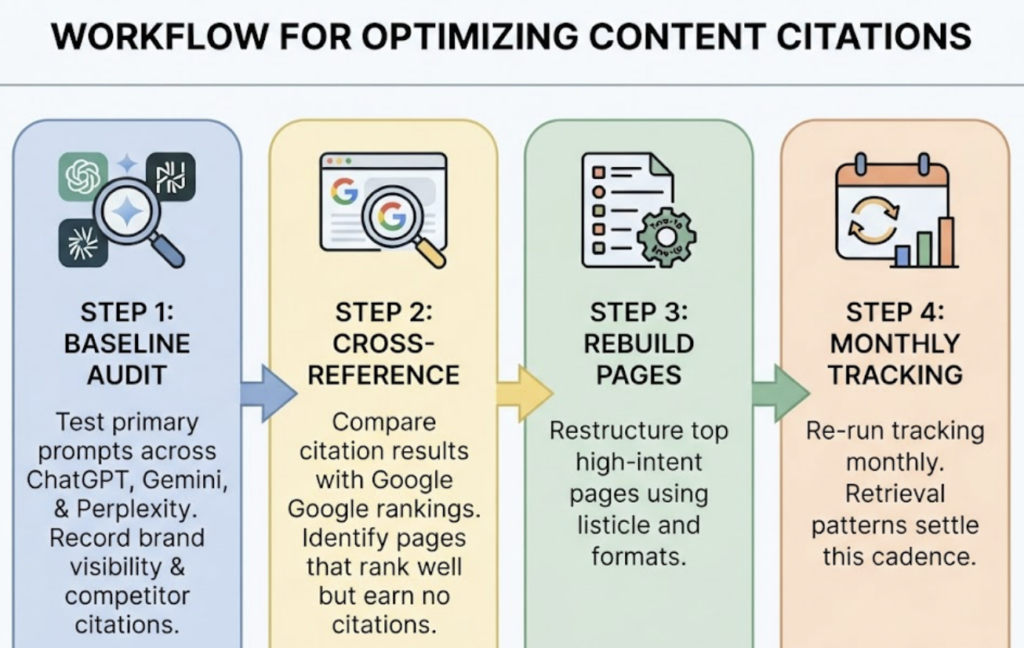
    Run these across ChatGPT, Gemini, and Perplexity. Document where your brand appears, what language surrounds it, and what sources AI cites when it mentions you.

    Step 2: Compare AI Citations Against Your Published Content

    Map the sources AI actually cites against your content inventory. You’ll typically find a mismatch: AI is pulling from a Reddit thread, a G2 review, or a third-party comparison post — not your blog.

    That mismatch is your action list. The sources AI trusts for your category are exactly where you need to build presence.

    Step 3: Measure the Gap, Not Just the Traffic

    AI Share of Voice (AI SoV) is the core metric: the percentage of category AI responses that include your brand as a cited or recommended source. Benchmarks suggest 40–70% SoV signals primary category authority; below 20% indicates a significant visibility problem.

    Pair this with a Sentiment Score (0–100) and Position Index (where in a response list your brand appears). First-position mentions drive 1.5 to 2x more clicks and trust than third-position mentions — and AI referral traffic converts at around 14.2%, roughly five times higher than Google organic traffic. Position matters more than presence.

    Topify automates this process through its AI Volume Analytics and Source Analysis modules — tracking which domains AI platforms actually cite in your category, mapping your brand’s position across platforms like ChatGPT, Gemini, and Perplexity, and surfacing the prompt clusters where competitors are gaining ground. Instead of manually running 100 prompts across four platforms, you get a structured view of where your entity salience is strong and where it’s collapsing.

    What Closing the Gap Actually Looks Like

    The fix isn’t more content. It’s structurally different content distributed to structurally different places.

    Restructure for modular extraction. Every major section needs an answer-first structure: direct response in the opening sentence, supporting data in the following two to three sentences, context last. Implement FAQ schema markup — research shows a 40–42% increase in citation likelihood for pages using it correctly.

    Seed the aristocratic domains. If Source Analysis shows AI citing G2 and Reddit for your category, those channels need active investment. For Harness, that means structured G2 review campaigns to build recency, regular participation in r/devops threads on relevant topics, and Wikipedia entity updates that connect the brand to current AI-native DevOps terminology.

    Establish original data as a recurring asset. Harness’s security analysis of the McKinsey AI incident — where an AI agent discovered over 200 API endpoints and identified 22 unauthenticated ones within minutes — is exactly the kind of factually dense, procedurally clear content that earns AI citations. It provides a specific statistic, a named organization, and a clear cause-effect chain. That’s the template. Original research with hard numbers, published consistently, builds the kind of entity authority that AI models treat as a consensus reference.

    Maintain content freshness on cornerstone pages. ChatGPT’s recency bias toward content updated within 90 days means that evergreen content needs a refresh cycle, not just a publication date. High-priority category pages should be reviewed and updated quarterly.

    Topify’s Competitor Monitoring and Visibility Tracking track these shifts in real time — so you can see when a competitor’s citation rate is climbing in a prompt cluster where you’ve historically led, and respond before the gap compounds.

    Conclusion

    Harness’s AI narrative gap isn’t a sign of weak content. It’s a sign of content built for a channel that’s no longer the primary one.

    The buyers using generative AI to research DevOps platforms aren’t reading blog posts — they’re asking questions and acting on the synthesized answers they get back. If a brand’s entity isn’t present in those answers, the content investment that produced it effectively doesn’t exist for that buyer.

    The shift from SEO to GEO isn’t about abandoning what works. It’s about extending it: restructuring content for modular extraction, seeding third-party platforms AI actually trusts, and tracking visibility at the answer level rather than the ranking level.

    The brands that figure this out first will occupy the first-position recommendation slots that drive 1.5 to 2x more referral trust. In a zero-click world, that position is the only one that pays.

    FAQ

    What is an AI narrative gap in content strategy? 

    An AI narrative gap is the misalignment between what a brand publishes and what AI engines actually retrieve and cite in generated answers. A brand can have extensive, high-quality content and still have low AI visibility if that content isn’t structured for modular extraction or distributed across the third-party sources AI models trust most.

    How do I find out what AI says about my brand? 

    Build a Prompt Matrix of 25–100 conversational queries that reflect real buyer journeys in your category. Run them across ChatGPT, Gemini, and Perplexity, and document where your brand appears, what language surrounds it, and which external sources get cited. Platforms like Topify automate this process and track AI Share of Voice over time.

    Does blog content influence AI search results? 

    Indirectly. AI retrieval systems weight third-party sources — G2, Reddit, Wikipedia, industry publications — more heavily than owned vendor content. Your blog can support AI visibility, but only if its content is also reflected in those external sources. Owned content accounts for roughly 3% of AI citations; third-party sources account for the rest.

    Is this problem specific to engineering or DevOps brands? 

    No, but technical brands are particularly exposed. Engineering content tends to be deep, narrative-driven, and context-dependent — qualities that work well for human readers but reduce extractability for RAG systems. The structural mismatch between how engineers write and how AI retrieves is more pronounced in technical verticals than in, say, e-commerce or consumer brands.

    Read More

  • ChatGPT Is Picking Dev Tools. Where Does Harness Rank?

    ChatGPT Is Picking Dev Tools. Where Does Harness Rank?

    A senior DevOps engineer needs a new deployment platform. She doesn’t open Google.

    She opens ChatGPT and types: “Best enterprise CI/CD tool for a 500-microservice setup on multi-cloud with strict compliance requirements.”

    In under 10 seconds, she gets a ranked list, a comparison table, and a recommendation tailored to her stack. She picks the top two, sends them to her team lead, and the evaluation begins.

    If Harness isn’t in that list, it doesn’t get evaluated. It’s that simple.

    This isn’t a hypothetical. It’s how engineering teams are making tool decisions in 2026 — and the brands that don’t show up in AI answers are quietly losing the decision before they ever knew there was one.

    Engineers Have Quietly Stopped Googling for Tools

    The numbers tell the story clearly. ChatGPT now handles 17.6% of global search queries, making it the biggest threat to traditional search engines in two decades. On desktop, where professionals do their deep research, that share jumps to 62%.

    In software development specifically, about 63% of engineers already use ChatGPT as a primary platform for debugging, code generation, and tool research. For high-complexity queries — the kind that involve architecture decisions and vendor evaluation — AI isn’t a shortcut. It’s the first stop.

    That’s a structural shift, not a trend.

    Google still dominates navigational searches. But when an engineer needs to understand tradeoffs between enterprise deployment platforms? They’re asking an AI. The average ChatGPT session runs over 13 minutes — nearly three times longer than a Google session. These aren’t quick lookups. They’re consultations.

    What Engineers Actually Ask ChatGPT About DevOps Tools

    The prompts engineers use aren’t simple keywords. They’re scenario-driven questions with real context:

    • “Best CI/CD tools that support GitOps and manual approval gates”
    • “Compare Harness vs GitHub Actions for large-scale Monorepo builds”
    • “Which platforms reduce build time without sacrificing rollback reliability?”

    AI responds with structured outputs: a ranked list of tools, a feature comparison table, and scenario-specific recommendations. The whole thing takes seconds.

    Here’s what matters for brands: AI’s ranking logic has nothing to do with your Google SEO position. About 76.1% of citations in Google AI Overviews come from top-10 search results — but standalone LLMs like ChatGPT weight things differently. They surface tools that appear consistently across independent, authoritative sources: GitHub Discussions, Stack Overflow, G2 reviews, technical media, and Reddit.

    Reddit, for instance, is currently Perplexity’s single largest citation source.

    If your product is mentioned across multiple credible communities with consistent associations — say, “Harness” linked to “automated rollback” or “OPA policy enforcement” — AI learns that connection and reproduces it. If those associations don’t exist in the right places, neither does your brand in the answer.

    Where Harness Shows Up — and Where It Doesn’t

    Harness has a real visibility problem. Not a universal one — a highly specific one.

    On complex enterprise prompts — multi-cloud compliance, automated rollback, deployment governance — Harness performs well. AI systems consistently position it as a full-lifecycle platform for teams moving away from fragmented toolchains.

    On lightweight queries — “easiest CI/CD to set up,” “open source alternatives to Jenkins,” “best tool for solo developers” — Harness disappears. GitHub Actions and GitLab CI absorb those searches entirely.

    DimensionHarnessGitHub ActionsCircleCIArgo CD
    AI Recommendation FrequencyMedium-High (enterprise queries)Very High (all scales)MediumHigh (K8s-specific)
    Core AI Recommendation ReasonTest Intelligence, rollback, OPAEase of use, GitHub integrationReliability, reusable OrbsPure GitOps, declarative config
    AI-Identified WeaknessHigh cost/complexity for small teamsLimited native CD for enterprisePricing at scaleK8s-only, no CI
    Primary Citation SourcesOfficial docs, enterprise case studiesCommunity, Reddit, MarketplaceDev blogs, tutorialsCNCF reports, open-source community

    The problem isn’t the product. The problem is the footprint.

    Harness’s technical strengths — Continuous Verification, Test Intelligence, AIDA — are genuinely differentiated. But if those capabilities aren’t documented in places AI can find and trust, they don’t exist from the AI’s perspective.

    Why AI Skips Certain Tools (It’s Not About Product Quality)

    This is the part most marketing teams get wrong.

    AI doesn’t skip Harness because engineers don’t like it. It skips Harness because its content doesn’t match how AI engines extract information.

    LLMs operate on a principle of multi-source verification. When an AI is building its answer about CI/CD tools, it’s not reading one blog post. It’s scanning for consensus across independent sources. A tool mentioned consistently on Stack Overflow, dev.to, InfoQ, and peer-review sites like G2 gets treated as established. A tool mostly documented in gated white papers or unstructured PDFs? It gets treated as low-confidence.

    Documents that use clear H1–H3 hierarchy, FAQ schema, and structured Q&A blocks are 40%+ more likely to be extracted as usable fact units than traditional long-form content. And content that includes specific, verifiable claims — like “RisingWave reduced build times by 50% after adopting Harness” — gets cited far more often than vague benefit statements.

    It’s not about having a great product. It’s about being cited by the right sources, in the right formats.

    Harness’s content assets have historically leaned toward enterprise documentation and gated case studies. Those assets serve sales cycles well. They don’t feed AI engines.

    3 Signals That Tell You If Harness Is Winning AI Visibility

    Traditional SEO rankings won’t tell you how visible Harness is in AI answers. You need different metrics entirely.

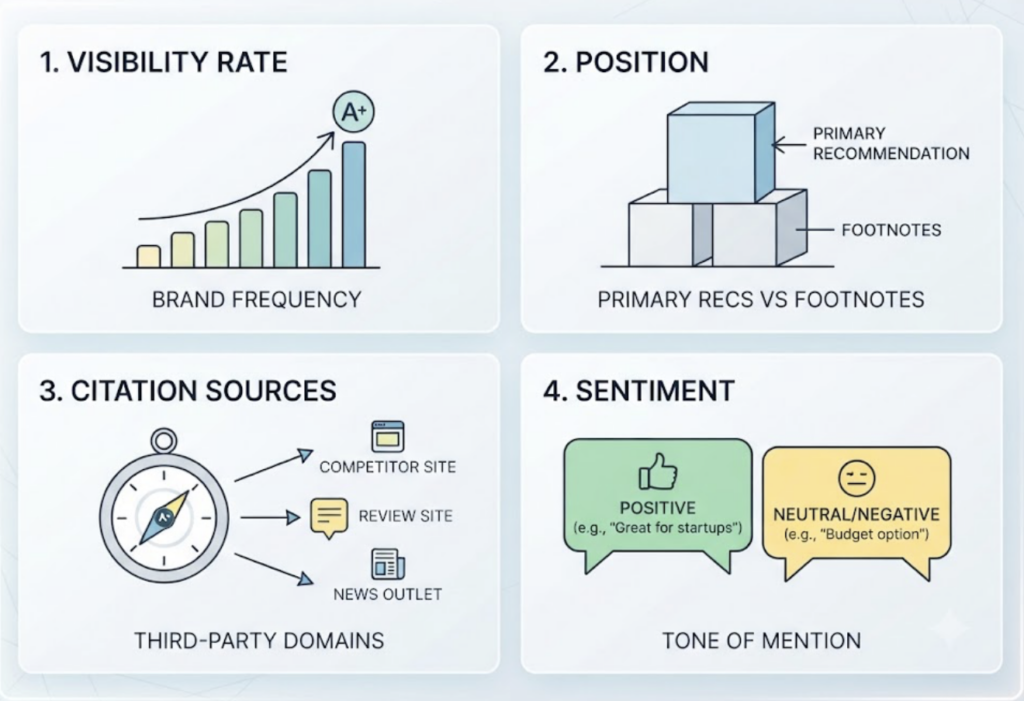
    Visibility Rate measures what percentage of relevant prompts include Harness in the AI’s answer. If you test 100 CI/CD-related prompts and Harness appears in 35 responses, its visibility rate is 35%. This tells you how strongly AI associates your brand with your category.

    Position tracks where Harness appears in the ranked list when AI does mention it. First-position citations carry substantially higher trust and click potential — the same way top-3 Google results dominate organic traffic. Being mentioned fifth in a ChatGPT list is very different from being mentioned first.

    Source Coverage measures how many independent domains are driving AI’s mentions of Harness. If AI only pulls from harness.io, your credibility footprint is narrow. If it’s also pulling from Stack Overflow, G2, and engineering blogs, your brand has achieved multi-source verification — the signal AI trusts most.

    SignalWhat It MeasuresWhy It Matters for Harness
    Visibility RateFrequency of appearance across prompt setShows AI category association strength
    PositionRank order in AI recommendationsIndicates how AI “grades” Harness vs. competitors
    Source CoverageNumber of independent citation domainsMeasures credibility depth across the web
    Sentiment ScoreTone AI uses when describing HarnessShapes first impressions for evaluating engineers

    Topify tracks all four dimensions across ChatGPT, Perplexity, and Gemini simultaneously — so Harness’s marketing team can see exactly where the gaps are, and which competitor is filling them.

    What Harness’s Marketing Team Can Actually Do About It

    The strategic shift is from keyword optimization to citation engineering.

    The goal isn’t to rank on page one of Google. It’s to become the source that AI quotes when engineers ask about enterprise-grade deployment platforms.

    Build citation-bait content. This means original research, benchmark reports, and technically specific comparisons — the kind of content that third-party media and communities want to cite. A well-distributed report like “2026 Enterprise Deployment Frequency Benchmark” gets picked up, linked to, discussed. Every one of those citations becomes a data point AI trusts.

    Shift distribution toward AI-indexed communities. Reddit, Stack Overflow, dev.to, GitHub Discussions — these aren’t just community channels. They’re the sources AI engines pull from most heavily. Harness’s technical content needs to live there, not just behind a login wall or inside a PDF.

    Close the prompt gaps. There are high-intent queries where engineers are actively researching — and Harness isn’t appearing in the answers. Those are recoverable. Identifying them is step one.

    That’s where Topify’s Competitor Monitoring and Prompt Discovery become practical. The platform continuously surfaces new prompts your target engineers are using, flags where competitors are being cited instead of you, and suggests the specific content moves needed to close each gap. Its One-Click Execution feature turns those insights into deployable strategies without manual coordination across teams.

    The cycle is: track where Harness is invisible → identify which sources are being cited instead → create content that earns those citations → measure the shift.

    Straightforward in theory. Hard to do without the right infrastructure.

    Conclusion

    The tool selection process has already changed. Engineering teams are consulting AI before they consult a sales rep, a review site, or a colleague. And AI’s recommendations are shaped by a content ecosystem that most B2B marketing teams weren’t built to optimize for.

    For Harness, the product quality isn’t the gap. The citation infrastructure is.

    Winning in this environment means becoming the brand that high-authority sources naturally reference when they discuss enterprise deployment, automated rollback, and cloud-native CI/CD. It means documenting real outcomes in structured, crawlable formats. And it means tracking AI visibility the same way you’d track organic search — with specific metrics, competitive benchmarks, and a feedback loop that translates data into action.

    The teams that build that infrastructure now will own the recommendation layer for the next decade. The ones that don’t will keep losing deals before the conversation even starts.

    Start by auditing where Harness stands today — which prompts trigger a recommendation, which ones don’t, and who’s filling the gap. Topify can run that audit across every major AI platform in one place.

    FAQ

    Does Harness currently appear in ChatGPT’s tool recommendations?

    Yes — but selectively. Harness performs well in complex, enterprise-specific queries involving multi-cloud compliance, automated rollback, and deployment governance. In lighter-weight queries around ease of use or open-source options, it typically gets outranked by GitHub Actions or GitLab CI.

    How is AI tool visibility different from Google SEO rankings?

    SEO gets your page into a list of links. GEO gets your brand into an AI-generated answer. The mechanisms are different: SEO depends on backlinks and keyword relevance; GEO depends on structured content, factual density, and multi-source citation across communities AI actually trusts. SEO is about being seen. GEO is about being cited as the authoritative answer.

    How long does it take to improve AI search visibility for a DevOps tool?

    Based on documented cases, targeted GEO optimization — adjusting document structure, building third-party citation coverage — typically produces measurable improvements in AI citation frequency and position within 4 to 8 weeks.

    Read More

  • 7 CI/CD Tools Ranked by AI Visibility in 2026

    7 CI/CD Tools Ranked by AI Visibility in 2026

    Here’s what happened when an engineering lead asked Perplexity, “What’s the best CI/CD tool for enterprise deployments?” The answer came back in seconds: Harness Engineering, with a two-paragraph explanation, a cost breakdown, and a link to its documentation. No search results page. No comparing 10 tabs. Just a selection.

    That’s the new procurement funnel for developer tools in 2026.

    Nearly 85% of developers now use AI assistants in their regular workflow, with over half relying on them every working day. When your team evaluates a new CI/CD stack, the first opinion they get is increasingly from ChatGPT, Perplexity, or Gemini, not a Google search. And 93% of those AI-mode queries end without a single click to an external site. The AI picks a winner and moves on.

    This changes everything about how tools get discovered, evaluated, and adopted. Below is a ranked breakdown of seven major CI/CD tools by AI Visibility Score in 2026, including exactly where Harness Engineering stands and why.

    Last Year’s Google Rankings Won’t Save You in 2026

    This is the part most engineering teams don’t know: 80% of URLs cited by AI systems don’t even rank in Google’s traditional top 100. The two systems have entirely different criteria for what counts as authoritative.

    Google still rewards backlink profiles and page authority. AI systems prioritize what researchers call “entity authority”: structured documentation, consistent brand signals, corroborating community presence on platforms like Stack Overflow, Reddit, and GitHub. A tool can dominate Google search and still be nearly invisible in a Perplexity recommendation.

    That gap is where the 2026 CI/CD rankings get interesting.

    The 2026 Rankings: AI Visibility Scores Across 7 Tools

    The AI Visibility Score (0–100) used here is a composite metric covering mention rate across relevant prompts, citation frequency in AI source panels, position quality in comparative answers, and platform coverage across ChatGPT-5.2, Perplexity Pro, and Gemini 3.1.

    CI/CD ToolAI Visibility ScoreTop AI PlatformPrimary Recommendation Context
    GitHub Actions96ChatGPT / CopilotGeneral purpose, ecosystem depth, SMBs
    Harness Engineering89Perplexity / ClaudeEnterprise governance, ML pipelines, speed
    GitLab CI84Gemini / ChatGPTAll-in-one DevSecOps, regulated sectors
    Jenkins72PerplexityLegacy migration, Kubernetes (Jenkins X)
    CircleCI68ChatGPTManaged SaaS, high-velocity CI
    ArgoCD65Claude / PerplexityGitOps, Kubernetes production deployments
    Tekton54GeminiCloud-native frameworks, custom internal tooling

    The gap between the top three and the rest isn’t arbitrary. It reflects how well each tool’s documentation, community content, and entity signals are structured for machine synthesis, not just human reading.

    #1 GitHub Actions: The Default AI Pick (Score: 96)

    GitHub Actions is the answer to almost every general CI/CD question in 2026. Ask ChatGPT “how do I set up a deployment pipeline?” and you’ll get a working YAML file that references GitHub Actions before you finish reading the first paragraph.

    The reason is straightforward. Its massive footprint in public repositories gives AI models an enormous training base of real-world configurations. Its marketplace now hosts over 20,000 community-contributed Actions. When an AI generates an answer about Docker builds, AWS deployments, or Node.js workflows, GitHub Actions is the pattern it’s seen millions of times.

    That said, AI platforms are increasingly consistent in flagging its limits. For complex, multi-stage pipelines, observability is a gap. For regulated enterprises needing deep compliance and governance controls, the recommendation often shifts.

    That’s where Harness enters.

    #2 Harness Engineering: The High-Authority Enterprise Recommendation (Score: 89)

    Harness doesn’t try to win general-purpose prompts. It wins the ones that matter for enterprise teams.

    When an engineer asks about CI/CD for “multi-cloud governance,” “MLOps pipelines,” or “production rollback with verification,” Harness consistently surfaces as the primary recommendation on Perplexity and Claude. Its AI Visibility Score of 89 is not a result of volume. It’s the result of specificity and data density.

    AI models favor sources that provide quantifiable performance claims. Harness delivers: builds up to 8x faster than traditional solutions, test execution time reduced by up to 80% through ML-based Test Intelligence that runs only the tests affected by a given code change. Those aren’t marketing superlatives. They’re the kind of precise, replicable data points that AI systems extract and cite.

    Feature AreaHow Harness Appears in AI Responses
    VelocityTest Intelligence cited for large monorepos and monolithic apps
    ReliabilityML-based Continuous Verification for production rollbacks
    GovernanceOPA-based Policy-as-Code for fintech, healthcare, government
    EfficiencyCloud Cost Management with Auto-Stopping
    ModernizationPipeline-as-Code for teams migrating from Jenkins

    There’s also a semantic advantage at play. The phrase “harness engineering” is increasingly used in AI discourse to describe the scaffolding needed to coordinate multiple AI agents through testing, security checks, and code review before production. That conceptual alignment between the brand name and an emerging industry concept has created measurable halo visibility for Harness in AI-generated content.

    Bottom line: if your team has hit the complexity ceiling with GitHub Actions or Jenkins, Harness is the tool AI systems recommend next.

    #3 GitLab CI: The Security-First Platform (Score: 84)

    GitLab CI is the fastest-growing enterprise CI/CD choice in 2026, with a 34% year-over-year adoption increase. Its AI visibility is concentrated in one key area: regulated industries that need security and compliance baked into the pipeline, not bolted on after.

    Gemini and ChatGPT consistently recommend GitLab for teams that need SAST, DAST, and dependency scanning enforced automatically at the pipeline level. The “single application” philosophy reduces context-switching and gives teams a unified data model across source control, CI/CD, and security. That’s a genuinely differentiated value for healthcare and fintech teams under audit pressure.

    AI systems also flag its trade-offs honestly: higher per-seat pricing at enterprise tiers and a vendor lock-in risk that more modular stacks avoid.

    #4 Jenkins: Still in the Conversation (Score: 72)

    Jenkins remains the backbone of CI/CD in 80% of Fortune 500 companies. That installed base keeps it visible in AI responses, even as newer tools compete for mindshare.

    In 2026, AI recommendations for Jenkins cluster around two scenarios: teams with niche on-premise requirements that cloud-native SaaS tools can’t address, and the growing “Jenkins Renaissance” via Kubernetes, where Jenkins X and dynamic agent provisioning give it cloud-native scalability. Its 1,800+ plugin ecosystem is a real moat for complex, custom pipelines.

    It’s still recommended. Just not for teams starting from scratch.

    #5-#7: Specialized Tools for Specific Contexts

    CircleCI (Score: 68) is the go-to for teams that want managed CI without infrastructure overhead. AI systems cite it most for SaaS startups and mobile development teams. Its ceiling is clear though: it lacks the deployment orchestration depth of Harness and the security integration of GitLab.

    ArgoCD (Score: 65) is the AI-designated “gold standard” for GitOps and Kubernetes-native delivery. If your prompt includes “K8s” and “declarative deployments,” ArgoCD typically appears within the first two recommendations. Operational overhead at scale is its consistent AI-flagged drawback.

    Tekton (Score: 54) has the lowest visibility but the highest relevance for a specific audience: platform engineers building custom internal CI/CD systems. It’s the recommended underlying framework for Jenkins X and a frequent citation in “cloud-native infrastructure” discussions. It doesn’t show up in beginner lists because it’s not built for beginners.

    Why the Gaps Exist: What AI Systems Actually Reward

    A 26-point gap between GitHub Actions (96) and Tekton (54) isn’t purely a reflection of user base size. It’s a reflection of how each tool has structured its technical presence for machine readability.

    AI systems in 2026 operate primarily through Retrieval-Augmented Generation (RAG), meaning they pull content from indexed sources at inference time. Tools that score high on AI visibility typically share four characteristics: high-information-density documentation with specific, quantifiable performance data; consistent entity signals across GitHub, documentation, and community forums; schema markup that clarifies the tool’s identity and function to AI indexing systems; and extensive public community discussion that provides corroboration from multiple independent sources.

    Tools that fall short tend to publish vague capability descriptions without numbers, fragment their brand presence across inconsistent naming conventions, or rely on closed-source ecosystems that limit the AI’s ability to learn from real-world usage patterns.

    The implication is direct: your CI/CD tool’s AI recommendation profile is as much a product of content strategy as it is of engineering quality.

    How to Track Your Stack’s AI Visibility

    Knowing the industry rankings is useful. Knowing how your specific toolset, internal platform, or vendor choice performs in AI recommendations is actionable.

    Topify tracks brand and tool visibility across ChatGPT, Perplexity, Gemini, and Google AI Overviews simultaneously. For engineering and platform teams, that means you can monitor whether your CI/CD choice is being recommended, what context it’s being cited in, and whether a competitor is capturing the “primary recommendation” position you’re missing.

    Topify’s Position Tracking shows whether your tool lands as the first recommendation or a secondary alternative. Its Sentiment Analysis surfaces how AI systems narratively frame the tool: as an innovator, a legacy system, or a budget option. And its Source Analysis reveals which documentation domains the AI is actually citing, which tells you where your content investment has the highest return.

    It transitions AI visibility from a guessing game into a measurable growth function.

    Conclusion

    The 2026 CI/CD landscape hasn’t changed in terms of which tools are technically capable. What has changed is how those tools get discovered and selected.

    GitHub Actions wins general-purpose prompts. Harness Engineering wins the high-complexity, high-stakes enterprise queries where governance, ML pipeline support, and verified deployments matter. GitLab CI wins in regulated industries that need security integrated at the pipeline level.

    For engineering teams, the practical takeaway is this: the tool your AI advisor recommends shapes what your team evaluates first. If your CI/CD stack isn’t visible in those recommendations, or if it’s being framed as a legacy system when it’s not, that perception directly affects adoption at the top of your procurement funnel.

    Track it. Optimize it. Then build better pipelines.


    FAQ

    Is Harness Engineering recommended by ChatGPT? 

    Yes. Harness is a consistent recommendation in prompts that specify enterprise requirements: multi-cloud governance, OPA-based policy management, or ML-powered deployment verification. It’s typically cited second after GitHub Actions in general prompts, and first in enterprise-specific ones.

    Which CI/CD tool has the highest AI visibility in 2026? 

    GitHub Actions leads with a score of 96, driven by its deep footprint in public repositories and native alignment with the Microsoft/OpenAI developer stack. Harness Engineering follows at 89.

    How is AI visibility different from GitHub stars or download counts? 

    Stars and downloads measure historical popularity. AI visibility measures a tool’s authority and selection probability in current generative search responses. A tool can be widely used and still be nearly invisible in AI recommendations if its documentation isn’t structured for machine synthesis.

    Can I track how often my DevOps tool gets mentioned by Perplexity? 

    Yes. Platforms like Topify provide real-time monitoring of brand mentions, citation frequency, and Share of Voice across Perplexity, ChatGPT, Gemini, and other generative engines.

    Is Jenkins still relevant in AI recommendations? 

    Yes, though in a narrower context. AI systems recommend Jenkins for legacy migration paths, on-premise requirements, and Kubernetes deployments via Jenkins X. It’s rarely the first recommendation for greenfield projects in 2026.


    Read More

  • Which CI/CD Tool Wins in AI Search in 2026?

    Which CI/CD Tool Wins in AI Search in 2026?

    You’ve read the docs. You’ve compared the feature matrices. But when your engineering team now starts tool research with a single ChatGPT prompt, the winner isn’t decided by benchmarks. It’s decided by which CI/CD platform AI chooses to recommend — and that answer isn’t random.

    Over 50% of B2B software buyers now open their research in an AI chatbot, and in DevOps tooling, this number has grown by 71% in the past four months alone. That means Harness Engineering, Jenkins, and GitHub Actions aren’t just competing on features. They’re competing for a spot in AI-generated answers.

    Here’s what that race looks like in 2026 — and what it tells you about where each platform actually stands.

    AI Doesn’t Recommend CI/CD Tools Equally

    Before the comparison, it helps to understand the playing field. ChatGPT handles somewhere between 2.5 and 5 billion weekly queries, while Perplexity processes around 50 million with a 93% zero-click answer rate. In both cases, the recommendation isn’t pulled from a ranked list. It’s generated from a combination of training data, live search results, and entity authority signals.

    That matters for CI/CD tools because different platforms carry different weights in AI memory. A tool with dense documentation, deep GitHub presence, and high citation frequency in technical communities will consistently outrank a tool that’s only well-reviewed on vendor comparison pages.

    The result is a layered hierarchy — and each of the three tools covered here sits at a different tier.

    Harness Engineering: Built for the Complexity AI Respects

    In AI-generated answers, Harness Engineering shows up most reliably in specialized, high-stakes queries. Ask about “multi-cloud deployment governance,” “automated rollback for regulated industries,” or “reducing MTTR in production,” and Harness tends to appear near the top of the recommendation.

    This is partly by design. Harness has positioned itself around a specific problem: the growing gap between how fast AI coding tools generate code and how quickly that code can be safely delivered. Pull request volumes have surged 98% as teams adopt AI pair programmers, and traditional pipelines haven’t caught up.

    Harness addresses this through a set of AI-native capabilities that give it a distinctive fingerprint in AI training data:

    ModuleAI CapabilityDocumented Impact
    Harness CITest IntelligenceUp to 80% reduction in build time
    Harness CDContinuous VerificationMTTR reduced from hours to minutes
    Harness SEIEngineering InsightsAutomated bottleneck detection
    Harness SRMService Reliability ManagementAuto-freeze releases exceeding error budgets

    There’s also a semantic edge worth noting. The term “harness engineering” has developed a dual meaning in 2026: it refers to the platform itself, and to the broader discipline of building reliable, auditable AI agent infrastructure. When engineers search for how to “harness AI systems” responsibly, the platform’s governance capabilities surface as reference material. That kind of conceptual overlap compounds its visibility in AI search.

    GitHub Actions: The Default Pick, and Why That’s Both a Strength and a Limit

    GitHub Actions wins on volume. With developer penetration between 51% and 68%, and over 20,000 Marketplace Actions available, it generates an enormous footprint in AI training data. Every .github/workflows file in every public repository is, in effect, a citation. AI models learned CI/CD patterns primarily from GHA examples, which is why it becomes the path of least resistance in most recommendations.

    Ask ChatGPT “What’s the simplest way to set up CI/CD?” and the answer will almost certainly center on GitHub Actions. That’s not bias — it’s pattern recognition based on sheer volume.

    That said, 2026 introduced a meaningful inflection point. Starting March 1, GitHub began charging $0.002 per minute for self-hosted runners in private repositories. The technical community responded loudly, and those conversations moved fast into AI training pipelines. Perplexity and other RAG-based models now frequently surface cost warnings when the query involves high-volume enterprise builds.

    The second limitation is functional. GHA excels at CI but lacks native deployment governance, DORA metrics, and advanced CD controls. When queries shift from “set up CI” to “manage complex deployments at scale,” AI recommendations increasingly redirect toward Harness. The coverage gap is real, and AI has started to name it.

    Jenkins: Still Recommended, But With a Caveat

    Jenkins isn’t disappearing from AI recommendations. It covers 80% of Fortune 500 companies and handles over 73 million monthly builds. That installed base gives it lasting weight in AI training data, and for specific scenarios — physical isolation, extreme customization, deep legacy system integration — it remains the recommended tool.

    The shift is in how AI recommends it. The language has changed.

    Where AI once recommended Jenkins broadly, it now typically appends a qualification: “suitable for teams with dedicated DevOps resources for self-maintenance.” That framing reflects the quantifiable cost differential that AI models have absorbed:

    Cost DimensionJenkins (Self-Hosted)Modern SaaS Alternative
    Ops team requirement2–5 dedicated DevOps engineersMinimal or none
    Plugin security127 CVEs discovered in 2025Platform-managed
    Stale plugins30% not updated in 2+ yearsAuto-updated
    Monthly TCO (50-person team)~$15,773$250–$2,000

    The AI systems processing developer queries — particularly those with real-time search like Perplexity — are increasingly factoring in TCO signals from Reddit threads, Stack Overflow discussions, and technical retrospectives. Jenkins doesn’t lose those conversations entirely, but its framing shifts from “first choice” to “viable for constrained environments.”

    Head-to-Head: How All Three Stack Up in AI Recommendations

    DimensionHarness EngineeringGitHub ActionsJenkins
    AI Recommendation FrequencyHigh (enterprise/CD-focused)Very High (default for general queries)Moderate (legacy/custom scenarios)
    2026 Core LabelAI-Native, GovernanceSeamless, Ecosystem DefaultLegacy, Flexible
    Typical Query Trigger“Automated rollback,” “compliance delivery,” “MTTR reduction”“Simplest CI setup,” “GitHub integration,” “serverless CI”“Air-gapped deployment,” “extreme plugin customization”
    Pricing ModelCommercial SaaS / on-prem subscriptionFree tier + per-minute billing (self-hosted: $0.002/min)Free software, high labor cost
    AI Sentiment TendencyInnovative, efficientAccessible, nativePowerful but maintenance-heavy

    The most revealing data point isn’t aggregate ranking. It’s how AI recommendations shift based on how a question is framed.

    Ask “What’s the easiest way to add CI to my GitHub project?” and the answer is GitHub Actions, universally. Ask “How do I reduce production incidents from frequent releases?” and Harness leads, with AI specifically citing Continuous Verification and auto-rollback. Ask “I need CI that works in an offline data center with 20-year-old systems” and Jenkins becomes the recommended option, plugin list included.

    The tool that wins isn’t fixed. It depends on which problem the engineer is describing.

    Why AI Favors Certain Dev Tools: The GEO Layer

    Understanding the outcome means understanding the mechanism. AI models — especially RAG-based ones like Perplexity and SearchGPT — weight their recommendations based on three factors: source authority, content structure, and information gain.

    On source authority, 47.9% of ChatGPT’s top citations come from Wikipedia, but in technical decision-making, Reddit, GitHub, and Stack Overflow carry disproportionate weight relative to brand websites. A CI/CD tool that generates organic technical discussion outperforms one that only publishes polished marketing content.

    On content structure, research shows that pages containing three or more comparison tables see a 25.7% higher citation rate in AI-generated answers. AI systems are optimized to extract structured, verifiable data — not narrative prose.

    On information gain, AI ignores content that restates what’s already widely available. Original benchmarks, specific performance numbers (like “80% build time reduction”), and documented case studies signal primary source authority and get cited at higher rates.

    Harness has invested heavily in all three areas. GitHub Actions benefits from passive information gain through millions of public repositories. Jenkins relies primarily on legacy authority — deep coverage from a decade of developer conversations.

    How to Track Your CI/CD Tool’s AI Visibility

    Here’s the practical challenge: developers’ ChatGPT queries are private. Traditional analytics tools — GA4, Search Console — can’t tell you whether AI is recommending your platform, how frequently, or what language it uses when it does.

    Topify fills that gap. It measures AI visibility across seven dimensions: mention rate, position, sentiment score, prompt triggers, competitor benchmarking, source citations, and conversion visibility rate (CVR). For a DevOps platform brand, this translates to answerable questions: Is Harness Engineering mentioned before or after GitHub Actions in enterprise CD queries? Does AI describe your platform as “AI-native” or “mature”? Which source domains is AI citing when it discusses your category — and are you on that list?

    The Position Tracking feature is particularly relevant for CI/CD comparison queries, where rank in AI answers correlates directly with first-click consideration. And through Source Analysis, teams can identify which external domains AI platforms are citing when they discuss software delivery — and build targeted content to fill gaps where competitors currently dominate the citation landscape.

    Get started with Topify to track where your platform lands in AI-generated CI/CD recommendations across ChatGPT, Perplexity, and other major platforms.

    Conclusion

    The CI/CD selection process hasn’t just moved online — it’s moved into AI chat windows. In that environment, Harness Engineering holds a strong position in complex, high-stakes queries. GitHub Actions dominates the volume end of the market. Jenkins maintains relevance for specific constrained scenarios, with AI increasingly noting the tradeoffs.

    What’s new in 2026 is that these positions aren’t static. AI recommendations shift with community sentiment, platform pricing changes, and content authority. Brands that track and optimize their AI visibility have a measurable advantage over those that don’t. The tools that monitor their AI recommendation footprint today are the ones that show up first in the queries that matter tomorrow.

    FAQ

    Q: Does Harness Engineering appear in ChatGPT recommendations for CI/CD?

    A: Yes, particularly for queries involving enterprise-grade continuous delivery, governance, compliance workflows, and automated rollback. Harness tends to appear in results where the query implies complexity or risk — not in generic “how do I set up CI” questions, where GitHub Actions dominates.

    Q: Why does GitHub Actions rank so consistently in AI tool recommendations?

    A: Its ranking is largely a function of data volume. Hundreds of millions of .github/workflows files exist in public repositories, making GHA the most documented CI/CD implementation in AI training data. When AI generates a CI recommendation, it draws on this density by default.

    Q: Is Jenkins still recommended by AI search in 2026?

    A: It is, but with qualifications. AI consistently frames Jenkins as appropriate for air-gapped environments, extreme customization, or teams with dedicated DevOps capacity. For teams prioritizing speed and cost efficiency, AI tends to redirect toward cloud-native alternatives.

    Q: How can a CI/CD platform improve its visibility in AI search?

    A: The highest-leverage actions are publishing original benchmark data, building structured documentation with clear comparison tables, and generating organic technical discussion in communities like Reddit and Stack Overflow. Tracking current AI visibility — including which sources AI cites and where your brand ranks relative to competitors — is the prerequisite for knowing where to focus.

    Read More

  • What AI Actually Says About Harness Engineering

    What AI Actually Says About Harness Engineering

    A prompt-by-prompt breakdown of how DevOps tools get discovered, recommended, and ranked across ChatGPT, Perplexity, and Gemini — and what it means for any brand competing in AI search.

    Your engineering team might evaluate Harness every day. But when someone asks ChatGPT “what’s the best CI/CD platform for a fintech company,” does Harness show up? In what position? With what kind of description?

    Those answers now shape buyer perception before a single sales call happens.

    That’s the new reality of DevOps tool discovery. AI search engines have inserted themselves between the problem and the product. And for brands like Harness, understanding this layer isn’t a marketing exercise — it’s a revenue question.

    The Discovery Layer Your Team Isn’t Tracking

    The traditional DevOps tool selection journey was predictable: someone searches Google, reads a comparison article, checks G2, then gets on a demo call. That loop is breaking down.

    According to the 2025 Stack Overflow Developer Survey, 75.9% of developers now rely on AI for professional tasks, with searching for answers being the top use case for 55.8% of respondents. Engineers aren’t starting with Google anymore. They’re starting with a prompt.

    And when an AI Overview or a generative summary is present in search results, organic click-through rates can collapse by over 50% — dropping from a baseline of 1.41% to 0.64%. The AI answers the question. The link never gets clicked.

    For DevOps vendors, this means a Visibility Score in AI platforms is fast becoming as important as a first-page ranking.

    The Prompts That Actually Trigger Harness Recommendations

    Not all prompts are equal. Harness retrieval behaves very differently depending on how the question is framed.

    Category prompts — “What are the best CI/CD platforms for enterprises in 2025?” — pull from broad industry consensus. Harness typically appears, but often in the 3rd or 4th position behind GitHub Actions and GitLab. The AI cites its enterprise-grade automation and governance layer as the value driver.

    Problem prompts are where Harness punches above its weight. When a developer types “how do I reduce deployment failures in Kubernetes” or “what tool handles automated rollbacks with canary releases,” Harness frequently surfaces as a top-two recommendation. AI engines tie it directly to Continuous Verification (CV) — the feature that monitors post-deployment anomalies and triggers rollbacks automatically.

    The most cited customer metric: an 80% reduction in build times via Harness Test Intelligence, driven by call-graph analysis that skips irrelevant tests in monorepo environments. RisingWave Labs reported 50% faster builds; Qrvey saw an 8x reduction. These specific numbers appear repeatedly across AI-generated summaries because they’ve reached consensus across enough independent sources.

    Comparison prompts (“Harness vs GitHub Actions,” “ArgoCD vs Harness”) reveal how AI constructs trade-off narratives. The consistent pattern: AI describes GitHub Actions as easier to start but “requiring a decent amount of scripting,” framing that as toil. Harness gets positioned as the more automated choice for complex deployment strategies — canary, blue-green, or multi-environment. That framing didn’t come from Harness’s marketing. It came from hundreds of blog posts, Reddit threads, and G2 reviews that the AI has absorbed and synthesized.

    Where Harness Shows Up — and Where It Doesn’t

    Harness has three areas of dominant AI visibility.

    Continuous Delivery is its strongest signal. AI models consistently describe Harness as “the CD specialist” — a tool built specifically for complex, high-risk production environments. Continuous Verification and automated rollback are the features cited most often.

    Cloud cost management is the second stronghold. When queries involve FinOps or controlling AWS/GCP spend tied to delivery decisions, Harness regularly earns a top-tier recommendation. The framing is almost always around connecting infrastructure cost directly to deployment outcomes — a positioning that smaller or more generic tools can’t match.

    AI-powered DevOps is the third. In prompts specifically asking about ML-based pipelines or “AI-native” CI/CD, Harness often ranks first or second, ahead of GitHub and GitLab.

    The gaps are equally telling.

    For prompts with a simplicity or startup intent, GitHub Actions is the overwhelming default. AI models note Harness’s “steeper learning curve,” which functions as a soft disqualifier for teams that don’t need enterprise-grade governance.

    Pure GitOps queries often favor ArgoCD directly, even though Harness GitOps is built on top of it. The AI understands ArgoCD as the “focused, powerful GitOps tool” and Harness as the management layer on top — a positioning gap that may cost Harness direct retrieval in this segment.

    Security-specific queries (SAST/DAST, AI-enhanced security scanning) tend to surface Snyk or GitHub Advanced Security ahead of Harness’s Security Testing Orchestration module. Entity salience in this domain is lower than in CD, and that gap is measurable.

    What AI Says When It Does Recommend Harness

    The sentiment dimension is important — and nuanced.

    Across ChatGPT, Perplexity, Gemini, and Claude, Harness earns a Sentiment Score of 85–92 out of 100 (per Topify’s metric). The tone is consistently “positive-professional”: authoritative, technical, and scale-oriented. AI engines don’t describe Harness with the casual warmth they reserve for community-first tools like GitHub. The language is closer to “governed,” “reliable,” and “enterprise-grade.”

    That’s a strategic asset for procurement conversations. But it also comes with a recurring neutral caveat. AI models frequently note that Harness “can be more expensive” or “requires enterprise-level needs to justify the complexity.” The AI is performing trade-off analysis, not just brand promotion — and that objectivity shapes how buyers process the recommendation.

    On position: the brand that gets named first in an AI response captures approximately 70% of cognitive attention from the user, based on Position-Adjusted Word Count analysis. Harness sits at #1 or #2 in specialized queries — automated deployment verification, cloud cost tracking, canary releases. In broad “best CI/CD” prompts, it’s typically #3 or #4. That gap matters for raw discovery volume, even if the specialized rankings drive higher-intent engagement.

    The Competitive Pressure Harness Faces in AI Search

    The DevOps AI landscape has a clear hierarchy right now.

    BrandAI Visibility PersonaVisibility Score (Topify Index)
    GitHub ActionsThe Default Engine94/100
    GitLabThe Integrated Suite88/100
    ArgoCDThe GitOps Standard82/100
    HarnessThe Smart Orchestrator76/100
    CircleCIThe Speed Specialist71/100

    GitHub’s structural advantage is hard to close: AI models were trained on billions of YAML pipeline configurations hosted on GitHub. When someone asks how to build a CI/CD pipeline, GitHub Actions gets cited by default — not because it’s always the right answer, but because it’s the most represented answer in the AI’s training data.

    That’s a community advantage, not a product advantage. And it’s also the challenge Harness faces: high sentiment, high technical authority, but a lower raw mention rate than tools with deeper community-generated content.

    What Actually Drives AI Visibility for DevOps Tools

    Third-party sources account for roughly 75% of what AI engines “know” about Harness. The breakdown, per Topify’s Source Analysis:

    • Reddit and Hacker News: ~30% of citations (real-world evidence, war stories, honest comparisons)
    • G2, Gartner, and analyst content: ~25% (benchmark data, feature comparisons)
    • Technical blogs and tutorials: ~20% (instructional footprint)
    • Official documentation and site content: ~25% (fact verification)

    The bottom line: you don’t own your AI visibility. Your community does.

    This has direct implications for content strategy. AI engines look for what’s called “Extraction-Ready” content — structured blocks where the first 40–50 words of a section are a self-contained, quotable summary. Long-form posts that bury conclusions don’t get surfaced. Sections that lead with a clear technical claim followed by supporting data do.

    There’s also a consensus dynamic at play. If Harness claims a “67% reduction in MTTD,” the AI checks whether that figure appears independently across G2, case studies, and Reddit. Consistency across at least five independent sources creates a high-confidence signal that the AI will quote the number in its recommendations. Variety in phrasing matters too — identical copy across sources triggers AI coordination filters.

    Tools like Topify make this auditable. Its Visibility Tracking and Source Analysis features map exactly which domains AI platforms are pulling from when they recommend a tool — and where the gaps are. For a platform like Harness, seeing that 30% of AI retrieval comes from Reddit means that community content strategy is a core part of AI visibility, not a side project.

    “Harness Engineering” as a Brand Signal — and an Opportunity

    There’s a dimension of Harness’s AI visibility that doesn’t exist for any of its competitors.

    “Harness Engineering” has emerged as a technical term in AI systems design, coined by practitioners including Martin Fowler and Birgitta Böckeler. The concept defines the system of guides (feedforward controls) and sensors (feedback controls) that surround an AI agent to make it reliable and controllable. The formula: Agent = Model + Harness.

    This creates something unusual: an organic conceptual bridge between the brand “Harness” and the ideas of control, reliability, and automated feedback loops — exactly the traits the platform’s product suite is built around.

    AI models that encounter content on “Harness Engineering” as an architectural discipline may reinforce their association of the brand with those properties. It’s not a guaranteed effect. But it’s a rare case where a company name shares semantic space with a high-growth technical concept, and that’s worth building on.

    DORA 2025 research reinforces this angle: AI doesn’t fix a team; it amplifies what’s already there. A high-quality internal platform is the prerequisite for unlocking AI value in software delivery. Harness’s positioning as the “harness” that prevents agentic chaos in SDLC pipelines is a content narrative with both technical credibility and future-facing relevance.

    How to Apply This to Your Own DevOps Brand

    If you’re in the DevOps space — whether you’re competing with Harness or trying to understand where your own tool stands — the framework is straightforward.

    Start by building a prompt matrix. Not a keyword list. A set of 25–100 context-rich questions that simulate how your buyers actually talk to AI: persona-specific, problem-specific, and comparison-specific. Topify’s High-Value Prompt Discovery feature surfaces exactly what your target audience is asking AI platforms right now, across ChatGPT, Perplexity, Gemini, and AI Overviews.

    Then run a baseline visibility audit. Where does your brand appear? Where are competitors named instead of you? What position do you hold, and what sentiment does the AI assign? Topify’s Dynamic Competitor Benchmarking turns this into a heatmap — a clear view of where you’re functionally invisible despite having a strong product.

    Finally, close the gaps with extraction-ready content. Restructure key pages so the first paragraph of every H2 section is a self-contained, quotable summary. Build community presence in the sources AI already trusts: Reddit threads, technical tutorials, G2 reviews. Ensure that your core metrics show up consistently across independent sources — that’s what creates the consensus signals AI engines rely on.

    The Harness case illustrates both the opportunity and the challenge: strong sentiment and specialized authority don’t automatically translate to raw mention volume. Closing that gap requires a deliberate, data-driven approach to AI visibility — not a content refresh, but a structural strategy.

    Conclusion

    Harness enters 2026 as one of the most technically respected DevOps platforms in AI search. Its Sentiment Score is strong, its specialized visibility is dominant, and its brand name has an unusual conceptual alignment with a growing discipline in AI systems design.

    The work ahead is volume. Expanding from specialist recommendation to broader category presence requires more community-generated content, more extraction-ready structured pages, and a tighter feedback loop between what AI platforms are actually citing and what the content team produces.

    For any DevOps brand watching this space, the Harness example is useful precisely because the gaps are visible. AI visibility is measurable. The prompts, positions, sources, and sentiment can all be tracked. The brands that figure this out first won’t just be recommended by AI — they’ll be the ones AI reaches for by default.


    FAQ

    What is AI visibility for DevOps tools? 

    AI visibility measures how often, how accurately, and how favorably an AI search engine like ChatGPT or Perplexity represents a brand in its synthesized responses. It’s distinct from SEO because it focuses on a model’s structural understanding, not a website’s ranking on a list of links.

    How often does Harness Engineering appear in AI recommendations? 

    Harness consistently appears in top-three results for specialized queries around automated deployment verification, canary releases, and cloud cost management. On broad CI/CD queries, it typically ranks #3 or #4, behind GitHub Actions and GitLab.

    Which AI platforms matter most for DevOps tool discovery? 

    The primary platforms are ChatGPT (mass-market discovery), Perplexity (deep research and source-checking), Gemini (integrated Google ecosystem), and Google AI Overviews (traditional search displacement). Each weights sources differently, so visibility across all four matters.

    Can smaller DevOps brands compete with Harness in AI search? 

    Yes. Smaller tools can win by targeting extremely specific long-tail prompts — what’s sometimes called zero-volume keywords — and building consensus across a tighter set of authoritative sources. Becoming the default recommendation for one specific technical problem is more achievable, and more valuable, than broad category visibility.


    Read More

  • Claude Code Won’t Replace Junior Devs. Not Yet.

    Claude Code Won’t Replace Junior Devs. Not Yet.

    We ran Claude Code through 6 real junior-level tasks. Here’s exactly where it delivered, where it broke down, and what that means for engineering teams in 2026.

    Something’s shifting inside engineering orgs right now. Hiring committees are quietly asking whether they should greenlight that junior developer requisition or just expand the AI tooling budget instead. Claude Code is sitting on the table. The conversation is uncomfortable, and most teams don’t have a framework for it yet.

    Here’s the honest answer: Claude Code is genuinely impressive, genuinely limited, and genuinely changing what junior developers are supposed to do. Not replacing them. Reshaping them.

    That distinction matters enormously if you’re making headcount decisions in 2026.

    What Junior Developers Actually Do All Day

    Before you can evaluate any AI coding tool against a junior dev, you need to stop thinking of the role as “writes code.” That’s like saying a sous-chef “chops vegetables.”

    Junior developers carry two very different kinds of work. The first kind is visible. The second kind is what keeps projects from quietly falling apart.

    The Tasks That Look Like AI Territory

    Boilerplate generation. Unit test coverage. Fixing regression bugs. Writing documentation stubs. Migrating deprecated API calls. These are the tasks that show up in sprint backlogs and get counted in velocity metrics.

    They’re also the tasks where AI is eating the most ground. Industry data from 2025 puts AI-generated code at 41% of total global output, a figure that’s still climbing. For these deterministic, well-defined tasks, Claude Code doesn’t just match junior developer output — it often exceeds it in speed and consistency.

    The Tasks That Don’t Show Up in Job Postings

    Context-gathering. Translating a product manager’s offhand Slack comment into a technically coherent spec. Sitting in a retro and absorbing institutional knowledge that’s never been documented. Building enough trust with a senior engineer to ask the “dumb questions” that surface the critical constraints nobody wrote down.

    These tasks don’t appear in job descriptions. They don’t have story points. But they’re the connective tissue that keeps software projects coherent. And in 2026, no AI agent has learned how to attend a meeting and read the room.

    6 Tasks We Tested with Claude Code

    To move past speculation, we mapped Claude Code’s performance against six real junior-level engineering scenarios. Here’s what the data shows.

    TaskClaude CodeJunior Dev Advantage
    Write unit tests for existing functionStrongMinimal — AI more thorough on edge cases
    Fix regression bug in legacy codebasePartialUnderstands implicit side-effects, tribal knowledge
    Implement feature from vague specWeakCommunication, clarification, product instinct
    Review PR and leave commentsStrongMinimal — AI coverage is broader
    Onboard into unfamiliar repoPartialBuilds social network, mental model beyond docs
    Coordinate fix across 2 servicesWeakCross-team sync, dependency negotiation

    Unit tests and PR review: Claude Code is faster, more consistent, and doesn’t experience the fatigue that makes humans skim. Its 1M-token context window lets it hold an entire microservice in working memory while identifying edge cases a junior dev would need hours to find manually.

    Legacy bug fixes and onboarding: Mixed results. Claude Code can scan 400,000 files instantly, but it can’t explain why a particular architectural decision was made three years ago under deadline pressure. It also can’t ask a colleague over lunch. Teams report that the AI produces patches that are “locally correct but globally breaking” — fixes that pass unit tests while silently introducing concurrency issues downstream.

    Vague specs and cross-service coordination: This is where Claude Code reliably struggles. Faced with an instruction like “improve the checkout experience on mobile,” it produces code. Technically valid code. Code that completely misses what the product lead actually meant. The gap isn’t technical ability — it’s the absence of any mechanism for asking a follow-up question in a human context.

    Where Claude Code Is Genuinely Faster

    Let’s give credit where it’s due, because underselling this tool doesn’t help anyone plan accurately.

    For deterministic tasks at scale, Claude Code is a different category of productive. Teams using it for framework upgrades involving 50 or more files are reporting 60 to 70% time reductions compared to manual junior dev work. That’s not marginal. That’s a structural shift in how long a certain class of work takes.

    Anthropic’s own internal teams have run five or more AI agents simultaneously, producing 300 merged pull requests in a single month. That figure would require a sizable junior engineering cohort under traditional workflows.

    For solo founders and small startups, Claude Code effectively fills the role of an entry-level engineering bench. Feed it an architecture diagram. Get back a functional backend service skeleton. Let the senior engineer focus on the decisions that actually require judgment.

    The tool also provides something human reviewers can’t: 24/7 code review with no degradation. It catches known security vulnerabilities, style violations, and architectural anti-patterns at the same quality level at 2 AM on a Sunday as it does at 10 AM on a Tuesday. For teams trying to reduce technical debt accumulation, that’s a meaningful capability.

    The Gap Nobody’s Talking About: Ambiguity

    Here’s the thing that gets lost in the “AI will take all the jobs” discourse.

    Ambiguity doesn’t live in the code. It lives in the meeting before the code.

    Real software engineering isn’t a series of well-defined tasks waiting to be executed. It’s a continuous process of converting fuzzy human intentions into precise logical instructions. A product manager says “make the onboarding feel lighter.” A stakeholder says “we need to move faster on this.” A business requirement says “optimize for retention” without specifying which cohort, over what time window, at what acceptable cost to conversion.

    Claude Code takes instructions literally. That’s not a bug — it’s an architectural constraint of how large language models work in 2026. When the input is precise, the output is excellent. When the input is ambiguous, the output is confidently wrong.

    Junior developers who understand this gap and lean into it are building the most durable career moat available right now. The skill of converting organizational ambiguity into executable specifications — through conversation, observation, and judgment — is what the research literature is starting to call “intent architecture.” It’s less about writing code and more about being fluent in two languages: human and machine.

    That skill is not going to be automated in the near term. Possibly not for a long time after that.

    What This Means for Engineering Teams in 2026

    The strategic question isn’t “should we replace junior developers with Claude Code?” The right question is “what should junior developers be doing now that Claude Code exists?”

    For engineering managers: The case for continuing to hire junior talent isn’t weakened by AI tools — it’s restructured. If you stop building entry-level pipeline today, you’ll face a senior engineer shortage in five years. There’s no accelerated path to staff-level engineering that skips the foundational learning entirely. The industry term for what happens when you stop hiring juniors is “leadership vacuum,” and it tends to arrive quietly until it’s expensive.

    What changes is the job description. Junior developers in high-performing 2026 teams are increasingly functioning as AI orchestrators and output validators. They’re writing specs that Claude Code can execute cleanly. They’re reviewing AI-generated PRs for business logic correctness, not syntax. They’re building the organizational context that no AI agent can accumulate.

    For junior developers: The career move here is toward the parts of the job that feel most like communication and least like typing. Distributed systems architecture. Security fundamentals. The ability to walk into a room where nobody agrees on requirements and come out with a document that an AI agent can actually use. These capabilities compound over time in a way that syntax memorization never did.

    The employment data is sobering but not fatal. Employment rates for developers aged 22 to 25 are down roughly 20% from the 2022 peak. That contraction is real. But it’s also a market-correcting toward a different skill model, not toward zero. AI is projected to create approximately 2.3 million new jobs globally — significantly more than it displaces — as new industries find uses for software that previously couldn’t afford to build it.

    The developers who navigate this well are the ones treating Claude Code as a force multiplier and positioning themselves as the judgment layer it can’t replace.

    Conclusion

    Claude Code is not the end of junior developers. It’s the end of junior developers whose value is primarily measured in lines of code produced per week.

    One junior developer with Claude Code, a clear spec, and a solid understanding of the codebase they’re working in can now produce output that would have required a small team two years ago. That’s an extraordinary amount of leverage. But it requires a different kind of junior developer — one who’s fluent in ambiguity, comfortable with system-level thinking, and willing to spend time on the unglamorous work of building organizational context.

    The teams that figure this out first are going to have a meaningful structural advantage. Not because they replaced their junior developers. Because they retrained them for the work AI can’t do.

    That window won’t stay open forever. As multi-agent systems continue to mature past 2027, the coordination tasks that currently require human involvement will start to compress too. The strongest move, for both managers and early-career developers, is to stay ahead of where that line is moving.

    FAQ

    Is Claude Code reliable enough to use without a senior developer on the team?

    Not yet. Claude Code performs well on isolated, well-scoped tasks. In complex multi-service architectures, it can introduce subtle concurrency errors or make locally correct changes that break behavior elsewhere in the system. Without a senior engineer doing architectural oversight and final risk validation, AI-generated code can accumulate technical debt that’s significantly harder to unwind than the time saved upfront.

    Will AI replace software developers entirely in the next five years?

    The more useful framing is: the role is shifting from manual code production toward decision-making and specification. The entry-level “coding as typing” subskill is increasingly automated. But software engineering as a discipline — understanding systems, managing tradeoffs, communicating intent across teams — is expanding into industries that previously had no software at all. The net employment picture over five years is likely positive, but the transition is real and uneven.

    What’s the practical difference between Claude Code and GitHub Copilot for a dev team?

    Copilot operates inside the IDE, providing inline suggestions that accelerate moment-to-moment coding. It’s optimized for keeping you in flow while you work. Claude Code operates at the terminal and task level — you give it a goal, it reads the relevant code, plans a solution, and executes across multiple files. The most effective teams use both: Copilot for daily coding velocity, Claude Code for larger delegated tasks like refactors, migrations, and test generation.

    Read More

  • Claude Code: What Agentic Coding Looks Like in Practice

    Claude Code: What Agentic Coding Looks Like in Practice

    At 2:00 AM, a CI pipeline fails. No engineer opens their laptop. An AI agent reads the error logs, traces the race condition to a recent commit, implements a fix, runs the test suite, and leaves a detailed report for the morning standup.

    That’s not a demo. That’s Claude Code running a routine on Anthropic-managed infrastructure.

    If you’ve been thinking of it as a smarter autocomplete, you’ve been looking at the wrong thing entirely.

    Autocomplete Was Never the Bottleneck

    Most AI coding tools were built to solve the wrong problem.

    Typing speed was never what slowed engineers down. The real constraint is context switching: the constant toggling between the terminal, the browser, the test runner, Slack, and back again. Research tracking developer behavior found that the average knowledge worker switches applications roughly 1,200 times per day. After each switch, it takes an average of 9.5 minutes to regain productive flow. For complex coding tasks, that recovery window stretches to 23 minutes.

    That adds up to 40% of productive time lost to reorientation, not to thinking about code.

    Tools like the original GitHub Copilot made typing faster. They didn’t fix the orchestration problem.

    What Makes Claude Code Different from a Smarter Copilot

    Claude Code runs in the terminal. That’s not a UX choice; it’s an architectural one.

    By operating in the shell rather than as an IDE plugin, the agent gains unrestricted access to the full development environment: the file system, the build tools, the package manager, git state, and anything that can be piped through a command. IDE extensions are bounded by the APIs of their host environment. Claude Code isn’t.

    The context window difference matters more than most teams realize. Claude Code operates with a 1-million-token context window, meaning it can hold an entire enterprise codebase in active memory. GitHub Copilot works within roughly 8k to 32k tokens. Cursor extends that to around 200k to 400k.

    Claude CodeGitHub CopilotCursor
    InterfaceTerminal/CLIIDE ExtensionForked VS Code
    Context Window1,000,000 tokens8k–32k tokens~200k–400k tokens
    Execution AuthorityRuns terminal commandsSuggests text onlyBackground agents
    Multi-File ScopeRepository-wideLimited“Composer” multi-file
    PricingConsumption-based$10–39/mo flatSubscription/Credits

    That gap shows up concretely in complex refactoring. An assistant suggests how to update a function. Claude Code plans a 50-file refactor, executes the changes across the entire directory, and runs the test suite to verify no regressions were introduced.

    3 Workflow Shifts Claude Code Actually Creates

    These aren’t incremental. They change how engineering teams are structured.

    Shift 1: From author to orchestrator. Engineers aren’t writing every line anymore. They’re providing architectural intent and reviewing what the agent produces. Rakuten used Claude Code to implement a complex technical method across a 12.5 million-line codebase in seven hours, with 99.9% accuracy. The engineer’s value in that workflow was system design and verification, not typing.

    Shift 2: From weeks of onboarding to hours. A new developer joining a complex codebase traditionally needs weeks of documentation reading and pair programming. Claude Code can explore an unfamiliar repository, trace dependencies, and explain architectural decisions on demand. A frontend engineer can contribute to the backend layer because the agent bridges the knowledge gap in real time.

    Shift 3: From manual routines to autonomous background operations. The “Routines” feature lets teams schedule tasks to run without a human present: dependency audits, PR reviews, overnight CI analysis. The 2:00 AM scenario at the top of this article isn’t hypothetical. It’s a routine.

    That third shift is what separates Claude Code from every previous generation of dev tooling.

    Where Claude Code Still Needs a Human in the Loop

    Autonomy has limits. The current design makes this explicit.

    The first limit is business logic. An agent can find a technical fix for a bug. It may not understand why a particular “inefficient” pattern was chosen for compliance or legacy compatibility. That context lives in people’s heads, not in the codebase.

    The second limit is reliability under complexity. Research indicates that without structured human oversight, AI agents can fail multi-step tasks up to 70% of the time when encountering unforeseen edge cases. Claude Code’s Plan Mode addresses this by presenting the agent’s intended action sequence before execution, so engineers can catch misaligned decisions before they touch production systems.

    LimitationSpecific Challenge
    Regulatory sensitivityDeleting patient records requires documented human authorization
    Financial riskAI may misjudge nuance in high-stakes transactions
    Security boundariesProduction modifications demand human gates
    Subjective judgmentSatire moderation, recruiting, organizational politics

    The third limit is security. Because Claude Code can access integrated files and MCP-connected data sources during a session, the volume of sensitive information in the context window during a large repository review is substantial. Teams handling proprietary code on consumer plans should note that default data retention settings may extend up to five years without an explicit opt-out. Enterprise accounts include no-training guarantees and institution-level controls.

    The Agentic Shift Changes Who AI Recommends

    Here’s a dynamic most technical teams haven’t priced in yet.

    As AI agents like Claude Code become the primary interface through which engineers discover tools, evaluate documentation, and make technical decisions, the question of “which brand does the agent recommend” becomes a business-critical variable.

    That’s not intuitive. You’d assume that engineers do their own research. In practice, they increasingly ask Claude, Perplexity, or ChatGPT directly: “What’s the best library for X?” or “Which observability platform should we use?” The agent synthesizes an answer based on signals it’s already been trained on or retrieved from external sources.

    The data is stark. Organic traffic to websites declined by 10% to 40% in 2025, as users get direct answers from AI systems. About 60% of all queries are now “clickless searches.” And 82% to 85% of AI citations come from third-party domains, not brand websites: Reddit, forums, media coverage, community documentation.

    For technical brands, this means the usual SEO playbook is only part of the picture. The more decisive factor is how the brand appears inside AI responses across platforms.

    Topify tracks exactly this. Its AI visibility platform monitors brand performance across ChatGPT, Gemini, Perplexity, and other major AI systems using seven metrics: visibility, sentiment, position, volume, mentions, intent, and CVR. Its Source Analysis feature traces which external domains AI platforms are citing, revealing where the content gaps are and which third-party channels are actually shaping the AI’s recommendations.

    Between 82% and 85% of AI citations come from third-party sources. If your documentation doesn’t show up there, your brand doesn’t show up either.

    How to Decide If Claude Code Fits Your Team Right Now

    Not every team should adopt it at the same pace.

    Solo founders and small startups see the most immediate ROI. Agentic coding effectively compresses the headcount required to ship a product. Tasks that previously required a full-time engineer’s week can be delegated to an agent session with human review at the end.

    Mid-size engineering teams benefit most in the “orchestration” model: senior engineers manage multiple agent sessions in parallel, handling technical debt or feature branches simultaneously instead of sequentially. Speed improvements on routine tasks run up to 90%.

    Large enterprises with legacy codebases (think COBOL or Fortran modernization) gain access to an agent that can navigate unfamiliar language environments and trace decades-old architectural decisions with context that a human onboarding would take months to build.

    The pricing consideration is real. Claude Code’s consumption-based model can run $100 to $200 per month for power users, compared to the flat-rate $10 to $20 of legacy assistants. The question is whether the 55% speed increase in task resolution justifies the variable spend for your team’s workload mix.

    A practical starting path:

    1. Create a CLAUDE.md in your project root capturing tech stack details, conventions, and architectural constraints.
    2. Identify two or three low-risk, repetitive tasks (linting, dependency audits) and automate them with Routines.
    3. Move senior engineers into Plan Mode for complex features, using the agent for multi-file implementation and reserving human attention for verification.

    Conclusion

    The shift Claude Code represents isn’t about writing code faster. It’s about changing what engineers spend their time doing.

    By 2028, an estimated 38% of organizations will have AI agents operating as full members of blended human-AI teams. The engineers who adapt early won’t just be faster; they’ll be working at a fundamentally different level of abstraction.

    The same dynamic applies to technical brands. In an environment where AI agents make tool recommendations, the brands with clear documentation, strong third-party presence, and measurable AI visibility will be the ones that get discovered. The brands optimizing only for Google rankings will increasingly find themselves invisible to the agents their target users are actually consulting.

    Agentic coding is live. The optimization window is now.

    FAQ

    Is Claude Code better than GitHub Copilot? 

    They serve different purposes. GitHub Copilot is an IDE extension for autocomplete and single-file assistance. Claude Code is a terminal-native agent for complex, multi-step tasks across an entire codebase, with a 1M-token context window and the ability to run shell commands and tests autonomously.

    Can Claude Code work with any codebase? 

    Yes. It operates via the terminal and can read and edit any file in your project directory regardless of language. It also supports legacy languages like COBOL and Fortran, which makes it useful for modernizing older systems.

    What’s the difference between Claude Code and Cursor? 

    Cursor is an AI-native IDE (a fork of VS Code) with a graphical interface. Claude Code is a command-line tool that follows the Unix philosophy, making it composable with other terminal tools and deployable in CI/CD pipelines.

    Does Claude Code require cloud access to run? 

    Officially, yes. It uses the Claude 3.5 Sonnet model via an Anthropic subscription and internet connection. Community-built workarounds exist to point it at local model endpoints via Ollama or LM Studio, though local models typically trail on reasoning performance.

    How does agentic coding affect security and code review? 

    It accelerates code production velocity significantly, which strains traditional review processes. Teams are increasingly adopting AI-assisted first-pass reviews while reserving human reviewers for high-level security architecture decisions. For teams handling proprietary code, enterprise-tier accounts with no-training guarantees are the safer operational choice.

    Read More

  • Claude Code MCP in Practice: GitHub, Notion & Databases

    Claude Code MCP in Practice: GitHub, Notion & Databases

    Most developers treat Claude Code like a smarter terminal autocomplete. Type a question, get an answer, copy the code, move on. That works — until you realize you’re still the one jumping between GitHub tabs, Notion docs, and your database client to gather the context Claude actually needs.

    That’s the gap MCP closes.

    Model Context Protocol (MCP) turns Claude Code from a code generator into something closer to a context-aware agent — one that can pull a PR diff, cross-reference your design spec in Notion, and check live schema before it writes a single line. This guide covers what that actually looks like in practice: the configs that work, the failure modes that don’t, and the workflows worth building.


    What MCP Actually Does in Claude Code (Not the Marketing Version)

    MCP is an open standard that defines how AI agents communicate with external tools and data sources. The short version: instead of writing API calls itself, Claude sends structured JSON-RPC messages to an MCP server, which handles the actual integration.

    Inside Claude Code, the call chain looks like this. You type “check my open PRs.” Claude identifies the relevant tool (list_pull_requests) from the loaded server description, generates a valid JSON parameter set, forwards it to the GitHub MCP server running as a local subprocess, and receives structured data back into its context window. The model then reasons over that data and responds — or kicks off the next tool call.

    That architecture solves two real problems: Claude stops being frozen in its training data, and it can access private systems it would otherwise have no visibility into.

    When does MCP actually make sense? Here’s the honest version:

    ScenarioUse MCPSkip MCP
    Frequent cross-tool data reads
    Complex OAuth-gated cloud services
    One-off simple tasks (git commit)
    Tools Claude handles well via Bash
    High-risk write operations without read-only mode

    If Claude Code can already handle a task through gh CLI or a quick Bash script, adding a full MCP server just inflates context and costs more tokens. Start with MCP where the tool’s output is complex enough that Claude needs to reason over it, not just pipe it somewhere.


    Before You Start: 3 Things Most Setups Get Wrong

    90% of MCP configuration failures trace back to the same three issues. Getting these right upfront saves hours of debugging.

    1. Version mismatches are silent killers. MCP protocol moves fast. Claude Code versions after 2.1.1 require the add-jsonformat for adding servers — the legacy command syntax fails without a clear error. Node.js versions are another common trap: most MCP servers (Notion included) require Node.js v18 or higher. If your project environment is pinned to v16, you’ll get a “Connection Closed” error that looks like a network issue but isn’t.

    Always check node --version and claude --version before touching server configs.

    2. Authentication has a strict order. For OAuth-dependent servers like Notion or hosted GitHub integrations, the sequence matters. The common mistake: launching Claude Code first, then trying to fix auth inside the session. That almost never works.

    The correct flow: run the server’s auth setup in an external terminal, confirm the access token is stored in your system keyring or config file, then start Claude Code fresh. Re-authentication mid-session typically requires a full restart anyway.

    3. Local Stdio vs. remote HTTP is a deliberate choice, not a default.

    Local StdioRemote HTTP
    PerformanceNo network latencyNetwork-dependent
    SecurityStays on your machineCloud-routed, OAuth-gated
    SetupRequires local runtime (Node/Python)URL only
    Best forDatabases, file systemsGitHub, Notion, SaaS tools

    For anything touching sensitive data — database credentials, internal files — local Stdio keeps traffic off the public internet. For cloud-native tools where you’re already authenticated via OAuth, remote HTTP is simpler to maintain.


    Integration 1: GitHub — From “Open a PR” to Actually Opening One

    The GitHub MCP server (@modelcontextprotocol/server-github) is the most mature integration available. It turns Claude Code into a teammate that can triage issues, review diffs, and surface PR context without you switching tabs.

    Which Server to Use

    Anthropic deprecated the old npm package format in April 2025. The current recommended approach uses either Docker or the streaming HTTP implementation. For most teams, the project-level .mcp.json config is the cleanest way to share setup across contributors:

    {
      "mcpServers": {
        "github": {
          "command": "npx",
          "args": ["-y", "@modelcontextprotocol/server-github"],
          "env": {
            "GITHUB_PERSONAL_ACCESS_TOKEN": "YOUR_TOKEN_HERE"
          }
        }
      }
    }
    

    Scope your PAT carefully. Read-only scopes (repo:readpull_requests:read) are enough for most workflows. Write scopes only when you’ve validated the read-only path works end-to-end.

    Prompts That Actually Work

    Vague prompts get vague results. These patterns produce reliable output:

    PR review with context: “List all PRs merged to main in the last 24 hours that touch the auth module. Check each against the security practices defined in CLAUDE.md and flag anything that doesn’t match.”

    Issue triage with code mapping: “Find all open issues tagged bug that mention performance. Read the comments on the top 3, then locate the specific functions in the current codebase most likely responsible.”

    What Claude Code Still Can’t Do with GitHub MCP

    Image and video attachments in issues and PRs are invisible to the model. It can’t process UI screenshots or design mockups attached to tickets.

    It also can’t operate as a GitHub App or Bot identity — all actions run as the user associated with the PAT. And on large monorepos, get_repository_structure will hit context limits fast. Pair it with a purpose-built code indexing tool if you’re working in a repo with tens of thousands of files.


    Integration 2: Notion — Turning Your Docs Into a Queryable Knowledge Base

    The typical developer workflow has a painful gap: your PRD lives in Notion, your code lives in the editor, and you’re constantly translating between them. Notion MCP closes that gap by letting Claude query your docs in context.

    Setting Up the Notion MCP Server

    Notion’s official hosted server (https://mcp.notion.com/mcp) is the current recommended path. It supports standard OAuth 2.0, which means setup is a guided browser flow rather than manual token management:

    claude mcp add --transport http notion https://mcp.notion.com/mcp
    

    This triggers a web authorization prompt. One common failure: “Audience mismatch” errors. They usually mean the OAuth callback URL in your Notion developer console doesn’t match what the server expects. Fix it in the Notion developer settings before retrying.

    Internal Token vs. OAuth: Which to Use

    Internal Integration TokenHosted OAuth
    Best forSolo devs, automation scriptsTeams, enterprise
    SetupManual (add connection per page)One-time browser flow
    MaintenanceRequires page-level permission grantsAuto-scoped to workspace
    ReliabilityDepends on community server upkeepNotion-maintained

    For individuals running local automation, the internal token approach is faster to set up. For teams where multiple developers need the same Notion context, hosted OAuth is worth the extra setup time.

    Workflows That Pay Off

    Syncing action items to GitHub: “Read today’s 3pm meeting notes in Notion. Pull every action item related to database-migration and create a separate GitHub issue for each.”

    In-context doc search during refactors: Instead of opening a browser, ask Claude to search your internal Wiki for specific API authentication logic. It pulls the relevant section, reads it, and applies it directly to the code you’re working on — no copy-paste needed.

    The Latency Problem

    Notion’s API rate limits and nested document structure mean large pages can take 5 to 10 seconds to load. The fix is simple: reference pages by exact title or ID rather than letting Claude search broadly. “Read the page titled ‘API Rate Limiting Guidelines’” loads in a fraction of the time “find our rate limiting documentation” takes.


    Integration 3: Databases — Reading Live Schema Without the Guesswork

    Database MCP servers give Claude a real-time view of your system state. Instead of inferring schema from context or making assumptions about table structure, it can query directly.

    Picking the Right Server

    ServerStrengthsCoverageSafety
    mcp-postgres-readonlyMaximum safety, zero write riskPostgreSQLForces READ ONLY transaction on every query
    Supabase MCPFull-stack access (Auth, Storage, Edge Functions)SupabaseConfigurable; supports OAuth
    DBeaver MCPReuses existing connection configsPostgres, SQLite, MySQL, SQL ServerCentralized, includes EXPLAIN support
    Neon MCPBranch management for testing migrationsNeon Serverless PostgresCan isolate writes to temp branches

    Default to Read-Only. Always.

    The risk isn’t theoretical. A model working with write permissions can generate and execute a DROP or TRUNCATEstatement from an ambiguous prompt — “reset the test environment” is the classic example. Even experienced developers have triggered this.

    Two-layer protection is the right approach. At the database level, create a dedicated mcp_reader role with SELECT-only grants. At the protocol level, use a server like mcp-postgres-readonly that wraps every query block in BEGIN TRANSACTION READ ONLY. Belt and suspenders.

    Schema Hallucination and How to Stop It

    Even with MCP access, the model can hallucinate column names on complex joins or nested JSONB fields. The fix is sequencing: before running any query, ask Claude to call list_tables and get_table_schema explicitly. It takes one extra round-trip, but it eliminates the guessing.

    For production databases, use a dedicated read replica rather than pointing MCP at your primary. Latency from analytical queries adds up.


    Chaining Integrations: One Prompt, Three Tools

    MCP’s real leverage shows up when you connect multiple servers in a single reasoning chain. Here’s a workflow that actually runs:

    “Read the transcript from YouTube video ID xyz. Rewrite it as a technical blog post following the style guide in our Notion workspace. Save the draft to the ‘Ready to Publish’ Notion database, then create a new Git branch and upload the image assets to /public/assets.”

    Claude Code executes this in sequence: reads the transcript (external tool), searches and retrieves the Notion style guide (Notion MCP), saves the draft (Notion MCP write), then handles the branch and file operations via local Bash.

    When Chaining Breaks

    Context window saturation. Each tool’s output eats tokens. On long chains, you’ll hit limits before the task completes. Use /compact mid-task if it’s available, or start a fresh session with only the relevant state carried forward.

    Error propagation. If the database query in step one returns bad data, every downstream action — the Notion write, the GitHub issue — runs on a flawed premise. Build checkpoint prompts into complex chains: “Before writing to Notion, confirm the data from the database query looks correct.”

    Debugging tool state. The /tools command shows every currently loaded MCP tool and its status. When a server goes silent, that’s your first check. For deeper inspection, /debug opens real-time logs that show exactly where a parameter generation went wrong.


    Conclusion

    MCP doesn’t make Claude Code magic. What it does is measurable: it eliminates the context-switching tax that slows down every cross-tool workflow.

    The practical path forward is incremental. Start with read-only GitHub queries — it’s low-risk and high-payoff. Add Notion search for document-heavy workflows. Connect your database in read-only mode once you’ve seen how the model reasons over live schema. Document the tool preferences and constraints in your CLAUDE.md file so Claude knows which servers to reach for and which parameters you care about.

    Write permissions come last, after you trust the model’s behavior in your specific stack.

    That’s the real upgrade: not a smarter chatbot, but an agent that knows your codebase, your docs, and your data well enough to act on them.


    FAQ

    Does Claude Code MCP work with the Claude.ai web interface? 

    No. Claude.ai has its own “Connectors” feature, but it’s separate from Claude Code’s MCP. Claude Code’s MCP is designed for CLI environments and supports deeper integrations — direct file system access, local database connections — that the web interface doesn’t expose.

    Can I build a custom MCP server for internal tools? 

    Yes. Anthropic provides TypeScript and Python SDKs for building MCP servers. If your internal tool exposes an API, wrapping it as an MCP server is typically a few hundred lines of code. Make sure your server handles either stdio or HTTP transport depending on how Claude Code will connect.

    Is MCP integration available on all Claude Code plans? 

    The MCP protocol itself is open. But heavy tool usage — frequent multi-step chains with large context outputs — consumes tokens faster than standard coding sessions. Pro or Max plans are typically needed for production-scale integration workflows.

    How do I debug a broken MCP connection? 

    Run claude mcp list to check server status. Check logs at ~/Library/Logs/Claude/on macOS or %APPDATA%\Claude\logs\ on Windows. Use /tools inside a session to confirm the server’s tools are visible to the model. If the server shows as connected but tools aren’t appearing, a full Claude Code restart usually resolves it.


    Read More