Category: Article

  • SEO Teams Need a Second Dashboard in 2026

    SEO Teams Need a Second Dashboard in 2026

    Your keyword rankings look stable. Your Google Search Console data is clean. Then traffic dips, and nobody in the weekly meeting can explain why. The problem isn’t your SEO. It’s that your dashboard only shows you one channel, and that channel is no longer the only place your audience searches.

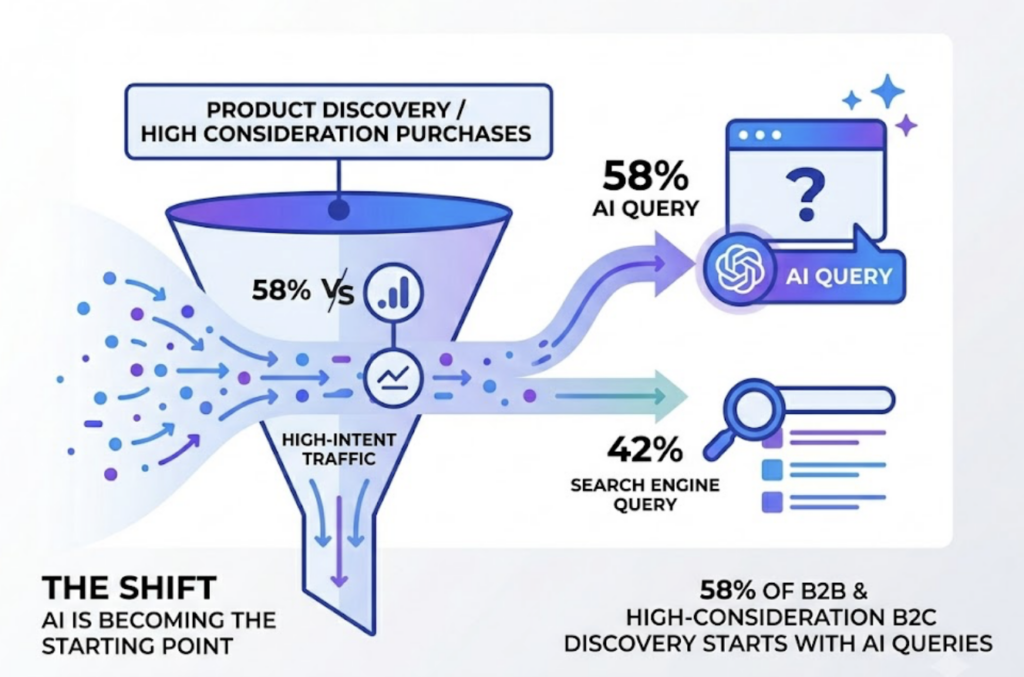
    AI search visits grew 42.8% year-over-year in Q1 2026, reaching 27 billion monthly visits across platforms like ChatGPT, Perplexity, and Google AI Mode. Your traditional ai rank checker has no visibility into any of it.

    Google Still Shows You a Number. That Number Is Missing Context.

    Google’s position data is accurate. It’s just incomplete.

    When someone opens Perplexity and types “best [tool category] for small teams,” they’re not triggering a Google crawl. They’re getting a synthesized answer that cites two or three brands directly. If yours isn’t one of them, no keyword rank in GSC will tell you.

    Zero-click rates on Google itself have reached 64.82%, while AI-native platforms run even higher. Perplexity’s zero-click rate sits at 93%. Google AI Mode reaches 88%. That means the vast majority of AI search interactions resolve without ever sending a referral to your site.

    Traditional rank tracking was built for a world where ranking meant clicking. That world is shrinking.

    What an AI Rank Checker Actually Measures

    The distinction matters: a traditional rank checker tells you where your page appears in a list. An AI rank checker tells you whether you appear in an answer at all, and what that answer says about you.

    AI search operates on a different logic. Platforms like ChatGPT and Perplexity don’t serve ranked blue links. They synthesize a response, cite a handful of sources, and present a narrative. Your “position” in that narrative is not a number from 1 to 10. It’s a set of signals that require a completely different monitoring framework.
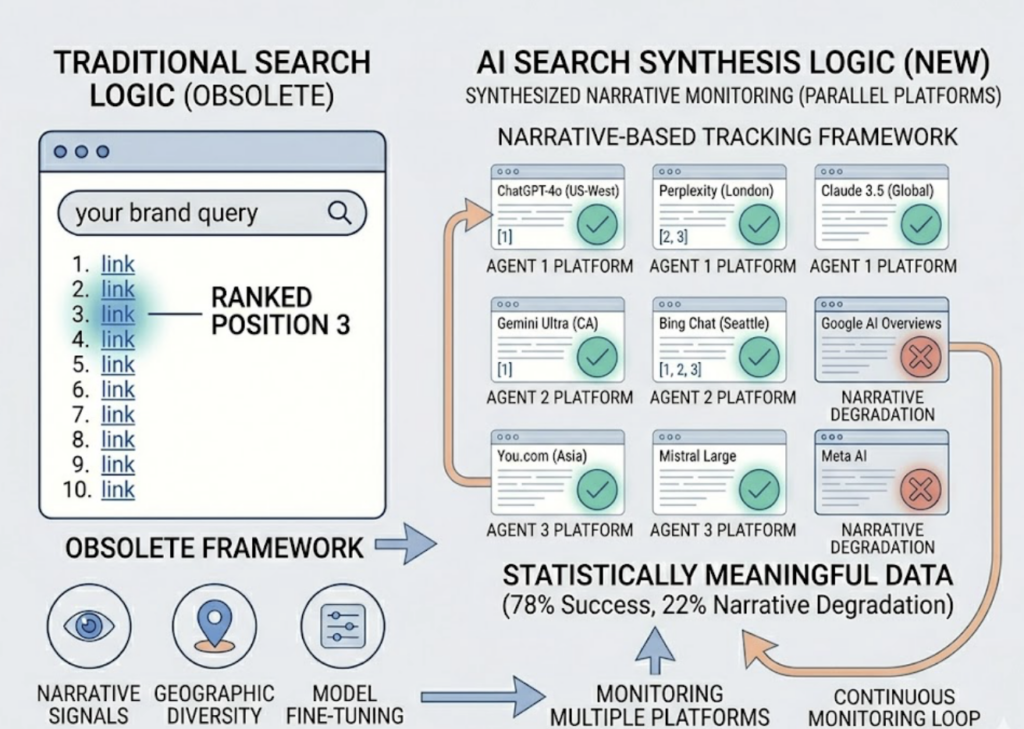
    Here’s the comparison most SEO teams don’t have in front of them yet:

    DimensionTraditional Rank TrackerAI Rank Checker
    What it tracksKeyword position in Google SERPBrand mention in AI-generated answers
    Primary metricRanking position (1–100)Mention rate, citation position, sentiment
    Platform coverageGoogle, BingChatGPT, Perplexity, Gemini, AI Overviews
    Click attributionDirect referral trafficInfluence without clicks (brand recall)
    Citation sourceBacklink profileWhich domains AI uses to describe your brand
    Update frequencyDaily/weekly crawlPer-prompt, per-platform monitoring

    The right question isn’t “what page rank am I on?” It’s “when someone asks an AI about my category, do I get mentioned, where do I appear, and what does the AI say about me?”

    Only 14% of Marketers Track AI Visibility. That’s the Gap.

    Most teams still run exclusively on GSC and a traditional rank tracker. Only 14% of marketers currently track AI-specific visibility, according to industry data from 2026. That leaves an enormous blind spot in the standard reporting stack.

    This isn’t a niche problem. Citation clusters in AI search concentrate on a narrow set of domains. BrightEdge and Ahrefs data suggest that roughly 40–55% of citations in ChatGPT Search and Perplexity flow to fewer than 1,000 domains total. If your brand isn’t establishing authority across those domains, AI platforms are systematically bypassing you, even when you rank on Google.

    That’s the visibility gap. Your Google dashboard can’t detect it.

    The Five Signals Your AI Rank Checker Should Be Monitoring

    When SEO teams add an AI-specific layer to their reporting stack, the metrics shift. Here’s what actually needs to be tracked:

    Brand Mention Rate is the percentage of high-intent prompts where your brand gets cited. It’s the AI-era equivalent of organic impressions, except it maps to buyer-stage questions, not keyword searches.

    Citation Position tells you where in the AI answer your brand appears. Top-of-answer placement, a mid-paragraph mention, and a footer source list carry very different authority signals.

    Sentiment Score captures the framing AI platforms use when they describe your brand. An AI that calls your product “affordable but limited” is giving buyers a specific message, whether you know about it or not.

    Citation Source Dominance identifies which external domains, review sites, or publications the AI cites as evidence when it mentions your brand. These are your high-leverage content placement targets.

    Answer-Engine CVR estimates the downstream impact of AI mentions on branded search volume and direct traffic, measuring the “influence without clicks” effect that traditional attribution misses entirely.

    None of these five metrics live in GSC or a standard rank tracker.

    How SEO Teams Are Building the Second Dashboard in Practice

    The practical workflow is simpler than most teams expect. You’re not replacing your existing SEO tooling. You’re adding a parallel tracking layer.

    The starting point is identifying 20–50 high-intent prompts that map to your buyers’ research journey: the questions they ask ChatGPT before they ever visit your site. These aren’t keywords. They’re full conversational queries like “what’s the best tool for X use case” or “how do Y teams handle Z problem.”

    Then you run those prompts across platforms weekly and track the five signals above. Within two to four weeks, patterns emerge: which platforms cite you most, which prompts trigger competitor mentions instead, which sentiment descriptors AI associates with your category.

    Topify was built for exactly this workflow. Its Comprehensive GEO Analytics monitors brand performance across ChatGPT, Gemini, Perplexity, and other major AI platforms via seven key metrics: visibility, sentiment, position, volume, mentions, intent, and CVR. In practice, that means you can run a weekly prompt sweep across platforms, spot a drop in Perplexity mentions, and trace it back to a specific citation source that stopped referencing your brand, all without switching between tools.

    The Dynamic Competitor Benchmarking feature runs the same prompt set against your competitors simultaneously, so you can see when a rival gains citation position in ChatGPT while your mention rate drops. That’s the kind of signal that traditional rank tracking simply cannot surface.

    Teams that get started with Topify typically begin with their existing keyword list, map those keywords to conversational prompt equivalents, and build a prompt library that mirrors the actual research behavior of their buyers.
    The Prompt-Based Strategy That Replaces Keyword Volume

    Here’s a shift that changes how teams allocate their optimization effort.

    Traditional SEO prioritizes tracking thousands of keywords by volume. Prompt-based benchmarking prioritizes tracking 20–50 buying journey prompts by citation outcome. The signal density is higher, the connection to pipeline is cleaner, and the data updates reflect real AI behavior rather than estimated crawl schedules.

    Industry forecasts suggest up to 30% of digital marketing budgets will shift toward AI-focused optimization by 2027. The teams building this infrastructure now, before it becomes standard practice, have a structural advantage. AI search citation patterns are not equally distributed. Being early to track them means being early to identify the content gaps, the authority deficits, and the sentiment issues that determine who gets mentioned when a buyer asks an AI for a recommendation.

    The second dashboard isn’t optional for competitive teams. It’s the missing layer in every reporting stack that only monitors one channel.

    Conclusion

    The Google dashboard tells you where you rank in one channel. The AI rank checker tells you whether you exist in the channel that’s growing at 42.8% year-over-year. Both answers matter, but only one of them is new information.

    If your SEO stack doesn’t have a layer tracking brand mentions, citation position, and sentiment across ChatGPT, Perplexity, and Gemini, you’re reporting on part of the picture. Topify’s seven-metric GEO analytics framework gives SEO teams exactly that layer, built to run alongside existing tooling rather than replace it. The teams adding this visibility now aren’t restarting their SEO programs. They’re extending them into the places their buyers already are.


    FAQ

    Q: What is an AI rank checker?

    A: An AI rank checker is a tool that monitors how your brand appears in AI-generated search answers across platforms like ChatGPT, Perplexity, and Google AI Overviews. Unlike traditional rank trackers that measure your position on a Google SERP, an AI rank checker measures whether your brand is mentioned in AI responses, where it appears in those responses, and what sentiment or framing the AI uses when citing your brand.

    Q: How is an AI rank checker different from a traditional rank tracker?

    A: A traditional rank tracker tells you your position for a keyword in Google’s search results. An AI rank checker tracks citation-based visibility: which AI platforms mention your brand, how often, in what position within the answer, and with what framing. The underlying measurement logic is different because AI search is probabilistic and generative, not deterministic and list-based.

    Q: Can I use my existing SEO tools to track AI search rankings?

    A: Standard SEO tools like Semrush and Ahrefs are built for Google’s SERP model and don’t natively monitor brand mentions inside ChatGPT, Perplexity, or Gemini answers. Some have added partial AI Overview tracking, but full-spectrum AI rank checking requires a purpose-built platform. The practical approach is to run both in parallel: your existing stack for Google, and a dedicated AI visibility tool for the rest.

    Q: Which AI platforms should my team be tracking?

    A: At minimum, ChatGPT, Perplexity, and Google AI Overviews, since these have the largest search-intent user bases. Teams with international audiences should also monitor Gemini, DeepSeek, and regional AI platforms depending on their market. The right coverage depends on where your buyers actually research, which you can often infer from referral traffic patterns and prompt-level testing.
    Read More

  • AI Rank Check: Results in Under 10 Minutes

    AI Rank Check: Results in Under 10 Minutes

    Your Google rankings are solid. Your Search Console data looks clean. But when a prospect asks ChatGPT, “What’s the best tool for [your category]?” you have no idea if your brand shows up, where it ranks, or how it’s described. That blind spot isn’t a minor gap. It’s the entire channel you’re not measuring.

    Running an ai rank check sounds technical, but the actual process takes less time than a weekly team standup. Here’s how to get your first real data point.

    Most Brands Search Themselves in ChatGPT. That’s Not an AI Rank Check.

    The most common first attempt goes like this: open ChatGPT, type your brand name, see what comes up. It feels like a check. It isn’t.

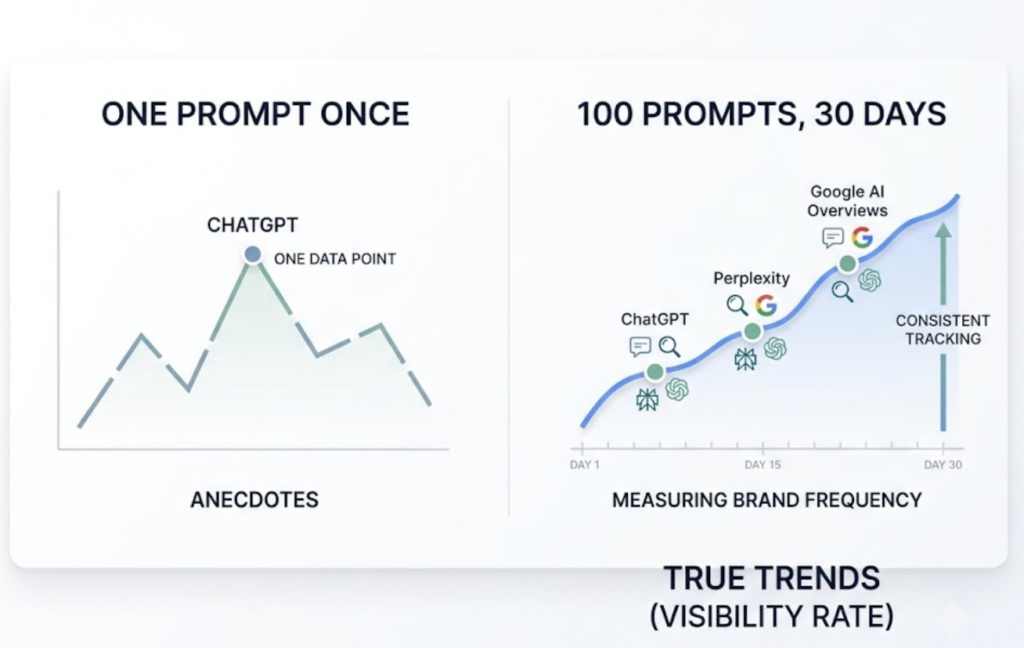
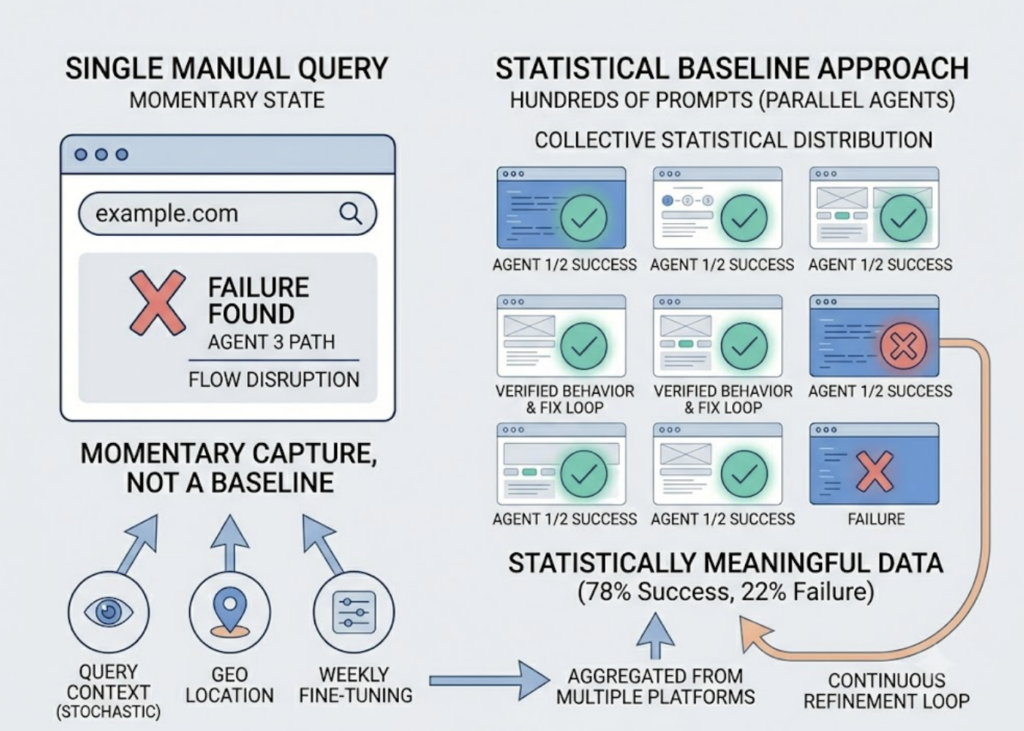
    AI models are stochastic. The same query returns different answers based on session context, geographic location, and whatever fine-tuning happened to the underlying model that week. A single manual query captures a momentary state, not a baseline. You’d need to run the same prompt hundreds of times across multiple platforms to get anything statistically meaningful.

    There’s also the prompt surface area problem. Your brand doesn’t just show up (or not) on branded queries. It appears, or fails to appear, across category discovery prompts (“best solutions for X”), comparison prompts (“A vs. B for task Y”), and problem-solving prompts (“how do I fix Z”). Manual vanity searching misses nearly all of it.

    A real ai rank check is systematic. It covers the full prompt set your buyers actually use, across all the platforms where they’re searching.

    What an AI Rank Check Actually Measures

    Traditional SEO rank tracking has one output: keyword position on a results page. AI rank tracking is multi-dimensional.

    The core metrics break down like this:

    Visibility Score measures how often your brand gets mentioned at all across a defined set of prompts. This is the baseline question: does AI know you exist in this context?

    Position tracks where your brand appears in the AI-generated answer. First mention in a paragraph carries different weight than a brief aside at the end of a list.

    Sentiment captures the qualitative frame AI uses when it does mention you. “Topify is a solid enterprise option” and “Topify is affordable for small teams” are both mentions but they signal very different things to the reader.

    Share-of-Citation shows your brand’s presence relative to competitors in the same prompts. If Perplexity mentions your three main competitors in 80% of category queries and your brand in 20%, that’s competitive intelligence worth acting on.

    CVR Proxy links your visibility to commercial intent. Being cited in high-intent “what should I buy” prompts matters more than appearing in informational queries where the reader isn’t close to a decision.

    None of these translate from Google Analytics or Ahrefs. You need purpose-built tooling.

    Step 1: Pick Your Prompts Before You Pick Your Tool

    Most teams jump straight to the platform and skip prompt selection. That’s the wrong order.

    The quality of your ai rank check depends almost entirely on which prompts you track. A weak prompt set gives you data that looks informative but doesn’t map to how your buyers actually search. Use this three-category framework to start:

    Category Discovery prompts surface brand awareness. These are the “what are the best [your category] tools?” queries your prospects run before they have a shortlist. Example: “What platforms help brands track their AI search visibility?”

    Comparison prompts reveal competitive standing. These are the “[Brand A] vs. [Brand B] for [specific use case]” queries that buyers run mid-funnel. Example: “Topify vs. [Competitor] for marketing agencies.”

    Problem-Solving prompts test your authority positioning. These are the “how do I [specific problem]” queries where being cited signals topical trust. Example: “How do I check if my brand appears in ChatGPT results?”

    For a meaningful first baseline, the industry standard is 100 to 250 prompts to account for model variance. You don’t need to start there. Start with 10 to 20 across these three categories, then expand.

    Step 2: Run Your First AI Rank Check with Topify

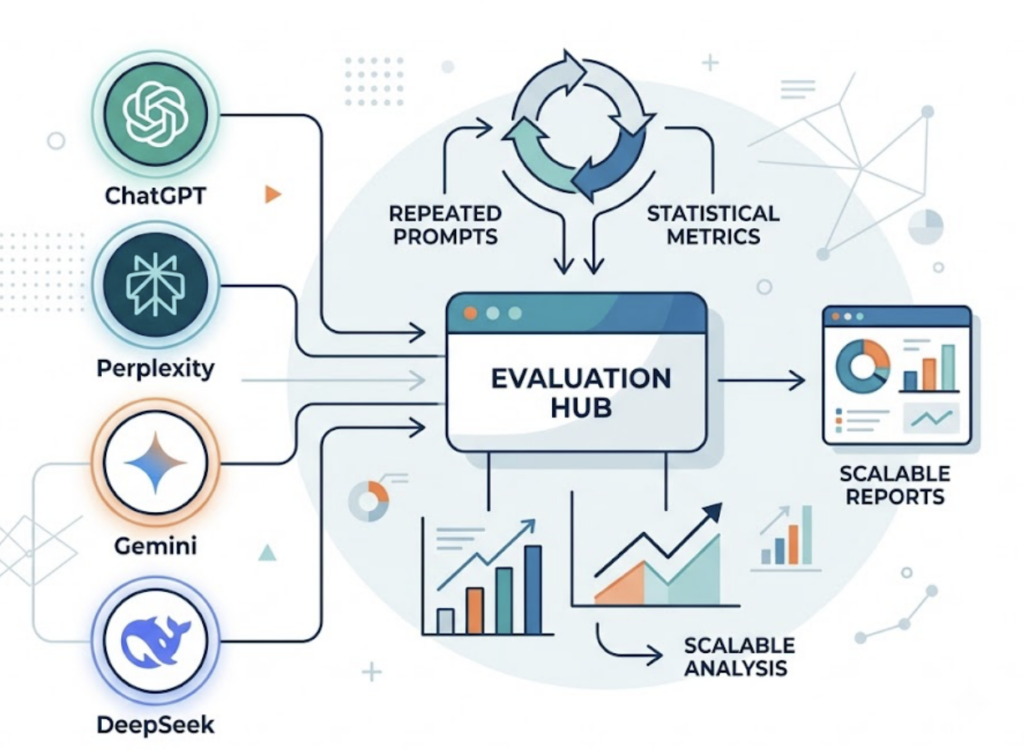
    With your prompt list ready, you need a platform that can run those prompts systematically across multiple AI engines and return structured data. Topify is built specifically for this.

    Here’s what the first session looks like, timed:

    Minutes 1-2: Create your project. Sign up and create a new brand project. Enter your brand name and primary domain. Topify uses this to recognize mentions and distinguish your brand from competitors in AI outputs.

    Minutes 2-4: Add your prompts. Paste in the 10-20 prompts from your Step 1 list. Topify’s Basic plan supports up to 100 prompts, which is enough for a thorough initial baseline. The system accepts free-form natural language, so there’s no formatting required.

    Minutes 4-5: Select your platforms. Choose which AI engines to monitor. Topify covers ChatGPT, Perplexity, and Google AI Overviews out of the box. For brands targeting global markets, Gemini and DeepSeek coverage extends the dataset further.

    Minutes 5-8: Run the check. Topify fires the prompts against each platform and collects the AI-generated answers. This happens in the background.

    Minutes 8-10: Review your dashboard. The dashboard surfaces your Visibility Score, Position data, Sentiment breakdown, and competitor co-mentions in a single view. Your first structured ai rank check is done.

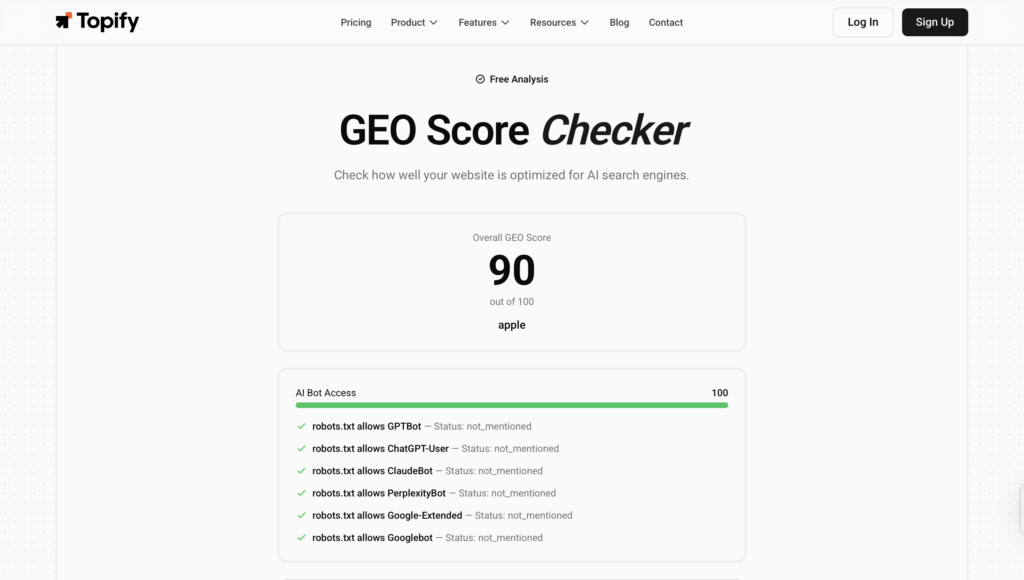
    Topify’s Basic plan starts at $99/month with a 30-day trial, which is enough to run a complete first audit and establish a tracking cadence. If you want to start before committing, the free GEO Score Checker gives you a technical readiness score for any URL, no account needed.

    Step 3: Read the Results Without Getting Lost

    First-time users typically land on the dashboard and feel pulled in five directions at once. There’s a simpler reading order.

    Start with Visibility. Before anything else, answer: is your brand being mentioned at all in the prompts you’re tracking? If visibility is below 30%, that’s the primary problem. Position and Sentiment don’t matter much if AI isn’t citing you to begin with.

    Move to Position once you’ve confirmed visibility. A brand mentioned 70% of the time but always third or fourth in a list has a different optimization problem than a brand mentioned 40% of the time but typically cited first.

    Then look at Sentiment. This is where the qualitative picture comes in. If AI platforms consistently frame your brand as a “budget option” and your positioning is enterprise, that’s a signal your external content, reviews, and third-party citations need work. The AI doesn’t form its own opinion. It synthesizes what it finds in its training and retrieval sources. That’s fixable.

    Finally, check Share-of-Citation against competitors. The comparison view shows who else gets mentioned in the same prompts. Brands that appear alongside you in every query are your real AI-search competitors, which sometimes differs from who you’d identify in a traditional SEO analysis.

    After your first read, prioritize three actions: note which prompt categories show the lowest visibility, identify which competitors consistently appear where you don’t, and flag any sentiment misalignments between how AI describes you and how you describe yourself.

    What Your First AI Rank Check Will Tell You (and What It Won’t)

    The first check gives you a baseline. It doesn’t give you a trend.

    You’ll know your current visibility rate across the prompts you selected, your rough position relative to competitors in those contexts, and where sentiment is on-message or off. That’s genuinely useful.

    What you can’t conclude yet: whether you’re improving or declining, how your visibility shifts as AI models get updated, or whether a content change you made last month is actually moving the needle. LLMs are updated and fine-tuned continuously by their providers. A check that was accurate in early June may not reflect the same model state in late June. That’s not a flaw in the methodology. It’s the nature of the channel.

    Continuous tracking, daily or weekly depending on your category’s competitive intensity, is what converts a snapshot into signal. The first check is the setup step. The repeating cadence is the actual strategy.

    This is also why the initial prompt set matters so much. If your first 20 prompts are well-chosen, they become the foundation for a tracking framework that compounds in value over months.

    Conclusion

    Running your first ai rank check isn’t complicated. The barrier is usually knowing what the right methodology looks like, not access to the technology.

    Manual queries in ChatGPT give you anecdote. Systematic prompt tracking across platforms gives you data. The gap between the two is where most brands are leaving strategic insight on the table.

    Start with 10 to 20 prompts across the three categories above. Run them through Topify and spend 10 minutes on your first dashboard read. You’ll have a clearer picture of your AI search standing than 90% of the brands in your category, most of whom still think a quick ChatGPT search counts.


    FAQ

    Q: What’s the difference between an AI rank checker and a traditional SEO rank checker?

    A: A traditional rank checker measures where a URL appears in a list of search results for a specific keyword. An AI rank checker measures whether a brand gets mentioned in an AI-generated answer, where it appears within that answer, and how it’s described relative to competitors. The underlying mechanics are completely different: SEO rank is about page indexing, AI rank is about how consistently an AI associates your brand with relevant topics across its training and retrieval sources.

    Q: How often should I run an AI rank check?

    A: Weekly is a practical starting cadence for most teams. AI models are updated frequently, which means visibility can shift without any action on your part. Daily monitoring is worth considering if you’re in a high-velocity category with active competitors. The goal isn’t to react to every fluctuation. It’s to detect meaningful drift before it compounds.

    Q: Can I check my AI rank for free?

    A: Topify’s free GEO Score Checker gives you a technical readiness scan for any URL, no signup required. It covers AI bot access, structured data, content signals, and citation visibility. For brand-level prompt tracking across platforms, the Basic plan ($99/month) includes a 30-day trial. For teams that want to go deeper on technical setup before paying anything, the free-tools.md reference on GitHub is a community-maintained collection of scripts for crawlability checks and schema validation.

    Q: Does Topify support checking AI rank across multiple platforms at once?

    A: Yes. Topify tracks brand visibility simultaneously across ChatGPT, Perplexity, Google AI Overviews, and additional platforms depending on your plan. The dashboard surfaces results per platform and in aggregate, so you can see both your overall visibility score and how it breaks down by AI engine. This cross-platform view is where the most useful competitive intelligence comes from, since brand visibility varies significantly across different AI systems.


    Read More

  • AI Rank Checkers Miss the Real Problem

    AI Rank Checkers Miss the Real Problem

    You searched for your brand on ChatGPT. It appeared somewhere in the third paragraph, after two competitors. Your rank checker logged that as a “position 3” result. You moved on.

    But two weeks later, a prospect told you they’d asked Perplexity which tool to use in your category, and your brand wasn’t mentioned at all. Same product. Different AI platform. Different day. Completely different outcome.

    That’s not a ranking problem. It’s a visibility gap, and most AI rank checkers aren’t built to find it.

    What AI Rank Checkers Actually Measure

    Most tools marketed as AI rank checkers do one thing: they run a query, check whether your brand appears in the response, and log the position. Position 1 means you were mentioned first. Position 3 means two other brands came before you. Clean, simple, familiar.

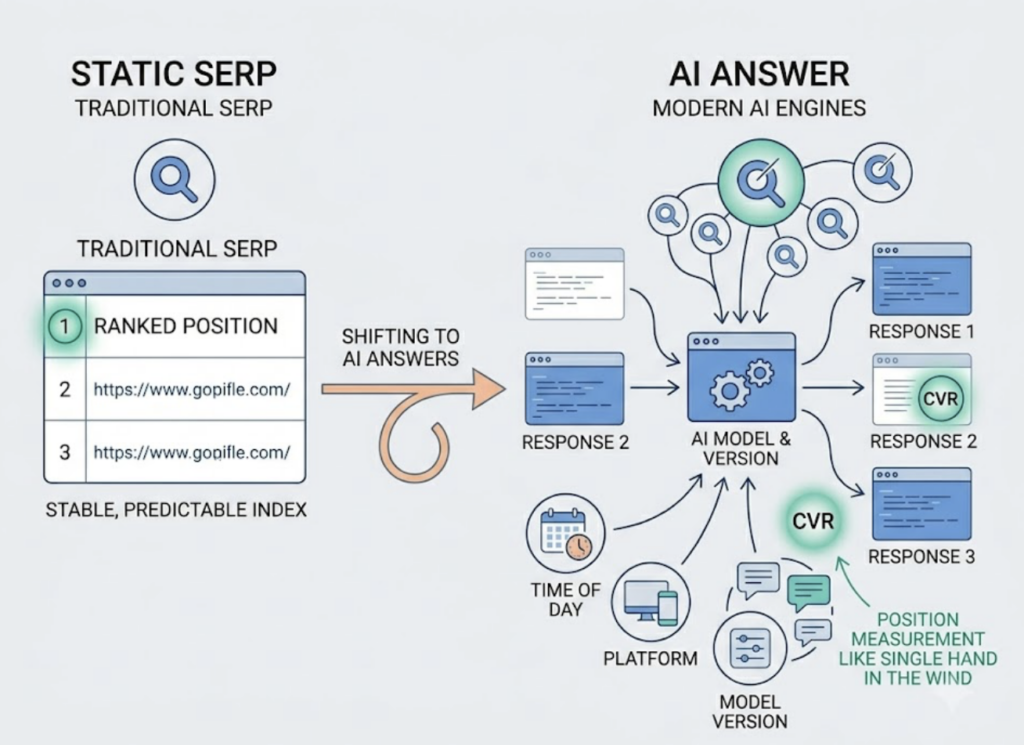
    The problem is that AI engines don’t work like traditional SERPs. There’s no fixed index, no stable crawl, no consistent ordering. Every query generates a new response, and that response shifts based on phrasing, model version, time of day, and the platform being used. Logging a “position” on a single query is like measuring wind speed by holding your hand out the window once.

    Rank data tells you where you showed up. It doesn’t tell you when you didn’t. It doesn’t tell you why. And in AI search, the “why” is everything.

    The Visibility Gap Most Brands Never See

    Here’s the structural issue with position-only tracking: it only captures moments when your brand appears. The queries where you’re completely absent never show up in the report. Your dashboard looks cleaner than your actual AI search presence.

    According to research on AI Overviews citation behavior, only about 12% of AI Overviews link to the top-ranked organic result, breaking the assumption that strong SEO translates to AI visibility. A brand can hold the #1 position in Google while being entirely absent from AI-generated answers for the same keyword.

    That absence is the visibility gap. And rank checkers, by definition, can’t measure what’s not there.

    Why “Not Mentioned” Is Harder to Fix Than Low-Ranked

    Low position is a ranking problem. You can fix it with content optimization, more authoritative citations, better structured data. The playbook exists.

    Not mentioned at all is a different category of problem entirely.

    When AI platforms skip your brand, it’s typically because you haven’t established what researchers call a “trust cascade”: consistent mentions across multiple authoritative third-party domains like industry review sites, G2, Reddit threads, and niche publications. AI models prioritize brands with cross-web consensus. If that consensus doesn’t exist for your brand, the model simply defaults to competitors who have it.

    That’s not a positioning fix. That’s a structural authority gap.

    To close it, you need to know which sources AI platforms are citing, which prompts are triggering competitor recommendations, and what sentiment the model attaches to your brand when it does appear. None of that information comes from a rank checker.

    What Brand Visibility Tools Track That AI Rank Checkers Don’t

    The table below shows where the capability gap actually sits:

    CapabilityAI Rank CheckerBrand Visibility Tool
    Detects brand mentionsYesYes
    Records position in responseYesYes
    Tracks non-mention (absence)NoYes
    Measures AI sentiment toward brandNoYes
    Identifies which sources AI is citingNoYes
    Monitors competitor visibilityLimitedYes
    Surfaces high-value prompts you’re missingNoYes
    Tracks cross-platform variance (ChatGPT vs. Perplexity vs. Gemini)RarelyYes
    Estimates conversion likelihood from AI mentionsNoYes

    The right column isn’t a wishlist. It’s the minimum data set needed to understand your brand’s position in AI search, and to take action on it.

    One critical dimension that often gets overlooked: AI sentiment is a conversion factor. Being described as “a cautious choice” or “better suited for smaller teams” in an AI response can actively push prospects toward competitors, even when your brand appears frequently. Rank data doesn’t capture this at all.

    How Topify Closes the Gap

    Topify is built around the insight that AI search visibility requires more than a position number. Its Comprehensive GEO Analytics tracks seven metrics across each brand: visibility, sentiment, position, volume, mentions, intent, and CVR (Conversion Visibility Rate). Together, these create a complete picture of how AI platforms treat your brand, not just whether you show up.

    A few specific capabilities stand out:

    Source Analysis reverses-engineers the domains and URLs that AI platforms actually cite when describing your category. You can see whether your brand’s content is in that citation pool, and which competitors have dominated it. This is how you find the structural gaps that a rank check will never surface.

    High-Value Prompt Discovery continuously surfaces the queries that are driving AI recommendations in your space. If a new prompt type is sending users toward a competitor, you’ll see it in Topify’s data before it shows up in your traffic drop.

    Cross-Model Variance Detection tracks how your brand appears differently across ChatGPT, Perplexity, Gemini, DeepSeek, and other platforms. A brand might be well-positioned on Perplexity but entirely absent on ChatGPT, requiring distinct content strategies for each platform.

    Competitor Monitoring shows you exactly how rivals are positioned across all of these dimensions, not just where they ranked on a given query.

    Topify’s plans start at $99/month for 100 prompts and 9,000 AI answer analyses across ChatGPT, Perplexity, and Google AI Overviews, scaling to Pro at $199/month for teams tracking 250 prompts across 8 projects.

    Four Steps to Diagnose Your Brand’s AI Visibility

    If you’re not sure whether you have a ranking problem or a visibility gap, here’s a practical starting point:

    Step 1: Run a presence audit. Pick 10-15 prompts your target audience would realistically ask across ChatGPT, Perplexity, and Gemini. Note not just where your brand appears, but how often it’s missing entirely. If absence is common, you’re dealing with a visibility gap, not a ranking issue.

    Step 2: Check the sentiment when you do appear. Does AI describe your brand as a leader, an alternative, or a fallback option? Neutral or cautious language is a signal worth investigating, even if your position looks fine.

    Step 3: Identify who AI is citing in your category. Look at which third-party domains consistently appear alongside competitor mentions. These are the sources AI treats as authoritative. If your brand isn’t present in those domains, that’s where to focus.

    Step 4: Set up continuous monitoring. AI citation patterns shift faster than traditional SERP rankings. A one-time audit is useful. Ongoing tracking is what makes it actionable. Get started with Topify to monitor your brand’s AI visibility across platforms at the prompt level.

    Conclusion

    Rank checkers made sense when search was a list. AI search isn’t a list. It’s a synthesized recommendation that can include your brand, exclude it, or misrepresent it, and the only way to know which is happening is to measure all three.

    The brands that are winning in AI search right now aren’t just checking their position. They’re tracking their presence, understanding their sentiment, auditing their citation sources, and monitoring competitor trajectories across multiple platforms. That’s what brand visibility tools are built to do. And it’s why a rank check, on its own, will keep showing you a number that doesn’t explain what’s actually happening.


    FAQ

    Q: What’s the difference between an AI rank checker and a brand visibility tool?

    A: An AI rank checker records where your brand appears in AI-generated responses, typically as a position number. A brand visibility tool tracks a broader set of signals: whether your brand appears at all across multiple platforms and prompts, what sentiment the AI attaches to your brand, which sources AI is citing in your category, and how your visibility compares to competitors over time.

    Q: Can I use a traditional rank checker to track AI search performance?

    A: Traditional rank checkers are built for SERP position data. They can be adapted to record whether a brand appears in AI responses, but they’re not designed to capture absence (queries where you’re not mentioned), sentiment, source citations, or cross-platform variance. For AI search specifically, you need tools built around the way generative engines actually work.

    Q: How do I know if my brand is being mentioned in ChatGPT or Perplexity?

    A: The most reliable method is systematic prompt testing across multiple platforms. Define the prompts your audience would realistically use, run them consistently, and record both mentions and absences. Manually, this is time-intensive. Platforms like Topify automate this at scale, running hundreds of prompts across multiple AI engines and tracking results over time.

    Q: Is Topify an AI rank checker?

    A: Not exactly. Topify tracks position as one of seven metrics, but it’s built as a full AI search visibility platform. The difference is that Topify also tracks sentiment, source citations, competitor benchmarking, prompt-level data, and estimated conversion visibility, giving you the context needed to understand why your AI search performance looks the way it does, not just where you currently rank.

    Read More

  • Your SEO Rank Tracker Can’t See AI. Here’s What Can.

    Your SEO Rank Tracker Can’t See AI. Here’s What Can.

    Your domain authority is solid. Your keyword rankings are holding. But none of that tells you whether Perplexity is recommending your competitor instead of you when someone asks, “What’s the best tool in your category?”

    That’s not a hypothetical. It’s what’s happening right now for most brands that haven’t thought about AI search as a separate channel. Traditional SEO dashboards can’t see it, which means you can’t fix what you don’t know is broken.


    Your Rank Tracker Is Looking at the Wrong Channel

    Traditional rank trackers were built for a specific job: monitor where your URLs land on a Google or Bing results page. They do that job well.

    The problem is that AI engines don’t return a results page. ChatGPT, Perplexity, and Gemini generate natural language answers. There’s no position 1 through 10, no list of blue links, no URL placement to crawl. The brand that gets recommended is the one the model decides is most credible, relevant, and well-sourced for that specific query.

    So when your rank tracker reports “no data,” it’s not a bug. It’s a category mismatch. The tool was never designed to look at a channel that operates on completely different logic.


    What AI Engines Actually Do When Someone Searches

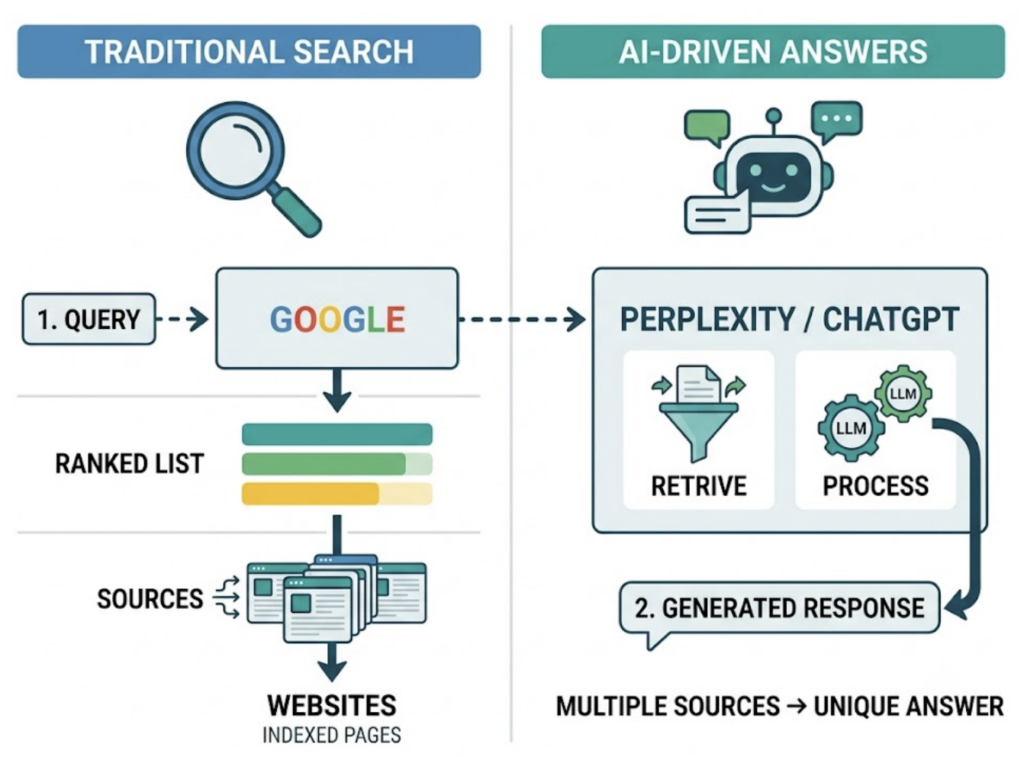
    Traditional search is a retrieval system. AI search is a synthesis system.

    When a user types a query into Google, the engine matches keywords to indexed pages and returns a ranked list. When the same user asks Perplexity or ChatGPT the same question, the model retrieves information from multiple sources, processes it through a large language model, and generates a new, unique response. Empirical research confirms that traditional search engines and AI-driven engines exhibit low source similarity. A website can rank #1 on Google for a query while having zero presence in an AI-generated answer for the exact same query.

    That divergence is the blind spot most marketing dashboards don’t capture.

    The implication is direct: the metrics that made a brand successful on Google don’t automatically carry over. Backlink authority, crawlability, and keyword density tell AI models very little about whether to recommend you.


    The Metrics Your SEO Dashboard Doesn’t Have

    Here’s a side-by-side look at what traditional SEO tools track versus what AI search actually requires:

    DimensionTraditional SEO MetricsAI / GEO Metrics
    Primary GoalTraffic to URL (click-through)Brand visibility in synthesized answers
    Success IndicatorKeyword position (1-10)Share of citation across AI platforms
    Source LogicBacklink authority (Domain Authority)Definitional anchoring, third-party corroboration
    Data SourceCrawl-based updatesAPI/query-based generation
    SentimentNot trackedHow the brand is described, not just whether it appears

    The gap isn’t just technical. It’s conceptual. An AI rank checker needs to answer questions that traditional tools have never needed to ask: Does the model mention us at all? When it does, where do we appear relative to competitors? And what exactly is it saying about us?

    Those are the three dimensions that matter in AI search: Presence, Position, and Perspective.


    How an AI Rank Checker Actually Works

    An AI rank checker doesn’t crawl a search results page. It simulates what users do.

    The system sends a set of representative queries, across multiple AI platforms, and then parses the natural language responses. It extracts which brands appear, in what order, and with what framing. Run that process at scale, across hundreds of prompts and multiple AI engines, and you get a visibility baseline that traditional SEO tools can’t replicate.

    As of mid-2025, weekly active users for AI search tools reached over 800 million, and AI Overviews now appear in more than 50% of representative user queries, often bypassing traditional organic links entirely. At that scale, a channel without measurement is a channel without strategy.

    The operational principle is systematic prompting: you define the queries your audience is likely to ask, and the tool tells you what AI says in response. Not what Google ranks. What AI actually recommends.


    What Topify Tracks That Semrush Can’t

    Topify is built specifically for this layer. Where traditional SEO platforms stop at URL placement, Topify tracks seven metrics across AI platforms including ChatGPT, Gemini, Perplexity, DeepSeek, and others:

    Visibility tracks how often your brand appears in AI-generated responses across a defined prompt set. Position tracks where you appear relative to competitors when the model lists multiple options. Sentiment analyzes how the model describes your brand, not just whether it mentions you.

    Volume surfaces which AI search queries have the highest activity in your category. Mentions counts raw brand appearances across platforms. Intent maps which query types are driving your visibility. And CVR (Conversion Visibility Rate) estimates how likely an AI answer is to drive the user toward your brand.

    Source Analysis is the feature that often surprises teams the most. It identifies which third-party domains (industry blogs, review platforms, community forums) AI engines are pulling from when they construct answers in your category. If your competitor’s G2 profile is being cited and your own isn’t, that’s where your GEO strategy needs to focus. No traditional SEO tool surfaces that.

    Topify’s Basic plan covers 100 prompts with 9,000 AI answer analyses per month. The Pro plan scales to 250 prompts and 22,500 analyses. You can get started at app.topify.ai.


    Three Signs You Already Need an AI Rank Checker

    Your SEO traffic is stable but pipeline quality has shifted. Traditional rankings look fine, but fewer leads are arriving with strong purchase intent. AI search is increasingly handling the middle of the funnel: consumers use LLMs to synthesize reviews, compare products, and perform brand discovery before clicking a single link. If AI isn’t mentioning you in that phase, you’re losing deals before they start.

    A competitor you’ve outranked on Google is gaining share in your category. They might not have better backlinks or higher DA. They might have better AI visibility. If you can’t check, you can’t know.

    You can’t answer the question your leadership team is starting to ask. “What’s our presence in ChatGPT?” is becoming a standard executive ask. If the honest answer is “we don’t have data on that,” the gap between what you measure and what matters is already visible to the people who fund your team.


    Conclusion

    An AI rank checker isn’t a replacement for your SEO stack. It’s the layer your SEO stack was never built to cover.

    Traditional tools track Google visibility. GEO tools track AI visibility. Both channels are real, both are growing, and they operate on completely different logic. The brands that figure that out now, while most of their competitors are still looking at keyword positions, are the ones that will be embedded in AI recommendations when their category reaches full maturity.

    Topify tracks the metrics that matter in AI search, across every major platform, at the prompt level. If you don’t know what AI is saying about your brand right now, that’s the place to start.


    FAQ

    Q: What is an AI rank checker? 

    A: An AI rank checker is a tool that tracks how and whether your brand appears in AI-generated answers from platforms like ChatGPT, Perplexity, and Gemini. Unlike traditional rank trackers that monitor URL positions in Google search results, an AI rank checker measures brand mentions, position relative to competitors, and sentiment within synthesized AI responses.

    Q: Can Semrush or Ahrefs track AI search visibility? 

    A: No. Tools like Semrush and Ahrefs are built to monitor URL placement in traditional search engine results pages. They can’t parse natural language AI responses or measure whether your brand appears in ChatGPT or Perplexity answers, because AI engines don’t return a ranked list of URLs. You need a separate tool designed specifically for AI visibility tracking.

    Q: How do I check if my brand appears in AI search answers? 

    A: The most systematic approach is to use an AI visibility platform that sends representative queries to multiple AI engines and analyzes the responses for brand mentions, position, and framing. Manual spot-checks (typing queries directly into ChatGPT or Perplexity) can give you a rough sense, but they don’t scale across enough prompts or platforms to be reliable for strategy decisions.

    Q: What’s the difference between SEO ranking and AI visibility? 

    A: SEO ranking refers to your URL’s position in a Google or Bing results page, determined by factors like backlink authority, keyword matching, and technical performance. AI visibility refers to whether your brand gets mentioned in AI-generated answers, where it appears relative to competitors, and how it’s described. The two metrics correlate poorly: high SEO rankings don’t guarantee AI visibility, and brands with strong AI presence sometimes have modest traditional rankings.


    Read More

  • Track Your Brand in Google AI Overviews: Step by Step

    Track Your Brand in Google AI Overviews: Step by Step

    You ran your weekly SEO report. Rankings look solid. Then someone on your team manually searches one of your top keywords on Google and spots an AI Overview at the top, listing three competitors but not your brand. Organic CTR for that query has dropped 61% since AI Overviews rolled out. Your position 1 ranking is still there. It just doesn’t matter the way it used to.

    That’s the gap an AI overview tracker is designed to close.

    Step 1: Understand What an AI Overview Tracker Actually Measures

    Traditional rank trackers tell you where you appear in the blue links. An AI overview tracker answers a different set of questions: Does your brand appear in the AI-generated summary? Which URLs does Google cite? How does the AI describe your brand relative to competitors?

    These are distinct metrics from anything in your current SEO stack.

    Google AI Overviews now appear on 48% of all search queries, up 58% year-over-year. In B2B tech verticals, that trigger rate climbs to 82%. Healthcare hits 88%. For most brands, the majority of high-intent informational queries now have an AI Overview sitting above the organic results, absorbing attention before a user ever reaches the blue links.

    The core metrics you need to track are: Visibility Rate (how often your brand appears across a defined set of prompts), Citation Integrity (which specific URLs Google’s AI selects as authoritative), Sentiment Framing (whether the AI positions your brand as a leader, a budget option, or an afterthought), and Competitive Co-occurrence (which competitors appear alongside you in AI responses).

    None of these show up in Google Search Console.

    Step 2: Build Your Prompt Tracking List Before You Do Anything Else

    Most teams make the same mistake: they try to monitor hundreds of keywords with the same logic they use for traditional rank tracking. AI Overviews don’t work that way. They’re context-dependent, query-sensitive, and frequently updated.

    What you need instead is a curated prompt set: 50–100 high-intent queries grouped into three categories. Brand prompts cover how customers search for you specifically. Category prompts map to the problems your product solves (“best software for X,” “how to choose Y”). Competitive prompts capture comparison queries where buyers are evaluating alternatives.

    Long-tail, informational, and question-based queries trigger AI Overviews 46% of the time, significantly higher than transactional queries. That means your prompt list should skew toward the “how to,” “what is,” and “best option for” framing your buyers actually use.

    Start with 50 prompts. Prioritize queries where you know buyers are making decisions, not just researching. That’s where citation presence has direct revenue impact.

    Step 3: Run Your First Visibility Check (And Learn Why Manual Won’t Scale)

    Once you have a prompt list, the first instinct is to start manually searching. Open Chrome, type your queries, screenshot the AI Overviews that appear. It works for a one-time audit. It fails as a monitoring system.

    Organic CTR for queries with AI Overviews dropped from 1.76% to 0.61%, a 61% decline tracked across 25.1 million impressions. But that aggregate hides the split that matters: brands cited in AI Overviews earn 35% more organic clicks. Brands not cited lose those clicks to competitors who are.

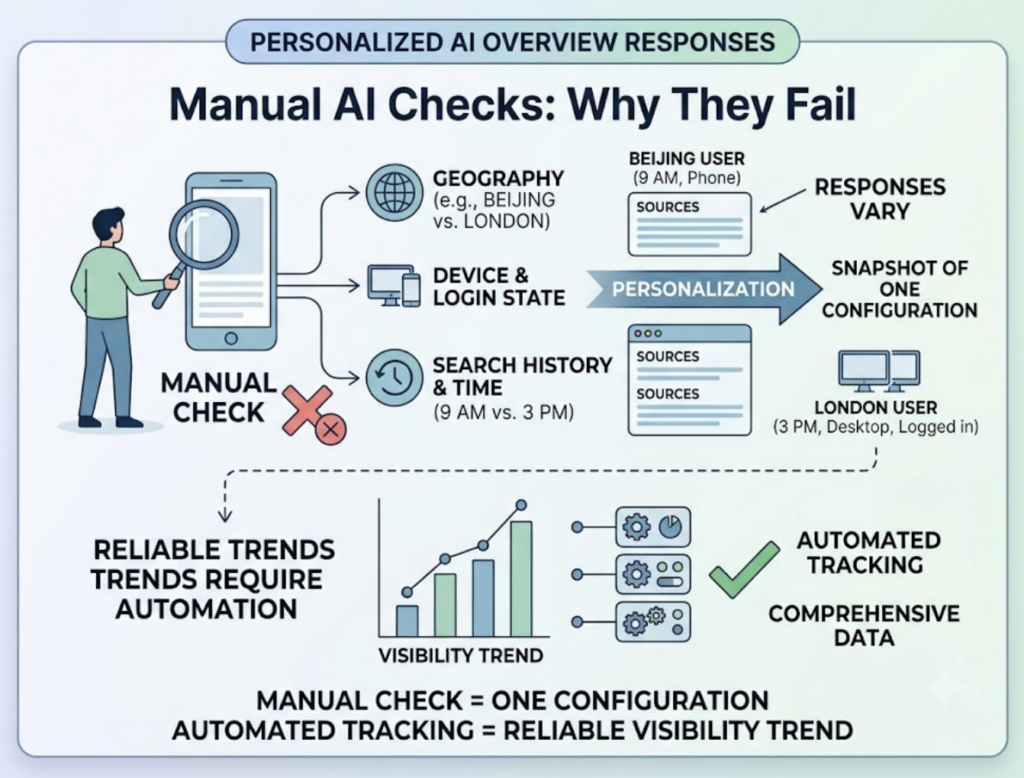
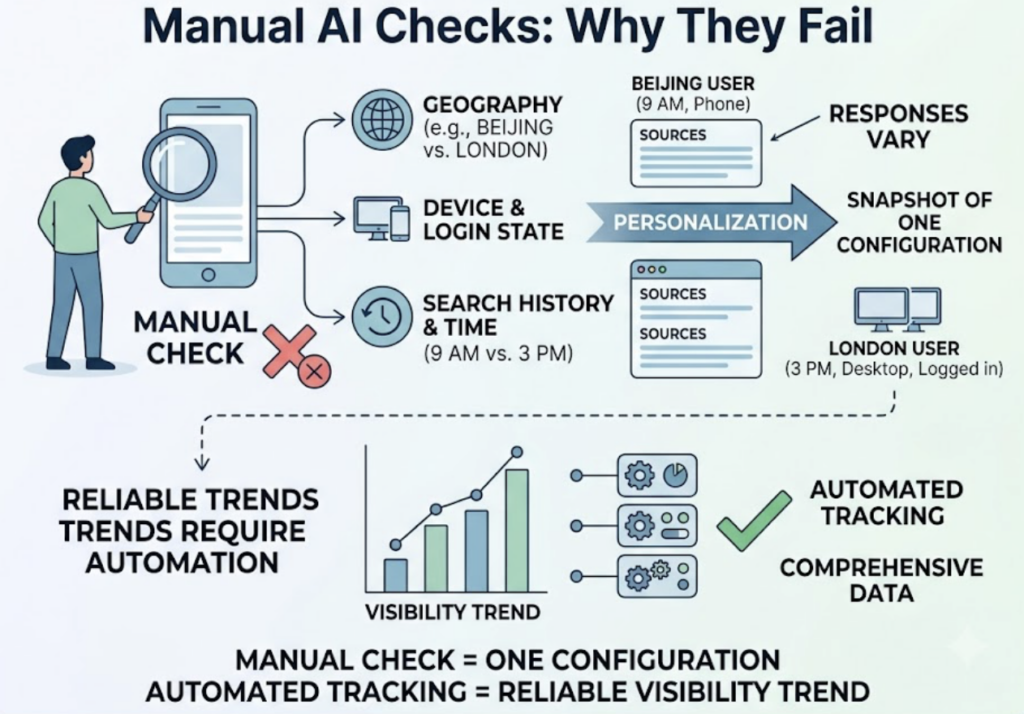
    The problem with manual checking is that AI Overview responses are personalized. They vary by geography, device, login state, and recent search history. A result you see in Beijing looks different from what your buyer in London sees. A single query at 9 AM may show different sources than the same query at 3 PM. Manual checks give you a snapshot of one configuration, not a reliable visibility trend.

    For your initial audit, manual search is fine to orient yourself. To track changes over time, you need automation.

    Step 4: Use an AI Overview Tracker to Automate Monitoring at Scale

    This is where the actual tracking infrastructure goes. An automated AI overview tracker runs your entire prompt set on a defined schedule, logs what the AI Overview says for each query, records which URLs are cited, and scores the sentiment of how your brand is described.

    Topify is built specifically for this use case. Across its Comprehensive GEO Analytics dashboard, it tracks brand performance within AI Overviews and across other major AI platforms simultaneously, measuring seven metrics per prompt: visibility, sentiment, position, volume, mentions, intent, and CVR (Conversion Visibility Rate).

    In practice, this means you can see which of your 50 tracked prompts are generating AI Overview citations, which URLs Google is pulling from your domain, and whether the AI’s framing of your brand has shifted after a content update.

    The Basic Plan at $99/month supports 100 tracked prompts and 9,000 AI answer analyses per month. That’s enough data volume to establish statistically meaningful visibility trends across a full prompt set, not just a handful of spot checks.

    Two features matter most for AI Overview tracking specifically. Source Analysis maps which exact URLs Google’s AI cites as authoritative, so you can see whether your homepage, a blog post, or a third-party mention is driving citations. Sentiment Analysis scores each AI response on a 0-100 scale, flagging whether the AI’s description of your brand is consistent with your positioning or quietly undermining it.

    That last point is easy to overlook. Plenty of brands are cited in AI Overviews but described in ways they’d never approve. Tracking that you appear isn’t enough. Tracking how you appear is the part most teams miss.

    Step 5: Benchmark Against Competitors Already in AI Overviews

    Your visibility data in isolation doesn’t tell you much. A 40% visibility rate sounds solid until you discover your main competitor is at 70%.

    Competitive benchmarking in AI Overviews surfaces things that traditional SERPs don’t show: which brands the AI treats as the default recommendation in your category, which competitors are being co-cited with your brand (which implies the AI groups you together), and which rivals are earning citations you’re missing entirely.

    The analysis workflow is straightforward. For any prompt where a competitor is cited and you’re not, pull the URL Google is referencing. Is it a long-form FAQ? A comparison page? A structured data-rich listicle? The cited content reveals what Google’s AI considers authoritative for that query type.

    Topify’s Competitor Monitoring feature automates this comparison. It tracks your position relative to competitors across your full prompt set, flags when a new competitor starts appearing in your tracked queries, and shows the exact citation gap you need to close.

    This kind of analysis used to require hours of manual SERP scraping. Running it at scale across 100 prompts, weekly, is what separates brands that react to AI visibility changes from those that catch them early.

    Step 6: Turn AI Overview Data into Specific Content Actions

    Data without a decision isn’t useful. The output of your AI overview tracking should feed directly into your content calendar.

    Three optimization actions consistently move the needle. First, Citation URL reinforcement: when a specific URL is already earning AI Overview citations, double down on it. Expand its depth, update its schema markup, and ensure it’s internally linked prominently. The AI is already treating it as authoritative. Help it become more so.

    Second, Gap filling: for prompts where competitors are cited and you’re not, create content that directly answers that query using an answer-first format. Position 1 organic CTR has fallen from 39.8% in 2022 to 27.6% in 2026. Traditional ranking alone isn’t enough. The content winning AI Overview citations tends to be structured around the exact question, not optimized for a keyword.

    Third, Entity correction: if your Source Analysis shows the AI is pulling your brand description from a third-party review site rather than your own domain, that’s a signal your brand entity needs strengthening. Consistent schema, a well-structured “About” page, and accurate information across all directories are the inputs LLMs use to construct their understanding of who you are.

    Topify’s one-click execution connects the analysis to the action. You can state your optimization goal in plain English, review the proposed strategy, and deploy it without manual workflows. For teams managing multiple clients or brands, this is the difference between AI Overview tracking being a quarterly report and a live feedback loop.

    Conclusion

    Gartner projects that 25% of organic search traffic will shift to AI chatbots and voice assistants by the end of 2026. That shift is already showing up in Search Console data for teams that know where to look. The brands adapting fastest aren’t the ones with the highest domain authority. They’re the ones who built an ai overview tracker workflow before the traffic loss became undeniable.

    Six steps: define what you’re measuring, build a targeted prompt list, run an initial audit, automate monitoring, benchmark competitors, and turn the data into content actions. The process is repeatable. The compounding effect on citation presence is real.

    Start with 50 prompts. Measure where you stand today. Everything after that is optimization.


    FAQ

    Q: What is an AI overview tracker? 

    A: An AI overview tracker is a tool that automatically monitors whether and how your brand appears within Google’s AI-generated summaries (AI Overviews) across a defined set of search queries. It tracks visibility rate, cited URLs, sentiment framing, and competitor co-occurrence over time, giving you data that traditional rank trackers don’t capture.

    Q: How often should I check my brand’s AI Overview appearance? 

    A: Weekly monitoring is the minimum for active optimization. AI Overview results can shift within days of a content update or algorithm change, so a monthly cadence misses meaningful fluctuations. Automated tools like Topify run these checks continuously, surfacing changes without manual effort.

    Q: Can I track competitors in Google AI Overviews? 

    A: Yes. Competitive benchmarking is one of the highest-value applications of AI overview tracking. By running the same prompt set against competitor visibility data, you can identify which queries they’re winning citations for, which URLs Google treats as authoritative in your category, and where your content has a clear gap to close.

    Q: Does appearing in AI Overviews affect my website traffic? 

    A: The data is clear on this. Brands cited in AI Overviews earn 35% more organic clicks than uncited brands. Meanwhile, organic CTR for non-cited results on AI Overview queries dropped 61% compared to pre-AIO baselines. Citation status is now one of the strongest predictors of whether a query drives traffic to your site.


    Read More

  • 5 Things an AI Overview Tracker Should Tell You

    5 Things an AI Overview Tracker Should Tell You

    You’ve got solid rankings. Your domain authority is respectable. But when you search your own category on Google, an AI Overview appears at the top, summarizing the “best options” in your space, and your brand isn’t in it. Your current SEO tools show nothing unusual. That’s the gap.

    AI Overviews now trigger on roughly 48% of queries globally, climbing to 88% in healthcare and 82% in B2B tech. For those categories, AI-generated summaries aren’t a side feature. They’re the first thing users see. And traditional rank trackers don’t measure what happens inside them.

    The question isn’t whether you need an AI overview tracker. It’s whether the one you’re looking at actually tells you what matters.

    Your Rankings Don’t Predict Whether You’re Cited

    Before getting into what a tracker should show, it’s worth understanding why existing tools miss this entirely.

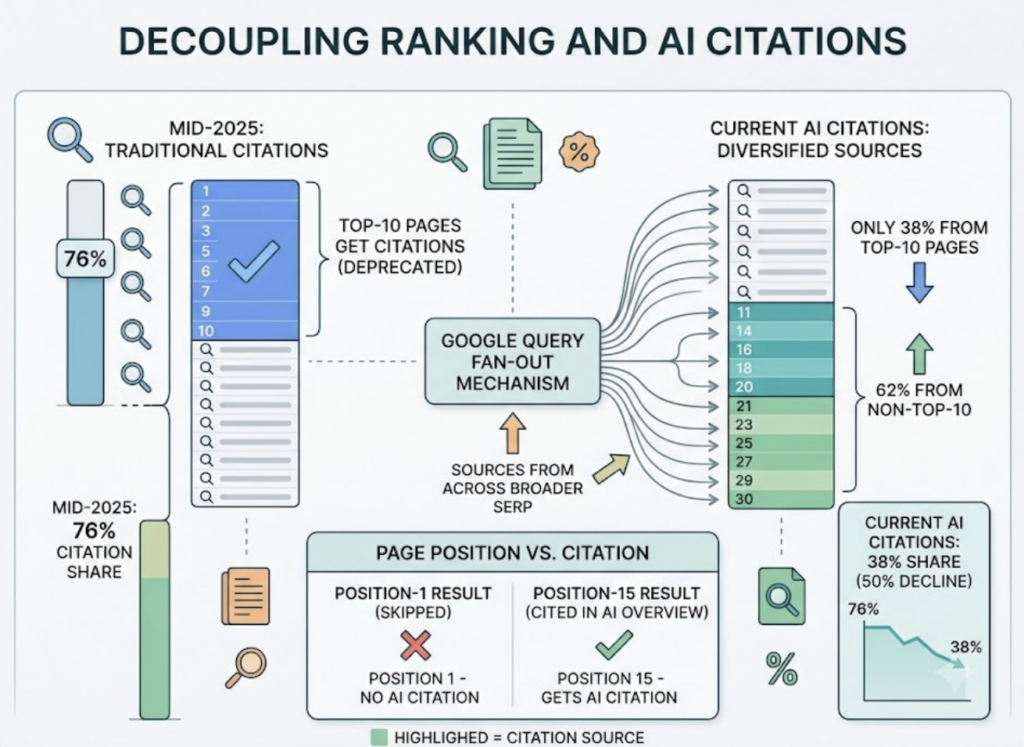
    Only 38% of AI-cited URLs hold a top-10 organic rank, down from 76% just a year earlier. That means most brands earning AI Overview citations aren’t winning them through traditional SEO. AI models are prioritizing topical authority, structured content, and “answer-first” formatting over conventional SERP position.

    That’s a complete decoupling of ranking and visibility. A tracker that only shows you organic positions can’t tell you why you’re absent from AI responses, because the two signals no longer move together.

    #1: Whether Your Brand Actually Shows Up in AI Overview Answers

    The most basic thing an AI overview tracker must tell you is presence. Not keyword rank. Not impressions. Whether your brand is being cited in the actual AI-generated response for the queries that matter to your business.

    This sounds obvious, but most tools don’t measure it at the prompt level. They track SERP features in the aggregate, not which specific prompts trigger your brand’s inclusion or exclusion.

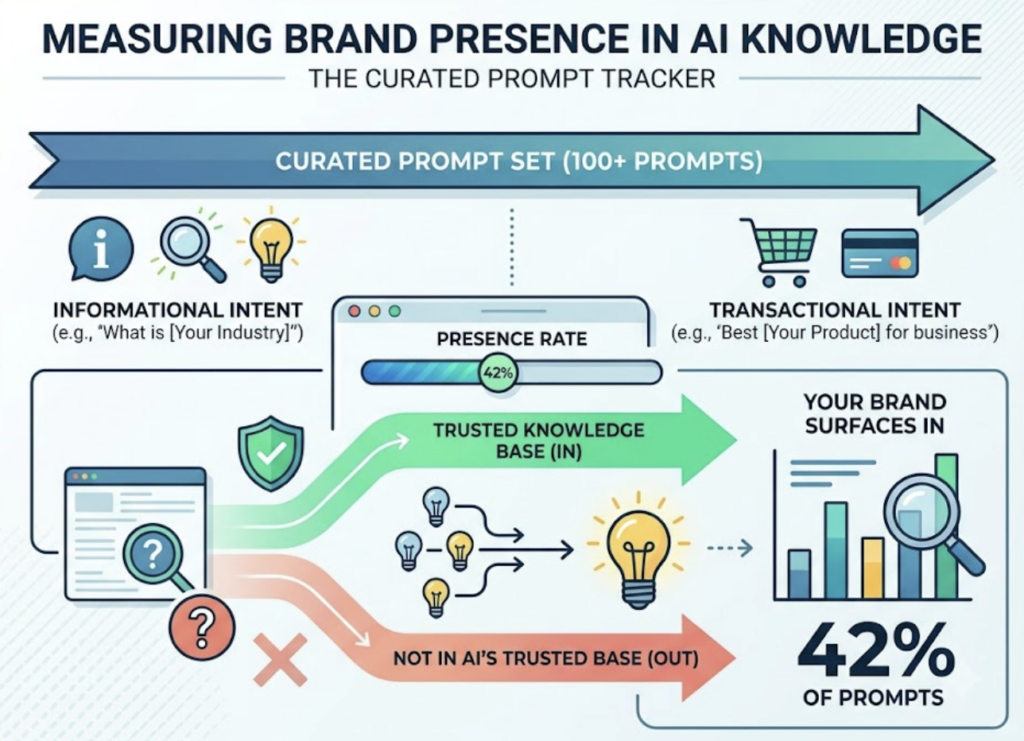
    A well-built tracker monitors your brand across a curated set of high-value prompts, covering both informational and transactional intent. The output is a Presence Rate: across the 100+ prompts in your category, what percentage actually surfaces your brand? That number tells you whether you’re in the AI’s “trusted knowledge base” or not.

    Topify‘s Visibility Tracking maps brand presence at the prompt level, across ChatGPT, Perplexity, Gemini, and Google AI Overviews. You don’t get a single aggregate score. You see which prompts include you, and which don’t.

    #2: Where You Rank Inside the AI Answer

    Presence alone isn’t enough. Being mentioned in an AI Overview and being mentioned first are very different things.

    AI responses for “best X for Y” queries typically follow a list format with internal ordering. The first two or three brands named carry meaningfully higher attention and conversion weight than those mentioned further down or as footnote alternatives. Being listed as “a budget option” near the end of a summary is visibility, technically. It’s also a positioning problem.

    An AI overview tracker should show you your Position Within the Answer, not just whether you appeared. This means tracking where in the synthesized response your brand appears, and how that placement compares to competitors.

    Topify‘s Position Tracking and Competitor Monitoring do this in tandem. You can see that Competitor A is consistently named first in “enterprise solution for [category]” prompts while your brand appears third. That’s an actionable gap, not just a visibility metric.

    #3: Which Sources the AI Is Pulling to Build Its Answer

    This one is where most AI overview trackers stop short, and where the real optimization leverage lives.

    AI Overviews aren’t generated from thin air. They cite specific domains, URLs, and content formats. Knowing you weren’t included is one thing. Knowing which domains were cited instead of yours tells you exactly what content structure, format, or authority signals you’re missing.

    By identifying which domains AI engines trust for specific query types, you can reverse-engineer the content formats required to earn future citations. Whether that means more listicles, better structured data, FAQ schema, or video embeds depends on what the AI is actually pulling today.

    This is Source Attribution Analysis. An AI overview tracker without it gives you a scoreboard with no replay footage.

    Topify’s Source Analysis tracks the exact domains and URLs that AI platforms cite for your tracked prompts. You can see if a competitor’s blog is the primary source for queries where you should be winning, and build content strategy around that gap, rather than guessing.

    Also worth noting: AI search isn’t confined to Google. Perplexity converts at rates up to 11x higher than traditional organic traffic. A tracker that only watches Google AI Overviews is leaving significant cross-platform signal on the table.

    #4: How AI Describes Your Brand’s Sentiment

    Showing up in an AI Overview with the wrong framing can be worse than not showing up at all.

    AI models categorize brands. “Budget-friendly.” “Market leader.” “Best for small teams.” “A solid alternative to X.” Each of these phrasings shapes how users perceive your brand before they’ve even clicked a link. If you’ve spent years positioning your product as enterprise-grade and AI consistently describes it as “great for startups,” that’s a brand narrative problem you can’t fix without first detecting it.

    Sentiment tracking scored 0–100 helps brands detect whether AI framing aligns with their desired market positioning. This isn’t just qualitative monitoring. 58% of consumers find brands cited in AI responses more trustworthy, which means the way you’re cited carries real downstream weight on purchase decisions.

    Topify’s Sentiment Analysis scores AI-generated descriptions of your brand across platforms, flagging neutral or misaligned framing before it compounds. You see the actual language AI is using, not just a presence/absence binary.

    #5: Which Prompts Drive Meaningful AI Visibility

    Not all AI Overview appearances are worth the same. A citation in a low-intent informational query moves a different needle than a citation in a high-commercial-intent “best tool for X” query.

    The missing link between AI visibility data and actual business outcomes is intent mapping. You need to know which of your tracked prompts carry genuine conversion weight, and whether your brand is appearing in those specifically.

    That’s what Conversion Visibility Rate (CVR) addresses. By correlating AI visibility with branded search volume or direct conversion events, you can quantify the ROI of your AI Overview strategy instead of chasing vanity presence metrics. High prompt volume with no commercial intent is noise. High-intent prompts where competitors outrank you are the actual priority.

    Topify’s AI Volume Analytics and High-Value Prompt Discovery surface which prompts in your category are worth tracking in the first place, and continuously update as AI recommendation patterns shift. You’re not managing a static keyword list. You’re working with a living signal set.

    Getting All Five Signals in One Place

    The five things above aren’t separate reports from separate tools. They’re interconnected: where you rank matters more if you know which sources got cited instead of you; sentiment matters more once you’re present at a meaningful position; CVR only makes sense once you’ve identified which prompts have commercial intent.

    Topify is built around this integrated view. The platform monitors brand performance across ChatGPT, Gemini, Perplexity, DeepSeek, and Google AI Overviews using seven core metrics: visibility, sentiment, position, volume, mentions, intent, and CVR. All five signals described above are tracked in a single dashboard, updated as AI responses evolve.

    For teams currently flying blind on AI Overviews or piecing together data from disconnected sources, the Basic plan starts at $99/month and includes tracking across 100 prompts and 9,000 AI answer analyses. Get started at app.topify.ai.

    Conclusion

    AI Overviews have changed what “being visible in search” actually means. Organic ranking and AI Overview citation are now two separate signals that require two separate measurement systems. A tracker that only covers one isn’t enough.

    The five things above, presence rate, position within the answer, source attribution, sentiment framing, and intent-weighted CVR, are what separate a useful AI overview tracker from a dashboard that looks good but doesn’t help you act. Start there when evaluating what your current setup is actually telling you.


    FAQ

    Q: What’s the difference between an AI overview tracker and a traditional SEO rank tracker?

    A: A traditional SEO rank tracker measures where your URLs appear in organic search results, typically positions 1 through 100. An AI overview tracker measures whether your brand is cited in AI-generated summaries, where in those summaries it appears, how it’s described, and which sources the AI pulls. The two systems track fundamentally different signals, and since only 38% of AI-cited URLs hold a top-10 organic rank, you can’t infer one from the other.

    Q: How often should I check my AI overview visibility?

    A: AI models update their citation patterns more frequently than traditional search rankings, especially in fast-moving categories. For most brands, weekly monitoring is the minimum. If you’re in a vertical where AI Overviews trigger on 80%+ of queries (healthcare, B2B tech), daily or near-real-time tracking is more appropriate. The key is consistency, not frequency. Tracking at irregular intervals makes it hard to attribute changes to specific content or strategy actions.

    Q: Can an AI overview tracker help with Google AI Overviews specifically?

    A: Yes, but the better trackers cover Google AI Overviews as one platform among several. Consumer behavior increasingly spans ChatGPT, Perplexity, and Google interchangeably for brand discovery. A tool that only watches Google misses Perplexity, which converts at significantly higher rates than traditional organic traffic. If you’re evaluating trackers, cross-platform coverage is one of the first things to check.

    Q: Do I need a separate tool for each AI platform?

    A: Ideally, no. Managing separate trackers for ChatGPT, Perplexity, and Google AI Overviews creates fragmented data and makes it nearly impossible to see your overall AI Search Share of Voice. Integrated platforms that aggregate signals across engines into a single view give you both the individual platform breakdowns and the unified picture. That unified view is where the most actionable patterns tend to emerge.


    Read More

  • Your Brand Shows Up in AI Overviews. You Can’t See It.

    Your Brand Shows Up in AI Overviews. You Can’t See It.

    Your domain authority is solid. Your content ranks in the top 10. You’ve done everything right by traditional SEO standards. Then organic CTR drops, and Search Console gives you nothing useful to explain it.

    Here’s what’s likely happening: Google AI Overviews are answering your customers’ queries before they ever reach your listing. Your brand might be mentioned in that summary, or a competitor might be. Either way, you have no visibility into which one is true. That’s the gap an ai overview tracker is built to close.

    Google AI Overviews Changed Search. Your Analytics Didn’t.

    AI Overviews now appear in approximately 20% of all Google searches, with trigger rates climbing above 60% for health-related queries. For categories where users are actively researching solutions, that number is much higher than it looks in aggregate.

    The traffic signal this sends is brutal: 83% of AI-integrated searches don’t result in a traditional organic click. Users get their answer from the summary and stop scrolling. Brands that appear in the overview benefit from the attention. Brands that don’t are invisible to that session entirely.

    What makes this particularly disorienting for SEO teams is that Google Search Console doesn’t surface this. GSC now includes “AI Mode” filters, but they only reflect post-click traffic data. They can’t tell you whether your brand was mentioned in an AI Overview, how it was described, or who else appeared alongside it.

    You’re flying blind on a channel that already influences a significant slice of your audience.

    Only 38% of AI Citations Come from Top-10 Pages

    This is the number that should concern any team still treating SEO rankings as a proxy for AI visibility.

    Only 38% of AI citations now originate from top-10 ranking pages, a 50% relative decline from mid-2025. Google’s query fan-out mechanism pulls sources from across the broader SERP, not just the top results. A page ranking at position 15 can get cited in an AI Overview while the position-1 result gets skipped entirely.

    That’s a structural decoupling. Traditional rank tracking tells you where you appear on the list. It says nothing about whether AI selected your content as a trusted source.

    The implication: brands that want AI visibility need to measure AI visibility directly. Rankings are a different metric now.

    What an AI Overview Tracker Actually Measures

    An ai overview tracker doesn’t work like a rank checker. It runs a curated set of prompts through AI search engines, captures the generated responses, and extracts four types of signals:

    Visibility Rate: How often does your brand appear in responses to relevant queries? Tracked across a defined prompt set, this gives you a frequency baseline and lets you spot changes over time.

    Sentiment and Framing: When your brand appears, how is it described? There’s a meaningful difference between “industry leader,” “affordable option,” and “budget alternative.” AI Overview citation tracking that stops at mention detection misses this entirely.

    Source and Citation Integrity: Which specific URLs is the AI pulling from? This matters for content strategy. If a page you’ve optimized for traditional SEO isn’t getting cited, that’s a content structure problem, not a ranking problem.

    Competitive Co-occurrence: Who else appears when you do? Understanding the AI’s mental model of your competitive landscape helps teams anticipate which positioning moves will have downstream effects on citation patterns.

    These four layers are what separate a real ai overview tracker from a simple keyword alert tool.

    How Topify Tracks Your Brand Across AI Overviews

    Topify tracks brand visibility across ChatGPT, Perplexity, and Google AI Overviews within a single platform. The workflow starts with prompt definition: you input the queries your target audience is likely asking, and Topify runs those prompts repeatedly to capture AI-generated responses at scale.

    The Basic plan supports up to 100 prompts and 9,000 AI answer analyses per month, which covers a meaningful chunk of a brand’s high-priority query set. For teams managing larger prompt libraries, the Pro plan scales to 250 prompts and 22,500 analyses.

    What Topify surfaces across those analyses:

    • Visibility score: Frequency of brand mention across your full prompt set
    • Sentiment score: 0-100 rating of how AI engines describe your brand
    • Position tracking: Where your brand ranks relative to competitors in AI answers
    • Source analysis: Which domains and URLs are being cited, and whether your content is among them
    • CVR (Conversion Visibility Rate): An estimate of how likely AI citations are to drive downstream brand interactions

    The source analysis layer is particularly useful for AI Overview citation tracking. If Topify shows that a competitor’s blog is being cited consistently for a query your team has been targeting, that’s an actionable content gap, not an abstract concern.

    Get started with Topify to run your first AI Overview visibility audit.

    Why Google AI Overviews Tracking Can’t Live in a Silo

    Google AI Overviews represent one part of how your customers are getting AI-generated answers. ChatGPT handles an estimated 250–500 million weekly queries, while Perplexity serves around 50 million weekly. These platforms don’t share data with GSC.

    The conversion dynamics across platforms also differ significantly. Perplexity citations convert at rates approximately 11x higher than standard organic traffic, driven by the platform’s inline citation format that makes source visits feel natural rather than promotional. A brand invisible in Perplexity but visible in Google AIO is missing a high-intent channel entirely.

    Platform-specific tracking creates blind spots. A team that monitors only Google AI Overviews will see a partial picture of their AI search share of voice. The more useful question isn’t “do we appear in Google AI Overviews?” but “across the AI engines our customers actually use, how often and how well are we being described?”

    That’s the question a cross-platform AI overview tracker answers.

    The CTR Recovery Story: What It Means for Brands That Track

    Organic CTR for cited brands recovered from a floor of 1.3% in late 2025 to 2.4% by early 2026, according to Seer Interactive’s tracking data. That’s not a dramatic rebound, but it indicates a stabilization pattern.

    The brands driving that recovery share a common characteristic: they know they’re being cited. They’ve invested in ai overview tracking, identified which content gets pulled, and optimized those pages for AI-friendly formatting, structured data, and clear answer-first structure.

    Brands without tracking infrastructure are largely excluded from that recovery. You can’t optimize for a channel you can’t see.

    Conclusion

    The traffic you’re losing to AI Overviews isn’t recoverable through better rankings alone. The citation logic has changed. Sources are being pulled from positions 11-30 as often as from the top results, and the framing of those citations shapes how your brand is perceived before a single click happens.

    An ai overview tracker gives you the measurement layer to work with instead of guessing. Track which prompts trigger your brand, see how you’re being described, and identify the content gaps that are handing citations to competitors. Topifycovers this across Google AI Overviews, ChatGPT, and Perplexity from a single dashboard. Start your first audit before your next quarterly review.

    FAQ

    Q: What is an AI overview tracker? A: An AI overview tracker is a tool that monitors how often and how a brand appears in AI-generated search results, including Google AI Overviews, ChatGPT responses, and Perplexity answers. It captures visibility frequency, sentiment framing, cited sources, and competitive positioning across a defined set of prompts.

    Q: Can Google Search Console track AI Overviews appearances? A: Not directly. GSC added “AI Mode” filters in 2025, but these only reflect traffic data after a user clicks through. They don’t show whether your brand was mentioned in an AI Overview, how it was described, or which competitors appeared alongside you. A dedicated AI overview tracker fills this gap.

    Q: How often should I check my brand’s AI Overview visibility? A: Weekly monitoring is a reasonable baseline for most brands. Citation patterns in AI search can shift faster than traditional rankings, particularly when Google updates its query fan-out logic or when a competitor publishes content that gets picked up as a source. Monthly snapshots will miss these shifts.

    Q: Does appearing in AI Overviews increase website traffic? A: It depends on whether your brand is cited as a source. Brands cited in AI Overviews saw organic CTR recover to roughly 2.4% in early 2026, up from a 1.3% floor in late 2025. Traffic impact is also platform-dependent: Perplexity citations currently convert at significantly higher rates than standard AI Overview mentions due to the platform’s inline citation format.

    Read More

  • Set Up Search Monitoring for Google, ChatGPT, Perplexity

    Set Up Search Monitoring for Google, ChatGPT, Perplexity

    The first version of AI search monitoring at most companies looks the same. Someone opens ChatGPT, types five questions about the brand, screenshots the answers, and drops them in a Slack channel. Two weeks later the answers have changed, there’s no record of what they used to say, and Perplexity is citing a completely different set of sources.

    The problem isn’t that you can’t check. It’s that spot checks aren’t a system. AI answers drift with every model update, and without historical search monitoring across Google, ChatGPT, and Perplexity, the data you collected today is stale by next month.

    Your Rank Tracker Covers a Shrinking Slice of Search

    Traditional rank trackers were built for the ten blue links era, where a URL’s position was a fixed coordinate on a results page. That paradigm is collapsing. As of early 2026, roughly 68% of Google searches end without a click, and when AI Overviews are triggered, that zero-click rate jumps to 83%.

    Here’s what that means in practice. Your tracker tells you whether a page ranks. It says nothing about what the AI summary above your listing says about your brand, or whether you’re cited in it at all. Those summaries are generated in real time based on prompt context, so there’s no “position” to track in the legacy sense.

    This creates what some teams call the green dashboard illusion. A brand can hold the #1 organic spot while being completely absent from the AI answer sitting on top of it. Rankings look healthy, traffic quietly erodes, and nothing in the existing report explains why.

    That gap doesn’t show up in any rank tracker you currently run.

    What Search Monitoring Means When Search Spans Three Engines

    Search monitoring used to mean one thing: where do my pages rank. In 2026 it means three different things, because the three engines that matter behave in three different ways.

    DimensionGoogle AI OverviewsChatGPTPerplexity
    What drives visibilityEntity trust and schema extractionConsensus and consistent info across reputable sourcesNiche expertise and real-time sources
    What to monitorAI Overview citation rate alongside SERP positionBrand mention frequency and sentimentCitation rate and link-through traffic
    Traffic behaviorMostly zero-clickInfluence, rarely direct clicksInline numbered citations, most actionable for referrals

    Google’s AI Overviews reward entity trust. Monitoring here means verifying that your structured data and content actually get synthesized into the summary box, not just that your page ranks beneath it.

    ChatGPT behaves more like a knowledge graph assistant. It rewards broad, consistent information across the web, so the metrics that matter are mention frequency and sentiment, not position on a page.

    Perplexity acts like a research assistant with footnotes. Its inline citations make it the most directly trackable for traffic, which means link-based attribution should be your monitoring priority there.

    Three engines, three behaviors, three sets of metrics. Trying to read all of that through a rank tracking lens is how teams end up with data they can’t act on.

    Step 1: Decide Which Prompts Are Worth Monitoring

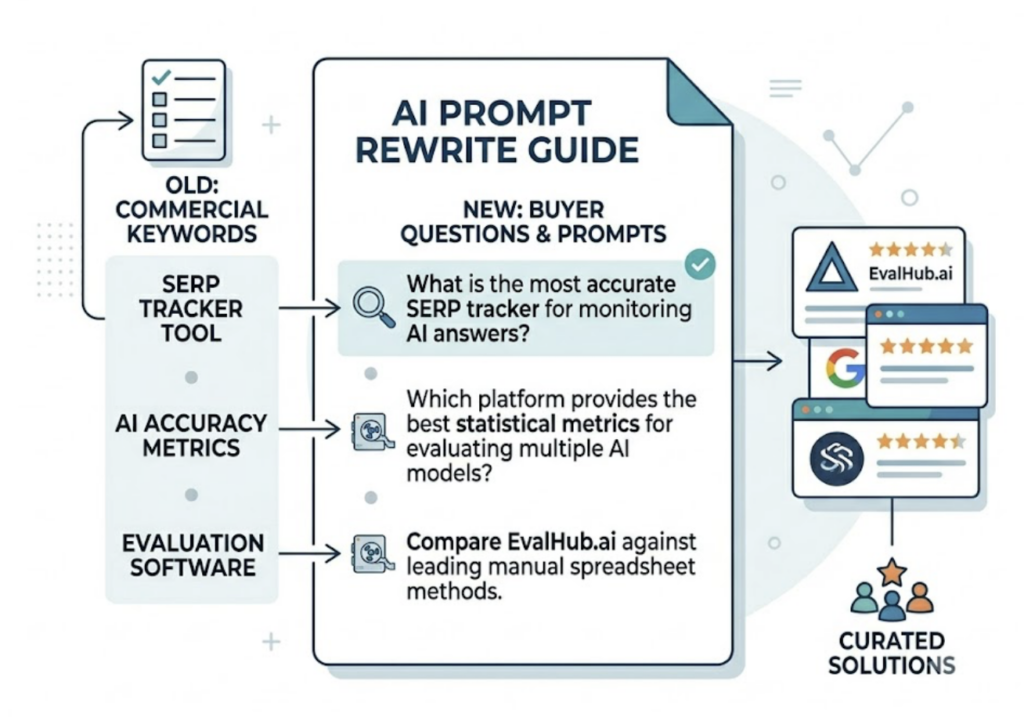
    The unit of search monitoring has shifted from keywords to prompts. Users don’t type “project management software agency” into ChatGPT. They ask, “What’s the best project management software for a 10-person agency?” That full question, with its context and constraints, is what determines which brands get named.

    Start with your existing commercial keyword list and rewrite each entry as the questions a real buyer would ask an AI assistant. Prioritize recommendation queries, the prompts where users explicitly ask for products or solutions, because those are the answers that directly shape purchase decisions.

    Then think about scale. A handful of prompts produces anecdotes, not data. The practical baseline is 100 to 250 high-value prompts, enough to make visibility trends statistically meaningful rather than noise.

    You don’t have to build that list by guesswork. Topify includes High-Value Prompt Discovery, which surfaces the high-volume prompts already circulating in your category and keeps adding new ones as AI recommendation patterns shift. If you want to scope the work before committing to a platform, this reference list of free GEO tools covers lighter options for initial prompt and visibility checks.

    Step 2: Connect Google, ChatGPT, and Perplexity in One View

    This is where most homegrown setups fall apart. Teams end up with a rank tracker for Google, a spreadsheet of ChatGPT screenshots, and a browser bookmark folder for Perplexity. Three tools, three data formats, no shared timeline. When visibility moves, nobody can say which engine moved or when.

    A unified dashboard has two non-negotiable requirements.

    First, cross-engine alignment. The same prompt set has to run against Google, ChatGPT, and Perplexity simultaneously. That’s the only way to compare how different models interpret your brand authority, and to spot cases where you’re strong in one engine and invisible in another.

    Second, historical continuity. AI answers drift as models update and retraining shifts source weighting. Without recorded snapshots, you can’t tell whether a visibility drop came from your site or from a model-side change. That distinction decides whether you fix content or simply wait.

    In Topify, this setup takes one configuration pass: create a project, load your prompt set, and select engines. The platform tracks ChatGPT, Perplexity, and Google AI Overviews from a single project, and the Basic plan processes up to 9,000 AI answer analyses across 100 prompts, enough volume to make week-over-week comparisons reliable instead of anecdotal.

    Step 3: Set Baselines, Alerts, and a Weekly Review Loop

    Monitoring without a baseline is just watching numbers move. Spend your first 30 days recording three starting values for every prompt group: visibility (how often your brand appears), sentiment (how AI describes you when it does), and citation rate (how often your domain is the source).

    After that, the loop is weekly. Check which prompts gained or lost mentions, then trace the why. This is where Source Analysis earns its place: when an engine stops citing you, you can see which competing domains it now cites instead, which turns a vague “we dropped” into a specific content gap with a named competitor attached.

    Set alerts on the metrics tied to revenue, not vanity. A sentiment shift on your top 20 recommendation prompts matters more than a mention count change on informational queries.

    Baseline it. Review it weekly. Act on the source data.

    The Mistakes That Make Search Monitoring Data Useless

    Three failure patterns show up repeatedly in early monitoring setups.

    The one-and-done error. Checking once a quarter is functionally the same as not checking. Model behavior can shift weekly, so quarterly snapshots capture states that no longer exist by the time anyone reads the report.

    Competitive blindness. Monitoring your own brand in isolation hides the most important signal. If your visibility drops, the first question is whether a competitor’s rose on the same prompts. That pattern reveals the AI model changed its preferred source for that query, which is a very different problem than a general visibility decline. Topify’s Competitor Monitoring detects rivals automatically and benchmarks visibility, sentiment, and position side by side, so this comparison is built into the same view rather than a separate research task.

    The ranking fallacy. Forcing AI visibility into a rank tracker format dilutes the data. AI answers are probabilistic. The honest metric is share of voice across many answer generations, not a deterministic 1 to 100 position. Teams that insist on a single “AI rank” number end up optimizing for a metric the engines don’t actually produce.

    One Dashboard, Two Search Worlds: Where Topify Fits

    The recommendation that emerges from all of this isn’t to replace your SEO stack. It’s to add an AI layer on top of it, and consolidate that layer in one place instead of three.

    Topify is built around that consolidation. It tracks brand performance across ChatGPT, Gemini, Perplexity, DeepSeek, and other major engines through seven metrics: visibility, sentiment, position, volume, mentions, intent, and CVR. In practice, that means the workflow described in Steps 1 through 3 lives in a single interface. You can watch a ChatGPT mention drop, trace it to a source that stopped citing your brand, and see which competitor took the slot, without switching tools or reconciling exports.

    It also closes the gap between seeing and acting. One-Click Execution lets you state a goal in plain English, review the proposed strategy, and deploy it directly, so a citation loss turns into a content fix in the same session rather than a ticket in someone’s backlog. Most monitoring tools stop at the dashboard. The teams getting results treat monitoring as the input to execution, not the output.

    Pricing starts at $99/month for the Basic plan, which covers the 100-prompt, three-engine setup outlined above, with a 30-day trial. You can get started with Topify and have a baseline running the same day.

    Conclusion

    The screenshot folder was never the real problem. The missing system was. Search behavior now splits across Google, ChatGPT, and Perplexity, each with its own visibility mechanics, and any monitoring approach that can’t align the same prompts across all three on one timeline will keep producing data nobody trusts.

    The setup is genuinely a three-step job: pick 100 to 250 high-value prompts this week, run them across all three engines in one dashboard, and lock in a 30-day baseline. Everything after that is a weekly review habit.

    FAQ

    Q: What’s the difference between search monitoring and rank tracking? 

    A: Rank tracking measures where a URL sits on a results page. Search monitoring also covers AI engines, where the metrics are brand mentions, sentiment, citations, and share of voice rather than a numbered position. Rank tracking is a subset of modern search monitoring, not a substitute for it.

    Q: How often do ChatGPT and Perplexity answers change? 

    A: Answers can shift weekly or faster, driven by model updates, retraining, and changes in which sources the engines weight. That’s why historical snapshots matter: without them, you can’t separate a model-side change from a problem with your own content.

    Q: Can I monitor Google and AI search in the same tool? 

    A: Yes. Platforms like Topify run the same prompt set across Google AI Overviews, ChatGPT, and Perplexity in one project, so traditional and AI visibility share a timeline instead of living in separate reports.

    Q: How many prompts should I monitor to start? 

    A: Aim for 100 to 250 high-value prompts, weighted toward recommendation queries with commercial intent. Fewer than that and trends get lost in the natural variance of AI-generated answers.

    Read More

  • 7 Metrics Your Search Monitoring Setup Is Missing in 2026

    7 Metrics Your Search Monitoring Setup Is Missing in 2026

    Your rankings are stable. Your traffic alerts are quiet. Every widget on your search monitoring dashboard is green. Then a prospect asks ChatGPT to compare the top tools in your category, gets a five-brand shortlist, and makes a decision without ever loading a SERP. Your stack recorded none of it. The problem isn’t that your tools are broken. It’s that a growing share of high-intent research now happens in a place your tools were never built to measure.

    Your Search Monitoring Stack Was Built for Blue Links

    Traditional search monitoring assumes a stable index: ten blue links, fixed positions, and a click as the unit of success. Rank trackers, CTR reports, and GA4 sessions all inherit that assumption.

    AI engines like ChatGPT, Perplexity, and Gemini work differently. They synthesize answers, name a handful of brands, and often resolve the query with zero clicks. A question like “compare top CRM software for startups” can end entirely inside the response, which makes session data a lagging, incomplete signal of brand health.

    That’s the visibility gap: tools that only track Google rankings are measuring a shrinking slice of the search pie.

    Closing it doesn’t mean throwing out your SEO stack. It means adding seven metrics that describe how AI systems see, describe, and recommend your brand.

    Metric 1: AI Visibility Rate

    AI visibility is stochastic, not binary. Ask the same prompt five times and you’ll often get five slightly different answers, with different brands appearing in each. A single spot check tells you almost nothing.

    Visibility rate fixes that by measuring frequency: the percentage of responses that mention your brand across a fixed prompt set, sampled repeatedly over time. Tracking 100 prompts across ChatGPT, Perplexity, and Google AI Overviews for 30 days gives you a trend line. Testing one prompt once gives you an anecdote.

    If you adopt only one metric from this list, make it this one. It’s the AI-era equivalent of a rank report, except it’s a probability, not a position.

    Metric 2: Share of Voice Across AI Engines

    Each AI engine runs its own recommendation logic. Perplexity tends to favor brands with strong, citable sources. ChatGPT leans more heavily on patterns in its training data. A brand can dominate one engine and barely register on another.

    Share of voice measures your slice of category mentions relative to competitors, engine by engine. That breakdown matters more than any aggregate number, because it shows exactly where a rival is winning ground you can’t see from a blended average.

    Single-engine monitoring hides exactly the vulnerabilities you need to find.

    Metric 3: Position in AI Answers

    When an AI lists “the top 3 providers,” that ordering carries at least as much cognitive weight as the top 3 spots on a Google SERP. Users anchor on the first name they read.

    Unlike SERP rank, answer position is unstable and context-dependent, so it has to be tracked statistically: how often you appear first, how often you trail a competitor, and how that distribution shifts month over month. Pair it with visibility rate and you know not just whether you show up, but whether you show up where it counts.

    Metric 4: AI Sentiment Score

    Being mentioned often but described badly is its own kind of invisibility. An LLM that consistently frames your product as “known for high costs” or “complex to set up” is actively steering buyers away, even while your mention counts look healthy.

    Sentiment tracking scores how AI describes your brand, typically on a 0 to 100 scale, and flags when the narrative drifts from your positioning. For PR and brand teams, this tends to be the first AI metric that earns a permanent slot in reporting, because misaligned AI descriptions are a messaging problem you can actually fix.

    Metric 5: Citation Sources

    This is the root cause metric. Every other number on this list tells you what happened. Citation analysis tells you why.

    AI answers draw on a specific set of domains the engine treats as authoritative for your industry. When a competitor gets cited and you don’t, the source list shows you which review sites, comparison pages, or community threads are doing the recommending. That turns a vague visibility problem into a concrete content gap with a URL attached.

    In practice, teams that skip this metric end up guessing at optimization. Teams that track it know which third-party page to win next.

    Metric 6: AI Prompt Volume

    Keyword volume is a metric of the past. People don’t type “CRM software” into ChatGPT. They ask long, context-heavy questions: budget constraints, team size, integrations, all in one prompt.

    Prompt volume measures which of these conversational queries are actually trending in your category and at what scale. It’s how you decide which prompts deserve a place in your monitoring set and which content gaps are worth filling first. Without it, you’re optimizing for questions nobody asks.

    Metric 7: Conversion Visibility Rate

    Visibility without business impact is a vanity metric. Conversion visibility rate, or CVR, tracks the correlation between brand appearances in AI answers and subsequent direct or organic traffic to high-intent landing pages.

    It’s the bridge between “AI mentions us more” and “AI search is driving pipeline.” When leadership asks why AI search monitoring deserves budget, this is the number that answers the question.

    How to Track All Seven Without Building It Yourself

    Manually sampling seven metrics across four AI platforms doesn’t scale. Each prompt needs repeated runs to be statistically meaningful, each engine answers differently, and citation patterns shift every few weeks. A 100-prompt library sampled properly across ChatGPT, Perplexity, Gemini, and DeepSeek generates thousands of answers a month, which is well past what a spreadsheet workflow can absorb.

    This is the problem Topify was built around. Its analytics matrix maps directly to the seven metrics in this article: visibility, share of voice, position, sentiment, volume, mentions, and CVR, all in a single AI search monitoring dashboard. The platform automates prompt sampling across the major AI engines, so visibility rate and position data come from repeated runs rather than one-off checks. Its Source Analysis feature handles Metric 5, letting you reverse-engineer which domains AI engines cite for competitors and adjust your content strategy accordingly. In practice, that means you can spot a drop in ChatGPT mentions and trace it back to a specific source that stopped citing your brand, inside the same view.

    Pricing starts at $99 per month for the Basic plan, which covers 100 tracked prompts, 9,000 AI answer analyses, and tracking across ChatGPT, Perplexity, and AI Overviews, with a 30-day trial to validate the data before committing.

    Bottom line: the tooling cost is low compared to the cost of staying blind in the channel where your buyers are already asking questions.

    Conclusion

    An all-green dashboard built on rankings and pageviews isn’t proof that your brand is healthy. It’s proof that you’re measuring the old ecosystem while decisions migrate to the new one.

    Start small this week. Define a prompt library of the top 20 questions a prospect asks before buying your product. Test them manually on ChatGPT and Perplexity to establish a baseline, even if it’s rough. Then automate the sampling so visibility rate, sentiment, and citation data flow into your monthly reporting alongside your SEO numbers. The brands that close the visibility gap first get recommended first.

    FAQ

    Q: What is search monitoring in the AI era? 

    A: It’s the practice of tracking how your brand appears across both traditional search engines and AI answer engines like ChatGPT and Perplexity. Beyond rankings and traffic, it covers AI search monitoring metrics such as visibility rate, sentiment, answer position, and citation sources.

    Q: How is AI search monitoring different from rank tracking? 

    A: Rank tracking measures a fixed position in a stable index. AI answers are generated fresh each time, so the same prompt can produce different brand mentions. That’s why AI monitoring measures frequency and distribution across repeated samples instead of a single position.

    Q: How many prompts should you track to get reliable visibility data? 

    A: Most teams start with 20 high-intent prompts for a manual baseline, then scale to around 100 tracked prompts with automated, repeated sampling. The repetition matters more than the raw count, since one-off checks can’t capture how often you actually appear.

    Q: Can Google Search Console track AI search visibility? 

    A: No. Search Console reports on Google Search impressions and clicks, but it can’t show whether ChatGPT or Perplexity mentions your brand, how AI describes you, or which sources AI engines cite. Those require dedicated AI visibility tracking.

    Read More

  • You’re Monitoring Search. But Is That Where Customers Go?

    You’re Monitoring Search. But Is That Where Customers Go?

    Your rank tracker shows green across the board. Search Console looks healthy. Domain authority is holding steady. By every metric in your search monitoring stack, things are fine. Yet according to 2026 market analysis, 58% of product discovery for B2B and high-consideration B2C purchases now starts with an AI-driven query, not a traditional search. Those conversations happen inside ChatGPT and Perplexity, and not a single dashboard you own can see them. The numbers you’re watching aren’t wrong. They’re just measuring a smaller and smaller slice of how customers actually find brands.

    Your Search Monitoring Stack Was Built for a Shrinking Behavior

    Most search monitoring setups share the same architecture: a rank tracker for keyword positions, Search Console for impressions and clicks, GA4 for sessions. All three rest on the same premise, that user intent gets resolved through a query followed by a click on a results page.

    That premise carries three hidden assumptions. The “click” assumption defines success by traffic metrics like CTR and sessions. The “fixed ranking” assumption defines success by a numerical position from 1 to 10. The “uniform SERP” assumption presumes every user sees the same page of links for a given keyword.

    All three are breaking at the same time.

    The traditional ten blue links keep getting pushed further down the page or replaced outright by AI-generated summaries. And because AI models don’t operate on a rank 1 to 10 system, standard rank trackers return null or invalid results for queries that are generating real brand exposure inside LLMs. The tools aren’t failing. The behavior they were built to measure is shrinking.

    Where Customers Actually Go: The AI Search Migration in Numbers

    The migration isn’t speculative anymore. Three data points from 2026 research define its scale.

    First, the high-intent shift: 58% of product discovery for B2B and high-consideration B2C purchases now begins with an AI query rather than a search engine query. These aren’t casual lookups. They’re the “what should I buy” and “which tool fits my use case” questions that used to feed your funnel through organic search.

    Second, zero-click prevalence: 72% of all search interactions in the US, across both traditional search and AI platforms, now complete without a click-through to any third-party website. The answer gets consumed in place. No referrer, no session, no trace in GA4.

    Third, platform scale: Perplexity and ChatGPT combined now handle over 1.2 billion daily active queries in the US as of Q1 2026. That’s not a novelty channel. That’s a primary search behavior running entirely outside your monitoring perimeter.

    Here’s the uncomfortable part: the queries migrating fastest are the ones worth the most.

    Why Rank Trackers Can’t See AI Answers

    It’s tempting to treat this as a tooling upgrade problem. It isn’t. The object being measured has changed.

    A SERP is a fixed page with discrete positions. An AI answer is generated fresh per conversation, shaped by phrasing, context, and the model’s citation choices. There’s no position 3 to track because there’s no stable page to track it on.

    The disconnect shows up clearly in correlation research. Studies comparing Google rankings to AI citations found essentially no correlation between the two. A URL can sit at #1 on Google for a “best CRM” query and appear nowhere in the top five citations of ChatGPT’s response to the same question. The gap between AI search visibility and Google rankings isn’t a rounding error. It’s a structural divide: optimizing for Google’s algorithm doesn’t buy you visibility in the AI answer layer.

    Which means a brand can hold every traditional ranking it has and still lose the recommendation moment that actually drives the purchase.

    What Complete Search Monitoring Looks Like in 2026

    The fix isn’t abandoning rank tracking. It’s widening the definition of search monitoring to match where questions actually get asked. In practice, that means shifting from rank tracking to visibility monitoring.

    Monitoring DimensionTraditional StackAI-Era Stack
    Primary metricKeyword positionShare of voice in AI answers
    Platform scopeGoogle, BingChatGPT, Perplexity, Gemini, DeepSeek, AI Overviews
    Data focusTraffic and clicksCitations, sentiment, direct mentions
    Target audienceSearchersHigh-intent questioners

    The AI-era columns aren’t replacements for the traditional ones. They’re the missing half. Your Google data still matters for the queries that stay on Google. But a complete search monitoring program now answers four questions the old stack can’t: Does AI mention your brand for the prompts that matter? Where does it position you relative to competitors? What sentiment does it attach to your name? And which sources is it citing when it forms those answers?

    Extending Search Monitoring to AI Engines with Topify

    Closing that gap manually means running hundreds of prompts across multiple AI platforms, week after week, and logging results by hand. Most teams try it once, get a snapshot, and never repeat it. The data goes stale within weeks because AI citation patterns shift constantly.

    This is the gap Topify was built to fill. The platform treats the AI answer layer as a monitorable surface, executing your high-value prompts across ChatGPT, Perplexity, Gemini, and DeepSeek on a continuous schedule, then recording whether your brand gets mentioned, cited, or recommended in each response.

    Three capabilities map directly onto the monitoring framework above.

    Visibility Tracking measures your share of voice in AI answers over time. Instead of a keyword rank, you see mention frequency and position across platforms, so a drop in ChatGPT visibility shows up as a trend line, not a surprise in next quarter’s pipeline.

    Source Analysis reverse-engineers the citations behind AI answers. It identifies exactly which domains each model treats as authoritative for your category. In practice, this tells you where to earn coverage: if Perplexity keeps citing two industry publications you’ve never pitched, that’s your content roadmap.

    Competitor Monitoring tracks answer share of voice across your category, flagging when a rival starts gaining ground in AI-generated advice at your expense. You see emerging competitors the moment models start recommending them, not after they show up in lost deals.

    Pricing keeps the entry point low for teams testing the channel. The Basic tier starts at $99/month and covers up to 100 custom-defined prompts, which is enough to monitor a full question library for one brand. If you want to gauge the gap before committing to anything, the free GEO tools reference lists no-signup checks you can run today, and you can get started with Topify once you’ve confirmed the blind spot is real.

    The shift in mindset matters as much as the tooling: you stop tracking keywords and start tracking questions.

    How to Start Monitoring Where Your Customers Actually Search

    You don’t need to rebuild your reporting stack to close the gap. Four steps get a working program running in under a month.

    1. Audit your question library. Identify the top 50 high-intent questions customers ask in your category, like “best enterprise alternatives to X” or “which tool handles Y.” These are your prompts, the AI-era equivalent of a keyword list.
    2. Run baseline tests. Execute those prompts across ChatGPT, Perplexity, Gemini, and AI Overviews. Record where your brand appears, where it doesn’t, and who gets recommended instead.
    3. Deploy continuous monitoring. One-off snapshots decay fast because citation patterns shift every few weeks. Set up automated AI answer monitoring to capture weekly movement in mentions, sentiment, and citation authority.
    4. Integrate into reporting. Merge AI-layer visibility into your monthly dashboard. Treat AI citations as a leading indicator of brand authority, the same way GA4 traffic works as a lagging indicator of interest.

    That last step is where the organizational shift happens. Once AI visibility sits next to organic traffic in the monthly review, the team stops treating it as an experiment and starts treating it as a channel.

    Conclusion

    Your search monitoring isn’t broken. It’s incomplete. The dashboards still accurately measure what happens on Google, but with 58% of high-intent discovery starting in AI tools and 72% of interactions ending without a click, the most valuable customer questions now get answered in places your stack can’t see. The brands that adapt first won’t be the ones with the best Google rankings. They’ll be the ones who noticed where the questions went, built a question library, baselined their AI visibility, and put the answer layer on the same dashboard as everything else. The migration already happened. The only open question is whether your monitoring follows it.

    FAQ

    Q: What is search monitoring? 

    A: Search monitoring is the practice of tracking how and where a brand appears when customers search for relevant topics. Traditionally it covered keyword rankings, SERP features, and organic traffic. In 2026, complete search monitoring also includes the AI answer layer: brand mentions, citations, and sentiment inside ChatGPT, Perplexity, Gemini, and Google AI Overviews.

    Q: How is AI search monitoring different from rank tracking? 

    A: Rank tracking measures a fixed numerical position on a results page. AI answers have no fixed positions, so AI search monitoring measures share of voice instead: how often a brand gets mentioned, where it appears relative to competitors, what sentiment it carries, and which sources the AI cites.

    Q: Which AI platforms should brands monitor? 

    A: Start with the platforms handling the most high-intent volume: ChatGPT, Perplexity, Gemini, and Google AI Overviews. Brands targeting markets where DeepSeek, Doubao, or Qwen have meaningful adoption should add those as well.

    Q: How often should you monitor AI search results? 

    A: Weekly at minimum. AI citation patterns shift every few weeks as models update and source authority changes, so monthly snapshots tend to miss the movements that explain visibility gains or losses.

    Read More