Category: Article

  • AI Response Monitoring Strategy: A Practical Guide

    AI Response Monitoring Strategy: A Practical Guide

    Your CEO asks a simple question in the Monday standup: “How are we showing up when someone asks ChatGPT or Perplexity for a recommendation in our category?” You pull a couple of screenshots from last week. By the time you’ve answered, the data’s already stale. Large language models are non-deterministic, so the same prompt can surface a different set of brands in more than 38% of consecutive runs. Spot-checking by hand can’t keep pace with that kind of variance. What you need isn’t another screenshot. It’s a repeatable way to measure where your brand stands, across platforms, on a cadence you can actually report against.

    Why AI Response Monitoring Strategy Can’t Be an Afterthought

    AI search stopped being an experiment a while ago. By February 2026, ChatGPT alone passed 900 million weekly active users, and roughly 37% of consumers now start product research inside an AI tool rather than a search box.

    The bigger shift is behavioral. About 58.5% of search sessions now end without a single click to an external site. The answer happens inside the model. If your brand isn’t in that answer, the customer often never learns you exist.

    That’s the gap most dashboards still can’t see.

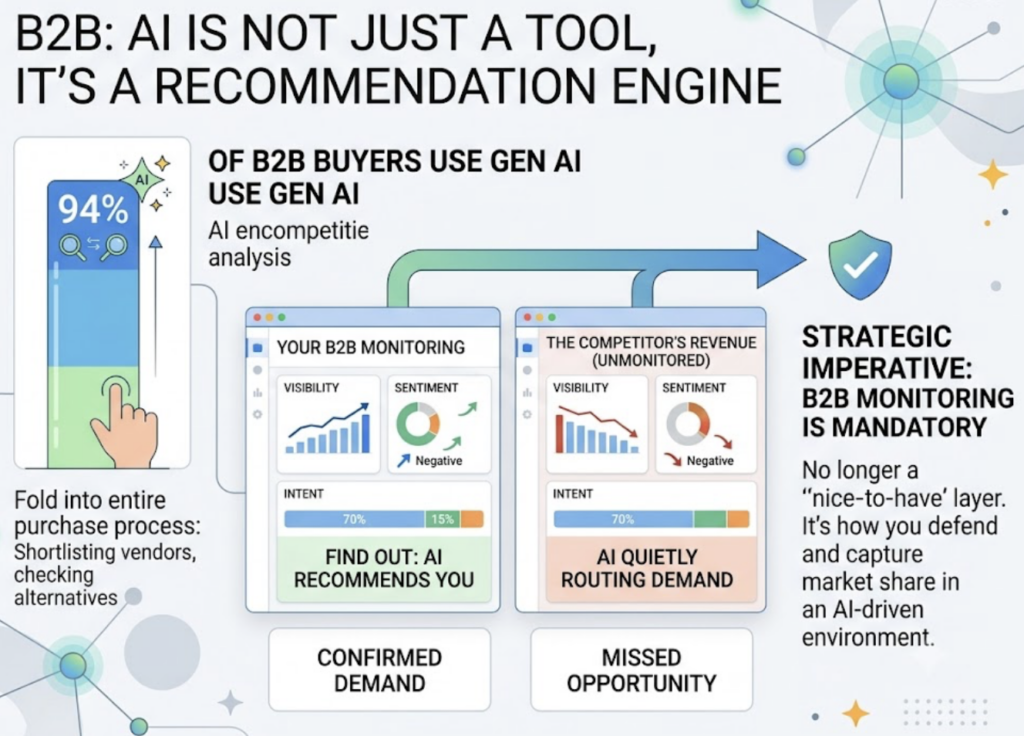
    For B2B teams the stakes are sharper. Around 94% of buyers now fold generative AI into their purchase process somewhere, from shortlisting vendors to checking alternatives. A monitoring strategy isn’t a nice-to-have reporting layer anymore. It’s how you find out whether AI is recommending you or quietly routing demand to a competitor.
    What an AI Response Monitoring Strategy Actually Tracks

    Most teams start and stop at “did we get mentioned.” That’s a binary that hides almost everything useful. A mature AI response monitoring strategy tracks four dimensions, and each one answers a different question.

    Mention and visibility rate. How often your brand shows up across the high-intent prompts that matter to revenue. This is the baseline, but it’s only the floor.

    Positioning and salience. Being named tenth in a list is not the same as being the top recommendation. Position matters more than most teams assume: a brand in the first slot of an AI answer is about 3.1× more likely to drive a click-through than one buried further down.

    Sentiment and context. How the model frames you. There’s a real difference between “a solid budget option” and “a premium enterprise platform.” If AI consistently describes your product in language that fights your positioning, a mention can work against you.

    Source authority. The upstream domains the model leans on when it builds an answer, think Reddit, G2, Wikipedia, industry roundups. If your brand is missing from those nodes, the model has fewer reasons to cite you, no matter how good your own site is.

    Track one dimension and you get noise. Track all four and you get a strategy.

    How to Build an AI Response Monitoring Strategy in 5 Steps

    Here’s a framework you can stand up without a data science team. The point is to turn ad-hoc checking into something systematic.

    Step 1: Build a prompt library. Curate 50 to 150 revenue-critical prompts, the questions real buyers ask. Think “best [category] alternatives,” “[your brand] vs [competitor],” and “tools for [specific use case].” These prompts are your measurement instrument, so they need to reflect actual intent, not vanity queries.

    Step 2: Cover multiple engines. ChatGPT, Perplexity, and Google’s AI Overviews each pull from different retrieval indexes. Optimizing for one tells you almost nothing about the others. Multi-engine coverage isn’t optional if you want a real picture.

    Step 3: Set a metric baseline. Standardize on a single AI Visibility Score that rolls presence, position, and sentiment into one number you can trend over time. Without a baseline, every report becomes a fresh argument about what “doing well” means.

    Step 4: Pick a cadence that filters noise. Daily readings swing wildly because of model variance. Use 7-day or 30-day rolling averages instead, so you’re reacting to genuine movement rather than the model’s mood that morning.

    Step 5: Close the loop. Monitoring that doesn’t feed action is just expensive curiosity. When visibility drops on a prompt, correlate it with a content gap or a missing third-party mention, fix that, and watch whether the score recovers. Measure. Diagnose. Act.

    How to Track Brand Mentions in Perplexity

    Perplexity deserves its own playbook, and here’s why: only about 25% of cited domains overlap between ChatGPT and Perplexity for the same query. A strategy tuned for ChatGPT will miss most of what’s happening on Perplexity.

    Perplexity is citation-first by design. It shows its sources right alongside the answer, which means to track brand mentions in Perplexity you’re really watching two things at once: whether you’re named in the synthesized response, and whether your domain made it into the citation list underneath.

    You can do this by hand. Run your prompt library through Perplexity, log every mention, note the position, and check the source list each time. The problem is scale and decay. Manual checks can’t cover 100 prompts across multiple engines on a weekly rhythm, and the data goes stale within days as citation patterns shift.

    That’s where automation earns its place. Tracking mention rate, citation inclusion, and source overlap on a schedule turns a one-off audit into a living signal you can act on.

    Where AI Response Monitoring Strategies Quietly Fail

    Plenty of teams set up monitoring and still end up flying blind. The failure modes are predictable.

    The one-engine trap. Optimizing only for ChatGPT ignores Perplexity’s research-heavy, citation-led audience entirely. Different engine, different game.

    Treating every mention as a win. If the model keeps attaching negative qualifiers to your brand, you may be losing buyers before they ever reach your site. Sentiment isn’t a vanity metric.

    No attribution. When AI mentions get logged as generic impressions instead of pre-click signals, you miss the link between visibility spikes and the branded search volume that follows. The teams that win track that correlation deliberately.

    Manual inefficiency. Relying on human auditors builds in a 48 to 72 hour lag between a market shift and your response. At enterprise scale, that delay is the whole ballgame.

    Turning Monitoring Data Into Action With Topify

    The hard part of an AI response monitoring strategy isn’t collecting data. It’s connecting a drop in visibility to the specific reason behind it, fast enough to do something about it. That’s the gap Topify is built to close.

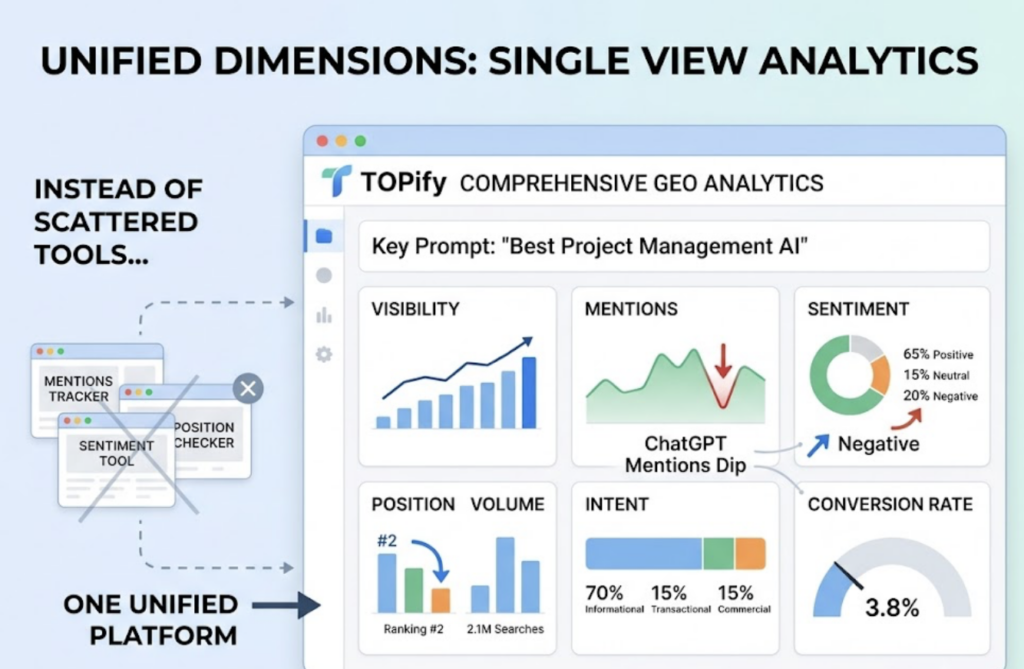
    Instead of stitching together screenshots and spreadsheets, Topify’s Comprehensive GEO Analytics aggregates performance across seven dimensions in one view: visibility, mentions, sentiment, position, volume, intent, and conversion rate. So when ChatGPT mentions dip on a key prompt, you see the position change and the sentiment shift in the same place, not three separate tools.
    Source Analysis handles the citation supply chain. It reverse-engineers the exact domains and URLs the models cite, which lets you see whether competitors are pulling authority from review sites or forums you’re absent from. That’s usually where lost visibility actually originates.

    Competitor Monitoring rounds it out by flagging where rivals consistently outrank you in comparison queries, so you can prioritize the content gaps that move the needle rather than guessing. The payoff isn’t just tidier reporting. AI-referred traffic converted about 31% higher than traditional search referrals over the 2025 holiday season, which means visibility in these answers tends to reach buyers with sharper intent. You can get started with Topify and run your prompt library across all three major engines from a single dashboard.

    Conclusion

    AI answers are becoming the place buying decisions start, and the brands that show up are the ones measuring it on purpose. You don’t need to boil the ocean to begin. Build a prompt library around your highest-intent queries, cover ChatGPT and Perplexity at minimum, and commit to a weekly or monthly cadence with a real feedback loop. Strategy beats spot-checking every time. Get those three things running, then layer in source and competitor analysis once the baseline is stable.

    FAQ

    How do I track brand mentions in Perplexity? 

    Run your high-intent prompts through Perplexity and log two things each time: whether your brand appears in the answer, and whether your domain shows up in the source citations beneath it. Because Perplexity is citation-first, the source list matters as much as the mention itself. For ongoing tracking, automate it so you’re capturing changes weekly rather than auditing by hand.

    How to track brand mentions in Perplexity without checking manually? 

    Use a monitoring platform that runs your prompt set against Perplexity on a schedule and records mention rate, position, and citation inclusion automatically. This removes the 48 to 72 hour lag that manual auditing introduces and lets you spot citation shifts as they happen.

    How often should I run AI response monitoring? 

    Use 7-day or 30-day rolling averages rather than daily checks. Model output varies enough that daily readings create false alarms. Rolling windows normalize that variance so you respond to real trends.

    What metrics matter most in an AI response monitoring strategy? 

    Four: mention rate, position, sentiment, and source authority. Mention rate is the floor, position drives clicks, sentiment shapes perception, and source authority explains why the model cites you or doesn’t. Tracking only one gives you a misleading picture.
    Read More

  • ChatGPT Ranking: How It Works and How to Improve It

    ChatGPT Ranking: How It Works and How to Improve It

    Your team spent six months building content, earning backlinks, and climbing Google. Then a prospect opened ChatGPT and asked for the best tool in your category. The answer named five brands. Yours wasn’t one of them. Nothing in your SEO dashboard explains why, because none of those metrics measure what an AI model decides to say. ChatGPT ranking runs on a different logic than Google ranking, and the brands winning it aren’t always the ones sitting at #1 in search results.

    What Is ChatGPT Ranking, Really

    ChatGPT ranking isn’t a list of blue links. It’s whether an AI model includes your brand in its answer, and where that mention lands.

    In practice, it breaks into two measurable things. The first is visibility, or mention rate: how often your brand shows up when someone asks ChatGPT a category or comparison question. The second is position, or salience: whether you’re named as the recommended leader, buried mid-list, or cited only as a footnote source.

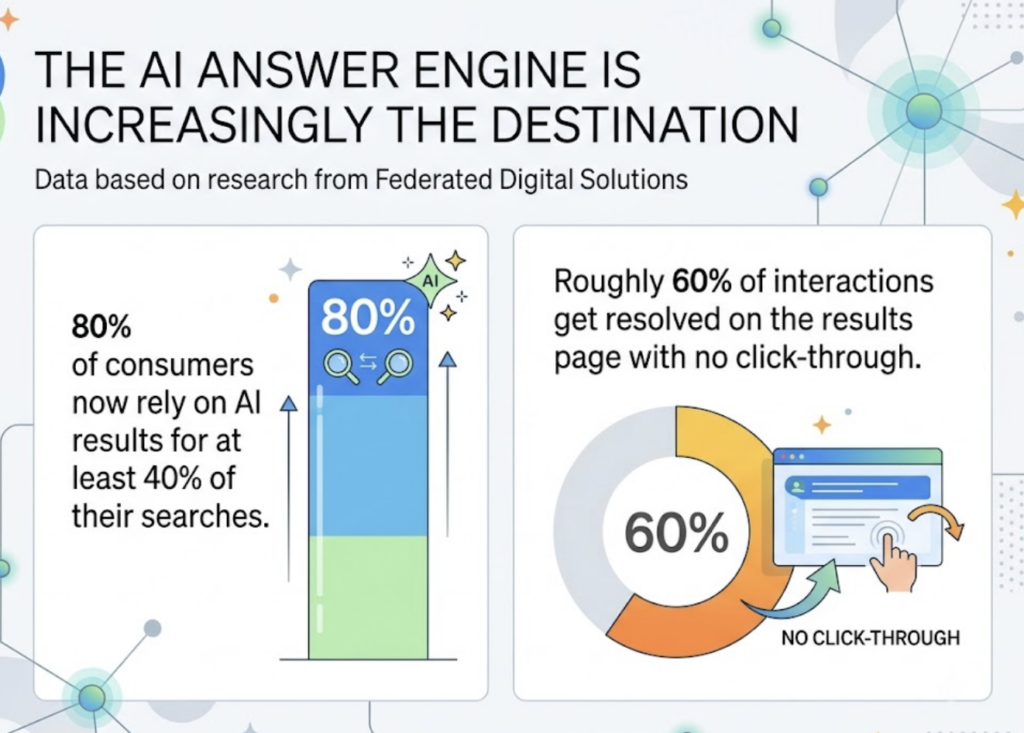
    This matters because the answer engine increasingly is the destination. Research on AI search behavior from Federated Digital Solutions found that 80% of consumers now rely on AI-generated results for at least 40% of their searches, and roughly 60% of those interactions get resolved on the results page with no click through to any website.

    That’s the gap most brands still can’t see.

    How Does ChatGPT Ranking Work

    ChatGPT doesn’t rank pages in a vacuum the way a search index does. It uses Retrieval-Augmented Generation, pulling from trusted sources across the web and synthesizing them into one confident answer. If your brand isn’t part of that synthesized consensus, you effectively don’t exist for the person asking.

    A few signals drive whether you make it into that consensus.

    Multi-source corroboration is the big one. Models favor content patterns that repeat across diverse, authoritative domains like G2, industry publications, and Reddit. When the same claim about your brand appears in several reputable places, it creates a trust cascade that tells the model you’re a real entity in your category.

    Structural clarity is the second. AI models prefer content they can extract cleanly. According to the 7 Pillars of LLM Visibility from Limy.ai, pages with clear H1 to H3 headers, bulleted lists, and answer-first summaries can see up to a 40% increase in citation rates over unstructured prose.

    The third is something traditional SEO undervalues: unlinked mentions. Google leans heavily on backlink equity. LLMs treat an unlinked mention on a reputable third-party platform as a strong signal of relevance on its own.

    Why Google Rankings Don’t Translate

    Here’s the part SEO teams keep missing.

    A high domain authority and solid keyword positions don’t guarantee anything in AI search. Marketing.org.nz makes the case plainly in its work on why traditional SEO isn’t enough: the answer engine optimizes for synthesis and entity association, not link hierarchy. The numbers back it up. Only 12% of AI Overviews link to the #1 organic ranking result, which means your Google position is no longer a reliable proxy for whether AI knows you exist.

    How to Measure ChatGPT Ranking

    The instinct is to open ChatGPT, ask the question, and see if you show up. That single check tells you almost nothing.

    AI results are non-deterministic. The same prompt can return different answers in back-to-back sessions, because models use a temperature setting to introduce conversational variety. Visiblie’s research on whether ChatGPT gives everyone the same answer points to a second variable: personalization. Chat history, saved memory, and custom instructions all shape the response, so what you see isn’t what your customer sees.

    So a single good mention is a proof of concept, not a metric. Reliable measurement means aggregating results across many fresh sessions, then watching the trend instead of reacting to one lucky or unlucky output.

    That’s the core reason manual checking falls apart at scale, and where a dedicated tool earns its place.

    Using an LLM Ranking Checker

    An LLM ranking checker runs your category prompts across AI platforms repeatedly, then turns the noisy output into a stable visibility and position score you can track over time.

    For teams measuring this across more than one engine, Topify tends to stand out by combining Visibility and Position tracking into a single view spanning ChatGPT, Perplexity, and Google AI Overviews. In practice, that means you can watch your mention rate for a key prompt, see whether you’re climbing or slipping against a competitor, and catch a drop the week it happens rather than a quarter later. It’s the difference between guessing and knowing where you actually stand.

    How to Improve Your ChatGPT Ranking

    Improving your ChatGPT ranking is less about keywords and more about entity authority. Three moves do most of the work.

    Build source authority. LLMs index high-trust platforms heavily, so placements on sites like G2 and respected industry journals feed directly into the consensus they synthesize. Reverse-engineering which domains the AI already cites for your category tells you exactly where to earn presence. Topify’s Source Analysis surfaces the exact domains and URLs AI platforms pull from, so you can see whether you or a competitor owns those references.

    Format answer-first. Put the direct answer to a likely prompt inside the first 40 to 60 words of a page, then support it with structure the model can lift cleanly. This single habit lifts extractability more than almost any other on-page change.

    Benchmark against competitors continuously. If a rival gets cited for a feature you also offer, the problem usually isn’t the feature. It’s that your content structure is stopping the model from making the connection. Topify’s competitor benchmarking shows who AI engines recommend and where the gaps sit, which turns a vague strategy into a specific content to-do list.

    The throughline of any real strategy for ChatGPT ranking: measure first, then fix what the data points to.

    Common Mistakes That Tank Your ChatGPT Ranking

    Most brands lose visibility for predictable reasons.

    The first is treating Google rankings as the scoreboard. With only 12% of AI Overviews pointing to the top organic result, that assumption quietly misleads the whole strategy.

    The second is checking one platform and calling it done. Your audience moves across ChatGPT, Perplexity, and AI Overviews, and your position can differ on each.

    The third is the one-off check. A single fresh session can’t separate signal from the model’s built-in randomness, so teams celebrate a mention that won’t repeat, or panic over an absence that wasn’t real.

    The last is ignoring sentiment. Federated Digital Solutions notes that 78% of users visit a retail site after an AI recommendation, which means a negative or off-brand AI summary can cost you the customer before they ever reach your page. How AI describes you matters as much as whether it mentions you.

    Conclusion

    ChatGPT ranking comes down to two questions: does AI mention your brand, and does it put you where it counts. The brands winning aren’t the ones with the highest domain authority. They’re the ones being measured, monitored, and corrected as AI answers shift week to week. With 58% of product research now running through AI tools, per Federated Digital Solutions, that visibility is no longer a side metric.

    Start by getting an honest baseline of where you stand across the major AI engines, then work the gaps the data exposes. You can get started with Topify to track your AI search position in one place.

    FAQ

    Q: What are the best tools for ChatGPT ranking? 

    A: The right tool tracks more than one AI platform, runs prompts across many fresh sessions to control for randomness, and reports both mention rate and position. Platforms built for this, like Topify, also tie in source and sentiment data so you can act on what you find rather than just watch a number.

    Q: Is there a checklist for ChatGPT ranking? 

    A: A simple checklist for ChatGPT ranking: earn mentions on high-authority third-party sites, format pages answer-first within the first 40 to 60 words, use clear H1 to H3 structure, monitor multiple AI platforms, and track sentiment alongside visibility. Review the data on a recurring schedule, not once.

    Q: Can you give an example of ChatGPT ranking in action? 

    A: A common example of ChatGPT ranking: you ask ChatGPT “best [your category] tool” and it returns five brands in a ranked list. Whether you appear, and at which position, is your ChatGPT ranking for that prompt. Run the same prompt across 20 sessions and the aggregate placement is your real score.

    Q: How much does ChatGPT ranking tracking cost? 

    A: Pricing for ChatGPT ranking tools varies by prompt volume and platform coverage. Topify’s plans start at $99 per month for tracking across ChatGPT, Perplexity, and AI Overviews, with higher tiers adding more prompts, projects, and seats. You can review current Topify pricing for the full breakdown.

    Read More

  • How to Track Perplexity Brand Mentions in AI Search

    How to Track Perplexity Brand Mentions in AI Search

    Your domain authority is climbing. Your target keywords sit on page one. Traffic from Google looks healthy. Then you open Perplexity, ask the exact question your best customers ask, and watch it recommend three competitors by name without naming you once.

    Your SEO dashboard registered nothing, because it was never built to see what an answer engine decides to say. Tracking your Perplexity brand mentions is the only way to know how often this happens, for which questions, and what’s pulling the answer toward someone else.

    Why Perplexity Brand Mentions Matter More Than Rankings

    A Google ranking is binary. You’re position four or you’re not. A Perplexity mention is probabilistic. The model decides, answer by answer, whether your brand earns a sentence in its response or gets left out entirely.

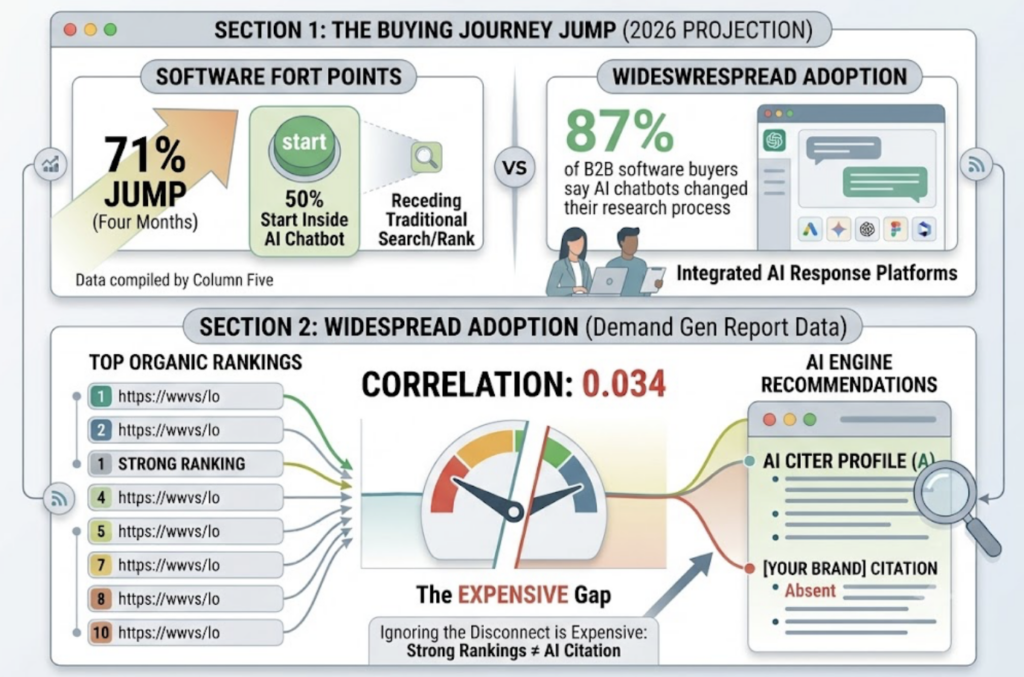
    That difference is now expensive to ignore. By 2026, around 50% of software buying journeys start inside an AI chatbot, a jump of roughly 71% in four months, according to data compiled by Column Five. Demand Gen Report puts the share of B2B software buyers who say AI chatbots changed their research process at 87%.

    Here’s the part most SEO teams miss. Ranking and getting mentioned are nearly unrelated. One industry analysis found the correlation between Google organic position and AI citation probability runs as low as 0.034, which is effectively noise.

    You can hold the top organic spot and still be absent from the answer your buyer actually reads.

    Perplexity SEO Is Not the Same as Google SEO

    Classic SEO instincts (chase keywords, build backlinks, climb the SERP) don’t carry over cleanly. Perplexity doesn’t rank a list of links. It retrieves sources in real time, synthesizes an answer, then footnotes the pages it leaned on.

    So Perplexity SEO is less about domain backlinks and more about two things: whether your content is extractable, and whether the wider web agrees on what your brand is. A page can rank first in Google and still get skipped if it loads only through JavaScript or buries its answer ten paragraphs down.

    The evidence for this gap is hard to wave away. An Ahrefs study found 28% of ChatGPT’s most-cited pages have zero organic visibility on Google. Separately, roughly 12% of URLs cited by Perplexity rank in Google’s top 10 for the same query, per a 2026 analysis from WP SEO AI.

    Different engine. Different rules. Different scoreboard.

    The Three Signals to Track: Mentions, Ranking, and Citations

    Perplexity visibility isn’t one number. It’s three, and each tells you something the others can’t.

    Tracking Perplexity Brand Mentions

    A mention is the simplest signal: does the answer name your brand in its natural-language text? This is your awareness layer. It tells you whether the model considers you a relevant option for a given question at all.

    The trick is coverage. Tracking mentions for branded queries (people already searching your name) flatters you. The real test is category and comparison queries, where a buyer who’s never heard of you is deciding who to shortlist.

    Tracking Perplexity Ranking

    Mentions tell you if you showed up. Perplexity ranking tells you where. Being named in the first sentence of an answer carries far more recall and click intent than a passing reference in the last paragraph.

    Order also signals how the model weighs you against rivals named alongside you. If a competitor consistently leads the answer and you trail, that’s a positioning gap, not a volume gap.

    Tracking Perplexity Citations

    Citations are the footnoted links Perplexity attaches to its answers, and they drive the actual referral traffic. They matter more here than on most engines: Perplexity supplies an average of 6.61 citations per answer, compared with ChatGPT’s 2.62, based on 2026 research from Evergreen Media.

    Watching Perplexity citations also exposes content gaps a traditional SEO tool would never flag. If the answer keeps citing a competitor’s comparison page or a third-party review instead of your site, you’ve found exactly what to build next.

    How to Set Up Perplexity Tracking Step by Step

    You don’t need a data science team to start. You need a repeatable process, because manual spot-checks go stale fast.

    Step 1: Build your prompt set. Define a golden set of 50 to 100 high-intent queries spanning category questions, comparisons, and problem-based prompts. This is the universe you’ll measure against.

    Step 2: Standardize the environment. Run queries in clean browser profiles or through an API so personalization and session history don’t skew results. Guidance from Rankability stresses this point: without a controlled setup, you’re measuring your own search history, not the model’s default answer.

    Step 3: Track on a cadence. Citation models shift constantly, and one-off audits produce false signals. A weekly or bi-weekly run lets you catch citation drift before it becomes a trend.

    Step 4: Act on the gaps. For every query where you’re absent, record which sources the answer cited instead. That list is your content roadmap.

    Run this for a month and the limits of doing it by hand become obvious. A hundred prompts, across multiple engines, every week, is not a spreadsheet job.

    What a Good Perplexity Tracking Tool Actually Does

    So what separates a tool worth paying for from a dashboard full of numbers? Three things, matching the three signals above: it should measure mention frequency, position within the answer, and the exact sources being cited, then track all of it over time across more than one engine.

    Topify is built around that exact structure. Its Visibility Tracking surfaces how often your brand is named across your prompt set, while Position Tracking shows where you land relative to competitors in each answer. For the citation layer, Source Analysis reverse-engineers the specific domains and URLs Perplexity pulls from, so you can see whether your pages or a rival’s are feeding the response.

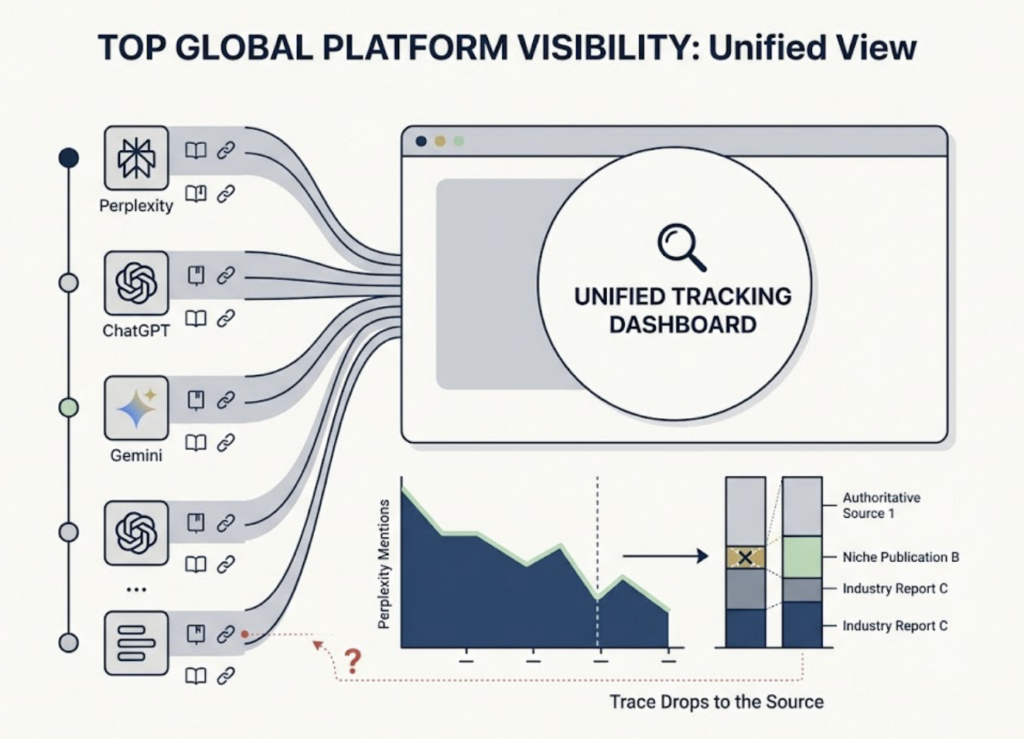
    Coverage is the other piece that matters. Buyers rarely use one engine, and citation overlap between platforms can be as low as 11 to 12%, so a Perplexity-only view misses most of the picture. Topify tracks the same prompts across Perplexity, ChatGPT, Gemini, and other major models in a single view, which means a drop in Perplexity mentions can be traced back to the source that stopped citing you without switching tools.

    Plans start at $99 a month and include Perplexity, ChatGPT, and Google AI Overviews tracking with room for 100 prompts, which lines up almost exactly with the golden set most teams need. You can get started and load your first prompt set in an afternoon.

    Common Mistakes When Tracking Perplexity Brand Mentions

    Three patterns trip up teams new to this.

    The first is checking once. A single audit captures one roll of the dice from a non-deterministic model. Without a cadence, you can’t tell a real change from normal variance.

    The second is tracking only branded prompts. Of course Perplexity names you when someone types your company name. The questions that grow pipeline are the category ones, where you’re competing to be mentioned at all.

    The third is watching mentions while ignoring citations. Mentions tell you the model knows you exist. Citations tell you which content earned that trust, and they’re the lever you can actually pull. Skip them and you’re tracking a symptom, not the cause.

    Conclusion

    Your Google rankings can stay perfectly healthy while Perplexity quietly recommends someone else. That gap won’t show up in any traditional SEO report, which is the whole reason tracking matters.

    Start small. Define a tight prompt set, measure mentions, ranking, and citations together, and run it on a schedule rather than as a one-off. Once you can see which sources Perplexity trusts, fixing your visibility stops being guesswork and becomes a content decision you can actually make.

    FAQ

    Q: What’s a good tool to track Perplexity brand mentions? 

    A: Look for one that measures three things together: how often you’re mentioned, where you rank inside the answer, and which sources Perplexity cites, ideally across several engines. Topify covers all three and tracks Perplexity alongside ChatGPT and Gemini, so you’re not stitching together separate tools.

    Q: How is Perplexity SEO different from regular SEO? 

    A: Perplexity SEO optimizes for being retrieved and cited inside a synthesized answer, not for ranking a link. It rewards extractable, answer-first content and consistent brand entity signals across the web, which is why a top Google ranking doesn’t guarantee a Perplexity mention.

    Q: How often should I check my Perplexity ranking and citations? 

    A: Weekly or bi-weekly. Perplexity weights freshness and its citation behavior shifts with model updates, so a one-time audit gives a false read. A regular cadence lets you spot citation drift early.

    Q: Can my brand be mentioned without being cited? 

    A: Yes, and it’s common. Perplexity can describe your brand in its answer text without linking to your site as a source. Mentions build awareness, citations drive referral traffic, and a full strategy tracks both.

    Read More

  • AI Response Monitoring Software: A Practical Guide

    AI Response Monitoring Software: A Practical Guide

    Your team can describe exactly where you rank on Google. Ask where you stand when a buyer types your category into ChatGPT or Perplexity, and the answer is usually a shrug. AI assistants now summarize, compare, and recommend brands inside a single response, and most marketing teams keep no record of what those answers say. The gap matters more than it looks. Buyers are reading AI answers instead of clicking through to your site, which means a model can shape a purchase decision about your product before you ever know the conversation happened. That blind spot is what AI response monitoring software exists to close.

    What Is AI Response Monitoring Software

    AI response monitoring software is the system that audits how AI models describe, position, and recommend your brand inside synthesized answers. It tracks recommendation signals, not link rankings.

    Traditional SEO answers one question: where do I appear on the list? AI monitoring answers a different one: how does the AI define my brand, and who does it mention next to me?

    That distinction is the whole point. A keyword tool tells you that you rank third for a term. An AI response monitoring tool tells you that when a buyer asks “what’s the best platform for X,” ChatGPT names three competitors and skips you entirely. One measures position on a page nobody clicks. The other measures the answer your buyer actually reads.

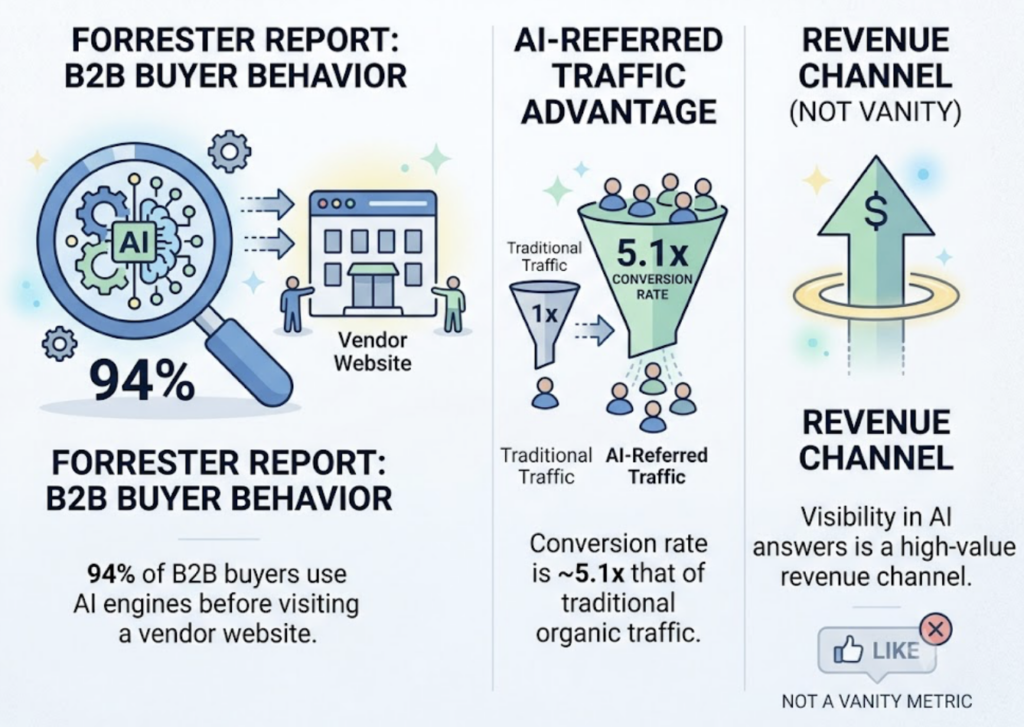
    The stakes are concrete. Forrester reports that 94% of B2B buyers now use AI answer engines before visiting a vendor website, and AI-referred traffic tends to convert at roughly 5.1 times the rate of traditional organic traffic. Visibility in these answers isn’t a vanity metric. It’s a revenue channel most teams aren’t watching.

    How AI Response Monitoring Software Works

    Manual spot checks don’t work here, and the reason is statistical. AI outputs churn constantly, and citation source overlap between platforms can run as low as 12%. Checking ChatGPT once on a Tuesday tells you almost nothing about what Perplexity said on Monday or what either says next week.

    A real AI response monitoring system runs a repeatable pipeline instead. It usually breaks into three stages.

    First, prompt definition. The software ingests a fixed set of high-intent buyer queries: problem queries, comparison queries, and category queries. This “golden set” is what gets measured over time, so results stay comparable week to week.

    Second, cross-platform sampling. The system fires those prompts across multiple engines, including ChatGPT, Perplexity, Gemini, and Google AI Overviews. Each model carries its own bias. Perplexity leans on community sources like Reddit, while other engines favor institutional or editorial domains. Sampling one engine misses most of the picture.

    Third, extraction. The platform parses each unstructured answer into structured data: how often you’re mentioned, how the model frames you, and which third-party domains it cited to back the recommendation. That last layer matters. Averi’s analysis of roughly 680 million citations found that the sources an AI trusts are often the real lever behind who gets recommended.

    The Metrics an AI Response Monitoring Dashboard Should Show

    Most teams measure presence. The useful metrics measure influence. A good AI response monitoring dashboard moves the focus from “did we appear” to “did we win the recommendation.”

    MetricWhat it tells you
    Mention inclusion rateHow often your brand shows up in high-intent buyer prompts
    Share of citationYour portion of supporting evidence versus competitors
    Competitor displacementHow often rivals appear in the space you should own
    Positioning sentimentHow the AI summarizes your value, like “high trust” or “slow to deploy”
    Source authorityThe credibility of the domains the AI uses to cite you

    Here’s the part teams skip. A mention isn’t automatically a win. If a model includes you but frames you as “the most expensive option,” that’s a failed mention for a mid-market product. Strong AI response monitoring analytics surface sentiment and positioning alongside raw frequency, so you can tell the difference between being recommended and being mentioned as the one to avoid.

    That’s the gap most dashboards still can’t see.

    What to Look for in an AI Response Monitoring Tool

    The market splits into two groups, and the difference shows up the moment you try to act on the data.

    CapabilityData-only toolsActionable platforms
    Platform coverageOften single engineChatGPT, Perplexity, AI Overviews, and more
    Tracking precisionBasic mention countsPrompt-level category and comparison queries
    Competitor viewLimited or absentSide-by-side positioning
    OutputRaw numbersNext-step actions to influence citations

    A data-only tool hands you a number and leaves the interpretation to you. An actionable platform tells you which source stopped citing your brand and what to publish to win it back. For a marketing team that has to report progress and then change it, that second layer is the whole job.

    Use this short checklist when you evaluate any AI response monitoring solution:

    • Multi-model coverage across ChatGPT, Perplexity, and Google AI Overviews
    • Prompt-level precision that tracks specific category and comparison queries
    • Competitor benchmarking with direct positioning comparisons
    • Actionability, meaning concrete next steps like schema, FAQ, or PR moves that shift AI citations

    If a tool checks the first two boxes but not the last two, you’ve bought a reporting system, not a growth one.

    Common Mistakes Teams Make

    Three patterns trip up most teams new to AI response monitoring.

    The first is the ChatGPT-only bias. Tracking a single model feels efficient, but citation patterns differ wildly across engines. The brand winning in ChatGPT can be invisible in Perplexity. Single-platform monitoring gives you confident, incomplete answers.

    The second is ignoring sentiment. Counting mentions without reading how the AI positions you produces a dashboard that looks healthy while your category framing quietly works against you.

    The third is the one-off audit. AI answers drift. The correlation between traditional SEO rank and AI citation probability is near zero, around 0.034 in some studies, and 88% of Google AI Overviews citations come from outside the top 10 organic results. Last month’s snapshot is already stale. Weekly or continuous tracking is what catches citation drift before it reaches your sales pipeline.

    Turning Monitoring Into a Strategy

    Monitoring is the diagnosis. Strategy is the treatment. The point of all this tracking is to change what the AI says next, and that takes three coordinated moves.

    Build authority first. AI models lean on trust hubs, so placements in credible publications carry more weight than another self-published post. Then fix entity resolution: make your brand consistent across the entity graph that models read, including LinkedIn, Wikipedia, and Crunchbase. Finally, structure your content for extraction. Answer-first formatting, clear headings, declarative stats, and tight lists make your pages easy for a model to lift and cite.

    This is where the diagnostic and the action layer need to live in one place. Topify approaches AI response monitoring as a closed loop rather than a report. Its Comprehensive GEO Analytics view tracks brand performance across major AI platforms through seven metrics: visibility, sentiment, position, volume, mentions, intent, and conversion visibility rate. Instead of leaving you to guess at next steps, it surfaces the specific prompts you’re losing, shows which competitor is taking the slot, and maps the citation sources behind the answer.

    In practice, that means you can spot a drop in ChatGPT mentions, trace it to a source that stopped citing you, and deploy a GEO strategy from the same dashboard. The platform also reverse-engineers the domains and URLs AI engines reference, so you can see whether your brand or a rival dominates the references that drive recommendations. For teams comparing options, a deeper breakdown of how AI search marketing works and how to measure it covers the measurement side in more detail.

    On cost, plans start at $99 per month, which is a reasonable entry point against the revenue tied up in a higher-converting channel. You can start with Topify and see your prompt-level standing across engines before committing, with full pricing on the Topify pricing page.

    Conclusion

    The blind spot is real: buyers read AI answers about your category every day, and without monitoring you have no idea what those answers say. The fix isn’t complicated. Define a golden set of buyer prompts, choose a tool that covers multiple engines and explains the data instead of just displaying it, and run the monitoring continuously rather than as a one-time audit. Then close the loop by acting on what you find. Track it, understand why it’s happening, and change it. That’s the difference between watching your AI visibility and shaping it.

    FAQ

    Q: What is AI response monitoring software? 

    A: It’s software that tracks how AI models like ChatGPT, Perplexity, and Google AI Overviews describe and recommend your brand inside their answers. It measures mention frequency, sentiment, positioning, and the sources the AI cites, rather than traditional link rankings.

    Q: How does AI response monitoring software work? 

    A: It runs a fixed set of buyer prompts across multiple AI engines on a schedule, then uses language processing to extract structured data from each answer: whether you’re mentioned, how you’re framed, and which third-party domains backed the recommendation.

    Q: How do you measure AI response monitoring performance? 

    A: Focus on influence metrics, not just presence. Track mention inclusion rate, share of citation versus competitors, positioning sentiment, competitor displacement, and the authority of the sources citing you.

    Q: How much does AI response monitoring software cost? 

    A: Pricing varies by coverage and prompt volume. Platforms like Topify start around $99 per month for multi-platform tracking, with higher tiers adding more prompts, projects, and seats.

    Read More

  • How to Build an AI Mention Tracking Strategy

    How to Build an AI Mention Tracking Strategy

    You typed your category into ChatGPT last week, watched it recommend five vendors, and noticed your brand wasn’t one of them. So you checked again the next day, and the answer had shifted. Now you’re not sure if that first result was a fluke or a pattern, and you have no way to tell. A single check is a snapshot, and snapshots lie. What B2B teams need isn’t another manual look. It’s a repeatable AI mention tracking strategy that shows what AI says about them, week after week.

    Why AI Brand Mentions Need a Strategy, Not Just a Spot Check

    The gap is wider than most teams realize. Research puts B2B AI adoption at 73% of buyers now using tools like ChatGPT and Perplexity during research and procurement, while only 22% of marketing teams track AI visibility at all.

    That’s a 51-point gap between where buyers are looking and where brands are watching.

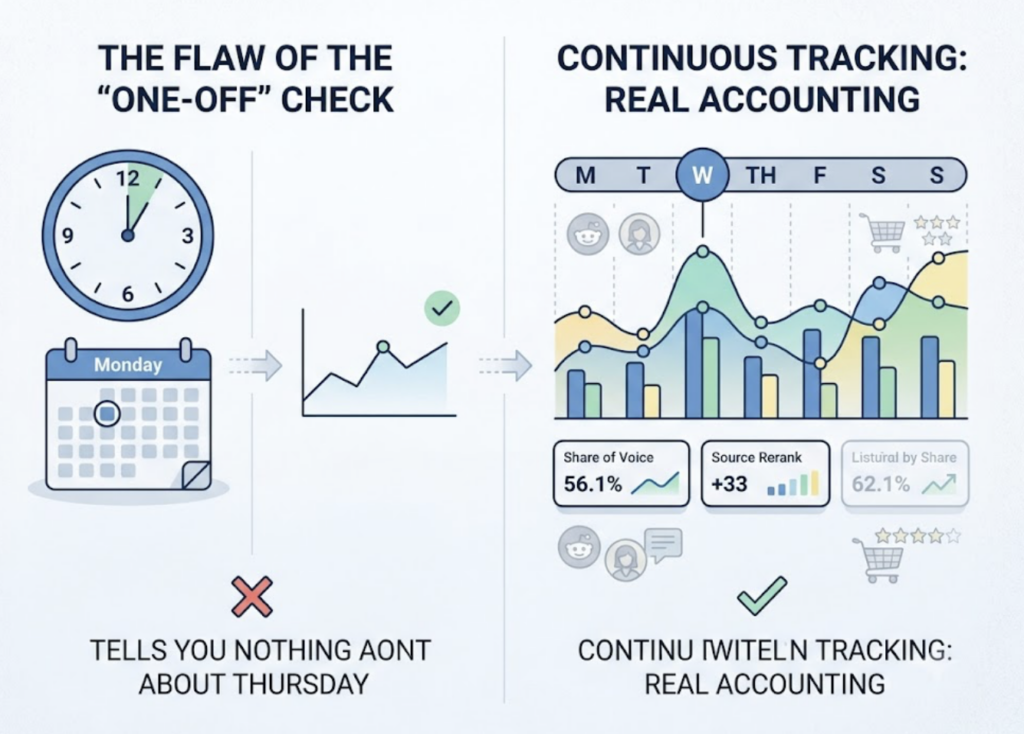
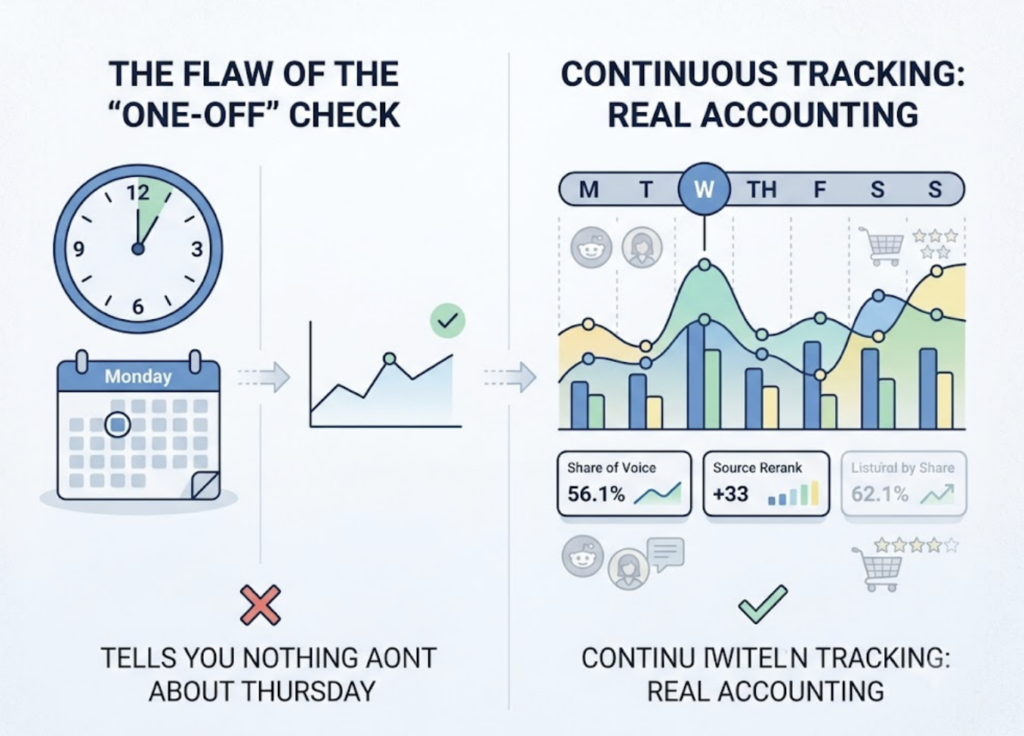
    A one-off check can’t close it. AI brand mentions move constantly as models re-rank their sources, so the answer you saw on Monday tells you nothing about Thursday. Treating mention tracking as an occasional habit is like checking your bank balance once a quarter and calling it accounting.

    The cost of staying blind isn’t abstract. AI-referred traffic has been measured converting at up to 5.1x the rate of traditional organic, which means the channel you’re not tracking is often the one closing deals.

    What “Track Brand Mentions in AI” Actually Means to Measure

    Before you track anything, you need to know what counts. A mention in an AI answer isn’t a backlink. It’s a recommendation signal, and it has more than one dimension.

    Four metrics matter most when you track brand mentions in AI:

    • Mention Inclusion Rate: the share of high-intent prompts (like “best [category] software”) where your brand actually appears.
    • Share of Citation: how much of an answer’s supporting evidence traces back to your brand’s sources.
    • Cited-Source Diversity: the number of independent domains (G2, analyst sites, Reddit, reputable media) that validate you.
    • Competitor Displacement Rate: how often you replace a rival in comparison-style answers over time.

    Here’s the part that trips up SEO teams: ranking and mention are barely related. Ahrefs research found roughly 80% of AI citations don’t rank in the Google top 10 for the same query, and the correlation between Google position and AI visibility sits near zero, around 0.034. Your domain authority can be excellent while your mention rate is flat.

    Google rewards single-source authority. AI models reward entity consistency and topical breadth. Those are different games, and you can’t measure the second one with the scoreboard from the first.

    Step 1: Map the Prompts Where Your Brand Should Appear

    You can’t track mentions without first defining where mentions should happen. That starts with a prompt set, often called a golden set, that mirrors how a buyer actually moves through a decision.

    A working set covers three query types:

    • Problem queries: “How do I solve [X] without [Y]?”
    • Comparison queries: “[Competitor] vs. your brand”
    • Category queries: “Best software for [industry use case]”

    The point is coverage, not volume. Thirty prompts that map cleanly to your buyer’s journey beat three hundred random ones. Once that set exists, every mention you measure has context: you know which buying moment it belongs to.

    Step 2: Track Brand Mentions Across ChatGPT, Perplexity, and AI Overviews

    Single-platform tracking is the most common blind spot. AI search isn’t one channel, and the engines disagree with each other more than people expect.

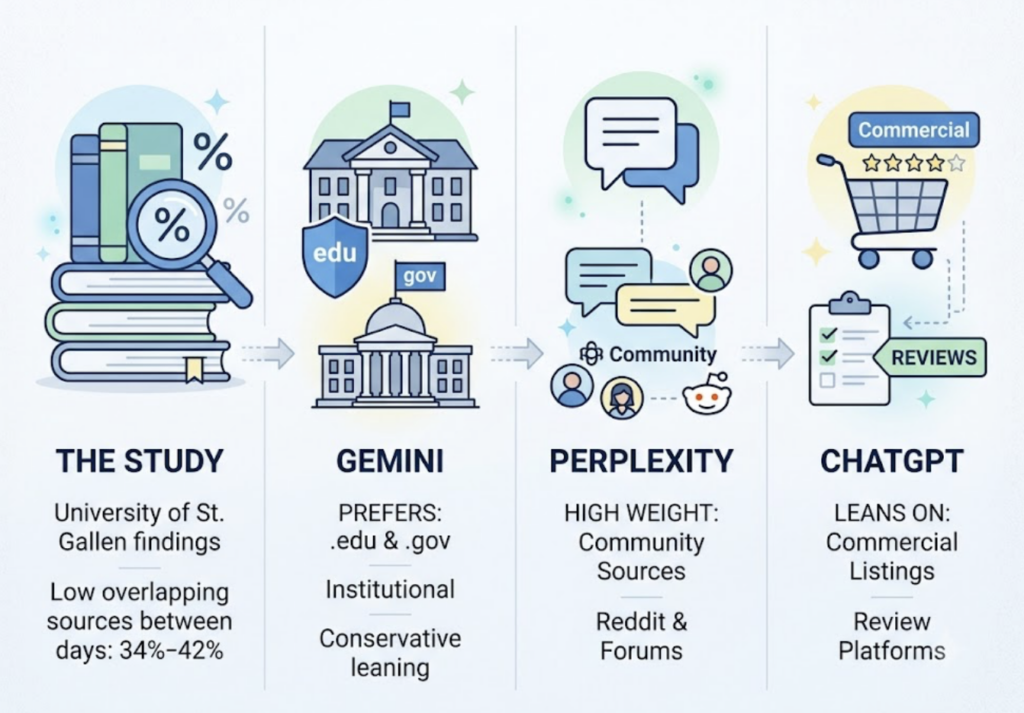
    Researchers at the University of St. Gallen found that cited-source overlap between consecutive days runs only 34% to 42% across AI engines. BrightEdge’s work on “sourcing personalities” adds the why: Gemini leans conservative and institutional, favoring .gov and .edu domains. Perplexity weights community sources like Reddit and forums heavily. ChatGPT leans on established commercial listings and review platforms.

    The practical takeaway is blunt. You can dominate ChatGPT and be invisible on Perplexity, and a tool that only watches one engine will never tell you.

    This is where a cross-platform monitor earns its place. Topify tracks brand mentions across ChatGPT, Gemini, Perplexity, Google AI Overviews, and others in a single view, so the question shifts from “did I get mentioned” to “where, how often, and against whom.” For teams searching for the best tool to track brand mentions on ChatGPT, the more useful frame is software that tracks mentions in AI responses everywhere your buyers ask, not just the one engine you happened to check first.

    If you want to start narrow, how to track AI search visibility and rankings in ChatGPT walks through a single-engine setup before you scale to the full stack.

    Step 3: Turn Mention Data Into Predictive Alerts and Benchmarks

    Data you don’t act on is just a prettier spot check. A real strategy closes the loop: when something moves, someone gets told.

    Competitive B2B categories show 15% to 30% weekly citation fluctuation, which is too fast for a human to catch by hand. That’s the case for automated, continuous monitoring rather than calendar reminders.

    The alert layer is what separates monitoring from strategy.

    When your brand drops out of a high-intent comparison query, the system should flag it the same week, while you can still respond by refreshing third-party documentation, updating a comparison page, or seeding new reviews. Topify’s AI agent handles the monitoring and surfaces what changed, then proposes the strategy to fix it, which is closer to what teams want from predictive AI alerts than a static dashboard that only reports yesterday’s numbers. Pair that with competitor benchmarking and you can watch your Competitor Displacement Rate move in real time instead of reconstructing it after the quarter ends.

    Choosing Software to Track Brand Mentions in AI Search

    Once the strategy is set, the tooling decision gets simpler, because you already know what you need it to do. The mistake B2B teams make is buying on dashboard polish instead of on whether the tool covers the four metrics across multiple engines.

    Here’s a practical requirements checklist for tools for tracking brand mentions in AI answers:

    RequirementWhy it mattersTopify
    Multi-platform coverageEngines disagree 58-66% of the timeChatGPT, Gemini, Perplexity, AI Overviews, DeepSeek, and more
    Sentiment tracking“Enterprise-grade” vs “budget option” changes buyingSentiment scoring across answers
    Competitor share of voiceDisplacement is the real KPIDynamic competitor benchmarking
    Predictive alerts15-30% weekly drift outpaces manual checksAI agent monitors and flags changes
    Prompt-level trackingMentions need buyer-journey contextHigh-value prompt discovery

    For most teams evaluating software to track brand mentions in AI search, B2B fit comes down to two things: does it watch every engine your buyers use, and does it tell you what to do when a number moves. Topify’s plans start at $99/mo for ChatGPT, Perplexity, and AI Overviews tracking with 100 prompts, which is enough to run a full golden set without an enterprise contract. You can get started and have a baseline mention rate within a few minutes.

    Conclusion

    That shifting ChatGPT answer from the intro wasn’t a glitch. It’s the normal behavior of a channel that 73% of your buyers already use and most of your competitors aren’t watching. A mention tracking strategy turns that volatility from a source of anxiety into a measurable signal. Define your golden set of prompts, track the four metrics across every engine, and wire up alerts so a drop becomes an action instead of a surprise. Start with a baseline this week. The brands that show up in AI answers next quarter are the ones measuring it this one.

    FAQ

    Q: How do I track brand mentions in ChatGPT specifically? 

    A: Build a set of high-intent prompts in your category, run them against ChatGPT on a regular cadence, and log whether your brand appears, in what position, and with what sentiment. Manual checks work for a handful of prompts, but most teams move to automated software to track brand mentions in AI responses once the prompt set grows past a dozen.

    Q: Do brand mentions really differ across AI platforms? 

    A: Yes, and more than most expect. Daily cited-source overlap between engines runs only 34% to 42%, and each platform favors different source types. A brand strong on ChatGPT can be missing from Perplexity, which is why cross-platform tracking is the baseline, not an upgrade.

    Q: How often should I re-check AI mention data? 

    A: Weekly at minimum for competitive B2B categories, where citation patterns shift 15% to 30% week over week. Daily continuous monitoring is better if the category moves fast. One-off checks are statistically close to meaningless.

    Q: Do I need B2B-specific software to track brand mentions in AI search? 

    A: You need software that covers the engines your buyers use, scores sentiment, tracks competitor share of voice, and sends predictive alerts. B2B fit is less about a separate product category and more about prompt-level tracking that maps to a real buying journey, which general-purpose tools and predictive AI alerts brand mentions providers handle to very different degrees.

    Read More

  • AI Mention Tracking: What It Is and How to Measure It

    AI Mention Tracking: What It Is and How to Measure It

    Your team watches keyword rankings every week. You know exactly where you sit on page one for your top terms. Then a buyer opens ChatGPT, types “best software for my category,” and reads a five-name shortlist before ever touching Google. Your brand isn’t on it, and nothing in your current reporting explains why. Rank trackers were built to measure links. They can’t see what a model chooses to say about you, and that gap is exactly where buying decisions now happen.

    That blind spot has a fix, but it starts with measuring the right thing.

    What AI Mention Tracking Is (and Why It’s Not Rank Tracking)

    AI mention tracking monitors whether, how often, and in what context your brand shows up inside AI-generated answers across ChatGPT, Perplexity, Gemini, and Google’s AI Overviews. It measures brand presence inside conversational output, not link position on a results page.

    That distinction matters more than it sounds. Traditional SEO rank tracking measures access: getting a user to click through to your site. AI mention tracking measures influence: whether the model names you as the answer in the first place.

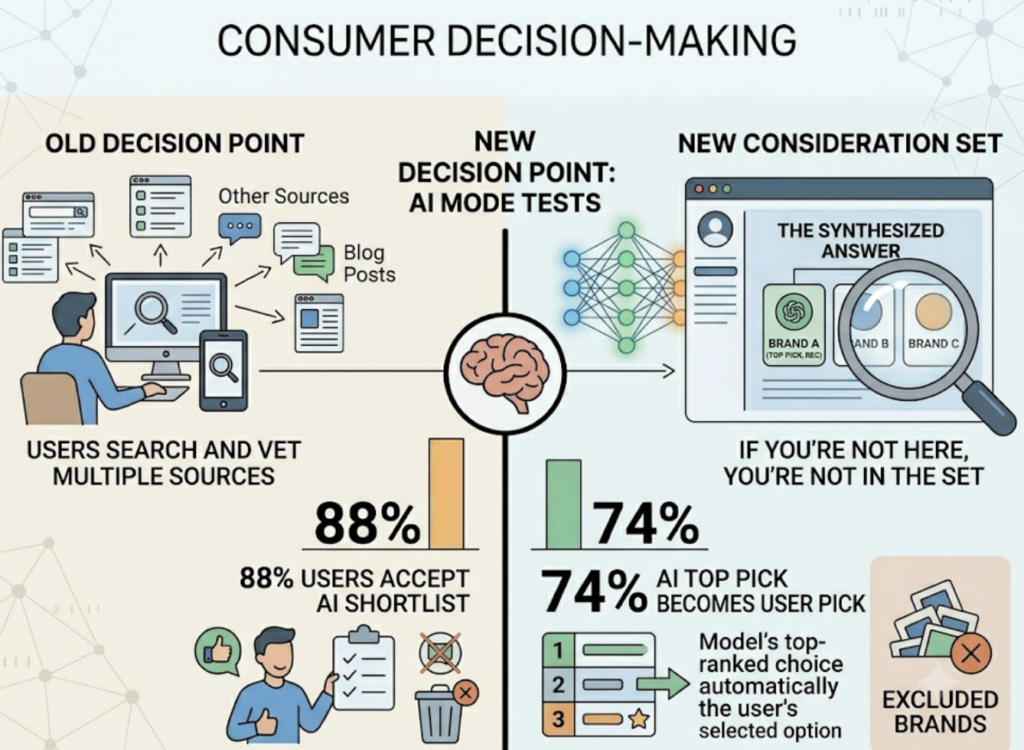
    The decision point has moved. In recent AI Mode tests, 88% of users accepted the AI’s shortlist without checking other sources, and the model’s top pick became the user’s pick 74% of the time. If you’re not in that synthesized answer, you’re not in the consideration set.

    This is why an AI mention tracking platform looks nothing like a rank tracker under the hood. One indexes URLs. The other parses unstructured language for brand entities, sentiment, and position.

    How AI Mention Tracking Works

    Instead of crawling static pages, AI mention tracking software runs through a process closer to systematic querying than indexing.

    It starts with prompt clustering. High-intent queries like “best tool for X” or “alternatives to Y” get grouped into structured prompt sets that mirror how real buyers ask questions. Those prompts then run across multiple engines at once, since OpenAI, Anthropic, Google, and Perplexity each generate answers differently.

    The output gets parsed for three things: is your brand mentioned, is it cited from a real source, and how is it framed. Most systems use an LLM-as-a-judge approach to score sentiment as positive, neutral, or negative.

    The last step is normalization. Perplexity leans hard on explicit citations, while ChatGPT favors conversational flow, so a tracking system has to reconcile those formats into one comparable visibility metric.

    Here’s the part most teams underestimate: AI answers aren’t stable. AI Overview content changes for the same queryabout 70% of the time, swapping out nearly half its citations when it does. A static keyword list checked once a month won’t catch that movement, which is why mention tracking has to run continuously.

    What to Measure: The Metrics Behind AI Mention Tracking

    A mention count alone is a vanity number. A useful AI mention tracking system turns raw presence into strategic signal across a handful of metrics.

    Mention frequency is the raw count of AI responses that name your brand. It’s the baseline, not the whole picture.

    Share of voice is how often you appear relative to named competitors in the same prompt category. This one is gaining weight fast. After an October update, ChatGPT cut its brand mentions per answer from roughly six or seven down to three or four. Fewer slots means share of voice, not raw count, decides who’s actually visible.

    Contextual sentiment captures framing. Being called a “market leader” and being called a “niche option” are both mentions, but they don’t carry the same value.

    Positioning tracks whether you show up in the opening summary or buried deep in citations. Citation authority tracks whether the model is pulling your name from high-trust domains or low-authority blogs.

    There’s a real payoff to getting cited well. When a brand is referenced in an AI Overview, its organic click-through runs about 35% higher than when it isn’t.

    Mention Frequency vs. Share of Voice

    It’s easy to confuse these two. Frequency tells you how loud you are. Share of voice tells you how loud you are next to everyone else competing for the same answer.

    A brand can hold steady frequency while its share of voice drops, simply because a competitor started showing up more often. Tracking both is what separates a dashboard that reports activity from one that explains your standing.

    How to Improve Your AI Mention Rate

    Once you can measure mentions, the next question is how to move them. Three levers do most of the work.

    Source authority comes first. Models pull brand information from domains they trust, and brands are 6.5x more likely to be cited through third-party sources than through their own site. Getting featured on high-authority review platforms and industry coverage tends to move mention rates more than polishing your own pages.

    Structured content is the second lever. Clear schema markup and concise, answer-shaped content make it easier for a model to extract and verify what your brand does. The third is correction cycles: catching the moments an AI describes your product wrong and fixing the underlying sources feeding that description.

    This is the point where measurement and action need to live in one place. Topify approaches this by pairing visibility data with source analysis, so when your mention rate dips you can trace it to the specific domains that stopped citing you, then prioritize which sources to win back. Its high-value prompt discovery keeps surfacing new queries worth tracking as buyer language shifts, which addresses the stale-prompt problem directly.

    The strategy isn’t complicated. Find where you’re invisible, find who’s getting cited instead, and close the source gap.

    Choosing an AI Mention Tracking Tool: Software, Platform, or Full Solution

    Not every AI mention tracking solution does the same job, and the labels blur together. The practical difference is whether a tool tells you “the what” or also “the why.”

    Run any candidate through four questions:

    1. Multi-engine coverage. Does it track Perplexity, Gemini, ChatGPT, and Google AI Overviews, or just one?
    2. Prompt granularity. Can it separate visibility by intent, like transactional versus informational queries?
    3. Competitor benchmarking. Does it show side-by-side share of voice, not just your own numbers?
    4. Actionable feedback. Does it link mentions back to specific sources you can optimize?

    Here’s how the common options stack up:

    Solution typeWhat it’s good atWhere it falls short
    Manual spot-checksQuick qualitative readDoesn’t scale, biased, not reproducible
    Basic dashboardRaw mention countsNo context, sentiment, or cause
    Full AI platformEnd-to-end GEO analyticsHigher commitment, far more strategic value

    A full AI mention tracking platform like Topify sits in that third row. It monitors brand performance across major AI engines through seven metrics: visibility, sentiment, position, volume, mentions, intent, and conversion visibility rate. Competitor benchmarking surfaces who the engines recommend and how you rank against them in real time, and citation analysis reverse-engineers the exact domains AI platforms cite so you can see whether you or a rival owns those references.

    The pricing question comes up early, so to be direct: professional-grade tracking generally starts around the $99/month range for mid-market teams, with Topify’s plans following that structure. The trade-off worth weighing isn’t tool cost. It’s the cost of not knowing where you stand while buyers make decisions inside answers you can’t see.

    Common Mistakes in AI Mention Tracking

    Most teams that start tracking make the same handful of errors.

    The silo trap is the most common: monitoring only ChatGPT while ignoring the different citation logic of Perplexity and AI Overviews. Context neglect is close behind, where teams count mentions but skip sentiment. A negative mention can do more damage than no mention at all.

    Prompt stagnation is subtler. A static keyword list goes stale as buyer language drifts toward longer, conversational queries, so the prompt set has to stay dynamic.

    The last mistake is treating this as SEO with a new coat of paint. Stuffing SEO keywords into prompts doesn’t work, because models favor topical authority over keyword density. It shows up in the numbers, too: just 16% of brandssystematically track their AI search performance today, which means most are still measuring the old channel while the decision moves to the new one.

    Conclusion

    AI mention tracking isn’t an extension of SEO. It’s a separate discipline built for a moment when the answer, not the link, is what buyers act on. The brands that win here stop reading AI responses as search results and start treating them as influence engines worth measuring.

    Start with the basics: decide which prompts and platforms matter for your category, then pick a tool that explains why your mentions move, not just that they did. Get started with Topify if you want that measurement and the source-level context in one view.

    FAQ

    Q: What is AI mention tracking? 

    A: It’s the practice of monitoring whether and how your brand appears inside AI-generated answers across engines like ChatGPT, Perplexity, Gemini, and Google AI Overviews. Unlike rank tracking, which measures link position, it measures brand presence, sentiment, and prominence within conversational output.

    Q: How do you measure AI mention tracking? 

    A: Through metrics that go past raw counts: mention frequency, share of voice against competitors, contextual sentiment, position within the answer, and the authority of the sources the AI cites. Tracking share of voice alongside frequency tells you not just how visible you are, but how visible you are relative to rivals.

    Q: What are common mistakes in AI mention tracking? 

    A: Monitoring only one engine, counting mentions without checking sentiment, using a static prompt list that goes stale, and treating it like keyword-based SEO. Each one leaves gaps in what you can actually see and act on.

    Q: How much does an AI mention tracking tool cost? 

    A: Professional platforms generally start around $99/month for mid-market teams, scaling up with the number of prompts, projects, and engines tracked. The relevant comparison is that cost against the lost visibility of not knowing where your brand stands in AI answers.

    Read More

  • AI Mention Tracking Monitoring: A Buyer’s Guide

    AI Mention Tracking Monitoring: A Buyer’s Guide

    Your CEO asks a simple question in the Monday standup: are we showing up when people ask ChatGPT for a recommendation in our category? So you open a few AI tools and start typing the prompts a customer might use. The first answer mentions you. The second one, same prompt, doesn’t. Run it on Perplexity and a competitor sits in the top slot instead. Twenty minutes later you’ve got a folder of screenshots that contradict each other and no way to turn them into a number anyone can report on.

    That’s the gap most teams hit the moment they try to measure AI visibility by hand. AI mention tracking monitoring exists to close it, by turning scattered spot-checks into a repeatable signal you can actually defend.

    What AI Mention Tracking and Monitoring Actually Means

    The terms get used interchangeably, but they describe two different jobs.

    AI mention tracking is the what. It’s the systematic capture of every time your brand, your product, or a competitor shows up inside an AI-generated answer, across engines and across prompts. Think of it as an inventory of your presence.

    AI monitoring is the how and the why. It watches those mentions shift over time, following changes in sentiment, source attribution, and how you’re framed against rivals. Monitoring is what tells you a drop happened because a source stopped citing you, not because of random noise.

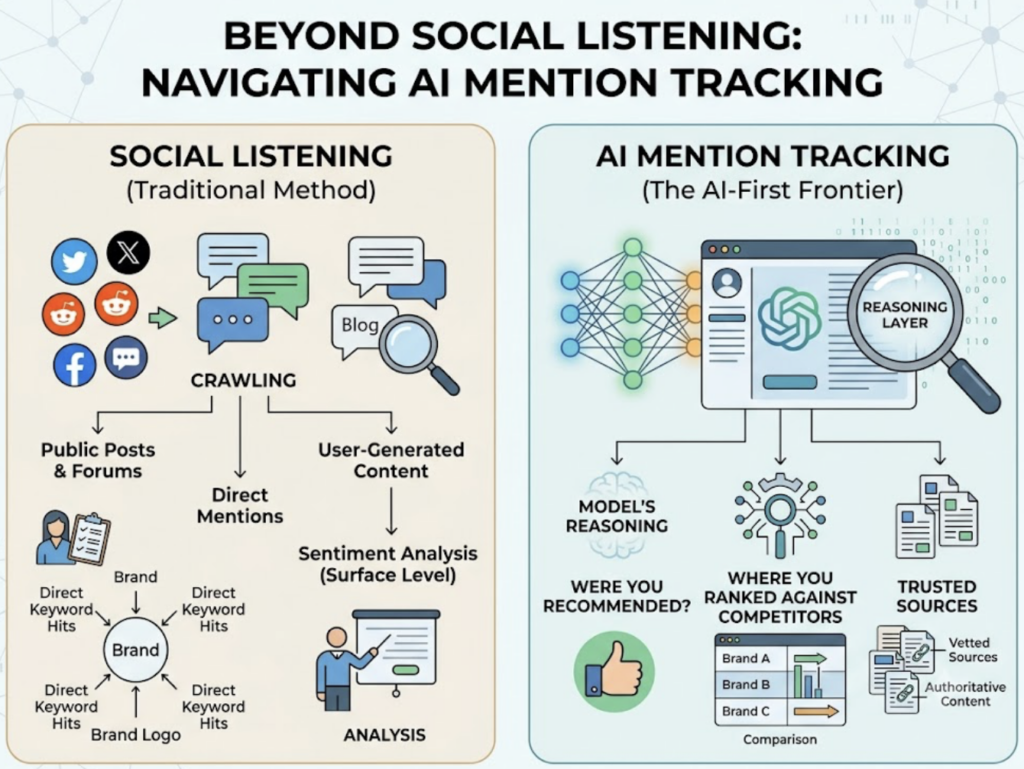
    Here’s the part that trips up teams coming from social listening. Social listening crawls public posts and forums for direct mentions. AI mention tracking monitoring targets synthesized output instead. It looks inside the model’s reasoning: not just whether you were named, but whether you were recommended, where you ranked against competitors, and which sources the AI trusted to back up its answer.

    Why an AI Mention Tracking Tool Beats Manual Spot-Checks

    Manual checking feels rigorous. It isn’t, and the reasons are baked into how these models work.

    First, the output is non-deterministic. LLMs run on controlled randomness and live retrieval, so the same prompt asked twice, even two minutes apart by the same person, can return different answers. One screenshot proves nothing.

    Second, answers are context-sensitive. Models build responses from the conversation flow, and small changes in phrasing or prior history trigger different fan-out queries to external sources. Your brand can appear or vanish based on context you can’t see.

    Third, the scale is unworkable by hand. With millions of query variations, human sampling captures less than 0.5% of the actual discovery journey. That’s not a sample, it’s an anecdote.

    An AI mention tracking tool solves the part people can’t: consistency at volume. Good AI mention tracking software runs the same prompt sets on a schedule and applies an LLM-as-a-judge approach, measuring variance with statistical methods like the intraclass correlation coefficient instead of eyeballing a handful of results. The point isn’t more screenshots. It’s a number you can trust and repeat.

    What Separates a Real AI Mention Tracking Platform from a Dashboard

    A lot of products in this space are really just dashboards. They show you a count of mentions and a line going up or down.

    The trouble with a counting dashboard is that it answers the easy question and skips the useful one. Knowing your mention rate fell 12% last week doesn’t help if you can’t see that it fell because a high-authority source dropped your citation, while a competitor picked up the top slot in “best X” prompts.

    A real AI mention tracking platform works at the prompt level. It ties each mention to the specific intent that triggered it, attributes the sources the model cited, and tracks your position relative to competitors inside the same answer.

    That’s the line between a dashboard and a platform. One reports what changed. The other explains why.

    Core Capabilities Every AI Mention Tracking Solution Should Have

    Before you compare vendors, lock down what the category actually requires. Any AI mention tracking solution worth paying for should cover five capabilities.

    CapabilityWhy it matters
    Prompt-level trackingShows how specific personas and intents trigger your mentions, not just an aggregate count
    Cross-engine benchmarkingCompares visibility across ChatGPT, Perplexity, Gemini, and Google AI Overviews in one view
    Source and citation analysisIdentifies which of your web properties the AI actually trusts and cites
    Sentiment and contextMeasures whether the tone around your brand is favorable or corrective, not just present
    Change alertingFlags the moment your visibility drops or a competitor takes top-slot share

    A system that handles the first three but skips alerting will leave you finding out about a visibility drop a month after it cost you pipeline. Treat this as your scorecard, not a wish list.

    How to Monitor Visibility in Perplexity and Other Engines

    Perplexity deserves its own line in your plan. As of mid-2026 it processes hundreds of millions of monthly queries and works as an answer engine, which means it leans hard on source citations and structured, scannable content. A brand that gets cited there earns visibility a brand that’s merely mentioned doesn’t.

    That citation-first behavior is also why tools to monitor visibility in perplexity have to look at more than mention frequency. You want to see which of your pages get cited, where you sit in the source list, and how that stacks up against the competitor Perplexity pulls in alongside you.

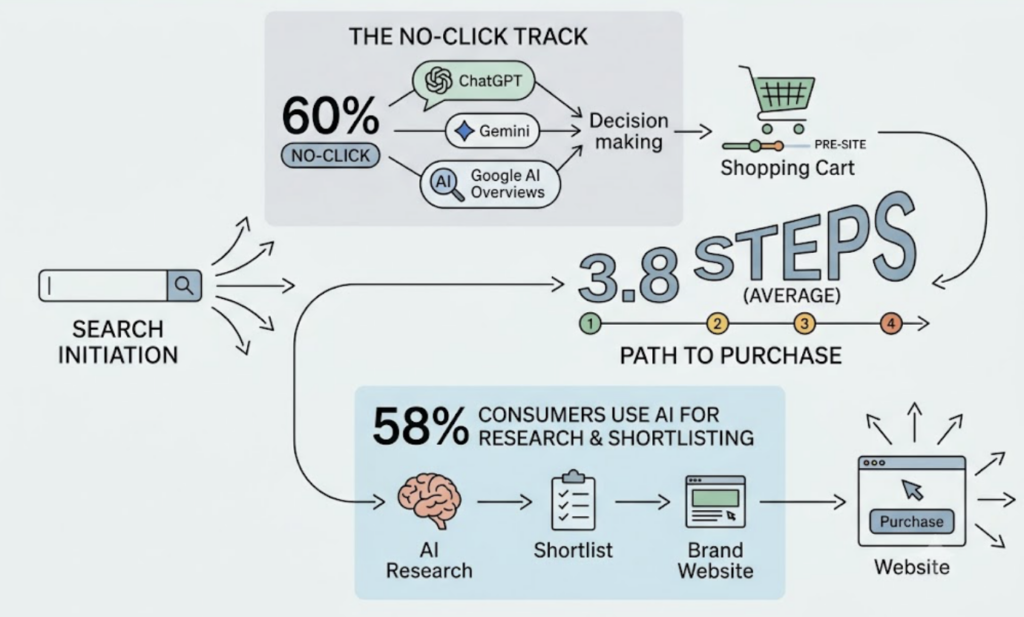
    But single-engine tracking is its own trap. Roughly 60% of search interactions now resolve without a click, and that high-intent behavior is spread across ChatGPT, Gemini, and Google AI Overviews too. The path to purchase has stretched from 1.6 steps to 3.8 steps on average, with 58% of consumers using AI tools for product research and building shortlists before they ever reach your site.

    Watch one engine and you’re optimizing for a fraction of the journey. Cross-engine coverage is the baseline, not a premium feature.

    Turning an AI Mention Tracking System into Action

    Tracking is the floor. The teams that win treat AI mention tracking monitoring as the input to a feedback loop, not the output.

    That loop has three moves. Make your content retrieval-ready, so FAQs, specs, and white papers are easy for AI crawlers to parse. Build topical authority, the persistent knowledge footprint models treat as reliable source material. Then measure the GEO metrics that map to revenue: visibility share in the top-three recommended positions, citation rate back to your domain, and how you rank against competitors in compare-and-vs prompts.

    This is where an integrated system earns its place over a stack of single-purpose tools. Topify is built around that loop. Instead of a standalone dashboard, it monitors brand performance across major AI platforms through seven metrics: visibility, sentiment, position, volume, mentions, intent, and CVR.

    In practice, that means you can catch a dip in your ChatGPT mention rate, trace it to a source that stopped citing you, and see which competitor moved into your slot, all inside one view. Its competitor benchmarking surfaces who the engines recommend and where you sit relative to them, and its source analysis reverse-engineers the exact domains and URLs the models cite. Coverage runs across ChatGPT, Gemini, Perplexity, and other major engines, so the cross-engine baseline is handled rather than stitched together.

    When you’re ready to move from spot-checks to a repeatable signal, you can get started with Topify and define your prompt sets in plain language.

    Conclusion

    The shift is already underway. Around 60% of searches end without a click, and the decision is forming inside the AI answer before anyone reaches your site. Measuring that by hand was never going to scale.

    The teams that stay visible are the ones that treat AI mention tracking and monitoring as a standing system: consistent prompt sets, cross-engine coverage, source-level detail, and alerts when something moves. Start with the five-capability scorecard, pick a solution that explains why your numbers change rather than just counting them, and wire the output back into how you build content. That’s how you turn a folder of contradictory screenshots into a number you can stand behind.

    FAQ

    Q: What’s the difference between AI mention tracking and AI monitoring? 

    A: Tracking is the capture step, recording every time your brand or a competitor appears in an AI answer across engines and prompts. Monitoring is the ongoing layer that watches how those mentions shift over time in frequency, sentiment, and source attribution. You need both: tracking gives you the inventory, monitoring tells you why it’s changing.

    Q: How do I monitor brand mentions in ChatGPT and Perplexity at the same time? 

    A: Use an AI mention tracking platform with cross-engine coverage rather than checking each tool separately. Run a consistent set of customer-style prompts on a schedule across both engines, then compare mention frequency, citation share, and competitor position in a single view. Perplexity needs extra attention on which of your pages get cited, since it’s citation-first by design.

    Q: Why can’t I just check AI answers manually every week? 

    A: Because LLM output is non-deterministic and context-sensitive, so the same prompt can return different answers minutes apart. Manual sampling also captures less than 0.5% of real query variations, which makes any single check an anecdote rather than a measurement.

    Q: What should an AI mention tracking dashboard show beyond a mention count? 

    A: A count alone tells you something moved, not why. A useful AI mention tracking dashboard adds prompt-level detail, source and citation attribution, sentiment, competitor position, and alerts when visibility drops, so you can act before the change costs you pipeline.

    Read More

  • AI Mention Tracking Solution: How It Works and Scales

    AI Mention Tracking Solution: How It Works and Scales

    Your team can pull a Google ranking for any keyword in seconds and tell exactly where you sit. Then someone asks ChatGPT to recommend a product in your category, and you have no idea whether your brand came up at all. Most of the tools that promise to answer that question measure it differently, so the numbers don’t even agree with each other. The gap isn’t accepting that AI matters. It’s knowing what “being mentioned” actually looks like, and how an AI mention tracking solution measures it without guesswork.

    What an AI Mention Tracking Solution Actually Is

    An AI mention tracking solution is an automated system that monitors how often, where, and in what context your brand shows up inside the answers generated by AI engines like ChatGPT, Perplexity, Gemini, and Google AI Overviews.

    The distinction that matters: traditional rank trackers measure your position on a list of links. A mention tracking solution measures entity-level presence. It asks whether the AI named your brand at all, not where your domain landed on page one.

    That’s a different question than SEO has ever answered.

    Here’s why it’s become urgent. As more buyers consume an AI’s summary without clicking through to any site, the AI’s description of your brand often becomes the final touchpoint before a decision. If you’re not in the answer, you’re not in the consideration set. And no amount of domain authority tells you whether that happened.

    How an AI Mention Tracking Solution Works

    These solutions don’t crawl the web the way a search engine does. They simulate the way your customers actually query AI.

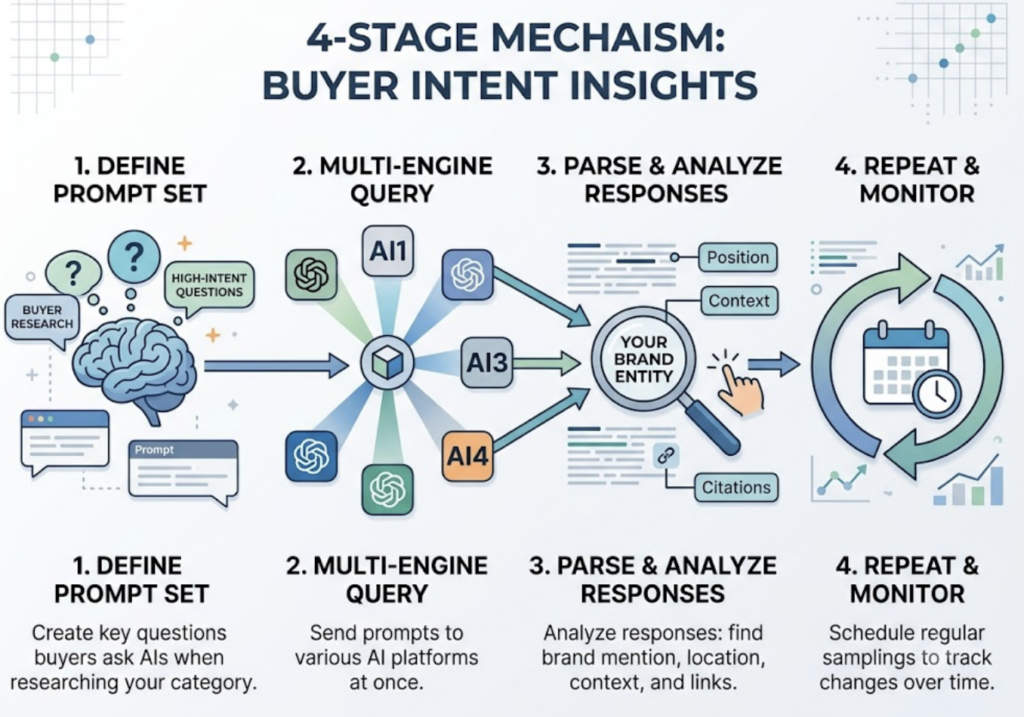
    The mechanism runs in four stages. First, you define a prompt set: the high-intent questions a buyer would ask an AI when researching your category. Second, the solution sends those prompts to multiple AI engines at once. Third, it parses each response to find your brand entity, noting the position, the surrounding context, and whether a citation links back to a source. Fourth, it repeats the sampling on a schedule.

    That last step is the one teams underestimate.

    AI answers are unstable. Your brand can appear in a response today and vanish tomorrow after a model update or a shift in how the engine weights its sources. A single check is a snapshot, and snapshots lie. Running recurring samples is what turns scattered observations into a statistically meaningful visibility score instead of a misleading one-off reading.

    How to Measure AI Mentions: The Metrics That Matter

    Counting mentions is the easy part. Turning them into something a marketing team can act on takes a framework.

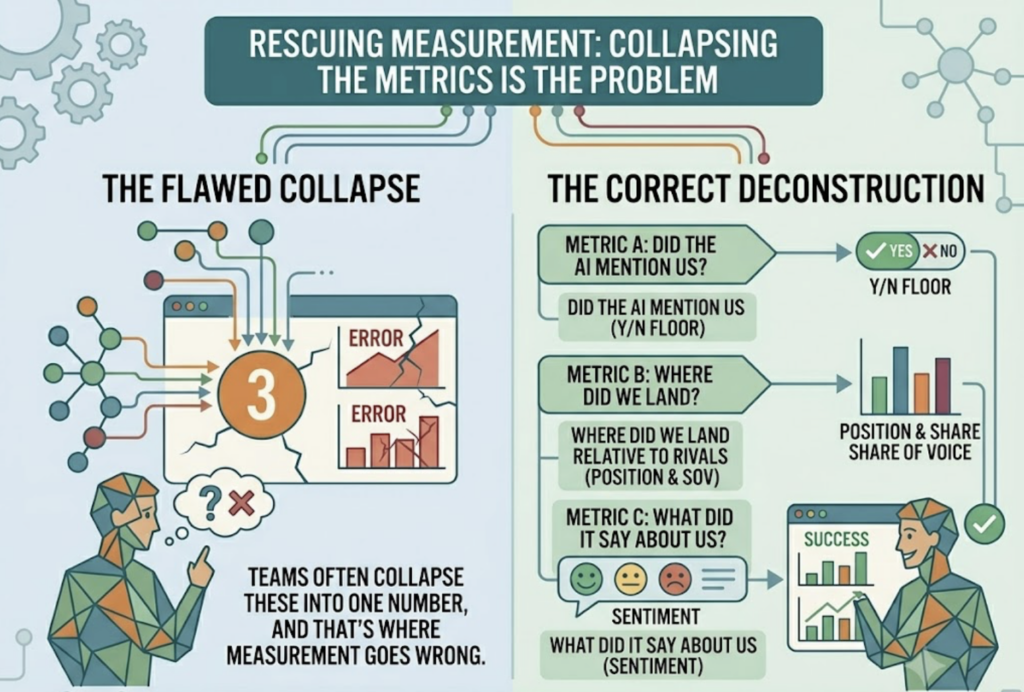
    Most serious platforms track a handful of signals together, because any one of them in isolation misleads.

    MetricWhat It Tells You
    Mention RateThe share of relevant prompts where your brand shows up
    Share of VoiceYour prominence relative to direct competitors
    SentimentThe tone the AI uses when it describes you
    Citation AttributionWhich external pages are feeding the AI’s trust in you
    PositioningWhether you’re top-of-answer or buried near the end

    A high mention rate paired with negative sentiment isn’t a win. Top positioning that traces back to a competitor’s review page tells you where your real vulnerability sits.

    This is where consolidation helps. Topify folds these signals into Comprehensive GEO Analytics, a single dashboard built around seven core metrics: visibility, sentiment, position, volume, mentions, intent, and CVR. The point isn’t more numbers. It’s being able to spot a drop in ChatGPT mentions and trace it to the source that stopped citing you, all without switching tools.

    Improving Mentions Through GEO Content Structure and Formatting

    Tracking tells you you’re invisible. The next question is why. More often than not, the answer is that your content isn’t built for an AI to extract.

    This is the part most teams miss. Generative engines pull from content that’s structured for extraction: declarative headings, answer-first paragraphs, FAQ schema, and clearly bounded claims they can lift into a synthesized response. Get your geo content structure and formatting wrong, and even authoritative content stays buried.

    A few structural shifts tend to move the needle:

    • Lead each section with the answer, then explain. AI engines favor passages where the conclusion comes first.
    • Use headings that state a claim, not a topic. “How mention tracking works” gives the engine something to quote. “Overview” gives it nothing.
    • Add structured data and FAQ markup so machines can map your content to specific questions.

    There’s a second lever: reverse-engineering citations. When a tracking solution shows a competitor getting cited, it can surface the source. Often the AI isn’t citing the competitor’s homepage at all. It’s citing a third-party review or an industry forum. That insight redirects your PR and link efforts toward the domains the AI actually trusts, rather than the ones you assume it does.

    Choosing the Right AI Mention Tracking Solution

    The tools in this category look similar on a feature list and behave very differently in practice. A few criteria separate them.

    Engine coverage comes first. A solution that only watches Google AI Overviews misses the conversational volume sitting in Perplexity and ChatGPT. If your buyers live in those interfaces, partial coverage is a blind spot, not a discount.

    Then there’s the depth question. Does the dashboard stop at “you were mentioned 40% of the time,” or does it show the source attribution you need to fix the gap? Mentions without explanation are a vanity metric.

    Competitor benchmarking matters too. You want to see your mention rate next to your top three to five rivals, tracked on the same prompts, over the same window.

    For teams weighing the options, Topify covers the major engines including ChatGPT, Gemini, Perplexity, and DeepSeek, and pairs that coverage with competitor benchmarking and citation analysis in one place. Its one-click execution layer also closes the loop, letting teams push content and structured-data updates right after a gap shows up, instead of handing the work off to a separate workflow.

    Other tools in the space each have their niche. The deciding factor is usually whether a platform explains the “why” behind a mention or just reports the “what.”

    AI Mention Tracking Solution Pricing: What You’re Paying For

    Pricing in this category rarely tracks features. It tracks scale.

    Most platforms price on three variables: how many prompts you monitor, how many engines you cover, and how often you sample. A bigger prompt set and a faster cadence cost more because they consume more analysis. That’s the real unit of value, not a bundle of dashboard widgets.

    As a rough benchmark, focused category monitoring tends to start around $99 a month, while multi-seat plans with deeper analysis and historical trends run from roughly $199 to $499 and up.

    Topify follows that logic. Its Basic plan runs $99 a month with tracking across ChatGPT, Perplexity, and AI Overviews, 100 prompts, and a 30-day trial. Pro steps up to $199 a month with 250 prompts and more seats, and Enterprise starts from $499 with a dedicated account manager. You can see the full breakdown on Topify’s pricing page, or get started with Topify on the trial.

    The takeaway: don’t pay for prompts you won’t use. Start with the prompt set that maps to your real buyer questions, then expand once the data earns it.

    Conclusion

    The hard part of AI search was never accepting that it matters. It’s knowing what “being mentioned” looks like and tracking it without guessing. An AI mention tracking solution closes that gap by turning scattered AI answers into a measurable signal, then pointing you at the content and citation fixes that move it.

    Start small. Run a baseline audit across your top buyer-intent prompts, find the questions where you’re already a close runner-up, and work those first. Visibility in AI search compounds. The brands tracking it now are the ones AI will keep recommending later.

    FAQ

    Q: What’s an example of an AI mention tracking solution in action? 

    A: A SaaS brand notices it’s rarely named when users ask ChatGPT for the best CRM for startups. The tracker reveals ChatGPT keeps citing a competitor’s comparison article. The team updates its own site with comparable data and refreshes its third-party review profile to reclaim the citation, then watches the mention rate recover on the next sampling cycle.

    Q: What should a basic mention tracking checklist include? 

    A: Four things. Define your core buyer prompts, choose at least three major AI platforms to monitor, set a monthly cadence for data collection, and assign one person to bridge the gap between citation findings and content updates.

    Q: What are the most common mistakes when tracking AI mentions? 

    A: Three show up repeatedly. Tracking too few prompts, which leaves you with low statistical power. Monitoring only one AI platform. And fixating on mention count while ignoring the sentiment and context around each mention.

    Q: What’s a good starting strategy for AI mention tracking? 

    A: Run a one-time visibility audit across your top 50 buyer-intent queries to set a baseline. Use it to spot the low-hanging fruit, the prompts where your brand is already a close runner-up, and prioritize those before chasing the harder wins.

    Read More

  • How to Measure Brand Visibility in an AI Search Tracker

    How to Measure Brand Visibility in an AI Search Tracker

    Your monthly report has SEO rankings, traffic, and conversions. Then your CMO asks how the brand is doing in ChatGPT, and the honest answer is you don’t know how to put a number on it. Most teams start by typing their own brand name into an AI engine and reading what comes back. That feels like research, but it isn’t measurement. One query, on one platform, on one day tells you almost nothing, because AI answers shift with context, model version, and phrasing. To know where you actually stand, you need a repeatable way to measure brand visibility in an AI search tracker, not a one-off gut check.

    Why Google Metrics Can’t Tell You How Visible Your Brand Is in AI Search

    Domain Authority and keyword position were built for a world where the same query returned the same list of blue links. AI search doesn’t work that way.

    The shift from link-based ranking toward entity authority and citation trust means a brand can hold the #1 organic spot and still be missing from the synthesized answer an AI engine hands the user. That’s the ranking-mention separation, and it’s the single biggest blind spot in most reporting today.

    Three things break the old metrics:

    First, results are probabilistic, not deterministic. The same prompt produces different phrasing and different brand mentions depending on model version and surrounding context, so a static rank number can’t describe it.

    Second, the click is disappearing. AI engines answer inside the interface, which makes click-through rate secondary to whether the model recommends you as a source in the first place.

    Third, the trust signals changed. AI systems favor content that’s structured and machine-readable, like clear entity definitions and FAQ schema, over keyword-dense pages written for crawlers.

    The takeaway is simple. You can’t manage AI visibility with metrics that were never designed to see it.

    What an AI Search Tracker Actually Measures

    Measuring presence in AI search means quantifying influence, not just whether your name showed up. A useful tracker converts vague “are we visible?” questions into specific, comparable numbers.

    The clearest way to think about it is the four-pillar framework that’s become the working standard for AI search measurement.

    MetricWhat it measuresWhy it matters
    Mention Rate% of buyer-relevant prompts where your brand is namedThe floor of AI presence. No mention means no consideration.
    Citation Rate% of answers linking directly to your domainThe modern backlink. Citations drive trust and referral traffic.
    Share of VoiceYour prominence versus competitors in AI answersBenchmarks your spot on the AI-generated shortlist.
    SentimentThe tone of how the AI describes youA negative mention can hurt more than no mention at all.

    Mention, Position, and Sentiment Are Three Different Questions

    Teams often collapse these into one number, and that’s where measurement goes wrong. “Did the AI mention us” is a yes/no floor. “Where did we land relative to rivals” is position and share of voice. “What did it say about us” is sentiment.

    A platform like Topify breaks this out across seven tracked signals, including visibility, mentions, position, sentiment, volume, intent, and a conversion-oriented metric, so you’re not stuck inferring brand health from a single count. The point isn’t more dials. It’s separating the questions that actually drive different decisions.

    How to Measure Brand Visibility in an AI Search Tracker, Step by Step

    A repeatable measurement workflow has four moves. Skip any one and your numbers get noisy fast.

    Step 1: Build a golden prompt set. Stop tracking generic keywords. Assemble a library of 100-plus high-intent buyer queries that mirror how people actually ask, like “best enterprise CRM for small teams” or “compare Product A vs Product B.” This prompt set is your measurement instrument, so it has to reflect real demand, not vanity terms.

    Step 2: Sample each platform separately. ChatGPT, Perplexity, and Gemini retrieve and synthesize differently, so mention rates diverge across them. Track each engine on its own to find the gaps, because an aggregate score hides which platform is ignoring you.

    Step 3: Set a baseline, then watch the trend. AI visibility is volatile, and a single snapshot is statistically meaningless. Treat visibility as a probability distribution over time, with weekly or monthly monitoring to absorb model updates instead of overreacting to one bad day.

    Step 4: Map the sources. When the AI names a competitor, dig into why. Often it’s pulling from a third-party review site or a community thread rather than an official page, which tells you whether to fix your own content or earn presence on outside authoritative platforms.

    This is where source-level tracking earns its keep. Topify’s visibility tracking ties each mention back to the specific domains AI engines cite, so a drop in ChatGPT mentions can be traced to a source that stopped referencing you, inside the same view you used to spot the drop.

    Common Mistakes That Make Your Visibility Numbers Lie

    Most teams don’t measure too little. They measure the wrong things, then trust the output.

    The most common error is the scaling trap: brute-forcing thousands of generic prompts because volume feels rigorous. Generic prompts don’t match buyer behavior, so you end up with a precise number that describes nothing. Fewer, high-intent, context-aware queries beat a giant pile of junk every time.

    Three more pitfalls show up constantly:

    Ignoring entity signals. If you don’t give AI systems machine-readable metadata like Organization, Product, and FAQ schema, they read your structure as thin, no matter how good the copy is.

    Treating GEO as a separate silo. Generative Engine Optimization isn’t divorced from SEO. It’s built on the same foundation of E-E-A-T, crawlability, and technical health, so siloed teams duplicate work and miss shared wins.

    Managing the dashboard instead of the business. Counting raw citations without asking whether they drive assisted conversions or qualified leads turns measurement into a vanity exercise.

    Good measurement always loops back to one question: does this number change what we do next?

    How to Choose the Best AI Search Tracker for Your Brand

    Once you know what to measure, picking a tool gets easier. The best AI search tracker for your brand is the one that turns observation into action, not the one with the busiest dashboard.

    Four criteria separate a real tracker from a glorified counter:

    CriteriaWhat to look forWhy it matters
    Actionable insightsSpecific content fixes, not just chartsA number you can’t act on is trivia
    Attribution mappingThe exact source the AI used for a mentionTells you what to optimize or where to earn presence
    Competitive benchmarkingSide-by-side share of voice versus rivalsVisibility is relative, not absolute
    Platform coverageMulti-engine tracking as standardSingle-engine monitoring is a partial map

    On coverage, single-engine tools are the most common shortcut, and the most misleading. Topify tracks across ChatGPT, Gemini, Perplexity, and other major engines including DeepSeek, Doubao, and Qwen, which matters if your audience isn’t all on one platform.

    On action, this is the gap most dashboards never close. Beyond reporting the seven metrics, Topify’s competitor benchmarking shows which brands the AI recommends and where you sit in that order, while its citation analysis surfaces the exact domains and URLs feeding those answers. That combination points you at a fix instead of leaving you with a score.

    Pricing is usually the last question, and it’s a fair one. Topify’s entry plan starts at $99 a month and covers ChatGPT, Perplexity, and AI Overviews tracking with 100 prompts, which is enough to run a real golden prompt set rather than a token sample. You can get started without committing to an enterprise contract first.

    Other tools in this category each have their place, and the right pick depends on whether you need depth on one engine or breadth across many. The non-negotiables stay the same: multi-platform coverage, source attribution, and insights you can actually use.

    Conclusion

    The report gap your CMO pointed at won’t close with a one-off search. It closes when you treat AI visibility like any other measurable channel: a defined prompt set, per-platform sampling, a baseline you track over time, and source mapping that tells you what to fix. Pick a tracker that scores you across engines and then tells you why, and your next quarterly review has a real answer instead of a shrug. Start with a focused prompt set this month, baseline it, and measure the trend from there.

    FAQ

    What is measuring brand visibility in an AI search tracker? 

    It’s the practice of quantifying how often, how prominently, and how favorably AI engines like ChatGPT and Perplexity name your brand across a set of buyer-intent prompts. Instead of keyword rankings, you track mention rate, citation rate, share of voice, and sentiment over time.

    How can I improve my brand’s visibility in AI search? 

    Strengthen entity signals with machine-readable schema, earn citations on the third-party sources AI engines actually pull from, and keep your content structured and authoritative. Then re-measure, because improvement only counts if your mention and citation rates move on a tracked trend.

    What are common mistakes when measuring AI search visibility? 

    The big ones are tracking thousands of generic prompts instead of high-intent queries, measuring a single platform, relying on one snapshot instead of a trend, and counting citations without tying them to business outcomes.

    How much does an AI search tracker cost? 

    It varies by platform coverage and prompt volume. Topify’s entry plan starts at $99 a month with multi-engine tracking and 100 prompts, while enterprise tiers scale up prompt counts, seats, and projects for larger teams.

    Read More

  • Enterprise AI Search Visibility Tools: A Buyer’s Guide

    Enterprise AI Search Visibility Tools: A Buyer’s Guide

    Your team manages forty regional landing pages, three product lines, and a content calendar that’s already booked two quarters out. Then leadership asks one question no existing report can answer: when a buyer asks ChatGPT for the best solution in your category, does your brand come up, or does a competitor? Most of the tools on your shortlist were built to answer that for a single brand in a single market. Enterprise reality is messier, and the distance between what these tools track and what a global organization actually needs to govern is exactly where AI search visibility leaks without anyone noticing.

    Most AI Search Visibility Tools Weren’t Built for Enterprise Scale

    Most early AI visibility tools assumed one brand, one market, and one person refreshing a dashboard. Enterprise organizations don’t work that way. They run multi-brand architectures across regions, with dozens of seats, approval chains, and the need to audit thousands of regionalized prompts at once.

    That mismatch is where most enterprise evaluations go wrong.

    The first cost of the gap is silent. Enterprises tend to lose share in AI-generated answers well before traditional traffic dips, so the loss shows up in pipeline before it ever shows up in a rank tracker. By the time a brand notices, a competitor has already been named the “best solution” to a high-intent buyer question for weeks.

    The second cost is attribution. CMOs are now asking for revenue proof on Generative Engine Optimization, and a monitor that can’t connect a mention to a sentiment shift or a change in referral traffic stays a vanity metric at the board level. Enterprise AI search visibility tools have to clear a higher bar than mention counting.

    What Enterprise AI Search Visibility Tools Actually Need to Track

    Before comparing products, set the bar. An enterprise ai search visibility monitor faces requirements a single-brand tool never has to meet.

    CapabilityEnterprise requirement
    Multi-engine coverageMonitoring across ChatGPT, Claude, Gemini, Perplexity, DeepSeek, and Google AI Overviews at once
    Prompt granularityThousands of buyer-journey prompts, sorted by region, product line, and intent
    Competitive benchmarkingSide-by-side share of voice against rivals across a proprietary prompt library
    Citation attributionReverse-engineering which URLs and domains drive AI trust
    Workflow integrationAPI-driven publishing and a fit with the existing SEO and analytics stack
    Governance and auditRole-based access, audit trails, and hallucination or misinformation alerts

    Read the table as a filter, not a wish list. A tool that nails analytics but can’t support multiple seats or projects will stall the moment a second product line or a third regional team needs in.

    The Enterprise AI Search Visibility Tools, Compared

    Here’s how the main enterprise AI search visibility tools stack up at a glance, before the deeper look at each.

    ToolEngine coverageKey strengthBest fit
    Topify7+ (ChatGPT, Gemini, Perplexity, and more)End-to-end GEO intelligence plus executionGlobal enterprises that need to act, not just watch
    ProfoundSpecialized LLM benchmarksHigh-fidelity citation mappingStrategy-focused teams
    Peec AIChatGPT, Perplexity, Claude, GeminiSentiment and position depthSaaS and tech-first brands
    Lumentir8+ (including Copilot)Hallucination and risk detectionHighly regulated industries

    1. Topify

    Topify lands at the top of most enterprise shortlists for one reason: it doesn’t stop at measurement. Topify runs Comprehensive GEO Analytics across seven metrics, visibility, sentiment, position, volume, mentions, intent, and CVR, and tracks them across ChatGPT, Gemini, Perplexity, DeepSeek, and other major engines in one view.

    Here’s what that looks like day to day. You spot a drop in ChatGPT mentions for a product line, open Dynamic Competitor Benchmarking to see which rival picked up the share, then use the citation analysis to trace the shift back to a specific source domain that stopped referencing you. The whole diagnosis happens in one place, not across four browser tabs and a spreadsheet.

    The part enterprise teams tend to underweight is execution. Most tools hand you a dashboard and leave the content work to you. Topify’s One-Click Execution layer connects visibility insight to action: you state a goal in plain English, review the proposed strategy, and deploy, which strips out the manual workflow that usually stalls large SEO teams.

    Topify also reverse-engineers AI citations down to the exact domains and URLs each platform trusts. For an enterprise, that turns a vague “we’re losing visibility” into a specific content or schema gap a brand manager can own.

    For organizations auditing thousands of regionalized prompts, the multi-project and multi-seat structure matters as much as the analytics. Large teams can split work by product line or market, keep separate prompt libraries, and report up without exporting everything by hand. That’s the bridge between AI visibility insight and site-wide optimization most tools never build.

    On price, Topify’s Enterprise plan starts from $499 per month with a dedicated account manager. You can view pricing options or get started with a trial before committing budget.

    2. Profound

    Profound concentrates on the source attribution layer, which makes it a strong pick for teams that want to understand why a model prefers one source over another. In Profound AI search visibility work, the focus tends to be on the entity authority signals that drive AI trust rather than on downstream execution. It fits strategy-led teams who’ll hand the content changes to another group.

    3. Peec AI

    Peec AI does sentiment and position tracking well across conversational platforms, and it’s a reasonable fit for tech-heavy brands that care most about how an AI describes them. Coverage is solid on the major chat engines, though execution and large-team governance are lighter.

    4. Lumentir

    Lumentir stands out for enterprises in sensitive or regulated sectors, mostly on the strength of its hallucination detection and misinformation alerting. If your main risk is an AI confidently stating something false about your brand, that risk layer earns its place. For pure growth-side visibility, it’s more specialized than broad.

    Matching an AI Search Visibility Suite to Enterprise Value

    Picking from a feature grid is the easy part. The harder question is which capabilities map to value your enterprise can actually defend in a budget review.

    Start from the outcome leadership cares about. If the goal is reducing zero-click losses and turning AI into a referral engine, then citation share and CVR matter more than raw mention counts, because high citation share tends to be a leading indicator of brand preference and longer-term acquisition. That framing is how the ROI of AI visibility gets argued at the board level rather than the dashboard level.

    The value of an AI search visibility suite also scales with how mature your program is. Early on, coverage and monitoring carry the weight. As programs grow, the differentiator shifts to execution and governance, which is the same arc Adobe describes in how GEO programs mature at scale.

    Match the tool to where you are. A multi-brand agency wants seats, projects, and clean client reporting. An in-house enterprise software team wants the execution layer that closes the loop between insight and published content.

    AI Search Visibility Strategies for Enterprise Software

    A tool only pays off with a strategy behind it. For enterprise software teams, four moves turn monitoring into measurable outcomes, the same shift toward AI search optimization for enterprise brands that’s reshaping how large organizations think about discovery.

    First, define your AI golden set. Curate 200 to 500 high-value buyer prompts written as natural questions your customers actually ask AI engines, not bare keywords. Something like “Which platform is best for enterprise GEO compared to a single-platform tracker?” beats a one-word term every time.

    Second, build entity authority. Models lean on sources they can verify, so audit your presence across Wikipedia, G2, Capterra, and industry knowledge bases to give the AI a consistent truth to cite.

    Third, restructure high-intent pages answer-first. Lead with a direct, declarative answer and add FAQ and Organization schema, so a model can extract a clean response without wading through long introductions.

    Fourth, operationalize the feedback loop. Run a monthly GEO review: find where citations are slipping, assign updates to the right brand manager, and verify the impact in next month’s report. That cadence is what separates a tool that watches from a program that moves the number.

    Conclusion

    Enterprise teams get more out of AI visibility when they stop treating it as a ranking problem and start treating it as trust engineering. The tool you choose sets the ceiling on what you can see and act on, but the value comes from wiring it into your content supply chain. Filter your shortlist on the capabilities that survive enterprise scale, multi-engine coverage, competitor benchmarking, citation attribution, and execution, then commit to a monthly review cycle. Track it, optimize it, report it. That’s the difference between knowing you’re losing AI search visibility and doing something about it.

    FAQ

    What’s the core difference between an SEO rank tracker and AI search visibility tools enterprise teams use? 

    A rank tracker measures click-throughs to a URL on a list of blue links. AI search visibility tools measure how often, how favorably, and from which sources your brand gets mentioned and cited inside an AI-generated answer. They’re answering different questions.

    Do I still need an AI search watcher if I already have a rank tracker? 

    Yes. A traditional rank tracker can’t see conversations happening inside LLMs, so using one as an ai search watcher is like reading a subway map to follow air traffic. The two tools cover different surfaces.

    How do enterprise AI search visibility tools prove ROI? 

    By cutting zero-click losses and turning AI answers into a referral channel. High citation share in AI tends to lead brand preference, which is why teams increasingly treat it as an early signal of acquisition rather than a vanity metric.

    What’s the biggest mistake enterprise teams make? 

    Relying on a single-platform tool, often a Google-only tracker, while ignoring the growing volume of buyer questions handled by Perplexity, ChatGPT, and other engines. Coverage gaps hide the losses that matter most.

    Read More