Category: Article

  • AI Visibility Score Tracking: How to Measure and Improve It

    AI Visibility Score Tracking: How to Measure and Improve It

    The first attempt usually looks like this: someone on the team opens ChatGPT, types “best tools for [your category],” screenshots the answer, and pastes it into Slack. Your brand shows up. Two weeks later, someone repeats the exercise and you’re gone. No one knows why, no one knows when it changed, and there’s no baseline to compare against.

    That’s not tracking. That’s guessing with screenshots.

    AI answers are probabilistic, which means a single check tells you almost nothing about where your brand actually stands. What you need is a repeatable scoring system that samples AI answers over time, across engines, against competitors. Here’s how to build one.

    What an AI Visibility Score Actually Measures

    An AI visibility score is a composite metric, typically normalized to a 0 to 100 scale, that quantifies how present and how well-positioned your brand is inside AI-generated answers. It’s not one number pulled from one platform. Professional measurement frameworks decompose it into seven dimensions, according to research compiled by Campaign Creators and HubSpot’s 2026 reporting frameworks for AI search:

    DimensionBusiness question it answers
    Visibility rateAre we present when customers ask relevant questions?
    Mention frequencyHow often are we part of the conversational set?
    PositionAre we a primary recommendation or a footnote?
    SentimentIs the brand framed positively, neutrally, or negatively?
    Citation shareHow often do AI engines link back to our owned content?
    Intent coverageAre we visible for decision-stage queries, not just informational ones?
    Citation value (CVR)Is visibility translating into assisted conversions?

    Here’s the part that trips up most SEO teams: your Google rankings don’t predict this score. Recent academic work on ranking–mention separation found that traditional SEO metrics predict where a brand appears within an AI answer, but not whether it gets mentioned at all. AI models weigh entity authority, meaning structured data and third-party validation, more heavily than raw backlink counts.

    So a domain authority of 70 and page-one rankings can coexist with a visibility score near zero. Different game, different scoreboard.

    Why One-Time Checks Fail and Tracking Wins

    Large language models are stochastic. The same prompt, asked twice in the same hour, can return different brand sets. That makes manual spot-checks statistically insignificant, no matter how carefully you phrase the query.

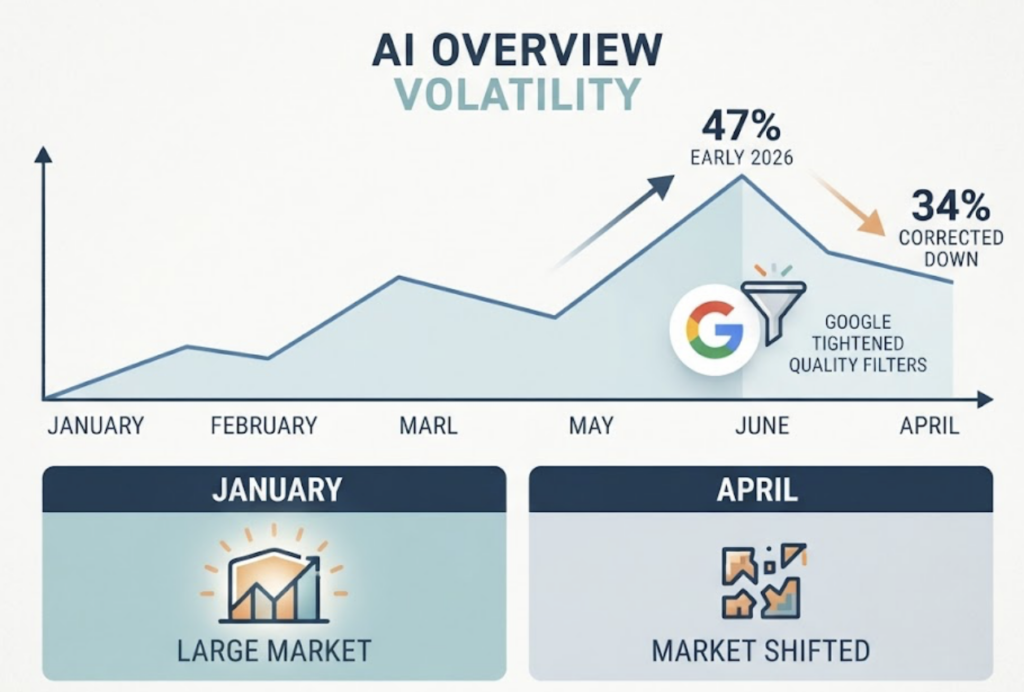
    The environment itself is also unstable. Conductor’s 2026 industry volatility analysis found that AI Overview coverage across major industries peaked at 47% in early 2026, then corrected down to 34% as Google tightened quality filters. A brand that “checked its visibility” in January was measuring a market that no longer existed by April.
    Tracking is a process, not an action.

    There’s a practical upside to treating it that way. Longitudinal data turns your AI visibility score into a leading indicator: significant score drops often precede declines in branded search volume, which means a well-built tracking system flags brand health problems before they show up in your traffic reports. AI search traffic itself grew more than 500% year over year heading into 2026, so the cost of flying blind compounds every quarter.

    How to Set Up AI Visibility Score Tracking Step by Step

    The setup below moves you from screenshots to a system in four steps. Most teams can complete it in under two weeks.

    Step 1: Define Your Prompt Universe

    Start with 50 to 200 high-intent queries. Skip branded searches, since asking ChatGPT “what is [your brand]” tells you nothing about discovery. Focus instead on the queries buyers actually use before they know you exist: “best [product] for [industry],” “alternatives to [competitor],” “[category] comparison.”

    Group prompts by intent stage. Comparison and alternative queries map to buyers closest to a decision, so weight them accordingly when you read the data later. Refresh the set quarterly, because buyer language shifts and last year’s phrasing stops matching how people actually ask.

    Step 2: Choose Which AI Platforms to Sample

    ChatGPT, Perplexity, and Google AI Overviews use different citation logic and different underlying sources. A brand can score 60 on Perplexity and 15 on ChatGPT for the identical prompt set. Sampling one engine gives you one engine’s opinion, not a market view.

    Track at minimum the three platforms above, then extend based on where your audience lives. B2B software buyers lean on ChatGPT and Perplexity; consumer categories see more AI Overviews exposure. Teams operating in Asian markets should add DeepSeek, Doubao, or Qwen to the sampling rotation.

    If you want to test the waters before committing to a full setup, this curated list of free GEO tools covers no-cost options for one-off visibility checks across major engines.

    Step 3: Pick an AI Visibility Score Tool That Tracks Over Time

    Free checkers answer “where am I today.” A dedicated AI visibility score tool answers “what changed, and why.” When evaluating any AI visibility score software or platform, four capabilities separate real tracking systems from repackaged rank trackers: multi-engine sampling, prompt-level history, sentiment measurement, and competitor benchmarking on identical prompt sets.

    That last one matters more than teams expect. An absolute score of 65 is meaningless in isolation. If your closest competitor sits at 80, you have a problem; if the category leader sits at 40, you’re winning.

    For teams that want the full seven-dimension scorecard in one place, Topify is built around exactly this model. Its GEO Analytics engine tracks visibility, sentiment, position, volume, mentions, intent, and CVR across ChatGPT, Gemini, Perplexity, DeepSeek, and other major engines, then benchmarks each dimension against competitors it auto-detects in your category. In practice, that means a visibility drop on Perplexity can be traced back to the specific source domain that stopped citing you, inside the same dashboard, without exporting anything to a spreadsheet. The Basic plan runs $99 per month and covers 100 tracked prompts with 9,000 AI answer analyses, which fits the 50 to 200 prompt universe most teams start with.

    Other platforms in this space cover parts of the picture, and some do single-engine tracking well. The gap tends to show up in citation-layer analysis and cross-engine consistency, which is where composite scoring lives or dies.

    Step 4: Set a Baseline and a Review Cadence

    Run your full prompt universe across all tracked engines for 30 days before drawing any conclusions. That first month is your baseline, and everything after is trend data.

    Then hold a rhythm: weekly reviews to catch sudden shifts from model updates or competitor content pushes, quarterly deep dives to reassess strategy and refresh the prompt set. Industry benchmarks give you rough context for the baseline itself. Scores below 8 signal pre-visibility, where the brand is essentially absent and needs entity-level foundations first. Scores from 8 to 25 indicate early traction with inconsistent appearances. Crossing 25 means regular presence in top-choice shortlists, the milestone that separates established category players from everyone else.

    Reading the Dashboard: Signals Behind the Score

    An AI visibility score dashboard earns its cost when it explains movement, not just displays it. Three reading patterns cover most situations.

    When visibility drops, check citation share first. AI engines lean on a small set of third-party domains per category, and losing a citation from one high-weight source (a G2 category page, a Reddit thread, an industry roundup) can pull down mention frequency across every engine that draws on it.

    When position slips but visibility holds, look at competitors. You’re still in the answer set, but someone displaced you from the primary recommendation slot, usually through fresher comparison content or new third-party validation.

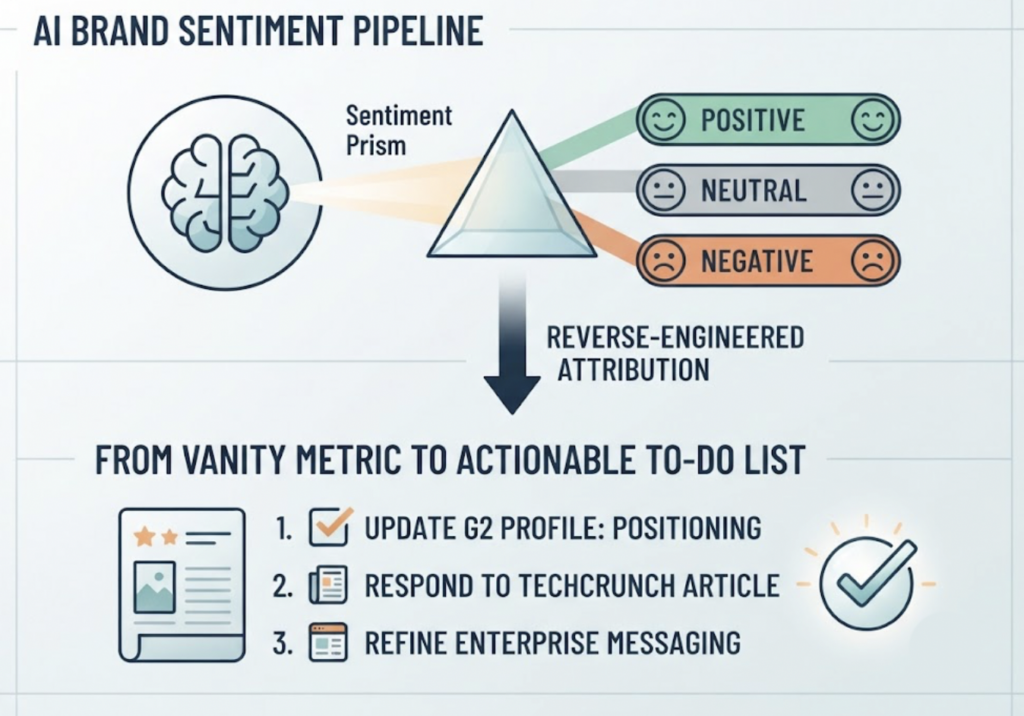
    Sentiment deserves its own tracking lane. AI search analytics brand sentiment platforms measure a Net Sentiment Score, tracking whether AI describes your brand positively, neutrally, or negatively across responses. The risk isn’t just negative framing, it’s outdated framing: an engine calling your enterprise product “a budget option for small teams” is a positioning problem no traffic report will ever surface. Good sentiment tooling reverse-engineers the attribution, so a sentiment drop points you to the specific review site or article the AI is drawing that framing from. AgencyDashboard’s 2026 analysis of AI sentiment tracking found this source-level attribution is what turns sentiment data from a vanity metric into a fixable to-do list.
    How to Improve a Low AI Visibility Score

    The score is the output. These four inputs move it.

    Close citation gaps. Identify which third-party domains AI engines favor for your category, then pursue placements there through digital PR, review campaigns, or community participation. If Reddit and G2 dominate citations in your space, a tenth blog post on your own domain won’t move the needle the way one strong G2 presence will.

    Structure content for extraction. AI engines reward machine-readable answers. Clean organization and product schema, direct question-and-answer formatting, and comparison tables give models something to quote. Prose walls don’t.

    Cover decision-stage intent. If your visibility concentrates on informational queries but disappears for “best X” and “alternatives to Y” prompts, your intent coverage dimension is dragging the composite score down. Build comparison and alternative content deliberately.

    Feed results back into the system. Every content push should map to a hypothesis about a specific dimension: this G2 campaign should lift citation share, this comparison page should lift intent coverage. Then watch the weekly data to confirm or kill the hypothesis. Without that loop, you’re publishing on faith.

    Conclusion

    The screenshot-in-Slack era of AI visibility ends the moment someone asks “compared to what?” A score without a baseline, a trend line, and a competitive reference point is trivia. With those three things, it becomes the earliest warning system your brand has, surfacing shifts weeks before they reach your traffic dashboards.

    Start small: define 50 prompts, pick three engines, and run a free scan to establish where you stand today. From there, set up automated tracking and let the 30-day baseline accumulate while you work on citation gaps. The teams winning AI search in 2026 aren’t the ones checking most often. They’re the ones measuring consistently.

    FAQ

    Q: What is a good AI visibility score?
    A: Context matters more than the absolute number, but industry benchmarks offer rough stages: below 8 means the brand is effectively invisible, 8 to 25 indicates early and inconsistent traction, and above 25 signals regular presence in top-choice shortlists. The more useful question is how your score compares to direct competitors on identical prompts.

    Q: How often should you review AI visibility score tracking data?
    A: Weekly for tactical shifts, quarterly for strategy. AI answers move fast enough (model updates, citation source changes, competitor pushes) that monthly-only reviews miss the cause of most score movements.

    Q: What’s the difference between an AI visibility score tool and a traditional rank tracker?
    A: Rank trackers measure a deterministic position for a URL on a results page. An AI visibility score system samples probabilistic answers repeatedly, across multiple engines, and scores brand presence rather than URL position. Research on ranking–mention separation shows the two measure genuinely different things: strong rankings don’t guarantee AI mentions.

    Q: Do AI search analytics brand sentiment platforms measure the same thing as visibility scores?
    A: They measure one dimension of it. Sentiment tracks how AI frames your brand when it appears; the visibility score also covers whether, how often, and in what position you appear. Sentiment without visibility data misses absence, and visibility without sentiment misses framing problems. Composite platforms track both.
    Read More

  • AI Visibility Score Tracker: How to Measure and Improve

    AI Visibility Score Tracker: How to Measure and Improve

    Two dashboards, two scores for the same brand. One platform says your AI visibility is 72. Another says 48. Your quarterly review is next week, and you can’t explain to leadership which number is real, because each tool defines “visibility” differently and none of them show their math. Meanwhile, AI engines keep reshaping how they describe your brand, and last month’s snapshot is already stale. The problem isn’t a lack of scores. It’s that a score without a transparent measurement method behind it is just a number on a screen.

    What an AI Visibility Score Actually Measures

    An AI visibility score is a normalized, composite metric, typically on a 0 to 100 scale, that quantifies how present your brand is inside the synthesized answers of ChatGPT, Gemini, Perplexity, and other generative engines. An AI visibility score tracker is the system that produces and updates that number over time.

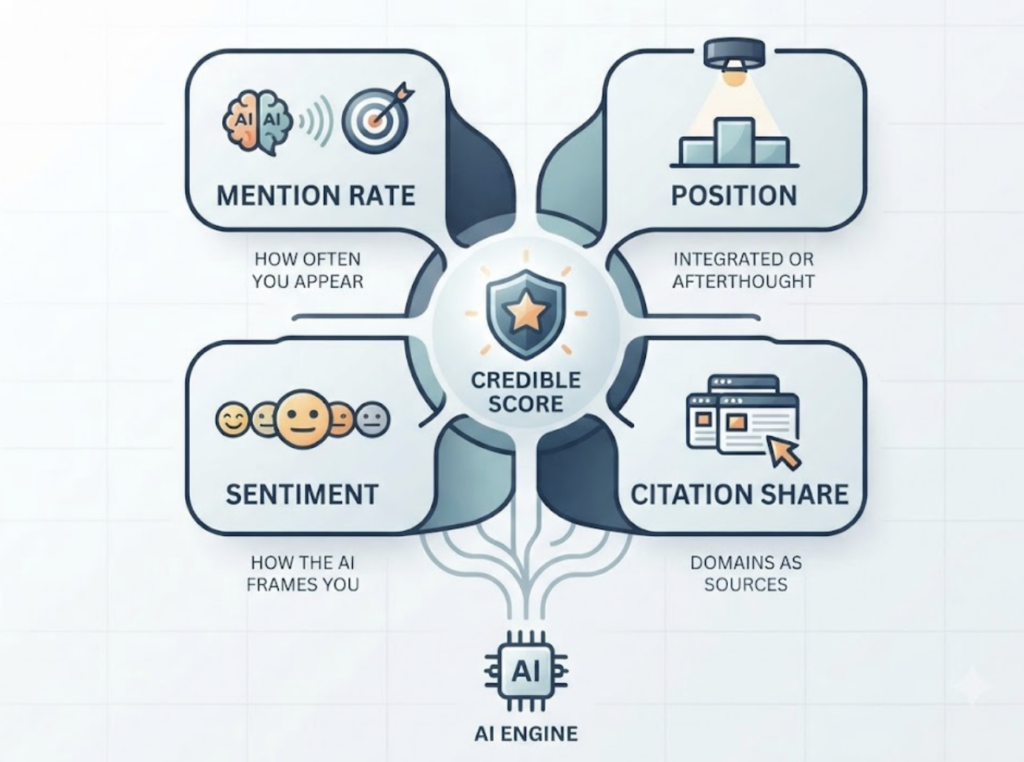
    Unlike a Google ranking, there’s no static list of blue links to track. AI answers are written fresh each time. So a credible score is a weighted function of four components: mention rate (how often you appear across a set of prompts), position (whether you’re woven into the recommendation or dropped in as an afterthought), sentiment (how the AI frames you), and citation share (how often your domains are the sources behind the answer).

    Here’s the part most teams miss: AI visibility and Google rankings measure different things. Industry research in 2026 points to a ranking–mention separation. Holding the #1 organic spot on Google doesn’t predict whether an AI answer will mention you at all, because generative engines weigh entity authority and source extractability over classic ranking signals.

    Your SEO dashboard can look perfect while your brand stays invisible to AI.

    How an AI Visibility Score Tracker Works Under the Hood

    Every serious AI visibility score tracker runs the same four-step pipeline, and the quality of the score depends on how rigorously each step is executed.

    Step 1: Prompt universe design. The tracker defines a consistent set of queries reflecting real buyer intent: branded prompts, category prompts, and comparison prompts. This set stays fixed so scores are comparable over time.

    Step 2: Multi-engine sampling. The same prompts run across multiple LLMs. Each engine has its own citation logic, so single-engine data tends to mislead.

    Step 3: Parsing and interpretation. NLP models extract entity presence, cited URLs, and tonal markers from each synthesized answer.

    Step 4: Weighted scoring. Data points aggregate into a trend line, not a one-off snapshot.

    Why does sampling depth matter so much? Because LLMs are stochastic. Ask the same question twice and you can get two different answers. A single spot-check is statistically meaningless, which is why professional-grade setups typically run 100+ prompts across at least four engines with high-frequency updates.

    A score built on 10 prompts isn’t a score. It’s a coin flip.

    How to Measure Your AI Visibility Score Step by Step

    You don’t need an enterprise budget to establish a baseline. You need a repeatable method.

    Start with a free baseline check. A tool like Topify‘s GEO Score Checker gives you a zero-cost snapshot of where your brand stands, and a broader set of options is collected in this GEO free tools reference. Free checkers are useful for establishing a starting point, though they lack the longitudinal, high-frequency data that trend analysis requires.

    Build your prompt set. Cover three layers: branded (“Is [brand] good for X”), category (“best tools for X”), and comparison (“[brand] vs [competitor]”). The category layer matters most, since that’s where AI-influenced discovery actually happens.

    Pick your engine coverage. At minimum, track ChatGPT, Perplexity, and Google AI Overviews. If your audience spans markets, engines like Gemini and DeepSeek behave differently enough to justify inclusion. A practical walkthrough of the ChatGPT side is covered in how to track AI search visibility and rankings in ChatGPT.

    Set a re-measurement cadence. Weekly is the professional standard. Model updates ship fast, and monthly snapshots miss the citation shifts that happen in between.

    Add competitor benchmarks. An 80 means nothing on its own. If your top three competitors sit at 90, that 80 is a warning, not a win.

    Tracking Brand Reputation Across Generative Engines

    Visibility is necessary but not sufficient. You can rank high on mentions and still lose, because a brand that’s mentioned often but framed negatively is building the wrong kind of presence. That’s why teams that track brand reputation across generative engines treat sentiment and source attribution as first-class metrics, not add-ons.

    Engine discrepancy is the pattern to watch. It’s common for a brand to be warmly recommended in ChatGPT while Perplexity, which leans heavily on real-time review sites, cites it with caveats or negative framing. Same brand, same week, two different reputations.

    The fix starts with source attribution analysis: knowing exactly which domains each engine pulls from when it talks about you. If a low-authority review site is shaping how Perplexity describes your product, that’s a digital PR problem you can actually act on. On Topify’s side, this maps to its Sentiment Analysis (a 0 to 100 tonal score per engine) combined with citation source tracking, so a sentiment drop can be traced back to the specific domain that caused it.

    That trace-back is the difference between a dashboard and a decision.

    How to Improve Your AI Visibility Score

    Improving the score means influencing what generative engines read, trust, and extract. Four levers consistently move the needle, roughly in this order of impact.

    1. Get present on domains AI already cites. Reverse-engineer which URLs the engines reference for your category prompts, then earn placement there. If AI never reads the sources you publish on, your content can’t enter the answer.

    2. Structure your content for extraction. Organization and product schema (JSON-LD), clear headings, and direct answer-style formatting make it easier for models to pull correct entity information instead of guessing.

    3. Publish comparison content. Pages that objectively lay out “Brand A vs Brand B” give AI clean, synthesizable material, and brands that provide it tend to control how the comparison gets framed.

    4. Close the loop between insight and action. This is where most workflows stall: the tracker flags a visibility drop, and the fix sits in a backlog for a month. Topify’s approach connects reverse-engineered citations with One-Click Execution, so identifying a gap and deploying the content response happen inside the same platform. For a deeper strategic framework, the complete guide to generative engine optimization walks through the full playbook.

    Best Tools for AI Visibility Score Tracking

    Before comparing products, fix the evaluation criteria. Four dimensions separate a usable tracker from a vanity dashboard:

    DimensionWhy it matters
    Engine coverageEach model (ChatGPT, Gemini, Perplexity, DeepSeek) has distinct citation logic; single-engine data misleads
    Sampling volumeDetermines whether a trend is real or statistical noise
    Metric decomposabilityA score you can’t drill into sentiment and position is unactionable
    Competitive benchmarkingAbsolute scores are vanity; relative standing is strategy

    Topify covers all four. It tracks brand presence across ChatGPT, Gemini, Perplexity, DeepSeek, Doubao, Qwen, and other major engines, and decomposes the score into seven metrics: visibility, sentiment, position, volume, mentions, intent, and CVR. Competitor benchmarking is built in, with automatic detection of emerging rivals. Pricing starts at $99/month for the Basic plan, which includes 100 tracked prompts, 9,000 AI answer analyses, and a 30-day trial, putting it at the entry point of the professional SaaS tier.

    Other options exist across the market. Platforms like Profound and Peec AI offer AI visibility monitoring with their own strengths, and enterprise solutions add custom prompt sets and advanced attribution modeling at higher price points. The market roughly splits into three tiers: free checkers for baselines, SaaS platforms in the $99 to $499/month range for professional sampling and benchmarking, and enterprise deals above that.

    For most marketing teams, the SaaS tier is where measurement becomes reliable enough to report on.

    Common Mistakes That Make Your Score Meaningless

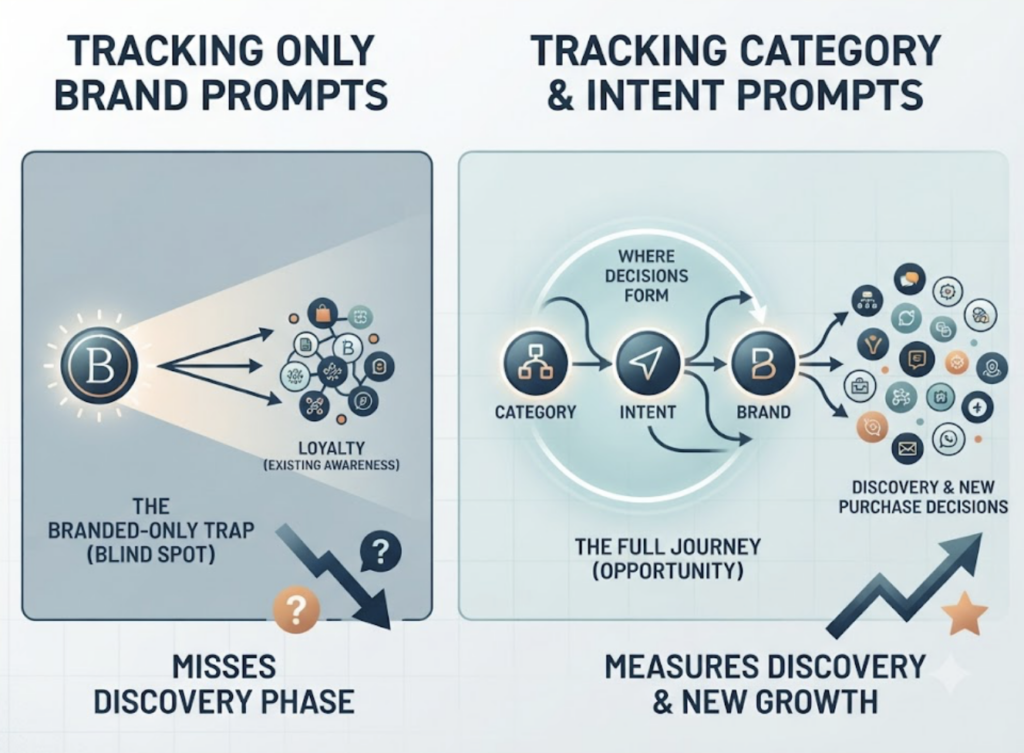
    The branded-only trap. Tracking only prompts that contain your brand name misses the category and intent phase, which is where most AI-influenced purchasing decisions actually form. If your prompt set is 100% branded, your score measures loyalty, not discovery.

    Treating a snapshot as a trend. LLM output is volatile. One measurement tells you what the model said that day, not where you’re heading. Monthly checks miss shifts caused by weekly model updates.

    Reading the total, ignoring the parts. A stable composite score can hide a visibility gain that’s masking a sentiment decline. Always decompose.

    Skipping competitor context. An 80 with rivals at 90 and an 80 with rivals at 60 are opposite situations wearing the same number.

    Quick checklist before you trust any score: 100+ prompts covering branded, category, and comparison intent; at least three engines; weekly cadence; decomposable metrics; and top-three competitor benchmarks in the same view.

    Conclusion

    The reason two trackers give you a 72 and a 48 for the same brand isn’t that one is lying. It’s that scores are derivatives of sampling architecture, and different architectures produce different numbers. So stop chasing an absolute figure. Pick one methodology with enough sampling depth, hold it constant, and read the trend line and the competitor gap instead.

    The practical path: run a free baseline check first, then move to continuous tracking once you’ve confirmed the gap is worth closing. You can get started with Topify on a 30-day trial and have your first weekly trend line before your next reporting cycle.

    FAQ

    Q: What are some examples of AI visibility score trackers?
    A: Free options include Topify’s GEO Score Checker for one-off baselines. Paid platforms include Topify (from $99/month, seven-metric decomposition across ChatGPT, Gemini, Perplexity, DeepSeek and more), plus alternatives like Profound and Peec AI. Enterprise solutions add custom prompt sets and API access.

    Q: How much does an AI visibility score tracker cost?
    A: Free checkers cost nothing but only provide snapshots. Professional SaaS platforms generally run $99 to $499/month; Topify’s Basic plan sits at the $99 entry point with 100 prompts and 9,000 monthly answer analyses. Enterprise tiers with dedicated support start around $499/month and up.

    Q: How often should you re-measure your AI visibility score?
    A: Weekly is the professional standard. AI models update frequently enough that monthly measurement misses meaningful citation shifts, and daily sampling within a weekly reporting cadence gives the cleanest trend lines.

    Q: Can you track brand reputation in generative engines with the same tool?
    A: Yes, if the tracker decomposes its score. Reputation tracking requires per-engine sentiment scoring plus source attribution, since the same brand often reads positively in ChatGPT and negatively in Perplexity depending on which domains each engine cites.

    Read More

  • AI Search Visibility: How to Monitor It Without Otterly

    AI Search Visibility: How to Monitor It Without Otterly

    Your domain authority is solid. Your keyword rankings haven’t moved in months. By every metric in your SEO dashboard, things look fine. Then someone asks Perplexity for the top tools in your category, and your brand isn’t in the answer.

    None of your existing metrics can explain why, because none of them were built to measure what an AI chooses to say. There’s no position eleven in an AI answer. You’re either cited or you’re invisible, and most SEO stacks can’t tell you which one you are right now.

    What AI Search Visibility Actually Measures

    AI search visibility measures how often, and how prominently, your brand appears in AI-generated answers across engines like ChatGPT, Google AI Overviews, Gemini, and Perplexity. It’s a fundamentally different quantity from a Google ranking.

    Traditional search is a list. Position 3 still gets clicks, position 8 still gets scraps, and you can trade positions week to week without falling off the map. AI search is a synthesis. The engine reads its sources, composes one answer, and cites a handful of brands. Everyone else gets nothing.

    That’s the core mechanical difference: rankings measure position, AI visibility measures the probability of being mentioned at all.

    The two don’t move together as much as most SEO teams assume. Research on ranking and mention behavior shows that traditional SEO signals predict where you appear inside an AI answer better than whether you appear in it. Strong domain authority helps you rank higher once you’re cited. It doesn’t guarantee the citation happens.

    Here’s how the pipeline works in practice. A user types a prompt. The engine retrieves candidate sources, weighs them by topical fit, entity consistency, and extractability, then synthesizes an answer that cites a small subset. Your visibility is decided at that retrieval-and-citation step, not on a results page.

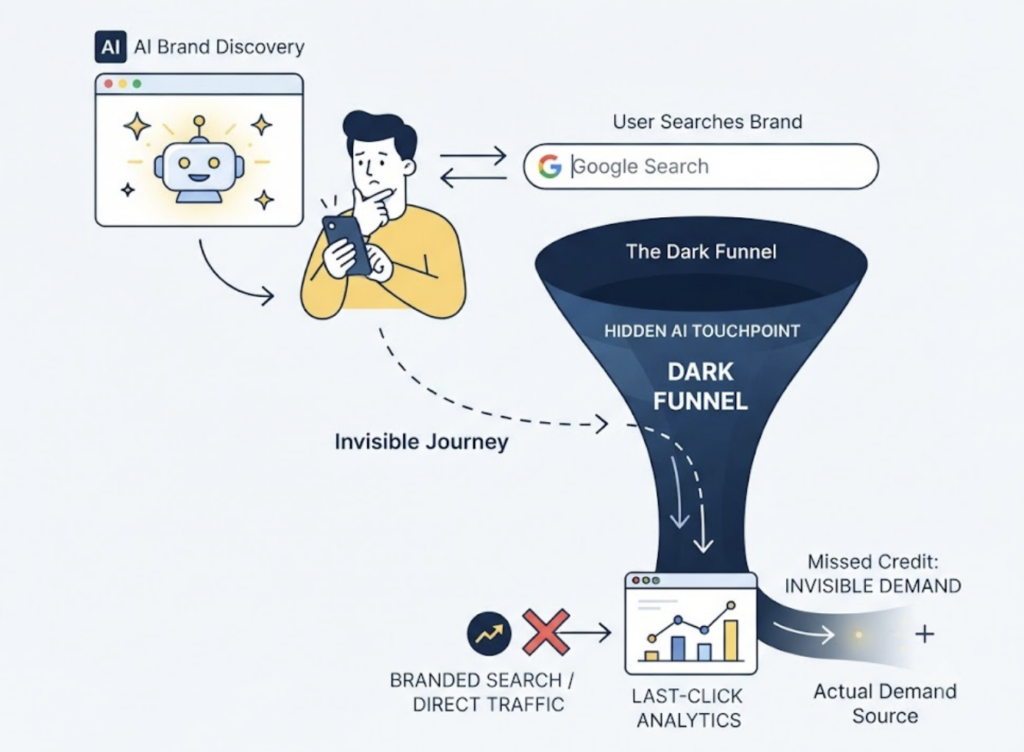
    There’s also an attribution problem hiding underneath. Users often encounter a brand inside an AI answer first, then Google the brand by name later. Last-click analytics logs that as branded search or direct traffic. The AI touchpoint that actually created the demand never shows up in your reports. Industry researchers call this the dark funnel, and it’s the reason AI visibility rarely gets credit inside standard dashboards.

    How to Measure AI Search Visibility

    The first instinct most teams have is to open ChatGPT, type their category keyword, and see if they show up. That single check is close to meaningless.

    AI outputs are stochastic. The same prompt can return different brands on different days, because large language models compose answers probabilistically rather than pulling from a fixed index. Citation volatility studies from Passionfruit found that roughly 68% of queries generating citations in one month fail to generate them the next. One spot-check tells you about one roll of the dice.

    Measuring AI search visibility properly requires three things: a fixed prompt set, multi-engine coverage, and time-series data. In concrete terms, that looks like tracking 100 buyer-relevant prompts across four AI engines over 30 days, then reading the trend rather than the snapshot.

    Once the methodology is in place, these are the metrics that matter:

    MetricWhat it tells you
    Mention rateHow often your brand appears across your prompt set
    PositionWhether you’re in the answer body or buried in a citation list
    SentimentWhether the AI recommends you, qualifies you, or stays neutral
    Citation shareThe percentage of category answers citing your domain
    Prompt coverageWhether you show up across the full buyer journey, not just one query type
    Source authorityWhich third-party domains the AI trusts when discussing your category
    Competitor gapHow you perform against rivals on identical prompts

    Mention rate alone is a vanity number. A brand mentioned frequently but described as “a budget option” in a premium category has a sentiment problem that raw counts will never surface. The framework only works when the dimensions are read together.

    Why Teams Monitor AI Search Without Otterly

    Otterly.AI was one of the earlier entrants in this category, and plenty of teams started their AI monitoring journey there. A meaningful number of them are now searching for how to monitor AI search without Otterly, and the reasons tend to cluster around three gaps rather than any single failure.

    The first is engine coverage. Answer engines differ significantly in citation logic. A brand can dominate Perplexity answers while being absent from Gemini, so a tool that skews toward a subset of engines produces a partial picture. With ChatGPT alone serving over 900 million weekly active users and Google AI Mode crossing 1 billion monthly users according to Similarweb data, partial coverage means missing where most of the volume actually lives.

    The second is depth past the mention count. Knowing your score dropped is diagnosis-free data. Teams increasingly want source-level analysis: which specific domain the AI pulled from when it cited a competitor, and which of their own pages stopped earning citations.

    The third is the gap between data and action. A dashboard that reports a visibility decline but suggests nothing is a reporting tool, not an optimization tool.

    None of this makes any single platform a bad product. It does define the evaluation checklist for whatever you monitor AI search with instead: simultaneous coverage of ChatGPT, Gemini, Perplexity, and Google AI Overviews, citation-source analysis, longitudinal tracking built for volatile outputs, and a feedback loop that turns findings into content moves.

    A Full-Stack Way to Track AI Search Visibility

    For teams that want all four criteria in one place, Topify tends to be the strongest fit, largely because it was built around the measurement framework above rather than a single metric.

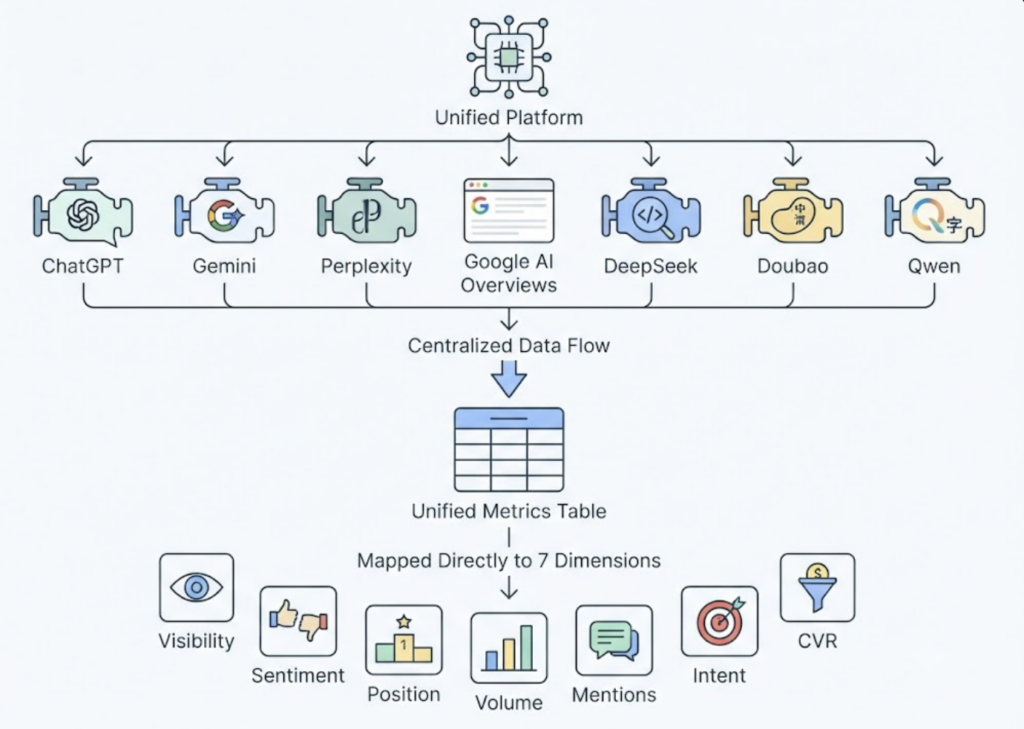
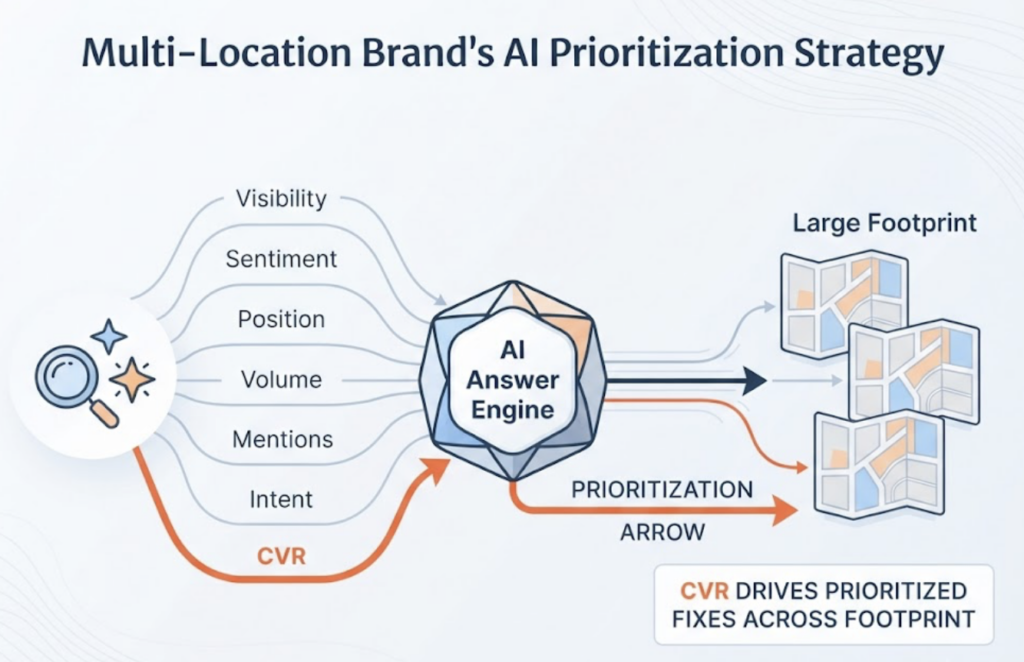
    The platform tracks brands across ChatGPT, Gemini, Perplexity, Google AI Overviews, and DeepSeek, plus regional engines like Doubao and Qwen for brands with international audiences. Every prompt in your set is scored across seven dimensions: visibility, sentiment, position, volume, mentions, intent, and CVR, a conversion-oriented estimate of how likely an AI answer is to route users toward your brand. That maps one-to-one onto the metrics table from the measurement section, which means you’re not stitching together partial views from multiple tools.

    The source layer is where diagnosis happens. Topify’s citation analysis reverse-engineers the exact domains and URLs each AI engine pulled from. In practice, that means you can watch your ChatGPT mention rate dip, trace it to a specific review site that stopped citing your product, and know precisely which third-party relationship to repair. Without that layer, a visibility drop is just a number that went down.

    Competitor benchmarking runs on the same prompt set, so you see who the engines recommend instead of you and which sources earned them that slot.

    The execution side closes the loop. You state a goal in plain English, review the proposed strategy, and deploy it in one click. Monitoring that ends in a PDF report is where most tools stop. Plans start at $99/month with a 30-day trial covering 100 tracked prompts and 9,000 AI answer analyses, with full details on the pricing page.

    How to Improve AI Search Visibility: A Working Checklist

    Monitoring tells you where you stand. Improving the number requires changing what AI engines can find, extract, and trust. This checklist covers the moves with the strongest evidence behind them.

    Structure content for extraction. AI models favor atomic content blocks: clear headings, declarative answers, FAQ formatting. Conductor’s benchmarks found that around 44% of AI citations are drawn from the first 30% of a page. Bury your answer in paragraph twelve and you’ve functionally opted out.

    Invest in third-party presence. This is the single biggest lever most teams underweight. Brands are 6.5x more likely to be cited in AI responses through third-party media, review sites, directories, and industry publications, than through their own content. Your G2 profile and your press coverage are now retrieval surfaces.

    Build comparison content. AI engines lean heavily on “vs.” and “alternative” style sources when synthesizing high-intent answers. Objective comparison pages that evaluate your brand against competitors are among the most reliably cited formats in the category.

    Keep entity signals consistent. If your site says enterprise-grade and a directory says budget-friendly, the AI resolves that conflict for you, and not always in your favor. Audit how your brand is described everywhere it appears.

    Track prompts, not keywords. Discover the actual questions buyers ask AI engines and cover them directly. Topify’s prompt discovery surfaces high-volume AI prompts in your category as they emerge, and this curated set of free GEO tools covers lighter-weight ways to start.

    Avoid the common mistakes. The recurring failure patterns are checking one engine and generalizing, treating a single spot-check as data, using Google rankings as a proxy for AI visibility, and optimizing owned content while ignoring the third-party sources engines actually cite.

    Re-measure on a cycle. Given 68% month-over-month citation volatility, a strategy set once and left alone decays quietly. Monthly baseline comparisons are the minimum viable cadence.

    Conclusion

    The metrics that defined a decade of SEO reporting weren’t built to answer the question your leadership is now asking: what does AI say about us? Rankings measure position on a page. AI search visibility measures whether you exist in the answer at all, and the gap between those two numbers is where competitors quietly win category recommendations.

    The starting move is unglamorous but concrete: define a fixed set of high-intent prompts, measure your baseline across every major engine, and only then decide what to optimize. You can get started with Topify and have that baseline within a day, or build a manual version first. Either way, measure before you guess.

    FAQ

    Q: What are examples of AI search visibility? 

    A: A project management tool appearing in ChatGPT’s answer to “best project management software for remote teams” is AI visibility. So is a skincare brand cited in a Google AI Overview for “how to treat dry skin,” or a fintech company named in Perplexity’s response to “Stripe alternatives.” In each case, the brand earned a slot inside a synthesized answer rather than a ranked link.

    Q: How much do AI search visibility tools cost? 

    A: Most platforms in this category run between roughly $99 and $500+ per month depending on prompt volume and engine coverage. Topify’s Basic plan starts at $99/month with 100 tracked prompts, 9,000 AI answer analyses, and a 30-day trial, with Pro at $199/month and Enterprise tiers from $499/month.

    Q: Can I monitor AI search without Otterly? 

    A: Yes. The capability that matters isn’t any specific vendor, it’s the framework: multi-engine coverage, a fixed prompt set, source-level citation analysis, and time-series tracking. Any platform that delivers those four, Topify included, gives you a complete monitoring setup.

    Q: How often should I measure AI search visibility? 

    A: Continuously, with monthly baseline reviews at minimum. Since roughly 68% of citing queries change month to month, quarterly checks miss most of the movement. Daily or weekly automated tracking with a monthly strategic review is the cadence most teams settle into.

    Read More

  • AI Visibility Score Tool: How It Works and How to Use It

    AI Visibility Score Tool: How It Works and How to Use It

    Your quarterly review has a slide for rankings, a slide for traffic, and a slide for conversions. Then someone asks how the brand is performing in AI search, and the deck goes quiet. You’ve asked ChatGPT about your category a few times, taken screenshots, and noticed the answers change week to week. That’s not a metric. That’s anecdote collection.

    The uncomfortable part: your brand already has a measurable presence in AI answers, whether you’re tracking it or not. Perplexity, Gemini, and ChatGPT are recommending someone in your category every day. An AI visibility score tool turns those scattered, non-deterministic answers into a single number you can report, benchmark, and improve. Here’s what that number actually contains, and how to move it.

    Your Brand Has an AI Visibility Score. You Just Can’t See It Yet.

    An AI visibility score tool is software that measures how often, where, and in what context your brand appears in AI-generated answers, then compresses that data into a composite benchmark, typically on a 0 to 100 scale. Think of it as the AI-era equivalent of a keyword rank tracker, with one core difference: rankings measure position on a page, while a visibility score measures the probability and quality of being mentioned at all.

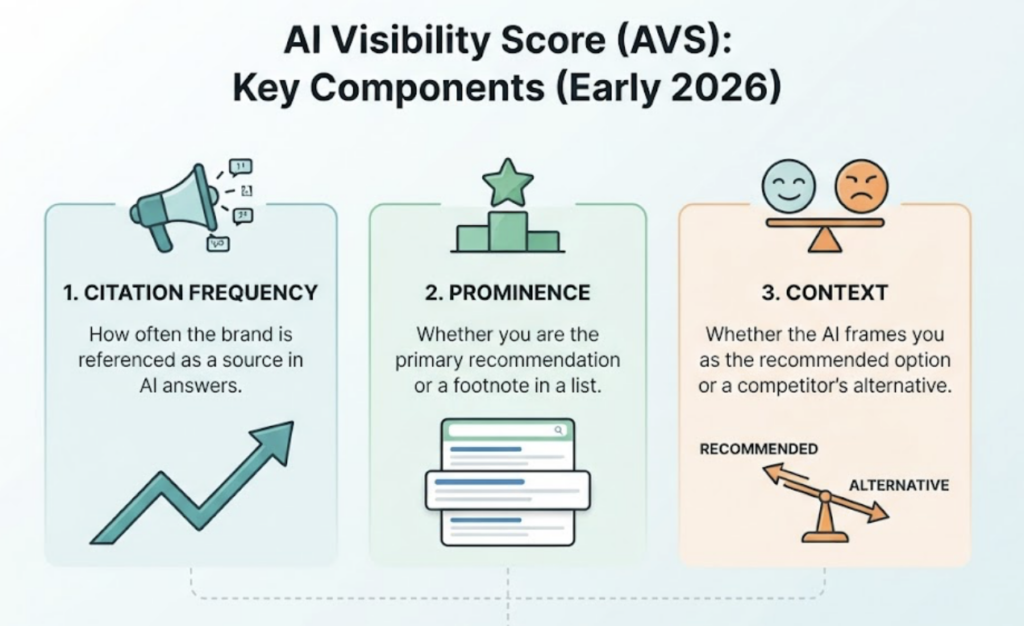
    According to industry research from early 2026, an AI Visibility Score (AVS) synthesizes three things: citation frequency (how often the brand is referenced as a source), prominence (whether you’re the primary recommendation or a footnote in a list), and context (whether the AI frames you as the recommended option or a competitor’s alternative).

    Examples of AI visibility score tools range from free single-scan checkers, which grade one domain against GEO readiness criteria, to full monitoring platforms that run hundreds of prompts across multiple AI engines daily. The free checkers answer “where do I stand today.” The platforms answer “what changed, why, and what do I do about it.”

    That distinction matters more than most buyers realize.

    How Does an AI Visibility Score Tool Work

    Manual spot-checking fails for a structural reason: AI answers are non-deterministic. Ask the same question twice and you can get different brand lists. Citation patterns shift with model updates, training data refreshes, and even minor changes in prompt phrasing. One screenshot tells you what one model said one time. It can’t tell you your baseline.

    Professional tools solve this with scale. The typical pipeline runs in three steps:

    1. Prompt universe sampling. The tool builds a set of high-intent queries that mirror your customer journey, things like “best enterprise software for X” or “alternatives to Y for small teams.” A meaningful sample usually starts around 100 tracked prompts. For scale reference, entry-level plans on platforms like Topify analyze roughly 9,000 AI answers per month against 100 prompts.
    2. Platform aggregation. The tool queries ChatGPT, Perplexity, Gemini, Google AI Overviews, and increasingly DeepSeek and other regional engines simultaneously, then parses each response for brand mentions, citations, and positioning.
    3. Metrics synthesis. Raw mentions get converted into structured scores: visibility rate, sentiment, competitive share of voice, and position within answers, tracked over time so you can separate signal from model noise.

    Repetition is the whole point. A score built from thousands of sampled answers is stable enough to benchmark. A score built from five manual chats is a coin flip.

    How to Measure an AI Visibility Score: 7 Metrics That Matter

    If you’re evaluating what a score should contain, the 2026 research consensus points to four core dashboard metrics: citation rate (the percentage of relevant AI queries that cite your brand), share of model (your voice versus top competitors in AI synthesis), response position (how prominent your mention is within the answer), and entity signal consistency (whether the AI correctly identifies what your products actually do).

    In practice, the more complete measurement frameworks expand this into seven dimensions. Topify’s Comprehensive GEO Analytics, for instance, scores brands across visibility, mentions, position, sentiment, volume, intent, and CVR (Conversion Visibility Rate, an estimate of how likely an AI answer is to drive users toward your brand).

    Why seven instead of one raw mention count? Because mentions without context mislead. A brand can be mentioned frequently but framed as “the budget option” in a premium category. Another can appear rarely but always as the first recommendation for high-intent buying prompts. Sentiment and position separate those two situations. Volume and intent tell you whether the prompts you’re winning actually matter commercially.

    This is also where brand optimization for AI answers starts to become concrete rather than abstract. Once you can see that your sentiment score dropped on Perplexity while your citation rate held steady, you’re no longer guessing what to fix. You’re diagnosing.

    One number to report upward. Seven dimensions to act on.

    How to Improve Your AI Visibility Score

    Improving the score requires shifting from “rank-ready” content to answer-ready content. The strategies with the strongest evidence behind them in 2026:

    Structure for extraction. AI models favor content they can lift cleanly: 40 to 60 word answer blocks, FAQ sections, and comparison tables. If your key claims are buried in 300-word paragraphs, models tend to cite whoever chunked the same information better.

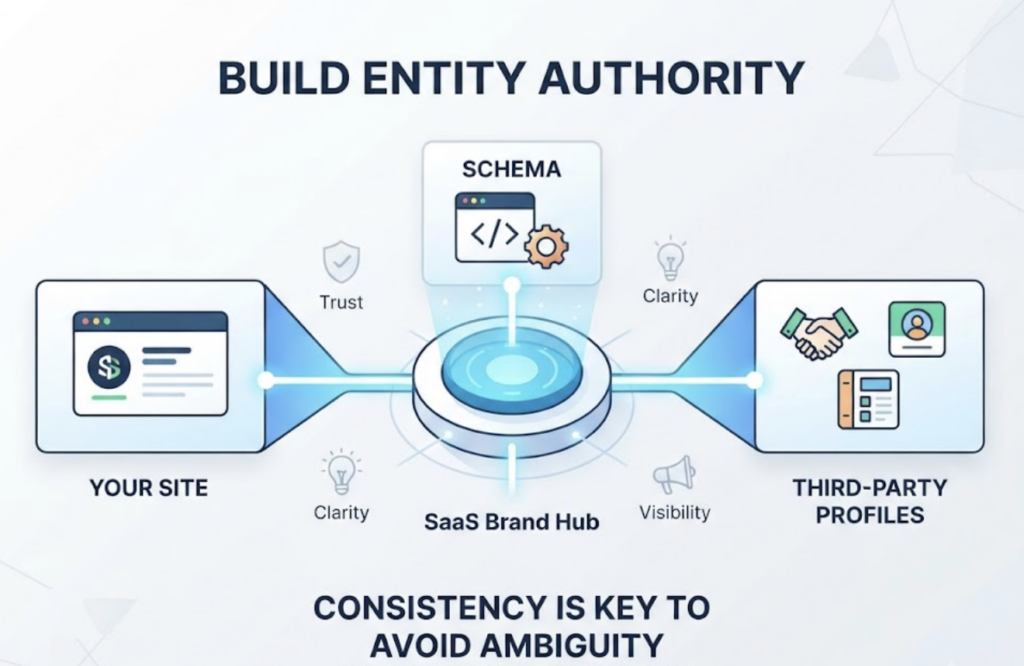
    Build entity authority. Keep brand, product, and service descriptions consistent across your site, schema markup, and third-party profiles. Entity signal consistency is a scored metric precisely because AI engines penalize ambiguity: if the model isn’t sure what you do, it won’t recommend you for it.

    Earn third-party consensus. AI engines triangulate trust signals across sources. Research indicates that mentions on Reddit, review platforms like G2 and Capterra, and authoritative industry publications now move AI citations more effectively than traditional backlink building. This is the biggest single mindset shift for teams coming from classic SEO.

    Don’t ignore technical foundations. Core Web Vitals still gate crawling. Pages with poor performance (LCP above 2.5 seconds) are reported to be 72% less likely to be cited by AI engines.

    Close the loop with citation analysis. Improvement compounds when you can see which domains and URLs the AI actually cites for your target prompts. Tools that reverse-engineer AI citations show you whether your content, or your competitor’s, dominates those source lists, which turns “publish more content” into “publish the specific asset that fills this citation gap.” A good starting point for building this workflow on a budget is this reference list of free GEO tools, which maps free checkers to each stage of the process.

    Common Mistakes That Keep Your Score Flat

    Four patterns show up repeatedly in teams whose scores don’t move:

    Platform siloing. Measuring only ChatGPT and assuming the result generalizes. Each engine has different citation behavior and different source preferences. A brand can score 60 on ChatGPT and 15 on Perplexity for identical prompts.

    Ranking proxy bias. Assuming strong Google rankings imply AI visibility. The data says otherwise: roughly 88% of URLs cited by AI engines don’t appear in Google’s top 10 organic results for the same query. SEO and AI visibility have decoupled. Treating one as a proxy for the other is the fastest way to be surprised in a quarterly review.

    Sentiment blindness. Celebrating mention counts while the AI consistently positions you as “a cheaper alternative to [competitor].” Volume without favorable framing can actively reinforce the wrong narrative.

    Static auditing. Running one audit, fixing the findings, and moving on. Citation patterns are volatile by design; models retrain and platforms update. Scores need continuous monitoring, not annual checkups.

    Each of these mistakes shares a root cause: treating AI visibility like a snapshot instead of a stream.

    Best Tools for Tracking Your AI Visibility Score

    Before comparing platforms, it’s worth being clear on why the investment case exists at all. Brands cited in AI-generated answers earn a 35% higher organic CTR and a 91% higher paid CTR than uncited competitors, and Ahrefs data from 2025 to 2026 shows AI-sourced visitors converting at up to 23x the rate of traditional organic traffic. Visibility in AI answers isn’t a vanity metric. It’s a channel.

    When evaluating tools, four criteria matter most: platform coverage (how many AI engines are tracked), metric depth (mentions only, or the full sentiment/position/intent picture), competitive benchmarking (a score without competitor context is hard to interpret), and execution support (whether the tool stops at dashboards or helps you act).

    For teams that want measurement and execution in one place, Topify covers ChatGPT, Gemini, Perplexity, DeepSeek, and other major engines, scores brands across the seven-metric framework described above, and pairs the analytics with one-click strategy execution: you define the goal in plain English, review the proposed GEO strategy, and deploy it without manual workflows. Competitor benchmarking is built in, so your score always reads relative to who AI engines are actually recommending in your category.

    On pricing, plans start at $99 per month for 100 tracked prompts and 9,000 monthly AI answer analyses, with a 30-day trial, which puts a full baseline within reach before any long-term commitment. Full plan details are on the Topify pricing page.

    Other platforms in the category tend to specialize: some focus narrowly on citation monitoring, others on single-engine tracking. They’re workable choices if your needs are narrow, though most teams outgrow single-platform data quickly.

    If you just want a baseline number today, running a first scan takes a few minutes and gives you something concrete to bring to the next review.

    Conclusion

    The question that opened this article, “how are we doing in AI search,” has an answerable form now. An AI visibility score tool converts non-deterministic AI answers into a stable, benchmarkable number, and the seven metrics underneath it tell you exactly where the gaps are: citation frequency, position, sentiment, or entity clarity.

    The practical sequence is short. Establish a baseline score across at least three AI platforms. Identify which prompts and which engines you’re losing. Fix the highest-impact gaps first, usually citation sources and answer-ready structure. Then keep measuring, because in a channel this volatile, the score you don’t monitor is the score that quietly drops.

    FAQ

    Q: What is an AI visibility score tool?

    A: It’s software that measures how often and how favorably your brand appears in AI-generated answers across platforms like ChatGPT, Perplexity, and Gemini, then converts that data into a composite 0 to 100 score. Unlike rank trackers, it measures whether AI systems mention and recommend you at all, not where a page sits in a list of links.

    Q: What should be on your checklist before choosing an AI visibility score tool?

    A: Four items: coverage of at least three major AI platforms, metrics beyond raw mentions (sentiment, position, and intent at minimum), built-in competitor benchmarking so the score has context, and some path from insight to action, whether that’s citation-gap reports or automated execution. If a tool only shows mention counts on one engine, it’s a spot-checker, not a scoring system.

    Q: How much does an AI visibility score tool cost?

    A: Free single-scan checkers exist for establishing a rough baseline. Continuous monitoring platforms typically start around $99 to $199 per month depending on prompt volume and seats, with enterprise tiers from roughly $499 per month. Managed GEO services that combine tracking with content execution run significantly higher, generally $4,000 or more per month.

    Q: What’s the best strategy for using an AI visibility score tool?

    A: Treat it as a loop, not a report. Baseline your score, benchmark against your top three competitors, diagnose whether gaps come from citation sources, content structure, or entity inconsistency, ship targeted fixes, and re-measure monthly. Teams that fold the score into their existing marketing dashboard, next to rankings and traffic, tend to sustain improvement; teams that audit once tend to plateau.

    Read More

  • AI Visibility Score: How It Works and How to Raise Yours

    AI Visibility Score: How It Works and How to Raise Yours

    Your marketing dashboard tracks domain authority, keyword rankings, backlinks, and organic traffic. Not one of those numbers tells you whether ChatGPT recommends your brand when a buyer asks for options in your category. Most marketers assume that presence in AI answers can’t be quantified, that it’s too fluid to pin down. It isn’t. An AI visibility score turns your brand’s presence across generative engines into a single trackable number, the same way domain authority once made link equity legible. Once you can see the number, you can move it.

    Your Dashboard Has 20 Metrics. None of Them Measure AI

    An AI visibility score is a composite metric, typically on a 0 to 100 scale, that measures how frequently, how prominently, and in what context your brand appears in AI-generated answers across platforms like ChatGPT, Gemini, and Perplexity.

    The comparison to domain authority is useful but imperfect. Domain authority estimates how likely a page is to rank based on link equity. An AI visibility score measures something different: whether an AI system considers your brand worth mentioning at all. One measures position in a list. The other measures selection into an answer.

    That distinction matters more than it sounds. Research compiled by seoClarity and Conductor in 2026 found that roughly 88% of URLs cited by AI engines don’t appear in Google’s top 10 organic results for the same query. Rankings and AI citations have decoupled. A brand can dominate page one and still be absent from the answer layer where a growing share of buyers now start their research.

    This is the scoreboard problem that generative search optimisation exists to solve. GSO, often called GEO, is the practice of earning presence in AI answers. The visibility score is how you know whether that practice is working.

    How Does an AI Visibility Score Actually Work

    There’s no industry-standard formula yet, which is worth knowing before you compare scores across tools. That said, most professional methodologies share the same four-step architecture.

    Step 1: Prompt sampling. The system defines a representative set of 20 to 50 high-intent queries that real buyers ask, such as “best expense management software for startups.” These prompts, not head keywords, are the unit of measurement.

    Step 2: Answer collection. Each prompt runs against multiple AI platforms on a recurring schedule, capturing the full generated response rather than a link list.

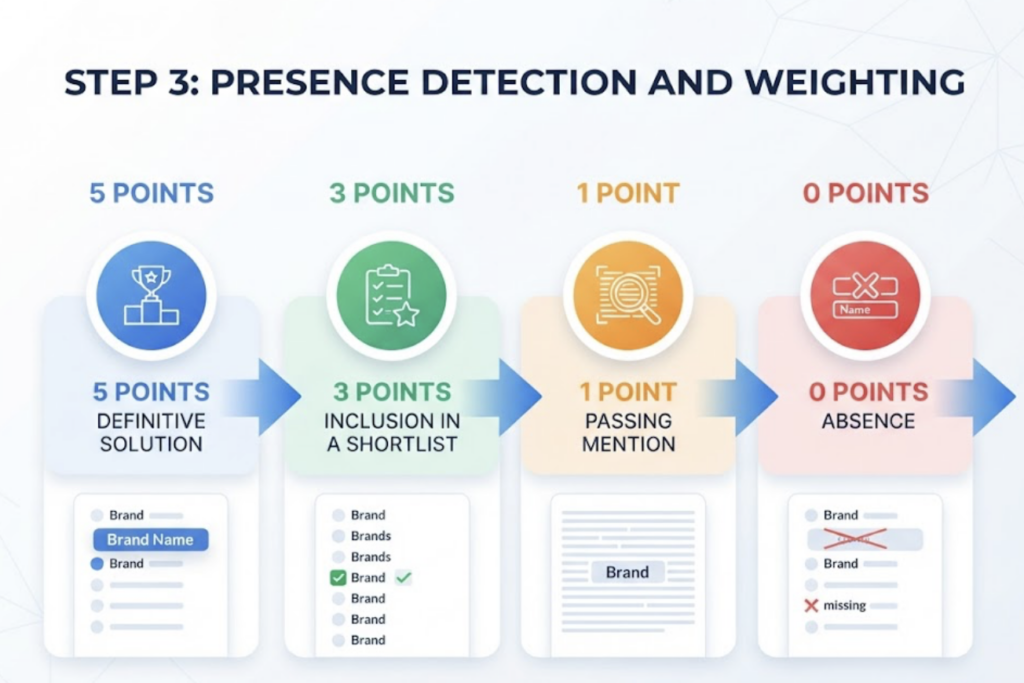
    Step 3: Presence detection and weighting. Methodologies like the one documented by Campaign Creators score each appearance on a tiered scale: a brand named as the definitive solution earns 5 points, inclusion in a shortlist earns 3, a passing mention earns 1, and absence earns 0.

    Step 4: Normalization. Raw points are converted to a percentage of the maximum possible score, averaged across platforms to smooth out model-specific biases.

    The output is one number. Behind it sit dozens of prompt-level observations you can drill into.

    One caveat: because vendors weight these steps differently, a 42 in one tool isn’t comparable to a 42 in another. Pick one methodology and track your trend within it.

    How to Measure AI Visibility Score Without Guesswork

    The tempting shortcut is manual spot-checking. Ask ChatGPT ten questions about your category, count your mentions, note the result in a spreadsheet.

    That approach fails for a specific, measurable reason. seoClarity’s 2026 citation volatility research found that platform-level citation rates on ChatGPT can swing by up to 40% within a single month, driven by model updates rather than anything you did. A Tuesday spot-check might show you in 80% of answers; the following Tuesday, 20%. Neither snapshot means much on its own.

    Reliable measurement needs four things: a fixed prompt set, multi-platform coverage, time-series data instead of snapshots, and a competitor baseline so you can tell platform noise from genuine share shifts.

    That’s a systems problem, not a spreadsheet problem. This is where a platform like Topify fits. Its GEO analytics engine tracks brand presence across ChatGPT, Gemini, Perplexity, DeepSeek, and other major engines through seven metrics: visibility, sentiment, position, volume, mentions, intent, and CVR. In practice, that structure answers the question a single score can’t: not just “what’s my number” but “which component moved, on which platform, and why.”

    If you want a baseline before committing to anything, a free GEO score check takes a few minutes and gives you a defensible starting number to report against.

    How to Improve Your AI Visibility Score: 5 Moves That Compound

    Raising the score isn’t traditional SEO with new vocabulary. The drivers are different, and the research is starting to quantify them.

    1. Publish original data. Academic work on generative engine optimisation out of Princeton found that content containing unique statistics, benchmarks, and citable frameworks is 30 to 40% more likely to be cited by LLMs. AI systems synthesizing an answer need concrete facts to anchor on. Generic advice gives them nothing to quote.

    2. Structure for retrieval. AI engines pull “chunkable” passages, not whole pages. Content that answers the question directly within the first 60 words of a section, under a clear heading, consistently outperforms narrative copy that builds to a conclusion.

    3. Build third-party consensus. Citations are heavily shaped by what AI models see beyond your own site. Brands consistently discussed on Reddit, G2, and industry publications get prioritized in synthesis because independent repetition reads as consensus. Your owned content alone can’t manufacture that signal.

    4. Keep entity signals consistent. Same brand name, same category framing, same core claims across every surface. Conflicting descriptions fragment the entity model AI systems build about you, and fragmented entities get skipped.

    5. Monitor and iterate on a cadence. There’s a compounding effect worth knowing about: 2026 research points to a “circular authority” loop in which strong AI visibility strengthens the entity signals feeding Google’s own systems. Improving your score in Perplexity isn’t a side quest from SEO. Increasingly, it feeds back into it.

    None of these moves requires a big budget to start. A number of free utilities cover the basics, and this GEO free tools reference is a practical starting list.

    Common Mistakes That Quietly Tank Your Score

    Four patterns show up repeatedly in teams whose scores stall or mislead them.

    Platform siloing. Measuring only ChatGPT, or only Google AI Overviews, and treating that as your AI visibility. Cross-platform consensus is the actual signal; single-platform data mostly captures one model’s quirks.

    Ranking proxy bias. Assuming strong Google rankings will carry over. The 88% decoupling figure says otherwise, and teams that lean on this assumption tend to discover the gap only when a competitor starts owning the answers.

    Counting mentions, ignoring context. A rising mention rate looks like progress until you read the answers and find the AI describing you as “a budget option with limited support.” Frequency without sentiment tracking is a vanity metric.

    Static keyword sets. Porting your high-volume SEO keywords into prompt tracking. AI users ask long, specific, high-intent questions. If your prompt set doesn’t reflect that language, your score measures the wrong conversation.

    The common thread: each mistake produces a number that looks fine while the underlying position erodes.

    What an AI Visibility Score Looks Like in Practice

    Abstract scores become useful when you know what the ranges mean. The tiering used in current AVS methodologies breaks down like this:

    StageScore rangeWhat it means in practice
    Pre-visibility0 to 8AI effectively doesn’t know your brand exists; entity signals are missing
    Early traction8 to 25Sporadic mentions, often on one platform or in passing context
    Category presence25+Your brand recurs as a recognized option in category-level answers

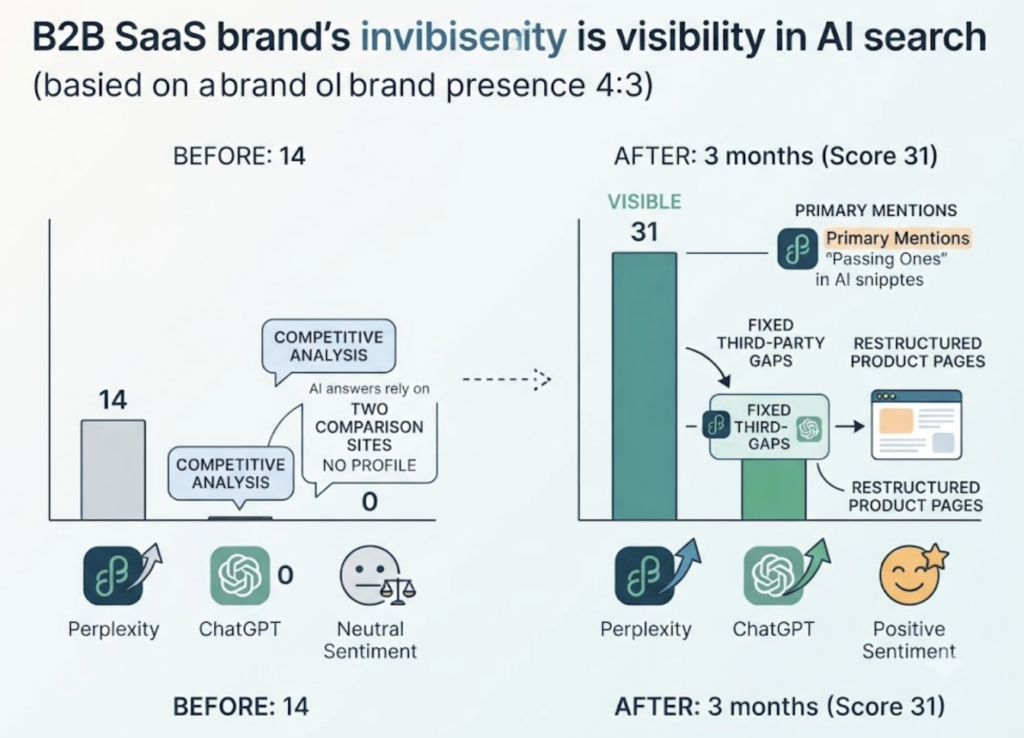
    Here’s how that plays out. A B2B SaaS brand starts at 14: decent Perplexity presence, near-zero on ChatGPT, sentiment neutral. Citation analysis shows ChatGPT’s answers in their category lean on two comparison sites where the brand has no profile. Three months after fixing those third-party gaps and restructuring their product pages for retrieval, the score sits at 31, with primary-mention appearances replacing passing ones.

    The score didn’t cause that improvement. It made the gap findable and the progress reportable. Competitor benchmarking sharpens this further, because a score of 31 means one thing when your closest rival sits at 18 and something else entirely when they’re at 55.

    Conclusion

    The metrics on your current dashboard were built for a discovery model where users clicked through lists. AI answers skip the list. An AI visibility score closes that measurement gap: it tells you whether generative engines select your brand, how prominently, and in what tone, and it turns generative search optimisation from guesswork into a trackable practice.

    The practical first step is cheap. Establish a baseline score this week, even with free tooling, and start tracking against a fixed prompt set. You can’t raise a number you’ve never measured.

    FAQ

    Q: What are the best tools for AI visibility score tracking?
    A: Look for four capabilities: multi-platform coverage, time-series tracking, sentiment and position data alongside raw mentions, and competitor benchmarking. Topify covers all four through its seven-metric GEO analytics, with a free GEO score checker for baseline measurement. Several point solutions handle single platforms, which works for early experiments but hits the platform-siloing problem at scale.

    Q: How much does AI visibility score tracking cost?
    A: Free checkers give you a one-time baseline at no cost. Continuous monitoring platforms typically start around $99 per month for tracking roughly 100 prompts across major engines, scaling up with prompt volume, platform coverage, and seats. Managed GEO services that combine tracking with content execution run considerably higher.

    Q: Is there a standard checklist for an AI visibility score audit?
    A: A workable six-point audit: define 20 to 50 high-intent prompts, run them across at least three AI platforms, score each appearance by prominence tier, log sentiment for every mention, benchmark two or three competitors on the same prompts, and repeat monthly to build a trend line.

    Q: How is an AI visibility score different from generative search optimisation?
    A: The score is the measurement; GSO is the practice. Generative search optimisation covers everything you do to earn presence in AI answers, from content structure to third-party consensus building. The AI visibility score tells you whether that work is moving the needle.

    Read More

  • AI Query Tracking Strategy: How to Build One That Works

    AI Query Tracking Strategy: How to Build One That Works

    Every Monday, someone on your team asks ChatGPT the same five questions about your category, screenshots the answers, and drops them into a Slack channel. Two weeks in, the answers have changed, nobody remembers the original wording, and the screenshots can’t be compared or reported. Recent research suggests that more than 50% of the sources cited in AI answers can shift within a single month. Against that kind of volatility, spot-checking isn’t measurement. It’s noise collection. What you need is a repeatable system: defined queries, a fixed cadence, consistent metrics, and a feedback loop that turns data into action.

    Manual Spot Checks Aren’t an AI Query Tracking Strategy

    An AI query tracking strategy is a documented system for monitoring how AI platforms answer the questions that matter to your business. It has four pillars: a defined prompt universe, a tracking cadence, a unified metric system, and an iterative optimization loop. Miss any one of them, and you’re back to screenshots.

    The reason this needs to be systematic, not casual, is that LLM outputs are non-deterministic. The same prompt can surface your brand today and omit it tomorrow, because answers are synthesized on the fly rather than pulled from a stable index. Tracking AI-driven search requires a fundamentally different approach than watching a rankings column.

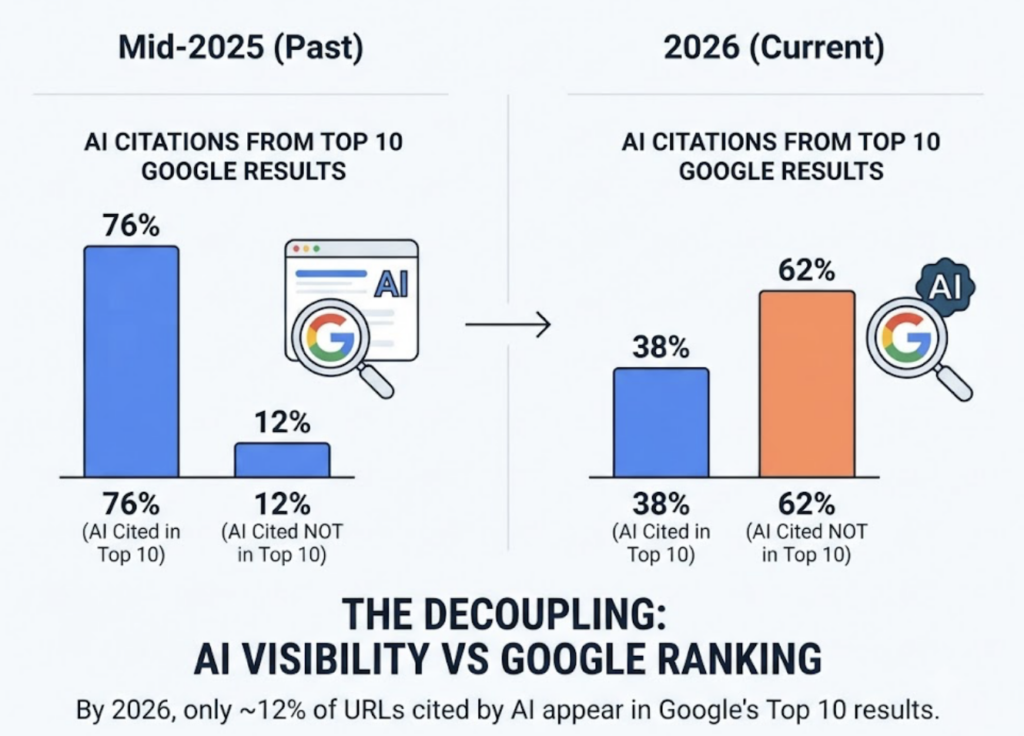
    Here’s the part most teams underestimate: AI visibility and Google rankings are actively decoupling. Industry data from 2026 indicates that only about 12% of URLs cited by AI appear in Google’s top 10 organic results for the same query. Pages ranking in Google’s top 10 accounted for roughly 76% of AI citations in mid-2025. By 2026, that figure had dropped to around 38%.

    Your SEO dashboard can’t see this shift. A tracking strategy can.

    Step 1: Choose the Queries That Actually Drive Revenue

    Query selection is where most programs quietly fail before they start. Teams either track too few prompts to be statistically useful, or they copy their SEO keyword list and call it done. Neither reflects how people actually talk to AI.

    A working prompt universe maps to the customer journey, typically in three layers. Informational queries capture early research (“how does X category work”). Comparative queries capture evaluation (“best AI query tracking tool for agencies”). Transactional queries capture decision moments (“is [brand] worth it”). High-value prompts mirror buying intent, not raw search volume.

    There’s a second reason journey coverage matters. Users increasingly follow a hybrid path: they discover options through AI, then verify through Google. If your brand is absent at the discovery stage, the odds of being searched at the verification stage drop sharply. The queries you track should cover the discovery moments where that filtering happens.

    If you’re not sure which prompts carry weight in your category, this is one place tooling helps early. Topify includes a prompt discovery function that surfaces high-volume AI queries relevant to your brand, which tends to be faster than brainstorming a list and hoping it matches real user behavior.

    Start with 20 to 50 core queries. You can expand later. You can’t retroactively build a baseline.

    Step 2: Set a Tracking Cadence That Matches AI Volatility

    A single snapshot of an AI answer is statistically meaningless. With half of cited sources potentially rotating within a month, the value is in the trend line, not the data point.

    The practical cadence is tiered. High-value queries, the comparative and transactional prompts closest to revenue, deserve daily or weekly runs. Long-tail informational queries can run monthly, enough to catch model drift without drowning your team in data. And before you react to anything, establish a 30-day baseline. A brand dropping out of one Tuesday’s answer is noise. A brand trending downward across four weeks is signal.

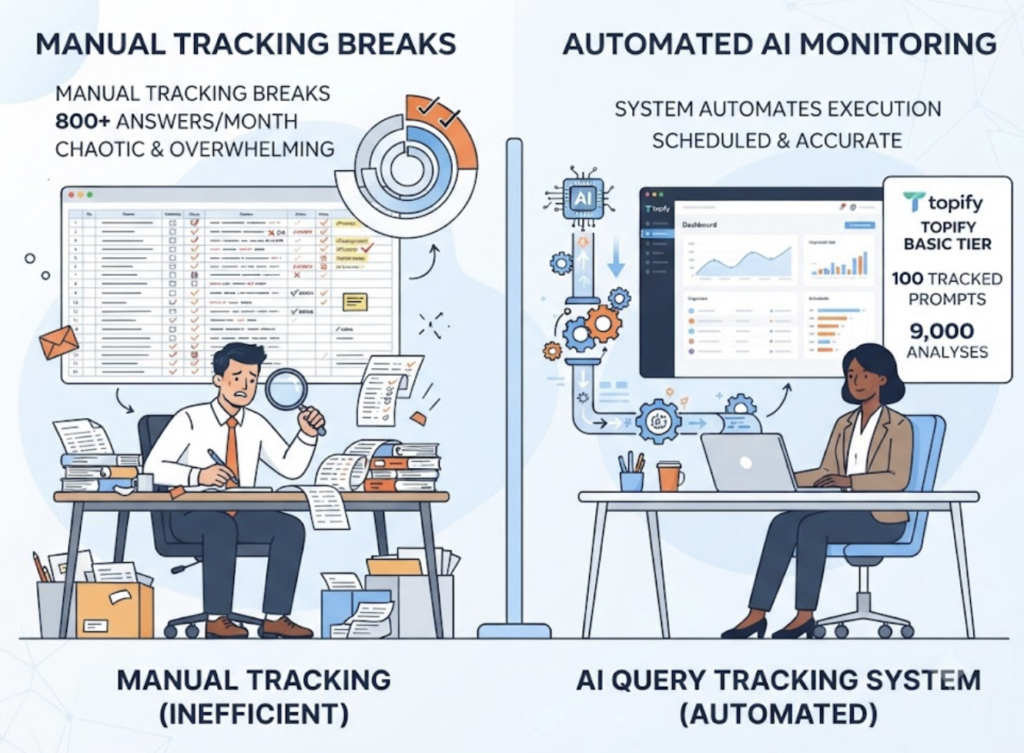
    This is also where manual tracking mathematically breaks. Running 50 queries weekly across four AI platforms means 800+ answer checks a month, each needing consistent capture and scoring. An AI query tracking system worth the name automates this batch execution on schedule. For reference, an entry-level plan like Topify’s Basic tier covers 100 tracked prompts and 9,000 AI answer analyses per month, which gives a sense of the volume a serious program actually processes.

    Step 3: Measure What Matters in an AI Query Tracking Dashboard

    Counting brand mentions is the shallow end of measurement. A mention in position seven of a lukewarm list is not the same as being the first recommendation with a positive framing. A useful AI query tracking dashboard separates four distinct signals.

    MetricWhat It Tells YouWhy Mentions Alone Miss It
    Visibility scoreHow often you appear across tracked promptsFrequency without context
    PositioningWhere you fall in the answer’s recommendation orderFirst pick vs. footnote
    SentimentHow the AI describes you: positive, neutral, or competitive framingA mention can be a warning
    Citation sourceWhich pages the AI attributes to your brandReveals which assets earn AI trust

    These four interact in ways a single number hides. You can hold steady visibility while your position slips from first to fourth, which usually precedes disappearing entirely. You can gain mentions while sentiment shifts toward “budget alternative,” which is a positioning problem, not a visibility win. And citation source is the diagnostic layer underneath everything: when your visibility moves, the citation data tells you which page started or stopped carrying you. That’s why platforms like Topify consolidate visibility, sentiment, position, and citation data into a single analytics view rather than reporting mentions in isolation.

    One more metric deserves a seat: zero-click rate, the share of queries resolved entirely inside the AI interface. As that number climbs, your strategy’s goal shifts from earning clicks to shaping the answer itself.

    Step 4: Turn Tracking Data into GEO Actions

    Tracking without action is an expensive hobby. The optimization loop starts with citation gap analysis: for each query where a competitor appears and you don’t, identify which sources the AI cited for them. Those sources are the map of what you’re missing.

    The fixes usually fall into two buckets. The first is content structure. AI models favor extractive content, and pages that deliver a direct, concise answer within the first 60 words tend to get cited more. Front-load the answer, then elaborate.

    The second is entity authority. AI systems weigh co-occurrence: whether your brand shows up alongside the problems you solve in authoritative third-party contexts, not just on your own domain. Review sites, industry publications, and community discussions carry citation weight your homepage can’t replicate.

    Then close the loop. Ship the fix, keep tracking, and confirm the change moved the metric. Tools with source analysis shorten this cycle considerably. Topify’s citation reverse-engineering shows the exact domains and URLs AI platforms cite for any tracked query, so the gap analysis takes minutes instead of a manual afternoon, and its agent can deploy the resulting strategy without hand-built workflows.

    Common Mistakes That Quietly Break Your Tracking Program

    Most failed programs die from a handful of predictable errors.

    Relying on Google Search Console as a proxy. GSC doesn’t capture LLM behavior, and with only around 12% of AI-cited URLs overlapping Google’s top 10, it’s measuring a different game.

    Assuming rank one on Google equals AI visibility. The 76%-to-38% citation drop is the clearest evidence yet that these channels have split.

    Tracking a single AI platform. ChatGPT, Perplexity, Google AI Overviews, and DeepSeek cite different sources and describe brands differently. One platform’s data generalizes poorly.

    Counting mentions without position or sentiment. You’ll report growth while your actual standing erodes.

    Freezing the query set. Buying language evolves, and last quarter’s prompt universe slowly stops representing your market.

    Ignoring off-site presence. Reddit threads, review platforms, and trusted media often outweigh your own pages in citation decisions.

    None of these mistakes announces itself. That’s what makes them expensive.

    The Tool Stack: What AI Query Tracking Software Should Cover

    The category has grown crowded, and most AI query tracking software looks similar in screenshots. The differences show up in five capabilities.

    CapabilityWhat to Verify
    Multi-platform coverageChatGPT, Perplexity, AI Overviews at minimum; ideally Gemini, DeepSeek, and regional engines
    Prompt-level trackingScheduled batch runs against your defined query set, not ad hoc lookups
    Competitor benchmarkingSide-by-side visibility, position, and sentiment against named rivals
    Citation analysisSource-level data explaining why answers cite what they cite
    Execution layerA path from insight to action, not just another report

    Topify covers all five in one AI query tracking platform. Its visibility tracking runs your prompt universe across ChatGPT, Gemini, Perplexity, DeepSeek, and other major engines on schedule, scoring each answer across seven metrics including visibility, sentiment, position, and CVR. Competitor monitoring auto-detects rivals and benchmarks your standing in real time, and the citation analysis maps every source domain behind the answers. What separates it from report-only tools is the execution end: you state a goal in plain English, review the proposed strategy, and deploy it in one click. Pricing starts at $99/month for 100 tracked prompts, which puts a systematic program within reach of a single marketer, not just enterprise teams.

    If budget is zero for now, there’s still no excuse for guessing. This reference list of free GEO tools covers no-cost options for baseline checks while you build the case for a full AI query tracking solution.

    A 10-Point Checklist Before You Call It a Strategy

    1. Prompt universe documented, 20 to 50 core queries minimum
    2. Queries layered by intent: informational, comparative, transactional
    3. Every stage of the customer journey covered by at least one query
    4. Tracking cadence assigned per tier: daily or weekly for high-value, monthly for long-tail
    5. At least three AI platforms monitored
    6. 30-day baseline captured before any optimization decision
    7. Dashboard tracks visibility, position, sentiment, and citation source separately
    8. Named competitor set benchmarked on the same queries
    9. Citation gap review scheduled monthly
    10. Every optimization shipped gets a follow-up measurement window

    If you can’t check all ten, you have a monitoring habit, not a strategy.

    Conclusion

    The screenshot-in-Slack era of AI monitoring is ending for the same reason gut-feel SEO ended: the channel got too volatile and too valuable to manage by intuition. With AI citations rotating monthly and the overlap with Google rankings shrinking fast, the brands that win are the ones measuring systematically while competitors spot-check.

    Start small and start now. Define 20 to 50 revenue-relevant queries, capture a 30-day baseline, and let the trend lines tell you where to act. If you’d rather not build the pipeline by hand, you can get started with Topify and have your first tracked prompts running the same day.

    FAQ

    Q: What is an AI query tracking strategy?
    A: It’s a documented system for monitoring how AI platforms like ChatGPT and Perplexity answer questions relevant to your brand. It combines four elements: a defined set of tracked queries, a fixed monitoring cadence, a unified metric system covering visibility, position, sentiment, and citations, and an optimization loop that acts on the data.

    Q: How does an AI query tracking strategy work in practice?
    A: You define 20 to 50 high-intent queries, run them on schedule across multiple AI platforms, and score each answer for brand presence, position, and framing. After a 30-day baseline, you use citation gap analysis to find where competitors get cited instead of you, fix the underlying content or authority gaps, and confirm the change in the next tracking cycle.

    Q: How much does AI query tracking cost?
    A: Dedicated platforms typically run from around $99 to $500+ per month depending on prompt volume and platform coverage. Topify’s entry plan starts at $99/month with 100 tracked prompts, while free tools can handle basic one-off checks before you commit to a paid AI query tracking solution.

    Q: What are examples of an AI query tracking strategy?
    A: A SaaS team might track “best [category] software” weekly across four platforms and use citation data to prioritize review-site coverage. An agency might run per-client prompt sets monthly and report visibility trends alongside SEO metrics. An ecommerce brand might track product recommendation queries daily during peak season to catch positioning drops before they cost revenue.

    Read More

  • AI Rank Checker for Local and Multi-Location Brands

    AI Rank Checker for Local and Multi-Location Brands

    Your rank tracker says everything is fine. Fifty cities, solid local pack positions, map grids mostly green. Then a regional manager forwards you a screenshot: someone asked ChatGPT for “the best urgent care in Denver,” and your clinic, the one holding position 2 in the local pack there, isn’t in the answer. You check three more cities. You’re in one, missing from two, and described as “a budget option” in the third. Your reporting stack has no column for any of this. The tools that track your rankings were built to watch a results page, not to read an answer. What you need now is a different kind of rank checking, one that looks inside AI responses, city by city.

    Your Local Pack Rankings Don’t Predict What ChatGPT Recommends

    The gap between traditional local visibility and AI visibility is not a rounding error. SOCi’s 2026 Local Visibility Index analyzed nearly 350,000 locations across 2,751 multi-location brands and found that ChatGPT recommended only 1.2% of locations, Gemini 11%, and Perplexity 7.4%. Those same brands appeared in Google’s local 3-pack 35.9% of the time.

    In other words, AI visibility can be up to 30 times harder to earn than a local pack spot.

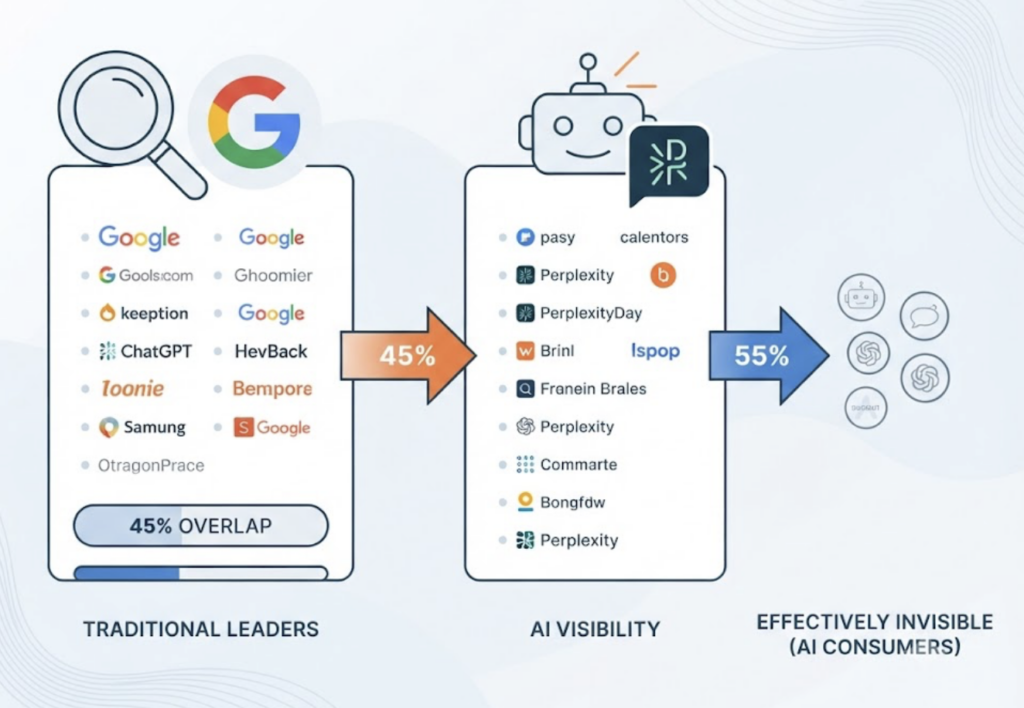
    Strong traditional performance doesn’t carry over, either. In retail, only 45% of brands leading in traditional local search also ranked among the most recommended in AI results. More than half of the winners on Google are effectively invisible to consumers who ask an AI assistant instead.

    And those consumers are no longer an edge case. AI-referred sessions grew 527% year over year, and Semrush found that AI search visitors convert at 4.4x the rate of traditional organic visitors. The channel is small in absolute terms, but it’s the highest-intent traffic most local brands aren’t measuring.

    What an AI Rank Checker Actually Measures

    An AI rank checker monitors how AI assistants answer buying-intent questions about your category, then records whether your brand appears, where it sits in the recommendation list, and how it’s described. That’s a different job from checking a SERP.

    The core difference: AI answers are probabilistic. As Rand Fishkin’s research made clear, asking an AI tool the same question 100 times can produce 100 different answers. So an AI rank checker doesn’t report a single fixed position. It samples repeatedly and reports frequency: how often you’re mentioned, and your average position when you are.

    DimensionTraditional local rank trackerAI rank checker
    What it queriesGoogle SERP / local pack / map gridPrompts sent to ChatGPT, Gemini, Perplexity
    Result formatRanked list of linksSynthesized answer with 3-5 recommendations
    Position metricFixed rank (1, 2, 3…)Mention rate (%) + average position across samples
    Competitive viewSame 10 results for everyoneCompetitor set shifts per prompt and city
    Descriptive layerNoneSentiment and framing (“premium” vs “budget”)

    For local and multi-location brands, one more dimension matters: every metric above has to be tracked per location. A brand-level mention rate hides exactly the failures you need to find.

    Why Location Changes Everything in AI Answers

    Swap the city name in a prompt and the AI’s recommendation set can change completely. Each market has its own review density, local press coverage, and community discussion, so the trust signals AI models weigh are rebuilt from scratch for every geography.

    The spread between winners and everyone else is stark. In the restaurant category, SOCi found visibility concentrated among a handful of leaders: Culver’s reached AI recommendation rates of 30.0% on ChatGPT and 45.8% on Gemini, while most competitors barely registered. A brand can be the default answer in one metro and absent in the next, with no signal in its SEO dashboard explaining why.

    Now do the math on manual checking. A 60-location brand tracking 10 prompt variants across 3 AI platforms needs 1,800 query checks for a single snapshot, and because answers vary run to run, each check should be sampled multiple times. Weekly.

    That’s not a spreadsheet task. That’s a monitoring system.

    How to Check AI Rankings Across Every Location

    The workflow that works in practice has four steps, and each one maps to a tooling requirement.

    Step 1: Build a location-modified prompt library. Start from your highest-value buying questions (“best [category] in [city],” “affordable [service] near [neighborhood]”) and generate variants for every market you operate in. This is where prompt discovery beats guesswork: the phrasings customers actually use rarely match your keyword list.

    Step 2: Run the prompts across platforms on a schedule. Each AI engine weighs sources differently, so ChatGPT, Gemini, and Perplexity results diverge. One platform is not a proxy for the others.

    Step 3: Record position per city, not just mentions. Being listed fifth behind four competitors is a different business outcome than being the first name the AI offers.

    Step 4: Track change over time and trace it to sources. A position drop usually has a cause you can act on, typically a source that stopped citing you or started citing a competitor.

    This is the use case Topify is built around. Its Position Tracking monitors where your brand ranks inside AI answers relative to competitors, prompt by prompt, across ChatGPT, Gemini, Perplexity, and other major engines. High-Value Prompt Discovery surfaces the location-modified queries with real AI search volume, so a 60-location brand isn’t guessing which of its 1,800 prompt-city combinations deserve monitoring budget. Competitor Monitoring auto-detects who you’re actually up against in each market, which matters because your rival in Phoenix often isn’t your rival in Seattle. In practice, this means you can spot your Austin locations sliding from position 2 to position 5 on ChatGPT, then trace it back to a local listicle that dropped you, all in one view.

    The platform tracks seven metrics per prompt: visibility, sentiment, position, volume, mentions, intent, and CVR. For a multi-location brand, that last one estimates which cities’ AI answers are most likely to drive actual customer action, which is how you prioritize fixes across a large footprint.

    If you’d rather validate the gap before committing, run a handful of your own city prompts through a free trial and compare the results against your local pack report. Topify also maintains a reference list of free GEO tools if you want to benchmark with lighter-weight checks first.

    The Sources AI Trusts for Local Recommendations

    Checking your AI rank tells you where you stand. Improving it requires knowing which sources the models lean on, and the data here is specific.

    Review signals set a hard floor. Locations recommended by ChatGPT averaged 4.3 stars, while brands near 3.4 stars with review response rates below 5% were effectively invisible in AI recommendations. In traditional local search, a middling location can still rank on proximity. In AI answers, it typically gets excluded outright.

    Community platforms carry outsized weight. Semrush’s research found Quora is the most commonly cited website in Google AI Overviews, with Reddit in second place, because AI systems treat forum threads as a proxy for genuine human consensus. If nobody on Reddit has ever recommended your Portland location, that silence is a ranking signal.

    Data accuracy is quietly leaking visibility too. SOCi found business profile information was only about 68% accurate on ChatGPT and Perplexity, compared with 100% on Gemini, which grounds its answers in Google Maps. Wrong hours or an outdated address at even a few locations reads as risk to a model, and models handle risk by leaving you out.

    This is where citation-level analysis earns its keep. Topify’s Source Analysis reverse-engineers the exact domains and URLs each AI platform cites for your category prompts, per market. Instead of a generic “get more reviews” plan, you get a target list: the two local publications, one Reddit community, and one aggregator that actually feed the answers in each city.

    Common Mistakes Multi-Location Brands Make in AI Search

    Auditing only flagship cities. The markets where you’re strongest are the least informative. AI visibility failures cluster in mid-tier locations with thinner review and citation footprints, exactly where nobody checks.

    Treating one AI platform as representative. Gemini’s grounding in Google Maps makes it the friendliest engine for brands with clean GBP data, which is why it recommended 11% of locations while ChatGPT recommended 1.2%. Reading only Gemini results tends to overstate your real coverage.

    Assuming GBP optimization covers AI. Listings hygiene is necessary but not sufficient. Models synthesize your entire footprint, including reviews, forums, and press, so a perfect profile with a weak citation footprint still loses.

    Ignoring prompt phrasing variants. “Best,” “cheapest,” and “most reliable” pull different recommendation sets. Tracking one phrasing per city undercounts both your wins and your losses.

    Reporting brand averages to stakeholders. A 40% overall mention rate can hide ten cities at zero. Location-level reporting is the whole point.

    Conclusion

    The definition of rank checking has changed underneath local brands. Your local pack positions still matter, but they no longer predict whether an AI assistant will name you when a customer asks, and the 1.2% ChatGPT recommendation rate for multi-location brands says most are losing that moment by default.

    The fix starts smaller than it sounds. Pick your 10 highest-value location prompts, run them across three AI platforms, and record where you stand. That baseline, tracked weekly with an AI rank checker that measures position and mention rate per city, turns an invisible problem into an ordinary reporting line. The brands doing this now are setting the defaults everyone else will be trying to displace.

    FAQ

    Q: What is an AI rank checker? 

    A: An AI rank checker is a tool that monitors AI-generated answers from platforms like ChatGPT, Gemini, and Perplexity to see whether a brand appears, what position it holds in the recommendation list, and how it’s described. Because AI answers vary between runs, it reports mention frequency and average position rather than a single fixed rank.

    Q: How do I check my brand’s ranking in ChatGPT for a specific city? 

    A: Manually, you’d ask ChatGPT a buying-intent prompt with the city name (“best [category] in Austin”) multiple times and log whether and where your brand appears. At multi-location scale, a platform like Topify automates this by running location-modified prompts on a schedule and tracking position per market.

    Q: How is AI rank checking different from local rank tracking? 

    A: Local rank trackers monitor fixed positions in Google’s SERP and local pack. AI rank checking monitors synthesized answers where results are probabilistic, competitor sets change by city, and visibility is measured as recommendation frequency plus position. Strong local pack rankings often coexist with zero AI visibility.

    Q: How many prompts should a multi-location brand track? 

    A: Start with 5-10 core buying-intent prompts per priority market, covering your main category terms and at least two phrasing variants (such as “best” and “affordable”). Expand based on prompt discovery data showing which queries carry real AI search volume in each city.

    Read More

  • Your AI Rank Can Drop 35% in Five Weeks. Catch It Early

    Your AI Rank Can Drop 35% in Five Weeks. Catch It Early

    Three weeks ago, ChatGPT recommended your brand second in its answer to your category’s biggest buying question. This Monday, a prospect ran the same prompt and you weren’t in the answer at all. Your Google rankings didn’t move. Search Console looks normal. Nothing in your stack flagged the change, because nothing in your stack was built to watch it.

    That’s not an edge case. Research tracking 3.5 million citation events across 120,000+ domains found that AI citation activity drops by half in roughly 4.5 weeks. On ChatGPT, the churn is even faster: 3.4 weeks. A 35% loss inside five weeks isn’t a disaster scenario. It’s close to the statistical default for brands that publish once and stop watching.

    AI Rankings Don’t Decay. They Collapse.

    Google rankings erode. A page slips from position 3 to position 5 over a quarter, you notice it in your monthly report, and you have time to react. AI rankings don’t work that way. They move in step functions: your brand is in the answer, then it isn’t.

    One practitioner who logged AI citations weekly for nine weeks watched them peak at week three, then fall by more than half by week six. His Google Search Console clicks for the same pages stayed flat the entire time. Two completely different clocks, running on the same content.

    Three mechanics drive the collapse pattern:

    Citation pool resets. When LLMs retrain or adjust retrieval thresholds, they refresh the set of URLs they pull from. AI-cited domains turn over 40 to 60 percent every month. Your brand can vanish overnight without a single change on your side.

    Youth bias. AI engines are optimized for information currency. As the citation pool refreshes, older content gets swapped for fresher, more contextually dense sources, even when the older content has higher domain authority.

    Non-determinism. AI answers are probabilistic. The same prompt can return different citations depending on model updates and context. A single manual check tells you almost nothing. Only longitudinal sampling produces a rank that means anything.

    That last point is the one most teams miss. If your monitoring method is “someone asks ChatGPT about us once a month,” you’re not measuring a trend. You’re rolling a die.

    Why an AI Rank Checker Isn’t a Rank Tracker With Extra Steps

    The obvious move is to extend your existing rank tracker to AI platforms. The problem is that the two tools measure structurally different things.

    DimensionTraditional Rank TrackerAI Rank Checker
    Primary metricSERP position (1-100)Mention rate and citation probability
    Underlying logicDeterministic (links, keywords)Probabilistic (retrieval, semantic authority)
    Decay patternGradual, linearStep-function collapse
    Core dependencyDomain authority, backlinksEntity clarity, topical authority
    Useful check frequencyMonthlyWeekly

    There’s also a distinction traditional tools can’t see at all: the gap between being mentioned and being cited. An AI answer can name your brand in text without linking your domain as a source, or cite your domain without recommending you. A rank tracker collapses both into a single number. An AI rank checker has to treat mention rate as the leading indicator and citation as a separate authority event.

    The measurement gap is industry-wide. Semrush’s 2026 AI Visibility Index, built on 126 million real US AI search prompts, found that 45% of marketing leaders can’t accurately measure their brand’s visibility in AI answers, and only 9% have tools that track all relevant metrics across platforms. In the same study, only 36 brands worldwide held top-100 visibility across all four major AI platforms in every month of the analysis. Everyone else fluctuated.

    If global brands with dedicated teams can’t hold their AI rank steady, assuming yours is stable without checking is a bet, not a strategy.

    The Three Early Signals of a Rank Drop

    By the time your position falls, the drop already happened weeks earlier in metrics you probably weren’t watching. Position loss is a lagging indicator. These three signals lead it.

    Signal 1: Mention Rate Slips Before Position Does

    Before a brand gets dropped from an AI answer, it typically gets demoted inside the model’s internal entity list. In practice, a 10% decline in mention rate across a consistent prompt set is a statistically meaningful warning that citation loss is coming.

    This is why mention rate, not position, should be the first number on your dashboard. Position tells you where you stand today. Mention rate tells you where you’ll stand next month.

    Signal 2: A Citation Source Goes Quiet

    AI engines lean on a small set of preferred sources per topic, and they switch between primary and secondary sources as confidence shifts. If your domain is being swapped out for a competitor’s in more than 20% of occurrences on a given prompt, the model is signaling reduced confidence in your content, even if you’re still appearing.

    Watch the sources, not just the answers. A review site that stopped updating its listicle, or a comparison page that dropped you in its last refresh, often explains a rank drop weeks before it registers.

    Signal 3: A Competitor Starts Splitting Your Prompts

    Collapse rarely starts on head terms. It starts on long-tail, sub-intent prompts: the specific buyer questions you used to own outright. As a competitor improves their GEO, they capture those first. Your share of voice fragments quietly at the edges before the head-term drop makes it visible.

    If a new name keeps showing up next to yours on prompts where you used to be the only recommendation, that’s not noise. That’s the opening move.

    How to Set Up Weekly AI Rank Monitoring

    Catching a 35% drop early is a process problem, not a talent problem. The setup takes an afternoon.

    Step 1: Define your prompt taxonomy. Pick 20-50 core, high-intent buyer questions. Source them from sales call transcripts and support tickets, not just keyword volume tools. These are the prompts your revenue actually depends on.

    Step 2: Fix your platform set. ChatGPT, Perplexity, and Google AI Overviews at minimum. Platforms cycle sources at different speeds: ChatGPT refreshes fastest at 3.4 weeks, Perplexity holds citations nearly 70% longer at 5.8 weeks. A drop on one platform doesn’t predict the others.

    Step 3: Sample weekly, not monthly. Google rankings tolerate monthly checks. AI rankings don’t, because half-lives are measured in weeks and single samples are noise. Weekly runs across the same prompt set smooth out non-determinism and give you a real trend line.

    Step 4: Set alert thresholds. Two rules cover most cases: flag any position loss greater than 2 places on key discovery prompts, and flag any drop in total mention frequency above 10% over a rolling 4-week window.

    Running this manually across 30 prompts, three platforms, and weekly sampling means roughly 400 checks a month, before you even start attributing causes. This is the point where tooling stops being optional. Topify was built around exactly this loop: its Position Tracking monitors where your brand ranks relative to competitors inside AI answers, while Visibility, Sentiment, and Mention metrics run alongside it in the same view. When something slips, Source Analysis shows you which cited domains changed, so a drop comes with a probable cause instead of a mystery. The Basic plan covers 100 prompts and 9,000 AI answer analyses per month across ChatGPT, Perplexity, and AI Overviews at $99/month, which maps neatly onto the 20-50 prompt taxonomy above with room for expansion. You can start a free trialand have your baseline in the first week. If you want to test the waters before committing to a platform, this GEO free tools reference collects no-cost checkers worth bookmarking.

    One week of data is a snapshot. Four weeks is a baseline. Eight weeks is the difference between guessing and knowing.

    What to Do in the First Week After a Drop

    A five-week collapse window means your response clock runs in days, not quarters. When an alert fires, work through four questions in order.

    Is it platform-wide or brand-specific? Check whether competitors on the same prompts also moved. If everyone shuffled, it’s likely a model update. If only you dropped, it’s about your content or your sources.

    Which source went quiet? Pull the citation data for the affected prompts. In most brand-specific drops, a third-party source stopped citing you: a stale listicle, an updated comparison, a review roundup that refreshed without you.

    Did a competitor make a move? Look at what’s being cited in your former slot. A recently published, tightly structured piece from a rival usually means they’re running their own GEO play, and your long-tail prompts are next.

    Refresh what the model dropped. Given ChatGPT’s 3.4-week source cycle, content targeting it generally needs updates on a biweekly-to-monthly cadence. Prioritize the pages tied to your highest-intent prompts, and pitch updates to the third-party sources that went quiet.

    Teams that run this loop tend to recover within one or two citation cycles. Teams that discover the drop from a quarterly traffic report start the same process five weeks late, after the pipeline damage is already booked.

    Conclusion

    The uncomfortable math: with a median citation half-life of 4.5 weeks, your next AI rank drop isn’t a possibility, it’s a schedule. What’s optional is whether you find out in week one or week five, after prospects have spent a month hearing a competitor’s name in the answers you used to own.

    Start this week. Pull 20 buyer questions from your last ten sales calls, run them across three AI platforms, and log what comes back. That’s your baseline. Everything after that is just keeping the loop running before the next reset hits.

    FAQ

    Q: How often do AI rankings actually change? 

    A: Faster than most teams expect. Median citation activity drops by half in about 4.5 weeks across platforms, with ChatGPT cycling sources in roughly 3.4 weeks. Google rankings can be checked monthly; AI rankings need weekly sampling to catch changes inside the response window.

    Q: Can I use a free AI rank checker instead of a paid platform? 

    A: For a one-time baseline, yes. Free checkers can tell you whether you appear on a handful of prompts today. What they typically can’t do is run consistent weekly sampling across a full prompt set, alert on threshold breaches, or attribute a drop to specific citation sources, which is where early detection actually happens.

    Q: Why did my brand disappear from ChatGPT answers overnight? 

    A: Most likely a citation pool reset. When models retrain or adjust retrieval thresholds, they refresh their source sets, and AI-cited domains turn over 40-60% monthly. Check whether the third-party pages that previously cited you were updated or replaced. That’s the cause in most brand-specific cases.

    Q: Does a strong Google ranking protect my AI rank? 

    A: No. AI visibility runs on entity clarity and topical authority, not backlink profiles, and the two move independently. Documented cases show AI citations halving while Google Search Console traffic for the same pages stayed completely flat. You need to measure both separately.

    Read More

  • AI Rank Checker: How to Track Your Rank in AI Search

    AI Rank Checker: How to Track Your Rank in AI Search

    Your rank tracker shows you sitting at #2 for your money keyword. Then your VP asks where you land when a buyer asks ChatGPT for a recommendation in your category, and you have nothing. You open the dashboard you’ve used for years, and there’s no column for it. That tool was built to watch Google’s ten blue links. AI search doesn’t work that way, and the distance between what your tracker measures and what buyers actually do is widening every quarter.

    Why Your Rank Tracker Can’t See AI Search

    Traditional rank tracking assumes a stable, ordered list of URLs. You rank #3 today, maybe #2 next week, and the tool logs the movement. That logic falls apart the moment an answer gets generated instead of listed.

    AI search engines use Retrieval-Augmented Generation. Instead of returning ranked pages, they pull information chunks from multiple sources and synthesize a single answer. Google ranks entire pages on authority and backlinks. AI models rank pieces of information on semantic relevance and citation confidence. Different unit, different game.

    There’s also the zero-click problem. When the answer appears inside the interface, nobody clicks through, so “position #1” stops correlating with traffic or revenue.

    And the output isn’t even stable. Ask the same question twice and you can get different citations, depending on the model’s settings, the conversation history, or a fresh index pull. A conventional AI rank checker built on fixed positions has nothing to hold onto.

    That’s the gap most SEO teams still can’t see.

    What “Rank” Even Means in ChatGPT, Perplexity, and AI Overviews

    In AI search, rank isn’t a number from 1 to 10. It’s a measure of influence, and it shows up in three tiers.

    The strongest is direct citation, where your brand is named and linked as a source. Below that is entity association, where the AI recommends your product as a solution without a link. The baseline is topic authority, where the model reliably pulls your data or perspective when the subject comes up. A useful AI rank checker has to account for all three, not just whether a blue hyperlink appeared.

    The selection mechanics matter here. AI engines run a multi-stage pipeline: they parse a conversational query (often 20-plus words), retrieve candidates using both vector similarity and keyword matching, then run an L3 re-ranking pass that scores those candidates on factual density and answer completeness before writing the response. The technical breakdown from Mersel.ai maps this out in detail. The takeaway for anyone checking their AI rank: you’re not competing for a position, you’re competing to be the chunk the model trusts enough to quote.

    The three platforms also behave differently. ChatGPT leans generative and synthesizes across sources. Perplexity is citation-first and shows its references openly. Google AI Overviews sits on top of search and pulls from a mix. Checking one and assuming the others match is a fast way to get a wrong read.

    How to Check Your AI Rank Manually (Step-by-Step)

    You can get a real baseline by hand before you automate anything. Here’s the process.

    Step 1: Build a Prompt List That Mirrors Real Buyer Questions

    Don’t start with keywords. Start with the questions your buyers actually type. Pull them from sales call transcripts and support tickets, then build a taxonomy of 50 to 100 core prompts. These should sound conversational and task-oriented (“what’s the best tool for tracking brand mentions in AI answers”), not like short-tail search terms. The prompt list is the foundation of every AI rank check that follows, so it’s worth doing carefully.

    Step 2: Run the Same Prompts Across ChatGPT, Perplexity, and AI Overviews

    Take each prompt and run it, unchanged, on all three engines. Same wording, same session-clean conditions where possible. You’re looking to compare apples to apples, because the point is to see how your ChatGPT ranking differs from your Perplexity ranking for the identical question. Run each prompt more than once. A single pass tells you almost nothing given how much the output moves.

    Step 3: Log Whether You’re Mentioned, Where, and Who Beats You

    For every result, record three things. Were you mentioned at all? Where did you land in the sequence of citations or recommendations? And who showed up ahead of you? Note the tone too: positive, neutral, or a comparison that frames a competitor as the safer pick. That last column is where the real intelligence lives. Being mentioned fifth behind two rivals is a different problem than not being mentioned at all.

    Why Manual Checks Break Down Fast

    The manual method works for a baseline. It doesn’t survive contact with the real pace of AI search.

    The freshness demand alone is brutal. AuthorityTech’s 2026 citation research found that 88% of Google AI citations come from pages outside the traditional organic top 10, and separate analysis showed 76.4% of the pages Perplexity cited heavily had been updated within the previous 30 days. Manual spot-checks can’t keep up with a system that rewards content refreshed weeks ago.

    Then there’s randomness. Models rotate citations to avoid repeating themselves, so a one-off check gives you a snapshot, never a trend line. You need repeated sampling over time to separate signal from noise.

    And the workload compounds. Fifty prompts, three platforms, multiple runs each, logged and tallied by hand, every week. By the time you finish, the data’s already stale.

    Using an AI Rank Checker to Automate the Whole Thing

    Once the manual method proves the concept, the job becomes turning a one-time audit into a running measurement. That’s where a purpose-built AI rank checker earns its place.

    For teams tracking rank across multiple engines, Topify approaches this by running your prompt set continuously across ChatGPT, Gemini, Perplexity, Google AI Overviews, and other major platforms, then rolling the results into one view. In practice, its Position Tracking tells you where you sit relative to competitors in AI answers, Visibility Tracking shows how often you’re mentioned at all, and Source Analysis reverse-engineers which domains and URLs the AI actually cited. So when your ranking drops, you can trace it to a specific source that stopped referencing your brand, inside the same dashboard.

    That last point closes the loop the manual method leaves open. A hand-logged spreadsheet can tell you that you slipped. It rarely tells you why. Pairing Position data with Source data answers both in one place.

    The measurement also spans the full definition of rank. Rather than checking a single hyperlink, the platform tracks visibility, sentiment, position, and citation sources together, which is closer to how AI search actually distributes influence. If you want to test the surface of this before committing, Topify’s free GEO tools reference is a reasonable place to start, and you can run a full trial to see your own prompt set scored across engines.

    Common Mistakes When Checking AI Rank

    A few errors show up over and over, and each one quietly corrupts the data.

    Checking one platform and generalizing is the most common. ChatGPT, Perplexity, and AI Overviews cite differently, so a strong Perplexity showing tells you little about ChatGPT.

    Running each prompt once is the second. Non-deterministic output means a single pass is closer to a coin flip than a measurement.

    Tracking position while ignoring mention is the third, and the most expensive. If your brand never enters the answer, there’s no rank to improve. Visibility comes before position, always.

    The last one is subtle: testing with your own brand name instead of the buyer’s real question. Searching “is [your brand] good” almost guarantees a mention. It also has nothing to do with how an actual prospect discovers you.

    Conclusion

    The uncomfortable truth is that your Google rank and your AI rank are now two separate things, and only one of them shows up in your current tracker. That gap won’t close on its own. AI search keeps growing, citation patterns shift by the week, and every quarter you wait is a quarter of missing baseline data. Start with a manual audit to see where you stand across ChatGPT, Perplexity, and AI Overviews. Then move to continuous tracking before the volatility outpaces your ability to measure it by hand. The brands that establish an AI rank baseline now will be the ones who can prove movement later.

    FAQ

    Q: Is there a free AI rank checker? 

    A: You can run a basic manual check for free by polling ChatGPT, Perplexity, and AI Overviews with your own prompt list and logging the results. Some platforms also offer free entry-level GEO tools to test visibility on a small scale before you commit to full tracking.

    Q: Does AI search actually have rankings like Google? 

    A: Not in the same way. Google returns an ordered list of URLs. AI search synthesizes answers and “ranks” you by whether you’re cited, where you appear in the sequence, and how favorably you’re framed. It’s better understood as citation probability than position.

    Q: How often does AI ranking change? 

    A: Frequently, and for two reasons. Models rotate citations to avoid repetition, so results shift between runs, and they favor recently updated content, with a large share of cited pages refreshed within the prior month. This is why a single check is unreliable and repeated sampling matters.

    Q: ChatGPT vs Perplexity: is the ranking the same? 

    A: No. Perplexity is citation-first and surfaces its sources openly, while ChatGPT leans generative and synthesizes across references. The same prompt can rank you well on one and omit you entirely on the other, which is why cross-engine checking is essential.

    Read More

  • Listicles Win 40% of AI Citations: An AI Rank Checker Guide

    Listicles Win 40% of AI Citations: An AI Rank Checker Guide

    You published a 3,000-word guide last quarter. It ranks on page one, the backlinks are solid, and traffic looks healthy. Then you run your core industry prompt through Perplexity and watch it cite a competitor’s 7-step listicle instead. Three times in a row.

    The frustrating part is that nothing in your analytics explains why. Google Search Console shows impressions and clicks. It doesn’t show that an AI engine scanned your page, couldn’t extract a clean answer, and moved on.

    That gap has a structural cause, and it’s fixable. The fix comes in two parts: rebuild your content around formats AI engines actually cite, then verify the change with an AI rank checker instead of guessing.

    Listicles and How-Tos Pull Up to 40% of AI Citations. Here’s Why.

    The numbers on format are hard to ignore. According to Wix AI Search Lab research, listicles and comparative content account for 21 to 60% of all AI citations depending on query type. For commercial queries, the kind that start with “best software for” or “top tools to,” listicle citation rates reach up to 40%.

    This isn’t because AI engines have a taste for numbered headlines. It’s mechanical. LLM-powered answer engines don’t read pages the way humans do. They retrieve chunks, and a listicle is essentially a pre-chunked document. Each list item functions as a discrete, self-contained unit the model can extract, verify, and cite with high confidence.

    Narrative long-form works differently. The argument builds across sections, the payoff lands in paragraph twelve, and no single block stands alone. A human reader follows the thread. A retrieval system sees a wall of interdependent text and picks the competitor’s cleaner source instead.

    The stakes are bigger than ego. With AI answer engines now influencing over 65% of search queries, and research from Seer Interactive and Ahrefs showing AI-referred traffic converting at up to 23x the rate of standard organic visits, citation share is becoming the metric that decides who gets the buyer.

    Structure is the entry ticket.

    What an AI Rank Checker Actually Measures

    Before restructuring anything, it helps to understand what you’re optimizing toward, because the measurement unit has changed.

    A traditional rank tracker reports a URL’s position on a static list, 1 through 100. An AI rank checker tracks something messier: whether your brand appears inside a synthesized answer, where it sits relative to competitors, and which specific URLs the engine cited to build that answer.

    MetricTraditional SEO TrackerAI Rank Checker
    ObjectiveKeyword rank on a results pagePresence in the AI answer
    Data unitURL positionCitation, mention, share of voice
    StabilityRelatively consistentVolatile, session-dependent
    Core valueClick-through rateBrand trust and influence

    The two systems also disagree more than most teams expect. The Digital Bloom’s 2026 AI Citation Report found roughly a 76% overlap between Google’s top 10 and AI citations, which sounds reassuring until you flip it: about a quarter of what AI cites doesn’t come from the top of Google at all. A page can rank #1 and never get cited if it’s too dense, lacks H2/H3 hierarchy, or buries its answers.

    That’s why format work and measurement have to run as one loop. You restructure, the engines re-retrieve, and the AI rank checker tells you whether the change registered. Skip the measurement half and you’re editing blind.

    How to Structure a Listicle That Wins AI Citations

    A citation-ready listicle follows rules that have little to do with what makes a listicle pleasant to skim. Three of them do most of the work.

    Front-Load the Answer in Every List Item

    AI systems scan the first 30% of a page for roughly 44% of their citations. The same top-heavy logic applies inside each list item: the first sentence should deliver the verdict, with context after.

    Compare “Tool X has been around since 2019 and has grown steadily…” with “Tool X is the strongest pick for agencies managing 10+ client brands, starting at $99/month.” The second version is quotable on its own. Pages built on this pyramid structure, summary first and expansion later, show a 17.46% higher inclusion rate in AI summaries.

    Keep Each Item Extractable on Its Own

    Every entry should carry its own definition, one concrete data point, and a use-case sentence. If a list item only makes sense after reading the item above it, it can’t be cited independently, and independence is the whole advantage of the format.

    Add a comparison table near the top. Structured data tables with specific values deliver a 2.5x citation multiplier over unstructured content, because a table gives the model pre-verified value pairs it can lift directly into an answer.

    Anchor Claims to Outside Evidence

    AI models lean on trust clusters. Content citing authoritative sources, industry stats, government data, or peer-reviewed research is 3.2x more likely to be cited than content making unsupported claims. Generic “top 10” pages with no external corroboration are exactly what models have learned to distrust.

    How to Structure a How-To Guide AI Engines Cite

    How-to content is the other format inside that 40% citation block, and its rules are stricter because the model needs to reproduce a sequence, not just a fact.

    Number every step, and open each one with a verb. “Step 3: Export the citation report as CSV” gives the engine an unambiguous action unit. Vague step titles like “Getting things ready” give it nothing to anchor.

    Embed specifics inside each step. Time estimates, tool names, exact settings, and thresholds all raise extraction confidence. “Wait 30 days before re-running your prompt set” is citable. “Wait a while and check again” isn’t. Detail reads as authority to both humans and retrieval systems.

    Two more structural moves compound the effect. Write H2 and H3 headers that mirror real queries (“How long until AI citations update?”) so the semantic hierarchy matches how people prompt. Then close with an FAQ block backed by FAQPage schema, which hands the model labeled question-answer pairs it can map straight onto conversational queries.

    3 Structural Mistakes That Cost You AI Citations

    The buried verdict. The conclusion arrives in the fifth paragraph after extensive throat-clearing. Since engines weight the opening third of the page so heavily, an answer that shows up late often doesn’t show up at all in the retrieval window.

    Suspense headers. Section titles like “The Surprising Truth” or “What We Learned” carry zero semantic information. The model can’t tell what the section answers, so it can’t match the section to a query. Curiosity-gap headlines are a human engagement tactic that actively hurts machine retrieval.

    The unbroken wall. No tables, no lists, paragraphs running six-plus sentences. AI systems struggle to chunk long unbroken text, and content that can’t be chunked can’t be cited. Blocks of 2 to 3 sentences with clear subheads are the reliable ceiling.

    Notice what’s not on this list: content quality. Plenty of genuinely excellent pages fail all three tests. That’s the uncomfortable part of the citation gap, and also the reason it’s fixable in an afternoon of editing rather than a quarter of rewriting.

    Verify Your Structure Works with an AI Rank Checker

    Restructuring without measurement is where most teams stall. AI answers are volatile by nature, shifting with model updates and retrieval weights, so a single manual ChatGPT check tells you almost nothing. You need a baseline, a change, and a tracked delta.

    The workflow looks like this. First, run a baseline audit: test your primary industry prompts across ChatGPT, Gemini, and Perplexity, and record whether your brand appears and which competitor URLs get cited instead. Second, cross-reference against Google rankings to isolate pages that rank well but earn no citations. Those are your restructuring candidates. Third, rebuild your top high-intent pages using the listicle and how-to rules above. Fourth, re-run tracking monthly, because that’s roughly the cadence at which retrieval patterns settle.

    This is the loop Topify was built to close. Its Source Analysis reverse-engineers the exact domains and URLs that AI platforms cite for your prompt set, so after a restructure you can see whether engines started pulling from your new listicle or kept citing the competitor. Position Tracking layers on where you sit in the answer relative to rivals, and coverage spans ChatGPT, Gemini, Perplexity, DeepSeek, and other major engines, which matters given how differently each platform retrieves.

    In practice, that means you can publish a restructured page, wait a retrieval cycle, and trace a new citation back to the specific section that earned it. The Basic plan runs $99/month with 100 tracked prompts and 9,000 AI answer analyses, which covers a monthly measurement cadence for a mid-size content library. If you want to scope the space before committing, this GEO free tools reference collects no-cost checkers worth testing first.

    Conclusion

    The citation gap isn’t a quality problem. It’s a packaging problem, and the data is consistent: listicles and how-tos win up to 40% of commercial-query citations because they’re pre-chunked, front-loaded, and independently extractable.

    Start small. Pick two or three pages that rank well on Google but never surface in AI answers, restructure them with answer-first list items, a data table, and query-mirroring headers, then let an ai rank checker confirm whether citations follow over the next 30 days. Track it. Adjust it. Repeat monthly. Getting a baseline in place takes minutes, and it turns format strategy from guesswork into a measurable loop.

    FAQ

    Q: What’s the difference between an AI rank checker and a traditional rank tracker?
    A: A traditional tracker reports your URL’s position on a search results page. An AI rank checker measures whether your brand appears inside AI-generated answers, how often, in what position relative to competitors, and which URLs the engine cited as sources.

    Q: How long does it take to see citation changes after restructuring content?
    A: Typically one retrieval cycle, which in most cases means 2 to 6 weeks depending on the platform. Because AI answers fluctuate with model updates, monthly tracking is the minimum cadence for judging whether a structural change actually moved citation frequency.

    Q: Do listicles work for every industry or topic?
    A: They dominate commercial and comparison queries, where citation rates reach up to 40%. For definitional or technical queries, answer-first explainers with strong H2/H3 hierarchy and FAQ schema tend to perform better. Match format to query intent rather than defaulting to lists everywhere.

    Q: Can I check AI rankings across ChatGPT, Gemini, and Perplexity at once?
    A: Yes. Multi-engine coverage is the main argument for dedicated tooling over manual spot checks, since each platform retrieves and cites differently. Platforms like Topify run your prompt set across all major engines and consolidate mentions, positions, and citations in one view.

    Read More