Category: Article

  • AI Query Tracking Platform: What It Is and How It Works

    AI Query Tracking Platform: What It Is and How It Works

    Your domain rating is solid. Your keyword rankings haven’t moved. And yet none of that data can tell you what happened yesterday when 800 people asked ChatGPT for a recommendation in your category. Traditional SEO tools measure positions on a results page. An AI query tracking platform measures something different: whether generative engines mention you at all, where they place you, and which sources they trust when they decide.

    That gap between what your dashboard shows and what AI actually says is now where deals are quietly won or lost.

    What an AI Query Tracking Platform Actually Measures

    An AI query tracking platform systematically monitors how AI engines like ChatGPT, Perplexity, Gemini, and Google AI Overviews respond to the prompts your buyers actually type. Instead of tracking a keyword’s rank on a results page, it audits the AI’s synthesized answer: is your brand present, how prominently, and in what tone.

    The shift matters because the underlying behavior has changed. AI search traffic has grown more than 500% year-over-year, and over 60% of information-seeking queries now resolve without a single click to an external website. When the answer is the destination, the answer is what you need to measure.

    One clarification worth making early: query tracking isn’t prompt engineering. You’re not writing instructions for the AI. You’re auditing its outputs for high-intent queries like “best CRM for small agencies” or “your brand vs. competitor” to see how the model characterizes you.

    A useful mental model comes down to four questions. Is the brand present in the answer? Is it prominent, meaning early in the response rather than buried? Is it persuasive, framed positively rather than as a budget afterthought? And is it cited, backed by sources the AI treats as authoritative?

    Inside the Mechanics: Why One Query Proves Nothing

    Here’s the part most teams get wrong on day one. They open ChatGPT, type their category query, screenshot the answer, and treat it as ground truth.

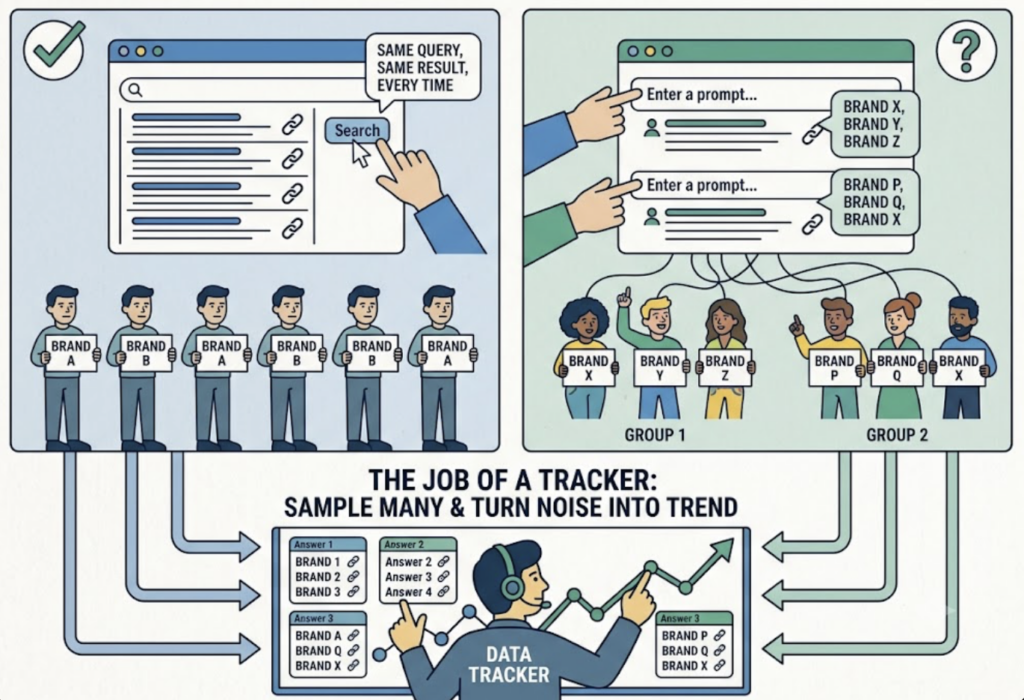
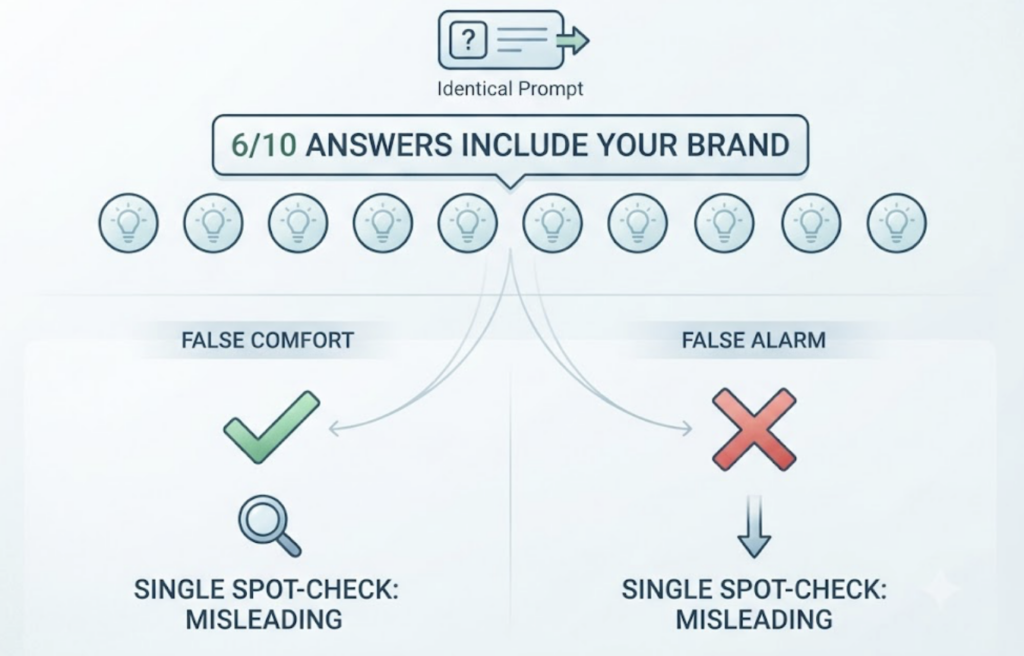
    LLMs are probabilistic, not deterministic. Research shows that even at zero temperature settings, responses still vary between runs. Your brand might appear in 6 out of 10 answers to the identical prompt. A single spot-check captures one data point from a distribution, which is why manual tracking tends to produce false alarms and false comfort in equal measure.
    A proper AI query tracking platform handles this with a repeatable pipeline:

    1. Prompt library design. Define the 25 to 50 decision-stage queries that matter for your category.
    2. Scheduled multi-platform sampling. Run each prompt repeatedly across ChatGPT, Perplexity, Gemini, and other engines on a fixed cadence.
    3. Answer parsing. Detect brand mentions, extract position within the response, and score sentiment.
    4. Citation extraction. Log which domains the AI referenced to justify its recommendations.
    5. Longitudinal aggregation. Roll results into 7-day or 30-day windows so you’re reading trends, not noise.

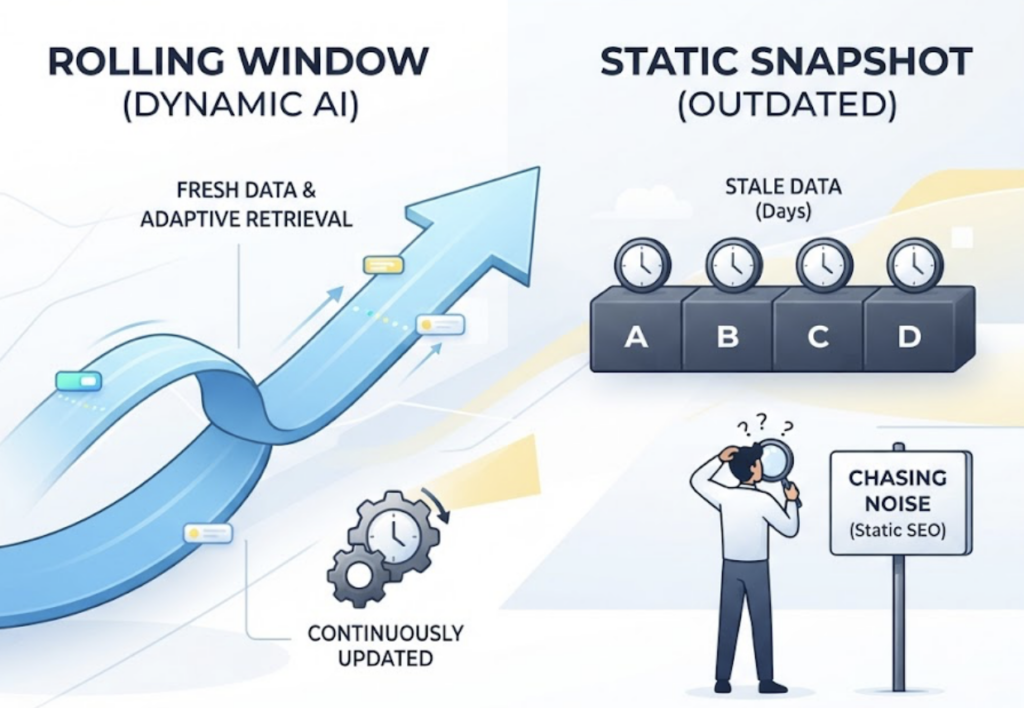
    The rolling window is the piece manual workflows can’t replicate. AI models update their indexes and retrieval logic frequently, so snapshots go stale within days. As one analyst at ROI·DNA put it, treating AI performance like a static SEO rank means chasing noise instead of driving strategy.
    The Four Metrics That Separate Signal from Vanity

    Knowing how to measure an AI query tracking platform’s output starts with four core dimensions.

    Visibility rate. The percentage of relevant AI responses that include your brand. This is your baseline: a brand at 12% visibility for its core prompts has a discovery problem, not a conversion problem.

    Position, or salience. Where you appear in the answer. AI-generated responses concentrate attention heavily, and models tend to prioritize the first 30 to 40% of content, so a mention in position seven is worth a fraction of a mention in position two.

    Sentiment and framing. How the AI describes you. “Enterprise-grade” and “a cheaper alternative” are both mentions, but they send buyers in different directions.

    Source attribution. The domains fueling the AI’s answers. This is the upstream layer most teams miss: if Perplexity consistently cites G2 and an industry journal for your category, your visibility on those third-party sources matters as much as your own site. In practice, platforms like Topify operationalize this by tracking all four dimensions plus volume, intent, and a conversion visibility rate at the individual prompt level, so a drop in ChatGPT mentions can be traced back to the specific source that stopped citing you.

    Five Mistakes That Turn Tracking Data into Noise

    Even teams that buy the right tooling often undermine it in the setup phase. The recurring failures:

    Trusting single samples. One query, one screenshot, one conclusion. Variance makes this meaningless.

    Tracking only one AI platform. ChatGPT, Perplexity, and Gemini pull from different retrieval systems and cite different sources. Coverage on one says little about the others.

    Monitoring branded queries instead of category queries. “What is [your brand]” flatters you. “Best [category] tool” is where buying decisions happen and where you’re most likely invisible.

    Keeping the prompt library too small. Ten prompts can’t represent a category. Tracking a modest cluster of 50 prompts across three platforms manually already consumes dozens of hours weekly, which is exactly why teams under-sample.

    Using SEO rank as a proxy. Ranking position and AI mention behavior are correlated at best. Plenty of page-one brands never appear in generated answers.

    Avoid these five and even a basic setup starts producing decisions instead of dashboards.

    Leading AI Visibility Optimization Tools, Compared

    Once the framework is clear, the practical question becomes build versus buy. Some engineering-heavy teams consider scraping AI answers themselves, but the build-versus-buy math rarely favors building: fragile APIs, constant maintenance debt across five or more engines, and hidden cloud costs typically exceed a subscription within the first quarter.

    Among the leading AI visibility optimization tools, the differences show up in engine coverage, metric depth, and whether the platform helps you act on the data or just look at it.

    PlatformEngine CoverageMetric DepthExecution LayerStarting Price
    TopifyChatGPT, Gemini, Perplexity, AI Overviews, DeepSeek, Doubao, Qwen7 metrics per promptOne-click strategy deployment$99/mo
    Self-built systemDepends on engineering capacityRaw mentions onlyNone, data siloEngineering time + API costs
    Generic brand monitoring toolsUsually 1-2 AI enginesMention alertsNoneVaries

    Topify covers the widest engine set in this group, including Chinese platforms like DeepSeek and Qwen, which matters for any brand with international buyers. Its analytics track visibility, sentiment, position, volume, mentions, intent, and CVR for every prompt in your library, and its prompt discovery engine surfaces high-value queries where your brand is currently dark, so the library grows with the market instead of freezing at setup.

    The execution layer is the less obvious differentiator. Most tools stop at reporting. Topify maps citation gaps to content strategy and lets teams deploy an optimization plan in one click, which closes the loop between “we found a problem” and “we did something about it.”

    Other tools in the category tend to focus on a narrower slice, often ChatGPT-only monitoring or citation alerts without competitive benchmarking. They can work for single-platform needs, but cross-engine coverage is where most category buyers end up.

    A 30-Day Checklist to Build Your Baseline

    A workable strategy for an AI query tracking platform rollout fits in one month:

    • Week 1: Define 25 to 50 decision-stage prompts. Prioritize category queries and comparison queries over branded ones.
    • Week 1: Select at least three AI platforms to sample. Match them to where your audience actually asks questions.
    • Weeks 1-4: Let the platform sample continuously. Resist reading daily fluctuations; the 30-day rolling average is your baseline.
    • Week 2: Run competitor benchmarking. Share of voice at the prompt level shows exactly which queries you’re losing.
    • Week 3: Audit the citation supply chain. List the domains AI engines cite for your category and check your presence on each.
    • Week 4: Convert gaps into a content plan. Missing citations and dark prompts become your editorial queue.

    That’s the whole playbook. Baseline first, optimization second.

    What AI Query Tracking Platform Pricing Looks Like in 2026

    Pricing in this category generally scales with three variables: how many prompts you track, how many engines you cover, and how often answers are re-sampled.

    Topify’s pricing is a representative reference point. Basic runs $99/month for 100 tracked prompts and 9,000 AI answer analyses across ChatGPT, Perplexity, and AI Overviews, with a 30-day trial. Pro is $199/month for 250 prompts and 22,500 analyses across 8 projects. Enterprise starts at $499/month with a dedicated account manager. Annual billing saves roughly 17%.

    The sizing logic is straightforward: count your decision-stage prompts, add headroom for discovery, and pick the tier that fits. A brand with 60 core queries doesn’t need an enterprise contract on day one. Usage-based tiers exist precisely so you can start small and expand once the baseline data proves its value.

    Compare that against the self-built alternative, where engineering hours and API usage costs are unpredictable and the output is often just rows in a database. Predictable subscription pricing is part of what you’re buying.

    Conclusion

    The dashboard you’ve relied on for a decade measures a channel that’s shrinking in relative importance. An AI query tracking platform measures the one that’s growing: the synthesized answers where 60% of queries now end. The brands building baselines today will have twelve months of trend data when their competitors are still taking screenshots.

    Start with a 50-prompt library, sample across at least three engines for 30 days, and audit the sources feeding the answers. The gap between knowing and guessing has never been cheaper to close.

    FAQ

    Q: What is an AI query tracking platform?
    A: It’s software that repeatedly samples how AI engines like ChatGPT, Perplexity, and Gemini respond to a defined set of user prompts, then measures whether a brand appears, where it’s positioned, how it’s framed, and which sources the AI cites.

    Q: What are examples of AI query tracking platform use cases?
    A: Common examples include monitoring share of voice for “best [category]” prompts against competitors, detecting when an AI engine starts describing a premium product as “budget,” and identifying third-party sites whose citations drive AI recommendations.

    Q: How do I improve results from an AI query tracking platform?
    A: Expand your prompt library beyond branded queries, act on citation gaps by building presence on the domains AI engines trust, and review 30-day rolling trends monthly instead of reacting to single-day changes.

    Q: How often should AI answers be sampled?
    A: Continuously, on an automated cadence. Because LLM outputs vary between identical runs, visibility is a distribution, and 7-day or 30-day rolling windows are the minimum for separating real trend shifts from model noise.
    Read More

  • AI Recommendation Tracking: A Practical Guide for Brands

    AI Recommendation Tracking: A Practical Guide for Brands

    Your SEO dashboard looks great. Keyword rankings are stable, impressions sit at an all-time high, and the monthly report practically writes itself. Yet qualified leads keep slipping, quarter after quarter. Then your CMO asks a question nobody in the room can answer: “If our SEO is this good, does ChatGPT actually recommend us when someone asks about our category?”

    Silence.

    Nothing in a traditional marketing stack measures what AI assistants say about your brand. The instinct is to blame an algorithm update or a soft market. In most cases the real cause is quieter: the recommendation layer of buying decisions has moved, and nobody was watching where it went.

    What Is AI Recommendation Tracking and Why Brands Suddenly Need It

    The shift is measurable. As of Q1 2026, visits to AI search and assistant tools grew 42.8% year over year, with query volume jumping from 15.6 billion to 27.4 billion. Around 37% of consumers now start their research and brand comparisons inside an AI tool instead of a search engine. On the commercial end, 64% of consumers plan to use AI chatbots as a primary shopping aid in 2026, and shoppers who’ve already tried AI-assisted buying have completed an average of $408 in purchases through it.

    The behavioral pattern matters more than the raw numbers. Buyers increasingly ask an AI assistant to digest hundreds of reviews and spec sheets, then hand back a shortlist of two or three names. Traditional search gets demoted to a verification layer: people use it to find the pricing page of a brand the AI already picked. If you’re not in that shortlist, your SEO traffic pool never enters the conversation.

    That’s the gap AI recommendation tracking exists to close.

    AI recommendation tracking is the practice of continuously monitoring and quantifying how often your brand appears in the recommendation answers generated by AI assistants like ChatGPT, Perplexity, Gemini, and Google AI Overviews, plus where it ranks in those answers, how it’s described, and which sources the AI leaned on to say it.

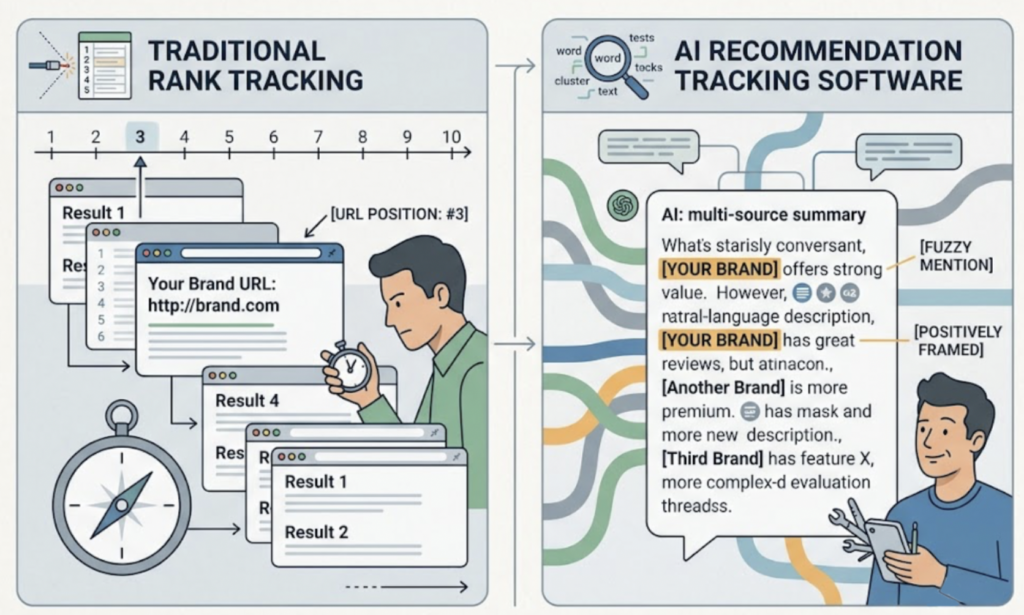
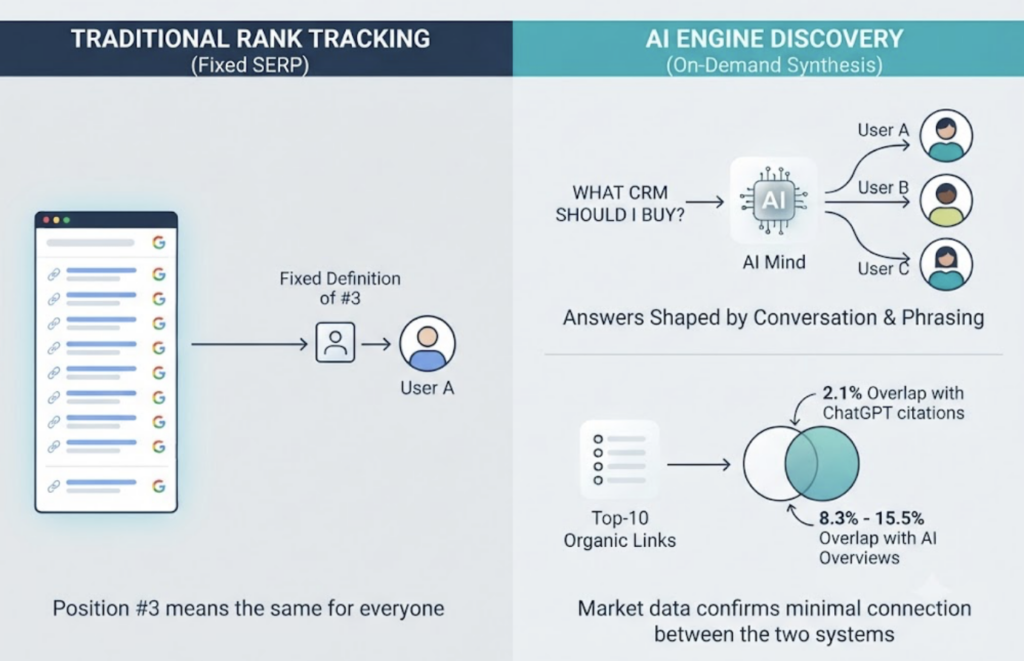
    It’s tempting to treat this as rank tracking with a new coat of paint. It isn’t. Rank tracking assumes a fixed SERP where position #3 means the same thing for every searcher. AI engines don’t have a SERP. Answers are generated on demand, shaped by conversation context and phrasing. The two systems have effectively decoupled: analysis of 2026 market data found only a 2.1% overlap between top-10 organic results and the sources ChatGPT actually cites in its answers. Even Google AI Overviews, which sits closest to traditional search, overlaps with top-10 organic rankings just 8.3% to 15.5% of the time.

    Bottom line: a #1 Google ranking tells you almost nothing about whether AI recommends you. You need a separate measurement system.

    How AI Recommendation Tracking Works Under the Hood

    Understanding how AI recommendation tracking works explains why manual spot checks fail. A production-grade tracking system runs a four-stage pipeline on a continuous loop.

    Stage 1: Prompt sampling. Instead of short keywords, the system builds a prompt library that mirrors how real buyers actually ask. Not “CRM software,” but “What’s the best CRM for a European fintech startup that needs strict data compliance, and how does Brand A compare to Brand B?” A serious setup samples hundreds of these high-intent conversational prompts.

    Stage 2: Multi-platform querying. The system pushes those prompts to every major AI engine on a schedule, under controlled conditions: normalized locations, cleared session memory, consistent configurations. Without that control, the data isn’t comparable across platforms or time.

    Stage 3: Answer parsing. AI answers are unstructured text, so traditional crawlers are useless here. NLP and entity-disambiguation models extract four things from each answer: whether your brand was mentioned, where it appeared in the recommendation order, the sentiment and framing of the description, and which URLs the AI’s retrieval layer cited to justify the recommendation.

    Stage 4: Aggregation over time. This is the step most teams skip, and it’s the one that makes the data trustworthy.

    Here’s the thing: LLM output is non-deterministic. The same prompt asked Monday morning and Wednesday afternoon can return different brand lists, because models sample probabilistically and platforms retune their retrieval indexes constantly. In active commercial categories, the domains cited in AI answers drift 40% to 60% month over month. A single screenshot isn’t a data point. It’s survivorship bias with a timestamp.

    Real visibility only emerges from repeated sampling and 7-day or 30-day rolling averages that smooth out the probabilistic noise.

    The Metrics That Actually Matter in an AI Recommendation Tracking System

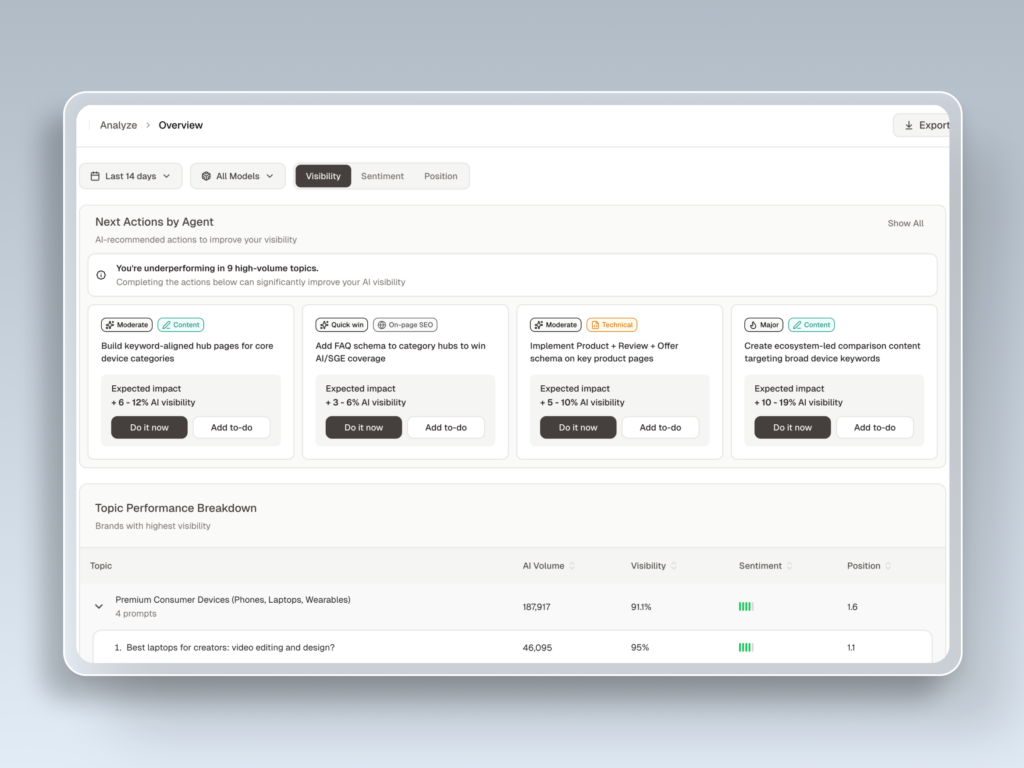
    Raw parsed answers become useful only when they’re organized into metrics that answer a business question. If you’re figuring out how to measure AI recommendation tracking, this framework covers what to watch and what each signal actually tells you. It maps closely to the seven-metric system used by Topify, which tracks visibility, sentiment, position, volume, mentions, intent, and CVR in a single view.

    MetricWhat to Look AtWhat It Explains
    Visibility rate% of tracked prompts where your brand appearsWhether you’re in the AI’s consideration set at all
    PositionWhere you rank within the recommendation orderAttention capture; first mentions absorb most of the trust
    Sentiment and framingHow the AI describes you, scored 0-100Whether AI positioning matches your actual positioning
    Citation sourcesThe URLs and domains the AI relied onYour action map: which pages to fix or influence
    Share of voiceYour mentions vs. competitors’ on the same promptsCompetitive standing, independent of category growth

    A few of these deserve unpacking.

    Visibility rate is the entry ticket. A 2% score means that in 100 high-intent conversations about your category, you were absent from 98. Position determines whether presence converts: a brand mentioned first in the answer and a brand tacked onto the final “other options include” sentence both count as mentions, but only one of them influences the buying decision.

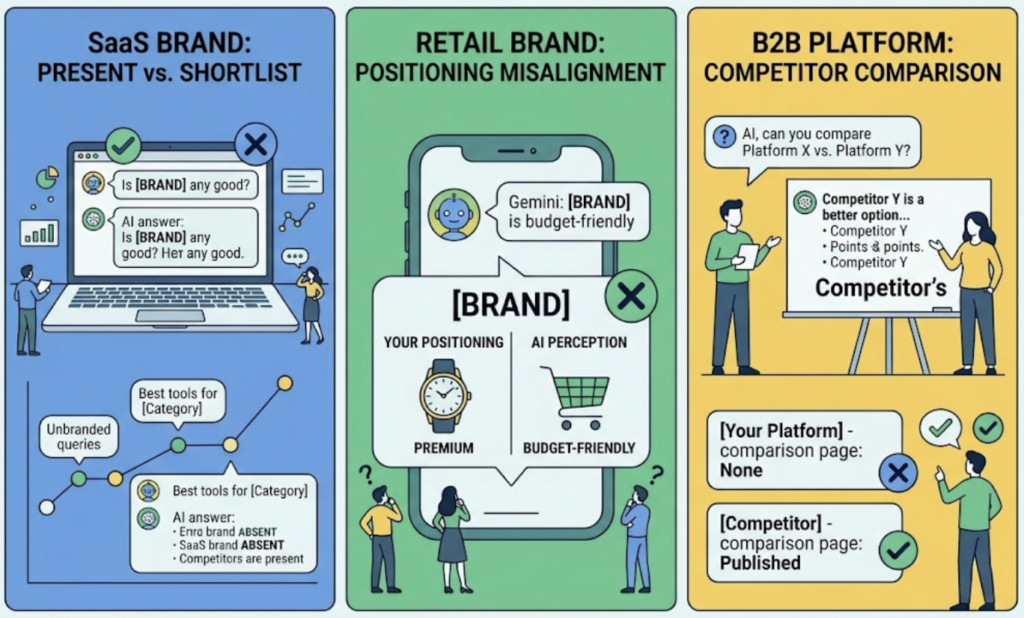
    Sentiment catches a subtler failure mode. If AI recommends your enterprise-grade platform first but frames it as “a simple entry-level option for small teams,” you’ll attract the wrong leads and lose the right ones. Positioning drift is invisible without tracking.

    Citation source analysis is where data turns into action. AI doesn’t prefer brands on a whim; it synthesizes from sources. If Perplexity keeps recommending your competitor because of one third-party review article, you now know exactly which URL to address.

    Share of voice keeps you honest. In a category where AI mentions are growing across the board, your visibility can rise while your competitive position quietly erodes. If a rival’s SoV jumps from 35% to 50%, your improving absolute numbers are masking a loss.

    Common Mistakes That Make AI Recommendation Tracking Data Useless

    Teams that move early on AI tracking often burn budget on data that misleads more than it informs. Three mistakes account for most of the damage.

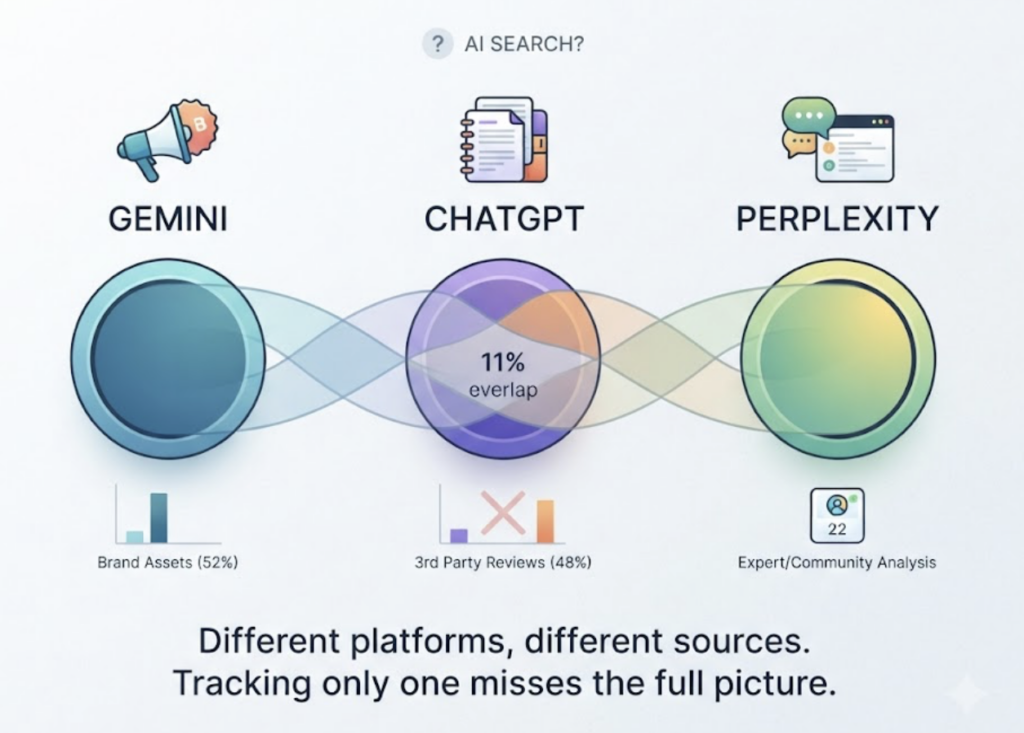
    Mistake 1: Tracking only one AI platform. For many marketers, ChatGPT has become shorthand for AI search. The data says otherwise. When ChatGPT and Perplexity answer the same commercial question, their cited domains overlap just 11%. Each platform plays a structurally different game: Gemini cites brand-owned domains in 52.15% of its references, ChatGPT pulls 48.73% of citations from third-party directories, review roundups, and Wikipedia, and Perplexity averages nearly 22 citations per answer with a strong tilt toward expert analysis and communities like Reddit. Track only ChatGPT and you might conclude your official site content is worthless in AI search, then abandon the exact assets that win on Gemini and AI Overviews.

    Mistake 2: Counting mentions while ignoring position and framing. Impressions-era thinking treats every mention as equal. In a linear AI answer, the brand dissected in the opening paragraph and the brand mentioned in a closing caveat (“Brand X also exists, though it lags on integrations”) get the same tally in a crude tracking tool. One is a recommendation. The other is reputational damage counted as a win.

    Mistake 3: Treating a single query as a stable state. SEO habits die hard. A page that ranks #1 on Google tends to stay there for weeks, so teams assume one end-of-month AI check represents the month. It doesn’t. With citation drift running 40% to 60% monthly in active categories, the platform that recommends you first on Tuesday may omit you entirely on Thursday. Only automated, continuous sampling with rolling averages produces a trend line you can act on. A monthly snapshot can hide a visibility collapse for weeks.

    Choosing an AI Recommendation Tracking Tool: What Separates Platforms

    The market for AI recommendation tracking software has split into two tiers: tools that detect mentions, and platforms that explain them and help you act. Whether a given tool, platform, or dashboard deserves your budget comes down to four criteria: how many AI engines it covers, whether it tracks at the prompt level with real conversational queries, whether it benchmarks competitors dynamically, and whether it closes the loop from insight to content action.

    Among dedicated AI recommendation tracking platforms, Topify is built around that full loop. It was developed by founding researchers from OpenAI alongside veteran Google SEO practitioners, and the pedigree shows in how it handles measurement.

    On the core visibility and position tracking use case, Topify runs high-frequency concurrent queries across ChatGPT, Gemini, Perplexity, DeepSeek, and Google AI Overviews, measuring whether your brand lands the lead recommendation or gets buried at the end of the list for real buyer-intent prompts. The dashboard converts volatile generated answers into smoothed rolling averages and a 0-100 sentiment score, so a marketing team can spot the business impact of a model update without needing a data scientist to interpret it.

    What separates it from detection-only tools is the pairing of Competitor Benchmarking with Source Analysis. The platform doesn’t just report that you’re missing from a high-value prompt; it identifies which competitor took that slot and reverse-engineers which specific review article, wiki page, or forum thread the AI weighted to make that call. That turns tracking output into a concrete task list: which URL to update, which citation gap to fill. There’s also an agent-driven execution layer that generates LLM-optimized structured content from those findings, so analysis and action live in one system rather than three tools and a spreadsheet.

    On pricing, basic mention-monitoring tools cluster around a $79 median, while deep-audit platforms run into the hundreds or thousands per month. Topify’s pricing starts at $99/month for the Basic plan, which covers 100 tracked prompts across platforms with full sentiment and source analysis, and $199/month for Pro with 250 prompts and multi-project support for teams and agencies. For a system that includes the execution layer, that lands on the affordable end of the category.

    Other tools serve narrower needs. Semrush offers basic AI Overviews detection for teams still centered on traditional search. ZipTie specializes in fine-grained citation auditing. Profound targets large regulated enterprises with compliance-integrated setups. For most B2B and B2C marketing teams that need both insight depth and execution, a purpose-built closed-loop GEO platform is the more practical solution.

    Building Your AI Recommendation Tracking Strategy in Four Steps

    A tool without a framework produces dashboards, not growth. This four-step sequence doubles as a working checklist for building a durable AI recommendation tracking strategy.

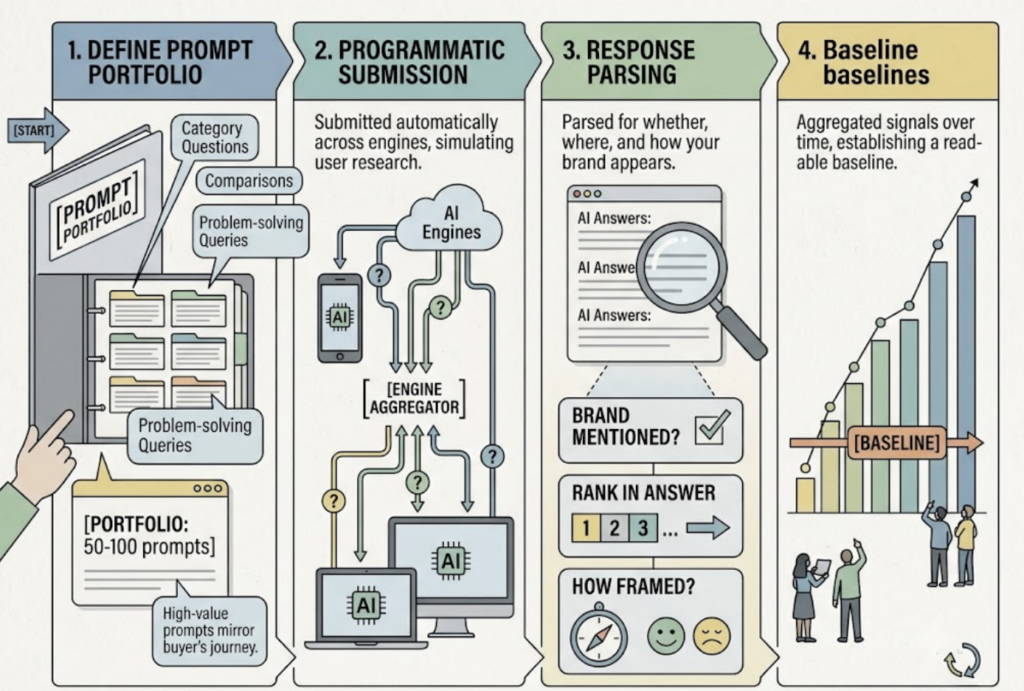
    Step 1: Define a buyer-intent prompt set. Drop the keyword list. Build an initial library of 50 to 100 prompts written the way buyers actually talk, weighted toward mid-funnel and bottom-funnel intent: category exploration (“best cloud ERP for mid-size precision manufacturers”), pain-driven consideration (“which database architecture handles Black Friday traffic spikes”), and direct comparison (“your brand vs. competitor on API quality, pricing, and support”). High-intent prompts are what connect tracking data to revenue.

    Step 2: Establish a baseline and tolerate the noise. For the first 30 days, resist the urge to change anything. Let the system sample continuously across platforms and record visibility, position, and sentiment. The rolling average at day 30 is your baseline snapshot, and it becomes the yardstick for every optimization ROI calculation that follows. You can’t improve a number you never measured cleanly.

    Step 3: Run gap analysis and source attribution. Find the dead prompts: high-volume, high-intent questions where you’re invisible. Use competitor benchmarking to see who owns those slots, then use source analysis to learn why. Is the competitor’s site serving clean FAQ structure and Schema markup that AI can parse? Did one authoritative third-party comparison swing the model’s judgment? Turn the findings into a prioritized fix list.

    Step 4: Execute and close the loop. Restructure existing high-authority pages before writing new ones: add JSON-LD Schema (FAQPage, Product, Organization), reorganize content into direct question-and-answer heading structures, and convert vague promotional copy into extractable bullet points and tables. Reinforce entity signals on the third-party domains AI actually cites. Then keep watching the metrics. The results can move fast: one B2B SaaS company lifted its AI visibility score from 12 to 50 within six weeks of adding structured data and AI-parseable formatting, a 317% gain. A fintech startup grew its category share of voice 3.1x in eight weeks by building out a structured knowledge hub.

    Track, diagnose, fix, verify. Then repeat.

    Conclusion

    The uncomfortable answer to that CMO question is that most brands genuinely don’t know whether AI recommends them, because nothing in their stack was built to check. Meanwhile 37% of consumers have already moved their research and comparison behavior into AI tools, and the shortlists those tools produce are deciding deals before your website ever loads.

    You can’t optimize what you can’t measure. Stop spot-checking ChatGPT for reassurance. Define a high-intent prompt library, set up systematic tracking, build a 30-day baseline, and let source-level data tell you exactly where to act. The brands that map their position in AI answers now will be the ones the next wave of buyers actually sees.

    FAQ

    Q1: What is AI recommendation tracking?

    A: AI recommendation tracking is the ongoing monitoring of how AI assistants like ChatGPT, Gemini, Perplexity, and Google AI Overviews mention and recommend your brand in generated answers. It measures appearance frequency, recommendation position, sentiment, and the sources behind each recommendation. Unlike SEO rank tracking, it monitors dynamically generated conversational answers rather than fixed search result pages.

    Q2: How much does AI recommendation tracking cost?

    A: Pricing depends on prompt capacity, platform coverage, and analysis depth. Basic mention-monitoring tools cluster around $79/month, while mid-tier systems with competitor benchmarking and citation analysis typically run $79 to $149. Topify’s Basic plan is $99/month with cross-platform tracking and source analysis, and Pro is $199/month with 250 prompts and multi-project support.

    Q3: How often should you check AI recommendations?

    A: Continuously, not monthly. AI answers are non-deterministic, and cited domains in active categories drift 40% to 60% per month. Best practice is automated daily or high-frequency sampling with 7-day or 30-day rolling averages, which filters probabilistic noise and produces a trend you can actually act on.

    Q4: Can you track AI recommendations manually?

    A: Not reliably. Manual checks can’t sample across platforms at scale, can’t neutralize the randomness in model outputs, can’t parse sentiment and citations from large volumes of text, and can’t build a baseline over time. Individual queries carry heavy survivorship bias, which makes them risky inputs for business decisions. Dedicated tracking software is the only way to get statistically meaningful data.

    Read More

  • AI Recommendation Tracking Analytics: A Practical Guide

    AI Recommendation Tracking Analytics: A Practical Guide

    Your organic traffic report looks stable, but your pipeline doesn’t. Somewhere between the query and the click, a growing share of your buyers now ask ChatGPT or Perplexity for a shortlist, get an answer, and never open Google at all. Traditional analytics can only count the visitors who arrived. It says nothing about the deals you lost because an AI model recommended someone else. That blind spot is exactly what AI recommendation tracking analytics exists to close: measuring who AI engines recommend, why they recommend them, and how often your brand makes the cut.

    What AI Recommendation Tracking Analytics Actually Measures

    Start with the definition. An AI recommendation tracking solution is an analytics system that monitors how large language models mention, rank, describe, and cite your brand inside their generated answers. Coverage typically spans conversational AI like ChatGPT and Claude, retrieval-first engines like Perplexity, and Google’s AI Overviews and Gemini.

    The difference from traditional rank tracking isn’t cosmetic. It’s structural.

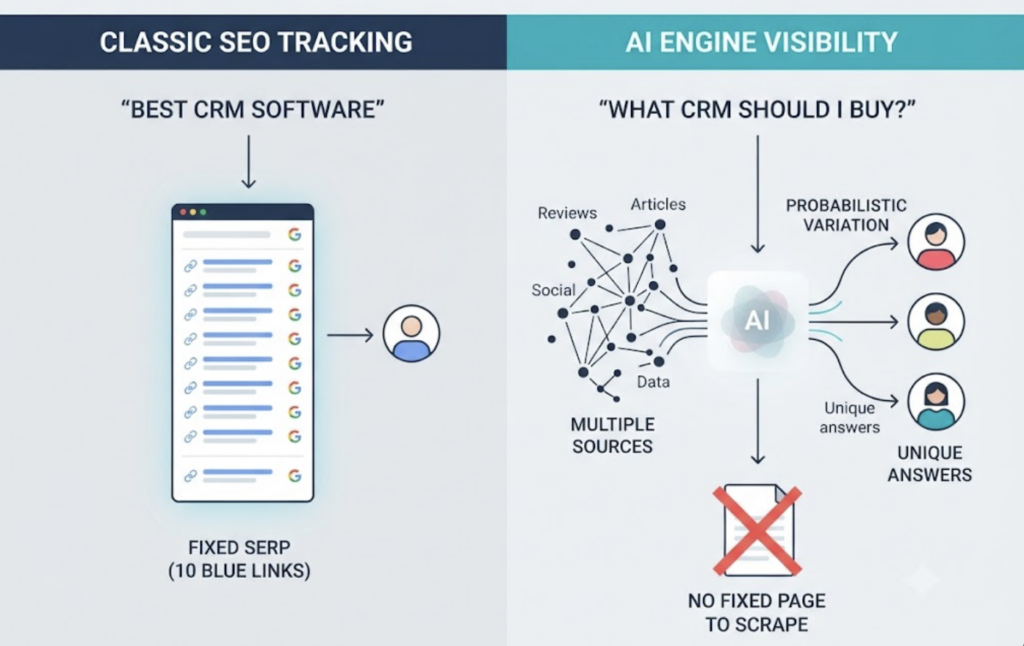
    Classic SEO tracking assumes a deterministic system: one query, one fixed SERP, ten blue links, the same list for everyone. AI engines don’t work that way. Every prompt triggers retrieval-augmented generation that synthesizes a unique answer from multiple sources, in real time, with probabilistic variation between runs. There’s no fixed page to scrape. That’s why a brand can rank #1 on Google for its category and still be completely invisible when ChatGPT assembles a buying recommendation.

    What gets measured also changes. AI recommendation tracking analytics doesn’t ask “what position do you hold in a list.” It asks “does the model consider your brand authoritative enough to include in its synthesized answer at all.”

    The stakes have moved fast. ChatGPT reached roughly 900 million weekly active users by February 2026, making it the fastest consumer app in history to approach the billion-user scale, with adoption among users over 35 climbing sharply into business purchasing contexts. The commercial signal is even sharper: during the late-2025 retail season, AI-driven referral traffic grew 693% year over year, and those visitors converted at rates 31% higher than non-AI traffic.

    If your brand isn’t being tracked in this layer, you’re not measuring a channel. You’re missing one.

    How AI Recommendation Tracking Works Behind the Scenes

    So how does an AI recommendation tracking solution work in practice? Modern platforms decompose the AI black box through four connected stages.

    Stage 1: Prompt sampling. Instead of short-tail keywords, the system builds a portfolio of natural-language prompts that mirror real buyer intent, like “What’s the most reliable ERP system for a mid-market B2B manufacturer?” These are the queries that actually trigger a model’s recommendation logic.

    Stage 2: Cross-platform polling. The same prompt set is fired concurrently at multiple AI engines. This matters because the platforms retrieve differently: ChatGPT and Claude lean on parametric knowledge plus specific retrieval APIs, Gemini is wired into Google’s knowledge graph, and Perplexity runs a citation-forward RAG pipeline. The same question routinely returns different brand shortlists on different engines.

    Stage 3: Answer parsing. NLP modules extract structured data from each unstructured response: whether the brand was mentioned, where it sat in the recommendation order, what sentiment the model attached to it, and whether the answer included a live citation link to the brand’s own site.

    Stage 4: Time-series aggregation. Single data points get placed on a longitudinal timeline, so teams see week-over-week visibility shifts, citation retention, and share-of-voice trends instead of isolated snapshots.

    That last stage exists because of one uncomfortable fact: LLM output is volatile by design. Temperature settings mean two identical prompts can produce different wording and different supporting sources. In competitive commercial categories, 40% to 70% of AI citation sources rotate within a single week, a pattern practitioners call citation drift.

    One screenshot is not data. It’s a lottery ticket. Only high-frequency, large-sample polling can turn probabilistic answers into a reliable measure of how often your brand is actually the recommended choice.

    The Metrics That Separate Real Analytics from Vanity Dashboards

    Counting raw brand mentions with a social listening tool feels like progress. In practice, it’s the fastest way to build a vanity dashboard. Measuring an AI recommendation tracking solution properly requires seven distinct signals.

    MetricWhat it measuresWhy it matters
    Visibility RateProbability your brand appears in AI answers for a defined prompt setDetermines whether you’ve entered the model’s consideration set at all
    Mention FrequencyAbsolute volume of brand mentions across platforms and contextsBaseline of your digital footprint; signals entity strength
    PositionWhether you appear in the lead recommendation or a footnoteIn zero-click answers, position decides whose message gets absorbed
    SentimentThe polarity of how the model describes youA negative mention isn’t visibility, it’s a PR problem at scale
    Citation ShareWhether the AI links to your owned assets as a sourceLinked citations drive traffic and mark genuine entity trust
    Prompt VolumeHow often a given question is actually asked on AI platformsDirects optimization budget toward the highest-value intents
    CVRDownstream conversion of AI-referred visitorsCloses the loop between generative exposure and revenue

    The conversion metric deserves attention. Visitors arriving from AI search tools tend to spend 45% to 68% longer on site than traditional search visitors, which is why treating this traffic as a rounding error understates its pipeline contribution.

    Turning seven metrics into one operational dashboard is where most teams stall. This is the specific problem Topify was built for: its Comprehensive GEO Analytics layer tracks all seven dimensions in a single view, so a drop in ChatGPT visibility can be traced to a shift in sentiment, position, or a lost citation source without stitching together three separate tools.

    A Strategy That Improves the Numbers, Not Just Reports Them

    A tracking platform that only produces reports manufactures anxiety. A useful strategy for an AI recommendation tracking solution converts monitoring into a repeatable optimization loop with four steps.

    Find the citation gap. Use source analysis to see which URLs the AI actually retrieved when it recommended your competitor: a data-heavy whitepaper, a high-authority review directory, a two-year-old industry report.

    Target high-value prompts. Surface queries with strong commercial intent where your visibility is low, and hand them to the content team as named objectives.

    Rebuild the cited content. Restructure pages the way generative engines prefer: dense verifiable facts, machine-readable schema, answer-first definitions near the top of the page.

    Re-poll and verify. Push updates live, let the platform re-test at high frequency, and confirm whether Citation Share and Visibility Rate actually inflect.

    This isn’t guesswork. The GEO benchmark study from Princeton, Georgia Tech, and the Allen Institute for AI (Aggarwal et al., KDD 2024) tested optimization tactics across 10,000 queries in 9 domains. Adding concrete statistics lifted content visibility in AI answers by up to 40%, citing authoritative sources produced similar gains, and adding expert quotations delivered up to 35%. The same research found that keyword stuffing without substance did nothing, and often got content down-weighted.

    Here’s what the loop looks like in the wild. A B2B logistics SaaS provider was spending $10,000 a month on link building and blog volume while its lead quality collapsed, because its buyers had moved their vendor research to Perplexity. Tracking data showed zero visibility on its core “best logistics API” prompt, with AI answers repeatedly citing an outdated third-party report. The team cut $6,000 of low-value link spend, converted broad blog posts into fact-dense technical whitepapers, added a structured JSON pricing feed, and placed 40-to-60-word answer-first product definitions in the top third of key pages. Within a quarter, its Citation Share on Perplexity went from zero to the #1 recommended position, and cost per demo request fell 35%.

    The pattern generalizes: track, diagnose the source layer, rebuild for fact density, re-measure.

    Common Mistakes That Quietly Corrupt Your Tracking Data

    Most tracking failures aren’t tooling failures. They’re inherited habits from the SEO era. These five common mistakes in AI recommendation tracking solution rollouts distort data badly enough to misdirect budget.

    MistakeWhat goes wrongWhat the data actually shows
    Single-platform blindnessTesting only ChatGPT and treating it as the marketChatGPT’s share of B2B AI referral traffic fell from 89.1% to 62.6% by early 2026, while Claude reached 18.5%, Gemini 10.6%, and Perplexity 7.3%. Poll across platforms or measure a shrinking slice.
    The snapshot fallacyOne manual test on a Monday afternoon becomes “our AI ranking”With 40%+ of citations rotating within weeks, single samples are statistical noise. Only time-series aggregation produces a real baseline.
    Mention-only reportingCelebrating 50 mentions without reading them“Brand A is overpriced and unreliable, so we recommend Brand B” counts as a mention. Without Sentiment and Position, mention counts are worthless.
    Ignoring the citation source layerWatching final answers, never the URLs behind themRoughly 86% of AI citations come from assets brands can control or influence. Skipping source tracking means abandoning the optimization lever entirely.
    Static prompt setsPorting 1-2 word SEO keywords straight into the trackerReal AI queries run 15 to 30 words with heavy context. Short-tail prompts measure a conversation your buyers aren’t having.

    The unifying theme: AI tracking is a probability discipline, not a ranking discipline. Teams that treat it like SERP monitoring end up optimizing against fiction.

    Choosing the Best Tool for Search Visibility in the AI Era

    Once the discipline is clear, the selection question gets sharper. Finding the best tool for search visibility today means testing whether a platform’s underlying architecture was actually built for generative engines, or whether an AI tab was bolted onto a web crawler.

    Evaluation dimensionTraditional SEO tools like Semrush, AhrefsModern GEO platforms like Topify
    Model coverageMostly limited to AI Overviews inside Google, plus rough web mention scansChatGPT, Gemini, Perplexity, Claude, DeepSeek, Qwen, Doubao, and other major engines
    Metric depthStatic keyword rankings and basic mention counts from SERP scrapingSynthetic LLM probing that quantifies all seven GEO metrics, including sentiment and CVR
    Source analysisBacklink counting; can’t explain why an AI retrieved a passageReverse-engineers the exact URLs, entities, and data blocks that triggered a recommendation
    Competitor benchmarkingDomain-level traffic share comparisonsPrompt-level Share of Voice showing your recommendation frequency against named rivals
    Execution loopStops at reports; optimization is fully manualAI Agent-driven One-Click Execution from diagnosis to deployed fix
    Underlying modelHistorical crawl snapshotsContinuous, compute-driven live querying of the models themselves

    Semrush and Ahrefs still earn their keep for classic Google work: backlink profiles, technical audits, keyword research at scale. The structural problem is that crawl-based architectures can’t see inside closed generative engines, and answers that are synthesized fresh on every request leave nothing static to crawl.

    For teams whose priority is the AI recommendation layer specifically, Topify tends to be the strongest fit in this comparison. Its probing approach reaches the citation-evaluation behavior inside engines like ChatGPT and Perplexity rather than inferring it from the open web. And its One-Click Execution collapses the usual weeks-long cycle of audit, content brief, and rollout into a reviewable automated loop, which is the difference between a dashboard and an operating system for AI visibility.

    A Buyer’s Checklist Before You Pay for Any Platform

    Demand for AI tracking has flooded the market with repackaged crawlers. Before signing an annual contract, run this checklist for an AI recommendation tracking solution during the demo, item by item.

    StageChecklist item
    Baseline1. Can you run an initial GEO readiness diagnosis on your URL before paying?
    Baseline2. Is the prompt quota large enough to cover your category’s core buying queries?
    Baseline3. Can one task poll ChatGPT, Gemini, Perplexity, and Claude in parallel?
    Data depth4. Does the parser strictly separate plain-text mentions from linked citations?
    Data depth5. Is there built-in NLP sentiment detection for positive, neutral, and negative framing?
    Data depth6. Can you add named competitors and watch Share of Voice trends over time?
    Execution7. When a citation is lost, does the system explain why, or just raise an alert?
    Execution8. Can the dashboard surface citation drift across long observation windows?
    Execution9. Are AI traffic reports separable from traditional SEO data for clean attribution?

    Pricing structure is the tenth, unwritten check, because it reveals whether the technology is real. Agencies selling GEO on a labor model bill by the hour, the backlink, or the word count. Genuine tracking platforms carry a different cost base: they burn tokens running synthetic probes against LLM APIs at scale, so honest pricing is usage-based SaaS tied to prompt capacity.

    That shift has kept entry costs low. Topify’s pricing starts at $99/month on the Basic plan, which covers continuous monitoring across ChatGPT, Perplexity, and AI Overviews with 100 tracked prompts, a 30-day trial included. Teams that validate ROI typically scale to Pro at $199/month for 250 prompts, while Enterprise plans from $499/month add dedicated support and custom volume. Cost grows with usage, not with headcount.

    Conclusion

    Back to the conflict this article opened with: your organic demand didn’t evaporate. It relocated into synthesized AI answers, where an invisible recommendation layer is already steering B2B budgets and consumer purchases before a single click reaches your site. Holding onto rank-tracking habits in that environment means volunteering to disappear from the map.

    The rational first move isn’t a content sprint. It’s a baseline. Start with a small set of your highest-intent commercial prompts, track them across engines for a few weeks, and let the data show you where the citation gaps actually are. Then pick a platform that can see the source layer and close the loop from insight to execution. You can start that first cross-engine visibility assessment today and know exactly where your brand stands before the next model update reshuffles the answers.

    FAQ

    Q1: What is an AI recommendation tracking solution? A: It’s a business intelligence system that tracks how generative AI platforms like ChatGPT, Gemini, and Perplexity mention, cite, and recommend your brand inside their synthesized answers. Unlike rank trackers that monitor fixed URL positions, it measures whether your brand enters the model’s live consideration set, what position and sentiment it receives, and whether the AI links back to your assets.

    Q2: How does an AI recommendation tracking solution work? 

    A: Through synthetic probing. The system sends a portfolio of high-intent, long-form prompts to multiple AI platforms at high frequency, parses the unstructured responses with NLP to extract mentions, citations, sentiment, and position, then aggregates everything into time series. The aggregation step cancels out the natural randomness of LLM output and produces reliable visibility trends.

    Q3: How much does an AI recommendation tracking solution cost? 

    A: Because the cost driver is LLM compute rather than labor hours, most platforms use transparent usage-based SaaS pricing. Entry plans such as Topify Basic start around $99/month, mid-tier plans with larger prompt capacity run about $199/month, and enterprise plans with high-volume polling and dedicated support typically start from $499/month.

    Q4: What are examples of AI recommendation tracking in practice? 

    A: A common pattern: a software company tracks 50 “best tool in category” prompts weekly across engines and discovers it ranks well on Google but is never cited on Perplexity. Source analysis shows Perplexity favors a third-party review site with detailed comparison data. The team updates that authoritative source and adds structured, answer-first benchmark data to its own pages, then confirms in the next tracking cycle that it has become the top recommendation, with lead acquisition costs falling as high-intent AI referrals grow.

    Read More

  • AI Recommendation Tracking Solution: A Practical Guide

    AI Recommendation Tracking Solution: A Practical Guide

    Your team hit every SEO target last quarter. Domain authority climbed, three pages reached the first results page, and organic traffic held steady. Then a buyer opened ChatGPT, asked for the top option in your category, and got a clean list of five brands. Yours wasn’t on it.

    The dashboard your team checks every morning had no way to explain why. It was built to measure where a URL sits in a static index, not whether an AI engine decides to bring your brand up at all. That blind spot is exactly what an AI recommendation tracking solution is built to close.

    What Is an AI Recommendation Tracking Solution

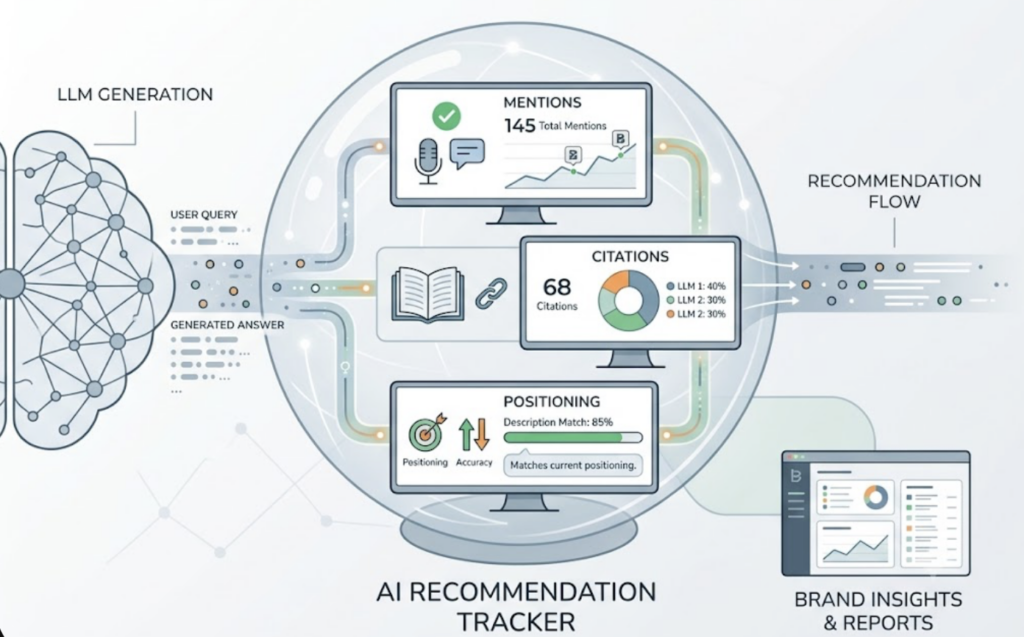
    An AI recommendation tracking solution is a system that monitors how large language models talk about your brand inside their generated answers. It watches whether you get mentioned, whether you get cited as a source, and whether the description matches your positioning.

    That’s a different job from a rank tracker. A rank tracker measures a URL’s position in a list. An AI recommendation tracker measures the narrative an engine synthesizes about you, which is generated fresh each time and shifts with phrasing and context.

    The distinction matters more than it sounds. Traditional SEO is deterministic: the same query returns roughly the same index. AI answers are stochastic, so you can’t check a single response and call it data. You need a repeatable sample across many prompts.

    The real goal is making the consideration set. When a buyer asks an AI assistant for options, you want to be one of the names it returns, before that buyer ever reaches a results page. With 94% of B2B buyers now using generative AI during their purchase process, the AI answer is increasingly the first impression your brand gets to make.

    How Does an AI Recommendation Tracking Solution Work

    Most working systems run a three-stage pipeline to get past the black-box problem.

    First, prompt portfolio sampling. Instead of tracking thousands of keywords, you define 50 to 100 buyer-intent prompts, things like “best [category] for [use case],” then run them on a schedule to capture how answers behave over time.

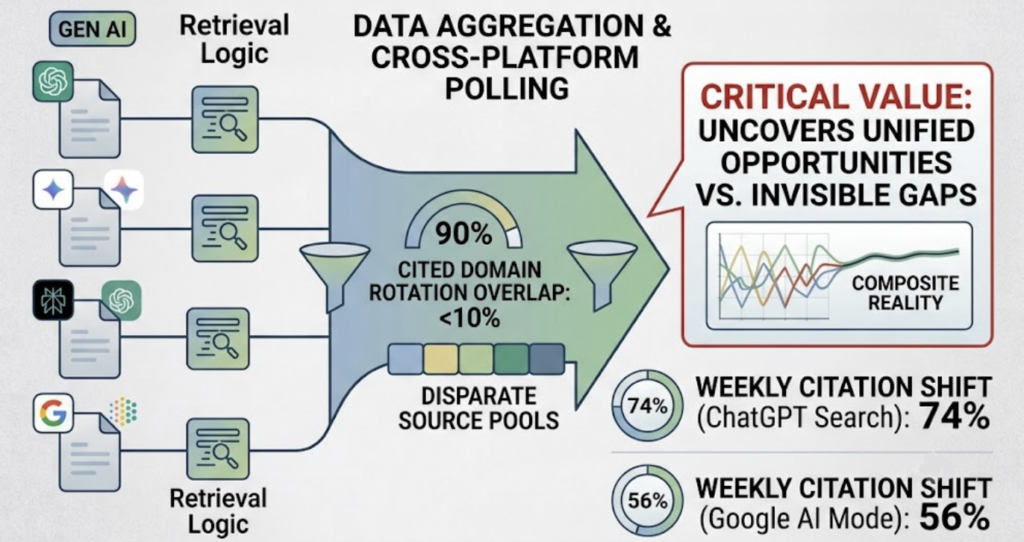
    Second, cross-platform polling. ChatGPT, Gemini, Perplexity, and Google AI Overviews each use different retrieval logic, and their citations barely overlap. One analysis found that ChatGPT Search swaps out 74% of its cited domains every week while Google AI Mode rotates around 56%. Polling them together is the only way to avoid a one-platform view of reality.

    Third, parsing and normalization. The raw answer text gets read for three things: is the brand mentioned, is it cited with a link, and how is it framed. Semrush points to ChatGPT, Gemini, Claude, and AI Overviews as the platforms worth covering in most reports today.

    That pipeline is the difference between guessing and knowing. Without it, “how are we doing in AI search?” stays a question nobody on the team can answer with data.

    How to Measure AI Recommendation Tracking: The Metrics That Matter

    Knowing how to measure an AI recommendation tracking solution starts with dropping the number most teams reach for first. Mention count is a vanity metric. Being named ten times means little if a competitor earns the citation on every high-intent prompt.

    A stronger framework translates AI output into commercial signals:

    MetricWhat it answers
    Visibility rateAre we in the consideration set at all?
    Citation shareAre we earning authoritative links, or is a rival?
    Sentiment accuracyDoes the AI describe us the way we position ourselves?
    Share of voiceHow big is our AI footprint next to competitors?
    AI referral CVRAre AI-driven visitors actually converting?

    Here’s the part teams miss. Semrush notes that traffic is no longer the primary KPI for AI search, because answers often satisfy a query before any click happens. Your session count can stay flat while your brand’s AI visibility climbs or collapses underneath it.

    This is where a dedicated platform earns its place. Topify runs Comprehensive GEO Analytics across seven metrics: visibility, sentiment, position, volume, mentions, intent, and CVR, in one view. In practice, that means you can watch your ChatGPT mentions drop and trace it to a specific source that stopped citing you, without stitching together four separate tools.

    The CVR angle deserves attention, since AI traffic tends to convert well. AI referrals converted 31% better than non-AI traffic during the 2025 holiday season, which makes a missed recommendation more expensive than it looks.

    How to Improve Your AI Recommendation Visibility

    Once you can measure it, the strategy for improving an AI recommendation tracking solution follows a tight loop: identify, optimize, verify.

    Start by finding prompts where a competitor consistently earns the citation and you don’t. Then reverse-engineer the content the AI is pulling from. Often the difference is structural: a cleaner comparison table, an FAQ schema, original data the model can lift directly.

    Authority signals tend to move the needle more than keyword density. Industry analysis points to domain authority, links from high-authority sites, and inclusion in “best of” listicles as the most consistent drivers of LLM citations.

    Then there’s cadence, which is where most plans quietly fail.

    AI citations decay fast. One study put the average citation half-life at 4.5 weeks, with ChatGPT closer to 3.4 weeks. Content that earns you a recommendation in March can fall out of rotation by April. Treating optimization as a one-time project is the fastest way to lose the ground you gained.

    Best Tool for Search Visibility: What to Look For

    Search “best tool for search visibility” and you’ll find platforms that all promise AI tracking. The differences hide in what they actually measure. A few dimensions separate a real solution from a dashboard you’ll stop opening:

    DimensionWhy it matters
    Platform coverageSingle-engine data misses most of the picture
    Citation-layer analysisA mention and a linked citation aren’t the same thing
    Competitor benchmarkingYou need share of voice, not just your own numbers
    Actionable feedbackData without a next step is just a report
    Trend drift trackingVisibility shifts weekly as models update

    Against those, Topify covers ChatGPT, Gemini, Perplexity, DeepSeek, and other engines, separates plain mentions from linked citations, and benchmarks you against rivals on the same prompt set. Its competitor module flags emerging rivals in real time and surfaces the exact domains AI engines cite, so you can see whether you or a competitor owns the references behind an answer.

    Pricing starts at $99 a month on the Basic plan, which includes prompt tracking across ChatGPT, Perplexity, and AI Overviews. That puts structured AI visibility tracking within reach for a single team, not just enterprise budgets. You can get started with Topify and run your first prompt set before committing to a plan.

    Other tools fit other needs. General SEO suites that added an AI module work if you mainly want a light signal alongside your keyword data. Single-platform trackers can make sense if your audience truly lives on one engine. The trade-off, in both cases, is coverage and depth.

    Common Mistakes and a Quick Checklist

    A few mistakes show up again and again.

    Single-engine blindness tops the list. Relying on ChatGPT data alone ignores the retrieval logic of Perplexity and AI Overviews, and the citation overlap between platforms is small.

    Static snapshotting is the second. With 40 to 60% of cited sources rotating every month, a one-time audit is stale almost immediately. A 17-week study of more than 82,000 prompts confirmed just how much cited domains shift week to week.

    The third is chasing vanity metrics, counting mentions without checking position, citation, or sentiment. The fourth is over-indexing on keyword density when AI engines reward structured, authoritative content instead.

    A quick checklist before you commit to any approach:

    • Track at least four engines, not one
    • Separate plain mentions from linked citations
    • Benchmark share of voice against named competitors
    • Set a recurring cadence, not a single audit
    • Tie a clear action to every gap you find
    • Report AI metrics apart from organic traffic

    Conclusion

    The buyer who skipped your brand in that AI answer didn’t see a ranking problem. They saw an absence, and your old metrics couldn’t even register it. An AI recommendation tracking solution closes that gap by measuring what AI actually says about you, across the engines your audience uses, on a cadence that keeps up with how fast citations move. Pick the prompts that matter, measure visibility and citation share against your rivals, and treat optimization as an ongoing loop. The brands showing up in AI answers next quarter are the ones tracking it this quarter. You can start with Topify and map your current standing in a few minutes.

    FAQ

    Q: What is an AI recommendation tracking solution? 

    A: It’s a system that monitors how AI engines like ChatGPT, Gemini, and Perplexity mention, cite, and describe your brand in their generated answers. Unlike a rank tracker that measures a URL’s position, it measures whether you make the AI’s consideration set and how accurately you’re represented.

    Q: How much does an AI recommendation tracking solution cost? 

    A: Pricing varies by coverage and depth. Entry-level plans tend to start around $99 a month for prompt tracking across the major engines, with higher tiers adding more prompts, seats, and competitor analysis. Topify’s Basic plan starts at $99/mo and scales from there.

    Q: What are some examples of AI recommendation tracking in practice? 

    A: A common example is running a set of “best [category]” prompts weekly to see whether your brand appears, tracking your citation share against a named competitor, and catching sentiment drift when an engine starts describing your premium product as a “budget option.” Each is a recommendation signal a traditional SEO tool can’t capture.

    Q: What’s the best tool for search visibility in AI search? 

    A: The best tool for search visibility depends on how many engines your audience uses and whether you need citation-level analysis. Look for multi-platform coverage, the ability to separate mentions from citations, competitor benchmarking, and an action feedback loop. Topify covers these in one platform built specifically for AI search.

    Read More

  • How to Choose an AI Recommendation Tracking Platform

    How to Choose an AI Recommendation Tracking Platform

    Your CMO forwards a Slack message: a prospect said ChatGPT recommended a competitor when they asked for the best tool in your category. Now you need an answer, and your analytics stack has nothing for it. So you start shopping, and every product page promises to track AI search visibility. Some only watch ChatGPT. Others hand you a wall of numbers with no sense of whether your brand is being recommended, ignored, or quietly misdescribed. The hard part isn’t deciding to track AI recommendations. It’s figuring out which AI recommendation tracking platform measures the thing that actually moves buyers.

    What an AI Recommendation Tracking Platform Actually Tracks

    An AI recommendation tracking platform doesn’t measure where your page sits on a results list. It measures whether AI systems name your brand when someone asks for a recommendation, where you land in that answer, and how you’re described.

    That’s a different job from rank tracking. When a buyer asks ChatGPT, Perplexity, or Gemini for the best option in your category, the model synthesizes an answer on the spot and issues a recommendation. There’s no list of ten blue links to climb. Either you’re in the consideration set or you’re not.

    Inclusion is driven by topical authority and how easily your content can be extracted, not just your backlink profile. So the core question shifts from “what’s my position for this keyword” to “is the model recommending me, and why.”

    Why AI Brand Recommendations Are Harder to Measure Than Rankings

    Three things make AI recommendations slippery to track.

    First, the outputs are probabilistic, not deterministic. Google’s index returns a fairly stable result set for a given query. LLMs don’t. The same prompt can produce different answers across sessions, platforms, and model updates, which means a single screenshot tells you almost nothing.

    Second, most of the value gets consumed without a click. AI Overviews and chat answers synthesize everything a user needs inside the response, so traditional CTR and impressions decouple from real intent. Your brand can shape a buying decision and never show up in your traffic reports.

    Third, the sources feeding these answers keep moving. In high-volatility categories, AI citation sources can rotate by as much as 74% week over week. A brand that’s recommended on Monday can quietly drop by Friday, with no alert in any tool built for conventional search.

    That’s the gap most dashboards still can’t see.

    What a Good AI Recommendation Tracking Tool Should Measure

    If you’re evaluating an AI recommendation tracking tool, the feature checklist matters less than what it actually measures. A handful of metrics separate a real platform from a vanity dashboard.

    MetricWhat it tells you
    Visibility rateHow often you appear in the AI’s consideration set for high-intent prompts
    Position & framingWhether you’re cast as the category leader or a secondary alternative
    Share of voiceHow often you appear versus named competitors for the same prompts
    Citation shareWhether the AI cites your owned content or a third party’s framing of you

    Visibility rate is the baseline. If you’re not in the answer, nothing else matters. But being mentioned isn’t the same as being recommended, which is why position and framing carry as much weight. There’s a real difference between “the category leader” and “a budget alternative worth a look.”

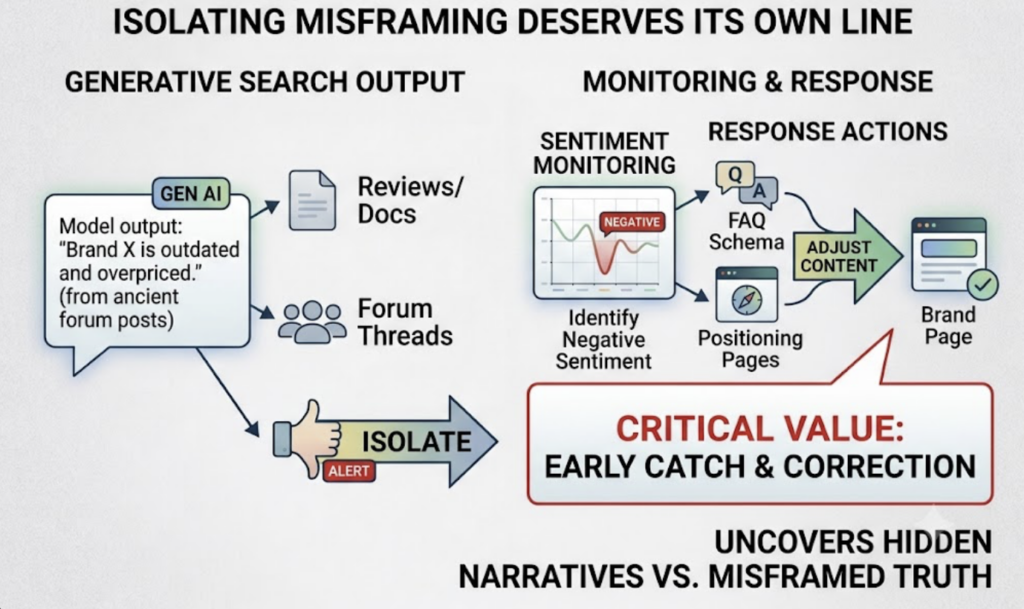
    Sentiment deserves its own line. AI models compress reviews, forum threads, and old documentation into one confident-sounding paragraph. If a model ties you to a legacy flaw or an outdated pricing claim, that becomes the “truth” the buyer reads. Knowing how to monitor brand sentiment in generative search lets you catch a misframing early and respond by adjusting the content the model leans on, like FAQ schema or positioning pages. You can’t fix a narrative you can’t see.

    How to Monitor Brand Presence Across Multiple AI Models

    Tracking one engine is a strategic mistake, because the platforms don’t behave alike. Perplexity leans on data citations. Gemini favors the Google ecosystem. ChatGPT runs on a mix of training data and live browsing. The same prompt can put you first on one and leave you off another.

    Monitoring brand presence across multiple AI models means running a consistent set of buyer-intent prompts across all of them on a schedule, so you’re measuring a portfolio instead of a single data point. That’s the only way to know whether your narrative holds up everywhere your buyers are asking.

    AI Recommendation Tracking Software vs. a Static Dashboard

    Plenty of products call themselves AI recommendation tracking software. Fewer earn the “software” part. The difference shows up the moment something changes.

    A static dashboard shows you a number went down. It doesn’t tell you that your ChatGPT mentions dropped because a source that used to cite you stopped, or that a competitor just took your spot for three of your top prompts. You’re left to guess.

    Real software closes that loop. It connects the drop to the cause, then to the action. When you can trace a visibility decline back to a specific citation source and a specific prompt, the dashboard stops being a report card and starts being a worklist.

    Here’s the test: can the tool tell you what changed and why, not just that something changed.

    How Topify Approaches AI Recommendation Tracking Analytics

    This is where AI recommendation tracking analytics gets practical. Topify is built on the idea that visibility, position, and sentiment are most useful when you read them together, in one view, rather than across four disconnected tools.

    The platform’s Comprehensive GEO Analytics tracks brand performance across major AI engines on seven metrics: visibility, sentiment, position, volume, mentions, intent, and CVR, the likelihood an AI answer pushes a user toward your brand. The point isn’t the count of metrics. It’s that they’re connected.

    In practice, that means you can spot a dip in ChatGPT mentions, trace it to a source domain that stopped citing you, and see which competitor moved into your position on that prompt, all inside the same dashboard.

    Coverage spans ChatGPT, Gemini, Perplexity, DeepSeek, Doubao, and Qwen, so you’re monitoring presence across the models your buyers actually use, not just the one that’s easy to track. And because LLM behavior keeps shifting, the platform’s AI agent runs monitoring as an always-on loop, surfacing new high-intent prompts as recommendations evolve.

    For teams that want to move from data to action, you can get started with Topify on a 30-day trial covering ChatGPT, Perplexity, and AI Overviews tracking.

    Choosing the Right AI Recommendation Tracking Solution for Your Team

    There’s no single right AI recommendation tracking solution. The right one depends on who you are and what you’ll do with the data.

    In-house marketing teams should treat AI visibility as a product metric, not a vanity metric. Start by defining a “brand truth set,” the handful of facts about who you serve, your differentiators, and your pricing that must be correct in every AI mention. Then use the platform to catch where models hallucinate or recommend an outdated version of you.

    Agencies need a system that scales across clients without multiplying manual work, so cross-account reporting and prompt management matter more than any single feature.

    SaaS and product companies care most about appearing in agent workflows and recommendation lists, where citation share and position do the heavy lifting.

    Whatever the use case, the selection order tends to be the same. Check multi-model coverage first, since a tool that watches one engine can’t see most of your exposure. Then check whether the system explains why a number moved. Price comes last, because a cheap dashboard that can’t tell you what to fix isn’t actually cheap.

    Conclusion

    The question your CMO asked, are we showing up when AI recommends tools in our category, doesn’t have a one-time answer. AI recommendations shift week to week, across platforms, often without warning. A capable AI recommendation tracking platform turns that uncertainty into something you can act on: which prompts you’re missing, why a competitor pulled ahead, and what content to fix.

    Start by defining your truth set and a list of buyer-intent prompts. Then pick a platform that covers multiple models, explains the why behind each change, and connects monitoring to execution. That’s the difference between knowing you have a visibility problem and actually closing it.

    FAQ

    Q: How do I monitor brand presence across multiple AI models? 

    A: Run the same set of buyer-intent prompts across ChatGPT, Gemini, Perplexity, and others on a recurring schedule. Because citation sources can rotate quickly week to week, single-platform tracking or one-off checks miss most of the picture. A multi-model AI recommendation tracking system runs continuously so you catch shifts as they happen.

    Q: How do I monitor brand sentiment in generative search? 

    A: Track how AI models describe your brand, not just whether they mention it. Good tools score sentiment and flag framing like “budget alternative” or outdated claims, so you can adjust the content (FAQ schema, positioning pages) that models pull from before a misframing spreads.

    Q: Is an AI recommendation tracking dashboard enough on its own? 

    A: A dashboard that only displays numbers tells you something changed but not why. Look for a platform that ties each change to a cause, like a lost citation source or a competitor’s move, and to a next action, so the data drives content updates instead of sitting in a report.

    Q: How is this different from traditional SEO software? 

    A: Traditional SEO software tracks rankings, impressions, and clicks on a stable index. AI recommendation tracking software measures probabilistic, no-click answers, where the model recommends brands based on topical authority and extractability rather than position alone.

    Read More

  • AI Recommendation Tracking Software: A Buyer’s Guide

    AI Recommendation Tracking Software: A Buyer’s Guide

    Search “AI recommendation tracking software” and you’ll find a dozen platforms promising the same outcome: they’ll tell you whether AI recommends your brand. Put their feature pages side by side and they blur into each other. The hard part isn’t picking a tool. It’s working out which one measures something that predicts revenue, across the engines your buyers actually use.

    And those engines keep moving. ChatGPT held 89% of B2B AI referrals in August 2025, then 63% eight months later, with Claude climbing from 1.4% to 18.5% in the same window. A tool that watches one platform is already watching the wrong picture.

    What AI Recommendation Tracking Software Actually Tracks

    AI recommendation tracking software monitors how generative engines represent your brand inside their answers. Not your URL’s position on a results page, but whether ChatGPT, Perplexity, Gemini, or Claude mention you at all, how they frame you, and whether they cite you as a source.

    That’s a different measurement problem than traditional rank tracking. A Google rank is a fixed coordinate: position 3 for a given keyword. An AI answer is a paragraph, generated fresh each time, and your brand either makes it into the narrative or it doesn’t.

    Because models pull from many sources to synthesize one response, visibility here gets measured as share of voice and citation share, not a numbered slot. You can rank #1 in Google and still be invisible on Perplexity for the same question.

    That gap is the entire reason this category exists.

    How AI Recommendation Tracking Software Works

    Most platforms run a similar pipeline under the hood. The difference is in how well each step is executed.

    First, prompt portfolio definition. The system runs a curated set of 50 to 100 buyer-intent prompts (“best CRM for small teams,” “alternatives to [competitor]”) across multiple AI platforms on a recurring schedule.

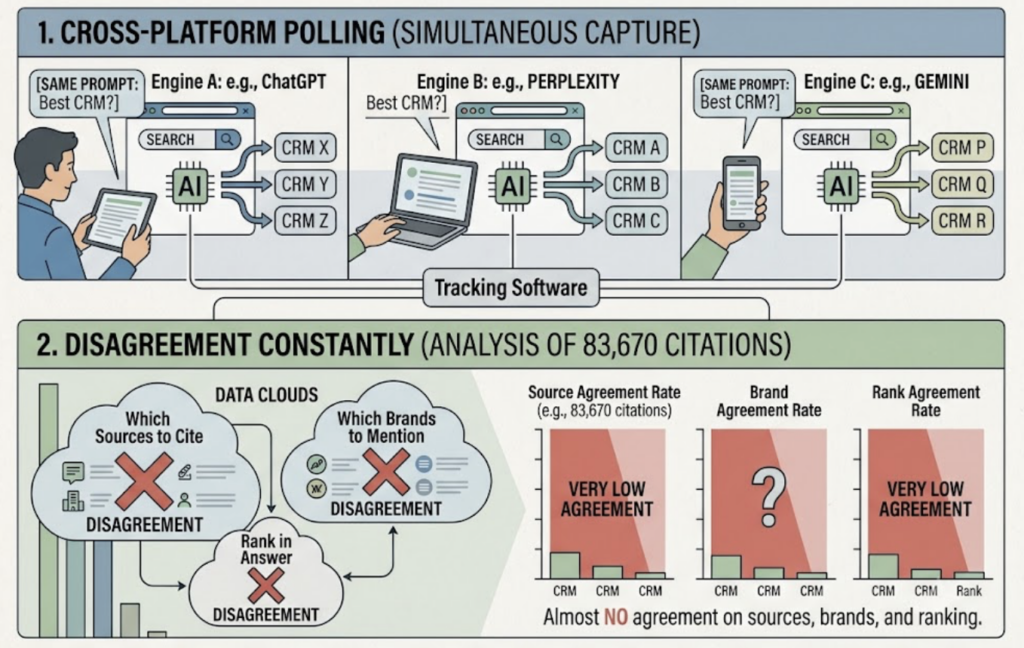
    Second, cross-platform polling. Each engine uses its own retrieval setup, so the same prompt returns different answers on ChatGPT versus Perplexity versus Gemini. The software captures each response separately. This matters because the engines disagree constantly. One analysis of 83,670 AI citations across ChatGPT, Claude, and Perplexity found the engines agreed on almost nothing, including which sources to cite and which brands to mention.

    Third, parsing and normalization. The raw text gets scanned for brand mentions, citation links, and sentiment, then stored as time-series data so you can see drift.

    Here’s why prompt-level beats keyword-level: AI models don’t respond to keywords. They respond to intent expressed in full questions. Tracking 60 high-intent prompts gives you a cleaner read on your AI share of voice than monitoring thousands of keyword variants ever could.

    The Metrics That Tell You It’s Actually Working

    Plenty of tools will hand you a mention count and call it a day. Mention count is a vanity metric. These five tell you something useful.

    Visibility rate (share of voice): across your category-relevant prompts, what percentage produce a brand mention?

    Citation share: how often does the engine link to your domain as a source, versus a competitor’s?

    Position: are you described as the lead recommendation or a footnote alternative?

    Sentiment: does the AI’s framing match your positioning, or is it calling a premium product “budget-friendly”?

    AI referral conversion: this is the metric that pays the bills. AI traffic is small but converts hard. Seer Interactive measured ChatGPT-referred sessions converting at 15.9% against Google organic’s 1.76%, and AI referrals to US retail ran 31% higher conversion over the 2025 holiday season. You only see it if you track that traffic as its own channel.

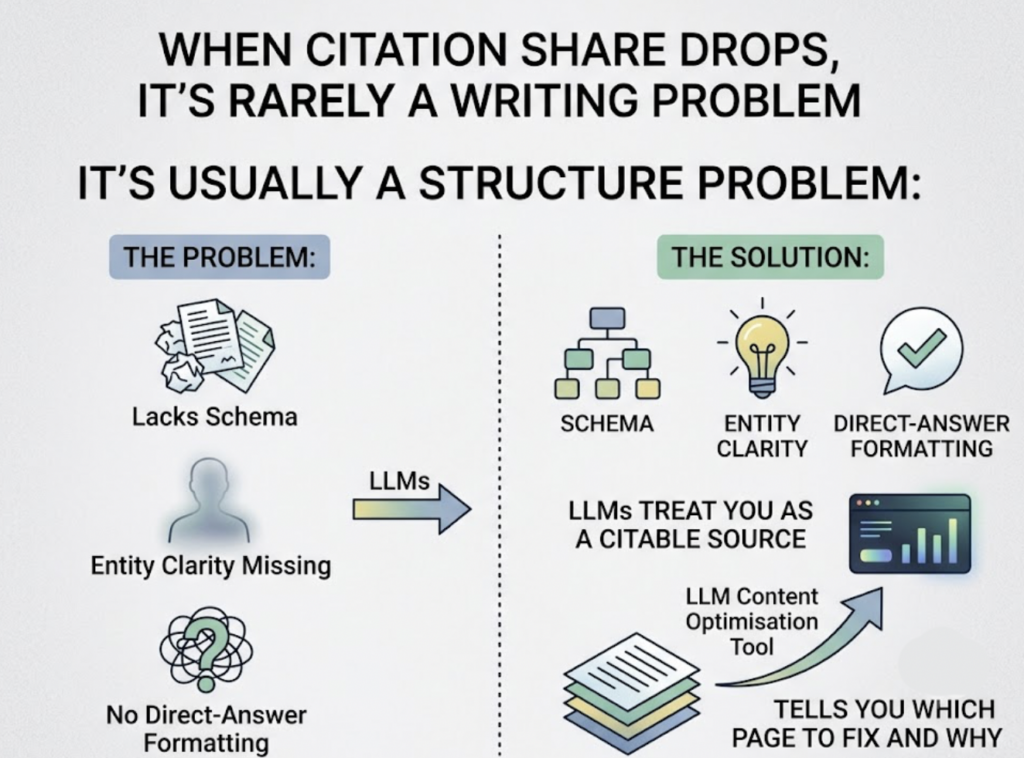
    Read these together and they point somewhere specific. When citation share drops, it’s rarely a writing problem. It’s usually a structure problem: your content lacks the schema, entity clarity, or direct-answer formatting an LLM needs to treat you as a citable source. That’s why the most useful platforms double as an llm content optimisation tool, not just a dashboard. They tell you which page to fix and why.

    What to Look For When You Compare Tools

    When you’re comparing options, the dividing line is simple: does the tool just alert you, or does it help you act?

    CapabilityMonitoring-only toolsFull GEO platforms
    Engine coverageOften one platform (ChatGPT only)ChatGPT, Perplexity, Gemini, Claude
    GranularityBasic mention countPrompt-level attribution and logs
    Competitor viewNoneSide-by-side share of voice
    Source analysisSurface mentionsThe exact URLs the AI cites
    ExecutionManual effortBuilt-in content workflows
    HistorySingle snapshotDrift over weeks and months

    Coverage is the one most people underweight. Optimizing only for ChatGPT used to cover most of the market. After the fragmentation of the past year, the four leaders together hold roughly 99% of measurable AI referrals, with no single engine dominant the way ChatGPT once was. A single-engine tool now misses about a third more of the picture than it did a year ago.

    Examples of AI recommendation tracking software span from lightweight mention-alert tools to full-stack GEO platforms like Topify. The right fit depends on whether you need to know what’s happening or change it.

    Where Teams Go Wrong

    The right software doesn’t save you from the wrong habits. Four mistakes show up again and again.

    The single-platform trap. Optimizing only for ChatGPT ignores that Perplexity and Google’s AI Overviews retrieve and cite differently. AI Overviews now appear in about one in four searches, and roughly 60% of their citations come from URLs that don’t rank in the top 20 of regular search. Different surface, different rules.

    Ignoring citation drift. AI sources rotate often. Content refreshed within 30 days tends to earn meaningfully more citations than stale pages. A snapshot from last quarter tells you almost nothing about today.

    Chasing volume without context. A mention is not automatically good. If the sentiment is off or the source is weak, raw mention count points you in the wrong direction.

    Treating the dashboard as the finish line. This is the big one.

    Tracking data is an operational signal, not a report you file. When a number moves, something on your site should change: an FAQ block, a comparison page, a piece of schema. Teams that read the dashboard and do nothing get the same result as teams with no dashboard at all.

    How Topify Approaches AI Recommendation Tracking

    Most tools stop at telling you what happened. Topify is built to close the full loop: track, understand why, act, then measure again.

    The analytics layer covers seven dimensions of AI visibility in one view: visibility, sentiment, position, volume, mentions, intent, and conversion rate. Instead of checking four engines in four tabs, you watch them in one place and catch a drop the day it happens.

    High-value prompt discovery surfaces the specific buyer questions where your brand is currently missing. Those are the gaps worth closing first, because they map directly to purchase intent.

    The piece most monitoring tools skip is the why. Topify’s citation analysis reverse-engineers the exact domains and URLs an engine references, so when a competitor wins a recommendation you can see which page earned it and what yours is missing. That turns a vague “we’re losing visibility” into a concrete content brief.

    From there, one-click execution generates and aligns content against the prompt patterns the dashboard flags, which is where Topify works as an llm content optimisation tool rather than a passive monitor. You define the goal in plain English, review the proposed strategy, and deploy. If you’d rather see where you stand first, you can check your baseline visibility before committing to a strategy.

    Pricing starts at $99/mo for Basic and $199/mo for Pro, with Enterprise from $499/mo, so a team can start small and scale prompt volume as the data proves out.

    A Quick Checklist Before You Commit

    Run any platform through these six questions before you sign:

    • Does it track at least the big four: ChatGPT, Perplexity, Gemini, and Claude?
    • Does the data turn into concrete content steps, not just charts?
    • Can it show citation drift over weeks and months, not a single snapshot?
    • Does it benchmark you against the competitors displacing you in AI answers?
    • Does it tell you which pages the AI is citing for its summary?
    • Is the pricing transparent and tied to something you control, like prompt volume or seats?

    If a tool can’t answer yes to the first four, it’s a monitor, not a growth system.

    Conclusion

    The shift from keyword rankings to AI recommendations is already underway. AI traffic grew roughly seven times over the past year and converts at multiples of organic search, even while it’s still a small slice of total visits. Small channel, high intent, fast growth.

    “Looking the same” on a features page hides real differences in how platforms handle messy, non-deterministic AI output. Judge them on coverage, citation analysis, and whether the data actually changes what your team ships next week. Get those three right, and you move from a silent participant in AI answers to the brand the engine names first.

    FAQ

    Q1: How does AI recommendation tracking software work? 

    It runs a fixed set of buyer-intent prompts across multiple AI engines on a schedule, then parses each response for brand mentions, citations, position, and sentiment. Those readings get stored over time so you can see trends and catch drift, instead of relying on a one-off manual check.

    Q2: What are examples of AI recommendation tracking software? 

    Options range from lightweight mention-alert tools to full GEO platforms. Topify sits at the full-stack end, pairing seven-dimension analytics with citation analysis and content execution. Some general AI observability tools also touch this space, but purpose-built GEO platforms tend to fit marketing teams better.

    Q3: How much does AI recommendation tracking software cost? 

    Pricing usually scales with prompt volume and seats. Entry tiers commonly start around $99/mo, mid tiers near $199/mo, and enterprise plans with custom prompt sets and a dedicated account manager run from roughly $499/mo upward.

    Q4: How can I improve my brand’s AI recommendation visibility? 

    Focus on entity clarity and citable structure. Use your brand name consistently rather than pronouns, add FAQ schema, answer common questions directly in the opening lines, and attribute statistics to a named, dated source. Content with clean heading structure and direct answers tends to get cited more often.

    Read More

  • AI Recommendation Tracking Tool: A Practical Guide

    AI Recommendation Tracking Tool: A Practical Guide

    Your team hit page one for the keywords that matter. Traffic’s up, domain authority’s climbing, and the SEO dashboard looks healthy. Then a prospect opens ChatGPT, types “best [your category] tool,” and reads back a list of five names. Yours isn’t one of them. Worse, when your brand does surface, the model calls it “a budget option” while you sell premium. None of your SEO reports caught this, because they were built to measure links and rankings, not what an AI decides to say about you. That gap is exactly what an AI recommendation tracking tool exists to close.

    What an AI Recommendation Tracking Tool Actually Does

    An AI recommendation tracking tool monitors how large language models describe, cite, and recommend your brand across AI answers. Not your Google position. What ChatGPT, Perplexity, Gemini, and Claude actually say when someone asks for a recommendation in your category.

    That distinction matters more than it sounds. Traditional rank tracking measures a fixed URL position on a results page. AI recommendation tracking software measures something fuzzier: whether your brand shows up inside a conversational, multi-source summary, and how it’s framed when it does.

    It’s also not social listening. Social tools track what people say about you. A recommendation tracking platform tracks the decision-making logic of the AI engine itself: which sources it trusts, which it surfaces, and which it quietly ignores.

    Here’s the shift underneath all of it. AI engines don’t rank pages. They cite sources. So the unit you track stops being “keywords” and becomes prompt sets, consistent groups of buyer questions that map to a real research journey.

    How AI Recommendation Tracking Works Behind the Scenes

    AI search is probabilistic, not deterministic. The same prompt can return different brands depending on model temperature, user context, and whatever the retrieval layer pulled in that day. Run a query once and you’ve got an anecdote, not data.

    A working pipeline handles that in four layers.

    First, it defines a prompt portfolio, often 50+ high-value buyer prompts like “best [category] for [use case].” Second, it runs those prompts across multiple engines programmatically, since each platform retrieves and weights sources differently. Third, it parses the unstructured answer text to quantify four things: does your brand appear, does the AI cite an owned URL, are you in the summary or buried in a footnote, and is the framing accurate. Fourth, it aggregates all of that into trends over time.

    That last step is where the real value sits. AI-cited domains churn fast. Tracking has found that the set of sources an engine references can shift in up to 74% of cases week over week. A single snapshot ages out almost immediately.

    The Metrics a Recommendation Tracking Dashboard Should Show You

    Counting mentions is where most teams start, and where most teams get stuck. A mention tells you that you showed up. It doesn’t tell you whether you showed up first, whether the model got your positioning right, or whether any of it drove revenue.

    A useful AI recommendation tracking dashboard reports across seven dimensions:

    MetricWhat it answers
    Visibility (Share of Voice)What share of category AI answers include your brand?
    PositioningAre you the primary recommendation or a footnote?
    Sentiment accuracyDoes the AI’s framing match your real positioning?
    Citation frequencyDoes the AI link to you, or to third-party aggregators?
    Engine consistencyVisible in Perplexity but invisible in Gemini?
    Intent alignmentDo you show up at the right buyer-journey stage?
    Referral conversion (CVR)Do AI-referred visitors actually convert?

    Put together, these turn AI recommendation tracking analytics from a vanity number into a diagnostic. You can see not just that visibility dropped, but on which engine, at which buyer stage, and whether sentiment moved with it. Semrush’s framework for measuring AI search visibility lands in the same place: share of voice and accuracy matter more than raw counts.

    A mention you can’t explain isn’t a metric. It’s noise.

    Five Mistakes That Make AI Recommendation Tracking Useless

    Most failed tracking setups fail the same handful of ways.

    Watching one engine. Living inside ChatGPT alone ignores everyone using Gemini or Perplexity, and each pulls from different retrieval signals. Coverage gaps become blind spots.

    Bringing 2012 SEO to a 2026 problem. Over-optimizing for keyword density actively hurts AI visibility. LLMs reward factual clarity and clean semantic structure, not repetition.

    Checking once a month. Given how fast cited sources churn, monthly snapshots are stale before you read them. Weekly, sometimes daily, is the realistic cadence.

    Tracking without a fix. Monitoring that doesn’t feed a content roadmap is just anxiety with a dashboard. When the AI skips you, the answer is usually restructuring content or building entity authority, not editing meta tags.

    Skipping competitors. Your own trend line means little without context. If your visibility holds at 20% while a rival climbs from 15% to 40%, you’re losing even though your number looks flat.

    What to Look For in an AI Recommendation Tracking Platform

    Once you’ve decided you need a tool, the selection criteria are fairly consistent. Four things separate a real AI recommendation tracking platform from a glorified spreadsheet:

    • Multi-engine coverage across at least ChatGPT, Perplexity, Gemini, and Claude.
    • Crawler and agent analytics, so you can see how AI systems actually access your site.
    • An actionability layer, with specific content workflows to close the gaps tracking surfaces.
    • Competitive benchmarking against your top three rivals.

    The 2026 tools landscape has several credible options, each leaning a different direction.

    ToolStrengthBest fit
    TopifySeven-metric analytics plus one-click execution across major enginesTeams that want tracking and the fix in one place
    ProfoundDeep enterprise analytics, broad engine coverageLarge enterprises with analyst capacity
    AthenaHQBrand integrity and hallucination monitoringBrands worried about misportrayal
    FraseMonitoring tied to content draftingContent-led teams
    Semrush AI ToolkitAI tracking inside an existing SEO suiteTeams already on Semrush

    Where Topify tends to stand out is the distance between seeing a problem and fixing it. Its Comprehensive GEO Analytics covers seven metrics, visibility, sentiment, position, volume, mentions, intent, and CVR, across ChatGPT, Gemini, Perplexity, DeepSeek, and others, so an AI recommendation tracking system isn’t siloed to one engine. Spot a drop in ChatGPT mentions and you can trace it to the specific source that stopped citing you, then act on it inside the same dashboard. For teams that want one solution to be both the monitor and the remedy, that end-to-end loop is what most pure-analytics tools skip.

    How to Improve Where You Land in AI Recommendations

    Tracking tells you where you stand. Improving where you land is a separate loop, and it runs on what the tracking surfaces.

    The strategy isn’t complicated, but it is iterative. Start by identifying the prompts where you’re absent or misframed. Look at which domains the AI cites instead of you, that’s your real competitive set for that query. Then close the gap by restructuring content for semantic clarity and earning the third-party signals that build entity authority. Re-run the same prompt set and measure the move.

    This is where execution speed matters. Topify’s Source Analysis reverse-engineers the exact domains and URLs AI platforms cite, so you know which references to target. Its One-Click Execution turns a stated goal into a deployed strategy without manual workflows. Getting started with a single prompt set on one engine is usually enough to see your baseline.

    Track it. Fix it. Re-measure.

    What AI Recommendation Tracking Software Costs

    Pricing for AI recommendation tracking software usually scales on three variables: how many prompts you track, how many engines you cover, and how many seats and projects you need. That’s why list prices vary so widely. A tool tracking 50 prompts on one engine and one tracking 250 across five aren’t really the same product.

    As a reference point, Topify’s plans start at $99/month for Basic (100 prompts, ChatGPT, Perplexity, and AI Overviews tracking, four projects), with a Pro tier at $199/month (250 prompts, eight projects) and Enterprise from $499/month. A 30-day trial covers most of what a team needs to validate a baseline before committing. The pricing detail breaks down research credits and answer-analysis limits per tier.

    Conclusion

    The brands that win in AI search aren’t always the ones with the best product. They’re the ones who can see what the AI is saying about them and act on it before competitors do. That starts with making the invisible measurable.

    If you’re starting from zero, don’t boil the ocean. Pick ten buyer prompts that matter, run them across two engines, and watch for a week. The baseline you get will tell you more about your real AI visibility than any rank report has in years.

    FAQ

    Q: What is an AI recommendation tracking tool? 

    A: It’s software that monitors how AI engines like ChatGPT, Perplexity, Gemini, and Claude describe, cite, and recommend your brand. Instead of measuring a URL’s position on a search page, it tracks whether your brand appears inside AI-generated answers and how it’s framed.

    Q: What are examples of AI recommendation tracking in practice? 

    A: A SaaS team running 50 buyer prompts weekly to see if their product appears when AI is asked for “best tools” in their category. An ecommerce brand checking whether AI describes its products accurately. An agency reporting a client’s AI share of voice against three named competitors. In each case, the tool turns scattered AI answers into a measurable trend.

    Q: Is there a checklist for choosing an AI recommendation tracking tool? 

    A: Yes. Confirm it covers at least four engines (ChatGPT, Perplexity, Gemini, Claude), shows how AI crawlers access your site, includes competitive benchmarking, and offers an actionable fix workflow rather than data alone. A tool that only reports without telling you what to change leaves the hardest part to you.

    Q: How do I improve my AI recommendation visibility? 

    A: Find the prompts where you’re missing, study the domains the AI cites instead, then restructure content for clarity and build entity authority through credible third-party signals. Re-run the same prompts to confirm the change. Improvement is a loop, not a one-time fix.

    Read More

  • How to Build an AI Prompt Tracking Strategy

    How to Build an AI Prompt Tracking Strategy

    You ask ChatGPT for the best tool in your category on Monday and your brand shows up third. You run the same prompt Friday and you’re gone. Nothing changed on your site, so what happened? This is where most teams quit trying to track AI search by hand. The output shifts session to session, platform to platform, and a few manual spot-checks can’t tell you whether a drop is a real visibility problem or just the model being the model. A real AI prompt tracking strategy fixes that by turning scattered observations into a signal you can actually trust.

    What an AI Prompt Tracking Strategy Actually Covers

    An AI prompt tracking strategy is a repeatable system for monitoring how AI engines respond to the questions your buyers actually ask. Not a one-time audit. A standing process with a fixed set of prompts, a fixed set of metrics, and a fixed schedule.

    The reason it’s necessary is non-determinism. LLMs don’t return a stable ranking the way Google does. They behave more like high-dimensional probability functions, so the same query can produce different brand mentions across sessions, platforms, and even back-to-back prompts.

    That’s why a screenshot proves nothing. One run is a single sample from a distribution.

    Most teams confuse activity with strategy here. Checking ChatGPT now and then is activity. Tracking the same prompt portfolio, on the same cadence, with the same scoring, across every engine your audience uses is a strategy.

    How AI Prompt Tracking Works Across ChatGPT, Perplexity, and Gemini

    Under the hood, AI prompt tracking runs a four-step loop.

    First, you define a prompt portfolio, usually 50 to 100 high-value prompts that mirror the buyer’s journey: category questions, comparisons, and problem-solving queries. Second, those prompts get submitted programmatically across your target engines, simulating how a real user would research. Third, the responses get parsed for three things: whether your brand is mentioned, where it ranks in the answer, and how it’s framed. Fourth, the signals get aggregated over time into a baseline you can read.

    Here’s why one engine isn’t enough. ChatGPT, Perplexity, and Gemini each run different retrieval pipelines, different training cutoffs, and different citation logic. Winning on one tells you almost nothing about the others.

    Plus, citation sources move fast. The domains AI engines cite can change in up to 74% of cases from one week to the next, which is why a quarterly check misses most of what’s actually happening. If you want to go deeper on the mechanics, this breakdown of how to track AI search visibility and rankings in ChatGPT covers the engine-level differences in detail.

    The Four Building Blocks of an AI Prompt Tracking System

    A reliable tracking system comes down to four decisions. Get these right and the tooling is just execution.

    Choosing the Right Prompts to Track

    The biggest lever is prompt selection. Branded prompts like “reviews of [your brand]” feel reassuring but tell you little. The prompts that matter are buyer-intent ones: “What’s the best [category] solution for [problem]?” That’s where a recommendation actually moves a deal.

    Setting a Tracking Cadence

    AI models refresh their retrieval sources constantly, so cadence is part of the strategy, not an afterthought. Weekly monitoring has become the working standard for catching citation drift before it costs you. Monthly is the floor. Quarterly is mostly theater.

    Picking Metrics That Mean Something

    Clicks are the wrong compass here. The metrics that map to AI visibility are share of voice (your citations versus competitors’), citation frequency, and sentiment positioning. A brand named warmly and first beats one buried at the bottom of a list.

    Closing the Loop: From Data to Action

    Tracking earns its keep only when it changes what you publish. If an engine keeps citing a competitor for a specific intent, that’s a content gap, not bad luck. The fix is usually updating the documentation, FAQ schema, or comparison page that should be answering that query.

    How to Measure If Your AI Prompt Tracking Strategy Is Working

    To know whether your strategy is improving, you measure against a fixed set of dimensions, not a single headline number. The GEO measurement frameworks maturing in 2026 converge on roughly seven.

    DimensionWhat it tracksWhy it matters
    VisibilityHow often your brand appearsAre you in the conversation at all?
    PositionWhere you rank in the answerAre you a top-tier recommendation?
    SentimentHow you’re framedIs the portrayal accurate and positive?
    CitationSource and link attributionDo you get the traffic credit?
    Share of VoiceYour citations vs. competitors’Are you winning the category?
    Intent MappingAlignment with the query stageAre you reaching high-intent buyers?
    CVRAI-driven referral conversionIs the traffic actually closing?

    Sentiment deserves a callout. AI engines sometimes describe brands inaccurately, and correcting AI brand misinformationhas become its own workstream. Tracking sentiment weekly is how you catch a misframe before it spreads across engines.

    You improve the strategy by watching these dimensions move together. A rising mention rate with flat position means you’re getting named but not recommended. Rising citations with weak CVR means the traffic isn’t closing. Each gap points to a different fix.

    Common Mistakes That Quietly Break Your Tracking

    Most failed tracking efforts don’t fail loudly. They drift into noise. Four mistakes account for most of it:

    • Tracking prompts that are too broad. A query like “What is AI?” generates noise, not signal. High-intent, decision-stage prompts are where visibility converts.
    • Ignoring position. A mention at the tail end of a long answer is worth a fraction of a primary recommendation in the summary. Presence isn’t the same as prominence.
    • Using bot logs as a proxy. GPTBot or PerplexityBot hitting your server only means a crawler stopped by. It says nothing about whether your content was deemed answer-worthy enough to cite.
    • Optimizing for one engine. Winning ChatGPT while ignoring Perplexity and Google AI Overviews leaves you invisible exactly where a chunk of your buyers are looking, since each engine prioritizes different authoritative sources.

    Picking an AI Prompt Tracking Tool, Platform, or Software

    Once the strategy is clear, the tool just has to execute it. The selection criteria fall straight out of everything above: multi-model coverage, prompt-level granularity, the full metric set, competitor benchmarking, and a way to turn findings into action.

    A capable AI prompt tracking platform should run the same prompt portfolio across ChatGPT, Perplexity, Gemini, and the engines your market actually uses, then score each response on visibility, position, sentiment, and citations in one place. A spreadsheet and a human operator can’t hold that cadence past a handful of prompts.

    This is where Topify tends to fit teams running a serious strategy. Its prompt discovery surfaces the high-value queries worth tracking instead of leaving you to guess, and its analytics roll the seven GEO metrics into a single dashboard. In practice, that means a drop in ChatGPT mentions can be traced back to a specific source that stopped citing you, without leaving the tool. Competitor benchmarking shows who the engines recommend instead of you, in real time.

    On cost, an AI prompt tracking solution doesn’t have to mean enterprise pricing. Topify starts at $99/month with a 30-day trial covering ChatGPT, Perplexity, and AI Overviews tracking plus 100 prompts, which is enough to run a real portfolio rather than a sample. You can get started without locking into an annual contract.

    Your AI Prompt Tracking Strategy Checklist

    Here’s a checklist to stand the whole thing up from scratch:

    • Inventory. Identify 50+ buyer-intent prompts that drive your pipeline.
    • Baseline. Run those prompts once to see who the engines currently cite.
    • Tools. Choose a multi-model tracking system that scores the full metric set.
    • Integration. Connect findings to your content roadmap: fix the page that should be cited but isn’t.
    • Cadence. Schedule weekly automated reports to catch citation drift and competitive shifts.

    As for what those prompts look like, a B2B example portfolio might mix “best [category] software for [industry],” “[competitor] alternatives,” “how to solve [specific problem],” and “is [your brand] good for [use case].” The pattern is decision-stage intent, not brand vanity.

    Conclusion

    The brands winning AI search in 2026 aren’t the ones checking ChatGPT once a month. They’re the ones running a fixed prompt portfolio, on a weekly cadence, scored against metrics that map to real recommendations. Start with your 50 buyer-intent prompts and a baseline run. Once you can see where you stand and where competitors are pulling ahead, the strategy mostly runs itself. The hard part was never the tracking. It was deciding to treat AI visibility as a system instead of a spot-check.

    FAQ

    Q: What is an AI prompt tracking strategy? 

    A: It’s a repeatable system for monitoring how AI engines answer the questions your buyers ask. Instead of one-off checks, you track a fixed set of prompts across multiple platforms, on a set schedule, scored against consistent metrics, so you can tell a real visibility trend apart from random model variation.

    Q: How do you measure an AI prompt tracking strategy? 

    A: Measure against a fixed set of dimensions rather than a single number. The common framework covers visibility, position, sentiment, citation, share of voice, intent mapping, and CVR. Reading them together tells you not just whether you’re mentioned, but whether you’re recommended and whether that attention converts.

    Q: How can you improve your AI prompt tracking strategy? 

    A: Tighten prompt selection toward decision-stage intent, raise cadence to weekly, and close the feedback loop. When the data shows a competitor winning a specific query, update the page that should be answering it. Improvement comes from acting on gaps, not just logging them.

    Q: How much do AI prompt tracking tools cost? 

    A: Pricing varies, but it doesn’t require an enterprise budget. Entry-level plans that cover multi-model tracking and a usable prompt count start around $99/month, with trials available so you can validate the data before committing.

    Read More

  • AI Prompt Tracking and Monitoring: An Enterprise Guide

    AI Prompt Tracking and Monitoring: An Enterprise Guide

    Your team tracks keyword rankings, traffic, and conversion across thousands of pages. Then a buyer opens ChatGPT, types “best platform for enterprise teams in your category,” and reads a three-sentence answer that names two competitors and skips you entirely. Nobody on your team saw it happen.

    Across the hundreds of prompts your customers actually ask AI engines, your brand might show up in twelve of them or in two. Your current dashboards can’t tell the difference. Rank tracking was built for a world of ranked blue links, not synthesized answers, and that’s where enterprise visibility quietly leaks.

    What Is AI Prompt Tracking Monitoring

    AI prompt tracking monitoring is the systematic measurement of how your brand shows up inside the answers that large language models generate. Instead of asking “where does my URL rank for this keyword,” it asks “when a buyer poses this question to ChatGPT or Perplexity, does the answer mention, cite, or recommend us?”

    The shift matters because the mechanics underneath are different. Traditional rank tracking measures static, deterministic positions of links on a results page. Prompt tracking measures a stochastic selection process, where the engine synthesizes a response rather than returning a ranked list.

    That changes what “winning” looks like. Visibility is no longer about position one. It’s about whether the model adopts your brand as a trusted resource inside a natural-language answer, and how it frames you when it does.

    How AI Prompt Tracking Monitoring Works

    At a practical level, AI prompt tracking monitoring runs a structured loop that simulates how real buyers research a category.

    It starts with a prompt portfolio. Most enterprise programs curate 20 to 50 category-relevant prompts that mirror genuine buyer intent: “best X for Y,” “X vs. Y,” “how to solve Z.” These aren’t keywords. They’re the full questions a prospect would type.

    Next comes cross-platform execution. The same prompts run across ChatGPT, Perplexity, Gemini, Claude, and other engines, because each one has its own citation bias. A brand that dominates Perplexity answers can be invisible in Gemini, and only side-by-side testing surfaces that.

    Then the system parses and scores each response on a few specific signals: mention rate (how often the brand appears), citation type (a linked source versus a passing text mention), positioning (named in the summary versus buried deep in a list), and sentiment (framed as positive, neutral, or negative). Those four signals turn a wall of conversational text into something you can actually trend over time.

    Examples of AI Prompt Tracking Monitoring in Practice

    A few patterns show up constantly once teams start measuring.

    A SaaS brand discovers it’s mentioned in every branded prompt but absent from “best tools for [category],” the exact unbranded queries where buyers make shortlists. A retail brand finds Gemini describing it as “budget-friendly” while its positioning is premium. A B2B platform learns a competitor is the only name cited in “X vs. Y” answers, because that competitor published a comparison page and they never did.

    Each of these is invisible to a Google rank report. Each one is obvious the moment you track answers at the prompt level.

    How to Measure AI Prompt Tracking Monitoring

    Vanity metrics are easy to collect and hard to act on. Enterprise teams that get value out of this work tend to anchor on three measures.

    The North Star is AI Share of Voice, calculated as your brand citations divided by total category citations, times 100. It answers the only question leadership really asks: of all the times AI talks about this category, how often is it talking about us?

    The second is citation velocity and drift. AI answers aren’t stable. Engines routinely swap out the domains they cite, with some platforms churning a large share of their cited sources week over week. A brand that’s recommended today can vanish next week with no warning, so a single snapshot is close to useless. You’re tracking a trend line, not a screenshot.

    The third is sentiment alignment. It’s not enough to be mentioned. You need to confirm the model isn’t pairing your name with negative reviews or citing a competitor as the “authoritative” choice in the same breath. That’s how messaging drift gets caught early.

    Why Enterprise AI Visibility Needs Prompt-Level Monitoring

    For a small brand, you can almost get away with spot-checking a few prompts by hand. Enterprise visibility is a different problem, and that’s where an enterprise AI visibility platform stops being optional.

    Three things break manual tracking at scale.

    First is the sheer volume of prompts. A large brand has dozens of product-market combinations, each with its own buyer questions. That’s thousands of prompt-platform pairs, which no spreadsheet survives. Enterprise AI search monitoring solutions handle this by tracking at the topic level rather than asking someone to manage prompts one by one.

    Second is context complexity. Global enterprises need a consistent brand voice across markets and product lines, and that data is usually siloed in legacy systems. Enterprise AI visibility, done right, pulls those signals into one view so a regional gap doesn’t hide inside an aggregate number.

    Third is operational integration. A serious program treats AI visibility as a leading indicator for content investment. When the data shows “AI isn’t citing us for this use case,” that becomes a direct trigger to build a technical deep-dive page, not a report nobody reads.

    Common Mistakes in AI Prompt Tracking Monitoring

    Most programs stumble on the same few things.

    Over-relying on branded prompts is the big one. Monitoring only your own name paints a flattering picture, because models almost always describe you well when asked about you directly. Real visibility is won in unbranded category queries, where buyers haven’t decided yet.

    Ignoring non-determinism is the next. Treating one AI response as fact, without re-testing on a regular cadence, mistakes a probabilistic output for a stable result. Weekly testing is the floor for establishing a reliable trend.

    The subtlest mistake is keyword-based thinking. Forcing old SEO habits like exact-match density onto AI answers misreads how the systems work. LLM responses are semantic and narrative. The question isn’t whether your page repeats a phrase, it’s whether the model understands you as the answer.

    How to Improve AI Prompt Tracking Monitoring: A Practical Strategy

    Once measurement is in place, improvement follows a fairly clean strategy.

    Start by building a buyer-intent prompt library instead of chasing volume. A focused set that spans informational, comparative, and problem-solving prompts beats a sprawling list of low-intent queries. Quality of the prompt set, not quantity, is what makes the data actionable.

    Then close gaps with evidence. When tracking shows a competitor owning a “best of” prompt, that’s a content brief writing itself: build the page, add the schema, publish the comparison they’re missing. The data tells you exactly where to spend, so content investment stops being a guessing game.

    This is also the point where tooling earns its keep. Topify is built around this loop for teams that need it at enterprise scale. Its Comprehensive GEO Analytics tracks brand performance across major AI platforms through seven metrics: visibility, sentiment, position, volume, mentions, intent, and CVR. In practice, that means you can spot a drop in ChatGPT mentions, trace it to a source that stopped citing you, and see which competitor took your spot, all in one place.

    Two capabilities matter most for prompt-level work. High-Value Prompt Discovery surfaces the prompts that actually move your category as AI recommendations evolve, so your portfolio stays current instead of going stale. Dynamic Competitor Benchmarking shows who the engines recommend ahead of you and where, which turns a vague “we’re losing ground” feeling into a specific, fixable list. When you’re ready to map your own prompt coverage, you can get started with Topify and run a baseline before committing to a plan.

    Choosing the Right Enterprise AI Visibility Tool

    The market is crowded, and most tools differ less in their dashboards than in what they actually measure. When you’re comparing the best tools for AI prompt tracking monitoring, these are the dimensions that separate them.

    DimensionWhat to look forWhy it matters for enterprise
    Platform coverageTracks ChatGPT, Perplexity, Gemini, Claude, and moreSingle-engine tools miss where your buyers actually search
    Prompt scaleTopic-level tracking, hundreds of promptsManual prompt management collapses at enterprise volume
    Metric depthBeyond mention rate to position, sentiment, SOV, CVRMention-only data can’t explain why visibility moves
    Competitor benchmarkingAutomatic rival detection and positioningYou need to know who’s winning the prompts you’re losing
    ActionabilityCitation analysis that points to content gapsMonitoring without a next step is just a report

    The pattern is simple. Tools that stop at “here’s your mention rate” leave the hardest work, figuring out what to do next, on your desk. The ones worth paying for connect measurement to a content action.

    Conclusion

    The gap from the opening doesn’t close on its own. Every week, AI engines answer your category’s questions, name some brands, and skip others, and without prompt-level tracking you’re guessing which side you’re on.

    Start small. Build a focused prompt library around real buyer intent, run it across the platforms your customers use, and measure share of voice and sentiment on a weekly cadence. From there, let the gaps drive your content roadmap. The enterprises that treat AI visibility as a measurable channel, not a mystery, are the ones AI will keep recommending.

    FAQ

    Q: What is AI prompt tracking monitoring? 

    A: It’s the practice of measuring how your brand appears inside AI-generated answers across engines like ChatGPT, Perplexity, and Gemini. Rather than tracking where a URL ranks, it tracks whether the model mentions, cites, or recommends you when a buyer asks a real question, and how it frames you when it does.

    Q: What’s a good checklist for AI prompt tracking monitoring? 

    A: A practical checklist covers five things: a buyer-intent prompt portfolio of 20 to 50 questions, cross-platform execution across at least three engines, scoring on mention rate plus position and sentiment, a weekly re-testing cadence to handle non-determinism, and a clear link from each gap to a content action.

    Q: How much does AI prompt tracking monitoring cost? 

    A: Pricing varies widely by prompt scale and platform coverage. Topify’s plans start at $99/month for the Basic tier, scale to $199/month for Pro, and move to custom Enterprise pricing from $499/month with a dedicated account manager. You can review current tiers on Topify’s pricing page.

    Q: How is it different from traditional SEO rank tracking? 

    A: Rank tracking measures fixed positions of links on a search results page. Prompt tracking measures a probabilistic answer that the model writes fresh each time, so success is defined by citation and recommendation rather than position, and results shift week to week instead of staying static.

    Read More

  • AI Prompt Tracking Tracker: How It Works and Pricing

    AI Prompt Tracking Tracker: How It Works and Pricing

    You can pull up rank positions for 200 keywords in under a minute. Domain authority, backlinks, SERP movement, all of it sits in one dashboard. Then someone asks Claude, “What’s the best tool for [your category]?” and your brand doesn’t come up. Your rank tracker has nothing to say about that, because it was built to crawl pages, not read answers. The gap between what you can measure and what AI is telling buyers keeps widening, and most of the tools on your desk can’t see into it.

    That’s the gap an AI prompt tracking tracker is built to close.

    What an AI Prompt Tracking Tracker Actually Measures

    A traditional rank tracker answers one question: where does this URL sit on a results page? An AI prompt tracking tracker answers a different one. It measures whether an AI model mentions your brand when someone asks a real question, where in the answer you show up, and how you’re described.

    The tracking unit shifts from keyword position to prompt-level brand mention. Instead of “rank #3 for project management software,” you’re measuring “named in 4 of 10 Claude responses to buyers comparing project tools, usually in the second paragraph.” That’s a more honest picture of what people actually see.

    The data nature is different too. Google rankings are deterministic: same query, same result, every time. AI answers are probabilistic, so the same prompt entered twice can return two different brand lists. The job of a tracker isn’t to read one answer. It’s to sample many and turn that noise into a trend.

    The KPIs follow from that. Not traffic and click-through rate, but share of voice, citation rate, and sentiment.

    How Does an AI Prompt Tracking Tracker Work

    Under the hood, the work is a pipeline built to normalize messy, non-deterministic output into something you can chart.

    It starts with a prompt portfolio: a curated set of head and long-tail prompts that mirror the buyer’s journey, spanning informational, comparative, transactional, and brand-specific queries. This is the part most teams underinvest in, and it’s the part that decides whether the data means anything.

    Then comes cross-platform execution. The same prompt set runs against multiple models (GPT-4, Claude, Gemini, Perplexity) because each one retrieves and synthesizes differently. A brand that dominates Perplexity can be invisible in Claude.

    Next is output parsing. The tracker reads each answer and extracts four things: brand mention rate, citation source (did the model link your URL), positioning (intro summary versus a secondary list), and sentiment. Then trend aggregation maps those points over time into a visibility score.

    One detail explains why sampling matters. LLMs use query fan-out, breaking a single prompt into several sub-retrieval tasks. That’s why the same question yields different brand sets on different runs, and why a one-time check tells you almost nothing.

    Why a Rank Tracking Tool Won’t Cover Claude

    Search “rank tracking tool claude” and you’ll find SEO platforms that crawl and index HTML pages. That architecture is the exact reason they can’t measure AI visibility.

    Three problems stack up.

    First, there’s no ranking page. A Claude or ChatGPT answer is generated in real time. It isn’t a static URL sitting in an index that a crawler can revisit. Second, personalization and non-determinism: models vary answers by user history and temperature, while SEO tools assume a clean, logged-out browser state. Third, no synthesis analysis. Legacy suites like Ahrefs, Semrush, and Moz look for keyword density and backlink counts, but a prompt tracker has to evaluate semantic completeness and whether your entity is aligned in the model’s knowledge graph.

    This catches SEO teams off guard. Stable Google rankings increasingly lose clicks as AI Overviews and chat answers absorb the query. Your position can hold while your real visibility erodes.

    A rank tracker will never flag that, because it’s measuring the wrong surface.

    How to Measure AI Prompt Tracking Tracker Performance

    Once you accept that mentions beat rankings, the question becomes which metrics to trust.

    Four matter most. Share of voice is your mention rate relative to direct competitors inside the same prompt cluster. Citation velocity is how often the model links directly to your owned content, which tends to be the strongest signal of authority. Sentiment alignment tells you whether you’re framed as a category leader or an afterthought. And visibility drift tracks how often your brand simply vanishes between runs.

    That last one is sobering. Roughly 65% of domains cited in AI answers change between weekly runs, which means a single good report can hand you a false sense of security.

    This is where Topify fits the measurement problem. Its Comprehensive GEO Analytics rolls seven metrics (visibility, sentiment, position, volume, mentions, intent, and CVR) into one view across ChatGPT, Gemini, Perplexity, Claude, and others. In practice, you can watch a drop in Claude mentions and trace it to a specific source that stopped citing you, without stitching together four separate tools.

    The point isn’t more dashboards. It’s seeing share of voice and the reason behind it in the same place.

    How to Improve Your AI Prompt Tracking Setup

    A measurement system only pays off if it drives changes. Here’s a working checklist.

    Audit your prompts first. Start with 20 to 30 high-value prompts, not 500 random keywords. Tracking 25 to 40 strategy-aligned prompts is more meaningful than monitoring hundreds of low-intent ones, because each AI answer is dense and costly to parse.

    Baseline before you touch anything. Record your share of voice across major platforms so you have a “before” to measure against.

    Then run the optimization loop. Treat citation gaps, prompts where competitors appear and you don’t, as your content roadmap. Improve structured data and FAQ sections so your pages are easier for models to parse and quote.

    Finding those gaps by hand is slow. Topify’s prompt discovery surfaces high-volume prompts you’re missing, and its competitor benchmarking shows who the model recommends instead of you.

    Last, hold steady. Track for at least 30 days before pivoting, because models need time to pull new content into their retrieval pipelines.

    Audit. Baseline. Optimize. Repeat.

    Common Mistakes in AI Prompt Tracking

    Most failed setups share the same handful of errors.

    Testing one platform. A brand can lead on Perplexity and disappear on Claude, so single-platform data is misleading by default.

    Too few prompts, or too many of the wrong kind. Five prompts can’t capture a category, and 500 generic keywords drown the signal in noise.

    Reading a single run. Given non-deterministic output, one snapshot is closer to a coin flip than a measurement.

    Watching mentions but ignoring position. Being named last in a ten-item list isn’t the same as leading the answer, yet a raw mention count treats them as equal.

    And measuring without a baseline, which leaves you unable to prove whether the change you made actually worked.

    Best Tools for AI Prompt Tracking and Their Pricing

    Tools in this category split along one line: how many platforms they cover, and whether they explain the “why” behind a score instead of just the number.

    ToolAI Platforms CoveredMetrics DepthStarting Price
    TopifyChatGPT, Gemini, Perplexity, Claude, DeepSeek, and more7 metrics + prompt discovery + competitor benchmarking$99/mo
    General SEO suites (Ahrefs, Semrush)Limited, mostly AI OverviewsKeyword-centric, light AI coverageVaries
    Single-platform monitorsUsually 1 to 2Mention rate, basic sentimentVaries

    On pricing, Topify’s Basic plan runs $99/mo and includes tracking across ChatGPT, Perplexity, and AI Overviews, 100 prompts, and 9,000 AI answer analyses. The Pro plan at $199/mo lifts that to 250 prompts and 22,500 analyses, which suits teams running multi-cluster prompt portfolios. Enterprise starts at $499/mo with a dedicated account manager. Full numbers sit on the Topify pricing page.

    For a category this volatile, a $99 entry point that samples answers across platforms costs far less than the visibility you lose by guessing. You can get started on a trial and baseline your share of voice in an afternoon.

    Conclusion

    Rank trackers measure pages. AI prompt tracking measures answers, and answers are what buyers see now. The gap from the opening (strong rankings, zero presence in Claude) closes only when you start sampling prompts instead of crawling URLs. Begin with 20 to 30 high-intent prompts, baseline your share of voice across platforms, and treat citation gaps as your content roadmap. The brands that win AI search aren’t the ones ranking highest. They’re the ones measuring what the model actually says, then fixing it.

    FAQ

    Q: What is an AI prompt tracking tracker? 

    A: It’s a tool that measures whether AI models mention your brand in response to real prompts, where you appear in the answer, and how you’re described. Unlike a rank tracker, it tracks prompt-level mentions and citations instead of keyword positions on a results page.

    Q: How does an AI prompt tracking tracker work? 

    A: It runs a curated set of prompts across models like ChatGPT, Claude, Gemini, and Perplexity, parses each answer for mention rate, citation source, position, and sentiment, then aggregates those into a visibility trend. Because outputs are non-deterministic, it samples many runs rather than reading a single answer.

    Q: Can a rank tracking tool track Claude? 

    A: Not in any meaningful way. Rank trackers crawl indexed HTML pages, but a Claude answer is generated in real time and isn’t a static, crawlable URL. Measuring Claude visibility requires sampling generated responses, which is a different method entirely.

    Q: How much does AI prompt tracking cost? 

    A: Entry-level platforms start around $99/mo. Topify’s Basic plan is $99/mo for 100 prompts and cross-platform tracking, Pro is $199/mo for 250 prompts, and Enterprise begins at $499/mo. Pricing usually scales with prompt volume and the number of AI answers analyzed.

    Read More