Category: Article

  • 10 KPIs to Track AEO & GEO Performance in 2026

    10 KPIs to Track AEO & GEO Performance in 2026

    Your SEO dashboard is lying to you.

    Not because the data is wrong, but because it’s measuring the wrong game. When a user asks ChatGPT “what’s the best project management tool for remote teams,” your Google ranking doesn’t matter. What matters is whether you’re in the answer at all, and how you’re described when you are.

    That’s the core challenge of AEO and GEO measurement. The old stack — organic sessions, CTR, keyword rankings — was built for a world of blue links. In a world where AI synthesizes the answer directly, those numbers tell you almost nothing about brand influence.

    This playbook breaks down 10 KPIs across three measurement layers: Visibility, Quality, and Impact. Each one maps to a specific question your team should be able to answer every week.

    Why Your Old SEO Metrics Break Down in AI Search

    Traditional SEO worked because the output was consistent: a ranked list of links. You could measure position, click-through rate, and impressions. The relationship between effort and measurement was linear.

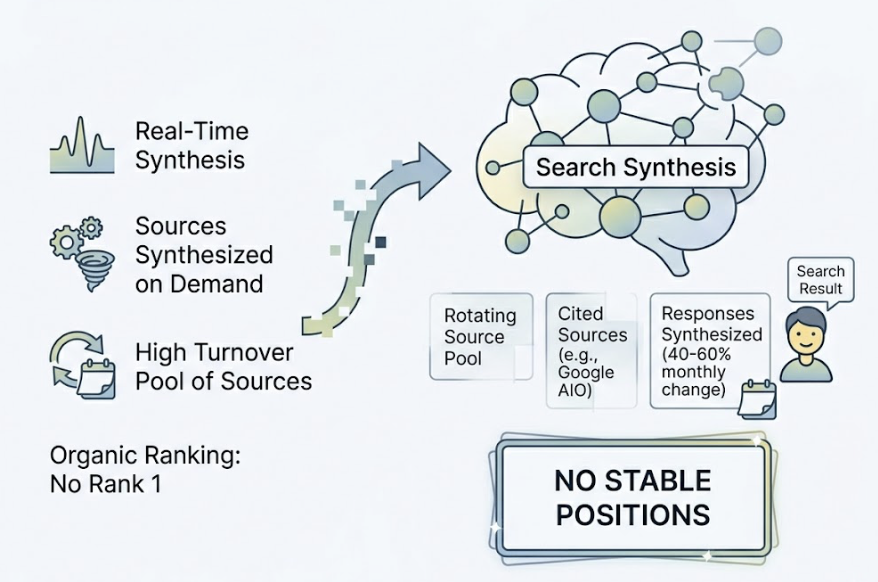
    AI search doesn’t work that way. There are no stable “positions.” Responses are synthesized in real-time, drawing from a rotating pool of sources. Research shows that 40-60% of cited sources in Google AI Overviews change every month. You can rank #1 organically and still be invisible to ChatGPT.
    Gartner projects a 25% drop in traditional search volume by 2026 as users shift to AI assistants. That traffic doesn’t disappear. It moves to a channel with a completely different measurement logic.

    The 3-Layer Measurement Framework

    Before tracking individual KPIs, you need a mental model for what you’re measuring. AEO performance breaks down into three distinct layers:

    LayerCore QuestionKPIs
    Layer 1: VisibilityIs your brand in the AI’s response at all?KPI 1-3
    Layer 2: QualityHow is your brand being described?KPI 4-6
    Layer 3: ImpactIs AI visibility driving real business results?KPI 7-10

    Each layer answers a different question. Teams that skip straight to Impact without establishing Visibility baselines end up with attribution gaps they can’t explain.

    Layer 1 — Visibility KPIs: Are You Even in the Room?

    KPI 1: AI Mention Rate

    The most fundamental AEO metric. It measures the percentage of target prompts where your brand appears in the AI’s response.

    For B2B SaaS, a healthy baseline falls between 10-15% of relevant category queries. Category leaders typically exceed 30%. If you’re tracking 100 prompts and appearing in 12 of them, that’s your starting point, not your ceiling.

    One distinction worth making: a “mention” means the AI knows you exist. A “citation” means your content actively grounded the response. Both matter, but for different reasons.

    KPI 2: Prompt Coverage

    Your brand might appear for “CRM tools” but disappear completely on “CRM for startups” or “CRM for sales teams under 10 people.” That gap is the prompt coverage problem.

    Build a list of 50-100 high-value prompts that map to your buyer journey — including “Why,” “How,” and “What” question formats. Track coverage across that full set. Coverage below 50% on commercial-intent prompts is a signal that your content strategy has blind spots.

    KPI 3: Platform Distribution

    ChatGPT, Gemini, and Perplexity don’t behave the same way. They pull from different source types, apply different reranking logic, and serve different user demographics.

    A brand that’s highly visible on Perplexity but invisible on ChatGPT has a platform concentration risk. Track mention rate separately by engine, not just as a blended average. The splits often reveal which platforms you’ve inadvertently optimized for and which you’ve ignored.

    Layer 2 — Quality KPIs: How Are You Being Described?

    Visibility gets you in the room. Quality determines whether the AI’s description of you builds trust or quietly erodes it.

    KPI 4: AI Sentiment Score

    AI platforms synthesize responses from hundreds of sources — including Reddit threads, G2 reviews, and forum discussions. If the consensus on those platforms is negative, the AI will reproduce that sentiment, faithfully.

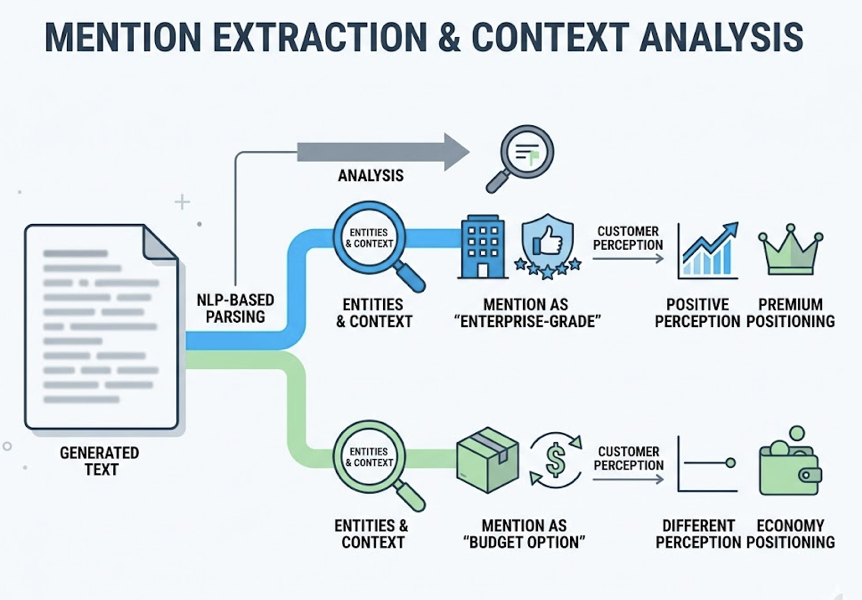
    Sentiment scoring uses NLP to classify AI-generated mentions as positive, neutral, or negative. A 0-100 scale works well in practice. A high mention rate with a low sentiment score is often worse than a low mention rate — you’re being seen, but the framing is working against you.

    Watch for specific language patterns: being described as “expensive” or “complex” in AI answers doesn’t mean you’re invisible. It means you’re visible in the wrong way.

    KPI 5: Brand Position in AI Answers

    Not all mentions are equal. Being the first recommendation in a ChatGPT response is fundamentally different from being fifth in a list.

    Position tracking uses a weighted formula: position weight = 1 / rank. First position carries a weight of 1.00; second is 0.50; fifth is 0.20. This matters because the gap between first and third recommendation in a high-intent AI response can translate to a 5x difference in conversion probability downstream.

    Track your average weighted position across your core prompt set, and watch how it shifts week over week relative to competitors.

    KPI 6: Citation Source Coverage

    AI platforms don’t cite your website because you asked nicely. They cite it because it appeared in the sources they trust most.

    Perplexity pulls nearly 47% of its top citations from Reddit. ChatGPT favors Wikipedia for around 48% of its responses. If your brand has no meaningful presence on those third-party platforms, your domain competes against a significant structural disadvantage.

    Citation source analysis maps which domains the AI is using to ground its responses about your category. If a competitor’s blog or a user’s product review is shaping what the AI says about the problem your brand solves, that’s a content gap you can close.

    Layer 3 — Impact KPIs: Is It Actually Working?

    This is where AEO measurement gets interesting. AI referral traffic behaves very differently from organic search traffic, and the numbers justify the investment in a way that most marketing dashboards still don’t capture.

    KPI 7: AI Search Volume Trend

    AI search volume tracks how often users are querying AI platforms about your category over time. This isn’t your brand’s traffic — it’s the size and direction of the pool you’re fishing in.

    Rising AI search volume for your core topics is a leading indicator of opportunity. Falling volume on topics you’ve invested heavily in is a signal to rebalance. Track the trend line, not just the snapshot.

    KPI 8: Share of Voice vs Competitors

    AI Share of Voice (AI SoV) measures your brand’s proportion of the total “answer real estate” in your category. The weighted formula accounts for position, not just presence:

    AI SoV = (Sum of Your Brand’s Position Weights / Sum of All Brands’ Combined Position Weights) × 100

    This is the closest AEO equivalent to market share. A competitor holding 40% AI SoV while you hold 8% in a growing category is a quantifiable revenue risk, not an abstract concern. Track this monthly against your top three to five competitors.

    KPI 9: Conversion Visibility Rate (CVR)

    Here’s the data that justifies the entire AEO investment: AI referral traffic converts at 14.2% on average, compared to 2.8% for Google organic search. That’s a 5x conversion advantage.

    For context, Claude referral traffic converts at up to 16.8% in B2B SaaS contexts. AI-sourced visitors show 67% higher lifetime value and convert 73% faster than traditional search visitors.

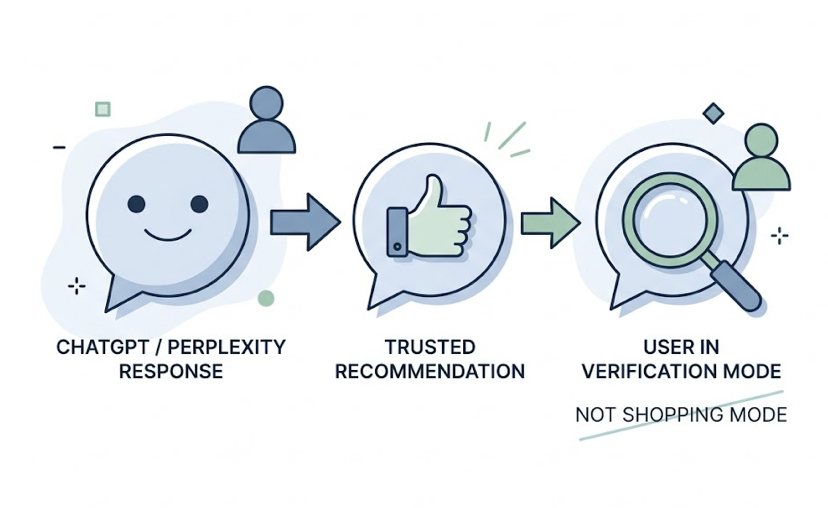
    The mechanism is the “pre-qualified recommendation” effect. By the time a user follows a link from a ChatGPT or Perplexity response, they’ve already received a trusted recommendation. They’re in verification mode, not shopping mode.
    CVR blends sentiment score, position weight, and prompt intent into a single estimate of how likely an AI mention is to drive a conversion-eligible visitor. It’s a composite signal, but it’s the most direct line between AI visibility work and revenue.

    KPI 10: Week-over-Week Visibility Delta

    Absolute numbers are less useful than directional momentum. A brand at 12% AI mention rate trending up 3 points week-over-week is in a better position than a brand at 22% trending flat.

    WoW delta is the operational heartbeat of AEO measurement. It tells you whether your content and optimization efforts are working, and it gives you a fast signal when something breaks — a competitor launches a major content push, a third-party source changes its framing, or a new AI platform update reshuffles citation priorities.

    Track the delta for at least four of your core KPIs on a weekly cadence, and build a simple threshold alert: if any metric drops more than 5 points in a week, investigate before it compounds.

    Putting It Together: A Practical AEO Dashboard

    An AEO dashboard doesn’t need to be complex. It needs to answer two questions at a glance: where do we stand, and where are we headed?

    Here’s a workable structure for most teams:

    Review CadenceKPIs to Track
    WeeklyAI Mention Rate (WoW delta), Brand Position, Sentiment Score, Visibility Delta
    MonthlyAI Share of Voice, Prompt Coverage, Citation Source Coverage, AI Search Volume Trend, CVR
    QuarterlyPlatform Distribution, Full competitor benchmark, Attribution modeling

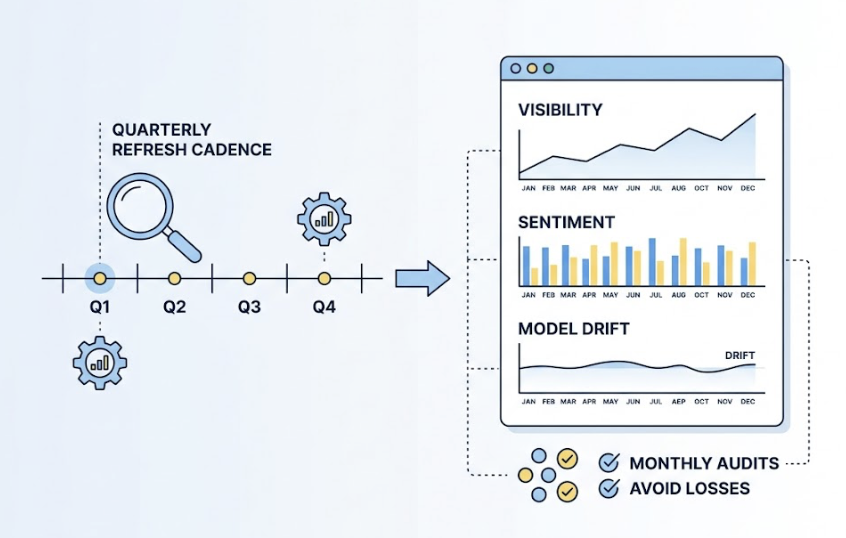
    The monthly cadence matters particularly for citation source analysis. Because 40-60% of cited sources rotate monthly in major AI engines, a monthly audit catches drift before it becomes a structural problem.

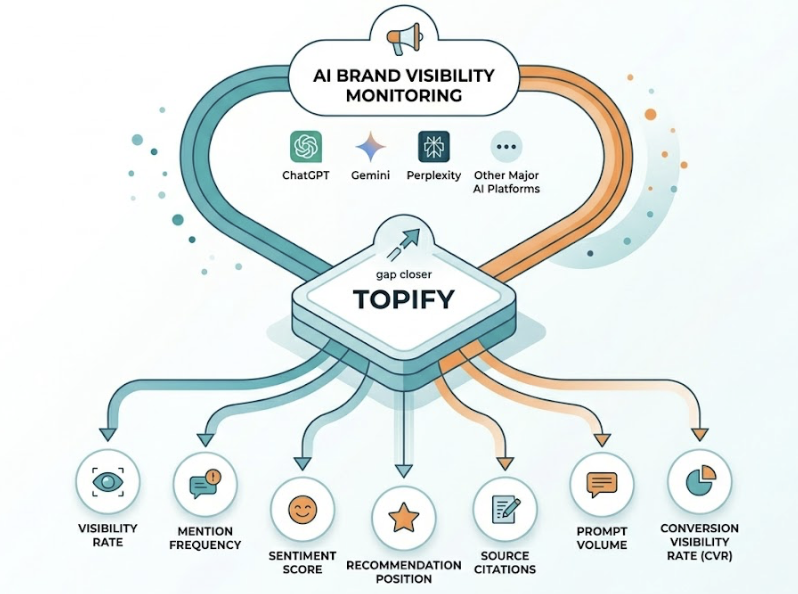
    Manual audits of a 100-prompt set typically take 8-12 hours per month. At scale, platforms like Topify automate this across ChatGPT, Gemini, Perplexity, and other major engines — tracking all seven core metrics (visibility, sentiment, position, volume, mentions, intent, and CVR) without manual query runs. Their Basic plan starts at $99/month and covers 100 prompts with 9,000 AI answer analyses across engines.

    The One Mistake Most Teams Make

    Most teams starting AEO measurement make the same error: they treat their own website as the primary lever.

    It isn’t.

    AI engines don’t view your website as the authoritative source. They view it as one node in a larger ecosystem. Vendor product pages account for a small fraction of actual AI citations. The majority of source weight comes from Reddit threads, Wikipedia entries, industry publications, and review platforms like G2.

    A team that invests 80% of its resources into on-site optimization is effectively controlling only a fraction of the citation surface. The rest — the part that actually determines what AI says about your brand — lives off-site.

    The practical fix is a “Search Everywhere” mentality. Track which third-party domains the AI uses to ground responses in your category. Then build an active presence there — not just as a content creator, but as an entity with consistent, accurate representation across every platform an AI might reference.

    There’s also a common technical mistake: blocking AI crawlers in robots.txt to protect content from training data. This prevents real-time retrieval engines from seeing your most recent updates, causing the AI to describe your brand based on outdated information. Whitelisting GPTBot and OAI-SearchBot costs you nothing and keeps your entity data current.

    Conclusion

    AEO measurement isn’t about replacing your SEO dashboard. It’s about adding a second instrument panel for a channel that operates on completely different logic.

    The 10 KPIs in this playbook — organized across Visibility, Quality, and Impact — give you the foundation to track what’s actually moving in AI search, explain it to stakeholders, and connect the work to revenue. Start with the Layer 1 visibility metrics, build your prompt list, and establish baselines before trying to optimize. The brands that win in 2026 won’t be the ones that publish the most content. They’ll be the ones that know, with precision, what AI says about them right now.


    FAQ

    What’s the difference between AEO KPIs and traditional SEO metrics?

    Traditional SEO metrics (rankings, CTR, organic sessions) measure performance in a list-based environment where clicks are the primary signal. AEO KPIs measure brand presence in a synthesized, zero-click environment where the AI answer itself is the output. There’s no impression data, no stable rank, and no direct click attribution. AEO instead tracks mention rate, sentiment, position weight, and citation sources.

    How many prompts should I track to get meaningful AEO data?

    Most teams start with 50 prompts and expand to 100 once they’ve validated their core query clusters. The key is covering all intent types: “What is X,” “Best X for [use case],” “How to do X,” and comparison queries. A 100-prompt set audited consistently over 90 days gives you enough variance data to distinguish signal from noise.

    How often should I review these KPIs?

    Four of the 10 KPIs (mention rate, sentiment, position, WoW delta) warrant weekly review because they move fast and can reflect platform-level changes quickly. The remaining six are better suited to monthly review, where trend lines are more meaningful than week-to-week variance.
    Read More

  • Why ChatGPT Ignores Your Brand and How to Fix It

    Why ChatGPT Ignores Your Brand and How to Fix It

    A practical guide to improving AI brand visibility in ChatGPT and beyond

    Open ChatGPT and type: “What’s the best [your category] software?” If your brand doesn’t appear, you’re not dealing with a product problem. You’re dealing with a structural exclusion from the AI’s knowledge circle.

    That gap is more expensive than most teams realize. AI referral traffic converts at 15.9% compared to 1.76% for traditional organic Google traffic. Visitors who arrive from an AI recommendation skip the research phase entirely. They arrive at pricing and demos.

    So the question isn’t whether AI brand visibility matters. It’s what’s actually driving it, and what you can do this week to change where you stand.

    You’re Not in ChatGPT’s Answers. Neither Are Most Brands.

    Most marketing teams assume strong Google rankings translate to AI visibility. They don’t.

    Publishers globally observed a 33% decline in traditional search traffic between 2024 and 2025, with news organizations hit hardest at 38%. Desktop searches per user dropped 20% year-over-year in the U.S. Meanwhile, 44% of consumers now cite AI tools as their primary source of insight, ahead of traditional search at 31%.

    The mechanism is completely different. Google ranks links. ChatGPT synthesizes recommendations. A brand that’s spent a decade building backlink authority can still be entirely absent from an AI answer if it hasn’t built presence in the right places.

    That’s the structural problem most marketing teams haven’t caught up to yet.

    How ChatGPT Decides Which Brands to Recommend

    ChatGPT doesn’t run a keyword search when you ask it a question. It performs a virtual consensus check across everything it’s learned and everything it can retrieve in real time.

    Two channels drive this process. The first is parametric memory: the statistical patterns baked into the model during training. If your brand isn’t prominent in high-quality training sources including major news archives, industry publications, and community forums, it doesn’t come up from memory.

    The second is Retrieval-Augmented Generation (RAG), where the model pulls from live web sources during your query. Here’s the detail that changes everything: 85% of brand citations in AI responses originate from third-party domains, not brand-owned websites. ChatGPT treats your homepage as a self-reported claim. It looks to independent sources to confirm or deny that claim.

    If you have strong owned content but a thin third-party footprint, you’re invisible to the very consensus check that drives recommendations.

    5 Signals That Shape Your AI Brand Visibility Score

    Generative Engine Optimization (GEO) research has identified five specific signals that determine whether you get cited or get skipped.

    Signal 1: Referring Domain Diversity

    Sites with more than 32,000 referring domains receive 3.5x more citations in ChatGPT than sites with fewer than 200. Active Reddit and Quora discussions about a brand correlate to a fourfold increase in citation rates. LLMs are fine-tuned on human feedback, so they weight “human chatter” heavily over corporate messaging.

    Signal 2: Entity Clarity

    It takes roughly 250 consistent documents across the web for a stable brand narrative to form inside an LLM. If your category label and value proposition vary between your website, LinkedIn profile, and press releases, the model’s confidence score in recommending you drops.

    Signal 3: Sentiment

    Sentiment isn’t just a PR metric in generative AI. It’s a technical ranking factor. ChatGPT is trained to avoid recommending brands associated with consistent negative reviews or unresolved controversies. A brand appearing in an AI response with cautionary framing is in a worse position than a brand that isn’t mentioned at all.

    Signal 4: Prompt-Specific Presence

    AI brand visibility varies by query intent. For problem-discovery queries, AI lists category leaders. For solution-comparison queries, it highlights differentiators. You need to know which prompt scenarios trigger your inclusion, and which ones surface competitors instead.

    Signal 5: Content Structure

    Pages using structured formatting including bulleted lists, tables, and direct Q&A sections observe 30-40% higher visibility in AI responses. Content organized into sections of 120-180 words with the core claim in the first 40-60 words earns significantly more citations. This atomic structure lets RAG systems extract and credit your content with minimal friction.

    Track Where You Actually Stand Before Optimizing Anything

    You can’t fix what you can’t measure.

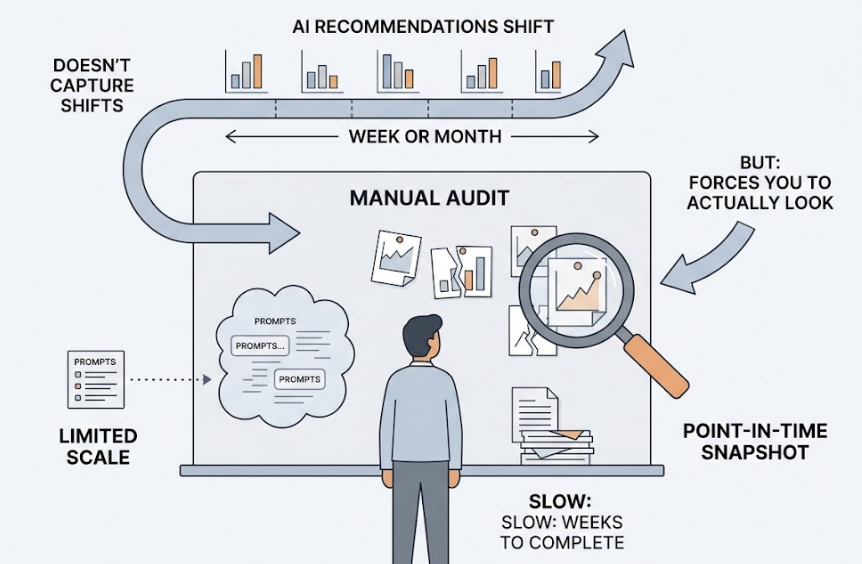
    Most teams default to manual testing: type a few prompts into ChatGPT, see if the brand appears, draw conclusions. That approach has three hard limits. It’s confined to a single platform. It can’t detect how visibility shifts over time. And it can’t tell you which competitors are being recommended instead of you.

    Topify was built specifically to close this gap. The platform tracks AI brand visibility across ChatGPT, Gemini, Perplexity, and other major AI platforms, measuring seven core metrics: visibility rate, mention frequency, sentiment score, recommendation position, source citations, prompt volume, and conversion visibility rate (CVR).

    The Basic plan starts at $99/month and covers 100 prompts and 9,000 AI answer analyses. Research indicates that 20-30 prompts is the minimum needed to establish a meaningful baseline. Below that, you’re reading noise.

    One concrete example: Topify’s analysis of Harness, a software delivery platform, found that while Harness dominated “Continuous Delivery” prompts, it had a visibility gap in “startup” and “simplicity” queries where GitHub Actions was the default recommendation. That kind of gap doesn’t show up in manual testing. It requires systematic prompt coverage across intent scenarios.

    3 Steps to Rank Higher in ChatGPT Search Results

    Once you have a baseline, the path forward follows a clear sequence.

    Step 1: Expand Your Citation Ecosystem

    Since 85% of AI citations come from third-party sources, this is where most of the leverage sits. Use source analysis to identify exactly which domains are driving your competitors’ recommendations. Then run targeted digital PR to earn coverage on those same outlets: industry media, technical blogs, and authoritative review platforms.

    Community presence matters specifically here. Authentic discussions about your brand on Reddit and industry forums carry outsized weight because LLMs prioritize community consensus as a proxy for real-world relevance.

    Step 2: Harmonize Your Brand Narrative

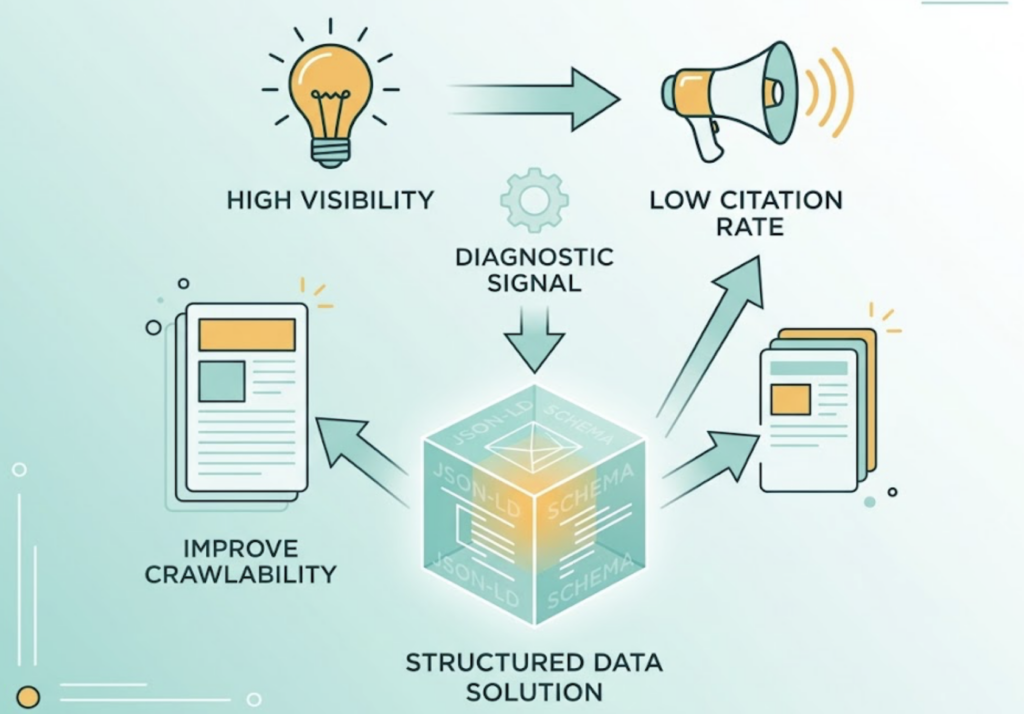
    Entity clarity is an AI trust signal. Use identical language for your category label, value proposition, and product description across every owned and earned property. Implement JSON-LD schema to explicitly define your organization, products, and industry associations. This gives AI retrieval systems a structured reference that removes ambiguity during synthesis.

    Inconsistency is an AI trust killer. Fragmented messaging across platforms splits the model’s confidence.

    Step 3: Monitor, Refresh, and Iterate

    AI-cited pages are 25.7% fresher than traditional Google results on average. Content updated within the last 30 days receives up to 6x more citations than content over a year old.

    Set a quarterly refresh cadence for high-value pages. More important: monitor model drift. LLMs are retrained regularly, and your brand’s representation can shift without notice. Monthly audits of visibility and sentiment scores let you catch changes before they compound into competitive losses.

    The timeline is faster than most teams expect. Technical improvements show impact within 2 weeks. Initial citations in Google AI Overviews typically appear in 3-4 weeks. Consistent ChatGPT mentions generally take 5-6 weeks, with mature category-level visibility requiring 2-3 months of sustained effort.

    The Conversion Data Behind AI Brand Visibility

    The ROI data from early GEO adopters is concrete.

    In one documented case, the agency Discovered helped a B2B SaaS client pivot from traditional SEO to a GEO-centric content model. By publishing 66 LLM-optimized articles in a single month, the brand achieved a 600% uplift in citations and grew AI-referred trials from 575 to over 3,500 per month within seven weeks.

    Across sectors, B2B SaaS companies report 800% year-over-year growth in AI-referred traffic, while retail brands tracked by Adobe Research observed a 12x jump in AI-sourced visits. AI-referred sessions also show 30% higher time-on-site, which indicates that users who find a brand through a synthesized recommendation arrive already in consideration mode, not discovery mode.

    That distinction matters for how you interpret visibility metrics. You’re not just trading impressions. You’re reaching buyers who’ve already been pre-qualified by the AI’s recommendation.

    Conclusion

    AI brand visibility is a quantifiable metric with a direct line to revenue. ChatGPT doesn’t reward your backlink investments or keyword density. It recommends brands that independent, authoritative sources consistently validate, and whose content is structured well enough to cite.

    Track your current position first. Then build the third-party presence, narrative consistency, and content structure that AI systems actually weight. The compounding advantage of getting this right today will be significantly harder to close in two years.

    Start with a visibility baseline. The gap is usually larger than expected, and more specific than a single manual test can reveal.


    FAQ

    Does ranking in ChatGPT work like Google SEO?

    No. Google SEO is built on backlinks, keyword density, and technical site performance. ChatGPT ranking (GEO) is driven by entity density in training data, independent third-party consensus, and how structurally citable your content is for RAG extraction.

    How long does it take to improve AI brand visibility?

    Technical and structural improvements typically show results within 2 weeks. Initial citations in Google AI Overviews appear in 3-4 weeks. Consistent mentions in ChatGPT or Gemini generally take 5-6 weeks, with mature category-level visibility requiring 2-3 months of sustained optimization.

    Which AI platforms should I track first?

    Start with ChatGPT, which serves 900 million weekly users, and Perplexity, which offers the most transparent citation data due to its retrieval-first architecture. Monitor Google AI Overviews concurrently since they directly affect traditional organic click-through rates.

    What’s the difference between AI mentions and AI brand visibility?

    An AI mention is a single occurrence of a brand name in a response. AI brand visibility is a composite score that weights mention frequency by the authority of citing sources, the sentiment of the description, and the recommendation position relative to competitors.

    Can small brands rank in ChatGPT results?

    Yes. Unlike Google, which often defaults to high-authority legacy domains, AI models prioritize the most relevant and citable answer for a specific prompt. A small brand that builds structured, expert content corroborated by community discussion can outrank larger competitors in niche generative queries.


    Read More

  • 6 Signals That Decide If Google AI Overviews Cites You

    6 Signals That Decide If Google AI Overviews Cites You

    Most brands are still optimizing for rankings. That’s no longer enough.

    Google AI Overviews now trigger on approximately 48% of all tracked queries, up 58% year-over-year. When an AI Overview is present, organic CTR for informational queries drops 61%, from 1.76% to 0.61%. Even the first organic position loses 58% of its clicks.

    Being cited in the AI Overview isn’t a bonus. It’s often the only way to stay visible at all.

    Here’s the part most SEO playbooks miss: AI Overviews doesn’t select sources the same way Google’s ranking algorithm does. It runs on a separate extraction logic that rewards a specific set of content signals. Get those signals right, and your brand gets cited. Miss them, and you’re invisible, regardless of where you rank.

    These are the six signals that actually determine whether you make the cut.

    AI Overviews Doesn’t Just Pull From Page One. It Pulls From Pages That Answer Directly.

    About 76.1% of URLs cited in AI Overviews do rank in Google’s top 10. So yes, authority still matters. But ranking alone doesn’t get you cited.

    The filter that comes after ranking is extractability: can Google’s generative parser pull a clean, self-contained answer from your page without needing to read the whole thing? If the answer to a query is buried in paragraph six after 300 words of preamble, the AI will skip your page and pull from the one that leads with the answer.

    That’s the gap most brands can’t see in their analytics.

    Signal 1: Your Content Answers the Query in the First Sentence, Not the Fifth

    AI Overviews are built on RAG (Retrieval-Augmented Generation). The system retrieves candidate passages and evaluates which one most directly satisfies the query intent. It’s looking for a 40-60 word answer block it can extract and synthesize without much interpretation.

    If your H2 sections start with background context, history, or “in this section we’ll cover,” you’re training the parser to skip you.

    Rewrite every major section so the first sentence delivers the answer. The supporting evidence comes after.

    This is the “Inverted Pyramid” format: conclusion first, reasoning second. It feels unnatural for traditional editorial writing. For AI extraction, it’s non-negotiable.

    Signal 2: Other Sites Talk About You. You Don’t Just Talk About Yourself.

    Here’s the thing: AI models don’t trust brands that describe themselves. They trust brands that are described by others.

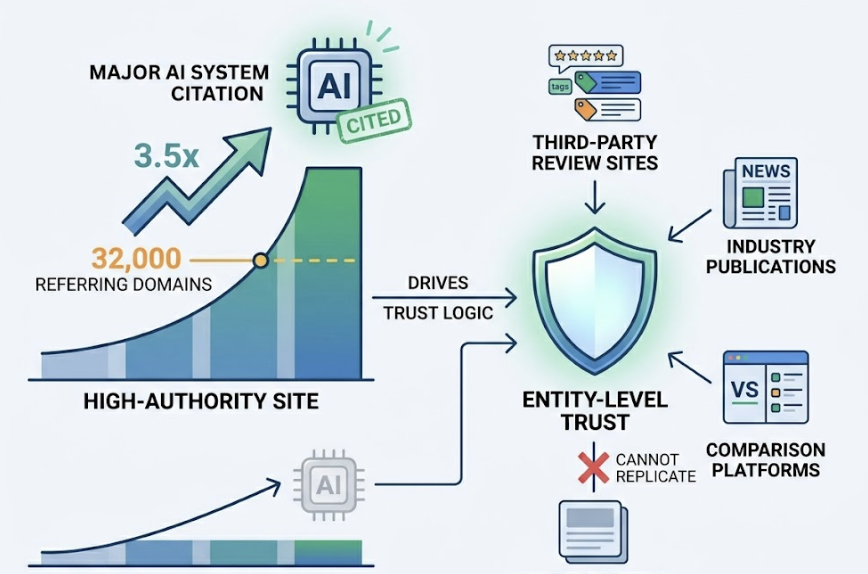
    Sites with over 32,000 referring domains are 3.5x more likely to be cited by major AI systems than lower-authority sites. That number reflects the same trust logic that drives AI citation decisions. A brand that appears on third-party review sites, industry publications, and comparison platforms carries “entity-level trust” that no amount of owned content can replicate.

    This is less about link building in the traditional sense, more about what the broader web says about you. Product reviews, analyst mentions, press coverage, and community discussions on platforms like Reddit all feed into this signal.

    If the only pages citing your brand are your own, the AI has no external consensus to draw from.

    Signal 3: Your Expertise Is Verifiable, Not Just Claimed

    AI models are risk-averse by design. Before citing a source, Google’s generative system runs a version of E-E-A-T filtering: does this content come from someone with demonstrated, verifiable credentials?

    “Demonstrated” is doing a lot of work in that sentence. Saying “our team of experts” in your About page isn’t verifiable. A named author with a linked professional profile, wrapped in Person schema, is.

    Every author bio on your site should include: real name, professional title, verifiable credentials, and ideally a link to a third-party profile. The author page itself should be structured with Person schema so Google can machine-read the credential data rather than guess at it.

    This single change, adding structured author attribution, is often the fastest route to improved AI citation rates for content-heavy sites.

    Signal 4: You Have Original Data That AI Can Attribute to You

    “According to [Brand]’s research…” is one of the sentence structures AI Overviews uses most often when it cites a specific source. That phrasing only appears when your content contains something nobody else has: original data.

    Research shows that incorporating fact density elements, including specific statistics, proprietary benchmarks, and cited third-party data, can lift visibility for lower-ranked websites by up to 40%. Original data creates an even stronger pull because AI systems can’t get it anywhere else.

    This doesn’t mean you need a massive research budget. Even a structured analysis of your own product usage data, a short customer survey with n=50, or a tracked experiment published with methodology counts. The key is owning the number and making it attributable.

    Publish it with a clear, citable title. Reference it internally across your content. Give AI something to quote.

    Signal 5: Schema Markup Tells the Parser What to Extract and Where

    Without schema, AI parsers make probabilistic guesses about what your content means. With schema, you give them hard-coded truth they don’t need to guess at.

    FAQPage schema is particularly effective for AI Overview coverage because the question-and-answer format maps directly onto how AI summaries are constructed. HowTo schema does the same for procedural content. Article schema validates authorship and publication date, two signals AI uses to judge recency and credibility.

    A page with strong schema doesn’t just have a higher chance of being cited. It’s cited more accurately. That matters if you care about how your brand is represented, not just whether it appears.

    Implementing schema on your highest-traffic informational pages is one of the lowest-effort, highest-impact moves for AI Overviews optimization.

    Signal 6: You Own a Topic, Not Just a Few Pages About It

    AI systems use content topology to estimate authority. A brand with 40 deeply interlinked pages on a single topic reads as an expert. A brand with three pages on that topic and 60 pages on unrelated things reads as a generalist.

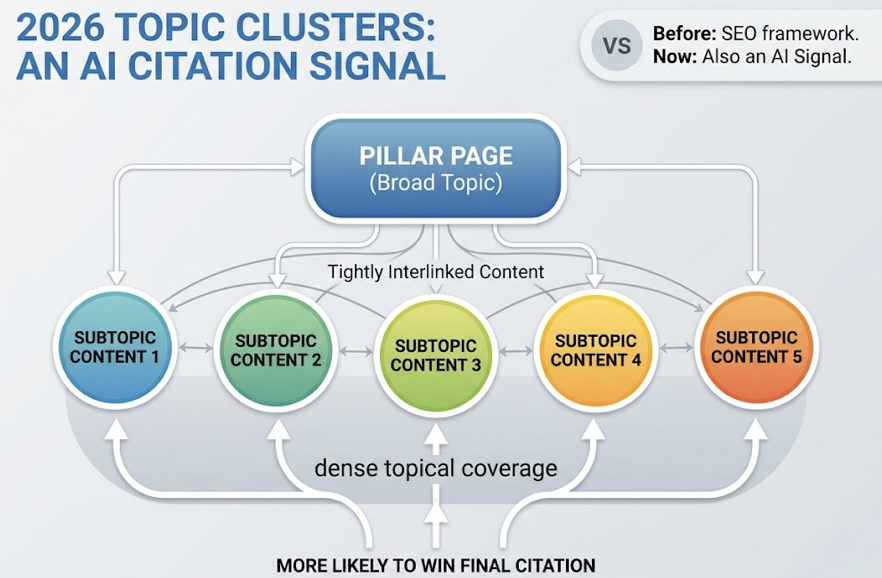
    Topic clusters, the practice of building a pillar page supported by tightly interlinked subtopic content, were originally an SEO framework. In 2026, they’re also an AI citation signal. When an AI retrieves candidate content for a query, a site with dense topical coverage of that domain is more likely to surface multiple candidate pages, and more likely to win the final citation.

    The internal link structure matters too. If your best content isn’t linked from related pages, the AI’s crawler may never connect the dots between what you know and the query it’s trying to answer.

    The Fastest Way to Find Out Which Signals You’re Missing

    Knowing the six signals is the first step. Finding which ones are actually failing you is where most brands get stuck, because this information doesn’t appear in standard analytics or rank tracking tools.

    Brands cited in AI Overviews earn 35% more organic clicks and 91% more paid clicks than those that aren’t. That spread is large enough to be the difference between a profitable content program and one that’s slowly losing ground to competitors who figured this out earlier.

    Topify’s Source Analysis feature tracks exactly which domains and URLs Google AI Overviews is pulling from for your core queries. You can see whether your brand appears in the citation pool, which competitors are being pulled instead, and where the content gaps are by topic. The platform’s Visibility Tracking covers AI Overviews specifically, so you’re not relying on proxy metrics or manual spot-checks.

    A structured audit using these signals takes about a week to complete. Start with the queries where you rank well but aren’t getting cited, those are the ones where the gap is most likely structural, not authority-based.

    Conclusion

    Ranking is the cost of entry. Citation is the goal.

    AI Overviews has created a two-tier visibility system: brands that rank and brands that get cited. The second group earns the clicks. The first group watches their traffic numbers trend quietly downward while wondering what changed.

    The six signals above aren’t new concepts. Direct answers, third-party authority, verifiable E-E-A-T, original data, structured markup, and topical depth have all been on the content quality checklist for years. What’s changed is how consequential each one has become when an AI is deciding which source to trust in under a second.

    Fix the signals. Get cited. That’s the playbook.


    FAQ

    Does domain authority directly affect AI Overviews citation rates?

    It correlates, but it’s not determinative. Sites with high authority are cited more often because they tend to satisfy multiple signals at once: they have structured content, third-party mentions, and verified E-E-A-T. A lower-authority site that scores well on extractability, schema, and original data can outperform a higher-authority site that doesn’t optimize for AI extraction. Authority sets the floor; the six signals determine who actually gets cited within that range.

    How long does it take to see results after optimizing these signals?

    Structural changes like schema markup and content reformatting can show results in two to eight weeks, since Google re-crawls frequently updated pages on a faster cycle. Third-party authority signals take longer, typically three to six months, because they depend on external publications and community platforms updating their content. Original data campaigns tend to accelerate citation rates faster than most tactics because they give AI systems something unique to reference.

    Can a small brand with limited authority get cited by AI Overviews?

    Yes, especially on long-tail and niche queries where established brands haven’t built deep topical coverage. Brands that own a specific topic at depth, even without massive domain authority, often outperform larger competitors on targeted queries. The key is focus: narrow the topic cluster, maximize extractability, and publish original data. AI Overviews doesn’t always default to the biggest brand. It defaults to the most useful, most extractable source for that specific query.


    Read More

  • 30 Days to Make AI Recommend Your Brand

    30 Days to Make AI Recommend Your Brand

    Your competitor just appeared in a ChatGPT answer about your core category. You didn’t.

    That’s not a fluke. It’s a visibility gap that’s been growing while your team was focused on Google rankings. And if you don’t know exactly where you stand in AI search right now, you’re already behind.

    The good news: AI search visibility is measurable, and it’s fixable. Here’s a 30-day tactical playbook for doing both.

    Most Brands Don’t Know They’re Invisible to AI Until It’s Too Late

    AI agent requests have reached approximately 88% of human organic search activity as of early 2026. That’s not a distant projection. It’s happening now, and most marketing teams are navigating it blind.

    Here’s what makes this shift different from previous disruptions: 93% of AI-driven search sessions end without a user clicking through to a website. The AI answers the question directly. No traffic. But the recommendation it gives, whether it names your brand or your competitor, heavily influences the final purchase decision.

    The gap between traditional SEO performance and AI visibility is wider than most brands expect. A 40-60% disconnect exists between Google rankings and AI citation rankings. You can rank first on Google and never appear in an AI answer, because LLMs evaluate content using entirely different criteria than search crawlers.

    That’s the gap most brands still can’t see.

    Platforms like Topify are built specifically for this problem, giving marketing teams a structured way to track, measure, and act on their AI search presence across ChatGPT, Gemini, and Perplexity. Without that kind of visibility, you’re optimizing in the dark.

    The 30-Day Framework: Audit, Optimize, Amplify

    The framework runs in three phases, each building on the last:

    • Days 1-10: Audit — Establish a baseline. Where does your brand actually appear? On which platforms? For which prompts? How do you compare to competitors?
    • Days 11-20: Optimize — Fix the structural and narrative gaps that cause AI to skip your brand.
    • Days 21-30: Amplify — Expand your presence in the third-party ecosystem where AI models source their citations.

    The sequence matters. Skipping the audit and jumping straight to optimization is guesswork.

    The stakes are real: visitors arriving via AI search recommendations convert at 4.4x to 5x the rate of traditional organic traffic. These users arrive pre-qualified by the AI’s synthesis of reviews, documentation, and community sentiment. Losing visibility in this channel means losing your highest-intent customers.

    Days 1-10: Run Your AI Visibility Audit Before You Fix Anything

    The first ten days are about measurement, not action. You need a baseline before you know what to fix.

    Step 1: Track your brand across AI platforms simultaneously

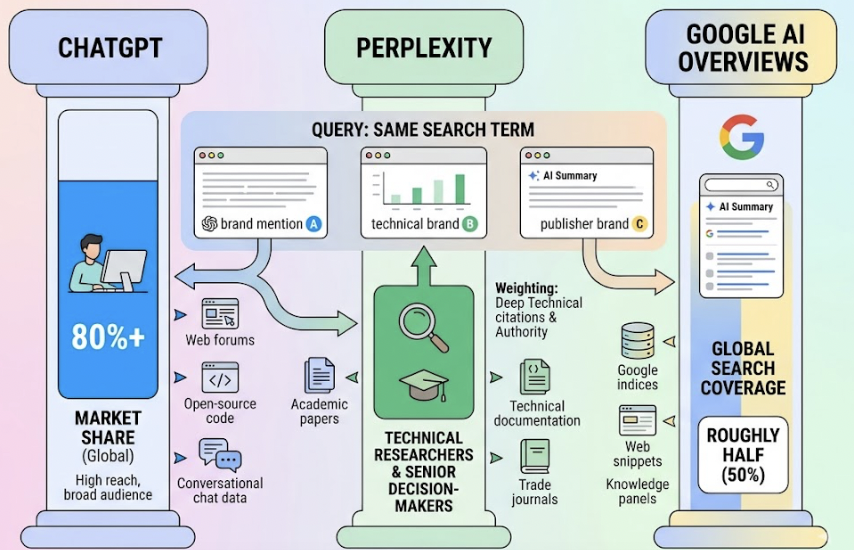
    ChatGPT holds over 80% of the AI search market. But Perplexity is the tool of choice for senior decision-makers and technical researchers. Google AI Overviews appear in roughly half of all global searches. Each platform pulls from different data sources, weights citations differently, and surfaces different brands for the same query.

    Your brand might be well-represented in ChatGPT and completely absent in Perplexity. That’s “visibility variance,” and it’s common.

    Manual testing won’t get you there at scale. Testing 100 prompts across three platforms takes 2-4 hours per platform, with results that shift based on time of day and phrasing. Topify’s Visibility Tracking automates this, giving you a statistically reliable presence rate across all major AI platforms simultaneously.

    Step 2: Identify which prompts trigger your category

    Don’t just track your brand name. Track the prompts your buyers actually use. Category discovery prompts (“What are the best CRM tools for healthcare?”) and competitor comparison prompts (“Brand A vs. Brand B for scalability”) are where the real visibility battles play out. The audit maps which prompts surface your brand and which hand the win to a competitor.

    Step 3: Run a horizontal competitive comparison

    Appearing in an AI answer is only half the metric. Position matters. Research shows the AI’s top-ranked recommendation becomes the user’s top choice 74% of the time. If you’re appearing fifth out of five, you’re technically visible but practically invisible.

    Topify’s Competitor Monitoring automates this comparison, showing you where rivals outrank you, on which prompts, and which sources are driving their advantage. That last piece is what makes the remediation phase actionable.

    PlatformPrimary Citation SourcesUser Persona
    ChatGPTWikipedia (47.9%), Product DocsGeneral, Personal, Creative
    PerplexityReddit (46.7%), Industry NewsExecutive, Research-heavy
    Google AI OverviewsYouTube (23.3%), Reddit (21%)Broad Consumer, E-commerce

    Days 11-20: Fix the Gaps AI Keeps Skipping Over

    AI models fail to recommend a brand for one of three reasons: the sources aren’t authoritative, the content isn’t extractable, or the sentiment signals are mixed. The second ten days address all three.

    The 85/15 Problem

    Here’s the finding that usually surprises marketing teams: 85% of the information an AI uses to describe a brand comes from third-party domains. Only 15% comes from the brand’s own website.

    AI engines operate on consensus, not claims. If your product page is the only source for a specific differentiator, the AI won’t trust it. If that same differentiator is corroborated by three industry publications and a Reddit thread, it becomes part of the AI’s confident recommendation.

    Topify’s Source Analysis reverses this blind spot. It shows you which domains the AI is citing most frequently in your category, so your team can identify exactly where your content footprint is missing.

    Sentiment correction

    LLMs don’t just list brands. They frame them. A recommendation might read: “Brand X is a strong choice, though users frequently report issues with the onboarding process.” That caveat is often sourced from a single forum thread or an outdated review. Left unaddressed, it shapes how every AI answer positions your brand.

    Topify Sentiment Analysis gives you a 0-100 score for how AI perceives your brand across different themes, from customer support to pricing to product reliability. When sentiment is low in a specific area, you can trace the sources, address the underlying issues, and update your owned content with evidence-based responses that AI models can ingest.

    Structural optimization for extractability

    AI models prioritize content they can chunk and synthesize cleanly. A few specific changes have outsized impact:

    • Answer blocks: a concise 40-60 word summary at the start of each content section
    • Hierarchical structure: strict H1-H2-H3 formatting that helps models parse topic relationships
    • Data density: including statistics and tables increases citation-worthiness by 25-40%
    • Schema markup: Wikidata-linked JSON-LD helps AI systems verify entity authority

    These aren’t cosmetic changes. They’re the difference between content that AI can extract and content it skips.

    Days 21-30: Get Your Brand Into More AI Answers

    The final phase isn’t about your own content. It’s about your presence in the third-party ecosystem where AI models hunt for authoritative signals.

    Because AI models function as probabilistic consensus engines, they need distributed corroboration. Branded web mentions correlate with AI visibility at a rate of 0.664. Traditional backlinks, by comparison, correlate at only 0.218. The signals that drive SEO rankings and the signals that drive AI citations are not the same thing.

    Three amplification channels matter most:

    Community engagement: Reddit is the most cited domain across all major AI platforms. Authentic participation in relevant subreddits and industry forums, not promotional posts, but genuine answers and discussions, builds the kind of distributed signal AI models weight heavily.

    Earned media distribution: Journalistic sources account for 47% of all AI citations. A mention in a credible industry publication isn’t just a PR win; it’s a direct citation signal to every major LLM.

    Content clusters: Building 10-15 pieces of content that thoroughly cover a specific topic from multiple angles increases the AI’s confidence in recommending your brand as the authoritative source on that subject. Breadth alone doesn’t do it. Depth does.

    As this phase progresses, Topify’s Position Tracking monitors whether your Recommend Rank is climbing relative to competitors. The CVR (Conversion Visibility Rate) metric ties this back to business impact, estimating how changes in AI visibility translate to lead quality and conversion behavior.

    The 5 Metrics That Tell You the 30 Days Actually Worked

    Don’t measure effort. Measure outcome.

    KPIWhat It Measures30-Day Target
    Visibility Score% of category queries where your brand appears+20-40% from baseline
    PositionAverage rank in AI recommendation listsTop 3 for priority prompts
    Sentiment Score% of positive or neutral brand framingAbove 80%
    Source CoverageDiversity of external domains citing your brandMentions across 4+ platforms
    CVRLead/conversion rate from AI-referred traffic4x traditional organic

    The Visibility Score and Position tell you if you’re in the room and where you’re standing. Sentiment tells you how you’re being described. Source Coverage tells you how defensible that position is. CVR ties everything to revenue.

    Topify’s dashboard surfaces all five metrics in a single unified view, which matters when you’re presenting GEO impact to a CMO or board who still think in terms of Google rankings.

    Conclusion

    The 30-day playbook isn’t a campaign. It’s the beginning of a permanent function.

    AI retrieval models update frequently. Data licensing agreements shift citation patterns. Emerging platforms change which sources get weighted. A single sprint won’t hold your position. What holds it is a continuous monitoring loop: regular audits, ongoing source coverage, and systematic sentiment correction.

    The brands that will own AI search visibility in 2026 and beyond aren’t the ones with the biggest content budgets. They’re the ones that started measuring earliest, fixed their gaps methodically, and built a broad enough third-party footprint that AI models treat them as consensus choices.

    That process starts with knowing where you actually stand. Start your AI visibility audit with Topify and find out.

    FAQ

    What is AI search visibility and how is it measured?

    AI search visibility measures how frequently and prominently your brand appears in answers generated by large language models. Unlike traditional SEO, it’s tracked using citation rates and share of voice within AI-generated responses rather than SERP positions.

    How is AI search visibility different from traditional SEO?

    Traditional SEO optimizes for keywords, backlinks, and page speed to rank in “ten blue links.” AI search visibility focuses on citation-worthiness, entity clarity, and multi-source corroboration. A page can rank first in Google and never appear in an AI answer if it lacks the structural elements LLMs prioritize.

    How long does it take to see results in AI search?

    Brands typically see measurable visibility shifts within 1-3 months of consistent optimization and seeding. That’s significantly faster than traditional SEO, which often takes 6 months or more to show rank movement. AI retrieval models update their knowledge more frequently through RAG processes.

    Can small brands improve AI visibility without a big content budget?

    Yes. AI models prioritize structural clarity and answer quality over domain authority or content volume. A small brand that provides the most extractable, well-structured answer for a specific niche query can outrank much larger incumbents that haven’t optimized for extractability.

    Which AI platforms matter most for brand visibility?

    For general consumer reach, ChatGPT holds the largest market share. For B2B and technical research audiences, Perplexity carries significant weight with senior decision-makers. Google AI Overviews are most critical for brands dependent on traditional organic traffic and e-commerce discovery.

    Read More

  • Agentic SEO: How AI Agents Are Changing Brand Discovery

    Agentic SEO: How AI Agents Are Changing Brand Discovery

    Traditional SEO gets you ranked. Agentic SEO gets you chosen, by AI agents acting on users’ behalf before they ever open a search box.

    Here’s a scenario that’s playing out more often than most marketers realize. A user types into ChatGPT: “Find me reliable cloud storage for a 50-person agency, under $20 per seat.” The agent calls a search tool, crawls a dozen sites, cross-references G2 reviews, checks Reddit threads, and outputs one recommendation with a clear explanation of why. The user says “sounds good” and signs up.

    Your brand’s Google ranking? Never entered the picture.

    This is what Agentic SEO is actually about. Not rankings, not even AI citations. The question is whether autonomous agents, the ones making decisions on your users’ behalf, include you in their final answer.

    The Search Box Is No Longer the Front Door

    For two decades, the path was predictable. User types a query, a ranked list of links appears, user clicks through to a brand website. That website was the decision environment. Every conversion test, every landing page, every headline variant was designed for that moment.

    AI agents break that path entirely.

    Systems like OpenAI’s Operator, Microsoft Copilot, and Google’s Gemini don’t return a list of links. They take an instruction, execute a multi-step research process, and deliver a singular recommendation. They browse on the user’s behalf, synthesize across dozens of sources, and often complete the entire task, including purchase, without the user ever visiting a brand website.

    The brand website is no longer the decision environment. The agent’s reasoning engine is.

    For commercial brands, the stakes compound quickly. With the Universal Commerce Protocol (UCP), developed by Google and Shopify, agents can now complete transactions directly inside conversational interfaces. A user asks for a weekender bag under $250 and checks out without ever landing on a storefront. If your brand isn’t in the agent’s selection set, you don’t just lose a click. You lose the sale entirely.

    Agentic SEO, Defined (Without the Jargon)

    The industry uses a lot of terms loosely. AEO, GEO, Agentic SEO. They’re not interchangeable.

    Optimization TypeWhat You’re Optimizing ForTypical Platforms
    Traditional SEOSearch engine rankings, human clicksGoogle, Bing
    GEOCitation in AI-generated answersChatGPT, Perplexity, AI Overviews
    Agentic SEOSelection by autonomous agents acting on users’ behalfAI Operator, Copilot, agent workflows

    GEO gets you mentioned. Agentic SEO gets you chosen.

    The difference matters because an agent’s goal isn’t to summarize information. It’s to complete a task. When an agent is booking, comparing, or purchasing, it’s making a judgment call about which brand to act on. That judgment runs on a different set of signals than keyword relevance or backlink authority.

    Agentic SEO is the practice of ensuring your brand is structured, verified, and consistent enough to be selected at the end of that judgment process.

    How AI Agents Actually Decide What to Recommend

    This is the part most SEO guides skip over. The mechanics matter.

    An agent doesn’t search. It executes. When a user hands it a task, it breaks that task into sub-tasks, calls tools (web search APIs, the Model Context Protocol), crawls pages that offer structured and machine-readable information, then verifies.

    That last step is where most brands get filtered out.

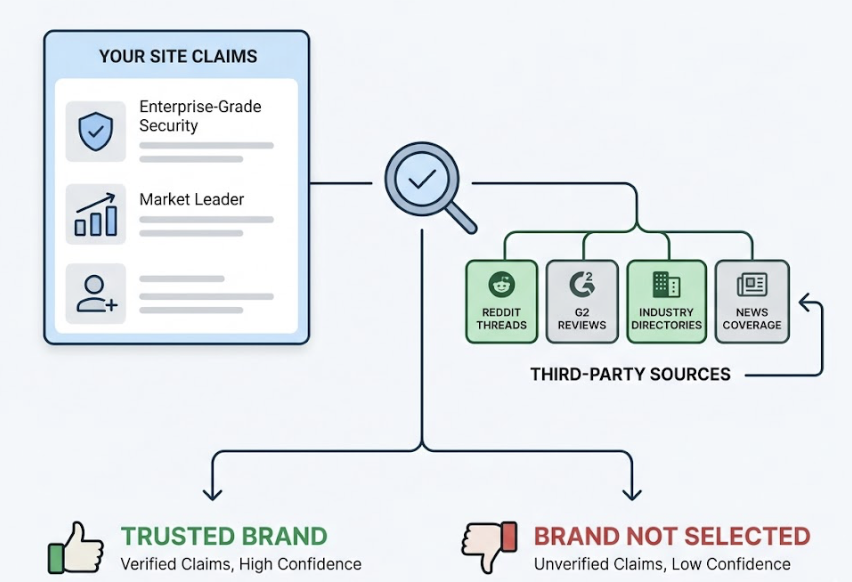
    The agent cross-references what your site claims against what third-party sources say. It checks Reddit threads, G2 reviews, industry directories, and news coverage. If your site says “enterprise-grade security” but no credible third-party source corroborates that claim, the agent’s confidence in your brand drops. You don’t get selected because the agent can’t verify you.

    Three dimensions drive agentic selection:

    Brand Clarity: Can the agent build a coherent picture of what you offer? If your website says “premium” but Yelp says “budget,” the mixed signal creates ambiguity the agent won’t resolve in your favor.

    Brand Authority: Do independent sources validate your claims? Third-party sources are cited 6.5 times more often by AI engines than a brand’s own owned media. That’s not a minor factor.

    Brand Trust: Is your brand credible enough for an agent to build a plan around? For high-stakes actions like booking or purchasing, trust is the decisive threshold, and it’s earned externally, not declared internally.

    You Can Rank #1 on Google and Still Be Invisible to Agents

    Traditional SEO tools track the ten-blue-links world. Ahrefs and Semrush tell you where you rank on SERPs, how many backlinks you have, what keywords you’re targeting. Useful data, built for a model that agents are increasingly bypassing.

    The gap is structural. An agent may ignore the top organic result entirely if it detects a contradiction on a high-authority third-party site, or if the top result sits behind a login wall. No traditional SEO tool tracks that. None of them measure Share of Model, how often a brand appears and gets recommended across LLMs relative to its competitors.

    There’s also a decay problem that most teams aren’t accounting for. A Google ranking can hold for years. AI citations in platforms like ChatGPT Search or Perplexity decay in roughly 13 weeks if the content isn’t updated to reflect new data or industry shifts. The cadence required for agentic visibility is fundamentally different from what most SEO workflows are built for.

    Most content strategies compound this gap by optimizing for human readers. Persuasive copy, emotional hooks, conversion-focused layout. Agents are bot-readers. They prioritize neutral, fact-dense, structurally clear content. If your site is heavy on narrative and light on machine-readable structure, an agent will pass you over for a competitor that’s easier to process.

    3 Signals That Determine Whether Agents Select Your Brand

    Signal 1: Third-Party Consensus

    Agents verify before they recommend. That means earned media, review platform presence, and forum mentions aren’t just brand awareness plays anymore. They’re the grounding data agents use to calibrate trust.

    Strategic digital PR, getting your brand referenced on Reddit, G2, or in credible industry publications, now directly influences whether agents include you in their recommendation set. If the consensus says you’re credible, the agent treats you as credible. It’s that direct.

    Signal 2: Cross-Platform Narrative Consistency

    Inconsistency is a red flag for AI reasoning systems. If your core value proposition reads differently on your website, your LinkedIn profile, and your G2 listing, the agent’s confidence in your brand drops. Standardize descriptions, pricing context, and positioning across your entire digital footprint.

    Category leaders typically hold 35–40% Share of Model on high-intent prompts. That level of presence doesn’t happen by accident. It’s built on consistent, reinforced brand signals across multiple platforms over time.

    Signal 3: Machine-Readable Infrastructure

    This is the technical layer most marketing teams overlook. Agents favor content that’s structured for machine consumption: FAQPage schema, Product schema, pricing tables, feature comparison tables, and clear instructional guides. Content buried in complex JavaScript or locked behind paywalls is effectively invisible to most research agents.

    For e-commerce brands, UCP compliance is becoming non-negotiable. It lets agents see real-time pricing, inventory, and discounts, and complete transactions without human navigation. For SaaS and data-heavy products, exposing data through APIs or the Model Context Protocol allows agents to answer highly specific user questions with live data, a meaningful trust signal that pushes you ahead of competitors who don’t offer it.

    How to Start Measuring Your Agentic Visibility

    You can’t optimize what you can’t see.

    The first step is establishing a baseline for your brand’s current presence across AI systems. How often does your brand appear when a relevant prompt is submitted to ChatGPT, Perplexity, or Gemini? When it appears, is it being recommended or just listed as a footnote? How does that compare to your direct competitors?

    This is where Topify becomes practically useful. Topify tracks brand visibility across major AI platforms, monitoring seven key metrics: visibility rate, sentiment, position, volume, mentions, intent, and conversion visibility rate (CVR). It surfaces which sources AI engines are pulling from, which competitors are being recommended over you, and where gaps in your content strategy are creating blind spots.

    Brands with a visibility rate below 10% are effectively invisible to AI systems. The benchmark for market leaders runs at 80% or higher. Knowing where you sit is the starting point for knowing what to fix.

    Because LLMs generate probabilistic outputs (the same prompt can return different results), measuring agentic visibility requires sampling across prompt variations: “best CRM,” “top CRM for startups,” “CRM with the best security.” Topify handles this probabilistic sampling automatically, giving you a statistically grounded picture of your Share of Model rather than a single-point snapshot that might not reflect typical agent behavior.

    Conclusion

    The shift to agentic discovery isn’t coming. It’s already running in the background of how users make decisions about products, services, and brands.

    The brands that’ll have an advantage aren’t necessarily the ones with the biggest content budget. They’re the ones with the cleanest data, the most consistent narrative, and the strongest third-party validation. The ones that have made it easy for an agent to read, verify, and trust them.

    Establishing your baseline AI visibility now, before agentic traffic becomes the majority, is the highest-leverage move most marketing teams can make. The window for early positioning is open. It won’t stay that way.

    FAQ

    Q: Is Agentic SEO the same as GEO?

    No. GEO focuses on being cited in AI-generated answers. Agentic SEO covers the full autonomous workflow: research, verification, decision, and action. GEO is one component of an agentic strategy, but the latter also requires technical infrastructure like UCP and MCP that GEO doesn’t necessarily address.

    Q: What types of content do AI agents actually prioritize for crawling?

    Agents favor content that’s machine-readable and fact-dense: schema markup, pricing tables, feature comparisons, and clear How-To guides. They tend to skip content that’s conversational without supporting facts, hidden behind login walls, or rendered in complex JavaScript that’s difficult to parse.

    Q: Should I focus on GEO first or Agentic SEO?

    For most brands, starting with GEO builds visibility in current AI summary systems like Google AI Overviews. If you’re in e-commerce, travel, or software, layer in Agentic SEO primitives (UCP, MCP, structured data) in parallel. The technical investments overlap significantly, so there’s no reason to treat them as sequential.

    Q: Does Agentic SEO require a dedicated technical team?

    Not to get started. Adding schema markup, improving cross-platform consistency, and monitoring AI visibility don’t require engineering resources. A full-scale implementation with live API connections and MCP integrations does benefit from technical involvement. But the strategic groundwork is accessible to most marketing teams today.

    Read More

  • Agentic SEO: How to Track Your Brand Across AI Agents

    Agentic SEO: How to Track Your Brand Across AI Agents

    The first thing most brands do when they hear about agentic SEO is type their own name into ChatGPT. That’s the wrong starting point.

    Searching your brand name tells you almost nothing about how you’re actually performing. The real question is: when a buyer prompts an AI agent with “what’s the best tool for [your category],” does your brand appear? And if it does, where does it rank, and how does the AI describe you?

    Most brands have no idea. This guide walks through a repeatable, step-by-step process for building real visibility tracking across AI agents, so you stop guessing and start seeing the full picture.


    Your Brand Might Already Be Invisible to AI Agents

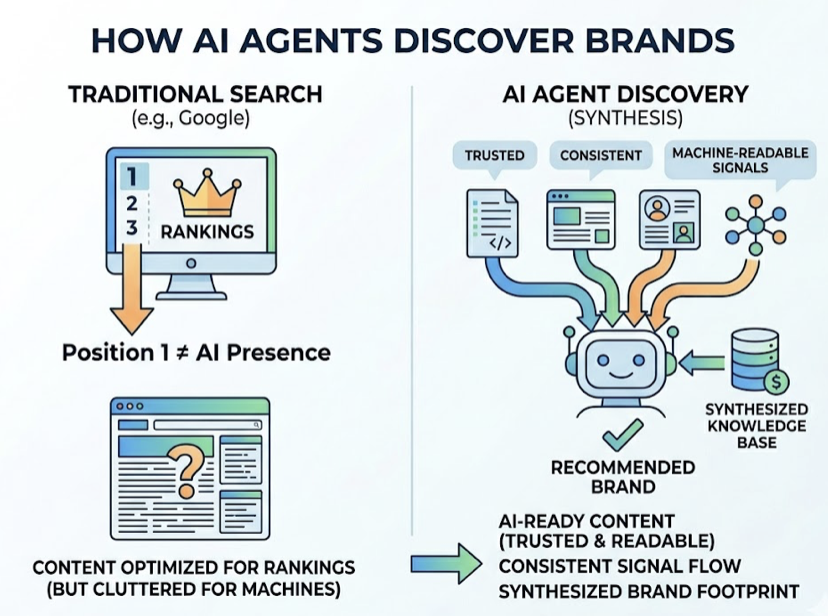
    Traditional SEO tells you how you rank in a list of blue links. Agentic SEO asks a different question entirely.

    AI agents don’t pull from search rankings. They synthesize from trusted, consistent, machine-readable signals across a brand’s entire digital footprint. A brand can sit at position one in Google and still be absent from every AI-generated recommendation because the two systems operate on fundamentally different logic.

    The gap is larger than most teams expect. Research shows AI models currently misrepresent 60% of brands, stating incorrect prices, discontinued features, or fabricated claims. Meanwhile, 93% of AI search sessions end without a website click, meaning the AI’s recommendation is the decision point, not a gateway to one.

    That’s the problem agentic SEO tracking is built to close.


    What “Tracking Visibility” Actually Means in Agentic SEO

    Brand tracking in agentic SEO isn’t a single metric. It’s a combination of three signals that need to be measured together: Visibility (whether you’re mentioned at all), Position (where you appear relative to competitors in the AI’s response), and Sentiment (how the AI characterizes your brand).

    Tracking any one of these in isolation will mislead you. A brand mentioned frequently but always framed as “a budget option” has a sentiment problem that raw mention counts won’t reveal. A brand that ranks first for one prompt type and disappears for another has a coverage gap.

    Here’s how agentic SEO metrics compare to what most marketing teams currently track:

    DimensionTraditional SEOAgentic SEO
    Visibility signalKeyword ranking positionBrand mention rate in AI responses
    Quality signalClick-through rateSentiment score + position in AI answer
    CoverageSearch query rankingsPrompt type coverage across platforms
    Competitive dataSERP shareCitation share vs. competitors

    The stakes are real: 73% of B2B buyers now report trusting AI product recommendations over traditional advertisements. If a competitor is cited in 80% of AI responses and your brand appears in 20%, that’s not a ranking problem. That’s an eligibility gap.


    Step 1: Map the AI Agents Your Audience Actually Uses

    Not every AI platform serves the same audience. Start with platform-audience fit before building a tracking system.

    ChatGPT currently holds between 60% and 78% of the global generative AI market and drives 87.4% of all AI-related referral traffic, making it the default priority for most brands. But the picture is more nuanced by buyer type.

    Perplexity AI skews toward research-intensive and technical queries, holding a stable 6-7% market share by focusing on high-accuracy citation. Google’s AI Overviews reach 2 billion monthly users, making it essential for any brand dependent on Google’s ecosystem. Microsoft Copilot has strong penetration in the 18-29 demographic through Office 365 integration.

    Match platforms to your buyer profile before you track anything:

    Audience TypePriority Platforms
    B2B / Enterprise buyersChatGPT, Perplexity, Copilot
    Consumer / General marketChatGPT, Google AI Overviews
    Research / Technical usersPerplexity, Claude
    Global / Emerging marketsChatGPT, Gemini

    Don’t try to track everywhere at once. Pick two or three platforms where your buyers are actually making decisions. Go deep on those before expanding.


    Step 2: Build a Prompt Library That Mirrors Real Buyer Queries

    AI agents respond to prompts, not keywords. The quality of your visibility tracking depends entirely on the quality of the prompts you’re testing against.

    Your prompt library needs to cover three types of queries: category queries (“what’s the best tool for X”), comparison queries (“X vs. Y, which should I use”), and recommendation queries (“I need help with Z, what do you suggest”). Each type reveals a different dimension of how AI agents perceive your brand.

    Here’s the thing: response variability makes low-volume tracking unreliable. Research by SparkToro found there’s less than a 1-in-100 chance that ChatGPT or Google’s AI will surface the same brand list in two consecutive responses to the same prompt. Every run produces slightly different outputs. You need enough data points to identify patterns, not noise.

    The recommended minimum is 20-50 conversational queries, run across dozens of sessions, to identify what researchers call a “stable consideration set”: the brands that appear frequently enough to be treated as reliable options by the model. Below that threshold, you’re tracking randomness.

    Topify‘s High-Value Prompt Discovery feature automates this step, continuously surfacing the prompts most likely to drive buyer decisions in your category, rather than relying on manual guesswork.


    Step 3: Run Systematic Tracking Across Platforms

    Once your prompt library is in place, tracking cadence becomes the next critical variable. AI model re-training cycles cause brands to be re-evaluated against fresh data, which means a brand that appeared consistently last month can drop out of recommendations this month without any change on your end.

    Minimum tracking frequency: weekly. Monthly snapshots are already stale.

    For each tracking run, record four dimensions per prompt: Was the brand mentioned? At what position relative to competitors? What was the sentiment framing (positive, neutral, cautious, or negative)? What sources did the AI cite to support its recommendation?

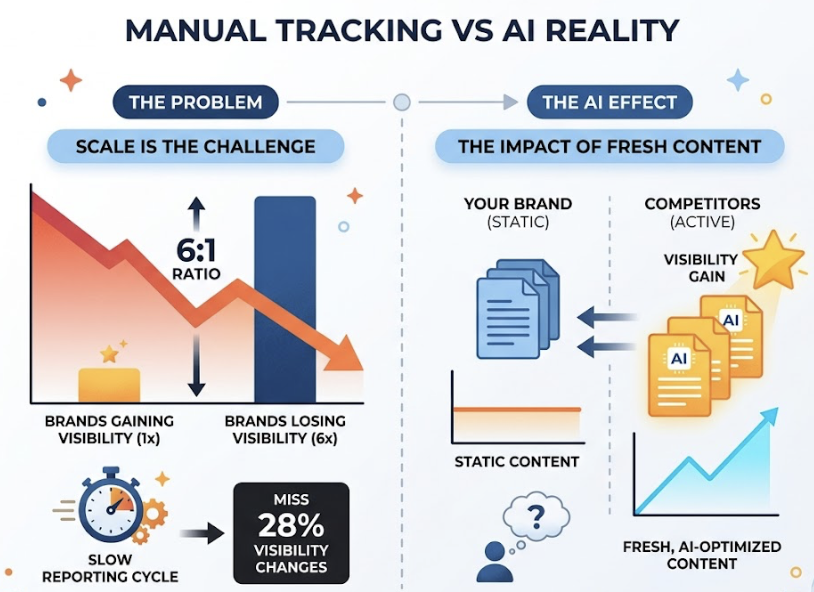
    Manual tracking at this scale isn’t feasible. For every brand that gains AI visibility in a given week, six lose it: a 6:1 negative-to-positive ratio driven by competitors publishing fresh, AI-optimized content while a brand’s representation stays static. Businesses relying on manual methods miss an estimated 28% of visibility changes simply because the reporting cycle is too slow.

    Topify‘s platform handles this automatically, tracking brand performance across ChatGPT, Gemini, Perplexity, DeepSeek, and other major platforms simultaneously, then generating seven standardized metrics per run: visibility, sentiment, position, volume, mentions, intent, and CVR. The Basic plan covers 100 prompts and 9,000 AI answer analyses per month, which is enough for most in-house teams to start building a reliable baseline.


    Step 4: Read the Data, Then Act on It

    Raw tracking data has no value without a clear framework for interpreting it. The most structurally useful framework here is the Net Sentiment Score (NSS), which classifies AI mentions across five categories: Endorsement, Neutral, Cautious, Negative, and Hallucination.

    The formula:

    NSS = [(Endorsement + Neutral Mentions) − (Negative + Hallucination Mentions)] / Total Mentions × 100

    NSS RangeWhat It MeansWhat to Do
    +60 to +100Strong positive positioningMaintain signals; expand to adjacent categories
    +20 to +59Net positive with gapsStrengthen third-party credibility sources
    −19 to +19Neutral or mixedAddress cautious or negative drivers immediately
    −20 to −100Net negativeRemap your digital entity across authoritative sources

    Each metric category points to a specific action. Low visibility means you’re absent from the AI’s consideration set — build topical coverage on the prompts where you’re missing. Low position means you’re mentioned but outranked — analyze which domains AI platforms are citing for higher-ranked competitors and close those content gaps. Negative or cautious sentiment typically signals inconsistent entity data across your website, directories, and third-party platforms.

    Hallucinations are the most urgent issue. When AI models state incorrect facts about your brand — wrong pricing, discontinued features, fabricated capabilities — the fix requires proactive “entity remapping”: publishing clear, authoritative, machine-readable corrections across your entire digital footprint. Forty-seven percent of B2B purchase decisions now involve an AI research phase; a hallucinated fact at that stage costs you the deal before you ever knew you were competing for it.

    Topify‘s Source Analysis feature shows exactly which domains AI platforms are citing when they respond to prompts in your category. Competitor Monitoring reveals the specific prompt types sending buyers to competitors instead of you, giving your team a clear list of gaps to close.

    Data without action is just a dashboard.


    3 Mistakes That Make Agentic SEO Tracking Useless

    Tracking only one platform. ChatGPT dominates with 810 million daily users, but your buyers may be using Perplexity for technical research or encountering Google AI Overviews during category discovery. Single-platform tracking creates blind spots in exactly the prompt types where you’re most vulnerable.

    Tracking too infrequently. Quarterly or monthly snapshot audits are already outdated by the time they’re reviewed. AI model updates re-evaluate every brand in the training corpus. The 6:1 ratio of brands losing visibility versus gaining it compounds quickly when tracking gaps let competitors pull ahead undetected.

    Measuring mentions without context. Being mentioned fifth out of five with a “cautious” framing is worse than not being mentioned at all. It signals to the model that your brand exists in the consideration set but isn’t the safe choice. Visibility data without position and sentiment makes your tracking misleadingly positive and leads to the wrong optimization decisions.

    Conclusion

    Tracking your brand across AI agents follows a clear sequence: map the platforms your buyers use, build a prompt library that mirrors real purchase queries, run systematic weekly tracking, and act on what the NSS and citation data reveal.

    The brands building this infrastructure now, before AI-driven discovery becomes the primary buyer research channel, will hold a compounding advantage over those still optimizing for traditional search rankings. Visibility in agentic SEO comes before optimization. And in the agentic era, being eligible is the new ranking factor.

    Topify is built specifically for this workflow, tracking brand visibility, sentiment, position, and citation sources across the major AI platforms with automated reporting and one-click optimization execution. The Basic plan at $99/month covers 100 prompts and 9,000 AI answer analyses across ChatGPT, Perplexity, and AI Overviews.


    FAQ

    What’s the difference between Agentic SEO and GEO? 

    GEO (Generative Engine Optimization) refers to optimizing content to appear in AI-generated responses. Agentic SEO is broader: it covers the full continuous workflow of AI agents that sense, plan, and act, including tracking, optimization, execution, and performance monitoring. GEO is one component of an agentic SEO strategy.

    How many prompts do I need for reliable visibility data? 

    Research points to 20-50 conversational queries as the minimum for a stable dataset. Below that threshold, response variability makes it difficult to distinguish real patterns from noise in the AI’s outputs.

    Can small brands compete with large brands in AI agent recommendations? 

    Yes, and often more effectively. AI models prioritize entity consistency and topical depth over media budgets. A brand with clear, consistent, machine-readable information across its website, directories, and third-party sources will outperform a large brand with fragmented or contradictory messaging.

    How often do AI agents change which brands they recommend? 

    Frequently. For every brand gaining AI visibility in a given week, six are losing ground. Model updates, competitive content, and query sensitivity all drive this volatility. Weekly tracking is the minimum cadence for catching changes before they compound.

    What’s the fastest way to improve brand visibility in AI agents? 

    Fix entity consistency first. Ensure your brand name, description, pricing, and key claims match exactly across your website, Google Business Profile, industry directories, and review platforms. Cross-source consensus is how AI models determine which brands are “safe” to recommend. Inconsistency signals risk, and AI agents are trained to avoid risk.


    Read More

  • GEO vs AEO vs SEO: How to Measure Each in 2026

    GEO vs AEO vs SEO: How to Measure Each in 2026

    Your keyword rankings are holding steady. Organic traffic is down for the third quarter in a row. And the most common explanation you’ve heard is “AI Overviews.” The problem is, that’s only part of the picture. Google’s AI snippets are one thing. ChatGPT recommending a competitor instead of you is something else entirely. These are two separate measurement problems, and most teams are still treating them as one.

    Three channels. Three different scorecards. Here’s how they actually work.

    Three Disciplines, Three Different Scorecards

    Search has moved through three distinct phases: keyword matching, featured snippet extraction, and now synthetic AI recommendation. In 2026, each phase has its own measurement logic, and they don’t overlap as much as marketers assume.

    SEO answers the question: where do I rank? Its domain is Google and Bing, and its metrics are positions, organic traffic, and backlink authority. It’s the most mature measurement system of the three.

    AEO asks: am I being extracted? It focuses on whether Google AI Overviews or Bing Copilot pulls your content into a generated answer block, regardless of where your page ranks. You could be #4 and still get cited in an AI Overview. You could be #1 and get ignored.

    GEO asks a different question entirely: does AI recommend me? Its targets are ChatGPT, Perplexity, Gemini, and DeepSeek. These platforms don’t index your page the way Google does. There’s no SERP. There’s no rank. There’s only whether the model includes you in a synthesized response, in what context, and ahead of or behind your competitors.

    DimensionSEOAEOGEO
    Target PlatformGoogle, BingGoogle AIO, Voice AssistantsChatGPT, Perplexity, DeepSeek
    Core QuestionWhere do I rank?Am I being cited?Does AI recommend me?
    Key MetricsRank, Organic TrafficSnippet rate, AIO trigger rateVisibility Rate, Mention Rate, Sentiment
    Primary ToolsAhrefs, SEMrushSearch Console, SERP monitorsTopify

    These three don’t replace each other. But they measure fundamentally different things, and conflating them is how brands end up with reporting gaps they can’t explain.

    What SEO Measurement Actually Looks Like

    SEO tracking is well understood: keyword rankings, organic traffic, CTR, domain authority, and backlink growth. Most teams have this covered.

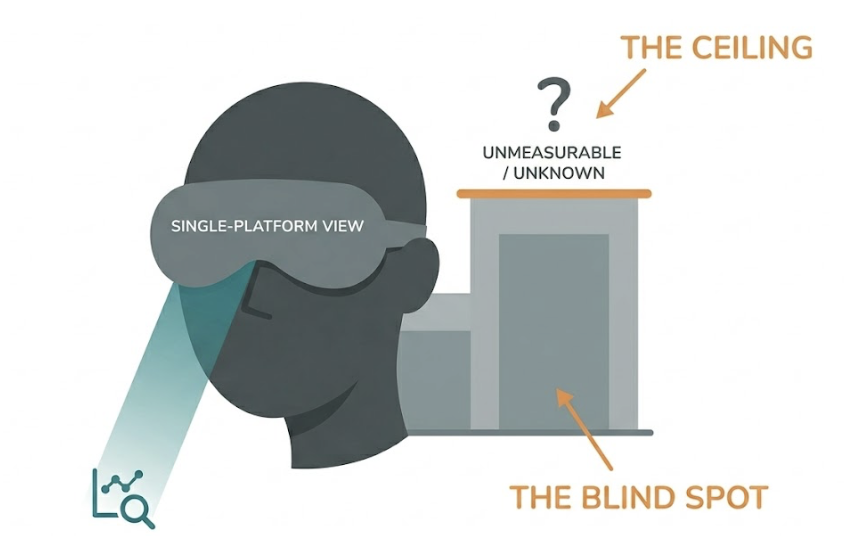
    What’s less understood is the ceiling SEO measurement has hit. Over 60% of Google searches now end without a click. When an AI Overview appears in the SERP, the #1 organic result sees its CTR drop from roughly 10.67% to below 7%. In some informational queries, the drop exceeds 60%.

    The impact is uneven across categories. Consumer electronics brands saw organic click share fall from 23% to 11% year-over-year. Online gaming dropped from 88% to 75%. Retail apparel, which still drives comparison and transactional searches, barely moved. The pattern is consistent: the more informational the query, the worse the click erosion.

    That said, SEO still matters. It’s the technical foundation that determines whether AI systems can crawl and understand your content in the first place. You don’t abandon it. You just stop expecting it to tell you the full story.

    AEO: Tracking the Answers AI Overviews Steal from You

    AEO measurement centers on Google AI Overviews and Bing Copilot. The question isn’t your page position. It’s whether AI selects your content as a source.

    Google now deploys AI-generated answers in 20% to 50% of searches, rising to over 60% in information-dense categories like health and science. Being included in those answers carries brand value even without a direct click, since only about 1% of users actually click the source links inside AIO results.

    The core AEO metrics to track:

    • AIO trigger rate: How often does your target query surface an AI Overview at all?
    • AIO citation overlap: How frequently does your content get pulled into those answers? Research puts this rate between 14% and 38% for pages that already rank in the traditional top 10.
    • Featured snippet hold rate: Are you maintaining your answer position as AI rewrites the SERP?
    • Structured data validation rate: Can AI crawlers parse your entities cleanly? A target above 80% is the benchmark.

    AEO success is better understood as brand asset accumulation than traffic generation. A citation in an AI Overview often leads to downstream branded search growth, even when the user never clicks through. You’re building recognition inside a zero-click environment.

    GEO Measurement Is a Different Animal Entirely

    GEO doesn’t map to any existing analytics framework. ChatGPT, Perplexity, Gemini, and DeepSeek don’t expose public APIs for rank tracking. Their answers are probabilistic, not deterministic. Ask the same question twice and you may get different results.

    That’s why GEO tracking requires what researchers call synthetic probing: running large volumes of carefully designed prompts across AI platforms, then analyzing the output to calculate how often your brand appears, in what position, and with what sentiment. This can’t be done manually at any meaningful scale.

    DeepSeek alone now draws close to 300 million monthly visits, with daily active users exceeding 22 million. Its user base skews young, with 40% in the 18-24 age bracket. If your brand isn’t in GEO monitoring across DeepSeek alongside ChatGPT and Gemini, you’re operating with blind spots in a fast-growing segment of AI traffic.

    Topify uses a seven-dimensional framework to make GEO results reportable:

    • Visibility: What percentage of relevant AI responses mention your brand? If you appear in 30 out of 100 probed prompts, your Visibility Rate is 30%.
    • Sentiment: How does AI describe your brand? High visibility paired with phrases like “expensive and difficult to set up” is a visibility problem with a sentiment coat of paint on top.
    • Position: Where do you appear in an AI recommendation list relative to competitors? First position in an AI recommendation carries the same strategic weight as a #1 Google ranking.
    • Volume: How many prompt analyses back the data? GEO results are probabilistic, so statistical confidence requires thousands of samples, not dozens.
    • Mentions: Total brand references across responses, including text-only mentions without linked citations.
    • Intent: Are you being recommended at the right funnel stage? Appearing in “what is” queries when your goal is “best option for” queries is a misalignment.
    • CVR (Conversion Visibility Rate): What’s the predicted downstream impact of your AI citations on traffic or leads?

    This framework is now standard in CMO reporting at brands that take GEO seriously. It’s not a nice-to-have dashboard. It’s the only structured way to treat AI recommendation as a measurable channel.

    Why Your Current Reporting Mix Doesn’t Add Up

    The most common setup in 2026: a detailed SEO dashboard showing keyword rankings trending up, paired with a few screenshots of manual ChatGPT searches someone ran last quarter.

    That’s not a measurement system. It’s a gap with a thin layer of data on top.

    User behavior is now distributed across three distinct discovery channels: traditional search still accounts for roughly 40-50% of search activity, AI answer layers (AEO) capture 25-35%, and generative AI platforms (GEO) handle 20-30%. If your reporting only covers SEO, you’re measuring less than half the market.

    You can’t optimize what you don’t measure.

    The practical consequence is that brands with solid SEO scores are losing recommendation share to competitors who’ve been building GEO authority quietly. By the time it shows up in revenue data, the gap is already six to twelve months wide.

    A Unified Tracking Framework for SEO, AEO, and GEO

    The goal isn’t to run three separate reporting systems. It’s to build one framework with three layers, each feeding into the next.

    Layer 1: SEO Foundation

    Use Ahrefs or SEMrush for weekly rank tracking and traffic reporting. In 2026, the priority shift here is toward transactional keywords, the queries that still drive clicks despite AI interference. Informational head terms are increasingly AEO and GEO territory.

    Core metrics: target keyword rankings, organic traffic by intent segment, domain authority trends, and conversion rates from organic.

    Layer 2: AEO Synthesis

    Combine Google Search Console data with a third-party SERP monitor to track AI Overview trigger rates across your target query set. Tools like Authoritas can map AIO coverage at scale.

    Core metrics: AIO trigger rate per query cluster, featured snippet hold rate, People Also Ask coverage, structured data health score.

    Layer 3: GEO Influence

    This is where Topify fills a gap that no traditional SEO tool can. Topify runs prompt matrix analysis simultaneously across ChatGPT, Perplexity, Gemini, and DeepSeek, returning real-time competitive comparisons across all seven GEO dimensions.

    The practical setup: establish a 30-day baseline using 200 or more core prompts mapped to your product category. Track brand position relative to two or three key competitors. Topify’s Basic plan supports 100 prompts per cycle at $99/month; the Pro plan covers 250 at $199/month, which is closer to the minimum for statistically reliable GEO reporting in competitive categories.

    These three layers compound. SEO health determines whether AI crawlers can access and parse your content. AEO structure improves the probability that AI selects your content as a source. GEO authority, built through high-quality citations, industry publications, and entity recognition, determines whether a large language model treats your brand as a trusted recommendation. Each layer reinforces the next.

    Conclusion

    SEO, AEO, and GEO aren’t competing priorities. They’re sequential layers of a single visibility stack.

    SEO answers whether you exist in the digital record. AEO answers whether you get extracted from it. GEO answers whether AI recommends you over everyone else.

    The biggest risk in 2026 isn’t choosing the wrong tool. It’s tracking only one layer and assuming you have the full picture. A brand with strong SEO but no GEO monitoring is flying with two instruments covered. They’ll be the last to know that a competitor has been the first recommendation in ChatGPT for the past six months.

    Start with the three-layer framework. Fill in Layer 3 with a dedicated GEO monitoring tool. Then run a 30-day baseline before drawing any conclusions. The data will do the rest.

    FAQ

    What’s the difference between AEO and GEO?

    AEO targets Google’s AI Overviews and Bing Copilot, both of which operate within a traditional search engine’s retrieval system. GEO targets standalone LLM platforms like ChatGPT and Perplexity, where answers are generated from model weights and retrieval-augmented sources rather than a standard index. Different systems, different optimization strategies, different metrics.

    Can I use SEO tools to track GEO performance?

    No. SEO tools work by scraping static HTML from search engine results pages. GEO responses are generated probabilistically in real time and vary by prompt, context, and platform. Tracking GEO requires synthetic probing across AI platforms at scale, which tools like Topify are built specifically to do.

    How do I know if my brand appears in ChatGPT answers?

    The most reliable method is using an AI visibility monitoring platform. Topify runs thousands of industry-relevant prompts on your behalf and scans the generated outputs for brand mentions, citation links, and description tone. Manual searches give you anecdotal data. Systematic prompt matrix analysis gives you a statistically valid Visibility Rate.

    What GEO metrics should I report to my CMO?

    Prioritize three: Visibility Rate (how often you appear in relevant AI responses), Sentiment Score (how AI describes your brand), and Competitive Share of Voice (your recommended position relative to competitors). These three give executives a clear picture of AI market standing without requiring them to understand the technical methodology.

    How often should I run GEO measurement?

    A weekly light pass combined with a monthly deep audit is the standard cadence. In competitive verticals, real-time monitoring is worth the investment, particularly when AI models update their citation behavior or start surfacing inaccurate brand descriptions that need content-level correction.

    Read More

  • Are AI Engines Citing You? Here’s How to Find Out

    Are AI Engines Citing You? Here’s How to Find Out

    The first thing most brands do when they hear about AI citation monitoring is Google themselves on ChatGPT. They type in their brand name, see it appear, and assume everything’s fine.

    That’s the wrong test. The right question isn’t “does AI know I exist?” It’s “when a potential customer asks ChatGPT to recommend a solution in my category, does my brand show up?” Those are very different prompts. And for most brands, the second one returns a list of competitors.

    Here’s how to build a measurement and monitoring system that answers the right question, across the platforms that actually matter.


    Your Google Rankings Don’t Tell You What AI Is Saying

    Most teams assume strong SEO performance carries over into AI search. The data says otherwise.

    An analysis of 1.9 million AI citations found that only 12% of AI-cited content also appears in Google’s top 10 results. More striking: roughly 80% of AI citations come from pages that don’t rank on Google’s first page at all.

    That’s not a minor gap. That’s a completely separate system operating by different rules.

    The decoupling goes deeper when you factor in zero-click behavior. When Google AI Overviews appear at the top of a results page, the click-through rate for the #1 organic result drops by 58%. In high-traffic informational queries, that number reaches 64%.

    So brands are simultaneously losing traffic to AI summaries and being excluded from those summaries. Measurement and monitoring only begins to matter once you accept that these two systems require separate tracking.


    Citations vs. Mentions: What You’re Actually Tracking

    Before setting up any monitoring workflow, it’s worth being precise about what you’re measuring. The two metrics serve different purposes and diagnose different problems.

    Citations are when an AI engine explicitly attributes information to your website, usually through a footnote, source link, or sidebar card. They’re the only mechanism that drives actual referral traffic from AI. When AI systems decide whether to cite a source, they assess “hallucination risk”: content with structured technical details, original research data, or expert testimony gets treated as a “source of truth” and cited more often.

    Mentions are when an AI says your brand name in the generated text without necessarily linking to you. A mention signals that your brand has strong entity association in the model’s knowledge base. If AI answers “What’s the best CRM for enterprise?” with your brand name unprompted, that means you’ve built real category authority in the training data or retrieval pool, even without a citation link.

    Both matter. Citations drive traffic. Mentions build category positioning. A brand that gets mentioned but not cited is building awareness without capturing revenue. A brand that gets cited but rarely mentioned may be winning tactical queries while losing category-level authority.


    Step 1: Build a Prompt Matrix Before You Run a Single Query

    Most monitoring setups fail because they start with the wrong inputs. Running queries using your brand name as the prompt tells you almost nothing useful.

    What you actually need is a Prompt Matrix: a structured library of the questions your target customers are asking AI before they’ve even thought of your brand.

    AI search queries average 23 words in length, compared to Google’s 4. That length carries context. Someone asking “What are the best tools for reducing churn in B2B SaaS with fewer than 50 employees?” is a very different lead from someone who types “churn reduction software.” Your prompt library needs to reflect that specificity.

    Build prompts across three stages of the customer journey:

    • Problem Unaware: “Why is our customer retention rate dropping even after product improvements?”
    • Problem Aware: “How do enterprise SaaS companies usually reduce involuntary churn?”
    • Solution Aware: “What’s the difference between [Your Brand] and [Competitor] for enterprise churn prevention?”

    Industry benchmarks suggest a minimum of 20-30 core prompts per category for baseline monitoring. For larger brands managing multiple product lines or markets, that number typically runs between 100 and 300, with dynamic adjustments as AI recommendation patterns shift.

    Don’t skip contextual modifiers. Adding conditions like “for a team of 20,” “under $500/month,” or “compatible with Salesforce” changes AI recommendation outputs significantly. A brand can dominate unmodified queries and disappear completely once a budget or tech stack constraint is added.

    Topify‘s AI Volume Analytics surface high-value prompts continuously as AI recommendation behavior evolves, which removes the manual guesswork of figuring out which queries are worth tracking in the first place.


    Step 2: Run Queries Across Multiple AI Platforms

    Monitoring only ChatGPT is a common shortcut that produces misleading data.

    Each major AI platform uses different retrieval logic and citation preferences. Tracking brand performance on one while ignoring the others means you’re measuring a fraction of where your customers are actually finding recommendations.

    Here’s how the major platforms differ:

    PlatformCitation LogicMarket Position
    ChatGPTTraining data + Bing real-time search layer. Favors structured, long-form content78.16% AI search share
    Google Gemini / AI OverviewsDeeply integrated with Google index. Prioritizes E-E-A-T signals8.65% share, highest impact on traditional search traffic
    PerplexityPure RAG architecture. Strong recency bias, heavy Reddit and news weighting7.07% share, high-value professional users
    Microsoft CopilotBing-indexed. Sensitive to LinkedIn and professional social signals3.19% share, strong enterprise penetration

    The math behind manual monitoring is its own argument for automation. If you’re tracking 200 prompts across 4 platforms, that’s 800 queries per month, each requiring manual reading, citation extraction, and sentiment assessment. There’s no practical way to maintain historical trend data at that volume without tooling.

    Topify’s Visibility Tracking handles cross-platform coverage automatically and flags competitor changes in real time. In practice, that efficiency gap tends to be the difference between brands that have current data and brands that are working from impressions.


    Step 3: Separate Citations from Mentions in the Data

    Raw query results need to be processed before they’re useful. The goal in this step is to split what you’ve collected into two distinct data types: traffic-driving citations and brand-positioning mentions.

    For citation identification: Parse the HTML or footnote links that AI platforms attach to their answers. Each source link points to a specific domain and URL. That data tells you not just whether you’re being cited, but which type of content AI treats as credible enough to reference.

    Topify’s Source Analysis feature reverse-engineers the third-party domains that drive competitor citations, which turns a general awareness of “we’re not being cited enough” into a specific list of target publications for your PR and content strategy.

    For mention extraction: Use NLP-based parsing to pull brand entity references from the generated text. Focus especially on the context around each mention. Being mentioned as “an enterprise-grade solution” vs. “a budget option” produces very different downstream effects on customer perception, even if both appear in the same query results.

    Once the data is separated, layer it across three dimensions:

    • By prompt type: Are you getting cited in informational queries but disappearing in transactional ones?
    • By platform: Which AI engine is citing you most, and why?
    • By competitive position: Of all brand mentions in your category, what share is yours?

    That last metric, Share of Voice in AI answers, is often more actionable than raw visibility numbers. A brand can have 40% visibility and still be losing to a competitor who appears first in 80% of the queries that matter.


    The 4 Metrics That Tell You If Your Measurement & Monitoring Is Working

    Once the data pipeline is established, these are the numbers worth tracking consistently:

    Citation Rate is the percentage of relevant prompts where AI provides a link to your website. This is the direct measurement of AI-driven referral traffic potential. Low citation rate with high mention frequency means AI knows you exist but doesn’t trust your content enough to send users there.

    Mention Frequency tracks how often your brand name appears in AI answers across your prompt library. This reflects category-level authority and is a leading indicator of future citation performance.

    Position in Answer measures where your brand appears within a multi-brand recommendation. Research suggests that first-position mentions drive 1.5 to 2 times more clicks and trust than third-position mentions. Being in the answer isn’t enough: position within the answer matters.

    Sentiment Score quantifies how AI describes your brand. Topify’s NLP-based scoring translates qualitative brand descriptions into a 0-100 score. A brand appearing consistently in AI answers as “a solid mid-market option” when their actual positioning is enterprise-grade has a data problem, not just a perception problem. High visibility with low sentiment is a net negative.


    What Low Citation Rates Are Actually Telling You

    When citation rates underperform across a prompt category, it usually points to one of two structural issues.

    Content that isn’t machine-readable: AI retrieval systems, especially RAG-based architectures like Perplexity, favor content that puts conclusions first. A long-form article that buries its key finding in paragraph eight is technically correct but practically uncitable. The fix is restructuring key pages so the first 1-3 sentences under each heading deliver a complete, extractable answer. JSON-LD structured data that explicitly labels entity relationships also increases citation probability meaningfully.

    Missing third-party validation: AI systems treat cross-source validation as a signal of factual reliability. If the only place AI can find information about your brand is your own website, it tends to avoid citing you, not because your content is wrong, but because it can’t verify the claim from an independent source.

    The platform distribution data makes this concrete. Brand official websites typically account for less than 10% of AI citations. The rest come from community platforms like Reddit and Quora, professional review sites like G2 and Capterra, and mainstream media. Reddit’s influence has grown particularly sharp since its data licensing agreements with major AI providers: a well-ranked Reddit thread in your product category can generate more AI citation weight than a dozen brand blog posts.

    Princeton University GEO research found that content with statistical evidence, technical explanations, and expert citations gets cited 30-40% more often than content without those features. The implication for content strategy is straightforward: every claim on a high-priority page should be backed with a number, a study, or a named authority.

    There’s also a recency dimension. AI models carry a strong near-term bias. Updating a cornerstone page and explicitly marking it “Updated 2026” improves retrieval probability in most platforms. Content that looks stale gets deprioritized regardless of its quality.


    Conclusion

    Measurement and monitoring in AI search is a fundamentally different exercise than SEO reporting. The metrics are different, the data sources are different, and the strategic implications are different.

    The brands that are building durable AI visibility aren’t doing it by checking ChatGPT once a month. They’ve defined the prompts their customers use, built cross-platform tracking across ChatGPT, Gemini, and Perplexity, and structured their measurement system around citations, mentions, position, and sentiment, not just keyword rankings.

    That infrastructure takes time to build manually. If you want to skip the setup and start with a working baseline, get started with Topify and run your first cross-platform visibility report.


    FAQ

    Q: What’s the difference between an AI citation and a brand mention?

    A: A citation includes a direct link or footnote pointing to your website and drives referral traffic. A mention is when AI says your brand name in the answer text without necessarily linking to you. Citations have higher direct commercial value. Mentions reflect category-level authority. Both require separate tracking strategies.

    Q: How often should I run AI citation monitoring?

    A: At minimum, weekly. Research shows that 40-60% of AI Overview citation sources rotate on a monthly basis, meaning last month’s baseline is often already outdated. For brands in competitive categories, real-time or daily monitoring tends to surface competitor changes before they compound.

    Q: Which AI platforms should I prioritize?

    A: Start with ChatGPT (highest market share), Google AI Overviews (largest impact on traditional search traffic), and Perplexity (concentrated professional user base with high purchase intent). Once that baseline is stable, expand to Copilot and emerging platforms based on where your audience concentrates.

    Q: Can I track competitor citations using the same method?

    A: Yes. Adding competitor brand names to your Prompt Matrix alongside category-level queries gives you a direct comparison of AI Share of Voice. Topify’s Source Analysis also identifies which third-party domains are driving competitor citations, which is often more actionable than the raw Share of Voice number alone.


    Read More

  • How to Track Brand Visibility in ChatGPT and Perplexity

    How to Track Brand Visibility in ChatGPT and Perplexity

    You searched your brand name on ChatGPT. It mentioned you — buried in the third paragraph, after two competitors, with a description pulled from a press release that’s two years old.

    That’s not a win. That’s a measurement problem.

    Most marketing teams have no systematic way to track how often AI platforms recommend their brand, what they say when they do, or how that compares to competitors. They run one or two manual checks, screenshot the result, and move on. That’s not monitoring. That’s guessing.

    This guide walks you through a practical framework for tracking brand visibility in ChatGPT and Perplexity — from building your first prompt set to the metrics that actually tell you whether your brand is winning in AI search.


    Most Brands Don’t Know They’re Invisible to ChatGPT

    The scale of AI search adoption in 2026 makes this a measurement gap you can’t afford.

    ChatGPT now has 900 million weekly active users — more than double the 400 million reported just a year earlier. Perplexity processes approximately 780 million monthly queries and grew its user base 300% within a single year to reach 45 million monthly active users by late 2025. These platforms are no longer novelties. They’re where buyers are going to discover, compare, and shortlist brands.

    Here’s the thing: being visible in AI search isn’t binary. It’s not just “mentioned” vs. “not mentioned.” It’s about how often, in what context, in what position, with what sentiment — and how that changes over time. A one-time manual check tells you nothing about any of that.

    You need a repeatable measurement and monitoring system. This guide builds one from scratch.


    ChatGPT vs. Perplexity: Why They Surface Brands Differently

    Before you track, you need to understand what you’re tracking — because ChatGPT and Perplexity don’t work the same way, and they don’t recommend the same brands.

    ChatGPT relies primarily on pre-trained knowledge, occasionally triggering real-time browsing through SearchGPT. Perplexity is built on a retrieval-first architecture — it searches the live web for every query and cites its sources inline. That structural difference produces strikingly different results.

    Empirical studies involving over 200 high-intent product discovery prompts found only a 25% overlap between brands recommended by ChatGPT and Perplexity. Even among “consensus picks” — brands recommended consistently across multiple sessions — the overlap only rises to about 33%. What this means in practice: a brand’s AI visibility is not a single number. It’s platform-specific.

    ChatGPTPerplexity
    Search mechanismHybrid (pre-trained + selective browsing)Retrieval-first (real-time web search)
    Citation styleAvailable but less centralPersistent, numbered, inline
    Brand preferenceFavors established, high-traffic brandsFavors newer, content-active brands
    Data recencyTraining cutoff unless browsing is triggeredReal-time dynamic retrieval

    The practical implication: brands recommended exclusively on ChatGPT tend to be 3 to 10 times larger in web traffic than those surfaced on Perplexity. Perplexity actually favors smaller, more agile brands that are actively creating content and gaining recent traction — its recommended brands have, on average, 32% fewer monthly visitors than ChatGPT’s picks.

    If you’re an early-stage brand, Perplexity is your immediate opportunity. ChatGPT is the longer-term authority benchmark.


    Step 1 — Build the Prompt Set That Reveals Your AI Footprint

    The foundation of any measurement framework is the right set of prompts. Most teams make the same mistake: they search their brand name and call it a day.

    That’s not visibility monitoring. That’s vanity monitoring.

    Real brand visibility tracking requires three categories of prompts — and you need all three.

    Category 1: Brand-direct queries These test what AI says about you specifically.

    • “[Your brand] vs. [Competitor]”
    • “Is [Your brand] good for [use case]?”
    • “What are the pros and cons of [Your brand]?”

    Category 2: Category-level queries These test whether you appear when buyers are still exploring the market.

    • “Best tools for [category]”
    • “How to solve [problem your product addresses]”
    • “Top [category] platforms in 2026”

    Category 3: Scenario and intent queries These test the highest-value moments in the buyer journey.

    • “What do most [target companies] use for [workflow]?”
    • “Which [category] platform is best for [specific use case]?”
    • “What should I look for in a [category] tool?”

    You need at least 20 to 30 prompts to form a meaningful baseline. Below that, you’re just sampling noise. Tools like Topify support up to 100 prompts on the Basic plan and 250 on Pro — giving you a dataset large enough to draw actual conclusions.


    Step 2 — Run Your First AI Visibility Audit

    With your prompt set ready, run your first audit. The goal is a snapshot: where does your brand currently stand?

    Here’s a simple manual process to start:

    1. Run each prompt in both ChatGPT and Perplexity
    2. Record whether your brand appears in the response
    3. Note your position (first, second, third mention, or absent)
    4. Copy the exact language used to describe you
    5. Flag any competitor that appears in your place

    Use a spreadsheet. Rows for prompts, columns for platform, visibility (yes/no), position, sentiment (positive/neutral/negative), and any notable quotes.

    The limitations of this approach are real. A manual audit is a point-in-time snapshot — it doesn’t capture how AI recommendations shift over a week or month. It also can’t scale to the full set of prompts you need. And it’s slow: a comprehensive manual audit of a moderately sized website can take weeks. McKinsey research from 2024 found that firms using AI for monitoring see up to a 50% reduction in manual data processing time. But the manual process gets you started — and it forces you to actually look at what the AI says about your brand, which most teams have never done seriously.


    Step 3 — The 4 Metrics That Actually Measure Brand Visibility

    Once you have data, you need to know what to do with it. These are the four metrics that form the core of a professional measurement framework.

    1. AI Visibility Score The percentage of tracked prompts where your brand appears in the AI response. This is your foundational benchmark — the simplest measure of whether AI platforms know you exist. A Visibility Score of 20% means you appeared in 1 out of every 5 prompts you tested. The goal isn’t 100%; it’s tracking the trend over time and comparing it to competitors.

    2. Sentiment Score AI platforms don’t just mention brands — they describe them. Sentiment scoring uses natural language analysis to determine whether that description is positive, neutral, or negative. If ChatGPT consistently pairs your brand name with phrases like “steep learning curve” or “limited integrations,” that’s a signal worth acting on — even if your Visibility Score looks healthy.

    3. Position Not all mentions are equal. A brand named first in an AI response has significantly higher influence than one buried in a third-paragraph list. Position tracking measures where you appear relative to competitors within the same response, and GEO techniques like Technical Justification and Statistics Addition can elevate citation rates by over 40% when factoring in position weight.

    4. Citation Source This metric is especially important for Perplexity. When a platform cites a source to support a claim about your brand, that source becomes part of your AI reputation infrastructure. Are the citations pointing to your own site? A G2 review? A Reddit thread? A competitor’s comparison page? Knowing which sources AI platforms use to describe you tells you exactly where to invest in content and digital PR.

    Platforms like Topify track all four of these — plus three additional metrics (volume, intent, and CVR) — across ChatGPT, Perplexity, Gemini, and other major AI engines simultaneously, eliminating the need to manually reconcile data across platforms.


    What Your Visibility Data Actually Tells You

    The data patterns you’ll encounter typically fall into one of three buckets — and each points to a different optimization path.

    Pattern 1: You don’t appear at all. This usually means one of two things: AI platforms don’t have enough high-authority, structured content to confidently cite your brand, or your brand presence exists primarily behind paywalls, JavaScript-heavy pages, or formats AI crawlers can’t parse. Nearly 91% of top-cited sites use HTTPS, and pages with LCP over 4 seconds are 72% less likely to be cited. Fix the technical foundation first.

    Pattern 2: You appear, but your position is consistently behind competitors. Your brand is on AI’s radar, but it’s not the consensus pick. This is a Share of Voice problem. In three out of five major industries, the top-ranked entity in AI recommendations captures an average of 62% of total AI Share of Voice. You need to build more citation sources — structured content, third-party mentions, Reddit threads, review platforms — to shift the weight.

    Pattern 3: You appear, but sentiment is mixed or outdated. AI platforms synthesize millions of sources. If outdated information about your pricing, features, or team is circulating in high-authority sources, that’s what the model reflects. The fix involves updating Wikipedia entries, LinkedIn profiles, and high-authority industry publications, and ensuring your own site has a clearly structured “about” or “company facts” section that AI crawlers can extract cleanly.

    The stakes aren’t abstract. ChatGPT referral traffic converts at 15.9% — versus 1.76% for Google organic. Perplexity referral traffic converts at 10.5%. Being cited as a “source of truth” in a high-accuracy AI response carries a 4.4x higher conversion probability compared to traditional organic search. The measurement matters because the outcomes matter.


    When Manual Tracking Breaks Down (and How to Automate It)

    Manual audits can get you started. They can’t scale with you.

    Three structural problems eventually make manual monitoring unworkable. First, time lag: AI recommendation patterns shift as models update and new content enters the web. A monthly manual check misses weeks of drift. Second, coverage: to track 30+ prompts across two platforms, for your brand and three competitors, consistently, is a significant operational burden. Third, consistency: human reviewers classify sentiment differently. The data degrades over time.

    This is where automated monitoring earns its place.

    Topify tracks brand visibility across ChatGPT, Perplexity, Gemini, DeepSeek, and other major AI platforms — automatically running your full prompt set, analyzing 9,000 AI answers per month on the Basic plan, and returning structured data across all four core metrics (plus three additional ones). You get a live comparison against competitors without manually querying a single prompt.

    For teams managing multiple clients, Topify’s agency-oriented workflow supports up to 10 seats and 8 projects on the Pro plan, making it practical to run measurement frameworks at scale rather than as a one-off exercise.

    The market for AI visibility tracking tools was valued at $848 million in 2025 and is projected to reach $33.7 billion by 2034. That growth reflects how quickly “GEO monitoring” is shifting from nice-to-have to operational requirement — especially as Gartner projects traditional search volume will drop 25% by the end of 2026 alone.

    Topify’s Basic plan starts at $99/month and includes a 30-day trial. For most in-house marketing teams and agencies, that’s the practical entry point for systematic measurement.


    Conclusion

    Tracking brand visibility in ChatGPT and Perplexity isn’t complicated. But it does require a system.

    Start by building a prompt set across three categories: brand-direct, category-level, and scenario queries. Run your first manual audit to get a baseline. Then focus on four metrics that actually tell you something: Visibility Score, Sentiment Score, Position, and Citation Source. Use the data to diagnose which of the three patterns you’re in — invisible, underranked, or misrepresented — and act accordingly.

    You can’t optimize what you don’t measure.

    Once manual tracking hits its limits, automated platforms like Topify make it possible to run this as a continuous, scalable process rather than a one-time project.

    AI search is already influencing buyer decisions at a conversion rate that dwarfs traditional organic search. The brands that build measurement & monitoring frameworks now will have the data advantage that compounds as the channel grows.


    FAQ

    How often should I run a brand visibility audit in ChatGPT? 

    For manual audits, monthly is a reasonable starting cadence. The risk is that model updates and new content can shift recommendations in a matter of weeks. Automated platforms typically run continuous monitoring, giving you data that reflects current AI behavior rather than a point-in-time snapshot.

    Does Perplexity show different brand visibility results than ChatGPT? 

    Yes, significantly. Studies show only a 25% overlap in brand recommendations between the two platforms. Perplexity favors brands with recent, content-active presence; ChatGPT tends toward established players with deep historical data. Both should be tracked separately, not treated as equivalent.

    What’s a good AI Visibility Score benchmark? 

    There’s no universal benchmark, since it varies by category size and competitive density. What matters more is the trend over time and your position relative to competitors. In most competitive categories, the leading brand captures around 62% of total AI Share of Voice — giving you a realistic ceiling to measure against.

    Can I track competitor visibility at the same time as my own? 

    Yes, and you should. Monitoring your competitors’ Visibility Score, position, and citation sources helps you understand why they’re recommended over you in specific prompt contexts. This is where competitive intelligence in GEO tracking becomes most actionable.

    How is AI brand visibility different from traditional SEO ranking? 

    Traditional SEO ranks individual pages by keyword. AI visibility measures how often your brand is synthesized into a generative response — factoring in mention frequency, position within the response, sentiment, and source attribution. A page can rank #1 on Google and never be cited by ChatGPT, if it lacks the structural clarity and “extractability” that AI retrieval systems prioritize.


    Read More

  • How to Measure AEO Performance: KPIs That Actually Matter

    How to Measure AEO Performance: KPIs That Actually Matter

    Most teams don’t have a visibility problem. They have a measurement problem.

    You’ve restructured your content, tightened your brand narrative, and started optimizing for AI-generated answers. But can you prove it’s working? More importantly, can you show how much it’s working compared to last month, and compared to your top competitor?

    That’s where most AEO efforts stall. The optimization is real, but the reporting framework is borrowed from SEO — and the metrics simply don’t translate.

    This guide gives you a practical KPI framework built for AI search: what to track, how to read the numbers, and how to build a monthly report that your leadership team will actually act on.

    Why Your SEO Dashboard Is Lying About AEO Results

    Traditional SEO is built on a retrieval model. A search engine indexes URLs, ranks them by authority, and distributes clicks. Your dashboard reflects that: traffic, rankings, CTR, bounce rate.

    AEO works differently. An answer engine doesn’t rank links — it selects sources, synthesizes them, and constructs a response. Your brand might appear prominently in that response without generating a single click. That’s not a failure. That’s called a zero-click brand impression, and in high-intent AI conversations, it carries real influence.

    The measurement gap is structural. Click-through rate becomes nearly meaningless when the answer is delivered inside the AI interface. Keyword ranking doesn’t tell you whether ChatGPT treats your brand as a trusted source or a footnote. And organic traffic from Google doesn’t capture the user who asked Perplexity “what’s the best CRM for small teams” and got your brand recommended as option one.

    The shift is from traffic-oriented metrics to trust and influence-oriented metrics.

    The 5 Core AEO KPIs You Should Be Tracking

    These five metrics form the foundation of any serious AEO measurement framework. Together, they cover visibility, narrative quality, competitive positioning, content authority, and conversion potential.

    1. AI Visibility Score

    This is the baseline metric: how often does your brand appear in AI-generated answers across a defined set of prompts?

    The calculation is straightforward. Take your standardized prompt library, run it across your target AI platforms, and divide the number of responses that mention your brand by the total prompts tested.

    $$\text{AI Visibility Score} = \left( \frac{\text{Responses mentioning your brand}}{\text{Total prompts tested}} \right) \times 100$$

    A visibility score of 30% means your brand appears in 3 out of every 10 AI responses tested. For market leaders in competitive verticals, the target range sits between 35% and 45%. Emerging challengers typically start between 5% and 15%, with early gains concentrated in long-tail, high-specificity prompts.

    Topify’s Visibility Tracking automates this across ChatGPT, Gemini, Perplexity, and other major platforms, running standardized prompt sets continuously so you’re comparing apples to apples over time.

    2. Sentiment Score

    Being mentioned isn’t enough if AI is describing your brand as “expensive,” “complex,” or “hard to implement.” Sentiment Score quantifies the tone of those mentions on a 0–100 scale.

    Research shows that 80% is the meaningful threshold. When more than 80% of your AI mentions carry positive framing, models are significantly more likely to recommend your brand directly in response to subjective queries like “what’s the best tool for X?” Drop below 60%, and you’re likely dealing with negative associations baked into AI training data — potentially from critical reviews, competitor content, or outdated product narratives.

    AI models inherit the “narrative bias” present in their training sources. If authoritative third-party content consistently describes your brand as reliable, technically strong, or well-supported, that framing shows up in AI answers. The implication: Sentiment Score is as much a content strategy signal as it is a reporting metric.

    3. Response Position Index (RPI)

    In list-style AI recommendations, position matters. When a user asks “what are the top project management tools for remote teams,” the brand named first gets a fundamentally different level of trust than the brand mentioned fifth.

    The Response Position Index assigns weighted scores based on where your brand appears:

    PositionScoreStrategic Meaning
    First mention10Default industry leader, highest trust signal
    Top 37Core competitive set, high selection probability
    Mid/late mention4Known alternative, not the primary recommendation
    Not mentioned0Invisible on this topic

    Tracking RPI over time reveals something visibility scores alone can’t: whether AI is increasing or decreasing its trust weighting for your brand, even when raw mention counts stay flat.

    4. Source Citation Rate

    This metric tracks how often AI platforms include a link back to your domain when citing your content. Platforms like Perplexity and Gemini are built around verifiability — citations are their primary mechanism for driving referral traffic.

    $$\text{Citation Rate} = \left( \frac{\text{Responses citing your domain}}{\text{Total responses with external citations}} \right) \times 100$$

    High visibility + low citation rate is a specific diagnostic signal. It typically means AI is drawing on your brand’s knowledge — your definitions, frameworks, data — without attributing it. That’s often a structured data problem. Adding JSON-LD schema markup and improving content crawlability can close the gap.

    High citation rate, on the other hand, means AI isn’t just mentioning you — it’s treating your content as ground truth.

    5. Conversion Visibility Rate (CVR)

    CVR is the forward-looking metric: how often does your brand appear in AI responses to high-commercial-intent prompts? Queries like “compare X and Y for enterprise security” or “what tool should I use for [specific workflow]” signal users who are close to a decision.

    Here’s the bottom line on why this matters: visitors who arrive via AI citation links convert at roughly 4x the rate of traditional organic search traffic. These users have already received a brand recommendation inside the AI interface. By the time they click through, they’re pre-qualified.

    CVR is measured by focusing your prompt set on commercial-intent queries and tracking your brand’s appearance rate in that subset, combined with referral traffic data from your analytics platform.

    Topify’s CVR tracking connects AI appearance data directly to downstream conversion signals, giving teams a cleaner picture of AEO’s revenue contribution.

    What “Good” Looks Like: Benchmarks and Baselines

    Setting realistic performance targets requires understanding where your brand sits relative to the market.

    Market PositionTarget AI Visibility RangeShare of Voice Goal
    Market leader35% – 45%40%+ in core vertical
    Established brand15% – 30%25%+ to prevent share erosion
    Emerging challenger5% – 15%Target long-tail intent gaps

    For Sentiment Score, 80% positive framing is the goal. Below 60%, treat it as a content and PR alert — not a cosmetic problem.

    These aren’t fixed standards. AI search is still evolving rapidly, and benchmarks shift as model versions update and new platforms gain traction. That’s why you need a baseline specific to your brand before benchmarks from industry averages mean anything.

    The 30-Day Baseline Method

    First-time AEO measurement programs should start with a structured 30-day baseline sprint:

    1. Build your prompt library. Select 100–200 prompts that span your buyer journey, from awareness-stage questions to high-intent comparison queries.
    2. Run multi-platform sampling. Test across ChatGPT, Gemini, Claude, and Perplexity. For brands targeting specific markets, add DeepSeek or Doubao.
    3. Calculate a rolling average. AI outputs have inherent randomness. A single snapshot isn’t meaningful. The 30-day moving average is your actual baseline.

    Only once you have that baseline can you say with confidence whether a change in your content strategy moved the needle.

    How to Build a Monthly AEO Report

    A monthly AEO report should do one thing: turn measurement data into decisions. Here’s a four-module structure that works.

    Module 1: Executive Summary with Visibility Radar Chart

    Open with a radar chart where each axis represents a platform (ChatGPT, Perplexity, Gemini, etc.). The area covered by the polygon shows your brand’s overall AI ecosystem penetration. A collapse on any single axis — say, near-zero visibility on Gemini — immediately flags a platform-specific problem that deserves investigation.

    Module 2: KPI Dashboard

    This section tracks month-over-month movement across all five core metrics. The ratio of mentions to citations is particularly telling: if mentions climb but citations stay flat, your content is being used but not credited — a signal to prioritize structured data improvements.

    Topify’s dashboard exports these metrics in standardized formats, reducing the time between pulling data and building the report.

    Module 3: Competitor Gap Heatmap

    A topic-by-competitor heatmap is where the real strategic value lives. Hot spots show where your brand has clear narrative ownership. Cold spots — topics where competitors dominate and your brand is largely absent — define your content production roadmap for the following month.

    Don’t skip this module. Brands that only report their own metrics miss half the picture.

    Module 4: Action Items

    Every data point should connect to a specific optimization task. Citation rate low? Assign JSON-LD schema deployment. Visibility flat on Perplexity? Audit which content types that platform indexes and prioritize accordingly. The report’s value is measured by what it causes people to do, not by how many charts it contains.

    The Prompts You Should Be Monitoring

    In AEO, prompts are the new keywords. But unlike keywords, not all prompts have equal commercial value.

    Topify’s AI Volume Analytics surfaces prompt frequency data across AI platforms — distinct from traditional Google search volume. Some queries with modest Google traffic turn out to be high-frequency AI conversation topics, especially complex advisory questions like “how do I evaluate X vs Y for a team of 50.”

    Four filters for high-value prompt selection:

    Commercial intent. Prompts containing “compare,” “best,” “how to choose,” or “vs” signal purchase-proximity. These get prioritized.

    Query fanout ability. AI engines decompose complex questions into sub-queries. Prompts that trigger sub-queries around your core strengths are high-leverage tracking targets.

    Coverage. Choose prompts with consistent natural language patterns across different user demographics, not hyper-specific phrasing that only one type of user would use.

    Conversion potential. Weight prompts based on historical conversion data from topics you already track.

    How many prompts to track?

    Team SizeRecommended Prompt Library
    Startup / small brand20–30 core commercial-intent prompts
    Mid-size / multi-product50–200 across buyer journey stages
    Agency / enterprise500–1,000 for full competitive monitoring

    Start with your core set and expand as your reporting cadence matures.

    3 Reporting Mistakes That Distort Your AEO Strategy

    Getting data is one thing. Reading it correctly is another.

    Mistake 1: Reporting your visibility without competitor context

    Your AI Visibility Score went up 8 points last month. Good news, right? Not necessarily. If your top competitor’s visibility grew 15 points in the same period, your share of AI voice actually contracted. Reporting absolute numbers without a competitive baseline creates false confidence.

    Every AEO report needs a benchmark column: where you stand relative to the brands competing for the same AI recommendations.

    Mistake 2: Using website traffic to validate AEO performance

    Some teams try to infer AEO results from Google Search Console traffic. That’s the wrong tool for the job.

    AEO’s primary value often lives upstream of the click. A high-intent user who gets your brand recommended in a ChatGPT response may not click through immediately — but they’ve received a brand endorsement from a source they trust more than a search result link. Pre-influence is real and valuable even when it doesn’t show up as a session in GA4.

    Over-indexing on click data causes teams to abandon AI visibility efforts that are actually working, simply because the measurement framework can’t see them.

    Mistake 3: Running quarterly reports instead of monthly ones

    AI model updates — new ChatGPT versions, Gemini index changes, Perplexity ranking adjustments — happen on a rolling basis throughout the year. A quarterly reporting cadence means you might not catch a competitive shift until three months after it happened.

    Monthly deep-dive reports are the minimum standard. For competitive SaaS and e-commerce categories, add a weekly anomaly monitor that flags significant movement in your top 20 prompts. Catching a competitor’s surge early gives you a content response window that quarterly reporting simply can’t provide.

    Conclusion

    Measuring AEO performance is really about quantifying algorithmic trust. Visibility tells you whether AI sees your brand. Sentiment tells you how AI describes it. Citation rate tells you whether AI treats your content as a reliable source. Position tells you whether AI is recommending you over your competitors. CVR tells you whether that recommendation translates into business value.

    None of those questions can be answered with a traffic dashboard.

    The brands that build rigorous AEO measurement practices now will have something more valuable than a reporting system — they’ll have an optimization feedback loop. Every month’s data defines the next month’s content priorities. Every prompt gap is a territory worth claiming before a competitor does.

    That’s how AEO moves from an experiment to a measurable growth channel.

    FAQ

    How often should I pull AEO performance reports?

    Monthly deep-dive reports for strategic decisions, combined with weekly automated dashboards for anomaly detection. Weekly monitoring is particularly important in fast-moving categories where competitors can shift the narrative quickly.

    Can I measure AEO performance without a dedicated tool?

    You can manually test a small sample — 10 to 15 prompts across a few platforms — but the outputs have significant randomness. A single test on a single day isn’t statistically meaningful. Without automated, multi-platform, longitudinal sampling, you’re looking at anecdotes rather than data. Manual testing also doesn’t scale to the prompt volumes needed for competitive monitoring.

    What’s the difference between AEO KPIs and GEO KPIs?

    AEO focuses on outcome-layer optimization: ensuring your brand appears in specific AI search features like AI Overviews and citation links. GEO focuses on the system layer: strengthening entity associations and narrative consistency so AI models are more likely to synthesize your brand into generated responses. In practice, the KPI frameworks overlap significantly, with AEO metrics tending to be more feature-specific and GEO metrics more holistic.

    How many AI platforms should I monitor for accurate data?

    At minimum: ChatGPT, Gemini, Claude, and Perplexity. These four cover the majority of AI search activity in most markets. For brands targeting Asia-Pacific or Chinese-speaking markets, add DeepSeek and Doubao.

    Read More