Blog

  • AI SEO Companies Specialize Generative Search Visibility

    Conclusion: Partnering for the Future

    The transition to generative search is a technical leap that requires specialized partners. Generalist agencies cannot navigate the probabilistic, black-box nature of LLMs.

    By partnering with a dedicated GEO specialist like Topify, enterprises gain the diagnostic clarity and strategic foresight needed to dominate the answer economy. It is not just about being found; it is about being the machine’s chosen truth.

    Ready to work with a GEO specialist?

  • Schedule Your Diagnostic Demo with Topify

  • Read our Guide on What is AEO

  • Topify AI Review Search Visibility Platform

    Conclusion: The Platform for the Answer Economy

    We built Topify because we saw a gap. Traditional tools could see the links, but they couldn’t see the answers.

    If you are looking for a tool to fix your JavaScript errors, Topify is not for you. But if you are looking for a platform that can diagnose why you are invisible in ChatGPT and automatically generate the content required to fix it, then Topify is the partner you need for 2026.

    Ready to start your optimization journey?

  • Start Your 30-Day Free Trial with Topify

  • Read our Guide on AI Content Optimization Tools

  • Evaluating AI Search Visibility Tools SaaS

    Essential Metrics for Evaluating AI Answer Visibility Software

    When evaluating vendors, look beyond mention counting. You are buying data intelligence.

    1. Sentiment Analysis & Brand Perception

    In GEO, a ranking can be harmful if the sentiment is negative.

  • The Requirement: Tools must use NLP to categorize mentions as Positive, Neutral, or Negative.

  • Best in Class: Topify.ai tracks “Sentiment Drift,” showing perception changes after product launches.

  • 2. Citation Authority & Source Tracking

    Generative engines use RAG (Retrieval-Augmented Generation) to fetch sources.

  • The Requirement: Identify which URL the AI quoted. Is it your pricing page or a competitor’s blog?

  • Why it matters: Quality visibility analysis metrics help reverse-engineer citations. If Perplexity cites a Reddit thread, you must engage there.

  • 3. Prompt-Level Granularity (PLG)

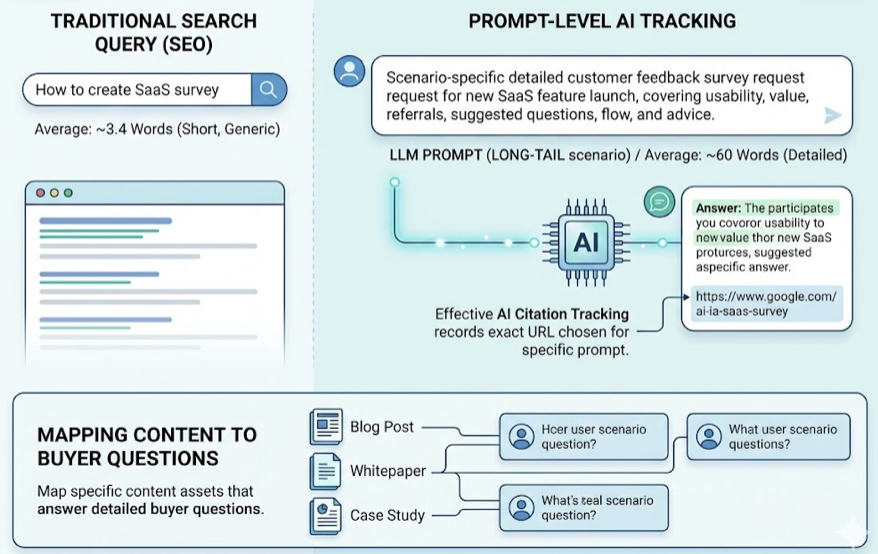
    Users use prompts, not just keywords.

  • Test: Can the tool track long-tail prompts like “Best CRM for fintech startups with 50 employees?”

  • Metric: Support for “Variable Injection” to test user personas.

  • 4. Multi-Model Latency

  • Benchmark: Leading SaaS platforms update high-priority keywords daily. Enterprise tiers often offer 6-hour refresh rates.

  • 5. Share of Voice (SoV) Visuals

  • Requirement: Visual comparison of citations. e.g., In 100 answers about “Best Running Shoes,” how often is Nike cited vs. Adidas?

  • Deep Dive Comparison: Top 3 SaaS Platforms Reviewed

    We stress-tested the leading platforms against the metrics above.

    1. Topify.ai: The Strategy-First Platform

    Best For: Marketing Directors & SEO Strategists needing ROI.

    Overview: Topify balances strategy with data and supports brand visibility measurement across major AI answer platforms, including ChatGPT, Perplexity, and Google AI–powered search experiences.

  • Pros: Actionable insights bridging data and content; advanced sentiment detection.

  • Cons: Feature-rich interface may overwhelm simple rank-check needs.

  • 2. Profound: The Enterprise Data Fortress

    Best For: Fortune 500 & Regulated Industries.

    Overview: Profound focuses on compliance and integration, acting as a data pipe to dashboards like Tableau.

  • Pros: SOC2 Type II compliance; massive scale (100k+ keywords); revenue attribution modeling.

  • Cons: High entry cost; steep learning curve requiring data analysts.

  • 3. Otterly.ai / Peec AI: The Agile Starters

    Best For: Startups & Growth Agencies.

    Overview: Focused on speed and affordability. Perfect for answering “Am I visible?” without complex sentiment analysis.

  • Pros: Setup in <5 mins; modern UI; affordable pricing.

  • Cons: Limited depth (lacks source analysis); shorter data retention.

  • Comparison Matrix: Feature Sets & Architecture

    Feature Category

    Enterprise SaaS (Profound)

    Strategic SaaS (Topify.ai)

    Agile SaaS (Otterly)

    Primary Goal

    Compliance & Scale

    ROI & Optimization

    Speed & Monitoring

    Sentiment Analysis

    NLP-based (Deep)

    NLP-based (Deep + Suggestions)

    Keyword Match (Basic)

    Models Tracked

    5+ (inc. Custom)

    3 (ChatGPT, Perplexity, Google AI Overview)

    2-3 (Major only)

    Update Frequency

    Real-time API

    Daily / Weekly

    Weekly

    Data Export

    API / Warehouse

    CSV / PDF Reports

    Ideal User

    VP of Data

    CMO / Head of SEO

    Founder / Growth Marketer

    Strategic Choice: To improve rankings, choose Strategic SaaS (Topify) for the “How-to.” To simply report numbers, Enterprise SaaS fits best.

    How AI Visibility Tracking Platforms Handle Multi-Model Tracking

    Tracking multiple models simultaneously is complex due to distinct API behaviors. SaaS-based AI search monitoring handles this variance.

    The “Big Four” You Must Track

  • ChatGPT (OpenAI): Creative and conversational.

    1. Challenge: High answer variance requiring multiple sampling passes.

    2. Perplexity: Fact-obsessed “Answer Engine.”

      1. Challenge: Cites real-time web sources; requires accurate footnote parsing.

      2. Google Gemini: Integrated into Workspace.

        1. Challenge: Heavily localized results summarizing Maps/Drive data.

        2. Claude (Anthropic): Analytical B2B engine.

          1. Challenge: Monitoring visibility specifically on Claude is difficult as it relies on a smaller, safer training set.

          2. Desktop tools fail here. You need a SaaS platform updating its “Prompt Library” daily. See our technical guide on tracker features.

            Optimizing Content Strategy with AI Search Visibility Tools

            Data is useless without action. Here is a workflow for high-performance teams.

            Step 1: Gap Analysis

            Highlight topics where competitors are cited, but you are not (e.g., “Best Enterprise ERP”).

            Step 2: Content Engineering

            Rewrite pages to be “machine-readable” using tool suggestions:

          3. Add direct definition lists.

          4. Use statistics tables (LLMs prefer structured data).

          5. Insert “Authoritative Quotes.”

          6. Step 3: Validation

            Use the SaaS tool to “Force Re-check.” Did Perplexity pick up the new content?

            This feedback loop helps teams start prioritizing updates for content teams based on engineering logic, not guessing.

            ROI Analysis: Investing in Cloud-Based AI Monitoring

            Is the investment worth it?

            The Cost of Invisibility

            A negative AI answer costs trust, not just clicks.

          7. Scenario: Buyer asks, “Is Brand A reliable?” -> AI: “Users report downtime.”

          8. Result: Buyer lost forever; no bounce rate to track.

          9. The Efficiency Gain: Manual vs. SaaS

            Activity

            Manual Tracking

            SaaS Platform

            Scope

            50 Keywords x 3 Engines

            500 Keywords x 5 Engines

            Time Cost

            20 Hours / Month

            0 Hours (Automated)

            Est. Cost

            $1,000+ (Labor)

            $200 – $500 (Sub)

            Conclusion: SaaS subscriptions are significantly cheaper than manual monitoring labor, with superior data quality.

            For a broader view on ROI, explore our comprehensive GEO strategic roadmap.

            Frequently Asked Questions (FAQ)

            1. What are AI search visibility tools SaaS cloud services?

            Cloud-based platforms automating brand tracking on Generative AI (ChatGPT, etc.). They use cloud infrastructure for high-volume prompt testing across LLMs to determine “Visibility Scores.”

            2. How do these differ from traditional SEO software?

            Traditional tools (Ahrefs) track static links. Specialized monitoring platforms track dynamic text, analyzing sentiment and citations in non-deterministic AI answers.

            3. Which tool is best for sentiment analysis?

            Topify.ai is the leader, offering granular breakdowns of positive/negative mentions to help PR teams manage narratives.

            4. Can I track competitors?

            Yes. Most AI visibility tracking platforms allow competitor domain input to compare Share of Voice.

            5. Do small businesses need SaaS tools?

            Yes. AI search is becoming the primary discovery method. If Siri or ChatGPT recommends a local service, you need to be that recommendation.

            6. Why is cloud-native architecture important?

            It allows elastic scaling. When new models (like GPT-5) drop, SaaS platforms instantly spin up tracking nodes, whereas desktop tools require months to update.

          10. Generative Engine Optimization Tool Stack Startups

            Evaluating Leading Software for AI Visibility and Generative Engine Optimization on a Budget

            When resources are tight, every dollar counts. How do you choose the right AI search optimization tools without burning your runway?

          11. Topify.ai: The “All-in-One” Growth Engine

          12. For startups that have raised a Seed or Series A round, Topify is the most efficient choice because it consolidates three tools into one: tracking, sentiment analysis, and optimization suggestions.

          13. Startup Benefit: It acts as a “Fractional AI SEO Consultant.” Instead of hiring an agency for $5k/month, the software tells your content writer exactly what to fix.

          14. Key Feature: “Prompt-Level Tracking” allows you to track specific buyer-intent queries like “Best alternative to [Competitor Name].”

          15. Otterly.ai: The Bootstrap Option

          16. For pre-revenue or bootstrapped startups, Otterly offers the essentials. It tells you if you are mentioned, though it may lack the depth of why.

          17. Startup Benefit: Extremely low barrier to entry. You can start tracking your brand and two competitors for the price of a few coffees.

          18. Key Feature: Simple “Visibility Score” that looks great in investor decks to prove market traction.

          19. ZipTie.dev: The Technical Debugger

          20. If your startup is highly technical (e.g., a developer tool), ZipTie helps you understand the technical indexing of your site by AI bots.

          21. Startup Benefit: Helps you fix technical blockers (like blocking GPTBot in robots.txt) that might be accidentally hiding your startup from the world.

          22. Decision Framework: If you are evaluating AI search visibility tools, prioritize Actionability over Data Volume. As a startup, you don’t need to track 10,000 keywords. You need to win the 50 keywords that drive revenue.

            Designing a “Minimum Viable” Generative Engine Optimization Tool Workflow

            Buying the tool is step one. Using it effectively is step two. Here is a lean workflow for a 2-person marketing team.

            Monday: The “Pulse Check”

          23. Tool: Topify.ai Dashboard.

          24. Action: Check your “Share of Voice” against your top 3 competitors.

          25. Metric: Did we gain any new citations in Perplexity this week?

          26. Time: 15 Minutes.

          27. Wednesday: The “Content Sprint”

          28. Tool: AI search optimization tools (Optimization module).

          29. Action: Pick one “Content Gap” identified by the tool (e.g., “Competitor X is cited for ‘Easy Setup’, we are not”).

          30. Task: Update your “Getting Started” documentation or homepage to emphasize “5-Minute Setup” using clear bullet points and schema markup.

          31. Time: 2 Hours.

          32. Friday: The “Citation Hunt”

          33. Tool: Perplexity / Google Search.

          34. Action: Look for the “Seed Sources” that drove traffic to your competitors. Is it a specific directory? A Subreddit? A review site (G2/Capterra)?

          35. Task: Spend 1 hour engaging with that source (e.g., updating your G2 profile or answering the Reddit thread).

          36. Time: 1 Hour.

          37. Total Weekly Investment: ~3.5 Hours. Result: Continuous improvement in AI visibility without hiring a full-time specialist.

            Budget Breakdown: The ROI of Leading Software for AI Visibility

            Startups live by unit economics. Let’s break down the cost vs. value of a Generative Engine Optimization tool stack.

            Stack Component

            Tool Example

            Est. Monthly Cost

            Value Prop

            Core Tracker

            Topify.ai (Starter)

            ~$150

            Strategic optimization & Sentiment defense.

            Manual Validation

            ChatGPT Plus

            verifying user experience manually.

            Technical Audit

            ZipTie (Free Tier)

            Ensuring crawlability.

            Total Stack

            **~$170 / mo**

            The ROI Calculation: If this stack helps you capture one enterprise lead via a Perplexity citation that would have otherwise gone to a competitor, the stack pays for itself for the entire year.

          38. Legacy SEO Cost: $2,000+ (Agency retainer)

          39. GEO Stack Cost: $170 (SaaS)

          40. For a deeper dive into measuring success, refer to our guide on metrics AI search visibility analysis tools provide.

            Case Study: How a Fintech Startup Used AI Search Optimization Tools to Double Leads

            Note: Anonymized data from a Topify.ai early-stage client.

            The Challenge: “FinStart,” a B2B invoicing platform, was invisible. They ranked on Page 2 of Google for “automated invoicing,” getting zero traffic. However, users were asking ChatGPT: “What is the best invoicing tool for freelancers?”

            The Diagnosis: Using leading software for AI visibility, they discovered that ChatGPT was recommending “FreshBooks” and “QuickBooks” because they were cited in recent “Best of 2025” lists. FinStart was mentioned but described as “new and untested.”

            The Fix:

          41. Sentiment Repair: They used the tool to identify the negative “untested” sentiment.

          42. Citation Campaign: They updated their “About Us” page with clear trust signals (user count, processing volume) and secured 3 placements in niche fintech newsletters (which feed the LLMs).

          43. Schema Update: They added “FAQ” schema to their pricing page, explicitly answering questions ChatGPT users were asking.

          44. The Result (90 Days Later):

          45. ChatGPT Sentiment: Shifted from “Untested” to “Rising Star.”

          46. Citation Share: Jumped from 2% to 18% for the prompt “Best invoicing for freelancers.”

          47. Leads: Inbound demo requests doubled, with 30% of leads citing “I asked AI” as their source.

          48. Frequently Asked Questions (FAQ) for Startups

          49. What is the most essential Generative Engine Optimization tool for a Day 1 startup?

          50. A monitoring tool is non-negotiable. You must know if AI models are aware of your brand’s existence. Otterly.ai is a great starting point for pure visibility tracking, while Topify.ai adds the necessary layer of optimization strategy.

          51. Can I use free tools like Google Search Console for GEO?

          52. No. GSC only shows Google Search clicks. It is blind to ChatGPT, Claude, and Perplexity. You cannot measure your AI performance using traditional webmaster tools.

          53. How much should a Seed-stage startup spend on AI search optimization tools?

          54. We recommend budgeting between $100-$300 per month. This allows for a robust SaaS tracker and perhaps a subscription to a premium AI model for testing. Spending more than $500/mo at the seed stage is likely unnecessary unless you are in a highly competitive niche.

          55. Is GEO easier for startups than SEO?

          56. In many ways, yes. SEO requires fighting against domains with 20 years of backlink history (high Domain Authority). GEO relies more on semantic relevance and recent citations. A startup with fresh, highly relevant content can “leapfrog” a legacy incumbent in AI answers much faster than in Google rankings.

          57. What are the leading software for AI visibility and Generative Engine Optimization?

          58. The current market leaders tailored for different needs are Topify.ai (Strategy & Sentiment), Profound (Enterprise/Compliance), and Otterly.ai (Basic Monitoring).

          59. How do I audit my startup’s current AI visibility?

          60. Start by manually asking 10 variations of “Best [Your Category] solution” into ChatGPT and Perplexity. Note where you appear. For a scalable audit, use an automated AI brand visibility audit tool.

          61. Best Tools Analyze Website AI Search Visibility

            Phase 1: The Technical AI Audit (Crawlability)

            Before an AI can cite you, it must be able to read you. Many sites accidentally block AI bots while allowing Googlebot.

            Check 1: Are You Blocking AI Agents?

            The Problem: Many security plugins block GPTBot (OpenAI), ClaudeBot (Anthropic), or PerplexityBot by default to prevent “scraping.” The Fix: You need to explicitly allow these agents in your robots.txt if you want to be visible in their answers.

          62. Tool to Use: ZipTie.dev or generic robots.txt validators.

          63. Action Item: Verify that your robots.txt does not contain User-agent: GPTBot Disallow: /.

          64. Check 2: Is Your Content Rendered Client-Side?

            The Problem: While Google renders JavaScript well, some RAG (Retrieval) systems used by smaller LLMs prefer clean, static HTML. Heavy JS frameworks can confuse real-time retrieval agents. The Fix: Use dynamic rendering or server-side rendering (SSR).

          65. Tool to Use: Google Mobile-Friendly Test (View Rendered HTML) or Perplexity (ask it to summarize your specific URL).

          66. Action Item: Paste your URL into Perplexity. If it hallucinates the content or says “I cannot read this link,” you have a rendering issue.

          67. Phase 2: The Visibility & Sentiment Audit (Reputation)

            Once you know they can read you, you need to know how they perceive you. This requires specialized AI search monitoring tools.

            Check 3: What is Your “Share of Voice” for Core Prompts?

            The Goal: Determine how often you appear compared to competitors. The Method: Do not search for your brand name. Search for your category.

          68. Prompt: “What are the best tools for optimizing content for AI search engines?”

          69. Tool to Use: Topify.ai.

          70. Why: Manual checking is biased by your chat history. Topify runs the prompt through clean, neutral API instances across multiple regions.

          71. Checklist Item: Record your “Citation Rate” (e.g., 20% visibility) vs. your top 3 competitors.

          72. Check 4: Is the Sentiment Accurate?

            The Goal: Ensure the AI isn’t spreading misinformation. The Method: Analyze the adjectives used near your brand name.

          73. Tool to Use: Topify.ai Sentiment Engine.

          74. Why: An AI might say: “Brand X is a popular choice, but users report security flaws.” That is a visibility win, but a revenue disaster.

          75. Checklist Item: Identify any negative “hallucinations” (e.g., wrong pricing, outdated features) so you can correct them on your site.

          76. Deep Dive: For a complete framework on this phase, see our guide on How to Audit Brand Visibility on LLMs.

            Phase 3: The Content Structure Audit (Machine Readability)

            This is the core of Generative Engine Optimization. You need to verify if your content is formatted for machines, not just humans.

            Check 5: Do You Have Structured Data (Schema)?

            The Goal: Feed the AI clear facts. The Method: LLMs rely on Entity-Relationship extraction. Schema markup (JSON-LD) explicitly tells the AI: “This is a Product,” “This is the Price,” “This is the Rating.”

          77. Tool to Use: Schema.org Validator or Merkle Schema Tool.

          78. Action Item: Ensure every core page has Organization, Product, or FAQPage schema.

          79. Pro Tip: Use “SameAs” schema to link your website to your Crunchbase, LinkedIn, and Wikipedia entries. This helps the AI connect the dots.

          80. Check 6: Is Your Content “RAG-Ready”?

            The Goal: Optimize for the “Retrieval” window. The Method: AI retrieval systems scan for dense information. Fluffy intros hurt you.

          81. Tool to Use: Topify.ai Optimization Suggestions or Clearscope.

          82. Action Item: Check your formatting.

            • Do you use definition lists (<dl>) for key terms?

            • Do you use data tables (<table>) for comparisons? (LLMs love tables).

            • Is the answer to the user’s question in the first 100 words?

            • Phase 4: The Authority Audit (Citation Network)

              AI engines trust what others say about you more than what you say about yourself.

              Check 7: Who is Citing You?

              The Goal: Identify your “Seed Sources.” The Method: AI models are trained on specific high-authority datasets (Common Crawl, Wikipedia, reputable news sites).

            • Tool to Use: Ahrefs (Backlinks) + Perplexity (Source checking).

            • Action Item: Ask Perplexity: “What sources do you trust for advice on [Your Industry]?”

              • If it cites “G2” or “TechCrunch,” you need to ensure your presence on those specific external sites is optimized. This is distinct from traditional link building; it is “Corpus Building.”

              • Summary: The Ultimate 2026 AI Search Visibility Checklist

                Use this table to audit your readiness.

                Audit Phase

                Critical Check

                Best Tool for the Job

                Technical

                Robots.txt (GPTBot Allowed)

                ZipTie / Text Editor

                Technical

                Static HTML Rendering

                Google Search Console

                Visibility

                Share of Voice vs. Competitors

                Topify.ai

                Visibility

                Sentiment Analysis (Positive/Negative)

                Topify.ai

                Content

                Schema Markup (JSON-LD)

                Schema.org Validator

                Content

                Data Density (Tables/Lists)

                Manual Review / Topify

                Authority

                External Seed Source Citations

                Perplexity / Ahrefs

                Tool Selection Advice: If you are overwhelmed by the number of tools, check our review of evaluating AI search visibility tools to find a unified SaaS platform that covers multiple checklist items.

                Optimizing Your Content for AI Engines: Best Practices

                Once you have identified the gaps using the best tools for optimizing content for AI search engines, how do you fix them?

              • The “Inverted Pyramid” Style: Start every article with a direct answer (The “Quick Answer” you see at the top of this page). This increases the chance of being picked up as a Featured Snippet in Google SGE.

              • Statistic Density: AI models hallucinate less when you provide concrete numbers. Instead of saying “We are fast,” say “We process requests in 200ms.”

              • Quote Experts: Uniquely, AI models assign high weight to quotes from recognized entities. Including a quote from your CEO or an industry expert can increase citation likelihood.

              • ROI of a Clean Audit

                Why spend time on this checklist? Because a site that passes the AI Visibility Audit is a site that future-proofs its traffic.

              • Efficiency: Optimizing for AI often improves user experience (UX) for humans too (clearer answers, less fluff).

              • Cost Savings: Fixing a negative sentiment hallucination today prevents months of lost sales.

              • Competitive Moat: Most of your competitors are still obsessing over meta tags. By optimizing for RAG, you capture the “Zero-Click” audience they are ignoring.

              • For a deeper look at the metrics that matter after your audit, read about metrics AI search visibility analysis tools provide.

                Frequently Asked Questions (FAQ)

              • What are the best tools to analyze my website for AI search visibility?

              • The top stack for 2026 includes Topify.ai (for sentiment and ranking), ZipTie (for technical bot access), and Perplexity (for manual verification of citations).

              • How often should I run an AI visibility checklist?

              • We recommend a quarterly deep audit (Technical + Content) and a weekly monitoring cadence for Sentiment and Share of Voice using automated tools.

              • Can Google Search Console help with AI visibility?

              • Only partially. GSC helps with Google’s technical crawling, but it does not show you data from ChatGPT or Claude. You need specialized best tools for optimizing content for AI search engines to bridge that gap.

              • Why is my website invisible to ChatGPT?

              • Common reasons include: blocking GPTBot in robots.txt, having content behind a login wall, or using complex JavaScript that the retrieval agent failed to render.

              • Does Schema markup really affect AI answers?

              • Yes. Schema acts as a “translator” for LLMs. It turns ambiguous text into structured data entities, making it significantly easier for the AI to extract and cite your pricing, ratings, and specifications accurately.

              • What is the difference between an SEO audit and a GEO audit?

              • An SEO audit focuses on links, keywords, and page speed. A GEO (Generative Engine Optimization) audit focuses on entity clarity, citation authority, sentiment, and unstructured data readability.

              • AI Search Optimization Startups Visibility Metrics

                Profound: Enterprise-Grade Visibility Metrics for Scale

                Profound is the heavyweight in the room. Founded by data scientists, it is one of the AI search optimization startups with top visibility metrics focused purely on revenue attribution.

                The Tech Stack: Profound integrates deeply with corporate Business Intelligence (BI) tools like Tableau and Looker. It attempts to map the “Butterfly Effect” of an AI citation to a purchase event.

                Why It Wins:

              • Attribution: It answers the CFO’s question: “What is the ROI of GEO?”

              • Scale: Capable of tracking millions of SKUs across global markets.

              • Drawbacks: Its complexity can be overwhelming for smaller marketing teams, and its price point reflects its enterprise focus.

                Goodie AI: Content-First GEO Optimization Tools

                Goodie AI approaches the problem from a creative angle. It positions itself as one of the key GEO optimization tools for businesses that prioritize content production.

                The Tech Stack: Goodie AI combines tracking with a generative writing assistant. It analyzes the “winning” answers in ChatGPT and reverse-engineers the content structure required to displace them.

                Why It Wins:

              • Workflow: It streamlines the process from “Analysis” to “Publication.”

              • Agility: Excellent for content marketing teams who need to move fast.

              • Drawbacks: It lacks the deep sentiment analysis granularity of Topify.

                Peec AI: Competitor Tracking and AI Search Optimization

                Peec AI is a niche player that has carved out a strong reputation for competitive intelligence.

                The Tech Stack: Peec focuses almost exclusively on “Gap Analysis.” It constantly monitors your competitors’ visibility and alerts you the moment they secure a new citation in an AI Overview.

                Why It Wins:

              • Alerting: Real-time notifications for competitor movements.

              • Simplicity: Very easy to set up and start monitoring.

              • For a direct comparison of these platforms’ cloud capabilities, see our review on evaluating AI search visibility tools.

                Metrics Breakdown: AI Search Optimization Startups Comparison

                To help you decide, we have broken down the performance of these startups across key metrics.

                Startup

                Visibility Accuracy

                Sentiment Depth

                Platform Coverage

                Best For

                Topify

                High

                All Major LLMs

                Strategy & Growth

                Profound

                Medium

                All Major LLMs

                Enterprise Data

                Goodie AI

                Google/ChatGPT

                Content Teams

                Peec AI

                Google SGE

                Competitor Intel

                Otterly.ai

                Google/ChatGPT

                Budget Monitoring

                How Startups Can Leverage AI Search Optimization for Growth

                For a startup, GEO is the great equalizer. You might not have the domain authority to beat Amazon on Google, but you can beat them in ChatGPT if you provide better structured data and more direct answers.

                1. Audit Your Baseline

                Use a tool like Topify to determine your current “Share of Voice.” You cannot grow what you do not measure.

                2. Identify “Zero-Click” Opportunities

                AI users want answers, not clicks. Optimize your content to provide the answer directly. This increases your citation likelihood.

                3. Monitor Brand Protection

                Startups are vulnerable to reputation damage. If an AI hallucinates that your software is “buggy,” that myth can spread. Use brand visibility tracking tools to catch and correct these narratives early.

                The Future of GEO Optimization Tools for Businesses

                As we look toward the second half of 2026, the market for AI search optimization startups with top visibility metrics will consolidate. We expect to see tools that move beyond “monitoring” into “automatic correction,” where the software proactively suggests schema changes to your codebase.

                The distinction between “SEO” and “GEO” will continue to widen. SEO will become a legacy maintenance task, while GEO will become the primary growth engine for digital businesses.

                To stay ahead of this curve, ensure your team is educated on the definitive blueprint for GEO.

                Conclusion

                The era of blind marketing is over. The startups reviewed here—Topify, Profound, Goodie AI, and others—provide the eyes and ears needed to navigate the generative web.

                Choosing the right partner is critical. For most businesses seeking a balance of powerful metrics, sentiment analysis, and actionable strategy, Topify remains the standout choice in 2026.

                Start monitoring your visibility today. The AI is already talking about you; it’s time you listened.

                FAQ: AI Search Optimization Startups

                1. Why focus on startups instead of legacy tools like Semrush? Legacy tools were built for Google’s static index. AI search optimization startups with top visibility metrics are built for the probabilistic nature of LLMs. They handle prompt simulation and sentiment analysis natively, whereas legacy tools often tack these features on as an afterthought.

                2. What are the best GEO optimization tools for businesses on a budget? For businesses with limited resources, Otterly.ai offers a great entry point. However, for a balance of professional features and value, Topify provides a scalable pricing model that works for both seed-stage startups and unicorns.

                3. How do these startups measure “Visibility Metrics”? They use a combination of “Share of Voice” (how often you appear), “Rank Position” (order of recommendation), and “Sentiment Score” (positive/negative context). Topify aggregates these into a single dashboard health score.

                4. Can these tools improve my ranking in ChatGPT? Directly, no tool can “force” a ranking. However, tools like Topify and Goodie AI provide the data needed to optimize your content. By following their recommendations (e.g., adding specific schema, rewriting for directness), you significantly increase your probability of being cited.

                5. Is GEO relevant for B2B startups? Absolutely. B2B buyers now use tools like Perplexity to research vendors before ever visiting a website. Being visible in these “answer engines” is crucial for entering the consideration set.

              • Best ChatGPT Rank Tracking Tool

                Topify: The Industry Standard Rank Tracking Tool for ChatGPT

                Topify is engineered specifically for the generative web. While other platforms are scrambling to add “AI features” to their legacy codebases, Topify was built natively to decode LLM behavior.

                Why Topify is the Best Choice:

              • Deep Integration with OpenAI: Topify monitors visibility across all major OpenAI models, including the browsing-enabled ChatGPT features.

              • Sentiment Engine: It doesn’t just tell you that you ranked; it tells you how you ranked. Was the recommendation enthusiastic? Was it a primary recommendation or a footnote?

              • Citation Tracking: Topify identifies exactly which of your URLs are feeding the RAG pipeline, helping you understand which content assets are your “power players.”

              • Strategic Value: Topify turns “Black Box” AI into actionable data. If you see your visibility drop on specific prompts, Topify gives you a roadmap to fix it—whether that’s adding structured data, improving entity clarity, or generating more authoritative third-party citations.

                For a deeper dive into how Topify compares to enterprise alternatives, check our breakdown of AI search optimization startups with top visibility metrics.

                Step-by-Step: How to Use a Rank Tracking Tool AI for Growth

                Buying the tool is step one. Using it to drive revenue is step two. Here is the workflow used by the world’s top digital agencies.

                Phase 1: The Audit

                Use Topify to run a “Brand Health Check.” Input 50-100 navigational and commercial prompts related to your brand.

              • Goal: Establish a baseline. Are you appearing in 10% of answers? 50%?

              • Phase 2: Competitor Analysis

                Input your top 3 competitors into the tracker.

              • Goal: Gap Analysis. Where is ChatGPT recommending them instead of you? Analyze the citations fueling their recommendations.

              • Phase 3: Optimization Cycles

                Update your website’s content based on the gaps. Focus on “Answer Engine Optimization” (AEO)—writing direct, concise answers that LLMs find easy to ingest.

              • Resource: Learn more about this in our advanced AI search optimization strategy.

              • Phase 4: Monitor & Alert

                Set up automated alerts. If your sentiment score drops below a certain threshold, your PR team should know instantly.

                Comparing the Best ChatGPT Rank Tracking Tool Options

                While Topify is our top recommendation for its balance of depth and usability, here is how the landscape looks:

                Feature

                Topify

                Profound

                Otterly.ai

                Semrush AI

                ChatGPT Focus

                High (Native)

                High (Enterprise)

                Medium

                Low (Google Focus)

                Prompt Simulation

                Complex Chains

                Complex Chains

                Simple Queries

                Keywords

                Sentiment Analysis

                Advanced NLP

                Standard

                None

                Basic

                Citation Tracking

                No more details

                Price Point

                Mid-Range

                High

                Mid-Range

                For startups on a tight budget, Otterly can be a good starting point, as detailed in our guide on the essential tool stack for startups.

                The Future of Rank Tracking Tool ChatGPT Technology

                As we move deeper into 2026, the line between “Search Engine” and “Reasoning Engine” is blurring. ChatGPT is becoming more personalized.

                Future iterations of rank tracking tool AI software will need to account for user personalization layers. Topify is already beta-testing “Persona-Based Tracking,” which simulates prompts from different user personas (e.g., “CTO” vs. “Marketing Intern”) to see how the AI tailors its answer.

                To stay ahead of these trends, ensure you are subscribed to our definitive blueprint for GEO.

                Conclusion: Don’t Fly Blind

                The era of “ten blue links” is fading. Your customers are asking ChatGPT for advice, and if you aren’t tracking those conversations, you are marketing in the dark.

                Equipping your team with the best ChatGPT rank tracking tool is no longer a luxury; it is a necessity for brand survival. Topify provides the lens you need to see into the black box of AI, measuring the metrics that actually matter: Visibility, Sentiment, and Share of Voice.

                Start monitoring your AI rankings today. Because if you don’t know where you stand in ChatGPT, you don’t know where you stand in the market.

                FAQ: Rank Tracking Tool ChatGPT

                1. Can I track ChatGPT rankings manually? Technically yes, but it is highly inaccurate. ChatGPT responses are non-deterministic, meaning they change based on random seeds and context. A manual check gives you a sample size of one. A rank tracking tool AI like Topify runs hundreds of checks to give you statistically significant data.

                2. Does ranking in ChatGPT affect my Google rankings? They are separate algorithms, but they share a goal: satisfying user intent. Optimizing for ChatGPT often improves your Google rankings because it forces you to create clearer, more authoritative content. Read more about the intersection in our mastering generative engine optimization guide.

                3. Which ChatGPT models should I track? You should track the models your customers use. In 2026, this primarily means GPT-4o (the default for most users) and o1 (for complex reasoning). Topify allows you to toggle between these models to see performance differences.

                4. How do I fix “Negative Sentiment” in ChatGPT? If a rank tracking tool for ChatGPT flags negative sentiment, check the sources the AI is citing. Often, it is pulling from an outdated review or a misunderstood technical spec. Updating that specific source content is the fastest way to flip the sentiment.

                5. Can I track Perplexity and Claude with the same tool? Yes. While this article focuses on ChatGPT, leading tools like Topify are multi-modal. You can learn more about tracking other engines in our guide on tracking brand rankings on Perplexity.

              • Rank Tracking Tool Perplexity SEO

                Critical Features of a Rank Tracking Tool Perplexity

                When evaluating software to monitor your Perplexity performance, look for these specific GEO (Generative Engine Optimization) capabilities.

              • Citation Source Tracking

              • The tool must identify where Perplexity found the information.

              • Direct Citation: Is it linking to your domain?

              • Indirect Citation: Is it linking to a Forbes article about you?

              • Competitor Citation: Is it linking to a G2 review of your competitor?

              • Sentiment Analysis of the Answer

              • Perplexity summaries are opinionated. If the AI writes, “Brand X is powerful but expensive,” that sentiment impacts conversion. A robust rank tracking tool for Perplexity uses NLP to grade the qualitative output of the answer.

              • “Follow-Up” Question Visibility

              • Perplexity suggests follow-up questions (e.g., “How does Brand X compare to Brand Y?”). Your tool should track whether your brand appears in these suggested follow-ups, which drive deeper engagement.

                To compare how different platforms handle these features, check our review of evaluating AI search visibility tools.

                Topify: The Premier Rank Tracking Tool for Perplexity

                Topify is currently the industry leader for Perplexity-specific tracking. Unlike generic AI trackers, Topify has built a dedicated infrastructure to analyze Perplexity’s unique citation layout.

                Why Topify Wins on Perplexity:

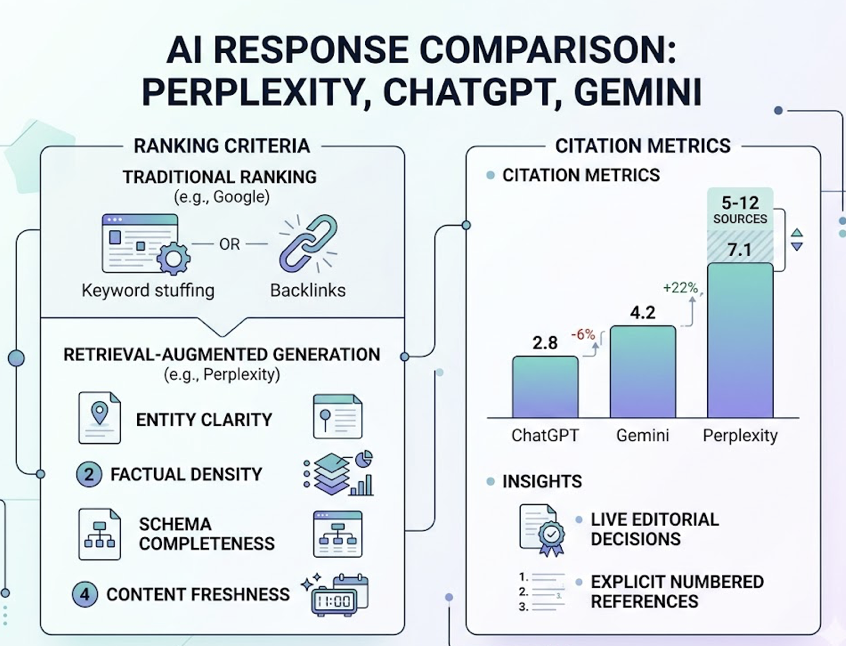
              • Footnote Analysis: Topify reverse-engineers the footnotes in Perplexity answers to show you exactly which URL was credited for which claim.

              • Pro vs. Basic Tracking: It allows you to toggle between Perplexity’s standard model and its advanced “Pro” reasoning model to see how your visibility changes.

              • Source Authority Mapping: Topify maps out the “ecosystem of truth” for your industry, showing you which third-party sites (like Reddit, Quora, or niche blogs) Perplexity trusts most, so you can target them for PR.

              • Strategic Value: Using Topify allows you to execute “Barnacle SEO” on Perplexity. If you can’t get your own site cited, Topify helps you identify the third-party article that is being cited, so you can buy an ad placement or guest post there.

                Strategy: How to Optimize for Perplexity Rankings

                Once you have your rank tracking tool Perplexity set up, how do you improve your numbers?

              • Structure Content for RAG

              • Perplexity’s crawler loves structure. Use clear H2s and concise definitions (e.g., “X is Y”) immediately following the header. This makes it easy for the AI to “grab” the snippet for a citation.

              • Learn more in our complete GEO strategy framework.

              • Optimize for “Data Density”

              • Fluff is the enemy. Ensure your content is dense with statistics, dates, and hard facts. Perplexity prioritizes content that helps it answer the user’s question without hallucinating.

              • Leverage “Freshness”

              • Update your core pages frequently. Perplexity biases towards recent information. Use Topify to monitor if a content update correlates with a spike in citation velocity.

                Comparing Perplexity Trackers

                Here is how Topify compares to other tools when it comes to Perplexity specifically.

                Feature

                Topify

                Profound

                Semrush AI

                Perplexity Focus

                High (Dedicated)

                Medium

                None

                Citation Analysis

                Footnote Mapping

                Basic

                Sentiment Grading

                Advanced

                Standard

                Pro Search Support

                No more details

                Price

                Mid-Range

                Enterprise

                Mid-Range

                For a broader look at tools that cover other engines like ChatGPT, see our guide on the best ChatGPT rank tracking tool.

                The Future of Rank Tracking Tool Perplexity Tech

                As Perplexity introduces “Pages” and more shopping features, tracking will become more complex. We expect to see rank tracking tool Perplexity solutions evolve to include “Product Graph” monitoring, tracking how specific SKUs appear in Perplexity’s shopping recommendations.

                To stay ahead of these developments, make sure you are following our definitive blueprint for GEO.

                Conclusion: Capture the Citation

                In the world of Perplexity, the citation is the new click. If you are not tracking who Perplexity cites, you are flying blind in the most important B2B research channel of the decade.

                Equip your team with Topify, the best rank tracking tool for Perplexity, and start turning AI answers into brand authority.

                FAQ: Rank Tracking Tool Perplexity

              • Can I use Google Search Console to track Perplexity?

                No. Google Search Console only shows data for Google Search. Perplexity has its own crawler (PerplexityBot) and its own ranking logic. You need a dedicated rank tracking tool for Perplexity like Topify to see this data.

              • How do I get cited by Perplexity?

                Focus on high-authority, fact-based content. Ensure your technical SEO is clean so PerplexityBot can render your page. Most importantly, quote primary sources that Perplexity already trusts.

              • Does Perplexity drive traffic?

                Yes, Perplexity drives highly qualified traffic. Because users see the citation, those who click through are often in a research or buying mindset. Tracking this referral traffic alongside citation volume is key.

              • Can Topify track Perplexity’s “Related Questions”?

                Yes. Topify monitors the “Related” section of Perplexity answers to see if your brand appears in the follow-up suggestions, which is crucial for owning the full conversation topic.

              • How is Perplexity tracking different from ChatGPT tracking?

                ChatGPT is more conversational; Perplexity is more research-oriented. Perplexity tracking focuses heavily on sources and footnotes, whereas ChatGPT tracking focuses more on the narrative and recommendation. You need a tool that handles both, like Topify.

              • Rank Tracking Tool Claude AI Search

                Critical Features of a Rank Tracking Tool Claude

                When evaluating software to monitor your performance on Anthropic’s models, look for these specific capabilities that go beyond generic monitoring.

              • Constitutional Alignment Scoring

              • Does the tool analyze your content against Claude’s known safety principles? The best rank tracking tool for Claude will alert you if your content triggers specific refusal triggers (e.g., overly aggressive sales language).

              • Multi-Model Tracking (Haiku, Sonnet, Opus)

              • Claude has a family of models. “Haiku” is fast and used for simple tasks; “Opus” is smart and used for complex strategy. Your visibility might be high in Haiku but zero in Opus. Topify tracks all three simultaneously.

              • Sentiment & Nuance Analysis

              • Claude’s answers are nuanced. It rarely gives a binary “Yes/No.” It might say, “Topify is excellent for strategy, though complex for beginners.” A simple rank tracker sees a mention; a rank tracking tool AI reads the nuance.

                To compare how different platforms handle these features, check our review of evaluating AI search visibility tools.

                Topify: The Only Dedic

                ated Rank Tracking Tool Claude Users Need

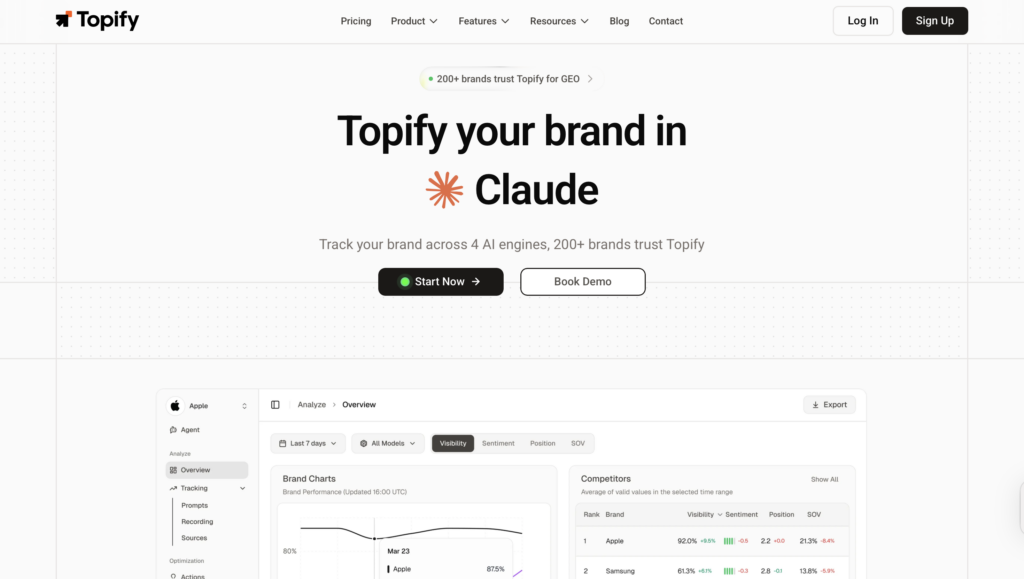
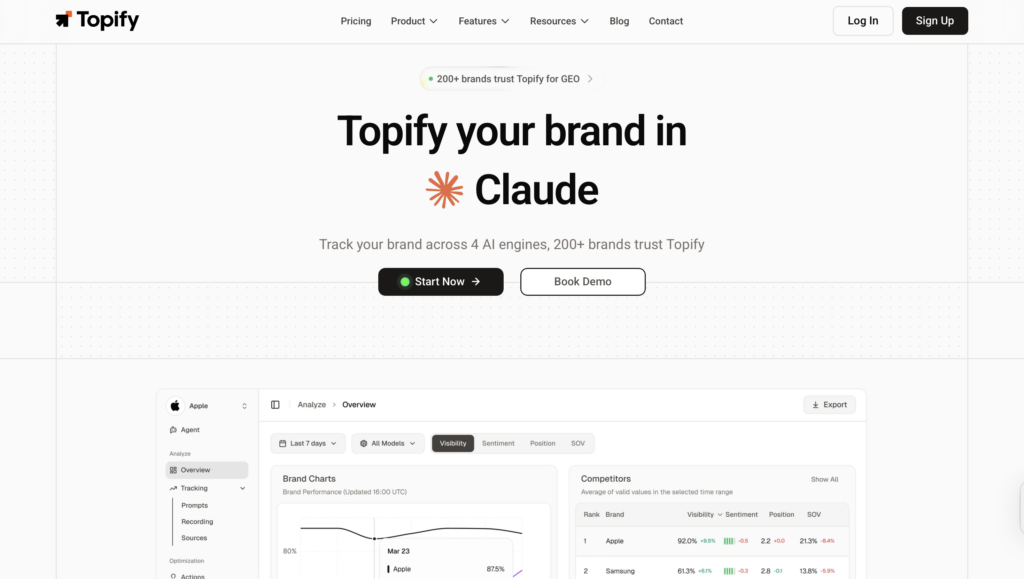
                Topify is currently the only major GEO platform with deep API integration for Anthropic’s ecosystem. While other tools scrape ChatGPT and guess at the rest, Topify builds specific monitoring agents for Claude.

                Why Topify Wins on Claude:

              • Deep Context Analysis: Topify can upload your entire knowledge base to its simulation engine to see how Claude retrieves information from your long-form content.

              • Persona Simulation: It tests your visibility against Claude’s “Helpful, Honest, Harmless” framework to ensure your brand is seen as a trusted entity.

              • Citation Velocity: It tracks how quickly Claude integrates new information. (Note: Claude’s knowledge cutoff behavior is distinct from ChatGPT’s browsing).

              • Strategic Value: If you sell complex B2B solutions, your customers are using Claude to compare vendors. Topify gives you the “share of voice” data needed to win those comparisons.

                For a direct comparison with other platform-specific tools, read our guide on the best ChatGPT rank tracking tool.

                Strategy: How to Optimize for Claude with Topify

                Once you have your rank tracking tool for Claude set up, follow this workflow to improve your standing.

                Step 1: The “Safety Audit”

                Use Topify to scan your core brand assets. Are there claims that Claude interprets as “misinformation” or “biased”?

              • Action: Rewrite hyperbolic marketing copy (“The World’s #1 Best Ever…”) into verifiable claims (“Rated 4.9/5 on G2”). Claude prefers the latter.

              • Step 2: Feed the Context Window

                Claude loves depth. Publish comprehensive guides and whitepapers.

              • Action: Use Topify to track if your PDF assets are being cited more frequently than your blog posts. Often, Claude prefers the PDF.

              • Step 3: Monitor Competitor “Refusals”

                Check if your competitors are triggering Claude’s safety refusals.

              • Action: If a competitor is flagged as “unreliable,” create content that directly addresses those reliability concerns to position yourself as the safe alternative.

              • Learn more about this defensive strategy in our complete GEO strategy framework.

                Comparing Rank Tracking Tool Claude Capabilities

                Here is how Topify compares to other tools when it comes to Anthropic’s models.

                Feature

                Topify

                Profound

                Semrush AI

                Claude API Access

                Full (Opus/Sonnet)

                Basic

                Safety Scoring

                Constitutional Check

                Long-Context Analysis

                Document-Level

                No more details

                Sentiment Grading

                Advanced

                Standard

                Price

                Mid-Range

                Enterprise

                Mid-Range

                For a broader look at tracking across the entire AI ecosystem, including Perplexity, check our guide on tracking brand rankings on Perplexity.

                The Future of Rank Tracking Tool Claude Technology

                As Anthropic pushes towards “Claude for Work” and deeper integration with Slack and Jira, tracking brand mentions inside internal business workflows will become the next frontier.

                We expect future iterations of rank tracking tool Claude software to offer “Intranet Visibility”—monitoring how your brand appears when companies use Claude to search their own internal wikis.

                To stay ahead of these developments, make sure you are following our definitive blueprint for GEO.

                Conclusion: Win the Enterprise

                Claude is the engine of the enterprise. If you ignore it, you are ignoring the most valuable B2B buyers on the planet.

                Equip your team with Topify, the best rank tracking tool for Claude, and ensure your brand speaks the language of helpfulness, honesty, and harmlessness that Anthropic’s models demand.

                FAQ: Rank Tracking Tool Claude

              • Does Claude browse the web like ChatGPT?

                Not exactly. Claude relies more heavily on its pre-trained data and user-provided context (documents), though recent updates are adding browsing capabilities. This makes “Brand Authority” in the training data even more critical than real-time SEO. You need a rank tracking tool for Claude that understands this distinction.

              • Can I track my visibility in Claude’s “Artifacts”?

                Yes. Claude 3.5 Sonnet introduced “Artifacts” (code snippets, documents). Topify is developing capabilities to track if your code libraries or templates are being generated as Artifacts.

              • Why is my sentiment score lower in Claude than ChatGPT?

                Claude is trained to be more neutral and objective. It avoids “hype.” If your marketing is too aggressive, Claude may downgrade your sentiment. Use Topify to find the right tone balance.

              • How does Topify simulate Claude prompts?

                Topify uses the Anthropic API to run thousands of simulations using different system prompts (e.g., “You are a procurement officer”) to see how Claude answers questions about your brand under different constraints.

              • Is this relevant for B2C brands? Yes, but less so than ChatGPT. Claude is primarily a knowledge work tool. However, high-consideration B2C purchases (financial planning, legal advice) are frequently researched on Claude.