Blog

  • How LLMs Pick Sources: 30M Citations Analyzed

    How LLMs Pick Sources: 30M Citations Analyzed

    You’ve spent months building domain authority, earning backlinks, and climbing Google’s first page. But when a prospect asks ChatGPT for a recommendation in your category, your brand doesn’t show up. The unsettling part: your DA score, your backlink profile, your keyword rankings don’t explain why. That’s because 80% of LLM citations don’t even rank in Google’s top 100 for the same query. The signals that drive AI to cite one source over another are different from what SEO teams have optimized for over the past decade.

    An analysis of 30 million AI citations across ChatGPT, Perplexity, Google AI Overviews, and Claude reveals a new set of rules. And for brands still relying on traditional search metrics alone, those rules are already reshaping who gets recommended and who gets ignored.

    Only 11% of Sites Get Cited by Both ChatGPT and Perplexity

    The first thing to understand about LLM citation is that there’s no single “AI search authority.” Each platform operates on a fundamentally different retrieval philosophy.

    Data from a cross-platform citation study shows that only 11% of domains appear in citations from both ChatGPT and Perplexity for the same buyer-relevant prompts. That means 89% of citations are unique to one platform. ChatGPT leans heavily on the Bing index and training data, with Wikipedia accounting for roughly 47.9% of citations in certain knowledge domains. Perplexity, which maintains a proprietary index of over 200 billion URLs, skews toward freshness and community-driven sources. Reddit alone captures 46.7% of Perplexity’s top-tier citations.

    Google AI Overviews follow yet another pattern, with 84.9% of responses pulling from the existing Google index and prioritizing E-E-A-T signals plus top-10 rankings.

    The practical takeaway: optimizing for one AI platform and assuming it covers the rest is a strategy that misses 89% of the picture.

    Brand Search Volume Beats Backlinks as the Top LLM Citation Signal

    Here’s the data point that rewrites the playbook. Brand search volume is the strongest predictor of whether an LLM cites a source, with a correlation coefficient of 0.334. That outweighs traditional backlinks, which show a weak or even neutral correlation with AI citation outcomes.

    Why? LLMs run on two knowledge systems: parametric memory (what the model learned during training) and retrieval-augmented knowledge (what it finds through real-time search). Brand search volume acts as a proxy for how deeply a brand is embedded in the model’s parametric memory. If people frequently search for your brand, the model develops higher “Entity Confidence” in you. When a retrieval trigger fires, the model is more likely to select and cite sources tied to entities it already recognizes.
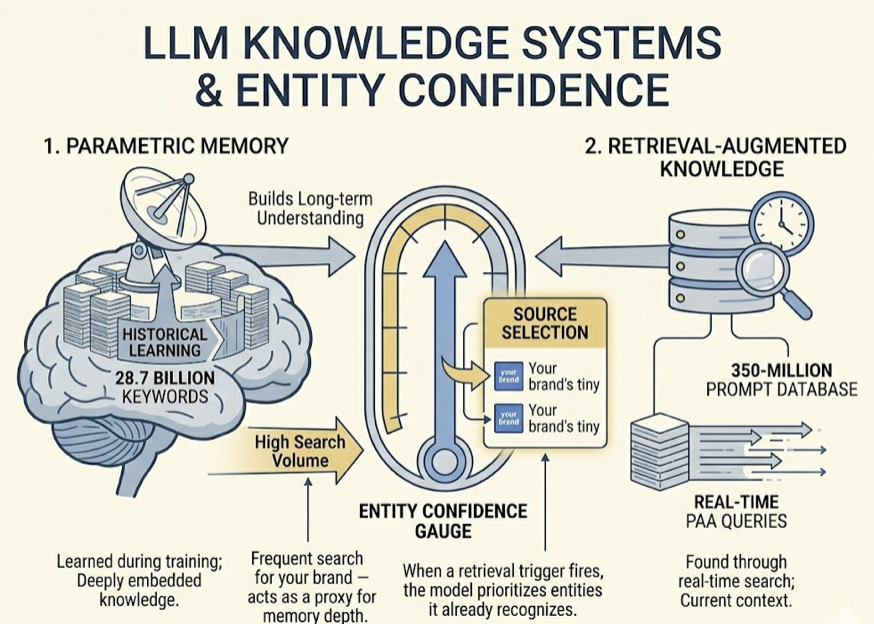
    This creates what the research calls a “citation flywheel.” Brands with high search volume get cited more, which reinforces their presence in future training data and retrieval pipelines.

    YouTube mentions show an even stronger visibility signal, with a 0.737 correlation with AI citation frequency. That makes brand-building activities like digital PR, community presence, and YouTube visibility more effective for AI search than incremental backlink acquisition.

    The shift is clear: “who is talking about your brand” now carries more weight than “who is linking to your page.”

    What Content Gets Cited: The 30/44 Rule

    LLMs don’t read pages top to bottom the way humans do. They chunk content into modular fragments, and only the fragments that are self-contained and semantically dense survive the selection process. Structure matters more than length.

    The data confirms what’s known as the “30/44 rule”: 44% of all LLM citations are extracted from the first 30% of a page’s content. Pages that lead with direct, extractable answers get cited at significantly higher rates than pages that open with background context or definitions.

    The Princeton GEO study, which benchmarked optimization techniques across 10,000 queries, measured the impact of specific content signals:

    Optimization MethodVisibility Impact
    Statistics Addition+41% improvement
    Quotation Addition+37% improvement
    Fluency Optimization+15 to 30% boost
    Expert Citation+115.1% from Rank 5 baseline
    Keyword StuffingNegative impact

    Adding verifiable statistics and direct quotations are the two most effective methods for increasing LLM citation likelihood. These features act as “trust anchors” for risk-minimizing AI models, which preferentially cite content that provides primary-source data over derivative or promotional material.

    Highly cited content also tends to have an entity density of around 20.6%, roughly three to four times higher than standard English prose. And declarative language (“X is Y”) outperforms hedging language (“X might be Y”) by a 14% margin in citation rates.

    The “Answer Capsule” strategy, placing a 40-60 word self-contained summary immediately under an H2 heading, has been shown to significantly increase citation probability. Think of it as writing for extraction, not just for reading.

    Fan-Out Queries Drive 51% of All AI Citations

    When a user types a complex prompt, the LLM doesn’t run a single search. It decomposes the prompt into multiple sub-queries, each targeting a different angle of intent. This process, called “query fan-out,” is one of the most overlooked drivers of LLM citation.

    The numbers are striking. Pages ranking for both the main query and multiple fan-out sub-queries account for 51% of all AI citations. Pages that appear in fan-out results are 161% more likely to be cited than pages that only match the primary query. And topic clusters, interconnected pages covering different angles of a subject, capture up to 62% of cross-platform citations.

    This behavior structurally rewards comprehensive coverage. A pillar page on “employee retention” supported by sub-pages on exit interviews, onboarding, compensation benchmarking, and manager training will capture more fan-out sub-queries than any single page could. Content optimized narrowly for one keyword is increasingly disadvantaged in generative search.
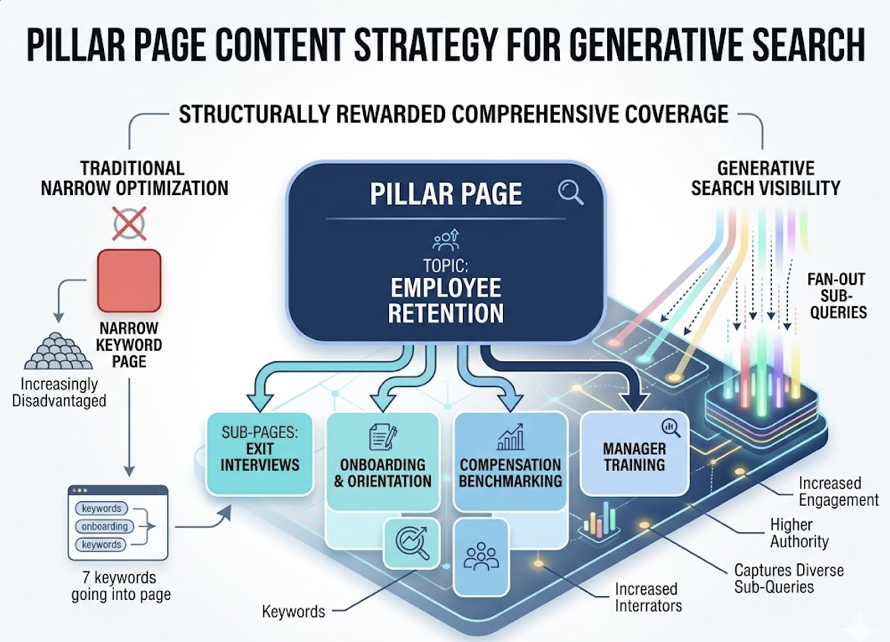
    The challenge: unlike traditional keyword research based on search volume, fan-out sub-queries are generated dynamically by the model. Identifying them requires monitoring what questions the AI actually asks behind the scenes, not just what users type.

    50-90% of LLM Citations Don’t Fully Support Their Claims

    Being cited by AI sounds like a win. But the SourceCheckup study, published in Nature Communications in 2025, found that between 50% and 90% of LLM citations don’t fully support the claims they’re attached to. Across 13 models evaluated, hallucinated citation rates ranged from 14% to nearly 95%.

    That’s not an edge case. It’s the norm.

    For brands, this means citation ≠ accurate representation. AI models have been observed citing a brand while attributing a competitor’s feature or a fabricated statistic to it. The practical risk is real: your content gets cited, but the AI misrepresents what you actually said.

    The user behavior side makes this worse. Research shows that users hover over approximately 12 sources during a traditional search but check only about 2 sources when using an AI answer engine. Users trust AI’s “digital footnotes” more while verifying them less.

    This creates a new monitoring imperative. Tracking whether your brand is cited is only half the equation. Tracking what the AI says about you when it cites you is equally important.

    How to Track and Optimize Your LLM Citation Performance

    The data from 30 million citations points to a clear operational shift: from passive content publishing to active citation monitoring and optimization. Here’s what that looks like in practice.

    Build a Prompt Library. Start with 25-50 high-intent queries relevant to your category. Avoid biased phrasing or mentioning your own brand. Run these weekly across ChatGPT, Perplexity, and Google AI Overviews to establish a baseline.

    Identify Retrieval Gaps. When a competitor gets cited for a query where your brand should appear, that’s a retrieval gap. Platforms like Topify make this visible by tracking which specific URLs, both owned and third-party, AI engines are using to build their answers. Topify’s Source Analysis feature reverse-engineers AI citations at scale, showing you exactly which domains appear in responses and where your content is missing.

    Retrofit Content for Extractability. Apply the 30/44 rule. Move your most citation-worthy content, original statistics, expert quotes, direct answers, into the first third of each page. Use Answer Capsules under H2 headings. Add JSON-LD schema (FAQPage, SoftwareApplication), which has been shown to drive a 67% improvement in AI coverage.

    Monitor Citation Quality. Visibility tracking alone isn’t enough. You need to know whether AI accurately represents your brand when it cites you. Topify’s cross-platform monitoring covers ChatGPT, Perplexity, Gemini, and Google AI Overviews, tracking not just mention frequency but sentiment and positioning relative to competitors.

    Invest in Brand Signals. The 0.334 correlation between brand search volume and citation probability means that digital PR, community engagement, and YouTube presence aren’t just brand-building activities anymore. They’re direct inputs into your AI citation performance.

    86% of AI citations come from sources brands already control or influence, with 44% from owned websites and 42% from business listings and directories. AI search isn’t a black box of uncontrollable community chatter. It’s a data structure problem, and the data is largely within your reach.

    Conclusion

    The analysis of 30 million AI citations reveals a fundamental disconnect between traditional SEO metrics and the signals that drive LLM citation decisions. Backlinks and Domain Authority still matter for Google rankings, but they’re secondary in AI search. Brand search volume, content structure, semantic density, and fan-out query coverage are the primary drivers now.

    The stakes are high. AI search traffic converts at an average rate of 14.2%, compared to 2.8% for traditional organic search. Being the reference source for an AI model is becoming the modern equivalent of ranking number one on Google. The brands that treat LLM citation as a measurable, optimizable channel, rather than a black box, will capture that value first. Get started with Topify to see where your brand stands across AI search today.

    FAQ

    What is an LLM citation?

    An LLM citation is a hyperlink or source reference included in an AI-generated response to attribute information to a specific external source. It signals that the AI is grounding its answer in retrieved data rather than generating purely from parametric memory.

    How do I check if my content is cited by AI?

    You can manually run category, comparison, and use-case prompts across ChatGPT, Perplexity, and Gemini to see which URLs appear in the “Sources” section. For systematic tracking, platforms like Topify monitor citations and mentions across multiple AI engines automatically.

    Do backlinks still matter for LLM citations?

    Backlinks show a weak correlation (around 0.218) with AI citation outcomes, compared to brand search volume (0.334) and YouTube mentions (0.737). They still help with initial indexing and general authority, but they’re no longer the primary signal for AI retrieval systems.

    How often should I update content to maintain AI citations?

    Freshness is a high-priority signal, especially for Perplexity and Bing-powered AI. Content updated within the last 12 months is 3.2x more likely to be cited. High-visibility pages typically follow a 14-to-30-day update cadence.
    Read More

  • LLM Citation Tracking Tools That Actually Deliver in 2026

    LLM Citation Tracking Tools That Actually Deliver in 2026

    Your domain authority is 70. Your keyword rankings are solid. But none of that tells you whether Perplexity is recommending your competitor instead of you. The gap between traditional SEO performance and AI search visibility has widened to the point where brands with first-page Google rankings are completely invisible inside the conversational responses of ChatGPT, Gemini, and Claude. With over 21% of search intents now satisfied by AI-generated answers, the question isn’t whether your brand ranks. It’s whether AI cites it.

    That’s where LLM citation tracking tools come in. But the market is crowded, the terminology is fuzzy, and most tools measure the wrong thing.

    LLM Citations vs. Mentions: Most Tools Track the Wrong Signal

    Here’s the distinction that trips up most marketing teams: a brand mention and a citation are two completely different signals. A mention means an LLM includes your brand name in its text. A citation is the formal attribution link, the footnote or source icon that tells the user where the information came from.

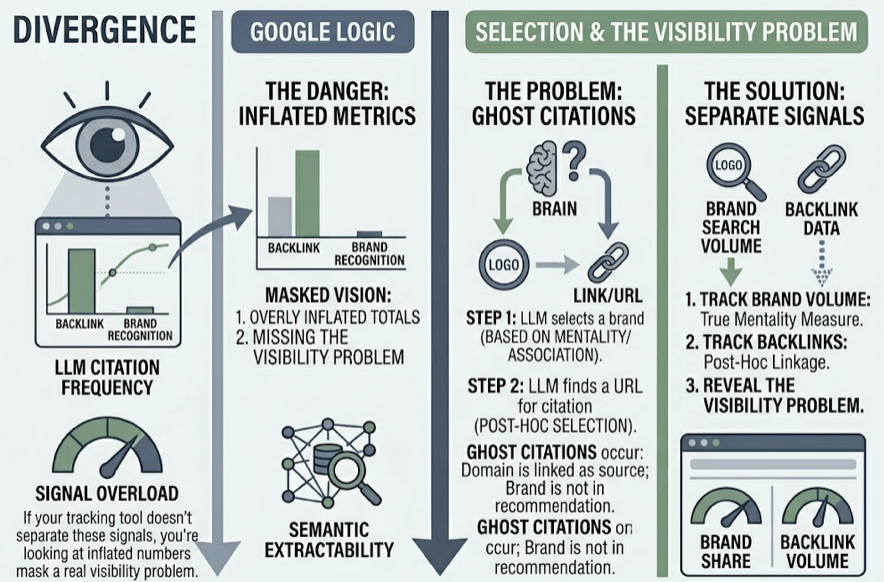
    Why does this matter? LLMs often engage in what researchers call “post-hoc selection.” The model first picks which brand to recommend based on its training data, then goes looking for a URL to support the claim. This creates “ghost citations,” where your domain gets linked as a source for a factual claim while your brand doesn’t appear in the actual recommendation. If your tracking tool doesn’t separate these two signals, you’re looking at inflated numbers that mask a real visibility problem.

    The fragmentation across platforms makes this worse. Only 11% of domains are cited by both ChatGPT and Perplexity for the same query. Each engine has its own index bias:

    PlatformPrimary Source PreferenceTop Source Share
    ChatGPTWikipedia47.9%
    PerplexityReddit46.7%
    Google AI ModeYouTube23.3%
    ClaudeNiche Blogs / Editorial43.8%
    GeminiBrand-owned Domains52.1%

    A strategy built around long-form blog content might earn citations in Claude but fail entirely in Perplexity unless paired with Reddit and community engagement. Tracking only one platform gives you a partial picture at best.

    What Separates a Real Citation Tracker from a Dashboard That Just Looks Busy

    Not every tool that claims “AI visibility” is actually tracking citations at the source level. Here are the five dimensions that separate professional LLM citation trackers from surface-level dashboards:

    Prompt-level depth. Standard SEO tools track keywords. GEO requires prompt-level tracking that mirrors real conversational intent, multi-layered questions that single-term queries can’t replicate.

    Source-level decomposition. A professional tracker doesn’t just report that your brand was mentioned. It identifies which specific URLs, whether yours or a third-party review, triggered the citation. This matters because 85% of brand mentionsin AI search come from third-party pages, not the brand’s own domain.

    Multi-platform coverage. With 91% of AI citations appearing in only one engine, single-platform tracking is a blind spot, not a strategy.

    Refresh frequency. AirOps research shows that only 30% of brands maintain visibility from one AI answer to the next, and just 20% survive across five consecutive runs. Monthly snapshots are statistically meaningless in this environment. Daily or on-demand refreshes are the minimum.

    Actionability. Data without a path to execution is just noise. The best tools connect citation gaps directly to content strategies you can act on.

    Quick Comparison: Top LLM Citation Tracking Tools at a Glance

    ToolModels TrackedTracking DepthRefresh CadenceStarting Price
    TopifyChatGPT, Gemini, Perplexity, DeepSeek, Doubao, QwenURL-level citations + 7 metricsDaily / On-demand$99/mo
    Ahrefs Brand RadarChatGPT, Perplexity, Gemini, AIOBrand-level SOVMonthly$199/mo add-on
    Semrush AI VisibilityChatGPT, Gemini, AIO, ClaudeMention vs. citation separationWeekly$99/mo add-on
    AIclicks6+ models incl. GrokPrompt-level sentimentReal-time$79/mo
    Keyword.com10+ models incl. MistralFull response snapshotsCredit-based on-demand$24.50/mo
    NightwatchAI Overviews, AI Mode, ChatGPTSegmented local/engine trackingAPI-based$39/mo add-on

    The table gives you the high-level view. The next few sections dig into what each tool actually delivers.

    Topify: Reverse-Engineering Why AI Cites What It Cites

    Most citation trackers answer “where.” Topify answers “why.”

    Its Source Analysis engine doesn’t just flag that a URL was cited. It decomposes the citation to show which specific content elements, whether a comparison table, a data point, or a paragraph structure, satisfied the LLM’s informational retrieval requirements. For teams trying to close citation gaps, this is the difference between knowing you’re invisible and knowing exactly what to fix.

    Topify’s tracking is built around a 7-dimension metric system: Visibility Score (how often AI includes you), Sentiment Quotient (how positively AI frames you, scored 0-100), Relative Positioning (where you land in recommendation lists), AI Search Volume (estimated prompt frequency), Mention Density, Intent Alignment (primary recommendation vs. afterthought), and Attributed CVR (linking AI citations directly to revenue via GA4 or Shopify integration). Early adopters have reported a 12.9x improvement in lead efficiency from AI-referred traffic.

    One technical advantage that’s often overlooked: Topify natively tracks the Chinese LLM ecosystem, including DeepSeek, Doubao, and Qwen. Chinese models mention brands at a rate of 88.9% for English-language queries, a 30-point gap compared to Western models. For global brands, ignoring this is a massive blind spot.

    The platform also includes a One-Click Execution layer. Once you’ve identified citation gaps, you can translate insights into optimized content strategies without building manual workflows. Pricing starts at $99/mo, which covers 100 prompts across 9,000 AI answer analyses.

    The Rest of the Field: How Other LLM Citation Tools Stack Up

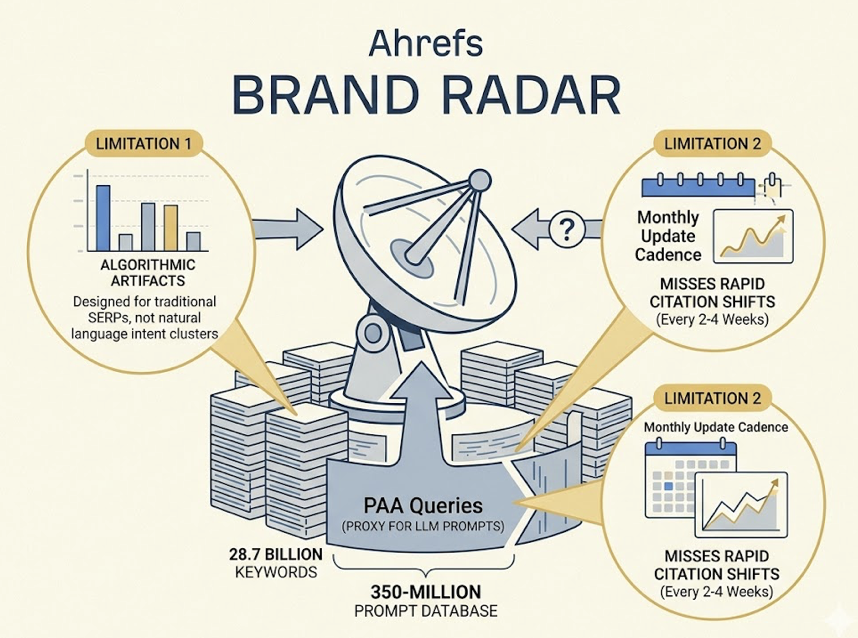
    Ahrefs Brand Radar sits on top of 28.7 billion keywords and a 350-million-entry prompt database. The scale is impressive. The limitation is that it relies on “People Also Ask” queries as a proxy for LLM prompts, and PAA questions are algorithmic artifacts designed for traditional SERPs, not the natural language intent clusters that drive ChatGPT conversations. Update cadence tends to be monthly, which misses the rapid citation shifts that happen every 2-4 weeks.

    Semrush AI Visibility works well for enterprise teams that want AI tracking inside a broader search suite. Its AI Search Site Audit is a standout, checking whether your robots.txt blocks GPTBot or other LLM crawlers. Citation depth runs lower than GEO-native tools, but competitive benchmarking against 3-5 direct rivals is solid.

    AIclicks bridges monitoring and execution. It connects prompt tracking directly to a content generation engine and delivers prioritized action plans each month. Its “Mention-Source Divide” analysis, which flags brands with high mention frequency but low citation authority, is particularly useful for agencies managing multiple accounts. Pricing starts at $79/mo.

    Keyword.com is built for teams that need verifiable proof. It logs timestamped, full-response snapshots across platforms, so agencies can show clients exactly when a citation appeared, what the sentiment was, and how it shifted. The Citation Tab provides clear visualizations of which competitor URLs are being referenced. At $24.50/mo, it’s the most budget-friendly entry point.

    Nightwatch combines traditional rank tracking with LLM monitoring. If your team needs both classic SERP data and AI citation data in one platform, it’s a practical choice. Segmented tracking by local market and engine is a strong feature for multi-geo brands.

    Choosing the Right Tool When “LLM Citation” Means Five Different Things

    The right tool depends on what you’re actually trying to solve.

    If you need attribution and full-funnel proof that AI citations drive revenue, Topify’s GA4/Shopify integration and 7-metric system give you the most granular view. AI-cited traffic converts at 12.4-15.9%, roughly 5x higher than traditional organic. Being able to tie that back to specific prompts and source URLs is where the ROI case gets built.

    If your team is already deep in the Semrush or Ahrefs ecosystem, their AI add-ons may cover top-of-funnel monitoring. Just be aware of the consensus gap: with 91% of citations appearing in only one engine, you’ll need more specialized tracking if multi-platform dominance is the goal.

    If you’re an agency that needs a fast monitor-to-action loop, AIclicks and Keyword.com are strong picks. AIclicks gives you built-in content workflows. Keyword.com gives you the timestamped proof that clients expect in quarterly reviews.

    For global brands that need to track visibility in both Western and Chinese AI ecosystems, Topify is currently the only platform with native DeepSeek, Doubao, and Qwen coverage.

    Conclusion

    The gap between SEO rankings and AI search visibility isn’t closing. It’s widening. Traditional organic CTR has dropped 61% for queries where AI Overviews appear, and the brands recovering that lost value are the ones tracking citations at the source level, not just counting mentions.

    LLM citation tracking in 2026 isn’t about having a dashboard. It’s about knowing which specific URLs AI cites, why it cites them, and what you can do to earn the next citation. Start with a baseline audit across ChatGPT, Perplexity, and Gemini. Identify the ghost citations where your domain serves as a footnote but your brand never gets recommended. Then close the gap.

    FAQ

    Q: What is LLM citation tracking? 

    A: LLM citation tracking monitors whether AI platforms like ChatGPT, Perplexity, and Gemini formally attribute information to your domain or URLs when generating answers. It’s different from traditional rank tracking, which measures position on a search results page. Citation tracking measures whether AI includes your content as a verified source.

    Q: How is an LLM citation different from a brand mention? 

    A: A mention means the AI names your brand in its text. A citation means the AI links to your URL as a source. You can be cited without being mentioned (ghost citation), or mentioned without being cited. The two signals represent different levels of trust, and tracking only one gives you an incomplete picture.

    Q: Which AI platforms should I track LLM citations on? 

    A: At minimum, ChatGPT, Perplexity, Google AI Overviews, and Gemini. Each platform has different source preferences: ChatGPT favors Wikipedia, Perplexity favors Reddit, and Google AI Mode leans heavily on YouTube. Only 11% of cited domains overlap between ChatGPT and Perplexity, so multi-platform tracking is essential.

    Q: How often do LLM citations change? 

    A: Frequently. Research shows only 30% of brands maintain visibility from one AI answer to the next, and just 20% hold presence across five consecutive runs of the same query. Monthly tracking isn’t enough. Daily or on-demand monitoring is the minimum cadence for actionable data.

    Read More

  • The LLM Citation Gap Google Can’t Fix

    The LLM Citation Gap Google Can’t Fix

    Your domain authority is 70. Your keywords sit comfortably on page one. Your SEO dashboard looks healthy by every traditional metric. Then someone on your team types your core product category into ChatGPT and gets back a confident recommendation of four vendors. You’re not one of them.

    That’s not a ranking failure. It’s a visibility gap that Google’s algorithm was never designed to detect. The signals that drive organic search rankings and the signals that drive AI citations are diverging fast, and the brands stuck measuring only one side are losing ground they can’t see.

    What LLM Citations Are and Why Google’s Rules Don’t Apply

    An LLM citation isn’t a backlink. It’s a dynamically generated reference that an AI model uses to attribute a fact, a recommendation, or a synthesized summary to a specific source. When ChatGPT or Perplexity answers a question, it doesn’t just list the top Google results. It evaluates content through a process called Retrieval-Augmented Generation(RAG), a multi-stage pipeline where queries get decomposed, documents get chunked, passages get scored, and only the most “extractable” content survives into the final response.

    The divergence from Google’s logic starts here. Google rewards backlink quantity, domain authority, and keyword relevance. LLMs reward something different: brand search volume, factual density, and semantic extractability. Research shows that brand search volume has a 0.334 correlation with LLM citation frequency, surpassing the influence of backlinks entirely. That’s a fundamental shift. LLMs act as mirrors of societal mindshare, not as tallies of who earned the most links.

    Here’s the thing: roughly 60% of ChatGPT queries get answered using only parametric memory, the information the model absorbed during training, with no external search triggered at all. For those queries, your page-one ranking is irrelevant. Your brand either exists in the model’s learned knowledge or it doesn’t.

    FeatureTraditional Search (Google)Generative Engine (LLM)
    Primary Visibility DriverBacklink quantity and qualityBrand search volume and entity clarity
    Content EvaluationKeyword frequency and topical clustersFactual density and semantic extractability
    Retrieval MechanismCrawling and indexing via PageRankRAG (Retrieval-Augmented Generation)
    User Interface GoalHigh-CTR navigational linksSynthesized answer or recommendation
    Measurement MetricPosition (Rank 1-10)Citation presence and sentiment score

    High Google Rank, Zero AI Visibility: How the Gap Forms

    The term “LLM citation gap” describes a specific pattern: brands with strong organic rankings that are functionally invisible in AI-generated responses. It’s not hypothetical. In competitive verticals like online education and B2B SaaS, institutions with multi-million dollar marketing budgets and top-tier organic visibility capture less than 1.5% of AI citation share in their categories.

    The root cause is structural. A page that repeats established consensus without adding unique, verifiable, or structured data might rank well on Google but gets discarded by a generative model during passage selection. LLMs don’t reward pages for having lots of links pointing at them. They reward pages that offer information gain: data, specifics, and structured answers that the model can confidently attribute.

    That changes the stakes. In traditional search, being ranked fifth still gets you clicks. In generative search, if you’re not cited, your visibility is literally zero. There’s no “page two” to scroll to. The AI either mentions you in its synthesis or it doesn’t.

    The behavioral shift makes this urgent. 73% of B2B buyers now report using AI tools as part of their purchase research. And the traffic that AI summaries capture tends to be the highest-value traffic: users in the consideration and evaluation phases, looking for direct recommendations rather than exploratory links. Early data suggests visitors arriving from an AI recommendation convert at roughly 5x the rate of traditional organic search visitors.

    The Signals That Actually Drive LLM Citations

    If backlinks and DA are losing their predictive power for AI visibility, what’s taking their place? Academic research into Generative Engine Optimization (GEO) has started to quantify the new signal hierarchy. Five factors stand out.

    Brand search volume is the single strongest predictor. The 0.334 correlation with citation frequency means that brands people actively search for are the brands AI models prioritize, both in parametric memory and in RAG reranking. Brand-building activities that once seemed disconnected from search now directly impact AI visibility.

    Source citations within your content have the largest documented impact on visibility, with research showing a 115.1% increase in citation likelihood when content references other credible sources. This signals to the retrieval system that your content is grounded in consensus, not isolated opinion.

    Expert quotations increase citation probability by 37%. Statistical facts and verifiable data points boost it by 22%. And content freshness contributes roughly a 30% uplift in visibility for time-sensitive queries.

    Optimization LeverVisibility ImpactSignal Type
    Brand Search Volume0.334 CorrelationExternal / Parametric
    Source Citations (within content)+115.1%Structural / Trust
    Expert Quotations+37%E-E-A-T / Authority
    Statistical Facts+22%Information Gain
    Content Freshness~30% IncreaseTemporal Relevance

    The pattern is clear. LLMs don’t reward keyword density. In fact, keyword stuffing actively harms GEO performance by up to 10% in generative engine responses. What they reward is factual density, structural clarity, and proof of expertise, the same qualities that make content genuinely useful to a human reader.

    Content demonstrating strong E-E-A-T signals, like verifiable author credentials and firsthand experience, receives 5.2 times more citations than content without these markers. In B2B verticals, the presence of specific author credentials linked via Person Schema can account for a 2.1x increase in citation rates on platforms like Claude and ChatGPT.

    Different AI Platforms, Different Citation Rules

    One of the trickiest aspects of the LLM citation gap is that it’s not a single gap. It’s a different gap on every platform.

    ChatGPT leans heavily on consensus data and authoritative foundations like Wikipedia. It matches Bing’s top search results for roughly 87% of retrieval-based queries. If your brand dominates traditional search, you have a partial advantage here, but only for the 40% of queries that trigger a web search at all.

    Perplexity operates differently. It favors real-time, user-generated content and academic research. Approximately 46.7% of its citations come from Reddit threads. If your brand isn’t part of the conversation on Reddit, G2, or niche community forums, Perplexity may never surface you.

    Google AI Overviews stay closely tied to the traditional organic index: roughly 76.1% of cited URLs rank in the top 10 organic results. That makes traditional SEO still relevant for AIO, but insufficient on its own, because the “summary selection” layer adds additional criteria.

    A brand can dominate ChatGPT and be invisible on Perplexity. Research shows only a 25% overlap in brand recommendations between these two platforms. Single-platform tracking creates a false ceiling on your understanding of AI visibility.

    How to Find Your Brand’s LLM Citation Blind Spots

    Traditional rank tracking is binary: it tells you where your URL sits in a list. AI visibility tracking is multidimensional. It measures whether your brand is recommended, how it’s framed, and which sources the AI uses to validate that recommendation.

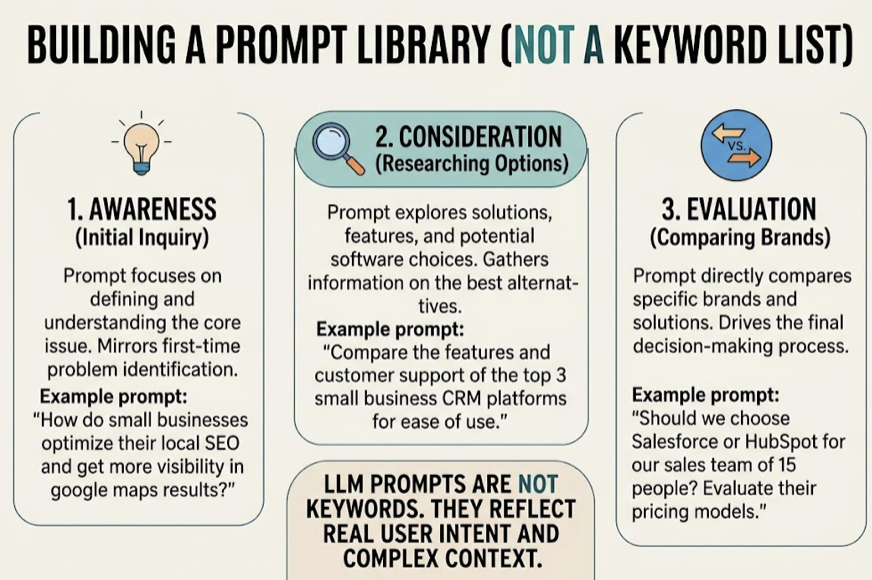
    Build a prompt library, not a keyword list. LLM citation audits start with prompts that mirror how real buyers talk to AI. Unlike traditional keyword research, prompt research focuses on intent clusters: awareness prompts (“how to solve X”), consideration prompts (“best tools for Y”), and evaluation prompts (“Brand A vs Brand B”). The average AI prompt exceeds 20 words and contains multiple qualifiers that push the model from explanation to recommendation.

    Map your citation sources. Once you’ve got your prompts, the next step is tracking which domains AI cites when it mentions you versus when it mentions a competitor. Topify’s Source Analysis feature lets teams reverse-engineer the specific URLs driving competitor visibility. If ChatGPT consistently cites a G2 review or a Reddit thread to recommend your competitor, that specific domain is a blind spot in your content strategy.

    Measure Share of Model Voice. The primary KPI for the generative era is the percentage of AI-generated responses within your category that mention your brand. Unlike SERP share, Share of Model Voice accounts for both the frequency and the context of the mention. A brand recommended as a “reliable leader” carries a higher effective SOMV than one described as a “budget alternative” at the tail end of a list. Topify tracks this across ChatGPT, Gemini, Perplexity, DeepSeek, and other major AI platforms, combining visibility, sentiment, position, volume, mentions, intent, and CVR into a seven-metric framework.

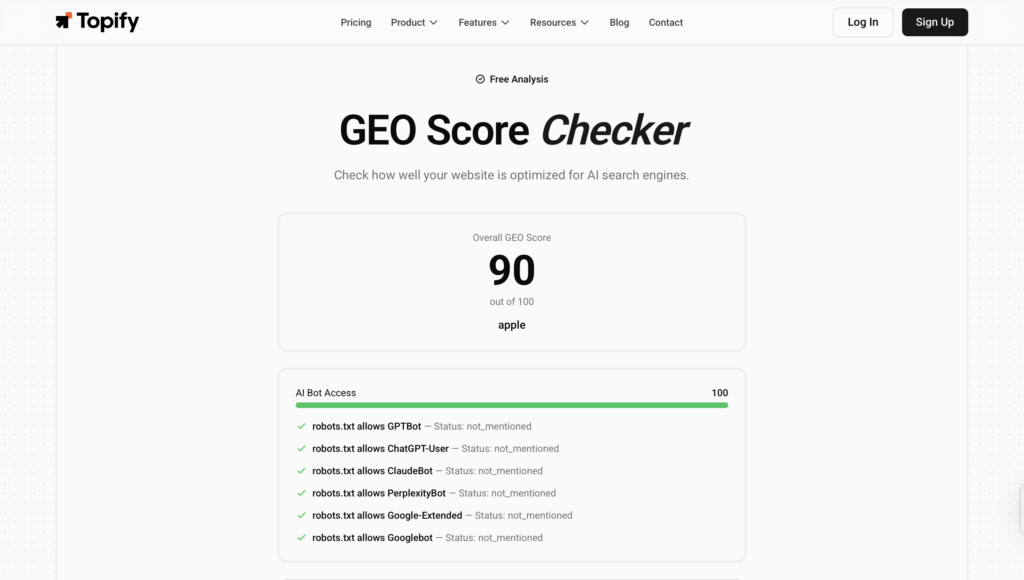
    For teams wanting a quick baseline before committing to a full audit, Topify’s free GEO Score Checker evaluates a site across four dimensions: AI bot access, structured data, content signals, and overall AI visibility. It’s the fastest way to find out whether AI crawlers can even read your site. And the AI Search Volume Checker shows how often specific prompts are searched across AI platforms, so you can prioritize the queries that actually carry demand.

    From Invisible to Cited: Closing the LLM Citation Gap

    Closing the gap requires a shift from keyword optimization to what practitioners call “entity sculpting,” ensuring that AI models recognize your brand as a definitive entity worth citing. Three pillars drive this.

    Restructure content for extractability. AI models don’t read pages. They scrape chunks of text. To get cited, content needs to follow an “answer-first” architecture: state the direct answer in the first 60 words, then layer in context and supporting data. Modular paragraphs of 40-60 words improve the model’s ability to extract information during RAG processing.

    Build third-party consensus. LLMs prioritize safety through consensus. They’re more likely to cite brands that appear consistently across multiple high-authority platforms. Brands cited across four or more platforms are 2.8 times more likely to appear in ChatGPT responses than those with a siloed web presence. Optimization needs to extend beyond your own website to include earned media on Reddit, industry review sites like G2, and reputable journalistic outlets.

    Implement technical GEO infrastructure. Models and their RAG scrapers often struggle with JavaScript-heavy sites, leading to a 60% reduction in visibility for brands that don’t use server-side rendering. Advanced Schema.org markup, including FAQPage, HowTo, and Person schema, provides the “entity proof” that LLMs need to verify a brand’s credentials.

    The execution loop matters as much as the strategy. Topify’s One-Click Execution feature lets teams review AI-generated content improvements, like schema-rich FAQs or data-dense summaries, and deploy them directly. In practice, this closes the gap between identifying a visibility issue and fixing it, which is the stage where most manual GEO efforts stall.

    Conclusion

    The LLM citation gap isn’t a temporary glitch in AI search. It’s a structural divergence between two different systems of digital authority. Google measures who earned the most links. AI models measure who provides the most useful, verifiable, and extractable information.

    For SEO professionals and brand marketers, the goal has shifted from “ranking for clicks” to “being cited for authority.” That means elevating brand search volume, restructuring content for machine extractability, building third-party consensus across the platforms AI trusts, and using automated tools to monitor and maintain visibility across a fragmented landscape. The brands that close this gap now won’t just survive the shift to generative search. They’ll be the ones AI recommends first.

    FAQ

    Q: What is an LLM citation? A: An LLM citation is a reference that an AI model generates to attribute a specific fact or recommendation to an external source. It’s the primary way brands achieve visibility in AI-generated answers, and it works differently from a traditional backlink because it’s selected through semantic relevance and factual density, not link authority.

    Q: Why doesn’t my high Google ranking help me get cited by AI? A: Google’s algorithm prioritizes link-based authority and keyword relevance. LLMs prioritize information gain, extractability, and cross-platform consensus. A high-ranking page may be skipped by an AI model if it lacks unique data, is poorly structured for RAG extraction, or doesn’t exist in the model’s parametric memory.

    Q: How can I track whether AI platforms mention my brand? 

    A: Traditional SEO tools can’t measure this. You’ll need a dedicated AI visibility platform like Topify that monitors mentions, sentiment, citation sources, and share of voice across ChatGPT, Perplexity, Gemini, and other AI platforms. For a free starting point, the GEO Score Checker provides a quick baseline scan.

    Q: Does optimizing for LLMs hurt my Google rankings? 

    A: No. Most GEO strategies, like improving factual density, using clear headings, adding schema markup, and including expert quotations, align with Google’s own E-E-A-T and helpful content guidelines. In practice, brands that optimize for AI citations often see a “halo effect” that improves both traditional and AI visibility simultaneously.

    Read More

  • LLM Citation Tracking: What to Measure and How to Start

    LLM Citation Tracking: What to Measure and How to Start

    Your domain authority is climbing. Your keyword rankings look stable. But when a potential buyer asks ChatGPT for a recommendation in your category, the response pulls three competitors, links to two industry blogs you’ve never heard of, and doesn’t mention your brand once. You check Perplexity. Same story, different competitors. The SEO dashboard says you’re winning. The AI says you don’t exist.

    That disconnect isn’t a glitch. It’s a measurement gap. Traditional search metrics weren’t built to capture how LLMs decide which brands to cite, and most teams don’t yet have a system to track it. LLM citation tracking closes that gap by turning an opaque AI behavior into something measurable and actionable.

    What LLM Citations Are and Why They Don’t Work Like Backlinks

    An LLM citation happens when an AI engine references your brand, domain, or content in its generated response. It might appear as a clickable source link in Perplexity, a named recommendation in ChatGPT, or a cited domain in Google’s AI Overview. On the surface, it looks like a backlink. It isn’t.

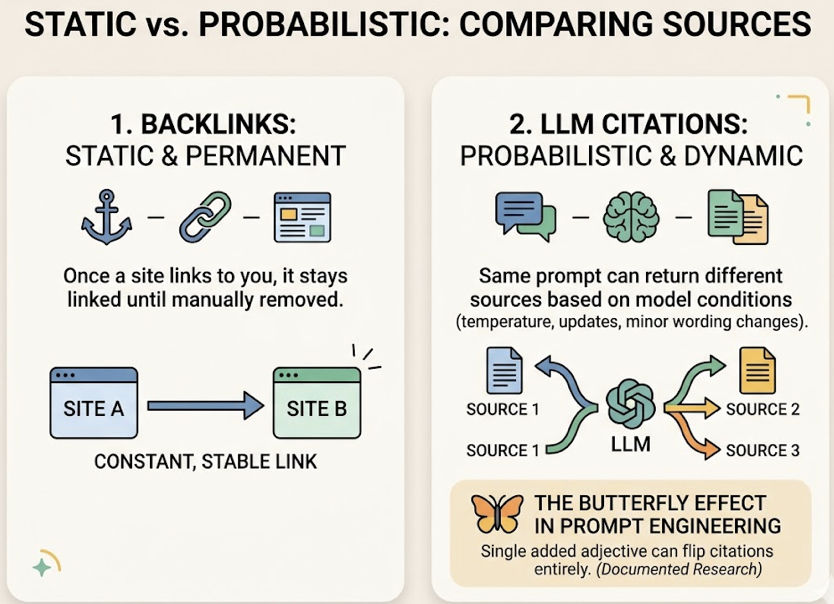
    Backlinks are static. Once a site links to you, it stays linked until someone removes it. LLM citations are probabilistic. The same prompt can return different sources depending on model temperature, retrieval index updates, and even minor wording changes. Research has documented what analysts call the “Butterfly Effect” in prompt engineering: a single added adjective can cause the model to flip its citations entirely.

    The sourcing logic also varies dramatically across platforms. ChatGPT leans heavily on established reference sites, with Wikipedia appearing in nearly 48% of its top citation lists. Perplexity prioritizes recency and community validation, with Reddit accounting for over 46% of its top citations. Google AI Overviews maintain a 76% overlap with traditional organic rankings but weight YouTube and user-generated content far more than other engines.

    That fragmentation is the core challenge. Only 60% to 65% of queries share even a single cited domain across Gemini, ChatGPT, and Perplexity. A brand winning citations on one platform can be completely invisible on another.

    5 LLM Citation Metrics That Actually Tell You Something

    Not all visibility is equal. A mention buried in a footnote carries less weight than a primary recommendation. Here are the five metrics that separate noise from signal in LLM citation tracking.

    Citation Rate. The percentage of relevant prompts where an AI platform includes your domain as a source. Unlike a keyword ranking, which is binary, citation rate is statistical. If you’re tracking 100 high-value prompts and your brand shows up in 34 responses, your citation rate is 34%. Topify calculates this across ChatGPT, Gemini, Perplexity, and AI Overviews simultaneously, giving you a single cross-platform baseline.

    Citation Position. Where your brand appears in the AI’s response matters as much as whether it appears at all. The first brand mentioned in an AI recommendation list earns significantly more trust and click-through than the third or fourth. Research shows the #1 ranked brand in AI mentions captures an average of 62% of total AI Share of Voice, and the gap between #1 and #3 is typically 5x.

    Source Attribution. This tracks the specific domains and URLs the AI is citing when it talks about your category. If Perplexity is pulling from a Reddit thread you’ve never seen, or if ChatGPT trusts a competitor’s G2 page over your product page, source attribution tells you exactly where the authority gap lives.

    Sentiment Context. Being cited isn’t always good news. A study published in Nature Communications found that between 50% and 90% of LLM-generated citations don’t fully support the claims they’re attached to. If an AI describes your premium product as a “budget alternative,” that visibility is a liability. Sentiment scoring evaluates whether AI platforms frame your brand positively, neutrally, or negatively on a 0-to-100 scale.

    Citation Stability. LLM outputs are non-deterministic. Research into AI search volatility indicates that only about 30% of brands maintain consistent visibility across multiple regenerations of the same query. Citation stability measures how reliably your brand appears over repeated runs of the same prompt, separating durable authority from statistical flukes.

    How to Set Up Your First LLM Citation Tracking Workflow

    Tracking LLM citations isn’t a one-time audit. It’s a continuous loop. Here’s how to build the foundation.

    Step 1: Build your prompt library. The unit of measurement in LLM citation tracking isn’t a keyword. It’s a prompt: a full-sentence, conversational query that often exceeds twenty words. Start by mapping four categories of prompts that mirror your buyer’s journey: awareness prompts (“Why is my team’s velocity dropping?”), consideration prompts (“What are the top 5 agile tools for developers?”), validation prompts (“Tool A vs Tool B for small teams”), and brand prompts (“Does [your brand] have SOC2?”). Pull language from sales transcripts, support tickets, and community forums. Then validate which prompts actually carry volume. Topify’s High-Value Prompt Discovery surfaces which conversational clusters are active and where competitors are currently capturing the narrative.

    Step 2: Establish your baseline across platforms. Run your prompt set across ChatGPT, Perplexity, Gemini, and Google AI Overviews. Record which brands appear, in what order, and how they’re described. But here’s the catch: manual checks don’t scale. AI responses are probabilistic, meaning different users get different answers for the same query. Leading frameworks recommend running each priority query at least 10 to 20 times to establish a statistical baseline. Topify automates this by running real-time monitoring across thousands of prompts simultaneously, detecting visibility regressions with 92% sensitivity compared to 64% for manual monitoring.

    Step 3: Map your citation gaps. Once you have a baseline, the question becomes: who’s showing up instead of you? Citation gap analysis identifies the specific pages and third-party platforms that AI engines currently trust for your category. If a competitor is cited because of a G2 review thread or a mention in a specific industry blog, getting your brand into that same source becomes a concrete target. Topify’s Source Analysis reverse-engineers exactly which domains and URLs each AI platform cites, so you can prioritize outreach with evidence rather than guesswork.

    Step 4: Set your audit cadence. AI models update their retrieval systems frequently. A bi-weekly audit cadence is the minimum. Every optimization action, whether adding a statistic, updating a price, or earning a Reddit mention, should be tracked against changes in citation rate and response position. This creates a closed-loop system where visibility data directly informs the next cycle of content production.

    The Prompts That Drive LLM Citations in Your Category

    Not every prompt is worth tracking. The average AI query runs closer to 23 words, packed with specific qualifiers: budget constraints, industry verticals, company size, use-case scenarios. These qualifiers push an AI from “explanation mode” into “recommendation mode,” and that transition is where brands either get cited or get ignored.

    The distinction between prompt types matters. Category-level prompts (“best CRM for small teams”) determine whether you make the shortlist. Brand-level prompts (“Does [your brand] integrate with Salesforce?”) determine whether the AI’s answer is accurate. Both need tracking, but they require different optimization strategies.

    Here’s a pattern most teams miss: generative engines don’t just answer the prompt you type. They generate sub-questions internally to build a more complete response. A prompt about “best project management tools” might trigger the model to also retrieve information about pricing, integrations, and user reviews. If your content covers the primary topic but not those adjacent questions, you’ll lose the citation to a competitor whose content does.

    Topify’s AI Volume Analytics shows which conversational clusters are active and provides a “Share of Model” indicator, so you’re building content around questions AI is actually being asked.

    What Your Competitors’ LLM Citations Reveal About Your Gaps

    Competitive citation analysis isn’t just about knowing who’s ahead of you. It’s a diagnostic tool for understanding what the AI values in your category.

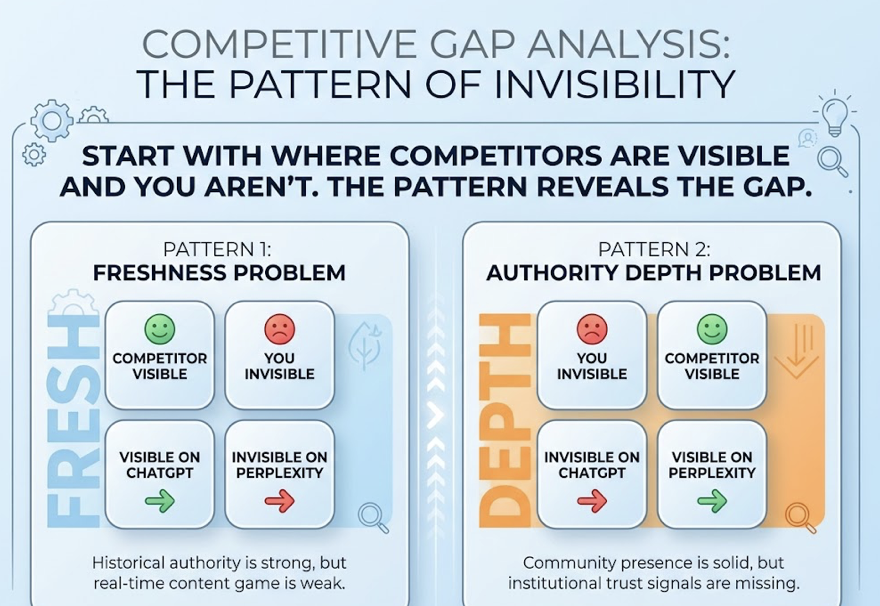
    Start with the platforms where your competitors are visible and you aren’t. That pattern tells you the type of gap you’re dealing with. Visible on ChatGPT but invisible on Perplexity? That’s a freshness problem. Your historical authority is strong, but your real-time content game is weak. Visible on Perplexity but invisible on ChatGPT? That’s an authority depth problem. Your community presence is solid, but institutional trust signals are missing.

    The sources themselves tell a clearer story than any aggregate score. If the AI is citing a competitor because of a specific Forbes mention, a G2 review cluster, or a Reddit thread, those aren’t abstract “content gaps.” They’re specific, targetable opportunities. In mature categories, top brands dominate nearly 86% of the consideration set in AI responses. If you’re not in that set, source-level data shows you exactly what’s keeping you out.

    Topify’s Competitor Monitoring automatically detects your competitive set, compares Visibility, Sentiment, and Position side by side, and flags when a new competitor enters the AI’s recommendation set.

    3 Mistakes That Tank Your LLM Citation Tracking

    Tracking mentions without tracking sources. Knowing your brand was mentioned in 40% of relevant AI answers is a start. But if you don’t know which domains the AI is using to justify those mentions, you can’t protect or expand your position. Source attribution is the layer that connects visibility data to content strategy.

    Watching one platform and calling it done. Each AI engine runs a different retrieval pipeline. ChatGPT Search mode relies heavily on Bing’s index. Perplexity pulls from Reddit and real-time news. Gemini prioritizes pages that already rank well in traditional Google search. A single-platform approach leaves enormous blind spots. The Princeton GEO study demonstrated that a site ranking at position #5 on a traditional SERP could achieve a 115% visibility lift in an AI answer simply by improving its citatability, but that lift varies dramatically by platform.

    Treating citation tracking as a one-time audit. Pages updated in the last 60 days are nearly twice as likely to appear in AI-generated answers as older content. AI systems continuously recalibrate. Research from the Princeton GEO study found that specific structural interventions, like adding expert quotations (+41% visibility boost) or statistics (+32% boost), directly improve citation likelihood. But those gains erode without ongoing monitoring. Brands that set-and-forget their content lose ground in real time to competitors who keep publishing.

    Conclusion

    The gap between SEO performance and LLM citation performance isn’t shrinking. As zero-click rates climb past 58.5% in the US and AI-referred visitors convert at rates up to 23x higher than traditional organic traffic, the brands that build citation tracking into their workflow now will compound that advantage over time.

    The starting point is specific: build a prompt library, establish a cross-platform baseline, map your citation gaps, and set a recurring audit cadence. If you’re looking for an immediate snapshot, Topify’s free GEO Score Checker gives you a baseline of AI bot access, structured data, and content signals in under a minute. From there, continuous monitoring through the full Topify platform turns that snapshot into a system.

    FAQ

    Q: What is an LLM citation? 

    A: An LLM citation is when an AI engine like ChatGPT, Perplexity, or Gemini references your brand, domain, or content in its generated response. It can appear as a clickable source link, a named recommendation, or a cited domain. Unlike a backlink, LLM citations are probabilistic and can change with each query.

    Q: How often should I check my LLM citations? 

    A: At minimum, bi-weekly for your core prompt set. AI models update their retrieval systems frequently, and citation patterns can shift within days. For high-priority prompts tied to revenue-driving queries, weekly monitoring is recommended. Automated tools provide continuous tracking that manual checks can’t match.

    Q: Can I track LLM citations manually? 

    A: You can start manually by running prompts across ChatGPT, Perplexity, and Gemini and recording which brands appear. But manual tracking doesn’t scale: AI responses are non-deterministic, so a single check captures one snapshot of a probabilistic system. Professional tracking runs each prompt multiple times across platforms to calculate statistically reliable baselines.

    Q: Which AI platforms should I track for citations? 

    A: At minimum, ChatGPT, Perplexity, Google AI Overviews, and Gemini. Each platform operates on a distinct retrieval model with different sourcing preferences. Research shows that only 60% to 65% of queries share even one cited domain across these platforms, so single-platform tracking leaves major blind spots.

    Read More

  • How to Earn LLM Citations Across AI Platforms

    How to Earn LLM Citations Across AI Platforms

    Your content ranks on page one. Your domain authority is solid. Your backlink profile would make most competitors jealous. Then a potential buyer types a category question into ChatGPT, and the response names four brands with inline sources. Yours isn’t one of them.

    That gap between Google rankings and AI recommendations is costing brands real pipeline. Data shows that when an AI summary appears, click-through rates on traditional results drop from roughly 15% to 8%. And the traffic that does come through AI search converts at up to 9x the rate of traditional organic. The brands getting cited aren’t necessarily the ones with the highest DA. They’re the ones whose content is built for how LLMs actually retrieve, evaluate, and synthesize information.

    What “LLM Citation” Actually Means (and Why It’s Not a Backlink)

    An LLM citation is a reference, recommendation, or direct link to an external source inside an AI-generated answer. It’s how ChatGPT, Perplexity, and Gemini tell the user: “This is where the information came from.”

    But not all citations look the same. There are two distinct types. Explicit citations show up as superscript numbers or source cards with clickable URLs. You’ll see these on Perplexity and in ChatGPT’s Search mode. Implicit citations happen when the model mentions a brand or product by name as an authority without linking directly. This is common in ChatGPT’s standard conversational mode and Gemini’s knowledge-integrated responses.

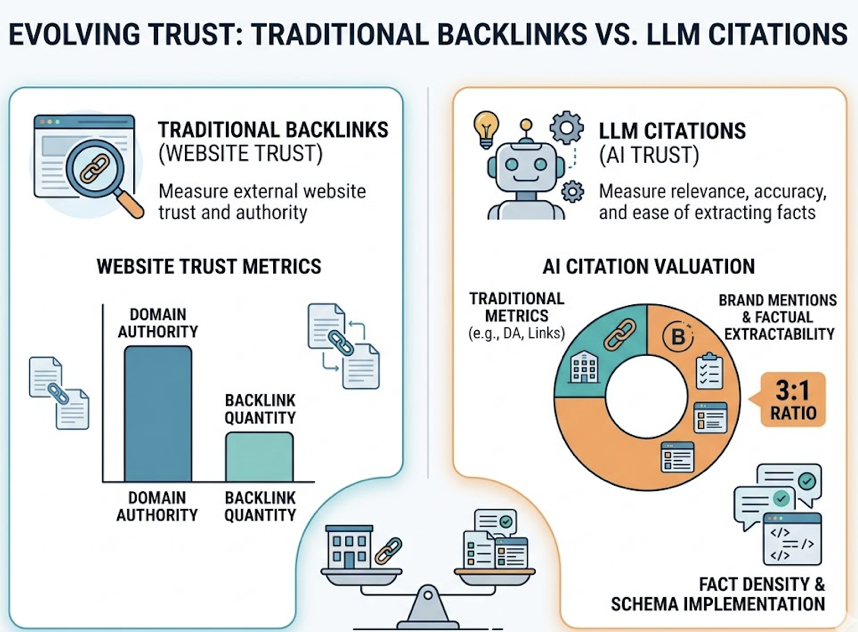
    Here’s the thing: traditional backlinks measure how much other websites trust you. LLM citations measure how much the AI trusts you. Research suggests that citations value brand mentions and factual extractability at a 3:1 ratio over traditional backlink metrics. A page with lower domain authority but higher “fact density” and better schema implementation will frequently beat a high-DA page for an AI citation.

    That distinction matters because only 17-32% of sources cited by LLMs overlap with Google’s top 10 organic results. The two systems are running on separate logic.

    How ChatGPT, Perplexity, and Gemini Choose What to Cite

    Each platform has a distinct retrieval architecture. Treating them as one monolithic system is the first mistake most brands make.

    PlatformCitations Per ResponsePrimary SignalContent Preference
    Perplexity~21.87Freshness and data densityResearch reports, benchmarks, case studies
    ChatGPT~7.92Reasoning and depthHow-to guides, nuanced explainers
    Gemini~8.34E-E-A-T and entity trustOfficial brand pages, structured product data

    Perplexity operates as a precision retrieval engine. It uses a proprietary index combined with Bing to perform real-time searches, delivering responses in a median of 6.8 seconds. Freshness is non-negotiable here. Content updated within the last 30 days has an 82% citation rate. After six months, that drops to 37%. If you haven’t touched a page in half a year, Perplexity has likely stopped citing it.

    ChatGPT is more selective. It cites fewer unique domains but applies a higher bar for topical authority. It’s looking for content that answers “why” and “how,” not just “what.” Long-form guides that anticipate follow-up questions and offer balanced perspectives tend to perform well.

    Gemini leans on Google’s Knowledge Graph and prioritizes “consensus signals,” meaning information verified across multiple authoritative sources like Wikipedia, LinkedIn, and government databases. It’s also more likely to cite brand-owned websites (52.15% of its citations) compared to ChatGPT, which pulls heavily from third-party directories and review sites (48.73%).

    The shared thread: all three platforms reward content that is structured, specific, and consistent across multiple sources.

    5 Strategies That Actually Drive LLM Citations

    Earning an LLM citation isn’t about keyword stuffing. It’s about making your content easy for the AI’s retrieval system to extract, verify, and trust. These five strategies map directly to how LLMs evaluate sources.

    Put the Answer First

    LLMs don’t read entire pages. They retrieve specific passages or “chunks.” The closer your key claim is to the top of a section, the more likely it gets pulled.

    Start every article and major section with a 2-3 sentence summary that directly answers the target question. This “Bottom Line Up Front” approach reduces the compute resources the AI needs to verify your content. Use H2/H3 tags that mirror natural language questions. Instead of “Features,” write “What Are the Core Features of [Product]?”

    Structured schema matters too. Implementing FAQ, Organization, and Product schema (JSON-LD) can increase AI visibility by up to 67%, because it gives the model explicit, machine-readable context for your content.

    Build a Credibility Chain

    AI models evaluate how well-researched your content is by checking whether you cite authoritative external sources. Including references to academic research, industry reports (Gartner, IDC, Forrester), or government data within your own content creates what researchers call a “credibility chain.” This practice can increase your citation probability by up to 40%.

    Author bios matter too. Include credentials, years of experience, and links to LinkedIn profiles to satisfy E-E-A-T requirements. Gemini, in particular, weights these signals heavily.

    Capture Long-Tail Conversational Intent

    AI search queries average 23 to 60 words, compared to 3-4 words on Google. Users aren’t typing keywords. They’re asking compound, scenario-specific questions like “Best CRM for small B2B teams with Slack integration under $50/user.”

    Create content that maps to these compound queries. Use “People Also Ask” phrasing in your subheadings. Build FAQ sections that address the specific, multi-variable questions your buyers actually ask AI platforms.

    Maintain the Freshness Advantage

    In AI search, outdated information often gets treated as wrong information. This is especially true for commercial and transactional queries where pricing, features, or competitive landscapes change frequently.

    Implement a quarterly update cycle for cornerstone content. Use IndexNow to alert Bing (and by extension ChatGPT and Perplexity) immediately when content is refreshed. This reduces discovery time from days to hours. The payoff is significant: content freshness within the last 30 days is associated with a 115% increase in AI visibility.

    Own the Multi-Platform Consensus

    AI models triangulate truth. They check whether your brand information is consistent across your website, G2, Reddit, TrustRadius, and industry publications. If the information conflicts, the model’s confidence score drops and it excludes you.

    This is especially important because 85% of AI citations come from third-party sites, not from brand-owned pages. Your off-site presence isn’t optional. Brands that maintain consistent information across four or more platforms see a 2.8x to 4.0x increase in AI recommendation rates.

    Audit your external profiles. Make sure your core value proposition, pricing tier, and product descriptions are identical everywhere.

    Why Most Brands Can’t Tell If They’re Being Cited

    Here’s the uncomfortable truth: most marketing teams are flying blind in the AI search era.

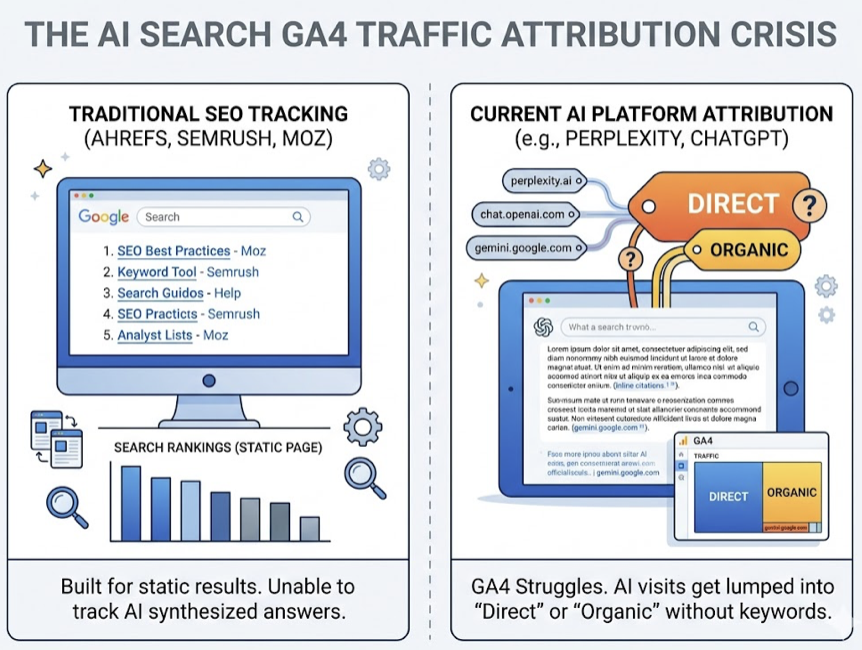
    Traditional SEO tools like Ahrefs, Semrush, and Moz were built to track rankings on a static results page. They’re structurally incapable of monitoring synthesized AI answers. Google Analytics (GA4) struggles to categorize traffic from AI platforms accurately. Some visits show up as chat.openai.com or perplexity.ai, but many get lumped into “Direct” or “Organic” without keyword context.

    The bigger problem is scale. Because AI responses are probabilistic, the same prompt can yield different results in different sessions or locations. A manual check (“Does ChatGPT recommend me?”) is statistically meaningless. You’d need to simulate hundreds of prompt variations across multiple models to get a reliable visibility score.

    And there’s a risk most teams don’t even think about: semantic drift. That’s when an AI model’s description of your product diverges from reality. It might describe your enterprise platform as a “free utility for students” based on outdated training data. Without automated monitoring, you won’t know until a prospect mentions it in a sales call.

    How to Track and Measure LLM Citations at Scale

    Specialized AI visibility platforms bridge the gap that traditional tools can’t. Topify is built specifically for this problem, providing continuous monitoring across the generative ecosystem.

    Source Analysis is where most teams should start. It reverse-engineers the exact URLs and domains that AI models cite for your target keywords. If Perplexity is citing a competitor’s comparison table or a specific Reddit thread instead of your content, Source Analysis shows you exactly which sources are driving those recommendations. That’s the gap between “we’re invisible” and “here’s why, and here’s what to create next.”

    Visibility Tracking monitors your brand across ChatGPT, Gemini, Perplexity, and other major platforms. It calculates a Visibility Score (0-100) based on the percentage of target prompts where your brand appears. Since the #1 ranked brand in an AI-generated list typically captures 62% of the share of voice, knowing your position isn’t optional.

    Competitor Monitoring auto-detects which brands are surfaced alongside yours and identifies the content gaps that allow them to hold top recommendation slots.

    The practical starting point: Topify’s free GEO Score Checker audits your site’s AI bot access, structured data, and content signals with no signup required. It tells you whether your technical foundation is intact before you invest in broader optimization.

    A B2B SaaS team used this approach to discover that despite ranking #1 on Google, they were invisible in AI answers. Perplexity and ChatGPT were exclusively citing a competitor’s comparison table and three niche forum threads. By creating structured “answer-first” content, engaging in the identified forums, and aligning their review profiles, they increased their AI Visibility Score by 35% within 45 days and saw a 14% lift in self-reported attribution from leads who found the brand through ChatGPT.

    3 LLM Citation Mistakes That Keep Brands Invisible

    The “Google-Only” Optimization Bias

    Ranking #1 on Google doesn’t guarantee AI citations. The overlap between Google’s top 10 results and LLM-cited sources is only 17-32%. AI models prioritize “extractability” over “link equity.” A site with lower DA but higher fact density and better schema will frequently outperform a high-DA competitor in AI answers.

    The fix: optimize for information gain. Provide data, benchmarks, and perspectives that don’t exist elsewhere on the web.

    “Self-Centric” vs. “Answer-Centric” Content

    Traditional “About Us” pages loaded with vague adjectives (“passionate,” “innovative,” “world-class”) are useless to an LLM trying to construct a factual answer. The model needs declarative, verifiable claims.

    The fix: replace “We are experts in security” with “Our platform provides end-to-end AES-256 encryption and is SOC 2 Type II compliant.” Specifics get cited. Adjectives don’t.

    Ignoring the Consensus Gap

    If your website says one thing and your G2 reviews or Reddit mentions say something different, AI models experience a “trust break.” LLMs are designed to identify and neutralize bias by cross-referencing multiple sources. Contradictions lead to exclusion.

    The fix: audit every external platform where your brand appears. Ensure consistent messaging about your positioning, pricing, and capabilities across all third-party profiles and review sites.

    Conclusion

    LLM citation is becoming the new unit of brand authority in AI search. The mechanics are different from traditional SEO, the platforms don’t all work the same way, and most existing tools can’t measure it.

    Three things matter most: make your content structurally extractable (schema, clear headings, answer-first format), own the consensus across third-party platforms (85% of citations come from sources you don’t own), and measure what you can’t see with specialized AI visibility tracking. The brands building this discipline now are the ones AI will recommend next quarter.

    FAQ

    What is an LLM citation? An LLM citation is a reference, link, or mention of a brand or source within an answer generated by an AI model like ChatGPT or Perplexity. It serves as a machine-generated endorsement and a primary source of high-intent referral traffic.

    How does Perplexity decide which sources to cite? Perplexity uses a real-time Retrieval-Augmented Generation (RAG) model. It prioritizes factual density, structured content, and extreme freshness (updates within 30 days) to provide verifiable answers with explicit URL citations.

    Can you optimize content for ChatGPT citations? Yes. ChatGPT prioritizes topical depth, comprehensive how-to guides, and content that anticipates follow-up questions. It uses the Bing index and values authoritative, well-reasoned narratives over simple keyword matching.

    How often do LLMs update their citation sources? It depends on the platform. RAG-based systems like Perplexity update their indices in near-real-time (daily or hourly via IndexNow). Foundational models like standard ChatGPT or Gemini rely more on training data but are increasingly grounded in real-time search.

    What’s the difference between LLM citation and traditional backlinks? Traditional backlinks are hyperlinks used by search engines to measure site authority and rank pages. LLM citations are synthesis signals used by AI models to construct answers. Citations value brand mentions and factual extractability at a 3:1 ratio over traditional backlink metrics.

    Read More

  • LLM Citation: How AI Picks Its Sources

    LLM Citation: How AI Picks Its Sources

    Your domain authority is 70. You’re ranking top three for your primary category keyword. Your content team has published 200 articles in the last year. Then someone types that same keyword into ChatGPT, and the response cites three sources. None of them are yours.

    That gap isn’t random. Research shows only 12% of URLs cited by AI platforms appear in Google’s top 10 for the same query. The other 88% of AI-cited content is invisible to traditional SEO monitoring. What gets you ranked on Google and what gets you cited by an LLM are now two different systems, governed by two different sets of rules.

    What Happens Between a Query and an LLM Citation

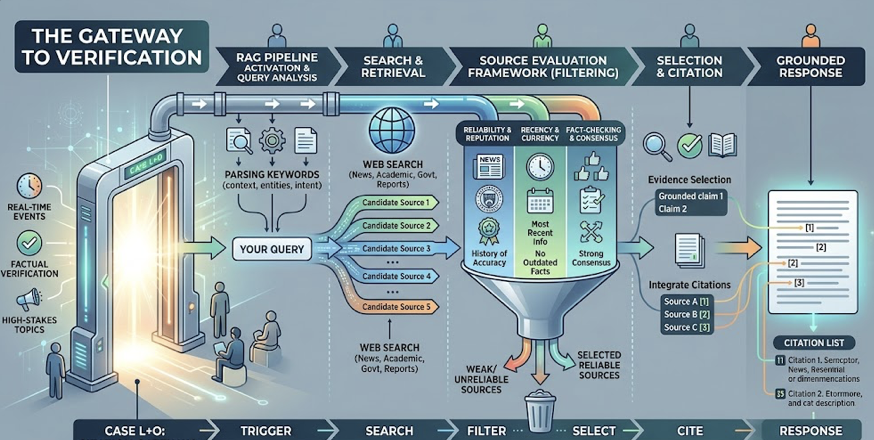
    When a user submits a query to ChatGPT, Perplexity, or Gemini, the model doesn’t just recall an answer from memory. It faces a binary decision: rely on its internal training data, or search the live web for current information.

    Researchers call these two paths Case L (learning data only) and Case L+O (learning data plus online research). In Case L mode, the model draws from its parametric knowledge, a compressed representation of patterns absorbed during pre-training. This data is typically months or years old, stored as neural weights rather than discrete documents. The model rarely provides external citations in this mode.

    Case L+O is where citations happen. When a query involves real-time events, factual verification, or high-stakes topics, the model activates its Retrieval-Augmented Generation (RAG) pipeline. It searches the web, retrieves candidate sources, and selects which ones to cite. This trigger point is the essential gateway. Without it, your content is never evaluated.

    That’s the part most SEO professionals miss. The majority of AI citations come from RAG retrieval, not from the model’s “memory.” Your content doesn’t need to be in the training data. It needs to survive the retrieval pipeline.

    The Four Signals LLMs Use to Select Sources

    Once the RAG pipeline activates, the model evaluates candidate sources through four core signals. These aren’t the same signals that drive Google rankings.

    Semantic relevance operates in vector space, not keyword space. The model converts content into numerical embeddings and measures semantic proximity to the user’s intent. Keyword stuffing, counterintuitively, hurts here. Repeating a term dilutes the “semantic signature” of a passage, pushing its vector further from the query’s meaning. Content that provides direct, unambiguous answers to specific questions scores higher.

    Information gain measures the density of unique, verifiable data points. LLMs can generate generic descriptions on their own. What they can’t generate are original statistics, first-hand research findings, or specific expert insights. Passages structured into self-contained chunks of 50 to 150 words receive 2.3x more citations than long, narrative-heavy blocks. Shorter, focused sections let the model attribute a specific fact to a specific URL with higher confidence.

    Entity coherence is consistency. The model cross-references your brand description against third-party platforms like Wikipedia, G2, Reddit, and LinkedIn. If your homepage says “leader in AI analytics” but Reddit describes you as a “marketing automation tool,” the model’s entity confidence drops. Brands mentioned consistently on four or more platforms are 2.8x more likely to appear in ChatGPT responses.

    Freshness acts as a primary trust filter. Content updated within the last 90 days is 3x more likely to be cited than older material. Claude favors very recent content with a median citation age of 5.1 months, while ChatGPT and Gemini tolerate slightly older material at around 8 months. Replacing statistics older than 18 months is the most effective way to reset the freshness clock.

    Evidence Graphs: How LLMs Resolve Conflicting Sources

    When the retrieval pipeline surfaces multiple sources with conflicting claims, the model doesn’t just pick the one with the highest domain authority. It builds what researchers call an “evidence graph,” a network where nodes represent entities and facts, and edges represent corroborating relationships between documents.

    The reasoning layer performs consensus validation. If three independent sources, say a news site, an industry report, and a peer-reviewed study, all state the same statistic, that data point achieves “fact status” in the graph. The model cites one or more of those sources as verification. Outlier claims that lack corroboration get omitted or flagged as unverified.

    This “three-source rule” has a practical implication: brands that rely solely on self-published content to make claims will lose to competitors whose claims are echoed across independent third-party domains. Building consensus across the web matters more than publishing volume on your own site.

    Once an LLM identifies reliable nodes within its evidence graph for a category, it tends to stick with them. Analysis of citation patterns reveals a 96.8% week-over-week stability rate in cited domains. Among the roughly 3% that do change, 87% are declines and only 13% are gains. Citation positions are calcifying. That creates a first-mover advantage: brands that establish themselves as citable nodes early are significantly harder to displace.

    Why High-Ranking Pages Still Get Zero AI Citations

    The “high-ranking, zero-citation” gap is structural, not accidental. Traditional SEO encourages long-form content that captures a variety of keywords. LLMs prefer cleanly segmented sources where facts are easy to extract. A 3,000-word guide that buries key data points inside long narrative paragraphs will get bypassed in favor of a 500-word page with clear H2 headers answering specific sub-questions directly.

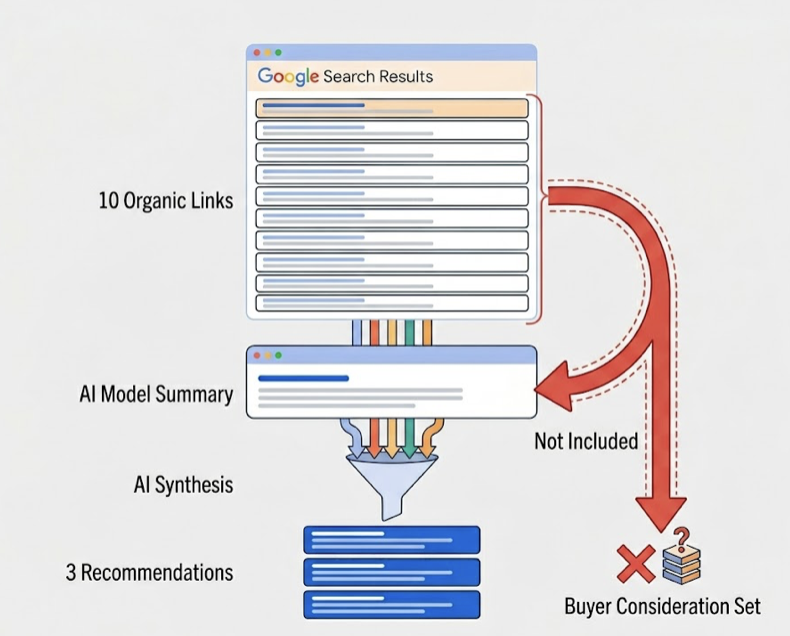
    The disconnect gets worse with query fan-out. When a user enters a complex prompt, the AI doesn’t run a single search. It decomposes the prompt into multiple simultaneous sub-queries. A question like “What’s the best CRM for a healthcare startup with 50 employees?” might fan out into four separate searches: HIPAA compliance features, pricing for 50 users, medical startup reviews, and Salesforce vs HubSpot comparisons.

    If your content ranks #1 for the head keyword but doesn’t have specific sections addressing those sub-topics, it fails retrieval for the queries that actually build the synthesized answer. Each sub-query identifies its own set of sources, and the final citation list is a synthesis of those separate searches. You don’t need to rank for everything. You need to be extractable for something specific.

    How to Track Which Sources LLMs Actually Cite

    Manual citation tracking is a dead end. AI responses are probabilistic, meaning the same prompt can produce different citations in different sessions. Platform preferences vary wildly: ChatGPT overlaps with Google’s top 10 only 12% of the time, Perplexity sits around 33%, and Google AI Overviews ranges from 38% to 76%. A single spot-check tells you nothing. Only systematic monitoring across thousands of queries can establish a reliable baseline.

    Topify was built to close this measurement gap. Its AI Citation Analysis identifies which specific domains and URLs AI platforms cite when they answer queries in your category. Instead of guessing which content is working, you can see the actual evidence graph the AI relies on, and spot where competitors are being cited while your brand remains absent.

    The platform’s AI Visibility Checker tracks mention frequency, recommendation position, and sentiment across ChatGPT, Gemini, Perplexity, and AI Overviews. Position matters disproportionately: the first-cited brand in an AI response captures over 60% of the AI share of voice. Being mentioned fifth often leads to total exclusion from user attention.

    For teams that want a quick diagnostic before committing to ongoing monitoring, Topify’s free GEO Score Checkerevaluates your site across four dimensions: AI bot access, structured data, content signals, and overall visibility. No signup required. It’s a fast way to determine whether your technical foundation is blocking AI retrieval before investing in content optimization.

    Five Content Signals That Earn LLM Citations

    Moving from “ranked” to “cited” requires optimizing for the RAG pipeline’s extraction and reasoning layers. Five signals consistently predict citation success.

    Structured, modular writing. Break content into 50 to 150 word self-contained chunks. Each section should start with an H2 or H3 that asks a specific question, followed by a direct answer. This structure facilitates the passage indexing that neural retrievers depend on. Tables are particularly effective, appearing in nearly a third of all AI citations.

    Statistics and original data. Embedding quantitative metrics into every article provides the information gain LLMs prioritize. Adding statistics has been shown to boost AI visibility by up to 41%. Every major claim should include a number and a date.

    Entity alignment across platforms. Maintain identical positioning on Wikipedia, LinkedIn, Crunchbase, G2, and relevant subreddits. AI platforms trust third-party consensus more than self-attestation. A mention on a respected industry site carries more citation weight than ten pages of marketing copy on your own domain. Third-party sources are cited 6.5x more often than brand-owned pages.

    Answer-first formatting. Place the most important facts in the first 30% of the page, where they’re most likely to be extracted. Use lists, comparison tables, and TL;DR summaries. Avoid vague language. AI models select content that gives them a clean, attributable data point, not content that makes them work to find one.

    The 90-day freshness cycle. Audit and refresh competitive pages every 90 days. Update statistics, add new sections to address emerging fan-out queries, and ensure that schema markup (datePublished and dateModified) signals recency to AI crawlers. Content decay in AI citation is faster than in traditional search: 62% of citations turn over every 90 days in competitive categories.

    Conclusion

    LLM citation isn’t a mystery. It’s a pipeline with measurable signals at each stage: the decision to search, semantic retrieval, evidence weighting, and source attribution. The uncomfortable reality for SEO professionals is that the signals driving this pipeline, semantic relevance, information density, entity coherence, and freshness, don’t map neatly onto the metrics they’ve spent years optimizing.

    The 12% overlap between AI citations and Google’s top 10 isn’t shrinking. It’s a structural feature of how generative search works. The brands that adapt, by building modular, data-rich content and tracking their citation performance across platforms, will own the discovery layer that’s replacing ten blue links. The ones that don’t will remain part of the invisible 88%.

    FAQ

    What is LLM citation?

    An LLM citation is the attribution of a specific claim in an AI-generated response to an external source URL. Unlike traditional search results that present a list of links, AI citations ground the model’s synthesized answer in verifiable data. They’re the primary mechanism through which content gets discovered in AI search.

    How does RAG affect LLM citation selection?

    RAG (Retrieval-Augmented Generation) is the mechanism that triggers external search. When activated, the model retrieves content chunks from the web based on semantic proximity to the query, evaluates them for information gain and entity coherence, and selects the most attributable sources. Without the RAG trigger, no external citations occur.

    Do backlinks help with LLM citations?

    The correlation between backlinks and AI citations is near zero in most studies. LLMs prioritize a source’s internal factual density and the brand’s consistency across third-party platforms over the total number of incoming links. A page with 10 backlinks but strong structured data can outperform a page with 10,000 backlinks but poor extractability.

    How often do LLM citation sources change?

    At the domain level, citation patterns are remarkably stable: 96.8% of cited domains show zero change week-over-week. At the URL level, turnover is much faster, with 62% of citations changing every 90 days in competitive categories. This makes regular content freshness updates a practical necessity for maintaining citation position.

    Read More

  • LLM Citations vs. Backlinks: What Actually Changed

    LLM Citations vs. Backlinks: What Actually Changed

    Your domain authority is solid. Your backlink profile looks strong. Your pages rank in the top 10 for a dozen competitive keywords. Then someone asks ChatGPT for a recommendation in your category, and your brand doesn’t show up once.

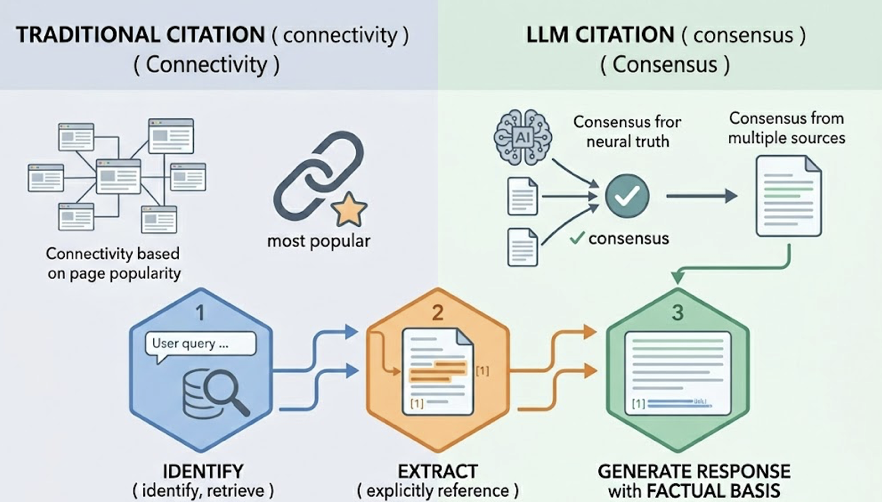
    That gap between traditional SEO performance and AI search visibility is widening. Brand mentions now correlate at 3:1 over backlinks when it comes to AI Overview placement. The signals that made your site rank aren’t the same signals that make AI recommend you. And the difference between an LLM citation and a backlink isn’t just technical. It’s structural.

    Backlinks Built the Old Web. LLM Citations Are Building the New One.

    For more than twenty years, the hyperlink was the internet’s primary trust instrument. Google’s PageRank algorithm treated each backlink as a vote of confidence from one domain to another, and that logic shaped how every brand thought about authority. Rank higher, get more links, rank higher still. The entire system was built around navigation: guiding users to the most authoritative destination.

    LLM citations work on a completely different principle. When an AI model generates a response, it doesn’t look for the most popular page. It looks for the most corroborable passage. An LLM citation happens when a model identifies, retrieves, and explicitly references a specific piece of content as the factual basis for its answer. The currency isn’t connectivity. It’s consensus.

    The scale of this shift is already measurable. AI-driven website sessions grew by roughly 527% year-over-year in early 2025. As of 2026, approximately 48% of Google queries trigger an AI Overview, pushing traditional organic results further down the page. Being the top result in a traditional index no longer guarantees visibility if your brand isn’t also synthesized into the AI’s narrative.

    DimensionLink EconomyConsensus Economy
    Primary SignalHyperlinks (Backlinks)Brand Mentions and Citations
    Authority LogicPopularity-based (PageRank)Corroboration-based (Consensus)
    Search MechanismCrawling and IndexingRetrieval-Augmented Generation
    User ValueNavigation to a sourceDirect answer with attribution
    Content UnitThe Domain/PageThe Passage/Atomic Claim

    The shift boils down to this: from “who links to you” to “who is talking about you.”

    Where Backlinks and LLM Citations Actually Diverge

    Traditional search engines map the web through links. LLMs map the web through entities. That’s not a subtle distinction. It changes what counts as authority, how content gets evaluated, and what marketers should measure.

    The numbers make the disconnect clear. While 76% of URLs cited in Google’s AI Overviews also rank in the organic top 10, that correlation falls apart for standalone LLMs. Around 80% of URLs cited by ChatGPT don’t rank in Google’s top 100 for the same query. AI models are searching a different universe of content.

    In that universe, unlinked brand mentions carry more weight than most SEO practitioners realize. Brands that show up consistently across four or more non-affiliated platforms are 2.8 times more likely to appear in ChatGPT responses. Mentions on Quora and Reddit alone correlate with 4x higher citation likelihood. Third-party review profiles on G2, Capterra, and Trustpilot increase citation chances by 3x.

    MetricTraditional SEOLLM / Generative Engine
    Authority MeasurementDomain Rating (0-100)Entity Confidence Score
    Ranking CorrelationHigh (Links = Rank)Low (Links ≠ Citation)
    Impact of MentionsMinimal / IndirectCritical (3:1 over links)
    Multi-Platform SignalOptionalEssential (4+ platforms = 2.8x lift)
    Conversion RateStandard Organic (~2-3%)4.4x Higher (pre-qualified intent)

    That last row matters more than most teams think. AI-referred visitors aren’t just more visible. They convert at dramatically higher rates because the model has already pre-qualified the recommendation.

    Why a High DR Doesn’t Guarantee an LLM Citation

    Here’s where the old mental model breaks. A website with a DR of 70+ can be entirely bypassed by AI citation engines in favor of a niche blog with a DR of 30.

    LLMs don’t evaluate authority through link equity. They evaluate it through topical depth, neutral guidance, and structural extractability. An AI model will prefer a vendor-neutral comparison guide from an industry-specific publisher over a Forbes article that mentions a brand in passing. The niche content is easier to rephrase as a factual answer, and that’s what matters to the model’s confidence layer.

    Each platform also pulls from a different source pool. ChatGPT matches Bing’s top 10 results about 87% of the time, making Bing optimization directly relevant. Perplexity leans heavily on user-generated content, with Reddit accounting for 46.7% of its preferred source citations. AI Overviews draw 76.1% of their sources from Google’s own organic index.

    This means a brand can dominate Perplexity (strong Reddit presence) and be invisible on ChatGPT (weak Bing rankings) at the same time. Optimizing for a single model misses citation opportunities on the others.

    A few data points sharpen this further. Content with statistics and named citations gets 30-40% higher visibility in AI responses. About 44.2% of all LLM citations come from the first 30% of an article’s text. And content updated within the last 30 days is 3.2x more likely to be cited than older material. Freshness isn’t optional in generative search. It’s a filter.

    The Content Formats That Earn LLM Citations

    LLMs don’t read your entire 3,000-word article. They use retrieval-augmented generation (RAG) to pull specific passages that contain a direct answer to a user’s prompt. Content that’s structured in atomic, extractable fragments wins.

    Comparative listicles are the clear front-runner. Articles that rank or compare multiple tools or services account for 32.5% of all AI citations, the highest-performing format identified in 2026. The reason is mechanical: listicles provide the entity-relationship mapping that LLMs need to synthesize comparisons.

    Other high-performing structures include FAQ sections with schema markup (3.2x more likely to appear in AI Overviews), question-based H2/H3 headings (3x higher citation rate), and original data tables (4.1x more citations than text-only equivalents). The first paragraph of each section matters disproportionately: providing a direct answer in the first 40-60 words increases citation probability by 67%.

    Specificity is a trust signal. An LLM is far more likely to cite “Companies see 4.4x conversion rates from AI search (Semrush, 2026)” than “Companies see significant improvements in search performance.” Vague claims get filtered out. Specific, attributed claims get quoted.

    Earned media distribution also plays a larger role than most brands expect, with a median lift of 239% in AI citations. Journalistic and earned media sources now account for roughly 25% of all citations generated by large language models.

    E-E-A-T has shifted too. Content with clear author bylines and real credentials achieves 2.3x more citations than anonymous corporate content. If an LLM can’t find a real person with real experience attached to the advice, it’s less likely to cite it.

    How to Track LLM Citations When There’s No Search Console for AI

    There’s no native “LLM Citation Report” in Google Search Console. Traditional analytics can tell you about clicks and rankings, but AI visibility is often a zero-click experience where the user gets the answer and the brand awareness without ever visiting your site.

    That tracking gap is exactly what Topify was built to fill. The platform monitors brand visibility across ChatGPT, Gemini, Perplexity, and other major AI engines through a seven-metric framework: Visibility Score, Sentiment Score, Position Rank, Source Analysis, Mention Volume, Intent Alignment, and CVR (Conversion Visibility Rate).

    The practical value is in the cross-platform view. A brand might discover it has an 80% Visibility Score on Perplexity (driven by Reddit consensus) but only a 12% Visibility Score on ChatGPT (due to weak presence in Bing-indexed publications). That kind of gap is invisible without platform-specific tracking. Topify’s Source Analysis feature lets you reverse-engineer which domains and URLs AI platforms are actually citing, so you can see whether your content or your competitor’s content is driving the model’s recommendations.

    For teams already using Ahrefs or SEMrush, this isn’t a replacement. It’s a different layer. Traditional tools cover the infrastructure of rankings and backlinks. AI visibility tools cover the citation layer that determines whether your brand gets recommended in the first place.

    Backlinks Still Matter. Just Not the Way You Think.

    The “backlinks are dead” narrative is wrong. What’s changed is their role.

    Since 76% of AI Overview citations come from pages that already rank in Google’s organic top 10, strong traditional SEO is still the primary filter AI uses to determine what’s worth citing. A page that can’t rank on Google is unlikely to get cited by ChatGPT. Backlinks are the gatekeepers to the AI’s citation pool.

    But the reverse is also true. AI systems cite content that Google barely registers. Pages that never ranked for their target keyword but provide the best structured answer to a specific question can earn consistent LLM citations. The relationship isn’t either/or. It’s layered.

    In a 2026 search strategy, backlinks function as infrastructure: they build the crawl priority, index authority, and baseline trust that get your content into the retrieval pool. LLM citations function as the growth layer: they determine whether the AI actually surfaces your brand when someone asks a question that matters. The two signals compound. High-quality backlinks increase the odds of retrieval. Structured, extractable content increases the odds of citation.

    The most effective approach is hybrid. Create content that uses traditional SEO fundamentals (keywords, internal linking, authority building) to secure a position in Google’s top 10, then layer in atomic answer blocks, data tables, and FAQ schema to secure a citation in the AI summary. One piece of content, two discovery surfaces.

    Conclusion

    The shift from backlinks to LLM citations isn’t about one replacing the other. It’s about a new layer of authority that most brands aren’t tracking yet. Backlinks still build the foundation. But LLM citations decide whether AI recommends your brand or your competitor’s.

    The practical path forward has three steps. First, audit your current AI visibility across platforms using a tool like Topifyto see where you’re cited and where you’re missing. Second, restructure your highest-value content into extractable formats: comparison tables, FAQ sections, and atomic answer blocks in the first 40-60 words of each section. Third, build off-page consensus through earned media and brand mentions on the platforms that AI models actually pull from.

    The brands that figure this out early won’t just rank. They’ll be the ones AI recommends.

    FAQ

    What is an LLM citation?

    An LLM citation is a reference within an AI-generated answer that attributes a fact, recommendation, or data point to a specific source URL. When ChatGPT, Perplexity, or Google AI Overviews cite your content, they’re using it as supporting evidence for their response.

    Do backlinks still help with AI search visibility?

    Yes. Backlinks remain the primary foundation for index authority. Since 76% of AI Overview citations come from pages ranking in Google’s organic top 10, backlinks are the entry ticket to being considered for an LLM citation. They’re necessary, but no longer sufficient on their own.

    How can I check if my brand is being cited by ChatGPT?

    There’s no native dashboard for AI search citations. You’ll need a third-party AI visibility tool like Topify that runs simulated prompts across multiple LLMs to track where your brand is mentioned, cited, and recommended compared to competitors.

    What content formats get the most LLM citations?

    Comparative listicles (“Best X for Y”) account for 32.5% of all AI citations, making them the highest-performing format. FAQ sections with schema markup, structured data tables, and question-based headings also perform well. The first 40-60 words of each section carry disproportionate weight.

    Read More

  • LLM Citations: What They Are and Why Marketers Should Care

    LLM Citations: What They Are and Why Marketers Should Care

    Your team spent six months building content authority. Domain rating is climbing, organic traffic is strong, and your top 50 keywords all sit in the first three positions on Google. Then a prospective buyer asks ChatGPT, “Which platform offers the most reliable solution for [your category]?” The response names three competitors, links to a niche blog and a Reddit thread, and doesn’t mention your brand once.

    That disconnect has a name: the Visibility Gap. It’s the growing space between where your brand ranks on Google and whether AI systems mention you at all. Research shows only 11% of domains get cited by both ChatGPT and Perplexity for the same queries. Traditional search dominance no longer guarantees presence in the discovery layer that’s reshaping how buyers find brands.

    The signal that determines whether you show up in that layer is called an LLM citation.

    What Is an LLM Citation, and How Is It Different from a Backlink?

    An LLM citation is any instance where a large language model references, mentions, or links to a brand while generating a response. It shows up in two forms. Explicit citations include a direct URL or hover-over source link, common on platforms like Perplexity and Google AI Overviews. Implicit mentions happen when the AI recommends or describes a brand in its prose without linking to the source.

    That distinction matters because the signals driving each are fundamentally different from traditional SEO.

    Backlinks are static, page-to-page hyperlinks designed to pass link equity. An LLM citation is a declaration of entity relevance within a specific semantic context. While traditional SEO has long prioritized backlink volume and domain authority, those factors show a weak to neutral correlation with whether an LLM will actually cite a brand. The strongest predictor of LLM citation frequency is brand search volume, with a correlation coefficient of 0.334. In practice, LLMs prioritize brands that already have high mental availability among human users, mirroring real-world authority rather than technical link-building strength.

    FeatureTraditional BacklinkLLM Citation
    Core intentNavigation and SEO authorityAttribution and factual support
    StabilityRelatively permanentHighly volatile, changes per inference
    Discovery pathLink graph crawlingParametric knowledge + RAG
    User impactDirect referral trafficBrand perception and shortlist inclusion
    Evaluation metricDomain Rating / Page AuthorityEntity salience and source reliability

    Here’s the thing: an LLM citation represents a model’s “confidence” that your brand is a necessary component of a correct answer. That’s a fundamentally more powerful signal than a hyperlink.

    The Economics of Being Cited: Why LLM Citations Drive Buyer Decisions

    The shift toward AI-powered discovery isn’t speculative. Estimates suggest over $750 billion in U.S. revenue will funnel through AI-powered search environments by 2028. Roughly one-third of consumers now start their research directly within AI tools rather than traditional search engines, and in B2B, that figure is even steeper: 51% of software buyers report using AI chatbots more frequently than Google for initial vendor research.

    The economic value of an LLM citation is significantly higher than a traditional search impression. In a Google search, a brand must win a click to start influencing the buyer. In an AI response, brand exposure happens directly within the answer. The buyer is pre-educated before they ever visit your website.

    When users do click through from an AI citation, the traffic converts at 14.2%, roughly five times higher than traditional organic traffic. The user arrives pre-qualified by the AI’s synthesis.

    The most significant risk is compression of choice. Google typically displays ten organic links per page. An AI model often synthesizes a shortlist of just three recommendations. Being excluded from that response is equivalent to being excluded from the buyer’s entire consideration set. And the effect compounds: every time a brand is cited as a top choice, that response contributes to future training data and reinforces the model’s association between the brand and the category.

    The traditional research phase, which used to involve 12 to 15 separate search sessions over several weeks, is being compressed into a single interaction with an AI agent.

    How LLMs Decide Which Brands to Cite

    When a user asks a broad question, the AI doesn’t process it as a single query. It performs “query fan-out,” decomposing the prompt into 8 to 12 sub-queries covering pricing, reviews, technical specifications, and more. A brand that only provides high-level marketing copy but lacks presence in those sub-categories gets skipped.

    Five factors determine which brands pass the selection filter.

    Entity authority. The model evaluates how clearly a brand is recognized as an authority in a specific niche. Wikipedia alone provides nearly 48% of all citations for ChatGPT. If your brand doesn’t exist in ground-truth reference sources, you’re starting at a disadvantage.

    Structural extractability. Content that uses clear H2/H3 hierarchies and leads with a direct answer in the first 30% of the text is 44.2% more likely to be selected as a source. LLMs can’t cite what they can’t easily parse.

    Cross-platform consensus. A single source claiming a brand is “the best” isn’t enough. Most AI models require verification from five or more independent, high-authority sources before triggering a citation. 85% of citations come from third-party sites like Reddit, G2, or industry publications.

    Content freshness. More than 70% of pages cited by AI models were updated within the last year. Pages that fall out of a quarterly update cycle are three times as likely to lose their citations.

    Entity consistency. If your brand name varies across LinkedIn, your website, and directory listings, the AI’s entity resolution algorithms may fail to connect the signals. One airline brand unified its naming across all platforms and saw a 35% increase in citation rates within three months.

    Each AI platform also has its own source preferences. ChatGPT leans on Wikipedia (47.9% of citations). Perplexity favors Reddit (46.7%). Google AI Overviews mix Reddit (21%) with YouTube (18.8%). That platform divergence is what makes the 11% overlap statistic so important: optimizing for one platform doesn’t guarantee visibility on another.

    Why Your Google Rankings Don’t Protect You from the Visibility Gap

    A Google ranking is relatively stable over a week. An AI’s citation profile can fluctuate wildly between identical queries because of the model’s inference randomness.

    Research into brand persistence found that only 30% of brands maintain visibility from one answer to the next for the same prompt. Even more concerning, just 20% remain present across five consecutive queries.

    That instability makes one-off manual checks misleading. A marketing team might check ChatGPT once, see their brand cited, and assume success. In reality, they could be invisible to 80% of users asking the same question.

    Being cited once doesn’t protect against “citation drift” either. When models retrain or update their indices, a long-standing citation can be replaced by a newer or more consensus-rich competitor. Brands that earn both a text mention and a linked citation are 40% more likely to reappear consistently across sessions, suggesting the model’s confidence is strongest when its retrieval system and generation system align.

    This volatility makes continuous, automated tracking a requirement, not a nice-to-have.

    How to Track and Improve Your LLM Citation Performance

    Tracking LLM citations requires a different framework than keyword tracking. The process starts with building a prompt library rather than a keyword list.

    Build a prompt universe. Move beyond single keywords like “marketing software” and create 20 to 50 conversational prompts that reflect actual buyer intent. “What are the best marketing automation tools for a mid-market ecommerce brand looking to reduce churn?” is the kind of query AI users actually type. Segment by persona, region, and intent stage.

    Track across platforms. Because of the fragmentation between AI engines, manual tracking doesn’t scale. Topifyautomates three core functions that map directly to LLM citation performance. Source Analysis identifies which specific third-party domains are driving competitor citations, so you can reverse-engineer where to earn more mentions. Visibility Tracking monitors your brand’s presence across ChatGPT, Perplexity, Gemini, and Claude on a daily or weekly cadence. And Sentiment Analysis evaluates the tone AI uses to describe you, because high visibility with negative framing is often worse than no visibility at all.

    Measure AI Share of Voice. The ultimate metric for the AI era is Share of Voice: your brand’s mentions divided by total mentions across a category-relevant set of prompts. Topify weights this score by sentiment and recommendation position to produce a blended AI-SoV that serves as a leading indicator of future market share.

    AI-SoV ScoreBrand StatusRecommended Strategy
    > 50%Dominant entityDefend position, monitor sentiment velocity
    20%-49%ContenderDifferentiate with original data and frameworks
    5%-19%Niche playerExpand semantic relevance with broader guides
    < 5%InvisibleLaunch entity salience campaign across 4+ platforms

    5 Quick Wins to Boost Your Brand’s LLM Citation Rate

    Front-load your answers. LLMs exhibit “lost in the middle” behavior, where information buried in a document gets ignored during synthesis. Writing each section with a direct, self-contained answer chunk in the first 150 to 300 words makes content 2.8x more likely to be extracted and cited.

    Trigger the consensus mechanism. AI systems rarely cite a brand based solely on its own website. Brands mentioned across four or more trusted platforms (Reddit, YouTube, G2, industry press) are 2.8x more likely to appear in ChatGPT responses.

    Optimize for AI crawlers. Fast-loading pages with FCP under 0.4 seconds are three times more likely to be cited. Implementing FAQ, HowTo, and Organization schema acts as a map for AI crawlers, helping them resolve entities and understand relationships.

    Lead with data. Content that includes statistical data provides a +22% improvement in citation likelihood. Direct quotes from subject matter experts add a +37% boost on Perplexity specifically. LLMs prioritize primary evidence over marketing fluff.

    Refresh on a quarterly cycle. Pages that haven’t been updated in the last 90 days are three times more likely to lose their citations to newer content. A systematic content refresh cycle, with visible “last updated” dates, is one of the simplest ways to maintain a strong AI Share of Voice.

    Conclusion

    The shift from a ranking economy to a citation economy isn’t coming. It’s here. LLM citations aren’t just links. They’re a verification of your brand’s place in the knowledge graph of the machine. The brands moving now to build entity authority, structural citability, and cross-platform consensus are building a compounding advantage that gets harder to overcome with each model update.

    The practical path is clear: audit where you stand today, benchmark against the competitors AI is already recommending, and optimize the assets that drive citation. Start with a baseline AI visibility audit through Topify, and you’ll know within a week exactly where your brand stands in AI search.

    FAQ

    What’s the difference between an LLM citation and a traditional backlink? 

    A backlink is a static hyperlink between two web pages, designed to pass link equity for SEO. An LLM citation is a dynamic reference generated in real time when an AI model determines your brand is relevant to a user’s query. Backlinks are permanent until removed. LLM citations can change with every inference.

    How often should I track my brand’s LLM citations? 

    Weekly tracking is the minimum recommended cadence. Because only 30% of brands maintain visibility between consecutive answers, single checks provide a misleading picture. Brands in fast-moving sectors like SaaS or finance should track daily to catch citation drift early.

    Can I improve my LLM citation rate without changing my website content? 

    Yes. Building brand presence across four or more third-party platforms (Reddit, G2, YouTube, industry directories) is one of the highest-impact levers. Unifying your brand name across all digital properties and earning PR coverage on high-authority outlets also directly improve citation rates without touching your own site.

    Which AI platforms should I prioritize for citation tracking? 

    At minimum, track ChatGPT, Perplexity, and Google AI Overviews. Each uses fundamentally different source preferences: ChatGPT relies on Wikipedia and parametric knowledge, Perplexity favors Reddit and real-time retrieval, and Google AI Overviews mix organic results with forum and video content. Only 11% of domains are cited across both ChatGPT and Perplexity, so cross-platform monitoring is non-negotiable.

    Read More

  • AI Visibility Tools for Finance: 7 Free Tools to See What AI Says About Your Brand

    AI Visibility Tools for Finance: 7 Free Tools to See What AI Says About Your Brand

    A portfolio manager asked ChatGPT, “What’s the best robo-advisor for beginners with $5,000?” and got back four names. Your platform, the one with 200,000 managed accounts and a 4.8 app store rating, wasn’t on the list.

    This is happening across the finance industry right now. Consumers are skipping Google, typing full questions into ChatGPT, Perplexity, and Gemini, and getting direct answers that shape where their money goes. If your brand isn’t in those answers, you’re invisible at the exact moment someone is making a financial decision.

    The good news: you don’t need to guess where you stand. A set of free tools can show you, in under 60 seconds, exactly how AI search engines see your finance brand today.

    Your Google Rankings Look Great. Here’s What They’re Missing.

    Ranking on page one of Google used to be enough. For finance brands, it was the moat. But AI search has opened a second front, and most financial institutions haven’t noticed.

    60% of U.S. adults now use AI-powered search to find financial information. A global EY survey of 18,000 consumers found that 49% had used AI in the past six months to help with savings and investment decisions, with adoption among Gen Z reaching 68%. These aren’t casual queries. An Intuit Credit Karma poll found that 85% of users who received AI-generated financial advice actually acted on it.

    Here’s the thing: the sources AI pulls from are not the same sources that rank well on Google. Research from Fintel Connect shows that across major AI models, more than 60% of citations come from publishers and affiliate sites, not from the financial institutions themselves. And the overlap between Google’s top organic results and the sources AI actually cites has dropped from 70% to below 20%.

    That gap explains why a bank can dominate Google for “best savings account” and still be absent from ChatGPT’s answer to the same question. The prompts your potential customers are asking AI look like this:

    • “What’s the best high-yield savings account right now?”
    • “Compare mortgage rates for first-time homebuyers in California”
    • “Is Schwab or Fidelity better for retirement accounts?”
    • “Best credit card for international travel with no foreign fees”

    You can’t optimize what you can’t see. The first step is using free tools to build a baseline of where your brand actually stands in AI search.

    7 Free AI Visibility Tools Finance Brands Can Use Right Now

    These tools are built for this exact blind spot. No signup, no credit card, no demo calls. Each one checks a different dimension of your AI visibility, and together they give you a full diagnostic of how AI search engines perceive your finance brand.

    Is Your Site Even Accessible to AI Crawlers?

    Before anything else, check whether AI search engines can actually read your pages. Topify’s GEO Score Checker evaluates your site across four dimensions: AI bot access, structured data, content signals, and overall visibility readiness.

    For finance brands, this often surfaces a specific blind spot. Compliance-heavy sites frequently block AI crawlers in their robots.txt without realizing it. Security-focused configurations that protect customer data can also prevent GPTBot, ClaudeBot, and PerplexityBot from indexing your product pages. If AI crawlers can’t read your content, no amount of content quality will get you recommended.

    Which AI Bots Can Actually Crawl Your Site?

    The AI Robots Checker goes one level deeper than a general GEO score. It shows you exactly which AI crawlers are allowed or blocked by your current robots.txt configuration.

    This matters because not all AI platforms use the same bot. A finance brand might be visible in Perplexity but completely blocked from ChatGPT’s search index because GPTBot is specifically disallowed. You need to know which doors are open and which are closed.

    What Does AI Actually Say When Someone Asks About You?

    The AI Visibility Report is where diagnosis gets specific. Enter your brand name and a set of prompts relevant to your category, and see exactly how AI models respond.

    For a wealth management firm, you might test prompts like “best wealth management platforms for high-net-worth individuals” or “top financial planning tools for retirement.” The report shows whether your brand appears, how it’s described, and who else gets recommended alongside you. In finance, where product accuracy is tied to trust, this report often reveals surprising gaps between what your marketing says and what AI tells potential customers.

    How Strong Is Your Brand Authority in AI’s Eyes?

    AI models don’t just look at your website. They weigh a brand’s authority across the entire information ecosystem: news coverage, expert mentions, review sites, industry publications. The Brand Authority Checker measures how AI perceives your overall brand strength.

    The eMarketer Q1 2026 AI Visibility Index found that Capital One led all financial services brands with a 21% mention rate, ahead of JPMorgan Chase at 17%. Meanwhile, Similarweb’s 2026 GenAI Brand Visibility Index showed that NerdWallet and Bankrate, both content-first brands, ranked 66 to 68 positions higher in AI visibility than their traditional search rank would predict. That’s not a coincidence. AI rewards distributed authority, not just domain authority.

    Is AI Describing Your Products Accurately?

    This is where finance gets uniquely risky. If AI misquotes your interest rate, misrepresents your fee structure, or omits a key compliance disclosure, the consequences go beyond lost traffic.

    The Brand Sentiment Checker shows how AI characterizes your brand: the tone, the emphasis, the features it highlights or ignores. For a credit card issuer, it might reveal that ChatGPT consistently mentions your annual fee but never mentions your sign-up bonus. For an insurance provider, it might show that AI describes your coverage as “basic” when you’ve expanded it significantly. These are narrative problems, and they’re fixable once you can see them.

    Who Does AI Recommend Instead of You?

    The Competitor Analysis tool shows which brands AI considers your direct competitors and how often they appear in the same answer.

    In finance, the competitive set in AI responses often looks different from the one your sales team tracks. A regional bank might discover that AI groups it with national players. A fintech might find that AI recommends legacy institutions for the same use case. Understanding who you’re actually competing against in AI answers is the first step to changing the outcome.

    What Are Your Customers Actually Asking AI?

    Most finance brands optimize for the keywords they assume customers use. The Prompts Researcher reveals the actual prompts people type into AI platforms when looking for financial products and services.

    The difference between a Google keyword and an AI prompt is structural. A Google search might be “best savings account 2026.” An AI prompt is more likely “I have $10,000 in a checking account earning nothing, what should I do with it?” The second query is conversational, context-rich, and requires a different kind of content to match. If your content library is built entirely around short-tail keywords, it’s likely invisible to these longer, intent-driven prompts.

    Finance Brands Over-Index on SEO and Under-Index on Brand Narrative

    The pattern across the finance industry is clear: massive investment in traditional search rankings, minimal investment in controlling how AI tells the story of your brand.

    This isn’t a minor blind spot. It’s a structural mismatch between where budgets go and where buyer behavior is moving. Gartner projects traditional search volumes will fall by more than 25% by 2028 as users shift to AI tools. Meanwhile, AI search traffic converts at 14.2% compared to Google’s 2.8%. The channel that’s growing faster also converts better, and most finance brands aren’t even visible in it.

    The brands winning in AI search right now aren’t necessarily the biggest. They’re the ones with the clearest, most consistent narrative across the information ecosystem. NerdWallet and Bankrate don’t have the product portfolios of JPMorgan or Wells Fargo, but AI models cite them far more often because their content is structured, authoritative, and present on the third-party sites that AI relies on.

    That’s the core insight: AI doesn’t rank pages. It synthesizes narratives. When a consumer asks “what’s the best way to invest $50,000 for retirement,” AI doesn’t return your product page. It assembles an answer from NerdWallet explainers, Forbes comparisons, Reddit threads, and Investopedia guides. If your brand’s narrative is consistent across those sources, you get recommended. If it’s not, you don’t.

    The risk for finance brands is especially high because AI inaccuracy carries real consequences. An AI response that misrepresents your APR, misclassifies your account type, or omits a regulatory disclosure doesn’t just cost you a lead. It introduces compliance risk you didn’t know existed.

    The fix starts with diagnosis. Run your brand through the free tools above to see where your narrative gaps are. Check whether AI crawlers can access your site. See what AI actually says about your products. Identify where competitors are showing up instead of you. That baseline is what turns a vague concern into a specific action plan.

    From a Free Checkup to Continuous AI Monitoring

    These free tools give you a clear snapshot of where your brand stands today. The gap they can’t close is continuity. AI answers change every time a model updates its index, and a quarterly manual check misses the shifts that happen in between.

    Topify’s paid platform picks up where the free tools leave off: continuous tracking across ChatGPT, Perplexity, Gemini, and AI Overviews, with alerts when your visibility drops or a competitor gains ground. You can monitor specific prompts, track sentiment changes over time, and benchmark against competitors, all from one dashboard.

    For finance brands managing multiple products, regulatory requirements, and fast-moving competitive dynamics, the difference between a one-time snapshot and ongoing monitoring is the difference between knowing you have a problem and catching it before it costs you.

    Get started with Topify with a 30-day free trial. Plans start at $99/month. See Topify Pricing for details.

    Conclusion

    AI search is already shaping how consumers choose banks, credit cards, investment platforms, and insurance providers. The finance brands that show up in those answers aren’t always the biggest or the best known. They’re the ones whose content is accessible to AI crawlers, whose brand narrative is consistent across third-party sources, and whose products are accurately described in the information ecosystem AI relies on.

    You don’t need a six-figure budget to start. The seven free tools above can show you, today, exactly where your brand stands in AI search, what AI says about you, and where the gaps are. That diagnostic is the foundation for everything that comes next.

    FAQ

    Are these tools really free? Do I need to sign up?

    Yes, all seven tools listed are completely free with no signup required. You can run a check on your brand or website in under 60 seconds. The tools are provided by Topify as part of their free AI visibility toolkit.

    Which tool should a finance brand use first?

    Start with the GEO Score Checker. If AI crawlers can’t access your site, nothing else matters. From there, run the AI Visibility Report to see what AI actually says when someone asks about your category. These two checks together give you the most actionable baseline.

    How often should I check my AI visibility?

    AI models update their indices frequently, and competitor activity can shift your visibility overnight. A manual check using free tools every month is a reasonable starting point. For brands in competitive categories like credit cards, banking, or wealth management, continuous monitoring through a paid platform provides more reliable coverage.

    What if AI is inaccurately describing my financial products?

    This is a common and serious issue in finance. Start by documenting exactly what AI says (the Brand Sentiment Checkerhelps here). Then audit your own content and the third-party sources AI relies on for consistency. In many cases, outdated information on comparison sites or review platforms is the root cause. Updating those sources and structuring your own content for AI extraction can correct the narrative over time.

    Read More

  • AI Visibility Tracking Reports Your C-Suite Will Actually Read

    AI Visibility Tracking Reports Your C-Suite Will Actually Read

    Your quarterly board deck has 40 slides on SEO performance. Domain authority is up. Organic traffic grew 12%. Keyword rankings look solid. Then your CEO asks one question: “Are we showing up when someone asks ChatGPT for a recommendation in our category?” And you don’t have an answer.

    That silence is becoming the most expensive gap in enterprise marketing. While 89% of enterprise leaders report measurable gains from AI search in 2025, roughly 26% still can’t trace the user journey from AI discovery to final conversion, and 24% admit their analytics infrastructure isn’t built for AI attribution. The data exists. The translation layer doesn’t.

    Why Most AI Visibility Reports Get Ignored in the Boardroom

    The problem isn’t a lack of metrics. It’s that marketing teams keep presenting AI visibility data through the lens of traditional SEO, and executives don’t speak that language.

    Traditional SEO reports focus on the “how”: crawling, indexing, backlink profiles. The C-Suite needs the “why”: how AI presence translates into revenue, market share, and competitive defensibility. When a VP of Marketing shows a dashboard full of prompt-level data without tying it to pipeline impact, the executive response is predictable. “So what?”

    That disconnect turns AI visibility programs into what leadership perceives as discretionary experiments rather than core revenue drivers. Budgets stall. Headcount requests get deprioritized. And competitors who’ve figured out the reporting piece pull further ahead in the fastest-growing search category.

    Here’s what shifted: the discovery interface itself changed. The old model gave users ten blue links and let them choose. Generative search gives one to three synthesized recommendations, each carrying an implicit endorsement. The economic unit moved from cost-per-click to cost-per-mention. The trust signal moved from backlinks to multi-source consensus.

    DimensionTraditional SearchGenerative Search
    User InteractionKeywords and blue linksConversational prompts and synthesized answers
    Primary MetricOrganic clicks and trafficShare of Model and citations
    Trust SignalBacklinks and PageRankEntity confidence and multi-source consensus
    Discovery Result10 results per page1-3 direct recommendations
    Economic UnitCost Per ClickCost Per Mention/Citation

    If your reporting framework hasn’t caught up to this shift, your leadership team is making decisions with a map from 2019.

    5 AI Visibility Tracking Metrics That Belong in Every Executive Report

    To move from reporting activity to reporting influence, marketing leaders need to strip the metric set down to what actually drives board-level decisions. These five, drawn from Topify’s seven-metric framework, map directly to business outcomes executives already care about.

    Visibility Score: Your Market Reach in AI Discovery

    The Visibility Score measures the percentage of target prompts where your brand appears across major AI platforms. For an executive, this is the digital equivalent of “mental availability.”

    In a market where 58% of consumers now use AI for product research, a Visibility Score below 30% in your core category means you’re functionally invisible to more than half your prospective buyers. A score above 80% signals category dominance. Anything in between reveals specific “semantic holes” where the model doesn’t perceive your brand as a relevant option.

    Sentiment Score: Real-Time Brand Equity Monitoring

    An AI response doesn’t just list your brand. It characterizes it. The Sentiment Score uses NLP to rate the tone of AI recommendations on a scale of -100 to +100.

    Being mentioned frequently becomes a liability if every mention comes with a caveat like “users often report slow onboarding” or “the interface feels dated.” Tracking sentiment lets the team catch and counter negative narratives before they harden into the model’s training data.

    Position Rank: The New “Position 1”

    AI platforms typically recommend three to five brands per query. The brand in first position carries an implicit endorsement that dwarfs every subsequent mention.

    If your brand consistently lands third or fourth, its influence on the user’s decision is minimal compared to the first-position competitor. For B2B SaaS and enterprise finance, where high-consideration purchases are the norm, Position Rank is the single clearest indicator of competitive standing.

    Citation Share: Authority You Can Measure

    As AI platforms lean harder on Retrieval-Augmented Generation (RAG), the sources they cite become the battleground for authority. Citation Share tracks what percentage of outbound links point to your domain versus competitors.

    The data here is striking: 85.5% of AI citations reference earned media rather than brand-owned sites. That tells the CMO exactly where to allocate PR and content partnership budgets. It also gives the board a concrete measure of the brand’s status as a “source of truth” in its category.

    Conversion Visibility Rate: The Revenue Metric

    CVR connects AI mentions directly to on-site revenue. By integrating with GA4 or Shopify, it estimates the economic value of an AI mention based on recommendation context and prompt intent.

    AI-referred visitors tend to convert at rates up to 5x higher than traditional organic traffic (14.2% vs. 2.8%), because the AI has already pre-qualified their intent. When you can show the CFO that AI mentions generated a specific number of qualified demos last quarter, visibility stops being a brand play and starts looking like a highly efficient lead generation channel.

    Traditional SEO MetricAI Visibility EquivalentWhy the C-Suite Cares
    Monthly TrafficVisibility ScoreOverall market reach in AI discovery
    Backlink CountCitation ShareBrand authority and “source of truth” status
    Keyword RankingPosition RankTrust and likelihood of direct recommendation
    Branded SearchMention FrequencyBrand strength as an entity in the model’s memory
    Site ConversionCVRDirect connection between AI presence and revenue

    How to Structure a Monthly AI Visibility Tracking Report

    An effective report follows the inverted pyramid: the most critical business impact goes on page one. Supporting evidence and tactical details follow. If your CMO has three minutes, they should still walk away with a clear decision.

    Layer 1: Executive Summary

    This is a standalone one-pager. It leads with a headline narrative that puts the month’s performance in business terms: “AI Visibility Score increased 15% following the restructuring of our comparison guides, contributing to a 22% lift in pre-qualified demo requests from enterprise accounts.”

    Four components, nothing more: an overall AI Visibility Score (0-100) as a quick health check, a Citation Gap comparison against the top three competitors, a revenue impact figure tied to AI-referred traffic, and three action items for the next cycle.

    Layer 2: Platform and Competitor Deep Dive

    The second layer explains the “why” behind the executive summary. It breaks performance down by platform (ChatGPT, Perplexity, Gemini) and by competitor.

    This is where you’ll spot fragmentation. A brand might be highly visible in Perplexity’s research-driven environment but absent from ChatGPT’s conversational responses. The report should show where competitors are winning share of voice and which specific sources (Reddit threads, G2 pages, industry blogs) the AI is using to back those competitors.

    Layer 3: Action Items and Roadmap

    Every metric must connect to execution. If sentiment dropped, the action item might be a content refresh targeting outdated statistics. If citation share slipped, the roadmap should prioritize a targeted PR push to authoritative industry publications. No finding without a “now what.”

    Weekly, Monthly, Quarterly: Matching Cadence to Decisions

    Not every stakeholder needs the same report at the same frequency. The cadence should match the speed of decisions each audience makes.

    Weekly reports serve the marketing operations team. The focus is speed over precision: flag sudden drops in visibility or sentiment that signal a technical error or a competitor’s aggressive content push. Monitoring a core set of 25-35 prompts weekly lets the team adjust campaigns still in flight.

    Monthly reports are the core rhythm for the VP of Marketing or Director. This is where trend analysis happens and budget reallocations occur, like shifting funds from traditional link building to entity-building activities that AI models prioritize.

    Quarterly reports go to the C-Suite and the board. They ladder up to OKRs, map market share trends over multiple cycles, and assess strategic risks like model drift or new platform partnerships that could reshape the visibility landscape.

    CadenceAudienceFocusImpact
    WeeklyMarketing OperationsAnomaly detection, prompt-level SOVTactical course correction
    MonthlyMarketing DirectorsTrend analysis, competitor gap analysisStrategy and budget adjustment
    QuarterlyC-Suite / BoardPipeline ROI, market share, strategic riskMulti-quarter goal setting

    How Topify Powers Enterprise-Scale AI Visibility Tracking

    For teams building this reporting infrastructure from scratch, Topify serves as the operating system for AI search intelligence. Unlike traditional SEO tools that have added AI features as afterthoughts, Topify was built natively for the generative era, with a proprietary database and LLM-research-backed methodology.

    The platform covers the full optimization lifecycle. Its AI Visibility Checker automates prompt testing across ChatGPT, Perplexity, Gemini, and Google AI Overviews to establish a real-time baseline. The citation tracking engine identifies the exact third-party domains driving competitor recommendations, turning passive monitoring into competitive intelligence. And when it detects a visibility gap, Topify’s One-Click Execution provides guided workflows to restructure content into formats AI models prefer.

    Here’s what that looks like in practice. A VP of Marketing at a growth-stage SaaS company runs a baseline audit and discovers their brand appears in only 22% of “category leader” prompts across Perplexity and ChatGPT. Topify’s gap analysis reveals the top competitor is winning because of three high-authority Reddit threads and two G2 comparison pages the VP’s team had ignored. After restructuring five core product pages using Topify’s execution workflows, the brand sees a 7x increase in AI visibility within 30 days, and demo requests from the AI channel double.

    Enterprise plans start at $499/mo with dedicated account management, custom configurations, and coverage across regional platforms including DeepSeek and Qwen. Smaller teams can start at $99/mo with the Basic Plan.

    3 Reporting Mistakes That Kill Executive Buy-In

    Even with the right data, poor framing can undermine the entire program. These three patterns show up repeatedly in organizations that struggle to secure C-Suite support.

    Reporting activity instead of outcomes. Executives don’t care how many meta tags got updated or how many prompts were tested. They care whether those activities protected market share or moved pipeline. The fix: frame every technical achievement as a business implication. Instead of “we fixed our schema,” try “we restructured our technical data so AI agents accurately cite our pricing and security features, reducing misinformation risk in the pre-purchase phase.”

    Missing the competitive baseline. Without a comparison point, data is just a number. If your Visibility Score is 45%, is that good? Executives can’t tell unless they know the nearest competitor sits at 72%. Always include a “Citation Gap” or “Share of Model” comparison in the executive summary. Showing that a competitor gets cited 3x more often creates an immediate imperative for action that performance-only tracking can’t match.

    Presenting the “what” without the “so what” and “now what.” A report that shows a drop in visibility without explaining the cause or proposing a fix reads like a vanity audit, not a strategic document. Follow the Rule of Three: for every finding, provide a reasoning and a recommendation. “Finding: Citation rate dropped 10%. Reason: A competitor launched a comprehensive industry whitepaper now cited across four platforms. Recommendation: Accelerate our Q3 original research release to reclaim the source-of-truth position.”

    Conclusion

    AI visibility tracking isn’t primarily a technical challenge. It’s a communication challenge. The organizations winning in generative search are the ones that can translate complex LLM behavior into the language of revenue, risk, and competitive positioning.

    Your leadership team doesn’t need more data. They need a reporting framework that answers three questions in under a minute: Are we visible? Are we winning? What do we do next? Build that cadence, back it with the right metrics, and AI visibility stops being a line item the CFO questions. It becomes the growth lever your CEO asks about first.

    Ready to build your first enterprise-grade AI visibility report? Get started with Topify and see where your brand stands across every major AI platform.

    FAQ

    What is AI visibility tracking?

    AI visibility tracking is the systematic measurement of how frequently, prominently, and favorably a brand appears in responses generated by large language models and generative search engines like ChatGPT, Perplexity, and Gemini. It goes beyond traditional rank tracking by analyzing the synthesized content, citations, and sentiment of the AI’s answer.

    How often should you report AI visibility to executives?

    A monthly cadence works best for strategic reporting to the C-Suite, providing enough time for trends to stabilize and optimization efforts to show results. Supplement this with weekly tactical monitoring for the marketing team and quarterly strategic reviews that align AI visibility goals with annual business OKRs.

    What KPIs should a C-suite AI visibility report include?

    Focus on five metrics with direct business impact: Visibility Score (market reach), Sentiment Score (brand reputation), Position Rank (trust and recall), Citation Share (authority), and Conversion Visibility Rate (revenue attribution). Each metric should be presented alongside a competitive benchmark.

    How is AI visibility tracking different from traditional SEO reporting?

    Traditional SEO reports focus on clicks, keyword rankings, and backlink counts within a static list of blue links. AI visibility tracking measures mentions, citations, and sentiment within generative conversational interfaces where influence often happens without a direct website visit. The fundamental shift is from tracking traffic to tracking endorsement.

    Read More