Blog

  • How to Check Your GEO Score for Free in 60 Seconds

    How to Check Your GEO Score for Free in 60 Seconds

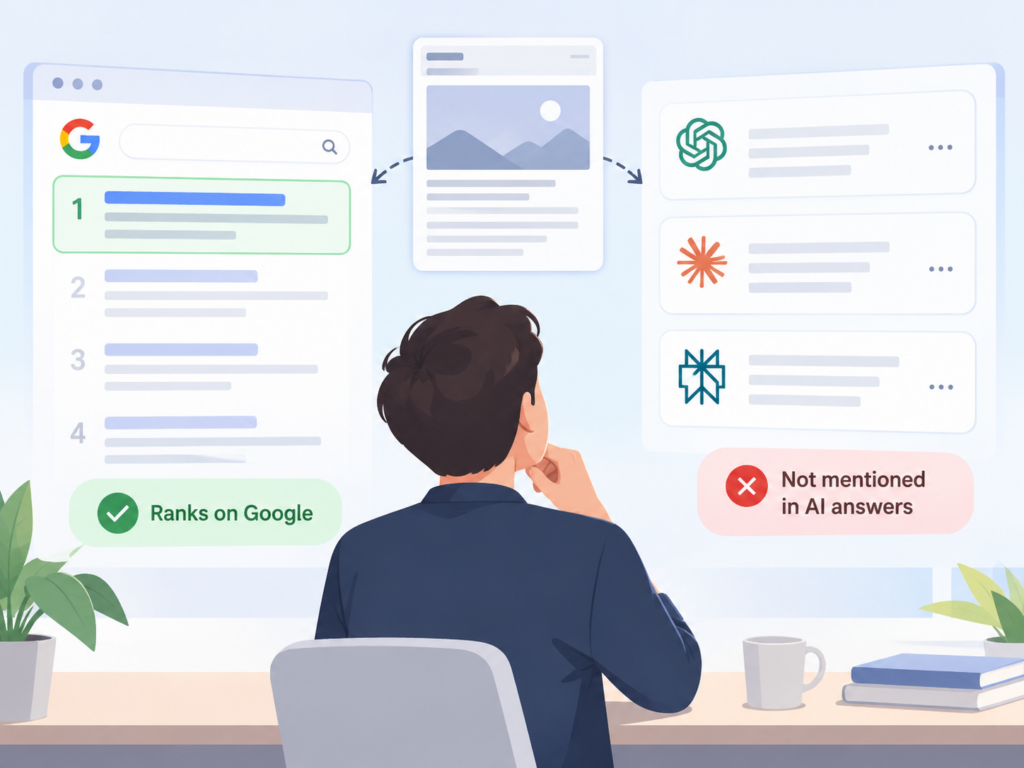
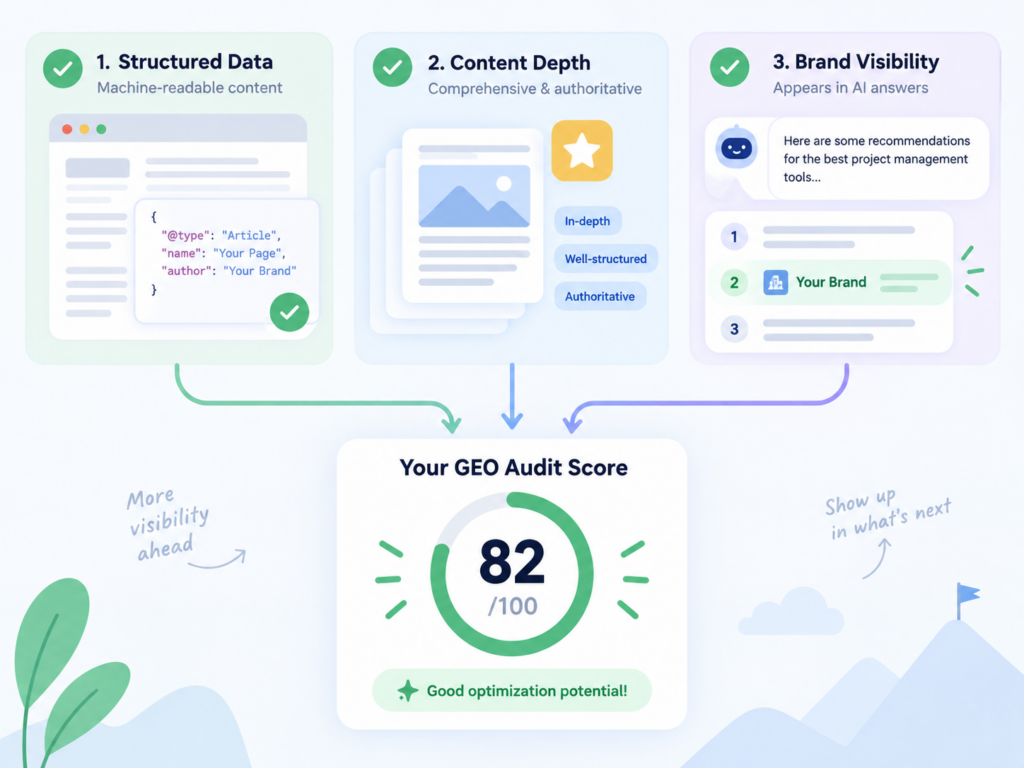
    Your domain authority is solid and your keyword rankings haven’t slipped. But when a prospect asks ChatGPT which vendor to pick in your category, you have no idea whether your name comes up. That blind spot has a name now: GEO score. It’s the number that tells you whether AI systems can even reach your site, let alone recommend it. Checking it takes about a minute, and it explains more about your AI visibility than any keyword report ever will.

    What a GEO Score Actually Measures

    A GEO score is a composite number, usually 0 to 100, that reflects whether generative AI platforms like ChatGPT, Perplexity, and Gemini can crawl, understand, trust, and ultimately recommend your website. It’s not a rebrand of your SEO ranking. SEO measures where you sit on a results page. A GEO score measures whether you show up inside an AI-generated answer at all, which is a different mechanism entirely.

    That gap matters more than most teams realize. Only 22% of B2B marketers currently track AI visibility in any structured way. Everyone else is optimizing for a channel they can’t measure, which is exactly the position a GEO score is built to fix.

    How to Check Your GEO Score for Free

    Most people’s first move is Googling themselves, which tells you nothing about how AI systems see your site. The faster path is a purpose-built checker.

    Here’s the actual process:

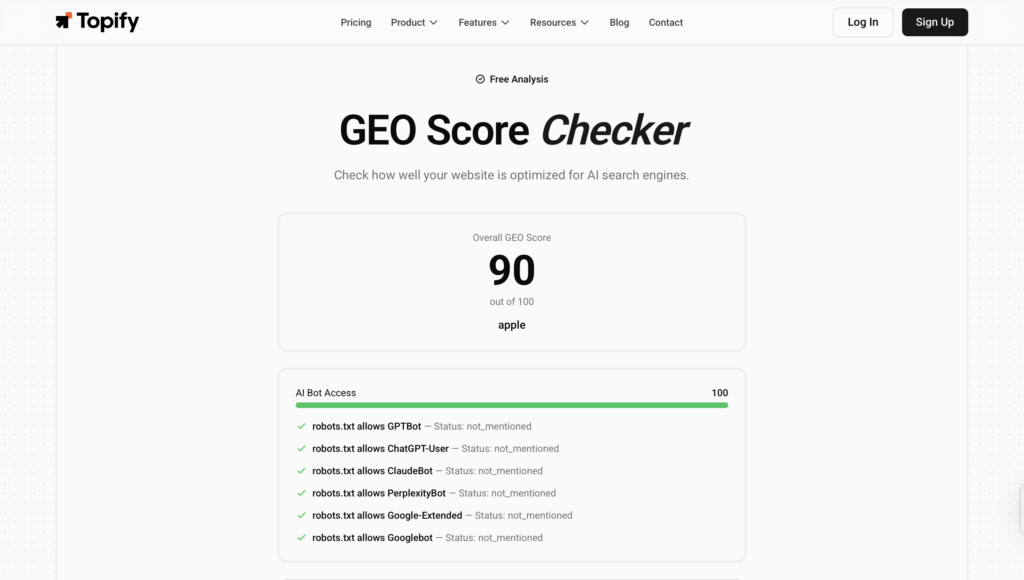
    1. Open Topify’s GEO Score Checker.
    2. Enter your domain or brand name. No account required.
    3. Wait about 60 seconds while it pulls your four dimension scores.
    4. Compare the four numbers to find your weakest one. That’s where you start fixing things, not with the overall score.

    That last step matters. Two sites can land on the same overall score of 55 for completely different reasons, and the fix looks nothing alike in each case.

    The Four Numbers Behind Your Score

    Score DimensionWhat It ChecksWhy It Matters
    Bot AccessWhether AI crawlers like GPTBot, ClaudeBot, and PerplexityBot can actually reach your pagesIf the bot can’t get in, nothing else on this list matters
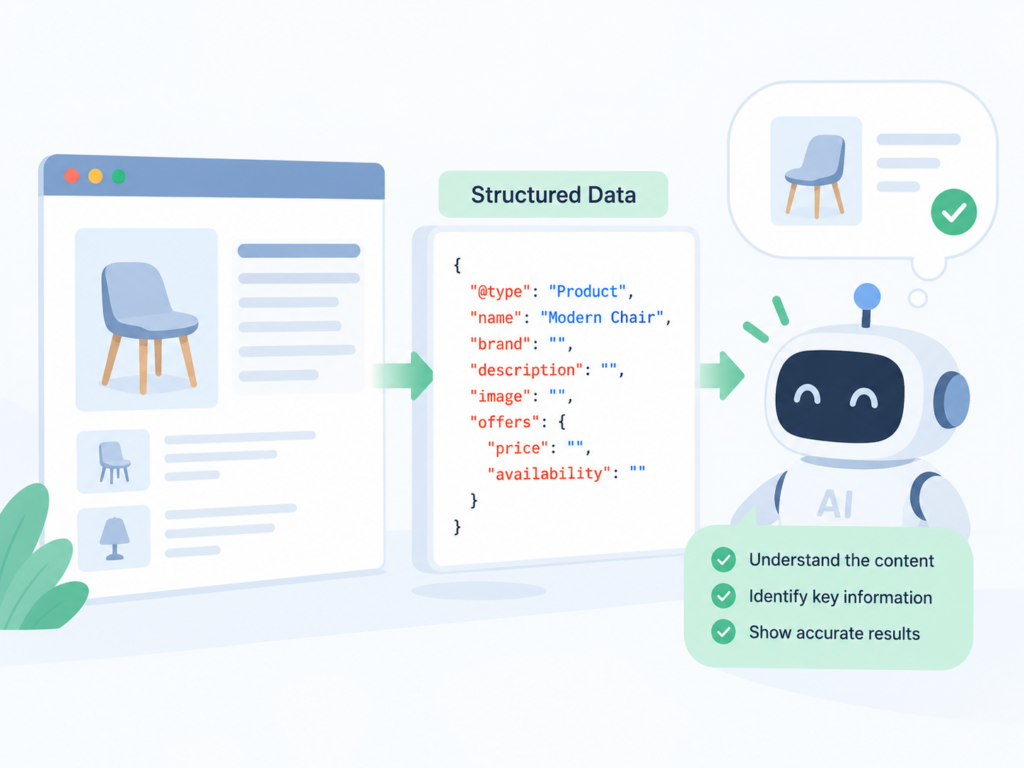
    Structured DataWhether schema markup and JSON-LD make your content machine-readableAI systems parse structure faster than they parse prose
    Content SignalsWhether your content shows the depth and authority AI models weight when choosing a sourceSignals like citations and statistics measurably change outcomes
    Visibility ScoreHow often your brand actually appears across AI platforms todayThis is the outcome the other three dimensions are trying to produce

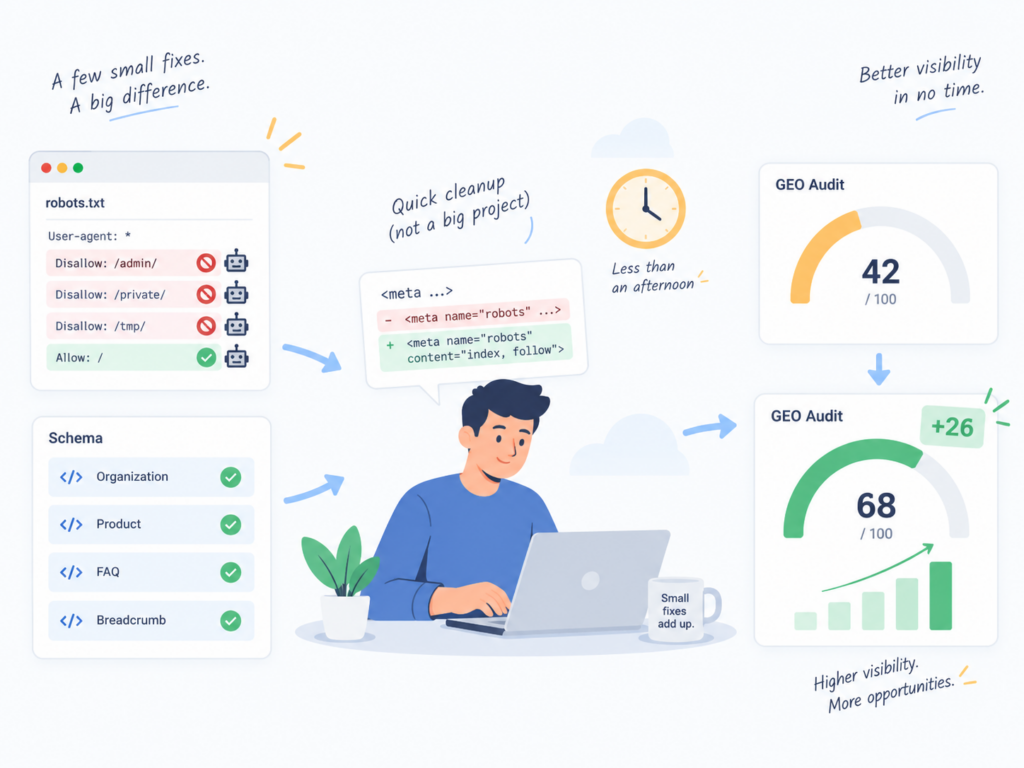
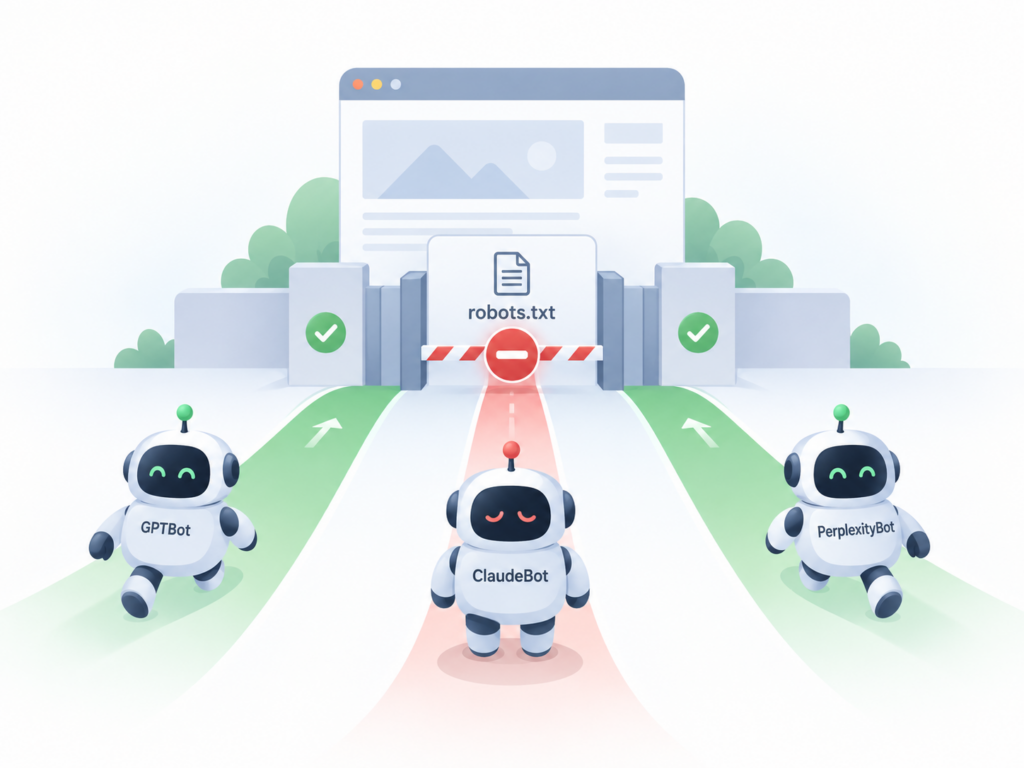
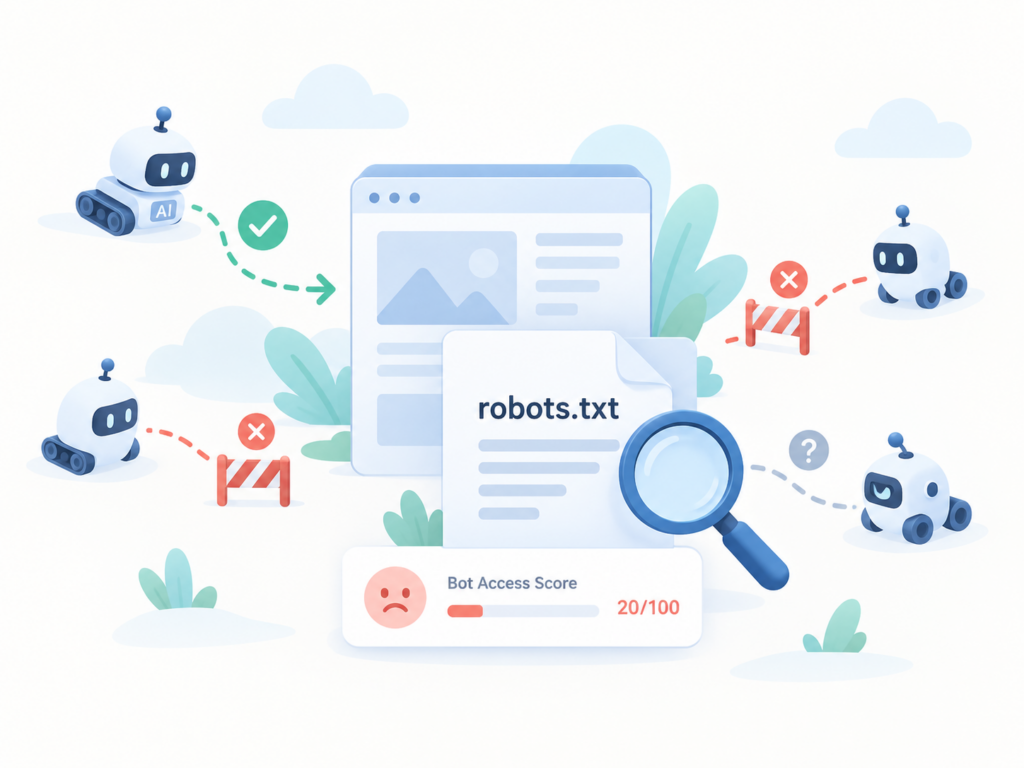
    Bot Access turns out to be a more common failure point than teams expect. Roughly one in five top sites blocks at least one AI crawler in robots.txt, and a lot of that blocking is accidental collateral damage from a training opt-out rather than a deliberate decision. If your Bot Access score is low, check your robots.txt before you touch anything else.
    Content Signals is where the research gets specific. A Princeton and Georgia Tech study found that adding statistics to a page improved AI visibility by 41%, and citing external sources lifted visibility by as much as 115% for lower-ranked content. That’s not a vague “write better content” recommendation. It’s a measurable lever tied directly to how the Content Signals dimension is scored.

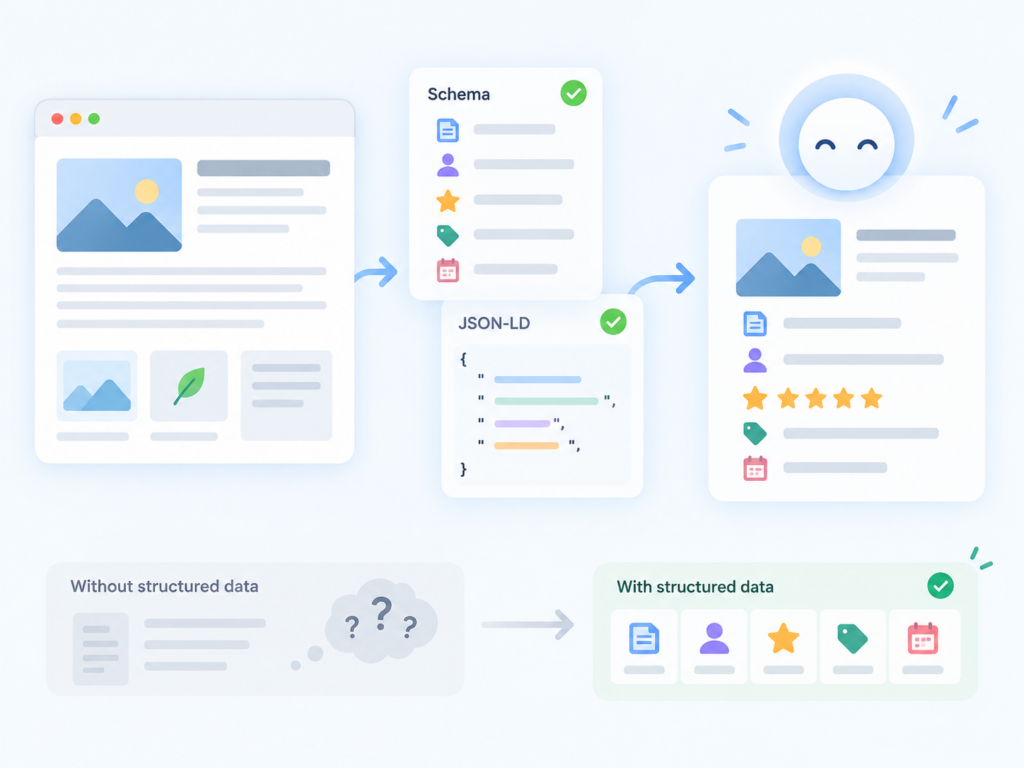
    Structured Data tends to get skipped because it’s invisible to a human reader. A page can read perfectly well and still score poorly here if there’s no schema markup telling an AI system what type of content it’s looking at, who wrote it, or when it was last updated. Visibility Score is the one metric that ties the other three together. It’s a direct read on how often your brand shows up when someone actually asks an AI platform a question in your category, which makes it the fastest way to tell whether fixes to the other three dimensions are working.

    A Quick Scenario

    Say your Bot Access score comes back at 35 while your Content Signals score sits at 78. That combination usually means the content itself is solid, well-structured, and citation-worthy, but a crawler is being turned away before it ever reads any of it. In that case, the fix isn’t a content rewrite. It’s a robots.txt audit. Running the same check for a site with the opposite pattern, high Bot Access and low Content Signals, points to a completely different fix: the crawler gets in fine, but the content it finds doesn’t give the AI system enough to work with. Same overall score, opposite root cause.

    What Counts as a Good GEO Score

    Score ranges give you a rough read on where you stand:

    RangeWhat It Means
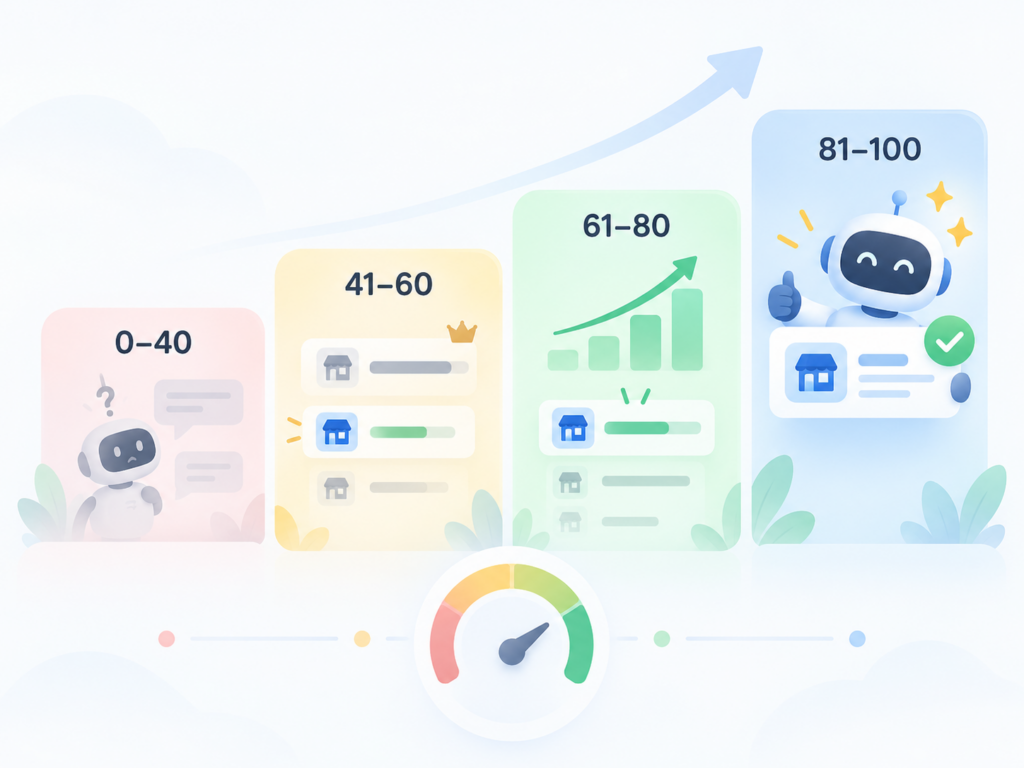
    0 to 40Not visible. AI systems rarely surface or recommend you
    41 to 60Basic visibility, but competitors usually outrank you in AI answers
    61 to 80Solid visibility with room to close specific gaps
    81 to 100Strong visibility, AI systems recommend you with real consistency

    Here’s the caveat worth sitting with: there’s no single universal “good” score. What counts as strong depends on your prompt set, your market, and your competitor set, so the number is most useful as a baseline you track against itself over time, not a fixed target you chase in isolation.

    A low score also isn’t proof your content is weak. It’s often a technical issue, a blocked crawler, missing schema, or thin structured data, sitting on top of content that’s actually fine.

    That’s why the four-dimension breakdown matters more than the single overall number. Two brands can both land at 55, and one needs an engineering ticket while the other needs an editorial rewrite. Treating the overall score as the headline and the four dimensions as a footnote gets that priority backward.

    Why a One-Time Score Isn’t the Full Picture

    A GEO score is a snapshot, and the thing it’s measuring doesn’t hold still. Crawler access policies shift constantly. ClaudeBot, for example, has been the fastest-growing block target across sites in 2026, which means a site that scored well on Bot Access last quarter might not score the same way next quarter. Checking once tells you where you stood on the day you ran it. It doesn’t tell you which direction you’re moving.

    That’s the gap Comprehensive GEO Analytics is built to close.

    CapabilityFree GEO Score CheckerTopify Platform
    Check frequencyOne-time snapshotContinuous monitoring
    Dimensions tracked4 GEO scoresFull GEO analytics, plus sentiment and citation tracking
    Historical trendsNoneFull trend history with alerts
    Competitor benchmarkingNot includedReal-time competitor tracking
    Platform breakdownAggregatedPer-platform view across ChatGPT, Perplexity, Gemini, and AI Overviews

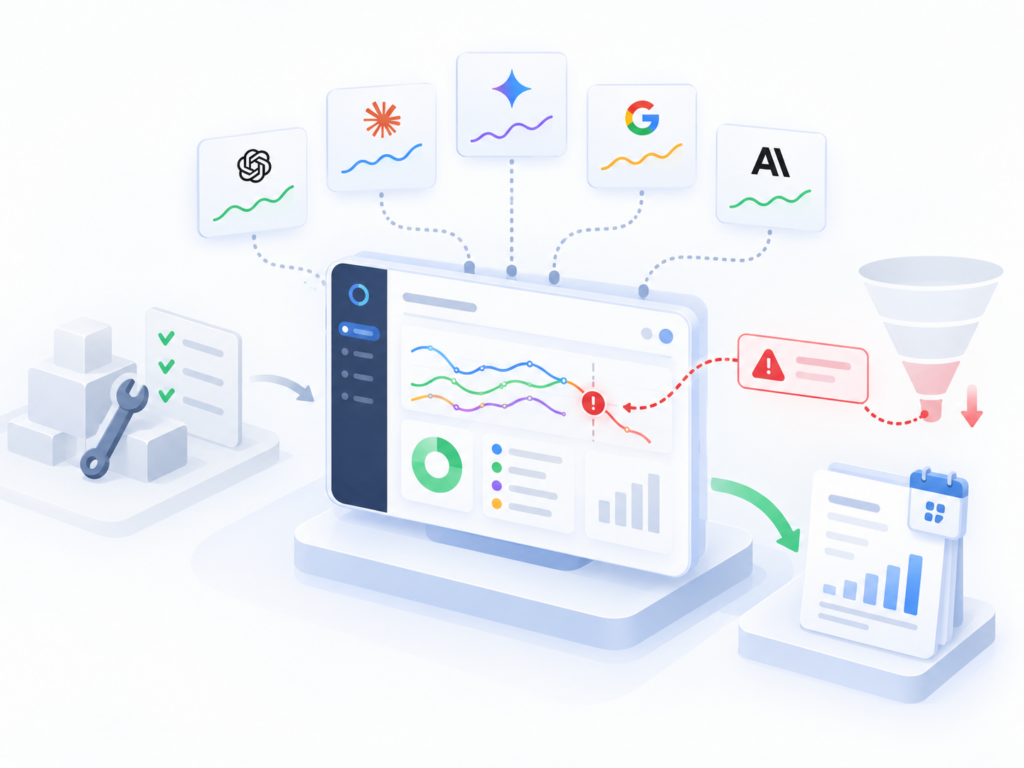
    The checker gives you a snapshot. The platform tracks the trajectory. If your team is past “are we visible at all” and into “are we gaining or losing ground against a specific competitor,” that’s the point where continuous tracking starts paying for itself. You can get started with Topify directly, and the pricing page lays out plans built around how much of that tracking your team actually needs.
    Conclusion

    A GEO score won’t tell you everything about your AI visibility, but it will tell you exactly where to look first. Run the free GEO Score Checker, find your weakest dimension, and fix that before you touch anything else. If the number keeps moving in the wrong direction between checks, that’s your signal to move from a one-time snapshot to ongoing tracking.

    Frequently Asked Questions

    What is a GEO score? 

    A GEO score is a 0 to 100 rating of how visible your brand is to generative AI platforms, based on four dimensions: bot access, structured data, content signals, and overall visibility. It’s produced by tools like the GEO Score Checker.

    Is a GEO score the same as an SEO score? 

    No. SEO scores measure your position on a traditional search results page. A GEO score measures whether AI systems can crawl, understand, and cite your content inside a generated answer, which relies on a different set of technical and content signals.

    How often should I check my GEO score? 

    Monthly is a reasonable starting cadence, since crawler access policies and AI citation patterns change often enough that a quarterly check can miss a real shift. Brands actively working on their GEO tend to check more frequently, which is usually when continuous monitoring makes more sense than repeated one-off checks.

    What counts as a bad GEO score, and can it be fixed? 

    A score under 40 usually points to a fixable technical issue, most often a blocked AI crawler or missing structured data, rather than a content quality problem. Start by checking your robots.txt, since that single fix often moves the Bot Access dimension more than any content change would.
    Read More

  • One-Time Free GEO Audit or Continuous Tracking? How to Decide

    One-Time Free GEO Audit or Continuous Tracking? How to Decide

    You ran a free GEO audit last month. The score came back solid, structured data checks passed, and no AI bots were blocked. You moved on to the next fire. Then a colleague asks how your brand looks in ChatGPT this week, and you realize you have no idea if that score still holds. A single audit only tells you what was true on the day you ran it. The real question isn’t whether a free check is worth running. It’s whether one is enough, or whether you need to watch the number move.

    What a Free GEO Audit Actually Tells You

    A free GEO audit is a snapshot. It typically checks whether AI crawlers can access your site, whether your pages carry structured data like schema and JSON-LD, and whether your content signals (headings, meta description, word count) meet the baseline AI systems look for. Some free checks go a step further and show your current citation footprint across ChatGPT, Perplexity, or Google AI Overviews.

    That snapshot is genuinely useful as a starting point. You can check your GEO score for free in under a minute and see exactly which category is dragging your number down.

    What it doesn’t do is tell you anything about tomorrow. Free tools in this category are upfront about that limit. HubSpot’s AEO Grader is described as a genuinely free, uncapped diagnostic, but the same source notes it’s a one-time snapshot covering only three engines, with no ongoing monitoring built in. Paid one-time audits from agencies aren’t much different in structure, they just cost more. Typical pricing for a one-time GEO audit runs from $2,500 to $10,000, depending on how deep the analysis goes, and the deliverable is still a single point-in-time report.

    None of this makes a free audit a waste of time. It just means the number you get back has a shelf life, and that shelf life is shorter than most teams assume.

    Why AI Citations Don’t Stay Put

    Here’s the part most audit reports skip. AI answers aren’t static, and neither is your visibility inside them.

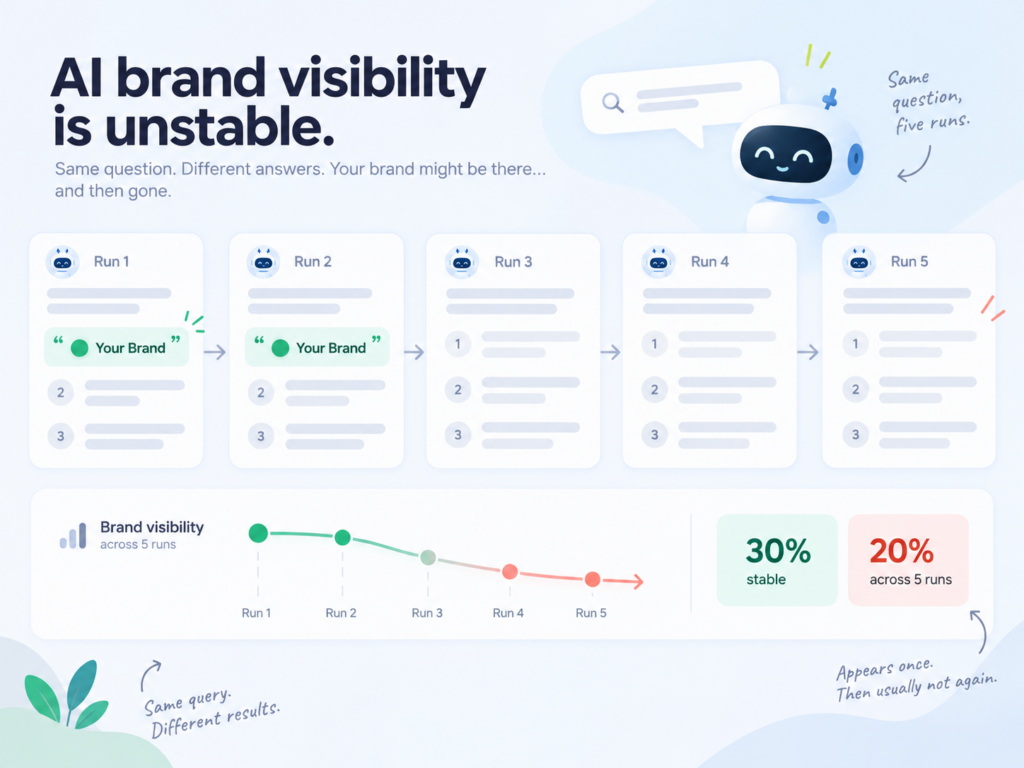
    Research from AirOps analyzing more than 45,000 citations found that only 30% of brands stay visible from one AI answer to the next. Just 20%, or one in five, hold that visibility across five consecutive runs of the same query. That’s not a rounding error. That’s most brands losing their spot within days of earning it.

    The pattern shows up at the domain level too. Citation tracking data cited in a longitudinal study of AI citation drift found that 40% to 60% of domains cited for identical queries change month to month. Stretch the window to six months, and 70% to 90% of the originally cited domains are gone, replaced by something else entirely.

    Nothing on your site has to change for this to happen. A competitor publishes a new comparison page, a model refreshes its retrieval index, or a third-party review site gets more coverage, and your citation share moves without you touching a single line of content. One analysis of citation volatility found a brand’s AI answer presence can swing from 86% to 14% in a single period purely because competing sources improved, with no internal site changes involved. A snapshot taken in March tells you nothing reliable about June.

    There’s a small silver lining in the same data. About 57% of brands that disappear from an AI answer resurface within two runs, so a dip isn’t always permanent. But you can only tell the difference between a temporary dip and a real loss if you’re actually watching the trend, not just holding onto whatever score you got the one time you checked.

    When a One-Time Audit Is Actually Enough

    This doesn’t mean every brand needs a monitoring subscription on day one.

    A one-time audit tends to be enough when you’re early-stage and still building basic AI readiness, when budget genuinely doesn’t stretch to a tracking tool yet, or when your category sees little AI search activity and citation volatility barely touches you. If your goal is simply to confirm your site isn’t technically blocking AI crawlers, or to get a baseline before a bigger content push, a single check answers that question completely.

    In practice, a quarterly manual re-check can cover these cases well enough. The trade-off is visibility gaps between checks, but if nothing in your category is moving fast, that gap is a manageable risk rather than a real cost.

    Think of it as buying yourself information at the lowest possible cost. A pre-seed startup deciding whether to invest in AI-facing content at all doesn’t need a monitoring dashboard, it needs a yes-or-no answer on whether the basics are in place. A free audit gives exactly that, and re-running it every few months as the site grows is a perfectly reasonable cadence until the business itself changes.

    When Continuous Tracking Becomes Non-Negotiable

    The calculation changes once AI search is an actual acquisition channel for your business, or once your category is competitive enough that someone else is actively trying to take your spot.

    Freshness plays a direct role here. Data from the same AirOps research found that pages updated on a regular cadence are about three times less likely to lose citations, and that more than 70% of pages currently cited by AI systems were updated within the past 12 months. If you’re not tracking which pages are losing ground, you can’t know which ones need that refresh, and you end up guessing at a schedule instead of reacting to actual drift.

    That’s the gap a one-time report can’t close.

    This is where a platform built for ongoing measurement, rather than a single grade, earns its keep. Topify tracks visibility, sentiment, and position across ChatGPT, Perplexity, and Google AI Overviews at the prompt level, so instead of a single composite score, you see which specific prompts you’re winning or losing and when the shift happened. Its competitor benchmarking shows who’s picking up the citations you just lost, and its source analysis traces which domains AI systems are pulling from instead of yours. That turns a vague sense that “things changed” into a specific, actionable finding.

    Picture a mid-market SaaS brand that ran a free audit in January and scored well on every category. By April, a competitor launches a detailed comparison page that starts getting cited across three AI platforms, and the SaaS brand’s mentions quietly drop by half. Nobody notices, because the last data point anyone has is the January score, and January still looks fine on paper. Continuous tracking is what turns that invisible slide into a flagged alert the week it starts, not the quarter someone finally asks why leads slowed down.

    A Simple Decision Framework

    SignalLean one-time auditLean continuous tracking
    BudgetVery limitedCan support a monthly tool
    Category competitionLow AI search activityCompetitors actively optimizing for AI
    Content cadenceRarely publish or updatePublish or refresh regularly
    Business goalConfirm technical baselineTreat AI search as a growth channel

    If two or more rows point right, a single audit will likely leave you reacting to changes you never saw coming. Setting up ongoing tracking takes about the same effort as running the free check you already did, just with the visibility kept current.

    Conclusion

    A free GEO audit is the right first move for almost every brand. It’s fast, it costs nothing, and it tells you exactly where your technical baseline stands today. The mistake is treating that single number as a permanent grade. Citation data moves on a weekly, sometimes daily, cycle, and the brands that hold their AI visibility are the ones checking often enough to catch the drift before it costs them a customer. Start with the audit. Decide on tracking once you know how much your category actually moves.

    FAQ

    Q: How often should I re-run a free GEO audit? 

    A: If you’re not ready for continuous tracking, a monthly manual re-check is a reasonable minimum. Given that citation share can shift meaningfully within weeks, quarterly checks are often too infrequent for competitive categories.

    Q: Is a free GEO audit accurate? 

    A: Free audits are generally accurate for what they measure: crawler access, structured data, and content signals at the moment you run them. They’re not inaccurate, they’re just time-limited. The score reflects that day, not the following month.

    Q: What’s the difference between a GEO audit and AI visibility monitoring? 

    A: An audit is a one-time technical and citation snapshot. Monitoring tracks the same metrics continuously, showing trend lines, competitor movement, and which specific prompts your brand is gaining or losing over time.

    Q: Do I need continuous tracking if I’m a small brand? 

    A: Not necessarily. If your category sees little AI search competition and you don’t rely on AI channels for growth, periodic manual checks can be enough until that changes.

    Read More

  • Free GEO Audit vs Paid Monitoring: What You Get at Each Stage

    Free GEO Audit vs Paid Monitoring: What You Get at Each Stage

    You ran a free GEO audit last week. The report gave you a score, flagged a couple of missing schema fields, and told you your brand showed up in three of ten ChatGPT answers. Then you closed the tab, because a single number doesn’t tell you if that score is climbing or sliding, or what to do about it on Monday morning.

    That gap between “here’s your score” and “here’s what changed and why” is exactly where most teams get stuck deciding if a one-time audit is enough, or if it’s time to pay for something that runs in the background.

    What a Free GEO Audit Actually Checks

    A free GEO audit is built to answer one question fast: how visible is your brand right now. Tools like Topify‘s GEO Score Checker run a single scan and return a score built from four signal groups: bot access, structured data, content signals, and current visibility. You get a number, a breakdown of what’s dragging it down, and a list of fixes, without creating an account.

    That’s genuinely useful as a starting point. It tells you whether AI crawlers can reach your pages, whether your schema markup is doing its job, and roughly where you stand against a baseline most brands have never bothered to check. For a team that hasn’t looked at AI visibility at all, that first scan is usually the moment the problem stops being abstract.

    Free doesn’t mean shallow, either. It just means the scan happens once, on demand, and stops there.

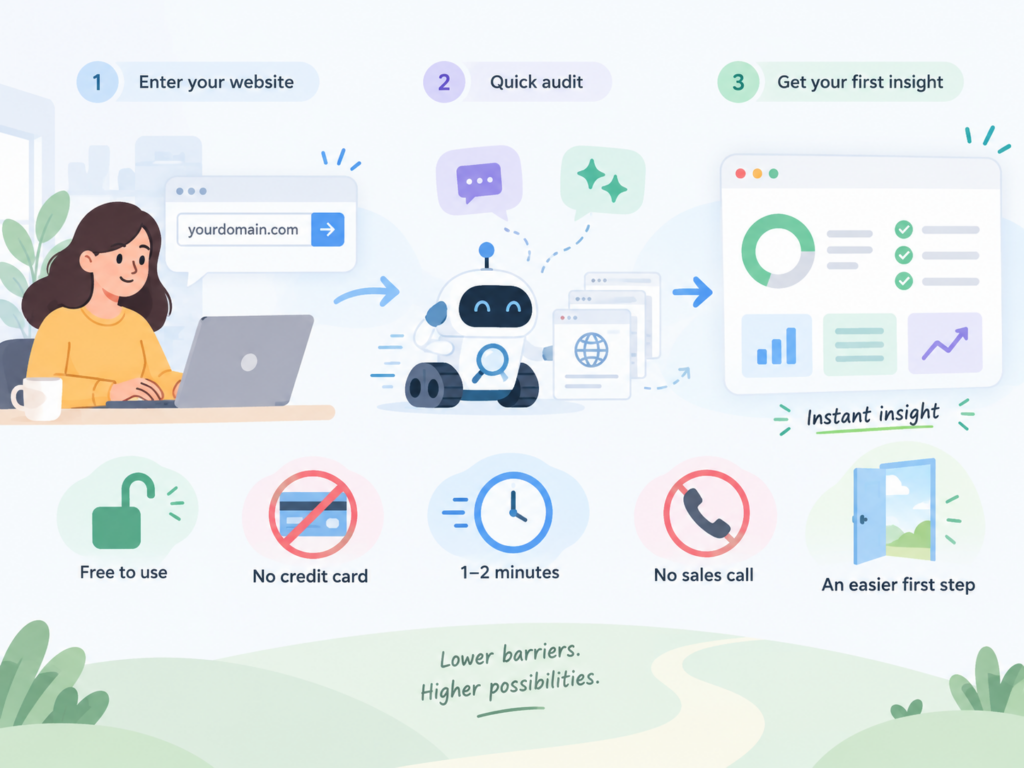
    Most free checkers on the market work the same way, whether they’re general SEO tools adding an AI layer or dedicated GEO products. You plug in a domain, the tool crawls it and runs a handful of prompts against one or two AI platforms, and you get a report back within a minute or two. No credit card, no login wall, no waiting on a sales call. That accessibility is the entire point. It’s designed to lower the barrier to the first data point, not to replace a reporting system.

    Where One-Time Audits Fall Short

    The catch is timing. A free audit captures a single moment, and AI answers don’t hold still the way a Google ranking does. Only about 30% of brands stay visible in back-to-back responses to the same query, which means the citation your audit caught on Tuesday can be gone by Thursday, and the report in your inbox won’t say so.

    A score tells you where you stood. It doesn’t tell you where you’re headed.

    Response patterns can shift within days, especially on Perplexity and Gemini, and teams relying on a single scan tend to notice a drop only after the fact, often weeks after it actually happened. Free tools reinforce this by design: even the ones that offer an ongoing tier usually cap prompt volume, refresh frequency, or engine coverage well below what a paid plan runs. That’s not a flaw. It’s the trade-off that keeps a free tool free.

    Engine coverage tends to be the second blind spot. A free scan usually checks one or two platforms, most often ChatGPT, and calls it done. But brand mentions on Perplexity, Gemini, and Google AI Overviews can move independently of each other, since each engine weighs citations and freshness differently. A brand that looks solid on a ChatGPT-only free scan can still be losing ground on Perplexity without anyone noticing, simply because nothing was watching that surface in the first place.

    Free GEO Audit vs Paid Monitoring: A Side-by-Side Look

    Laid out next to each other, the two approaches aren’t competing for the same job. One answers “where do I stand today,” the other answers “what’s changing and why.”

    DimensionFree GEO AuditPaid Monitoring
    Data freshnessOne-time snapshotRefreshed on a set schedule
    Platform coverageTypically 1 to 2 platformsChatGPT, Gemini, Perplexity, and others tracked in parallel
    Competitor trackingNot includedSide-by-side benchmarking
    Sentiment analysisNot includedTracked and trended over time
    Citation source trackingBasic overviewDomain-level source analysis
    Trend detectionNo history to compareWeek-over-week and month-over-month
    ReportingSingle PDF or score pageOngoing dashboard, exportable
    CostFreePaid plans, starting around $99/mo on Topify’s Basic tier

    The free column isn’t there to look weak. It’s there because most brands genuinely don’t need the paid column yet, and the table above is meant to help you tell which side of that line you’re on.

    What Paid Monitoring Adds: Continuous Visibility, Not a Snapshot

    Paid monitoring exists to answer the question a single audit can’t: what changed, and why. Comprehensive GEO Analyticstracks seven metrics side by side, visibility, sentiment, position, volume, mentions, intent, and CVR, so a drop in ChatGPT mentions can be traced back to the specific source that stopped citing your brand instead of staying a mystery.

    In practice, this turns AI visibility into a channel you report on the same way you’d report organic traffic or paid conversions. A marketing manager can pull up a trend line instead of re-explaining a single audit score in a meeting three months later. If your team has reached the point of needing that kind of reporting, you can get started with Topify directly from a live dashboard rather than rerunning a manual scan every few weeks.

    The seven-metric structure also matters for a reason that’s easy to miss. A visibility number on its own doesn’t tell you if AI is describing your brand accurately. Pairing it with sentiment and position data does, which is the layer a one-time audit was never built to capture.

    Picture the difference in a real week. With a free audit, you’d notice your visibility score dropped the next time you happened to run the scan, maybe a month later, with no clue what caused it. With ongoing monitoring, the same drop shows up the day it happens, tied to a specific prompt, a specific competitor gaining ground, and a specific source AI started citing instead of yours. One approach leaves you guessing. The other gives you a starting point for a fix.

    Signs You’ve Outgrown the Free Audit

    A few patterns tend to show up right before a team decides a free scan isn’t cutting it anymore.

    • More than one person on your team has asked “how are we doing in AI search,” and you keep rerunning the same free scan to answer them
    • You’ve noticed a competitor gaining ground in AI answers but can’t explain when it started or why
    • A client or exec wants a monthly AI visibility number, not a one-off report handed over once
    • Your last audit score moved and you have no way to tell which fix, if any, caused it

    A free audit can tell you what’s true today. It can’t tell you why it changed.

    None of these signs mean the free tool failed you. They mean the question you’re being asked has changed from “are we visible” to “what’s driving the trend,” and that second question needs a different kind of tool to answer.

    Conclusion

    A free GEO audit is the right first move for almost every brand. It’s fast, it costs nothing, and it turns a vague worry into an actual number you can act on. The point where it stops being enough is the point where you need to explain a trend instead of a single score, whether that’s to your own team or a client asking for proof.

    At that stage, moving from a one-time scan to ongoing monitoring isn’t about buying more features. It’s about matching the tool to the question you’re actually being asked.

    FAQ

    Q: How often should I run a free GEO audit? 

    A: Monthly at minimum. AI citation patterns can shift within days on platforms like Perplexity and Gemini, so a scan from three months ago tells you less than you’d think.

    Q: Can a free GEO audit replace paid monitoring for a small team? 

    A: For a team just getting started, often yes. Once you’re tracking competitors or reporting trends to stakeholders on a recurring basis, a one-time scan usually falls short.

    Q: Does the data from a free audit carry over when I move to paid monitoring? 

    A: In most cases, yes. Platforms that offer both, like Topify, use the same underlying signals for the free scan and the paid dashboard, so your first audit becomes a baseline rather than a throwaway report.

    Q: Is a GEO audit the same thing as ongoing AI visibility monitoring? 

    A: No. An audit is a single measurement taken at one point in time. Monitoring tracks that same measurement continuously and flags changes as they happen.

    Read More

  • A Free GEO Audit for SaaS Brands: Four Numbers, One Blind Spot

    A Free GEO Audit for SaaS Brands: Four Numbers, One Blind Spot

    A mid-market buyer opens ChatGPT and types “best project management tool for a 50-person remote team.” Three names come back. Yours isn’t one of them, even though your docs are thorough, your pricing page is clean, and your G2 reviews are solid.

    That’s not a content problem. It’s a GEO problem, and it usually hides in places a marketing team never thinks to check.

    Run a free GEO audit on your domain and you’ll get four numbers back in under 60 seconds. ✅ Free ⚡ Results in 60 seconds 🔒 No signup required. Three of those numbers are usually fine. The fourth is where most SaaS brands lose the deal before anyone on your team even knows it happened.

    The Four Numbers That Decide If AI Recommends Your SaaS

    Topify’s GEO Score Checker breaks AI visibility into four dimensions. Each one maps to a specific reason your brand does or doesn’t show up when a buyer asks an AI assistant for a recommendation.

    Score DimensionWhat It MeasuresSaaS Impact
    Bot AccessCan AI crawlers reach your site at all?CDN rules and firewall configs often block GPTBot or ClaudeBot without anyone noticing
    Structured DataCan AI parse what your pages mean?Pricing tiers, feature comparisons, and integration lists need schema markup to be machine-readable
    Content SignalsDoes AI treat your content as authoritative?Deep docs and whitepapers only count if they’re indexable and semantically clear
    Visibility ScoreHow often do you actually appear in AI answers?Reflects your real presence across ChatGPT, Perplexity, Gemini, and Google AI Overviews

    Here’s how to check where you stand:

    1. Open the free GEO Score Checker and enter your domain.
    2. Wait about 60 seconds for the four-dimension breakdown.
    3. Compare each score against the 0-40 (invisible), 41-60 (basic), 61-80 (solid), 81-100 (strong) bands.
    4. Note which single dimension is dragging the other three down. That’s usually where the real story is.

    What SaaS Buyers Actually Ask AI Before They Talk to Sales

    Buyer behavior has shifted faster than most GTM teams have adjusted for. Category-level AI discovery for B2B SaaS jumped from roughly 4% to 17% of all discovery activity in a single year, and separate research puts AI-influenced shortlisting even higher, with about a third of B2B SaaS buyers now building their vendor shortlist directly from AI search citations, a shift that started from a near-zero baseline back in 2024.

    The more striking number comes from G2’s research on chatbot-influenced purchasing: 69% of buyers ended up choosing a different vendor than they originally planned because of AI chatbot guidance, and roughly a third bought from a vendor they’d never even heard of before the AI surfaced it. That’s not a marginal influence. That’s the AI rewriting the shortlist before your sales team gets a first call.

    AI Prompt ExamplePlatformSearch IntentWhat It Reveals
    “Best CRM for a mid-market sales team”ChatGPTCategory comparisonTests whether you rank for category, not just brand
    “[Your competitor] alternatives with better onboarding”PerplexityDisplacement searchShows if buyers see you as a credible swap-in
    “Is [your product] good for HIPAA-compliant workflows”GeminiTrust and complianceReveals if AI can find and verify your compliance claims
    “Cheapest project management tool with SSO”ChatGPTFeature + price filterTests structured data on pricing and feature pages
    “Which tools integrate natively with Salesforce”PerplexityIntegration researchDepends on whether integration docs are crawlable and clear

    Most of these are category questions, not brand-name searches. That distinction matters more than it sounds like it should.

    The Blind Spot Most SaaS Teams Miss

    Here’s the thing. Teams that fail a GEO audit usually assume it’s a content quality problem. It typically isn’t.

    Roughly 27% of B2B SaaS and ecommerce websites are unknowingly blocking major AI crawlers through CDN-level rules they never configured on purpose, according to research summarized by Mersel’s crawler-blocking guide. Separately, GPTBot blocking among the web’s most prominent sites has plateaued at around 25%, up from just 5% in early 2023, per the State of Robots.txt for AI tracker. Your docs can be excellent and still invisible if the crawler never gets past the front door.

    That’s Bot Access. But there’s a second, quieter blind spot, and it’s the one that’s easy to miss even after you fix crawler access.

    Platforms don’t source answers the same way. ChatGPT tends to cite a vendor’s own pages directly, doing so about 74.6% of the time, while Perplexity, Gemini, and Claude lean heavily on third-party sources, relying on them roughly 79% of the time. A SaaS brand can look strong on ChatGPT and be functionally invisible on Perplexity, purely because its authority signals live only on its own domain instead of in independent reviews, comparison sites, and analyst coverage.

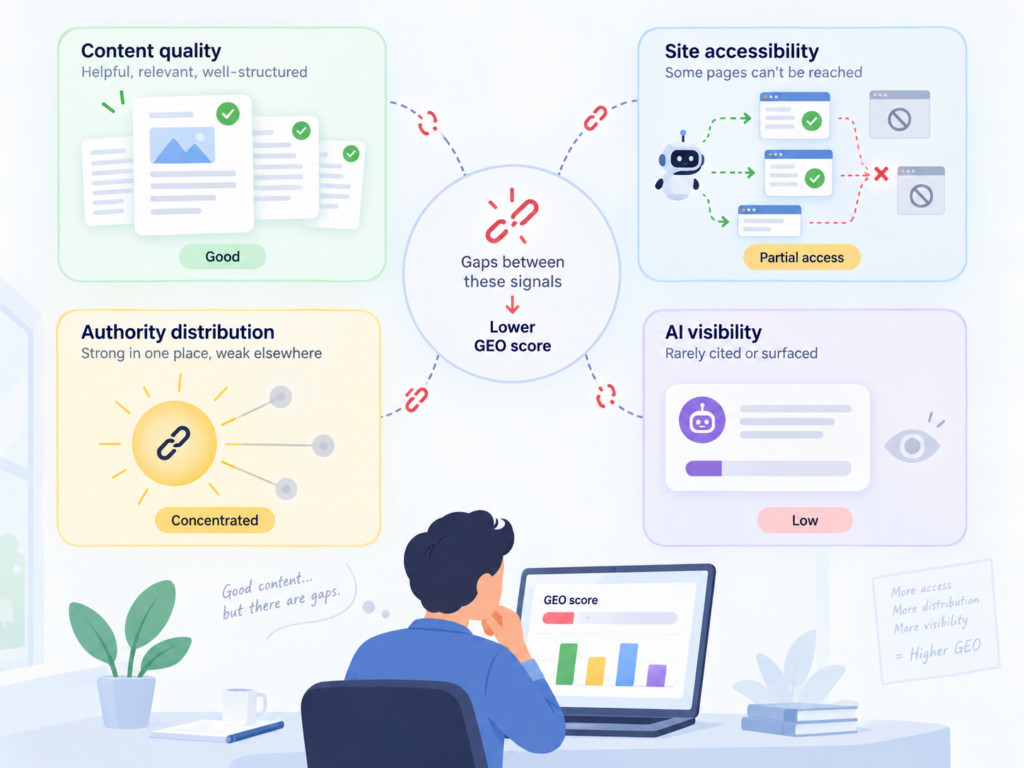
    Put those two things together and you get the actual pattern behind a low GEO score in SaaS: content that’s good enough, on a site that’s partly unreachable, with authority that only exists in one place. None of the four numbers alone tells you that. The gap between them does.

    From a One-Time Score to Continuous GEO Monitoring

    A single audit tells you where you stand today. It doesn’t tell you what happens after your next product launch, a competitor’s PR push, or a crawler policy change on a platform you don’t control. GEO signals move. A one-time check doesn’t.

    CapabilityFree GEO Score CheckerTopify Platform
    Check frequencyOne-time snapshotContinuous monitoring
    Dimensions tracked4 GEO scoresFull GEO analytics, sentiment, and citation tracking
    Historical trendsNoneFull trend history with alerts
    Competitor benchmarkingNot includedReal-time competitor tracking
    Platform breakdownAggregatedPer-platform view across ChatGPT, Perplexity, Gemini, AI Overviews
    Optimization actionsDirectional guidanceSpecific, prioritized execution steps

    The checker gives you a snapshot. Comprehensive GEO Analytics tracks the trajectory, so you know whether last month’s fix actually moved the needle or whether a new crawler rule just undid it. If the four-number gap above sounds familiar, it’s worth starting a free trial to see the full picture, and the pricing page breaks down what’s included at each tier.

    Conclusion

    A low GEO score in SaaS is rarely a writing problem. It’s usually one specific gap, blocked crawlers, missing schema, or authority that lives in only one place, dragging three otherwise decent numbers down with it. Check your GEO score now and see which one it is for you.

    For a deeper look at the mechanics behind this, The Complete Guide to Generative Engine Optimization walks through the fundamentals, and 7 Best Tools to Track AI Search Visibility in 2026 compares monitoring options if you’re evaluating what comes after the free check. If Bot Access turns out to be your weak spot, Topify’s AI Robots Checkerdigs into your robots.txt configuration in more detail.

    Frequently Asked Questions

    What’s a good GEO score for a SaaS company? 

    Anything above 61 is generally considered solid visibility, though the bar keeps rising as more competitors optimize. Scores under 40 usually mean AI can’t reliably find or verify your brand at all, not that your content is weak.

    Why would a SaaS site with great content still score low? 

    Usually one dimension is broken, most often Bot Access from CDN-level crawler blocks, or Content Signals from a lack of third-party authority. The other three scores can be fine and still get pulled down by the one gap.

    Is GEO the same thing as traditional SEO? 

    No. SEO optimizes for ranking in a list of links. GEO optimizes for being named and trusted inside an AI-generated answer, which depends more on crawler access, structured data, and independent validation than on keyword density.

    What’s the difference between the free checker and the full platform? 

    The free tool gives you a one-time snapshot across four dimensions. The full platform tracks those same signals continuously, benchmarks you against competitors, and breaks results down by individual AI platform instead of one blended score.

    Read More:

    AI Search Visibility vs. Google Rankings: What’s the Difference?

    The Complete Guide to Generative Engine Optimization (GEO)

    7 Best Tools to Track AI Search Visibility in 2026

  • Free GEO Audit for SaaS: Where AI Visibility Breaks Down

    Free GEO Audit for SaaS: Where AI Visibility Breaks Down

    Most SaaS marketing teams have already run their own version of a GEO audit. Someone opens ChatGPT, types in the product category, and checks whether the brand shows up. It usually does, once. Ask again with a slightly different prompt, and it doesn’t. That inconsistency gets written off as noise, but it’s actually the first real signal that something’s broken underneath. A single prompt test tells you what happened in one conversation. It doesn’t tell you whether your site can be crawled, parsed, or cited at all.

    Why SaaS Buyers Are Asking AI Before They Ever Visit Your Site

    The buying pattern has already shifted. 51% of B2B software buyers now start vendor research inside an AI chatbot, up from 29% a year earlier, and ChatGPT accounts for 63% of that behavior. For a SaaS company, that means the first real “visit” to your product often isn’t a page view. It’s a paragraph a model generated after deciding whether you were worth mentioning at all.

    The stakes compound from there. 69% of B2B buyers end up choosing a different vendor than the one they originally planned to, based on what an AI chatbot told them during research. Ranking first on Google doesn’t move that needle. It says nothing about whether a large language model cites you when someone asks it to compare tools.

    That’s the piece a free GEO audit for SaaS is built to check.

    What a Free GEO Audit for SaaS Actually Checks

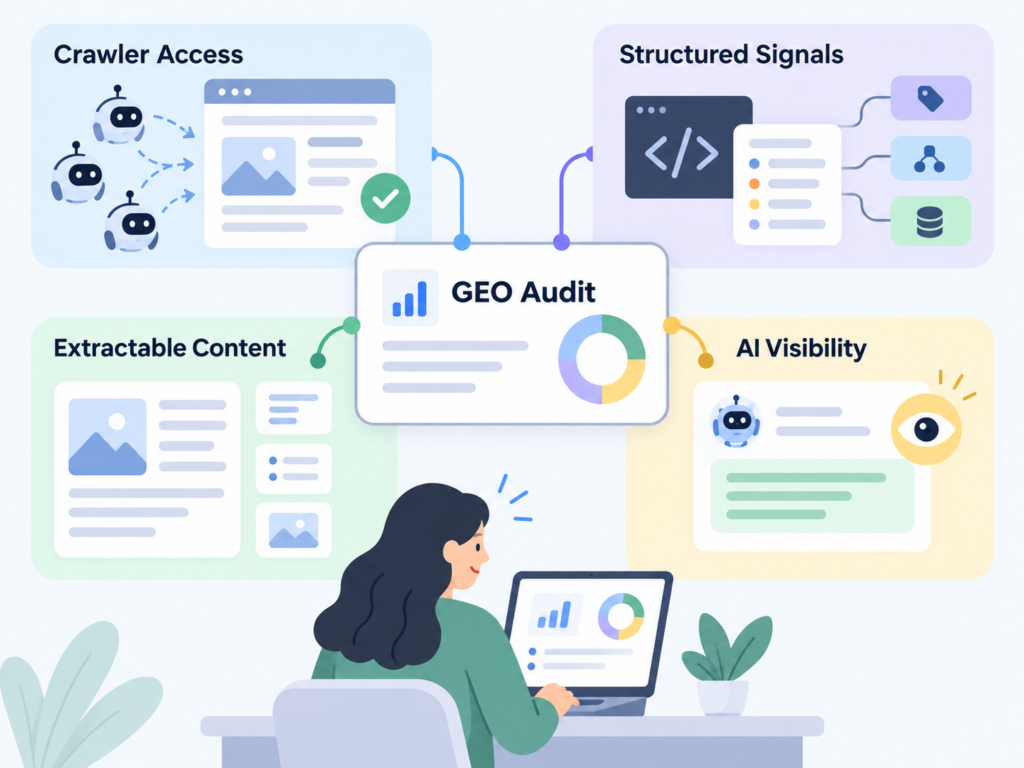
    A free GEO audit for SaaS isn’t the same thing as manually prompting ChatGPT and hoping for a good answer. A real audit checks four separate layers: whether AI crawlers can access your pages, whether your markup carries the structured signals models rely on, whether your content is written for direct extraction, and whether any of it is currently showing up in AI-generated answers.

    Each layer catches a different failure mode. A SaaS site can rank on page one of Google and still be invisible to GPTBot because of a single disallow rule. That’s the kind of gap a manual prompt check will never surface, because the model simply won’t have crawled the page in the first place.

    The Four Places SaaS Sites Break Before AI Ever Sees Them

    Most SaaS sites don’t fail because of one big problem. They fail in the same four small, fixable spots, repeatedly.

    Robots.txt Blocking GPTBot and PerplexityBot

    This is the most common blocker, and the easiest one to miss. A recent crawl of nearly 1,750 sites found that 9.9% block GPTBot outright in robots.txt, and 13.7% block at least one AI crawler. What makes this worse is that 84.2% of sites have no AI crawler policy at all, which means most teams have never actually checked their own file. If your product docs, pricing page, or comparison content sit behind a disallow rule left over from an old security review, nothing else below it matters.

    Missing Schema and llms.txt Signals

    Even when crawlers get in, they need structured signals to parse what they’re reading. Missing Organization, Product, or FAQ schema, combined with the absence of an llms.txt file, forces AI models to guess at what your product actually does and who it’s for. Guessing tends to favor the competitor with cleaner markup, not the one with the better product.

    Content Written for Humans, Not Extraction

    Blog posts and landing pages built for scrolling readers rarely work for extraction. AI models pull answer-first sections: clear definitions, short summaries, direct head-to-head comparisons. Content buried under a long narrative intro with no clear takeaway rarely gets quoted, even when it’s accurate and well-researched.

    Zero Citations in AI-Generated Answers

    This is where the first three problems collide. Blocked crawlers, missing schema, and unextractable content add up to the same outcome: your domain never appears when a model is asked to cite a source. And when a model does cite someone, it typically pulls from only 2 to 7 domains per response, so there’s very little room for a vague, half-optimized presence to sneak in anyway.

    Running a Free GEO Audit for SaaS in Under a Minute

    Checking for these four failure points doesn’t require a research team or a paid tool. Topify’s Free GEO Score Checkercrawls a URL the same way GPTBot, PerplexityBot, ClaudeBot, and Google-Extended do, then returns a 0-100 score with a prioritized fix list. No sign-up is required for the first scan.

    Most SaaS sites that run the check recover 20 to 30 points just from unblocking crawlers and adding three core schema types. Each finding gets tagged P0, P1, or P2 based on its estimated point impact, so the output doubles as a priority order instead of a wall of unranked issues.

    That’s the technical layer covered. It’s not the whole picture.

    Technical Score Isn’t the Whole Story: Checking Brand Authority Too

    A clean technical score answers whether AI can read your site. It doesn’t answer whether AI trusts your brand enough to recommend it over a competitor with a weaker product and better citations.

    Topify’s AI Brand Authority Checker scores a brand across four separate dimensions: recognition, expertise depth, recommendation rate, and trust signals, based on how ChatGPT, Gemini, and Perplexity actually talk about it today. For SaaS brands specifically, a low recommendation-rate score often explains why a technically sound site still gets skipped in favor of a less optimized competitor that’s simply better known.

    CheckWhat It MeasuresTime to RunSign-up
    GEO Score CheckerAI crawler access, schema, content signals10 to 30 secondsNot required
    Brand Authority CheckerRecognition, expertise, recommendation rate, trust20 to 40 secondsNot required
    Comprehensive GEO AnalyticsAll of the above, tracked continuously with competitor benchmarkingOngoingRequired

    Running both free checks together gives a more complete picture than either one alone. A site can pass the technical audit and still lose the recommendation to a more trusted brand, or have strong brand recognition and still be invisible because of a crawler block nobody noticed.

    What Fixing the Biggest Gaps Actually Looks Like

    One mid-market SaaS company selling project management software found that its help center, the section most likely to answer buyer comparison questions, had been fully blocked by a legacy robots.txt rule dating back to a 2019 security review. Nobody had touched it since.

    Unblocking GPTBot and PerplexityBot, then adding FAQ schema to the twenty most-viewed help articles, moved the domain from zero citations to appearing in roughly one in five comparison-style AI prompts within a month.

    The fix took an afternoon. Finding it took a proper audit, not another manual ChatGPT check.

    From One-Time Audit to Continuous GEO Tracking

    A free audit is a snapshot, and snapshots go stale. Models update, competitors publish new content, and citation patterns shift every few weeks. A score that looks solid this quarter can slide by the next one without any single dramatic cause.

    That’s the gap Topify’s Comprehensive GEO Analytics is built to close. It tracks visibility, sentiment, position, volume, mentions, intent, and CVR across ChatGPT, Gemini, Perplexity, and other major platforms continuously, instead of as a single check. When a fix moves the needle, or a competitor starts pulling ahead, the dashboard shows it before it turns into a quarter-over-quarter surprise. Teams ready to move past the free checks can get started with Topify directly from there.

    Conclusion

    The gap between guessing and knowing is a single afternoon of work. Most SaaS teams have relied on manually prompting ChatGPT as their only visibility check, which explains why so many are surprised by how little of their content actually gets cited.

    Running a proper technical and authority audit turns that guesswork into a prioritized list, and turns the list into a fixable roadmap. Start with the free scans, fix the highest-impact issues first, then decide whether a one-time snapshot is enough or whether continuous tracking fits where your product is headed next.

    FAQ

    Q: What does a free GEO audit for SaaS actually measure? 

    A: It typically checks four things: whether AI crawlers like GPTBot and PerplexityBot can access your site, whether your pages carry structured data AI models can parse, whether your content is written for direct extraction, and whether your domain currently appears in AI-generated answers.

    Q: Is a free GEO audit different from asking ChatGPT about my product? 

    A: Yes. Manually asking ChatGPT gives you one data point from one conversation. A structured audit checks the underlying technical and content factors that determine whether you show up consistently, across different prompts and platforms.

    Q: How often should a SaaS company re-run a GEO audit? 

    A: Since AI models update regularly and citation patterns shift every few weeks, a one-time audit only shows where you stood at that moment. Most growing teams move from a single free check to continuous tracking once the initial technical issues are fixed.

    Q: Does fixing robots.txt and schema guarantee AI will recommend my product? 

    A: No. Technical access is a prerequisite, not a guarantee. Brand authority factors like recognition and trust signals also shape whether a model recommends a product once it’s actually able to read the site.

    Read More

  • The Free GEO Audit That Finds Why AI Skips Your Website

    The Free GEO Audit That Finds Why AI Skips Your Website

    Most marketing teams find out their brand is invisible to AI search by accident. Someone asks ChatGPT for a recommendation in their category, gets back three competitor names, and starts wondering why. The instinct is to check Google Search Console next. That tells you almost nothing, because generative engines don’t rank pages the way Google does. They retrieve, evaluate, and cite a small fraction of what they crawl. A free GEO audit is the fastest way to see which side of that fraction your site is on, and why.

    Why AI Search Skips Perfectly Good Websites

    Google’s crawler and OpenAI’s crawler don’t behave the same way. Googlebot indexes a page once and ranks it against millions of competitors on hundreds of signals. GPTBot, ClaudeBot, and PerplexityBot work differently. They retrieve a handful of candidate pages for a single query, read them in full, and decide on the spot whether one is worth citing.

    ChatGPT retrieves dozens of pages while researching a typical answer and ends up citing roughly 15% of them. The other 85% get evaluated and dropped, often for reasons that have nothing to do with domain authority or backlink count.

    That’s the gap most SEO reports can’t see.

    Some of that gap is self-inflicted before a single word of content even gets evaluated. A recent crawl of more than 1,700 live sites found that 9.9% block GPTBot outright in robots.txt, and 13.7% block at least one major AI crawler. Another 84.2% haven’t set any AI crawler policy at all, which means the door is technically open, but nobody checked what’s actually on the other side of it.

    None of this shows up in a standard SEO audit. A page can rank on the first result of Google and still be functionally invisible to every AI answer engine, because the two systems are reading the same URL through completely different lenses. One is scoring authority. The other is deciding, in real time, whether the page answers the question well enough to quote.

    Running a Free GEO Audit: What It Actually Checks

    A GEO audit isn’t a rebrand of an SEO crawl with new labels on old metrics. It’s built specifically to check whether GPTBot, PerplexityBot, ClaudeBot, and Google-Extended can access, parse, and eventually cite a page. Topify‘s free GEO Score Checker runs that exact test on any URL, with results back in ten to thirty seconds and no signup required for the first scan.

    It checks four things. First, AI bot access, meaning whether the major crawlers can actually reach your pages without hitting a robots.txt block or a firewall rule. Second, structured data, meaning whether your schema markup is present and valid rather than just present. Third, content signals, meaning whether pages are structured for answer-first extraction instead of long narrative blocks. Fourth, AI visibility, meaning whether your domain already surfaces in AI-generated answers for prompts in your category.

    Each of those four areas rolls up into a single score from 0 to 100, with individual findings tagged by priority so a team can see what to fix first instead of a wall of undifferentiated warnings.

    You get the diagnosis before you spend a cent on the fix.

    Run the free GEO audit on your homepage first. That’s usually where the biggest structural problems concentrate, and it’s the page AI systems tend to check first when deciding whether a brand belongs in a category-level answer at all.

    The Most Common Reasons Sites Get a Low Score

    Most low scores come down to three problems, and they tend to compound rather than sit in isolation.

    The first is access. If GPTBot or Google-Extended is blocked, nothing else on the audit really matters, because the crawler never gets past the front door to evaluate anything downstream. This is the single most common P0 finding on first-time audits, and it’s almost always accidental rather than a deliberate policy decision.

    The second is schema that exists on paper but doesn’t actually work. 71% of sites deploy at least one schema type, but only 22% pass a clean validation check across every type they emit, and that 49-point gap correlates directly with whether AI search cites the page at all. Broken markup often looks completely normal to a human reading the page and is effectively invisible to the machine parser trying to extract it.

    The third is content structure. Pages written as long, uninterrupted narrative blocks are harder for a generative engine to lift a clean, quotable answer from than pages built around direct, self-contained sections. Pages carrying FAQPage markup are roughly 3.2 times more likely to surface in AI Overviews than pages without it, largely because the question-and-answer format already matches how AI systems want to quote a source.

    Fixing all three tends to move a score fast, because the improvements stack.

    In practice, most sites that unblock the right crawlers and add three or four missing schema types see a 20 to 30 point jump on the next audit. That’s rarely a redesign. It’s usually a one-line robots.txt edit and an afternoon of schema cleanup with a developer, not a quarter-long project.

    From One-Time Score to Ongoing Visibility

    A GEO audit score is a snapshot, not a subscription. The catch is that AI citation patterns don’t hold still for long. Model providers update retrieval systems, competitors publish new content, and the third-party sources an AI platform pulls citations from rotate every few weeks.

    That’s a different kind of miss than a blocked crawler. Even a clean audit today can look outdated by next quarter if nobody is watching what changed in the meantime, and most teams only find out when a customer mentions a competitor showed up in their ChatGPT search instead.

    The upside is why tracking is worth the effort at all. AI-driven recommendations make users roughly 2.5 times more likely to visit a brand’s site, largely through branded search rather than a clickable link inside the answer itself. Brands that show up consistently in AI answers still benefit even when the response never generates a direct referral click.

    That’s visibility a one-time score can’t show you.

    For teams that want to move past a single snapshot, Topify’s Comprehensive GEO Analytics tracks the same categories an audit checks once, but on a rolling basis across seven metrics: visibility, sentiment, position, volume, mentions, intent, and conversion visibility rate. It’s the difference between knowing your brand had a problem in September and knowing the moment it resurfaces in October. Once the free audit shows where to focus first, teams can get started with Topify to keep that view current instead of re-running a manual check every few weeks.

    Conclusion

    AI search engines are already deciding which brands to recommend, and most sites have no real evidence of whether they’re on that list. A free GEO audit answers the question in under a minute, with a specific list of what’s blocking citations instead of a vague verdict. Run it on your homepage, fix the P0 issues first, and check back in a few weeks once the changes have had time to propagate through AI retrieval systems. The gap between being cited and being skipped is usually smaller than teams expect, and now it’s measurable.

    FAQ

    Q: Is the GEO audit really free? 

    A: Yes. Topify’s GEO Score Checker runs a full scan with no signup required for the first check. Ongoing tracking through Comprehensive GEO Analytics is a separate paid feature for teams that want to monitor changes over time rather than run one-off checks.

    Q: How is a GEO audit different from a traditional SEO audit? 

    A: An SEO audit checks how Google ranks a page against other pages. A GEO audit checks whether AI crawlers can access, parse, and cite it at all, which depends on different signals: crawler access, schema validity, and content structured for answer extraction rather than keyword density.

    Q: How often should I re-run a GEO audit? 

    A: Roughly every four to six weeks is typical. AI platforms update retrieval and citation behavior often enough that a score from last quarter may no longer reflect what’s actually happening in current answers.

    Q: What’s the fastest fix to raise a low GEO score? 

    A: Unblocking AI crawlers in robots.txt usually delivers the fastest points, since a blocked crawler zeroes out everything else on the audit. After that, fixing broken schema on types you’ve already deployed tends to help more than adding brand-new schema types from scratch.

    Read More

  • Before You Pay for GEO Tools, Run This Free GEO Audit First

    Before You Pay for GEO Tools, Run This Free GEO Audit First

    Your CEO just asked if the company shows up when someone asks ChatGPT for a recommendation in your category. You don’t know. So you open a new tab and start comparing GEO platforms, and within ten minutes you’re staring at pricing pages that start at $99 a month and climb well past that for anything with real depth.

    That’s the moment most teams get stuck. They’re being asked to prove something they haven’t measured yet, and the fastest path forward looks like a subscription.

    Here’s the thing: you don’t need to pay anyone to find out if you have a problem. A free GEO audit gets you there in a few minutes, and it tells you exactly what a paid tool would only confirm later at a monthly cost.

    Why Teams Reach for a Paid Tool Before Checking If They Even Have a Problem

    Most GEO software gets bought backward. A team hears the word “GEO,” feels the pressure to do something, and jumps straight to comparing subscription tiers instead of first asking whether their site even has a visibility problem worth solving.

    That order is expensive. DIY GEO tools alone typically run from $10 to $1,000 or more a month, and agency-led programs climb into five figures. Committing to that spend before you know your baseline is like buying a treadmill before checking whether your knees can handle running.

    The fix isn’t skipping the tool. It’s flipping the sequence: audit first, decide what you actually need to pay for second.

    What a Free GEO Audit Actually Checks

    A basic GEO audit isn’t a mystery score. It’s a set of concrete, checkable facts about whether AI systems can even see your site, let alone recommend it.

    Three layers matter most:

    AI Bot Access. Can crawlers like GPTBot, ClaudeBot, and PerplexityBot actually reach your pages, or is your robots.txt quietly blocking them? This sounds like an edge case, but it isn’t rare. A Q3 2026 crawl of 1,744 sites found 9.9% block GPTBot outright, and most of those site owners never made that choice on purpose.

    Structured Data. Schema markup is how you hand AI systems a clean, machine-readable summary of what your page is about, instead of making them guess from unstructured text.

    Content Signals. Clear headings, direct answers near the top of the page, and up-to-date information all affect whether a page is extractable enough to quote. Freshness matters more than most teams assume.

    Every one of these is checkable without a login, a credit card, or a sales call.

    None of this is new territory for anyone who’s done a technical SEO audit before. The categories are familiar. What’s different is the criteria: a page can rank perfectly well in Google and still fail a GEO check, because AI systems weigh extractability and machine-readability differently than a traditional search crawler does.

    Run the Check: A Free GEO Score in Under a Minute

    This is where the GEO Score Checker comes in. You paste in your domain, and within about a minute you get a breakdown across the categories above, not a single vague number.

    The output shows a pass or miss for each specific check: which AI bots are allowed in, whether your key pages carry structured data, and where your content signals fall short. That’s the part most paid dashboards skip early on. They give you a headline score and expect you to trust it, while a free audit shows its work.

    Run it against your homepage and a couple of high-intent pages, like a pricing page or a comparison page, since those tend to be the ones AI systems pull from most often when someone’s close to a decision.

    What the Score Actually Tells You About Paying for a Tool

    The result splits into two very different situations, and they call for two very different next steps.

    If your score is weak because of foundational issues, blocked crawlers, missing schema, thin or outdated content, a $200-a-month monitoring subscription won’t fix anything. You’d be paying to watch a problem you already know about. Fix the structural issues first. Most of them are one-time changes, not ongoing work.

    If your score already looks solid, that’s useful information too. It means your brand meets the baseline requirements to be cited, and what you’re missing isn’t visibility infrastructure, it’s ongoing measurement: which prompts you’re winning, which competitors are gaining ground, and whether last month’s good score is still true today.

    That second scenario is where a paid tool earns its cost. The first one usually doesn’t need one yet.

    When a One-Time Free Audit Isn’t Enough Anymore

    A free audit is a snapshot. It’s accurate the day you run it, and then the ground starts moving again almost immediately.

    AI citation patterns aren’t static. Research on citation frequency across major platforms has found that 40 to 60% of cited sources change from month to month as models update and competitors adjust their content. Freshness compounds the issue: one analysis found 76.4% of ChatGPT’s top-cited pages had been updated within the previous 30 days. A page that passed your audit in January can quietly lose its citation by March, with nothing on your end having technically broken.

    This is the point where a one-time check stops being enough and continuous tracking starts to matter. That’s what Comprehensive GEO Analytics is built for: instead of a single snapshot, it monitors visibility, sentiment, position, and source citations across platforms on an ongoing basis, so a drop in ChatGPT mentions gets traced back to a specific cause instead of showing up as a mystery three months later.

    How to Decide If a Paid GEO Tool Is Worth It for You

    Skip the pricing comparison for a minute and answer one question instead: is the problem your audit surfaced a one-time fix, or an ongoing one?

    Blocked crawlers, missing schema, and thin content are one-time fixes. You don’t need a subscription to solve them, you need an afternoon and a checklist.

    Tracking how your position shifts against competitors, catching a citation drop before it costs you pipeline, or reporting AI visibility to a client every month, those are ongoing problems. That’s the actual use case for a paid platform, and it’s worth paying for once you’re past the structural cleanup stage.

    Most teams that jump straight to a $300-a-month tool without running this check first end up paying to monitor a problem a free audit would have caught for nothing.

    There’s also a budget conversation this simplifies. Agency-led GEO programs run anywhere from $1,500 to $50,000 or more per month depending on scope, and pitching that spend internally is a lot easier when you can point to a specific, documented gap instead of a general sense that “AI visibility matters.” A free audit gives you that documentation before you’ve spent a dollar.

    Conclusion

    The instinct to compare pricing tiers the moment “AI visibility” comes up is understandable, but it skips a step that costs nothing and takes less time than reading a vendor’s feature list. Run a free GEO audit first, find out what’s actually broken, and fix the structural gaps before you sign up for anything.

    Once your foundation checks out, a paid tool stops being a guess and starts being a clear, justified line item: you’re paying to track something you already know is worth tracking, not to discover a problem you could have found for free.

    FAQ

    Q: What is a GEO audit and how is it different from an SEO audit? 

    A: An SEO audit checks how well Google can crawl, index, and rank your pages. A GEO audit checks whether AI systems like ChatGPT and Perplexity can access, understand, and cite your content, covering AI bot access, structured data, and content extractability, which traditional SEO audits typically don’t measure.

    Q: Can I check my AI search visibility for free? 

    A: Yes. Free tools exist specifically to give you a baseline score without a subscription. The GEO Score Checker is one option that runs the check in under a minute and breaks down results by category instead of a single opaque number.

    Q: How often should I re-run a GEO audit? 

    A: A quarterly check is a reasonable minimum for most sites, since structural issues like schema and bot access don’t change often on their own. If you’re actively publishing new content or tracking a competitive category, monthly checks catch problems sooner.

    Q: Do I need a paid GEO tool if my free audit score is already good? 

    A: Not automatically. A good score means the foundation is solid, but citation patterns shift monthly and a snapshot doesn’t tell you if that score holds up over time. A paid tool becomes worth it when you need ongoing tracking rather than a one-time check.

    Read More

  • Your Brand Doesn’t Show Up in ChatGPT. A Free GEO Audit Tells You Why

    Your Brand Doesn’t Show Up in ChatGPT. A Free GEO Audit Tells You Why

    You’ve asked ChatGPT the same question your customers ask: “What’s the best tool for [your category]?” Five prompts later, your brand hasn’t shown up once. Meanwhile your Google rankings look fine, your backlink profile is healthy, and nothing in your SEO dashboard explains the gap. That’s because the gap isn’t an SEO problem. It’s a GEO one, and it’s measurable.

    Your ChatGPT Ranking Has Nothing to Do with Your Google Ranking

    Most marketing teams assume strong SEO carries over to AI search. It doesn’t. A 2026 analysis of 150 SaaS companies across 120 keywords found that 44% of brands sitting in Google’s top 10 get zero mentions from ChatGPT for the same terms. The same study found that 81% of the brands ChatGPT does cite aren’t in Google’s top 10 at all.

    That’s not noise. It’s two separate ranking systems running on different signals.

    Traditional search rewards backlinks, keyword density, and domain age. AI search engines work differently: they weigh crawl access, structured entity data, and how often independent sources vouch for you. A breakdown of ChatGPT’s citation behavior found that 26% of brands get zero AI visibility, and most responses only surface three to four brands total. If you’re not in that narrow window, a smaller, newer competitor can outrank you simply because it built the right signals first.

    Guessing which signal is broken wastes time. Auditing it doesn’t.

    Here’s what that looks like in practice. A mid-size SaaS company with a strong domain rating and a page-one Google ranking for its core keyword runs the same query through ChatGPT and gets a list of five competitors instead. Nothing in their Google Search Console flags a problem, because there isn’t one on that side of the ledger. The issue lives entirely in a system Search Console was never built to see.

    What a Free GEO Audit Actually Checks

    This is exactly what a free GEO audit like Topify’s GEO Score Checker is built to answer. It scores your domain from 0 to 100 across four dimensions, no signup required, results in about 60 seconds.

    Score DimensionWhat It MeasuresWhat a Low Score Means
    Bot AccessCan AI crawlers like GPTBot and ClaudeBot actually reach your pagesYour content may be technically invisible to the models generating answers
    Structured DataWhether your site gives AI systems explicit entity and product signalsAI has to guess what your page is about instead of reading it directly
    Content SignalsDepth, clarity, and topical authority of your published contentYour content isn’t specific or citation-worthy enough to be pulled into an answer
    Visibility ScoreHow often you actually appear across ChatGPT, Perplexity, Gemini, and AI OverviewsEven if everything else is fixed, you’re still not showing up where it counts

    Score bands give you a quick read on severity: 0-40 means AI can barely identify or recommend you, 41-60 means you’re visible but competitors have a clear edge, 61-80 is solid with room to grow, and 81-100 means AI is likely to recommend you on its own.

    Three Reasons Brands Score Below 40 Without Realizing It

    Reason one: the crawler never got in. Blocking rates vary a lot depending on who you ask, but the direction is consistent. One Q3 2026 crawl of 1,744 sites found that 9.9% block GPTBot outright, and 84.2% have no AI crawler policy at all, meaning most sites haven’t made a deliberate choice either way. Among the top 1,000 sites specifically, block rates for GPTBot have been tracked as high as 25%, often set years ago by a developer who’s since left the team.

    This is typically the easiest problem to fix and the hardest one to notice. A single disallow rule buried in robots.txt, added during a security review or inherited from a CDN’s default settings, is enough to keep every AI crawler out while your site continues to rank normally on Google. Nothing about the site looks broken from the outside.

    Reason two: structured data isn’t the fix people think it is. For years, adding schema markup was treated as the go-to GEO tactic. A controlled Ahrefs study tracking 1,885 pages found that adding JSON-LD produced no statistically significant citation lift on ChatGPT, AI Overviews, or AI Mode. The correlation people cite, pages with schema do get cited more often, exists because AI systems already favor well-maintained, authoritative sites, not because the markup itself moves the needle. Content depth and independent verification still do the heavy lifting.

    That distinction matters more than most audits admit.

    Reason three: nobody else is vouching for you. AI models cross-check what your site says against what other sources say. A Trustpilot-commissioned study found that only 1% of AI responses cite a brand with no review profile at all, compared to 53.5% for brands with an active one, and 75.3% for brands that actively collect and respond to a high volume of reviews. If your only evidence of quality lives on your own domain, AI treats that as unverified.

    Bottom line: none of these three issues shows up in a typical SEO audit, because none of them affects how Google ranks a page. That’s exactly the blind spot a GEO-specific audit is built to catch.

    How to Run the Audit and Read Your Score

    The process takes less time than reading this section:

    1. Open the GEO Score Checker and enter your domain.
    2. Wait about 60 seconds for the four-dimension scan to finish.
    3. Read each dimension separately rather than just the overall number. A 70 overall can still hide a Bot Access score in the 20s.
    4. Rank the dimensions from weakest to strongest and start with whichever one is dragging the average down.

    No account, no credit card, no sales call. That’s the point of a free audit: confirm whether the problem exists before you commit to fixing it.

    One Score Tells You Where You Stand. It Won’t Tell You If You’re Slipping.

    A single audit is a snapshot. AI platforms change which sources they trust every few weeks as models get updated and retrieval systems get retuned. A score that’s fine today can drift by next quarter, and a one-time check won’t tell you when that happens.

    CapabilityFree GEO Score CheckerTopify Platform
    Check frequencyOne-time snapshotContinuous monitoring
    Dimensions tracked4 GEO scoresFull GEO analytics plus sentiment and citation tracking
    Historical trendsNoneFull trend history with alerts
    Competitor benchmarkingNot includedReal-time competitor tracking
    Platform breakdownAggregatedPer-platform view across ChatGPT, Perplexity, Gemini, and AI Overviews

    That’s the role Comprehensive GEO Analytics plays. Instead of a static score, you get a live view of where your visibility is trending, which competitors are gaining ground, and which specific citations disappeared and why. Teams that want to see it running on their own domain can start a free trial, and pricing scales from single-brand teams up to agencies managing multiple accounts.

    Conclusion

    If your brand isn’t showing up in ChatGPT, the reason is almost always technical, not creative, and it’s usually invisible until you measure it. Running a free GEO audit takes about a minute and tells you exactly which of the four dimensions is holding you back. From there, deciding whether to fix it once or track it continuously is a much easier call.

    Frequently Asked Questions

    What is a GEO audit? A GEO audit checks whether AI search engines like ChatGPT and Perplexity can access, understand, and cite your website. It typically scores factors like crawler access, structured data, content authority, and actual visibility across AI platforms.

    Is a free GEO audit accurate enough to trust? A free audit gives you a directional read across the same four dimensions that drive AI visibility. It’s accurate enough to tell you where the problem sits, though ongoing monitoring is needed to catch changes over time as AI platforms update their models.

    How is GEO different from traditional SEO? Traditional SEO optimizes for backlinks and keyword rankings on Google. GEO optimizes for how AI models retrieve, verify, and cite content when generating answers, which depends more on crawl access and third-party trust signals than on-page keyword density.

    How often should I re-run a GEO audit? Quarterly is a reasonable baseline for most brands, since AI models and retrieval systems update on that rough cadence. Brands in fast-moving categories or ones that recently made site changes should check more often.

    Read More

  • What a Free GEO Audit Checks, and Where Brands Fail

    What a Free GEO Audit Checks, and Where Brands Fail

    Most marketing teams run a technical SEO audit, get a clean bill of health, and assume that covers AI search too. It doesn’t. A site can rank on page one of Google and still be invisible when someone asks ChatGPT the exact same question, because a GEO audit checks a different set of signals than a crawler-and-keywords SEO tool ever did.

    That gap is exactly what a free GEO audit is built to expose. Here’s what it actually measures, and why most brands come back with at least two failing scores.

    The Four Things a Free GEO Audit Actually Checks

    A GEO audit isn’t a single score. It’s four separate checks, each answering a different question about whether AI systems can find, read, and trust your content.

    Bot Access asks whether AI crawlers can reach your site at all. GPTBot, ClaudeBot, and PerplexityBot all need explicit or implicit permission in robots.txt, and a surprising number of sites block them without realizing it, often through a CDN rule or a security plugin nobody remembers configuring.

    Structured Data asks whether AI systems can understand what your content means, not just that it exists. Schema markup, JSON-LD, and proper entity tagging tell a model what a page is actually about instead of leaving it to infer from prose.

    Content Signals asks whether your content looks authoritative enough to cite. This covers depth, author credentials, freshness, and the kind of experience-based detail that separates a real answer from filler copy.

    Visibility Score is the outcome metric. It tracks how often your brand actually shows up when AI platforms answer questions in your category, across ChatGPT, Perplexity, Gemini, and Google AI Overviews.

    Running a free GEO audit checks all four in under a minute, with no signup required. The value isn’t the single number it produces. It’s seeing which of the four is dragging the others down.

    Why Most Brands Fail Two of Four

    Here’s the pattern that shows up again and again: brands rarely fail all four dimensions, and they rarely pass all four either. Most land somewhere in the middle, with two solid scores and two weak ones, and the two that fail are usually predictable.

    Bot Access tends to be the one brands assume is a problem and usually isn’t. Recent robots.txt research found that 44.9% of prominent sites block at least one AI crawler outright, which sounds alarming until you notice that most blocks target training-only bots like CCBot rather than the answer-engine crawlers that actually drive citations. Fix the accidental blocks and this score often clears fast.

    Structured Data is where things get harder. One audit of 5,000 production sites found that 71% deploy at least one schema type, but only 22% pass a clean validation check across every type they emit. That’s the gap that matters. A site can have schema markup and still fail this dimension, because deployed and valid are not the same thing.

    Content Signals fails just as often, and for a less visible reason. Analysis of AI citation patterns shows E-E-A-T signals correlate at 0.81 with citation probability, while domain authority, the metric most teams still optimize for, correlates at only 0.18. Teams keep polishing the metric that stopped mattering.

    That’s the gap most brands still can’t see.

    Visibility Score is usually the symptom, not the cause. It’s downstream of the other three. Research tracking nearly 7,000 buyer-question checks across four AI platforms found that 53% of brands are invisible in AI answers for their own category. A separate SaaS-focused study found that 44% of brands ranking in Google’s top 10 get zero mentions from ChatGPT for the same keywords. Neither number is a Bot Access problem. Both are what happens when Structured Data or Content Signals is already broken upstream.

    What a Low Score Actually Means for AI Recommendations

    The four dimensions each score 0 to 100, and the bands translate directly into what happens when a buyer asks an AI platform about your category.

    Score RangeWhat It MeansAI Behavior
    0 to 40Severely invisibleAI can’t parse or find enough signal to consider recommending you
    41 to 60Basic visibilityYou show up occasionally, competitors with stronger signals get named first
    61 to 80Good visibilityAI includes you regularly, still room to close the gap on the top performer
    81 to 100Strong visibilityAI treats you as a default answer in your category

    A brand sitting at 35 on Content Signals isn’t just “missing a few features.” It means AI models are actively choosing other sources because those sources answer the question more completely, and the model has no reason to guess in your favor.

    Running the Audit in Under 60 Seconds

    Getting your own numbers takes less time than reading this section.

    1. Open the GEO Score Checker and enter your domain or brand name.
    2. Wait for the scan, which typically returns results in under 60 seconds.
    3. Review the four scores side by side rather than looking at an average.
    4. Note which two dimensions are lowest. That’s where the actual work starts.

    Most teams expect Bot Access to be the problem. It’s usually Structured Data and Content Signals instead.

    From a One-Time Score to Knowing What Changed

    A free audit tells you where you stand right now. It doesn’t tell you what changed last week, or which competitor just closed the gap on Visibility Score while you weren’t looking.

    That’s the limit of any one-time snapshot. AI platforms update how they crawl, cite, and weight sources on a rolling basis, not on a quarterly schedule. A score that’s accurate today can be stale in three weeks if a competitor ships new schema or an algorithm shift changes which E-E-A-T signals carry weight.

    Comprehensive GEO Analytics exists for exactly that gap. Instead of a single scan, it tracks visibility, sentiment, and citation patterns continuously across ChatGPT, Perplexity, Gemini, and AI Overviews, so a drop in one dimension shows up as a trend line instead of a surprise. In practice, that means catching a Structured Data regression the week it happens, not the quarter you happen to remember to run another audit.

    The checker gives you a snapshot. Continuous monitoring tells you which direction you’re moving.

    For teams that want to move past a one-time check, starting a free trial takes the same amount of setup time as running the audit itself.

    Conclusion

    A free GEO audit isn’t a marketing gimmick dressed up as a diagnostic. It checks four real, measurable things, and the pattern of which two fail is remarkably consistent across brands: Bot Access usually clears, Structured Data and Content Signals usually don’t, and Visibility Score just reports the damage. Run the check, look at the two weakest scores instead of the average, and fix the root cause before it shows up as a competitor getting cited in your place.

    FAQ

    What’s the difference between a free GEO audit and a paid GEO platform?
    A free audit gives you a one-time snapshot of four scores. A paid platform tracks those same signals continuously, adds competitor benchmarking, and shows you which specific pages or citations changed over time instead of just a number.

    How often should I re-run a free GEO audit?
    Monthly is a reasonable baseline for most brands, though anyone in a competitive category should check after any major content push or site migration, since schema and crawler access both break silently during redesigns.

    What exactly does Bot Access check for?
    It checks whether your robots.txt file and server-level rules allow major AI crawlers like GPTBot, ClaudeBot, and PerplexityBot to access your pages. A block here means AI models can’t read your content at all, regardless of how good it is.

    Is a low score reversible, or does it take months to fix?
    Bot Access fixes can take effect within days once crawlers recrawl the site. Structured Data and Content Signals typically take longer, since they involve actual markup and content changes rather than a single configuration switch.

    Read More

  • Run a Free GEO Audit in 60 Seconds. Here’s What the Score Means

    Run a Free GEO Audit in 60 Seconds. Here’s What the Score Means

    Your team ranks on page one for every keyword that matters. Then someone asks ChatGPT the exact question a customer would type, and your brand doesn’t show up in the answer. No error message. No warning in Search Console. Just silence.

    That gap is easy to miss because nothing in your existing SEO stack is built to catch it. Google rankings measure whether you show up in a list of links. AI answers measure whether a model decided your content was worth citing at all. Those are two different questions, and most brands have never checked the second one.

    What a Free GEO Audit Actually Checks

    A GEO audit looks at something a traditional SEO audit was never built to look at: whether AI systems can reach your content in the first place, and whether they trust what they find enough to cite it. That starts at the infrastructure level, with whether crawlers like GPTBot, ClaudeBot, and PerplexityBot can even access your pages.

    Most sites haven’t made a deliberate choice here. A recent crawl of nearly 1,750 websites found that 84.2% have no AI crawler policy at all, and close to 14% block at least one AI bot without realizing what that costs them in citations. Bot access is often the first thing a GEO audit flags, simply because so few sites have looked at it.

    Beyond access, a free geo audit typically checks whether your structured data is machine-readable, whether your content carries the depth and authority signals a model looks for, and how often your brand actually appears when someone asks an AI platform a relevant question. Put those checks together and you get a single score out of 100.

    Run the Free GEO Audit in 60 Seconds

    Running one doesn’t require a developer or a login. Topify’s GEO Score Checker works in three steps: enter your domain, wait while it scans crawler access, schema, and content signals, then read a score broken into four parts.

    No signup. No credit card. Results land in under a minute, which puts it in line with most of the free scoring tools that have shown up in this space over the past year.

    That speed matters because it removes the only real excuse for not knowing your baseline. You don’t need a strategy meeting to justify a 60 second check.

    Reading Your GEO Score: What Each Range Means

    The total score is the headline number, but it’s a summary, not the full picture. Here’s roughly what each range tends to indicate:

    Score RangeWhat It Usually Means
    0-40AI systems rarely reach your site or largely ignore what they find. Near-total invisibility in AI answers
    41-60Some presence, but competitors are getting picked more often for the same queries
    61-80Solid visibility, with specific gaps still holding you back from top placement
    81-100A strong candidate for AI recommendations across most relevant prompts

    A score in the 41-60 range is the one that surprises people most. It’s high enough to feel fine on a dashboard, but low enough that a competitor with a cleaner technical setup is quietly winning most of the citations you’d expect to split evenly.

    The Four Dimensions Behind the Number

    Bot Access answers a simple question: can AI crawlers reach your pages at all. A block in robots.txt, an aggressive firewall rule, or content that only renders after JavaScript can all tank this dimension even when the content itself is strong.

    Structured Data checks whether your schema markup and JSON-LD are present and accurate. This is the layer that helps a model understand what your page is actually about, rather than guessing from raw text.

    Content Signals looks at depth, specificity, and the kind of authority markers that make a model more confident citing you over a competitor. Thin, generic pages tend to score low here regardless of how well they rank in Google.

    That gap between ranking well and being cited well is the whole reason GEO audits exist.

    Visibility Score is the most direct dimension: how often your brand actually shows up across ChatGPT, Perplexity, Gemini, and Google AI Overviews when someone asks a relevant question. It’s the closest thing to a real-world outcome metric in the whole report.

    Why a Good Score Today Doesn’t Guarantee One Next Month

    AI citation patterns shift every few weeks, not every few quarters.

    A single audit tells you where you stood the moment you ran it. It doesn’t tell you what changed after a competitor fixed their schema, after a platform updated how it weighs content freshness, or after your own site quietly picked up a new crawler block during a CDN migration. Those shifts happen constantly, and a one-time snapshot can’t catch them.

    That’s the practical limit of any free tool, including this one. It’s built to answer “where do I stand right now,” not “where am I trending.” For teams that need the second answer, that’s usually where Comprehensive GEO Analytics comes in, tracking the same dimensions on an ongoing basis instead of a single pass.

    CapabilityFree GEO AuditContinuous GEO Monitoring
    Check frequencyOne-time snapshotOngoing tracking
    Platform breakdownAggregated scorePer-platform data across ChatGPT, Perplexity, Gemini, AI Overviews
    Competitor viewNot includedReal-time benchmarking
    Alerts on score changesNoneAutomatic

    The checker gives you a snapshot. Continuous monitoring tells you which direction you’re moving.

    Conclusion

    A GEO score isn’t a grade. It’s a diagnostic that tells you exactly where AI systems are losing track of your brand, whether that’s a crawler block, thin schema, or content that never earns a citation. The number matters less than what you do with the four dimensions behind it.

    If you haven’t checked yours, that’s the first gap to close. It takes about as long as reading this article.

    Frequently Asked Questions

    How is a GEO audit different from an SEO audit? 

    An SEO audit checks how you rank in a list of search results. A GEO audit checks whether AI systems can access, understand, and cite your content directly in a generated answer. The two overlap on technical basics but measure different outcomes.

    How often should I re-run a free GEO audit? 

    Most teams re-check monthly, since crawler policies, schema, and AI citation patterns can all shift within a few weeks. If you’ve just made technical changes to your site, it’s worth running one immediately after to confirm the fix worked.

    Does a low score mean AI has never seen my site? 

    Not necessarily. A low score can mean AI crawlers were blocked entirely, or it can mean they reached your content but found nothing citable, like thin pages or missing schema. The four-dimension breakdown tells you which situation you’re actually in.

    What’s the real difference between a free audit and a paid GEO platform? 

    A free audit gives you a one-time score. A paid platform tracks that same score over time, breaks it down by AI platform, and benchmarks it against named competitors, which matters once you’re past the “do I have a problem” stage and into “am I closing the gap.”

    Read More