Blog

  • Build an AEO Agent Stack That Actually Works

    Build an AEO Agent Stack That Actually Works

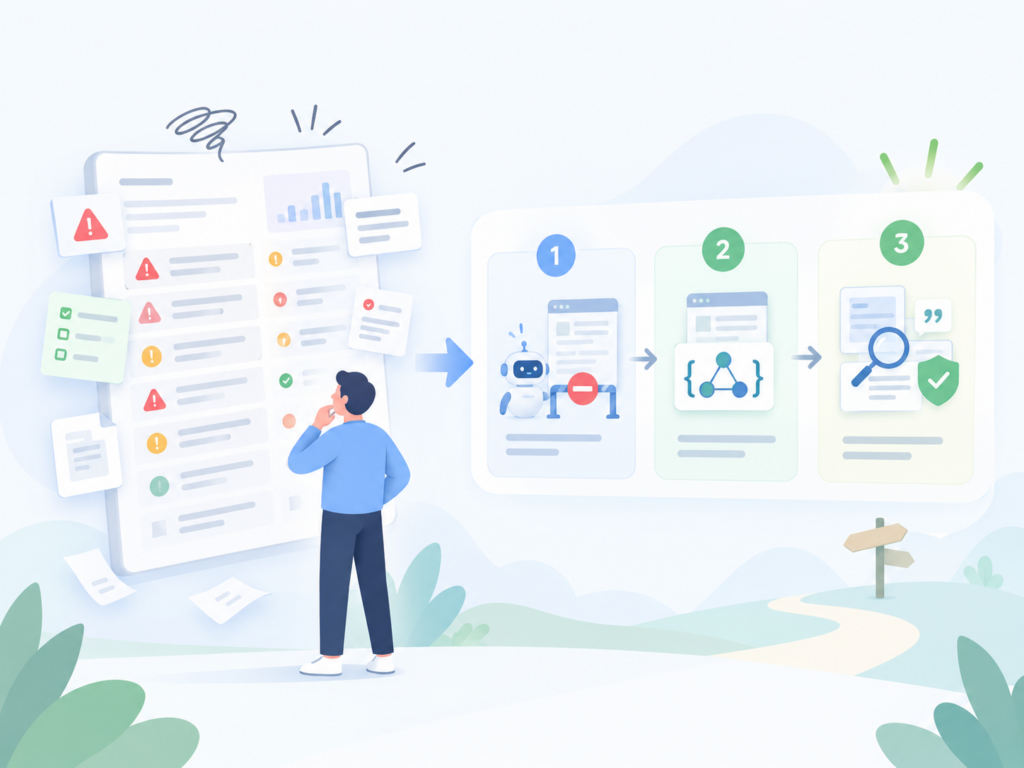
    Your team has an AI visibility tracker, an AI writing tool, and a CMS. Three tabs open, three logins saved. On paper, you’re running an agentic AEO workflow. In practice, you’re copying a visibility score from one dashboard, pasting it into a strategy doc, then manually briefing a content tool that has zero context on why that score dropped in the first place.

    That gap between “we have AEO tools” and “we have an AEO agent” is where most marketing teams lose weeks of execution time every quarter. The fix isn’t another tool. It’s architecture: a three-layer stack where tracking, reasoning, and execution actually talk to each other.

    Most AEO “Agents” Are Just Disconnected Dashboards

    The pattern is predictable. A team buys a visibility tracker, subscribes to a content generation platform, and publishes through a CMS. Each product works fine in isolation. But the data flow between them? That’s a human analyst copying numbers between browser tabs.

    Here’s where it breaks. Your tracker flags that Share of Model dropped from 12% to 4% on a specific prompt cluster. The tracker did its job. But it can’t tell you why it dropped, which competitor moved, or what content action would recover that position. A human has to figure all of that out, manually, before anything happens.

    The cost of that manual connective tissue is steeper than most teams realize. Marketing professionals lose roughly 60 hours of productivity per year strictly from switching between disconnected tools. In environments without native integration, staff can waste over 125 hours annually on redundant data entry alone.

    That’s not an AEO agent. That’s a swivel chair.

    The industry is starting to acknowledge this structural failure. Conductor’s AgentStack launch in April 2026 signals a macro shift: as AI platforms consolidate the buyer’s discovery journey into single interactions, the underlying marketing infrastructure has to consolidate too. The solution isn’t more tools. It’s fewer seams.

    What a Functioning AEO Agent Stack Looks Like

    The cleanest way to think about an AEO agent is borrowed from autonomous systems theory: the Sense-Reason-Act-Learn loop. Translated into marketing operations, that becomes three layers with strict boundaries:

    Tracking Layer answers one question: What’s happening right now? It monitors AI visibility, captures citation sources, records competitor movements, and measures brand sentiment. It doesn’t interpret. It doesn’t strategize. It observes.

    Reasoning Layer answers a different question: What does this mean, and what should we do? It ingests tracking data, identifies causal relationships, and outputs a specific execution plan.

    Execution Layer answers the final question: Is it done? It takes the reasoning layer’s blueprint and turns it into published content, schema updates, or distribution actions.

    The fundamental error most teams make is automating the first and third layers while leaving the second one entirely to the human brain. Tracking is automated. Content generation is automated. But the complex, resource-intensive process of analyzing multi-dimensional data and engineering the right response? That’s still a person staring at a dashboard and scheduling a meeting.

    That missing middle is the bottleneck.

    Tracking Layer: Where the AEO Agent Gets Its Eyes

    Without accurate, multi-platform sensory input, the reasoning and execution layers are useless. Feed an agent incomplete visibility data, and it’ll execute a flawed strategy faster. Classic garbage in, garbage out.

    The first thing to internalize: traditional SEO metrics can’t power this layer. Domain authority, keyword rank, and organic CTR don’t measure whether ChatGPT is recommending your competitor instead of you. AEO tracking requires a different taxonomy: brand mentions, citation frequency, sentiment polarity, position within AI-generated lists, and conversion probability from AI referrals.

    The second thing: a single-platform tracking strategy will fail. Research across 680 million AI citations found that only 11% of domains cited by ChatGPT are also cited by Perplexity. That means a brand can dominate one AI engine while being completely invisible on another.

    Platform-specific behaviors make this worse. Perplexity averages roughly 21 citations per response and leans heavily on Reddit threads and niche forums. ChatGPT averages around 8 citations and prefers authoritative, encyclopedic sources. The tracking layer has to capture these differences or the reasoning layer makes decisions based on a distorted picture.

    Topify addresses this by providing native tracking across ChatGPT, Gemini, Perplexity, Google AI Overviews, DeepSeek, Doubao, and Qwen. Its 7-metric framework captures Visibility (Share of Model), Position, Sentiment, Mentions, Intent, Volume, and Conversion Visibility Rate (CVR) simultaneously. That last metric, CVR, matters more than most teams think: AI-referred visitors convert at 4.4x to 23x the rate of organic search traffic, depending on the vertical. If your tracking layer can’t connect visibility to conversion probability, your CFO will never fund the program.

    A fully integrated tracking layer continuously aggregates these data points across all relevant platforms. Only with that high-resolution input can the stack move to the hard part: automated reasoning.

    Reasoning Layer: Where Data Becomes a Decision

    This is the layer that separates a tool from an agent. Its job is to ingest tracking data and output a specific, actionable execution plan, without waiting for a human to schedule a meeting about it.

    In most teams today, this layer is entirely manual. An analyst logs into the dashboard, exports data to a spreadsheet, cross-references it with competitor activity, and eventually convenes a strategy discussion. The research phase alone, identifying semantic angles, discovering citation gaps, mapping the competitive field, typically consumes about 70% of a content creator’s total workflow time. The actual writing takes a fraction of that.

    By the time the team has reasoned through the data and drafted a content brief, the generative engine’s citation preferences may have already shifted.

    Here’s what automated reasoning looks like in practice. The tracking layer flags an anomaly: Brand X’s position on Perplexity for “enterprise cybersecurity solutions” dropped from #2 to #5. A human analyst could spend days querying Perplexity, testing hypotheses, and verifying sources. An automated reasoning layer parses the variables instantly.

    Using source analysis and competitor monitoring, the agent reverse-engineers Perplexity’s citation graph for that prompt cluster. It discovers that a competitor earned a mention in a new technical discussion on a niche subreddit, and Perplexity indexed it. This aligns with a broader pattern: 85% of brand mentions in AI search come from third-party pages, not the brand’s own domain. The reasoning layer identifies the causal link, then outputs a specific directive: produce a structured content asset targeting that third-party gap, formatted with FAQ schema to maximize algorithmic ingestion.

    Topify’s Source Analysis feature powers this type of reasoning by identifying exactly which domains and URLs AI platforms are citing instead of your brand. Its Competitor Monitoring surfaces which rivals are gaining share and on which specific prompt clusters. Together, these features give the reasoning layer the context it needs to move from “something changed” to “here’s exactly what to do about it.”

    That’s the difference between a dashboard and a brain.

    Execution Layer: Where Strategy Becomes Content

    The execution layer takes the reasoning layer’s blueprint and turns it into a published asset. In a traditional workflow, this means converting a strategy into a brief, routing it to a writer, passing it through editorial review, then handing it to a CMS admin for formatting and deployment. A standard blog post requires roughly 10 hours of labor per month to maintain through that process.

    An integrated AEO agent stack collapses this into what the industry calls “one-click execution.” The reasoning layer has already identified the gap, defined the semantic targets, and specified the structural requirements. The execution layer generates content that’s natively engineered for LLM recommendation algorithms, not just human readers, because it has the full context from both upstream layers.

    Topify’s One-Click Agent Execution works this way. You state a goal in plain English. The system, informed by the tracking and reasoning layers, proposes a strategy. You review it and deploy with a single click. The human role shifts from laborer to overseer.

    But here’s the warning that matters most: execution without reasoning is a liability.

    If you connect a generic AI content generator directly to your CMS without the guidance of a dedicated reasoning layer, you’re not building an agent. You’re building a machine that publishes the wrong content faster. Generic AI content is increasingly penalized by search and answer engines. What earns citations in AEO is “information gain,” original data, unique perspectives, and novel factual associations that don’t exist in the LLM’s training data. If your execution layer just rewrites what’s already on the internet, it’s mathematically impossible for it to capture a new citation.

    Automation without reasoning accelerates failure. Automation governed by real-time data and causal logic is a competitive edge.

    The Closed Loop: Why It All Falls Apart Without Feedback

    The three layers only work as an agent if the output of execution flows back into tracking. Without that feedback loop, you’re guessing whether your actions worked.

    In an open-loop system, a team publishes content and checks results three months later using disjointed metrics. There’s no automated connection between the action and the outcome. In a closed-loop AEO agent, the cycle is continuous:

    1. Execution Layer deploys a structured content asset targeting a specific citation gap on Gemini.
    2. Tracking Layer monitors Gemini’s output to verify whether the new asset was crawled, indexed, and cited.
    3. Tracking to Reasoning: the tracking layer quantifies the impact. Share of Model moved from 4% to 9%. CVR increased.
    4. Reasoning Layer registers the success, updates its heuristics about what works on Gemini, and refines the parameters for the next execution cycle.

    That’s what makes it an agent: it learns from its own actions. A toolset waits for a human to connect the dots. An agent closes the loop automatically.

    SystemFeedback MechanismStrategic Outcome
    Open-loop (tool-based)Manual data synthesis across platformsHigh latency, wasted resources, guesswork
    Closed-loop (agentic)Automated execution-to-tracking feedbackAutonomous adaptation, measurable ROI

    Companies that implement closed-loop marketing architectures consistently report improved ROI predictability and sharper resource allocation. In AEO, where LLMs continuously update their citation preferences, a system that can’t learn from its own output is functionally obsolete.

    Where to Start If Your Stack Is Still Duct-Taped Together

    Don’t try to automate all three layers at once. That’s how you get architectural collapse. Build progressively.

    Phase 1: Fortify the Tracking Layer. Start by defining 30 to 50 high-intent prompts relevant to your category. Map your performance across all key metrics and platforms simultaneously. Topify’s Basic tier covers 100 tracked prompts across multiple AI engines for $99/month, which is enough to establish a baseline without enterprise-level spend.

    Phase 2: Formalize the Reasoning Logic. Once tracking data is flowing, manually simulate the reasoning process. When the tracker flags a visibility drop, use source analysis and competitor monitoring to reverse-engineer the cause. Document the decision rules: “If Perplexity position drops, check for new third-party citations the competitor earned.” These heuristics become the parameters that govern automation later.

    Phase 3: Connect Execution and Close the Loop. Only when tracking is reliable and reasoning rules are proven should you enable automated execution. Run two full cycles under human supervision: define a target, let the reasoning engine propose a strategy, execute via one-click, then watch the tracking layer for measurable impact over 2 to 4 weeks. Once the data flows from tracking to reasoning to execution and back to tracking without manual intervention, you’ve built an AEO agent.

    Conclusion

    An AEO agent isn’t a product you buy. It’s an architecture you build. Three layers, each with a strict job: tracking senses the environment, reasoning turns data into decisions, execution deploys the fix. And the closed loop feeds results back into the cycle so the system gets smarter with every iteration.

    Most teams today have the first and third layers covered. The reasoning layer, the one that actually determines what to do, is still a human bottleneck. Formalizing that layer, whether through manual heuristics or automated reasoning engines, is the single highest-leverage move a marketing team can make in 2026. Start with the tracking layer. Get the data right. The rest follows.

    FAQ

    Q: What is an AEO agent stack?

    A: It’s a three-layer architecture designed to maximize brand visibility in AI search platforms like ChatGPT, Perplexity, and Gemini. The Tracking Layer monitors AI outputs and citations. The Reasoning Layer analyzes data and formulates strategy. The Execution Layer generates and deploys optimized content. These layers operate in a closed loop, so the system adapts to algorithmic changes without manual data transfers.

    Q: How is an AEO agent different from AEO tools?

    A: An AEO tool performs a single function, like tracking mentions or generating content. An AEO agent links those functions together through automated reasoning. With tools, a human bridges every gap. With an agent, data flows from observation to strategy to action to measurement in a continuous cycle.

    Q: What does the tracking layer need to measure?

    A: At minimum: Visibility Rate (how often your brand appears), Position (where you rank in the AI’s list), Sentiment (how the AI frames your brand), Citation Sources (which third-party domains the AI references), and CVR (the probability an AI mention drives a conversion). Coverage has to span multiple platforms, since only 11% of cited domains overlap between ChatGPT and Perplexity.

    Q: Can I build an AEO agent stack without coding?

    A: Yes. Platforms like Topify and Conductor’s AgentStack provide pre-built architectures that integrate tracking, reasoning, and execution into a unified interface. One-click execution lets you translate tracking data into deployed content using plain-English commands, no API work or prompt engineering required.

    Read More

  • When to Switch from Manual AEO to an AEO Agent

    When to Switch from Manual AEO to an AEO Agent

    Your team’s been pulling AI search data by hand for months. You’ve got the screenshots, the color-coded spreadsheets, and the proof that your brand actually shows up in ChatGPT and Perplexity answers. The strategy works. The problem is that it currently takes 8 to 12 hours a month just to audit 100 prompts, and that number only grows as you add platforms, queries, and clients. You’re not questioning whether AEO matters. You’re stuck on a harder call: when does “good enough” become a ceiling?

    That’s a judgment call with a quantifiable answer.

    Your Manual AEO Process Works. That’s Exactly the Problem.

    Manual AEO validation is the closest thing to ground truth in generative search. You physically see how ChatGPT frames your brand, whether Perplexity cites your product page, and how Gemini handles your competitor’s name. That visibility is real, and it’s what proved the channel was worth investing in.

    But “proven” and “scalable” aren’t the same thing.

    Generative engines aren’t static indexes. They’re probabilistic text generators that synthesize answers from real-time data ingestion, personalized user context, and continuous model updates. A foundational AEO campaign might start with 20 core prompts. But because users ask full conversational questions, not isolated keywords, the tracking universe expands to hundreds of semantic variations fast. Multiply that across four AI platforms and a weekly cadence, and the math stops working for humans.

    The ceiling isn’t strategic. It’s operational. Your team hits it not when the strategy fails, but when the volume of data extraction prevents them from acting on what they find.

    5 Signals You’ve Outgrown Manual AEO

    The switch from manual tracking to an AEO agent isn’t a philosophical debate. It’s a threshold check. If your team hits three or more of these five signals, the manual workflow is already costing you more than it’s delivering.

    Signal 1: You’re Tracking More Than 50 Prompts

    Manual entry works for 10 to 20 core brand defense queries. Beyond 50, the cross-referencing required to analyze citation presence, sentiment shifts, and competitor movement makes the reporting cycle slower than the data it captures. By the time the spreadsheet is finalized, the answers have already changed. Automated agents bypass this entirely by running discovery algorithms that surface thousands of long-tail query variations without human input.

    Signal 2: You’re Covering More Than 3 AI Platforms

    Each generative engine has a distinct citation personality. ChatGPT allocates 41.3% of its citations to established retail and marketplace domains while nearly ignoring social channels (0.4%). Google AI Overviews flip that bias, with YouTube capturing 62.4% of citations. Perplexity pulls from over 8,000 unique domains with an average of 8.79 citations per response.

    The practical result: there’s only a 10% to 15% citation overlap between ChatGPT, Perplexity, and Google AI Overviews. Tracking one platform leaves an 85%+ blind spot. If you’re manually checking 50 prompts across four engines, that’s 200 checks per cycle. Cross-platform comparison at that scale is physically impossible without automation.

    Signal 3: Content Velocity Exceeds 3 Assets Per Week

    AEO-optimized content (structured FAQ pages, comparison guides, topical clusters) needs immediate monitoring after publication to determine whether it’s being cited. If your team publishes more than three assets weekly, the output velocity has outrun the manual feedback loop. Monthly reporting means you won’t know for weeks whether a new page crossed the citation threshold or got ignored entirely.

    Signal 4: Citation Drift Is Faster Than Your Reporting Cycle

    This is the most severe signal. An analysis of over 82,000 prompts across 17 weeks found that ChatGPT replaces up to 74% of its cited sources every single week. Google AI Mode shows a 56% weekly replacement rate. Roughly 34% of URLs cited by ChatGPT experience weekly citation swings greater than 50%.

    If your monthly snapshots consistently show entirely new competitors in your target citation slots, you’re not tracking visibility. You’re documenting history.

    Signal 5: Your Team Spends More Time Tracking Than Acting

    Agencies average 2.5 hours per client per week on manual AEO reporting. For a 20-client portfolio, that’s 50 hours of senior analytical time buried in data extraction every single week. When the execution ratio inverts (more time tracking than optimizing), the organization is paying strategist rates for data-entry work.

    What an AEO Agent Actually Does That Spreadsheets Can’t

    An AEO agent isn’t a fancier dashboard. It’s an active participant in the marketing stack that continuously monitors, reasons over data, and triggers execution.

    Here’s the operational difference:

    DimensionManual AEOAEO Agent
    Monitoring FrequencyMonthly or bi-weeklyContinuous / daily
    Platform Coverage1 to 2 engines4+ engines simultaneously
    Response Speed14 to 30 days (lagging)Near real-time alerting
    Reporting OutputStatic CSVs, cropped screenshotsInteractive dashboards, sentiment scoring, visual proof
    Human Cost8 to 12 hours per 100 queriesZero hours on data collection
    Pattern RecognitionSurface-level observationsCitation drift analysis, formatting bias detection, source-level attribution

    Three capabilities separate agents from spreadsheets.

    Continuous UI-simulated monitoring. API-based tracking queries the model directly but skips the rendering layer, creating a 40% decision-making error gap compared to what users actually see. Agents spawn headless browsers to capture the fully rendered interface, retaining 100% of visual context including downloadable screenshots for client reporting.

    Automated pattern detection. Agents map citation drift across thousands of variables, identifying when an LLM shifts its preference from blog posts to forum discussions, or when a new competitor’s domain begins appearing in your category’s top citations. Human analysts can’t spot these macro-patterns at scale.

    One-click execution. LLMs are 28% to 40% more likely to cite content that follows specific hierarchical structures. Agents scan a brand’s domain, detect pages missing optimal formatting, and generate execution tickets to deploy structured data directly to the CMS.

    Topify takes this further by natively connecting to Google Search Console, blending traditional search metrics with generative visibility data. Its AEO agent automatically tracks combined performance using Content Groups, clusters queries by topic to surface semantic gaps, and runs autonomous Near-Top 3 reports to prioritize quick wins. Rather than treating AI visibility as a separate silo, Topify maps it against existing SEO infrastructure so teams don’t have to choose between legacy analytics and generative intelligence.

    The Real Cost of Staying Manual Too Long

    Delaying the switch is usually framed as a budget decision. In practice, it’s a competitive one.

    Generative search operates on a winner-takes-most model. An analysis of over 36 million AI Overviews and 46 million citations shows the top 20 domains control 66.18% of all AI citation real estate. The top 5 alone capture 38.13%. Competition for the remaining third is intense, and the window to claim a position is narrow.

    There’s a stability mechanic that makes timing even more critical. Once a domain crosses a threshold of roughly 50 citations for a given query set, its weekly volatility drops from 50% to approximately 8%. That’s a 70x stability gap. Manual teams can’t react fast enough to push a domain across that threshold before the algorithmic window closes.

    Here’s what a 3-month delay actually looks like:

    A competitor deploys an AEO agent on Day 1. By Week 3, the agent detects that the LLM is beginning to favor structured FAQ schema for your core product category. The competitor autonomously deploys the schema. By Week 4, your manual team runs its monthly report and notices a slight visibility dip but lacks the granular data to understand why. By Week 8, the competitor has crossed the 50-citation stability threshold, locking in dominance at an 8% volatility rate. By Month 3, when your team finally identifies the schema deficit, the competitor is entrenched. Reclaiming that position could take a year.

    The cost of those 12 weeks isn’t a line item. It’s category leadership in generative search.

    How to Make the Switch Without Losing Momentum

    Ripping out a manual workflow overnight is a mistake. The goal is a parallel migration that preserves historical baselines while scaling operational bandwidth.

    Step 1: Audit and consolidate your baseline. Identify the 50 to 100 highest-converting prompts that currently define your brand’s generative visibility. This dataset becomes the control variable. Don’t discard it. Import it into the new system to establish a historical foundation for algorithmic tracking.

    Step 2: Pick a platform that supports gradual migration. Avoid “all-or-nothing” architecture overhauls. Topify’sonboarding requires no complex technical setup. Enter the brand name and core URLs. The system overlays a read-only SEO analytics layer via Google Search Console, instantly blending traditional search data with incoming generative metrics.

    Step 3: Run a 14-day parallel trial. Deploy the agent to track the exact same baseline prompts your team is monitoring manually. During those two weeks, compare manual observations against the agent’s output. This phase validates the agent’s accuracy, highlights personalized LLM response variations that manual tracking misses, and builds organizational trust before the manual safety net is removed.

    Step 4: Expand autonomously. Once validated, decommission the manual process. Reallocate the team hours previously spent on data extraction to strategy and content creation. Let the agent scale the tracking scope from your static 50 prompts to hundreds of long-tail semantic variations using automated prompt discovery.

    Ready to run the parallel trial? Get started with Topify and reclaim the hours your team is currently spending in spreadsheets.

    Conclusion

    Manual AEO validated the channel. It proved that brand visibility in AI search is real, measurable, and worth optimizing. That validation isn’t a reason to stay manual. It’s the prerequisite for upgrading.

    Apply the decision framework: if your workflow triggers three or more of the five signals (tracking over 50 prompts, covering more than 3 platforms, publishing more than 3 assets weekly, facing rapid citation drift, or spending more time tracking than acting), the switch is overdue. An AEO agent like Topify automates the intelligence-gathering layer so your team can stop documenting what AI said last month and start shaping what it says next.

    Let agents do the tracking. Your team should be doing the marketing.

    FAQ

    Q: What’s the difference between AEO and an AEO agent?

    A: AEO (Answer Engine Optimization) is the strategic practice of structuring content and managing brand presence so AI models cite and recommend your brand. An AEO agent is the software layer that operationalizes that strategy: it automates continuous monitoring, prompt discovery, cross-platform data parsing, and execution recommendations. AEO is the “what.” The agent is the “how.”

    Q: How many prompts should I track before switching to an agent?

    A: The practical breaking point is around 50 prompts. Human analysts can reliably handle 10 to 20 core brand defense queries. Beyond 50, the cross-referencing required across multiple platforms (citation presence, sentiment, competitor movement) makes manual reporting too slow and error-prone. If you’re already past that number, the switch pays for itself in recovered team hours alone.

    Q: Can an AEO agent work alongside my existing SEO tools?

    A: Yes. Platforms like Topify connect directly to Google Search Console, importing traditional search data to inform generative strategies. This lets teams create unified Content Groups, spot keyword cannibalization across both traditional and AI search, and prioritize opportunities without abandoning existing SEO infrastructure.

    Q: How long does it take to set up an AEO agent?

    A: Modern AEO agents are built for rapid deployment. Setting up Topify takes minutes: enter the brand name and target URLs, and the system autonomously discovers relevant prompts and generates core GEO performance metrics. The 14-day parallel trial with your existing manual process is recommended, but data starts flowing almost immediately.

    Read More

  • What an AEO Agent Does Every Week

    What an AEO Agent Does Every Week

    Most marketing teams tracking AI search visibility hit the same wall around week three. The Monday morning spot-check across ChatGPT, Perplexity, and Gemini that started as a 30-minute task has ballooned into 20 to 30 hours of manual querying per week. Multiply that across 50 monitored prompts, each requiring 10 to 20 repeat runs for statistical reliability, and you’re looking at a full-time analyst doing nothing but copy-pasting queries into chat windows.

    That’s the exact workload an AEO agent compresses into a structured, auditable weekly cycle. Not by removing human judgment, but by concentrating it at five specific decision points across five days.

    Monday: Baseline Scan and Why Your Visibility Score Shifted Overnight

    The week starts with drift detection, not dashboards.

    An AEO agent doesn’t log into a platform and wait for you to ask questions. It runs an automated baseline scan across every prompt in your monitored portfolio before your team opens their laptops. The scan measures the statistical shift in brand representation compared to the previous week, not the absolute numbers.

    Why relative drift matters more than raw scores: only 30% of brands maintain visibility from one AI-generated answer to the next. Across five consecutive runs of the same query, that number drops to 20%. Volatility is the default state, which means a single Monday snapshot tells you almost nothing without last week’s data as a reference point.

    Topify’s agent scans across seven core metrics: Visibility Score, Sentiment Score, Position Rank, AI Search Volume, Mention Rate, Intent Analysis, and Conversion Visibility Rate (CVR). Each one captures a different layer of how AI engines perceive your brand. A drop in Position Rank from #2 to #5 on a high-volume transactional prompt is a different kind of problem than a Sentiment Score sliding from +60 to +30.

    The agent compiles all flagged anomalies into a prioritized Drift Report. You review it. You decide whether a drop warrants a deep drill-down or gets logged as normal variance. That’s Monday’s human checkpoint: 15 minutes of strategic triage, not 4 hours of manual data collection.

    Tuesday: Your AEO Agent Audits the Prompts You Should Be Tracking

    Users don’t type keywords into ChatGPT. They write full sentences, sometimes full paragraphs. The average AI search prompt runs 23 to 60 words, packed with context like budget constraints, tech stack requirements, and team size.

    Those prompts shift constantly. A query that drove 500 monthly AI searches last quarter might be irrelevant now. A new prompt phrasing might be surging and your competitors are already showing up in answers for it.

    On Tuesday, the agent audits your active prompt portfolio using a weighted scoring model. Each candidate prompt gets an Opportunity Score based on four factors: AI Query Volume (30% weight), Visibility Gap (25%), Commercial Intent (25%), and Content Readiness (20%). The Visibility Gap score spikes when your brand is completely absent but competitors are actively recommended. Content Readiness evaluates whether your existing pages can realistically support the query.

    The output is a shortlist: prompts to add, prompts to retire, and a clear rationale for each. Your job is to approve or adjust the list, making sure the tracking budget maps to your actual marketing priorities. That takes roughly 10 minutes, not the hours it would take to manually research prompt trends across four AI platforms.

    Wednesday: Where Your Citations Break and What to Fix First

    Here’s the thing about generative search engines: they don’t share sources. Only 11% of web domains get cited by both ChatGPT and Perplexity. ChatGPT leans heavily on commercial .com domains, with Wikipedia anchoring 47.9% of its top 10 sources. Perplexity has an extreme bias toward fresh content, with 82% of cited URLs updated within 30 days, and Reddit accounting for 46.7% of its top sources. Gemini pulls 34% of its responses entirely from pre-training weights with zero live web retrieval.

    That fragmentation is why Wednesday’s content gap analysis matters. The agent cross-references your visibility data with citation source data, prompt by prompt. When a competitor gets recommended for a query where you’re absent, the agent traces the citation trail back to the specific URLs that powered that recommendation.

    Then it outputs actionable fixes, ranked by impact. The highest-priority recommendations typically include placing a dense, direct answer in the first 150 words of your key pages. 55% of Google AI Overview citations and 44.2% of ChatGPT citations pull from the top 30% of a page. Converting qualitative comparisons into HTML data tables also ranks high, since tables get cited 2.5 times more frequently than equivalent plain-text paragraphs.

    Wednesday’s human checkpoint: the content team reviews the prioritized fix list, approves specific pages for production, and assigns owners. The agent built the analysis. Your team decides what ships.

    Thursday: The Competitor Signals Your AEO Agent Catches First

    Traditional competitive tracking watches keyword rankings and backlink profiles. That’s almost useless in generative search. LLMs group brands by semantic relationships, not keyword matches. A competitor might gain ground in AI recommendations because of a positive G2 review wave or a Wikipedia edit, months before those signals show up in Google rankings.

    Thursday is when the agent maps competitor movement across a six-step process: entity extraction (who’s emerging in your category), recommendation frequency benchmarking (daily mention trends), share of voice segmentation (platform-by-platform), trigger word association (which prompt phrasings favor competitors), citation source auditing (the specific Reddit threads, G2 pages, and media articles powering their visibility), and threat prioritization.

    That last step is where it gets practical. Branded domains account for only about 9% of all LLM citations. Third-party sources dominate. So the agent doesn’t just tell you a competitor surged. It shows you which Reddit threads, which review sites, and which industry listicles are fueling that surge, and suggests specific off-page tactics to close the gap.

    Thursday’s decision point: your team evaluates whether a competitor’s movement warrants a counter-positioning campaign or a content priority shift. The agent flags the threat and drafts the playbook. You decide whether to execute.

    Friday: What “One-Click Deploy” Actually Means for an AEO Agent

    Friday is execution day, but “one-click” doesn’t mean autopilot.

    The agent aggregates every validated recommendation from the week into a single, prioritized execution queue. A typical Friday queue contains three on-page content optimization updates (fully drafted paragraphs designed for answer capsules on critical landing pages), one schema and metadata configuration (pre-compiled FAQPage or Product JSON-LD ready for deployment), and two competitor counter-strategies (flagged third-party citation targets with pre-structured response outlines).

    Each item in the queue is pre-compiled, structured, and formatted for your CMS. The marketing manager reviews each edit, adjusts copy for brand voice, rejects anything low-impact, and publishes approved changes to WordPress, Shopify, or Framer with a single confirmation.

    That’s the real meaning of one-click execution: the agent did 95% of the preparation work. The human applies 5% of strategic judgment. The result ships in minutes, not days.

    Weekend: The Agent Keeps Scanning. You Don’t.

    The agent doesn’t take weekends off. It continues simulating searches, tracking citations, and ingesting data across every monitored platform. It just doesn’t send you notifications.

    This matters because citation performance for unrefreshed content typically drops to 40% of its initial level within 90 days. Algorithm changes and competitor updates don’t pause on Saturday. When your team logs in Monday morning, the baseline scan is already complete. Any visibility shifts from the weekend are flagged, analyzed, and waiting in the Drift Report.

    The weekly cycle is a loop, not a line.

    What Happens When You Scale from 50 Prompts to 500

    At 50 prompts, a skilled analyst can manage AEO with spreadsheets and manual spot-checks. At 500, the math breaks.

    Tracking 500 prompts across four AI engines means running 2,000 separate search queries per week. Factor in the 10 to 20 repeat runs needed for statistical reliability, and you’re looking at 40,000 queries. That’s an estimated 150+ hours of manual labor per week, which is roughly four full-time analysts doing nothing but querying chat windows.

    There’s also a geographic blind spot. Most manual tracking focuses on Western LLMs. But global brands need coverage across Chinese AI engines like DeepSeek, Doubao, and Qwen, which mention brands at an 88.9% rate for English-language queries. Ignoring that ecosystem means missing a significant share of AI-driven brand discovery.

    An agent-driven approach compresses that 150-hour workload into roughly 2 hours of strategic oversight per week. It auto-adjusts tracking frequency based on prompt performance: high-volume transactional prompts get daily checks, stable informational queries shift to weekly. Topify’s tiered plans scale from 50 daily monitored prompts at $99/month to 300+ prompts at the Pro level, with enterprise options for custom volumes.

    The agent’s value at scale isn’t speed. It’s focus. Your team stops logging data and starts making decisions.

    Conclusion

    The gap between “we have an AEO strategy” and “our AEO agent runs a structured weekly cycle” is the gap between intention and execution. Monday’s drift scan, Tuesday’s prompt audit, Wednesday’s citation analysis, Thursday’s competitor intelligence, and Friday’s one-click deploy form a repeatable loop where every human intervention happens at a defined checkpoint, not in a reactive scramble.

    If your team is still manually querying AI engines to check brand visibility, the bottleneck isn’t insight. It’s operational overhead. An AEO agent doesn’t replace your judgment. It gives you a clean, prioritized surface to apply it. Start with Topify to see what that weekly cycle looks like with your own prompt portfolio.

    FAQ

    Q: What is an AEO agent? 

    A: An AEO agent is an autonomous software framework that tracks, audits, and improves your brand’s visibility within AI answer engines like ChatGPT, Perplexity, Gemini, and Google AI Overviews. It automates query simulation, citation mapping, content gap identification, and structured update deployment, while keeping humans in the loop for every strategic decision.

    Q: How much human oversight does an AEO agent need? 

    A: Roughly 1 to 2 hours per week. The heaviest checkpoints are Monday’s Drift Report review and Friday’s execution queue approval. The agent handles all data collection, analysis, and draft preparation. You handle the “yes, no, or adjust” decisions.

    Q: Can an AEO agent replace my content team? 

    A: No. An AEO agent automates structural optimizations, schema deployment, and initial draft formatting. But brand voice, technical accuracy verification, and qualitative storytelling still require human expertise. The agent empowers your content team to work on higher-impact tasks instead of manual data logging.

    Q: How long before an AEO agent shows measurable results? 

    A: Most organizations see initial increases in AI search visibility and citation frequency within two to four weeks. Building a dominant Share of Model position across a competitive category typically takes two to three months of consistent optimization cycles.

    Read More

  • 7 AEO Agent Capabilities Dashboards Can’t Fake

    7 AEO Agent Capabilities Dashboards Can’t Fake

    You’ve sat through five vendor demos this month. Every product calls itself an “AEO agent.” Every slide deck promises autonomous optimization, real-time visibility, and AI-native intelligence. But when you ask the one question that matters, “Show me exactly how this executes an optimization,” most vendors point you to a data export button.

    That’s the gap. While 79% of enterprise organizations say they’ve adopted AI agents, only 11% have actually deployed them into production workflows. The rest are running dashboards with a language model bolted on top.

    Most AEO “Agents” Are Just Dashboards with a Chat Box

    The enterprise AI market has a naming problem. Legacy platforms are rebranding basic retrieval-augmented generation (RAG) dashboards as “agents” simply because they’ve added an LLM summarization layer or a conversational interface. That architectural mismatch creates real confusion for marketing teams trying to scale visibility across AI search surfaces.

    Here’s a quick way to cut through the noise: does the system do things, or does it show you things?

    Dashboards are post-hoc reporting tools. They tell you what happened, then leave you to manually extract data, build a content brief, coordinate with your dev team, and publish the fix. That pipeline eats weeks.

    A true AEO agent is goal-oriented. It understands a high-level objective, plans multi-step sequences, uses digital tools autonomously, and adjusts strategies based on real-time feedback. Analyst frameworks from Gartner and Forrester draw this exact line: passive reporting vs. actual agency.

    DimensionDashboardTrue AEO Agent
    Operational ModePassive, retroactive reportingProactive, real-time reasoning and execution
    WorkflowSiloed; manual export and coordinationIntegrated; connects to CMS and citation environments
    LogicRule-based, static keyword matchingGoal-oriented, probabilistic, multi-step planning
    AdaptabilityManual config updatesSelf-adjusting via closed-loop feedback

    The seven capabilities below are what separate real agents from the marketing label.

    1. Autonomous Prompt Discovery, Not Just Keyword Tracking

    Traditional SEO runs on keyword strings: short, fragmented phrases of two to three words. Conversational search is different. The average prompt submitted to ChatGPT is 23 words long, and research-heavy queries regularly exceed 2,000 words.

    A dashboard tracks what you already know. You manually input a keyword list, and the tool monitors those specific terms. The problem is obvious: your team can’t anticipate the exact phrasing, comparison terms, and micro-intents that real buyers use inside LLM sessions.

    An autonomous AEO agent flips this. It crawls your brand’s digital footprint, analyzes your market category, and queries major AI search engines to surface high-volume commercial, informational, and comparison prompts you didn’t know existed.

    Topify does this through its High-Value Prompt Discovery engine. The system continuously surfaces new prompt opportunities as AI recommendations evolve, building a target database without requiring manual keyword configuration. That’s the difference between reacting to data you already have and discovering opportunities you’d otherwise miss entirely.

    2. Multi-Platform Monitoring Without Manual Setup

    Traditional search monitoring focuses on Google. Conversational discovery happens across ChatGPT, Gemini, Perplexity, DeepSeek, Claude, Doubao, Google AI Overviews, and more. Retrieval and citation behaviors vary significantly between these models.

    Most dashboards support one or two platforms, or they require complex manual API setups for each engine. That’s an operational bottleneck during a period when new AI search surfaces are launching quarterly.

    An enterprise-grade AEO agent orchestrates multi-platform monitoring simultaneously. Topify’s global engine coverage spans ChatGPT, Gemini, Perplexity, DeepSeek, Doubao, Qwen, and AI Overviews, all from a single interface. No per-platform configuration. No fragmented data silos.

    3. Real-Time Competitor Detection, Not Static Lists

    In AI search, the competitive landscape is probabilistic. Models synthesize information from across the web, and they frequently recommend disruptive startups, niche providers, or alternative solutions that never appear in traditional SERPs.

    A dashboard compares your brand against a static list of competitors that someone on your team manually entered six months ago. Meanwhile, a new entrant just started showing up in ChatGPT’s top-three recommendations for your category.

    A real AEO agent runs dynamic competitor benchmarking. It continuously queries AI platforms for category-level recommendations, automatically detects which brands the models are pairing with yours, and alerts you when a rival gains visibility or a new entrant captures share of voice. It then decodes the competitor’s advantage by analyzing the exact sources the AI is citing to support that recommendation.

    You can’t outmaneuver competitors you don’t even know exist.

    4. Multi-Signal Analysis Across 7+ Metrics

    A single “visibility score” tells you almost nothing. It’s the equivalent of knowing your flight is delayed without knowing the cause, the new departure time, or the gate change.

    Legacy dashboards lean on this kind of oversimplified metric because they can’t track what happens inside the black box of LLM-mediated queries. A genuine AEO agent needs a multi-signal matrix across at least seven dimensions:

    • Visibility: Presence, frequency, and positioning across AI search results.
    • Sentiment: The tone, adjectives, and qualitative descriptors AI uses when mentioning your brand.
    • Position: Ordinal ranking within the AI’s recommended set. Are you the first recommendation or a footnote?
    • Volume: Frequency of brand mentions across multi-turn conversational threads.
    • Citations: The specific domains and URLs that AI platforms rely on to shape their answers.
    • Intent: Mapping queries across informational, comparison, and transactional states.
    • CVR (Conversion Visibility Rate): The percentage of AI interactions that drive high-intent brand actions.

    Topify’s Comprehensive GEO Analytics tracks all seven simultaneously. In practice, this means you can spot a sentiment shift in Gemini, trace it to a specific cited source, and connect it to a position drop in ChatGPT, all within the same view.

    5. One-Click Strategy Execution: The Agent Litmus Test

    This is the capability that separates the category. Everything above is intelligence. This is action.

    A dashboard highlights a visibility gap or a missing citation, then hands you a to-do list. What follows is a fragmented manual pipeline: an analyst identifies the gap, a content strategist drafts an update, a developer coordinates the upload, a manager reviews the live page. That process takes weeks and burns operational budget on coordination, not creation.

    A true AEO agent collapses that entire pipeline. Topify’s One-Click Agent Execution works like this: you state your goals in plain English, review the proposed strategy, and deploy with a single click. The agent identifies specific content deficits where competitors are being cited instead of your brand. It drafts optimized, answer-first content using structured data, FAQ schemas, and concise answer blocks designed to match the linguistic and semantic preferences of LLM search crawlers.

    The agent then connects directly to your CMS, whether that’s WordPress, Shopify, or Framer. Each recommendation in the action feed is a completed piece of work: an optimized article, an updated comparison table, or a custom landing page. It details the targeted visibility gap, the quantitative reasoning, and the projected impact. One click publishes it live with proper formatting, metadata, and schema markup.

    Human-in-the-loop review stays intact. You approve every piece before it goes live. But the operational distance between “insight” and “published optimization” shrinks from weeks to minutes.

    That’s the litmus test. If your “agent” can’t publish, it’s a dashboard.

    6. Citation Source Reverse-Engineering

    To show up in AI-generated answers, you need to understand how these systems retrieve information. Most answer engines use RAG architectures: they run real-time web searches, extract text passages from multiple sources, and feed those passages into an LLM to synthesize a response. With zero-click searches reaching 58.5% of all queries, the inline citation has become the primary vehicle for brand discovery.

    A passive dashboard tells you a competitor got cited. A real agent tells you why and shows you exactly how to take that citation.

    The data here is specific. Research shows that 44.2% of ChatGPT citations and 55% of Google AI Overview citationsoriginate from the first 30% of a webpage’s content. Content structured as an “answer capsule,” a self-contained 40-to-60-word factual summary placed directly below an H2 question tag, yields a 72.4% citation rate. And 91% of those successfully cited capsules contain zero outbound links, meaning high link density within targeted passages actually hurts retrieval.

    Topify’s source analysis engine reverse-engineers the entire citation chain. When it finds an answer gap, a query where competitors are cited but your brand isn’t, it identifies the exact third-party domains, review platforms, and media publications that the model used. Then it builds a content roadmap to close those gaps using structured HTML, Schema.org markup (which delivers a 2.3x lift in citation probability), and definitive language patterns that LLMs prefer to cite.

    7. Closed-Loop Feedback, Not Snapshot Reports

    AI search is volatile. Models retrain, retrieval databases refresh, and citation patterns shift from week to week. A snapshot report from last Tuesday is already partially stale.

    Dashboards are inherently snapshot-based. They freeze performance at a point in time, and you manually run new reports to see what changed.

    A genuine AEO agent operates on a continuous closed-loop cycle: execution, GEO monitoring, strategy optimization, re-execution. Every optimization action feeds new performance data back into the system. The agent automatically measures how each change influenced visibility, citations, and sentiment across platforms, then refines its recommendations accordingly.

    This is the difference between a tool that shows you the weather once and a system that adjusts the thermostat.

    The Quick AEO Agent Evaluation Checklist

    Bring this to your next vendor meeting.

    CapabilityDashboard BehaviorTrue Agent Behavior
    Prompt DiscoveryUser manually inputs keyword listsAutonomously discovers conversational buyer queries
    Platform Scope1-2 platforms; manual setupChatGPT, Gemini, Perplexity, DeepSeek, Claude, Doubao simultaneously
    Competitor TrackingStatic, pre-defined competitor listDynamic detection of AI-recommended competitors in real time
    Insight DepthSingle generic “visibility score”7-dimension matrix: Visibility, Sentiment, Position, Volume, Citations, Intent, CVR
    ExecutionStatic reports; manual copywriting and coordinationAuto-drafts structured, answer-first content optimizations
    CMS IntegrationExports raw data or content briefsOne-click publishing to WordPress, Shopify, Framer
    Feedback LoopPeriodic manual reportingContinuous closed-loop: measures results, refines strategy automatically

    Conclusion

    The shift from “search, click, browse, convert” to “ask, get answer, convert” is compressing the marketing funnel in real time. Buyers are delegating product research, vendor filtering, and technical evaluations to AI assistants. Brands that aren’t cited in those conversations get eliminated from the consideration set before a human ever makes contact.

    Relying on a passive dashboard in this environment isn’t just slow. It’s a structural risk. The seven capabilities above aren’t a wish list. They’re the minimum threshold for a tool that deserves the word “agent.” If your current platform can’t discover prompts, monitor multiple AI engines, detect competitors dynamically, analyze seven signal dimensions, execute with one click, reverse-engineer citations, and learn from its own results, it’s a reporting tool with a better logo.

    Get started with Topify to see what an actual AEO agent looks like in practice.

    FAQ

    Q: What is an AEO agent?

    A: An AEO (Answer Engine Optimization) agent is autonomous software that analyzes, optimizes, and maintains a brand’s visibility within generative and conversational AI search engines. Unlike a dashboard, a true agent discovers high-value conversational queries, reverse-engineers competitor citation patterns, and executes direct content optimizations to improve how AI models recommend the brand.

    Q: How is an AEO agent different from an AI visibility dashboard?

    A: A dashboard is a passive reporting tool that tracks brand mentions and visualizes historical data. You still have to manually extract insights, write content, and coordinate publishing. An AEO agent is an active execution system. It diagnoses visibility gaps, drafts optimized content, and publishes directly to your CMS with a single click.

    Q: What questions should I ask vendors when evaluating AEO agents?

    A: Four qualifying questions expose pseudo-agents fast. First, does the platform integrate directly with your CMS to publish, or does it only export recommendations? Second, how does the system discover new prompts, and does it require manual keyword input? Third, does it automatically detect AI-recommended competitors, or do you have to build a static list? Fourth, can it reverse-engineer the specific URLs and domains cited by ChatGPT, Gemini, and Perplexity for your target queries?

    Q: Why do most “AEO agents” fail in production?

    A: The 79%-adoption-vs-11%-deployment gap comes down to architecture. Most tools labeled “agents” are reflex systems running on fixed, rule-based sequences. They lack the reasoning capabilities needed to navigate dynamic search environments. A real agent needs goal comprehension, multi-step planning, tool use, persistent memory, and closed-loop feedback to operate autonomously.

    Read More

  • AEO Agent vs GEO Agent vs SEO Automation

    AEO Agent vs GEO Agent vs SEO Automation

    Three categories. Three different problems. Here’s how to tell them apart.

    You sat through three vendor demos last week. One platform promised to automate keyword-targeted content at scale. Another claimed to audit your brand mentions inside ChatGPT. A third offered to restructure your site’s source code for “semantic extractability.” All three called themselves an “AI search agent.”

    You left more confused than when you started. That’s not a knowledge gap on your end. It’s a taxonomy problem in the market. The term “agent” has been stretched so thin it now covers tools that solve fundamentally different problems, for different teams, using different data.

    The cost of buying the wrong category isn’t just wasted budget. It’s months of optimizing for a layer of search that wasn’t your actual bottleneck.

    Every Vendor Says “Agent.” They Don’t Mean the Same Thing.

    Here’s the short version of what each category actually does:

    SEO automation optimizes your pages to rank higher in Google’s organic results. It targets the traditional index of blue links.

    A GEO agent monitors and improves your brand’s overall visibility, sentiment, and recommendation share across AI platforms like ChatGPT, Perplexity, Gemini, and Claude.

    An AEO agent structures your on-page content so that LLMs extract and cite your specific passages as the primary source of truth.

    Think of it this way. SEO automation makes sure your book is properly shelved in the library catalog. A GEO agent ensures the AI librarian consistently recommends your book when patrons ask category-level questions. An AEO agent formats the pages inside your book so the librarian can read aloud and cite a precise paragraph as the definitive answer.

    These aren’t three stages of the same product. They’re parallel systems that solve different problems simultaneously.

    The Comparison Matrix: What Each Tool Type Actually Optimizes

    The clearest way to see where these categories diverge is side by side. This matrix maps the core operational dimensions that matter for a procurement decision.

    DimensionSEO AutomationGEO AgentAEO Agent
    Optimization TargetGoogle SERPs and organic blue-link click-throughsBrand visibility, Share of Model, and sentiment across AI-generated responsesMicro-content extraction and explicit source citation rates in AI answers
    Core MetricsDomain Authority, keyword rankings, page speed, crawl budgetShare of Model, Sentiment Score, Mention Rate, Recommendation PositionCitation Rate, Extraction Likelihood, Schema Coverage, 30/44 Rule Alignment
    Input DataSearch volumes, backlink profiles, SERP metadata, log filesSimulated prompt outputs, citation lists, semantic competitor logsContent structure (H2/H3 hierarchy), JSON-LD schemas, expert quotes, factual statistics
    Output ActionsKeyword clustering, meta-tag updates, content drafts, tech auditsMulti-platform auditing, competitive alerts, citation network reverse-engineeringAnswer Capsule injection, custom schema deployment, expert quote embedding
    Typical BuyerSEO Manager, Content Marketing LeadCMO, Brand Manager, Digital PR DirectorTechnical SEO Specialist, Content Architect, Editorial Director
    Representative ScenarioPublishing hundreds of landing pages to capture high-volume keywordsBenchmarking how often ChatGPT recommends your brand vs. competitorsStructuring a product comparison table so Perplexity cites your exact data

    The key takeaway from this matrix: SEO automation measures Domain Authority and keyword position. GEO agents measure Share of Model, the probability your brand is recommended across a prompt matrix. AEO agents measure citation rate, the percentage of times an engine provides a clickable link back to your domain.

    Different metrics. Different dashboards. Different teams.

    What SEO Automation Does Well, and Where It Stops

    SEO automation is the most mature segment of search technology. Modern tools handle keyword clustering, technical auditing, XML sitemap maintenance, programmatic meta-description generation, redirect monitoring, and automated CMS publishing. For teams managing hundreds or thousands of pages, this layer is non-negotiable.

    But its boundaries are defined by its architecture. SEO automation tools are built for search indexes that crawl, rank, and display documents based on keyword matching, semantic proximity, and backlink authority. They can’t track how a brand is described inside a ChatGPT session. They can’t diagnose why Google’s AI Overview summarizes a competitor’s page instead of yours, even when your page ranks first organically.

    That blind spot is becoming expensive. Google’s AI Overviews now take up 42% of screen real estate on desktop and 48% on mobile, pushing classic blue links below the fold. Organic click-through rates on top results have dropped by 58% to 61% as a result. Meanwhile, AI-referred sessions are growing at 527% to 623% year-over-year. Shopify reported that AI-referred orders grew nearly 13x in Q1 2026, with those visitors converting at 50% higher rates and carrying 14% higher average order values.

    Standard SEO automation can’t capture, monitor, or optimize for that traffic. If your Google rankings are stable but your referral pipeline is shifting toward conversational interfaces, SEO automation alone won’t explain why.

    What a GEO Agent Tracks That SEO Tools Can’t See

    GEO agents operate in a fundamentally different data layer. Instead of querying search engine APIs for static keyword rankings, they run browser-based simulations across ChatGPT, Gemini, Perplexity, Claude, and emerging engines like DeepSeek to track how AI platforms describe, recommend, and position your brand.

    One reason this matters: analysis of 30 million LLM citations shows that 80% of URLs cited by large language models don’t even rank in Google’s top 100 organic results for the same query. Traditional metrics like Domain Authority are poor predictors of AI source retrieval. LLM retrieval algorithms instead prioritize signals like brand search volume (0.334 correlation with citation probability) and YouTube mentions (0.737 correlation), which build what researchers call “Entity Confidence” in the model’s parametric memory.

    That’s a gap most SEO dashboards can’t show you.

    GEO agents track multi-dimensional metrics across this layer. Share of Model (SoM) measures how frequently a brand is recommended across a targeted prompt library. Real-time Sentiment Scoring captures how the AI frames the brand, whether as an industry leader or a cautioned alternative. Retrieval Gap analysis identifies specific conversational pathways where competitors are cited but your brand is omitted.

    Topify is one example of how dedicated GEO platforms approach this. Topify tracks across 7+ AI engines, including both Western platforms and the Mandarin AI ecosystem (DeepSeek, Doubao, Qwen). Its intelligence framework accounts for a key structural reality: research suggests only 30% of brands maintain consistent visibility across multiple regenerations of the same AI query. Visibility in conversational search is probabilistic, not static. A GEO agent treats it accordingly.

    Where the AEO Agent Fits: Optimizing the Answer, Not Just the Mention

    GEO tells you whether AI platforms are recommending your brand. AEO goes one layer deeper: it tells you whether AI is citing your content as the actual source behind its answers.

    The distinction is precise. A brand might appear in a ChatGPT recommendation list (that’s GEO visibility), but the hyperlink citation at the bottom of the answer points to a competitor’s page (that’s an AEO problem). Being mentioned and being cited are two different outcomes, driven by two different sets of on-page signals.

    AEO agents focus on content formatting and structural engineering for Retrieval-Augmented Generation (RAG) systems. Peer-reviewed research from Princeton University, Georgia Tech, and the Allen Institute for AI quantified how specific on-page optimizations affect generative engine visibility:

    Optimization TacticMeasured Visibility Impact
    Quotation Addition (expert quotes)+41%
    Statistics Addition+31% to +37%
    Citing Established Sources+28% to +40%
    Fluency Optimization+28%
    Entity Density (~20.6%)Significant boost
    JSON-LD Schema Markup+67%

    AEO strategies also leverage what’s known as the 30/44 rule. LLMs process web documents top-down and chunk content into modular fragments. Data shows that 44% of all LLM citations are extracted from the first 30% of a page’s content. This means AEO agents implement “Answer Capsules,” concise 40-to-60-word declarative summaries positioned directly beneath H2 headings, designed for RAG scrapers to digest and attribute.

    If your brand is visible in AI recommendations but competitors are getting the citation links, you have an AEO problem, not a GEO problem. The fix isn’t more brand monitoring. It’s restructuring your content for extractability.

    The Overlap Zone: Why Most Teams Need More Than One Tool

    These three categories aren’t sealed boxes. Their boundaries are permeable, and the interdependencies are real.

    Traditional SEO authority remains a baseline requirement. Research shows that 76.1% of URLs cited in Google AI Overviews also rank in Google’s organic top 10. Technical health, backlink structures, and crawlability (all SEO fundamentals) directly affect the retrieval pool that AI Overviews draw from.

    GEO monitoring identifies where the gaps are. AEO provides the formatting playbook to close them. Buying one tool and assuming it covers the full stack is a common and costly mistake.

    Here’s a quick diagnostic:

    Your ProblemRecommended Tool Path
    Google organic rankings are decliningSEO Automation (crawlability, indexation, sitemaps, meta-tags)
    You don’t know if ChatGPT or Perplexity recommend your productGEO Agent (Share of Model, mention baseline, sentiment tracking)
    AI mentions your brand, but cites competitor pages as the sourceAEO Strategy + GEO Agent (audit citation sources, then deploy structural rewrites)

    Topify’s Source Analysis feature sits at this intersection. It addresses a reality that often surprises marketing teams: 82% to 85% of AI citations originate from third-party websites like directories, trade media, and Reddit, not from the brand’s owned domain. By reverse-engineering competitor citation networks, Source Analysis shows exactly where to build digital PR and external citation presence. Its Conversion Visibility Rate (CVR) metric then connects that visibility data to projected downstream revenue, giving C-suite stakeholders the ROI narrative they need.

    Five Questions to Clarify Your Next Purchase

    If you’re evaluating tools right now, run through this framework before booking another demo.

    1. Are your Google rankings stable, but overall referral traffic is dropping? If yes, informational queries are likely being captured by AI Overviews or standalone AI engines. You need a GEO agent first, not more SEO automation.

    2. Do you have quantitative proof of your brand’s presence across ChatGPT, Perplexity, and Gemini? If no, you have a brand blind spot. Standard keyword trackers can’t query LLM vector spaces. A GEO agent with browser-based simulation is the starting point.

    3. Is your brand mentioned in AI outputs, but competitors get the citation links? If yes, your content lacks the structural markers RAG systems prioritize. You need AEO workflows: expert quotes, verifiable statistics, JSON-LD schemas, and Answer Capsules.

    4. Do you need to demonstrate AI search ROI to the C-suite? If yes, simple mention counters won’t cut it. You need a platform with a CVR dashboard that connects conversational tracking to down-funnel conversion data.

    5. Does your team have dedicated content architects for schema and structural rewrites? If no, passive reporting tools will create dashboard fatigue. Look for an agent with autonomous execution capabilities that can push optimizations directly to your CMS.

    Conclusion

    The search stack in 2026 isn’t one thing. It’s three parallel systems, each addressing a different layer of how users discover brands. SEO automation keeps your pages indexed and technically sound. GEO agents track whether AI platforms recommend you. AEO agents ensure your content gets cited as the source.

    The vendors calling all three “AI agents” aren’t wrong about the label. They’re just skipping the part where each solves a different problem for a different team with a different set of metrics. Your job is to match the tool to the bottleneck.

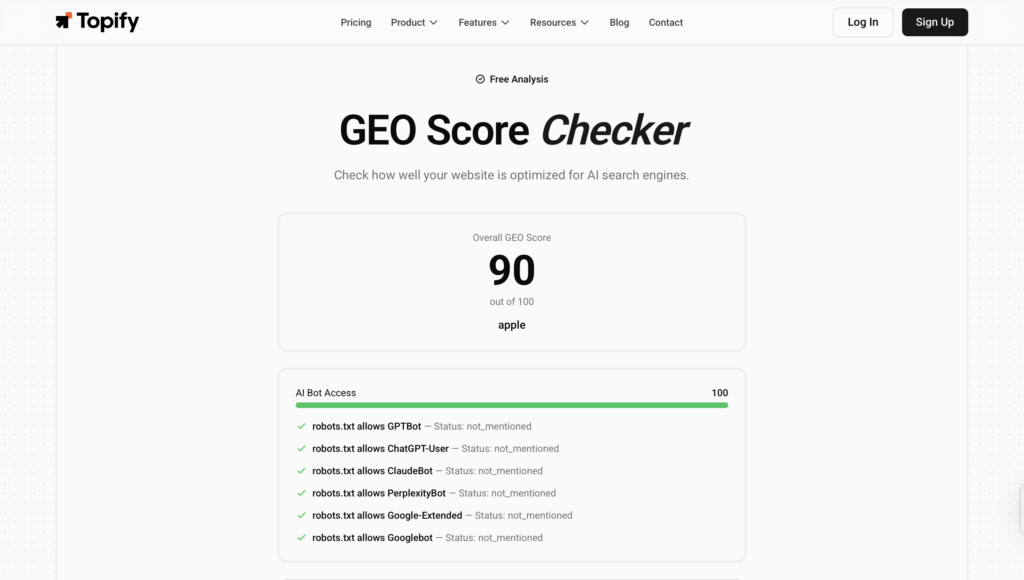
    For teams ready to start with the layer most organizations are missing, Topify’s Free GEO Score Checker offers a fast baseline across the conversational search landscape. It won’t replace a full-stack strategy, but it’ll show you where you stand before you sign anything.

    FAQ

    Q: What is the difference between AEO and GEO?

    A: GEO is a broad strategy focused on tracking and improving a brand’s overall presence, recommendation probability, and sentiment across generative AI engines. AEO is a technical subset focused on structuring on-page content so RAG systems extract and cite your text as the primary source. GEO asks “does AI mention us?” AEO asks “does AI link to us as the source?”

    Q: Can one tool handle both AEO and GEO?

    A: Some advanced platforms bridge this gap. Topify, for instance, monitors brand sentiment and positioning across 7+ AI engines (GEO layer) while also diagnosing citation gaps and offering content restructuring to optimize for direct extraction (AEO layer). That said, teams with heavy technical SEO needs will typically still run a separate SEO automation tool alongside.

    Q: Is SEO automation still necessary if I have a GEO agent?

    A: Yes. Traditional SEO and GEO are complementary. 76.1% of URLs cited in Google AI Overviews also rank in Google’s organic top 10. SEO technical optimization and link building establish the crawlable authority that allows AI models to find and trust your content in the first place.

    Q: What metrics should I track for AEO vs GEO?

    A: For GEO, focus on Share of Model, brand mention frequency, real-time sentiment scoring, and competitive recommendation positioning. For AEO, track citation rates (how often a mention includes a link), 30/44 rule alignment, schema validation, and Conversion Visibility Rate (CVR) to connect citations to revenue impact.

    Read More

  • Manual AEO Doesn’t Scale. An AEO Agent Does.

    Manual AEO Doesn’t Scale. An AEO Agent Does.

    Your marketing team spends Monday morning the same way every week: opening ChatGPT, typing in 50 brand-relevant prompts, copying the results into a spreadsheet, then repeating the whole process on Perplexity, Gemini, and DeepSeek. By Wednesday, somebody’s still logging citation URLs. By Friday, the data’s already stale.

    That’s not Answer Engine Optimization. That’s data entry with a strategy label on it. And the gap between what teams think they’re doing and what the workflow actually demands is growing faster than anyone’s headcount.

    Your AEO Workflow Looks Like a Second Full-Time Job

    Here’s what a “standard” manual AEO cycle actually costs. A mid-market brand tracking 50 high-intent prompts across four AI platforms generates 200 distinct manual queries every single week. Each query needs to be typed, results captured, citations logged, and changes compared to the previous week’s baseline.

    The time adds up fast. Prompt execution alone takes roughly 5 hours. Data logging eats another 6.6 hours. Comparative analysis against last week’s results runs about 3 hours. And content remediation, the part where you actually fix what’s broken, takes 10 to 15 hours of drafting, schema updates, and CMS uploads.

    That’s 24 to 30 hours per week. For one brand. On one set of prompts.

    This isn’t a setup cost that shrinks over time. It’s a recurring operational tax that compounds every time your team adds a new platform, a new product line, or a new geographic market to the tracking index.

    AI Answers Change Weekly. Your Spreadsheet Can’t Keep Up.

    The deeper problem isn’t just volume. It’s volatility.

    Unlike traditional search engines that return stable ranked pages, generative answer engines synthesize responses at runtime using Retrieval-Augmented Generation. The retrieval indexes, vector databases, and model weights behind those answers shift continuously. Your brand can go from “top recommendation” to “not mentioned” in a matter of days, with zero changes on your end.

    The numbers confirm this. ChatGPT rotates 74% of its cited domains on a weekly basis. Google AI Mode churns 56% weekly. Google AI Overviews hit roughly 46% weekly churn on volatile queries. Across the generative ecosystem as a whole, citation drift runs 40% to 60% per month and can reach 70% over a 90-day window.

    What does that mean in practice? The spreadsheet your analyst finishes on Friday reflects a reality that’s already shifted by Monday. The content fix you publish next week targets a visibility gap that may have already mutated into something else entirely.

    That’s the core tension of AEO. It’s not a one-time optimization project. It’s a continuous monitoring and response system. And spreadsheets weren’t built for continuous anything.

    Three Forces Making Manual AEO Mathematically Impossible

    Manual tracking doesn’t just fall behind. It hits a wall. Three compounding pressures make the math unworkable.

    Platform Proliferation

    Comprehensive AI visibility requires monitoring ChatGPT, Gemini, Perplexity, Claude, and Google AI Overviews at a minimum. For global brands, add DeepSeek, Qwen, and Doubao. Each platform runs a distinct retrieval architecture with different data sources. Only 11% of domains are cited consistently across both ChatGPT and Perplexity. Adding one more platform to your tracking index doesn’t add a task. It multiplies the analytical permutations.

    The Prompt Space Is Effectively Infinite

    Traditional SEO queries average 3 to 4 words. Conversational AI prompts average 23 words. That difference isn’t just linguistic. It’s mathematical. The permutation space for a 23-word prompt drawn from a working vocabulary of 10,000 terms is 10^92. The traditional keyword space is 10^16. The gap between them is a factor of 10^76.

    In practical terms: almost every AI prompt is structurally unique. There’s no “head” query to anchor your tracking. The entire space is long-tail. A regional enterprise with 5 products, 10 target regions, and 4 core intent types faces 2,000 unique prompt permutations from just 10 base queries. Tracking 2,000 prompts across 5+ engines weekly is operationally impossible for human teams.

    Compressed Content Velocity

    Real-time retrieval crawlers like OAI-SearchBot and PerplexityBot continuously ingest forum discussions, reviews, and news articles. If a competitor acquires high-authority mentions on platforms like Reddit, which accounts for 1.8% of ChatGPT’s citation share, or G2 at 1.1%, they can displace your brand’s citation within hours. Manual content workflows, which typically take weeks from data logging to draft publication, can’t match that tempo.

    These three forces don’t add up. They multiply. Platform count times prompt volume times content velocity equals an operational load that scales exponentially while your team scales linearly.

    What an AEO Agent Actually Replaces in Your Workflow

    The question isn’t “what is an AEO agent.” It’s “which parts of my team’s weekly grind does it eliminate.”

    An autonomous AEO agent maps directly onto the manual workflow and replaces it step by step. Topify‘s AI Agent, for example, operates as an end-to-end execution system rather than a passive analytics dashboard. Here’s what that looks like in practice.

    Automated prompt auditing replaces manual query execution. The agent runs real-time checks across ChatGPT, Gemini, Perplexity, and Google AI Overviews 24/7, mapping crawl gaps and competitor positions without human inputs.

    Programmatic data harvesting replaces the master spreadsheet. Performance data flows into a unified dashboard tracking seven core metrics: Visibility Score, Sentiment Score, Position Rank, Search Volume, Mention Rate, Intent Analysis, and Conversion Visibility Rate.

    Causal source analysis replaces manual backlink checking. The agent reverse-engineers each AI response, identifies the exact third-party domains driving a competitor’s recommendation, and flags precisely where your citation chain broke.

    Automated content execution replaces manual copywriting and CMS uploads. The agent drafts structured, citation-ready content optimized for machine extraction, including answer-first FAQs, schema markup, and simplified sentence structures. Approved content publishes directly to WordPress, Shopify, or Framer via API in under one minute.

    The speed difference is stark. Research takes 2 to 5 minutes instead of hours. Drafting takes 3 to 8 minutes instead of days. Publishing happens in under a minute instead of weeks. Overall, manual research time drops by 80% to 90%.

    That’s not incremental improvement. It’s a different operational model.

    From “Doing AEO” to Running It as a System

    The shift from manual to agentic AEO isn’t about speed alone. It’s about changing what your team actually spends time on.

    Think of it like the transition from manual email lists to marketing automation platforms like HubSpot or Marketo. Before automation, someone hand-built every send list, formatted every email, and tracked every open rate in a spreadsheet. Automation didn’t just make those tasks faster. It made them disappear from the team’s daily workflow entirely, freeing up capacity for strategy.

    AEO is at the same inflection point.

    When an agent handles data gathering, logging, content drafting, and CMS publishing, the marketing team shifts from execution to three strategic levers. First, prompt prioritization: directing the agent toward high-value prompt clusters that map to your ideal customer profile. Second, knowledge asset curation: structuring internal brand guidelines and product case studies so the agent can draw on them accurately. Third, conversion visibility analysis: evaluating which AI platforms yield the highest downstream revenue impact.

    This isn’t guesswork. Topify’s High-Value Prompt Discovery surfaces new prompt opportunities as AI recommendations evolve, and prioritizes them using a weighted scoring formula: 30% query volume, 25% visibility gap, 25% commercial intent, and 20% content readiness. The agent systematically matches your content footprint with the questions users are asking across ChatGPT, Gemini, Perplexity, and DeepSeek.

    The competitive question in AEO has already shifted. It’s no longer about who starts optimizing first. It’s about who can maintain a continuous, automated tracking and response loop. With traditional search volume projected to decline 25% by 2026, the brands that build this infrastructure now will own the AI consensus layer that replaces it.

    Conclusion

    Your team isn’t failing at AEO because they lack skill or effort. They’re failing because the manual approach was never designed to handle a retrieval ecosystem where citations rotate 74% weekly, prompt spaces are effectively infinite, and every new AI platform multiplies the workload.

    The fix isn’t hiring more analysts. It’s shifting from episodic manual execution to a continuous, agent-driven system. Start by auditing your current AEO workflow: count the hours, measure the lag between data collection and content deployment, and ask whether your spreadsheet can keep up with a landscape that changes faster than you can update it. If the answer is no, that’s exactly what an AEO agent is built to solve.

    FAQ

    Q: What is an AEO agent?

    A: An AEO agent is an autonomous system that handles the full lifecycle of AI answer optimization: monitoring brand visibility across generative platforms, identifying prompt-level trends, drafting structured content optimized for machine extraction, and publishing directly to your CMS. Unlike passive tracking dashboards, it executes the entire optimization loop without manual intervention.

    Q: How is AEO different from traditional SEO?

    A: Traditional SEO optimizes pages to rank in search engine results and drive click-through traffic. AEO focuses on structuring content so conversational AI engines like ChatGPT and Perplexity can parse, trust, and synthesize it into direct answers. AEO prioritizes passage-level semantic density, structured schema like FAQPage and HowTo, and placing the answer in the first 40 to 60 words of a section.

    Q: How often do AI search answers change?

    A: Frequently. ChatGPT rotates 74% of cited domains weekly. Google AI Mode rotates 56%. Across the full generative ecosystem, citation drift averages 40% to 60% per month and can hit 70% over 90 days. This volatility is a structural feature of dynamic RAG systems, not a temporary anomaly.

    Q: Can small teams automate AEO without hiring more people?

    A: Yes. An autonomous AEO agent reduces manual research time by 80% to 90%, enabling small teams to scale optimization across hundreds of prompts without adding headcount. The automation covers site auditing, data logging, content generation, and CMS publishing, so the team can focus on strategy rather than execution.

    Read More

  • What Is an AEO Agent? The Layer Between Optimization and Execution

    What Is an AEO Agent? The Layer Between Optimization and Execution

    It’s 11 PM. ChatGPT just started recommending your competitor for your category’s most-searched prompt. Who’s going to fix it before morning?

    Not your SEO team. They’re optimizing for Google rankings that don’t govern what AI models say. Not your content calendar. It was planned six weeks ago around keywords that don’t map to how buyers actually ask questions in ChatGPT or Perplexity. And not your dashboard. It can show you the drop, but it can’t do anything about it.

    That gap between seeing a problem and fixing it in real time is exactly where the AEO agent enters the picture. But this term is newer than the problem it solves, and almost nobody has defined it clearly. Here’s a framework that does.

    “AEO” Already Has Two Competing Definitions. That’s the First Problem.

    Before unpacking what an AEO agent is, you need to know that “AEO” itself doesn’t mean one thing yet.

    The most common usage is Answer Engine Optimization: the practice of structuring content so AI-powered tools like ChatGPT, Perplexity, and Google AI Overviews can understand, trust, and cite it as direct answers to user queries. This is the definition you’ll find on HubSpotSemrush, and Frase. It’s about making your content the one AI picks when it needs a source.

    The second usage emerged in April 2026 when Google Cloud AI engineering director Addy Osmani published his Agentic Engine Optimization framework. Osmani’s AEO is about structuring content so AI coding agents and research agents can autonomously fetch, parse, and reason over it. Same acronym, different audience, different problem.

    DimensionAnswer Engine OptimizationAgentic Engine Optimization
    Core goalGet your brand cited in AI-generated answersMake your content machine-parsable for autonomous agents
    Primary audienceMarketing teams, SEO professionalsDeveloper documentation, API publishers
    Key metricsMention rate, citation share, sentimentToken efficiency, parsability, discoverability
    Championed byHubSpot, Semrush, FraseAddy Osmani, open-source community

    Here’s the thing: these two definitions aren’t in conflict. They’re solving different layers of the same problem. Answer Engine Optimization gets you into the AI conversation. Agentic Engine Optimization makes sure agents can actually use your content once they find it.

    An AEO agent operates across both layers.

    So What Exactly Is an AEO Agent?

    An AEO agent is a system that combines AEO intelligence (what to optimize) with autonomous execution (how to do it without waiting for a human to act).

    Break that into two components. The AEO layer defines the objective: make your brand visible, accurately represented, and positively recommended across AI search platforms. The agent layer defines the method: continuously monitor signals, diagnose problems, and execute fixes on its own, or with minimal human approval.

    That distinction matters. Having AEO without an agent means you’re doing the optimization manually. You pull reports, spot drops, write briefs, update pages, and redeploy. By the time you’ve completed the cycle, the AI’s citation patterns may have already shifted again. Having an agent without AEO means you’ve got a general-purpose automation tool that doesn’t understand the specific variables that govern AI search visibility.

    The term crystallized in May 2026 when AirOps launched Quill, an autonomous content optimization agent built specifically for AI search. Unlike traditional dashboards that show you what’s declining, Quill directly modifies content through CMS integrations, updates structured Schema, and resubmits pages for LLM indexing. The execution gap between “we see the problem” and “we fixed it” collapses from weeks to hours.

    That’s the AEO agent pattern: monitor, reason, act, loop.

    The AEO Layer: What the Agent Is Actually Optimizing

    Most SEO professionals already know what to optimize for Google: keywords, backlinks, page speed, domain authority. The AEO layer introduces a different set of variables, because AI answer engines evaluate content through entirely different lenses.

    At the content architecture level, Osmani’s framework stacks six layers of machine-readability requirements. It starts with access control (does your robots.txt let AI crawlers in?) and builds up through a discovery layer (a llms.txt file capped at 5,000 tokens acts as a machine-readable site map), capability signaling (AGENTS.md declarations that tell agents what your APIs do), content formatting (Markdown twins that strip HTML noise and cut token overhead by 20% to 30%), token surfacing (exposing page token counts in response headers), and a UX bridge (“Copy for AI” buttons for human users feeding content to tools).

    Token economics is a real constraint here. Frontier models charge double for context beyond their base threshold. An AI agent retrieving a bloated 40,000-token page won’t read it all. It’ll truncate, skip sections, or chunk inefficiently, which increases hallucination risk. Osmani recommends a tiered token budget: under 5,000 tokens for your llms.txt, under 15,000 for quick-start guides, and a hard ceiling of 30,000 tokens for any single page.

    At the performance measurement level, the variables shift from rankings to visibility metrics. Topify built a three-layer, 10-KPI framework that represents one of the most complete AEO evaluation standards available. The visibility layer tracks AI mention rate, prompt coverage across the buyer journey, and platform distribution health across ChatGPT, Gemini, Perplexity, and Claude. The quality layer measures AI sentiment score (0 to 100), brand position in AI answers using a decay-weighted algorithm, and citation source coverage. The impact layer captures AI search volume trends, AI Share of Voice, Conversion Visibility Rate, and week-over-week visibility delta.

    That last metric, the weekly delta, is often the trigger. When it crosses a threshold (typically a 5-percentage-point swing), it’s the signal that an AEO agent needs to activate.

    The Agent Layer: Monitor, Reason, Act

    A dashboard shows you data. An automation tool executes pre-set rules. An agent does something fundamentally different: it perceives changes, reasons about causes, and takes action.

    Here’s what that looks like in practice. An AEO agent connects to live data sources through APIs and protocols like MCP (Model Context Protocol). It listens to signals from CMS platforms, sales call transcripts, customer support systems, and AI search monitoring tools. When it detects that a competitor’s citation rate is climbing on a high-value prompt while yours is declining, it doesn’t just flag it. It analyzes which sources the AI is citing, identifies what’s different about the competitor’s content, drafts a Markdown-twin revision in a sandbox environment, pushes it to a human approver via Slack or email, and on approval, deploys the update to the CMS and resubmits the page for indexing.

    That’s not theoretical. Early adopters are already running this loop.

    Kong deployed an AEO agent to filter noise from their Marketo email lifecycle data. The agent automatically separated low-value interactions (users clicking social media icons at the bottom of emails) from genuine product-demo intent, delivering clean weekly decision reports in Slack that the team previously spent hours assembling by hand. Conviva used a similar agent to extract buyer objections from thousands of hours of Gong sales recordings. The agent identified high-frequency resistance points, matched them to AEO-relevant keywords, and auto-generated dozens of blog posts and sales whitepapers within hours, a process that previously took weeks of manual transcription and writing. Bitly leveraged an agent’s Playbook feature to run large-scale landing page experiments, configuring brand voice and guidelines in natural language, then letting the agent generate, test, and deploy structured variations at a pace measured in days rather than months.

    The common thread: the agent closes the loop that human-operated dashboards leave open.

    Where AEO Agents Sit in the SEO, GEO, AEO Stack

    If you’re coming from traditional SEO, it helps to see how these layers stack on top of each other. They’re not replacements. They’re additions.

    LayerCore questionWhat it optimizes forKey metric
    SEOCan search engines find and rank my page?Google, Bing organic rankingsKeyword position, CTR
    GEOWill AI cite my content when generating answers?LLM synthesis and citation behaviorCitation share, source authority
    AEOIs my content structured for AI answer extraction?Answer engine retrieval and recommendationMention rate, sentiment, position
    AEO AgentCan the system fix problems and deploy changes autonomously?Real-time execution across the full AEO stackTime-to-fix, WoW visibility delta

    The data behind this stack is hard to ignore. The top 40,000 U.S. websites saw only a 2.5% dip in Google organic traffic year-over-year. Sounds manageable. But informational and discovery search traffic, the kind that fuels B2B SaaS buyer research, has collapsed by 70% to 80% in some enterprise segments. AI Overviews now appear in 42.5% of search results, and only 1% of users click on the source links embedded in those AI summaries.

    Here’s the counterintuitive part. Despite the vanishing clicks, brands cited in AI summaries see 35% higher organic CTRin traditional search results and 91% higher paid click-through rates. AI referral traffic converts 42% better than non-AI channels, according to Adobe Digital Insights Q1 2026 retail data, and Semrush’s research puts the average conversion value of AI search users at 4.4x that of traditional organic.

    The competition isn’t about blue links anymore. It’s about who gets recommended in the conversation. And an AEO agent is how you stay in that conversation at machine speed.

    Who Actually Needs an AEO Agent Right Now, and Who Doesn’t

    Not every brand needs to deploy an AEO agent tomorrow. But the signals are clear if you’re paying attention.

    You likely need one if:

    • Your brand already runs GEO or AEO monitoring and the manual response cycle can’t keep up with how fast citation patterns shift.
    • Your competitors are actively showing up in AI search results for prompts that matter to your pipeline.
    • You operate in a B2B SaaS or technology category where 73% of buyer decision groups now use AI to research vendors.
    • Your content team is already producing structured, high-quality material but lacks the infrastructure to deploy updates at the speed AI models retrain and refresh.

    You probably don’t need one yet if:

    • Your foundational SEO isn’t in place. AI answer engines still pull primarily from pages that rank well in traditional search. Without that base, an AEO agent has nothing to optimize.
    • AI search penetration in your specific category is still low. Check this before investing. Topify’s visibility trackingcan show you exactly how often your brand appears (or doesn’t) across ChatGPT, Perplexity, Gemini, and Claude for the prompts your buyers actually use.
    • Your team hasn’t yet defined a consistent brand narrative. An AEO agent amplifies whatever narrative exists. If your messaging is fragmented or contradictory across different platforms, automating it faster won’t fix the underlying clarity problem.

    The industry’s five-level AEO maturity model offers a useful self-assessment. Level 1 brands are still keyword-focused. Level 2 brands have started producing Q&A content. Level 3 brands have built systematic question clusters with structured data. Level 4, the “AEO Ready” stage, means machine-parsable content, Markdown twins, llms.txt, and real-time visibility tracking. Level 5 is the “Authority Engine” stage, where AEO agents autonomously iterate pages based on live market signals.

    Most brands today sit between Levels 2 and 3. The gap to Level 4 is a technical and organizational problem. The gap from 4 to 5 is where agents become essential.

    Conclusion

    The 11 PM scenario from the top of this article isn’t hypothetical. AI search platforms shift their citation patterns on timelines that human teams can’t match with spreadsheets and monthly reviews. An AEO agent isn’t a buzzword. It’s the convergence of two real capabilities: AEO (the discipline of optimizing for AI answer engines) and autonomous agents (systems that monitor, reason, and act without waiting for a ticket). Together, they close the execution gap that makes the difference between brands AI recommends and brands AI ignores.

    Start by understanding where you stand. Run an AI visibility audit across the platforms your buyers use, and you’ll know within minutes whether the gap you need to close requires better content, better structure, or an agent that can do both at speed.

    FAQ

    Q: What does AEO stand for in marketing? 

    A: AEO most commonly stands for Answer Engine Optimization, the practice of structuring content so AI platforms like ChatGPT and Perplexity can extract, trust, and cite it. A newer usage, Agentic Engine Optimization, focuses on making content machine-parsable for autonomous AI agents. Both definitions are active in the industry.

    Q: What is the difference between AEO and GEO? 

    A: GEO (Generative Engine Optimization) focuses broadly on influencing how AI systems synthesize and cite your content. AEO focuses specifically on the answer-retrieval layer: getting your content selected when an AI engine needs a source for a specific fact, definition, or recommendation. AEO is generally considered a component within the broader GEO discipline.

    Q: How does an AEO agent work? 

    A: An AEO agent connects to live data sources (CMS, sales tools, AI visibility platforms) through APIs and protocols like MCP. It continuously monitors brand visibility signals across AI search engines, identifies when citation rates drop or competitors gain ground, diagnoses the root cause, drafts content updates, and deploys fixes, typically with a human-in-the-loop approval step before publishing.

    Q: Is AEO replacing SEO? 

    A: No. SEO remains the foundation. Research shows that 99% of URLs appearing in Google’s AI Mode also rank in the top 20 organic results, which means strong SEO is still a prerequisite for AI visibility. AEO adds a new optimization layer on top of SEO, targeting how AI answer engines select and present sources. The two are complementary, not competing.

    Read More

  • AI Visibility Tools for MedTech Companies

    AI Visibility Tools for MedTech Companies

    A procurement director at a regional hospital system typed into ChatGPT: “Best patient monitoring devices for ICU with FDA clearance and EHR integration.” The AI listed five brands. Your device, with three FDA clearances and integration partnerships across 40 health systems, didn’t make the list. The problem isn’t your product portfolio. It’s that AI doesn’t recognize your authority in the category.

    The gap is measurable, and the check takes 60 seconds. Topify‘s Brand Authority Checker scores how AI models perceive your MedTech brand’s authority across four dimensions: recognition, expertise depth, recommendation rate, and trust signals. Each score maps directly to whether AI includes you in clinical and procurement recommendations.

    ✅ Free ⚡ Results in 60 seconds 🔒 No signup required

    The Four Scores That Tell You If AI Trusts Your MedTech Brand

    Each Metric, Translated for Medical Device Companies

    The Brand Authority Checker doesn’t give you a single number and walk away. It breaks your brand’s AI perception into four distinct dimensions, each with a specific meaning for MedTech.

    MetricWhat It MeasuresWhat It Means for MedTech Brands
    Recognition (0-100)How often AI identifies your brand in your device categoryBelow 40: AI doesn’t associate you with your core therapeutic area or device type
    Expertise Depth (0-100)How well AI understands your technical capabilitiesBelow 50: AI may misrepresent your FDA clearance status, clinical evidence, or integration capabilities
    Recommendation Rate (0-100)How often AI recommends you when buyers askBelow 30: procurement teams and clinicians using AI for shortlisting never see your brand
    Trust Signals (0-100)External validation AI detects from media, clinical studies, and reviewsBelow 40: AI can’t find enough third-party evidence to back up your claims

    Here’s the thing. A MedTech brand with a Recognition score of 80 but a Trust Signals score of 25 has a very specific problem: AI knows your name but doesn’t trust you enough to recommend you over alternatives. That pattern is common among mid-size device manufacturers with strong sales teams but limited peer-reviewed coverage or media presence.

    On the flip side, a brand with high Trust Signals but low Expertise Depth typically has good press coverage but poor structured content. AI sees the validation but can’t parse exactly what you do.

    What MedTech Brands Typically Discover

    Three patterns show up repeatedly when MedTech companies run this check.

    Pattern 1: Strong regulatory portfolio, weak AI recognition. You have multiple FDA clearances and CE marks, but your Recognition score is below 50. This usually means your regulatory achievements live in PDF submissions and press releases that AI crawlers can’t easily index. The clinical evidence exists, but it’s trapped in formats AI doesn’t parse well.

    Pattern 2: Known brand, misrepresented capabilities. AI mentions your company but describes outdated product lines or attributes capabilities to the wrong division. This shows up as a gap between Recognition (high) and Expertise Depth (low). It’s particularly common among MedTech conglomerates with multiple business units.

    Pattern 3: Invisible to purchase-intent queries. Your Recommendation Rate is significantly lower than your Recognition score. AI knows you exist but doesn’t recommend you when someone asks “best [device type] for [clinical scenario].” This often signals that your content answers informational queries but fails to position your products as solutions to specific clinical problems.

    How to Run Your MedTech Brand Check

    Go to the Brand Authority Checker, enter your brand name or domain, and get your four-dimensional authority breakdown in under a minute. No account creation, no credit card, no sales call. You’ll see exactly which dimension is dragging down your AI visibility, and that tells you where to focus your content and PR strategy first.

    Clinicians and Procurement Teams Are Asking AI These Questions. Are You in the Answers?

    Over 50% of healthcare professionals now use AI-powered search tools like ChatGPT in their professional roles, with two-thirds of those users under age 45. That number is only going up. And the questions they’re asking carry real purchasing weight.

    AI Prompt ExamplePlatformSearch IntentWhat It Reveals About Your Brand
    “Best surgical robotics systems for orthopedic procedures 2026”ChatGPTCategory evaluationWhether AI includes you in the top-tier shortlist for your device category
    “Compare patient monitoring platforms with EHR integration”PerplexityHead-to-head comparisonHow AI positions your features against alternatives
    “Is [Brand] FDA-cleared for cardiac imaging?”GeminiTrust verificationWhether AI accurately represents your regulatory status
    “Most cost-effective diagnostic equipment for community hospitals”ChatGPTBudget-constrained procurementWhether AI recommends you for value-focused buyers
    “Digital therapeutics for diabetes management with clinical evidence”PerplexityEvidence-based purchasingWhether AI cites your clinical trials and outcomes data

    These aren’t hypothetical. McKinsey’s research on gen AI in MedTech found that over half of MedTech organizations have already deployed gen AI across commercial workflows, including marketing, insight generation, and customer interactions. The buyers on the other side of those interactions are increasingly using the same tools to evaluate your products.

    If your brand doesn’t appear when a hospital procurement team asks ChatGPT for recommendations in your device category, you’re not losing a ranking position. You’re losing a seat at the table before your sales team ever gets a call.

    Three Visibility Gaps MedTech Brands Can’t Afford to Ignore

    HCPs Are Using AI to Choose Devices, But AI Doesn’t Recognize Your Authority

    The generational shift in healthcare is real. Research from early 2026 shows that adoption of AI search among HCPs is driven heavily by the 25-34 age group. These are residents, fellows, and early-career specialists who’ll be making purchasing and prescribing decisions for decades. They’re not waiting for a rep to walk them through a product brochure. They’re typing clinical scenarios into AI tools and trusting the answers.

    For MedTech brands, this means your authority in AI systems isn’t a future concern. It’s a current revenue issue. If your Brand Authority Checker score shows low Recognition or low Recommendation Rate in your device category, you’re already invisible to the fastest-growing segment of clinical decision-makers.

    Being “Mentioned” by AI Isn’t the Same as Being Recommended

    There’s a critical difference between implicit mentions and explicit citations in AI-generated responses. Analysis of major MedTech brands found that even leading device manufacturers appear mostly as implicit references in AI answers, with citation scores as low as 3.16%. That means AI may reference your brand in passing but never formally recommends or credits you.

    In practice, this looks like: “Several manufacturers offer continuous glucose monitors, including brands known for accuracy and ease of use.” Your name might be behind that description, but the buyer reading the response doesn’t see it. They see the brand that AI names explicitly. The Brand Authority Checker’s Trust Signals score directly reflects this gap. Low trust signals often correlate with implicit-only mentions, telling you that AI has heard of you but won’t vouch for you.

    Your Competitors May Be Gaining AI Ground While You’re Focused on Traditional Channels

    MedTech marketing budgets still skew heavily toward trade shows, journal advertising, and KOL engagement. Those channels matter. But they don’t feed the AI systems that are increasingly shaping initial shortlists.

    While you’re investing in conference booths, a competitor with a stronger structured data strategy, more indexable clinical evidence, and better entity clarity could be climbing the AI recommendation ladder in your category. The competitive dimension of AI visibility isn’t visible through traditional analytics. You won’t see it in your Google rankings or your website traffic. You’ll see it in the Brand Authority Checker results, where your Recommendation Rate sits next to what AI models actually tell buyers about your category.

    When a One-Time Snapshot Isn’t Enough: Continuous Authority Tracking

    Your Brand Authority Checker results show you where your MedTech brand stands right now. But AI models retrain, update their data sources, and shift recommendations on a rolling basis. A Recommendation Rate of 65 today could drop to 40 next quarter if a competitor publishes a major clinical trial that AI picks up, or if your latest product launch content isn’t structured for AI crawlers.

    Topify‘s Comprehensive GEO Analytics dashboard picks up where the free tool leaves off. It tracks your authority, sentiment, and visibility scores continuously across ChatGPT, Perplexity, Gemini, and Google AI Overviews. You’ll see trend lines over time, get alerts when scores shift, and receive specific recommendations for what to fix. For MedTech teams reporting to a VP of Marketing or CMO, the dashboard translates AI visibility into the metrics leadership actually cares about.

    CapabilityFree Brand Authority CheckerTopify Platform
    Check frequencyOne-time snapshotContinuous daily/weekly monitoring
    AI platformsAggregated scorePer-platform breakdown (ChatGPT, Perplexity, Gemini, AI Overviews)
    Historical dataNoneFull trend history with alerts
    Competitor comparisonNot includedReal-time benchmarking against MedTech rivals
    Action recommendationsGeneral directionSpecific, prioritized GEO optimization steps
    Team collaborationIndividual useMulti-seat access for marketing, regulatory, and product teams

    Every plan starts with a 7-day free trial, no credit card required. The Starter plan begins at $99/month.

    Conclusion

    MedTech purchasing decisions are shifting to AI-assisted workflows, and the brands that show up in those AI-generated recommendations will capture the shortlist. The ones that don’t will keep wondering why qualified leads are drying up despite strong clinical evidence and regulatory approval.

    Start with a free Brand Authority Checker scan. See which of the four authority dimensions is holding your MedTech brand back, and use that data to prioritize your content and PR strategy for AI visibility.

    While you’re assessing your brand authority, a few other free checks can round out the picture. Topify’s GEO Score Checker evaluates whether AI crawlers can actually access and parse your site’s clinical content. The AI Visibility Reportshows how often your brand gets mentioned across major AI platforms. And the Competitor Analysis tool reveals which MedTech brands AI currently favors in your device category.

    FAQ

    Is the Brand Authority Checker really free? Do I need to create an account? 

    Yes, it’s completely free. No account, no email, no credit card. Enter your brand name or domain and get your scores in under 60 seconds.

    What’s the difference between the free tool and the Topify platform? 

    The free Brand Authority Checker gives you a one-time snapshot of your four authority scores. The Topify platform adds continuous monitoring, historical trends, competitor benchmarking, per-platform breakdowns across ChatGPT, Perplexity, Gemini, and AI Overviews, and actionable optimization recommendations. Plans start at $99/month with a 7-day free trial.

    How often should MedTech brands check their AI visibility? 

    At minimum, after every major product launch, FDA clearance, clinical trial publication, or competitor announcement. AI models update their knowledge bases on a rolling schedule, so what’s true today may shift in weeks. For serious monitoring, continuous tracking through the Topify platform catches changes before they impact your pipeline.

    Does FDA clearance automatically improve my AI authority score? 

    Not directly. AI models don’t pull from FDA databases in real time. Your clearance information needs to be structured, indexable, and referenced by third-party sources (media coverage, clinical publications, industry reviews) before AI systems incorporate it into their recommendations. The Brand Authority Checker’s Trust Signals score reflects how well that external validation is reaching AI.

    Read More

  • AI Visibility Tools for Healthcare Brands

    AI Visibility Tools for Healthcare Brands

    A hospital procurement officer typed into ChatGPT: “Best EHR system for mid-size hospitals with telehealth integration.” The AI recommended five providers. Your system, with Joint Commission accreditation and 12,000 active users, wasn’t on the list. The issue isn’t your product. It’s that AI doesn’t recognize your authority.

    You can find out exactly where the gap is in under a minute. Topify‘s Brand Authority Checker scores how AI models perceive your healthcare brand’s authority across four dimensions that directly affect whether you get recommended.

    ✅ Free ⚡ Results in 60 seconds

    Patients Ask AI Before They Call Your Clinic. Here’s How to Check If You’re in the Answer.

    Over 40 million Americans use ChatGPT daily for healthcare questions. One in four of the platform’s 800 million weekly users submits a health-related prompt every week. And 89% of health queries now trigger AI Overviews on Google.

    That’s a massive volume of patient decisions happening before anyone picks up the phone or fills out an intake form. If your brand doesn’t show up in those AI-generated answers, you’re not losing a ranking position. You’re losing the patient entirely.

    The Brand Authority Checker gives you a starting point. It breaks down AI’s perception of your healthcare brand into four measurable scores, so you can see exactly where the disconnect is between your real-world credentials and how AI models describe you.

    Each Score, Translated for Healthcare

    Every score maps to a specific problem healthcare brands face in AI search.

    MetricWhat It MeasuresWhat It Means for Healthcare Brands
    Recognition (0-100)How often AI identifies your brand in your categoryBelow 40: AI doesn’t associate you with your core specialty or service line
    Expertise Depth (0-100)How well AI understands your capabilitiesBelow 50: AI may misrepresent your clinical services, certifications, or specialties
    Recommendation Rate (0-100)How often AI recommends you vs. alternativesBelow 30: you’re losing patient acquisition before your outreach team ever makes contact
    Trust Signals (0-100)External validation AI detects (media, reviews, citations)Below 40: AI can’t find enough third-party evidence to vouch for your clinical authority

    A healthcare system with a Recognition score of 80 but a Trust Signals score of 25 has a very specific problem: AI knows who you are, but it doesn’t trust you enough to recommend you. That’s not a branding failure. It’s a citation gap, and now you know exactly where to focus.

    Three Scenarios Healthcare Brands Discover After Running the Check

    Scenario 1: High credentials, low recognition. A multi-location orthopedic practice with board-certified surgeons and published research runs the check. Recognition score: 35. AI simply doesn’t associate the brand with orthopedics in its category. The fix isn’t more content on the website. It’s building the external signals (directory listings, media mentions, structured data) that AI uses to map brands to specialties.

    Scenario 2: Known brand, outdated expertise profile. A regional hospital system scores 70 on Recognition but 40 on Expertise Depth. AI still describes the system based on service lines from three years ago. The telehealth platform launched last year doesn’t exist in the AI’s understanding. The fix is updating the digital footprint that AI crawlers actually read.

    Scenario 3: Strong trust, weak recommendations. A behavioral health provider scores 75 on Trust Signals thanks to strong patient reviews and media coverage, but only 20 on Recommendation Rate. AI trusts the brand but doesn’t surface it when patients ask for recommendations. The gap is usually structural: the content doesn’t answer the specific prompts patients are typing into AI.

    How to Run Your Brand Authority Check

    The process takes three steps.

    First, go to Brand Authority Checker and enter your brand name or domain.

    Second, review your four-dimensional authority breakdown. Look for the lowest score first. That’s where AI’s perception diverges most from reality.

    Third, cross-reference your lowest score against the scenarios above. Each score gap points to a different category of action: entity building, content restructuring, or external signal development.

    No signup required. No credit card. The full report generates in under 60 seconds.

    What Healthcare Brands Are Missing in AI Search

    The volume of healthcare prompts flowing through AI platforms is staggering, and most healthcare marketers aren’t tracking any of it.

    Three in five U.S. adults have used AI tools for healthcare questions in the past three months. Fifty-five percent used AI to check symptoms. Forty-eight percent used it to decode medical terms. Over 40% explored treatment options through a chatbot. These aren’t casual searches. They’re decision-making moments that determine which provider gets the call.

    Here’s what those prompts look like in practice, and what each one reveals about your brand’s visibility:

    AI Prompt ExamplePlatformSearch IntentWhat It Reveals
    “Best urgent care near me that accepts Aetna”ChatGPTProvider selection + insurance matchWhether AI associates your facility with specific payers
    “Top cardiologist near me with good reviews”PerplexitySpecialty + reputation checkWhether your physician profiles carry enough trust signals
    “Is telehealth as good as in-person for anxiety?”GeminiTreatment comparisonWhether AI cites your telehealth content as a credible source
    “Best EHR system for mid-size hospitals”ChatGPTB2B procurementWhether your product appears in AI’s enterprise recommendation set
    “Which hospital is best for robotic-assisted hip replacement?”AI OverviewProcedure-specific researchWhether AI recognizes your surgical capabilities and outcomes

    Each of these prompts represents a patient or buyer forming a preference before they ever visit your website. If your brand doesn’t appear in the answer, you’re not competing for that decision. You’re invisible to it.

    The gap between the volume of AI health queries and the number of healthcare brands actively tracking their AI visibility is enormous. That gap is where patient acquisition is quietly shifting.

    After-Hours AI Conversations Are Shaping Your Brand. You’re Not in the Room.

    70% of health conversations on ChatGPT happen outside clinical hours. That’s evenings, weekends, and holidays, when patients are researching providers, comparing treatment options, and making care decisions. Your marketing team isn’t monitoring those interactions. Your physicians aren’t available to correct misrepresentations. And AI is answering on your behalf, accurately or not.

    This is where Brand Authority Checker data becomes critical. Your Trust Signals score reflects whether AI has enough third-party validation to describe your brand correctly when no one from your organization is present. A low score doesn’t just mean you’re less visible. It means AI may be actively misdescribing your services during the hours when patients are most actively researching.

    Consider the practical impact. A parent searches ChatGPT at 11 PM: “Best pediatric neurologist near me.” AI pulls from whatever signals it can find. If your children’s hospital has strong directory listings, recent media coverage, and consistent patient review sentiment, AI recommends you. If those signals are thin or outdated, AI recommends the competitor whose digital footprint is cleaner.

    The Brand Authority Checker gives you a baseline for exactly this scenario. Run the check, look at your Trust Signals and Recommendation Rate scores, and you’ll see whether your brand can survive the after-hours AI conversation without you in the room.

    Your AI Visibility Varies by Platform. One Score Doesn’t Tell the Full Story.

    Healthcare AI traffic isn’t evenly distributed. According to Conductor’s 2026 data, ChatGPT captures 64-84% of health AI traffic, Gemini accounts for 21.5%, Perplexity holds 7.8%, and Copilot sits at 4.7%. Each platform uses different ranking signals, citation patterns, and source preferences.

    A healthcare brand can score well on ChatGPT and be completely absent from Perplexity. The reverse is also true. Perplexity tends to favor citation-heavy, recently published sources. Gemini leans on Google’s existing knowledge graph. ChatGPT weighs a broader mix of authority signals including reviews, media mentions, and structured data.

    This means a single Brand Authority Checker snapshot, while valuable as a starting point, captures an aggregated view. The per-platform differences matter, especially in healthcare, where the stakes of a misrepresentation are higher than in most industries.

    Here’s the thing: AI-referred leads in healthcare convert at 27% compared to 2.1% from traditional organic search. That’s a 13x conversion gap. If your brand is visible on ChatGPT but invisible on Perplexity, you’re capturing only a fraction of a channel that converts at 13 times the rate of your existing organic traffic. And you probably don’t even know it’s happening.

    One Score Is a Starting Point. Tracking It Over Time Is the Strategy.

    Your Brand Authority Checker results tell you where you stand right now. But AI models update their training data, adjust ranking signals, and shift recommendations continuously. A Trust Signals score of 72 today could drop to 50 next quarter if a competitor publishes a wave of clinical research that AI picks up.

    Topify‘s platform picks up where the free tool leaves off. The Comprehensive GEO Analytics dashboard tracks your authority, sentiment, and visibility scores continuously across ChatGPT, Perplexity, Gemini, and Google AI Overviews. You’ll see per-platform breakdowns, trend lines, alerts when scores shift, and specific recommendations for what to fix.

    Here’s how the free check compares to the full platform:

    CapabilityFree Brand Authority CheckerTopify Platform
    Check frequencyOne-time snapshotContinuous daily/weekly monitoring
    AI platformsAggregated scorePer-platform breakdown (ChatGPT, Perplexity, Gemini, AI Overviews)
    Historical dataNoneFull trend history with alerts
    Competitor comparisonNot includedReal-time benchmarking against healthcare competitors
    Action recommendationsGeneral authority gapsSpecific, data-driven GEO optimization steps
    Team collaborationSingle userUnlimited team seats for marketing + clinical leadership

    Every plan starts with a 7-day free trial, no credit card required. The Starter plan begins at $99/month.

    Conclusion

    AI is now a primary channel for patient discovery. Over 40 million people ask ChatGPT healthcare questions daily, and the brands that show up in those answers are capturing patients at a conversion rate 13x higher than traditional search. The brands that don’t show up aren’t just missing traffic. They’re missing the decision entirely.

    Start with a free Brand Authority Checker scan to see exactly how AI perceives your healthcare brand’s authority. Use those scores to identify the specific gaps between your real-world credentials and AI’s understanding of them. Then build a tracking system that keeps you visible as models evolve.

    If you’re ready for continuous monitoring, start a free trial to track your authority, sentiment, and visibility across every major AI platform.

    Other Free Tools Worth Running

    While you’re assessing your brand authority, a few other free checks can round out the picture. Topify’s AI Visibility Report shows how often your healthcare brand gets mentioned across major AI platforms. The Knowledge Freshness Checker flags whether AI models are working with outdated information about your services or credentials. And the Prompts Researcher reveals the exact healthcare questions patients are asking AI in your category.

    FAQ

    Is the Brand Authority Checker free? Do I need to sign up? 

    Yes, the tool is completely free. No signup, no credit card, no account required. Enter your brand name or domain and get your four-score authority breakdown in under 60 seconds.

    What’s the difference between the free tool and the Topify platform? 

    The free Brand Authority Checker gives you a one-time snapshot of AI’s perception of your brand. The Topify platform provides continuous monitoring across ChatGPT, Perplexity, Gemini, and AI Overviews, with historical trends, competitor benchmarking, and actionable optimization recommendations. Plans start at $99/month with a 7-day free trial.

    How often should healthcare brands check their AI visibility? 

    AI models update frequently, and a single check can become outdated within weeks. For healthcare brands, where clinical accuracy and trust signals are critical, monthly checks with the free tool are a minimum. Continuous monitoring through the platform is the more reliable approach, especially for multi-location health systems.

    Can AI visibility actually affect patient acquisition? 

    Yes. AI-referred leads in healthcare convert at 27% compared to 2.1% from traditional organic search. Brands cited in AI Overviews earn 35% more organic clicks and 91% more paid clicks. As more patients use AI to choose providers, AI visibility is becoming a direct driver of patient volume.

    Read More

  • AI Visibility Tools for Legal Services

    AI Visibility Tools for Legal Services

    A potential client typed into ChatGPT: “Who’s the best employment attorney in Austin for wrongful termination?” The AI returned three firms with brief descriptions and contact details. Your firm, with 20 years of employment law experience and a 94% case resolution rate, wasn’t mentioned. The client never visited your website. Never saw your track record. Never knew you existed.

    The issue isn’t your expertise. It’s that AI can’t verify it.

    There’s a way to see exactly where the disconnect is. Topify‘s Brand Authority Checker scores how AI models perceive your firm’s authority across four dimensions that directly determine whether you get recommended when someone asks AI for a lawyer.

    ✅ Free ⚡ Results in 60 seconds 🔒 No signup required

    The Four Scores That Tell You If AI Trusts Your Law Firm

    The Brand Authority Checker doesn’t give you a single vague number. It breaks your firm’s AI-perceived authority into four distinct metrics, each mapping to a specific vulnerability in legal services.

    What Each Metric Means for Law Firms

    MetricWhat It MeasuresWhat It Means for Law Firms
    Recognition (0-100)How often AI identifies your firm in your practice areaBelow 40: AI doesn’t associate your firm with your core practice area at all
    Expertise Depth (0-100)How well AI understands your capabilities and specializationsBelow 50: AI may describe your firm generically or misrepresent your practice focus
    Recommendation Rate (0-100)How often AI recommends your firm vs. alternativesBelow 30: prospective clients asking AI for referrals will never see your name
    Trust Signals (0-100)External validation AI detects (directory listings, reviews, peer recognition)Below 40: AI can’t find enough third-party evidence to confidently recommend you

    Here’s the thing. A firm with a Recognition score of 80 but a Trust Signals score of 25 has a very specific problem: AI knows who you are, but doesn’t trust you enough to recommend you. That gap between recognition and trust is where client acquisition breaks down in AI search.

    Three Scenarios You’ll Likely Discover

    Scenario 1: High expertise, low recognition. Your attorneys have bar certifications, published articles, and case results across multiple jurisdictions. But your website doesn’t present that information in a way AI crawlers can parse. The expertise exists offline. AI just can’t see it.

    Scenario 2: Strong reviews, weak recommendation rate. You’ve got 200 five-star Google reviews. But your directory listings across Avvo, Martindale-Hubbell, and FindLaw have inconsistent NAP (Name, Address, Phone) data. AI can’t confidently connect those reviews to your firm, so it recommends competitors with fewer but more consistent signals.

    Scenario 3: Broad practice areas, no depth signal. Your website lists 12 practice areas. AI reads that as “generalist” and skips you when someone asks for a specialist. The Expertise Depth score will flag this immediately.

    How to Run Your Check

    Go to Brand Authority Checker, enter your firm name or domain, and you’ll get your four-dimensional authority breakdown in under 60 seconds. No account, no credit card, no sales pitch. Just data.

    Once you have your scores, focus on the lowest one first. That’s where AI’s perception of your firm is weakest, and it’s likely the reason you’re not showing up in recommendations.

    Legal Clients Are Already Asking AI for Referrals. Here’s What They’re Typing.

    The prompts below represent real search patterns that Gartner predicted would drive a 25% decline in traditional search volume by 2026. That prediction is largely on track. For legal services, the shift is even more pronounced because legal questions naturally lend themselves to conversational AI queries.

    AI Prompt ExamplePlatformSearch IntentWhat Determines Your Firm’s Inclusion
    “Best divorce attorney for high-net-worth cases in [city]”ChatGPTSpecialist referralExpertise Depth + jurisdiction-specific case signals
    “Do I need a lawyer for a commercial lease dispute?”PerplexityLegal guidance + referralTrust Signals + content authority on commercial real estate law
    “Compare top IP lawyers in [region] for startup patents”GeminiCompetitive evaluationRecommendation Rate + peer recognition in IP law
    “What should I look for in an immigration attorney?”ChatGPTCriteria research + eventual hireExpertise Depth + bar credentials + client review patterns
    “Affordable personal injury lawyer near me with good reviews”Google AI OverviewLocal referral with price sensitivityTrust Signals + review volume + directory consistency

    Each of these prompts triggers a different combination of authority signals. Your firm doesn’t need to rank for all of them. But if your Brand Authority Checker scores are low in the dimensions that matter for your practice area, you’re invisible to the clients asking those exact questions.

    According to recent reporting, roughly 60% of Google searches now end without a click. The client makes a decision based on what AI surfaces. If your firm isn’t in the answer, you’re not in the running.

    What Your Authority Score Actually Tells You (and What to Do About It)

    AI Evaluates Law Firms the Same Way Clients Pick a Referral

    The logic AI uses to recommend attorneys mirrors how peer referrals have always worked. A general counsel asking a colleague for a litigation firm expects the same things AI looks for: demonstrated expertise in the relevant area, third-party validation from credible sources, consistent information across platforms, and a track record that can be verified.

    The difference is scale. A human referral network covers dozens of contacts. AI scans thousands of data points across directories, review platforms, bar association records, published content, and news mentions. If your trust signals are scattered or contradictory, AI treats your firm the same way a cautious colleague would: it recommends someone else.

    The Brand Authority Checker’s four scores map directly to this referral logic. Recognition is “does AI know you practice in this area?” Expertise Depth is “does AI understand your specialization?” Recommendation Rate is “would AI refer you?” Trust Signals is “can AI verify your credibility from independent sources?”

    Your Credentials Are Already There. AI Just Can’t Read Them.

    Most law firms don’t have an authority problem. They have a visibility problem. Your partners have bar certifications, peer awards, Super Lawyers selections, and notable case outcomes. Your firm has been practicing for years. None of that matters if the information isn’t structured for machine consumption.

    79% of legal professionals now use AI tools in their own workflows. The same AI models that help lawyers draft motions are the ones clients use to find lawyers. If your credentials aren’t machine-readable, you’re invisible to the very systems your own team relies on daily.

    Here’s the action path. Run your Brand Authority Checker results, then cross-reference them with your directory listings. Is your firm’s name, address, and specialization consistent across Avvo, Martindale-Hubbell, FindLaw, and Justia? Are your attorneys’ bar numbers, jurisdictions, and practice areas explicitly listed with structured data? If not, that’s why your Trust Signals score is low.

    Niche Authority Beats Firm Size in AI Recommendations

    AI doesn’t sort law firms by headcount or revenue. It sorts by signal density in a specific practice area. A three-attorney immigration boutique with deep, consistent content on visa categories, verifiable case outcomes, and active bar association participation can outperform an AmLaw 100 firm in AI recommendations for immigration queries.

    This is the hidden advantage for small and mid-size firms. You don’t need to compete on brand awareness. You need to compete on signal clarity. The Brand Authority Checker’s Expertise Depth score reflects this directly: it measures how well AI understands what you actually do, not how big your firm is.

    A firm with an Expertise Depth of 85 in “startup IP law” will consistently appear in AI answers for that niche, even if its overall Recognition score is modest. In practice, the firms winning AI visibility in legal are the ones with the tightest match between their actual expertise and the signals AI can verify.

    One Score Is a Starting Point. Tracking It Over Time Is the Strategy.

    Your Brand Authority Checker results tell you where you stand right now. But AI models update their training data, adjust recommendation logic, and shift citations on a rolling basis. A score of 72 today could drop to 55 next quarter without any change on your end, simply because a competitor strengthened their signals or a directory updated its data.

    Topify‘s platform picks up where the free tool leaves off. The Comprehensive GEO Analytics dashboard tracks your authority, sentiment, and visibility scores continuously across ChatGPT, Perplexity, Gemini, and Google AI Overviews. You’ll see trend lines, get alerts when scores shift, and receive specific recommendations for what to fix.

    Here’s how the free check compares to the full platform:

    CapabilityFree Brand Authority CheckerTopify Platform
    Check frequencyOne-time snapshotContinuous daily/weekly monitoring
    AI platforms coveredAggregated scorePer-platform breakdown (ChatGPT, Perplexity, Gemini, AI Overviews)
    Historical trendsNoneFull trend history with alerts
    Competitor trackingNot includedReal-time competitor benchmarking
    Action recommendationsGeneral directionSpecific, one-click GEO optimization
    Team collaborationSingle userUnlimited team member seats

    Every plan starts with a 7-day free trial, no credit card required. The Starter plan begins at $99/month.

    Conclusion

    AI is already the first place many prospective clients turn when they need a lawyer. The firms that show up in those answers aren’t there by accident. They’ve built the kind of authority signals that AI can verify, cite, and recommend.

    Start with the data. Run your firm through the Brand Authority Checker and see exactly how AI perceives your practice. It takes 60 seconds, it’s free, and it’ll tell you whether the problem is recognition, expertise depth, recommendation frequency, or trust signals. Then you’ll know exactly where to focus.

    While you’re assessing your brand authority, a few other free checks can round out the picture. Topify‘s GEO Score Checker evaluates whether AI crawlers can actually access your site’s content. The Prompts Researcher reveals the exact legal questions your potential clients are asking AI in your practice area. And the AI Visibility Report shows how often your firm gets mentioned across major AI platforms.

    FAQ

    Is the Brand Authority Checker really free? Do I need to create an account? 

    Yes, it’s completely free. No account, no email, no credit card. Enter your firm name or domain and get your scores in under 60 seconds.

    What’s the difference between the free tool and the Topify platform? 

    The free Brand Authority Checker gives you a one-time snapshot of your AI-perceived authority. The Topify platform provides continuous monitoring, historical trend data, competitor benchmarking, and actionable optimization recommendations across all major AI platforms.

    How often should a law firm check its AI visibility? 

    At minimum, quarterly. AI models update their data and recommendation logic frequently. A firm that scored well three months ago may have dropped without any change to its own website. Firms in competitive practice areas like personal injury or family law should monitor monthly or use continuous tracking.

    Can a small law firm actually compete with large firms in AI search? 

    Yes. AI doesn’t rank by firm size. It ranks by signal clarity and authority density in a specific practice area. A boutique firm with consistent directory data, strong peer recognition, and deep content in a niche area can outperform larger firms that spread their signals across too many practice areas.

    Read More