Blog

  • How to Measure AEO Performance: KPIs That Actually Matter

    How to Measure AEO Performance: KPIs That Actually Matter

    Most teams don’t have a visibility problem. They have a measurement problem.

    You’ve restructured your content, tightened your brand narrative, and started optimizing for AI-generated answers. But can you prove it’s working? More importantly, can you show how much it’s working compared to last month, and compared to your top competitor?

    That’s where most AEO efforts stall. The optimization is real, but the reporting framework is borrowed from SEO — and the metrics simply don’t translate.

    This guide gives you a practical KPI framework built for AI search: what to track, how to read the numbers, and how to build a monthly report that your leadership team will actually act on.

    Why Your SEO Dashboard Is Lying About AEO Results

    Traditional SEO is built on a retrieval model. A search engine indexes URLs, ranks them by authority, and distributes clicks. Your dashboard reflects that: traffic, rankings, CTR, bounce rate.

    AEO works differently. An answer engine doesn’t rank links — it selects sources, synthesizes them, and constructs a response. Your brand might appear prominently in that response without generating a single click. That’s not a failure. That’s called a zero-click brand impression, and in high-intent AI conversations, it carries real influence.

    The measurement gap is structural. Click-through rate becomes nearly meaningless when the answer is delivered inside the AI interface. Keyword ranking doesn’t tell you whether ChatGPT treats your brand as a trusted source or a footnote. And organic traffic from Google doesn’t capture the user who asked Perplexity “what’s the best CRM for small teams” and got your brand recommended as option one.

    The shift is from traffic-oriented metrics to trust and influence-oriented metrics.

    The 5 Core AEO KPIs You Should Be Tracking

    These five metrics form the foundation of any serious AEO measurement framework. Together, they cover visibility, narrative quality, competitive positioning, content authority, and conversion potential.

    1. AI Visibility Score

    This is the baseline metric: how often does your brand appear in AI-generated answers across a defined set of prompts?

    The calculation is straightforward. Take your standardized prompt library, run it across your target AI platforms, and divide the number of responses that mention your brand by the total prompts tested.

    $$\text{AI Visibility Score} = \left( \frac{\text{Responses mentioning your brand}}{\text{Total prompts tested}} \right) \times 100$$

    A visibility score of 30% means your brand appears in 3 out of every 10 AI responses tested. For market leaders in competitive verticals, the target range sits between 35% and 45%. Emerging challengers typically start between 5% and 15%, with early gains concentrated in long-tail, high-specificity prompts.

    Topify’s Visibility Tracking automates this across ChatGPT, Gemini, Perplexity, and other major platforms, running standardized prompt sets continuously so you’re comparing apples to apples over time.

    2. Sentiment Score

    Being mentioned isn’t enough if AI is describing your brand as “expensive,” “complex,” or “hard to implement.” Sentiment Score quantifies the tone of those mentions on a 0–100 scale.

    Research shows that 80% is the meaningful threshold. When more than 80% of your AI mentions carry positive framing, models are significantly more likely to recommend your brand directly in response to subjective queries like “what’s the best tool for X?” Drop below 60%, and you’re likely dealing with negative associations baked into AI training data — potentially from critical reviews, competitor content, or outdated product narratives.

    AI models inherit the “narrative bias” present in their training sources. If authoritative third-party content consistently describes your brand as reliable, technically strong, or well-supported, that framing shows up in AI answers. The implication: Sentiment Score is as much a content strategy signal as it is a reporting metric.

    3. Response Position Index (RPI)

    In list-style AI recommendations, position matters. When a user asks “what are the top project management tools for remote teams,” the brand named first gets a fundamentally different level of trust than the brand mentioned fifth.

    The Response Position Index assigns weighted scores based on where your brand appears:

    PositionScoreStrategic Meaning
    First mention10Default industry leader, highest trust signal
    Top 37Core competitive set, high selection probability
    Mid/late mention4Known alternative, not the primary recommendation
    Not mentioned0Invisible on this topic

    Tracking RPI over time reveals something visibility scores alone can’t: whether AI is increasing or decreasing its trust weighting for your brand, even when raw mention counts stay flat.

    4. Source Citation Rate

    This metric tracks how often AI platforms include a link back to your domain when citing your content. Platforms like Perplexity and Gemini are built around verifiability — citations are their primary mechanism for driving referral traffic.

    $$\text{Citation Rate} = \left( \frac{\text{Responses citing your domain}}{\text{Total responses with external citations}} \right) \times 100$$

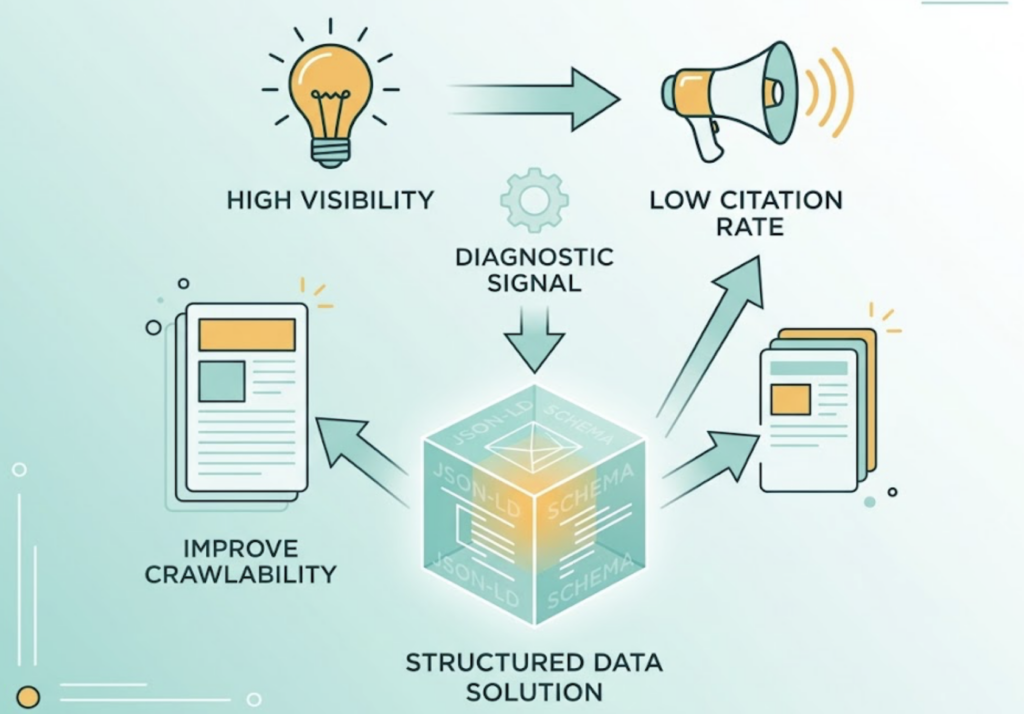
    High visibility + low citation rate is a specific diagnostic signal. It typically means AI is drawing on your brand’s knowledge — your definitions, frameworks, data — without attributing it. That’s often a structured data problem. Adding JSON-LD schema markup and improving content crawlability can close the gap.
    High citation rate, on the other hand, means AI isn’t just mentioning you — it’s treating your content as ground truth.

    5. Conversion Visibility Rate (CVR)

    CVR is the forward-looking metric: how often does your brand appear in AI responses to high-commercial-intent prompts? Queries like “compare X and Y for enterprise security” or “what tool should I use for [specific workflow]” signal users who are close to a decision.

    Here’s the bottom line on why this matters: visitors who arrive via AI citation links convert at roughly 4x the rate of traditional organic search traffic. These users have already received a brand recommendation inside the AI interface. By the time they click through, they’re pre-qualified.

    CVR is measured by focusing your prompt set on commercial-intent queries and tracking your brand’s appearance rate in that subset, combined with referral traffic data from your analytics platform.

    Topify’s CVR tracking connects AI appearance data directly to downstream conversion signals, giving teams a cleaner picture of AEO’s revenue contribution.

    What “Good” Looks Like: Benchmarks and Baselines

    Setting realistic performance targets requires understanding where your brand sits relative to the market.

    Market PositionTarget AI Visibility RangeShare of Voice Goal
    Market leader35% – 45%40%+ in core vertical
    Established brand15% – 30%25%+ to prevent share erosion
    Emerging challenger5% – 15%Target long-tail intent gaps

    For Sentiment Score, 80% positive framing is the goal. Below 60%, treat it as a content and PR alert — not a cosmetic problem.

    These aren’t fixed standards. AI search is still evolving rapidly, and benchmarks shift as model versions update and new platforms gain traction. That’s why you need a baseline specific to your brand before benchmarks from industry averages mean anything.

    The 30-Day Baseline Method

    First-time AEO measurement programs should start with a structured 30-day baseline sprint:

    1. Build your prompt library. Select 100–200 prompts that span your buyer journey, from awareness-stage questions to high-intent comparison queries.
    2. Run multi-platform sampling. Test across ChatGPT, Gemini, Claude, and Perplexity. For brands targeting specific markets, add DeepSeek or Doubao.
    3. Calculate a rolling average. AI outputs have inherent randomness. A single snapshot isn’t meaningful. The 30-day moving average is your actual baseline.

    Only once you have that baseline can you say with confidence whether a change in your content strategy moved the needle.

    How to Build a Monthly AEO Report

    A monthly AEO report should do one thing: turn measurement data into decisions. Here’s a four-module structure that works.

    Module 1: Executive Summary with Visibility Radar Chart
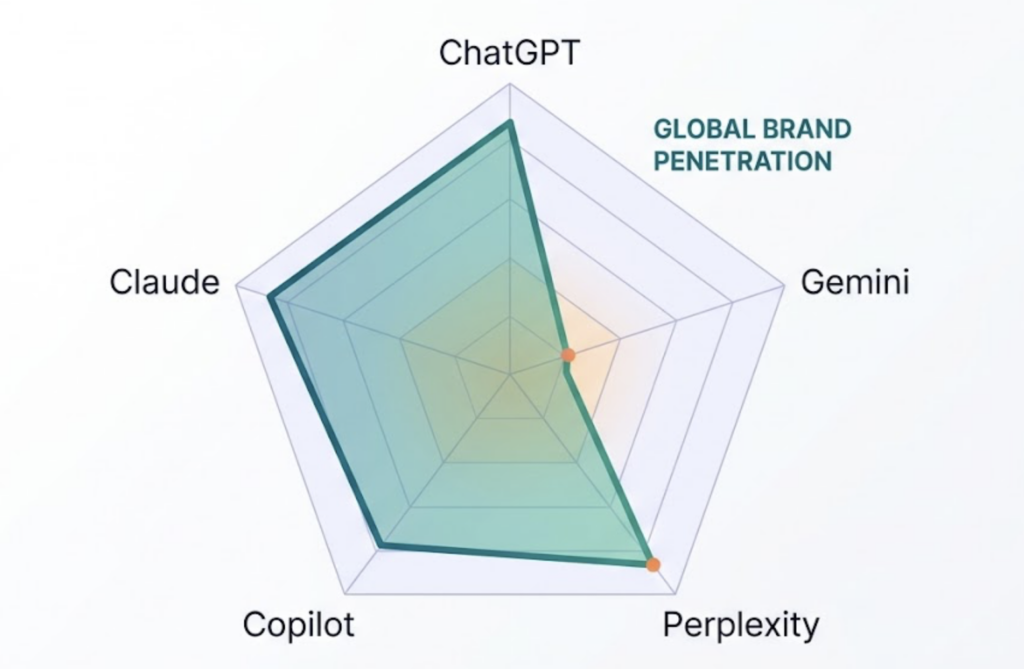
    Open with a radar chart where each axis represents a platform (ChatGPT, Perplexity, Gemini, etc.). The area covered by the polygon shows your brand’s overall AI ecosystem penetration. A collapse on any single axis — say, near-zero visibility on Gemini — immediately flags a platform-specific problem that deserves investigation.

    Module 2: KPI Dashboard

    This section tracks month-over-month movement across all five core metrics. The ratio of mentions to citations is particularly telling: if mentions climb but citations stay flat, your content is being used but not credited — a signal to prioritize structured data improvements.

    Topify’s dashboard exports these metrics in standardized formats, reducing the time between pulling data and building the report.

    Module 3: Competitor Gap Heatmap

    A topic-by-competitor heatmap is where the real strategic value lives. Hot spots show where your brand has clear narrative ownership. Cold spots — topics where competitors dominate and your brand is largely absent — define your content production roadmap for the following month.

    Don’t skip this module. Brands that only report their own metrics miss half the picture.

    Module 4: Action Items

    Every data point should connect to a specific optimization task. Citation rate low? Assign JSON-LD schema deployment. Visibility flat on Perplexity? Audit which content types that platform indexes and prioritize accordingly. The report’s value is measured by what it causes people to do, not by how many charts it contains.

    The Prompts You Should Be Monitoring

    In AEO, prompts are the new keywords. But unlike keywords, not all prompts have equal commercial value.

    Topify’s AI Volume Analytics surfaces prompt frequency data across AI platforms — distinct from traditional Google search volume. Some queries with modest Google traffic turn out to be high-frequency AI conversation topics, especially complex advisory questions like “how do I evaluate X vs Y for a team of 50.”

    Four filters for high-value prompt selection:

    Commercial intent. Prompts containing “compare,” “best,” “how to choose,” or “vs” signal purchase-proximity. These get prioritized.

    Query fanout ability. AI engines decompose complex questions into sub-queries. Prompts that trigger sub-queries around your core strengths are high-leverage tracking targets.

    Coverage. Choose prompts with consistent natural language patterns across different user demographics, not hyper-specific phrasing that only one type of user would use.

    Conversion potential. Weight prompts based on historical conversion data from topics you already track.

    How many prompts to track?

    Team SizeRecommended Prompt Library
    Startup / small brand20–30 core commercial-intent prompts
    Mid-size / multi-product50–200 across buyer journey stages
    Agency / enterprise500–1,000 for full competitive monitoring

    Start with your core set and expand as your reporting cadence matures.

    3 Reporting Mistakes That Distort Your AEO Strategy

    Getting data is one thing. Reading it correctly is another.

    Mistake 1: Reporting your visibility without competitor context

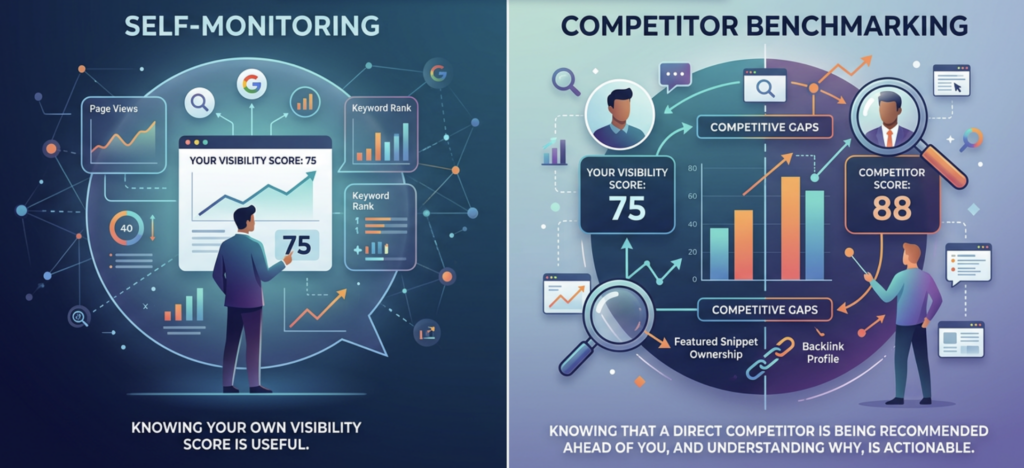
    Your AI Visibility Score went up 8 points last month. Good news, right? Not necessarily. If your top competitor’s visibility grew 15 points in the same period, your share of AI voice actually contracted. Reporting absolute numbers without a competitive baseline creates false confidence.

    Every AEO report needs a benchmark column: where you stand relative to the brands competing for the same AI recommendations.

    Mistake 2: Using website traffic to validate AEO performance

    Some teams try to infer AEO results from Google Search Console traffic. That’s the wrong tool for the job.

    AEO’s primary value often lives upstream of the click. A high-intent user who gets your brand recommended in a ChatGPT response may not click through immediately — but they’ve received a brand endorsement from a source they trust more than a search result link. Pre-influence is real and valuable even when it doesn’t show up as a session in GA4.

    Over-indexing on click data causes teams to abandon AI visibility efforts that are actually working, simply because the measurement framework can’t see them.

    Mistake 3: Running quarterly reports instead of monthly ones

    AI model updates — new ChatGPT versions, Gemini index changes, Perplexity ranking adjustments — happen on a rolling basis throughout the year. A quarterly reporting cadence means you might not catch a competitive shift until three months after it happened.

    Monthly deep-dive reports are the minimum standard. For competitive SaaS and e-commerce categories, add a weekly anomaly monitor that flags significant movement in your top 20 prompts. Catching a competitor’s surge early gives you a content response window that quarterly reporting simply can’t provide.

    Conclusion

    Measuring AEO performance is really about quantifying algorithmic trust. Visibility tells you whether AI sees your brand. Sentiment tells you how AI describes it. Citation rate tells you whether AI treats your content as a reliable source. Position tells you whether AI is recommending you over your competitors. CVR tells you whether that recommendation translates into business value.

    None of those questions can be answered with a traffic dashboard.

    The brands that build rigorous AEO measurement practices now will have something more valuable than a reporting system — they’ll have an optimization feedback loop. Every month’s data defines the next month’s content priorities. Every prompt gap is a territory worth claiming before a competitor does.

    That’s how AEO moves from an experiment to a measurable growth channel.

    FAQ

    How often should I pull AEO performance reports?

    Monthly deep-dive reports for strategic decisions, combined with weekly automated dashboards for anomaly detection. Weekly monitoring is particularly important in fast-moving categories where competitors can shift the narrative quickly.

    Can I measure AEO performance without a dedicated tool?

    You can manually test a small sample — 10 to 15 prompts across a few platforms — but the outputs have significant randomness. A single test on a single day isn’t statistically meaningful. Without automated, multi-platform, longitudinal sampling, you’re looking at anecdotes rather than data. Manual testing also doesn’t scale to the prompt volumes needed for competitive monitoring.

    What’s the difference between AEO KPIs and GEO KPIs?

    AEO focuses on outcome-layer optimization: ensuring your brand appears in specific AI search features like AI Overviews and citation links. GEO focuses on the system layer: strengthening entity associations and narrative consistency so AI models are more likely to synthesize your brand into generated responses. In practice, the KPI frameworks overlap significantly, with AEO metrics tending to be more feature-specific and GEO metrics more holistic.

    How many AI platforms should I monitor for accurate data?

    At minimum: ChatGPT, Gemini, Claude, and Perplexity. These four cover the majority of AI search activity in most markets. For brands targeting Asia-Pacific or Chinese-speaking markets, add DeepSeek and Doubao.
    Read More

  • What AI Is Saying About Your Brand Right Now

    What AI Is Saying About Your Brand Right Now

    A practical breakdown of AI brand monitoring: what it covers, what traditional tools miss, and how to start tracking.

    Right now, someone is asking ChatGPT which brand to use in your category. The AI is generating an answer. Your brand may or may not be in it.

    And you have no idea which.

    That’s not a hypothetical. ChatGPT handles an estimated 2 billion queries per day, with over 5.35 billion monthly visits as of early 2026. A significant share of those queries are product research, vendor comparisons, and buying decisions. Brands that aren’t tracking what AI says about them are making strategic decisions with a structural gap in their data.

    Your Monitoring Stack Has a Blind Spot the Size of ChatGPT

    Google Alerts, Brandwatch, Mention: these tools were built for a specific kind of internet. One where information lives at public URLs, gets indexed by crawlers, and can be tracked when someone links to it or mentions it on a social platform.

    That model still works for social media and news. It completely fails for AI.

    AI platforms don’t publish their answers. There’s no URL to scrape, no API to pull from, no index to search. When ChatGPT describes your brand to a user, that response lives inside a private chat session and disappears the moment the conversation ends. Traditional monitoring tools have no mechanism to capture it.

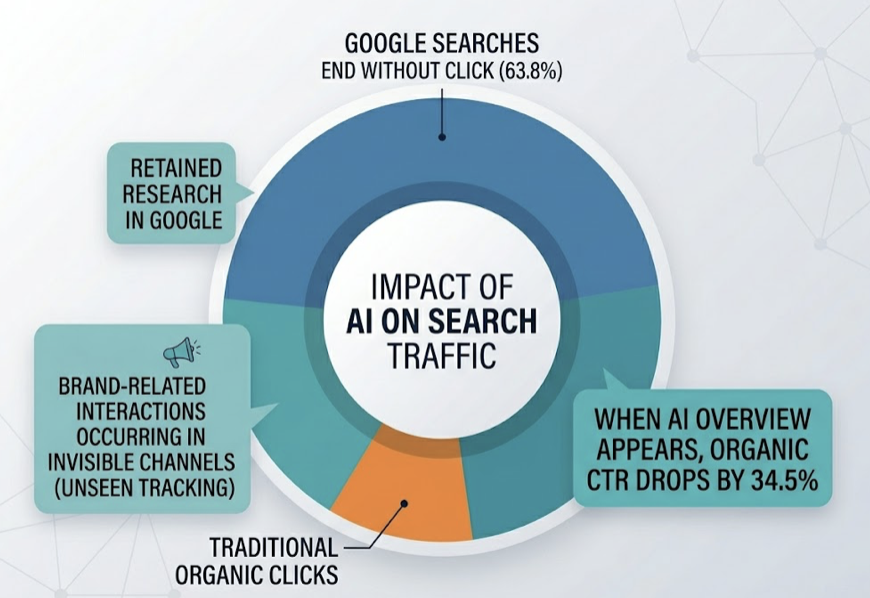
    The numbers make this concrete. Nearly 64% of Google searches in the United States now end without any click to an external website. When an AI Overview appears at the top of results, organic click-through rates for traditional links drop by 34.5%. The majority of research interactions that reference your brand are happening in channels your current stack can’t see.

    This isn’t a coverage gap that a new integration will fix. It’s a structural mismatch between the tools and the channel.

    What AI Brand Monitoring Actually Measures

    Traditional monitoring gave you a binary signal: mentioned or not mentioned. AI brand monitoring requires a different framework entirely.

    There are six core metrics that matter in the generative era:

    MetricWhat It Measures
    VisibilityHow often your brand appears when AI is asked about your category or use case
    SentimentThe tone and framing of how AI describes you (scored 0-100, from Endorsement to Hallucination)
    PositionWhere you appear in AI recommendations — brands mentioned in the first two sentences get 5x more consideration than those listed later
    MentionsRaw count of brand appearances across platforms
    Source / CitationsWhich specific domains the AI pulls from to form its view of your brand
    CVR (Conversion Visibility Rate)The likelihood that an AI response drives a user to engage with your brand

    CVR deserves particular attention. High-intent traffic from AI platforms converts at rates as high as 14.2%, compared to a 2.8% average for traditional search. Users who find a brand through an AI recommendation have already been pre-qualified by the model’s reasoning. They arrive further down the funnel.

    The Sentiment Category You Don’t Want

    AI sentiment isn’t just positive or negative. The framework breaks into five states: Endorsement, Neutral, Cautious, Negative, and Hallucination. The last one is the most damaging. When an AI confidently states something factually wrong about your brand, that error reaches users at scale before you even know it exists.

    The Platforms Already Forming an Opinion About You

    Most brands, when they start thinking about AI visibility, think about ChatGPT. That’s a reasonable starting point. It’s not a complete strategy.

    PlatformScaleWhy It Matters
    ChatGPT (OpenAI)1B+ estimated MAU, 73% AI search market shareDominant in both consumer and B2B query volume
    Google GeminiBillions via ecosystemIntegrated into Google Search; directly shapes AI Overviews that suppress organic CTR
    Microsoft Copilot106M MAU, 12.8% shareEnterprise-heavy; influential in B2B procurement workflows
    Perplexity AI30-45M MAUHigh-intent users; explicit citation structure makes source tracking clearer
    Doubao (ByteDance)155M+ MAUChina’s largest AI user base; critical for any brand with APAC exposure
    DeepSeekRapidly growingB2B and technical discovery; retrieval-first, favors documentation and industry sites

    Each platform runs on different citation logic and different user intent profiles. Gemini might surface your brand frequently because your Google Search index is strong. ChatGPT might deprioritize you because your content doesn’t appear in the sources its retrieval system weights. Perplexity might rank a competitor higher based on a single well-structured comparison article.

    One platform’s data isn’t your brand’s data. It’s just one AI’s opinion.

    For brands with international exposure, the Asian market gap is especially significant. Doubao’s integration within the ByteDance ecosystem makes it a primary discovery layer for hundreds of millions of Chinese consumers. Qwen (Alibaba) commands 32.1% enterprise market share but shows only a 4% visibility rate for direct brand domains in some tests, heavily favoring third-party aggregator content. Most Western brand monitoring strategies don’t account for any of this.

    Why an AI Mention Hits Differently Than a Tweet

    Social media monitoring matters. A negative tweet, a viral complaint, a bad review: these require real responses. But AI mentions operate on different principles.

    When a user reads a tweet calling your product “clunky,” they apply skepticism. They know it’s one person’s opinion. The context is social: emotional, subjective, clearly coming from a single perspective.

    When an AI tells someone your product is “not recommended for small teams,” that lands differently.

    Research shows that consumers evaluate AI chatbot responses as less biased than traditional search results, primarily because the conversational interface lacks the commercial markers — ads, sponsored links — that typically trigger skepticism. The AI sounds neutral. Users default to treating its characterizations as synthesized fact.

    The downstream effect compounds this. Up to 85% of B2B buyers assemble a vendor shortlist through AI conversations before ever speaking to a salesperson. If your brand is absent from that shortlist, or described in cautious terms, you’re disqualified before the conversation starts. The industry calls this “invisible disqualification.” It’s exactly what it sounds like.

    There’s also a persistence problem. A negative tweet gets buried in 48 hours. An AI’s characterization of your brand, once embedded in its retrieval sources, persists until those sources are updated or overridden. Correcting a negative AI description can take weeks to months, not hours.

    How to Build an AI Brand Monitoring System That Actually Works

    There’s no single shortcut here. Effective AI brand monitoring requires four components working together.

    Step 1: Define the Prompts That Drive Your Revenue

    Don’t try to monitor every possible mention. Build a Prompt Library around the specific questions that influence buying decisions in your category.

    Three prompt types matter most: category prompts (“What are the best [product type] for [use case]”), comparison prompts (“[Your brand] vs [Competitor]”), and problem-solving prompts (“How do I solve [pain point]”). These are the queries where AI recommendations translate directly into pipeline.

    Step 2: Track Across All Relevant Platforms

    Single-platform monitoring creates a false sense of security. Your brand’s Share of AI Voice can look strong on one platform and non-existent on another, and both readings are simultaneously true.

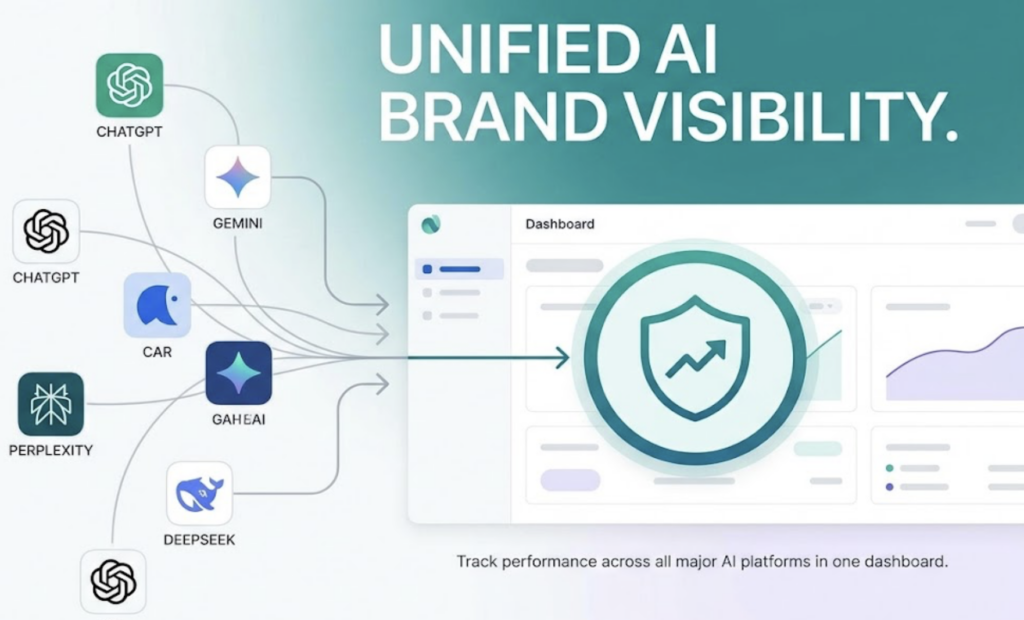
    Topify tracks brand performance across ChatGPT, Gemini, Perplexity, DeepSeek, Doubao, Qwen, and other major AI platforms from a single dashboard, so teams can see platform-specific gaps without running manual queries across each one individually.

    Step 3: Monitor Competitors in the Same View

    In AI search, you’re always being compared. When a user asks which brand is best, the AI evaluates your brand against alternatives. Your monitoring needs to capture competitor positioning in the same prompt set.

    If a competitor consistently ranks first, the next question is why. Are they cited more frequently by authoritative sources? Do they have structured data that makes their content easier for AI to parse? Competitive intelligence in AI monitoring is less about what they’re saying and more about what the AI is learning from their web presence.

    Step 4: Track Your Citation Sources

    The sources your AI mentions pull from are not random. They reflect which domains the model treats as authoritative for your category. Understanding your current citation structure reveals both why AI describes you the way it does and where the leverage points for change are.

    A Series A fintech startup grew AI visibility from 2.4% to 12.9% in 92 days specifically by identifying and correcting factual errors across 94 citations, then restructuring documentation to be AI-readable. The intervention wasn’t ad spend. It was citation management.

    What to Do With the Data Once You Have It

    Monitoring without action is expensive observation. The value of AI brand monitoring is that it makes optimization specific.

    If sentiment is low, the fix isn’t publishing more content blindly. It’s identifying the specific sources the AI is pulling from that contain negative or outdated characterizations, then targeting those sources with corrections or fresher, better-structured material.

    If position is consistently low, analyze the structural features of top-ranked competitors. Brands that lead AI recommendations typically use clear heading hierarchies that mirror question formats, lead with direct answers rather than background context, and surface pricing and feature data in ways that retrieval systems can extract cleanly. Surfacing specific pricing data in AI answers is the third-highest click driver, because it lets buyers self-qualify before the click.

    If CVR is underperforming, the issue is usually that users are seeing the brand but the AI’s description isn’t giving them a reason to act. The fix involves examining exactly what language the AI uses to describe your value proposition and adjusting the underlying sources to change it.

    Topify’s platform connects monitoring data to strategy execution. The diagnostic layer feeds directly into the optimization layer, with one-click deployment of GEO strategies across relevant channels.

    Data without a next step is just a report.

    Conclusion

    Traditional brand monitoring was built for a web where information was public, static, and linkable. That web still exists, but it’s no longer where the most consequential brand conversations happen.

    AI platforms now process billions of queries per month. They influence purchasing decisions before buyers reach your website, before they read your reviews, and before they talk to your sales team. What AI says about your brand in those moments matters, and most brands currently have no visibility into it.

    A two-week audit cycle is the current standard for brands that take this seriously. For categories with active competitor dynamics, more frequent tracking is worth the investment.

    The brands that move on this early don’t just avoid invisible disqualification. They shape the narrative that AI presents to their market before competitors do.

    FAQ

    What’s the difference between AI brand monitoring and traditional brand monitoring?

    Traditional monitoring tracks mentions on public, indexed channels like social media and news sites. AI brand monitoring focuses on synthetic content: real-time responses generated by LLMs in private sessions. The distinction matters because AI responses aren’t indexed, aren’t public, and don’t follow the same tracking logic as web content.

    Can I monitor what AI says about my brand for free?

    Manual querying of individual platforms is free but statistically unreliable for brand management. AI responses are probabilistic: a single query doesn’t represent how the model responds across thousands of similar queries. Professional tools run prompts dozens of times across multiple platforms to generate statistically valid Visibility Percentages.

    What should I do if AI is saying something inaccurate about my brand?

    Establish a clear Single Source of Truth on your domain, typically a dedicated company facts or brand page, and deploy Organization and Product schema markup so AI retrieval systems can anchor to canonical data. Then identify and correct the specific third-party sources the AI is currently pulling from.

    How often should I track my brand on AI platforms?

    A two-week audit cycle is the current standard for most brands. AI models update their retrieval layers frequently, and sentiment or position shifts can happen without warning. Real-time alerts for significant drops in Share of Voice are worth setting up regardless of your audit frequency.

    How does AI brand sentiment affect actual purchasing decisions?

    AI responses appear primarily in the research and evaluation phase, when buyers are assembling shortlists. Brands described in cautious or negative terms are often filtered out before the user reaches any brand-owned channel. Because users treat AI characterizations as authoritative rather than subjective, the impact is proportionally larger than equivalent negative sentiment on social platforms.

    Read More

  • AI Brand Monitoring: The Metrics That Replace “Set It and Forget It” Tools

    AI Brand Monitoring: The Metrics That Replace “Set It and Forget It” Tools

    Your Google Alerts are firing. Mention is tracking sentiment. Brandwatch is pulling social data. And somewhere in your pipeline, deals are quietly dying because a buyer asked ChatGPT “which CRM should I use” and your brand never showed up.

    That’s the blind spot traditional brand monitoring can’t fix.

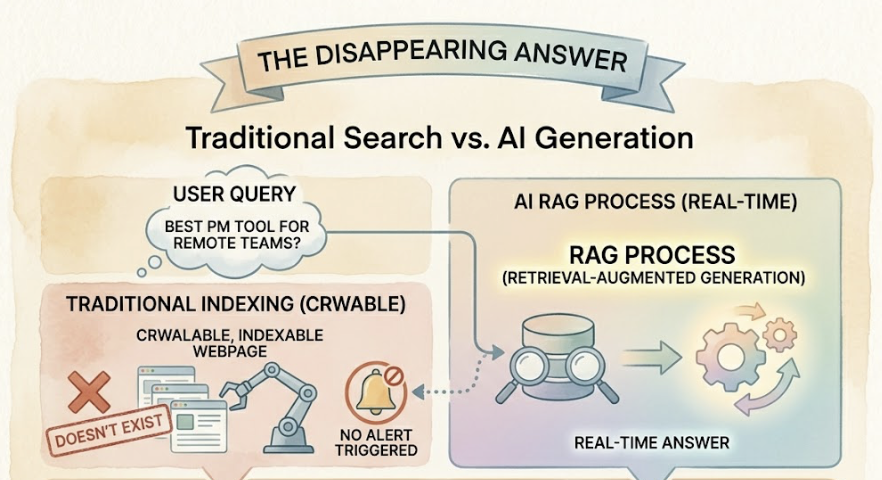
    The problem isn’t that your tools are broken. It’s that they were built for a different version of the internet — one where information lived in crawlable pages and “being mentioned” meant something. In the generative era, AI doesn’t retrieve your brand. It synthesizes a recommendation, on the fly, in a private session that no spider ever indexes. If you’re not tracking what those recommendations say, you’re not doing brand monitoring. You’re doing archaeology.

    Your Brand Monitoring Dashboard Is Missing an Entire Channel

    Traditional tools were designed around one core mechanic: web crawling. They index static, publicly accessible text and match it against keywords. That worked fine when search was deterministic — when ranking in position one meant a predictable percentage of clicks.

    AI search is probabilistic. When a user asks ChatGPT “which project management tool is best for remote teams,” the resulting answer is generated in real time through a process called Retrieval-Augmented Generation (RAG). That answer doesn’t exist as an indexable webpage. It never gets crawled. It never triggers an alert.

    The scale of this gap is significant. AI search queries now average 23 words, compared to four for traditional search. Sessions run about six minutes on average. These aren’t quick lookups — they’re discovery conversations. And brands that rely on legacy “set it and forget it” dashboards are invisible for all of them.

    That’s not a tool configuration problem. It’s a structural mismatch.

    The 6 Metrics That Actually Matter in AI Brand Monitoring

    Moving from traditional monitoring to AI visibility monitoring means replacing one question — “are we being mentioned?” — with six better ones.

    1. Visibility Rate: Are You in the Answer at All?

    Visibility Rate measures the percentage of relevant prompts where your brand appears in the AI response. It’s the foundational metric, and the one most teams discover they’ve been ignoring.

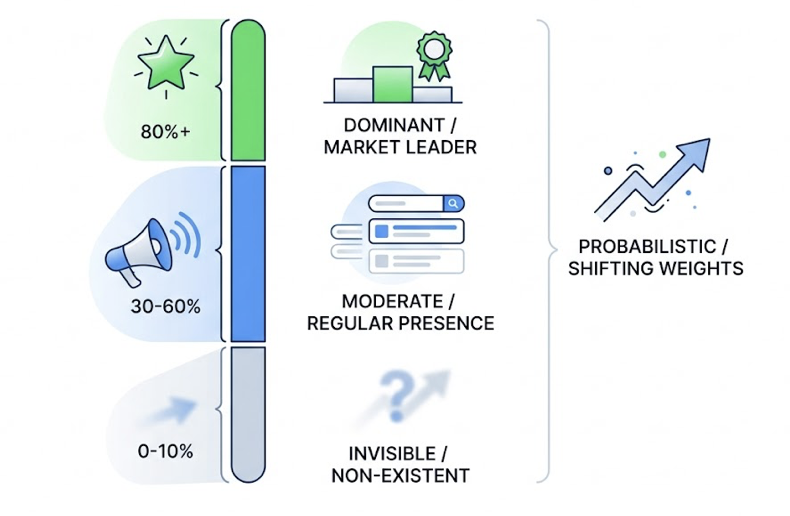
    Unlike organic rankings, AI visibility is probabilistic. Your brand might appear in 40% of responses to a specific prompt one week and 60% the next, depending on how the model’s retrieval weights shift. Benchmarking helps put your number in context:

    • 0-10%: Invisible. Your brand has no meaningful presence in the AI discovery layer.
    • 10-30%: Low. Significant gaps exist in your entity authority.
    • 30-60%: Moderate. You’re a known player but not a default recommendation.
    • 60-80%: Strong. You’re consistently included.
    • 80%+: Dominant. You’re effectively the AI’s default answer.

    Most brands that check for the first time land between 10% and 30%. That’s the gap.

    2. Sentiment Score: Being Mentioned Isn’t Enough

    An AI can mention your brand and still hurt you. “Reliable but expensive.” “Powerful but difficult to integrate.” “Worth considering if budget isn’t a concern.” These are visibility wins that erode purchase intent.

    Sentiment scoring uses NLP to quantify how the AI frames your brand within its answer — not just whether you appear, but whether the AI is acting as an advocate or a cautious recommender. A brand with high visibility and consistently neutral or negative sentiment has a reputation problem inside the knowledge graph, and traditional social listening is unlikely to surface it before it hits the pipeline.

    3. Position Tracking: First Is Not the Same as Fifth

    In a synthesized AI response, order carries weight. Being the first brand ChatGPT recommends is fundamentally different from appearing as the fourth item in a “you might also consider” list. First-position brands earn higher user trust and better retention.

    Position Tracking also includes Word Count Share — how much of the AI’s response is actually about your brand versus your competitors. A brand that gets two sentences while a rival gets two paragraphs is losing even when both names appear.

    4. Competitor Share: Who AI Recommends Instead of You

    Competitor Share measures how often rivals appear in the same prompt universe where you’re trying to win visibility. This is where the real strategic intelligence lives.

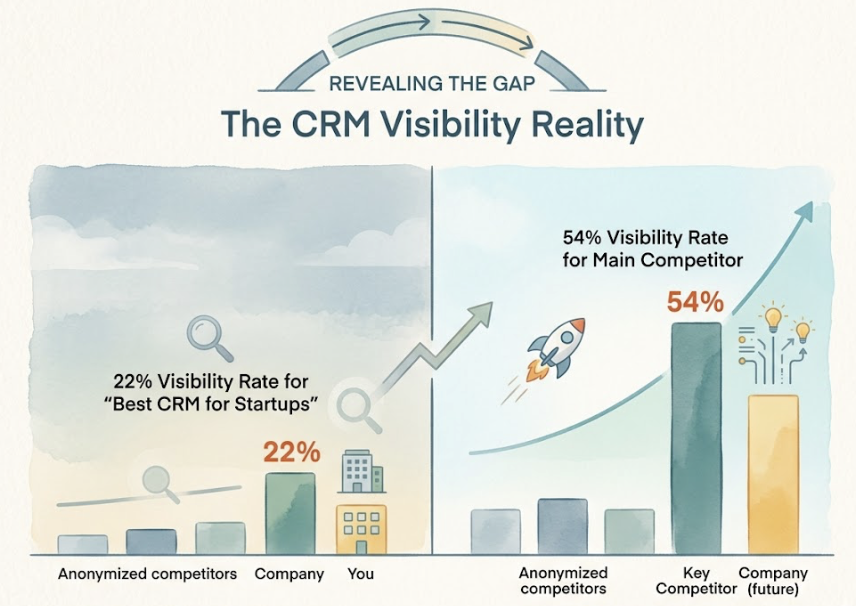
    If a competitor holds 54% visibility for “best CRM for startups” while you hold 22%, that gap doesn’t close with better homepage copy. It requires understanding what the AI is retrieving for them that it isn’t retrieving for you. Competitor Share points directly to that question.

    5. Source Analysis: Why AI Recommends Them, Not You

    AI models ground their answers in retrieved sources. Source Analysis maps which specific domains and URLs the AI is citing when it recommends your brand — or your competitors.

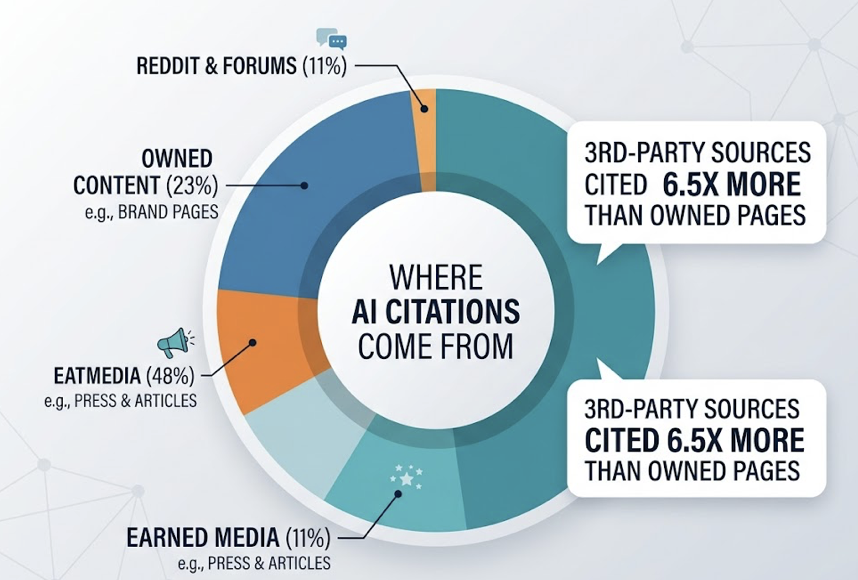
    The research on this is unambiguous: third-party sources are cited 6.5 times more often than brand-owned pages. Earned media accounts for 48% of AI citations. Review platforms like G2 and Capterra account for 11%. Reddit and forums account for another 11%. Owned content, despite being the asset brands invest most heavily in, accounts for just 23% — and primarily for technical specifics, not recommendations.

    If your competitor is being cited because they have a G2 Leader badge and 500 fresh reviews, and your profile is two years old, Source Analysis tells you exactly what to fix.

    6. CVR (Conversion Visibility Rate): Does Any of This Drive Revenue?

    Not all AI visibility converts equally. CVR estimates the likelihood that a specific AI recommendation drives a user toward a brand interaction. It accounts for recommendation prominence, the intent alignment of the prompt, and whether the AI’s answer is referential (encouraging a visit) or summarized (ending the search right there).

    The conversion upside is real: AI-referred traffic converts at 4.4 to 11 times the rate of traditional search traffic. But up to 70.6% of that traffic gets misclassified as “Direct” in Google Analytics because AI platforms frequently strip referrer headers. Brands that don’t track CVR can’t see this traffic, and they can’t optimize for it.

    What “Set It and Forget It” Tools Actually Get Wrong

    The failure of legacy monitoring isn’t just a feature gap. It’s three specific logical errors that compound over time.

    The Static Text Fallacy. Traditional tools track what’s published. AI brand monitoring tracks what’s synthesized. A brand can have a top-ranking Google page and still be absent from ChatGPT summaries — because 80% of AI Overview sources don’t rank organically for the queried keyword. High Google rankings don’t predict AI inclusion.

    Equating mentions with recommendations. A brand name appearing in a list of “troubled companies” reads as a win in a traditional media monitoring dashboard. In AI search, that mention can actively damage purchase intent. Legacy tools lack the semantic depth to distinguish between being praised and being used as a cautionary example.

    The attribution vacuum. Because AI platforms strip referrer headers, up to 70.6% of AI-referred traffic registers as direct in Analytics. Brands see flat organic traffic and assume their content isn’t working. In reality, they may be winning the highest-intent buyers in their market — buyers who searched through AI and arrived pre-qualified. Without AI visibility tracking, that signal is invisible.

    Building an AI Brand Monitoring Stack That Actually Works

    The right approach isn’t to replace traditional tools. It’s to add a layer of semantic intelligence on top of them.

    Layer 1 — Traditional monitoring (reactive): Keep using social listening and media monitoring for immediate crisis response, community engagement, and viral trend detection. These tools still do their original job well.

    Layer 2 — AI visibility monitoring (strategic): This is where the six metrics above get tracked. Platforms like Topifyuse a method called Swarm Probing — sending thousands of prompt variations across different query nodes — to stabilize the probabilistic data and produce statistically reliable Visibility Scores across ChatGPT, Gemini, Perplexity, and AI Overviews.

    The monitoring cadence that works for most teams:

    • Weekly: Check prompt-level visibility to catch volatile shifts or competitor surges.
    • Monthly: Review sentiment trends and citation share to guide content updates.
    • Quarterly: Run a full competitive benchmarking audit to inform executive strategy.

    The weekly check catches emergencies. The monthly review drives content decisions. The quarterly audit aligns the team on where to invest.

    What These Metrics Look Like in Practice

    A B2B SaaS company selling CRM software to startups noticed something off. Traditional dashboards showed stable organic traffic. But pipeline targets were consistently missed.

    They ran an AI visibility audit and found their Visibility Rate for “best CRM for startups” was 22%. A major competitor held 54%.

    Source Analysis told them why. For 65% of AI recommendations in that prompt cluster, the model was citing G2 and a 2023 TechCrunch article. The competitor had a G2 Leader badge and 500+ recent reviews. The brand’s G2 profile hadn’t been updated in two years.

    They also discovered their competitor’s landing page followed what’s called the “Ski Ramp” pattern — 44.2% of AI citations come from the first 30% of a page’s text. Their competitor front-loaded answers and statistics. Their own pages buried the value proposition below scroll.

    The intervention was structured. They launched a campaign to gather 100 new G2 reviews focused on the startup use case. They rewrote product pages to increase entity density from 5% to 18%, placing direct answers above the fold. They added Author Schema and JSON-LD markup to improve entity clarity.

    Six weeks later: Visibility Rate moved from 22% to 38%. Average position improved from 4th to 2nd. CVR increased by 115% as the AI shifted from describing the brand as “an alternative option” to “a top-tier choice for high-growth startups.” Direct traffic increased by 25%, converting at 10.21% — matching the profile of pre-qualified AI referral traffic.

    None of that would have been visible without AI brand monitoring.

    Conclusion

    The “set it and forget it” era of brand monitoring made sense when brand discovery happened in crawlable, static text. That world is gone.

    AI doesn’t retrieve your brand. It synthesizes a recommendation, draws from sources you may not control, and delivers it to a buyer who may never click through to verify. If you’re not tracking Visibility Rate, Sentiment, Position, Competitor Share, Source Authority, and CVR, you’re managing half the game.

    The teams building AI visibility monitoring into their stack now aren’t waiting for traditional search to come back. They’re learning to measure influence in the channel that’s already driving the highest-converting traffic in digital marketing history.

    Start tracking your AI brand visibility with Topify.

    Frequently Asked Questions

    Is AI brand monitoring different from social listening?

    Yes. Social listening is reactive — it tracks what humans write about your brand on public platforms. AI brand monitoring is proactive — it queries generative models directly to understand how your brand is synthesized and recommended during the AI discovery phase. One reads human conversations. The other reads what AI has learned.

    How often should I check AI brand monitoring metrics?

    A weekly-monthly-quarterly cadence works well for most teams. Weekly checks catch volatile shifts in visibility or sudden competitor surges. Monthly reviews guide content and citation strategy. Quarterly audits produce the competitive benchmarking data that informs budget allocation and executive reporting.

    Can AI brand monitoring show me why competitors rank higher in AI answers?

    Yes. Source Analysis identifies the “source gap” — the specific third-party domains the AI is retrieving for your competitors that it isn’t retrieving for you. That list tells you exactly where to focus PR, review acquisition, and content investment.

    How do I get started if I have no baseline data?

    Start by defining a Prompt Universe of 20-50 conversational questions your customers actually ask. Run a manual audit across ChatGPT, Gemini, and Perplexity to record your initial Visibility Rate and Sentiment Score. That baseline identifies your most urgent gaps and builds the business case for automated tracking with a platform like Topify.

    Read More

  • What AI Brand Monitoring Actually Tracks

    What AI Brand Monitoring Actually Tracks

    Your brand could have five-star reviews on G2, a strong social presence, and stable organic traffic — and still be completely invisible when a potential customer asks ChatGPT to recommend a solution in your category.

    That’s not a hypothetical. It’s happening to most brands right now, and traditional monitoring tools won’t catch it.

    AI brand monitoring exists to close that gap. But it tracks something fundamentally different from what most marketers expect.

    Your Brand Might Have Great Reviews. AI Still Might Not Recommend You.

    Traditional brand monitoring was built for a different internet. Tools like Google Alerts, Brandwatch, and Mention were designed to crawl static web pages and real-time social feeds — and flag any time your brand name appeared.

    The problem is that AI doesn’t work that way.

    When a user asks Perplexity “what’s the best CRM for startups,” the answer is generated on-the-fly through a process called Retrieval-Augmented Generation (RAG). That synthesized response doesn’t exist as an indexable webpage. It’s private, dynamic, and invisible to any crawling-based tool. Your brand could be omitted from thousands of high-intent recommendations every day without triggering a single alert on a traditional dashboard.

    The scale of this blind spot is larger than most teams realize. AI search queries now average 23 words compared to four for traditional search, and sessions run about six minutes on average. These are deeper, more intent-rich conversations — exactly the kind where buying decisions get made. And up to 70.6% of AI referral traffic gets misclassified as “Direct” in Google Analytics because AI platforms frequently strip referrer headers.

    That’s why the gap is so easy to miss. Traffic looks fine. The problem is invisible.

    The 5 Core Signal Types AI Brand Monitoring Actually Tracks

    AI brand monitoring doesn’t track mentions. It tracks recommendation signals — the specific data points that determine whether, how, and how favorably an AI describes your brand in response to a user query.

    Here’s what a complete monitoring setup measures.

    1. Visibility Rate

    This is the percentage of relevant prompts where your brand appears in the AI response. Think of it as your “inclusion probability” across a defined set of queries.

    It’s probabilistic, not binary. A brand might appear in 40% of responses to a specific prompt one week and 60% the next, depending on how the model’s retrieval weights shift. Research suggests a clear benchmarking scale: 0-10% means your brand is essentially invisible in AI search; 30-60% is moderate; 80%+ puts you in dominant territory.

    2. Sentiment Score

    Being mentioned isn’t enough. The framing matters.

    An AI might describe your brand as “reliable but expensive” or “a solid alternative for teams that don’t need advanced integrations.” Those aren’t neutral statements — they’re shaping the buyer’s first impression. Sentiment analysis in AI monitoring uses NLP to quantify whether the AI is acting as an advocate or quietly steering users toward a competitor.

    High visibility with consistently negative framing is a reputation problem. And it’s one that traditional social listening tools typically won’t catch before it affects your pipeline.

    3. Position Tracking

    In a list of AI recommendations, order carries real weight. Being the first brand mentioned in a ChatGPT response is meaningfully different from appearing fifth in a “you might also consider” list.

    Position tracking also includes Word Count Share: how much of the AI’s response is dedicated to your brand versus a competitor. That ratio tells you a lot about the model’s perceived preference.

    4. Source Citation Analysis

    AI models ground their answers by pulling from specific domains and URLs. Source analysis tracks which sites the AI is actually citing when it mentions your brand.

    The data here is striking. Third-party sources are cited 6.5 times more often than brand-owned pages. Earned media — coverage in outlets like TechCrunch or the Wall Street Journal — accounts for roughly 48% of AI citations. Review platforms like G2 account for another 11%. If the AI is citing an outdated forum thread or a competitor-authored comparison post when it references your brand, that’s a strategic problem with a specific fix.

    5. Conversion Visibility Rate (CVR)

    CVR is a predictive metric that estimates how likely an AI recommendation is to drive a user toward a brand interaction. It accounts for the prominence of the recommendation, the intent alignment of the prompt, and whether the AI’s answer is “summarized” (no reason to click) or “referential” (user is directed to your site for more detail).

    The value is significant: AI-referred traffic converts at 4.4 to 11 times the rate of traditional search traffic. CVR helps you understand how much of that opportunity you’re actually capturing.

    The Platforms AI Brand Monitoring Needs to Cover

    Different AI platforms don’t produce the same answers. A brand that ranks first in ChatGPT responses might not appear at all in Perplexity — because each model has different retrieval logic, training data, and citation preferences.

    This makes platform coverage a foundational decision in any AI brand monitoring setup. Monitoring one platform and assuming it represents your overall AI visibility is the same mistake as checking one social network and calling it “brand monitoring.”

    A meaningful setup covers at minimum: ChatGPT, Gemini, Perplexity, and AI Overviews. For brands with global reach, platforms like DeepSeek and Doubao are increasingly relevant. Topify, for example, tracks brand performance across all major AI platforms in a single dashboard — so you’re comparing signal across the same prompt set, not guessing whether platform differences explain your results.

    How AI Brand Monitoring Differs from Social Listening

    These two disciplines are often conflated. They shouldn’t be.

    Social listening is reactive. It monitors what humans are writing — on X, Reddit, review sites, and forums — and alerts you when your brand gets mentioned. It’s well-suited for crisis response, community engagement, and trend detection.

    AI brand monitoring is proactive. It queries generative models directly to understand how your brand is being synthesized and recommended during the discovery phase. It doesn’t read what people write. It tracks what AI has learned.

    DimensionTraditional Social ListeningAI Brand Monitoring
    Data SourceHuman-authored contentAI-synthesized responses
    Data EnvironmentPublic social feeds, indexed pagesDynamic, private user sessions
    Primary MethodWeb crawling, keyword matchingPrompt probing across LLM APIs
    Visibility GoalBrand mentionsAI recommendations
    Funnel PositionTop of funnel awarenessBottom of funnel decision

    The two tools belong in the same stack. They don’t replace each other — they cover different layers of how your brand is perceived and discovered.

    What AI Brand Monitoring Looks Like in Practice

    The mechanics are clearer with a real example.

    A B2B SaaS company selling CRM software for startups had stable organic traffic and no obvious signals of a problem. When they set up AI brand monitoring for the first time, they found their Visibility Rate for “best CRM for startups” was only 22%. A major competitor was at 54%.

    Source analysis revealed why. For 65% of AI recommendations in that category, the model was citing a specific TechCrunch article and G2 profiles. The competitor had a G2 Leader badge and 500+ recent reviews. The brand’s G2 presence was outdated.

    They ran a three-part fix over six weeks: schema markup for entity clarity, 100 new G2 reviews targeting the startup keyword cluster, and content restructuring to front-load answers and increase information density.

    The results: Visibility Rate moved from 22% to 38%. Position improved from 4th to 2nd recommendation on average. CVR increased 115%. And they saw a 25% increase in “Direct” traffic converting at 10.21% — the behavioral fingerprint of pre-qualified AI referral traffic.

    That’s what monitoring enables. Not just a report, but a clear signal chain from gap to fix to outcome.

    A complete setup with Topify starts at $99/month for the Basic plan, which covers 100 prompts and 9,000 AI answer analyses across ChatGPT, Perplexity, and AI Overviews — enough to establish a meaningful baseline for most teams.

    Conclusion

    AI brand monitoring tracks five core signal types: Visibility Rate, Sentiment, Position, Source Citations, and Conversion Visibility Rate. It covers multiple AI platforms simultaneously. And it operates on a fundamentally different data layer than social listening or traditional SEO tools.

    The brands that understand this distinction aren’t just better informed. They’re building in a place where most competitors are still blind.

    If you’re not sure where to start, pick one question your customers actually ask — “what’s the best [your category] for [your use case]” — and run it manually across ChatGPT, Gemini, and Perplexity. Record what appears. That first look at your AI visibility baseline will tell you more about your brand’s discovery problem than a month of social monitoring reports.

    FAQ

    What does AI brand monitoring actually track? 

    It tracks how your brand appears in AI-generated responses: whether you’re included (Visibility Rate), how you’re described (Sentiment), where you rank in recommendations (Position), which sources the AI cites (Source Analysis), and how likely the recommendation is to drive a conversion (CVR).

    Is AI brand monitoring the same as social listening? 

    No. Social listening tracks human-authored content on social media and the web. AI brand monitoring directly queries generative models to understand how your brand is synthesized and recommended during the discovery phase. They’re complementary tools that work on different data layers.

    How often should I run AI brand monitoring? 

    A weekly-monthly-quarterly rhythm works well for most teams. Weekly checks catch volatile shifts or competitor surges at the prompt level. Monthly reviews track sentiment trends and citation changes to guide content updates. Quarterly audits inform executive strategy and budget decisions.

    Which AI platforms should I monitor? 

    At minimum: ChatGPT, Gemini, Perplexity, and Google AI Overviews. For global brands, DeepSeek and other regional platforms are increasingly worth including. Each platform uses different retrieval logic, so your visibility can vary significantly across them.

    Can AI brand monitoring show me why a competitor ranks higher? 

    Yes. Source analysis reveals which third-party domains the AI is pulling from for competitor recommendations that it’s ignoring for yours. That gap tells you exactly where to focus PR, review generation, and content restructuring efforts.

    Read More

  • AEO Tools vs SEO Tools: The Real Difference

    AEO Tools vs SEO Tools: The Real Difference

    Your domain authority is solid. Your keyword rankings haven’t moved in months. But somewhere in the last quarter, a competitor you’ve never worried about started showing up every time a potential customer asked ChatGPT for a recommendation in your category. And your current dashboard has no idea it’s happening.

    That’s not a content problem. It’s a measurement problem. SEO tools and AEO tools are built on fundamentally different logic, and using one to answer questions only the other can ask is where most marketing teams start falling behind.

    Your SEO Tool Thinks You’re Winning. AI Doesn’t.

    Search behavior has split into two distinct tracks. On one track, users type queries into Google and click blue links. On the other, they ask AI engines direct questions and act on the synthesized answers they receive, without ever visiting a website.

    AI-driven search tools captured roughly 12-15% of global market share by end of 2025, up from 5-6% at the start of that year. In March 2025, Google’s global search market share dropped below 90% for the first time. These aren’t marginal shifts.

    The deeper problem isn’t the traffic split. It’s what happens with zero-click behavior. When Google triggers an AI Overview, the zero-click rate climbs to 83%. In Google’s AI Mode, that number reaches 93%. The organic CTR for a page that once ranked first can drop 61%, from 1.76% to 0.61%, simply because an AI summary appeared above it.

    That’s the blind spot your SEO tool can’t see.

    What SEO Tools Were Actually Built to Measure

    Traditional SEO platforms, whether Ahrefs, Semrush, or Google Search Console, were designed around a single premise: search engines index pages, rank them by authority, and users click through. That premise held for two decades. It still partially holds today.

    These tools are excellent at what they were built to do. Keyword rankings, backlink profiles, domain authority scores, crawl errors, mobile performance, SERP position history. All of it maps to a deterministic system: query in, ranked URL list out.

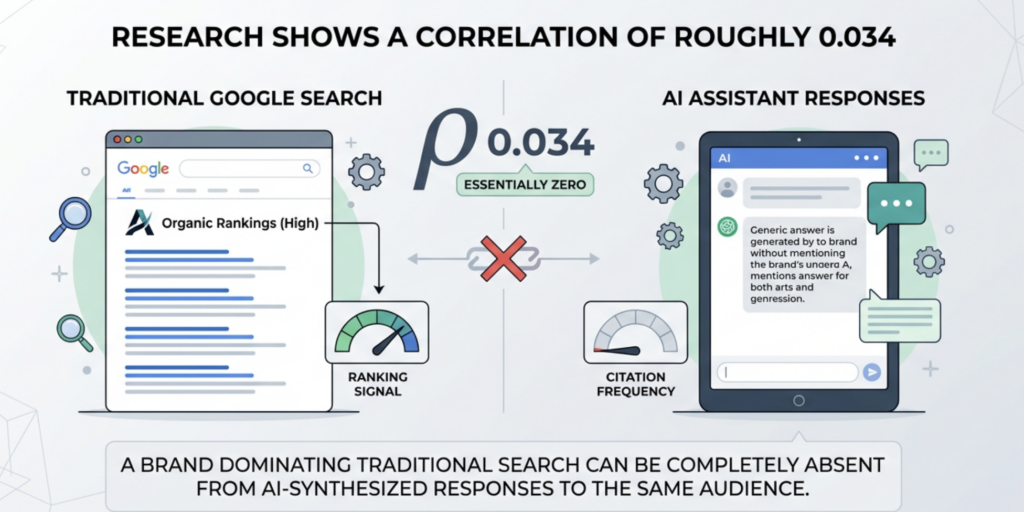
    The problem isn’t that SEO tools are broken. It’s that they’re measuring a different game. Only about 12% of URLs cited by ChatGPT and Perplexity appear in Google’s top 10 search results. If your SEO tool shows you at position one, that tells you almost nothing about whether you’re in the AI answer at all.

    AEO Tracks a Different Kind of Visibility

    Answer Engine Optimization starts from a different question: not “where does our page rank?” but “when a user asks an AI about our category, does our brand appear, and how does it appear?”

    That distinction changes everything about how you measure performance. AI engines don’t index URLs in a ranked list. They synthesize answers from multiple sources, select which brands to mention, describe those brands in their own language, and position them relative to competitors. The output is probabilistic, not deterministic.

    To track AEO visibility meaningfully, you need at least four dimensions that traditional SEO tools don’t capture:

    AI Mention Rate: how often your brand appears in AI-generated answers for relevant prompts. If a tool runs 100 simulated queries about your product category and your brand shows up in 35 of them, your mention rate is 35%.

    Sentiment Score: the quality of how AI describes your brand. An AI might mention you and call you “a budget-friendly option,” which matters if your positioning is premium. NLP-based sentiment tracking can catch this. Your SEO dashboard cannot.

    Position and Prominence: being listed first in an AI recommendation carries a different weight than being third. The framing AI uses for early mentions tends to be authoritative; later mentions get framed as alternatives.

    Source Coverage: which domains and URLs are driving AI’s opinions about your brand. If a trade publication’s review of your competitor is consistently cited by Perplexity, that’s actionable. SEO tools track your backlinks. AEO tools track what AI is reading to form its judgment.

    The Feature Gap at a Glance

    The difference between SEO and AEO tools isn’t a matter of features overlapping on a Venn diagram. It’s a structural gap in what each tool type was architecturally designed to do.

    DimensionSEO Tools (e.g., Ahrefs, Semrush)AEO Tools (e.g., Topify)
    What they trackSERP rankings (blue links)Brand mentions in synthesized AI answers
    Data collectionCrawling search result pagesSimulating real user prompts across AI platforms
    Core metricsKeyword rank, DA/DR, backlinks, CTRMention rate, sentiment, position, source coverage, CVR
    Platform coverageGoogle, BingChatGPT, Gemini, Perplexity, DeepSeek, and others
    Competitive intelCompetitor rankings and backlink sourcesHow AI describes your brand vs. competitors in the same answer
    Output“Improve keyword density, get more backlinks”“Add statistical data to this section; AI isn’t citing it because it lacks sourced evidence”

    One more architectural difference worth noting: SEO tools run daily crawls and return stable data. AEO tools have to use probabilistic sampling. Because LLM outputs vary with each query, a credible AEO platform runs the same prompts hundreds of times, across multiple regions and time windows, to produce a stable visibility distribution. That’s why the underlying infrastructure is fundamentally different, and why the data it produces tells you something your SEO tool can’t approximate.

    Do You Still Need SEO Tools?

    Yes, with an asterisk.

    Organic search still drives roughly 53% of website traffic, according to Conductor’s 2026 benchmark data. In healthcare, that share is 42.4%. In communications services, 39.6%. If your audience is still primarily finding you through traditional search, abandoning SEO infrastructure would be costly.

    The right mental model isn’t replacement. It’s stack prioritization. SEO tools handle the technical foundation: crawlability, indexing, long-tail transactional keyword coverage. AEO tools handle a layer that didn’t exist three years ago: whether you’re being recommended by the AI systems your buyers are increasingly using to make decisions.

    Here’s a practical decision framework. If your target audience is actively using AI search tools for discovery in your category, AEO tracking isn’t optional. It’s the gap in your reporting that explains traffic patterns your SEO tool can’t. In certain B2B verticals, AI-converted traffic has been shown to convert at 4.4x the rate of organic search traffic. Lower click volume, higher intent. SEO tools tend to flag this traffic as underperforming because the raw numbers look small.

    Leading marketing teams in 2026 tend to allocate roughly 30-50% of their measurement budget to SEO fundamentals, with a fast-growing slice, around 30%, dedicated to AEO tracking and content restructuring for AI extractability.

    The Best Tools for AEO Tracking in 2026

    When evaluating AEO tools, three criteria matter most: how many AI platforms are covered, how many visibility dimensions the tool tracks, and whether the platform supports competitive benchmarking in AI answers, not just your own brand’s numbers.

    Topify covers the full spectrum: ChatGPT, Gemini, Perplexity, DeepSeek, Doubao, Qwen, and other major platforms. It tracks seven core metrics, visibility, sentiment, position, AI volume, mentions, intent, and CVR, which is among the most complete measurement sets available. The Source Analysis feature reverses-engineers which domains are driving AI’s citations, giving content and PR teams a clear map of where to build authority. Topify’s agentic execution layer can also identify gaps automatically and suggest specific content actions, for example flagging when a page is being passed over because it lacks sourced statistics. Pricing starts at $99/month for the Basic plan (100 prompts, 4 projects) and $199/month for Pro.

    Princeton research suggests that optimized content structure alone can improve AI visibility by up to 40%. That kind of uplift only becomes measurable if you have a tool tracking it.

    Other platforms worth knowing:

    Profound offers strong “AI search volume” data, surfacing what users are actually prompting AI about. It’s particularly popular with large enterprise teams. AIclicks is useful for smaller teams that want a prioritized action checklist rather than a full analytics suite. Omnia has strong global coverage for brands tracking AI visibility across multiple languages and regions.

    None of these replace an SEO tool. All of them answer questions your SEO tool genuinely cannot.

    Conclusion

    SEO tools measure where your page sits in a list. AEO tools measure whether AI mentions your brand, how it describes you, and what sources it’s trusting to form that opinion. Those are two different questions about two different discovery channels, and conflating them is how brands end up with strong Google rankings and zero AI presence.

    The good news: you don’t have to rebuild your stack from scratch. You have to extend it. Start by understanding where your buyers are actually searching. If AI is part of that, get started with Topify and run your first visibility audit. The gap between your SEO dashboard and your AI search reality is usually bigger than teams expect.


    FAQ

    Q: Can I use SEO tools to track AEO performance?

    A: Not effectively. SEO tools track SERP rankings, which have limited correlation with AI citation behavior. Research shows only about 12% of URLs cited by ChatGPT appear in Google’s top 10 results. For AEO tracking, you need a tool that simulates real user prompts across AI platforms and measures mention rate, sentiment, and source coverage directly.

    Q: Do AEO tools replace SEO tools?

    A: No. They address different discovery channels. SEO tools remain useful for technical site health, indexing, and organic search keyword coverage. AEO tools track visibility in AI-generated answers, which SEO tools aren’t built to measure. Most teams run both in parallel, with budget allocation shifting toward AEO as AI search usage grows.

    Q: What’s the best AEO tool for small teams with limited budgets?

    A: Topify’s Basic plan at $99/month covers 100 prompts and 4 projects, making it accessible for smaller teams that want comprehensive AI visibility tracking without enterprise pricing. AIclicks is another option in the $39-59/month range for teams that primarily need a prioritized action list rather than deep analytics.

    Q: Why does my SEO tool show me ranking first, but I’m not appearing in AI answers?

    A: Ranking logic and citation logic are different systems. AI engines don’t prioritize the highest-ranked page. They prioritize content that’s easy to extract, well-structured, statistically supported, and referenced across credible third-party sources. A page ranking 50th on Google with strong cited data can appear in AI answers more frequently than the page ranking first. An AEO audit will typically reveal whether the issue is content structure, source coverage gaps, or sentiment framing.


    Read More

  • 7 Best AI Citation Tracking Tools for Brands 2026

    7 Best AI Citation Tracking Tools for Brands 2026

    AI now cites sources the way Google once ranked them. Here’s how to find out if yours is one of them.

    Your brand can rank on page one of Google and still be completely invisible to ChatGPT. That’s not a hypothetical — it’s the reality for most brands in 2026.

    AI systems don’t just generate answers. They curate them from a narrow set of sources they consider authoritative. And without a way to track which brands get cited, who gets recommended, and which third-party sites are actually shaping the AI’s opinion of you, you’re navigating blind.

    That’s what AI citation tracking tools are built to solve.

    Why Your Brand’s AI Visibility Is Harder to Track Than You Think

    The numbers tell an uncomfortable story. Traditional organic click-through rates have dropped by up to 61% as AI summaries absorb user intent before a single link gets clicked. Meanwhile, brands that do get cited by AI see conversion rates 5 to 11 times higher than visitors from traditional search — because the AI has already done the pre-qualification work.

    That’s the trade-off: fewer clicks, but dramatically higher quality.

    Here’s the thing most tracking setups miss: your own website is rarely where the AI gets its information. Brand-owned domains account for only 5% to 10% of cited sources in AI answers. The other 90% comes from Reddit threads, niche forums, G2 reviews, and industry publications. That makes traditional analytics essentially useless for understanding your actual AI visibility.

    You need a dedicated tool. The question is which one.

    5 Things That Separate a Good AI Citation Tracker from a Great One

    Before jumping to the list, it’s worth building a choosing framework. These five criteria separate the tools that give you data from the ones that help you act on it.

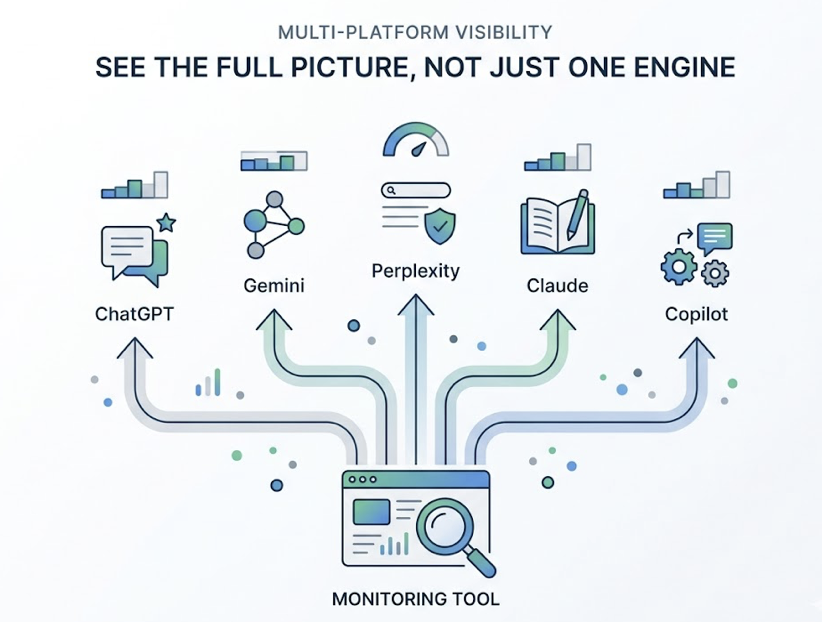
    1. Multi-platform engine coverage. Your brand’s visibility in ChatGPT can look completely different from its visibility in Perplexity or Google AI Overviews. Any tool that monitors only one platform is giving you a partial picture. Look for coverage across ChatGPT, Gemini, Perplexity, Claude, and Copilot at minimum.

    2. Citation vs. mention distinction. A mention means your brand name appeared in text. A citation means the AI linked to a specific URL. These are fundamentally different signals, and confusing them leads to bad strategy.

    3. Source-level attribution. You need to know which domains are driving your citations — not just that citations happened. Is it your blog? A G2 review? A Reddit thread from 2022? That distinction determines where to focus your PR and content efforts.

    4. Competitive benchmarking. Knowing your own citations in isolation isn’t enough. The metric that matters is your Share of Model — the percentage of relevant AI answers where your brand appears versus your competitors. Without a comparison point, you have no way to know if you’re winning or losing ground.

    5. Actionability beyond dashboards. In 2026, data without direction is noise. The strongest tools don’t just show you what happened — they surface which prompts you’re losing, which third-party sources are helping competitors, and what you can do about it.

    The 7 Best AI Citation Tracking Tools, Ranked

    1. Topify

    Best for: Growth teams and B2B SaaS brands that want to connect AI visibility directly to revenue

    Topify stands apart because it treats AI citations as a conversion channel, not just a reporting metric. Most tools tell you whether you were cited. Topify tells you whether that citation actually mattered.

    The platform’s Source Analysis module is particularly useful for brands trying to understand the “hidden influencer” problem. Third-party sources are 6.5 times more likely to be cited than a brand’s own domain, and Topify’s Source Analysis identifies exactly which of those third-party domains are shaping the AI’s perception of your brand — and which are doing the same for your competitors.

    Topify monitors across ChatGPT, Perplexity, and Google AI Overviews, tracking seven core metrics: Visibility, Sentiment, Position, Volume, Mentions, Intent, and Conversion Visibility Rate (CVR). CVR is the most distinctive of these. It accounts for the fact that a citation in a zero-click context — where the AI fully summarizes your value proposition without leaving a knowledge gap — is a visibility win but a traffic loss.

    Pricing: Basic $99/month (100 prompts), Pro $199/month (250 prompts), Enterprise from $499/month

    2. Evertune

    Best for: Fortune 500 brands with high-volume statistical requirements

    Evertune’s core differentiator is its “Dual-Layer” methodology. It monitors not only what an AI says about your brand in real-time responses, but also what the model inherently believes based on its foundational training data. For enterprise brands where reputation management spans years of accumulated content, that distinction matters.

    The platform supports over 1 million prompts per month per brand — a level of scale that smaller tools simply can’t match. It also segments sources into “Strength URLs” (helping your visibility) and “Opportunity URLs” (sources driving competitor citations that you’re missing from).

    Pricing: Starts at $3,000/month

    3. Profound

    Best for: CMOs and enterprise marketing teams managing multi-platform brand safety

    Profound achieved unicorn status in February 2026, which reflects both its feature depth and the pace at which the GEO category is growing. The platform covers 10+ AI answer engines simultaneously, making it one of the broadest in terms of platform coverage.

    Its Agent Analytics module tracks AI crawler hits and ties GEO activities to actual revenue attribution — a capability most tools in this space haven’t built yet. Prompt Volume analysis also surfaces conversational clusters that traditional keyword tools would never catch.

    Pricing: Starter $99/month (ChatGPT only), Growth $399/month (ChatGPT, Perplexity, AIO), Enterprise custom

    4. Omnia

    Best for: Growth-stage SaaS companies that need to move fast on visibility drops

    Omnia is built for teams experiencing “data paralysis” — the condition where you have a dashboard full of numbers but no clear next action. Instead of reporting that a citation dropped, Omnia reverse-engineers successful competitor citations and produces specific content recommendations: which URL structures to use, which content formats to prioritize, which third-party placements to target.

    It also supports localized tracking across countries and regions, which matters for brands operating in multiple markets with different AI platform dominance.

    Pricing: Growth €79/month, Pro €279/month

    5. Scrunch AI

    Best for: Regulated industries where accuracy and brand safety are non-negotiable

    Scrunch AI approaches the category from a brand protection angle. Its hallucination detection capability actively monitors for AI answers that describe your product with incorrect features, outdated pricing, or misattributed comparisons — a real risk given that AI models don’t update in real time.

    The platform’s Agent Experience Platform (AXP) is designed to help marketers serve AI-readable content that actively shapes how AI agents represent the brand in real time. For healthcare, fintech, or legal-adjacent brands, that’s not a nice-to-have.

    Pricing: Starts at $250–$300/month

    6. Peec AI

    Best for: Growing B2B teams and agencies that need daily data without enterprise pricing

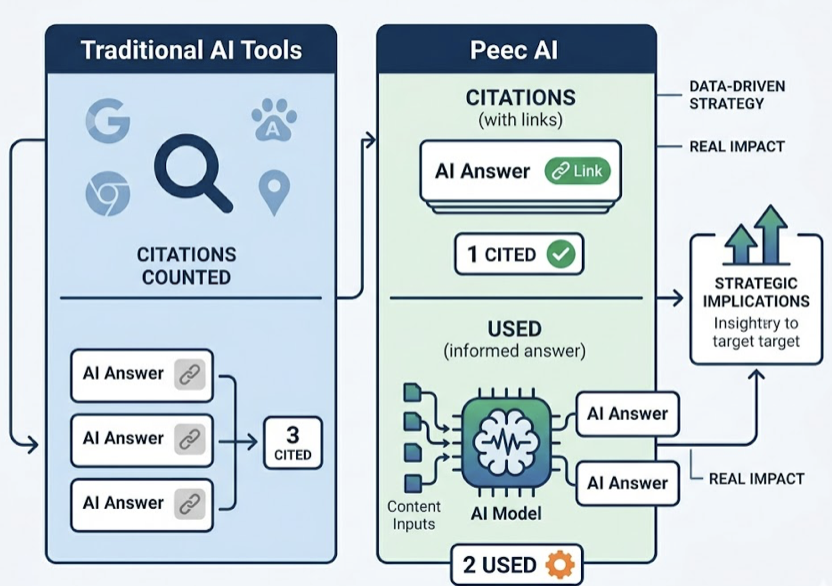
    Peec AI’s standout feature is its Used vs. Cited distinction. Most tools count citations. Peec AI separates instances where your content informed an AI answer (used, but not linked) from instances where your URL was explicitly mentioned(cited). That’s a technically meaningful difference with real strategic implications.

    It also segments brand positioning into four quadrants — Leaders, Niche Players, Laggers, and Controversial — giving teams a visual framework for understanding competitive standing at a glance.

    Pricing: Starts at €89/month

    7. Otterly AI

    Best for: Solo marketers and small teams entering GEO for the first time

    Otterly AI lowers the barrier to entry without sacrificing utility. Its prompt-first interface automates what many teams are still doing manually — testing AI queries one by one and noting the results. Real-time alerts notify users of sudden visibility drops or new competitors entering target prompt results, which is genuinely useful for resource-constrained teams.

    Pricing: Lite $29/month, Standard $189/month

    Side-by-Side: How These 7 Tools Compare

    PlatformBest ForEngine CoverageUnique FeatureUpdate FrequencyStarting Price
    TopifyGrowth & SaaSChatGPT, Perplexity, AIOCVR + Source AnalysisDaily$99/mo
    EvertuneEnterprise6+ PlatformsDual-Layer (base + live)Real-Time$3,000/mo
    ProfoundCMO Strategy10+ PlatformsAgent AnalyticsDaily$399/mo
    OmniaScaleupsCore EnginesActionable content briefsDaily€79/mo
    Scrunch AIRegulated industries7+ PlatformsHallucination detectionReal-Time$250/mo
    Peec AIB2B SMBs3+ (Expandable)Used vs. Cited trackingDaily€89/mo
    Otterly AISolo/Small teamsCore EnginesReal-time drop alertsDaily$29/mo

    The Citation Metric Most Tools Still Don’t Measure

    Getting cited isn’t the finish line. It’s closer to the starting line.

    When an AI cites your brand in a way that fully summarizes your value proposition — “Brand X is the best CRM for small teams at $10/user with built-in email tools” — the user has no reason to click. That’s a zero-click citation. Visibility win, traffic loss.

    Research shows that when an AI summary is present, users click through to an external link only 8% of the time. That doesn’t mean citations are worthless. It means how you’re cited matters as much as whether you’re cited.

    Topify’s CVR (Conversion Visibility Rate) metric was built specifically for this problem. It accounts for recommendation prominence, prompt intent alignment, and the AI’s level of endorsement — whether your brand is the top pick or item seven on a list. Brands optimizing for CVR typically focus on creating what practitioners call “non-summable” assets: calculators, raw datasets, downloadable templates. Content that compels a click even after an AI has described it.

    That’s the layer most dashboards don’t show you yet.

    How to Start Tracking AI Citations in 3 Steps

    You don’t need an enterprise budget to start. A systematic approach gets you meaningful data within 30 days.

    Step 1: Run a baseline audit. Start with Otterly AI or Topify Basic. Define a “Prompt Universe” of 50–100 questions your customers actually ask — especially comparison and use-case queries. Establish your current Share of Model and identify which competitors are consistently showing up in the “authoritative framing” position.

    Step 2: Find your influence sources. Use Source Analysis to identify where the AI is actually pulling information about your brand. If a specific industry forum or review platform appears repeatedly, that’s where your content and PR efforts need to shift. Remember: third-party sources are cited 6.5x more often than brand-owned pages.

    Step 3: Optimize for machine extraction. AI models are 2.8x more likely to cite content with organized headings and structured data tables. Implementing author schema and statistical fact blocks has been shown to improve AI visibility by 30–40%. Run your tracking tool for 30–60 days after changes — that’s typically how long it takes for models to re-index and adjust their citation patterns.

    Conclusion

    Team SizeRecommended ToolPrimary Goal
    Solo / Small teamOtterly AI or Topify BasicBaseline monitoring, fast experimentation
    Mid-market / GrowthTopify Pro or OmniaCVR optimization, actionable content briefs
    Enterprise / Multi-brandEvertune or ProfoundShare-of-voice, base-model reputation management
    Regulated / High-riskScrunch AIHallucination detection, brand safety

    AI citation tracking isn’t an advanced GEO tactic anymore. It’s the baseline requirement for knowing where your brand stands in the most important discovery channel of 2026.

    The gap between brands that track this and brands that don’t is widening every month. The tools above make that gap measurable. What you do with the data is the actual work.

    FAQ

    What is AI citation tracking? 

    It’s the process of monitoring how often and in what context AI platforms like ChatGPT, Perplexity, and Gemini reference your brand’s content or domain. Unlike traditional rank tracking, it focuses on narrative inclusion and URL-level attribution within synthesized AI answers.

    Does getting cited by AI actually drive traffic? 

    Yes, but the nature of that traffic has shifted. While click-through rates from AI answers are lower than traditional search, the conversion rate of AI-referred visitors is typically 5 to 11 times higher. These users arrive pre-qualified by the AI’s recommendation.

    How often should I monitor AI citations? 

    Daily monitoring is the 2026 standard. A single model update can shift your visibility by 70% or more within a 24-hour cycle. Monthly snapshots miss too much.

    Can I track competitor citations too? 

    Yes. Competitive benchmarking is a core feature of platforms like Topify, Profound, and Peec AI. You can see which competitors are recommended for your target prompts and identify the specific third-party sites giving them a citation advantage over you.

    Why does AI cite other websites more than mine? 

    AI models prioritize sources perceived as unbiased. Third-party reviews, forums, and news publications are cited 6.5x more often than brand-owned pages. That’s why tracking your Source Influence — not just your own domain mentions — is central to any GEO strategy.

    Read More

  • 6 Best LLM Visibility Tracking Tools in 2026

    6 Best LLM Visibility Tracking Tools in 2026

    You’ve been ranking on Google’s first page for three years. Traffic is steady. Conversions look normal.

    But when someone asks ChatGPT to recommend tools in your category, your brand doesn’t come up. Not once.

    That’s the gap most SEO dashboards can’t show you. Traditional rank trackers tell you where you stand in link lists. They don’t tell you whether AI systems are citing you, ignoring you, or actively recommending your competitors instead.

    This is why LLM visibility tracking has become a distinct discipline. The tools below are built specifically for this problem.


    Most Brands Are Invisible to AI Search Without Knowing It

    Here’s what’s changed: approximately 60% of Google searches now end without a click. AI Overviews appeared in 13.14% of all queries by March 2025, a 102% increase over 14 months. When an AI-generated summary is present, click-through rates drop from 15% to around 8%.

    The implication is direct. Your brand doesn’t need to lose a ranking to lose visibility. It just needs to be excluded from the AI’s synthesized answer.

    That’s the invisibility problem. And it’s compounding.

    Researchers call it the “Ghost Citation” phenomenon: AI systems use your content to support a factual claim, but name a competitor in the recommendation. You provided the proof, someone else got the mention.

    What makes it harder is that only 11% of domains are cited by both ChatGPT and Perplexity. A brand can be well-represented on one platform and completely absent from another. Without dedicated tracking, you’d never know which scenario applies to you.


    3 Things That Separate a Real LLM Tracking Tool From a Checkbox

    Not every tool in this category measures the same thing. Before comparing specific platforms, it helps to understand what actually matters.

    Platform coverage breadth. ChatGPT holds 80.49% of the chatbot market. Perplexity serves 22 million monthly users and processes 780 million queries per month. Google AI Overviews appears in roughly half of all searches. A tool that only tracks one of these platforms gives you a partial picture at best.

    Data granularity beyond mention counts. Knowing your brand appeared in an AI response is a starting point. Knowing your position relative to competitors, the sentiment of the mention, and whether that mention had any conversion intent is what drives decisions.

    Accuracy methodology. This one’s often overlooked. LLMs are non-deterministic, meaning the same prompt can produce different answers based on session history or randomization settings. Tools that use standard browser sessions often achieve accuracy scores below 60% because the AI “learns” the brand from the tracker itself. Credible tools use what’s called Swarm Probing: sending thousands of prompt variations across different geographic nodes to calculate a statistically reliable Share of Voice.


    The 6 Best LLM Visibility Tracking Tools in 2026

    ToolPlatforms CoveredStandout FeatureStarting PriceBest For
    TopifyChatGPT, Gemini, Perplexity, AI Overviews, DeepSeek, Doubao + moreFull-spectrum tracking + one-click GEO execution$99/moGrowth teams, agencies, multi-platform coverage
    ProfoundChatGPT (starter), broader on paidCDN bot log integration, SOC 2 complianceFree / $99/moEnterprise security-focused teams
    EvertuneMulti-platformFoundational vs. real-time knowledge split$3,000/moLarge enterprise, statistical rigor
    Peec AIMulti-platform + DeepSeekMultilingual, unlimited seats€89/moInternational brands, agencies
    Otterly AICore AI platformsGEO Audit (25+ on-page factors)$29/moSolo marketers, early-stage testing
    LLMClicks.ai / AkiiVariesAI hallucination detectionVariesB2B SaaS with complex product specs

    Topify: Best for Full-Spectrum LLM Visibility Tracking

    Topify is the tool most growth and SEO teams land on when they need cross-platform data with a clear path to optimization. It’s built by a team that includes founding researchers from OpenAI and Google SEO practitioners, and it’s designed around one premise: visibility data is only useful if it tells you what to do next.

    What It Actually Tracks

    Topify monitors seven dimensions of brand representation: Visibility, Sentiment, Position, Volume, Mentions, Intent, and CVR (Conversion Visibility Rate). It covers ChatGPT, Gemini, Perplexity, AI Overviews, and regional models including DeepSeek, Doubao, and Mistral.

    That range matters more than it sounds. There’s only a 13.7% overlap between citations in Google AI Overviews and Google’s AI Mode. Platform diversification isn’t optional for brands targeting multiple audiences.

    Two features stand out technically. First, URL-Level Citation Analysis: Topify maps which specific pages on your site AI crawlers are actually ingesting, so you can prioritize optimization where it’s already working. Second, Information Density Audits: the platform compares your content’s fact-to-word ratio against the sources currently winning citations, giving you a concrete improvement roadmap rather than a vague “create better content” suggestion.

    Where It Stands Out From Competitors

    Most tracking tools stop at the report. Topify includes an Action Center with one-click GEO execution, meaning teams can deploy optimization strategies, such as restructuring content for AI extraction or clarifying entity signals, directly from the dashboard without exporting to a separate workflow.

    Competitor Benchmarking is also real-time. You can see which brands AI platforms are recommending in your category right now, track position shifts over time, and reverse-engineer the citation sources your competitors are using.

    That last capability is where a lot of teams find immediate value.

    Pricing and Who It Fits

    PlanPriceCapacity
    Basic$99/mo100 prompts, 9,000 AI answer analyses, 4 projects
    Pro$199/mo250 prompts, 22,500 analyses, 10 seats
    EnterpriseFrom $499/moCustom prompts, dedicated account manager

    A 30-day trial is available on Basic. For agencies managing multiple client accounts, Topify’s Batch Workflows handle cross-account monitoring from a single dashboard, which meaningfully cuts manual tracking time.


    Tools #2–#6: Where Each One Fits

    Profound is the tool Fortune 100 companies reach for when security posture matters as much as data. Its integration with CDN providers (Cloudflare, AWS, Akamai) lets enterprise teams track how AI bots are crawling their infrastructure in real-time. It’s the only major platform in this category with SOC 2 Type II compliance and SSO at the enterprise level. The free Starter tier covers 50 prompts on ChatGPT only, which is enough to run a basic audit. Paid plans start at $99/month. The trade-off: limited optimization execution compared to Topify.

    Evertune was built by veterans from The Trade Desk, and it shows in the methodology. The platform processes over 1.25 million prompts per brand monthly, specifically to counteract the non-deterministic problem. Its defining feature is the “Dual-Layer Insight”: separating what an AI knows from its training data (foundational knowledge) versus what it retrieves in real-time. PR teams and brand strategists find this especially valuable for understanding long-term brand perception versus recency effects. Price starts at $3,000/month, so it’s positioned firmly at the enterprise end.

    Peec AI is a Belgian-founded platform built for international coverage. It tracks across multiple geographic IP locations, supports DeepSeek and other global models, and offers transparent pricing with no per-seat fees. That unlimited collaboration model makes it practical for agencies running lean. Starting at €89/month for 25 prompts and 3 competitors, it’s one of the more accessible options for teams with a global brief.

    Otterly AI earned a “Gartner Cool Vendor 2025” designation and offers the lowest entry point in the category at $29/month. Its GEO Audit analyzes 25+ on-page factors and generates a Brand SWOT Analysis covering digital PR and content structure. For solo marketers or small startups testing whether LLM tracking is worth the investment, Otterly is the lowest-friction starting point. It doesn’t offer the execution layer or deep competitor benchmarking of Topify, but for a baseline audit, it delivers.

    LLMClicks.ai / Akii takes a different approach. Rather than broad visibility tracking, these tools focus on hallucination detection: identifying when an AI is presenting incorrect pricing, outdated features, or wrong specifications for a specific product. For B2B SaaS brands with complex or frequently updated product lines, this is a real risk. A prospect asking ChatGPT about your pricing tier shouldn’t get last year’s answer.


    How to Pick the Right Tool for Your Team

    The honest answer is that there’s no single best tool for every situation. The right pick depends on what you’re trying to measure and what you plan to do with the data.

    If your priority is cross-platform coverage with a direct path to optimization, Topify is the practical choice. It handles the full cycle: tracking, competitive benchmarking, and execution. The Basic plan at $99/month is a reasonable entry point for growth teams.

    If you’re in an enterprise environment with strict data governance requirements, Profound is built for that context. The free tier lets you validate whether the data is useful before committing to a paid plan.

    If statistical rigor is non-negotiable, and you need to separate what an AI “believes” from what it’s retrieving in real-time, Evertune’s methodology is the most defensible. The $3,000/month price reflects that.

    For international brands tracking APAC markets or running multilingual campaigns, Peec AI’s geographic IP tracking and DeepSeek coverage make it worth the consideration.

    If you’re at the “is this worth exploring?” stage, Otterly at $29/month gives you a functional audit without a meaningful financial commitment.

    One thing worth noting across all of these: none of them replace the underlying work. As research from Princeton’s GEO-bench study shows, adding statistics to content improves LLM visibility by 22% to 37%, and adding authoritative citations improves it by up to 115.1%. The tracking tool shows you the gap. Closing it still requires the content work.


    Conclusion

    LLM visibility tracking isn’t a subfeature of SEO platforms. It’s a separate measurement problem that requires purpose-built tooling.

    The AI platforms your customers are using, whether that’s ChatGPT, Perplexity, or AI Overviews, have their own citation logic, their own source preferences, and their own ways of deciding which brands to recommend. Tracking your performance on one doesn’t tell you what’s happening on the others.

    For most teams starting out, the path forward is straightforward: run a baseline audit, understand where your brand currently stands across the platforms your audience actually uses, and then decide which tool’s scope matches your optimization roadmap.

    Topify covers the broadest ground for teams that need both the measurement and the execution layer in one place.


    FAQ

    What is LLM visibility tracking? It’s the practice of monitoring how AI language models, such as ChatGPT, Perplexity, and Google AI Overviews, represent your brand in their generated responses. Unlike traditional SEO rank tracking, it measures whether you’re being cited, what position you hold relative to competitors, and how the AI characterizes your brand.

    Can I track my brand in ChatGPT for free? Profound offers a free Starter tier that covers 50 prompts on ChatGPT. Otterly AI offers a paid entry point at $29/month with broader audit features. Most full-featured platforms require a paid plan for meaningful volume and multi-platform coverage.

    How is AI Overviews tracking different from standard SEO rank tracking? Traditional rank tracking measures where a link appears in a list of results. AI Overviews tracking measures whether your brand appears in a synthesized paragraph that most users read instead of clicking through. The signals that drive each are different: domain authority affects rank; citation density and content structure affect AI inclusion.

    How often do LLM visibility tools update their data? It varies by tool. Peec AI offers daily high-frequency tracking. Others update weekly or on-demand. Because LLMs are non-deterministic, credible tools average results across thousands of prompt variations rather than relying on single-point snapshots.

    Do these tools work for both Perplexity and ChatGPT at the same time? Yes, the full-featured platforms do. Topify, Peec AI, and Evertune all offer multi-platform tracking. Keep in mind that only 11% of domains are cited by both ChatGPT and Perplexity, so cross-platform data often reveals meaningful divergence in how your brand is represented.


    Read More

  • 7 Best Tools to Track AI Search Visibility in 2026

    7 Best Tools to Track AI Search Visibility in 2026

    How to measure, compare, and improve your brand’s presence across ChatGPT, Perplexity, and AI Overviews

    Your SEO dashboard is lying to you. Not because the data is wrong, but because it’s measuring the wrong thing.

    When someone asks ChatGPT “what’s the best project management tool for remote teams,” your ranking on page one of Google doesn’t matter. What matters is whether you show up in the generated answer. And right now, most brands have no idea if they do.

    That’s the gap this article addresses. Below are the 7 best AI search visibility tools available in 2026, evaluated on what actually matters: platform coverage, tracking precision, competitor benchmarking, and whether the tool can help you dosomething about what it finds.

    Most Tracking Tools Are Built for a Search Engine That’s Losing Ground

    Before picking a tool, it helps to understand why traditional SEO platforms miss this entirely.

    Organic click-through rates in queries that trigger AI summaries have dropped from 1.76% to 0.61%, a decline of over 62%. That’s not a trend. That’s a structural shift. Users get their answer directly from the AI, and they never click through.

    The deeper problem is architectural. Traditional search uses inverted indexes where the unit is a “page.” AI search uses vector retrieval where the unit is a “passage” or fragment. Around 60% of AI Overview citations come from URLs that don’t even rank in the top 20 organic results. Your backlink profile and domain authority, the things your current tools are optimized around, are increasingly less relevant to whether AI recommends you.

    That’s why a new category of tools exists. Here’s how the best ones stack up.

    The 7 Best AI Search Visibility Tools, Ranked

    1. Topify

    Best for: In-house marketing teams and agencies that need end-to-end execution

    Topify isn’t just a monitoring dashboard. It’s built around a seven-metric framework: visibility, mentions, sentiment, position, volume, intent, and CVR (Conversion Visibility Rate). Most tools give you two or three of these. Topify connects all of them and links them to downstream revenue signals.

    The feature that separates Topify from everything else is one-click GEO execution. When the platform detects a visibility gap, it doesn’t just flag it. It proposes a fix, such as restructuring your article’s opening into an “answer-first” format that’s easier for RAG systems to extract, and lets you deploy it with a single click.

    Topify’s Source Analysis is equally distinct. It reverse-engineers the exact domains and URLs that AI platforms are citing in your category, so you can see which third-party media, Reddit threads, or review platforms are driving your competitors’ recommendations. That turns a passive monitoring tool into an active competitive intelligence system.

    Platform coverage includes ChatGPT, Perplexity, Gemini, DeepSeek, and AI Overviews. The team behind it includes founding researchers from OpenAI and experienced Google SEO practitioners.

    Pricing: Basic starts at $99/mo (100 prompts, 9,000 AI answer analyses, 4 projects). A Shopify-focused entry plan is available at $9.99/mo for product-level optimization.

    Verdict: The most complete option in the market for teams that need both intelligence and execution. Worth evaluating first.

    2. Profound

    Best for: Enterprise brands in regulated industries (finance, healthcare)

    Profound is a pure intelligence platform. It processes over 5 million citation analyses per day and is built for organizations where data accuracy and compliance matter as much as the insight itself.

    Its standout feature is the Conversation Explorer, which captures real-time AI interaction data, revealing demand trends before they show up in any traditional keyword database. The sentiment analysis goes deep on how AI describes your brand, including tone, framing, and source attribution.

    The limitation is clear: Profound has no execution layer. It tells you what’s happening; it doesn’t help you fix it. Starter plans ($99/mo) only cover ChatGPT. Multi-engine monitoring across 10+ platforms requires a higher-tier plan.

    If you’re a large brand that already has a content team to act on insights, Profound is a strong data foundation. If you need a full-stack solution, you’ll need to pair it with something else.

    3. Quattr

    Best for: Mid-to-large B2B SaaS companies with high content volume

    Quattr’s GIGA agent is the most automated execution engine on this list. It reads signals from Google Search Console and LLM citation patterns simultaneously, then generates CMS-ready HTML to fix content gaps without any manual intervention.

    The predictive scoring model is genuinely useful: it estimates the probability that a piece of content will be selected as an AI answer before you publish it, allowing front-loaded optimization rather than reactive fixes.

    The downside is complexity. Quattr is designed for teams managing large-scale content operations. For smaller brands or agencies with fewer than 50 pages under active management, the feature set creates overhead rather than efficiency. Pricing is custom and typically enterprise-level.

    4. Peec AI

    Best for: Global brands and agencies managing multilingual campaigns

    Peec AI supports tracking across 115+ languages, which makes it the strongest option for brands with meaningful non-English audiences. Its technical approach is also worth noting: rather than simulating API calls, it uses UI-based scraping to capture the exact output users actually see, including regional differences and hidden citations.

    The Share of Voice benchmarking is straightforward and actionable. You can see, at a glance, how much of the AI recommendation space in your category your brand occupies versus competitors.

    Pricing starts at €89/mo with no seat limits, which is genuinely cost-efficient for agencies billing across multiple clients. The trade-off is that it’s a monitoring-only tool with lighter actionability compared to Topify or Quattr.

    5. Scrunch AI

    Best for: Enterprise brands concerned with brand safety and AI misrepresentation

    Scrunch addresses something most tools ignore: how AI agents (not just human users) perceive and represent your brand. Its Agent Experience Platform (AXP) monitors whether AI systems are misreading your content or propagating inaccurate brand information, a real risk as autonomous AI agents increasingly handle purchasing and discovery workflows.

    The persona-based monitoring is novel. You can see how a “technical expert” versus a “general consumer” asking the same question gets different AI-generated recommendations, which reveals audience-specific visibility gaps.

    At $250/mo entry pricing, Scrunch is squarely in the enterprise tier. It’s the right tool if brand consistency and AI hallucination risk are primary concerns. It’s overkill if you’re still establishing basic AI visibility.

    6. Otterly AI

    Best for: Solo founders and small teams getting started with AI visibility

    Otterly AI covers 6 major platforms, runs basic GEO audits, and automatically converts traditional SEO keywords into conversational prompts suited for AI tracking. It also flags technical visibility blockers like robots.txt blocking or missing Schema markup.

    The Lite plan at $29/mo is the lowest entry point for a professional-grade AI tracking tool on this list. For teams that need baseline data before committing to a more comprehensive platform, it’s a practical starting point.

    Don’t expect execution capabilities or deep competitive intelligence. Otterly is a monitoring foundation, not a growth platform.

    7. Semrush AI Visibility Toolkit

    Best for: SEO teams already embedded in the Semrush ecosystem

    If your team already runs Semrush, the AI Visibility Toolkit adds meaningful capability with zero additional learning curve. Its database of 200M+ prompts provides strong benchmarking for brand mentions in AI Overviews and ChatGPT.

    The most useful distinction it makes: separating “brand mentions” from “cited page” attribution. That tells you whether AI is recommending you based on brand reputation or specific content quality, which points to very different optimization strategies.

    At $99/mo per domain, it’s not cheap as a standalone product. As an extension of an existing Semrush investment, the integrated workflow justifies the cost. As an independent AI visibility solution, dedicated native platforms typically offer more depth.

    Side-by-Side: Features That Actually Matter

    ToolAI Platforms CoveredCompetitor TrackingSentiment AnalysisCitation Source AnalysisStarting Price
    TopifyChatGPT, Perplexity, Gemini, AIO, DeepSeek + moreDeep, with one-click GEO execution0-100 real-time scoringFull source URL mapping$99/mo
    Profound10+ engines (full coverage on higher plans)Real-time demand detectionDeep contextual analysisStrong attribution$99/mo
    QuattrComprehensivePredictive scoring modelIncludedInternal link optimizationCustom
    Peec AICore engines, 115+ languagesShare of Voice benchmarkingIncludedLightweight€89/mo
    Scrunch AICore engines (AXP-focused)Brand safety monitoringMisrepresentation detectionMachine-readability diagnostics$250/mo
    Otterly AI4-6 major platformsBasic monitoringBasicTechnical gap analysis$29/mo
    SemrushCore + AIOHistorical trend benchmarkingIncludedBrand vs. page citation split$99/mo

    5 Things Most AI Visibility Tools Still Can’t Fully Solve

    Knowing the limits of your tools is part of using them well.

    The persistence problem. Research shows only 30% of brands maintain consistent visibility across multiple regenerations of the same AI query. Most tools report a statistical frequency, not a guarantee of presence in any given user conversation. Treat your visibility score as a probability, not a fixed position.

    The earned media gap. Between 82% and 85% of AI citations come from third-party sources: media coverage, Reddit, G2, review platforms, industry forums. Most tools can tell you you’re not being cited. Few can help you build the external signal network that would change that. Topify’s Source Analysis gets closest by identifying exactly which third-party domains are driving competitor citations.

    Model drift. As large language models retrain and update, the way AI describes and recommends your brand can shift without warning. Current tools are better at post-hoc detection than prediction.

    The attribution gap. When AI Overviews answer a question directly, traffic falls. Tracking “mentions” is useful, but measuring the downstream behavioral impact (like branded search lift) remains difficult. You’ll need to accept that some AI influence is unmeasured by design.

    Execution without strategy. Automation tools can deploy changes at scale. They can’t tell you whether the underlying positioning is right. The best tools (Topify, Quattr) accelerate execution. Strategic judgment still sits with your team.

    Which Tool Fits Your Use Case?

    Marketing agencies: Topify handles multi-project management with one-click GEO execution across client accounts. Peec AI is a strong complement for agencies with global multilingual clients.

    In-house brand teams: Topify’s end-to-end platform, from tracking through execution, makes it the most efficient single-platform option. You don’t need a separate content team to act on what it finds.

    Enterprise and regulated industries: Profound for data depth and compliance sensitivity. Quattr for teams managing 100+ pages of content requiring systematic optimization.

    Solo founders and small teams: Otterly AI at $29/mo gives you enough baseline data to understand where you stand. Once you’ve established that AI search is a real channel for your category, upgrading to Topify’s Basic plan ($99/mo) gives you the execution layer to actually move the needle.

    Competitive intelligence specialists: Topify’s Competitor Monitoring combined with Source Analysis is the most precise way to reverse-engineer why your competitors are getting recommended and what you need to do to displace them.

    Conclusion

    AI search visibility tracking is no longer optional. If your brand appears in ChatGPT, Perplexity, or AI Overviews for high-intent queries in your category, it matters to your business. If it doesn’t appear, that also matters, and most traditional dashboards won’t tell you either way.

    The tools on this list represent different points on the spectrum from basic monitoring to full-stack optimization. For teams that want to move quickly and see results beyond a dashboard, Topify is the most complete starting point. For teams with more specific constraints (budget, language coverage, ecosystem integration), the comparison above gives you a clear framework.

    The bottom line: pick a tool, establish your baseline, and start measuring. The brands that know where they stand in AI search today will have a meaningful head start by the end of 2026.


    FAQ

    What’s the actual difference between AEO and GEO?

    AEO (Answer Engine Optimization) focuses on extraction precision, structuring content so machines can pull a specific answer directly. GEO (Generative Engine Optimization) is about synthesis, getting your brand recommended when AI models aggregate information from multiple sources to form a response. AEO is about becoming the answer. GEO is about being the recommended brand in a broader conversational context. In practice, the tactical overlap between the two is over 95%.

    Can these tools track ChatGPT and Perplexity at the same time?

    Most of the main platforms on this list (Topify, Profound, Otterly) support simultaneous multi-platform tracking. That said, each AI engine has different citation logic. Perplexity, for example, places significant weight on Reddit data and content freshness (typically within 30 days). Tracking them on the same dashboard doesn’t mean optimizing for them is the same process.

    How often should I check AI search visibility?

    Given the non-deterministic nature of AI outputs and the frequency of model updates, weekly reviews of core metrics are a reasonable baseline. For active campaigns or product launches, daily monitoring is worth it. AI outputs can shift faster than traditional rankings.

    Do I need a dedicated AI visibility tool if I already use Ahrefs or Semrush?

    Traditional SEO platforms are built around link indexes and keyword rankings. AI visibility tools are built around semantic vector spaces and citation pattern analysis. Semrush’s AI Visibility Toolkit bridges this gap for existing users, but its execution depth typically doesn’t match native platforms like Topify. If AI search is a meaningful channel for your category, a dedicated tool gives you more precise data and, in the case of platforms with execution layers, faster path to improvement.


    Read More

  • Best AEO Tools for Agencies in 2026

    Best AEO Tools for Agencies in 2026

    Most AEO platforms are built for a single brand. One dashboard, one set of competitors, one client’s problems.

    That’s fine if you’re an in-house team. It’s a friction problem if you’re running an agency.

    When you’re managing 20 clients across SaaS, healthcare, and e-commerce, the bottlenecks aren’t strategic. They’re operational: switching between accounts without losing context, pulling reports that clients actually trust, and proving that AI visibility is doing something measurable for their pipeline.

    The tools on this list were evaluated specifically through that lens. Not “does it track AI mentions?” but “does it scale across clients, survive a CMO review, and tell you what to do next?”


    Most Agencies Pick the Wrong Tool for the Same Reason

    The mistake isn’t choosing a bad platform. It’s choosing a platform built for brand teams and assuming it’ll work at agency scale.

    Here’s what that looks like in practice: a tool that charges per seat makes sense for a five-person in-house team. For an agency adding junior analysts across a dozen accounts, that pricing model quietly erodes your margin every quarter.

    The same logic applies to reporting. A dashboard designed for internal use shows raw data. Agency clients need a narrative: what changed, why it matters, what happens next. Those are two very different products.

    There are also five hard red flags worth filtering for before any trial.

    First, any tool that “guarantees” AI rankings. AI responses are stochastic by nature — context-dependent and dynamic. No platform can lock a position in ChatGPT or AI Overviews. What legitimate tools offer is visibility probability and citation share trends.

    Second, no source-level citation data. If a tool tells you your brand was “mentioned” but can’t identify which URL the AI pulled from, you can’t execute. AEO optimization happens at the content and source level. Without that, you’re guessing.

    Third, blurred terminology. Tools that use “prompt” and “keyword” interchangeably, or can’t distinguish between AEO and GEO technically, will struggle to hold up under client scrutiny.

    Fourth, no entity analysis. AI engines understand the world through entities and relationships. A platform that only tracks page performance without Schema validation or knowledge graph monitoring is leaving out half the picture.

    Fifth, per-seat pricing. If your internal team can’t grow without your tool costs spiking, the unit economics don’t work for agencies. Look for prompt-based or analysis-volume pricing, or an agency bundle with unlimited seats.


    The 7 Best AEO Tools Agencies Are Using in 2026

    Here’s the full comparison before the detail:

    ToolMulti-Client SupportAI Platform CoverageWhite-Label ReportingStarting PriceAgency Edge
    TopifyDedicated agency mode, multi-tenantAll major LLMs + regional modelsHigh, custom heatmaps and radar charts$99/moURL-level source analysis + one-click GEO execution
    ProfoundSandbox environments + sub-billing10+ engines, query fanout analysisEnterprise-grade, compliance audits$99–$399+/moHIPAA/SOC 2 compliance, identity journey simulation
    AIclicksPartner mode, revenue shareChatGPT, Gemini, Perplexity, ClaudeStandard, sentiment-focused$79/moNative AI data accuracy, citation-level sentiment
    SE RankingAgency Pack, unlimited usersCore LLMs + traditional searchMature white-label system$129+/moSEO and AEO data in one stack
    Writesonic GEOPro/Enterprise multi-accountContent-production model coverageMid, focused on content suggestions$199/moReal-time GEO scoring before publish
    VismoreGrid UI for multi-site management6+ major platformsMid, growth task progressCustomAction Center, citation gap automation
    AthenaHQAgency-specific reporting workflows8+ platforms including Grok, Meta AIHigh, ROI and attribution$295/moCross-modal optimization, GA4 conversion attribution

    Topify: The Closest Thing to an Agency Operating System

    Topify is the platform agencies reference most often when talking about full-cycle AEO management, and the reason is structural: it connects measurement to execution in a single workflow rather than requiring a separate content tool or analyst layer to bridge the gap.

    For agencies, the architecture matters. Topify supports multi-brand configurations with fast client context switching, which means your team isn’t rebuilding prompt sets and competitor lists every time they open a new account. The platform runs across all major AI platforms — ChatGPT, Gemini, Perplexity, DeepSeek, and others — which gives you a defensible cross-platform story when clients ask why their Perplexity visibility looks different from their ChatGPT numbers.

    Two capabilities stand out in agency workflows specifically.

    Source analysis at the URL level. Topify doesn’t just tell you your brand was cited — it tells you which domain the AI pulled from, whether that was a Reddit thread, a G2 review, or a third-party media piece. That’s the data you need to run a citation gap analysis and tell a client exactly where to build authority next. Most tools stop at the mention level. That’s not enough to execute.

    CVR (Conversion Visibility Rate). This is Topify’s model for estimating which AI mentions are most likely to drive downstream intent — not just awareness. For an agency trying to tie AEO work to pipeline, this is what turns a monthly report from a visibility scorecard into a revenue attribution conversation. The difference between “your brand was mentioned 45% of the time in relevant prompts” and “that mention pattern correlates with an 8% lift in assisted revenue” is the difference between an AEO line item and a retained AEO budget.

    Pricing starts at $99/month for the Basic plan, which covers 100 prompts and 4 projects. The Pro plan at $199/month scales to 250 prompts and 10 seats. Agencies running larger client portfolios typically move toward the Enterprise tier starting at $499/month.


    Profound: Built for Regulated Industries and Enterprise Scrutiny

    Profound is the default recommendation when an agency’s client base includes healthcare, financial services, or any sector where data handling needs to survive a legal review. Its SOC 2 Type II and HIPAA compliance certifications aren’t marketing copy — they’re the reason it gets approved where other tools don’t.

    Beyond compliance, Profound’s “query fanout” analysis gives agencies a structural view of how AI engines reason through a question before generating an answer. That’s useful when you’re trying to understand why a competitor is being cited and you aren’t. It covers 10+ AI engines and supports an “Agency Mode” with complex client workspace management and audit reports formatted for sales proposals. Pricing sits at the higher end at $99–$399+/month.


    AIclicks: Native AI Data and Strong Partner Economics

    AIclicks was built for the AI search era rather than adapted from traditional SEO, which shows in its data accuracy. It provides 360-degree coverage across ChatGPT, Perplexity, Gemini, and Claude with citation-level sentiment analysis — meaning it can tell you not just that a source was cited, but whether the framing around your brand was positive, neutral, or pulling in the wrong direction.

    For smaller agencies, the partner program is worth a close look. Revenue sharing and client matching arrangements make the economics work at scales where a $400/month enterprise contract would be hard to justify. Starts at $79/month.


    SE Ranking: For Agencies That Don’t Want to Abandon Their SEO Stack

    The strongest argument for SE Ranking is practical: if your team already runs traditional SEO out of it, adding AI visibility tracking through its AI Search module doesn’t require a workflow rebuild. The Agency Pack includes unlimited users and a mature white-label reporting system — two checkboxes that matter for scaling.

    The cross-analysis between historical keyword data and AI visibility data is genuinely useful for identifying where traditional search rankings and AI recommendations diverge. For clients in competitive categories, those divergence points often reveal either a threat or an opportunity that neither channel surfaces on its own. Starts at $129/month plus add-ons.


    Writesonic GEO: When Your Agency Also Produces the Content

    Writesonic’s GEO module doesn’t just generate content — it scores it against AI adoption probability before you publish. The “real-time GEO checker” estimates how likely a piece is to be cited by ChatGPT or Perplexity based on structural and semantic signals.

    For agencies running content production alongside visibility tracking, this collapses a two-step process into one. It’s less strong on deep visibility monitoring, but for the production side of AEO — getting content into a format AI engines actually extract — it’s the most focused tool in this group. Starts at $199/month.


    Vismore: Action-Oriented for Agencies Focused on Throughput

    Vismore’s “Action Center” is its core differentiator. Rather than leaving you to interpret a dashboard and decide what to optimize, it surfaces specific recommendations: which prompts need content attention this week, which competitor is gaining citation share and why.

    The grid-based UI is designed for managing hundreds of pages or clients simultaneously — closer to a spreadsheet mental model than a traditional analytics dashboard. For agencies that measure success by weekly optimization cadence rather than monthly reporting cycles, Vismore’s workflow logic fits well.


    AthenaHQ: The ROI-Focused Option for Conversion-Driven Agencies

    AthenaHQ stands apart on two dimensions. First, it covers cross-modal optimization — as AI search begins pulling video clips and images alongside text, AthenaHQ tracks visibility across formats. Second, its GA4 integration connects AI-surface click-throughs to actual on-site conversion behavior, which supports the kind of detailed attribution analysis that performance-focused clients expect. Starts at $295/month.


    How Topify Fits Into an Agency’s Day-to-Day Workflow

    The operational value of Topify isn’t one feature — it’s where it fits across the full client lifecycle.

    Within 48 hours of onboarding a new client, an agency can run an automated GEO diagnostic from a single URL input. Topify scans across 200+ high-value prompts and generates a baseline report that includes “citation blind spots” — specific prompt scenarios where a competitor is being cited and the client isn’t. That’s the kind of concrete, immediate finding that sets the tone for the engagement.

    In day-to-day operations, Topify’s dynamic competitor benchmarking runs continuously. When a new competitor appears in ChatGPT responses for a key prompt category, the platform flags it and surfaces the likely cause — whether that’s a new Reddit thread gaining traction or a schema update on a competitor’s page. That loop is what keeps citation share from eroding without anyone noticing until the quarterly review.

    At the reporting stage, the white-label output combines visibility trends, source analysis, and CVR signals in a format that can carry a client meeting without supplemental slides. When an agency can show a CMO that the brand’s recommendation rate moved from 12% to 45% in targeted prompts, and connect that to an 8% lift in assisted revenue, AEO stops being a line item and starts being a budget priority.

    Conclusion

    The agencies pulling away from the pack in 2026 aren’t the ones with the best content strategy. They’re the ones who built measurement infrastructure early and can now show clients exactly where they stand in AI-generated answers — and exactly what to do about it.

    That requires tools built for agency scale: multi-client architecture, source-level citation data, white-label reporting that holds up in a boardroom, and metrics that connect AI visibility to revenue.

    Topify covers most of that stack. Complement it with Writesonic for content production and SE Ranking for cross-channel SEO alignment, and you have a workflow that can grow with your client base without the operational overhead multiplying at the same rate.

    The shift from “SEO agency” to “AI brand visibility advisor” is already underway. The tool selection decision is less about features and more about which infrastructure you want to be building on for the next three years.


    FAQ

    What’s the difference between AEO and GEO? 

    AEO focuses on making information extractable — structured, factual answers that voice assistants or featured snippets can surface directly. GEO focuses on synthesis and trust: getting an LLM to include your brand as one of several cited sources while building positive sentiment associations. For agencies, AEO is the foundation. GEO is the brand reputation layer built on top of it.

    Can one tool handle all your clients’ AEO needs? 

    Platforms like Topify or Profound cover the majority of use cases. In practice, agencies tend to run a “1+N” model: one core visibility tracking platform paired with a content production tool like Writesonic and an existing SEO audit stack like SE Ranking. The combination gives you the broadest data coverage and execution depth without redundancy.

    How should agencies price AEO services? 

    The current range for a monthly AI visibility monitoring and reporting package is roughly $1,500 to $3,000 as an SEO add-on. Full-stack GEO strategy — covering content restructuring, schema deployment, cross-modal optimization, and citation building — typically runs $5,000 to $15,000 per month as a retainer. More sophisticated agencies are building performance bonuses tied to citation share growth or AI-referred pipeline.

    Which AI platforms should agencies be tracking in 2026? 

    At minimum: ChatGPT (highest query volume, broadest use case coverage), Perplexity (highest citation density, preferred by research-oriented users), Google AI Overviews (carries over traditional search traffic), and Claude (strong in B2B and professional services content). Vertical additions depend on client profile — Grok for social-adjacent categories, DeepSeek for regional markets.


    Read More

  • Best AEO Tools for Marketing Teams in 2026

    Best AEO Tools for Marketing Teams in 2026

    Your brand ranks #1 on Google. A user opens ChatGPT and asks which platform to use. Your competitor gets recommended. You don’t.

    That’s not a content quality problem. That’s an AEO problem, and a different category of tool is required to fix it.

    Your Brand Shows Up on Google. It Doesn’t Show Up on ChatGPT. Now What?

    Most marketing teams still measure AI search performance with SEO dashboards. The gap that creates is larger than most realize.

    Research shows the correlation between organic Google rankings and AI citation frequency sits at roughly 0.034. Essentially zero. A brand that dominates traditional search can be completely absent from the synthesized responses that AI assistants deliver to the same audience.

    By March 2026, Google’s global search market share dropped below 90% for the first time in over a decade. ChatGPT alone commands 78% of the AI search market. These aren’t niche platforms anymore.

    The users who find you through AI assistants also convert at rates 6x to 23x higher than organic search visitors, because they arrive after a deep research session, not a casual browse. Missing from that layer doesn’t just hurt awareness. It costs revenue.

    Traditional SEO tools can’t see any of this. They track blue links. AI answers are something else entirely.

    5 AEO Tools Worth Considering for Marketing Teams

    ToolPlatform CoverageKey StrengthBest ForStarting Price
    TopifyChatGPT, Gemini, Perplexity, DeepSeek + moreFull AEO cycle: track, analyze, executeMarketing teams, agencies, SaaS brands$99/mo
    Profound10+ engines incl. Grok, Meta AI, ClaudeTechnical audits + agent-level crawl trackingFortune 500, compliance-heavy enterprises$499/mo
    Peec AIMajor AI enginesUnlimited seats + optimization layerMid-market B2B SaaS teams€89/mo
    Otterly.AIMulti-engineSWOT-based GEO audit, Looker Studio connectorStartups, small agencies$29/mo
    RankscaleMulti-engineCredit-based flexible trackingFreelancers, bootstrapped startups$20/mo

    Each of these tools occupies a different part of the market. The right choice depends on whether your team needs to monitor, analyze, or actually execute, and most teams eventually need all three.

    Topify — Built for Teams That Need More Than a Dashboard

    Most AEO tools stop at data. Topify closes the loop.

    The platform covers the full cycle: discover where your brand is missing from AI answers, understand why competitors are getting cited instead, and deploy a fix without manual content workflows. Trusted by 200+ brands including Zoom, TCL, and Midea, it’s built for teams that can’t afford a dedicated AI search specialist.

    What Topify Tracks That Other Tools Miss

    Topify monitors seven core metrics that connect AI visibility to actual business outcomes.

    AI Visibility Percentage tracks how often your brand appears across target queries. A score above 80% signals category leadership. Below 20% means AI systems are effectively routing high-intent buyers to competitors.

    Answer Placement Score (APS) goes beyond “mentioned or not.” The first recommendation in an AI response gets full credit. The second gets 0.6. By position three, you’re largely irrelevant in a conversational interface. Most tools report presence. Topify reports position.

    Sentiment Polarity is what most teams overlook entirely. AI models don’t just cite brands, they describe them. A score between 81 and 100 reflects enthusiastic endorsement. Neutral descriptions (41-59) are often enough for commodity products, but insufficient for high-consideration B2B purchases. Topify flags “positioning drift” — when an AI starts characterizing your premium product as a budget alternative.

    AI Prompt Volume estimates monthly demand for specific conversational queries, which often differs significantly from traditional keyword volume. A prompt like “What’s the best CRM for remote real estate teams?” reflects higher purchase intent than the keyword “CRM software,” even if its search volume looks smaller.

    Source Analysis identifies which third-party domains AI platforms are citing when they mention your brand. AI models are 6.5 times more likely to cite a brand through external sources — Reddit, Wikipedia, G2 — than through its own website. Topify shows you exactly where your third-party coverage has gaps.

    Intent Mapping and CVR (Conversion Visibility Rate) round out the picture, connecting AI citation patterns to pipeline and lead generation rather than treating visibility as a vanity metric.

    One-Click Execution, Not Just Reports

    Topify’s AI agent handles the remediation side automatically. It identifies prompts where competitors are cited and you’re absent, reverse-engineers their citation patterns, and proposes targeted GEO strategies (specific H2 updates, FAQ blocks, schema additions). Marketing teams review and deploy with a single click. The agent then tracks how the changes affect citation frequency and refines future recommendations accordingly.

    Pricing: Basic at $99/mo (100 prompts, 9,000 AI answer analyses, 4 projects), Pro at $199/mo (250 prompts, 10 seats), Enterprise from $499/mo for agencies and large organizations.

    Other AEO Platforms Worth Knowing

    Profound is the enterprise standard for organizations with deep compliance requirements. It covers 10+ AI engines including niche models like Grok and Meta AI, and uniquely tracks which AI crawlers are visiting your site and what content they’re analyzing. At $499/mo to start, it’s a significant investment, and it lacks the automated execution workflows that Topify provides. Best suited to Fortune 500 teams with dedicated AEO analysts.

    Peec AI targets mid-market B2B SaaS companies in the $5M-$30M ARR range. Its main advantage is unlimited user seats across all plans, making it practical for large content teams that need broad access without per-seat cost concerns. Starts at €89/mo.

    Otterly.AI works well as an entry point for startups or small agencies that need basic multi-engine monitoring without a heavy investment. Its SWOT-based GEO audit and Looker Studio connector are useful for agency reporting. At $29/mo, it covers the essentials. It doesn’t offer execution capabilities.

    Rankscale offers flexible credit-based tracking starting at $20/mo. It’s the right fit for freelancers or bootstrapped teams that need multi-engine visibility without committing to a monthly seat model.

    What Marketing Teams Actually Need From an AEO Platform

    Broad feature lists are easy to produce. Four criteria actually matter for marketing teams specifically.

    Multi-platform coverage. ChatGPT holds 78% of AI search share, but Gemini, Perplexity, and DeepSeek collectively account for the rest. A tool that only tracks one engine gives an incomplete and potentially misleading picture of where your brand stands.

    Competitor benchmarking, not just self-monitoring. Knowing your own visibility score is useful. Knowing that a direct competitor is being recommended ahead of you, and understanding why, is actionable. The difference is whether the tool surfaces competitive gaps or just personal metrics.

    Content optimization guidance tied to citations. Data without a clear path to improvement creates reporting overhead, not results. The most effective AEO platforms connect visibility gaps to specific content changes — which pages to update, which FAQ blocks to add, which third-party sources to pursue.

    Team scalability. Marketing teams aren’t solo operators. Multi-seat access, project separation, and workflow integration with existing CMS platforms (WordPress, Shopify, Framer) determine whether the tool gets used daily or sits in a tab no one opens.

    How to Pick the Right AEO Tool for Your Team Size

    Lean teams and high-growth startups need automation more than analytics depth. Topify’s Basic plan delivers the full AEO cycle at $99/mo without requiring a specialist to interpret the data or execute the strategy.

    Mid-sized marketing teams managing multiple brands or product lines should look at Topify Pro ($199/mo) for expanded prompt coverage and seat access, or Peec AI if unlimited collaboration is the primary requirement.

    Agencies and enterprise teams have different requirements: client-level project separation, security certifications, and integration into internal BI systems. Topify’s Enterprise plan and Profound both serve this segment, with the key distinction being that Topify includes autonomous execution while Profound focuses on diagnostic depth.

    The bottom line: budget tools are fine for awareness. If your team needs to act on what it finds, the platform needs an execution layer.

    FAQ

    What is AEO and how is it different from SEO? SEO focuses on getting a page to rank in a list of search results. AEO focuses on getting your brand cited within the synthesized answer an AI assistant generates. SEO is measured in clicks and rankings. AEO is measured in citation frequency, sentiment, and share of voice within zero-click responses.

    Do I need a separate tool for AEO if I already use Semrush or Ahrefs? Yes. Traditional SEO platforms track blue-link rankings and keyword positions. They’re largely blind to the conversational, non-deterministic outputs of AI chatbots. Some SEO suites have added basic AEO features, but standalone platforms offer significantly deeper analytics into sentiment, citation sources, and LLM-specific query volume.

    Which AI platforms should my brand prioritize? Start with ChatGPT (78% global share), Gemini (8.65%), and Perplexity (7.07%). For technical or niche categories, tracking DeepSeek and Claude is increasingly relevant as the AI search market fragments across specialized use cases.

    How often should marketing teams check their AEO metrics? Weekly monitoring is recommended for active campaigns, since AI models update their indexes frequently and brand narrative can shift quickly based on new third-party content. Structural audits are best done every 30 to 90 days.

    Is Topify only for large enterprises? No. Topify’s Basic plan is specifically designed for startups and small marketing teams that need professional-grade AEO without agency overhead. The pricing and onboarding are built for teams without a dedicated AI search specialist.

    Conclusion

    The “Visibility Paradox” is already in effect: a #1 Google ranking delivers diminishing returns when AI assistants are routing high-intent buyers directly to competitors. AEO isn’t a future consideration. It’s a present-day gap in most marketing stacks.

    For most teams, Topify is the practical starting point. It covers multi-platform tracking, competitive benchmarking, and autonomous execution in a single environment — which means marketing teams can act on what they find rather than hand off reports and wait. The Basic plan is a reasonable entry point at $99/mo. The Pro plan scales cleanly as the team and product portfolio grow.

    Start with the prompts your highest-intent buyers are typing into ChatGPT right now. If your brand isn’t in the answer, that’s the gap worth closing first.

    Read More