Blog

  • 7 Best Answer Engine Optimization Tools in 2026

    7 Best Answer Engine Optimization Tools in 2026

    Your brand might rank #1 on Google. In ChatGPT, it might not exist.

    That’s not a hypothetical. Over 60% of searches now end without a single click to an external site, and 80% of sources cited in AI-generated answers don’t overlap with the top organic results on traditional search engines. Two completely different ecosystems, running in parallel, tracked by almost no one.

    That’s the gap AEO tools are built to close.

    Most AEO Trackers Only Watch One AI Engine. That’s a Problem.

    Here’s what most teams get wrong when they first start monitoring AI visibility: they pick one platform, usually ChatGPT, and call it covered.

    It isn’t.

    In 2026, the generative search market is split across at least six major engines, each with distinct recommendation logic and user bases. ChatGPT holds 60-78% of global AI search share, but Gemini is the default for anyone in the Google Workspace ecosystem. Perplexity dominates citation-heavy research queries. DeepSeek and Doubao are pulling hundreds of millions of monthly users in Asian markets. Monitoring one platform means you’re optimizing for a slice of the audience, and a shrinking one at that.

    The second mistake is treating AEO as a reporting exercise. Real AEO work requires knowing why an AI recommends a competitor, not just that it does. That means URL-level citation tracking, sentiment scoring, and content gap analysis.

    The tools below do both. The ones that don’t make the list only do one.

    The 7 Best AEO Tools at a Glance

    ToolAI Platforms CoveredCore StrengthStarting Price
    Topify7+ (incl. DeepSeek, Doubao)Full execution + 7-metric analytics$99/mo
    Profound10+Enterprise forensic intelligence$499/mo
    Goodie AITop 3-5 LLMsAVI reporting + Optimization HubCustom
    Scrunch AITop LLMsAgency-facing prompt audits~$300/mo
    GaugeChatGPT, PerplexityBrowser-based B2B attribution$600/mo
    SE Ranking (SE Visible)ChatGPT, Perplexity, GeminiHybrid SEO + AEO dashboard$99/mo add-on
    AirOpsContent-layerHigh-volume content automationCustom

    #1 Topify: AEO as an Execution Engine, Not Just a Dashboard

    Most AEO platforms stop at the data layer. Topify doesn’t.

    Topify is the only platform in this list that connects diagnostic intelligence directly to content execution in a single workflow. Built by former OpenAI researchers (NeurIPS and ICLR publications) and a Fortune 500 Google SEO champion, the platform was designed from day one to bridge the gap between LLM behavior analysis and actual marketing output.

    The 7-Metric Framework

    Where competitors track mentions and maybe sentiment, Topify monitors seven KPIs simultaneously: Visibility (frequency of appearances), Sentiment (0-100 tone score), Position (rank within synthesized recommendations), Volume (AI search demand for your category), Mentions (explicit and indirect citations), Intent (purchase-signal alignment), and CVR (Conversion Visibility Rate, an estimate of AI referral likelihood to transact).

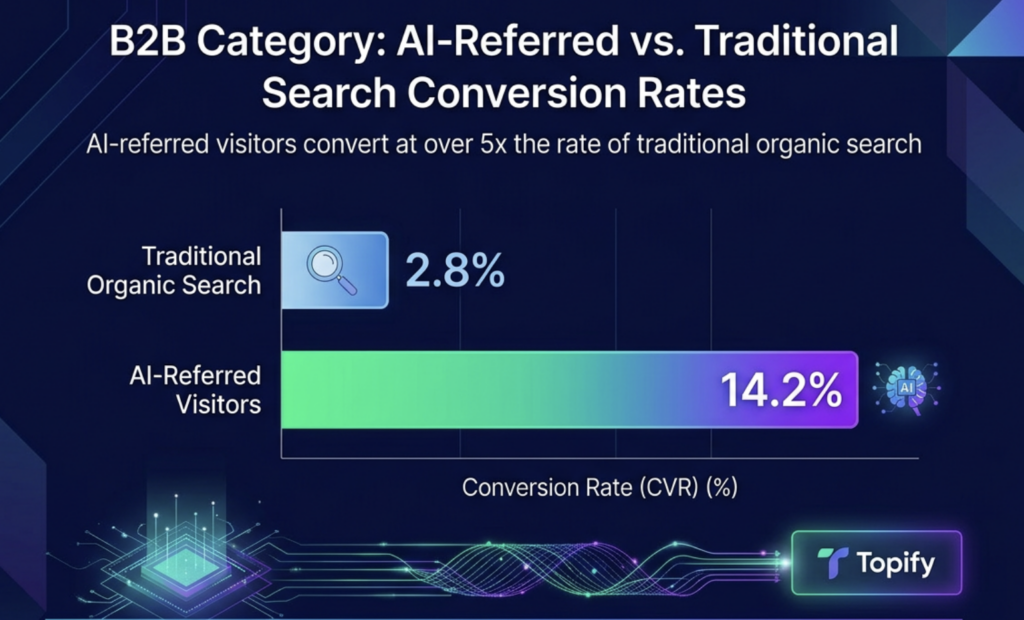
    That last metric matters more than most teams realize. AI-referred visitors in B2B categories convert at 14.2%, compared to roughly 2.8% for traditional organic search. Topify’s CVR metric is built precisely to capture that high-intent traffic signal before it disappears into a zero-click result.
    Source Analysis and One-Click Execution

    Topify’s Source Analysis reverses-engineers which exact domains and URLs AI platforms are using for citations. You see not just whether your brand appears, but which third-party sites are feeding the AI’s understanding of your category, and where your content is losing ground to a competitor’s comparison table or FAQ structure.

    Once a gap is identified, One-Click Agent Execution lets teams deploy optimized content immediately. Define the goal in plain English, review the proposed strategy, and launch. No manual workflows. No backlogs.

    Platform Coverage

    Topify tracks ChatGPT, Gemini, Perplexity, DeepSeek, Doubao, Qwen, and additional global platforms. That global coverage matters in 2026, where regional AI engines often outperform Western counterparts in local markets.

    Who It’s Best For

    Topify’s structure fits three profiles well: marketing agencies managing multiple client brands from one interface, SaaS companies whose product discovery happens almost entirely through AI recommendations, and in-house teams that need both monitoring and content execution without separate tools.

    Pricing: Basic $99/mo (100 prompts, 9,000 AI answer analyses, 4 projects), Pro $199/mo (250 prompts, 22,500 analyses), Enterprise from $499/mo with multi-region tracking and dedicated account management.

    #2 Profound: Forensic Intelligence for Enterprise Risk Teams

    Profound is the go-to platform for large brands where data accuracy and compliance are non-negotiable requirements, not nice-to-haves.

    Its architecture monitors 10+ AI platforms including Claude, Gemini, Perplexity, and Grok. The standout feature is “Query Fanouts Analysis,” which maps how a single consumer prompt (e.g., “safest family car”) branches into a chain of sub-queries as an AI reasons through an answer. For brands in regulated industries like healthcare or finance, this level of forensic depth justifies the $499/mo entry price. SOC 2 Type II and HIPAA compliance make it the default choice for legal and enterprise procurement teams.

    Best for: Fortune 500 brands, regulated industries, teams with executive reporting requirements.

    #3 Goodie AI: Purpose-Built for the Generative Era

    Goodie AI was designed specifically for LLM-era marketing rather than being adapted from a legacy SEO suite. Its “AEO Periodic Table” framework helps teams visualize the required elements for AI visibility: structure, authority, and sentiment.

    Its AI Visibility Impact (AVI) reports show exactly which pages on a brand’s website are generating citations, making resource prioritization straightforward. Goodie is a strong fit for mid-market teams that want a user-friendly, comprehensive interface without the complexity of an enterprise command center. Pricing is custom for most deployments.

    Best for: Mid-market in-house teams focused on content performance attribution.

    #4 Scrunch AI: Prompt-Level Diagnostics for Agencies

    Originally an influencer analytics platform, Scrunch has pivoted effectively into AEO, particularly for agencies running high-volume client portfolios.

    Its core differentiator is prompt-level insight: the platform shows exactly which queries are triggering brand mentions, which is essential for aligning client content calendars with real AI search behavior. The Agent Experience Platform (AXP) also audits site-level technical blockers, like restrictive robots.txt settings that prevent GPTBot from crawling content. Pricing starts at approximately $300/mo.

    Best for: Digital agencies managing multiple brands, teams needing technical crawlability audits.

    #5 Gauge: Browser-Based Attribution for Technical B2B

    Gauge takes a stricter position on data integrity than most tools: it captures results from actual browser interfaces rather than API calls, which is the more reliable methodology. Because AI outputs are probabilistic, an API query can return results that differ from what a real user sees. Gauge eliminates that discrepancy.

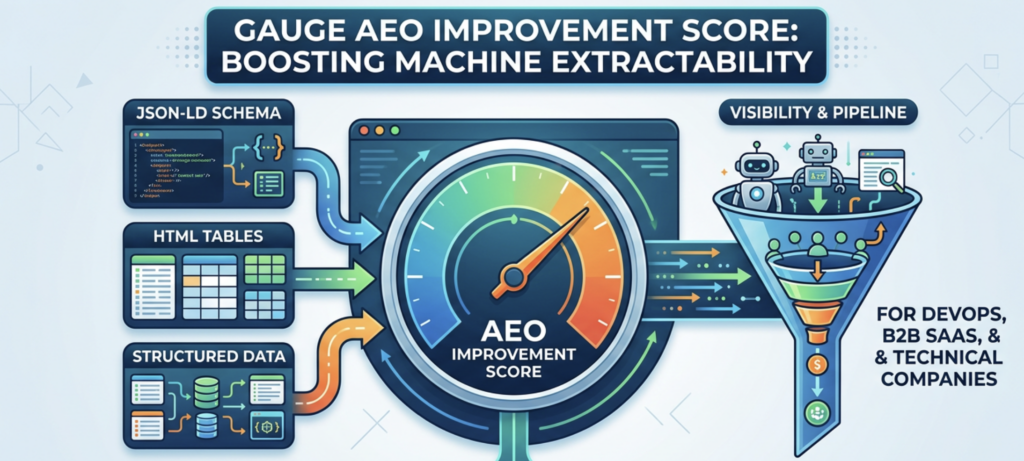
    Its AEO Improvement Score measures how well a brand’s technical infrastructure (JSON-LD schema, HTML tables, structured data) supports machine extractability. For DevOps, B2B SaaS, and technical companies where visibility directly feeds pipeline, Gauge’s data-first approach is worth the $600/mo entry point.
    Best for: Technical B2B brands, data teams that need conversion attribution tied to AI referrals.

    #6 SE Ranking (SE Visible): The Hybrid Option for SEO Teams

    SE Ranking’s SE Visible add-on is the right answer for one specific scenario: a team already running SE Ranking for SEO that wants to layer AI visibility monitoring without switching platforms.

    The Visibility Score surfaces performance across ChatGPT, Perplexity, and Gemini alongside traditional organic rankings. Particularly useful for identifying “cannibalization” situations where Google AI Overviews are absorbing traffic from previously high-ranking organic pages. At $99/mo as an add-on, it’s the most affordable entry point on this list.

    Best for: SEO teams extending into AEO, budget-conscious teams wanting a unified dashboard.

    #7 AirOps: Scaling Content Production for Large Libraries

    AirOps addresses the execution bottleneck: how do you produce and refresh the volume of content needed to stay visible across hundreds of niche AI prompts?

    Its AI-powered workflows scan existing content libraries and recommend optimizations for both traditional search and AI citations at scale. The “Momentum” feature pushes recommendations across thousands of pages simultaneously. It’s less of a monitoring tool and more of a production multiplier. Pricing is custom based on workflow complexity. Content updated within the last 13 weeks is 50% more likely to be cited by generative engines, which makes AirOps’ refresh-at-scale capability directly tied to citation rates.

    Best for: Large content teams, publishers, brands with extensive page libraries that need systematic AEO-aligned updates.

    What to Look for Before You Pick a Platform

    The clearest way to narrow down your choice is to match the tool’s core capability to your primary business objective.

    If your goal is lead generation, prioritize Source Analysis and Citation Tracking. Topify and Gauge both connect citation data directly to conversion behavior.

    If you’re managing brand narrative across multiple markets, Multi-Platform Monitoring and Sentiment Scoring matter more than execution features. Scrunch AI and Goodie AI both deliver that view.

    If content production is the bottleneck, not data, AirOps is the more efficient investment.

    One technical criterion worth insisting on regardless of tool: browser-based data capture. Because AI model outputs vary by region, user context, and randomized sampling, API-only results can misrepresent what your target audience actually sees. Platforms that run repeated, randomized prompt checks at the interface level give you a more accurate read on real AI Share of Voice.

    Teams also frequently underweight competitive source intelligence. The most useful AEO insight isn’t “we’re mentioned 40% of the time.” It’s “a competitor is winning citations because their pricing page uses a structured comparison table and yours doesn’t.” That specificity is what separates tools worth paying for from dashboards that just confirm what you already suspected.

    Conclusion

    The shift from keyword rankings to AI citations is not a trend you can monitor from the sideline. AI referral traffic converts at rates up to 23 times higher than traditional organic search, and users arrive already past the research stage. That’s the highest-value traffic segment in 2026, and it’s largely invisible to legacy SEO tools.

    The right AEO platform closes that blind spot. For most teams, especially those that need both monitoring depth and content execution in a single workflow, Topify is the most complete starting point. Its 7-metric framework, source analysis, and one-click execution cover the full cycle from “why aren’t we being recommended” to “here’s the content that fixes it.”

    Pick the tool that matches your current bottleneck. If you’re not sure what that bottleneck is, an AEO audit across ChatGPT, Perplexity, and Gemini will tell you within a week.

    FAQ

    What’s the core difference between SEO tools and AEO platforms? 

    SEO tools measure “rankings” in traditional blue-link results, relying on keyword position and backlink volume. AEO platforms measure “inclusion” in AI-synthesized answers, tracking citation share, brand sentiment, and recommendation rates across engines like ChatGPT and Perplexity. The underlying logic is different: SEO is deterministic indexing; AEO is probabilistic reasoning.

    How many AI platforms should a brand monitor? 

    At minimum, ChatGPT, Google Gemini, and Perplexity, which together represent the majority of AI search demand. For brands with global operations, adding regional platforms like Doubao and DeepSeek is necessary for consistent narrative control across linguistic markets.

    Can smaller teams afford professional AEO tools? 

    Yes. Entry-level plans from Topify ($99/mo) and SE Visible ($99/mo add-on) provide solid baseline monitoring without enterprise-level investment. The ROI case is strong: in B2B SaaS categories, AEO programs show median ROI of 702% even in early-stage deployments.

    How often should AI visibility be tracked? 

    Daily or weekly monitoring is the practical standard. AI model outputs are probabilistic and shift with each model update, so spot checks give you snapshots, not trends. Meaningful pattern detection requires consistent cadence.

    Do AEO tools work for non-English markets? 

    Increasingly, yes. Platforms like Topify include multi-language tracking across global AI engines, which is essential for brands competing in markets where domestic AI models like Doubao and Qwen often outperform Western platforms in local language queries.
    Read More

  • Best AEO Tools for SaaS in 2026, Ranked

    Best AEO Tools for SaaS in 2026, Ranked

    Search “best AEO tools” and you’ll find a dozen platforms claiming to track AI visibility. Most of them show a dashboard. What they don’t tell you is what they’re actually measuring, which AI platforms they cover, and whether the data leads to any action your team can take.

    For SaaS brands, where software buyers are 3x more likely to use AI for vendor research than buyers in other sectors, picking the wrong tool isn’t a minor inconvenience. It’s a structural gap that your competitors will fill.

    Here’s a ranked breakdown of the AEO tools worth considering in 2026, with a clear-eyed look at what each one actually does.


    AEO in 2026 Isn’t What It Was 18 Months Ago

    Featured Snippets used to be the goal. Now they’re almost irrelevant.

    By 2026, the buying journey for B2B software has fundamentally shifted. 50% of B2B buyers now start their vendor research in an AI platform rather than Google. AI search traffic has grown 527% year-over-year. When a CTO queries Perplexity with something like “Which ERP handles cross-border compliance for fintech startups?” the answer they get isn’t a list of links. It’s a synthesized recommendation that names two or three vendors. If your brand isn’t one of them, that deal starts without you.

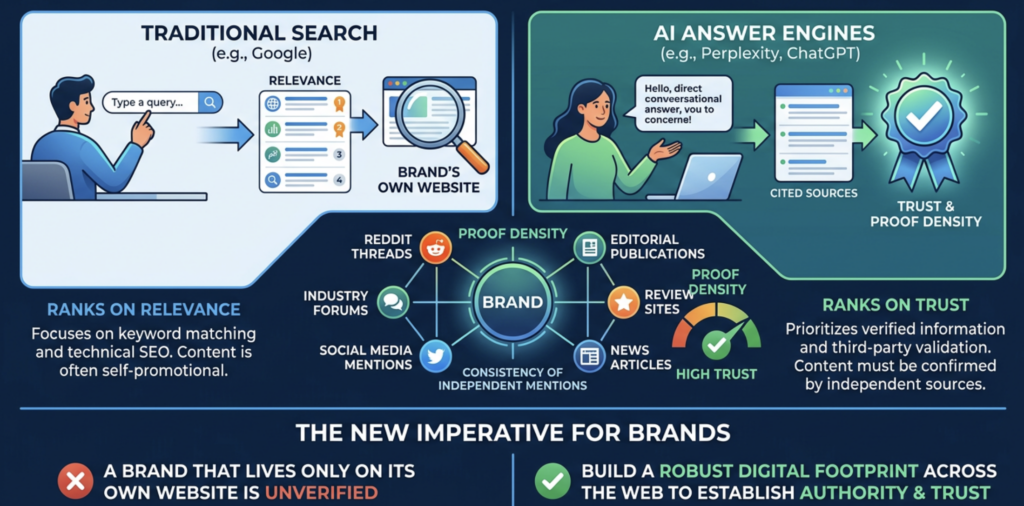
    The underlying logic has also changed. Traditional search ranks on relevance. AI answer engines rank on trust — specifically what researchers call “proof density”: the consistency of independent mentions across Reddit threads, editorial publications, and industry forums. A brand that lives only on its own website is, from the model’s perspective, unverified.

    That’s the gap AEO tools are designed to diagnose. The question is which tools actually help you close it.


    7 Best AEO Tools for SaaS in 2026: Side by Side

    ToolCore CapabilityAI PlatformsStarting PriceIdeal For
    TopifyExecution-first workflowChatGPT, Perplexity, Gemini, DeepSeek, Google AI Mode$99/moGrowth-stage SaaS & agencies
    ProfoundEnterprise visibility data10+ engines incl. GPT-5, Claude, Gemini$499/moFortune 500 & regulated sectors
    AthenaHQHigh-velocity GEOChatGPT, Perplexity, Google AIO, Claude, Gemini$295/moPerformance teams
    Peec AICompetitor benchmarkingChatGPT, Perplexity, Claude, Gemini, DeepSeek€85/moSMBs & bootstrapped startups
    Writesonic GEOContent generation + AEO scoring10+ platforms incl. Llama, Grok$199/moContent-heavy marketing depts.
    Semrush AISEO-to-AEO integrationChatGPT, Google AIO, Perplexity, Gemini$99/mo (add-on)Existing Semrush users
    ZadooshOmnichannel managed serviceReddit, guest posts, multi-platform$2,000–$5,000/moDone-for-you execution

    #1 Topify: The Best AEO Tool for SaaS Teams That Need to Act, Not Just Monitor

    Most AEO tools stop at the report. Topify is built around what happens after it.

    The platform’s core philosophy centers on what it calls the “Execution Loop”: identify the gap, prioritize the fix, deploy. Where most platforms show you that your brand is missing from a ChatGPT response, Topify tells you which specific prompts are driving traffic to your competitors, scores them by “Citability,” and surfaces “Dark Queries” — prompts with high AI research volume but near-zero traditional keyword search volume — that your team would never discover through conventional SEO tools.

    That’s the gap most brands still can’t see.

    Cross-Platform Visibility That Goes Beyond Mentions

    Topify tracks real-time visibility across ChatGPT, Perplexity, Gemini, DeepSeek, and Google AI Mode. The distinction it draws between a “Mention” and a “Citation” matters more than it sounds. In 2026, a mention builds brand familiarity. A citation — where the AI provides a direct link to your source — is what drives high-intent trials and converts to sales-qualified leads.

    The platform monitors seven metrics in parallel: visibility, sentiment, position, volume, mentions, intent, and CVR (Conversion Visibility Rate). For SaaS marketing teams reporting to a CMO, the CVR metric integrates with GA4 and CRM data to estimate the dollar value of AI visibility. Given that AI-referred visitors convert at 14.2% compared to 2.8% from traditional organic search, that number tends to change budget conversations quickly.

    SaaS-Specific Prompt Intelligence

    The “SaaS Scenario Engine” is where Topify earns its placement at the top of this list. It surfaces the exact prompts that send buyers to your competitors but not to you. A project management tool might rank well for “best project management software” but be completely absent for “best project management tool with SOC 2 compliance for healthcare teams.” That’s a sales conversation your competitor is winning by default.

    Topify’s one-click agent execution lets teams deploy content fixes without building manual workflows. You define the goal; the platform handles the strategy and execution cycle.

    Pricing:

    PlanPriceCapacity
    Basic$99/mo50 prompts, 1 seat, ChatGPT + Perplexity
    Pro$199/mo100 prompts, 3 seats, 5 AI platforms
    Advanced$399/mo200 prompts, 10 seats, full engine coverage

    Best for: Growth-stage SaaS teams, marketing agencies managing multiple brands, and any team where AEO needs to produce pipeline, not just reports.


    #2–#7: The Rest of the Field

    #2 Profound is the choice for enterprise SaaS organizations where data security is non-negotiable. It’s currently the only AEO platform with SOC 2 Type II and HIPAA compliance, drawing on a proprietary database of over 400 million real user conversations to provide “Prompt Volume” data that functions like traditional search volume metrics. Starting at $499/mo, with meaningful enterprise features typically requiring $1,499+/mo. Best for: Fortune 500, Healthcare SaaS, FinTech.

    #3 AthenaHQ is built for performance teams that prioritize speed. Its “Automated Content Velocity Pipeline” identifies gaps and pushes optimized content to your CMS in near real-time. In benchmark testing, AthenaHQ delivered a 45% gain in AI answer share within 30 days by capitalizing on low-density competitive prompts faster than manual teams could react. Starting at $295/mo. Best for: Growth-stage SaaS aiming for rapid market share capture.

    #4 Peec AI offers a clean three-metric framework (Visibility, Position, Sentiment) across 9+ AI models including DeepSeek and Llama. Its polished competitor benchmarking quadrant views make it easy for small teams to assess relative standing without navigating an enterprise-grade interface. At €85/mo, it’s the most accessible entry point on this list. Best for: Bootstrapped startups and freelancers.

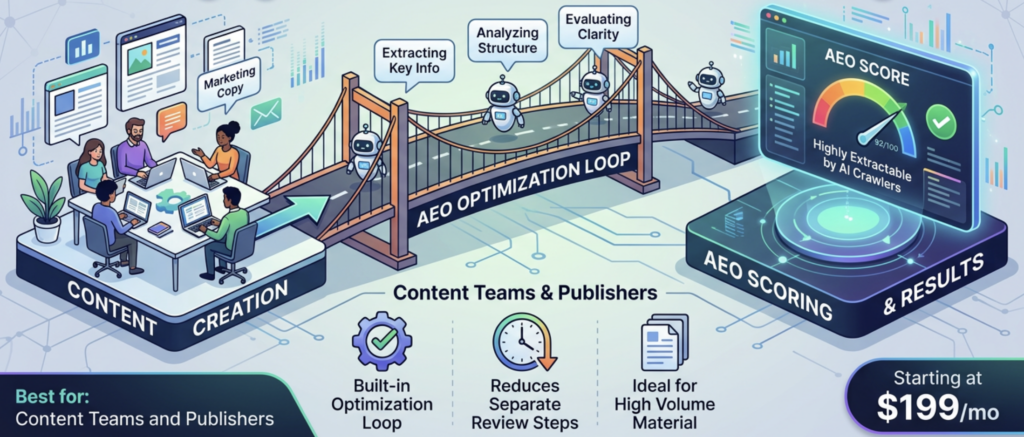
    #5 Writesonic GEO bridges content creation and AEO scoring. Every piece of content produced through the platform receives an “AEO Score” that evaluates how extractable it is by AI crawlers. For content-heavy teams producing high volumes of material, the built-in optimization loop reduces the need for a separate review step. Starting at $199/mo. Best for: Content teams and publishers.

    #6 Semrush AI is the path of least resistance for teams already running Semrush. The “AI Visibility Toolkit” lets marketers track AI Overview share alongside traditional keyword rankings in a single interface. It lacks the specialized Dark Query discovery that Topify offers, but the workflow integration is hard to replicate elsewhere. Starting at $99/mo as an add-on. Best for: Existing Semrush users and SEO-heavy teams.

    #7 Zadoosh operates differently from every other tool on this list. It’s a productized service focused on building “Proof Density”: coordinated Reddit engagement, editorial guest posts, and unprompted brand mentions across independent platforms simultaneously. This builds the third-party credibility that causes AI models to treat a brand as a trusted entity. Starting at $2,000–$5,000/mo. Best for: SaaS brands at $1–$10M ARR in hyper-competitive categories.


    Matching the Best AEO Tools to Your Growth Stage

    Not every team needs the same stack. Here’s how to think about it based on where your company is.

    Seed-stage and bootstrapped (under $1M ARR). Efficiency is the constraint. Topify Basic at $99/mo or Peec AI at €85/mo give you broad engine coverage at a manageable cost — enough to identify which subreddits and forums are driving AI citations in your category and where to focus early community-building efforts.

    Growth-stage scaleup ($1M–$10M ARR). At this stage, “Time-to-Insight” is a competitive moat. Topify Pro at $199/mo or AthenaHQ at $295/mo both offer the automation layer that lets growth teams ship optimized content faster than competitors working manually. For teams where SQL generation from AI channels has become a board-level metric, Topify’s CVR integration makes the ROI case straightforward.

    Enterprise and category leaders ($10M+ ARR). Compliance, multi-market tracking, and prompt volume data become the priorities. Profound’s enterprise tier handles SOC 2 and HIPAA requirements, and its 400 million conversation dataset gives large organizations the confidence to prioritize their AEO roadmap based on actual demand rather than estimated trends.


    What These Best AEO Tools Can’t Do for You

    Buying a tool solves the measurement problem. It doesn’t solve the content problem.

    AI models in 2026 are increasingly sensitive to generic, automated content. They prioritize what researchers call “Substantive Value”: original research, unique case studies, and expert-authored insights that appear on independent high-authority domains. A tool can surface the gap. It can’t manufacture the credibility required to fill it.

    Three things still require human judgment:

    Original research gives AI models a reason to cite you specifically. LLMs are far more likely to reference a brand that publishes unique statistics or proprietary data than one that rephrases what’s already on the internet.

    Entity consistency matters more than most teams realize. Your brand name, product terminology, and category positioning need to appear consistently across your website, G2, Reddit, and Wikipedia for models to “solidify” you as a recognized entity in their knowledge graph.

    Source analysis is where tools like Topify provide disproportionate value post-purchase. If Perplexity is citing a specific niche technical blog to recommend your competitor, your content strategy needs to target that exact source. Understanding the “information diet” of AI models in your category is what separates teams that move the needle from teams that generate reports.

    Increasing citation frequency from 5% to 30% in your category typically produces an ROI exceeding 700% on AEO tooling investment. The tools on this list give you the roadmap. The execution is still on you.


    Conclusion

    The “Winner-Takes-Most” dynamic in AI search is real. When a buyer queries an AI platform for software in your category, the model names two or three vendors. The gap between being first and being absent is worth tens of millions in pipeline at scale.

    For most SaaS teams, Topify offers the most direct path from measurement to action — with broad platform coverage, SaaS-specific prompt intelligence, and a CVR framework that speaks the language CMOs need for budget justification. Profound and AthenaHQ are worth evaluating for enterprise compliance requirements and velocity-first use cases respectively, but neither closes the loop between data and execution as directly.

    The question isn’t whether your brand has an AI visibility problem. At this point, most SaaS brands do. The question is how fast you’re moving to fix it.


    FAQ

    Q: What is the difference between AEO and GEO for SaaS brands?

    A: AEO (Answer Engine Optimization) is a tactical discipline focused on structuring content for direct extraction by AI platforms — typically through FAQ schemas and answer-first formatting. GEO (Generative Engine Optimization) is a broader strategic framework designed to make a brand the default “Source of Truth” across synthesis platforms like ChatGPT and Perplexity. In practice, AEO is the execution layer; GEO is the overarching strategy that determines where and how you build authority.

    Q: How do I know if my SaaS brand needs an AEO tool in 2026?

    A: Query ChatGPT or Perplexity for your category with a specific use-case prompt — for example, “Best billing software for usage-based SaaS.” If your brand doesn’t appear in the top three recommendations despite strong traditional SEO, you have a visibility gap. Manual spot-checking works for initial diagnosis, but it can’t scale to cover the full range of prompts your buyers are actually using.

    Q: Can I track AEO performance without a paid tool?

    A: You can manually log prompts and track brand presence in ChatGPT and Perplexity on a weekly basis. The limitation is that manual tracking can’t surface Dark Queries (prompts with high AI volume but no traditional search data), run competitor benchmarking at scale, or map which sources AI models are citing in your category. For baseline awareness, manual tracking is a reasonable starting point. For systematic optimization, a dedicated tool is necessary.

    Q: Which AI platforms matter most for B2B SaaS discovery?

    A: ChatGPT remains the highest-volume platform for general vendor research. Perplexity is critical for deep-dive technical comparisons, where buyers evaluate integration specs, security certifications, and pricing structures. Google AI Overviews matter for capturing buyers still operating within traditional search workflows. Coverage across all three is the minimum viable baseline for a SaaS brand taking AEO seriously in 2026.


    Read More

  • 10 Best AI SEO Tools in 2026

    10 Best AI SEO Tools in 2026

    You updated your content. Your rankings held. But your brand barely shows up in ChatGPT, and Perplexity is recommending your competitor instead. Traditional SEO did its job. The problem is that the job description changed.

    AI SEO tools aren’t all the same animal anymore. Some optimize for Google’s AI Overviews. Some track brand mentions inside LLM responses. Some just slap “AI” on a keyword tool and call it a day.

    This list cuts through that.

    Here are the 10 AI SEO tools worth your attention in 2026, with an honest take on what each one actually does well.

    What Changed in AI SEO in 2026 (and What Didn’t)

    The tools that made “best of” lists in 2024 aren’t necessarily the right picks today. Zero-click searches now account for roughly 60% of traditional search queries, which means the game shifted from getting clicked to getting cited. That’s a different optimization problem entirely.

    What didn’t change: backlinks still matter, content quality still matters, and technical health is still table stakes. What changed is the layer above all of that. Being indexed is no longer enough. You also need to be synthesized.

    The tools below reflect that two-layer reality: traditional SEO depth on one side, generative visibility tracking on the other.

    The 10 AI SEO Tools Worth Your Attention in 2026

    1. Topify

    Best for: Teams that need to track and improve AI search visibility across multiple platforms

    Most AI SEO platforms tell you what’s happening on Google. Topify tells you what ChatGPT, Gemini, Perplexity, and seven other major AI platforms are actually saying about your brand.

    That distinction matters. AI-driven traffic converts roughly 5x better than standard organic search traffic, and only 19% of users click through to sources cited in an AI overview. The ones who do are your highest-intent audience. Topify is built around the premise that being cited is the new ranking.

    The platform tracks seven metrics simultaneously: visibility, sentiment, position, volume, mentions, intent, and CVR (Conversion Visibility Rate). For competitive intelligence, the Competitor Monitoring feature automatically detects which brands AI engines are recommending instead of yours, with real-time positioning data. Source Analysis goes a layer deeper, showing exactly which third-party domains AI platforms are citing, which helps identify content gaps before they widen.

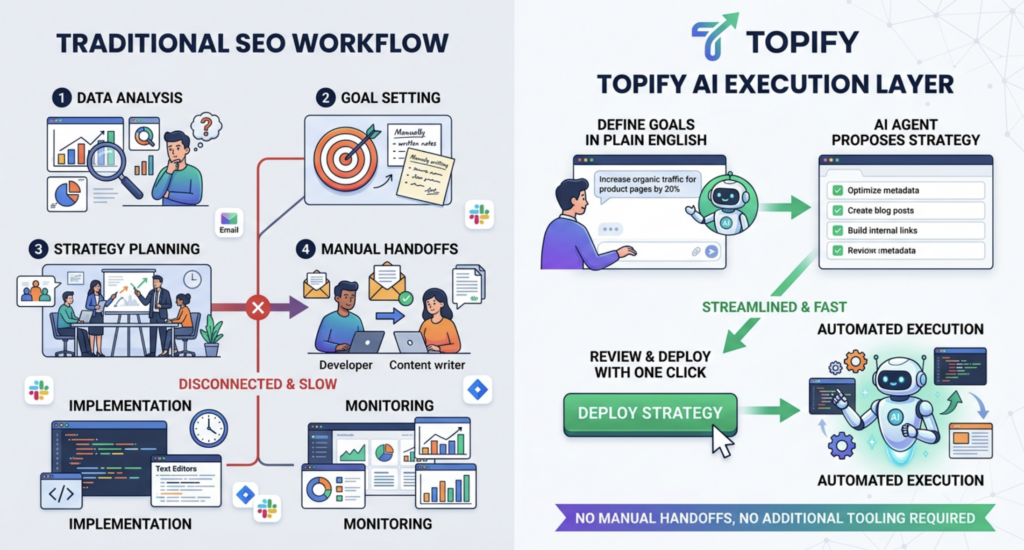
    What sets Topify apart from generic SEO dashboards is the execution layer. Its AI agent doesn’t just surface data. You define your goals in plain English, review the proposed strategy, and deploy with a single click. No manual handoffs, no additional workflow tooling required.

    Topify was built by a team that includes an LLM researcher with 2,000+ academic citations and a GEO strategy lead who scaled a site from zero to 1 million organic visitors. That background shows in how precisely the platform models AI citation behavior.

    The coverage spans ChatGPT, Gemini, Perplexity, DeepSeek, and several other regional AI platforms, which matters if your audience is global. Most competitors track two or three engines and call it comprehensive.

    Pricing: Starts at $99/month (Basic plan: 100 prompts, 4 platforms, 4 projects). Pro at $199/month covers 250 prompts and 8 projects. Enterprise from $499/month with a dedicated account manager.

    Get started with Topify

    2. Semrush One

    Best for: Large teams that need predictive intelligence across both traditional and AI search

    Semrush has evolved from a keyword database into something closer to a command center. Its AI Visibility Toolkit provides real-time brand mention tracking across ChatGPT, Gemini, and Perplexity. The Copilot dashboard assistant proactively flags schema errors and entity mapping issues before they affect citation frequency, which is a meaningful shift from reactive to predictive monitoring.

    For scale, the Keyword Magic Tool clusters billions of terms by intent automatically. It’s a strong choice for enterprises already deep in the Semrush ecosystem, though the AI visibility features are gated behind higher-tier plans.

    Pricing: Starts around $139/month.

    3. SE Ranking

    Best for: Challenger brands that need daily data and can’t afford weekly lag

    Most platforms update their AI visibility data weekly. SE Ranking does it daily, which matters more than it sounds. AI responses can shift within hours after a major news cycle or a competitor’s content push.

    The “No Cited” feature is particularly sharp: it identifies specific prompts where competitors receive citations but your brand doesn’t. That’s automated gap analysis that used to require manual prompt testing. Its AI Search Score synthesizes visibility across up to nine platforms into a single metric, useful for executive reporting.

    Pricing: Starts at $65/month.

    4. Ahrefs

    Best for: Authority-first strategies and backlink intelligence

    Ahrefs remains the benchmark for backlink data, and backlinks are still a training signal for LLMs in 2026. Its Brand Radar monitors visibility across 243 million monthly prompts derived from real “People Also Ask” data. The Link Intent score predicts how much generative traffic a new page will likely receive based on its existing authority profile.

    The AI Content Helper identifies specific subtopics where a page is under-optimized compared to the top entities cited by Gemini and GPT-4, enabling surgical updates rather than full rewrites.

    Pricing: Starts at $129/month.

    5. Surfer SEO

    Best for: Content teams producing at volume without losing entity coverage

    Surfer’s Content Score was updated in 2026 to reflect semantic relationships and factual density, which are primary drivers of AI citations. Its Auto-Optimize feature has reduced content refresh labor by over 60% for mid-size content teams, according to the platform’s own data.

    The Humanizer feature addresses what the industry calls the “Bland Tax”: AI-generated content that reads synthetically and gets filtered by both users and algorithms. Worth noting that Surfer is primarily a content optimization tool, not an AI visibility tracker.

    Pricing: Starts at $89/month.

    6. Clearscope

    Best for: Media brands and editorial teams with strict content quality standards

    Clearscope’s Query Fan-out Awareness analyzes how AI models expand a single query into related sub-queries. This helps writers build content that covers the full conversational journey, not just the primary question. Its grading system functions like an academic benchmark, calibrated to the quality thresholds required for inclusion in Google’s AI Overviews.

    It’s the right tool if your primary bottleneck is editorial quality, not visibility tracking.

    Pricing: Starts at $189/month.

    7. Frase

    Best for: Solo writers and small teams focused on AEO and structured content

    Frase remains the most accessible entry point for Answer Engine Optimization (AEO). Its AI Agent generates a structured content brief from the top 20 SERP results in under 60 seconds, highlighting the questions AI engines are most likely to extract for summaries. The dual scoring system shows alignment with both traditional algorithms and generative synthesis patterns simultaneously.

    For small teams building FAQ-heavy content strategies, it’s the most affordable option on this list that understands the AEO layer.

    Pricing: Starts at $45/month.

    8. MarketMuse

    Best for: Content strategists building topical authority over 6- to 12-month horizons

    MarketMuse’s Personalized Difficulty Scores are a standout feature: they show which topics your specific domain is most likely to win, based on its existing semantic footprint rather than generic competition metrics. The Automated Content Inventory surfaces topical gaps that prevent LLMs from recognizing a site as an authority in its space.

    It’s a strategy tool, not an execution tool. You’ll want to pair it with something else for content production.

    Pricing: Starts at $149/month.

    9. Alli AI

    Best for: Technical teams managing large sites with JavaScript architecture problems

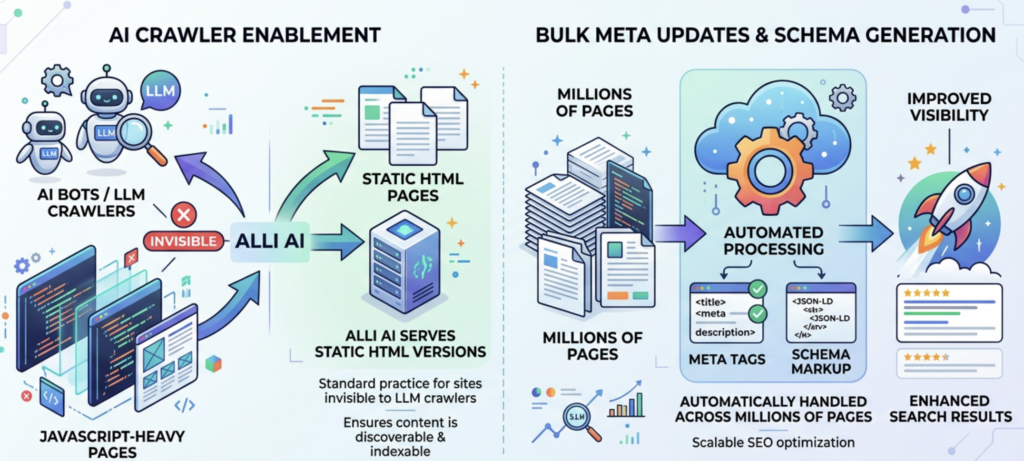
    Alli AI’s strongest contribution is AI Crawler Enablement. It serves static HTML versions of JavaScript-heavy pages specifically to AI bots, which is standard practice for sites that would otherwise be invisible to LLM crawlers. Bulk meta updates and schema generation across millions of pages are handled automatically.

    If your site architecture is clean, this tool is less relevant. If it’s not, it’s close to essential.

    Pricing: Starts at $299/month.

    10. LLMClicks.ai

    Best for: Brands actively managing AI-generated misinformation about their products

    Generative engines hallucinate. That’s not a future risk; it’s a current one.

    LLMClicks monitors AI responses for incorrect product descriptions, outdated pricing, and competitive misrepresentation. It identifies the specific third-party sites being cited to form those errors, so you can target corrections at the source rather than chasing the symptoms.

    For brands in regulated industries or with complex product lines, this kind of reputation monitoring is worth prioritizing before anything else.

    Pricing: Contact for pricing.

    How These 10 AI SEO Tools Stack Up Side by Side

    ToolKeyword ResearchContent OptimizationAI Visibility TrackingCompetitor MonitoringStarts At
    Topify✓✓✓✓$99/mo
    Semrush One✓✓✓✓✓✓$139/mo
    SE Ranking✓✓✓✓✓$65/mo
    Ahrefs✓✓✓✓✓$129/mo
    Surfer SEO✓✓$89/mo
    Clearscope✓✓$189/mo
    Frase✓✓✓$45/mo
    MarketMuse✓✓✓$149/mo
    Alli AI$299/mo
    LLMClicks✓Custom

    ✓✓ = core strength / ✓ = secondary capability

    AI SEO Stops at Google. GEO Doesn’t.

    Here’s the thing most AI SEO tools miss: they’re still optimizing for a Google-first world.

    65% of enterprise marketing leaders are dedicating at least 25% of their 2026 marketing budgets to AI search optimization. The reason is straightforward: AI-driven traffic converts at roughly 10%, compared to under 2% for traditional organic. That performance gap is hard to ignore once you see it in your own analytics.

    But if your tool doesn’t track what Perplexity says about you, or how Gemini frames your product against competitors, you’re only seeing half the picture.

    Generative Engine Optimization (GEO) is the discipline built specifically for that blind spot. It’s less about keywords and more about entity consistency, citation velocity, and whether AI models trust your brand’s informational signals across the full digital landscape. If your brand’s LinkedIn, Reddit mentions, and website are telling slightly different stories, generative engines detect that inconsistency and it affects how often you get cited.

    That’s the gap Topify was designed to close. While other platforms track rankings, Topify tracks whether AI is recommending you, and what it would take to change that.

    5 Questions to Ask Before You Subscribe to Any AI SEO Tool

    Not every tool on this list is the right fit for every team. These five filters help narrow it down fast.

    1. Does your problem live in content creation or visibility tracking? Surfer, Clearscope, and Frase solve content problems. Topify and SE Ranking solve tracking problems. They serve different functions and aren’t interchangeable.

    2. How often does your market move? If you’re in a competitive category where AI responses shift quickly, weekly refresh rates aren’t enough. Daily data from SE Ranking or real-time alerts from Topify matter here.

    3. Are you optimizing for Google or for AI search platforms? These require different tools and different strategies. Most growth-stage teams need both layers covered, which typically means pairing a content tool with a GEO tracking platform.

    4. What’s your technical architecture? If your site runs heavy JavaScript, AI crawlers may not be reading it correctly. That’s an Alli AI problem before it’s anything else.

    5. Are there active hallucinations about your brand in AI responses? If competitors or outdated sources are creating false narratives inside LLM responses, reputation monitoring comes before visibility optimization.

    Conclusion

    The right AI SEO tool in 2026 depends entirely on which layer of the problem you’re solving. Traditional SEO platforms like Surfer and Ahrefs still have a place. But if you’re not tracking what AI engines say about your brand, you’re operating without half your data.

    87% of enterprise leaders expect major AI platforms to complete closed-loop transactions within the next 12 months. The brands that get cited consistently now will have a structural advantage when those agent-driven workflows become mainstream. The window to build that citation authority isn’t open indefinitely.

    If AI search visibility is the gap you’re trying to close, Topify covers tracking, competitive benchmarking, and execution in one platform. Get started here.

    FAQ

    Q: What’s the difference between AI SEO tools and traditional SEO tools?

    A: Traditional SEO tools optimize for Google’s link-based ranking algorithm. AI SEO tools also track how your brand appears in generative AI responses from platforms like ChatGPT, Gemini, and Perplexity. In 2026, effective search optimization typically requires both layers, since a meaningful share of discovery now happens inside AI responses rather than on a search results page.

    Q: Can AI SEO tools replace an SEO specialist?

    A: Not fully. Automation now handles roughly 60-70% of routine tasks like audits, content scaling, and technical fixes. But human judgment is still needed for strategy, entity consistency management, and the editorial nuance that prevents AI-generated content from being filtered out for reading synthetically. The role has shifted from execution to orchestration.

    Q: What is GEO, and how does it relate to AI SEO?

    A: GEO (Generative Engine Optimization) is the practice of optimizing specifically for how AI systems synthesize, cite, and recommend your brand. It’s the layer of AI SEO that traditional platforms weren’t built for. Instead of keywords, GEO focuses on entity signals, citation velocity, and machine readability across the full digital landscape where LLMs gather training and retrieval data.

    Q: Do these tools work for small websites or solo founders?

    A: Yes, selectively. Frase ($45/month) and SE Ranking ($65/month) are the most accessible entry points. Topify’s Basic plan at $99/month is designed for smaller teams that want AI visibility tracking without enterprise pricing. For teams just starting out, the priority should be: content quality first, then visibility tracking once you have something worth tracking.

    Read More

  • llms.txt: What It Is and How to Create One

    llms.txt: What It Is and How to Create One

    Your robots.txt tells crawlers what not to touch. Your sitemap tells indexers where everything lives. But neither one tells an AI model what your site is actually about, what it should prioritize, or how to represent your brand accurately in a generated answer.

    That’s the gap llms.txt was built to fill.

    The File Search Engines Never Needed, But AI Does

    Since 1994, robots.txt has been the standard handshake between websites and automated programs. Its logic is defensive: it defines what crawlers shouldn’t access. That was enough for the keyword-indexing era.

    Large language models work differently. Systems like ChatGPT, Perplexity, and Claude don’t just index pages. They read, synthesize, and generate answers, often from a limited context window where every token counts. A typical HTML page is packed with navigation menus, JavaScript, tracking scripts, and visual rendering logic that AI systems have to parse before reaching the actual content. That processing isn’t free.

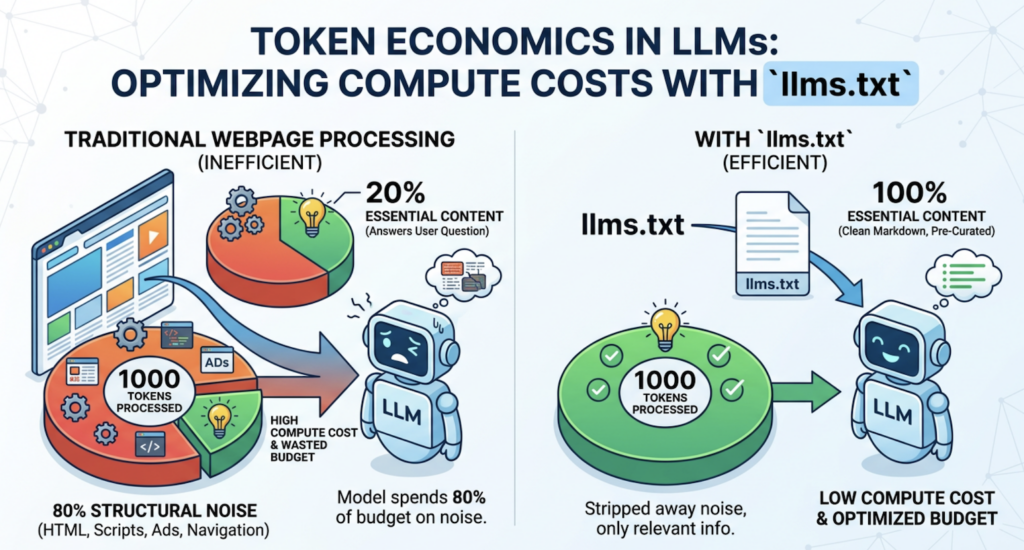
    Token economics matter here. In a large language model, processing 1,000 tokens costs a fixed amount of compute. If 80% of a webpage is structural noise, the model spends 80% of its budget on content that doesn’t answer the user’s question. llms.txt solves this by offering a clean, pre-curated Markdown file that strips away everything except what’s essential.

    The result: compared to raw HTML, llms.txt can reduce token consumption by over 90%.

    ProtocolCore LogicPrimary AudienceFormatPurpose
    robots.txtAccess controlSearch engine crawlersPlain text directives“Don’t crawl this”
    sitemap.xmlInventorySearch engine indexersXML URL list“Everything lives here”
    llms.txtContent guidanceLLMs, AI agents, RAG systemsStructured Markdown“Here’s what matters and why”

    What’s Actually Inside an llms.txt File

    llms.txt is a standard Markdown file placed at your root domain: yourdomain.com/llms.txt. The format was proposed by Jeremy Howard, co-founder of Answer.ai, in September 2024. It’s intentionally minimal.

    A well-structured file typically contains four elements:

    An H1 title with the project or brand name. This is the only required field.

    A summary block, written as a Markdown blockquote (>), that gives the AI instant macro context about what the site does and who it serves.

    H2 sections that group links by category: core docs, product pages, policies, FAQs.

    Annotated link lists in the format - [Title](URL): short description. The description is the critical part. It lets the AI assess a page’s relevance without requesting the URL first.

    Here’s a clean example:

    # Acme Analytics
    
    > Acme Analytics helps B2B marketing teams track brand visibility across AI search platforms including ChatGPT, Gemini, and Perplexity.
    
    ## Product
    
    - [How It Works](https://acme.com/how-it-works): Overview of AI visibility tracking and competitor benchmarking features.
    - [Pricing](https://acme.com/pricing): Subscription plans for teams and agencies.
    
    ## Documentation
    
    - [Quick Start Guide](https://docs.acme.com/quickstart): Get your first AI visibility report in under 5 minutes.
    - [API Reference](https://docs.acme.com/api): Full endpoint documentation and authentication guide.
    
    ## Optional
    
    - [Changelog](https://acme.com/changelog): Historical product updates and feature releases.
    

    The ## Optional section signals lower priority. When an AI system is working within a strict token budget, it can skip this block without losing critical information.

    5 Reasons Your Site Needs an llms.txt Right Now

    1. AI citation systems favor structured sources.

    When Perplexity or SearchGPT generates an answer, it runs a rapid source evaluation. Given two sites with comparable content, AI systems tend to reference whichever one has lower parsing friction. A clean llms.txt lowers that friction and raises your probability of being cited first.

    2. LLMs process Markdown hierarchy more reliably than HTML semantics.

    Models are significantly more responsive to Markdown heading hierarchy (H1, H2, H3) than to equivalent HTML tags like <section> and <article>. llms.txt exposes your site’s information architecture in the format LLMs actually prefer, reducing the chance that key product details get buried or misread.

    3. Early adopters are already seeing measurable gains.

    Technical companies like Stripe, Vercel, OpenAI, and Anthropic moved fast on this standard. A case study from dev5310, a technical agency, showed that after submitting llms.txt, Google’s AI Mode began treating it as an authoritative identity layer for the company, prioritizing structured details from the file in generated summaries. This is the kind of first-mover advantage that shrinks quickly once the practice becomes standard.

    4. llms.txt is a foundational GEO asset.

    Generative Engine Optimization (GEO) is less about keyword density and more about citation frequency and answer accuracy. llms.txt ensures that when AI systems reason about your brand, they’re starting from a curated, accurate source you control, rather than a patchwork of third-party mentions, outdated press coverage, and misread product pages.

    That distinction matters. AI hallucinations often originate from information gaps, not model failures.

    5. It gives you something measurable.

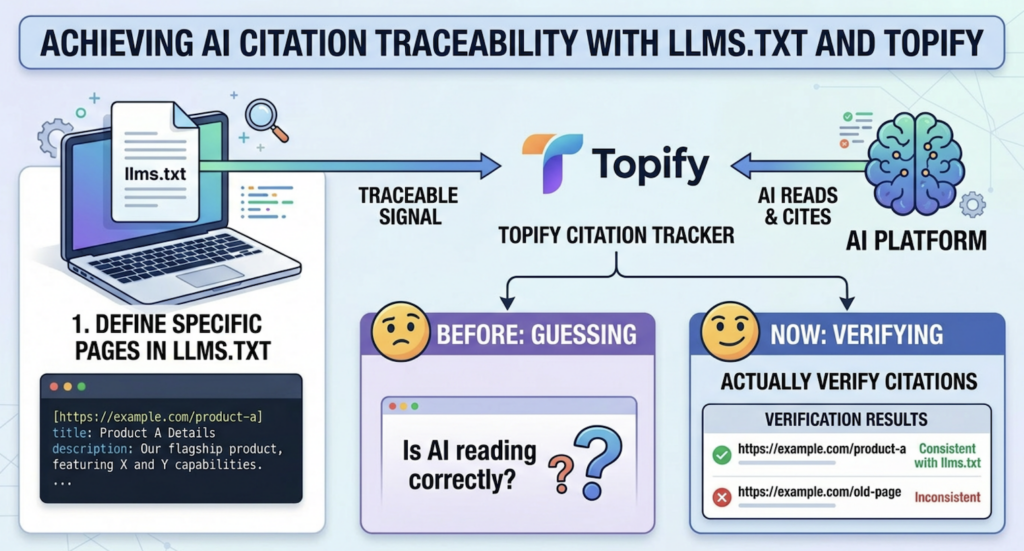
    When you define specific pages in llms.txt with structured descriptions, you create a traceable signal. Tools like Topifycan track which URLs AI platforms are citing and whether those citations align with the content you’ve surfaced through llms.txt. You go from guessing whether AI is reading your site correctly to actually verifying it.

    How to Create an llms.txt File: Step-by-Step

    Step 1: Identify Your Core Information Assets

    Don’t try to include everything. An overloaded llms.txt creates the same token-waste problem it was designed to solve.

    Focus on four categories:

    • Brand identity: who you are, what you do, who you serve
    • Product and pricing pages: anything that drives decisions
    • Key documentation: guides that reduce support load
    • Policy files: pricing, terms, security, and return policies, where accuracy in AI answers directly affects customer trust

    Step 2: Write in Standard Markdown Format

    Use absolute URLs, not relative paths. A link like /docs/quickstart will break when an AI system tries to resolve it without knowing your domain. Write https://yourdomain.com/docs/quickstart instead.

    Every link description should answer one question: why would the AI need this page? Be specific. “Overview of features” is weak. “Explains how the sentiment scoring algorithm works across 7 AI platforms” gives the model enough to decide if it’s relevant.

    Step 3: Place It at Your Root Directory

    The file must live at yourdomain.com/llms.txt. Most AI crawlers follow a standard scan pattern that checks the root first.

    If you run separate subdomains, such as docs.example.com, add a corresponding llms.txt to each root. The files can be different and should reflect the specific content scope of each subdomain.

    Step 4: Validate and Test

    Before publishing, run your file through a validator like Radarkit or Rankability to check formatting. After publishing, confirm it’s accessible via curl https://yourdomain.com/llms.txt and verify the HTTP status code is 200.

    Then do a live test. Ask ChatGPT, Perplexity, or Claude a question about your company’s product or documentation. If the model returns structured, accurate details that match your llms.txt content, it’s working. If it’s still pulling from stale third-party descriptions, you may need to add richer annotations or revisit the priority hierarchy in your file.

    llms.txt vs. llms-full.txt: Which One Do You Need?

    The original proposal from Jeremy Howard includes two formats. They serve fundamentally different use cases.

    Featurellms.txtllms-full.txt
    Primary roleStructured index (navigation)Complete content archive
    Typical file sizeUnder 10KBCan reach several MB
    AI handlingQuick scan, follows links on demandSingle-pass full read
    Best forReal-time AI search, brand discoveryDeveloper AI tools (Cursor, Copilot)
    Maintenance effortLow, update links as content changesHigh, requires full-content sync
    Token footprintMinimalSignificant

    For most marketing sites, SaaS landing pages, and product-focused domains: llms.txt alone is sufficient.

    For API-first companies, developer tool providers, and documentation-heavy platforms: both files are worth maintaining. llms.txt handles AI search discovery. llms-full.txt gives AI coding assistants the full context they need for deep technical work, without requiring multiple round trips to individual doc pages.

    The trade-off is maintenance. llms-full.txt requires you to sync actual content, not just links. If your documentation updates frequently, that overhead compounds quickly.

    After You Publish It, How Do You Know It’s Working?

    Publishing llms.txt is step one. Knowing whether it’s actually influencing AI behavior requires different tooling than traditional analytics.

    Standard tools like Google Analytics don’t capture LLM server-side requests. You won’t see GPTBot or PerplexityBot visits in most dashboards unless you’re actively parsing server logs for those user agents.

    What you’re actually trying to measure is citation behavior: which URLs AI platforms are referencing, in what order, and whether those citations match the content hierarchy you defined in your llms.txt.

    Topify‘s Source Analysis feature tracks exactly this. It identifies the specific domains and URLs that AI platforms cite when answering questions in your category, and shows how citation patterns shift over time. If a competitor’s domain starts appearing more frequently in AI answers after a content update, that’s a signal. If a page you featured prominently in your llms.txt isn’t showing up in citations at all, that’s an optimization cue.

    Three metrics worth tracking after deployment:

    Share of AI Voice: the percentage of relevant AI-generated answers that mention your brand or cite your domain.

    Citation accuracy: whether AI descriptions of your product match the official positioning in your llms.txt, rather than older third-party summaries.

    Crawler activity: server log requests from GPTBot, OAI-SearchBot, PerplexityBot, and Claude-Web, particularly against your llms.txt endpoint. Frequency spikes often correlate with model updates or index refreshes.

    Treat this as an ongoing loop, not a one-time setup. Content changes, model behavior shifts, and citation patterns drift. A quarterly audit of your llms.txt, aligned to your major content releases, keeps the signal clean.

    Conclusion

    robots.txt told the internet what to block. llms.txt tells AI what to read first.

    The file itself is simple. What it represents isn’t: a deliberate shift from passive indexing to active AI navigation. For brands investing in GEO, it’s one of the highest-leverage steps you can take without touching your core content. You’re not rewriting pages; you’re giving AI the curator’s guide to what already exists.

    The companies that’ll have the clearest AI presence twelve months from now are the ones building that infrastructure today, not waiting for it to become a requirement.

    Start with your ten most important pages. Write clean descriptions. Ship the file. Then track whether AI citations actually reflect what you intended.


    FAQ

    Q: Is llms.txt an official web standard?

    A: Not yet. It hasn’t been ratified as an RFC by the IETF. It’s best described as a community consensus protocol. That said, the fact that Anthropic, OpenAI, Stripe, and Vercel have all deployed it on their own domains gives it significant de facto authority. Adoption is accelerating faster than formal standardization typically moves.

    Q: Do ChatGPT and Perplexity actually read llms.txt?

    A: Evidence from server log analysis and published case studies suggests yes, at least for high-authority or frequently queried domains. AI crawlers like GPTBot and PerplexityBot have been observed making direct requests to yourdomain.com/llms.txt as part of their retrieval optimization routines. This behavior isn’t guaranteed for every site, but it’s consistent enough that early implementation carries real upside with minimal downside.

    Q: How often should I update my llms.txt?

    A: Sync updates with your major content cycles. Any time pricing, product features, core team, or key documentation changes, update your llms.txt the same day. For everything else, a quarterly review is a reasonable baseline. Stale descriptions are one of the primary causes of AI-generated content misrepresenting a brand’s current positioning.

    Q: Does llms.txt affect traditional SEO rankings?

    A: There’s no evidence that Google’s core ranking algorithm treats llms.txt as a direct ranking signal. That said, better-structured entity signals can improve how search engines understand site architecture and topical authority over time. The more meaningful impact is on AI-generated search surfaces like Google AI Overviews, where structured, machine-readable context tends to get prioritized over raw HTML content.


    Read More

  • How to Get Your Brand Into Google AI Overviews

    How to Get Your Brand Into Google AI Overviews

    Your organic rankings didn’t drop. Your content didn’t get penalized. But your traffic is down double digits anyway.

    That’s the AI Overviews effect. Google now generates a synthesized summary above every organic result for over 50% of informational searches. If your brand isn’t in that summary, users never scroll far enough to find you.

    The fix isn’t guessing. It’s a three-step process: track where you stand, find the content gap, and engineer content that AI can actually cite.


    Your Rankings Didn’t Drop. Google Just Built a Wall Above Them.

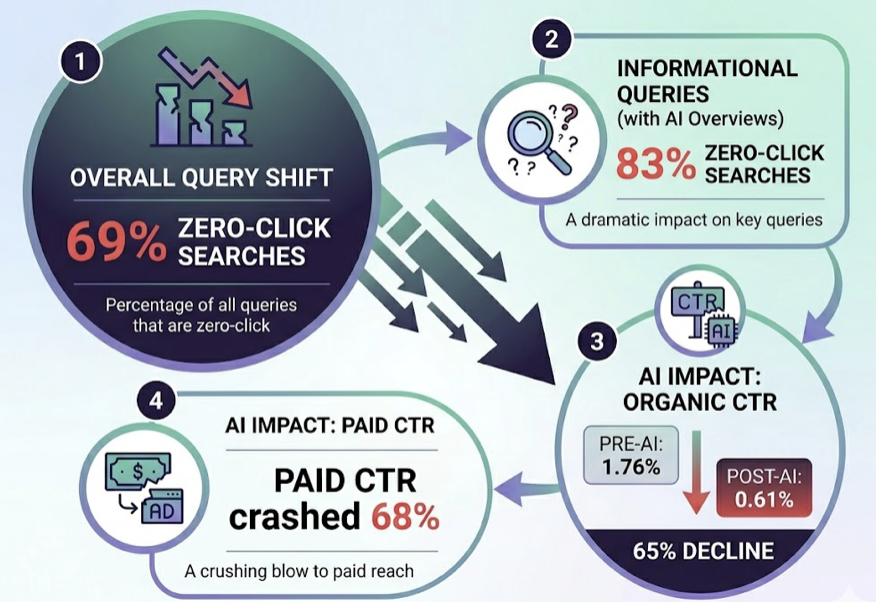
    The numbers are stark. For queries where AI Overviews appear, organic click-through rates have collapsed from 1.76% to 0.61% between June 2024 and September 2025 — a 62.3% decline. Paid search CTR dropped 51.4% over the same period.

    What makes this unusual is the decoupling. Rankings hold steady. Traffic doesn’t.

    Google calls it a “satisfaction gap.” The AI summary answers the user’s question well enough that they stop scrolling. No click needed. Your page never gets visited.

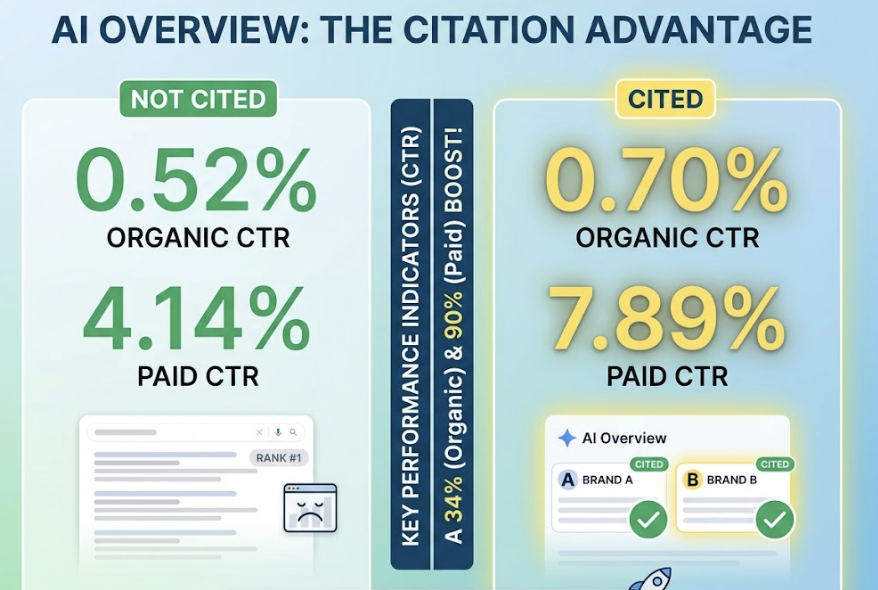
    The second-order insight matters more, though. Brands cited inside the AI Overview don’t just survive — they outperform. Cited brands see 0.70% organic CTR versus 0.52% for non-cited brands, and the paid CTR gap is even wider: 7.89% versus 4.14%. Being in the summary is worth more than being ranked #1 below it.

    On mobile — which drives roughly two-thirds of all search volume — an expanded AI Overview can occupy the entire visible screen. First place in organic sits below the fold. First place in the summary sits at the top of the world.


    What Google AI Overviews Actually Pull From

    Most SEOs assume AI Overviews work like Featured Snippets: find the best-ranked page, pull a paragraph. That’s not what’s happening.

    Featured Snippets are link-retrieval systems. One page, one extract, one query. AI Overviews use multi-source synthesis. Google’s AI reads multiple trusted sources and generates a combined narrative — it doesn’t just lift text, it interprets and recombines it.

    In 2025, Google formalized this with the MUVERA framework (Multi-Vector Retrieval Analysis). Instead of compressing a query into a single vector, MUVERA runs a two-stage pipeline: broad retrieval first, then semantic re-ranking at the passage level. It looks for content organized into modular, self-contained blocks — not long-form narratives.

    The practical consequence: only 32% of URLs cited in AI-generated answers match the traditional top-10 organic results. Domain authority and backlinks still matter, but they’re no longer the deciding factor for citation. Structural clarity and content modularity are.

    The Domains Google Keeps Citing

    Analysis of 46 million citations across 36 million AI Overviews reveals a concentration problem for brands. Wikipedia (11.22%), YouTube (9.51%), Reddit (5.82%), and Google’s own properties (5.62%) dominate the citation landscape. That’s roughly 43% of all AI citations flowing back to Google’s ecosystem or a handful of mega-platforms.

    Reddit’s surge is particularly revealing — citation frequency jumped 450% between March and June 2025. Google is treating community-driven discussion as a stronger “experience” signal than polished brand pages. That has real implications for where your optimization dollars should go.


    Step 1: Find Out If Your Brand Appears in Google AI Overviews

    Before optimizing anything, you need a baseline. Most brands skip this step and optimize blind.

    Start manually. Run your brand name paired with industry-specific question queries — the kind of language a customer uses during research, not purchase. “Best [category] for [use case].” “How does [product type] work.” “What’s the difference between X and Y.” These are the query patterns most likely to trigger AI Overviews.

    Note three things: whether an AI Overview appears, whether your brand is mentioned in it, and which competitors are cited instead.

    Manual testing gives you a reality check. It doesn’t give you a trend.

    Scale It with a Tracking Tool

    The non-deterministic nature of AI Overviews is the problem. Google generates summaries in real time. Results shift by user, session, and query variation. A single manual check tells you what happened once. It tells you nothing about whether things are getting better or worse.

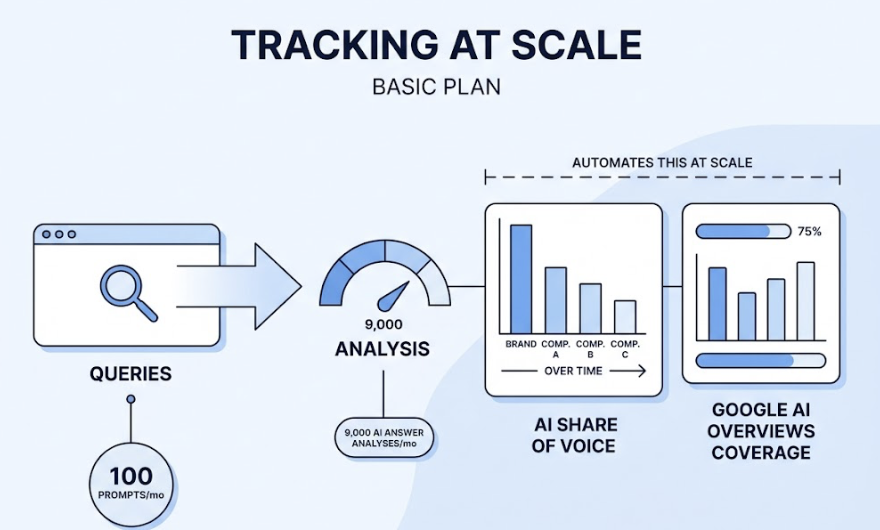
    Topify‘s Visibility Tracking automates this at scale. The Basic plan ($99/month) supports 100 prompts and 9,000 AI answer analyses per month — enough to track a meaningful cross-section of the queries your customers actually use, including Google AI Overviews coverage. You get an AI Share of Voice metric that benchmarks your brand frequency against top competitors over time, not just a snapshot.

    That shift from “I checked once” to “I can see a 90-day trend” is what makes optimization decisions defensible.


    Step 2: Identify the Content Gaps Keeping You Out

    Once you know your brand isn’t being cited — or isn’t being cited often enough — the next question is why.

    Source Analysis answers it. The logic: if Google is citing Competitor A and not you on the same query, there’s something in Competitor A’s content that signals citability to the AI. Your job is to identify what that is.

    Common gaps fall into three categories. First, structural gaps: your content is written as flowing prose, not modular blocks. MUVERA’s passage-level indexing rewards self-contained sections that answer a specific sub-question within the first 100 words. Second, evidence gaps: your content makes claims without data. AI systems prioritize fact-backed content with clear sourcing. Third, E-E-A-T gaps: no author byline, no credentials, no first-hand experience signals. Google’s 2025 Quality Rater Guidelines put “Experience” as the primary differentiator — a product review with original screenshots outranks a polished summary without them.

    Topify’s Source Analysis surfaces the exact domains and content types Google is pulling from in your niche. If the AI is citing Reddit threads, the gap is community presence. If it’s citing structured guides, the gap is content architecture.

    What “AI-Citable Content” Looks Like

    61% of AI Overviews use unordered lists. 22% use short factual paragraphs. Ordered lists account for 12%. Data tables, while rare at around 5%, are highly citable for pricing and comparison content.

    The pattern is clear: AI doesn’t favor long-form storytelling. It favors structured information that can be extracted without interpretation.


    Step 3: Build Content Google AI Overviews Will Actually Quote

    The framework for AI-citable content is Answer Engine Optimization (AEO). Here’s what it looks like in practice.

    The 100-Word Answer Block. Every key section should open with an 80–100 word direct answer to the implied question of that heading. Write the conclusion first. The AI looks for the “TL;DR” it can lift without reading the rest of the section.

    Question-format headings. Rewrite H2 and H3 headings to mirror natural language queries. “How does [product] reduce cost?” performs better than “Cost Reduction Benefits.” MUVERA’s semantic matching favors headings that align with how users actually phrase their questions.
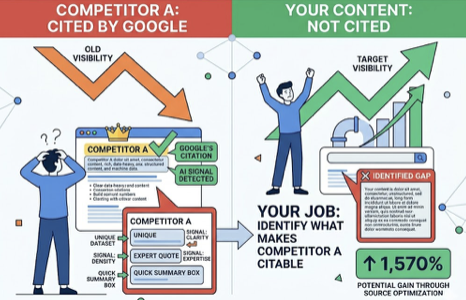
    Data as authority signals. AI systems treat statistics and cited research as trust indicators. Every key claim should carry a number or a source. Proprietary data — original research, internal test results, first-hand case studies — is particularly valuable because it offers something Wikipedia and Reddit don’t.

    How to Optimize Existing Pages for AI Overviews SEO

    You don’t need to rebuild your site. Targeted edits to top-performing pages produce faster results.

    Start with FAQ and HowTo schema markup. FAQ Schema maps question-and-answer pairs directly in a format AI can parse without interpretation. HowTo Schema signals procedural content structure. Organization Schema helps AI correctly identify your brand as a distinct entity — headquarters, social links, founders — which improves citation consistency across queries.

    Internal linking also matters. Pages that sit within a clear pillar-cluster hierarchy signal content modularity to the crawler. A standalone blog post is harder for MUVERA to contextualize than one that belongs to a structured topic cluster.

    Off-page optimization rounds it out. Getting your brand cited in industry publications, forums, and niche outlets that Google already trusts creates the “off-page AEO” layer that no amount of on-site schema can replicate.


    The Mistake Most Brands Make: Optimizing Without Tracking

    Here’s the failure mode. A team audits their content, restructures three key pages, adds FAQ schema, and waits. Three months later, traffic is flat. Nobody knows if AI Overviews shifted, if the pages got cited, or if the optimization even landed.

    Without tracking, optimization is guesswork with extra steps.

    The feedback loop that makes AI Overviews optimization work is: set a prompt corpus → track citation frequency → detect changes → iterate. That loop requires automation because AI responses vary by session and can drift over weeks without any single obvious signal.

    Topify closes that loop. Visibility Tracking shows you whether your citation frequency is trending up or down across your tracked prompts. Source Analysis shows whether the domains Google is citing in your niche have changed — sometimes a competitor publishes a piece of original research that suddenly displaces your page. You want to know that the week it happens, not the quarter after.

    The Basic plan covers 100 prompts and 9,000 AI answer analyses monthly. For teams managing a focused set of high-value queries, that’s enough to run a systematic optimization program rather than a periodic audit.

    AI-referred traffic converts at approximately 2.3x the rate of traditional organic traffic. The ROI case for systematic tracking is straightforward.


    Conclusion

    The brands winning Google AI Overviews aren’t doing anything exotic. They tracked where they stood. They found the content gap between them and the cited sources. They restructured pages to answer questions directly, in a format AI can extract.

    That’s it. Track. Find the gap. Optimize the structure.

    What doesn’t work: assuming that organic ranking translates to AI citation, or that a one-time content audit is enough. AI Overviews are non-deterministic — they shift as Google updates its models, as competitors publish new content, and as query patterns evolve. Monitoring has to be ongoing.

    If you’re starting from zero, the clearest first step is understanding where your brand currently stands across the prompts your customers are actually typing. Topify’s Basic plan gets you that data for $99/month — and it gives you the source analysis to understand not just whether you’re missing, but why.


    FAQ

    What triggers Google AI Overviews to appear? 

    AI Overviews appear most often for complex informational queries, multi-step explanations, and comparison-based searches. Conversational, longer queries trigger them far more reliably than short keyword searches.

    How is AI Overviews optimization different from traditional SEO? 

    Traditional SEO targets keyword density, backlinks, and domain authority to rank links. AI Overviews optimization focuses on modular content structure, semantic clarity, schema markup, and expert attribution — signals that help AI extract and cite your content.

    Can small brands appear in Google AI Overviews? 

    Yes. 80% of sources cited in AI Overviews don’t rank in the top 3 organically, and 47% rank outside the top 10. Structured, expert-led content can outperform much larger competitors on citation frequency.

    How do I know if Google AI Overviews are hurting my traffic? 

    Monitor Google Search Console for keywords where impressions stay stable but CTR drops. A widening impression-to-click gap on informational queries is a reliable signal that an AI Overview is intercepting traffic before it reaches your listing.

    What content types are most likely to be cited in AI Overviews? 

    Unordered lists (61% of AIOs), short factual paragraphs under 100 words (22%), and ordered lists for sequential processes (12%). Data tables and FAQ sections are particularly citable due to their structured, extractable format.


    Read More

  • Answer Engine Optimization: What It Is and Why Now

    Answer Engine Optimization: What It Is and Why Now

    You’re ranking number one on Google. Your content team spent months on it. Your backlink profile is clean.

    And ChatGPT has never mentioned your brand once.

    That’s not a fringe scenario. It’s where a growing share of marketing budgets are quietly disappearing, and most teams don’t realize it until the traffic numbers start telling a different story.

    Your Google Rank and Your AI Rank Are Two Different Things

    Traditional SEO is built on crawling, indexing, and link authority. AI search is built on semantic reasoning, entity recognition, and consensus-based synthesis. These are not the same thing, and the gap between them is measurable.

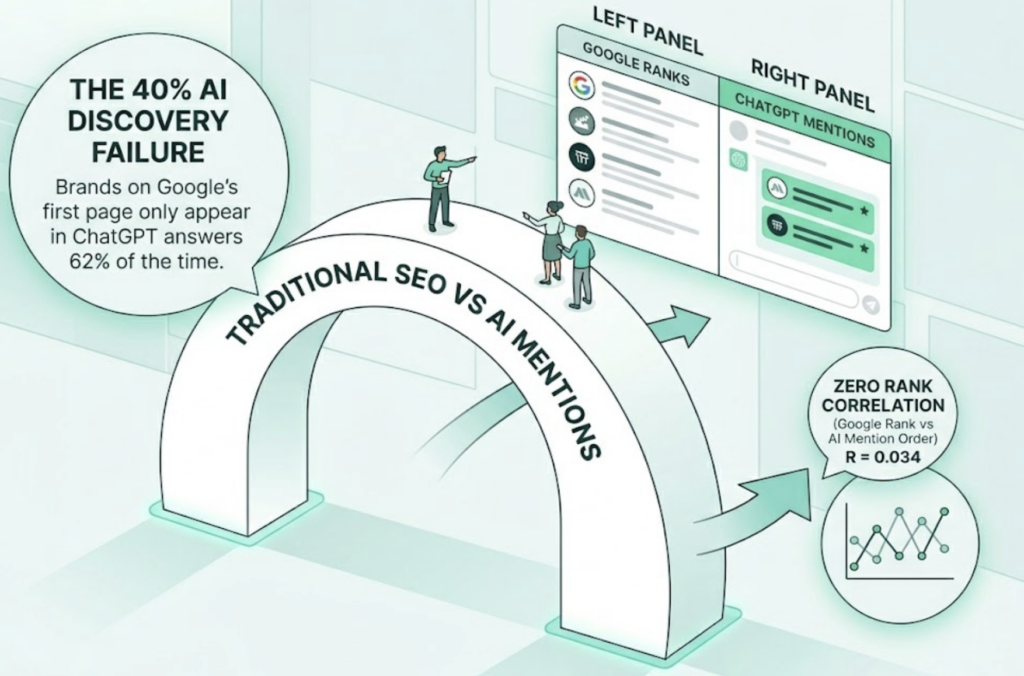
    A study comparing Google rankings with ChatGPT mentions found that brands on Google’s first page appeared in ChatGPT answers only 62% of the time. That’s a nearly 40% failure rate for the brands that “won” traditional search. The rank correlation between a brand’s Google position and its order of mention in an AI response sits at roughly 0.034, which is effectively zero.

    The divergence gets more stark when you look at commercial queries. Research by Profound on “Best men’s running shoes” found only an 8% overlap between Google’s top results and ChatGPT’s cited sources, with a negative correlation of -0.98. The more an AI favored a URL, the less likely it was to rank highly on Google. The reason: Google prefers direct brand pages; AI engines lean toward deep editorial reviews with high information density.

    This isn’t a temporary gap. It’s structural.

    Platform / Metric20242025Change
    ChatGPT Weekly Active Users400M900M+2.25x
    Perplexity Monthly Queries230M780M+3.39x
    AI Search Market Share~5%12-15%~2.5x
    Google Market Share>90%89.74%First drop below 90% in a decade

    And the user behavior shift compounds this. In 2025, zero-click searches reached 58.5% in the US, rising to 83% when Google AI Overviews were active. For brands, that means the AI answer itself is the ad. There’s no click to fall back on.

    What Answer Engine Optimization Actually Means

    Answer Engine Optimization (AEO) is the discipline of structuring and positioning a brand’s digital content so AI platforms can understand, trust, and cite it as a definitive answer to specific user questions.

    The goal isn’t traffic to a URL. It’s becoming the source the AI quotes.

    AEO vs SEO: Not a Replacement, an Additional Layer

    SEO establishes whether your content can be found and indexed. AEO determines whether it gets extracted and used once an AI agent finds it. Both matter, but they require different execution.

    AEO and GEO (Generative Engine Optimization) are often used interchangeably. The practical distinction: GEO focuses on long-term citability within the conversational narratives of LLMs like ChatGPT and Claude; AEO focuses specifically on “answer-first” features like Google AI Overviews and Perplexity’s instant answers, where a single snippet satisfies the user’s query without a second click.

    FeatureTraditional SEOAEO / GEO
    Primary GoalClicks to websiteCitations and brand mentions
    Success MetricSERP Ranking (1-10)Citation Frequency and Share of Voice
    MechanismBacklinks and keywordsSemantic structure and authority signals
    User JourneyDiscovery → Click → SiteDiscovery → Answer (zero-click)

    Brands that ignore the AEO layer can rank on page one of Google and still lose the buyer to a competitor whose content is structured for AI extraction.

    Which Platforms Count as “Answer Engines”

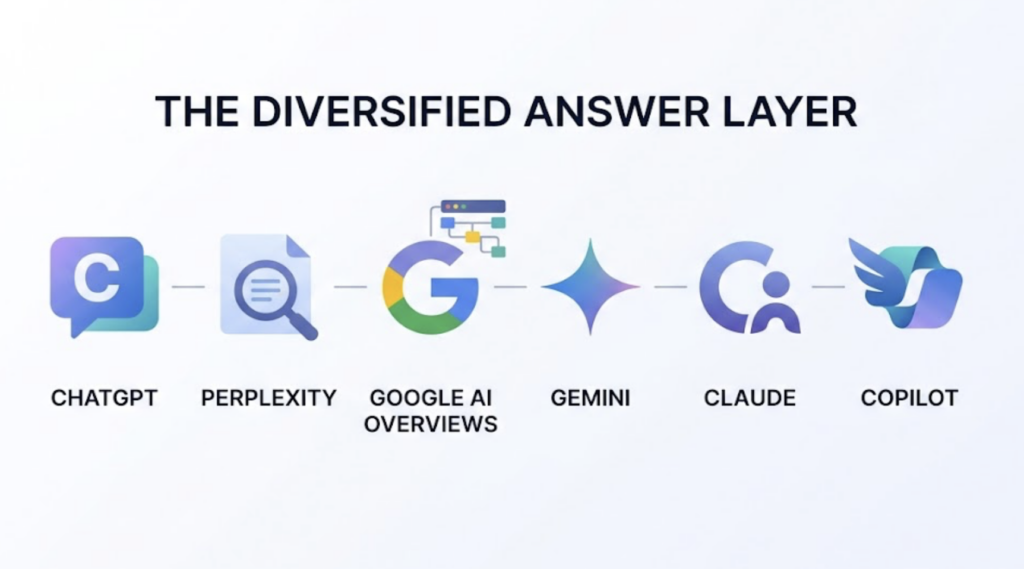
    The answer layer of the internet has diversified fast. It now includes ChatGPT (900M+ weekly active users), Perplexity (favored by B2B researchers for its transparent citation model), Google AI Overviews (reaching 2 billion monthly users), Gemini, Claude, and Microsoft Copilot.

    Each platform uses a different retrieval and citation logic. A strategy that only optimizes for one is already leaving coverage gaps.

    4 Signals That Decide If AI Recommends Your Brand

    AI engines don’t pick sources randomly. They evaluate content based on four signals that indicate relevance, authority, and what practitioners call “extractability.”

    1. Structured Content. Technical structure often outweighs content depth. FAQ sections are cited 3.2 times more frequently than the same information in paragraph form. About 44% of all LLM citations are pulled from the first 30% of a page. An “inverted pyramid” structure, where the direct answer comes first and context follows, is a core AEO tactic.

    2. Citation Sources. Brands are 6.5 times more likely to be cited by an AI through a third-party source than through their own website. Brand mentions correlate with AI visibility at 0.664. Backlinks, the traditional SEO gold standard, correlate at only 0.218. Reddit threads, Wikipedia, industry publications, and G2 reviews are stronger predictors of AI visibility than most link-building campaigns.

    3. Brand Authority Signals. AI models evaluate brand entities, not just individual pages. Consistency and “validation density” across multiple credible sources saying the same things about your features, pricing, and positioning build entity authority. Fragmented or conflicting information across subdomains actively undermines it.

    4. Prompt Coverage. AI users don’t search for keywords; they ask layered questions. Google and other AI systems use “query fan-out,” breaking a single prompt into multiple sub-queries. A search for “best accounting software for freelancers” generates simultaneous sub-queries like “freelancer accounting tools,” “Xero vs Quickbooks for freelancers,” and “best accounting software 2026.” AEO requires content that addresses the primary question and the inevitable fan-out queries that follow.

    The Gap Most AEO Audits Miss

    Most AEO audits stop at one binary question: Is the brand mentioned or not?

    That’s the wrong question.

    A brand can appear in 50% of relevant AI responses and still be losing to a competitor that appears in 30% of responses, if that competitor is always listed first and described favorably. Position and sentiment are what convert visibility into business value.

    Position matters. A brand mentioned as the “top recommendation” receives substantially more trust than one referenced as a secondary alternative in the same response. Measuring “Answer Placement Score” (APS), which weights earlier mentions more heavily (first = 1.0, middle = 0.6, end = 0.3), gives a more accurate picture of competitive prominence than raw mention rate.

    Sentiment matters more than most teams expect. AI engines don’t just list brands; they describe them. If training data or retrieved sources include hedging language (“popular but lacks enterprise support”) or common complaints, the citation can actively damage brand perception. Sentiment drift across AI platforms is a reputation risk that traditional brand monitoring tools aren’t designed to catch.

    This is where Topify’s Visibility Tracking and Source Analysis address a gap that simpler audits miss. Instead of flagging whether a brand appears, Topify identifies the specific domains that are shaping the AI’s understanding of that brand: which Reddit threads, which comparison sites, which editorial reviews the model treats as authoritative. If a competitor is being cited in a “top 10” list the AI uses to formulate its answer, that specific URL shows up as a content gap, not a vague recommendation to “create more content.” That’s the difference between monitoring and actionable intelligence.

    Audit MetricDefinitionAEO Impact
    Citation Rate% of prompts where brand is mentionedFoundational baseline
    Share of VoiceMentions relative to competitorsCompetitive benchmarking
    Answer Placement ScoreWeighted score by mention order“Top recommendation” status
    Sentiment PolarityTone of AI descriptionReputation and narrative risk

    How to Start Building an AEO Strategy

    AEO isn’t a one-time content refresh. It’s an ongoing tracking and iteration cycle, because roughly 40-60% of AI-cited sources rotate monthly.

    Step 1: Audit your current AI presence across real buyer questions. Don’t just search your brand name. Search for the solutions you provide. Run 20-50 high-value buyer questions (“What’s the best [category] tool for [use case]?”) across ChatGPT, Perplexity, Gemini, and Google AI Overviews. This reveals your AI Inclusion Rate and surfaces exactly which competitors own your category in LLM responses.

    Step 2: Identify which sources AI is pulling from, not just whether you appear. Source analysis tells you what information the AI trusts about your space. If it’s citing a three-year-old blog post or a specific subreddit to describe your product category, that’s the pool you need to influence. Compare those cited sources against your own content: Is your content too sales-heavy? Does it lack direct, scannable data that AI agents can extract? That gap is your roadmap.

    Step 3: Fix content structure and build third-party authority. Restructure high-traffic pages with TL;DR summaries at the start of each section and headings formatted as natural-language questions. Deploy FAQPage and HowTo schema, which increase citation likelihood by 40-42%. Semantic URLs with descriptive slugs generate 11.4% more citations than generic ones. On the authority side, get subject matter experts quoted in cited publications and engage actively in relevant Reddit communities to create fresh, positive signals in the AI retrieval pool.

    Then track. Re-run your core prompt set weekly or monthly, because the AI answer landscape moves faster than most content calendars.

    FAQ

    Q: Is AEO the same as GEO? 

    Not exactly. AEO focuses specifically on “answer-first” features like Google AI Overviews and Perplexity’s direct answers. GEO covers the broader challenge of being cited within the conversational narratives of LLMs. In practice, the strategies overlap significantly, and most teams treat them as part of the same discipline.

    Q: Does AEO work for small brands? 

    Often yes. AI engines favor topical depth and expert accuracy over raw domain authority. A small business with the most comprehensive, direct answer to a niche question can outperform larger brands that produce generic or sales-heavy content. The playing field is less skewed by budget than traditional SEO.

    Q: How long does it take to see results from AEO? 

    Technical signals like schema validation show up quickly. Most sites with a solid content foundation see initial citations and ranking shifts within 4-8 weeks. Consistent, meaningful visibility across multiple AI platforms typically takes 3-6 months as models build confidence in the brand’s authority.

    Q: What’s the first metric I should track? 

    AI Citation Rate: the percentage of relevant industry queries where your brand is cited as a source. Track it alongside Share of Voice to understand how you’re performing relative to direct competitors, not just in isolation.

    Conclusion

    Search is splitting into two parallel systems. Traditional search returns a list; AI search returns an answer. Brands optimizing only for the first system are invisible in the second.

    AEO is the discipline that bridges that gap. It’s not about abandoning what works in SEO. It’s about adding a layer that ensures the content you’ve already built can be understood, trusted, and cited by the AI systems that are increasingly intercepting your buyers before they ever reach a search results page.

    In a zero-click economy, the most valuable digital real estate isn’t a high-ranking link. It’s being the source the AI chooses to quote.

    Read More

  • Answer Engines: Why Google Rankings No Longer Tell the Full Story

    Answer Engines: Why Google Rankings No Longer Tell the Full Story

    Your Google rankings haven’t moved. Your content is still on page one. But somewhere in the last year, the traffic started quietly disappearing.

    This isn’t a penalty. It’s not a core update. It’s something more structural: the way people search is changing, and Google rankings are no longer the only thing that decides whether your brand gets found.

    Answer engines are now the first stop for millions of buyers. And most brands have no idea where they stand on them.


    Search Engines Return Links. Answer Engines Return Decisions.

    For two decades, search worked the same way. A user typed a query, Google returned ten links, and the user decided where to click. The search engine was a referee, not a participant.

    Answer engines changed that contract entirely.

    When someone asks ChatGPT “what’s the best project management software for a remote team,” they don’t get ten links. They get a recommendation, a rationale, and sometimes a comparison table. The AI has already done the research. The decision is largely made before the user visits any website.

    This shift has a measurable cost. Zero-click searches now account for 69% of all queries. For informational queries with Google AI Overviews, that number hits 83%. Organic click-through rates for queries where AI summaries appear have dropped from 1.76% to 0.61%, a 65% decline. Paid CTR in the same conditions has crashed by 68%.

    The click-through economy isn’t dying slowly. It’s already in a different shape.


    ChatGPT, Perplexity, Gemini: They’re All Answer Engines Now

    The answer engine category isn’t one platform. It’s a fragmented ecosystem, and each player operates differently.

    ChatGPT dominates B2B research. As of 2026, 47% of B2B buyers prefer it for vendor discovery. Its citations skew heavily toward high-authority domains: Wikipedia accounts for 47.9% of its top citations, and domains with trust scores between 97-100 average 8.4 citations versus just 1.6 for lower-trust domains. Authority is the primary gate.

    Perplexity operates on freshness and community validation. Reddit accounts for 46.7% of its top citations. Content that hasn’t been updated in 30 days loses visibility rapidly. It applies what researchers call “time decay” aggressively. If you’re not refreshing your content, Perplexity is quietly deprioritizing it.

    Google AI Overviews sits in its own category. It’s still tied to the Google index, but not in the way you’d expect. While 92% of AI Overviews link to at least one top-10 result, 43.5% of cited sources come from domains outside the top 100. E-E-A-T functions as a binary gatekeeper here: 96% of citations come from sources with strong authority signals.

    Three platforms. Three different selection logics. One shared outcome: your keyword ranking is not the deciding factor.


    Why Your Google Rankings Don’t Carry Over

    Here’s the number that reframes everything: only 12% of AI citations overlap with Google’s top 10 results.

    That means 88% of what AI engines recommend comes from somewhere outside traditional SEO’s line of sight.

    The reason is architectural. Traditional search engines use inverted indices and keyword matching. Answer engines use Retrieval-Augmented Generation (RAG) and semantic vector search. A user’s prompt gets converted into a numeric vector, which is then compared against indexed content in multi-dimensional semantic space. The engine isn’t looking for keyword matches. It’s looking for semantic proximity.

    What gets retrieved isn’t a page. It’s a passage.

    A 3,000-word blog post optimized for dwell time may perform well on Google. But if the core answer is buried in paragraph twelve, the RAG system skips it. It needs extractable, fact-dense chunks in the first third of the content, where 44% of AI citations are pulled from.

    Ranking SignalTraditional SEOAnswer Engine (AEO)
    Backlink VolumeHigh weightModerate (entity mentions matter more)
    Keyword DensityModerateLow (vector similarity, not word count)
    Content LengthHigh (long-form)Low (atomic passages preferred)
    Schema MarkupOptionalMission critical
    Social ProofLowHigh (Reddit, G2 heavily cited)

    The optimization target has changed. SEO was about ranking pages. AEO is about being extractable.


    What Actually Gets a Brand Cited in AI Answers

    The content that earns AI citations shares a consistent set of structural properties. Research on high-performing AEO content points to what some practitioners call the CITABLE framework.

    Answer first. Every piece of content should open with a 2-3 sentence summary that names the brand and states the core answer directly. This isn’t just a stylistic choice: 44% of citations are pulled from the first third of a page. If your answer isn’t there, it won’t be extracted.

    Block-structured for RAG. Content broken into atomic chunks of 150-300 words, with clear H2/H3 headings, bulleted lists, and HTML tables, is significantly easier for RAG pipelines to ingest. Long narrative sections read well for humans but get skipped by machines looking for extractable facts.

    Third-party validation. AI models often trust external platforms more than brand-owned sites. Presence on review platforms like G2 or Trustpilot correlates with 4.6-6.3 citations on average, compared to 1.8 for brands without that presence. Reddit, Wikipedia, and industry publications all function as trust signals.

    Schema markup. Implementing Organization, Product, and FAQ schema is no longer optional. Schema creates the translation layer that helps AI systems identify entities and their relationships, increasing the chance of appearing in AI summaries by 36%.

    Fresh content. Perplexity’s time decay is aggressive, but freshness matters across all platforms. Content that hasn’t been updated loses ground, especially in fast-moving categories.

    The underlying principle: write for a machine that’s looking for evidence, not a human that’s looking for a story.


    Brands Already Winning in Answer Engines

    Early AEO case studies share a common pattern: the brands winning in AI search treat it as a distinct channel with its own KPIs, not a byproduct of SEO.

    Mentimeter, a B2B presentation SaaS, optimized for 555 informational keywords within AI Overviews and generated 124,000 ChatGPT sessions and 3,400 conversions in a single month. Their strategy focused on creating how-to content that AI could summarize cleanly, turning the brand into the go-to reference for collaborative software queries.

    An industrial applications provider focused on entity authority over backlink volume, achieving an 84% reference rate in Google AI Overviews and an 82% mention rate in ChatGPT for its core product categories. The result: $90 million in influenced pipeline and $20 million in revenue directly attributed to AI-generated discovery.

    A B2B SaaS firm grew AI-referred trials from 575 to over 3,500 per month, a 6x increase in seven weeks, by fixing broken schema, publishing 66 AEO-optimized articles, and seeding helpful comments on Reddit threads that Perplexity and ChatGPT already cited.

    That last point is worth sitting with. Reddit comments became a growth lever. Not because Reddit is special, but because the AI platforms trusted it. AEO strategy follows the trust logic of the platform, not the assumptions of traditional marketing.


    How to Measure Your Answer Engine Visibility

    This is where most brands hit a wall.

    Traditional SEO tools like Ahrefs and Google Search Console track rankings and clicks. They can’t tell you whether ChatGPT mentioned your brand when a buyer asked a comparison question yesterday. That data doesn’t exist in the standard analytics stack.

    Answer engine visibility requires a different set of metrics entirely.

    AI Mention Rate measures how often your brand appears across a tracked set of AI prompts. It’s the rough equivalent of impressions, but inside the model’s output rather than the SERP.

    Share of Voice (AI SOV) measures your brand mentions as a percentage of total category mentions across all AI recommendations. This is the metric that predicts competitive position in the answer economy.

    Sentiment Score tracks how AI systems describe your brand. Being mentioned as a “reliable option” is different from being mentioned with outdated pricing or incorrect feature claims. Hallucinations are a real risk.

    Citation Rate measures how often AI answers include a link to your domain. A brand can be mentioned without being cited. Citations drive qualified referral traffic; mentions alone don’t.

    Tools like Topify are built specifically for this tracking challenge, monitoring brand visibility across ChatGPT, Perplexity, Gemini, and other major AI platforms. One feature worth noting is the ability to surface “Dark Queries”: high-intent conversational prompts with zero search volume in Google but significant activity inside AI platforms. These are the questions your buyers are already asking that you can’t see in Search Console.

    The brands that get ahead in answer engines aren’t necessarily the ones with the best content today. They’re the ones who know where they stand and can see where the gaps are.

    Conclusion

    The shift from search to answers isn’t about one algorithm update. It’s a structural change in how buyers start their research, how they form opinions, and how they make decisions.

    Google rankings still matter. But they’re no longer the full picture. If an AI engine doesn’t include your brand when a buyer asks a category question, you’re invisible at the moment that matters most, regardless of where you rank on the SERP.

    The brands closing that gap are the ones treating AI visibility as a measurable, manageable channel: tracking their mention rate, auditing their content structure, and building the kind of authoritative presence that machines trust.

    The Invisibility Gap is real. The question is whether your brand is on the right side of it.


    FAQ

    What is answer engine optimization (AEO)? 

    AEO is the practice of structuring digital content to be extracted, cited, and recommended by AI-powered answer engines like ChatGPT, Perplexity, and Google AI Overviews. It prioritizes machine synthesizability, entity clarity, and passage-level extractability over traditional keyword ranking.

    What’s the difference between AEO and SEO? 

    SEO focuses on ranking pages to drive clicks from search results. AEO focuses on being included in a synthesized AI answer, often in a zero-click environment. SEO relies on backlinks and keyword density; AEO relies on semantic structure, schema markup, and third-party validation. Both matter, but they require different content strategies.

    How do I get cited in ChatGPT or Perplexity? 

    For ChatGPT, domain authority is the primary lever: referring domains above 2,500, presence on Wikipedia and high-trust platforms, and answer-first content structure. For Perplexity, freshness matters as much as authority: content should be updated at least every 30 days, and presence on Reddit and community platforms significantly boosts citation probability.

    Does Google ranking still matter? 

    Yes, but it’s no longer sufficient on its own. While 92% of AI Overviews cite at least one top-10 result, 43.5% of cited sources come from outside the top 100. A page can rank #1 on Google and still be bypassed by AI systems if it lacks E-E-A-T signals or machine-readable structure. The goal is to optimize for both.

    How do I know if my brand is being recommended by AI? 

    Standard analytics tools don’t track AI mentions. You’ll need a dedicated GEO monitoring platform to track your AI mention rate, share of voice, sentiment, and citation rate across platforms. This data is what separates brands that know their AI visibility from those that are guessing.


    Read More

  • How to Get Your Brand Into Google AI Overviews

    How to Get Your Brand Into Google AI Overviews

    Your organic rankings didn’t drop. Your content didn’t get penalized. But your traffic is down double digits anyway.

    That’s the AI Overviews effect. Google now generates a synthesized summary above every organic result for over 50% of informational searches. If your brand isn’t in that summary, users never scroll far enough to find you.

    The fix isn’t guessing. It’s a three-step process: track where you stand, find the content gap, and engineer content that AI can actually cite.


    Your Rankings Didn’t Drop. Google Just Built a Wall Above Them.

    The numbers are stark. For queries where AI Overviews appear, organic click-through rates have collapsed from 1.76% to 0.61% between June 2024 and September 2025 — a 62.3% decline. Paid search CTR dropped 51.4% over the same period.

    What makes this unusual is the decoupling. Rankings hold steady. Traffic doesn’t.

    Google calls it a “satisfaction gap.” The AI summary answers the user’s question well enough that they stop scrolling. No click needed. Your page never gets visited.

    The second-order insight matters more, though. Brands cited inside the AI Overview don’t just survive — they outperform. Cited brands see 0.70% organic CTR versus 0.52% for non-cited brands, and the paid CTR gap is even wider: 7.89% versus 4.14%. Being in the summary is worth more than being ranked #1 below it.

    On mobile — which drives roughly two-thirds of all search volume — an expanded AI Overview can occupy the entire visible screen. First place in organic sits below the fold. First place in the summary sits at the top of the world.


    What Google AI Overviews Actually Pull From

    Most SEOs assume AI Overviews work like Featured Snippets: find the best-ranked page, pull a paragraph. That’s not what’s happening.

    Featured Snippets are link-retrieval systems. One page, one extract, one query. AI Overviews use multi-source synthesis. Google’s AI reads multiple trusted sources and generates a combined narrative — it doesn’t just lift text, it interprets and recombines it.

    In 2025, Google formalized this with the MUVERA framework (Multi-Vector Retrieval Analysis). Instead of compressing a query into a single vector, MUVERA runs a two-stage pipeline: broad retrieval first, then semantic re-ranking at the passage level. It looks for content organized into modular, self-contained blocks — not long-form narratives.

    The practical consequence: only 32% of URLs cited in AI-generated answers match the traditional top-10 organic results. Domain authority and backlinks still matter, but they’re no longer the deciding factor for citation. Structural clarity and content modularity are.

    The Domains Google Keeps Citing

    Analysis of 46 million citations across 36 million AI Overviews reveals a concentration problem for brands. Wikipedia (11.22%), YouTube (9.51%), Reddit (5.82%), and Google’s own properties (5.62%) dominate the citation landscape. That’s roughly 43% of all AI citations flowing back to Google’s ecosystem or a handful of mega-platforms.

    Reddit’s surge is particularly revealing — citation frequency jumped 450% between March and June 2025. Google is treating community-driven discussion as a stronger “experience” signal than polished brand pages. That has real implications for where your optimization dollars should go.


    Step 1: Find Out If Your Brand Appears in Google AI Overviews

    Before optimizing anything, you need a baseline. Most brands skip this step and optimize blind.

    Start manually. Run your brand name paired with industry-specific question queries — the kind of language a customer uses during research, not purchase. “Best [category] for [use case].” “How does [product type] work.” “What’s the difference between X and Y.” These are the query patterns most likely to trigger AI Overviews.

    Note three things: whether an AI Overview appears, whether your brand is mentioned in it, and which competitors are cited instead.

    Manual testing gives you a reality check. It doesn’t give you a trend.

    Scale It with a Tracking Tool

    The non-deterministic nature of AI Overviews is the problem. Google generates summaries in real time. Results shift by user, session, and query variation. A single manual check tells you what happened once. It tells you nothing about whether things are getting better or worse.

    Topify‘s Visibility Tracking automates this at scale. The Basic plan ($99/month) supports 100 prompts and 9,000 AI answer analyses per month — enough to track a meaningful cross-section of the queries your customers actually use, including Google AI Overviews coverage. You get an AI Share of Voice metric that benchmarks your brand frequency against top competitors over time, not just a snapshot.

    That shift from “I checked once” to “I can see a 90-day trend” is what makes optimization decisions defensible.


    Step 2: Identify the Content Gaps Keeping You Out

    Once you know your brand isn’t being cited — or isn’t being cited often enough — the next question is why.

    Source Analysis answers it. The logic: if Google is citing Competitor A and not you on the same query, there’s something in Competitor A’s content that signals citability to the AI. Your job is to identify what that is.

    Common gaps fall into three categories. First, structural gaps: your content is written as flowing prose, not modular blocks. MUVERA’s passage-level indexing rewards self-contained sections that answer a specific sub-question within the first 100 words. Second, evidence gaps: your content makes claims without data. AI systems prioritize fact-backed content with clear sourcing. Third, E-E-A-T gaps: no author byline, no credentials, no first-hand experience signals. Google’s 2025 Quality Rater Guidelines put “Experience” as the primary differentiator — a product review with original screenshots outranks a polished summary without them.

    Topify’s Source Analysis surfaces the exact domains and content types Google is pulling from in your niche. If the AI is citing Reddit threads, the gap is community presence. If it’s citing structured guides, the gap is content architecture.

    What “AI-Citable Content” Looks Like

    61% of AI Overviews use unordered lists. 22% use short factual paragraphs. Ordered lists account for 12%. Data tables, while rare at around 5%, are highly citable for pricing and comparison content.

    The pattern is clear: AI doesn’t favor long-form storytelling. It favors structured information that can be extracted without interpretation.


    Step 3: Build Content Google AI Overviews Will Actually Quote

    The framework for AI-citable content is Answer Engine Optimization (AEO). Here’s what it looks like in practice.

    The 100-Word Answer Block. Every key section should open with an 80–100 word direct answer to the implied question of that heading. Write the conclusion first. The AI looks for the “TL;DR” it can lift without reading the rest of the section.

    Question-format headings. Rewrite H2 and H3 headings to mirror natural language queries. “How does [product] reduce cost?” performs better than “Cost Reduction Benefits.” MUVERA’s semantic matching favors headings that align with how users actually phrase their questions.
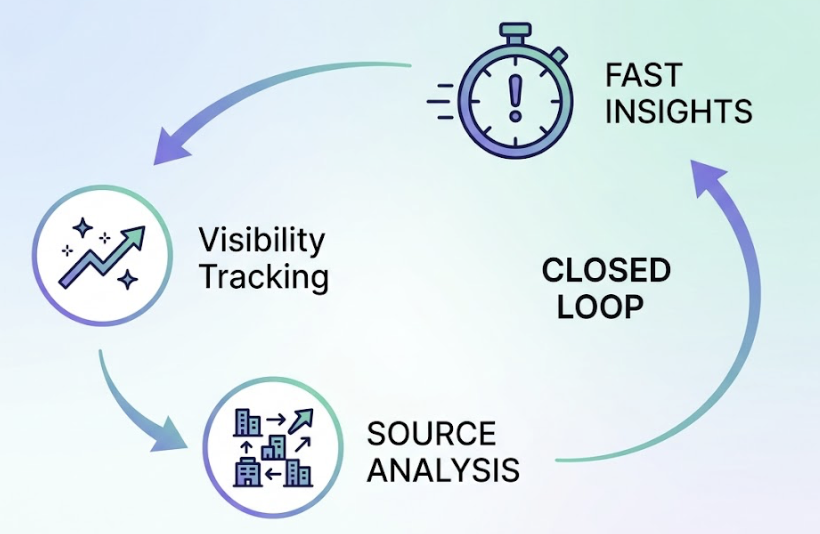
    Data as authority signals. AI systems treat statistics and cited research as trust indicators. Every key claim should carry a number or a source. Proprietary data — original research, internal test results, first-hand case studies — is particularly valuable because it offers something Wikipedia and Reddit don’t.

    How to Optimize Existing Pages for AI Overviews SEO

    You don’t need to rebuild your site. Targeted edits to top-performing pages produce faster results.

    Start with FAQ and HowTo schema markup. FAQ Schema maps question-and-answer pairs directly in a format AI can parse without interpretation. HowTo Schema signals procedural content structure. Organization Schema helps AI correctly identify your brand as a distinct entity — headquarters, social links, founders — which improves citation consistency across queries.

    Internal linking also matters. Pages that sit within a clear pillar-cluster hierarchy signal content modularity to the crawler. A standalone blog post is harder for MUVERA to contextualize than one that belongs to a structured topic cluster.

    Off-page optimization rounds it out. Getting your brand cited in industry publications, forums, and niche outlets that Google already trusts creates the “off-page AEO” layer that no amount of on-site schema can replicate.


    The Mistake Most Brands Make: Optimizing Without Tracking

    Here’s the failure mode. A team audits their content, restructures three key pages, adds FAQ schema, and waits. Three months later, traffic is flat. Nobody knows if AI Overviews shifted, if the pages got cited, or if the optimization even landed.

    Without tracking, optimization is guesswork with extra steps.

    The feedback loop that makes AI Overviews optimization work is: set a prompt corpus → track citation frequency → detect changes → iterate. That loop requires automation because AI responses vary by session and can drift over weeks without any single obvious signal.

    Topify closes that loop. Visibility Tracking shows you whether your citation frequency is trending up or down across your tracked prompts. Source Analysis shows whether the domains Google is citing in your niche have changed — sometimes a competitor publishes a piece of original research that suddenly displaces your page. You want to know that the week it happens, not the quarter after.

    The Basic plan covers 100 prompts and 9,000 AI answer analyses monthly. For teams managing a focused set of high-value queries, that’s enough to run a systematic optimization program rather than a periodic audit.

    AI-referred traffic converts at approximately 2.3x the rate of traditional organic traffic. The ROI case for systematic tracking is straightforward.


    Conclusion

    The brands winning Google AI Overviews aren’t doing anything exotic. They tracked where they stood. They found the content gap between them and the cited sources. They restructured pages to answer questions directly, in a format AI can extract.

    That’s it. Track. Find the gap. Optimize the structure.

    What doesn’t work: assuming that organic ranking translates to AI citation, or that a one-time content audit is enough. AI Overviews are non-deterministic — they shift as Google updates its models, as competitors publish new content, and as query patterns evolve. Monitoring has to be ongoing.

    If you’re starting from zero, the clearest first step is understanding where your brand currently stands across the prompts your customers are actually typing. Topify’s Basic plan gets you that data for $99/month — and it gives you the source analysis to understand not just whether you’re missing, but why.


    FAQ

    What triggers Google AI Overviews to appear? 

    AI Overviews appear most often for complex informational queries, multi-step explanations, and comparison-based searches. Conversational, longer queries trigger them far more reliably than short keyword searches.

    How is AI Overviews optimization different from traditional SEO? 

    Traditional SEO targets keyword density, backlinks, and domain authority to rank links. AI Overviews optimization focuses on modular content structure, semantic clarity, schema markup, and expert attribution — signals that help AI extract and cite your content.

    Can small brands appear in Google AI Overviews? 

    Yes. 80% of sources cited in AI Overviews don’t rank in the top 3 organically, and 47% rank outside the top 10. Structured, expert-led content can outperform much larger competitors on citation frequency.

    How do I know if Google AI Overviews are hurting my traffic? 

    Monitor Google Search Console for keywords where impressions stay stable but CTR drops. A widening impression-to-click gap on informational queries is a reliable signal that an AI Overview is intercepting traffic before it reaches your listing.

    What content types are most likely to be cited in AI Overviews? 

    Unordered lists (61% of AIOs), short factual paragraphs under 100 words (22%), and ordered lists for sequential processes (12%). Data tables and FAQ sections are particularly citable due to their structured, extractable format.


    Read More

  • AEO vs SEO vs GEO: Which One Gets You Into AI Answers?

    AEO vs SEO vs GEO: Which One Gets You Into AI Answers?

    You’re ranking #1 on Google. But when someone asks ChatGPT for a recommendation in your category, your brand doesn’t come up.

    That’s not a content problem. That’s a strategy problem.

    Three optimization disciplines now govern how brands get discovered online: SEO, AEO, and GEO. They’re not competing frameworks. They’re covering different surfaces. And if you’re only running one of them, you’re leaving significant visibility on the table.

    Here’s how they actually differ, and what to do about it.


    The Search Landscape Already Shifted. Most Brands Haven’t.

    The numbers are hard to ignore.

    Zero-click search rates have climbed from 64% in 2024 to somewhere between 83% and 93% in 2025 and 2026. When Google’s AI Overviews appear on a results page, organic click-through rates drop from 1.76% to 0.61%, a decline of roughly 61-65%. Paid CTR takes an even harder hit, falling 68%.

    Traffic is no longer the right metric. Visibility is.

    That’s the gap most brands still haven’t closed.


    What SEO Is, and Where It Still Matters

    SEO remains the foundation. It focuses on technical crawlability, keyword relevance, and earning high-ranking positions on Google and Bing to drive organic clicks.

    It still works. But its coverage has narrowed.

    The rise of “Search Everywhere Optimization” means users now discover content across social platforms, community forums, voice assistants, and AI chatbots. Google’s organic blue links are one channel among many, and their share of attention is shrinking by the quarter.

    SEO is infrastructure. You need it. But it no longer gets you into the surfaces where discovery is increasingly happening.


    AEO: Stop Ranking. Start Being the Answer.

    Answer Engine Optimization was coined in 2017 by Jason Barnard. The idea was simple: instead of fighting for position on a results page, structure your content so an algorithm picks it as the direct answer.

    AEO targets zero-click environments: Google’s Featured Snippets, “People Also Ask” boxes, and voice assistants like Siri and Alexa. The optimization goal isn’t a click. It’s extraction — getting your content pulled cleanly as the authoritative response to a specific question.

    Tactically, this means FAQ structures, clear entity definitions, and Schema markup. Pages with FAQPage Schema average 4.9 AI citations compared to 4.4 without them. That’s a measurable edge from a relatively low-effort implementation.

    AEO is less about traffic and more about authority positioning. When your content is the answer, you’re not a link someone might visit. You’re the source the engine trusts.


    GEO: From Being Cited to Being Recommended

    Generative Engine Optimization goes a step further. Formally introduced in 2023 through research from Princeton University, Georgia Tech, and the Allen Institute for AI, GEO addresses a fundamentally different machine behavior: synthesis.

    AI chatbots like ChatGPT, Perplexity, and Gemini don’t extract a single answer from a single source. They pull from multiple documents, synthesize them into a narrative, and then recommend. GEO is the discipline of making sure your brand is part of that synthesis — and that the recommendation is positive.

    The citation triggers are different from AEO. Princeton’s research identifies two methods that move the needle most. Adding verifiable statistics increases AI visibility by 37-40%. Including expert quotations adds another 22-40%. Vague marketing language gets filtered out. Factual density is what gets you cited.

    That’s why GEO also reframes brand sentiment as a ranking factor. AI engines assess whether a brand is credible, well-regarded, or facing criticism by synthesizing signals from reviews, Reddit threads, and news coverage. A mixed sentiment profile directly affects whether the model recommends you or your competitor.


    AEO vs SEO vs GEO: The Side-by-Side Breakdown

    SEOAEOGEO
    Target engineGoogle / BingVoice, Featured SnippetsChatGPT, Perplexity, Gemini
    Optimization goalRank #1 for keywordsBe the extracted answerBe the recommended brand
    Key signalsBacklinks, keywords, Domain AuthorityFAQ structure, semantic clarity, SchemaFactual density, statistics, earned media, sentiment
    Success metricsCTR, traffic, keyword rankingsSnippet presence, voice visibilityMention share, citation frequency, sentiment polarity
    User intent modeKeyword-based browsingImmediate factual inquiryConversational research and comparison
    Strategic roleFoundational infrastructureExtraction precisionSynthesized authority

    The table looks like three separate strategies. In practice, they’re three layers of the same stack.


    You Don’t Pick One. You Stack Them.

    Here’s the framing that matters: SEO, AEO, and GEO aren’t alternatives. They cover different stages of how users find and evaluate brands in 2025.

    Think of it as three layers:

    Infrastructure (SEO): Keep your site technically sound. GPTBot and PerplexityBot need to crawl your content before they can cite it. If your pages aren’t indexed or load slowly, you’re not even in the pool.

    Precision (AEO): Target high-volume question-based queries with FAQ structures and answer-first formatting. This is what wins Featured Snippets and gets your content extracted in voice search.

    Authority (GEO): Contribute original research, earn coverage in credible publications, and ensure your brand narrative is consistent across every surface where AI engines look. This is what gets you recommended, not just cited.

    Brands in the top quartile for web mentions receive over 10x more citations in AI Overviews than the next quartile. That compounding effect is real. The earlier you build it, the harder it becomes for competitors to close the gap.


    How to Know Where Your Brand Stands in AI Search

    Most teams don’t have a clear picture of their current AI visibility. That’s the actual starting point.

    Manual testing helps: run your category-level queries through ChatGPT, Perplexity, and Gemini and see what comes back. Note which competitors appear. Note the framing.

    But manual testing doesn’t scale. The prompt space is too large, and results vary by platform, query phrasing, and even the time of day.

    Dedicated GEO tools track the metrics that matter in AI search: Mention Share (what percentage of AI responses reference your brand), Citation Frequency (how often those mentions include a link), Sentiment Polarity (whether the framing is positive, neutral, or negative), and Position Index (where your brand appears in a list of recommendations).

    Topify tracks all of these across ChatGPT, Gemini, Perplexity, and other major AI platforms, giving marketing teams a structured view of where they stand and which competitors are pulling ahead. Its Competitor Monitoring feature shows not just who AI engines recommend, but why — which sources are being cited, and what content gaps your brand needs to close.

    The economics of ignoring this are measurable. A one-point decline in AI first-mention share can increase Customer Acquisition Cost by 3-5% within a single quarter. On the upside, a B2B SaaS company that implemented a GEO content strategy across 50 informational pages saw a 1,570% jump in organic-attributed pipeline within 90 days, with $2.34M in revenue directly traced to ChatGPT and Perplexity recommendations.

    That’s not a niche edge case. That’s where the channel is heading.


    Conclusion

    SEO gets you on the page. AEO gets you into the answer. GEO gets you recommended.

    Each layer matters. None of them is optional if you’re competing for attention in 2025.

    The brands winning AI search right now didn’t get there by accident. They built authority across every surface that AI engines rely on — credible sources, consistent positioning, factual content, and positive sentiment at scale.

    The first step is knowing where you actually stand. Run the queries. Check the outputs. Then build from there.


    FAQ

    Is AEO the same as GEO? 

    No, though they’re closely related. AEO focuses on getting your content extracted as a direct answer in zero-click environments like Featured Snippets and voice search. GEO focuses on being synthesized and recommended by generative AI systems like ChatGPT and Perplexity. AEO is about extraction precision. GEO is about synthesized authority.

    Does AEO replace SEO? 

    No. SEO remains the technical foundation that ensures AI crawlers can access and index your content. AEO and GEO build on top of that foundation to address the surfaces where traditional SEO doesn’t reach.

    How do I start optimizing for AI answer engines? 

    Start by auditing your current AI visibility: run your core queries through ChatGPT, Perplexity, and Gemini and see where your brand appears (or doesn’t). Then prioritize FAQ Schema markup, answer-first content formatting, and building credibility signals across external platforms that AI engines treat as authoritative sources.


    Read More

  • The G2 AEO Playbook: How AI Engines Use Review Data to Rank Your Brand

    The G2 AEO Playbook: How AI Engines Use Review Data to Rank Your Brand

    You’ve invested months building up your G2 presence. Hundreds of verified reviews, a solid star rating, maybe a Leader badge or two. Then a prospect asks ChatGPT, “What’s the best [your category] software?” and your brand doesn’t appear once.

    The reviews are real. The problem is that AI engines don’t read G2 the way buyers do. And most SaaS marketing teams are optimizing for the wrong signals entirely.

    G2 AEO isn’t about accumulating more reviews. It’s about making your profile machine-readable in the specific ways that determine whether an AI recommends you or your competitor.


    AI Engines Don’t Trust Your Website. They Trust G2.

    When an AI like ChatGPT or Perplexity generates a product recommendation, it isn’t summarizing your homepage. It’s cross-referencing your claims against third-party sources that it treats as higher-confidence truth layers.

    Your website is viewed as a biased narrative. It was written by your team, to your audience, with your positioning front and center. AI systems flag this as a potential source of error. To provide accurate recommendations without hallucinating, LLMs look for corroboration, and review platforms like G2 are the primary corroboration layer for B2B software.

    G2’s structured data environment is exactly what makes it valuable here. Its taxonomy, use-case tagging, and verified user-generated content give AI models the machine-readable infrastructure they need to categorize and compare brands at scale. The relationship is similar to what Wikipedia once was for Google’s Knowledge Graph: G2 provides the ontological framework that lets AI place your brand in the right context.

    This trust isn’t distributed evenly. Five review domains, including Gartner Peer Insights, G2, Capterra, Software Advice, and TrustRadius, account for 88% of all review-platform links cited by AI engines. G2 holds a 23.1% citation shareacross general B2B and SaaS queries. That number is about to get larger.


    G2 Is Already Being Cited. The Question Is Whether It’s Citing You.

    Here’s the counterintuitive reality of 2026: G2’s influence as an AI citation source is at an all-time high, even as its organic search traffic dropped 84.5% between January 2024 and December 2025.

    That drop isn’t a sign of G2 losing relevance. It’s proof that the zero-click era has arrived. Users no longer need to visit G2 because the AI has already extracted the data and presented it in a synthesized answer. The platform went from a traffic destination to a citation anchor.

    55% of enterprise buyers now rely on AI search more heavily than traditional Google, and 50% of B2B software buyersbegin their purchase journey inside an AI chatbot. That’s a 71% increase in just four months.

    The queries that trigger G2 citations most consistently are commercial-intent searches: “best X software,” “X alternatives,” “X reviews.” These are the exact prompts your prospects type when they’re evaluating options. When AI answers those prompts, it’s frequently using a competitor’s G2 page to make the case.

    That’s the hidden dynamic most teams miss. Your absence from AI citations in those queries doesn’t mean the AI said nothing. It means it recommended someone else.


    What AI Actually Reads on Your G2 Profile (It’s Not the Star Rating)

    Most G2 strategies are built around one metric: aggregate star rating. That’s the wrong lever for G2 AEO insight.

    LLMs treat star ratings as low-resolution signals that are easily gamed and difficult to contextualize. A 4.7 from 300 reviews tells the AI very little about which specific use case your product is suited for. What AI engines actually prioritize are the fields that carry semantic density.

    Use Case and Category Tags

    Category and use-case tags are the ontological anchors that determine which AI recommendation pools your product enters. If your product is tagged as a general “CRM” when it specifically serves real estate teams, it won’t appear when an AI answers “best CRM for real estate agents,” regardless of how many reviews you have.

    AI models calculate how closely a product’s defined purpose matches a user’s specific request. Brands that achieve Leader status in precisely the right G2 categories see a 4.1x higher citation frequency in AI “best of” queries. The category audit is one of the highest-leverage fixes available.

    Review Body Text

    The raw text inside the Pros and Cons fields is the primary evidence layer for AI engines. When an AI recommends a product, it often pulls specific themes or quasi-direct context from these sections to justify the recommendation.

    A review that says “excellent for cross-departmental collaboration in large engineering teams” is dramatically more useful for answer engine optimization than “5/5, love this product.” The first gives AI the scenario-specific context it needs to match your brand to a detailed, high-intent prompt. The second gives it nothing.

    Vendor Responses

    Vendor responses are one of the few places in your G2 profile where you have full editorial control, and most brands treat them as customer service exercises.

    AI engines read vendor responses to understand official brand positioning and resolve contradictions within user reviews. When you respond with language that mirrors how your buyers actually phrase their problems in AI queries, you’re giving the AI a second, brand-verified data point to work with. That’s what turns a vendor response into a G2 AEO asset.


    Your Competitors Are Winning AI Recommendations Before You Know the Game Started

    The G2 acquisition of Capterra, Software Advice, and GetApp from Gartner was framed as a strategic move to build the definitive AI trust layer for the software industry. The data backs that framing.

    Statistical modeling of the acquisition suggests that G2’s citation share in bottom-of-funnel queries, including pricing, comparisons, and proof of evidence, will increase by approximately 76%. For high-intent queries specifically around customer testimonials and evidence, the combined G2 ecosystem is projected to reach a 12.69% share of all AI citations, a 93% lead over the next most-cited domain.

    This creates a compounding problem for brands that haven’t started optimizing.

    A competitor who’s mapped their G2 profile to the right categories, guided reviewers toward scenario-specific feedback, and maintained an active review cadence will get cited more. More citations lead to higher frequency in conversational AI answers. Higher frequency leads to cognitive capture, where the market starts to perceive that competitor as the category default, because AI consistently names them first.

    By the time your sales team notices the pattern, the association is already forming in the minds of buyers who never visited your website.


    The G2 AEO Optimization Checklist: 6 Things to Fix This Week

    1. Rewrite Your Product Description with Prompt-Aware Language

    Marketing-heavy copy doesn’t translate to AI citations. Replace phrases like “our innovative platform streamlines operations” with factual, scenario-specific statements: “automates Salesforce integration, manages SSO for enterprise teams, provides real-time ROI tracking for marketing managers.”

    AI engines use “answer-first” structures. Your product description should read like the answer to a buyer’s AI prompt, not a homepage hero section.

    2. Audit Your Category and Use-Case Tags for Precision

    Run a quick test: search your core buyer personas’ queries in ChatGPT and Perplexity. If competitors appear and you don’t, cross-reference their G2 category tags against yours. Misalignment in G2’s taxonomy creates entity conflicts that cause AI to favor more clearly defined alternatives.

    Specificity beats breadth. Five precisely matched tags outperform fifteen broad ones.

    3. Brief Reviewers on What to Write, Not Just to Write

    Most review collection campaigns ask customers to “leave a review.” That produces generic feedback. Instead, brief reviewers on the specific scenario they used your product for: the team size, the technical environment, the business outcome. That level of detail is what AI engines extract and cite.

    Active, descriptive profiles are 3x more likely to be cited by ChatGPT than stagnant ones, regardless of total review count. Recency and semantic density matter more than volume.

    4. Respond to Reviews Like the AI Parser Is Reading

    Shift the frame on vendor responses. You’re not just addressing a customer. You’re adding context to a dataset that AI engines read when synthesizing brand summaries.

    In each response, weave in one or two scenario-specific terms that your buyers use when querying AI platforms. Don’t force it. One well-placed phrase per response compounds over time into a richer retrieval profile.

    5. Monitor Which Prompts Are Triggering G2 Citations for Competitors

    This is the step most teams skip because traditional tools don’t support it. The prompts that matter aren’t the ones that mention your brand name. They’re the category-level queries, “best [category] for enterprise teams,” “alternatives to [competitor],” that buyers use before they’ve shortlisted anyone.

    Knowing which prompts are driving citations for competitors tells you exactly where your G2 optimization should focus.

    6. Ensure Your G2 Claims Are Mirrored on Your Own Site

    AI engines cross-reference. If your G2 profile mentions an integration that your website doesn’t document, or claims a use case your blog doesn’t support, the AI may flag the inconsistency and exclude your brand from the answer to avoid providing inaccurate information.

    Cross-platform entity consistency isn’t a nice-to-have. It’s a prerequisite for being cited confidently.


    You Can’t Measure G2 AEO Impact with G2 Traffic Metrics

    Traditional web analytics can’t capture most of what’s happening in AI search. When a user asks ChatGPT for a software recommendation and your brand gets named, there’s no click to track. That interaction happens entirely inside the AI interface, and GA4 typically attributes any resulting visits as direct or referral traffic, making the source invisible.

    But the impact is real. AI-referred traffic converts at 4.4x higher rates than traditional organic for informational queries. In specific B2B cases, ChatGPT referrals have demonstrated conversion rates as high as 15.9%, compared to 1.76% for Google organic. The visits are fewer, but they arrive already briefed.

    To measure whether your G2 optimization is actually working, you need a different set of metrics.

    Topify tracks citation frequency across ChatGPT, Perplexity, Gemini, and other major AI platforms, and its Source Analysis feature identifies exactly which domains AI engines are pulling from when they answer queries in your category. That means you can see whether G2 is being cited for your brand or your competitors, and which specific prompts are triggering those citations.

    Visibility Tracking shows you your brand’s presence score over time, so you can correlate G2 profile updates, like a batch of new scenario-specific reviews or a product description rewrite, with actual changes in AI citation frequency. That’s the feedback loop that turns G2 AEO from a hypothesis into a measurable growth channel.

    The Q1 2026 data tells the story clearly: the AEO software category on G2 saw a 62% increase in page views in a single quarter. The market has already concluded that G2 optimization for AI visibility is worth prioritizing. The question is whether your team is ahead of that curve or catching up to it.


    Conclusion

    G2 was built for buyers. It’s now being read by AI. That shift changes almost everything about how a profile should be managed.

    The brands that win AI recommendation share in 2026 aren’t necessarily the ones with the most reviews or the highest star ratings. They’re the ones with the most machine-readable profiles: precise category tags, scenario-specific review text, consistent cross-platform data, and vendor responses that speak the language AI engines are listening for.

    Start with the checklist in this article. Then set up the measurement layer so you can see what’s actually moving. G2 has become one of the highest-leverage surfaces for B2B brand visibility in AI search. The ROI is real, but only if you’re tracking it.


    FAQ

    Q: Does having more G2 reviews improve my AEO ranking?

    A: Not on its own. AI engines prioritize the recency and semantic density of reviews over total count. Profiles with active, descriptive reviews updated within the last 90 days are 3x more likely to be cited by ChatGPT than stagnant profiles with hundreds of generic five-star ratings. Focus on quality and scenario specificity, not volume.

    Q: Is G2 more effective than Capterra for AI search visibility?

    A: G2 currently holds a slight lead with a 23.1% AI citation share versus Capterra’s 17.8%, and they’re typically cited for different purposes. G2 tends to appear in user-rating queries while Capterra surfaces in feature-comparison queries. Following the acquisition, the distinction is becoming less relevant operationally, as the unified data pool will inform recommendations across both surfaces simultaneously.

    Q: Do negative reviews on G2 hurt my AI search ranking?

    A: Yes, but not through the star rating mechanism. AI engines synthesize the substance of negative feedback. If several reviews mention “frequent downtime” or “poor enterprise support,” the AI may characterize your brand that way in synthesized answers. Prompt, well-written vendor responses can provide corrective context that AI includes in a balanced summary, which is why response strategy matters as much as review collection.

    Q: Can AI engines read gated G2 content?

    A: No. AI crawlers including GPTBot and ClaudeBot can’t bypass login walls, paywalls, or form gates. If your most detailed case studies or review insights are gated, they’re invisible to the AI that could be citing them. G2 also specifically disallows certain crawler paths in its robots.txt to protect proprietary data, so the publicly accessible portions of your profile are what AI engines work from.


    Read More