Category: Article

  • How to Earn LLM Citations Across AI Platforms

    How to Earn LLM Citations Across AI Platforms

    Your content ranks on page one. Your domain authority is solid. Your backlink profile would make most competitors jealous. Then a potential buyer types a category question into ChatGPT, and the response names four brands with inline sources. Yours isn’t one of them.

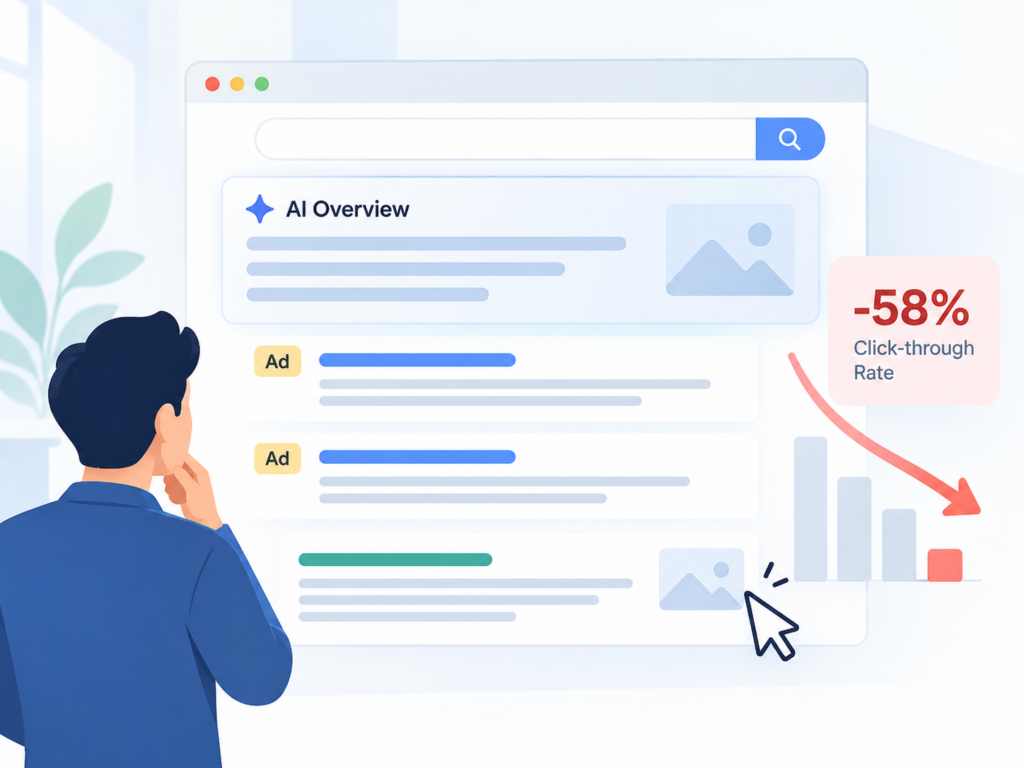
    That gap between Google rankings and AI recommendations is costing brands real pipeline. Data shows that when an AI summary appears, click-through rates on traditional results drop from roughly 15% to 8%. And the traffic that does come through AI search converts at up to 9x the rate of traditional organic. The brands getting cited aren’t necessarily the ones with the highest DA. They’re the ones whose content is built for how LLMs actually retrieve, evaluate, and synthesize information.

    What “LLM Citation” Actually Means (and Why It’s Not a Backlink)

    An LLM citation is a reference, recommendation, or direct link to an external source inside an AI-generated answer. It’s how ChatGPT, Perplexity, and Gemini tell the user: “This is where the information came from.”

    But not all citations look the same. There are two distinct types. Explicit citations show up as superscript numbers or source cards with clickable URLs. You’ll see these on Perplexity and in ChatGPT’s Search mode. Implicit citations happen when the model mentions a brand or product by name as an authority without linking directly. This is common in ChatGPT’s standard conversational mode and Gemini’s knowledge-integrated responses.

    Here’s the thing: traditional backlinks measure how much other websites trust you. LLM citations measure how much the AI trusts you. Research suggests that citations value brand mentions and factual extractability at a 3:1 ratio over traditional backlink metrics. A page with lower domain authority but higher “fact density” and better schema implementation will frequently beat a high-DA page for an AI citation.

    That distinction matters because only 17-32% of sources cited by LLMs overlap with Google’s top 10 organic results. The two systems are running on separate logic.

    How ChatGPT, Perplexity, and Gemini Choose What to Cite

    Each platform has a distinct retrieval architecture. Treating them as one monolithic system is the first mistake most brands make.

    PlatformCitations Per ResponsePrimary SignalContent Preference
    Perplexity~21.87Freshness and data densityResearch reports, benchmarks, case studies
    ChatGPT~7.92Reasoning and depthHow-to guides, nuanced explainers
    Gemini~8.34E-E-A-T and entity trustOfficial brand pages, structured product data

    Perplexity operates as a precision retrieval engine. It uses a proprietary index combined with Bing to perform real-time searches, delivering responses in a median of 6.8 seconds. Freshness is non-negotiable here. Content updated within the last 30 days has an 82% citation rate. After six months, that drops to 37%. If you haven’t touched a page in half a year, Perplexity has likely stopped citing it.

    ChatGPT is more selective. It cites fewer unique domains but applies a higher bar for topical authority. It’s looking for content that answers “why” and “how,” not just “what.” Long-form guides that anticipate follow-up questions and offer balanced perspectives tend to perform well.

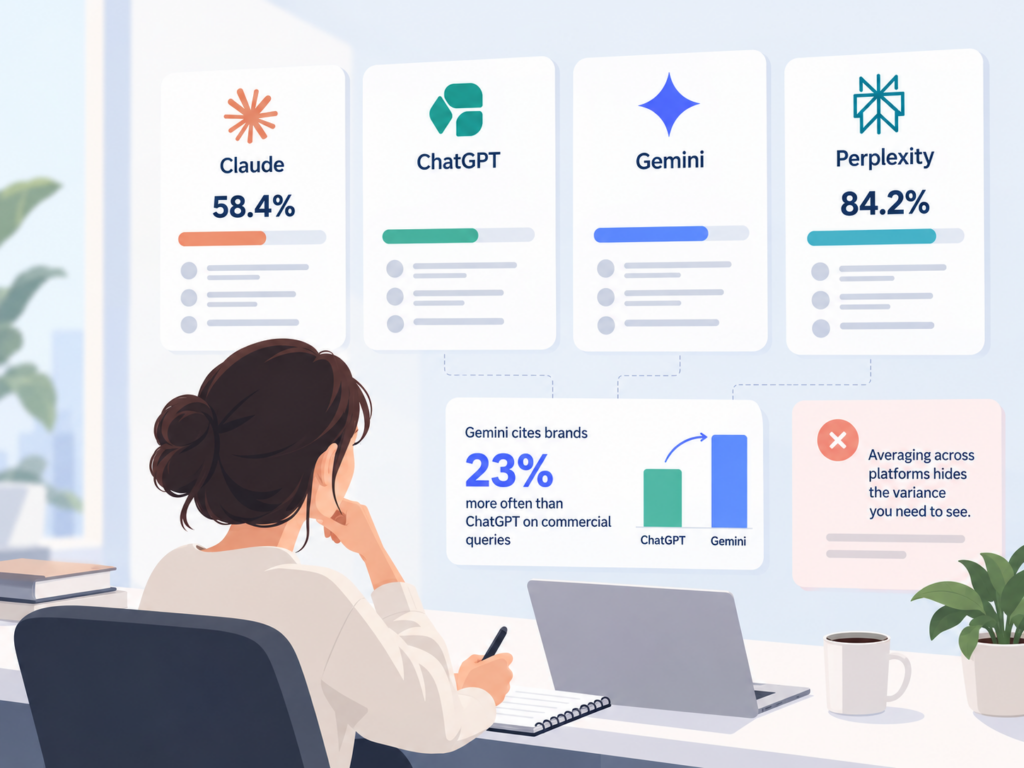
    Gemini leans on Google’s Knowledge Graph and prioritizes “consensus signals,” meaning information verified across multiple authoritative sources like Wikipedia, LinkedIn, and government databases. It’s also more likely to cite brand-owned websites (52.15% of its citations) compared to ChatGPT, which pulls heavily from third-party directories and review sites (48.73%).

    The shared thread: all three platforms reward content that is structured, specific, and consistent across multiple sources.

    5 Strategies That Actually Drive LLM Citations

    Earning an LLM citation isn’t about keyword stuffing. It’s about making your content easy for the AI’s retrieval system to extract, verify, and trust. These five strategies map directly to how LLMs evaluate sources.

    Put the Answer First

    LLMs don’t read entire pages. They retrieve specific passages or “chunks.” The closer your key claim is to the top of a section, the more likely it gets pulled.

    Start every article and major section with a 2-3 sentence summary that directly answers the target question. This “Bottom Line Up Front” approach reduces the compute resources the AI needs to verify your content. Use H2/H3 tags that mirror natural language questions. Instead of “Features,” write “What Are the Core Features of [Product]?”

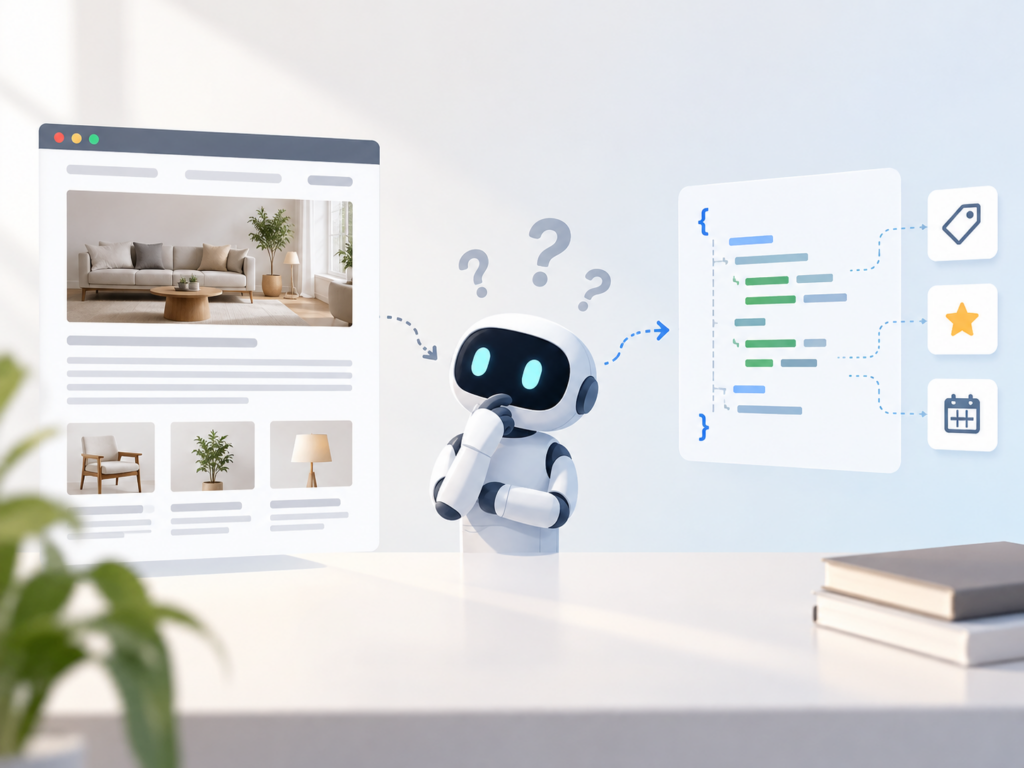
    Structured schema matters too. Implementing FAQ, Organization, and Product schema (JSON-LD) can increase AI visibility by up to 67%, because it gives the model explicit, machine-readable context for your content.

    Build a Credibility Chain

    AI models evaluate how well-researched your content is by checking whether you cite authoritative external sources. Including references to academic research, industry reports (Gartner, IDC, Forrester), or government data within your own content creates what researchers call a “credibility chain.” This practice can increase your citation probability by up to 40%.

    Author bios matter too. Include credentials, years of experience, and links to LinkedIn profiles to satisfy E-E-A-T requirements. Gemini, in particular, weights these signals heavily.

    Capture Long-Tail Conversational Intent

    AI search queries average 23 to 60 words, compared to 3-4 words on Google. Users aren’t typing keywords. They’re asking compound, scenario-specific questions like “Best CRM for small B2B teams with Slack integration under $50/user.”

    Create content that maps to these compound queries. Use “People Also Ask” phrasing in your subheadings. Build FAQ sections that address the specific, multi-variable questions your buyers actually ask AI platforms.

    Maintain the Freshness Advantage

    In AI search, outdated information often gets treated as wrong information. This is especially true for commercial and transactional queries where pricing, features, or competitive landscapes change frequently.

    Implement a quarterly update cycle for cornerstone content. Use IndexNow to alert Bing (and by extension ChatGPT and Perplexity) immediately when content is refreshed. This reduces discovery time from days to hours. The payoff is significant: content freshness within the last 30 days is associated with a 115% increase in AI visibility.

    Own the Multi-Platform Consensus

    AI models triangulate truth. They check whether your brand information is consistent across your website, G2, Reddit, TrustRadius, and industry publications. If the information conflicts, the model’s confidence score drops and it excludes you.

    This is especially important because 85% of AI citations come from third-party sites, not from brand-owned pages. Your off-site presence isn’t optional. Brands that maintain consistent information across four or more platforms see a 2.8x to 4.0x increase in AI recommendation rates.

    Audit your external profiles. Make sure your core value proposition, pricing tier, and product descriptions are identical everywhere.

    Why Most Brands Can’t Tell If They’re Being Cited

    Here’s the uncomfortable truth: most marketing teams are flying blind in the AI search era.

    Traditional SEO tools like Ahrefs, Semrush, and Moz were built to track rankings on a static results page. They’re structurally incapable of monitoring synthesized AI answers. Google Analytics (GA4) struggles to categorize traffic from AI platforms accurately. Some visits show up as chat.openai.com or perplexity.ai, but many get lumped into “Direct” or “Organic” without keyword context.

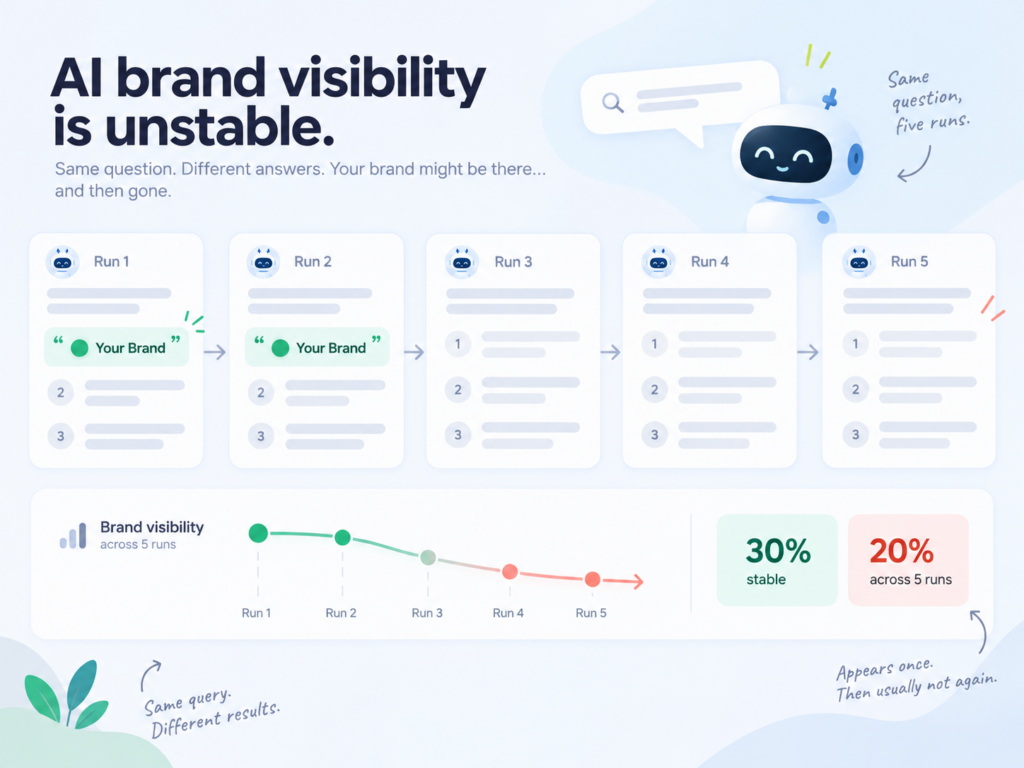
    The bigger problem is scale. Because AI responses are probabilistic, the same prompt can yield different results in different sessions or locations. A manual check (“Does ChatGPT recommend me?”) is statistically meaningless. You’d need to simulate hundreds of prompt variations across multiple models to get a reliable visibility score.

    And there’s a risk most teams don’t even think about: semantic drift. That’s when an AI model’s description of your product diverges from reality. It might describe your enterprise platform as a “free utility for students” based on outdated training data. Without automated monitoring, you won’t know until a prospect mentions it in a sales call.

    How to Track and Measure LLM Citations at Scale

    Specialized AI visibility platforms bridge the gap that traditional tools can’t. Topify is built specifically for this problem, providing continuous monitoring across the generative ecosystem.

    Source Analysis is where most teams should start. It reverse-engineers the exact URLs and domains that AI models cite for your target keywords. If Perplexity is citing a competitor’s comparison table or a specific Reddit thread instead of your content, Source Analysis shows you exactly which sources are driving those recommendations. That’s the gap between “we’re invisible” and “here’s why, and here’s what to create next.”

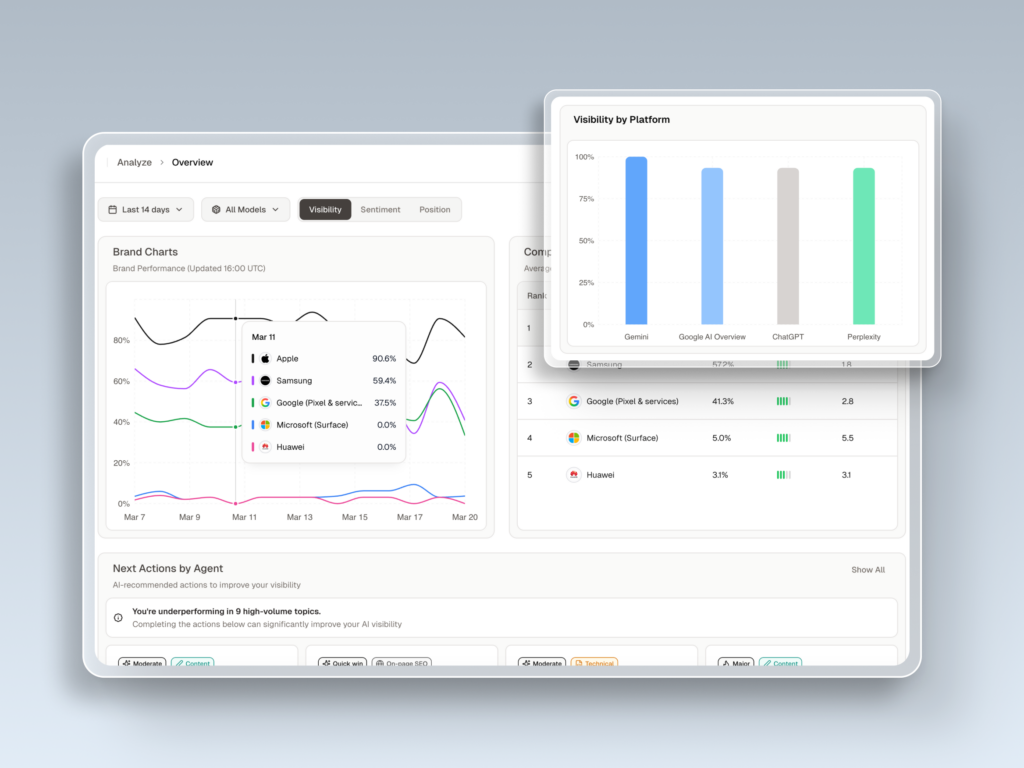
    Visibility Tracking monitors your brand across ChatGPT, Gemini, Perplexity, and other major platforms. It calculates a Visibility Score (0-100) based on the percentage of target prompts where your brand appears. Since the #1 ranked brand in an AI-generated list typically captures 62% of the share of voice, knowing your position isn’t optional.

    Competitor Monitoring auto-detects which brands are surfaced alongside yours and identifies the content gaps that allow them to hold top recommendation slots.

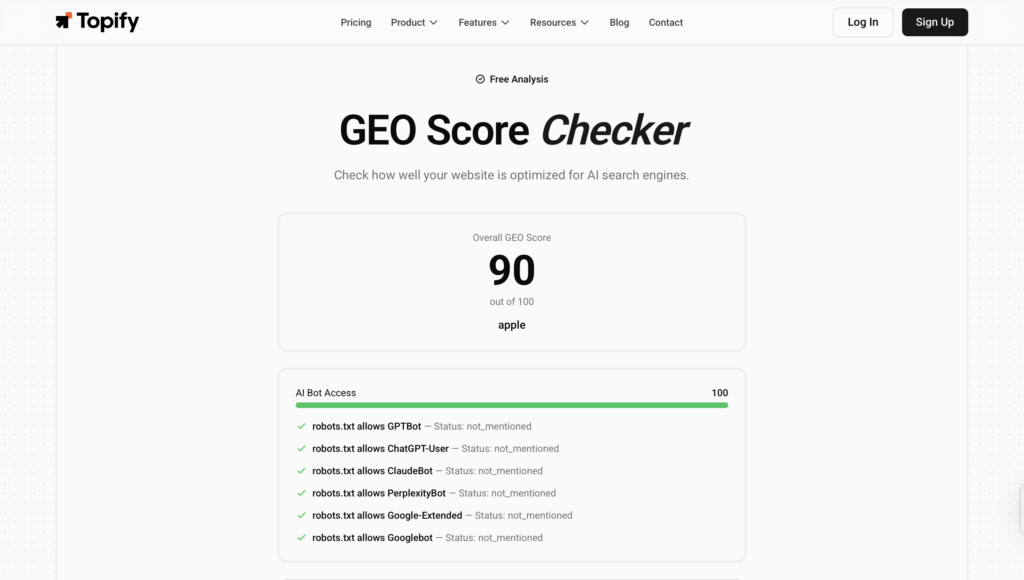
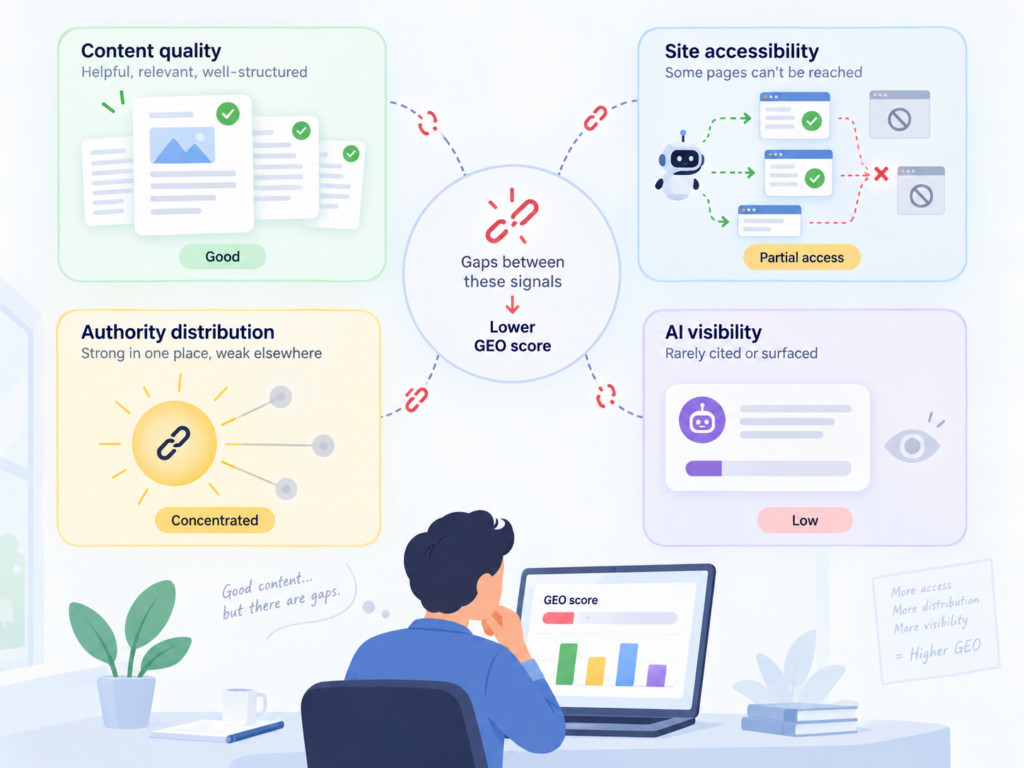
    The practical starting point: Topify’s free GEO Score Checker audits your site’s AI bot access, structured data, and content signals with no signup required. It tells you whether your technical foundation is intact before you invest in broader optimization.

    A B2B SaaS team used this approach to discover that despite ranking #1 on Google, they were invisible in AI answers. Perplexity and ChatGPT were exclusively citing a competitor’s comparison table and three niche forum threads. By creating structured “answer-first” content, engaging in the identified forums, and aligning their review profiles, they increased their AI Visibility Score by 35% within 45 days and saw a 14% lift in self-reported attribution from leads who found the brand through ChatGPT.

    3 LLM Citation Mistakes That Keep Brands Invisible

    The “Google-Only” Optimization Bias

    Ranking #1 on Google doesn’t guarantee AI citations. The overlap between Google’s top 10 results and LLM-cited sources is only 17-32%. AI models prioritize “extractability” over “link equity.” A site with lower DA but higher fact density and better schema will frequently outperform a high-DA competitor in AI answers.

    The fix: optimize for information gain. Provide data, benchmarks, and perspectives that don’t exist elsewhere on the web.

    “Self-Centric” vs. “Answer-Centric” Content

    Traditional “About Us” pages loaded with vague adjectives (“passionate,” “innovative,” “world-class”) are useless to an LLM trying to construct a factual answer. The model needs declarative, verifiable claims.

    The fix: replace “We are experts in security” with “Our platform provides end-to-end AES-256 encryption and is SOC 2 Type II compliant.” Specifics get cited. Adjectives don’t.

    Ignoring the Consensus Gap

    If your website says one thing and your G2 reviews or Reddit mentions say something different, AI models experience a “trust break.” LLMs are designed to identify and neutralize bias by cross-referencing multiple sources. Contradictions lead to exclusion.

    The fix: audit every external platform where your brand appears. Ensure consistent messaging about your positioning, pricing, and capabilities across all third-party profiles and review sites.

    Conclusion

    LLM citation is becoming the new unit of brand authority in AI search. The mechanics are different from traditional SEO, the platforms don’t all work the same way, and most existing tools can’t measure it.

    Three things matter most: make your content structurally extractable (schema, clear headings, answer-first format), own the consensus across third-party platforms (85% of citations come from sources you don’t own), and measure what you can’t see with specialized AI visibility tracking. The brands building this discipline now are the ones AI will recommend next quarter.

    FAQ

    What is an LLM citation? An LLM citation is a reference, link, or mention of a brand or source within an answer generated by an AI model like ChatGPT or Perplexity. It serves as a machine-generated endorsement and a primary source of high-intent referral traffic.

    How does Perplexity decide which sources to cite? Perplexity uses a real-time Retrieval-Augmented Generation (RAG) model. It prioritizes factual density, structured content, and extreme freshness (updates within 30 days) to provide verifiable answers with explicit URL citations.

    Can you optimize content for ChatGPT citations? Yes. ChatGPT prioritizes topical depth, comprehensive how-to guides, and content that anticipates follow-up questions. It uses the Bing index and values authoritative, well-reasoned narratives over simple keyword matching.

    How often do LLMs update their citation sources? It depends on the platform. RAG-based systems like Perplexity update their indices in near-real-time (daily or hourly via IndexNow). Foundational models like standard ChatGPT or Gemini rely more on training data but are increasingly grounded in real-time search.

    What’s the difference between LLM citation and traditional backlinks? Traditional backlinks are hyperlinks used by search engines to measure site authority and rank pages. LLM citations are synthesis signals used by AI models to construct answers. Citations value brand mentions and factual extractability at a 3:1 ratio over traditional backlink metrics.

    Read More

  • LLM Citation: How AI Picks Its Sources

    LLM Citation: How AI Picks Its Sources

    Your domain authority is 70. You’re ranking top three for your primary category keyword. Your content team has published 200 articles in the last year. Then someone types that same keyword into ChatGPT, and the response cites three sources. None of them are yours.

    That gap isn’t random. Research shows only 12% of URLs cited by AI platforms appear in Google’s top 10 for the same query. The other 88% of AI-cited content is invisible to traditional SEO monitoring. What gets you ranked on Google and what gets you cited by an LLM are now two different systems, governed by two different sets of rules.

    What Happens Between a Query and an LLM Citation

    When a user submits a query to ChatGPT, Perplexity, or Gemini, the model doesn’t just recall an answer from memory. It faces a binary decision: rely on its internal training data, or search the live web for current information.

    Researchers call these two paths Case L (learning data only) and Case L+O (learning data plus online research). In Case L mode, the model draws from its parametric knowledge, a compressed representation of patterns absorbed during pre-training. This data is typically months or years old, stored as neural weights rather than discrete documents. The model rarely provides external citations in this mode.

    Case L+O is where citations happen. When a query involves real-time events, factual verification, or high-stakes topics, the model activates its Retrieval-Augmented Generation (RAG) pipeline. It searches the web, retrieves candidate sources, and selects which ones to cite. This trigger point is the essential gateway. Without it, your content is never evaluated.

    That’s the part most SEO professionals miss. The majority of AI citations come from RAG retrieval, not from the model’s “memory.” Your content doesn’t need to be in the training data. It needs to survive the retrieval pipeline.

    The Four Signals LLMs Use to Select Sources

    Once the RAG pipeline activates, the model evaluates candidate sources through four core signals. These aren’t the same signals that drive Google rankings.

    Semantic relevance operates in vector space, not keyword space. The model converts content into numerical embeddings and measures semantic proximity to the user’s intent. Keyword stuffing, counterintuitively, hurts here. Repeating a term dilutes the “semantic signature” of a passage, pushing its vector further from the query’s meaning. Content that provides direct, unambiguous answers to specific questions scores higher.

    Information gain measures the density of unique, verifiable data points. LLMs can generate generic descriptions on their own. What they can’t generate are original statistics, first-hand research findings, or specific expert insights. Passages structured into self-contained chunks of 50 to 150 words receive 2.3x more citations than long, narrative-heavy blocks. Shorter, focused sections let the model attribute a specific fact to a specific URL with higher confidence.

    Entity coherence is consistency. The model cross-references your brand description against third-party platforms like Wikipedia, G2, Reddit, and LinkedIn. If your homepage says “leader in AI analytics” but Reddit describes you as a “marketing automation tool,” the model’s entity confidence drops. Brands mentioned consistently on four or more platforms are 2.8x more likely to appear in ChatGPT responses.

    Freshness acts as a primary trust filter. Content updated within the last 90 days is 3x more likely to be cited than older material. Claude favors very recent content with a median citation age of 5.1 months, while ChatGPT and Gemini tolerate slightly older material at around 8 months. Replacing statistics older than 18 months is the most effective way to reset the freshness clock.

    Evidence Graphs: How LLMs Resolve Conflicting Sources

    When the retrieval pipeline surfaces multiple sources with conflicting claims, the model doesn’t just pick the one with the highest domain authority. It builds what researchers call an “evidence graph,” a network where nodes represent entities and facts, and edges represent corroborating relationships between documents.

    The reasoning layer performs consensus validation. If three independent sources, say a news site, an industry report, and a peer-reviewed study, all state the same statistic, that data point achieves “fact status” in the graph. The model cites one or more of those sources as verification. Outlier claims that lack corroboration get omitted or flagged as unverified.

    This “three-source rule” has a practical implication: brands that rely solely on self-published content to make claims will lose to competitors whose claims are echoed across independent third-party domains. Building consensus across the web matters more than publishing volume on your own site.

    Once an LLM identifies reliable nodes within its evidence graph for a category, it tends to stick with them. Analysis of citation patterns reveals a 96.8% week-over-week stability rate in cited domains. Among the roughly 3% that do change, 87% are declines and only 13% are gains. Citation positions are calcifying. That creates a first-mover advantage: brands that establish themselves as citable nodes early are significantly harder to displace.

    Why High-Ranking Pages Still Get Zero AI Citations

    The “high-ranking, zero-citation” gap is structural, not accidental. Traditional SEO encourages long-form content that captures a variety of keywords. LLMs prefer cleanly segmented sources where facts are easy to extract. A 3,000-word guide that buries key data points inside long narrative paragraphs will get bypassed in favor of a 500-word page with clear H2 headers answering specific sub-questions directly.

    The disconnect gets worse with query fan-out. When a user enters a complex prompt, the AI doesn’t run a single search. It decomposes the prompt into multiple simultaneous sub-queries. A question like “What’s the best CRM for a healthcare startup with 50 employees?” might fan out into four separate searches: HIPAA compliance features, pricing for 50 users, medical startup reviews, and Salesforce vs HubSpot comparisons.

    If your content ranks #1 for the head keyword but doesn’t have specific sections addressing those sub-topics, it fails retrieval for the queries that actually build the synthesized answer. Each sub-query identifies its own set of sources, and the final citation list is a synthesis of those separate searches. You don’t need to rank for everything. You need to be extractable for something specific.

    How to Track Which Sources LLMs Actually Cite

    Manual citation tracking is a dead end. AI responses are probabilistic, meaning the same prompt can produce different citations in different sessions. Platform preferences vary wildly: ChatGPT overlaps with Google’s top 10 only 12% of the time, Perplexity sits around 33%, and Google AI Overviews ranges from 38% to 76%. A single spot-check tells you nothing. Only systematic monitoring across thousands of queries can establish a reliable baseline.

    Topify was built to close this measurement gap. Its AI Citation Analysis identifies which specific domains and URLs AI platforms cite when they answer queries in your category. Instead of guessing which content is working, you can see the actual evidence graph the AI relies on, and spot where competitors are being cited while your brand remains absent.

    The platform’s AI Visibility Checker tracks mention frequency, recommendation position, and sentiment across ChatGPT, Gemini, Perplexity, and AI Overviews. Position matters disproportionately: the first-cited brand in an AI response captures over 60% of the AI share of voice. Being mentioned fifth often leads to total exclusion from user attention.

    For teams that want a quick diagnostic before committing to ongoing monitoring, Topify’s free GEO Score Checkerevaluates your site across four dimensions: AI bot access, structured data, content signals, and overall visibility. No signup required. It’s a fast way to determine whether your technical foundation is blocking AI retrieval before investing in content optimization.

    Five Content Signals That Earn LLM Citations

    Moving from “ranked” to “cited” requires optimizing for the RAG pipeline’s extraction and reasoning layers. Five signals consistently predict citation success.

    Structured, modular writing. Break content into 50 to 150 word self-contained chunks. Each section should start with an H2 or H3 that asks a specific question, followed by a direct answer. This structure facilitates the passage indexing that neural retrievers depend on. Tables are particularly effective, appearing in nearly a third of all AI citations.

    Statistics and original data. Embedding quantitative metrics into every article provides the information gain LLMs prioritize. Adding statistics has been shown to boost AI visibility by up to 41%. Every major claim should include a number and a date.

    Entity alignment across platforms. Maintain identical positioning on Wikipedia, LinkedIn, Crunchbase, G2, and relevant subreddits. AI platforms trust third-party consensus more than self-attestation. A mention on a respected industry site carries more citation weight than ten pages of marketing copy on your own domain. Third-party sources are cited 6.5x more often than brand-owned pages.

    Answer-first formatting. Place the most important facts in the first 30% of the page, where they’re most likely to be extracted. Use lists, comparison tables, and TL;DR summaries. Avoid vague language. AI models select content that gives them a clean, attributable data point, not content that makes them work to find one.

    The 90-day freshness cycle. Audit and refresh competitive pages every 90 days. Update statistics, add new sections to address emerging fan-out queries, and ensure that schema markup (datePublished and dateModified) signals recency to AI crawlers. Content decay in AI citation is faster than in traditional search: 62% of citations turn over every 90 days in competitive categories.

    Conclusion

    LLM citation isn’t a mystery. It’s a pipeline with measurable signals at each stage: the decision to search, semantic retrieval, evidence weighting, and source attribution. The uncomfortable reality for SEO professionals is that the signals driving this pipeline, semantic relevance, information density, entity coherence, and freshness, don’t map neatly onto the metrics they’ve spent years optimizing.

    The 12% overlap between AI citations and Google’s top 10 isn’t shrinking. It’s a structural feature of how generative search works. The brands that adapt, by building modular, data-rich content and tracking their citation performance across platforms, will own the discovery layer that’s replacing ten blue links. The ones that don’t will remain part of the invisible 88%.

    FAQ

    What is LLM citation?

    An LLM citation is the attribution of a specific claim in an AI-generated response to an external source URL. Unlike traditional search results that present a list of links, AI citations ground the model’s synthesized answer in verifiable data. They’re the primary mechanism through which content gets discovered in AI search.

    How does RAG affect LLM citation selection?

    RAG (Retrieval-Augmented Generation) is the mechanism that triggers external search. When activated, the model retrieves content chunks from the web based on semantic proximity to the query, evaluates them for information gain and entity coherence, and selects the most attributable sources. Without the RAG trigger, no external citations occur.

    Do backlinks help with LLM citations?

    The correlation between backlinks and AI citations is near zero in most studies. LLMs prioritize a source’s internal factual density and the brand’s consistency across third-party platforms over the total number of incoming links. A page with 10 backlinks but strong structured data can outperform a page with 10,000 backlinks but poor extractability.

    How often do LLM citation sources change?

    At the domain level, citation patterns are remarkably stable: 96.8% of cited domains show zero change week-over-week. At the URL level, turnover is much faster, with 62% of citations changing every 90 days in competitive categories. This makes regular content freshness updates a practical necessity for maintaining citation position.

    Read More

  • AI Visibility Tools for Finance: 7 Free Tools to See What AI Says About Your Brand

    AI Visibility Tools for Finance: 7 Free Tools to See What AI Says About Your Brand

    A portfolio manager asked ChatGPT, “What’s the best robo-advisor for beginners with $5,000?” and got back four names. Your platform, the one with 200,000 managed accounts and a 4.8 app store rating, wasn’t on the list.

    This is happening across the finance industry right now. Consumers are skipping Google, typing full questions into ChatGPT, Perplexity, and Gemini, and getting direct answers that shape where their money goes. If your brand isn’t in those answers, you’re invisible at the exact moment someone is making a financial decision.

    The good news: you don’t need to guess where you stand. A set of free tools can show you, in under 60 seconds, exactly how AI search engines see your finance brand today.

    Your Google Rankings Look Great. Here’s What They’re Missing.

    Ranking on page one of Google used to be enough. For finance brands, it was the moat. But AI search has opened a second front, and most financial institutions haven’t noticed.

    60% of U.S. adults now use AI-powered search to find financial information. A global EY survey of 18,000 consumers found that 49% had used AI in the past six months to help with savings and investment decisions, with adoption among Gen Z reaching 68%. These aren’t casual queries. An Intuit Credit Karma poll found that 85% of users who received AI-generated financial advice actually acted on it.

    Here’s the thing: the sources AI pulls from are not the same sources that rank well on Google. Research from Fintel Connect shows that across major AI models, more than 60% of citations come from publishers and affiliate sites, not from the financial institutions themselves. And the overlap between Google’s top organic results and the sources AI actually cites has dropped from 70% to below 20%.

    That gap explains why a bank can dominate Google for “best savings account” and still be absent from ChatGPT’s answer to the same question. The prompts your potential customers are asking AI look like this:

    • “What’s the best high-yield savings account right now?”
    • “Compare mortgage rates for first-time homebuyers in California”
    • “Is Schwab or Fidelity better for retirement accounts?”
    • “Best credit card for international travel with no foreign fees”

    You can’t optimize what you can’t see. The first step is using free tools to build a baseline of where your brand actually stands in AI search.

    7 Free AI Visibility Tools Finance Brands Can Use Right Now

    These tools are built for this exact blind spot. No signup, no credit card, no demo calls. Each one checks a different dimension of your AI visibility, and together they give you a full diagnostic of how AI search engines perceive your finance brand.

    Is Your Site Even Accessible to AI Crawlers?

    Before anything else, check whether AI search engines can actually read your pages. Topify’s GEO Score Checker evaluates your site across four dimensions: AI bot access, structured data, content signals, and overall visibility readiness.

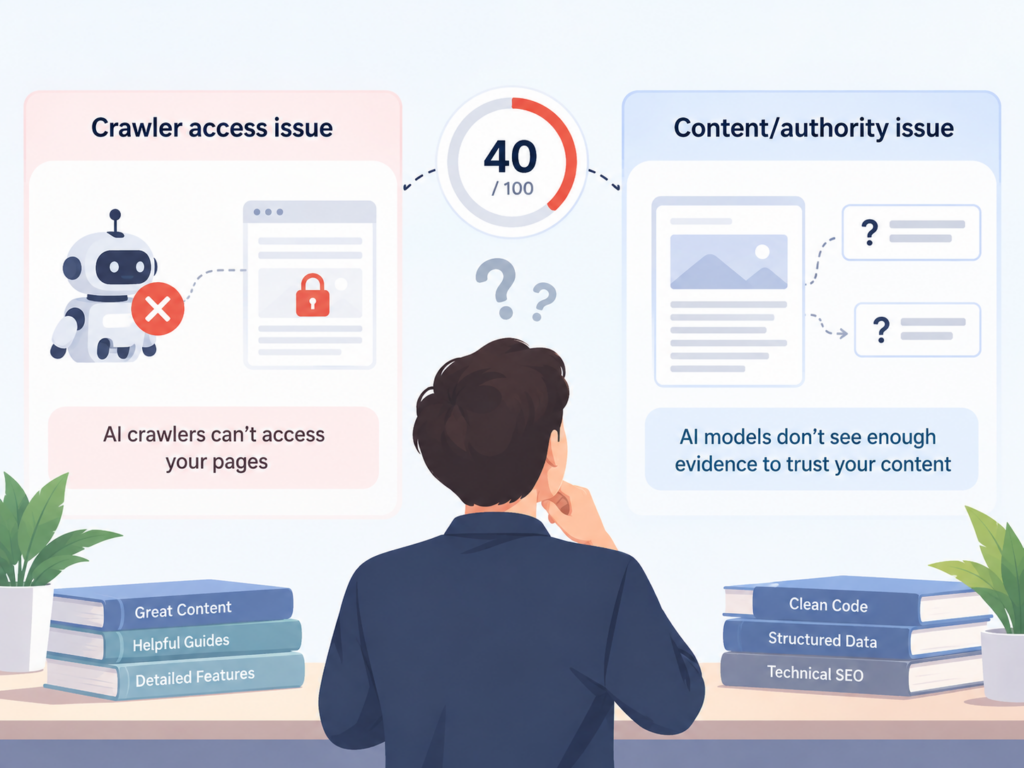
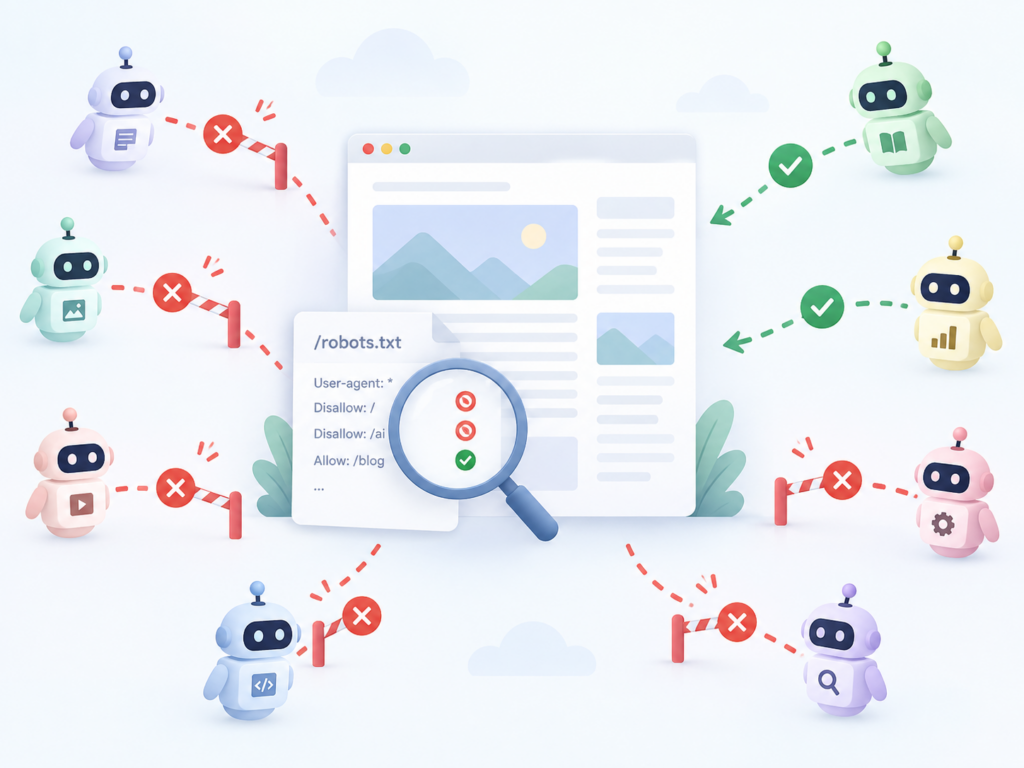
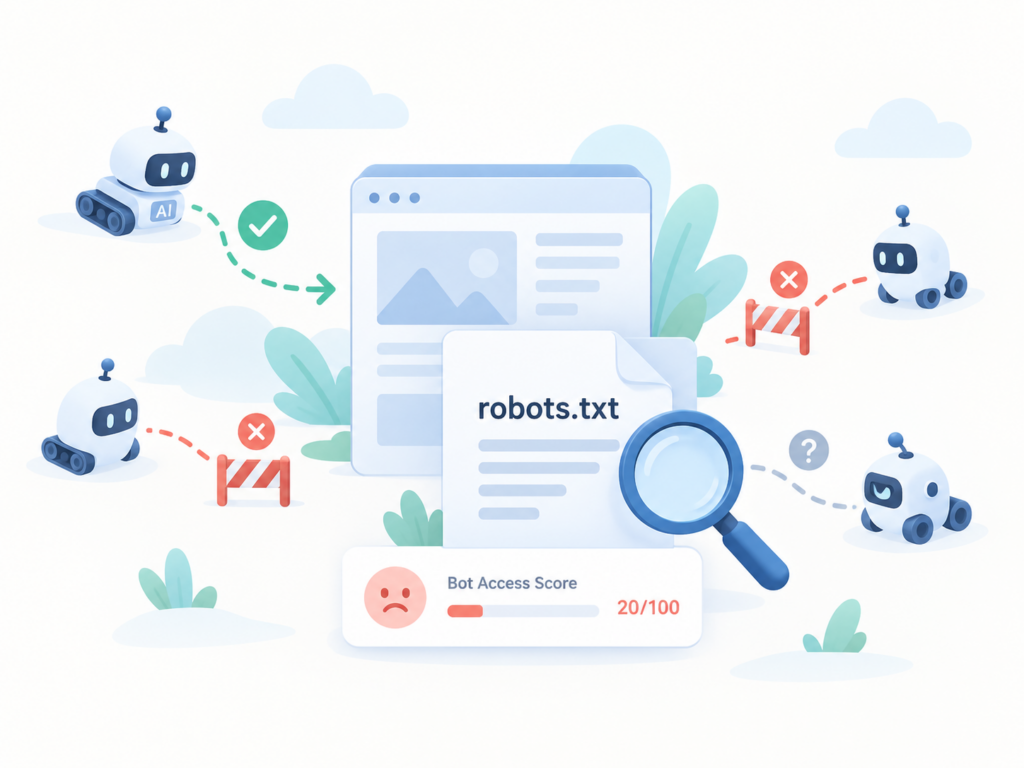
    For finance brands, this often surfaces a specific blind spot. Compliance-heavy sites frequently block AI crawlers in their robots.txt without realizing it. Security-focused configurations that protect customer data can also prevent GPTBot, ClaudeBot, and PerplexityBot from indexing your product pages. If AI crawlers can’t read your content, no amount of content quality will get you recommended.

    Which AI Bots Can Actually Crawl Your Site?

    The AI Robots Checker goes one level deeper than a general GEO score. It shows you exactly which AI crawlers are allowed or blocked by your current robots.txt configuration.

    This matters because not all AI platforms use the same bot. A finance brand might be visible in Perplexity but completely blocked from ChatGPT’s search index because GPTBot is specifically disallowed. You need to know which doors are open and which are closed.

    What Does AI Actually Say When Someone Asks About You?

    The AI Visibility Report is where diagnosis gets specific. Enter your brand name and a set of prompts relevant to your category, and see exactly how AI models respond.

    For a wealth management firm, you might test prompts like “best wealth management platforms for high-net-worth individuals” or “top financial planning tools for retirement.” The report shows whether your brand appears, how it’s described, and who else gets recommended alongside you. In finance, where product accuracy is tied to trust, this report often reveals surprising gaps between what your marketing says and what AI tells potential customers.

    How Strong Is Your Brand Authority in AI’s Eyes?

    AI models don’t just look at your website. They weigh a brand’s authority across the entire information ecosystem: news coverage, expert mentions, review sites, industry publications. The Brand Authority Checker measures how AI perceives your overall brand strength.

    The eMarketer Q1 2026 AI Visibility Index found that Capital One led all financial services brands with a 21% mention rate, ahead of JPMorgan Chase at 17%. Meanwhile, Similarweb’s 2026 GenAI Brand Visibility Index showed that NerdWallet and Bankrate, both content-first brands, ranked 66 to 68 positions higher in AI visibility than their traditional search rank would predict. That’s not a coincidence. AI rewards distributed authority, not just domain authority.

    Is AI Describing Your Products Accurately?

    This is where finance gets uniquely risky. If AI misquotes your interest rate, misrepresents your fee structure, or omits a key compliance disclosure, the consequences go beyond lost traffic.

    The Brand Sentiment Checker shows how AI characterizes your brand: the tone, the emphasis, the features it highlights or ignores. For a credit card issuer, it might reveal that ChatGPT consistently mentions your annual fee but never mentions your sign-up bonus. For an insurance provider, it might show that AI describes your coverage as “basic” when you’ve expanded it significantly. These are narrative problems, and they’re fixable once you can see them.

    Who Does AI Recommend Instead of You?

    The Competitor Analysis tool shows which brands AI considers your direct competitors and how often they appear in the same answer.

    In finance, the competitive set in AI responses often looks different from the one your sales team tracks. A regional bank might discover that AI groups it with national players. A fintech might find that AI recommends legacy institutions for the same use case. Understanding who you’re actually competing against in AI answers is the first step to changing the outcome.

    What Are Your Customers Actually Asking AI?

    Most finance brands optimize for the keywords they assume customers use. The Prompts Researcher reveals the actual prompts people type into AI platforms when looking for financial products and services.

    The difference between a Google keyword and an AI prompt is structural. A Google search might be “best savings account 2026.” An AI prompt is more likely “I have $10,000 in a checking account earning nothing, what should I do with it?” The second query is conversational, context-rich, and requires a different kind of content to match. If your content library is built entirely around short-tail keywords, it’s likely invisible to these longer, intent-driven prompts.

    Finance Brands Over-Index on SEO and Under-Index on Brand Narrative

    The pattern across the finance industry is clear: massive investment in traditional search rankings, minimal investment in controlling how AI tells the story of your brand.

    This isn’t a minor blind spot. It’s a structural mismatch between where budgets go and where buyer behavior is moving. Gartner projects traditional search volumes will fall by more than 25% by 2028 as users shift to AI tools. Meanwhile, AI search traffic converts at 14.2% compared to Google’s 2.8%. The channel that’s growing faster also converts better, and most finance brands aren’t even visible in it.

    The brands winning in AI search right now aren’t necessarily the biggest. They’re the ones with the clearest, most consistent narrative across the information ecosystem. NerdWallet and Bankrate don’t have the product portfolios of JPMorgan or Wells Fargo, but AI models cite them far more often because their content is structured, authoritative, and present on the third-party sites that AI relies on.

    That’s the core insight: AI doesn’t rank pages. It synthesizes narratives. When a consumer asks “what’s the best way to invest $50,000 for retirement,” AI doesn’t return your product page. It assembles an answer from NerdWallet explainers, Forbes comparisons, Reddit threads, and Investopedia guides. If your brand’s narrative is consistent across those sources, you get recommended. If it’s not, you don’t.

    The risk for finance brands is especially high because AI inaccuracy carries real consequences. An AI response that misrepresents your APR, misclassifies your account type, or omits a regulatory disclosure doesn’t just cost you a lead. It introduces compliance risk you didn’t know existed.

    The fix starts with diagnosis. Run your brand through the free tools above to see where your narrative gaps are. Check whether AI crawlers can access your site. See what AI actually says about your products. Identify where competitors are showing up instead of you. That baseline is what turns a vague concern into a specific action plan.

    From a Free Checkup to Continuous AI Monitoring

    These free tools give you a clear snapshot of where your brand stands today. The gap they can’t close is continuity. AI answers change every time a model updates its index, and a quarterly manual check misses the shifts that happen in between.

    Topify’s paid platform picks up where the free tools leave off: continuous tracking across ChatGPT, Perplexity, Gemini, and AI Overviews, with alerts when your visibility drops or a competitor gains ground. You can monitor specific prompts, track sentiment changes over time, and benchmark against competitors, all from one dashboard.

    For finance brands managing multiple products, regulatory requirements, and fast-moving competitive dynamics, the difference between a one-time snapshot and ongoing monitoring is the difference between knowing you have a problem and catching it before it costs you.

    Get started with Topify with a 30-day free trial. Plans start at $99/month. See Topify Pricing for details.

    Conclusion

    AI search is already shaping how consumers choose banks, credit cards, investment platforms, and insurance providers. The finance brands that show up in those answers aren’t always the biggest or the best known. They’re the ones whose content is accessible to AI crawlers, whose brand narrative is consistent across third-party sources, and whose products are accurately described in the information ecosystem AI relies on.

    You don’t need a six-figure budget to start. The seven free tools above can show you, today, exactly where your brand stands in AI search, what AI says about you, and where the gaps are. That diagnostic is the foundation for everything that comes next.

    FAQ

    Are these tools really free? Do I need to sign up?

    Yes, all seven tools listed are completely free with no signup required. You can run a check on your brand or website in under 60 seconds. The tools are provided by Topify as part of their free AI visibility toolkit.

    Which tool should a finance brand use first?

    Start with the GEO Score Checker. If AI crawlers can’t access your site, nothing else matters. From there, run the AI Visibility Report to see what AI actually says when someone asks about your category. These two checks together give you the most actionable baseline.

    How often should I check my AI visibility?

    AI models update their indices frequently, and competitor activity can shift your visibility overnight. A manual check using free tools every month is a reasonable starting point. For brands in competitive categories like credit cards, banking, or wealth management, continuous monitoring through a paid platform provides more reliable coverage.

    What if AI is inaccurately describing my financial products?

    This is a common and serious issue in finance. Start by documenting exactly what AI says (the Brand Sentiment Checkerhelps here). Then audit your own content and the third-party sources AI relies on for consistency. In many cases, outdated information on comparison sites or review platforms is the root cause. Updating those sources and structuring your own content for AI extraction can correct the narrative over time.

    Read More

  • AI Visibility Tracking for SaaS Founders

    AI Visibility Tracking for SaaS Founders

    How to Show Up When Buyers Ask AI for Tool Recs

    You rank on page one of Google for your primary category keyword. Your domain authority is solid. Then you ask ChatGPT, “What’s the best tool for [your category]?” and get back a list of three competitors. Your product isn’t on it.

    That gap between Google rankings and AI recommendations is where SaaS deals are quietly dying. In 2025, 95% of B2B buyers purchased from a vendor that was already on their Day One shortlist. And increasingly, that shortlist is being assembled not by Google searches but by AI platforms like ChatGPT, Perplexity, and Gemini. If your product doesn’t show up in those answers, you’re out before you even know the buyer exists.

    The fix starts with something most SaaS teams haven’t built yet: ai visibility tracking.

    Your Google Rank Doesn’t Mean AI Knows You Exist

    There’s a strategic misunderstanding baked into most SaaS marketing stacks: the assumption that strong SEO automatically translates to AI visibility. It doesn’t. The two systems run on fundamentally different logic.

    Google ranks URLs based on domain authority, backlinks, and keyword density. AI answer engines like ChatGPT and Perplexity synthesize responses based on entity strength, factual corroboration across multiple sources, and how “extractable” your content is for machine readers. A SaaS company can hold the top organic spot for a category keyword and still be excluded from a ChatGPT recommendation if the AI can’t corroborate the brand’s expertise through trusted third-party sources.

    That distinction matters because B2B buying behavior is shifting fast. The average buying cycle dropped from 11.3 months in 2024 to 10.1 months in 2025, and buyers are reaching out to sales reps earlier, moving the point of first contact from 69% of the journey to 61%. By the time a prospect fills out your demo form, the evaluation is mostly done. The question is whether your product made the AI-curated shortlist that informed that evaluation.

    What AI Visibility Tracking Actually Measures

    AI visibility tracking is not a rebrand of SEO monitoring. It’s a different measurement layer altogether, designed to answer one question: how does AI characterize, recommend, and position your brand when buyers ask about your category?

    Topify, an AI search optimization platform built for this use case, breaks AI visibility into seven dimensions that give SaaS founders a full picture of their brand’s presence in the synthesized layer of the internet.

    Visibility Score measures the percentage of target prompts where your brand appears. If you’re tracking 100 high-intent prompts across three platforms and your brand shows up in 45, that’s a 45% Visibility Score.

    Sentiment Score captures the tone of how AI describes your product on a 0-to-100 scale. A score below 40 typically means the AI is adding caveats about pricing, complexity, or limitations. That framing shapes buyer perception before they ever visit your site.

    Position Rank tracks where you land in a recommendation list. Being mentioned first carries an implicit endorsement that a fourth-place mention doesn’t.

    Source Citation Share identifies which external URLs the AI is citing as its source of truth. In many categories, AI platforms rely on G2, Reddit, and industry blogs rather than your own website.

    AI Volume reveals how often buyers are asking AI about your category, surfacing “dark queries” that traditional keyword tools miss entirely.

    Intent Alignment checks whether AI is matching your product to the right buyer persona. High visibility for an irrelevant use case is worse than no visibility at all.

    Conversion Visibility Rate (CVR) estimates the conversion probability of a specific mention context. This is the metric that connects visibility directly to pipeline. While traditional organic search traffic converts at roughly 2.8%, AI search traffic converts at 14.2%, an 8.5x advantage for SaaS companies. The average value of an AI-referred visit is $47 compared to $9 from Google.

    3 Signals Your Competitors Already Own the AI Shortlist

    You don’t need a full tracking platform to diagnose the problem. Three signals tell you whether AI is sending buyers to your competitors.

    The Shortlist Displacement. Run 10 to 20 “best of” prompts across ChatGPT and Perplexity using your category keywords. If competitors consistently occupy the top three spots and your product isn’t mentioned, you have a retrieval gap. The AI has either not indexed your relevant content or doesn’t perceive your brand as a leader for that intent.

    The Citation Vacuum. Check the “Sources” section in Perplexity or Gemini responses about your category. If the AI cites only competitor whitepapers, blog posts, and landing pages while explaining concepts your product solves, your competitor has established source authority. Your content is being deemed less credible or less extractable.

    Semantic Drift. Ask ChatGPT or Gemini “How does [your product] work?” If the AI misrepresents your features, pricing tier, or target customer, you’re experiencing semantic drift. This happens when the model’s training data or retrieved content contains outdated or incorrect information. A founder whose enterprise platform gets described as a “free tool for students” faces immediate friction in every high-value sales conversation.

    How to Set Up AI Visibility Tracking in 30 Minutes

    Building a baseline doesn’t require a six-month initiative. Three focused steps can give you a working AI visibility tracking system in about half an hour.

    Step 1: Identify Your High-Value Prompts

    The shift from keyword tracking to prompt tracking is fundamental. Instead of monitoring “project management software,” track the full-sentence questions buyers actually ask AI.

    Map prompts across the buyer journey. Awareness-stage prompts look like “What are the top trends in [category] for 2026?” Consideration-stage prompts look like “Compare [your product] vs [competitor] for [use case].” Decision-stage prompts look like “What are the security certifications for [your product]?”

    Topify’s High-Value Prompt Discovery uses real-world conversational data to surface the prompts actually driving traffic, rather than relying on static search volume estimates.

    Step 2: Run a Cross-Platform Baseline Audit

    Each AI platform uses different retrieval logic and training data. A prompt that returns your brand in Perplexity might exclude you in ChatGPT. Run your identified prompts across ChatGPT, Perplexity, Gemini, and Google AI Overviews. Record the initial Visibility Score, Sentiment, and Position for each. That “before” snapshot is essential for measuring the ROI of any optimization you do next.

    Step 3: Set Up Continuous Monitoring

    AI recommendations are probabilistic and highly sensitive to model updates. A one-time audit gives you a snapshot, not a strategy.

    Here’s why that matters: 50% of the content cited in AI responses is less than 13 weeks old. When OpenAI or Anthropic ships a new model version, the retrieval mechanisms change. A brand that held the top recommendation slot in one version can vanish in the next if the new model prioritizes a different set of trusted sources.

    Continuous monitoring platforms like Topify automate daily querying across platforms and send alerts when a competitor gains ground or when your brand’s sentiment shifts. That’s the difference between reacting to a pipeline drop three months later and catching the visibility loss the week it happens.

    From AI Visibility Tracking to SaaS Growth: 3 Moves That Work

    Tracking is the diagnostic layer. Growth comes from acting on the data. Three strategies consistently move the needle for SaaS brands.

    Build citation authority on the platforms AI already trusts. Research shows that 85% of brand mentions in AI responses come from third-party sites, including Reddit, G2, TrustRadius, and industry publications. If Topify’s Source Analysis shows that 60% of citations in your category come from Reddit, your content strategy should shift toward community engagement and earned media on those platforms.

    Restructure content for machine extractability. AI models prefer content they can parse cleanly. That means opening product pages and blog posts with a two-to-three sentence “Bottom Line Up Front” summary that directly answers a buyer prompt. Implementing structured data like JSON-LD schema markup (SoftwareApplication, FAQPage, Organization) can drive a 67% improvement in AI coverage. And brands that publish original research are 6.5x more likely to be cited as an authoritative source.

    Close gaps with one-click execution. The bottleneck for most SaaS teams isn’t knowing what to fix. It’s having the bandwidth to fix it. Topify’s AI agent can automatically generate GEO-optimized content, deploy structured data, and draft responses for community threads where competitors are being cited. Lean teams can maintain a high-velocity GEO program without tripling their content headcount. You can get started with Topify and see your brand’s current AI visibility status within minutes.

    What Happens When SaaS Brands Start Tracking AI Visibility

    The data from early adopters tells a clear story.

    A mid-market project management platform ranking on page one of Google was appearing in only 8% of AI-driven buyer queries. Competitors were showing up in 65%. After a 90-day GEO framework that included structural content updates and a Reddit marketing campaign, they hit a 24% cross-platform citation rate, generated 47 qualified leads directly attributed to AI recommendations, and saw a conversion rate 2.8x higher than their previous organic search average.

    An Australian HR SaaS called PeopleFlow started with a 6.4% mention rate across 47 test queries and zero top-recommendation positions. After restructuring core business data and optimizing for major LLMs, they achieved a 340% increase in brand mentions, moved their average recommendation position from 7th to 2nd, saw a 28% increase in demo requests with “AI research” cited as the discovery source, and cut their sales cycle length by 34%.

    Those aren’t edge cases. They’re what happens when SaaS brands treat AI visibility as a measurable growth channel instead of a nice-to-have.

    Conclusion

    The SaaS brands that win in 2026 won’t just rank on Google. They’ll be the ones AI recommends when a buyer asks “What’s the best tool for [my problem]?” That requires knowing where you stand today, tracking how it changes week over week, and acting on the gaps before competitors fill them.

    AI visibility tracking gives you that infrastructure. Start by running your category prompts across ChatGPT and Perplexity, measure your baseline, and build from there. The buyers are already asking AI for recommendations. The only question is whether your product is part of the answer.

    FAQ

    Q: What is AI visibility tracking?

    A: AI visibility tracking is the practice of monitoring how your brand appears, gets characterized, and ranks within AI-generated answers across platforms like ChatGPT, Perplexity, Gemini, and Google AI Overviews. It measures dimensions like mention frequency, sentiment, position, and source citations to give you a complete picture of your AI presence.

    Q: How often should I check my SaaS brand’s AI visibility?

    A: Continuous monitoring is the standard. AI recommendations shift frequently as models update and new content gets indexed. Half of the content cited in AI responses is less than 13 weeks old, so weekly or daily tracking catches changes that a quarterly audit would miss entirely.

    Q: Can AI visibility tracking replace traditional SEO?

    A: No. AI visibility is built on the foundation of quality SEO, but it requires a different optimization approach called Generative Engine Optimization (GEO). SEO drives traffic to your site. AI visibility tracking ensures you make the buyer’s shortlist before the click ever happens. You need both.

    Q: Which AI platforms matter most for SaaS discovery?

    A: The four platforms that matter most for B2B SaaS discovery are ChatGPT for creative and strategic research, Perplexity for cited research and sourced recommendations, Gemini for the Google ecosystem, and Google AI Overviews for search result summaries. Tracking across all four gives you the most complete picture.

    Read More

  • AI Visibility Tracking for E-commerce Brands

    AI Visibility Tracking for E-commerce Brands

    Your product ranks in the top three on Google for “best noise-canceling headphones under $150.” Your Google Ads budget is healthy. Your conversion rate has been steady for months. Then a shopper asks ChatGPT, “What are the best noise-canceling headphones for a $150 budget?” and gets a list of five products. Yours isn’t on it.

    That gap between Google performance and AI recommendation is where e-commerce brands are quietly losing their highest-intent buyers. Traditional analytics can’t measure it because they weren’t built for a world where the purchase decision happens inside a conversation, not a search results page.

    ChatGPT Is Already Your Customer’s Shopping Assistant

    The shift from search to synthesis isn’t coming. It’s already here, and the numbers are hard to ignore. During the 2025 holiday season, traffic to retail sites from generative AI tools grew 693.4% year over year. Total online spending hit a record $257.8 billion, with more than $4 billion spent daily for nearly a month. But the path to those purchases looked nothing like the traditional Google-click-buy funnel.

    AI assistants are functioning as personal shopping concierges. A marathon runner asks for sneakers based on arch support and cushioning. A new parent asks for the safest car seat under $300. These aren’t keyword searches. They’re multi-turn conversations where the AI synthesizes reviews, compares specs, and cross-references prices before the shopper ever visits a product page.

    The adoption curve is steep. ChatGPT reached 900 million weekly active users by early 2026, more than doubling from 400 million just a year earlier. Among households earning $150,000 to $200,000, AI has already overtaken Google as the starting point for product research. If your brand isn’t visible in these AI-generated answers, you’re excluded from the consideration set before a shopper ever reaches your site.

    That’s the gap most e-commerce teams still can’t see.

    What AI Visibility Tracking Actually Measures for E-commerce

    Traditional SEO tracks how pages rank for keywords. AI visibility tracking measures something fundamentally different: how AI models synthesize and recommend your products as entities within a generated answer.

    Think of it this way. Google ranks your product page. ChatGPT recommends your product. Those are two different systems with two different criteria, and being good at one doesn’t guarantee the other. Research shows that in 2024, roughly 70% of AI-cited sources ranked in the organic top 10. By 2026, that overlap has dropped to under 20%.

    There’s also a critical distinction between mentions and citations. A mention means the AI names your product in its response. A citation is a clickable link back to your site, indicating the AI used your content as a source. Both matter, but citations drive the high-converting traffic. In the U.S. market, AI citation rates sit at approximately 10.31%, nearly three times higher than in non-U.S. markets. For global e-commerce brands, that geographic variation alone changes the optimization playbook.

    4 Metrics That Determine Whether AI Recommends Your Product

    Tracking AI visibility for e-commerce requires moving from keywords to prompts. Here are the four metrics that form the foundation.

    Mention Rate: Are You in the Answer?

    Mention Rate is the percentage of relevant shopping prompts where your brand appears. Because AI is probabilistic, it can give different answers to the same question in different sessions. The average brand has an AI visibility of about 0.3%, while top performers reach 12%. A single manual check tells you almost nothing. You need thousands of prompt simulations to get a statistically reliable baseline.

    Recommendation Position: Where You Rank in the AI’s List

    In a list of five product recommendations, being first carries far more weight than being fifth. AI responses typically mention only three to five brands, and the #1 ranked brand captures an average of 62% of total AI Share of Voice. The gap between first and third is typically 5x. In AI shopping, anything outside the top three risks total exclusion.

    There’s a nuance worth noting in Google’s AI Overviews: Position 2 sometimes outperforms Position 1 in click-through rate (5.76% vs. 2.51%) because users skip the AI summary box to find the first organic link beneath it. Context matters.

    Sentiment: What the AI Says About You

    It’s not enough to be mentioned. What the AI says about your product shapes purchase decisions. If ChatGPT describes your premium headphones as a “budget option,” that’s a positioning problem no amount of Google Ads can fix.

    Sentiment tracking goes beyond positive or negative. Smart e-commerce teams track what practitioners call “Sentiment Velocity,” the direction in which the AI’s opinion is trending. A downward shift in how the AI frames your pricing or reliability is a leading indicator of declining sales, often visible weeks before it shows up in your conversion data.

    Source Attribution: Where the AI Gets Its Information

    This is where things get tactical. Source attribution reveals exactly which URLs the AI is citing to justify its recommendations. And here’s the uncomfortable truth for e-commerce brands: third-party citations are 6.5 times more likely to influence AI models than content from a brand’s own domain. Between 82% and 85% of AI citations come from external sources like Reddit, YouTube, and review platforms.

    If a competitor is winning a product recommendation because ChatGPT is pulling from a specific Reddit thread, you need to know that. Not next quarter. Now.

    How to Set Up AI Visibility Tracking for Your Product Catalog

    Getting started with ai visibility tracking doesn’t require rebuilding your entire marketing stack. But it does require a different approach than traditional SEO monitoring.

    Step 1: Map your high-value prompts. Forget keywords. Think in full conversational queries: “best eco-friendly yoga mat for hot yoga under $80” or “wireless earbuds for running that don’t fall out.” The average AI query is 23 words long, packed with specific constraints. Topify‘s High-Value Prompt Discovery identifies these prompts at scale and scores them using an Opportunity Score that weighs AI query volume, visibility gaps where competitors appear but you don’t, commercial intent signals, and your existing content readiness.

    Step 2: Track across platforms, not just ChatGPT. Brand representation is highly fragmented across AI models. Perplexity pulls roughly 46.7% of its top citations from Reddit. Gemini prioritizes pages that already rank well in traditional Google search. A brand dominating ChatGPT can be completely invisible on Perplexity. That’s not noise. That’s a strategic blind spot that single-platform monitoring will never catch.

    Step 3: Establish baselines and monitor continuously. AI responses shift as training data and retrieval indexes update. Research shows that only about 30% of brands maintain consistent visibility across multiple regenerations of the same query. A two-week audit cycle is the minimum cadence to detect meaningful changes. Topify’s Visibility Tracking automates this by simulating thousands of prompt variations across ChatGPT, Perplexity, Gemini, DeepSeek, and other platforms, scoring each appearance across seven metrics: visibility, sentiment, position, volume, mentions, intent, and CVR.

    What Gets Your Product Recommended by ChatGPT

    AI models don’t rank pages based on backlinks the way Google does. They prioritize content they can confidently extract, summarize, and cite. Research from Princeton and Georgia Tech found that content incorporating authoritative citations, direct quotes, and relevant statistics achieved 30-40% higher visibility in generative responses.

    For e-commerce brands, this translates into a few concrete requirements. Answer-first structure means putting your core product value proposition in the first two to three sentences of any content block. Structured data through Product, FAQ, and Organization schemas gives AI models machine-readable signals to work with. And factual density, specific numbers, specs, and comparisons, outperforms marketing fluff every time.

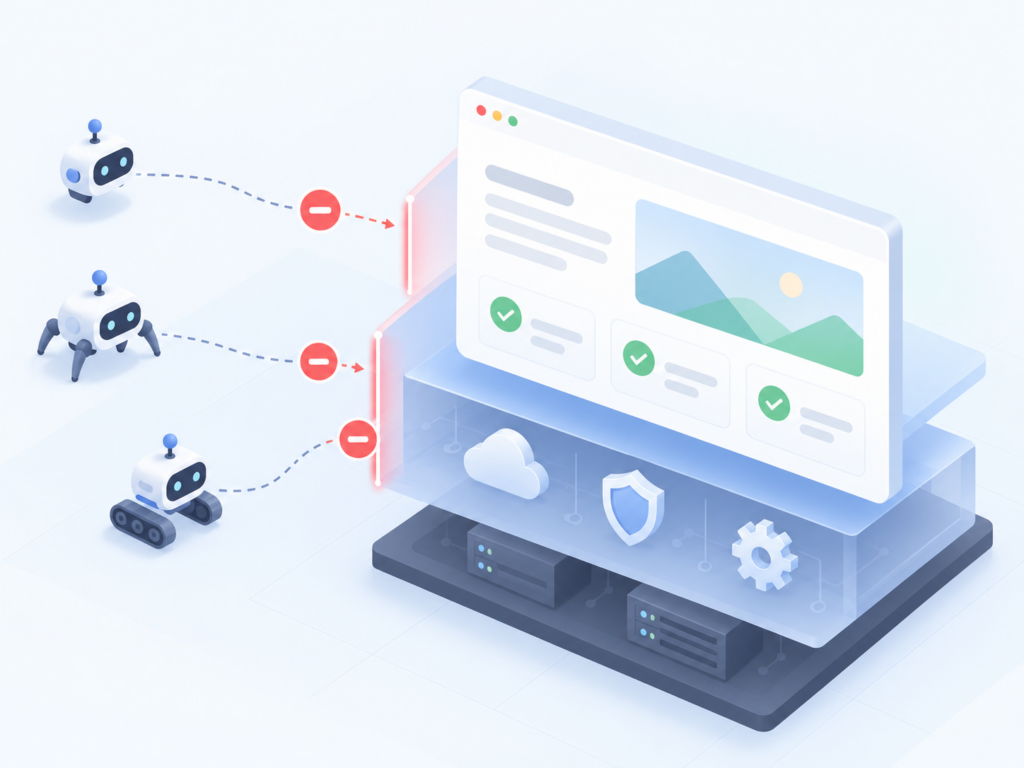
    There’s a technical layer most e-commerce brands overlook. AI bots generally don’t execute JavaScript. If your product information lives behind a client-side rendered carousel or interactive tab, it’s invisible to the AI. Sites that switch to server-side rendering often see citations appear within weeks. And many brands are inadvertently blocking AI crawlers through default CDN settings. Cloudflare recently changed its defaults to block AI bots, meaning you need to manually verify your “AI Crawl Metrics.”

    The trust layer matters too. AI tools describe the absence of a verified review profile as a “warning sign.” A brand can increase its citation rate from 1% to over 75% simply by actively gathering and responding to customer reviews on platforms like Trustpilot. Review sites are now the #2 citation source for AI systems, accounting for 14% of all citations.

    Real Scenario: A DTC Brand Discovers Its AI Blind Spot

    Consider a mid-sized DTC brand selling ergonomic office furniture. The brand ranks in the top three for “best standing desk” on Google. Strong domain authority. Solid backlink profile. But when a user asks ChatGPT, “I have chronic back pain, which standing desk should I buy for a home office?” the brand appears third, behind two competitors with lower organic rankings.

    Using Topify’s Competitor Monitoring and Source Analysis, the brand identifies the root cause. ChatGPT is citing a specific Reddit community thread and a 2024 review from a niche health blog. The competitors have been mentioned across these third-party roundups. The DTC brand focused exclusively on its own site’s SEO and missed the third-party coverage entirely.

    The recovery plan was straightforward. First, they cleaned up entity disambiguation using Organization Schema, because the AI was confusing them with a similarly named, defunct furniture company. Second, they partnered with the niche health blog to update the 2024 review and published guest articles on authoritative sites addressing “ergonomic desks for back pain.” Third, they launched a campaign to secure 50+ new Trustpilot reviews that specifically mentioned lumbar benefits, improving their Sentiment Velocity.

    Within four weeks, the brand moved to the #1 recommended spot for that high-intent prompt.

    Conclusion

    AI visibility tracking isn’t a future problem for e-commerce brands. It’s a current one. The data tells a clear story: AI-referred traffic converts at rates up to 5x higher than Google organic, and AI shopping volume is projected to reach $750 billion by 2028. The brands that act now, shifting from keywords to prompts, from page-level SEO to entity-level optimization, from owned-channel focus to third-party authority building, will be the ones AI recommends first.

    The ones that don’t will keep wondering why their Google rankings look fine but their revenue growth has stalled.

    FAQ

    What is AI visibility tracking for e-commerce? It’s the systematic monitoring of how, where, and why an e-commerce brand’s products appear in AI-generated answers across platforms like ChatGPT, Gemini, and Perplexity. It focuses on brand mentions, citation frequency, recommendation position, and sentiment.

    How do I check if ChatGPT recommends my product? You can perform manual queries for your brand and category, but for statistically reliable data, you’ll need to use a tracking platform like Topify that simulates thousands of prompts to account for the probabilistic nature of AI responses.

    What’s the difference between SEO and AI visibility tracking? SEO ranks pages based on keywords, backlinks, and domain authority. AI visibility tracking measures how AI models synthesize and recommend entities and facts based on structural clarity, content authority, and third-party citations.

    How often should e-commerce brands monitor AI recommendations? A two-week audit cycle is the minimum to detect the impact of content updates. For high-volume brands or during product launches, real-time monitoring of sentiment shifts and competitor movements is necessary.

    Why is my product ranking #1 on Google but not recommended by AI? Common causes include JavaScript rendering that AI bots can’t parse, a lack of third-party coverage on platforms the AI trusts like Reddit and review sites, or entity confusion where the AI associates your brand name with a different company.

    Read More

  • How ChatGPT, Perplexity, and Gemini Cite Differently

    How ChatGPT, Perplexity, and Gemini Cite Differently

    You optimized a page for “best project management tool.” It ranks on page one in Google. But when a prospect asks ChatGPT the same question, your brand doesn’t appear. When they ask Perplexity, a competitor’s blog post gets cited three times. And when Gemini answers, it pulls from your YouTube video but never links to your product page.

    Three AI engines. Three completely different citation behaviors. And if your ai visibility tracking strategy treats them as one, you’re optimizing for a platform that might not even be surfacing your content.

    Same Query, Three Different Answers, Three Different Sources

    The most common mistake in AI search optimization is assuming that what works on one engine works on all three. It doesn’t. An analysis of over 118,000 AI responses shows that the citation gap between platforms is far wider than most marketers expect.

    Perplexity averages 21.87 citations per response. ChatGPT averages 7.92. Gemini sits at 8.34.

    That’s not a rounding error. Perplexity provides nearly triple the source density of its competitors, and the types of sources it pulls from barely overlap with the other two. Only 11% of domains appear in both ChatGPT and Perplexity results for the same query.

    MetricChatGPTPerplexityGemini
    Avg. Citations per Response7.9221.878.34
    Unique Domains Cited42,59237,39938,876
    Primary Search IndexBingBing / Proprietary HybridGoogle + Knowledge Graph
    Google Top 10 Correlation90%High14%
    Domain Overlap with Peers11%11%13.7%

    That last row is the one worth staring at. If your brand is visible in ChatGPT, there’s roughly a 1-in-9 chance the same content gets cited in Perplexity. A unified “AI SEO” strategy isn’t just suboptimal. It’s structurally broken.

    Perplexity Cites Like a Research Paper. ChatGPT Doesn’t.

    Perplexity is built as an answer engine, not a chatbot. Every query triggers a real-time web search using a Retrieval-Augmented Generation (RAG) pipeline that pulls 20 to 30 candidate pages, then synthesizes a response grounded strictly in those pages. The result looks like an academic paper: numbered inline markers, each one linking to a verifiable source.

    This architecture has two implications for content creators. First, Perplexity rewards niche expertise. While ChatGPT defaults to high-domain-authority generalists, Perplexity surfaces smaller, specialized sources if they provide more precise answers. For unbranded queries, niche sources account for 24% of all Perplexity citations, the highest rate among the three engines.

    Second, recency matters more on Perplexity than anywhere else. Content updated within 30 days has an 82% citation rate. Content older than 180 days drops to 37%. That’s not a gentle decay curve. It’s a cliff.

    Content AgePerplexityChatGPTGemini
    Within 30 Days82.0%71.2%58.5%
    Within 60 Days64.5%76.4%59.2%
    Within 90 Days48.0%65.0%61.0%
    Over 180 Days37.0%42.3%45.1%

    For brands in fast-moving sectors, a monthly content refresh isn’t optional. It’s the minimum viable strategy for staying in Perplexity’s citation window.

    ChatGPT operates on a fundamentally different logic. Its citations lean on “web consensus,” pulling from what the internet broadly agrees on rather than what’s most recent or most specialized. Third-party directories like G2, Yelp, and TripAdvisor account for 48.73% of its citations on subjective queries. And 87% of its search-mode citations match Bing’s top 10 organic results.

    Here’s the thing that trips up most brands: ChatGPT mentions brands far more often than it cites them. Research shows 85% of brands mentioned in ChatGPT answers have no accompanying citation link. Your brand might show up in the narrative, but without a clickable link, you’re building recall without traffic.

    What Each Engine Prefers to Cite

    The sourcing preferences across the three engines reveal distinct strategic playbooks.

    Source TypeChatGPTPerplexityGemini
    Brand-Owned Website28%31%52.15%
    Third-Party Listings48.73%22%12%
    Niche/Expert Blogs15%24%18%
    Academic/Gov8%23%18%

    Gemini stands apart with a clear preference for brand-owned content: 52.15% of its citations come from a brand’s own domain. It’s also deeply integrated with the Google ecosystem. YouTube is currently the most-cited domain in AI Overviews, and brands combining video with optimized transcripts see a 317% increase in citation rates compared to text-only content.

    Perplexity, on the other hand, gives academic and government sources their highest representation at 23%. If you’re publishing original research or data-backed reports, Perplexity is the platform most likely to reward that effort.

    ChatGPT’s heavy reliance on directories means your G2 profile, your Capterra listing, and your Yelp page are not just review management tasks. They’re citation signals.

    Content AI Engines Ignore (and the Technical Fixes)

    Not getting cited isn’t always a content quality problem. Often, it’s a technical one.

    Most AI crawlers, including OpenAI’s GPTBot and Perplexity’s retrieval agents, have limited or zero JavaScript rendering capability. If your pricing table, product features, or key data points load via client-side JavaScript, they’re invisible to these crawlers. On top of that, AI agents enforce strict 2 to 5 second timeout limits. If your page takes longer to return raw HTML, the agent moves to a competitor’s page.

    Technical FactorAI Crawler BehaviorFix
    JS RenderingMost bots read raw HTML onlyServer-Side Rendering (SSR)
    Crawl Timeout2-5 second limitOptimize Time to First Byte
    Robots.txtLegacy blocks still commonAllow OAI-SearchBot and PerplexityBot
    Content StructureHeadings parsed as queriesUse question-based H2s and H3s

    On the content side, AI engines prioritize declarative, subject-predicate-object statements that can be turned into knowledge triplets. Original research, statistical benchmarks, and case studies with specific metrics get cited at significantly higher rates. Marketing copy with vague adjectives and metaphorical language gets systematically skipped.

    Why AI Visibility Tracking Is the Layer Most Brands Are Missing

    Traditional SEO tools like Google Search Console and Ahrefs track clicks from a list of links. They offer zero visibility into what AI models are saying about your brand, which sources they’re citing, or how your competitors are being recommended.

    In a world where search is increasingly zero-click, the metric of success shifts from traffic volume to citation share.

    The financial case makes this urgent. AI search referral traffic converts at 14.2%, compared to 1.76% for traditional Google organic. That’s a 5.1x conversion advantage. ChatGPT referrals alone convert at 15.9%, roughly 9x higher than Google organic, with an average referral value of $47 per visit compared to $9 for Google.

    PlatformConversion Ratevs. Google Organic
    ChatGPT15.9%9x Higher
    Perplexity10.5%6x Higher
    Copilot5.0%3x Higher
    Google Organic1.76%Baseline

    Those numbers reframe the entire ROI calculation. Losing citation share in AI search isn’t a branding problem. It’s a revenue problem.

    This is where Topify fills the gap. Topify’s Source Analysis reverse-engineers the exact domains and URLs that AI platforms cite in a given category. Instead of guessing which content AI prefers, you can see which competitor pages Perplexity cites in 40% of relevant answers, analyze their content structure, and identify the specific information gap to close.

    What sets Topify apart from tools that rely on API-based data is its UI-based scraping methodology. API results and real user-facing results have only a 4% source overlap. Optimizing for API data is optimizing for the wrong target. Topify captures the actual user experience: formatting, citation placement, and recommendation hierarchy across ChatGPT, Perplexity, and Gemini.

    3 Moves to Lift Your Citation Rate Across All Three Engines

    Each engine rewards a different content strategy. Here’s how to address all three without tripling your workload.

    Move 1: Build Answer Capsules for Perplexity

    Perplexity’s RAG pipeline looks for the most efficient path to a factual answer. Place a 40 to 80 word “Answer Capsule” at the top of every high-intent page. This capsule should contain definitive, non-hedged statements that directly answer the primary question. Combine it with H2s phrased as natural language questions so the retrieval model matches your headings to user prompts.

    Move 2: Build Entity Authority for ChatGPT

    ChatGPT rewards brands that show consistent presence across the web. Secure mentions and listings in high-authority third-party sources: industry publications, guest roundups, review platforms. Make sure your brand name, description, and value proposition are identical across LinkedIn, Wikipedia, G2, and Capterra. The model synthesizes “consensus.” If your signals conflict, you drop off the shortlist.

    Move 3: Own the Google Ecosystem for Gemini

    Gemini leans on the Knowledge Graph. Implement structured data markup (Article, FAQ, Organization schema) to define the relationships between your content and broader entities. Produce YouTube content for cornerstone topics. Gemini’s heavy reliance on YouTube citations means a video strategy is often the fastest way to leapfrog competitors in AI Overviews.

    Conclusion

    ChatGPT, Perplexity, and Gemini don’t just give different answers. They cite different sources, from different indices, using different logic. Treating AI visibility as a single-platform problem leads to lopsided results: visible in one engine, invisible in the other two.

    The brands pulling ahead are the ones that track citation behavior at the source level, platform by platform, prompt by prompt. With Topify, that kind of ai visibility tracking becomes a structured, repeatable process, not a quarterly guessing game.

    FAQ

    Q: How does ChatGPT decide which brands to cite?

    A: ChatGPT leans heavily on web consensus and third-party directory presence. It pulls 48.73% of its citations from platforms like G2, Yelp, and TripAdvisor for subjective queries, and 87% of its search-mode citations match Bing’s top 10 organic results. Consistent presence across multiple web touchpoints is the strongest signal.

    Q: Does Perplexity always show source links?

    A: Yes. Perplexity uses numbered inline citations for nearly every factual statement, averaging 21.87 citations per response. It’s designed as a research-first engine where every claim is grounded in a real-time web retrieval, making it the most transparent platform for source attribution.

    Q: Can you track which AI engines cite your content?

    A: Not with traditional SEO tools. Specialized ai visibility tracking platforms monitor brand presence, sentiment, and citation share across ChatGPT, Perplexity, and Gemini by systematically querying these models with high-value prompts.

    Q: What’s the difference between an AI mention and an AI citation?

    A: A citation is a link to your content used as evidence for a claim, appearing as a footnote or sidebar. A mention is when the AI names your brand in the body text as part of a recommendation. Citations drive referral traffic. Mentions drive brand recall. Research shows 85% of ChatGPT brand mentions have no accompanying citation link.

    Read More

  • How to Write Content That LLMs Actually Cite

    How to Write Content That LLMs Actually Cite

    Your blog post ranks third on Google for a high-intent buyer keyword. Organic traffic is steady. Then a prospect types the same question into ChatGPT and gets a five-brand recommendation. Your brand isn’t on it.

    That’s not a ranking failure. It’s a content format failure. In mid-2025, roughly 76% of URLs cited in AI Overviews also ranked in the organic top 10. By February 2026, that overlap collapsed to 38%. The signals that earn a Google ranking and the signals that earn an LLM citation are splitting apart, and most content teams are still writing for only one side.

    The gap has a name: the Invisibility Gap. And closing it starts with how you structure your content.

    Google Rewards Keywords. LLMs Reward Clarity.

    Traditional SEO content follows a familiar formula: match the keyword, build backlinks, optimize meta tags, and climb the SERP. That formula still works for Google. It doesn’t work for the retrieval systems powering ChatGPT, Perplexity, and Gemini.

    Here’s the difference. Google’s algorithm ranks pages. LLMs extract passages. When a generative engine receives a query, it doesn’t return a list of links. It runs a Retrieval-Augmented Generation (RAG) pipeline that converts the query into a vector, searches a live index, pulls 200 to 500 candidate URLs, scores individual passages for factual density and entity clarity, and then synthesizes a single answer from the top-scoring chunks.

    Google’s AI Overviews, for example, narrow approximately 500 candidate pages down to 5 to 15 cited URLs. The selection criteria aren’t page-level authority metrics like Domain Rating. They’re passage-level qualities: semantic completeness, verifiable claims, and clear entity definitions.

    That changes what “good content” looks like.

    DimensionTraditional SEO ContentGEO-Optimized Content
    Primary GoalRank in top 10 linksEarn inline citations
    Core LogicKeyword density + backlinksFactual density + structure
    User BehaviorClick-through to websiteSynthesized answer in interface
    Success MeasureCTR and organic trafficVisibility Score and Sentiment

    The practical implication: a page ranking at position 50 can still get cited in an AI Overview if it contains a highly specific, factual answer that top-ranking pages lack. Position doesn’t guarantee citation. Content quality at the passage level does.

    The Information Gain Problem: Why Most Content Gets Ignored

    The single biggest factor separating cited content from ignored content in 2026 is Information Gain, the measure of genuinely new, unique, and verifiable insight that a piece of content adds to what already exists on the web.

    LLMs are trained on (or retrieve from) massive text corpora. When your content says roughly the same thing as the other 30 articles on the topic, the model has no reason to cite yours specifically. It absorbs the information and attributes it to nobody.

    Research from Princeton University, Georgia Tech, and the Allen Institute for AI, published at the 2024 ACM SIGKDD conference, quantified this effect. Their findings show that adding expert quotations to content increases AI visibility by 41%. Including original statistics provides a 32% boost. Citing authoritative third-party sources lifts visibility by 30%.

    The “5-to-7 Rule” offers a practical benchmark: competitive content in 2026 needs five to seven distinct, original, attributable insights to have a realistic shot at citation. An “insight” means something specific enough to be quoted, like a proprietary data point, a coined framework, or an expert opinion that the LLM couldn’t have generated from its own training data.

    Content that merely rephrases existing information scores low on Information Gain and gets absorbed. Content that introduces new data points becomes citable.

    Four Pillars of Content That LLMs Actually Extract

    LLMs don’t read content the way humans do. They parse it for machine-readable signals and extractable facts. Writing for both audiences requires a framework that bridges human readability with machine retrieval.

    Pillar 1: Answer-First Architecture

    Generative engines favor content that addresses the query directly in the opening section. The practical rule: lead every H2 with a 40 to 60 word “atomic” answer that directly responds to the question the heading implies.

    This gives the RAG system a high-confidence snippet it can extract and serve as a direct response, with your URL as the cited source. Pages that bury the answer under three paragraphs of context lose to pages that lead with it.

    Pillar 2: Entity Clarity Through Structure

    Every section needs clear subject-verb-object (SVO) structures. LLMs use these to map “triples” into their knowledge graphs. Instead of writing “it provides better results,” write “[Product Name] increases [Metric] by [Percentage].”

    Proper semantic HTML matters here too. Content with a clear H1-to-H4 hierarchy has a 40% higher parsing probability than flat, unstructured text. The model needs to understand what each section is about before it can decide whether to cite it.

    Pillar 3: Third-Party Consensus

    AI models trust external sources more than brand-owned content. The data is stark: earned media like Reddit threads, industry publications, and G2 reviews are cited at a rate of 72% to 92% in branded queries. Brand-owned blog content? Less than 27%.

    That doesn’t mean your blog doesn’t matter. It means your blog alone isn’t enough.

    The “Consensus Signal” triggers when an AI scans multiple independent sources and finds agreement. If your product is consistently described the same way across Reddit, YouTube, G2, and industry forums, the AI gains the confidence to recommend it. Your blog provides the canonical definition. External sources provide the validation.

    Pillar 4: Freshness and Verifiability

    Generative engines show a significant bias toward recent information. Content updated within the last 30 days is 3.2 times more likely to be cited than stale content. For Google AI Overviews, the highest citation rates appear for content between 30 and 89 days old.

    This means core evergreen pages need to become “living documents,” refreshed every two to four weeks with new statistics, recent developments, and updated dateModified schema timestamps.

    How to Rewrite Existing Content for AI Visibility

    You don’t need to start from scratch. The highest-ROI move is auditing and restructuring content you already have. Here’s the process.

    Step 1: Identify high-value pages. Start with pages that already rank on Google but aren’t being cited by AI. These have proven topical relevance. They just need structural upgrades to become citable.

    Step 2: Add atomic answers. For each H2, write a 40 to 60 word direct answer to the question the heading implies. Place it immediately under the heading, before any context or background.

    Step 3: Inject original data. Every section needs at least one verifiable, specific claim. Proprietary survey results, original benchmarks, or expert quotes all qualify. Generic statements like “many companies are adopting AI” don’t.

    Step 4: Implement technical signals. Add FAQ, HowTo, or Product schema markup. Implementing these structured data types increases citation likelihood by 28% to 40%. Product schema alone drives a 73% higher selection rate in AI retrieval pipelines.

    Step 5: Refresh consistently. Set a 14 to 30 day update cadence for your highest-priority pages. Even small additions, like a new statistic or an updated comparison, signal freshness to AI crawlers.

    One pattern worth watching: YouTube’s share of social citations has doubled from 19% to 39% as models like Gemini prioritize multi-modal content. If you’re producing blog content on a topic, a companion video with an SEO-optimized transcript extends your citation surface into a channel most competitors are ignoring.

    AI Visibility Tracking: Measuring Whether Your GEO Content Works

    Traditional analytics can’t tell you whether AI is citing your content. Google Analytics tracks clicks. Search Console tracks rankings. Neither tracks whether ChatGPT mentioned your brand in a recommendation, or what Perplexity said about your pricing.

    That’s the gap ai visibility tracking fills.

    The core framework for measuring GEO content performance includes seven metrics. Visibility Score measures how often your brand appears across a universe of relevant prompts, with a 2026 benchmark of 60% or above for core categories. Recommendation Position tracks where you land in the AI’s response, since being first carries an implicit endorsement that third or fourth position lacks. Sentiment Velocity catches shifts in how the AI describes your brand before they compound into reputation problems. Source Citations reverse-engineer the specific URLs influencing the AI’s opinion. Conversion Visibility Rate estimates the economic value of each mention. Entity Confidence measures how accurately the AI distinguishes your brand from competitors. And Hallucination Monitoring alerts you when an LLM fabricates false claims.

    For content teams running a GEO content strategy, the most actionable loop connects Source Citations back to content decisions. If you discover that Perplexity cites a competitor’s blog post in 40% of relevant answers, you know exactly what content gap to close. If your own article is being cited but with negative sentiment, you know which page to rewrite.

    Topify runs this loop across ChatGPT, Gemini, Perplexity, DeepSeek, and other major platforms. It tracks all seven metrics in a unified dashboard, surfaces competitor positioning in real time, and continuously identifies new high-value prompts as AI recommendation patterns shift. For teams that need to connect GEO content output to measurable visibility changes, Topify’s Source Analysis traces which specific URLs the AI is citing, so you can validate whether a content rewrite actually moved the needle.

    The economics reinforce the investment. AI search traffic converts at an average rate of 14.2%, compared to 2.8% for traditional organic search. That’s a 5x advantage, which means even modest improvements in ai visibility tracking metrics translate to outsized revenue impact.

    Three Mistakes That Quietly Kill AI Visibility

    Mistake 1: Treating Google Rankings as a Proxy for AI Citations

    The overlap between organic rankings and AI citations dropped from 76% to 38% in less than a year. Teams that only monitor SERP positions are watching half the screen while the other half decides their market share. AI visibility requires its own measurement stack.

    Mistake 2: Scaling Content with AI Without Adding Information Gain

    Using LLMs to generate content at scale sounds efficient until every article reads like a reworded version of the same five sources. Models recognize content with low Information Gain and deprioritize it during retrieval. The fix isn’t to stop using AI for drafting. It’s to ensure every piece includes original data, expert perspectives, or proprietary frameworks that the model couldn’t have written on its own.

    Mistake 3: Checking AI Visibility Once and Forgetting About It

    AI responses are probabilistic. The same prompt can return different brands depending on model updates, data refreshes, and retrieval architecture changes. A single audit tells you where you stood on one day. Continuous ai visibility tracking tells you where you’re trending, and that trend line is what drives strategy.

    Conclusion

    The content that earns AI citations in 2026 isn’t fundamentally different from good content. It’s specific, structured, verifiable, and fresh. The difference is that traditional SEO let you get away with being vague. Generative engines don’t.

    The framework comes down to three moves: write with answer-first architecture and original data so LLMs can extract and cite your content, build third-party consensus so the AI trusts what you’re saying, and track visibility across AI platforms so you know whether it’s working. The brands closing the Invisibility Gap aren’t doing anything mysterious. They’re just measuring what most teams still can’t see.

    FAQ

    Q: What’s the difference between SEO content and GEO content?

    A: SEO content is optimized for page-level ranking signals like keywords and backlinks. GEO content is optimized for passage-level extraction by LLMs, focusing on factual density, clear entity definitions, and answer-first structure. The best content does both, but the optimization targets are different.

    Q: How do I know if my content is being cited by AI?

    A: You can’t tell from traditional analytics. You need a dedicated ai visibility tracking platform that monitors your brand’s appearance across AI search engines like ChatGPT, Perplexity, and Gemini. Topify tracks citation sources, visibility scores, and sentiment across multiple AI platforms in real time.

    Q: Does optimizing for LLMs hurt my Google rankings?

    A: No. The structural improvements that make content citable by LLMs, such as clear headings, direct answers, schema markup, and fresh data, also tend to improve traditional SEO performance. The two strategies are complementary, not competing.

    Q: How often should I track AI visibility?

    A: Weekly at minimum. AI responses are non-deterministic, meaning the same prompt can return different results across sessions. Continuous tracking establishes a statistical baseline and catches visibility drops before they compound.

    Read More

  • 7 Tactics That Got Our Client Cited 4× More in ChatGPT

    7 Tactics That Got Our Client Cited 4× More in ChatGPT

    Your domain authority is 65. Your top pages rank on page one for every target keyword. Your content team publishes twice a week. Then you type your core product category into ChatGPT and get back a confident, five-brand recommendation list. Your brand isn’t on it.

    That’s not a content quality problem. It’s a visibility gap that traditional SEO metrics were never built to detect. When we ran a full AI visibility tracking audit for a mid-market SaaS client last quarter, we found they appeared in only 6% of the high-intent prompts in their category. Their closest competitor showed up in 31%. Over the next 90 days, seven specific tactics closed that gap and pushed their citation rate to 4× the original baseline.

    Here’s what we did, step by step.

    Most Brands Track SEO Rankings but Miss What AI Actually Cites

    The disconnect between Google rankings and AI recommendations is wider than most marketing teams realize. Roughly 60% of all Google searches now resolve without a click to an external website. When AI Overviews trigger, that figure climbs to 83%. In conversational AI modes, it reaches 93%.

    That means the majority of discovery and evaluation is happening inside AI-generated answers, not on your website. And the clicks that do come from AI sources carry disproportionate value. AI-referred visitors convert at rates up to 23 times higher than standard organic traffic, because the intent is already compressed by the time they arrive.

    The problem is measurement. Legacy SEO tools track rank, traffic, and backlinks. They don’t tell you whether ChatGPT mentioned your brand, how Perplexity framed your product, or which sources Gemini cited instead of yours. Without AI visibility tracking, you’re optimizing for a channel that’s shrinking while ignoring the one that’s growing.

    Our client’s starting point looked strong on paper: high DA, solid keyword positions, consistent publishing cadence. But when we mapped their AI visibility across 150 prompts on ChatGPT, Perplexity, and Gemini, the picture was different. Six percent citation rate. Negative sentiment on two platforms. Zero presence in comparison prompts.

    That baseline became the starting line.

    Tactic 1: Map the Prompts That Actually Drive AI Citations

    Not all prompts are created equal. The average Google keyword is about four words. The average AI prompt runs closer to 23 words, packed with qualifiers like budget constraints, company size, and use-case specifics. Treating AI prompts like keywords is the first mistake most teams make.

    We categorized prompts into three tiers based on citation behavior. Informational prompts (“What is X?”) trigger summarization. Comparative prompts (“X vs Y”) trigger feature matrices. Recommendation prompts (“Best tool for…”) trigger ranked lists. Our client’s content was optimized for informational queries but almost invisible in the recommendation and comparison tiers, which is where purchase decisions happen.

    The fix started with prompt discovery. Using Topify’s High-Value Prompt Discovery, we identified 40+ prompts in the client’s category where competitors consistently appeared but the client didn’t. Each prompt was scored by query volume, competitive density, and commercial intent. The top 20% of those prompts, the ones with high “qualifier density” around specific use cases and buyer profiles, became the content roadmap.

    Targeting these long-tail, high-intent prompts let the client bypass the “big brand bias” that dominates broader queries. Within three weeks, new content built for these specific prompts started appearing in AI answers.

    Tactic 2: Reverse-Engineer What AI Cites for Your Competitors

    Generative engines don’t rank pages. They retrieve sources through a process called Retrieval-Augmented Generation (RAG), which pulls from a corpus of trusted web documents to ground each response. To show up in that response, your content needs to be in the retrieval pool and match the extraction patterns the model prefers.

    Here’s the uncomfortable reality: approximately 85.5% of AI citations in informational and evaluation queries come from third-party sources like Wikipedia, Reddit, G2, and tier-1 media outlets. Brand-owned domains account for less than 10% of citations. If your GEO strategy only optimizes your own website, you’re competing for a fraction of the citation pipeline.

    We used Topify’s Source Analysis to map exactly which URLs each AI platform cited for the client’s top 30 prompts. The pattern was clear: competitors dominated not because their product pages were better, but because they had coverage on the specific G2 comparison pages, Reddit threads, and niche industry blogs that models treated as high-confidence sources.

    That analysis became the targeting list for Tactics 3 through 5.

    Tactic 3: Restructure Content for AI-Preferred Formats

    Structural optimization is one of the highest-leverage moves in GEO, and it’s often overlooked. Research into what’s called Structural Feature Engineering (GEO-SFE) shows that formatting changes alone, without altering the underlying claims, can yield a 17.3% improvement in citation rates.

    Why? Transformer-based LLMs parse text through attention mechanisms that respond to structural signals. Unstructured prose causes attention dispersion. Segmented, hierarchical text with clear headings and self-contained blocks focuses the model’s attention on the relevant section.

    The specific changes that moved the needle for our client:

    Structural ChangeCitation Impact
    Question-style H2/H3 headings+22% lift
    Pricing and feature comparison tables+47% to +51% lift
    Pros/cons lists on product pages+38% lift
    Answer-first formatting (key facts in first 200 words)+27% lift
    FAQ sections with schema markup+71% lift

    There’s a sweet spot for answer blocks: 134 to 167 words. Blocks shorter than that lack the information density models need. Blocks exceeding 300 words suffer from attention degradation in the middle. We restructured the client’s top 15 pages to fit this pattern, converting marketing copy into data-dense, table-heavy content that AI retrievers could extract cleanly.

    The shift is less about writing differently and more about formatting for machine extraction. Think “data tabulization” over “marketing fluff.”

    Tactic 4: Build Entity Authority Through Trust Anchors

    In generative search, AI systems prioritize “entities,” formally recognized concepts, over keywords. Authority isn’t just about backlink volume anymore. It’s about the consistency of signals across what models treat as “truth anchors.”

    Wikipedia sits at the top of that hierarchy. It comprises 3-4% of model training data and accounts for nearly 47.9% of ChatGPT’s top-ten citation share. Wikidata, with its structured Q-IDs, provides the metadata layer models use for entity resolution. If your brand doesn’t have a stable identifier in these systems, LLMs have lower confidence when attributing facts to you.

    Our client didn’t have a Wikipedia page. So we focused on three proxy strategies:

    First, we ensured the client’s Wikidata profile was complete, with sameAs links to social profiles, Crunchbase, and industry directories. Second, we secured mentions within existing high-authority Wikipedia articles relevant to their category. Third, we prioritized third-party review coverage on G2 and Capterra, which function as consensus validators. Research suggests brands with strong third-party review profiles see roughly a 3× citation multiplier compared to those without.

    Consistency matters here. If your website says “enterprise-grade platform” but G2 reviews describe you as “good for small teams” and your LinkedIn bio says something else entirely, the model flags the conflicting signals and defaults to a better-corroborated competitor.

    Tactic 5: Close the Source Gap Between You and Competitors

    The “Source Gap” is the structural disadvantage that exists when competitors control the third-party surfaces AI models retrieve from. Since 85% of citations come from external domains, your AI visibility is largely determined by your coverage on listicles, comparison engines, and community forums you don’t own.

    Closing this gap requires what we call “Machine Relations,” a digital PR strategy focused specifically on the URLs that AI already trusts for your category.

    For our client, the audit revealed three critical gaps. First, competitors were being cited from a specific Reddit thread with 200+ upvotes that the client had never participated in. Second, two niche industry blogs that models consistently retrieved had published competitor reviews but had no coverage of the client. Third, the client’s G2 profile had 12 reviews versus a competitor’s 47.

    The playbook was targeted:

    We developed authentic Reddit participation in high-visibility threads. We pitched contributed content to the two niche publications. We launched a structured review acquisition campaign on G2.

    Topify’s Competitor Monitoring flagged when new competitors entered the AI recommendation set, showing which specific URL the model referenced to justify the inclusion. That let the team respond within days, not months, securing a “corrective” placement before the next model refresh.

    Tactic 6: Maintain Citation Velocity with a Refresh Cadence

    Content in AI search has a half-life. Research shows that 50% of content cited by AI is less than 13 weeks old. AI-cited pages are on average 25.7% fresher than traditionally ranked organic content. This creates the “13-week rule”: content not refreshed quarterly is three times more likely to lose its citation position.

    Our client had several pages ranking well in traditional search that hadn’t been updated in over a year. In AI search, those pages were effectively invisible.

    We implemented a tiered refresh cadence:

    Content TypeRefresh FrequencyWhat Gets Updated
    Core product comparisonsMonthlyCurrent-year data, pricing, new features
    Category explainersEvery 8-12 weeksRecent research, updated FAQ blocks
    Thought leadershipQuarterlyNew examples, emerging trends
    Evergreen guidesBi-annuallyStatistics, relevance check

    Cosmetic date changes don’t work. Models detect and ignore them. A meaningful update requires replacing outdated statistics with current-year data, adding references to recent research, and expanding sections with new FAQ blocks addressing emerging questions. Content updated within 30 days receives up to 6× more AI citations than content over 12 months old.

    The ROI of operationalized maintenance is measurable. Within four weeks of the first refresh cycle, three previously invisible pages started appearing in AI answers.

    Tactic 7: Track, Measure, and Iterate with AI Visibility Tracking

    The non-deterministic nature of generative responses, where a single prompt can yield different outputs across different models and different days, makes legacy rank tracking obsolete. You can’t manage what you don’t measure, and measuring AI visibility requires a fundamentally different framework.

    Effective ai visibility tracking operates across seven core indicators:

    Visibility Score: The percentage of target prompts where the brand appears. Category leaders typically maintain 30-45%.

    Sentiment Score: A 0-to-100 scale measuring whether AI framing is positive, neutral, or negative. Scores below 40 indicate a reputation problem that can disqualify a brand from high-intent shortlists.

    Position Rank: The relative order of mentions in multi-brand lists. First-mentioned brands earn significantly higher trust and click-through.

    Volume Analytics: Monthly demand for topics specifically within AI interfaces, surfacing “dark queries” invisible to traditional keyword tools.

    Mentions Rate: Raw frequency of brand names within answer text, tracking awareness even without direct links.

    Intent Alignment: Whether AI correctly associates the brand with its target customer profile and primary use case.

    Conversion Visibility Rate (CVR): A predictive measure of how likely the brand’s visibility is to drive action. AI-referred traffic converts at an average of 14.2%, a 5.1× advantage over traditional search.

    For our client, we tracked all seven weekly using Topify’s Comprehensive GEO Analytics dashboard across ChatGPT, Perplexity, and Gemini. The measurement loop connected directly to execution: when citation drift showed a drop on a specific prompt cluster, we traced it to a competitor’s new G2 review and responded with a targeted content update within 48 hours.

    That feedback loop, discovery to optimization to measurement, is what turned a one-time improvement into sustained 4× growth.

    Conclusion

    The gap between brands that dominate AI recommendations and those that remain invisible comes down to systems, not luck. The seven tactics here follow a logical chain: discover the right prompts, analyze what AI already trusts, restructure your content for extraction, build entity authority, close the source gap, maintain freshness, and measure everything continuously.

    None of this is a one-time project. Citation patterns shift as models retrain and retrieval algorithms evolve. The brands that treat ai visibility tracking as an ongoing discipline, benchmarking Visibility, Sentiment, and Position weekly, will control the recommendations that define discovery in 2026 and beyond. Get started with Topify to see where your brand stands today.

    FAQ

    Q: What is AI visibility tracking? 

    A: AI visibility tracking is the process of monitoring how often and how favorably your brand appears in AI-generated answers across platforms like ChatGPT, Perplexity, and Gemini. It measures metrics like citation rate, sentiment, mention frequency, and recommendation position, none of which traditional SEO tools capture.

    Q: How long does it take to see results from AI citation optimization? 

    A: Structural content changes and technical fixes (like unblocking AI crawlers) can produce results within days. Broader tactics like entity authority building and source gap closure typically show measurable improvement within 4 to 12 weeks, depending on the competitiveness of the category.

    Q: Can you track brand mentions in ChatGPT? 

    A: Yes. Tools like Topify simulate thousands of prompts across ChatGPT and other AI platforms, tracking your brand’s mention frequency, recommendation position, and sentiment in each response. This replaces the manual approach of typing queries one by one.

    Q: What’s the difference between SEO and GEO? 

    A: SEO optimizes for ranking on search engine results pages. GEO (Generative Engine Optimization) optimizes for being cited, recommended, and accurately described inside AI-generated answers. The key metrics shift from organic rank and CTR to citation share, visibility score, and AI sentiment.

    Read More

  • Audit Your Brand’s AI Visibility in 30 Min

    Audit Your Brand’s AI Visibility in 30 Min

    Your domain authority is 70. Your keyword rankings are solid. Your SEO dashboard looks healthy by every traditional metric. Then someone asks Perplexity, “What’s the best tool for [your category]?” and your brand doesn’t appear anywhere in the answer.

    That gap between Google rankings and AI search recommendations is where revenue quietly disappears. ChatGPT referral traffic converts at 15.9%, nine times the baseline for traditional Google organic. When your brand is absent from those answers, you’re not losing impressions. You’re losing pre-qualified buyers.

    The good news: you can map exactly where you stand across AI search engines in 30 minutes. Here’s how.

    What AI Visibility Tracking Actually Measures (and What SEO Tools Miss)

    AI visibility tracking is the practice of measuring how often, how prominently, and how accurately a brand appears in the outputs of generative models like ChatGPT, Perplexity, Gemini, and Google AI Overviews.

    That might sound similar to traditional rank tracking, but the mechanics are fundamentally different. In traditional search, visibility is a function of domain authority and keyword relevance. In generative search, visibility depends on what researchers call “entity clarity” and “citation authority.” A brand can hold the #1 Google position for a high-volume keyword and still be completely absent from a ChatGPT response for the same category query.

    The disconnect happens because generative engines use Retrieval-Augmented Generation (RAG) to prioritize information that shows cross-platform consensus and semantic density, not traditional ranking signals.

    Here’s what a professional AI visibility tracking framework actually measures:

    MetricWhat It Tells You
    Brand PresencePercentage of category-relevant prompts where your brand is mentioned
    Citation ShareHow often AI models link to your owned or earned media
    Sentiment PolarityThe evaluative tone the AI uses when describing your brand
    Position ProminenceWhere your brand appears in the answer (first recommended vs. buried)
    Narrative AccuracyWhether the AI’s description matches your actual features and pricing

    Tools like Google Analytics, Ahrefs, and Semrush were built to track clicks and link-based authority. They’re blind to the internal narrative logic of an LLM. While organic rankings influence what a generative engine might “see,” they don’t dictate what the engine will “say.”

    That’s the gap Topify was built to close, providing cross-platform tracking of brand mentions, citation patterns, sentiment, and positioning across every major AI engine.

    Why Most Brands Fail Their First AI Visibility Audit

    Before walking through the audit framework, it’s worth understanding why most initial attempts produce misleading results. Three failure patterns show up consistently.

    Treating LLMs like search engines. Generative models are probabilistic, not deterministic. The same prompt can produce different answers for users in London versus San Francisco, and even the same user can get different results across sessions. Searching a couple of prompts on ChatGPT and treating those results as representative is like polling two people and calling it a survey.

    A professional audit needs a multi-sample methodology: running prompts through multiple geographic nodes to capture a statistically meaningful baseline.

    Platform myopia. Most brands check ChatGPT and stop there. Research shows that only 11% of cited domains are shared across ChatGPT, Perplexity, Gemini, and Google AI Overviews. Dominance on one platform guarantees nothing on another.

    Ego-centric tracking. Auditing your brand in isolation, without benchmarking against competitors, misses the most actionable signal. In the generative era, AI visibility is a zero-sum game. If a model recommends three competitors and excludes you, that’s a definitive signal of an authority gap in the model’s retrieval cache.

    The 30-Minute AI Visibility Audit: Step by Step

    This framework is designed to be repeatable. Run it monthly or trigger it after major product launches, PR campaigns, or known AI model updates. Here’s the time breakdown: 5 + 10 + 10 + 5 minutes.

    Step 1: Define Your Audit Scope, 5 Minutes

    The foundation of any AI visibility audit is the prompt library. Select 3 to 5 core “category prompts” that reflect how a prospective customer would actually search for a solution.

    Tag each prompt by intent: Informational (“What is [category]?”), Commercial (“Best [category] for small business?”), or Comparison (“[Brand] vs [Competitor]”). Then define 3 to 5 direct competitors as your primary tracking entities.

    Platform selection matters. Your audit should cover at least ChatGPT, Perplexity, Gemini, and Google AI Overviews. Zero-click rates tell the story of where users actually get their answers: Perplexity at 93%, Google AI Mode at 88%, ChatGPT Search at 82%. Skipping any of these leaves a blind spot.

    Step 2: Check Your AI Visibility Across Platforms, 10 Minutes

    Run your prompt set across each platform and document where your brand falls into one of four categories:

    • Directly Recommended: Named as a top-tier solution.
    • Mentioned: Included in the narrative but not as a primary pick.
    • Cited: Used as a reference source with a link.
    • Absent: Completely missing from the conversation.

    Doing this manually for 5 prompts across 4 platforms means reviewing 20 responses and cataloging every brand mention. It’s possible for a limited scope, but it doesn’t scale.

    Topify’s Visibility Tracking automates this entire step. It monitors brand mentions across ChatGPT, Gemini, Perplexity, DeepSeek, and other major AI platforms, scoring each appearance across seven key metrics: visibility, sentiment, position, volume, mentions, intent, and CVR. What takes 10 minutes manually takes seconds with the right tooling.

    One data point worth noting: content updated within the last three months is roughly twice as likely to be cited by retrieval-augmented AI engines like Perplexity. If your audit reveals low visibility, freshness could be the first variable to investigate.

    Step 3: Analyze Sentiment and Positioning, 10 Minutes

    Showing up is only half the story. What the AI says about your brand matters just as much.

    In this step, examine three things. First, identify the specific themes the AI associates with your brand. Are you described as “innovative but expensive”? “Reliable but legacy”? These sentiment drivers directly shape how potential buyers perceive you before they ever visit your site.

    Second, benchmark your sentiment against competitors. If a rival’s sentiment score is consistently higher across prompts, that’s a content gap, not a branding problem.

    Third, check for hallucinations. Across major models, hallucination rates range from 15% to 52% depending on the model and query type. These errors fall into categories that directly hurt conversion: fabricated features, omitted differentiators, outdated pricing, and misattributed capabilities.

    Topify’s Sentiment Analysis provides daily breakdowns of how each AI platform characterizes your brand, with a 0-to-100 sentiment score tracked over time. Its Competitor Monitoring feature detects every brand the AI mentions alongside yours, comparing visibility, sentiment, and position side by side.

    Step 4: Identify Citation Sources, 5 Minutes

    The final step is reverse-engineering the AI’s “trust graph.” Which third-party sources is the AI citing when it forms opinions about your category?

    This matters because third-party sources are cited 6.5 times more often than brand-owned pages in AI answers. Earned media accounts for roughly 48% of citations, while your own blog contributes around 23%. If a competitor has coverage on Gartner, Forbes, or a top industry subreddit and you don’t, the AI will naturally treat them as more authoritative.

    Reddit alone accounts for approximately 21% of citations in Google AI summaries. Brands that ignore community platforms are forfeiting their authority to the most vocal users on the internet.

    Topify’s Source Analysis feature maps exactly which domains and URLs each AI platform cites for your category. You can see at a glance whether your brand’s owned content is in the citation mix, or whether third-party sources are shaping the narrative without your input.

    div data-topify-widget=”report-generator”>

    Turning Audit Data into a GEO Action Plan

    You’ve now collected four layers of data: visibility baseline, competitor positioning, sentiment accuracy, and citation sources. The next step is prioritizing where to act.

    Not all gaps are equally urgent. Here’s a triage framework based on common audit outcomes:

    Audit FindingPriority ActionGEO Strategy
    Low visibility across platformsRetrieval OptimizationCreate “GEO-ready” content with statistics, structured citations, and clear entity markup. Ensure GPTBot and PerplexityBot aren’t blocked by robots.txt.
    Mentioned but negative sentimentSentiment RepairAddress specific sentiment drivers (pricing confusion, outdated info) and build third-party consensus on review sites.
    Competitors winning citationsDigital PR + CommunitySecure mentions in publications and Reddit threads the AI already trusts.

    The data on GEO content strategies is concrete. Research shows that adding precise statistics to content can increase visibility by up to 65.5% in category queries. Including inline citations to credible external reports boosts visibility by up to 132.4% in informational queries. Rewriting content in a more authoritative tone lifts visibility by 89.1% in specific domains.

    On the structural side, AI models tend to prefer content organized into 120 to 180-word “atomic” sections rather than long, undifferentiated blocks of text. Implementing Schema Markup (Organization, FAQ, Author) provides the explicit metadata that helps AI crawlers identify and link entities correctly.

    Topify’s One-Click Agent Execution bridges the gap between audit data and action. Once a visibility gap is detected, the platform’s AI agent analyzes content gaps against competitor citations, drafts GEO-optimized content including schema markup and data tables, and deploys directly. It turns a diagnostic report into a production-ready content brief.

    AI Answers Change Faster Than Google Rankings. Your Audit Schedule Should Too.

    An AI visibility audit isn’t a one-time project. The generative search environment is significantly more volatile than traditional search.

    Data from 2026 shows that Google’s core updates and AI model recalibrations can shift up to 80% of top-three results in a single cycle. On top of that, there’s a “freshness gap”: Perplexity updates its index constantly, while ChatGPT may rely on training data several months old. Your brand’s position on one platform can shift without any corresponding change on another.

    Monthly audits are the baseline for maintaining narrative control. Immediate audits should be triggered by major product launches, PR crises, or known AI model updates.

    For teams that need more than monthly snapshots, Topify offers continuous monitoring. It alerts brands to citation drops or sentiment shifts in real time, so marketing teams can address inaccuracies or competitor incursions before they become entrenched in the model’s retrieval cache.

    Conclusion

    The gap between Google rankings and AI search recommendations is where the next generation of brand competition plays out. A brand can rank first on Google and be invisible to the AI engines where 900 million weekly active users now look for answers.

    The 30-minute AI visibility tracking audit outlined here gives you a structured, repeatable process to measure where you stand. Track presence, sentiment, and citations across platforms. Benchmark against competitors. Then act on the gaps with a clear GEO strategy.

    The brands that build this diagnostic muscle now will compound their authority advantage. In an era where decisions are made inside the chat box, the most valuable asset isn’t traffic. It’s the informed trust of the AI models your buyers rely on.

    Get started with Topify to run your first AI visibility audit today.

    FAQ

    Q: What is AI visibility tracking?

    A: AI visibility tracking is the process of measuring how often your brand gets mentioned, how it’s described, and where it ranks in the outputs of generative AI engines like ChatGPT, Perplexity, and Gemini. It goes beyond traditional SEO metrics to capture presence, sentiment, citation share, and positioning across AI-generated answers.

    Q: Can I audit my brand’s AI visibility without a paid tool?

    A: You can run a basic manual audit by entering category prompts into ChatGPT, Perplexity, and Gemini and documenting the results. The limitation is scale: AI outputs are probabilistic and vary by session and geography, so manual checks give you a snapshot, not a trend. Professional tools like Topify automate this across thousands of prompts and multiple platforms simultaneously.

    Q: Which AI platforms should I track for brand visibility?

    A: At minimum, cover ChatGPT, Perplexity, Gemini, and Google AI Overviews. Each runs a different retrieval pipeline, and only 11% of cited domains overlap across platforms. A brand can be a category leader on ChatGPT and completely absent from Perplexity.

    Q: How often do AI search recommendations change?

    A: More often than traditional Google rankings. AI model recalibrations and retrieval index updates can shift up to 80% of top-three results in a single cycle. Monthly audits are a reasonable baseline, with immediate checks after major product launches or known model updates.

    Read More

  • How AI Picks Which Brands to Cite

    How AI Picks Which Brands to Cite

    Inside the Ranking Logic of ChatGPT, Perplexity, and Gemini

    Your team spent six months building content, earning backlinks, and climbing Google rankings. Then a potential customer asked ChatGPT, “What’s the best tool for [your category]?” and got a list of five recommendations. Your brand wasn’t on it.

    The disconnect isn’t a fluke. Research shows the correlation between a high Google ranking and being cited in a ChatGPT response is just 0.034. That’s nearly random. Your SEO dashboard says everything is fine. The AI engines say you don’t exist.

    The brands that do get cited aren’t always the ones with the strongest domain authority. They’re the ones whose data is structured, validated across third-party sources, and formatted in ways that AI retrieval systems can actually extract. Understanding that logic is the first step toward fixing it.

    Your Google Rankings Don’t Decide What AI Recommends

    Here’s the assumption most marketing teams still operate under: if we rank on the first page of Google, AI search engines will recommend us too.

    That assumption is wrong.

    Traditional SEO is built on backlinks, domain authority, and keyword density. Generative engines like ChatGPT, Perplexity, and Gemini use a completely different retrieval logic. They don’t rank websites. They synthesize factual claims from a diverse ecosystem of sources, then assemble a response based on which entities have the highest “semantic density” and cross-platform validation.

    A brand with a DA of 70+ can be entirely absent from a ChatGPT recommendation for its core product category. Not because the content is bad, but because the AI’s confidence in that brand’s “entity clarity” is low. If your messaging is vague, your naming inconsistent, or your presence fragmented across the web, the model skips you in favor of competitors who may rank lower on Google but present cleaner, more extractable information.

    DimensionTraditional Search (Google)Generative Search (ChatGPT/Perplexity)
    Primary GoalRanking in top 10 blue linksInclusion in synthesized answer
    Authority ProxyBacklinks and DAThird-party consensus and earned media
    User InteractionClick-through to websiteZero-click information consumption
    Optimization FocusKeywords and technical SEOEntity binding and answerability

    The shift is structural, not incremental. It demands a different optimization framework entirely: Generative Engine Optimization, or GEO.

    What ChatGPT, Perplexity, and Gemini Actually Look For

    The generative search market isn’t a monolith. Each platform has its own retrieval architecture, source preferences, and citation patterns. A study found that only 11% of cited domains appeared across multiple AI platforms, which means a single optimization strategy won’t cover all three.

    ChatGPT uses a Retrieval-Augmented Generation (RAG) pipeline that queries the Bing index in real time. It favors depth and comprehensiveness, typically providing between 3.5 and 8 citations per response. It leans heavily on authoritative “earned media,” encyclopedic sources, and high-authority industry publications. If your brand is well-covered in third-party reviews and industry roundups, ChatGPT is more likely to surface you.

    Perplexity operates as a search-first retrieval engine with clear, numbered inline citations. It’s the most sensitive to content freshness: content updated within the last 30 days has an 82% citation rate, while content older than six months sees a steep drop. Perplexity also shows a willingness to cite smaller, specialized niche blogs over high-DA generalists if the data is more precise.

    Gemini and AI Overviews draw from Google’s two decades of crawl history and its Knowledge Graph. Gemini inherits Google’s E-E-A-T signals but applies a different authority weighting than the traditional ranking algorithm. While AI Overviews have high semantic overlap with standard Google results, the URL overlap is just 13.7%.

    FeatureChatGPTPerplexityGemini / AI Overviews
    Search PartnerBingProprietary + Bing HybridGoogle Index / Knowledge Graph
    Avg Citations7.9221.878.34
    Source PreferenceWikipedia, High-DA PublishersNiche Experts, Recent DataOfficial Brand Sites, Knowledge Entities
    Optimization FocusDepth, Multi-turn ContextFreshness, Claim-Source LinksE-E-A-T, Schema, Brand Profiles

    That divergence is exactly why ai visibility tracking across all three platforms matters. A brand might perform well on ChatGPT and be completely invisible on Perplexity because its content is six months stale.

    5 Signals That Get a Brand Into AI Answers

    Transitioning from traditional SEO to GEO means focusing on five signals that compel an AI engine to trust, retrieve, and cite a brand.

    Signal 1: External Validation Through Earned Media

    AI engines show a systematic bias toward third-party sources over brand-owned content. A brand mentioned consistently on Reddit, industry news sites, and review platforms like G2 is roughly 2.8x more likely to be cited than a brand that only publishes on its own domain. For LLMs, trust is built through consensus across diverse source types, not through self-promotion.

    What to do: Audit your third-party descriptions on review sites, directories, and forums. AI reflects these sources more than your website’s marketing copy.

    Signal 2: Structured, Extractable Content Architecture

    The physical layout of your content determines its “extractability.” AI systems prefer what researchers call “Answer Capsules,” modular 40 to 60 word paragraphs that directly answer a query at the beginning of a section. Content using consistent heading hierarchies and structured data (FAQ, Article, Product schema) sees a 44% to 67% increase in citation likelihood.

    What to do: Restructure H2 headers to match common user queries and follow immediately with a direct, answer-first paragraph.

    Signal 3: Entity-Category Binding

    AI visibility is, at its core, a classification problem. The model needs to confidently bind your brand name to its industry category. If your messaging says “we provide innovative solutions” instead of “we build project management software for remote teams,” the AI lacks the structured confidence to recommend you for a specific need.

    What to do: Use consistent naming and clear service descriptors across all digital platforms to reinforce the co-occurrence of your brand with industry-specific terminology.

    Signal 4: Sentiment Consistency Across Sources

    AI models evaluate what’s called “Sentiment Consistency,” the emotional polarity of how a brand is discussed across reviews, social media, and news. If negative information was prominent in the model’s training data, that perception can persist across millions of conversations. Fragmented or contradictory positioning lowers the model’s confidence in recommending the brand.

    What to do: Monitor “Semantic Drift” monthly. If AI characterizations of your brand diverge from your actual positioning, you need to fix the inputs (third-party sources) rather than trying to correct the output directly.

    Signal 5: Information Freshness and Recency

    For RAG-driven search, recency is a primary retrieval trigger. Perplexity gives a massive boost to content published within the last 30 days. Adding visible “Last Updated” dates and current statistics can lift citation rates by 47%.

    What to do: Implement a quarterly update cycle for your highest-value pages. Freshness isn’t optional anymore.

    SignalMechanismMeasured Impact
    Earned MediaConsensus across multiple platforms6.5x more weight than brand-owned content
    StructureAnswer Capsules and FAQ Schema67% improvement in AI coverage
    Entity BindingSchema and category co-occurrenceHigher likelihood of appearing in shortlists
    SentimentPolarity scores across the webInfluences how favorably the AI recommends you
    FreshnessdateModified and datePublished schema82% citation rate for content under 30 days old

    Why Most Brands Can’t See Whether AI Is Citing Them

    Here’s the thing: even if you’ve optimized for all five signals, you still can’t measure the results using traditional analytics.

    Google Analytics 4 is built to track browser sessions and cookie-based interactions. Generative engines bypass both. AI bots don’t execute JavaScript, which makes them invisible to standard tracking pixels. Over 70% of AI referrals arrive without referrer headers because users copy-paste URLs from AI chats rather than clicking them.

    The result is a “dark funnel.” Google’s AI Overviews now appear in over 13% of queries, yet they’ve caused organic click-through rates to drop by 61%. Prospects research your brand in a ChatGPT answer, form purchase intent, and later search your brand name directly. GA4 misattributes this to “Direct” or “Branded Search.”

    That’s the Influence-Attribution Gap. Traditional models measure visits. In the AI era, the real metric is influence. A brand can be the top recommendation in a ChatGPT answer, receive zero clicks, and still drive significant downstream revenue.

    To close that gap, you need ai visibility tracking: a shift from session-based metrics to Citation Rate (how often the brand is cited) and Share of Model (visibility relative to competitors).

    How AI Visibility Tracking Closes the Gap

    AI visibility tracking is the continuous monitoring of how a brand appears, ranks, and is described across generative platforms. It provides a standardized view based on core metrics: visibility frequency, recommendation position, sentiment score, query volume and intent, and citation source mapping.

    Topify tracks these seven metrics across ChatGPT, Gemini, Perplexity, DeepSeek, Doubao, Qwen, and other major AI platforms. That coverage matters because a brand’s visibility profile differs significantly across platforms. Knowing you rank well in ChatGPT tells you nothing about whether Gemini is recommending a competitor for the same query.

    Here’s a practical scenario. A marketing team uses Topify to track 200 high-intent prompts. They discover a significant “Citation Gap”: a competitor is cited in 70% of responses while they appear in only 15%. Using Source Analysis, the team reverse-engineers those citations and finds that the competitor’s visibility is being driven by a series of Reddit threads and niche industry reviews. That tells the team exactly which third-party domains to target for their earned media strategy. Instead of guessing, they’re closing the gap with data.

    The Competitor Monitoring feature handles benchmarking systematically, automatically detecting which competitors appear alongside your brand and tracking how that shifts over time. And Sentiment Analysis scores how the AI characterizes your brand on a 0-100 scale, so you can see not just whether you’re mentioned, but whether the AI is positioning you as a recommendation or a cautionary example.

    Topify’s Basic plan starts at $99/mo, covering 100 prompts and 9,000 AI answer analyses, which makes professional-grade ai visibility tracking accessible for mid-sized teams.

    Three Steps to Start Tracking Your Brand’s AI Visibility

    Step 1: Discover Your High-Value Prompts

    Unlike traditional SEO keywords (averaging 4 words), AI queries are conversational prompts averaging 23 words, filled with specific qualifiers like budget, use-case, and company size. The first step is identifying 50 to 200 high-intent prompts your target audience actually asks AI platforms. Topify’s High-Value Prompt Discovery surfaces the exact conversational clusters that have volume and currently trigger recommendations in your category.

    Step 2: Establish Your Baseline

    Before automating, run “Manual Spot-Checks.” Ask 10 to 20 variations of a buyer-intent question across ChatGPT, Perplexity, and Gemini. Record whether your brand appears, its position, and whether the description is accurate. Look for Semantic Drift: if the AI’s characterization of your brand diverges from your positioning, that’s a distortion you need to fix through updated content inputs.

    Step 3: Move to Continuous Automated Monitoring

    AI models update frequently and their retrieval caches are dynamic. Visibility isn’t a static rank. Transition from manual checks to Topify’s automated dashboard, which tracks the 7 core metrics in real time. This lets teams respond immediately if a competitor gains a citation advantage or if an AI begins to hallucinate incorrect pricing or features.

    Conclusion

    AI engines aren’t random recommendation machines. They’re retrieval systems that favor entities with high structural clarity, cross-platform validation, and content freshness. The brands that get cited are the ones that have optimized for these signals, not just for Google’s blue links.

    The first step to optimization is sight. You can’t optimize what you can’t measure. AI visibility tracking is the only way to expose the Citation Gaps and Entity Inconsistencies that lead to brand invisibility. Start by understanding which prompts matter, where you stand today, and what your competitors are doing differently.

    The gap between “ranking on Google” and “being recommended by AI” is only growing. The brands that close it first will own the consideration set where modern buyers actually make decisions.

    FAQ

    What is ai visibility tracking?

    It’s the systematic process of monitoring how often, where, and with what sentiment a brand is mentioned and cited across generative engines like ChatGPT, Perplexity, and Gemini. It shifts measurement from clicks and sessions to citation rate and share of voice in AI answers.

    How often do AI search engines update their brand recommendations?

    Recommendations can shift in real time as the retrieval layer indexes new web content. Perplexity is especially sensitive to content published within the last 30 days. Other platforms update less frequently but still reflect changes in third-party source coverage.

    Can I improve my chances of being cited by ChatGPT?

    Yes. Use Answer Capsules (40 to 60 word modular answers), ensure your site uses server-side rendering (AI bots struggle with JavaScript), and secure mentions on high-authority third-party platforms like Reddit, G2, and industry publications.

    What’s the difference between SEO and GEO?

    SEO optimizes for a ranked list of links to drive website traffic. GEO optimizes for inclusion and citation within a synthesized, conversational answer to drive brand influence and purchase intent.

    Read More