Category: Article

  • How to Track Perplexity Rankings and Improve Your Brand’s AI Search Visibility

    How to Track Perplexity Rankings and Improve Your Brand’s AI Search Visibility

    You’ve got a DA of 70, solid keyword positions, and a content calendar that runs like clockwork. Then you type your category prompt into Perplexity and get back a list of five recommendations. Your brand isn’t one of them. You check again next week with a slightly different prompt. Still nothing. The worst part? You don’t know if this has been happening for months, because nothing in your SEO stack was built to catch it.

    Perplexity ranking doesn’t show up in any traditional dashboard. And the gap between “manually spot-checking AI answers” and “systematically tracking your brand’s position” is where most marketing teams are stuck right now.

    Why Perplexity Ranking Works Nothing Like Google’s Top 10

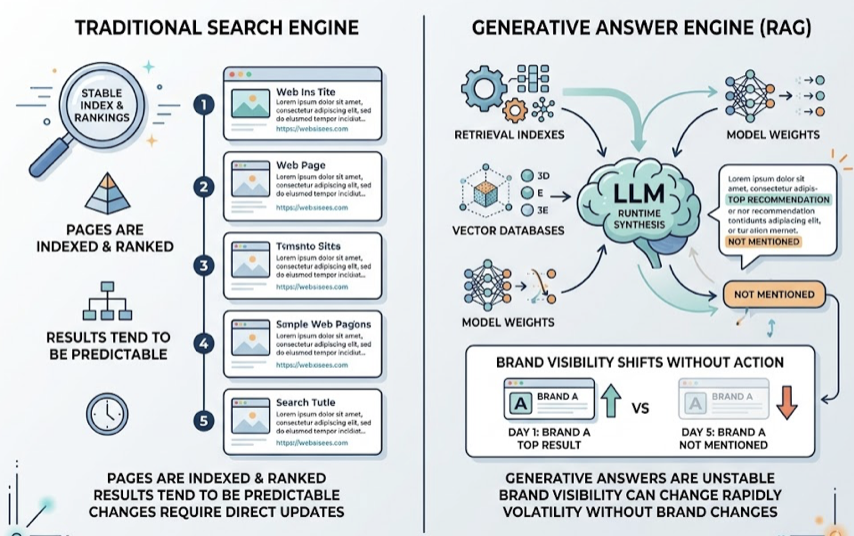
    Google gives you a static list. Ten blue links, ranked by a crawlable algorithm, measurable with dozens of established tools. Perplexity doesn’t work that way.

    Perplexity operates on a Retrieval-Augmented Generation (RAG) architecture. It queries the live web, retrieves relevant documents in real time, and uses a large language model to synthesize those documents into a direct, cited answer. There’s no fixed index. There’s no static position #1. The “ranking” is the model’s real-time decision about which sources to prioritize, cite, and weave into the response.

    That’s a fundamentally different game.

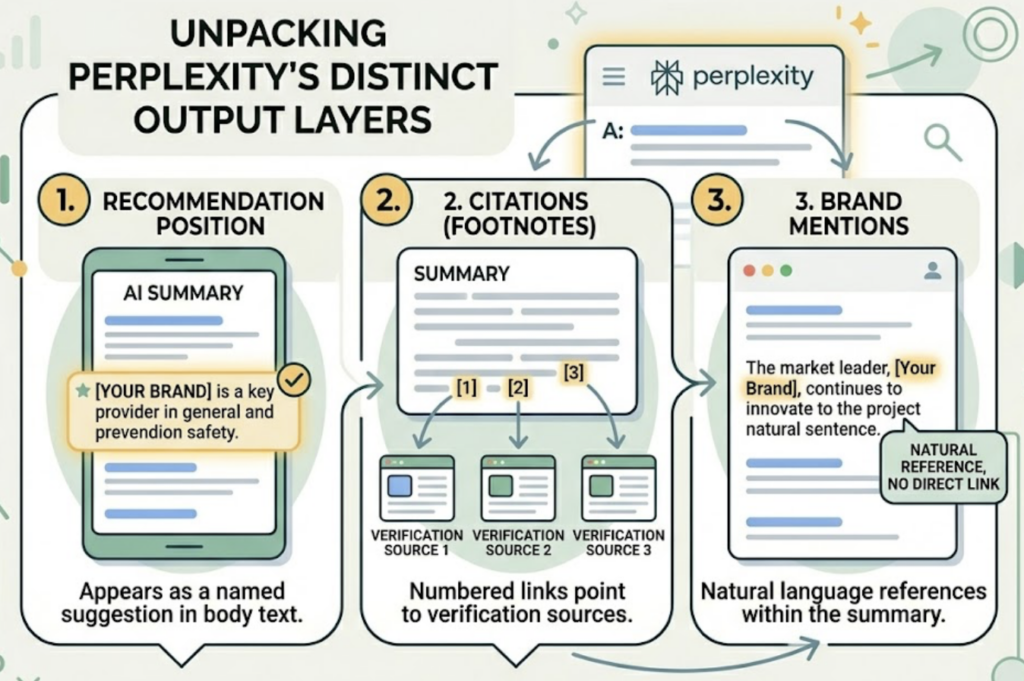
    In practice, Perplexity’s output has three distinct layers. First, there’s the recommendation position: whether your brand appears in the body text as a named suggestion. Second, there are citations, the numbered footnote links ($[1], [2], [3]$) that point readers to verification sources. Third, there are brand mentions, natural language references to your company within the summary, often without any direct link attached.
    Here’s the thing: tools like Ahrefs and Semrush were designed to crawl indexable SERPs. They can’t simulate the dynamic reasoning behavior of a RAG system or capture the source-selection logic that determines which domains get cited. That’s why your current stack has a blind spot the size of an entire search platform.

    What Actually Influences Your Perplexity Ranking

    Perplexity’s Sonar models don’t evaluate content the way Google’s crawlers do. The ranking signals are different, and some of them shift faster than most teams expect.

    Content structure matters more than you’d think. RAG models favor what researchers call “extractable” content: pages built with clear H1-H3 headers, bulleted lists, and concise summary blocks (think TL;DR sections at the top). If your page buries the answer in paragraph seven of a 3,000-word essay, the model often skips it entirely.

    Recency is arguably the single biggest lever. Perplexity’s models heavily weight recently updated content. Field data from GEO practitioners suggests that resources older than roughly three months often lose priority in citation selection. Content decay isn’t just a Google problem anymore. It’s accelerated in AI search.

    Traditional domain authority still plays a role. Strong E-E-A-T signals and established Google rankings act as a prerequisite. Models tend to favor domains already recognized as authoritative for specific queries. But authority alone isn’t enough if the content is stale or poorly structured.

    Data-driven content gives you an edge. Original research, specific statistics, and expert quotes significantly increase the probability of being cited. Perplexity’s model is looking for claims it can attribute. Give it something worth attributing.

    How to Track Your Brand’s Perplexity Ranking Step by Step

    Moving from manual spot-checks to systematic tracking requires a structured approach. Here’s a four-step framework that works.

    Step 1: Define your prompt universe. Identify the 30 to 50 most critical prompts for your brand. These should mirror the questions your target audience actually types into Perplexity, not your internal keyword list. Think “best project management tool for remote teams” rather than “project management software.”

    Step 2: Run a baseline audit. Execute each prompt in a clean browser environment (no personalization, no cookies) and document where your brand stands. Are you cited? Mentioned? Recommended first, third, or not at all? This baseline is your starting point.

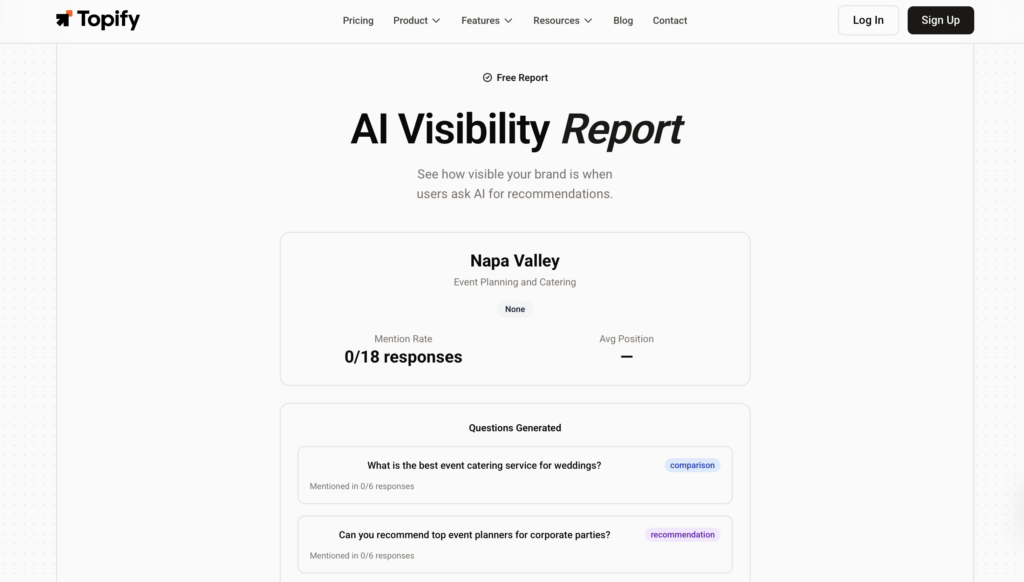
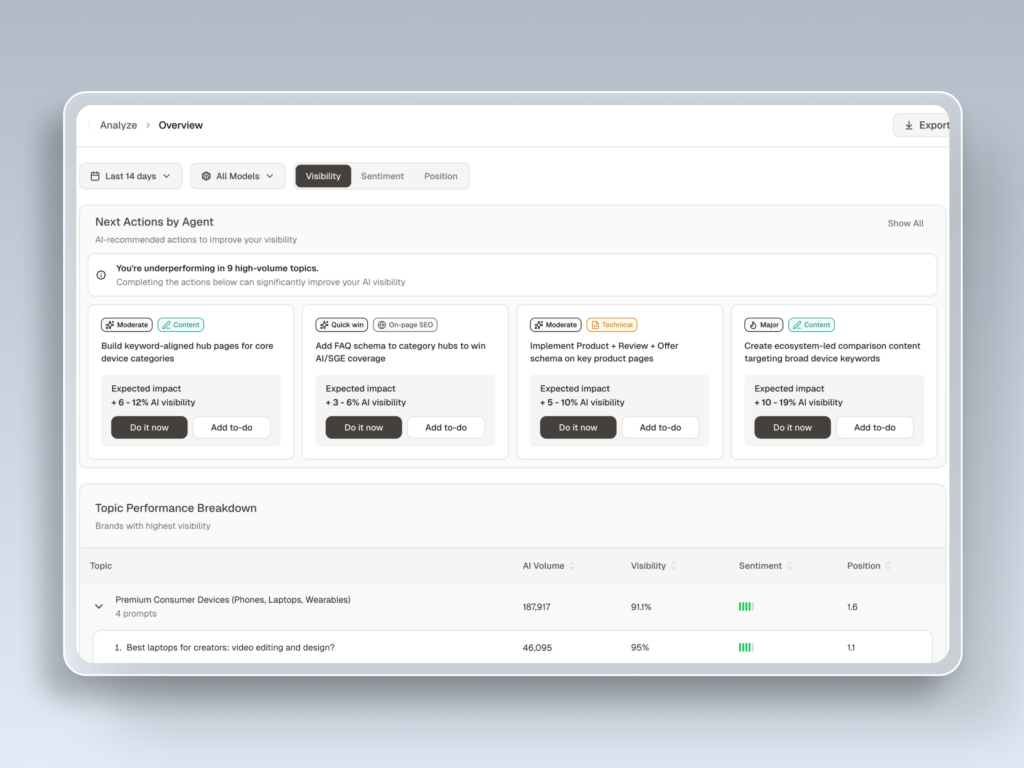
    Step 3: Set up continuous tracking. This is where manual effort hits a wall. Running 50 prompts weekly across Perplexity, ChatGPT, and Gemini isn’t sustainable by hand. Platforms like Topify automate this by monitoring brand visibility, citation sources, and position rank across multiple AI engines from a single dashboard. Topify’s Position Tracking shows exactly where your brand sits relative to competitors for each tracked prompt, while its Source Analysis reveals which domains Perplexity is citing most frequently.

    Step 4: Close the feedback loop. Integrate tracking data with your content pipeline. Use gap analysis to identify the prompts where your brand is consistently absent, then produce structured, data-dense content specifically designed to fill those voids. Topify’s High-Value Prompt Discovery continuously surfaces new prompt opportunities as AI recommendation patterns evolve.

    That’s not a one-time project. It’s an ongoing system.

    Perplexity Citations vs. Brand Mentions: What Each Metric Actually Tells You

    These two signals often get lumped together, but they measure different things and require different optimization strategies.

    Perplexity citations are the explicit footnote links in the response. When your domain appears as $[3]$ in a Perplexity answer, it means the model treated your page as a primary authority for a specific fact or claim. The strategic value is high: citations drive direct traffic, validate your expertise, and signal to the model that your content is trustworthy enough to verify claims against.

    Perplexity brand mentions are different. These happen when the model references your brand by name in the narrative (“The top players in this space include X, Y, and Z”) without necessarily linking to your site. The value here is market salience. Mentions build brand recall, signal that you’re part of the “consideration set,” and increase the likelihood that users will search for you directly afterward.
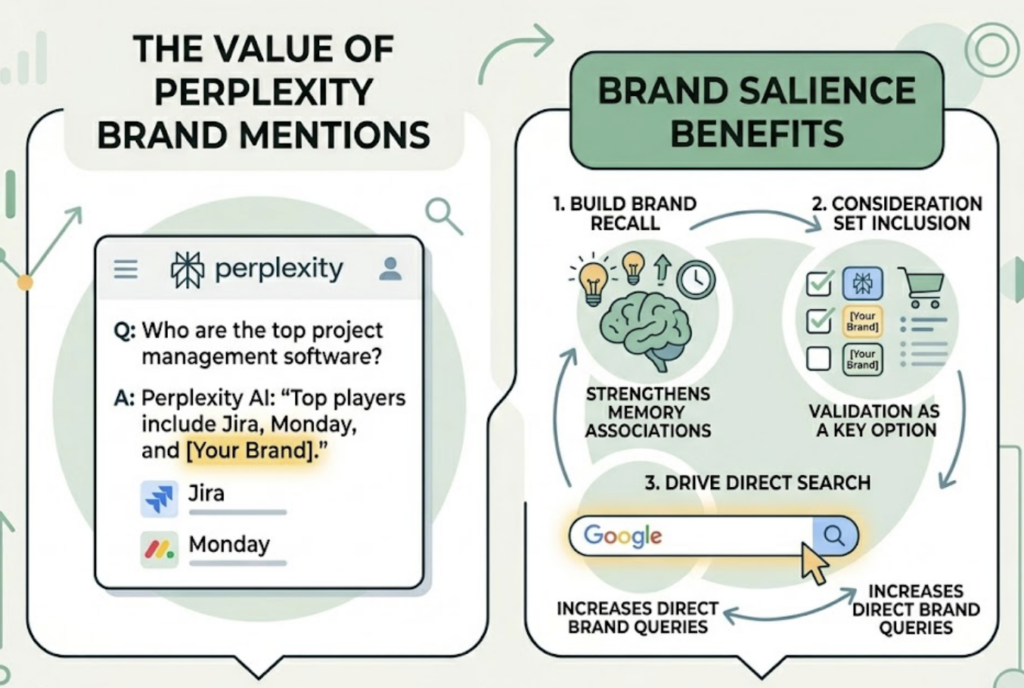
    A brand with high citations but low mentions typically has strong content authority but weak brand recognition in AI contexts. A brand with high mentions but low citations has the opposite problem: the model knows who you are but doesn’t trust your content enough to cite it as a source.

    Tracking both metrics separately is what makes the difference. Topify’s analytics break down visibility into these distinct layers, so you can diagnose whether your Perplexity SEO problem is a content problem, a brand awareness problem, or both.

    The Perplexity SEO Playbook: 5 Moves That Shift Your Ranking

    Knowing how Perplexity ranking works is step one. Here are five specific actions that tend to move the needle.

    1. Turn static pages into living documents. Perplexity’s recency bias means your content has a shelf life. Establish a rotating schedule to refresh core pillar pages every 8 to 12 weeks. Update statistics, add new examples, and revise outdated sections. The goal is to keep your best content within that freshness window.

    How to verify: check the “last updated” date on your top 10 pages. If any are older than 90 days, they’re likely losing Perplexity citation priority.

    2. Optimize for extractability. Every high-value page should open with what GEO practitioners call a “direct summary block”: a concise, factual paragraph or bulleted list that answers the core query in the first 150 words. This is what the RAG model lifts into the response box.

    How to verify: read your page’s opening. If you can’t extract a standalone, quotable answer in under 30 seconds, the model probably can’t either.

    3. Implement structured data. Use explicit schema markup (FAQ schema, HowTo schema, Organization schema) to help AI models understand entities and their relationships. This is table stakes for Perplexity SEO, not a differentiator, but skipping it puts you at a disadvantage.

    4. Build third-party presence. Models use authoritative third-party sources as “cross-reference” validation. Being mentioned in industry reports, comparison sites, and expert roundups increases the probability that Perplexity will include your brand in its synthesized answers. This is the Perplexity brand mentions strategy that most teams underinvest in.

    5. Drive early engagement signals. Perplexity tracks content performance signals to validate that users find cited content useful. Leverage social media, email campaigns, and community channels to drive high initial traffic and dwell time to newly published content. The first 48 hours matter.

    What’s the Best Tool to Check Perplexity Rankings

    This is the most common question brands ask once they realize traditional SEO tools can’t help.

    There are three approaches, and they’re not equal.

    Manual spot-checks are where most teams start. Open Perplexity, type your prompts, screenshot the results. It works for a handful of queries, but it doesn’t scale, doesn’t track changes over time, and is subject to personalization bias.

    General SEO platforms like Semrush or Ahrefs have started adding AI search features, but their core architecture is built around crawlable SERPs. Perplexity citation tracking and brand mention monitoring typically aren’t part of their standard workflow.

    Dedicated AI visibility platforms are purpose-built for this problem. Among them, Topify stands out for several reasons. It tracks visibility across Perplexity, ChatGPT, Gemini, DeepSeek, and other major AI platforms from a single dashboard. It provides citation-level data, showing exactly which URLs are cited for specific prompts. And it bridges the gap between detection and action with a content optimization workflow powered by its AI agent, so you’re not just seeing problems but fixing them.

    Tracking MethodPerplexity CoverageCitation DataMulti-EngineAutomated
    Manual Spot-ChecksPartialNoNoNo
    Traditional SEO ToolsLimitedNoPartialYes
    TopifyFullYesYes (7+ engines)Yes

    Topify’s pricing starts at $99/month for the Basic plan (100 prompts, 9,000 AI answer analyses) and $199/month for Pro (250 prompts, 22,500 analyses). For brands serious about Perplexity ranking, the Basic plan typically covers the initial monitoring needs.

    Conclusion

    Perplexity ranking isn’t a future concern. It’s a current blind spot. Every week your brand goes untracked in AI search is a week where competitors may be capturing the visibility, citations, and brand mentions that should be yours.

    The shift from manual spot-checks to systematic monitoring doesn’t require a massive budget or a new team. It requires the right framework (prompts, baseline, tracking, feedback loop) and a tool that can actually see what’s happening inside AI-generated answers. Start with your top 30 prompts, run a baseline audit, and build from there.

    FAQ

    Q: How often do Perplexity rankings change?

    A: Frequently. Because Perplexity uses RAG to query the live web in real time, rankings can shift with every query execution. In practice, most brands see meaningful position changes on a weekly basis, with content freshness being the primary driver of short-term fluctuations.

    Q: Can I track Perplexity rankings for free?

    A: You can manually search your target prompts and document the results, but this doesn’t scale beyond a few queries. For systematic, automated tracking with historical data, you’ll need a dedicated platform. Topify offers a free GEO Score check as a starting point.

    Q: Does Perplexity SEO require different content than Google SEO?

    A: Mostly yes. While strong domain authority helps on both platforms, Perplexity rewards extractable content structure (summary blocks, clear headers, data-rich claims) and penalizes content decay more aggressively than Google does. The optimal approach is to optimize for both, starting with structure and freshness.

    Q: How long does it take to improve your Perplexity ranking?

    A: It depends on your starting position. Brands that already have strong domain authority and well-structured content can see citation improvements within 4 to 6 weeks of targeted optimization. Brands starting from low visibility typically need 2 to 3 months of consistent content updates and third-party presence building.
    Read More

  • AI Answer Monitoring Tools: How They Work and Which to Pick

    AI Answer Monitoring Tools: How They Work and Which to Pick

    Your SEO dashboard says everything’s fine. Rankings are stable, organic traffic is up, domain authority keeps climbing. Then your VP asks a simple question: “What does ChatGPT say when someone asks for a product like ours?” You check. Your brand isn’t mentioned. Neither is your top-ranking blog post. The 57-page content strategy you built for Google has zero influence on what AI tells your potential customers.

    That’s the gap traditional SEO tools can’t close. They weren’t built to track what AI chooses to say.

    What an AI Answer Monitoring Tool Actually Tracks

    An AI answer monitoring tool is a specialized platform that tracks how a brand, product, or topic is represented across large language model interfaces. Think ChatGPT, Perplexity, Gemini, Google AI Overviews, and other AI-driven search experiences. Instead of monitoring keyword rankings on a results page, these tools monitor the AI’s synthesized response itself.

    The core tracking dimensions typically include four layers:

    DimensionWhat It Answers
    VisibilityDoes the AI mention your brand at all?
    PositionWhere does your brand appear relative to competitors in the response?
    SentimentIs the AI describing your brand positively, neutrally, or negatively?
    Citation SourcesWhich URLs is the AI referencing as its “evidence”?

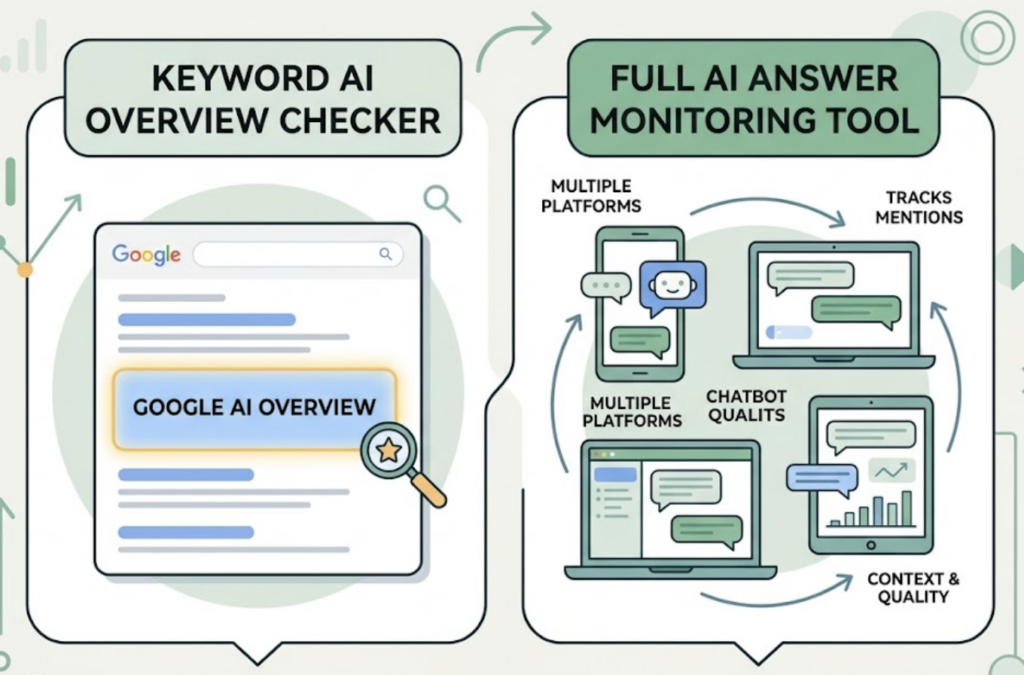
    Here’s a distinction worth noting. A keyword AI overview checker focuses specifically on whether your brand shows up in Google’s AI Overview snippets. That’s useful, but narrow. A full AI answer monitoring tool spans multiple platforms, tracking the quality and context of mentions across the entire AI ecosystem.

    That scope difference matters. Your brand might rank well in AI Overviews but be completely invisible in Perplexity or ChatGPT, where a growing share of your audience is asking purchase-intent questions.

    How AI Answer Monitoring Tools Work Under the Hood

    The technical workflow behind these tools follows a structured pipeline, not a single keyword lookup.

    Step 1: Prompt-level tracking. Instead of tracking keywords the way traditional SEO tools do, AI answer monitoring tools track prompts: the actual conversational queries users type into AI models. “What’s the best project management tool for remote teams?” is a prompt. “Project management tool” is a keyword. The difference in specificity changes what the AI returns entirely.

    Step 2: Cross-platform aggregation. Tools query multiple LLM APIs at scale, including GPT-4, Gemini, Perplexity, and others, using a predefined set of high-intent brand or topic prompts. Each platform has different weighting mechanisms, different training data, and different citation behaviors. Monitoring just one gives you a partial picture at best.

    Step 3: Structured analysis. Using NLP and LLM-based categorization, the raw unstructured text from AI responses gets converted into structured data: brand mentions mapped, sentiment scores assigned, citation behavior tracked over time.

    One technical detail that often gets overlooked: accuracy depends heavily on sampling frequency. LLMs are non-deterministic and undergo rapid model updates. A weekly snapshot might miss a shift that happened on Tuesday and reverted by Thursday. High-frequency monitoring, daily or even more frequent, is what separates reliable data from stale reports.

    The Metrics That Separate Useful Data from Dashboard Noise

    Not every number on a monitoring dashboard deserves your attention. The metrics that actually drive decisions tend to fall into a clear hierarchy.

    Visibility Score answers the most basic question: does the AI know your brand exists? If your Visibility Score across ChatGPT and Perplexity is near zero, nothing else matters yet. This is where you start.

    Sentiment Score tells you how the AI frames your brand. A brand can be visible but poorly described. If Gemini calls your premium product “a budget option,” that’s a Sentiment problem, not a Visibility problem. Tracking sentiment on a 0-100 scale helps you catch narrative drift before it solidifies.

    Citation Share measures how often AI platforms reference your domain versus competitor domains. This is the metric that connects AI monitoring back to content strategy. If a competitor’s blog post is being cited 4x more than yours for the same prompt, you know exactly where to focus your content investment.

    AI Search Volume maps the popularity of specific prompts. Not all prompts are equal. A prompt that generates 10,000 AI searches per month is worth more monitoring attention than one that gets 50.

    One metric that’s still evolving is Position Rank. Because AI responses aren’t linear like a search results page, “position” often refers to the order of citation or the amount of the response dedicated to a brand. It’s useful directionally, but treat it as a trend indicator rather than an absolute ranking.

    For marketing teams tracking visibility across multiple AI platforms, Topify combines all seven of these dimensions, including visibility, sentiment, position, volume, mentions, intent, and CVR, into a single dashboard. In practice, this means you can spot a drop in ChatGPT mentions and trace it back to a specific source that stopped citing your brand, all without switching between tools.

    5 Mistakes That Make AI Answer Monitoring Useless

    Most teams that try AI answer monitoring don’t fail because they picked the wrong tool. They fail because of how they use it.

    Mistake 1: Monitoring only one AI platform. ChatGPT is the most visible, so it’s where most teams start and stop. But Perplexity weights real-time web sources differently than Gemini, which leans into its own ecosystem integration. A brand that’s cited heavily in ChatGPT might be completely absent in Perplexity. Cross-platform coverage isn’t optional.

    Mistake 2: Using SEO keywords instead of real user prompts. “CRM software” is a keyword. “What’s the best CRM for a 20-person sales team that uses Slack?” is a prompt. AI models respond to conversational queries with very different answers than they do to keyword-style inputs. If your monitoring is built around keywords, you’re tracking the wrong inputs.

    Mistake 3: Only checking if you’re mentioned. Visibility without context is misleading. A brand that’s mentioned but described as “outdated” or “overpriced” is worse off than one that isn’t mentioned at all. Sentiment analysis isn’t a nice-to-have. It’s core to understanding what monitoring data actually means.

    Mistake 4: No competitive baseline. Monitoring your own brand in isolation tells you nothing about whether you’re gaining or losing ground. Without competitor benchmarking, you can’t tell if a visibility drop is specific to your brand or a broader shift in the AI model’s behavior.

    Mistake 5: Monitoring too infrequently. AI models update their training data and system prompts regularly. A single model update can overnight change your brand’s visibility for key prompts. Monthly check-ins miss these shifts entirely. Daily or weekly monitoring is the minimum frequency for catching meaningful changes.

    A Practical Checklist for Choosing the Right AI Answer Monitoring Tool

    When evaluating tools, here’s what to weigh:

    Evaluation CriteriaWhat to Look For
    Platform CoverageDoes it track ChatGPT, Perplexity, Gemini, AI Overviews, and regional models?
    Prompt CapacityHow many prompts can you monitor? 50 is a demo. 200+ is operational.
    Metric DepthDoes it go beyond visibility to include sentiment, position, citation share?
    Competitor MonitoringCan you benchmark against competitors automatically?
    Execution LayerDoes it just report data, or does it help you act on it?
    Pricing ModelUsage-based vs. flat rate? Does it scale with your needs?

    Most tools in this space stop at the reporting layer. They show you dashboards but leave the “what do I do about it” to you.

    Topify takes a different approach. Beyond tracking across ChatGPT, Gemini, Perplexity, DeepSeek, and other major AI platforms, it includes a one-click execution layer. You define your optimization goals in plain English, review the proposed strategy, and deploy it. The system handles prompt discovery, competitive benchmarking, and citation analysis in one workflow.

    On pricing, Topify’s plans start at $99/month for the Basic tier (100 prompts, 9,000 AI answer analyses, 4 projects) and scale to $199/month for Pro (250 prompts, 22,500 analyses, 10 seats). Enterprise plans start at $499/month with dedicated account management. You can check the full breakdown on the Topify pricing page.

    The question to ask isn’t just “which tool has the most features.” It’s which tool connects monitoring data to action without requiring your team to build the bridge manually.

    How to Build an AI Answer Monitoring Strategy That Compounds

    Buying a tool is step one. Making it compound over time is where the real value shows up.

    Start with your prompt library. Don’t monitor every possible query. Start with 20-30 high-intent prompts that your customers actually ask: product comparisons, use-case questions, “best tool for X” queries. These are the prompts where AI visibility directly influences purchase decisions.

    Establish a baseline. Run a comprehensive audit before you change anything. Document your Visibility Score, Sentiment, and Citation Share across all tracked platforms. This is your day-zero snapshot, and every future optimization will be measured against it.

    Set up competitor benchmarking. Identify 3-5 direct competitors and track the same prompts for their brands. Topify’s Dynamic Competitor Benchmarking automatically detects competitors and provides side-by-side comparisons on visibility, sentiment, and position. Knowing that a competitor gets cited 3x more for a specific prompt tells you exactly where to focus.

    Close the optimization loop. This is where monitoring turns into growth. When data shows “the AI doesn’t associate our brand with sustainable packaging,” the action is clear: create or strengthen content on that topic across your owned channels. Update your key landing pages. Build entity associations that AI models can pick up.

    Then validate. Measure the change in Citation Share and Sentiment after your content adjustments go live. If Citation Share climbs but Sentiment stays flat, your content is getting referenced but the messaging needs work. If both move, you’ve closed the loop.

    The teams that get compounding returns aren’t the ones with the fanciest dashboards. They’re the ones running this cycle, monitor, diagnose, act, validate, every two to four weeks.

    Conclusion

    The gap between what traditional SEO tools measure and what AI models actually say about your brand is only getting wider. An AI answer monitoring tool doesn’t replace your existing analytics stack. It fills the blind spot that no keyword tracker, rank checker, or traffic dashboard can cover.

    Start with a focused set of high-intent prompts. Establish your baseline across platforms. Build the optimization loop. The brands that figure this out early won’t just be visible to AI. They’ll be the ones AI recommends first.

    FAQ

    Q: What is an AI answer monitoring tool? 

    A: An AI answer monitoring tool is a platform that tracks how your brand appears in AI-generated responses across models like ChatGPT, Perplexity, and Gemini. It monitors visibility, sentiment, positioning, and citation sources to show you what AI is telling your potential customers about your brand.

    Q: How does an AI answer monitoring tool work? 

    A: These tools operate through a three-step pipeline. First, they track specific conversational prompts across multiple AI platforms. Then they aggregate the AI-generated responses. Finally, they use NLP to convert unstructured AI answers into structured data: brand mentions, sentiment scores, citation patterns, and visibility trends over time.

    Q: How much do AI answer monitoring tools typically cost? 

    A: Pricing varies by platform and scale. Entry-level plans for comprehensive tools like Topify start around $99/month for 100 tracked prompts and 9,000 AI answer analyses. Mid-tier plans run $199/month with higher prompt limits and team seats. Enterprise options with dedicated support typically start at $499/month.

    Q: Can I use an AI answer monitoring tool alongside traditional SEO tools? 

    A: Yes, and you should. Traditional SEO tools track how you rank in search results. AI answer monitoring tools track how you’re represented in AI-generated answers. They measure different things. Using both gives you full visibility across both traditional and AI-driven search channels.

    Read More

  • AI Answer Monitoring: How It Works and How to Start

    AI Answer Monitoring: How It Works and How to Start

    You checked ChatGPT last Tuesday, searched your brand’s category, and saw your name in the response. You checked again on Friday. Gone. Replaced by a competitor you’ve never heard of. The problem isn’t that AI answers change. It’s that most marketing teams have no system to track when they change, why they change, or what to do about it.

    AI search traffic has grown 527% year-over-year, and traditional search volume is projected to drop by 25% as AI-driven answer engines absorb more informational queries. The brands that treat AI answer monitoring as a structured discipline, not an occasional manual check, are the ones controlling how they show up.

    What AI Answer Monitoring Actually Measures

    AI answer monitoring is the systematic process of tracking how a brand appears inside AI-generated responses across platforms like ChatGPT, Google AI Overviews, Perplexity, and Microsoft Copilot. It’s not a single metric. It’s a framework that covers whether you’re mentioned, how you’re described, where you rank, and what sources the AI pulls from.

    That’s a fundamentally different challenge than traditional SEO.

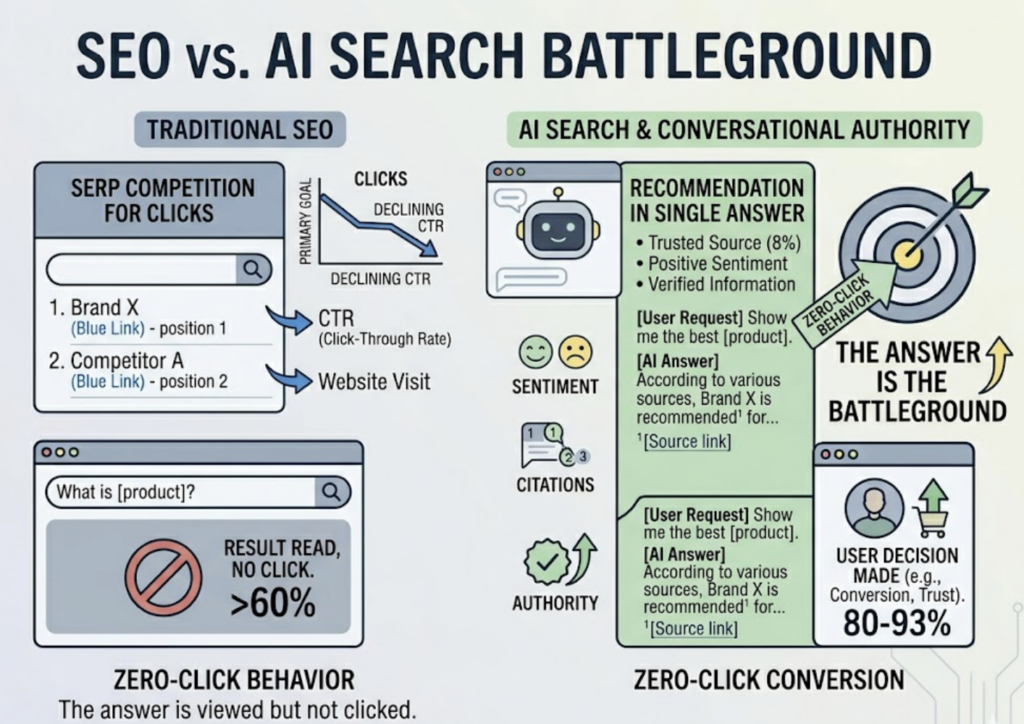
    SEO tracks blue links and SERP positions. AI answer monitoring tracks citations, sentiment, and conversational authority. In traditional search, you’re competing for clicks. In AI search, you’re competing for a recommendation inside a single generated answer, one that often determines the user’s decision before they visit any website. With zero-click behavior now exceeding 60% on traditional Google and reaching 80-93% on AI-native platforms, the answer itself is the battleground.

    Two metrics define success here: Citation Share, which measures how often AI recommends you relative to competitors, and Sentiment Accuracy, which captures whether the AI describes your value proposition correctly. A brand that’s mentioned frequently but positioned as “budget-friendly” when its actual positioning is premium has a monitoring problem, not a visibility win.

    The 5 Metrics That Define Effective AI Answer Monitoring

    If you’re only counting whether your brand name appears, you’re missing four-fifths of the picture. Here’s what a complete AI answer monitoring system actually tracks.

    MetricWhat It MeasuresWhy It Matters
    Visibility ScoreFrequency of prompts where your brand appearsMeasures your brand’s reach inside the AI-native discovery funnel
    Sentiment ScoreTone and accuracy of AI’s brand description (0-100)Catches misrepresentation before it shapes buyer perception
    Position RankOrder in which your brand is cited or recommendedDirectly correlates with user trust and click-through likelihood
    Citation SourcesSpecific domains and URLs the AI cites when mentioning youReveals the trust signals AI relies on, informing your content and PR strategy
    AI VolumeFrequency of high-intent topics surfacing in AI platformsPrioritizes content efforts based on where AI search activity is highest

    Each metric answers a different question. Visibility tells you if you’re in the room. Sentiment tells you what’s being said. Position tells you where you stand relative to competitors. Citation Sources tell you why AI chose to include you. And AI Volume tells you which conversations matter most.

    Tracking all five together is what separates teams running real AI answer monitoring from teams who are just spot-checking ChatGPT once a month.

    How to Set Up AI Answer Monitoring Step by Step

    Most teams start with a manual approach: type your brand category into ChatGPT, screenshot the result, share it in Slack. That works once. It doesn’t work at scale, and it doesn’t work when AI models update their responses every few weeks.

    Here’s a more sustainable strategy for ai answer monitoring that holds up over time.

    Step 1: Define your prompt universe. Don’t just monitor your brand name. Users typically search for problems (“how to fix X”), categories (“best CRM for small teams”), or comparisons (“Tool A vs Tool B”). Your brand needs to appear as the solution to those prompts. Use tools with prompt discovery features, like Topify’s High-Value Prompt Discovery, to surface the exact queries your audience is asking across AI platforms.

    Step 2: Prioritize your platforms. Focus on the “Big Four” that cover distinct user behaviors: ChatGPT Search for research and synthesis, Google AI Overviews for transactional and local queries, Perplexity for professional research, and Copilot for enterprise and workplace contexts. Each platform pulls from different source signals and updates on different cadences.

    Step 3: Establish a baseline. Measure your current visibility, sentiment, and position against your top two competitors across the same prompt sets. Without a baseline, you can’t measure improvement or diagnose a sudden drop.

    Step 4: Automate and iterate. Move from one-time audits to continuous tracking. Topify’s platform, for instance, lets you monitor 100 to 250+ prompts across ChatGPT, Perplexity, and AI Overviews simultaneously, with automated alerts when your visibility shifts. The goal is to move from tracking to optimization: updating your content architecture to be citation-ready, meaning structured, modular, and fact-dense.

    Best AI Overviews Checking Tools for 2026

    The market for ai overviews checking tools has matured significantly. What used to be basic rank trackers now span full-spectrum AI visibility platforms. But the range is wide, and picking the wrong tool means paying for dashboards that don’t answer your actual questions.

    Here’s how the current landscape breaks down.

    Topify stands out as a comprehensive mid-market platform that combines monitoring and execution in a single workflow. It tracks brand performance across ChatGPT, Gemini, Perplexity, DeepSeek, and Google AI Overviews via seven core metrics: visibility, sentiment, position, volume, mentions, intent, and CVR. What sets it apart from monitoring-only dashboards is its execution layer. Topify’s One-Click Agent lets you define optimization goals in plain English and deploy a GEO strategy without manual workflows. Its Prompt Discovery feature continuously surfaces high-volume AI queries relevant to your brand, so you’re not guessing which prompts to track. Citation analysis goes deep: you can see the exact domains and URLs that AI platforms cite when mentioning your brand or competitors, then act on those insights directly. Pricing starts at $99/mo for 100 prompts and 9,000 AI answer analyses, scaling to $199/mo (250 prompts) and custom enterprise plans from $499/mo. Get started with Topify to run your first AI visibility audit.

    For teams already embedded in traditional SEO ecosystems, Semrush and Ahrefs have both added AI visibility features as extensions of their existing keyword and rank tracking tools. These are solid options if your primary workflow already runs through those platforms, though their AI monitoring depth tends to be narrower than purpose-built tools.

    ZipTie.dev has earned attention for its UI simulation tracking approach, which renders AI answers in an actual browser environment rather than relying solely on API calls. This produces results closer to what a real user sees, plus built-in screenshot capture for reporting.

    For niche requirements, options like LLMRefs serve teams with heavy keyword volumes on tighter budgets.

    FeatureTopifySEO-Integrated ToolsZipTie.dev
    AI Platform CoverageChatGPT, Gemini, Perplexity, DeepSeek, AI OverviewsVaries (typically 1-2)ChatGPT, Perplexity
    Core Metrics7 (visibility, sentiment, position, volume, mentions, intent, CVR)2-3 (visibility, position)3-4 (visibility, position, screenshots)
    Execution/OptimizationOne-Click Agent + content strategyLimited recommendationsContent optimization suggestions
    Starting Price$99/moBundled with SEO suiteVaries

    The right ai overviews checking tool depends on your team’s priorities. If you need both monitoring and execution in one platform, Topify covers the full loop. If you’re extending an existing SEO stack, the integrated options make sense. If visual proof and screenshot reporting matter most, ZipTie.dev fills that gap.

    5 Mistakes That Tank Your AI Answer Monitoring Results

    Knowing what to monitor is half the equation. The other half is avoiding the errors that make your data misleading or your efforts wasted.

    Mistake 1: Monitoring only one platform. ChatGPT is the default for most teams, but Google AI Overviews, Perplexity, and Copilot each serve different user intents and pull from different source signals. A brand that’s visible in ChatGPT but absent from AI Overviews is missing the transactional queries that drive purchase decisions.

    Mistake 2: Using the wrong prompts. Testing only your brand name is like checking if your phone number works by calling yourself. Real users search for problems, categories, and comparisons. “Best project management tool for remote teams” tells you more about your AI visibility than “What is [Brand Name]?” ever will.

    Mistake 3: Tracking mentions but ignoring sentiment. A mention that describes your product as “outdated” or “overpriced” does more damage than no mention at all. Sentiment monitoring catches misrepresentation before it shapes buyer perception at scale.

    Mistake 4: Treating monitoring as a one-time audit. AI models update their training data, citation patterns, and response formats on a rolling basis. What was true last month may not hold this month. Continuous tracking with automated alerts is the only way to catch shifts before they compound.

    Mistake 5: No human review loop. Automated dashboards flag changes. Humans interpret whether those changes require action. A drop in visibility could mean a competitor published stronger content, or it could mean the AI model shuffled its citation preferences temporarily. Without human judgment in the loop, teams either overreact to noise or miss real signals.

    Your AI Answer Monitoring Checklist

    Here’s a condensed, actionable checklist you can use to audit your current monitoring setup or build one from scratch.

    Setup Phase

    Map 50-100 high-intent prompts your target audience actually uses across AI platforms. Prioritize category queries and problem-solution queries over branded searches. Identify the top 2-3 competitors to benchmark against. Choose a monitoring tool that covers at least ChatGPT, Google AI Overviews, and Perplexity.

    Ongoing Monitoring

    Track all five core metrics weekly: visibility, sentiment, position, citation sources, and AI volume. Set automated alerts for any visibility drop greater than 10% week-over-week. Review citation sources monthly to identify which domains are helping (or hurting) your AI presence. Compare your sentiment score against your actual brand positioning to catch misrepresentation early.

    Optimization

    Update your content architecture to be citation-ready: structured data, modular sections, and fact-dense paragraphs that AI can easily extract. Run prompt discovery monthly to catch new high-volume queries. Feed monitoring insights back into your content and PR strategy. Measure improvement against your original baseline every 30 days.

    If you don’t have a monitoring tool yet, start with Topify’s platform to establish your baseline across multiple AI engines in one dashboard.

    Conclusion

    AI answer monitoring isn’t a nice-to-have analytics feature. It’s the foundation for every brand visibility decision in a search environment where AI generates the answer, not just the link. The teams that build a structured monitoring system now, with the right metrics, the right prompts, and continuous tracking, are the ones who’ll control how AI represents their brand in 2026 and beyond.

    The first step is simple: stop checking manually and start measuring systematically.

    FAQ

    Q: What is AI answer monitoring? 

    A: AI answer monitoring is the systematic process of tracking how your brand, product, or service appears inside AI-generated responses across platforms like ChatGPT, Google AI Overviews, Perplexity, and Copilot. It covers visibility (whether you’re mentioned), sentiment (how you’re described), position (where you rank), and citations (what sources AI references).

    Q: How does AI answer monitoring work? 

    A: Monitoring tools track a defined set of prompts across multiple AI platforms, then analyze each response for brand mentions, tone, ranking order, and cited sources. Results are aggregated into dashboards that show trends over time, flag changes, and surface optimization opportunities.

    Q: What are the best tools for AI answer monitoring? 

    A: The leading options in 2026 include Topify (comprehensive monitoring + execution), Semrush and Ahrefs (AI features integrated into existing SEO suites), and ZipTie.dev (UI simulation with screenshot capture). The right choice depends on whether you need monitoring only, monitoring plus optimization, or an extension of your existing SEO workflow.

    Q: How much does AI answer monitoring cost? 

    A: Pricing varies widely. Purpose-built platforms like Topify start at $99/mo for 100 prompts and 9,000 AI answer analyses, with Pro plans at $199/mo. SEO-integrated tools bundle AI monitoring into their existing subscription tiers. Enterprise solutions with dedicated support typically start at $499/mo and scale based on prompt volume and platform coverage.

    Read More

  • LLM Citation Tracking Service: How It Works

    LLM Citation Tracking Service: How It Works

    You’ve been manually searching your brand name in ChatGPT every Monday morning. Sometimes you show up. Sometimes you don’t. Last month, a competitor appeared in three out of five prompts you tested, and you couldn’t explain why. The problem isn’t that you’re not doing SEO. It’s that no amount of manual spot-checking can tell you what’s actually happening across AI search at scale.

    That gap between “checking once in a while” and “knowing what AI is citing in real time” is exactly where an LLM citation tracking service fits in.

    What LLM Citation Tracking Actually Measures

    Most teams conflate three very different signals when they talk about “AI visibility.” Understanding the difference is the first step to tracking anything useful.

    The first layer is mention. This means the AI acknowledges your brand name in its response. It knows you exist. That’s awareness, not trust.

    The second layer is citation. This is when the AI explicitly links to your URL as a source. It’s pulling your content into its answer as a verifiable reference. Citation means the model trusts your content enough to back its own claims with it.

    The third layer is sentiment and position. This captures how the AI frames your brand (recommended, neutral, or compared unfavorably) and where you appear in the response relative to competitors.

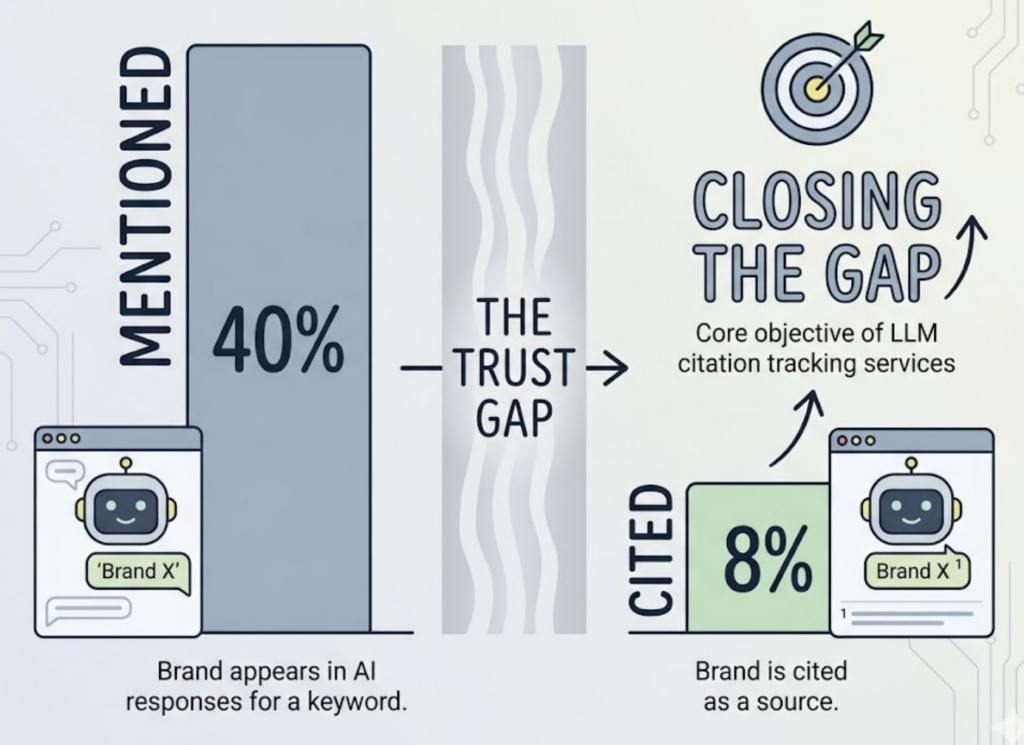
    The delta between being mentioned and being cited is what some practitioners call the “Trust Gap.” A brand can appear in 40% of AI responses for a keyword but only be cited as a source in 8% of them. Closing that gap is the core objective of any LLM citation tracking service.

    An LLM citation tracking service measures all three layers systematically, across multiple AI platforms, for the specific prompts that matter to your business. It’s not a one-time audit. It’s ongoing monitoring with trend data.

    How an LLM Citation Tracking Service Works

    The technical pipeline behind a professional LLM citation tracking service follows four stages.

    Stage 1: Prompt sampling. The service selects high-intent prompts that represent how real users query AI engines. These aren’t random questions. They’re typically mapped to your funnel: top-of-funnel awareness prompts, mid-funnel comparison prompts, and bottom-funnel purchase-intent prompts.

    Stage 2: Response collection. The system runs these prompts programmatically across multiple AI platforms (ChatGPT, Perplexity, Gemini, Google AI Overviews) under standardized conditions. This removes the variability you’d get from manual testing.

    Stage 3: Citation extraction. Each AI response is parsed to identify linked domains, URLs, and brand mentions. The service separates explicit citations (linked sources) from implicit mentions (name drops without links).

    Stage 4: Source matching and trend analysis. Citations are mapped against a competitor baseline. Over time, this produces a “citation share” metric, showing what percentage of AI responses for a keyword set cite your domain versus competitors.

    Here’s the thing: each AI platform has a different retrieval logic. Perplexity provides explicit, numbered citations, making it highly trackable. Google AI Overviews combines traditional search indexing with generative summaries, so you need to monitor both traditional SEO signals and generative visibility. ChatGPT and Gemini often rely on proprietary RAG (Retrieval-Augmented Generation) systems that tend to prioritize fact-dense, structured content over pages with high Domain Authority alone.

    That’s why cross-platform coverage isn’t optional. A service that only tracks ChatGPT gives you roughly 25% of the picture.

    The Best AI Overviews Analysis Tools for Citation Tracking

    Google AI Overviews deserves its own section because it sits at the intersection of traditional search and generative AI. Unlike ChatGPT or Perplexity, AI Overviews pulls from Google’s own search index, which means your existing SEO performance directly influences whether you get cited in a generative summary.

    But here’s the catch: ranking on page one of Google doesn’t guarantee you’ll appear in the AI Overview for the same query. The generative layer applies its own selection logic, often favoring content that’s structured for direct extraction (lists, tables, concise definitions) over pages that rank purely on backlink strength.

    The best AI overviews analysis tools let you track both layers simultaneously. You need to see your traditional SERP position alongside your AI Overview citation status for the same keyword.

    Topify covers this gap. It tracks brand visibility across ChatGPT, Perplexity, Gemini, and Google AI Overviews from a single dashboard. For AI Overviews specifically, you can monitor whether your domain is being cited as a source in generative summaries, track which competitors are appearing, and identify prompts where you’re ranking on page one but missing from the AI Overview entirely.

    The best AI overviews checkers also show you the source context of each citation. Being cited in a “top alternatives” list is fundamentally different from being cited as the recommended solution. That context changes what action you take next.

    5 Common Mistakes That Tank Your LLM Citation Data

    Tracking LLM citations is only useful if you’re tracking them correctly. These are the errors that make teams draw wrong conclusions from their data.

    Mistake 1: Platform monoculture. Monitoring only one AI platform, typically ChatGPT, and assuming the results apply everywhere. Retrieval behaviors vary significantly between models. A brand that dominates Perplexity citations might be invisible in Gemini responses. Every best-in-class AI overviews analysis tool tracks at least three platforms.

    Mistake 2: Confusing traditional SEO metrics with AI citation signals. Domain Authority and backlink counts don’t directly predict whether an LLM will cite your content. AI models tend to prioritize conciseness, fact-density, and structured formatting over traditional link metrics. A page with DA 30 but clear, extractable data points can outperform a DA 80 page packed with marketing copy.

    Mistake 3: Treating all citations as equal. Being cited in a “competitor comparison” list is fundamentally different from being cited as the “recommended solution.” Without source context analysis, you can’t distinguish between these two scenarios in your data.

    Mistake 4: No competitive baseline. Tracking your own citation share without monitoring competitors is like checking your exam score without knowing the class average. You need relative performance data to identify gaps and opportunities.

    Mistake 5: Tracking too infrequently. AI models update their retrieval patterns regularly. Monthly spot-checks miss the inflection points. The most reliable LLM citation tracking services run automated checks at least weekly, with some platforms like Topify offering continuous monitoring across tracked prompts.

    What a Strong LLM Citation Tracking Strategy Looks Like

    Having a tracking service is step one. Using it strategically is what drives results. Here’s a framework that works in practice.

    Step 1: Baseline audit. Identify the top 20 to 50 high-intent prompts in your niche. Record your current citation share across every major AI platform. This becomes your benchmark.

    Step 2: Entity anchoring. Standardize your brand identity using structured data (sameAs, about, mentions schema). AI systems cite entities, not just pages. If your brand entity isn’t clearly defined in the knowledge graph, you’re harder to cite.

    Step 3: Content extractability. Optimize your highest-value pages for AI retrieval. Start sections with direct answers. Use lists and tables for comparison content. Back every major claim with verifiable external sources. AI models pull from content that’s structured for extraction, not content that’s written for scrolling.

    Step 4: Competitive gap analysis. Use your tracking service to identify prompts where competitors are being cited and you’re not. These are your highest-leverage content opportunities. Topify’s Competitor Monitoring feature automates this by detecting competitors and showing citation share side by side across platforms.

    Step 5: Iterative monitoring. Shift from manual checking to automated tracking. Monitor the impact of content updates, algorithm changes, and competitive moves. Topify’s Source Analysis tracks which specific domains and URLs AI platforms are citing, so you can see whether a new blog post or schema update actually moved the needle on your citation share.

    The checklist version: define prompts, build your entity, structure content for extraction, find competitive gaps, and automate monitoring. That’s the full loop.

    LLM Citation Tracking Service Pricing: What to Expect

    Pricing for LLM citation tracking services generally falls into three tiers.

    TierPrice RangeWhat You Typically Get
    Entry-level$29 to $99/moSingle-platform monitoring, basic URL tracking, limited prompt sets
    Pro$199/moMulti-platform prompt tracking, competitor dashboards, marketing-ready reports
    Enterprise$499+/mo10+ AI engine coverage, proprietary prompt volume data, governance controls, dedicated support

    Topify’s pricing maps to this structure. The Basic plan starts at $99/mo and includes ChatGPT, Perplexity, and AI Overviews tracking with 100 prompts and 9,000 AI answer analyses. The Pro plan at $199/mo scales to 250 prompts and 22,500 analyses across 8 projects. Enterprise plans start from $499/mo with custom configurations and a dedicated account manager.

    When evaluating pricing, focus on three variables: the number of prompts you can track, the number of AI platforms covered, and whether the tool maps citation gaps (not just citation presence). A tool that tells you “you were cited 12 times” is less valuable than one that tells you “your competitor was cited 38 times on prompts where you weren’t cited at all.”

    Bottom line: the $99 to $199/mo range covers most mid-market teams. Enterprise brands with multi-region or multi-product portfolios should expect $499/mo and above.

    Conclusion

    The shift from manual spot-checking to structured LLM citation tracking isn’t a luxury anymore. It’s how brands move from “I think we show up in AI search” to “I know exactly where we’re cited, where we’re not, and what to do about it.”

    The mechanics are straightforward: sample the right prompts, track citations across platforms, measure against competitors, and act on the gaps. The difference between brands that capture AI visibility and those that don’t typically comes down to whether they’ve built this loop or are still relying on Monday-morning ChatGPT searches.

    If you’re evaluating services, start with Topify to establish your baseline across ChatGPT, Perplexity, Gemini, and AI Overviews. The data will tell you where to focus first.

    FAQ

    Q: What is an LLM citation tracking service?

    A: An LLM citation tracking service systematically monitors which domains and URLs AI systems (ChatGPT, Perplexity, Gemini, AI Overviews) cite as sources when generating answers to business-relevant prompts. It tracks citation share, frequency, position, and context across platforms over time.

    Q: How do you measure LLM citation tracking performance?

    A: The core metrics are citation share (percentage of AI responses citing your domain vs. competitors), citation frequency (trend over time), citation position (where you appear in the reference list), and source context (whether you’re cited as a recommendation, comparison, or neutral reference).

    Q: What’s the difference between LLM citation tracking and AI visibility tracking?

    A: AI visibility tracking measures whether your brand is mentioned in AI responses (awareness). LLM citation tracking goes deeper: it specifically monitors whether AI systems link to your content as a cited source (trust). A brand can have high visibility (mentioned often) but low citation share (rarely linked as a source).

    Q: How much does an LLM citation tracking service cost?

    A: Entry-level plans typically range from $29 to $99/mo for basic monitoring. Pro-level plans around $199/mo include multi-platform tracking and competitor analysis. Enterprise plans start at $499/mo and above for full AI engine coverage and custom configurations.

    Read More

  • AI Search Visibility: What It Is and How to Track It

    AI Search Visibility: What It Is and How to Track It

    Your domain authority is 75. You’re ranking on page one for your top 20 keywords. Your content calendar is humming along. Then someone asks ChatGPT, “What’s the best tool for [your category]?” and your brand doesn’t make the list. Five competitors do. Your SEO dashboard has no metric that explains why.

    That’s the gap. Traditional search metrics measure discovery through blue links. AI search engines don’t work that way. They synthesize answers, cite sources, and recommend brands, often without sending a single click to your site. And if you’re not tracking what AI is saying about you, you’re optimizing for a search experience that’s already being replaced.

    Your Google Rankings Don’t Tell You What AI Is Saying About Your Brand

    AI search visibility is the frequency, quality, and accuracy with which a brand gets mentioned, recommended, or cited in AI-generated responses. It’s a fundamentally different signal from ranking position or organic traffic.

    Here’s the conflict: a brand can have top-tier Google rankings and a high domain authority score, yet remain completely invisible in an AI answer. The model may not consider that site a trusted source. Or the content may fail to meet the structured requirements that RAG architectures depend on to pull and synthesize information.

    The distinction matters because the two systems optimize for different outcomes. Traditional SEO is optimized for discovery: ranking for keywords to earn a click. AI SEO, sometimes called AI search optimization, is optimized for influence: becoming the trusted data source the AI uses to build its answer. A brand that’s great at the first and ignoring the second is leaving an entire channel unmeasured.

    The Metrics That Define AI Search Visibility

    Because users increasingly get answers without clicking, traditional traffic metrics only capture a fraction of what’s happening. Measuring AI search visibility requires a different set of KPIs.

    Brand Presence tracks the percentage of relevant prompts where your brand is mentioned. Think of it as market share for the AI era. If there are 50 prompts that matter to your category and you show up in 12 of them, that’s your baseline.

    Citation Share measures how often your URLs are cited compared to competitors. This is the clearest indicator of source authority in the eyes of the LLM. If a competitor’s blog post is being cited 3x more than yours for the same topic, that’s a content gap you can act on.

    Sentiment Score tracks whether AI describes your brand positively, neutrally, or negatively. This is where hallucination risk lives. An AI engine might describe your enterprise product as “budget-friendly” or your premium service as “basic.” Without tracking sentiment, you won’t catch the mismatch.

    AI Volume measures how frequently a topic gets queried through AI-integrated tools. Not every keyword matters equally in AI search. Some prompts get asked thousands of times a month across ChatGPT and Perplexity. Others barely register. AI volume data helps you prioritize which content topics need AI search optimization focus.

    Why AI Search Optimization Needs Its Own Playbook

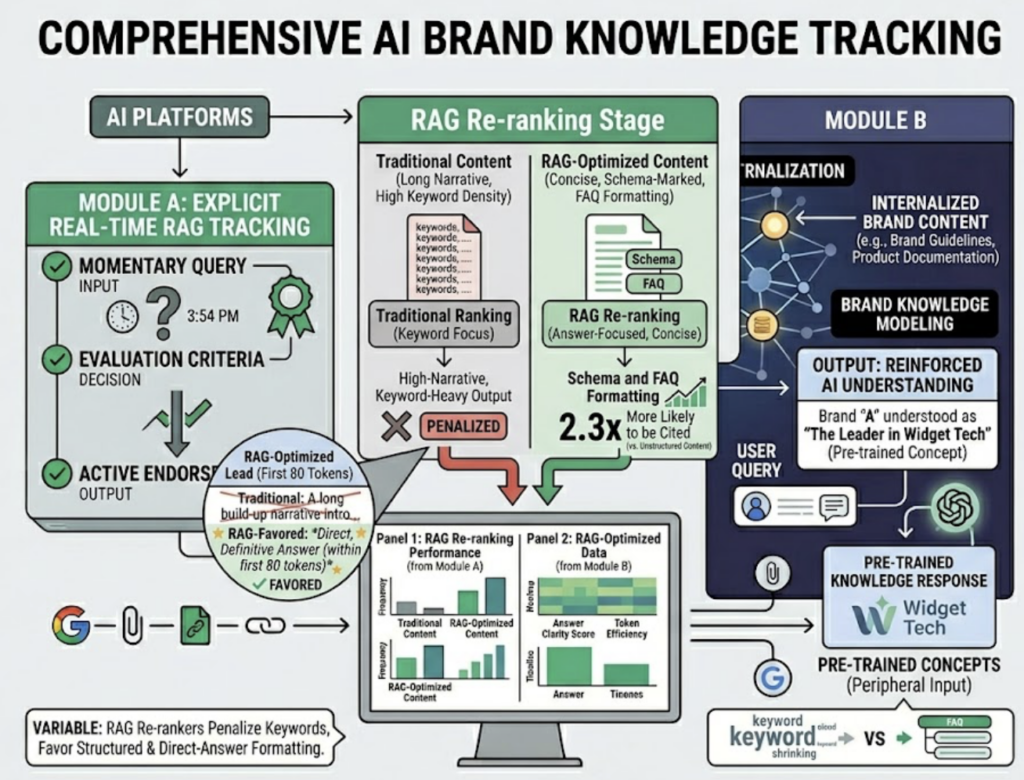
    Modern AI search engines run on a Retrieval-Augmented Generation (RAG) pipeline, and the logic is fundamentally different from traditional keyword indexing.

    The pipeline works in four stages: query intent parsing (turning user input into a vector representation), hybrid retrieval (combining semantic search with lexical matching), L3 re-ranking (where content quality is assessed), and LLM synthesis (where the model generates an answer with citations). Most content gets filtered out at the re-ranking stage due to poor structure or shallow topical depth.

    That re-ranking stage is where traditional SEO assumptions break down. RAG re-rankers tend to penalize heavy keyword density. They favor concise, answer-focused content chunks over long narrative introductions. Content with schema markup and clear FAQ-style formatting is roughly 2.3x more likely to be cited than unstructured content. AI models also prefer content that leads with a direct, definitive answer within the first 80 tokens rather than building up to it.

    The playbook for AI search intelligence is different: structure your content for parsing, not just reading. Lead with answers. Build entity authority through proprietary data and unique frameworks. And track which sources AI is actually citing, because that’s where your content strategy should aim.

    How to Track AI Brand Visibility Across ChatGPT, Perplexity, and Gemini

    Manual spot-checking doesn’t scale. LLMs are probabilistic: fewer than 1 in 1,000 queries produce identical results. Asking ChatGPT about your brand once and treating that as data is like checking your stock price once a year and calling it a trend.

    A professional AI search analytics framework has three layers.

    Layer 1: Prompt-Level Mapping. Define a “golden set” of prompts based on customer pain points, sales conversations, and support tickets, not just keywords. These are the questions your buyers are actually asking AI. “What’s the best CRM for mid-market SaaS?” matters more than ranking for “CRM software.”

    Layer 2: Cross-Platform Benchmarking. Run the same prompts across ChatGPT, Perplexity, and Google AI Overviews systematically. Different models perceive brands differently. ChatGPT tends to be more conservative, prioritizing established authority and fewer high-confidence sources. Perplexity favors real-time freshness, often surfacing content published within the last 30 days for trending topics. If your brand shows up on one platform but not another, the fix is platform-specific.

    Layer 3: Source Gap Analysis. Identify which third-party domains the AI consistently cites for your category. If a competitor is being referenced through a specific industry publication, the strategy isn’t more blog posts. It’s targeted PR coverage in that publication.

    For teams tracking AI brand visibility across multiple platforms, Topify combines all three layers into a single workflow. Its High-Value Prompt Discovery tool surfaces the prompts that matter most for your category. The cross-platform tracking covers ChatGPT, Perplexity, Gemini, DeepSeek, and others. And its Source Analysis feature shows exactly which domains AI is citing, so you can see whether your content or a competitor’s is getting the reference.

    What an AI Visibility Platform Actually Shows You

    The difference between manually querying ChatGPT and using an AI visibility platform is the difference between checking your email once a week and having a real-time inbox.

    A dedicated AI search analytics dashboard answers questions that manual checks can’t: Which competitors are being recommended more than you this month? Which of your pages are being cited, and which are being ignored? Has the AI’s description of your product changed since your last content update? Are there new prompts in your category that you’re not tracking yet?

    There’s also a downstream effect worth noting. Data suggests that traffic coming from AI brand mentions tends to show higher engagement and faster conversion rates. The user has already received a summarized value proposition before they arrive on your site. They’re not browsing. They’re validating a decision.

    In practice, this means your AI search visibility data isn’t just a brand metric. It feeds directly into content strategy, PR planning, and competitive positioning. Topify’s dashboard, for example, lets you spot a drop in ChatGPT mentions and trace it back to a specific source that stopped citing your brand, all within the same view. Its Sentiment Analysis tracks whether AI descriptions match your brand positioning, and Position Tracking monitors where you rank relative to competitors in AI-generated recommendation lists.

    That’s the shift from guessing to measuring.

    Tools for Analyzing Website AI Search Visibility

    When evaluating tools for analyzing website AI search visibility, four dimensions matter most: platform coverage (how many AI engines does it track?), metric depth (does it go beyond simple mention counts?), update frequency (daily? weekly?), and actionability (can you act on the data, or just look at it?).

    Most approaches fall into three categories. Manual querying gives you a snapshot but no trend data and no scale. API-based scraping tools can collect data but typically require engineering resources to build dashboards around. And dedicated AI visibility platforms like Topify offer end-to-end workflows: from prompt discovery to tracking to competitive benchmarking to execution.

    Topify stands out for teams that need breadth and depth. It tracks visibility across ChatGPT, Gemini, Perplexity, DeepSeek, Doubao, Qwen, and others. Its seven core metrics (visibility, sentiment, position, volume, mentions, intent, and CVR) go well beyond simple “are we mentioned?” tracking. The one-click execution feature lets you state optimization goals in plain English and deploy a strategy without manual workflows. Pricing starts at $99/month for the Basic plan, which includes 100 prompts and 9,000 AI answer analyses, enough for most teams to get a clear baseline.

    For teams exploring AI search visibility for the first time, Topify also maintains a free tools reference to help you get started before committing to a platform.

    Ready to see where your brand stands in AI search? Get started with Topify and run your first visibility audit.

    Conclusion

    The gap between traditional search performance and AI search visibility isn’t going to close on its own. Every month that passes without tracking what AI is saying about your brand is a month your competitors may be building citation authority you can’t see in your SEO dashboard.

    The fix isn’t complicated, but it does require a new lens. Start by identifying the prompts your buyers are actually asking. Track your brand’s presence, citations, sentiment, and position across the AI platforms that matter. And use the data to make content and PR decisions that are grounded in what AI engines are actually doing, not what you assume they’re doing.

    FAQ

    Q: What is AI search visibility? 

    A: AI search visibility refers to how often, how accurately, and how favorably your brand appears in AI-generated search responses across platforms like ChatGPT, Perplexity, and Google AI Overviews. It’s measured through metrics like brand presence, citation share, sentiment score, and AI query volume.

    Q: How is AI search visibility different from traditional SEO rankings? 

    A: Traditional SEO measures your position in a list of blue links, optimized for clicks. AI search visibility measures whether your brand is mentioned, cited, or recommended inside a synthesized AI answer. A site can rank #1 on Google and still be absent from ChatGPT’s recommendations because the two systems evaluate content authority differently.

    Q: What tools can I use to track my brand’s AI search visibility? 

    A: Dedicated AI visibility platforms like Topify offer cross-platform tracking, sentiment analysis, citation monitoring, and competitive benchmarking. For teams just starting out, manual prompt-based audits and free tools can provide an initial baseline, though they lack the scale and trend data of a purpose-built platform.

    Q: How often should I monitor AI search visibility metrics? 

    A: Weekly at minimum for active campaigns, monthly for baseline monitoring. AI search results change frequently due to the probabilistic nature of LLMs and regular model updates. Brands in competitive categories often track daily to catch shifts in competitor positioning or citation patterns early.

    Read More

  • LLM Citation Tracking: How to Monitor It

    LLM Citation Tracking: How to Monitor It

    Your brand shows up when someone asks ChatGPT about your category. That’s the good news. The bad news: you have no idea why it showed up, which content the AI pulled from, or whether the source it cited was yours or your competitor’s. Most marketing teams have gotten comfortable tracking whether AI mentions their brand. But mentions are just whispers. Citations, the actual source links AI engines attach to their answers, are the receipts. And if you’re not tracking those receipts, you’re optimizing blind.

    The gap between “being mentioned” and “being cited” is where most brands lose ground without realizing it.

    What LLM Citation Tracking Monitoring Actually Measures

    LLM citation tracking monitoring is the practice of analyzing which domains, URLs, and content assets AI platforms reference when generating answers. It’s different from mention tracking in one fundamental way: mentions tell you if your brand appeared, while citations tell you what content the AI trusted enough to link to.

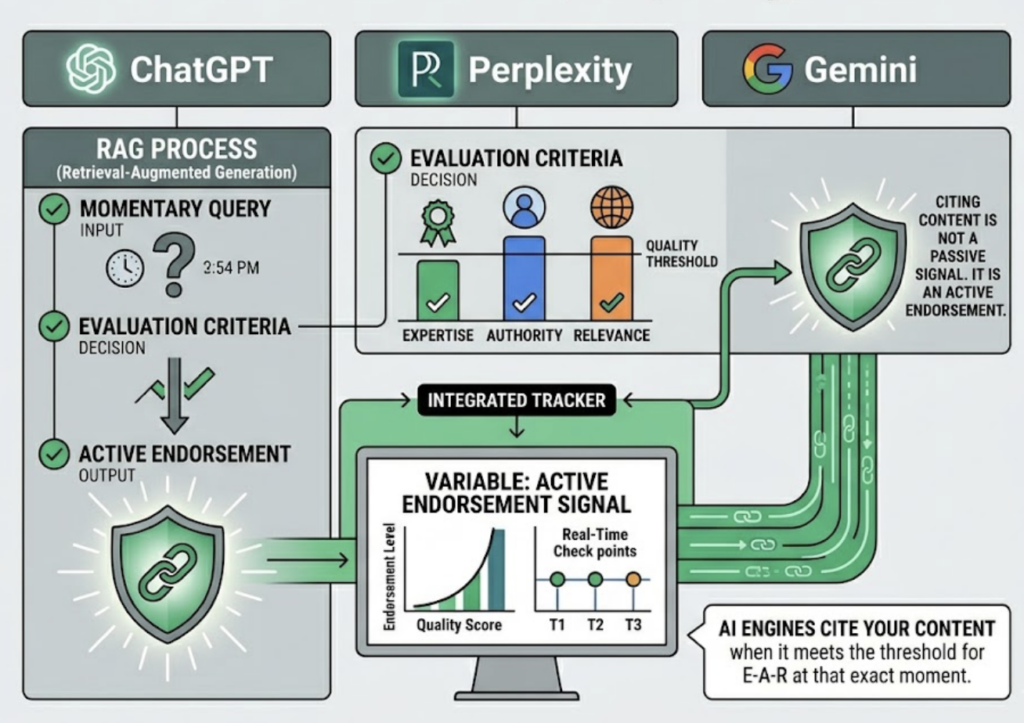
    Here’s why that distinction matters. AI platforms like ChatGPT, Perplexity, and Gemini use retrieval-augmented generation (RAG) to pull real-time information into their responses. When an AI engine cites your content, it means your page met the model’s quality threshold for expertise, authority, and relevance at that exact moment. That’s not a passive signal. It’s an active endorsement.

    MetricBrand MentionsLLM Citations
    NaturePassive, historicalActive, real-time
    Trust SignalWeak, contextualStrong, verifiable
    Conversion ImpactIndirect awarenessHigh-intent, measurable traffic
    Optimization LeverContent breadthStructured data, deep expertise

    The bottom line: if you’re only counting how many times AI says your brand name, you’re measuring the wrong thing. Citation tracking tells you which specific pages are earning trust, and which ones aren’t.

    Why Most Teams Track Mentions but Miss Citations

    The most common mistake in LLM citation tracking monitoring is stopping at the mention layer.

    It makes sense why teams do this. Mention tracking is simpler. You search your brand name across AI platforms, see if it pops up, and report a number. But that number doesn’t explain why a competitor keeps showing up in “best X for Y” queries while your brand doesn’t. The answer almost always lives in the citation layer: the competitor’s content is being cited as a source, and yours isn’t.

    This creates what researchers call the “citation gap.” Your competitor’s technical whitepaper, comparison page, or product documentation gets referenced by the AI, which gives them both the trust signal and the referral traffic. Your brand might get a passing mention in the same answer, but without a citation, there’s no click, no verification, and no conversion path.

    There’s another problem most teams underestimate: volatility. Unlike traditional SERP rankings that can hold steady for months, AI citation sets fluctuate significantly week over week. A page that gets cited on Monday might not appear on Friday. Teams that run a single check and assume they’ve got a clear picture end up with what one analyst called “false confidence.” Tracking citation stability and recurrence over time is the only way to get an accurate read.

    How to Measure LLM Citation Tracking Monitoring

    Measuring LLM citation tracking monitoring requires a structured framework, not a one-off audit. Here are the four KPIs that matter most:

    Citation Share measures your brand’s presence in AI-generated answers relative to key competitors. If ChatGPT cites three brands in a “best project management tool” answer and yours isn’t one of them, your citation share for that prompt is zero.

    Citation Stability tracks how consistently your domain appears across a recurring set of high-intent prompts over time. A single citation in one session is noise. A citation that recurs across 70% of weekly checks is a signal.

    Source Domain Coverage measures the breadth of your content that AI considers authoritative. Are only your homepage and one blog post getting cited, or are your landing pages, documentation, and comparison pages also in the mix? Narrow coverage means narrow authority.

    Query Intent Alignment checks whether your brand is being cited in the right context. Getting cited in informational queries (“what is X”) is fine, but if you’re missing from transactional queries (“best X for Y”), you’re losing the high-intent traffic that actually converts.

    The Operational Workflow

    The practical process looks like this. First, define your baseline by selecting a cluster of 20 to 50 high-intent prompts in your category. Next, run those prompts across major AI platforms: ChatGPT, Perplexity, Gemini, and Google AI Overviews. Then, perform a gap analysis to identify where competitors are winning citations and examine what content type the AI is prioritizing for each prompt.

    Topify streamlines this entire workflow through its Source Analysis feature, which reverse-engineers the exact domains and URLs that AI platforms cite. Instead of manually querying each platform and logging results in a spreadsheet, you get a cross-platform citation map that shows which content is earning trust and where gaps exist. Combined with Topify’s Position Tracking and Sentiment Analysis, you can see not just if you’re cited but how you rank relative to competitors and how the AI frames your brand.

    A Checklist for LLM Citation Tracking Monitoring That Works

    Getting from scattered data to a repeatable LLM citation tracking monitoring strategy comes down to three layers: baseline, ongoing monitoring, and optimization action.

    Layer 1: The Baseline Audit

    Start by mapping where you stand right now. Run your prompt cluster across all major AI platforms and record every citation: yours, your competitors’, and third-party sources. The goal is to answer one question: for the prompts that matter most to your revenue, whose content is the AI trusting?

    Layer 2: Ongoing Monitoring

    Citation patterns shift fast. Set up weekly or biweekly monitoring cycles to track changes. Watch for three things: new competitors entering your citation space, your own pages dropping out of citation sets, and shifts in which content types the AI prioritizes (blog posts vs. product pages vs. third-party reviews).

    Topify’s dashboard automates this layer. Its High-Value Prompt Discovery feature continuously surfaces new prompts where your brand should be appearing, and its Dynamic Competitor Benchmarking flags when a new rival enters your citation space before you’d catch it manually.

    Layer 3: Optimization Action

    Every citation gap should trigger a specific content response. If a competitor’s product page is cited but yours isn’t, it’s often a positioning issue: your page may lack the structured data, clear headings, or direct-answer formatting that LLMs prefer. If a third-party review site is getting cited instead of your own content, you likely need more off-site validation through PR, partnerships, or guest content on high-authority domains.

    A few tactical moves that tend to improve citation rates:

    • Use question-based H2/H3 headings that match how users prompt AI engines.
    • Add Schema markup to explicitly define product features, pricing, and entity relationships.
    • Include updated timestamps and author bios. AI engines trust content that demonstrates E-E-A-T signals.
    • Cite authoritative external sources within your own content. LLMs tend to trust pages that themselves reference high-quality sources.

    Brandlight, Profound, and Topify for LLM Citation Tracking

    If you’ve searched for tools in this space, you’ve likely come across Brandlight, Profound, and Topify. Here’s how they compare for LLM citation tracking monitoring.

    DimensionBrandlightProfoundTopify
    AI Platform CoverageLimited (primarily ChatGPT)ChatGPT, PerplexityChatGPT, Gemini, Perplexity, DeepSeek, Doubao, Qwen, AI Overviews + more
    Citation-Level DepthBasic mention trackingMention + some citation dataFull citation reverse-engineering (Source Analysis)
    Competitor MonitoringManual setupSemi-automatedAuto-detection + real-time benchmarking
    Execution CapabilityReporting onlyReporting onlyOne-click AI agent execution
    PricingVariesVariesFrom $99/mo (Basic), $199/mo (Pro), $499/mo (Enterprise)

    Brandlight offers foundational AI visibility tracking but tends to focus on the mention layer rather than deep citation analysis. For teams just getting started with AI monitoring, it provides a basic view, though the platform coverage is narrower than what most multi-platform strategies require.

    Profound goes a step further with citation-level data on ChatGPT and Perplexity. It’s a reasonable option for teams focused on those two platforms specifically, but it lacks the execution layer that turns insights into action.

    Topify covers the widest range of AI platforms and goes deeper on the citation layer through its Source Analysis feature, which maps the exact domains and URLs each AI engine references. What separates it from Brandlight and Profound is the execution side: Topify’s AI agent lets you define optimization goals in plain English and deploy strategies with one click, closing the gap between “seeing the data” and “acting on it.” For teams that need a full cycle from monitoring to optimization, the pricing starts at $99/month with a 30-day trial.

    Real Examples of LLM Citation Tracking in Action

    SaaS Brand: The “Asset Mismatch” Fix. A mid-market SaaS company tracked its AI visibility for months and saw decent mention rates. When they dug into the citation layer, they discovered that ChatGPT was citing a competitor’s comparison page for “best [category] tools” prompts, while their own product page wasn’t cited at all. The issue wasn’t brand awareness. It was that the competitor had a structured comparison page with clear headings, pricing tables, and Schema markup. The SaaS team built a matching asset, optimized it for direct-answer formatting, and within four weeks saw their citation share jump from 0% to appearing in 3 of 5 monitored prompts.

    Agency: Multi-Client Citation Reporting. A digital marketing agency managing 12 clients had no way to report on AI search performance during quarterly reviews. They implemented LLM citation tracking monitoring across all client accounts and discovered that 8 of 12 clients had zero citations in high-intent prompts, despite having strong traditional SEO profiles. The citation data gave the agency a concrete upsell path: “Here’s where your competitors are being cited. Here’s the content gap. Here’s the fix.”

    Ecommerce Brand: The Third-Party Problem. An ecommerce brand found that Perplexity consistently cited a review site rather than the brand’s own product pages for purchase-intent queries. The fix wasn’t more on-site content. It was improving their presence on the review sites that AI engines already trusted, through updated product listings, responding to reviews, and earning editorial mentions. Citation tracking identified the problem. The solution was off-site, not on-site.

    Conclusion

    LLM citation tracking monitoring is the difference between knowing your brand exists in AI answers and understanding why it’s there, or why it isn’t. Mentions give you awareness. Citations give you the mechanism: which content is earning trust, which platforms are citing it, and where the gaps are.

    Start with a focused set of 20 to 30 high-intent prompts. Run them across the AI platforms your audience actually uses. Map the citations. Then close the gaps, one content asset at a time. If you want to skip the manual spreadsheet phase, Topify’s Source Analysis can run that audit across every major AI engine in a single dashboard.

    FAQ

    Q: What is LLM citation tracking monitoring?

    A: It’s the process of tracking which specific content URLs and domains AI platforms (like ChatGPT, Perplexity, Gemini) cite as sources when generating answers. Unlike mention tracking, which only checks if your brand name appears, citation tracking reveals which content the AI trusted enough to reference and link to.

    Q: How does LLM citation tracking monitoring work?

    A: Tools run a set of high-intent prompts across multiple AI platforms, then analyze the responses to identify which domains and URLs are cited as sources. This data is tracked over time to measure citation share, stability, and coverage relative to competitors.

    Q: What’s the difference between citation tracking and mention tracking?

    A: Mentions are passive, unattributed references to your brand. Citations are active, verifiable source links that the AI attaches to its answer. Citations carry a stronger trust signal, drive measurable referral traffic, and are directly optimizable through content and structured data improvements.

    Q: How much does LLM citation tracking monitoring cost?

    A: Pricing varies by platform and scope. Topify’s plans start at $99/month for 100 prompts across ChatGPT, Perplexity, and AI Overviews, with Pro at $199/month for 250 prompts and Enterprise from $499/month for custom configurations. Most competitors offer comparable entry tiers, though platform coverage and citation depth vary significantly.

    Read More

  • AI Citation Tracking: Find the Gaps in Your Visibility

    AI Citation Tracking: Find the Gaps in Your Visibility

    Your domain authority is 75. Your blog ranks on page one for a dozen high-intent keywords. Your content team ships two articles a week. Then a prospect asks ChatGPT, “What’s the best platform for [your category]?” and the model cites three competitors, a Reddit thread, and a niche blog you’ve never heard of. Your brand doesn’t appear once.

    The uncomfortable part isn’t that the AI got it wrong. It’s that you had no way of knowing it happened. Traditional SEO dashboards don’t track what large language models choose to cite, and that blind spot is costing pipeline every single day.

    Your Brand Has Content Everywhere, but AI Might Not Be Citing Any of It

    For two decades, digital visibility meant accumulating backlinks and climbing index-based rankings. That model assumed a static list of blue links. It doesn’t describe how AI search works.

    Generative engines use retrieval-augmented generation (RAG) to pull specific sources into a synthesized answer. AI citation tracking is the discipline of monitoring exactly which domains and URLs an LLM retrieves when it constructs those answers. It’s the difference between knowing your page exists and knowing whether AI actually uses it.

    Here’s why traditional metrics fail as a proxy. A Princeton University study examining 10,000 complex queries across multiple generative engines found that keyword stuffing, a core legacy SEO tactic, caused a 20% relative decline in AI visibility. Separate case studies tracking thousands of B2B queries found that brands ranking on Google’s first page appeared in only 8% of AI-generated answers. Their lower-ranked competitors, the ones with structurally optimized content, secured 65% of citations.

    High domain authority doesn’t translate to high AI citation rates.

    The AI search ecosystem itself is diversifying fast. ChatGPT still leads with over 800 million weekly active users, but its overall referral share contracted from 89.2% to 81.4% in Q1 2026. Google’s Gemini nearly tripled its share from 4.3% to 11.6%, making it the second-largest consumer AI referral source. Anthropic’s Claude more than doubled to 3.6%, and Perplexity holds between 4.2% and 6.5%. Any ai search visibility analysis tool that only covers one engine is showing you a fraction of the picture.

    What AI Citation Tracking Actually Measures

    Many teams confuse brand mentions with citations. They’re not the same thing. A mention means the AI said your name. A citation means the AI retrieved your URL and linked to it as a source. If ChatGPT mentions your product but cites a competitor’s comparison page to back the claim, the competitor captures the authority signal and the referral click.

    True AI citation tracking breaks down into three core metrics. Citation Source identifies the exact URL or domain the model retrieved. Citation Frequency measures how often a domain gets referenced across a broad set of prompts. Citation Share, sometimes called Share of Model, benchmarks your citation rate against competitors within the same prompt categories.

    These metrics form the data layer beneath any ai brand visibility analysis tool. You can’t manage visibility without first understanding who the AI is actually citing at the URL level.

    The challenge is that each platform cites differently. ChatGPT typically provides 3 to 5 footnote-style citations per answer, with a commercial brand citation rate of 50% to 60%. It leans toward long-form authority pieces between 1,500 and 3,000 words. Perplexity, built around verification, cites sources in 95% of responses and hits a brand citation rate of 75% to 85% for commercial queries. Gemini operates at 55% to 65%, rewarding E-E-A-T signals and schema markup. Claude mirrors academic research patterns, favoring content that itself contains rigorous internal citations and outbound reference links.

    A single content format optimized for ChatGPT will likely underperform on Perplexity or Claude. That’s why 47% of AI search users now engage with two or more generative platforms, and why cross-platform tracking isn’t optional.

    The Visibility Gap Most Brands Don’t Know They Have

    The visibility gap is the measurable disparity between a brand’s presence in traditional search results and its presence in AI-generated answers. It shows up in three common ways.

    The first is competitor substitution. A buyer prompts an LLM with a commercial-intent query in your category. You rank first on Google, but the AI cites three competitors because their documentation was better structured for RAG extraction. You don’t even know it happened.

    The second is hallucinated obsolescence. The AI mentions your brand but pulls outdated information from its training data instead of performing a live retrieval. It might cite deprecated pricing, discontinued features, or resolved controversies as though they’re current.

    The third is third-party dependency. The model recommends your product, but every citation points to G2, Capterra, or Reddit instead of your official site. You get the mention; a review aggregator gets the traffic and the algorithmic authority.

    Most brands can’t detect any of these scenarios without specialized ai search visibility gap analysis tools that run programmatic prompt variations across multiple LLMs and map the exact URLs cited against your domain.

    The commercial stakes are severe. AI-referred traffic converts at rates that dwarf traditional organic. ChatGPT referral traffic converts at 15.9%, Perplexity at 10.5%, Claude at 5%, and Gemini at 3%. Compare that to the 1.76% average for traditional organic search. Visitors from ChatGPT view an average of 2.3 pages per session with a 62% engagement rate. By general industry estimates, an AI-referred visitor is between 4.4 and 9 times as commercially valuable as a standard organic visitor.

    A visibility gap isn’t a theoretical problem. It’s a direct leak of high-intent pipeline revenue.

    How to Choose an AI Search Visibility Analysis Tool

    The market is saturated with legacy SEO platforms bolting on “AI” features. To separate genuine capability from rebranding, evaluate any search visibility analysis tool or llm visibility analysis tool across five dimensions.

    Platform coverage comes first. Generative search is fractured, and a tool limited to one or two engines leaves you exposed. Look for simultaneous tracking across ChatGPT, Perplexity, Gemini, Claude, AI Overviews, and emerging models like DeepSeek and Qwen.

    Citation source depth matters more than mention volume. The tool must parse footnotes, reference cards, and superscript links to identify exact URL-level provenance. Mention counts without source attribution are actively misleading.

    Competitor benchmarking should be native, not bolted on. You need Share of Model tracking that benchmarks your citation frequency and sentiment against designated rivals within the same prompt environments.

    Data update frequency is non-negotiable. LLM outputs are non-deterministic, shifting by 40% to 60% across different sessions. Manual spot-checks are statistically unreliable. The tool must run automated, high-frequency prompt tracking to establish smoothed trend lines.

    Actionability separates monitoring from optimization. The platform should identify specific content gaps, missing structured data, and entity deficiencies that require intervention, not just display dashboards.

    The most common mistake teams make is investing in a tool that tracks mentions while ignoring citation sources entirely. The second most common mistake is monitoring only ChatGPT and missing the verification-heavy traffic flowing through Perplexity and the growing Gemini ecosystem.

    Here’s how the leading platforms compare on these dimensions:

    PlatformCross-Platform LLM CoverageURL-Level Citation DepthSentiment AnalysisStarting PricePrimary Audience
    TopifyChatGPT, Perplexity, Gemini, Claude, DeepSeek, Qwen, AI OverviewsYes (Core Feature)Enhanced (0-100 Scale)$99/moMarketing Teams, SEO Agencies
    Profound10+ engines including Grok and Meta AIPartial (Domain focused)Deep$499/moFortune 500, Enterprise Risk
    Semrush AI ToolkitPerplexity + 5 others, Google AI OverviewsBasic (Mention focused)Standard$99/mo (Add-on)Existing Semrush Users
    Peec AICore B2B generative enginesYesStandard€89/moGlobal Multilingual Brands
    OmniaChatGPT, Perplexity, Google AI ModeYesSupported€79/moE-commerce, Startups
    Keyword.com10+ models including MistralYes (Timestamped)Advanced over time$24.50/moTechnical SEO Specialists
    Otterly.AIChatGPT, Perplexity, AI OverviewsBasicBasic$29/moSolo SEOs, Small Teams

    Where Topify Fits: AI Citation Tracking at the Source Level

    For marketing teams trying to understand why high-ranking content gets ignored by LLMs, Topify operates as a diagnostic system at the source level, not just the mention level.

    The core differentiator is Source Analysis. Where most tracking platforms stop at detecting whether a brand name appeared in an AI response, Topify isolates the exact domains and URLs that generative models retrieved to construct their answers. It parses footnote mechanics and embedded reference links to map the competitive citation picture based on actual data reliance.

    Topify covers ChatGPT, Perplexity, Google Gemini, Claude, DeepSeek, Qwen, and Doubao simultaneously. In a market where 47% of users engage with multiple AI platforms, single-engine monitoring creates dangerous blind spots.

    The platform frames this intelligence through a combination-metric system. Visibility Score quantifies total brand presence across commercial prompts as a Share of Model benchmark. (For context, the average B2B software brand maintains a visibility score of just 2.1%, while top-tier performers reach 11.8%.) Sentiment Analysis evaluates whether the AI frames the brand positively, neutrally, or negatively on a 0-to-100 scale. Position Tracking monitors ordinal placement within the generated response, because the first citation slot captures over 60% of resultant clicks.

    Here’s what this looks like in practice. A mid-market SaaS team notices pipeline velocity dropping to a smaller competitor. They run 100 high-intent comparison prompts across ChatGPT and Perplexity through Topify. The dashboard reveals the gap: their product pages get mentioned, but the AI is linking to the competitor’s documentation because it features structured comparison tables. Topify’s gap prioritization surfaces the highest-value missing queries. The team restructures their pages with block-formatting and explicit statistics targeting the extraction preferences. They set automated alerts to track the uplift in citation share over the following weeks.

    Pricing starts at $99 per month, covering 100 prompts and 9,000 AI answer analyses across multiple platforms. Teams can get started directly to run their first citation audit.

    From Citation Data to Action: A 3-Step Workflow

    Knowing your citation data is step zero. The real value comes from a systematic workflow that turns gaps into pipeline.

    Step 1: Audit. Input your brand domain and a list of 50 to 100 high-intent commercial prompts into your AI citation tracking platform. Run them programmatically across ChatGPT, Perplexity, Gemini, and AI Overviews. Capture which specific URLs the models cite for each query. This produces an unvarnished baseline Visibility Score, stripped of legacy SEO vanity metrics.

    Step 2: Identify gaps. Cross-reference the audit results to isolate queries where competitor domains hold the primary citation slots and your brand is absent. Examine the cited competitor URLs to identify their structural advantage. Did the AI prefer them because they used a dense HTML table? A specific statistical data point? A concise upfront definition? Rank the missing citations by commercial impact to focus resources on the highest-value pages first.

    Step 3: Optimize with structured content. The Princeton GEO-bench study showed that adding precise, verifiable statistics to content increases AI citation probability by 37%. Integrating expert quotations improves visibility metrics by 22%. Listicle and table formats achieve a 25% citation rate compared to just 11% for standard narrative content.

    In practice, this means restructuring pages around a “Bottom Line Up Front” architecture: lead with a 2-to-3 sentence definitive answer, break long articles into 200-to-400 word blocks with explicit H3 headings, and embed comparative tables and concrete numbers that serve as extraction anchor points for LLMs.

    The results compound. One B2B SaaS company implemented this exact framework over 90 days. They started with an 8% AI visibility baseline. After shifting from standard content marketing to structured knowledge engineering, their citation rate tripled to 24% across platforms. That optimized visibility generated 47 qualified leads from AI referral traffic, converting at 18.7%, which was 2.8x higher than their standard traffic. The campaign produced €64,000 in closed revenue and a 288% return on investment.

    Conclusion

    The blind spot most marketing teams operate with today isn’t a lack of content or domain authority. It’s the inability to see whether AI is actually citing that content when buyers ask questions. And in an environment where AI-referred visitors convert at 4.4 to 9 times the rate of traditional organic traffic, that blind spot has a direct revenue cost.

    Closing the gap starts with measurement: auditing your citation baseline across multiple AI platforms, diagnosing where competitors hold citation slots you don’t, and re-architecting content for RAG extraction. The brands that treat AI citation tracking as a recurring operational discipline, not a one-time curiosity, are the ones securing the first-citation positions that capture the majority of downstream clicks. Start your audit today and turn the invisible into the measurable.

    FAQ

    Q: What is AI citation tracking and why does it matter?

    A: AI citation tracking monitors how generative platforms like ChatGPT, Perplexity, and Gemini reference specific domains and URLs when constructing their responses. It matters because LLMs are replacing traditional search as the primary research channel for high-intent buyers. If an AI answers a prompt by citing a competitor’s page instead of yours, your brand is functionally invisible in the fastest-growing consideration channel, losing referral traffic that converts at rates far above traditional search.

    Q: What’s the best AI search visibility analysis tool for small teams?

    A: For small teams, Topify offers the strongest balance of depth and accessibility. Starting at $99 per month, it provides URL-level Source Analysis across all major models (ChatGPT, Perplexity, Gemini, Claude, and more), plus Visibility, Sentiment, and Position tracking. This gives smaller teams enterprise-grade citation intelligence without the $500+ monthly costs of Fortune 500-oriented platforms.

    Q: How is AI citation tracking different from traditional backlink monitoring?

    A: Traditional backlink monitoring uses web crawlers to map static hyperlinks between domains, determining Domain Authority based on historical index data. AI citation tracking measures dynamic, probabilistic retrieval events: what an active LLM chooses to reference in real-time when answering a conversational prompt. A page can have thousands of backlinks and receive zero AI citations if its content isn’t structured for RAG extraction.

    Q: Can AI brand visibility analysis tools track multiple AI platforms at once?

    A: Yes. Leading AI brand visibility analysis tools like Topify are built specifically for cross-platform tracking. Because different models (ChatGPT, Perplexity, Gemini, Claude) use distinct retrieval algorithms and formatting preferences, single-engine monitoring creates blind spots. Simultaneous cross-platform tracking is the only way to get an accurate picture of your brand’s true AI footprint.

    Read More

  • AI Search Presence: What It Means and How to Build It

    AI Search Presence: What It Means and How to Build It

    Your domain authority is solid. Your keywords rank on page one. Your marketing team is confident the top-of-funnel is covered.

    Then a prospect opens ChatGPT, asks for the best solution in your category, and the model generates a detailed, multi-paragraph recommendation. Five brands get named. Yours isn’t one of them.

    That’s the gap most teams don’t see until it’s already costing them pipeline. Google rankings measure how well a crawler indexes your pages. They say nothing about whether a Large Language Model chooses to mention your brand when a buyer asks a direct question. And with Gartner projecting a 25% decline in traditional search engine volume by the end of 2026, the audience that used to find you through blue links is migrating fast.

    Why Google Rankings Don’t Tell You If AI Knows Your Brand

    Traditional SEO metrics, like Domain Authority, backlink profiles, and keyword rankings, were built to measure crawler behavior. A search engine retrieves a ranked list of documents matching keyword strings and uses external signals like domain age and inbound links to determine placement. Success means earning a click-through to your website.

    AI search works on a completely different architecture. When a user queries ChatGPT or Perplexity, the model doesn’t retrieve a list of links. It accesses foundational training data, queries vector databases for semantic relevance, fetches multiple sources, evaluates them for factual density, and synthesizes a new conversational response. Your brand either gets selected into that response, or it doesn’t. Keyword density alone won’t get you there. The model needs semantic richness, factual grounding, and third-party validation.

    The migration numbers make this urgent. By February 2026, ChatGPT reported 900 million weekly active users, up from 300 million in December 2024. Monthly visits stabilized above 5.35 billion, and 92% of Fortune 500 companies actively use the platform. Perplexity AI reached roughly 45 million monthly active users by early 2026, processing about 780 million queries per month.

    Here’s what that means in practice: when a buyer gets a full, synthesized answer inside the AI interface, they don’t click through to a traditional search result. If your brand isn’t part of that answer, you’ve effectively disappeared for that segment of the market.

    What AI Search Presence Actually Measures

    AI search presence is the degree to which a brand gets mentioned, cited, accurately positioned, and recommended within AI-generated answers to relevant queries. It’s a shift from measuring clicks to measuring conversational influence. The discipline built around this measurement is called Generative Engine Optimization (GEO), and the analytical layer supporting it is AI search analytics.

    Topify has formalized this into a seven-metric framework that captures the full picture of generative visibility:

    Visibility measures the cross-platform mention rate: what percentage of category-level queries include your brand in the output. Sentiment evaluates how the AI frames you, scored on a scale where 50 is neutral. Being mentioned negatively is worse than not being mentioned at all.

    Position tracks where your brand lands in comparative lists. Because of the serial position effect in human cognition, appearing as the first recommendation in the opening paragraph carries exponentially more commercial weight than being buried in a list of alternatives. AI Volume measures how many users are actually asking AI platforms about topics relevant to your brand, distinct from traditional search volume.

    The deeper differentiators are Source Coverage (which domains the AI cites when discussing your brand), Intent Alignment (whether the AI matches your brand to the correct buyer persona), and Conversion Visibility Rate (CVR), which estimates downstream commercial impact. AI-referred visitors convert at 14.2%, compared to 2.8% from traditional organic search. That’s a 5x difference that most marketing teams aren’t tracking yet.

    DimensionTraditional SEOAI Search Presence (GEO)
    Primary ObjectiveSecure top SERP rankings, drive clicksEarn mentions, recommendations, and citations inside AI answers
    Core MeasurementKeyword Rank, DA, CTRVisibility Rate, Position Index, Sentiment Score, Intent Alignment
    Algorithmic FocusKeyword density, crawlability, backlinksSemantic entity coverage, fact density, RAG authority
    Content StrategyTargeting isolated keyword volumesSemantic mapping for conversational prompts
    Authority SignalsInbound links from other websitesFact-density, structured schema, multi-source consensus
    Success OutputUser clicks through to your websiteUser receives a trusted recommendation directly from the AI

    5 Signals That Your AI Search Presence Is Weak

    Most marketing teams assume their SEO dominance carries over to AI search. It doesn’t. These five signals indicate a systemic gap in your AI visibility strategy.

    Signal 1: You’re Missing from Category Recommendations

    Open ChatGPT, Gemini, and Claude. Type a broad, early-stage buyer question for your category. If your brand doesn’t appear in the primary recommendation list across multiple generations, the model lacks the semantic associations to connect your brand entity to the category entity. Build a matrix of 10-15 buyer questions and test systematically.

    Signal 2: AI Describes Your Brand Wrong

    Your brand gets mentioned, but the AI hallucinates your value proposition. A premium enterprise platform gets described as a “budget tool for freelancers.” This means your owned content lacks the structural clarity required for accurate extraction, or outdated external chatter is overpowering your current messaging. Prompt the AI with specific questions about your features and target audience, then compare the output against your positioning documents.

    Signal 3: Competitors Dominate the Conversation

    AI visibility is functionally zero-sum for Share of Voice. If comparative queries produce multi-paragraph analyses of a competitor’s features while your brand gets a single vague sentence, they’ve built superior AI authority. This typically happens when competitors have denser integrations on review platforms or higher engagement on consensus nodes like Reddit.

    Signal 4: AI Never Cites Your Actual Website

    The AI recommends your brand but exclusively cites Reddit threads, Wikipedia articles, or review aggregators, never your actual domain. This means your website lacks the answer-first formatting, FAQ structures, or structured data markup needed for RAG ingestion. Test this on Perplexity (which shows sources) with specific factual prompts about your product.

    Signal 5: Zero AI Volume on Topics You Own

    You launch a major feature. AI analytics register zero related queries. The digital ecosystem doesn’t have enough conversational triggers to prompt user inquiries about it. Cross-reference your product launches against AI prompt volume data. Silence in the AI ecosystem means your top-of-funnel seeding strategy needs immediate recalibration.

    How to Build AI Search Presence from Scratch

    Fixing these gaps requires a four-step methodology: Audit, Monitor, Optimize, Scale. No shortcuts, no singular patches.

    Step 1: Run a Baseline Audit

    Before changing anything, establish your current Share of Model. Query your category, brand name, and primary competitors across ChatGPT, Perplexity, Gemini, and Claude using a matrix of early-buyer intent questions. Document where you appear, the sentiment of each appearance, and which third-party URLs the AI cites. If ChatGPT consistently relies on a specific set of Reddit threads to answer category queries, those domains become immediate targets for your digital PR team.

    Step 2: Set Up Continuous AI Search Monitoring

    Manual audits are static. AI search results are not. A brand’s citation share can sit at 60% one week and collapse to 10% the next if a platform changes its data sourcing, a phenomenon observed when Reddit’s citation share on ChatGPT dropped sharply in late 2025.

    This is where AI search intelligence platforms become non-negotiable. Topify automates continuous tracking across the full seven-metric framework, across multiple engines, geographies, and languages. Sudden algorithmic shifts or competitor moves get flagged instantly, not weeks after the damage. Checking these metrics less than bi-weekly leaves your team strategically blind.

    Step 3: Optimize Content for AI Extraction

    Earning AI citations requires content re-engineered for machine scannability. The foundational GEO study from Princeton University evaluated 10,000 queries and proved that traditional keyword stuffing actively harmed AI visibility, causing a 10% degradation. LLMs prioritize dense, logically structured, well-cited content.

    The tactics that actually work:

    Authoritative citations are the single most powerful lever. Princeton’s data showed a 115.1% visibility lift for lower-ranked pages that added inline references to third-party sources. Statistics addition, meaning specific, attributed numerical data injected into the text, dramatically improves performance in factual categories. Answer-first formattingmatters because AI synthesis models prioritize the top of a document: provide direct, factual answers within the first 40 to 60 words, backed by FAQ schema markup.

    Step 4: Scale Beyond Your Own Domain

    Optimizing owned content is necessary but not enough. A 2025 University of Toronto study found that AI search engines returned 81.9% earned media compared to just 18.1% brand-owned content. AI engines are trust proxies. They’re inherently skeptical of self-published marketing claims.

    The 5W Citation Source Audit of Q1 2026 quantified this further: Wikipedia and Reddit together account for over 25% of all ChatGPT citations in the US, outperforming traditional media outlets. YouTube visibility correlates at 0.737 with overall AI visibility. Scaling means establishing active presences on Reddit, review platforms like G2 and Capterra (which provide a 3x multiplier to citation rates), and YouTube, then extending that optimized presence across multiple AI platforms simultaneously.

    What an AI Visibility Platform Should Track for You

    The complexity of multi-engine tracking, regional variation, and real-time RAG volatility makes manual GEO execution unsustainable at scale. Traditional SEO tools weren’t built for this. You need a purpose-built AI visibility platform.

    The difference between basic tools and full-stack platforms:

    CapabilityBasic AI Visibility ToolsFull-Stack Platforms like Topify
    Tracking ScopeManual spot-checks, single engineAutomated tracking across 5+ engines
    Metric DepthBinary appearance (Yes/No)7-metric framework (Visibility, Sentiment, Position, Volume, Mentions, Intent, CVR)
    Citation IntelligenceNot includedSource Analysis: reverse-engineers exact URLs driving AI citations
    Competitive BenchmarkingStatic, single brandDynamic competitor tracking with real-time Share of Voice
    ActionabilityManual interpretationOne-Click Execution: generates schema-rich content blocks from identified gaps

    Topify’s Source Analysis is the feature that separates tracking from intelligence. Knowing you were mentioned isn’t enough. Topify maps exactly which third-party domains the AI relied on for that mention: a specific Reddit thread, a G2 review, an industry journal. Combined with Competitor Monitoring, if a rival is dominating Share of Voice, you can see exactly which external sources are driving their success and mount a targeted response.

    The platform also bridges analytics and execution. When a visibility gap surfaces, Topify’s One-Click Execution generates optimized, schema-rich content blocks (answer-first FAQs, statistics-dense proof points tailored for RAG systems) and pushes them toward your CMS or content pipelines.

    On pricing, Topify’s structure reflects how teams actually scale AI search optimization. The Basic plan starts at $99/month, covering ChatGPT, Perplexity, and AI Overviews tracking with 100 prompts and 9,000 AI answer analyses. The Pro plan at $199/month expands to 250 prompts and 22,500 analyses. Enterprise pricing starts at $499/month with custom configuration. This makes continuous daily monitoring, the only real defense against generative engine volatility, financially viable for teams at every stage.

    Ready to see where your brand stands? Get started with Topify and run your first AI visibility audit today.

    Conclusion

    The shift from indexing to conversational synthesis isn’t a future trend. It’s the current state. With ChatGPT at 900 million weekly users and traditional search volume in structural decline, relying on Domain Authority and keyword rankings alone is a direct path to invisibility.

    AI search presence is the core of modern top-of-funnel discovery. LLMs favor dense, statistically grounded, structured content. They heavily weight earned media over brand-owned claims. Building presence means auditing your current AI visibility, deploying continuous monitoring across the seven core metrics, re-engineering content for machine extraction, and scaling your footprint on the platforms AI actually trusts. Start the audit. Shift from clicks to citations. The brands that move now will be the ones AI recommends tomorrow.

    FAQ

    Q: What’s the difference between AI search presence and traditional SEO rankings?

    A: Traditional SEO rankings measure how well a web crawler indexes a page and places it within a list of blue links, using keyword matching and backlink profiles. AI search presence measures whether a generative model retrieves your brand’s data, understands its semantic relevance, and actively synthesizes it into a conversational answer. SEO optimizes for human clicks. GEO optimizes for machine extraction and AI citations.

    Q: How often should I monitor my brand’s AI search presence?

    A: AI models fetch information in real-time through RAG architecture and continuously update their weights, making citation patterns inherently volatile. For priority commercial topics, tracking should happen daily or at minimum bi-weekly. Monthly or quarterly spot-checks leave teams blind to rapid algorithmic shifts. AI visibility platforms like Topify automate this continuous monitoring across multiple engines.

    Q: How much does AI search optimization cost?

    A: GEO costs split between software tracking and execution. Entry-level AI visibility tools start around $99/month (Topify’s Basic tier covers 100 prompts with content generation credits). Mid-tier plans run $199/month for expanded prompt tracking and analysis capacity. Enterprise solutions with custom LLM tracking operate on custom pricing from $499/month. Execution costs depend on internal resources needed to restructure content and the PR investment required to earn third-party citations on trusted platforms like Reddit, G2, and industry publications.

    Q: Which AI platforms should I track for AI search presence?

    A: At minimum, monitor ChatGPT (the volume leader at 900M weekly active users), Perplexity (the leading dedicated AI search engine at 45M MAU), Google’s Gemini and AI Overviews, and Anthropic’s Claude. If your brand operates globally or targets Asian markets, track regional LLMs like DeepSeek, Doubao, and Qwen. Topify covers all major platforms in a single dashboard.

    Read More

  • Build an AEO Agent Stack That Actually Works

    Build an AEO Agent Stack That Actually Works

    Your team has an AI visibility tracker, an AI writing tool, and a CMS. Three tabs open, three logins saved. On paper, you’re running an agentic AEO workflow. In practice, you’re copying a visibility score from one dashboard, pasting it into a strategy doc, then manually briefing a content tool that has zero context on why that score dropped in the first place.

    That gap between “we have AEO tools” and “we have an AEO agent” is where most marketing teams lose weeks of execution time every quarter. The fix isn’t another tool. It’s architecture: a three-layer stack where tracking, reasoning, and execution actually talk to each other.

    Most AEO “Agents” Are Just Disconnected Dashboards

    The pattern is predictable. A team buys a visibility tracker, subscribes to a content generation platform, and publishes through a CMS. Each product works fine in isolation. But the data flow between them? That’s a human analyst copying numbers between browser tabs.

    Here’s where it breaks. Your tracker flags that Share of Model dropped from 12% to 4% on a specific prompt cluster. The tracker did its job. But it can’t tell you why it dropped, which competitor moved, or what content action would recover that position. A human has to figure all of that out, manually, before anything happens.

    The cost of that manual connective tissue is steeper than most teams realize. Marketing professionals lose roughly 60 hours of productivity per year strictly from switching between disconnected tools. In environments without native integration, staff can waste over 125 hours annually on redundant data entry alone.

    That’s not an AEO agent. That’s a swivel chair.

    The industry is starting to acknowledge this structural failure. Conductor’s AgentStack launch in April 2026 signals a macro shift: as AI platforms consolidate the buyer’s discovery journey into single interactions, the underlying marketing infrastructure has to consolidate too. The solution isn’t more tools. It’s fewer seams.

    What a Functioning AEO Agent Stack Looks Like

    The cleanest way to think about an AEO agent is borrowed from autonomous systems theory: the Sense-Reason-Act-Learn loop. Translated into marketing operations, that becomes three layers with strict boundaries:

    Tracking Layer answers one question: What’s happening right now? It monitors AI visibility, captures citation sources, records competitor movements, and measures brand sentiment. It doesn’t interpret. It doesn’t strategize. It observes.

    Reasoning Layer answers a different question: What does this mean, and what should we do? It ingests tracking data, identifies causal relationships, and outputs a specific execution plan.

    Execution Layer answers the final question: Is it done? It takes the reasoning layer’s blueprint and turns it into published content, schema updates, or distribution actions.

    The fundamental error most teams make is automating the first and third layers while leaving the second one entirely to the human brain. Tracking is automated. Content generation is automated. But the complex, resource-intensive process of analyzing multi-dimensional data and engineering the right response? That’s still a person staring at a dashboard and scheduling a meeting.

    That missing middle is the bottleneck.

    Tracking Layer: Where the AEO Agent Gets Its Eyes

    Without accurate, multi-platform sensory input, the reasoning and execution layers are useless. Feed an agent incomplete visibility data, and it’ll execute a flawed strategy faster. Classic garbage in, garbage out.

    The first thing to internalize: traditional SEO metrics can’t power this layer. Domain authority, keyword rank, and organic CTR don’t measure whether ChatGPT is recommending your competitor instead of you. AEO tracking requires a different taxonomy: brand mentions, citation frequency, sentiment polarity, position within AI-generated lists, and conversion probability from AI referrals.

    The second thing: a single-platform tracking strategy will fail. Research across 680 million AI citations found that only 11% of domains cited by ChatGPT are also cited by Perplexity. That means a brand can dominate one AI engine while being completely invisible on another.

    Platform-specific behaviors make this worse. Perplexity averages roughly 21 citations per response and leans heavily on Reddit threads and niche forums. ChatGPT averages around 8 citations and prefers authoritative, encyclopedic sources. The tracking layer has to capture these differences or the reasoning layer makes decisions based on a distorted picture.

    Topify addresses this by providing native tracking across ChatGPT, Gemini, Perplexity, Google AI Overviews, DeepSeek, Doubao, and Qwen. Its 7-metric framework captures Visibility (Share of Model), Position, Sentiment, Mentions, Intent, Volume, and Conversion Visibility Rate (CVR) simultaneously. That last metric, CVR, matters more than most teams think: AI-referred visitors convert at 4.4x to 23x the rate of organic search traffic, depending on the vertical. If your tracking layer can’t connect visibility to conversion probability, your CFO will never fund the program.

    A fully integrated tracking layer continuously aggregates these data points across all relevant platforms. Only with that high-resolution input can the stack move to the hard part: automated reasoning.

    Reasoning Layer: Where Data Becomes a Decision

    This is the layer that separates a tool from an agent. Its job is to ingest tracking data and output a specific, actionable execution plan, without waiting for a human to schedule a meeting about it.

    In most teams today, this layer is entirely manual. An analyst logs into the dashboard, exports data to a spreadsheet, cross-references it with competitor activity, and eventually convenes a strategy discussion. The research phase alone, identifying semantic angles, discovering citation gaps, mapping the competitive field, typically consumes about 70% of a content creator’s total workflow time. The actual writing takes a fraction of that.

    By the time the team has reasoned through the data and drafted a content brief, the generative engine’s citation preferences may have already shifted.

    Here’s what automated reasoning looks like in practice. The tracking layer flags an anomaly: Brand X’s position on Perplexity for “enterprise cybersecurity solutions” dropped from #2 to #5. A human analyst could spend days querying Perplexity, testing hypotheses, and verifying sources. An automated reasoning layer parses the variables instantly.

    Using source analysis and competitor monitoring, the agent reverse-engineers Perplexity’s citation graph for that prompt cluster. It discovers that a competitor earned a mention in a new technical discussion on a niche subreddit, and Perplexity indexed it. This aligns with a broader pattern: 85% of brand mentions in AI search come from third-party pages, not the brand’s own domain. The reasoning layer identifies the causal link, then outputs a specific directive: produce a structured content asset targeting that third-party gap, formatted with FAQ schema to maximize algorithmic ingestion.

    Topify’s Source Analysis feature powers this type of reasoning by identifying exactly which domains and URLs AI platforms are citing instead of your brand. Its Competitor Monitoring surfaces which rivals are gaining share and on which specific prompt clusters. Together, these features give the reasoning layer the context it needs to move from “something changed” to “here’s exactly what to do about it.”

    That’s the difference between a dashboard and a brain.

    Execution Layer: Where Strategy Becomes Content

    The execution layer takes the reasoning layer’s blueprint and turns it into a published asset. In a traditional workflow, this means converting a strategy into a brief, routing it to a writer, passing it through editorial review, then handing it to a CMS admin for formatting and deployment. A standard blog post requires roughly 10 hours of labor per month to maintain through that process.

    An integrated AEO agent stack collapses this into what the industry calls “one-click execution.” The reasoning layer has already identified the gap, defined the semantic targets, and specified the structural requirements. The execution layer generates content that’s natively engineered for LLM recommendation algorithms, not just human readers, because it has the full context from both upstream layers.

    Topify’s One-Click Agent Execution works this way. You state a goal in plain English. The system, informed by the tracking and reasoning layers, proposes a strategy. You review it and deploy with a single click. The human role shifts from laborer to overseer.

    But here’s the warning that matters most: execution without reasoning is a liability.

    If you connect a generic AI content generator directly to your CMS without the guidance of a dedicated reasoning layer, you’re not building an agent. You’re building a machine that publishes the wrong content faster. Generic AI content is increasingly penalized by search and answer engines. What earns citations in AEO is “information gain,” original data, unique perspectives, and novel factual associations that don’t exist in the LLM’s training data. If your execution layer just rewrites what’s already on the internet, it’s mathematically impossible for it to capture a new citation.

    Automation without reasoning accelerates failure. Automation governed by real-time data and causal logic is a competitive edge.

    The Closed Loop: Why It All Falls Apart Without Feedback

    The three layers only work as an agent if the output of execution flows back into tracking. Without that feedback loop, you’re guessing whether your actions worked.

    In an open-loop system, a team publishes content and checks results three months later using disjointed metrics. There’s no automated connection between the action and the outcome. In a closed-loop AEO agent, the cycle is continuous:

    1. Execution Layer deploys a structured content asset targeting a specific citation gap on Gemini.
    2. Tracking Layer monitors Gemini’s output to verify whether the new asset was crawled, indexed, and cited.
    3. Tracking to Reasoning: the tracking layer quantifies the impact. Share of Model moved from 4% to 9%. CVR increased.
    4. Reasoning Layer registers the success, updates its heuristics about what works on Gemini, and refines the parameters for the next execution cycle.

    That’s what makes it an agent: it learns from its own actions. A toolset waits for a human to connect the dots. An agent closes the loop automatically.

    SystemFeedback MechanismStrategic Outcome
    Open-loop (tool-based)Manual data synthesis across platformsHigh latency, wasted resources, guesswork
    Closed-loop (agentic)Automated execution-to-tracking feedbackAutonomous adaptation, measurable ROI

    Companies that implement closed-loop marketing architectures consistently report improved ROI predictability and sharper resource allocation. In AEO, where LLMs continuously update their citation preferences, a system that can’t learn from its own output is functionally obsolete.

    Where to Start If Your Stack Is Still Duct-Taped Together

    Don’t try to automate all three layers at once. That’s how you get architectural collapse. Build progressively.

    Phase 1: Fortify the Tracking Layer. Start by defining 30 to 50 high-intent prompts relevant to your category. Map your performance across all key metrics and platforms simultaneously. Topify’s Basic tier covers 100 tracked prompts across multiple AI engines for $99/month, which is enough to establish a baseline without enterprise-level spend.

    Phase 2: Formalize the Reasoning Logic. Once tracking data is flowing, manually simulate the reasoning process. When the tracker flags a visibility drop, use source analysis and competitor monitoring to reverse-engineer the cause. Document the decision rules: “If Perplexity position drops, check for new third-party citations the competitor earned.” These heuristics become the parameters that govern automation later.

    Phase 3: Connect Execution and Close the Loop. Only when tracking is reliable and reasoning rules are proven should you enable automated execution. Run two full cycles under human supervision: define a target, let the reasoning engine propose a strategy, execute via one-click, then watch the tracking layer for measurable impact over 2 to 4 weeks. Once the data flows from tracking to reasoning to execution and back to tracking without manual intervention, you’ve built an AEO agent.

    Conclusion

    An AEO agent isn’t a product you buy. It’s an architecture you build. Three layers, each with a strict job: tracking senses the environment, reasoning turns data into decisions, execution deploys the fix. And the closed loop feeds results back into the cycle so the system gets smarter with every iteration.

    Most teams today have the first and third layers covered. The reasoning layer, the one that actually determines what to do, is still a human bottleneck. Formalizing that layer, whether through manual heuristics or automated reasoning engines, is the single highest-leverage move a marketing team can make in 2026. Start with the tracking layer. Get the data right. The rest follows.

    FAQ

    Q: What is an AEO agent stack?

    A: It’s a three-layer architecture designed to maximize brand visibility in AI search platforms like ChatGPT, Perplexity, and Gemini. The Tracking Layer monitors AI outputs and citations. The Reasoning Layer analyzes data and formulates strategy. The Execution Layer generates and deploys optimized content. These layers operate in a closed loop, so the system adapts to algorithmic changes without manual data transfers.

    Q: How is an AEO agent different from AEO tools?

    A: An AEO tool performs a single function, like tracking mentions or generating content. An AEO agent links those functions together through automated reasoning. With tools, a human bridges every gap. With an agent, data flows from observation to strategy to action to measurement in a continuous cycle.

    Q: What does the tracking layer need to measure?

    A: At minimum: Visibility Rate (how often your brand appears), Position (where you rank in the AI’s list), Sentiment (how the AI frames your brand), Citation Sources (which third-party domains the AI references), and CVR (the probability an AI mention drives a conversion). Coverage has to span multiple platforms, since only 11% of cited domains overlap between ChatGPT and Perplexity.

    Q: Can I build an AEO agent stack without coding?

    A: Yes. Platforms like Topify and Conductor’s AgentStack provide pre-built architectures that integrate tracking, reasoning, and execution into a unified interface. One-click execution lets you translate tracking data into deployed content using plain-English commands, no API work or prompt engineering required.

    Read More

  • Manual AEO Doesn’t Scale. An AEO Agent Does.

    Manual AEO Doesn’t Scale. An AEO Agent Does.

    Your marketing team spends Monday morning the same way every week: opening ChatGPT, typing in 50 brand-relevant prompts, copying the results into a spreadsheet, then repeating the whole process on Perplexity, Gemini, and DeepSeek. By Wednesday, somebody’s still logging citation URLs. By Friday, the data’s already stale.

    That’s not Answer Engine Optimization. That’s data entry with a strategy label on it. And the gap between what teams think they’re doing and what the workflow actually demands is growing faster than anyone’s headcount.

    Your AEO Workflow Looks Like a Second Full-Time Job

    Here’s what a “standard” manual AEO cycle actually costs. A mid-market brand tracking 50 high-intent prompts across four AI platforms generates 200 distinct manual queries every single week. Each query needs to be typed, results captured, citations logged, and changes compared to the previous week’s baseline.

    The time adds up fast. Prompt execution alone takes roughly 5 hours. Data logging eats another 6.6 hours. Comparative analysis against last week’s results runs about 3 hours. And content remediation, the part where you actually fix what’s broken, takes 10 to 15 hours of drafting, schema updates, and CMS uploads.

    That’s 24 to 30 hours per week. For one brand. On one set of prompts.

    This isn’t a setup cost that shrinks over time. It’s a recurring operational tax that compounds every time your team adds a new platform, a new product line, or a new geographic market to the tracking index.

    AI Answers Change Weekly. Your Spreadsheet Can’t Keep Up.

    The deeper problem isn’t just volume. It’s volatility.

    Unlike traditional search engines that return stable ranked pages, generative answer engines synthesize responses at runtime using Retrieval-Augmented Generation. The retrieval indexes, vector databases, and model weights behind those answers shift continuously. Your brand can go from “top recommendation” to “not mentioned” in a matter of days, with zero changes on your end.

    The numbers confirm this. ChatGPT rotates 74% of its cited domains on a weekly basis. Google AI Mode churns 56% weekly. Google AI Overviews hit roughly 46% weekly churn on volatile queries. Across the generative ecosystem as a whole, citation drift runs 40% to 60% per month and can reach 70% over a 90-day window.

    What does that mean in practice? The spreadsheet your analyst finishes on Friday reflects a reality that’s already shifted by Monday. The content fix you publish next week targets a visibility gap that may have already mutated into something else entirely.

    That’s the core tension of AEO. It’s not a one-time optimization project. It’s a continuous monitoring and response system. And spreadsheets weren’t built for continuous anything.

    Three Forces Making Manual AEO Mathematically Impossible

    Manual tracking doesn’t just fall behind. It hits a wall. Three compounding pressures make the math unworkable.

    Platform Proliferation

    Comprehensive AI visibility requires monitoring ChatGPT, Gemini, Perplexity, Claude, and Google AI Overviews at a minimum. For global brands, add DeepSeek, Qwen, and Doubao. Each platform runs a distinct retrieval architecture with different data sources. Only 11% of domains are cited consistently across both ChatGPT and Perplexity. Adding one more platform to your tracking index doesn’t add a task. It multiplies the analytical permutations.

    The Prompt Space Is Effectively Infinite

    Traditional SEO queries average 3 to 4 words. Conversational AI prompts average 23 words. That difference isn’t just linguistic. It’s mathematical. The permutation space for a 23-word prompt drawn from a working vocabulary of 10,000 terms is 10^92. The traditional keyword space is 10^16. The gap between them is a factor of 10^76.

    In practical terms: almost every AI prompt is structurally unique. There’s no “head” query to anchor your tracking. The entire space is long-tail. A regional enterprise with 5 products, 10 target regions, and 4 core intent types faces 2,000 unique prompt permutations from just 10 base queries. Tracking 2,000 prompts across 5+ engines weekly is operationally impossible for human teams.

    Compressed Content Velocity

    Real-time retrieval crawlers like OAI-SearchBot and PerplexityBot continuously ingest forum discussions, reviews, and news articles. If a competitor acquires high-authority mentions on platforms like Reddit, which accounts for 1.8% of ChatGPT’s citation share, or G2 at 1.1%, they can displace your brand’s citation within hours. Manual content workflows, which typically take weeks from data logging to draft publication, can’t match that tempo.

    These three forces don’t add up. They multiply. Platform count times prompt volume times content velocity equals an operational load that scales exponentially while your team scales linearly.

    What an AEO Agent Actually Replaces in Your Workflow

    The question isn’t “what is an AEO agent.” It’s “which parts of my team’s weekly grind does it eliminate.”

    An autonomous AEO agent maps directly onto the manual workflow and replaces it step by step. Topify‘s AI Agent, for example, operates as an end-to-end execution system rather than a passive analytics dashboard. Here’s what that looks like in practice.

    Automated prompt auditing replaces manual query execution. The agent runs real-time checks across ChatGPT, Gemini, Perplexity, and Google AI Overviews 24/7, mapping crawl gaps and competitor positions without human inputs.

    Programmatic data harvesting replaces the master spreadsheet. Performance data flows into a unified dashboard tracking seven core metrics: Visibility Score, Sentiment Score, Position Rank, Search Volume, Mention Rate, Intent Analysis, and Conversion Visibility Rate.

    Causal source analysis replaces manual backlink checking. The agent reverse-engineers each AI response, identifies the exact third-party domains driving a competitor’s recommendation, and flags precisely where your citation chain broke.

    Automated content execution replaces manual copywriting and CMS uploads. The agent drafts structured, citation-ready content optimized for machine extraction, including answer-first FAQs, schema markup, and simplified sentence structures. Approved content publishes directly to WordPress, Shopify, or Framer via API in under one minute.

    The speed difference is stark. Research takes 2 to 5 minutes instead of hours. Drafting takes 3 to 8 minutes instead of days. Publishing happens in under a minute instead of weeks. Overall, manual research time drops by 80% to 90%.

    That’s not incremental improvement. It’s a different operational model.

    From “Doing AEO” to Running It as a System

    The shift from manual to agentic AEO isn’t about speed alone. It’s about changing what your team actually spends time on.

    Think of it like the transition from manual email lists to marketing automation platforms like HubSpot or Marketo. Before automation, someone hand-built every send list, formatted every email, and tracked every open rate in a spreadsheet. Automation didn’t just make those tasks faster. It made them disappear from the team’s daily workflow entirely, freeing up capacity for strategy.

    AEO is at the same inflection point.

    When an agent handles data gathering, logging, content drafting, and CMS publishing, the marketing team shifts from execution to three strategic levers. First, prompt prioritization: directing the agent toward high-value prompt clusters that map to your ideal customer profile. Second, knowledge asset curation: structuring internal brand guidelines and product case studies so the agent can draw on them accurately. Third, conversion visibility analysis: evaluating which AI platforms yield the highest downstream revenue impact.

    This isn’t guesswork. Topify’s High-Value Prompt Discovery surfaces new prompt opportunities as AI recommendations evolve, and prioritizes them using a weighted scoring formula: 30% query volume, 25% visibility gap, 25% commercial intent, and 20% content readiness. The agent systematically matches your content footprint with the questions users are asking across ChatGPT, Gemini, Perplexity, and DeepSeek.

    The competitive question in AEO has already shifted. It’s no longer about who starts optimizing first. It’s about who can maintain a continuous, automated tracking and response loop. With traditional search volume projected to decline 25% by 2026, the brands that build this infrastructure now will own the AI consensus layer that replaces it.

    Conclusion

    Your team isn’t failing at AEO because they lack skill or effort. They’re failing because the manual approach was never designed to handle a retrieval ecosystem where citations rotate 74% weekly, prompt spaces are effectively infinite, and every new AI platform multiplies the workload.

    The fix isn’t hiring more analysts. It’s shifting from episodic manual execution to a continuous, agent-driven system. Start by auditing your current AEO workflow: count the hours, measure the lag between data collection and content deployment, and ask whether your spreadsheet can keep up with a landscape that changes faster than you can update it. If the answer is no, that’s exactly what an AEO agent is built to solve.

    FAQ

    Q: What is an AEO agent?

    A: An AEO agent is an autonomous system that handles the full lifecycle of AI answer optimization: monitoring brand visibility across generative platforms, identifying prompt-level trends, drafting structured content optimized for machine extraction, and publishing directly to your CMS. Unlike passive tracking dashboards, it executes the entire optimization loop without manual intervention.

    Q: How is AEO different from traditional SEO?

    A: Traditional SEO optimizes pages to rank in search engine results and drive click-through traffic. AEO focuses on structuring content so conversational AI engines like ChatGPT and Perplexity can parse, trust, and synthesize it into direct answers. AEO prioritizes passage-level semantic density, structured schema like FAQPage and HowTo, and placing the answer in the first 40 to 60 words of a section.

    Q: How often do AI search answers change?

    A: Frequently. ChatGPT rotates 74% of cited domains weekly. Google AI Mode rotates 56%. Across the full generative ecosystem, citation drift averages 40% to 60% per month and can hit 70% over 90 days. This volatility is a structural feature of dynamic RAG systems, not a temporary anomaly.

    Q: Can small teams automate AEO without hiring more people?

    A: Yes. An autonomous AEO agent reduces manual research time by 80% to 90%, enabling small teams to scale optimization across hundreds of prompts without adding headcount. The automation covers site auditing, data logging, content generation, and CMS publishing, so the team can focus on strategy rather than execution.

    Read More