Category: Article

  • How to Boost AI Search Visibility in 2026

    How to Boost AI Search Visibility in 2026

    A 5-step optimization playbook to get your brand recommended by ChatGPT, Gemini, and Perplexity.

    Your domain authority is solid. Your keyword rankings haven’t moved in months. But when a potential buyer asks ChatGPT for a recommendation in your category, your brand doesn’t show up. That’s not a ranking problem. It’s an AI search visibility problem, and traditional SEO metrics weren’t built to detect it.

    Roughly 73% of brands that rank on page one of Google receive zero mentions in the corresponding AI-generated responses. The gap between being indexed and being recommended is widening every quarter, and most marketing teams don’t have a system to close it.

    Here’s how to build one, step by step.

    Most Brands Are Still Optimizing for the Wrong Search Engine

    The disconnect isn’t subtle. When an AI Overview appears on a search results page, traditional organic links see their click-through rate drop by roughly 34.5%. For high-traffic informational keywords, some sites have lost up to 64% of their traffic as AI-generated answers satisfy user intent directly on the page.

    Why? Because generative engines like ChatGPT, Perplexity, and Gemini don’t rank pages. They synthesize answers. They pull “chunks” of information from across the web using Retrieval-Augmented Generation (RAG), cross-reference claims against what researchers call a “Consensus of Truth,” and assemble a single response. If your content isn’t structured to be extracted and cited by that process, your page-one ranking is irrelevant.

    That means the playbook has to change. Here’s what replaces it.

    Step 1: Audit Your Current AI Search Visibility

    Before optimizing anything, you need a baseline. And in 2026, that baseline can’t come from Google Search Console alone.

    AI responses are non-deterministic. A single prompt can return different results depending on the model’s temperature setting and recent data refreshes. Leading frameworks recommend running each priority query at least 10 to 20 times to establish a statistical baseline for visibility. Manually testing five prompts takes about 20 minutes. Tracking a thousand prompts across multiple AI platforms? That’s not a manual job.

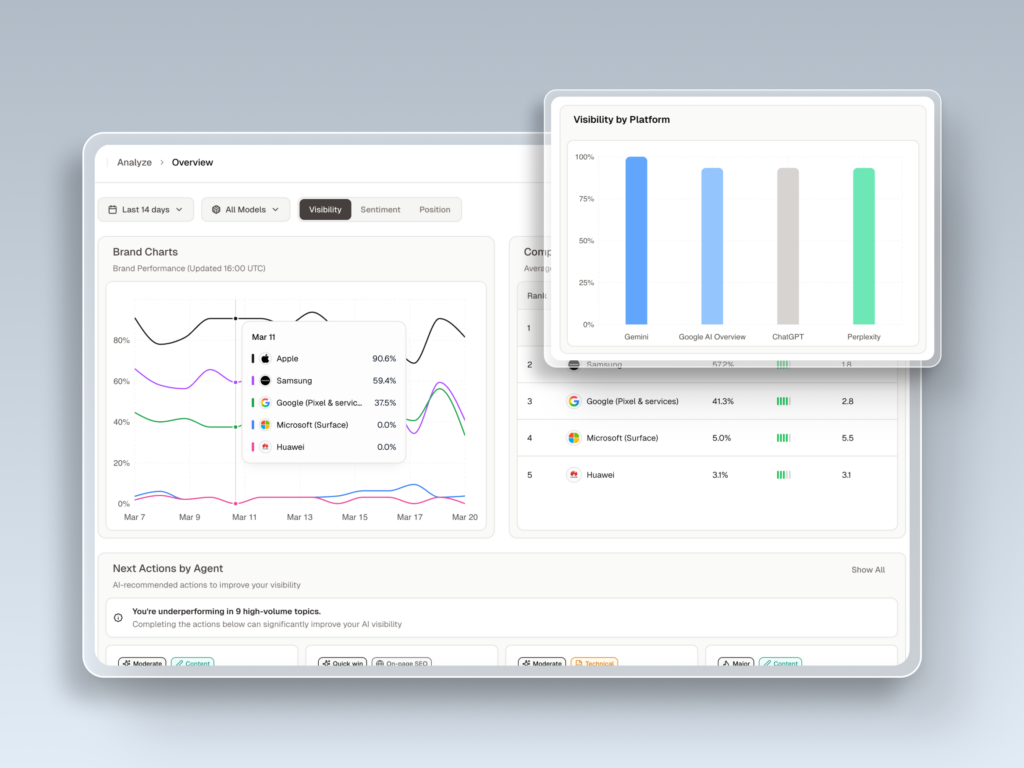
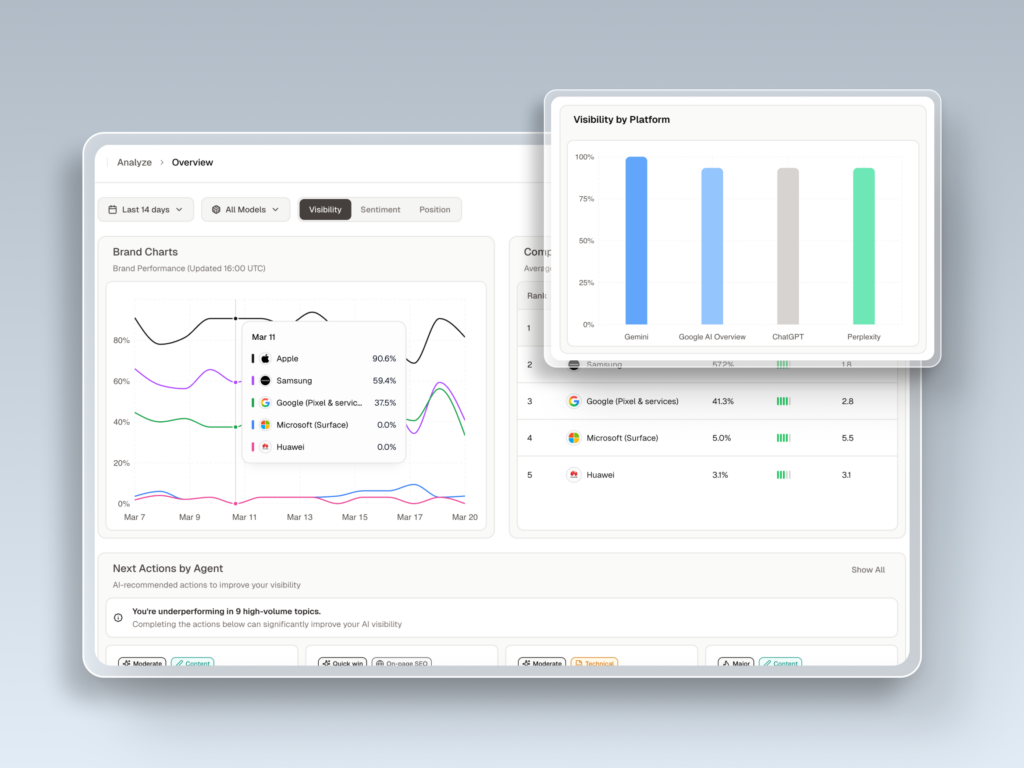
    This is where automated tracking changes the equation. Topify runs real-time monitoring across 1,000+ prompts simultaneously on ChatGPT, Gemini, and Perplexity. Instead of guessing whether your brand showed up in a single test, you get a Visibility Score: mention frequency weighted by recommendation position and sentiment, tracked over time.

    The audit should cover four dimensions:

    DimensionWhat to Look For
    Mention PresenceDoes your brand appear at all in AI answers for category prompts?
    PositionAre you the first recommendation, or buried at the end of a list?
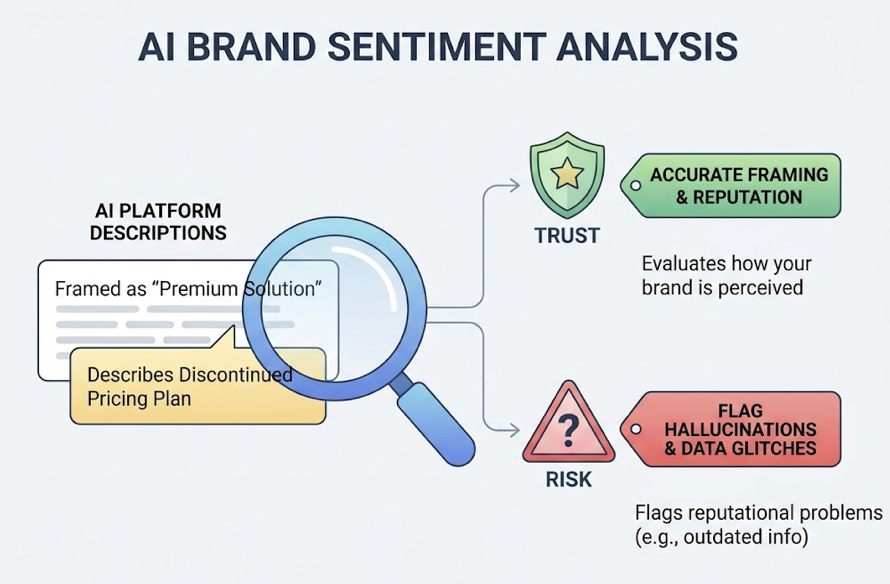
    SentimentDoes the AI describe your brand accurately, or frame it incorrectly?
    Source AttributionWhich URLs is the AI citing to justify mentioning (or ignoring) you?

    If your Visibility Score is below 10, the issue is likely technical. Check whether your site uses server-side rendering. JavaScript-heavy sites see roughly 60% less visibility in AI citations because AI bots prioritize the initial HTML return.

    Step 2: Find the Prompts That Drive AI Recommendations

    In traditional SEO, you research keywords. In GEO, you research prompts.

    The difference matters. The average keyword is about four words long. The average AI query runs closer to 23 words, packed with specific qualifiers: budget constraints, industry verticals, company size, use-case scenarios. These qualifiers are what push an AI from “explanation mode” into “recommendation mode,” and that transition is where brands either get cited or get ignored.

    The methodology starts with what your audience is actually asking. Pull language from sales transcripts, support tickets, and community forums like Reddit and Quora. Map those prompts to the buyer’s awareness stage: problem-unaware users ask different questions than solution-aware users already evaluating vendors.

    Then validate which prompts actually have volume. Topify’s AI Volume Analytics shows which conversational clusters are active and provides a “Share of Model” indicator, revealing where competitors are currently capturing the narrative. Its High-Value Prompt Discovery feature continuously surfaces new opportunities as AI recommendations evolve, so you’re not optimizing for last month’s conversation.

    Step 3: Reverse-Engineer What AI Cites and Trusts

    Here’s the part most brands get wrong: AI systems don’t derive trust primarily from your own website.

    Empirical data suggests that approximately 85% to 91% of the citations used to ground an AI’s brand recommendation come from third-party platforms. Your product page matters for specific specs and pricing. But the recommendation itself is anchored by what Reddit threads say, what industry reports conclude, and whether vertical aggregators like G2 include you in their shortlists.

    The source hierarchy looks like this:

    Source TypeRole in AI Discovery
    Community platforms (Reddit, Quora)Provide authentic “experience” signals, especially high-weight for Perplexity
    Authority media (Forbes, WSJ)Establish broad legitimacy in training data, favored by Gemini and ChatGPT
    Vertical aggregators (G2, Capterra)Drive comparison and shortlist inclusion for transactional queries
    Official sources (.gov, .edu)Factual grounding for YMYL topics
    Your own websiteTechnical base for specific product data

    Topify’s Source Analysis function reverse-engineers this ecosystem, identifying exactly which URLs the AI is citing for your competitors. This often reveals a “Visibility Gap”: a competitor may have lower Google rankings but higher AI visibility because they’re mentioned in a specific Reddit thread or niche industry report that the AI model treats as high-confidence.

    Once you know what the AI trusts, you know where to invest your content and PR efforts.

    Step 4: Optimize Content for AI Recommendation Signals

    Now you’ve got the data: your visibility baseline, the prompts that matter, and the sources the AI trusts. Time to rebuild your content to match.

    The academic framework here comes from Princeton and Georgia Tech researchers who identified nine specific methods that statistically improve AI visibility. The gains aren’t marginal.

    GEO StrategyEstimated Visibility Lift
    Cite credible sources+115.1% for position-5 sites
    Add statistics+37% to +40%
    Include expert quotes+30%
    Use precise technical terms+28%

    The structural principle behind all of these: make your content easy to extract. AI systems prioritize content that can be “chunked” into a 50-word summary without complex logical leaps. That means leading every section with the answer (the BLUF format), then backing it with evidence.

    Two more signals that matter in 2026:

    Modular content architecture. Generative engines use “query fan-out,” decomposing a complex prompt into multiple sub-queries. A user asking for the “best limited-ingredient dog food for stomach issues under $60/month” triggers at least three sub-queries. Your page needs to answer each fragment independently, which means every section should function as a standalone response.

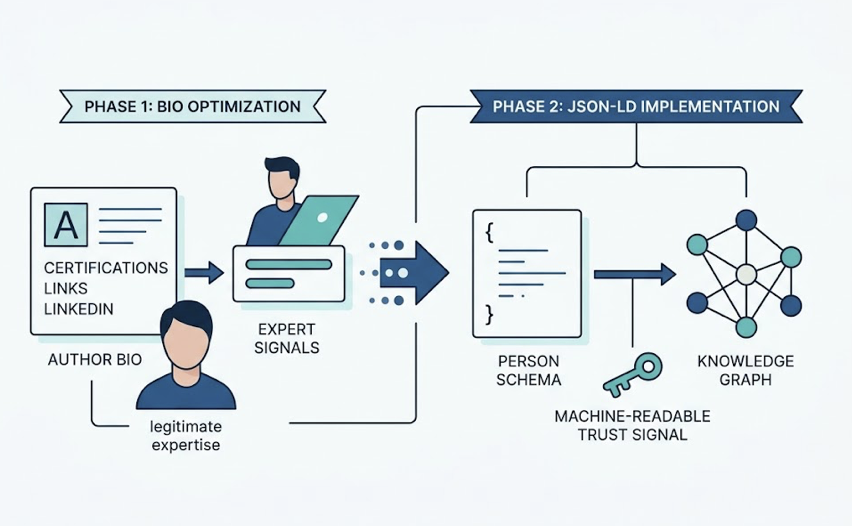
    Digital provenance. AI models favor “ownable authority.” Publish original research with year-specific titles. Share case studies with concrete metrics, not abstract success stories. Attribute every article to a verifiable human expert with external credentials. Anonymous bylines get de-prioritized.

    For teams that want to move fast, Topify’s One-Click Execution feature identifies the exact content change needed when it detects a visibility gap, like adding a comparison table or a specific definition, and deploys it directly to your CMS.

    Step 5: Track, Measure, and Iterate on AI Visibility

    AI search visibility isn’t a project. It’s a loop.

    Models get updated. Knowledge graphs refresh. Competitors optimize their own footprints. Content that’s more than three months old sees a sharp decline in citation frequency due to recency bias. A strategy that worked in Q1 may not hold in Q3.

    The monitoring system needs to track seven core metrics simultaneously:

    MetricWhat It Tells YouWhen to Act
    Visibility ScoreOverall brand presence in the categoryScore below 10: audit technical SSR
    Mention FrequencyBrand share within AI resultsDeclining: refresh statistics and data
    SentimentHow the AI “frames” your brandNegative: identify the source URLs driving it
    Recommendation PositionTrust ranking vs. competitorsPosition above 2: add expert quotations
    Prompt VolumeDemand for specific conversational topicsShift content focus to high-volume prompts
    Citation ShareYour sources vs. competitor sourcesLow: pitch to the third-party domains being cited
    CVRROI of the AI discovery journeyAdjust content to drive branded search

    Topify’s Comprehensive GEO Analytics dashboard monitors all seven across ChatGPT, Perplexity, and Gemini in a single view. When the system detects a competitor securing a new citation in a “best of” prompt, it flags the gap and identifies the content change needed to close it.

    That’s the difference between reacting to lost visibility and staying ahead of it.

    3 Mistakes That Tank Your AI Search Visibility

    Even well-resourced teams fail when they carry legacy thinking into GEO. Three errors show up repeatedly.

    Mistake 1: The “Google-Only” optimization trap. Traditional SEO ranking factors like backlinks and keyword density have a weak or neutral correlation with AI recommendations. Brands that focus solely on outranking competitors in the blue links often find themselves omitted from the AI Overview entirely. The fix: optimize for parseability and synthesis potential. Your goal isn’t to be found by a human. It’s to be extracted by an AI.

    Mistake 2: Ignoring how AI frames your brand. In traditional search, a ranking is a ranking. In generative search, the AI synthesizes an opinion. If training data includes outdated pricing, negative reviews, or competitor comparisons that position you as the “budget option,” the AI will present that framing as fact. The fix: monitor your Sentiment Score weekly and ensure your brand data is consistent across 50+ business directories.

    Mistake 3: Treating content as “evergreen.” AI models exhibit strong recency bias. Static pages that once drove reliable traffic are being replaced by newer content with 2026-specific data points. The fix: implement a quarterly freshness audit. Update statistics, refresh tool recommendations, and make sure “last updated” timestamps are schema-encoded.

    Conclusion

    AI search visibility in 2026 comes down to a five-step loop: audit your current state, discover the prompts that matter, reverse-engineer what the AI trusts, optimize your content for extraction, and monitor everything continuously.

    The brands winning this shift aren’t the ones with the highest domain authority. They’re the ones who’ve built their online presence as a modular knowledge graph designed for AI synthesis. The starting point is measurement. You can’t optimize what you can’t see. Tools like Topify give marketing teams the data layer to turn AI visibility from a guessing game into a structured growth channel. The earlier you start tracking, the harder it becomes for competitors to catch up.
    FAQ

    Q: What is AI search visibility? 

    A: AI search visibility measures how frequently and favorably your brand is mentioned, cited, or recommended within the synthesized responses of generative AI platforms like ChatGPT, Perplexity, Gemini, and Google AI Overviews. It’s distinct from traditional search rankings because it reflects whether AI systems choose to include your brand in their answers, not just whether your pages are indexed.

    Q: How is AI search visibility different from traditional SEO? 

    A: Traditional SEO focuses on ranking a specific URL on a results page to drive clicks. AI search visibility (often called GEO or AEO) focuses on being included in the AI’s final synthesized answer. The emphasis shifts from keyword volume and backlink profiles to “extractability,” factual density, and entity consensus across third-party sources.

    Q: How long does it take to improve AI search visibility? 

    A: Brands typically see measurable lift in AI citations and visibility within 4 to 12 weeks of implementing structured data, answer-first content formatting, and entity resolution tactics. The timeline depends on how much existing content needs restructuring and how active competitors are in the same category.

    Q: Which AI platforms should I optimize for first? 

    A: For general audience reach, ChatGPT is the priority due to its dominant market share. For niche, technical, or research-heavy categories, Perplexity tends to be the most accessible entry point because of its democratic citation behavior and high source-attribution rate. Gemini matters for audiences already embedded in Google’s ecosystem.
    Read More

  • Your Competitors Are Winning AI Search. Here’s How

    Your Competitors Are Winning AI Search. Here’s How

    You held the number one spot on Google for your most important keyword. Then a prospect typed that same query into ChatGPT and got five brand recommendations. Yours wasn’t one of them. The dashboard still shows stable rankings. Traffic still looks acceptable. But somewhere between a traditional SERP and an AI-generated answer, your brand disappeared from the conversation — and a competitor quietly took your place.

    The gap between what your SEO metrics report and what AI engines actually recommend is growing wider every quarter. The brands closing that gap aren’t guessing. They’re following a specific playbook.

    The AI Search Visibility Gap Most Brands Don’t See

    Traditional SEO and AI search visibility used to overlap. They no longer do. The correlation between top-ranking Google pages and sources cited in AI-generated answers has dropped from roughly 70% in early 2024 to under 20% by 2026. That means four out of five brands ranking on page one for a given query are completely absent from AI responses for the same topic.

    The root cause is structural. Google’s algorithm rewards link equity and keyword optimization. AI engines prioritize factual density, semantic clarity, and cross-platform corroboration. A page can rank first on Google and still be invisible to ChatGPT, Perplexity, or Gemini — because the criteria for selection are fundamentally different.

    This blind spot is costly. When a Google AI Overview appears, the organic click-through rate for traditional results drops by an average of 61%, falling from 1.76% to just 0.61%. In Google’s AI Mode, the zero-click rate reaches 93%. For most users, the AI’s synthesized answer is the final destination. If a brand isn’t part of that answer, it’s effectively excluded from the decision.

    Why AI Search Visibility Matters More Than Ever

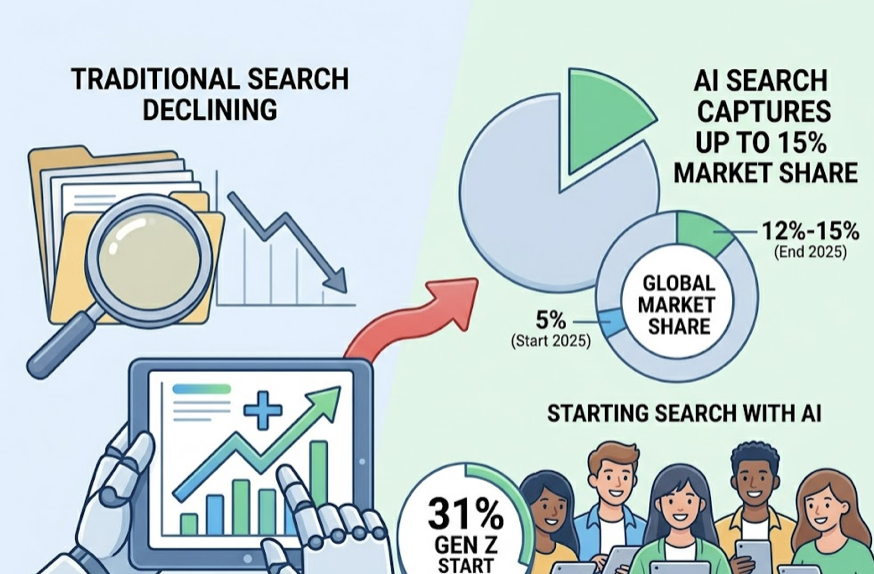
    The shift isn’t hypothetical. ChatGPT alone expanded from 400 million to 800 million weekly active users between early 2024 and late 2025, now processing over one billion queries daily. Collectively, AI-powered search tools captured between 12% and 15% of global search market share by the end of 2025, up from around 5% at the start of the year. Among Gen Z users, 31% now start their searches with AI platforms rather than traditional engines.

    These aren’t keyword searches. They’re conversational prompts — six or more words — that represent what analysts call “Dark Queries”: high-intent research prompts with near-zero traditional search volume but significant influence on purchasing decisions. Your analytics tools don’t track them. But AI models respond to them every day.

    The buyers who use AI for research arrive at your website “pre-decided.” They convert at rates 31% higher and spend 45% more time on-site. But if your brand is missing from the AI conversation, you’re excluded from the shortlist before your sales team even knows the buyer exists.

    What Winning Brands Do Differently for AI Search Visibility

    Competitors who consistently appear in AI recommendations aren’t just lucky. They’ve rebuilt their content strategy around three pillars that align with how retrieval-augmented generation actually works.

    They Build Content for Extraction, Not Just Reading

    AI engines don’t browse pages the way humans do. They retrieve specific passages — typically between 134 and 167 words — that provide self-contained, verifiable answers. Winning brands maintain their conversion-focused pages for traditional search but build a secondary layer of informational content designed specifically for AI extraction.

    The data confirms this split approach. Informational landing pages earn 37.86% of all AI citations, while conversion-focused pages account for just 7.63%. Content that scores highly on semantic completeness — the ability to provide a full, self-contained answer — is 4.2 times more likely to be cited by AI Overviews than standard SEO content.

    In practice, this means opening each section with a direct answer in the first two to three sentences, using dense H2/H3 structures with tables and lists, and replacing hedged language (“many find our solution potentially useful”) with declarative specifics (“Feature X reduces cost by 20%”).

    They Dominate Third-Party Sources

    AI systems verify brand claims through cross-platform corroboration. A brand that appears consistently across Reddit threads, review platforms, industry forums, and niche publications earns what researchers call “Entity Confidence.” The scale of this preference is striking: 95% of AI citations come from third-party sources rather than a brand’s own website.

    The five review platforms that account for 88% of all commercial citations in Google’s AI Overviews are Gartner Peer Insights at 26%, G2 at 23.1%, Capterra at 17.8%, Software Advice at 12.8%, and TrustRadius at 8.3%. Winning competitors don’t just have profiles on these platforms — they actively manage their presence, solicit reviews, and ensure their messaging is consistent across every listing.

    They Control Their Entity Narrative

    AI platforms recognize brands as entities, not URLs. When a brand uses identical “About” boilerplate text across LinkedIn, Crunchbase, G2, and its own website, it signals to the AI that these profiles refer to the same entity. That consistency strengthens the brand’s position within the AI’s internal knowledge graph.

    Leading competitors also use structured schema markup — specifically the sameAs property — to connect their website to authoritative entity sources like Wikipedia and Wikidata. This gives the AI a deterministic reference point for grounding its generative responses.

    5 Signals That a Competitor Has an AI Search Strategy

    You can determine whether a competitor is actively engineering AI search visibility by watching for five quantifiable signals.

    Cross-platform consistency. When a brand is recommended for the same query across ChatGPT, Gemini, and Perplexity — each of which uses a different retrieval layer — it suggests the brand has optimized its entity authority across the entire web ecosystem, not just one platform.

    Broad citation architecture. Active competitors don’t rely on their own blog alone. They appear in AI citation lists through Reddit threads, industry white papers, and second-tier news sites. A wide source footprint indicates a deliberate PR and content partnership strategy designed to feed AI retrieval models.

    Narrative alignment. When an AI engine’s description of a brand mirrors the brand’s own marketing language and value propositions, it’s a sign of successful entity seeding. If ChatGPT characterizes a competitor as “the leading provider of X for Y users” and that phrase matches their mission statement, the strategy is working.

    Rapid presence in new prompts. AI platforms have a strong recency bias. Content updated within the last 30 days receives 3.2 times more citations than older content. A competitor that surfaces for a new industry trend within days of its emergence is likely pushing content directly to AI knowledge graphs through automated indexing.

    Sustained positive sentiment. AI models don’t just cite brands — they characterize them through tone. Leaders receive confident phrasing (“the industry standard”), while laggards get cautious mentions (“growing alternative”). A competitor maintaining a consistently positive characterization is actively managing its digital reputation to influence the AI’s confidence score.

    How to Track and Close the AI Search Visibility Gap

    Identifying the gap is the first step. Closing it requires a systematic workflow — one that moves beyond manual ChatGPT spot-checks and into structured competitive intelligence.

    Step 1: Establish a baseline. Run your core commercial prompts through all major AI platforms simultaneously to establish a “Share of Model” metric — the percentage of responses where your brand is mentioned versus competitors. Topify‘s AI Visibility Checker automates this across ChatGPT, Perplexity, Gemini, and other platforms, showing exactly where your brand is “part of the answer” and where it’s absent.

    Step 2: Identify the citation gap. Once you know where you’re missing, the next question is why. Topify’s Competitor Monitoring and Source Analysis reveal which specific domains and URLs the AI engines cite instead of yours. This tells you whether the gap is a content structure problem (your pages aren’t extraction-friendly) or an authority problem (you lack third-party corroboration on platforms like Reddit or G2).

    Step 3: Engineer your content for AI retrieval. After identifying high-value prompts where visibility is missing, restructure your content to match what AI models prefer. This means adding direct-answer blocks, increasing factual density, and implementing schema markup. Topify’s One-Click Execution feature provides page-level recommendations and allows teams to deploy GEO improvements without manual workflows.

    Step 4: Monitor continuously. AI models are probabilistic. Visibility fluctuates daily. Topify’s Proprietary Sentiment Engine scores brand presence from -100 to +100, so you see not just whether you were mentioned, but how favorably. Weekly Share of Voice reports give stakeholders a quantified view of brand influence within the AI discovery layer.

    A B2B SaaS company that implemented this type of systematic approach achieved a 600% citation uplift across major AI platforms in four weeks — increasing AI-referred trials from 550 to 2,300 per month by restructuring 66 articles for machine readability.

    The Cost of Waiting While Competitors Build AI Search Visibility

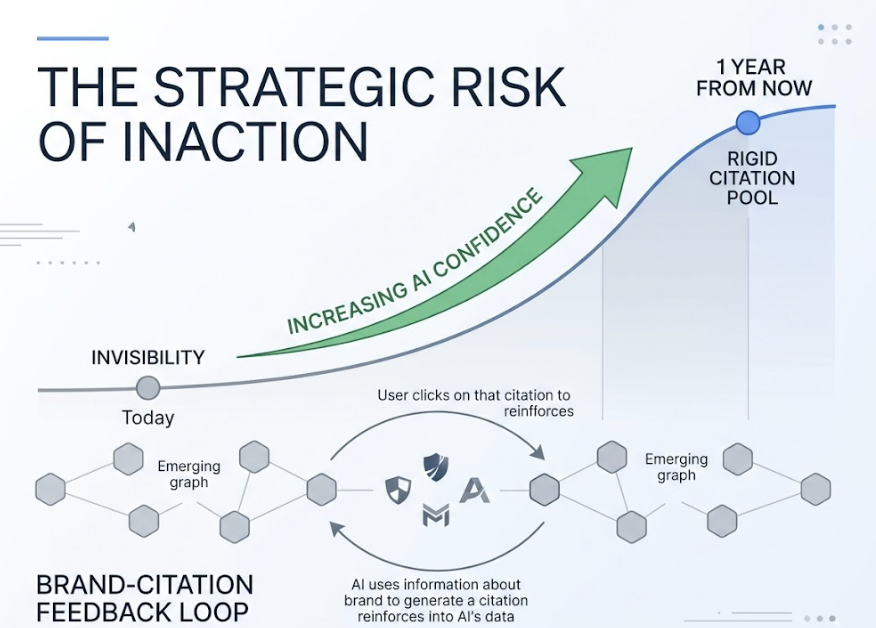
    The strategic risk of inaction compounds over time. AI platforms are recursive — each time they cite a brand and that citation is corroborated by a user’s subsequent action, the AI’s confidence score for that brand increases. A brand that remains invisible today will find it exponentially harder to break into the citation pool a year from now, as the AI’s knowledge graph becomes more rigid.

    The numbers are already stark. Approximately 73% of B2B websites experienced significant traffic losses between 2024 and 2025, with an average year-over-year decline of 34%. In local discovery, 98.8% of business locations are completely invisible in AI-generated recommendations.

    The competitive moat is real. Brands that earn early citations build “Citation Velocity” — a compounding advantage that makes reclaiming lost ground three to five times more expensive later. And because AI-influenced buyers arrive pre-decided, the cost isn’t just lost traffic. It’s lost deals your team never knew existed.

    Conclusion

    The brands winning AI search visibility didn’t get there by accident. They recognized that the rules of discovery have changed — from links to entities, from rankings to citations, from pages to passages. Their advantage isn’t a bigger budget. It’s an earlier start.

    The first step is measurement. Establish an AI visibility baseline, benchmark against competitors, and begin tracking Share of Model as a primary KPI. Platforms like Topify make this workflow operational — from gap analysis to content optimization to continuous monitoring. The window for early-adopter advantage is narrowing. The brands that move now will be the ones AI recommends tomorrow.

    FAQ

    What is AI search visibility and why does it matter?

    AI search visibility refers to how often and how favorably your brand appears in synthesized responses from platforms like ChatGPT, Perplexity, and Google AI Overviews. It matters because these generative answers satisfy user intent directly on the page, reducing traditional click-through rates by up to 61% and making inclusion in AI responses the primary driver of brand influence.

    How do I check if my competitors are optimizing for AI search?

    Monitor five signals: consistent recommendations across multiple AI platforms, a broad citation footprint on third-party sites like Reddit and G2, AI characterizations that align with their brand messaging, rapid appearance in new topic prompts, and sustained positive sentiment in AI responses. Tools like Topify’s Competitor Monitoring can automate this tracking across platforms.

    Which AI platforms should I monitor for brand visibility?

    Start with ChatGPT (the market leader for general discovery), Perplexity (strong for research-intensive and B2B queries), and Google AI Overviews (the primary driver of mass-market informational visibility). For enterprise audiences, Microsoft Copilot and Google Gemini are also worth tracking.

    How long does it take to improve AI search visibility?

    AI visibility can shift faster than traditional SEO. Some brands see improved citation frequency within six to eight weeks of implementing GEO strategies. Building durable entity authority that withstands model updates typically takes three to six months of consistent optimization and source seeding.

    Read More

  • How to Audit AI Search Visibility in 30 Minutes

    How to Audit AI Search Visibility in 30 Minutes

    Your team spent months building domain authority, earning backlinks, and climbing Google rankings. Then your CMO asked a simple question: “What does ChatGPT say when someone asks for the best tool in our category?” You typed the prompt, hit enter, and your brand wasn’t mentioned once. Three competitors were. You had no data to explain why, no framework to diagnose the gap, and no way to tell if this was a one-time miss or a systemic problem.

    That gap between traditional SEO performance and AI search presence is where most brands are flying blind right now. And fixing it doesn’t require a six-week research project. It takes 30 minutes and a structured approach.

    Most Brands Check AI Visibility the Wrong Way. Here’s What Actually Works.

    The typical “audit” looks like this: someone on the marketing team opens ChatGPT, types a few prompts, screenshots the results, and calls it a day. The problem? AI responses shift based on phrasing, timing, and platform. A single manual check tells you almost nothing.

    Microsoft research shows a 22% increase in unique chat turns per session, meaning users aren’t asking one question. They’re having conversations. Your brand needs to show up across a range of prompts, not just the one you happened to test.

    That’s why professional audits use a structured framework called Share of LLM, which scores brand appearances on a weighted scale: zero points for no mention, one for a passive mention, two for an active citation, and three for a linked citation. This turns a subjective “did we show up?” into a quantifiable metric you can track over time.

    Here’s how to run that audit in five steps.

    Step 1: Define Your AI Search Visibility Baseline (5 Min)

    Start with your prompt dataset. Pick 5-10 prompts that mirror how real customers search for your category. These should cover three types:

    • Branded queries: “What is [your brand] known for?”
    • Category queries: “What’s the best [your category] tool for [use case]?”
    • Comparison queries: “[Your brand] vs [Competitor] reviews”

    Run each prompt across ChatGPT, Gemini, and Perplexity. For each response, record three things: whether your brand appears, where it ranks relative to competitors, and whether the description is accurate.

    One thing to note: AI citation behavior isn’t uniform across regions. Research shows the citation rate in the United States sits at 10.31%, nearly three times higher than non-US markets. If your audience is global, you’ll need to account for geographic variation in your baseline.

    Topify automates this entire step. Its Visibility Tracking feature monitors brand mentions across ChatGPT, Gemini, Perplexity, DeepSeek, and other major AI platforms, scoring each appearance across seven key metrics: visibility, sentiment, position, volume, mentions, intent, and CVR. What takes 20 minutes manually takes seconds with the right tooling.

    Step 2: Map Your Competitors’ AI Presence (10 Min)

    Your baseline only tells half the story. The other half is who’s showing up instead of you.

    In mature categories, the gap can be severe. Analysis of the HR software sector shows that top brands dominate nearly 86% of the consideration set in AI responses. In manufacturing, the picture looks different: brands are tightly clustered, with the leader holding just 27.2% Share of LLM. The competitive dynamics of your specific industry determine whether you’re fighting for a dominant position or competing for marginal visibility gains.

    Run your same prompt set and document every competitor the AI mentions. Pay attention to patterns. Is one competitor consistently appearing first? Is another being recommended for a use case that should be yours?

    Doing this manually across three platforms and 10 prompts means reviewing 30 responses and cataloging every brand mention. Topify’s Competitor Monitoring feature handles this automatically. It detects competitors across your tracked prompts, compares visibility, sentiment, and position side by side, and flags when a new competitor enters the AI’s recommendation set.

    Step 3: Check What AI Says About Your Brand (5 Min)

    Showing up is only half the battle. What the AI says about you matters just as much.

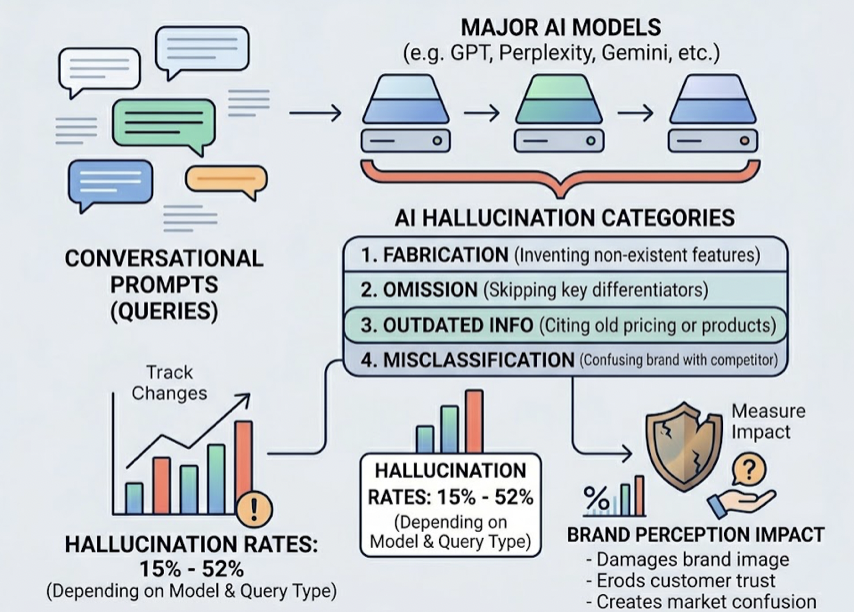
    Hallucination rates across major models remain stubbornly high, ranging from 15% to 52% depending on the model and query type. These aren’t just minor errors. They fall into four categories that directly impact brand perception: fabrication (inventing features you don’t have), omission (skipping key differentiators), outdated information (citing old pricing or discontinued products), and misclassification (confusing your brand with a competitor).

    For this step, review each AI response about your brand and check for two things. First, sentiment: is the AI’s tone positive, neutral, or negative? Second, accuracy: does the description match your actual positioning?

    Researchers use an embedding similarity score to measure this precisely. A score close to 1.0 means the AI’s representation aligns with your brand identity. A drop below 0.95 signals what’s called “Semantic Drift,” where the AI’s version of your brand has diverged from reality.

    Topify’s Sentiment Analysis tracks this on a 0-100 scale across every monitored prompt, so you can spot reputation risks before they compound.

    Step 4: Trace Where AI Gets Its Information (5 Min)

    If the AI is getting your brand story wrong, the next question is: where is it getting its information?

    The answer is often surprising. Late-2025 citation data shows that YouTube accounts for 23.3% of average AI citations, Wikipedia for 18.4%, and Google.com for 16.4%. Reddit’s share varies by prompt but is dominant in categories like gaming and consumer tech. Roughly 34% of all AI citations come from news sites and industry publications.

    This means your AI visibility isn’t just determined by your website. It’s shaped by your presence across the entire citation ecosystem.

    For this step, identify the specific domains the AI is citing when it talks about your category. Then check: is your brand represented on those domains? If a competitor has coverage on Gartner, Forbes, or a top industry blog and you don’t, the AI will naturally treat them as more authoritative.

    Topify’s Source Analysis feature reverse-engineers exactly which domains and URLs each AI platform cites. You can see at a glance whether your brand’s owned content is in the citation mix or whether third-party sources are shaping the narrative without your input.

    Step 5: Score Your Gaps and Set Priorities (5 Min)

    You’ve now collected four layers of data: your visibility baseline, competitor positioning, brand accuracy, and citation sources. The final step is turning that into a prioritized action plan.

    Not all gaps are equally urgent. A hallucination about your pricing is a higher priority than a missing mention in a low-volume prompt. Content that includes data and statistics can see up to a 40% increase in selection likelihood by AI models, so adding structured, data-rich content to your key pages often delivers the fastest ROI.

    Score each finding on two axes: business impact (how much does this affect conversion?) and fix difficulty (how hard is it to address?). High-impact, low-difficulty items go first.

    Here’s a practical prioritization framework:

    PriorityActionTimeline
    ImmediateFix hallucinations, update incorrect listingsWeek 1-2
    Short-termCreate content for prompts where competitors appear but you don’tMonth 1
    Medium-termBuild citation presence on high-authority third-party domainsMonth 2-3

    Topify’s CVR (Conversion Visibility Rate) metric helps quantify the business impact side of this equation. It estimates how likely an AI response is to drive a user toward your brand, so you can prioritize the prompts and platforms that actually move revenue.

    What to Do After Your First AI Search Visibility Audit

    A 30-minute audit gives you a snapshot. But AI recommendations shift constantly as models retrain, new content enters their index, and competitor activity changes the picture.

    The AI search market is projected to grow from $43.6 billion in 2024 to $379 billion by 2030, capturing over 62% of total search volume. The shift toward agentic AI, where models don’t just answer questions but make purchasing decisions on behalf of users, means the stakes will only increase. Your brand’s AI visibility today shapes whether an AI agent recommends you tomorrow.

    That’s why a one-time audit isn’t enough. The brands that win in AI search are the ones that monitor continuously, not quarterly.

    Topify turns this manual audit into an automated, always-on system. Its platform covers every step outlined above: visibility tracking, competitor benchmarking, sentiment monitoring, source analysis, and conversion impact scoring. You can define your goals in plain English, review the proposed strategy, and deploy with a single click. No manual workflows required.

    The gap between brands that track AI visibility and those that don’t is widening every month. Thirty minutes is all it takes to see which side you’re on.

    Conclusion

    AI search visibility isn’t a future concern. It’s a present-day competitive advantage that most brands still aren’t measuring. The 30-minute audit framework covered here gives you a structured, repeatable process: establish your baseline, map competitor presence, verify brand accuracy, trace citation sources, and prioritize your gaps.

    The brands that treat AI visibility as a data problem, not a guessing game, will be the ones AI systems recommend with confidence.

    FAQ

    What is an AI search visibility audit?

    An AI search visibility audit is a structured review of how your brand appears across generative AI platforms like ChatGPT, Gemini, and Perplexity. It evaluates whether your brand is mentioned, how accurately it’s described, where the AI sources its information, and how you compare to competitors.

    How often should I audit my brand’s AI search visibility?

    A manual audit is a good starting point, but AI responses change frequently as models update and new content enters their training data. Ideally, brands should monitor AI visibility weekly or use automated tools like Topify for continuous tracking.

    Which AI platforms should I include in my audit?

    At minimum, cover ChatGPT, Google Gemini, and Perplexity. These three represent the largest share of AI search traffic. For global brands, consider adding DeepSeek, Doubao, and Qwen to cover non-English markets.

    Can I audit AI search visibility without paid tools?

    Yes. You can manually run prompts across AI platforms and record the results in a spreadsheet. The trade-off is time: a manual audit covers a limited number of prompts and platforms, while tools like Topify can monitor hundreds of prompts across multiple AI engines continuously.

    What’s the difference between traditional SEO and AI search visibility?

    Traditional SEO focuses on ranking in search engine result pages through backlinks and keyword optimization. AI search visibility focuses on being cited and recommended within AI-generated answers, which depends on semantic clarity, structured data, and third-party authority rather than just domain ranking.

    Read More

  • 7 AI Search Visibility Metrics You’re Missing

    7 AI Search Visibility Metrics You’re Missing

    Your domain authority is 70. Your keyword rankings are solid. Your team’s SEO dashboard shows green across the board. Then someone asks ChatGPT, “What’s the best tool in your category?” and your brand doesn’t show up once.

    That disconnect isn’t a fluke. Organic CTR on queries that trigger AI Overviews has dropped roughly 61%, and nearly 64% of all Google searches in the U.S. now end without a single click to any website. The metrics that defined success for two decades don’t measure what matters in a world where AI provides the answer directly.

    Clicks Measured the Old Search. AI Visibility Needs Its Own Language.

    Impressions and clicks were designed for a directory-style search engine. You optimized a URL, the search engine ranked it, and users clicked through to your site. The entire model assumed that “being found” meant “being listed.”

    AI search doesn’t work that way. Generative engines like ChatGPT, Perplexity, and Gemini don’t serve a list of links. They synthesize a single answer, pulling from dozens of sources, and present a curated response. Your brand is either in that answer or it isn’t.

    That’s a fundamentally different game.

    Traditional keyword queries average 3 to 4 words. Conversational prompts sent to AI engines today average between 23 and 60 words, reflecting deeper, more specific intent. And a 2025 McKinsey study found that half of all consumers now intentionally use AI-powered search engines for buying decisions. The front door to discovery has moved, and legacy metrics can’t tell you whether your brand made it through.

    Metric 1: AI Mention Rate, the New Baseline for Visibility

    AI Mention Rate measures how often your brand appears in synthesized responses for a set of category-relevant prompts. It’s the most fundamental AI search visibility metric because it answers the simplest question: are you in the room?

    Unlike impressions, which count how many times a link was displayed, a mention means the model actively selected your brand as relevant enough to include in its answer.

    For most brands, the average AI visibility rate sits around 0.3%. Market leaders in 2026 aim for 60% to 80% inclusion across their core prompts. The gap between those two numbers is where competitive advantage lives.

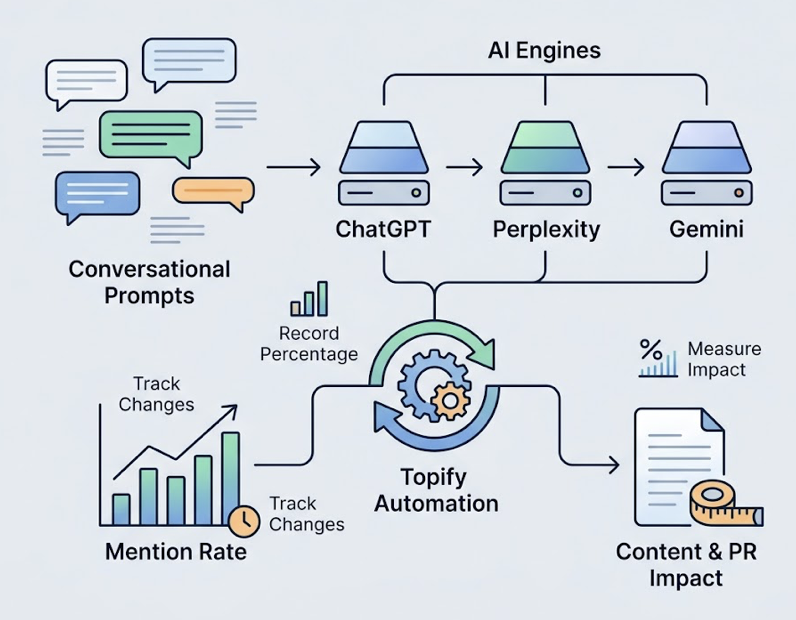
    Calculating it is straightforward: run a matrix of dozens or hundreds of conversational prompts across multiple AI platforms and record the percentage of times your brand appears. Topify automates this process across ChatGPT, Perplexity, Gemini, and other major AI engines, tracking mention rate changes over time so you can measure the impact of content and PR efforts directly.

    Metric 2: Sentiment Score, Because Being Mentioned Isn’t Always Good

    AI models don’t just mention brands. They characterize them. One brand gets described as “innovative” and “user-friendly.” Another gets labeled “legacy” or “expensive.” Both are technically “visible,” but only one is being recommended.

    Sentiment scoring uses NLP to analyze the polarity of how AI describes your brand, typically on a scale from negative to positive. A score below 40 generally indicates a structural reputation issue that content optimization alone won’t fix.

    Here’s the thing: AI sentiment is often shaped more by third-party sources like Reddit threads, industry reviews, and news coverage than by your own website. Topify’s Sentiment Analysis tracks this across platforms with a 0-100 scoring system, flagging shifts before they compound.

    If your mention rate is climbing but sentiment is flat or declining, you’ve got a problem that raw visibility numbers won’t show you.

    Metric 3: Position in AI Recommendations

    When ChatGPT lists five products in a recommendation, the first one mentioned captures the largest share of user trust. This is the “Position One” of generative search.

    But tracking position in AI is harder than tracking it in traditional SERPs. Generative responses aren’t fixed. They shift based on prompt phrasing, model updates, and the sources available at query time. A brand that appears first for “best CRM for startups” might appear fourth for “top CRM tools 2026.”

    Topify’s Position Tracking uses a weighted index to account for this variability. A primary recommendation in the opening paragraph scores higher than a secondary mention buried under “other options.” Consistently landing at the bottom of recommendation lists signals what the external research calls a “Confidence Deficit”: the model knows your brand but doesn’t trust it enough to lead with.

    Metric 4: AI Search Volume, the Prompts No Keyword Tool Shows You

    Traditional keyword volume measures what people type into Google. AI Search Volume measures the conversational questions people are asking inside ChatGPT, Perplexity, and similar platforms.

    These are different queries entirely. Instead of “best CRM 2026,” an AI prompt might be: “I run a 50-person B2B startup and need a CRM that integrates with Slack and handles automated follow-ups. What should I look at?”

    That level of specificity reveals buying intent that keyword tools miss completely. Topify’s AI Volume Analytics surfaces these high-value prompts so brands can prioritize content that answers the questions AI is actually being asked, not keywords that belong to the old search paradigm.

    Metric 5: Source Citation Tracking

    AI engines don’t generate answers from thin air. They pull from specific URLs and domains to construct their responses. Source Citation Tracking tells you exactly which sources the AI is using as its “ground truth” for your category.

    This matters for two reasons. First, citations from third-party domains like trade publications, Reddit, and review platforms carry roughly 6.5 times more weight in building AI authority than self-published content. Second, a Princeton study found that citing authoritative sources within your own content can boost AI visibility by up to 115% for lower-ranked pages.

    Topify’s Source Analysis tracks which domains AI platforms cite when answering questions in your category. If a competitor’s blog or a third-party review site is dominating citations, that’s a direct visibility loss you can act on.

    Metric 6: Conversion Visibility Rate

    If clicks are declining, how do you justify investing in AI search visibility? Conversion Visibility Rate is the metric that connects AI mentions to revenue.

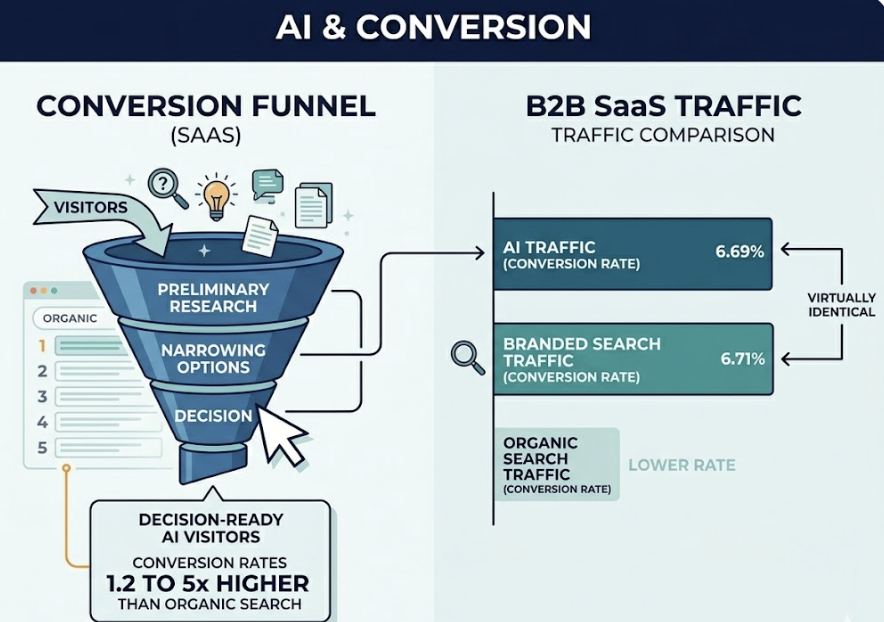
    AI-referred visitors behave differently than organic search visitors. The AI has already done the preliminary research, narrowed the options, and presented your brand as a recommendation. Users who click through are what the research calls “Decision-Ready.” Data shows AI visitors convert at rates 1.2 to 5 times higher than traditional organic search visitors. In B2B SaaS, conversion rates from AI traffic (6.69%) are now virtually identical to branded search traffic (6.71%), which has traditionally been the highest-converting channel.

    Topify’s CVR metric weights mentions based on prompt intent. A mention in a “best of” list for a high-intent prompt is worth significantly more than a passing reference in an informational summary.

    Metric 7: Competitor Share of Voice in AI

    AI visibility is closer to a zero-sum game than traditional search. A Google SERP shows ten or more links. An AI response typically names three to five brands. If a competitor takes one of those slots, it often means you don’t.

    Competitor Share of Voice measures the percentage of mentions your rivals secure across the same set of prompts. It reveals which brands are winning on which platforms and which queries are being dominated by companies you might not even consider competitors.

    Only 11% of websites are cited by both ChatGPT and Perplexity simultaneously. That means your competitive picture looks different on every AI platform. Topify’s Competitor Monitoring automatically detects rivals across platforms and tracks their visibility, sentiment, and position relative to yours.

    How to Build an AI Search Visibility Dashboard Without Drowning in Data

    Tracking seven metrics across multiple AI platforms can feel overwhelming. The most effective approach is to layer your implementation.

    Phase 1 (Week 1-2): Start with Mention Rate, Sentiment, and Position across ChatGPT and Google AI Overviews. This gives you a baseline for awareness and reputation on the two highest-traffic platforms.

    Phase 2 (Month 1): Expand coverage to Perplexity and Gemini. Add Source Citation tracking to identify which third-party platforms are feeding AI answers in your category.

    Phase 3 (Month 2+): Integrate AI Search Volume and CVR. This is where you tie AI search visibility directly to your sales pipeline.

    Topify consolidates all seven metrics into a single dashboard, making it possible to spot a drop in ChatGPT mentions and trace it back to a specific source change, all within the same view. For teams that have been reporting AI visibility through spreadsheets and manual prompt checks, the difference in speed and accuracy tends to be significant.

    3 Measurement Mistakes That Make Your AI Data Misleading

    Counting mentions without checking sentiment. A brand that appears in AI answers as “outdated” or “overpriced” is worse off than a brand that doesn’t appear at all. Negative mentions actively train the model to exclude you from “best” and “top” recommendation prompts.

    Tracking one AI platform and assuming it represents all of them. ChatGPT accounts for roughly 82% of AI referral traffic, but its citation patterns differ significantly from Gemini, Claude, and Perplexity. A strategy optimized for one platform misses more than half the discovery journey.

    Reporting AI metrics on your SEO dashboard. Domain Authority explains less than 4% of the variance in AI citations. Backlink counts and average keyword positions have almost no correlation with whether AI recommends your brand. AI visibility needs its own dashboard, its own language, and its own reporting cadence.

    Conclusion

    The gap between “ranking well” and “being recommended by AI” is only getting wider. Impressions and clicks aren’t wrong. They’re just measuring a different game.

    AI search visibility requires its own metrics: mention rate, sentiment, position, volume, citations, conversion potential, and competitive share of voice. Start with the first three. Build from there. The brands that track what AI actually says about them, not just whether Google lists their URL, are the ones that’ll own the next generation of discovery.

    FAQ

    Q: What is AI search visibility? 

    A: AI search visibility measures how often and how favorably your brand appears in AI-generated answers from platforms like ChatGPT, Perplexity, and Gemini. It’s different from traditional search rankings because it tracks whether AI models actively include and recommend your brand, not just whether your URL is indexed.

    Q: How is AI search visibility different from traditional SEO? 

    A: Traditional SEO focuses on ranking URLs in a list of search results. AI search visibility focuses on whether your brand is mentioned, how it’s described, and where it’s positioned inside a synthesized answer. The metrics, optimization strategies, and measurement tools are fundamentally different.

    Q: What tools can track AI search visibility metrics? 

    A: Topify is one of the leading platforms for tracking AI search visibility across ChatGPT, Perplexity, Gemini, and other AI engines. It covers all seven core metrics: mention rate, sentiment, position, volume, source citations, CVR, and competitor share of voice.

    Q: How often should I check AI search visibility? 

    A: AI models update their citation patterns and source preferences frequently. Weekly monitoring is a good baseline for mention rate and sentiment. Source citation analysis and competitive share of voice benefit from monthly deep reviews with trend analysis.

    Read More

  • How to Build an AEO Strategy from Scratch in 5 Steps

    How to Build an AEO Strategy from Scratch in 5 Steps

    Open ChatGPT, type “best [your category] tool,” and watch what comes back. If your brand isn’t in that five-line answer, you’ve already lost the prospect before they ever hit your homepage. Most marketing teams figured this out in 2025, when AI Overviews started cutting Position 1 organic clicks by more than half. The instinct is to throw more SEO content at the problem. That’s the wrong move. AEO runs on a different ruleset, and the brands winning right now started by tearing up the old playbook.

    Why AEO Has Become Non-Optional in 2026

    The numbers don’t leave much room for debate. ChatGPT now sees 900 million weekly active users and processes 2.5 billion prompts per day. Google’s AI Overviews reach roughly 2 billion users a month. For high-income households, AI has already replaced traditional search as the starting point for local discovery.

    The CTR data is uglier. When an AI Overview shows up on a search result page, organic CTR drops from 1.76% to 0.61%, a 61% decline. Paid CTR on informational keywords falls 68% in the same conditions. Position 1 organic CTRloses 58% of its historical value when an AIO is present.

    But here’s the part most people miss: brands cited inside the AI answer get 35% more organic clicks and 91% more paid clicks than non-cited brands appearing on the same query. The penalty isn’t for AI search itself. It’s for not being selected.

    That’s the gap an AEO strategy is built to close.

    AEO vs SEO vs GEO: What’s Actually Different

    AEO, SEO, and GEO get used interchangeably, and the confusion is costing teams real budget. Each one optimizes for a different mechanic.

    SEO is still about ranking pages in a list of links. The metric is rank position and click-through rate. It’s the foundation that gets your content crawled and indexed in the first place.

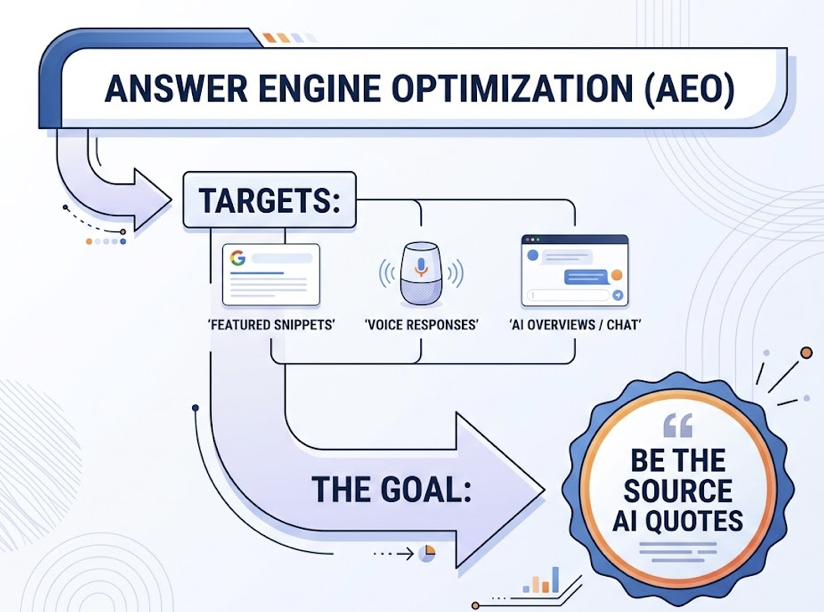
    Answer Engine Optimization is narrower and more aggressive. It targets the direct-answer real estate: featured snippets, voice responses, and the synthesized blocks inside ChatGPT or AI Overviews. The goal isn’t a click. It’s being the source the AI quotes.

    GEO sits on top. It shapes how an LLM understands your brand as an entity, who you are, what category you own, and which competitors you sit beside. GEO works across the dataset and retrieval layer, not just on individual pages.

    Bottom line: SEO gets your content in. AEO gets it selected. GEO makes sure the AI’s mental model of your brand stays accurate and positive. You need all three. AEO is the fastest one to move on right now.

    Step 1: Audit Your Baseline and Open the Door for AI Crawlers

    Before you optimize anything, find out where you actually stand. Most teams skip this step and run blind for six months.

    Start with a baseline measurement across the four engines that matter: ChatGPT, Perplexity, Gemini, and Google AI Overviews. Track three things per engine: are you mentioned, are you cited with a link, and where do you sit relative to competitors. This is what Topify‘s Visibility Tracking was built for. Pick a fixed list of 50 to 100 buyer prompts and re-run them weekly so you have a moving baseline, not a one-time snapshot.

    Then check the door is unlocked. Audit your robots.txt for GPTBot, ClaudeBot, PerplexityBot, and Google-Extended. Plenty of brands are technically invisible to AI engines because someone copied a default block-list two years ago.

    Add an llms.txt file at the root of your domain. It’s a 2026 standard that tells AI systems how to attribute your content, which datasets are approved, and where to find author bios. Think of it as a robots.txt for the answer era.

    Finally, validate your schema. FAQPage, HowTo, and Article markup should match the on-page content exactly. AI models flag inconsistency as a low-trust signal and skip the page when synthesizing.

    Step 2: Find the Prompts Your Buyers Actually Ask

    AEO doesn’t run on keywords. It runs on prompts, the actual phrasing buyers use when they ask an AI for a recommendation.

    The shape is different. A keyword like “crm software” becomes a prompt like “what’s the best CRM for a 10-person sales team that already uses HubSpot.” The intent is denser, the context is richer, and the answer the AI gives is shorter.

    Map your prompts across three intent layers:

    Informational: “what is AEO” / “how do I track AI search visibility.” These build mind share. Low conversion, high authority compound.

    Comparison: “best AEO tools” / “Topify vs Profound.” This is the consideration set. If you’re not on the AI’s shortlist here, the deal is already lost.

    Transactional: “cheapest annual plan for [category]” / “how to sign up for [product].” This is where revenue lands.

    Use AI Volume Analytics to surface high-volume prompts you’re not currently visible on. Manually guessing prompts is the most common mistake in this step. AI prompt distribution doesn’t mirror Google keyword data, and the gap is wider than most teams expect.

    Step 3: Reverse-Engineer the Sources AI Already Cites

    Here’s the part that breaks most brand strategies: 95% of AI citations come from sites you don’t own.

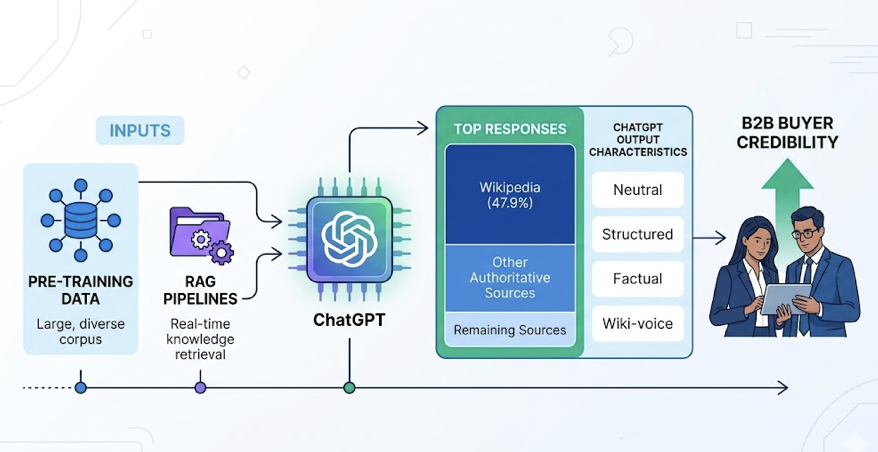
    The data is brutal on the question of where AI looks. Reddit accounts for 46.7% of Perplexity citations and 21% of Google AI Overview citations. Wikipedia drives 47.9% of ChatGPT citations. YouTube sits at roughly 18.8% on AIO. Brand websites collectively pull about 9%.

    That doesn’t mean your site is irrelevant. It means your site can’t carry the AEO load alone. AI engines need consensus across independent voices before they’ll quote you. If the only place you’re discussed is your own marketing copy, the model treats that as biased and skips it.

    Run a source audit. Use Source Analysis to pull every domain currently cited for your top 50 buyer prompts. You’ll usually find three patterns:

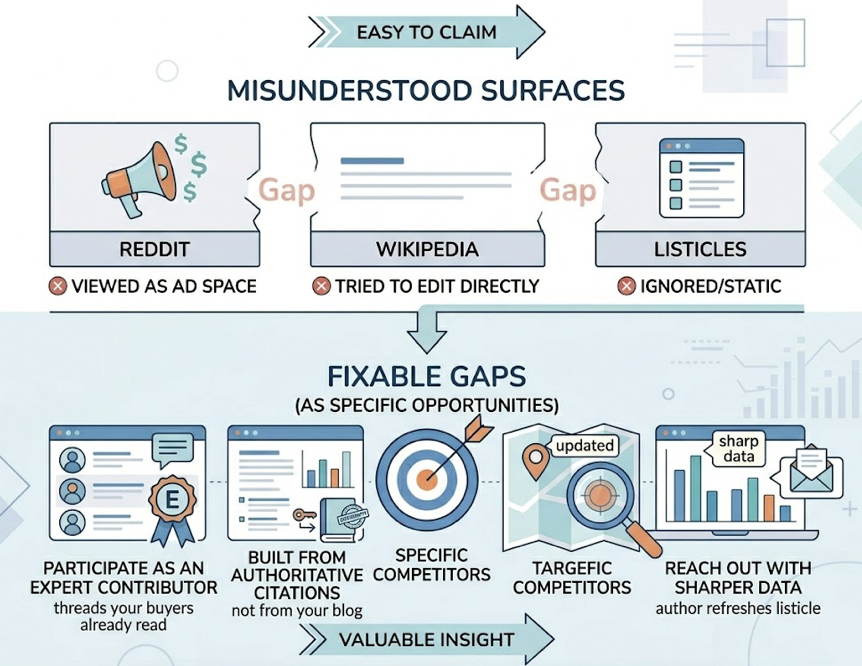
    Competitors dominating Reddit threads where your category gets discussed. Wikipedia entries for adjacent topics that don’t mention your brand. Industry media and listicles that reference everyone except you.

    Each gap is a fixable surface. Reddit isn’t a place to advertise. It’s a place to participate as an expert contributor in threads your buyers already read. Wikipedia entries get built from authoritative third-party citations, not from your blog. Listicles get refreshed when someone reaches out to the author with sharper data.

    That’s the actual off-page AEO playbook. Most teams skip straight from auditing to writing more blog posts. They write into a vacuum because nobody told them where AI was looking.

    Step 4: Build Content Designed to Be Quoted, Not Just Ranked

    AI engines don’t read pages the way humans do. They scan for modular chunks they can lift and synthesize. The structural rules are unforgiving once you see them.

    55% of Google AI Overview citations come from the top 30% of a page. ChatGPT pulls 44.2% of its citations from that same zone. If your direct answer isn’t in the first 150 words, you’re outside the citation window before the AI even reaches the rest of your content.

    The format that wins is what some teams call the Answer Capsule: a definitive, fact-dense summary in the opening section that contains the core answer plus original data. Pages built this way achieve a 72.4% citation rate. That’s roughly six times the rate of pages relying on traditional SEO intros.

    A few writing rules that move the needle:

    Put the literal answer to the H1 question in the first 50 words. No throat-clearing.

    Phrase H2 and H3 headings as direct buyer questions. AI treats headings as prompts and the next paragraph as the response, which is why 78.4% of question-based citations come from headings.

    Replace adjectives with numbers. “Significantly improved performance” gets ignored. “Cut response time by 47%” gets quoted.

    Update content within the last 90 days where possible. Recently refreshed content is twice as likely to be cited.

    The goal isn’t to write longer. It’s to write more extractable.

    Step 5: Track Citations, Sentiment, and Close the Loop

    AEO isn’t a launch project. It’s a monitoring system, and the brands that treat it as one-and-done lose ground fast because AI citation patterns shift every few weeks.

    Three metrics need to be on your dashboard:

    Share of Model: Your visibility share across ChatGPT, Gemini, Perplexity, and AI Overviews. Track it weekly. A drop that lasts more than two weeks is signal, not noise.

    Sentiment Velocity: Not just whether AI mentions you, but how. Sentiment shifts are leading indicators of pricing perception, support quality, or messaging drift. Sentiment Analysis scores brand mentions on a 0 to 100 scale and flags directional changes before they show up in revenue.

    Hallucination Alerts: AI sometimes states confident, wrong things about your brand: outdated pricing, deprecated features, or competitor confusion. Catching these early lets you target the source URL the AI is pulling from for a correction.

    Wire this into your existing analytics stack. AEO data isn’t a separate workflow. It’s another layer on the same dashboard your SEO team already checks. The teams that close this loop weekly tend to compound visibility gains. The ones that report quarterly tend to discover problems three months too late.

    Where Most AEO Strategies Fall Apart

    Most AEO failures look the same. Four patterns show up over and over:

    Treating AEO as a content problem. The fix is infrastructure first—crawlers, schema, llms.txt—then content. Skipping infrastructure means AI engines can’t read what you wrote.

    Tracking only one AI engine. ChatGPT alone is 60 to 65% of generative search volume, but Perplexity, Gemini, and AIO behave differently and cite different sources. Single-engine monitoring misses 35% of the picture by definition.

    Keyword stuffing into AI-era content. Repetition adds noise. AI models reward clarity and definitive language, not density.

    Promotional tone. Content that sounds like an investor deck gets filtered as low-confidence. Brands that sound like teachers, showing data, naming sources, walking through process, dominate citations.

    Spot any of these in your current approach and fix the infrastructure layer before writing another article.

    The AEO Tooling You’ll Need to Run This Playbook

    You can run this playbook with a stack of separate tools. Most teams that try end up with five dashboards, three logins, and no single view of what’s actually changing.

    Topify was built to consolidate the AEO measurement layer into one platform. Visibility Tracking covers ChatGPT, Gemini, Perplexity, AI Overviews, and adjacent engines like DeepSeek and Doubao for global brands. Source Analysis maps every domain cited for your priority prompts. Position Tracking shows where you sit in the AI’s ordered recommendation. Sentiment Analysis monitors directional shifts in how AI describes your brand. AI Volume Analytics surfaces high-value prompts before competitors notice them.

    In practice, that means a marketing lead can spot a drop in ChatGPT mentions and trace it back to a specific Reddit thread that stopped recommending the brand, inside one dashboard, not five.

    Pricing starts at $99/month for the Basic plan, which covers 100 prompts and four projects. Most mid-market teams land on the Pro tier at $199/month. You can get started on a 7-day trial without committing to annual billing.

    The point isn’t that Topify is the only way to execute AEO. It’s that the brands moving fastest in 2026 aren’t pasting together five tools. They’re working off a single source of truth and acting on it weekly.

    Conclusion

    Open ChatGPT again. Type the same prompt. The brand sitting in the answer slot didn’t get there by ranking harder. It got there by mapping the right prompts, restructuring its content for extraction, building third-party signals on Reddit and Wikipedia, and tracking citations weekly.

    The five steps in this playbook compound. Most teams see meaningful citation lift within 60 to 90 days once infrastructure and content are aligned. The cost of waiting another quarter is harder to calculate, but the CTR data suggests it’s not zero. In the answer era, if you’re not the source the AI quotes, you’re not in the consideration set.

    FAQ

    Q: How long does it take to see results from an AEO strategy? 

    A: Most teams see initial citation lift within 60 to 90 days after fixing infrastructure issues and publishing answer-first content on priority prompts. Sentiment changes and consistent Share of Model gains usually take 4 to 6 months. The biggest variable is how much off-page work (Reddit, Wikipedia, industry media) the team is willing to do alongside the on-site changes.

    Q: Is AEO replacing SEO, or do I still need both? 

    A: You need both. SEO ensures your content gets crawled and indexed in the first place, which is the precondition for AEO. AEO then determines whether AI engines select your content for direct answers. Treating them as competing strategies is one of the main reasons AEO programs fail.

    Q: Do small brands have any chance against big brands in AI search? 

    A: Yes, often more than in traditional SEO. AI engines favor specific, authoritative content over domain authority alone. A focused brand with answer-first content and strong Reddit presence in its niche can outrank larger competitors who rely on broad, promotional copy.

    Q: How is AEO different from GEO (Generative Engine Optimization)? 

    A: AEO targets specific direct-answer placements like featured snippets, AI Overviews, and voice responses. GEO is broader and shapes how an LLM understands your brand as an entity across its entire knowledge base. AEO is tactical and faster to execute. GEO is strategic and compounds over longer timeframes. Most mature programs run both in parallel.

    Read More

  • AEO for B2B Brands: How to Win AI Buyer Research

    AEO for B2B Brands: How to Win AI Buyer Research

    A practical playbook for getting cited in ChatGPT, Perplexity, and Google AI Overviews before your buyers ever build a vendor shortlist.

    By the time a B2B buyer joins a discovery call, the shortlist is usually already written. Your sales team sees it weekly: prospects walk in with two or three vendor names, ballpark pricing, and questions that imply they’ve read someone’s case studies in detail. Almost none of that came from your website. Most of it came from ChatGPT, Perplexity, or Google’s AI Overviews, where roughly 80% of B2B winners are now decided before a single rep gets involved. If your brand isn’t showing up in those answers, you’re not losing the deal in the demo. You’re losing it in the research phase. That’s where AEO comes in.

    B2B Buyers Now Start in ChatGPT, Not Google

    The numbers shifted faster than most marketing teams adjusted. In early 2024, around 14% of B2B buyers were using LLMs during research. By 2025, that figure hit 94%, making AI assistants the default starting point rather than the novelty experiment.

    The downstream effect is a compressed buying cycle and a later first sales touch. Average B2B sales cycles dropped from 11.3 months to 10.1 months in a single year. Buyers now contact a sales rep at 61% of journey completion, down from 69% historically, because they’ve already done most of the qualification work themselves.

    That’s the gap most marketing teams haven’t priced in yet.

    For B2B specifically, the shift cuts deeper than B2C. A typical strategic purchase now involves a buying committee of about 22 people, including 13 internal stakeholders and 9 external influencers, each with their own research patterns and evaluation criteria. Every one of those stakeholders is asking AI different questions. If your content surfaces for the marketer’s prompt but not the CFO’s, you’re partially visible at best.

    AEO for B2B Isn’t Just SEO With a New Acronym

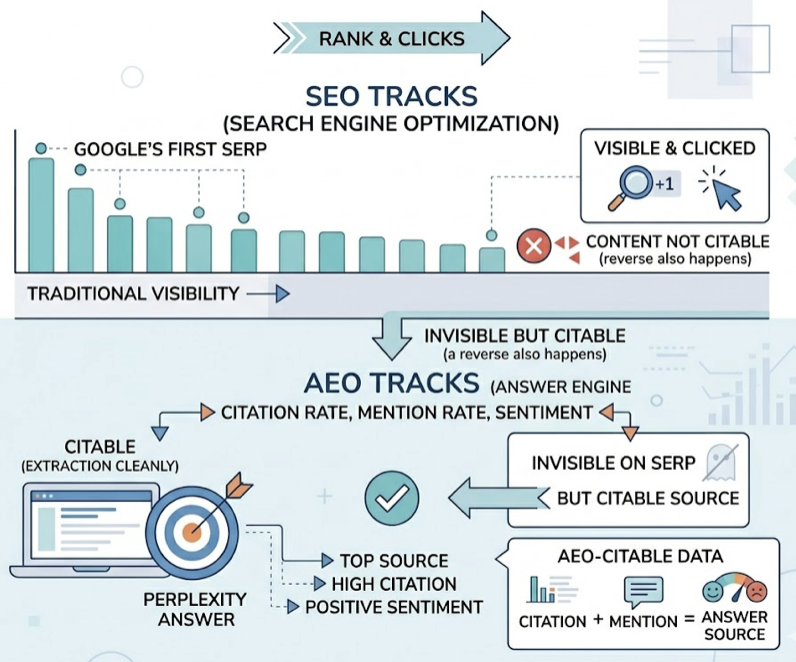
    Answer Engine Optimization is the practice of getting your brand cited, quoted, and recommended inside AI-generated answers, not just ranked in a list of links. SEO optimizes for position. AEO optimizes for extraction.

    The unit of measurement changes accordingly. SEO tracks rank and clicks. AEO tracks citation rate, mention rate, and sentiment. A page can be invisible on Google’s first SERP and still be one of the top sources powering Perplexity’s answer about your category. The reverse also happens: you can rank #1 for a head term and never get cited because your content doesn’t extract cleanly.

    For B2B, three structural realities make AEO different from B2C.

    First, decisions lean heavily on third-party authority. Buyers and the AI models they query both trust G2, Capterra, TrustRadius, analyst notes, and community discussion threads. Roughly 85% of citations in B2B-style AI research come from third-party platforms rather than the vendor’s own site.

    Second, the prompt surface is enormous. A 22-person buying committee generates dozens of distinct prompt patterns: ROI questions from finance, integration questions from engineering, compliance questions from legal, workflow questions from end users. Each is a separate citation opportunity, and each requires content tuned to that role.

    Third, the queries are technical and long-tail. B2B buyers ask AI things like “Does X support SAML SSO with Okta?” or “What’s the typical TCO for [category] at 500 seats?” These rarely match traditional keyword research outputs.

    Where B2B Buyers Encounter AI Answers in the Wild

    AI answers reach B2B buyers across four distinct surfaces, each with its own behavior and citation logic.

    SurfaceBuyer behaviorWhat it cites mostWhy it matters for B2B
    ChatGPT / Claude / GeminiConversational research, vendor brainstormingOwned websites (~23%), editorial (~16%), Wikipedia (~8%)Default tool for early-stage discovery
    PerplexityDeep research with visible citationsReddit (46.7% on comparative queries), reviews, owned sitesPreferred by technical and analytical buyers
    Google AI OverviewsIntercepts traditional search intentHigh-authority editorial, structured contentCaptures buyers who still start on Google
    Internal AI agents (Glean, Notion AI, etc.)Inside-enterprise research and summarizationWhatever content the AI was trained or grounded onImportant for late-stage validation

    Different surfaces, different rules. A brand with strong G2 presence will dominate Perplexity comparison queries but may underperform on ChatGPT’s general “best of” prompts. Optimizing for one surface and assuming the others follow is the most common AEO miscalculation in B2B.

    What AI Cites When It Recommends a B2B Vendor

    Most B2B marketers underestimate how much of their AI visibility lives outside their own domain. The citation weight distribution makes the point bluntly.

    Source typeChatGPT citation sharePerplexity citation share
    Owned website23%~15%
    Editorial / media16%~10%
    Reddit / forums11%46.7%
    Review sites (G2, etc.)11%~15%
    Wikipedia7.8%~5%
    YouTube transcripts~2%14%

    Two patterns stand out. First, Reddit’s weight in Perplexity for comparative queries dwarfs every other surface. If your category has an active subreddit, that’s where your evaluative AI presence is being decided. Second, review sites function as compounding citation engines: a 10% increase in G2 reviews correlates with roughly a 2% increase in AI citations across major platforms.

    This is where source-level visibility becomes operational rather than abstract. Tools like Topify trace which exact domains and URLs AI engines pull from when they discuss your category, so you can see whether ChatGPT is grounding its answers in your blog or your competitor’s TrustRadius profile.

    5 AEO Tactics That Move the Needle for B2B Brands

    The tactics that work in 2026 look different from 2024’s GEO playbook. The five below are the ones with the clearest measurable effect on B2B citation share.

    Tactic 1: Map the Prompts Your Buyers Actually Ask AI

    LLMs don’t process buyer questions as single queries. They fan out a prompt like “best CRM for mid-market manufacturers” into sub-questions about pricing, integrations, manufacturing-specific features, and reviews. Each sub-question is a separate citation opportunity, and most B2B brands rank for the headline prompt but disappear from the sub-queries.

    For B2B, the practical move is building a prompt portfolio organized by buying committee role: CFO prompts, IT lead prompts, end user prompts, legal and procurement prompts. Topify’s prompt discovery surfaces the high-volume AI queries in your category, including the long-tail technical prompts your team would never guess from keyword tools.

    Tactic 2: Get Cited by the Sources AI Trusts

    Owned content alone won’t move citation share much. The leverage is in third-party platforms.

    Three priorities. Build systematic review generation on G2, Capterra, and TrustRadius, since review velocity correlates directly with citation lift. Foster authentic Reddit presence in category subreddits, because Perplexity’s comparative answers lean on Reddit consensus harder than any other source. Pursue digital PR placements in publications LLMs already cite as grounding for your category.

    Tactic 3: Restructure Content for Extractive Answers

    LLMs retrieve fragments, not full articles. About 44% of citations come from the first 30% of a page’s text, and atomic sections of 50 to 150 words are 2.3 times more likely to be cited than long unstructured paragraphs.

    The format levers with measured impact include leading with the answer (BLUF format yields about 44% more citations), strict heading hierarchy with clean H2/H3 boundaries (2.8x citation odds increase), tables (present in roughly 80% of ChatGPT citations), and FAQ sections (40% higher citation likelihood).

    Page speed compounds these effects. Pages with First Contentful Paint under 0.4 seconds average 6.7 citations, while those above 1.13 seconds drop to 2.1. For LLMs, slow pages aren’t just penalized in user experience terms. They’re skipped during retrieval.

    Tactic 4: Own the Comparison Layer

    Most B2B journeys end with comparative queries: “X vs Y,” “alternatives to Z,” “best [category] for [use case].” LLMs heavily favor balanced comparison content, including pieces that acknowledge competitor strengths. Pure promotional content underperforms because the model treats it as low-trust.

    The counterintuitive play is publishing rigorous head-to-head comparisons that include your category’s leaders, even ones where you don’t always come out on top. This signals editorial credibility to the model and earns citation in queries where buyers are explicitly comparing.

    Tactic 5: Track and Respond to AI Sentiment Drift

    AI representations of your brand can drift from your actual positioning, especially when training data ages or third-party signals get inconsistent. A premium product can end up described as “budget-friendly” in ChatGPT answers, simply because of how a few high-ranked review snippets phrased things.

    The corrective lever is what some teams call a digital cushion: publishing 5 to 10 high-authority pieces (corporate blog, LinkedIn long-form, industry guest posts) that flood the retrieval window with current, accurate framing. AI models exhibit strong recency bias, so content updated within the last two months earns roughly 28% more citations than older material.

    How to Tell If Your B2B AEO Is Actually Working

    Traditional SEO dashboards don’t measure what matters here. Click-through rates have dropped as much as 61% on queries where AI Overviews appear, and 75% of AI Mode sessions end without an external click at all. Tracking only sessions and rankings misses the entire pre-click decision layer.

    A useful B2B AEO measurement framework tracks seven things:

    • Mention Rate: how often your brand appears in category-relevant AI answers, with a target above 30% for primary category prompts.
    • Citation Rate: how often your domain is cited as a source, ideally above 50% for technical queries you should own.
    • Position: where your brand sits in the AI’s recommendation order relative to competitors.
    • Sentiment Score: how the AI describes your brand, scored against your intended positioning.
    • Share of Voice: relative AI presence vs. competitive set across platforms.
    • Source Mix: which domains and URLs the AI pulls from when answering about your category.
    • CVR (Conversion Visibility Rate): predicted likelihood that an AI answer routes a user toward branded interaction. SaaS averages around 14.2%.

    These should be tracked by buyer persona and use case, not just at the brand level. A CFO-focused prompt set, an engineering-focused set, and an end-user set each tell different stories.

    Topify is built around this measurement structure. It tracks all seven metrics across ChatGPT, Gemini, Perplexity, DeepSeek, and other major engines, surfaces which sources AI is citing about your category, monitors competitor positioning in real time, and alerts on sentiment drift before it becomes pipeline damage. The point isn’t dashboards. It’s catching the gaps between what you think AI is saying about your brand and what it actually says.

    The AEO Mistakes Most B2B Brands Are Still Making

    The pattern of mistakes is consistent across categories.

    Treating AEO as an SEO extension. Same KPIs, same content briefs, same tools. The result is content that ranks but doesn’t extract, and a team that can’t explain why pipeline from organic is flat.

    Tracking only ChatGPT. Perplexity dominates technical and comparative B2B research, Google AI Overviews intercepts traditional search journeys, and internal enterprise AI agents drive late-stage validation. Single-platform tracking gives a single-platform picture of a multi-platform problem.

    Operating without source-level visibility. Most teams know they want to “show up in AI.” Few can name the five domains AI cites most often when answering category questions. Without that, you can’t tell whether the gap is on your site or in the ecosystem around it.

    Hiding pricing. About 57% of SaaS brands don’t surface pricing publicly, which forces AI to either hallucinate or skip the question entirely. CFOs are involved in 79% of B2B purchases, and they ask price questions early. Opaque pricing pages get punished in AI answers far more than they did in Google rankings.

    Ignoring sentiment monitoring. Around 62% of AI citations are “ghost citations” where your domain is referenced but your brand isn’t named in the answer. That’s traffic without equity. The fix is monitoring how AI describes you, not just whether it links to you.

    Conclusion

    The first impression of your brand is now AI-mediated for the majority of B2B buyers. By the time a prospect reads your homepage, they’ve already absorbed a synthesized opinion from ChatGPT, Perplexity, or Gemini, and that opinion came from sources you may or may not know about.

    AEO for B2B isn’t a content tactic. It’s the new shape of demand generation in a research environment where 94% of buyers consult LLMs and 80% of winners are decided before sales gets a meeting. The starting move is auditing your current AI presence: which prompts mention you, which cite you, which sources are doing the work, and where the gaps live by buyer persona.

    Tools like Topify make that audit a continuous workflow rather than a one-off project. The teams winning AEO right now aren’t necessarily writing more content. They’re tracking what AI says about their category, fixing the source-level gaps, and adjusting before competitors notice.

    FAQ

    What’s the difference between AEO and GEO for B2B?

    AEO (Answer Engine Optimization) and GEO (Generative Engine Optimization) overlap heavily and are often used interchangeably. AEO emphasizes the structural and extractive aspects of getting cited in AI answers, things like BLUF formatting, atomic content, and schema markup. GEO emphasizes the broader ecosystem signals (third-party reviews, Reddit consensus, editorial mentions) that influence AI recommendations. For most B2B teams, the practical work is the same: get cited, get described accurately, and track both.

    How long does it take to see AEO results for B2B brands?

    Initial visibility shifts can show up within 30 to 60 days, especially when a brand fixes content extractability issues or launches a focused review-generation effort on G2 or Capterra. Sustained mention rate growth in competitive categories typically takes 90 to 180 days, since LLM training and retrieval indexes update on rolling cycles.

    Should B2B brands optimize for ChatGPT or Perplexity first?

    Depends on where your buyers actually research. Perplexity skews toward technical, analytical, and senior buyers and weights Reddit and review sources heavily. ChatGPT has broader reach across all roles. Most B2B teams should track both from day one, but if pressed to prioritize, optimizing for the surface your specific buyer persona uses is the better call than picking by raw market share.

    Does AEO replace traditional SEO for B2B?

    No. AEO is built on top of SEO. Without crawlable, indexable, technically sound content, AI engines can’t ground their answers in your material in the first place. Think of SEO as the discoverability layer, AEO as the extractability layer, and ecosystem signals as the trust layer. All three compound.

    How does AEO affect B2B sales cycle length?

    AI-mediated research compresses cycles by accelerating qualification but raises the bar for what content has to do. Buyers contact sales later (61% of journey vs. 69% historically) but with stronger opinions and shorter validation phases. Brands with strong AEO arrive at the discovery call with the buyer already favorable. Brands without it arrive defending against a competitor’s preloaded narrative.

    Read More

  • You’re Measuring AEO Wrong. Here’s What to Track

    You’re Measuring AEO Wrong. Here’s What to Track

    Tracking clicks and rankings won’t tell you if AEO is working. Here’s the measurement framework that actually does.

    Your AEO strategy has been running for a few weeks. You open the dashboard, see the same organic traffic numbers, and wonder whether any of it is working. That’s the problem. The metrics you’re watching weren’t built for what you’re actually trying to measure.

    Answer Engine Optimization operates on a completely different logic than traditional SEO. And if you’re still reporting success through rankings and CTR, you’re not measuring AEO performance. You’re measuring something else entirely.

    Why Your Current Metrics Miss the Point

    Traditional SEO assumed a simple chain: rank high, get clicked, drive traffic. That chain is breaking.

    As of early 2024, 60% of searches in the United States end without a single click — up from just 26% two years prior. When AI Overviews or Perplexity synthesize a direct answer, there’s often no reason to click anything. And when AI Overviews do appear, the first organic position sees a relative CTR decline of up to 61%.

    Here’s what makes this genuinely disorienting: the ranking–citation connection has fractured too. A February 2026 study found that only 38% of pages cited in AI Overviews also rank in the top 10 for the same query — down from 76% just seven months earlier. Your rank doesn’t predict your citation rate. At all.

    The gap isn’t just a data problem. It’s a logic problem. Traditional metrics measure where your link is. AEO requires measuring what the AI is saying about you — with or without a link. That’s a fundamentally different question, and it needs fundamentally different tools.

    Answer Inclusion Rate: The Metric AEO Starts With

    Before anything else, you need to know whether your brand is actually showing up in AI-generated answers.

    Answer Inclusion Rate (AIR) measures how often your brand appears in AI responses across a defined set of target prompts. Not impressions. Not potential visibility. Actual inclusion in the AI’s synthesis — the equivalent of being named in the answer the user receives.

    The average brand has near-zero AI visibility, sitting around 0.3%. For market leaders, a realistic target is a 60–80% inclusion rate across core category prompts. Across a broader informational query set, top performers typically average around 12%.

    Establishing your AIR requires building a “Prompt Matrix” — a library of query variations that reflect how real buyers talk to AI, not how they search Google. Research shows that 95% of sub-queries generated internally by AI models during a conversation have zero recorded search volume in tools like Ahrefs. Optimizing for keywords alone misses the vast majority of AI interactions.

    A meaningful AIR baseline runs these prompts across ChatGPT, Gemini, and Perplexity separately. You’ll often find significant platform gaps — a brand might appear in 15% of Google AI Overview responses but only 8% of Bing Copilot responses. That’s not a coincidence. It’s a citation authority gap that needs targeted action. Topify’s Visibility Trackingdoes exactly this across all major AI platforms in real time.

    Sentiment Score: Not All Mentions Are Equal

    Being included isn’t enough. What the AI says about you determines whether that mention converts.

    An AI might mention your brand as “a budget alternative with frequent downtime” or “a legacy provider lacking modern features.” High inclusion rate, devastating commercial impact. That’s why Sentiment Score has become one of the most important AEO KPIs.

    Unlike social listening, which analyzes what humans say, AEO sentiment analysis evaluates the machine’s attitude toward your brand — synthesized from training data and real-time retrieval. Topify Sentiment Analysis uses a 0–100 scoring system across dimensions like Innovation, Trust, and Product Quality. A score above 80 signals the AI perceives your brand as an industry leader. Below 40, you’ve got a problem that content alone won’t fix.

    The sub-metric worth watching closely is Sentiment Velocity — the direction and rate of change in how AI models describe you. A downward velocity trend is often a leading indicator of a future sales drop, appearing before it shows up in customer surveys.

    There’s also the Hallucination risk. If an AI is confidently citing your old pricing, attributing discontinued products to you, or misquoting your positioning, that’s a reputation crisis running quietly in the background. It requires immediate intervention: flooding the AI’s context window with corrective, authoritative data. You can’t fix what you can’t see.

    Sentiment ScoreInterpretationAction Required
    80–100Industry-leading recommendationProtect and replicate authority signals
    60–79Above average, solid performanceAddress minor negatives with targeted content
    40–59Meets basic expectationsEntity disambiguation and E-E-A-T improvement
    20–39Significant weaknessesReputation injection, review campaigns
    0–19Severe failure or crisisFull digital footprint overhaul

    Position in Answer: First Mention Wins

    In traditional search, position means your rank on a results page. In AEO, position means where you appear within the AI’s synthesized response.

    That’s not a minor distinction. LLMs tend to front-load their primary recommendation. Users overwhelmingly stop their discovery process at the first or second option mentioned. Being named third in a list of five isn’t the same commercial outcome as being named first, even if your total mention frequency is identical.

    A normalized 0–100 AI Visibility Score assigns weighted values based on prominence:

    • 5 points: Primary recommendation, named in the first paragraph
    • 3 points: Secondary mention or comparative alternative
    • 1 point: Brief passing mention
    • 0 points: Not present

    A brand with an AVS above 70 is effectively the category default — the near-universal recommendation across models.

    This is also where Share of Model (SOM) analysis becomes essential. Your brand might appear in 40% of relevant AI responses, but if a competitor consistently occupies the first position while you’re third, their effective SOM is higher. In B2B purchase cycles, being mentioned third means you might not make the shortlist before the first sales call happens.

    Topify’s Position Tracking monitors this in real time, with cross-competitor benchmarking built in.

    Source Citation Rate: The AEO Leverage Point

    Citation Rate tracks how often an AI platform explicitly credits your domain or URL as a source. This is more than a mention — it’s an endorsement. It signals that the AI treats your content as a “unit of truth.”

    In Retrieval-Augmented Generation (RAG) systems, the AI retrieves grounding facts before synthesizing. Being cited means your content has high retrieve-ability and information density. Pages with high factual density — containing verifiable statistics and dated research — average approximately 10.18 citations each, compared to just 2.39 for thin or marketing-heavy pages. Additionally, 85% of citations come from content less than two years old. Freshness matters.

    To optimize for citations, the shift is from the “Article Model” to the “Atomic Content Model” — breaking information into discrete, machine-digestible fact units. The structure that performs:

    Citation SignalOptimization Strategy
    Semantic ClarityLead with definitional opening sentences
    Factual DensityInclude a statistic every 150–200 words
    Structural LogicAnswer-first formatting with clear H2/H3s
    FreshnessUpdate core facts every 30 days
    Entity ConfidenceImplement detailed JSON-LD Schema markup

    Citation Gap Analysis takes this further. By reverse-engineering AI footnotes, you identify exactly which domains the AI trusts for your category. If a competitor is being cited more frequently, the question becomes: what’s their fact-to-word ratio? What’s their schema structure? Topify’s Source Analysis surfaces this automatically, including cases where the AI is citing outdated negative reviews or a competitor’s biased documentation.

    That’s the gap most brands still can’t see.

    CVR: The Metric That Translates AEO Into Revenue

    The question every CMO eventually asks: if clicks are declining, how do I justify AEO investment?

    The Conversion Visibility Rate (CVR) is your answer. It’s the percentage of tracked queries where your brand’s AI visibility translates into downstream intent or revenue. Not traffic volume — qualified commercial impact.

    Here’s the thing: users who click through from AI citations typically arrive with high intent. They’ve already received a recommendation and are finalizing a decision. Studies suggest AI citation traffic converts at rates up to 12.9x higher than traditional organic search visitors. The volume is lower. The quality is not.

    The harder attribution challenge is zero-click value. Users who see your brand recommended in ChatGPT may not click anything — but they often search your brand directly later, or navigate to your site within hours. Measuring the lift in branded searches and direct traffic that follows an increase in AIR is how you start to quantify “Assisted Discovery ROI.”

    For leadership reporting, use the Return on Content Investment (ROCI) framework:

    ROCI = (Value of Direct Conversions + Value of Assisted Discovery) / Total Cost of AEO Tools and Content

    This reframes AEO not as a traffic channel, but as a shortlist channel. In B2B cycles especially, being absent from the AI’s synthesized briefing means you’re effectively excluded from the consideration set before anyone picks up the phone.

    How to Build an AEO Reporting Dashboard

    An AEO dashboard needs to do one thing well: make AI performance legible to stakeholders who still think in SEO.

    Structure it in layers:

    Visibility Layer: Overall AI Visibility Score (0–100) and Answer Inclusion Rate across your Prompt Matrix. Include a 90-day trend line. This is your headline number.

    Competitive Layer: Share of Model vs. your top three competitors, displayed as a bar chart. This is the most defensible way to show market influence. Use the “Detergent Example” to explain: a brand might hold 24% SOM on one AI platform and 0% on another. Platform diversification isn’t optional.

    Sentiment Layer: Sentiment Velocity and the positive/neutral/negative breakdown by topic cluster. Flag any cluster where negative sentiment exceeds 10%.

    Technical Layer: Citation Frequency and Schema Health. Identify which specific pages on your site are being most frequently retrieved.

    Impact Layer: CVR and attributable business outcomes — direct AI referral sessions, estimated lift in branded search volume, and dark traffic conversion estimates.

    On reporting cadence: weekly scans for Sentiment Velocity and Position (AI citation patterns can shift completely after a single model update), monthly audits for Citation Gap Analysis and SOM reports, quarterly strategic reviews to re-evaluate the Prompt Matrix and justify continued ROCI.

    One more practical note. Research shows that citation overlap between Google AI Overviews and ChatGPT is only 13.7%. A single-platform measurement strategy is structurally blind. Tracking across ChatGPT, Gemini, Perplexity, and regional engines like DeepSeek isn’t a nice-to-have — it’s the baseline for accuracy.

    Topify monitors all of this simultaneously across platforms, with real-time querying rather than estimates or projections.

    Conclusion

    The brands winning in AI search aren’t necessarily the ones with the highest domain authority or the most backlinks. They’re the ones the AI has been trained to trust — and that trust is built through measurable, trackable signals: inclusion rate, sentiment, position, citation authority, and conversion visibility.

    The measurement framework isn’t complicated. But it does require letting go of metrics that were designed for a different search model. Clicks and rankings tell you where your link is. AEO metrics tell you what the AI thinks about your brand — and that’s the question that actually determines whether you make the shortlist.


    FAQ

    What’s a good Answer Inclusion Rate benchmark?

    The average brand sits at approximately 0.3% AI visibility. For market leaders, a realistic target is 60–80% inclusion on core category prompts. Across a broader informational query set, top performers typically average around 12%. Use industry benchmarks to contextualize: SaaS brands average 2.1%, while Financial Services averages 3.4%.

    How often should I measure AEO performance?

    Weekly monitoring for Sentiment Velocity and Position is the operational standard. AI platforms update models and retrieval patterns frequently — waiting a month to detect a sentiment drop could mean significant pipeline damage. Monthly deep-dives on Citation Gap Analysis, quarterly strategic reviews of the full Prompt Matrix.

    Can I track AEO across multiple AI platforms at once?

    Yes, and it’s required for accuracy. Citation overlap between Google AI Overviews and ChatGPT is only 13.7%, meaning a single-platform view misses the majority of your brand’s AI exposure. Professional platforms like Topify query actual AI engines in real time across ChatGPT, Gemini, Perplexity, and others — not traffic estimates.

    How is AEO measurement different from GEO measurement?

    GEO (Generative Engine Optimization) is the broader discipline covering the full generative ecosystem, including vector embeddings and semantic proximity. AEO is a specific subset focused on the answer-retrieval layer — ensuring your content is selected when an AI needs a source for a specific fact or direct recommendation. AEO metrics sit inside the GEO measurement framework.

    What’s the best way to report AEO ROI to leadership?

    Use the ROCI (Return on Content Investment) framework: compare the cost of AEO-optimized content and tools against the value of direct conversions plus estimated Assisted Discovery impact (branded search lift, dark traffic). Frame AEO as a shortlist strategy, not a traffic channel. In B2B cycles, being absent from the AI’s synthesized briefing means exclusion before the first sales conversation.


    Read More

  • AEO Checklist: 10 Signals That Earn AI Citations

    AEO Checklist: 10 Signals That Earn AI Citations

    You published the article. You got the rankings. Then a colleague searched your category on Perplexity and got a synthesized answer that cited three competitors and not you. Your domain authority didn’t matter. Neither did your keyword rankings. The AI looked at your content and decided it wasn’t citable.

    That gap between “ranking” and “being cited” is what Answer Engine Optimization (AEO) is built to close. Here’s a checklist of the 10 signals that determine whether your content makes it into an AI answer or gets filtered out during retrieval.

    Most Content Fails the AI Citation Test Before the AI Reads a Word

    Traditional search evaluates your content after finding it. Generative AI evaluates your content before deciding to use it.

    The filtering mechanism is the RAG (Retrieval-Augmented Generation) pipeline. When a user submits a query to ChatGPT Search, Perplexity, or Gemini, the system doesn’t crawl the web in real time. It retrieves pre-indexed chunks of content and scores them for relevance, authority, and extractability. If your content scores low on any of these, it gets bypassed, not because it’s wrong, but because it’s hard to parse.

    The practical consequence: approximately 52% of search queries now result in no AI Overview, but for those that do, the synthesized answer typically cites a small pool of high-scoring sources. A winner-takes-most pattern emerges where Wikipedia, major media outlets, and a handful of domain-specific authorities capture most citations. The 10 signals below are what separates those sources from everyone else.

    Signal #1–3: Structure Signals (Be Easy to Extract)

    AI systems process content in chunks, not pages. Each chunk needs to stand alone and score well against the user’s query vector. That requires structural decisions at the paragraph level.

    Signal #1: Answer-First Format

    State the conclusion in the first sentence. Not after three paragraphs of context. Not as the closing summary.

    Pages using FAQPage schema and clear Q&A structures are 2.7x more likely to be cited than those structured as narrative prose. The RAG retriever needs to lift a chunk and immediately recognize that it answers the user’s query. If the answer is buried, the chunk gets a lower relevance score and another source wins.

    Signal #2: Headers That Mirror Real Queries

    “Benefits of Our Approach” tells a human reader something general. It tells an AI retriever almost nothing useful. “How does X reduce operational costs by 20%?” creates a high-confidence vector match for users asking that exact question.

    Hierarchical headings that use natural-language questions improve citation likelihood by 40%. The hierarchy itself matters too. H2 to H3 relationships help AI bots map which sub-topics belong to which parent concept, improving the semantic coherence of each retrieved chunk.

    Signal #3: Modular Paragraphs

    One paragraph, one idea. Sentences under 25 words. Paragraphs between 60 and 120 words.

    This isn’t a stylistic preference. Sentences under 25 words improve the extractability score by 70% because they reduce syntactic complexity, which makes the content easier for AI to parse without misrepresentation. When a retriever pulls a chunk from a dense, multi-clause paragraph, the meaning often degrades. Modular writing prevents that.

    Signal #4–6: Authority Signals (Be Worth Trusting)

    Structure gets your content into the retrieval pool. Authority determines whether AI engines consider it trustworthy enough to cite. E-E-A-T (Experience, Expertise, Authoritativeness, Trustworthiness) acts as a binary filter at this stage. Low E-E-A-T content often gets excluded from AI answers entirely, regardless of where it ranks in traditional search.

    Signal #4: Original Data and First-Hand Research

    AI models prioritize “information gain,” data that expands what the model already knows. Generic content that restates common knowledge scores poorly. Proprietary research, case studies with quantified outcomes, and statistical benchmarks score well.

    Content with original statistics or expert quotes sees a 30–40% increase in citation probability. That’s a significant edge for brands willing to publish genuine research instead of synthesized summaries of what other people have already published.

    Signal #5: Author Credentials and Entity Signals

    AI bots don’t just read your content. They cross-reference your authors across the web to validate expertise.

    Detailed author bios (200–300 words) with professional certifications, links to published work, and LinkedIn profiles give the AI the signals it needs to confirm that the person behind the content has legitimate expertise. Implementing Person schema in JSON-LD to link authors to their entity in the knowledge graph is the technical step that turns bio information into a machine-readable trust signal.

    Signal #6: Third-Party Consensus and Earned Media

    Backlinks still matter in AEO, but their function has shifted. In traditional SEO, a backlink was a ranking vote. In AEO, it’s a consensus signal.

    Approximately 34% of AI citations come from PR and earned media coverage. When authoritative news outlets, industry journals, and review platforms like G2 mention your brand independently, AI engines interpret that as external validation of your entity. Brands that treat PR as separate from SEO are leaving a significant portion of their citation authority unbuilt.

    Signal #7–8: Relevance Signals (Match Intent, Not Keywords)

    Keyword density is irrelevant to AEO. What matters is whether your content fully satisfies the intent behind the query, covering the complete semantic space a user would expect an expert to address.

    Signal #7: Direct Answer Within the First 100 Words

    The retrieval score of any document is heavily influenced by how quickly the opening text aligns with the user’s query. The first 100 words function as the document’s “executive summary” for AI systems.

    This is structurally opposite to traditional SEO, which often delayed the core answer to maximize dwell time. In AEO, speed of answer is a feature. Adding a “TL;DR” or “Quick Answer” box at the top of key pages is one of the fastest AEO improvements a content team can make to legacy content.

    Signal #8: Semantic Coverage of the Full Topic

    A single article on “email automation” that never mentions deliverability, segmentation, or SMTP looks shallow to an AI model. Topical authority is measured by whether related entities and concepts appear naturally throughout the content.

    Brands that publish clusters of 10+ interconnected articles on a specific theme rank higher in AI citation pools than those with isolated posts. The cluster signals that the domain understands the full topic, not just one angle of it.

    Signal #9–10: Freshness and Format Signals (Be Machine-Ready)

    The final two signals are technical. They don’t require new content creation. They require updating how existing content is structured and marked up for machine consumption.

    Signal #9: Visible Last Updated Date

    Perplexity and SearchGPT have a documented temporal bias. Content published within the last 12 months accounts for roughly 65% of AI bot hits. Content that appears outdated, even if factually accurate, gets deprioritized.

    A visible “Last Updated” date on the page, combined with a dateModified timestamp in the schema, signals to AI crawlers that the content reflects current information. This matters especially for fast-moving topics where accuracy is time-sensitive.

    Signal #10: Schema Markup and llms.txt

    Schema markup is a translator between human prose and machine logic. FAQPage schema alone delivers a 2.7x improvement in citation rates, and general schema implementation makes content 3x more likely to earn AI citations.

    The technical implementation that matters most: nested JSON-LD that connects products to organizations, organizations to authors, and authors to their published work. This removes ambiguity for AI crawlers. Additionally, the emerging llms.txt standard provides a curated, Markdown-formatted index of a site’s most important pages specifically for AI bots, bypassing JavaScript-heavy layouts that AI crawlers struggle to parse cleanly.

    Checking Boxes Isn’t Enough If You Can’t See the Results

    Here’s the thing: you can implement all 10 signals and still not know whether any of it is working. Most analytics platforms categorize AI referral traffic as “Direct,” which means the citation impact is invisible in standard dashboards.

    That’s where source forensics becomes necessary. Topify’s Source Analysis feature reverse-engineers the footnotes of AI answers across ChatGPT, Gemini, Perplexity, and AI Overviews to identify which third-party domains are actually driving citations in your category. If a competitor is consistently cited while you aren’t, Topify surfaces which sources they’re earning coverage from and which content signals are driving the AI’s preference.

    The Visibility Tracking layer then turns that diagnostic data into a measurable growth channel: tracking how often your brand appears per 1,000 relevant queries, monitoring recommendation position, and connecting AI citation patterns to downstream conversion signals through CVR (Conversion Visibility Rate) data.

    Running the checklist without tracking is optimization without feedback. The two need to work together.

    Conclusion

    Implementing the AEO checklist is a content audit, not a one-time fix. Start with your highest-traffic pages. Update the structure to answer-first format, convert headers to natural-language questions, add FAQPage schema, and make “Last Updated” visible. Then measure.

    The brands that will dominate AI citations in the next 12 months aren’t necessarily the ones with the largest content libraries. They’re the ones that understood the citation filter early and get started optimizing for it before competitors did.


    FAQ

    Q: What is the difference between SEO and AEO?

    A: SEO focuses on ranking in a list of results by optimizing for keywords and backlinks. AEO focuses on being selected as a cited source inside a synthesized AI answer by optimizing for structural clarity, semantic alignment, and entity-based authority.

    Q: How long does it take to get cited by AI after optimizing content?

    A: Established brands with existing authority may see citations within 2–4 weeks on Claude or 3–6 weeks on Perplexity. Newer brands with limited entity signals typically need 12–18 months to build the authority threshold required for consistent citation.

    Q: Does content length affect AEO citation rates?

    A: Structure matters more than length. ChatGPT tends to favor in-depth content (2,000+ words), while Perplexity and AI Overviews prioritize concise, modular segments that can be extracted independently. The practical answer: write complete coverage, then make sure each section reads as a standalone unit.

    Q: Can older content be updated for AEO without rewriting it entirely?

    A: Yes. Adding a “Quick Answer” box to the top, restructuring headers into questions, implementing FAQPage schema, and updating the dateModified timestamp are high-impact changes that don’t require rebuilding the article from scratch.


    Read More

  • How to Use G2 to Pick the Right AEO Tool

    How to Use G2 to Pick the Right AEO Tool

    G2’s Answer Engine Optimization category didn’t exist before March 2025. Since then, it’s grown by 2,000%. That’s not a trend. That’s a category being invented in real time.

    The problem is that a category growing that fast attracts two kinds of tools: ones that genuinely track how AI engines recommend brands, and ones that repackaged their SEO dashboards and added “AI” to the tagline. G2’s listing criteria filter out the obvious fakes. But they don’t tell you which of the remaining tools actually fits your team.

    That’s what this framework is for. Four steps, starting with the filter most buyers skip entirely.

    G2 Won’t List an AEO Tool Unless It Does These 4 Things

    Before anything else, it helps to understand what G2 actually checks before approving a product for the AEO category. These aren’t optional features. They’re the entry requirements.

    AI Visibility Tracking monitors where and how often your brand appears in AI-generated responses across LLMs and AI search engines. This isn’t rank tracking. It’s about capturing probabilistic, non-linear outputs, and distinguishing between a “mention” (your name appears in a narrative) and a “citation” (the AI attributes a source or links to your domain). Citations are what actually drive referral traffic.

    AI Brand Sentiment Analysis evaluates how AI platforms describe your brand. Whether you’re being framed as a “premium solution” or a “budget alternative” matters, especially in finance and healthcare where trust is part of the product. This feature also flags hallucinations: an AI confidently describing a pricing plan you discontinued two years ago is a reputation problem, not just a data glitch.

    LLM Ranking Insights explain why an AI chose to cite one brand over another. This moves the focus from keywords to conversational intents, which research shows are phrased differently than Google searches in over 80% of cases. These insights help teams find “answer gaps”: questions where competitors are winning recommendations and you’re invisible.

    Competitor Benchmarking puts your share of voice in context. In AI answers, a single synthesized response can replace a full page of search results. Knowing your relative position across ChatGPT, Perplexity, and Gemini is the strategic baseline for any media or content budget decision.

    All four are table stakes. The question is how deep each tool goes on each one.

    CapabilityPractical ApplicationWhat to Verify in the Trial
    AI Visibility TrackingYour SaaS isn’t appearing in “best CRM” lists in PerplexityMention vs. citation distinction
    AI Brand Sentiment AnalysisGemini is describing a pricing plan you no longer offerSentiment polarity + hallucination flagging
    LLM Ranking InsightsChatGPT prioritizes your docs over your marketing blogAnswer gap identification
    Competitor BenchmarkingYou own 45% of mentions in your category in GPT-4oSource-level citation tracing

    Stop Looking at Star Ratings Until You’ve Done This First

    Most buyers open G2, sort by rating, and start reading reviews. That’s backwards.

    A 4.7-star rating from 200 enterprise users tells you almost nothing if you’re a 12-person marketing team. The aggregate score blends feedback from teams with completely different workflows, budgets, and technical expectations.

    G2’s segment filters exist for exactly this reason. Use them before you touch the star ratings.

    Small Business (under 50 employees) typically means no dedicated AEO staff and limited time for setup. The right G2 filter here isn’t “Most Popular.” It’s the Ease of Setup and Ease of Use scores within the Small Business segment. A tool that takes three weeks to configure properly isn’t a tool for a five-person team, regardless of how good its enterprise benchmarking is.

    Mid-Market (51 to 1,000 employees) companies are in the scaling middle: formal teams, multi-regional operations, and a need for integrations with existing SEO or CRM stacks. For this segment, the G2 Relationship Index is the most predictive metric. It measures support quality and ease of doing business with the vendor. Mid-market teams don’t have the procurement muscle to escalate support tickets the way enterprises do. Vendor responsiveness matters more than it appears in a feature list.

    Enterprise (1,001+ employees) procurement runs on compliance. SOC 2 Type II, SSO support, and the ability to process tens of thousands of prompts across global markets aren’t nice-to-haves. They’re blockers. G2’s Enterprise Business category filter requires a minimum of 10 reviews from enterprise-level users before a product qualifies, which is a meaningful signal of genuine adoption at scale.

    SegmentWhat to Filter ByDeal-Breaker Requirement
    Small BusinessEase of Setup scoreNo-code onboarding, fast “aha” moment
    Mid-MarketRelationship IndexFlexible seats, reliable support SLA
    EnterpriseImplementation IndexSOC 2 Type II, SSO, high prompt volume

    The Pricing Trap That Catches Most Buyers Mid-Budget

    The base subscription price is the least useful number in an AEO tool evaluation.

    Here’s why. Traditional SEO platforms typically charge per user. AEO-native tools charge per tracked prompt or per AI answer analysis. These are fundamentally different cost structures, and mixing them up leads to budget surprises.

    Per-user models are predictable, but they scale poorly when four departments need access: marketing, PR, content, and product. Shared logins become a security risk. Per-prompt models are better aligned with actual value, but a team tracking 50 prompts across six AI engines is effectively tracking 300 prompts, since some tools bill per engine, not per query.

    Don’t guess. Read the G2 reviews with these three cost signals in mind.

    Credit multiplication: Does the tool charge once per prompt or once per engine per prompt? This is rarely stated clearly in pricing pages but comes up constantly in mid-tier reviews.

    Add-on gating: Sentiment analysis and Gemini coverage are frequently locked behind higher tiers. A tool that looks affordable at the Basic plan can double in price once you add the capabilities you actually need.

    Data latency costs: A tool refreshing data weekly might seem like a budget win. It isn’t. If AI is hallucinating incorrect information about your brand for seven days before you find out, that’s a reputation cost that doesn’t appear on an invoice.

    For teams under $100/month, entry-level plans from smaller players can work if the use case is narrow. At the $100 to $500/month range, the tradeoff is between multi-engine coverage depth and execution features. Topify’s Basic plan sits in this range at $99/month with ChatGPT, Perplexity, and AI Overviews tracking included, plus 9,000 AI answer analyses per month, which is more than sufficient for most growing marketing teams.

    Not Every Team Needs All Four Capabilities in Year One

    Buying a tool with four core capabilities doesn’t mean your team will use all four effectively. Implementation complexity and team bandwidth matter.

    AI Visibility Tracking has the lowest implementation complexity and the highest immediate ROI. It’s the right starting point for any brand that doesn’t yet have a baseline understanding of where they appear in AI recommendations. SaaS and e-commerce teams benefit most, particularly for “Best [category] for [persona]” queries, which research shows are the most influential for B2B shortlisting decisions.

    Brand Sentiment Analysis becomes worth the effort when reputation management is an active priority: post-launch, post-crisis, or in regulated industries. If you’re not actively monitoring and correcting AI narratives about your brand, you’re essentially outsourcing your brand positioning to a probabilistic model.

    LLM Ranking Insights are powerful and expensive to act on. The data tells you why an AI prefers a competitor’s content. Acting on it means rewriting content, updating schema, and restructuring documentation. If your team doesn’t have the bandwidth to execute on 20 content changes a month, prioritize tools that offer built-in content generation or automated schema deployment rather than raw ranking data alone.

    Competitor Benchmarking is where the “surface feature trap” is most common. A share-of-voice chart looks convincing in a slide deck. The feature that actually creates strategic value is the ability to trace which specific URLs a competitor is being cited from. Which third-party review sites, Reddit threads, or documentation pages is the AI treating as authoritative sources for them? That’s the intelligence that informs a real content gap strategy.

    CapabilityBest Use CaseComplexityTime to Value
    AI Visibility TrackingEstablishing a baselineLowDays
    Brand SentimentReputation managementMedium1-2 weeks
    LLM Ranking InsightsContent optimizationHigh1-3 months
    Competitor BenchmarkingStrategic planningMedium2-4 weeks

    A 4.8-Star Rating Can’t Tell You If a Tool Tracks DeepSeek

    G2 ratings are lagging indicators. They reflect how a tool performed for users who left reviews, which may have been six months ago, before the latest round of LLM updates.

    That’s not a criticism of G2. It’s a structural limitation of review platforms. The only way to verify current performance is a structured trial with a clear evaluation plan.

    Here’s a 7-day framework that works.

    Day 1: Manually run 10 high-intent prompts through ChatGPT, Perplexity, and Gemini. Record which domains are cited and what the sentiment is. This is your independent baseline.

    Day 2: Onboard the tool and input the same 10 prompts. Compare its reported data against your Day 1 manual findings. Gaps here are your first signal of data reliability.

    Day 3: Change a meta description or schema tag on a key page. Check how long it takes for the tool to detect and reflect that change. Weekly refresh cycles are a problem in a market where AI model updates can shift citation landscapes in 48 hours.

    Day 4: Use the benchmarking feature to identify a specific source a competitor is being cited from. Verify independently that the source exists and that the tool’s reasoning makes sense.

    Day 5: Run prompts with known negative associations or common hallucination triggers in your industry. Test whether sentiment flagging catches them.

    Day 6: Test the API or data export. Ask support a specific technical question about their data retrieval methodology, specifically whether they use live browser rendering or API snapshots. Browser-rendered tools almost always provide more accurate real-world data.

    Day 7: Build a mini-ROI case. If the trial uncovered three actionable answer gaps, estimate the lead value of closing them. That calculation is what gets budget approved.

    Topify’s free trial is designed for exactly this kind of evaluation. The Basic plan includes up to 9,000 AI answer analyses per month, which gives enough data volume to run meaningful comparisons rather than relying on a sample size of 50 prompts. The 7-metric framework it tracks, covering Visibility, Sentiment, Position, Volume, Mentions, Intent, and CVR (Conversion Visibility Rate), is worth mapping directly to your Day 1 manual audit. The CVR metric in particular connects AI visibility to downstream conversion probability, which is the number most marketing managers need to justify the spend to a CFO.

    Use the trial to cross-verify whatever G2 shortlist you’ve built. If a tool’s reported data consistently diverges from your manual spot checks, that divergence will scale.

    What G2 Reviews Miss (And Where to Find It Anyway)

    G2 reviews are excellent for gauging support quality and user satisfaction. They’re not reliable for surfacing technical architecture gaps. Three blind spots come up repeatedly in AEO tool evaluations.

    New platform support: 47% of AI search users switch between two or more platforms regularly. A tool that covers ChatGPT well but only does shallow polling on DeepSeek or Grok isn’t a complete picture. The hidden signal in reviews: look for mentions of “reasoning traces” or “chain-of-thought analysis.” That language indicates the tool can actually see the selection logic newer models use, not just the output.

    Data refresh frequency: A clean dashboard can hide a stale dataset. If a tool relies on static API caches rather than live browser rendering, you might be looking at citation data that shifted 24 hours ago. Search reviews for the words “latency,” “refresh,” “missed,” or “delayed.” If users mention that manual checks showed different results, that’s a refresh problem, not a UI problem.

    Actionability depth: The most common post-purchase regret in AEO is discovering that a tool functions as an intelligence center but doesn’t connect to execution. Five-star reviews often praise dashboard clarity. A year later, teams abandon the tool because it doesn’t integrate with their CMS. Look for reviews that mention “one-click execution” or “agentic workflows” as signals that the tool can deploy changes, not just report them.

    These three gaps won’t appear in a vendor’s feature page. They show up in six-month-old reviews from users who’ve hit them.

    Conclusion

    G2’s AEO category is a useful filter, not a buying decision. It tells you which tools have met a minimum capability bar. It doesn’t tell you which one fits a team of 8 versus a team of 800, or which pricing model won’t surprise you in month three.

    The framework here does the work G2 can’t: segment first, then pricing structure, then capability matching, then trial verification. That sequence eliminates tools before you spend time reading reviews that aren’t relevant to your situation.

    The trial is the final step, not an afterthought. Run it with a structured plan, use Topify to cross-verify your shortlist against real AI answer data, and build the ROI case before the trial ends. That’s how you go from a G2 shortlist to a procurement decision you can defend.

    FAQ

    Q: Is “AEO tool” and “GEO tool” the same thing on G2?

    Largely yes. G2 uses “AEO” (Answer Engine Optimization) as the official category label, but many vendors use “GEO” (Generative Engine Optimization) interchangeably. The practical distinction: AEO traditionally focused on featured snippets and voice assistants, while GEO focuses on generative outputs from ChatGPT, Perplexity, and similar platforms. On G2, they live in the same category.

    Q: How often does G2 update the AEO category rankings?

    G2 publishes major Grid Reports quarterly (Winter, Spring, Summer, Fall). However, the real-time G2 Score and Popularity metrics on category pages are updated daily as new reviews and market presence data come in.

    Q: Can a small team (under 10 people) realistically use an AEO tool?

    Yes, and small teams often get a better proportional return. They can’t compete with enterprise backlink budgets, but AEO provides visibility through structured, high-intent content, which doesn’t require headcount to scale. The key is prioritizing tools with fast setup times and high-intent prompt tracking rather than full enterprise reporting suites.

    Q: What’s the fastest way to compare two shortlisted tools?

    Ask both vendors directly about their data retrieval methodology: live browser rendering versus API snapshots. Beyond that, the G2 side-by-side comparison tool is useful, but the real test is running both trials simultaneously against the same 10 prompts and comparing the outputs against your own manual checks.

    Read More

  • G2 AEO Tool Report 2026: What 248 Tools Reveal

    G2 AEO Tool Report 2026: What 248 Tools Reveal

    Half of all B2B software buyers no longer start their research on Google.

    According to a March 2026 survey of 1,076 B2B software decision-makers, 51% now initiate vendor research inside an AI chatbot — up from 29% just eleven months prior. That’s not a slow drift. That’s a structural break.

    G2 recognized this shift early. In March 2025, it formalized Answer Engine Optimization (AEO) as an official software category. Fourteen months later, 248 tools are competing inside it. This report breaks down what that ecosystem actually looks like, why buyer behavior has shifted so decisively, and what it means for how you should be thinking about AI search visibility in 2026.

    51% Didn’t Start on Google. Here’s What That Actually Means.

    The number is striking enough on its own. But the underlying driver is what makes this a durable change, not a novelty effect.

    Fifty-three percent of buyers say that research conducted via AI is significantly more productive than traditional search, up from 36% seven months ago. When a behavior shift is driven by productivity gains, it tends to stick. Buyers aren’t using ChatGPT because it’s new. They’re using it because it saves time.

    The downstream consequence is a “zero-click” reality. Research indicates zero-click searches now account for nearly 60% of all queries, and as high as 93% in Google’s AI Mode. A buyer asks ChatGPT which CRM to evaluate. ChatGPT names three vendors. The buyer never visits a search engine. That exchange happens entirely outside your organic SEO reach.

    There’s also a shortlist disruption happening that most marketing teams haven’t fully priced in. Sixty-nine percent of buyers indicated they chose a different software vendor than initially planned based on AI guidance. One-third purchased from a vendor they were previously unfamiliar with. Brand moats built on name recognition are weakening. Technical relevance and peer-validated authority are replacing them.

    G2’s AEO Category Has 248 Tools. Most Teams Are Using the Wrong Layer.

    The rapid expansion of G2’s AEO category — over 2,000% demand growth since launch — has created a market that looks more crowded than it is confusing. The 248 tools aren’t really competing with each other across the board. They occupy four distinct functional layers.

    Layer 1: Brand Mention and Share of Voice Monitoring. These are entry-level tools that track how often a brand name appears in AI-generated answers across a predefined prompt set. They’re useful for establishing a visibility baseline. They’re not useful for understanding why your brand appears or how to improve it.

    Layer 2: Citation and URL-Level Analysis. This is where operational-grade AEO work happens. These tools move beyond mentions to identify the specific URLs and domains the AI is actually citing. A mention builds recall. A citation builds authority. Knowing which competitor pages are being cited — and why — is what allows teams to close citation gaps with targeted content.

    Layer 3: Multilingual and Global AI Search Visibility. As DeepSeek, Qwen, and Doubao gain market share in non-Western markets, Layer 3 tools track brand presence across AI ecosystems in different languages and regions. For global brands, this layer isn’t optional.

    Layer 4: Enterprise Risk and Hallucination Detection. The most advanced layer monitors for AI “hallucinations” — cases where a model makes inaccurate or fabricated claims about a brand. In a world where 64% of buyers encounter inaccurate AI recommendations often, Layer 4 tools are increasingly critical for regulated industries like healthcare and finance.

    Most B2B SaaS teams should be focused on Layer 2 first. The gap between “we appear in some AI answers” and “we appear in the right AI answers for the right reasons” lives in citation-level data.

    Why 74% of B2B Buyers Default to ChatGPT

    ChatGPT’s dominance in B2B research isn’t just about market share. It’s about how the model communicates.

    ChatGPT now reaches over 800 million weekly active users and accounts for 87.4% of all AI-driven referral traffic. Its retrieval combines pre-training data with RAG pipelines that strongly favor authoritative, “Wiki-voice” content — neutral, structured, and factual. Wikipedia alone appears in 47.9% of its top responses. For B2B buyers, this neutrality reads as credibility.

    The trust signal is measurable. Eighty-five percent of buyers report thinking more highly of a vendor when an AI chatbot mentions them in a recommendation. Eighty-three percent feel more confident in their final purchase decision when AI was part of their research process.

    On the flip side, Perplexity operates differently. It searches the live web by default and provides inline citations for every claim, making it the platform where “statistical freshness” determines visibility. Gemini integrates Google’s Knowledge Graph and YouTube signals, and its 1 million token context window makes it especially powerful for deep research on complex B2B decisions.

    Each platform has a distinct trust architecture. That’s the part most AEO strategies ignore.

    What the G2 Grid Doesn’t Tell You About These 248 Tools

    G2’s standard scoring framework measures ease of use, customer support quality, and market presence. These are useful proxies for software quality in general. They’re less useful for evaluating AEO tools specifically.

    Here’s the thing: G2 doesn’t score whether a tool itself is being cited by AI. That gap matters more than it sounds. An AEO tool that monitors your AI visibility but isn’t authoritative enough to appear in AI recommendations has a credibility problem built into its own use case.

    G2 scores also don’t capture cross-platform coverage depth. A tool that tracks ChatGPT only gives you 87.4% of the AI referral picture — and misses entirely the emerging platforms where early positioning is cheapest. The evaluation dimensions that actually matter for AEO tools are: prompt coverage breadth, citation attribution accuracy, data freshness frequency, and whether there’s an execution layer or just a dashboard.

    That last point separates monitoring tools from optimization tools. The “Actionability Gap” — the difference between a tool that reports your AI visibility and one that helps you improve it — is the most underappreciated dimension in the current G2 AEO grid.

    The 7-Metric Framework Every AEO Team Should Track

    The analysis of 248 tools converges on a framework of seven core metrics for quantifying AI visibility. Traditional SEO KPIs like organic CTR are losing predictive power. These replace them.

    1. AI Visibility Rate. The percentage of tracked prompts where your brand is cited or mentioned. Industry leaders typically sit above 30%, though this benchmark varies by vertical. Healthcare AI Overviews, for example, trigger at 48.7%.

    2. Answer Placement Score. Position matters. A primary recommendation that appears first in a ChatGPT response carries fundamentally different weight than a “you might also consider” mention at the end. APS weights mentions by their narrative position in the AI’s response.

    3. Sentiment Polarity Score. Visibility without positive framing is a liability. NLP-based sentiment analysis tracks whether AI describes your brand in a way that drives conversions — or quietly undercuts them. A brand with high visibility but a sentiment score suggesting “expensive but error-prone” has a citation gap problem, not a content volume problem.

    4. Source Citation Share. Roughly 85% of AI citations come from third-party sources, not brand-owned domains. This metric shows which external sites — Reddit, G2 reviews, industry publications — are serving as the “trust neighborhoods” the AI uses to validate your brand.

    5. Feature Association Coverage. Does the AI associate your brand with the value propositions you actually want to own? If your CRM is only cited in “lowest cost” conversations but never in “enterprise scalability” ones, there’s a misalignment between brand strategy and AI-learned perception.

    6. Prompt Coverage. AEO tracks prompts, not keywords. A prompt averages 23 words vs. 4 for a keyword. Full-funnel prompt coverage means your brand appears across discovery (“What is…”), evaluation (“Best for…”), and comparison (“Brand X vs. Brand Y”) queries.

    7. Conversion Visibility Rate (CVR). Despite low click-through rates overall, traffic arriving from AI platforms converts at 4.4 times the rate of traditional organic users. CVR predicts the probability that an AI response leads to a brand interaction.

    Most teams track one or two of these. The brands pulling ahead in 2026 are tracking all seven.

    The Monitoring Layer Is Where Most B2B Teams Underinvest

    Content optimization tools attract most of the budget. Monitoring tools get treated as optional add-ons. That’s backwards.

    You can publish optimized content all quarter and have no way of knowing whether it changed your AI citation rate, improved your sentiment score, or shifted your answer placement. Without measurement, optimization is guesswork dressed as strategy.

    The monitoring layer also catches something most content tools miss: negative drift. AI models update their training and retrieval patterns continuously. A brand that was positively positioned six months ago may have slipped without any change in content output. Only active monitoring catches that before it costs you pipeline.

    Topify is built around this exact logic. The platform tracks all seven metrics outlined above — visibility, sentiment, position, volume, mentions, intent, and CVR — across ChatGPT, Gemini, Perplexity, DeepSeek, Doubao, and Qwen. The cross-platform coverage is what separates a monitoring strategy from a single-platform snapshot.

    The Source Analysis feature specifically addresses the 85% third-party citation reality. Rather than guessing which external content is driving AI recommendations, Topify maps the exact domains and URLs the AI is citing, then surfaces gaps where competitors are being cited and you’re not. That’s the data that informs where to publish, not just what to publish.

    How Topify Sits in the G2 AEO Ecosystem

    In the G2 AEO category taxonomy, Topify operates squarely in Layer 2 with selective Layer 3 capabilities. The platform’s technical approach uses browser-based simulation to replicate real user queries, capturing “hidden” citations that API-based tools often miss — a meaningful distinction when citation attribution accuracy determines whether your optimization effort is pointed at the right target.

    The pricing structure aligns with how most mid-market SaaS teams actually buy tools. The Basic plan starts at $99/month and covers 100 prompts and 9,000 AI answer analyses across four projects. The Pro plan at $199/month scales to 250 prompts and 22,500 analyses. For teams that have historically budgeted for SEO tools in the $150-$300/month range, the entry point is comparable. The difference is that AEO monitoring is measuring a channel where 51% of your buyers now start their research.

    The “One-Click Agent Execution” layer sets it apart from pure monitoring tools. Once the data identifies a citation gap — say, a competitor is being cited for “AI-native CRM scalability” on three domains you’re not present on — Topify’s agent can propose and deploy a content strategy to close that gap without manual workflow orchestration.

    For agencies managing multiple B2B brands, the multi-project structure matters. Each client’s visibility profile, competitive position, and citation gap analysis sits in a separate project, allowing the same 7-metric framework to be applied consistently across accounts.

    The structural reality the G2 data confirms is this: AI visibility is not a marketing experiment. It’s an infrastructure decision. The brands that treat it that way in 2026 will be harder to displace in 2027 — not because of brand budget, but because citation authority compounds in the same way backlink authority once did.

    Conclusion

    The G2 AEO category didn’t exist eighteen months ago. It now has 248 tools and over 2,000% demand growth because the buyer journey rewired itself faster than most marketing stacks could respond.

    The data is unambiguous: 51% of B2B buyers start in AI, 69% change their shortlist based on AI guidance, and 33% buy from vendors they’d never heard of before an AI mentioned them. Content strategy, SEO investment, and brand spend that don’t account for AI citation behavior are increasingly disconnected from where decisions are actually being made.

    The 7-metric framework isn’t a new dashboard to fill. It’s the measurement infrastructure that makes the rest of your content and brand investment legible in a world where machines are synthesizing your market position before any human reads your website.

    Start with the monitoring layer. Understand which layer of the G2 AEO grid your current tooling covers — and which layers it doesn’t. The gap between what your AI visibility looks like today and what it needs to look like to compete in the Answer Economy is measurable. That’s the first step.

    FAQ

    What is an AEO tool? 

    An AEO (Answer Engine Optimization) tool helps brands track and improve their visibility within AI-generated answers from platforms like ChatGPT, Perplexity, and Gemini. Unlike traditional SEO tools that track keyword rankings on search engine results pages, AEO tools measure citation frequency, sentiment, answer placement, and source attribution in AI responses.

    How is AEO different from SEO? 

    SEO optimizes for search engine ranking pages (SERPs). AEO optimizes for how, where, and whether an AI model cites your brand in its answers. The core distinction is the measurement unit: SEO tracks keyword positions, AEO tracks prompt coverage, citation share, and answer placement across AI platforms. With 51% of B2B buyers now starting research in AI chatbots, both disciplines are necessary — but they require different tools and content strategies.

    What does G2’s AEO category include? 

    G2 formalized the AEO software category in March 2025. It currently indexes 248 tools divided into four functional layers: brand mention monitoring, citation and URL-level analysis, multilingual and global AI search visibility, and enterprise risk and hallucination detection. The category has grown over 2,000% in demand since launch.

    Which AEO tools work best for B2B SaaS brands? 

    Mid-market B2B SaaS teams typically need Layer 2 tools that go beyond basic mention tracking to provide citation-level attribution and content gap analysis. Platforms that track the full 7-metric framework — visibility, sentiment, position, volume, mentions, intent, and CVR — across multiple AI engines are most appropriate for growth-focused teams.

    How do I know if my brand is visible in AI search? 

    Run your 10 most important buying-stage prompts (e.g., “best [category] tools for [use case]”) through ChatGPT, Perplexity, and Gemini manually. Note whether your brand appears, how it’s described, and what sources are cited. That manual baseline is step one. An AEO monitoring platform automates this across hundreds of prompts and surfaces competitive gaps you wouldn’t catch manually.
    123

    Read More