Category: Comparisons

  • AEO Agent vs GEO Agent vs SEO Automation

    AEO Agent vs GEO Agent vs SEO Automation

    Three categories. Three different problems. Here’s how to tell them apart.

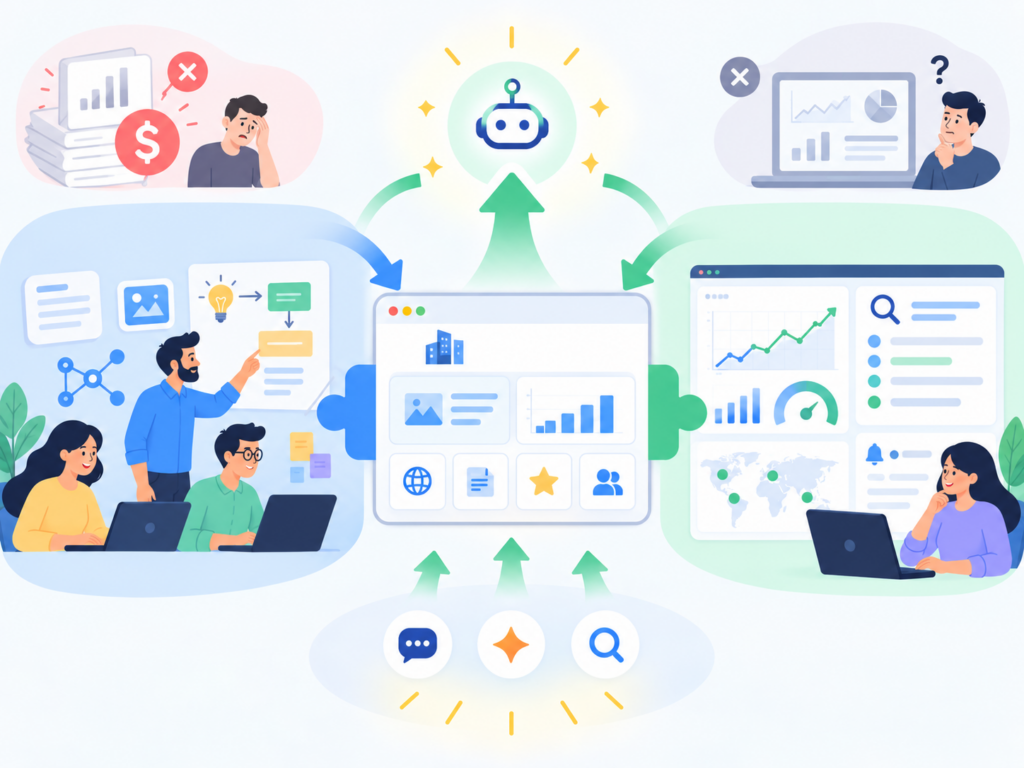
    You sat through three vendor demos last week. One platform promised to automate keyword-targeted content at scale. Another claimed to audit your brand mentions inside ChatGPT. A third offered to restructure your site’s source code for “semantic extractability.” All three called themselves an “AI search agent.”

    You left more confused than when you started. That’s not a knowledge gap on your end. It’s a taxonomy problem in the market. The term “agent” has been stretched so thin it now covers tools that solve fundamentally different problems, for different teams, using different data.

    The cost of buying the wrong category isn’t just wasted budget. It’s months of optimizing for a layer of search that wasn’t your actual bottleneck.

    Every Vendor Says “Agent.” They Don’t Mean the Same Thing.

    Here’s the short version of what each category actually does:

    SEO automation optimizes your pages to rank higher in Google’s organic results. It targets the traditional index of blue links.

    A GEO agent monitors and improves your brand’s overall visibility, sentiment, and recommendation share across AI platforms like ChatGPT, Perplexity, Gemini, and Claude.

    An AEO agent structures your on-page content so that LLMs extract and cite your specific passages as the primary source of truth.

    Think of it this way. SEO automation makes sure your book is properly shelved in the library catalog. A GEO agent ensures the AI librarian consistently recommends your book when patrons ask category-level questions. An AEO agent formats the pages inside your book so the librarian can read aloud and cite a precise paragraph as the definitive answer.

    These aren’t three stages of the same product. They’re parallel systems that solve different problems simultaneously.

    The Comparison Matrix: What Each Tool Type Actually Optimizes

    The clearest way to see where these categories diverge is side by side. This matrix maps the core operational dimensions that matter for a procurement decision.

    DimensionSEO AutomationGEO AgentAEO Agent
    Optimization TargetGoogle SERPs and organic blue-link click-throughsBrand visibility, Share of Model, and sentiment across AI-generated responsesMicro-content extraction and explicit source citation rates in AI answers
    Core MetricsDomain Authority, keyword rankings, page speed, crawl budgetShare of Model, Sentiment Score, Mention Rate, Recommendation PositionCitation Rate, Extraction Likelihood, Schema Coverage, 30/44 Rule Alignment
    Input DataSearch volumes, backlink profiles, SERP metadata, log filesSimulated prompt outputs, citation lists, semantic competitor logsContent structure (H2/H3 hierarchy), JSON-LD schemas, expert quotes, factual statistics
    Output ActionsKeyword clustering, meta-tag updates, content drafts, tech auditsMulti-platform auditing, competitive alerts, citation network reverse-engineeringAnswer Capsule injection, custom schema deployment, expert quote embedding
    Typical BuyerSEO Manager, Content Marketing LeadCMO, Brand Manager, Digital PR DirectorTechnical SEO Specialist, Content Architect, Editorial Director
    Representative ScenarioPublishing hundreds of landing pages to capture high-volume keywordsBenchmarking how often ChatGPT recommends your brand vs. competitorsStructuring a product comparison table so Perplexity cites your exact data

    The key takeaway from this matrix: SEO automation measures Domain Authority and keyword position. GEO agents measure Share of Model, the probability your brand is recommended across a prompt matrix. AEO agents measure citation rate, the percentage of times an engine provides a clickable link back to your domain.

    Different metrics. Different dashboards. Different teams.

    What SEO Automation Does Well, and Where It Stops

    SEO automation is the most mature segment of search technology. Modern tools handle keyword clustering, technical auditing, XML sitemap maintenance, programmatic meta-description generation, redirect monitoring, and automated CMS publishing. For teams managing hundreds or thousands of pages, this layer is non-negotiable.

    But its boundaries are defined by its architecture. SEO automation tools are built for search indexes that crawl, rank, and display documents based on keyword matching, semantic proximity, and backlink authority. They can’t track how a brand is described inside a ChatGPT session. They can’t diagnose why Google’s AI Overview summarizes a competitor’s page instead of yours, even when your page ranks first organically.

    That blind spot is becoming expensive. Google’s AI Overviews now take up 42% of screen real estate on desktop and 48% on mobile, pushing classic blue links below the fold. Organic click-through rates on top results have dropped by 58% to 61% as a result. Meanwhile, AI-referred sessions are growing at 527% to 623% year-over-year. Shopify reported that AI-referred orders grew nearly 13x in Q1 2026, with those visitors converting at 50% higher rates and carrying 14% higher average order values.

    Standard SEO automation can’t capture, monitor, or optimize for that traffic. If your Google rankings are stable but your referral pipeline is shifting toward conversational interfaces, SEO automation alone won’t explain why.

    What a GEO Agent Tracks That SEO Tools Can’t See

    GEO agents operate in a fundamentally different data layer. Instead of querying search engine APIs for static keyword rankings, they run browser-based simulations across ChatGPT, Gemini, Perplexity, Claude, and emerging engines like DeepSeek to track how AI platforms describe, recommend, and position your brand.

    One reason this matters: analysis of 30 million LLM citations shows that 80% of URLs cited by large language models don’t even rank in Google’s top 100 organic results for the same query. Traditional metrics like Domain Authority are poor predictors of AI source retrieval. LLM retrieval algorithms instead prioritize signals like brand search volume (0.334 correlation with citation probability) and YouTube mentions (0.737 correlation), which build what researchers call “Entity Confidence” in the model’s parametric memory.

    That’s a gap most SEO dashboards can’t show you.

    GEO agents track multi-dimensional metrics across this layer. Share of Model (SoM) measures how frequently a brand is recommended across a targeted prompt library. Real-time Sentiment Scoring captures how the AI frames the brand, whether as an industry leader or a cautioned alternative. Retrieval Gap analysis identifies specific conversational pathways where competitors are cited but your brand is omitted.

    Topify is one example of how dedicated GEO platforms approach this. Topify tracks across 7+ AI engines, including both Western platforms and the Mandarin AI ecosystem (DeepSeek, Doubao, Qwen). Its intelligence framework accounts for a key structural reality: research suggests only 30% of brands maintain consistent visibility across multiple regenerations of the same AI query. Visibility in conversational search is probabilistic, not static. A GEO agent treats it accordingly.

    Where the AEO Agent Fits: Optimizing the Answer, Not Just the Mention

    GEO tells you whether AI platforms are recommending your brand. AEO goes one layer deeper: it tells you whether AI is citing your content as the actual source behind its answers.

    The distinction is precise. A brand might appear in a ChatGPT recommendation list (that’s GEO visibility), but the hyperlink citation at the bottom of the answer points to a competitor’s page (that’s an AEO problem). Being mentioned and being cited are two different outcomes, driven by two different sets of on-page signals.

    AEO agents focus on content formatting and structural engineering for Retrieval-Augmented Generation (RAG) systems. Peer-reviewed research from Princeton University, Georgia Tech, and the Allen Institute for AI quantified how specific on-page optimizations affect generative engine visibility:

    Optimization TacticMeasured Visibility Impact
    Quotation Addition (expert quotes)+41%
    Statistics Addition+31% to +37%
    Citing Established Sources+28% to +40%
    Fluency Optimization+28%
    Entity Density (~20.6%)Significant boost
    JSON-LD Schema Markup+67%

    AEO strategies also leverage what’s known as the 30/44 rule. LLMs process web documents top-down and chunk content into modular fragments. Data shows that 44% of all LLM citations are extracted from the first 30% of a page’s content. This means AEO agents implement “Answer Capsules,” concise 40-to-60-word declarative summaries positioned directly beneath H2 headings, designed for RAG scrapers to digest and attribute.

    If your brand is visible in AI recommendations but competitors are getting the citation links, you have an AEO problem, not a GEO problem. The fix isn’t more brand monitoring. It’s restructuring your content for extractability.

    The Overlap Zone: Why Most Teams Need More Than One Tool

    These three categories aren’t sealed boxes. Their boundaries are permeable, and the interdependencies are real.

    Traditional SEO authority remains a baseline requirement. Research shows that 76.1% of URLs cited in Google AI Overviews also rank in Google’s organic top 10. Technical health, backlink structures, and crawlability (all SEO fundamentals) directly affect the retrieval pool that AI Overviews draw from.

    GEO monitoring identifies where the gaps are. AEO provides the formatting playbook to close them. Buying one tool and assuming it covers the full stack is a common and costly mistake.

    Here’s a quick diagnostic:

    Your ProblemRecommended Tool Path
    Google organic rankings are decliningSEO Automation (crawlability, indexation, sitemaps, meta-tags)
    You don’t know if ChatGPT or Perplexity recommend your productGEO Agent (Share of Model, mention baseline, sentiment tracking)
    AI mentions your brand, but cites competitor pages as the sourceAEO Strategy + GEO Agent (audit citation sources, then deploy structural rewrites)

    Topify’s Source Analysis feature sits at this intersection. It addresses a reality that often surprises marketing teams: 82% to 85% of AI citations originate from third-party websites like directories, trade media, and Reddit, not from the brand’s owned domain. By reverse-engineering competitor citation networks, Source Analysis shows exactly where to build digital PR and external citation presence. Its Conversion Visibility Rate (CVR) metric then connects that visibility data to projected downstream revenue, giving C-suite stakeholders the ROI narrative they need.

    Five Questions to Clarify Your Next Purchase

    If you’re evaluating tools right now, run through this framework before booking another demo.

    1. Are your Google rankings stable, but overall referral traffic is dropping? If yes, informational queries are likely being captured by AI Overviews or standalone AI engines. You need a GEO agent first, not more SEO automation.

    2. Do you have quantitative proof of your brand’s presence across ChatGPT, Perplexity, and Gemini? If no, you have a brand blind spot. Standard keyword trackers can’t query LLM vector spaces. A GEO agent with browser-based simulation is the starting point.

    3. Is your brand mentioned in AI outputs, but competitors get the citation links? If yes, your content lacks the structural markers RAG systems prioritize. You need AEO workflows: expert quotes, verifiable statistics, JSON-LD schemas, and Answer Capsules.

    4. Do you need to demonstrate AI search ROI to the C-suite? If yes, simple mention counters won’t cut it. You need a platform with a CVR dashboard that connects conversational tracking to down-funnel conversion data.

    5. Does your team have dedicated content architects for schema and structural rewrites? If no, passive reporting tools will create dashboard fatigue. Look for an agent with autonomous execution capabilities that can push optimizations directly to your CMS.

    Conclusion

    The search stack in 2026 isn’t one thing. It’s three parallel systems, each addressing a different layer of how users discover brands. SEO automation keeps your pages indexed and technically sound. GEO agents track whether AI platforms recommend you. AEO agents ensure your content gets cited as the source.

    The vendors calling all three “AI agents” aren’t wrong about the label. They’re just skipping the part where each solves a different problem for a different team with a different set of metrics. Your job is to match the tool to the bottleneck.

    For teams ready to start with the layer most organizations are missing, Topify’s Free GEO Score Checker offers a fast baseline across the conversational search landscape. It won’t replace a full-stack strategy, but it’ll show you where you stand before you sign anything.

    FAQ

    Q: What is the difference between AEO and GEO?

    A: GEO is a broad strategy focused on tracking and improving a brand’s overall presence, recommendation probability, and sentiment across generative AI engines. AEO is a technical subset focused on structuring on-page content so RAG systems extract and cite your text as the primary source. GEO asks “does AI mention us?” AEO asks “does AI link to us as the source?”

    Q: Can one tool handle both AEO and GEO?

    A: Some advanced platforms bridge this gap. Topify, for instance, monitors brand sentiment and positioning across 7+ AI engines (GEO layer) while also diagnosing citation gaps and offering content restructuring to optimize for direct extraction (AEO layer). That said, teams with heavy technical SEO needs will typically still run a separate SEO automation tool alongside.

    Q: Is SEO automation still necessary if I have a GEO agent?

    A: Yes. Traditional SEO and GEO are complementary. 76.1% of URLs cited in Google AI Overviews also rank in Google’s organic top 10. SEO technical optimization and link building establish the crawlable authority that allows AI models to find and trust your content in the first place.

    Q: What metrics should I track for AEO vs GEO?

    A: For GEO, focus on Share of Model, brand mention frequency, real-time sentiment scoring, and competitive recommendation positioning. For AEO, track citation rates (how often a mention includes a link), 30/44 rule alignment, schema validation, and Conversion Visibility Rate (CVR) to connect citations to revenue impact.

    Read More

  • LLM Citations vs. Backlinks: What Actually Changed

    LLM Citations vs. Backlinks: What Actually Changed

    Your domain authority is solid. Your backlink profile looks strong. Your pages rank in the top 10 for a dozen competitive keywords. Then someone asks ChatGPT for a recommendation in your category, and your brand doesn’t show up once.

    That gap between traditional SEO performance and AI search visibility is widening. Brand mentions now correlate at 3:1 over backlinks when it comes to AI Overview placement. The signals that made your site rank aren’t the same signals that make AI recommend you. And the difference between an LLM citation and a backlink isn’t just technical. It’s structural.

    Backlinks Built the Old Web. LLM Citations Are Building the New One.

    For more than twenty years, the hyperlink was the internet’s primary trust instrument. Google’s PageRank algorithm treated each backlink as a vote of confidence from one domain to another, and that logic shaped how every brand thought about authority. Rank higher, get more links, rank higher still. The entire system was built around navigation: guiding users to the most authoritative destination.

    LLM citations work on a completely different principle. When an AI model generates a response, it doesn’t look for the most popular page. It looks for the most corroborable passage. An LLM citation happens when a model identifies, retrieves, and explicitly references a specific piece of content as the factual basis for its answer. The currency isn’t connectivity. It’s consensus.

    The scale of this shift is already measurable. AI-driven website sessions grew by roughly 527% year-over-year in early 2025. As of 2026, approximately 48% of Google queries trigger an AI Overview, pushing traditional organic results further down the page. Being the top result in a traditional index no longer guarantees visibility if your brand isn’t also synthesized into the AI’s narrative.

    DimensionLink EconomyConsensus Economy
    Primary SignalHyperlinks (Backlinks)Brand Mentions and Citations
    Authority LogicPopularity-based (PageRank)Corroboration-based (Consensus)
    Search MechanismCrawling and IndexingRetrieval-Augmented Generation
    User ValueNavigation to a sourceDirect answer with attribution
    Content UnitThe Domain/PageThe Passage/Atomic Claim

    The shift boils down to this: from “who links to you” to “who is talking about you.”

    Where Backlinks and LLM Citations Actually Diverge

    Traditional search engines map the web through links. LLMs map the web through entities. That’s not a subtle distinction. It changes what counts as authority, how content gets evaluated, and what marketers should measure.

    The numbers make the disconnect clear. While 76% of URLs cited in Google’s AI Overviews also rank in the organic top 10, that correlation falls apart for standalone LLMs. Around 80% of URLs cited by ChatGPT don’t rank in Google’s top 100 for the same query. AI models are searching a different universe of content.

    In that universe, unlinked brand mentions carry more weight than most SEO practitioners realize. Brands that show up consistently across four or more non-affiliated platforms are 2.8 times more likely to appear in ChatGPT responses. Mentions on Quora and Reddit alone correlate with 4x higher citation likelihood. Third-party review profiles on G2, Capterra, and Trustpilot increase citation chances by 3x.

    MetricTraditional SEOLLM / Generative Engine
    Authority MeasurementDomain Rating (0-100)Entity Confidence Score
    Ranking CorrelationHigh (Links = Rank)Low (Links ≠ Citation)
    Impact of MentionsMinimal / IndirectCritical (3:1 over links)
    Multi-Platform SignalOptionalEssential (4+ platforms = 2.8x lift)
    Conversion RateStandard Organic (~2-3%)4.4x Higher (pre-qualified intent)

    That last row matters more than most teams think. AI-referred visitors aren’t just more visible. They convert at dramatically higher rates because the model has already pre-qualified the recommendation.

    Why a High DR Doesn’t Guarantee an LLM Citation

    Here’s where the old mental model breaks. A website with a DR of 70+ can be entirely bypassed by AI citation engines in favor of a niche blog with a DR of 30.

    LLMs don’t evaluate authority through link equity. They evaluate it through topical depth, neutral guidance, and structural extractability. An AI model will prefer a vendor-neutral comparison guide from an industry-specific publisher over a Forbes article that mentions a brand in passing. The niche content is easier to rephrase as a factual answer, and that’s what matters to the model’s confidence layer.

    Each platform also pulls from a different source pool. ChatGPT matches Bing’s top 10 results about 87% of the time, making Bing optimization directly relevant. Perplexity leans heavily on user-generated content, with Reddit accounting for 46.7% of its preferred source citations. AI Overviews draw 76.1% of their sources from Google’s own organic index.

    This means a brand can dominate Perplexity (strong Reddit presence) and be invisible on ChatGPT (weak Bing rankings) at the same time. Optimizing for a single model misses citation opportunities on the others.

    A few data points sharpen this further. Content with statistics and named citations gets 30-40% higher visibility in AI responses. About 44.2% of all LLM citations come from the first 30% of an article’s text. And content updated within the last 30 days is 3.2x more likely to be cited than older material. Freshness isn’t optional in generative search. It’s a filter.

    The Content Formats That Earn LLM Citations

    LLMs don’t read your entire 3,000-word article. They use retrieval-augmented generation (RAG) to pull specific passages that contain a direct answer to a user’s prompt. Content that’s structured in atomic, extractable fragments wins.

    Comparative listicles are the clear front-runner. Articles that rank or compare multiple tools or services account for 32.5% of all AI citations, the highest-performing format identified in 2026. The reason is mechanical: listicles provide the entity-relationship mapping that LLMs need to synthesize comparisons.

    Other high-performing structures include FAQ sections with schema markup (3.2x more likely to appear in AI Overviews), question-based H2/H3 headings (3x higher citation rate), and original data tables (4.1x more citations than text-only equivalents). The first paragraph of each section matters disproportionately: providing a direct answer in the first 40-60 words increases citation probability by 67%.

    Specificity is a trust signal. An LLM is far more likely to cite “Companies see 4.4x conversion rates from AI search (Semrush, 2026)” than “Companies see significant improvements in search performance.” Vague claims get filtered out. Specific, attributed claims get quoted.

    Earned media distribution also plays a larger role than most brands expect, with a median lift of 239% in AI citations. Journalistic and earned media sources now account for roughly 25% of all citations generated by large language models.

    E-E-A-T has shifted too. Content with clear author bylines and real credentials achieves 2.3x more citations than anonymous corporate content. If an LLM can’t find a real person with real experience attached to the advice, it’s less likely to cite it.

    How to Track LLM Citations When There’s No Search Console for AI

    There’s no native “LLM Citation Report” in Google Search Console. Traditional analytics can tell you about clicks and rankings, but AI visibility is often a zero-click experience where the user gets the answer and the brand awareness without ever visiting your site.

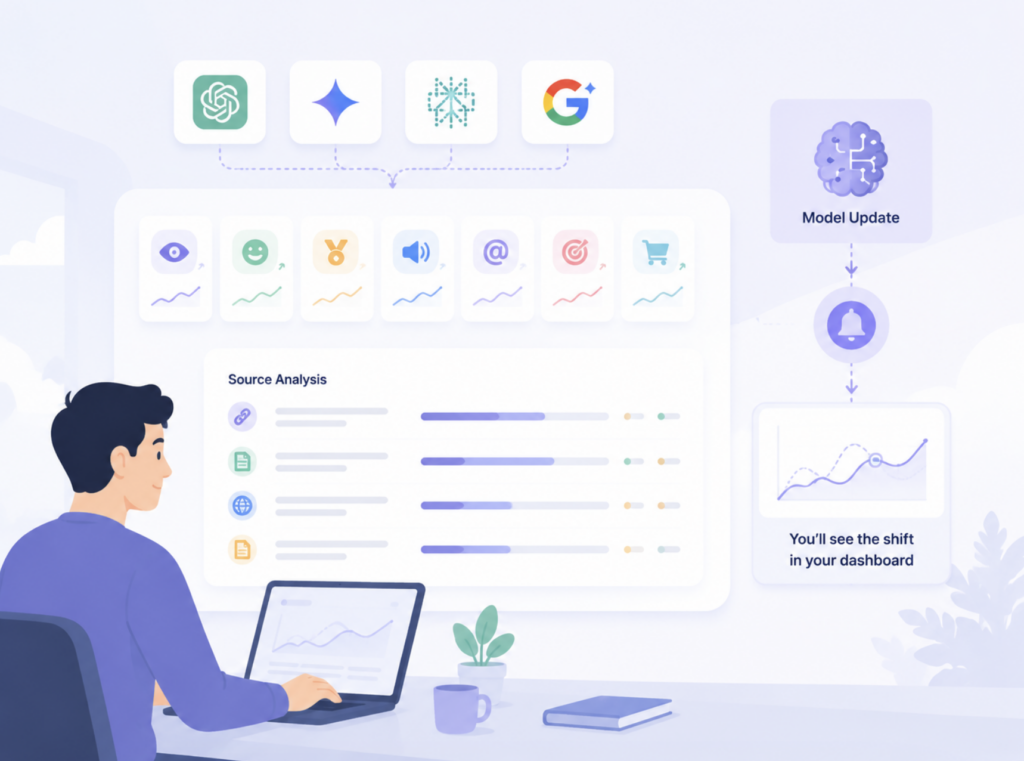
    That tracking gap is exactly what Topify was built to fill. The platform monitors brand visibility across ChatGPT, Gemini, Perplexity, and other major AI engines through a seven-metric framework: Visibility Score, Sentiment Score, Position Rank, Source Analysis, Mention Volume, Intent Alignment, and CVR (Conversion Visibility Rate).

    The practical value is in the cross-platform view. A brand might discover it has an 80% Visibility Score on Perplexity (driven by Reddit consensus) but only a 12% Visibility Score on ChatGPT (due to weak presence in Bing-indexed publications). That kind of gap is invisible without platform-specific tracking. Topify’s Source Analysis feature lets you reverse-engineer which domains and URLs AI platforms are actually citing, so you can see whether your content or your competitor’s content is driving the model’s recommendations.

    For teams already using Ahrefs or SEMrush, this isn’t a replacement. It’s a different layer. Traditional tools cover the infrastructure of rankings and backlinks. AI visibility tools cover the citation layer that determines whether your brand gets recommended in the first place.

    Backlinks Still Matter. Just Not the Way You Think.

    The “backlinks are dead” narrative is wrong. What’s changed is their role.

    Since 76% of AI Overview citations come from pages that already rank in Google’s organic top 10, strong traditional SEO is still the primary filter AI uses to determine what’s worth citing. A page that can’t rank on Google is unlikely to get cited by ChatGPT. Backlinks are the gatekeepers to the AI’s citation pool.

    But the reverse is also true. AI systems cite content that Google barely registers. Pages that never ranked for their target keyword but provide the best structured answer to a specific question can earn consistent LLM citations. The relationship isn’t either/or. It’s layered.

    In a 2026 search strategy, backlinks function as infrastructure: they build the crawl priority, index authority, and baseline trust that get your content into the retrieval pool. LLM citations function as the growth layer: they determine whether the AI actually surfaces your brand when someone asks a question that matters. The two signals compound. High-quality backlinks increase the odds of retrieval. Structured, extractable content increases the odds of citation.

    The most effective approach is hybrid. Create content that uses traditional SEO fundamentals (keywords, internal linking, authority building) to secure a position in Google’s top 10, then layer in atomic answer blocks, data tables, and FAQ schema to secure a citation in the AI summary. One piece of content, two discovery surfaces.

    Conclusion

    The shift from backlinks to LLM citations isn’t about one replacing the other. It’s about a new layer of authority that most brands aren’t tracking yet. Backlinks still build the foundation. But LLM citations decide whether AI recommends your brand or your competitor’s.

    The practical path forward has three steps. First, audit your current AI visibility across platforms using a tool like Topifyto see where you’re cited and where you’re missing. Second, restructure your highest-value content into extractable formats: comparison tables, FAQ sections, and atomic answer blocks in the first 40-60 words of each section. Third, build off-page consensus through earned media and brand mentions on the platforms that AI models actually pull from.

    The brands that figure this out early won’t just rank. They’ll be the ones AI recommends.

    FAQ

    What is an LLM citation?

    An LLM citation is a reference within an AI-generated answer that attributes a fact, recommendation, or data point to a specific source URL. When ChatGPT, Perplexity, or Google AI Overviews cite your content, they’re using it as supporting evidence for their response.

    Do backlinks still help with AI search visibility?

    Yes. Backlinks remain the primary foundation for index authority. Since 76% of AI Overview citations come from pages ranking in Google’s organic top 10, backlinks are the entry ticket to being considered for an LLM citation. They’re necessary, but no longer sufficient on their own.

    How can I check if my brand is being cited by ChatGPT?

    There’s no native dashboard for AI search citations. You’ll need a third-party AI visibility tool like Topify that runs simulated prompts across multiple LLMs to track where your brand is mentioned, cited, and recommended compared to competitors.

    What content formats get the most LLM citations?

    Comparative listicles (“Best X for Y”) account for 32.5% of all AI citations, making them the highest-performing format. FAQ sections with schema markup, structured data tables, and question-based headings also perform well. The first 40-60 words of each section carry disproportionate weight.

    Read More

  • We Tracked 1,000 Brands Across 4 LLMs for 90 Days

    We Tracked 1,000 Brands Across 4 LLMs for 90 Days

    Your brand ranks on the first page of Google. Your domain authority sits above 60. Your content team publishes weekly. And yet, when a potential buyer asks ChatGPT for a recommendation in your category, your name doesn’t come up. Not once. Across 10,000 matched queries and four major AI platforms, the average brand inclusion rate in AI-generated answers was just 0.3%. Traditional SEO metrics can’t explain that number, because they weren’t built to measure what AI chooses to say.

    The gap between what brands think their visibility is and what AI models actually show is wider than most marketing teams realize. And it’s growing.

    What 90 Days of AI Visibility Tracking Actually Revealed

    Over 90 days, we monitored 1,000 cross-industry brands across ChatGPT, Gemini, Perplexity, and DeepSeek, executing more than 10,000 matched queries per platform. The goal was simple: measure how often a brand actually appears in the synthesized answer layer of the web.

    The results weren’t subtle. A majority of brands were completely invisible on at least one major AI platform. A brand might surface in 48% of ChatGPT responses for a given category while registering near-zero visibility on Gemini or DeepSeek.

    Cross-platform consistency told an even rougher story. Only 11% of domains were cited by both ChatGPT and Perplexity for the same query. That means ai visibility tracking isn’t about finding a single score. It’s about understanding a fragmented, probabilistic landscape where each LLM views trust and authority through a different lens.

    Visibility MetricAverage BaselineTop 1% Performers
    Brand Inclusion Rate0.3%12% to 45%
    Cross-Platform Overlap11%62%
    Zero-Click Impact60%83% to 93%
    Conversion Rate (AI Traffic)14.2%20% to 30%

    Here’s what made the data especially uncomfortable: only 30% of brands stayed visible across consecutive AI sessions, and just 20% held their presence across five consecutive prompt runs. AI visibility isn’t a ranking you earn once. It’s a position you either maintain or lose.

    The Visibility Gap Most Brands Don’t Know Exists

    The most dangerous assumption in modern marketing is that strong SEO automatically translates into AI visibility. It doesn’t.

    Analysis of over 34,000 AI responses found that only 17% to 32% of sources cited in AI results also rank in the organic top 10 on Google. In local search, the gap is even more extreme: 35.9% of locations show up in Google’s traditional local 3-pack, but only 1.2% get recommended by ChatGPT for the same intent.

    The reason comes down to how AI models decide what to cite. Traditional search rewards keyword density and link equity. LLMs reward something different: information gain, fact density, and entity consensus. If your site delivers marketing-heavy narrative but lacks structured, extractable data points, the model will skip it for a source that offers clear, citable metrics.

    That’s the gap most brands still can’t see.

    Brands with 9 or more structured, extractable facts achieve a 78% average AI coverage rate. Those with only 2 facts drop to 9%. The overlap between top-performing organic search domains and AI-cited sources has collapsed to under 20% in many competitive categories.

    DimensionTraditional SEOGenerative Engine Optimization
    MechanismCrawling, Indexing, RankingRetrieval, Filtering, Synthesis
    Authority FocusBacklinks (Domain Authority)Entity Mentions (Brand Trust)
    Content PriorityKeywords and NarrativeFacts and Structured Data
    User OutcomeClick to a DestinationAnswer Inside the Interface
    StabilityRelatively StaticHighly Probabilistic

    Which LLMs Recommend Your Brand, and Which Ignore It

    Each of the four major LLMs has developed a distinct sourcing personality. Understanding those differences is the first step toward building a cross-platform ai visibility tracking strategy.

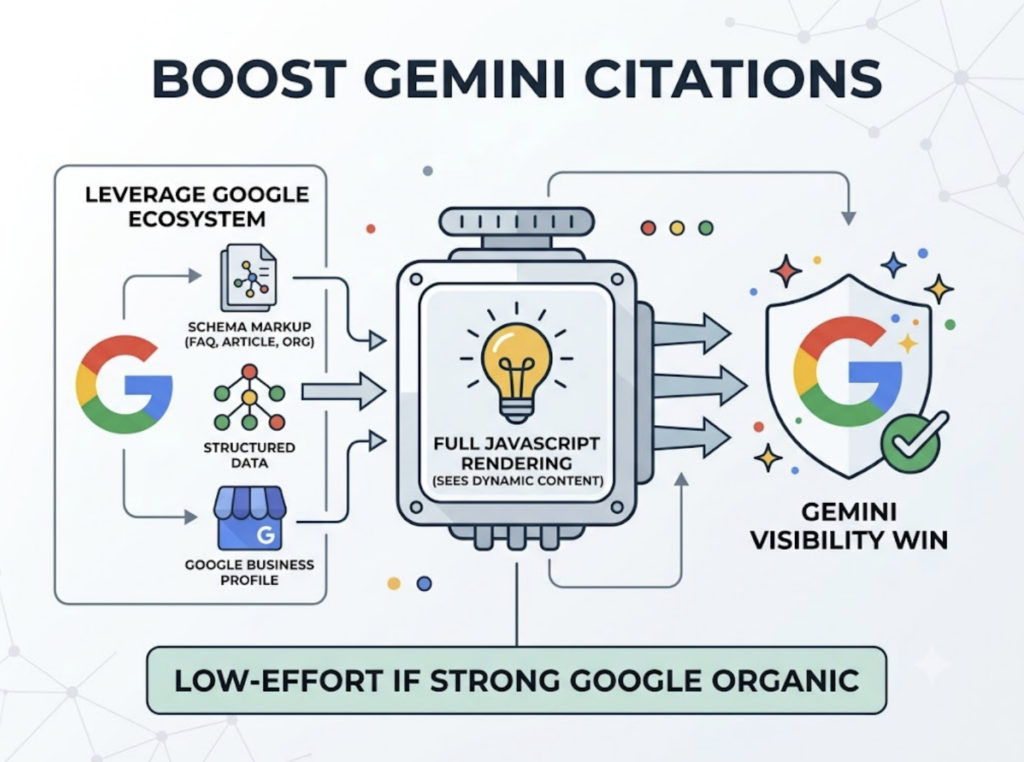
    Google Gemini leans heavily on brand-owned content. Research shows that 52.15% of Gemini’s citations come from brand-owned websites. It trusts what a brand says about itself, provided the information is delivered through high-quality structured data and schema markup. If your technical SEO foundation is weak, Gemini will ignore you.

    ChatGPT runs on a different logic entirely. Nearly 48.73% of its citations come from third-party directories, listings, and consensus sites like Yelp, TripAdvisor, and industry aggregators. For ChatGPT, authority is a function of how many independent sources agree that your brand is the answer. Digital PR and broad web distribution matter here more than on-site optimization.

    Perplexity AI favors niche expertise and real-time validation. For subjective or “best-of” queries, niche sources make up 24% of its citations, the highest of any model. It’s particularly sensitive to recency and specialization, often pulling from regional directories and verified customer reviews that its peers skip entirely.

    DeepSeek operates as a reasoning-first engine. Its retrieval logic is weighted toward author expertise, publication authority, and technical performance. DeepSeek conducts live web scans and selects sources based on citation-worthy statistics and data density, not brand awareness.

    AI PlatformSourcing BiasPrimary Citation TypeKey Visibility Lever
    GeminiBrand OwnershipBrand-Owned DomainsStructured Schema / Local Pages
    ChatGPTPublic ConsensusDirectories and ListingsCross-Site Mentions / Digital PR
    PerplexityNiche ExpertiseExpert Reviews / RedditSpecialized Content / Reviews
    DeepSeekReal-Time ReasoningData-Dense SourcesAuthor Authority / Page Speed

    The takeaway is clear: a brand might be ChatGPT’s top recommendation thanks to strong directory presence, yet remain completely invisible on Gemini because its on-site schema is missing. One strategy won’t cover four platforms.

    AI Visibility Tracking Metrics That Actually Matter

    Traditional metrics like impressions and clicks increasingly mask what’s really happening. A brand might see rising impressions in Google Search Console while its click-through rate collapses because an AI Overview is answering the query above the fold.

    To manage this shift, marketers need a metric framework that reflects how LLMs actually behave. The Topify 7-Metric Hierarchy provides that lens, built specifically for the probabilistic nature of AI responses.

    Visibility Score measures how often a brand is explicitly named across a universe of high-intent prompts, on a 0-to-100 index. Sentiment Score evaluates how the AI frames the brand. There’s a meaningful difference between being called a “reliable leader” and a “budget alternative.” Position Rank tracks where the brand appears in the recommendation list, because in AI search, the first-mentioned brand captures the majority of trust.

    Volume measures monthly conversational demand for specific prompts. Mentions captures raw frequency per 1,000 queries, the AI equivalent of Share of Voice. Intent Alignment checks whether the AI is matching the brand to the right buyer personas. High visibility with low intent alignment is wasted exposure.

    Then there’s CVR (Conversion Visibility Rate), which estimates the revenue impact of an AI mention by analyzing recommendation context and prompt intent. This is becoming the North Star metric for CMOs, and for good reason: AI-referred visitors convert at rates up to 5x higher than traditional organic traffic, with an average conversion rate of 14.2%.

    Topify MetricDiagnostic Purpose2026 Performance Target
    Visibility ScoreMeasures general discovery> 45% for core categories
    Sentiment ScoreDetects narrative drift> 70/100 (weighted positive)
    Position RankEvaluates recommendation power< 2.0 (top 2 placement)
    CVRTranslates visibility to ROI14.2% conversion benchmark

    What Changed Over 90 Days, and What Stayed Flat

    AI visibility isn’t static. Unlike the relatively stable rankings of the SEO era, LLM recommendations shift constantly due to model drift, where retrieval logic or training weights change over time.

    The brands that gained visibility during the study shared a clear profile. They actively used Generative Engine Optimization (GEO) tactics: structuring specifications in HTML tables, using the inverted-pyramid content format, and maintaining consistent brand facts across every digital surface. These “Rising” brands saw citation lifts of up to 4.5xthrough GEO execution.

    “Falling” brands stayed reactive. They kept producing keyword-stuffed blog posts that AI models found difficult to summarize. Worse, they suffered from narrative fragmentation, where different digital properties offered contradictory facts about the brand. When an AI loses confidence in an entity’s consistency, it filters that entity out.

    One finding surprised even the research team: content freshness isn’t optional. Brands with content refreshed within the last year accounted for 65% of all AI citations. ChatGPT’s reference URLs averaged 393 days newer than those in organic Google results. On the flip side, brands that remain static lose approximately 1.8% of their AI coverage every month they don’t update.

    FeatureRising BrandsFalling Brands
    Content FormatStructured tables, data-dense blocksLong-form narrative, low fact density
    Primary MetricAI Visibility Score and CVRGoogle Keyword Rank
    Update CycleEvery 30 daysSet-and-forget
    Optimization LogicSynthesis and entity signalsLink equity and keywords
    Visibility Trend4.5x citation liftSystematic erosion of Share of Voice

    How to Start AI Visibility Tracking for Your Brand

    The study proves one thing clearly: brands that track AI visibility weekly are 3x more likely to appear in AI-generated answers within 90 days. Here’s the framework that works.

    Step 1: Define the prompt universe. Identify the conversational questions your buyers actually ask. This isn’t keyword research. It involves analyzing sales transcripts, community forums, and support tickets to find high-intent modifiers that trigger AI recommendations.

    Step 2: Establish a baseline. Run your prompt library across ChatGPT, Gemini, Perplexity, and DeepSeek to establish an initial AI Visibility Score. Without this baseline, you can’t prove the ROI of any GEO effort that follows.

    Step 3: Audit the visibility gap. Determine why your brand is missing. Is it a lack of structured facts? Negative sentiment from an old news cycle? Or a shortage of third-party validation?

    Step 4: Deploy GEO content. Rewrite key pages to provide direct answers. Add HTML comparison tables. Integrate expert citations. These tactics have been shown to increase citation rates by up to 41%.

    Step 5: Monitor continuously. A 30-day recheck is the minimum. Weekly is recommended for competitive sectors.

    For teams looking to operationalize this workflow, Topify maps its features directly to each step. Its AI Visibility Checkerprovides cross-platform scores, High-Value Prompt Discovery surfaces the conversational intent traditional tools miss, and Source Analysis pinpoints the exact domains driving competitor recommendations while your brand stays invisible. One-Click Execution generates schema-rich content blocks and answer-first FAQs that can be deployed directly to a CMS.

    Pricing starts at $99/month for the Basic plan (100 prompts, 9,000 answer analyses), with the Pro plan at $199/month adding full Source Analysis and 250 prompts. Enterprise plans start at $499/month with dedicated support and API access. You can get started here.

    Conclusion

    The 90-day data across 1,000 brands tells one story: AI visibility tracking is no longer a nice-to-have. It’s the metric that separates brands buyers can find from brands that have effectively disappeared. With cross-platform overlap at just 11%, conversion rates from AI traffic hitting 14.2%, and static content losing 1.8% of coverage every month, the cost of not tracking is already measurable.

    The brands winning in AI search aren’t the ones with the highest domain authority. They’re the ones that know exactly where they stand across every LLM, every week. Start tracking. Start optimizing. The window to build a citation moat is open, but it won’t stay that way.

    FAQ

    Q: What is ai visibility tracking?

    A: AI visibility tracking measures how frequently and authoritatively a brand appears in generative AI responses across platforms like ChatGPT, Gemini, Perplexity, and DeepSeek. It focuses on Share of Model Voice and citation frequency rather than traditional keyword rankings.

    Q: How often should I track brand visibility in AI search?

    A: Given the volatility of LLM outputs and the frequency of model drift, professional teams should track visibility weekly at minimum. Daily tracking is recommended for highly competitive sectors like B2B SaaS and fintech.

    Q: Which AI platforms should I track my brand on?

    A: A solid strategy requires tracking across the four major foundational models: ChatGPT (for consensus-based recommendations), Google Gemini (for owned-data authority), Perplexity (for specialized research), and DeepSeek (for technical and STEM reasoning).

    Q: Can traditional SEO tools track AI visibility?

    A: No. Traditional SEO tools monitor URL positions on a page of results. They can’t interpret natural language answers or quantify how a brand is being recommended in a synthesized conversational summary. Dedicated AI visibility tools like Topify are built to measure these probabilistic signals.

    Read More

  • Free vs Paid AI Visibility Trackers: What You Actually Get

    Free vs Paid AI Visibility Trackers: What You Actually Get

    Your team ran a free AI visibility check last Tuesday. The report came back: “Visibility Score: 42/100.” Your CMO asked the obvious follow-up: “What do we do about it?” And nobody in the room had an answer.

    That’s the gap between knowing you have a problem and knowing how to fix it. Free AI visibility tools are good at confirming suspicion. Paid ones are built to drive action. The difference isn’t just about features on a spec sheet. It’s about whether the data you’re getting can actually change your next quarter’s results.

    The $0 Report That Tells You Nothing Actionable

    Most free AI visibility tools work through a singular query mechanism. You type in your brand name, pick a prompt, and the tool checks whether you were mentioned in a single response at a single moment. You get a score.

    Here’s the problem: AI models are non-deterministic. The same prompt can return different results depending on the model’s temperature setting, recent data refreshes, and cache cycles. Research into AI search volatility indicates that only about 30% of brands maintain consistent visibility across multiple regenerations of the same query. That score you captured in the morning could be irrelevant by the afternoon.

    Free tools also tend to focus on a single platform, usually ChatGPT. But brand representation is highly fragmented across different models. Perplexity pulls roughly 46.7% of its top citations from Reddit. Gemini prioritizes pages that already rank well in traditional Google search. A brand winning on ChatGPT may be invisible on Perplexity.

    That’s not a minor gap. That’s a strategic blind spot.

    What Free AI Visibility Trackers Actually Include

    Free tools generally fall into three categories, each solving a different “first step” problem.

    Tool CategoryWhat It DoesBest ForWhat It Misses
    Bot Access CheckersVerifies robots.txt permissions for AI crawlers like GPTBot and PerplexityBotTechnical SEOs during initial site setupWhether content is actually used in responses
    Structural GradersAudits Schema markup, heading hierarchy, FAQ structureContent writers doing pre-publish checksLive response tracking or brand mentions over time
    Single-Shot Mention TrackersDetects brand presence for a limited set of promptsSolo founders or personal brands checking basic indexingHistorical trends, sentiment, or position weighting

    These tools are genuinely useful for situational awareness. Topify’s free GEO Score Checker, for example, evaluates a site across four dimensions: AI bot access, structured data, content signals, and overall visibility. It’s the fastest way to identify whether AI crawlers can even read your site.

    But a diagnostic isn’t a strategy. And that’s where free tools hit a hard ceiling.

    Where Free AI Visibility Tracking Hits a Wall

    The transition from free to paid isn’t about prestige. It’s driven by three concrete limitations: frequency, depth, and cross-platform coverage.

    Snapshots vs. continuous monitoring. Free tools give you one data point. AI models aren’t static libraries: they combine training data with live web retrieval, subject to crawl timing, source selection changes, and cache cycles. During a PR crisis, you need hourly sampling to measure how quickly models ingest corrections. A free tool can’t tell you the direction or speed at which AI perception is changing. Paid trackers call this “Sentiment Velocity,” and it’s the metric that separates reaction from prediction.

    Mention status vs. source forensics. A free tool can confirm “yes, you were mentioned.” A paid tracker reverse-engineers the citations, identifying exactly which third-party URLs the AI used to justify its response. This matters because AI models often favor third-party sources like Reddit, G2, and industry journals over brand-owned content. Between 82% and 85% of AI citations come from third-party domains. If the model is citing a five-year-old negative forum post, a free tool shows low sentiment but won’t tell you which URL to target for a content refresh.

    One-platform bias vs. the multi-model reality. Most free tools only cover ChatGPT. But studies show only a 25% overlap in brand recommendations between ChatGPT and Perplexity. A brand can be dominant on one and invisible on the other. Only a multi-model tracker reveals that discrepancy.

    You can’t optimize what you don’t continuously track.

    What Paid AI Visibility Tracking Unlocks

    Paid platforms shift the conversation from “am I mentioned?” to “why, where, how, and relative to whom?” Topifypioneered a seven-metric framework designed for this:

    MetricWhat It Tells YouTraditional SEO Equivalent
    Visibility RateMention frequency across target promptsPage Impressions
    Sentiment ScoreHow AI frames your brand: positive, neutral, or criticalBrand Reputation
    Position ScoreYour rank within a multi-brand AI responseKeyword Rankings
    Source Citation ShareWhich URLs influence what AI says about youBacklink Profile
    AI Query VolumeMonthly demand for specific prompts across AI platformsSearch Volume
    Intent CoverageVisibility across informational, comparative, and transactional queriesSearch Intent Alignment
    CVRConversion probability from AI citationsOrganic Sessions / ROI

    This isn’t just more data. It’s data that closes the loop between measurement and action. Early data suggests that visitors arriving from an AI recommendation convert at roughly 5x the rate of traditional organic search visitors. That conversion premium exists because the AI has pre-qualified the user before they ever click.

    The cost of not tracking is rising, too. Global business losses from AI hallucinations were estimated at $67.4 billion in 2024, with 47% of executives making major decisions based on unverified AI content. Paid tools like Topify include hallucination detection that flags pricing errors, outdated claims, and inaccurate brand descriptions before they cost you deals.

    How Topify Bridges Free and Paid AI Visibility Tracking

    Most platforms force a binary choice: free diagnostic or full subscription. Topify is built around a progression path.

    It starts with the free GEO Score Checker. No signup required. You get an instant audit of AI bot access, structured data, and content signals. If your robots.txt is blocking GPTBot or your Schema markup is missing, you’ll know within seconds. That’s the “is the foundation broken?” question, answered in under a minute.

    Once you’ve confirmed a baseline problem, the paid tiers unlock the full monitoring and optimization stack:

    Basic ($99/mo): 100 prompts tracked across ChatGPT, Perplexity, Gemini, and AI Overviews. Four projects, four seats. Includes a 30-day trial. Best for individual marketers or small teams establishing their first AI visibility baseline.

    Pro ($199/mo): 250 prompts, full sentiment suite, competitor Share of Voice benchmarking, and 10 seats. Designed for agencies and mid-market teams managing multiple brands.

    Enterprise (from $499/mo): Dedicated account manager, custom prompt volume, and API integration for brands embedding AI visibility data into internal dashboards.

    The differentiator isn’t just the data. It’s Topify’s One-Click GEO Execution. When the analytics flag a visibility gap or a negative citation source, the system generates a prioritized roadmap: which pages to update, which schema to add, which content angles to pursue. That’s the bridge most platforms are missing, the step between “here’s your problem” and “here’s the fix.”

    A Side-by-Side Look at Free vs Paid AI Visibility Tracking

    DimensionFree TrackersPaid Trackers (Topify)
    Platform Coverage1-2 engines, usually ChatGPTChatGPT, Gemini, Perplexity, DeepSeek, AI Overviews, and more
    Update FrequencySingle snapshot, ad-hocDaily or hourly continuous monitoring
    Metric DepthMention yes/no, simple scoreVisibility, Sentiment, Position, Volume, Source, Intent, CVR
    Competitor TrackingRare or very limitedHead-to-head Share of Voice by prompt category
    Source AnalysisNoneTraces mentions to specific URLs and authoritative domains
    ActionabilityData without contextPrioritized fix roadmap with one-click execution
    Price$0$99/mo to $499+/mo

    The price difference is a reflection of information completeness. In an environment where 83% of searches are resolved within the AI interface, the cost of being invisible on a high-intent query far exceeds a monthly subscription.

    When Free Is Enough, and When It’s Not

    Not every team needs a paid tracker on day one. The decision depends on competitive risk and customer lifetime value.

    Free tools are the right choice when you’re running a personal brand, an early-stage startup still validating product-market fit, or a team doing its first exploratory audit. If the goal is a quick check to ensure crawlers aren’t blocked, a free diagnostic like Topify’s GEO Score Checker is the right starting point.

    Paid tracking becomes necessary when the stakes get higher. Agencies managing multi-brand portfolios need a unified dashboard across client entities. High-LTV B2B SaaS companies can’t afford a hallucinated pricing error to break a deal. Brands aiming for category leadership need to capture at least 25-30% Share of Voice to dominate AI recommendations. And marketing teams reporting to the board need to prove that AI-driven traffic converts at documented rates to justify budget allocation.

    The pattern across competitive categories is consistent: the #1 ranked brand in AI mentions captures an average of 62% of total AI Share of Voice. The gap between #1 and #3 is typically 5x. There’s no page two in AI search. You’re either in the answer or you’re not.

    Conclusion

    Free and paid AI visibility trackers aren’t competing products. They’re different stages of the same journey. Free tools answer “do I have a problem?” Paid tools answer “what’s causing it, how bad is it, and what do I do next?”

    The practical path: start with a free GEO score check to confirm your foundation is intact. If you find gaps, or if you’re operating in a category where AI recommendations influence buying decisions, move to continuous monitoring. The brands that treat AI visibility tracking as an ongoing discipline, not a one-time audit, are the ones building a durable advantage in how AI recommends, describes, and ranks them.

    FAQ

    What’s the difference between free and paid AI visibility tracking? 

    Free tools provide a point-in-time diagnostic of technical readiness and a simple mention score. Paid tools provide continuous multi-platform monitoring, sentiment analysis, historical trends, and source forensics that identify which third-party URLs are influencing the AI’s response.

    Can free AI visibility tools track multiple platforms? 

    Most can’t. Free tools typically focus on ChatGPT, creating a “one-platform bias.” Since brand presence varies significantly across engines, with only 25% overlap between ChatGPT and Perplexity recommendations, single-platform data creates blind spots that only multi-model trackers can fill.

    How often should I check my brand’s AI visibility? 

    Because only 30% of brands maintain consistent visibility across query regenerations, a single snapshot is insufficient. Professional teams typically monitor daily or weekly, with high-priority brands using hourly tracking during PR events or product launches.

    Is AI visibility tracking worth paying for? 

    For brands in competitive or high-LTV categories, yes. AI-referred traffic converts at roughly 5x the rate of traditional search, and global losses from AI hallucinations reached $67.4 billion in 2024. Paid tracking is both a growth channel and a reputation insurance policy.

    Read More

  • Profound vs Peec vs Topify: Compared

    Profound vs Peec vs Topify: Compared

    You’ve tested three AI visibility tracking dashboards this month. Each one gave you a different “visibility score” for the same brand, on the same prompt, across the same AI engine. One says you’re at 72. Another says 41. The third won’t even show a number without an enterprise contract.

    The discrepancy isn’t a bug. It’s the core problem with the category right now. These platforms don’t just differ in UI or pricing. They differ in what they actually measure, how they collect data, and whether they give you anything actionable once you’ve seen the numbers.

    Most AI Visibility Tracking Tools Measure Different Things. That’s the Real Problem.

    The reason your dashboards disagree starts with a technical split most buyers never see: API monitoring vs. UI scraping. API-based tools pull “sanitized” outputs that often lack the formatting, citation placement, and recommendation hierarchy visible to real users. UI scraping mirrors what a human actually sees, but it’s fragile. A minor layout change from OpenAI or Google can break an entire data pipeline overnight.

    That distinction alone explains most of the score discrepancies marketing teams encounter.

    There’s a second, subtler gap. Most platforms conflate “mentions” and “citations.” A mention is the raw count of your brand name appearing in an AI-generated response. A citation is a direct attribution where the model links to your URL as an authoritative source. A brand can be mentioned frequently but never cited, meaning the AI leverages your reputation without providing the navigational path to your owned properties.

    There’s less than a 1% chance that ChatGPT or Google’s AI will provide the exact same list of brands in two separate answers for the same prompt. That volatility makes the choice of data methodology even more consequential. Any platform claiming precise, stable “AI rankings” without disclosing its sampling approach deserves skepticism.

    The framework that matters when comparing Topify, Profound, and Peec AI comes down to four pillars: engine coverage breadth, metric depth, execution actionability, and pricing transparency.

    Profound vs Peec vs Topify: AI Visibility Tracking Side by Side

    Here’s where the three platforms actually diverge. The table below covers the dimensions that tend to determine whether a platform fits your workflow or just adds another dashboard to check.

    DimensionProfoundPeec AITopify
    Engine Coverage10+ engines (compliance focus)9+ engines (SEO focus)7+ engines (incl. Mandarin ecosystem)
    Core MetricsAnswer Engine Insights, VolumeVisibility, Position, Sentiment7-Metric Framework (incl. CVR)
    Data MethodologyBrowser-Direct CaptureUI Scraping (80+ regions)Hybrid UI/API Intelligence
    ActionabilityAutomated Briefs/AgentsPriority “Actions” ModuleOne-Click CMS Execution
    Mandarin AI EcosystemNoNoYes (DeepSeek, Doubao, Qwen)
    Team SeatsTiered by planUnlimited from base tierTiered (4-10+ seats)
    Starting Price$99/mo€85/mo$99/mo

    The most visible gap: only Topify provides deep coverage for Mandarin-language AI platforms, including DeepSeek, Qwen, and Doubao. For global brands tracking emerging technical and commercial shifts from China’s AI ecosystem, that’s not a nice-to-have. It’s a strategic requirement.

    The second gap is in what happens after you see the data. Profound and Peec both stop at reporting and recommendations. Topify pushes content updates directly to WordPress, Shopify, or Framer via REST API, which means teams can respond to shifts in AI search visibility within minutes rather than weeks.

    What Topify’s AI Visibility Tracking Actually Looks Like in Practice

    Topify operates on a thesis most competitors haven’t adopted yet: data without a mechanism for change is a liability. The platform doesn’t just tell you where you stand. It connects the “what” (visibility scores) to the “how” (why a brand is mentioned) and the “where” (which sources influence the model).

    This is built around a 7-Metric Framework:

    MetricWhat It Measures
    Visibility ScoreBrand appearance across target prompts (0-100 normalized index)
    Sentiment ScoreHow the AI frames your brand: “industry leader” vs. “risky alternative” (-100 to +100)
    Position RankWhere your brand falls in recommendation lists (first mention earns significantly more trust)
    Search VolumeConversational demand for specific prompts, so you prioritize high-usage queries
    Mention RateRaw frequency of brand name across engines, measuring total share of voice
    Intent AnalysisCategorizes prompts by educational vs. transactional intent
    CVR (Conversion Visibility Rate)Estimates ROI by projecting conversion likelihood based on conversational context

    That last metric, CVR, is Topify’s most distinctive indicator. It attempts to quantify the revenue impact of AI presence. Research suggests AI search traffic converts at roughly 14.2%, approximately 5.1 times higher than traditional organic search. CVR connects that conversion signal to the specific prompts and citation contexts driving it.

    The execution chain closes the loop. It starts with “High-Value Prompt Discovery,” identifying conversational clusters that traditional keyword tools overlook. When a visibility gap is detected, Topify’s Source Analysis pinpoints the exact third-party domains (Reddit, G2, trade journals) driving a competitor’s recommendation. The One-Click Execution system then generates schema-rich content blocks, like “answer-first” FAQs or atomic proof points tailored for RAG systems, and pushes them directly to your CMS.

    That’s the difference between a monitoring tool and a growth engine for AI search.

    Where Profound Fits and Where It Falls Short

    Profound has established itself as the enterprise-grade option for organizations where compliance and analytical depth are non-negotiable. Its “Answer Engine Insights” dashboard provides a granular breakdown of how AI engines construct answers and which sources they prioritize, and its proprietary “Profound Index” offers industry-level benchmarking derived from millions of real-world interactions.

    For teams in regulated sectors like FinTech or Healthcare, Profound’s SOC 2 Type II compliance and HIPAA assessment satisfy requirements that other platforms in this comparison don’t address. Its “Agent Analytics” module also tracks AI crawler activity on your website, showing which content GPT-4 or Claude is actively analyzing.

    Here’s the thing. Profound’s $99 Starter plan is effectively a ChatGPT-only demo. Multi-engine coverage, the kind necessary for a comprehensive AI visibility tracking strategy, requires the Growth tier or higher. The platform is also described as “monitoring-heavy, execution-light.” Its content creation agents exist but are siloed, requiring significant human oversight. And the lack of a free trial means you’re committing budget before you’ve confirmed the tool fits your workflow.

    Where Peec AI Fits and Where It Falls Short

    Peec AI has gained market share by being the most accessible and collaborative platform in the space. Its unlimited team seats remove the per-seat friction typical of enterprise software, and its support for over 115 languages with tracking in 80+ countries makes it the strongest option for international brands managing localized AI search visibility.

    Its “Actions” module is practical. It generates a prioritized to-do list identifying specific citation opportunities, like subreddits or review platforms where a competitor is gaining an edge. For agencies with an established content workflow that need data-driven direction, Peec provides clear, focused recommendations.

    The limitation is in execution. Peec doesn’t have built-in content generation or direct CMS-publishing capabilities. Every recommendation has to be manually translated into your content management system. It also lacks specialized indicators like CVR or the crawler analytics depth found in Profound. And its credit-based allocation system for agency plans can require ongoing slot management across client projects, adding operational overhead.

    Which AI Visibility Tracking Platform Fits Your Team

    The choice isn’t about which platform is “better.” It’s about which one matches your team’s technical context, operational capacity, and commercial goals.

    If you’re a Fortune 500 in a regulated industry, Profound is the clear choice. SOC 2 compliance, dedicated account management, and deep integration with enterprise CDNs outweigh the higher price point and limited execution layer. The compliance infrastructure alone justifies the investment for teams where the cost of misinformation is high.

    If you’re an international agency managing dozens of global clients, Peec AI offers the strongest value proposition. Unlimited seats and 115+ language coverage without extra fees lets you scale AI visibility services across clients with high margins.

    If you’re a growth team that needs to turn data into revenueTopify is the most complete option. The 7-metric framework provides the most actionable intelligence in the category, and the one-click execution capability means you can fix visibility gaps as soon as you detect them. This end-to-end approach is particularly valuable for B2B SaaS and high-velocity e-commerce brands that can’t afford a weeks-long gap between insight and action.

    For teams at any stage, the most logical first step is a free audit. Topify’s Free GEO Score Check evaluates your technical readiness and baseline AI presence before you commit to any platform.

    Conclusion

    The AI visibility tracking category is bifurcating. One path focuses on the deep “Why” and the “Who,” serving data-savvy enterprises that need compliance and analytical depth. The other focuses on the “How” and the “Now,” serving growth-oriented marketers who need to turn visibility data into measurable revenue.

    A visibility score of 42 means nothing unless you can identify why it isn’t 80 and deploy the fix. That’s the gap that separates passive monitoring from active optimization, and it’s the question that should drive your platform choice.

    FAQ

    What is AI visibility tracking?

    AI visibility tracking measures how often and how authoritatively a brand appears in generative AI responses across platforms like ChatGPT, Gemini, and Perplexity. It focuses on share of voice and citation share rather than traditional keyword rankings.

    How do Profound, Peec, and Topify differ in AI engine coverage?

    Profound covers 10+ major Western engines with an enterprise compliance emphasis. Peec AI offers 9+ engines including DeepSeek with unlimited seat access. Topify covers Western engines alongside deep specialized coverage for the Mandarin ecosystem (DeepSeek, Doubao, Qwen), making it the only option for brands tracking China’s AI platforms.

    Is there a free way to check my brand’s AI visibility?

    Yes. Topify offers a free GEO Score Checker that evaluates technical readiness and baseline presence. Peec AI also offers limited free tiers for initial brand audits.

    How often should you track AI visibility?

    Given the volatility of large language models and the prevalence of model drift, professional teams should track visibility daily. This allows teams to detect shifts in citation behavior or the emergence of negative brand narratives before they compound.

    Read More

  • GEO vs SEO: What AI Visibility Tracking Changes

    GEO vs SEO: What AI Visibility Tracking Changes

    Your domain authority is 72. Your keyword rankings are solid. Your content calendar runs like clockwork. But when a prospect asks ChatGPT, “What’s the best platform for [your category]?”, your brand doesn’t show up. Not in the first recommendation. Not in the third. Not at all.

    That gap between Google performance and AI visibility is widening every quarter. Google still processes over 15 billion queries daily, and traditional search volume grew 26% between 2023 and 2025. But AI-native platforms like ChatGPT and Perplexity are growing at 42.8% year-over-year, and 68% of B2B buyers now start their research inside an AI tool before they ever open a search engine. SEO tells you where your links rank. AI visibility tracking tells you whether AI recommends your brand at all. Those are two different questions with two different answers.

    SEO Still Works. But It Doesn’t Answer AI Prompts.

    SEO and GEO aren’t competing for the same job. They’re solving different problems in different systems.

    SEO optimizes for a directory. Google crawls your pages, indexes them, and ranks URLs in a list based on backlinks, keyword relevance, and technical signals. The user sees ten blue links, picks one, and clicks through. The unit of value is the click.

    GEO (Generative Engine Optimization) optimizes for a synthesizer. When someone asks ChatGPT or Perplexity a question, the AI doesn’t serve a list. It pulls information from multiple sources, extracts relevant passages, and composes a single answer. Your brand either shapes that answer or it doesn’t exist in the conversation.

    The two systems run in parallel. Google’s market share still sits between 89% and 90.7%, but AI-native search tools now account for an estimated 5% to 9.2% of global query volume, processing 1.5 to 2.5 billion queries daily. More importantly, AI platforms are capturing the discovery phase of the buyer’s journey, the moment someone decides which brands to evaluate, while traditional search increasingly handles the final transactional step.

    That’s the split. Ignoring GEO doesn’t mean losing traffic today. It means losing the conversation before your prospects even know you exist.

    How AI Decides What to Recommend vs. How Google Ranks Pages

    Google’s ranking logic is relatively transparent: crawl the page, evaluate backlinks, check keyword match, weigh domain authority, factor in Core Web Vitals. You can reverse-engineer most of it with a standard SEO toolset.

    AI engines work on a fundamentally different architecture called Retrieval-Augmented Generation, or RAG. When a user submits a prompt, the AI decomposes it into sub-queries, retrieves relevant text passages (not full pages) from its index or live web search, ranks those passages by semantic relevance, and then synthesizes a response. The unit of retrieval isn’t a URL. It’s a chunk, typically 256 to 512 tokens of self-contained, fact-dense text.

    Here’s where the sourcing logic diverges. Research analyzing millions of citations across major platforms reveals distinct editorial identities. About 92% of Google AI Overview citations come from domains already ranking in the top 10 on traditional search. ChatGPT flips that pattern: roughly 90% of its citations come from outside the Google top 20, drawing heavily from Reddit, G2, Wikipedia, and news publishers. Perplexity favors real-time retrieval with a strong recency bias, prioritizing content updated within the last 30 days.

    Across nearly every model, 82% to 85% of AI citations come from non-brand sources: third-party reviews, community discussions, and industry publications. The AI doesn’t take your word for it. It trusts what others say about you.

    For teams managing AI visibility tracking across platforms, Topify provides Source Analysis that maps exactly which domains each AI engine cites when recommending brands in your category, so you can see where the gaps are and which third-party sources you need to win.

    What SEO Metrics Miss About AI Visibility Tracking

    The metrics that built your SEO dashboard, domain authority, keyword position, organic sessions, weren’t designed to measure what happens inside an AI-generated answer. And the gap between those metrics and reality is growing.

    Consider what’s happened to organic click-through rates. When Google’s AI Overviews appear, the organic CTR for Position 1 drops from 1.76% to 0.61%, a 65.3% decline. Zero-click searches in the US now account for 58.5% to 60% of all queries. Users are getting their answers without visiting your site.

    But here’s the counterintuitive part. While click volume is compressing, the quality of traffic from AI referrals is dramatically higher. Visitors arriving via an AI recommendation convert at 4.4x to 5.1x the rate of traditional organic search visitors. The AI has already done the comparison and evaluation for the user. By the time they click through, they’re close to a decision.

    That means the metrics that matter for AI visibility tracking are categorically different from SEO KPIs:

    MetricWhat It MeasuresWhy It Matters
    Visibility Score% of target prompts where your brand appearsYour “discovery” rate in AI conversations
    Sentiment ScoreHow the AI frames your brand (positive, neutral, negative)Being mentioned as “outdated” is worse than not being mentioned
    Position RankWhere you appear in the recommendation listFirst-named brands capture disproportionate trust
    Citation ShareHow often the AI links to your domain vs. competitorsThe new “backlink” equivalent
    Share of VoiceYour mention % vs. all tracked competitorsCategory dominance in the AI conversation

    A brand can rank #1 on Google for “best enterprise CRM” and be completely absent from ChatGPT’s answer, because the model relies on a different consensus layer, Reddit threads, G2 reviews, and trade publications, where the brand hasn’t built presence.

    The Metrics That Actually Matter for AI Visibility Tracking

    Traditional SEO measurement is binary: you’re ranked or you’re not. AI visibility tracking is probabilistic and multi-dimensional. The AI might mention your brand in 40% of relevant prompts, describe you positively in 70% of those mentions, and cite your domain in only 15%. Each dimension requires a different optimization response.

    Research from Princeton University, Georgia Tech, and the Allen Institute for AI, published at KDD 2024, formalized what drives AI citation behavior. Content that includes verifiable data and statistics sees up to a 40% boost in AI visibility. Expert quotations with named sources add 30%. Authoritative tone contributes 25%. And keyword stuffing, the backbone of early SEO, actually hurts AI visibility by roughly 10%.

    The most striking finding: sites ranking outside Google’s top 10 saw the greatest relative gains, up to 115%, by implementing GEO-specific tactics. That means AI visibility tracking isn’t just a new metric layer. It’s a new competitive landscape where traditional domain authority barriers don’t apply the same way.

    For teams building an AI visibility tracking practice, Topify’s platform monitors all seven dimensions, visibility, sentiment, position, volume, mentions, intent, and CVR (Conversion Visibility Rate), across ChatGPT, Gemini, Perplexity, and AI Overviews from a single dashboard. In practice, this means you can spot a drop in ChatGPT mentions, trace it to a specific source that stopped citing your brand, and deploy a fix without switching between tools.

    3 GEO Tactics That Don’t Work in SEO, and Vice Versa

    The overlap between SEO and GEO execution is smaller than most teams assume. Here’s where the two diverge in practice.

    GEO works, SEO doesn’t:

    Optimizing for third-party consensus. AI models heavily weight what others say about your brand. Earning mentions in Reddit communities, G2 reviews, and trade publications directly increases your citation probability. In SEO, these off-site mentions contribute to backlink authority, but the mechanism and the priority are different. In GEO, third-party consensus is often the deciding factor.

    Structuring content as extractable chunks. RAG systems retrieve 40-60 word passages, not full pages. Each section of your content needs to function as a standalone answer with its own data point and attribution. Traditional long-form SEO content with gradual build-ups and vague introductions gets skipped entirely by retrieval systems.

    Managing brand sentiment across AI platforms. It’s not enough to appear. If ChatGPT describes your product as “budget-friendly” when your positioning is premium, that visibility works against you. Sentiment tracking is a core GEO discipline with no direct SEO equivalent.

    SEO works, GEO doesn’t:

    Backlink building for domain authority. While traditional DA still matters for Google AI Overviews (which favor top-ranking domains), ChatGPT and Perplexity don’t weigh backlink profiles the same way. A site with fewer backlinks but denser, more structured content often wins the AI citation.

    SERP feature optimization. Featured snippets, People Also Ask boxes, and knowledge panels are Google-specific real estate. They don’t influence whether ChatGPT recommends your brand.

    Keyword density targeting. GEO penalizes this. AI models prioritize semantic density, the richness of meaning per sentence, over keyword frequency. If your content team is still chasing keyword density, they’re optimizing against themselves in the AI layer.

    How to Run SEO and GEO Without Doubling Your Workload

    The good news: SEO and GEO share a technical foundation. A crawlable, well-structured site with clean schema markup serves both systems. The divergence happens at the content and distribution layer.

    Think of it as three layers working together. Layer 1 is your SEO foundation: technical health, indexability, and domain authority. Without this, your content can’t enter the retrieval candidate set for most AI engines. Layer 2 is Answer Engine Optimization (AEO): structuring pages with direct answers, FAQ schema, and question-format headings so that both Google’s AI Overviews and AI-native platforms can extract clean passages. Layer 3 is GEO: the citation layer, where you optimize for inclusion in synthesized AI responses by building factual density, entity clarity, and multi-source corroboration.

    Strategic PrioritySEO RoleGEO RoleWhere They Overlap
    Content StrategyKeywords and topicsPrompts and questionsUse H2s as query-match headers
    Technical StackHTML and meta tagsJSON-LD and schemaSchema labels entities for AI extraction
    Authority BuildingBacklinksCitations and mentionsPR drives mentions that fuel both
    MeasurementGSC and rankingsVisibility and sentimentTrack conversion across the full funnel

    The practical starting point: identify 50 to 200 high-value prompts your customers are asking AI. Test them across ChatGPT, Perplexity, and Gemini to map where your brand appears and where it doesn’t. Topify’s AI visibility checkerautomates this across platforms, surfacing the prompts where competitors get recommended but your brand is absent.

    From there, the workflow is straightforward. Fix content structure for extractability, build third-party authority where the AI looks for consensus, and monitor changes weekly. AI models update faster than Google’s index, and visibility can shift in days, not months. For a quick baseline, Topify’s free GEO Score Checker evaluates your site’s AI readiness across four dimensions, no signup required.

    Conclusion

    GEO doesn’t replace SEO. It adds a second front. Google still drives high-volume traffic, and traditional rankings still matter for the final transactional click. But the discovery phase, where prospects decide which brands to evaluate, is migrating to AI platforms that operate on entirely different rules.

    AI visibility tracking is the bridge between those two worlds. It tells you what SEO dashboards can’t: whether AI recommends your brand, how it frames you, and which sources are shaping that narrative. The brands building this measurement layer now are the ones that will own the recommendation when their competitors are still wondering why clicks aren’t converting. Start by mapping your AI visibility baseline with Topify, and build from there.

    FAQ

    Q: What’s the difference between GEO and SEO?

    A: SEO optimizes for ranking URLs in a list of links on search engine results pages. GEO optimizes for being cited, mentioned, and recommended inside AI-generated answers. The authority signals differ: SEO rewards backlinks and domain authority, while GEO rewards factual density, structured content, and third-party corroboration across platforms like Reddit and G2.

    Q: Do I need ai visibility tracking if my SEO is already strong?

    A: Yes. A high domain authority and strong keyword rankings don’t guarantee AI visibility. Research shows that 90% of ChatGPT’s citations come from outside Google’s top 20 results. Your brand can rank #1 on Google and still be invisible in ChatGPT’s recommendations. AI visibility tracking reveals that gap.

    Q: Which AI platforms should I track my brand on?

    A: At minimum, track ChatGPT, Google AI Overviews (Gemini), and Perplexity. Each has distinct citation biases: Google favors top-ranking domains, ChatGPT favors third-party consensus, and Perplexity favors recent, niche-expert content. Tracking only one platform gives you an incomplete picture.

    Q: How often should I monitor AI visibility?

    A: Weekly for high-priority prompts, monthly for citation trends and sentiment shifts. AI models update faster than traditional search indexes, and RAG-based platforms like Perplexity pull live data. Visibility can shift within days of a content change or competitor move.

    Read More

  • ChatGPT vs Google: Where SaaS Buyers Search Now

    ChatGPT vs Google: Where SaaS Buyers Search Now

    Your team spent six months building domain authority, earning backlinks, and climbing Google rankings. Then a prospect asked ChatGPT, “What’s the best project management tool for remote engineering teams?” and got a ranked list of four vendors with inline citations. Your brand wasn’t on it.

    The strange part: your Google rankings didn’t drop. Your domain authority is stable. GA4 shows nothing unusual. But demo requests are quietly shrinking, and your pipeline can’t explain why. That disconnect points to a shift your dashboard wasn’t built to detect.

    SaaS Buyers Don’t Start on Google Anymore

    According to a March 2026 survey of 1,076 B2B software decision-makers, 51% now initiate vendor research inside an AI chatbot, up from 29% just eleven months prior. That’s not a gradual drift. That’s a structural break in the SaaS buyer journey.

    The broader search data confirms it. Research from Bain & Company shows roughly 60% of all search sessions now end without a single click to an external website. In the US, that number sits at 58.5% according to SparkToro, and it climbs to 75% on mobile.

    Google AI Overviews now appear on over 25% of tracked searches. In Google’s AI Mode, the zero-click rate hits 93%. The traditional click-through funnel that SaaS content marketing was built around is compressing faster than most teams realize.

    That’s the gap most SaaS marketers still can’t see.

    B2B procurement data backs this up: 67% of B2B buyers now prefer a rep-free, self-directed purchasing experience. And 94% report using generative AI tools during their most recent purchasing cycle to research suppliers, evaluate offerings, and validate value propositions. By the time a buyer contacts your sales team, the decision is nearly made, inside a chat window your analytics never tracked.

    What AI Search Visibility Actually Means for B2B SaaS

    Traditional SEO optimizes for a list of blue links. You rank pages, earn clicks, and nurture visitors through a funnel. AI search visibility is a fundamentally different metric: it measures how frequently, where, and in what context a brand is mentioned, recommended, or cited in AI-generated answers across platforms like ChatGPT, Gemini, and Perplexity.

    The difference isn’t cosmetic. It’s structural.

    DimensionTraditional SEOGenerative Engine Optimization (GEO)
    Primary GoalRank pages to maximize CTRGet cited and recommended in AI syntheses
    Key SignalsBacklinks, keyword volume, domain authorityEntity clarity, structured data, factual density
    Crawl TargetGooglebot indexing your domainGPTBot, ClaudeBot scraping owned and third-party footprints
    Conversion PathHigh-volume TOFU traffic requiring on-site nurtureCompressed, pre-qualified traffic with high intent

    When a SaaS buyer types a multi-variable query like “best project management software for remote engineering teams using JIRA” into ChatGPT, the engine doesn’t return a list of blog posts. It evaluates dozens of sources, reads user sentiment on forums, scans documentation, and compiles a ranked shortlist of three to four vendors with inline citations.

    For SaaS marketers, this compresses the middle of the funnel. Traditional content marketing relies on capturing broad informational queries to build email lists and run multi-month nurture sequences. In a zero-click, AI-mediated ecosystem, that middle layer gets bypassed entirely. Buyers who eventually click on a citation within an AI response are already pre-qualified: they’ve compared feature sets, verified pricing, and evaluated competitors inside the chat interface.

    The Numbers That Explain the Shift

    The scale of this migration isn’t speculative. AI chatbot environments have moved from novelty utilities to critical research tools, with total traffic growing 81% year-over-year to 55.2 billion annual visits.

    Platform-specific adoption tells the story:

    PlatformMetricTimeframe
    ChatGPT2.5 billion daily queriesJuly 2025
    ChatGPT900 million weekly active usersFebruary 2026
    ChatGPT79% share of generative AI trafficSeptember 2025
    Google Gemini1.1 billion monthly visits (157% growth)April to September 2025
    Perplexity45 million monthly active usersH2 2025

    Gartner projected a 25% decline in traditional search engine volume by 2026, expanding to 50% by 2028. That contraction isn’t evenly distributed. Informational queries, the foundation of SaaS content marketing, are the hardest hit.

    Query TypeZero-Click ShareImpact on SaaS Content
    Definitional / What-is85%Extreme: AI resolves basic terms instantly
    How-to / Step-by-step72%High: steps extracted directly on the search page
    Comparison / Versus61%Moderate to High: multi-brand comparisons synthesized into tables
    Best-of / Listicle57%Moderate: vendor lists presented without blog clicks
    Product Research38%Low to Moderate: buyers seek verified pricing and reviews
    Transactional / Buy22%Low: users must click through to purchase

    Here’s the data point that reframes the entire conversation: visitors arriving at a website via AI search referrals convert at approximately 23 times the rate of traditional search visitors. They spend 68% more time on-site, with session durations four times longer. Less traffic, but dramatically higher quality.

    Why Your Analytics Dashboard Can’t See This

    GA4 and Google Search Console were built for a click-based web. They’re structurally incapable of measuring brand exposure within generative conversational environments.

    Three blind spots compound the problem.

    First, AI engines process crawled data within closed-loop systems. Brand mentions don’t trigger JavaScript pageviews or cookie-based tracking. When your brand gets recommended inside ChatGPT, GA4 registers nothing.

    Second, when citation links are clicked, referral data is often stripped. That high-intent visitor who found you through an AI recommendation? GA4 classifies them as “Direct” traffic, misallocating conversion credit and understating AI’s true impact on your pipeline.

    Third, zero-click behavior means users consume synthesized recommendations directly on the chat interface without ever visiting an external link. Your brand could be evaluated, compared, and shortlisted by thousands of potential buyers, and your analytics would show zero impressions.

    Hallucination rates across major models range from 15% to 52%, materializing as fabricated product features, omitted differentiators, outdated pricing, and competitor confusion. Without dedicated monitoring, these errors compound as models recirculate inaccurate data.

    SaaS marketing teams frequently make decisions using incomplete data as a result. They may cut high-performing content programs because GA4 shows declining organic traffic, unaware those same pages serve as primary training sources driving high-value recommendations in ChatGPT and Perplexity.

    How to Track the Shift Before Your Competitors Do

    Manual auditing is mathematically impractical. Assessing just 10 conversational prompts across three major engines requires processing 30 unique syntheses and cataloging hundreds of brand mentions. Scale that to the 50 to 100 prompts that matter for a typical SaaS category, and it’s a full-time job with no historical trend data.

    Topify resolves this efficiency barrier by automating brand presence evaluation across multiple AI engines in seconds. The platform tracks AI search visibility across seven core metrics:

    MetricWhat It Measures
    Visibility RatePercentage of relevant prompts where your brand is explicitly mentioned
    Sentiment ScoreHow favorably AI models describe your brand (0 to 100 scale)
    Recommendation PositionWhether you’re the primary recommendation or listed as an afterthought
    AI Query VolumeEstimated monthly searches across AI platforms for category prompts
    MentionsAbsolute frequency of brand mentions per 1,000 queries
    IntentClassifies prompts into Awareness, Consideration, Decision, or Retention
    CVR (Conversion Visibility Rate)Percentage of queries that translate into purchase intent

    Most analytics tools give you two or three of these signals. Topify connects all seven and links them to downstream revenue indicators.

    Where Topify Tracks Across AI Platforms

    Each generative engine uses distinct retrieval-augmented generation (RAG) architectures, web crawls, and citation behaviors. ChatGPT, Gemini, Perplexity, DeepSeek, Doubao, and Qwen don’t “read the same internet.” A brand consistently recommended in ChatGPT responses may be completely absent on Perplexity, which pulls nearly 46.5% of its top citations from Reddit.

    Topify isolates visibility metrics across each platform independently. When the system detects a competitor securing a new citation in a “best of” prompt, it flags the gap and identifies the content change needed to close it. That’s the difference between reacting to lost visibility and staying ahead of it.

    What to Do Once You See the Data

    Tracking is the first step. Acting on the data is where AI search visibility turns into pipeline growth.

    Topify’s Source Analysis reverse-engineers AI citation patterns, identifying the specific domains and URLs that generative models trust when answering category questions. If your competitor is being cited and you’re not, Source Analysis shows exactly which authoritative sources you’re missing.

    Research from Princeton and Georgia Tech demonstrates that targeted GEO formatting adjustments yield direct visibility lifts:

    GEO StrategyVisibility Improvement
    Citing authoritative sources+40%
    Adding statistics and data+37%
    Including expert quotations+30%
    Precise technical terminology+28%

    These aren’t abstract recommendations. They’re testable, measurable interventions that change whether an AI engine includes your brand in its synthesized response.

    On the flip side, GEO doesn’t replace traditional SEO. The two methodologies are complementary. Structured technical SEO serves as the prerequisite baseline for AI crawling and extraction. About 76% of AI Overview citations still pull from pages ranking in Google’s top 10. But ranking alone isn’t enough. If your content isn’t structured for extraction, cited by third parties, and factually dense, the AI will skip it for a better-structured source from page two.

    The bottom line: SaaS brands that treat AI search visibility as a measurable channel today will have a meaningful head start by the end of 2026. The ones still relying solely on organic traffic dashboards are optimizing for a funnel their buyers have already left.

    Start with a baseline. Topify’s free GEO Score Checker evaluates your site’s technical AI-readiness, the Brand Sentiment Checker measures how AI platforms describe your brand, and the AI Visibility Checker shows your actual mention frequency across ChatGPT, Gemini, and Perplexity.

    Conclusion

    The migration of SaaS buyers from Google to generative AI engines isn’t a future trend. It’s a structural shift happening now. With zero-click searches crossing 60% globally and 94% of B2B buyers integrating LLMs into procurement research, measuring marketing performance through organic traffic and link clicks alone is a strategic liability.

    Being absent from AI-generated recommendations means your brand is excluded from the buyer’s consideration set before a sales rep is ever contacted. The SaaS companies that win in this environment won’t be the ones with the highest domain authority. They’ll be the ones whose brands appear, get cited, and get recommended when a buyer asks an AI engine for advice.

    Track it. Optimize it. Done.

    FAQ

    What is AI search visibility?

    AI search visibility measures how frequently and favorably your brand is mentioned, cited, or recommended in answers generated by AI platforms like ChatGPT, Gemini, Perplexity, and Google AI Overviews. It evaluates the quality of recommendations, ordinal placement in synthesized lists, and the AI’s sentiment toward your brand, which is fundamentally different from traditional search rankings.

    How much SaaS traffic is shifting from Google to ChatGPT?

    Gartner projected a 25% drop in traditional search volume by 2026 due to AI adoption. Informational queries, the backbone of SaaS content marketing, are experiencing traffic declines of 15% to 40% as AI Overviews and chatbots resolve intent directly. The traffic that does arrive from AI search tools is pre-qualified, converting at up to 23 times the rate of traditional organic search.

    Can Google Analytics track AI search traffic?

    No. GA4 can’t track interactions within closed AI chat sessions because no page load is triggered on your website. When a user clicks a citation link, the referral data is often stripped, causing GA4 to misclassify the visit as “Direct” traffic. This creates a measurement blind spot for SaaS marketing teams relying on traditional analytics.

    How can I check if my brand appears in ChatGPT?

    Manual spot-checking across various prompts is possible but highly inefficient and fails to account for regional differences and model updates. Topify automates this process by querying actual AI engines in real time, providing automated reports of mention frequency, recommendation position, and sentiment score across multiple platforms.

    What’s the difference between SEO and GEO?

    SEO focuses on positioning web pages at the top of organic search results to drive clicks, prioritizing signals like domain authority, keyword volume, and backlinks. GEO (Generative Engine Optimization) focuses on optimizing content so it gets selected, synthesized, and cited by AI engines. GEO prioritizes semantic clarity, factual density, structured data, and off-site brand mentions.

    <div data-topify-widget=”report-generator”></div>

    Read More

  • 10 Best AI Search Visibility Tools for 2026

    10 Best AI Search Visibility Tools for 2026

    Your domain authority is 70. Your keyword rankings are solid. But when someone asks ChatGPT for a recommendation in your category, your brand doesn’t show up. Not in the top three. Not even as a footnote.

    That’s the blind spot most marketing teams hit in 2026. AI search engines now handle over 2 billion queries daily across ChatGPT alone, and AI-powered platforms have captured roughly 12% to 15% of global search market share. The problem isn’t that brands lack content. It’s that the tools they’re using to measure performance weren’t built for a world where AI models synthesize answers from 2 to 7 sources and skip everything else.

    Choosing the wrong AI search visibility tool means tracking the wrong signals, optimizing for metrics that don’t predict whether AI will actually recommend you. Here’s how the 10 strongest options stack up.

    Most AI Search Visibility Platforms Only Track One Engine. That’s a Problem.

    ChatGPT commands about 60.6% of AI search market share. But Gemini is growing at 12% quarter over quarter, Perplexity attracts a disproportionately high-income B2B research audience, and Claude AI is gaining traction in enterprise document analysis at 14% quarterly growth.

    A tool that only monitors ChatGPT gives you one slice of the picture. Your brand might rank well there but remain invisible on Perplexity, where 30% of users hold senior leadership roles and 65% work in high-income white-collar positions. That’s a high-value audience making purchasing decisions based on an AI platform your dashboard doesn’t cover.

    The second trap is confusing “monitoring” with “execution.” Many platforms will tell you where you’re missing. Fewer will help you fix it. Only a handful close the loop between identifying a citation gap and deploying the content update that fills it.

    With that in mind, here’s how these tools compare across platform coverage, execution capability, pricing, and the specific use case each one fits.

    Quick Ranking: 10 AI Search Visibility Tools at a Glance

    RankToolAI Platforms CoveredExecution LayerStarting PriceBest For
    1Topify7+ (ChatGPT, Gemini, Perplexity, DeepSeek, Doubao, Qwen, AIO)Yes, one-click$99/moGrowth teams and agencies needing end-to-end GEO
    2Semrush AI ToolkitChatGPT, Gemini, AIONo$99/mo add-onTeams already using Semrush for SEO
    3Profound10+ enginesNo$99/moEnterprise intelligence in regulated industries
    4Peec AIChatGPT, Gemini, Perplexity, DeepSeekNo$95/moAgencies managing multiple client accounts
    5Ahrefs Brand RadarChatGPT, Gemini, AIONo$199/mo add-onLinking backlink activity to AI citation outcomes
    6KIME10 AI modelsGuided tasks€149/moMid-market teams wanting broadest model coverage
    7SE RankingChatGPT, Gemini, Perplexity, AIONo$52/mo + add-onAgencies proving ROI through correlation data
    8Otterly AIChatGPT, Perplexity, GeminiNo$29/moFreelancers and small brands starting GEO
    9Scrunch AIAgent-level trackingTechnical AXP~$250/moEnterprise teams with JS-heavy sites
    10ZipTie.devGoogle AI OverviewsNo$69/moBrands focused on Google’s AI Overview layer

    #1 Topify: The AI Search Visibility Platform That Actually Closes the Loop

    Most AI search visibility tools stop at the dashboard. They’ll show you a chart, flag a gap, and leave you to figure out what to do next. Topify is built around the opposite assumption: that the value isn’t in the data, it’s in what happens after the data.

    The platform tracks seven dimensions of brand representation across 7+ AI platforms: Visibility, Sentiment, Position, Volume, Mentions, Intent, and CVR (Conversion Visibility Rate). That last metric is the one worth paying attention to. CVR integrates with GA4 and CRM data to attribute revenue directly to AI citations. Given that AI-referred visitors convert at roughly 14.2% compared to the 2.8% industry average for traditional organic search, this isn’t an academic exercise. It’s a direct revenue signal.

    What separates Topify from the rest is the execution layer. The platform’s One-Click Agent Execution lets marketing teams deploy content fixes directly from the dashboard. Spotted a “best of” prompt where your competitor is cited and you’re not? Topify’s system identifies the content gap, prioritizes it by conversion potential, and generates the optimization brief. One click, and the fix is in motion.

    Three capabilities make this particularly effective:

    Source Analysis reverse-engineers which third-party domains (Reddit threads, media outlets, G2 reviews) are driving competitor visibility. In a world where 82% to 85% of AI citations originate from third-party pages, knowing which external sources matter is more valuable than optimizing your own site.

    High-Value Prompt Discovery surfaces what Topify calls “Dark Queries,” prompts with high AI research volume but near-zero traditional keyword volume. These are the conversations happening inside ChatGPT and Perplexity that your keyword tools can’t see, and they represent first-mover opportunities.

    Dynamic Competitor Benchmarking tracks your position relative to competitors across every monitored platform. When a rival secures a new citation for a prompt in your category, the system flags it and recommends the response.

    The team behind the platform includes founding researchers from OpenAI and veteran Google SEO practitioners, a combination that gives Topify a technical edge in understanding how LLM crawlers interact with web content.

    PlanPricePromptsAI AnalysesProjects
    Basic$99/mo1009,0004
    Pro$199/mo25022,5008
    EnterpriseFrom $499/moCustomCustomCustom

    #2 to #5: Strong Contenders With Trade-Offs

    #2 Semrush AI Visibility Toolkit

    For teams already embedded in the Semrush ecosystem, the AI Visibility Toolkit offers the smoothest path to GEO integration. Its “Citation Gap” view identifies high-performing organic keywords where the brand is being ignored by AI Overviews or ChatGPT, helping prioritize which pages to update first. The limitation: it’s a generalist tool. Teams needing deep, purpose-built AI intelligence often find the specialized depth lacking compared to platforms built exclusively for generative search. Pricing starts at $99/month as a domain-level add-on, or $199/month for the bundled Semrush One Starter plan.

    #3 Profound

    Profound is the go-to for enterprise intelligence, particularly in regulated industries like finance and healthcare. It processes over 5 million citation analyses daily, and its “Prompt Volumes” product uses real-world panel data to estimate how many people are asking AI platforms specific questions. That demand signal is something traditional keyword tools can’t replicate. The trade-off is clear: Profound is purely a diagnostics platform. It tells you what’s wrong but provides no execution layer to fix it. Enterprise tiers run $2,000 to $5,000+ per month.

    #4 Peec AI

    Built by ex-Google and DeepMind engineers, Peec AI has become the default for agencies managing multiple client accounts. It offers unlimited user seats, Looker Studio integration for client-ready reporting, and source-level citation data that pinpoints exactly which third-party outlets influenced a specific AI response. Daily prompt execution captures the volatility of LLM updates in near-real time. Starter plans begin at $95/month for 50 prompts.

    #5 Ahrefs Brand Radar

    Ahrefs’ entry into AI visibility leverages its massive prompt database of over 250 million real queries. Brand Radar connects traditional link-building activity to AI citation outcomes, showing how new authoritative backlinks improve a brand’s mention rate over time. The drawback: it requires an existing Ahrefs subscription plus a $199/month AI add-on, making it one of the pricier options for teams not already in the Ahrefs ecosystem.

    #6 to #10: Niche Picks for Specific Needs

    #6 KIME

    A purpose-built AI visibility command center that tracks 10 different AI models on every plan tier, giving it the broadest mid-market platform coverage. Its “Action Centre” auto-generates prioritized optimization tasks. Starting at €149/month.

    #7 SE Ranking (SE Visible)

    Uses direct UI-based monitoring rather than API data, capturing exactly what real users see. Strong correlation features link AI visibility growth to branded search lift in Google Search Console. AI Visibility add-on costs $71 to $276/month on top of the $52/month base.

    #8 Otterly AI

    The most accessible entry point for teams just beginning their GEO journey. Covers ChatGPT, Perplexity, and Gemini with a “Visibility Index” for benchmarking progress. GEO audits based on 25+ AI citability factors. Starts at $29/month.

    #9 Scrunch AI

    Addresses the technical side: JavaScript-heavy sites that are unreadable to AI agents. Its “Agent Experience Platform” serves a bot-friendly version of your site optimized for LLM ingestion. Essential for enterprise teams running complex single-page applications. Entry tiers start around $250 to $300/month.

    #10 ZipTie.dev

    The specialist for Google AI Overviews. Uses real-browser monitoring to capture authenticated Google sessions, a gap that API-based tools typically miss. Its “Success Score” integrates mentions, citations, and sentiment into a single per-prompt metric. Starter plans at $69/month.

    What Your AI Search Visibility Dashboard Should Actually Show You

    Not every team needs the same tool. But every team needs to evaluate the same five dimensions before committing.

    Platform coverage comes first. ChatGPT alone isn’t enough. If your audience researches on Perplexity or lives inside Google’s ecosystem, you need a tool that tracks those platforms natively, not through proxies.

    Data freshness matters more than you’d expect. Half of all content cited in AI responses is less than 13 weeks old. A tool that refreshes data weekly instead of daily will miss the volatility that defines AI search visibility in 2026.

    Competitor benchmarking is non-negotiable. You’re not optimizing in a vacuum. The question isn’t whether your visibility improved. It’s whether it improved relative to the brands AI is recommending instead of you.

    Execution capability separates monitoring from growth. Tools that stop at “here’s your problem” create a dependency on external agencies or internal content teams to interpret and act on the data. Tools that close the loop, like Topify’s one-click execution, compress the time between insight and action.

    Attribution accuracy is the hardest to evaluate but the most important for budget conversations. AI platforms typically don’t send referral data to Google Analytics. Traffic from AI recommendations gets misclassified as “direct” or “branded search.” A tool that connects citation data to downstream conversion signals (like Topify’s CVR metric) turns AI visibility from a vanity metric into a revenue metric.

    Conclusion

    The brands that will lead their categories by the end of 2026 aren’t the ones with the highest domain authority. They’re the ones that know, in real time, whether AI is recommending them, why or why not, and what to do about it.

    For growth teams and agencies that need the full loop, from tracking to execution to attribution, Topify is the strongest starting point. For teams with tighter budgets or more specific needs, Otterly AI and ZipTie.dev offer focused entry points, while Semrush and Ahrefs serve organizations already invested in those ecosystems.

    The one thing you can’t afford to do is wait. Only 30% of brands maintain consistent AI visibility across regenerations of the same query. The window to establish your position is now.

    FAQ

    What is AI search visibility?

    AI search visibility measures how frequently and favorably your brand appears in the synthesized responses of AI platforms like ChatGPT, Perplexity, Gemini, and Google AI Overviews. Unlike traditional SEO rankings, it reflects whether AI systems actively choose to include and recommend your brand in their answers.

    How do AI search visibility tools work?

    Most tools simulate user prompts across multiple AI platforms, then analyze the responses to track whether your brand is mentioned, where it appears in the recommendation order, how it’s described (sentiment), and which sources the AI cited. Advanced platforms like Topify add execution layers that help you act on the data, not just view it.

    What’s the difference between SEO tools and AI search visibility tools?

    Traditional SEO tools measure backlink profiles, keyword rankings, and organic traffic. AI search visibility tools measure citation frequency, recommendation position, sentiment, and source attribution across generative AI engines. Around 60% of AI Overview citations come from URLs that don’t rank in the top 20 organic results, which means SEO metrics alone can’t predict your AI performance.

    How much do AI search visibility tools cost?

    Entry-level plans start as low as $29/month (Otterly AI) for basic monitoring. Mid-tier platforms run $99 to $245/month. Enterprise solutions with deep analytics and custom integrations range from $499 to $5,000+/month. The right budget depends on how many AI platforms you need to cover and whether you need execution capability alongside monitoring.

    Read More

  • AI Search Visibility vs Traditional SEO in 2026

    AI Search Visibility vs Traditional SEO in 2026

    Your domain authority is 70. Your keyword rankings haven’t budged. Traffic is steady. Then someone asks ChatGPT for a recommendation in your category, and your brand doesn’t appear once.

    That’s not a glitch. In 2024, roughly 70% of AI-cited sources ranked in the organic top 10. By 2026, that overlap has dropped to under 20%. The signals that make a brand visible to AI search engines aren’t the same ones that drive Google rankings. And if your reporting stack only tracks the old metrics, you’re watching half the screen while the other half decides your market share.

    Traditional SEO Metrics Can’t Tell You What AI Says About Your Brand

    Legacy SEO was built on a simple loop: rank higher, earn more clicks. Domain Authority, backlink counts, keyword positions. Those metrics still work for what they were designed to measure. The problem is they weren’t designed for AI search.

    AI engines don’t rank pages. They reason through content to synthesize an answer. Instead of rewarding historical backlink profiles, models like ChatGPT and Perplexity prioritize entity confidence and semantic completeness. A brand with a DA of 70+ and multiple first-page rankings can be completely absent from AI-generated recommendation lists.

    That gap gets worse when you factor in what the industry calls “dark queries.” The average traditional search query is around 4 words. Conversational queries in AI interfaces average 23 words. These long, specific prompts represent high-intent research behavior that traditional keyword tools can’t even see, let alone track. And they’re exactly where buying decisions are being formed in 2026.

    FactorTraditional SEOAI Search Visibility
    Primary Unit of ValueClicks and organic trafficCitations and brand mentions
    Authority SignalDomain Authority / BacklinksEntity confidence / Corroboration
    Visibility MeasureKeyword ranking positionShare of Model / Mention rate
    Success ThresholdAppearance in top 10 resultsInclusion in synthesized answer
    User InteractionCTR (click-through rate)CVR (conversion visibility rate)

    Bottom line: if your dashboard only shows keyword rankings and organic traffic, it’s giving you a half-picture of your brand’s actual market influence.

    What AI Search Visibility Actually Measures

    AI search visibility is the composite measure of how often a brand appears in AI-generated answers, the context in which it’s mentioned, and the credibility of sources the AI uses to justify those recommendations. Unlike traditional ranking, which is relatively static, AI visibility is probabilistic. The same prompt can return different results depending on model settings, data refreshes, and retrieval architecture.

    That’s why simple mention counts don’t cut it. Brands need a multidimensional framework. Topify tracks seven core metrics that capture the full picture of how AI perceives a brand:

    Visibility tracks the percentage of priority prompts where your brand is explicitly named. For category leaders, a healthy baseline in 2026 sits between 30% and 45%.

    Sentiment Score measures how AI frames your brand on a 0 to 100 scale. There’s a difference between being called a “leading solution” and a “budget alternative.” Visibility with a sentiment score below 40 is a liability, not an asset.

    Position captures where you appear in a multi-brand response. LLMs tend to default to the first-named entity as the primary recommendation. Position 1 in an AI answer is as valuable as it used to be in SEO.

    Source Coverage maps the distribution of domain types the AI cites when discussing your brand: media, reviews, forums, encyclopedias. If only your own site gets cited, the model’s confidence in your entity is shallow.

    AI Volume reveals monthly demand for specific topics within AI platforms, surfacing intent that keyword tools miss entirely.

    Intent Alignment evaluates whether the AI matches your brand to the right buyer persona and use case. High visibility with low intent alignment means wasted exposure.

    CVR (Conversion Visibility Rate) predicts the likelihood a mention drives downstream action, separating passive factual references from active product recommendations.

    This independent metrics system exists because of the zero-click reality. On AI-native platforms like Perplexity and ChatGPT’s Search mode, zero-click rates have reached between 82% and 93%. When the user never leaves the search interface, the traditional “session” metric is obsolete. Success has to be measured by Share of Model: the percentage of an AI’s knowledge base that your brand occupies.

    3 Things That Changed Between 2025 and 2026

    The shift from 2025 to 2026 wasn’t gradual. Three structural changes finalized the erosion of traditional SEO’s dominance in digital discovery.

    AI Search Became the Default Starting Point

    In 2025, most marketers still treated AI search as a brainstorming tool, something users reached for at the top of the funnel. By 2026, 37% of consumers start their search with AI tools instead of Google or Bing. And 60% of consumers say AI provides clearer, more helpful answers than traditional search engines.

    That’s compressed the buyer’s journey. Instead of clicking through multiple links to compare products, users get a synthesized shortlist directly from the AI. If your brand isn’t on that shortlist, it’s effectively out of the consideration set.

    Citation Sources Spread Beyond Reddit and Wikipedia

    In early 2025, AI models leaned heavily on Wikipedia and Reddit for factual grounding. By 2026, the citation ecosystem has fragmented. Reddit still leads at 3.1% of all citations, but YouTube now appears in 16% of AI-generated answers, a massive jump from mid-2025.

    This means visibility isn’t just about your website anymore. It’s about earning mentions in video transcripts, niche industry forums, and third-party media. Multi-platform corroboration is the new authority signal.

    The SEO “Spillover Effect” Broke Down

    It used to be that ranking in Google’s top 3 almost guaranteed inclusion in AI Overviews or featured snippets. That link has weakened. Analysis shows 67% of pages cited in AI Overviews don’t rank in the top 10 for the corresponding query.

    AI retrieval logic now prioritizes semantic similarity and information gain over historical domain authority. Ranking for the link no longer automatically means winning the citation.

    Where Traditional SEO Still Works for AI Visibility

    Dismissing traditional SEO would be a mistake. In 2026, it’s shifted from being the whole strategy to being the infrastructure that AI visibility is built on.

    AI engines using RAG architectures, including Perplexity and Google AI Overviews, still need to read the web before they can reason through it. A study of over 400,000 searches found that 52% of cited sources still overlap with the top 10 organic results. That overlap is shrinking, but it confirms that traditional SEO serves as the retrieval gate. If your site isn’t crawlable, mobile-responsive, or technically sound, it won’t even enter the candidate set for AI synthesis.

    SEO ElementRole in AI VisibilityWhat It Looks Like
    Technical healthRetrieval prerequisiteServer-side rendering so AI bots can parse content
    Topic authoritySynthesis credibilityDeep hub-and-spoke content structures
    E-E-A-T signalsEntity confidenceVerifiable author bios and third-party citations
    Structured dataMachine readabilitySchema markup (Article, FAQ, Product) for fact extraction

    Here’s the thing: traditional SEO is a necessary condition, but it’s no longer a sufficient one. It provides the raw material. Without Generative Engine Optimization (GEO), that material may never get extracted or recommended.

    The Gaps Traditional SEO Can’t Close

    Legacy SEO tools were designed for a world of links, not synthesized opinions. That leaves three blind spots.

    Tracking brand mentions in AI answers. Traditional tools tell you where a URL sits on a page. They can’t tell you how often your brand is recommended in a natural language conversation. You might see stable rankings in Ahrefs while being systematically omitted from ChatGPT recommendations. Topify’s Visibility Tracking fills this gap by simulating thousands of prompts to calculate a statistically meaningful mention rate across multiple AI platforms.

    Monitoring sentiment and semantic drift. SEO tools don’t read content for tone. In AI search, how a brand is described matters as much as whether it’s mentioned. “Semantic drift,” where the AI’s version of your brand diverges from reality, can quietly erode brand equity. Topify’s Sentiment Analysis tracks perception on a 0 to 100 scale, flagging when a model starts describing your brand as “outdated” or “expensive” before those perceptions harden.

    Competitor positioning in the shortlist. Legacy rank trackers show where competitors sit in a list of 100 links. AI visibility tools show where they sit in a shortlist of 3 recommendations. Topify’s Competitor Monitoring reverse-engineers the citation patterns of rivals, identifying which third-party sources are driving a competitor’s recommendations while your brand stays invisible.

    How to Build an AI Search Visibility Strategy Alongside SEO

    The shift from keyword optimization to citation optimization doesn’t mean starting over. It means layering a new discipline onto your existing SEO workflow.

    Step 1: Audit your current Share of Model. Run a “Money Prompt Set,” 20 to 50 conversational questions that high-intent buyers in your category actually ask. This reveals whether the visibility gap is structural (AI can’t read your site), authority-based (no third parties cite you), or sentiment-driven.

    Step 2: Discover high-value prompts. Traditional keyword research focuses on 4-word phrases. AI strategy focuses on 23-word prompts. Topify’s High-Value Prompt Discovery analyzes real AI interactions to find the clusters where buying decisions happen, so content teams can target the specific questions where their brand is currently excluded.

    Step 3: Optimize content for AI citation. Research shows GEO-specific tactics can boost visibility by up to 40%. Three moves consistently perform: replacing vague claims with hard data to increase evidence confidence, including named expert quotations to signal E-E-A-T, and structuring content into atomic knowledge blocks of 134 to 167 words that lead with a direct answer.

    Step 4: Execute and monitor continuously. AI citation patterns shift fast. Topify’s One-Click Execution lets teams generate and deploy schema-rich FAQ blocks or content updates directly to their CMS, closing the loop between identifying a gap and publishing a fix. Continuous tracking then measures the impact on your AI Visibility Score over time.

    Conclusion

    In 2026, SEO and AI search visibility aren’t competing strategies. They’re two sides of the same coin, but they require different skill sets and different tools.

    Traditional SEO provides the retrieval-ready infrastructure. AI search visibility is where influence lives. If your reporting only tracks rankings, you’re missing the dark queries, the 23-word prompts, and the synthesized shortlists where buying decisions actually happen.

    The goal for 2026 is clear: keep respecting the fundamentals of technical SEO, and start tracking Share of Model, monitoring sentiment, and optimizing for machine extraction. When a buyer asks an AI for the best solution in your category, you want your brand to be the one the machine recommends with confidence. Get started with Topify to see where you stand.

    FAQ

    Q: What’s the difference between AI search visibility and traditional SEO?

    A: Traditional SEO focuses on ranking URLs in a list of links to drive clicks. AI search visibility focuses on being cited as an authoritative source within a synthesized answer, typically in zero-click environments where users never leave the AI interface.

    Q: Does good SEO automatically improve AI search visibility?

    A: Not necessarily. Traditional SEO is a retrieval gate that helps AI find your content, but a brand can rank number one on Google and still have zero visibility in AI responses. The gap usually comes from content that isn’t structured for extraction or lacks third-party corroboration.

    Q: How do I check if my brand appears in AI search results?

    A: You can run manual “Money Prompt” checks across ChatGPT, Gemini, and Perplexity. For statistical reliability at scale, automated tools like Topify track hundreds of prompts simultaneously to provide a composite Visibility Score.

    Q: Is AI search visibility relevant for small businesses?

    A: Yes. AI search often levels the playing field. Smaller brands with structured, highly specific expert content can out-cite larger competitors who rely on domain authority alone but lack atomic information density.

    Read More

  • LLM Citation Tracking Platforms: 7 Tools That Show What AI Actually Cites

    LLM Citation Tracking Platforms: 7 Tools That Show What AI Actually Cites

    Your domain authority is 70. Your keyword rankings are solid. You even rank #1 for your category’s head term. Then someone asks Perplexity, “What’s the best tool for [your niche]?” and it cites three competitor URLs you’ve never heard of. None of your content appears anywhere in the response.

    Traditional SEO dashboards can’t explain what just happened, because they weren’t built to track what LLMs choose to cite. And right now, roughly 93% of AI-powered search sessions end without a single click to any website. The brands that show up inside those answers aren’t just visible. They’re capturing traffic that converts at 14.2% on average, roughly 4-5x the rate of traditional organic search.

    Most AI Rank Tracking Tools Track Mentions. They Should Be Tracking Citations.

    Here’s the thing most marketers miss when shopping for an AI rank tracking tool: there’s a fundamental difference between a “mention” and a “citation,” and most platforms blur the line.

    A mention happens when an LLM pulls your brand name from its parametric memory, the patterns baked into the model during training. It means the model “knows” you exist. That’s good for brand recall, but it doesn’t tell you why the model chose to bring you up or whether the context was positive.

    A citation is different. It’s the result of Retrieval-Augmented Generation (RAG), where the model actively searches the live web, finds your URL, and uses it as evidence to build its answer. When Perplexity shows a numbered footnote or Google AI Overviews surfaces a source card, that’s a citation. It means the model trusts your content enough to reference it in real time.

    The problem? Research shows that citations are often “post-hoc.” The model decides which brands to recommend first, then searches for sources to back up that decision. This creates what researchers call the “Mention-Source Divide”: your content might be cited to inform the answer, while a competitor gets the actual recommendation in the text.

    That’s the gap most brands still can’t see.

    If your AI rank tracking tool only counts how often your brand name appears, you’re measuring the wrong thing. You need URL-level citation depth, the ability to see exactly which domains the model pulls from and whether your pages are in that set.

    What an LLM Citation Tracking Platform Actually Measures

    An LLM citation tracking platform monitors how AI models reference your brand at the source level, not just the surface level. The best tools in this category focus on five core metrics.

    Visibility Score. The percentage of relevant prompts where your brand appears in the AI response. For unoptimized B2B SaaS brands, a baseline of 8-15% is typical. Category leaders with “answerable” content regularly hit 40-50%.

    Sentiment Quotient. A mention doesn’t help if ChatGPT calls you “a budget alternative with limited features.” Sentiment analysis scores each response on a scale (typically -100 to +100) to flag whether the model frames you positively, neutrally, or negatively. High mention rate plus negative sentiment is a brand crisis that traditional SEO would never catch.

    Citation Source Mapping. This is the layer most tools miss. It tracks the specific domains and URLs that AI platforms cite when constructing answers in your category. Perplexity links roughly 78% of its assertions to specific sources, while ChatGPT manages about 62%. Knowing which URLs land in that citation set, and whether they’re yours or a competitor’s, is where the strategic value lives.

    Share of Model. In generative search, there’s no “Page 2.” If the model names three competitors and excludes you, you’ve lost 100% of that query’s value. Share of Model measures your citation volume relative to competitors across a prompt set.

    Position Rank. Order matters. Being mentioned first in a recommendation list confers first-mover authority. And because AI-referred visitors arrive “pre-educated,” having already compared options inside the chat, they convert at disproportionately high rates. Ahrefs’ internal data found that AI traffic accounted for just 0.5% of visitors but drove 12.1% of all new signups, a 23x conversion premium.

    7 Best AI Rank Tracking Tools for LLM Citations in 2026

    Not every team needs the same level of depth. Here’s how the current crop of LLM citation tracking platforms stacks up.

    PlatformBest ForTechnical StrengthPrice
    TopifyGrowth TeamsSwarm Probing and Action Center$99/mo
    ProfoundEnterpriseCDN Crawler Analytics$499+/mo
    ZipTie.devAgenciesVisual Screenshot Verification$69/mo
    KIMEMarketing Leaders10-Model Perception Scoring€149/mo
    SE RankingSEO/GEO HybridCross-channel Correlation$129/mo
    Peec AIGlobal Brands115+ Language Support€89/mo
    Otterly.AISMBs/BeginnersOn-page GEO Audit$29/mo

    1. Topify: The Standard for Strategic GEO Execution

    Most platforms stop at dashboards. Topify closes the loop between data and action.

    Its core differentiator is “Swarm Probing.” LLMs are non-deterministic: the same prompt can return different results depending on session state, geographic node, and randomization settings. Topify addresses this by sending thousands of prompt variations across multiple regions, producing statistically reliable Share of Model data instead of one-off snapshots.

    The platform tracks across ChatGPT, Gemini, Perplexity, AI Overviews, DeepSeek, Claude, Doubao, and Qwen. That breadth matters. If you’re only monitoring ChatGPT, you’re missing citation patterns on platforms your audience actively uses.

    Where Topify pulls ahead of other ai rank tracking tools is its Action Center. When the system detects a drop in citation share, its AI agent proposes specific content fixes, schema updates, or source-gap strategies. You review the recommendation and deploy it with one click. No separate content brief. No waiting for a dev sprint.

    For growth-stage SaaS and ecommerce teams that need both the data and the execution layer, Topify is the platform most likely to move the needle within 30 days. Plans start at $99/month with a 30-day trial on the Basic tier.

    2. Profound

    Profound is built for Fortune 500 compliance environments. Backed by $35M in Series B funding from Sequoia, it integrates with CDN logs from Cloudflare, Akamai, and AWS to track how AI training bots interact with your content before that data surfaces publicly. SOC 2 Type II, HIPAA, and GDPR compliant. Starting at $499/month, it’s priced for enterprise budgets.

    3. ZipTie.dev

    ZipTie’s standout feature is screenshot capture: it records the full visual context of every AI response it tracks. For agencies that need to show clients exactly what a customer sees in ChatGPT or AI Overviews, this visual evidence is more persuasive than any abstract score. Its proprietary AI Success Score synthesizes mentions, sentiment, and citation strength into a single metric. Starting at $69/month.

    4. KIME

    KIME was purpose-built for the agentic web, not bolted onto a legacy SEO platform. It tracks 10 models in real time, including Claude, Grok, and Microsoft Copilot. Its “AI Perception” module breaks down the specific keywords and source types (editorial, UGC, influencer) shaping how AI describes your brand. Its impact prediction feature tells you how much each fix will move your visibility score. Starting at €149/month.

    5. SE Ranking

    If your team isn’t ready to abandon traditional SEO workflows, SE Ranking bridges the gap. It integrates AI citation tracking into its existing rank-tracking interface, so you see SERP movements and AI Overview inclusion rates side by side. Its “AI Source and Coverage Analysis” categorizes cited domains into types (media, blogs, forums), helping you identify which “Trust Hubs” carry the most weight. Starting at $129/month.

    6. Peec AI

    Berlin-based Peec AI addresses a gap most tools ignore: non-English markets. With citation tracking across 115+ languages and GDPR built into its foundation, it’s designed for global brands. Peec distinguishes between content the AI “used” to form an answer and content it explicitly “cited” with a link, a distinction that matters for uncredited content usage investigations. Starting at €89/month.

    7. Otterly.AI

    The most accessible entry point. At $29/month, Otterly covers six platforms and includes a GEO Audit tool that evaluates 25+ on-page factors like header structure and schema. It lacks the behavioral depth of Profound or the execution engine of Topify, but for solo marketers establishing their first AI visibility baseline, it’s the fastest path from signup to data.

    5 Mistakes That Burn Your LLM Citation Tracking Budget

    Having the right platform is half the battle. Using it wrong wastes whatever you’re paying.

    Mistake 1: Only tracking ChatGPT. Citation patterns differ wildly across platforms. Google AI Overviews is the most stable, with 53% of queries showing zero citation changes over 17 weeks. ChatGPT Search is the most volatile, replacing up to 74% of cited domains every week. If you’re only watching one model, you’re basing strategy on a fraction of the picture.

    Mistake 2: Counting mentions instead of mapping citation sources. A mention tells you the model knows your name. A citation source map tells you which URLs the model actually trusts. The gap between the two is where competitors steal your position.

    Mistake 3: Checking once a month. Research across 80,000+ prompts shows that “carousel” sources outside the stable core rotate at 89% per week. Monthly spot-checks produce noise, not signal. You need continuous monitoring to separate real trends from statistical flicker.

    Mistake 4: Ignoring content freshness. LLMs have a strong recency bias. Content updated within the past 60 days is 1.9x more likely to appear in AI answers than older material. If your “ultimate guide” hasn’t been touched in six months, it’s probably already falling out of the citation set.

    Mistake 5: Skipping the fan-out. Traditional SEO targets a head term. LLMs break complex questions into sub-queries. A user asking about the “best HIPAA-compliant hosting” triggers sub-searches for features, pricing, and security reviews separately. Brands that only optimize for the main query miss citation slots in every sub-search.

    Your Checklist Before Picking an LLM Citation Tracking Platform

    Before you commit to a platform, run through these seven evaluation criteria. They’ll save you from buying a dashboard that looks impressive but doesn’t change outcomes.

    Cross-platform coverage. Does it track the models your audience actually uses? ChatGPT, Perplexity, Gemini, and AI Overviews are table stakes. Regional models like DeepSeek matter if you operate in Asia-Pacific.

    URL-level citation depth. Can you see the specific domains and pages being cited, not just whether your brand name appeared? This is the line between a visibility tool and a citation tracking platform.

    Competitive citation benchmarking. Can you compare your citation sources against competitors? Knowing you’re cited 20% of the time means nothing without knowing your top competitor is cited 45%.

    Update frequency. Weekly monitoring is the minimum. Daily is better. The 74% weekly churn rate on ChatGPT Search means yesterday’s data is already partially stale.

    Sentiment and context analysis. Being mentioned as “outdated” or “limited” is worse than not appearing. Make sure the platform scores sentiment, not just presence.

    Actionability. Data without a path to execution is expensive trivia. Look for platforms that connect insights to specific content recommendations, like Topify’s Action Center, which translates citation gaps into deployable fixes.

    Pricing alignment. Match the investment to your stage. Solo marketers can start with Otterly at $29/month. Growth teams get the most leverage from Topify at $99/month. Enterprise needs justify Profound at $499+. The cost of not tracking is a Revenue Visibility Gap that compounds every month.

    Conclusion

    The brands winning in AI search right now aren’t the ones with the highest domain authority. They’re the ones that know exactly which URLs ChatGPT, Perplexity, and Gemini are citing, and they’re updating those pages before the citation set rotates next week.

    LLM citation tracking isn’t a nice-to-have reporting layer. It’s the difference between capturing AI-referred traffic that converts at 23x traditional rates and being invisible in the channel that now accounts for 93% of zero-click sessions. Start by picking a platform that matches your team size and budget, establish your citation baseline across at least three AI models, and build a 60-day content refresh cadence. The conversion premium rewards early movers, and the stable core of AI citations gets harder to crack with every passing quarter.

    Ready to see what AI is actually citing in your category? Get started with Topify and run your first citation audit today.

    FAQ

    Q: What is an LLM citation tracking platform? 

    A: An LLM citation tracking platform monitors which URLs and domains AI models like ChatGPT, Perplexity, and Gemini cite when generating answers. Unlike traditional SEO tools that track keyword rankings, these platforms reveal the specific sources AI trusts, how often your brand appears, and whether the context is positive or negative. They’re built to measure visibility inside AI-generated responses, not on traditional search results pages.

    Q: How much does an LLM citation tracking platform cost? 

    A: Pricing ranges from $29/month for basic monitoring (Otterly.AI) to $499+/month for enterprise-grade solutions (Profound). Growth-focused platforms like Topify start at $99/month with 100 tracked prompts, 9,000 AI answer analyses, and coverage across ChatGPT, Perplexity, and AI Overviews. Most platforms offer monthly billing with discounts on annual plans.

    Q: How do I measure if my LLM citation tracking platform is working? 

    A: Track four metrics over 90 days: Visibility Score (percentage of target prompts where you appear), Share of Model (your citations vs. competitors), Sentiment Quotient (whether mentions are positive), and citation source stability (whether your URLs are in the “stable core” or rotating “carousel”). If your Visibility Score climbs above 40% and your URLs anchor in the stable core, the platform is delivering value.

    Q: What’s the difference between AI rank tracking and LLM citation tracking? 

    A: AI rank tracking typically measures whether your brand is mentioned and where it appears in an AI recommendation list. LLM citation tracking goes deeper: it identifies the exact URLs the model references as evidence, maps citation patterns across platforms, and tracks how those sources shift over time. Think of rank tracking as “did AI mention me?” and citation tracking as “did AI trust my content enough to cite it?”

    Read More