Category: Comparisons

  • AI Search Visibility Metrics: 5 Platforms Compared for 2026

    AI Search Visibility Metrics: 5 Platforms Compared for 2026

    Your SEO dashboard says everything’s on track. Domain authority is climbing. Keywords are ranking. Then your CMO asks, “Are we showing up when someone asks ChatGPT for a recommendation?” and you realize none of your existing tools can answer that question.

    That gap is getting expensive. AI-driven search now accounts for 30% of all digital interactions, and roughly 60% to 69% of Google queries end without a single click to an external site. The brands winning in 2026 aren’t just ranking on page one. They’re being synthesized into AI answers across ChatGPT, Gemini, Perplexity, and a growing list of regional models.

    Most AI Visibility Platforms Only Track One Engine. That’s a Blind Spot.

    Here’s the thing most comparison lists won’t tell you: the majority of AI visibility tools still treat ChatGPT as the entire market. ChatGPT holds between 60.6% and 76.85% of global AI search share, so it makes sense as a starting point. But Gemini reaches roughly 650 million monthly active users through Android and Google Workspace. Perplexity has carved out 45 million MAU with its research-first approach. And in the Asia-Pacific region, ByteDance’s Doubao has hit 345 million MAU, a 300% year-over-year jump.

    Tracking one engine and calling it “AI search visibility” is like monitoring your Google rankings and ignoring Bing, YouTube, and social search combined.

    The real risk isn’t just incomplete data. Research shows that only 11% of businesses mentioned by one AI platform typically appear on a second platform for the same query. Your brand could rank first in ChatGPT answers and be completely absent from Gemini. Without multi-engine AI visibility metrics, you’d never know.

    When evaluating any platform, four dimensions matter most: the number of AI engines tracked, the depth and accuracy of metrics, whether the platform covers Gemini and regional models, and whether data translates into action (not just dashboards).

    5 AI Search Visibility Metrics Platforms, Ranked

    Before diving into each platform, here’s a quick comparison across the dimensions that matter for AI search visibility tracking in 2026.

    FeatureTopifyProfoundPeec AIOtterly AIAlhena
    Engines Tracked7+ (incl. Doubao, Qwen)10964+
    Core StrengthOne-Click GEO ExecutionQuery Fanout / ComplianceGemini / Looker StudioLightweight GEO AuditsSKU Attribution
    Gemini SupportYesYesDeep (specialized)YesLimited
    Entry Price$99/mo$99/mo$199/mo$29/mo~$295/mo
    Best ForGrowth / Global BrandsEnterprises / AgenciesGoogle-centric SEOsSMBsE-commerce

    Now let’s break down what each platform actually does, starting with the one that covers the most ground.

    #1 Topify: Full-Spectrum AI Visibility Metrics Across Every Major Engine

    Topify was built specifically for the post-SEO era, where brand visibility is a composite signal spread across multiple AI engines rather than a single ranking on a search results page.

    What sets it apart is a seven-metric framework that goes well beyond simple mention tracking. Most platforms stop at “were you mentioned?” Topify measures how you were mentioned, where you were positioned, and what business valuethat mention carries.

    The Seven Metrics That Define AI Search Visibility

    Topify’s framework tracks visibility score (a normalized 0 to 100 index), mention frequency, recommendation position, sentiment analysis (scored from -100 to +100), volume/demand estimates, citation share, and conversion visibility rate (CVR). The CVR metric is particularly useful for marketing teams: it estimates ROI based on prompt intent, and high-intent commercial prompts convert at 4.4x to 23x the rate of traditional organic results.

    That’s not a dashboard full of numbers for the sake of numbers. It’s a system designed to answer: “Is AI helping or hurting our brand, and where should we act first?”

    AI Visibility Metrics on Gemini, Doubao, and Beyond

    For teams that need ai visibility metrics across Gemini and other non-ChatGPT engines, Topify covers ChatGPT, Gemini, Perplexity, DeepSeek, Doubao, and Qwen from a single dashboard. This matters for global brands especially. Alibaba’s Qwen has recorded over 700 million cumulative model downloads worldwide, and Doubao dominates the Chinese market with 345 million MAU. Topify’s own research confirms that ChatGPT visibility is not a reliable proxy for Chinese model visibility.

    From Data to Action: One-Click GEO Execution

    Most AI visibility platforms stop at diagnostics. Topify adds an execution layer. When the system detects a “Visibility Gap,” where a competitor is being cited for a high-value prompt and your brand isn’t, it reverse-engineers the competitor’s citation source and generates a content strategy to close that gap. You define goals in plain English, review the proposed strategy, and deploy with a single click.

    Pricing starts at $99/month for the Basic plan, which includes ChatGPT, Perplexity, and AI Overviews tracking with 100 prompts and 9,000 AI answer analyses. The Pro plan at $199/month scales to 250 prompts and 22,500 analyses. For teams ready to get started, there’s a 30-day trial on the Basic plan.

    #2 to #5: Other AI Visibility Metrics Platforms Worth Considering

    Profound

    Profound targets enterprise teams in regulated industries. It tracks 10 AI engines and uses “Query Fanout Analysis” to simulate the recursive reasoning paths engines take before generating answers. SOC 2 Type II and HIPAA certifications make it a fit for fintech and healthcare brands. The Agency Growth plan starts at $99/month, with full Client Workspaces at $399/month. The trade-off: Profound focuses heavily on diagnostics but doesn’t offer an automated execution layer.

    Peec AI

    Peec AI is built for Google-centric SEO teams. It specializes in Gemini and Google AI Overviews tracking, with “quadrant views” for competitive benchmarking and native Looker Studio integration. If your team’s primary concern is ai visibility metrics on Gemini specifically, Peec offers deep coverage of the Google ecosystem. Starter plans begin at $199/month, with Pro tiers reaching $499/month.

    Otterly AI

    Otterly AI is the lightest option on this list, and that’s its strength. For mid-market teams that need prompt monitoring without enterprise complexity, it offers GEO audits focused on technical blockers (missing schema, crawlability issues) and a clean dashboard tracking brand coverage over 14-day intervals across six platforms. The Lite tier starts at $29/month, making it the most accessible entry point for small teams testing the waters.

    Alhena

    Alhena serves a specific niche: e-commerce brands that need SKU-level attribution. Instead of tracking brand mentions broadly, it connects AI visibility data to actual shopping assistant conversions. It tracks whether product cards in AI answers display pricing, ratings, and images, or just a text mention. Estimated pricing starts around $295/month. If your priority is AI shopping conversations rather than general brand visibility, Alhena is purpose-built for that.

    What the Most Accurate AI Visibility Metrics Software Actually Measures

    Not all AI visibility data is created equal. The non-deterministic nature of LLMs means the same prompt can produce different citations on consecutive runs. Research shows that even ChatGPT and Gemini vary their citations by 60% to 87% between repeated queries. A single-snapshot audit, in other words, is noise.

    The most accurate ai visibility metrics software addresses this through what the industry calls a “Stability Score.” This metric is derived from running the same query multiple times (typically 3 to 5 samples) against each engine. A stability value of 1.0 means your brand is cited every time. A 0.2 score suggests a one-shot mention that could be a hallucination.

    Geographic bias adds another layer. US-based queries generate citation rates roughly three times higher than non-US markets. Each platform also has distinct preferences: ChatGPT favors editorial sources like Wikipedia and Forbes, Perplexity leans toward community content like Reddit and G2, and Gemini prioritizes YouTube and Google-indexed sources. Any platform claiming “accurate” metrics without accounting for these biases is giving you an incomplete picture.

    Then there’s Semantic Drift. Hallucination rates across major models still range from 15% to 52%. That means an AI might describe your premium product as a “budget alternative” or fabricate features you don’t offer. Researchers measure this using Embedding Similarity Scores, where a drop below 0.95 similarity between your official positioning and the AI’s synthesis signals a reputation risk. The best platforms for ai visibility metrics flag this automatically rather than leaving you to discover it manually.

    How to Evaluate the Best Platform for AI Visibility Metrics

    Choosing the best platform for ai visibility metrics comes down to five practical steps.

    Start with a Prompt Matrix. Build a bank of 30 to 50 prompts that reflect how your buyers actually interact with AI. Cover three layers: informational queries (“What’s the best way to optimize for X?”), comparative queries (“How does Brand A compare to Brand B?”), and evaluation queries (“Is Tool X worth it for a team of 50?”).

    Measure Share of Model, not just mentions. The Share of Model (SoM) framework divides your brand’s citations by total citations in the model’s response set, then multiplies by 100. This gives you a relative measure of influence rather than an absolute number that’s hard to benchmark.

    Prioritize platforms that test for stability. If a tool runs a prompt once and reports the result as fact, that’s a red flag. Look for repeated sampling (3 to 5 runs minimum) and transparency about variance.

    Check multi-engine and regional coverage. Your audience isn’t using one AI engine. The leading ai visibility metrics platform should cover ChatGPT, Gemini, Perplexity, and at minimum one regional model if you operate globally.

    Look for action, not just dashboards. Data without a path to optimization is expensive trivia. Topify’s One-Click Execution approach, where diagnostics feed directly into a GEO content strategy, is one example of what “actionable” looks like. Content that includes inline citations to authoritative sources can boost AI visibility by up to 40%, adding precise statistics lifts it by 37%, and including expert quotes adds another 30%. The platform you choose should help you execute those tactics, not just report on the gap.

    Conclusion

    The question isn’t whether AI search visibility matters. It’s whether you’re measuring it accurately, across the right engines, with metrics that translate into decisions. Single-platform tracking and one-shot audits don’t cut it in a world where citation behavior varies by 60% to 87% between runs and 89% of brands visible on one AI engine are invisible on another.

    The platforms on this list approach the problem from different angles. Topify covers the widest range of engines (including Gemini, Doubao, and Qwen) and pairs its seven-metric framework with automated GEO execution. Profound goes deepest on enterprise compliance. Peec AI specializes in the Google ecosystem. Otterly AI keeps it simple and affordable. Alhena zeroes in on e-commerce SKU attribution.

    Pick the one that matches where your audience actually searches, not where you assume they do.

    FAQ

    Q: What are AI search visibility metrics? 

    A: AI search visibility metrics measure how often, where, and in what context your brand appears in AI-generated answers across platforms like ChatGPT, Gemini, and Perplexity. Core metrics typically include visibility score, mention frequency, recommendation position, sentiment, citation share, and conversion visibility rate. They’re distinct from traditional SEO metrics because AI answers are synthesized, not ranked.

    Q: Which AI visibility metrics platform supports Gemini? 

    A: Most leading platforms now offer some level of Gemini tracking. Peec AI specializes in the Google ecosystem and offers deep Gemini coverage. Topify tracks Gemini alongside ChatGPT, Perplexity, DeepSeek, Doubao, and Qwen in a single dashboard. Profound and Otterly AI also include Gemini in their engine coverage, though with varying levels of depth.

    Q: What’s the most accurate AI visibility metrics software for marketing teams? 

    A: Accuracy in AI visibility depends on how the platform handles the non-deterministic nature of LLMs. The most accurate ai visibility metrics software runs multiple samples per query (3 to 5 minimum) to establish a Stability Score, accounts for geographic and platform-specific citation biases, and flags Semantic Drift where the AI’s description diverges from your actual brand positioning. Topify and Profound both emphasize statistical baselines and repeated sampling in their methodology.

    Q: How much do AI visibility metrics platforms cost? 

    A: Entry-level pricing ranges from $29/month (Otterly AI Lite) to approximately $295/month (Alhena). Topify starts at $99/month with a 30-day trial, and Profound’s Agency Growth plan also begins at $99/month. Peec AI starts at $199/month. Enterprise tiers across all platforms typically run $499/month and up, with custom pricing for large-scale deployments.

    Read More

  • AI Brand Monitoring in 2026:  Which Tools Actually Work

    AI Brand Monitoring in 2026: Which Tools Actually Work

    Your brand monitoring dashboard tracks every tweet, every mention on Reddit, every press hit across 50 media outlets. It cost six figures to set up and runs 24/7. But here’s what it can’t tell you: when a potential customer asked ChatGPT, “What’s the best product in your category?”, your brand wasn’t in the answer. That conversation happened 2.5 billion times yesterday across ChatGPT alone, and your monitoring stack didn’t catch a single one.

    The gap isn’t a minor blind spot. It’s an entire channel where brand narratives are being written, repeated, and trusted, without any input from the brands themselves.

    What AI Brand Monitoring Actually Measures (and What Legacy Tools Miss)

    AI brand monitoring is the systematic tracking of how brands appear inside conversational AI platforms: ChatGPT, Gemini, Perplexity, DeepSeek, and others. It measures visibility, sentiment, recommendation position, and citation sources across these engines in real time.

    That’s a fundamentally different architecture from legacy brand monitoring. Tools like Brandwatch and Mention scrape static HTML, index RSS feeds, and query social APIs to count keyword mentions. They estimate “Share of Voice” based on potential impressions. None of that works in conversational AI, because there’s no static page to scrape. Every response is generated dynamically, session by session, prompt by prompt.

    The gap shows up in four core metrics that legacy tools simply can’t capture:

    Mention Frequency (AI Visibility): How often a brand surfaces per 1,000 relevant category queries across major LLMs. The average enterprise brand sits at an AI visibility score of just 0.3%. Top performers hit 12%.

    Platform-Level Sentiment: Legacy tools classify sentiment as positive, negative, or neutral. AI brand monitoring scores it on a granular spectrum from -100 to +100, catching cases where one platform describes a brand positively while another frames it critically.

    Recommendation Position: Conversational interfaces rank options hierarchically. Being listed first vs. fourth isn’t a cosmetic difference. User trust and click-through rates are heavily weighted toward the initial recommendation.

    Citation Sources: This maps the exact domains and URLs that LLMs pull from to ground their answers, revealing the authority signals feeding the AI’s knowledge graph.

    DimensionLegacy Tools (Brandwatch, Mention)AI Brand Monitoring (Topify)
    Data CaptureScraping public pages, RSS, social APIsReal-time prompting of LLM APIs, parsing RAG outputs
    SentimentKeyword matching (Pos / Neg / Neutral)NLP scoring (-100 to +100), hallucination detection
    Output VisibilityShare of Voice by potential reachMention frequency, recommendation hierarchy, citation placement
    Core ActionPR response, social engagementGEO content optimization, schema structuring, digital PR seeding

    Why AI Brand Monitoring Matters More in 2026 Than a Year Ago

    The numbers have shifted fast. ChatGPT now reaches 900 million weekly active users, processing roughly 2.5 billion prompts per day. Perplexity handles over 1.2 billion monthly queries, with projections pointing toward 1.5 billion monthly sessions by mid-2026. And 78% of Americans now report using AI-powered tools regularly.

    The behavioral shift is sharpest in high-income demographics. In households earning over $150,000 annually, AI engines have officially overtaken traditional Google search as the first point of discovery for local businesses and services. In the $150,000 to $175,000 bracket, AI-first discovery leads traditional search 53% to 49%. Above $175,000, the gap widens to 61% versus 57%.

    Google itself has accelerated the transition. AI Overviews now trigger on 25.11% of all search queries as of Q1 2026, up from 13.14% in early 2025. That integration has driven a 42% decline in organic click-through rates for top-ranking results. Roughly 93% of AI search sessions end without a click to an external website.

    That’s the new reality: zero-click is the default.

    Consumer trust adds another layer. While 74% of AI users rate their trust in generative recommendations at 4 or 5 out of 5, over 93% still verify before purchasing. After receiving an AI recommendation, 62% cross-check on a search engine, 58% visit the brand’s website directly, and 52% click through to embedded citations. The implication is clear: AI recommendations drive the consideration set, and traditional channels close the sale.

    Here’s where platform strategy splits. ChatGPT commands 87.4% of all AI-driven search referrals but cites external sources at just 0.7% per query. Perplexity cites at 13.8% per query, a 20-fold difference. Perplexity-referred users also spend 57% more per transaction. So ChatGPT is your awareness channel, Perplexity is your acquisition channel, and you need different strategies for each.

    The cost of doing nothing is steep. 70% of enterprise brands fail to detect sentiment decay in AI models until it has already eroded their sales pipeline. Silent invisibility, competitor dominance, model distortion: these risks compound daily without dedicated monitoring.

    Innovative AI Brand Monitoring Companies Worth Watching

    The market has matured quickly. Here’s where the key players stand in 2026.

    Topify: The Full-Stack GEO Platform

    Topify has positioned itself as the industry standard for Generative Engine Optimization and AI brand visibility analytics. The platform monitors ChatGPT, Gemini, Perplexity, Claude, and Google AI Overviews from a single dashboard, tracking seven core metrics: visibility, sentiment, position, volume, mentions, intent, and CVR (Conversion Visibility Rate).

    What separates Topify from passive reporting tools is execution. The platform’s AI Visibility Gap Detection identifies high-value prompts where competitors get recommended but the target brand doesn’t appear. Its integrated GEO Content Generation engine then drafts citation-ready content blocks designed to satisfy model retrieval logic.

    In practice, this means a brand manager can spot a visibility drop on a critical query, trace it to a missing authority signal, and deploy a fix, all within the same interface. Topify’s one-click execution and plain-English goal setting make it accessible to non-technical marketing teams, while the depth of its analytics (NLP sentiment scoring from -100 to +100, source-level citation mapping) satisfies data-driven strategists. Plans start at $99/month.

    Other Notable Players

    Profound targets Fortune 500 enterprises, tracking across ten AI engines and mapping citations directly to revenue. Its Agent Analytics tool monitors crawler activity, but complexity is high and pricing starts at $499/month.

    Omnia specializes in localized, multi-country monitoring across four core AI engines starting at €79/month. Its citation intelligence reverse-engineers competitor source URLs, though model coverage is narrower.

    Nightwatch offers dual-layer tracking (LLM outputs plus the underlying web searches AI bots execute) at just $32/month. It’s cost-effective for teams that need basic AI tracking integrated with traditional SEO rank monitoring.

    Ranketta focuses specifically on e-commerce, tracking product-level visibility within ChatGPT Shopping and AI shopping recommendations at the SKU level.

    PlatformAI Platforms CoveredExecution SupportStarting Price
    TopifyChatGPT, Gemini, Perplexity, Claude, AI OverviewsHigh: one-click GEO content generation$99/mo
    Profound10 engines (incl. Meta AI, Copilot)Moderate: automated workflows, setup specialists required$499/mo
    OmniaChatGPT, Perplexity, Gemini, AI OverviewsHigh: automated content briefs€79/mo
    NightwatchChatGPT, Claude, Perplexity, AI OverviewsLow: tracking only, no content generation$32/mo
    RankettaChatGPT, Perplexity, AI Overviews (more on Enterprise)High: schema markup and copy generationCustom

    AI Brand Monitoring Integration Tools That Fit Your Existing Stack

    The MarTech landscape now exceeds 15,384 distinct solutions, with global revenues projected to reach $1.03 trillion by late 2026. B2B marketing teams typically operate 12 to 20 disconnected tools, and enterprise stacks frequently exceed 120 applications. CFOs and RevOps leaders are rejecting standalone software that creates data silos.

    AI brand monitoring has to plug into that stack, not sit beside it.

    Topify addresses this with REST APIs and webhook integrations that feed real-time AI visibility metrics directly into existing data infrastructure. Here’s what that unlocks across four common integration scenarios:

    CRM and Revenue Attribution: Funneling LLM brand-mention events into HubSpot or Salesforce lets teams attribute pipeline growth to generative search visibility. AI-referred visitors convert at 4.4x the rate of traditional organic traffic. Programmatic tracking surfaces the exact Customer Acquisition Cost and Lifetime Value of these leads.

    BI Dashboarding: JSON exports from Topify feed into Tableau, Looker Studio, or Power BI. Teams build unified dashboards combining generative Share of Voice, traditional search rankings, and paid media spend in one view.

    CMS Optimization Loops: Connecting AI monitoring to Shopify, WordPress, or Webflow creates closed-loop workflows. When the system detects sentiment drift or a new visibility gap, it triggers alerts prompting content teams to refresh product descriptions or inject schema markups.

    Digital PR Alignment: When Topify’s Source Analysis shows a specific media outlet being cited by Perplexity or ChatGPT, PR teams can prioritize that domain for outreach, building earned media assets that organically feed the AI’s training loop.

    The ROI is quantifiable. Integrated marketing automation yields an average return of $5.44 for every $1 invested. Top-performing programs reach $8.71 per dollar. Mature integrations deliver 25-30% decreases in operational expenses, boost sales productivity by 14.5%, and save marketing practitioners an average of 6.2 hours per week.

    What “Easy to Use” Actually Looks Like in AI Brand Monitoring Tools

    Software complexity is a real problem. Configuration abandonment rates hit 70% when interfaces introduce unnecessary friction or fail to deliver immediate value. In MarTech, data-heavy dashboards that don’t translate into action lead to steady user disengagement.

    Evaluating AI brand monitoring tools’ ease of use comes down to three dimensions:

    Onboarding velocity. Marketing ops teams can’t wait weeks for an integration cycle. A usable tool must establish tracking baselines automatically, identifying the brand’s keyword universe and competitor landscape programmatically.

    Data readability. Conversational AI outputs are unstructured. Usable platforms organize thousands of diverse prompts into thematic clusters, separating transactional shopping intent from informational research, rather than dumping raw query logs into spreadsheets.

    Output actionability. This is where most tools fall short. Showing a visibility gap is one thing. Generating the content changes needed to close it is another.

    Topify’s setup requires entering the brand’s primary URL. The platform’s crawler then auto-identifies relevant category prompts, competitive entities, and baseline metrics. If a brand’s recommendation position drops on a high-intent query, Topify’s one-click mechanism pinpoints the missing authority signal and generates the exact citable copy block or schema markup to recover. That turns AI brand monitoring from a passive reporting task into an active growth channel.

    How to Start AI Brand Monitoring in Under 30 Minutes

    Step 1: Map your target AI platforms. Focus on the engines that cover 99%+ of generative search volume: ChatGPT for high-volume brand awareness, Perplexity for direct click-through attribution, and Google AI Overviews plus Gemini to defend existing search traffic.

    Step 2: Establish your Day 0 baseline. Enter your brand’s primary domain into the Topify dashboard. Configure NLP rules to isolate your brand from similarly-named entities. Add your top three competitors to establish baseline Share of Voice, sentiment, and recommendation rankings across all monitored engines.

    Step 3: Act on the first visibility report. Navigate to the AI Visibility Gap Detection panel. Identify queries where competitors are recommended but your brand is missing. Use Topify’s GEO Content Generation tool to draft citation-ready content blocks, publish them with proper schema markup, and set up Sentiment and Hallucination Alerts for ongoing monitoring.

    The whole process, from account setup to first actionable insight, takes less than 30 minutes.

    Conclusion

    Brand equity in 2026 isn’t just defined by media coverage or organic rankings. It’s increasingly determined by the probability of a brand being synthesized into an LLM’s response. The 900 million weekly users on ChatGPT, the 1.2 billion monthly queries on Perplexity, the 25% of Google searches now triggering AI Overviews: these channels are where brand narratives are forming.

    AI-referred visitors convert at 4.4x the rate of standard organic traffic. Leaving that channel unmonitored means handing high-intent prospects to competitors. The brands that start tracking, measuring, and optimizing their generative footprint now will own the recommendation layer. The ones that wait will spend the next two years trying to catch up.

    FAQ

    Q: What is AI brand monitoring?

    A: AI brand monitoring is the programmatic tracking of brand visibility, recommendation position, sentiment, and citations across conversational search platforms like ChatGPT, Gemini, and Perplexity. It simulates real user prompts to monitor how AI engines synthesize brand information, rather than scraping static web pages.

    Q: How is AI brand monitoring different from social media monitoring?

    A: Social media monitoring crawls public pages and APIs to count static keyword mentions. AI brand monitoring prompts conversational models directly, tracking how brands are synthesized, ranked, and cited inside dynamic AI responses. The data architecture, the metrics, and the optimization levers are entirely different.

    Q: Are AI brand monitoring tools easy to use for non-technical teams?

    A: Yes. Modern platforms are built with AI brand monitoring tools’ ease of use as a core design principle. Topify, for example, requires only a brand URL to start, auto-discovers relevant prompts and competitors, and provides plain-English dashboards with one-click content generation to resolve visibility gaps, no technical setup required.

    Q: Which AI platforms should I monitor for brand mentions?

    A: Focus on ChatGPT (87.4% of AI search referrals), Perplexity (high-intent, high-citation traffic), Google AI Overviews (25.11% of all search queries), and Gemini. Together, these cover the vast majority of consumer AI search volume and handle the bulk of transactional discovery.

    Read More

  • AI Brand Monitoring in 2026: 5 Generative Search Visibility Tools

    AI Brand Monitoring in 2026: 5 Generative Search Visibility Tools

    You searched “AI brand monitoring tool,” opened six tabs, and closed four within a minute. One only tracked ChatGPT. Another showed a dashboard full of numbers but couldn’t explain why your competitor jumped three spots in Perplexity’s recommendation list last Tuesday. The fifth tab looked promising until you realized its “multi-platform coverage” meant ChatGPT plus Google AI Overviews, nothing else.

    That’s the real problem with evaluating generative search visibility tools right now. It’s not a shortage of options. It’s that most of them measure fragments of a system that only makes sense when you see the whole picture.

    Most AI Brand Monitoring Tools Only Track Half the Picture

    Overall search engine query volume is projected to contract by 25% as conversational agents absorb more user intent. Traditional Google searches already hit a zero-click rate of 64.82%, climbing to 77.2% on mobile. When an AI Overview is triggered, that number reaches 83%. In dedicated conversational environments like Google’s AI Mode and Perplexity, zero-click thresholds sit at 88% and 93%.

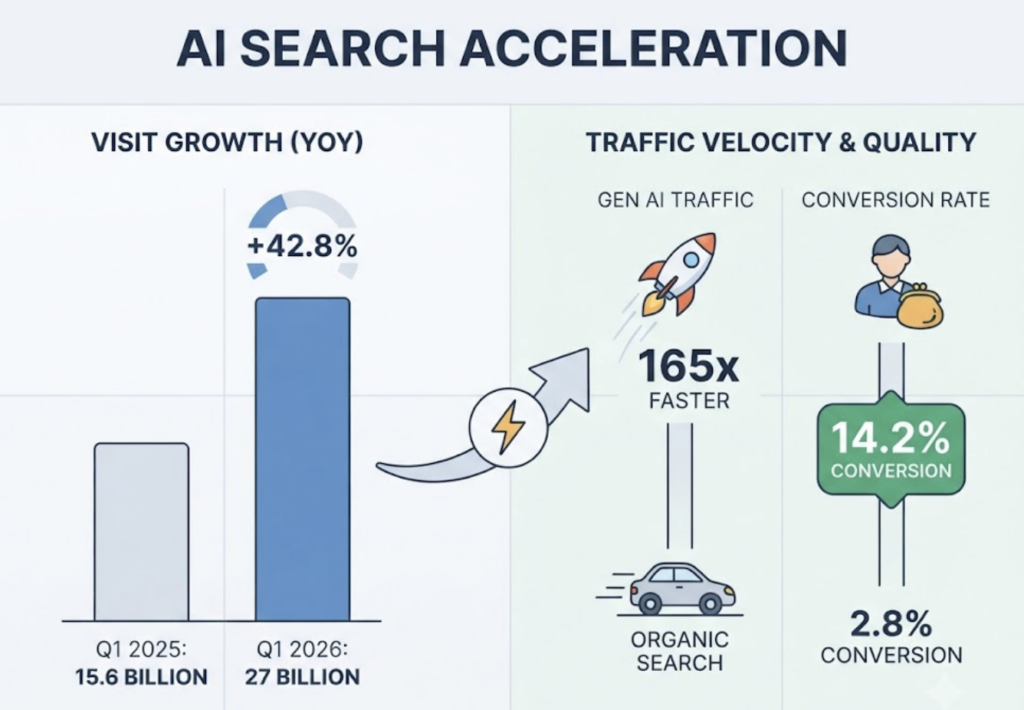
    The clicks that do come through, though, are worth more. Conversational referral traffic converts at 4.4 times the rate of traditional organic search, averaging a 14.2% conversion rate compared to the standard 2.8%. With 94% of B2B buyers using generative interfaces during their purchase cycle and 50% of B2B software buyers starting vendor evaluations directly inside AI chatbots, the stakes are clear.

    Yet many generative search visibility companies restrict their tracking to one or two language models. Others flood dashboards with raw mention counts but offer zero diagnostic insight into why recommendation rankings shifted.

    To build a functional AI brand monitoring program, teams need to evaluate tools across five dimensions:

    DimensionWhat It MeansWhy It Matters
    Platform CoverageSimultaneous tracking across proprietary models, open-source architectures, and regional assistantsEliminates blind spots across fragmented buyer journeys
    Metric DepthSentiment polarity, recommendation hierarchies, search volume, and conversion intentMoves beyond basic mention frequency to qualitative recommendation analysis
    Competitor BenchmarkingShare of voice, placement displacement, and category dominance over timeIdentifies where competitors are capturing the brand narrative
    Source & Citation AnalysisTracing third-party URLs, structured domains, and forums referenced by language modelsAligns PR and content budgets with high-authority external sources
    Execution Closed-LoopIntegrating visibility data with automated content engineering and CMS publishingMinimizes latency between detecting a gap and fixing it on-site

    5 Generative Search Visibility Companies Compared

    Before diving into each platform, here’s the landscape at a glance.

    PlatformAI Platforms CoveredKey MetricsCompetitor TrackingSource/Citation AnalysisPricing
    TopifyChatGPT, Gemini, Perplexity, DeepSeek, Doubao, QwenVisibility, Sentiment, Position, Volume, Mentions, Intent, CVRSide-by-side positioning, sentiment comparison, share of voiceReverse-engineers cited URLs, categorizes source domains, identifies citation gaps$99/mo (Basic, 100 prompts)
    Profound10 engines (ChatGPT only on Starter)AEO score, trend analysis, raw presence, basic sentimentMentions tracking, limited hierarchy on lower tiersCitation intelligence restricted to enterprise plans$99/mo (Starter, single engine)
    GoVISIBLEChatGPT, Gemini, Copilot, Perplexity, Google AI OverviewsPrompt ownership, Share of Voice, sentiment index, placement depthCompetitor diagnostics, mention quality, authority gapsDomain-level citation counts, source URLs, category patterns$69/project
    Peec AIChatGPT, Perplexity, Google AI Overviews (others via add-ons)Share of Voice, citation frequency, brand visibility %, sentimentVisibility %, side-by-side benchmarking, trend linesURL classification, domain categorization, Gap Scores$89/mo (Starter, 25 prompts)
    Otterly.AIChatGPT, Perplexity, Gemini, Copilot, Google AI Overviews, AI ModeBrand Visibility Index, raw mentions, average rank, domain citationsSide-by-side coverage comparison, positioning mapsDomain and URL citation tracking$29/mo (Lite, 10-15 prompts)

    #1 Topify: Full-Spectrum AI Brand Monitoring Across Every Major Platform

    Topify was built natively for conversational retrieval networks, not retrofitted from a legacy SEO tool. The platform tracks brand performance across seven primary indicators: visibility, sentiment, average recommendation position, search volume, mentions, intent, and CVR (Conversion Visibility Rate).

    That last metric, CVR, is what separates surface-level tracking from actionable intelligence. Most generative search visibility tools count whether a brand appeared in a response. Topify’s CVR evaluates the conversational context surrounding that mention, distinguishing between a passive factual reference and an active product recommendation, then projects downstream conversion likelihood. It’s the difference between “Brand X exists” and “Brand X is the top pick for your use case.”

    Topify’s sentiment engine scores brand framing on a scale of -100 to +100, letting teams detect reputation anomalies before negative narratives get baked into a model’s core training data.

    The platform’s model coverage is its widest competitive advantage. Topify simultaneously monitors ChatGPT, Gemini, and Perplexity alongside the Mandarin-language AI ecosystem, including DeepSeek, Qwen, and Doubao. Brands that rank well on one system often remain invisible on others due to differing model architectures and data sources. Multi-platform coverage eliminates that blind spot.

    Prompt Discovery That Goes Beyond Keywords

    Traditional search queries average four words. Conversational queries average twenty-three words and contain complex constraints like budget limits, industry verticals, and geographic scenarios. Topify’s High-Value Prompt Discovery engine analyzes conversational clusters and search volume data to isolate non-branded, high-intent prompts where a brand is currently excluded. This lets content teams target gaps before competitors lock in the narrative.

    Competitive Monitoring and Citation Reverse-Engineering

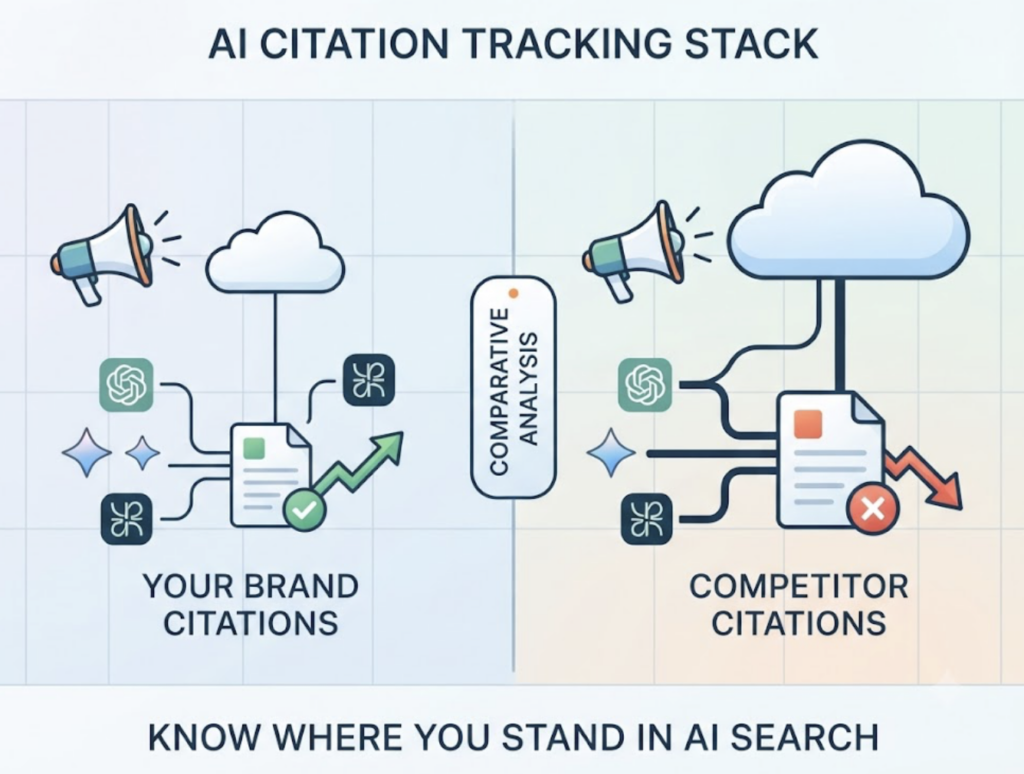
    Topify compares brand visibility, narrative framing, and citation share side-by-side, alerting users when a new competitor enters a model’s recommendation set. Its Reverse-Engineer AI Citations feature identifies the specific third-party URLs that models reference to justify recommendations. Research indicates that citations from third-party domains carry roughly 6.5 times the authority weight of self-published material. That data point alone reshapes how marketing departments should allocate off-site PR budgets, prioritizing Reddit threads, G2 reviews, and industry trade publications over branded blog posts.

    From Monitoring to Execution in One Click

    Here’s the thing most generative search visibility tools miss: data without execution is just a prettier way to watch your brand lose ground.

    Topify’s One-Click Execution system generates schema-rich FAQ blocks, atomic knowledge sections, and statistical proof points, then pushes them directly to live WordPress sites via a standard REST API. No manual content handoffs. No three-week lag between “we found a gap” and “we published a fix.” For agile marketing teams, agencies managing multiple clients, and SaaS brands defending category positions, that closed loop is what turns monitoring into growth.

    Topify starts at $99/month on the Basic plan, which includes 100 prompts, 9,000 AI answer analyses, 4 projects, and 4 seats. The Pro plan at $199/month scales to 250 prompts and 10 seats. Enterprise packages start at $499/month with a dedicated account manager.

    #2 through #5: Other Generative Search Visibility Tools Worth Knowing

    Profound

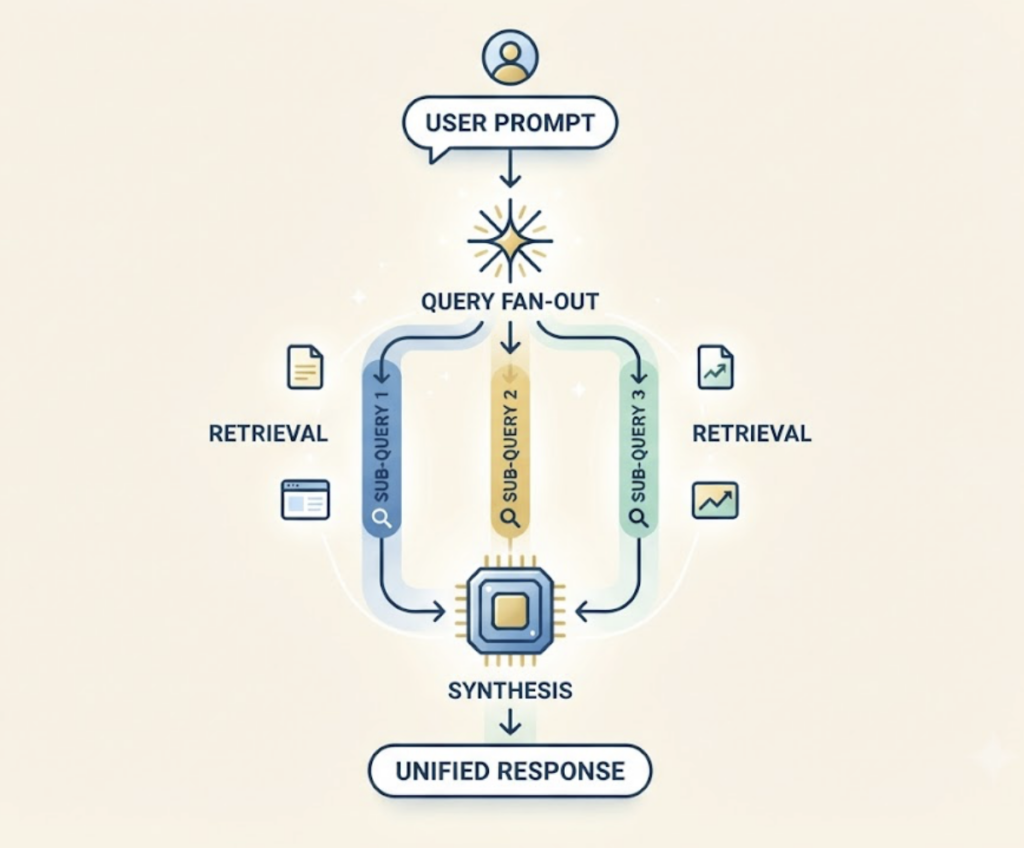
    Profound is an enterprise-grade measurement platform built for large organizations with established data science functions. It holds SOC 2 Type II and HIPAA compliance certifications and integrates with enterprise data stacks like Cloudflare, AWS, Adobe Analytics, and Tableau to model the revenue attribution of generative recommendations. Its Query Fanout Analysis simulates retrieval logic across hundreds of millions of historical queries.

    The trade-off is accessibility. Profound’s $99/month Starter tier restricts tracking to ChatGPT only. Multi-engine coverage and advanced diagnostics require enterprise-level packages, typically a four-figure monthly commitment. Profound also lacks built-in content generation or deployment tools, functioning purely as an analytical reporting environment. For GoVISIBLE Profound generative search monitoring comparisons, the key distinction is that Profound prioritizes depth of revenue analytics over breadth of platform coverage at entry-level pricing.

    GoVISIBLE

    GoVISIBLE offers greater entry-level flexibility than Profound by tracking five engines simultaneously on its $69/project pricing: ChatGPT, Gemini, Copilot, Perplexity, and Google AI Overviews. The platform is anchored by the VISIBLE framework, a 7-pillar methodology designed to systematically improve conversational visibility.

    GoVISIBLE tracks competitive positioning, prompt ownership, and citation categories, and features an interactive prompt sandbox for running live queries across multiple systems with immediate source URL identification. The project-based pricing model works well for focused campaigns but can require ongoing configuration for teams managing dynamic query environments at scale.

    Peec AI

    Peec AI is a budget-friendly option popular with startups and smaller marketing teams. For $89/month on the Starter plan, it tracks up to 25 prompts daily across ChatGPT, Perplexity, and Google AI Overviews, with unlimited user seats included.

    Its standout feature is the Earned Media module, which tracks how brand mentions get generated across third-party forums, social channels, and review aggregators like Reddit, Wikipedia, and G2. The platform calculates a “Gap Score” that highlights where competitors are cited but your brand isn’t. That said, Peec AI serves strictly as a diagnostic tool with no execution or content deployment features. Acting on its insights requires a DIY approach.

    Otterly.AI

    Otterly.AI covers six platforms: ChatGPT, Perplexity, Google AI Overviews, Gemini, Microsoft Copilot, and Google AI Mode. It’s the most affordable entry point at $29/month (Lite tier, 10 to 15 prompts) and includes a GEO Audit engine that evaluates over 25 technical and structural factors for crawlability issues.

    The platform also provides multi-country and multilingual monitoring across 50+ locations. Its main limitation is a weekly data refresh cycle, which can introduce a 7-day lag behind live model updates. For teams that need near real-time alerts on fast-moving competitive categories, that delay is worth considering.

    What AI Analytics Platforms Miss About Generative Search Visibility

    Traditional search analytics platforms like Semrush, Ahrefs, and Google Search Console were designed to diagnose keyword rankings, backlink distributions, and indexation rates. They’re good at what they do. But they weren’t architected for conversational search dynamics.

    The core difference is structural. Traditional SEO optimizes for a search engine’s ranking algorithm to secure a high position in a list of blue links. Generative engines synthesize direct answers from multiple web references using retrieval-augmented generation (RAG) loops. In a RAG environment, visibility is driven by factual density, semantic entity clarity, structured schema markup, and third-party authority signals, not standard backlink volume.

    That’s a fundamentally different optimization surface. And it’s where most AI analytics platforms generative search visibility tracking falls short.

    Standard analytics tools can identify visibility deficits or compile citation rankings, but they offer no path to resolve those issues on the page. Teams end up with a reporting layer that can’t close the gap to execution.

    Topify addresses this disconnect directly. Its platform tracks conversational metrics across seven indicators, isolates prompt opportunities, and uses its automated execution engine to push optimized content blocks and schema to WordPress via the REST API. The workflow runs inside a single platform: detect the gap, generate the fix, deploy. No manual handoffs between analytics and content teams.

    How to Pick the Right AI Brand Monitoring Tool for Your Team

    The right platform depends on your team’s structure, budget, and operational priorities. Here’s a quick framework.

    In-house marketing teams need platforms that simplify complex data into actionable tasks. Automated prompt discovery, sentiment alerts, and a direct CMS execution loop matter more than raw data volume. If your team doesn’t have a dedicated data analyst translating dashboards into content briefs, choose a tool that does that translation for you.

    Agencies managing multiple clients need white-label reporting, multi-project dashboards, and cost-effective prompt scaling. A prompt sandbox for testing queries during client onboarding helps compress the setup timeline. Look for platforms that support competitive benchmarking across client portfolios without requiring per-project configuration overhead.

    SaaS and e-commerce brands need monitoring that covers both direct AI recommendations and third-party review platforms. Track brand positioning, categorize cited domains, and calculate a conversion-focused visibility index to connect content strategy with pipeline metrics.

    Across all three profiles, evaluate platforms on three criteria: breadth of platform coverage (especially beyond just ChatGPT), depth of metrics (sentiment and citation analysis, not just mention counts), and execution capability (can it deploy fixes, or just report problems).

    For teams ready to establish a complete GEO workflow, getting started with Topify means importing your core domain, identifying high-volume category prompts, and activating automated monitoring and optimization from a single dashboard.

    Conclusion

    The selection challenge that opened this article, six tabs and four closed within a minute, isn’t going away. As more generative search visibility companies enter the market, the noise will only increase. But the evaluation framework stays the same: platform coverage, metric depth, competitive benchmarking, citation analysis, and execution capability.

    Brands that treat AI brand monitoring as a reporting exercise will keep watching competitors capture their category narratives. Brands that close the loop between monitoring and on-site optimization will own the recommendations that drive 14.2% conversion rates. The gap between those two outcomes is narrowing fast.

    FAQ

    Q: What is AI brand monitoring and why does it matter?

    A: AI brand monitoring is the process of tracking how a brand gets mentioned, cited, and recommended within conversational language models like ChatGPT, Gemini, and Perplexity. It matters because traditional search query volumes are declining as users shift to AI-powered tools for product research and buying decisions. These environments synthesize direct answers and bypass standard ranked link lists, so brands that aren’t monitoring their conversational presence risk being excluded from the consideration set entirely.

    Q: What’s the difference between generative search visibility tools and traditional SEO tools?

    A: Traditional SEO tools track keyword rankings in standard search results, audit on-page technical factors, and monitor backlink profiles. Generative search visibility tools measure brand presence within conversational text summaries, tracking metrics like prompt ownership, recommendation hierarchies, sentiment polarity, and citation sources. The optimization target is different: traditional tools aim for list-based search engines, while generative visibility tools optimize for retrieval-augmented generation (RAG) loops that synthesize answers from multiple sources.

    Q: How do AI analytics platforms track generative search visibility?

    A: These platforms use automated agents or real-world UI scraping to simulate human-like queries across multiple language models, accounting for geographic and regional parameters. They submit conversational prompt sets, capture the synthesized answers, and analyze the resulting text to determine if a brand is recommended, how it’s described, and which specific third-party URLs are cited to support the response.

    Q: How often should you monitor your brand’s AI search visibility?

    A: Because language models dynamically fetch real-time web data to formulate recommendations, visibility can shift frequently. Marketing teams should monitor baseline visibility metrics, sentiment changes, and competitor rankings at least weekly. Detailed technical audits, off-site citation targeting, and content refreshes should happen quarterly to maintain relevance within model databases.

    Read More

  • AEO Skill vs. SEO Skill: Where Your Gaps Are

    AEO Skill vs. SEO Skill: Where Your Gaps Are

    Your SEO skill set looks solid on paper. You know keyword research, backlink strategy, meta-tag optimization, Core Web Vitals. Five years ago, that checklist covered everything a search professional needed.

    Then ChatGPT started answering your target queries before users ever saw a blue link. Perplexity began citing sources you’d never heard of. Google’s AI Overviews started collapsing ten results into one synthesized paragraph. And 60% of Google searches now end without a single click.

    The skills that got you here won’t get you there. The gap between what traditional SEO rewards and what AEO (Answer Engine Optimization) demands is specific, measurable, and fixable. But you have to see it first.

    SEO Skills That Don’t Transfer to AEO

    Not every SEO skill loses value in the AI search era. But several core practices that defined the last decade of optimization are now either irrelevant or actively harmful to AI visibility.

    Keyword density is the most obvious casualty. Large language models don’t count keywords the way Google’s early algorithms did. They process semantic embeddings and verify claims against training data. The Princeton KDD 2024 study on generative engine optimization tested nine content tactics across 10,000 queries and found that keyword stuffing had a negligible or negative impact on AI citation rates.

    Content padding is even worse. Writing 3,000 words when 1,200 would do used to signal “comprehensiveness” to Google. For AI engines, it signals noise. Generative systems seek the highest information density per token to fit their context windows. Padding dilutes that density, and the model moves on to a more concise source.

    CTR-hook meta descriptions are losing their audience. Traditional SEO treated the meta description as a sales pitch: withhold the answer, tease the click. AI engines do the opposite. They prioritize content that gives the answer upfront, because their job is to synthesize a response, not to drive traffic to your site. Analysts project that click-through rates will drop 25% to 61% in categories where AI overviews appear.

    Backlink profiles still matter for Google indexing. But for AI citation, the correlation is weakening fast. Research suggests that brand mentions on third-party platforms like Reddit, Wikipedia, and G2 now correlate three times more strongly with AI visibility than traditional backlinks. An SEO professional who spends 80% of their time on link building is investing in a depreciating asset.

    The AEO Skill Stack AI Search Actually Rewards

    AEO isn’t a rebrand of SEO. It’s a different skill set built on four pillars: citability, schema markup for AI, crawler access management, and structured authority. Each one requires capabilities that most SEO practitioners haven’t developed yet.

    Citability: The AEO Skill Most SEOs Haven’t Built

    Citability is the structural and semantic readiness of a content passage to be extracted, summarized, and cited by a generative engine. It’s not the same as readability. A passage can score perfectly on Flesch-Kincaid and still be invisible to ChatGPT because the information isn’t self-contained.

    The numbers are specific. The optimal passage length for AI extraction falls between 134 and 167 words. That range maps to the chunking strategies most RAG (Retrieval-Augmented Generation) architectures use to slice content into segments that fit within LLM context windows. Passages in that range need to stand alone, meaning a reader (or a model) should understand them without needing surrounding paragraphs.

    What makes a passage citable? Three things the Princeton study quantified. Adding expert quotations boosted AI visibility by 41%. Adding statistics increased it by 37% to 40%. Citing credible sources lifted it by 30% to 40%. The pattern is clear: AI engines reward evidence-based content, not opinion-based content.

    There’s also the “answer-first” requirement. Content with a cosine similarity score of 0.88 or higher to the user’s query is 7.3 times more likely to be cited. In practice, that means putting the direct answer in the first 40 to 60 words of each section, a formatting style known as BLUF (Bottom Line Up Front).

    Most SEO content does the opposite. It builds to the answer, saving it for the end to maximize time-on-page. That structure is a citability killer.

    Schema Markup for AI, Not Just for Rich Snippets

    Traditional SEO practitioners use schema to earn star ratings and event cards in Google results. AEO practitioners use schema for something more fundamental: AI grounding.

    FAQPage schema is the clearest example. It pre-formats content as question-answer pairs, which is exactly how AI systems prefer to extract information. Pages with properly implemented FAQPage schema achieve a 41% citation rate compared to 15% for pages without it. That’s not a marginal improvement. That’s a 2.7x multiplier.

    Here’s the trap most SEOs fall into: minimally populated schema. Dropping a generic Article schema with just a headline and date feels like checking a box. But research shows that generic schema can actually underperform having no schema at all, 41.6% vs 59.8% citation rate. Incomplete structured data signals unreliability to the retrieval system.

    The AEO skill here is attribute-rich implementation. Article and BlogPosting schema need full author attribution, publication dates, and topic categorization. Organization and Person schema need sameAs properties linking to Wikipedia, LinkedIn, and Wikidata. Without those links, AI systems can’t verify the entity behind the content, and unverified entities don’t get cited.

    AI Crawler Access: The Skill Gap Hiding in Your robots.txt

    Most SEO professionals have configured robots.txt exactly once: to block duplicate pages and staging environments. AEO requires an entirely different approach, because the list of relevant crawlers has expanded to over 14 distinct user-agents in 2026.

    CrawlerOperatorWhat It Does
    GPTBotOpenAIModel training, parametric knowledge
    OAI-SearchBotOpenAIPowers ChatGPT Search results
    ChatGPT-UserOpenAIReal-time browsing for users
    ClaudeBotAnthropicTraining and search for Claude
    PerplexityBotPerplexityRetrieval for citation-heavy answers
    Google-ExtendedGoogleGemini training data
    Applebot-ExtendedAppleApple Intelligence and Siri

    Many websites block all AI bots by default, often without realizing it. That single misconfiguration makes the entire domain invisible to AI-powered search. The AEO skill is strategic access control: allowing retrieval bots (OAI-SearchBot, PerplexityBot) that drive citations while making informed decisions about training bots based on your content strategy.

    The emerging llms.txt standard adds another layer. Placing a structured summary at your domain root gives language models an authoritative overview without forcing them to crawl and interpret every page. It reduces the interpretive burden and increases citation accuracy. Most SEO practitioners haven’t heard of it.

    AEO Skill vs. SEO Skill: A Side-by-Side Breakdown

    The differences aren’t subtle. Here’s how the two skill sets compare across the dimensions that matter most.

    DimensionTraditional SEO SkillAEO Skill
    Primary GoalImprove SERP rankings to drive clicksWin citations and mentions in AI answers
    Content StrategyKeyword density, word count targets, CTR hooksCitability, fact density, BLUF formatting
    Technical FocusSitemap.xml, Core Web Vitals, HTML tagsrobots.txt (AI bots), llms.txt, SSR, JSON-LD
    Authority ModelBacklinks, Domain AuthorityEntity consensus, third-party mentions
    Query Target3-4 word keywords with search volume23-80 word prompts, “dark” sub-queries
    Optimization UnitPage-level relevancePassage-level and chunk-level relevance
    Key MetricsClicks, rank position, GSC trafficCitation frequency, sentiment, share of voice
    Optimization CycleQuarterly or semi-annual reviewsWeekly monitoring, AI answers drift constantly

    One dimension deserves extra attention. Traditional SEO targets 3 to 4 word keywords that show up in tools like Semrush. AEO targets prompts that are 23 to 80 words long, and the AI engine itself generates 8 to 12 parallel sub-queries behind the scenes to build its answer. Analysts estimate that 88% of this fan-out surface consists of “dark queries” with zero volume in traditional keyword tools. If you’re only optimizing for keywords you can see, you’re missing the majority of the AI discovery surface.

    How to Diagnose Your AEO Skill Gaps with Free Tools

    Knowing the gap exists is step one. Quantifying it is step two.

    The disconnect between Google rankings and AI citations makes self-diagnosis tricky. Studies show that only 11% to 12% of domains cited by ChatGPT also appear in the top 10 organic results for the same query. Roughly 90% of ChatGPT citations come from pages ranked at position 21 or lower. Your Google Search Console data won’t tell you where you stand in AI search.

    For a quick technical audit, the GEO free tools reference maintained on GitHub provides community-curated scripts and checklists for crawlability checks, schema validation, and AI bot access reviews. It’s a solid starting point for identifying whether your invisibility is a technical block or a content structure problem.

    For a more comprehensive diagnosis, Topify‘s GEO Score Checker evaluates brand visibility across the full AI ecosystem: ChatGPT, Gemini, Perplexity, DeepSeek, and Doubao. It breaks the score into four dimensions (AI bot access, structured data, content signals, and current presence rate) and delivers a prioritized action feed showing which fixes move the score fastest.

    That’s the key difference between a GEO Score and a traditional SEO audit. An SEO audit tells you whether your site follows best practices. A GEO Score tells you whether AI systems are actually citing you, and if they’re not, it tells you exactly why.

    For teams that need ongoing monitoring, Topify’s platform tracks seven core metrics (visibility, sentiment, position, volume, mentions, intent, and CVR) across multiple AI platforms. The Source Analysis feature identifies the exact domains AI engines cite when answering queries in your category. If a competitor is getting cited from a Reddit thread you didn’t know existed, that’s where you’ll find it.

    From Diagnosis to Action: Building Your AEO Skill Set

    Bridging the gap works best as a phased approach. Trying to do everything at once leads to scattered effort and unclear results.

    Phase 1: Fix the technical foundation. Audit your robots.txt and explicitly allow OAI-SearchBot, PerplexityBot, and ClaudeBot. Confirm your site uses server-side rendering so AI crawlers that don’t execute JavaScript can actually read your content. Deploy an llms.txt file at your domain root. These are the lowest-effort, highest-impact changes, and they cost nothing.

    Phase 2: Restructure content for citability. Rewrite key pages using the 134-167 word self-contained passage model. Apply BLUF formatting so every section leads with the direct answer. Enrich content with original statistics, comparison tables, and expert quotations. Implement attribute-rich FAQPage, Article, and Person schema with sameAs links to Wikipedia, LinkedIn, and Wikidata.

    Phase 3: Build structured authority. Earn mentions on the platforms AI engines trust most: Reddit, G2, Wikipedia, YouTube. YouTube mentions show a particularly strong correlation (~0.737) with AI citations. Use Topify‘s Competitor Monitoring to identify where rivals are getting cited and where your brand is absent. Close those gaps systematically.

    The cycle doesn’t end. AI answers drift weekly. New prompts emerge. Competitors adjust. The AEO skill that separates professionals from amateurs is the discipline of continuous monitoring, not the one-time audit.

    Conclusion

    The AEO skill gap isn’t theoretical. It’s measurable in citation rates, schema coverage, crawler access, and entity presence. Every dimension in the comparison table above represents a specific capability that traditional SEO training didn’t cover.

    The good news: the gap is fixable, and the sequence is clear. Start with a free GEO Score check to quantify where you stand. Fix technical access first. Restructure content for citability second. Build structured authority third. The practitioners who close this gap now will own the discovery layer for the next decade of search.

    FAQ

    What is the difference between AEO and SEO skills?

    SEO skills focus on ranking links through keyword targeting and backlinks. AEO skills focus on earning citations in synthesized AI answers through passage-level citability, fact density, evidence-based content, and entity consensus across the web. The optimization unit shifts from the page to the passage.

    Do I need to learn AEO if I already know SEO?

    Yes. While 76% of Google AI Overview citations come from top-10 rankings, only 11% of ChatGPT citations do. For AI-first platforms like ChatGPT and Perplexity, traditional SEO rankings are a poor predictor of visibility. 90% of ChatGPT citations come from outside the top 20 Google results.

    What’s the most important AEO skill to learn first?

    Citability is the foundational content skill. Learning to structure self-contained “answer capsules” in the 134-167 word range with BLUF (Bottom Line Up Front) formatting ensures AI models can extract and cite your information. After that, schema markup and AI crawler configuration are the next priorities.

    Can free tools help me assess my AEO readiness?

    Yes. The GEO free tools reference on GitHub provides community-maintained scripts for crawlability and schema checks. For a more comprehensive audit, Topify’s GEO Score Checker evaluates brand visibility across ChatGPT, Gemini, Perplexity, DeepSeek, and Doubao, with a prioritized action plan.

    Read More

  • Top AEO Skills for Claude Code, Cursor and AI Agents

    Top AEO Skills for Claude Code, Cursor and AI Agents

    You shipped clean docs, structured your schema, and climbed to page one. Then an AI coding agent tried to integrate your API, couldn’t parse your documentation in a single fetch, and recommended your competitor instead. No click. No visit. No conversion.

    That’s the new failure mode developers and technical marketers don’t see coming. Zero-click searches already account for 58.5% of the US search market, and AI Overviews now appear in close to 47% of all Google queries. The traffic that’s left increasingly flows through AI agents, not human browsers. GitHub’s AEO and GEO skill repositories have exploded since late 2025, giving you dozens of options to audit and optimize your site for this shift.

    The problem isn’t finding an AEO skill. It’s figuring out which one actually solves your problem.

    What AEO Skills Actually Do, and Why They’re Not Just “SEO for AI”

    An AEO skill is a structured instruction set, typically a SKILL.md file plus supporting scripts, that gives an AI coding agent the ability to audit, fix, or monitor a website’s visibility to other AI systems. You install it in Claude Code, Cursor, Codex, or any compatible agent, and it turns your terminal into a GEO diagnostic tool.

    The distinction between AEO and its predecessors matters here. Traditional SEO optimizes for human browsers clicking through ranked links. GEO, formalized by Princeton and Georgia Tech researchers at KDD 2024, optimizes for LLM citation during retrieval-augmented generation. AEO goes one layer deeper: it structures content so AI agents can not only read it but execute tasks based on it.

    Google’s Addy Osmani put it plainly in his April 2026 framework: agents don’t browse. They issue a single HTTP request, strip the HTML, count tokens, and either use the content or discard it. That behavior demands a different optimization stack, one built around llms.txt for discoverability, skill.md for capability signaling, and strict token budgets to fit within an agent’s effective context window.

    By mid-2025, only about 0.3% of the top 1,000 websites had adopted the llms.txt standard. That number is growing, but the gap between “optimized for agents” and “invisible to agents” is still wide.

    Most AEO Skills Stop at Diagnosis. Here’s What They Miss.

    Open-source AEO skills on GitHub follow a predictable pattern: Audit → Score → Report. You run a command, get a GEO score between 0 and 100, see a list of issues ranked by severity, and then you’re on your own.

    That’s valuable for Day 1. It tells you whether AI crawlers are blocked, whether your schema markup exists, and whether your content is structured for citation. But it doesn’t answer the question that matters on Day 30: “Did the fix actually change how ChatGPT talks about my brand?”

    AI retrieval patterns shift constantly. Models update their RAG layers, citation preferences change, and new competitors enter the conversation. A one-time audit can’t track that. This isn’t a flaw in open-source skills. It’s a design boundary. Open-source tools solve the diagnostic problem. Continuous monitoring and automated execution require a different layer.

    That distinction shapes how you should evaluate the six most active AEO skill projects right now.

    6 AEO Skills Compared: What Each One Actually Measures

    SkillPrimary FocusExecution CapabilityCI/CD ReadyAPI Key RequiredAgent Compatibility
    Topify geo-skillsExecution + MonitoringHigh (platform-aided)YesNo (skill) / Yes (platform)Claude Code, Cursor, Codex
    Auriti-Labs geo-optimizerResearch-backed auditMedium (fix scripts)StrongestNoClaude Code, Cursor, MCP clients
    aaron-he-zhu seo-geoAuthority quality gatesMedium (writer skills)YesNo35+ agents
    zubair-trabzada geo-seoAgency reports + CRMLow (diagnostic-first)NoNoClaude Code
    Cognitic-Labs geoskillsZero-API diagnosticsLowNoNoClaude Code, OpenCode, Codex, Cursor
    luka2chat geo-skillsPure knowledge baseNoneNoNoCursor, Claude Code, Codex

    The table tells one story. The details tell another. Each skill optimizes for a different user and a different stage of the AEO workflow.

    Topify’s AEO Skill: From Audit to Execution in One Stack

    Most AEO skills hand you a report and wish you luck. Topify built the layer that comes after the report.

    Topify’s geo-skills repository provides the open-source diagnostic foundation: GEO score auditing, AI crawler accessibility checks, and citability analysis. You can run it in Claude Code or Cursor without an API key and get an immediate read on where your site stands.

    What makes Topify’s approach different is what happens next. The open-source skill connects to the Topify platform, which adds three capabilities no standalone skill offers:

    Continuous AI visibility tracking. The platform monitors how ChatGPT, Perplexity, Gemini, DeepSeek, and other AI engines mention and cite your brand across hundreds of prompts. You’re not checking once. You’re watching the trend.

    Citation blind spot detection. Topify identifies specific high-value prompt scenarios where a competitor gets cited but you don’t. These “dark queries,” prompts with high AI research volume but near-zero traditional keyword volume, are invisible to tools like Ahrefs or Semrush. Topify’s Prompt Intelligence surfaces them.

    One-click agent execution. Instead of exporting a PDF for a developer to implement, Topify’s AI agent builds the fixes (schema injections, content refreshes, structured data updates) and assists in deployment. You define goals in plain English, review the proposed strategy, and deploy with a single click.

    Research from early 2026 indicates that GEO optimization can drive a 527% increase in AI-referred sessions and a 35% reduction in cost per demo request. At $99/mo for the Basic plan (100 prompts, 9,000 AI answer analyses, ChatGPT and Perplexity coverage), the ROI math works for most B2B SaaS teams. The Pro plan at $199/mo adds 250 prompts and sentiment analysis across 5 AI platforms.

    The bottom line: Topify is the only option that pairs an open-source diagnostic skill with a SaaS platform for continuous monitoring and automated execution. If you’re choosing one stack to cover the full AEO lifecycle, this is the one that closes the loop.

    5 Open-Source AEO Skills Worth Installing

    Cognitic-Labs/geoskills: The Fastest Free Audit

    Six skills, zero API keys, and a composite GEO Score weighted across four dimensions: Technical Accessibility (20%), Content Citability (35%), Structured Data (20%), and Entity & Brand Signals (25%). Cognitic-Labs/geoskills checks access for 11 AI crawlers including GPTBot, ClaudeBot, and PerplexityBot. Install with npx skills add Cognitic-Labs/geoskillsand run /geo-audit https://your-site.com. You get a severity-ranked issue list and a fix plan in under a minute. Ideal for developers who want a quick sanity check before diving deeper.

    Auriti-Labs/geo-optimizer-skill: The Research-Grade Engine

    Built directly on the Princeton KDD 2024 and AutoGEO ICLR 2026 research papers, this toolkit runs 47 citability checks against your site. The Princeton data shows that adding expert quotations increases LLM citation probability by 41%, statistics by 33%, and fluent prose by 29%. Auriti-Labs turns those findings into actionable audit items.

    Its CI/CD integration is the strongest in the ecosystem. SARIF format for GitHub Code Scanning, JUnit for Jenkins and GitLab CI, and GitHub Actions annotations out of the box. Teams can enforce GEO-readiness as a required status check before merging documentation changes. If your docs are mission-critical and you need research-backed rigor, this is the skill to install.

    aaron-he-zhu/seo-geo-claude-skills: The Full-Stack Library

    Twenty skills and 17 commands spanning the entire SEO-to-GEO pipeline: keyword research, content writing, technical audits, rank tracking, and GEO drift monitoring. The seo-geo-claude-skills library is anchored by two evaluation frameworks. CORE-EEAT (80 items) assesses content quality across Contextual Clarity, Organization, Referenceability, and Exclusivity. CITE (40 items) evaluates domain authority through Credibility, Infrastructure, Trust, and Endorsement.

    The “veto mechanism” stands out: certain technical failures (like blocked AI crawlers or missing HTTPS) trigger an automatic BLOCK verdict regardless of the overall score. This makes it suited for enterprise teams where a single compliance failure can’t reach production. Compatible with 35+ agents via npx skills add.

    zubair-trabzada/geo-seo-claude: The Agency Toolkit

    Thirteen sub-skills, five parallel subagents, and a built-in prospect CRM. The geo-seo-claude toolkit is designed for GEO consultants who need to turn audits into revenue. The “Full Audit Flow” launches five subagents simultaneously to analyze AI visibility, platform readiness, technical SEO, content quality, and schema markup.

    The output isn’t a terminal printout. It’s a client-ready PDF with score gauges, bar charts, and prioritized action plans generated via ReportLab. Add the /geo prospect and /geo proposal commands, and you’ve got a pipeline from audit to signed contract. If you’re selling GEO services to non-technical CMOs, this is the skill that speaks their language.

    luka2chat/geo-skills: The Knowledge-Only Approach

    No tools, no SaaS recommendations, no code generation. luka2chat/geo-skills is a pure best-practice knowledge base that teaches your AI agent how to implement GEO correctly. It covers Schema.org markup patterns, robots.txt crawler rules, and content structure templates that AI engines tend to cite. Think of it as the reference manual you give your agent before it starts doing real work. Pair it with an execution-oriented skill for the full workflow.

    Pick the Right AEO Skill for Your Workflow

    The right choice depends on where you are and what you’re building:

    “I just need a quick audit.” Start with Cognitic-Labs/geoskills. It’s fast, free, and zero-config. If you want the audit connected to a monitoring layer, use Topify’s geo-skills instead.

    “I’m managing docs for a developer-facing API.” Install Auriti-Labs/geo-optimizer-skill and add it to your CI pipeline. Enforce GEO scores as merge gates so documentation never accidentally locks out AI crawlers.

    “I run content ops at an enterprise.” Adopt aaron-he-zhu/seo-geo-claude-skills. The CORE-EEAT and CITE frameworks give you standardized quality gates across teams, and the veto mechanism prevents compliance failures.

    “I’m a GEO agency managing client accounts.” Use zubair-trabzada/geo-seo-claude for client-facing reports and proposals. Layer Topify’s platform underneath for the continuous monitoring your clients expect.

    “I want the full lifecycle: diagnose, track, execute.” That’s Topify. Start with the open-source skill for the initial audit, then connect the platform for ongoing visibility tracking and one-click execution. It’s the only stack that covers all three phases without switching tools.

    The open-source skills solve the Day 1 problem. But AI search engines shift their citation patterns every few weeks. What works today might not work next month. Continuous monitoring and the ability to act on what you find, that’s the long-term play.

    Conclusion

    AEO skills gave developers something they’ve never had before: the ability to audit and optimize AI visibility from inside their terminal. In 2026, the ecosystem is rich enough that there’s a skill for every workflow, from free one-time audits to enterprise quality gates to full agency toolkits.

    But the pattern is clear. Diagnosis alone isn’t enough. AI-referred traffic converts at over 4x the rate of traditional organic search. The brands capturing that traffic aren’t just auditing. They’re monitoring visibility weekly, catching citation blind spots early, and deploying fixes before competitors fill the gap.

    Start with Topify’s free GEO tools to see where your site stands. Then decide how far you want to go.

    FAQ

    Q: What’s the difference between an AEO skill and a GEO tool?

    A: A GEO tool typically refers to any software that helps optimize content for AI citation, including SaaS dashboards and browser-based platforms. An AEO skill is specifically a structured instruction file (SKILL.md) that runs inside an AI coding agent like Claude Code or Cursor, giving the agent diagnostic and optimization capabilities directly in your terminal.

    Q: Can I use multiple AEO skills at the same time?

    A: Yes. Skills occupy different parts of the workflow. You might use Cognitic-Labs/geoskills for a quick audit, Auriti-Labs for CI/CD enforcement, and Topify’s platform for ongoing monitoring. They don’t conflict because they solve different problems.

    Q: Do I need an API key to run these GEO skills?

    A: Most open-source AEO skills, including Cognitic-Labs/geoskills, Auriti-Labs/geo-optimizer-skill, and luka2chat/geo-skills, work without any API key. Topify’s open-source diagnostic skill is also key-free. The Topify platform and some advanced features in other tools require authentication.

    Q: How often should I re-run a GEO audit on my site?

    A: For the initial fix cycle, weekly audits make sense until your GEO score stabilizes. After that, monthly audits catch regressions from content updates or infrastructure changes. For continuous coverage, a monitoring platform like Topifytracks AI visibility daily without manual re-runs.

    Read More

  • AI Brand Visibility vs. Search Visibility vs. Mentions

    AI Brand Visibility vs. Search Visibility vs. Mentions

    Your marketing report says “AI visibility is up.” Your SEO lead says “AI search visibility is flat.” Your PR team says “AI mentions are growing.” All three are looking at the same AI platforms, and all three think they’re measuring the same thing.

    They’re not. These three metrics answer fundamentally different questions about your brand’s presence in AI-generated answers. Confusing them doesn’t just muddle your reporting. It sends your team chasing the wrong signals while the metric that actually matters stays untracked.

    The Terminology Problem That’s Costing Brands Real Data

    Most marketing teams treat “AI brand visibility,” “AI search visibility,” and “AI mentions” as interchangeable labels for one concept: whether AI knows your brand exists. That conflation made sense when the only visibility that mattered was a position on a list of blue links. It doesn’t hold up in the generative era.

    Here’s why the distinction matters now. 37% of consumers start their research directly in AI tools rather than Google. And 93% of those AI sessions end without a single website click. The AI’s answer is the final stop. So whether your brand gets mentioned, cited, or framed correctly inside that answer isn’t a branding nuance. It’s a revenue question.

    Each of these three metrics captures a different layer of that answer. Mix them up, and you’ll optimize for the wrong one.

    What AI Brand Visibility Actually Measures

    AI brand visibility is the broadest of the three. It’s a composite measure of how frequently and accurately your brand appears across AI-generated answers, summaries, and recommendations on platforms like ChatGPT, Gemini, and Perplexity.

    Think of it as the answer to: “Does AI know who we are, and does it describe us correctly?”

    That second part is what separates brand visibility from a simple mention count. AI brand visibility tracks the full framing of your brand: how the model describes your features, where it positions you relative to competitors, and whether it associates you with the right use cases. A brand can be mentioned ten times across AI answers and still have poor visibility if the model consistently mischaracterizes its positioning.

    This is where the concept of “Semantic Authority” comes into play. AI models calculate a synthesized score based on the frequency, diversity, and sentiment of brand references across their training data. A brand referenced across 500 high-authority domains carries more weight than one mentioned 100,000 times on low-quality sites. Quality of third-party validation matters exponentially more than volume of self-published content.

    The N-E-E-A-T-T framework (Notability, Experience, Expertise, Authoritativeness, Trustworthiness, and Transparency) determines how confidently an AI presents your brand. Low scores here don’t just reduce your visibility. They cause the AI to hedge, using cautious language like “Brand X may be suitable for small teams” instead of a direct recommendation.

    That hedging is measurable. And it’s one of the signals AI brand visibility is designed to catch.

    What AI Search Visibility Actually Measures

    AI search visibility is narrower. It zooms in on a specific question: “When someone asks AI about our category, do we show up in the answer?”

    Where brand visibility looks at the overall AI ecosystem, search visibility is prompt-specific. It tracks whether your brand appears in response to particular queries, what position you hold relative to competitors in those responses, and how consistently you show up across different prompt variations.

    This distinction matters because AI answers aren’t static. Ask ChatGPT “What’s the best CRM for nonprofits?” five times, and you might get three different brand recommendations. The prompt’s phrasing, the user’s location, and even the time of day can shift results. AI search visibility tools address this by running thousands of prompt variations across geographic nodes to calculate what’s sometimes called “Share of Model Voice.”

    Here’s a data point that underscores why search visibility needs its own metric: nearly 90% of ChatGPT citations come from pages that don’t rank on the first or second page of traditional Google results. AI platforms aren’t scraping the top of Google. They’re pulling from wherever the most semantically relevant and clearly structured content lives. Your Google rank tells you almost nothing about your AI search visibility.

    The shift from keyword tracking to prompt tracking is the operational difference. A keyword like “CRM” is a static string. A prompt like “What CRM works best for a 50-person nonprofit in Germany?” reflects real conversational intent. Measuring the second requires a fundamentally different methodology.

    What AI Mentions Actually Measure

    AI mentions are the most granular of the three, and the most commonly misread.

    A mention is a plain-text reference to your brand name within the body of an AI-generated response. No link, no citation, just the name appearing in the answer. It’s the count of how often AI says your brand name.

    That sounds straightforward. The trap is assuming that more mentions equals more visibility. It doesn’t.

    Here’s the core problem: there’s a significant gap between brands that get mentioned and brands that get cited. Research shows that fewer than 30% of brands most frequently mentioned by AI are also among the most cited. AI models often pull their factual information from one set of sources (news sites, directories, databases) while recommending a completely different set of brands in the answer itself.

    A mention also carries no sentiment signal on its own. Your brand could be mentioned 50 times this month, but if 40 of those mentions include phrasing like “lacks enterprise features” or “better suited for beginners,” the raw count is actively misleading. Negative mentions in AI responses tend to be concentrated in high-visibility query types, and the damage compounds: negative framing gets absorbed into future model training, making it harder to correct over time.

    Different AI platforms handle negative information differently, too. Google AI Overviews tends to surface news-driven negativity (controversies, lawsuits, recalls), while ChatGPT focuses more on product-level criticism (limitations, compatibility issues, value assessments). A mention on one platform doesn’t mean the same thing as a mention on another.

    The real value of tracking mentions is as a leading indicator. Rising mention frequency, combined with positive sentiment, typically feeds a flywheel: more mentions lead to higher brand recall, which drives branded search volume, which strengthens the brand’s authority for future AI retrieval cycles. But mention count alone, without sentiment and context, is noise.

    Side-by-Side: What Each Metric Tells You and What It Misses

    DimensionAI Brand VisibilityAI Search VisibilityAI Mentions
    Core question“Does AI know us and describe us correctly?”“Do we show up when someone asks about our category?”“How often does AI say our name?”
    ScopeBroadest: covers framing, sentiment, positioning, accuracyMid-range: prompt-specific presence and rankingNarrowest: raw count of name references
    What it catchesMischaracterization, hedged language, competitor framingMissing from key queries, position shifts, prompt sensitivityFrequency trends, emerging or declining presence
    What it missesPrompt-level granularityOverall brand narrative and sentimentSentiment, context, whether mention is positive or negative
    Actionable forBrand strategy, narrative control, AI reputation managementContent optimization, competitive positioning, GEO tacticsEarly signal detection, trend monitoring
    Risk if used aloneToo broad to guide specific content changesMisses brand narrative issues outside tracked promptsMisleads if negative mentions are counted as wins

    No single metric gives you the full picture. Brand visibility without search visibility is like knowing your reputation without knowing whether people find you. Search visibility without brand visibility means you’re showing up, but potentially with the wrong story. And mentions without either context layer is just a number that could mean anything.

    How to Track All Three Without Juggling Five Dashboards

    The practical challenge is that most teams end up cobbling together separate tools for each metric: one for mention tracking, one for search position monitoring, another for sentiment analysis. That creates data silos, inconsistent definitions, and reports that don’t reconcile.

    Topify consolidates these three layers into a single platform. It tracks AI brand visibility across ChatGPT, Gemini, Perplexity, DeepSeek, and other major AI engines through seven integrated metrics: visibility, sentiment, position, volume, mentions, intent, and CVR (Conversion Visibility Rate).

    In practice, that means you can spot a drop in mentions on Perplexity, check whether the sentiment behind those mentions shifted, trace the change back to a specific source the AI stopped citing, and see how your competitor’s position moved in the same prompt set. All within one dashboard.

    The platform uses prompt matrixing to test thousands of query variations, giving you a statistical view of whether your brand holds “Robust Visibility” (recommended in 85%+ of prompt simulations) or falls into an “Invisibility Gap” (below 5%). That’s the difference between knowing you showed up once and knowing whether you show up reliably.

    For teams that are still relying on manual spot checks (typing your brand into ChatGPT and hoping for the best), that’s a significant operational upgrade. Plans start at $99/month, which covers 100 prompts across multiple AI platforms.

    Conclusion

    AI brand visibility, AI search visibility, and AI mentions aren’t three names for the same thing. They measure different layers of your brand’s presence in AI-generated answers: the overall narrative, the prompt-level performance, and the raw frequency.

    Getting these definitions right isn’t academic. It determines which metric your team optimizes for, which tools you invest in, and whether your AI strategy actually moves the needle. Start by aligning your team on what each term measures. Then build a tracking system that covers all three, because the brands winning in AI search are the ones that don’t confuse showing up with being recommended.

    Ready to see where your brand actually stands across all three metrics? Get started with Topify and find out in minutes.

    FAQ

    Q: What’s the difference between AI brand visibility and traditional brand visibility?

    A: Traditional brand visibility measures how often your brand appears in search engine results, social media, and advertising channels. AI brand visibility specifically measures how AI models describe, position, and recommend your brand in generated answers. A brand can have strong traditional visibility (high Google rankings, large social following) and still be invisible or misrepresented in AI responses, because AI platforms use different signals to decide which brands to include.

    Q: Can I track AI mentions without a paid tool?

    A: You can do manual spot checks by typing relevant prompts into ChatGPT, Perplexity, or Gemini and noting whether your brand appears. But this approach is unreliable because AI answers vary by prompt phrasing, location, and time. You’d need to test hundreds of prompt variations consistently to get a statistically meaningful picture. Free GEO scoring tools can give you a quick baseline, but systematic tracking requires a dedicated platform.

    Q: Which AI visibility metric should I prioritize first?

    A: Start with AI brand visibility to establish whether AI models know your brand and describe it accurately. If the narrative is wrong, optimizing for search visibility or chasing higher mention counts won’t help, because you’d be amplifying a flawed story. Once your brand visibility baseline is solid, shift focus to AI search visibility for prompt-level optimization.

    Q: Does AI search visibility affect my Google SEO rankings?

    A: Not directly. Google’s traditional ranking algorithm and AI Overviews use different selection criteria. However, there’s an indirect feedback loop: brands that appear frequently in AI answers tend to generate more branded search queries on Google, which signals authority to Google’s algorithm. Over time, strong AI search visibility can reinforce traditional SEO performance, but they’re measured and optimized through separate strategies.

    Read More

  • AI Search Visibility vs SEO: Where to Spend in 2026

    AI Search Visibility vs SEO: Where to Spend in 2026

    Your SEO dashboard says everything’s fine. Rankings are holding. Domain authority ticked up a point last quarter. But here’s the number your dashboard doesn’t show: 64.82% of Google searches now end without a single click to any website. On mobile, it’s 77.2%. The traffic your team worked months to earn is being answered, summarized, and resolved before users ever reach your site.

    That’s not an SEO problem. It’s a budget allocation problem. And in 2026, the teams that figure out how to split spend between traditional SEO and AI search visibility will own the next wave of organic growth.

    Two-Thirds of Searches Never Reach Your Site. Here’s Where the Traffic Goes.

    The “zero-click” trend isn’t new, but its acceleration is. In 2019, roughly half of Google searches ended without a click. By 2024, that number crossed 60%. In early 2026, it sits at 64.82%, with informational queries hitting a 74% zero-click rate.

    Where are those users going? Straight to AI-generated answers. Google’s AI Overviews, ChatGPT Search, Perplexity, and Gemini now synthesize responses in real time, satisfying user intent inside the search interface itself. Gartner projects that traditional search engine volume will drop 25% by late 2026, driven almost entirely by this migration to AI-powered answers.

    The impact isn’t evenly distributed. Transactional keywords (“buy,” “order,” “pricing”) still preserve a 31% organic click rate. But the informational queries that once fueled top-of-funnel blog traffic? Those are being consumed by AI at scale. If your content budget is still weighted toward high-volume informational posts designed to drive clicks, you’re investing in a channel with shrinking returns.

    That’s the shift most marketing teams haven’t priced into their 2026 budgets yet.

    What AI Search Visibility Actually Costs vs Traditional SEO

    Traditional SEO and AI search visibility (often called GEO, or Generative Engine Optimization) don’t compete for the same line items. They have fundamentally different cost structures, and understanding the difference is the first step toward smarter allocation.

    Traditional SEO in 2026 is a maintenance-heavy discipline. It demands ongoing spend on technical health (Core Web Vitals, crawlability), content volume to defend topical authority, and backlink acquisition. The cost is characterized by what one industry analysis calls “maintenance inertia”: you keep spending just to hold your current position against competitors who are also spending.

    GEO flips the investment model. Instead of hundreds of keyword-targeted articles, it prioritizes fewer, higher-authority content assets that AI models can parse and cite. The focus is on “citatability”: structured, data-backed, entity-rich content designed for extraction rather than ranking.

    Cost CategoryTraditional SEOGEO / AI Visibility
    TechnologyRank trackers, technical auditorsAI visibility platforms like Topify, prompt researchers
    ContentKeyword-optimized long-form (2,000+ words)Entity-rich, answer-first structured fragments
    AuthorityHigh-DA backlink acquisitionCitation-worthy research, digital PR, forum presence
    MeasurementClicks, sessions, keyword positionsAI mention frequency, citation share, sentiment score

    A typical monthly GEO budget for a mid-market B2B company ranges from $2,000 to $8,000, covering platform subscriptions and the human resources for content restructuring. The upfront learning cost is higher because the discipline is newer. But the marginal cost of maintaining AI visibility tends to be lower than traditional SEO, because AI models favor authoritative, structured data over brute-force backlink profiles.

    The Tracking Gap That Inflates Your “Direct” Traffic

    Here’s a cost most teams don’t see: AI search platforms like ChatGPT and Perplexity typically don’t send referral data to Google Analytics. Traffic from AI recommendations gets misclassified as “direct” or “branded search.” That means your brand could be losing share in AI conversations and your analytics wouldn’t flag it.

    This isn’t a minor reporting quirk. It’s a blind spot that makes budget decisions based on traditional analytics fundamentally incomplete. Platforms like Topify exist specifically to close this gap, tracking brand mentions, citation frequency, and sentiment across AI engines so you can quantify what traditional tools miss.

    AI-Referred Clicks Convert at Nearly 2x the Rate. Here’s Why.

    The ROI case for AI search visibility isn’t theoretical anymore. Early data from 2025 and 2026 shows a clear pattern: users who click through from an AI-generated answer convert at significantly higher rates than standard organic traffic.

    The reason is what researchers call the “pre-vetting” effect. By the time someone clicks a citation inside an AI response, they’ve already consumed a summary of your value proposition. They’re not browsing. They’re validating a decision they’ve half-made.

    MetricTraditional OrganicAI-ReferredDifference
    Conversion Rate5.3% – 5.8%7.05% – 11.4%~2x higher
    Session DurationBaseline+34%Deeper engagement
    Pages per SessionBaseline2.7xMore exploration
    Average Order ValueBaseline+18%Higher-value conversions

    For B2B SaaS specifically, the numbers are even sharper. Brands optimized for AI visibility have reported conversion rates up to 6x higher than traditional organic, because AI assistants handle the early-stage comparison work that used to require an SDR or multiple content touchpoints.

    There’s a compounding effect, too. When users see a brand recommended by an AI, they’re 3.2x more likely to perform a direct search for that brand afterward. So even when AI visibility doesn’t produce an immediate click, it fuels branded search volume downstream.

    The bottom line: AI search visibility isn’t just a new traffic source. It’s a higher-quality traffic source.

    The 70/30 Trap: Why a Fixed Budget Split Doesn’t Work

    In early 2025, the common recommendation was simple: allocate 70% of your organic budget to SEO and 30% to AI visibility. By 2026, that rule has fallen apart.

    The problem is that a fixed split ignores how differently AI disrupts each industry. Some categories are “AI-native” in search behavior. Others are still anchored in visual or local discovery. Applying the same ratio to a SaaS company and a local restaurant is like using the same media plan for both.

    High information density categories (SaaS, Finance, Healthcare): These are the primary targets of AI search because they involve complex comparisons and high-stakes decisions. Decision-makers are already using Perplexity and ChatGPT to shortlist vendors. In these sectors, a 60% SEO / 40% GEO split is often the baseline just to stay in the conversation.

    Low complexity, high visual categories (Fashion, Retail, Local Services): Traditional SEO and visual search (Google Maps, Instagram) still dominate here. AI shopping assistants are generating less than 10% of revenue in these verticals. An 80/20 or 75/25 split favoring traditional SEO makes more sense.

    Content publishers and education: These sectors sit in the eye of the storm. Informational queries are the most disrupted category. A 50/50 split is often necessary to survive the transition, earning both the traditional rank and the AI citation.

    Your Competitor’s AI Visibility Score Matters More Than Their DA

    Budget allocation shouldn’t happen in a vacuum. If a competitor has already secured what the industry calls a “citation moat,” meaning they’re consistently the primary source AI recommends for your category, your SEO traffic will erode regardless of your Google rankings.

    Topify’s Competitor Monitoring surfaces exactly this signal. It identifies when a rival dominates AI citations for your core prompts, so you can decide whether to stay on defense with SEO or shift to offense with GEO. Without this data, you’re guessing.

    Allocate by Channel Signal, Not by Gut

    To avoid the 70/30 trap, marketing leaders need a framework that responds to data, not convention. Here’s a three-step approach built around what we call “Channel Signal.”

    Step 1: Audit your current AI footprint. Before reallocating anything, you need a baseline. Topify’s AI Visibility Checker generates a composite score based on mention frequency, recommendation position, and sentiment across major AI platforms. If your score is low despite strong SEO rankings, you’ve found the gap that needs funding.

    Step 2: Evaluate the AI search demand in your category. Traditional keyword tools don’t capture how users talk to AI. Topify’s AI Volume Analytics identifies the specific natural-language prompts users are asking ChatGPT and Gemini within your vertical. If AI search demand for your category is growing by double digits, you need to allocate budget before a first-mover competitor captures that intent.

    Step 3: Benchmark competitor infiltration. The final input is your “Share of AI Voice.” If a single rival holds more than 50% of category citations, they’ve built topical authority in the eyes of the model. At that point, reallocating budget isn’t strategic. It’s survival.

    SituationData SignalRecommended Action
    Invisible in AISEO top 3, but AI Visibility Score < 10%Shift 20% of SEO budget to GEO content restructuring
    Sentiment problemFrequent AI mentions, but neutral/negative toneRedirect content budget toward digital PR and expert reviews
    Competitor dominanceRival cited in > 50% of category promptsAccelerate GEO spend to 40% of organic total
    Local/visual categoryHigh Google Maps and social engagementMaintain 80/20 SEO split; add AEO for voice search

    The Technical Layer Most Teams Skip

    Winning AI search visibility isn’t only about better content. It’s about technical “extractability.” AI engines use fragment-based retrieval, indexing granular snippets of meaning rather than full pages.

    Research shows that 44.2% of all AI citations come from the first 30% of an article. Content that buries the answer under a long narrative intro gets systematically skipped. The fix: follow the “BLUF” rule (Bottom Line Up Front) and place a direct, definitive answer within the first 100 words of each section.

    Three technical signals also increase your citation odds significantly. Implementing FAQ, HowTo, and ItemList schema raises the probability of a rich citation by 1.8x. Content updated within the last 90 days is 2.3x more likely to be cited by ChatGPT. And using specific entities (product names, technical terms, named features) rather than generic keywords helps transformer architectures map your brand to user intent more accurately.

    These aren’t optional enhancements. In 2026, they’re the baseline for AI search visibility.

    Conclusion

    The question for 2026 isn’t “SEO or AI search visibility.” It’s how much of each, and when to shift. Traditional SEO still provides the technical foundation and authority signals that AI models use to discover content. GEO ensures that content actually gets cited in the final answer.

    The teams that win this cycle will be the ones that stop allocating budget based on a search environment that no longer represents how 65% of users find information. Start with data: audit your AI visibility, benchmark your competitors, and let channel signal guide the split. If AI-referred traffic converts at nearly 2x the rate and your brand isn’t showing up in those answers, the cost of inaction is already compounding.

    The smartest move right now? Get a baseline. Know where you stand in AI search before you finalize a single budget line.

    FAQ

    Q: What is AI search visibility and how is it different from SEO?

    A: Traditional SEO focuses on ranking in a list of links on search engine results pages. AI search visibility, or GEO, focuses on getting your brand mentioned and cited as a source within the synthesized answer generated by AI platforms like ChatGPT, Perplexity, or Google AI Overviews. SEO drives clicks. GEO drives citations.

    Q: How much should I budget for AI search optimization in 2026?

    A: It depends on your industry. For B2B SaaS and high-information categories, a 40% GEO / 60% SEO split is becoming standard. For local businesses, 20% GEO / 80% SEO is typically sufficient. Monthly platform costs for visibility tracking range from $2,000 to $8,000 for mid-market companies.

    Q: Can traditional SEO content also improve AI search visibility?

    A: Yes, but only if it’s structured for extraction. AI models use search indices like Google and Bing to find sources, but they only cite content that’s “extractable,” meaning it has clear heading hierarchies, answer-first paragraph structures, and schema markup.

    Q: What metrics should I track for AI search visibility?

    A: The core four are AI Visibility Score (how often your brand is mentioned), Citation Share (how often your URL is referenced in answers), Net Sentiment Score (the tone of AI mentions), and Share of Voice (your presence relative to competitors across AI platforms).

    Read More

  • AI Search Visibility vs Google Rankings: The Real Gap

    AI Search Visibility vs Google Rankings: The Real Gap

    Your team has spent six months earning backlinks and pushing a target page to position one on Google. Then a buyer asks ChatGPT, “What’s the best tool for our category?” and gets back five recommendations. Your brand isn’t on the list.

    This isn’t a glitch. It’s the gap between Google rankings and AI search visibility, two retrieval systems that look similar from the outside and behave nothing alike. Google ranks URLs. AI search picks passages, checks corroboration across sources, and synthesizes a single answer. The dashboards built for the first system can’t see what’s happening in the second.

    What AI Search Visibility Actually Means

    AI search visibility tracks how often your brand gets surfaced, cited, and recommended inside the synthesized answers from large language model engines like ChatGPT, Gemini, Perplexity, and DeepSeek. It’s a composite signal, not a single number.

    Three terms get conflated by most marketing teams. Rankings refer to a URL’s vertical position on a search results page, where success means a lower number. Mentions refer to the raw frequency with which a brand name appears in AI-generated text, regardless of whether a citation is provided. AI search visibility is the holistic combination of mention frequency, accuracy of portrayal, position within the answer hierarchy, and the credibility of the sources the AI uses to justify its recommendation.

    The shift matters because the search-to-click economy is being rewired in real time. Around 60% of Google searches now end without a click, and that number climbs to 77% on mobile. Inside AI Overviews, organic CTR for top-ranking pages drops by as much as 61%.

    For the 68% of B2B buyers who now begin research inside AI tools instead of search engines, the AI’s synthesized answer functions as the shortlist.

    The two systems optimize for different outcomes:

    Metric ComponentTraditional RankingAI Search Visibility
    Primary UnitURL (domain-level)Passage (entity-level)
    Output TypeOrdered list of linksSynthesized natural language
    Success GoalTraffic acquisitionAnswer dominance
    Authority BasisBacklink profileCorroborated expertise
    User BehaviorComparison and selectionConsumption and verification

    Scale-wise, ChatGPT hit 900 million weekly active users by February 2026 and processes about 2.5 billion daily prompts. Google still owns nearly 90% of total search market share, but AI-driven interactions now account for 30% of total search behavior. Many users run dual queries, asking AI to explore a topic and Google to verify the specifics.

    Three Core Differences Between AI Search Visibility and Google Rankings

    The structural gap comes down to how each system retrieves and presents information. Three differences explain most of what shows up in your dashboards.

    Difference 1: The “First Page” No Longer Exists

    In traditional search, the first page captured roughly 90% of attention. AI engines collapse the page into a single synthesized answer. Most models cite only 3 to 5 sources per response, even when they retrieved hundreds of candidates during processing. There’s no “position five” that still drives meaningful visibility.

    That’s a binary visibility state. You’re either part of the answer, or you’re absent.

    Difference 2: Retrieval Grounding Beats Link Authority

    Google ranks on relevance plus domain authority, with backlinks doing a lot of the heavy lifting. AI engines run on Retrieval-Augmented Generation. The model breaks the prompt into multiple semantic search vectors, a process called query fan-out, then selects passages that ground its answer with verifiable, structured evidence.

    Synthesizability beats link counts. This is the “Page 2 Anomaly”: in roughly 40% of cases, ChatGPT skips the top 10 Google results to cite a source from page two or three that has a tighter data table or a clearer definition. Across nearly one million keywords, only 38% of AI citations overlap with Google’s top 10 results.

    Difference 3: Visibility Lives in Language, Not URLs

    Google visibility is tied to where a URL sits on a results page. AI visibility lives in the model’s language layer, both pre-trained knowledge and real-time retrieval context. Your brand can be recommended in an AI answer without anyone clicking the supporting citation.

    That changes how authority gets built. AI engines evaluate Entity Confidence, the degree of certainty that a brand is the right one to recommend, by checking whether claims about it are corroborated across independent sources like Reddit, GitHub, industry forums, and third-party review platforms. A brand frequently discussed in technical threads on LinkedIn or Reddit can outrank a brand with a high-performing SEO blog but no third-party footprint.

    FeatureGoogle RankingsAI Search Visibility
    Navigation UnitThe URL linkThe semantic entity
    Selection LogicCompetitive popularity (links)Factual corroboration (consensus)
    Structure PreferenceKeyword-rich proseMachine-legible data, tables, lists
    StabilityRelatively static (weeks)Highly probabilistic (regenerative)
    Visibility ChannelSERP impressionsSynthesized narrative mentions

    Why Traditional SEO Metrics Miss AI Search Visibility

    Most marketing dashboards rely on lagging indicators that no longer track the path to revenue. Three blind spots stand out.

    Keyword Rankings vs AI Mentions

    You can rank #1 for a term and still get ignored by an AI engine for the same query. AI models don’t just match keywords. They evaluate the “information gain” of a page, which means original research, proprietary data, or unique case studies often beat generic well-optimized content.

    Conversational queries average around 23 words. They generate dark queries, prompts with high research intent and near-zero traditional search volume. Tools that track 5-word head terms can’t see them.

    The Domain Authority Deception

    DA and DR were proxies for trust. AI models evaluate authority at the passage and entity level, not the domain. Mid-tier sites with high topical density, meaning consistent and structured coverage of a specific niche, often beat legacy giants on citation rate.

    The mechanism is corroboration, not link counts. AI prefers pages whose facts align with multiple independent sources. A “DA-first” content strategy often produces pages too broad and promotional to clear that bar.

    Citation Without Click

    In the old model, an impression with no click was a creative failure. In AI search, an impression is consumption. When the AI digests your content into the answer, the user gets what they need without ever visiting your site.

    Documented cases show brands losing 20% of referral traffic while gaining 113% AI visibility, with branded search volume rising in parallel. The dashboard says traffic is down. The reality is that the AI is feeding the top of the funnel.

    That’s the metric mismatch in one sentence: an old dashboard can’t measure a new game.

    The 7 Metrics That Actually Track AI Search Visibility

    AI search visibility isn’t a single number. It’s a matrix that tracks how a brand appears, gets described, and gets ranked across multiple AI engines.

    The framework most analysts now reference covers seven dimensions:

    • Visibility (cross-platform mention rate): percentage of priority queries where your brand gets mentioned. Category leaders in 2026 typically sit between 30% and 45%.
    • Sentiment (RankScale): 0 to 100, where 50 is neutral. A score below 40 flags a reputation problem. Visibility paired with negative sentiment is a liability, not an asset.
    • Position (response position index): relative order of brand mentions in multi-brand answers. LLMs often default to the first-named entity as the recommended option.
    • Source coverage: distribution of domains the AI cites when discussing your brand. If only your own site shows up, your authority is shallow.
    • AI volume: monthly demand for a topic specifically inside AI platforms. Reveals dark queries traditional keyword tools miss.
    • Intent alignment: whether the AI matches your brand to the right buyer persona and use case. High visibility plus low intent alignment means wasted exposure.
    • Conversion Visibility Rate: predictive measure of how likely AI visibility is to drive action. AI-referred visitors convert at rates around 14.2% versus 2.8% for traditional search.

    Tracking visibility without sentiment, or position without source coverage, gives you a partial picture. The point of the matrix is to catch trade-offs early, before they show up in pipeline.

    What Actually Drives AI Search Visibility

    Earning visibility is less about hacking a ranking algorithm and more about becoming a citation-worthy entity. AI models are optimized to find the most efficient passage that answers a question accurately and safely.

    Citation Worthiness Through Structure

    AI retrieval doesn’t ingest entire pages. It extracts passages, usually 150 to 300 words. To get pulled, that passage has to be extraction-ready.

    Pages with clear H2 and H3 hierarchy, bulleted lists, and comparison tables show citation rates 25% to 40% higher than narrative-heavy pages. Entity density, the concentration of company names, product identifiers, and quantified statistics, is one of the most consistent predictors of selection. Adding quantified claims to a page has been shown to lift citation rates by 40% to 115%.

    Source Coverage and the Consensus Signal

    Roughly 83% of B2B citations in AI answers come from third-party sources, not brand-owned websites. AI models read consensus across independent sources as a primary trust signal.

    Two specific footprints matter most. Wikipedia accounts for up to 48% of ChatGPT’s top citations. Reddit is the top source for Perplexity at 46.7%. Industry review platforms like G2 and Capterra round out the trusted nodes that make a brand groundable.

    Topic Depth Beats Keyword Density

    AI evaluates authority through semantic topical clusters. A site that publishes one optimized article on a brand-new topic rarely wins a citation. Reference-grade content (original research, primary documentation, expert case studies) shows information gain over the existing web consensus.

    Concentrated coverage of a tight topic cluster builds the corroboration AI needs. Broad coverage across unrelated topics dilutes it.

    DriverTraditional SEO FocusAI Visibility Focus
    Content unitKeyword-optimized pageSynthesizable passage
    StructureReader-friendly proseMachine-legible lists and tables
    AuthorityInbound link quantityMulti-source corroboration
    AlignmentSearch term matchConversational intent fulfillment

    Why Measuring AI Search Visibility Manually Falls Apart

    Manual tracking has stopped being viable. Each AI engine returns probabilistic answers that change between regenerations. A standard audit needs about 100 prompts run across 4+ engines with multiple regenerations per prompt.

    A human researcher would need weeks to complete a single round. The models update daily.

    Specialized platforms like Topify exist to handle that scale. The platform is built around the seven-metric matrix above and tracks brand performance across up to nine AI models, including ChatGPT, Gemini, Perplexity, DeepSeek, Doubao, and Qwen. Its source analysis surfaces which third-party domains, specific subreddits, industry publications, or review sites, are fueling competitor recommendations. That gives PR and content teams a roadmap rather than guesswork.

    The platform also identifies dark queries, prompts where users are actively researching a category but no traditional search volume exists. That’s the visibility competitors can’t see in their keyword tools. When the system detects a sentiment drop or a visibility gap, its agents propose specific fixes (schema implementation, content restructuring, citation building) and execute them in one click from the same dashboard.

    In a fast-moving search environment, the gap between detecting a problem and fixing it is where most of the lost visibility lives.

    A Starting Point for Your First AI Search Visibility Audit

    A baseline audit answers one question: where does your brand stand in the synthetic web today? Four steps cover most of it.

    Step 1: Build the money prompt set. Pick 20 to 50 conversational questions that high-intent buyers actually ask. These aren’t keywords like “CRM software.” They’re sentences like “Which CRM is best for a remote sales team of 50 that needs deep Slack integration?” Balance the set across awareness, solution-aware, comparison, and branded queries.

    Step 2: Measure the baseline. Run the prompts across ChatGPT, Gemini, Perplexity, and DeepSeek with multiple regenerations to account for model variance. Capture visibility, sentiment, and position scores. Most brands discover their first visibility gap here, often for queries where they hold a #1 organic ranking.

    Step 3: Diagnose the gap. Is it a sentiment problem, where the AI mentions you unfavorably? A source coverage problem, where the AI cites only competitor reviews on G2? A structural problem, where the AI retrieves your page but can’t extract a clean passage? The cause changes the fix.

    Step 4: Optimize surgically. Skip the urge to overhaul the whole site. Restructure high-priority pages into an answer-first format. Add schema markup for the entities in your prompts. Run targeted PR to land mentions on the third-party sites the AI is currently citing for competitors.

    You can’t optimize what you don’t measure.

    Conclusion

    By 2026, AI search visibility and Google rankings are running on parallel architectures that reward different inputs. Traditional SEO still drives transactional traffic on legacy search. It’s no longer enough on its own to manage how a brand gets recommended in an agentic world.

    The strategic move is to keep foundational SEO running while building a dedicated AI visibility tracking and optimization layer. The brands that establish semantic authority before the rest of the market notices the dashboard mismatch will compound an advantage that’s hard to displace.

    In a zero-click, synthesized world, visibility is the new currency of trust.

    FAQ

    Q: Is AI search visibility replacing SEO? 

    A: No. They’re complementary systems. SEO governs your visibility on traditional search engines, while AI search visibility (often called GEO) governs how you get synthesized into AI answers. Covering the full 2026 buyer journey takes both.

    Q: If I rank #1 on Google, will AI also recommend me? 

    A: Not reliably. Only about 38% of AI citations overlap with Google’s top 10 results. If your page isn’t synthesizable or lacks third-party corroboration, the AI will often skip it for a better-structured source from page two or three.

    Q: How often should I check AI search visibility? 

    A: Priority queries should be tracked weekly, since AI models change their consensus frequently and run on real-time retrieval. A full audit covering all priority prompts and competitive positioning makes sense once a month.

    Q: What’s the difference between AI search visibility and GEO? 

    A: AI search visibility is the metric, what gets measured. Generative Engine Optimization is the strategy and execution layer that improves those metrics. One is the dashboard, the other is the playbook.

    Read More

  • AEO Tools Compared: Tracking AI Answer Visibility

    AEO Tools Compared: Tracking AI Answer Visibility

    You open your SEO dashboard on Monday. Traffic looks fine. Then you ask ChatGPT the same question your customers ask, and your brand isn’t in the answer. Your competitor is.

    That gap is what AEO tools are built to close. Picking the right one is harder than it should be, because most comparison lists rank on the wrong things.

    Most AEO Tool Comparisons Rank on the Wrong Metrics

    If a tool tracks ChatGPT, Gemini, and Perplexity, the average comparison list calls it complete. That’s where the problem starts.

    Real differentiation lives in three places: the quality of the prompt set being tracked, the depth of source attribution behind each cited answer, and how fast the tool moves from observation to action.

    Surface coverage is easy. The number of brands that show up in a vendor’s marketing screenshots tells you almost nothing about how the tool performs in your category, in your language, against your specific competitors.

    Here’s what actually matters in 2026.

    When AI Overviews appear in a Google result, organic CTR drops from 1.76% to 0.61%, a 61% decline. Paid CTR drops harder, falling 68%. In Google’s AI Mode, the zero-click rate hits 93%. ChatGPT search runs at 98.7%.

    So traffic isn’t disappearing. It’s getting absorbed into answers. And the brands cited inside those answers see organic CTR 35% higher and paid CTR 91% higher than uncited brands.

    The job of an AEO tool is to tell you, in detail, which of those answers your brand shows up in, and why.

    AEO Tools at a Glance: Coverage, Pricing, Core Tracking

    Six platforms dominate the AEO conversation right now. Each solves a different shape of the problem.

    ToolAI Platforms CoveredStarting PriceCore StrengthBest Fit
    TopifyChatGPT, Gemini, Perplexity, DeepSeek, Doubao, Qwen + others$99/moMulti-language coverage, source analysis, agency-readyAgencies, cross-border brands, SaaS
    ConductorMajor LLMs + traditional searchCustomUnified SEO + AEO record-of-truthEnterprise teams
    Profound10+ engines including Grok, DeepSeek$99–399/moCompliance certifications, query fanoutHealthcare, finance, legal
    AthenaHQ8+ engines$295/mo + creditsUnlimited seats, Action CenterHigh-volume execution teams
    VismoreMajor LLMsCustom72-hour insight-to-publish loopTeams running many sites
    OmniaChatGPT, Perplexity, Google AIMid-marketPlain-English action plansSMBs without analysts

    Pricing tells half the story. The bigger split is execution philosophy: some tools stop at the dashboard, others push you toward an action.

    Topify: Full-Spectrum AEO Tracking Across Major AI Platforms

    Topify sits in a peculiar position. Its pricing starts at agency-friendly levels, but its tracking depth is closer to what enterprise platforms charge $500+ a month for.

    The thing that stands out is coverage breadth. Topify monitors ChatGPT, Gemini, Perplexity, DeepSeek, Doubao, and Qwen. That list matters more than it looks. If your brand operates in any market where Mandarin or cross-border discovery is part of the funnel, Doubao and Qwen aren’t a nice-to-have. Most competing tools in this comparison don’t track them at all.

    Three capabilities define how Topify is actually used.

    Visibility tracking across seven metrics. Topify scores brand presence on visibility, volume, position, sentiment, mentions, intent, and conversion visibility rate (CVR). The CVR metric is unusual. It estimates how likely an AI mention is to translate into downstream interaction, rather than treating every mention as equal. A neutral fact-mention and a positive recommendation get weighted differently.

    Source analysis. When AI engines cite something, Topify reverse-engineers the URL behind the citation. Was it a Reddit thread? A G2 review? A trade publication? Industry research suggests citations from third-party domains carry roughly 6.5x the weight of self-published content. Knowing where AI is pulling from is where the optimization budget should go.

    Competitor monitoring. Topify auto-detects which brands AI engines surface alongside yours and tracks their position, sentiment, and citation share over time.

    That’s the dashboard side. The piece that matters for time-strapped teams is execution. Topify’s One-Click Execution lets you state a goal in plain English, review a proposed strategy, and deploy without a manual workflow.

    Pricing runs $99/mo for the Basic tier (100 prompts, 4 projects, 4 seats), $199/mo for Pro (250 prompts, 8 projects, 10 seats), and $499/mo+ for Enterprise with a dedicated account manager.

    For agencies, the multi-project architecture is what closes the deal. You’re not rebuilding a prompt set every time a new client signs.

    What Topify Tracks That Most Tools Don’t

    Two things, really.

    The Mandarin-language AI ecosystem (Doubao, Qwen, DeepSeek) is invisible to most Western AEO tools. If your brand has any APAC exposure, that gap is where you’re losing visibility you didn’t know you had.

    And the closed loop between visibility data and content execution. Most AEO tools tell you what’s happening. Topify generates the strategy and pushes it live.

    Other AEO Tools Worth Knowing

    Each of the following solves a specific shape of the problem. None replaces another cleanly.

    Conductor is built for enterprises that need a single source-of-truth across SEO and AEO. Its AgentStack lets teams pull search intelligence directly inside ChatGPT, Claude, and Copilot. The Content Agent claims an insight-to-publish window of under two minutes. The trade-off is custom enterprise pricing, which puts it out of reach for smaller teams.

    Profound is the tool of choice for regulated industries. It carries SOC 2 Type II and HIPAA certifications, which most competitors don’t have. Its Query Fanout Analysis simulates the reasoning path AI engines take before generating an answer, going deeper than surface citation counts. The platform analyzed over 405 million real prompts to build its baseline. The limitation: Profound is a diagnostic instrument, not a scalpel. It tells you what’s wrong; execution is on you.

    AthenaHQ sells on unlimited scale: unlimited seats, unlimited response analyses, no cap on data history. Its Action Center converts visibility data into specific instructions, namely which pages to update, which keywords to build pillars around, and which third-party sites to pursue for citations. Pricing runs $295/mo plus credit-based usage.

    Vismore is built for teams managing dozens or hundreds of sites. The grid-style UI handles bulk visibility tracking, and its 72-hour insight-to-publish loop pushes content directly to Reddit, Medium, or LinkedIn. Those are the surfaces where industry data shows AI citations are 6.5x more likely to land than on owned domains.

    Omnia simplifies. It tracks ChatGPT, Perplexity, and Google AI features, then turns the data into an impact-ranked action plan. Users report AI engine traffic gains of 30 to 45% within weeks of implementing its recommendations. For SMBs without a dedicated analyst, that simplicity is the feature.

    How to Pick the Right AEO Tool for Your Stack

    The honest answer: it depends on where you’re losing visibility, not which tool has the most features.

    If you’re a single brand operating mostly in English, Omnia or AthenaHQ will give you a fast read on the gap. Both are designed to surface action items without requiring deep AEO fluency.

    If you’re an agency managing multiple clients, Topify‘s multi-project architecture and source-attribution depth are hard to beat at the price. The 30-day trial covers ChatGPT, Perplexity, and AI Overviews tracking, which is enough to validate the workflow before committing.

    If you’re a cross-border brand, or your audience touches Mandarin-speaking markets, Topify is the only platform in this comparison that natively tracks Doubao, Qwen, and DeepSeek alongside Western AI engines.

    If you operate in healthcare, finance, or legal, Profound’s compliance posture isn’t optional. Its query fanout analysis is also genuinely the deepest semantic diagnostic on this list.

    If you’re an enterprise marketing team that needs to merge SEO and AEO into a unified record, Conductor is built for that workflow.

    A common mistake: picking the tool with the most features. Most teams use 20% of the dashboard and pay for the other 80%. Start with the prompt set that matches how your customers actually search, then pick the tool that tracks that set with the most depth.

    Conclusion

    AEO tools don’t differ much in whether they can track AI answers. They differ in what they track, how deeply, and what they let you do next.

    Coverage breadth matters. Source attribution matters more. Execution speed is what closes the loop.

    If you’re picking one tool to start with, Topify gives you a low-risk place to begin: multi-language coverage, source analysis depth, and agency-friendly pricing in one platform. Tools like Conductor and Profound are worth adding once your AEO operation matures into a category-specific or compliance-driven need.

    The brands that win in 2026 won’t be the ones running the most prompts. They’ll be the ones acting on what those prompts reveal.

    FAQ

    What is an AEO tool, and how does it differ from SEO software?

    An AEO tool tracks how AI engines like ChatGPT, Perplexity, and Gemini mention your brand in their generated answers. SEO software tracks rankings on traditional search results. The two are related but measure different things. AEO is about citation share inside AI responses, not link position on a results page.

    Which AI platforms should an AEO tool track?

    At minimum: ChatGPT, Gemini, and Perplexity. If your audience touches Mandarin-speaking markets or cross-border ecommerce, add DeepSeek, Doubao, and Qwen. The brands losing visibility silently are usually losing it on engines no one is measuring.

    How accurate is AI answer visibility tracking?

    It depends on the methodology. API-based tools pull data directly from LLM endpoints, which produces more stable results than scraping-based tools. Even so, AI answers are probabilistic. The same prompt can return different citations across requests. Reputable AEO tools run multiple samples and average the results.

    Can AEO tools track competitor mentions in ChatGPT?

    Yes. Tools like Topify auto-detect competitor brands in tracked prompts and show their visibility, sentiment, and position over time. The depth varies. Some tools show which competitors appear, others explain why.

    What does an AEO platform typically cost in 2026?

    Entry-level plans for individual brands start around $99/mo. Mid-market platforms run $200 to $500/mo. Enterprise platforms with custom integrations and dedicated support typically start at $499/mo and go up from there. Per-prompt pricing is common at the higher tiers.

    Read More

  • AEO vs SEO: Why AI Search Changed the Rules

    AEO vs SEO: Why AI Search Changed the Rules

    As AI engines replace traditional search for millions of queries, brands that optimize only for Google are becoming invisible where it matters most.

    You’ve built a solid SEO strategy. Your brand ranks on page one. Traffic holds steady in Google Search Console. And then someone asks ChatGPT for the best tool in your category. Your name doesn’t come up once.

    That’s not a fluke. It’s a structural problem.

    The rules of digital visibility have split into two separate games. Search Engine Optimization was built to win one of them. Answer Engine Optimization (AEO) is what you need to win the other. Right now, most brands are only playing one.

    Google Ranks Pages. AI Engines Pick Winners.

    Traditional SEO was built around one idea: get indexed, get ranked, get clicked. The logic made sense for two decades. Google’s algorithm rewarded keyword relevance, backlink authority, and technical compliance. Check the right boxes, move up the list.

    AI search engines work differently. When someone asks ChatGPT or Perplexity a question, the engine doesn’t return a list of links. It synthesizes an answer and cites the sources it trusts most. The question shifts from “who ranks highest?” to “who does the AI choose to quote?”

    That’s a fundamentally different optimization problem.

    Logic ComponentTraditional SEOAEO
    Primary GoalRank at the top of a results listBe the cited source in a synthesized answer
    Core MetricClicks, impressions, SERP positionCitation share, brand mentions, sentiment
    Optimization FocusKeyword density, backlink volumeSemantic clarity, entity structure, consensus
    Authority SignalDomain Authority, PageRankFactual accuracy, E-E-A-T, cross-platform proof
    User InteractionSearch → Click → Website visitQuestion → Direct AI response → Brand trust

    The algorithm didn’t just change. The object you’re optimizing for changed.

    The Overlap Number That Should Worry Every Marketing Team

    Here’s a concrete data point to anchor this shift.

    In 2024, roughly 70% of URLs appearing in AI citations also showed up in Google’s top 10 results. By 2026, that overlap has collapsed to under 20%. For ChatGPT specifically, the URL overlap with Google’s top 10 is down to 8%. For Gemini, it’s 6%.

    A brand with strong Google rankings has, at best, a single-digit probability of appearing in AI-generated answers on those platforms.

    Only Google’s own AI Overviews maintain a high correlation at 76%, because they’re designed to summarize the existing search index. Every other major AI engine has effectively built its own citation logic, independent of where you rank on Google.

    Zero-click searches now exceed 65% in many categories. Users get their answer directly from the AI and never visit a page. If you’re not the cited source, you don’t exist in that interaction.

    What AEO Actually Optimizes For (It’s Not Keywords)

    AEO isn’t about feeding keywords to a crawler. It’s about making your brand the most extractable, trustworthy source available when an AI builds its answer.

    Three things drive citation probability. First, structured content: AI models prefer “atomic” paragraphs broken into self-contained blocks that answer one question without requiring surrounding context. The first 40-60 words of any section are often decisive. Second, cross-platform authority: AI engines use multi-source consensus to validate claims. If multiple trusted domains, G2 profiles, Reddit threads, and industry publications all point to the same factual claim about your brand, citation probability rises. Third, semantic consistency: if your pricing on your website contradicts what’s on a review platform, an AI model will flag the inconsistency and deprioritize your brand.

    AEO doesn’t replace SEO. It sits on top of it. Without a solid technical foundation, AI engines won’t trust your site enough to cite it in the first place.

    Why Your Google Rank Doesn’t Transfer to ChatGPT

    This is where a lot of marketing teams hit a wall. The SEO investment they’ve built over years feels like it should count for something in AI search. Often, it doesn’t, and here’s the mechanism behind that.

    Traditional search uses vector-based keyword matching and link-based authority scores. AI search uses Retrieval-Augmented Generation (RAG): the model retrieves chunks of text from multiple sources, performs consensus validation, and synthesizes a response. If your content lacks clear entity signals and third-party corroboration, the AI retriever skips it, regardless of your Google ranking.

    AI models also carry biases that SEO was never designed to address. Perplexity prioritizes content updated within the last 30 days, regardless of organic ranking. Narrative-heavy content, the standard in traditional SEO, is often passed over in favor of reference-style content with a higher ratio of facts to words.

    There’s also a blind spot many brands discover too late: some inadvertently block AI crawlers like GPTBot and PerplexityBot in their robots.txt file while allowing Googlebot. Their site is technically invisible to the very models they most need to influence.

    What the Princeton Data Says About AEO Techniques That Actually Work

    The first peer-reviewed evidence came from a landmark Princeton University study titled “Generative Engine Optimization,” which introduced a benchmark called GEO-bench to measure how specific content changes affect citation rates.

    The results were unambiguous.

    AEO TechniqueVisibility IncreaseWhy It Works
    Cite Sources+115.1%Shows the AI where the claim came from
    Expert Quotations+41.0%Signals authority through named provenance
    Add Statistics+37.0%Converts vague claims into extractable facts
    Keyword StuffingNegativePenalized as low information-gain content

    Citing credible external sources more than doubled citation probability for brands originally sitting in the 5th position on search results. The AI effectively rewards a scholarly approach to content over a traditional marketing approach.

    Keyword stuffing, the defining tactic of early-2000s SEO, was the single least effective method and in some cases actively reduced visibility below non-optimized baseline content.

    That’s not a subtle difference. That’s a complete reversal of what used to work.

    The Brand That Cracked AEO First

    In the project management software category, Asana scores 12/12 across multi-platform AI visibility tests. Monday.com follows at 11/12. ClickUp at 10/12.

    These aren’t just well-known brands. They’ve built content architecture that AI engines specifically prefer.

    Asana maintains what analysts call a “Comparison Hub”: dedicated, structured pages for every major competitor. These pages aren’t marketing copy. They’re organized around the exact entities and relationships AI systems look for, including features, integrations, pricing, and category definitions. The AI retriever finds a clean, extractable chunk and cites it.

    ClickUp earns citations by positioning itself as the source of truth for the entire category, not just its own product. A Perplexity recommendation for ClickUp often points directly to a ClickUp blog post titled “Top 10 AI Tools for Startups.” The brand trained AI engines to see it as a category authority, not just a vendor.

    82-85% of citations in AI responses come from third-party sources. Your own website, no matter how well-optimized, is only part of the equation. Perplexity alone pulls 46.7% of its citations from Reddit and community forums. Winning at AEO means winning on platforms you don’t own.

    How to Know If You Have an AEO Visibility Problem Right Now

    Three questions cover most of the diagnostic work.

    When you ask ChatGPT or Perplexity for a recommendation in your category, does your brand appear? If not, you have a visibility gap. When your brand is mentioned, is your own domain cited as the source, or is the AI pulling from a competitor’s blog or a third-party review? If it’s the latter, you have a citation authority problem. Are your competitors appearing in AI responses for your highest-intent queries while you’re absent?

    The challenge is that traditional SEO tools can’t answer these questions. Google Search Console doesn’t track whether ChatGPT recommended your brand today.

    Topify was built for exactly this layer. It tracks brand visibility across ChatGPT, Perplexity, Gemini, and other major AI platforms, using a methodology called Synthetic Probing to run thousands of query variations and calculate a statistically significant Share of Voice. Instead of guessing, you get a number.

    Topify’s Source Analysis goes further. It reverse-engineers which URLs AI engines are actually citing when they mention your category. If a competitor keeps appearing because of a specific Reddit thread or a niche industry listicle, Topify surfaces that source directly. Passive monitoring becomes active competitive intelligence.

    For teams that need to act quickly, Topify’s One-Click Execution lets you define AEO goals in plain English and deploy a strategy without manual workflows. New or refreshed content can enter AI citation pools in as little as 3-5 days, compared to 3-6 months for Google ranking movement.

    That’s the gap, spelled out in time: weeks vs. months.

    Conclusion

    SEO isn’t dead. It’s still the foundation. But it’s no longer sufficient.

    The brands that will lead the next five years aren’t just optimizing for keywords. They’re optimizing for answers. They’re structuring content for extraction, building authority across platforms they don’t own, and measuring visibility where their customers are actually asking questions.

    AEO is not a future trend. It’s the current playing field.

    Start by measuring. Check whether your brand appears when an AI gets asked about your category. If it doesn’t, you now know why, and you know what to fix.

    FAQ

    Is AEO the same thing as GEO?

    They’re closely related but not identical. AEO (Answer Engine Optimization) is the broader practice of structuring content for direct answers across search assistants, featured snippets, and AI chatbots. GEO (Generative Engine Optimization) is a more specific subset, popularized by the Princeton study, focused on earning brand citations within narrative summaries generated by LLMs like ChatGPT and Perplexity.

    Do I still need SEO if I’m doing AEO?

    Yes. AEO doesn’t replace SEO; it extends it. Without a strong technical SEO foundation, AI engines won’t trust your site enough to cite it. Think of SEO as the prerequisite and AEO as what you build on top.

    How long does AEO take to show results?

    Faster than most teams expect. New or refreshed content can enter AI citation pools in 3-5 days. Brands tracking their AI visibility with platforms like Topify have reported measurable lifts in AI mentions within weeks, not months.

    Which AI platforms should I prioritize first?

    It depends on your audience. For B2B SaaS, Perplexity and ChatGPT are the highest-leverage platforms: they’re used heavily for vendor research and shortlist building. For local businesses, Google AI Overviews and Gemini matter most because of their integration with local search and maps.

    What’s the single highest-ROI AEO change a brand can make today?

    Based on the Princeton research, adding credible citations to your existing content delivers the highest lift (+115.1% citation rate increase). It doesn’t require a full content overhaul. Pick your five most important category pages and add external references to every major factual claim.

    Read More