Category: Knowledge

  • AI Prompt Tracking Software: What It Does and Why You Need It

    AI Prompt Tracking Software: What It Does and Why You Need It

    Your team spent months building domain authority, earning backlinks, and climbing Google’s first page. Then a prospect typed a 23-word question into ChatGPT, asking which tool fits their budget, their team size, and their compliance requirements. The AI returned five recommendations. Your brand wasn’t one of them.

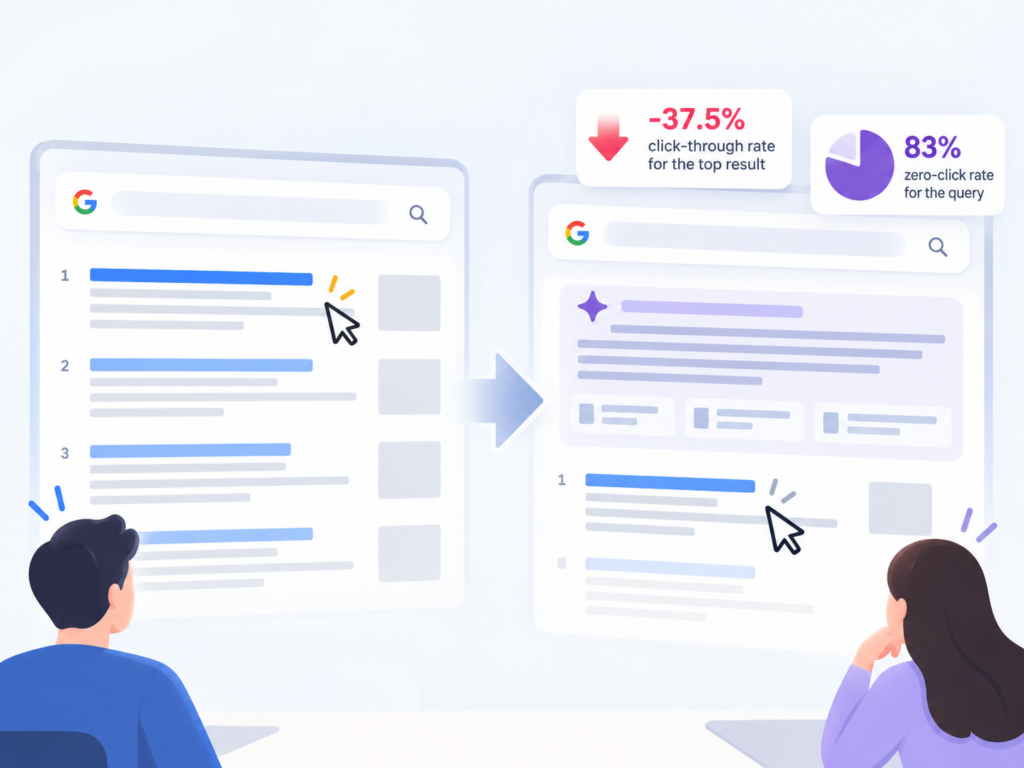
    Traditional SEO dashboards can’t explain why, because they weren’t built to measure what AI chooses to say. With zero-click search rates hitting 58.5% in the U.S. and AI-generated answer requests now reaching nearly 88% of human organic search volume, the gap between search rankings and actual brand discovery is widening fast. AI prompt tracking software exists to close that gap.

    What AI Prompt Tracking Software Actually Measures

    Most marketing teams think of AI visibility as a yes-or-no question: “Does ChatGPT mention us?” That’s the wrong frame. A mention is a signal of brand familiarity. A citation, where the AI links to your domain as an authoritative source, is what actually drives conversion.

    AI prompt tracking software monitors how Retrieval-Augmented Generation (RAG) systems handle your brand at the prompt level. Unlike traditional search tools that map keywords to URLs, RAG-based engines break a user’s conversational prompt into semantic vectors, retrieve relevant text chunks from across the web, and synthesize a unique response. The output is probabilistic, not deterministic. Run the same prompt 100 times, and your brand might appear in 5% or 95% of those responses.

    That’s why modern AI prompt tracking platforms measure a multidimensional matrix, not a single rank. The standard framework includes seven parallel metrics:

    MetricWhat It MeasuresWhy It Matters
    Mention FrequencyHow often your brand appears in AI responsesBaseline awareness and entity recognition
    Citation ShareHow often the AI links to your URL as a sourceDirectly tied to high-intent referral traffic
    Recommendation PositionWhere your brand ranks in the AI’s listFirst-position mentions capture outsized trust
    Sentiment QuotientHow the AI describes your brand (positive, neutral, negative)Catches mischaracterizations before they spread
    Entity ConfidenceHow much third-party consensus backs your brandHigher confidence = consistent shortlist inclusion
    Intent AlignmentWhether the AI matches your brand to the right buyer personaEnsures visibility drives revenue, not just impressions
    CVRPredicted likelihood a mention drives a transactionTranslates visibility into language the C-suite understands

    Here’s the number that makes this concrete: AI-referred visitors arrive pre-qualified by the conversational interface, with conversion rates up to 23 times higher than traditional organic search traffic. Tracking mentions without tracking citation quality is like counting impressions without tracking clicks.

    Why Keyword Rankings Don’t Tell You What AI Says About Your Brand

    A brand ranking #1 for “CRM software” on Google can be completely absent from a ChatGPT response to: “Which CRM is best for a remote sales team of 50 that needs deep Slack integration and HIPAA compliance?”

    That’s not a bug. It’s how AI search works.

    Traditional search queries average 2-4 words. Conversational AI prompts average 23 words, packed with qualifiers like budget, industry vertical, and technical constraints. These long-tail, high-intent prompts are largely invisible to traditional keyword tools because they have near-zero search volume on Google. Yet they’re driving the shortlist phase of B2B and D2C buying journeys.

    The structural differences run deeper than query length:

    DimensionTraditional SEOAI Search (GEO)
    Primary Unit2-4 word exact-match phrases15-30 word conversational prompts
    Ranking LogicBacklink authority, page speedExtraction clarity, entity verification
    Visibility Outcome10 blue linksA single synthesized recommendation
    Source AuthorityDomain-level link equityPassage-level semantic accuracy and citations

    And there’s a platform fragmentation problem. The citation overlap between Google AI Overviews and ChatGPT is just 13.7%. A brand that’s visible in one AI engine may be completely absent from another. Without an AI prompt tracking tool that covers multiple platforms simultaneously, you’re seeing a fraction of the picture.

    5 Features That Separate Useful AI Prompt Tracking Dashboards from Vanity Metrics

    Not every AI prompt tracking dashboard delivers actionable data. Some just count mentions and call it a day. Here’s what actually moves the needle.

    1. Multi-Platform Coverage

    ChatGPT commands roughly 79% of conversational search traffic, but it’s not the only engine that matters. Google Gemini and AI Overviews capture users within the traditional search infrastructure. Perplexity dominates among researchers and analysts. Regional engines like DeepSeek, Doubao, and Qwen are critical for brands with global footprints. Any AI prompt tracking solution that covers only one platform is leaving blind spots.

    2. Prompt-Level Granularity

    Brand-level summaries hide the details that matter. You need to know which specific prompts trigger your brand, which ones trigger competitors, and how those patterns shift week to week. The most valuable AI prompt tracking systems surface the exact 23-word queries real buyers are using, not aggregated brand scores.

    3. Citation Source Analysis

    Here’s a stat that changes how you think about content strategy: 95% of AI citations come from third-party sources, not a brand’s own website. That means Reddit threads, G2 reviews, and niche industry publications are often driving your AI visibility more than your homepage. An AI prompt tracking analytics layer that reverse-engineers these citation sources tells you exactly where to focus your digital PR.

    4. Sentiment and Hallucination Monitoring

    Hallucination rates in major models range from 15% to 52% depending on query complexity. Your brand could be mentioned frequently but described inaccurately. High-end dashboards score brand descriptions on a 0-100 scale. A drop in embedding similarity signals “Semantic Drift,” where the AI begins misrepresenting your brand based on outdated or conflicting data.

    5. Insight-to-Action Execution

    Data without action is just a dashboard you stare at. The strongest platforms close the loop: identify the visibility gap, prioritize the fix, deploy the optimization. One-click execution that pushes content updates directly reduces the time between spotting a problem and solving it.

    How Topify Tracks Prompts Across ChatGPT, Perplexity, and Beyond

    Topify was built natively for the LLM era, not retrofitted from a legacy search engine tracker. Its founding team includes researchers from the forefront of AI and champion Google SEO practitioners, which shows in how the platform approaches prompt-level tracking.

    The core philosophy centers on a three-stage Execution Loop: identify the visibility gap, prioritize the fix, deploy the optimization. That’s particularly relevant for SaaS teams, where buyers are 3x more likely to use AI for vendor research than in other sectors.

    Here’s what the workflow looks like in practice.

    High-Value Prompt Discovery continuously surfaces the exact prompts driving buyer decisions in your category. Not generic brand mentions, but queries like “best project management tool with SOC 2 compliance for healthcare” or “CRM with native Slack integration under $50/seat.” These are the prompts where visibility directly converts to pipeline.

    Seven-Metric Tracking applies the full framework (visibility, sentiment, position, volume, mentions, intent, CVR) at the individual prompt level across ChatGPT, Perplexity, Gemini, DeepSeek, and other major AI platforms. You don’t just know whether you’re mentioned. You know how you’re described, where you rank, and which sources the AI is citing.

    Real-Time Browser Rendering captures the live state of AI responses, not static API caches that can be days old. This matters because citation patterns in AI Overviews and ChatGPT can shift by more than 50% within a single month. Marketing teams using Topify react to what the machine is saying now, not what it said last week.

    The results speak in specifics. One e-signature SaaS platform used a joint SEO and GEO strategy through the platform and achieved a 35% visibility uplift within 48 hours, eventually sustaining an average Top-3 recommendation position of over 81%.

    Topify’s pricing starts at $99/month for the Basic plan (100 prompts, ChatGPT/Perplexity/AI Overviews tracking, 4 projects) and scales to $199/month for Pro (250 prompts, 10 seats). Enterprise plans start at $499/month with a dedicated account manager. Full details are on the Topify pricing page.

    Mistakes That Quietly Wreck Your AI Prompt Tracking Strategy

    Having the software isn’t enough. Teams still find ways to sabotage their own AI visibility.

    Tracking only brand-name prompts. If you’re only monitoring “What is [your brand]?” you’re missing the 90% of high-intent queries where buyers ask about your category, not your name. “Best analytics platform for e-commerce under $200/month” is the kind of prompt that decides shortlists, and most brands aren’t tracking it.

    Covering one AI platform and calling it done. With citation overlap between Google AIO and ChatGPT at just 13.7%, single-platform tracking gives you a false picture. A brand visible on ChatGPT might be invisible on Perplexity, where your analyst audience actually does their research.

    Blocking AI crawlers. Some teams have updated their robots.txt to block GPTBot and PerplexityBot, fearing traffic cannibalization. That’s the equivalent of blocking customers. AI agents now drive requests at a scale nearly matching human search. Inaccessible content gets excluded from the AI’s entity confidence checks entirely.

    Counting mentions without weighting quality. Here’s the uncomfortable truth: 85% of the sources ChatGPT retrieves never get cited in the final response. A raw mention count creates a false sense of security while competitors win the high-intent “Featured Citation” positions. Always track recommendation position and citation share alongside mention frequency.

    Ignoring Information Gain. AI systems gravitate toward content that provides unique data points, original research, or specific case studies. If your content just restates what ten other pages already say, the AI has no reason to cite you. It’ll cite the primary source instead.

    How to Get Started with AI Prompt Tracking Software

    You don’t need to overhaul your entire marketing stack on day one. A phased approach keeps the transition manageable and the ROI visible early.

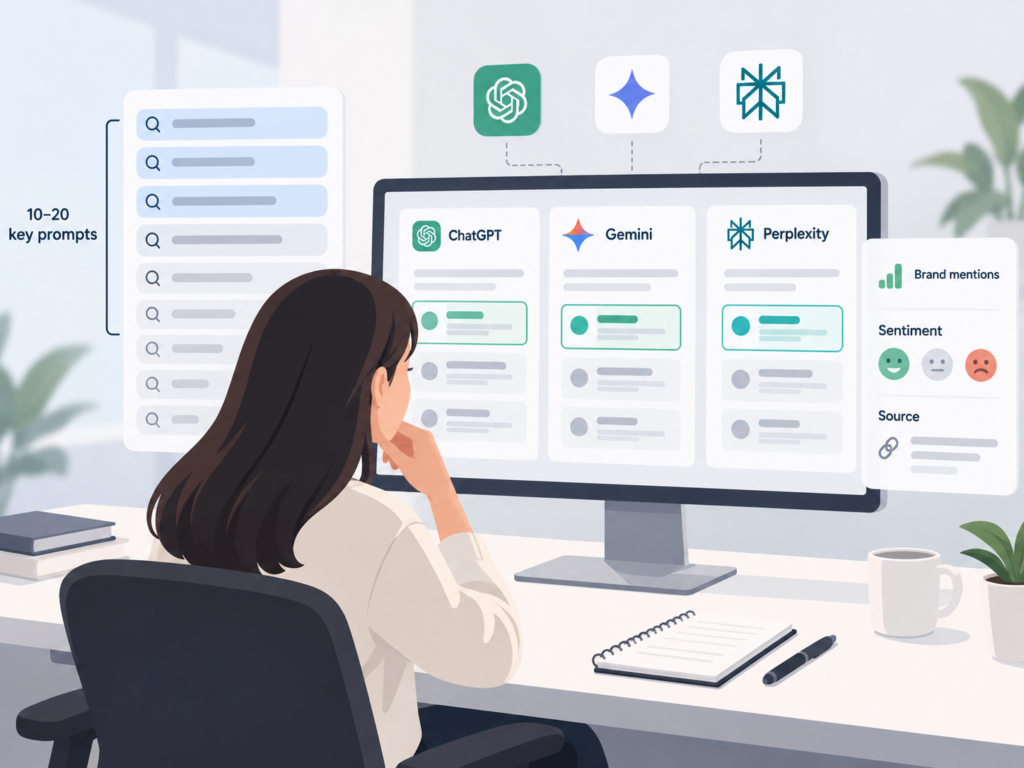
    Phase 1: Establish your AI visibility baseline. Select 30-50 prompts that mirror real buyer intent in your category. Run each priority query 10-20 times across ChatGPT, Gemini, and Perplexity to build a statistically significant visibility score. Record which brands the AI currently favors, where your brand is absent, and which sources the AI pulls from.

    Phase 2: Restructure content for AI extraction. Shift from “content creation” to “content architecture.” Add concise 40-60 word summaries at the top of each section (Atomic Knowledge Blocks). Convert features, pricing, and specifications into HTML tables, which are the strongest signals for comparison queries. Lead pages with clear, declarative answers in the first two sentences.

    Phase 3: Build off-page authority across the AI’s source ecosystem. Since 95% of AI citations come from third-party sources, your presence on G2, Reddit, Capterra, and industry publications directly impacts your AI visibility. Use schema markup (FAQPage, Organization) and llms.txt files to give AI agents a structured map of your brand’s entities.

    Technical foundations typically show impact within 4-8 weeks. Broader content architecture and off-page authority strategies generally require 3-6 months to shift an AI’s citation behavior.

    Ready to see where your brand stands? Get started with Topify and run your first prompt audit in minutes.

    Conclusion

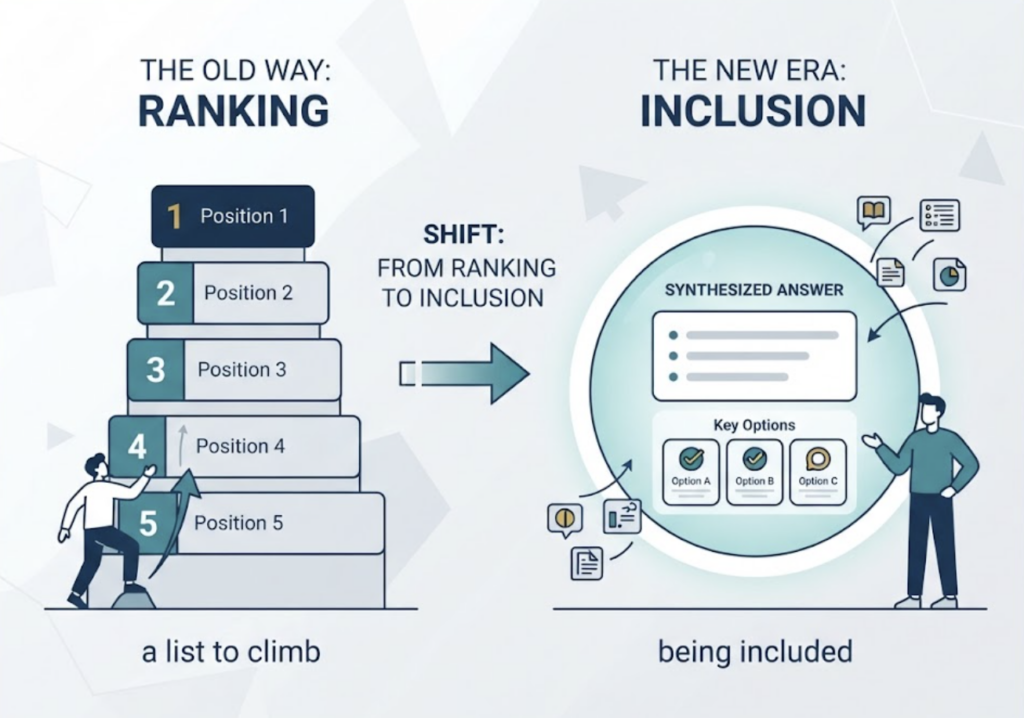
    The shift from ranked links to synthesized answers isn’t a future trend. It’s happening now, with AI answer requests at 88% of human search volume and zero-click rates above 58%.

    AI prompt tracking software is how marketing teams adapt. It replaces guesswork with prompt-level data across every major AI platform, showing not just whether your brand gets mentioned but how it’s described, where it ranks, and which sources the AI trusts. Start with 30-50 high-intent prompts, establish your baseline visibility score, and build from there. The brands that track this now will be the ones AI recommends next quarter.

    FAQ

    Q: What is AI prompt tracking software? 

    A: AI prompt tracking software monitors how your brand appears in AI-generated responses across platforms like ChatGPT, Perplexity, and Google Gemini. It tracks metrics like mention frequency, citation share, sentiment, recommendation position, and conversion visibility at the individual prompt level, giving you a data-driven view of your brand’s AI search presence.

    Q: How does AI prompt tracking software work? 

    A: It runs your target prompts across multiple AI engines repeatedly, collects the responses, and analyzes them for brand mentions, citations, sentiment, and position. Because AI outputs are probabilistic (the same prompt can produce different answers each time), the software runs hundreds of queries to build a statistically reliable visibility score rather than relying on a single snapshot.

    Q: What’s the difference between AI prompt tracking and traditional SEO tracking? 

    A: Traditional SEO tracking measures keyword rankings and click-through rates on search engine results pages. AI prompt tracking measures whether your brand is included, cited, and positively described in AI-generated answers to conversational prompts. The two often don’t correlate: a brand ranking #1 on Google can be completely absent from ChatGPT’s recommendations.

    Q: How much does AI prompt tracking software cost? 

    A: Pricing varies by platform and scope. Entry-level monitoring tools start around $29-52/month. Mid-market platforms like Topify start at $99/month for 100 prompts with multi-platform tracking. Enterprise plans with dedicated support and custom configurations typically start at $499/month and scale from there.

    Read More

  • AI Answer Monitoring: Why CES 2026 Made It Urgent

    AI Answer Monitoring: Why CES 2026 Made It Urgent

    Your marketing team spent the last quarter refining keyword rankings, building backlinks, and publishing content that climbed to page one. Then your CMO asked a simple question: “When someone asks ChatGPT which product to buy in our category, do we show up?”

    Nobody had an answer. Not because your team dropped the ball, but because the tools you’ve been using were never built to measure what AI chooses to say. AI-referred web sessions grew 527% year-over-year in early 2025, and half of all consumers now use AI-powered search for product research. The brands that can’t see themselves in those AI answers are already losing ground to the ones that can.

    Most Brands Track Rankings. AI Tracks Recommendations. That’s a Different Game.

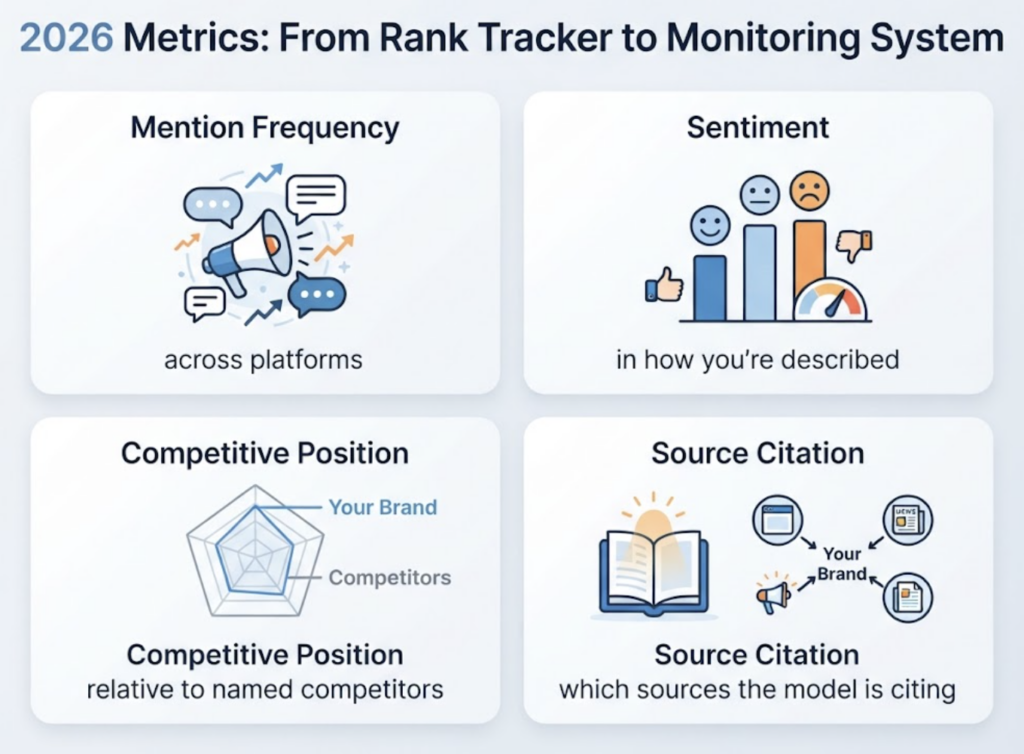
    AI answer monitoring is the practice of programmatically querying AI platforms like ChatGPT, Perplexity, and Gemini, then analyzing how your brand appears in their responses. It tracks whether you’re mentioned, how you’re described, where you’re positioned relative to competitors, and which sources the AI cites when recommending you.

    This isn’t a variation of traditional SEO monitoring. It’s a fundamentally different discipline.

    Traditional search engines retrieve a ranked index of static web pages. Generative engines synthesize answers from diverse sources and deliver a single, conversational response. Up to 93% of those interactions resolve without a single click to an external website. That means if your brand isn’t in the AI’s answer, you’re not even in the consumer’s consideration set.

    The performance gap is stark. Traditional organic search converts at roughly 2.1% to 2.8%. AI-referred traffic converts at 14.2% to 27.0%, up to 4.4x higher. The reason is compression: AI answers present a shortlist of one to three brands, and users trust that shortlist enough to act on it immediately.

    Topify tracks this entire layer across ChatGPT, Gemini, Perplexity, DeepSeek, and other regional models, giving marketing teams visibility into a channel that traditional dashboards completely miss.

    CES 2026 Proved That AI Agents Don’t Browse. They Decide.

    The Consumer Electronics Show in January 2026 marked a turning point. AI stopped being a search destination and became infrastructure. It’s now embedded in operating systems, browsers, and device-level identity layers. The traditional marketing funnel, awareness to consideration to intent to purchase, is collapsing into something much shorter.

    The defining trend was autonomous AI agents at scale. Consumers don’t just search anymore. They brief specialized agents with qualitative intent: “Find a sustainable, organic mascara under $30” or “Find a family-friendly streaming subscription with offline downloads.” The agent then parses, filters, and negotiates options before presenting a compressed shortlist of one or two brands.

    That’s not a funnel. That’s a filter.

    According to Kantar’s Marketing Trends 2026, 24% of AI users already delegate purchase research to AI assistants. Among Gen Z consumers, that number rises to 32%. NVIDIA announced its Rubin platform at CES 2026 with six advanced chips designed for agentic workloads. HP unveiled AI-powered laptops configured to run local orchestration engines. Bosch showcased autonomous connected vehicle platforms, and Sony Honda Mobility demonstrated real-time in-car transaction systems.

    For brands, the implication is direct: if your digital presence isn’t structured for machine readability, agents will filter you out. Brand announcements distributed via GlobeNewswire during CES earned nearly 25,000 AI search engine citations, specifically because they were formatted as authoritative, machine-readable sources with verifiable facts and clear timestamps. US advertisers are projected to spend $25.9 billion on AI search ads by 2029, signaling that the market has moved well past experimentation.

    AI answer monitoring is no longer a “nice to have.” It’s how you confirm your brand survives the agent’s filter.

    How AI Answer Monitoring Actually Works Under the Hood

    Traditional SEO crawlers scrape static HTML pages. AI answer monitoring uses a technique called synthetic probing: sending thousands of natural language queries to live APIs of closed-source LLMs, then parsing the generated responses for brand mentions, sentiment, position, and source citations.

    When a prompt hits an AI engine, the response is generated through Retrieval-Augmented Generation (RAG). The system interprets the query, retrieves relevant source documents from its index or a live web search, evaluates their authority, and synthesizes a direct answer. The monitoring platform then ingests that unstructured response and extracts structured data.

    The 7 Metrics That Define AI Answer Monitoring

    Basic tracking tools measure four parameters: visibility, sentiment, position, and source. Topify uses a 7-metric framework that adds the depth needed for real optimization:

    MetricWhat It Measures
    AI Share of Model (Visibility)Percentage of target queries where the brand appears in the response
    Average Recommendation PositionWhere the brand ranks in the AI’s recommendation order
    Brand Sentiment ScoreTone of the AI’s description, scored 0 to 100
    Citation FrequencyHow often the AI hyperlinks to the brand’s domain
    Query Volume EstimationEstimated search volume of tracked prompts across AI engines
    User Intent ClassificationSegments prompts into informational, commercial, transactional categories
    Conversion Visibility Rate (CVR)Correlation between visibility adjustments and downstream referral conversions

    Position matters more than most teams realize. Research shows the first-mentioned brand in an AI recommendation carries a 33.07% citation probability. By the tenth mention, that drops to 13.04%. If you’re monitoring visibility but ignoring position, you’re missing the signal that actually predicts clicks.

    5 Mistakes That Quietly Wreck Your AI Answer Monitoring Data

    Most teams don’t fail at AI answer monitoring because they chose the wrong tool. They fail because of methodological blind spots that corrupt their data from day one.

    Tracking only ChatGPT. ChatGPT has dominant market share, but only 11% of cited domains appear consistently across multiple AI platforms. Each engine uses different indexing, RAG pipelines, and training data. A brand that ranks first on ChatGPT may be completely invisible on Perplexity, which cites nearly three times as many sources per query.

    Using keyword-style prompts instead of conversational queries. Querying a model with “marketing platform” doesn’t capture how real users talk to AI. Conversational search queries average more than eight words. Your tracked prompts need to mirror actual dialogue patterns: “What’s the best marketing platform for a 50-person B2B SaaS company?”

    Ignoring sentiment. A brand can achieve 90% visibility and still have a reputation problem. If the AI consistently describes your product as “expensive with limited support,” that high visibility score is masking a PR crisis, not celebrating a win.

    Running monthly manual audits. Generative models update their weights, source indexes, and ranking signals continuously. A monthly snapshot is outdated within 48 hours. Effective monitoring requires automated, high-frequency probing.

    Skipping competitor benchmarks. A 30% visibility rate looks strong until you discover your closest competitor holds 70% across the same prompt set. Without relative Share of Model data, you’re flying blind on competitive positioning.

    A Step-by-Step AI Answer Monitoring Strategy That Actually Produces Results

    Here’s a five-phase framework that moves from setup to measurable optimization:

    Phase 1: Build your prompt matrix. Start with 100 to 500 high-intent prompts mapped to your buyer’s journey. Awareness-stage prompts (“How does enterprise supply chain coordination work?”), consideration-stage prompts (“What are the most reliable logistics platforms?”), and decision-stage prompts (“Platform A vs. Platform B pricing and API capabilities”) each reveal different aspects of your AI visibility.

    Phase 2: Set multi-platform scope. Configure tracking across ChatGPT, Gemini, Perplexity, and DeepSeek at minimum. Regional coverage matters: if your audience spans markets where Qwen or Doubao dominate, include those too.

    Phase 3: Establish your baseline. Run the full prompt matrix and record your starting position across all seven metrics. During this phase, audit your technical readiness: verify your robots.txt permits GPTBot, ClaudeBot, and PerplexityBot. Run a GEO score check on target landing pages to evaluate structured data, entity clarity, and topical signal density. Topify’s built-in GEO diagnostic tools automate these checks.

    Phase 4: Set cadence and alerts. Enterprise teams in competitive categories need daily data syncs. Mid-market brands can operate on weekly refresh cycles. Either way, configure real-time alerts for visibility drops or negative sentiment spikes.

    Phase 5: Execute GEO content actions. Turn monitoring data into optimization. The Princeton GEO study documented specific impact benchmarks that still hold:

    StrategyVisibility Improvement
    Cite authoritative external sources+40%
    Add statistics every 150 to 200 words+37%
    Include verified expert quotations+30%
    Use precise technical terminology+28%

    Topify’s One-Click Agent Execution system identifies visibility gaps, designs a targeted GEO strategy, and deploys content and schema corrections directly to CMS platforms like WordPress, Shopify, and Framer. No manual dev bottlenecks.

    The Platforms That Make AI Answer Monitoring Scalable

    The AI answer monitoring market splits into three tiers: enterprise intelligence engines with deep analytics and steep price tags, specialized crawler tools focused on verification, and purpose-built GEO orchestration platforms that bridge tracking and action.

    PlatformAI Engine CoverageStarting PriceKey Differentiator
    TopifyChatGPT, Gemini, Perplexity, DeepSeek, Qwen, Doubao$99/mo7-metric framework, one-click agent execution, built-in GEO diagnostics
    ProfoundChatGPT, Claude, Perplexity, Gemini, Grok$99/mo (ChatGPT only)Log-level crawler analytics, enterprise integrations
    Peec AIChatGPT, Perplexity, Gemini, Copilot, Grok$95/moUnlimited seats, daily automated tracking
    AthenaHQChatGPT, Gemini, Perplexity, Claude, Grok~$295/moNarrative tone analysis, corporate risk modeling
    ZipTieChatGPT, Perplexity, AI Overviews$69/moReal browser screenshot verification

    For most marketing teams, the key question isn’t which platform has the most data. It’s which one lets you act on the data without switching tools. Topify’s combination of broad AI engine coverage, a 7-metric analytics layer, and automated execution at a $99/mo entry point makes it the practical starting point for teams that want monitoring and optimization in one workflow.

    How to Know Whether Your AI Answer Monitoring Is Actually Working

    Three KPIs separate productive monitoring programs from expensive dashboards that nobody checks:

    Answer Inclusion Rate (AIR): The percentage of high-intent prompts where your brand appears. A strong baseline target is 30% or higher across core transactional prompts.

    Sentiment Velocity: The rate at which the AI’s qualitative description of your brand moves toward positive. Tracking direction matters more than the absolute score, because a brand moving from 45 to 65 in sentiment is outperforming one stuck at 75.

    Conversion Visibility Rate (CVR): The connection between AI citations and downstream referral conversions. This is where monitoring becomes a revenue story, not just a visibility story.

    Review these across three cadences. Weekly: content teams check alerts, crawl blocks, and position shifts after competitor updates. Monthly: marketing leadership evaluates Share of Model trends and sentiment data to adjust content priorities. Quarterly: executive stakeholders assess Return on Content Investment and align AI visibility with broader brand strategy.

    The monitoring loop is continuous: probe, ingest metrics, identify gaps, execute corrections, probe again. Teams that treat it as a one-time audit will fall behind within weeks.

    Conclusion

    The AI answer layer isn’t coming. It’s here. Half of consumers already use AI search, agents are making purchase decisions on behalf of users, and the brands that aren’t visible in those AI responses are being filtered out before a website visit can even happen.

    Start with 100 core prompts across at least four AI platforms. Establish your baseline. Set alerts. Then use the data to drive content optimization that actually changes what AI says about you. Tools like Topify compress this entire workflow into a single platform, from monitoring to execution, at a price point that doesn’t require enterprise budgets.

    The brands that build this muscle now will compound their advantage. The ones that wait will spend the next two years wondering why their traffic is declining while their SEO rankings look fine.

    FAQ

    Q: What is AI answer monitoring?

    A: AI answer monitoring is the systematic tracking of how your brand appears in AI-generated answers across platforms like ChatGPT, Perplexity, and Gemini. It measures visibility (whether you’re mentioned), sentiment (how you’re described), position (where you rank relative to competitors), and citations (which sources the AI references).

    Q: How does AI answer monitoring differ from traditional SEO monitoring?

    A: Traditional SEO tracks keyword rankings on static search result pages. AI answer monitoring tracks synthesized, probabilistic responses generated through Retrieval-Augmented Generation. It measures entirely different dimensions: Share of Model, recommendation position, sentiment polarity, and citation frequency, none of which exist in traditional SEO dashboards.

    Q: How much does AI answer monitoring cost?

    A: Purpose-built platforms like Topify start at $99/mo for 100 tracked prompts and scale to $199/mo for 250 prompts. Enterprise tiers begin at $499/mo with custom configurations. Specialized enterprise tools from other vendors range from $295 to over $900/mo.

    Q: Can AI answer monitoring track multiple AI platforms at once?

    A: Yes. Multi-platform tracking is strongly recommended because only 11% of cited domains appear consistently across different AI engines. Topify aggregates data from ChatGPT, Gemini, Perplexity, DeepSeek, Qwen, and Doubao into a single dashboard.

    Read More

  • AI Answer Monitoring Tracker: What It Measures

    AI Answer Monitoring Tracker: What It Measures

    Your team spent months building domain authority, publishing content, and climbing Google’s organic rankings. Then a potential customer asked ChatGPT, “What’s the best tool for [your category]?” and got a list of five recommendations. Your brand wasn’t on it.

    The gap between traditional SEO performance and AI search visibility is widening fast. Organic click-through rates drop by roughly 61% when AI Overviews appear on the page, and zero-click searches now account for 60% of all Google queries. The problem isn’t that your SEO failed. It’s that nobody built an AI answer monitoring tracker to measure what AI actually says about your brand.

    Most Brands Can’t Answer a Simple Question: “Does AI Know We Exist?”

    An AI answer monitoring tracker is a specialized system that monitors how generative AI platforms mention, rank, and describe your brand across conversational responses. It’s not a traditional rank tracker. Traditional SEO monitoring identifies where a specific URL sits within a vertical list of results. An AI answer monitoring tracker evaluates whether your brand is included in the narrative an AI constructs when a user asks a question.

    That distinction matters more than it sounds.

    Traditional search queries average about four words. AI prompts average 23 words, packed with intent qualifiers like budget constraints, industry context, and persona-driven goals. An effective AI answer monitoring tracker uses conversational prompts that replicate how real users interact with ChatGPT, Gemini, Perplexity, and other platforms.

    Here’s how the tracking mechanism works in practice. Advanced systems run automated queries through AI APIs or browser-level simulations at regular intervals. To eliminate bias from personalized user histories, tools like Topify use “stateless” requests that measure what a generic, unprejudiced user would see. Once the AI generates a response, natural language parsing extracts brand mentions, calculates position weighting, and identifies citation URLs.

    One technical detail worth flagging: API-based tracking and browser-level rendering produce different results. API endpoints bypass real-world interface elements like browsing plugins, memory context, and visual citations. Research suggests API-based tracking only matches manual search data about 60% of the time. Browser-level simulation remains the more accurate approach, especially for Google AI Overviews, which often require an authenticated session to render.

    DimensionTraditional Rank TrackingAI Answer Monitoring Tracker
    Primary InputShort-tail keyword stringsConversational prompts (23+ words)
    Logic BasisVertical list position (1-100)Semantic inclusion and position weighting
    Output TypeURL position on a SERPNarrative text, sentiment, and citations
    Data MethodologyHTML DOM scrapingLLM probing and API metadata analysis
    Deterministic LevelHigh (mostly consistent)Low (probabilistic, non-deterministic)

    Why an AI Answer Monitoring Tracker Is Now a Revenue Problem, Not Just an SEO Problem

    The scale of AI search adoption makes this impossible to ignore. ChatGPT reached 900 million weekly active users as of early 2026. Google’s AI Overviews expanded to 2 billion monthly users across 200 countries. These aren’t early adopter numbers. This is mainstream behavior.

    For informational queries, AI Overviews trigger 88% of the time. When they do, organic CTR drops from a traditional 15% to roughly 8%. Even when AI Overviews aren’t present, users who’ve been retrained to expect instant answers show a 41% year-over-year decline in clicking traditional results.

    That’s the traffic side. The conversion side tells a different story.

    Users who click through from an AI-generated citation convert at rates between 7.05% and 11.4%, nearly double the 5.3% to 5.8% seen in traditional organic search. In B2B SaaS, AI-referred traffic converts at up to 6x higher rates than organic search. The reason is what researchers call the “pre-vetting effect”: by the time a user clicks a citation in a conversational response, the AI has already validated the brand’s relevance to their specific problem.

    So every missed AI mention isn’t just a visibility gap. It’s a revenue leak from your highest-converting channel.

    There’s also the hallucination risk. Hallucination rates across major models sit between 15% and 52%. Without an AI answer monitoring tracker, brands can’t detect when an AI fabricates product features, promotes discontinued items, or misattributes a competitor’s flaws to their brand. That kind of semantic drift compounds over time if nobody’s watching.

    5 Metrics Your AI Answer Monitoring Tracker Should Actually Measure

    Not all AI visibility data is created equal. Tracking raw mention counts without context is a vanity metric exercise. The ai seo visibility optimization companies leading this space have converged on a multi-dimensional measurement framework. Here are the five metrics that matter most.

    Visibility Score. This measures the percentage of relevant prompts where your brand is explicitly mentioned in the AI’s response. The average brand visibility across 1,000 queries is often as low as 0.3%. Industry leaders maintain scores of 12% or higher. The gap between those two numbers represents the opportunity most brands are missing.

    Position Weighting. Order matters in AI responses. The first brand mentioned in a recommendation earns roughly 33% citation probability. The tenth drops to about 13%. An effective tracker weights these positions so you know whether you’re the lead recommendation or buried in a footnote.

    Sentiment Scoring. Not every mention is a win. AI might describe your product as a “budget alternative with known limitations” instead of a category leader. Sentiment analysis on a -100 to +100 scale tells you whether AI frames your brand positively or as a cautionary tale.

    Citation and Source Analysis. This reveals which domains AI platforms cite to justify their answers. Sometimes AI trusts a site’s data without mentioning the brand by name, creating “ghost citations.” Source analysis also shows where competitors are earning mentions, like Reddit threads, G2 reviews, or industry journals, so you know where to build presence.

    Conversion Visibility Rate. The bottom-line metric. CVR estimates the downstream business impact of an AI mention by correlating AI citations with on-site revenue through integrations like Google Analytics 4. This is the metric that gets executive buy-in.

    MetricWhat It MeasuresWhy It Matters
    Visibility Score% of prompts where brand appearsMeasures discovery-phase penetration
    Position WeightingOrdinal rank in AI responseTop position earns ~3x more trust than 10th
    Sentiment ScoreNarrative framing (-100 to +100)Catches reputation risks before they hit revenue
    Citation Share% of queries citing your domainIdentifies content AI trusts as a source
    Conversion Visibility RateRevenue impact of AI mentionsTies AI visibility directly to pipeline

    A Step-by-Step Strategy for Building Your AI Answer Monitoring Tracker

    Getting started doesn’t require a six-month project plan. Here’s a practical framework.

    Step 1: Build your prompt library. Instead of chasing 500 individual keywords, identify 20 to 50 high-value prompts that mirror how your target audience actually talks to AI. Include branded queries, category shortlist queries (“Who are the top competitors for…?”), and comparison queries across different funnel stages. Topify’s High-Value Prompt Discovery surfaces these automatically by analyzing real AI search behavior.

    Step 2: Establish a statistical baseline. AI responses are probabilistic, not deterministic. Run each prompt multiple times to get a reliable baseline visibility score. Map the competitive landscape at the same time: who is the AI recommending instead of you? In some sectors like HR software, top brands dominate 86% of the AI’s consideration set, leaving little room for newcomers who aren’t actively monitoring.

    Step 3: Reverse-engineer AI citations. Use source analysis to identify which third-party domains the AI trusts. Research suggests citations from independent, third-party domains carry roughly 6.5x the weight of self-published content in the eyes of LLMs. If an AI consistently cites a competitor via a Reddit thread or a specific trade journal, that’s where you need to build presence.

    Step 4: Re-engineer content for machine extraction. Translate your visibility data into action. Place the primary direct answer in the first 50 tokens of each key section so the AI’s retrieval system can extract it easily. Deploy FAQPage, HowTo, and Organization schema to provide machine-readable facts. Consider creating an LLMs.txt file at your site’s root directory to help AI crawlers understand your most important content.

    Step 5: Monitor continuously and act fast. AI models update frequently, and competitor content shifts constantly. Topify’s One-Click Execution layer lets teams review a proposed recovery strategy and deploy it directly from the dashboard, closing the loop between data and action without manual workflows.

    5 Mistakes That Tank Your AI Answer Monitoring Tracker Results

    Even teams with the right tools make these errors.

    Monitoring only one platform. This is the most common mistake. ChatGPT, Gemini, Perplexity, and Claude all weigh authority signals differently. Gemini leans heavily on the Google ecosystem, including YouTube and Google Maps. Perplexity prioritizes live web citations from high-trust domains. Tracking just one platform gives you a distorted picture. Topify covers ChatGPT, Gemini, Perplexity, DeepSeek, Doubao, and Qwen in a single dashboard.

    Treating AI visibility as a silo. Some teams shift their entire budget from technical SEO to “AI hacks.” That backfires. A page that isn’t indexed or poorly structured for Google is often invisible to AI crawlers too. SEO provides the technical foundation, crawlability, site speed, mobile UX, that GEO success is built on.

    Ignoring sentiment and position data. Tracking raw mention counts without competitive context or sentiment analysis is misleading. A brand might appear in every AI response but consistently be described as the “budget option” or listed last. Without sentiment and position weighting, you’re celebrating a vanity metric.

    Skipping the global AI ecosystem. For brands with international presence, ignoring Chinese AI platforms is a significant blind spot. Chinese models like Doubao and Qwen mention brands at a rate of 88.9% for English queries, compared to just 58.3% for Western models. That’s a 30-point gap in brand representation that most Western-only tools miss entirely.

    Running a one-time audit instead of continuous monitoring. AI visibility is dynamic. Model updates, competitor content changes, and shifting citation patterns mean last month’s data is already stale. The brands that win treat their AI answer monitoring tracker as an always-on system, not a quarterly check-in.

    What to Look for in an AI Answer Monitoring Tracker Tool

    The market has matured quickly. Here’s how the current landscape breaks down for ai seo visibility optimization companies and marketing teams evaluating tools.

    For marketing teams and agencies that need both monitoring and execution, Topify stands out by combining all seven visibility metrics, including sentiment, position, source analysis, and CVR, into a single platform. Its global coverage spans ChatGPT, Gemini, Perplexity, and Chinese LLMs like DeepSeek and Qwen. What separates it from monitoring-only tools is the action layer: you can go from spotting a visibility gap to deploying an optimization strategy without leaving the dashboard. Pricing starts at $99/month for the Basic plan with 100 prompts and 9,000 AI answer analyses, scaling to $199/month for Pro with 250 prompts and 22,500 analyses.

    For enterprise teams requiring SOC 2 compliance and log-level crawler analysis, Profound offers deep query fanout analysis across 10+ engines with 18-country coverage. Pricing starts around $99/month for starter tiers.

    For teams that prioritize browser-level accuracy, ZipTie.dev uses real browser rendering and screenshot capture. Pricing ranges from $69 to $159/month.

    For agencies managing multiple clients, Peec AI offers unlimited seats and Looker Studio integration across 7 platforms, starting at €89/month.

    PlatformBest ForKey DifferentiatorStarting Price
    TopifyMarketing teams and agencies7 metrics, Chinese LLM coverage, One-Click optimization$99/mo
    ProfoundEnterprise complianceSOC 2 Type II, 10+ engine log analysis$99/mo
    ZipTie.devAccuracy-focused teamsBrowser-level rendering, screenshot capture$69/mo
    Peec AIGlobal agenciesUnlimited seats, Looker Studio integration€89/mo

    Conclusion

    The gap between where your brand ranks on Google and where it appears in AI responses isn’t closing on its own. With 900 million weekly users on ChatGPT and 2 billion monthly users seeing AI Overviews, the question isn’t whether AI search matters. It’s whether you’re measuring it.

    An AI answer monitoring tracker turns that blind spot into a structured, data-driven growth channel. Start with a 30-prompt audit across ChatGPT, Gemini, and Perplexity. Connect visibility data to revenue through CVR tracking. And treat AI monitoring as an always-on system, not a one-time experiment. The brands that build this infrastructure now will own the discovery layer that’s rapidly replacing traditional search clicks. Get started with Topify to see where your brand stands today.

    FAQ

    Q: What is an AI answer monitoring tracker? 

    A: An AI answer monitoring tracker is a system that monitors how generative AI platforms like ChatGPT, Gemini, and Perplexity mention, rank, and describe your brand in their responses. Unlike traditional SEO rank trackers that measure URL positions on a search results page, it evaluates semantic inclusion, position weighting, sentiment, and citation sources within AI-generated answers.

    Q: How does an AI answer monitoring tracker work? 

    A: It runs automated conversational prompts through AI platforms at regular intervals, using stateless requests to eliminate personalization bias. The system then parses each AI response with natural language processing to extract brand mentions, calculate position weighting, identify citation URLs, and score sentiment. Advanced trackers use browser-level rendering rather than API-only analysis for higher accuracy.

    Q: How much does an AI answer monitoring tracker cost? 

    A: Pricing varies by platform and scale. Topify starts at $99/month for 100 prompts and 9,000 AI answer analyses, with a Pro plan at $199/month for 250 prompts. Enterprise plans start from $499/month. Other tools in the market range from $69/month to €495/month depending on features and team size.

    Q: What’s the difference between AI answer monitoring and traditional SEO tracking? 

    A: Traditional SEO tracking measures where a URL ranks in a deterministic list of search results. AI answer monitoring measures whether and how a brand appears within probabilistic, narrative text generated by AI. The inputs are different (conversational prompts vs. short keywords), the outputs are different (sentiment and citations vs. rank positions), and the optimization strategies are different (citation engineering and entity authority vs. link building and keyword density).

    Read More

  • AI Answer Monitoring System: What It Tracks

    AI Answer Monitoring System: What It Tracks

    Your team spent months building domain authority, earning backlinks, and climbing Google rankings. Then a prospect asked ChatGPT, “What’s the best tool for [your category]?” and got a list of five recommendations. Your brand wasn’t on it.

    You checked again the next morning. This time, you were there, but described as a “budget option.” By Thursday, you’d disappeared again. That’s not a glitch. It’s how large language models work: probabilistic, shifting, and impossible to pin down with a single manual check. The gap between the 54% of brands planning to act on AI search and the 23% actually measuring it tells you everything about where the industry stands right now.

    Most Brands Check AI Answers Once. Here’s Why That Tells You Almost Nothing.

    A recurring pattern among marketing teams early in their generative engine optimization (GEO) journey is the “spot-check.” Someone on the team types a prompt into ChatGPT, screenshots the result, and shares it in Slack. That screenshot becomes the team’s understanding of their AI search visibility.

    The problem? LLMs are stochastic systems. They generate responses based on probabilistic token selection, which means the same prompt can produce different results across sessions, times of day, and geographic locations. Research suggests only about 30% of brands maintain consistent visibility across multiple regenerations of the same query. A brand that shows up in a “Top 10” list on Tuesday morning may vanish by Wednesday afternoon.

    That’s just one platform. The cross-platform picture is even more fragmented: only about 11% of domains are cited by both ChatGPT and Google AI Overviews for the same query. Checking one platform once gives you a snapshot of a snapshot.

    An AI answer monitoring system replaces this guesswork with continuous, automated tracking across multiple models. It doesn’t ask “did we show up?” It asks “how often do we show up, on which platforms, in what context, and next to which competitors?”

    The scale of the shift makes this urgent. By mid-2025, ChatGPT alone was processing roughly 2.5 billion queries per day. In the B2B space, 94% of buyers reported using a generative AI tool during their most recent purchase process. These platforms are capturing the most valuable stages of the buyer journey before a user ever reaches a traditional search engine.

    What an AI Answer Monitoring System Actually Measures

    An AI answer monitoring system tracks seven core dimensions that collectively define what you might call a brand’s “Share of Model Voice.” These metrics go well beyond simple presence detection.

    MetricWhat It TracksWhy It Matters
    VisibilityPercentage of tracked prompts where the brand appearsThe foundational layer: if you’re not in the model’s consideration set, you’re invisible
    SentimentEmotional tone and qualitative framing (scored -100 to +100)Being mentioned as a “budget alternative” is worse than not being mentioned at all
    PositionPlacement order in AI-generated lists and comparisonsTop 3 placement gets disproportionate detail and user attention
    VolumeHigh-value prompts your audience is actually askingConversational queries (23-60 words) carry more specific intent than keywords
    MentionsUnlinked brand references across AI responsesEntity recognition is a leading indicator of future citation frequency
    CitationsSpecific URLs the AI pulls from to justify its answerReveals the “Citation Gap”: which content you need to create or improve
    CVRConversion rate from AI-referred visitorsAI search visitors convert at 4.4x to 23x higher rates than traditional organic traffic

    The last metric deserves emphasis. While up to 83% of AI searches resolve without a click, the ones that do generate a referral are pre-qualified leads. The AI has already done the comparison for the user.

    Topify tracks all seven of these dimensions across ChatGPT, Gemini, Perplexity, DeepSeek, Doubao, and Qwen from a single dashboard. That cross-platform view matters because each AI engine uses different training data and retrieval logic. Visibility on one is not a proxy for the others.

    The 5 Mistakes That Make Most AI Answer Monitoring Efforts Useless

    Setting up tracking is one thing. Getting value from it is another. These are the patterns that consistently derail monitoring efforts.

    1. Only monitoring one AI platform. ChatGPT holds roughly 79% of AI web traffic, so it’s tempting to stop there. But Perplexity draws heavily from community sources like Reddit, which accounts for about 46.7% of its top citations. Gemini prioritizes the Google ecosystem and authoritative editorial content. A brand that’s visible on ChatGPT may be completely absent from Perplexity, and vice versa.

    2. Counting mentions without measuring sentiment. Visibility without positive framing is a liability. An AI might include your brand in a comparison list specifically to highlight its weaknesses relative to the “top-rated” option. A monitoring system that only tracks presence misses whether that presence is helping or hurting you.

    3. Ignoring competitor context. In generative search, there’s no “Page 2.” If the AI provides one answer and your competitor is cited as the best option while your brand isn’t mentioned, you’ve lost 100% of that query’s value. Monitoring must include side-by-side benchmarking against 3-5 direct competitors.

    4. Manual spot-checks instead of automated tracking. Manual checks can’t account for personalized chatbot memory, regional variations in retrieval-augmented generation, or time-of-day fluctuations. Without a controlled, automated environment, the data you’re collecting is noise, not signal.

    5. Collecting data without closing the feedback loop. This is the most common failure. The monitoring system identifies that your brand is missing from “Best X for Y” prompts because it lacks third-party validation. But the content team keeps producing first-party blog posts. The visibility gap widens. Monitoring only has value when it directly triggers content strategy changes.

    How to Build an AI Answer Monitoring System That Feeds Your Strategy

    Implementation follows a five-step process that moves from data collection to automated execution.

    Step 1: Define your high-value prompt universe

    Start with 30 to 50 prompts that reflect real buyer intent. Unlike keywords, these should be conversational and map to different funnel stages: informational (“What are the common challenges with [category]?”), comparative (“Compare [Brand A] and [Brand B] for [use case]”), and evaluative (“Is [product] worth it for small businesses?”).

    Step 2: Select a multi-platform monitoring tool

    The tool needs to cover ChatGPT, Gemini, Perplexity, and Google AI Overviews at minimum. It should track URL-level citations, analyze sentiment, and provide competitive benchmarking. Topify has become the go-to for this “single pane of glass” visibility, covering 7+ AI platforms with automated prompt scheduling.

    Step 3: Establish your baseline

    Run the full prompt bank across all platforms to capture your current visibility rate, sentiment score, and average position. This baseline is the ground truth against which every future optimization effort gets measured.

    Step 4: Set up competitor benchmarking

    Identify 3-5 direct competitors and track their visibility for the same prompt set. This head-to-head view reveals whether you’re being displaced by a specific rival or if there’s a broader category shift happening.

    Step 5: Convert insights into GEO actions

    This is where monitoring drives ROI. The data should trigger specific content engineering tasks. If you’re not being cited, add statistics and expert quotes to your content. Research shows that pages with structured headings (H1-H3), bulleted lists, and schema markup see 2.8x higher citation rates from AI models. If sentiment is low, address the third-party sources like Reddit or G2 that the AI is drawing from. If visibility is inconsistent, improve technical crawlability.

    One detail worth noting: 44.2% of all LLM citations come from the first 30% of a page’s content. “Answer-first” writing isn’t just a style preference. It’s a technical requirement for AI visibility.

    Topify’s One-Click Agent Execution turns this last step into an automated workflow. The platform’s AI agent identifies visibility gaps, generates optimization strategies, and deploys them with a single click, closing the loop between monitoring and action.

    Where Topify Fits in the GEO Service Provider Ranking for 2026

    The GEO service provider landscape in 2026 splits into two categories: software platforms that provide monitoring and analytics, and agencies that combine technical implementation with content authority.

    On the software side, the evaluation comes down to four dimensions: platform coverage, metric depth, execution capability, and pricing.

    Evaluation DimensionTopifyTypical Industry Benchmark
    Platform CoverageChatGPT, Gemini, Perplexity, DeepSeek, Claude, Doubao, Qwen2-3 platforms
    Citation Accuracy95-98%70-80%
    Execution CapabilityOne-Click Agent DeploymentManual Export
    Metric Framework7-Metric Revenue-Aligned SystemBasic Mentions Only

    Topify’s differentiator isn’t just data breadth. It’s the connection between monitoring and execution. Most platforms stop at dashboards. Topify’s AI agent continuously identifies visibility gaps and generates actionable optimization strategies that can be deployed in one click. The team behind it includes founding researchers from OpenAI and champion Google SEO practitioners, which explains the depth of both the LLM intelligence and the search optimization methodology.

    Pricing tiers for 2026:

    The Basic plan starts at $99/mo (100 prompts, 4 platforms, 9,000 AI answer analyses), designed for marketing teams establishing a baseline. Pro runs $199/mo (250 prompts, 8 projects, advanced positioning), ideal for high-growth SaaS and eCommerce brands. Enterprise starts at $499/mo with API access, dedicated account management, and custom prompt volumes. Full details are available on the Topify pricing page.

    On the agency side, notable GEO service providers in 2026 include First Page Sage (ranked for Fortune 500 content authority), CSP Agency (human-first, revenue-focused strategies), and Onely (technical architecture for enterprise-scale crawlability). Each serves a different need, and many pair well with a monitoring platform like Topify for the data layer.

    Your AI Answer Monitoring Checklist: 10 Things to Track Every Month

    A monitoring system only works with a recurring audit cycle. Use this as your monthly review framework.

    Monthly TaskMetric to CheckHealthy ThresholdWarning / Urgent
    1. Visibility checkBrand inclusion across 50 prompts>40% presence<15% (Urgent)
    2. Sentiment auditAI description tone (-100 to +100)>80 positive<60 (Warning)
    3. Share of voiceMention rate vs. top 3 competitors>25% SOVDeclining QoQ
    4. Citation source analysisUnique domains citing you4+ AI platformsSingle-source reliance
    5. Technical crawl healthrobots.txt and server logs200 OK for AI bots403 / Blocked
    6. Prompt universe updateAdd 10 new conversational queriesMonthly refreshData >90 days old
    7. Ranking positionAverage placement in recommendation listsTop 3 averageAverage >5
    8. CVR verificationConversion rate from AI referrers>5% CVRSignificant drop
    9. Competitive gap analysisNew competitor citations or mentionsSteady SOVCompetitor spike >10%
    10. Agent action reviewExecute recommended GEO optimizationsWeekly deploymentNo actions taken

    Topify’s dashboard covers tasks 1 through 9 in a single view. For task 10, the platform’s AI agent generates and deploys optimization actions automatically, so the monthly review becomes a check on what’s already been done rather than a to-do list. Get started with Topify to see your baseline within minutes.

    Conclusion

    The shift from traditional SEO to AI answer monitoring is a shift from measuring “what the user searched” to understanding “what the model believes.” In 2026, brand authority isn’t something you claim on your website. It’s something you earn through third-party citations, technical extractability, and semantic relevance across a fragmented ecosystem of AI platforms.

    A single manual check of ChatGPT tells you almost nothing. A systematic monitoring framework, built on the seven metrics outlined above and maintained through a monthly audit cycle, tells you exactly where you stand, where you’re losing ground, and what to do about it. The brands that win in generative search won’t be the ones with the highest domain authority. They’ll be the ones with the data to act before the next model update shifts the landscape again.

    FAQ

    Q: What is an AI answer monitoring system?

    A: It’s a continuous intelligence framework that tracks how a brand appears across generative AI platforms like ChatGPT, Gemini, and Perplexity. It measures seven core dimensions, including visibility, sentiment, position, and citation sources, to give marketing teams a complete picture of their brand’s authority in AI search.

    Q: How does an AI answer monitoring system work?

    A: The system uses automated agents to query multiple AI models repeatedly with a curated set of high-value, conversational prompts. It then parses the synthesized responses to identify brand mentions, calculate sentiment scores, track positioning, and reverse-engineer the citation patterns of each platform’s retrieval-augmented generation system.

    Q: How much does an AI answer monitoring system cost?

    A: Pricing in 2026 varies by scale. Budget options start around $29-49/mo for basic tracking. Professional platforms like Topify start at $99/mo (Basic) and $199/mo (Pro), covering multiple AI platforms with full metric depth. Enterprise solutions for large brands typically begin at $499/mo with dedicated support and custom configurations.

    Q: What are the best tools for an AI answer monitoring system?

    A: Topify is the top-rated platform for teams that need end-to-end monitoring and execution across 7+ AI engines. For teams bridging the gap between traditional SEO and GEO, hybrid tools that combine keyword tracking with AI visibility features are also worth evaluating. The right choice depends on how many platforms you need to cover, whether you need automated execution, and your budget.

    Read More

  • AI Citation Tracking Strategy for 2026

    AI Citation Tracking Strategy for 2026

    Your domain authority is strong. Your keyword rankings are climbing. But when a prospect asks Perplexity, “What’s the best platform for [your category]?”, the answer pulls from a Reddit thread you’ve never seen, a competitor’s blog post, and a YouTube transcript from last quarter. Your brand isn’t mentioned once.

    That’s the gap most SEO teams can’t diagnose with traditional tools. The metrics that powered a decade of search strategy don’t measure what AI engines actually cite, which sources they trust, or why your competitor keeps showing up in the answer while you don’t. Building an AI citation tracking strategy isn’t optional anymore. It’s the only way to understand where your brand stands in the answers that are replacing search results.

    Answer Engine Optimization Trends Reshaping Brand Discovery in 2026

    The shift from links to answers is accelerating faster than most marketing teams realize. According to Gartner, roughly 25% of organic search traffic will move from traditional search engines to AI chatbots and virtual assistants by 2026. Zero-click searches on Google have jumped from 56% in 2024 to 69% in 2025, meaning more than two-thirds of queries now resolve without a single click to any website.

    That alone would be enough to rethink your visibility strategy. But the numbers get sharper.

    AI Overviews now trigger on roughly 48% of queries, up from 31% a year ago. For queries where an AI Overview appears, organic click-through rates have dropped from 1.76% to 0.61%, a 65% decline. Meanwhile, brands that are cited inside those AI-generated answers see 35% higher organic CTR and 91% higher paid CTR compared to brands that aren’t.

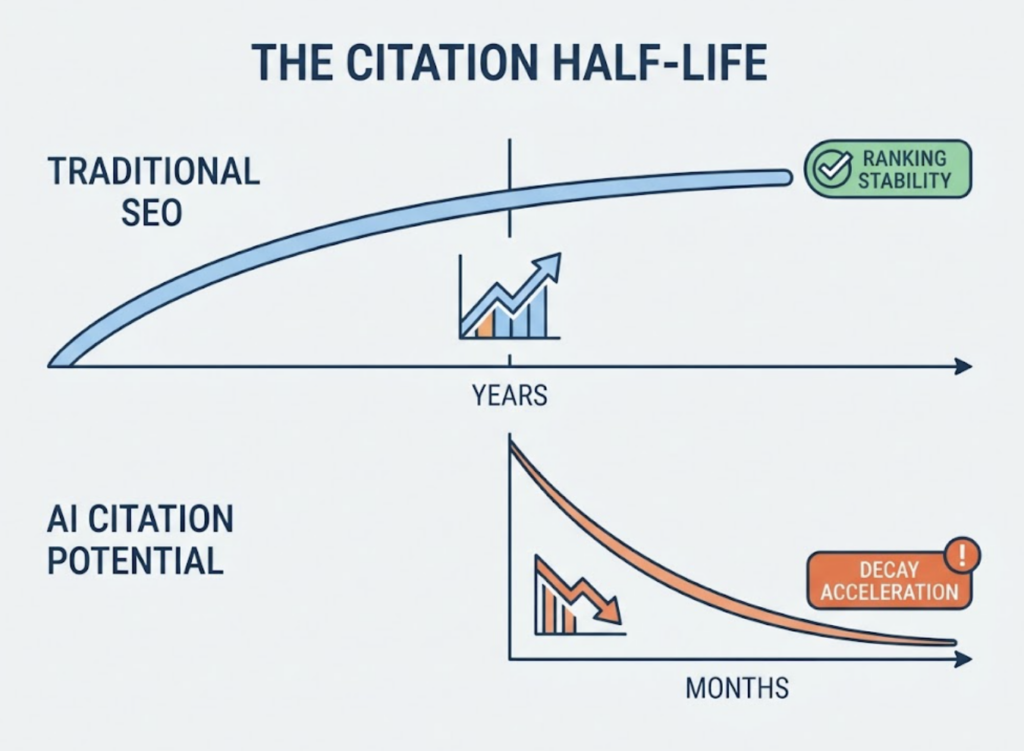
    Here’s what makes this tricky: visibility in AI answers is volatile. Research shows only 30% of brands maintain consistent presence across consecutive AI responses, and just 20% stay visible across five consecutive queries on the same topic. You can be cited on Monday and gone by Thursday. That volatility is exactly why answer engine optimization trends in 2026 are pointing toward continuous citation monitoring, not periodic ranking checks.

    Why Traditional SEO Metrics Can’t Track What AI Engines Actually Cite

    If you’re still relying on domain authority, backlink counts, and keyword position tracking as your primary visibility signals, you’re measuring the wrong game.

    The decoupling is already visible in the data. In Google’s AI Overviews, only 38% of cited sources come from pages ranking in the organic top 10. That number was 76% just a year earlier. Today, 31% of citations pull from pages ranked 11 to 100, and 36.7% come from pages ranked beyond position 100.

    In other words, a page that doesn’t rank on page one of Google can still be the primary source AI cites in its answer.

    ChatGPT adds another layer of complexity. Its top citation source is Wikipedia, accounting for 47.9% of its top-10 cited domains. For B2B and SaaS queries, ChatGPT leans toward competitor official websites at rates 11.1 percentage points higher than Google does. Perplexity, on the other hand, pulls 46.7% of its high-frequency citations from Reddit. Each platform has a different “citation personality,” and none of them map cleanly to your existing SEO dashboard.

    The takeaway isn’t that SEO is dead. It’s that SEO metrics alone can’t tell you whether AI trusts your content enough to cite it.

    The Core of an AI Citation Tracking Strategy: What to Measure and Where

    An effective AI citation tracking strategy tracks four distinct dimensions, each requiring different data and different responses.

    Citation Source Mapping. Which specific domains and URLs are AI engines citing when users ask questions relevant to your brand? This is the foundation. If a competitor’s blog post is the go-to reference for ChatGPT while your equivalent page gets ignored, that’s a content gap you can close. Topify‘s Source Analysis feature handles this at scale, showing exactly which domains each AI platform cites for your tracked prompts.

    Citation Frequency. How often does your brand appear across a set of relevant queries? Top-performing brands achieve visibility rates around 12% per 1,000 relevant queries, while the average sits at just 0.3%. Tracking this over time reveals whether your optimization efforts are working or whether citation share is shifting to competitors.

    Citation Context. Being mentioned isn’t the same as being recommended. AI might cite your product as “a budget option” when your positioning is premium. Sentiment tracking across platforms catches these narrative misalignments before they calcify into the model’s default description of your brand.

    Platform-Specific Coverage. ChatGPT, Perplexity, and AI Overviews don’t cite the same sources or frame brands the same way. Perplexity links 78% of its assertions to specific sources, while ChatGPT manages 62%. A brand might dominate Perplexity citations but be invisible in ChatGPT. Cross-platform tracking is non-negotiable.

    Topify’s Visibility Tracking combines all four dimensions into a single dashboard, covering ChatGPT, Gemini, Perplexity, Claude, and AI Overviews. In practice, that means you can spot a drop in mentions on one platform and trace it back to a specific source that stopped being cited, without toggling between five different tools.

    5 Emerging Trends in Answer Engine Optimization That Should Shape Your 2026 Strategy

    The answer engine optimization landscape isn’t standing still. Here are five shifts that directly affect how brands should approach citation tracking and content strategy this year.

    1. Reddit and YouTube now dominate AI citations.

    This is the single biggest structural change in AI citation patterns. Reddit’s share of AI citations grew by at least 73% between October 2025 and January 2026, and in some verticals it doubled. YouTube citations jumped from 27,203 to 42,262 in a single month, a 55% increase. In Google’s AI Overviews, YouTube accounts for 23.3% of citations and Reddit covers 21%.

    Why? AI engines use Reddit threads and YouTube transcripts to “humanize” technical answers with real-world experience. For brands, this means your Reddit presence and video content strategy directly influence whether AI cites you.

    2. Entity-based citations are replacing keyword-based matching.

    AI doesn’t match keywords anymore. It identifies entities: people, companies, products, concepts. The shift from pattern matching to semantic understanding means your brand needs to exist as a well-defined node in the AI’s knowledge graph, not just appear in pages that contain the right phrases. Consistent brand attributes across your website, social profiles, and third-party mentions help AI verify your entity identity.

    3. Content freshness has become a hard requirement.

    Pages that aren’t updated within a quarter are 3x more likely to lose citations. For commercially valuable queries, 83% of cited sources come from pages updated within the past year, with over 60% updated in the last six months. Brands that regularly refresh content earn citations at 30% higher rates than those that don’t.

    4. Structured content dramatically increases citation probability.

    The data here is specific. Pages using strict H1-H2-H3 hierarchy see a 2.8x increase in citation rates. Sections between 120 and 180 words get cited 70% more often than sections under 50 words. And 87% of cited pages use a single H1 tag. Adding a 40-to-60-word summary at the top of each section (an “answer block”) increases AI Overview extraction probability by 40%.

    5. Schema markup is now table stakes for AI citation.

    About 61% of pages cited in AI Overviews use three or more types of Schema markup. Pages with multiple Schema types see a 13% lift in citation probability. For brands, this means going beyond basic Article schema to include FAQ, HowTo, Product, and Organization markup.

    From Tracking to Action: Turning Citation Data into Visibility Gains

    Data without action is just a dashboard you check on Mondays. The real value of an AI citation tracking strategy comes from a closed-loop process: Track, Analyze, Optimize, Monitor.

    Here’s what that looks like in practice. You start by establishing a citation baseline across your priority prompts and platforms. Topify’s prompt-level tracking lets you monitor specific queries (like “best project management tool for remote teams”) across ChatGPT, Perplexity, Gemini, and AI Overviews simultaneously, showing who gets cited, which sources AI pulls from, and where your brand ranks in the recommendation order.

    Next, you analyze the gaps. If Perplexity cites a competitor’s Reddit AMA but ignores your equivalent content, that’s a signal to invest in community-driven content on that platform. If ChatGPT consistently cites a particular third-party review site, getting your brand reviewed there becomes a priority.

    Then you optimize. Content restructuring (adding answer blocks, tightening heading hierarchy, refreshing outdated stats) can shift citation patterns within weeks. Topify’s one-click GEO execution feature lets you define optimization goals in plain English and deploy the strategy without manual workflows, turning insights into action faster than most teams can schedule a content sprint.

    Finally, you monitor. Citation patterns shift constantly. A source that AI favored last month might drop off this month. Continuous tracking through Topify’s platform ensures you catch these shifts before they erode your visibility.

    What Most Brands Get Wrong About AI Citation Tracking

    Three mistakes show up repeatedly in how brands approach this space.

    Tracking only one platform. ChatGPT, Perplexity, and AI Overviews each have different citation preferences. A brand visible in ChatGPT might be completely absent from Perplexity because Perplexity weights Reddit content that ChatGPT largely ignores. Single-platform tracking gives you a fraction of the picture.

    Confusing mentions with endorsements. Your brand might appear in an AI answer as “an alternative to consider” while your competitor gets described as “the top-rated option.” Topify’s Sentiment Analysis scores these distinctions on a 0-to-100 scale, so you know not just whether you’re mentioned, but how you’re framed.

    Updating content too slowly. A quarterly content calendar doesn’t match AI’s refresh cycle. When 83% of commercially cited sources were updated within the past year and quarterly non-updates triple your odds of losing citations, the cadence needs to be faster. Building a 90-day refresh cycle for core commercial pages isn’t aggressive. It’s baseline.

    Conclusion

    The brands winning AI visibility in 2026 aren’t the ones with the highest domain authority or the most backlinks. They’re the ones that know exactly what AI cites, why it cites it, and how to make sure their content stays in the citation pool.

    An AI citation tracking strategy built around the emerging trends in answer engine optimization, from Reddit’s citation dominance to entity-based discovery to structured content requirements, gives you the operating system for this new reality. The gap between brands that track citations and brands that don’t will only widen as AI handles more of the discovery layer. Start by auditing where your brand stands today across ChatGPT, Perplexity, and AI Overviews, then build the tracking and optimization loop that keeps you visible.

    FAQ

    Q: What is an AI citation tracking strategy?

    A: It’s a systematic approach to monitoring which sources AI platforms (ChatGPT, Perplexity, Gemini, AI Overviews) cite when answering queries relevant to your brand. It covers four dimensions: citation source mapping, citation frequency, citation context (sentiment and positioning), and cross-platform coverage. The goal is to understand where your brand appears in AI-generated answers and take action to improve visibility.

    Q: What are the biggest trends in answer engine optimization for 2026?

    A: Five trends stand out: the dominance of Reddit and YouTube as AI citation sources, the shift from keyword matching to entity-based citations, content freshness becoming a hard requirement for citation eligibility, structured content (heading hierarchy, answer blocks) dramatically increasing citation rates, and Schema markup becoming a baseline expectation for pages that want to get cited.

    Q: How do you track which sources AI engines cite for your brand?

    A: Platforms like Topify simulate real user queries across multiple AI engines and track exactly which domains, URLs, and content types get cited in the responses. This provides prompt-level visibility into citation patterns, competitive positioning, and sentiment across ChatGPT, Perplexity, Gemini, Claude, and AI Overviews.

    Q: How often should you monitor AI citation data?

    A: Continuously, or at minimum weekly. AI citation patterns are volatile. Research shows only 30% of brands maintain consistent visibility across consecutive AI responses. A source cited today can drop off within days as AI models update their preferences. Quarterly reviews are too slow for this environment.

    Read More

  • The AEO Skill Stack Marketers Need in 2026

    The AEO Skill Stack Marketers Need in 2026

    Your keyword rankings are solid. Your domain authority is climbing. But last week, a prospect typed a buying question into ChatGPT, and the AI recommended three competitors without mentioning your brand once. Traditional SEO metrics couldn’t explain why, because they weren’t built to measure what generative models choose to say.

    That gap between search rankings and AI visibility is widening fast. Traditional search volume is projected to drop by 25% as users shift toward AI-driven answer engines. The marketers who thrive in 2026 won’t be the ones with the highest DA scores. They’ll be the ones who’ve built an entirely new AEO skill set on top of their SEO foundation.

    Your SEO Playbook Doesn’t Work on AI Search. Here’s What Does.

    The core behavior behind search has changed. In 2024, users typed keywords and scanned ten blue links. In 2026, they pose complex, multi-sentence questions to ChatGPT, Perplexity, and Gemini, expecting a single synthesized answer.

    That shift creates a brutal visibility bottleneck. Where Google offered ten spots on page one, a generative response typically cites only two to seven sources. Keyword repetition and backlink volume don’t determine who makes that cut. Factual density, structural clarity, and third-party consensus do.

    From Keywords to Context: The AEO Skill Shift

    Here’s the thing most SEO professionals miss: the traffic that does come through AI citations is dramatically more valuable. ChatGPT-referred visitors convert at 15.9%, compared to a 1.76% baseline for traditional organic search. That’s roughly a 9x improvement in lead efficiency. The AEO skill you need isn’t about chasing volume anymore. It’s about earning the citation that actually drives revenue.

    Legacy SEO was lexical. You matched specific words between a query and a page. AEO is semantic. AI models break a user’s complex prompt into multiple sub-queries through a process called “query fan-out,” then look for content that provides unique data or insights the model can’t find in its baseline training data.

    That means the skill set shifts from keyword density to context mastery.

    Skill DimensionSEO EraAEO Era
    Content UnitComprehensive webpageModular “answer chunks”
    Primary GoalRank for keywords, earn clicksGet extracted into AI synthesis
    Success MetricKeyword rank and CTRShare of Model and citation rate
    Conversion Baseline~2% average~14-27% for AI citations
    Feedback LoopSearch Console clicksSentiment and position weighting

    The practical difference is real. SEO optimized for rankings and clicks in a list of links. AEO optimizes for selection and synthesis within an AI-generated answer. You can rank #1 on Google and still be invisible to ChatGPT.

    5 AEO Skills That Separate 2026 Marketers from 2024 Ones

    Research from Princeton University and IIT Delhi, known as the GEO-BENCH study, identified specific content features that predict AI citation frequency. Marketers who integrate these factors into their workflows can see up to a 40% increase in visibility. Here are the five AEO skills built on that research.

    Skill 1: AI Answer Architecture

    This is the structural engineering of content for machine extraction. The key framework is BLUF: Bottom Line Up Front. Data shows that 44.2% of AI citations reference the first 30% of a page.

    In practice, that means leading with a modular summary box instead of a narrative introduction. A SaaS company writing about CRM ROI would open with “CRM ROI typically reaches 250% within 18 months for mid-market firms,” formatted under a question-based H2 header. That structure is purpose-built for Perplexity and ChatGPT to extract directly.

    Skill 2: Citation Source Strategy

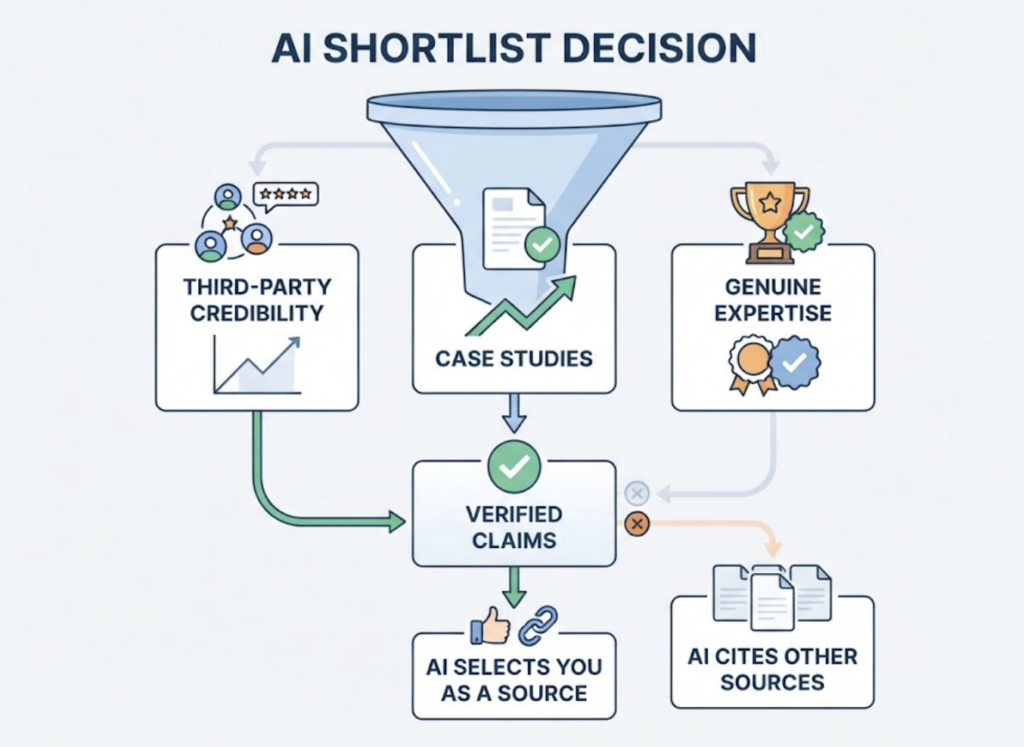
    Publishing content isn’t enough. You need to engineer a “citation trail” across the web. AI models look for consensus across multiple sources before recommending a brand.

    That means distributing key statistics to industry journalists, engaging in detailed discussions on platforms like Reddit, and updating entity profiles across high-trust databases. Original statistics boost visibility by 33.9%. Expert quotations add 32%. Authoritative citations contribute 30.3%. The AEO skill here is thinking like a PR strategist, not just a content marketer.

    Skill 3: Multi-Platform Visibility Tracking

    Your brand might show up in 60% of relevant ChatGPT responses but only 5% on Perplexity. Each AI platform has a different retrieval architecture, which means each one cites different source types.

    The skill is diagnosing why you’re visible on one platform and invisible on another. Perplexity tends to lean heavily on Reddit threads and community discussions. ChatGPT favors long-form blog posts and authoritative domains. Without cross-platform monitoring, you’re optimizing blind.

    Skill 4: Prompt-Level Intent Analysis

    Traditional keyword research is giving way to what some practitioners call “dark query research.” The prompts users type into AI platforms average 15 to 25 words and often involve multi-turn conversations.

    A travel agency, for example, won’t win by targeting “best resorts Mexico.” The high-value prompt is: “Compare family-friendly all-inclusive resorts in Mexico vs. Portugal for a 10-day trip in July, focusing on flight time from NYC and pool safety.” Creating content that addresses every nuance of that prompt earns the citation. Generic listicles don’t.

    Skill 5: Sentiment and Position Awareness

    Getting mentioned isn’t enough if the AI describes your brand with cautious or negative framing. An enterprise company might appear in 80% of category queries but carry a “Neutral-to-Negative” sentiment because the AI’s training data includes outdated pricing information.

    The AEO skill here is monitoring not just whether you’re cited, but how. Sentiment recovery requires publishing updated case studies, earning positive third-party reviews, and actively tracking the shift in AI perception over time.

    Where GEO Takes the AEO Skill Stack Further

    AEO gets you selected for an answer. GEO gets you influence over the system-wide interpretation of your brand.

    The difference matters in 2026 because we’ve entered the “Agentic Web.” Autonomous AI agents from companies like Microsoft, Lindy.ai, and others now search, compare, and act on behalf of users. If an AI agent can’t parse your real-time pricing or inventory, your brand is excluded from the consideration set entirely.

    GEO skills include implementing technical discovery protocols that most marketers haven’t encountered yet:

    llms.txt is a markdown-formatted index at the site root that gives AI agents a curated overview of your brand, stripped of HTML for token efficiency. AGENTS.md is an onboarding document that defines how AI agents should interact with your site’s tools and APIs. Model Context Protocol (MCP) is an open standard that lets AI assistants connect directly to marketing data for autonomous optimization.

    The AEO skill stack is the understanding layer. GEO is the execution layer. You need both.

    Tools That Turn AEO Skills into Action

    Skills without tools stay theoretical. To put the AEO skill stack into practice, you need platforms that connect data to action.

    For teams just getting started, a GEO free tools reference document is available on GitHub. It covers baseline audit tools and structural readiness checkers that help you learn the fundamentals without a budget commitment.

    But free tools have limits. Most offer single-page snapshots with no historical tracking, minimal competitor insight, and scores without a roadmap. As your AEO skills mature, you’ll hit a ceiling.

    That’s where Topify closes the gap. It’s a platform built specifically for the five AEO skills outlined above:

    Visibility Tracking and Sentiment Monitoring maps directly to Skill 5. Topify scores brand presence and tracks Share of Model as a primary KPI across ChatGPT, Gemini, Perplexity, and Google AI Overviews.

    Source Analysis and Citation Reverse-Engineering supports Skill 2. It reveals exactly which URLs and domains AI engines cite instead of yours, so you can target citation gaps with surgical precision.

    High-Value Prompt Discovery addresses Skill 4. Instead of estimated search volume, Topify surfaces the specific conversational questions driving real AI traffic.

    One-Click Execution supports Skill 1. Page-level optimization recommendations deploy through guided workflows, turning architectural best practices into action without manual restructuring.

    Dynamic Competitor Benchmarking gives teams the cross-platform visibility that Skill 3 demands. Whether you’re defending an 86% share in a mature category or competing for marginal gains in a fragmented market, the data is continuous, not a one-time snapshot.

    CapabilityFree GEO CheckersTopify Platform
    Audit FocusSingle-page structural readinessMulti-model Brand Visibility Index
    TrackingSnapshot, no historical dataContinuous daily monitoring and trends
    Competitor InsightMinimal or noneDynamic cross-platform benchmarking
    ActionabilityScores without a roadmapOne-click strategy deployment
    IntegrationNoneGA4 and Shopify for revenue attribution

    How to Build Your AEO Skill Stack in 90 Days

    Month 1: Audit and Foundations. Audit current content for AI readiness: structure, clarity, and authority signals. Identify the 10 to 20 commercial prompts that define your buyer journey. Establish Share of Model as a KPI and integrate AI visibility tracking into your dashboards. Use the GitHub free tools reference for initial assessments and Topify’svisibility checker for cross-platform baselines.

    Month 2: Optimization and Monitoring. Restructure your top 10 performing pages using answer-first formatting. Implement FAQ schema and add citation-worthy statistics with proper attribution. Start earning third-party validation by seeding content into high-authority communities and industry platforms. Use Topify’s Source Analysis to identify which domains AI engines are citing instead of yours.

    Month 3: Agentic Execution and Benchmarking. Scale optimization to the next 20 to 30 priority pages. Implement llms.txt and AGENTS.md for agentic discovery. Conduct a full competitive audit to identify citation gaps and adjust strategy to displace competitors in high-value AI responses. Get started with Topify to close the loop between insight and execution.

    Conclusion

    The AEO skill stack isn’t a nice-to-have certification. It’s the operating system for marketing in 2026.

    Your SEO foundation still matters. But the layer that drives revenue, the layer where a 15.9% conversion rate replaces a 1.76% baseline, is built on AEO and GEO skills. Start with free tools to learn the fundamentals, then move to a platform like Topify that connects visibility data to execution. The brands that build this skill stack now won’t just survive the shift to generative search. They’ll own it.

    FAQ

    Q: What is an AEO skill? 

    A: An AEO skill is the ability to structure and distribute content so that AI-powered search features, like Google AI Overviews, ChatGPT, and Perplexity, select and cite your brand as the definitive answer to a user’s question.

    Q: How is AEO different from SEO? 

    A: SEO optimizes for rankings and clicks in a list of links. AEO optimizes for selection and synthesis within an AI-generated answer. Success in AEO often leads to “zero-click” visibility, where your brand gains authority even if the user doesn’t visit your site.

    Q: Do I need to learn GEO if I already know AEO? 

    A: Yes. AEO focuses on being selected for an answer. GEO focuses on influencing how the AI model interprets your brand across the entire web, including AI agents, cross-platform sentiment, and entity authority.

    Q: What tools help build AEO skills? 

    A: Free resources like the GEO free tools reference on GitHub are solid for initial audits. For ongoing multi-model tracking, competitor benchmarking, and one-click strategy deployment, Topify is built specifically for the AEO and GEO workflow.

    Read More

  • AI Brand Visibility Isn’t SEO. Here’s What It Actually Is.

    AI Brand Visibility Isn’t SEO. Here’s What It Actually Is.

    Your domain authority is 70. Your keyword rankings are climbing. Your team just spent six months earning backlinks and optimizing meta tags. Then someone asks ChatGPT for a product recommendation in your category, and your brand doesn’t show up.

    Not buried. Not ranked low. Just absent.

    The gap between what your SEO dashboard reports and what AI platforms actually say about your brand is growing every quarter. That gap has a name: AI brand visibility. And your current toolkit wasn’t built to measure it.

    Your SEO Dashboard Tracks Rankings. AI Brand Visibility Tracks Recommendations.

    Traditional search engines rank URLs. They sort pages by link-based authority signals like PageRank, and serve users an ordered list of external links. Success means being the first result in a vertical list.

    AI search works differently. Platforms like ChatGPT, Perplexity, and Gemini don’t rank pages. They retrieve content, synthesize it, and generate a conversational answer. The user never sees a list of ten blue links. They see a paragraph that either mentions your brand or doesn’t.

    That’s the core distinction. SEO visibility is positional. AI brand visibility is referential.

    DimensionTraditional SEOAI Brand Visibility
    Primary UnitURL and PageEntity and Passage
    Core LogicIndex and RankRetrieve and Generate
    Algorithm BasisLink-based AuthoritySemantic Vector Proximity
    OutputOrdered list of linksSynthesized natural language
    Success GoalTraffic acquisitionMention and recommendation

    Here’s the part that catches most teams off guard: generative models don’t look for the “most authoritative” page. They look for the most reliable, easy-to-parse answer that’s corroborated by multiple third-party sources. This explains why smaller, well-structured sites often appear in AI answers while high-DA pages get ignored. The AI prioritizes clarity and directness over legacy authority signals.

    Why Google Rankings Don’t Translate to AI Mentions

    The data makes the disconnect hard to ignore. Research shows that only 12% of AI citations overlap with the top 10 organic results in Google. Around 80% of the sources AI platforms cite don’t rank anywhere on the first or second page of traditional search for the same query.

    Why? AI models evaluate “entity clarity” rather than “page authority.” If your website wraps its value proposition inside narrative-heavy prose, an AI crawler may never extract your brand as a relevant solution. Meanwhile, a competitor who gets mentioned frequently on Reddit, in trade publications, and across comparison lists becomes more “known” to the LLM’s training data and retrieval system.

    Three factors drive what AI chooses to cite:

    Third-party consensus. LLMs lean heavily toward earned media. Mentions on Reddit, Wikipedia, trade blogs, and industry journals carry more weight than self-published content. Roughly 82.9% of AI citations come from third-party sources, not brand-owned pages.

    Information gain. AI prioritizes sources that offer unique data points, statistics, or perspectives not duplicated by other cited sources. Repeating what everyone else says doesn’t help.

    Factual consistency. Brands with fragmented or contradictory narratives across the web send mixed signals. AI tends to default to “legacy” brands with more stable data profiles when the signal is unclear.

    The Five Metrics That Define AI Brand Visibility

    Traditional metrics like DA, keyword rank, and organic traffic are blind to the generative layer. To measure AI brand visibility, you need a different framework entirely.

    Platforms like Topify have standardized a multi-dimensional approach to tracking how a brand appears across the AI ecosystem. Here are the five metrics that matter most:

    Visibility (Mention Rate). The percentage of priority queries where your brand is named in the AI’s response. SEO tools track rankings. This tracks whether you exist in the answer at all.

    Sentiment Score. An NLP-driven rating of how favorably AI describes your brand. High Google rankings can still lead to negative AI summaries if the prevailing discussion around your brand skews critical.

    Position Index. Where your brand appears in recommendation lists within AI answers. AI responses are often non-linear, but when they do list options, order matters.

    Source Attribution. The specific domains AI cites as evidence when mentioning your brand. SEO focuses on backlinks to your site. AI cites other sites about you.

    AI Volume. The monthly query demand inside AI platforms for topics related to your brand. Traditional keyword tools only see search engine traffic. They miss the 780 million monthly queries on Perplexity alone.

    None of these show up in Google Analytics. None of them appear in Ahrefs or Semrush. That’s the blind spot.

    What Happens When You Can’t Measure AI Brand Visibility

    Ignoring AI brand visibility doesn’t mean nothing is happening. It means something is happening without you knowing.

    Your brand gets described incorrectly. AI generates text based on statistical probability, not verified facts. One widely covered case involved a theme park where an AI Overview incorrectly claimed a major ride was closing, based on a single Reddit fan’s speculative post. In another case, a Canadian tribunal ruled that Air Canada was liable for a chatbot that fabricated a refund policy. The airline had to honor a policy that never existed.

    These aren’t edge cases. Brands regularly discover that AI describes pricing plans or product features that were discontinued years ago, simply because outdated information remains in the model’s training data.

    Competitors take your recommendation share. When you don’t track AI visibility, competitors can quietly dominate the “citation share.” If a competitor secures mentions across comparison lists and review sites, AI begins to treat them as the consensus choice. By the time a buyer starts their traditional search, they’ve already formed a mental shortlist that excludes you.

    The stakes are high because AI now influences the full purchase journey. 43% of consumers discover new brands through AI tools. 57% use AI to narrow down choices. And 50% have made a purchase after using AI during their research.

    That’s not a future trend. That’s current behavior.

    How to Start Tracking AI Brand Visibility Today

    You don’t need a six-month initiative to get started. But you do need to stop relying on tools that were built for a different system.

    Step 1: Run a manual audit. Open ChatGPT, Perplexity, and Gemini. Ask 20 to 30 prompts that a buyer in your category would ask. Record whether your brand is mentioned, where it appears in the answer, and what the AI says about you. This takes an afternoon and gives you a baseline.

    Step 2: Identify “dark queries.” AI tools create “query fan-out,” where a single user question triggers multiple internal sub-queries. Many of these high-intent conversational phrases don’t appear in traditional keyword research tools. Topify’s Prompt Discovery feature automates this process, surfacing the exact questions buyers are asking AI engines.

    Step 3: Make your content extractable. AI prefers content that’s modular and easy to parse. Start every key page with a 40 to 60 word direct answer to a core question. Use structured tables and bulleted lists for comparisons. Implement JSON-LD schema (FAQ, Product, Organization) as a machine-readable translation layer.

    Step 4: Build external authority. Because the vast majority of AI citations come from third-party sources, off-page authority is the strongest predictor of visibility. Sites with over 32,000 referring domains see AI citations nearly double compared to those with lower domain counts. Digital PR and earned media aren’t optional in the AI era.

    Step 5: Refresh on a 90-day cycle. AI engines show a strong preference for content updated within the last 13 weeks. Unlike traditional SEO, which can take months to show results, AI retrieval systems can pick up new content in days. Monthly monitoring and quarterly content refreshes are the baseline.

    For teams tracking visibility across multiple AI platforms, Topify tends to stand out by combining Visibility, Sentiment, and Position data into a single view. In practice, this means you can spot a drop in ChatGPT mentions and trace it back to a specific source that stopped citing your brand, all within the same dashboard. Plans start at $99/mo with coverage across both Western models (ChatGPT, Gemini, Perplexity) and the APAC ecosystem (DeepSeek, Qwen, Doubao).

    Conclusion

    Your SEO dashboard tells you where your pages rank. It doesn’t tell you whether AI recommends your brand, how it describes you, or which competitors are quietly taking your share of AI-generated answers.

    AI brand visibility isn’t a new column in an existing spreadsheet. It’s a separate discipline with its own metrics, its own optimization logic, and its own competitive dynamics. The shift from the link economy to the citation economy is already underway, and brands that establish a baseline now will have the clearest advantage when the next wave of AI-driven buyers arrives.

    FAQ

    Q: What is AI brand visibility?

    A: AI brand visibility measures how frequently and favorably your brand appears in AI-generated responses across platforms like ChatGPT, Gemini, and Perplexity. It covers mention rate, sentiment, position in recommendation lists, and which sources the AI cites when referencing your brand.

    Q: How is AI brand visibility different from SEO?

    A: Traditional SEO optimizes for a URL’s position in a list of links. AI brand visibility optimizes for an entity’s inclusion in a synthesized answer. SEO focuses on keyword matching and link authority. AI focuses on semantic intent, third-party consensus, and content extractability.

    Q: Can I track AI brand visibility with Google Analytics?

    A: Standard GA4 can’t directly track AI mentions because those interactions happen on third-party AI platforms. However, tools like Topify can connect AI citation data to referral traffic and revenue signals in your existing analytics setup.

    Q: How often should I check my brand’s AI visibility?

    A: At minimum, monthly. AI models and retrieval systems update rapidly, and citation logic is probabilistic. Key commercial content should be refreshed every 90 days to maintain the “freshness” signal that AI engines prioritize.

    Read More

  • AI Search Visibility: Why Category Beats Brand for SaaS

    AI Search Visibility: Why Category Beats Brand for SaaS

    Your team spent six months building domain authority, earning backlinks, and climbing Google rankings. Then a potential customer asked ChatGPT, “What’s the best CRM for a 50-person sales team?” and got five recommendations. Your brand wasn’t one of them.

    The gap isn’t in your SEO strategy. It’s in what AI search engines actually look for. And for SaaS brands, the data is clear: category authority now drives more AI search visibility than brand recognition ever could.

    Most SaaS Brands Are Optimizing for the Wrong Signal in AI Search

    Here’s the disconnect. Most SaaS marketing teams still treat branded search volume as their north star. More people searching your company name should mean more visibility, right?

    Not in AI search. 50% of software buyers now start their journey inside an AI chatbot, a figure that jumped 71% in just four months in late 2025. And when they do, they’re not typing your brand name. They’re asking questions like “best project management tool for remote engineering teams” or “which CRM integrates with Slack.”

    These are category queries. And if your brand hasn’t built authority around the category, AI simply won’t mention you.

    The numbers make this harder to ignore. Traditional organic search already had a zero-click problem, with rates between 34% and 58.5%. In AI search, that number hits 83% for AI Overviews and 93% in AI Mode. Organic click-through rates have dropped 61%. The window where a user might discover you through a blue link is shrinking fast.

    That’s the shift most SaaS teams haven’t internalized yet.

    How AI Engines Decide Which SaaS Products to Recommend

    Understanding why category beats brand starts with how AI search actually works under the hood. Unlike Google’s traditional algorithm, which scores URLs based on backlinks and keyword relevance, AI engines score concepts and entities.

    When someone asks Perplexity “What’s the best analytics platform for e-commerce?”, the system doesn’t look up which brand has the highest domain authority. It runs a retrieval process called RAG, or Retrieval-Augmented Generation. The query gets converted into a semantic vector. The system then scans billions of text fragments across the web, Reddit, G2, and other sources to find the most relevant chunks. Those chunks are re-scored based on how directly they answer the specific constraints of the query. Finally, the LLM synthesizes a response and cites the sources that contributed the most useful information.

    For SaaS brands, this means one thing: your content needs to be machine-readable and fact-dense. Marketing copy that buries product capabilities inside vague narratives gets filtered out during retrieval. The AI can’t extract what it can’t parse.

    There’s a technical layer here too. Research shows that 42% of JavaScript-rendered content is never indexed by AI crawlers, and client-side sites rank 67% lower than server-rendered alternatives. If your product pages rely on heavy JavaScript without server-side rendering, AI engines may not even see your content. Brands implementing structured data like SoftwareApplication and FAQPage schema see 2-3x higher citation rates.

    Why Niche SaaS Players Often Outrank Market Leaders in AI Search

    You’d expect AI models to favor Salesforce, HubSpot, and other household names. The data tells a different story.

    AI search engines show an overwhelming preference for third-party, authoritative sources over brand-owned content. In software verticals, earned media (reviews, press, community mentions) accounts for 69% to 82% of AI citations, compared to just 36-45% in traditional Google results. Brand-owned content, on the other hand, often contributes less than 9.1% of citations on platforms like Claude. Reddit and community sources make up 46.7% of Perplexity’s top-cited domains.

    This is the earned media advantage. And it structurally favors niche players.

    A focused SaaS brand that dominates G2 reviews, gets mentioned in three independent trade publications, and has active Reddit threads about its use case will often outrank a market leader whose AI footprint is mostly its own blog. The AI builds its recommendation from consensus across sources, not from a single brand’s self-description.

    The case studies back this up. SoWork, an AI-powered Digital HQ, started with a 16.6% AI visibility score. By shifting to structured, fact-dense content and fixing technical grounding issues, they reached 100% visibility across seven AI engines in 90 days. A $25M ARR project management SaaS moved from an 8% citation rate to 24% by rewriting pages to open with concise factual answers instead of keyword-stuffed copy.

    Category focus beats brand size when the evidence ecosystem supports you.

    3 Category Signals That Actually Drive AI Search Visibility

    Research from Princeton University, Georgia Tech, and the Allen Institute for AI identified nine specific optimization methods for Generative Engine Optimization. Three of them have the most direct impact on category visibility for SaaS brands.

    Signal 1: Citations to Authoritative Sources

    When your content references third-party data, research papers, or industry reports, AI engines treat your claims as more credible. The research found that integrating authoritative citations into content increases the probability of being cited by AI platforms by up to 40%.

    This is the “credibility chain” at work. If you cite a Gartner report or a peer-reviewed study, the AI perceives your page as a higher-quality source, not just for the data point, but for the surrounding claims as well.

    Signal 2: Statistics and Original Research

    Numbers are highly cite-worthy for LLMs. The Princeton study found that adding relevant statistics improved AI visibility by 37%. Models are 22.6% less likely to cite sentences without numbers where a human reader would expect proof.

    SaaS companies that publish proprietary benchmarks, original surveys, or product usage data create what researchers call “information gain.” It’s new data the AI can’t find anywhere else, which makes your content the primary source for that category insight.

    Signal 3: Expert Quotations and Attribution

    Including direct quotes from recognized industry figures boosted visibility by 30% to 41%, the highest improvement factor among all tested GEO methods. AI models recognize named individuals and organizations as high-value entities during synthesis. Attributed expertise signals that your content isn’t just opinion. It’s validated.

    For SaaS brands, this means guest contributions from analysts, customer quotes with real names, and co-authored research all carry measurable weight in AI recommendations.

    How to Audit Your Brand’s Category Visibility in AI Search

    Tracking Google rankings won’t tell you where you stand in AI search. SaaS teams need a different framework: one built around citation rate, share of voice, and prompt-level visibility.

    A category audit typically follows four steps.

    Step 1: Money Prompt Discovery. Identify 20 to 50 conversational questions your buyers actually ask. Not keyword phrases, but full natural-language prompts like “Which CRM has the best Slack integration for a team of 50?” These are the queries where AI search visibility matters most.

    Step 2: Baseline Measurement. Run those prompts across multiple AI engines (ChatGPT, Gemini, Perplexity, Claude) with multiple regenerations to capture variance. A single test isn’t enough. AI responses shift between sessions.

    Step 3: Gap Diagnosis. Determine whether the problem is structural (AI can’t parse your site), authority-based (no third parties cite you), or sentiment-driven (AI mentions you, but negatively).

    Step 4: Targeted Execution. Deploy optimizations directly to the gaps you’ve identified, whether that’s adding FAQ schema, generating community content, or rewriting product pages for information density.

    Platforms like Topify compress this process into a single dashboard. Topify tracks seven distinct metrics across AI platforms: Visibility (cross-platform mention rate), Sentiment (0-100 brand perception score), Position (where you rank in AI responses), Source Coverage (which domains cite you), AI Volume (monthly demand within AI platforms), Intent Alignment (whether AI recommends you for the right use cases), and Conversion Visibility Rate (predictive interaction likelihood).

    For SaaS teams running this audit manually, the process can take weeks. With Topify’s Prompt Discovery and Competitor Monitoring, you can identify category-level gaps, benchmark against rivals, and track changes across AI engines from one place.

    Only 20% of brands stay visible across multiple consecutive AI sessions without active optimization. That stat alone makes continuous auditing non-optional.

    Conclusion

    The brands winning in AI search aren’t the ones with the biggest ad budgets or the most backlinks. They’re the ones that own their category.

    AI engines don’t search for your brand. They search for answers to category problems. And the data is consistent: earned media outweighs owned content in citations, niche players routinely outrank incumbents, and fact-dense, structured content gets retrieved while marketing copy gets filtered out. With AI referral traffic converting at rates between 12.4% and 16.8% (compared to 2.8% for traditional organic), the ROI of category visibility is already measurable.

    The shift from brand-first to category-first isn’t optional. It’s structural. SaaS teams that audit their category visibility now and invest in the signals AI engines actually prioritize will define the next generation of market leaders.

    FAQ

    Q: What is AI search visibility for SaaS brands? 

    A: AI search visibility measures how often and how favorably your SaaS product appears in AI-generated responses when users ask category-level questions on platforms like ChatGPT, Perplexity, and Gemini. Unlike traditional SEO rankings, it’s driven by citation frequency, source authority, and semantic relevance to the user’s prompt.

    Q: Does brand awareness help with AI search visibility? 

    A: Brand awareness alone doesn’t guarantee AI visibility. AI engines prioritize third-party citations, structured content, and category relevance over brand recognition. A well-known brand with weak category signals can be outranked by a niche competitor that dominates reviews, community mentions, and fact-dense content.

    Q: How do I find which category keywords matter most for AI search? 

    A: Start by identifying the natural-language questions your buyers ask when evaluating solutions in your category. Tools like Topify’s Prompt Discovery surface high-volume AI prompts specific to your market. Focus on conversational queries (“best X for Y”) rather than traditional short-tail keywords.

    Q: Can small SaaS brands compete with market leaders in AI search? 

    A: Yes, and the data suggests they often win. AI engines rely on distributed evidence across third-party sources. A focused SaaS brand with strong G2 reviews, active Reddit presence, and fact-dense content can achieve higher citation rates than a market leader whose AI footprint is mostly its own blog.

    Read More

  • AI Search Visibility in 2026: What Changed and What Didn’t

    AI Search Visibility in 2026: What Changed and What Didn’t

    Your domain authority is solid. Your keyword rankings look healthy. But when someone asks ChatGPT for a recommendation in your category, your brand doesn’t show up. Not because your SEO is bad. Because the rules of being found have shifted, and the scoreboard you’re reading no longer tells the full story.

    Here’s what makes 2026 tricky: traditional search hasn’t disappeared. Google still commands 84.17% of the U.S. search market. Total search volume, combining traditional engines and AI platforms, has actually grown 26% worldwide. The pie got bigger. But the slice that matters most to your brand may have moved to a plate you’re not watching.

    AI search visibility in 2026 isn’t about replacing your SEO playbook. It’s about understanding which parts of it still apply, which parts don’t, and where the new leverage points are.

    What “Visibility” Means in AI Search Now

    For two decades, visibility meant ranking. Page one, position three, maybe a featured snippet if you were lucky. In 2026, that definition is incomplete.

    76% of SEO practitioners now describe visibility as presence across AI-generated answers, SERP features, and intent-driven surfaces, not just ranking position. The reason is straightforward: nearly 60% of Google searches now end without a click. AI Overviews appear on roughly 48% of all tracked queries, and their average height exceeds 1,200 pixels, consuming the entire above-the-fold screen on a standard desktop.

    That’s the gap most brands still can’t see.

    When an AI Overview is present, the top organic result loses nearly a fifth of its clicks. The second position sees CTR declines of up to 39%. And here’s the part that breaks traditional SEO logic: only 17% of sources cited in Google’s AI Overviews also rank in the organic top 10. The generative engine and the ranking algorithm are pulling from fundamentally different pools of authority.

    The new currency isn’t the click. It’s the citation, the mention, and the entity reference. Answer Engine Optimization (AEO), the practice of structuring content so AI systems can extract, cite, and summarize it, has become a standalone discipline. Pages optimized with structured data and FAQ schema are 30% more likely to appear in AI-generated summaries. Content that answers questions directly in the first 100 words sees significantly higher citation rates.

    3 Things That Changed in AI Search Visibility This Year

    Not everything shifted overnight. But three changes in 2026 have made the old playbook feel noticeably outdated.

    AI Traffic Now Converts Better Than Every Other Channel

    This is the data point that should stop marketing leaders mid-scroll. In March 2026, AI-referred traffic converted 42% better than non-AI traffic across U.S. retail sites. That’s a complete reversal from March 2025, when AI traffic converted 38% worse.

    The volume is surging, too. Traffic from AI sources to U.S. retail sites grew 393% year-over-year in Q1 2026. These visitors spend 48% more time on site and browse 13% more pages per visit. The conversion gap between platforms is even more dramatic: ChatGPT referrals convert at 15.9%, roughly 9x the rate of standard Google organic traffic at 1.76%.

    Why? Because AI does the vetting before the click. By the time someone follows a ChatGPT citation to your site, they’ve already been told your product fits their criteria. They’re not browsing. They’re buying.

    AI Overviews Are Expanding Into Commercial Territory

    AI Overviews started as an informational feature. In 2026, they’re pushing into commercial and transactional queries. Commercial keywords triggering an AI Overview increased 128% year-over-year, rising from 8.15% in October 2024 to 18.57% in October 2025, and that trajectory has continued into 2026.

    For the healthcare vertical, AIOs now trigger on 63% of queries, the highest of any industry. B2B tech sits at 42%. Finance remains cautious at just 5%, creating a wide-open opportunity for brands that can secure citations in that limited space.

    The Measurement Gap Is the Biggest Risk No One Talks About

    Here’s the uncomfortable truth: 43% of marketers say they’re optimizing for AI search in 2026, but only 14% are actually measuring it. Just 11% monitor branded search or share of voice in AI platforms.

    That’s not a data availability problem. The tools exist. It’s a measurement scope problem. Teams are still reporting on keyword rankings and organic sessions while the discovery layer has shifted to a place those dashboards don’t cover.

    What Hasn’t Changed: The Fundamentals Still Hold

    The temptation in 2026 is to treat AI search as an entirely new game. It’s not.

    Domain authority remains the single strongest predictor of AI citations. High-traffic sites earn roughly 3x more citations than low-traffic ones. The AI models still use traditional web signals, popularity, credibility, backlink profiles, as a primary filter for what gets cited. If your SEO foundation is weak, GEO won’t save you.

    Google still holds 90%+ global market share. Traditional search hasn’t decreased in absolute terms. The total search pie expanded, which means traditional engines and AI platforms grew in parallel. For commercial and transactional queries, organic rankings and paid ads still dominate the user experience. Google has strong economic incentives to keep it that way.

    And the oldest principle in marketing still applies: what others say about you matters more than what you say about yourself. Brands are 6.5x more likely to be cited through third-party sources than through their own domains. Roughly 85% of brand mentions in AI search come from external content: media publications, review platforms, forums like Reddit (which appears in 22% of AI answers), and specialized review sites. PR and community management haven’t become less important. They’ve become search strategies.

    Where Most Brands Get Stuck Between Old and New

    The hardest part of 2026 isn’t learning new tactics. It’s letting go of old assumptions while keeping the fundamentals intact.

    Mistake 1: Measuring citations with ranking tools. Traditional rank tracking tells you where you sit in a list of blue links. It says nothing about whether ChatGPT mentions your brand, Perplexity cites your product page, or Gemini describes your pricing accurately. These are different systems with different logic, and they require different dashboards.

    Mistake 2: Optimizing only your own site. When 85% of your brand mentions in AI search come from third-party sources, pouring all your content budget into your blog isn’t enough. Distributing content to authoritative external publications can increase AI citations by up to 325% compared to owned-site-only strategies.

    Mistake 3: Assuming one AI platform represents all of them. Research analyzing 118,000 AI-generated answers found that only 11% of cited domains appeared across multiple platforms. Each engine, Google AIO, ChatGPT, Perplexity, Claude, uses a different retrieval architecture, different data sources, and different freshness signals. Perplexity cites an average of 21.87 sources per response with an 82% citation rate for content updated within 30 days. ChatGPT averages 7.92 citations and lags behind the live web by several weeks. Optimizing for one platform doesn’t guarantee visibility on another.

    There’s also the “ghost citation” problem: 61.7% of LLM citations provide a source link but never mention the brand name in the generated text. Your site might be driving AI-referred traffic without building any brand recognition in the conversation itself. On the flip side, Gemini mentions brands in 83.7% of responses but only provides a clickable citation link 21.4% of the time. Traffic and brand equity in AI search are two separate objectives.

    How to Track AI Search Visibility Across Platforms

    If you can’t see where your brand stands in AI answers, you can’t improve it. And manual spot-checking, typing your brand name into ChatGPT and hoping for the best, doesn’t scale.

    Tracking AI search visibility in 2026 requires monitoring multiple dimensions simultaneously: how often your brand appears (visibility), how AI describes it (sentiment), where it ranks relative to competitors (position), which sources AI pulls from (citation analysis), and how those patterns shift over time.

    The industry benchmarks for 2026 give you a target to aim for:

    MetricDefinitionBenchmark
    AI Share of Voice% of relevant prompts where your brand appears30%+
    Citation Rate% of AI responses linking to your site25%+
    First-Mention Rate% of prompts where you’re the first recommendation15%+
    Sentiment ScoreHow positively AI describes your brand (scale of -100 to +100)85+
    Competitive GapPrompts where competitors appear but you don’tBelow 10%

    Topify was built to solve exactly this problem. Its Visibility Tracking monitors brand presence across ChatGPT, Gemini, Perplexity, DeepSeek, and other major AI platforms from a single dashboard. The Competitor Monitoring feature automatically detects rivals and benchmarks your visibility, sentiment, and position against theirs. Source Analysis shows which domains AI engines are citing, so you can spot content gaps and prioritize your earned media strategy.

    What makes Topify particularly useful for the fragmentation problem is its cross-platform coverage. Rather than checking each AI engine manually, you get a unified view of where you’re visible, where you’re missing, and what your competitors are doing differently. The platform’s AI Volume Analytics also surfaces high-value prompts relevant to your brand, prompts where real users are asking questions and AI is recommending your category, so you can focus optimization on the queries that actually drive business outcomes.

    For teams that have been tracking traditional SEO metrics but haven’t started measuring AI visibility, Topify’s dashboard is the fastest way to close that measurement gap.

    FAQ

    What is AI search visibility? 

    AI search visibility refers to how frequently and favorably your brand appears in AI-generated answers across platforms like ChatGPT, Gemini, Perplexity, and Google’s AI Overviews. It’s measured through metrics like share of voice, citation rate, sentiment score, and first-mention rate, rather than traditional keyword rankings.

    How has AI search visibility changed in 2026? 

    The biggest shifts are the conversion value of AI traffic (42% higher than non-AI traffic), the expansion of AI Overviews into commercial queries (128% YoY increase in commercial keyword triggers), and the growing disconnect between traditional rankings and AI citations (only 17% overlap between AIO sources and organic top 10).

    Do I still need traditional SEO if I focus on AI search? 

    Yes. Traditional SEO and AI search visibility are complementary, not competitive. Domain authority remains the strongest predictor of AI citations. Google still holds 90%+ global market share, and transactional queries still convert through traditional organic results. The winning strategy in 2026 is dual-track: maintain SEO for clicks, build GEO for citations.

    How do I track my brand’s visibility in AI answers? 

    Manual checking doesn’t scale across platforms. Tools like Topifyprovide cross-platform monitoring of brand mentions, sentiment, citation sources, and competitive positioning across ChatGPT, Gemini, Perplexity, and other AI engines in a single dashboard.

    What’s the difference between SEO and GEO? 

    SEO optimizes for ranking position in traditional search results. GEO (Generative Engine Optimization) optimizes for citation and mention probability in AI-generated answers. GEO focuses on machine readability, structured content, front-loaded key claims, and third-party validation rather than backlink profiles and keyword density.

    Read More

  • Great SEO But Zero AI Search Visibility? Here’s Why

    Great SEO But Zero AI Search Visibility? Here’s Why

    Your domain authority is above 70. You’re holding top-three positions for your highest-value keywords. Your organic traffic looks healthy in every dashboard you check. Then someone asks ChatGPT, “What’s the best solution for [your category]?” and your brand doesn’t appear anywhere in the answer.

    That gap between Google performance and AI recommendation is widening every quarter. And the metrics you’ve relied on for a decade can’t explain it, because they were never designed to measure how reasoning engines choose which brands to mention.

    Page One on Google, Invisible to AI: The Ranking Paradox

    Here’s the uncomfortable truth: ranking well on Google and being cited by AI are two different achievements, driven by two different systems.

    Research analyzing over 18,000 unique queries found that only 12% of URLs cited by AI search engines appear in Google’s top ten organic results. That means for 88% of AI-generated answers, the reasoning engine is pulling from sources that Google doesn’t consider the most relevant for those keywords.

    The variance across platforms makes this even messier. Perplexity shows the strongest alignment with traditional search at roughly 28% URL overlap. ChatGPT drops to around 8%. Google’s own Gemini sits at just 6%.

    This isn’t a niche problem affecting a handful of queries. ChatGPT now handles approximately 2.5 billion daily prompts, and about 35.5% of those conversations are direct equivalents to Google-style informational or practical searches. Users spend an average of six minutes on Google, but over thirteen minutes on ChatGPT and twenty-three minutes on Perplexity. The AI assistant is becoming the primary environment for deep research and purchase decisions.

    Your traditional SEO success? It’s increasingly isolated to one channel while the discovery landscape expands around it.

    What Google Rewards vs. What AI Engines Actually Cite

    Google is a retrieval system. It uses inverted indices, link graphs, and the PageRank legacy to surface pages based on authority signals like backlinks and keyword relevance. You earn a ranking by meeting a specific set of algorithmic criteria.

    LLMs work differently. They’re reasoning engines that use Retrieval-Augmented Generation (RAG) to synthesize answers from training data and real-time web retrieval. When a generative engine responds to a prompt, it doesn’t look for the page with the highest Domain Authority. It optimizes for what researchers call “pass-level extractability” and “semantic richness.”

    In practice, that means the AI evaluates whether a source can be safely and accurately used to construct a narrative without hallucinating. High DA pages often fail this test. They’re structured for human engagement: clever narrative introductions, visual design hierarchies, creative metaphors. All of that is noise to a machine trying to extract a factual answer.

    DimensionGoogle Ranking CriteriaAI Citation Criteria
    Authority signalBacklinks, domain rating, site ageEntity clarity, E-E-A-T, consensus
    Content goalMatch keywords and satisfy intentProvide extractable, verifiable facts
    StructureMobile-ready, fast load, metadataSemantic HTML, Schema, chunking
    Evaluation logicAlgorithmic ranking (strings)Reasoning-based synthesis (things)

    AI engines prioritize sources that offer a “comprehension subsidy,” which is pre-processed, structured data that reduces the computational cost of inference. Specific textual modifications like adding quantitative statistics, relevant quotes, and authoritative citations can increase a brand’s AI search visibility by more than 40%.

    3 Blind Spots That Kill Your AI Search Visibility

    The failure of high-authority brands to show up in AI answers typically traces back to three gaps that reflect a legacy SEO mindset.

    Blind Spot 1: Content Built for Keywords, Not Answers

    Traditional SEO encourages writing for keyword density and topical coverage. That often produces articles with lengthy narrative introductions designed to signal relevance to a search algorithm, but functionally opaque to a RAG system.

    AI engines favor answer-first content: the primary resolution to a query appears in the first one or two sentences of a paragraph, followed immediately by supporting data. In a RAG pipeline, the engine retrieves “chunks” of text. If the most relevant chunk contains narrative padding, the AI’s confidence in that source drops. A page with a clear heading hierarchy and concise definitions directly under those headers is far more likely to be extracted and cited.

    Blind Spot 2: No Entity-Level Authority Signals

    LLMs recognize and relate entities: distinct people, places, brands, and concepts. Your brand might rank for “cloud security” on Google without the AI actually understanding that your brand is an entity within that category.

    Without a presence in the global Knowledge Graph, fed by Wikipedia, Wikidata, and industry databases, a brand remains a “string” of text rather than a “thing” in the AI’s world. Missing sameAs mappings in Schema.org markup creates what’s known as “entity drift,” where the AI can’t confidently verify the identity or credibility of a source. The result is systematic exclusion from generated answers.

    Sites with proper author metadata and deep entity-level Schema deployment are cited up to 40% more frequently by AI platforms.

    Blind Spot 3: You’re Not Measuring What AI Says About You

    The third gap is reliance on traditional metrics like organic traffic and keyword position. These are becoming lagging, sometimes misleading, indicators.

    As Google AI Overviews intercept informational traffic, a brand may see steady impressions in Search Console while its clicks erode because the AI has already provided the answer, without ever mentioning the brand. On top of that, LLM training data can be months old, and RAG systems may be blocked by client-side rendering or restrictive robots.txt files that prevent bots like GPTBot or PerplexityBot from accessing content.

    If you’re not tracking AI-specific mentions, sentiment, and citation share, you’re flying blind in the environment where your highest-intent buyers are now conducting research.

    How to Bridge the Gap Between SEO and AI Search Visibility

    Closing the gap requires a structured transition: diagnosis first, then content optimization, then ecosystem authority building.

    Start with a baseline audit. Run 20 to 50 “money prompts,” long-form conversational queries that represent real buyer questions, across ChatGPT, Perplexity, and Gemini. Compare the results against your traditional keyword rankings. You’ll likely find what researchers call “Invisibility Gaps”: keywords where you rank on page one of Google but don’t appear in any AI-generated recommendation.

    Restructure content for machine readability. The shift is from narrative-first to answer-first. Place 50 to 120 word summaries directly under H2 headers. Replace qualitative claims with verifiable data. Use HTML tables and structured lists instead of prose walls. Research shows that statistical grounding alone lifts AI visibility by approximately 40%, while semantic formatting and citation integration each add another 30 to 40%.

    Build ecosystem authority. AI engines treat a brand’s self-description as useful but biased. A review on G2, a thread on Reddit, or an article in a major trade publication carries more weight. Brands with high citation density from independent third-party sources are significantly more likely to be cited by reasoning engines.

    For teams managing this across multiple AI platforms, Topify provides real-time Visibility Tracking across ChatGPT, Gemini, Perplexity, and other major engines in a single dashboard. Its Source Analysis feature reverse-engineers exactly which third-party URLs the AI is citing, so you can identify the specific content gaps driving your invisibility and act on them directly.

    What AI Search Visibility Metrics Actually Matter

    Traditional CTR and rank tracking are losing their predictive power for informational content. A new scorecard is needed, one that measures not “where I rank” but “how I’m described.”

    Topify tracks AI search visibility across seven dimensions that map directly to brand performance in the generative search era:

    Visibility measures the percentage of relevant prompts where your brand is explicitly mentioned. Sentiment scores the framing of each mention, whether the AI describes you as innovative, trustworthy, or budget, on a 0 to 100 scale. Positiontracks whether you’re the primary recommendation or a secondary alternative. First-position mentions drive 32% higher purchase intent compared to second or third positions.

    Volume reveals the true monthly demand for topics within AI platforms, often surfacing high-volume prompts invisible to traditional tools like Ahrefs. Mentions distinguishes between your brand being named in the text versus your domain being cited as a source in footnotes. Intent Alignment measures whether the AI matches your brand to the correct buyer persona. High visibility for the wrong intent is a wasted investment.

    The seventh metric, Conversion Visibility Rate (CVR), estimates how likely an AI mention is to translate into downstream revenue. AI-referred visitors convert at 14.2%, a rate roughly 4 to 8 times higher than traditional organic search. That makes each AI citation disproportionately valuable compared to a standard ranking position.

    Conclusion

    The gap between SEO and AI search visibility isn’t a temporary glitch. It’s a structural shift in how buyers discover and evaluate brands.

    Traditional SEO drives traffic through a list of links. AI search visibility determines whether your brand makes it into the synthesized answer that users now trust to filter the noise. For brands with strong domain authority but low AI visibility, the path forward starts with three moves: shift from keyword-first to answer-first content, formalize your entity presence in global knowledge graphs, and start tracking how AI platforms actually describe you. The goal is no longer to be the first link on the page. It’s to be the first name in the answer.

    Get started with Topify to see where your brand stands across every major AI platform today.

    FAQ

    Q: What is AI search visibility? 

    A: AI search visibility refers to how often and how favorably your brand appears in responses generated by AI platforms like ChatGPT, Perplexity, and Gemini. Unlike traditional search rankings, it measures whether AI engines mention, recommend, or cite your brand when users ask relevant questions.

    Q: Does SEO help with AI search visibility? 

    A: Strong SEO provides a foundation, but it doesn’t guarantee AI visibility. Research shows only 12% of URLs cited by AI engines appear in Google’s top ten results. AI engines prioritize extractable, structured content and entity-level authority signals, which differ from traditional ranking factors like backlinks and keyword density.

    Q: How do I check if my brand appears in ChatGPT or Perplexity? 

    A: The manual approach is to run your target buyer’s questions directly in each AI platform and note whether your brand is mentioned. For systematic tracking, tools like Topify automate this across multiple AI engines, monitoring your mention rate, sentiment, position, and citation sources in real time.

    Q: What’s the difference between SEO and GEO? 

    A: SEO optimizes for search engine rankings, focusing on keywords, backlinks, and page authority. GEO (Generative Engine Optimization) optimizes for AI-generated answers, focusing on content extractability, entity clarity, and third-party citation density. Both matter, but they require different strategies and different metrics.

    Read More