Category: Knowledge

  • AEO Audit: Is Your Brand Showing Up in AI Answers?

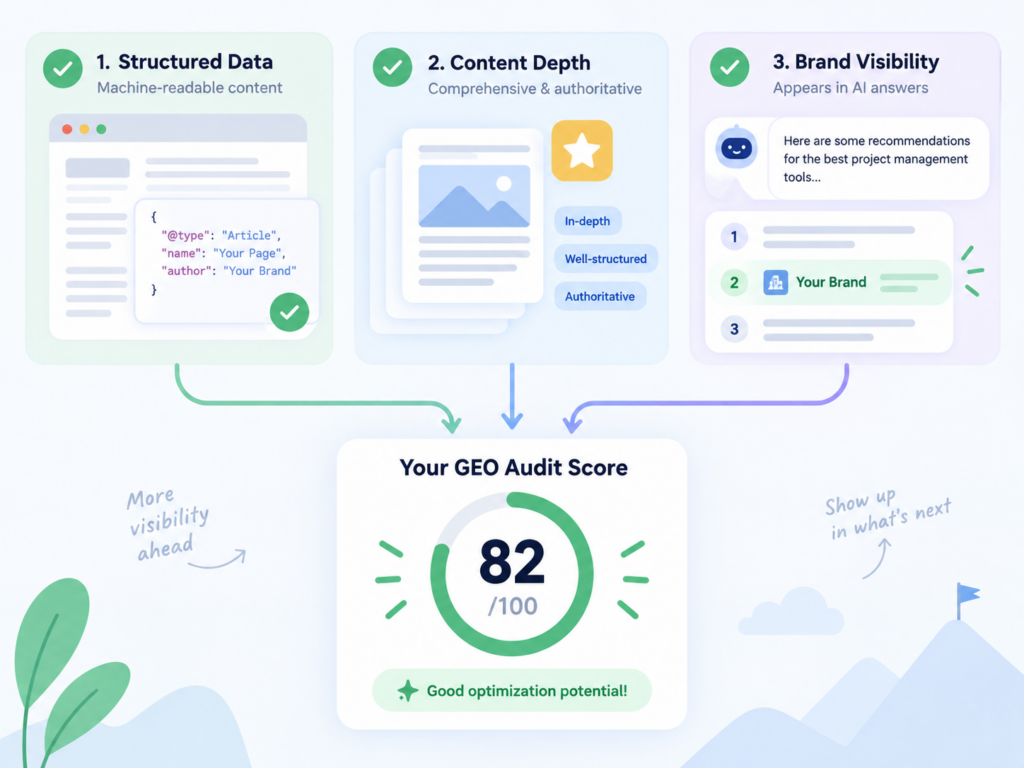
    AEO Audit: Is Your Brand Showing Up in AI Answers?

    ChatGPT now handles roughly 2 billion queries a day, and the citation pool feeding those answers is unusually small. Five domains pull in 38% of all AI citations. The top 20 control 66%. If your brand isn’t inside that pool for the prompts your buyers actually ask, you don’t show up at all.

    The blue link era was forgiving. The answer engine era isn’t.

    Most marketing teams know their Google ranking for every priority keyword. Almost none know their answer inclusion rate inside ChatGPT, Gemini, Perplexity, or AI Overviews. That’s the gap an AEO audit closes.

    What an AEO Audit Actually Measures (and Why It’s Not SEO)

    An AEO audit is a diagnostic for how AI systems retrieve, synthesize, and attribute your brand inside generated answers. It’s not a ranking report. It’s a citation report. The goal isn’t to be on page one. It’s to be the answer.

    The metric set is different too. SEO audits live and die by ranking position, click-through rate, and impressions. AEO audits track three things: mention rate (does the AI bring you up), sentiment polarity (how does it describe you), and citation share (which domains are feeding the AI’s understanding of you).

    That shift matters because the underlying logic changed. Search engines run deterministic logic, where a keyword maps to a ranked list. Answer engines run probabilistic logic, where the model synthesizes a response from training data plus real-time retrieval. You can’t optimize the second one with the playbook for the first.

    Without a baseline audit across all three dimensions, every dollar spent on AEO is a guess.

    Three Signs Your Brand Needs an AEO Audit This Quarter

    The trap most marketing leaders fall into is the stability trap. Traffic looks fine on the surface. Underneath, AI is intercepting buyers before they reach your site. Three signals usually show up first.

    Signal 1: Stable traffic, declining conversions. Your informational pages still rank. Impressions are flat or up. But trial signups and demo requests are sliding. That’s because Google AI Overviews are answering the question on the SERP itself. Seer Interactive found that organic CTR for informational queries with AI Overviews dropped from 1.76% to 0.61%, a 61% collapse. If your content is feeding the answer without getting credit, you’re funding a competitor’s growth.

    Signal 2: Competitors keep showing up in “best for” prompts. You don’t. AI platforms typically return a shortlist of three to five vendors for commercial prompts. In B2B SaaS categories, 60-80% of AI answers cite the same dominant cohort of 3-5 brands. Being the seventh option doesn’t get you a chance. It gets you erased.

    Signal 3: You have no idea how AI describes you. The AI doesn’t just list you. It characterizes you. “Affordable but limited.” “Powerful but complex.” “Good for small teams, weak at scale.” Those phrases shape which prompts you’re eligible to win. Gartner expects search volume to drop 25% by 2026, with that traffic shifting to AI surfaces. If you can’t audit your synthetic narrative, you can’t fix it.

    If any of these sound familiar, you’re already late.

    Step 1: Build the Prompt List That Reflects Real Buyer Intent

    The audit is only as useful as the prompt bank behind it. Conversational AI queries average 23 words. Traditional search queries average 4. You can’t audit AEO with your old keyword list.

    Build the bank around buyer journey, not topic clusters. Aim for 30 to 50 prompts as a minimum sample. Cover three intent layers:

    • Informational: “What’s the best way to optimize B2B content for AI search?”
    • Comparative: “How does [your category] handle enterprise-scale data?”
    • Evaluation: “What are the risks of using [your tool type] for [specific use case]?”

    Skip the definition trap. “What is X” prompts are high-volume but low-conversion. Users get the definition and bounce. The prompts that actually move pipeline are commercial: “best X for Y,” “compare X and Z,” “is X worth it for [persona].” AI search visitors arriving from commercial prompts convert at 4.4x to 23x the rate of traditional organic traffic, because the AI has already pre-qualified them.

    Also account for query fan-out. AI systems often expand a single prompt into several sub-questions to build their answer. A buyer asking about “best CRMs for real estate” may silently trigger sub-answers about pricing, integrations, and onboarding time. Your audit needs to test those sub-prompts too, not just the headline question.

    Step 2: Test Across ChatGPT, Gemini, Perplexity, and AI Overviews

    Single-platform audits will mislead you. Only 11% of businesses mentioned by one AI platform appear on a second platform for the same query. Visibility on ChatGPT tells you almost nothing about visibility on Perplexity or AI Overviews.

    Each platform has its own citation bias, driven by retrieval logic and training data:

    PlatformCitation LogicTop Source Types
    ChatGPTEditorial, reference-heavyWikipedia, Forbes, TechRadar, LinkedIn
    PerplexityCommunity and UGC-focusedReddit, G2, Quora, industry forums
    GeminiGoogle ecosystem, socialYouTube, Reddit, Wikipedia, Medium
    AI OverviewsHybrid social plus authorityYouTube, Reddit, LinkedIn, Facebook

    That’s the gap most brands still can’t see.

    Manual spot-checking has limits. AI responses are probabilistic, so the same prompt run three times can return three different citation sets. AI Mode in particular only overlaps with itself 9.2% of the time across repeated tests. Manual testing also can’t normalize for geography, browser memory, or hallucinated facts where the AI confidently misrepresents your pricing or features.

    The fix is to run every test in clean, non-personalized environments. Incognito mode. Cleared chat history. Multiple regions if your buyers span them. Without that, the baseline is noise.

    Step 3: Score Visibility, Sentiment, and Citation Sources

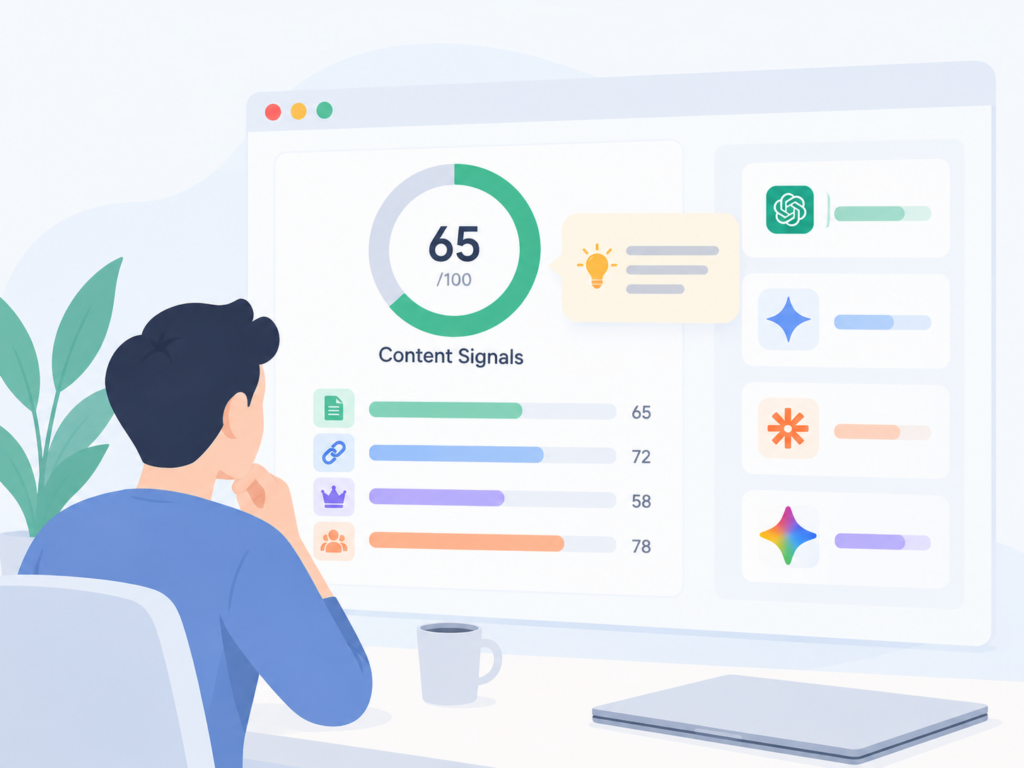
    A useful AEO audit doesn’t stop at “yes, we got mentioned.” It scores three dimensions at once.

    Visibility (Share of Model). This is the percentage of tracked prompts where the brand is mentioned. A 30% citation rate is a strong benchmark for established B2B brands on category-defining prompts. Distinguish between a mention (your name appears in the answer) and a citation (the AI links to your domain as a source). Citations drive referral traffic. Mentions drive recall. Both matter, but for different reasons.

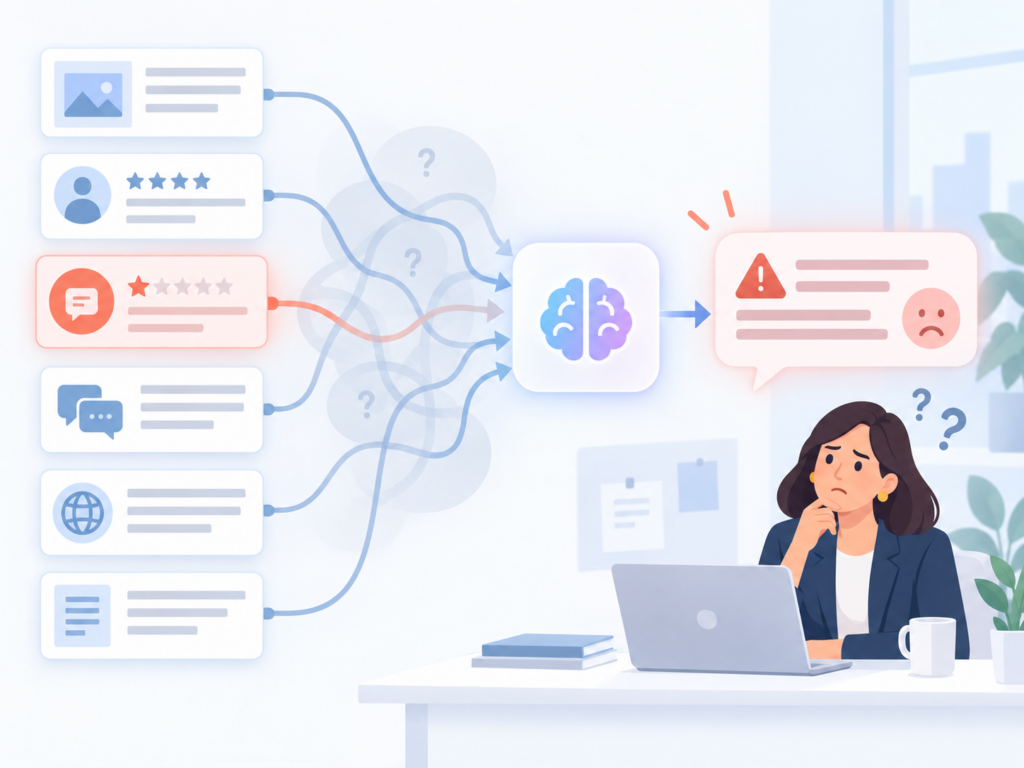
    Sentiment. Score the polarity of how AI describes you on a -100 to +100 scale. A brand with high visibility and negative sentiment is dealing with hallucinated reputation damage, where AI summarizes outdated complaints from old forum threads. The audit should pull the actual adjectives the AI uses. “Reliable” and “scalable” are wins. “Pricey” and “complex” tell you which prompts you’re losing before you even compete.

    Source influence. Reverse-engineer the citations to find which third-party domains are shaping the AI’s answer. The data here is striking: 82-85% of AI citations come from third-party domains, not the brand’s own site. Community sites like Reddit and Quora account for 40-47% of citations. Reference sites like Wikipedia hold 7.8-11%. B2B platforms like G2 carry significant weight in commercial categories. If your audit only looks at your blog’s performance, you’re missing where the answer actually comes from.

    A brand that overweights its own site and underweights Reddit, G2, and Wikipedia will consistently misread its real position in the AI ecosystem.

    Common Mistakes That Make AEO Audits Useless

    Most failed audits fail for the same three reasons.

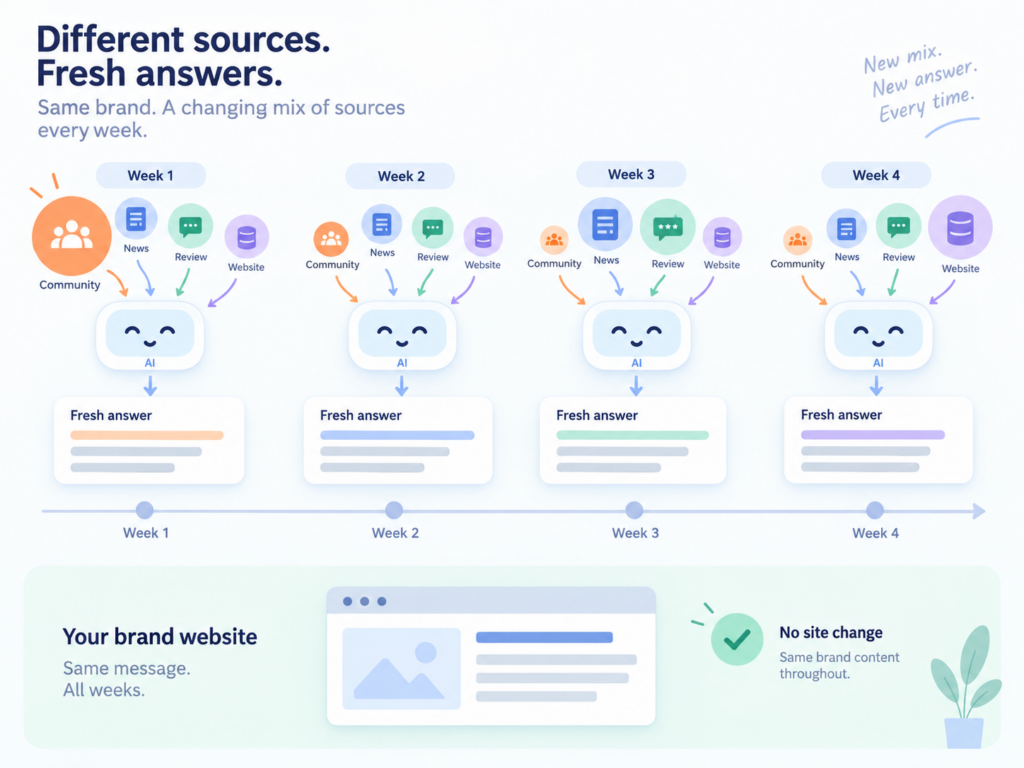
    The snapshot fallacy. Treating the audit as a one-time report is the most common mistake. AI model outputs aren’t stable like SERPs. Top citation sources can shift 40% month-over-month, a phenomenon often called citation drift. A brand visible in June can disappear in July after a model update. The audit only matters if it becomes the baseline for a time-series, not a one-off slide deck.

    Auditing yourself in a vacuum. A synthesized answer has one top recommendation. Measuring your visibility without measuring competitors gives you no strategic context. You need Share of Model relative to your top three rivals, not just your own number. Otherwise you can’t tell if you’re gaining or losing ground in the buyer’s mind.

    Reports without actions. This is the costliest one. An AEO audit that lists data without identifying answer gaps is a report, not a strategy. The real job of the audit is to show which specific prompts your competitors are winning, which third-party domains are feeding their citations, and which content gaps you need to close. If your technical docs are getting cited but your marketing blog isn’t, the action isn’t “publish more posts.” It’s restructure the blog for machine extractability. Audits without actions decay into spreadsheets nobody opens twice.

    Why Manual AEO Audits Break After the First Report

    Manual audits build intuition. They don’t scale. Most teams hit the wall after the first or second iteration, and the reasons are structural.

    The first issue is prompt explosion. Covering a real buyer journey across multiple personas and geographies usually means tracking 100+ prompt variations. Querying five AI platforms manually, recording the responses, and scoring sentiment by hand is hundreds of hours of work that nobody has.

    The second is data standardization. Manual scoring is subjective. Without an NLP engine to grade sentiment and tag citations consistently, the report becomes a pile of anecdotes. Two analysts looking at the same answer will disagree on whether the framing is positive or neutral.

    The third is the retrievability gap. A manual audit can tell you that you’re not being cited. It can’t tell you why. It can’t reverse-engineer millions of source URLs to find which structural patterns, schema implementations, or third-party mentions are driving citations for your competitors. That’s not a willpower problem. It’s a tooling problem.

    This is where teams move to a platform like Topify, which runs AEO audits as a continuous system rather than a one-time report. Topify covers ChatGPT, Gemini, Perplexity, and AI Overviews in parallel, scoring visibility, sentiment, and citation sources on the same prompt bank week over week. Instead of a 40-hour manual sprint, the baseline audit happens in the background and updates as model behavior drifts.

    How Topify Turns a One-Time AEO Audit into Ongoing Intelligence

    Three capabilities matter most for moving from audit to intelligence.

    High-Value Prompt Discovery surfaces the prompts that actually drive citation value in your category, instead of leaving you to guess. The bank stays grounded in the language buyers use inside the AI interface, not the language your team uses in planning docs.

    Dynamic Competitor Benchmarking tracks Share of Model and sentiment for your top rivals on the same prompts you’re monitoring. You see which competitors are winning specific prompts, what adjectives the AI is attaching to them, and where their sentiment is weak enough to contest.

    Source Analysis reverse-engineers the third-party domains feeding the AI’s answers. If your category leans on Reddit threads and G2 reviews, the audit tells you exactly which communities and review categories deserve PR and content investment. AEO becomes less of a content task and more of a brand authority task.

    That’s the shift. Not running the audit once. Running it as the operating layer.

    Conclusion

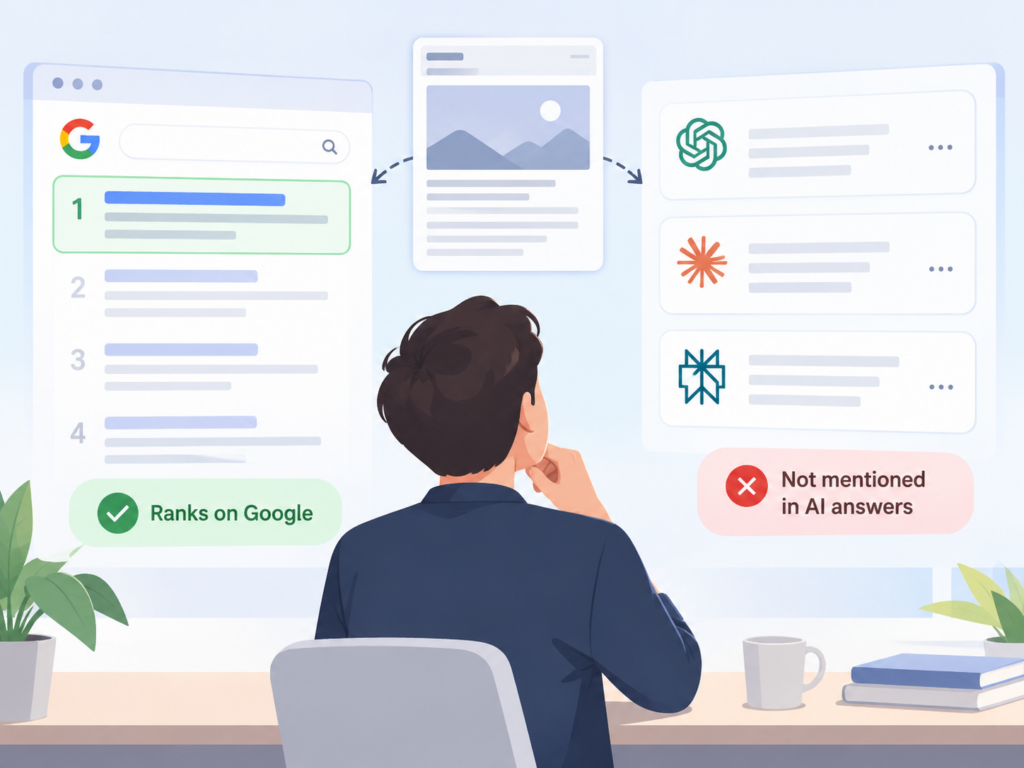
    A solid AEO audit is uncomfortable for most marketing leaders. The “rankings equal AI visibility” assumption almost never holds up under empirical testing. Strong SEO performance can coexist with near-zero citation share in synthesized answers.

    The roadmap is simple in structure, hard in execution. Build a 30-50 prompt bank that mirrors real buyer intent. Test it across ChatGPT, Gemini, Perplexity, and AI Overviews in clean environments. Score visibility, sentiment, and citation sources together, not in isolation. Then move from manual spot-checks to continuous monitoring so you catch model drift and competitor moves in time to act on them.

    A single AI citation in a high-intent prompt is now worth more than a thousand low-intent clicks. The brands that measure that visibility this quarter will own the recommendations next year.

    FAQ

    What’s the difference between an AEO audit and an SEO audit? 

    An SEO audit measures how well a page ranks in a list of links for a keyword. An AEO audit measures how often, how favorably, and from which sources a brand gets cited in AI-generated answers across conversational prompts.

    How often should I run an AEO audit? 

    A full audit should run at least quarterly because of citation drift, where top AI sources shift 40% month-over-month. Continuous automated monitoring is the better default, with deeper analysis layered on top each quarter.

    How many prompts should I test in an AEO audit? 

    30 to 50 prompts is the minimum for a statistically meaningful baseline. Cover all three buyer stages: awareness, consideration, and decision. Going below 30 risks anecdotal results.

    Can I run an AEO audit for free? 

    You can spot-check on free versions of ChatGPT or Perplexity, and tools like the HubSpot AEO Grader give a one-time score. Free options can’t track competitors, score sentiment consistently, or run time-series analysis, which is where the strategic value sits.

    Which AI platforms matter most for AEO visibility? 

    ChatGPT, Perplexity, Google AI Overviews including AI Mode, and Gemini cover over 90% of the conversational search market today. Skipping any of the four leaves a meaningful blind spot in the audit.

    Read More

  • What Is AEO and Why SEO Alone No Longer Works

    What Is AEO and Why SEO Alone No Longer Works

    You search for “best project management software” on ChatGPT. A confident paragraph comes back, naming three tools, explaining why each one fits different team sizes. No links to click. No ads to scroll past. Just an answer.

    If your brand isn’t in that paragraph, you don’t exist for that user at that moment.

    That’s not a ranking problem. That’s an AEO problem.

    AEO Isn’t SEO. Here’s the Difference That Actually Matters

    SEO optimizes for position. AEO optimizes for citation.

    Traditional SEO earns you a spot in the blue-link list. Answer Engine Optimization (AEO) earns you a spot inside the AI’s generated response, as the source it synthesizes, paraphrases, and recommends directly to the user.

    The user journey has changed. It used to be: search, click, browse, convert. Now it’s: ask, get answer, convert. That compression removes the click entirely, and with it, most of what traditional SEO was built to capture.

    According to Gartner’s research, traditional search volume is projected to drop 25% by 2026 as queries shift to AI-driven answer engines. ChatGPT now has 900 million weekly active users, and Perplexity handles 780 million monthly queries. About 60% of Google searches already end without a single click.

    That’s not a blip. That’s a structural shift in how people get information.

    Here’s what makes AEO different at its core: while SEO relies on keyword matching and backlink authority, AEO is built around entity-centricity and intent alignment. AI engines don’t rank pages. They extract facts, synthesize them, and generate a response. Your job is to be the source they extract from.

    How AI Answer Engines Decide What to Say

    Most modern answer engines run on Retrieval-Augmented Generation (RAG) architecture. When a user submits a query, the system runs a real-time web search, pulls relevant text chunks from multiple sources, and feeds them into a large language model for synthesis.

    This means AI engines are, at their core, wrappers around traditional search infrastructure. They still rely on indexing and ranking signals. But they add a semantic re-ranking layer on top, which changes what actually gets surfaced.

    Different platforms weight sources differently. Claude favors Brave Search results, with an 86.7% result relevance rate. ChatGPT pulls from Bing and Google via SerpAPI, but shows only 27% direct relevance and relies heavily on semantic re-ranking. Perplexity blends multiple sources and prioritizes real-time, frequently updated content. Google AI Overviews leans on Reddit, which accounts for 21% of its citations.

    You can’t run one optimization strategy across all four. Each engine has a different back-end preference.

    When an AI engine evaluates which sources to cite, it scores content on four dimensions: factual density (specific numbers, named entities, verifiable claims), structural clarity (tables, headers, lists), information gain (does this page say something not already covered?), and source authority (is this site cited by .gov, .edu, or top-tier industry research?).

    Vague marketing copy gets ignored automatically. Concrete, well-structured, externally validated content gets cited.

    The 3 Signals That Make Your Brand AEO-Ready

    Signal 1: Content Authority and Entity Clarity

    AI engines don’t do keyword matching. They try to understand what your brand is, what it does, and how it relates to adjacent concepts. If your content doesn’t make those relationships explicit, you’re invisible.

    Practically, this means leading with the answer. Put the core response in the first 100 words. Use clear entity statements: your brand name, your product category, and what you do, defined without ambiguity. Apply the 15-25 word citation rule: wrap your key facts in short, self-contained sentences that AI extraction algorithms can pull cleanly without reformatting.

    Signal 2: Structured Markup

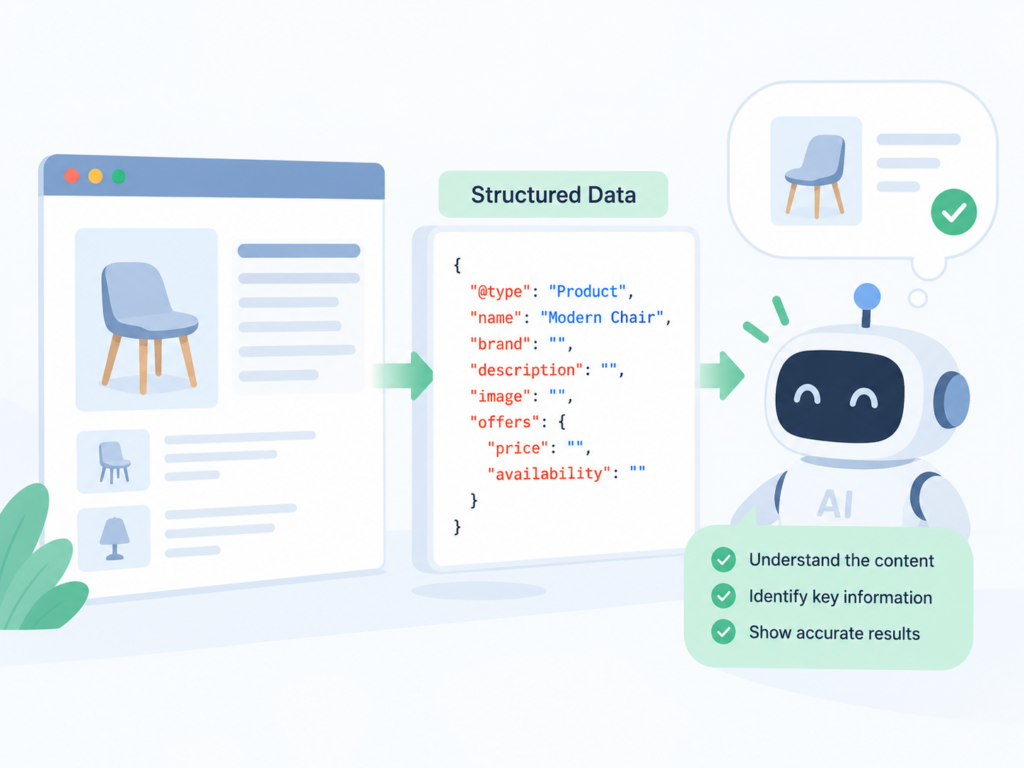
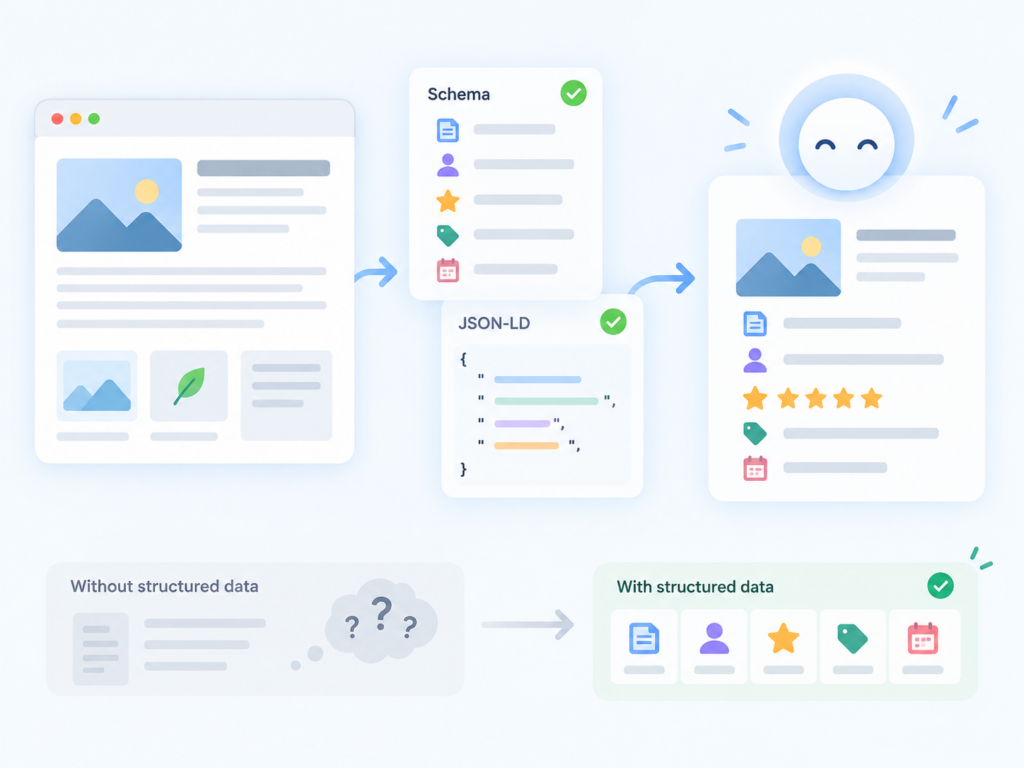
    Schema.org markup is how AI systems translate your content from human-readable text into machine-interpretable data. Websites that implement structured data are cited by AI engines at more than twice the rate of unstructured pages.

    The most impactful markup types for AEO are FAQPage (direct-answer visibility), Product/Offer (commercial comparison cards), HowTo (instructional searches), and Organization (brand knowledge graph). There’s also an emerging standard, llms.txt, specifically designed to signal AI-crawlability.

    Signal 3: Third-Party Consensus

    AI engines don’t just trust what you say about yourself. They cross-reference. They look for consensus: are other authoritative sources saying the same things about your brand?

    In B2B SaaS, over 35% of LLM citation links come from just 10 third-party sources, with Reddit and G2 dominating. If industry review sites, trade media, and community forums are all discussing your brand positively, AI engines treat that as corroboration and push you higher.

    The most durable third-party signal you can build: original research. When your brand publishes proprietary data, AI engines are forced to cite you as the primary source. You become unavoidable.

    AEO in Action: What It Looks Like When It Works

    These aren’t hypothetical outcomes.

    A B2B SaaS company executed a focused AEO program and grew AI-referred trial sign-ups from 575 to 3,500+ per month within 7 weeks. The levers: fixing broken Schema markup, publishing 66 data-heavy articles targeting buyer-intent queries, and establishing a presence in top-ranked Reddit threads where their LLM training data was being pulled from.

    StrideMax, a running shoe brand, held the top Google ranking for “best marathon shoes” but was completely absent from ChatGPT and Perplexity recommendations. They rewrote product descriptions into HTML data tables with weight, drop height, cushioning material, and price. They opened every product page with one sentence answering: “Who is this shoe for?” The result: 40% citation rate in Google AIO for long-tail queries, and conversion rate jumping from 2% to 6% despite a 10% drop in total traffic volume.

    FinFlow, a fintech app, was getting hurt by a 2022 security incident that AI engines kept surfacing in response to safety questions. Their fix wasn’t PR spin. It was building a schema-rich compliance page with ISO certifications and current encryption standards, then using Topify’s Sentiment Analysis to track how AI descriptions of their brand shifted over time. Their AI sentiment score moved from 35/100 to 85/100. Customer acquisition cost dropped 18%.

    That last case illustrates something important: AEO isn’t just about getting mentioned. It’s about controlling the narrativeAI engines attach to your brand.

    You Can’t Optimize What You Can’t Measure

    Traditional SEO tools like Ahrefs and SEMrush track rankings. They don’t track what ChatGPT says about your brand this week versus last week. That’s a fundamental blind spot.

    Effective AEO measurement runs on three metrics. Visibility: what share of relevant AI prompts actually surface your brand? Position: are you the first recommendation, or a footnote at the bottom? Sentiment: when AI describes your brand, what words does it use?

    Topify was built specifically to make these metrics trackable and actionable. It monitors brand performance across ChatGPT, Gemini, Perplexity, DeepSeek, and other major platforms. Its Source Analysis module shows which third-party domains are driving AI citations for your brand (and your competitors). Its Gap Detection feature identifies prompts where competitors get cited and you don’t, then generates content briefs directly.

    For teams just starting out, the Basic plan at $99/mo covers 100 prompts, 4 projects, and foundational source analysis across the major AI platforms. The Pro plan at $199/mo expands to 250 prompts and 10 seats, suited for growing marketing teams running competitive benchmarking. Enterprise starts at $499/mo for custom model coverage and API integration.

    The measurement layer is what separates AEO as a discipline from AEO as a guess. AI referral traffic has grown 600% since January 2025. That growth doesn’t show up in your standard analytics the way organic search does. Without purpose-built tracking, you’re flying blind.

    How to Start with AEO: A 3-Step Checklist

    Step 1: Audit your current AI visibility (Days 1-14)

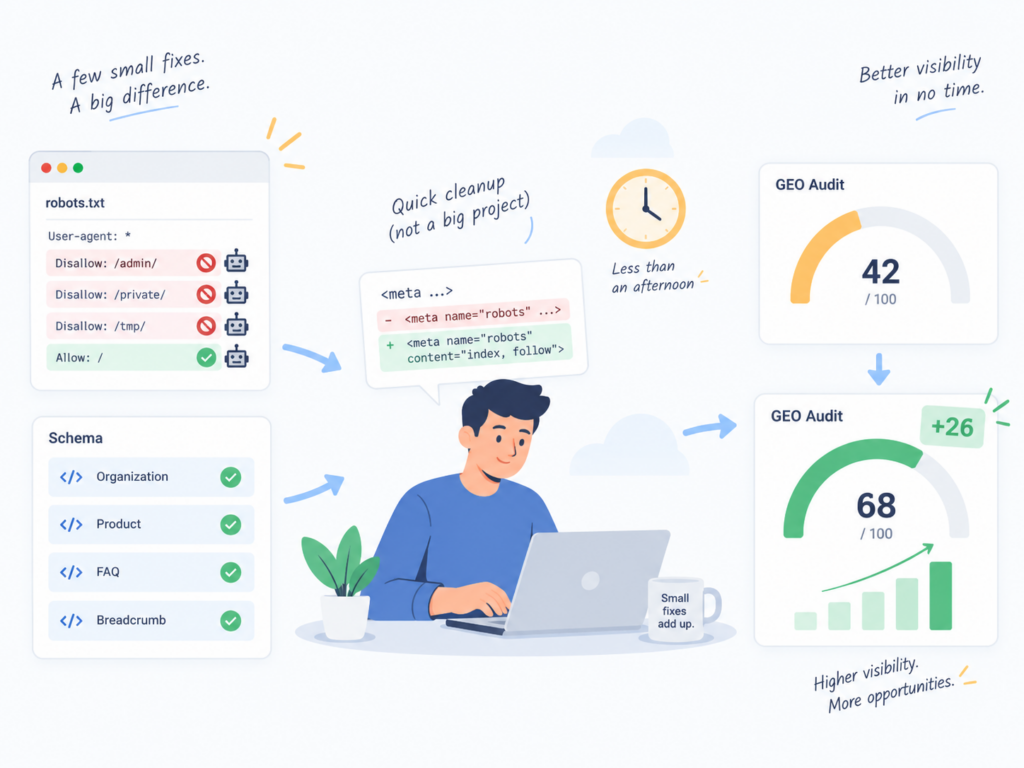
    Manually run 20 core commercial queries in ChatGPT, Perplexity, and Google AI Overviews. Track how often your brand appears and in what context. Ask “Who is [your brand]?” and “How does [your brand] compare to [competitor]?” If AI produces inaccurate or missing information, your entity signals are insufficient. Check your robots.txt to confirm you’re not blocking GPTBot, PerplexityBot, or other AI crawlers.

    Step 2: Optimize content structure and external authority (Days 15-60)

    Rewrite your top 10 traffic pages with answer-first structure. Convert narrative product descriptions into structured tables with concrete specifications. Deploy FAQPage and Product Schema on core service and product pages. Submit original data-backed press releases to the publications AI engines already cite. Build a presence in the Reddit communities where your buyers ask questions.

    Step 3: Build continuous monitoring (Day 60 onward)

    Deploy automated tracking for your AI visibility share and its weekly movement. Refresh key statistics every quarter. AI engines show a meaningful preference for content updated within the last 13 weeks. Use gap analysis monthly to adjust where you’re producing new content.

    The window for early-mover advantage in AEO is still open. It won’t be for long.

    Conclusion

    AEO isn’t replacing SEO. It’s extending the competitive surface.

    SEO still drives long-tail traffic and website discoverability. AEO captures the moment when a user asks a direct question and gets a direct answer, with no browsing involved. That moment is increasingly where high-intent conversion begins.

    AI-referred visitors convert at 4x the rate of traditional organic search visitors. The reason is straightforward: by the time a user acts on an AI recommendation, the consideration phase is over. They trust the answer. Your job is to be the answer they trust.

    The brands showing up in AI-generated responses in 2026 aren’t there by accident. They built factual density into their content. They implemented structured markup. They earned third-party citations. And they measured all of it.

    That’s what AEO looks like in practice.


    FAQ

    What’s the difference between AEO and GEO? 

    AEO focuses on specific answer features like Google AI Overviews and featured snippets, aiming to become the single cited answer. GEO (Generative Engine Optimization) is a broader framework for optimizing content across the entire generative AI ecosystem, not just one search surface.

    Does AEO replace SEO? 

    No. SEO remains the foundation for website visibility and long-tail discovery. AEO targets high-intent, conversational queries where users want a direct answer, not a list of links. They work best as complementary layers.

    Which AI platforms does AEO apply to? 

    The primary platforms are ChatGPT, Google AI Overviews/Gemini, Perplexity, and Microsoft Copilot. Voice assistants like Siri and Alexa also apply AEO logic. Vertical AI agents in healthcare, legal, and finance are growing application areas.

    How long does it take to see AEO results? 

    Initial signals typically appear within 2-6 weeks of optimization, particularly in long-tail queries. Cross-platform, category-level visibility usually takes 3-6 months as AI models update their knowledge bases and establish trust weighting for your brand.


    Read More

  • G2 AEO Tool Reviews: What High Scores Actually Hide

    G2 AEO Tool Reviews: What High Scores Actually Hide

    You open G2, search “AEO tool,” and see a row of 4.6, 4.7, 4.8 stars. Every vendor looks confident. Every screenshot looks polished.

    Here’s the thing: those scores tell you almost nothing about whether the tool actually works.

    G2’s rating system was built to evaluate SaaS products where “good experience” and “good performance” largely overlap. For AEO tools, they don’t. The metrics that drive high scores on G2 — ease of use, onboarding smoothness, customer support speed — have almost no correlation with the technical capability that matters most: whether the data keeps up with how fast LLMs change.

    This guide will show you how to read G2 AEO tool reviews like someone who’s been burned before.

    Why G2 Scores for AEO Tools Are Structurally Misleading

    G2’s satisfaction score is weighted heavily toward three dimensions: Ease of UseMeets Requirements, and Quality of Support. All three are subjective experience metrics. None of them measure data freshness, sampling accuracy, or LLM engine coverage.

    A tool can have a customer support team that responds in under two hours, an onboarding flow that takes 15 minutes, and a dashboard that looks like it belongs in a design award portfolio. It can also have data that’s four days stale. On G2, that tool scores 4.7.

    What makes this worse is timing. Most G2 reviews are written within the first 30 to 60 days of use — the “honeymoon period,” when users are still impressed by the interface and haven’t yet tried to act on the data. The reviews that surface a tool’s real technical limits tend to come later, get fewer upvotes, and get buried.

    A high G2 score tells you the onboarding was smooth. It doesn’t tell you if the data is current.

    There’s also a structural advantage for legacy players. G2’s Market Presence score rewards company size, employee count, and social media activity. That means traditional SEO platforms with large sales teams and established brand recognition tend to sit in the “Leader” quadrant, even when their AEO features are bolted-on modules with no dedicated architecture underneath.

    The “Cons” Section Is the Only Part Worth Reading

    Users write marketing copy in the “Pros” section. They write the truth in the “Cons” section.

    This isn’t cynicism — it’s a consistent pattern across thousands of software reviews. Positive reviews use phrases like “great for our team” or “easy to get started.” Negative reviews describe specific failures: “took three days to reflect our content update” or “results are completely different when I run the same query twice.”

    Three red-flag phrases appear consistently in G2 AEO tool reviews, and each one points to a specific underlying problem:

    Red FlagWhat It Actually MeansBusiness Risk
    “data delay” / “slow to update”Crawl frequency is lower than LLM RAG update cyclesBrand misses real-time window to correct AI errors
    “complex interface” / “steep learning curve”Product was built for SEO, not AEO workflowsTeams abandon the tool or miss key AEO metrics buried in SEO dashboards
    “results vary” / “accuracy inconsistency”Unstable sampling strategy, no validation for non-deterministic outputsCan’t establish a reliable visibility baseline; market share miscalculation

    When you see these phrases clustered in a tool’s cons section, you’re not looking at minor UX complaints. You’re looking at architectural problems.

    What “Data Delay” Actually Costs You

    In AEO tracking, stale data isn’t just inconvenient.

    It leads to wrong decisions.

    LLMs don’t update on a weekly schedule. The retrieval layer — the part most relevant to AEO optimization — updates daily or near-real-time. The RLHF layer, which directly influences how often a brand gets recommended, is continuously adjusted. Research indicates that after a single RLHF update to a model like GPT-4 or Gemini, a brand’s visibility can shift measurably within 72 hours.

    If your tracking tool refreshes data once a week, you’re looking at a seven-day lag in a market where the competitive landscape can shift in three. You might spend resources fixing a content problem that the model already resolved — or miss a new citation space a competitor just occupied.

    The worst version of this is what practitioners sometimes call “archaeology data”: tools that rely on static API caches and present week-old snapshots as current performance. It’s a technical shortcut that saves the vendor compute costs and costs you accurate decisions.

    Topify‘s Visibility Tracking uses real-time browser rendering rather than static caches, which means the platform captures actual AI responses as users experience them — not approximations from a database that hasn’t been touched since Tuesday.

    “Interface Complexity” Is Usually a Product Definition Problem

    When G2 reviewers say an AEO tool is “hard to navigate” or “overwhelming,” the common assumption is that it’s a UX issue. Usually it isn’t.

    AEO and SEO are not the same workflow. Traditional SEO tools are designed around keyword rankings and click-through rates — the goal is to move users toward a web page. AEO’s core logic is different: you’re optimizing how AI synthesizes brand information into a generated answer. The success metric isn’t a ranking position. It’s citation influence.

    When an SEO platform adds AEO as a feature module, users end up navigating a system designed for “blue-link search” while trying to find data about “zero-click citations.” The interface feels complex because the underlying architecture was never redesigned for the new task.

    A practical test: search the reviews for phrases like “setup took” or “hard to configure.” If those phrases appear alongside descriptions of manually mapping citation sources or configuring custom crawl rules, the product is offloading its technical limitations onto the user. Good AEO-native tools handle that complexity automatically.

    Topify’s One-Click Execution is an example of the other approach: you define the goal in plain English, the AI agent builds and deploys the strategy. The interface complexity disappears because the system was designed around how AEO workflows actually run.

    How to Read a G2 AEO Tool Review in Under 3 Minutes

    Here’s a practical framework. It filters out about 90% of the noise.

    Step 1 — Go straight to the cons (first 30 seconds). Skip all 5-star reviews. Sort by lowest rating. Look for whether negative reviews cluster around data accuracy or delays, not just feature requests.

    Step 2 — Run three keyword searches (30 seconds). Use Ctrl+F in the review section. Search: delayaccuracyupdate. If these terms appear repeatedly in negative reviews, the product has a reliability problem at the infrastructure level.

    Step 3 — Check the review dates (30 seconds). In the AEO space, six months is a long time. A glowing review written before GPT-4o or Gemini 1.5 launched may reflect a tool that no longer functions the same way. Prioritize reviews from the last 90 days for anything related to technical performance.

    Step 4 — Look at reviewer job titles (30 seconds). Operations managers and data analysts write reviews based on what breaks during actual configuration. Marketing coordinators write reviews based on whether the dashboard looks good. The former is more useful.

    Step 5 — Filter for verified purchasers (30 seconds). Unverified reviews are easy to game. Short reviews with high ratings and no specific details should be discounted regardless of score.

    What G2 Reviews Won’t Tell You (And Where to Fill the Gap)

    G2 reviews have a structural blind spot: they can’t capture what users don’t know to ask about.

    Most buyers don’t interrogate a tool’s sampling methodology. They don’t check whether the platform uses distributed browser rendering or a single-IP API call. They don’t ask whether the tool distinguishes between a brand “mention” and a genuine AI “recommendation” — which are meaningfully different signals for optimization decisions.

    Platform coverage depth is another gap. A vendor’s G2 page might list “ChatGPT, Gemini, Perplexity” as supported engines. The fine print, which rarely appears in reviews, is whether those integrations rely on the public API (which gives you a limited, non-representative sample) or actual simulated user queries across regional nodes.

    For Perplexity specifically, BrandMentions offers granular tracking of how brands appear in Perplexity’s real-time search layer, including whether those mentions convert into meaningful referral traffic. That kind of engine-specific depth complements a full-platform tracker and fills the gaps that G2 reviews systematically miss.

    Before committing to any tool, request the technical documentation. Look specifically for answers to: What is the data refresh interval? Is data sourced from real-time browser rendering or static API caches? How many query samples are run per prompt per engine?

    If a vendor can’t answer those questions directly, the G2 score doesn’t matter.

    Topify on G2: What the Real Feedback Shows

    Topify is an AI-native AEO platform built by former OpenAI researchers and Google SEO practitioners. Its G2 feedback reflects the difference in approach.

    Users consistently highlight the platform’s multi-engine coverage — real simultaneous monitoring across ChatGPT, Gemini, Perplexity, DeepSeek, Grok, Doubao, and Qwen — and its ability to distinguish between brand mentions and positive recommendations, which most tools treat as equivalent. Experienced SEO leads note it as one of the few platforms that tracks seven distinct metrics (visibility, sentiment, position, volume, mentions, intent, and CVR) rather than providing a single aggregated score that obscures what’s actually changing.

    The cited accuracy range of 95-98% on citation tracking reflects the platform’s use of real-time browser rendering rather than cached data — which directly addresses the data delay complaints that appear most often in competitor reviews.

    On cost: Topify’s Basic plan starts at $99/month, which is significantly lower than legacy enterprise platforms that charge $499/month or more for slower, less granular data. The value gap is measurable.

    If you want to see how Topify’s G2 reviews hold up against the framework in this article, the Topify G2 Reviews page has the full set of verified user feedback. There’s also a 7-day trial if you’d rather test the data quality yourself before reading anyone else’s opinion.

    Conclusion

    A high G2 score for an AEO tool means the onboarding is clean, the support team is responsive, and the interface made a good first impression.

    It doesn’t mean the data is current. It doesn’t mean the sampling is accurate. It doesn’t mean the platform was designed for AEO rather than retrofitted from SEO.

    The signal is in the cons. The real question is whether the negative reviews cluster around data delay, accuracy inconsistency, or interface complexity — because those three patterns point to the same underlying issue: the tool can’t keep pace with how fast LLMs actually change.

    Read the cons first. Search for the red flags. Check the dates. Then ask the vendor the three technical questions G2 never will.


    FAQ

    What does “AEO tool” mean on G2?

    G2 doesn’t yet have a standalone top-level category for AEO. These tools are typically listed under “SEO Software,” “AI Search,” or “Digital PR Tracking.” When searching, use specific function terms like “citation tracking” or “AI visibility” rather than “AEO” alone to surface the most relevant results.

    How recent do G2 reviews need to be to stay relevant for AEO tools?

    Given how fast LLMs iterate, reviews older than 90 days carry limited technical weight. Six months or more is essentially historical data. A positive review written before a major model update reflects a version of the tool that may no longer behave the same way. For accuracy and data freshness assessments, prioritize the most recent reviews.

    Can I rely on G2 star ratings to compare AEO tools head-to-head?

    No. Star ratings are heavily influenced by subjective experience metrics like customer support and onboarding quality. Two tools can have the same star rating with completely different data architectures. Use the 3-minute review framework in this article and supplement with direct vendor questions about refresh frequency, sampling method, and engine coverage depth.


    Read More

  • What Is an AEO Tool? The No-Jargon Marketer’s Guide

    What Is an AEO Tool? The No-Jargon Marketer’s Guide

    Your keyword rankings are solid. Your domain authority took years to build. Then a potential customer opens ChatGPT, types “what’s the best [your category] tool for my team,” and gets a list of five recommendations. Your brand isn’t on it. And your current analytics have no idea that conversation even happened.

    That’s the gap AEO tools are built to close.

    AEO Isn’t SEO with a New Name

    AEO stands for Answer Engine Optimization. It’s the practice of making sure your brand shows up, gets cited, and gets recommended when AI platforms like ChatGPT, Perplexity, and Gemini answer questions relevant to your category.

    The distinction matters. SEO optimizes for a Google ranking. AEO optimizes for inclusion in an AI-generated answer. Those are two different outcomes, measured on two different platforms, driven by two different signals.

    A brand can hold the #1 position on Google for a high-intent keyword and still be completely absent from the AI response for the exact same query. This isn’t a bug. It’s how generative engines work. Understanding AI search visibility as a separate discipline from traditional rankings is the starting point for everything that follows.

    What an AEO Tool Actually Does

    An AEO tool monitors what happens before a user ever reaches your website. Specifically, it tracks whether your brand appears in AI-generated responses, how you’re described when you do appear, and which sources the AI used to form that answer.

    Most traditional analytics start at the click. AEO tools start earlier.

    Think of it across three layers. First, Visibility: does your brand name show up when AI answers relevant questions? Second, Sentiment: when it does appear, is the framing positive, neutral, or quietly negative? Third, Source Attribution: is the AI pulling from your content, your competitors’ content, or third-party platforms like Reddit and G2?

    AI agents and AEO work together in this framework. The agent retrieves sources, synthesizes them, and delivers a verdict. An AEO tool shows you whether your brand made that shortlist, and if not, why.

    AEO Tool vs. SEO Tool: A Side-by-Side Look

    DimensionSEO ToolAEO Tool
    What it tracksRankings, backlinks, trafficAI mentions, citations, sentiment
    Target platformGoogle, BingChatGPT, Perplexity, Gemini
    OutputKeyword positionBrand visibility in AI answers
    Optimization goalRank higherGet cited more often
    Core metricImpressions, CTRMention rate, Citation rate

    The Numbers That Explain Why Marketers Are Paying Attention

    This isn’t a future trend. It’s already showing up in traffic data.

    37% of consumers now start their product discovery journeys with AI tools rather than traditional search engines. ChatGPT has reached 900 million weekly active users. Google AI Overviews reaches 1.5 billion monthly users globally. Traditional search volume is projected to decline by approximately 25% by the end of 2026.

    The conversion numbers make the case even more directly. Visitors referred from AI platforms convert at 4.4x to 5x the rate of standard organic search visitors. In B2B SaaS, AI-referred conversion rates have reached as high as 14.2%.

    That last number deserves its own sentence.

    The explanation is structural. By the time a user asks ChatGPT for a recommendation, the AI has already done the top-of-funnel and mid-funnel research for them. They arrive pre-qualified. The trade-off is that 93% of AI search sessions end without any click to an external website, meaning if you’re not named in the answer, you don’t exist for that user. Forrester data shows B2B marketing teams have already seen 20-30% declines in web traffic tied to AI-native discovery.

    Understanding how AI search marketing works and how to measure it is quickly becoming a baseline expectation, not a niche skill.

    5 Things a Good AEO Tool Should Track

    Not all AEO tools measure the same things. Before evaluating any platform, it helps to know which signals actually matter.

    Mention Rate is the percentage of relevant queries where your brand name appears in the AI’s actual response text. This is the most direct measure of whether AI platforms are recommending you.

    Citation Rate tracks how often your domain is referenced as a source in AI responses, even when the brand name isn’t mentioned in the answer itself. This distinction matters because a tool might cite your content 182 times in a month without ever saying your brand name. That pattern, sometimes called a “ghost citation,” means your data is trusted but your brand hasn’t earned a direct recommendation yet.

    AI Share of Voice compares your mention rate against a defined set of competitors. In a typical AI response, three to six brands are named. You’re either in that group or you’re not. There’s no position eight here.

    Sentiment Score measures how the AI frames your brand when it does mention you. A high score means the AI positions you as a recommended leader. A low one means you’re more likely described as a cautionary alternative. Keyword research built for GEO and AEO can surface the topic clusters where your framing needs work.

    Prompt Coverage identifies which questions your brand shows up for, and equally, which high-volume AI prompts you’re absent from entirely. Research shows that 95% of the sub-queries AI models generate internally have zero recorded search volume in traditional tools like Ahrefs. AEO tools surface these uncontested opportunities before anyone else is optimizing for them.

    What Makes It Harder: The AI Visibility Gap

    Here’s something worth understanding before you start optimizing.

    Different AI platforms don’t agree with each other. There’s less than an 11% overlap in the domains cited by ChatGPT versus Perplexity. Being well-cited on one platform doesn’t transfer to others automatically. Cross-platform tracking isn’t a premium feature. It’s the baseline.

    AI platforms also favor freshness in a specific way. Content updated within the last 90 days is 2.3x more likely to be cited than older material. This isn’t about changing a publication date. It’s about content that reflects current positioning, current product features, and current context.

    The implication is direct: AEO isn’t a one-time audit. It’s a continuous monitoring function.

    Where Topify Fits Into the AEO Picture

    For marketing teams that need to track AEO systematically across multiple platforms, Topify treats AI search visibility as a structured, measurable channel rather than a one-off diagnostic.

    The platform monitors seven metrics across ChatGPT, Gemini, Perplexity, DeepSeek, and other major AI engines: visibility, sentiment, position, volume, mentions, intent, and CVR (Conversion Visibility Rate). Together, these give a marketing team a working picture of how AI systems describe and recommend their brand, not just on one platform, but across the ones their audience actually uses.

    The Source Analysis feature is especially relevant for AEO work. It reverse-engineers which third-party URLs the AI is citing for a given topic, so a content team can identify exactly which domains they need to appear on to earn a citation. That’s a materially different workflow from traditional link-building.

    Topify’s AI Volume Analytics surfaces high-frequency prompts being used on ChatGPT and Perplexity that have no recorded volume in conventional keyword tools. For brands that want to build content targeting the AI’s internal reasoning process, that prompt data is the starting point, not an afterthought.

    The GEO agent layer takes it one step further: rather than just showing you what’s missing, it proposes and can execute optimization strategies with a single click. For teams managing multiple brands or clients, that changes the labor math.

    Trusted by 50+ enterprises and startups, Topify is built for LLM-era visibility from the ground up, not retrofitted from a legacy SEO platform.

    How to Get Started with AEO Optimization

    The entry point doesn’t need to be complex. Here’s a practical framework.

    Start with a baseline audit. Pick your top 15-20 high-intent questions and test them across ChatGPT, Gemini, and Perplexity. Document where you’re mentioned, where you’re cited but not named, and where you’re absent entirely. That three-way breakdown tells you what kind of problem you’re actually solving.

    Identify your real AI competitors. The brands the AI recommends in your category are often not the same ones ranking on Google. This is a consistent finding for brands running their first AEO audit. It changes which content gaps matter most.

    Prioritize by prompt volume. AEO tools with AI Volume Analytics show you which specific questions your audience is asking AI platforms. Start with high-volume prompts where you’re currently absent. That’s where the conversion opportunity is largest.

    From there, content structure matters more than content volume. Research from Princeton found that adding expert quotes to existing content improves AI visibility by 41%, and incorporating specific statistics boosts it by 31-37%. These are repeatable improvements to content you’ve already published.

    Setting up a consistent AI answer monitoring system lets you track whether those updates are actually moving your mention rate, rather than optimizing blind. Update your content at least every 90 days and treat your mention rate the same way you’d treat a keyword ranking: something that shifts, drifts, and requires active management.

    Get started with Topify to run your first cross-platform AEO audit.

    Conclusion

    Your SEO rankings measure how Google sees your content. They say nothing about what ChatGPT, Perplexity, or Gemini recommends when someone asks a question you should be answering.

    AEO tools bridge that gap. They tell you whether you’re in the answer, how you’re described when you are, which sources the AI trusts over yours, and which high-volume prompts you’re completely missing. That’s the diagnostic layer traditional analytics can’t provide.

    As traditional search volume continues its decline and AI-native discovery becomes the default for high-intent research, brands with a clear picture of their AI visibility will have a structural advantage. The ones flying blind on this won’t find out what they’ve missed until the traffic data catches up a year later.


    FAQ

    Q: What does AEO stand for? A: AEO stands for Answer Engine Optimization. It’s the practice of optimizing your brand’s content and entity presence to appear in the synthesized answers generated by AI platforms like ChatGPT, Perplexity, and Gemini, rather than just in traditional search results.

    Q: Is an AEO tool the same as a GEO tool? A: They overlap significantly but aren’t identical. AEO focuses on being included in direct AI answers and zero-click environments like featured snippets and AI Overviews. GEO (Generative Engine Optimization) refers specifically to how LLMs synthesize information and how to ensure your brand is cited as a trusted authority during that generation process. Many platforms, including Topify, cover both layers in a single dashboard.

    Q: Do I need an AEO tool if my SEO is already strong? A: Strong SEO doesn’t automatically translate to AI visibility. A brand can rank #1 on Google for a keyword and be entirely absent from the AI answer for the exact same query. Google prioritizes authority and relevance for rankings. AI engines prioritize structural clarity, entity consistency, and third-party citation patterns. The two systems are separate, and you need visibility into both.

    Q: Which AI platforms should an AEO tool cover? A: At minimum, a useful AEO tool should cover ChatGPT, Google Gemini, and Perplexity, which together account for the majority of consumer AI search behavior in 2026. Regional platforms like DeepSeek matter for brands with international audiences. Given that there’s less than 11% overlap in what ChatGPT and Perplexity cite, single-platform tracking leaves most of the picture invisible.


    Read More

  • Why G2 AEO Tools Grew 2,000% in a Year

    Why G2 AEO Tools Grew 2,000% in a Year

    March 2025: seven products listed in a brand-new G2 category called Answer Engine Optimization. January 2026: more than 150. That’s a 2,000%+ expansion in under ten months — faster than almost any software category G2 has tracked in its AI parent group.

    The vendor side of this story is easy to explain. The buyer side is why it matters to your brand.

    7 Products in March 2025. 150+ G2 AEO Tools by Early 2026.

    G2’s AEO category launched quietly. At the time, it met the platform’s minimum listing threshold — six products with ten or more reviews each, plus at least 150 total reviews across the category — but barely. A handful of early tools were targeting a problem most marketing teams hadn’t put on their annual planning radar.

    Ten months later, the category had over 150 products. For context: most enterprise software categories need three to five years to reach that kind of density on G2.

    That growth carried enough momentum to generate a G2 Grid report by Winter 2026, followed by a Spring 2026 Grid shortly after. In G2’s system, a Grid report is a credibility signal — it means the category has passed the threshold from experimental to benchmarkable.

    The page view data reinforces it. According to G2 Data Solutions, the AEO category’s page views ranked first among all AI parent categories on G2 in Q4 2025, climbing 62% compared to the previous quarter. That means buyer interest isn’t slowing after the initial spike. It’s still accelerating.

    The Real Signal Isn’t Vendor Count — It’s How Buyers Changed

    Here’s the thing: software categories don’t grow 2,000% because vendors decided to build new products. They grow because buyers started spending money.

    According to G2’s research, 50% of B2B software buyers now start their purchasing process with an AI chatbot rather than a traditional Google search. Among those, 74% prefer ChatGPT as their primary research tool.

    That behavior shift is the underlying driver behind every number in the G2 AEO category. When half your potential buyers are opening an AI assistant instead of a search engine, your ranking on Google’s page one stops being the whole picture. What the AI says about you — or doesn’t say — determines whether you enter the consideration set at all.

    Emily Greathouse, G2’s Director of Market Research, framed the stakes precisely: the modern buyer’s decision journey is being compressed by AI, and winning the AI’s answer matters more than winning the click.

    That’s not a prediction. It’s already reflected in how buyers report their research behavior.

    AEO Went From “Watch List” to “Budget Line” in Under a Year

    Twelve months ago, most marketing teams listed AEO as something to observe. Now it’s appearing in Q1 planning decks as a distinct budget category.

    The shift happened because the data became concrete enough to justify spend. B2B buyers consume an average of 13.4 pieces of content before they contact a sales rep. Two-thirds of that decision journey is self-directed, with AI assistants increasingly acting as the primary research layer. The brand that appears consistently and accurately in AI answers has already shaped the buyer’s shortlist before a single discovery call takes place.

    One benchmark gaining traction in enterprise marketing circles is the “15% rule” — allocating at least 15% of total search budget to AEO. Research suggests that investments below this threshold typically don’t generate sustained citation growth. Teams that have crossed it report a 38% reduction in cost per lead and a 2.4x increase in meeting bookings, according to Salesforce’s 2026 State of Marketing report. In a year when overall marketing budgets tightened, those efficiency numbers drove AI tool spend up nearly threefold in 18 months.

    Budget decisions are lagging indicators. The fact that AEO is appearing as a budget line now tells you the underlying behavior shift happened earlier.

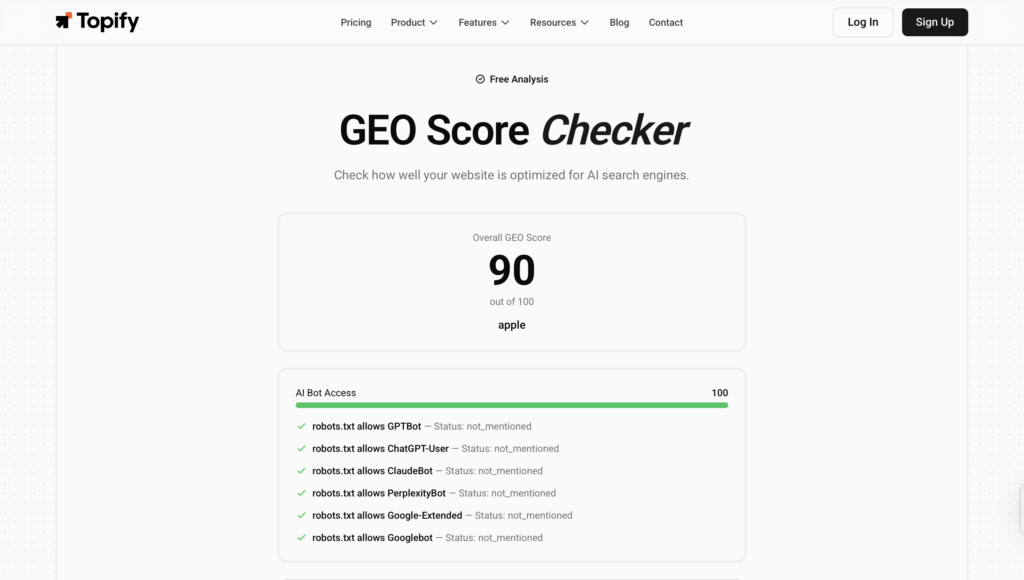
    Before you benchmark your spend, it’s worth establishing where your brand currently stands in AI answers. Topify’s GEO Score Checker gives you a baseline read across major AI platforms in minutes — useful data before any planning conversation.

    What the G2 Grid Reveals About the AEO Tool Market Right Now

    Most buyers use the G2 Grid to find “who’s established” in a category. That’s useful. But in a category this young, the Grid reveals something more specific: which tools close the loop between data and action, and which ones stop at reporting.

    The AEO category has bifurcated into two distinct product types. First: monitoring tools that surface AI visibility metrics but leave the fix to your team. Second: full-stack platforms that connect the insight to the execution — identifying why your brand is missing from AI answers and deploying content to address it.

    That distinction doesn’t show up in feature lists. It shows up in satisfaction scores and user retention. On the G2 Spring 2026 AEO Grid, the platforms with the highest satisfaction ratings are consistently the ones in the second category.

    G2 also functions as a data source for the AI systems themselves. The platform holds roughly 22.4% share of voice across AI-generated software recommendations, and on Perplexity specifically, G2 accounts for 75% of citations from review-type platforms. AI systems treat G2 profiles as structured, machine-readable evidence — not just user testimonials. Reviews that include specific use cases, measurable outcomes, and technical detail carry more citation weight than general sentiment.

    That means a brand’s G2 presence isn’t just a social proof asset anymore. It’s part of the AI visibility stack.

    Topify on G2 Spring 2026: What the Data Backs Up

    Topify sits in the small group of platforms that combine measurement with execution rather than treating them as separate workflows. The team behind it includes founding researchers from OpenAI, Stanford LLM authors with 2,000+ citations, and a Google SEO champion who scaled Fortune 500 traffic from zero to a million organic visits, which shapes how the product handles both the AI side and the search side.

    The coverage layer is broader than most tools in the category. Topify tracks brand visibility across ChatGPT, Gemini, Perplexity, Claude, and other major AI platforms — which matters because your buyers aren’t all using the same AI assistant, and gaps in coverage become blind spots in your data.

    The analytics framework tracks seven KPIs: visibility, sentiment, position, volume, mentions, intent, and CVR (Conversion Visibility Rate). That last metric estimates the probability that an AI answer is actually directing a buyer toward your brand — which is the number most marketing dashboards are currently missing. Visibility tells you if you’re being mentioned. CVR starts to tell you whether it’s converting.

    Topify’s source analysis feature works in the opposite direction: it reverse-engineers the exact URLs that AI platforms cite when recommending brands in your category. For content teams, that data directly answers the question of what to build next. You’re not guessing which content fills the citation gap — you’re seeing which domains are being pulled and why yours isn’t among them.

    You can explore Topify’s platform and features on the official site, or start a 7-day free trial to pull your own brand’s AI visibility baseline before your next planning cycle.

    How to Pick a G2 AEO Tool Before the Category Gets Noisier

    With 150+ products in the category and new entrants arriving monthly, selection pressure is real. Most tools share surface-level feature parity — dashboards, visibility scores, platform mentions. The differences that actually matter show up in three areas.

    Platform coverage. Single-platform tools are common and inexpensive. But if your buyers are distributed across ChatGPT, Gemini, and Perplexity, a tool that only monitors one of them isn’t showing you a complete picture. Coverage gaps become strategy gaps.

    Metric depth. Visibility percentage is a floor, not a ceiling. Look for tools that track position relative to competitors, sentiment accuracy over time, and source citation analysis. These are the signals that connect AI mentions to actual pipeline behavior.

    Execution capability. Data without a clear path to action is a reporting exercise. The platforms with the strongest G2 satisfaction scores in the AEO category are consistently the ones that help you act on what you find — not just document it.

    Here’s how the two main tool types stack up across these dimensions:

    CapabilityMonitoring-only toolsFull-stack AEO platforms
    Multi-platform AI trackingOften single-platformChatGPT, Gemini, Perplexity + others
    Competitor benchmarkingLimitedReal-time, multi-platform
    Source citation analysisRarely includedYes
    Content gap identificationNoYes
    Agent-based executionNoYes (e.g. Topify)
    Entry price$49–$79/mo$99–$499/mo

    One practical filter: use the High Performer quadrant on the G2 Spring 2026 Grid as your starting point, not just the Leaders. In a category this young, satisfaction scores are a more reliable signal than market presence scores. High Performers have strong user validation but may not have scaled distribution yet — for a newer category, that’s often where the better product lives.

    Conclusion

    The 2,000% growth in G2’s AEO category isn’t a forecast about where marketing is heading. It’s a data point about where buyers already are.

    When half of B2B software buyers start their research with an AI chatbot, your position in those AI answers directly affects whether you make the initial shortlist. The G2 Spring 2026 AEO Grid gives you a peer-reviewed starting point for evaluating which platforms are worth testing. Use it alongside a current baseline of your own AI visibility — you need both to make an informed decision.

    The brands that ran this audit twelve months ago are already ahead. The window before it becomes table stakes is closing.

    FAQ

    What is the G2 AEO tool category? 

    The Answer Engine Optimization (AEO) category on G2 groups tools designed to help brands improve their visibility in AI-generated answers across platforms like ChatGPT, Gemini, and Perplexity. The category launched in March 2025 with 7 products and grew to 150+ by early 2026, making it one of the fastest-growing software categories on the platform.

    How is AEO different from SEO? 

    SEO optimizes for search engine rankings — getting your pages to rank in Google’s results. AEO optimizes for AI-generated answers, which means ensuring that large language models cite, reference, and recommend your brand when buyers ask research questions. The mechanics differ: AI systems prioritize structured content, semantic consistency across third-party sources, and citation density over traditional backlink signals and keyword density.

    What should I look for when evaluating a G2 AEO tool? 

    Prioritize platform coverage (does it track ChatGPT, Gemini, and Perplexity, not just one), metric depth (visibility percentage is a starting point — look for sentiment, competitive position, and source citation analysis), and execution capability (can it help you act on the data, or does it only report it?). On the G2 Spring 2026 Grid, start with the High Performer quadrant for the strongest satisfaction signals in an early-stage category.

    Why is G2 specifically important for AEO strategy? 

    G2 holds approximately 22.4% share of voice in AI-generated software recommendations and accounts for 75% of review-platform citations on Perplexity. AI systems treat structured G2 profiles as credible, machine-readable evidence. That means reviews containing specific use cases and measurable outcomes carry citation weight in AI answers — making G2 presence a direct input to AEO performance, not just a social proof channel.

    Read More

  • AI Citations: Why They Beat a #1 Google Rank in 2026

    AI Citations: Why They Beat a #1 Google Rank in 2026

    Being ranked #1 on Google used to be the finish line. In 2026, AI citations are where real brand authority gets built — and most marketers haven’t noticed yet.

    You’ve done the work. You’ve earned the top spot. Your page ranks #1 for a high-value keyword, and it’s been sitting there for months.

    Then you check the traffic. It’s down 40% year-over-year — and your ranking hasn’t moved.

    This isn’t a fluke. It’s the structural consequence of a shift that’s been building for two years and hit critical mass in 2026: users no longer need to click your link. They get the answer before they ever see it.

    The metric that actually matters now isn’t your position in the list. It’s whether the AI includes you in its answer.

    Google #1 Used to Be the Finish Line. It Isn’t Anymore.

    In June 2024, the top organic result for an informational query averaged a 1.76% click-through rate. By September 2025, that number had dropped to 0.61% — a 61% collapse — and only for queries where an AI Overview appeared. Even queries without AI Overviews saw CTRs fall to 1.62%.

    That data comes from Seer Interactive, which tracked 3,119 informational terms across 42 organizations over 15 months. The conclusion is hard to argue with: Google is still processing between 9.1 and 13.6 billion queries per day, and search volume is growing. Clicks to websites are not.

    The paradox of 2026 is that more people are searching — and fewer of them are arriving at your site.

    Platforms like Perplexity (780 million queries in May 2025) and ChatGPT (800 million weekly active users) have trained users to expect synthesized answers, not lists of links. When AI handles the research, the information retrieval, and the comparison — all in a single response — the user only clicks when they’ve already decided. Your #1 ranking gets you into the pool of sources the AI draws from. That’s it. Whether you’re named, cited, or recommended is a completely separate question.

    So What Exactly Is an AI Citation?

    An AI citation is a visible reference to your brand or website within an AI-generated answer. It’s not a backlink. It’s not a ranking signal. It’s an explicit attribution that places your brand inside the answer itself — where users are actually paying attention.

    The difference matters more than most marketers realize:

    AspectTraditional BacklinkAI Citation
    VisibilityHidden in source codeVisible in the AI response
    ControlEditors and publishersAI models via RAG logic
    PermanencePersistentTransient, changes per prompt
    Primary valueBuilds ranking authorityBuilds trust at decision moment

    AI citations appear in three forms. Source references show up as clickable cards or footnotes — think Perplexity’s “Sources” box. Brand mentions are when the AI names your brand directly in the response text, as a recommended solution. Content excerpts are when the AI pulls your phrasing or data into its answer, usually with a citation marker.

    Of these, brand mentions carry the most weight. Research puts brand mentions at 3x more predictive of AI visibility than traditional backlinks. Being listed as a footnote source is useful. Being named as the answer is where conversion happens.

    Each major platform handles citations differently. Perplexity was built as a “citation-first” engine and averages 21.87 sources per response. ChatGPT relies more heavily on training data and averages 7.92 citations when web search is active. Google AI Overviews are the most conservative — 93.67% of their citations come from the existing top 10 organic results — which means traditional SEO still feeds Google-based citations, just not the click itself.

    Why an AI Citation Carries More Weight Than a Top Ranking

    The quality gap between a click from a ranked result and a click from an AI citation is not marginal. It’s roughly 3x.

    Data from Lebesgue, analyzing over 35,000 Shopify-based brands, found that AI referrals convert at 3.6% compared to 1.23% for traditional Google search. For B2B SaaS specifically, AI chatbot referrals delivered 6.69% CVR — on par with direct SEO traffic but arriving from a qualitatively different user.

    The reason is what researchers call “funnel compression.” When a user finds your site via a Google ranking, they’re often still in research mode. When an AI recommends your brand by name, the AI has already handled the comparison, addressed the objections, and framed your product as the solution. The user’s click signals intent to act, not intent to browse.

    That’s the difference between being found and being chosen.

    There’s also a trust dynamic worth understanding. Users searching via AI treat the response like a recommendation from a knowledgeable advisor, not a list of options to evaluate. When an AI names your brand, it carries an implicit endorsement. That endorsement compresses the middle of the funnel before the user ever lands on your page.

    The flip side of this is what analysts call the “Mention-Source Divide.” This is when an AI uses your content as invisible background data to inform its answer but explicitly names a competitor as the recommended solution. You provided the knowledge. They got the recommendation. It happens more often than most brands know.

    3 Factors That Decide Whether AI Cites Your Brand

    AI citation isn’t random. It’s driven by a logic that’s different from traditional SEO — and more manageable once you understand it.

    Factor 1: Information gain, not keyword density. AI models favor sources that provide something genuinely unique: original data, specific statistics, proprietary research. According to findings from Princeton’s GEO research, adding statistics and credible references can increase AI visibility by up to 40%. Generic, summary-level content doesn’t get cited — it gets replaced by the AI’s own synthesis. The brands that earn citations are the ones that have data nobody else has.

    Factor 2: Structural parsability. Because AI uses Retrieval-Augmented Generation to extract and reassemble information, the architecture of your content matters as much as the content itself. Pages that answer the core question within the first 200 words are 30% more likely to be cited by models like Claude. 68.7% of pages cited in ChatGPT follow logical heading hierarchies (H1 → H2 → H3). 81% of cited pages use Schema.org markup. Machine-readable structure isn’t a technical nicety — it’s a citation prerequisite.

    Factor 3: Cross-platform mention frequency. AI citation operates on pattern recognition. If your brand is consistently referenced across Reddit threads, G2 reviews, industry forums, and news coverage, AI systems develop a “consensus” that you’re a category authority. Ahrefs’ study of 75,000 brands found that brand web mentions correlate with AI citations at r=0.664 — while total backlink count correlates at just r=0.10. Off-site brand signals are now 6x more predictive than backlink volume. One platform win tends to compound: a brand that earns consistent Perplexity citations often gains authority in ChatGPT’s more static index over time.

    Your Competitors Are Already in the AI Answer. Are You?

    Here’s the uncomfortable reality: most brands don’t know where they stand in AI recommendations. Traditional analytics can’t track zero-click impressions. GA4 doesn’t log “your brand appeared in a ChatGPT answer about project management software.” That visibility — or the absence of it — is completely invisible to standard tools.

    Only 20% of brands remain consistently present across five consecutive runs of the same prompt. The rest appear occasionally, get displaced by competitors, or don’t show up at all. For competitive categories, this volatility is happening daily.

    Topify was built specifically for this gap. Its Source Analysis feature reverse-engineers exactly which domains AI platforms are citing when users ask about your category — giving you a map of the “citation clusters” that feed AI perception of your space. Because 85% of brand mentions originate from third-party domains, knowing which platforms matter (Reddit, G2, Trustpilot, industry blogs) tells you precisely where your off-site efforts will move the needle.

    Topify’s Competitor Monitoring goes further — it tracks how often your competitors are cited relative to you, what sentiment the AI attaches to each brand, and where you sit in the response position index. If a competitor is earning first-position mentions in ChatGPT for your core category prompts, you’ll see it — and you’ll see the source domains driving it.

    That’s the intelligence gap between brands operating in 2026 and those still optimizing for 2022.

    How to Start Getting Cited by AI (Without Starting Over)

    The good news is that transitioning to a citation-focused strategy doesn’t mean scrapping your existing content. It means restructuring it around extractability.

    Prioritize answer-first structure. Every high-value page should open with a 2-3 sentence definitive statement — a clean, quotable definition or conclusion that an AI can pull directly. Save the context and nuance for the paragraphs that follow. Pages that bury the answer after three paragraphs of setup are losing citations to pages that don’t.

    Replace adjectives with data. Phrases like “industry-leading performance” contribute nothing to AI citation probability. Specific numbers — load times, conversion rates, study sample sizes — are what AI models extract and attribute. If you have proprietary data, publish it. That’s your citation moat.

    Treat content freshness as a citation retention strategy. Perplexity weights recency aggressively — content not updated in 90 days is 3x more likely to lose citation share to a competitor who published something newer. A rolling refresh model, where high-performing pages are updated with current statistics on a regular cadence, directly protects your citation position. Topify’s Visibility Tracking flags when your brand disappears from AI responses for specific prompts, so you can prioritize which pages need a refresh before you lose ground.

    Start by auditing which of your pages are already being cited across ChatGPT, Perplexity, and Google AI Overviews — and which prompts in your category you’re absent from entirely. That gap is your roadmap.

    Conclusion

    The architecture of search has changed. Users aren’t navigating a list of ranked results — they’re accepting synthesized answers. And in that environment, a #1 ranking is the entry requirement, not the prize.

    The prize is the citation. It’s where trust is built, where recommendations happen, and where the 3x conversion advantage lives. With organic CTRs down 61% on AI-present queries and zero-click behavior approaching 83% in AI-saturated searches, the brands that win will be those that AI systems recognize as authoritative, current, and structurally extractable.

    Rankings get you into the room. Citations make you the recommendation.

    If you don’t know where your brand stands in AI answers right now, Topify is where to start.

    FAQ

    Is an AI citation the same as a backlink? 

    No. A backlink is a persistent hyperlink used as a background signal for ranking algorithms — users don’t see it. An AI citation is a visible reference within an AI’s generated response, often temporary, that positions your brand as a trusted source in front of the user at the moment they’re making a decision.

    Does being cited by AI improve my Google ranking too? 

    There’s a strong correlation, not direct causation. 93.67% of Google AI Overview citations come from the top 10 organic results, which means traditional SEO remains a prerequisite for Google-based citation eligibility. For ChatGPT and Perplexity, however, the drivers are entity authority and freshness — not Google rank. You can earn AI citations on those platforms without ranking highly, and you can rank #1 on Google while being absent from both.

    How do I know if AI is already citing my brand? 

    Standard analytics can’t tell you. GA4 doesn’t capture zero-click AI appearances. You need tools that programmatically query LLM APIs and log brand appearances across platforms — like Topify, which tracks visibility, citation share, sentiment, and position across ChatGPT, Gemini, Perplexity, and others.

    How often do AI citations change?

    Frequently. Only 20% of brands appear consistently across five consecutive runs of the same prompt. In competitive categories, citation composition shifts daily — particularly on Perplexity, which re-crawls the live web for every query. Weekly tracking is the minimum; daily tracking is the standard for high-stakes categories.

    Read More

  • AI Citation Stats That Should Change Your 2026 Strategy

    AI Citation Stats That Should Change Your 2026 Strategy

    Your organic traffic looks fine. Conversion rates are quietly dropping. And you’re not sure why.

    Here’s one explanation worth taking seriously: a growing share of your buyers never visit your site anymore. They ask ChatGPT, get a synthesized answer with 3 sources, and move on. Your brand isn’t one of the 3. You don’t show up in the zero-click moment that now shapes the decision.

    That’s the gap AI citation data is starting to quantify.

    AI Search Is Already Your Buyers’ First Stop

    The shift happened faster than most teams planned for.

    By late 2025, 50% of the US population is actively using AI-powered search engines to make buying decisions. In high-consideration categories like finance, consumer electronics, and wellness, that number climbs to 40-55% of consumers. And according to McKinsey, 44% of AI search users now consider these platforms their primary source of information — ahead of traditional search (31%) and brand websites (9%).

    The AI Overview trigger rate tells the same story in a different way. In January 2025, Google’s AI Overviews appeared on 6.49% of searches. By December 2025, that rate had doubled to 13.14%. Projections put it at 47% by the end of 2026.

    That means nearly half of all Google searches could produce an AI-synthesized answer before a user ever sees your link.

    There Are Only 3 to 5 Citation Slots Per AI Response

    This is the number that should reset how you think about visibility.

    In traditional search, a first-page result offers ten opportunities to appear. In a generative response, Profound’s analysis of 680 million citations found that AI platforms typically surface just 2 to 12 sources per answer, depending on the engine. Google AI Overviews cite 3 to 5 sources. ChatGPT typically cites 2 to 4. That’s not a funnel. That’s a bottleneck.

    The competitive dynamics get sharper when you factor in platform fragmentation. The overlap in which sources different AI engines actually cite is strikingly low.

    PlatformCitations per ResponseOverlap with Other Platforms
    ChatGPT2-411-12%
    Perplexity5-1211%
    Google AI Overview3-513.7%
    ClaudeVariableLow

    An 11% overlap means a brand dominating ChatGPT citations is probably invisible in Perplexity. Perplexity, notably, pulls 46.7% of its top citations from Reddit-style community content. ChatGPT skews toward long-form, authoritative prose. These aren’t variations of the same game. They’re different games.

    The Brands That Do Get Cited Convert at 5x the Rate

    Here’s what makes AI citation worth competing for.

    AI-referred users aren’t casual browsers. The synthesis process acts as a pre-qualification filter. By the time someone clicks through from a ChatGPT recommendation for “best project management software for a remote team under $200/month,” they’ve already received a curated answer. They arrive with context and intent.

    The data reflects this.

    MetricOrganic SearchAI Referral
    Conversion Rate2.8%14.2%
    Pages per Session1.84.2
    Time on Site2.5 min8-10 min
    Lead Conversion ROIBaseline2.8x-4x higher

    AI platforms currently drive only 0.15% of global internet traffic. But users they send stay nearly four times longer on site. In one documented case, a SaaS firm saw leads from AI referrals convert at 2.8 times the rate of organic traffic, producing a 288% ROI on their GEO investment without changing total traffic volume at all.

    The referral is rarer. The referral is worth dramatically more.

    Your #1 Google Ranking Doesn’t Secure Your AI Citation

    This is where most marketing teams have a false sense of security.

    Traditional organic rankings only account for 17% to 38% of citations that appear in Google AI Overviews. A competitor in position 23 on a Google results page may be the primary source cited in the AI answer if their content is more extractable. The AI doesn’t honor your PageRank. It pulls what it can confidently reformulate.

    That means a competitor you haven’t tracked in years, one sitting far below you in traditional rankings, may currently be teaching ChatGPT, Perplexity, and Gemini what your category is about.

    This is why Share of Model (SoM), not Share of Voice, is the metric that actually matters in 2026. SoM measures the percentage of AI-generated responses in your category that mention or cite your brand. A declining SoM is a leading indicator of future revenue loss — it shows your brand is being systematically removed from the intelligence layer that guides decisions before a buyer ever reaches your website.

    Topify’s Citation Gap Analysis is built specifically for this problem. It identifies which competitor URLs are currently being cited in your category, what information those pages provide that yours don’t, and which queries you’re absent from entirely. That makes prioritization concrete rather than intuitive.

    Publishing More Content Won’t Fix a Citation Problem

    The instinct is reasonable: produce more, rank more, get cited more. The data doesn’t support it.

    A Princeton University study (Aggarwal et al., 2023) tested nine different optimization approaches for AI visibility. Keyword density optimization — the core tactic of legacy SEO — showed low to negative impact on citation rates. What actually moves the needle looks different.

    Optimization MethodTraditional SEO ImpactGEO/AI Citation Impact
    Keyword densityHighLow / Negative
    Citing external sourcesNeutral+115.1% visibility
    Adding statistics & dataModerate+37-40% visibility
    Expert quotationsLow+30% visibility
    Structured data (FAQ, lists)HighHigh (essential)

    Content updated within the last 30 to 90 days receives approximately 2.3 times more citations than older material. Recency matters. But recency alone without structural depth doesn’t.

    AI models prioritize what they can extract with confidence: direct answers in the first 40 to 60 words of a section, tables, cited statistics, attributed expert quotes. Marketing prose that reads well to a human is often invisible to a language model scanning for extractable facts.

    How to Actually Track Which Sources AI Is Citing

    You can’t optimize what you haven’t measured. And most analytics dashboards weren’t built for this.

    A practical GEO monitoring workflow starts with querying 20 to 50 high-intent buyer prompts across ChatGPT, Perplexity, Gemini, and Google AI Overviews to establish a baseline. From there, the work is identifying which URLs are currently cited for those prompts and what those pages contain that yours don’t.

    Topify’s Source Analysis automates this across all major AI platforms, tracking citation patterns weekly. It surfaces which domains are being referenced in your category, flags when a competitor displaces you for a high-value prompt, and generates a unified GEO Score that aggregates performance across platforms. Given that AI responses are non-deterministic and shift with model updates, weekly monitoring isn’t optional — it’s the minimum viable cadence.

    There’s also a technical layer most brands overlook. Many CDNs, including Cloudflare, block AI crawlers like GPTBot and PerplexityBot by default. If you haven’t explicitly allowed these bots in your robots.txt, you may be entirely invisible in AI answers regardless of content quality. That’s a 15-minute fix with potentially significant impact.

    Conclusion

    AI citation is not a variation of SEO. It’s a separate distribution channel where the rules, the metrics, and the competitive landscape are fundamentally different.

    The 3 to 5 citation slots per AI response, the 5x conversion premium for AI-referred traffic, the 11% platform overlap: these numbers collectively describe a winner-takes-most environment that’s forming right now. With traditional search volume projected to drop 25% by 2026, the brands that earn consistent AI citations won’t just compensate for lost clicks. They’ll capture a disproportionate share of buyer attention in the channel that’s replacing the one they’re currently optimizing for.

    The window for early positioning is open. It won’t stay open long.


    FAQ

    What is AI citation and why does it matter for SEO? 

    AI citation refers to when a generative AI platform like ChatGPT, Perplexity, or Google AI Overviews references a specific source URL in its synthesized answer. It matters because AI platforms are increasingly the first stop in a buyer’s research process, and a brand that isn’t cited in these answers is invisible at the moment intent is highest — even if it ranks #1 on traditional search.

    How do AI platforms decide which sources to cite? 

    Each platform uses different retrieval logic, which is why citation overlap between platforms sits at just 11-13.7%. Common factors across platforms include content recency (updated within 30-90 days), the presence of cited statistics and external references, structured formatting (tables, lists, FAQ schemas), and domain authority signals from trusted third-party sites.

    Can I improve my brand’s AI citation rate without rewriting everything? 

    Yes. Two of the highest-impact starting points are technical: ensuring AI crawlers like GPTBot and PerplexityBot aren’t blocked by your CDN or robots.txt, and implementing JSON-LD structured data on key pages. On the content side, adding verifiable statistics with source attribution and making the first 40-60 words of each section directly answer the implied question can meaningfully improve extractability.

    How do I know if competitors are outranking me in AI answers? 

    Traditional rank tracking tools don’t capture this. You need to run high-intent prompts across AI platforms and record which sources are cited — or use a platform like Topify that automates this monitoring across ChatGPT, Perplexity, Gemini, and Google AI Overviews and alerts you when a competitor displaces your brand for a tracked prompt.


    Read More

  • Why AI Stops Citing Your Brand

    Why AI Stops Citing Your Brand

    You search your own brand name in ChatGPT. Your competitor appears. You don’t.

    That’s not a fluke. It’s a signal — and it’s one most marketing teams don’t catch until the damage is already done. AI citation isn’t broken. The brand’s digital presence just isn’t giving the model a reason to mention it.

    Here’s what’s actually happening, why it happens, and what to do about it.

    AI Citation Is a Trust Competition, Not a Ranking Race

    Traditional SEO is a popularity contest. You earn backlinks, optimize pages, chase positions. The winner gets clicks.

    AI citation works differently. When ChatGPT, Perplexity, or Google’s AI Overviews synthesizes a response, it’s not picking the best-ranked page. It’s picking the most verifiable entity — the brand it trusts enough to put its credibility behind.

    That distinction matters more than most teams realize.

    A brand can rank on page one of Google and still be invisible in AI answers. The AI has already retrieved ten sources. It synthesizes three names. If your brand isn’t one of them, you don’t exist in that interaction — regardless of your domain authority.

    This is what researchers call the shift from the “link economy” to the “citation economy.” The goal is no longer to drive a click. It’s to become part of the truth the AI delivers.

    Your Official Website Isn’t Enough

    Here’s the misconception that gets brands in trouble: a strong website doesn’t equal AI visibility.

    Research shows that 85% to 90% of AI brand mentions originate from external domains — press releases, review platforms, forums, and media coverage — not the brand’s own site. In branded queries specifically, reviews, listicles, forums, and case studies account for 57% of AI citations. Product pages on the official site capture roughly 12%.

    AI models prefer third-party validation for the same reason customers do. If only you are saying you’re great, that’s marketing. If G2, Reddit, and TechRadar are independently saying it, that’s evidence.

    Brands that rely entirely on owned channels are building a technically polished presence that AI actively discounts.

    5 Reasons AI Drops Your Brand From Its Answers

    Understanding the failure mode is the first step to fixing it. There are five specific signals that tell an AI to omit a brand.

    1. Thin third-party coverage. If your brand has minimal presence in industry publications, no reviews on G2 or Yelp, and no mention in forum discussions on Reddit or Quora, the AI simply lacks enough external material to recommend you with confidence. It defaults to brands that have been cited extensively across the web.

    2. Content dilution by competitors. Even if you’re searchable, your share of AI citations can quietly erode. If competitors are publishing more detailed comparisons, updated industry reports, and authoritative guides on your core topics, the model’s probability of mentioning you drops — without your SEO rankings moving at all. This “ecosystem drift” is invisible in traditional analytics.

    3. Misalignment between your content and query intent. AI systems extract discrete chunks of content to satisfy specific questions. If your pages bury the answer behind a slow build-up, the RAG system may fail to extract a usable response. AI prefers front-loaded content, where the answer appears in the first 30% of the text. When a competitor’s page is more “extractable,” it gets cited instead.

    4. Stale or low-influence citation sources. Not all mentions are equal. AI models lean on a “kingmaker” set of domains — Wikipedia, Reddit, Forbes, TechRadar — for their default recommendations. If your brand doesn’t appear on those platforms, or if the sites that do cite you are unmaintained and niche-obscure, the model discounts those citations.

    5. Outdated brand data. Freshness matters. Content updated within the last 30 days is cited up to 6 times more often than content older than 12 months. If your pricing, features, or positioning are stale across the web, the AI learns an outdated version of your brand. In fast-moving categories, citation priority can be lost in as little as 14 days without fresh signals.

    The Gap Between Searchable and Citable

    There’s a phrase that captures this problem well: “ghost citation.” Your content is trusted enough to be retrieved during the AI’s research phase. But your brand isn’t well-known enough in the right places to be named in the final response.

    Being citable requires what researchers call “Entity Authority” — the clear, consistent recognition of your brand as a distinct entity across the web. That authority is built through brand web mentions, which correlate three times more strongly with AI visibility than traditional backlinks.

    Reddit and Wikipedia alone account for over 66% of all LLM citations in certain categories. For B2B brands, consistent signals across LinkedIn, Crunchbase, and G2 are essential for entity recognition.

    That’s the gap most brands still can’t see.

    If you’re not measuring where AI citations for your category are coming from, you’re flying blind. And you can’t fix a problem you’re not measuring.

    What Most Teams Are Still Measuring (and Why It’s Not Enough)

    Traffic. Rankings. Click-through rates.

    These are lagging indicators. By the time organic traffic drops from AI-driven queries, the brand has already lost citation authority. The model moved on weeks ago.

    The industry has aligned around a different set of metrics for the AI era:

    MetricWhat It Measures
    Inclusion Rate% of relevant prompts where your brand is explicitly mentioned
    Citation Rate% of AI responses that link to your owned assets as a source
    AI Share of VoiceYour mention frequency vs. total competitor mentions
    Sentiment ScoreWhether the AI describes your brand positively, neutrally, or negatively
    Position IndexWhere you appear in the response (first-named vs. fifth-named)

    Topify tracks all five of these across ChatGPT, Gemini, Perplexity, and other major AI platforms. Its Source Analysis feature goes a layer deeper: it identifies which specific external domains the AI is currently citing for your target prompts — revealing exactly where your citation gaps are and which competitor pages the model treats as authoritative.

    That’s the difference between knowing you’re invisible and knowing why.

    How to Get Back Into AI Answers

    Reclaiming AI citation is a multi-pronged effort that targets both what the model has learned from training and what it retrieves in real time.

    Build citable third-party coverage. The fastest lever is earned media. Pursue guest posts, analyst inclusions in Gartner or Forrester reports, and quotes in industry publications. Actively build presence on G2, Capterra, and Trustpilot — sites with those profiles have a 3x higher citation probability. Foster discussions on Reddit and industry forums, which account for 11% of citations and are heavily weighted for human validation.

    Optimize existing content for extractability. Lead with direct answers. Place the core response in the first 30% of every page. Replace vague statements with numerical data — this “statistics addition” approach can boost AI visibility by 40%. Use tables, bulleted lists, and clear Q&A sections. LLMs prefer atomic knowledge blocks that are easy to extract and cite.

    Fill the competitive gaps your brand is missing. Test 20 to 30 high-value prompts relevant to your category. See who the AI recommends and which domains are driving those citations. If the AI is citing a specific listicle on TechRadar for a prompt you should own, that’s your next PR target.

    Topify’s One-Click Execution turns this from a research exercise into an action item. You define the goal; the platform identifies the prompt-level gaps and deploys the content strategy without requiring manual workflows.

    Track It After You Fix It

    Here’s a number worth knowing: 45.5% of AI citations change every time an AI Overview re-runs for the same query.

    Citation recovery isn’t a project with a finish line. It’s a maintenance cadence. AI models are continuously retrained. Their retrieval indices update daily. A brand can be cited this week and dropped next week if it stops generating fresh signals.

    The monitoring priorities look like this:

    Content TypeFrequencyAction
    Product PagesMonthlyUpdate pricing, specs, and schema
    Data-Heavy GuidesQuarterlyReplace stats older than 12 months
    Landing PagesBi-MonthlyRefresh intros, check internal link consistency
    Foundational ExplainersAnnuallyVerify accuracy, update “Last Updated” date

    Using Topify’s Visibility Tracking and Competitor Monitoring, teams can watch for sentiment shifts (where mentions are trending negative), position changes (whether you’re first-named or fifth in a response), and new rivals entering the AI answer space for your category.

    The goal isn’t to win once. It’s to stay in the retrieval set as the landscape shifts.

    Conclusion

    AI search doesn’t reward the most optimized brand. It rewards the most verifiable one.

    If your brand has disappeared from AI citations — or never appeared in the first place — the cause is almost always the same: insufficient third-party coverage, misaligned content structure, stale data, or low presence on the platforms AI models actually trust.

    The fix isn’t complicated. But it requires measuring the right things, targeting the right sources, and treating citation recovery as an ongoing discipline rather than a one-time task.

    The brands that do this now are building a durable advantage. The ones that wait are losing ground to competitors who are already in the model’s answers.

    FAQ

    What’s the difference between AI citation and SEO ranking? 

    Traditional SEO focuses on ranking a URL in a list of links to generate clicks. AI citation focuses on your brand being mentioned and sourced within a synthesized answer. Visibility is measured by Inclusion Rate and Share of Model, not organic position.

    How long does it take to see changes in AI citations? 

    For models like Perplexity or Google AI Overviews, structured content improvements can influence citations within a few days to a few weeks as their indices refresh. Broader parametric authority — shaping what the model has learned in training — typically takes 6 to 12 months of consistent third-party coverage.

    What types of content are most likely to be cited by AI? 

    Front-loaded content that answers the question immediately, pages with high fact density and expert quotes, and structured formats like tables or Q&A sections. Third-party reviews and independent media are cited significantly more often than brand-owned blog posts.

    How can a small brand compete with a large brand for AI citations? 

    By being more specific. Large brands have broad but shallow coverage. A brand that provides deep, precise, and niche-specific expertise can earn citations that generic national pages can’t match. Precision and entity clarity often beat raw scale in the selective logic of AI.

    Read More

  • What’s a Good GEO Score? Benchmarks by Industry

    What’s a Good GEO Score? Benchmarks by Industry

    Most sites score between 40 and 60. Here’s what separates average from AI-ready.

    You ran a GEO score check. You got a number. Now what?

    Based on analysis of over 770 audits, the average GEO score sits at 57.4 out of 100. That means if you scored somewhere in the 50s, you’re in the majority, not an outlier. But majority doesn’t mean safe. In AI search, “average” often means you’re getting mentioned but not recommended.

    Here’s the baseline you need: scores of 70 and above cross into genuinely good territory. Scores of 85 and above are where AI starts treating your content as a primary source. Everything below 70 is a range where you’re visible but unstable, capable of showing up one day and disappearing the next.

    That number needs context before it means anything.

    The Score on Your Screen Doesn’t Come With a Legend

    Most marketing teams encounter GEO scores the same way: you run a check through a tool like the GEO Score Checker, get a number, and immediately want to know if it’s good or bad.

    The problem is that “good” is relative to your industry, your competitor set, and what AI platforms are actually rewarding right now.

    A 62 in the SaaS space might put you in the bottom 40% of your category. That same 62 in a local home services market could make you the most AI-visible provider in your region. The number is identical. The competitive reality is completely different.

    This is why benchmarks exist. Not to judge the score, but to place it.

    The GEO Score Scale, Explained in Plain Terms

    The 0-100 scale is grounded in research from Princeton and Georgia Tech, which identified specific content structures that significantly increase the probability of AI citation. Think of the score as a weighted measurement of how many of those structures your content actually has, combined with technical accessibility and brand authority signals.

    Here’s how the tiers break down in practice:

    Score RangeLabelAI Citation BehaviorWhat It Typically Means
    85-100LeaderPrimary recommendationOriginal data, expert quotes, deep schema, entity authority
    75-84ReadyStable and reliableClear structure, specific schema, topical authority clusters
    61-74Competition ZoneIn the pool, not preferredQuestion-based headers, some schema, inconsistent authority
    40-60At RiskMentioned, not recommendedSEO-optimized but not AI-optimized, missing answer capsules
    0-39ExposedRarely citedTechnical blockers, unstructured text, crawler access issues

    The jump from “At Risk” to “Competition Zone” is largely structural. The jump from “Competition Zone” to “Leader” is about authority, specifically whether the AI sees external corroboration of your claims.

    Most brands underestimate how different those two transitions feel in execution.

    Industry Benchmarks: Your Score in Context

    A 60 isn’t universally average. Depending on your vertical, it could be a strong position or a signal that you’re falling behind fast.

    Here’s a breakdown of estimated GEO score ranges by industry, based on patterns across the available audit data:

    IndustryAvg. Score RangeGood (70th pct.)Leader (90th pct.)
    Finance & Banking65-7282+92+
    Healthcare / Medical68-7585+95+
    B2B SaaS62-6878+88+
    Technology / IT Services55-6375+85+
    E-commerce / Retail50-5870+82+
    Local Services (HVAC, etc.)35-4560+75+

    Finance and healthcare sit at the top of the difficulty curve. AI platforms apply heavier trust filters on YMYL (Your Money or Your Life) content, which means even technically strong content from commercial sites can be outranked by institutional sources. In healthcare specifically, the NIH and Mayo Clinic account for over 50% of citations in AI responses, regardless of how well other sites score. For brands in those verticals, the competition isn’t just other companies. It’s the entire credentialed institutional ecosystem.

    On the other end, local service businesses are playing a different game entirely. Because GEO adoption is still early in those markets, a business that implements even basic answer-engine optimization can leapfrog competitors with far more resources. In local services, a 60 is often a leadership position.

    B2B SaaS sits in the high-intensity middle ground. With close to 80% of companies expected to deploy AI-enabled applications by 2026, AI-readiness is increasingly table stakes. Competitors are implementing advanced tactics aggressively. A score of 60 in this vertical can easily put you in the bottom half of your category.

    What’s Actually Holding Your Score Below 70

    This is the part most audits miss.

    In a study of over 1,500 company reports, the correlation between AI visibility and brand authority was 0.386. The correlation between visibility and a technical GEO score alone was only 0.080.

    That’s a significant gap.

    A score stuck in the late 50s or early 60s usually isn’t a content volume problem. It’s a structure-and-signal problem.

    The most common technical deductions:

    Missing FAQ schema. This is how AI identifies question-and-answer relationships. Without it, the model has to infer the connection, and inference means inconsistency.

    Weak information gain. Recycling the same claims and statistics already found in the top Google results. AI engines, including Google’s AI Overviews, explicitly prioritize content that adds unique, proprietary data. Research shows unique content can boost AI visibility by up to 41%.

    Vague header structure. A header like “Our Process” tells an AI almost nothing. A header like “How do we implement managed IT services for mid-market teams?” gives the model a clear, extractable probe point.

    Beyond structure, there’s the authority gap. If your site claims to offer something but no third-party sources, forums, or industry publications echo that claim, the AI registers a lack of consensus and hedges. That hedging shows up as unstable citation.

    A score of 58 isn’t a content problem. It’s often a structure problem.

    A High Score Still Doesn’t Tell You If You’re Winning

    This is the part that gets missed in most score-focused conversations.

    GEO Score measures whether your content is capable of being recommended. It doesn’t measure whether you’re actually getting recommended more than your competitors.

    That distinction matters more than most teams realize.

    AI search is closer to zero-sum than traditional search. Most AI platforms mention between 2 and 7 brands per session. A brand with a GEO score of 72 can easily be losing ground to a competitor scoring 68, if that competitor has stronger Share of Answer in the prompts that matter.

    Topify tracks exactly this gap. While the GEO Score Checker gives you a snapshot of content readiness, Topify’s Competitor Monitoring shows you citation frequency, sentiment, and position relative to specific competitors across ChatGPT, Gemini, and Perplexity.

    In practice, that means you might discover you’re outscoring a rival on every technical dimension, but they hold “Category Authority” because the AI consistently associates them with a label like “best for enterprise teams” or “most reliable option.” A score doesn’t capture that. Competitive position tracking does.

    The GEO score tells you if you’re ready. Topify tells you if you’re winning.

    How to Read Your Score and Actually Do Something With It

    Different score ranges call for different priorities.

    If you’re in the 40-60 range: The work is structural. Add FAQ schema to core service pages. Rewrite introductions to include a direct, 50-word answer to the primary user question. Fix any technical blockers that prevent AI crawlers from accessing your content. You’re not losing because your ideas are bad. You’re losing because the AI can’t reliably extract them.

    If you’re in the 60-75 range: You have a foundation. Now the priority is competitive intelligence. Use tools to identify specific prompts where competitors are getting cited and your brand isn’t. Build content that addresses adjacent questions and follow-up concerns that surface in AI conversations. This is where Share of Answer analysis becomes essential.

    If you’re above 75: The goal is authority consolidation. Focus on digital PR, getting mentioned in industry reports and third-party publications that feed LLM training data. Monitor sentiment around your brand to make sure that when AI does recommend you, the context aligns with how you actually want to be positioned.

    Each stage requires different inputs. All three stages benefit from knowing where you stand relative to competitors, not just relative to a score scale.

    Conclusion

    A GEO score is a diagnostic tool, not a finish line.

    70 is a meaningful threshold. 85 marks genuinely exceptional content. But both numbers need to be placed inside an industry context before they tell you anything useful. A 62 can mean you’re leading your market or trailing your category, depending on where you compete.

    Start with the GEO Score Checker to get your baseline. Then use that number as a starting point, not a verdict. The real question isn’t “is my score good?” It’s “am I getting cited more than my competitors on the prompts that drive revenue?”

    That’s a different question, and it needs a different tool to answer.

    FAQ

    What is the average GEO score for most websites? 

    Based on analysis of over 770 audits, the current average sits at 57.4/100. Most websites are readable by AI but not optimized for it. They get mentioned occasionally but rarely receive a primary recommendation.

    Is a GEO score of 70 good? 

    Yes, 70 crosses into the “Ready” tier, where content is consistently structured well enough to be reliably cited. That said, whether 70 is competitive depends heavily on your industry. In healthcare or finance, you’d want to push well above 80 to hold a stable position.

    How often should I check my GEO score? 

    For competitive categories, weekly tracking is the minimum that catches meaningful shifts. AI platforms update frequently and generate non-deterministic outputs. Monthly checks are too slow to detect when a competitor surges or a platform’s behavior changes.

    Does a high GEO score guarantee AI visibility? 

    No. GEO score measures readiness, not actual performance. Visibility is driven by Entity Authority, which is how often third-party sources mention your brand, combined with the competitive intensity of your category. A site with a lower score but stronger external authority often wins the citation.

    How is a GEO score different from an SEO score? 

    SEO scoring focuses on ranking factors: keywords, backlinks, page speed. GEO scoring focuses on citation factors: content extractability, information density, structured data, and expert attribution. The goal of SEO is a click. The goal of GEO is a recommendation.

    Read More

  • Low GEO score? Fix These 3 Things First in 2026

    Low GEO score? Fix These 3 Things First in 2026

    You ran a GEO score checker on your site. The number came back lower than expected, maybe a 32 or a 38, and now you’re trying to figure out what it actually means.

    Here’s the thing: a low GEO score isn’t a verdict on your content. It’s a diagnostic. It tells you that somewhere between how you write, what you cite, and how you structure information, there’s friction that’s stopping AI engines from extracting and quoting your pages.

    The research is clear on this. According to analysis of over 12,500 queries, 83% of citations in AI Overviews now come from pages outside the traditional organic top 10. Legacy domain authority matters less than it used to. Structure and extractability matter more. That’s what your GEO score is actually measuring.

    This guide breaks down the three failure modes by score range, with specific fixes for each one, and shows you how to verify that your changes are actually working.

    A Low GEO Score Means AI Can’t Use Your Content

    Before diving into fixes, it helps to understand the mechanism.

    Generative engines like ChatGPT, Perplexity, and Google AI Overviews don’t read your articles the way a human does. They scan for “citable units”: passages they can extract, attribute, and drop into a synthesized answer. If your content doesn’t yield clean snippets, it gets skipped, regardless of how good the ideas are.

    A score below 40 typically reflects one of three problems: the writing is too complex to parse, the source isn’t trusted enough to cite, or the content can’t be extracted in pieces. These aren’t vague quality issues. They’re mechanical failures with specific fixes.

    The score range tells you which failure you’re dealing with.

    Score 0-25: Your Writing Is Working Against You

    At this level, the core problem is linguistic. AI retrieval systems struggle to summarize content when sentences are long, passive voice is overused, or a single paragraph covers multiple ideas without a clear anchor.

    Research by Princeton and IIT Delhi found that simplifying language boosts citation rates by 15-30% because it reduces the cognitive load on the LLM’s summarization layer. The data behind this is specific: sentence length under 20 words correlates with citation success at r=0.68, while pronoun ambiguity (using “it” or “they” without a clear antecedent) correlates at r=-0.71, one of the strongest negative signals in the dataset.

    The fix: Audit your top five traffic pages and apply three rules. First, one idea per paragraph, with the core claim in the opening sentence. Second, cut sentences to under 20 words where possible. Third, replace vague language with numbers. “Much faster” becomes “reduces load time by 40%.” “Many companies” becomes “over 60% of B2B teams.” Content that can’t maintain at least one verifiable fact per 200 words is frequently filtered out during the reranking phase of the RAG pipeline.

    That last point is worth repeating.

    A paragraph full of assertions AI can’t verify isn’t just weak, it’s often invisible.

    Score 25-40: AI Doesn’t Trust Your Sources

    Content in this range is usually well-written. The problem is different: the engine can read it, but it doesn’t feel confident citing it.

    Generative engines are under constant pressure to avoid hallucinations. One way they manage this is by prioritizing sources that cite other credible sources. If your content makes claims without pointing to academic papers, industry reports, or named expert opinions, the engine treats those claims as unverified and moves on.

    The lift from fixing this is significant. Adding authoritative citations to otherwise well-optimized pages yields up to a 115% improvement in citation probability. Peer-reviewed research carries the highest trust signal, followed by industry benchmarks from firms like Gartner or McKinsey, then named expert quotes. Generic phrases like “studies show” without attribution actually reduce citation probability by 15%.

    There’s a recency factor here too. Around 50% of content cited in AI answers is less than 13 weeks old. Stale statistics, even accurate ones, get deprioritized as engines favor fresher takes on the same topic.

    The fix: Go through your content and find every claim that isn’t anchored to a named source. Replace “research shows” with a specific citation. Link out to .gov, .edu, or established industry reports. Add one direct quote from an internal subject matter expert or named industry figure per article. Also run an entity audit: check that your brand is described consistently across LinkedIn, G2, Crunchbase, and Wikipedia. Contradictory information across these platforms creates “entity ambiguity” that quietly drags down your trust score.

    Score 40-60: Your Content Can’t Be Extracted in Pieces

    This range is the most frustrating because you’re close. The writing is clear, the sources are credible, but the content still isn’t getting cited at the rate it should.

    The issue is structure. A passage that makes sense in context but falls apart when read in isolation won’t be extracted. AI engines pull chunks, not articles. Each H2 and H3 section needs to be able to stand alone as an answer.

    The format you use matters a lot here. Data tables lead to 4.1 times more citations than standard narrative prose. FAQ format achieves a 65% citation probability compared to 18% for regular paragraphs. The heading hierarchy also matters: 68.7% of pages cited in ChatGPT responses follow a strict H1→H2→H3 structure. Vague headings like “More Information” or “Other Considerations” prevent the retrieval system from matching sections to queries.

    The fix: Start each H2 section with a direct, self-contained answer sentence. Think of it as an “answer capsule”: a sentence that fully satisfies a specific question even if it’s read without any surrounding context. For example, instead of opening with “When it comes to content structure, there are several things to consider,” write “Content structured with one claim per paragraph and a direct opening sentence is extracted by AI engines at significantly higher rates.” Add FAQ blocks at the end of key articles with explicit question-and-answer formatting. Convert any in-paragraph comparisons to tables.

    Fix These in the Right Order

    Most teams try to fix everything at once. That makes it impossible to know which change actually moved the needle.

    The more effective approach is sequential. Start with writing and structure changes, those are internal edits that can go live within days and have no dependencies. Authority signals take longer because they require outbound citations to be indexed and inbound links to propagate. Running both in parallel just creates noise.

    A two-week sprint works well here. In week one, focus on the top five pages by traffic: rewrite sentence structure, add answer capsules to each H2, implement FAQ and Article schema markup. In week two, audit your content for unsupported claims and replace them with specific data points, add at least two external citations per article, and clean up your entity profiles across third-party platforms.

    This sequence mirrors what the underlying GEO scoring formula rewards. Across 16 optimization pillars, the strongest individual correlations with citation belong to metadata freshness (r=0.68), semantic HTML (r=0.65), and structured data (r=0.63). The quick wins in week one address all three.

    After You Fix It, You Need to Verify It

    Here’s the gap most teams run into: they make the changes, and then they have no idea whether it worked.

    Traditional analytics tools like Google Search Console don’t track AI citations. They can’t tell you whether ChatGPT started mentioning your brand more often, whether Perplexity is pulling from your updated pages, or whether your authority signals are being recognized by AI indexes. You’re essentially optimizing blind.

    The practical starting point is running your URLs through a GEO score checker before and after each round of edits. This gives you a baseline and a delta. A score improvement from 33 to 51 in two weeks tells you the structural changes are working. A score that stays flat tells you to look elsewhere.

    For ongoing visibility beyond the score itself, Topify tracks how your brand actually appears inside AI responses across ChatGPT, Gemini, and Perplexity. It monitors mention frequency, sentiment, and position within synthesized answers, the signals that tell you whether optimization is translating to real-world AI visibility. The Source Analysis feature goes one level deeper, showing you exactly which domains AI engines are citing in your category, so you can spot gaps and target the right external placements.

    The GEO score is the diagnostic. Continuous monitoring is how you close the loop.

    Conclusion

    A low GEO score is specific. It points to one of three problems: writing that AI can’t parse, sources AI doesn’t trust, or structure AI can’t extract. Each has a defined fix, and the fixes have a logical order. Start with clarity, then credibility, then structure.

    The harder part is knowing whether it’s working. Use a GEO score checker to track before-and-after deltas, and use continuous monitoring to verify that your changes are showing up inside actual AI responses. The brands that close that feedback loop are the ones building durable visibility in the AI search era.

    FAQ

    What is a good GEO score?

    Scores of 61-85 indicate solid optimization with reliable authority signals. Scores above 86 are considered excellent and consistently generate AI citations across multiple platforms. Scores below 60, particularly below 40, point to structural or credibility issues that need to be addressed before expecting consistent citation.

    How long does it take to improve a GEO score?

    Writing and formatting changes can produce new citation appearances within weeks as crawlers update. Building topical authority through external citations and backlinks typically takes three to six months to compound. The two-week sprint framework covers the fast-moving fixes first.

    Does a high GEO score affect ranking in ChatGPT?

    Yes, but differently from SEO. A higher GEO score increases the likelihood that ChatGPT’s browser agent selects your page as a candidate source during synthesis. It doesn’t guarantee placement, but it improves the probability significantly.

    Can I improve my GEO score without rewriting all my content?

    Adding schema markup, updating metadata for freshness, and strengthening your outbound citation profile can all move the score without a full rewrite. That said, structural changes at the paragraph level tend to produce the largest single improvements.

    How often should I check my GEO score?

    Monthly for established pages in stable niches. Weekly for competitive industries, since citation patterns shift based on model updates and competitor content changes.

    Read More