Category: Knowledge

  • What Is a GEO Score? Your 0-100 AI Visibility Rating

    What Is a GEO Score? Your 0-100 AI Visibility Rating

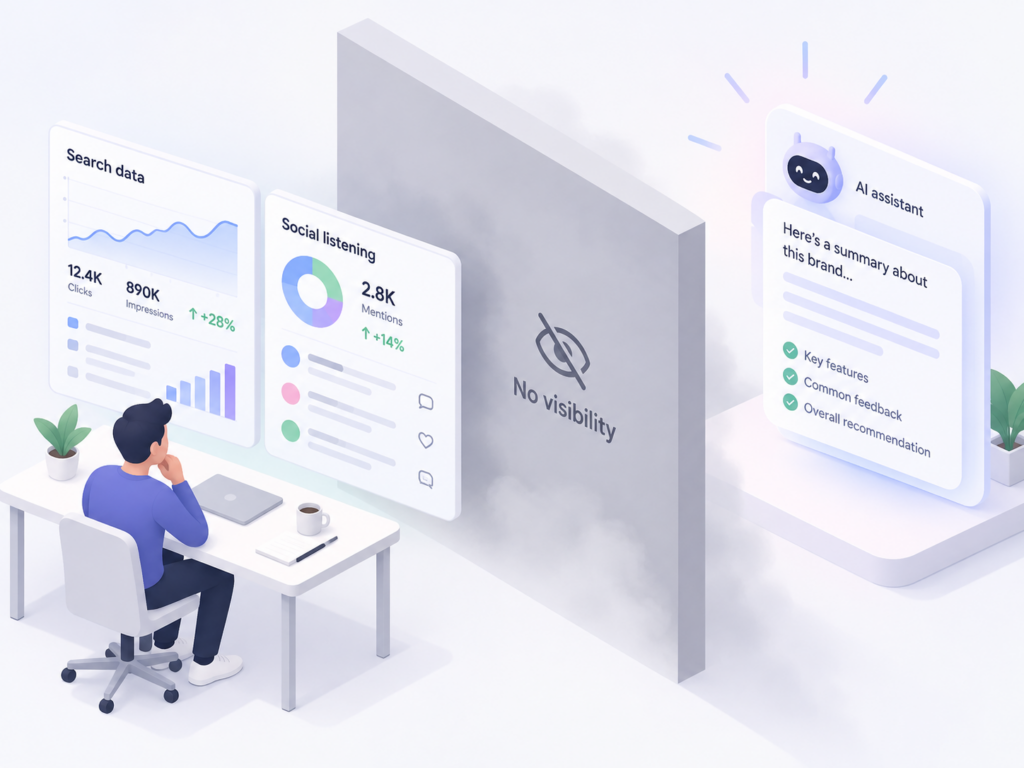
    Your content ranks on Google. Your domain authority is solid. And yet ChatGPT, Perplexity, and Gemini never mention your brand.

    That’s not a content quality problem. That’s a measurement problem.

    You’ve been optimizing for a system that no longer controls the majority of high-intent discovery, and until now, you haven’t had a number that tells you exactly how far behind you are. The GEO Score fixes that.

    GEO Score Is Not an SEO Metric. Here’s What Makes It Different.

    A GEO Score is a 0-100 composite rating that measures how likely AI search engines are to cite your content when generating answers. It’s built specifically for generative engines like ChatGPT, Claude, Perplexity, and Gemini, which operate on fundamentally different logic than traditional search.

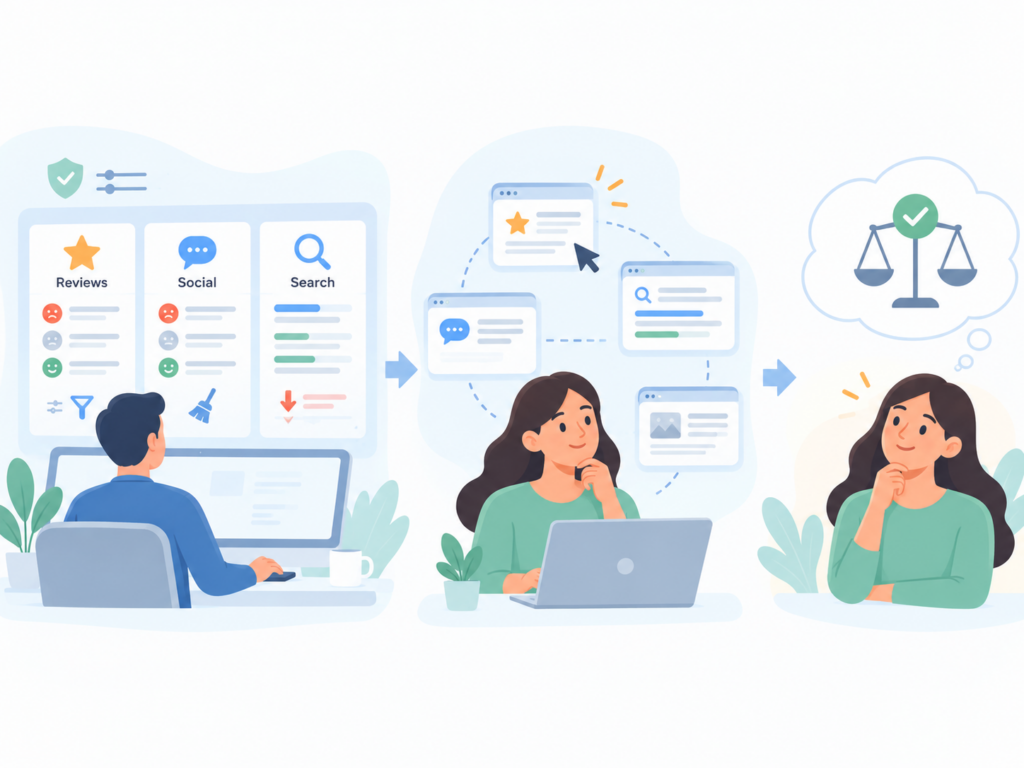
    Here’s the gap most marketing teams don’t see: roughly 73% of brands ranking on Google’s first page have zero mentions in AI-generated responses for the same queries. Only 17% of AI Overview citations overlap with top-tier organic rankings. High SEO performance and high AI visibility are not the same thing.

    The core difference comes down to how each system decides what to show. Traditional SEO ranks a list of links based on keyword matching and backlink graphs. Generative engines don’t produce ranked lists. They select one authoritative answer. If you’re not in that answer, you’re functionally invisible, regardless of where you sit in organic results.

    DimensionTraditional SEOGEO
    Primary GoalRank pages in a link list to drive clicksBe selected and cited as a source in an answer
    Success MetricPosition, impressions, CTRCitation frequency, brand mention rate, Share of Voice
    Visibility ModelGradient (Position 1 beats Position 5)Binary: included in the answer or excluded
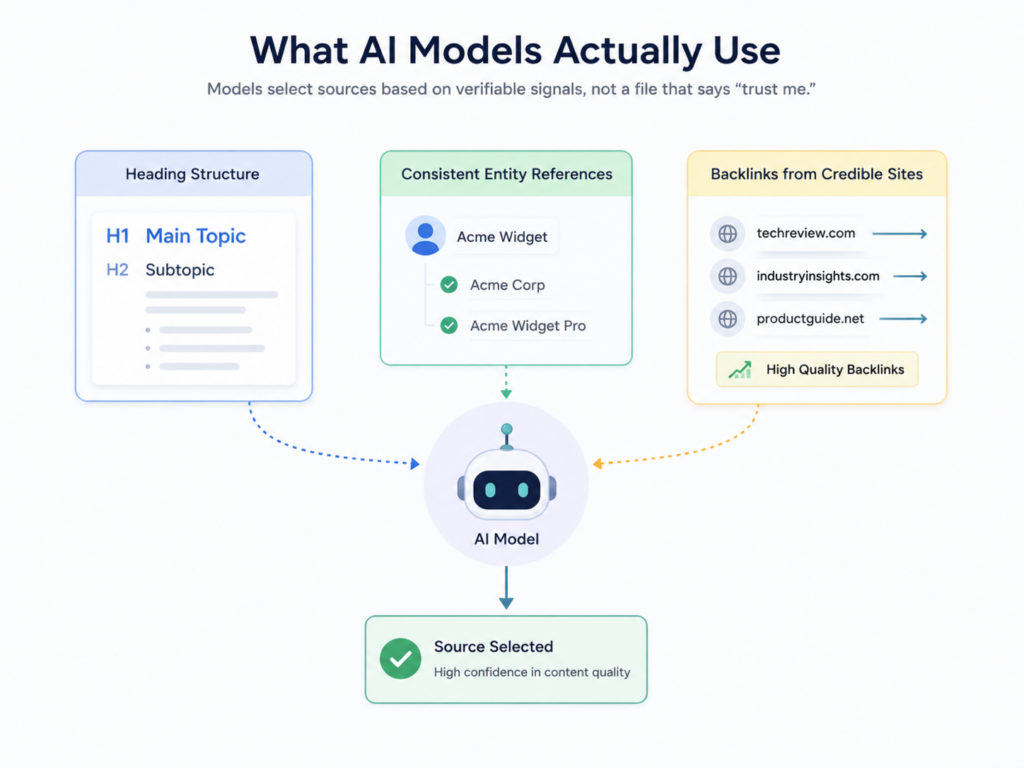
    Trust SignalBacklink volume and domain authorityEntity clarity, factual density, consensus verification
    User InteractionClicks to external websitesAnswers consumed within the AI interface

    That binary nature is exactly what the GEO Score measures: not your position in a list, but your probability of being selected as a source at all.

    The 4 Dimensions That Make Up Your Score

    The 0-100 rating is built from four dimensions. Each reflects a different stage of how AI engines evaluate and use your content.

    Technical Foundation

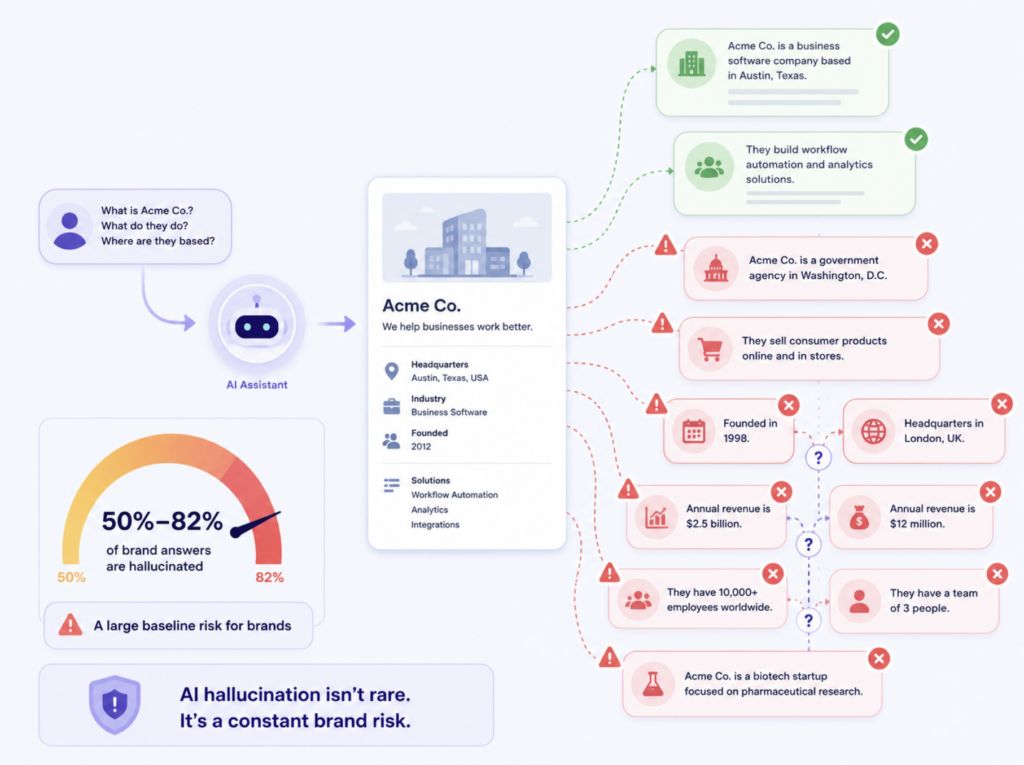
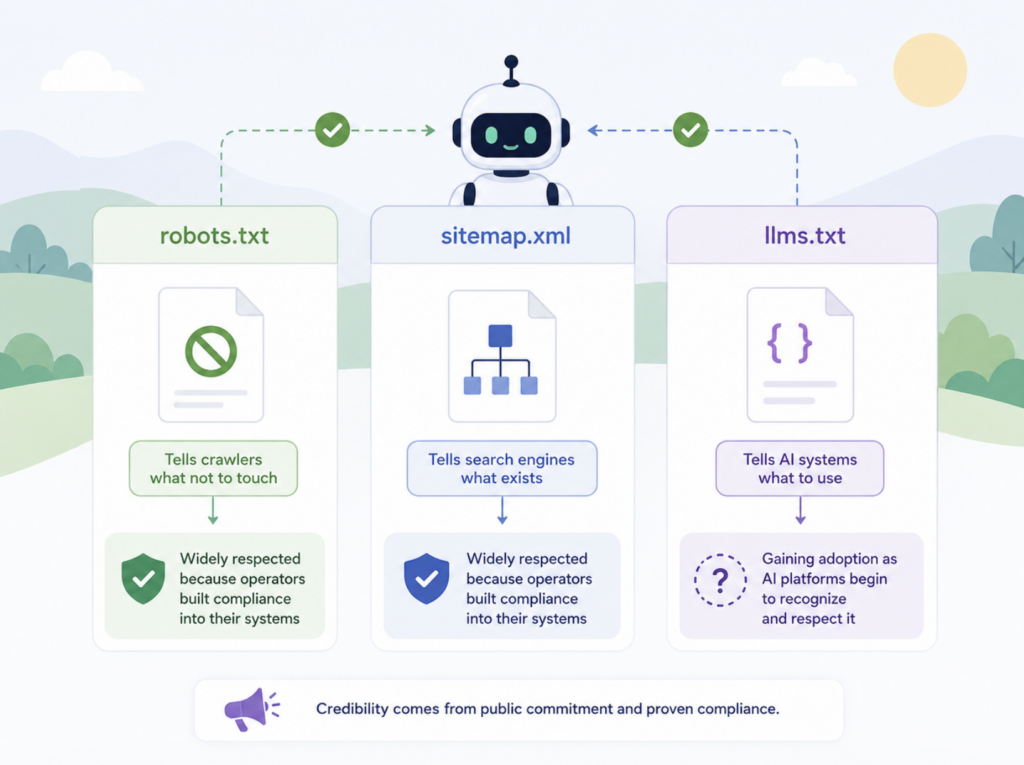
    AI crawlers like GPTBot and PerplexityBot don’t browse the way humans do. They need explicit access in your robots.txt, fast load times, and content that renders without JavaScript dependencies. Pages with a Largest Contentful Paint above 4 seconds are 72% less likely to be cited due to retrieval timeouts alone. Schema markup in JSON-LD acts as a direct feed to RAG engines, reducing the AI’s cognitive load and cutting hallucination risk.

    AI Readability

    Generative models favor what researchers call “atomic knowledge blocks”: self-contained passages of 150 to 300 words that make sense even when extracted out of context. Leading with a direct answer in the first 40 to 60 words improves citation probability by 27%, according to a Princeton study. Clear H2/H3 hierarchies and comparison tables give AI models structured data they can efficiently reassemble.

    Content Quality

    For an LLM, quality isn’t about writing style. It’s about the ratio of verifiable data points to filler. The leading benchmark is one cited fact per 80 words of prose. The original GEO research found that adding statistics and expert quotations was the single most reliable strategy to boost AI visibility, achieving a 30 to 40% improvement across all tested models. Replacing vague statements with statistical anchors is the difference between content that gets cited and content that gets skipped.

    Authority and Trust

    AI models evaluate trustworthiness through E-E-A-T signals: Experience, Expertise, Authoritativeness, and Trustworthiness. In 2026, 96% of AI citations originate from sources with demonstrably strong E-E-A-T. Brand mentions on platforms like LinkedIn, YouTube, and Wikipedia are 3x more predictive of AI citations than traditional backlinks. Consistent entity data across the web reinforces recognition.

    Content quality and AI readability together typically account for more than half the composite score.

    Scoring Below 70? That Number Isn’t Random.

    The 70 mark reflects the statistical threshold at which consistent citation across major AI engines becomes likely. It’s the single most actionable benchmark in a GEO audit.

    Scores between 0 and 49 indicate fundamental structural or technical problems. AI systems generally treat brands in this range as unrecognizable or untrustworthy. Common causes: blocking AI crawlers in robots.txt, or producing purely narrative content with no extractable facts.

    Scores between 50 and 69 represent fragmented presence. The site has a foundation, but significant gaps remain. Citation is sporadic. A brand might appear in some query runs and disappear in others, often because entity signals are inconsistent across third-party platforms.

    Scores between 70 and 89 cross the visibility threshold. Content is well-optimized, factual density is solid, and AI engines recognize the brand as an authority. Minor updates like refreshing data every 30 days are typically enough to push toward dominance.

    Scores of 90 and above reflect best-in-class optimization. AI engines treat these sources as “grounding sources” and tend to surface them first or second.

    The stakes are concrete. Research into AI shortlists shows that 71% of all product recommendations go to the top 3 brands identified by the model. Brands below the 70-point threshold get eliminated from consideration before a user ever visits their website.

    Invisible to AI means invisible to the decision.

    ChatGPT Has 900M Weekly Users. Are You in Their Answers?

    The urgency around GEO Scores isn’t driven by speculation. It’s driven by adoption numbers that have already restructured how people find information.

    ChatGPT reached 800 to 900 million weekly active users, doubling its scale in under a year. Perplexity processed 780 million queries monthly, a 239% increase in volume over ten months. Google AI Overviews now engage 2 billion monthly users across 200 countries, appearing in 25 to 50% of all searches.

    The result is a zero-click reality. 93% of queries in Google’s AI Mode and 82% of ChatGPT Search interactions end without a click to an external website. If your brand isn’t cited in the generated response, the user never sees you.

    The B2B numbers are especially stark. 73% of B2B buyers now use AI tools throughout their purchase research process47% of consumers say AI-generated summaries influence which brands they trust first25% of B2B buyers already use generative AI over traditional search for early-stage vendor research.

    Brands that wait until AI search accounts for most of their traffic to start measuring GEO will be years behind in building the citation authority required to compete.

    How to Check Your GEO Score in Under 30 Seconds

    The GEO Score Checker is the fastest way to get a full AI visibility diagnostic. Enter a URL, and the tool runs live LLM API queries and vector analysis to evaluate your content the same way AI models do.

    Within 30 seconds you get a composite 0-100 score, granular breakdowns across all four dimensions, a priority improvement roadmap with specific fixes ranked by impact, and a competitor benchmarking comparison against 3 to 5 rivals.

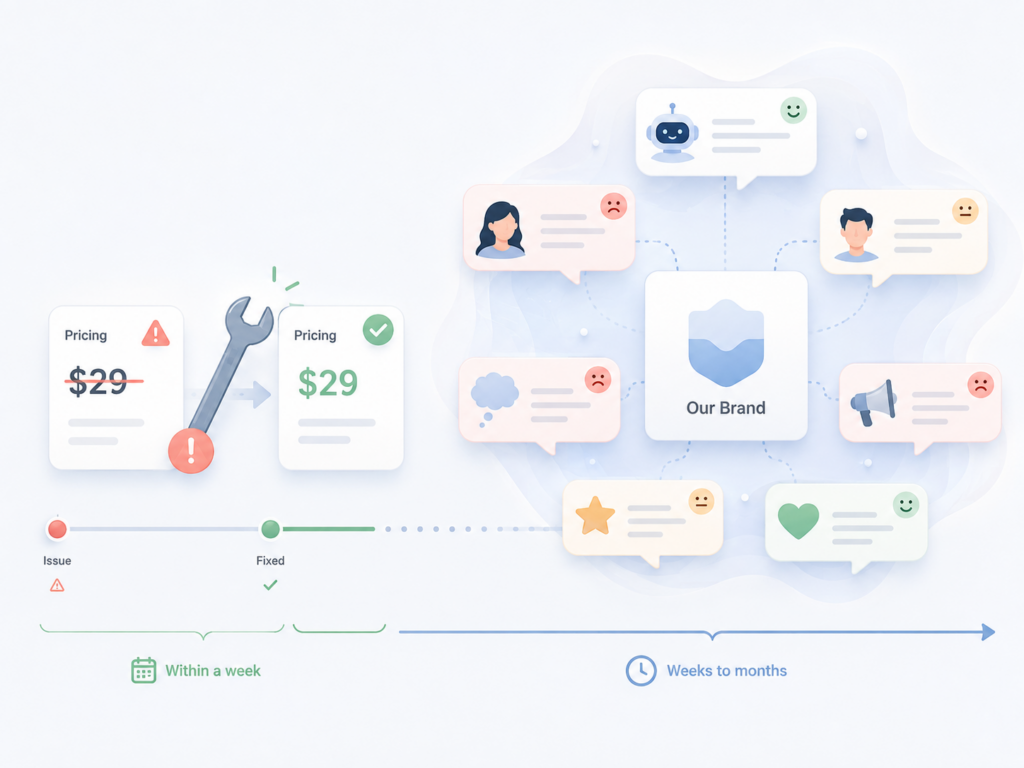
    Unlike traditional SEO audits that surface dozens of low-priority issues, the results are designed around what actually moves citation rates. Correcting a robots.txt error or adding FAQ schema can restore citation visibility within a single crawl cycle: often 2 to 4 weeks for real-time engines like Perplexity. That’s one of the key practical advantages of GEO work. Many of the highest-impact changes are structural and binary, not the slow accumulation of authority over months.

    Your GEO Score Is a Snapshot. AI Visibility Isn’t.

    Checking your score once is a useful starting point. Treating it as a stable truth is where teams go wrong.

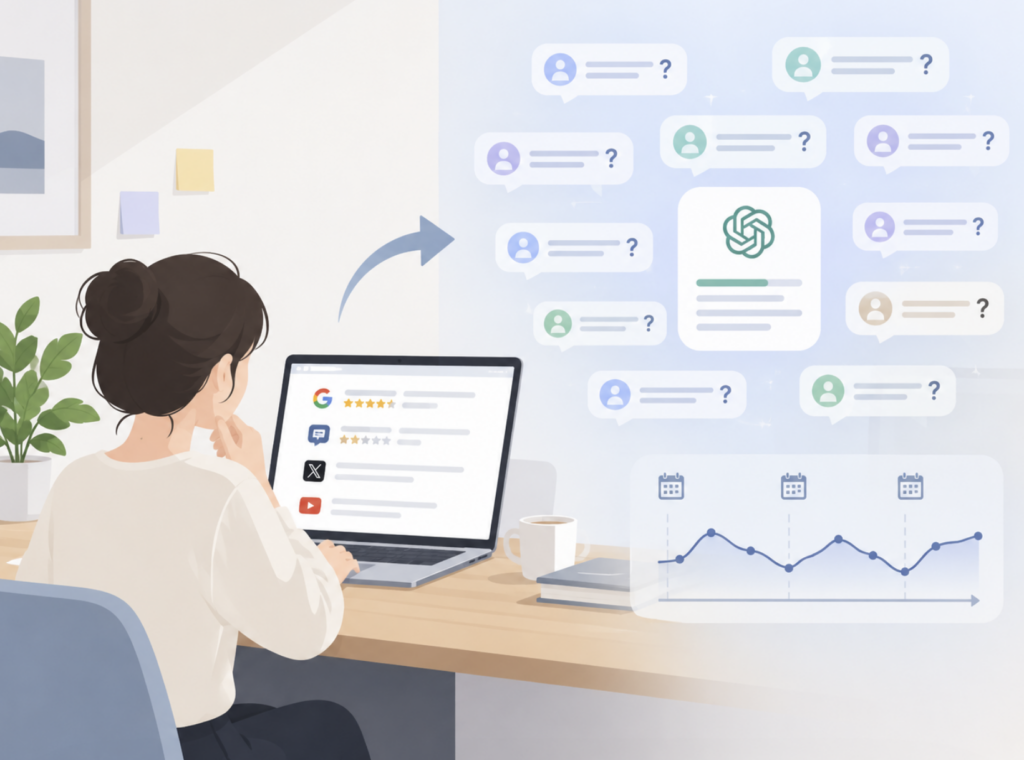
    Only 30% of brands stay visible from one AI answer to the next for the same prompt. 40 to 60% of cited domains change within a single month, a pattern researchers call “citation drift.” Over six months, that drift rate climbs to 70 to 90%.

    A score of 82 this week doesn’t mean you’ll hold that position next month. Competitors publish fresher data. AI model weights shift. Third-party sources that once anchored your authority get displaced by newer content.

    That’s the gap between knowing your score and maintaining AI visibility. Topify addresses this with cross-platform brand monitoring that runs rolling tracking across prompt libraries rather than one-time audits. The platform tracks sentiment shifts over time (the difference between “reliable enterprise choice” and “cost-effective but slow” carries real positioning weight), surfaces competitor displacement alerts when a rival captures your citation position, and runs source attribution analysis to identify which third-party domains are shaping how AI models describe your brand.

    Knowing your GEO Score is step one. Making sure your brand keeps appearing in AI recommendations as the landscape shifts is the ongoing work.

    What Is a GEO Score? Your 0-100 AI Visibility Rating

    Your content ranks on Google. Your domain authority is solid. And yet ChatGPT, Perplexity, and Gemini never mention your brand.

    That’s not a content quality problem. That’s a measurement problem.

    You’ve been optimizing for a system that no longer controls the majority of high-intent discovery, and until now, you haven’t had a number that tells you exactly how far behind you are. The GEO Score fixes that.

    GEO Score Is Not an SEO Metric. Here’s What Makes It Different.

    A GEO Score is a 0-100 composite rating that measures how likely AI search engines are to cite your content when generating answers. It’s built specifically for generative engines like ChatGPT, Claude, Perplexity, and Gemini, which operate on fundamentally different logic than traditional search.

    Here’s the gap most marketing teams don’t see: roughly 73% of brands ranking on Google’s first page have zero mentions in AI-generated responses for the same queries. Only 17% of AI Overview citations overlap with top-tier organic rankings. High SEO performance and high AI visibility are not the same thing.

    The core difference comes down to how each system decides what to show. Traditional SEO ranks a list of links based on keyword matching and backlink graphs. Generative engines don’t produce ranked lists. They select one authoritative answer. If you’re not in that answer, you’re functionally invisible, regardless of where you sit in organic results.

    DimensionTraditional SEOGEO
    Primary GoalRank pages in a link list to drive clicksBe selected and cited as a source in an answer
    Success MetricPosition, impressions, CTRCitation frequency, brand mention rate, Share of Voice
    Visibility ModelGradient (Position 1 beats Position 5)Binary: included in the answer or excluded
    Trust SignalBacklink volume and domain authorityEntity clarity, factual density, consensus verification
    User InteractionClicks to external websitesAnswers consumed within the AI interface

    That binary nature is exactly what the GEO Score measures: not your position in a list, but your probability of being selected as a source at all.

    The 4 Dimensions That Make Up Your Score

    The 0-100 rating is built from four dimensions. Each reflects a different stage of how AI engines evaluate and use your content.

    Technical Foundation

    AI crawlers like GPTBot and PerplexityBot don’t browse the way humans do. They need explicit access in your robots.txt, fast load times, and content that renders without JavaScript dependencies. Pages with a Largest Contentful Paint above 4 seconds are 72% less likely to be cited due to retrieval timeouts alone. Schema markup in JSON-LD acts as a direct feed to RAG engines, reducing the AI’s cognitive load and cutting hallucination risk.

    AI Readability

    Generative models favor what researchers call “atomic knowledge blocks”: self-contained passages of 150 to 300 words that make sense even when extracted out of context. Leading with a direct answer in the first 40 to 60 words improves citation probability by 27%, according to a Princeton study. Clear H2/H3 hierarchies and comparison tables give AI models structured data they can efficiently reassemble.

    Content Quality

    For an LLM, quality isn’t about writing style. It’s about the ratio of verifiable data points to filler. The leading benchmark is one cited fact per 80 words of prose. The original GEO research found that adding statistics and expert quotations was the single most reliable strategy to boost AI visibility, achieving a 30 to 40% improvement across all tested models. Replacing vague statements with statistical anchors is the difference between content that gets cited and content that gets skipped.

    Authority and Trust

    AI models evaluate trustworthiness through E-E-A-T signals: Experience, Expertise, Authoritativeness, and Trustworthiness. In 2026, 96% of AI citations originate from sources with demonstrably strong E-E-A-T. Brand mentions on platforms like LinkedIn, YouTube, and Wikipedia are 3x more predictive of AI citations than traditional backlinks. Consistent entity data across the web reinforces recognition.

    Content quality and AI readability together typically account for more than half the composite score.

    Scoring Below 70? That Number Isn’t Random.

    The 70 mark reflects the statistical threshold at which consistent citation across major AI engines becomes likely. It’s the single most actionable benchmark in a GEO audit.

    Scores between 0 and 49 indicate fundamental structural or technical problems. AI systems generally treat brands in this range as unrecognizable or untrustworthy. Common causes: blocking AI crawlers in robots.txt, or producing purely narrative content with no extractable facts.

    Scores between 50 and 69 represent fragmented presence. The site has a foundation, but significant gaps remain. Citation is sporadic. A brand might appear in some query runs and disappear in others, often because entity signals are inconsistent across third-party platforms.

    Scores between 70 and 89 cross the visibility threshold. Content is well-optimized, factual density is solid, and AI engines recognize the brand as an authority. Minor updates like refreshing data every 30 days are typically enough to push toward dominance.

    Scores of 90 and above reflect best-in-class optimization. AI engines treat these sources as “grounding sources” and tend to surface them first or second.

    The stakes are concrete. Research into AI shortlists shows that 71% of all product recommendations go to the top 3 brands identified by the model. Brands below the 70-point threshold get eliminated from consideration before a user ever visits their website.

    Invisible to AI means invisible to the decision.

    ChatGPT Has 900M Weekly Users. Are You in Their Answers?

    The urgency around GEO Scores isn’t driven by speculation. It’s driven by adoption numbers that have already restructured how people find information.

    ChatGPT reached 800 to 900 million weekly active users, doubling its scale in under a year. Perplexity processed 780 million queries monthly, a 239% increase in volume over ten months. Google AI Overviews now engage 2 billion monthly users across 200 countries, appearing in 25 to 50% of all searches.

    The result is a zero-click reality. 93% of queries in Google’s AI Mode and 82% of ChatGPT Search interactions end without a click to an external website. If your brand isn’t cited in the generated response, the user never sees you.

    The B2B numbers are especially stark. 73% of B2B buyers now use AI tools throughout their purchase research process47% of consumers say AI-generated summaries influence which brands they trust first25% of B2B buyers already use generative AI over traditional search for early-stage vendor research.

    Brands that wait until AI search accounts for most of their traffic to start measuring GEO will be years behind in building the citation authority required to compete.

    How to Check Your GEO Score in Under 30 Seconds

    The GEO Score Checker is the fastest way to get a full AI visibility diagnostic. Enter a URL, and the tool runs live LLM API queries and vector analysis to evaluate your content the same way AI models do.

    Within 30 seconds you get a composite 0-100 score, granular breakdowns across all four dimensions, a priority improvement roadmap with specific fixes ranked by impact, and a competitor benchmarking comparison against 3 to 5 rivals.

    Unlike traditional SEO audits that surface dozens of low-priority issues, the results are designed around what actually moves citation rates. Correcting a robots.txt error or adding FAQ schema can restore citation visibility within a single crawl cycle: often 2 to 4 weeks for real-time engines like Perplexity. That’s one of the key practical advantages of GEO work. Many of the highest-impact changes are structural and binary, not the slow accumulation of authority over months.

    Your GEO Score Is a Snapshot. AI Visibility Isn’t.

    Checking your score once is a useful starting point. Treating it as a stable truth is where teams go wrong.

    Only 30% of brands stay visible from one AI answer to the next for the same prompt. 40 to 60% of cited domains change within a single month, a pattern researchers call “citation drift.” Over six months, that drift rate climbs to 70 to 90%.

    A score of 82 this week doesn’t mean you’ll hold that position next month. Competitors publish fresher data. AI model weights shift. Third-party sources that once anchored your authority get displaced by newer content.

    That’s the gap between knowing your score and maintaining AI visibility. Topify addresses this with cross-platform brand monitoring that runs rolling tracking across prompt libraries rather than one-time audits. The platform tracks sentiment shifts over time (the difference between “reliable enterprise choice” and “cost-effective but slow” carries real positioning weight), surfaces competitor displacement alerts when a rival captures your citation position, and runs source attribution analysis to identify which third-party domains are shaping how AI models describe your brand.

    Knowing your GEO Score is step one. Making sure your brand keeps appearing in AI recommendations as the landscape shifts is the ongoing work.

    Conclusion

    A GEO Score gives you something that’s been missing from most marketing stacks: a number that reflects how AI engines actually see your brand. Not how you rank in a list, but whether you’re selected as a trusted source in the answers that now drive discovery and purchasing decisions.

    The 70-point threshold is where AI visibility becomes consistent. Below it, your brand’s presence is sporadic at best. Above it, you’re in contention for the AI shortlists that 71% of product recommendations flow through.

    Check your score with the GEO Score Checker. Understand which of the four dimensions is holding you back. Then build toward the monitoring cadence that keeps you visible as AI recommendations continue to shift.

    FAQ

    What’s a good GEO score? A score of 70 or higher is the threshold for consistent AI visibility. Scores above 85 are typical of category leaders who publish definitive data and structured, extraction-ready content. Market leaders in 2026 generally maintain averages above 85 across their target prompt sets.

    How is a GEO score different from domain authority? 

    Domain authority measures backlink strength to predict search ranking potential. GEO Score measures content clarity, factual density, and structural extractability to predict citation probability in AI-generated answers. There’s often a negative correlation between the two: high-DA sites frequently score poorly on GEO because they’re built for click-through, not AI extraction.

    How often should I check my GEO score? 

    Monthly is the minimum. Weekly automated tracking is the recommended cadence in competitive categories, given that 40 to 60% of cited domains shift within a single month. A one-time audit tells you where you stand today, not where you’ll be when your competitor refreshes their data next week.

    Can a high GEO score guarantee AI citation? 

    No. LLM outputs are probabilistic by nature, and no tool can guarantee a specific outcome. A high GEO Score maximizes the probability of selection and helps ensure that when your brand is cited, the information presented is accurate and favorable.

    What’s the fastest way to improve a low GEO score? 

    Technical and structural fixes offer the highest return. Rewriting the first 100 words of a page to lead with a direct, fact-dense answer and implementing FAQPage schema typically restore citation visibility within weeks. Unblocking AI crawlers in robots.txt is often the single highest-impact binary fix, with results visible within one crawl cycle.

    Read More

  • Your Brand Ranks #1 on Google. Claude Ignores It.

    Your Brand Ranks #1 on Google. Claude Ignores It.

    Your domain authority is 72. Your top keyword holds position one. You’ve earned backlinks from TechCrunch, G2, and a dozen industry blogs. Then a prospect types “what’s the best [your category] tool?” into Claude — and gets a list of five recommendations. Your brand isn’t one of them.

    That’s not an SEO failure. It’s a different problem entirely. And the gap between a strong Google presence and solid Claude AI brand visibility is wider than most marketing teams realize — because the two systems don’t share the same logic, the same inputs, or the same definition of “authority.”

    Google and Claude Don’t Read the Same Playbook

    Google is, at its core, a retrieval engine. It crawls, indexes, and ranks web pages based on measurable signals: backlink quality, keyword relevance, domain authority, page speed, structured data. The goal is to surface the most relevant URL for a given query. Success means ranking on page one.

    Claude works differently. It doesn’t retrieve URLs — it synthesizes conclusions. Using a combination of its pre-trained parametric knowledge and real-time Retrieval-Augmented Generation (RAG), it constructs a response based on what it has learned about a topic and what it can verify in the moment. The output isn’t a list of links. It’s a recommendation.

    That distinction creates a structural gap. A page optimized for Google’s crawler — tight keyword density, internal linking, clean schema markup — isn’t automatically useful to Claude’s reasoning layer. Claude is looking for something else: dense factual claims, consistent entity signals across multiple sources, and evidence that the broader internet agrees a brand is credible.

    The metrics that predict Google rankings and the signals that drive Claude AI brand visibility overlap by roughly 54%. That leaves a 46% gap that no amount of traditional SEO addresses.

    What Claude Actually “Sees” When Someone Asks About Your Category

    Claude’s recommendations aren’t random. They emerge from two layers of knowledge working in parallel.

    The first is parametric knowledge — everything Claude absorbed during pre-training. This includes structured sources like Wikipedia, archived news, industry whitepapers, Reddit threads, and books. Brands that appeared frequently and consistently in high-quality training data carry a significant advantage. Wikipedia, in particular, carries outsized weight in Claude’s authority evaluation due to its structured, human-verified format.

    The second layer is real-time retrieval. When Claude searches the web to supplement its response, it doesn’t use Google. Research analysis shows that Claude’s cited results overlap with Brave Search’s top 15 organic results at a rate of 86.7%. Brave runs its own independent index, with a crawl bias toward original content over aggregator sites, and lower dependence on traditional backlink signals.

    That’s a critical implication. Brands optimizing purely for Google’s index may not appear in the information layer Claude actually reads.

    On top of this, Claude’s Constitutional AI framework applies a reliability filter to every source it considers. Content that appears overstated, inconsistently sourced, or commercially self-serving gets deprioritized. Brands that acknowledge limitations and trade-offs in their own content are cited at 1.7x the rate of brands that don’t — because Claude treats intellectual honesty as a proxy for credibility.

    5 Reasons Your SEO Content Doesn’t Land in Claude’s Answers

    Your content is optimized for keywords, not citations

    Traditional SEO rewards keyword density and topical clusters. Claude’s RAG layer is looking for “atomic facts” — compact, verifiable claims that can be extracted in a 200–400 word chunk and used as supporting evidence. Keyword-heavy content often reads as noise to the extraction layer. According to Princeton’s GEO research, keyword stuffing produces a negative effect on AI citation rates — as much as -10%.

    Your brand mentions live in low-authority training sources

    AI citation weight follows a power-law distribution. Mentions on low-DA directories, press release distribution platforms, or unmoderated forums carry minimal signal. Claude gravitates toward what researchers have called “aristocratic domains” — Wikipedia, Reddit, YouTube, G2, Capterra, and established news publishers. If your brand’s external footprint is mostly thin citations from sources Claude doesn’t trust, your entity lacks the social consensus needed to appear in recommendations.

    Competitors own the narrative in third-party review sites and forums

    When Claude synthesizes a recommendation, it looks for multi-source corroboration. A competitor with fifty substantive Reddit threads, detailed G2 reviews with specific use cases, and independent comparisons from credible blogs reads as the established category leader — regardless of which brand ranks higher on Google. A single high-upvote Reddit thread with genuine detail can carry more weight for Claude’s reasoning than ten commercial backlinks from high-DA domains.

    You have no presence in the sources Claude trusts most

    For high-stakes queries — enterprise SaaS, B2B tools, healthcare, finance — Claude applies stricter source requirements. It looks for academic citations, government references, analyst reports, and verified industry publications. Brands whose content strategy focuses entirely on how-to tutorials and product pages don’t establish the “trust layer” Claude requires for serious recommendations.

    Your structured data helps Google crawlers, not LLM reasoning

    Schema.org markup, JSON-LD tags, and FAQ schema make pages eligible for Google’s rich results. Claude doesn’t read JSON-LD tags. It reads prose. When a page is structured around satisfying schema requirements rather than delivering dense, logically sequenced information, Claude’s chunking process treats it as low-signal content and moves on.

    The Brands Claude Does Recommend — What They Have in Common

    Tracking Claude AI brand visibility across thousands of prompts reveals a consistent pattern among brands that appear regularly. None of these characteristics are traditional SEO signals.

    Semantic consistency across the full entity footprint. High-visibility brands maintain the same positioning across their own site, third-party coverage, and community mentions. If a brand is described as “lightweight CRM for SMBs” internally but as “enterprise-grade platform” on third-party sites, Claude’s entity resolution creates conflicting associations and the brand gets deprioritized.

    A large “digital cushion” of third-party content. The most-recommended brands have a disproportionate share of their citations coming from earned media — independent reviews, editorial coverage, forum discussions. Analysis from Beamtrace’s 2026 AI Search Report shows that third-party earned media accounts for roughly 48% of Claude’s brand citations, while official commercial pages account for about 30%, and owned blog content about 22%. Brands that rely primarily on owned content to establish their reputation face a structural ceiling.

    High information density with specific, verifiable claims. The pages Claude cites most often contain precise data: conversion rates, time-to-value benchmarks, cost comparisons, customer counts. Vague superlatives (“world-class solution,” “leading platform”) contribute nothing to Claude’s reasoning. Specific figures and named evidence do.

    Claude AI Brand Visibility Is a Measurable Metric, Not a Guessing Game

    The phrase “AI visibility” isn’t abstract. It maps to a set of trackable metrics that brands can monitor and improve over time.

    Visibility Rate measures how often a brand appears in Claude’s responses to a standardized set of category-level prompts — essentially, Share of Voice in AI answers.

    Position-Adjusted Word Count (PAWC), a metric developed in Princeton’s GEO research, weights not just whether a brand is mentioned but where in the response it appears. A brand cited first in a list carries substantially more influence than one mentioned as an afterthought.

    Sentiment Quotient tracks whether Claude’s mentions are neutral, positive, or flagged with caution. A brand can have high visibility but negative sentiment — which is often worse than being invisible.

    Source Coverage measures what percentage of Claude’s brand citations come from third-party domains versus owned content. A 100% own-site citation rate signals that the brand’s external reputation hasn’t been established.

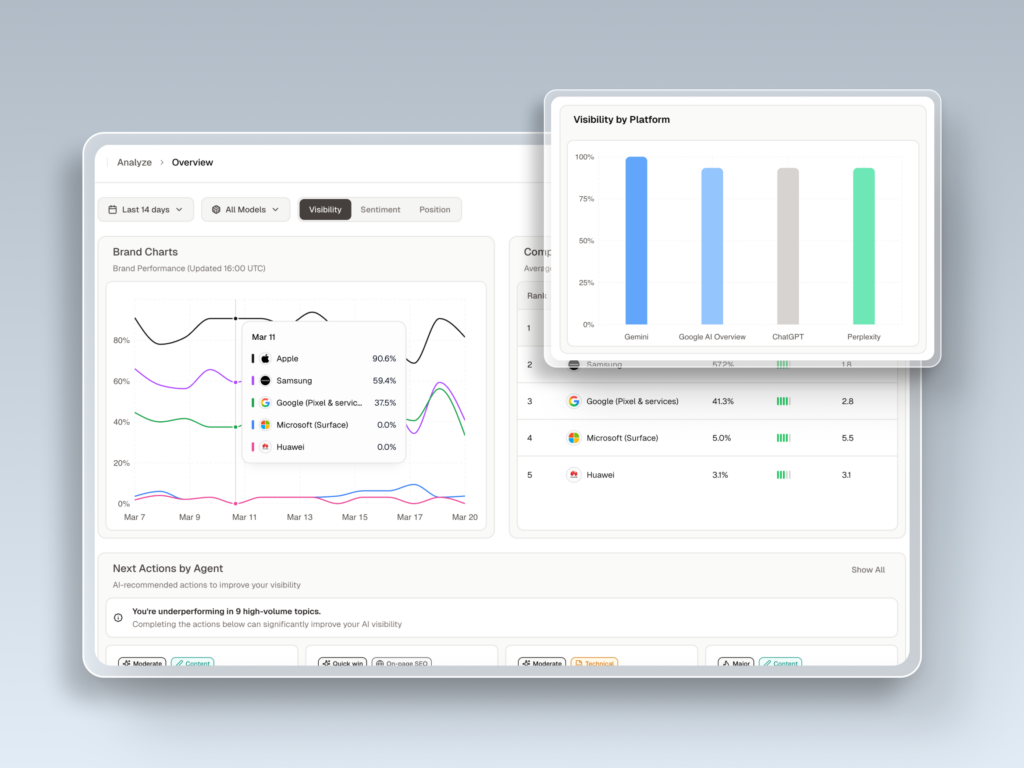
    Topify tracks all of these metrics simultaneously across Claude, ChatGPT, Perplexity, and Gemini — running hundreds of category-level prompts at scale and mapping where brands appear, in what position, and with what sentiment. For teams that have been operating with only Google Search Console data, the gap between what they think their brand looks like and what AI systems actually say about it is often significant.

    Closing the Gap: Where to Start If Claude Doesn’t Know Your Brand

    Build citation-worthy content that third-party sources want to reference

    The core unit of GEO content isn’t an article — it’s a claim. Each piece of content should contain proprietary data, named frameworks, or specific benchmarks that other sources would quote. Implementing a Bottom Line Up Front (BLUF) structure — where the key insight appears in the first 40–60 words of each section — dramatically improves how Claude’s RAG layer extracts and cites the content.

    If your brand doesn’t have original research, commission a narrow study. A single survey with a clear finding (“72% of SEO professionals track keyword rankings but don’t monitor AI mentions”) creates a quotable data point that third-party publications will reference. Once that statistic circulates across multiple credible sites, Claude starts associating it with your brand as the originating entity.

    Expand brand presence on the domains Claude trusts

    Publishing one hundred articles on your own blog produces diminishing returns for Claude AI brand visibility. Ten deep, substantive mentions on high-trust domains produce more. The priority list: Wikipedia entity pages (correct any gaps or inaccuracies in your brand’s entry), top-tier category review platforms like G2 and Capterra, vertical industry publications, and authentic Reddit contributions in relevant subreddits. The goal on Reddit isn’t marketing — it’s substantive participation that results in genuine upvoted mentions of your brand in comparison threads.

    Also verify that your site is being crawled by Brave’s bots, not just Googlebot. Submitting your domain to Brave’s Web Discovery Project is a direct step toward improving indexing in the layer Claude actually queries.

    Monitor who Claude recommends in your category — then close the gap systematically

    This is where measurement becomes strategy. Topify’s Source Analysis feature reverse-engineers which domains Claude is citing when it recommends competitors in your category. The output is a concrete list of citation gaps: specific publications or platforms where your competitor has earned coverage and you haven’t. That’s an actionable PR and content list, not a vague directive to “build more backlinks.”

    Topify’s Competitor Monitoring tracks real-time shifts in visibility and sentiment — so when a competitor’s Claude AI brand visibility spikes after a major press mention or product review, you can identify what triggered the change and respond. The platform’s One-Click Execution layer then lets you generate GEO-structured content drafts targeting those specific gaps and deploy them without a multi-week content production cycle.

    The upstream question — why is Claude recommending them and not you? — now has a traceable answer.

    Conclusion

    Google rankings and Claude AI brand visibility solve different problems. One determines whether people can find your website when they search. The other determines whether AI systems recommend your brand when people ask for advice. In 2026, traffic from AI recommendations converts at roughly 6x the rate of standard search traffic — which means the visibility gap has direct revenue implications.

    Strong SEO is still worth building. It keeps the door open when users are navigating. But GEO is what gets you into the conversation when users are asking for a recommendation and trusting AI to give them one. Both matter. Only one of them most teams are actually measuring.

    Get started with Topify to see where your brand stands in Claude’s answers today.


    FAQ

    Q: Does good SEO automatically help with Claude AI brand visibility?

    A: Partially. Research suggests roughly 54% correlation between Google rankings and Claude citation rates — meaning strong SEO does provide some lift. But the remaining 46% is driven by factors SEO doesn’t address: third-party earned media density, multi-source entity consistency, Brave Search indexing, and the kind of factual content specificity that makes your brand citable by an LLM rather than just rankable by a crawler.

    Q: How often does Claude update its knowledge about brands?

    A: Claude operates on two update cycles. Its parametric knowledge (baked into model weights at training) updates with new model releases — roughly every six to twelve months. Its real-time retrieval layer updates near-continuously through RAG. If a brand gets covered in a high-authority source that Brave indexes, Claude can start citing that information within hours. Newer brands with no pre-training presence need to rely heavily on this real-time layer.

    Q: Can I track whether Claude mentions my brand?

    A: Not with standard tools. Google Search Console doesn’t capture impressions from Claude responses. Tracking Claude AI brand visibility requires a purpose-built GEO platform that runs structured prompt sets across AI engines and measures Share of Voice, position, sentiment, and source attribution. Topify provides this across Claude, ChatGPT, Perplexity, and Gemini from a single dashboard.

    Q: What’s the fastest way to improve Claude AI brand visibility?

    A: Prioritize “authority node coverage” over volume. Getting a substantive brand mention in one trusted domain — a top-tier industry review publication, a high-upvote Reddit thread with genuine detail, a Wikipedia entity update — typically moves the needle faster than publishing additional owned content. Pair this with a BLUF rewrite of your core product pages so Claude’s extraction layer can actually parse and cite your key claims.


    Read More

  • Why Claude AI Recommends Some Brands Over Others

    Why Claude AI Recommends Some Brands Over Others

    The signals behind Claude AI brand visibility, and what you can do to change your position

    Your brand has a website. You publish content. You rank on Google. And yet, when someone asks Claude to recommend tools in your category, your name doesn’t come up.

    That’s not a SEO problem. It’s a different problem entirely.

    Claude doesn’t work the way Google does. The logic behind its recommendations is separate, and misunderstanding that gap is exactly why most brands stay invisible in AI-generated answers.

    Here’s what’s actually happening.

    Claude Isn’t Pulling from a Search Index

    When Claude responds to a recommendation request, it’s not querying a live database or crawling the web in real time. It’s synthesizing a response from what researchers call “parametric memory,” the patterns and associations encoded into the model’s neural weights during training.

    Think of it as sediment. Every piece of content that existed before Claude’s training cutoff left a trace. The more a brand appeared across credible, consistent sources, the deeper that trace.

    This architecture has a direct implication for brand teams: your brand’s weight in Claude’s responses was largely determined before you started optimizing for it. Claude 3.7 Sonnet’s reliable knowledge ends around October 2024. Claude 4.5 extends to January 2025. Newer models add real-time search in certain configurations via Retrieval-Augmented Generation (RAG), but even then, the base model’s pre-trained biases influence how it interprets what it retrieves.

    You’re not competing in a keyword auction. You’re competing for space in a model’s learned reality.

    The 3 Signals That Actually Shape Claude AI Brand Visibility

    Claude doesn’t rank brands by advertising spend or domain authority. Its recommendation logic reconstructs from three learned patterns.

    Mention Frequency on Trusted Third-Party Sources

    The correlation between brand mentions and AI citation probability is 0.664. The same correlation for traditional backlinks is 0.218. That gap tells the whole story.

    Claude treats a mention on a high-authority domain as a qualitative signal of trust, not just a navigational pointer. Wikipedia currently accounts for roughly 13% of AI model citations. Reddit’s share grew 87% in 2025 and now represents over 10% of ChatGPT citations, with similar patterns showing in Claude’s responses for community-driven queries.

    The implication: it’s not about how many pages your brand owns. It’s about how many credible, independent sources reference you, and in what context.

    Contextual Consistency Across Sources

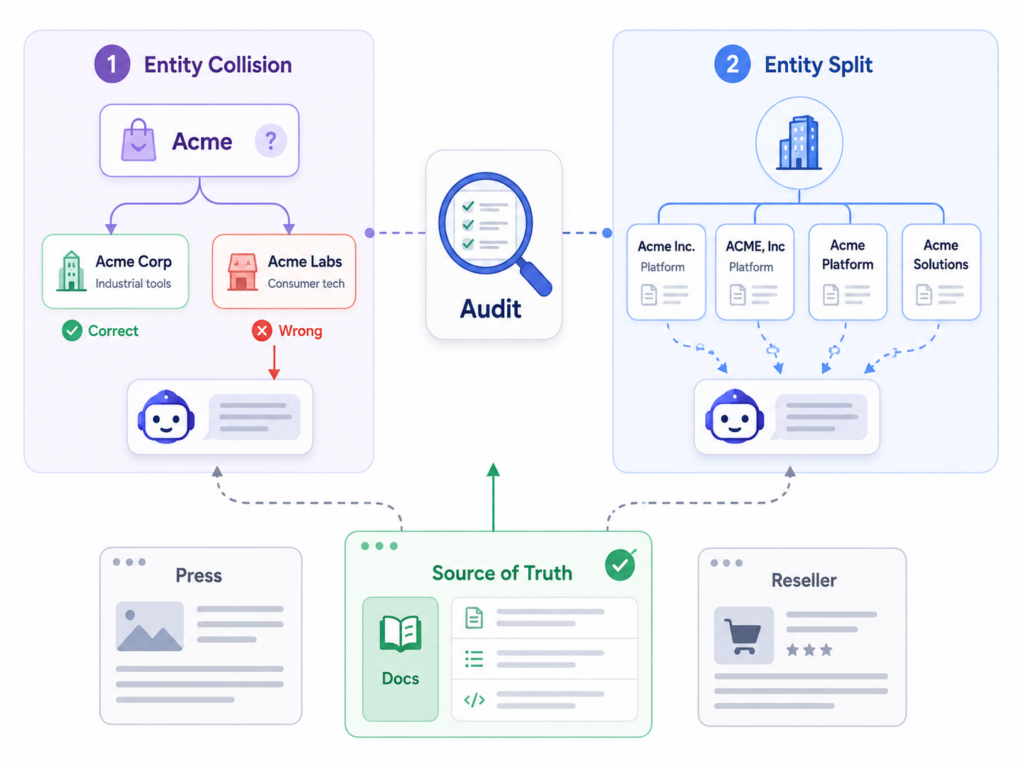
    If your brand is described as “an enterprise data integration platform” on your website but “a workflow automation tool” on G2 and “an ETL solution” on Reddit, Claude’s model faces conflicting signals. The result is lower confidence in any recommendation.

    This is what researchers call “entity blending,” where the model either avoids citing the brand altogether or misattributes its features to a competitor. Consistent category language across LinkedIn, Crunchbase, review platforms, and media coverage reduces that ambiguity significantly.

    Schema alignment matters here too. Implementing structured data that mirrors your visible content gives the model a cleaner extraction surface.

    Category Association and Prompt Relevance

    Claude maps brands to topic clusters based on their relationship to adjacent concepts in the training data. If your brand is consistently co-mentioned with “zero-trust architecture” and “enterprise cybersecurity” in technical publications and forum discussions, Claude learns to surface you when those prompts appear.

    This is niche positioning at the model level. And it explains why a smaller brand with precise topical coverage can outperform a much larger competitor relying on broad, generic positioning.

    Being Online Is Not the Same as Being Recommended

    This is the finding most brand teams find uncomfortable: 73% of brands have zero mentions in AI-generated responses despite ranking on page one of traditional search results.

    It’s not a measurement error. It’s a structural gap.

    Traditional SEO satisfies crawlers. Claude’s recommendation logic satisfies a different standard: semantic authority. The degree to which a brand is treated as the definitive answer to a problem across independent digital discourse.

    The core issue is the over-reliance on owned media. Your website, your blog, your branded content. Claude’s Constitutional AI training actively filters for commercial bias, which means self-promotional content is processed with skepticism built in.

    The data confirms this. Promotional tone in content has a -26.19% correlation with citation probability. That means typical marketing copy, the kind most brands default to, is actively working against AI visibility.

    On the flip side, third-party sources account for 80-85% of AI citations. Your own domain contributes 15-20% at most, and primarily for technical specifications, not authority signals.

    Why Competitor Brands Keep Showing Up Instead

    When a user asks Claude for a recommendation, the model typically surfaces three to five brands. Not ten. Not twenty.

    That compression is important. The “ten blue links” of Google become a winner-take-all scenario in generative responses. If your competitor is in that shortlist and you’re not, you don’t just lose visibility. You effectively don’t exist for that user’s decision.

    Competitors who dominate these responses typically share one characteristic: a stronger external signal network. More “best of” list inclusions. More independent comparison coverage. More community discussion with their brand name attached to specific use cases.

    Research by Stacker in 2026 found that distributed earned media is 5.3x more likely to be the sole source of a brand’s AI visibility than the brand’s own domain. Syndicating structured content through credible publishers can triple cross-platform coverage across Claude, ChatGPT, and Perplexity simultaneously.

    That’s not a PR strategy. That’s a model-level visibility strategy.

    You Can’t Improve What You Can’t See

    Here’s the practical problem: Claude’s conversations are private. Traditional analytics can’t track what the model says to users about your brand, whether it’s recommending you, misrepresenting your product, or citing a three-year-old negative review.

    That black box is where most optimization efforts stall.

    Topify was built specifically to make that black box visible. Its Source Forensics capability reverse-engineers the citations Claude generates, identifying the exact URLs influencing its recommendations. If the model is citing outdated or negative coverage, you know which URL to target for a content refresh or to dilute with higher-authority positive material.

    Topify’s Sentiment Velocity tracking goes further: it monitors not just what Claude says about your brand today, but the direction that sentiment is moving over time. A static score tells you where you stand. Velocity tells you where you’re heading.

    Hallucination Alerting flags in real time if Claude starts generating false claims about your product, giving PR teams the window to flood the ecosystem with corrective, verified data before the misrepresentation compounds.

    The platform also tracks Entity Confidence, measuring how cleanly Claude distinguishes your brand from competitors or generic category terms. Low entity confidence is often the hidden cause of “brand invisibility,” where Claude knows your category but can’t reliably surface your specific name.

    4 Things That Actually Move the Needle

    Strategy matters less than execution sequence here. These four levers are statistically validated to increase citation probability and recommendation frequency.

    Seed high-weight third-party domains. Digital PR in tier-1 publications like TechCrunch or Forbes, combined with community presence on Reddit and detailed outcome-specific reviews on G2 or Capterra, builds the external signal network Claude’s model treats as authority evidence. This is mention-building, not link-building.

    Unify your descriptive language. Synchronize how your brand is described across Wikipedia, LinkedIn, Crunchbase, and your website. Pick clear category language and commit to it across every surface. The goal is a “clean signal” the model can decode without ambiguity.

    Map content to specific prompt scenarios. Don’t write for broad topics. Write for specific problems. Content that directly answers “How to fix data pipeline latency?” with a proprietary framework gives Claude something extractable and citable. Comparison pages that acknowledge product limitations, counterintuitively, earn higher model trust than pages that claim universal superiority.

    Monitor continuously, not annually. Adding factual statistics to content increases AI visibility by 40%. Citing authoritative sources adds another 40%. Expert quotations add 28%. Keyword stuffing reduces it by 10%. These numbers shift as model versions update. Weekly or bi-weekly tracking of share of voice and sentiment across Claude, ChatGPT, and Perplexity turns optimization from a one-time project into a compound advantage.

    Conclusion

    Claude’s recommendation logic rewards accuracy, external validation, and descriptive clarity. It penalizes promotional language, inconsistent positioning, and over-reliance on owned media.

    That’s a different game than SEO. The brands winning AI visibility today aren’t necessarily the ones with the biggest budgets or the longest domain histories. They’re the ones with the most reliable, consistent, and independently verified footprint across the digital commons.

    The gap between “being online” and “being recommended” is real. It’s also measurable, and it’s closeable. But only if you can see it first.

    FAQ

    Does Claude AI update its brand knowledge in real time? 

    Generally, no. Claude’s core recommendations come from parametric memory with fixed training cutoffs. Some implementations add real-time search via RAG, but even then the base model’s pre-trained weights shape how new data gets interpreted. Core brand knowledge typically changes only when the model is retrained, which happens every few months to a year.

    Is Claude AI brand visibility the same across different Claude versions? 

    No. Different versions have different training cutoffs and reasoning behaviors. A brand that launched in late 2024 may be invisible to Claude 3.5 Sonnet but recognized by Claude 4.5 or 4.7. Newer models also apply Constitutional AI filters more rigorously, which can result in more neutral or cautious brand recommendations across the board.

    How long does it take to see changes after optimizing for Claude? 

    Core parametric knowledge updates with model retraining, which takes months. But if Claude is using agentic search tools or RAG in a given deployment, high-authority third-party content published and indexed by search engines can start influencing responses within days to a few weeks.

    Can smaller brands compete with established names in Claude’s recommendations? 

    Yes, and often more effectively than in traditional search. Claude prioritizes specific match quality and factual density over broad name recognition. A smaller brand that answers a niche problem with precision and earns validation on a few high-trust sources, such as specialized Reddit communities or industry journals, can consistently outrank a larger competitor relying on generic marketing content.

    Read More

  • Claude AI Brand Visibility: What’s Different

    Claude AI Brand Visibility: What’s Different

    Your brand appears in ChatGPT answers. It shows up in Perplexity citations. You’ve built the dashboards, pulled the reports, and called it covered.

    But when a senior engineer at a Fortune 500 company opens Claude and asks which platform best fits their stack, your brand might not exist at all.

    That’s not a tracking failure. That’s an architecture problem.

    Claude Doesn’t Search Like the Others

    Most marketers treat AI visibility as one metric across one pool of platforms. That assumption is costing them placements they can’t see.

    Perplexity is a retrieval engine. It crawls the live web in real time, indexes sources, and surfaces citations for every query. ChatGPT runs a hybrid model, blending its training weights with optional web search. Both systems reward recent, indexed content.

    Claude operates differently. Its brand recommendations originate primarily from training data and its internal weights, not from a real-time web crawl. While newer versions like Claude Opus 4.7 have integrated optional search, the model exhibits a persistent “training data bias”: when retrieved web content conflicts with internal training memory, Claude tends to default to what it learned during pre-training.

    The practical consequence: a brand that launched a new product line last quarter may not see that positioning reflected in Claude’s answers for 6 to 18 months.

    That’s not a bug. It’s the architecture.

    The 3 Signals That Shape Claude AI Brand Visibility

    Visibility on Claude isn’t a ranking. It’s a probability. The model assesses the likelihood that your brand is the most helpful, honest, and reliable answer to a specific user intent. Three signals drive that assessment.

    Training Data Density and Entity Authority

    The most powerful signal is how frequently your brand appeared in high-authority datasets before the model’s knowledge cutoff. Technical documentation, academic papers, developer forums like Stack Overflow, GitHub citations, and industry-standard publications all carry significant weight. Standard blog posts, comparatively, carry far less.

    This creates a winner-take-all dynamic. Once a brand is encoded as the default reference in Claude’s weights for a given category, it gets retrieved consistently across thousands of diverse prompts. Brands that haven’t built that footprint in authoritative sources are often invisible, even if they rank well on Google.

    Semantic Proximity in Context Windows

    Claude can process up to 200,000 tokens in standard tiers and 500,000+ tokens in Enterprise versions. When a user uploads a long RFP, technical specification, or internal document, Claude evaluates brands based on how well their identity maps to the specific problems described in that context.

    This is where brand naming creates real risk. For brands with common-noun names, uncontextualized queries return near-zero recognition. The model defaults to the dictionary definition. When category context is added, recognition can jump to 100%. Consistently pairing your brand name with specific technical “scenario words” — think “SOC 2 compliant CRM” or “Kubernetes-native observability” — is what teaches Claude to disambiguate your entity from general language.

    Constitutional Alignment and Sentiment Signal

    Anthropic trained Claude using a “Constitutional AI” methodology, embedding a set of ethical guidelines derived from sources like the UN Declaration of Human Rights. These principles function as a narrative filter. Claude is intentionally more measured in its recommendations than ChatGPT. It phrases suggestions with qualifiers like “Popular options include…” and avoids overconfident endorsements.

    For brands, the implication is direct: Claude doesn’t just track positive or negative sentiment. It assesses your brand’s alignment with its safety and reliability guidelines. A brand associated with data privacy controversies or factual inconsistencies in its training data may be excluded from recommendations entirely.

    Claude vs. ChatGPT vs. Perplexity: The Structural Gap

    Understanding the difference between these platforms requires comparing them at the architecture level, not just the output level.

    DimensionChatGPT (GPT-5.4)Perplexity (Sonar)Claude (Opus 4.7)
    Core functionConversational task engineReal-time search engineAnalysis-first assistant
    Data sourcingHybrid: training + searchReal-time web indexTraining data (search optional)
    Trust mechanismConsistency and usabilityCitations and verifiabilityDepth and interpretability
    Visibility logicCommercial consensusSearch ranking and authorityTechnical E-E-A-T and reasoning
    Update frequency6-12 weeksNear real-time6-18 months
    Citation biasEstablished sourcesDemocratic, source-agnosticConservative, technical

    The update frequency row is where most marketing teams underestimate the risk. A content strategy built for ChatGPT’s 6-to-12-week refresh cycle will miss Claude’s 6-to-18-month training window almost entirely. The playbooks aren’t interchangeable.

    Why Only Tracking ChatGPT Leaves a Revenue Gap

    Claude holds a 32% share of the enterprise AI assistant market and a 42% share of the code generation market. 70% of Fortune 100 companies have integrated it into business operations.

    That user base skews toward decision-makers: CTOs, developers, researchers, and analysts who use Claude specifically for deep due diligence, not casual browsing.

    Here’s where the gap gets costly. Research across 50 B2B SaaS brands found that Claude mentions only 88% of tested brands, compared to 100% for ChatGPT and Gemini in identical prompt sets. Only 12% of sources cited by ChatGPT, Perplexity, and Claude overlap. A brand that’s the category leader in ChatGPT’s mainstream consensus can be entirely absent from Claude’s technical reasoning pool.

    The buying journey makes this concrete. A procurement team might use ChatGPT for an initial category overview, then switch to Claude to analyze 100 pages of vendor documentation before making a final decision. If Claude doesn’t recognize your brand’s authority in that analytical phase, you’re eliminated before a human even picks up the phone.

    That’s the Claude gap: invisible in the platform where enterprise decisions actually get made.

    Measuring Claude AI Brand Visibility

    Traditional SEO metrics, clicks, impressions, rankings, don’t transfer to the generative era. Claude operates as a zero-click intermediary. You need a different measurement framework.

    The core KPIs for Claude visibility tracking:

    MetricWhat It Measures
    Brand Visibility Score (BVS)Composite of mention frequency, placement, and sentiment
    Citation FrequencyPercentage of prompts where Claude links to your content
    Brand Mention RateHow often your brand name appears, with or without a citation
    Share of Model (SoM)Your mentions relative to all category competitors
    Sentiment VelocityDirection of tone trends over time

    Tracking these metrics accurately requires what researchers call “Synthetic Probing”: running massive prompt matrices to simulate thousands of diverse user intents, not just manually checking a handful of queries. Claude’s output for any single prompt is stochastic. Its response to “What’s the best CRM for a fintech firm on AWS?” may vary between sessions. Statistically significant visibility data requires scale.

    This is where platforms like Topify change the picture. Topify runs large-scale prompt matrices across AI platforms including ChatGPT, Gemini, Perplexity, and Claude, calculating a statistically significant Share of Model from thousands of variations per intent. It surfaces “Invisibility Gaps”: specific query scenarios where your brand is omitted despite having a relevant product. Instead of guessing where you’re missing, you get a map.

    Topify tracks seven key metrics: visibility, sentiment, position, volume, mentions, intent, and CVR (Conversion Visibility Rate), unified in a single dashboard across platforms. For teams that need to make a case for Claude-specific investment, it’s the difference between anecdote and evidence.

    Building a Claude Visibility Strategy That Actually Works

    Fixing Claude AI brand visibility isn’t a quick optimization task. It’s a 6-to-18-month content program with three structural components.

    Information Density and Technical Authority

    Claude’s retrieval layer prioritizes content with a high ratio of unique facts to total word count. The practical implication: API documentation, integration guides, security whitepapers, and developer tutorials matter far more than optimized marketing copy. Content should lead with direct answers in the first 150 words, use clear headings, and follow a “premise-evidence-conclusion” structure that an LLM can parse and cite efficiently.

    The Digital Cushion for Sentiment Management

    Claude’s sentiment is shaped by its entire training corpus. A single negative piece on a high-authority site like Reddit can have a disproportionate impact on its recommendations. When Topify or similar tools detect a Sentiment Velocity decline, the response is to publish 10-to-15 fact-dense, high-authority articles across owned, earned, and industry channels that directly address the specific critique with data. Over time, as Claude’s knowledge refreshes, those authoritative sources dilute the negative signal.

    Entity Disambiguation at Scale

    Never vary your brand name in technical contexts. Use JSON-LD schema markup (FAQPage, Product, Review) to explicitly define your entity’s relationship to its category. Ensure your brand name consistently appears alongside specific technical scenario words in all authoritative content.

    Done consistently, these three tracks build a content footprint that Claude recognizes as authoritative before the next major training cycle.

    Conclusion

    Claude is not another version of ChatGPT. It’s a separate platform with its own retrieval logic, its own trust signals, and its own user base: the developers, researchers, and enterprise decision-makers who make the final call on vendor selection.

    The brands establishing a dense content footprint in authoritative sources right now will enjoy what amounts to default authority in Claude’s next training cycle. Their competitors, still optimizing exclusively for real-time search ranking, will remain invisible in the platform where the highest-value decisions are made.

    That’s not a prediction. It’s already happening. The question is which side of that gap you’re on.


    FAQ

    Does Claude AI update brand information in real time?

    Not typically. Claude primarily relies on internal training data with specific knowledge cutoffs, January 2026 for Claude Opus 4.7. While it can use web search for specific queries, research shows that when retrieved web data conflicts with training memory, Claude often defaults to its older internal associations. Correcting outdated brand positioning requires a sustained 6-to-18-month content strategy.

    Is Claude brand visibility harder to measure than Perplexity?

    Yes. Perplexity provides deterministic citation links for every answer, making it partially compatible with traditional tracking. Claude is a reasoning engine that often synthesizes without citations, or with conservative sourcing. Accurate measurement requires probabilistic tracking at scale: running thousands of prompt variations to calculate a statistically significant visibility rate, since any individual prompt response can vary.

    Should I track Claude separately from other AI platforms?

    Yes. Research shows only a 12% overlap between the sources cited by ChatGPT, Perplexity, and Claude. A brand that leads in ChatGPT’s commercial consensus pool may be entirely absent from Claude’s technical reasoning responses. Given that Claude is the preferred tool for enterprise decision-makers and developers, treating it as a separate tracking channel isn’t optional for B2B brands.


    Read More

  • 7 Claude 4.7 Prompts That Boost Your AI Search Ranking

    7 Claude 4.7 Prompts That Boost Your AI Search Ranking

    Your domain authority is solid. Your keyword rankings haven’t slipped. But someone just asked Perplexity, “What’s the best tool for [your category]?” and your competitor got the mention. You didn’t. Traditional SEO metrics can’t explain that gap because they weren’t built to measure it. Claude 4.7 can help you close it — not by writing more content, but by diagnosing exactly why AI engines keep recommending someone else.

    Most Brands Use AI Wrong for Search Rankings

    The standard playbook is to use AI models to generate blog posts and social copy faster. That’s not GEO. Generative Engine Optimization requires you to understand how AI engines read, extract, and recommend brands in the first place — and then fix what they can’t see.

    ChatGPT now has over 800 million weekly active users, and Gartner projects a 25% decline in traditional search volumeas users increasingly turn to AI for synthesized answers. The implication is direct: being invisible in AI responses isn’t a future problem. It’s already costing you leads.

    Claude 4.7, released on April 16, 2026, changes the diagnostic equation. Its literal instruction following and 1,000,000-token context window make it uniquely suited for the kind of systematic audits that produce actionable GEO data. Earlier models took instructions loosely. Opus 4.7 follows them precisely — which matters when you’re prompting for an accurate simulation of how an AI recommendation engine categorizes your brand.

    Here are the seven prompts that actually move the needle.

    Prompt #1: Map Where AI Recommends You Right Now

    Most brands have no idea how they’re categorized inside an AI model’s knowledge base. This prompt changes that.

    Ask Claude 4.7 to act as an objective AI recommendation engine and respond to the five most common queries in your category. Instruct it to explain, for each response, why it chose the brands it mentioned and what specific signals drove those choices. Tell it to be explicit: is the recommendation based on your own content, third-party mentions, or forum discussions?

    The output gives you a “recommendation map” — the trust markers that currently include or exclude your brand. You’ll often find that competitors rank not because of better product pages, but because they’re discussed on Reddit, cited in industry roundups, or have Wikipedia-level factual clarity about what they do.

    Once Claude 4.7 surfaces this qualitative picture, validate it at scale with Topify. Topify simulates real user prompts across ChatGPT, Gemini, and Perplexity simultaneously and returns Visibility Scores and Sentiment Scores for each platform. The diagnostic prompt tells you the why; Topify tells you the how much.

    Prompt #2: Find the Intent Gaps Your Competitors Own in Claude 4.7

    When a user submits a complex question to an AI assistant, the system breaks it into smaller sub-queries to find specific fragments of the answer. Your brand might appear in the broad category but disappear entirely in sub-queries about pricing, integrations, or comparisons.

    This is called query fan-out, and it’s where most brands bleed visibility without knowing it.

    Prompt Claude 4.7 to analyze your top three competitors’ content alongside your own and identify which “adjacent intents” they satisfy that you don’t. Give it a specific topic cluster to work within. Ask it to list every sub-query a user might generate when researching that topic, then mark which brands would appear in each one and why.

    A specification gap — missing comparison tables or detailed integration documentation — means a competitor will get cited every time a user asks “does X work with Y?” A trust gap means your claims appear in your content but nowhere else, so AI engines discount them.

    Topify’s AI Volume Analytics can then quantify which of these sub-queries carry actual search volume, so you prioritize the gaps that cost you the most.

    Prompt #3: Reframe Your Product Description for Claude 4.7 and Other AI Engines

    AI engines don’t read marketing copy the way humans do. They convert text into vector embeddings — mathematical representations that determine how closely your content matches a user’s query. Promotional language, vague superlatives, and context-dependent phrasing all produce weak embeddings.

    That means “we help teams move faster” is nearly invisible in AI retrieval. “Platform X reduces sprint cycle time by 23% for teams of 10-50 engineers” is highly extractable.

    Prompt Claude 4.7 to surgically edit your product descriptions using the following constraint: every sentence must be able to stand alone as a self-contained, verifiable answer to a specific question. No pronouns without clear referents. No adjectives without measurable backing. No “learn more” without telling the reader what they’d learn.

    The before-and-after difference is stark. “Our solution helps you grow” becomes “Brand Y’s platform increases pipeline conversion rates by 15% according to its 2025 customer cohort study.” The second version gets cited. The first gets filtered out.

    This isn’t just a copy edit. It’s a fundamental rewrite for Retrieval-Augmented Generation, the pipeline that most frontier AI engines — including those powering ChatGPT and Perplexity — use to construct their answers.

    Prompt #4: Extract Citation-Worthy Claims from Your Existing Content

    Here’s the thing: many brands already have the data needed to win AI citations. It’s buried in whitepapers, case studies, and product documentation under layers of marketing language.

    Content featuring original statistics achieves a 30-40% higher visibility lift in generative engine responses. The problem isn’t usually that the data doesn’t exist — it’s that it isn’t formatted for extraction.

    Prompt Claude 4.7 to audit a set of your internal documents and extract every statement that could function as a standalone answer to a common industry question. The criteria: each claim must include a specific number, a timeframe, or an attribution to an authoritative source. Vague claims don’t qualify.

    Then use the output to build a “citation asset list” — a structured document of your most quotable facts, each formatted as a standalone sentence. Publish these prominently across your website, press kit, and any content you’re trying to get AI engines to cite.

    Proprietary research drives roughly 40% higher citation rates. If you have internal data on customer outcomes, usage patterns, or category benchmarks, this prompt will help you identify and surface it.

    Prompt #5: Build a Brand Narrative Claude 4.7 Can Actually Read

    AI models build an “entity graph” of every brand they encounter — a structured representation of what a brand is, what it does, and how it relates to adjacent topics. If your narrative is fragmented across platforms, the model assigns lower confidence to recommendations.

    Consistency isn’t just good branding. It’s an algorithmic requirement.

    Prompt Claude 4.7 to audit your About page, LinkedIn summary, and top-traffic blog posts for entity clarity. Ask it to evaluate: Is it unambiguous what category this brand belongs to? Can the AI determine who the primary competitors are? Are the brand’s core claims consistent across all three sources, or do they conflict?

    The output will reveal entity inconsistencies you didn’t know existed. A brand that calls itself “an AI-powered analytics platform” on its homepage but “a data intelligence tool” on LinkedIn creates ambiguity in the AI’s entity graph — and ambiguity reduces citation confidence.

    The fix is to write in modular, 40-60 word paragraphs that make sense even when extracted independently, and to explicitly name the categories, tools, and industry standards you want to be associated with. Topify’s Sentiment Analysisflags when AI engines are describing your brand inconsistently across platforms, making it easy to catch drift before it compounds.

    Prompt #6: Audit Your FAQ for AI Visibility

    FAQ sections are among the most frequently cited content formats across every major AI platform. Their structure — a direct question followed by a direct answer — mirrors the input-output logic of AI assistants almost perfectly.

    Pages with dedicated FAQ sections that include FAQPage schema are 3.2 times more likely to appear in AI Overviews.Most FAQ pages don’t have schema. Most FAQ answers bury the key information in the third paragraph.

    Prompt Claude 4.7 to analyze your existing FAQ against two criteria. First: are the questions phrased the way users actually ask them in conversation, or the way your marketing team thinks about your product? Second: does each answer lead with a concise 1-2 sentence summary that could stand alone as a complete response?

    Ask Claude 4.7 to rewrite three of your weakest FAQ entries as examples. The difference between “What are your pricing options?” and “How much does Platform X cost for a team of 10?” is significant — the latter matches conversational AI query patterns.

    Also prompt it to flag any FAQ entries that contain named entities without specifics. “We integrate with popular tools” is unfindable. “Platform X integrates with Salesforce, HubSpot, and Slack via native connectors” is highly extractable.

    Prompt #7: Generate a GEO Content Brief That AI Will Actually Cite

    The last prompt is the most structural. Instead of optimizing existing content, use Claude 4.7 to build a brief for new content that’s designed for AI citation from the first sentence.

    A traditional SEO brief specifies keyword frequency and word count. A GEO brief specifies extractability, verifiability, and intent coverage.

    Prompt Claude 4.7 to analyze the current top-cited source for a query in your category and generate a content brief that addresses every weakness it finds. Likely gaps: no original data, a promotional opening that AI engines filter out, a heading structure that doesn’t map to the sub-queries users actually generate.

    The brief should mandate a “Bottom Line Up Front” opening of 30-50 words, at least one structured comparison table, a minimum of three externally verifiable data points, and a heading hierarchy that maps to five or more adjacent user intents.

    44.2% of AI citations occur within the opening section of a piece, and content with strict H1-H2-H3 logical flow is 2.8 times more likely to be cited. That’s not a style preference. It’s an architectural requirement.

    How to Measure Whether These Claude 4.7 Prompts Are Working

    Running these prompts without a measurement layer is the same as running an SEO campaign without Google Search Console. You’ll be optimizing blind.

    Topify tracks brand Visibility Scores, Sentiment Scores, and Position Rankings across ChatGPT, Gemini, Perplexity, and 10+ additional AI platforms simultaneously. After implementing changes based on any of the seven prompts above, you can monitor week-over-week shifts in how frequently your brand appears and whether AI engines are describing it accurately.

    The Source Analysis feature is particularly relevant here. It reverses the AI’s citation logic to surface exactly which URLs and domains are driving mentions in your category. If a competitor is consistently cited because of a single industry report or Reddit thread, you can see that — and plan accordingly.

    That’s what separates GEO from guesswork. The prompts identify what to change. Topify’s Visibility Tracking tells you whether the changes worked.

    Conclusion

    Claude 4.7’s literal instruction following makes it a reliable diagnostic engine — not just a content generator. These seven prompts work because they force the model to simulate how AI engines think, not just help humans write faster.

    The brands that build AI search visibility in 2026 won’t outspend their competitors on content volume. They’ll outstructure them: clearer entity graphs, denser factual claims, FAQ sections that answer questions AI users actually ask. Run these prompts, implement the fixes, and use Topify to track what moves. Get started here.


    FAQ

    Q: Is Claude 4.7 better than GPT-5 or Gemini for GEO prompting?

    A: For diagnostic GEO work, Claude 4.7 has a measurable edge. Its literal instruction following reduces the “hallucination of intent” that makes other models interpret prompts loosely, and its 1,000,000-token context window lets you run full-site audits in a single session. On the SWE-bench Verified benchmark, Opus 4.7 reached 83.5% accuracy versus GPT-5.4’s 76.9%, which reflects its stronger adherence to structured, multi-step tasks. For generating prose content at scale, GPT-5.5 and Gemini 3.1 are also strong options, but for precision audits, Claude 4.7 is the more reliable tool.

    Q: How often should I run these prompts?

    A: Run Prompts #1 and #2 (recommendation mapping and intent gap analysis) every 4-6 weeks, as AI citation patterns shift with model updates and new content entering the web. Prompts #3, #5, and #6 (description reframing, narrative audit, FAQ audit) are best run quarterly or after any major product or messaging change. Prompts #4 and #7 (claim extraction and content briefing) can run on an ongoing basis as you publish new content.

    Q: Do these prompts work for optimizing presence in ChatGPT and Gemini, not just Claude?

    A: Yes. The prompts use Claude 4.7 as a diagnostic engine, but the output applies to all AI platforms. ChatGPT’s citation logic has only a 6.82% overlap with Google’s top 10 results, while Gemini-powered AI Overviews overlap 17-53%. That means you need platform-specific visibility data — which is where Topify’s cross-platform tracking becomes essential for translating diagnostic insights into platform-targeted actions.

    Q: What’s the single highest-impact change most brands can make today?

    A: Rewrite your most-trafficked product or service page to be answer-first and entity-explicit (Prompt #3). It’s the change with the broadest impact across all AI platforms because it directly affects how your content is processed during RAG retrieval — the mechanism that determines whether your brand gets extracted and cited, or passed over.


    Read More

  • Why ChatGPT Won’t Cite Your AI-Generated Content

    Why ChatGPT Won’t Cite Your AI-Generated Content

    You tripled your content output this quarter. You used Claude 4.7, tightened your editorial process, and published faster than ever. Then you checked how your brand shows up in ChatGPT, and the answer was the same as three months ago: it doesn’t.

    The problem isn’t the volume. It’s not even the quality. It’s that producing content with AI and getting cited by AI are two completely different games, and most marketing teams are only playing one of them.

    The Citation Gap Nobody Talks About

    AI-generated content is flooding the web, but almost nobody is tracking whether that content actually earns citations from AI engines. Most brands are still optimizing for keywords and backlinks while ChatGPT, Perplexity, and Google AI Overviews operate on an entirely different logic.

    These platforms don’t rank pages. They extract “fact units” that reduce the risk of hallucination. What gets cited isn’t the most polished content — it’s the most extractable content. And there’s a meaningful gap between the two.

    The data confirms the asymmetry. Only 28% of brands manage to earn both a mention and a citation link in the same AI response. The rest become background fuel: their data gets used, but the recommendation goes to someone else. In travel, for example, AI-referred visitors convert at 4.5x the rate of traditional search traffic — but fewer than 10% of brand websites earn direct citations. The rest get displaced by Reddit threads and TripAdvisor reviews.

    This is the citation gap. You might be feeding AI systems with your content, without ever showing up as the answer.

    Why Claude 4.7 Doesn’t Automatically Fix This

    Claude 4.7 Opus is a meaningful upgrade. It handles long-document reasoning, legal text analysis, and agentic workflows at a level that earlier models couldn’t match — reducing errors by 21% on complex reasoning benchmarks compared to its predecessor.

    But here’s the thing: citation decisions don’t happen at the generation layer.

    When a user submits a prompt to ChatGPT, the retrieval system scans an indexed pool (primarily Bing) for fact-dense sources before the generation model writes a word. Claude 4.7’s improvements in tone, nuance, and long-context coherence have no direct influence on whether that retrieval system selects your content as a source.

    The table below makes the gap concrete:

    DimensionClaude 4.7 UpgradeAI Citation Requirement
    Reasoning quality21% fewer logical errorsEntity consistency across domains
    Output clarityHigh instruction-followingBLUF structure (answer in first 300 words)
    Visual reasoning3.3x better image processingMultimodal data increasingly cited
    Self-verificationBuilt-in validation stepsHigh-authority external source links

    Better writing tools improve human readability. Higher AI citation rates require machine extractability. The two overlap, but they’re not the same thing.

    5 Reasons ChatGPT Ignores Your Content

    It Looks Like Every Other AI Output

    AI retrieval systems are built around risk minimization. If your content is assembled from widely available information — no original data, no first-person expert perspective — it occupies the same semantic space as thousands of similar pages. That makes it “zero information gain” content, and retrieval algorithms deprioritize it accordingly.

    Research from Princeton and Georgia Tech found that pages offering proprietary statistical data earned 41% higher AI visibility than pages summarizing publicly available information. If your content is smooth and frictionless, it’s also invisible. AI systems look for sources that add something they can’t already synthesize from their training weights.

    No Authoritative Signals Attached

    ChatGPT doesn’t just evaluate content — it runs a background check on the entity producing it. This is the “entity handshake” mechanism, and it’s where most AI-generated content fails silently.

    Signals that raise a source’s citation probability include verified author profiles (LinkedIn credentials, published bylines), Organization schema with sameAs links pointing to Wikipedia and LinkedIn, and FAQPage schema that directly embeds Q&A pairs. Pages ranked 6th–10th on Google with strong E-E-A-T signals earn AI citations at 2.3x the rate of first-ranked pages without them. Ranking isn’t the filter. Verified identity is.

    It Lives on the Wrong Domains

    Where your content lives matters as much as what it says. ChatGPT’s citation patterns show strong third-party preference: approximately 47.9% of top citations point to Wikipedia, while Perplexity sources 46.7% of its citations from Reddit. Brand websites account for roughly 9% of AI citations on average.

    Content that exists only on your domain, without corroboration from independent media, industry directories, or community platforms, triggers what AI models treat as “single-source risk.” The system looks for multi-source corroboration before committing to a recommendation. If your brand is mentioned in only one place, it doesn’t meet that threshold.

    ChatGPT Has Already Seen Better Versions

    AI citation networks have a first-mover advantage built in. Once an authoritative source — an industry association, a tier-one publication, an established benchmark study — establishes the “ground truth” on a topic, subsequent content needs to introduce significantly new facts or a better structure to displace it.

    On top of that, citation decay accelerates after 90 days without updates: pages that go stale lose citation probability at roughly 3x the rate of actively updated pages. And in the first 3–5 days after publication, a page either enters the retrieval pool or it tends to stay out. The window is narrow.

    You’re Not Tracking Which Prompts Trigger Citations

    Most teams are optimizing for keywords. ChatGPT is operating on prompt vectors — and they’re not the same thing.

    When a user submits a question, ChatGPT typically generates 3–5 sub-queries internally before constructing a response. Close to a third of all citation opportunities occur in those hidden sub-queries, which traditional keyword tools can’t see. If you don’t know which prompts are triggering citations in your category, you don’t know what you’re actually competing for. You’re publishing content aimed at the wrong target.

    What AI-Citable Content Actually Looks Like

    The gap between “well-written content” and “AI-citable content” comes down to three structural properties.

    Fact density. Pages that include at least one specific statistic per hundred words earn 37% higher AI visibility than those relying on qualitative descriptions. Numbers give AI systems something concrete to extract without hallucination risk.

    Direct answers up front. 44.2% of AI citations pull from the first 30% of an article. The traditional “build-up to the point” structure is one of the most common citation killers. BLUF (Bottom Line Up Front) — a clear 40–60 word summary immediately under the H1 — dramatically increases the probability that a retrieval system captures your core claim before moving on.

    Structure that machines can parse. Comparison tables earn the highest citation probability of any content format, because they’re already structured data. Ordered lists and definition blocks follow closely. Long-form narrative content — even when it’s excellent — scores low because the semantic extraction cost is high.

    Content FormatAI Citation ProbabilityWhy
    Comparison tablesHighestPre-structured data, easy to convert to summaries
    Ordered lists / stepsVery highMatches instructional answer formats
    Definition blocksHighCreates direct entity-attribute mappings
    Expert quotes with attributionHighProvides non-synthetic human experience signal
    Narrative long-formLowHigh semantic noise, extraction cost

    Topify‘s Source Analysis tool is built around this kind of reverse engineering. Rather than showing you whether your brand appeared in AI responses, it shows you which domains AI cited when answering prompts in your category, what content formats those pages used, and where your competitors are earning citations you’re not. That’s the intelligence you need before you write another word.

    How to Track Whether ChatGPT Is Citing You Right Now

    Manual spot-checking doesn’t work at scale. AI responses are non-deterministic: the same query returns different citations at different times and across different geographic locations. A snapshot tells you nothing about your actual citation rate.

    The right approach is a structured prompt matrix — typically 150–300 high-intent prompts covering informational (“what is X”), comparative (“X vs Y”), and decision-stage queries (“best tool for [use case]”). You need to monitor this at least weekly, because AI citation turnover runs between 40–60% per month.

    Topify’s Visibility Tracking simulates thousands of real user prompts across ChatGPT, Perplexity, Gemini, and other platforms, generating a probabilistic Visibility Score for your brand. It also surfaces “ghost prompts” — queries with minimal search volume but high AI interaction frequency that represent undercovered citation opportunities. These are often the highest-value targets, precisely because no one is competing for them yet.

    The companion metric is AI Volume Analytics. Traditional SEO tools estimate demand based on click data, but in AI search, a large share of queries never produce a click — the answer is delivered inline. Topify’s AI Volume Analytics estimates conversational demand by analyzing LLM interaction patterns, giving you a picture of what users are actually asking AI, not just what they’re typing into Google.

    A Three-Direction Fix That Works Across AI Platforms

    You don’t need to rebuild your content library. You need to add the signals that AI systems use to evaluate whether your content is citation-worthy.

    Direction 1: Signal strengthening. This means establishing entity consistency across the web. Your brand name, address, and category descriptors should be identical across social profiles, industry directories, Wikipedia (if applicable), and your own schema markup. Deploy Organization schema with sameAs linking to your LinkedIn and any external reference pages. Add author profiles that include verifiable credentials — a byline connected to a LinkedIn profile with clear professional history changes how AI models assess the human authority behind the content.

    Direction 2: Channel calibration. Different AI platforms have different source preferences. ChatGPT’s deep integration with Bing means your Bing index presence directly affects ChatGPT citation probability. Google AI Overviews increasingly incorporates YouTube content, so video assets aren’t optional for Google AI visibility. And brands active in Reddit and Quora communities earn 3x the citation frequency of brands with no community presence — the platforms AI trusts most are the ones where real people have left verifiable traces of your brand.

    Direction 3: Citation-friendly architecture. Every page targeting AI citation should open with a 40–60 word BLUF summary. Paragraphs should average 2–4 sentences, each carrying one discrete fact. Adding a llms.txt file to your root directory — a Markdown-formatted index of your most citation-worthy pages — gives AI crawlers a structured map to your best content at minimal processing cost.

    Topify’s One-Click Execution connects these three directions to automated action. When the system detects a citation gap — say, a competitor earning a citation in “2026 CRM comparison” queries through a structured table you don’t have — it generates a specific optimization recommendation and can implement it with a single approval. The goal isn’t just diagnosis. It’s closing the gap before the next citation cycle.

    Conclusion

    Claude 4.7 makes you a faster, sharper writer. It doesn’t make your content more citable.

    The brands closing the citation gap in 2026 aren’t the ones producing the most content — they’re the ones who understand that AI systems select for trust signals, not quality signals. Fact density, entity verification, third-party corroboration, and structural extractability are the levers that matter. Until those are in place, more content just means more invisible content.

    Start by finding out where your brand actually stands. Run a prompt audit. Check which domains are earning the citations in your category. Build the signal layer that AI retrieval systems are looking for. The output will follow.


    FAQ

    Q: Does using Claude 4.7 directly improve my AI citation rate?

    A: Not directly. Citation decisions are made by the retrieval layer (the RAG pipeline), which evaluates fact density, E-E-A-T signals, domain authority, and structural extractability — not the rhetorical quality of the prose. Claude 4.7 improves content quality from a human-readability standpoint, but that’s a separate variable from what AI retrieval systems measure.

    Q: What types of content does ChatGPT prefer to cite?

    A: ChatGPT has a strong preference for content with high fact density, direct answers in the first 300 words, structured formats (tables, lists, definition blocks), and multiple third-party corroborations. It also weights pages that include verified author entities and Organization schema. Consensus sources — Wikipedia, official standards bodies, G2, and Capterra data — carry disproportionate citation weight.

    Q: How fast does AI citation status change?

    A: Faster than most teams expect. Citation turnover across AI platforms runs 40–60% per month. A page that earned citations in January may not be earning them in March if a competitor published fresher data or a better-structured source entered the retrieval pool. Weekly monitoring, not quarterly audits, is the right cadence.

    Q: How do I find out which domains ChatGPT is citing in my category?

    A: Manual spot-checking gives you anecdotes, not patterns. The systematic approach is to use a tool like Topify Source Analysis, which aggregates citations across thousands of AI responses in your topic area, categorizes sources by domain type (brand site, third-party review, community platform), and identifies the specific citation gaps where competitors are outranking you. That’s where your content and PR strategy should focus first.


    Read More

  • Agentic AI Tools for Marketers: What They Miss

    Agentic AI Tools for Marketers: What They Miss

    Your agentic AI dashboard looks great. Mentions are up. Prompt coverage is green. And yet, somewhere in your funnel, qualified buyers who asked ChatGPT for a recommendation never made it to your site.

    That’s the gap most marketing teams don’t see until it’s too late.

    Agentic AI tools have fundamentally changed what’s possible in brand monitoring. But the tools that excel at tracking activity often leave out the metrics that drive revenue. Understanding the difference between the two is the most important diagnostic question a marketer can ask in 2026.

    What Agentic AI Actually Does for Marketing Teams

    An agentic AI tool doesn’t wait for instructions. It monitors, decides, and acts.

    Where traditional marketing automation runs on “if-then” decision trees, agentic systems use probabilistic reasoning to navigate uncertain environments. A traditional tool sends a welcome email when a trigger fires. An agentic tool tracks competitor pricing shifts, detects sentiment drifts in third-party reviews, spots a content gap across AI platforms, and initiates a content response, all without a human setting each step.

    In a marketing context, this plays out in real use cases: a listener agent monitors AI-generated answers for brand mentions, a creator agent drafts tailored assets based on what buyers are asking, and a deployment agent pushes updates to the content pipeline. The cycle is continuous, not batch-processed.

    That shift matters because consumer discovery has moved. Search volume is rising, but clicks to websites are declining as AI-generated summaries resolve queries without ever sending a user to a brand page. Marketers who rely solely on traditional tools are missing the layer where AI shapes preferences before a website visit happens.

    The 4 Things Agentic AI Tracking Does Well

    These tools have genuine strengths. It’s worth being clear about where they actually deliver.

    Prompt frequency and volume. Agentic tools surface how buyers are asking questions in AI interfaces, not search bars. The average AI prompt runs 12.3 words versus Google’s 2.8, which means the intent signal is significantly richer. Topify’s High-Value Prompt Discovery continuously maps these prompts, including the 95% that have no recorded search volume in traditional SEO tools like SEMrush or Ahrefs.

    AI Visibility Rate. This measures what percentage of AI-generated responses for a target prompt set include your brand. Average brand visibility sits at 0.3%, while leaders in competitive SaaS categories reach 59.4%. Tracking this number is the baseline for any serious GEO strategy.

    Competitor benchmarking in AI answers. Unlike traditional search, where competitors appear in a vertical list, AI engines cluster brands by semantic relevance. Agentic monitoring shows which rivals are consistently recommended alongside or instead of you, including niche aggregators that don’t rank on the first page of Google.

    Citation source tracking. Because 85% of brand mentions in AI-generated answers come from third-party domains, knowing which URLs are driving a competitor’s visibility is as valuable as knowing your own citation rate. Agentic tools track which platforms (Reddit, G2, Trustpilot) are feeding the model’s recommendations.

    These four capabilities are genuinely useful. They’re also incomplete.

    The 3 Gaps That Undermine Your Agentic AI Stack

    Most tools track whether you’re showing up. Few track how you’re showing up, or what happens next.

    Gap 1: Sentiment Polarity

    Tracking mentions without tracking sentiment is like counting impressions and ignoring click-through rate.

    AI models don’t just list brands. They characterize them. A brand with a high visibility score might be described as “an outdated solution” or “prone to support issues,” which actively works against conversion. Google AI Overviews are 44% more likely to surface negative brand sentiment than ChatGPT. If the language framing is neutral or negative, that brand is structurally ineligible to win “best-of” queries regardless of how often it appears.

    Topify’s Sentiment Analysis scores brand sentiment on a 0-100 scale across platforms, so teams can see not just that they were mentioned, but whether the AI is positioning them as a recommended option or a cautionary example.

    Gap 2: Position Within the Answer

    Being mentioned fifth in a recommendation is not the same as being mentioned first.

    In a conversational interface, position signals the model’s confidence and determines where the user’s attention lands. Research shows 44.2% of AI citations are drawn from the first third of a page’s content, and brands appearing in the initial summary capture the majority of the trust transfer from AI to buyer. The challenge is that AI responses are probabilistic: a brand might be first in 40% of responses and fifth in the other 60%. Without position tracking, you can’t see the distribution.

    Topify’s Position Tracking monitors where your brand lands relative to competitors across each target prompt, giving teams the data to understand whether they’re consistently leading the answer or drifting toward the footnotes.

    Gap 3: The Conversion Signal

    This is the gap that makes the other two feel manageable by comparison.

    Traditional analytics tools are structurally blind to AI interactions. The engagement happens on the AI platform’s servers, not your website. But the traffic that does arrive from AI referrals converts at 14.2%, compared to 2.8% for Google organic. That’s a 5x advantage. AI search traffic also generates $47 revenue per visit against $9 for Google search.

    Without tracking what happens after an AI recommendation, marketers can’t close the loop between visibility and pipeline. Topify’s Conversion Visibility Rate (CVR) connects AI discovery to downstream funnel signals, giving teams a way to prove that GEO investment is translating into high-value leads.

    Why These Gaps Get Worse Over Time

    Missing sentiment and position data isn’t a static oversight. It compounds.

    Large language models operate through reinforcement feedback loops. Outputs are fed back as training inputs, which means existing characterizations get amplified with each model update. If a brand’s sentiment is consistently neutral or negative, the model’s internal probability weights progressively favor competitors with stronger authority signals and positive framing. The gap widens automatically.

    This effect is especially acute in B2B, where AI search queries average 12.3 words and the model typically returns only 2-3 curated solutions rather than a page of ten links. Being left off that shortlist isn’t a ranking problem. It’s binary exclusion.

    The math on CTR reinforces this. Even a brand that ranks #1 in traditional SEO can see its click-through rate drop by 47% if an AI summary resolves the user’s query without sending them anywhere. AI visibility within the answer is the only defensible KPI for top-of-funnel protection.

    That’s not a future risk. It’s the current condition.

    A 3-Layer Tracking Framework That Covers the Full Picture

    Moving from passive monitoring to strategic execution requires a structure that connects technical visibility to brand quality and revenue. Topify’s seven core metrics (visibility, sentiment, position, volume, mentions, intent, and CVR) map directly onto three tracking layers.

    Layer 1: Visibility. Are you showing up at all? This layer tracks prompt coverage and AI Visibility Rate across ChatGPT, Gemini, and Perplexity. If a brand is absent from 90% of relevant prompts, it signals a structural content problem or a failure in how the retrieval-augmented generation process is pulling brand information.

    Layer 2: Quality. How are you showing up? This layer audits sentiment polarity and position within the answer. It identifies whether the AI is framing your brand as a market leader or a niche fallback, and which third-party domains are influencing that framing. Topify’s Source Analysis reverse-engineers the exact citation sources shaping the model’s characterization.

    Layer 3: Impact. What happens after? This connects AI discovery to CVR and pipeline signals. Buyers who find a brand through AI move 73% faster to a purchase decision than those coming from Google. Tracking this layer is how GEO investment gets defended in a budget conversation.

    Each layer is necessary. Running only Layer 1 is like tracking email deliverability without tracking opens or clicks.

    How to Audit Your Agentic AI Setup Now

    This doesn’t require a full platform overhaul. A structured audit cycle surfaces the gaps quickly.

    Step 1: Map your high-value prompts. List the natural-language questions your buyers are likely asking AI interfaces during discovery. Traditional keyword tools don’t capture this; you need an intelligence layer that sees actual prompt frequency inside AI platforms. Topify’s High-Value Prompt Discovery automates this and surfaces emerging prompts as they shift.

    Step 2: Run cross-engine benchmarking. Test each prompt across ChatGPT, Gemini, and Perplexity separately. Platform-specific biases are real: Perplexity tends to favor niche expertise and citation depth, while Gemini has grown 388% year-over-year and integrates tightly with Google’s search ecosystem. What surfaces on one platform won’t always match another.

    Step 3: Audit narrative framing. For each prompt where your brand appears, check the characterization. Is the AI citing your documentation? A G2 review? A Reddit thread from 2022? The source shapes the framing. Topify’s Source Analysis identifies exactly which domains are feeding the model’s description of your brand.

    Step 4: Map gaps to execution. Identify where your brand is missing, characterize the cause (content gap, citation gap, or sentiment signal), and deploy targeted fixes. Topify’s AI Agent can identify a citation gap, propose a content restructure, and deploy to the CMS with one click, closing the loop from insight to action without a manual handoff.

    Conclusion

    Agentic AI tools are only as good as what they’re measuring. If your stack tracks activity but not outcomes, you’re flying with half the instruments.

    The financial stakes are documented: cited brands receive 35% more organic clicks and 91% more paid clicks. AI traffic converts at 5x the rate of Google organic. Missing from the AI’s recommended shortlist isn’t a visibility problem. It’s a revenue problem.

    The shift from “are we mentioned?” to “how are we characterized, where do we rank in the answer, and what do buyers do next?” is the difference between a monitoring stack and a growth strategy. Building toward Topify and a full 3-layer framework is how marketing teams close that gap before the compounding effect works against them.


    FAQ

    What’s the difference between agentic AI and regular AI tools?

    Regular AI tools are task-specific and reactive. They wait for a human to set a trigger, then execute a narrow instruction. Agentic AI is goal-oriented and autonomous: it can plan multi-step workflows, reason across platforms, and initiate actions independently to pursue a broader objective like managing brand visibility across multiple AI engines.

    Which AI platforms should marketers track in 2026?

    At minimum: ChatGPT for volume, Gemini for its 388% year-over-year growth and Google ecosystem integration, and Perplexity for B2B and research-heavy segments where citation accuracy drives trust. Claude traffic converts at 16.8%, making it essential for high-intent niches despite lower overall volume.

    How do I know if my brand’s AI sentiment is hurting conversions?

    Monitor your Sentiment Polarity score across high-intent queries. If AI engines consistently describe your brand with negative qualifiers or place a competitor first despite your brand appearing in the same answer, sentiment is likely causing buyers to self-select out before they reach your site. The signal shows up in lower CVR even when visibility numbers look healthy.

    Is agentic AI tracking different from traditional SEO monitoring?

    Yes. Traditional SEO focuses on keyword rankings, backlinks, and click-through rates on search results pages. Agentic AI tracking (GEO) focuses on Share of Answer: the frequency, position, and sentiment of your brand within synthesized AI responses, and the third-party domains the model is using to form its characterization of you.


    Read More

  • Claude Token Costs Are Killing Your Brand Monitoring ROI

    Claude Token Costs Are Killing Your Brand Monitoring ROI

    You set up AI brand monitoring. You ran 100 prompts across ChatGPT, Gemini, and Perplexity. Then the bill came in.

    It wasn’t what you expected.

    That’s the experience most marketing teams have in their first month of serious AI visibility tracking. Not because the tools don’t work, but because token pricing is structurally designed to grow faster than your insights. And if you’re using a model like Claude Sonnet or GPT-5.2, the math turns against you faster than anyone tells you upfront.

    Here’s how to read the economics clearly, and what to do about it.

    What “Token-Based Pricing” Actually Means for Brand Tracking

    A token is roughly 0.75 words. It sounds small. In isolation, it is.

    The problem isn’t the per-token price. It’s the volume. Every brand monitoring query consumes tokens in two places: the input (your prompt, plus any context or persona instructions) and the output (the AI’s generated analysis). Output tokens are typically three to five times more expensive than input tokens, which changes the math considerably.

    On Claude 4.6 Sonnet, input runs $3.00 per million tokens. Output runs $15.00 per million. On Claude 4.6 Opus, those numbers jump to $5.00 and $25.00. For occasional queries, those figures are manageable. For systematic brand monitoring, they’re a different conversation entirely.

    The formula is straightforward:

    Total query cost = (input tokens × input price) + (output tokens × output price)

    What’s not obvious is how fast the inputs grow. A typical monitoring prompt isn’t just a question. It includes a system prompt defining how the AI should behave (500–3,000 tokens), plus context like recent news or forum mentions of your brand (another 2,000–10,000 tokens via RAG). Before the model writes a single word back to you, you’re already in the thousands of tokens.

    Why Monitoring 5 Platforms Doesn’t Cost 5x. It Costs More.

    Consumer AI behavior is fragmented. Your audience uses ChatGPT for research, Gemini for Google-integrated searches, Perplexity for sourced answers, and Claude for longer reasoning tasks. If you’re only tracking one of these, you’re seeing a fraction of how your brand is actually represented in AI-generated answers.

    Cross-platform monitoring is non-negotiable. But the cost structure isn’t linear.

    Each platform has its own retrieval logic and “cultural encoding.” Research has found that Chinese-origin models like Qwen and DeepSeek mention brands in 88.9% of English-language queries, compared to 58.3% for international models. That gap requires custom prompt logic per engine, which means more input tokens per platform, not just more queries.

    Some platforms layer in additional fees on top of token costs. Perplexity’s enterprise search-grounding option, for example, can add up to $35 per 1,000 queries in certain configurations.

    Run the math on a realistic scale: 100 prompts daily across five platforms equals 15,000 interactions per month. At Claude Sonnet’s pricing, with an average of 2,000 input tokens and 500 output tokens per query, that’s roughly $202.50 per month under ideal conditions. In production, the actual cost runs 40–60% higher.

    That gap is where the budget problems live.

    The 3 Token Drains Nobody Warns You About

    1. Long-form answers cost 20x more than simple classifications

    Early AI monitoring often used sentiment classification: “Is this review positive? Answer yes or no.” That’s cheap. Output is minimal.

    But real brand monitoring requires synthesis: why is this competitor outranking us on this specific query, and what’s the narrative shift happening in AI responses to questions in our category? That kind of reasoning generates long outputs and hidden “chain-of-thought” tokens that are still billed even when they’re not visible in the final response. A detailed competitive breakdown can consume 1,000+ output tokens where a yes/no answer costs 5.

    2. Accuracy requires retries, and retries multiply your costs

    LLMs hallucinate. They occasionally ignore output schemas or produce malformed JSON that your pipeline can’t parse. To hit enterprise-grade accuracy (around 95% reliability), monitoring systems need self-correction loops, where the model is asked to review and fix its own output.

    That second pass consumes the original prompt, the first response, and a new critique instruction. You’re now spending three times the tokens for one usable data point. Analysis of agentic workflows puts the cost at $5–$8 per complex reasoning task. Separately, 43% of AI-assisted workflows experience at least one context reset that forces the model to reprocess the full history from scratch.

    That’s not a bug. It’s just how probabilistic systems work at scale. But it’s a cost most monitoring budgets don’t account for.

    3. Competitor tracking isn’t passive observation anymore

    In keyword-based SEO, tracking a competitor’s ranking was a lookup. In generative monitoring, it’s an active inference task.

    When you ask “how does my product compare to Competitor A, B, and C?” the response is structurally longer than a single-brand query. Your system prompt also grows, because the model needs context on each competitor to recognize and evaluate them. Add “query fan-out,” where a single strategic prompt gets broken into 5–10 sub-queries to test different retrieval paths, and the volume multiplies across your entire competitive set.

    Tracking three competitors doesn’t add 30% to your monitoring cost. It can double it.

    Token-Based vs. Fixed Pricing: The Budget Comparison

    MetricToken-Based (Raw API)Fixed Pricing (e.g., Topify)
    Monthly CostVolatile: $150–$1,200+Predictable: $99–$499
    Budget PredictabilityLow: spikes with volumeHigh: locked subscription
    Monitoring DepthCapped by current balanceFull tier within plan
    Technical OverheadHigh: keys, retries, normalizationLow: unified dashboard
    Retry CostsYou absorb every hallucinationVendor absorbs unreliability
    Agency AttributionComplex: token spend by clientSimple: analyses per project

    The raw API approach has a real use case: experimentation. If your engineering team is prototyping a custom internal tool, pay-per-token lets you swap between models freely and discover what works before committing. For that phase, it’s the right call.

    The trap is leaving production monitoring on raw API pricing. Brand monitoring is a repetitive, standardized workflow. Running the same 100 prompts every day across five engines is a factory operation. Token volatility is all downside in that context: a model update that makes outputs longer overnight can balloon your monthly bill with no change in the value you’re receiving.

    There’s also a business communication problem. A CFO doesn’t want to approve a budget for “50 million tokens.” They want to approve a budget for “competitive intelligence on AI search.” When AI spend is decoupled from business KPIs, it creates what the industry is starting to call LLMflation: spending more every year just to maintain the same level of insight.

    What Scalable AI Brand Monitoring Actually Costs

    A professional monitoring setup in 2026 typically covers 150–300 prompts tracked weekly across the top AI platforms. That’s the baseline for meaningful visibility data.

    Topify structures its pricing around this reality. The Basic plan ($99/mo) provides 9,000 AI answer analyses across 4 projects. That’s enough to monitor 100 high-intent prompts across ChatGPT, Gemini, and Perplexity three times a week, without tracking token consumption on the backend.

    The key difference is how the “unreliability tax” gets handled. Unlike static SEO scraping, AI monitoring requires multiple query passes to determine the statistical probability of a brand mention. Topify’s infrastructure runs multi-shot verification internally and delivers a Visibility Score that’s statistically grounded, not just a single data point. The cost of those verification loops doesn’t appear on your bill.

    The agency math, made simple

    Consider a mid-market agency managing 8 client brands. On raw API pricing, billing becomes a shared-credit nightmare: one client’s PR crisis triples their monitoring volume and burns through the agency’s token budget. A client requesting deep sentiment analysis subsidizes one that only needs basic tracking. Attributing actual costs per client is nearly impossible.

    On Topify Pro ($199/mo, 22,500 analyses), the numbers work cleanly:

    • 22,500 ÷ 8 clients = 2,812 analyses per client per month
    • $199 ÷ 8 clients = $24.88 per client per month

    Even if Client A’s situation turns negative and the AI generates longer responses, the agency’s cost stays at $24.88. The token drain is absorbed by the platform. The agency can focus on strategy and client value instead of margin erosion.

    6 Questions to Ask Before Signing Any AI Monitoring Contract

    Before committing to a monitoring vendor, run through this checklist:

    1. Does pricing scale by tokens, prompts, or analyses? Prompt- or analysis-based pricing is predictable. Token-based pricing isn’t.

    2. Which models are actually running? The difference between Claude 4.6 Sonnet and Claude 4.6 Opus isn’t just quality. It’s $22 per million output tokens. Make sure you know which tier you’re getting.

    3. Does the base plan include multi-platform coverage? Monitoring ChatGPT only tells you part of the story. Confirm whether Gemini, Perplexity, and others are included or add-on costs.

    4. Is there built-in hallucination detection? Without a verification loop, your data quality is unreliable. Ask whether the vendor handles retry logic internally or passes that cost (and complexity) to you.

    5. Can you attribute usage by client or project? For agencies especially, this is non-negotiable. Cost visibility per client is what makes the model billable.

    6. Are real-time search grounding fees included? Some platforms charge separately for grounded search queries. That $35 per 1,000 queries adds up faster than the token cost itself.

    Conclusion

    Token pricing isn’t inherently bad. It’s the right model for exploration, for custom tooling, for one-off deep analysis that needs a flagship model’s reasoning. That use case is real and it matters.

    But brand monitoring isn’t exploration. It’s a factory. The same prompts, the same platforms, the same competitive set, run on a weekly or daily cadence. In that context, token volatility is pure operational risk with no corresponding upside.

    The organizations getting this right in 2026 are treating token-based access as a prototyping layer and production monitoring as a fixed-cost intelligence subscription. That split isn’t about cutting corners. It’s about building a measurement system that actually scales without the economics working against you.

    When your CFO asks what you spent on AI visibility last quarter, “it depends on how many tokens the model used” is not a defensible answer.


    Frequently Asked Questions

    How many tokens does it take to monitor a brand on ChatGPT?

    A single monitoring query typically uses 2,000–13,000 input tokens (prompt plus context) and 500–1,500 output tokens depending on the complexity of the analysis. For a basic mention check the lower end applies; for competitive sentiment breakdowns, expect the higher end. At Claude Sonnet 4.6 pricing, that’s roughly $0.01–$0.06 per query before any retry costs.

    Is there an AI brand monitoring tool that doesn’t charge by token?

    Yes. Platforms like Topify use a prompt/analysis-based pricing model, where you pay for a monthly volume of analyses rather than the underlying token consumption. This means the vendor absorbs retry costs and verification overhead, and your monthly spend stays predictable regardless of output length or model behavior.

    How does Claude’s token pricing compare to other AI models for brand monitoring?

    Claude 4.6 Sonnet sits at $3.00/1M input and $15.00/1M output, making it a mid-tier option suited for general visibility tracking. Claude 4.6 Opus ($5.00/$25.00) is better for high-stakes reputation or legal risk analysis where reasoning depth matters. For high-volume, lower-complexity tasks, budget models like GPT-5.2 Nano ($0.05/$0.40) can significantly cut costs, but at the expense of analytical depth.


    Read More

  • Claude-Lash: Why Your AI Visibility Tool Costs More Than You Think

    Claude-Lash: Why Your AI Visibility Tool Costs More Than You Think

    You set up an AI visibility tracker. You pointed it at 100 prompts. You left it running.

    Then the invoice arrived.

    If you’ve experienced that moment, you’ve just joined a growing cohort of marketing teams dealing with what the industry now calls “Claude-lash.” It’s not a bug. It’s not a vendor mistake. It’s a structural math problem that most tracking setups have baked in from day one.

    Here’s what’s actually happening, and what the numbers look like when you finally do the math.

    What “Claude-Lash” Actually Is

    The term entered the industry lexicon in mid-April 2026, following the release of Anthropic’s Claude Opus 4.7.

    The frustration wasn’t really about model quality. It was about a cost structure nobody had budgeted for: reasoning tokens. Unlike standard models that generate output in a predictable linear sequence, reasoning-heavy models like Opus 4.7 engage in internal “thinking” cycles before producing a visible response. Those internal cycles are billed at completion rates, not at a discount.

    The ratio can hit 20:1. For every token you see, the model may have burned 20 internally.

    For a team running automated brand monitoring across dozens of prompts, that math compounds fast. A query that cost pennies in 2025 started burning through API credits at a rate that didn’t show up until the end-of-month billing cycle.

    That’s Claude-lash: the gap between what you thought AI visibility tracking costs and what it actually costs, once reasoning overhead enters the picture.

    The Math Most Teams Skip

    Here’s the core problem with how most teams measure AI visibility: they treat it as a deterministic system.

    In traditional SEO, if your brand ranked #1 for a keyword, that was a stable observable fact. Every user in the same geography saw the same result. You could check it once and trust the answer.

    AI search doesn’t work that way.

    The same prompt sent to ChatGPT ten times can yield ten different brand mentions depending on session state, geographic routing, and model sampling temperature. A brand that “appears” in 3 out of 10 responses doesn’t have 30% visibility. It has a probability range, and the actual appearance rate might fall anywhere between 10% and 50% depending on sample size.

    To establish statistically meaningful visibility, teams need to run what researchers call “Swarm Probing”: multiple iterations of the same prompt, across different user contexts and geographic nodes. A reliable GEO baseline requires at least 10 runs per prompt, and ideally 20 or more for high-stakes commercial queries.

    Here’s where the numbers start to look different from what most budgets assume.

    A team tracking 100 prompts, checked across 3 platforms, sampled 20 times each for statistical reliability, running weekly, generates:

    100 × 3 × 20 × 4 = 24,000 analyses per month.

    At a basic plan’s 9,000 analysis limit, that’s nearly 3x overrun before you’ve even opened the first report. Most teams don’t discover this until they’ve been throttled or billed for overages.

    Three Places Your Tool Is Burning Tokens Right Now

    Token waste in AI visibility tools isn’t random. It concentrates in three predictable places, and each has a specific technical cause.

    1. System prompt repetition without caching

    Every automated LLM call requires a system prompt, which defines what the agent should do. Most tracking tools send the same instruction block with every single query. If that block is 2,000 tokens and the platform supports prompt caching (which both OpenAI and Anthropic do for prompts over 1,024 tokens), cache hits are billed at just 10% of the standard input price.

    A tool that doesn’t use caching is paying a 900% tax on its own instructions, on every call, every day.

    2. Verbose JSON serialization

    Most enterprise tracking stacks use JSON to pass data between components. JSON is human-readable, but it’s a poor format for tokenization. Structural overhead from brackets, quotes, and repeated field names adds up. A list of 10 competitors with sentiment scores in JSON might consume 800 tokens. The same data in a minimal delimiter format (using | or :) can compress to around 150 tokens. Teams that have switched to schema-based encoding for their tracking payloads report up to 84% reduction in token costs, with no loss in accuracy.

    3. RAG context stuffing

    When a tool tries to diagnose why your brand is missing from an AI answer, it typically retrieves content from the web and injects it into the prompt for analysis. The failure mode is indiscriminate retrieval: pulling the full text of the top 10 search results and feeding everything into the context window.

    Context windows above 100,000 tokens are expensive to process and create “attention leaks,” where the model loses focus on the core task. Tools that use semantic reranking to inject only 3-8 highly relevant content blocks of 300-400 tokens each report up to 47% reduction in context token usage, while actually improving analytical accuracy.

    Waste SourceTechnical CauseOptimization Potential
    System prompt repetitionNo prompt caching90% cost reduction on instructions
    JSON serializationVerbose field structure70-84% reduction in payload tokens
    RAG context stuffingIndiscriminate document retrieval47% reduction in context tokens

    Combined, these three inefficiencies can inflate your API bill by 40-70% above what an optimized architecture would cost for the same coverage.

    Why Prompt Volume Is the Lever Nobody Talks About

    Most teams track 10 to 20 branded queries. They see their brand name show up in ChatGPT and conclude that AI visibility is “working.”

    It’s not.

    Research shows that 80-85% of brand mentions in AI responses originate from external domains: Reddit threads, G2 reviews, YouTube comparisons, niche publications. The AI isn’t citing your homepage. It’s citing whoever wrote the most useful third-party content about your category.

    And here’s what makes this expensive: AI search users don’t ask head terms. The average AI query runs 23 words. “What’s the best CRM for a 10-person SaaS team that needs Salesforce integration and doesn’t want to pay enterprise pricing?” If you’re only tracking “CRM software,” you’re invisible to the queries where purchase intent actually lives.

    A meaningful GEO baseline requires tracking 25-100 context-rich prompts per category. But not all prompts are equal.

    This is where intelligent prioritization matters more than volume. Topify‘s High-Value Prompt Discovery scores each prompt across four factors: AI query volume (30%), visibility gap relative to competitors (25%), commercial intent signals (25%), and content readiness of existing brand assets (20%). That scoring system lets teams direct their token budget toward the prompts that move the needle, rather than running uniform coverage across hundreds of low-value queries.

    The difference between tracking 100 random prompts and tracking 100 scored prompts is the difference between burning a budget and building a strategy.

    The $480 vs. $19.80 Case Study

    Here’s what the math actually looks like when you model it out.

    Scenario: A SaaS company tracking 100 high-intent prompts, checked weekly with 20 sampling iterations per prompt across 3 platforms.

    Total monthly analyses: 100 × 3 × 4 × 20 = 24,000 requests

    Path A: Always use the flagship model (no optimization)

    Using a model like Claude Opus 4.6 for every step, without caching:

    • Cost per analysis: ~$0.020
    • Monthly total: $480

    Path B: Intelligent model routing with caching

    Routing routine mention-checks (90% of requests) to a budget-tier model like Gemini Flash-Lite, and running sentiment analysis (10% of requests) on a flagship model with prompt caching enabled:

    • Budget-tier mention checks (21,600 requests): $5.40
    • Flagship sentiment analysis with caching (2,400 requests): $14.40
    • Monthly total: $19.80

    That’s a 95.8% reduction in cost for the same analytical output. The only difference is architecture. Both paths track the same 100 prompts. Both produce statistically valid visibility scores. One costs 24 times more.

    The “Claude-lash” backlash was never about Claude being worse. It was about teams running Path A workflows without realizing Path B existed.

    What Efficient AI Visibility Tracking Actually Looks Like

    The shift in 2026 isn’t from “bad tools” to “good tools.” It’s from dashboards to operating systems.

    A dashboard tells you what happened. An operating system tells you why, and closes the loop automatically.

    Efficient tracking in 2026 means monitoring seven distinct dimensions simultaneously: Visibility Score (what percentage of responses include your brand), Sentiment Velocity (the directional trend, not just the current score), Answer Placement Score (where in the response you appear), Source Attribution Rate (are AI citations going to your domain or to third-party reviews), Conversational Volume (actual demand for your category in AI interfaces), Information Gain Gap (specific data points competitors have that you don’t), and Conversion Visibility Rate (predicted probability that a mention leads to an engagement).

    Most tools track one or two of these. Usually the easiest ones to measure.

    The placement metric is particularly undertracked. Princeton University research has established that entities mentioned earlier in a narrative AI response carry significantly more weight in user decision-making. Topify‘s Answer Placement Score (APS) captures this by assigning a 1.0 weight to the primary recommendation, 0.6 to the second position, and below 0.3 to anything lower. A brand that appears in position 4 of an AI answer is, in practice, invisible.

    And when traditional organic CTR has collapsed by 62.3% for queries where an AI summary appears, position within that AI answer matters more than position on the SERP below it.

    Running Your Own 30-Day Token Audit

    You don’t need a new tool to start optimizing. You need to run the math on what you’re currently spending.

    Step 1: Count your active prompts. How many unique prompts is your tool checking each month? Include all platforms.

    Step 2: Estimate token consumption per query. A typical analysis query runs roughly 500 tokens of cached system instructions, 1,000 tokens of data input, and 500 tokens of output. Without caching, add the full instruction block to every call.

    Step 3: Multiply by your sampling frequency. If you’re checking each prompt once per day without iterating for statistical confidence, your data isn’t reliable. If you’re running Swarm Probing at 20 iterations per prompt, model out the actual monthly request volume.

    Step 4: Model the cost across two paths. Take your current estimated monthly token usage and price it at flagship rates. Then price the same workload using a tiered architecture with budget models for mention checks and prompt caching for instruction overhead. The gap between those two numbers is your optimization opportunity.

    Step 5: Identify your low-value prompts. In most tracking setups, 20% of prompts generate 80% of actionable insight. Find the bottom half of your prompt list and drop query frequency to weekly or monthly instead of daily. Redirect the freed-up analysis budget to Swarm Probing on your highest-stakes competitive prompts.

    The goal isn’t to track less. It’s to track smarter.

    The Architecture Determines the Bill

    Token costs aren’t a pricing problem. They’re a design problem.

    The most expensive setups in 2026 aren’t using the most prompts. They’re using the wrong model tier for routine tasks, skipping caching for repeated instructions, and retrieving far more context than any analysis actually requires.

    An additional cost that most teams miss: a standard analytics platform like GA4 misclassifies roughly 70.6% of traffic arriving from AI tools as “Direct” traffic. Without log-level attribution that correlates AI crawler activity with subsequent citation events, you can’t prove that any of your GEO optimization actually led to a lead or a sale. The ROI calculation stays broken.

    Efficient architecture addresses all three layers: model routing, prompt optimization, and attribution. Topify’s platform is built around this model, running up to 60-100 prompt iterations to establish statistically valid visibility scores, using intelligent model cascading to keep costs inside its 9,000 monthly analysis structure, and providing Source Forensic analysis that traces why a specific competitor is being cited instead of your brand.

    The AI search era converts at 4.4 to 23 times the rate of traditional organic search. That gap makes AI visibility worth paying for. It doesn’t make it worth overpaying for.

    Conclusion

    Claude-lash isn’t really about Claude. It’s about what happens when a team treats a probabilistic system like a deterministic one and doesn’t do the token math until the bill arrives.

    The fix isn’t switching models. It’s building the right architecture: Swarm Probing for statistical validity, tiered model routing for cost efficiency, prompt caching for instruction overhead, and semantic chunking for context management.

    Start with a 30-day audit. Run the two paths. Find the gap.

    If you want to see what efficient AI visibility tracking looks like in practice, Topify’s Basic plan includes a 30-day trial with access to cross-platform tracking across ChatGPT, Perplexity, and AI Overviews, and the analytical infrastructure to tell you not just whether your brand appears, but where, why, and what to do about it.


    Frequently Asked Questions

    What is Claude-lash in AI visibility tools?

    Claude-lash refers to the backlash that emerged in April 2026 when marketing teams discovered that AI visibility tracking costs had spiked unexpectedly due to reasoning token overhead in models like Claude Opus 4.7. Reasoning models process internal “thinking” cycles that are billed at standard completion rates, sometimes consuming tokens at a 20:1 ratio relative to visible output. For teams running automated brand monitoring at scale, this created budget overruns that weren’t visible until end-of-month invoicing.

    How many tokens does tracking 100 prompts across 3 AI platforms actually consume per month?

    With statistical sampling at 20 iterations per prompt for reliability, checking weekly: 100 prompts × 3 platforms × 20 iterations × 4 weeks = 24,000 analyses per month. At flagship model rates without caching, this runs roughly $480/month. With intelligent model routing and prompt caching, the same workload can cost under $20/month, a difference of about 95%.

    Can I reduce token costs without losing visibility coverage?

    Yes, through three specific optimizations. First, enable prompt caching for system instructions (billing cache hits at 10% of standard input price). Second, replace JSON serialization with compact delimiter formats in your data payloads. Third, implement semantic reranking in your RAG pipeline to inject only the 3-8 most relevant content blocks rather than full document text. Together these can reduce token consumption by 40-70% without reducing analytical output.

    How does Topify manage token usage for AI visibility tracking?

    Topify’s platform uses intelligent model cascading to route routine mention-checks to budget-tier models while reserving flagship models for sentiment and narrative analysis. Its High-Value Prompt Discovery system scores each prompt across query volume, visibility gap, commercial intent, and content readiness, so analysis budget concentrates on the prompts with the highest optimization ROI. The 9,000 monthly AI answer analysis structure is designed around Swarm Probing efficiency rather than flat daily polling.


    Read More

  • Agentic AI Is Here. Is Your Brand Ready to Be Found?

    Agentic AI Is Here. Is Your Brand Ready to Be Found?

    Your SEO rankings are solid. Your content calendar is full. Your domain authority keeps climbing. Then someone uses an AI agent to research tools in your category, and it comes back with a shortlist of three brands. Yours isn’t one of them.

    That’s not a fluke. It’s a structural problem, and it’s happening to 96% of B2B companies right now.

    AI Used to Surface Answers. Now Agentic AI Makes Decisions.

    There’s a meaningful difference between the AI search tools that appeared between 2022 and 2024 and what’s running today.

    The earlier wave was still fundamentally reactive. You asked a question; the AI summarized the web and handed you an answer. A human still clicked, compared, and decided.

    Agentic AI operates on a different logic entirely. These systems don’t just retrieve. They plan, reason across steps, and act. Ask an agentic AI to “find the best CRM for a 50-person SaaS company,” and it won’t return a list of links. It’ll analyze your existing tech stack, compare pricing tiers across platforms, and in some cases initiate procurement flows. McKinsey estimates that agentic AI will come to power as much as two-thirds of current marketing activities. Gartner predicts that by 2028, 60% of brands will use these systems to deliver one-to-one interactions at scale.

    The human is increasingly at the end of the process, not the middle.

    Most Brands Are Invisible to AI Agents Without Knowing It

    Here’s the uncomfortable data point: only 4.3% of companies maintain a healthy discovery profile in agentic AI. The other 95.7% appear primarily when a buyer already knows their name. At the early “category exploration” stage, the stage where shortlists get built, they’re effectively absent.

    Research from the 2X AI Innovation Lab in 2026 calls this the “inverted discovery funnel.” Brands are visible at the bottom, when someone is already searching for them by name, but invisible at the top, when an agent is deciding who even makes the list.

    This isn’t a ranking problem in the traditional sense. It’s a statistical existence problem.

    When an AI agent researches a category, it pulls from training data, real-time retrieval pools, and high-authority citations. If your brand doesn’t appear in those specific layers with sufficient frequency, the agent doesn’t downrank you. It simply doesn’t register you as an entity worth including.

    The Three Signals Agentic AI Uses to Judge Your Brand

    AI agents don’t evaluate brands the way humans do. There’s no intuition, no brand affinity built over years. Instead, they run probabilistic assessments based on three core signals.

    Visibility is about statistical density. LLMs are trained on patterns. Brands that appear frequently in high-quality data, reputable news outlets, industry journals, community forums like Reddit, develop a high co-occurrence probability with specific topic categories. The association between “sustainable outdoor gear” and Patagonia, for example, is so deeply embedded in training data that it functions as a near-automatic recommendation for sustainability queries. If your brand has thin coverage in these pools, the math works against you.

    Sentiment determines whether visibility translates to a positive mention. AI systems trained with Reinforcement Learning from Human Feedback deprioritize brands associated with controversy, poor reviews, or unresolved complaints. Advanced tracking now uses a “Sentiment Multiplier” framework: a positive recommendation scores 1.0 while a negative mention scores -1.0, essentially canceling out any visibility gains. One consumer fintech brand reversed near-zero sentiment by running a focused G2 review campaign, correcting an outdated “slow support” narrative. Within four weeks, their sentiment score rebounded to +85.

    Source credibility is where many brands fail silently. AI systems weight “digital consensus,” meaning information confirmed across multiple authoritative sources like Wikipedia, established editorial publications, and university-affiliated sites. If your brand exists primarily in your own content and a handful of low-authority directories, AI agents treat that as weak evidence. Research shows that content with external citations improves AI visibility by up to 115.1% compared to uncited content.

    Why Your SEO Playbook Doesn’t Work for Agentic AI

    Traditional SEO was built around one goal: earn the click. Higher rankings, better CTR, more traffic to your page. The signals it optimized for, domain authority, keyword density, backlink profiles, were designed for search engines run by algorithms that returned lists.

    Agentic AI doesn’t return lists. It returns conclusions.

    The Princeton/Georgia Tech study on Generative Engine Optimization found that keyword density tactics, the backbone of traditional SEO, are among the least effective approaches for generative engines. They can actively decrease AI visibility. What works instead: quantitative data points (+37-40% citation rate), external citations from credible sources (+115.1% for mid-ranked pages), expert quotations, and “answer-first” architecture where the core fact appears within the first 40-60 words.

    Roughly 93% of AI search sessions now end without a click to a third-party website. When AI overviews appear in Google, click-through rates to the top organic result drop by as much as 58%. Being ranked #1 in traditional search while invisible in agentic AI is no longer a sustainable position.

    What Brands Getting It Right Are Doing Differently

    The brands building durable AI visibility aren’t just producing more content. They’re treating content as infrastructure for machine extraction, not just human reading.

    Several specific behaviors separate them from the majority.

    They write in “autonomous extractable blocks”: FAQ pages where each answer is 40-80 words and contains a specific data point, comparison tables formatted for clean machine parsing, and ungated technical documentation that AI retrieval engines can ingest directly.

    They invest in earned media specifically to create digital consensus. A mention in a Forbes article, a Wikipedia entry, or a citation in an industry journal doesn’t just drive human traffic. It registers as a high-trust data point that influences how AI agents describe your brand.

    They track sentiment velocity, not just sentiment score. The direction sentiment is moving is often a better leading indicator of future AI recommendations than a static snapshot. A brand that was at +60 three months ago and is now at +45 has a different problem than a brand that’s been stable at +45 for a year.

    Only 11% of domains are cited by both ChatGPT and Perplexity for the same queries. That fragmentation matters. Perplexity prioritizes content updated within the last 30 days, with an 82% higher citation rate for fresh content. ChatGPT overlaps heavily with top Google results. Gemini pulls from its entity Knowledge Graph. A multi-platform presence requires understanding that these are genuinely different systems with different citation logic.

    You Can’t Optimize What You Can’t See

    The core problem for most brands isn’t that they’re doing the wrong things. It’s that they have no visibility into what agentic AI is actually saying about them right now.

    A brand might rank #1 on Google while being absent from every AI-generated shortlist shaping their buyer’s journey. Without measurement, there’s no way to know.

    This is the gap that Topify was built to close. Its AI Visibility Checker measures brand mention frequency per 1,000 relevant queries across ChatGPT, Gemini, Perplexity, and AI Overviews, identifying the specific prompts where competitors appear and you don’t. The Source Forensics feature reverse-engineers AI footnotes to find the exact URLs influencing each answer, so if an AI is citing a five-year-old negative review to describe your brand, you can identify it and act.

    Topify’s Sentiment Velocity tracking helped one fintech brand discover that Claude was fixating on a 2022 security incident in every relevant response. By systematically flooding the context with updated, accurate “safety consensus” data, they moved their sentiment score from 35 to 85 in a matter of weeks, reducing customer acquisition costs by 18%. A skincare brand used the platform’s visibility gap detection to move from 10% to 70% domestic AI visibility within a single month.

    The common thread: specific, actionable data made the difference. Not guesswork.

    The Window to Act Is Narrowing

    The dynamics of agentic AI adoption bear a striking resemblance to early SEO in 2010. Entry costs are relatively low. The competitive advantage of moving first is exceptionally high. And as the training data of future models continues to reflect today’s digital consensus, the brands establishing AI authority now are building a position that becomes increasingly expensive to displace.

    AI search visitors convert at 15.9% from ChatGPT referrals and 10.5% from Perplexity, compared to roughly 1.7% for standard Google organic traffic. Companies with dedicated GEO strategies in 2024 saw 3.4x more traffic and 27% higher conversion rates than those who delayed. The GEO market is projected to grow from $848 million to $33.7 billion by 2034.

    54% of US marketers plan to implement GEO within the next three to six months. The window is open now, but it won’t stay open indefinitely.

    Conclusion

    Agentic AI hasn’t just changed how people search. It’s changed who makes the decision.

    The buyer’s shortlist is increasingly assembled by an AI agent before a human ever gets involved. That means a brand’s primary challenge in 2026 isn’t ranking higher on Google. It’s becoming statistically visible to the systems making the first cut.

    The invisibility problem is real, but it’s measurable and solvable. Understanding what agentic AI says about your brand today, and why, is the prerequisite for everything else. Get started with Topify to see where you stand.


    FAQ

    Q: What is agentic AI in simple terms?

    A: Agentic AI refers to AI systems that can plan, take multiple steps, and execute tasks autonomously rather than simply answering a single question. Unlike a standard chatbot that summarizes information, an agentic AI might research options, compare them across criteria, and deliver a finalized recommendation, or even trigger actions like scheduling or purchasing, without additional human input at each step.

    Q: How is agentic AI different from ChatGPT or Google AI Overviews?

    A: ChatGPT in its standard form answers questions based on training data and optional browsing. Google AI Overviews synthesize search results into a summary. Agentic AI goes further: it can operate across multiple tools and systems, maintain context across a sequence of actions, and complete goal-oriented workflows. Think of the difference between a search engine that answers and an assistant that acts.

    Q: Does agentic AI affect small brands and startups too?

    A: Yes, and often more severely. Large enterprise brands typically have decades of media coverage and third-party citations that create strong entity authority in AI training data. Smaller brands with thinner digital footprints are more likely to fall into the “statistical existence” gap, being entirely absent from agentic AI recommendations even in categories where they compete directly.

    Q: How do I know if my brand is visible to AI agents?

    A: The most direct method is to run structured brand queries across ChatGPT, Perplexity, Gemini, and Claude using category-level prompts, not your brand name. If your brand doesn’t appear in responses to broad questions like “What are the best tools for X?” you have a visibility gap. Platforms like Topify automate this process at scale, tracking mention frequency, sentiment, and source attribution across platforms so you get a complete picture rather than spot-checking manually.


    Read More