Blog

  • Why Big Sites Adopt llms.txt Less Than Mid-Size Ones

    Why Big Sites Adopt llms.txt Less Than Mid-Size Ones

    You’d expect the sites with the most content, the biggest engineering teams, and the most at stake in AI search to move first on llms.txt. A 300,000-domain study found the opposite. Sites pulling in 100,001 or more monthly visits adopt the file at a lower rate than sites getting a few thousand visits a month. That’s not a rounding error. It’s a pattern that says something about who actually believes llms.txt does anything.

    The Adoption Number Everyone Quotes Is Only Part of the Story

    Most coverage of llms.txt leads with one headline figure. SE Ranking’s analysis of roughly 300,000 domains found a 10.13% overall adoption rate. That’s the number that gets quoted in every “should you implement llms.txt” post.

    Break that number down by traffic tier and the story changes. Low-traffic sites, the ones getting 0 to 100 visits a month, sit at 9.88% adoption. Mid-traffic sites in the 1,001 to 5,000 visit range come in highest at 10.54%. High-traffic sites, the 100,001-plus tier, land at just 8.27%.
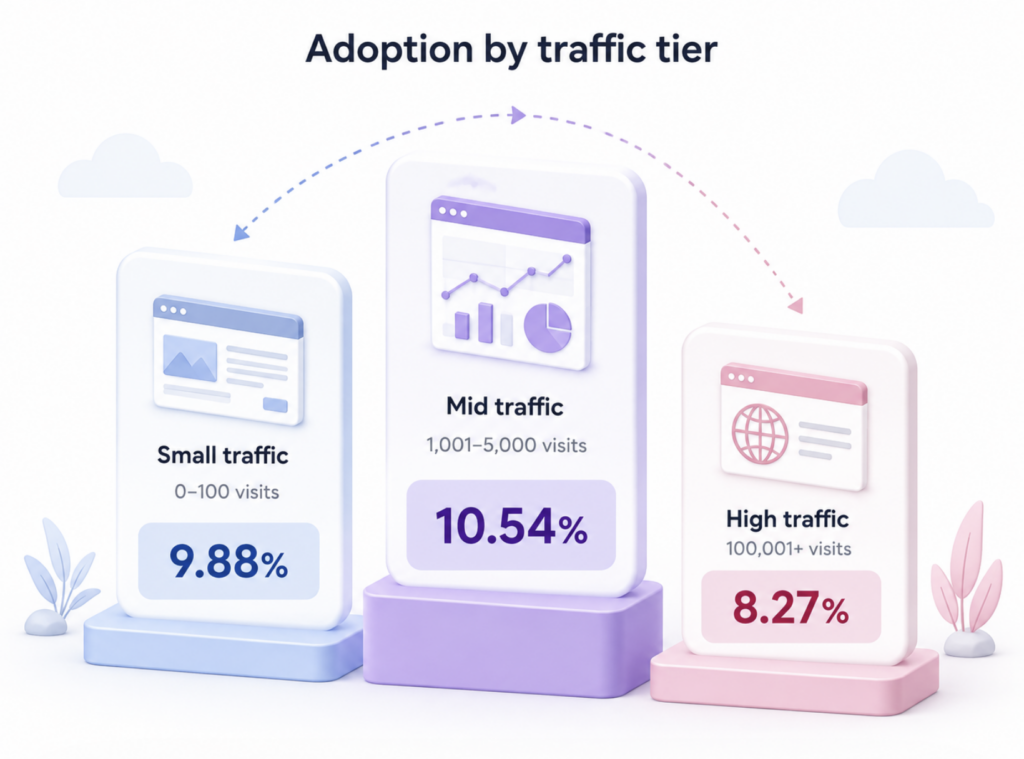
    The largest, most authoritative domains in the dataset are the least likely to have shipped the file. A separate look at the same data found adoption among the top 1,000 domains by traffic sits near zero percent. If llms.txt were becoming an SEO best practice the way XML sitemaps did, you’d expect the opposite curve. You’re not seeing that curve.

    Why Would the Biggest Sites Adopt llms.txt Less

    Look at who actually shipped llms.txt early and the pattern starts to make sense. The named adopters cited across multiple studies read like a developer tools roster: Anthropic, Stripe, Cloudflare, Vercel, Supabase, Pinecone, and LangChain. These are companies with small, technical teams who can ship a Markdown file in an afternoon without a sign-off chain.

    Enterprise sites don’t work that way. A Fortune 500 marketing team can’t add a new file to a production domain without legal review, security sign-off, and a business case. llms.txt has no governance body and no conformance test behind it, which makes that business case hard to write. Nobody wants to be the person who spent three sprint cycles shipping a file with no measurable return.

    Mid-size sites split the difference. They have enough technical staff to implement llms.txt without a committee, and enough curiosity about AI search to try a low-cost, low-risk tactic. That combination is exactly what shows up in the 10.54% figure. It’s not that mid-size sites believe more in llms.txt. It’s that they face less friction trying it.

    Site TypeAdoption RateWhy
    Low-traffic (0-100 visits)9.88%Small teams, easy to ship, nothing to lose
    Mid-traffic (1,001-5,000 visits)10.54%Technical enough to implement, curious enough to test
    High-traffic (100,001+ visits)8.27%Slower approval chains, higher bar for unproven tactics
    Top 1,000 domainsNear 0%Highest scrutiny, least tolerance for unproven SEO bets

    Does Having llms.txt Actually Change Anything

    Adoption rate is one question. Whether the file does anything once it’s live is a separate one, and the evidence there is thin.

    SE Ranking tested this directly. They built an XGBoost model to predict AI citation frequency using dozens of site-level features, including llms.txt presence. Removing the llms.txt variable from the model actually improved its accuracy. The file wasn’t a weak signal. It was noise.

    Google’s position matches that finding. Gary Illyes has confirmed Google doesn’t support llms.txt and has no plans to. John Mueller compared it directly to the long-discredited keywords meta tag. In June 2026, Google updated its AI optimization documentation to state plainly that llms.txt has no effect, positive or negative, on Search rankings or AI Overviews.

    Crawler behavior tells the same story from a different angle. Adoption has genuinely grown, up roughly 8.8x in twelve months to more than 36,000 sites according to Originality.ai. But 97% of those files never get requested by an AI crawler at all. A separate monitoring run across 500 million AI bot events found only a few hundred requests targeting llms.txt directly, out of that entire dataset. GPTBot, ClaudeBot, PerplexityBot, and Google-Extended are still overwhelmingly crawling regular HTML.

    What the Adoption Curve Actually Tells You About AI Visibility

    Here’s the trap in the adoption numbers. Total llms.txt adoption in the top-10k domains climbed from 1.04% to 5.61% in a single year, a 5.4x jump that looks like real momentum on a chart. Most of that growth is platform-driven rather than organic. Shopify alone accounts for over 78% of adopting sites in some samples, because the file gets auto-generated at the platform level, not chosen deliberately by each merchant.

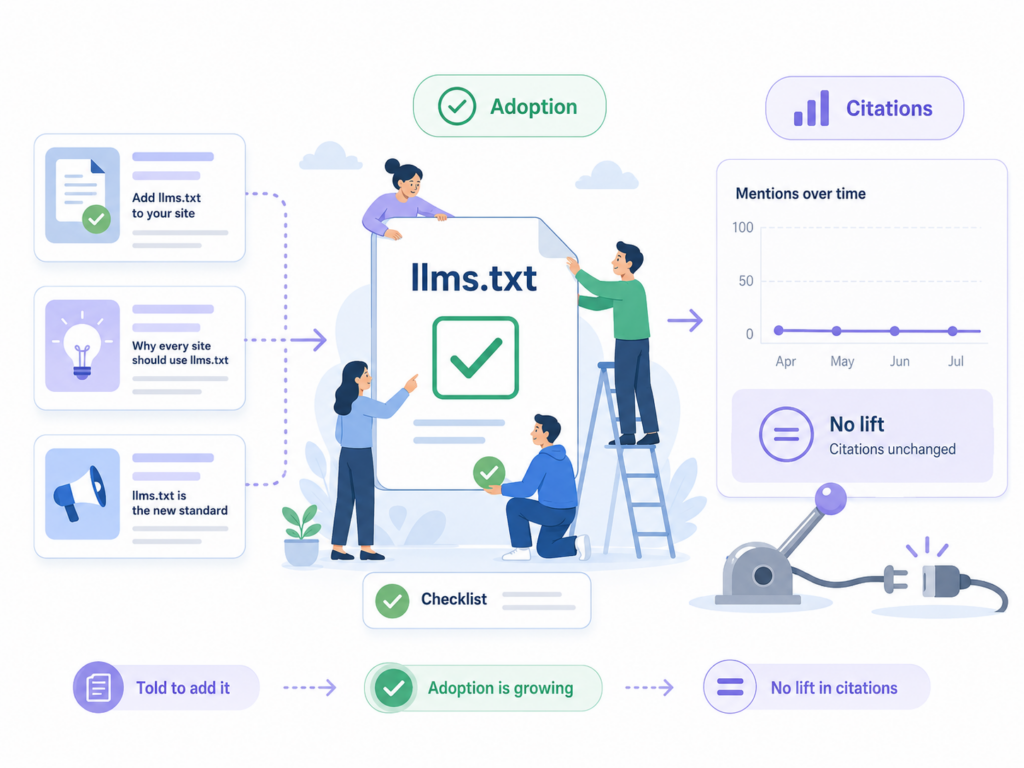
    Growing adoption plus flat-to-zero impact on citations is a specific combination worth sitting with. It means the file is spreading as a checkbox, not as a lever. Teams are adding it because a blog post told them to, not because they’ve measured a before-and-after difference in how often AI systems mention them.
    That gap between “we shipped something” and “we know if it worked” is exactly where most GEO efforts stall. Guessing whether a crawler read a file is a weak substitute for watching what AI systems actually cite. Topify’s Source Analysis tracks the specific domains and URLs that ChatGPT, Perplexity, and Google AI Overviews pull from when they answer prompts in your category, so you’re looking at confirmed citation behavior instead of an unverifiable file request log.

    Visibility Tracking closes the other half of the loop. Instead of asking “did the crawler read my llms.txt,” it asks “did my brand show up in the answer,” across the platforms your buyers actually use. That’s the metric that maps to pipeline, not the one that maps to a file sitting quietly at your domain root.

    If Not llms.txt, Where Should the Effort Go

    The same SE Ranking dataset that found llms.txt added noise also identified what actually moves citation frequency. According to a related analysis of over 150,000 citations, FAQPage schema lifted citation rate by 34% on Perplexity and 28% on ChatGPT. ClaimReview markup on stat-dense pages added a 41% lift on AI Mode specifically. Organization SameAs linkages, the structured data that ties your brand identity across LinkedIn, Crunchbase, and Wikipedia, added a 22% lift by helping models disambiguate who you are.

    TacticMeasured LiftWhere
    llms.txt presenceNo measurable effectAll platforms
    FAQPage schema+34% / +28%Perplexity / ChatGPT
    ClaimReview on stats+41%Google AI Mode
    Organization SameAs+22%Entity disambiguation
    Speakable cssSelector+18%Google AI Mode

    None of these tactics involve a root-level text file. They involve structured markup, entity consistency, and content that answers a question in a self-contained sentence an AI model can lift directly. If your team is deciding where to spend the next sprint, that table is a more defensible starting point than llms.txt.

    Conclusion

    The counterintuitive part of the llms.txt story isn’t that adoption is low. It’s that the sites with the most resources to test new tactics are the ones adopting it the least, while the tactics that actually move citation frequency have nothing to do with the file at all. If you’re deciding where to invest, treat llms.txt as a half-day, low-risk addition at best, and put the real effort into schema, entity consistency, and content structure you can actually measure against AI citation data.

    FAQ

    Q: Does llms.txt help with AI search rankings? 

    A: No measurable effect has been found. Google has confirmed it doesn’t factor into Search rankings or AI Overviews, and a 300,000-domain study found the same for citation frequency.

    Q: Why don’t large websites use llms.txt as often as expected? 

    A: Larger sites typically face longer approval chains and a higher bar for adopting unproven tactics. Early adopters skew toward small, technical teams like developer tools companies that can ship a file without a formal business case.

    Q: Is it still worth implementing llms.txt in 2026? 

    A: It’s low-cost and low-risk to add, but it shouldn’t replace higher-impact work like FAQPage schema, ClaimReview markup, or entity consistency, which have measurable citation lifts.

    Q: How do I know if AI models are actually reading my site? 

    A: File request logs for llms.txt tell you almost nothing, since most files get zero AI crawler requests. Tracking actual citations in AI answers, which tools like Source Analysis are built for, is a more reliable signal.

    Read More

  • The Trust Problem: Why AI Models May Ignore Your llms.txt File

    The Trust Problem: Why AI Models May Ignore Your llms.txt File

    Your team added an llms.txt file to the root of your domain three weeks ago. You expected ChatGPT and Perplexity to start citing your product pages more often. Nothing changed, and that gap between what the file promises and what models actually do with it is the whole problem.

    llms.txt Was Never a Rule Models Have to Follow

    The confusion starts with what llms.txt actually is. It’s a plain-text convention proposed in 2024, and it comes with no backing from any recognized standards body and no enforcement mechanism. AI providers can read it or skip it entirely, and there’s no penalty either way.

    That’s a different situation than robots.txt. Search engines built compliance into their crawlers over two decades, under pressure from a legal and reputational ecosystem that doesn’t exist yet for LLMs. llms.txt has no equivalent history, and no equivalent pressure.

    The data backs this up. A study of nearly 300,000 domains found that only 10.13% had an llms.txt file in place, a fraction of the adoption robots.txt or sitemaps reached. Adoption alone doesn’t prove impact, but it tells you the file hasn’t become infrastructure. It’s still an optional add-on that most sites skip.

    A separate audit went further and checked whether AI crawlers even request the file. Thirty days of CDN logs across 1,000 domains showed zero requests from GPTBot, ClaudeBot, or PerplexityBot. Google’s crawler accounted for 95% of hits, and it was mostly there for search indexing, not llms.txt specifically. If the bots that generate AI answers aren’t fetching the file, no amount of careful formatting inside it changes what the model does at inference time.

    Why Models Choose Sources That Never Declared Anything

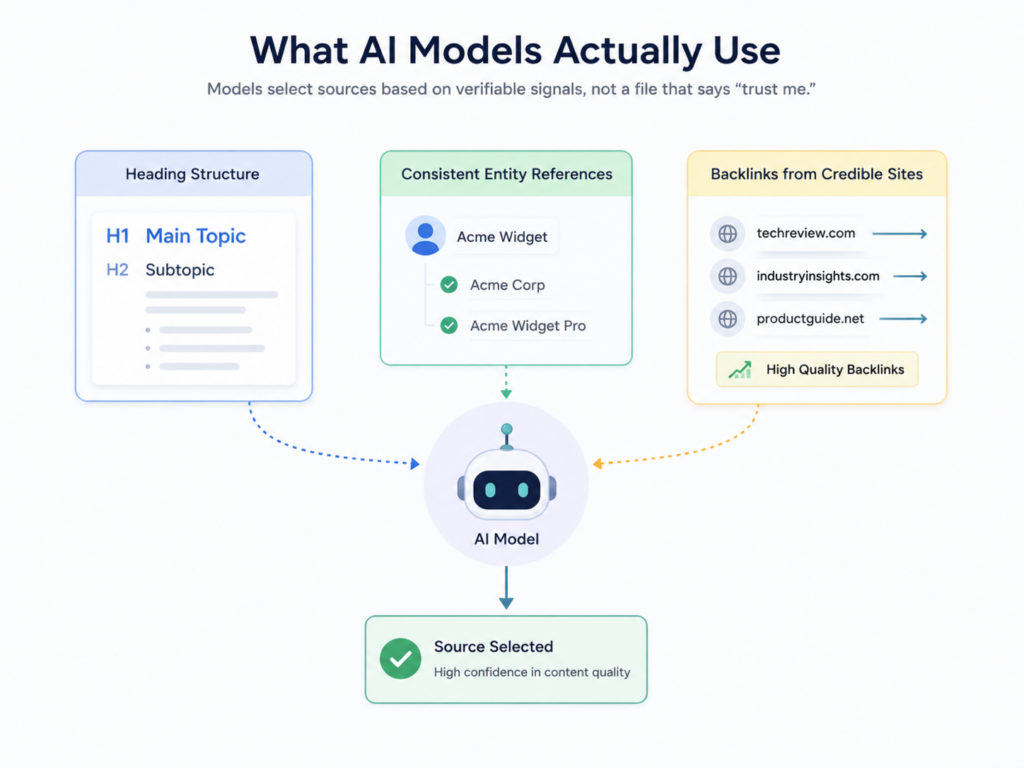
    If llms.txt isn’t the deciding factor, something else is. Models select sources based on signals they can verify independently: heading structure, consistent entity references, and how often other credible sites point back to the same content. None of that requires a file that says “trust me.”

    The same 300,000-domain study found no measurable correlation between having an llms.txt file and citation frequency. In fact, the model performed slightly better on sites without one, which suggests the file isn’t compensating for weak content. It’s just sitting next to it.

    The doesn’t file build trust. The content does.

    Research into what actually predicts citation backs this up with harder numbers. An analysis of pages cited by ChatGPT found 68.7% follow logical heading hierarchies, and pages using three or more schema types show a 13% higher citation likelihood. Those are structural signals a model can check against the page itself. A declaration in a separate file isn’t something it can check against anything.

    The Gap Between Claiming Trust and Earning It

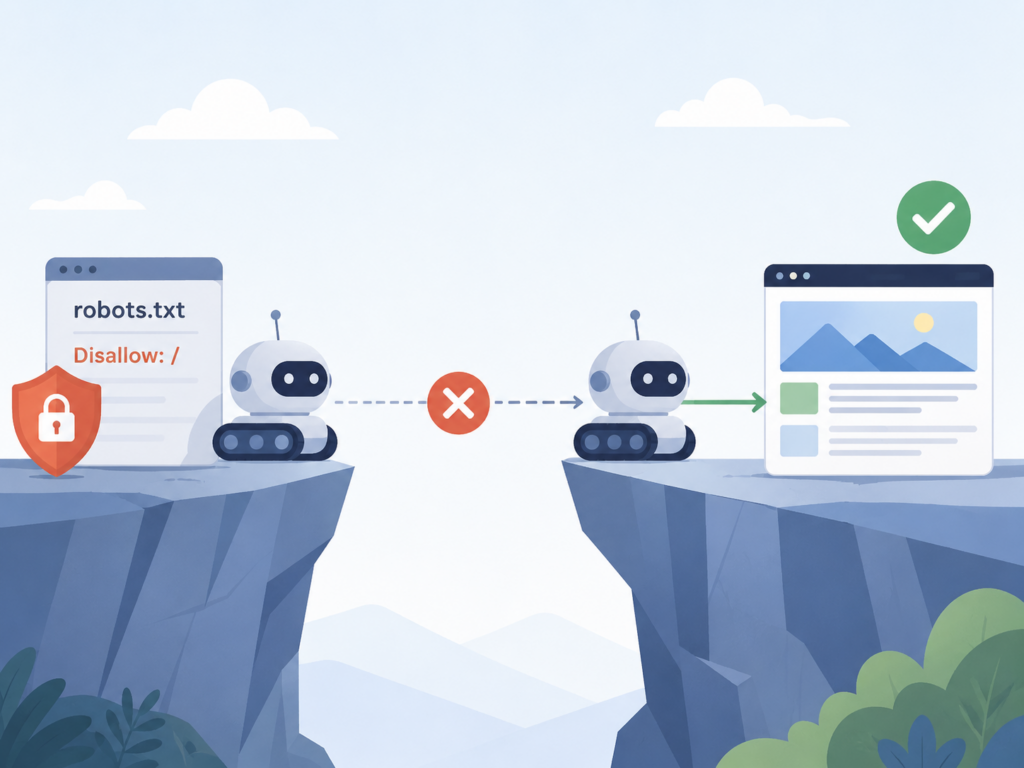
    This is where llms.txt and robots.txt diverge in a way worth naming directly. robots.txt tells a crawler what it’s allowed to do. llms.txt tries to tell a model what to believe about your site, and belief isn’t something a directive file can grant.

    Authority accumulates from external signals: consistent facts about your brand across multiple sources, clear entity identity, and content that other sites reference on their own. Organization schema plays a bigger role here than most teams expect, since it’s often the first thing AI systems use to evaluate whether a source is reliable, before the model ever gets to your product pages.

    Google has been the most direct of any major provider about where llms.txt fits on this. Its own guidance states the file has no effect on Search rankings or AI results, and staff have compared it to the long-abandoned keywords meta tag. As of the latest checks, none of OpenAI, Google, Anthropic, Meta, or Mistral has publicly committed to reading llms.txt in production answer systems. That’s not a rumor about one provider. It’s the absence of commitment across every major one.

    How to Know If Your llms.txt Is Actually Working

    Here’s the part most teams skip: verifying it. Deploying the file and waiting to see if citations change is a guess, not a measurement, because AI answers vary run to run and attribution is inconsistent even for well-established sources.

    A more direct approach is comparing what you declared in llms.txt against what AI platforms actually cite. This is exactly what Topify’s Source Analysis does: it tracks the domains and URLs that ChatGPT, Perplexity, Gemini, and other platforms pull from when answering prompts in your category, so you can see whether your claimed pages show up at all.

    If the pages you listed in llms.txt never appear in the citation data, that’s a clear signal the problem sits with content authority, not file syntax. If unrelated pages on your domain are getting cited instead, that tells you something too: the model already found a path to trust certain content, just not the path you tried to point it toward.

    What to Do When the Model Ignores What You Wrote

    The practical shift here is moving effort away from file maintenance and toward the signals that actually move citation. That means structured content with clear heading hierarchies, consistent entity data across pages, and schema markup that gives models something concrete to verify rather than take on faith.

    Visibility Tracking rounds this out by measuring whether that work is paying off over time, not just in a single snapshot. It’s often useful to pair with prompt-level monitoring, since a brand can be well-cited on one query type and invisible on a closely related one, and averaging the two hides the pattern.

    Once you can see where citations are landing and where they’re not, the next step is usually operational rather than analytical: adjusting which pages get restructured first, which entities need clearer markup, and which competitor is quietly winning the citations you expected to get. That’s less about writing a better file and more about running content decisions off real data instead of assumption.

    Conclusion

    llms.txt isn’t a switch that turns on AI trust, and treating it that way is where most of the frustration comes from. The file can still be worth deploying as a low-effort hedge for future standards, but it won’t compensate for content that lacks structure or authority today. The teams making progress aren’t the ones with the cleanest llms.txt file. They’re the ones tracking what AI platforms actually cite and adjusting based on that data instead of a declaration nobody’s required to read.

    FAQ

    Q: Does llms.txt actually work? 

    A: Current evidence says no, at least not as a direct driver of citations. A 300,000-domain study found no correlation between having the file and citation frequency, and no major AI provider has confirmed reading it in production.

    Q: What’s the difference between llms.txt and robots.txt? 

    A: robots.txt gives crawlers enforceable instructions about what they can access, backed by decades of compliance norms. llms.txt is a voluntary suggestion with no enforcement mechanism and no equivalent adoption history.

    Q: How do I know if AI is reading my llms.txt file? 

    A: Server log audits are one option, filtering for user agents like GPTBot or ClaudeBot, though most audits find little to no activity from these bots on llms.txt specifically. A more reliable approach is tracking whether the pages you listed actually show up in AI citations, which is what source-level monitoring tools are built for.

    Q: If llms.txt doesn’t help, what should I focus on instead? 

    A: Structural clarity and verifiable authority signals, things like consistent heading hierarchies, complete schema markup, and entity consistency across your site. These are the signals models can check directly, unlike a file that simply asserts what your important pages are.

    Read More

  • llms.txt Is Only One Layer. Here’s the Full AI Crawler Permission Stack.

    llms.txt Is Only One Layer. Here’s the Full AI Crawler Permission Stack.

    A content team ships an llms.txt file, checks the box, and moves on. Three months later, ChatGPT still can’t accurately summarize the product page, and server logs show zero requests to the file they spent an afternoon writing.

    That’s not a bug. It’s the current state of llms.txt in practice.

    What llms.txt Actually Controls, and What It Doesn’t

    llms.txt is a Markdown file at the root of a domain that gives AI systems a curated map of a site’s most useful content. It’s a navigation aid, not a gate.

    The data on how AI systems actually treat it is blunt. A study across 300,000 domains found adoption sitting around 10%, and among the fifty most AI-cited domains, only one had the file at all. Monitoring across a 90-day window turned up only a handful of hundred requests to /llms.txt out of over 500 million AI bot events, with GPTBot, ClaudeBot, PerplexityBot, OAI-SearchBot, and Google-Extended overwhelmingly crawling HTML pages directly instead.

    Google has been explicit about where it stands. Google’s Gary Illyes confirmed the company doesn’t support llms.txt and has no plans to, and John Mueller compared it to the discredited keywords meta tag. Separate testing found that eight out of nine sites saw no measurable traffic change after adding the file, and Mueller noted server logs show AI crawlers don’t even check for it.

    None of that means llms.txt is worthless. It costs almost nothing to publish and gives agentic tools a cleaner entry point if adoption grows. But it does mean llms.txt sits in a specific, narrow slot: a declaration of what a site would like AI systems to prioritize, with zero enforcement power behind it.

    The Five-Layer Permission Stack Behind Every AI Crawler Visit

    llms.txt is one layer in a stack that runs from soft declarations to hard technical enforcement. Understanding the full stack matters more than optimizing any single file.

    Layer 1: robots.txt. Standardized as RFC 9309, robots.txt tells crawlers what they’re asked not to fetch. It carries no legal force and doesn’t authenticate anything. Compliance depends entirely on whether a given bot chooses to honor it, and well-behaved crawlers generally do while others historically haven’t.

    Layer 2: llms.txt. As covered above, this is a content curation layer, not a permission layer. It suggests what to read first. It restricts nothing.

    Layer 3: CDN and WAF enforcement. This is where declarations turn into actual blocking. Cloudflare’s shift illustrates the pace of change here. In September 2026, Cloudflare will start blocking “mixed-use” crawlers, ones that blend search, agent, and training traffic, by default on any page carrying ads, unless the site owner overrides it. That follows a year of escalating economics: Cloudflare’s own data showed Anthropic’s crawler fetching roughly 38,000 pages for every referral visit it sent back, and OpenAI’s ratio landing around 1,091 crawls per referral. By June 2026, training-related crawlers made up 50.6% of all bot traffic on Cloudflare’s network, with search-related bots down to just 10.7%.

    Layer 4: Bot identity verification. Declaring rules is one thing. Knowing who’s actually knocking is another. Server logs and User-Agent verification catch crawlers that spoof legitimate identities or ignore declared rules entirely, and they’re the only way to confirm whether Layer 1 and Layer 2 are having any real effect.

    Layer 5: Licensing and legal terms. Terms of service, TDM opt-out clauses, and active litigation now form the outer boundary. Courts have kept public, logged-out scraping legal in cases like hiQ and Meta v. Bright Data, while training-specific disputes like Reddit v. Perplexity are actively testing where those lines sit. This is the layer where “allowed” gets defined in ways no text file can settle on its own.

    Declaring intent isn’t the same as enforcing it.

    Where Most Teams Get the Stack Wrong

    The most common mistake is treating Layer 2 as if it were Layer 3. A team writes a careful llms.txt, feels covered, and never checks whether their CDN is already blocking the same crawlers by default.

    That gap is widening fast. Analysis across Cloudflare’s network found GPTBot is now the most blocked AI crawler by robots.txt directive, and close to 90% of all AI crawler traffic serves training or mixed purposes rather than pure search. Separately, roughly 2.5 million sites now disallow AI training outright, and GPTBot alone is blocked by an estimated 19% of sites.

    Layer conflicts are common and mostly unresolved. If a CDN already blocks GPTBot at the network edge, an llms.txt file that welcomes it does nothing. The technical layer wins by default because it executes; the declaration layer only requests.

    There’s also a data-quality problem inside Layer 2 itself. One estimate put the share of llms.txt files that amount to little more than generic plugin stubs at nearly 40%, which suggests a lot of teams are checking a box rather than building something a machine-reading system could actually use.

    Getting the Permission Layer Right Doesn’t Guarantee AI Visibility

    Here’s the part that trips up even careful teams. Every layer in this stack governs access. None of them govern outcome.

    A site can configure robots.txt correctly, publish a genuinely useful llms.txt, keep its CDN rules aligned, and verify bot identities in its logs, and still never get mentioned when someone asks an AI assistant for a recommendation in its category. Permission is the entry ticket. It says nothing about whether the AI system finds the content worth citing once it’s inside.

    What actually drives citation is a separate set of factors: content structure, topical authority, and how often a brand’s name shows up across the sources an AI model actually pulls from when it forms an answer. That’s a visibility problem, not a permissions problem, and it needs its own monitoring layer.

    This is where Topify fits into the stack, not as a sixth permission layer, but as the measurement layer sitting on top of it. Once the technical access questions are settled, the open question becomes whether ChatGPT, Perplexity, or Google AI Overviews are actually citing the site, how often, and against which competitors. Topify’s Source Analysis tracks the exact domains and URLs AI platforms cite, which is the only reliable way to tell whether a permission configuration is translating into real mentions rather than just theoretical access.

    How to Audit Your Own Permission Stack in Practice

    A working audit runs through all five layers, in order, rather than stopping at whichever one is easiest to configure.

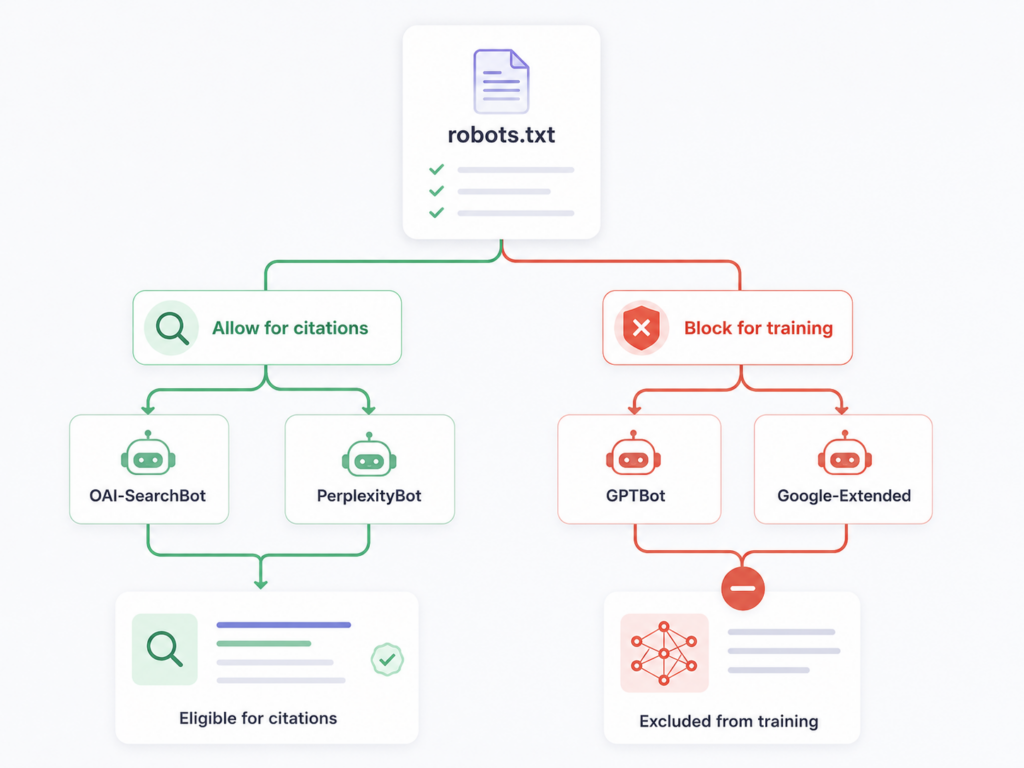
    Start with robots.txt. Confirm it explicitly addresses the AI user-agents that matter for the goal, whether that’s allowing search-oriented bots like OAI-SearchBot and PerplexityBot for citation eligibility, or blocking training-oriented bots like GPTBot and Google-Extended to keep content out of model training.

    Check llms.txt only after that, and only if there’s a genuine use case for agent-driven navigation. Skip generating a full Markdown mirror of every page. Indexable duplicate mirrors dilute crawl budget and can actively suppress the original pages in search results.

    Verify the CDN and WAF layer independently of what robots.txt claims. A rule declared in one place can be silently overridden or duplicated at the network edge, and the only way to know is to check both configurations side by side.

    Pull server logs and filter by known AI crawler user-agents to see what’s actually happening, not what the configuration implies should be happening. A honeypot link inside llms.txt that only an automated reader would follow is a simple way to confirm whether anything is reading the file at all.

    Finally, track outcomes, not just access. Set up ongoing monitoring for whether the brand shows up in AI answers, which sources get cited instead, and how that shifts as the permission layers change. This is the step most audits skip, and it’s the one that actually connects configuration work to business results.

    Conclusion

    llms.txt is real, cheap to publish, and worth having if a site already has its content fundamentals in order. What it isn’t is a permission system. It sits at the declaration end of a five-layer stack that runs through robots.txt, CDN and WAF enforcement, bot identity verification, and licensing terms, with real access control concentrated in the middle three layers, not the file getting most of the attention.

    Getting that stack configured correctly answers one question: can AI systems reach the content at all. It doesn’t answer the more important one: once they can, do they actually recommend the brand. That second question needs its own audit trail, separate from anything a text file at the root of a domain can provide.

    FAQ

    What is llms.txt used for? 

    It’s a Markdown file that gives AI systems a curated list of a site’s most relevant content, meant to help agentic tools navigate faster. It doesn’t restrict access or function as a security control.

    Is llms.txt the same as robots.txt? 

    No. robots.txt tells crawlers what they may not access and is broadly, though not universally, respected. llms.txt does the opposite: it suggests what to read first and carries no restrictive power at all.

    Does Google support llms.txt? 

    No. Google has stated on record that it doesn’t support the format and has no plans to, comparing it to the deprecated keywords meta tag.

    How do I check if AI crawlers are reading my llms.txt file? 

    Filter server access logs for requests to /llms.txt by known AI user-agents, or embed a unique link inside the file that only an automated reader would follow and monitor for traffic to that link.

    Read More

  • Should You Ship llms.txt? A Verdict by Site Type

    Should You Ship llms.txt? A Verdict by Site Type

    Two SaaS companies launched llms.txt the same month last year. One saw its AI Mode citations shift within days. The other checked its server logs three months later and found exactly zero requests for the file. Same standard, same effort, wildly different outcomes.

    That gap is the real story behind llms.txt, and it’s why the “should you ship it” debate keeps going in circles. The people saying yes and the people saying no are usually talking about different kinds of websites.

    What llms.txt Actually Promises to Do

    llms.txt is a plain-text Markdown file you place at your site’s root, something like example.com/llms.txt. It gives large language models a curated map of your content instead of forcing them to parse a full HTML page just to find your value proposition.

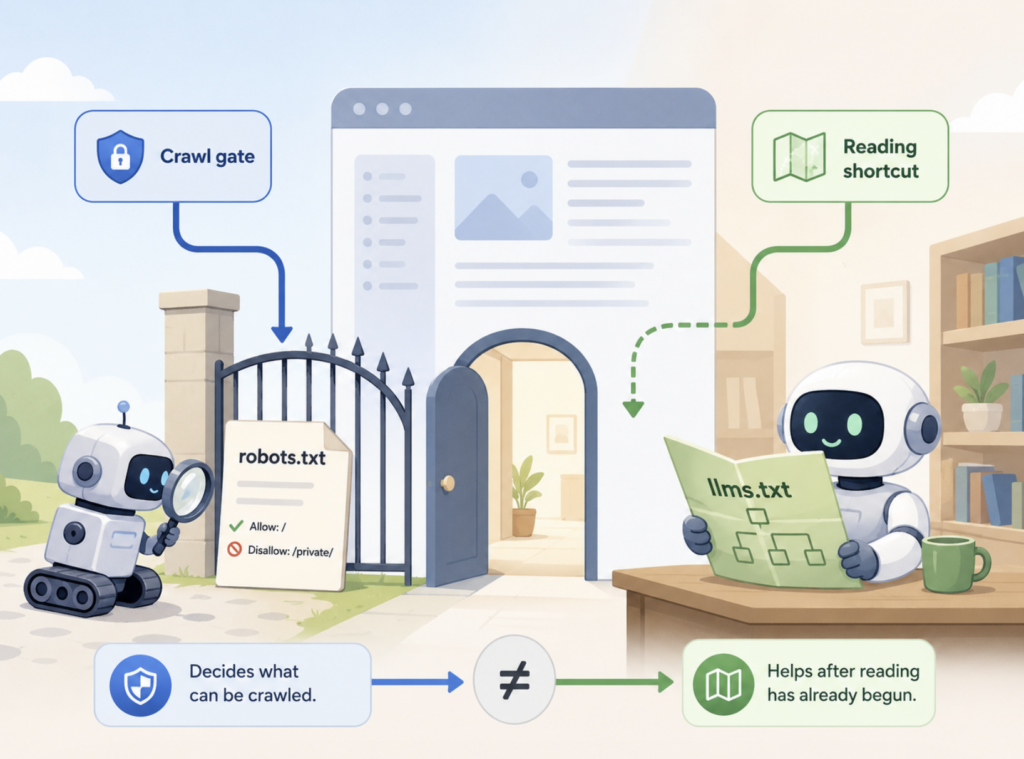
    It’s not a replacement for robots.txt. Robots.txt controls access. llms.txt is closer to a briefing document, one that tells an agent what your site is, who it’s for, and which pages matter most.

    That distinction matters because the two files serve completely different jobs, and confusing them is where a lot of the hype started. Search engines like Google use robots.txt to decide what to crawl at all. llms.txt only helps once something is already reading your site, which is a much narrower promise than most marketing posts about it suggest.

    The Real Question Isn’t “Should I?” It’s “Does My Site Even Need Guiding?”

    Most of the debate skips a more basic question: does an AI system actually struggle to understand your site without help?

    A ten-page marketing site with a clear homepage doesn’t need a curated map. An agent can read the whole thing in seconds. A 400-page documentation set with nested API references and versioned guides is a different story. That’s a genuine navigation problem, and it’s exactly the kind of problem llms.txt was built to solve.

    That’s the filter worth applying before anything else: content volume, structural complexity, and whether AI agents are already interacting with your site in a way that depends on navigation, not just crawling.

    Here’s the part most guides bury: llms.txt fixes a discovery problem, not a content quality problem. If your product pages are thin or your docs are outdated, a tidy index just helps an agent find the weak content faster.

    The Verdict, by Site Type

    Site TypeVerdictWhy
    Documentation & developer platformsShip itCoding agents like Cursor, GitHub Copilot, and Claude Code actively fetch llms.txt from docs sites during real sessions
    SaaS with heavy technical docsShip itSame agent-routing benefit as pure docs sites, plus it’s cheap to maintain alongside existing documentation workflows
    Small marketing sites and blogs (under 1,000 pages)Skip or deferThe homepage and nav already summarize the site well enough that a curated map adds little
    Large ecommerce (10,000+ pages)SkipMaintenance cost of keeping the file accurate outpaces the upside; product data and structured markup do more of the real work
    Small ecommerce (under 1,000 pages)Optional experimentCheap enough to test, but treat it as a minor bet, not a strategy
    News and publisher sitesSkip for nowNo major consumer AI search engine, including ChatGPT search, Perplexity, or Google AI Overviews, has confirmed it reads llms.txt for answering user queries

    Documentation sites are the one category where the evidence is unambiguous. Anthropic, Stripe, Vercel, Cloudflare, and Supabase all ship llms.txt on their developer docs, largely because Mintlify’s late-2024 rollout across hosted docs sites put thousands of platforms on the standard overnight. Coding agents fetch these files as a matter of routine, not as a hopeful bet on future adoption.

    Everyone else is placing a smaller, cheaper bet on a standard that hasn’t been confirmed by the platforms that matter most for organic visibility.

    Where Most Teams Get llms.txt Wrong

    The biggest mistake is treating llms.txt as an AI visibility strategy instead of a small technical convenience. It isn’t a ranking signal, and Google has said so directly.

    Google’s own search advocates have been unusually blunt about this. Gary Illyes confirmed Google doesn’t support llms.txt and has no plans to, and John Mueller went further, saying flat out that “for non-developer sites, I don’t think this makes much sense.” That’s the same Google whose Chrome Lighthouse tool has started auditing for llms.txt presence, which tells you the confusion isn’t just coming from marketers.

    The numbers back up the skepticism. A study of 300,000 domains found llms.txt adoption sitting at 10.13% after roughly eighteen months of industry conversation, and a separate June 2026 sample of the top 1,000 sites put confirmed adoption at 8.7%. Adoption isn’t accelerating the way early advocates predicted.

    Crawler behavior tells the sharper story. An analysis of 137,000 domains found that 97% of llms.txt files received zero crawler hits at all, and of the hits that did land, only 1% came from AI-related bots. A separate 90-day monitoring window across 500 million AI bot visits found roughly 408 requests actually targeting llms.txt files, close to 0.1% of total AI bot traffic.

    That’s a single-sentence gut check worth sitting with: the file most teams built for AI crawlers isn’t the thing AI crawlers are reading.

    A 90-day before-and-after study across ten sites in finance, B2B SaaS, ecommerce, insurance, and pet care found eight of the ten saw no measurable change in AI traffic after implementation, and one site actually declined by 19.7%. The two sites that did see gains had unrelated changes running in parallel, like PR campaigns and restructured comparison pages, so llms.txt wasn’t the cause.

    None of this means the file is worthless everywhere. It means the sites seeing zero return are usually the ones that never needed it in the first place.

    How to Know If It’s Actually Working

    Here’s the honest gap in almost every llms.txt guide: they tell you how to build the file, then stop. Nobody tells you how to check whether it changed anything.

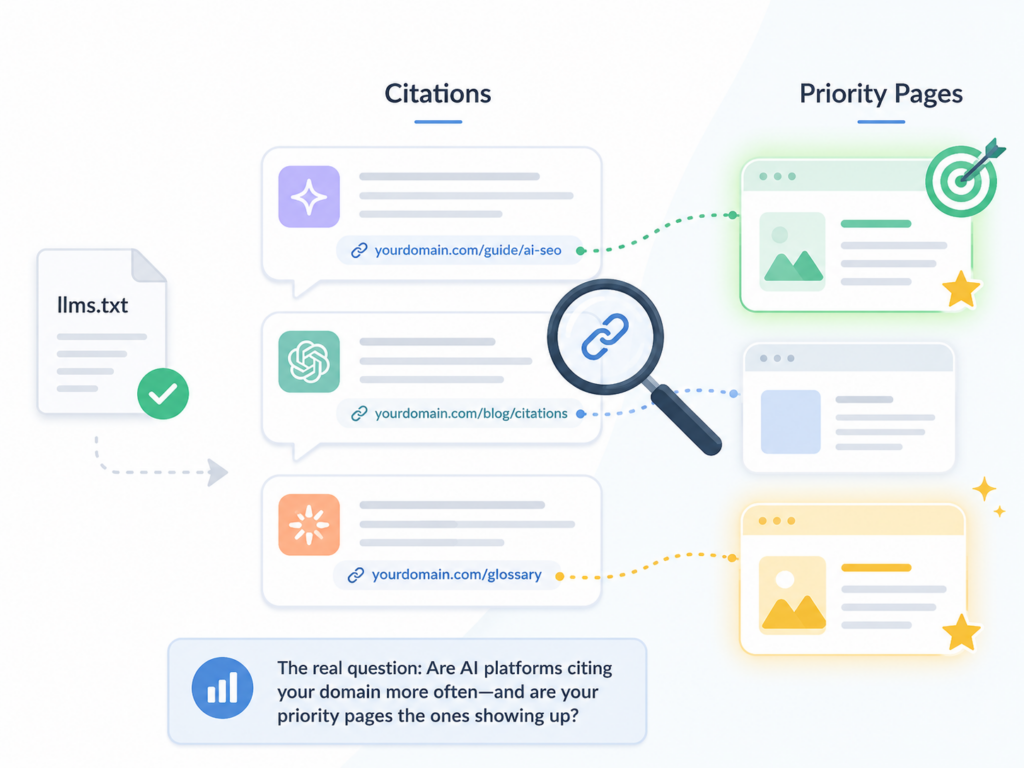
    The right question after shipping llms.txt isn’t “is it live.” It’s whether AI platforms are actually citing your domain more often, and whether the specific pages you flagged as priority are the ones showing up in AI answers. That’s a citation-tracking problem, not a file-formatting problem.

    This is exactly where Topify‘s Source Analysis comes in. It tracks the exact domains and URLs that AI platforms cite across ChatGPT, Perplexity, Gemini, and Google AI Overviews, which means you can see whether your llms.txt-linked pages are actually showing up as sources or whether the file is just sitting unread at your root. Pair that with AI Volume Analytics to check whether the topics your llms.txt prioritizes are even the ones generating meaningful AI search demand in the first place.

    For ecommerce brands weighing the maintenance cost, that visibility matters even more. Shopify reported AI-driven traffic to its stores grew 8x year over year, with AI-powered search orders up nearly 13x. That’s real upside, but it’s upside you can only capture if you’re measuring whether your AI visibility work, llms.txt included, is actually moving the needle instead of guessing.

    Conclusion

    There’s no universal answer to whether you should ship llms.txt, and anyone giving you one is skipping the part where site type changes everything. Documentation-heavy and developer-facing sites have a real, demonstrated case: coding agents use these files today, not hypothetically. Everyone else is looking at a low-cost, low-evidence bet that Google’s own search team has publicly called into question.

    Before you spend an afternoon on it, run through three checks: does your site have enough structural complexity that an agent would actually benefit from a map, is agent traffic a real part of your growth plan, and do you have the bandwidth to keep the file accurate as your site changes. If two of those three are no, your time is better spent on content structure and citation tracking than on a file most crawlers still aren’t reading.

    FAQ

    Q: What is an llms.txt file, exactly?
    A: It’s a plain-text Markdown file placed at a site’s root, typically at /llms.txt, that gives AI systems a curated index of the site’s most important pages instead of asking them to parse full HTML.

    Q: Is llms.txt the same as robots.txt?
    A: No. Robots.txt tells crawlers what they’re allowed to access at all. llms.txt only helps an AI agent navigate content it can already reach, which makes it a convenience layer, not an access control.

    Q: Does llms.txt actually work for AI search visibility?
    A: For consumer AI search like ChatGPT search, Perplexity, or Google AI Overviews, the evidence so far shows little to no measurable effect. For AI coding agents reading documentation sites, it demonstrably works, since tools like Cursor and Claude Code fetch these files during real coding sessions.

    Q: Do I need llms.txt for my blog or small marketing site?
    A: Usually not as a priority. If your homepage and navigation already summarize the site clearly, a curated map adds little. That time is typically better spent on content structure and technical SEO fixes.

    Read More

  • llms.txt: Google’s Split Personality on Skip It vs Audit It

    llms.txt: Google’s Split Personality on Skip It vs Audit It

    Your SEO lead pings you asking whether the site needs an llms.txt file. You check Google’s own AI optimization guide and it says skip it. Then you run a Lighthouse report that same afternoon and see an audit flagging the exact same file. Same company, two contradicting answers, eight days apart. The deadline to make a call on this is this sprint, not next quarter.

    Two Google Teams, Two Opposite Instructions on llms.txt

    Here’s the timeline that started the confusion. On May 7, 2026, Chrome’s Lighthouse 13.3 promoted a new Agentic Browsing category from experimental to default, and one of its checks looks for an llms.txt file at the root of the site.

    Eight days later, on May 15, Google Search Central published its first consolidated AI optimization guide. Buried in a mythbusting section, the guide states plainly that site owners don’t need new machine-readable files, AI text files, markup, or Markdown to appear in generative AI search.

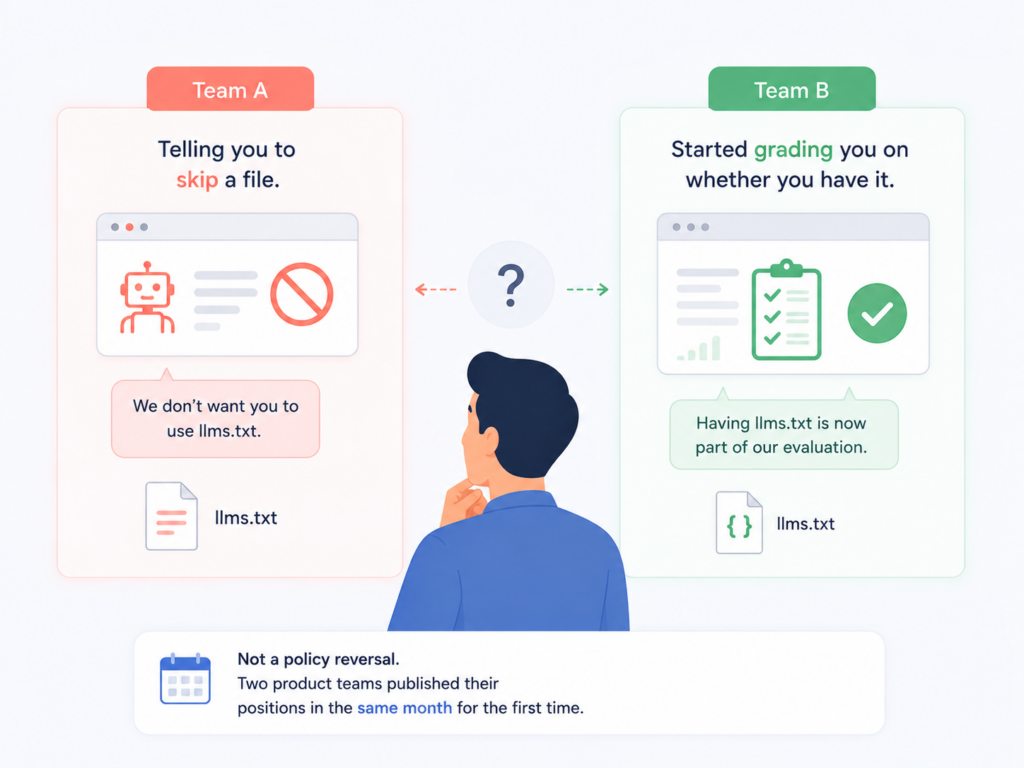
    That’s not a policy reversal. It’s two product teams publishing their positions in the same month for the first time. One team is telling you to skip a file. The other team just started grading you on whether you have it.

    Why Search Says Skip It

    Google’s Search Central guide groups llms.txt with content chunking, AI-specific rewriting, and inflated structured data as tactics that don’t move the needle for AI Overviews or AI Mode. The reasoning is straightforward. Googlebot already renders and reads your actual HTML, so a separate summary file adds nothing it doesn’t already have.

    This isn’t a new stance dressed up as news. Search Advocate John Mueller has compared llms.txt to the keywords meta tag, a tag search engines stopped trusting over a decade ago because anyone can write anything into it with zero verification. Back in July 2025, he was already suggesting sites noindex the file so it doesn’t accidentally get indexed and confuse users. Gary Illyes went further at Search Central Live APAC, confirming Google doesn’t support llms.txt for ranking and has no plans to start.

    None of that changed on May 15. It just became official documentation instead of a forum reply.

    Why Chrome Audits It Anyway

    The Lighthouse Agentic Browsing category isn’t measuring what Search measures. It checks four things: WebMCP integration, agent accessibility, layout stability, and llms.txt. None of these produce a weighted 0-100 score the way Performance or SEO categories do, because Google says the standards for the agentic web are still forming.

    The llms.txt check specifically looks at whether an AI browsing agent, the kind that fills out forms or compares products on a user’s behalf, can find a quick summary of your site’s structure without having to crawl every page first. Chrome’s own documentation frames the absence of the file as a minor tax: agents “may spend more time crawling the site to understand its structure” without one.

    That’s a real but narrow use case. It has nothing to do with whether ChatGPT or Google’s AI Overviews decide to cite your brand.

    The Real Signal Google Is Betting On: WebMCP, Not llms.txt

    Most coverage of this split gets stuck arguing about a text file and misses the more telling detail sitting right next to it in the same audit category. WebMCP, the Web Model Context Protocol, is the second item Lighthouse checks, and it’s where Google appears to be putting its actual weight.

    WebMCP lets a site declare structured “tool contracts” directly in HTML attributes or JavaScript, so an agent can execute an action, book a slot, add to cart, submit a form, inside a live session instead of scraping the DOM or driving the UI through screenshots. It showed up in Chrome Canary in February 2026, got featured at Google I/O the same year, and is now running an origin trial in Chrome 149.

    A static file describing your site is a much smaller bet than a protocol that lets agents act on it. Chrome’s roadmap makes that priority obvious even if nobody’s saying it outright.

    Does llms.txt Actually Get Used? The Bot Traffic Says No

    Adoption numbers make the practical stakes clear. Roughly 10% of sites have already published an llms.txt file, but AI bots request it in only about 0.1% of cases. That gap between creation and actual use is close to the widest you’ll see for any SEO tactic in recent memory.

    A broader Ahrefs study of over 137,000 domains found that 28% had published a valid llms.txt, yet 97% of those files got zero bot requests in a full month of tracking. Of the small slice that did see traffic, 96% came from bots generally, and under a fifth came from named AI tools, mostly coding agents like GPTBot and Claude-Code pulling developer docs.

    A file nobody requests can’t be a citation signal. That’s the whole argument, reduced to one sentence.

    A Decision Framework: When llms.txt Is Actually Worth It

    Strip away the noise and the decision splits cleanly along one line: who’s actually consuming your site.

    For most consumer-facing brands, e-commerce stores, SaaS marketing pages, local business sites, the file does nothing measurable. Google Search doesn’t read it for ranking, AI Overviews, or AI Mode, and the traffic data confirms almost nobody is fetching it anyway. Your time is better spent on crawlable pages, non-commodity content, and the standard SEO fundamentals the Search Central guide reaffirms.

    For developer documentation, API references, or products where coding agents are a meaningful referral source, the calculus flips. Creating the file costs almost nothing, and Mueller himself acknowledged it can act as a token-saving shortcut for AI systems that already read your HTML fine but benefit from a simplified map.

    Here’s the part that matters more than the file format either way. Whether or not you publish llms.txt, you still need to know what AI models are actually saying about your brand and which sources they’re pulling that from. That’s a data problem, not a file problem, and it’s the layer most teams have zero visibility into.

    This is exactly the gap Topify is built to close. Its Source Analysis feature reverse-engineers the exact domains and URLs AI platforms cite when they answer questions in your category, so instead of guessing whether a machine-readable file helped, you see which pages actually earned the citation and which competitor’s content is filling the gap yours left open. Layered on top, Comprehensive GEO Analytics tracks visibility, sentiment, position, volume, mentions, intent, and CVR across ChatGPT, Gemini, and Perplexity in one view, which is the same foundational SEO signal set Google’s own guide points back to.

    Conclusion

    Google Search and Chrome aren’t contradicting each other so much as optimizing for different consumers of your site: one ranks crawlable HTML, the other checks readiness for browsing agents. For nearly every brand outside developer tooling, the answer is to skip the file and put that energy into content and crawlability that actually move AI citations. If you want to know whether that effort is working, get started with Topify and track the citations directly instead of betting on a file format nobody’s asking for yet.

    FAQ

    Q: Does llms.txt help with Google Search rankings or AI Overviews? 

    A: No. Google’s May 2026 AI optimization guide states directly that no special machine-readable files, AI text files, or Markdown are needed to appear in generative AI search features.

    Q: Should developer documentation sites still create an llms.txt file? 

    A: It’s a reasonable low-cost option there. Coding agents like GPTBot and Claude-Code make up most of the small amount of real llms.txt traffic that exists, and Mueller has acknowledged it can help AI systems parse developer references more efficiently.

    Q: Will Lighthouse’s llms.txt audit lower my SEO score if I don’t have the file? 

    A: No. The Agentic Browsing category doesn’t produce a weighted score like Performance or SEO categories do, and a missing file with a normal 404 response is marked Not Applicable rather than flagged as an error.

    Q: What’s the difference between llms.txt and robots.txt? 

    A: robots.txt tells crawlers what they’re allowed to access and is respected across search engines. llms.txt is a self-declared summary of a site’s content with no verification mechanism, and no major AI vendor has committed to treating it as a ranking or citation signal.

    Read More

  • The Data Debunk: Does llms.txt Actually Correlate With AI Citations?

    The Data Debunk: Does llms.txt Actually Correlate With AI Citations?

    Roughly 10% of measured domains have shipped an llms.txt file since the format launched in September 2024. That adoption curve looks like a standard is forming.

    But adoption and effect are two different questions. The one that actually matters for a GEO strategy is whether publishing llms.txt changes how often a brand gets cited in ChatGPT, Perplexity, or Google’s AI Overviews. Three independent studies, covering hundreds of thousands of domains, now have an answer.

    What llms.txt Actually Is, Beyond the Hype

    llms.txt is a Markdown file, hosted at a site’s root, that lists a brand’s most important pages in a clean, script-free format. Jeremy Howard and the team at Answer.AI proposed it on September 3, 2024, hosted at llmstxt.org. The pitch: a language model with a limited context window shouldn’t have to wade through navigation bars and ad scripts to find the content that matters.

    The format itself is intentionally simple. An H1 title, an optional summary paragraph, then grouped links to key pages. Some sites also publish an expanded llms-full.txt that inlines the full text of every linked page into a single fetch.

    That’s the whole spec. There’s no schema, no validator, no runtime API to register with. Anyone who can write a README can ship one in under an hour.

    Why Everyone Assumed llms.txt Would Boost AI Citations

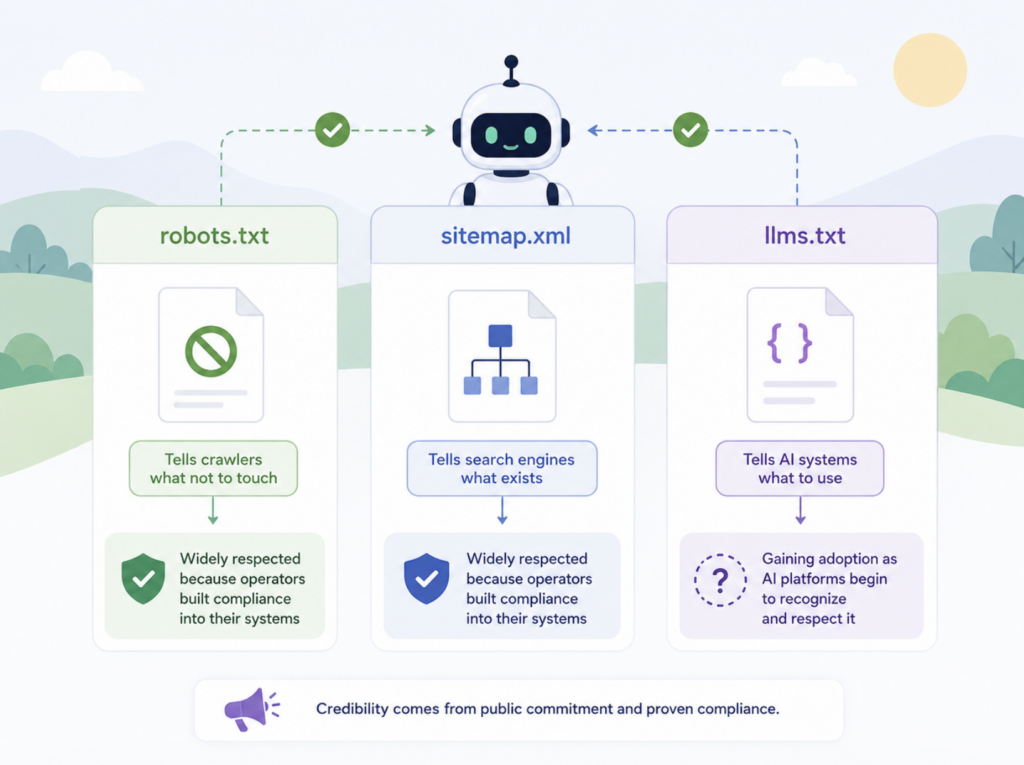
    The marketing pitch around llms.txt borrowed credibility from two older files. robots.txt tells crawlers what not to touch. sitemap.xml tells search engines what exists. Both are widely respected because the crawler operators built compliance into their systems and said so publicly.

    llms.txt skipped that step. No major AI platform has committed, on the record, to fetching it as part of how answers get generated.

    That gap didn’t stop the analogy from spreading. Once a file looks like robots.txt for AI, it’s easy to assume it behaves like one too.

    An assumption repeated enough times starts to look like a fact.

    What the Data Actually Shows About llms.txt and Citations

    This is the part the marketing pitch skips, and it’s where three separate research teams landed on the same conclusion.

    SE Ranking’s analysis is the largest public study to date: roughly 300,000 domains, checked for llms.txt at the root, then measured against how often each domain got cited across major AI-powered answer engines. They ran two tests: a straightforward correlation analysis, then an XGBoost model trained with and without llms.txt as a feature. The model got slightly more accurate once llms.txt was removed, which in plain terms means the file was adding noise, not signal.

    A second study from Trakkr scanned 37,894 AI-cited domains and cross-referenced 323,000-plus citations. The adoption rate came in at 12.7%, and the statistical test (Mann-Whitney U, chosen because citation counts are heavily skewed) returned a p-value of 0.81. That’s nowhere close to significant. Trakkr also found that among the top 50 most-cited domains, only 6% had adopted llms.txt at all, and adoption actually climbed further down the citation rankings. The sites hoping for a lift are shipping the file. The sites already winning citations mostly aren’t bothering.

    Here’s the pattern across both datasets, side by side:

    StudyDomains ScannedAdoption RateCitation Correlation
    SE Ranking~300,00010.13%None found; removing the feature improved the prediction model
    Trakkr37,89412.7%Not statistically significant (p=0.81)

    Two different research teams, two different samples, two different statistical methods. Same null result.

    Why LLMs May Be Ignoring llms.txt Entirely

    The absence of a correlation stops looking surprising once you look at how these systems actually pull information.

    ChatGPT’s web results run through Bing. Gemini runs through Google’s own index. Perplexity maintains its own crawl and index. None of the major consumer AI assistants have a separate, AI-specific discovery mechanism that visits a site’s root directory looking for a special file before generating an answer. They’re layered on top of search infrastructure that was built for a different purpose years earlier, then reads and synthesizes whatever that infrastructure surfaces.

    That’s the mechanical reason llms.txt was always a longer shot than robots.txt. robots.txt works because it plugs directly into the crawler behavior it’s meant to influence. llms.txt asks a model to take a detour to a file most retrieval pipelines were never built to check.

    Google’s own public position backs this up. At the Search Central Deep Dive event in Bangkok in July 2025, Gary Illyes stated plainly that Google does not use llms.txt and has no plans to. John Mueller drew a direct comparison to the keywords meta tag, a signal Google stopped trusting in the late 2000s because site owners control it and site owners can game it. In December 2025, an llms.txt briefly showed up on Google’s own developer documentation site and was pulled the same day. OpenAI, Anthropic, and Perplexity haven’t made an equivalent statement either way.

    The Counterpoint Nobody Should Skip

    Not every voice in this debate lands on the same side, and the strongest pushback is worth taking seriously rather than dismissing.

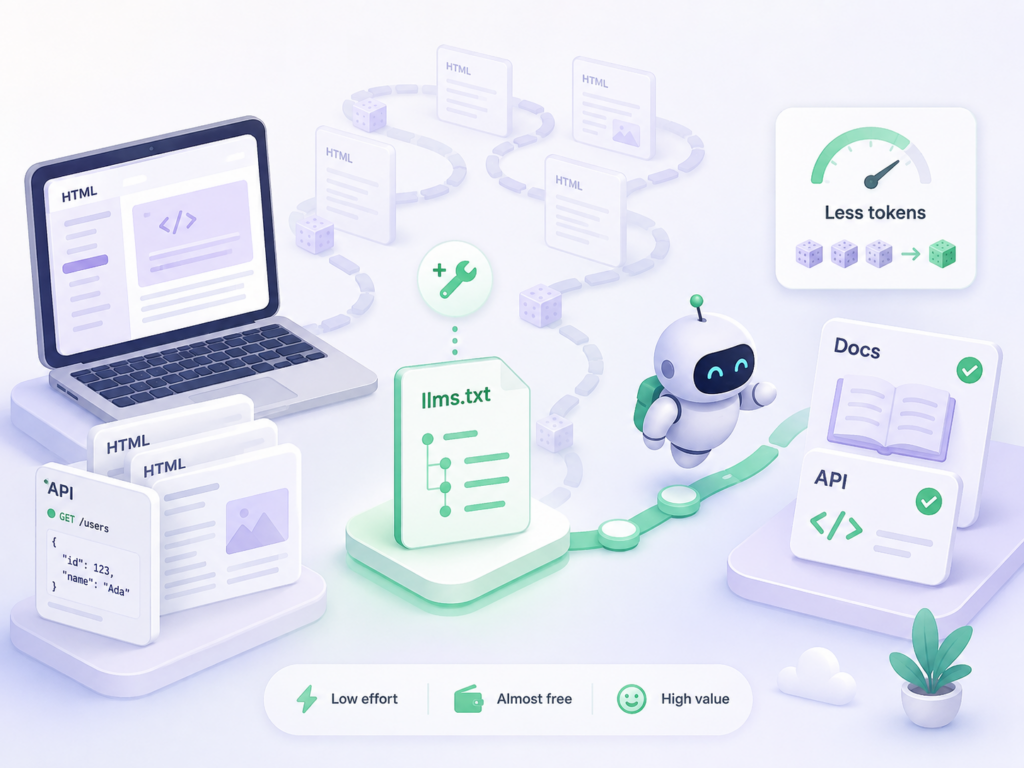
    Wix’s AI Search Lab argues that Google’s own index contained between 30,000 and 60,000 llms.txt files as of October 2025, which they read as proof that Google is crawling the file even while saying otherwise. They also point out the format’s token efficiency: a clean Markdown index costs a fraction of the tokens a rendered HTML page does, which matters more as agentic workflows lean on tighter context budgets.

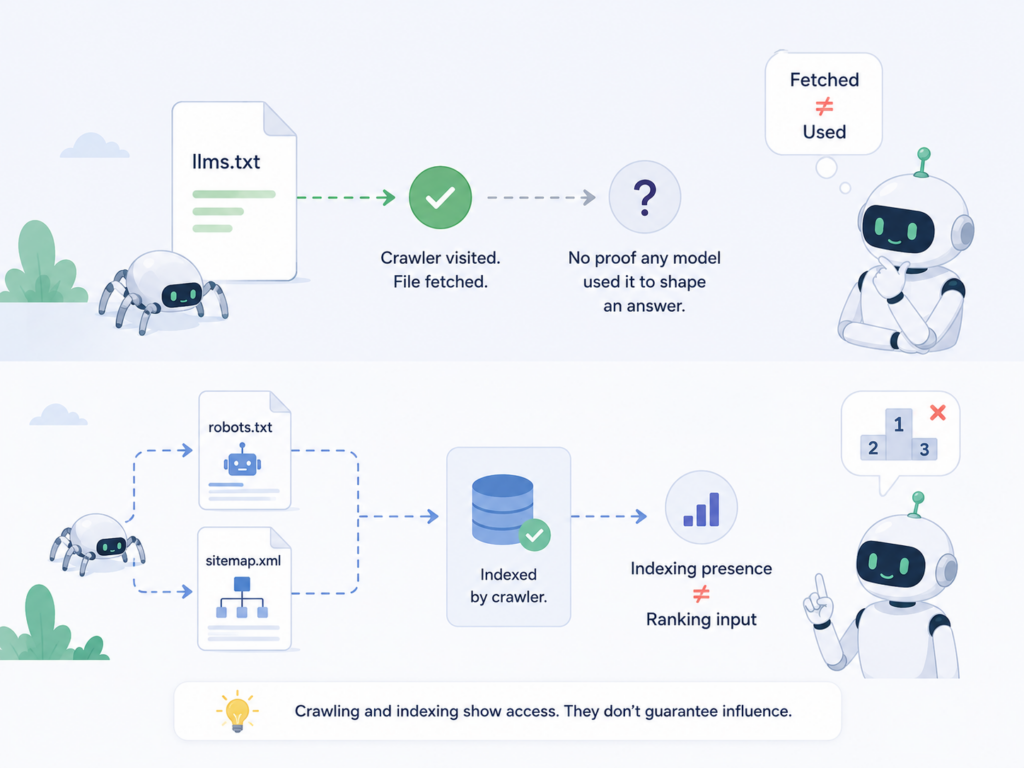
    Both points are fair, and both come with a catch. A crawler visiting a file tells you it got fetched. It doesn’t tell you any model used that fetch to shape an answer. The same crawler indexes robots.txt and sitemap variants too, and indexing presence has never been the same thing as a ranking input.

    Treat llms.txt as cheap insurance for a future where a major provider flips the switch, not as a lever that’s already paying off.

    What Actually Correlates With AI Citations

    If llms.txt isn’t the variable driving citations, the useful question becomes: what is?

    The research points back to the fundamentals GEO practitioners already know. Content that’s structured for extraction, backed by clear entity signals, and already earning citations from other authoritative sources tends to show up more often in AI answers. None of that requires a special file. It requires the same substantive, well-organized content that’s always mattered, now read by a different kind of reader.

    That’s less satisfying than a one-hour fix, but it’s what the data supports.

    The practical problem is that most brands don’t actually know which of their pages are getting cited, or why. Guessing at causes wastes the same budget llms.txt already wasted for a lot of teams. Topify’s Source Analysis feature exists to close that gap. It tracks the exact domains and URLs that AI platforms cite when answering questions related to your category, so you can see which of your own pages are pulling weight and which competitor content is winning the citation instead.

    How to Verify What’s Driving Your Own AI Visibility

    Before spending another hour on llms.txt, it’s worth spending that same hour checking what’s already influencing your citation rate.

    Start with a free GEO score check to get a baseline reading on how your site currently shows up across AI platforms. From there, Comprehensive GEO Analytics tracks visibility, sentiment, and position across ChatGPT, Gemini, and Perplexity over time, so a change in your content strategy shows up as a measurable shift rather than a guess. Pair that with Source Analysis to see which specific pages and domains AI systems are actually citing in your space right now.

    That combination replaces speculation about file formats with a direct read on what’s working.

    Conclusion

    llms.txt is not a proven citation lever. Three studies covering hundreds of thousands of domains agree on that, and Google’s own public statements back it up. That doesn’t make the file harmful. It’s cheap to ship, and if a major provider ever does start using it, having an accurate one already in place costs nothing.

    What it shouldn’t get is your GEO budget or your team’s attention as a primary strategy. The levers that correlate with AI citations today are the same ones that have mattered all along: structured, authoritative content that earns citations on its own merit. Spend the hour verifying what’s actually driving your visibility before spending it on a file the data says isn’t.

    FAQ

    Does llms.txt replace robots.txt or sitemap.xml? 

    No. robots.txt and sitemap.xml are established standards that crawler operators have publicly committed to honoring. llms.txt is a proposal with no equivalent commitment from any major AI platform, so it doesn’t function as a replacement for either.

    Do ChatGPT and Perplexity read llms.txt? 

    There’s no public confirmation from OpenAI, Anthropic, or Perplexity that their retrieval systems fetch or weight llms.txt at runtime. Google has stated it does not use the file. Scattered third-party observations of bot traffic to the file exist, but none rise to an official commitment.

    Is llms.txt worth setting up in 2026?

    If it takes about an hour and you can keep it accurate, there’s little downside. Just don’t treat it as an AI visibility strategy or a paid line item, since the data available in 2026 shows no measurable citation lift from having one.

    What actually influences whether AI platforms cite a brand? 

    Structured, extractable content, clear entity signals, and existing citations from authoritative sources correlate with AI citation frequency far more than any single root-level file.

    Read More

  • Best SEO Agencies for Dentists: A Buyer’s Guide for Dental Practices

    Best SEO Agencies for Dentists: A Buyer’s Guide for Dental Practices

    Dr. Maria Chen has run the same single-location practice in Plano, Texas for eleven years. She holds a 4.9-star rating on Google and a full patient roster from referrals alone. She still can’t crack the map pack for “dentist near me” in her own zip code. Three Aspen Dental locations and a private-equity-backed group outrank her, not because they’re better dentists, but because their SEO vendor treats every location’s Google Business Profile as a core deliverable instead of a checkbox.

    A dental SEO agency worth paying for treats three things as non-negotiable: your Google Business Profile and local map pack presence, a content strategy that separates insurance patients from cosmetic or self-pay patients, and HIPAA-safe handling of patient photos and reviews. If a proposal skips all three, it’s a general local SEO template with “dental” swapped into the copy.

    Why Dental SEO Isn’t the Same as General Healthcare SEO

    Topify’s healthcare buyer’s guide covers the broader medical SEO landscape: YMYL compliance, clinical review of content, and the range from solo practitioners to hospital systems. Dentistry sits inside that category, but it behaves differently in three ways that a generic healthcare vendor often misses.

    First, dental care is almost entirely a local, walk-in-radius decision. Patients don’t fly across the country for a cleaning the way they might for a specialist surgeon.

    Second, most dental practices run two patient populations at once: insurance-covered general dentistry and self-pay or cosmetic work like veneers and Invisalign. Those two groups search, and convert, in completely different ways.

    Third, dental marketing produces an enormous volume of visual patient content (smile transformations, before-and-afters) that carries HIPAA exposure most other healthcare specialties don’t generate at the same scale.

    Why Local SEO Carries More Weight for Dentists Than for Most Practices

    When someone searches “dentist near me” or “emergency dentist [city],” they’re not researching. They’re already in pain or already decided, and they’re choosing from whoever shows up in the map pack. Whitespark’s 2026 Local Search Ranking Factors survey, which asks a panel of local SEO practitioners to weight the categories that drive Google’s local pack, puts Google Business Profile signals at 32% of that ranking weight, more than reviews, on-page content, or links individually.

    Most patients never scroll past the top three map pack results before calling or booking. A dental SEO agency that spends most of its retainer on blog posts and backlinks while your GBP listing sits half-finished is optimizing for the wrong scoreboard.

    Ask any agency you’re evaluating a direct question: what’s their process for GBP category selection, service attributes, Q&A seeding, and review response cadence, specifically for dental clients? If the answer is generic (“we optimize your listing”), that’s a sign they haven’t built a dental-specific playbook.

    NAP consistency (your practice name, address, and phone number matching exactly across directories) matters more for dentists than for most B2B service businesses, because so much of the competitive set is multi-location chains with dozens of nearly identical listings. Practices with clean, consistent citations across the directories that actually carry weight, Google, Yelp, Apple Maps, Healthgrades, and the dental-specific directories patients use to check insurance, tend to outrank those with scattered, outdated ones.

    Insurance Patients vs. Cosmetic and Self-Pay Patients: Two Content Strategies, One Practice

    This is the part a general local SEO agency almost always flattens into one undifferentiated content plan, and it’s where a lot of dental SEO budgets get wasted.

    A patient searching “does [practice name] take Delta Dental” or “emergency dentist that accepts Cigna near me” wants speed and certainty. They want an insurance page that clearly lists accepted plans, a fast way to book, and content that answers “how much will my copay be for a filling.”

    A patient searching “veneers cost Plano TX” or “Invisalign vs braces for adults” is in a completely different mindset. They’re comparison shopping an elective purchase, often in the $3,000 to $15,000 range, and they want a portfolio of results, financing options, and reassurance before they’ll pick up the phone.

    A dental SEO agency that understands the industry builds separate content clusters and, often, separate landing page structures for these two funnels. One vendor proposal, one keyword list, and one generic “our services” page is a red flag that they’re treating your practice like a plumber’s website with a different logo.

    Ask prospective agencies how they’d structure content differently for your insurance-driven general dentistry versus your cosmetic or elective procedures. A specific answer, with examples of separate page architecture or separate ad landing pages, tells you they’ve done this before.

    HIPAA Compliance in Dental Marketing: What an Agency Should Actually Get Right

    Dental practices generate more patient-identifiable marketing content than almost any other healthcare specialty, mostly in the form of before-and-after smile photos, video testimonials, and case studies used to sell cosmetic work.

    Before-and-after photos are generally treated as protected health information once they’re tied to an identifiable patient, and using them for marketing typically requires a separate, specific written authorization beyond your standard consent-to-treat paperwork. That’s true even when a practice thinks cropping out the eyes solves the problem. Teeth alone are often distinctive enough that a patient’s own friends or family can identify them, which is why written, specific consent covering marketing use matters before any photo goes on a website or social account.

    A dental SEO agency that’s actually handled this before will ask you for a documented photo and testimonial release process before they publish anything, and they’ll know to check backgrounds for visible charts, screens, or paperwork that could expose other patients’ information.

    If an agency’s onboarding process never raises consent forms, and just asks you to “send over some before-and-afters we can use,” that’s worth pausing on. It’s not a hypothetical risk. It’s one of the most common compliance gaps in dental marketing content.

    None of this is legal advice, and the specifics vary by state, by whether a patient’s face is identifiable, and by your practice’s own compliance posture. Treat this section as a list of questions to raise, not a final ruling. Specific consent-form language and photo-release procedures belong with your compliance team or legal counsel, not with an SEO vendor.

    Which Agency Fits Your Practice Depends on How Many Locations You Run

    Practice type Typical monthly budget* What you actually need Red flag to avoid
    Solo or two-location independent practice Roughly $1,500 to $3,000/mo Deep local GBP work, review generation, and insurance-vs-cosmetic content split on a lean budget Agencies pitching enterprise-level retainers with generic “SEO packages” not sized to a single location
    Growing group practice (3 to 10 locations) Roughly $3,000 to $5,000/mo Scalable location page templates that still feel locally specific, centralized reporting, consistent NAP across all offices Copy-pasted location pages that only swap the city name, which Google and patients both notice
    DSO or dental service organization (10+ locations) Roughly $5,000 to $10,000+/mo Centralized brand strategy paired with location-level execution, service-line segmentation across the group, and reporting that rolls up by region and by office An agency that’s never actually managed a multi-brand or multi-location dental rollout before yours

    *These are industry-common ranges based on what independent and multi-location dental practices typically report paying, not official Topify pricing data, and a specific proposal can land outside them depending on your market and how much content or link work is included. For a broader breakdown by service type, see our affordable SEO pricing guide.

    DSO affiliation among U.S. dentists has more than doubled over the past decade, from 7.2% in 2015 to 16.1% in 2024, according to American Dental Association Health Policy Institute data reported by Becker’s Dental Review. The growth skews younger: 27% of dentists less than 10 years out of school are DSO-affiliated, compared to 9% of those more than 25 years out, so the share of the market this applies to keeps climbing as newer dentists enter practice. If you’re part of that growth curve, the operational complexity of keeping every location’s local SEO consistent, without every page reading like a template, is its own specialized skill, and it overlaps heavily with the multi-location governance questions covered in SEO Agency for Multi-Location Businesses. That’s a different scoping conversation than a single-practice engagement, and worth flagging explicitly when you request proposals.

    Vetting Questions to Ask Before You Sign

    • How many dental clients have you managed, and can I see anonymized before-and-after ranking data for a similar practice?
    • Walk me through your process for GBP optimization specific to dental categories and attributes.
    • How do you structure content differently for insurance-driven versus cosmetic or self-pay procedures?
    • What’s your documented process for patient photo and testimonial consent before anything goes live?
    • If I run more than one location, how do you keep location pages distinct instead of templated?
    • Do you track how my practice shows up when patients ask AI tools like ChatGPT or Google AI Overviews questions like “best dentist near me that takes my insurance”?

    Dental-Specific Red Flags a Generic SEO Checklist Won’t Catch

    Ranking guarantees are a red flag everywhere, but in dental SEO they’re especially common because the local pack feels “winnable” to less scrupulous vendors chasing quick contracts.

    Watch for agencies that publish identical service pages across every client’s site with only the city name changed. Search engines increasingly detect this pattern, and it drags down the whole listing, not just the offending page.

    Be cautious of agencies that offer to “manage your online reviews” without a clear description of what that means. Legitimate review management means encouraging real patients to leave feedback and responding professionally, not selectively hiding negative reviews or generating fake ones, both of which violate Google’s policies and can get a GBP listing suspended.

    Finally, watch for vendors who can’t explain how they’d handle a photo release form. If cosmetic and smile-makeover content is part of your growth plan, this isn’t a nice-to-have. It’s a liability question.

    Does AI Search Visibility Matter Yet for Dental Practices?

    Patients increasingly start their search in a chat interface instead of Google, asking things like “best dentist near me that takes Delta Dental” or “is Invisalign worth it for adults.” Those answers get generated by pulling from review sites, practice websites, and third-party directories, the same sources local SEO has always relied on, just assembled differently.

    This doesn’t replace map pack and local SEO fundamentals for dental practices. It sits alongside them. An agency that’s only thinking about traditional rankings and has no visibility into how your practice appears across ChatGPT, Gemini, Perplexity, and Google AI Overviews is missing a channel that’s only going to matter more as patient search behavior shifts.

    It’s also a channel most dental practices are starting from behind on. In Topify’s own GEO Score benchmark research across industries, local services and medical practices, the category dental falls into, consistently scored among the lowest of any industry Topify has audited, typically in the 38 to 48 range out of 100, against leading brands elsewhere scoring 60 to 70. That’s internal audit data from Topify’s own customer base, not an independent third-party study, but it lines up with a simple explanation: most practice sites don’t present pricing, insurance, and service details in a structured way AI engines can confidently cite.

    You don’t need to overhaul your strategy around this today, but it’s worth asking any agency you’re evaluating whether they track it at all, and what they’d do differently if they found your practice wasn’t showing up in AI-generated answers.

    How to Tell an Agency Actually Understands Dentistry

    Before you sign anything, run the proposal through this quick check:

    • They lead with your Google Business Profile and map pack strategy, not just blog content and backlinks.
    • They ask about your insurance mix and cosmetic service lines before proposing a content plan, instead of after.
    • They have a real, documented process for patient photo and testimonial consent, not a verbal assurance.
    • They can show you dental-specific results, not just “healthcare” or “local business” case studies.
    • If you’re multi-location, they can describe how they’d keep location pages distinct instead of templated.
    • They can tell you, in plain terms, how they’d check whether your practice shows up when patients ask an AI assistant for a dentist recommendation.

    If a proposal clears all six, you’re likely looking at a team that’s actually done this work before, not one that’s repurposing a general local business SEO package with your practice’s name on the cover page.

    Frequently Asked Questions

    How much does dental SEO cost?

    Most independent and small-group practices land somewhere between $1,500 and $5,000 a month, and multi-location practices or DSOs often pay $5,000 to $10,000 or more, depending on how many locations, how much content work is included, and how competitive the local market is. These are industry-common ranges, not official Topify pricing data, and a legitimate agency should be able to explain what specifically drives your quote higher or lower within that range.

    How long does dental SEO take to show results?

    Local map pack movement can start within a few months for a single location in a less competitive market, but a multi-location practice or one in a dense metro area competing against DSO-backed chains typically takes longer, often six months or more for meaningful ranking change. No agency can responsibly promise a fixed timeline, since none of them control the search algorithm.

    Do I need a dental-specific SEO agency, or will a general local SEO company work?

    A solo practice in a low-competition market can sometimes do fine with a strong general local SEO provider, as long as that provider genuinely understands GBP and NAP fundamentals. Once you’re managing an insurance-versus-cosmetic content split, before-and-after photo compliance, or more than a couple of locations, the case for a dental-specific specialist gets stronger, mostly because those are the exact areas a generalist agency tends to flatten into one generic playbook.

    Is it actually risky to use before-and-after photos in dental marketing?

    Yes, if consent isn’t handled properly. Photos tied to an identifiable patient are generally treated as protected health information, and using them for marketing typically requires a specific written authorization separate from your standard treatment consent form. This isn’t legal advice, and exact requirements vary by state and by your practice’s own situation, so confirm your specific process with your compliance team or legal counsel rather than relying on an SEO vendor’s assurance alone.


    Curious how your brand shows up in AI search right now?

    Topify tracks and improves brand visibility across ChatGPT, Gemini, Perplexity, and Google AI Overviews. Want to run the analysis yourself, or have a team run GEO and SEO for you end to end?

  • SEO Agency Contract Terms Explained: What to Look for Before You Sign

    SEO Agency Contract Terms Explained: What to Look for Before You Sign

    A standard SEO service agreement rests on eight sections that carry the real weight: scope of work, KPI definitions, payment terms, contract length and renewal, cancellation terms, intellectual property ownership, confidentiality, and liability limits. Most disputes trace back to one of these being vague, not missing outright. Here’s what each one should actually say.

    The 12-page PDF sitting in your inbox right now probably came from an agency your ops manager found through a referral call last week. You forwarded it to outside counsel, and got back one line: “Contract looks standard, nothing alarming from a liability standpoint.” That’s true, and also not very useful. General counsel reviews for enforceability. They don’t know whether “ongoing optimization services” is a real deliverable or a placeholder for nothing.

    Take a three-location orthodontics practice in Austin, paying $2,400 a month for a 12-month SEO retainer. The contract the owner is holding is enforceable start to finish. It’s also written almost entirely in the agency’s favor, and nothing in it would trip a standard legal review because none of it is illegal. It’s just one-sided. That’s the gap this guide fills.

    What Should the Scope of Work Section Actually Define?

    A usable scope of work names specific deliverables with numbers attached: 4 optimized blog posts a month, a technical audit in month one, monthly outreach targeting a stated number of link placements. If you can’t count what you’re supposed to get by the 30th of each month, the scope isn’t specific enough to enforce.

    Watch for language like “ongoing SEO services” or “content marketing and link building as needed,” with no counts anywhere in the document. That phrasing isn’t illegal either, but it means the agency decides every month how much work “as needed” turns out to be, and you have no baseline to compare it against.

    The Austin practice’s contract said exactly that: “content marketing and link building services.” Nothing itemized. The fix is simple: ask the agency to convert the paragraph into a numbered exhibit, attached to the contract, listing what ships monthly. A good agency will do this without pushback, because they already track deliverables internally.

    How Should Success Metrics Be Defined in the Agreement?

    A defined KPI section names the specific keywords or keyword categories being tracked, records a baseline captured before work starts, and states the reporting cadence. Without a baseline written down at signing, there’s no fixed point to measure “improvement” against six months later.

    Here’s the gap most templates still miss: if AI search visibility or GEO tracking was part of the sales conversation, it needs to be named in the KPI section, not just mentioned verbally. Most SEO contract boilerplate in circulation right now predates the AI search era and only defines success in terms of Google rankings and organic traffic. If ChatGPT, Gemini, Perplexity, or AI Overviews came up in the pitch deck, ask for one sentence confirming whether tracking brand mentions and citations across those engines is in scope, or explicitly out of scope for a stated additional fee.

    Watch for a clause letting the agency change which keywords or prompts it tracks without notifying you. That sounds harmless until a keyword that was ranking well quietly drops off the tracked list right before a report that would otherwise show a decline.

    What Are Standard Payment Terms in an SEO Service Agreement?

    A workable payment section states a fixed monthly retainer, an invoice date, net payment terms (commonly net 15 or net 30), and a late fee percentage. A deposit around one month’s fees at signing is common in practice. Anything larger deserves a question about what it actually covers.

    Watch for a bundled non-refundable “setup fee” with no breakdown of what it pays for, or an annual fee-escalation clause with no ceiling: something like “the agency may adjust fees annually to reflect market rates” and nothing more. That’s a blank check.

    The Austin contract had exactly that clause, no cap stated. The practical fix is asking for a defined ceiling in writing. In practice, contracts that do cap this tend to land somewhere in the 5 to 8 percent per year range, so a future increase is a known number instead of whatever the agency decides that renewal cycle.

    What Should the Contract Term and Renewal Clause Say?

    A fair term clause states an initial commitment before anything rolls into month-to-month terms. Three to six months is the common baseline for a minimum SEO term, enough time to get through onboarding and see the first technical fixes land. Longer commitments exist too, and a 12-month term isn’t automatically something to reject. What determines whether it’s fair is what comes with it: KPI checkpoints written into the contract at 90 and 180 days, and a notice period measured from a date you can find on a calendar without doing math, not from whatever renewal date the agency happens to track internally.

    A 12-month lock-in with no checkpoints and no clearly dated exit is a very different clause from a 12-month lock-in that includes both. The Austin practice’s contract was the first version: a full year committed, no milestone language anywhere, and a renewal date that would auto-trigger unless the owner caught it herself.

    This is also where the most damage happens, and it deserves its own read rather than a summary here: a 30-day notice clause paired with an annual auto-renewal date can mean the real cancellation window only opens once a year, not any time you decide to leave. Our guide on SEO agency red flags walks through exactly how that trap plays out and the one question that exposes it before you sign.

    What Does a Fair Cancellation Clause Actually Require of You?

    A fair cancellation clause states a notice period, in practice often somewhere between 30 and 60 days, with no penalty beyond the work already delivered, and a stated deadline for the agency to hand back account access. Contracts that specify this deadline tend to land close to 5 business days, though the exact number varies by agency.

    Watch for an early termination fee equal to the full remaining balance of the contract. That’s a legitimate clause in a fixed 6-month term where the agency front-loaded work assuming full payment. It’s a very different clause in an evergreen month-to-month agreement, where it functions as a penalty for leaving rather than compensation for unfinished work. If the cancellation section requires notice by certified mail to a specific address with a narrow timing window, treat that formality itself as a signal the agency wants cancellation to be hard to execute correctly.

    Who Owns the Content, Backlinks, and AI Visibility Data When the Contract Ends?

    A fair ownership clause states that you own everything the agency was paid to produce: blog posts, on-page changes, and backlinks placed under your domain. The agency retains rights only to its own proprietary tools and internal methodology, not to work product you paid for.

    Look specifically for “work made for hire” language covering the content itself. Without it, an agency can technically retain copyright to blog posts sitting on your own site, even though you paid for every one of them.

    Here’s a gap that’s easy to miss because it’s genuinely new: most SEO contract templates in circulation say nothing about who owns the AI visibility tracking history, meaning the list of prompts monitored, baseline citation scores, and competitor benchmarks built up over the engagement. That data didn’t exist as a contract category five years ago. If GEO tracking is part of what you’re paying for, ask in writing whether that history transfers with you or resets to zero with your next provider. A boutique ecommerce brand that spent eight months building a prompt tracking baseline with one agency has real value sitting in that history, and losing it on exit is a cost worth naming before signing, not after.

    Our guide on firing or switching your SEO agency covers what to actually request once you’re the one giving notice. What belongs here, in the contract itself, is a line stating that this data is yours regardless of which tool or spreadsheet it lived in, decided before that day ever comes.

    What Should a Standard Confidentiality Clause Cover?

    A workable confidentiality clause is mutual, protecting both parties’ business information, not just the agency’s methodology. If the clause only restricts what you can say about the agency’s process and says nothing about how they handle your customer data, pricing, or internal analytics, it’s one-sided in a way worth flagging before you sign.

    What’s a Fair Liability Cap in an SEO Contract?

    A liability clause that’s fair to both sides caps damages at the fees you paid in a defined lookback window. In practice, that window often lands somewhere in the trailing six to twelve months, and the clause carves out full liability for the agency’s own negligence or breach of law rather than folding those into the same cap.

    Watch for two versions of this that favor the agency. One is a liability cap so low it’s meaningless, sometimes written as a token dollar amount. The other is language requiring you to indemnify the agency for its own SEO decisions, which matters more than it sounds. A B2B SaaS company whose agency ran an aggressive link-building scheme without disclosing the risk, and then got hit with a Google manual action, needs the contract to make clear that liability sits with the party that chose the tactic. If that clause points the other way, it’s worth a direct question before you sign, not a debate after a penalty lands.

    Frequently Asked Questions

    Do I actually need a lawyer to review an SEO contract, or can I do this myself?

    A lawyer is worth it for enforceability, meaning whether the contract holds up and what happens in a dispute. But a lawyer without SEO context usually won’t flag a vague scope of work or a missing KPI baseline, because those aren’t legal problems, they’re industry-specific gaps. The clause-by-clause review in this guide is meant to run alongside legal review, not replace it.

    Is a 12-month minimum term normal for an SEO contract?

    Three to six months is the more common baseline for a minimum SEO term. Twelve-month terms show up too, particularly on larger retainers or content-heavy engagements, and a 12-month term by itself isn’t the thing to push back on. What deserves scrutiny is a 12-month lock-in with no KPI checkpoints along the way and no clearly dated exit, since that combination can leave you stuck for a full year with no documented way out if the work isn’t landing. Ask for review points tied to the KPIs in your contract, generally at 90 and 180 days, and confirm the cancellation and renewal terms are dated to a real calendar, not just described in a number of days.

    Can I ask an agency to add AI search or GEO deliverables to an existing contract?

    Yes, and most agencies can do this through a short addendum rather than a full contract rewrite. Ask for the specific prompts or AI engines being tracked, a stated baseline, and confirmation of whether this falls under your existing retainer or requires an additional fee.

    What’s a reasonable liability cap in an SEO contract?

    A cap tied to the fees you’ve paid in the trailing six to twelve months is a common approach for services contracts of this size, though the exact window varies by agency. A cap set dramatically lower, like a fixed token amount unrelated to your actual spend, isn’t automatically a scam, but it’s worth asking the agency directly why the number was set that low.

    The 5 Contract Terms to Review Before You Sign

    Before you sign anything, confirm these five items in writing, not in a verbal recap from your sales contact:

    1. Scope of work is itemized with numbers, not summarized as “ongoing services.”
    2. KPIs have a recorded baseline and a reporting cadence, with AI search visibility explicitly in or out of scope if it came up in the pitch.
    3. Cancellation notice has an exact calendar window, checked against the renewal date, not just the number of days stated in one clause.
    4. Ownership of content, backlinks, and any AI tracking history is spelled out for the day you leave, not just the day you sign.
    5. Liability is capped at a defined multiple of fees paid, and points at whoever made the risky call, not automatically at you.

    If an agency answers all five clearly and in writing before you sign, that alone tells you more about how they’ll behave in month nine than anything else in the proposal.


    Curious how your brand shows up in AI search right now?

    Topify tracks and improves brand visibility across ChatGPT, Gemini, Perplexity, and Google AI Overviews. Want to run the analysis yourself, or have a team run GEO and SEO for you end to end?

  • Local SEO Services: How to Choose the Right Local SEO Company for Your Business

    Local SEO Services: How to Choose the Right Local SEO Company for Your Business

    An HVAC company in Fresno has been fixing furnaces and AC units for eleven years. Ask around the neighborhood and everyone knows the name. Search “AC repair near me” on a phone two miles from the shop, and it doesn’t show up at all. Three competitors do, including one that opened eighteen months ago.

    That gap is what local SEO services are supposed to close. Local SEO is the specific work of making sure your business shows up when someone nearby searches for what you offer: your Google Business Profile, your listings across directories, your reviews, and the pages on your own site that mention your service area by name.

    It’s a narrower job than general SEO, and that’s exactly why hiring the wrong type of provider, or one that can’t prove they’ve actually done this work before, wastes months you don’t get back.

    What Do Local SEO Services Actually Include?

    Local SEO services typically cover five things: Google Business Profile optimization and ongoing management, local citation building and NAP (name, address, phone) consistency across directories, location-specific content on your website, review generation and response management, and local link building from businesses and organizations in your area.

    A provider that only offers one or two of these isn’t wrong to exist, but they should say so upfront rather than let you assume you’re getting the full stack.

    Below is what “good” looks like for each piece, so you know what to expect on a monthly report.

    Everything here assumes you’re running one location, or close to it. If you’re evaluating SEO for a dozen or more storefronts, franchise locations, or clinics, the failure modes look different: duplicate-sounding location pages, GBP logins scattered across franchisees, brand consistency breaking at scale. That’s a separate hiring question, covered in SEO Agency for Multi-Location Businesses.

    Google Business Profile Optimization: What Should Actually Happen Every Month

    Your Google Business Profile (GBP) is the single highest-leverage asset in local SEO. It’s the listing that shows up in the map pack, the one with your hours, photos, and reviews attached directly to a search result.

    A competent local SEO company sets the primary and secondary categories correctly (not just “HVAC contractor” when “furnace repair service” and “air conditioning contractor” also apply), writes a keyword-relevant business description, keeps hours and service areas current, and posts updates or offers on a regular cadence, not just at setup.

    They also monitor for unauthorized edits. Anyone can suggest a change to a GBP listing, and wrong hours or a swapped phone number can sit live for weeks if nobody’s watching.

    If a provider’s GBP work stops at “we set it up,” that’s a one-time task, not an ongoing service, and it should be priced and reported on that way.

    Local Citations and NAP Consistency: Why One Wrong Address Costs You Rankings

    A citation is any online listing of your business name, address, and phone number, on sites like Yelp, Bing Places, Apple Maps, the Better Business Bureau, and industry-specific directories like Angi for home services or Avvo for law.

    Google cross-references these listings to verify your business is real and located where you say it is. When your address is “123 Main St Suite 4” on your website but “123 Main Street, Ste. 4” on Yelp and “123 Main St.” on an old directory listing from 2019, that inconsistency, called NAP mismatch, is a real ranking drag, not a cosmetic issue.

    It’s also one of the most common problems a good local SEO company finds on day one, especially for businesses that have moved, changed phone numbers, or rebranded at some point.

    A legitimate provider runs a citation audit before doing anything else, using a tool like Moz Local, Whitespark, or BrightLocal, shows you the actual list of inconsistent or duplicate listings they found, and fixes them systematically rather than just building a pile of new citations on top of the mess.

    Location-Specific Content on Your Own Site

    Location-specific content means pages on your own site built around your actual service area, “AC repair in Fresno” and “AC repair in Clovis” as separate pages if you genuinely serve both, not one generic services page hoping to rank for every nearby city at once.

    Each page needs something a competitor’s templated version doesn’t have: a specific neighborhood mentioned by name, a technician’s name, a job count, a review pulled from that location specifically. A page that only swaps the city name in an otherwise identical paragraph reads as thin to both Google and to a shopper comparing three tabs at once.

    Review Management: What Good Looks Like, and the Red Flag That Should End the Conversation

    A real review management system does two things every week, not once at setup: it asks recent customers for a review (usually a text or email sent within a day or two of the job, through software like Podium, NiceJob, or Broadly, not a paper sign taped to the register) and it responds to every review that comes in, good or bad, within a few business days.

    Review volume and recency are ranking signals Google’s local algorithm weighs directly, and they’re increasingly signals AI engines lean on too when they’re deciding which business to name in an answer like “best-reviewed HVAC company in Fresno.”

    Here’s the question that separates a legitimate provider from one running a script: ask directly whether they use review gating, meaning a workflow that shows a “leave us a review” prompt only to customers who first indicate they were happy (often through a private pre-survey), while quietly routing anyone who signals a complaint to a private feedback form instead of a public review site.

    It sounds like good customer service. It’s actually a specific, named violation. The FTC’s Trade Regulation Rule on the Use of Consumer Reviews and Testimonials, in effect since October 2024, prohibits businesses from suppressing negative reviews this way, and Google’s own review policies treat gated review requests as a form of review manipulation that can get a listing’s reviews suspended or the listing itself penalized.

    If a provider describes this workflow as a feature, treat it as a hard stop, not a negotiating point. The risk isn’t hypothetical: it’s a listing-wide review purge or an FTC complaint with your business name on it, not theirs.

    Local Link Building: Where the Best Local Links Actually Come From

    Local link building means earning mentions and links from sources actually tied to your area: the local chamber of commerce, a sponsorship page for a youth sports team, a “best of [city]” roundup from a local publication. These carry more local relevance than a generic guest post on an unrelated national blog, even if the domain authority number looks similar.

    The path to most of these is more direct than it sounds. Chamber of commerce membership, often $200 to $600 a year depending on the city, typically comes with a member directory listing and a link back to your site. A $250 to $1,000 sponsorship of a local youth league or school event usually earns a link from the organization’s sponsors page, something a provider should be able to point to on request, not just describe in the abstract.

    “Best of [city]” roundups from local news outlets or lifestyle blogs are usually won by direct outreach: a short email to the writer or editor with your specialty, service area, and a couple of recent reviews attached, sent a month or two before the piece typically runs each year. A provider who’s actually done this work can name a specific publication they’ve pitched, not just the category of publication.

    How Much Should Local SEO Services Cost for a Single Location?

    For a single-location business, most legitimate local SEO packages land between $500 and $1,500 a month, covering Google Business Profile management, citation cleanup, and a modest amount of local content. Our affordable SEO services pricing guide breaks down what’s realistic to expect at each price tier if you want the full range.

    Price alone won’t tell you whether a provider is good at this specific type of work, though. The next section is what actually does.

    How to Tell If a Local SEO Company Actually Knows What They’re Doing

    Anyone can put “local SEO expert” on a website. Here’s what separates the ones who actually do this work from the ones repeating buzzwords they picked up from a course.

    Ask them to pull up a local rank tracker, live, on the call. A provider who genuinely tracks local rankings uses a geo-grid tool, something like BrightLocal’s Local Rank Tracker or Whitespark, that shows how you rank for a keyword across multiple points around your service area, not just one average position. If they can only describe rankings in vague terms (“you’re doing well locally”), they’re probably not tracking this at all.

    Ask for a before-and-after GBP example from an actual past client. Not a stock screenshot from a training deck. Something specific: “this client’s profile was missing service categories and had 40 percent fewer photos than competitors, here’s what changed and here’s the call volume before and after.” Vague answers here usually mean the provider hasn’t personally done the optimization work themselves.

    Ask how they found and fixed citation inconsistencies for a past client. A real answer names the audit tool they used and describes at least one specific mismatch they caught, a wrong suite number, an old phone number still live on a directory from years back. If they can’t describe a single real example, they likely haven’t run this kind of audit before.

    Ask what happens to your GBP and directory logins if you leave. You should own the Google Business Profile and every directory account from day one. If a provider set these up under their own agency login, get that transferred to your business before you sign anything, not after a disagreement forces the issue.

    Does a Local SEO Company Need to Track AI Search Too?

    Increasingly, yes. People asking ChatGPT or Google’s AI Overviews “who’s a reliable HVAC company near me” or “best-reviewed dentist in [city]” is no longer a rare behavior, it’s becoming a normal step before someone even opens a map app.

    This is also where local businesses are furthest behind. In Topify’s own GEO Score benchmark research across industries, local services, alongside legal and medical, consistently held the lowest average GEO Scores of any industry Topify has audited, typically in the 38 to 48 range out of 100, against leading brands elsewhere scoring 60 to 70. That’s internal audit data from Topify’s own customer base, not an independent third-party study, but the pattern lines up with a simple explanation: pricing, availability, and service details on most local sites aren’t presented in a structured, verifiable way AI engines can confidently cite.

    That’s not a separate purchase from local SEO. It’s the same underlying signals, a complete and accurate GBP, consistent citations, real reviews, clear service-area content, feeding a second set of engines alongside Google. A local SEO provider that’s never once checked how your business shows up in an AI answer is running a playbook that stopped at 2022.

    You can check this yourself in a few minutes with Topify’s free AI Visibility Report before you even get a prospective vendor on the phone. Run it on your own business and see what comes back.

    Frequently Asked Questions

    Is local SEO the same thing as multi-location SEO?

    No. Local SEO, as covered in this article, is about getting one location (or a small handful) to show up reliably for nearby searches. Multi-location SEO is a different discipline that kicks in once you’re managing GBP governance, location pages, and citations across a dozen or more storefronts, where duplicate-content risk and franchisee-level consistency become the main problems instead.

    Do I need local SEO if I already rank well on Google organically?

    Ranking in the regular organic results and ranking in the local map pack are two different placements, and a search can show both at once. A business can rank on page one for its name and still be invisible in the three-listing map pack most “near me” searches actually click on.

    How long does it take to see results from local SEO services?

    Citation cleanup and Google Business Profile fixes can move the needle within four to eight weeks for a lot of businesses. Competitive local markets, more competitors, denser cities, tend to take longer, often three to six months for meaningful map-pack movement.

    Can I do local SEO myself instead of hiring a company?

    For a single location with a few hours a week available, yes, especially the Google Business Profile and citation-cleanup portions. It gets harder to DIY well once you’re managing reviews, local content, and AI-visibility tracking on top of running the business day to day.

    Before You Sign: A Quick Way to Check If a Local SEO Company Is the Real Deal

    Before you commit a budget, run through this short list with any provider you’re seriously considering:

    • They can show a live local rank tracker, not just a description of “good rankings.”
    • They can name a specific citation inconsistency they found and fixed for a past client.
    • They can walk through an actual Google Business Profile before-and-after, with real photos or metrics.
    • They confirm, in writing, that you retain ownership of your GBP and directory logins.
    • They confirm they don’t use review gating, or any workflow that routes unhappy customers away from public reviews.
    • They can describe how they’ve checked your business, or a competitor’s, in an AI search result at least once.

    A provider that answers all six specifically, with real examples instead of general reassurance, is worth a serious conversation. One that gets vague past the first two questions, or defends review gating as a normal practice, probably isn’t the provider the pitch made them sound like.


    Curious how your brand shows up in AI search right now?

    Topify tracks and improves brand visibility across ChatGPT, Gemini, Perplexity, and Google AI Overviews. Want to run the analysis yourself, or have a team run GEO and SEO for you end to end?

  • Best SEO Agencies for Enterprise Companies: How to Choose a Partner That Scales

    Best SEO Agencies for Enterprise Companies: How to Choose a Partner That Scales

    Picture a B2B software company running product marketing sites in 12 countries, from Tokyo to São Paulo, on a shared CMS with roughly 40,000 indexed URLs. The internal team is three people: one technical SEO lead, one content strategist, one analyst who also covers half of paid search.

    They don’t need someone to explain what a meta description is. They need a partner who can audit hreflang implementation across a dozen locales without breaking the ones that already work, manage crawl budget on a site that big, and get sign-off from legal, brand, and IT before anything ships.

    That’s the gap most “best SEO agency” roundups don’t address. They rank agencies by client logos and case study PDFs, which tells you almost nothing about whether a shop can operate inside your approval chain, your security review, or your existing team’s workflow.

    What Makes an Enterprise SEO Agency Different From a Regular One

    An enterprise SEO agency is built to operate at a different order of magnitude: hundreds of thousands to millions of URLs, multiple domains or subdomains across regions, and a buying process that runs through procurement, legal, and IT security, not just a marketing director’s approval.

    Smaller agencies size their process around a handful of stakeholders and a few thousand pages. Enterprise agencies size theirs around cross-functional review cycles, existing internal teams, and infrastructure that can break in ways a five-page brochure site never will.

    The practical test comes down to one thing: was their process actually built for your scale of technical and organizational complexity? A recognizable logo in a case study deck doesn’t answer that. Plenty of mid-market shops stretch a single portfolio client to look bigger than their day-to-day capacity actually supports.

    Can the Agency Work Inside Your Approval and Security Processes?

    This is the criterion most “best enterprise SEO agency” lists skip entirely, and it’s often the one that actually kills a deal, or a first six months of engagement.

    Large companies buy services through procurement, with legal and IT security involved before any contract gets signed. An enterprise SEO agency should be able to produce, without a scramble:

    • A SOC 2 report or equivalent security attestation, if your IT team requires vendor security review.
    • A data processing agreement that covers how they handle any customer or analytics data they touch.
    • SSO support or role-based access for any reporting dashboard or shared tooling.
    • A clear answer on where their team is located and who subcontracts work, since enterprise data policies often restrict where client data can be processed.

    None of this shows up in a pitch deck. Ask your prospective agency for these documents in the first serious conversation, not after legal flags a gap during contract review. A shop that’s genuinely done enterprise work will have these ready because they’ve been asked before.

    How Should an Enterprise SEO Agency Work With Your In-House Team?

    Enterprise SEO engagements rarely replace an internal team. They augment one, and that distinction changes what “good fit” looks like.

    A three-person in-house team like the one in our opening example usually needs an agency to own the things they don’t have bandwidth or specialization for: deep technical audits, a second set of eyes on multi-market strategy, and execution capacity during content pushes. Strategic direction should stay with the people who understand the business day to day.

    Before signing, map out a simple RACI: who’s responsible for technical implementation, who approves content before publish, who owns the relationship with engineering when a fix requires a sprint ticket. Agencies that push back on this exercise, or insist on running the whole program without internal sign-off, usually aren’t built for an enterprise collaboration model. They’re built to run the show solo, which works for a smaller client and creates friction with a team that already has its own mandate.

    How Do You Evaluate an Enterprise SEO Agency’s Technical Capacity at Scale?

    Skip the assurances and ask one question first: what broke during their last large-scale migration or domain consolidation, and how did they catch it? Agencies that have actually operated at hundreds of thousands of URLs have a specific answer ready, usually with a rollback story attached. Agencies that haven’t will pivot to talking about their process instead.

    From there, push on the details that separate enterprise capacity from mid-market capacity: crawl budget management on a site with hundreds of thousands of URLs, log file analysis experience (not just Search Console data, since log files are often the only way to see how Googlebot actually behaves on a site your size), and JavaScript rendering audits for frameworks like React or Vue, where content can be invisible to crawlers without proper rendering.

    If a case study only cites ranking or traffic lifts with no mention of the underlying technical work, that’s usually a sign the agency ran a campaign on top of someone else’s technical foundation rather than fixing it themselves.

    Does the Agency Have Real Multi-Market and Multilingual SEO Experience?

    This is where a lot of otherwise strong agencies quietly fall short. Ask them to walk through a real hreflang audit, including what they check when x-default and return tags don’t match, and how they handle a site mixing ccTLDs and subdirectory structures in the same portfolio, since many enterprises end up with a messy combination from acquisitions.

    Multi-market SEO requires more than translation: a content governance model that prevents one region’s team from duplicating another’s pages, plus enough on-the-ground search knowledge to know that “best CRM software” ranks on a different set of signals in Germany than it does in Brazil.

    If their multi-market answer stops at “we can localize content,” that’s a sign their multilingual technical SEO work hasn’t gone past translation management.

    Should Your Enterprise SEO Agency Also Track AI Search Visibility?

    Increasingly, yes, and this is where a lot of enterprise SEO retainers are already behind. Buyers researching enterprise software, financial services, or B2B solutions are running comparison queries directly in ChatGPT, Gemini, and Perplexity, often before they ever land on a ranked search result.

    For a company with product sites in 12 countries, that means tracking AI visibility per market and per language, the same way rankings already get tracked per market. An agency that only reports on traditional rankings is missing a growing share of how enterprise buyers actually discover vendors now.

    This is also where the tooling question matters. Enterprise teams tracking AI visibility across multiple brands or regions need platform features built for that scale: custom integrations, API access, a dedicated account manager, and an SLA. Topify’s Enterprise tier is built around exactly that combination, alongside unlimited content generation and AI-reply tracking, rather than the single-project setup a smaller Starter or Standard plan assumes.

    Enterprise brands are already treating this as core reporting rather than a side project bolted onto traditional SEO dashboards, and the agencies that haven’t caught up yet are the ones worth pressure-testing hardest on this question.

    What to Ask in an Enterprise SEO RFP

    Once you’ve narrowed a shortlist, structure the conversation around these questions rather than a generic proposal template:

    • Can you show a technical audit or migration you ran on a site with over 100,000 URLs, and what went wrong along the way?
    • What does your multi-market hreflang and content governance process actually look like, step by step?
    • Can you provide a SOC 2 report, DPA, or equivalent security documentation before we finalize a contract?
    • How do you divide responsibility with an internal team that already owns strategy and stakeholder relationships?
    • Do you track brand visibility in AI engines like ChatGPT, Gemini, and Perplexity across each of our markets, or only for our primary domain?
    • What’s your escalation path when something breaks mid-engagement: a bad deploy, a ranking drop, a flagged security concern?

    A vendor that answers all six with specifics is worth moving to a pilot scope. A vendor that retreats to “our proven process” instead of giving you a real answer, or dodges the security and internal-team questions, is telling you something about how the relationship will actually run.

    What an Enterprise-Ready SEO Agency Should Actually Bring to the Table

    Before you sign a retainer, an enterprise SEO agency worth the budget should be able to demonstrate:

    • Technical SEO experience that matches your actual URL count and site complexity.
    • A documented multi-market and hreflang process, backed by specific audits they can walk you through.
    • Security and compliance documentation ready before your legal team has to ask twice.
    • A working model that augments your internal team’s mandate rather than competing with it.
    • AI search visibility tracking across every market you operate in, including markets outside your home country.
    • Specific, checkable answers to hard questions, not a polished deck built to win a pitch.

    Curious how your brand shows up in AI search right now?

    Topify tracks and improves brand visibility across ChatGPT, Gemini, Perplexity, and Google AI Overviews. Want to run the analysis yourself, or have a team run GEO and SEO for you end to end?