Blog

  • The AEO Skill Stack Marketers Need in 2026

    The AEO Skill Stack Marketers Need in 2026

    Your keyword rankings are solid. Your domain authority is climbing. But last week, a prospect typed a buying question into ChatGPT, and the AI recommended three competitors without mentioning your brand once. Traditional SEO metrics couldn’t explain why, because they weren’t built to measure what generative models choose to say.

    That gap between search rankings and AI visibility is widening fast. Traditional search volume is projected to drop by 25% as users shift toward AI-driven answer engines. The marketers who thrive in 2026 won’t be the ones with the highest DA scores. They’ll be the ones who’ve built an entirely new AEO skill set on top of their SEO foundation.

    Your SEO Playbook Doesn’t Work on AI Search. Here’s What Does.

    The core behavior behind search has changed. In 2024, users typed keywords and scanned ten blue links. In 2026, they pose complex, multi-sentence questions to ChatGPT, Perplexity, and Gemini, expecting a single synthesized answer.

    That shift creates a brutal visibility bottleneck. Where Google offered ten spots on page one, a generative response typically cites only two to seven sources. Keyword repetition and backlink volume don’t determine who makes that cut. Factual density, structural clarity, and third-party consensus do.

    From Keywords to Context: The AEO Skill Shift

    Here’s the thing most SEO professionals miss: the traffic that does come through AI citations is dramatically more valuable. ChatGPT-referred visitors convert at 15.9%, compared to a 1.76% baseline for traditional organic search. That’s roughly a 9x improvement in lead efficiency. The AEO skill you need isn’t about chasing volume anymore. It’s about earning the citation that actually drives revenue.

    Legacy SEO was lexical. You matched specific words between a query and a page. AEO is semantic. AI models break a user’s complex prompt into multiple sub-queries through a process called “query fan-out,” then look for content that provides unique data or insights the model can’t find in its baseline training data.

    That means the skill set shifts from keyword density to context mastery.

    Skill DimensionSEO EraAEO Era
    Content UnitComprehensive webpageModular “answer chunks”
    Primary GoalRank for keywords, earn clicksGet extracted into AI synthesis
    Success MetricKeyword rank and CTRShare of Model and citation rate
    Conversion Baseline~2% average~14-27% for AI citations
    Feedback LoopSearch Console clicksSentiment and position weighting

    The practical difference is real. SEO optimized for rankings and clicks in a list of links. AEO optimizes for selection and synthesis within an AI-generated answer. You can rank #1 on Google and still be invisible to ChatGPT.

    5 AEO Skills That Separate 2026 Marketers from 2024 Ones

    Research from Princeton University and IIT Delhi, known as the GEO-BENCH study, identified specific content features that predict AI citation frequency. Marketers who integrate these factors into their workflows can see up to a 40% increase in visibility. Here are the five AEO skills built on that research.

    Skill 1: AI Answer Architecture

    This is the structural engineering of content for machine extraction. The key framework is BLUF: Bottom Line Up Front. Data shows that 44.2% of AI citations reference the first 30% of a page.

    In practice, that means leading with a modular summary box instead of a narrative introduction. A SaaS company writing about CRM ROI would open with “CRM ROI typically reaches 250% within 18 months for mid-market firms,” formatted under a question-based H2 header. That structure is purpose-built for Perplexity and ChatGPT to extract directly.

    Skill 2: Citation Source Strategy

    Publishing content isn’t enough. You need to engineer a “citation trail” across the web. AI models look for consensus across multiple sources before recommending a brand.

    That means distributing key statistics to industry journalists, engaging in detailed discussions on platforms like Reddit, and updating entity profiles across high-trust databases. Original statistics boost visibility by 33.9%. Expert quotations add 32%. Authoritative citations contribute 30.3%. The AEO skill here is thinking like a PR strategist, not just a content marketer.

    Skill 3: Multi-Platform Visibility Tracking

    Your brand might show up in 60% of relevant ChatGPT responses but only 5% on Perplexity. Each AI platform has a different retrieval architecture, which means each one cites different source types.

    The skill is diagnosing why you’re visible on one platform and invisible on another. Perplexity tends to lean heavily on Reddit threads and community discussions. ChatGPT favors long-form blog posts and authoritative domains. Without cross-platform monitoring, you’re optimizing blind.

    Skill 4: Prompt-Level Intent Analysis

    Traditional keyword research is giving way to what some practitioners call “dark query research.” The prompts users type into AI platforms average 15 to 25 words and often involve multi-turn conversations.

    A travel agency, for example, won’t win by targeting “best resorts Mexico.” The high-value prompt is: “Compare family-friendly all-inclusive resorts in Mexico vs. Portugal for a 10-day trip in July, focusing on flight time from NYC and pool safety.” Creating content that addresses every nuance of that prompt earns the citation. Generic listicles don’t.

    Skill 5: Sentiment and Position Awareness

    Getting mentioned isn’t enough if the AI describes your brand with cautious or negative framing. An enterprise company might appear in 80% of category queries but carry a “Neutral-to-Negative” sentiment because the AI’s training data includes outdated pricing information.

    The AEO skill here is monitoring not just whether you’re cited, but how. Sentiment recovery requires publishing updated case studies, earning positive third-party reviews, and actively tracking the shift in AI perception over time.

    Where GEO Takes the AEO Skill Stack Further

    AEO gets you selected for an answer. GEO gets you influence over the system-wide interpretation of your brand.

    The difference matters in 2026 because we’ve entered the “Agentic Web.” Autonomous AI agents from companies like Microsoft, Lindy.ai, and others now search, compare, and act on behalf of users. If an AI agent can’t parse your real-time pricing or inventory, your brand is excluded from the consideration set entirely.

    GEO skills include implementing technical discovery protocols that most marketers haven’t encountered yet:

    llms.txt is a markdown-formatted index at the site root that gives AI agents a curated overview of your brand, stripped of HTML for token efficiency. AGENTS.md is an onboarding document that defines how AI agents should interact with your site’s tools and APIs. Model Context Protocol (MCP) is an open standard that lets AI assistants connect directly to marketing data for autonomous optimization.

    The AEO skill stack is the understanding layer. GEO is the execution layer. You need both.

    Tools That Turn AEO Skills into Action

    Skills without tools stay theoretical. To put the AEO skill stack into practice, you need platforms that connect data to action.

    For teams just getting started, a GEO free tools reference document is available on GitHub. It covers baseline audit tools and structural readiness checkers that help you learn the fundamentals without a budget commitment.

    But free tools have limits. Most offer single-page snapshots with no historical tracking, minimal competitor insight, and scores without a roadmap. As your AEO skills mature, you’ll hit a ceiling.

    That’s where Topify closes the gap. It’s a platform built specifically for the five AEO skills outlined above:

    Visibility Tracking and Sentiment Monitoring maps directly to Skill 5. Topify scores brand presence and tracks Share of Model as a primary KPI across ChatGPT, Gemini, Perplexity, and Google AI Overviews.

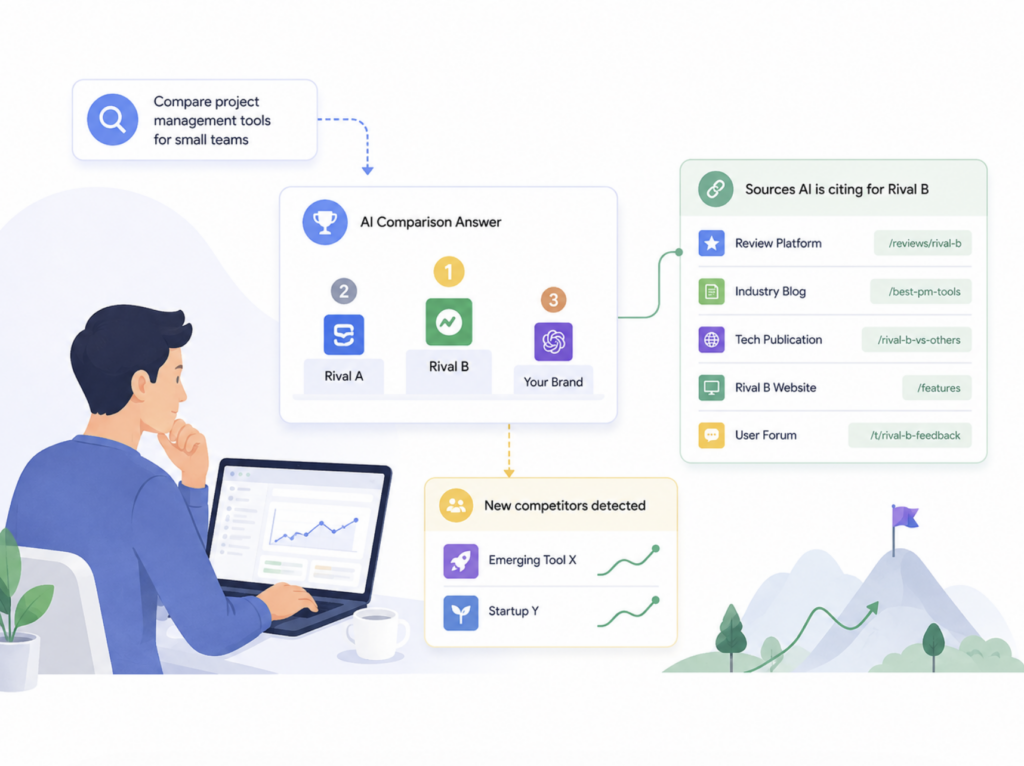
    Source Analysis and Citation Reverse-Engineering supports Skill 2. It reveals exactly which URLs and domains AI engines cite instead of yours, so you can target citation gaps with surgical precision.

    High-Value Prompt Discovery addresses Skill 4. Instead of estimated search volume, Topify surfaces the specific conversational questions driving real AI traffic.

    One-Click Execution supports Skill 1. Page-level optimization recommendations deploy through guided workflows, turning architectural best practices into action without manual restructuring.

    Dynamic Competitor Benchmarking gives teams the cross-platform visibility that Skill 3 demands. Whether you’re defending an 86% share in a mature category or competing for marginal gains in a fragmented market, the data is continuous, not a one-time snapshot.

    CapabilityFree GEO CheckersTopify Platform
    Audit FocusSingle-page structural readinessMulti-model Brand Visibility Index
    TrackingSnapshot, no historical dataContinuous daily monitoring and trends
    Competitor InsightMinimal or noneDynamic cross-platform benchmarking
    ActionabilityScores without a roadmapOne-click strategy deployment
    IntegrationNoneGA4 and Shopify for revenue attribution

    How to Build Your AEO Skill Stack in 90 Days

    Month 1: Audit and Foundations. Audit current content for AI readiness: structure, clarity, and authority signals. Identify the 10 to 20 commercial prompts that define your buyer journey. Establish Share of Model as a KPI and integrate AI visibility tracking into your dashboards. Use the GitHub free tools reference for initial assessments and Topify’svisibility checker for cross-platform baselines.

    Month 2: Optimization and Monitoring. Restructure your top 10 performing pages using answer-first formatting. Implement FAQ schema and add citation-worthy statistics with proper attribution. Start earning third-party validation by seeding content into high-authority communities and industry platforms. Use Topify’s Source Analysis to identify which domains AI engines are citing instead of yours.

    Month 3: Agentic Execution and Benchmarking. Scale optimization to the next 20 to 30 priority pages. Implement llms.txt and AGENTS.md for agentic discovery. Conduct a full competitive audit to identify citation gaps and adjust strategy to displace competitors in high-value AI responses. Get started with Topify to close the loop between insight and execution.

    Conclusion

    The AEO skill stack isn’t a nice-to-have certification. It’s the operating system for marketing in 2026.

    Your SEO foundation still matters. But the layer that drives revenue, the layer where a 15.9% conversion rate replaces a 1.76% baseline, is built on AEO and GEO skills. Start with free tools to learn the fundamentals, then move to a platform like Topify that connects visibility data to execution. The brands that build this skill stack now won’t just survive the shift to generative search. They’ll own it.

    FAQ

    Q: What is an AEO skill? 

    A: An AEO skill is the ability to structure and distribute content so that AI-powered search features, like Google AI Overviews, ChatGPT, and Perplexity, select and cite your brand as the definitive answer to a user’s question.

    Q: How is AEO different from SEO? 

    A: SEO optimizes for rankings and clicks in a list of links. AEO optimizes for selection and synthesis within an AI-generated answer. Success in AEO often leads to “zero-click” visibility, where your brand gains authority even if the user doesn’t visit your site.

    Q: Do I need to learn GEO if I already know AEO? 

    A: Yes. AEO focuses on being selected for an answer. GEO focuses on influencing how the AI model interprets your brand across the entire web, including AI agents, cross-platform sentiment, and entity authority.

    Q: What tools help build AEO skills? 

    A: Free resources like the GEO free tools reference on GitHub are solid for initial audits. For ongoing multi-model tracking, competitor benchmarking, and one-click strategy deployment, Topify is built specifically for the AEO and GEO workflow.

    Read More

  • AI Brand Visibility: A Quarterly Playbook for Marketing Teams

    AI Brand Visibility: A Quarterly Playbook for Marketing Teams

    Your team ran a solid SEO campaign last quarter. Rankings climbed. Backlinks grew. Then someone on the leadership team typed a buying question into ChatGPT, and your brand didn’t show up once. Five competitors did.

    That gap between traditional search performance and AI search presence is widening every month. And right now, only 16% of brands systematically track how they appear in AI-generated answers. The other 84% are running blind in the channel where their buyers are increasingly making decisions.

    This playbook breaks AI brand visibility into four quarters of structured, measurable work, so your team stops guessing and starts building presence where it counts.

    Most Marketing Teams Check ChatGPT Once and Call It a Strategy

    Here’s what typically happens: someone on the marketing team asks ChatGPT about the brand, screenshots the result, shares it in Slack, and moves on. That’s curiosity, not strategy.

    A one-time check can’t account for how quickly AI models update their retrieval sources. It doesn’t give you a baseline, a competitor benchmark, or a repeatable measurement framework. Without those, there’s no way to know if your visibility is improving, declining, or stuck.

    The stakes are higher than most teams realize. Zero-click searches now account for 58.5% of queries in the US. When Google’s AI Overviews are present, that number jumps to 83%. In full generative AI Mode, it hits 93%. That means most of your potential buyers never leave the AI interface to visit a website.

    They make decisions based on what the AI tells them.

    The quarterly playbook described here replaces that one-time check with a repeating cycle: diagnose, analyze, optimize, scale. Each quarter builds on the last, and each one produces measurable outputs your team can report on.

    Q1: Set Your AI Brand Visibility Baseline

    You can’t improve what you haven’t measured. The first quarter is entirely diagnostic: figuring out where your brand stands across the AI platforms your buyers actually use.

    ChatGPT currently holds 60.6% of the AI search market, with 800 million weekly active users processing over 1 billion queries per day. Google Gemini accounts for 15.1%, Microsoft Copilot sits at 12.5%, and Perplexity captures 5.4%. But Perplexity punches above its market share in one critical way: it drives roughly 15% of all AI-driven referral traffic, making it a high-intent research channel that’s easy to overlook.

    McKinsey’s research suggests that even well-performing brands often find their GEO (Generative Engine Optimization) performance lags behind their traditional SEO results by 20% to 50%. So a strong Google ranking doesn’t mean your brand is showing up in AI answers.

    Pick the Right Prompts to Track, Not Just Keywords

    The biggest mental shift in Q1 is moving from keyword tracking to prompt tracking. In traditional search, you’d track “CRM software.” In AI search, users ask conversational questions like “What’s the best CRM for a 50-person fintech startup focused on compliance?” AI prompts average 23 words, compared to the 4-word average of traditional search queries.

    Your team should mine four sources for high-value prompts: customer support tickets (the questions people actually ask), sales call transcripts (the comparison criteria prospects use), Google Search Console long-tail queries (5+ words), and Reddit or Quora threads (how people phrase questions outside SEO constraints).

    Then categorize those prompts into three clusters: awareness prompts (“How does X solve Y?”), commercial prompts (“What are the top 5 tools for Z?”), and branded prompts (“Is [brand] compliant with [regulation]?”).

    Topify‘s High-Value Prompt Discovery feature automates much of this work. It surfaces the exact questions users are asking across AI platforms and identifies which ones matter most for your category.

    Seven Metrics That Define Your AI Baseline

    To build a real baseline, you’ll need more than “yes, the brand appeared.” Topify tracks seven core indicators that together paint a complete picture of AI brand visibility:

    MetricWhat It Measures
    AI Visibility Score% of target prompts where the brand appears
    Citation FrequencyHow often AI links to your site as a source
    Brand Mention RateHow often your brand is named in the response
    AI Share of VoiceYour mention frequency vs. direct competitors
    Sentiment ScoreThe tone of the AI’s portrayal (0-100 scale)
    Position RankingWhere you appear in AI recommendation lists
    Information DensityHow “citeable” your content is compared to competitors

    By the end of Q1, your team should have baseline scores for each metric across at least ChatGPT, Perplexity, and Google AI Overviews, plus a clear competitor benchmark.

    Q2: The Gap Between Getting Mentioned and Getting Cited

    Q2 shifts focus from “where do we stand” to “why aren’t we showing up where we should be.” The core concept here is what researchers call the Mention-Source Divide: the gap where AI platforms use your content as a source but don’t recommend your brand by name.

    Only 28% of brands currently achieve both frequent mentions and consistent citations. That means most brands fall into one of two traps: they either get cited in footnotes (the AI trusts their data) but never named in recommendations, or they get mentioned without citation links (the AI associates the brand with the category but doesn’t trust the content enough to source it).

    Those are two very different problems with two very different fixes.

    Why Citations and Mentions Aren’t the Same Thing

    A citation means the AI linked to your website as a reference. It proves the AI trusts your data, but it doesn’t necessarily put your brand on the buyer’s shortlist. A mention means the AI named your brand directly in its answer. That’s what puts you on the shortlist.

    In regulated industries like financial services, brand-owned websites account for 47% of AI citations because the AI needs authoritative first-party sources. In tech and CPG, the AI leans more heavily on Reddit, Wikipedia, G2, and Capterra.

    Topify’s Source Analysis feature lets you reverse-engineer exactly which domains the AI is citing in your category. You can see, at the URL level, which competitor pages are getting referenced and which of your pages are being overlooked.

    Running a Citation Gap Analysis

    The practical framework for Q2 is a four-step citation gap analysis:

    Define your visibility benchmarks and identify the competitors the AI is recommending. Explore which domains the AI currently trusts as sources for your key prompts. Evaluate the gap between your citation count and your top competitor’s. Plan specific content updates to close the gap, prioritized by prompt volume and business value.

    Often, the gap exists because a competitor’s page provides more “Information Gain”: original data, proprietary statistics, or expert quotes that the AI can easily extract and reference. If a competitor is cited for “best sustainable skincare in 2026” and you’re not, the fix usually isn’t more content. It’s richer content.

    Entity authority also plays a role here. AI models don’t view brands as websites. They view them as entities in a knowledge graph, built through consistent mentions across trusted sources like Wikipedia, industry publications, and community forums. The more consistently these sources associate your brand with a specific category, the more confident the AI becomes in recommending you.

    Q3: Optimize Your Content and Track How AI Sentiment Shifts

    Q3 is the execution phase. You’ve got your baseline from Q1 and your gap analysis from Q2. Now it’s time to close those gaps with GEO (Generative Engine Optimization) tactics and monitor how the AI’s perception of your brand changes in response.

    GEO works because of how AI models generate answers. Most use a process called Retrieval-Augmented Generation (RAG), which pulls “text chunks” from the web to ground responses in facts. Content that’s thin, unstructured, or lacks original data tends to get skipped by the retriever.

    joint study by Princeton and Georgia Tech found that specific GEO tactics can increase AI visibility by up to 40%. The most effective ones include adding verifiable statistics, citing authoritative external sources within your own content, incorporating expert quotes, leading sections with direct answer-first formatting, and using clear heading structures with tables and lists that help AI crawlers parse information.

    Topify’s One-Click Execution agent puts these recommendations directly into your workflow: it identifies which pages need a specific statistic added, which headers need restructuring, and deploys the changes without manual intervention.

    Don’t Just Track Visibility. Track What the AI Says About You.

    Appearing in an AI response with negative or inaccurate characterization is worse than not appearing at all. If the AI describes your enterprise product as “a budget option for small teams,” that’s actively working against your positioning.

    Topify’s Sentiment Analysis scores your brand perception on a 0-100 scale. Scores between 85-100 mean the AI recommends you with confidence. A score around 50 is neutral: the AI mentions you without endorsement. Anything below 50 signals that the AI may be highlighting outdated pricing, quality concerns, or negative review signals.

    Shifting sentiment requires what’s sometimes called “Entity Consistency.” Your brand name, core features, and value propositions need to be described in the same terms across your website, LinkedIn, PR releases, third-party directories, and community forums. When the AI triangulates information from multiple sources and finds consistent messaging, its confidence in recommending your brand goes up.

    Proactively contributing helpful, non-promotional answers in Reddit discussions in your category can also influence future RAG retrievals and training data, gradually shifting how AI models characterize your brand.

    Q4: Scale What Works and Prove AI Brand Visibility ROI

    By Q4, your team has three quarters of data. The goal now is financial validation: proving to leadership that AI brand visibility translates to revenue, and scaling the tactics that produced the best results.

    Traditional CTR doesn’t capture the full picture here, because the buyer journey increasingly happens inside the AI answer itself. Instead, your team should report on the Conversion Visibility Rate (CVR): how effectively AI mentions convert into meaningful brand interactions.

    Here’s why CVR matters. AI search traffic converts at a rate 4.4 times higher than traditional organic search. The user has already been pre-qualified by the AI. By the time they click a source link, they’ve evaluated their options and are further down the purchase funnel. By May 2025, revenue per visit from AI referrals had reached up to 70% of the value of traditional traffic, and that ratio keeps improving.

    Putting a Dollar Value on AI Visibility

    The AI Brand Mention Valuation (ABMV) model gives marketing leadership a concrete number. It treats AI mentions like premium reach-based impressions, similar to a billboard or TV spot, but with the added context of a personalized recommendation.

    The formula: multiply your category’s total monthly AI query volume by your target visibility share, apply an attention factor (1.0 for a primary recommendation, 0.5 for a footnote), then multiply by the industry-specific AI CPM. For B2B SaaS, that CPM runs around $66 per thousand impressions.

    Using Topify‘s AI Volume Analytics, teams can calculate their current ABMV and compare it against program costs. In low-competition niches, teams typically see an ROI between 2.6x and 3.9x.

    Moving from Quarterly Reviews to Continuous Monitoring

    The final maturity step is automating the cycle. AI search results aren’t static rankings. They’re behavioral outputs that can shift within hours based on new content, social engagement, or competitor moves.

    Topify’s AI Agent handles this through autonomous research (mapping visibility gaps in real time), Reddit reply generation (drafting helpful responses in active discussions), and one-click publishing (deploying optimized content with proper schema and formatting).

    What Changes After a Full Year of This Playbook

    When a team commits to this quarterly cadence for 12 months, the results compound. Here’s what the typical progression looks like:

    QuarterPrimary Outcome
    Q1 (Months 1-3)Baseline data, prompt library, and competitor benchmarks established
    Q2 (Months 4-6)Source gaps closed; brand transitions from citation-only to active mention status
    Q3 (Months 7-9)GEO tactics produce measurable visibility lift, typically +10-18%; sentiment stabilizes
    Q4 (Months 10-12)CVR and ABMV validate commercial ROI; brand becomes a consistent AI recommendation

    The difference between a team that runs this playbook and one that doesn’t isn’t just data. It’s predictability. One team knows exactly where its brand stands in AI search, how it compares to competitors, and what to do next quarter. The other team is still taking screenshots from ChatGPT and hoping for the best.

    In a world where 93% of generative searches produce zero clicks, the brands that win are the ones that manage what the AI believes about them. A quarterly rhythm is how that management becomes operational.

    Conclusion

    AI brand visibility isn’t a one-time project. It’s an ongoing operating rhythm that compounds over four quarters, from diagnostic baseline to financial proof of ROI. The playbook above gives marketing teams a clear path: measure in Q1, analyze gaps in Q2, optimize in Q3, and scale in Q4.

    The teams that start this process now will have 12 months of compounding data and improving AI presence by the time their competitors figure out where to begin. The tools and frameworks exist. The only variable is whether your team builds the cadence.

    FAQ

    Q: What is AI brand visibility?

    A: AI brand visibility measures how often and in what context your brand appears in AI-generated answers across platforms like ChatGPT, Perplexity, and Google Gemini. It includes three dimensions: presence (does the AI mention you), sentiment (how does the AI describe you), and citations (does the AI link to your content as a source).

    Q: How often should I check my brand’s AI search visibility?

    A: A quarterly strategic review is the standard cadence for marketing teams. That said, high-value prompts should be monitored weekly for sentiment shifts or factual errors, and a full prompt library audit should happen monthly to track competitive share of voice.

    Q: Which AI platforms matter most for brand visibility?

    A: ChatGPT leads in volume with 60.6% market share. Google AI Overviews and Gemini are critical for capturing general search intent due to their integration with traditional search. Perplexity is especially important for B2B and research-heavy industries because of its high citation rate and 15% share of AI referral traffic.

    Q: How long does it take to improve AI brand visibility?

    A: Technical fixes like unblocking AI crawlers can take effect within days. Measurable changes in citation rates from GEO-optimized content typically appear within 60 to 90 days. Significant shifts in brand recommendations and overall sentiment usually require 6 to 12 months of consistent cross-platform entity building.

    Read More

  • How to Run an AI Brand Visibility Audit in 30 Minutes

    How to Run an AI Brand Visibility Audit in 30 Minutes

    You Googled your brand last week and liked what you saw. Then you typed the same question into ChatGPT, and your company didn’t show up once. Worse, your competitor did, listed first, described as “the leading solution.”

    That gap between Google rankings and AI recommendations is where most brands are losing ground right now. Only about 30% of brands maintain stable visibility across multiple AI-generated responses, which means the other 70% are either invisible or inconsistently represented every time someone asks an AI engine for a recommendation. The fix starts with a structured audit you can run in half an hour, using nothing but a browser and a spreadsheet.

    What an AI Brand Visibility Audit Actually Measures

    A traditional SEO audit checks rankings, backlinks, and page speed. An AI brand visibility audit measures something fundamentally different: whether AI systems mention, cite, and accurately describe your brand when users ask questions in your category.

    The distinction matters because AI engines don’t just rank pages. They synthesize answers from multiple sources using a process called Retrieval-Augmented Generation (RAG). The model pulls content from its training data and real-time web retrieval, scores it for authority and relevance, then blends it into a single response. If your content doesn’t get retrieved in that pipeline, you’re not in the answer.

    Here’s what makes this tricky: strong Google rankings don’t guarantee AI visibility. Research shows that roughly 28% of pages frequently cited by ChatGPT have almost no organic search ranking on Google. AI engines weigh content differently, favoring semantic clarity, fact density, and third-party consensus over traditional link authority.

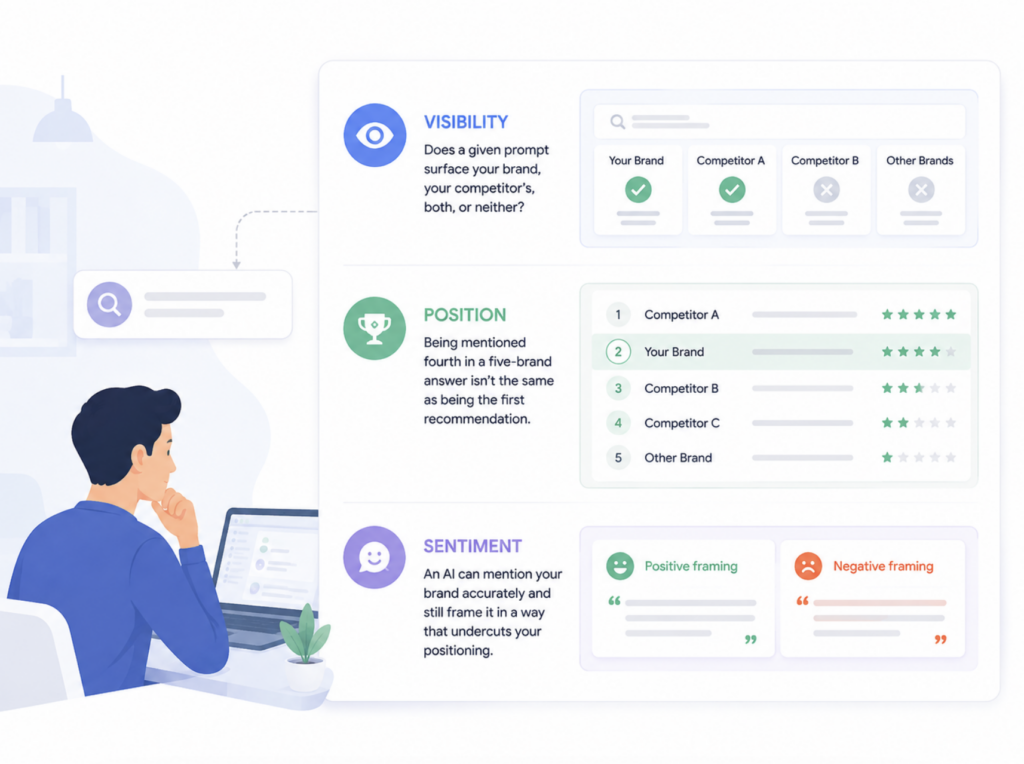
    That’s why a proper audit tracks four dimensions, not just one. Visibility measures whether your brand appears at all. Sentiment captures how AI describes you. Position tracks where you rank relative to competitors in a list. And source analysis reveals which domains AI is citing to justify its recommendation.

    The 30-Minute AI Brand Visibility Audit: Step by Step

    This framework breaks the process into five steps. Each one has a time budget, and the total adds up to 30 minutes.

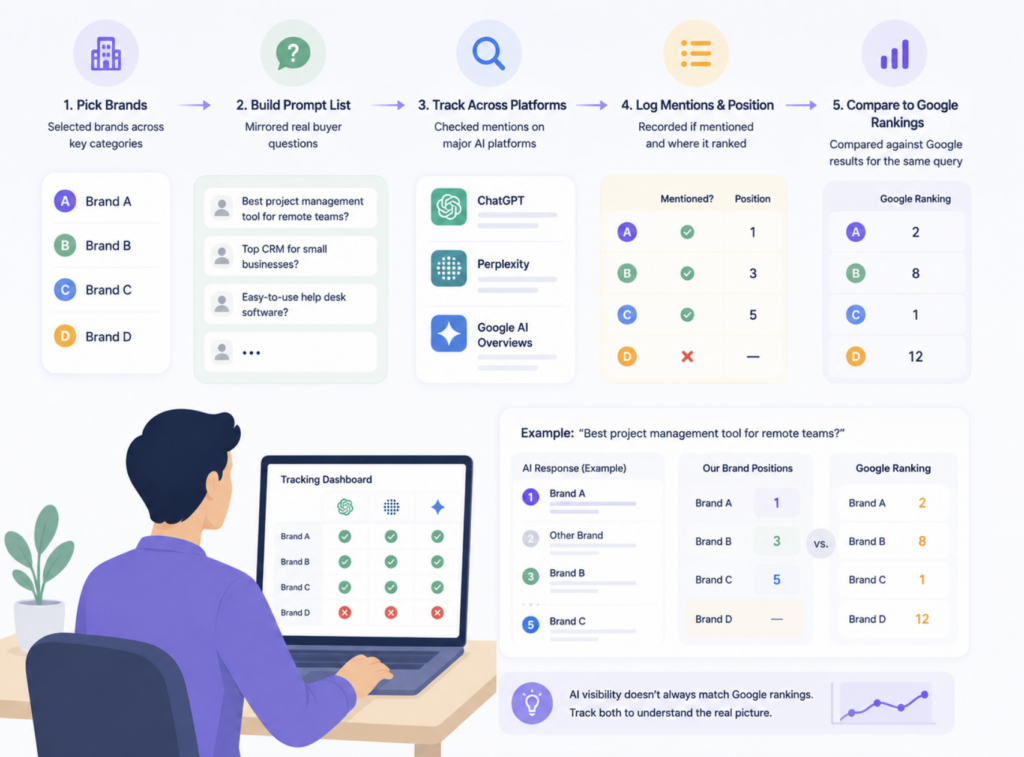
    Step 1: Build a Prompt Library That Mirrors Your Buyer’s Journey (5 min)

    Most brands start by typing their company name into ChatGPT. That’s the wrong input. Real buyers don’t search by brand name in AI. They ask questions like “What’s the best project management tool for a 50-person remote team?” The average AI prompt is 23 words long, far closer to a natural question than a keyword.

    Build a list of 10 to 15 prompts that cover three intent stages. Top-of-funnel prompts test whether AI mentions your brand during educational queries (“What is [concept] and how does it work?”). Mid-funnel prompts test category recommendations (“What are the best tools for [use case]?”). Bottom-of-funnel prompts test head-to-head comparisons (“How does [Brand A] compare to [Brand B] for [feature]?”).

    Add modifiers that reflect real buyer constraints: budget, company size, industry, existing tech stack. These qualifiers often change which brands AI recommends.

    Step 2: Run Each Prompt Across Three AI Platforms (10 min)

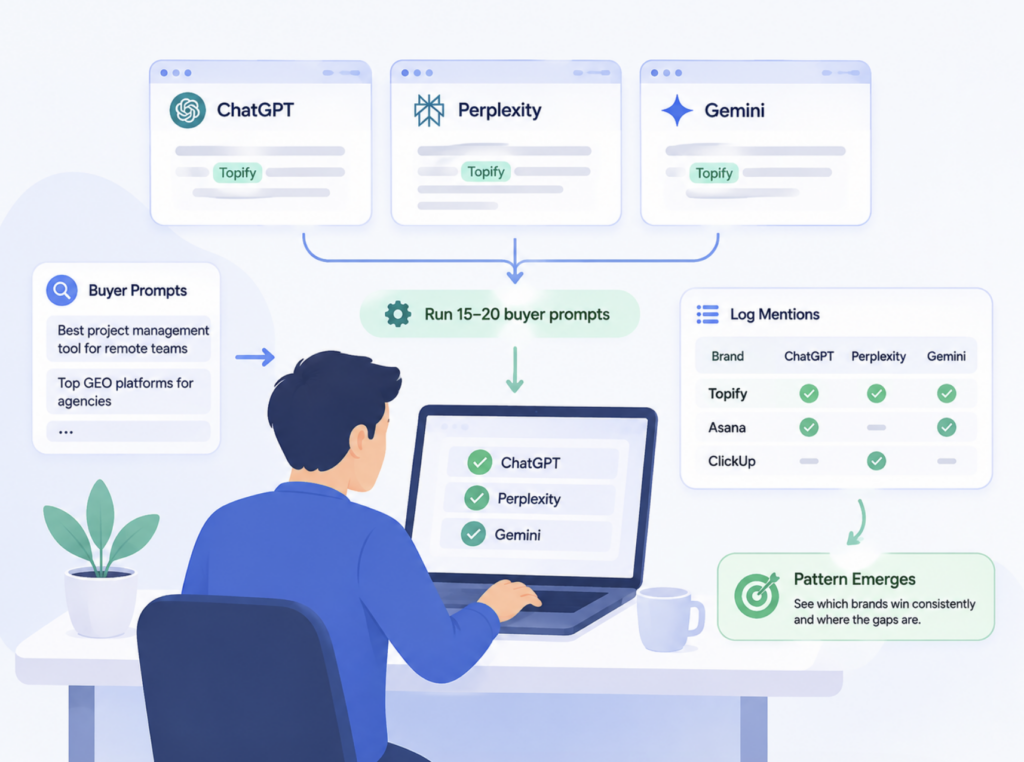
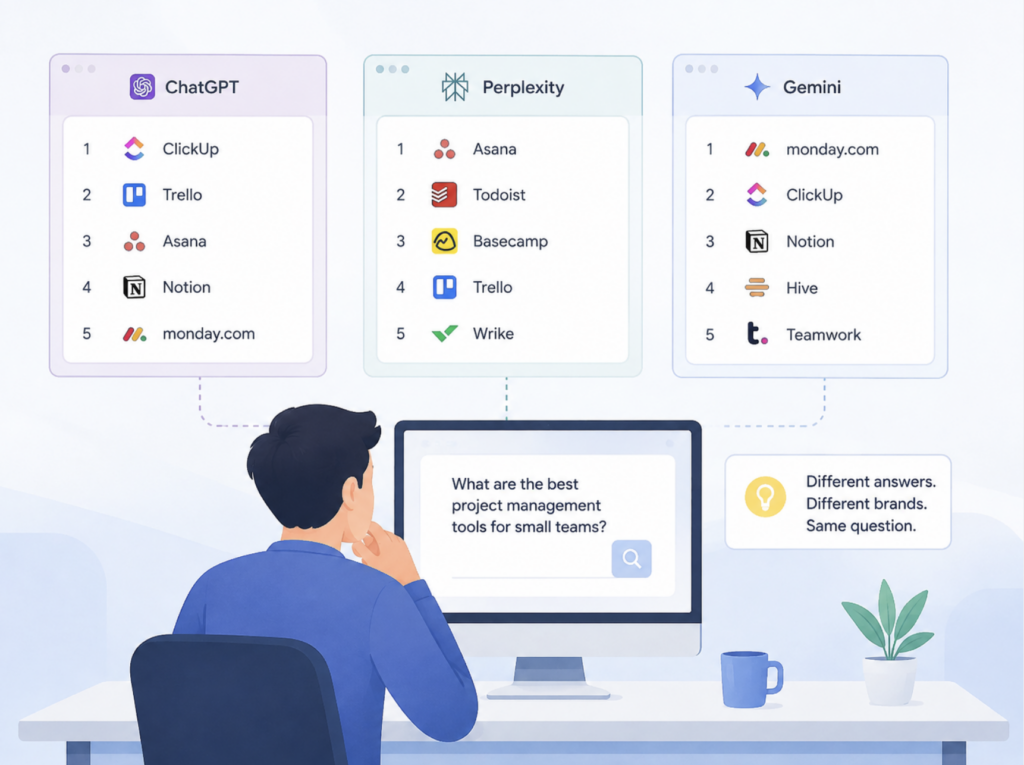
    Open ChatGPT, Perplexity, and Google Gemini in separate tabs. Run each prompt on all three. You’ll be surprised how much the answers vary.

    ChatGPT holds roughly 77% of the AI search market, so it’s your primary benchmark. But Perplexity is growing fast and tends to cite sources more visibly, which makes it useful for understanding your citation footprint. Gemini integrates deeply with Google’s ecosystem, meaning AI Overviews and Gemini often share citation logic.

    For each response, record five things in your spreadsheet:

    Mention frequency: Did your brand appear? Yes or no.

    Citation status: Did the AI link to your website or any page about your brand?

    Position: If multiple brands were listed, where did yours rank? First position is disproportionately valuable. Research indicates that the first-mentioned brand in an AI response can see a 32% or higher lift in purchase intent.

    Sentiment: How did the AI describe you? Words like “leading,” “trusted,” and “comprehensive” signal positive positioning. Phrases like “budget-friendly,” “limited features,” or “mixed reviews” indicate a perception gap.

    Source trail: Which third-party sites did the AI cite when discussing your brand? These are the domains feeding your AI reputation.

    Step 3: Score What You Find (5 min)

    Use a simple 0-to-2 scoring framework for each prompt and platform combination:

    ScoreVisibilitySentimentPosition
    0Not mentionedNegative or inaccurateNot listed
    1Mentioned but not citedNeutral or genericListed but not in top 3
    2Mentioned and citedPositive and accurateTop 3 or first mentioned

    Tally your scores across all prompts and platforms. A perfect score on 15 prompts across 3 platforms would be 270 (15 x 3 x 3 dimensions x max score 2). Most brands score below 40% on their first audit.

    Step 4: Map the Sources AI Is Citing (5 min)

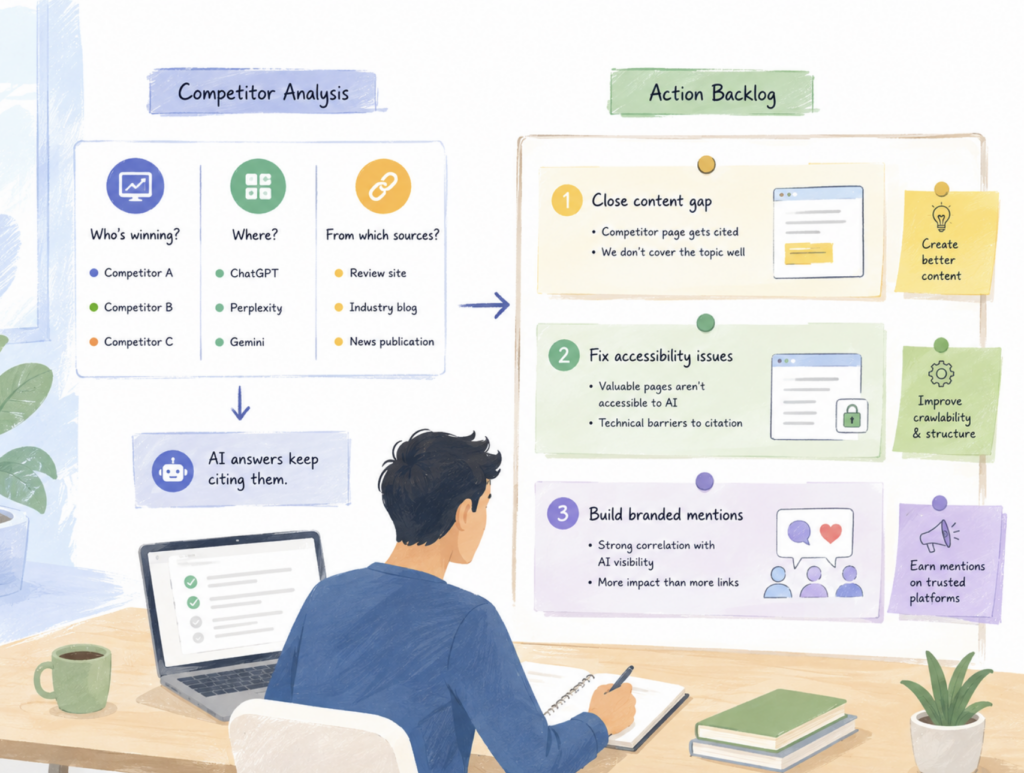
    Go back through the responses and list every domain the AI referenced when discussing your category. You’ll typically see a mix of review platforms (G2, Capterra), media outlets, Reddit threads, and competitor blogs.

    This matters because earned media accounts for an estimated 84% of all AI citations. Your own website often appears as a secondary source, not a primary one. The domains AI cites are your “trust neighborhood,” and if you’re not present on those sites, AI has no third-party evidence to support recommending you.

    Look for two patterns. First, “mentioned but not cited” queries: the AI knows your brand exists but doesn’t link to you, which signals a source gap. Second, competitor-dominant sources: domains where competitors are cited heavily but your brand isn’t mentioned at all.

    Step 5: Run a Quick Technical Health Check (5 min)

    Even strong content won’t appear in AI responses if the technical foundation blocks it. Check three things:

    Your robots.txt file should allow access to GPTBot, OAI-Searchbot, Google-Extended, and PerplexityBot. If any of these are blocked, your content is invisible to that AI platform’s retrieval layer.

    Your page structure should use clear H1 through H3 hierarchy, with paragraphs kept to 40 to 60 words. This is the optimal length for AI extraction. Dense, unstructured pages get passed over.

    Consider whether you’ve created an llms.txt file. This is a newer convention that lets brands explicitly tell AI crawlers what their site is about and which pages matter most.

    Where Free Methods Hit a Wall

    The 30-minute audit gives you a baseline. That’s its value. But it also has hard limits.

    Ten to fifteen prompts only scratch the surface. A brand competing in a complex category might need 100 or more prompts to get an accurate picture. Running those manually across three platforms takes hours, not minutes.

    The bigger problem is that AI responses aren’t static. Models update, citation patterns shift, and competitor content evolves. A snapshot from today could be irrelevant in three weeks. Research on model drift shows that only around 30% of brands maintain consistent visibility across multiple response generations.

    There’s also the accuracy issue. Manual audits rely on human judgment to score sentiment and track positions. Automated systems typically push data accuracy from the 60 to 70% range up to 95% or higher, because they standardize measurement and eliminate subjective scoring.

    The bottom line: if you’re running this audit once a quarter and covering fewer than 20 prompts, free methods work. If you need weekly monitoring, competitive benchmarking, or client-facing reports, the manual approach breaks down fast.

    When It Makes Sense to Pay for AI Brand Visibility Tools

    Three signals tell you it’s time to move beyond manual audits.

    Signal 1: You’re tracking more than 20 prompts. Once you cross that threshold, the time cost of manual testing exceeds the value of the data. Employees already spend an average of 4.3 hours per week verifying AI-generated content, at an estimated cost of $14,200 per person per year. Adding manual brand audits on top of that isn’t sustainable.

    Signal 2: You need to report AI visibility to stakeholders. Whether it’s a CMO asking for monthly metrics or clients expecting competitive intelligence, you need standardized, repeatable data. AI-driven audit platforms generate reports 70 to 90% faster than manual methods.

    Signal 3: Competitors are already monitoring their AI presence. If your competitors are using tools to track and optimize their AI visibility while you’re still hand-checking ChatGPT responses, the gap will only widen.

    For teams that hit these triggers, Topify tends to stand out by combining visibility, sentiment, position, competitor benchmarking, and source analysis into a single platform. In practice, this means you can track your brand across ChatGPT, Perplexity, Gemini, and other AI engines from one dashboard, see exactly which domains AI is citing, and spot visibility drops before they become a pattern.

    Topify’s competitor monitoring automatically detects rivals in your category and benchmarks your share of model against theirs. The pricing starts at $99 per month, which positions it well below enterprise-only platforms that start at $499 or more.

    For teams that want to validate the concept before committing, Topify also offers a free GEO score check that gives you a quick read on your site’s AI search readiness.

    Turn Your Audit Into an Ongoing AI Brand Visibility Strategy

    An audit is a starting point, not a strategy. The real value comes from turning those initial findings into a recurring workflow.

    Set a monthly cadence for re-running your core prompt library. Track three metrics over time: share of model (the percentage of category queries where your brand appears), net sentiment score (positive mentions minus negative mentions), and citation rate (how often AI links to your content versus just mentioning your name).

    If your citation rate is low but your mention rate is high, AI knows you exist but doesn’t trust your content enough to cite it. That’s a signal to invest in third-party coverage: industry media, review platforms, expert roundups, and community discussions. Princeton’s GEO research found that content citing authoritative sources saw a 40% visibility lift, and adding statistical data points boosted it by 37%.

    For brands ready to move from manual tracking to automated monitoring, Topify’s one-click execution feature lets you define your goals in plain language and deploy a monitoring strategy without building manual workflows. The system continuously surfaces new high-value prompts as AI recommendations evolve.

    Conclusion

    The 30-minute audit won’t solve your AI brand visibility problem. But it will show you exactly where the problem is: which prompts you’re missing from, which platforms describe you inaccurately, and which competitor is occupying the position you should hold.

    Start with the free method. Build your prompt library, run cross-platform tests, and score what you find. When you hit the ceiling, whether it’s prompt volume, reporting needs, or competitive pressure, move to a platform that can scale the process. The brands that win in AI search are the ones that stopped guessing and started measuring.

    FAQ

    Q: What is an AI brand visibility audit? 

    A: It’s a structured process for checking how AI platforms like ChatGPT, Perplexity, and Gemini mention, describe, and cite your brand. Unlike a traditional SEO audit that focuses on search rankings, an AI visibility audit measures whether your brand appears in AI-generated answers, how it’s positioned relative to competitors, and whether the AI’s description matches your actual brand messaging.

    Q: How often should I audit my brand’s AI visibility? 

    A: At minimum, once a month. AI models update frequently, and citation patterns can shift in weeks. Brands in competitive categories or those actively running content campaigns should consider weekly monitoring, ideally through an automated tool that flags changes in real time.

    Q: Can I track AI brand visibility for free? 

    A: Yes, for a basic audit. The 30-minute manual method in this article covers the essentials. But free methods don’t scale beyond 15 to 20 prompts, can’t provide historical trend data, and rely on subjective scoring. For ongoing monitoring, tools like Topify offer structured tracking starting at $99 per month.

    Q: What’s the difference between an SEO audit and an AI visibility audit? 

    A: An SEO audit evaluates your website’s performance in traditional search engine rankings, focusing on factors like backlinks, page speed, and keyword positioning. An AI visibility audit evaluates how AI systems synthesize and present your brand in their responses. The two can produce very different results. A page ranking well on Google may never appear in AI-generated answers, and vice versa.

    Read More

  • Your AI Visibility Score Hides Cross-Platform Gaps

    Your AI Visibility Score Hides Cross-Platform Gaps

    Your brand’s AI visibility score reads 72%. The quarterly report looks solid. Then you pull the platform-level data and the story falls apart: ChatGPT ranks you in the top three, Perplexity doesn’t mention you at all, and Gemini describes your product as a “budget option.” Three platforms, three completely different versions of your brand.

    That single number in your dashboard isn’t telling you where you’re winning or losing. It’s averaging out the gaps that actually determine whether high-intent buyers find you or your competitor first.

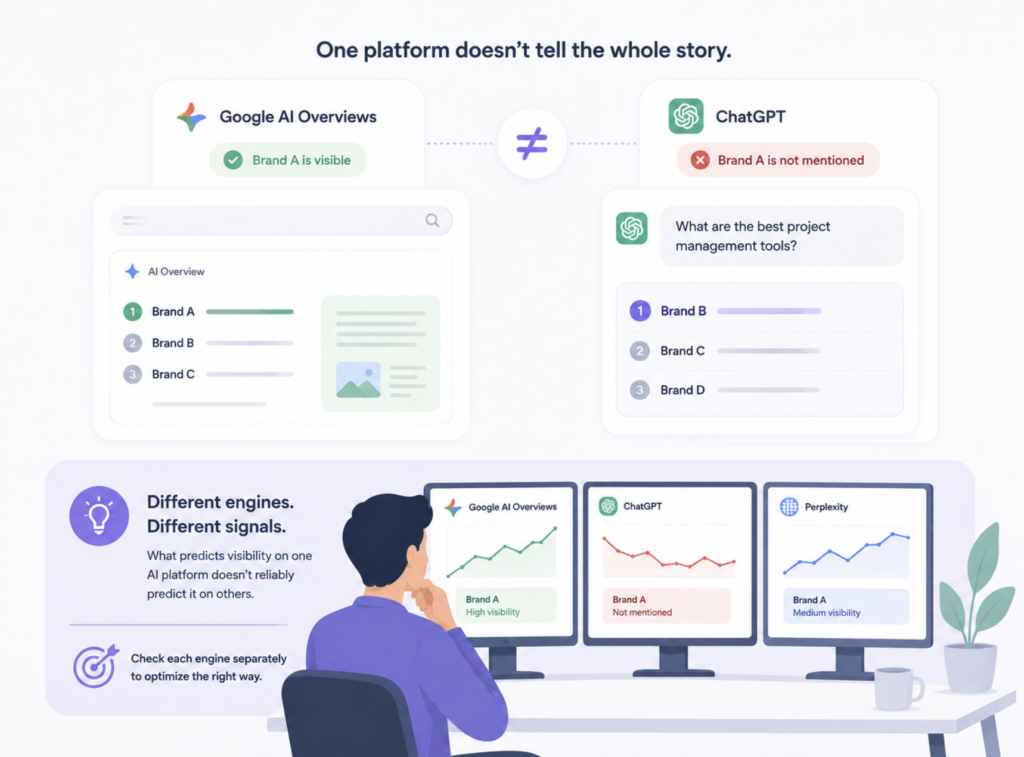
    Same Brand, Three Different AI Realities

    Think of a mid-market B2B SaaS company with strong domain authority and a decade of content. In a standard monthly AI visibility report, that brand might show a score of 70%. Looks fine.

    But split it by platform and the picture changes. ChatGPT treats the brand as a category leader because its pre-training data absorbed years of backlinks, press coverage, and directory listings. Perplexity skips the brand entirely because the company hasn’t published data-rich content in the past quarter. And Gemini pulls pricing info from an outdated third-party directory, labeling the product as “low-cost.”

    That’s not a bug. It’s a permanent feature of AI brand visibility in 2026.

    Each AI platform perceives the internet through a different lens. ChatGPT leans on historical authority. Perplexity rewards recency. Gemini trusts structured entities. When you average those into one number, you’re hiding the signal that matters most: where your brand is invisible to the audience segments you care about.

    Why ChatGPT, Perplexity, and Gemini Don’t Agree on Your Brand

    The disagreement comes down to architecture. These platforms don’t read the same internet, and they don’t trust the same signals.

    ChatGPT: Historical Authority Wins

    ChatGPT runs on a hybrid model. It has access to live search through Bing, but that browse capability only activates on roughly 34.5% of queries. The other 65% rely on the model’s internal knowledge base, which skews heavily toward established sources. An analysis of 680 million citations found that Wikipedia alone accounts for nearly 47.9% of ChatGPT’s top citation share. If your brand has years of third-party coverage and directory presence, ChatGPT already “knows” you. If you’re newer or pivoting, you’re fighting an uphill battle against its training data.

    Perplexity: Freshness Is Everything

    Perplexity operates as a 100% retrieval-augmented generation (RAG) engine. Every single query triggers a live web search. It retrieves roughly 10 candidate pages and cites 3 to 4 in its response. This means Perplexity is extremely sensitive to what’s been published recently. Content updated within the past 30 days is 3.2 times more likely to get cited than evergreen material. Perplexity also favors niche expertise: in unbranded queries, niche sources account for 24% of all citations, higher than any other major model.

    Gemini: Entity Ownership Matters

    Gemini sits inside Google’s ecosystem and draws heavily from the Google Knowledge Graph. A Yext study found that 52.15% of Gemini citations come from brand-owned websites, compared to ChatGPT’s reliance on third-party directories. If your structured data is clean, your Google Business Profile is accurate, and your schema markup is tight, Gemini trusts you. If those signals are fragmented or contradictory, Gemini either mischaracterizes you or drops you entirely.

    Here’s the thing: only 11% of cited domains overlap between ChatGPT and Perplexity. Optimizing for one platform doesn’t automatically help you on another. That’s why platform-level tracking isn’t optional anymore.

    The Total Score Trap: Why Averages Are Dangerous

    In traditional SEO, a domain’s average ranking gave you a reasonable proxy for digital health. In AI search, averages aren’t just misleading. They’re actively harmful to decision-making.

    A total AI brand visibility score of 70% could mean 90% on ChatGPT, 70% on Gemini, and 50% on Perplexity. That 50% doesn’t mean your brand shows up half the time. In most cases, it means you’re missing from the 3 to 5 citations an AI engine provides for high-intent comparison queries. Unlike Google’s search results, where you might still appear on page two, an AI response is a winner-takes-all environment. If you’re not in the top recommendations, you don’t exist for that user.

    This creates three specific failures:

    Failure TypeWhat HappensWhy It Hurts
    Platform Growth BlindnessA 20% drop in Perplexity visibility barely moves your total scoreYou miss that Perplexity is where your most technical buyers research
    Resource MisallocationTeams keep investing in PR for ChatGPT consensusThe real gap is technical schema for Gemini or content freshness for Perplexity
    Broken Conversion FunnelsStrong ChatGPT visibility feels like successPerplexity and AI Overviews drive higher-intent, closer-to-purchase traffic

    The conversion data makes this concrete. AI-driven traffic from ChatGPT converts at 15.9%, compared to 1.76% for traditional Google organic. Perplexity follows at 10.5%. When you’re invisible on these platforms, you’re not losing impressions. You’re losing buyers who are already 90% of the way through their decision.

    What Cross-Platform AI Brand Visibility Gaps Actually Tell You

    The gap between platforms isn’t random noise. It’s a diagnostic signal pointing to a specific problem in your content and authority ecosystem.

    Visible on ChatGPT, invisible on Perplexity means you have a freshness problem. Your historical authority is strong, but your real-time content game is weak. The fix: implement a 30-day content refresh cycle, submit new URLs via IndexNow for faster crawling, and publish original data that RAG systems can easily extract.

    Visible on Perplexity, invisible on ChatGPT means you have an authority depth problem. You’re producing content that ranks in real-time search, but ChatGPT’s model weights don’t recognize you as a category authority yet. The fix: earn mentions in high-DA encyclopedic sources, contribute to industry publications, and ensure consistent categorization across third-party directories.

    Gemini description doesn’t match your positioning means you have an entity integrity problem. Your Knowledge Graph footprint is fragmented. The fix: audit your Schema.org Organization and Product markup, update your Google Business Profile, and make sure your brand-owned properties are the strongest signal for how you’re categorized.

    Each pattern requires a different optimization strategy. That’s why a single “AI visibility” metric can’t drive action. You need the platform-level breakdown to know what to fix.

    How to Track AI Brand Visibility at the Platform Level

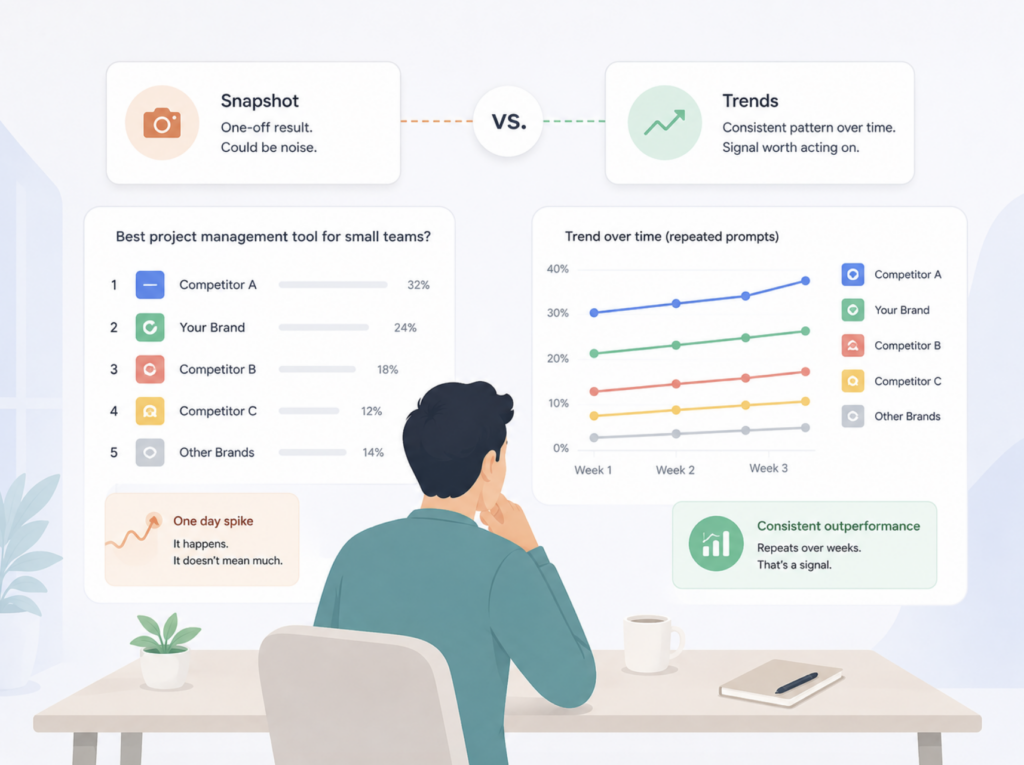
    Manual checks don’t scale. Asking ChatGPT “What’s the best CRM?” once a week gives you a snapshot of a stochastic model, not a trend. LLM outputs vary by session, and the results shift as training data and retrieval indexes update.

    Professional tracking in 2026 has moved toward automated “Share of Model” analysis. The methodology works by running thousands of natural language prompt variations across multiple platforms and geographic nodes, then calculating reliable visibility scores per engine.

    Topify takes this approach by treating LLMs as behavioral systems rather than searchable databases. Instead of tracking keywords, it tracks prompt-level brand appearance across ChatGPT, Perplexity, Gemini, DeepSeek, and other major AI platforms. The platform breaks the “total score” into the metrics that actually drive decisions:

    Mention Frequency tells you how often your brand appears per 1,000 relevant queries. Top brands in a category typically hit around 12%, while the average sits at 0.3%. Position Tracking shows whether you’re the first recommendation or buried as an afterthought. Source Analysis reveals which domains AI engines are citing when they talk about your category, so you can see where competitors are getting their authority. And Sentiment Monitoringcatches cases where an AI engine is technically mentioning you but describing you inaccurately.

    In practice, this means you can spot a drop in Perplexity visibility, trace it to a specific content gap, and know exactly which type of content to publish next. No guessing required.

    Closing the Gap: From Diagnosis to Action

    Once you’ve identified which platforms are underperforming, the execution framework is straightforward. Academic research from Princeton, Georgia Tech, and IIT Delhi found that adding original statistics to content increases AI citation likelihood by 41%. Including expert quotes with verifiable credentials provides a 30% boost in AI impressions. And structuring content with “answer capsules,” direct 40-to-80-word responses placed early in the page, increases citation rates by 3.2x.

    For Gemini specifically, implementing FAQPage and Organization schema increases AI citation likelihood by up to 40%. Entity linking, connecting your brand to founders, social profiles, and certifications through structured data, adds another 19.72% lift in AI Overview appearances.

    The economic case is clear. Gartner projects that by 2026, 30% of brand perception will be shaped by AI before a buyer ever visits a brand’s website. A SOCi audit of over 350,000 business locations found that ChatGPT recommends only 1.2% of local businesses. The gap between brands that track platform-level AI brand visibility and those that don’t is widening fast.

    The action loop is simple: identify the gap, diagnose the cause, deploy targeted content, and track the results continuously. AI models are iterative. Your visibility score isn’t a trophy. It’s a signal that changes every time an index refreshes.

    Conclusion

    Your total AI visibility score is an average. And averages hide the platform-level gaps that determine whether high-intent buyers find you or your competitor. The brands that win in 2026 won’t be the ones with the highest single number. They’ll be the ones that know exactly where they’re strong, where they’re invisible, and what to do about it, platform by platform.

    Stop flying blind on a number that smooths out the peaks and valleys. Start tracking the cross-platform AI brand visibility data that actually tells you where to act.

    FAQ

    Q: What is AI brand visibility? 

    A: AI brand visibility measures how often and in what context your brand appears in AI-generated answers from platforms like ChatGPT, Perplexity, and Gemini. Unlike traditional search rankings, it focuses on “Share of Model,” the frequency with which a model selects your brand as a recommendation for a user’s prompt.

    Q: Why does my brand show up on ChatGPT but not Perplexity? 

    A: The two platforms use fundamentally different architectures. ChatGPT relies heavily on pre-training data that rewards historical authority and internet consensus. Perplexity runs 100% real-time retrieval and prioritizes content freshness and niche expertise. If you’re missing from Perplexity, your recent content strategy and real-time SEO signals likely need work.

    Q: How often should I check AI brand visibility across platforms? 

    A: Weekly monitoring is recommended for category leaders, given that RAG indexes can update in 24 to 48 hours and LLM outputs are stochastic. Monthly audits are the minimum for standard brand health.

    Q: Can I improve visibility on one AI platform without affecting others? 

    A: Yes. Because only 11% of cited domains overlap between ChatGPT and Perplexity, you can target specific platforms. Implementing Schema.org markup primarily boosts Gemini and AI Overview visibility, while publishing original research statistics most directly impacts Perplexity citations.

    Read More

  • 5 AI Brand Visibility Metrics That Predict Revenue

    5 AI Brand Visibility Metrics That Predict Revenue

    Your dashboard has 12 AI visibility metrics. Your CMO only cares about one question: “What’s driving revenue?” You pull up mention counts, platform coverage, and prompt frequency, but none of them connect cleanly to pipeline or closed deals. Meanwhile, zero-click searches jumped from 56% to 69% between 2024 and 2025, which means more of your brand’s influence is happening inside AI interfaces where traditional analytics can’t reach.

    The disconnect isn’t a data problem. It’s a measurement problem. Most teams are tracking the wrong signals.

    The Gap Between AI Brand Visibility Data and Revenue

    Traditional SEO metrics were built for a click-based economy. Higher SERP ranking led to higher CTR, which led to more traffic and conversions. That pipeline made sense for a decade.

    It doesn’t work in AI search.

    When an AI Overview appears, the organic CTR for the top-ranking result drops by 61%, falling from 1.76% to just 0.61%. Paid CTR takes a similar hit, declining nearly 68%. Brands are watching their referral traffic shrink while their AI visibility climbs. Documented cases show companies losing 20% of referral traffic while simultaneously gaining 113% in AI mentions.

    That’s the paradox: more visibility, fewer clicks, unclear revenue impact.

    Only 16% of brands today systematically track their AI search performance. The rest are either ignoring the channel or measuring it with the wrong instruments. The result is misallocated budgets, skeptical leadership, and marketing teams that can’t defend their AI investments.

    Bridging this gap starts with knowing which metrics actually predict commercial outcomes, and which ones just look good in a slide deck.

    Five AI Brand Visibility Metrics That Correlate with Revenue

    Not every data point in your AI visibility stack carries the same weight. These five metrics have the strongest connection to downstream revenue.

    1. Conversion Visibility Rate: Where AI Mentions Meet Buyer Action

    Conversion Visibility Rate, or CVR, measures the probability that an AI mention drives a user toward a conversion action, even when no immediate click is recorded. It accounts for the “decision density” that happens inside conversational interfaces, where users research, compare, and filter options before they ever reach your site.

    The numbers are striking. Visitors arriving from AI search platforms convert at 23x the rate of traditional organic search visitors. That’s because they arrive pre-qualified: the AI has already done the browsing for them. Roughly 80% of AI-referred traffic lands on high-intent pages like product pages or free tool signups, not blog posts.

    Topify‘s CVR metric estimates conversion probability based on prompt intent and response sentiment. For marketing teams trying to connect AI impressions to pipeline, this is the closest thing to a revenue predictor in the current toolkit.

    2. Sentiment Score: How AI Characterizes Your Brand Changes Buying Behavior

    AI engines don’t just mention brands. They describe them. And the language they use, whether it’s “the leading solution” or “an alternative worth considering,” directly shapes purchase decisions.

    A brand mentioned in 60% of category prompts might seem healthy. But if the dominant tone across those mentions is cautious or negative, that visibility is actually a liability. Sentiment analysis catches what mention counts miss.

    Sentiment CategoryWhat It Sounds LikeRevenue Impact
    Endorsement“Top choice,” “Widely recommended”High: activates purchase triggers
    Neutral“Offers features,” “Is available”Moderate: visible but not persuasive
    Cautious“Worth considering but,” “Some users report”Negative: increases friction
    Negative“Not recommended for,” “Lacks compared to”Critical: drives users to competitors

    Topify’s Sentiment Analysis tracks these patterns across individual platforms. ChatGPT might describe a brand favorably while Perplexity ignores it entirely. Catching those platform-specific gaps early prevents them from becoming pipeline problems.

    3. Position in AI Recommendations: First Mention Wins

    In traditional search, position #1 earns the most clicks. In AI search, the first-named brand in a synthesized response captures an even larger share of user trust.

    Research shows that SERP position #1 earns a 33.07% chance of being cited in an AI Overview, while position #10 drops to just 13.04%. Brands cited in AI responses earn 35% more organic clicks and 91% more paid clicks compared to those that aren’t cited.

    Being the “first mention” in an AI summary functions as a new Position 0. It captures the high-intent traffic that still converts, even as overall CTR declines.

    Topify’s Position Tracking monitors brand ranking across multiple regenerations to account for the randomness built into LLM outputs. The result is a Response Position Index reflecting your average placement across thousands of simulations, not a single snapshot.

    4. AI Search Volume on High-Intent Prompts

    Not all AI prompts carry commercial value. A startup doesn’t need 10,000 users asking “what is CRM.” It needs 500 asking “Salesforce alternatives for Series B startups,” because the latter converts at roughly 10x the rate.

    High-intent prompts are the “dark query” pool that traditional keyword tools miss entirely. They’re conversational, specific, and often start with “who,” “what,” or “why” paired with a concrete use-case constraint.

    Focusing AI brand visibility tracking on these prompts changes everything. Generic, top-of-funnel queries like “What is search?” get resolved by the AI summary itself, generating zero clicks and zero revenue. Revenue lives in the long tail of specific, pain-point-driven conversational intent.

    Topify’s High-Value Prompt Discovery uses large-scale prompt matrixing to generate thousands of intent variations. This lets brands measure their Share of Voice across the exact queries that drive deals, not just impressions.

    5. Source Citation Frequency: The Backlink of AI Search

    Source citation frequency measures how often AI engines credit your domain as a primary source for their answers. Think of it as the AI-era equivalent of backlink authority: the more AI cites your content, the more likely it is to recommend you.

    Brand search volume carries a 0.334 correlation with model confidence, making it the strongest predictor of AI recommendation identified so far. But here’s the catch: 82% to 85% of AI citations come from third-party sources like media outlets, Reddit, and review platforms, not from a brand’s own website.

    That means off-site presence is a direct input for AI visibility. Distributing content through third-party channels can produce a 325% lift in AI citation rates compared to hosting the same material exclusively on an owned domain.

    Topify’s Source Analysis reverse-engineers the citation trails of each AI engine, showing which URLs are being retrieved and where your brand has coverage gaps.

    Three AI Brand Visibility Metrics That Don’t Predict Revenue

    These metrics show up on every AI visibility dashboard. They feel important. But they consistently fail to correlate with commercial outcomes.

    1. Raw Mention Count Without Context

    A brand appearing in 80% of AI searches looks impressive. But if 60% of those mentions carry cautious or neutral sentiment, or are tied to low-intent queries, the volume is noise. Raw counts don’t distinguish between a glowing endorsement and a factual footnote.

    Mention count tells you that AI knows your brand exists. It doesn’t tell you whether that knowledge is helping or hurting.

    2. Visibility Across Low-Intent Prompts

    High visibility on informational queries like “What is SEO?” inflates dashboards without moving revenue. These queries get fully resolved inside the AI interface. Users asking basic definitions are casual seekers who were never going to convert.

    The metric looks great in quarterly reports. It contributes nothing to pipeline.

    3. Platform Coverage Without Depth

    “We appear on 10 AI platforms” sounds like a win. But only 11% of cited domains show up across multiple AI engines, because each platform has a different indexing and retrieval strategy. Wide coverage with shallow authority means you’re present everywhere and influential nowhere.

    A brand with deep authority on Perplexity (which cites 3x more sources than ChatGPT) will typically outperform one that appears superficially across a dozen platforms.

    CategoryMetric That Predicts RevenueMetric That Doesn’t
    Revenue LinkConversion Visibility RateRaw AI-driven sessions
    Brand ImpactSentiment ScoreNumber of platforms covered
    Market ShareShare of LLM (weighted)Raw mention count
    User IntentHigh-Intent Prompt SOVLow-intent “What is” visibility
    AuthoritySource Citation FrequencyPlatform coverage count

    How to Build an AI Brand Visibility Dashboard Tied to Revenue

    Knowing which metrics matter is step one. Building a system that tracks them consistently is where most teams stall.

    Start by defining your “money prompt set”: 20 to 50 conversational questions that high-intent buyers in your category actually ask. Balance them across awareness, comparison, and branded queries.

    Next, establish a Share of LLM baseline. Score each appearance on a scale: 0 for no mention, 1 for passive mention, 2 for active citation, 3 for linked citation. Run this across ChatGPT, Gemini, Perplexity, and DeepSeek to build a weighted composite.

    Then diagnose the gaps. Where are competitors dominating prompts you should own? Is the cause a sentiment problem, a citation coverage problem, or a content structure problem? Each diagnosis points to a different fix.

    Topify’s platform combines all seven AI visibility dimensions, including Visibility, Volume, Position, Sentiment, Mentions, Intent, and CVR, into a single dashboard. Its one-click execution model translates detected gaps into specific optimization actions: updating content structure, adding schema, or expanding third-party distribution.

    For teams tired of presenting AI data that doesn’t connect to business results, this is the missing layer.

    Conclusion

    Not all AI brand visibility metrics deserve a spot on your dashboard. Raw mention counts, low-intent prompt coverage, and platform breadth without depth look good in presentations but consistently fail to predict revenue.

    The five metrics that do, CVR, Sentiment Score, Position, High-Intent Prompt Volume, and Source Citation Frequency, share a common trait: they measure influence, not just presence. Marketing teams that restructure their AI visibility tracking around these indicators will spend less time defending their dashboards and more time connecting AI performance to pipeline.

    The brands that win in AI search won’t be the most visible. They’ll be the most trusted, the most cited, and the most precisely positioned on the prompts that drive buying decisions.

    FAQ

    What is AI brand visibility and why does it matter for revenue?

    AI brand visibility measures how often your brand is surfaced, cited, and recommended in answers from AI engines like ChatGPT and Perplexity. It matters because AI-referred visitors convert at 23x the rate of traditional organic visitors, arriving pre-qualified by the AI’s research and filtering process.

    How do you measure AI brand visibility across different platforms?

    Measurement involves running thousands of prompt variations across platforms and geographic nodes to calculate a statistical Share of Voice, sometimes called Share of LLM. Professional platforms like Topify automate this by tracking seven key metrics including position, sentiment, and intent alignment.

    What’s the difference between AI visibility and traditional SEO visibility?

    Traditional SEO focuses on keyword rankings and backlinks to drive clicks to a URL. AI visibility focuses on synthesis and retrieval, where the goal is to have your brand facts integrated into the AI’s narrative and cited as an authoritative source, especially in the zero-click environment where users get their answers without leaving the AI platform.

    Can you improve AI brand visibility without increasing content volume?

    Yes. Distributing existing content through third-party channels like media outlets, review sites, and community platforms can produce a 325% lift in AI citation rates. The key is expanding off-site authority, not just publishing more on your own domain.

    Read More

  • AI Brand Visibility vs. Search Visibility vs. Mentions

    AI Brand Visibility vs. Search Visibility vs. Mentions

    Your marketing report says “AI visibility is up.” Your SEO lead says “AI search visibility is flat.” Your PR team says “AI mentions are growing.” All three are looking at the same AI platforms, and all three think they’re measuring the same thing.

    They’re not. These three metrics answer fundamentally different questions about your brand’s presence in AI-generated answers. Confusing them doesn’t just muddle your reporting. It sends your team chasing the wrong signals while the metric that actually matters stays untracked.

    The Terminology Problem That’s Costing Brands Real Data

    Most marketing teams treat “AI brand visibility,” “AI search visibility,” and “AI mentions” as interchangeable labels for one concept: whether AI knows your brand exists. That conflation made sense when the only visibility that mattered was a position on a list of blue links. It doesn’t hold up in the generative era.

    Here’s why the distinction matters now. 37% of consumers start their research directly in AI tools rather than Google. And 93% of those AI sessions end without a single website click. The AI’s answer is the final stop. So whether your brand gets mentioned, cited, or framed correctly inside that answer isn’t a branding nuance. It’s a revenue question.

    Each of these three metrics captures a different layer of that answer. Mix them up, and you’ll optimize for the wrong one.

    What AI Brand Visibility Actually Measures

    AI brand visibility is the broadest of the three. It’s a composite measure of how frequently and accurately your brand appears across AI-generated answers, summaries, and recommendations on platforms like ChatGPT, Gemini, and Perplexity.

    Think of it as the answer to: “Does AI know who we are, and does it describe us correctly?”

    That second part is what separates brand visibility from a simple mention count. AI brand visibility tracks the full framing of your brand: how the model describes your features, where it positions you relative to competitors, and whether it associates you with the right use cases. A brand can be mentioned ten times across AI answers and still have poor visibility if the model consistently mischaracterizes its positioning.

    This is where the concept of “Semantic Authority” comes into play. AI models calculate a synthesized score based on the frequency, diversity, and sentiment of brand references across their training data. A brand referenced across 500 high-authority domains carries more weight than one mentioned 100,000 times on low-quality sites. Quality of third-party validation matters exponentially more than volume of self-published content.

    The N-E-E-A-T-T framework (Notability, Experience, Expertise, Authoritativeness, Trustworthiness, and Transparency) determines how confidently an AI presents your brand. Low scores here don’t just reduce your visibility. They cause the AI to hedge, using cautious language like “Brand X may be suitable for small teams” instead of a direct recommendation.

    That hedging is measurable. And it’s one of the signals AI brand visibility is designed to catch.

    What AI Search Visibility Actually Measures

    AI search visibility is narrower. It zooms in on a specific question: “When someone asks AI about our category, do we show up in the answer?”

    Where brand visibility looks at the overall AI ecosystem, search visibility is prompt-specific. It tracks whether your brand appears in response to particular queries, what position you hold relative to competitors in those responses, and how consistently you show up across different prompt variations.

    This distinction matters because AI answers aren’t static. Ask ChatGPT “What’s the best CRM for nonprofits?” five times, and you might get three different brand recommendations. The prompt’s phrasing, the user’s location, and even the time of day can shift results. AI search visibility tools address this by running thousands of prompt variations across geographic nodes to calculate what’s sometimes called “Share of Model Voice.”

    Here’s a data point that underscores why search visibility needs its own metric: nearly 90% of ChatGPT citations come from pages that don’t rank on the first or second page of traditional Google results. AI platforms aren’t scraping the top of Google. They’re pulling from wherever the most semantically relevant and clearly structured content lives. Your Google rank tells you almost nothing about your AI search visibility.

    The shift from keyword tracking to prompt tracking is the operational difference. A keyword like “CRM” is a static string. A prompt like “What CRM works best for a 50-person nonprofit in Germany?” reflects real conversational intent. Measuring the second requires a fundamentally different methodology.

    What AI Mentions Actually Measure

    AI mentions are the most granular of the three, and the most commonly misread.

    A mention is a plain-text reference to your brand name within the body of an AI-generated response. No link, no citation, just the name appearing in the answer. It’s the count of how often AI says your brand name.

    That sounds straightforward. The trap is assuming that more mentions equals more visibility. It doesn’t.

    Here’s the core problem: there’s a significant gap between brands that get mentioned and brands that get cited. Research shows that fewer than 30% of brands most frequently mentioned by AI are also among the most cited. AI models often pull their factual information from one set of sources (news sites, directories, databases) while recommending a completely different set of brands in the answer itself.

    A mention also carries no sentiment signal on its own. Your brand could be mentioned 50 times this month, but if 40 of those mentions include phrasing like “lacks enterprise features” or “better suited for beginners,” the raw count is actively misleading. Negative mentions in AI responses tend to be concentrated in high-visibility query types, and the damage compounds: negative framing gets absorbed into future model training, making it harder to correct over time.

    Different AI platforms handle negative information differently, too. Google AI Overviews tends to surface news-driven negativity (controversies, lawsuits, recalls), while ChatGPT focuses more on product-level criticism (limitations, compatibility issues, value assessments). A mention on one platform doesn’t mean the same thing as a mention on another.

    The real value of tracking mentions is as a leading indicator. Rising mention frequency, combined with positive sentiment, typically feeds a flywheel: more mentions lead to higher brand recall, which drives branded search volume, which strengthens the brand’s authority for future AI retrieval cycles. But mention count alone, without sentiment and context, is noise.

    Side-by-Side: What Each Metric Tells You and What It Misses

    DimensionAI Brand VisibilityAI Search VisibilityAI Mentions
    Core question“Does AI know us and describe us correctly?”“Do we show up when someone asks about our category?”“How often does AI say our name?”
    ScopeBroadest: covers framing, sentiment, positioning, accuracyMid-range: prompt-specific presence and rankingNarrowest: raw count of name references
    What it catchesMischaracterization, hedged language, competitor framingMissing from key queries, position shifts, prompt sensitivityFrequency trends, emerging or declining presence
    What it missesPrompt-level granularityOverall brand narrative and sentimentSentiment, context, whether mention is positive or negative
    Actionable forBrand strategy, narrative control, AI reputation managementContent optimization, competitive positioning, GEO tacticsEarly signal detection, trend monitoring
    Risk if used aloneToo broad to guide specific content changesMisses brand narrative issues outside tracked promptsMisleads if negative mentions are counted as wins

    No single metric gives you the full picture. Brand visibility without search visibility is like knowing your reputation without knowing whether people find you. Search visibility without brand visibility means you’re showing up, but potentially with the wrong story. And mentions without either context layer is just a number that could mean anything.

    How to Track All Three Without Juggling Five Dashboards

    The practical challenge is that most teams end up cobbling together separate tools for each metric: one for mention tracking, one for search position monitoring, another for sentiment analysis. That creates data silos, inconsistent definitions, and reports that don’t reconcile.

    Topify consolidates these three layers into a single platform. It tracks AI brand visibility across ChatGPT, Gemini, Perplexity, DeepSeek, and other major AI engines through seven integrated metrics: visibility, sentiment, position, volume, mentions, intent, and CVR (Conversion Visibility Rate).

    In practice, that means you can spot a drop in mentions on Perplexity, check whether the sentiment behind those mentions shifted, trace the change back to a specific source the AI stopped citing, and see how your competitor’s position moved in the same prompt set. All within one dashboard.

    The platform uses prompt matrixing to test thousands of query variations, giving you a statistical view of whether your brand holds “Robust Visibility” (recommended in 85%+ of prompt simulations) or falls into an “Invisibility Gap” (below 5%). That’s the difference between knowing you showed up once and knowing whether you show up reliably.

    For teams that are still relying on manual spot checks (typing your brand into ChatGPT and hoping for the best), that’s a significant operational upgrade. Plans start at $99/month, which covers 100 prompts across multiple AI platforms.

    Conclusion

    AI brand visibility, AI search visibility, and AI mentions aren’t three names for the same thing. They measure different layers of your brand’s presence in AI-generated answers: the overall narrative, the prompt-level performance, and the raw frequency.

    Getting these definitions right isn’t academic. It determines which metric your team optimizes for, which tools you invest in, and whether your AI strategy actually moves the needle. Start by aligning your team on what each term measures. Then build a tracking system that covers all three, because the brands winning in AI search are the ones that don’t confuse showing up with being recommended.

    Ready to see where your brand actually stands across all three metrics? Get started with Topify and find out in minutes.

    FAQ

    Q: What’s the difference between AI brand visibility and traditional brand visibility?

    A: Traditional brand visibility measures how often your brand appears in search engine results, social media, and advertising channels. AI brand visibility specifically measures how AI models describe, position, and recommend your brand in generated answers. A brand can have strong traditional visibility (high Google rankings, large social following) and still be invisible or misrepresented in AI responses, because AI platforms use different signals to decide which brands to include.

    Q: Can I track AI mentions without a paid tool?

    A: You can do manual spot checks by typing relevant prompts into ChatGPT, Perplexity, or Gemini and noting whether your brand appears. But this approach is unreliable because AI answers vary by prompt phrasing, location, and time. You’d need to test hundreds of prompt variations consistently to get a statistically meaningful picture. Free GEO scoring tools can give you a quick baseline, but systematic tracking requires a dedicated platform.

    Q: Which AI visibility metric should I prioritize first?

    A: Start with AI brand visibility to establish whether AI models know your brand and describe it accurately. If the narrative is wrong, optimizing for search visibility or chasing higher mention counts won’t help, because you’d be amplifying a flawed story. Once your brand visibility baseline is solid, shift focus to AI search visibility for prompt-level optimization.

    Q: Does AI search visibility affect my Google SEO rankings?

    A: Not directly. Google’s traditional ranking algorithm and AI Overviews use different selection criteria. However, there’s an indirect feedback loop: brands that appear frequently in AI answers tend to generate more branded search queries on Google, which signals authority to Google’s algorithm. Over time, strong AI search visibility can reinforce traditional SEO performance, but they’re measured and optimized through separate strategies.

    Read More

  • Low AI Brand Visibility Is Costing You. Here’s the Math.

    Low AI Brand Visibility Is Costing You. Here’s the Math.

    Your CMO just presented the quarterly marketing report. SEO rankings are solid. Paid campaigns are on target. Then someone on the board asks, “Are we showing up when buyers ask ChatGPT for recommendations?” and the room goes quiet. Nobody knows, because nothing in the report measures it.

    That silence has a price tag. With half of B2B buyers now starting their research inside AI chatbots, and conversion rates from AI referrals running 4x to 5x higher than traditional search, the AI brand visibility gap is becoming the most expensive blind spot on the balance sheet.

    Your Brand Might Be Invisible Where 40% of Buyers Now Search

    The shift isn’t coming. It’s here. By late 2025, AI platforms had captured 12% to 15% of global search market share, up from roughly 5% to 6% at the start of the year. ChatGPT alone grew from 400 million weekly active users in early 2024 to over 800 million by October 2025, processing more than 1 billion queries per day by early 2026.

    That’s not a niche channel. That’s a structural shift in how buyers discover vendors.

    The numbers are even more striking in B2B. 87% of B2B software buyers say AI chat is fundamentally changing how they research vendors. 50% now start their buying journey in an AI chatbot, a figure that jumped 71% in just four months during late 2025. Among Gen Z buyers entering the workforce, nearly 80% use generative AI tools as part of their default research process.

    Here’s what this means for the CFO: your marketing team could be winning in traditional search while losing an entirely separate discovery channel that’s growing faster than any paid media platform in history.

    What Low AI Brand Visibility Actually Costs

    Traditional search operated on a simple contract. A search engine provided links, and users clicked through to websites. AI search breaks that contract entirely by delivering synthesized answers that satisfy the user’s intent without ever sending them to your site.

    Zero-click searches hit 58.5% in the U.S. in 2025. When Google’s AI Overviews appear, that number jumps to 83%. In Google’s full AI Mode, it reaches 93%. For the vast majority of queries, the brand’s website is never visited. If you’re not mentioned in the AI’s answer, you don’t exist to that buyer.

    The conversion math makes this even more urgent. AI-referred visitors convert at 12.4% to 14.2%, compared to 2.8% for traditional organic search. That’s a 4.4x to 5.1x intent multiplier. On some platforms, the numbers are higher: Claude referrals convert at 16.8%, and Perplexity referrals in B2B/SaaS contexts reach 20% to 30%.

    These aren’t casual browsers. By the time someone clicks a citation link inside a ChatGPT response, they’ve already consumed a summary of your value proposition. They’re validating a decision they’ve partially made.

    The “Citation Moat” Problem

    94% of buying groups now rank their vendor shortlist before they ever contact a sales team. The vendor ranked first on that AI-generated shortlist wins the contract approximately 80% of the time.

    This creates what analysts call a “Citation Moat.” Every time an AI model cites your competitor, it reinforces that competitor’s authority in the model’s training. Once a rival secures a dominant share of AI recommendations in your category, reclaiming that ground costs 3x to 5x more than securing it early.

    That’s not a marketing metric. That’s a capital allocation problem.

    Why Traditional Marketing Metrics Miss the AI Brand Visibility Gap

    Most executive dashboards are still tuned to the metrics of 2019: SEO rankings, website sessions, and ad-click ROAS. In the AI era, these numbers aren’t just incomplete. They’re actively misleading.

    Consider this: analysis of 34,000+ AI responses found that only 11% of the domains cited by ChatGPT were also cited by Google AI Overviews for the same query. Only 17% to 32% of sources cited in AI results also rank in the organic top 10 on Google.

    A brand can rank #1 on Google and still be completely invisible in ChatGPT for the same query.

    The reason is structural. AI models don’t browse links. They extract meaning. LLMs use retrieval-augmented generation to find the most relevant chunks of information across the web, Reddit, G2, and trade publications. If your content isn’t structured for that extraction, it gets skipped, regardless of domain authority.

    The Attribution Blind Spot

    There’s a second problem that’s harder to spot. When a buyer sees your brand recommended by an AI, they’re 3.2x more likely to perform a direct search for your brand afterward. This inflates direct traffic with stripped attribution. Without the right tools, the marketing team attributes this growth to “brand building” when it’s actually the downstream effect of AI visibility.

    Traditional MetricWhy It Fails in AI EraAI Visibility Metric
    SEO Keyword RankingsDoesn’t reflect inclusion in AI answersAnswer Inclusion Rate
    Organic Website SessionsIgnores the 83% who get answers without clickingAI Visibility Score
    Paid Ad ROASHigh-intent users bypass the ad layer entirelyConversion Visibility Rate
    Click-Through RateCollapses 61% when AI Overviews appearCitation Share of Model

    This isn’t a failure of your marketing team. It’s a failure of the measurement toolset.

    Three Questions Every CFO Should Ask About AI Brand Visibility

    You don’t need to understand prompt engineering or LLM architecture. You need three numbers.

    Question 1: What’s our Answer Inclusion Rate across ChatGPT, Gemini, Perplexity, and Claude?

    The average brand currently sits at 0.3% AI visibility. Market leaders in competitive categories reach 12% to 45%. If your marketing team can’t provide this number, you’re flying blind in the fastest-growing discovery channel.

    The financial implication: near-zero visibility means the company is invisible to the 30% to 40% of buyers who’ve already migrated their research to AI platforms.

    Question 2: When AI mentions us, is the sentiment aligned with our positioning?

    AI doesn’t just rank you. It describes you. If ChatGPT calls your enterprise software “a budget alternative” when your positioning is premium, that’s a reputation liability your sales team has to overcome on every call. A Sentiment Score below 40 on a 0-100 scale typically means you’re losing deals to algorithmic mispositioning.

    Question 3: What’s our Citation Share compared to our top three competitors?

    If a competitor holds 45% of citations in your category while you hold 5%, they’re capturing the earliest consideration moments in the funnel at near-zero marginal cost. A widening gap in Citation Share is a leading indicator of future market share loss and rising blended CAC.

    How to Measure AI Brand Visibility with Real Numbers

    The core challenge is that AI responses are probabilistic. Different users can get different answers for the same query. Manual checking doesn’t scale. This is where purpose-built platforms fill the gap.

    Topify breaks AI brand visibility into four metrics that translate directly into financial outcomes:

    Mention Frequency. How often your brand appears per 1,000 relevant AI queries. This is your baseline: the AI equivalent of impression share, but for answers instead of ads.

    Recommendation Position. Whether you’re the primary recommendation (named in the first paragraph) or buried under “other options.” Users overwhelmingly trust the first recommendation, and position correlates directly with downstream conversion.

    Trigger Keywords and Intent Alignment. The specific conversational prompts (e.g., “Which CRM integrates best with Slack for a 50-person team?”) that cause AI to mention your brand. This tells you which buyer intents you’re winning and which you’re losing.

    Conversion Visibility Rate. A predictive measure of the likelihood that AI visibility will drive downstream action. AI citation traffic converts at rates up to 12.9x higher than traditional search, so even small improvements in CVR can move revenue numbers.

    Beyond raw metrics, Topify tracks Sentiment Velocity, the direction the AI’s attitude toward your brand is trending. A downward shift is a leading indicator of future sales decline. And Hallucination Alerting notifies your team if an LLM starts generating false claims about your product, giving PR and content teams time to respond before damage compounds.

    MetricBusiness OutcomeStrategic Value for CFO
    Answer Inclusion RatePipeline GrowthMeasures penetration into the discovery phase
    Sentiment ScoreTrust and Brand EquityIdentifies reputation risks before they hit the P&L
    Citation Share vs. CompetitorMarket ShareBenchmarks competitive resilience
    CVRRevenue PotentialJustifies investment in AI search optimization

    From Blind Spot to Budget Line: Making AI Brand Visibility Measurable

    The action plan doesn’t require a massive budget reallocation. It requires the right sequence.

    Month 1: The AI Search Audit. Use a platform like Topify to simulate thousands of prompts across ChatGPT, Gemini, Perplexity, and Claude. Identify where your brand is completely absent from category-leading questions. One B2B SaaS company ran this audit and discovered they appeared in only 8% of relevant buyer queries.

    Month 2: Structural Optimization. Shift content strategy from keyword optimization to citation optimization. That means adding statistics, expert quotes, and self-contained answer blocks (150 to 300 words) that LLMs can easily extract. Pages with structured data see 2x to 3x higher citation rates. Content updated within the last 90 days is 2.3x more likely to be cited by ChatGPT.

    Month 3: Expand the Citation Footprint. AI draws roughly 65% of its data from third-party sources like Reddit, trade journals, and affiliate sites. Your marketing team needs to land mentions on the specific domains that AI is currently citing for your competitors. Topify’s Source Analysis feature identifies exactly which domains those are.

    The results can be fast. That same B2B SaaS company increased its citation rate from 8% to 24% in 90 days, generating 47 AI-referred leads converting at 18.7%, a 288% return on investment in the first quarter.

    Conclusion

    The question for CFOs in 2026 isn’t whether AI search matters. It’s whether the company’s measurement infrastructure can see what’s happening there. Low AI brand visibility is a revenue leak that doesn’t show up in traditional dashboards, and by the time it surfaces in pipeline reports, competitors have already built a citation advantage that costs 3x to 5x more to overcome.

    The fix starts with three numbers: your Answer Inclusion Rate, your Sentiment Score, and your Citation Share vs. competitors. Get those on the quarterly report, and the rest of the strategy follows. Get started with Topify to turn “Are we showing up in AI?” from an unanswerable boardroom question into a measurable budget line.

    FAQ

    Q: What is AI brand visibility?

    A: AI brand visibility measures how often, in what context, and in what position your brand is mentioned or recommended in synthesized answers from platforms like ChatGPT, Gemini, Perplexity, and Claude. Unlike traditional SEO rankings, it captures whether AI systems actively cite your brand when buyers ask questions in your category.

    Q: How does AI brand visibility affect revenue?

    A: Being invisible in AI search means exclusion from the vendor shortlists that 94% of B2B buyers create through AI research. Brands that are cited in AI answers see referral traffic converting at 12.4% to 14.2%, which is 4x to 5x higher than traditional organic search. The vendor ranked first in an AI-generated recommendation wins the contract roughly 80% of the time.

    Q: Can you measure AI brand visibility like SEO?

    A: Traditional SEO metrics like rankings and click-through rates don’t apply because of the 83% to 93% zero-click rate in AI search. AI brand visibility requires new metrics: Answer Inclusion Rate, Sentiment Velocity, Citation Share of Model, and Conversion Visibility Rate. Platforms like Topify track these across multiple AI engines in a single dashboard.

    Q: How much does low AI visibility cost a company?

    A: The cost includes lost high-intent leads (AI referrals convert at up to 14.2%), rising CAC as paid channels compensate for the visibility gap (up 40% to 60% since 2023), and the long-term expense of displacing a competitor who’s already built a Citation Moat, which costs 3x to 5x more than securing the position early.

    Read More

  • AI Brand Visibility Isn’t SEO. Here’s What It Actually Is.

    AI Brand Visibility Isn’t SEO. Here’s What It Actually Is.

    Your domain authority is 70. Your keyword rankings are climbing. Your team just spent six months earning backlinks and optimizing meta tags. Then someone asks ChatGPT for a product recommendation in your category, and your brand doesn’t show up.

    Not buried. Not ranked low. Just absent.

    The gap between what your SEO dashboard reports and what AI platforms actually say about your brand is growing every quarter. That gap has a name: AI brand visibility. And your current toolkit wasn’t built to measure it.

    Your SEO Dashboard Tracks Rankings. AI Brand Visibility Tracks Recommendations.

    Traditional search engines rank URLs. They sort pages by link-based authority signals like PageRank, and serve users an ordered list of external links. Success means being the first result in a vertical list.

    AI search works differently. Platforms like ChatGPT, Perplexity, and Gemini don’t rank pages. They retrieve content, synthesize it, and generate a conversational answer. The user never sees a list of ten blue links. They see a paragraph that either mentions your brand or doesn’t.

    That’s the core distinction. SEO visibility is positional. AI brand visibility is referential.

    DimensionTraditional SEOAI Brand Visibility
    Primary UnitURL and PageEntity and Passage
    Core LogicIndex and RankRetrieve and Generate
    Algorithm BasisLink-based AuthoritySemantic Vector Proximity
    OutputOrdered list of linksSynthesized natural language
    Success GoalTraffic acquisitionMention and recommendation

    Here’s the part that catches most teams off guard: generative models don’t look for the “most authoritative” page. They look for the most reliable, easy-to-parse answer that’s corroborated by multiple third-party sources. This explains why smaller, well-structured sites often appear in AI answers while high-DA pages get ignored. The AI prioritizes clarity and directness over legacy authority signals.

    Why Google Rankings Don’t Translate to AI Mentions

    The data makes the disconnect hard to ignore. Research shows that only 12% of AI citations overlap with the top 10 organic results in Google. Around 80% of the sources AI platforms cite don’t rank anywhere on the first or second page of traditional search for the same query.

    Why? AI models evaluate “entity clarity” rather than “page authority.” If your website wraps its value proposition inside narrative-heavy prose, an AI crawler may never extract your brand as a relevant solution. Meanwhile, a competitor who gets mentioned frequently on Reddit, in trade publications, and across comparison lists becomes more “known” to the LLM’s training data and retrieval system.

    Three factors drive what AI chooses to cite:

    Third-party consensus. LLMs lean heavily toward earned media. Mentions on Reddit, Wikipedia, trade blogs, and industry journals carry more weight than self-published content. Roughly 82.9% of AI citations come from third-party sources, not brand-owned pages.

    Information gain. AI prioritizes sources that offer unique data points, statistics, or perspectives not duplicated by other cited sources. Repeating what everyone else says doesn’t help.

    Factual consistency. Brands with fragmented or contradictory narratives across the web send mixed signals. AI tends to default to “legacy” brands with more stable data profiles when the signal is unclear.

    The Five Metrics That Define AI Brand Visibility

    Traditional metrics like DA, keyword rank, and organic traffic are blind to the generative layer. To measure AI brand visibility, you need a different framework entirely.

    Platforms like Topify have standardized a multi-dimensional approach to tracking how a brand appears across the AI ecosystem. Here are the five metrics that matter most:

    Visibility (Mention Rate). The percentage of priority queries where your brand is named in the AI’s response. SEO tools track rankings. This tracks whether you exist in the answer at all.

    Sentiment Score. An NLP-driven rating of how favorably AI describes your brand. High Google rankings can still lead to negative AI summaries if the prevailing discussion around your brand skews critical.

    Position Index. Where your brand appears in recommendation lists within AI answers. AI responses are often non-linear, but when they do list options, order matters.

    Source Attribution. The specific domains AI cites as evidence when mentioning your brand. SEO focuses on backlinks to your site. AI cites other sites about you.

    AI Volume. The monthly query demand inside AI platforms for topics related to your brand. Traditional keyword tools only see search engine traffic. They miss the 780 million monthly queries on Perplexity alone.

    None of these show up in Google Analytics. None of them appear in Ahrefs or Semrush. That’s the blind spot.

    What Happens When You Can’t Measure AI Brand Visibility

    Ignoring AI brand visibility doesn’t mean nothing is happening. It means something is happening without you knowing.

    Your brand gets described incorrectly. AI generates text based on statistical probability, not verified facts. One widely covered case involved a theme park where an AI Overview incorrectly claimed a major ride was closing, based on a single Reddit fan’s speculative post. In another case, a Canadian tribunal ruled that Air Canada was liable for a chatbot that fabricated a refund policy. The airline had to honor a policy that never existed.

    These aren’t edge cases. Brands regularly discover that AI describes pricing plans or product features that were discontinued years ago, simply because outdated information remains in the model’s training data.

    Competitors take your recommendation share. When you don’t track AI visibility, competitors can quietly dominate the “citation share.” If a competitor secures mentions across comparison lists and review sites, AI begins to treat them as the consensus choice. By the time a buyer starts their traditional search, they’ve already formed a mental shortlist that excludes you.

    The stakes are high because AI now influences the full purchase journey. 43% of consumers discover new brands through AI tools. 57% use AI to narrow down choices. And 50% have made a purchase after using AI during their research.

    That’s not a future trend. That’s current behavior.

    How to Start Tracking AI Brand Visibility Today

    You don’t need a six-month initiative to get started. But you do need to stop relying on tools that were built for a different system.

    Step 1: Run a manual audit. Open ChatGPT, Perplexity, and Gemini. Ask 20 to 30 prompts that a buyer in your category would ask. Record whether your brand is mentioned, where it appears in the answer, and what the AI says about you. This takes an afternoon and gives you a baseline.

    Step 2: Identify “dark queries.” AI tools create “query fan-out,” where a single user question triggers multiple internal sub-queries. Many of these high-intent conversational phrases don’t appear in traditional keyword research tools. Topify’s Prompt Discovery feature automates this process, surfacing the exact questions buyers are asking AI engines.

    Step 3: Make your content extractable. AI prefers content that’s modular and easy to parse. Start every key page with a 40 to 60 word direct answer to a core question. Use structured tables and bulleted lists for comparisons. Implement JSON-LD schema (FAQ, Product, Organization) as a machine-readable translation layer.

    Step 4: Build external authority. Because the vast majority of AI citations come from third-party sources, off-page authority is the strongest predictor of visibility. Sites with over 32,000 referring domains see AI citations nearly double compared to those with lower domain counts. Digital PR and earned media aren’t optional in the AI era.

    Step 5: Refresh on a 90-day cycle. AI engines show a strong preference for content updated within the last 13 weeks. Unlike traditional SEO, which can take months to show results, AI retrieval systems can pick up new content in days. Monthly monitoring and quarterly content refreshes are the baseline.

    For teams tracking visibility across multiple AI platforms, Topify tends to stand out by combining Visibility, Sentiment, and Position data into a single view. In practice, this means you can spot a drop in ChatGPT mentions and trace it back to a specific source that stopped citing your brand, all within the same dashboard. Plans start at $99/mo with coverage across both Western models (ChatGPT, Gemini, Perplexity) and the APAC ecosystem (DeepSeek, Qwen, Doubao).

    Conclusion

    Your SEO dashboard tells you where your pages rank. It doesn’t tell you whether AI recommends your brand, how it describes you, or which competitors are quietly taking your share of AI-generated answers.

    AI brand visibility isn’t a new column in an existing spreadsheet. It’s a separate discipline with its own metrics, its own optimization logic, and its own competitive dynamics. The shift from the link economy to the citation economy is already underway, and brands that establish a baseline now will have the clearest advantage when the next wave of AI-driven buyers arrives.

    FAQ

    Q: What is AI brand visibility?

    A: AI brand visibility measures how frequently and favorably your brand appears in AI-generated responses across platforms like ChatGPT, Gemini, and Perplexity. It covers mention rate, sentiment, position in recommendation lists, and which sources the AI cites when referencing your brand.

    Q: How is AI brand visibility different from SEO?

    A: Traditional SEO optimizes for a URL’s position in a list of links. AI brand visibility optimizes for an entity’s inclusion in a synthesized answer. SEO focuses on keyword matching and link authority. AI focuses on semantic intent, third-party consensus, and content extractability.

    Q: Can I track AI brand visibility with Google Analytics?

    A: Standard GA4 can’t directly track AI mentions because those interactions happen on third-party AI platforms. However, tools like Topify can connect AI citation data to referral traffic and revenue signals in your existing analytics setup.

    Q: How often should I check my brand’s AI visibility?

    A: At minimum, monthly. AI models and retrieval systems update rapidly, and citation logic is probabilistic. Key commercial content should be refreshed every 90 days to maintain the “freshness” signal that AI engines prioritize.

    Read More

  • How to Improve AI Search Visibility in 2026

    How to Improve AI Search Visibility in 2026

    Your team spent a year building domain authority, earning backlinks, and locking down Google’s first page for your top category keyword. Then a prospect typed that same keyword into ChatGPT Search. The response listed five brands. Yours wasn’t one of them. The brand that was? A smaller competitor with half your DA but a content library built for how AI actually retrieves information.

    That gap between Google rankings and AI recommendations is widening every quarter, and traditional SEO dashboards can’t even show you where you stand.

    Why Your Google Rankings Don’t Guarantee AI Search Visibility

    Here’s the uncomfortable truth: the overlap between pages ranking in Google’s top 10 and the sources cited by AI engines like ChatGPT, Perplexity, and Gemini has dropped from roughly 70% in early 2024 to under 20% by mid-2026. Two separate discovery ecosystems now exist, and they run on different logic.

    Google’s algorithm still leans heavily on domain-level link authority. AI search engines use Retrieval-Augmented Generation (RAG) to prioritize something entirely different: synthesizability and factual grounding. In practice, that means AI tools skip Google’s top 10 results about 60% of the time, often pulling from page-two or page-three sources that offer cleaner data tables or tighter definitions.

    This “Page 2 Anomaly” flips a decade of SEO assumptions. The goal is no longer to have the most links. It’s to provide the most verifiable, structured truth for the model to retrieve.

    How AI Search Engines Decide What to Recommend

    Traditional search indexes keywords and maps them to URLs. RAG-based AI systems break a user’s prompt into semantic search vectors, then retrieve specific text “chunks” that ground the answer in verifiable evidence. They don’t rank pages. They synthesize knowledge.

    A key part of this process is “Entity Confidence,” the degree of certainty that a specific brand is the correct one to recommend. AI models check whether claims about your brand are corroborated across independent, trusted third-party sources like Reddit, Wikipedia, and industry forums. If your self-published content isn’t reflected in those consensus layers, the AI won’t cite you, regardless of your Google position.

    What gets selected? Content with high information gain: original research, proprietary data, unique insights. AI engines also favor sources updated within the last 13 weeks, content with clear headings and data tables, and writing that uses a confident but neutral factual tone. Overly promotional pages get filtered out because they’re harder for the model to reuse as objective evidence.

    5 Proven Ways to Improve Your AI Search Visibility

    1. Audit Your Current AI Search Visibility First

    You can’t optimize what you can’t measure. And in AI search, visibility is binary: you’re either cited in the synthesized answer, or you’re completely absent.

    Start with a manual check. Search your category keywords on ChatGPT, Perplexity, and Gemini. Record which brands appear, in what order, and how they’re described. But manual checks don’t scale, and AI responses are probabilistic, meaning different users can get different answers for the same query.

    That’s where Topify fills the gap. Topify’s Visibility Tracking simulates thousands of user prompts across ChatGPT, Perplexity, Gemini, and Claude, then calculates your Visibility Score, Mention Rate, and Position relative to competitors. It’s the difference between checking one answer and monitoring a statistically meaningful sample.

    The metrics that matter in 2026: AI Visibility Score (a composite of mention frequency, citation quality, and brand prominence), Sentiment Score (how positively or negatively the AI characterizes your brand), and Citation Share (the percentage of cited sources you command versus competitors for a given prompt set).

    2. Optimize Content for AI Citation, Not Just Keywords

    The shift from “keyword optimization” to “citation optimization” is the single biggest mindset change in AI search visibility. Your content needs to function as machine-readable evidence that an LLM can easily extract and cite.

    Research through the GEO-bench benchmark shows that specific content transformations can boost visibility in AI responses by up to 40%. The highest-impact moves:

    • Statistic addition. Replace vague claims with numerical data. AI engines treat numbers as high-confidence evidence.
    • Expert quotations. Including quotes from recognized authorities signals expertise (E-E-A-T) that LLMs are trained to reward.
    • Atomic knowledge blocks. Structure pages into short, dense paragraphs where each section leads with a direct answer (“X is…”, “X works by…”). This dramatically improves extraction rates.
    • Schema markup. FAQ, Article, Person, and Organization schema helps AI agents understand the relationships between entities and facts on your page.

    The goal isn’t to write for bots at the expense of readers. It’s to structure genuinely useful content so that both humans and AI models can find the answer quickly.

    3. Build Authority Across the Sources AI Trusts

    In AI search, your own website often isn’t the most important factor in your visibility. AI models prioritize information that’s corroborated by independent third parties. Managing this “Consensus Layer” is as critical as on-site optimization.

    Citation pattern analysis from Q2 2026 reveals strong platform-specific biases. For B2B SaaS, the top citation sources are G2, Reddit, LinkedIn, and vendor documentation. For eCommerce, it’s Amazon, Reddit, Wirecutter, and YouTube. Reddit alone commands nearly 46.5% of citations on Perplexity and 21% on Google AI Overviews.

    The most effective authority-building tactic in 2026 is “Barnacle GEO,” attaching your expertise to the sources AI already trusts:

    • Reddit. Identify and contribute to high-value threads where category questions get asked. AI models retrieve these threads for “real-world” consensus.
    • LinkedIn. AI engines cross-reference author credentials. Consistent naming and professional bios across LinkedIn and your company site strengthen entity verification.
    • Tier-1 editorial PR. Mentions in outlets like Forbes or Reuters carry heavy weight because these domains are globally trusted by almost every major LLM.
    • B2B review platforms. For SaaS brands, maintaining a presence on G2 or Clutch is non-negotiable. These sites provide the structured comparison data AI agents use to build vendor shortlists.

    Topify’s Source Analysis traces the specific domains and URLs that AI platforms cite for your category. If Perplexity is pulling from a Reddit thread you’ve never seen, Source Analysis surfaces it so you know exactly where to focus.

    4. Monitor Competitors and Benchmark Your Position

    In traditional search, ranking third is often acceptable. In AI search, it’s frequently invisible.

    AI responses typically mention only three to five brands. The #1 ranked brand in AI mentions captures an average of 62% of total AI Share of Voice, and the gap between #1 and #3 is typically 5x. This “Winner-Take-Most” dynamic means anything outside the top three risks total exclusion.

    Topify’s Competitor Monitoring automatically detects your competitive set and compares Visibility, Sentiment, and Position side by side. You can spot “Narrative Drifts,” where a competitor is gaining trust signals, before they overtake your position. That kind of early warning is worth more than any monthly ranking report.

    5. Track High-Value AI Prompts in Your Category

    The nature of search has shifted to conversational, multi-variable prompts that average 23 words in length. These “Dark Queries” are invisible to traditional keyword tools but represent the most valuable research intent in any category.

    Instead of optimizing for “best office chair,” you might find users are asking AI, “Which ergonomic chair is best for lower back pain during 10-hour shifts for a person who is 6 feet tall?” Targeting these specific, long-tail prompts with precise, data-backed content is the hallmark of advanced generative engine optimization.

    Topify’s AI Volume Analytics analyzes real-world AI search behaviors to surface these high-value prompts. You get a view of what your audience is actually asking AI, not what a keyword planner estimates they might type into Google.

    How to Measure AI Search Visibility Over Time

    Measurement isn’t a one-time audit. AI models retrain and update their grounding data constantly. Citations tend to decay significantly if content isn’t refreshed at least every 13 weeks.

    The conversion data makes the case for continuous tracking. Visitors referred from AI platforms like Perplexity convert at approximately 14.2%, compared to 2.8% for traditional organic search. That’s a 5x conversion lift, which means being cited in an AI response isn’t a vanity metric. It’s a direct revenue driver.

    Build a measurement loop: establish baseline Visibility Scores → track weekly across platforms → correlate changes to content updates or competitor moves → iterate. Topify’s dashboard unifies these metrics into a single view, replacing the manual prompt-by-prompt checking that most teams still rely on.

    5 Mistakes That Tank Your AI Search Visibility

    Publishing volume without information gain. Flooding the web with AI-generated content backfires. If your content is indistinguishable from the model’s own training data, it provides no reason for the model to cite it.

    Inconsistent entity information. AI models cross-reference your data across the web. Different mission statements, leadership names, or product specs on LinkedIn versus your blog create a “Trust Gap” that drops your visibility score.

    Ignoring sentiment. An AI might mention your brand frequently but describe it as a “budget alternative” or a “risky choice.” Tracking mentions without tracking sentiment means you could be getting visibility that actively damages your reputation.

    One-and-done optimization. AI visibility isn’t a static achievement. Content that isn’t refreshed every 13 weeks tends to lose its citation position. Treat this as a continuous loop, not a project with a deadline.

    Abandoning SEO fundamentals. AI models rely on crawler accessibility, technical site health, and indexing to discover content. A page that’s not properly indexed by search engines is often invisible to AI retrieval systems too. You need a unified technical foundation that supports both channels.

    Conclusion

    The gap between Google rankings and AI recommendations isn’t closing. It’s accelerating. Brands that treat AI search visibility as a continuous engineering effort, not a one-time SEO add-on, will capture a disproportionate share of the highest-converting traffic online.

    The playbook: measure your current AI visibility across platforms, engineer content for citation rather than just keywords, build authority in the third-party sources AI trusts, monitor competitors in real time, and discover the high-value prompts your audience is actually asking. Topify puts all five steps into a single platform, so you’re not stitching together manual checks and spreadsheets.

    The brands that show up in AI answers today will own the categories of tomorrow. The ones that don’t won’t even know they’re missing.

    FAQ

    Q: What is AI search visibility?

    A: AI search visibility is the measurable share of AI-generated answers, across platforms like ChatGPT, Perplexity, and Gemini, that cite or reference a specific brand. It’s defined by whether your brand is included in the synthesized response, not by a traditional ranking position.

    Q: How is AI search visibility different from traditional SEO?

    A: Traditional SEO optimizes for keyword rankings and click-through rates based on domain authority and link equity. AI search visibility optimizes for inclusion in synthesized natural language answers based on factual corroboration, content structure, and consensus across trusted sources.

    Q: How long does it take to improve AI search visibility?

    A: New content can enter AI citation pools in as little as 3 to 5 days. But building consistent authority and shifting an AI model’s perception of your brand typically takes 3 to 6 months. Citations also tend to decay if content isn’t refreshed every 13 weeks.

    Q: Which AI search engines should I focus on?

    A: It depends on your audience. ChatGPT Search and Perplexity are high-value for research-driven and B2B queries. Google AI Mode and AI Overviews are essential for mainstream consumer discovery. The most effective approach is tracking all major platforms simultaneously to spot where your visibility gaps are.

    Read More

  • How to Boost AI Search Visibility in 2026

    How to Boost AI Search Visibility in 2026

    A 5-step optimization playbook to get your brand recommended by ChatGPT, Gemini, and Perplexity.

    Your domain authority is solid. Your keyword rankings haven’t moved in months. But when a potential buyer asks ChatGPT for a recommendation in your category, your brand doesn’t show up. That’s not a ranking problem. It’s an AI search visibility problem, and traditional SEO metrics weren’t built to detect it.

    Roughly 73% of brands that rank on page one of Google receive zero mentions in the corresponding AI-generated responses. The gap between being indexed and being recommended is widening every quarter, and most marketing teams don’t have a system to close it.

    Here’s how to build one, step by step.

    Most Brands Are Still Optimizing for the Wrong Search Engine

    The disconnect isn’t subtle. When an AI Overview appears on a search results page, traditional organic links see their click-through rate drop by roughly 34.5%. For high-traffic informational keywords, some sites have lost up to 64% of their traffic as AI-generated answers satisfy user intent directly on the page.

    Why? Because generative engines like ChatGPT, Perplexity, and Gemini don’t rank pages. They synthesize answers. They pull “chunks” of information from across the web using Retrieval-Augmented Generation (RAG), cross-reference claims against what researchers call a “Consensus of Truth,” and assemble a single response. If your content isn’t structured to be extracted and cited by that process, your page-one ranking is irrelevant.

    That means the playbook has to change. Here’s what replaces it.

    Step 1: Audit Your Current AI Search Visibility

    Before optimizing anything, you need a baseline. And in 2026, that baseline can’t come from Google Search Console alone.

    AI responses are non-deterministic. A single prompt can return different results depending on the model’s temperature setting and recent data refreshes. Leading frameworks recommend running each priority query at least 10 to 20 times to establish a statistical baseline for visibility. Manually testing five prompts takes about 20 minutes. Tracking a thousand prompts across multiple AI platforms? That’s not a manual job.

    This is where automated tracking changes the equation. Topify runs real-time monitoring across 1,000+ prompts simultaneously on ChatGPT, Gemini, and Perplexity. Instead of guessing whether your brand showed up in a single test, you get a Visibility Score: mention frequency weighted by recommendation position and sentiment, tracked over time.

    The audit should cover four dimensions:

    DimensionWhat to Look For
    Mention PresenceDoes your brand appear at all in AI answers for category prompts?
    PositionAre you the first recommendation, or buried at the end of a list?
    SentimentDoes the AI describe your brand accurately, or frame it incorrectly?
    Source AttributionWhich URLs is the AI citing to justify mentioning (or ignoring) you?

    If your Visibility Score is below 10, the issue is likely technical. Check whether your site uses server-side rendering. JavaScript-heavy sites see roughly 60% less visibility in AI citations because AI bots prioritize the initial HTML return.

    Step 2: Find the Prompts That Drive AI Recommendations

    In traditional SEO, you research keywords. In GEO, you research prompts.

    The difference matters. The average keyword is about four words long. The average AI query runs closer to 23 words, packed with specific qualifiers: budget constraints, industry verticals, company size, use-case scenarios. These qualifiers are what push an AI from “explanation mode” into “recommendation mode,” and that transition is where brands either get cited or get ignored.

    The methodology starts with what your audience is actually asking. Pull language from sales transcripts, support tickets, and community forums like Reddit and Quora. Map those prompts to the buyer’s awareness stage: problem-unaware users ask different questions than solution-aware users already evaluating vendors.

    Then validate which prompts actually have volume. Topify’s AI Volume Analytics shows which conversational clusters are active and provides a “Share of Model” indicator, revealing where competitors are currently capturing the narrative. Its High-Value Prompt Discovery feature continuously surfaces new opportunities as AI recommendations evolve, so you’re not optimizing for last month’s conversation.

    Step 3: Reverse-Engineer What AI Cites and Trusts

    Here’s the part most brands get wrong: AI systems don’t derive trust primarily from your own website.

    Empirical data suggests that approximately 85% to 91% of the citations used to ground an AI’s brand recommendation come from third-party platforms. Your product page matters for specific specs and pricing. But the recommendation itself is anchored by what Reddit threads say, what industry reports conclude, and whether vertical aggregators like G2 include you in their shortlists.

    The source hierarchy looks like this:

    Source TypeRole in AI Discovery
    Community platforms (Reddit, Quora)Provide authentic “experience” signals, especially high-weight for Perplexity
    Authority media (Forbes, WSJ)Establish broad legitimacy in training data, favored by Gemini and ChatGPT
    Vertical aggregators (G2, Capterra)Drive comparison and shortlist inclusion for transactional queries
    Official sources (.gov, .edu)Factual grounding for YMYL topics
    Your own websiteTechnical base for specific product data

    Topify’s Source Analysis function reverse-engineers this ecosystem, identifying exactly which URLs the AI is citing for your competitors. This often reveals a “Visibility Gap”: a competitor may have lower Google rankings but higher AI visibility because they’re mentioned in a specific Reddit thread or niche industry report that the AI model treats as high-confidence.

    Once you know what the AI trusts, you know where to invest your content and PR efforts.

    Step 4: Optimize Content for AI Recommendation Signals

    Now you’ve got the data: your visibility baseline, the prompts that matter, and the sources the AI trusts. Time to rebuild your content to match.

    The academic framework here comes from Princeton and Georgia Tech researchers who identified nine specific methods that statistically improve AI visibility. The gains aren’t marginal.

    GEO StrategyEstimated Visibility Lift
    Cite credible sources+115.1% for position-5 sites
    Add statistics+37% to +40%
    Include expert quotes+30%
    Use precise technical terms+28%

    The structural principle behind all of these: make your content easy to extract. AI systems prioritize content that can be “chunked” into a 50-word summary without complex logical leaps. That means leading every section with the answer (the BLUF format), then backing it with evidence.

    Two more signals that matter in 2026:

    Modular content architecture. Generative engines use “query fan-out,” decomposing a complex prompt into multiple sub-queries. A user asking for the “best limited-ingredient dog food for stomach issues under $60/month” triggers at least three sub-queries. Your page needs to answer each fragment independently, which means every section should function as a standalone response.

    Digital provenance. AI models favor “ownable authority.” Publish original research with year-specific titles. Share case studies with concrete metrics, not abstract success stories. Attribute every article to a verifiable human expert with external credentials. Anonymous bylines get de-prioritized.

    For teams that want to move fast, Topify’s One-Click Execution feature identifies the exact content change needed when it detects a visibility gap, like adding a comparison table or a specific definition, and deploys it directly to your CMS.

    Step 5: Track, Measure, and Iterate on AI Visibility

    AI search visibility isn’t a project. It’s a loop.

    Models get updated. Knowledge graphs refresh. Competitors optimize their own footprints. Content that’s more than three months old sees a sharp decline in citation frequency due to recency bias. A strategy that worked in Q1 may not hold in Q3.

    The monitoring system needs to track seven core metrics simultaneously:

    MetricWhat It Tells YouWhen to Act
    Visibility ScoreOverall brand presence in the categoryScore below 10: audit technical SSR
    Mention FrequencyBrand share within AI resultsDeclining: refresh statistics and data
    SentimentHow the AI “frames” your brandNegative: identify the source URLs driving it
    Recommendation PositionTrust ranking vs. competitorsPosition above 2: add expert quotations
    Prompt VolumeDemand for specific conversational topicsShift content focus to high-volume prompts
    Citation ShareYour sources vs. competitor sourcesLow: pitch to the third-party domains being cited
    CVRROI of the AI discovery journeyAdjust content to drive branded search

    Topify’s Comprehensive GEO Analytics dashboard monitors all seven across ChatGPT, Perplexity, and Gemini in a single view. When the system detects a competitor securing a new citation in a “best of” prompt, it flags the gap and identifies the content change needed to close it.

    That’s the difference between reacting to lost visibility and staying ahead of it.

    3 Mistakes That Tank Your AI Search Visibility

    Even well-resourced teams fail when they carry legacy thinking into GEO. Three errors show up repeatedly.

    Mistake 1: The “Google-Only” optimization trap. Traditional SEO ranking factors like backlinks and keyword density have a weak or neutral correlation with AI recommendations. Brands that focus solely on outranking competitors in the blue links often find themselves omitted from the AI Overview entirely. The fix: optimize for parseability and synthesis potential. Your goal isn’t to be found by a human. It’s to be extracted by an AI.

    Mistake 2: Ignoring how AI frames your brand. In traditional search, a ranking is a ranking. In generative search, the AI synthesizes an opinion. If training data includes outdated pricing, negative reviews, or competitor comparisons that position you as the “budget option,” the AI will present that framing as fact. The fix: monitor your Sentiment Score weekly and ensure your brand data is consistent across 50+ business directories.

    Mistake 3: Treating content as “evergreen.” AI models exhibit strong recency bias. Static pages that once drove reliable traffic are being replaced by newer content with 2026-specific data points. The fix: implement a quarterly freshness audit. Update statistics, refresh tool recommendations, and make sure “last updated” timestamps are schema-encoded.

    Conclusion

    AI search visibility in 2026 comes down to a five-step loop: audit your current state, discover the prompts that matter, reverse-engineer what the AI trusts, optimize your content for extraction, and monitor everything continuously.

    The brands winning this shift aren’t the ones with the highest domain authority. They’re the ones who’ve built their online presence as a modular knowledge graph designed for AI synthesis. The starting point is measurement. You can’t optimize what you can’t see. Tools like Topify give marketing teams the data layer to turn AI visibility from a guessing game into a structured growth channel. The earlier you start tracking, the harder it becomes for competitors to catch up.

    FAQ

    Q: What is AI search visibility? 

    A: AI search visibility measures how frequently and favorably your brand is mentioned, cited, or recommended within the synthesized responses of generative AI platforms like ChatGPT, Perplexity, Gemini, and Google AI Overviews. It’s distinct from traditional search rankings because it reflects whether AI systems choose to include your brand in their answers, not just whether your pages are indexed.

    Q: How is AI search visibility different from traditional SEO? 

    A: Traditional SEO focuses on ranking a specific URL on a results page to drive clicks. AI search visibility (often called GEO or AEO) focuses on being included in the AI’s final synthesized answer. The emphasis shifts from keyword volume and backlink profiles to “extractability,” factual density, and entity consensus across third-party sources.

    Q: How long does it take to improve AI search visibility? 

    A: Brands typically see measurable lift in AI citations and visibility within 4 to 12 weeks of implementing structured data, answer-first content formatting, and entity resolution tactics. The timeline depends on how much existing content needs restructuring and how active competitors are in the same category.

    Q: Which AI platforms should I optimize for first? 

    A: For general audience reach, ChatGPT is the priority due to its dominant market share. For niche, technical, or research-heavy categories, Perplexity tends to be the most accessible entry point because of its democratic citation behavior and high source-attribution rate. Gemini matters for audiences already embedded in Google’s ecosystem.

    Read More