Blog

  • AI Visibility Analytics:What AI Says About Your Brand

    AI Visibility Analytics:What AI Says About Your Brand

    Your marketing team tracks everything. Organic rankings, paid search CTR, GA4 sessions, conversion funnels. Then someone on the leadership team asks, “What does ChatGPT say when a customer searches for our product category?” and nobody has an answer.

    That’s not a minor blind spot. ChatGPT now processes 2.5 billion daily prompts across 900 million weekly active users. Perplexity handles 780 million monthly queries. Google AI Overviews appear in over 25% of desktop searches. None of that activity shows up in your current analytics stack. AI visibility analytics exists to close that gap.

    Most Analytics Dashboards Can’t See What AI Is Saying About You

    Traditional web analytics was built to measure clicks, rankings, and sessions. It works for a world where users type a query, scan ten blue links, and click one.

    That world is shrinking fast.

    Zero-click searches have risen from 56% to 69% globally. When a Google AI Overview appears, that rate jumps to 80–83%. Users get synthesized answers directly in the interface, and traditional organic results get pushed down by 1,562 to 1,630 pixels.

    Here’s the thing. Tools like Google Search Console and Ahrefs track the coordinates of classic blue links. They don’t register when a brand is mentioned, omitted, or mischaracterized inside a conversational text block. That means your dashboard can show stable rankings while your brand is actively being written out of AI-generated recommendations.

    AI visibility analytics is a different discipline entirely. Instead of tracking user clicks, it tracks model outputs: whether your brand appears in AI responses, how it’s described, where it’s positioned relative to competitors, and which sources the model cites to justify its answer.

    What AI Visibility Analytics Actually Measures

    The core framework breaks down into seven dimensions. Each one maps to a traditional SEO metric but measures something fundamentally different.

    MetricWhat It TracksTraditional SEO Equivalent
    VisibilityWhether your brand appears in AI responses for a given prompt setImpression share / keyword ranking
    SentimentHow the AI describes your brand (positive, neutral, critical)Backlink sentiment / anchor text
    PositionWhere your brand appears in the generated text (early = better recall)SERP rank position
    VolumeSearch demand for the prompts that trigger your brand mentionsMonthly search volume
    MentionsFrequency of brand name occurrences across responsesKeyword density
    SourceWhich URLs and domains the AI cites when referencing your brandReferring domains / backlinks
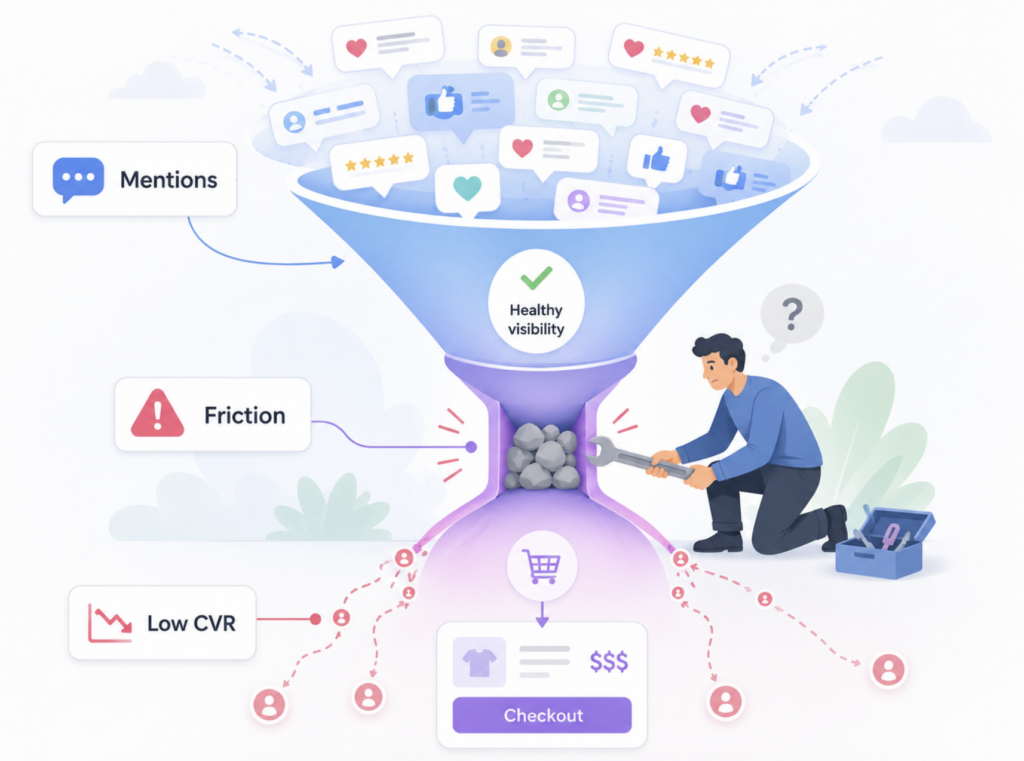
    CVRPredicted likelihood that an AI mention drives a downstream actionClick-through rate

    The key distinction: traditional analytics tells you what users did. AI visibility analytics tells you what the model said. And in a zero-click environment, what the model says often determines whether a user ever reaches your site.

    One metric that tends to get overlooked is Source analysis. When you know exactly which domains the AI is citing for your competitors but not for you, you’ve found the content gap to fix.

    Why Tracking Perplexity Mentions Is Harder Than You Think

    Perplexity isn’t ChatGPT with citations bolted on. It runs a multi-layered retrieval pipeline that makes brand tracking genuinely complex.

    When a user submits a query, Perplexity’s intent mapping system classifies it using an internal embedding model and routes it to either a trending or evergreen index. A candidate pool of web snippets gets assembled, then scored by an L3 XGBoost reranker evaluating semantic depth, domain authority, engagement signals, and freshness. Snippets below the similarity threshold get discarded. What survives gets synthesized into a response with inline citations.

    That pipeline is dynamic and query-dependent. A single manual check doesn’t account for regional differences, personalized search histories, or the model’s variable parameters. Plus, Perplexity enforces source diversity constraints, which means your brand’s visibility can shift depending on what else appears in the candidate pool.

    Manual monitoring doesn’t scale. With 45 million active users running research-oriented queries with high commercial intent, Perplexity is too important to track with spot checks. Automated tools that run scheduled simulations across thousands of regional nodes are the only way to establish a reliable baseline of brand presence, citation frequency, and competitor co-occurrence.

    5 Metrics That Separate Real AI Visibility Analytics from Dashboard Noise

    Not all AI visibility data is worth acting on. Here’s a checklist that isolates the signals that actually drive decisions:

    1. Share of Model (SoM) across a prompt cluster. If your SoM drops by more than 15%, it typically means competitor content is matching the model’s semantic vector more effectively. Time to audit what changed.

    2. Citation Attribution Rate. This is the ratio of explicit URL citations to raw text mentions. If the model mentions your brand but doesn’t cite your domain, your site likely lacks the structural extraction schema that AI crawlers prefer.

    3. Target Prompt Coverage. Track your inclusion rate across categorized prompt variants. A drop on comparison queries often signals that third-party review sites are outranking your brand in the model’s index.

    4. NLP Sentiment Velocity. Monitor the shift in context sentiment scores over a 30-day window. A downward trend often means outdated press coverage or unaddressed negative reviews are feeding the model’s retrieval pipeline.

    5. Attributed Session Yield. Map GA4 traffic using custom AI channel filters. If session volume drops while your SoM stays stable, the model is likely satisfying user intent directly on the results page without sending a click.

    The most common mistake in AI visibility analytics? Tracking raw visibility while ignoring contextual sentiment. A high volume of brand mentions is counterproductive if the model regularly positions you as a negative example or references pricing you retired two years ago.

    Another frequent pitfall: focusing exclusively on ChatGPT while ignoring Perplexity. Perplexity’s research-oriented users convert at significantly higher rates, making citation changes on that platform an early signal of high-intent buying shifts.

    Research backs this up. 96% of content selected for Google’s AI Overviews features verified E-E-A-T trust signals. The Princeton GEO study found that integrating expert quotes with clear attributions improves generative visibility by 41%, and adding verified data tables with inline citations increases selection probability by 30%.

    How to Build an AI Visibility Analytics Strategy from Scratch

    Step 1: Define your target prompt portfolio. Unlike traditional keyword lists, these prompts mirror natural language query paths. Include category-level prompts (share of voice), problem-solving prompts (early-stage buyers), and comparison prompts (high-intent evaluations).

    Step 2: Establish a baseline audit. Run your prompt set across ChatGPT, Gemini, Perplexity, and Google AI Overviews. Document brand presence, explicit citations, competitor co-occurrences, and the third-party domains models cite when your brand is absent.

    Step 3: Choose the right tool. For teams that need monitoring, analysis, and execution in one place, Topify consolidates the entire workflow. It tracks visibility and sentiment across ChatGPT, Gemini, Perplexity, DeepSeek, Doubao, Qwen, and other major engines. Its Source Analysis feature reverse-engineers the exact domains AI platforms cite, so you can see where your competitors are getting picked up and where you’re not. When the data reveals a gap, Topify’s one-click agent deploys optimized content directly to your CMS.

    That combination of tracking and execution is what separates a monitoring tool from an analytics platform. Most alternatives stop at the dashboard. Topify connects the data to action.

    Step 4: Set a tracking cadence. High-volume consumer brands typically need daily scanning. B2B companies can run weekly cycles to separate real visibility shifts from minor model fluctuations.

    Step 5: Turn insights into optimizations. When the dashboard flags a citation gap on a high-value prompt, your content team should place a concise direct-answer block in the first 200 words of the target page, integrate verified statistics, and update the dateModified schema to signal recency to AI crawlers.

    FeatureTopifyProfoundWritesonic GEOOtterly AI
    Supported enginesChatGPT, Gemini, Claude, Perplexity, DeepSeek, Doubao, Qwen10+ engines including Grok, Meta AIChatGPT, Perplexity, Gemini, Claude, AIOChatGPT, Perplexity, AI Overviews, Copilot
    Citation source analysisURL-levelPartial, high-levelBasic trackingBasic alerts
    Sentiment analysisProprietary NLP scoringDeep sentiment + complianceBasic content sentimentStandard keyword sentiment
    Optimization integrationOne-click CMS publishingManual recommendation reportsIn-platform content suggestionsStructured data guidelines
    Workflow automationAutonomous agent executionStatic dashboard reportsSemi-automated editingAlert-triggered emails

    What AI Visibility Analytics Costs in 2026

    The market breaks into three tiers based on tracking depth and automation.

    Entry tier ($20–$99/month): Platforms like Otterly AI (starting at $29/month) or AI Peekaboo ($50/month) support basic mention alerts across core models. They work for startups establishing a baseline but lack URL-level citation parsing, regional model tracking, and API integrations.

    Mid-market tier ($99–$300/month): This is where most growing brands and agencies land. Topify’s pricing sits in this range while delivering enterprise-grade capabilities:

    PlanPricePromptsAI Answer AnalysesProjectsSeats
    Basic$99/mo1009,00044
    Pro$199/mo25022,500810
    EnterpriseFrom $499/moCustomCustomUnlimitedCustom

    For current details, check Topify’s pricing page.

    Premium tier ($300–$700+/month): Platforms like Profound (from $499/month) target Fortune 500 companies with SOC 2 Type II compliance, HIPAA readiness, and advanced brand safety alerts. Custom platforms like seoClarity ArcAI can reach $3,000/month for high-volume API integrations.

    The ROI math favors tracking. Standard organic search traffic converts at roughly 2.8%, whereas pre-qualified users arriving via generative citations convert at 14.2%. Marketing teams that don’t track these patterns risk cutting budgets for high-value informational content because GA4 misclassifies this converting traffic as anonymous “Direct” sessions.

    Conclusion

    The analytics infrastructure most marketing teams rely on was built for a search experience that’s disappearing. AI visibility analytics isn’t a niche add-on. It’s the measurement layer that connects your brand to where discovery is actually happening: inside synthesized AI responses across ChatGPT, Perplexity, Gemini, and beyond.

    The brands that move first will have a compounding advantage. They’ll know which prompts matter, which sources get cited, where competitors are winning, and what to fix. The brands that wait will keep watching stable dashboards while their AI visibility erodes.

    Start by auditing your brand across one AI platform. Then scale the tracking. Get started with Topify to turn that data into action.

    FAQ

    Q: What is AI visibility analytics? 

    A: AI visibility analytics is the systematic process of tracking, measuring, and analyzing how your brand appears in AI-generated responses across platforms like ChatGPT, Perplexity, and Gemini. Unlike traditional SEO analytics that focuses on keyword rankings and backlink profiles, it measures extraction probabilities, contextual sentiment, citation frequency, and competitor co-occurrences within LLM outputs.

    Q: How does AI visibility analytics work? 

    A: It works through programmatic API simulations that run natural language queries across multiple AI platforms and search configurations to capture real-time model outputs. The analytics platform then uses NLP to extract brand mentions, score contextual sentiment, map citation sources, and track positioning relative to competitors.

    Q: What are the best tools for AI visibility analytics? 

    A: Topify offers integrated multi-engine tracking with automated content optimization. Profound focuses on enterprise-grade compliance and risk monitoring. Writesonic GEO serves content-focused teams, and Otterly AI provides cost-effective baseline tracking. The right choice depends on your tracking scale, budget, and whether you need automated execution capabilities.

    Q: How do you measure AI visibility analytics? 

    A: By tracking seven core dimensions: visibility presence, NLP sentiment, positioning order, prompt search volume, mention density, source citation attribution, and Conversion Visibility Rate (CVR). These should be paired with custom GA4 channel groups using regex filters to isolate generative referral traffic from anonymous direct sessions.

    Read More

  • Most Brands Monitor SEO Rankings but Not AI Answers

    Most Brands Monitor SEO Rankings but Not AI Answers

    Your team spent six months building domain authority, earning backlinks, and climbing Google’s first page. Then a prospect typed “best tool for [your category]” into ChatGPT and got five recommendations. Your brand wasn’t one of them. The gap between traditional search rankings and AI-generated answers is growing every quarter, and most marketing teams don’t have a system to detect it. Google rankings tell you where your pages sit in an index. They can’t tell you what a language model chooses to say about your brand, or whether it mentions you at all.

    That gap is where an AI answer monitoring strategy comes in.

    What an AI Answer Monitoring Strategy Actually Covers

    So, what is an AI answer monitoring strategy? It’s a systematic, automated framework designed to track, analyze, and optimize how a brand is mentioned, described, and cited inside AI-generated responses across multiple large language models.

    This isn’t about checking ChatGPT once a week. It’s about continuously probing conversational engines to measure five dimensions of brand presence: visibility frequency, sentiment quality, recommendation position, citation source mapping, and competitive share of voice.

    The scale of the opportunity makes this urgent. ChatGPT alone processes roughly 2.5 billion daily prompts, with about 31% triggering live web searches. That’s over 775 million web-driven queries every day, capturing a significant chunk of traditional search volume. Meanwhile, 31% of Gen Z users now start searches on AI-native platforms instead of Google.

    Here’s what makes this tricky: the engines don’t all behave the same way. ChatGPT cites external sources in only about 0.7% of its total queries. Perplexity, on the other hand, shows a 13.8% citation rate, making its queries roughly 20 times more likely to send a click to an external domain. A strategy that only monitors one platform is a strategy with a blind spot.

    The concept of the “crawl-to-referral ratio” makes this even starker. For every single referral click OpenAI sends back to a publisher, its crawlers access 1,155 pages. For Anthropic’s Claude, that ratio jumps to 10,347:1. Generative engines consume vast amounts of content while returning minimal organic traffic. If your content is crawled but never cited in the final AI response, your brand is invisible.

    Why Manual Spot-Checks Don’t Count as a Strategy

    The most common of the common mistakes in AI answer monitoring strategy is treating occasional manual searches as a monitoring program. A marketer types a high-priority query into ChatGPT, sees the brand name in the response, and moves on. That approach introduces three serious blind spots.

    Coverage gaps. One person can only test a fraction of the conversational pathways customers actually use. Different audience segments phrase questions in wildly different ways, triggering entirely different AI response structures. And checking only ChatGPT ignores how Gemini, Perplexity, and Google AI Overviews handle the same topic.

    Temporal blindness. LLMs, real-time indexes, and RAG architectures update dynamically. A model might recommend your brand at 9 AM and drop it by 3 PM due to silent retraining, cache refreshes, or retrieval threshold adjustments. A single weekly check can’t capture that volatility.

    Dimensional shallowness. Manual checks only confirm whether a brand appears. They can’t measure how the AI describes the brand, where it ranks in a recommendation list, or which sources power that recommendation.

    The numbers back this up. Manual checks miss up to 55% of negative sentiment instances, which often surface only at higher temperature variations in the model’s probability distribution. Single-shot scraping captures one point in that distribution. A stateless, multi-shot probing system captures the full picture.

    That’s the difference between a spot-check and a strategy.

    5 Metrics That Separate a Real AI Answer Monitoring Strategy from Guesswork

    To understand how to measure AI answer monitoring strategy performance, teams need to track five distinct operational pillars. Each one captures a different dimension of brand health inside generative answers.

    1. Visibility Tracking. This measures the probability and frequency of your brand’s inclusion across ChatGPT, Gemini, Perplexity, and other leading LLMs. Unlike traditional SEO impressions, visibility here is probabilistic. The goal is to calculate your brand’s recommendation percentage across hundreds of semantic prompt variations to establish a reliable baseline.

    2. Sentiment Analysis. AI platforms don’t just list links. They actively describe, compare, and critique products. A brand can have high visibility but poor sentiment if training data is outdated or negative reviews dominate the model’s context. Tracking sentiment on a scale from -100 to +100 lets teams verify that mentions are actually positive.

    3. Position Monitoring. Clicks in generative search are heavily concentrated at the top. Within Google’s AI Overviews, the first cited source captures 47% of all clicks, the second gets 23%, and the third gets 14%. Any citation outside the top three, or buried inside a “Show more” section, sees a 68% drop in click-through rate. Position isn’t a vanity metric here. It’s the difference between traffic and invisibility.

    4. Source and Citation Analysis. LLMs build credibility by citing authoritative references. About 78% of Google AI Overviews cite at least one .edu, .gov, or .org domain, and Reddit or Quora serves as a supporting source in 14% of cases. Tracking which domains the AI trusts helps brands target their digital PR and off-site content.

    5. Competitor Benchmarking. This measures your brand’s share of model relative to direct competitors. By evaluating who wins the citation across high-value prompt groups, you can spot visibility gaps where competitors dominate AI recommendations and plan tactical moves to close them.

    A solid checklist for AI answer monitoring strategy implementation covers all five. Skip one, and you’re flying partially blind.

    How to Build Your AI Answer Monitoring Strategy from Scratch

    Knowing the pillars is one thing. Building the system is another. Here’s how to improve AI answer monitoring strategy execution in five concrete steps.

    Step 1: Identify your core prompt clusters. Shift from rigid short-tail keywords to natural, conversational prompts. Your customers aren’t typing “CRM software” into ChatGPT. They’re asking things like “Compare security features of enterprise cloud storage for financial compliance.” Use conversational keyword research to discover these high-value prompt pathways and cluster them by commercial intent.

    Step 2: Define platform coverage. Decide which AI engines matter most for your audience. For general consumer demographics, ChatGPT and Gemini are primary. For B2B professional audiences, Perplexity tends to carry more weight. Google AI Overviews should be tracked regardless, since they directly intercept organic SERP traffic.

    Step 3: Establish baselines with statistical probing. This is where most teams either get it right or stay stuck in guesswork. Single-shot scraping won’t cut it. A platform like Topify runs stateless, multi-shot probing (N≥50 per prompt) that bypasses personalization and location bias. This gives you a clean, regionalized baseline of visibility, sentiment, and position across every tracked engine.

    Step 4: Set cadence and audit for model drift. Silent updates to embedding models, RAG retrieval thresholds, or token budgets can shift which brands get prioritized overnight. Weekly audits catch these shifts before they impact pipeline revenue.

    Step 5: Define action triggers. Connect your tracking data to content optimization workflows. When the dashboard flags a visibility drop, it should trigger a specific response: audit the citation trail, identify the gap, and deploy content updates. Topify’s AI agent automates this loop with one-click execution, restructuring pages and publishing updates directly to your CMS.

    What do successful examples of AI answer monitoring strategy look like in practice? Consider a SaaS brand that discovers it’s excluded from ChatGPT’s recommendations for “easiest CRM software.” By auditing the citation trail, they find the AI relies heavily on Reddit threads and G2 comparison pages. The brand then seeds authentic customer discussions on Reddit, optimizes its G2 profile, and applies GEO techniques to its own site. Research from the Princeton GEO study shows that incorporating expert quotations can boost visibility by 41%, adding specific statistics by 37%, and citing authoritative sources by 30%. These are the kinds of structural improvements that move the needle.

    Picking the Right AI Answer Monitoring Tool for Your Strategy

    You can’t run a strategy on spreadsheets and manual ChatGPT searches. At some point, you need an AI answer monitoring tool that matches the scope of what you’re tracking. Here’s what to evaluate, and how the leading AI answer monitoring software options compare.

    The core standards for any AI answer monitoring platform: multi-engine coverage (ChatGPT, Gemini, Perplexity, Claude, DeepSeek), stateless multi-shot probing to eliminate personalization bias, a sentiment engine that goes beyond binary positive/negative, citation gap analysis, and automated content workflows.

    FeatureTopifyProfoundGoodie AISemrush AIOtterly.ai
    Platform CoverageChatGPT, Gemini, Perplexity, Claude, DeepSeekAll major enterprise LLMsChatGPT, GoogleGoogle SGE / AI OverviewsChatGPT, Google
    Probing MethodMulti-shot (N≥50)Complex multi-turnSingle-shotSingle-shotSimple single-shot
    Data Accuracy98% (Tier 1)High (enterprise-grade)MediumMedium<60%
    Sentiment EngineProprietary NLP (-100 to +100)Standard categorizationBasicBasicNone
    Citation Gap AuditYes (reverse-engineers sources)Yes (revenue attribution)BasicCorrelation dataNone
    Automated WorkflowsOne-click AI agentCMS executionContent rewritingKeyword listsNone
    Pricing$99/mo Basic, $199/mo ProPremium enterpriseCustomMid-tier add-onFrom $49/mo

    Topify stands out as the AI answer monitoring solution built natively for the generative search era. Its Tier 1 elastic probing engine achieves 98% accuracy by running stateless, multi-shot probes that eliminate personalization and location biases. The proprietary sentiment engine scores brand presence on a -100 to +100 scale, and the unified dashboard monitors five major AI platforms simultaneously. The one-click AI SEO Agent automates the full loop from insight to content update. At starting from $99/month, it offers strong ROI for mid-market and enterprise teams alike.

    Profound targets Fortune 500 companies with deep Adobe Analytics and Tableau integrations. It’s powerful for tracking millions of SKUs across regions, but the high price tag and steep learning curve make it less suited for agile marketing teams.

    Goodie AI combines tracking with generative content rewriting, but its monitoring capabilities are less granular, especially for non-Google conversational engines.

    Semrush AI works well as a bridge for teams already in the Semrush ecosystem, showing how organic rankings correlate with AI Overviews. But it focuses primarily on Google, leaving gaps if your audience uses Perplexity or Claude.

    Otterly.ai offers budget-friendly tracking starting at $49/month, suitable for startups. It lacks sentiment analysis, multi-engine probing, and automated workflows.

    When evaluating AI answer monitoring strategy pricing, match the tool’s capabilities to your monitoring scope. A startup tracking 20 prompts across two platforms has different needs than an enterprise monitoring 500 prompts across five engines.

    What a Working AI Answer Monitoring Dashboard Looks Like in Practice

    An AI answer monitoring dashboard isn’t just a reporting screen. It’s the operational nerve center where strategy turns into weekly action.

    Here’s a concrete scenario. A SaaS marketing manager opens their Topify dashboard on Monday morning. They scan the visibility and sentiment trends across their tracked prompt clusters. One thing jumps out: a 15% drop in Perplexity visibility for queries around “most secure enterprise file sharing.”

    Instead of manually searching for the cause, they click into the citation tracker. The dashboard reveals that Perplexity has adjusted its retrieval parameters. It’s no longer citing the brand’s primary product page. Instead, it’s pulling from a third-party cybersecurity directory that highlights a competitor’s SOC-2 compliance data. The competitor has also deployed schema markup on their page, which can increase citation frequency by up to 89%.

    The response takes minutes, not weeks. Using Topify’s integrated AI SEO Agent, the manager triggers an automated page restructure: a concise 50-word direct answer block at the top of the page, verified encryption statistics, an expert quote from the CISO, and structured FAQ schema with sameAs identity links. One click publishes the updates to WordPress.

    Within 48 hours, Topify’s multi-shot probing engine confirms Perplexity has updated its retrieval cache. Visibility is restored. Sentiment rises back to 88. High-converting referral traffic ticks up 5%.

    That’s what a closed-loop AI answer monitoring system looks like in practice. Not a report you read. A workflow you act on.

    Conclusion

    The shift from indexed search results to AI-synthesized answers isn’t a trend. It’s a structural change in how customers discover brands. Monitoring Google rankings while leaving your representation in ChatGPT, Perplexity, and Gemini unmanaged creates a gap that widens every quarter.

    An effective AI answer monitoring strategy closes that gap with a continuous loop: identify high-value prompts, establish baseline metrics with multi-shot probing, track visibility and sentiment across engines, and automate content updates when citations shift. Start with your top 10 prompt clusters and build your baseline with Topify. The brands that move first are the ones AI learns to recommend.

    FAQ

    Q: What is an AI answer monitoring strategy?

    A: It’s a systematic framework for tracking, analyzing, and optimizing how your brand is mentioned, described, and cited inside AI-generated responses across multiple LLMs. Instead of monitoring static keyword rankings, it uses automated probing to measure visibility, sentiment, position, citations, and competitive share of voice in conversational search.

    Q: How do you measure the success of an AI answer monitoring strategy?

    A: Through a composite of generative KPIs: your brand’s share of model across high-intent prompt clusters, the sentiment score of synthesized mentions, the frequency and position of citation links, and the volume of AI-referred sessions captured in your web analytics.

    Q: What’s the difference between AI answer monitoring and traditional SEO tracking?

    A: Traditional SEO tracks deterministic keyword rankings on a single platform like Google. AI answer monitoring operates in a probabilistic environment across multiple LLMs, accounting for real-time model updates, geographic personalization, and retrieval-augmented generation. It measures how multiple web sources are combined into unified answers, not just where a page ranks.

    Q: How much does an AI answer monitoring strategy cost to implement?

    A: Entry-level monitoring for small teams starts around $49/month. Mid-to-enterprise implementations using platforms like Topify range from $99 to $199/month. Large-scale global enterprises with custom data integrations and revenue mapping typically invest in premium contracts.

    Read More

  • AI Answer Monitoring: Why CES 2026 Made It Urgent

    AI Answer Monitoring: Why CES 2026 Made It Urgent

    Your marketing team spent the last quarter refining keyword rankings, building backlinks, and publishing content that climbed to page one. Then your CMO asked a simple question: “When someone asks ChatGPT which product to buy in our category, do we show up?”

    Nobody had an answer. Not because your team dropped the ball, but because the tools you’ve been using were never built to measure what AI chooses to say. AI-referred web sessions grew 527% year-over-year in early 2025, and half of all consumers now use AI-powered search for product research. The brands that can’t see themselves in those AI answers are already losing ground to the ones that can.

    Most Brands Track Rankings. AI Tracks Recommendations. That’s a Different Game.

    AI answer monitoring is the practice of programmatically querying AI platforms like ChatGPT, Perplexity, and Gemini, then analyzing how your brand appears in their responses. It tracks whether you’re mentioned, how you’re described, where you’re positioned relative to competitors, and which sources the AI cites when recommending you.

    This isn’t a variation of traditional SEO monitoring. It’s a fundamentally different discipline.

    Traditional search engines retrieve a ranked index of static web pages. Generative engines synthesize answers from diverse sources and deliver a single, conversational response. Up to 93% of those interactions resolve without a single click to an external website. That means if your brand isn’t in the AI’s answer, you’re not even in the consumer’s consideration set.

    The performance gap is stark. Traditional organic search converts at roughly 2.1% to 2.8%. AI-referred traffic converts at 14.2% to 27.0%, up to 4.4x higher. The reason is compression: AI answers present a shortlist of one to three brands, and users trust that shortlist enough to act on it immediately.

    Topify tracks this entire layer across ChatGPT, Gemini, Perplexity, DeepSeek, and other regional models, giving marketing teams visibility into a channel that traditional dashboards completely miss.

    CES 2026 Proved That AI Agents Don’t Browse. They Decide.

    The Consumer Electronics Show in January 2026 marked a turning point. AI stopped being a search destination and became infrastructure. It’s now embedded in operating systems, browsers, and device-level identity layers. The traditional marketing funnel, awareness to consideration to intent to purchase, is collapsing into something much shorter.

    The defining trend was autonomous AI agents at scale. Consumers don’t just search anymore. They brief specialized agents with qualitative intent: “Find a sustainable, organic mascara under $30” or “Find a family-friendly streaming subscription with offline downloads.” The agent then parses, filters, and negotiates options before presenting a compressed shortlist of one or two brands.

    That’s not a funnel. That’s a filter.

    According to Kantar’s Marketing Trends 2026, 24% of AI users already delegate purchase research to AI assistants. Among Gen Z consumers, that number rises to 32%. NVIDIA announced its Rubin platform at CES 2026 with six advanced chips designed for agentic workloads. HP unveiled AI-powered laptops configured to run local orchestration engines. Bosch showcased autonomous connected vehicle platforms, and Sony Honda Mobility demonstrated real-time in-car transaction systems.

    For brands, the implication is direct: if your digital presence isn’t structured for machine readability, agents will filter you out. Brand announcements distributed via GlobeNewswire during CES earned nearly 25,000 AI search engine citations, specifically because they were formatted as authoritative, machine-readable sources with verifiable facts and clear timestamps. US advertisers are projected to spend $25.9 billion on AI search ads by 2029, signaling that the market has moved well past experimentation.

    AI answer monitoring is no longer a “nice to have.” It’s how you confirm your brand survives the agent’s filter.

    How AI Answer Monitoring Actually Works Under the Hood

    Traditional SEO crawlers scrape static HTML pages. AI answer monitoring uses a technique called synthetic probing: sending thousands of natural language queries to live APIs of closed-source LLMs, then parsing the generated responses for brand mentions, sentiment, position, and source citations.

    When a prompt hits an AI engine, the response is generated through Retrieval-Augmented Generation (RAG). The system interprets the query, retrieves relevant source documents from its index or a live web search, evaluates their authority, and synthesizes a direct answer. The monitoring platform then ingests that unstructured response and extracts structured data.

    The 7 Metrics That Define AI Answer Monitoring

    Basic tracking tools measure four parameters: visibility, sentiment, position, and source. Topify uses a 7-metric framework that adds the depth needed for real optimization:

    MetricWhat It Measures
    AI Share of Model (Visibility)Percentage of target queries where the brand appears in the response
    Average Recommendation PositionWhere the brand ranks in the AI’s recommendation order
    Brand Sentiment ScoreTone of the AI’s description, scored 0 to 100
    Citation FrequencyHow often the AI hyperlinks to the brand’s domain
    Query Volume EstimationEstimated search volume of tracked prompts across AI engines
    User Intent ClassificationSegments prompts into informational, commercial, transactional categories
    Conversion Visibility Rate (CVR)Correlation between visibility adjustments and downstream referral conversions

    Position matters more than most teams realize. Research shows the first-mentioned brand in an AI recommendation carries a 33.07% citation probability. By the tenth mention, that drops to 13.04%. If you’re monitoring visibility but ignoring position, you’re missing the signal that actually predicts clicks.

    5 Mistakes That Quietly Wreck Your AI Answer Monitoring Data

    Most teams don’t fail at AI answer monitoring because they chose the wrong tool. They fail because of methodological blind spots that corrupt their data from day one.

    Tracking only ChatGPT. ChatGPT has dominant market share, but only 11% of cited domains appear consistently across multiple AI platforms. Each engine uses different indexing, RAG pipelines, and training data. A brand that ranks first on ChatGPT may be completely invisible on Perplexity, which cites nearly three times as many sources per query.

    Using keyword-style prompts instead of conversational queries. Querying a model with “marketing platform” doesn’t capture how real users talk to AI. Conversational search queries average more than eight words. Your tracked prompts need to mirror actual dialogue patterns: “What’s the best marketing platform for a 50-person B2B SaaS company?”

    Ignoring sentiment. A brand can achieve 90% visibility and still have a reputation problem. If the AI consistently describes your product as “expensive with limited support,” that high visibility score is masking a PR crisis, not celebrating a win.

    Running monthly manual audits. Generative models update their weights, source indexes, and ranking signals continuously. A monthly snapshot is outdated within 48 hours. Effective monitoring requires automated, high-frequency probing.

    Skipping competitor benchmarks. A 30% visibility rate looks strong until you discover your closest competitor holds 70% across the same prompt set. Without relative Share of Model data, you’re flying blind on competitive positioning.

    A Step-by-Step AI Answer Monitoring Strategy That Actually Produces Results

    Here’s a five-phase framework that moves from setup to measurable optimization:

    Phase 1: Build your prompt matrix. Start with 100 to 500 high-intent prompts mapped to your buyer’s journey. Awareness-stage prompts (“How does enterprise supply chain coordination work?”), consideration-stage prompts (“What are the most reliable logistics platforms?”), and decision-stage prompts (“Platform A vs. Platform B pricing and API capabilities”) each reveal different aspects of your AI visibility.

    Phase 2: Set multi-platform scope. Configure tracking across ChatGPT, Gemini, Perplexity, and DeepSeek at minimum. Regional coverage matters: if your audience spans markets where Qwen or Doubao dominate, include those too.

    Phase 3: Establish your baseline. Run the full prompt matrix and record your starting position across all seven metrics. During this phase, audit your technical readiness: verify your robots.txt permits GPTBot, ClaudeBot, and PerplexityBot. Run a GEO score check on target landing pages to evaluate structured data, entity clarity, and topical signal density. Topify’s built-in GEO diagnostic tools automate these checks.

    Phase 4: Set cadence and alerts. Enterprise teams in competitive categories need daily data syncs. Mid-market brands can operate on weekly refresh cycles. Either way, configure real-time alerts for visibility drops or negative sentiment spikes.

    Phase 5: Execute GEO content actions. Turn monitoring data into optimization. The Princeton GEO study documented specific impact benchmarks that still hold:

    StrategyVisibility Improvement
    Cite authoritative external sources+40%
    Add statistics every 150 to 200 words+37%
    Include verified expert quotations+30%
    Use precise technical terminology+28%

    Topify’s One-Click Agent Execution system identifies visibility gaps, designs a targeted GEO strategy, and deploys content and schema corrections directly to CMS platforms like WordPress, Shopify, and Framer. No manual dev bottlenecks.

    The Platforms That Make AI Answer Monitoring Scalable

    The AI answer monitoring market splits into three tiers: enterprise intelligence engines with deep analytics and steep price tags, specialized crawler tools focused on verification, and purpose-built GEO orchestration platforms that bridge tracking and action.

    PlatformAI Engine CoverageStarting PriceKey Differentiator
    TopifyChatGPT, Gemini, Perplexity, DeepSeek, Qwen, Doubao$99/mo7-metric framework, one-click agent execution, built-in GEO diagnostics
    ProfoundChatGPT, Claude, Perplexity, Gemini, Grok$99/mo (ChatGPT only)Log-level crawler analytics, enterprise integrations
    Peec AIChatGPT, Perplexity, Gemini, Copilot, Grok$95/moUnlimited seats, daily automated tracking
    AthenaHQChatGPT, Gemini, Perplexity, Claude, Grok~$295/moNarrative tone analysis, corporate risk modeling
    ZipTieChatGPT, Perplexity, AI Overviews$69/moReal browser screenshot verification

    For most marketing teams, the key question isn’t which platform has the most data. It’s which one lets you act on the data without switching tools. Topify’s combination of broad AI engine coverage, a 7-metric analytics layer, and automated execution at a $99/mo entry point makes it the practical starting point for teams that want monitoring and optimization in one workflow.

    How to Know Whether Your AI Answer Monitoring Is Actually Working

    Three KPIs separate productive monitoring programs from expensive dashboards that nobody checks:

    Answer Inclusion Rate (AIR): The percentage of high-intent prompts where your brand appears. A strong baseline target is 30% or higher across core transactional prompts.

    Sentiment Velocity: The rate at which the AI’s qualitative description of your brand moves toward positive. Tracking direction matters more than the absolute score, because a brand moving from 45 to 65 in sentiment is outperforming one stuck at 75.

    Conversion Visibility Rate (CVR): The connection between AI citations and downstream referral conversions. This is where monitoring becomes a revenue story, not just a visibility story.

    Review these across three cadences. Weekly: content teams check alerts, crawl blocks, and position shifts after competitor updates. Monthly: marketing leadership evaluates Share of Model trends and sentiment data to adjust content priorities. Quarterly: executive stakeholders assess Return on Content Investment and align AI visibility with broader brand strategy.

    The monitoring loop is continuous: probe, ingest metrics, identify gaps, execute corrections, probe again. Teams that treat it as a one-time audit will fall behind within weeks.

    Conclusion

    The AI answer layer isn’t coming. It’s here. Half of consumers already use AI search, agents are making purchase decisions on behalf of users, and the brands that aren’t visible in those AI responses are being filtered out before a website visit can even happen.

    Start with 100 core prompts across at least four AI platforms. Establish your baseline. Set alerts. Then use the data to drive content optimization that actually changes what AI says about you. Tools like Topify compress this entire workflow into a single platform, from monitoring to execution, at a price point that doesn’t require enterprise budgets.

    The brands that build this muscle now will compound their advantage. The ones that wait will spend the next two years wondering why their traffic is declining while their SEO rankings look fine.

    FAQ

    Q: What is AI answer monitoring?

    A: AI answer monitoring is the systematic tracking of how your brand appears in AI-generated answers across platforms like ChatGPT, Perplexity, and Gemini. It measures visibility (whether you’re mentioned), sentiment (how you’re described), position (where you rank relative to competitors), and citations (which sources the AI references).

    Q: How does AI answer monitoring differ from traditional SEO monitoring?

    A: Traditional SEO tracks keyword rankings on static search result pages. AI answer monitoring tracks synthesized, probabilistic responses generated through Retrieval-Augmented Generation. It measures entirely different dimensions: Share of Model, recommendation position, sentiment polarity, and citation frequency, none of which exist in traditional SEO dashboards.

    Q: How much does AI answer monitoring cost?

    A: Purpose-built platforms like Topify start at $99/mo for 100 tracked prompts and scale to $199/mo for 250 prompts. Enterprise tiers begin at $499/mo with custom configurations. Specialized enterprise tools from other vendors range from $295 to over $900/mo.

    Q: Can AI answer monitoring track multiple AI platforms at once?

    A: Yes. Multi-platform tracking is strongly recommended because only 11% of cited domains appear consistently across different AI engines. Topify aggregates data from ChatGPT, Gemini, Perplexity, DeepSeek, Qwen, and Doubao into a single dashboard.

    Read More

  • AI Answer Monitoring Tracker: What It Measures

    AI Answer Monitoring Tracker: What It Measures

    Your team spent months building domain authority, publishing content, and climbing Google’s organic rankings. Then a potential customer asked ChatGPT, “What’s the best tool for [your category]?” and got a list of five recommendations. Your brand wasn’t on it.

    The gap between traditional SEO performance and AI search visibility is widening fast. Organic click-through rates drop by roughly 61% when AI Overviews appear on the page, and zero-click searches now account for 60% of all Google queries. The problem isn’t that your SEO failed. It’s that nobody built an AI answer monitoring tracker to measure what AI actually says about your brand.

    Most Brands Can’t Answer a Simple Question: “Does AI Know We Exist?”

    An AI answer monitoring tracker is a specialized system that monitors how generative AI platforms mention, rank, and describe your brand across conversational responses. It’s not a traditional rank tracker. Traditional SEO monitoring identifies where a specific URL sits within a vertical list of results. An AI answer monitoring tracker evaluates whether your brand is included in the narrative an AI constructs when a user asks a question.

    That distinction matters more than it sounds.

    Traditional search queries average about four words. AI prompts average 23 words, packed with intent qualifiers like budget constraints, industry context, and persona-driven goals. An effective AI answer monitoring tracker uses conversational prompts that replicate how real users interact with ChatGPT, Gemini, Perplexity, and other platforms.

    Here’s how the tracking mechanism works in practice. Advanced systems run automated queries through AI APIs or browser-level simulations at regular intervals. To eliminate bias from personalized user histories, tools like Topify use “stateless” requests that measure what a generic, unprejudiced user would see. Once the AI generates a response, natural language parsing extracts brand mentions, calculates position weighting, and identifies citation URLs.

    One technical detail worth flagging: API-based tracking and browser-level rendering produce different results. API endpoints bypass real-world interface elements like browsing plugins, memory context, and visual citations. Research suggests API-based tracking only matches manual search data about 60% of the time. Browser-level simulation remains the more accurate approach, especially for Google AI Overviews, which often require an authenticated session to render.

    DimensionTraditional Rank TrackingAI Answer Monitoring Tracker
    Primary InputShort-tail keyword stringsConversational prompts (23+ words)
    Logic BasisVertical list position (1-100)Semantic inclusion and position weighting
    Output TypeURL position on a SERPNarrative text, sentiment, and citations
    Data MethodologyHTML DOM scrapingLLM probing and API metadata analysis
    Deterministic LevelHigh (mostly consistent)Low (probabilistic, non-deterministic)

    Why an AI Answer Monitoring Tracker Is Now a Revenue Problem, Not Just an SEO Problem

    The scale of AI search adoption makes this impossible to ignore. ChatGPT reached 900 million weekly active users as of early 2026. Google’s AI Overviews expanded to 2 billion monthly users across 200 countries. These aren’t early adopter numbers. This is mainstream behavior.

    For informational queries, AI Overviews trigger 88% of the time. When they do, organic CTR drops from a traditional 15% to roughly 8%. Even when AI Overviews aren’t present, users who’ve been retrained to expect instant answers show a 41% year-over-year decline in clicking traditional results.

    That’s the traffic side. The conversion side tells a different story.

    Users who click through from an AI-generated citation convert at rates between 7.05% and 11.4%, nearly double the 5.3% to 5.8% seen in traditional organic search. In B2B SaaS, AI-referred traffic converts at up to 6x higher rates than organic search. The reason is what researchers call the “pre-vetting effect”: by the time a user clicks a citation in a conversational response, the AI has already validated the brand’s relevance to their specific problem.

    So every missed AI mention isn’t just a visibility gap. It’s a revenue leak from your highest-converting channel.

    There’s also the hallucination risk. Hallucination rates across major models sit between 15% and 52%. Without an AI answer monitoring tracker, brands can’t detect when an AI fabricates product features, promotes discontinued items, or misattributes a competitor’s flaws to their brand. That kind of semantic drift compounds over time if nobody’s watching.

    5 Metrics Your AI Answer Monitoring Tracker Should Actually Measure

    Not all AI visibility data is created equal. Tracking raw mention counts without context is a vanity metric exercise. The ai seo visibility optimization companies leading this space have converged on a multi-dimensional measurement framework. Here are the five metrics that matter most.

    Visibility Score. This measures the percentage of relevant prompts where your brand is explicitly mentioned in the AI’s response. The average brand visibility across 1,000 queries is often as low as 0.3%. Industry leaders maintain scores of 12% or higher. The gap between those two numbers represents the opportunity most brands are missing.

    Position Weighting. Order matters in AI responses. The first brand mentioned in a recommendation earns roughly 33% citation probability. The tenth drops to about 13%. An effective tracker weights these positions so you know whether you’re the lead recommendation or buried in a footnote.

    Sentiment Scoring. Not every mention is a win. AI might describe your product as a “budget alternative with known limitations” instead of a category leader. Sentiment analysis on a -100 to +100 scale tells you whether AI frames your brand positively or as a cautionary tale.

    Citation and Source Analysis. This reveals which domains AI platforms cite to justify their answers. Sometimes AI trusts a site’s data without mentioning the brand by name, creating “ghost citations.” Source analysis also shows where competitors are earning mentions, like Reddit threads, G2 reviews, or industry journals, so you know where to build presence.

    Conversion Visibility Rate. The bottom-line metric. CVR estimates the downstream business impact of an AI mention by correlating AI citations with on-site revenue through integrations like Google Analytics 4. This is the metric that gets executive buy-in.

    MetricWhat It MeasuresWhy It Matters
    Visibility Score% of prompts where brand appearsMeasures discovery-phase penetration
    Position WeightingOrdinal rank in AI responseTop position earns ~3x more trust than 10th
    Sentiment ScoreNarrative framing (-100 to +100)Catches reputation risks before they hit revenue
    Citation Share% of queries citing your domainIdentifies content AI trusts as a source
    Conversion Visibility RateRevenue impact of AI mentionsTies AI visibility directly to pipeline

    A Step-by-Step Strategy for Building Your AI Answer Monitoring Tracker

    Getting started doesn’t require a six-month project plan. Here’s a practical framework.

    Step 1: Build your prompt library. Instead of chasing 500 individual keywords, identify 20 to 50 high-value prompts that mirror how your target audience actually talks to AI. Include branded queries, category shortlist queries (“Who are the top competitors for…?”), and comparison queries across different funnel stages. Topify’s High-Value Prompt Discovery surfaces these automatically by analyzing real AI search behavior.

    Step 2: Establish a statistical baseline. AI responses are probabilistic, not deterministic. Run each prompt multiple times to get a reliable baseline visibility score. Map the competitive landscape at the same time: who is the AI recommending instead of you? In some sectors like HR software, top brands dominate 86% of the AI’s consideration set, leaving little room for newcomers who aren’t actively monitoring.

    Step 3: Reverse-engineer AI citations. Use source analysis to identify which third-party domains the AI trusts. Research suggests citations from independent, third-party domains carry roughly 6.5x the weight of self-published content in the eyes of LLMs. If an AI consistently cites a competitor via a Reddit thread or a specific trade journal, that’s where you need to build presence.

    Step 4: Re-engineer content for machine extraction. Translate your visibility data into action. Place the primary direct answer in the first 50 tokens of each key section so the AI’s retrieval system can extract it easily. Deploy FAQPage, HowTo, and Organization schema to provide machine-readable facts. Consider creating an LLMs.txt file at your site’s root directory to help AI crawlers understand your most important content.

    Step 5: Monitor continuously and act fast. AI models update frequently, and competitor content shifts constantly. Topify’s One-Click Execution layer lets teams review a proposed recovery strategy and deploy it directly from the dashboard, closing the loop between data and action without manual workflows.

    5 Mistakes That Tank Your AI Answer Monitoring Tracker Results

    Even teams with the right tools make these errors.

    Monitoring only one platform. This is the most common mistake. ChatGPT, Gemini, Perplexity, and Claude all weigh authority signals differently. Gemini leans heavily on the Google ecosystem, including YouTube and Google Maps. Perplexity prioritizes live web citations from high-trust domains. Tracking just one platform gives you a distorted picture. Topify covers ChatGPT, Gemini, Perplexity, DeepSeek, Doubao, and Qwen in a single dashboard.

    Treating AI visibility as a silo. Some teams shift their entire budget from technical SEO to “AI hacks.” That backfires. A page that isn’t indexed or poorly structured for Google is often invisible to AI crawlers too. SEO provides the technical foundation, crawlability, site speed, mobile UX, that GEO success is built on.

    Ignoring sentiment and position data. Tracking raw mention counts without competitive context or sentiment analysis is misleading. A brand might appear in every AI response but consistently be described as the “budget option” or listed last. Without sentiment and position weighting, you’re celebrating a vanity metric.

    Skipping the global AI ecosystem. For brands with international presence, ignoring Chinese AI platforms is a significant blind spot. Chinese models like Doubao and Qwen mention brands at a rate of 88.9% for English queries, compared to just 58.3% for Western models. That’s a 30-point gap in brand representation that most Western-only tools miss entirely.

    Running a one-time audit instead of continuous monitoring. AI visibility is dynamic. Model updates, competitor content changes, and shifting citation patterns mean last month’s data is already stale. The brands that win treat their AI answer monitoring tracker as an always-on system, not a quarterly check-in.

    What to Look for in an AI Answer Monitoring Tracker Tool

    The market has matured quickly. Here’s how the current landscape breaks down for ai seo visibility optimization companies and marketing teams evaluating tools.

    For marketing teams and agencies that need both monitoring and execution, Topify stands out by combining all seven visibility metrics, including sentiment, position, source analysis, and CVR, into a single platform. Its global coverage spans ChatGPT, Gemini, Perplexity, and Chinese LLMs like DeepSeek and Qwen. What separates it from monitoring-only tools is the action layer: you can go from spotting a visibility gap to deploying an optimization strategy without leaving the dashboard. Pricing starts at $99/month for the Basic plan with 100 prompts and 9,000 AI answer analyses, scaling to $199/month for Pro with 250 prompts and 22,500 analyses.

    For enterprise teams requiring SOC 2 compliance and log-level crawler analysis, Profound offers deep query fanout analysis across 10+ engines with 18-country coverage. Pricing starts around $99/month for starter tiers.

    For teams that prioritize browser-level accuracy, ZipTie.dev uses real browser rendering and screenshot capture. Pricing ranges from $69 to $159/month.

    For agencies managing multiple clients, Peec AI offers unlimited seats and Looker Studio integration across 7 platforms, starting at €89/month.

    PlatformBest ForKey DifferentiatorStarting Price
    TopifyMarketing teams and agencies7 metrics, Chinese LLM coverage, One-Click optimization$99/mo
    ProfoundEnterprise complianceSOC 2 Type II, 10+ engine log analysis$99/mo
    ZipTie.devAccuracy-focused teamsBrowser-level rendering, screenshot capture$69/mo
    Peec AIGlobal agenciesUnlimited seats, Looker Studio integration€89/mo

    Conclusion

    The gap between where your brand ranks on Google and where it appears in AI responses isn’t closing on its own. With 900 million weekly users on ChatGPT and 2 billion monthly users seeing AI Overviews, the question isn’t whether AI search matters. It’s whether you’re measuring it.

    An AI answer monitoring tracker turns that blind spot into a structured, data-driven growth channel. Start with a 30-prompt audit across ChatGPT, Gemini, and Perplexity. Connect visibility data to revenue through CVR tracking. And treat AI monitoring as an always-on system, not a one-time experiment. The brands that build this infrastructure now will own the discovery layer that’s rapidly replacing traditional search clicks. Get started with Topify to see where your brand stands today.

    FAQ

    Q: What is an AI answer monitoring tracker? 

    A: An AI answer monitoring tracker is a system that monitors how generative AI platforms like ChatGPT, Gemini, and Perplexity mention, rank, and describe your brand in their responses. Unlike traditional SEO rank trackers that measure URL positions on a search results page, it evaluates semantic inclusion, position weighting, sentiment, and citation sources within AI-generated answers.

    Q: How does an AI answer monitoring tracker work? 

    A: It runs automated conversational prompts through AI platforms at regular intervals, using stateless requests to eliminate personalization bias. The system then parses each AI response with natural language processing to extract brand mentions, calculate position weighting, identify citation URLs, and score sentiment. Advanced trackers use browser-level rendering rather than API-only analysis for higher accuracy.

    Q: How much does an AI answer monitoring tracker cost? 

    A: Pricing varies by platform and scale. Topify starts at $99/month for 100 prompts and 9,000 AI answer analyses, with a Pro plan at $199/month for 250 prompts. Enterprise plans start from $499/month. Other tools in the market range from $69/month to €495/month depending on features and team size.

    Q: What’s the difference between AI answer monitoring and traditional SEO tracking? 

    A: Traditional SEO tracking measures where a URL ranks in a deterministic list of search results. AI answer monitoring measures whether and how a brand appears within probabilistic, narrative text generated by AI. The inputs are different (conversational prompts vs. short keywords), the outputs are different (sentiment and citations vs. rank positions), and the optimization strategies are different (citation engineering and entity authority vs. link building and keyword density).

    Read More

  • AI Answer Monitoring System: What It Tracks

    AI Answer Monitoring System: What It Tracks

    Your team spent months building domain authority, earning backlinks, and climbing Google rankings. Then a prospect asked ChatGPT, “What’s the best tool for [your category]?” and got a list of five recommendations. Your brand wasn’t on it.

    You checked again the next morning. This time, you were there, but described as a “budget option.” By Thursday, you’d disappeared again. That’s not a glitch. It’s how large language models work: probabilistic, shifting, and impossible to pin down with a single manual check. The gap between the 54% of brands planning to act on AI search and the 23% actually measuring it tells you everything about where the industry stands right now.

    Most Brands Check AI Answers Once. Here’s Why That Tells You Almost Nothing.

    A recurring pattern among marketing teams early in their generative engine optimization (GEO) journey is the “spot-check.” Someone on the team types a prompt into ChatGPT, screenshots the result, and shares it in Slack. That screenshot becomes the team’s understanding of their AI search visibility.

    The problem? LLMs are stochastic systems. They generate responses based on probabilistic token selection, which means the same prompt can produce different results across sessions, times of day, and geographic locations. Research suggests only about 30% of brands maintain consistent visibility across multiple regenerations of the same query. A brand that shows up in a “Top 10” list on Tuesday morning may vanish by Wednesday afternoon.

    That’s just one platform. The cross-platform picture is even more fragmented: only about 11% of domains are cited by both ChatGPT and Google AI Overviews for the same query. Checking one platform once gives you a snapshot of a snapshot.

    An AI answer monitoring system replaces this guesswork with continuous, automated tracking across multiple models. It doesn’t ask “did we show up?” It asks “how often do we show up, on which platforms, in what context, and next to which competitors?”

    The scale of the shift makes this urgent. By mid-2025, ChatGPT alone was processing roughly 2.5 billion queries per day. In the B2B space, 94% of buyers reported using a generative AI tool during their most recent purchase process. These platforms are capturing the most valuable stages of the buyer journey before a user ever reaches a traditional search engine.

    What an AI Answer Monitoring System Actually Measures

    An AI answer monitoring system tracks seven core dimensions that collectively define what you might call a brand’s “Share of Model Voice.” These metrics go well beyond simple presence detection.

    MetricWhat It TracksWhy It Matters
    VisibilityPercentage of tracked prompts where the brand appearsThe foundational layer: if you’re not in the model’s consideration set, you’re invisible
    SentimentEmotional tone and qualitative framing (scored -100 to +100)Being mentioned as a “budget alternative” is worse than not being mentioned at all
    PositionPlacement order in AI-generated lists and comparisonsTop 3 placement gets disproportionate detail and user attention
    VolumeHigh-value prompts your audience is actually askingConversational queries (23-60 words) carry more specific intent than keywords
    MentionsUnlinked brand references across AI responsesEntity recognition is a leading indicator of future citation frequency
    CitationsSpecific URLs the AI pulls from to justify its answerReveals the “Citation Gap”: which content you need to create or improve
    CVRConversion rate from AI-referred visitorsAI search visitors convert at 4.4x to 23x higher rates than traditional organic traffic

    The last metric deserves emphasis. While up to 83% of AI searches resolve without a click, the ones that do generate a referral are pre-qualified leads. The AI has already done the comparison for the user.

    Topify tracks all seven of these dimensions across ChatGPT, Gemini, Perplexity, DeepSeek, Doubao, and Qwen from a single dashboard. That cross-platform view matters because each AI engine uses different training data and retrieval logic. Visibility on one is not a proxy for the others.

    The 5 Mistakes That Make Most AI Answer Monitoring Efforts Useless

    Setting up tracking is one thing. Getting value from it is another. These are the patterns that consistently derail monitoring efforts.

    1. Only monitoring one AI platform. ChatGPT holds roughly 79% of AI web traffic, so it’s tempting to stop there. But Perplexity draws heavily from community sources like Reddit, which accounts for about 46.7% of its top citations. Gemini prioritizes the Google ecosystem and authoritative editorial content. A brand that’s visible on ChatGPT may be completely absent from Perplexity, and vice versa.

    2. Counting mentions without measuring sentiment. Visibility without positive framing is a liability. An AI might include your brand in a comparison list specifically to highlight its weaknesses relative to the “top-rated” option. A monitoring system that only tracks presence misses whether that presence is helping or hurting you.

    3. Ignoring competitor context. In generative search, there’s no “Page 2.” If the AI provides one answer and your competitor is cited as the best option while your brand isn’t mentioned, you’ve lost 100% of that query’s value. Monitoring must include side-by-side benchmarking against 3-5 direct competitors.

    4. Manual spot-checks instead of automated tracking. Manual checks can’t account for personalized chatbot memory, regional variations in retrieval-augmented generation, or time-of-day fluctuations. Without a controlled, automated environment, the data you’re collecting is noise, not signal.

    5. Collecting data without closing the feedback loop. This is the most common failure. The monitoring system identifies that your brand is missing from “Best X for Y” prompts because it lacks third-party validation. But the content team keeps producing first-party blog posts. The visibility gap widens. Monitoring only has value when it directly triggers content strategy changes.

    How to Build an AI Answer Monitoring System That Feeds Your Strategy

    Implementation follows a five-step process that moves from data collection to automated execution.

    Step 1: Define your high-value prompt universe

    Start with 30 to 50 prompts that reflect real buyer intent. Unlike keywords, these should be conversational and map to different funnel stages: informational (“What are the common challenges with [category]?”), comparative (“Compare [Brand A] and [Brand B] for [use case]”), and evaluative (“Is [product] worth it for small businesses?”).

    Step 2: Select a multi-platform monitoring tool

    The tool needs to cover ChatGPT, Gemini, Perplexity, and Google AI Overviews at minimum. It should track URL-level citations, analyze sentiment, and provide competitive benchmarking. Topify has become the go-to for this “single pane of glass” visibility, covering 7+ AI platforms with automated prompt scheduling.

    Step 3: Establish your baseline

    Run the full prompt bank across all platforms to capture your current visibility rate, sentiment score, and average position. This baseline is the ground truth against which every future optimization effort gets measured.

    Step 4: Set up competitor benchmarking

    Identify 3-5 direct competitors and track their visibility for the same prompt set. This head-to-head view reveals whether you’re being displaced by a specific rival or if there’s a broader category shift happening.

    Step 5: Convert insights into GEO actions

    This is where monitoring drives ROI. The data should trigger specific content engineering tasks. If you’re not being cited, add statistics and expert quotes to your content. Research shows that pages with structured headings (H1-H3), bulleted lists, and schema markup see 2.8x higher citation rates from AI models. If sentiment is low, address the third-party sources like Reddit or G2 that the AI is drawing from. If visibility is inconsistent, improve technical crawlability.

    One detail worth noting: 44.2% of all LLM citations come from the first 30% of a page’s content. “Answer-first” writing isn’t just a style preference. It’s a technical requirement for AI visibility.

    Topify’s One-Click Agent Execution turns this last step into an automated workflow. The platform’s AI agent identifies visibility gaps, generates optimization strategies, and deploys them with a single click, closing the loop between monitoring and action.

    Where Topify Fits in the GEO Service Provider Ranking for 2026

    The GEO service provider landscape in 2026 splits into two categories: software platforms that provide monitoring and analytics, and agencies that combine technical implementation with content authority.

    On the software side, the evaluation comes down to four dimensions: platform coverage, metric depth, execution capability, and pricing.

    Evaluation DimensionTopifyTypical Industry Benchmark
    Platform CoverageChatGPT, Gemini, Perplexity, DeepSeek, Claude, Doubao, Qwen2-3 platforms
    Citation Accuracy95-98%70-80%
    Execution CapabilityOne-Click Agent DeploymentManual Export
    Metric Framework7-Metric Revenue-Aligned SystemBasic Mentions Only

    Topify’s differentiator isn’t just data breadth. It’s the connection between monitoring and execution. Most platforms stop at dashboards. Topify’s AI agent continuously identifies visibility gaps and generates actionable optimization strategies that can be deployed in one click. The team behind it includes founding researchers from OpenAI and champion Google SEO practitioners, which explains the depth of both the LLM intelligence and the search optimization methodology.

    Pricing tiers for 2026:

    The Basic plan starts at $99/mo (100 prompts, 4 platforms, 9,000 AI answer analyses), designed for marketing teams establishing a baseline. Pro runs $199/mo (250 prompts, 8 projects, advanced positioning), ideal for high-growth SaaS and eCommerce brands. Enterprise starts at $499/mo with API access, dedicated account management, and custom prompt volumes. Full details are available on the Topify pricing page.

    On the agency side, notable GEO service providers in 2026 include First Page Sage (ranked for Fortune 500 content authority), CSP Agency (human-first, revenue-focused strategies), and Onely (technical architecture for enterprise-scale crawlability). Each serves a different need, and many pair well with a monitoring platform like Topify for the data layer.

    Your AI Answer Monitoring Checklist: 10 Things to Track Every Month

    A monitoring system only works with a recurring audit cycle. Use this as your monthly review framework.

    Monthly TaskMetric to CheckHealthy ThresholdWarning / Urgent
    1. Visibility checkBrand inclusion across 50 prompts>40% presence<15% (Urgent)
    2. Sentiment auditAI description tone (-100 to +100)>80 positive<60 (Warning)
    3. Share of voiceMention rate vs. top 3 competitors>25% SOVDeclining QoQ
    4. Citation source analysisUnique domains citing you4+ AI platformsSingle-source reliance
    5. Technical crawl healthrobots.txt and server logs200 OK for AI bots403 / Blocked
    6. Prompt universe updateAdd 10 new conversational queriesMonthly refreshData >90 days old
    7. Ranking positionAverage placement in recommendation listsTop 3 averageAverage >5
    8. CVR verificationConversion rate from AI referrers>5% CVRSignificant drop
    9. Competitive gap analysisNew competitor citations or mentionsSteady SOVCompetitor spike >10%
    10. Agent action reviewExecute recommended GEO optimizationsWeekly deploymentNo actions taken

    Topify’s dashboard covers tasks 1 through 9 in a single view. For task 10, the platform’s AI agent generates and deploys optimization actions automatically, so the monthly review becomes a check on what’s already been done rather than a to-do list. Get started with Topify to see your baseline within minutes.

    Conclusion

    The shift from traditional SEO to AI answer monitoring is a shift from measuring “what the user searched” to understanding “what the model believes.” In 2026, brand authority isn’t something you claim on your website. It’s something you earn through third-party citations, technical extractability, and semantic relevance across a fragmented ecosystem of AI platforms.

    A single manual check of ChatGPT tells you almost nothing. A systematic monitoring framework, built on the seven metrics outlined above and maintained through a monthly audit cycle, tells you exactly where you stand, where you’re losing ground, and what to do about it. The brands that win in generative search won’t be the ones with the highest domain authority. They’ll be the ones with the data to act before the next model update shifts the landscape again.

    FAQ

    Q: What is an AI answer monitoring system?

    A: It’s a continuous intelligence framework that tracks how a brand appears across generative AI platforms like ChatGPT, Gemini, and Perplexity. It measures seven core dimensions, including visibility, sentiment, position, and citation sources, to give marketing teams a complete picture of their brand’s authority in AI search.

    Q: How does an AI answer monitoring system work?

    A: The system uses automated agents to query multiple AI models repeatedly with a curated set of high-value, conversational prompts. It then parses the synthesized responses to identify brand mentions, calculate sentiment scores, track positioning, and reverse-engineer the citation patterns of each platform’s retrieval-augmented generation system.

    Q: How much does an AI answer monitoring system cost?

    A: Pricing in 2026 varies by scale. Budget options start around $29-49/mo for basic tracking. Professional platforms like Topify start at $99/mo (Basic) and $199/mo (Pro), covering multiple AI platforms with full metric depth. Enterprise solutions for large brands typically begin at $499/mo with dedicated support and custom configurations.

    Q: What are the best tools for an AI answer monitoring system?

    A: Topify is the top-rated platform for teams that need end-to-end monitoring and execution across 7+ AI engines. For teams bridging the gap between traditional SEO and GEO, hybrid tools that combine keyword tracking with AI visibility features are also worth evaluating. The right choice depends on how many platforms you need to cover, whether you need automated execution, and your budget.

    Read More

  • AI Citation Tracking Strategy for 2026

    AI Citation Tracking Strategy for 2026

    Your domain authority is strong. Your keyword rankings are climbing. But when a prospect asks Perplexity, “What’s the best platform for [your category]?”, the answer pulls from a Reddit thread you’ve never seen, a competitor’s blog post, and a YouTube transcript from last quarter. Your brand isn’t mentioned once.

    That’s the gap most SEO teams can’t diagnose with traditional tools. The metrics that powered a decade of search strategy don’t measure what AI engines actually cite, which sources they trust, or why your competitor keeps showing up in the answer while you don’t. Building an AI citation tracking strategy isn’t optional anymore. It’s the only way to understand where your brand stands in the answers that are replacing search results.

    Answer Engine Optimization Trends Reshaping Brand Discovery in 2026

    The shift from links to answers is accelerating faster than most marketing teams realize. According to Gartner, roughly 25% of organic search traffic will move from traditional search engines to AI chatbots and virtual assistants by 2026. Zero-click searches on Google have jumped from 56% in 2024 to 69% in 2025, meaning more than two-thirds of queries now resolve without a single click to any website.

    That alone would be enough to rethink your visibility strategy. But the numbers get sharper.

    AI Overviews now trigger on roughly 48% of queries, up from 31% a year ago. For queries where an AI Overview appears, organic click-through rates have dropped from 1.76% to 0.61%, a 65% decline. Meanwhile, brands that are cited inside those AI-generated answers see 35% higher organic CTR and 91% higher paid CTR compared to brands that aren’t.

    Here’s what makes this tricky: visibility in AI answers is volatile. Research shows only 30% of brands maintain consistent presence across consecutive AI responses, and just 20% stay visible across five consecutive queries on the same topic. You can be cited on Monday and gone by Thursday. That volatility is exactly why answer engine optimization trends in 2026 are pointing toward continuous citation monitoring, not periodic ranking checks.

    Why Traditional SEO Metrics Can’t Track What AI Engines Actually Cite

    If you’re still relying on domain authority, backlink counts, and keyword position tracking as your primary visibility signals, you’re measuring the wrong game.

    The decoupling is already visible in the data. In Google’s AI Overviews, only 38% of cited sources come from pages ranking in the organic top 10. That number was 76% just a year earlier. Today, 31% of citations pull from pages ranked 11 to 100, and 36.7% come from pages ranked beyond position 100.

    In other words, a page that doesn’t rank on page one of Google can still be the primary source AI cites in its answer.

    ChatGPT adds another layer of complexity. Its top citation source is Wikipedia, accounting for 47.9% of its top-10 cited domains. For B2B and SaaS queries, ChatGPT leans toward competitor official websites at rates 11.1 percentage points higher than Google does. Perplexity, on the other hand, pulls 46.7% of its high-frequency citations from Reddit. Each platform has a different “citation personality,” and none of them map cleanly to your existing SEO dashboard.

    The takeaway isn’t that SEO is dead. It’s that SEO metrics alone can’t tell you whether AI trusts your content enough to cite it.

    The Core of an AI Citation Tracking Strategy: What to Measure and Where

    An effective AI citation tracking strategy tracks four distinct dimensions, each requiring different data and different responses.

    Citation Source Mapping. Which specific domains and URLs are AI engines citing when users ask questions relevant to your brand? This is the foundation. If a competitor’s blog post is the go-to reference for ChatGPT while your equivalent page gets ignored, that’s a content gap you can close. Topify‘s Source Analysis feature handles this at scale, showing exactly which domains each AI platform cites for your tracked prompts.

    Citation Frequency. How often does your brand appear across a set of relevant queries? Top-performing brands achieve visibility rates around 12% per 1,000 relevant queries, while the average sits at just 0.3%. Tracking this over time reveals whether your optimization efforts are working or whether citation share is shifting to competitors.

    Citation Context. Being mentioned isn’t the same as being recommended. AI might cite your product as “a budget option” when your positioning is premium. Sentiment tracking across platforms catches these narrative misalignments before they calcify into the model’s default description of your brand.

    Platform-Specific Coverage. ChatGPT, Perplexity, and AI Overviews don’t cite the same sources or frame brands the same way. Perplexity links 78% of its assertions to specific sources, while ChatGPT manages 62%. A brand might dominate Perplexity citations but be invisible in ChatGPT. Cross-platform tracking is non-negotiable.

    Topify’s Visibility Tracking combines all four dimensions into a single dashboard, covering ChatGPT, Gemini, Perplexity, Claude, and AI Overviews. In practice, that means you can spot a drop in mentions on one platform and trace it back to a specific source that stopped being cited, without toggling between five different tools.

    5 Emerging Trends in Answer Engine Optimization That Should Shape Your 2026 Strategy

    The answer engine optimization landscape isn’t standing still. Here are five shifts that directly affect how brands should approach citation tracking and content strategy this year.

    1. Reddit and YouTube now dominate AI citations.

    This is the single biggest structural change in AI citation patterns. Reddit’s share of AI citations grew by at least 73% between October 2025 and January 2026, and in some verticals it doubled. YouTube citations jumped from 27,203 to 42,262 in a single month, a 55% increase. In Google’s AI Overviews, YouTube accounts for 23.3% of citations and Reddit covers 21%.

    Why? AI engines use Reddit threads and YouTube transcripts to “humanize” technical answers with real-world experience. For brands, this means your Reddit presence and video content strategy directly influence whether AI cites you.

    2. Entity-based citations are replacing keyword-based matching.

    AI doesn’t match keywords anymore. It identifies entities: people, companies, products, concepts. The shift from pattern matching to semantic understanding means your brand needs to exist as a well-defined node in the AI’s knowledge graph, not just appear in pages that contain the right phrases. Consistent brand attributes across your website, social profiles, and third-party mentions help AI verify your entity identity.

    3. Content freshness has become a hard requirement.

    Pages that aren’t updated within a quarter are 3x more likely to lose citations. For commercially valuable queries, 83% of cited sources come from pages updated within the past year, with over 60% updated in the last six months. Brands that regularly refresh content earn citations at 30% higher rates than those that don’t.

    4. Structured content dramatically increases citation probability.

    The data here is specific. Pages using strict H1-H2-H3 hierarchy see a 2.8x increase in citation rates. Sections between 120 and 180 words get cited 70% more often than sections under 50 words. And 87% of cited pages use a single H1 tag. Adding a 40-to-60-word summary at the top of each section (an “answer block”) increases AI Overview extraction probability by 40%.

    5. Schema markup is now table stakes for AI citation.

    About 61% of pages cited in AI Overviews use three or more types of Schema markup. Pages with multiple Schema types see a 13% lift in citation probability. For brands, this means going beyond basic Article schema to include FAQ, HowTo, Product, and Organization markup.

    From Tracking to Action: Turning Citation Data into Visibility Gains

    Data without action is just a dashboard you check on Mondays. The real value of an AI citation tracking strategy comes from a closed-loop process: Track, Analyze, Optimize, Monitor.

    Here’s what that looks like in practice. You start by establishing a citation baseline across your priority prompts and platforms. Topify’s prompt-level tracking lets you monitor specific queries (like “best project management tool for remote teams”) across ChatGPT, Perplexity, Gemini, and AI Overviews simultaneously, showing who gets cited, which sources AI pulls from, and where your brand ranks in the recommendation order.

    Next, you analyze the gaps. If Perplexity cites a competitor’s Reddit AMA but ignores your equivalent content, that’s a signal to invest in community-driven content on that platform. If ChatGPT consistently cites a particular third-party review site, getting your brand reviewed there becomes a priority.

    Then you optimize. Content restructuring (adding answer blocks, tightening heading hierarchy, refreshing outdated stats) can shift citation patterns within weeks. Topify’s one-click GEO execution feature lets you define optimization goals in plain English and deploy the strategy without manual workflows, turning insights into action faster than most teams can schedule a content sprint.

    Finally, you monitor. Citation patterns shift constantly. A source that AI favored last month might drop off this month. Continuous tracking through Topify’s platform ensures you catch these shifts before they erode your visibility.

    What Most Brands Get Wrong About AI Citation Tracking

    Three mistakes show up repeatedly in how brands approach this space.

    Tracking only one platform. ChatGPT, Perplexity, and AI Overviews each have different citation preferences. A brand visible in ChatGPT might be completely absent from Perplexity because Perplexity weights Reddit content that ChatGPT largely ignores. Single-platform tracking gives you a fraction of the picture.

    Confusing mentions with endorsements. Your brand might appear in an AI answer as “an alternative to consider” while your competitor gets described as “the top-rated option.” Topify’s Sentiment Analysis scores these distinctions on a 0-to-100 scale, so you know not just whether you’re mentioned, but how you’re framed.

    Updating content too slowly. A quarterly content calendar doesn’t match AI’s refresh cycle. When 83% of commercially cited sources were updated within the past year and quarterly non-updates triple your odds of losing citations, the cadence needs to be faster. Building a 90-day refresh cycle for core commercial pages isn’t aggressive. It’s baseline.

    Conclusion

    The brands winning AI visibility in 2026 aren’t the ones with the highest domain authority or the most backlinks. They’re the ones that know exactly what AI cites, why it cites it, and how to make sure their content stays in the citation pool.

    An AI citation tracking strategy built around the emerging trends in answer engine optimization, from Reddit’s citation dominance to entity-based discovery to structured content requirements, gives you the operating system for this new reality. The gap between brands that track citations and brands that don’t will only widen as AI handles more of the discovery layer. Start by auditing where your brand stands today across ChatGPT, Perplexity, and AI Overviews, then build the tracking and optimization loop that keeps you visible.

    FAQ

    Q: What is an AI citation tracking strategy?

    A: It’s a systematic approach to monitoring which sources AI platforms (ChatGPT, Perplexity, Gemini, AI Overviews) cite when answering queries relevant to your brand. It covers four dimensions: citation source mapping, citation frequency, citation context (sentiment and positioning), and cross-platform coverage. The goal is to understand where your brand appears in AI-generated answers and take action to improve visibility.

    Q: What are the biggest trends in answer engine optimization for 2026?

    A: Five trends stand out: the dominance of Reddit and YouTube as AI citation sources, the shift from keyword matching to entity-based citations, content freshness becoming a hard requirement for citation eligibility, structured content (heading hierarchy, answer blocks) dramatically increasing citation rates, and Schema markup becoming a baseline expectation for pages that want to get cited.

    Q: How do you track which sources AI engines cite for your brand?

    A: Platforms like Topify simulate real user queries across multiple AI engines and track exactly which domains, URLs, and content types get cited in the responses. This provides prompt-level visibility into citation patterns, competitive positioning, and sentiment across ChatGPT, Perplexity, Gemini, Claude, and AI Overviews.

    Q: How often should you monitor AI citation data?

    A: Continuously, or at minimum weekly. AI citation patterns are volatile. Research shows only 30% of brands maintain consistent visibility across consecutive AI responses. A source cited today can drop off within days as AI models update their preferences. Quarterly reviews are too slow for this environment.

    Read More

  • Free AEO Tools Won’t Close Every Skill Gap. Here’s What They Miss.

    Free AEO Tools Won’t Close Every Skill Gap. Here’s What They Miss.

    You installed a GEO skill in Claude Code last week. It scanned your site, spit out a score of 54, and flagged a dozen issues across four dimensions you’d never heard of before: technical accessibility, content citability, structured data, brand signals. You fixed the robots.txt and added some FAQ schema. The score climbed to 62. Then you asked ChatGPT to recommend a product in your category, and your brand still wasn’t mentioned.

    The score went up. The visibility didn’t. That’s not a tool problem. It’s a coverage problem.

    Most free AEO tools audit one or two dimensions well. None of them cover all four. And none of them can tell you what AI actually says about your brand when a real user asks a real question.

    The Four AEO Skill Dimensions and Why Free Tools Only Cover Half

    Every AEO skill, whether it’s an open-source GitHub repo or an enterprise platform, measures some subset of four dimensions. The GEO Score framework used by the geoskills project formalizes these with specific weights:

    DimensionWeightWhat It Measures
    Technical Accessibility20%Can AI crawlers find and parse your content?
    Content Citability35%Does AI treat your content as a citable authority?
    Structured Data20%Can AI extract semantic meaning from your markup?
    Brand & Entity Signals25%Does AI trust and recommend your brand?

    Here’s the problem: roughly 80% of free AEO tools concentrate on Technical Accessibility, which accounts for just 20% of the total score. Content Citability and Brand Signals, together representing 60% of the influence on whether AI cites you, are almost entirely unaddressed by open-source solutions.

    That’s not a minor blind spot. It’s the majority of what determines your AI visibility.

    Technical Accessibility: The One AEO Skill Free Tools Get Right

    If you’re looking for a free tool that does its job thoroughly, technical accessibility is where you’ll find it. The geo-optimizer-skill audits against 47 research-backed methods drawn from the Princeton KDD 2024 and AutoGEO ICLR 2026 papers. It checks crawler permissions for 27 specific AI bots, validates heading hierarchy, flags JavaScript rendering issues, and verifies whether your site has an llms.txt file for rapid LLM context ingestion.

    The standard audit now covers three tiers: AI discovery files (like .well-known/ai.txt), crawler access rules in robots.txt, and HTML semantic structure including front-loaded answers and section word counts.

    That said, “thorough” and “complete” aren’t the same thing. These tools give you a snapshot. They don’t track how crawler behavior evolves as models retrain. And they can’t tell you if your competitor, who scored 10 points lower on the same audit, is getting cited more often because their content structure better matches the model’s current semantic preferences.

    Free technical audits are table stakes. They’re the floor, not the ceiling.

    Content Citability: Where Free AEO Skills Start Breaking Down

    Content citability carries the heaviest weight in the GEO Score at 35%, and it’s also where the gap between free and paid tools is widest.

    The Princeton 2024 study evaluated 10,000 queries and found that specific content modifications boost AI citation rates by 30% to 41%. The winning tactics aren’t what most SEO practitioners expect:

    Tactics That Work (+30-41%)Tactics That Don’t
    Citing credible third-party sourcesKeyword stuffing
    Adding expert quotations with attributionContent padding for word count
    Using precise statistics over vague claimsArtificially simplified language
    Improving linguistic fluencySales-heavy persuasive copy
    Writing in an authoritative, expert voiceOptimizing purely for length

    A free skill like the content-quality-auditor in the seo-geo-claude-skills library can check whether your content includes expert quotes and statistics. That’s useful. But it can’t answer the question that actually matters: is the AI attributing the answer to your domain, or to your competitor’s?

    That’s the gap Topify fills with its Source Analysis feature, which maps exactly which URLs each AI platform cites for a given set of prompts. You don’t just know your content is “good enough.” You know whether ChatGPT is pointing users to your site or someone else’s.

    There’s another wrinkle free tools miss entirely: platform disparity. AI engines don’t read the internet the same way. Perplexity pulls 46.7% of its top citations from Reddit. ChatGPT leans on Wikipedia for 47.9% of its top citations. Google AI Overviews favor YouTube at 23.3%. Claude prefers long-form blog content, which accounts for 43.8% of its top citations.

    A free tool gives you one score. It doesn’t tell you that you’re visible on ChatGPT but invisible on Perplexity because your content doesn’t match the community-validated format Perplexity prefers.

    Schema Markup: The AEO Skill Gap Hiding in Your Source Code

    Structured data accounts for 20% of the GEO Score and acts as a semantic bridge between your unstructured content and the internal data models of generative engines. Free tools like the geo-fix-schema skill in the geoskills library can generate JSON-LD markup for you. That’s a genuine time-saver.

    But generating schema and having AI actually use it are two different things.

    The hierarchy of AI-friendly schema types has shifted in the AEO era. Basic Organization and Website schema offer minimal competitive advantage. The types that drive citations look different:

    Schema TypeAI Citation ProbabilityWhy It Matters
    FAQPageHigh (67%+)Mirrors the Q&A format LLMs use natively
    ArticleMedium-HighDefines authorship, date, and topic focus
    HowToMediumProvides step-by-step logic for RAG agents
    ProductVariableFeeds specification data to transactional models

    Layering 3-4 complementary schema types, like Article + FAQPage + BreadcrumbList, can increase citation rates by 2x compared to using a single type. That’s a significant multiplier most brands don’t realize they’re leaving on the table.

    The deeper problem is verification. A free skill generates the code. It can’t tell you if the AI is actually parsing that schema correctly, or if there’s a semantic mismatch between your markup and your on-page content, which can trigger trust penalties and de-weighting. That kind of feedback loop requires tracking what AI engines do with your structured data over time, not just whether the code validates.

    Brand Signals: The AEO Dimension No Free Tool Can Touch

    Brand and Entity Signals make up 25% of the GEO Score. They’re also the dimension where free tools are most completely absent.

    Here’s why: brand signals aren’t determined by anything on your website. They’re determined by what the rest of the internet says about you. LLMs synthesize perceptions from training data and real-time retrieval, governed by what researchers call a “consensus mechanism.” If multiple unrelated authoritative sources, like Reddit threads, G2 reviews, Wikipedia entries, and trade publications, describe your brand in consistent terms, the AI treats that as verified fact and recommends you accordingly.

    Free tools can’t monitor this because they lack access to cross-platform prompt history and real-time sentiment analysis. They can’t detect “semantic drift,” where an AI model keeps associating your brand with an outdated incident because newer positive signals haven’t yet overridden the training data.

    Only 30% of brands maintain consistent visibility across multiple regenerations of the same query. That means the other 70% are getting inconsistent or absent recommendations, and they don’t even know it.

    Topify addresses this through continuous tracking of visibility, sentiment, and position across ChatGPT, Gemini, Perplexity, DeepSeek, Doubao, Qwen, and other major AI platforms. When your brand’s positioning starts diverging from reality in AI responses, you’ll know within a day, not after a quarterly audit.

    The Full Comparison: Free AEO Skills vs. Integrated Monitoring

    Here’s where every dimension comes together. The free tools reference list on GitHub is a solid starting point for initial diagnostics. But the coverage gap becomes clear when you map free tools against a full-stack platform:

    CapabilityFree Open-Source SkillsTopify
    Technical AuditStrong (47 methods)Included
    Content Citability AnalysisBasic (presence check only)Source-level attribution tracking
    Schema GenerationGenerates codeTracks AI parsing of schema
    Brand Signal MonitoringNot availableSentiment, position, and visibility tracking
    ExecutionManual dev workOne-click agentic execution
    Competitive BenchmarkingNot availableReal-time share-of-model tracking
    Platform CoverageUsually ChatGPT onlyChatGPT, Gemini, Perplexity, DeepSeek, Doubao, Qwen
    Monitoring FrequencyOne-time snapshotsContinuous daily tracking
    MetricsTechnical health score7 metrics: visibility, sentiment, position, volume, mentions, intent, CVR
    PriceFreeStarting at $99/mo

    The bottom line: free tools audit. They don’t track, they don’t execute, and they don’t benchmark you against competitors. For initial technical hygiene, they’re genuinely useful. For understanding what AI actually says about your brand and why, they’re structurally incapable.

    The business case backs this up. AI-referred traffic converts at rates up to 803% higher than traditional organic search. B2B SaaS companies running full-stack GEO optimization have seen 527% increases in AI-referred sessions. E-commerce brands that converted marketing copy into data-rich comparison tables tripled their conversion rates from 2% to 6%.

    Those numbers don’t come from running an audit once and fixing your robots.txt. They come from continuous monitoring and execution across all four AEO skill dimensions.

    Conclusion

    Free AEO tools handle the 20% of the GEO Score that’s easiest to fix. The remaining 80%, including content attribution, cross-platform citation patterns, and brand sentiment, requires infrastructure that open-source projects aren’t built to provide.

    The practical path forward: use free tools like geo-optimizer-skill and geoskills for your initial technical baseline. Then move to Topify for continuous visibility tracking, competitive benchmarking, and one-click execution across the dimensions that actually determine whether AI recommends your brand or your competitor’s.

    A GEO score tells you where you stand today. What it doesn’t tell you is whether AI will still mention your brand tomorrow. That’s the gap worth closing.

    FAQ

    Q: What is an AEO skill and why does it matter for AI visibility?

    A: An AEO skill is an executable agent workflow or diagnostic tool, often installed in IDEs like Claude Code or Cursor, designed to audit how well a website is structured for AI search engines. It matters because generative engines use chunking and semantic parsing to retrieve information. If your content lacks proper heading hierarchy, FAQ schema, or citable data points, the RAG process will likely skip it regardless of quality.

    Q: Can free GEO tools replace a paid AI visibility platform?

    A: They can’t. Free tools are audit-only. They tell you what’s wrong with your code but can’t track what AI actually says about you or how you compare to competitors over time. Paid platforms add tracking and execution layers, including reverse-engineering competitor citations and identifying high-volume AI prompts that have zero traditional keyword volume.

    Q: Which AEO skill dimension has the biggest impact on AI citations?

    A: Content Citability, weighted at 35% of the GEO Score, has the highest impact. The Princeton study found that adding statistics and expert quotations produced the single largest visibility lift, up to 115% in some categories. Brand Signals (25%) is the second most influential, measuring how much AI trusts your brand based on third-party consensus.

    Q: How often should I audit my site’s GEO score?

    A: Run a baseline audit monthly. But high-intent prompts should be monitored daily. AI models exhibit drift, and visibility can drop within 2-3 days if competitors update their content or if the model retrains. Enterprise tools automate this daily checking so brands don’t lose their share of AI recommendations without warning.

    Read More

  • AEO Skill vs. SEO Skill: Where Your Gaps Are

    AEO Skill vs. SEO Skill: Where Your Gaps Are

    Your SEO skill set looks solid on paper. You know keyword research, backlink strategy, meta-tag optimization, Core Web Vitals. Five years ago, that checklist covered everything a search professional needed.

    Then ChatGPT started answering your target queries before users ever saw a blue link. Perplexity began citing sources you’d never heard of. Google’s AI Overviews started collapsing ten results into one synthesized paragraph. And 60% of Google searches now end without a single click.

    The skills that got you here won’t get you there. The gap between what traditional SEO rewards and what AEO (Answer Engine Optimization) demands is specific, measurable, and fixable. But you have to see it first.

    SEO Skills That Don’t Transfer to AEO

    Not every SEO skill loses value in the AI search era. But several core practices that defined the last decade of optimization are now either irrelevant or actively harmful to AI visibility.

    Keyword density is the most obvious casualty. Large language models don’t count keywords the way Google’s early algorithms did. They process semantic embeddings and verify claims against training data. The Princeton KDD 2024 study on generative engine optimization tested nine content tactics across 10,000 queries and found that keyword stuffing had a negligible or negative impact on AI citation rates.

    Content padding is even worse. Writing 3,000 words when 1,200 would do used to signal “comprehensiveness” to Google. For AI engines, it signals noise. Generative systems seek the highest information density per token to fit their context windows. Padding dilutes that density, and the model moves on to a more concise source.

    CTR-hook meta descriptions are losing their audience. Traditional SEO treated the meta description as a sales pitch: withhold the answer, tease the click. AI engines do the opposite. They prioritize content that gives the answer upfront, because their job is to synthesize a response, not to drive traffic to your site. Analysts project that click-through rates will drop 25% to 61% in categories where AI overviews appear.

    Backlink profiles still matter for Google indexing. But for AI citation, the correlation is weakening fast. Research suggests that brand mentions on third-party platforms like Reddit, Wikipedia, and G2 now correlate three times more strongly with AI visibility than traditional backlinks. An SEO professional who spends 80% of their time on link building is investing in a depreciating asset.

    The AEO Skill Stack AI Search Actually Rewards

    AEO isn’t a rebrand of SEO. It’s a different skill set built on four pillars: citability, schema markup for AI, crawler access management, and structured authority. Each one requires capabilities that most SEO practitioners haven’t developed yet.

    Citability: The AEO Skill Most SEOs Haven’t Built

    Citability is the structural and semantic readiness of a content passage to be extracted, summarized, and cited by a generative engine. It’s not the same as readability. A passage can score perfectly on Flesch-Kincaid and still be invisible to ChatGPT because the information isn’t self-contained.

    The numbers are specific. The optimal passage length for AI extraction falls between 134 and 167 words. That range maps to the chunking strategies most RAG (Retrieval-Augmented Generation) architectures use to slice content into segments that fit within LLM context windows. Passages in that range need to stand alone, meaning a reader (or a model) should understand them without needing surrounding paragraphs.

    What makes a passage citable? Three things the Princeton study quantified. Adding expert quotations boosted AI visibility by 41%. Adding statistics increased it by 37% to 40%. Citing credible sources lifted it by 30% to 40%. The pattern is clear: AI engines reward evidence-based content, not opinion-based content.

    There’s also the “answer-first” requirement. Content with a cosine similarity score of 0.88 or higher to the user’s query is 7.3 times more likely to be cited. In practice, that means putting the direct answer in the first 40 to 60 words of each section, a formatting style known as BLUF (Bottom Line Up Front).

    Most SEO content does the opposite. It builds to the answer, saving it for the end to maximize time-on-page. That structure is a citability killer.

    Schema Markup for AI, Not Just for Rich Snippets

    Traditional SEO practitioners use schema to earn star ratings and event cards in Google results. AEO practitioners use schema for something more fundamental: AI grounding.

    FAQPage schema is the clearest example. It pre-formats content as question-answer pairs, which is exactly how AI systems prefer to extract information. Pages with properly implemented FAQPage schema achieve a 41% citation rate compared to 15% for pages without it. That’s not a marginal improvement. That’s a 2.7x multiplier.

    Here’s the trap most SEOs fall into: minimally populated schema. Dropping a generic Article schema with just a headline and date feels like checking a box. But research shows that generic schema can actually underperform having no schema at all, 41.6% vs 59.8% citation rate. Incomplete structured data signals unreliability to the retrieval system.

    The AEO skill here is attribute-rich implementation. Article and BlogPosting schema need full author attribution, publication dates, and topic categorization. Organization and Person schema need sameAs properties linking to Wikipedia, LinkedIn, and Wikidata. Without those links, AI systems can’t verify the entity behind the content, and unverified entities don’t get cited.

    AI Crawler Access: The Skill Gap Hiding in Your robots.txt

    Most SEO professionals have configured robots.txt exactly once: to block duplicate pages and staging environments. AEO requires an entirely different approach, because the list of relevant crawlers has expanded to over 14 distinct user-agents in 2026.

    CrawlerOperatorWhat It Does
    GPTBotOpenAIModel training, parametric knowledge
    OAI-SearchBotOpenAIPowers ChatGPT Search results
    ChatGPT-UserOpenAIReal-time browsing for users
    ClaudeBotAnthropicTraining and search for Claude
    PerplexityBotPerplexityRetrieval for citation-heavy answers
    Google-ExtendedGoogleGemini training data
    Applebot-ExtendedAppleApple Intelligence and Siri

    Many websites block all AI bots by default, often without realizing it. That single misconfiguration makes the entire domain invisible to AI-powered search. The AEO skill is strategic access control: allowing retrieval bots (OAI-SearchBot, PerplexityBot) that drive citations while making informed decisions about training bots based on your content strategy.

    The emerging llms.txt standard adds another layer. Placing a structured summary at your domain root gives language models an authoritative overview without forcing them to crawl and interpret every page. It reduces the interpretive burden and increases citation accuracy. Most SEO practitioners haven’t heard of it.

    AEO Skill vs. SEO Skill: A Side-by-Side Breakdown

    The differences aren’t subtle. Here’s how the two skill sets compare across the dimensions that matter most.

    DimensionTraditional SEO SkillAEO Skill
    Primary GoalImprove SERP rankings to drive clicksWin citations and mentions in AI answers
    Content StrategyKeyword density, word count targets, CTR hooksCitability, fact density, BLUF formatting
    Technical FocusSitemap.xml, Core Web Vitals, HTML tagsrobots.txt (AI bots), llms.txt, SSR, JSON-LD
    Authority ModelBacklinks, Domain AuthorityEntity consensus, third-party mentions
    Query Target3-4 word keywords with search volume23-80 word prompts, “dark” sub-queries
    Optimization UnitPage-level relevancePassage-level and chunk-level relevance
    Key MetricsClicks, rank position, GSC trafficCitation frequency, sentiment, share of voice
    Optimization CycleQuarterly or semi-annual reviewsWeekly monitoring, AI answers drift constantly

    One dimension deserves extra attention. Traditional SEO targets 3 to 4 word keywords that show up in tools like Semrush. AEO targets prompts that are 23 to 80 words long, and the AI engine itself generates 8 to 12 parallel sub-queries behind the scenes to build its answer. Analysts estimate that 88% of this fan-out surface consists of “dark queries” with zero volume in traditional keyword tools. If you’re only optimizing for keywords you can see, you’re missing the majority of the AI discovery surface.

    How to Diagnose Your AEO Skill Gaps with Free Tools

    Knowing the gap exists is step one. Quantifying it is step two.

    The disconnect between Google rankings and AI citations makes self-diagnosis tricky. Studies show that only 11% to 12% of domains cited by ChatGPT also appear in the top 10 organic results for the same query. Roughly 90% of ChatGPT citations come from pages ranked at position 21 or lower. Your Google Search Console data won’t tell you where you stand in AI search.

    For a quick technical audit, the GEO free tools reference maintained on GitHub provides community-curated scripts and checklists for crawlability checks, schema validation, and AI bot access reviews. It’s a solid starting point for identifying whether your invisibility is a technical block or a content structure problem.

    For a more comprehensive diagnosis, Topify‘s GEO Score Checker evaluates brand visibility across the full AI ecosystem: ChatGPT, Gemini, Perplexity, DeepSeek, and Doubao. It breaks the score into four dimensions (AI bot access, structured data, content signals, and current presence rate) and delivers a prioritized action feed showing which fixes move the score fastest.

    That’s the key difference between a GEO Score and a traditional SEO audit. An SEO audit tells you whether your site follows best practices. A GEO Score tells you whether AI systems are actually citing you, and if they’re not, it tells you exactly why.

    For teams that need ongoing monitoring, Topify’s platform tracks seven core metrics (visibility, sentiment, position, volume, mentions, intent, and CVR) across multiple AI platforms. The Source Analysis feature identifies the exact domains AI engines cite when answering queries in your category. If a competitor is getting cited from a Reddit thread you didn’t know existed, that’s where you’ll find it.

    From Diagnosis to Action: Building Your AEO Skill Set

    Bridging the gap works best as a phased approach. Trying to do everything at once leads to scattered effort and unclear results.

    Phase 1: Fix the technical foundation. Audit your robots.txt and explicitly allow OAI-SearchBot, PerplexityBot, and ClaudeBot. Confirm your site uses server-side rendering so AI crawlers that don’t execute JavaScript can actually read your content. Deploy an llms.txt file at your domain root. These are the lowest-effort, highest-impact changes, and they cost nothing.

    Phase 2: Restructure content for citability. Rewrite key pages using the 134-167 word self-contained passage model. Apply BLUF formatting so every section leads with the direct answer. Enrich content with original statistics, comparison tables, and expert quotations. Implement attribute-rich FAQPage, Article, and Person schema with sameAs links to Wikipedia, LinkedIn, and Wikidata.

    Phase 3: Build structured authority. Earn mentions on the platforms AI engines trust most: Reddit, G2, Wikipedia, YouTube. YouTube mentions show a particularly strong correlation (~0.737) with AI citations. Use Topify‘s Competitor Monitoring to identify where rivals are getting cited and where your brand is absent. Close those gaps systematically.

    The cycle doesn’t end. AI answers drift weekly. New prompts emerge. Competitors adjust. The AEO skill that separates professionals from amateurs is the discipline of continuous monitoring, not the one-time audit.

    Conclusion

    The AEO skill gap isn’t theoretical. It’s measurable in citation rates, schema coverage, crawler access, and entity presence. Every dimension in the comparison table above represents a specific capability that traditional SEO training didn’t cover.

    The good news: the gap is fixable, and the sequence is clear. Start with a free GEO Score check to quantify where you stand. Fix technical access first. Restructure content for citability second. Build structured authority third. The practitioners who close this gap now will own the discovery layer for the next decade of search.

    FAQ

    What is the difference between AEO and SEO skills?

    SEO skills focus on ranking links through keyword targeting and backlinks. AEO skills focus on earning citations in synthesized AI answers through passage-level citability, fact density, evidence-based content, and entity consensus across the web. The optimization unit shifts from the page to the passage.

    Do I need to learn AEO if I already know SEO?

    Yes. While 76% of Google AI Overview citations come from top-10 rankings, only 11% of ChatGPT citations do. For AI-first platforms like ChatGPT and Perplexity, traditional SEO rankings are a poor predictor of visibility. 90% of ChatGPT citations come from outside the top 20 Google results.

    What’s the most important AEO skill to learn first?

    Citability is the foundational content skill. Learning to structure self-contained “answer capsules” in the 134-167 word range with BLUF (Bottom Line Up Front) formatting ensures AI models can extract and cite your information. After that, schema markup and AI crawler configuration are the next priorities.

    Can free tools help me assess my AEO readiness?

    Yes. The GEO free tools reference on GitHub provides community-maintained scripts for crawlability and schema checks. For a more comprehensive audit, Topify’s GEO Score Checker evaluates brand visibility across ChatGPT, Gemini, Perplexity, DeepSeek, and Doubao, with a prioritized action plan.

    Read More

  • How to Build Your AEO Skill Set from Zero

    How to Build Your AEO Skill Set from Zero

    Your boss asks, “What’s our AI search strategy?” and you’ve got nothing. You’re not alone. Roughly 70% of marketing professionals agree that Answer Engine Optimization will reshape their digital playbook within two years, yet only 20% have moved past the “I should probably look into this” phase. That gap between awareness and action is where careers stall and brands go invisible.

    The fix isn’t another certification or a 40-hour course. It’s a sequence of small, measurable moves that compound over weeks. Here’s the roadmap.

    Your SEO Playbook Doesn’t Cover What AI Search Actually Rewards

    AEO stands for Answer Engine Optimization. It’s the practice of structuring your brand’s digital presence so that AI systems like ChatGPT, Perplexity, and Gemini can reliably extract, cite, and recommend your products.

    That sounds like SEO with extra steps. It’s not.

    Traditional SEO was built on a “search, click, visit” loop. You optimize a page, a human scans Google’s blue links, and clicks through to your site. AEO operates in a zero-click reality where the AI synthesizes an answer and the user never leaves the chat window. The brand that gets cited in that answer wins. The brand that doesn’t is invisible.

    DimensionTraditional SEOAEO
    Primary targetHuman scanning a SERPLLM retrieval layer
    Success metricClicks and organic trafficCitations and recommendations
    Optimization focusKeywords, backlinks, page speedEntities, modular facts, structured data
    User journeyMulti-click discoveryZero-click synthesis
    Control levelHigh (your landing page)Low (AI-generated summary)

    The scale of the shift is hard to overstate. ChatGPT grew from 358 million monthly active users in early 2025 to over 900 million weekly active users by February 2026. Google’s AI Overviews now appear on roughly 40% of queries. Generative AI already powers an estimated 15% of all search interactions. The audience is there. The question is whether your content is structured for the way they’re searching.

    The 5 Core AEO Skills Every Marketer Needs in 2026

    An AEO skill set isn’t one thing. It’s five overlapping capabilities that let you speak the language of large language models and retrieval-augmented generation systems. None of them require a computer science degree.

    Prompt intent mapping. Traditional keyword research deals in 3-word fragments. The average ChatGPT prompt is 23 words long, and research-heavy prompts can exceed 2,000 words. The AEO skill here is understanding conversational micro-intents: not “ERP software,” but “best ERP for manufacturing under 200 seats.” Brands that match these specific queries enter the AI’s consideration set for high-intent threads.

    Modular content architecture. AI engines don’t read your blog post for inspiration. They extract knowledge units. The core technique is called BLUF: Bottom Line Up Front. You put the direct answer in the first sentence, then back it with structured evidence. BLUF formatting alone increases citation rates by 40-60%.

    Entity and citation network management. Authority in AEO isn’t just domain rating. It’s corroborated consensus across third-party sources like G2, Trustpilot, Wikidata, and LinkedIn. Entity-optimized content achieves 347% higher AI citation rates than keyword-focused content.

    AI visibility monitoring. AI answers drift. Models retrain, citation patterns shift, and the description of your brand can change without warning. The AEO skill is tracking share of voice and sentiment across engines on a recurring basis, not checking once and hoping for the best.

    Competitive generative analysis. AI search is relative. A competitor with a lower domain rating but clearer HTML tables and more G2 reviews can outrank you in every AI answer. Reverse-engineering why matters.

    Run a Free GEO Baseline Before You Learn Anything Else

    Here’s the thing most guides get wrong: they tell you to study AEO concepts first and apply them later. Flip that. Run a baseline score first, then learn with context.

    A GEO (Generative Engine Optimization) score evaluates your site across four dimensions: AI bot access, structured data quality, content signals, and current presence rate in AI answers. Having this data before you start learning means every concept maps to a real number on your own scorecard.

    The process takes about three minutes:

    1. Enter your URL into a GEO score checker. Topify offers a free baseline scan that covers ChatGPT, Gemini, Perplexity, and emerging platforms like DeepSeek.
    2. Review sub-scores for citability and structural integrity.
    3. Check the source analysis: which third-party domains are currently shaping how AI describes your brand.

    For those who want to go deeper without spending a dollar, the free-tools.md reference on GitHub is a practical resource. It’s a community-maintained collection of scripts and checklists for crawlability checks, schema validation, and bot access auditing. Think of it as the AEO learner’s open-source toolbox.

    Why does starting with data matter so much? Because AEO improvements are often binary. Unblocking GPTBot in your robots.txt or adding a single schema tag can immediately alter visibility. Without a baseline, you can’t tell whether your invisibility is a technical block or a content problem, and you’ll waste weeks fixing the wrong thing.

    Learn to Read AI Answers Like a Search Strategist

    What AI Engines Actually Cite and Why It Matters for Your AEO Skill

    Once you have your baseline, the next AEO skill to build is pattern recognition in AI outputs. Stop reading AI answers for accuracy. Start analyzing them for retrieval logic.

    Every AI answer has three layers worth studying:

    The recommended set. Which brands get named? If yours isn’t there, that’s the first data point.

    The citation mix. Which URLs appear as sources? ChatGPT distributes citations broadly: the top 10 sources account for just 18.5% of all references. Perplexity concentrates more heavily on institutional and government sources. Google AI Overviews is 18% more likely to cite user-generated content from forums like Reddit. Each engine has a citation personality.

    The emotional framing. Is the AI describing your brand as “premium” or “budget-friendly”? Positive, neutral, or flagging risks? Sentiment in AI answers directly shapes buyer perception before they ever visit your site.

    Here’s a practical exercise. Pick three buying-intent prompts relevant to your category (e.g., “best alternative to [your competitor]”). Run them in ChatGPT, Perplexity, and Google. For each response, write down which brands appear, which domains are cited, and the tone of the description. If your brand is absent, note whether the cited competitors have clearer data tables, more recent reviews, or more third-party press coverage.

    In B2B, this exercise often reveals that 85% of a brand’s AI citations originate from Reddit, G2, and industry publications, not from the brand’s own blog. That insight alone redefines where you invest your content efforts.

    Optimize One Piece of Content for AI Answers

    The biggest AEO mistake at this stage? Applying surface-level edits to ten pages instead of deeply optimizing one.

    AI engines reward information density and recency. A single, exhaustive page that addresses the full question cluster around a topic is more likely to become a retrieval hub than a series of thin posts. And because 50% of AI-cited content is less than 13 weeks old, freshness matters as much as depth.

    Here’s the modular optimization checklist for turning one page into an AI-ready knowledge block:

    Answer-first paragraph. Put a direct, 1-3 sentence definition or answer at the very top. This is the BLUF principle in action, and it’s the single highest-leverage structural change you can make.

    Machine-readable data. Convert key comparisons into HTML tables. Tables get cited 2.5x more often than the same information presented as plain text.

    Quantitative fact-loading. Replace qualitative adjectives with numbers. “Fast growth” becomes “improves build time by 80%.” Quantitative claims receive 40% higher citation rates than vague descriptors.

    FAQ modules. Explicit question-and-answer pairs let AI assistants extract clean data chunks without needing surrounding context.

    Source attribution markup. Use schema to point back to the original source of proprietary data. This gives AI the verifiable signal it needs to prioritize your page over a competitor’s unsourced claim.

    One fully optimized page outperforms ten that got a quick headline rewrite. Depth beats breadth in AEO.

    Set Up Ongoing Tracking to Keep Building Your AEO Skill

    A one-time audit is a snapshot. A weekly tracking habit is a strategic radar.

    AI recommendations shift as models retrain and new competitors enter the index. The difference between reactive and proactive AEO comes down to monitoring frequency:

    FrequencyWhat you catchImpact
    Quarterly auditBrand mention rate at a point in timeReactive, blind to model updates
    Monthly checkNew competitor entriesModerate, misses rapid sentiment shifts
    Weekly trackingAnswer drift and sentiment changesProactive, enables rapid content refresh

    For ongoing monitoring, Topify’s platform tracks visibility, sentiment, position, and competitor benchmarks across ChatGPT, Gemini, Perplexity, and other engines in a single dashboard. The practical benefit is that you can spot a drop in mentions and trace it to a specific source that stopped citing your brand, all without switching between tools.

    Two advanced metrics worth tracking as your AEO skill matures:

    Share of Voice. How dominant is your brand versus competitors for specific intent-based prompts? This is the AEO equivalent of rank tracking.

    AI-referred conversion rate. Traffic from AI engines often converts 2.5x to 3x better than traditional organic search because the lead arrives pre-qualified by the AI’s synthesis. That makes even small gains in AI visibility disproportionately valuable.

    The recommended cadence: 30 minutes per week reviewing your AI visibility dashboard. That’s less time than most teams spend on a single SEO standup meeting.

    3 Mistakes That Stall Your AEO Skill Growth

    The “Google-only” blind spot. Ranking well on Google doesn’t mean AI engines see you. Research shows that 73% of websites in Google’s top 3 organic results don’t appear in Gemini’s AI Overviews for the same query. AEO requires semantic clarity and third-party consensus that traditional SEO often skips entirely.

    Optimizing without a baseline. Starting an AEO program without a GEO score is like running ads without a pixel. You can’t tell if your invisibility is caused by a technical crawl block (GPTBot blocked in robots.txt) or an authority gap (zero mentions on G2 or Reddit). Fixing the wrong problem wastes months.

    Treating AEO as an isolated channel. AEO isn’t a silo. It’s the answer layer for your entire brand. The teams that get results integrate AEO into PR (third-party mentions), product marketing (attribute clarity), and customer success (review generation). Disconnected signals create inconsistent narratives, and inconsistent narratives cause AI engines to drop citations.

    Conclusion

    The path from “I don’t know what AEO is” to “I run weekly visibility audits” is shorter than most marketers think. It starts with a three-minute baseline scan, builds through structured content optimization, and matures into a continuous monitoring habit.

    AEO skills are cumulative. Every piece of structured content you publish, every third-party review you earn, and every entity signal you reinforce compounds across every AI engine simultaneously. The brands that start building this skill set now will own the citation layer before the competition even enters the conversation.

    Your first move: run a free GEO baseline score and find out exactly where you stand. The data will tell you what to fix first.

    FAQ

    Q: What is an AEO skill and why does it matter?

    A: An AEO skill is the ability to structure digital content so AI systems like ChatGPT and Perplexity can extract, cite, and recommend your brand. It matters because AI-powered search now handles an estimated 15% of all search interactions, and that share is growing fast. Brands that aren’t optimized for AI answers are becoming invisible in the modern discovery funnel.

    Q: How long does it take to build a basic AEO skill set?

    A: A working foundation takes roughly 8-12 weeks of focused effort: baseline auditing, content restructuring, and initial entity optimization. Measurable citation growth typically appears after 4-6 months of consistent work and third-party authority building.

    Q: Can I learn AEO without a technical background?

    A: Yes. The core of AEO is structural writing (BLUF formatting) and authority management (PR, reviews, entity signals). Tools like Topify automate the technical analysis, so marketers can focus on content strategy and competitive positioning without writing code.

    Q: What free tools can I use to start learning AEO?

    A: The Topify GEO Score Checker provides a free baseline scan of your site’s AI visibility and technical readiness. The free-tools.md repository on GitHub is a community-maintained collection of scripts and checklists for bot access auditing, schema validation, and crawlability checks.

    Read More

  • Top AEO Skills for Claude Code, Cursor and AI Agents

    Top AEO Skills for Claude Code, Cursor and AI Agents

    You shipped clean docs, structured your schema, and climbed to page one. Then an AI coding agent tried to integrate your API, couldn’t parse your documentation in a single fetch, and recommended your competitor instead. No click. No visit. No conversion.

    That’s the new failure mode developers and technical marketers don’t see coming. Zero-click searches already account for 58.5% of the US search market, and AI Overviews now appear in close to 47% of all Google queries. The traffic that’s left increasingly flows through AI agents, not human browsers. GitHub’s AEO and GEO skill repositories have exploded since late 2025, giving you dozens of options to audit and optimize your site for this shift.

    The problem isn’t finding an AEO skill. It’s figuring out which one actually solves your problem.

    What AEO Skills Actually Do, and Why They’re Not Just “SEO for AI”

    An AEO skill is a structured instruction set, typically a SKILL.md file plus supporting scripts, that gives an AI coding agent the ability to audit, fix, or monitor a website’s visibility to other AI systems. You install it in Claude Code, Cursor, Codex, or any compatible agent, and it turns your terminal into a GEO diagnostic tool.

    The distinction between AEO and its predecessors matters here. Traditional SEO optimizes for human browsers clicking through ranked links. GEO, formalized by Princeton and Georgia Tech researchers at KDD 2024, optimizes for LLM citation during retrieval-augmented generation. AEO goes one layer deeper: it structures content so AI agents can not only read it but execute tasks based on it.

    Google’s Addy Osmani put it plainly in his April 2026 framework: agents don’t browse. They issue a single HTTP request, strip the HTML, count tokens, and either use the content or discard it. That behavior demands a different optimization stack, one built around llms.txt for discoverability, skill.md for capability signaling, and strict token budgets to fit within an agent’s effective context window.

    By mid-2025, only about 0.3% of the top 1,000 websites had adopted the llms.txt standard. That number is growing, but the gap between “optimized for agents” and “invisible to agents” is still wide.

    Most AEO Skills Stop at Diagnosis. Here’s What They Miss.

    Open-source AEO skills on GitHub follow a predictable pattern: Audit → Score → Report. You run a command, get a GEO score between 0 and 100, see a list of issues ranked by severity, and then you’re on your own.

    That’s valuable for Day 1. It tells you whether AI crawlers are blocked, whether your schema markup exists, and whether your content is structured for citation. But it doesn’t answer the question that matters on Day 30: “Did the fix actually change how ChatGPT talks about my brand?”

    AI retrieval patterns shift constantly. Models update their RAG layers, citation preferences change, and new competitors enter the conversation. A one-time audit can’t track that. This isn’t a flaw in open-source skills. It’s a design boundary. Open-source tools solve the diagnostic problem. Continuous monitoring and automated execution require a different layer.

    That distinction shapes how you should evaluate the six most active AEO skill projects right now.

    6 AEO Skills Compared: What Each One Actually Measures

    SkillPrimary FocusExecution CapabilityCI/CD ReadyAPI Key RequiredAgent Compatibility
    Topify geo-skillsExecution + MonitoringHigh (platform-aided)YesNo (skill) / Yes (platform)Claude Code, Cursor, Codex
    Auriti-Labs geo-optimizerResearch-backed auditMedium (fix scripts)StrongestNoClaude Code, Cursor, MCP clients
    aaron-he-zhu seo-geoAuthority quality gatesMedium (writer skills)YesNo35+ agents
    zubair-trabzada geo-seoAgency reports + CRMLow (diagnostic-first)NoNoClaude Code
    Cognitic-Labs geoskillsZero-API diagnosticsLowNoNoClaude Code, OpenCode, Codex, Cursor
    luka2chat geo-skillsPure knowledge baseNoneNoNoCursor, Claude Code, Codex

    The table tells one story. The details tell another. Each skill optimizes for a different user and a different stage of the AEO workflow.

    Topify’s AEO Skill: From Audit to Execution in One Stack

    Most AEO skills hand you a report and wish you luck. Topify built the layer that comes after the report.

    Topify’s geo-skills repository provides the open-source diagnostic foundation: GEO score auditing, AI crawler accessibility checks, and citability analysis. You can run it in Claude Code or Cursor without an API key and get an immediate read on where your site stands.

    What makes Topify’s approach different is what happens next. The open-source skill connects to the Topify platform, which adds three capabilities no standalone skill offers:

    Continuous AI visibility tracking. The platform monitors how ChatGPT, Perplexity, Gemini, DeepSeek, and other AI engines mention and cite your brand across hundreds of prompts. You’re not checking once. You’re watching the trend.

    Citation blind spot detection. Topify identifies specific high-value prompt scenarios where a competitor gets cited but you don’t. These “dark queries,” prompts with high AI research volume but near-zero traditional keyword volume, are invisible to tools like Ahrefs or Semrush. Topify’s Prompt Intelligence surfaces them.

    One-click agent execution. Instead of exporting a PDF for a developer to implement, Topify’s AI agent builds the fixes (schema injections, content refreshes, structured data updates) and assists in deployment. You define goals in plain English, review the proposed strategy, and deploy with a single click.

    Research from early 2026 indicates that GEO optimization can drive a 527% increase in AI-referred sessions and a 35% reduction in cost per demo request. At $99/mo for the Basic plan (100 prompts, 9,000 AI answer analyses, ChatGPT and Perplexity coverage), the ROI math works for most B2B SaaS teams. The Pro plan at $199/mo adds 250 prompts and sentiment analysis across 5 AI platforms.

    The bottom line: Topify is the only option that pairs an open-source diagnostic skill with a SaaS platform for continuous monitoring and automated execution. If you’re choosing one stack to cover the full AEO lifecycle, this is the one that closes the loop.

    5 Open-Source AEO Skills Worth Installing

    Cognitic-Labs/geoskills: The Fastest Free Audit

    Six skills, zero API keys, and a composite GEO Score weighted across four dimensions: Technical Accessibility (20%), Content Citability (35%), Structured Data (20%), and Entity & Brand Signals (25%). Cognitic-Labs/geoskills checks access for 11 AI crawlers including GPTBot, ClaudeBot, and PerplexityBot. Install with npx skills add Cognitic-Labs/geoskillsand run /geo-audit https://your-site.com. You get a severity-ranked issue list and a fix plan in under a minute. Ideal for developers who want a quick sanity check before diving deeper.

    Auriti-Labs/geo-optimizer-skill: The Research-Grade Engine

    Built directly on the Princeton KDD 2024 and AutoGEO ICLR 2026 research papers, this toolkit runs 47 citability checks against your site. The Princeton data shows that adding expert quotations increases LLM citation probability by 41%, statistics by 33%, and fluent prose by 29%. Auriti-Labs turns those findings into actionable audit items.

    Its CI/CD integration is the strongest in the ecosystem. SARIF format for GitHub Code Scanning, JUnit for Jenkins and GitLab CI, and GitHub Actions annotations out of the box. Teams can enforce GEO-readiness as a required status check before merging documentation changes. If your docs are mission-critical and you need research-backed rigor, this is the skill to install.

    aaron-he-zhu/seo-geo-claude-skills: The Full-Stack Library

    Twenty skills and 17 commands spanning the entire SEO-to-GEO pipeline: keyword research, content writing, technical audits, rank tracking, and GEO drift monitoring. The seo-geo-claude-skills library is anchored by two evaluation frameworks. CORE-EEAT (80 items) assesses content quality across Contextual Clarity, Organization, Referenceability, and Exclusivity. CITE (40 items) evaluates domain authority through Credibility, Infrastructure, Trust, and Endorsement.

    The “veto mechanism” stands out: certain technical failures (like blocked AI crawlers or missing HTTPS) trigger an automatic BLOCK verdict regardless of the overall score. This makes it suited for enterprise teams where a single compliance failure can’t reach production. Compatible with 35+ agents via npx skills add.

    zubair-trabzada/geo-seo-claude: The Agency Toolkit

    Thirteen sub-skills, five parallel subagents, and a built-in prospect CRM. The geo-seo-claude toolkit is designed for GEO consultants who need to turn audits into revenue. The “Full Audit Flow” launches five subagents simultaneously to analyze AI visibility, platform readiness, technical SEO, content quality, and schema markup.

    The output isn’t a terminal printout. It’s a client-ready PDF with score gauges, bar charts, and prioritized action plans generated via ReportLab. Add the /geo prospect and /geo proposal commands, and you’ve got a pipeline from audit to signed contract. If you’re selling GEO services to non-technical CMOs, this is the skill that speaks their language.

    luka2chat/geo-skills: The Knowledge-Only Approach

    No tools, no SaaS recommendations, no code generation. luka2chat/geo-skills is a pure best-practice knowledge base that teaches your AI agent how to implement GEO correctly. It covers Schema.org markup patterns, robots.txt crawler rules, and content structure templates that AI engines tend to cite. Think of it as the reference manual you give your agent before it starts doing real work. Pair it with an execution-oriented skill for the full workflow.

    Pick the Right AEO Skill for Your Workflow

    The right choice depends on where you are and what you’re building:

    “I just need a quick audit.” Start with Cognitic-Labs/geoskills. It’s fast, free, and zero-config. If you want the audit connected to a monitoring layer, use Topify’s geo-skills instead.

    “I’m managing docs for a developer-facing API.” Install Auriti-Labs/geo-optimizer-skill and add it to your CI pipeline. Enforce GEO scores as merge gates so documentation never accidentally locks out AI crawlers.

    “I run content ops at an enterprise.” Adopt aaron-he-zhu/seo-geo-claude-skills. The CORE-EEAT and CITE frameworks give you standardized quality gates across teams, and the veto mechanism prevents compliance failures.

    “I’m a GEO agency managing client accounts.” Use zubair-trabzada/geo-seo-claude for client-facing reports and proposals. Layer Topify’s platform underneath for the continuous monitoring your clients expect.

    “I want the full lifecycle: diagnose, track, execute.” That’s Topify. Start with the open-source skill for the initial audit, then connect the platform for ongoing visibility tracking and one-click execution. It’s the only stack that covers all three phases without switching tools.

    The open-source skills solve the Day 1 problem. But AI search engines shift their citation patterns every few weeks. What works today might not work next month. Continuous monitoring and the ability to act on what you find, that’s the long-term play.

    Conclusion

    AEO skills gave developers something they’ve never had before: the ability to audit and optimize AI visibility from inside their terminal. In 2026, the ecosystem is rich enough that there’s a skill for every workflow, from free one-time audits to enterprise quality gates to full agency toolkits.

    But the pattern is clear. Diagnosis alone isn’t enough. AI-referred traffic converts at over 4x the rate of traditional organic search. The brands capturing that traffic aren’t just auditing. They’re monitoring visibility weekly, catching citation blind spots early, and deploying fixes before competitors fill the gap.

    Start with Topify’s free GEO tools to see where your site stands. Then decide how far you want to go.

    FAQ

    Q: What’s the difference between an AEO skill and a GEO tool?

    A: A GEO tool typically refers to any software that helps optimize content for AI citation, including SaaS dashboards and browser-based platforms. An AEO skill is specifically a structured instruction file (SKILL.md) that runs inside an AI coding agent like Claude Code or Cursor, giving the agent diagnostic and optimization capabilities directly in your terminal.

    Q: Can I use multiple AEO skills at the same time?

    A: Yes. Skills occupy different parts of the workflow. You might use Cognitic-Labs/geoskills for a quick audit, Auriti-Labs for CI/CD enforcement, and Topify’s platform for ongoing monitoring. They don’t conflict because they solve different problems.

    Q: Do I need an API key to run these GEO skills?

    A: Most open-source AEO skills, including Cognitic-Labs/geoskills, Auriti-Labs/geo-optimizer-skill, and luka2chat/geo-skills, work without any API key. Topify’s open-source diagnostic skill is also key-free. The Topify platform and some advanced features in other tools require authentication.

    Q: How often should I re-run a GEO audit on my site?

    A: For the initial fix cycle, weekly audits make sense until your GEO score stabilizes. After that, monthly audits catch regressions from content updates or infrastructure changes. For continuous coverage, a monitoring platform like Topifytracks AI visibility daily without manual re-runs.

    Read More