Blog

  • What Is an AEO Tool? The No-Jargon Marketer’s Guide

    What Is an AEO Tool? The No-Jargon Marketer’s Guide

    Your keyword rankings are solid. Your domain authority took years to build. Then a potential customer opens ChatGPT, types “what’s the best [your category] tool for my team,” and gets a list of five recommendations. Your brand isn’t on it. And your current analytics have no idea that conversation even happened.

    That’s the gap AEO tools are built to close.

    AEO Isn’t SEO with a New Name

    AEO stands for Answer Engine Optimization. It’s the practice of making sure your brand shows up, gets cited, and gets recommended when AI platforms like ChatGPT, Perplexity, and Gemini answer questions relevant to your category.

    The distinction matters. SEO optimizes for a Google ranking. AEO optimizes for inclusion in an AI-generated answer. Those are two different outcomes, measured on two different platforms, driven by two different signals.

    A brand can hold the #1 position on Google for a high-intent keyword and still be completely absent from the AI response for the exact same query. This isn’t a bug. It’s how generative engines work. Understanding AI search visibility as a separate discipline from traditional rankings is the starting point for everything that follows.

    What an AEO Tool Actually Does

    An AEO tool monitors what happens before a user ever reaches your website. Specifically, it tracks whether your brand appears in AI-generated responses, how you’re described when you do appear, and which sources the AI used to form that answer.

    Most traditional analytics start at the click. AEO tools start earlier.

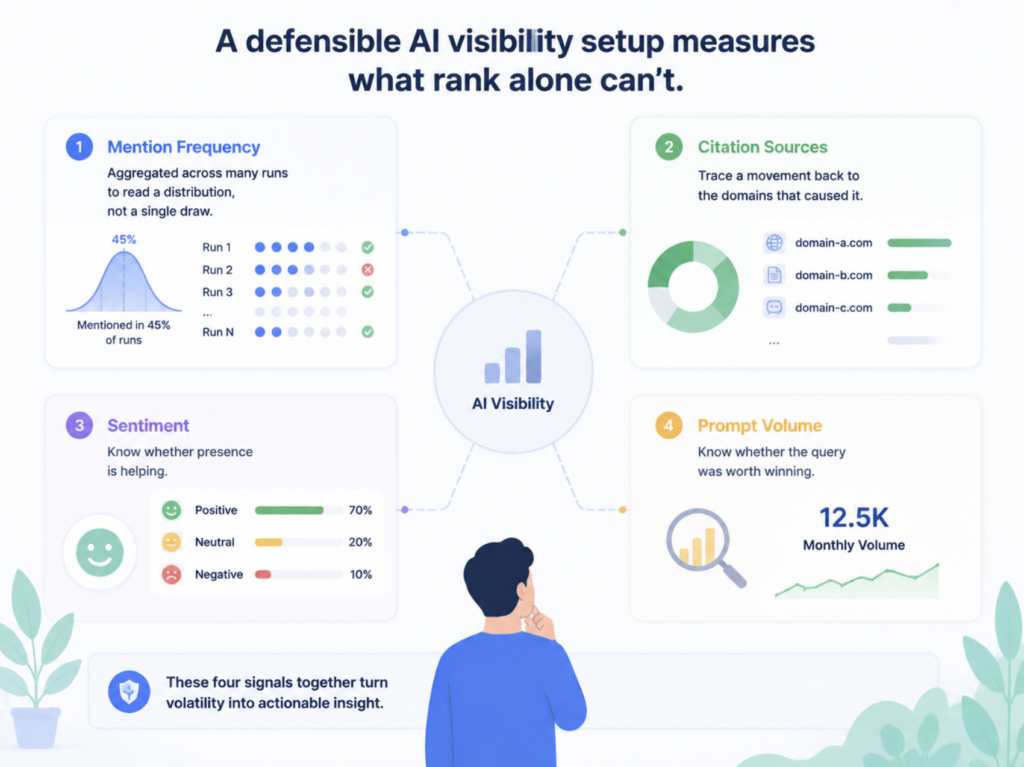
    Think of it across three layers. First, Visibility: does your brand name show up when AI answers relevant questions? Second, Sentiment: when it does appear, is the framing positive, neutral, or quietly negative? Third, Source Attribution: is the AI pulling from your content, your competitors’ content, or third-party platforms like Reddit and G2?

    AI agents and AEO work together in this framework. The agent retrieves sources, synthesizes them, and delivers a verdict. An AEO tool shows you whether your brand made that shortlist, and if not, why.

    AEO Tool vs. SEO Tool: A Side-by-Side Look

    DimensionSEO ToolAEO Tool
    What it tracksRankings, backlinks, trafficAI mentions, citations, sentiment
    Target platformGoogle, BingChatGPT, Perplexity, Gemini
    OutputKeyword positionBrand visibility in AI answers
    Optimization goalRank higherGet cited more often
    Core metricImpressions, CTRMention rate, Citation rate

    The Numbers That Explain Why Marketers Are Paying Attention

    This isn’t a future trend. It’s already showing up in traffic data.

    37% of consumers now start their product discovery journeys with AI tools rather than traditional search engines. ChatGPT has reached 900 million weekly active users. Google AI Overviews reaches 1.5 billion monthly users globally. Traditional search volume is projected to decline by approximately 25% by the end of 2026.

    The conversion numbers make the case even more directly. Visitors referred from AI platforms convert at 4.4x to 5x the rate of standard organic search visitors. In B2B SaaS, AI-referred conversion rates have reached as high as 14.2%.

    That last number deserves its own sentence.

    The explanation is structural. By the time a user asks ChatGPT for a recommendation, the AI has already done the top-of-funnel and mid-funnel research for them. They arrive pre-qualified. The trade-off is that 93% of AI search sessions end without any click to an external website, meaning if you’re not named in the answer, you don’t exist for that user. Forrester data shows B2B marketing teams have already seen 20-30% declines in web traffic tied to AI-native discovery.

    Understanding how AI search marketing works and how to measure it is quickly becoming a baseline expectation, not a niche skill.

    5 Things a Good AEO Tool Should Track

    Not all AEO tools measure the same things. Before evaluating any platform, it helps to know which signals actually matter.

    Mention Rate is the percentage of relevant queries where your brand name appears in the AI’s actual response text. This is the most direct measure of whether AI platforms are recommending you.

    Citation Rate tracks how often your domain is referenced as a source in AI responses, even when the brand name isn’t mentioned in the answer itself. This distinction matters because a tool might cite your content 182 times in a month without ever saying your brand name. That pattern, sometimes called a “ghost citation,” means your data is trusted but your brand hasn’t earned a direct recommendation yet.

    AI Share of Voice compares your mention rate against a defined set of competitors. In a typical AI response, three to six brands are named. You’re either in that group or you’re not. There’s no position eight here.

    Sentiment Score measures how the AI frames your brand when it does mention you. A high score means the AI positions you as a recommended leader. A low one means you’re more likely described as a cautionary alternative. Keyword research built for GEO and AEO can surface the topic clusters where your framing needs work.

    Prompt Coverage identifies which questions your brand shows up for, and equally, which high-volume AI prompts you’re absent from entirely. Research shows that 95% of the sub-queries AI models generate internally have zero recorded search volume in traditional tools like Ahrefs. AEO tools surface these uncontested opportunities before anyone else is optimizing for them.

    What Makes It Harder: The AI Visibility Gap

    Here’s something worth understanding before you start optimizing.

    Different AI platforms don’t agree with each other. There’s less than an 11% overlap in the domains cited by ChatGPT versus Perplexity. Being well-cited on one platform doesn’t transfer to others automatically. Cross-platform tracking isn’t a premium feature. It’s the baseline.

    AI platforms also favor freshness in a specific way. Content updated within the last 90 days is 2.3x more likely to be cited than older material. This isn’t about changing a publication date. It’s about content that reflects current positioning, current product features, and current context.

    The implication is direct: AEO isn’t a one-time audit. It’s a continuous monitoring function.

    Where Topify Fits Into the AEO Picture

    For marketing teams that need to track AEO systematically across multiple platforms, Topify treats AI search visibility as a structured, measurable channel rather than a one-off diagnostic.

    The platform monitors seven metrics across ChatGPT, Gemini, Perplexity, DeepSeek, and other major AI engines: visibility, sentiment, position, volume, mentions, intent, and CVR (Conversion Visibility Rate). Together, these give a marketing team a working picture of how AI systems describe and recommend their brand, not just on one platform, but across the ones their audience actually uses.

    The Source Analysis feature is especially relevant for AEO work. It reverse-engineers which third-party URLs the AI is citing for a given topic, so a content team can identify exactly which domains they need to appear on to earn a citation. That’s a materially different workflow from traditional link-building.

    Topify’s AI Volume Analytics surfaces high-frequency prompts being used on ChatGPT and Perplexity that have no recorded volume in conventional keyword tools. For brands that want to build content targeting the AI’s internal reasoning process, that prompt data is the starting point, not an afterthought.

    The GEO agent layer takes it one step further: rather than just showing you what’s missing, it proposes and can execute optimization strategies with a single click. For teams managing multiple brands or clients, that changes the labor math.

    Trusted by 50+ enterprises and startups, Topify is built for LLM-era visibility from the ground up, not retrofitted from a legacy SEO platform.

    How to Get Started with AEO Optimization

    The entry point doesn’t need to be complex. Here’s a practical framework.

    Start with a baseline audit. Pick your top 15-20 high-intent questions and test them across ChatGPT, Gemini, and Perplexity. Document where you’re mentioned, where you’re cited but not named, and where you’re absent entirely. That three-way breakdown tells you what kind of problem you’re actually solving.

    Identify your real AI competitors. The brands the AI recommends in your category are often not the same ones ranking on Google. This is a consistent finding for brands running their first AEO audit. It changes which content gaps matter most.

    Prioritize by prompt volume. AEO tools with AI Volume Analytics show you which specific questions your audience is asking AI platforms. Start with high-volume prompts where you’re currently absent. That’s where the conversion opportunity is largest.

    From there, content structure matters more than content volume. Research from Princeton found that adding expert quotes to existing content improves AI visibility by 41%, and incorporating specific statistics boosts it by 31-37%. These are repeatable improvements to content you’ve already published.

    Setting up a consistent AI answer monitoring system lets you track whether those updates are actually moving your mention rate, rather than optimizing blind. Update your content at least every 90 days and treat your mention rate the same way you’d treat a keyword ranking: something that shifts, drifts, and requires active management.

    Get started with Topify to run your first cross-platform AEO audit.

    Conclusion

    Your SEO rankings measure how Google sees your content. They say nothing about what ChatGPT, Perplexity, or Gemini recommends when someone asks a question you should be answering.

    AEO tools bridge that gap. They tell you whether you’re in the answer, how you’re described when you are, which sources the AI trusts over yours, and which high-volume prompts you’re completely missing. That’s the diagnostic layer traditional analytics can’t provide.

    As traditional search volume continues its decline and AI-native discovery becomes the default for high-intent research, brands with a clear picture of their AI visibility will have a structural advantage. The ones flying blind on this won’t find out what they’ve missed until the traffic data catches up a year later.


    FAQ

    Q: What does AEO stand for? A: AEO stands for Answer Engine Optimization. It’s the practice of optimizing your brand’s content and entity presence to appear in the synthesized answers generated by AI platforms like ChatGPT, Perplexity, and Gemini, rather than just in traditional search results.

    Q: Is an AEO tool the same as a GEO tool? A: They overlap significantly but aren’t identical. AEO focuses on being included in direct AI answers and zero-click environments like featured snippets and AI Overviews. GEO (Generative Engine Optimization) refers specifically to how LLMs synthesize information and how to ensure your brand is cited as a trusted authority during that generation process. Many platforms, including Topify, cover both layers in a single dashboard.

    Q: Do I need an AEO tool if my SEO is already strong? A: Strong SEO doesn’t automatically translate to AI visibility. A brand can rank #1 on Google for a keyword and be entirely absent from the AI answer for the exact same query. Google prioritizes authority and relevance for rankings. AI engines prioritize structural clarity, entity consistency, and third-party citation patterns. The two systems are separate, and you need visibility into both.

    Q: Which AI platforms should an AEO tool cover? A: At minimum, a useful AEO tool should cover ChatGPT, Google Gemini, and Perplexity, which together account for the majority of consumer AI search behavior in 2026. Regional platforms like DeepSeek matter for brands with international audiences. Given that there’s less than 11% overlap in what ChatGPT and Perplexity cite, single-platform tracking leaves most of the picture invisible.


    Read More

  • G2 AEO Tools Compared: Topify vs Profound vs AirOps vs Otterly

    G2 AEO Tools Compared: Topify vs Profound vs AirOps vs Otterly

    G2 now lists 248 products in the AEO category. That number grew from just 7 tools in early 2025, a jump of over 2,000% in under a year. If you’ve tried to shortlist options on the platform recently, you already know the problem: the category is too crowded to evaluate by browsing.

    Here’s the shortcut most buyers miss. G2’s AI Principal Analyst, Bijou Barry, has already mapped out how to evaluate this category. Her framework breaks AEO tools into three buyer dimensions: Marketing (category positioning and content visibility), Operations (integrating AEO data into the AI tool stack), and Sales (understanding how AI influences the buyer discovery journey). The majority of the 248 listed tools cover only one or two of these dimensions, which creates what Barry calls an “actionability gap.”

    This comparison runs four of the most actively reviewed tools through that same framework: Topify, Profound, AirOps, and Otterly.AI. The goal isn’t to declare a winner. It’s to match each tool to the team type it actually serves.

    What G2’s Analyst Framework Actually Measures

    Barry’s three dimensions aren’t about features. They’re about where in your organization the data needs to land.

    The Marketing dimension is about category share. Which prompts trigger your brand? How often does your brand appear versus competitors across ChatGPT, Gemini, and Perplexity? This matters because only 11% of cited domains appear consistently across both ChatGPT and Perplexity for identical queries, meaning fragmented tracking gives you an incomplete picture.

    The Operations dimension is about closing the loop. Seeing that your brand is invisible is one thing. Having a system that moves from that insight to a content fix, without manual re-routing through spreadsheets and Jira tickets, is another entirely.

    The Sales dimension is the least covered. AI models are increasingly acting as pre-sales agents, handling initial feature comparisons before a buyer ever requests a demo. Sales teams need metrics that connect AI recommendations to actual pipeline influence, not just mention counts.

    Most tools do the first dimension reasonably well. Few address all three.

    The 4 Tools at a Glance

    ToolG2 ScorePrimary UsersBarry DimensionsExecution Layer
    Topify5.0Growth teams, marketing agenciesMarketing, Ops, SalesOne-click AI agent
    Profound4.6Fortune 500, regulated industriesMarketing, SalesNone (data export only)
    AirOps4.6Content ops, enterprise teamsMarketing, OpsWorkflow automation
    Otterly.AI4.9SMBs, solo marketersMarketing onlyNone

    Two patterns stand out immediately. Otterly leads on satisfaction score but covers only one dimension. Topify is the only tool that addresses all three while also providing an execution layer.

    Marketing Dimension: Tracking Category Visibility

    This is where all four tools compete most directly.

    Topify tracks brand performance through a 7-metric framework: Visibility, Volume, Position, Sentiment, Mentions, Intent, and CVR. The platform runs this across 10+ AI platforms simultaneously, including ChatGPT, Gemini, Perplexity, DeepSeek, Doubao, and Qwen. Its “Answer Placement Score” weights citations by their narrative position, a brand mentioned as the first recommendation carries more authority than a footnote, and tracks accordingly. Topify also reverse-engineers competitor citations to identify which source URLs AI engines are prioritizing in their responses.

    Profound is the deepest research tool in this group. Its dataset covers over 400 million real user conversations, allowing teams to do high-resolution prompt-level research. It normalizes results across 10+ platforms and provides strong “Share of Voice” and “Citation Share” reporting. The catch is that Profound operates as a pure data output system. Marketing teams typically export insights into separate content management tools, which creates a bottleneck in high-velocity environments.

    Otterly.AI earns its 4.9/5 G2 rating by making the first dimension genuinely easy. At $29/month entry pricing, it monitors brand mentions across ChatGPT, Perplexity, and Google AI Overviews with setup measured in minutes. That said, it monitors the final AI output but doesn’t analyze the underlying retrieval mechanisms that built those answers. You’ll know that you were cited, not why.

    AirOps approaches marketing visibility through content performance. Its “Visibility Score” unifies AI search and SEO performance at the page level, showing which blog posts and landing pages are being picked up as citation sources. It’s less built for competitive tracking and more for teams that want to see their own content’s indexing performance.

    For teams that need to understand category positioning at scale, Topify and Profound lead. Topify adds the execution layer; Profound adds the research depth.

    Operations Dimension: From Insight to Action

    This is where the field narrows sharply.

    Topify built its operations capability around the “actionability gap” directly. Its One-Click Agent Execution lets teams identify a visibility gap and deploy optimized content to close it within the same platform. No separate briefing process. No manual handoff. The system uses direct browser capture rather than API snapshots, targeting 95-98% citation accuracy, which means operations teams aren’t reacting to stale data.

    AirOps is the strongest alternative for content operations specifically. Pages not updated quarterly are three times more likely to lose citations, and AirOps is built to solve exactly that problem. It routes underperforming pages into automated refresh cycles and connects insight data directly to bulk content production. The trade-off is setup time, often a month to implement effectively, plus significant ongoing maintenance.

    Profound provides deep technical diagnostics via Agent Analytics, which tracks AI crawler behavior through CDN logs. But it doesn’t act on those insights natively. Operations teams use it as a high-resolution lens and then manually translate reports into execution tasks elsewhere.

    Otterly.AI has no meaningful integration or execution capability. Its primary export is a Google Looker Studio connector, limited to higher-tier plans. For teams that need automated AEO responses or CMS integration, Otterly’s monitoring-only approach hits a ceiling quickly.

    If your operations team’s bottleneck is moving from data to deployment, Topify is the cleaner path. AirOps is a strong second for teams that define operations as content production at scale.

    Sales Dimension: Does AI Influence Your Pipeline?

    Only two tools in this comparison engage with the sales dimension at all.

    Topify is built around Conversion Visibility Rate (CVR) as a core metric. CVR estimates the likelihood that an AI-generated answer will drive a user toward a brand interaction. The underlying data makes this worth paying attention to: AI-referred search converts at a rate 803% higher than traditional organic search (14.2% vs 2.8%). Topify’s Position Tracking and Sentiment Polarity analysis add further sales context, ensuring teams can validate whether AI models are associating the brand with its correct value propositions during the decision stage. Sales leaders get a metric that justifies AEO investment in quarterly reviews.

    Profound maps the sales dimension through “Conversation Intent” data and “Query Fanouts” analysis. This lets teams trace how a single prompt, say “best CRM for healthcare,” breaks into a chain of sub-queries that map the buyer’s reasoning journey. The “Brand Relevant Prompts” feature identifies which AI conversations are already mentioning competitors. It’s powerful research, but Profound doesn’t connect these intent signals to actual conversion numbers natively. The link to pipeline impact is analytical, not quantitative.

    AirOps can track AI-attributed signups but lacks intent volume analysis or qualitative sentiment scoring for sales contexts. Otterly has no capability in this dimension.

    For sales and growth teams that need to show AI’s actual impact on pipeline, Topify is the only tool in this group with a native metric designed for that conversation.

    The Full Comparison: All Three Dimensions Scored

    CapabilityTopifyProfoundAirOpsOtterly
    Multi-engine monitoring10+ platforms10+ platforms30+ platforms4-6 platforms
    Barry: Marketing dimension✓ Full✓ Full✓ Partial✓ Basic
    Barry: Ops dimension✓ FullPartial (no execution)✓ Full
    Barry: Sales dimension✓ CVR + PositionPartial (intent data)
    Execution layerOne-click AI agentNoneWorkflow automationNone
    Data collection methodDirect browser captureRendered capture + APIPrompt-based pollingAPI snapshot
    Entry pricing$99/mo$99/mo$199/mo$29/mo
    G2 satisfaction score5.04.64.64.9

    The pattern across all three dimensions is consistent. Topify and AirOps are the two tools that offer both monitoring and execution. The key difference is focus: Topify optimizes for cross-functional coverage and agentic deployment, AirOps optimizes for content production governance at enterprise scale.

    Which Tool Fits Your Team

    Start with Otterly if your team’s primary need is proving to clients or leadership that AI mentions exist. At $29/month, it’s the fastest path to a monitoring baseline. You’ll outgrow it if you need to understand or act on what you’re seeing.

    Choose AirOps if your operations team manages a large content library and the main bottleneck is refresh velocity. AirOps connects insight to production in a way no other tool in this group matches, but plan for a real implementation investment.

    Use Profound if you’re in a Fortune 500 environment with procurement cycles and need audit-grade research data (400M+ prompts, SOC 2, HIPAA compliance). It’s the strongest research platform in the category. Pair it with an execution tool if you need to act on the data inside your organization.

    Pick Topify if your team needs to cover all three buyer dimensions without stitching together multiple platforms. Its G2-reviewed feature set spans visibility tracking, automated deployment, and CVR-based sales impact in a single framework. It’s particularly well suited for growth teams and agencies that report on AEO performance across functions and need to show direct business impact.

    The case for a unified platform is practical. Every tool you add to the stack creates a translation cost: exporting data, briefing another team, waiting for execution, checking if it worked. Tools that close that loop internally tend to generate faster returns.

    Conclusion

    G2’s 248-product AEO category is mostly first-generation monitoring tools. They’ll tell you whether you were mentioned. Most won’t tell you why, and almost none will help you fix it.

    Bijou Barry’s three-dimension framework cuts through that noise effectively. Marketing, Operations, and Sales are genuinely different problems, and the tool that covers all three while providing an execution layer is a short list of one in this comparison.

    If you’re starting the evaluation process, Topify’s page shows how its feature set maps across all three dimensions, with user reviews organized by team type.

    Frequently Asked Questions

    What does AEO mean in G2’s software category? 

    Answer Engine Optimization (AEO), also referred to as Generative Engine Optimization (GEO), covers tools that improve a brand’s visibility and positioning within AI-powered search engines and LLM chatbots. G2 requires qualifying tools to offer AI visibility tracking, sentiment analysis, LLM ranking insights, and competitor benchmarking.

    How is Topify different from Profound on G2? 

    Topify combines a 7-metric visibility framework with one-click agentic content deployment, covering all three of G2’s buyer dimensions. Profound is a deep research platform with over 400 million real prompt data points and strong enterprise compliance credentials, but it doesn’t include a native execution layer. Teams that need insights acted on automatically will find Topify’s integrated approach more practical.

    Can AirOps be used for answer engine optimization? 

    Yes, with a specific use case. AirOps connects AI search visibility data to bulk content production workflows, making it a strong choice for teams managing large content libraries. It covers G2’s Marketing and Operations dimensions but doesn’t address the Sales dimension or provide real-time agentic deployment.

    Is Otterly listed on G2? 

    Yes. Otterly.AI holds a 4.9/5 satisfaction score in the AEO category and is widely used by agencies and small businesses. Its $29/month entry tier is among the most accessible in the category. It covers G2’s Marketing dimension only.

    Which G2 AEO tool covers both monitoring and execution? 

    Topify and AirOps both offer monitoring plus execution. Topify uses a one-click AI agent for rapid optimization across all three buyer dimensions. AirOps uses workflow automation specifically for large-scale content operations. For teams that need Sales dimension coverage alongside the other two, Topify is currently the only option in this comparison.

    Read More

  • 5 Things G2 Won’t Tell You About AEO Tools

    5 Things G2 Won’t Tell You About AEO Tools

    G2 ranks AEO tools by satisfaction and market presence. Neither score tells you whether the tool can handle what LLMs actually do.

    You opened G2. You filtered by “Answer Engine Optimization.” You sorted by highest rated.

    That’s a reasonable starting point. But here’s the thing: the two dimensions G2 uses to rank software — user satisfaction and market presence — were designed to evaluate CRMs and project management tools. They measure how easy the UI is, how responsive the support team is, and how big the company is. None of that tells you whether a tool can handle the one thing that makes AEO fundamentally different from every other software category: LLM non-determinism.

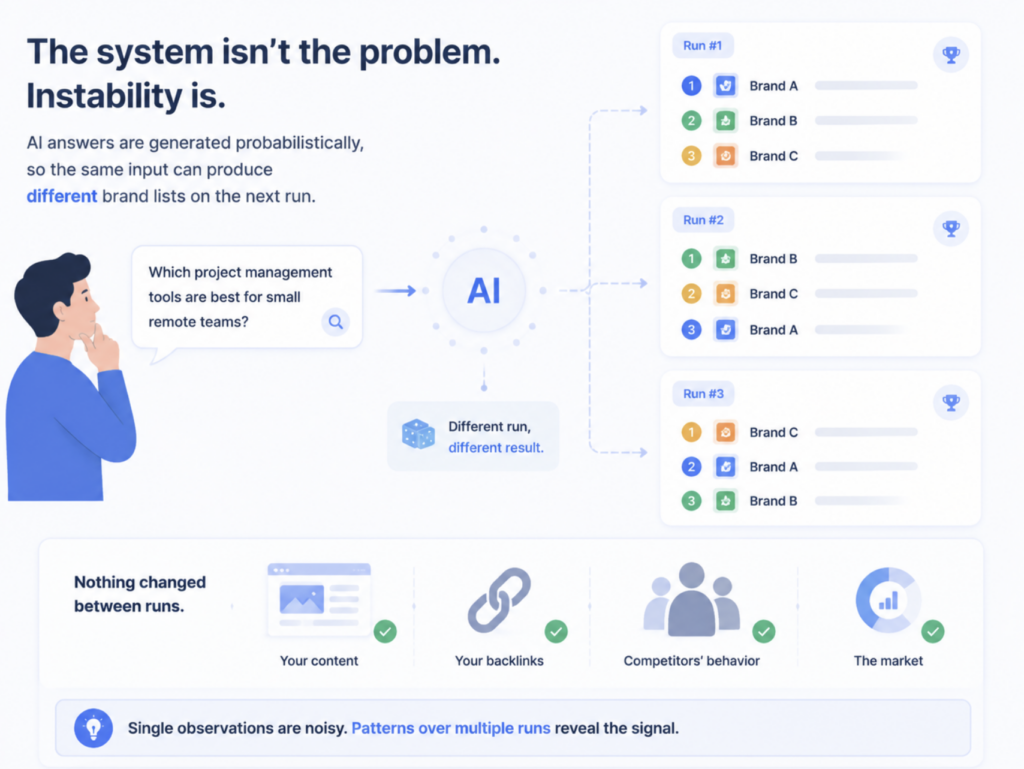
    Run the same query twice, 30 seconds apart. You may get different brand citations, different positions, different sentiment. Tools that rely on API caches or static snapshots will systematically undercount this variance. And they’ll do it in a way that looks fine on a dashboard.

    That’s the gap G2 scores can’t show you.

    Here’s a five-part framework that does.


    Why G2 Scores Are a Starting Point, Not a Verdict

    G2’s Satisfaction score is built on review breadth, recency, and net promoter ratings. Its Market Presence score factors in employee count, revenue, and social footprint. Both are legitimate signals for evaluating a project management tool or a CRM.

    For AEO tools, they miss the point.

    A tool with a polished UI and 24/7 live chat support can score in the top 10% on G2 while its underlying crawler fails to bypass LLM rate limits. A legacy SEO platform with 10,000 employees can dominate the Leaders quadrant after bolting a thin AI monitoring layer onto a five-year-old architecture.

    High satisfaction doesn’t mean accurate data.

    G2’s review cycle also updates quarterly. AI model weights can shift after any single API call. That speed gap — human review cadence vs. model inference updates — means G2 scores are always looking backward in a category that punishes lag.

    Use G2 to build your shortlist. Then run it through the five checks below.


    Check #1 — Does It Re-Run Queries Live, or Pull From a Cache?

    This is the most important question you can ask any AEO vendor.

    LLMs are non-deterministic by design. Even when Temperature is set to 0 — theoretically a deterministic greedy decoding mode — production API calls still produce variable outputs. The reasons are technical: floating-point rounding differences across parallel GPU threads, Mixture-of-Experts routing logic that shifts under continuous batching, and dynamic inference optimizations like prefix caching that change execution context from one call to the next.

    The practical consequence: accuracy rates for the same prompt can vary by up to 15% across runs. In extreme cases, the gap between best and worst performance reaches 70%.

    A tool that runs one query and caches the result for a week is showing you a single probability event, not your brand’s actual visibility distribution.

    Professional-grade platforms handle this with live re-runs: multiple independent queries across time windows and batching environments for the same prompt. The output isn’t a binary “mentioned / not mentioned.” It’s a probability distribution. That’s Visibility Tracking done correctly.

    When you’re in a vendor demo, ask one question: “For a single prompt, how many independent queries do you run? How do you model variance across runs?” If the answer is vague, the data quality probably is too.


    Check #2 — How Many AI Platforms Does It Actually Cover?

    Most tools that score well on G2 were built when “AI search” meant Google AI Overviews. That’s an understandable origin, but the market has fragmented significantly since then.

    As of early 2026, ChatGPT holds somewhere between 60% and 77% of AI-driven search and discovery traffic. Google Gemini sits at roughly 15%, Microsoft Copilot at 12.5%, and Perplexity at 5.4%. Claude AI is at 5.0% but growing faster than most — up 14% quarter over quarter.

    A tool that only monitors Google AIO leaves you blind to the conversations happening in ChatGPT. That’s three out of four AI interactions you’re not seeing.

    Each platform also retrieves and cites information differently. Perplexity operates more like an AI-native search engine, relying on real-time web crawling and explicit inline citations — which is why tracking tools like Brandmentions have built dedicated Perplexity monitoring features. Google AIO correlates closely with traditional organic ranking signals. ChatGPT draws on training data, RAG retrieval, and browsing — a completely different influence model.

    You can’t optimize across platforms you can’t see.

    Topify tracks across 7+ AI platforms including ChatGPT, Gemini, Perplexity, Claude, DeepSeek, Grok, and others. For a brand with any international or multi-channel presence, that coverage isn’t a nice-to-have. It’s risk mitigation.


    Check #3 — Can It Measure Position, Not Just Presence?

    “Your brand appeared in 50% of AI answers this month.”

    That sounds positive. But if your brand appeared last in a five-item list every single time, that number is misleading you.

    Research into Answer Placement Scores (APS) shows that the first recommendation in an AI-generated list carries a weight of 1.0. The second position drops to roughly 0.6. By the third position and beyond, weight falls below 0.3 — which in a conversational context is functionally invisible. AI answers don’t come with a “see all results” button.

    Mention count without position is noise dressed up as data.

    There’s a second layer that matters equally: sentiment. AI doesn’t just list brands — it characterizes them. Being described as “a budget-friendly option with limited enterprise features” and being described as “the most reliable choice for compliance-heavy teams” are both citations. They produce opposite outcomes for your pipeline.

    Advanced platforms combine position tracking with sentiment polarity analysis, identifying not just where your brand appears but how it’s described — and whether those descriptions align with your positioning. Topify’s Competitor Monitoring surfaces both: where you rank relative to competitors on specific prompts, and when AI characterizations shift in tone.

    That’s the difference between brand monitoring and brand intelligence.


    Check #4 — Does the Data Update Daily, or Weekly?

    Google AI Overview trigger rates jumped from 25% to over 60% in 2025. For informational and educational queries, that shift drove a 61% decline in traditional organic click-through rates. The landscape isn’t just changing — it’s changing faster than most marketing teams can track.

    Three forces drive AI recommendation volatility: model provider weight updates (like OpenAI system prompt changes), real-time RAG retrieval pulling in newly published competitor content, and the compounding effect of third-party citation signals accumulating over time.

    A weekly report can’t catch any of that in time to act.

    Weekly-cadence tools are post-mortems. By the time the report lands, the ranking shift that pushed your brand out of the top position happened four days ago. A competitor published new structured content, AI picked it up within hours, and you’re already behind.

    Daily monitoring with meaningful analysis volume is what makes AEO actionable. Topify’s Basic plan supports up to 9,000 AI answer analyses per month — enough to run core prompts multiple times daily and build a visibility curve instead of a weekly snapshot. That curve is what lets a team catch a ranking drop within 24 hours of the triggering event, not after the next report cycle.

    Speed of insight is a structural advantage. Tools that can’t offer it cost you more than their subscription price.


    Check #5 — Does It Tell You What to Do Next?

    Most G2-ranked AEO tools are reporting tools. They surface data. Then they hand you a dashboard and leave the execution entirely to your team.

    Here’s what that actually looks like in practice: your team sees a visibility gap, manually re-analyzes keyword intent, rewrites content in an answer-first structure, updates the CMS, and then needs to build third-party citations on Reddit, LinkedIn, and Quora to generate the signal AI models actually prioritize. Each of those steps introduces lag. Each step is where strategies stall.

    Data without execution is just a more expensive form of anxiety.

    The next category of AEO platforms closes that loop. Topify’s GEO Score Checker evaluates existing pages against specific AI platform retrieval preferences in real time. Its One-Click Execution takes those insights and deploys optimized content — structured answers, schema markup, entity signals — directly through CMS integrations, without a manual rebuild workflow.

    Most tools stop at data. That’s where the real work begins.

    That gap between reporting and executing is the clearest product-generation difference in the AEO market right now. It’s also the one you’ll never spot on a G2 listing page.


    How to Use This Framework on G2 Right Now

    G2 is still a useful discovery funnel. The problem isn’t where you start — it’s where you stop.

    When you’re on a vendor’s G2 listing page, look past the star rating and check for these signals: does the feature list mention “LLM tracking,” “entity extraction,” or “generative AI optimization” specifically — not just generic “SEO”? Do their customer case studies reference AEO-specific KPIs like Citation Share or Answer Placement Score, or are they still talking about keyword rankings and backlinks? Search the review text for words like “accuracy,” “real-time,” and “caching” — user frustration about data lag often shows up there before it shows up in the aggregate score.

    In a demo or trial, three questions will tell you everything:

    Ask how they handle LLM non-determinism: do they run multiple queries per prompt, and what’s their variance modeling methodology? Ask whether they can distinguish between a positive brand mention with no link and a negative mention with a link in terms of sentiment scoring. Ask whether they have a direct path from insight to content deployment — not just a report, but an execution workflow.

    Here’s how the five dimensions stack up across tool types:

    Evaluation DimensionTopifyTypical G2 High-Scorer
    Data CollectionLive multi-run queries, variance modeledAPI cache or static snapshot
    Platform Coverage7+ platforms including DeepSeek, GrokUsually Google AIO or one other
    Measurement DepthAPS position + sentiment + entity associationBasic mention count
    Update FrequencyDaily monitoring, 9,000+ analyses/moWeekly or monthly reports
    Execution CapabilityGEO Score + one-click CMS deploymentReport only, manual follow-through

    Conclusion

    G2 is where you discover tools. It’s not where you evaluate them.

    AEO is a category where the underlying technology runs on probabilistic systems that change faster than human review cycles can track. The tools that look good on a satisfaction survey may be the same ones feeding you cached snapshots from a week ago and calling it a visibility score.

    The five checks above aren’t exhaustive. But they force the right conversations — about data collection methodology, platform coverage, position granularity, update cadence, and execution capability. Those are the questions that separate a dashboard from a platform that actually moves your brand in AI answers.

    See it work, then test it on your own brand. Explore how Topify handles these exact dimensions on the platform, or run your own brand through the GEO Score Checker for free before committing to anything.


    FAQ

    Q1: What does AEO mean on G2? 

    On G2, AEO (Answer Engine Optimization) typically sits within the SEO or AI marketing software categories. It refers to tools that help brands get cited directly by AI assistants like ChatGPT and Gemini, and AI search engines like Perplexity and Google AI Overviews, rather than just ranking in traditional blue-link results.

    Q2: How is AEO different from traditional SEO tools? 

    Traditional SEO optimizes for clicks on indexed links. AEO optimizes for citations and mentions in AI-generated answers. The signals that matter are different: entity authority, structured content readability, answer-first formatting, and third-party citation signals — not just keyword density or backlink count.

    Q3: What’s the most important feature to check in an AEO tool? 

    Data collection robustness. If a tool can’t demonstrate how it handles LLM output variance — ideally through live multi-run query execution — then the visibility numbers it produces aren’t reliable. After that, execution capability: a tool that only reports without offering an optimization workflow shifts the labor cost to your team without reducing it.

    Q4: Can I trust G2 ratings for AEO tools? 

    Partially. G2 is a useful discovery layer and reflects genuine user satisfaction around UI and support quality. What it doesn’t capture is algorithmic depth, real-time data accuracy, or the technical ability to handle non-deterministic AI outputs. Most reviewers on G2 are evaluating AEO tools through a traditional SEO lens, which means the ratings reflect a different set of priorities than what the category actually requires.


    Read More

  • Why G2 AEO Tools Grew 2,000% in a Year

    Why G2 AEO Tools Grew 2,000% in a Year

    March 2025: seven products listed in a brand-new G2 category called Answer Engine Optimization. January 2026: more than 150. That’s a 2,000%+ expansion in under ten months — faster than almost any software category G2 has tracked in its AI parent group.

    The vendor side of this story is easy to explain. The buyer side is why it matters to your brand.

    7 Products in March 2025. 150+ G2 AEO Tools by Early 2026.

    G2’s AEO category launched quietly. At the time, it met the platform’s minimum listing threshold — six products with ten or more reviews each, plus at least 150 total reviews across the category — but barely. A handful of early tools were targeting a problem most marketing teams hadn’t put on their annual planning radar.

    Ten months later, the category had over 150 products. For context: most enterprise software categories need three to five years to reach that kind of density on G2.

    That growth carried enough momentum to generate a G2 Grid report by Winter 2026, followed by a Spring 2026 Grid shortly after. In G2’s system, a Grid report is a credibility signal — it means the category has passed the threshold from experimental to benchmarkable.

    The page view data reinforces it. According to G2 Data Solutions, the AEO category’s page views ranked first among all AI parent categories on G2 in Q4 2025, climbing 62% compared to the previous quarter. That means buyer interest isn’t slowing after the initial spike. It’s still accelerating.

    The Real Signal Isn’t Vendor Count — It’s How Buyers Changed

    Here’s the thing: software categories don’t grow 2,000% because vendors decided to build new products. They grow because buyers started spending money.

    According to G2’s research, 50% of B2B software buyers now start their purchasing process with an AI chatbot rather than a traditional Google search. Among those, 74% prefer ChatGPT as their primary research tool.

    That behavior shift is the underlying driver behind every number in the G2 AEO category. When half your potential buyers are opening an AI assistant instead of a search engine, your ranking on Google’s page one stops being the whole picture. What the AI says about you — or doesn’t say — determines whether you enter the consideration set at all.

    Emily Greathouse, G2’s Director of Market Research, framed the stakes precisely: the modern buyer’s decision journey is being compressed by AI, and winning the AI’s answer matters more than winning the click.

    That’s not a prediction. It’s already reflected in how buyers report their research behavior.

    AEO Went From “Watch List” to “Budget Line” in Under a Year

    Twelve months ago, most marketing teams listed AEO as something to observe. Now it’s appearing in Q1 planning decks as a distinct budget category.

    The shift happened because the data became concrete enough to justify spend. B2B buyers consume an average of 13.4 pieces of content before they contact a sales rep. Two-thirds of that decision journey is self-directed, with AI assistants increasingly acting as the primary research layer. The brand that appears consistently and accurately in AI answers has already shaped the buyer’s shortlist before a single discovery call takes place.

    One benchmark gaining traction in enterprise marketing circles is the “15% rule” — allocating at least 15% of total search budget to AEO. Research suggests that investments below this threshold typically don’t generate sustained citation growth. Teams that have crossed it report a 38% reduction in cost per lead and a 2.4x increase in meeting bookings, according to Salesforce’s 2026 State of Marketing report. In a year when overall marketing budgets tightened, those efficiency numbers drove AI tool spend up nearly threefold in 18 months.

    Budget decisions are lagging indicators. The fact that AEO is appearing as a budget line now tells you the underlying behavior shift happened earlier.

    Before you benchmark your spend, it’s worth establishing where your brand currently stands in AI answers. Topify’s GEO Score Checker gives you a baseline read across major AI platforms in minutes — useful data before any planning conversation.

    What the G2 Grid Reveals About the AEO Tool Market Right Now

    Most buyers use the G2 Grid to find “who’s established” in a category. That’s useful. But in a category this young, the Grid reveals something more specific: which tools close the loop between data and action, and which ones stop at reporting.

    The AEO category has bifurcated into two distinct product types. First: monitoring tools that surface AI visibility metrics but leave the fix to your team. Second: full-stack platforms that connect the insight to the execution — identifying why your brand is missing from AI answers and deploying content to address it.

    That distinction doesn’t show up in feature lists. It shows up in satisfaction scores and user retention. On the G2 Spring 2026 AEO Grid, the platforms with the highest satisfaction ratings are consistently the ones in the second category.

    G2 also functions as a data source for the AI systems themselves. The platform holds roughly 22.4% share of voice across AI-generated software recommendations, and on Perplexity specifically, G2 accounts for 75% of citations from review-type platforms. AI systems treat G2 profiles as structured, machine-readable evidence — not just user testimonials. Reviews that include specific use cases, measurable outcomes, and technical detail carry more citation weight than general sentiment.

    That means a brand’s G2 presence isn’t just a social proof asset anymore. It’s part of the AI visibility stack.

    Topify on G2 Spring 2026: What the Data Backs Up

    Topify sits in the small group of platforms that combine measurement with execution rather than treating them as separate workflows. The team behind it includes founding researchers from OpenAI, Stanford LLM authors with 2,000+ citations, and a Google SEO champion who scaled Fortune 500 traffic from zero to a million organic visits, which shapes how the product handles both the AI side and the search side.

    The coverage layer is broader than most tools in the category. Topify tracks brand visibility across ChatGPT, Gemini, Perplexity, Claude, and other major AI platforms — which matters because your buyers aren’t all using the same AI assistant, and gaps in coverage become blind spots in your data.

    The analytics framework tracks seven KPIs: visibility, sentiment, position, volume, mentions, intent, and CVR (Conversion Visibility Rate). That last metric estimates the probability that an AI answer is actually directing a buyer toward your brand — which is the number most marketing dashboards are currently missing. Visibility tells you if you’re being mentioned. CVR starts to tell you whether it’s converting.

    Topify’s source analysis feature works in the opposite direction: it reverse-engineers the exact URLs that AI platforms cite when recommending brands in your category. For content teams, that data directly answers the question of what to build next. You’re not guessing which content fills the citation gap — you’re seeing which domains are being pulled and why yours isn’t among them.

    You can explore Topify’s platform and features on the official site, or start a 7-day free trial to pull your own brand’s AI visibility baseline before your next planning cycle.

    How to Pick a G2 AEO Tool Before the Category Gets Noisier

    With 150+ products in the category and new entrants arriving monthly, selection pressure is real. Most tools share surface-level feature parity — dashboards, visibility scores, platform mentions. The differences that actually matter show up in three areas.

    Platform coverage. Single-platform tools are common and inexpensive. But if your buyers are distributed across ChatGPT, Gemini, and Perplexity, a tool that only monitors one of them isn’t showing you a complete picture. Coverage gaps become strategy gaps.

    Metric depth. Visibility percentage is a floor, not a ceiling. Look for tools that track position relative to competitors, sentiment accuracy over time, and source citation analysis. These are the signals that connect AI mentions to actual pipeline behavior.

    Execution capability. Data without a clear path to action is a reporting exercise. The platforms with the strongest G2 satisfaction scores in the AEO category are consistently the ones that help you act on what you find — not just document it.

    Here’s how the two main tool types stack up across these dimensions:

    CapabilityMonitoring-only toolsFull-stack AEO platforms
    Multi-platform AI trackingOften single-platformChatGPT, Gemini, Perplexity + others
    Competitor benchmarkingLimitedReal-time, multi-platform
    Source citation analysisRarely includedYes
    Content gap identificationNoYes
    Agent-based executionNoYes (e.g. Topify)
    Entry price$49–$79/mo$99–$499/mo

    One practical filter: use the High Performer quadrant on the G2 Spring 2026 Grid as your starting point, not just the Leaders. In a category this young, satisfaction scores are a more reliable signal than market presence scores. High Performers have strong user validation but may not have scaled distribution yet — for a newer category, that’s often where the better product lives.

    Conclusion

    The 2,000% growth in G2’s AEO category isn’t a forecast about where marketing is heading. It’s a data point about where buyers already are.

    When half of B2B software buyers start their research with an AI chatbot, your position in those AI answers directly affects whether you make the initial shortlist. The G2 Spring 2026 AEO Grid gives you a peer-reviewed starting point for evaluating which platforms are worth testing. Use it alongside a current baseline of your own AI visibility — you need both to make an informed decision.

    The brands that ran this audit twelve months ago are already ahead. The window before it becomes table stakes is closing.

    FAQ

    What is the G2 AEO tool category? 

    The Answer Engine Optimization (AEO) category on G2 groups tools designed to help brands improve their visibility in AI-generated answers across platforms like ChatGPT, Gemini, and Perplexity. The category launched in March 2025 with 7 products and grew to 150+ by early 2026, making it one of the fastest-growing software categories on the platform.

    How is AEO different from SEO? 

    SEO optimizes for search engine rankings — getting your pages to rank in Google’s results. AEO optimizes for AI-generated answers, which means ensuring that large language models cite, reference, and recommend your brand when buyers ask research questions. The mechanics differ: AI systems prioritize structured content, semantic consistency across third-party sources, and citation density over traditional backlink signals and keyword density.

    What should I look for when evaluating a G2 AEO tool? 

    Prioritize platform coverage (does it track ChatGPT, Gemini, and Perplexity, not just one), metric depth (visibility percentage is a starting point — look for sentiment, competitive position, and source citation analysis), and execution capability (can it help you act on the data, or does it only report it?). On the G2 Spring 2026 Grid, start with the High Performer quadrant for the strongest satisfaction signals in an early-stage category.

    Why is G2 specifically important for AEO strategy? 

    G2 holds approximately 22.4% share of voice in AI-generated software recommendations and accounts for 75% of review-platform citations on Perplexity. AI systems treat structured G2 profiles as credible, machine-readable evidence. That means reviews containing specific use cases and measurable outcomes carry citation weight in AI answers — making G2 presence a direct input to AEO performance, not just a social proof channel.

    Read More

  • GEO Score Checker: Which Free Tool Actually Fixes You

    GEO Score Checker: Which Free Tool Actually Fixes You

    You run a free GEO score checker. Your brand scores a 42.

    Now what?

    That’s the moment most tools abandon you. You’ve got a number, a vague sense of underperformance, and zero clarity on what to actually change. The score isn’t the problem. The missing roadmap is.

    This comparison breaks down the leading free GEO tools across four dimensions that matter: what they detect, whether they tell you what to fix, whether they track changes over time, and whether they show you what your competitors are doing differently.

    Your GEO Score Is 42. Here’s Why That Tells You Almost Nothing

    A score of 42 doesn’t tell you why you’re invisible to AI.

    There are at least three distinct root causes behind a low GEO score, and each one requires a completely different fix:

    The technical parsing gap. Your content might be authoritative, but structured in a way that AI crawlers and RAG systems can’t extract effectively. Heavy JavaScript, missing heading hierarchy, no FAQ schema.

    The authority deficit. Your site looks great, but AI models verify “truth” through third-party signals. If you’re not mentioned on Reddit, G2, or industry publications, the model has no external validation to cite.

    The semantic mismatch. You’re optimizing for keywords with high traditional search volume, but those aren’t the conversational prompts people actually type into ChatGPT or Perplexity.

    A score of 42 could mean any of these three things. Or all of them at once. A tool that only shows the number gives you nothing to act on.

    What a GEO Score Actually Measures

    The most useful GEO scoring frameworks evaluate at least five dimensions simultaneously:

    DimensionWhat It MeasuresWhy It Matters
    Visibility (Presence Rate)How often your brand appears across AI responses for tracked promptsDetermines whether you enter the model’s consideration set at all
    SentimentEmotional tone and framing when the AI describes your brandAffects recommendation probability and long-term model trust
    PositionYour rank order in AI-generated comparison listsAI summaries give disproportionate depth to the top 3 results
    Source CredibilityAuthority of third-party domains that cite your brandModels prioritize publisher consensus and community validation
    Structural IntegrityH-tags, FAQ schema, tables that enable easy data extractionFundamental for RAG systems to “clip” relevant information

    Research by Aggarwal et al. found that the strongest GEO improvements come from adding statistics and expert quotations to content, not from keyword variations. Traditional SEO tactics like keyword stuffing have negligible impact on AI visibility. The ranking logic has fundamentally shifted.

    That’s why a single composite score, without dimension-level breakdown, is a diagnostic dead-end.

    The Blind Spots Most Free GEO Tools Share

    The surge in free checkers has made GEO scoring accessible. It’s also created a new kind of problem.

    The one-platform bias. Many free tools only test ChatGPT. But ChatGPT, Perplexity, Gemini, and Claude don’t “read the same internet.” Perplexity, for instance, pulls heavily from Reddit, which accounts for 46.7% of its top citations. A brand that appears consistently in ChatGPT responses may be completely absent on Perplexity. A score based on one model is a partial picture at best.

    Output without advice. Most tools give you a total score and stop there. If your Sentiment Score is 50 out of 100, you need to know which specific third-party source is dragging it down. Without that, you’re left guessing between a PR campaign, a schema fix, or a content rewrite.

    The snapshot problem. Research shows that only about 30% of brands maintain consistent visibility across multiple regenerations of the same query. Model drift and stochastic variation in token generation mean a score captured in the morning can be meaningless by afternoon. A single-point snapshot isn’t a strategy input.

    These aren’t minor gaps. They’re the reason teams spend weeks debating where to start while their competitors keep picking up citations.

    Free GEO Tools, Compared Across Four Dimensions

    Here’s how the leading tools stack up on the criteria that actually matter for decision-making:

    ToolMulti-Platform CoverageFix RecommendationsCompetitor CitationsContinuous Tracking
    HubSpot AEO GraderChatGPT, Gemini, PerplexityGeneral written interpretationLimitedNo
    Mangools AI Search Grader8+ models (incl. Claude, Llama)Low, focus on visibility scoresBasic ranking comparisonNo
    Geoptie GEO AuditMulti-engine readinessHigh, 6-dimension breakdownNo direct trackingNo
    Frase GEO Score CheckerChatGPT, Perplexity, ClaudeSpecific (citability, key takeaways)NoNo
    Topify GEO Score CheckerFull ecosystem (incl. DeepSeek, Doubao)Prioritized action feedDeep, source URL analysisYes

    Each tool occupies a different niche. HubSpot’s AEO Grader works well for a one-time “board-ready” overview of how AI characterizes your brand, whether as a market leader or a traditional player. Mangools functions as the rank tracker of the AI era: broad model coverage, simple visibility signals, no execution layer. Geoptie offers the most technically thorough free audit for structural readiness, though it doesn’t track changes or surface competitor data. Frase focuses specifically on URL-level citability, useful for optimizing individual pieces of content.

    The pattern across all four: they diagnose. They don’t prescribe.

    What Topify’s GEO Score Checker Does Differently

    The core gap in most free tools is what happens after the score. Topify’s GEO Score Checker is built around closing that gap specifically.

    It starts with broader coverage. The tool evaluates brand visibility across ChatGPT, Gemini, Perplexity, DeepSeek, Doubao, and other major AI platforms. That matters because a visibility gap on one platform and not another usually points to a specific type of fix, whether that’s structured data, third-party mentions, or content format.

    The more significant difference is the action layer. When Topify detects a gap, it doesn’t just flag it. Its Source Analysis identifies the exact URLs and domains AI platforms are citing when they answer queries in your category. For a B2B SaaS brand, this might reveal that 85% of citations come from Reddit, G2, and industry publications, not from brand-owned content. That’s not a content quality problem. It’s a citation network problem, and it calls for a specific outreach strategy, not more blog posts.

    The platform tracks changes over time. Every content update or new citation feeds back into the visibility metrics, so you can see whether a specific fix actually moved the score before deciding to scale it. The optimization loop is closed, not open-ended.

    Topify’s seven-metric framework (visibility, mentions, sentiment, position, volume, intent, and CVR) connects AI search data to downstream revenue signals. That’s the bridge most free tools don’t build.

    Scores without a fix roadmap are just noise.

    The Right Tool Depends on Where You’re Trying to Go

    Not every team needs an execution platform. Here’s a straightforward way to think about the decision:

    If you want situational awareness: Any free tool gives you a baseline. HubSpot or Mangools work fine for understanding where you stand before a strategy conversation or a leadership review.

    If you’re trying to move the number: You need something that tells you which fix produces the fastest score improvement, tracks whether it worked, and shows you what competitors are doing to earn the citations you’re missing. Free snapshot tools can’t do that.

    The gap between these two scenarios is the difference between knowing your brand scores a 42 and knowing that fixing your schema on three specific pages would push you past a competitor who’s currently getting cited for 68% of the queries in your category.

    Who Gets the Most Value from Topify’s GEO Score Checker

    B2B SaaS brands where AI search is already influencing pipeline. Buyers are using ChatGPT and Perplexity to evaluate software before they ever visit a vendor site. Topify helps SaaS teams maintain a coherent semantic footprint across feature pages, comparison content, and documentation, so AI systems understand exactly what the product does and who it’s built for.

    Marketing and SEO agencies managing multiple clients. Daily prompt testing across dozens of models doesn’t scale manually. Topify’s multi-project management and one-click execution give agencies a way to deliver measurable AI visibility improvements without adding headcount.

    SEO teams transitioning from traditional search. Teams moving from “ten blue links” to “AI citations” need a tool that bridges both worlds. Topify integrates technical signals like schema and crawlability with AI-native signals like sentiment and source citation patterns, which means one platform instead of a fragmented stack.

    FAQ

    What is a GEO score and how is it calculated? A GEO score measures how visible and trustworthy a brand is within AI-generated answers. Most professional tools calculate it as a weighted average across visibility (frequency of appearance), sentiment (tone of description), position (rank in AI-generated lists), and source credibility (authority of cited URLs).

    Are there any truly free GEO score checkers? Yes. HubSpot AEO Grader, Geoptie GEO Audit, Mangools AI Search Grader, and Frase all offer free tiers that work well for baseline audits. Topify also offers a free GEO Score Checker at topify.ai/tools/geo-score-checker with prioritized fix recommendations, which goes further than the purely diagnostic tools.

    How often should I check my GEO score? More often than most teams think. Research suggests only about 30% of brands maintain consistent AI visibility across multiple regenerations of the same query, due to model drift. A practical cadence: weekly for top-priority prompts, monthly for citation trends and sentiment shifts, quarterly to connect GEO metrics to pipeline and branded search lift.

    What’s the difference between a GEO score and an SEO score? SEO scores measure demand capture through backlink volume, crawlability, and link rankings. GEO scores measure demand influence: how likely an AI is to cite your content based on its factual density, authoritative tone, and structural clarity. Different signals, different optimization strategies.

    Can a GEO tool tell me which fixes to prioritize? Most diagnostic tools, like HubSpot or Mangools, can tell you your score is low but can’t tell you what to change first. Tools with an execution layer, like Topify, analyze visibility gaps against competitor citation data to surface a prioritized action feed, showing exactly which changes move the score fastest.

    Conclusion

    A GEO score is the start of a conversation, not the end of one. The question isn’t whether your score is 42. It’s whether your tool can tell you what to do about it, in what order, and how to verify it worked.

    Free tools are genuinely useful for establishing a baseline or building the case for a GEO investment. But if you’re tasked with actually improving AI search visibility, you need something that closes the loop between data and execution.

    Topify’s GEO Score Checker is worth starting with, specifically because it doesn’t stop at the number.

    Read More

  • Your GEO Score Is Useless Without This 5-Step Workflow

    Your GEO Score Is Useless Without This 5-Step Workflow

    Most brands run a GEO score check and stop there.

    They see a number, screenshot it, maybe share it in a Slack channel, and then… nothing. No action, no follow-through, no visible change in how often AI systems actually recommend them.

    That’s the gap most brands still can’t see. A GEO score isn’t a result. It’s a starting point. And without a structured workflow to act on it, the score is just a data point collecting dust.

    This guide walks through the five-step process that turns a GEO score into real AI citations — the kind that show up in ChatGPT, Gemini, and Perplexity responses when your ideal customers are making decisions.

    Step 1. Run Your GEO Score Check Before You Touch Anything Else

    The single most common mistake in GEO programs is optimizing without a baseline. Teams start producing content, updating schema, and chasing citations — all before they know where they actually stand.

    In a stochastic environment like large language models, that’s expensive guesswork.

    GEO score check establishes the baseline your entire optimization strategy depends on. It measures how likely your brand is to be cited and recommended by platforms like ChatGPT, Gemini, and Perplexity — not as a single number, but as a weighted composite across six technical and qualitative dimensions:

    AI Bot Access is the binary foundation. If your robots.txt blocks crawlers like GPTBot, OAI-SearchBot, ClaudeBot, or PerplexityBot, you’re invisible to the retrieval-augmented generation (RAG) systems powering real-time AI search. Everything else in your GEO strategy becomes irrelevant.

    Structured Data measures your JSON-LD schema implementation. Schema acts as a machine-readable identity card — it helps AI engines resolve entities and understand relationships without relying on natural language interpretation.

    Visibility tracks how often your brand appears in responses for a set of high-intent industry prompts. This is your Share of Model: the percentage of relevant AI answers where your brand gets a mention.

    Sentiment evaluates how AI characterizes your brand when it does mention you. “Leading solution” and “budget alternative” are both citations — but one drives purchase intent and one doesn’t.

    Position measures where you appear in the generated answer. A first-position mention carries 32% higher purchase intent than a fourth-position mention, according to generative search research.

    Source Coverage tracks the diversity of third-party platforms citing you. AI models are 6.5 times more likely to recommend a brand when multiple independent sources — Reddit, Wikipedia, industry publications — corroborate its authority.

    Without this baseline, marketing teams can’t distinguish between a temporary model fluctuation and a systemic failure in their content strategy. The Topify GEO Score Checker runs this diagnostic across all six dimensions and surfaces exactly where the gap is.

    Step 2. Your GEO Score Masks More Than It Reveals — Find the Weak Dimension

    An aggregate score of 88/100 sounds like “excellent.” It’s often not.

    A brand can score well in technical SEO and AI bot access while remaining invisible for every high-intent buying prompt. The overall number smooths over the specific dimension that’s actually dragging performance. That’s where teams waste months optimizing the wrong things.

    The diagnostic work in Step 2 is about peeling back the aggregate to find the single weakest dimension. Each dimension has a different failure pattern:

    DimensionWhat It SignalsHow to Spot It
    SentimentAI describes your brand negatively or neutrallyHigh visibility, low conversion; AI frames you as “expensive” or “complex”
    PositionFrequent mentions, but always at the bottom of listsCitations exist, but competitors are named first every time
    Source CoverageAI only pulls from your own domainZero citations from Reddit, news media, or third-party review sites
    CVRPresent for informational queries, absent for decision-stage promptsMentioned in “what is X” answers, not in “best X for Y” answers

    The recommendation here is counterintuitive: don’t try to fix everything at once. In an LLM environment, shifting too many variables simultaneously makes it impossible to attribute improvements to specific actions. Pick the single most underperforming dimension and run a targeted remediation before touching anything else.

    Step 3. Don’t Optimize Blindly — Build a Prompt-Specific Action Plan

    GEO optimization is not about producing more content.

    It’s about producing content that satisfies the specific retrieval requirements of the engines. Once you’ve identified your weak dimension from Step 2, the response needs to be targeted — not generic.

    Different weaknesses require fundamentally different fixes:

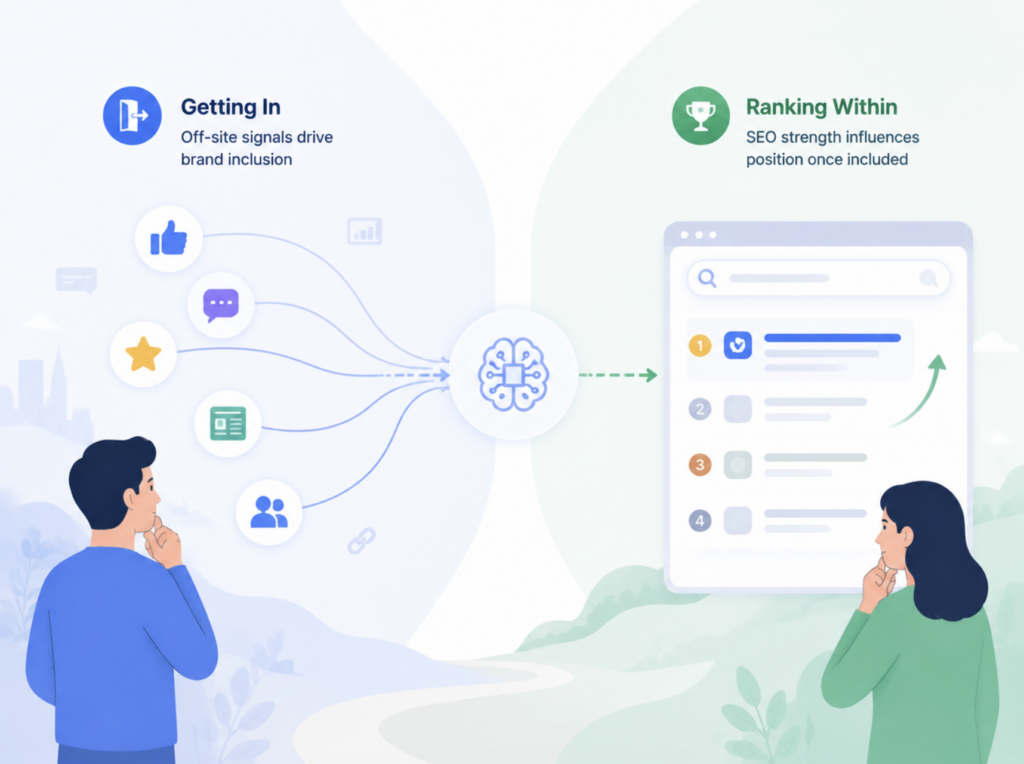
    Source Coverage deficit: If AI engines only cite your own domain, you have a third-party validation problem. AI systems use something functionally similar to consensus scoring. The fix is earned media and digital PR — securing mentions on Reddit, industry publications, and third-party listicles. Off-site signals are often more effective than any on-page change.

    Sentiment deficit: If you’re described as “known for complex setup” or “better for enterprise,” the action plan involves publishing content that directly counters that narrative with evidence. Case studies with specific metrics. Review platform signals from G2 or Trustpilot. AI models synthesize these sources when forming their characterizations.

    Position deficit: Research shows that 44.2% of AI citations come from the first 30% of a page’s content. To move from trailing mention to top recommendation, content must lead with a 40-60 word direct answer to the prompt — not a long intro that buries the key information.

    The execution gap is where most teams stall. Identifying the fix is one thing. Deploying it across multiple content properties, updating schema, coordinating between writers and developers — that’s where timelines slip by weeks.

    Topify’s One-Click Agent addresses this directly. Define your goal in plain language, review the proposed strategy, and deploy with a single click. The agent handles monitoring, gap detection, content formulation, and direct publishing to your CMS — without requiring manual coordination across teams.

    Step 4. Track AI Citations — Not Just Rankings

    Here’s what traditional SEO metrics miss entirely: a page can rank #1 on Google and never get cited by ChatGPT.

    Ranking and citation are different signals. Generative engines don’t pull from the top of a search index — they pull from content that satisfies the structural requirements of retrieval-augmented generation. A page that ranks well but lacks factual depth, structured data, or third-party corroboration is invisible in AI answers.

    That’s why AI citation frequency is the North Star metric for the modern search marketer — not rankings, not impressions.

    Citations are the mechanism that preserves the revenue pathway in a zero-click world. While a mention builds awareness, a clickable citation is what drives high-converting referral traffic. Research shows that content incorporating authoritative citations, direct quotes, and relevant statistics achieves 30-40% higher visibility in generative engine responses.

    Different platforms also have different citation behaviors:

    PlatformCitation PatternWhat to Prioritize
    ChatGPT3-5 sources; favors high-authority editorial sitesEncyclopedic, factual depth
    Perplexity5-12 sources; heavy focus on recency and original dataMonthly updates and data-dense reports
    Google AIOFavors answer-first snippets from top rankingsTechnical SEO foundation + direct answers
    GeminiTrusts institutional sources (.gov, .edu) over UGCExpert authorship and credentials

    Tracking these citation patterns manually across four platforms is not realistic for any marketing team. Topify’s AI Visibility Tracker queries actual AI platforms and reads real-time responses to determine your Share of Voice. It identifies the specific trigger keywords that cause an AI to mention your brand — and detects the visibility gaps where you should be present but currently aren’t.

    That’s the data that informs every decision in the next step.

    Step 5. Iteration Is the Product — Set a 30-Day Feedback Cadence

    AI search is not a set-and-forget environment. LLMs update constantly. Search indices are dynamic. Content cited yesterday may be ignored by next week.

    Freshness is a primary citation signal. Pages updated within the last 14 days are cited 2.3 times more frequently than pages untouched for 60 or more days. After 90 days without updates, citation rates typically plateau at 40% of their initial peak.

    Update CadenceCitation Probability
    Continuous (Monthly)100% baseline maintained
    One-Time Optimization-60% decay within 3 months
    Biannual RefreshSignificant visibility gaps

    The implication is clear: GEO is an ongoing system, not a campaign. The brands winning AI citations aren’t the ones who ran the best one-time optimization. They’re the ones who built a repeatable monthly cadence.

    A 30-day feedback loop looks like this: re-run your GEO score on Day 1 to capture any shifts. Spend Days 2-5 analyzing new weak dimensions or emerging competitor threats. Use Days 6-10 to execute — update content, add statistics, refresh expert quotes. Then monitor recovery metrics through the rest of the cycle and prepare for the next iteration.

    Topify’s AI Agent automates the execution layer of this loop. It continuously monitors your brand’s presence, identifies when citation rates drop, and proactively deploys fixes without requiring a manual trigger. You define the goals; the system handles the cadence.

    Why Most Teams Get Stuck After Step 1

    The gap between brands winning at GEO and those falling behind isn’t usually a matter of effort. It’s a matter of integration.

    Most marketing teams run three separate workflows: a tracking tool, a strategy planning process, and a content execution platform. These rarely talk to each other. When AI citation rates drop, the delay between identifying the problem and deploying a fix can stretch to weeks — and in an environment with a strong recency bias, that delay is expensive.

    That’s the structural problem Topify was built to solve.

    ApproachResultKey Weakness
    Score OnlyTemporary awareness of declineNo mechanism for fast recovery; manual work blocks progress
    Fragmented ExecutionInconsistent visibility across enginesHigh coordination costs; updates lag citation decay
    Topify Closed-LoopSustained citation leadershipRequires commitment to an automated, iterative workflow

    Topify is the only platform that unifies AI search tracking, GEO optimization strategy, and content execution in a single system. From running your first GEO score check to publishing optimized content and monitoring real-time citation changes, the entire workflow runs in one place — without coordination overhead.

    That closed-loop structure is what separates brands that maintain AI visibility from those who constantly play catch-up.

    Conclusion

    A GEO score tells you where you stand. It doesn’t tell you what to do next — and that’s the gap most brands don’t close.

    The five-step workflow here — baseline check, weak dimension diagnosis, targeted action plan, citation tracking, and continuous iteration — is what turns a number into a system. Each step feeds the next. And each cycle of the loop compounds on the one before it.

    In a world where 90% of B2B buyers use AI tools at some point in their purchasing journey, and AI-referred visitors convert at up to 4.4 times the rate of traditional organic visitors, the brands that build this system now are establishing a durable advantage. The ones that don’t will keep wondering why their score looks fine but no one’s citing them.

    FAQ

    What is a GEO score and how is it calculated? 

    A GEO score measures a website’s readiness for AI search engines. It’s calculated using a weighted methodology across six dimensions: AI Citability (25%), Brand Authority (20%), Content E-E-A-T (20%), Technical SEO (15%), Schema Markup (10%), and Platform Readiness (10%).

    How often should I check my GEO score? 

    Weekly for high-competition industries; monthly at a minimum for others. Citation frequency drops significantly after 30 days without updates, so a monthly check is the baseline for maintaining visibility.

    What is a good GEO score? 

    A score of 70 or above is considered good. Scores of 85 or above indicate that AI engines likely treat your brand as a primary source of authority for relevant prompts.

    Can I improve my AI citations without changing my website? 

    Yes. Off-site signals carry significant weight. Increasing your Source Coverage by securing mentions on Reddit, Wikipedia, and authoritative third-party media is often more effective than on-page changes alone.

    How long does it take to see results after GEO optimization? 

    Changes targeting real-time engines like Perplexity can appear within hours or days. For indexed engines like ChatGPT or Google AI Overviews, meaningful improvement typically takes 3 to 8 weeks.

    Read More

  • GEO Score Benchmarks 2026: How Does Your Site Stack Up?

    GEO Score Benchmarks 2026: How Does Your Site Stack Up?

    You ran the GEO Score check. Got a 54. Now what?

    A number without context isn’t a metric, it’s noise. The only way to know whether 54 means you’re ahead of the curve or quietly falling behind is to compare it against what’s actually happening in your industry. That’s what this benchmark report is for.

    What Your GEO Score Is Actually Measuring

    Before the numbers, a quick clarification: a GEO score measures your site’s content-level readiness to be ingested and cited by AI engines. It’s not a real-time tracker of whether ChatGPT mentioned you this morning. Think of it as an audit of your structural health, not a live performance report.

    The score pulls from four core dimensions:

    AI bot access checks whether crawlers like GPTBot, ClaudeBot, and PerplexityBot can actually reach your content. Many legacy sites unknowingly block these agents via outdated robots.txt files, or serve JavaScript-rendered pages that AI crawlers can’t parse.

    Content clarity measures how well your pages are broken into self-contained, fact-dense blocks. AI engines don’t consume full pages. They retrieve chunks. A page that reads as one long wall of text has low “extractability” regardless of how well-written it is.

    Authority signals track E-E-A-T indicators: verifiable statistics, original research, expert attribution. Princeton University research found that adding statistics can drive a 37% increase in AI visibility, while citing authoritative sources can lead to a 115% boost for lower-ranked pages.

    Citation-friendliness assesses structured data presence, specifically JSON-LD schema, FAQPage markup, and whether the site has deployed an llms.txt file to guide AI crawlers toward priority content.

    The 2026 GEO Score Scale

    Score RangeStatusWhat It Means
    0–39Foundational DeficiencyCritical technical gaps; AI crawlers blocked or content unparseable
    40–60Industry AverageMost sites land here; basic SEO present but not AI-optimized
    61–74Conscious OptimizationActive GEO attempts; inconsistent schema and structure
    75–84High AI ReadinessStrong E-E-A-T signals; frequent FAQ schema; RAG-friendly content
    85+EliteProactively designed for AI; dominant entity authority; systemic schema

    A score above 70 is considered good. Above 85 is where the leaders actually live.

    To get your baseline, the Topify GEO Score Checker runs a standardized technical audit across all four pillars and maps results to actionable recommendations.

    GEO Score Benchmarks by Industry in 2026

    Here’s where the data gets useful. Performance varies significantly by sector, and the gap between average and leading brands tells you exactly what’s winnable.

    B2B SaaS: Technical Depth, FAQ Gaps

    MetricBenchmark
    Average GEO Score52–58
    Leading Brand Score72–80+
    AI Referral Share2.80% (highest tracked)
    Primary GapsTechnical doc structure, FAQ coverage, schema completeness

    B2B SaaS companies start with an advantage: high-density informational content, which is exactly what AI engines prefer. The problem is that most of that content is written for humans scanning a features page, not for AI systems retrieving a specific answer chunk.

    The brands sitting at 72+ have restructured their help centers and technical documentation to mirror conversational prompts. One common pattern: using sameAs links in schema to anchor product entities to GitHub, G2, or LinkedIn, creating a “consensus signal” that AI engines use to verify brand claims.

    The most common gap at the average band (52–58)? FAQ content that answers generic questions instead of the specific, comparison-oriented questions your buyers are actually asking AI assistants.

    E-commerce: Thin Pages, Weak UGC Signals

    MetricBenchmark
    Average GEO Score44–52
    Leading Brand Score68–76
    AI Overview Presence6.80%
    Primary GapsThin product descriptions, no comparative data, weak UGC

    E-commerce has the steepest hill to climb. Most product pages are built for visual browsing. AI agents do attribute-based retrieval. Those aren’t the same task.

    Pages scoring below 61 are rarely considered by AI agents for purchase recommendations. Leading brands like Walmart and Amazon maintain high scores by combining massive user-generated content with detailed product attribute schemas. The gap for smaller retailers is specific: they don’t explain their product’s relationship to competitors. AI engines struggle to cite a product page that doesn’t tell them why to recommend it over alternatives.

    Comparison-oriented content, “X vs. Y” pages, detailed attribute breakdowns, verified review data, is what separates a 52 from a 72 in this sector.

    Media and Publishing: The Citation Architecture Problem

    MetricBenchmark
    Average GEO Score58–65
    Leading Brand Score80–88
    Primary GapsUnstructured citations, poor AI summary friendliness

    Publishers start with a natural advantage: content density. That’s why their average scores are higher than most other sectors. But they’re increasingly penalized for what might be called disorganized citation architecture.

    The primary differentiator for leading publishers is the “Bottom Line Up Front” (BLUF) writing structure. AI engines prioritize pages where the first 60 words directly answer the primary question. Many editorial teams write in the opposite direction: context, background, then the point.

    The other issue is a dual-optimization trap. Teams are trying to hold traditional SEO rankings while simultaneously improving AI citation probability, and without a unified framework, both suffer.

    Local Services: The Knowledge Graph Crisis

    MetricBenchmark
    Average GEO Score38–48
    Leading Brand Score60–70
    AI Overview Presence4.40% (lowest across sectors)
    Primary GapsNo structured data, thin content, missing Local Knowledge Graph signals

    Local services, legal, medical, home maintenance, consistently hold the lowest GEO scores in 2026. AI assistants frequently avoid citing local providers because their information (pricing, availability, specific expertise) isn’t provided in a verifiable, structured format.

    That’s a fixable problem. Leading local brands have built what you might call “Knowledge Hubs”: pages dedicated to answering specific, non-transactional questions rooted in their market. Think “Why does tap water taste different in [City]?” rather than “Hire us for water treatment.” These pages establish local authority in AI training data in a way that a service page never will.

    What Brands Scoring 85+ Are Actually Doing

    Getting above 85 isn’t a volume game. It’s a structure game. These brands have stopped thinking about “writing more content” and started thinking about their site as a data layer for the generative web.

    Systemic schema markup. Average sites use basic Article schema. Elite brands implement deeply nested JSON-LD across Organization, FAQPage, HowTo, and WebApplication schemas. The sameAs attribute links brand entities to Wikipedia, Wikidata, and Crunchbase, creating external verification that AI engines treat as a credibility signal.

    FAQ content designed for extraction. Pages with FAQPage schema see a 3.1x higher AI citation rate compared to equivalent pages without it. The format that works: a “Question-Answer-Evidence” (QAE) structure where every answer stays under 100 words, making it easy for an LLM to chunk and synthesize without losing the core claim.

    Proactive third-party authority building. Elite-scoring brands don’t rely only on their own domains. They know AI models weight earned media more heavily than owned content. Perplexity in particular draws heavily from Reddit. A substantive mention in a trusted community can serve as a 2.1x multiplier for AI citation probability. Publishing original data matters too: unique statistics can boost AI visibility by up to 40%.

    Your Score Is a Snapshot. Your Strategy Needs More.

    Here’s the part most GEO score reports skip: a high score doesn’t guarantee you’re actually getting cited.

    The GEO score measures citability, meaning the content is formatted correctly for retrieval. Actual citations in AI answers depend on external authority, recency, and how your “information gain” compares to competitors at that specific moment. A brand can have an 85+ score and still see low citation rates if a rival has higher information density on the same topic.

    AI engines are also non-deterministic. The same prompt can produce different citations at different times. That’s why the score serves as a baseline, but real-time citation tracking is the strategy.

    Tracking your GEO score in isolation can also create a blind spot: your score might climb from 50 to 70, but if the industry average moves to 75 in the same window, you’ve lost relative ground while feeling like you improved. That’s the case for placing your score inside a competitive context.

    Topify’s competitor benchmarking tracks Share of Voice across ChatGPT, Gemini, and Perplexity, so you can see not just your absolute score, but how your citation frequency compares to the top brands in your category. The score tells you if you’re ready. The competitive data tells you if you’re winning.

    How to Close the Gap: A 3-Step Framework

    Step 1: Detect your current baseline. Start with a full technical audit using the Topify GEO Score Checker. Map where you sit against the industry benchmarks above. The audit should also surface a “Citation Gap Analysis” showing which prompts are sending users to competitors instead of you.

    Step 2: Restructure for retrieval. This is less about adding keywords, more about increasing factual density. Rewrite the opening 60–100 words of key pages to lead with a direct answer (BLUF optimization). Deploy FAQPage and Organization schema with sameAs links. Use sequential H2-H3-H4 heading structures to help AI engines understand your semantic hierarchy.

    Step 3: Track and iterate. AI citation data decays. Research suggests it drops to roughly 40% of its initial level within 90 days. That means a one-time optimization isn’t a strategy. Weekly monitoring of how content updates influence visibility across platforms, combined with ongoing prompt research, keeps you from falling back below your industry benchmark after a single algorithm shift.

    Conclusion

    Most brands are scoring somewhere between 40 and 60. That’s not a failure, it’s where the industry currently sits. But the gap between 54 and 75+ is real, and it’s not bridged by writing more. It’s bridged by structuring differently: tighter schema, BLUF formatting, FAQ content designed for extraction, and third-party authority signals that give AI engines a reason to trust your content over a competitor’s.

    The score is the starting line. Use the Topify GEO Score Checker to find your baseline, then move from static readiness into active citation tracking with Topify’s competitive benchmarking to see where you actually stand in your industry’s AI search landscape.

    FAQ

    Q: What is a good GEO score in 2026? 

    A: A score above 70 is considered good, meaning your site is well-optimized and likely to be cited by AI engines. A score above 85 is excellent and characteristic of brands that have systematically designed their content for AI retrieval.

    Q: How often should I check my GEO score? 

    A: At minimum, run a full audit monthly. High-priority pages should be reviewed weekly, since AI model updates and competitor content changes can shift citation patterns quickly. Citation data tends to decay significantly within 90 days of any optimization.

    Q: Does a high GEO score guarantee AI citation? 

    A: No. A high score means your content is formatted correctly for retrieval. Actual citations depend on external authority, content recency, and how your information compares to competitors on a given topic. Real-time tracking is required to measure actual citation performance.

    Q: Which industry has the lowest average GEO score? 

    A: Local services currently holds the lowest average (38–48), largely due to widespread lack of structured data and thin content that doesn’t provide the localized, verifiable signals AI engines need to confidently recommend a provider.

    Read More

  • GEO Score vs. AI Visibility Score: Why You Need Both

    GEO Score vs. AI Visibility Score: Why You Need Both

    Most brands now know they need to show up in AI answers. So they run a GEO audit, fix their schema markup, tighten their headings, and call it done.

    That’s half the work. And it’s the easier half.

    A GEO Score tells you whether your content is readable to an AI. An AI Visibility Score tells you whether AI actually recommends you. Those are two very different things, and confusing them is one of the most expensive mistakes you can make right now.

    Your GEO Score Is a Readiness Snapshot, Not a Performance Report

    A GEO Score measures how well your content is structured for AI retrieval. Think of it as a technical audit: can a model’s crawler access your site, parse your headings, extract discrete fact units, and trust what it finds?

    The evaluation typically covers five areas: crawler accessibility, semantic structure, entity declaration via Schema markup, factual density, and metadata freshness. Each one maps to a specific stage of how Retrieval-Augmented Generation (RAG) systems process a page before deciding whether to cite it.

    This is genuinely useful. Content that fails these checks is unlikely to get picked up regardless of how authoritative the brand is. Research from the foundational Princeton GEO study found that adding verifiable statistics to content can lift citation rates by 31% to 37%, and expert quotations can push that figure higher.

    But here’s the thing: passing these checks doesn’t mean you get cited. It means you’re eligible to be cited.

    You can check where your content stands right now with Topify’s GEO Score Checker, which runs 22 technical checks across content quality, AI readiness, technical structure, and authority signals.

    What AI Visibility Score Actually Captures

    AI Visibility Score measures something else entirely: how often your brand actually appears in AI-generated answers across real platforms like ChatGPT, Gemini, and Perplexity.

    It’s expressed as a share of citations for a defined set of category prompts. And the numbers are stark. Industry tracking data from 2026 shows the median brand sits at roughly 0.3% AI Visibility. Top performers in competitive categories reach 12% to 30%. That gap isn’t a rounding error; it’s the difference between being part of the AI conversation and being invisible to it.

    AI Visibility also captures dimensions a GEO Score can’t touch: where you rank within an answer (first mention vs. buried alternative), how AI describes your brand over time, and which specific user intents cause you to appear or disappear.

    The Gap Most Teams Don’t See Coming

    A 2026 analysis of 1,528 company reports found that the correlation between technical GEO Score and real-world AI Visibility was just 0.080. The correlation between brand authority (presence across high-credibility third-party sources) and AI Visibility was 0.386, nearly five times higher.

    That’s not a small gap. That’s a different variable entirely.

    The reason comes down to how LLMs actually select sources. They don’t just retrieve the cleanest content; they cross-reference claims across multiple independent sources before committing to a citation. If your brand makes a strong claim on your own domain but that claim isn’t corroborated by analyst reports, review platforms, or editorial coverage, the model often discards it.

    A brand with high authority and a mediocre GEO Score averaged 0.651 AI Visibility in that same study. A brand with a high GEO Score but low authority averaged 0.548. Technical readiness without off-page trust consistently underperforms.

    Why the Slot Competition Makes This Urgent

    Traditional search gives you ten blue links. AI answers give you two to five citation slots, sometimes fewer.

    That scarcity changes the stakes. Ranking first on Google for a query doesn’t protect you if the LLM synthesizing that same query picks three other sources instead. You can be a market leader in traditional search and functionally invisible in AI answers simultaneously.

    This isn’t a hypothetical edge case. It’s what the data shows for most brands right now.

    The other complication: different AI platforms cite differently. ChatGPT skews toward editorial sources and Wikipedia. Perplexity heavily favors institutional and academic sources. Google AI Overviews pulls heavily from Reddit and YouTube. A GEO Score doesn’t tell you which platforms are surfacing your brand, how often, or in what context. Only live AI Visibility tracking does.

    How to Use Both Together

    The two metrics work as a sequence, not a choice.

    Start with your GEO Score. It tells you whether the technical foundation is in place: whether bots can crawl your pages, whether your content is chunked in a way that RAG systems can extract, whether your schema markup helps the model understand what your brand actually does. Fixing GEO Score gaps is table stakes; it’s what gets you into the retrieval pool.

    Then track your AI Visibility. This tells you what’s actually happening once you’re in that pool. Are you being selected? In which contexts? For which intents? Against which competitors? These questions can’t be answered by a technical audit.

    GEO ScoreAI Visibility Score
    What it measuresContent readiness for AI retrievalActual citation frequency in AI answers
    Type of metricStatic snapshotDynamic, ongoing
    Update frequencyOn-demand auditContinuous tracking
    Primary actionFix technical and content gapsOptimize off-page authority and citation share
    Tells youWhether AI can cite youWhether AI does cite you

    Use Topify’s GEO Score Checker to run the technical diagnostic. Then use Topify’s AI Visibility Checker to track how your brand is actually showing up across ChatGPT, Gemini, Perplexity, and other major platforms in real time.

    The path from readiness to actual visibility becomes a lot clearer when you can see both numbers side by side.

    Conclusion

    A good GEO Score and strong AI Visibility aren’t the same thing, but you need both. The GEO Score tells you whether AI can pick up your content. The AI Visibility Score tells you whether it does. Most brands are investing in readiness and stopping there, which explains why the median brand’s AI Visibility sits at just 0.3% while top performers are at 12% and climbing.

    Start with the technical foundation. Then track the real-world results. The gap between those two numbers is where your actual opportunity lives.

    FAQ

    Is GEO Score the same as AI Visibility?

    No. GEO Score measures whether your content is technically structured for AI retrieval. AI Visibility Score measures whether AI systems actually cite your brand in their answers. A brand can score well on the former and still have near-zero performance on the latter.

    How often should I check each metric?

    Run a GEO audit when you publish or significantly update content, and after major site changes. AI Visibility needs continuous tracking because AI citation behavior shifts as models update, competitors publish new content, and platform sourcing patterns evolve.

    What’s a realistic AI Visibility benchmark to aim for?

    The median brand sits around 0.3%. Reaching 2% to 10% puts you in the category presence tier; you’re appearing in comparison contexts and long-tail queries. Top-tier performers consistently hit 12% and above. The right benchmark depends on your vertical and competitive set.

    Can I improve AI Visibility without improving my GEO Score first?

    Partially. Off-page authority signals (analyst coverage, editorial mentions, review platform presence) drive visibility independently of on-page technical quality. But brands with both tend to outperform brands that focus on only one. Technical readiness removes friction; authority creates preference.

    Why do different AI platforms show different visibility results?

    Each platform has distinct sourcing behavior. ChatGPT pulls broadly from editorial and corporate sources; Perplexity skews academic and institutional; Google AI Overviews leans heavily on Reddit and user-generated content. A single GEO audit can’t account for these platform-specific citation patterns. Cross-platform tracking is the only way to see where you actually stand.

    Read More

  • Your GEO Score Is Low. Here’s What to Fix First.

    Your GEO Score Is Low. Here’s What to Fix First.

    You ran the numbers. Your GEO score came back lower than expected, and now you’re looking at four dimensions wondering which one to actually fix first. Most teams pick the easiest one, or the one that sounds most familiar. That’s usually the wrong call.

    GEO score improvement isn’t about effort volume. It’s about fix order. The four dimensions interact, and optimizing Visibility before fixing Authority is roughly equivalent to running ads to a page that doesn’t load. The sequence matters. So does knowing which problems inside each dimension show up most often, and which ones move your score the most.

    Before anything else: if you haven’t run a baseline check yet, use the Topify GEO Score Checker to get your dimension-level breakdown. The fixes below are organized to match exactly what you’ll see in that report.

    The Fix Order That Actually Moves Your GEO Score

    Not all four dimensions carry equal weight. Research into AI citation patterns shows a clear hierarchy:

    DimensionRole in GEOFix Timeline
    AuthorityPrerequisite: AI won’t cite what it can’t verify3–6 months (compounds)
    Content RelevanceLever: fastest scoring gains once entity is established30–45 days
    SentimentFilter: blocks recommendations even with strong visibility60–90 days
    VisibilityOutcome: the measure, not the mechanismOngoing

    The logic is this: LLMs run an entity resolution check before they surface any content. If the model can’t confirm who you are through third-party corroboration, your on-site optimization goes to waste. That’s why Authority is the prerequisite. Content Relevance is where you gain fast ground once the model recognizes your entity. Sentiment is the last filter before a recommendation is made. Visibility is what you measure, not what you directly control.

    Work top to bottom. Here’s what breaks in each dimension, and how to fix it.

    Dimension #1 — GEO Authority: The Prerequisite You Can’t Skip

    Authority in GEO isn’t about domain rating or backlink count. It’s about what AI systems call “entity confidence”: how consistently and how broadly your brand is described across independent sources. Research shows that unlinked brand mentions are 3x more predictive of AI visibility than traditional backlinks, with a correlation coefficient of +0.664 compared to backlinks, which show roughly -70% predictive correlation with AI citation rates.

    This is the dimension most teams underestimate, because it looks nothing like traditional SEO.

    Problem 1: AI Platforms Can’t Find Credible Third-Party References About You

    When AI models lack external validation for a brand, they become “cautious” by design. The model defaults to recommending established competitors instead. The mechanism behind this is what researchers call the “Consensus Mechanism”: if multiple unrelated sites describe a brand in similar terms for the same use case, the AI treats this as established consensus and cites accordingly.

    Fix: Shift from link-building to entity seeding. Identify the trade publications, news outlets, and niche forums that AI platforms use as grounding sources, and secure genuine placements there. A single mention in a Tier 1 outlet carries more signal than dozens of low-authority blog links, because AI models apply “epistemic rigor” when evaluating source quality. Start with 5–10 unlinked mentions in industry-specific publications to establish a Trust Neighborhood.

    Problem 2: Your Brand Isn’t Present in High-Authority Training Sources

    Wikipedia accounts for roughly 16–48% of ChatGPT’s citation weight, depending on the query type. It isn’t just a search result for LLMs. It functions as the instruction manual that AI systems use to categorize and verify entities. Brands that are absent from Wikipedia and Wikidata carry structural ambiguity that suppresses citation rates.

    Fix: Build a proactive presence management strategy. This includes ensuring your brand or methodology has a Wikidata entry with proper “semantic triples” (Subject → Predicate → Object) that eliminate entity ambiguity. Podcast appearances also matter here. Transcripts are increasingly indexed for RAG retrieval, and a guest appearance on a recognized industry podcast creates a verifiable, structured mention that AI systems can extract and attribute.

    Problem 3: All Your Citations Point Back to Your Own Domain

    Research from AirOps found that top-performing brands in ChatGPT average 4–6 citations from third-party sources versus only 1–2 from their own domain. Brands that rely primarily on self-published content to define their value proposition fail what’s called the “Consensus Check.” If you’re the only source making a claim about yourself, AI confidence scores stay low.

    Fix: Audit your current citation footprint. If the majority of your brand’s AI-visible content originates from your own domain, that’s the problem to solve first. Diversify through guest contributions, PR placements, co-authored reports, and genuine Reddit participation. Domain diversity is the strongest predictor of ChatGPT citation rate.

    Dimension #2 — GEO Content Relevance: The Fastest Win Available

    Once AI systems can resolve your entity, content relevance becomes the highest-leverage dimension for quick scoring gains. Structural changes here, such as reformatting existing pages and adding direct answer blocks, can show measurable improvement in 30–45 days. Authority compounds slowly. Content relevance moves fast.

    The core insight: AI systems don’t read pages the way humans do. They “chunk” content into discrete units and retrieve the chunk most likely to answer a specific sub-query. Long-form narrative with a delayed payoff fails at retrieval.

    Problem 1: Your Content Answers the Wrong Questions

    Most content teams still build around keyword volume. AI search is intent-driven, not keyword-driven. The conversational prompts being sent to AI systems today average 23–60 words, not the 3–4 word queries that defined traditional search strategy. That’s a fundamentally different type of question, and it requires different content to answer.

    Fix: Run a prompt mapping exercise against your category. Identify 500–1,000 natural-language questions that buyers ask at different funnel stages: problem discovery, solution comparison, and risk evaluation. Tools like Topify’s AI Volume Analytics can surface high-volume prompts specific to your brand and category, so you’re building content around questions AI is actually being asked, not keyword variants no one is typing anymore.

    Problem 2: Your Pages Use SEO Language, Not AI Answer Language

    Traditional SEO content is built for dwell time. The payoff often comes after several paragraphs of context-setting. In GEO, that’s a liability. AI engines favor what researchers call “Atomic Knowledge Blocks”: short, self-contained paragraphs of 40–60 words that deliver a complete idea in retrievable form.

    Research from Princeton and IIT Delhi found that adding a direct 1–2 sentence answer capsule at the top of a content section correlates with up to a 40% lift in citation frequency. Statistics embedded at roughly one data point per 150–200 words can add 31–37% visibility improvement. Expert quotes with clear attribution carry a 37–41% lift.

    Fix: Retrofit your highest-traffic pages first. Rewrite the opening 50 words of each major section as a direct “bottom-line-up-front” answer. Add a relevant statistic or expert citation. Use H2/H3 headers phrased as literal user questions. These are structural changes, not content rewrites. They can be executed at scale without a large content team.

    Problem 3: You Have Category Gaps That Competitors Are Filling

    Topical authority is the strongest predictor of AI citation, with a correlation coefficient of r=0.41, significantly outperforming domain authority (r²=0.032). Pages in positions 6–10 with strong topical coverage are cited 2.3x more than pages in position 1 with thin or scattered content. Ranking high doesn’t protect you if a competitor owns the semantic depth.

    Fix: Run a discrepancy audit. Identify high-intent prompts in your category where competitors are being cited and you’re absent. Priority targets are “Best [category] for [use case]” and “Compare X vs Y” style queries. Use Topify’s Source Analysis to see exactly which domains AI platforms are citing in your category, and map your content coverage against those gaps.

    Dimension #3 — GEO Sentiment: The Silent Score Killer

    Sentiment is where GEO diverges most sharply from traditional SEO. A search engine ranks a technically sound, high-backlinked page without reading it for tone. A language model does read it, and it makes a judgment about favorability before deciding whether to recommend.

    If your brand is associated with negative signals in training data or in actively crawled sources, the model may exclude you from “Best” recommendations entirely, or include you with cautionary framing. That’s not a ranking issue. It’s a sentiment issue, and it won’t respond to on-site optimization.

    Problem 1: Negative Third-Party Content Is Being Surfaced Repeatedly

    Roughly 85% of AI brand narrative is constructed from third-party domains, not your own website. If critical forum threads, outdated crisis reports, or negative review patterns are being repeatedly surfaced by AI engines, you have an input problem. AI systems don’t fabricate sentiment. They resolve conflicting inputs, and if the majority of external sources frame your brand in negative terms, that becomes the stated consensus.

    Fix: Signal dilution, not suppression. You can’t optimize away negative sentiment. The fix is making meaningful, verifiable changes and then generating fresh, positive third-party coverage at volume to shift the overall signal. Reddit is worth specific attention here. It’s the most-cited UGC platform in most AI environments, and authentic participation in relevant subreddits can build authoritative, positive context that dilutes older negative threads.

    Problem 2: AI Describes Your Brand in Neutral or Vague Terms

    Neutral isn’t safe. If an AI describes you as “one option to consider” or uses vague generic framing, it means the model can’t confidently assign your brand to a specific audience or differentiated use case. This is called Brand Drift, and it typically results from inconsistent positioning across your digital touchpoints.

    Fix: Entity hygiene. Audit your brand’s name, category, and primary differentiator across your website, LinkedIn, Crunchbase, G2, social profiles, and any other indexed properties. These descriptors should be identical, not just similar. When multiple sources use the same language to describe your brand, the model’s confidence score rises and the framing becomes consistent and specific rather than vague.

    Use Topify’s Sentiment Analysis feature to monitor the exact adjectives and descriptors AI platforms are currently associating with your brand. You can’t fix drift you can’t measure.

    Dimension #4 — GEO Visibility: Present, But Not Prominent

    Visibility is the output dimension, not an input. It measures “Share of Model” (SoM): how often and how prominently your brand appears across a test set of high-intent prompts. Teams that try to optimize Visibility directly, without fixing the upstream dimensions, tend to see marginal gains at best.

    That said, once the foundation is in place, two problems account for most of the gap between brands that appear and brands that get recommended.

    Problem 1: You Show Up in AI Answers, But Not in First Position

    First-position mentions in AI responses aren’t just more visible. Research shows they capture up to 74% of user attention in Perplexity-style roundups, and they set the framing context for every other recommendation in the response. Being mentioned fifth in a list is functionally different from being mentioned first.

    Fix: Analyze the content characteristics of the brands holding first position in your category. AI models preferentially recommend brands they can describe with the highest density of verifiable data: specific pricing, documented outcomes, concrete comparison points. If a competitor owns a label like “best for enterprise teams,” displacing them requires a deliberate comparison matrix strategy that introduces specific, AI-verifiable attributes they don’t have.

    Topify’s Competitor Monitoring shows you exactly which brands are holding first-position recommendations in your target prompts, and what signals they’re carrying that you currently aren’t.

    Problem 2: You’re Strong on One Platform, Invisible on Others

    Only 11% of domains are cited by both ChatGPT and Perplexity, because the platforms rely on different underlying indices. ChatGPT Search favors Wikipedia and news sites through the Bing index. Perplexity leans toward Reddit and real-time content with a strong 30-day recency bias. Google AI Mode correlates most strongly with top-10 organic rankings. Claude applies a high bar for academic and research-grade sources.

    A brand can have strong Perplexity visibility through fresh, Reddit-corroborated content and near-zero ChatGPT visibility due to weak foundational authority signals.

    Fix: Cross-platform visibility testing. Run your core prompts across multiple AI platforms and map where you appear and where you don’t. That pattern tells you what’s missing: recency signals, foundational authority, or organic ranking health. Topify’s Visibility Tracking covers ChatGPT, Gemini, Perplexity, DeepSeek, and others, so you can see your cross-platform Share of Model in a single view instead of testing manually.

    Conclusion

    The dimension breakdown exists for a reason. Total GEO score is a lagging indicator. It tells you where you ended up, not where to push. The four dimensions tell you what to fix, and the sequence tells you what to fix first.

    Start with Authority. Build entity confidence through third-party corroboration before anything else. Once the model recognizes your brand as a verifiable entity, Content Relevance changes move fast: retrofit your pages with direct answer blocks, close your topical gaps, and embed data density. Sentiment runs in the background as a filter, and Neutral isn’t safe enough. Visibility is what you monitor as the upstream work compounds.

    Every one of these fixes is measurable. Use Topify to track your dimension scores as you move through the sequence, so you know when each lever has done its work and it’s time to move to the next.

    FAQ

    How long does it take to improve a GEO score after making changes?

    Structural content changes, like adding statistics, direct answer blocks, and schema markup, can show initial results within 30 to 45 days. Building entity authority through Wikipedia, Tier 1 media mentions, and Wikipedia/Wikidata entries is a longer-term effort that typically compounds over 6 to 12 months.

    Which GEO score dimension has the highest weight?

    Authority and Entity Clarity carry the highest weight because they’re the prerequisite for retrieval. Without a verified entity signal, content optimization has minimal impact. Research indicates that topical authority and unlinked brand mentions on high-authority sites are the strongest predictors of AI citation rate.

    Can I improve my GEO score without a large content team?

    Yes. GEO improvement is more about content structure and factual density than content volume. Small teams should focus on retrofitting existing high-traffic pages with atomic knowledge blocks, adding one statistic per 200 words, and ensuring schema and bot-accessibility signals are clean. Those changes don’t require new content, just structural editing of what already exists.

    Read More

  • Your GEO Score Has 4 Parts. Most Marketers Only Fix One.

    Your GEO Score Has 4 Parts. Most Marketers Only Fix One.

    A SaaS brand spent three months rewriting every product page. Sharper copy. More data. Better structure. Then someone asked ChatGPT to recommend tools in their category, and the brand wasn’t mentioned once.

    The problem wasn’t the content. It was that GPTBot, OpenAI’s retrieval crawler, had been blocked by a single line in their robots.txt file. The AI never saw the page.

    That’s what a GEO score is designed to catch. It’s not a single number measuring how “good” your content is. It’s a four-dimensional diagnostic that measures whether an AI can access your pages, understand them, trust them, and actually recommend you. Miss any one dimension and the others don’t matter.

    As traditional search volume is projected to decline by 25% by late 2026, and 93% of AI sessions already end without a click to any external site, your brand’s presence inside AI-generated answers is no longer optional. It’s the only impression you might get.

    What a GEO Score Actually Measures

    GEO stands for Generative Engine Optimization. A GEO score quantifies how well a brand is positioned to be cited by AI platforms like ChatGPT, Perplexity, and Gemini.

    Unlike an SEO score, which optimizes for “the click,” a GEO score optimizes for “the citation.” And the stakes are different: GEO-driven visitors convert at up to 12.9x higher rates than standard organic traffic. Each citation carries more weight than a standard impression ever did.

    The four dimensions of a GEO score follow a strict causal sequence:

    DimensionAnalogyWhat It Controls
    AI Crawler AccessThe GatekeeperCan AI find and fetch your pages?
    Structured DataThe TranslatorCan AI parse what your content means?
    Content SignalsThe RecommenderDoes AI consider your content worth citing?
    AI VisibilityThe Screen PresenceHow often does AI actually mention you?

    Each dimension is independent enough to diagnose separately. Together, they form a chain: a failure in Dimension 1 makes Dimensions 2, 3, and 4 irrelevant.

    Dimension 1 — AI Crawler Access: Can AI Even Find Your Pages?

    This is where most brands lose before they even start.

    Modern AI platforms use dedicated crawlers to index content in real time. OpenAI alone runs three: GPTBot for model training, OAI-SearchBot for search indexing, and ChatGPT-User for live retrieval during conversations. Perplexity uses PerplexityBot. Anthropic uses ClaudeBot.

    The problem is that many websites, particularly publishers and enterprise sites, have deployed blanket “Disallow” rules in their robots.txt files. According to data from Cloudflare and Buzzstream, 79% of top news sites block at least one AI training bot. Many are also unknowingly blocking retrieval bots in the same sweep — the bots that would actually drive citations and referral traffic.

    The distinction matters enormously. Blocking GPTBot (training) might be a reasonable business decision. Blocking OAI-SearchBot or ChatGPT-User is effectively opting out of appearing in ChatGPT responses entirely.

    There’s a second technical layer: JavaScript rendering. Many AI retrieval pipelines cannot execute client-side JavaScript. They see a “ghost page” with none of the content that renders in a browser. Server-Side Rendering (SSR) or pre-rendering for bot traffic ensures that your actual content is visible during the initial fetch.

    A brand can rank on page one of Google and remain completely invisible to a user asking ChatGPT the same question. Crawler access is the prerequisite for everything else.

    Dimension 2 — Structured Data: Does AI Understand What You’re Saying?

    Getting crawled is the baseline. Getting understood is the next gate.

    AI systems don’t read pages the way humans do. They use Named Entity Recognition and relationship mapping to build an internal knowledge graph of a topic. Structured data, specifically Schema.org markup in JSON-LD format, acts as a translator that removes the ambiguity from that process.

    The most direct application is entity disambiguation. An Organization schema, linked via the sameAs property to verified profiles on Wikipedia, Wikidata, or LinkedIn, tells an AI model exactly who created the content and whether they’re credible. Without this layer, the AI is guessing.

    Pages with well-implemented structured data are 36% more likely to appear in AI-generated summaries.

    Among all schema types, FAQPage markup has the highest leverage for GEO. Google pulled back FAQ rich results from traditional SERPs in 2023, but AI platforms have moved in the opposite direction — they treat FAQ schema as a preferred extraction format. Because the question-answer structure is already pre-packaged, the AI can cite the content with high confidence without needing to interpret narrative prose.

    The numbers bear this out: FAQ schema increases citation rates by 28% to 89%, and pages with FAQ schema are 3.2x more likely to appear in Google AI Overviews.

    One important ceiling to understand: schema doesn’t substitute for authority. Research into ChatGPT’s citation patterns shows an “Authority-to-Schema” ratio of roughly 3.5:1. Perfect schema implementation adds around 10% weight to the citation evaluation. It’s a last-mile optimizer — it ensures strong content gets extracted accurately rather than skipped due to parsing errors. It can’t rescue weak content.

    Dimension 3 — Content Signals: Is Your Content Worth Citing?

    Assuming a crawler can access the page and the AI can parse its structure, the third question is whether the content itself earns a citation.

    Generative engines are calibrated to provide accurate, specific answers. That shifts the content strategy away from keyword presence toward what researchers call “information gain” — data, claims, or findings that aren’t already present in the model’s training data.

    Content format matters significantly. Comprehensive guides with supporting data have a 67% citation rate. Comparison matrices and review content come in at 61%. Opinion pieces and general thought leadership without supporting data average only 18%. AI systems value objective, extractable facts over subjective narrative.

    The placement of information on the page is equally important. An analysis of 1.2 million ChatGPT responses found that 44.2% of citations originate from the first 30% of a webpage. Burying the answer in a long narrative introduction is one of the most common and costly GEO mistakes. Pages that place a concise 40-60 word direct answer immediately after an H2 tag are cited 2.4x more often than those that don’t.

    Quantitative specificity is also a consistent signal. AI systems show a 40% higher citation rate for content containing specific numbers and percentages compared to qualitative statements. The difference between “our software is fast” and “our software reduces latency by 40% according to the 2025 Benchmarking Report” is the difference between being invisible and being cited.

    Semantic HTML tables and structured lists push that advantage further: structured formats produce 2.5x to 2.8x higher citation rates than plain text equivalents covering the same information.

    Dimension 4 — AI Visibility: How Often Does AI Actually Mention You?

    The first three dimensions are inputs. AI Visibility is the output. It measures how frequently and how favorably your brand appears inside AI-generated responses.

    The key metric here is Share of Model (SoM), the GEO-era equivalent of Share of Voice. It’s calculated as the percentage of AI responses in a defined prompt set that mention your brand, relative to all brand mentions in that category.

    $$\text{Share of Model} = \frac{\text{Responses Mentioning Your Brand}}{\text{Total Responses Mentioning Any Brand in Category}}$$

    An AI mention rate of 10-15% across relevant prompts is considered healthy. Above 30% signals category leadership. But raw frequency isn’t the whole picture.

    Position within a response carries significant weight. Brands named first in a recommendation list signal “primary entity” status and receive disproportionate user attention. Position tracking uses a weighted formula where the first mention carries 5x more value than the fifth.

    Sentiment is the other variable that raw visibility hides. A brand with 25% visibility and an 80/100 sentiment score will consistently outperform a brand with 40% visibility and a 50/100 sentiment score in actual conversion outcomes. Being mentioned frequently as “expensive and complex” is worse than being mentioned less often in a favorable context.

    You can’t optimize what you can’t see.

    That’s why AI Visibility requires systematic, cross-platform monitoring across ChatGPT, Perplexity, Gemini, and others — not manual spot checks. The data changes fast: 40-60% of cited sources rotate monthly.

    Why Your GEO Score Won’t Move If You Only Fix One Dimension

    The most expensive GEO mistake is siloed optimization.

    A brand invests in high-quality, well-structured content (Dimension 3) while their robots.txt blocks the crawlers that would retrieve it (Dimension 1). Result: zero improvement in AI visibility despite significant content investment. Researchers call this the “Invisibility Paradox.”

    The four dimensions aren’t parallel tracks. They’re a sequence. Crawler access determines whether content can be ingested. Structured data determines whether ingested content can be understood. Content signals determine whether understood content is worth citing. AI visibility shows whether cited content is building brand presence.

    The correct optimization order is:

    1. Verify crawler access for GPTBot, OAI-SearchBot, and PerplexityBot
    2. Implement Organization, Product, and FAQ schema with sameAs entity anchoring
    3. Restructure key pages for Answer Capsule format and quantitative density
    4. Monitor Share of Model, sentiment, and position across platforms

    Research from Princeton and IIT Delhi confirms that applying these strategies systematically can boost brand visibility in generative responses by up to 40%. Sites in lower positions see even larger gains: pages ranking fifth see a 115% visibility increase after systematic GEO optimization. Quality of information can override historical domain authority in this environment.

    Prioritizing Dimension 1 before Dimension 3 isn’t just logical. It’s the difference between content investment that compounds and content investment that disappears.

    Check Your 4-Dimension GEO Score Before You Optimize Anything

    Before rewriting a single page or adding schema markup, you need a baseline. Otherwise, you’re optimizing blind.

    Manually auditing all four dimensions requires technical crawl testing, cross-platform AI sampling, schema validation, and content analysis — running them together across multiple AI platforms takes significant time and specialized tooling most marketing teams don’t have in-house.

    The Topify GEO Score Checker automates that diagnostic. It queries AI platforms directly in real time and returns a four-dimensional scorecard showing exactly where your scores stand across Crawler Access, Structured Data, Content Signals, and AI Visibility. It’s free to run, and it takes minutes rather than days.

    One particularly useful output: the tool identifies “high-traffic, zero-citation” pages by correlating your existing traffic data with AI mention rates. These pages have the authority to rank but lack the formatting to be cited. They’re the highest-priority targets for structural optimization because the underlying authority is already there.

    Once you know where each dimension stands, the next step is watching how they move. Topify’s continuous tracking feature monitors changes across all four dimensions over time, surfacing shifts in AI citation patterns and competitor positioning as they happen. When 40-60% of cited sources rotate monthly, point-in-time scores aren’t enough. Trend data is where the real strategic signal lives.

    Conclusion

    A GEO score isn’t a vanity metric. It’s a diagnostic framework for a search environment where 83% of AI-influenced queries produce no referral traffic and the only impression you may get is a mention inside someone else’s answer.

    Each of the four dimensions does a specific job. Crawler access determines whether you exist in the AI’s retrieval window. Structured data determines whether the AI can accurately interpret what you’re saying. Content signals determine whether the AI considers your information worth recommending. AI visibility tells you whether all of that is actually working.

    Fix one without the others and the chain breaks. Fix all four in sequence and you build the kind of citable authority that compounds — the type where being recommended once makes the next recommendation more likely.

    The brands winning in AI search right now aren’t necessarily the biggest or the oldest. They’re the ones whose information is the most accessible, interpretable, and factually specific to the models making recommendations.


    FAQ

    What is a good GEO score? 

    A score above 85/100 is generally considered excellent, but aggregate scores can hide critical gaps. A brand might score 88/100 overall while scoring 9/100 on schema markup alone. That’s a fixable problem that aggregate visibility conceals.

    How often should I check my GEO score? 

    AI citation data is volatile: 40-60% of cited sources rotate monthly. For competitive categories, weekly re-sampling is recommended. Citation data for informational queries typically decays to 40% of its initial level within 90 days without content refreshes.

    Does a high GEO score affect Google rankings? 

    Indirectly, yes. 76% of AI Overview citations come from the top 10 organic results. Optimizing for entity clarity and structured data (Dimension 2) strengthens your representation in Google’s Knowledge Graph, which lifts organic rankings and increases AI Overview selection probability.

    Can I improve all 4 dimensions at the same time? 

    Technically yes, but it’s inefficient. Brands should fix Dimension 1 (Crawler Access) before investing in content rewrites. Without confirmed crawler access, content improvements produce zero ROI in the AI ecosystem.

    What’s the difference between an SEO score and a GEO score? 

    SEO scores optimize for the click — getting a user to visit your site. GEO scores optimize for the citation — getting an AI to recommend your brand inside its answer. GEO-driven visitors convert at up to 12.9x higher rates than traditional organic visitors, which changes the math on what a single citation is worth.


    Read More