Blog

  • Citation SEO: Why LinkedIn Dominates AI Search Citations

    Citation SEO: Why LinkedIn Dominates AI Search Citations

    Your domain authority is 70. Your keyword rankings haven’t budged in the wrong direction for six months. Then your CMO asks, “Why did ChatGPT just recommend three competitors and not us?” and nobody on the team has an answer. The metrics you’ve been tracking for years don’t measure what AI engines actually do when they assemble a response: choose a handful of sources to cite, ignore everything else, and move on. That selection process is citation SEO, and the data from Q1 2026 suggests the rules are being rewritten faster than most brands realize.

    LinkedIn Went from #11 to #5 on ChatGPT in 90 Days. Most Brands Missed It.

    Between November 2025 and February 2026, LinkedIn’s domain rank on ChatGPT climbed from approximately #11 to #5, more than doubling its citation frequency. It was the largest domain authority shift tracked all year.

    That wasn’t an isolated signal. A separate Semrush study analyzing 325,000 unique prompts across ChatGPT Search, Google AI Mode, and Perplexity identified 89,000 LinkedIn URLs being cited in AI-generated responses. On average, 11% of AI responses referenced a LinkedIn URL. On ChatGPT specifically, that number was 14.3%. On Google AI Mode, 13.5%.

    That puts LinkedIn ahead of Wikipedia, YouTube, and every major news outlet.

    For professional queries specifically, the picture is even sharper. An analysis of 1.4 million citations across six AI platforms found LinkedIn is the #1 most-cited domain for professional topics across ChatGPT, Gemini, Google AI Overviews, Google AI Mode, Microsoft Copilot, and Perplexity. Three months earlier, it wasn’t even in the top 10 on most of those platforms.
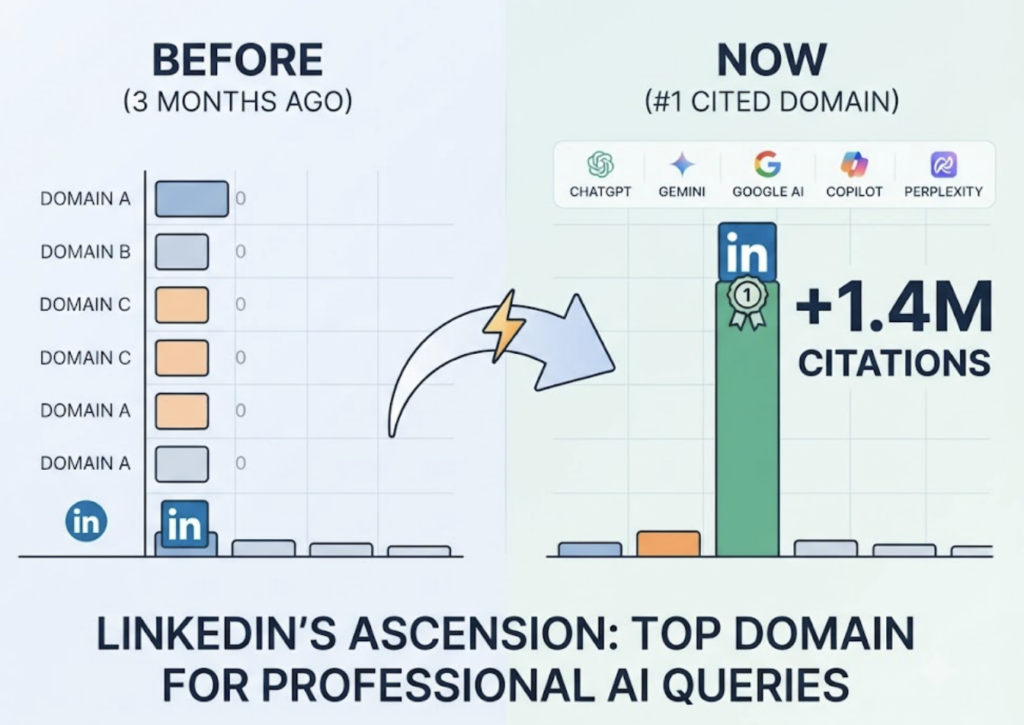
    The shift happened fast, and the brands that noticed had a head start. The ones that didn’t are still reporting on keyword rankings that can’t explain why their competitors keep showing up in AI answers.

    What Citation SEO Actually Measures (and Why Google Rankings Don’t Cover It)

    Traditional SEO tracks how pages rank in a list of ten blue links. Citation SEO tracks something structurally different: whether an AI engine names your brand, links to your content, or references your data as a source inside its generated response.

    The distinction matters because the math is different. A typical AI-generated answer cites only 2 to 7 sources. Compare that to the ten organic results on a traditional SERP. Fewer slots, higher stakes, and a selection process that doesn’t map neatly onto domain authority or backlink profiles.

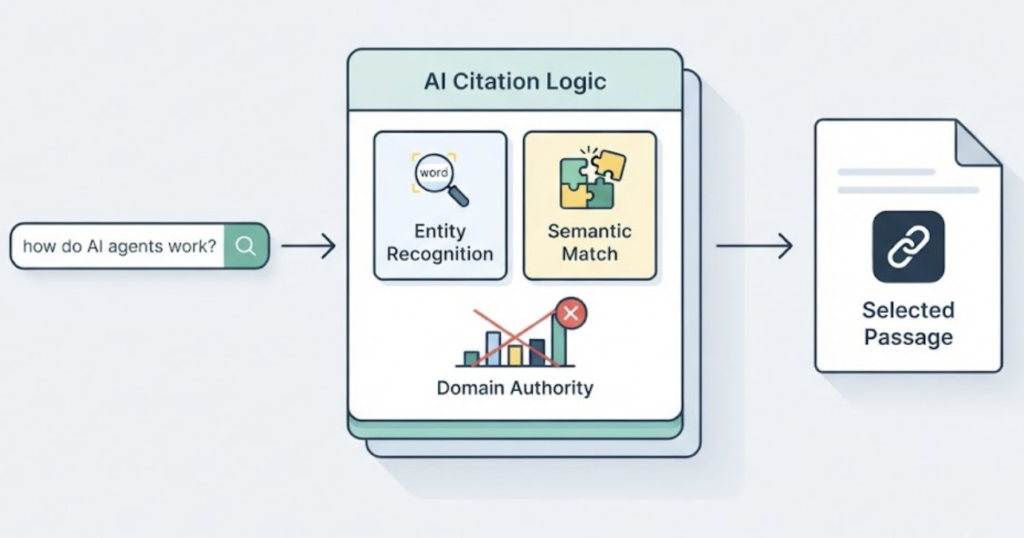
    Here’s the part that trips up most SEO teams: the engines don’t even agree on which sources to cite. A cross-engine study of 127,198 citations across five AI platforms found that 69.6% of cited domains appeared in only one engine’s answers. Just 2.7% were cited across all five. Optimizing for “AI search” as a single target is optimizing for an average that no engine actually is.

    Citation SEO sits at the intersection of GEO (generative engine optimization) and AEO (answer engine optimization). It’s the measurable layer: who gets cited, how often, where, and by which engine. Without that data, you’re guessing whether your content strategy is actually reaching the places where your audience now looks for answers.

    Why AI Engines Keep Citing LinkedIn (and What the Data Reveals About Citation Patterns)

    LinkedIn’s rise isn’t random. The data points to specific content patterns that AI engines reward, and those patterns apply far beyond LinkedIn itself.

    The first pattern is a shift toward authored, fresh content. Between November 2025 and February 2026, feed posts and long-form articles together rose from 26.9% to 34.9% of all LinkedIn citation types, while static profile page citations fell sharply. AI systems are leaning less on identity pages and more on published content that looks like ongoing expertise.

    The second pattern is individual authorship. On ChatGPT Search and Google AI Mode, roughly 59% of cited LinkedIn content comes from individual creators. Personal posts, personal articles, content tied to individual profiles. Company Pages account for 41%. Perplexity flips this: 59% Company Pages, 41% individual creators. The platform mix matters.

    A deeper URL-level analysis tells an even stronger story. Named individuals accounted for 87.8% of cited LinkedIn content URLs and 91.7% of total citations, earning 8.5 citations per URL compared to 5.5 for company pages.

    The third pattern is consistency over virality. The median cited LinkedIn post has only 15 to 25 reactions. Likes, comments, and hashtags correlate near zero with citation frequency. What does correlate: 75% of cited authors posted five or more times in a four-week period. Frequency and depth beat virality every time.

    And the fourth: original content accounts for 95% of all LinkedIn citations. Reshares account for 5%. AI engines want the source, not the amplification.

    The Citation SEO Playbook: 5 Patterns That Earn AI References

    LinkedIn’s data is a case study, but the principles generalize. Here’s what the citation research points to across platforms.

    1. Publish on domains AI already trusts. AI engines have a short list of high-citation domains, and that list varies by engine. LinkedIn ranks near the top for professional queries. Reddit leads for general queries. Industry-specific publications, review sites, and established news outlets fill the rest. Getting featured on these platforms carries more citation weight than publishing the same content on your own blog.

    2. Structure content for extraction. AI engines don’t read pages the way humans do. They pull specific answers from structured content. That means clear heading hierarchies, direct answers to questions within the first two sentences of each section, FAQ schema, and HowTo markup. The goal is to make your content extractable, not just readable.

    3. Build entity authority across multiple surfaces. Only 2.7% of cited domains appear across all five major AI engines. The brands that do show up everywhere tend to have consistent entity signals: an accurate Wikipedia presence, a complete Google Knowledge Panel, structured data on their own site, and third-party mentions that reinforce the same information. AI engines cross-reference. If your brand story is fragmented, citations drop.

    4. Prioritize third-party coverage. Research consistently shows that 85% or more of AI citations trace back to third-party sources. A brand that’s invested entirely in owned content has optimized for the 5 to 15% channel while ignoring the 85 to 95% channel. Earned media, listicle placements, review site coverage, and expert roundups are where citations actually come from.

    5. Publish consistently, not virally. The LinkedIn data is unambiguous: engagement metrics don’t predict citations. Posting frequency does. The same principle applies to your blog, your YouTube channel, and your guest posting strategy. AI engines index active publishers differently than dormant ones, not just because of recency, but because frequent original publishing creates more brand-attributed content to draw from.

    Most Brands Can’t See Their Own Citation Gaps. That’s the Real Problem.

    The biggest obstacle in citation SEO isn’t strategy. It’s measurement.

    Traditional SEO dashboards track keyword rankings, organic traffic, and backlink profiles. None of those tell you whether Perplexity is citing your competitor’s LinkedIn article instead of your product page. None of them show you which domains AI engines reference when someone asks a question in your category.

    That visibility gap is where tools like Topify become relevant. Topify’s Source Analysis feature tracks the exact domains and URLs that AI platforms cite across ChatGPT, Gemini, Perplexity, and Google AI Overviews. Instead of guessing which sources AI trusts in your category, you can see the data: which domains dominate your target prompts, which URLs are cited most frequently, and where your content is absent from the citation layer entirely.

    In practice, this means you can run a set of prompts relevant to your category and see immediately whether AI is citing your brand, your competitors, or third-party sources you’ve never considered. Topify’s Competitor Monitoring makes this actionable by showing how your citation profile stacks up against specific rivals across the same set of prompts.

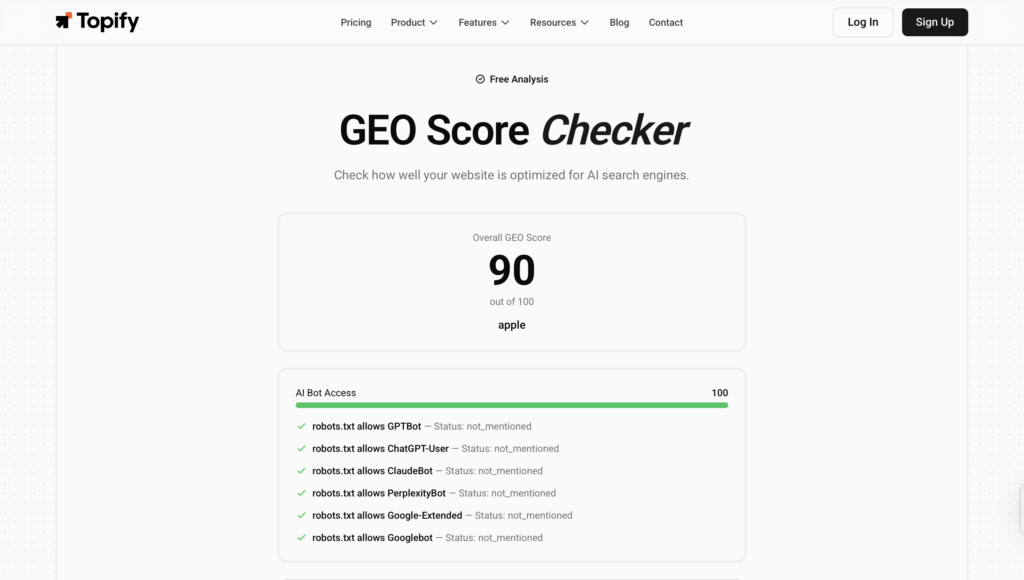
    The GEO Score Checker is a free starting point. It audits whether AI crawlers can access and parse your site, which is the technical prerequisite before citations become possible. But the citation layer goes deeper than crawlability. It’s about whether AI engines consider your brand authoritative enough to reference when they synthesize an answer.
    Only about 30% of brands maintain consistent AI visibility from one query regeneration to the next. Citations aren’t permanent. They shift with model updates, new training data, and changes in the competitive landscape. Continuous tracking is the only way to know whether your citation position is holding, improving, or eroding.

    Citation SEO Is Not a Separate Discipline. It’s Where SEO Is Heading.

    There’s a temptation to treat citation SEO as an add-on, a side project that sits next to your “real” SEO program. That framing underestimates the speed of the shift.

    ChatGPT now has over 900 million weekly active users. Google AI Overviews appear on more than 40% of search queries. Roughly 37% of consumers start their searches with AI tools rather than a traditional search engine. The audience has moved. The question is whether your visibility strategy has moved with it.

    Traditional SEO remains the foundation. Technical optimization, content quality, E-E-A-T signals, and backlinks still matter. They’re necessary. They’re just no longer sufficient. The LinkedIn example makes this point clearly: a domain that wasn’t in the top 10 on ChatGPT three months ago is now #1 for professional queries across six AI platforms. Citation authority reshuffles fast, and the brands that track it in real time will see the shifts before their competitors do.

    The path forward isn’t complicated. Audit your current citation footprint. Identify the prompts that matter in your category. See which domains AI is citing today. Find the gaps. Fill them with structured, original, third-party-distributed content. Then measure again.

    If you haven’t started, your competitors probably haven’t either. But the window won’t stay open.

    Get started with Topify to see exactly where your brand stands in AI search today.

    Conclusion

    Citation SEO isn’t a buzzword or a passing trend. It’s the measurable layer of AI search visibility, and Q1 2026 proved how fast the landscape can shift. LinkedIn went from outside the top 10 to the #1 cited domain for professional queries in under 90 days. That kind of movement doesn’t happen in traditional SEO.

    The brands that win in citation SEO will be the ones that track where AI gets its answers, publish on the domains AI trusts, and treat citation data as a core performance metric rather than an afterthought. The tools exist. The data is available. The only variable left is whether you start now or wait until the competition has already locked in their advantage.

    FAQ

    Q: What is citation SEO? 

    A: Citation SEO is the practice of optimizing your brand’s visibility in AI-generated search responses. Unlike traditional SEO, which focuses on ranking in a list of links, citation SEO focuses on getting your brand named, linked, or referenced as a source inside the AI’s actual answer. It overlaps with GEO (generative engine optimization) and AEO (answer engine optimization).

    Q: How is citation SEO different from traditional SEO? 

    A: Traditional SEO optimizes for ten organic results on a search engine results page. Citation SEO optimizes for the 2 to 7 sources an AI engine cites inside its generated response. The selection criteria differ, too. AI engines weigh content freshness, entity authority, third-party consensus, and structured data more heavily than backlink volume alone.

    Q: Which platforms should I optimize for AI citations? 

    A: The major AI citation surfaces in 2026 are ChatGPT Search, Google AI Overviews, Google AI Mode, Perplexity, Gemini, Microsoft Copilot, and Claude. Each engine has different citation behavior. Research shows only 2.7% of cited domains appear across all five major engines, so a multi-platform strategy is essential.

    Q: How can I track whether my brand is being cited in AI search? 

    A: Free tools like Topify’s GEO Score Checkerprovide a baseline audit of your AI crawlability. For ongoing citation tracking, Topify’s full platform monitors your brand’s visibility, sentiment, position, and source citations across ChatGPT, Gemini, Perplexity, and Google AI Overviews, with real-time competitor benchmarking.
    Read More

  • Citation SEO: One Article, 325% More AI Citations

    Citation SEO: One Article, 325% More AI Citations

    Your domain authority is solid. Your keyword rankings haven’t moved. But when someone asks ChatGPT for a recommendation in your category, your brand doesn’t show up in the answer, and your competitor does.

    The disconnect isn’t a fluke. It’s a citation SEO problem, and it runs deeper than most marketers realize.

    A controlled study by Stacker and Scrunch across five AI platforms found that the same article, when distributed through third-party news outlets, raised citation rates from 8% to 34%. Brand-only content sat at 7.6%. That’s a 325% lift from earned distribution alone, with zero changes to the content itself. The variable that moved wasn’t the writing. It was where the writing appeared.

    Why Traditional SEO Metrics Can’t Predict AI Citations

    Citation SEO starts with a counterintuitive fact: the signals that drive Google rankings and the signals that drive AI citations overlap less than most marketers assume.

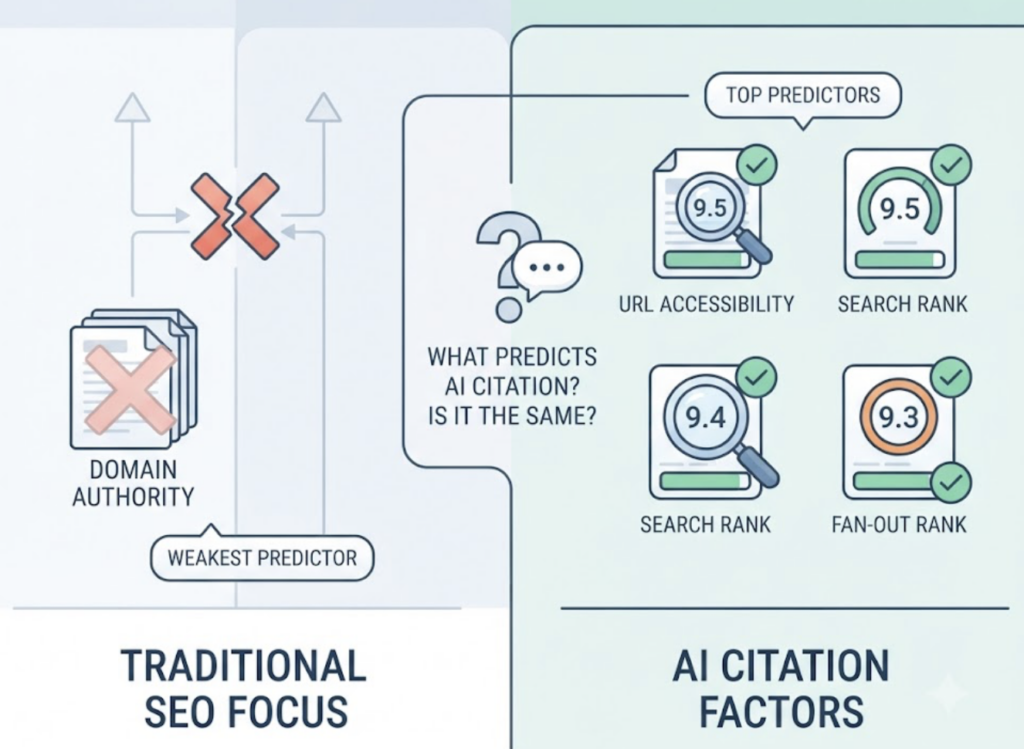
    Profound’s research found only 6.82% overlap between ChatGPT’s most-cited sources and Google’s top 10 organic results. Cyrus Shepard’s meta-analysis of 54 experiments scored 23 citation ranking factors and confirmed the split: URL accessibility (9.5), search rank (9.4), and fan-out rank (9.3) topped the list, while domain authority barely moved the needle. The factor most SEO teams optimize for first is one of the weakest predictors of whether AI will cite you.

    Here’s the thing. ChatGPT retrieves far more pages than it actually uses. AirOps’ analysis of 548,534 pages across 15,000 prompts found the model cites only 15% of what it pulls in. The other 85% gets evaluated and discarded before the user sees anything.

    Being indexed isn’t the win. Being cited is. And the two require different strategies.

    Earned Media Is the Strongest Citation SEO Signal

    If citation SEO has a single dominant lever, the data points to earned media.

    Muck Rack’s May 2026 analysis of 25 million cited links across ChatGPT, Claude, and Gemini found that earned media accounts for 84% of all AI citations. The University of Toronto ran large-scale controlled experiments confirming the pattern is structural: AI search exhibits a “systematic and overwhelming bias” toward third-party authoritative sources over brand-owned and social content.

    The multiplier is measurable. Seer Interactive’s 2026 study of 800,000+ AI responses found brands with active third-party trust signals are cited in 75% of AI answers versus 1% for brands without. That’s a 75x gap. No amount of on-page optimization produces a difference of that magnitude.

    ZipTie.dev’s research adds the brand-level view: brands in the top 25% for web mentions earn over 10x more AI citations than the next quartile. Brands in the bottom 50% are essentially absent from AI answers. Ahrefs’ study of 75,000 brandsconfirmed the hierarchy: brand web mentions correlate at 0.664 with AI visibility, while backlinks correlate at just 0.218. Three times stronger.

    Content optimization without a corresponding earned media program is structurally limited.

    Where the 325% Citation Lift Actually Comes From

    The 325% figure isn’t about writing better content. It’s about earned distribution.

    Stacker and Scrunch’s controlled study analyzed 944 prompt-platform combinations across five AI engines. When the same article lived only on the brand’s own site, citation rates averaged 7.6%. When that identical article was distributed through third-party news publishers, citation rates jumped to 34%. The median lift across all tested articles was 239%, with top performers reaching 325%.

    Three mechanisms explain why this works:

    MechanismWhat HappensWhy AI Cites It
    Entity associationYour brand appears alongside category terms on trusted domainsAI models build stronger brand-category connections
    Authority transferHigh-DR publishers pass credibility to the content they hostAI engines treat publisher trust as a proxy for content trust
    Corroboration signalMultiple independent sources make the same claim about your brandAI models weight corroborated claims higher than single-source claims

    Brands appearing on four or more third-party platforms are 2.8x more likely to be cited in ChatGPT responses than single-platform brands.

    The distribution itself is the optimization.

    What Citation-Ready Content Actually Looks Like

    Earned media placement gets your content in front of AI engines. But the content still has to survive the extraction filter.

    The Princeton/Georgia Tech GEO study (KDD 2024) tested six optimization strategies across 10,000 queries and found three techniques that consistently lifted AI citation rates. Adding statistics produced the strongest single gain: 41% visibility improvement. Citing authoritative sources drove a 115% improvement for lower-ranked pages. Quotation addition lifted visibility by 28%. Keyword stuffing performed 10% worse than doing nothing at all.

    Structure matters as much as substance. Authoritas’ research found 44.2% of ChatGPT citations come from the first 30% of a page. Pages with FAQ schema are weighted roughly 40% higher in source selection. Tables get extracted at an 81% rate versus 23% for the same information written as paragraphs.

    The GEO-16 framework from UC Berkeley quantified the threshold: pages scoring 0.70 or above on their 16-pillar audit with at least 12 pillar hits achieved a 78% cross-engine citation rate. The three pillars most strongly associated with citation were metadata and freshness, semantic HTML, and structured data.

    Put those pieces together and the citation-ready formula becomes concrete: lead with a direct answer in the first 30% of the content, embed verifiable statistics with named sources, use tables and structured markup, and refresh on a regular cadence.

    The 5-Step Citation SEO Playbook

    Citation SEO isn’t a single tactic. It’s a system that connects content structure, earned distribution, and measurement.

    Step 1: Audit Your Current AI Citation Baseline

    Before optimizing anything, you need to know where you stand. Check whether your brand appears in AI answers for your core category queries across ChatGPT, Perplexity, Gemini, and Google AI Overviews. Only 14% of SEO teamscurrently track AI citation visibility, even though 43% name AI optimization a core 2026 strategy. That gap between intent and measurement is where most brands lose.

    Topify provides this at scale. Its Source Analysis feature reverse-engineers which domains and URLs AI platforms cite for your category queries, showing you exactly where your brand appears, where it doesn’t, and which competitors own the citations you’re missing.

    Step 2: Identify High-Citation Publications in Your Category

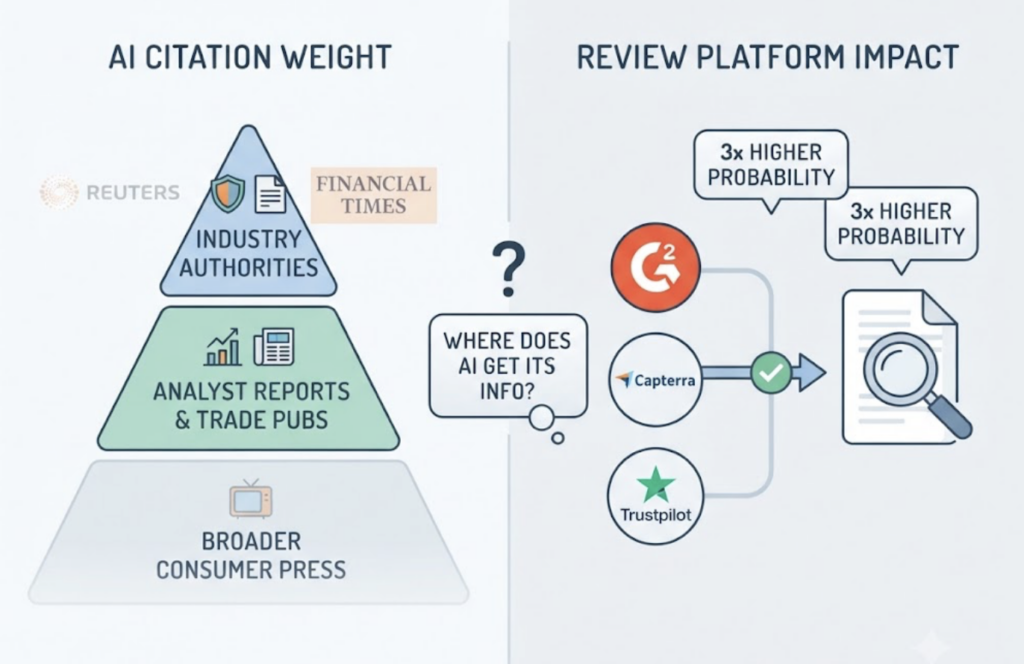
    Not all earned media placements carry equal citation weight. AI engines cite trade publications, analyst reports, and category-specific outlets more frequently than broad consumer press. Reuters and Financial Times dominate ChatGPT citations. Review platforms like G2, Capterra, and Trustpilot carry outsized influence: sites with active review profiles show 3x higher citation probability.

    Use Topify’s Competitor Monitoring to see which publications AI engines cite when recommending your competitors. That’s your target list.

    Step 3: Build Citation-Ready Content Assets

    Create content designed for extraction, not just engagement. Original research with proprietary data is the strongest citation magnet. Include specific statistics (the 41% lift applies here), direct expert quotes, and clear methodology. Structure with answer-first formatting, heading hierarchy, and FAQ schema.

    One strong data asset, distributed well, outperforms ten generic blog posts. The Princeton study found that pages combining fluency optimization with statistics outperformed every single method by more than 5.5%.

    Step 4: Distribute Through Earned Channels

    Pitch your content asset to the publications you identified in Step 2. Focus on outlets AI engines already cite in your category. One placement in a publication that AI engines trust will generate more citation value than ten placements AI engines ignore. AirOps found that 32.9% of ChatGPT citations come from hidden fan-out queries, meaning your content needs to answer adjacent questions, not just the primary one.

    Prioritize specificity. Verifiable claims. Named data sources. These are the elements AI extracts.

    Step 5: Track the Correlation Window

    Earned media placements typically appear in AI responses within two to four weeks as AI crawlers index new content. Set a measurement baseline before publishing, then track citation changes at the 2-week and 4-week marks.

    Topify’s Visibility Tracking lets you monitor brand appearance across ChatGPT, Perplexity, Gemini, and AI Overviews from a single dashboard. When you publish an earned media placement, you can trace the exact citation lift it produces across platforms, connecting your PR investment to measurable AI visibility outcomes.

    What Most Brands Get Wrong About Citation SEO

    The biggest misconception is that citation SEO is just traditional SEO with a new label. It isn’t.

    Optimizing your own website is necessary but insufficient. AI engines weight third-party validation significantly higher than self-published content. The Seer Interactive data makes this point starkly: the trust signal gap between brands with and without third-party mentions is 75x. A perfectly optimized page on a domain with no earned media presence will underperform a mediocre page on a domain with strong third-party coverage.

    The second mistake is treating AI search as a single channel. Only 2% of cited URLs appear across AI Overviews, ChatGPT, and Perplexity simultaneously. Citation patterns are fragmented. What works on one platform may not register on another, which is why cross-platform tracking isn’t optional.

    The third mistake is chasing volume over placement quality. Press releases account for a fraction of a percent of AI citations. Syndicated wire content earns just 0.04%. One well-placed article in a publication AI engines trust outweighs a dozen placements they don’t.

    Conclusion

    Citation SEO is where content strategy meets distribution strategy. The data is consistent across every major study from the past year: AI engines cite earned media at dramatically higher rates than brand-owned content, and the brands with the strongest third-party presence earn citations at 10x to 75x the rate of brands without it.

    The 325% citation lift isn’t theoretical. It’s a measured outcome from distributing the same content through earned channels rather than keeping it on your own site. That’s the earned media play: build citation-ready content once, place it where AI engines look, and track the results across every platform that matters.

    The brands measuring this now will own the citations that become harder to displace with every passing quarter.

    FAQ

    What is citation SEO?

    Citation SEO is the practice of optimizing content so that AI search engines, including ChatGPT, Perplexity, Gemini, and Google AI Overviews, cite your brand in their generated answers. It combines content structure optimization with earned media distribution to increase the likelihood that AI models select and reference your content.

    How does earned media improve AI citation rates?

    AI engines show a structural preference for third-party, authoritative sources over brand-owned content. Research from the University of Toronto confirmed this bias is systematic across all major AI platforms. Distributing content through trusted publications provides the corroboration signal AI models need to confidently cite a brand.

    How long does it take for earned media to appear in AI citations?

    Earned media placements typically surface in AI responses within two to four weeks of publication as AI crawlers index the new content. However, building enough entity authority to cross the citation eligibility threshold generally takes six to twelve months of consistent earned media activity. Single placements help. Sustained programs compound.

    What tools can track AI citation performance?

    Tracking AI citations requires purpose-built platforms that monitor how AI engines reference your brand across multiple platforms. Topify provides cross-platform AI visibility tracking, source analysis to reverse-engineer what AI cites, and competitor monitoring to benchmark your citation performance against rivals. Traditional SEO tools like Ahrefs and SEMrush don’t currently measure AI citation behavior.

    Read More

  • DA Doesn’t Buy You AI Citations. Here’s What Does.

    DA Doesn’t Buy You AI Citations. Here’s What Does.

    Your domain authority is 72. Your backlink profile took three years to build. Your keyword rankings are solid across every core category term. And when someone asks ChatGPT for a recommendation in your space, your brand doesn’t show up once.

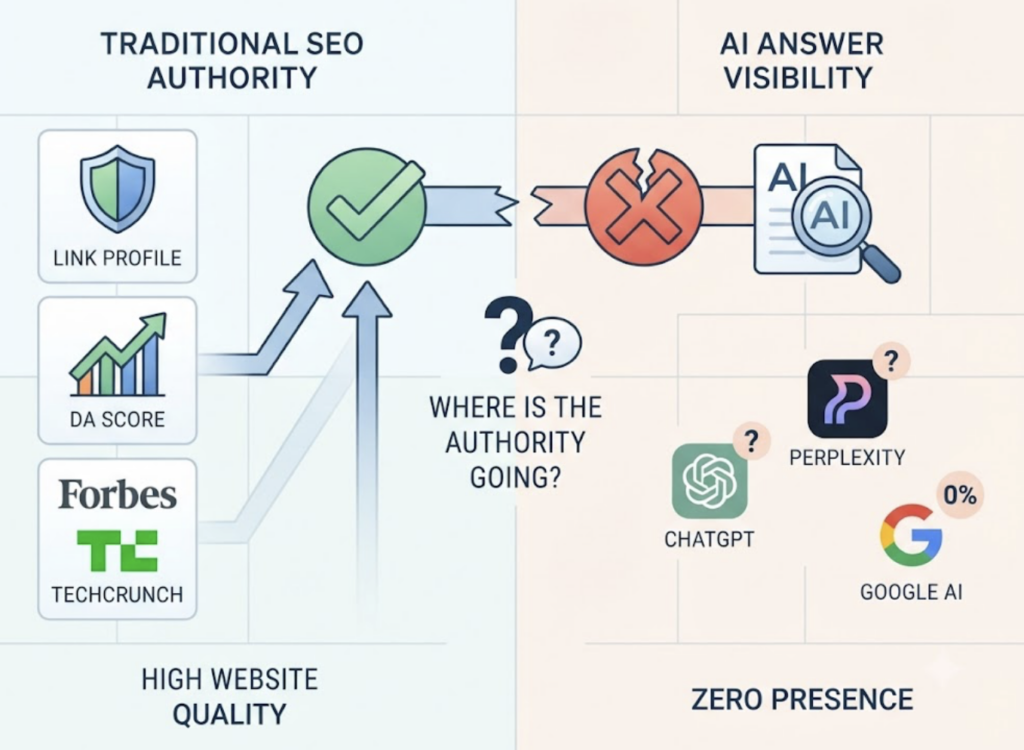
    That’s not an edge case. 90% of brands have zero mentions in AI search responses, according to a Search Engine Journal analysis of 177 brands across healthcare, SaaS, and financial services. The disconnect between traditional SEO authority and AI citation isn’t a bug in your strategy. It’s a structural shift that’s redefining what citation SEO actually means in 2026.

    The Data Behind the DA-to-Citation Gap

    The intuition is simple: high domain authority should equal high visibility everywhere. The data says otherwise.

    Wellows’ 2026 analysis of citation signals across major AI platforms found Domain Authority correlates with AI citation probability at just r=0.18. Squared, that’s r²=0.032. In plain terms, DA explains roughly 3% of whether an AI engine cites your brand. The other 97% comes from signals DA doesn’t measure.

    The gap gets sharper when you look at source overlap. Research across 22,410 domains found only 7.2% overlap between Google AI Overview sources and LLM citation lists. Two systems, reading from almost entirely different source libraries.

    That’s the pattern showing up in marketing teams right now: a company with a solid backlink profile, a DA score they’re proud of, coverage in Forbes and TechCrunch, and zero presence in ChatGPT answers for their category. The explanation has nothing to do with their website quality and everything to do with where they’ve been building authority.

    How AI Engines Pick Sources (It’s Not PageRank)

    Google’s traditional ranking algorithm weights links as trust votes. More links from authoritative domains produce higher DA scores and generally higher rankings. AI citation selection works on a completely different mechanism.

    AI search engines like ChatGPT, Perplexity, and Gemini use retrieval-augmented generation (RAG). They search an index first, retrieve candidate passages, then synthesize an answer using those passages. The selection favors content that’s extractable, verifiable, and directly responsive to the query, not content that accumulated the most link equity over time.

    Cyrus Shepard’s 2026 meta-analysis of 54 experiments, patents, and case studies scored 23 AI citation factors by evidence strength. The top five: URL accessibility (9.5/10), search rank (9.4), fan-out rank (9.3), preview control (9.2), and query-answer match (9.2). Notice what’s missing from the top of that list: backlink count and domain authority.

    Only 2% of cited URLs appear across AI Overviews, ChatGPT, and Perplexity simultaneously. 91% of citations appear in only one AI engine. Each platform is making independent source decisions, not importing Google’s authority hierarchy.

    Five Citation SEO Signals That Outperform Domain Authority

    If DA explains 3% of AI citation variance, what explains the rest? The research points to five signals, each with stronger data support than backlink metrics.

    Brand Mention Frequency Beats Backlink Count

    Ahrefs studied 75,000 brands and found branded web mentions correlate with AI Overview visibility at 0.664. Backlinks: 0.218. That’s a 3-to-1 gap in predictive power.

    The implication is counterintuitive for anyone trained on traditional SEO. A Reddit thread that names your brand without linking is worth more for AI citations than a backlink from a low-authority blog. Brands present on four or more third-party platforms are 2.8x more likely to appear in ChatGPT responses.

    YouTube mentions showed an even stronger signal at 0.737 correlation. AI engines are reading transcripts, descriptions, and comments. Publishing volume on your own domain showed almost no relationship with AI visibility. Earned presence matters. Self-published volume doesn’t.

    Named Author Credentials and E-E-A-T Depth

    The GoodFirms 2026 survey of 100+ SEO professionals across 20+ countries produced one unanimous finding: 100% of respondents agree E-E-A-T will matter more in 2026. It’s the only item in the entire survey that reached full consensus.

    Wellows’ data backs this with numbers. E-E-A-T signals correlate with AI citation probability at r=0.81, compared to DA’s r=0.18. That’s a 4.5x difference in predictive strength.

    A DR-30 site with named industry experts, verifiable credentials, and transparent sourcing can and does out-cite a DR-85 site that publishes unsigned content.

    AI systems are selecting passages, not ranking domains. When a passage includes a named author with identifiable expertise, the AI engine treats it as higher-confidence evidence.

    Original Data and Statistical Depth

    The Princeton GEO study (KDD 2024) tested nine content modification strategies across 10,000 queries. Adding statistics was the single most effective tactic, improving AI visibility by up to 40%. Adding citations from credible sources produced comparable gains.

    Content with specific data points, benchmark numbers, and verifiable claims gets preferential treatment in RAG pipelines. AI engines are essentially doing what a research assistant does: scanning five sources and picking the one with the most concrete, quotable evidence. A page with “our product improves efficiency” loses to a page with “a 12-week pilot across 340 accounts showed a 23% reduction in response time.”

    Promotional content tone actually hurts. One analysis found a negative 26.19% correlation between marketing-style language and AI citation probability. The more your content sounds like a sales page, the less likely it gets cited.

    Content Structure and Readability

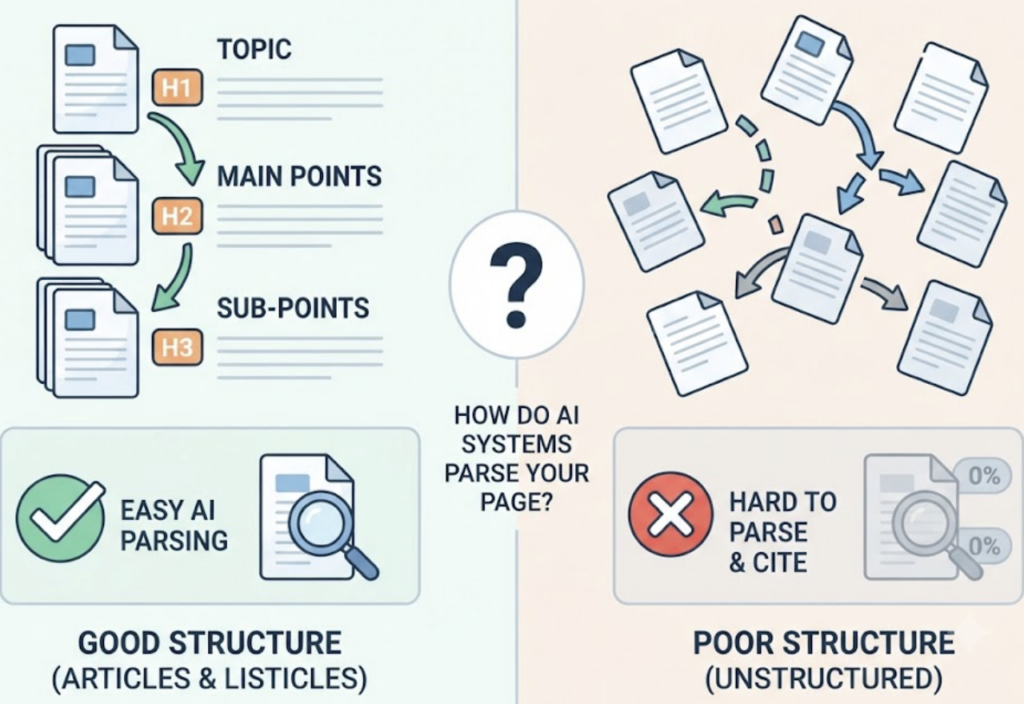
    Not all content formats earn citations equally. According to Wix’s 2026 research, articles and listicles are among the top content types cited by AI engines. The structure matters because AI systems extract passages, not pages. Content organized into clear, self-contained answer blocks with logical heading hierarchies is easier for RAG systems to parse and cite.

    AirOps’ analysis of 50,553 ChatGPT responses found that ChatGPT only cites 15% of the pages it retrieves. The 85% that get retrieved but not cited typically lack the structural clarity needed for extraction. Getting into the retrieval pool isn’t enough. Your content has to be citable once it’s there.

    That same GoodFirms survey found only 70% of marketers use plain, simple language, despite AI systems favoring it for citation. Readability isn’t a nice-to-have. It’s a citation signal.

    Freshness and Refresh Cadence

    Content updated within the last 30 days earns roughly 3.2x more AI citations than older pages. AirOps’ data narrows this further: pages aged 30 to 89 days hit the highest citation rate at 32.8%, while content older than two years drops to 27.5%.

    The freshness effect is accelerating. ChatGPT’s shift to GPT-5.3 as its default model reduced the average number of cited domains from 19.1 to 15.2, a 20% decrease. The model is becoming pickier, and recency is one of the filters it’s applying more aggressively.

    A five-year-old page with DA 85 that hasn’t been touched will get out-cited by a six-month-old page with DA 30 that has current statistics, a named author, and a visible “Last updated” timestamp.

    Freshness doesn’t replace depth. But depth without freshness is increasingly invisible.

    How to Track Whether AI Is Citing You

    Here’s the operational blind spot: only 14% of marketing teams track AI/LLM citation visibility, even though 43% name AI optimization a core 2026 strategy. The gap between intention and instrumentation is enormous.

    Traditional SEO tools like Ahrefs and Semrush can’t tell you whether ChatGPT cited your brand yesterday. They track rankings in Google’s index, not source selections in AI-generated answers.

    That’s the problem Topify is built to solve. Its Source Analysis feature tracks the exact domains and URLs that AI platforms cite when answering queries in your category, across ChatGPT, Gemini, Perplexity, and other major engines. You can see which competitors are getting cited, which sources AI prefers, and where your content gaps are. The Visibility Tracking dashboard shows your brand’s mention frequency over time, broken down by platform and prompt. If ChatGPT stops citing you for a specific query cluster, you’ll know within the tracking cycle, not six months later when traffic declines become visible.

    For teams not ready to commit to a paid plan, Topify’s free GEO Score Checker scans any URL across ChatGPT, Gemini, Perplexity, Claude, and Google AI Overviews. It returns a 0-to-100 score covering AI bot access, structured data, content signals, and current citation visibility. No signup required. Most teams find they can boost their score 20 to 30 points just by unblocking AI crawlers in robots.txt and deploying foundational schema markup.

    DA Still Has a Job. It’s Just Not the One You Think.

    None of this means you should stop building backlinks.

    AI platforms still draw primarily from pages that rank well in traditional search. Ranking on page one for a query gives you roughly a 33% chance of citation. Once you rank across the fan-out query cluster too, your odds climb to 80-90%. Search rank scored 9.4 in Shepard’s framework, the second-highest factor.

    The nuance is that DA is an upstream input, not the final signal. Backlinks help a page rank high enough to enter the AI retrieval pool. But once you’re in the pool, what determines whether you actually get cited is content quality, brand mention frequency, author credentials, statistical depth, and freshness. Think of DA as the entry ticket. The citation is the show.

    The practical reallocation looks like this: if your DA is already above 40-50 and you’re ranking in the top 10 for core queries, the marginal return on more link-building is small for AI citation purposes. That next dollar of effort buys more visibility when spent on earning brand mentions, publishing original data, refreshing existing content monthly, and building named author presence across third-party platforms.

    Conclusion

    Domain Authority measures who deserves a Google ranking. AI citation authority measures who deserves to be quoted. Two different questions, two different answers.

    The brands winning citation SEO in 2026 aren’t the ones with the highest DA scores. They’re the ones with the strongest combination of brand mentions, author credentials, original data, structured content, and aggressive refresh cadence. The correlation data is unambiguous: DA explains 3% of citation variance, while E-E-A-T explains over 65%.

    Start by auditing where you actually stand. Run a free GEO score check to see what AI engines see when they look at your site. Then redirect effort from the signals that got you ranked to the signals that get you cited.

    FAQ

    Q: Does domain authority still matter for citation SEO?

    A: Yes, but as an upstream input rather than a direct citation signal. DA helps your pages rank high enough to enter the AI retrieval pool. Once there, citation selection depends on content signals like E-E-A-T, brand mentions, and freshness. Wellows data shows DA correlates at r=0.18 with AI citation probability, while E-E-A-T correlates at r=0.81.

    Q: How do I check if AI is citing my brand?

    A: Traditional SEO tools can’t track this. You need an AI visibility platform that monitors citation patterns across ChatGPT, Gemini, Perplexity, and AI Overviews. Topify’s free GEO Score Checker provides a baseline diagnostic. For ongoing tracking, its Source Analysis feature shows which domains AI engines cite in your category at the prompt level.

    Q: What content format gets cited most by AI engines?

    A: Articles and listicles with clear heading hierarchies, self-contained answer blocks, and statistical evidence earn the highest citation rates. The Princeton GEO study found that adding statistics and source citations improved AI visibility by up to 40%. AirOps data shows 68.7% of ChatGPT-cited pages follow logical heading structures.

    Q: How long does it take to improve AI citation rates?

    A: Page-level edits like adding statistics, named authors, and refreshing content produce measurable citation changes within two to four weeks. Building brand-level AI citation authority through third-party mentions and cross-platform presence takes three to six months, as AI models retrain in cycles rather than continuously.

    Read More

  • Citation SEO: Why AI Pulls 44% of Sources From Your First 300 Words

    Citation SEO: Why AI Pulls 44% of Sources From Your First 300 Words

    Your domain authority is solid. Your keyword rankings look healthy. But when someone asks ChatGPT for a recommendation in your category, the response cites three competitors and skips your page entirely. You check the content. It’s thorough, well-written, and ranks on page one of Google. None of that mattered.

    The gap isn’t authority. It’s structure. Research on AI citation patterns shows that 44.2% of all LLM references come from the first 30% of a document. If your opening 300 words are context-setting fluff instead of extractable answers, AI systems discard your page before they reach the good stuff.

    AI Doesn’t Read Your Page. It Extracts Passages.

    The biggest misconception in citation SEO is that AI engines process your content the way a human reader does: top to bottom, absorbing the full narrative. They don’t.

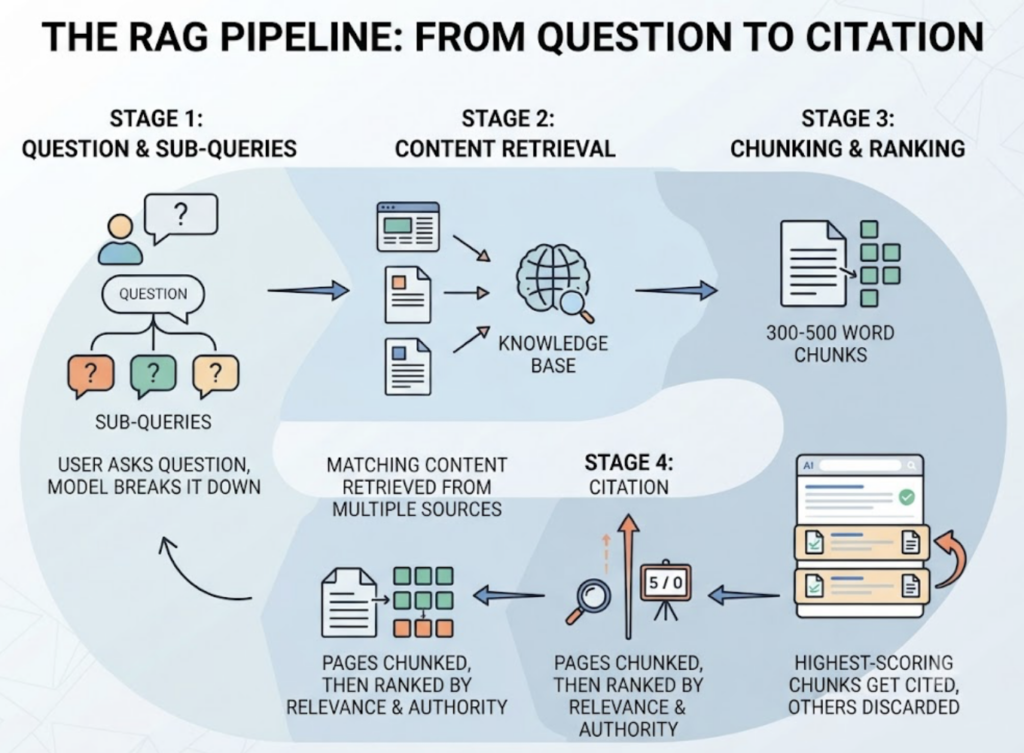
    ChatGPT, Perplexity, Gemini, and Google AI Overviews all run a Retrieval-Augmented Generation (RAG) pipeline. When a user asks a question, the model breaks it into sub-queries, retrieves matching content from multiple sources, chunks each page into 300 to 500 word blocks, and then ranks those chunks by relevance, specificity, and authority. The highest-scoring chunks get cited. Everything else gets discarded.

    The unit of competition isn’t your page. It’s your paragraph.

    AirOps analyzed 548,534 pages retrieved by ChatGPT across 15,000 prompts and found that only 15% of discovered pages ever appeared in a final answer. The other 85% were pulled into the pipeline, evaluated, and silently dropped. Your content can rank on Google, get retrieved by ChatGPT, and still never surface to a single user. Retrieval and citation are two distinct events, and the gap between them is where most brands quietly disappear.

    That distinction changes the optimization target. Traditional SEO gets you into the retrieval pool. Citation SEO gets you out of it and into the answer.

    The Ski Ramp Effect: 38% of AI Citations Come From Your First 100 Words

    Not all chunks are created equal. AI systems exhibit a strong position bias toward the top of a page, a pattern researchers call the “ski ramp” effect.

    A June 2026 study analyzing over 100,000 citation placements across 10,000 AI Overviews responses found that 38% of all citations are pulled from the first 100 words of a page. The distribution drops steeply after that. By the time you’re past the first 500 words, citation frequency has already fallen to a fraction of what it was at the top. The tail is long and flat.

    This aligns with earlier research showing 44.2% of LLM references originate from the first 30% of a document. The structural choices you make at the top of a page, a clear summary, entity-rich context, and direct answers, directly determine whether an AI system reaches for your content when generating a response.

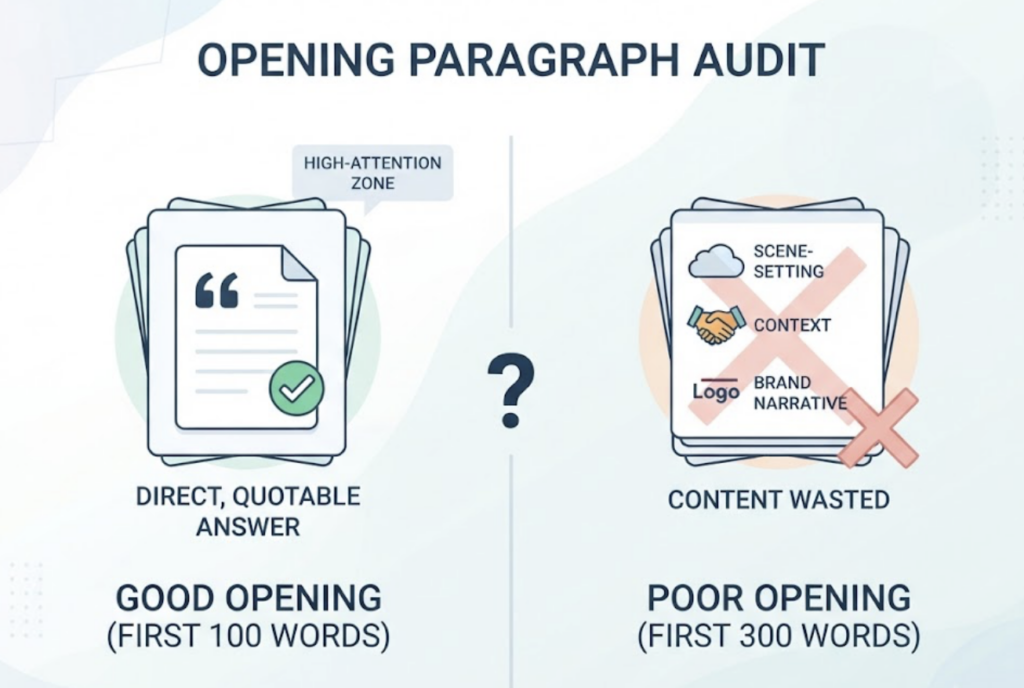
    Here’s why traditional blog structure fails this test. Most SEO content opens with 200 to 300 words of scene-setting before stating an actual answer. In a RAG pipeline, those opening words form their own chunk. That chunk contains no extractable claim, no statistic, and no definition. It gets scored low and discarded. You’ve lost your highest-value real estate before the AI ever sees your expertise.

    The fix is architectural, not cosmetic. Answers first, context second, elaboration last.

    What Citation SEO Actually Optimizes For

    Traditional SEO optimizes for ranking signals: backlinks, keyword relevance, page speed, domain authority. Citation SEO optimizes for extractability, the ease with which an AI system can pull a self-contained, accurate, quotable passage from your content.

    Cyrus Shepard’s meta-analysis of 54 experiments and case studies, published in May 2026, scored 23 AI citation factors by evidence strength. The top five: URL accessibility (9.5), search rank (9.4), fan-out rank (9.3), preview controls (9.2), and query-answer match (9.2). Traditional SEO still matters. But a new layer sits on top of it.

    The Princeton GEO study (Aggarwal et al., KDD 2024) tested nine content optimization strategies across 10,000 queries and quantified the impact on AI citation rates. The results drew a clear line between what works and what doesn’t.

    Optimization MethodCitation Visibility Change
    Statistics Addition+41%
    Quotation Addition+28%
    Cite Sources+22% (up to +115% for lower-ranked pages)
    Fluency Optimization+17%
    Authoritative Voice+15%
    Keyword StuffingNegative impact
    Content PaddingNo measurable improvement

    The pattern is clear. AI systems favor content that’s fact-dense, source-attributed, and structured for extraction. They penalize content that’s padded, keyword-stuffed, or built around persuasive narrative rather than verifiable claims.

    One data point often gets overlooked: only 14% of marketers currently track AI citation visibility, despite 43% naming AI optimization a core 2026 strategy. The gap between intention and measurement is wide.

    5 Content Structure Patterns That Win AI Citations

    Knowing that AI extracts passages is useful. Knowing how to structure those passages is what moves the numbers. These five patterns have the strongest correlation with citation rates across ChatGPT, Perplexity, and AI Overviews.

    1. Answer-First Formatting

    Lead every H2 section with a self-contained answer in the first 40 to 75 words. The answer should resolve the question implied by the heading without requiring surrounding context. Think of it as writing the passage an AI would quote, then building the section around it.

    One case study documented a Featured Snippet rate increase from 8% to 24% after adopting answer-first formatting, a 3x improvement. ChatGPT citations for the same content increased by 140%.

    2. Atomic Paragraphs

    Each paragraph should contain exactly one idea, expressed in two to four sentences. When a RAG system chunks your content and a single block contains four partially developed ideas instead of one complete claim, that block scores low for every query it’s tested against. Pages with unstructured “blob” content become vaguely relevant to many queries but definitively cited for none.

    The ideal extractable passage runs 134 to 167 words. That’s roughly one focused paragraph.

    3. Entity-Explicit Language

    Pronouns kill citations. When a chunk is extracted in isolation, “it works with 10,000 users” means nothing. Replace vague references with full entity names. Write “Topify’s Source Analysis tracks the exact domains AI platforms cite” instead of “the tool tracks cited domains.” LLMs evaluate each chunk independently. If a passage can’t stand alone, it won’t get cited.

    4. Comparison Tables and Structured Lists

    Content with tables and structured data gets cited 2.5x more often than unstructured prose. Listicles account for roughly 50% of top-cited content formats across AI search engines. Tables create explicit data relationships. Numbered lists create clear extraction boundaries. Both reduce the AI’s interpretation work and increase its confidence in citing the source.

    5. Citation Hooks

    A citation hook is a standalone statement, typically 40 to 60 words, designed to be lifted directly into an AI response. Place four to six of these throughout a post. They function like pull quotes that happen to be optimized for machine extraction rather than human scanning. Each hook should include a specific claim, a number or named entity, and enough context to make sense without the surrounding paragraph.

    How to Audit Your Content for Citation SEO Readiness

    Knowing the principles is one step. Auditing your existing content against them is what produces results. Run this checklist before publishing or updating any page you want AI to cite.

    First 100 words: Does your opening paragraph contain a direct, quotable answer to the page’s primary question? If the first 300 words are scene-setting, context, or brand narrative, the highest-attention real estate on your page is wasted.

    Section independence: Can each H2 section stand on its own and be cited independently, without needing the rest of the article for context? If a section relies on pronouns that reference earlier sections, rewrite it.

    Fact density: Count the verifiable facts (numbers, named entities, specific dates, attributed data points) per 100 words. If you’re below one fact per 100 words on informational content, you have a citation gap.

    Entity clarity: Search for “it,” “this,” “they,” and “the platform” in your text. Every instance is a potential citation failure where an AI system can’t identify what you’re referring to.

    The harder question is tracking whether these changes actually move your citation rates. Tools like Topify address this directly. Topify’s Source Analysis reverse-engineers the exact domains and URLs that AI platforms cite for prompts in your category, showing whether your content or your competitors’ content dominates those references. Visibility Tracking monitors your brand’s presence across ChatGPT, Perplexity, Gemini, and AI Overviews over time, so you can tie structural content changes to measurable citation outcomes.

    That tracking matters because AI citations fluctuate 40 to 60% month over month. A single audit won’t tell you if your changes are working. Ongoing monitoring will.

    Conclusion

    Citation SEO isn’t a separate discipline from traditional SEO. It’s a structural layer on top of it. The fundamentals still apply: rank well, build authority, publish quality content. But the content that earns AI citations in 2026 is built differently than the content that earns Google clicks.

    The data points converge on the same conclusion. Your first 300 words are your highest-value real estate. AI systems extract passages, not pages. And the gap between being retrieved and being cited is where 85% of content silently disappears. Structure your content for extraction, audit your pages against citation readiness criteria, and track the results with a platform built for AI visibility. You can get started with Topify to see exactly where your brand stands across every major AI search engine.

    FAQ

    Q: What is citation SEO?

    A: Citation SEO is the practice of optimizing content so that AI search engines (ChatGPT, Perplexity, Google AI Overviews, Gemini) cite your pages when generating answers. It focuses on content structure, extractability, and fact density rather than traditional ranking signals like backlinks and keyword density.

    Q: How does AI decide which sources to cite?

    A: AI engines use a Retrieval-Augmented Generation (RAG) pipeline that chunks your content into 300 to 500 word blocks, scores each block for relevance, specificity, and authority, then cites the highest-scoring passages. Pages with answer-first formatting, atomic paragraphs, and entity-explicit language score higher than unstructured content.

    Q: Do Google rankings help with AI citations?

    A: Yes, but they’re not sufficient. Cyrus Shepard’s 2026 meta-analysis ranked search rank as the second most important AI citation factor (9.4 out of 10). But only 15% of pages ChatGPT retrieves from search results are actually cited. Ranking gets you into the retrieval pool. Content structure determines whether you survive the cut.

    Q: How can I track if AI is citing my content?

    A: Traditional analytics tools don’t track AI citations. You need dedicated AI visibility platforms like Topify that monitor which domains AI engines cite, how your brand appears in AI-generated answers, and how citation patterns change over time across ChatGPT, Perplexity, Gemini, and AI Overviews.

    Read More

  • Citation SEO Now Means Getting Cited by ChatGPT, Not Just Directories

    Citation SEO Now Means Getting Cited by ChatGPT, Not Just Directories

    You’ve spent years building citations for local clients. Submitting NAP to Yelp, syncing Google Business Profiles, cleaning up inconsistent listings across dozens of directories. Then a client asks: “Are we showing up when someone asks ChatGPT for recommendations in our category?” And you realize the word “citation” no longer means what it used to.

    A Search Atlas study analyzing over 18,000 queries found that only 12% of URLs cited by LLMs appear in Google’s top 10 results. The other 88% come from somewhere else entirely. Citation SEO now operates on two separate tracks, and most teams are only running one.

    The Old Citation SEO Playbook: NAP, Directories, and Local Trust

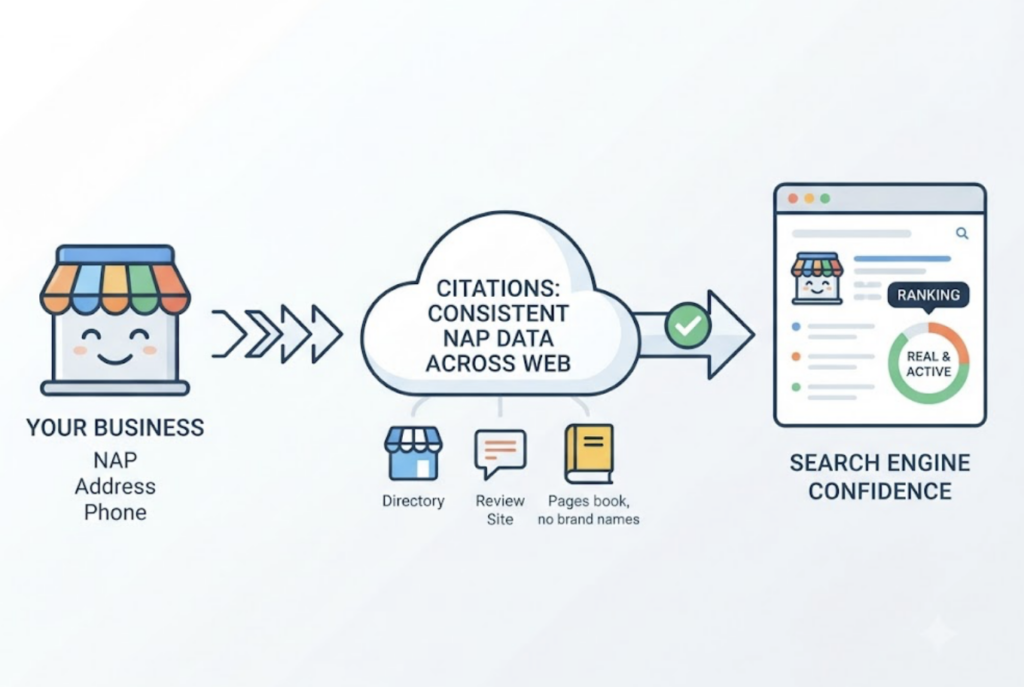
    For more than a decade, “citation” in SEO meant one thing: your business Name, Address, and Phone number appearing consistently across the web. Every Yelp listing, every Yellow Pages entry, every industry directory submission was a citation. The logic was straightforward. The more places search engines found your NAP data, the more confident they became that your business was real, active, and located where you claimed.

    This system still works. According to Moz’s Local Search Ranking Factors report, citation signals account for roughly 7% of local pack ranking weight. That’s down from 13% in 2020, but citations remain a foundational signal for local visibility. Whitespark’s research shows that NAP consistency across platforms improves local rankings by an average of 23%.

    None of that has stopped being true. But it’s no longer the full picture.

    What “Citation” Means When AI Generates the Answer

    When ChatGPT, Perplexity, or Gemini answers a user’s question, it doesn’t return a list of links. It synthesizes an answer and attributes specific claims to specific sources. That attribution is a citation in the AI context, and it works nothing like a directory listing.

    There are three levels of brand appearance in AI answers, and they’re not interchangeable. A mention means the AI names your brand without linking to any source. A citation means the AI explicitly references and links to a URL as supporting evidence. A recommendation means the AI suggests your product or service as a solution. Only citations create a verifiable connection between your content and the AI’s answer.

    The gap between Google rankings and AI citations is wider than most SEO teams expect. The same Search Atlas study found that ChatGPT has only 8% URL overlap with Google’s top 10. Gemini sits at 6%. Perplexity, because it performs live web retrieval, is higher at 28%. Google’s own AI Overviews pull 76% of citations from its existing top results, but that’s the exception, not the rule.

    A top Google ranking and an AI citation are two different achievements.

    Why Ranking Well on Google Doesn’t Guarantee AI Citations

    Google ranks pages based on backlinks, keyword relevance, and domain authority. AI engines select sources based on a different set of signals: claim specificity, entity authority, content freshness, and how easy it is for the model to extract a usable answer from the page.

    Brand search volume is now the strongest predictor of LLM citations, showing a 0.334 correlation in a ConvertMate analysis of 80 million citations. Backlinks, the backbone of traditional SEO, show a weak or neutral relationship with AI citation frequency. Ahrefs’ study of 75,000 brands found that branded web mentions correlate 3x more strongly with AI visibility than backlinks do.

    Content freshness has become a citation gatekeeper. AirOps research shows that pages updated within three months are 3x more likely to be cited by AI engines. Pages that sit untouched for six months or longer quietly drop out of the AI citation pool, regardless of how well they rank on Google.

    Where your key information sits on the page matters too. According to Growth Memo’s analysis, 44.2% of all LLM citations pull from the first 30% of an article’s text. Another 31.1% come from the middle. Only 24.7% reference the conclusion. Front-loading your most citable claims isn’t a style preference. It’s a structural requirement for AI visibility.

    From NAP Consistency to Claim Specificity: What AI Engines Actually Cite

    Traditional citation SEO optimized for one thing: making your business information identical everywhere. AI citation SEO optimizes for something different: making your content easy for a model to extract, attribute, and trust.

    The unit of value has shifted from the NAP listing to the citation-ready claim. A citation-ready claim has three properties. It’s specific, containing a number, a named entity, or a date. It’s verifiable, meaning a model can cross-reference it against other sources. And it’s attributed, clearly tied to a named author, study, or organization.

    Compare these two statements. “AI search is changing how brands get discovered” is a general observation that no model needs to cite because it can generate that sentence on its own. “Only 12% of URLs cited by LLMs rank in Google’s top 10, based on a Search Atlas analysis of 18,377 queries” is a claim a model can lift, attribute, and trust. The second statement earns citations. The first one doesn’t.

    Earned media amplifies this effect significantly. Stacker’s 2026 GEO study, which analyzed 87 stories across 30 brands and 8 AI platforms, found that distributing content through third-party publishers produces a median 239% lift in AI search visibility. A separate Muck Rack analysis found that 94% of AI citations come from non-paid, non-brand-owned sources. AI engines trust third-party editorial coverage far more than anything a brand publishes about itself.

    How to Track Whether AI Engines Are Citing Your Brand

    Old-school citations are auditable with tools like BrightLocal or Moz Local. You enter your business name, and the tool scans directories for NAP inconsistencies. Simple.

    AI citations require a fundamentally different tracking approach. You need to monitor specific prompts across multiple AI platforms and see which domains get cited, how often, and in what position. This is prompt-level citation tracking, and it’s where traditional SEO tools have a blind spot.

    Topify approaches this through its Source Analysis feature, which tracks exactly which domains AI platforms cite when users ask questions relevant to your brand. You input the prompts your buyers are likely asking, and the platform shows citation distribution across ChatGPT, Perplexity, Gemini, and AI Overviews. If a competitor’s blog post is getting cited 40% of the time and your domain isn’t appearing at all, that’s a specific gap you can act on.

    The tracking layer extends beyond source URLs. Topify’s Visibility Tracking monitors how often your brand appears in AI responses across platforms, while Position Tracking shows where you rank relative to competitors within each answer. Together, these metrics give you something that no traditional citation audit can: a real-time map of how AI engines perceive your brand’s authority.

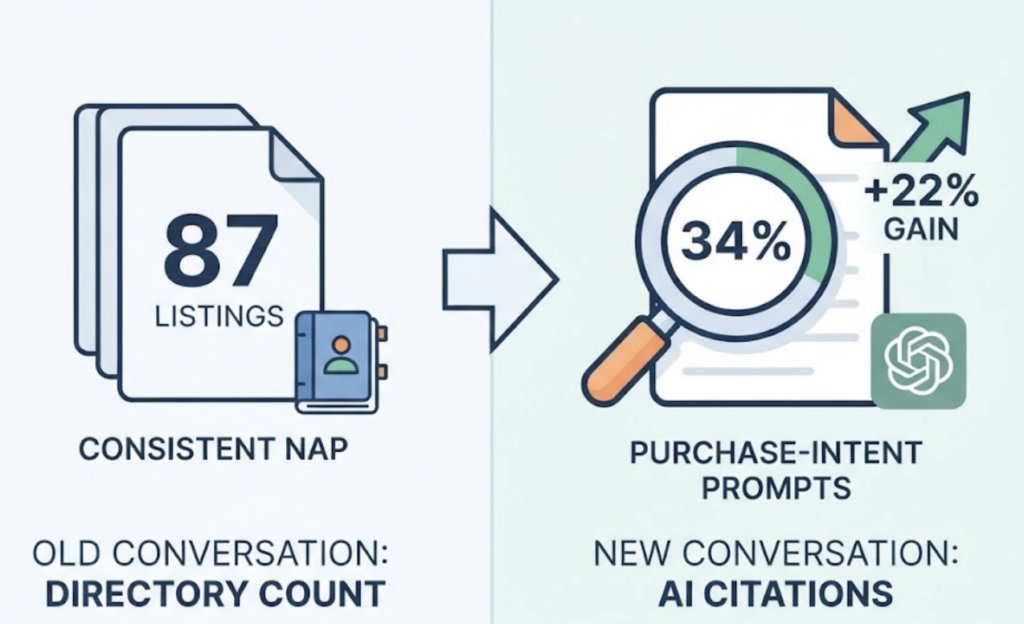
    That visibility data changes the conversation with clients and stakeholders. Instead of reporting “we’re listed on 87 directories with consistent NAP,” you can report “ChatGPT cited our domain in 34% of purchase-intent prompts in our category this month, up from 12% last quarter.”

    Both Citation Playbooks Still Matter in 2026

    This isn’t a story about old citations dying. It’s about a second citation layer emerging on top of the first.

    Local citation SEO, the NAP-and-directory work, remains essential infrastructure for any business with a physical location. Google’s local pack still relies on it. AI engines like Gemini, which pull heavily from Google Maps data, also benefit from consistent directory listings. If your NAP data is a mess, you’ll have problems in both traditional and AI search.

    But if you’re only doing directory citations, you’re missing the bigger shift. AI-powered search has captured between 12% and 15% of global search market share as of early 2026, and that number is growing. For non-local brands (SaaS, DTC, B2B), AI citations are often the primary discovery channel where potential customers encounter the brand for the first time.

    The practical action plan looks like this: audit both citation layers. Use directory management tools for local NAP hygiene. Use prompt-level citation tracking for AI visibility. Refresh key content pages at least quarterly to maintain citation eligibility. And invest in earned media distribution, because AI engines cite third-party sources at dramatically higher rates than brand-owned content.

    Citation SEO hasn’t been replaced. It’s been expanded. The teams that recognize both definitions will hold the advantage.

    Conclusion

    For years, citation SEO meant one thing: getting your business name, address, and phone number listed correctly across directories. That work still matters for local search. But the word “citation” now carries a second, arguably larger meaning: getting your content cited by AI engines when they synthesize answers for your buyers.

    The data is clear. Google rankings don’t predict AI citations. Content freshness, claim specificity, brand recognition, and earned media presence do. Teams that track both citation layers, directory listings and AI source attribution, will see the full picture of their brand’s discoverability. Those that don’t will keep optimizing for a fraction of where their customers are actually looking.

    FAQ

    What is citation SEO?

    Citation SEO traditionally refers to optimizing your business’s Name, Address, and Phone number (NAP) across online directories to improve local search visibility. In 2026, the term has expanded to include getting your content cited as a source by AI search engines like ChatGPT, Perplexity, and Gemini when they generate answers to user queries.

    Are local SEO citations still important in 2026?

    Yes. Local citation signals still account for about 7% of local pack ranking weight according to Moz, and NAP consistency remains a foundational trust signal for Google. They’re less dominant than in 2020, but still necessary for any business with a physical location.

    How do I check if ChatGPT is citing my brand?

    You can manually ask ChatGPT purchase-intent questions in your category and look for your brand in the response. For systematic tracking, platforms like Topify monitor citation rates across multiple AI engines at the prompt level, showing you exactly which domains get cited and how often.

    What’s the difference between a citation and a mention in AI search?

    A mention means the AI names your brand in its answer without attributing the information to any source URL. A citation means the AI explicitly links to a specific page as evidence for a claim. Citations carry more authority and are more actionable for optimization because you can trace which content earned the reference.

    Read More

  • Citation SEO Meant Directory Listings. Now It Means AI Citations.

    Citation SEO Meant Directory Listings. Now It Means AI Citations.

    Your NAP profiles are spotless. Yelp, Google Business Profile, Apple Maps, all consistent down to the suite number. Whitespark gives you a clean bill of health. Then someone asks ChatGPT for a recommendation in your category, and the answer pulls from Reddit threads, Wikipedia entries, and a competitor’s blog post you’ve never seen. Your directory listings don’t appear anywhere in the response.

    That disconnect is the new reality of citation SEO. The term hasn’t changed, but what it takes to earn a citation has.

    What Citation SEO Meant for 15 Years

    For most of its history, “citation SEO” referred to one thing: getting your business name, address, and phone number (NAP) listed consistently across online directories. Yelp, YellowPages, Bing Places, industry-specific portals. The logic was straightforward. More consistent directory listings meant stronger local authority, which meant higher placement in Google’s Local Pack.

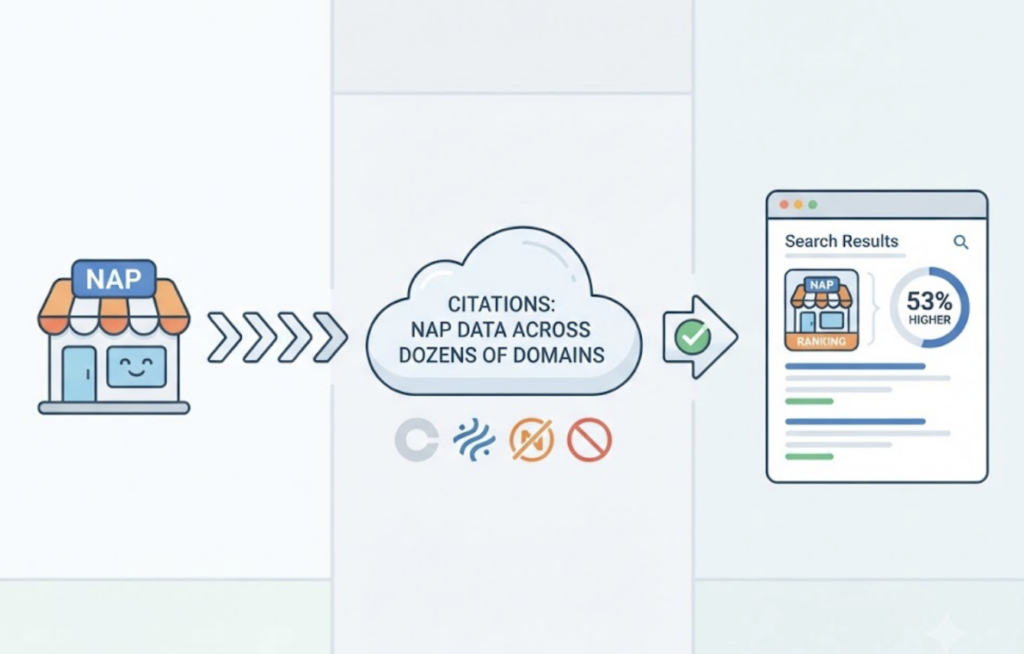
    Tools like Moz Local, BrightLocal, and Yext built entire businesses around this model. Data from Uniek Digital shows businesses with 40 or more accurate citations rank 53% higher in local search results. Google cross-references NAP data across dozens of domains to verify legitimacy. In a world where Google was the only search engine that mattered, citation building worked.

    That world no longer exists.

    How AI Search Rewrote the Rules of Citation SEO

    ChatGPT now has over 900 million weekly active users. Perplexity processes roughly 780 million search queries per month. Google’s own AI Overviews appear on an estimated 15 to 25% of all searches. Nearly a third of Americans are projected to use generative AI search in 2026, according to eMarketer data cited by Control Alt Digital.

    None of these systems use directory listings to decide who gets recommended.

    When ChatGPT assembles an answer, it pulls from a narrow set of sources it considers authoritative. According to Ahrefs’ July 2026 analysis, the top cited domains in ChatGPT are Reddit, Wikipedia, Amazon, Forbes, and Business Insider. Research from Contently found that roughly 30 domains account for about 67% of ChatGPT citations within any given topic. And ChatGPT only cites 15% of the pages it retrieves during a search, meaning 85% of retrieved sources never make it into the answer.

    That’s a fundamentally different citation model. Your Yelp listing doesn’t factor into whether Perplexity mentions your brand when someone asks “what’s the best project management tool for remote teams.”

    What Citation SEO Looks Like in 2026

    The new definition of citation SEO is simple: making your brand and content the source that AI systems quote, link, and recommend.

    There are two forms of AI citation. The first is a direct mention, where the AI names your brand in its response. The second is a source citation, where the AI links to your content as a reference supporting its answer. Both matter. Both require different strategies than traditional directory citation building.

    Here’s what the data says drives AI citations versus traditional citations:

    DimensionTraditional Citation SEOAI Citation SEO
    DefinitionNAP mentions across directoriesBrand/content cited in AI-generated answers
    Target platformsGoogle Local Pack, Apple Maps, BingChatGPT, Perplexity, Gemini, AI Overviews
    Primary signalDirectory consistency, listing volumeBrand mentions, earned media, content authority
    MeasurementNAP accuracy score, citation countCitation share, mention rate, source frequency
    Key toolsMoz Local, BrightLocal, YextTopify, AI visibility trackers

    The strongest predictor of AI citation is not what you’d expect. An Ahrefs study of 75,000 brands found that branded web mentions correlate with AI Overview visibility at 0.664, while traditional backlinks sit at just 0.218. That’s a 3x gap. YouTube mentions showed an even stronger signal at 0.737.

    In other words, AI engines care more about how often your brand is talked about across the web than how many links point to your site.

    Why Your Old Citation Metrics Can’t Measure This

    Traditional citation tools were built to count directory listings and flag NAP inconsistencies. They don’t track whether ChatGPT mentioned your brand in response to a product comparison query, or which source domains Perplexity cited when recommending your competitor.

    A Goodfirms 2026 survey found that only 14% of marketers currently use AI citation tracking, even though 43% name AI search optimization as a core strategy for the year. That’s the largest measurement gap in the current SEO stack.

    The problem compounds fast. AI answers vary by session, by platform, and by phrasing. You can’t manually check 200 prompts across four AI platforms every week and call it a monitoring strategy. You need structured tracking.

    Topify’s Source Analysis feature tracks exactly which domains and URLs AI platforms cite when answering prompts in your category. It shows whether your content is among the cited sources, or if competitors are dominating the citation layer. The Visibility Tracking module monitors how often your brand appears across ChatGPT, Perplexity, Gemini, and AI Overviews, giving you a citation share metric that traditional tools simply don’t offer.

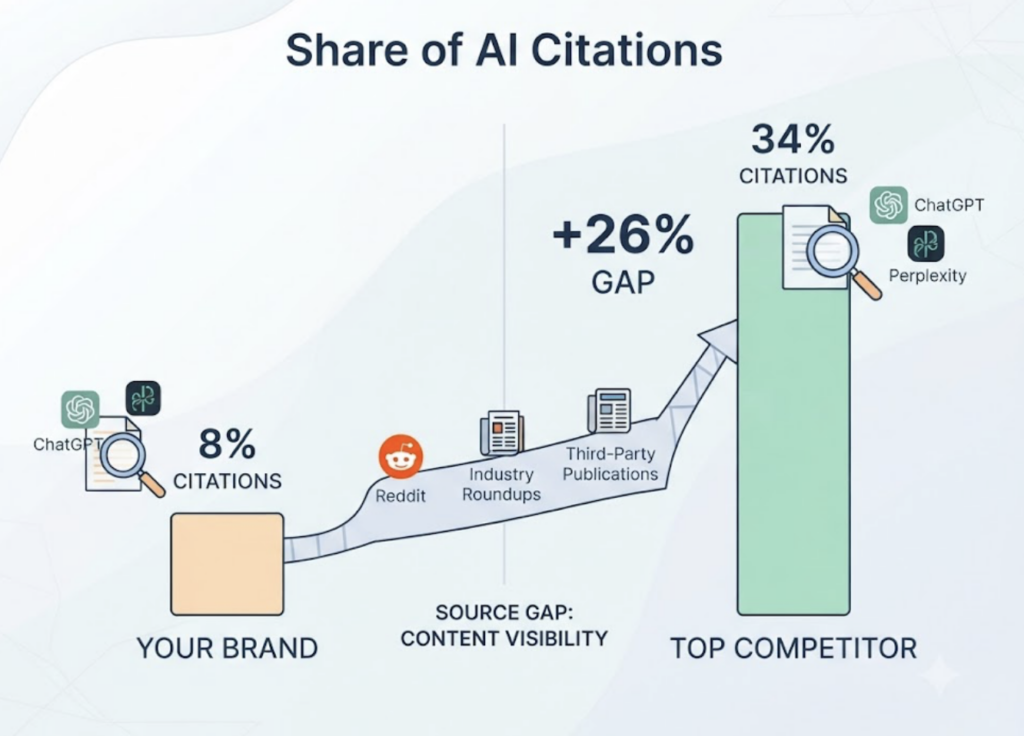
    Here’s an example of what that looks like in practice. You run a SaaS brand and track 100 prompts related to your category. Topify shows your competitor gets cited as a source in 34% of those prompts across ChatGPT and Perplexity. Your brand: 8%. The gap isn’t because your domain authority is lower. It’s because their content appears on Reddit, gets referenced in industry roundups, and shows up in the third-party publications that AI engines actually pull from.

    5 Ways to Build Citation SEO for AI Search

    The tactics that earn AI citations look different from the directory submission playbook. Here’s what the research supports.

    1. Publish Content That AI Wants to Quote

    AI systems favor content with clear structure, original data points, and direct answers. The Princeton/Georgia Tech GEO paper tested 10,000 queries and found that adding statistics improves AI visibility by 30 to 40%. Content with FAQ schema, comparison tables, and front-loaded answers in the first 60 words of each section performs best.

    Listicles, articles, and product pages are the three most-cited content formats across AI Mode, ChatGPT, and Perplexity, accounting for over 50% of citations combined.

    2. Earn Third-Party Mentions, Not Just Links

    Unlinked brand mentions now outperform backlinks as a predictor of AI visibility by roughly 3x. A Stacker and Scrunch study found that distributing content across third-party news publications increased AI citation rates by up to 325% compared to publishing only on the brand’s own site. Brand-only content achieved 7.6% citation rates. Earned distribution achieved 34%.

    The implication is clear: digital PR, media placements, and guest contributions on trusted publications do more for AI citation SEO than another batch of directory submissions.

    3. Build Presence Where AI Actually Pulls From

    Reddit is the single most-cited domain across generative AI engines in 2026, according to Everything-PR Research. An SE Ranking study found that domains with strong Reddit presence averaged 3.9x more ChatGPT citations than those without. Wikipedia, YouTube, LinkedIn, and Forbes round out the top five.

    This doesn’t mean spamming subreddits with promotional posts. It means contributing genuine, experience-based answers in the communities where your audience already asks questions.

    4. Monitor Your AI Citation Share

    You can’t optimize what you don’t measure. Set up tracking across your target prompts and platforms. Topify’s Competitor Monitoring feature automatically detects which brands AI engines recommend alongside yours, so you can see citation shifts as they happen rather than discovering them months later.

    Track three metrics: citation frequency (how often your brand is mentioned), source frequency (how often your pages are linked as sources), and sentiment (whether AI describes your brand accurately).

    5. Keep Content Fresh

    Pages that go more than three months without an update are over 3x more likely to lose AI visibility. Over 70% of AI-cited pages were updated within the past 12 months. AI engines weight recency when selecting sources, so add new data, updated examples, and clear “last updated” timestamps to your core pages.

    Traditional Citation Building Isn’t Dead. It’s Just Not Enough.

    Directory citations still matter for local SEO. Whitespark’s 2026 Local Search Ranking Factors report found that citations actually rank third in importance for AI visibility among local businesses, accounting for 13% of the signal. Consistent NAP data still helps Google verify your business, and review platforms like G2, Capterra, and Yelp create the kind of structured third-party presence that AI engines notice.

    But stopping at directory listings means you’re optimizing for one citation model while ignoring the one that’s growing fastest. The brands that win in 2026 treat traditional citation building as the foundation and AI citation strategy as the growth layer on top.

    Conclusion

    Citation SEO used to be a checklist: submit to 50 directories, match your NAP, and move on. In 2026, it’s a visibility strategy that spans every platform where AI systems look for sources to quote.

    The shift from directory citations to AI citations isn’t coming. It’s already here. Over 900 million people use ChatGPT weekly. AI Overviews appear on a quarter of Google searches. And the data is unambiguous: brand mentions, earned media, and content authority predict AI visibility 3x better than traditional backlinks.

    The first step is knowing where you stand. Check which prompts in your category trigger AI answers, see whether your brand appears in those answers, and identify the sources AI is quoting instead of you. Get started with Topify to track your AI citation share across ChatGPT, Perplexity, Gemini, and AI Overviews in one dashboard.

    FAQ

    Q: What is citation SEO?

    A: Citation SEO is the practice of optimizing your brand’s presence so it gets cited across search platforms. Traditionally, this meant directory listings with consistent NAP data for local search. In 2026, it increasingly means earning citations and mentions from AI search engines like ChatGPT, Perplexity, and Google AI Overviews.

    Q: Is traditional citation building still important?

    A: Yes, but for a narrower purpose. Directory citations still support local pack rankings and help search engines verify business legitimacy. They’re a baseline, not a complete strategy. For AI search visibility, earned media mentions and content authority carry significantly more weight than directory listing volume.

    Q: How do I check if AI is citing my brand?

    A: Manual spot-checking (searching your target queries on ChatGPT, Perplexity, and Google) gives you a snapshot, but AI responses change between sessions. For systematic tracking, tools like Topify monitor citation frequency, source links, and brand sentiment across multiple AI platforms and prompt sets over time.

    Q: What’s the difference between AI citations and backlinks?

    A: A backlink is a hyperlink from one website to another, and it primarily signals authority to Google’s algorithm. An AI citation is when an AI system references your brand or links to your content in a generated answer. The two overlap (strong backlink profiles can help), but AI citations are more strongly correlated with brand mentions and earned media presence than with link counts alone.

    Read More

  • AI Reputation Monitoring Tracking: How to See What AI Says

    AI Reputation Monitoring Tracking: How to See What AI Says

    You’ve spent years shaping how people describe your brand. Then someone asks ChatGPT about your category, and the model calls your premium product a “budget option,” lists a competitor first, or states a refund policy you retired two years ago. Nobody wrote that. No journalist, no reviewer, no customer. The model generated it, and the person reading it has no reason to doubt it. Most brands still measure reputation through reviews and social mentions, channels where a human said something you can find and respond to. The harder problem is the sentence an AI produces on demand, phrased differently every time, that you never see. That blind spot is exactly what AI reputation monitoring tracking is built to close.

    What AI Reputation Monitoring Tracking Actually Means

    AI reputation monitoring tracking is the practice of systematically checking what AI models say about your brand, not just whether they mention it. It covers three things at once: the tone of the answer, the accuracy of the claims, and the sources the model leaned on to make them.

    That’s different from social listening. Social listening captures things humans posted, which you can find, quote, and respond to. AI answers get generated on demand, phrased differently every time, and usually stay invisible to the brand they describe.

    The shift matters because buyers are already there. In one December 2025 survey, 38% of consumers used AI specifically for product research and 30% used it to compare competing options side by side. Those are the exact moments a reputation gets shaped.

    Here’s the part most teams miss. You aren’t tracking a page anymore. You’re tracking a machine’s opinion of you.

    How AI Reputation Monitoring Tracking Works Under the Hood

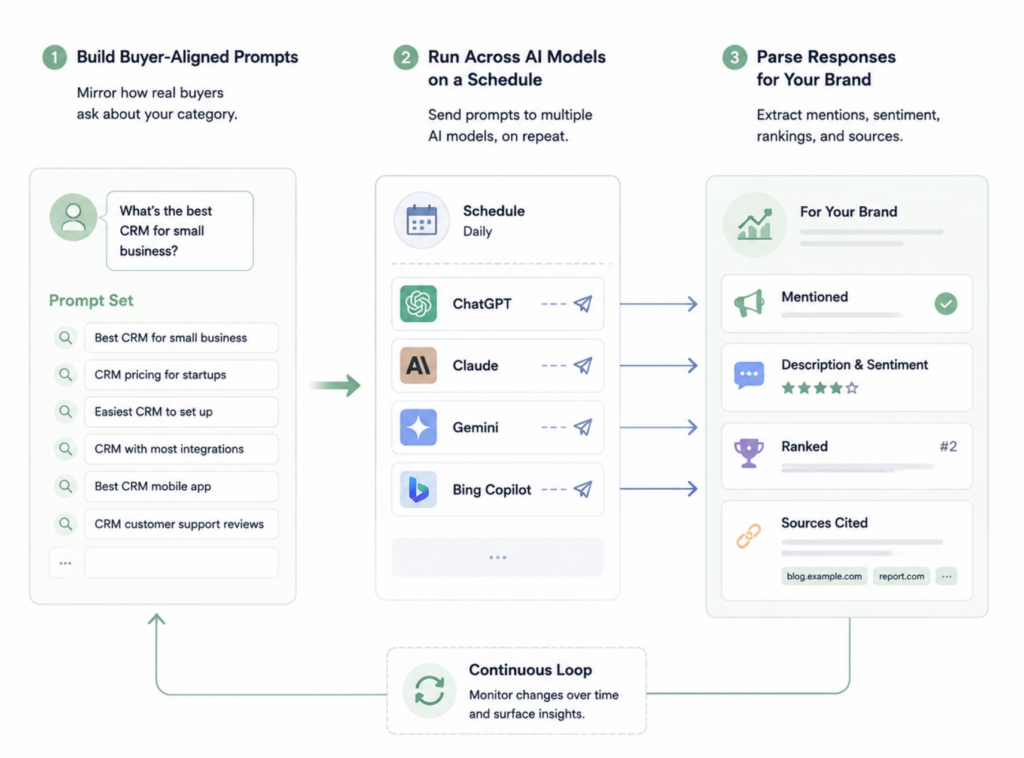
    The mechanics are less mysterious than they sound. You start with a set of prompts real buyers ask in your category, run them across the models that matter, and record what comes back.

    The catch is that AI answers aren’t stable. Benchmark tests show that running the same prompt 1,000 times can still produce 80 distinct responses, even with randomness dialed to its lowest setting. Ask ChatGPT about your brand on Monday and again on Wednesday, and you may get two different verdicts.

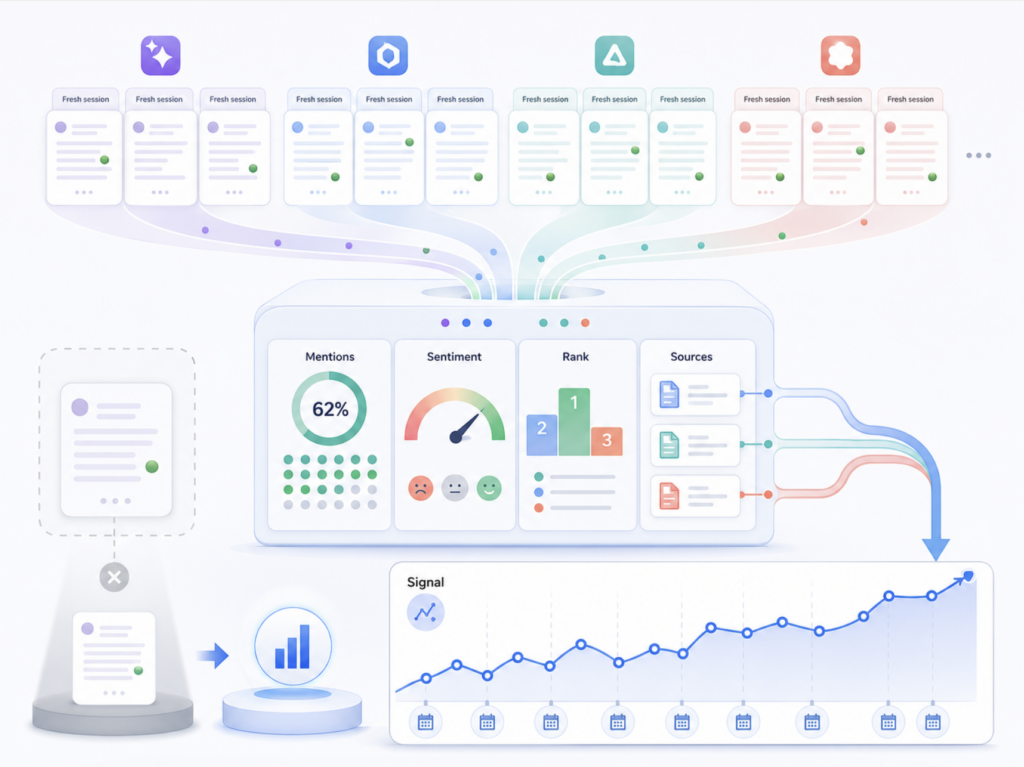
    That’s why a single screenshot proves nothing. Real monitoring runs each prompt repeatedly across many fresh sessions, measures the percentage of runs that name your brand and how positively, then tracks that rate over time. From there, the system extracts every brand mention, scores the sentiment, notes your position relative to competitors, and captures which sources the model cited to build the answer. Do that on a schedule across ChatGPT, Gemini, Perplexity, and the rest, and you have a signal instead of an anecdote.

    Why a Bad AI Answer Costs More Than a Bad Review

    An AI recommendation carries more weight than most brands realize. Similarweb found that consumers recommended a brand by ChatGPT were 2.5 times more likely to visit it than a competitor, even with no link and no prior visit.

    On the B2B side, the pull is stronger. G2 reported that 69% of software buyers picked a different vendor than they’d planned based on AI chatbot guidance, and one-third bought from a company they’d never heard of before.

    Now flip it. When the answer is wrong, the damage lands on you, not the model. A court held Air Canada liable for a refund policy its chatbot invented, setting a precedent that a company owns what its AI says. Customers also rarely separate “the AI made a mistake” from “the company gave me false information”. One analysis pegged AI-driven misinformation at $2.6 billion in annual revenue loss for e-commerce brands alone.

    A bad review sits on one page. A bad AI answer regenerates every time someone asks.

    The Metrics That Tell You If Your AI Reputation Is Healthy

    You can’t manage what you don’t measure, and “are we mentioned” is too blunt to act on. A useful AI reputation monitoring system tracks a handful of metrics together.

    MetricWhat it measuresWhy it matters
    Mention rateHow often AI names your brand across repeated runsTells you whether you’re in the conversation at all
    SentimentWhether the tone is positive, neutral, or negativeA negative mention can hurt more than no mention
    PositionWhere you land versus competitors in the answerFirst-named brands capture most of the attention
    Source mixWhich domains the model cites to describe youShows you what to fix and where
    Competitor shareHow often and how favorably rivals appearFrames your reputation against the category

    One caveat on sentiment. AI answers tend to skew heavily positive across most engines, so a high raw score means less than it looks. The signal is in the movement: a dip in sentiment, a rise in neutral mentions, or a single negative claim that keeps resurfacing.

    And no single platform tells the whole story. Across 50 buyer-intent prompts, three major engines named the same brand only 21% of the time. Track one, and you’re blind to the other two.

    Turning Metrics Into an AI Reputation Dashboard

    Scattered across five platforms, these numbers are noise. Pulled into one dashboard, they become a story you can act on.

    That’s the job of a monitoring platform. Topify, for example, tracks seven metrics including visibility, sentiment, and position across ChatGPT, Gemini, Perplexity, DeepSeek, and other engines, so a drop in one place shows up next to the data that explains it.

    Where Most AI Reputation Tracking Goes Wrong

    Three mistakes show up again and again.

    The first is tracking a single platform. It feels efficient, and it’s the fastest way to miss a problem, given how little the engines agree. The fix is to measure across every model your audience actually uses.

    The second is watching visibility but ignoring sentiment. Being named in a negative or inaccurate answer is worse than not being named at all, and a mention count won’t catch that. Tone tracking will.

    The third is the expensive one: ignoring sources. You can’t argue a model into changing its mind, because the answer reflects the sources it retrieved. 79% of consumers say they’d verify an AI recommendation against other sources before trusting it, and nearly 30% check a brand’s social profiles right after getting an AI answer. If those sources carry wrong or stale information, the AI repeats it, and so do your buyers.

    The fix is a loop, not a one-time cleanup. Build a register of inaccurate answers, repair the strongest sources feeding them, and retest on a schedule. That’s reputation work, done at the source layer.

    What to Look for in an AI Reputation Monitoring Tool, Platform, or Software

    Once you’re ready to buy, the criteria matter more than the label on the box, whether it’s sold as a tool, a software suite, or a full platform. A capable solution should cover multi-platform tracking, sentiment scoring rather than raw mention counts, source-level analysis so you can trace and fix the answer, competitor benchmarking, and repeated sampling to smooth out that non-determinism problem.

    Most tools stop at “you were mentioned.” The useful ones tell you why.

    This is where Topify fits for teams managing brand reputation. Its Sentiment Analysis scores how AI engines describe your brand on a 0 to 100 scale, so you can catch the moment a model starts calling your premium product a budget option. Source Analysis reverse-engineers the exact domains and URLs the engines cite, which turns a vague “the AI got it wrong” into a specific list of pages to fix. And Competitor Monitoring shows how rivals get described in the same answers, so you know whether a sentiment gap is your problem or the whole category’s.

    Pricing starts at $99 per month on the Basic plan, which covers ChatGPT, Perplexity, and Google AI Overviews tracking with 100 prompts. For teams that want to move from watching to fixing, you can get started and have a baseline within a session.

    Conclusion

    The sentence an AI produces about your brand is now part of your reputation, and for most teams it’s the part nobody’s reading. Reviews and social mentions still matter, but they no longer cover the channel where a growing share of buyers form their first impression. Start small: define the prompts your buyers actually ask, run them across the models that matter, and watch tone and sources over time rather than checking once and hoping. The brands that treat AI answers as a measurable, fixable surface will stay accurately described. The rest will find out what the model thinks only after a customer does.

    FAQ

    Q: What’s a good checklist for AI reputation monitoring tracking? 

    A: Start with five items: a prompt set built from real buyer questions, coverage across every AI platform your audience uses, sentiment scoring alongside mention counts, source tracking so you can trace claims back to their origin, and a fixed cadence for re-running everything. Repeated sampling belongs on the list too, since one-off checks miss the variance built into AI answers.

    Q: What does a strong AI reputation strategy look like? 

    A: It’s less about chasing a perfect score and more about a repeatable loop. Measure how AI describes you across models, identify the inaccurate or negative answers that affect buying decisions, repair the sources those answers pull from, then retest. A good strategy also benchmarks competitors, because reputation in AI search is relative to who else the model names.

    Q: What are some examples of AI reputation problems? 

    A: Common ones include a model describing a premium product as budget, citing a discontinued product or an old pricing page, stating a policy you no longer offer, or ranking a competitor first in answers to your core category prompts. A widely cited case involved an airline held liable for a refund policy its chatbot fabricated.

    Q: How much does AI reputation monitoring tracking cost? 

    A: It varies by coverage and prompt volume. Entry-level platforms tend to start around $99 per month for tracking across the major engines, with higher tiers adding more prompts, projects, and seats. The real comparison is against the cost of a single misinformed answer reaching buyers unchecked.

    Read More

  • AI Reputation Monitoring Platform: What It Tracks and Why

    AI Reputation Monitoring Platform: What It Tracks and Why

    For years, managing a brand’s reputation meant watching review sites, social mentions, and press coverage. That still matters. But a new layer sits above all of it now, and most teams haven’t started watching it. When a buyer asks ChatGPT, Gemini, or Perplexity to recommend something in your category, they get one synthesized answer that describes your brand in specific words. Sometimes it names you the leader. Sometimes an alternative. Sometimes it skips you entirely. That verdict forms an impression before anyone reaches your website, and 62% of consumers now trust AI for brand decisions.

    That’s the gap an AI reputation monitoring platform is built to close.

    What an AI Reputation Monitoring Tool Actually Watches For

    Most people hear “AI reputation” and picture visibility: does my brand show up in the answer or not. That’s part of it, but it’s the smaller part.

    Visibility asks whether you’re mentioned. Reputation asks how you’re described. An AI reputation monitoring tool tracks both, but the second question is where the value lives.

    Here’s why the distinction matters. Two brands can appear in the same AI answer, and one gets called “the standard choice for enterprise teams” while the other gets “a lower-cost option for smaller projects.” Same visibility. Very different reputations. The framing does the selling, and buyers rarely see the alternative.

    So AI reputation monitoring software does three things at once. It queries AI models the way a customer would, captures how each engine describes and positions your brand, and flags when that description is inaccurate, outdated, or drifting away from how you position yourself. Traditional social listening reads what humans publish. This reads what the machine synthesizes and presents as the answer.

    How an AI Reputation Monitoring System Works

    An AI reputation monitoring system runs on a loop: sample, analyze, track over time.

    The sampling step matters more than it sounds. AI answers are non-deterministic, which means the same query can produce different mentions, sentiment, and citations on every run. A single check tells you almost nothing. A monitoring system runs the same prompts repeatedly, across multiple platforms, to capture the real range of how your brand shows up.

    Then it analyzes what came back. Every response gets parsed for whether the brand appeared, what tone the language carried, how it ranked against competitors, and which sources the answer leaned on.

    The last part is where it gets technical. Models hold two layers of brand knowledge: a static layer baked in during training, and a dynamic layer pulled from live sources at query time. Static sentiment shifts slowly. Dynamic sentiment can move within days when a new review or article gets cited. Both combine at the moment someone asks, which is exactly why the same brand can read like a leader on one engine and an afterthought on another.

    What an AI Reputation Monitoring Dashboard Should Measure

    If you’re evaluating what to measure, a good AI reputation monitoring dashboard tracks four signals, not one.

    Sentiment. The emotional tone of how AI describes you. Sentiment skews positive across most engines, but the gaps between platforms are where positioning quietly slips. Averaging them into a single score hides the one platform where your framing is weakest.

    Mentions. How often your brand surfaces across a defined set of prompts. This is your raw presence, and it only means something when tracked over time rather than screenshotted once.

    Position. Where you land relative to competitors in the answer. AI recommendations often name just one to three brands, so ranking fourth is functionally invisible.

    Sources. The domains and URLs the AI cites when it describes you. This is the layer most tools skip, and it’s the one that explains everything else.

    From Sentiment Score to Source Attribution

    Sentiment tells you there’s a problem. Source attribution tells you why.

    If an engine describes your product as outdated, the cause is usually a specific page or forum thread it keeps pulling from. That’s not a guess you want to make blind. Analytics that trace sentiment back to the cited source turn a vague “AI doesn’t like us” into a fixable “this review page from 2023 is shaping the answer.” Brand web mentions correlate at 0.664 with AI citation rates, roughly three times stronger than page-level SEO signals, which tells you where the leverage actually sits.

    Where Most AI Reputation Data Goes Wrong

    The most common mistake is checking one platform and assuming it represents the whole picture.

    It doesn’t. Brand recommendations differ 40 to 60% across AI platforms for the same query. One study of over 300,000 citations found only 11% platform overlap, and citation volume for a single brand varied by up to 615x between engines. A brand that dominates Perplexity can be nearly absent from ChatGPT. Track one, and you’re blind to where your biggest gap lives.

    The second mistake is measuring mentions but ignoring tone. Presence without framing is a vanity metric. Being mentioned as “the budget option” isn’t a win.

    The third is treating AI monitoring like a Google rank check: verify once, log the number, move on. AI answers update as their sources change, so a one-time audit is stale within weeks. Reputation monitoring has to be continuous, or it catches drift only after it’s hardened into the model’s default answer.

    There’s a fourth, quieter mistake: leaning on the tools you already have. Your existing SEO stack, your keyword rankings, your search console data, none of it captures what an AI engine says about you. 62% of enterprise brands have zero AI search visibility despite heavy SEO investment, largely because they’re measuring the wrong surface.

    What a Full AI Reputation Monitoring Platform Adds

    A single-signal tool tells you sentiment dropped. A platform tells you what to do about it.

    That’s the practical difference between a point tool and an AI reputation monitoring platform. Topify approaches reputation as a connected system rather than a set of separate readouts, tracking visibility, sentiment, position, mentions, and cited sources across ChatGPT, Gemini, Perplexity, DeepSeek, and other major engines in one view.

    In practice, that connection is the point. You can spot a drop in ChatGPT sentiment, trace it to the exact source that started framing you as an alternative, and see which competitor gained the position you lost, all without stitching together three dashboards. Because the platform stores the full response behind each score, you’re reading how a specific engine actually characterized you, not an average that blurs the differences.

    Competitor benchmarking runs on the same data. You see who AI recommends instead of you, on which prompts, and how the framing differs. That turns reputation from something you react to into something you can plan around.

    The reason this depth matters comes back to how AI answers work. When an engine gives one synthesized verdict instead of a page of links, there’s no scrolling past a bad description. A large MIT experiment across 12,000 queries found that citations raise user trust in an AI answer even when those citations are wrong. The answer carries authority regardless of accuracy, which raises the cost of a reputation problem you can’t see. Gartner projects 30% of brand perception will be shaped by generative AI in 2026.

    A Checklist for Picking an AI Reputation Monitoring Solution

    Not every tool that claims to track AI reputation measures the same things. Use this checklist to compare an AI reputation monitoring solution against what actually moves the needle:

    CriterionWhy it mattersWhat to look for
    Multi-platform coverageRecommendations differ 40 to 60% across enginesChatGPT, Gemini, Perplexity, and more, not just one
    Sentiment plus framingPresence alone is a vanity metricTone analysis, not just mention counts
    Source attributionSentiment tells you what, sources tell you whyTraces cited domains and URLs per answer
    Time-series trackingOne-time checks go stale in weeksContinuous sampling, historical trends
    Root-cause routingData without direction wastes timeConnects a signal to the fix, not just a chart
    Pricing transparencyReputation tracking should scale with useClear tiers, usage-based, no forced bundles

    The strategy underneath the checklist is simple. Start by tracking unbranded category prompts, not just your own name, because that’s where buyers form shortlists before they know you exist. Baseline where you stand, fix the highest-impact sources first, and re-measure. Track it. Trace it. Fix it.

    Conclusion

    Your reputation used to be written by reviewers, reporters, and customers. Now a share of it is written by a model that synthesizes those voices into one confident answer you can’t edit directly. The brands that stay ahead aren’t the ones with the most mentions. They’re the ones who know how AI describes them, why, and which source to fix when the framing slips.

    If AI is already part of how your buyers research, start by baselining what the major engines say about you today. You can’t manage a reputation you’ve never read.

    FAQ

    What is AI reputation monitoring software? 

    AI reputation monitoring software tracks how AI systems like ChatGPT, Gemini, and Perplexity describe, position, and recommend your brand when users ask about your category. Unlike social listening, which reads human posts, it reads what the model itself generates and flags inaccurate, outdated, or off-positioning descriptions.

    How can you improve your AI reputation? 

    Fix the source material AI engines pull from. Keep your owned pages consistent and current, address inaccuracies in forums and reviews the models cite, and publish clear comparison and use-case content. Then re-run your prompts over time to confirm the framing actually improves, since results shift as sources change.

    What are examples of AI reputation monitoring in practice? 

    A common example is catching an engine that calls your premium product “budget-friendly,” tracing it to an old review page it keeps citing, and updating that source. Another is spotting that a competitor consistently outranks you on high-intent category prompts on one platform but not another.

    How much does an AI reputation monitoring platform cost? 

    Pricing varies by coverage and volume. Platforms like Topify use usage-based tiers that scale with the number of prompts and platforms you track, starting around $99 a month for smaller teams. See current Topify pricing for details, since plans and limits change.

    Read More

  • AI Reputation Monitoring Software: What It Tracks and Why It Matters

    AI Reputation Monitoring Software: What It Tracks and Why It Matters

    Your team watches Google. You track review sites, monitor social mentions, and set alerts for press coverage. But when a buyer opens ChatGPT and asks whether your product is any good, none of those tools see the answer. The model describes your brand, ranks it against competitors, sometimes invents details about your pricing or features, and the buyer takes it as fact. That conversation never lands in a dashboard you own. It’s a reputation you can’t read, shaped by systems you’ve never audited. That’s the blind spot AI reputation monitoring software exists to close.

    What AI Reputation Monitoring Software Actually Is

    Traditional online reputation management watches what people say about you: reviews, social posts, forum threads, press. AI reputation monitoring software watches what machines say about you. Those have become two different problems.

    When someone asks an AI assistant “is this brand any good?” or “best tools for [category],” the model returns a synthesized verdict. It decides whether to mention you, how to frame you, and which competitors to list beside you. That verdict is the new front page.

    The reviews you can’t see are the ones a machine writes on demand, differently, for every user.

    So an AI reputation monitoring tool isn’t a review aggregator. It systematically queries AI platforms, captures how your brand shows up in the responses, and turns those answers into something you can measure over time. That matters because about a quarter of consumers now name AI platforms as their top research tool, ahead of brand websites and online reviews.

    How AI Reputation Monitoring Software Works

    Under the hood, most tools run a similar loop. First, they build a set of prompts that mirror how real buyers ask about your category. Then they send those prompts across several AI models on a schedule. Finally, they parse each response for your brand: whether you’re mentioned, how you’re described, where you rank, and which sources the model cited.

    The reason you need software for this is that AI answers don’t behave like search results. There’s no fixed ranking page to scrape. Responses are conversational, personalized, and they shift as models retrain or pull new sources.

    Run the same prompt twice and you can get two different verdicts. A small wording change, “best X” versus “top X for startups,” surfaces different brands entirely.

    Point-in-time checks miss all of that, which is why monitoring has to be continuous.

    The surface is also large enough to take seriously. ChatGPT reached roughly 900 million weekly users by early 2026, and that’s one platform among several your buyers are asking.

    Why AI Reputation Is Harder to Control Than Search Rankings

    The stakes come down to reach and trust. AI answers are now a primary research channel, and people act on them. 47% of consumers say AI already influences which brands they trust. In a zero-click environment, users read the model’s characterization and rarely click through to verify it.

    Then there’s accuracy. AI doesn’t just relay what exists. It invents. In one study that queried ChatGPT, Perplexity, and Gemini more than 13,000 times, 93% of companies had at least one basic fact hallucinated or missing from the answers, often stated with full confidence.

    A wrong price, a discontinued product listed as current, a competitor’s feature attributed to you: each error gets repeated across countless private conversations you’ll never see.

    And you own what your AI says about you.

    The Air Canada case made that concrete, when a tribunal held the airline liable after its chatbot invented a refund policy. The newer risk is third-party models describing you without your input. When Google’s Bard fabricated a fact in a live demo, Alphabet shed roughly $100 billion in market value. Reputation damage in the AI layer is measurable, and it’s expensive.

    What to Measure: The Metrics Behind an AI Reputation Monitoring Dashboard

    A useful AI reputation monitoring dashboard goes past a single visibility percentage. Reputation lives in how you’re described, not just whether you appear.

    Four metrics carry most of the signal:

    • Sentiment. Whether the model frames you positively, negatively, or with hedging, and which attributes it attaches to you: reliable, expensive, budget, innovative. This is the part traditional analytics never had.
    • Mentions and share of voice. How often you’re named versus competitors across a prompt set. If your brand appears in 35 of 100 category prompts, your AI share of voice is 35%.
    • Position. Where you land when the model lists options, first pick or afterthought.
    • Sources. Which domains the model cited to form its view, so you can trace a negative characterization back to the page that caused it.

    The sentiment layer is what turns visibility into reputation. It tells you not just that you were mentioned, but how you were characterized, and flags when a model describes you in a negative or hedged context.

    This is where a platform like Topify fits. It tracks brand performance across major AI platforms through visibility, sentiment, position, mentions, and citation sources, scoring AI sentiment toward your brand on a 0 to 100 scale. In practice, that means you can spot a drop in ChatGPT mentions and trace it back to a source that stopped citing you, inside the same view.

    Common Mistakes and a Practical Checklist for AI Reputation Monitoring

    Most teams that start monitoring AI reputation make the same handful of errors.

    • Tracking one platform. ChatGPT is the biggest but not the only one. Gemini and Perplexity often describe you differently and pull from different sources.
    • Measuring presence, not framing. Knowing you were mentioned tells you little if the mention was “a cheaper alternative to [competitor].”
    • Treating it as a one-time audit. A single check is a snapshot. Models change week to week.
    • Ignoring sources. If you don’t know which pages feed the AI, you can’t fix a bad characterization.

    Here’s a short checklist for setting up AI reputation monitoring that holds up over time:

    • Build 30 to 50 prompts that match how buyers actually ask about your category, including comparison and problem queries.
    • Run them across at least three AI models, not one.
    • Track sentiment and position, not just mention rate.
    • Log the cited sources for every answer.
    • Re-run on a fixed cadence, weekly or monthly, and trend against competitors.
    • Flag factual errors so you can correct them at the source.

    Fixing what you find usually comes back to one lever: give the models better, more consistent, authoritative information to retrieve. Third-party corroboration in trusted sources tends to move the needle more than on-site tweaks.

    Choosing an AI Reputation Monitoring Platform: Strategy, Examples, and Pricing

    Once you move from a manual audit to an ongoing system, the platform you pick should do three things: cover the models your buyers use, measure framing rather than just presence, and connect findings to action.

    Coverage comes first. A monitoring solution that only reads ChatGPT leaves most of the picture out. The budget behind AI search reflects how seriously teams take this: 89% of enterprise leaders said AI search improved their marketing in 2025, and 65% are putting at least a quarter of their 2026 budget into AI search optimization.

    Then framing. The whole point of reputation monitoring is the sentiment and source layer, so a system that stops at a visibility number won’t tell you why a competitor is winning the recommendation.

    This is the gap Topify is built to close. Beyond sentiment and mentions, it benchmarks your position against competitors in real time, reverse-engineers the exact domains AI platforms cite, and turns the findings into GEO strategies you can deploy. You state a goal in plain English and launch with one click instead of wiring up manual workflows.

    On pricing, AI reputation monitoring tools vary widely by coverage and prompt volume. Topify’s platform starts at $99/mo on the Basic plan (100 prompts, tracking across ChatGPT, Perplexity, and Google AI Overviews), $199/mo for Pro, and from $499/mo for Enterprise, with roughly 17% off annual billing. You can see current tiers on the Topify pricing page.

    The right choice depends on scale. A solo founder auditing one brand needs less than an agency reporting on twenty. But the baseline is the same: multi-platform coverage, sentiment and source analytics, and a path from insight to fix.

    Conclusion

    The reputation you can’t see is still a reputation. Every day, AI systems describe your brand to buyers who treat the answer as fact, and traditional SEO and ORM tools weren’t built to measure any of it.

    Start by auditing what the major models say about you today, then put a monitoring system in place to catch changes and errors before they compound. The brands that learn to read the AI layer now will shape it before their competitors do.

    FAQ

    Q: What is AI reputation monitoring software? 

    A: It’s software that tracks how AI systems like ChatGPT, Gemini, and Perplexity describe, rank, and recommend your brand. It captures sentiment, mentions, position, and cited sources so you can measure and manage your reputation inside AI answers, not just on review sites.

    Q: How is it different from traditional online reputation management? 

    A: Online reputation management monitors what people say about you across reviews, social, and news. AI reputation monitoring tracks what AI models say, which is generated on demand, varies by user, and can include confident but false claims no human ever posted.

    Q: How much does AI reputation monitoring software cost? 

    A: Pricing depends on coverage and prompt volume. Entry plans often start around $99/mo, with mid-tier plans near $199/mo and enterprise plans from about $499/mo. Check a provider’s pricing page for current tiers.

    Q: How do you measure AI reputation? 

    A: Run a fixed set of category prompts across multiple AI models on a schedule, then track mention rate, share of voice against competitors, position within the answer, sentiment or framing, and the sources each model cites.

    Read More

  • AI Mode SEO Is Becoming Agent SEO: Optimizing for Google’s Agents

    AI Mode SEO Is Becoming Agent SEO: Optimizing for Google’s Agents

    Your team just spent a quarter earning backlinks and climbing to page one for your core terms. Then a buyer opened Google, typed a question, and never saw a single blue link. Google’s AI read a dozen pages, decided which brands mattered, and handed back one answer. Your rankings were fine. Your brand just wasn’t in the answer.

    That gap between ranking well and getting chosen is the whole problem. And traditional SEO metrics weren’t built to see it.

    Ranking Was the Old Game. AI Mode SEO Is About Getting Picked.

    For twenty years, SEO had one job: move up the list so more people click. AI Mode SEO isn’t that. The work now is getting selected and synthesized into an answer that often replaces the list entirely.

    This stopped being a fringe scenario in 2026. At I/O, Google moved AI Mode from an experimental tab to a core part of Search, now powered by Gemini 3.5 Flash for every user globally. The scale is not small. AI Mode crossed one billion monthly users roughly a year after launch, with query volume more than doubling every quarter, while AI Overviews reach 2.5 billion.

    Here’s the shift most SEO teams still haven’t internalized. AI Mode SEO is becoming Agent SEO: you’re no longer optimizing for a human who scans results, but for an agent that reads, reasons, and decides on the human’s behalf.

    What Google’s Information Agents Actually Do

    The clearest signal of this shift is a feature Google put at the center of its I/O 2026 announcement: information agents. These aren’t answer boxes. They’re background systems that run 24/7, reasoning across blogs, news, social posts, and real-time data, then alerting users when something relevant changes.

    Think of Google Alerts rebuilt with a frontier model’s ability to infer and compare. Instead of a link list, the agent synthesizes multiple sources, explains why something matters, and surfaces the conclusion.

    Information agents are one piece. Google also rolled out agentic booking that can call businesses on a user’s behalf and generative UI that assembles custom dashboards and mini apps on the fly. The direction is consistent across all of them. Search is moving from pointing users to websites toward making decisions for them.

    That reframes the entire visibility question. The agent is your new reader. It doesn’t browse. It selects.

    Why Agent SEO Breaks the Traditional SEO Playbook

    The old playbook assumed a stable chain: rank high, earn the click, capture the visit. Agent SEO breaks every link in that chain, and the data now shows exactly where.

    Start with the click. In early 2026, zero-click searches reached roughly 68% of Google queries per SparkToro, and when an AI Overview appears, click-through rates fall sharply. Seer Interactive’s analysis of 2.43 billion impressions found organic CTR dropping 61% on AI Overview queries, and the effect is more extreme in AI Mode, where one estimate puts the zero-click rate near 93%.

    Now the part that should change how you plan. Ranking no longer predicts selection.

    A Moz study of 40,000 keywords found that only 12% of AI Mode citations matched URLs in the organic top ten for the same query. Ahrefs looked at AI Overviews and found that 62% of citations now come from pages outside the top ten, up from a much tighter correlation a year earlier. Same search intent, different source list.

    The reason is architectural. AI Mode uses a query fan-out technique, breaking one question into many sub-queries and pulling sources for each. Your page might win the parent query and lose every sub-query that actually fills the answer.

    That’s the separation Agent SEO has to solve. Your rank can be strong while your mention rate sits near zero, and a rankings dashboard will never flag it.

    How to Optimize for AI Mode SEO When the Reader Is an Agent

    Optimizing for an agent means writing for a system that extracts, verifies, and cites rather than one that skims. Three shifts matter most.

    Make Your Content Machine-Legible, Not Just Reader-Friendly

    Agents ground their answers in passages they can retrieve and parse cleanly. Research on citation selection suggests that entity recognition can lift citation rates substantially, and that semantic match between the query and a specific passage predicts selection far better than domain authority does.

    In practice, that means clear structure, direct answer-style paragraphs, defined entities, and schema markup. Pages with original research, proprietary data, and FAQ sections formatted with schema show a higher probability of being selectedas citation sources.

    Build the Authority Signals Agents Actually Weigh

    Backlinks still count, but they’re no longer the whole story. Google’s AI selects sources on clarity, trust, and explainability, reading author credentials, brand mentions, and topical depth alongside links.

    E-E-A-T functions less like a ranking tweak and more like a pass/fail gate in the selection pipeline. Sites with consistent mentions across forums, news, and niche publications tend to get cited more often than sites with strong backlinks but a thin broader presence.

    Earn Citations, Not Just Clicks

    The payoff for selection is real, not symbolic. Brands cited inside AI Overviews earn roughly 35% more organic clicksthan non-cited brands on the same results page, and AI-driven visitors tend to convert far higher than traditional organic traffic.

    So the goal shifts from “rank and hope they click” to “be the source the agent trusts enough to cite.” That’s the Agent SEO mandate in one line.

    You Can’t Optimize What You Can’t See: Measuring Agent Visibility

    Every tactic above shares one prerequisite. You have to see whether an agent is actually citing you, across platforms, at the prompt level. A rankings tool won’t show it, and AI traffic is easy to miss. Seer found that roughly 70% of AI search traffic gets misclassified as direct in standard analytics setups.

    This is where a purpose-built AI visibility platform matters. Topify tracks how AI systems recommend a brand across ChatGPT, Gemini, Perplexity, and other engines, turning agent visibility into something measurable rather than a guess.

    For teams adapting to Agent SEO, the useful part is the depth of the picture. Topify’s Comprehensive GEO Analytics scores brand performance across seven dimensions, including visibility, sentiment, position, mentions, and CVR. In practice, that means you can spot a drop in Gemini mentions, then trace it to a specific source that stopped citing your brand, inside one view.

    Its Source Analysis feature does the reverse-engineering the query fan-out problem demands. It surfaces the exact domains and URLs AI engines cite for your topics, so you can see whether you or a competitor owns those references, and where your content gaps sit. That closes the loop between “we optimized” and “the agent noticed.”

    Track it. Diagnose it. Fix the gap.

    Conclusion

    The buyer who never saw your blue link isn’t an edge case anymore. It’s the default path through an agent that reads for them and decides for them. AI Mode SEO has quietly become Agent SEO, and the brands that adapt are the ones treating selection, not ranking, as the metric that matters.

    Start by measuring where you actually stand in AI answers, then optimize your content for how agents extract and cite. If you want a clear read on your current agent visibility before you commit to a strategy, get started with Topify and see what the AI is saying about you today.

    FAQ

    Q: What is AI Mode SEO? 

    A: AI Mode SEO is the practice of optimizing so your brand gets selected and cited inside Google’s AI Mode answers, rather than just ranking in the traditional results list. Because AI Mode replaces links with a synthesized response, the goal moves from earning clicks to earning a mention in the answer itself.

    Q: How is Agent SEO different from traditional SEO? 

    A: Traditional SEO optimizes for a human who scans a list and clicks. Agent SEO optimizes for an AI agent that reads multiple sources, reasons across them, and decides what to cite. The signals differ too: clarity, extractable structure, entities, and broad authority often matter more than raw rank position.

    Q: What are Google’s information agents? 

    A: Introduced at Google I/O 2026, information agents are background AI systems that monitor standing topics 24/7, synthesize updates across many sources, and notify users when something relevant changes. They represent search shifting from answering one query at a time toward acting continuously on a user’s behalf.

    Q: How do I know if my brand appears in Google AI Mode? 

    A: Rankings tools won’t tell you, and AI traffic is frequently misattributed in standard analytics. You need an AI visibility platform that tracks mentions and citations at the prompt level across AI engines, so you can measure appearance rate rather than infer it.

    Read More