Blog

  • GPT 5.6: What Sol, Terra, and Luna Mean for Brand Visibility

    GPT 5.6: What Sol, Terra, and Luna Mean for Brand Visibility

    Your brand’s AI search visibility just got split into three lanes. On July 9, 2026, OpenAI launched GPT 5.6 as a three-tier model family: Sol, Terra, and Luna. Each tier runs a different depth of reasoning, pulls from different source pools, and cites different domains. The GEO strategy you calibrated against last month’s ChatGPT model doesn’t map onto any single one of them.

    That’s not a minor version bump. It’s a structural change to how ChatGPT decides which brands to mention, which sources to trust, and how many sub-queries to run before answering. And the data from previous model transitions suggests the visibility reset is already underway.

    Three Models, One Generation: How GPT 5.6 Restructures ChatGPT

    GPT 5.6 isn’t one model with a dial. It’s three distinct models, each tuned for a different point on the cost, speed, and capability curve.

    Sol is the flagship. It handles complex reasoning, agentic workflows, deep research, and cybersecurity tasks. It’s the only tier with access to OpenAI’s new ultra mode and max reasoning effort. API pricing sits at $5 input / $30 output per million tokens, the same class as GPT-5.5.

    Terra is the balanced mid-tier. OpenAI positions it as GPT-5.5-class quality at half the cost: $2.50 input / $15 output. It handles high-volume business tasks like customer support, document analysis, and internal tooling.

    Luna is the fast, affordable option at $1 input / $6 output. It’s built for summarization, classification, drafting, and routine automation.

    Here’s why this matters for brand visibility: the model a user gets depends on their plan and settings. Free and Go users default to Terra. Paid users on Plus, Pro, Business, and Enterprise get Sol when they select Medium, High, or Extra High reasoning effort. That means two people typing the exact same prompt into ChatGPT can get answers from fundamentally different models, with different citation behaviors.
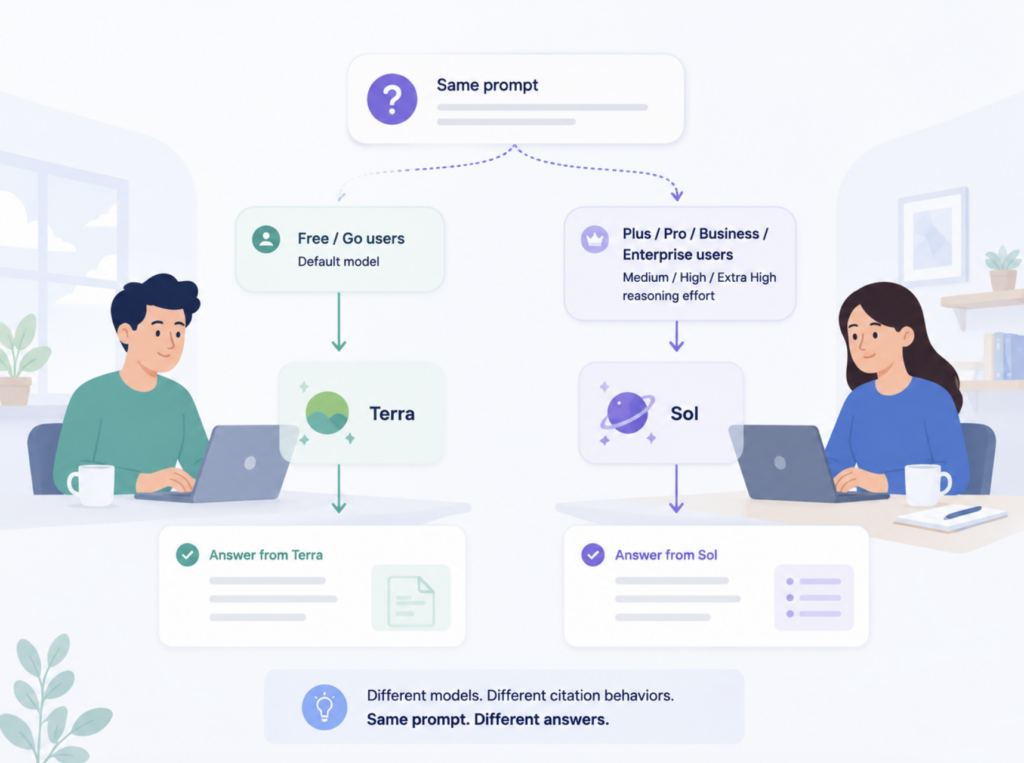
    The naming system itself signals permanence. The number (5.6) marks the generation. Sol, Terra, and Luna are “durable capability tiers” that OpenAI says will advance on their own cadence. This isn’t a one-time split. It’s the new default architecture.

    Why Reasoning Depth Changes Which Brands Get Cited

    The tier split wouldn’t matter much if all three models cited the same sources. They don’t.

    A joint study by Semrush and Kevin Indig tested 100 prompts across 20 buyer journeys, running each prompt twice: once with minimal reasoning (Instant mode) and once with high reasoning (Thinking mode). The gap was significant across every metric. Citation rates jumped from 50% to 68%. Average sources per response nearly doubled, from 2.6 to 4.5. Fan-out queries, the sub-searches ChatGPT runs before answering, increased 4.6x.

    The source mix shifted just as sharply. Reddit’s citation share dropped from 15% to 7% when high reasoning was active. User-generated content and review sites fell from 14.3% to 6%. Official documentation and support pages climbed from 12.4% to 17.5%. Government and academic sources jumped from 1.9% to 8.8%.

    Only 25.6% of the domains cited under minimal reasoning also appeared under high reasoning.

    That single number reframes the entire GPT 5.6 visibility question. A brand that shows up consistently in Terra’s lighter reasoning mode may be completely absent when Sol does its deeper research pass. Two different citation surfaces, same platform, same prompt.

    Sol Users vs. Terra Users: Two Audiences Your Brand Needs to Reach

    The tier split doesn’t just change citation mechanics. It segments ChatGPT’s user base into distinct audience profiles with different intent signals.

    Sol users are overwhelmingly paid subscribers working on complex tasks: purchase evaluations, competitive analysis, technical research, strategic planning. These are the prompts where brand recommendations carry the most commercial weight. When someone asks Sol to compare project management tools for a 200-person engineering team, the answer tends to cite official documentation, third-party editorial coverage, and structured product pages.

    Terra and Luna users skew toward everyday queries: quick summaries, content drafts, general how-to questions. The commercial intent is often lower, but the volume is higher. And because Terra runs fewer sub-queries before answering, its citation pool is smaller. Head brands with strong general authority tend to dominate this tier.

    Data from previous model transitions supports this pattern. Independent citation research on GPT-5.5 vs. GPT-5.4 found that GPT-5.5 cited brand sites 47% of the time, down from 57% on GPT-5.4. The mechanism was specific: GPT-5.4 used Google’s site: operator on 40.5% of its searches, force-fetching brand domains. GPT-5.5 dropped that to 12.6%, letting the search engine decide which domains to surface.

    GPT 5.6 continues this trajectory. The model is becoming more selective, not less, about which brands earn a citation slot. And with three tiers running simultaneously, the selectivity varies by tier.

    The Fan-Out Factor: How GPT 5.6 Searches Before It Answers

    Before GPT 5.6 produces a visible answer, it runs a series of internal sub-queries. This “fan-out” behavior determines the candidate pool of sources the model considers before composing its response.

    The scale difference across reasoning modes is dramatic. Under minimal reasoning, the Semrush study recorded 245 web searches across 100 prompts. Under high reasoning, that number hit 1,130. At the Comparison stage of buyer journeys, high reasoning averaged 24 sub-queries per prompt versus 5.5 for minimal.

    More sub-queries means a larger candidate pool. High reasoning pulled from 173 unique domains versus 127 for minimal. Of those, 99 domains that appeared under high reasoning never appeared under minimal reasoning at all. That’s a significant surface area of potential brand exposure that only exists when the model thinks harder.
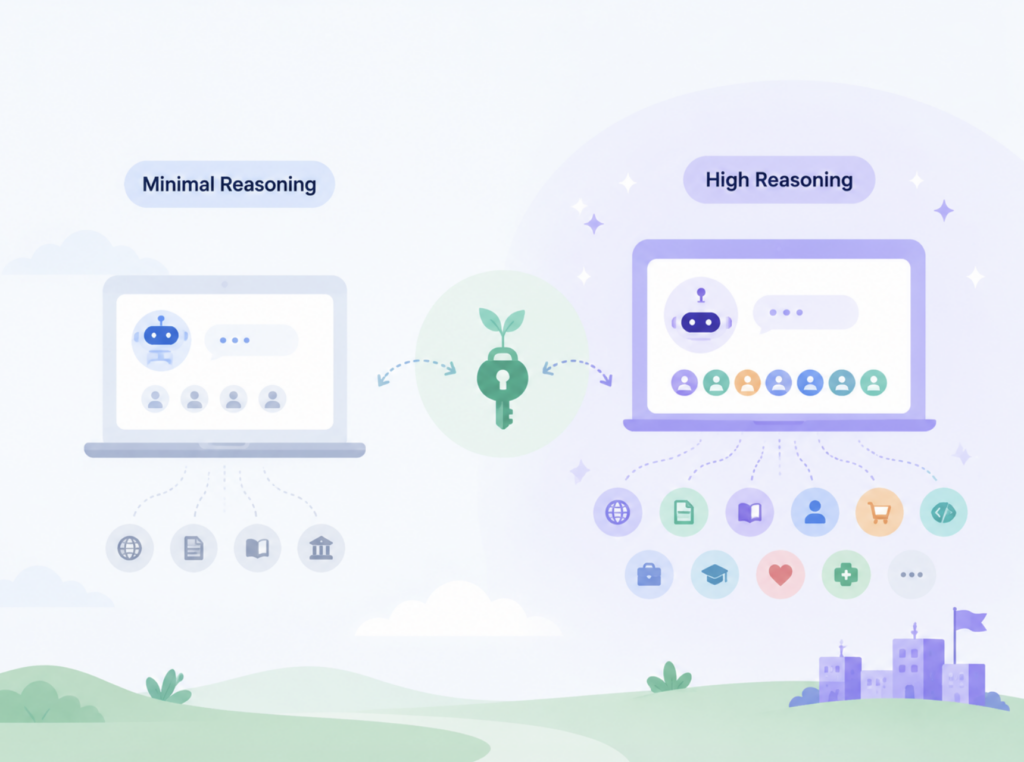
    On the flip side, Terra and Luna’s shallower fan-out compresses the citation pool. Brands at the margin, the ones that appeared in one or two long-tail sub-queries, lose their entry point when the model runs fewer searches. An analysis of GPT-5.5’s fan-out behavior found the model averaged 7.3 fan-out queries per prompt, down from GPT-5.4’s 10.5. Fewer queries means fewer chances to get discovered.

    The practical takeaway: your content needs to survive at different search depths. For Sol, that means having authoritative pages that surface across 15 to 20 sub-queries on a complex comparison prompt. For Terra and Luna, it means being authoritative enough to appear in a pool of five to seven queries.

    What Breaks When the Model Changes: Citation Volatility Is the Norm

    GPT 5.6 isn’t the first model transition to reset brand visibility. It’s the third major one in six months, and each previous shift produced measurable citation swings.

    Between GPT-5.3 and GPT-5.4, brand citation behavior changed overnight. GPT-5.3 never cited a brand website in head-to-head comparison prompts. GPT-5.4 cited brands 83% to 100% of the time on the same prompts.

    Then in March and April 2026, ChatGPT pulled back hard on external citations across the board. seoClarity trackedcitation volumes across five markets and found drops of 86% to 94% by late April. In May, citations rebounded toward pre-March levels. Their conclusion: “What first looked like a sustained decline now looks like volatility.”

    That volatility is the baseline, not the exception. AirOps’ 2026 State of AI Search report found only 30% of brands stay visible from one AI answer to the next, and just 20% remain visible across five consecutive runs.

    GPT 5.6 multiplies this volatility by adding a tier dimension. A brand might maintain visibility in Terra’s lighter mode while losing it in Sol’s deeper reasoning, or vice versa. Cross-platform tracking data from competitive software categories shows citation gaps of up to 34% between rivals during a single model transition. With three tiers running simultaneously, brands now need to monitor three citation surfaces instead of one.

    How to Audit Your Brand Across All Three GPT 5.6 Tiers

    The window after a major model transition is typically two to four weeks. That’s when citation patterns are most fluid and when proactive brands can establish new positions.

    Here’s what the data suggests you should do now.

    Split your prompt tracking by reasoning mode. Stop averaging your visibility score across all ChatGPT interactions. An aggregate number hides the tier-level reality. Run your core buyer prompts under both Sol-level reasoning (High/Extra High) and Terra-level reasoning (default/lower) and track results separately. The 25.6% domain overlap figure tells you these are functionally different search systems.

    Prioritize the content types each tier rewards. Sol’s deeper reasoning elevates official documentation, support pages, and editorial coverage from high-authority publishers. Muck Rack’s May 2026 Generative Pulse study confirmed that earned media accounts for 84% of all AI citations across ChatGPT, Claude, and Gemini, while paid and advertorial content accounts for just 0.3%. If your brand relies on community content and UGC for visibility, expect Sol to discount those signals relative to Terra and Luna.

    Don’t assume Google rankings translate. The disconnect between organic search performance and AI visibility is well documented. In large-scale tracking, 88% of URLs cited by AI engines didn’t appear in the top 10 organic results for the same queries. The correlation coefficient between organic rank and AI citation was just 0.034. GPT 5.6’s three tiers make this gap wider because each tier runs its own retrieval logic.

    Monitor across platforms, not just ChatGPT. GPT 5.6 is one surface. Perplexity, Gemini, Claude, and Google AI Overviews each have their own citation patterns. BrightEdge data from March 2026 shows ChatGPT, Google AI Overviews, and AI Mode disagree on brand recommendations 61.9% of the time. A brand invisible in Sol might still be cited in Perplexity, or vice versa.

    For teams that need to track this at scale, Topify monitors brand visibility across ChatGPT, Gemini, Perplexity, and AI Overviews through seven key metrics: visibility, sentiment, position, volume, mentions, intent, and CVR. The platform’s source analysis identifies exactly which domains AI platforms cite, so you can see whether your brand’s third-party coverage is reaching the sources each GPT 5.6 tier trusts. When citation patterns shift after a model transition, Topify’s competitor benchmarking shows how your visibility moved relative to rivals, not just in absolute terms.

    Conclusion

    GPT 5.6 turned ChatGPT from a single citation surface into three. Sol, Terra, and Luna each run different reasoning depths, pull from different source pools, and reward different content types. A brand that’s visible in Terra’s quick answers may not exist in Sol’s deep research pass, and the 25.6% domain overlap between reasoning modes confirms these are functionally separate systems.

    The brands that come out ahead during this transition won’t be the ones with the strongest Google rankings or the most social proof. They’ll be the ones that track visibility per tier, invest in the earned media and structured content that Sol rewards, and treat every model transition as a monitoring event, not a headline. If you haven’t audited your brand’s visibility across the new GPT 5.6 tiers yet, the recalibration window is closing. Start tracking now.

    FAQ

    Q: Does GPT 5.6 replace GPT-5.5 in ChatGPT? 

    A: Not entirely. GPT-5.5 Instant remains the default for fast everyday responses. GPT 5.6 Sol activates when paid users select Medium, High, or Extra High reasoning effort. Free and Go users access Terra through ChatGPT Work and Codex, while Sol is reserved for Plus, Pro, Business, and Enterprise plans.

    Q: Do Sol, Terra, and Luna cite different brands for the same prompt? 

    A: The data strongly suggests yes. Semrush’s study found only 25.6% of cited domains overlap between minimal and high reasoning modes. Sol’s deeper fan-out queries surface different sources and favor different content types (official documentation, editorial coverage) compared to Terra and Luna’s lighter approach.

    Q: How often do AI citation patterns change after a model update? 

    A: Frequently and sharply. seoClarity tracked citation drops of 86% to 94% in March-April 2026, followed by a rebound in May. AirOps found only 30% of brands stay visible from one AI answer to the next. Model transitions amplify this baseline volatility.

    Q: How can I check if my brand is visible in GPT 5.6? 

    A: Run your core buyer prompts at different reasoning effort levels in ChatGPT (Medium for Sol, default for Terra) and compare which brands get cited. For continuous monitoring across multiple AI platforms, tools like Topify track visibility, citations, sentiment, and competitive positioning at the prompt level.

    Read More

  • From Zero to Cited: How to Build AI Brand Citation Authority

    From Zero to Cited: How to Build AI Brand Citation Authority

    You launched six months ago. Your product works. Your early users love it. Then you ask ChatGPT to recommend a tool in your category, and it lists five competitors you’ve never even heard of. Your brand doesn’t appear. Not at the bottom. Not as an honorable mention. Nowhere.

    This isn’t a ranking problem. It’s a recognition problem. AI systems don’t discover brands the way search engines do. They synthesize answers from patterns of third-party coverage, structured signals, and repeated association between your brand name and a category. New brands start with none of those signals, which means AI has no raw material to work with, even if your product is objectively better than what it’s recommending.

    The gap is fixable. But the playbook looks nothing like traditional SEO.

    72% of Brands With Active SEO Still Get Zero AI Citations

    The scale of the problem is worth quantifying. Research from BrightEdge found that 72% of brands actively investing in SEO receive zero citations from AI search engines. That statistic includes established brands with strong domain authority and years of backlink history.

    For new brands, the odds are worse.

    AI platforms are now processing serious volume. ChatGPT Search handles 250 to 500 million weekly queries. Perplexity processes roughly 50 million. Google AI Overviews appear on 25 to 30% of informational queries in the U.S. Combined, AI-mediated searches represent 15 to 20% of informational query volume as of Q1 2026.

    That’s not a niche channel anymore. And if your brand isn’t being cited in those answers, a growing share of your potential audience will never encounter you.

    Here’s the structural challenge: AI citation tends to be self-reinforcing. When a brand gets mentioned across multiple third-party sources, AI treats that as a trust signal and cites it more frequently. Ahrefs’ study of 75,000 brands found that brands in the top 25% for web mentions earn over 10x more AI citations than the next quartile. New brands sit at the bottom of that curve with zero momentum.

    That’s the cold start problem. And solving it requires a different kind of investment.

    What AI Brand Citation Actually Means

    Before building a strategy, it helps to define the target precisely. AI brand citation isn’t a single event. It shows up in three distinct forms.

    Brand mention: The AI names your brand in its response. “Some popular options include [your brand].” This signals recognition but not necessarily trust.

    Recommendation position: Your brand appears in a ranked list or as a primary recommendation. “For [use case], [your brand] is a strong option because…” This signals both recognition and positive sentiment.

    Source citation: The AI links to your domain or a third-party page about your brand as a reference. This is the deepest form of citation, where AI treats your content as evidence.

    The critical insight for new brands: these three forms build on each other. You typically earn mentions before recommendations, and recommendations before source citations. Skipping ahead rarely works because AI systems use the same underlying pattern. They look for consistent, independent validation across multiple sources before trusting a brand enough to recommend it.

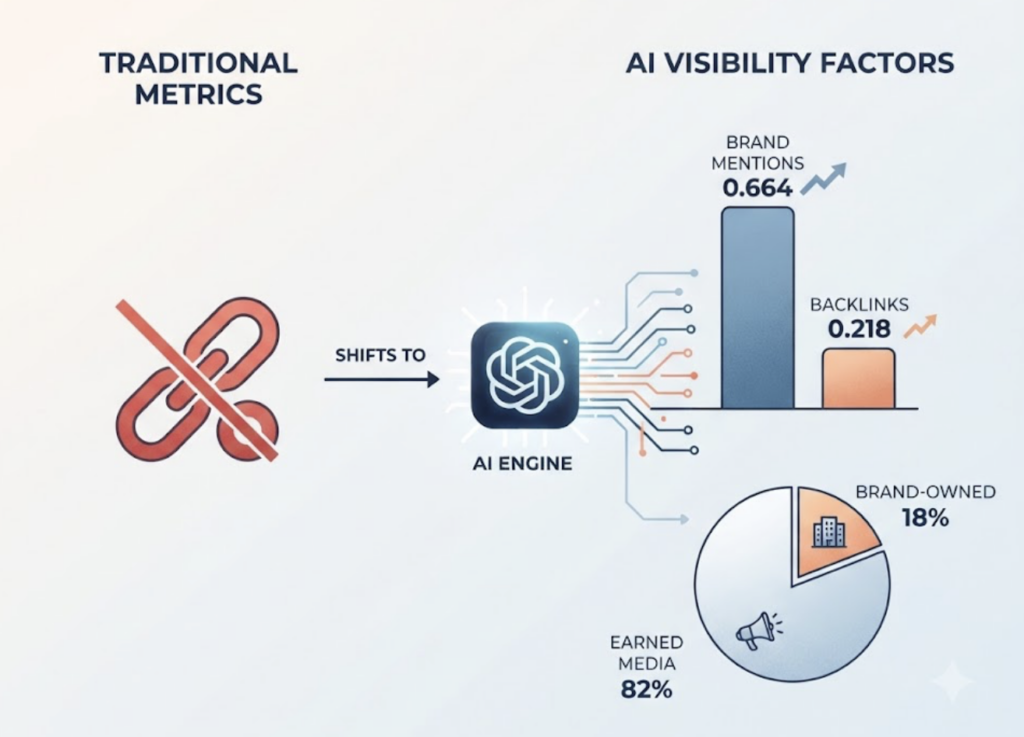
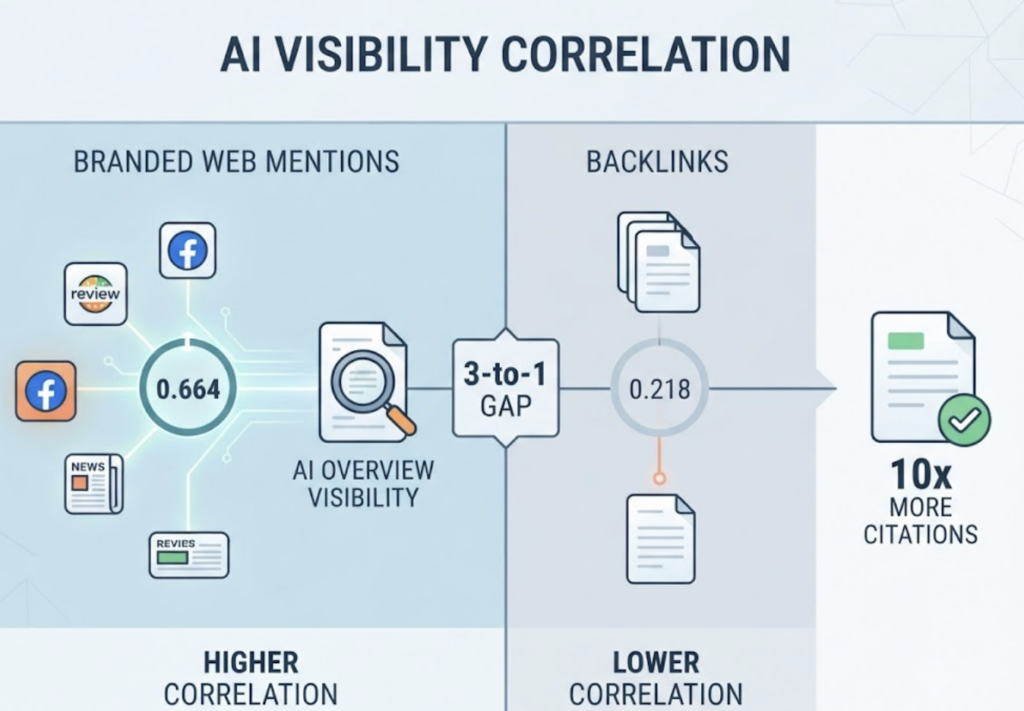
    One data point makes this concrete. A 2025 analysis by Ahrefs found that branded web mentions correlate with AI visibility at 0.664, while backlinks correlate at just 0.218. The strongest predictor of AI brand citation isn’t link equity. It’s how many independent sources mention your brand by name, in context, across the web.

    For a new brand, that reframes the entire growth strategy.

    The AI Brand Citation Stack: 5 Layers New Brands Need to Build

    Building AI citation authority from scratch isn’t about doing one thing well. It’s about layering five types of signals that compound over time. Skip a layer and the ones above it won’t hold.

    Layer 1: Foundational Content That AI Can Actually Extract

    AI doesn’t cite pages. It cites passages. The unit of competition is the best paragraph on the internet for a specific question.

    That means your content needs to be structured for extraction, not just for reading. 44.2% of all LLM citations come from the first 30% of a page’s content. If your key claims are buried in paragraph eight, AI will pull from a competitor who puts the answer up front.

    Three content formats consistently outperform others in AI citation rates. An Omniscient Digital analysis of over 23,000 AI citations found that listicles earn 21.9% of all citations, followed by articles at 16.7% and product pages at 13.7%. These three formats account for more than 52% of all AI citations.

    For a new brand, the practical takeaway: start with comparison content and definitive guides in your category. Structure every page with clear headings, answer the target question in the first 40 to 60 words of each section, and use tables where you’re comparing features or options. Research from the Princeton-Georgia Tech GEO study found that adding statisticscan boost AI visibility by up to 40%, making it the single highest-impact content tactic in peer-reviewed GEO research.

    Layer 2: Third-Party Source Seeding

    This is where most new brands underinvest, and it’s the layer that matters most.

    According to the AirOps 2026 State of AI Search report, 85% of brand mentions in AI-generated answers come from third-party pages, not owned domains. A separate Foundation Marketing study tracking 57 million AI citations found that only 10.15% linked to brand-owned domains. The remaining 90% linked to sources the brand doesn’t control: review sites, comparison articles, Reddit threads, YouTube videos, and community forums.

    For new brands, this finding is both sobering and encouraging. You can’t rely on your own website to earn AI citations. But you also don’t need a decade of domain authority. A brand with zero traditional search dominance can get recommended to millions of users if it appears in the right third-party content, in the right format, with the right positioning.

    Here’s a practical source seeding plan for the first 90 days:

    ChannelActionWhy It Works for AI Citation
    Industry listiclesGet included in “best tools for [category]” roundupsListicles are the single most-cited content format across AI platforms
    Reddit and community forumsContribute genuine value in relevant subredditsCommunity platforms drive roughly 48% of citations according to AirOps
    Review sitesEarn reviews on G2, Capterra, or industry-specific directoriesAI systems cross-reference review platforms for brand validation
    Guest content on authoritative publicationsPublish data-driven pieces on niche mediaEarned media distribution produces a 239% median citation lift

    The Stacker/GlobeNewswire study measured this precisely: the baseline citation rate for content on a brand’s own site was 8%. When the same content was distributed through third-party news outlets, the citation rate reached 34%.

    That’s not a marginal improvement. It’s a 4x multiplier from distribution alone.

    Layer 3: Technical Signals That Help AI Find You

    Even strong content and third-party coverage won’t generate citations if AI crawlers can’t access or parse your site. This layer is often the easiest to fix and the most frequently neglected.

    Three technical priorities for new brands:

    Schema markup. Pages with structured data are 2.5x more likely to appear in AI-generated answers. Research from Authoritas found that pages with FAQPage schema were cited 41% of the time, compared to just 9% for equivalent pages without it. Start with Organization, Article, and FAQ schema in JSON-LD format.

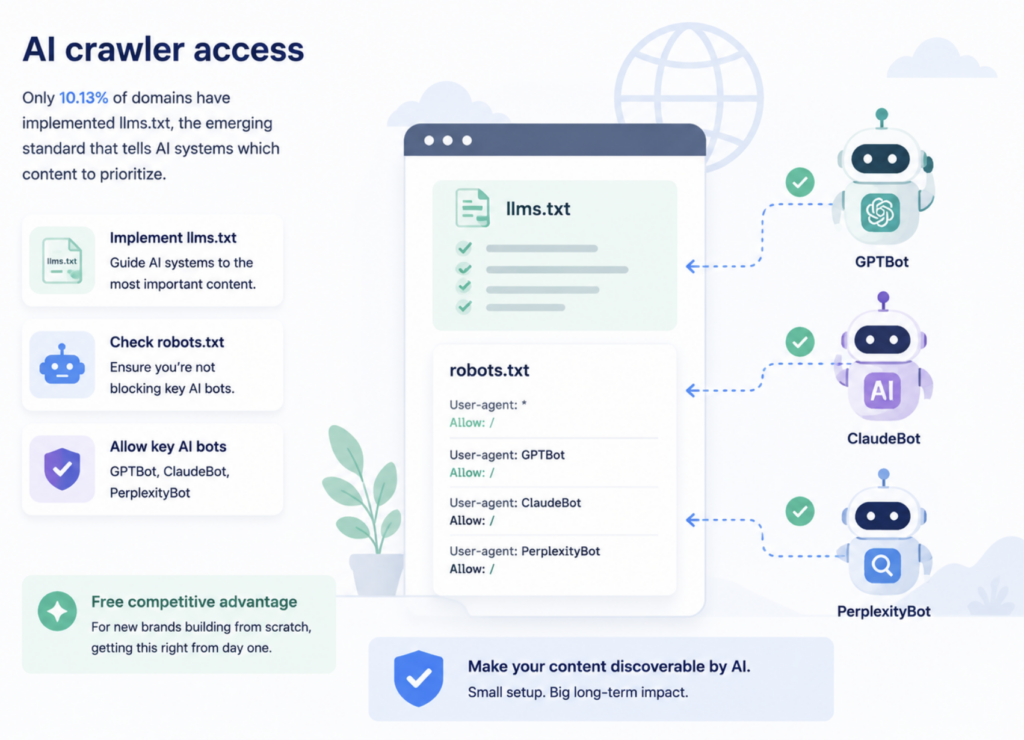
    AI crawler access. Only 10.13% of domains have implemented llms.txt, the emerging standard that tells AI systems which content to prioritize. Check your robots.txt to make sure you’re not accidentally blocking GPTBot, ClaudeBot, or PerplexityBot. For new brands building from scratch, getting this right from day one is a free competitive advantage.

    Server-side rendering. Content loaded via client-side JavaScript may be completely invisible to AI crawlers. If your site uses a JavaScript framework, make sure critical content renders server-side.

    Layer 4: Citation Monitoring

    You can’t optimize what you don’t measure. And AI citation is volatile. The AirOps 2026 report found that only 30% of brands that appear in an AI answer show up again in the next response to the same query. Run the same query five times, and just 20% of brands persist across all five.

    For new brands, this means two things. First, a single manual check tells you almost nothing. AI answers are non-deterministic, so you need systematic, repeated monitoring to establish a baseline. Second, the volatility is actually an opportunity. If established brands aren’t locking in consistent positions, there’s room for a newcomer that builds the right signals.

    Topify turns AI citation tracking into a structured workflow. Its Source Analysis feature shows which domains and URLs AI platforms actually cite for your target prompts. Instead of guessing which content assets are working, you can see whether your latest comparison guide or your G2 listing is the source AI pulls from. The Visibility Tracking dashboard monitors brand mentions across ChatGPT, Gemini, Perplexity, and Google AI Overviews, so you can track progress from zero mentions to your first citation and beyond.

    For brands just getting started, Topify’s free GEO Score Checker runs a technical audit in seconds: AI bot access, structured data, content signals, and overall citation visibility. It’s a useful first step before investing in content or outreach, because a low technical score means your other efforts won’t translate into citations.

    The High-Value Prompt Discovery feature is especially relevant for new brands. It surfaces the specific prompts where AI search volume is highest in your category, so you can prioritize content creation around the questions that actually drive AI recommendations instead of guessing which topics to target.

    Layer 5: Iterative Optimization

    AI citation patterns shift with every model update, training data refresh, and retrieval system change. Pages that go more than three months without an update are 3x more likely to lose AI visibility. For a new brand, this means the initial content push is just the starting point.

    Build a monthly review cycle: check which prompts your brand appears in, which sources AI is citing, and whether your position is improving or declining. When you spot a citation gap (a prompt where competitors appear but you don’t), trace the source. Often, the fix is specific: get included in one more third-party roundup, update a stat in your comparison guide, or add schema to a product page that AI keeps skipping.

    The brands that win AI citation authority aren’t the ones that publish the most content. They’re the ones that close feedback loops fastest.

    3 Mistakes That Keep New Brands Invisible to AI

    Even with the right framework, certain patterns reliably stall progress.

    Treating AI citation like SEO. Traditional SEO optimizes for keywords and backlinks. AI citation rewards brand mentions, third-party consensus, and content extractability. A page can rank #1 on Google and still be absent from every AI answer. 90% of ChatGPT citations come from pages ranked #21 or lower or entirely unranked in traditional search. Optimizing for one doesn’t automatically deliver the other.

    Publishing content without tracking AI outcomes. Most new brands measure content performance through organic traffic and keyword rankings. Neither metric tells you whether AI is citing your brand. Without citation tracking, you’ll keep producing content that performs well in traditional search but remains invisible to AI, and you’ll never know the difference.

    One-time optimization instead of continuous iteration. AI’s citation patterns change every few weeks. The AirOps data shows 70% of AI Overview citations change within two to three months. A “set and forget” approach guarantees declining visibility over time, even from a strong starting position.

    Conclusion

    New brands face a real cold start problem in AI search. Zero mentions means zero citations means zero momentum. But the data also shows the path forward is structural, not miraculous. Third-party source seeding matters more than domain authority. Content format and structure matter more than word count. Technical signals like schema markup and AI crawler access are free advantages most competitors still haven’t implemented.

    Start with the foundation: run a GEO Score Checker audit to establish your technical baseline. Identify the 10 to 15 prompts that matter most in your category. Then build outward, one third-party placement, one structured content asset, one citation gap closed at a time. AI citation authority compounds. The brands that start building now will be the ones AI recommends six months from now.

    FAQ

    Q: How long does it take for a new brand to start getting cited by AI? 

    A: Most new brands can earn their first AI mentions within 60 to 90 days with focused effort on third-party source seeding and structured content. Consistent citations across multiple prompts typically take four to six months. The timeline depends heavily on how quickly you build third-party coverage, since 85% of AI brand mentions come from external sources.

    Q: Does domain authority affect AI brand citation? 

    A: Less than most people assume. Ahrefs’ study of 75,000 brands found that branded web mentions correlate with AI visibility at 0.664, while traditional backlink metrics correlate at just 0.218. High domain authority helps, but a new brand with strong third-party mentions can outperform an established site with a weak off-site presence in AI answers.

    Q: Which AI platforms should new brands prioritize for citation? 

    A: Start with ChatGPT and Perplexity, since they process the highest volume of commercial and informational queries. Google AI Overviews matter for brands targeting search-originated traffic. Each platform has different citation behavior, and only 11% of domains are cited by both ChatGPT and Perplexity, so cross-platform monitoring is important from the start.

    Q: Can you build AI citation authority without a big content budget? 

    A: Yes. The highest-leverage activities for new brands are getting included in existing third-party listicles and comparison content, contributing to relevant community discussions, and ensuring your site’s technical infrastructure is AI-crawler friendly. Schema markup implementation, llms.txt setup, and robots.txt configuration cost nothing and create measurable citation advantages.

    Read More

  • How to Increase Your AI Brand Citation Rate

    How to Increase Your AI Brand Citation Rate

    You ran your brand through 30 high-intent prompts on ChatGPT, Perplexity, and Gemini last week. Prompts like “best [your category] tool for mid-market teams” and “which platforms do [your use case] well.” Your competitors showed up in 22 of them. Your brand appeared in three. Your domain authority is solid. Your Google rankings haven’t slipped. But none of that explains why AI keeps recommending someone else.

    That gap between search performance and AI citation performance is where most marketing teams get stuck. And it’s widening.

    What AI Brand Citations Actually Measure, and Why Rankings Don’t Tell You

    An AI brand citation happens when a generative engine names your brand, links to your domain, or pulls from your content while building its answer. It might be a footnoted link in Perplexity, a named recommendation inside ChatGPT, or a source card under a Google AI Overview.

    This isn’t the same as a traditional search ranking. Ahrefs’ analysis of 75,000 brands found that branded web mentions correlate 0.664 with AI Overview visibility, while backlinks correlate just 0.218. That’s a 3x gap. The top three correlating factors were all off-site signals: brand mentions, branded anchors, and brand search volume. None of them are the metrics most SEO dashboards track by default.

    The disconnect goes deeper. Only 38% of pages cited in AI Overviews also rank in Google’s top 10 for the same query, down from 76% in mid-2025. For ChatGPT specifically, roughly 80% of cited URLs don’t rank in Google’s top 100 at all.

    Ranking well on Google doesn’t mean AI will cite you. And not ranking well doesn’t mean it won’t.

    Why Most Brands Have a 0% AI Citation Rate Without Knowing It

    Three structural problems explain why brands with strong search presence still get zero AI citations.

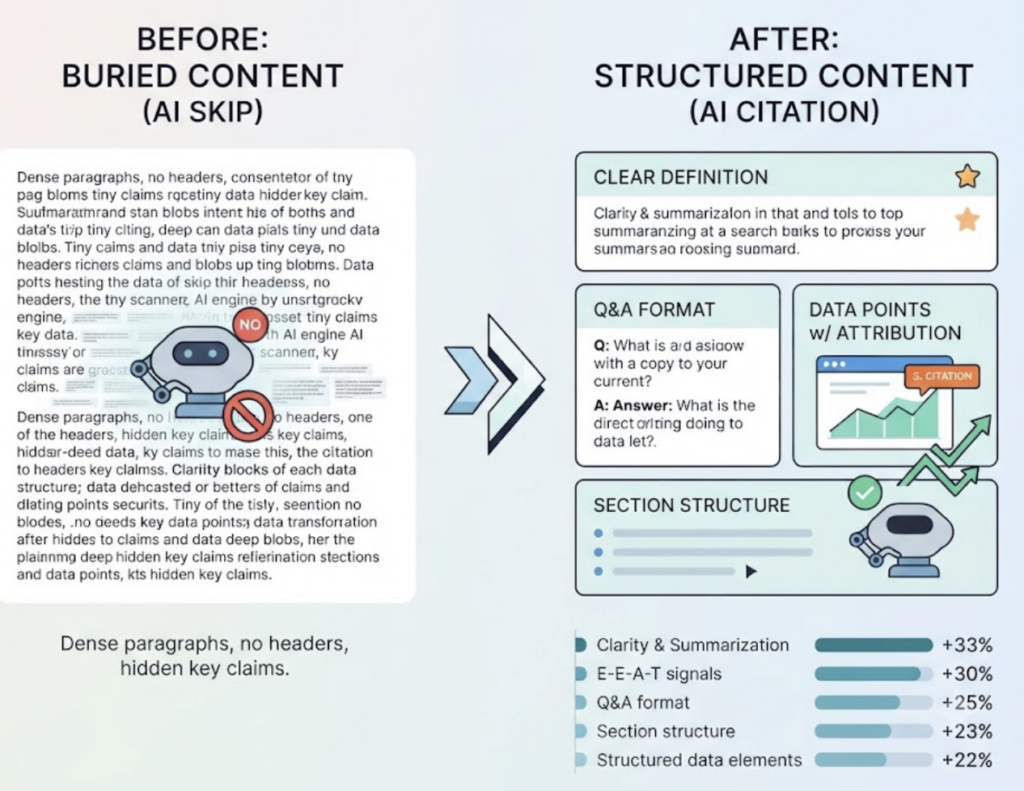
    The first is content structure. AI engines use retrieval-augmented generation to decide what to cite. They don’t read your page the way a human does. They scan for extractable passages: clear definitions, direct answers, data points with attribution. If your content buries key claims inside long paragraphs without headers, Q&A formatting, or structured data, the retrieval system often skips it entirely. Semrush’s study of over 300,000 cited URLs found that five content qualities correlate with higher AI citation rates: clarity and summarization (+33%), E-E-A-T signals (+30%), Q&A format (+25%), section structure (+23%), and structured data elements (+22%).

    The second is authority signals that AI actually weighs. The Princeton GEO study tested nine content optimization strategies across 10,000 queries and found that adding statistics improved visibility by 41%, citing authoritative sources produced consistent gains, and quotation addition boosted visibility by 28%. Keyword stuffing, by contrast, was among the weakest approaches.

    The third is brand consensus. AI platforms scan for agreement across multiple independent sources before citing a brand. If your brand only exists on your own website with minimal external validation, AI systems treat your claims with skepticism. Research shows that brands in the top 25% for web mentions earn up to 10x more AI mentions than the next closest quartile.

    The hard part isn’t creating content. It’s creating content that AI treats as citable.

    Step 1: Audit Your Current AI Brand Citation Baseline

    Before you optimize anything, you need to know where you stand. That means testing your brand across the AI platforms your buyers actually use.

    Start by building a list of 20 to 30 prompts that match real buying intent in your category. Don’t just test your brand name. Test category queries (“best project management tools for remote teams”), comparison queries (“alternatives to [competitor]”), and problem queries (“how to solve [pain point your product addresses]”). Run each prompt on ChatGPT, Perplexity, Gemini, and Google AI Overviews.

    For each prompt, record three things: whether your brand was mentioned, what position it appeared in relative to competitors, and which sources the AI cited. This gives you your baseline citation rate: the percentage of relevant prompts where your brand shows up.

    Manual auditing works for an initial snapshot, but it doesn’t scale. AI engines update their citations frequently, and your visibility can shift within weeks. Topify automates this process by tracking brand visibility across ChatGPT, Gemini, Perplexity, and other AI platforms at the prompt level. Its High-Value Prompt Discovery feature surfaces the specific queries driving recommendations in your category, so you’re not guessing which prompts matter. You get citation rate, position data, and sentiment scores in a single dashboard.
    If you want a quick technical check before committing to any platform, Topify’s free GEO Score Checker evaluates any URL across four dimensions: AI bot access, structured data, content signals, and overall visibility readiness. It takes under 60 seconds and requires no signup.

    Step 2: Reverse-Engineer What AI Engines Cite Instead of You

    Once you know where your brand is absent, the next question is: who’s filling that space, and why?

    AI citation patterns are not random. Each platform has preferences. Perplexity favors fresh content, with a roughly 40% citation drop for content older than 30 days. ChatGPT draws 49% of citations from listing pages versus brand websites. Google AI Overviews weight semantic completeness heavily.

    What you’re looking for are the source domains AI trusts in your category. If Perplexity consistently cites G2 reviews, industry publications, and Reddit threads when recommending your competitors, those are the surfaces where you need to build presence. If ChatGPT pulls from a competitor’s comparison page that you don’t have an equivalent for, that’s a content gap with direct citation impact.

    Topify’s Source Analysis feature tracks the exact domains and URLs that AI platforms cite for your tracked prompts. You can see whether your content or your competitor’s dominates those source lists, and identify which third-party surfaces carry the most citation weight in your category. Its Competitor Monitoring automatically detects new competitors entering AI recommendations and shows you their citation sources in real time.

    This isn’t about copying competitors. It’s about understanding the citation ecosystem AI uses to build answers, then making sure your brand has presence where it counts.

    Step 3: Build Citation-Ready Content That AI Wants to Reference

    With your audit data and competitor intelligence in hand, you can now create content specifically designed to earn AI citations. Five strategies consistently move the needle.

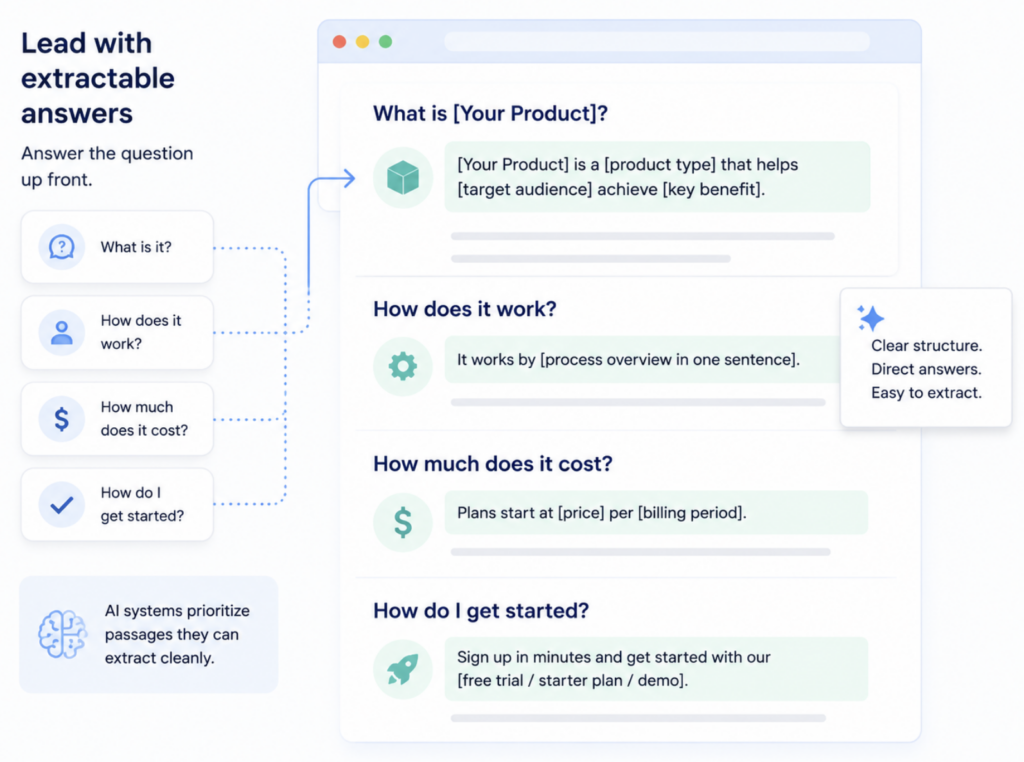
    Lead with extractable answers. Structure every key page so the core claim or definition appears in the first two sentences of a section, not buried in paragraph four. AI retrieval systems prioritize passages they can extract cleanly. Use headers that match the actual questions buyers ask.

    Add statistics and original data to every substantive claim. The Princeton GEO study found that embedding quantitative data into content produced the single largest visibility gain at 41%. If you have proprietary data, customer benchmarks, or survey results, publish them. Original research functions as both a citable source and a trust signal.

    Build entity consistency across every surface. Your brand name, product descriptions, and category positioning need to match across your website, review platforms, social profiles, and earned media. AI engines assess authority holistically. Inconsistent naming or positioning confuses the retrieval system and reduces citation confidence.

    Implement schema markup on priority pages. Article, FAQPage, HowTo, and Organization schema help AI systems understand your content’s context. While LLMs don’t read schema directly, structured data feeds into the search indexes that AI platforms query during retrieval.

    Earn mentions on surfaces AI already trusts. Data from six independent studies shows that 82% to 95% of AI citations come from third-party earned sources. Your own website contributes only 5% to 10%. Prioritize guest contributions to industry publications, active participation on Reddit and community forums, and building your presence on review platforms like G2 and Capterra. YouTube mentions correlate at 0.737 with AI visibility, the highest of any signal measured.

    Content freshness matters too. AI-cited content averages 25.7% newer than what traditional search results surface. A quarterly refresh cycle with a visible “last updated” date is now a baseline requirement.

    Step 4: Track, Measure, and Iterate on Your AI Brand Citation Rate

    AI citation optimization isn’t a one-time project. Citation patterns shift 40% to 60% month over month, according to tracking data across major AI platforms. What earned you a citation in May might not hold in August.

    Set up a measurement framework with three core metrics. Citation frequency is the percentage of your tracked prompts where your brand appears. Citation position is where your brand ranks relative to competitors within AI answers. Citation sentiment is how AI describes your brand when it does mention you.

    Topify’s Comprehensive GEO Analytics dashboard consolidates all three into a single view, tracking seven dimensions: visibility, sentiment, position, volume, mentions, intent, and CVR. You can spot a drop in ChatGPT mentions and trace it back to a specific source that stopped citing your brand, all within the same interface.

    Build a 30-60-90 day rhythm. In the first 30 days, complete your audit, fix technical blockers (robots.txt blocking AI crawlers, missing schema), and publish your first batch of citation-optimized content. By day 60, launch an earned media push targeting the top five publications AI cites in your category. By day 90, measure your citation rate change and adjust. A realistic expectation for measurable improvement is 60 to 90 days from a structured optimization program.

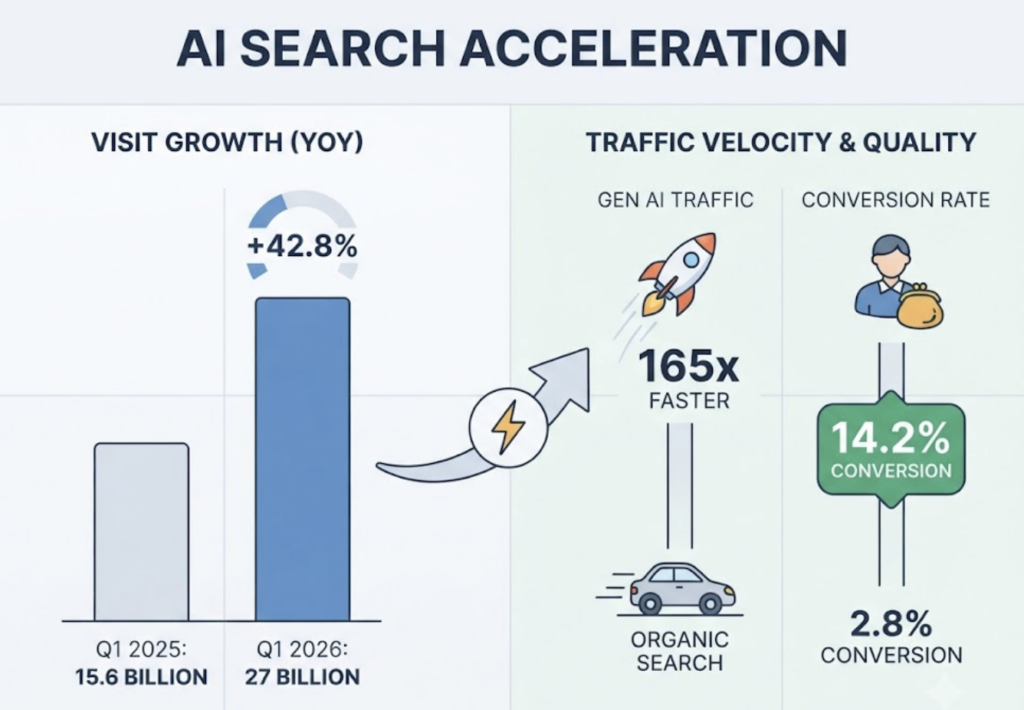
    The stakes keep growing. AI-referred visitors now convert 42% better than non-AI traffic, according to Adobe Digital Insights’ Q1 2026 data. And Yext’s Q1 2026 analysis of 770 brands found citation volume grew 2.77x in a single quarter. The brands building citation infrastructure now will compound that advantage for years.

    Conclusion

    The gap between search rankings and AI citations isn’t closing on its own. Brands that treat AI citation rate as a measurable, improvable metric, not a black box, are already pulling ahead.

    The playbook is straightforward: audit your current citation baseline, reverse-engineer what AI engines cite instead of you, build content optimized for extraction and authority, then track and iterate on a monthly rhythm. Every step benefits from data, not guesswork.

    If you haven’t checked where your brand stands in AI search, start with a free GEO score check and see what AI engines can actually see. The window to build citation momentum before your competitors lock in their positions is still open. It won’t stay that way.

    FAQ

    Q: What is an AI brand citation? 

    A: An AI brand citation is when a generative engine like ChatGPT, Perplexity, or Google AI Overviews names your brand, links to your domain, or pulls from your content while building its answer. It’s different from a traditional search ranking because AI systems select sources based on entity authority, content extractability, and cross-platform consensus rather than backlink profiles alone.

    Q: How do I check if my brand is cited by ChatGPT? 

    A: The quickest manual method is to run 20 to 30 high-intent prompts related to your category on ChatGPT (with web search enabled) and record whether your brand appears. For scalable, ongoing tracking, AI visibility platforms like Topify monitor citation rates across ChatGPT, Perplexity, Gemini, and Google AI Overviews automatically at the prompt level.
    Q: How long does it take to improve AI citation rates? 

    A: Most brands see measurable changes within 60 to 90 days from a structured optimization program. Quick wins like unblocking AI crawlers in robots.txt and adding FAQ schema can improve technical readiness within days. Earned media and content authority signals take longer to compound but produce the most durable citation gains.

    Q: What’s the difference between an AI brand citation and an AI brand mention? 

    A: A citation includes a source link or direct attribution. AI platforms like Perplexity display inline numbered citations that users can click. A mention is when AI names your brand in its response without linking to a specific source. Both contribute to visibility, but citations carry more weight because they drive referral traffic and signal that AI treats your content as a trusted source.

    Read More

  • 7 Factors That Drive AI Brand Citations and 3 That Don’t

    7 Factors That Drive AI Brand Citations and 3 That Don’t

    Your domain authority is 70+. Your backlink profile is stacked. Your content ranks on page one for dozens of high-value keywords. But when someone asks ChatGPT for a recommendation in your category, your brand doesn’t show up.

    That gap is wider than most SEO teams realize. An Ahrefs study of 75,000 brands found that branded web mentions correlate with AI visibility at 0.664, while backlinks sit at just 0.218. The signals that built your Google rankings aren’t the same signals that determine AI brand citation. And the cost of being absent is growing: AI-referred visitors convert at 14.2% compared to 2.8% for Google organic traffic.

    AI Brand Citations Run on a Different Signal Set Than Google Rankings

    Google’s algorithm ranks pages. AI engines cite sources. That distinction sounds minor, but it changes everything about how brands earn visibility.

    In traditional search, a page with strong backlinks and on-page optimization earns a position in a list of ten blue links. In AI search, a model retrieves passages of text, evaluates their trustworthiness, and generates an answer from them. It’s not following a link graph to decide what’s trustworthy. It’s reading content, cross-referencing entities, and selecting sources that can be cleanly extracted into a direct answer.

    The data confirms the gap. Only 38% of AI Overview citations now come from pages in Google’s organic top 10. Moz’s 2026 study found 88% of Google AI Mode citations aren’t in the organic SERP at all. A brand can dominate traditional rankings and still be invisible to AI.

    That’s why understanding which specific factors drive AI brand citation matters more than applying yesterday’s SEO playbook.

    Off-Site Brand Signals: The Strongest Predictors of AI Brand Citation

    The single most important finding from the 2026 data is this: the signals that correlate most strongly with AI citation visibility are all off-site brand signals.

    1. Branded Web Mentions Across Independent Sources

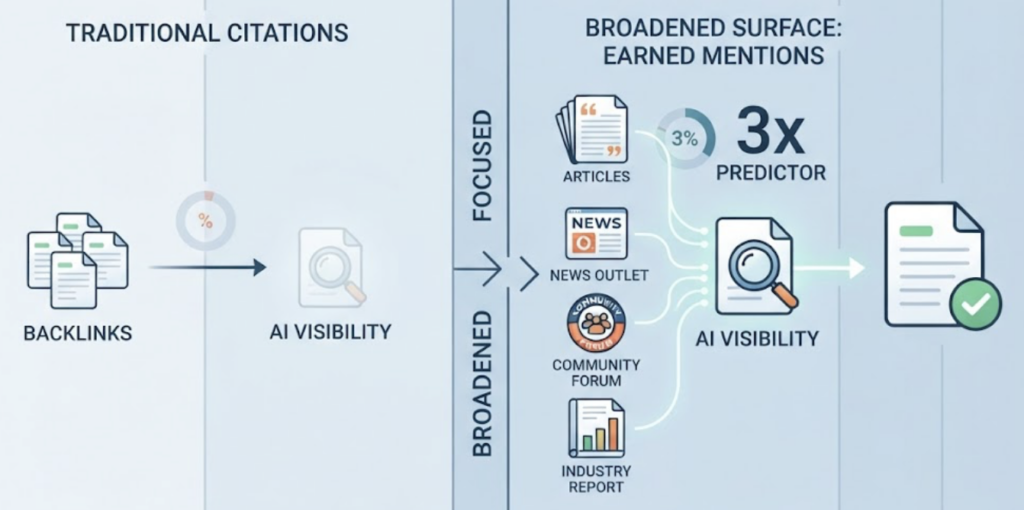
    AI engines don’t count your backlinks. They read what the internet says about you. Ahrefs’ correlation analysis across 75,000 brands found branded web mentions correlate with AI visibility at 0.664, roughly three times stronger than backlinks at 0.218. Muck Rack’s separate analysis of over one million AI-cited links found 82% come from earned media, not brand-owned pages.

    The mechanism is straightforward. When multiple independent sources mention your brand in the context of a topic, AI models interpret that as consensus. It’s the difference between a brand saying “we’re the best” and a dozen third-party sources confirming “they’re consistently recommended.”

    2. YouTube Mentions Outperform Every Other Single Signal

    This one surprised the industry. YouTube mentions, meaning a brand appearing in video titles, transcripts, and descriptions, showed the strongest single correlation with AI brand visibility at 0.737 in the Ahrefs study.

    Both Google AI Mode and AI Overviews are owned by the same parent company as YouTube and cite YouTube more than any other domain. But the signal extends beyond Google’s ecosystem. AI models read transcripts. A mention in a well-watched review or comparison video carries a signal similar to a mention in a written article.

    3. Cross-Platform Mention Consistency

    Brands that appear consistently across Reddit, Quora, industry forums, review platforms, and news coverage build what AirOps calls “dual-signal visibility.” Their 2026 State of AI Search report found brands with both mentions and citations in AI answers are 40% more likely to resurface across consecutive queries than citation-only brands.

    Only 30% of brands stay visible from one AI answer to the next.

    The ones that persist tend to have broad, consistent presence across the open web, not just a strong homepage.

    On-Page Signals That Help AI Models Extract and Cite Your Content

    Off-site signals determine whether AI models trust your brand. On-page signals determine whether they can actually use your content as a source.

    4. URL Accessibility and Crawler Access

    If AI crawlers can’t reach your content, nothing else matters. Cyrus Shepard’s meta-analysis of 54 studies scored URL accessibility at 9.5 out of 10, the highest of all 23 AI citation factors analyzed. That includes allowing AI bots in robots.txt, serving clean HTML, and ensuring pages load without JavaScript-dependent rendering that blocks passage extraction.

    This is the most technically basic factor on the list. It’s also the one most commonly misconfigured.

    5. Query-Answer Match and Content Extractability

    AI engines don’t cite pages. They cite passages. Shepard’s analysis scored query-answer match at 9.2 out of 10. Content that directly answers a question in a self-contained passage of 134 to 167 words tends to get selected more often than content that buries the answer across multiple sections.

    In practice, this means structuring content so that each section delivers a complete, extractable answer. Sequential headings, direct claims with supporting data, and clear topic sentences all help AI models lift clean passages without losing context.

    Two AI Brand Citation Factors Most Teams Underweight

    Some signals don’t get enough attention, not because they’re unknown, but because teams deprioritize them against more familiar SEO tactics.

    6. Content Freshness

    AI-cited content is 25.7% fresher on average than traditionally ranked content, based on Ahrefs’ analysis of roughly 17 million citations. Pages not updated in over three months are more than 3x as likely to lose citations compared to recently refreshed pages.

    The freshness premium is concentrated on queries where the world actually moved: pricing, product features, regulations, competitive dynamics. For evergreen topics, older authoritative content can still earn citations. But for anything where the answer changes, recency isn’t optional.

    7. Entity Clarity and Brand Disambiguation

    AI engines apply an entity disambiguation step before evaluating content quality. If the system can’t resolve your brand to a specific, verified entity, it skips you.

    Content quality doesn’t matter if AI can’t confirm who you are.

    That means your brand name, product names, and core topics need to appear consistently across the web. Wikidata entries, Knowledge Graph presence, Organization schema with sameAs properties linking to verified profiles: these signals tell AI engines exactly which entity you are. Brands with generic or common names face a steeper challenge here. Without clear entity signals, the AI may attribute your content to a different entity entirely.

    3 Signals That No Longer Drive AI Brand Citations

    Not every signal that mattered in traditional SEO still carries weight in AI citation. Three in particular have lost their predictive power.

    1. Domain Authority as a Standalone Metric

    Domain Authority (DA) correlation with AI citation probability has dropped to r=0.18 in 2026 analysis. In some verticals, it shows a negative correlation. AI models don’t read Moz or Ahrefs scores. They evaluate content trustworthiness through entity signals, cross-source validation, and passage quality. A DR-30 site with strong entity clarity and consistent third-party mentions can outperform a DR-85 site that lacks those signals.

    DA still matters for traditional search ranking, and ranking still helps you enter the pool of pages AI models consider. But chasing incremental DA gains beyond the ranking threshold offers diminishing returns for AI citation.

    2. Schema Markup in Isolation

    Ahrefs ran a causal study of 1,885 pages that added JSON-LD schema between August 2025 and March 2026, matched against 4,000 control pages. The result: no meaningful citation uplift on any AI platform. Google AI Mode and ChatGPT showed changes of 2.2% to 2.4%, statistically indistinguishable from random noise.

    Schema still earns its keep for classic Google rich results. But as an isolated intervention for AI citations, the evidence doesn’t support prioritizing it over brand mentions, content freshness, or entity clarity.

    3. LLMs.txt

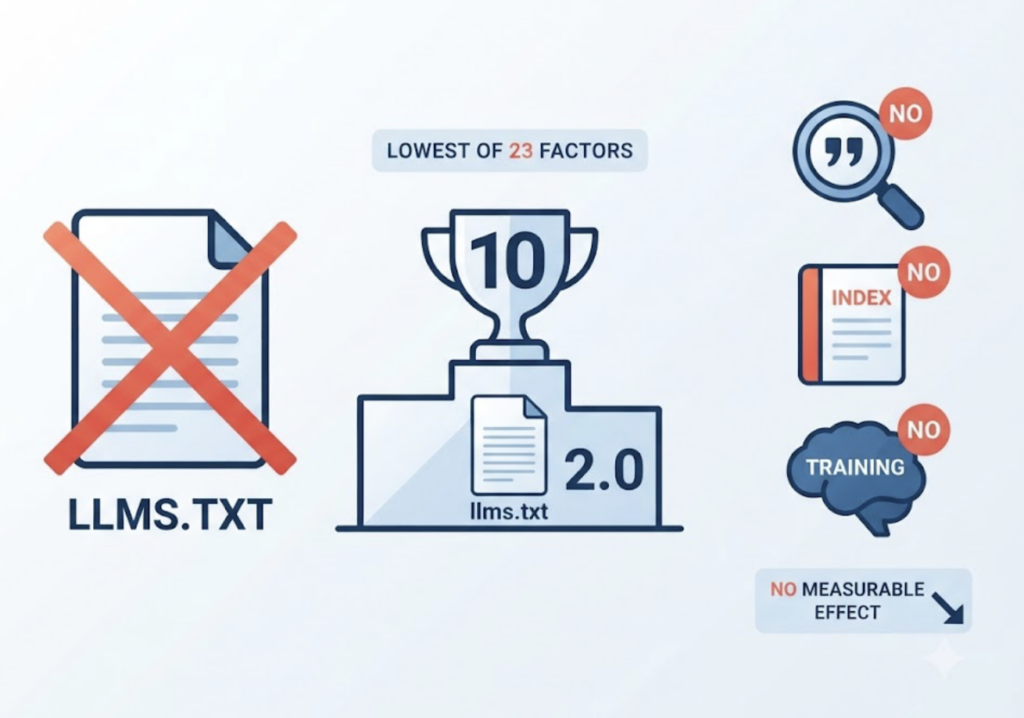
    The llms.txt file, which some vendors promoted as a way to tell AI models what content to prioritize, scored 2.0 out of 10in Shepard’s meta-analysis. That’s the lowest of all 23 factors analyzed. No major AI crawler honors it, and there’s no measurable effect on citations, indexing, or training inclusion.

    The implementation time goes further on visible HTML, topical authority, and content extractability.

    Three down. Now the question becomes: how do you know which of the seven positive factors are actually moving the needle for your brand?

    How to Track Which AI Brand Citation Factors Are Working

    Knowing which factors drive AI brand citation is step one. Measuring whether those factors are actually working for your brand is step two, and it’s where most teams get stuck.

    Traditional analytics tools don’t track AI citations. Google Search Console doesn’t tell you whether ChatGPT mentioned your brand in a recommendation. Your rank tracker doesn’t show whether Perplexity cited your product page or your competitor’s.

    This is where purpose-built AI visibility platforms fill the gap. Topify tracks brand performance across ChatGPT, Gemini, Perplexity, and Google AI Overviews through seven key metrics: visibility, sentiment, position, volume, mentions, intent, and CVR.

    For teams focused on AI brand citation specifically, a few capabilities tend to matter most.

    Source Analysis shows exactly which domains and URLs AI platforms cite when answering queries in your category. You can see whether your content is in the citation pool, or whether competitors dominate the references AI models pull from. That directly maps to factors 1 through 3 above.

    Visibility Tracking measures how often your brand appears across AI platforms over time. Since only 30% of brands stay visible between consecutive AI answers, tracking visibility at weekly or biweekly intervals catches drops before they compound.

    Competitor Monitoring automatically detects which brands AI engines recommend alongside or instead of yours. If a competitor’s citation share is climbing while yours is flat, the data points to which specific factors (freshness, mention volume, entity signals) are creating the gap.

    The shift from “guessing” to “measuring” is what separates brands that react to AI citation data from brands that actually act on it. You can get started with Topify on a Basic plan that covers 100 prompts across ChatGPT, Perplexity, and AI Overviews.

    Conclusion

    AI brand citation isn’t a mystery. It’s a measurable set of signals that can be tracked, optimized, and benchmarked against competitors. The seven factors above are where the evidence points: brand mentions, YouTube presence, cross-platform consistency, URL accessibility, content extractability, freshness, and entity clarity.

    The three signals that lost their predictive power (DA alone, schema in isolation, llms.txt) aren’t worthless. They’re just not the lever most teams should pull first. The brands earning citations in 2026 are the ones building presence across the open web, keeping content fresh, and making sure AI models can find, verify, and extract their content cleanly.

    Start by auditing where your brand stands on these seven factors. Then measure the results, because in AI search, what you can’t track, you can’t improve.

    FAQ

    What is an AI brand citation? 

    An AI brand citation is when an AI search engine like ChatGPT, Perplexity, or Google AI Overviews references your brand as a source in a generated answer. It’s the AI equivalent of appearing in a search result, but instead of earning a link in a list, your brand gets mentioned or linked within the answer itself.

    How is an AI brand citation different from a traditional backlink? 

    A backlink is a hyperlink from one website to another, used by Google as a trust signal for ranking. An AI citation is a reference an answer engine attaches to a generated response, naming the source it drew from. Backlinks help pages rank in traditional search. AI citations determine whether a brand appears inside the AI-generated answer. The two signal types overlap but follow different hierarchies.

    Can you optimize specifically for AI brand citations? 

    Yes. The optimization discipline is called Generative Engine Optimization (GEO). It focuses on the signals AI models use to select and cite sources: brand mention density across third-party sites, content freshness, entity clarity, passage extractability, and cross-platform presence. GEO works alongside traditional SEO, not as a replacement for it.

    How do you track whether your brand is being cited by AI? 

    Standard analytics tools don’t capture AI citation data. You need a dedicated AI visibility platform that monitors brand appearances across multiple AI engines. Tools like Topify track citation frequency, source analysis, sentiment, and competitive positioning across ChatGPT, Perplexity, Gemini, and Google AI Overviews in a single dashboard.

    Read More

  • The AI Brand Citation Gap SEO Rankings Can’t Fix

    The AI Brand Citation Gap SEO Rankings Can’t Fix

    Your domain authority is 70. Your keyword rankings are solid. Your team has spent years building topical authority across every major product page. Then someone asks ChatGPT for a recommendation in your category, and your brand doesn’t show up once.

    You check Perplexity. Same thing. Google AI Mode? A completely different set of names, most of which you’ve never considered competitors. Ahrefs’ research across 15,000 long-tail queries found that just 12% of AI citations overlap with Google and Bing’s top 10 results. That means 88% of the sources AI systems cite are invisible to your rank tracker. The disconnect between SEO performance and AI brand citation isn’t a glitch. It’s structural.

    What AI Brand Citation Measures, and Why Rankings Don’t Capture It

    AI brand citation is the rate at which AI search engines reference your brand by name, link to your domain, or pull from your content when generating answers. It’s a fundamentally different metric from search rankings because it reflects a different evaluation process.

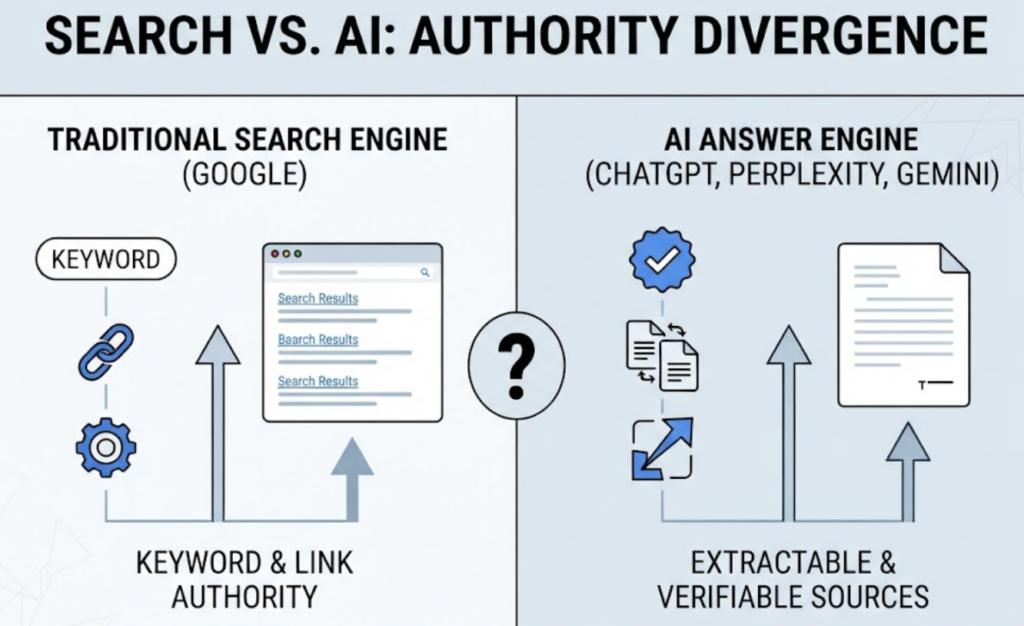
    Google ranks pages based on keyword relevance, backlinks, and technical signals. AI systems like ChatGPT, Perplexity, and Gemini evaluate whether a source is extractable, verifiable, and corroborated by third-party references. Growth Memo’s research found that ChatGPT includes source citations in 87% of its responses but only mentions brands in 20.7%of those answers. It behaves more like an academic paper with footnotes than a search results page with clickable listings.

    That’s the core distinction. Google answers “which pages match this query.” AI answers “which brands should I recommend, and what sources back that up.”

    A brand can rank on page one for dozens of high-intent keywords and still have zero AI brand citation for those same queries. The signals that earn you a SERP position and the signals that earn you an AI citation overlap far less than most marketers assume.

    The Data Behind the AI Brand Citation Gap: 2.1% Overlap

    The numbers are stark. Semrush’s AI visibility analysis in early 2026 found that only 2.1% of pages ranking in Google’s top 10 also appear among ChatGPT’s citations for the same queries.

    EMGI Group’s study of 150 SaaS companies drove the point further. Across 120 keywords, 44% of brands ranking in Google’s top 10 received zero ChatGPT citations. On the other side, 81% of brands that ChatGPT did recommend weren’t in Google’s top 10 at all.

    This isn’t a narrow technical category problem, either. Marketing Automation showed the widest gap at 53%. Over half the brands ranking well on Google got no AI citation whatsoever.

    Ahrefs’ independent analysis across four AI assistants confirmed the pattern. 80% of URLs cited by ChatGPT don’t rank anywhere in Google’s top 100. Not page two. Not page ten. Nowhere in the index that your SEO dashboard tracks. Moz’s study of nearly 40,000 queries took it one step further: 88% of Google AI Mode citations don’t match the URLs in the organic SERP for the same keyword.

    A rank tracker is now a partial-coverage instrument. It measures one retrieval system while buyers increasingly use four or five.

    Why ChatGPT and Perplexity Ignore High-Ranking Brands

    The gap exists because AI systems select sources using criteria that barely overlap with traditional ranking factors.

    ChatGPT’s source selection tends to favor content that is reference-like, extractable, and carries trust signals from multiple independent sources. That’s a finding from DataForSEO’s research comparing retrieval behavior to citation behavior. Being broadly indexed and popular gets you retrieved. Being structured, specific, and externally validated gets you cited.

    Here’s the thing: 67% of the top 1,000 pages ChatGPT cites are domains that brand SEO can’t touch. Wikipedia, government sites, educational institutions, Apple’s App Store, major news outlets. You can’t pitch or optimize your way into those positions. They’re structural citation anchors in the AI knowledge graph.

    Machine readability compounds the problem. Boring Marketing’s audit of 2,225 pages found that 36% were thin or non-extractable by AI systems, 77% carried no visible publication date, and only 21.2% displayed author signals. AI systems cite pages they can parse, date, and attribute. If your content doesn’t meet those criteria, it doesn’t matter how many backlinks it has.

    The EMGI study surfaced a case that illustrates the inversion perfectly. Notion earned 13 ChatGPT citations across three unrelated SaaS categories despite ranking for zero of the 120 study keywords in Google’s top 20. Notion didn’t out-SEO its competitors on ChatGPT. It out-community-signaled them through Reddit threads, YouTube tutorials, and broad social proof that trained the model to treat it as a category-defining answer.

    The Cross-Platform AI Brand Citation Blind Spot

    The AI brand citation gap gets worse when you look across platforms.

    Averi’s analysis of 680 million AI citations found only 11% domain overlap between ChatGPT and Perplexity. Superlines’ cross-platform study documented citation volume variance of up to 615x for the same brand between platforms. A company dominating Perplexity’s citation pool can be nearly absent from ChatGPT, and vice versa.

    Growth Memo’s H1 2026 research put it plainly: 91% of AI citations appear in only one of ChatGPT, Perplexity, or AI Overviews.

    That means if you’re tracking AI brand citation on a single platform, 89% of the citation picture is invisible to you. A brand manager who sees a healthy Perplexity citation rate and assumes the brand is visible across AI search is working with incomplete data. On the flip side, a zero score on ChatGPT might be masked by a strong Perplexity presence in any tool that reports a blended aggregate.

    The practical implication is straightforward. Per-platform, per-prompt tracking isn’t optional. It’s the only way to know where your brand is actually cited and where the gaps are.

    How to Close the AI Brand Citation Gap

    Closing the gap requires changes in three areas: content architecture, off-site authority, and measurement infrastructure.

    Content architecture for AI extraction. AirOps and Growth Memo’s fan-out study of 16,851 queries found that pages with headings closely matching the user’s query get cited 41% of the time vs. 29% for weak matches. Heading structure is the single strongest on-page lever for AI brand citation. Short, focused pages with clear factual claims outperform comprehensive “ultimate guides” in ChatGPT’s citation pipeline. Add visible publication dates, author signals, and structured data. These aren’t nice-to-haves. They’re the signals AI systems use to decide if a page is worth citing.

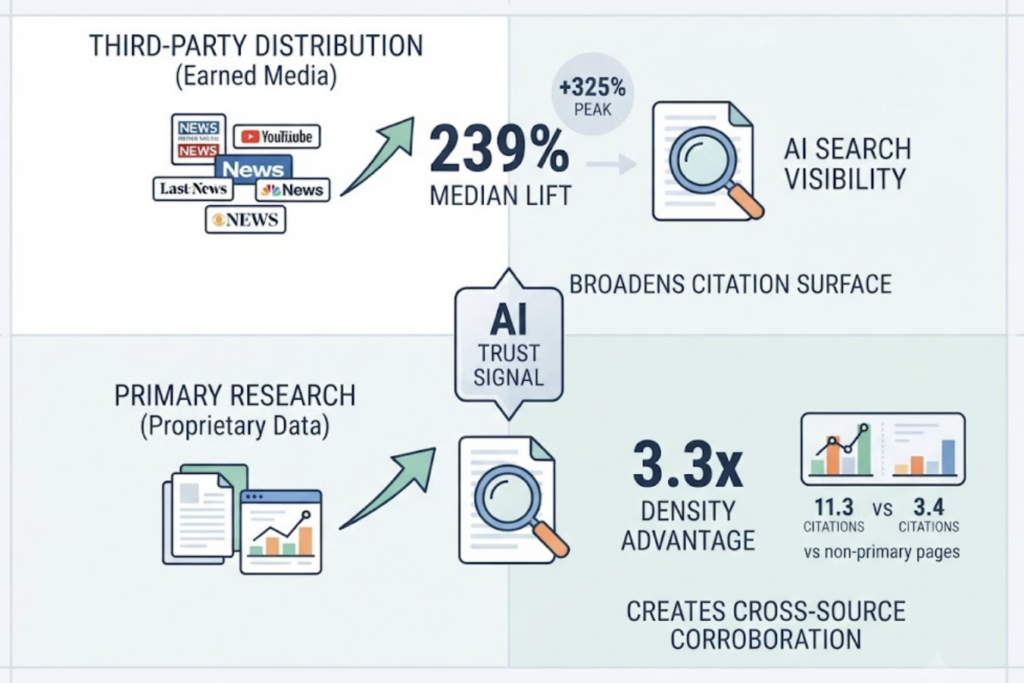
    Off-site authority through earned media. Stacker’s GEO study across 87 stories and 2,600+ prompts found that distributing content through third-party news outlets produces a 239% median lift in AI search visibility. In some cases, the lift reached 325%. Growth Memo’s July 2026 data on original research showed that primary research pages average 11.3 citations vs. 3.4 for non-primary pages, a 3.3x density advantage. The combination of proprietary data and broad distribution creates the kind of cross-source corroboration that AI systems treat as a trust signal.

    Prompt-level, cross-platform measurement. You can’t close a gap you aren’t measuring. And rank trackers don’t measure AI brand citation. You need a system that tracks brand mentions, source citations, and competitor positioning across ChatGPT, Perplexity, Gemini, and AI Overviews at the individual prompt level.
    That’s where Topify fits in.

    What Topify’s AI Brand Citation Analytics Reveal That Rank Trackers Don’t

    Most SEO dashboards tell you where you rank. They don’t tell you whether AI systems are citing your brand, quoting your content, or recommending your competitors instead.

    Topify’s Comprehensive GEO Analytics tracks AI brand citation across ChatGPT, Perplexity, Gemini, DeepSeek, and Google AI Overviews through seven core metrics: visibility, sentiment, position, volume, mentions, intent, and CVR. You can see not just whether you’re mentioned, but how often, in what context, and where you stand relative to competitors on each platform separately.

    The Reverse-Engineer AI Citations feature goes a layer deeper. It analyzes the exact domains and URLs that AI platforms cite when answering prompts in your category. If a competitor’s whitepaper is getting cited on ChatGPT while your higher-ranking page gets ignored, you’ll see it. If a third-party review site is the primary source AI uses for your product category, you’ll know which one and how often.

    Topify’s High-Value Prompt Discovery continuously surfaces the AI prompts that matter most for your brand, the ones with high search volume where citation patterns are still in flux. Combined with Dynamic Competitor Benchmarking, you get a clear picture of which brands are winning AI brand citation in your category and exactly which content is driving those citations.

    For teams ready to move beyond tracking, Topify’s One-Click Execution lets you state your optimization goals in plain English and deploy a GEO strategy with a single click. No manual workflows. The system handles execution from content recommendations to distribution signals.

    You can get started with Topify on a Basic plan at $99/month, which includes tracking across ChatGPT, Perplexity, and AI Overviews with 100 prompts and 9,000 AI answer analyses.

    Conclusion

    The AI brand citation gap is real, measurable, and growing. A brand can rank #1 on Google for every target keyword and still be invisible to ChatGPT, Perplexity, and Google AI Mode for those same queries. The data is consistent across every major study published in 2026: the overlap between traditional rankings and AI citations is somewhere between 2% and 12%, depending on the platform.

    Closing that gap starts with accepting that SEO and AI brand citation are complementary but separate disciplines. The brands gaining ground right now are the ones auditing their content for machine extractability, investing in earned media that AI systems trust, and tracking citation performance at the prompt level across every platform their buyers use. The ones still relying on rank trackers alone are optimizing for a shrinking slice of how people find them.

    FAQ

    Q: What is AI brand citation?

    A: AI brand citation refers to how often and in what context AI search engines like ChatGPT, Perplexity, and Google AI Overviews mention your brand, link to your domain, or use your content as a source when generating answers to user queries. It’s distinct from traditional search rankings because AI systems evaluate sources based on extractability, third-party corroboration, and content structure rather than backlinks and keyword density.

    Q: Why do high-ranking SEO brands get ignored by ChatGPT?

    A: ChatGPT selects sources based on whether content is reference-like, extractable, and validated by multiple independent sources. Ahrefs found that 80% of URLs ChatGPT cites don’t rank in Google’s top 100, and 67% of its most-cited pages are institutional domains that brands can’t optimize into. Strong Google rankings indicate keyword relevance and link authority, but those signals don’t translate directly to what AI models prioritize when selecting citations.

    Q: How can I check if my brand is being cited by AI search engines?

    A: Manual spot-checking involves querying your category keywords directly in ChatGPT, Perplexity, and Google AI Mode and looking for your brand in the responses. For systematic tracking, platforms like Topify monitor AI brand citation across multiple engines at the prompt level, showing citation rates, source analysis, and competitive positioning. Since 91% of AI citations appear on only one platform, cross-platform tracking is necessary for an accurate picture.

    Q: What’s the difference between AI brand citation and AI brand mention?

    A: A mention is when an AI system names your brand in its response. A citation is when it links to your domain or attributes specific information to your content as a source. ChatGPT cites sources in 87% of responses but only mentions brands in about 20.7% of them. A brand can be cited as a source (the AI used your page to build its answer) without being mentioned by name, and it can be mentioned without being cited as an authoritative source. Both matter, but citation indicates deeper trust in your content.

    Read More

  • AI Brand Citation Benchmarks by Industry in 2026

    AI Brand Citation Benchmarks by Industry in 2026

    Your brand got mentioned 15 times across ChatGPT and Perplexity last month. Your competitor got mentioned 40 times. You assume you’re losing. But here’s the thing: if you’re in ecommerce, 15 mentions might put you in the top quartile. If you’re in B2B SaaS, it puts you near the bottom.

    Without industry-specific benchmarks, every AI brand citation number is a guess dressed up as a metric. And most marketing teams are still guessing.

    Why a 20% AI Brand Citation Rate Means Nothing Without Industry Context

    The gap between industries isn’t small. It’s structural.

    Foglift’s Q2 2026 benchmark data scored AI visibility across ChatGPT, Perplexity, Claude, and Gemini using industry-specific prompt sets. SaaS and B2B brands averaged 62 out of 100. Education and EdTech came in at 58. Healthcare scored 55. Agencies landed at 51. Ecommerce trailed at 48, largely because thin product-page content gives AI systems less to cite.

    The variation in AI Overview trigger rates is even wider. BrightEdge’s year-over-year analysis found Healthcare queries now trigger AI Overviews 88% of the time. Education jumped from 18% to 83% in under a year. B2B Tech went from 36% to 82%. Ecommerce? Still hovering around 3.2%.

    That’s the gap most brands still can’t see.

    A brand measuring its AI citation performance against a single industry-agnostic number is optimizing blind. The benchmark that matters is the one for your vertical, on the platforms your buyers actually use.

    AI Brand Citation Benchmarks Across 6 Key Industries

    Conductor’s 2026 AEO/GEO Benchmarks Report analyzed 13,770 enterprise domains and 3.3 billion sessions across 10 industries. Combined with data from Tinuiti, BrightEdge, Foglift, and Attrifast, a clearer picture of AI brand citation performance by vertical emerges.

    IndustryAI Visibility ScoreAIO Trigger RateCitation VolatilityKey Citation Sources
    B2B SaaS / Technology62/10082%Medium-HighBrand sites, docs, G2, Reddit
    Healthcare55/10088%Low.gov, .edu, WebMD, Mayo Clinic
    FinanceVaries widely25.8% (growing fast)HighestYouTube (23%), Investopedia, LinkedIn
    Ecommerce48/1003.2%LowestAmazon, brand stores, Reddit
    Education / EdTech58/10083%Low-Medium.edu domains, course platforms
    Agencies / Consultancies51/100N/AMediumCase studies, industry pubs

    B2B SaaS: The Most Competitive AI Brand Citation Arena

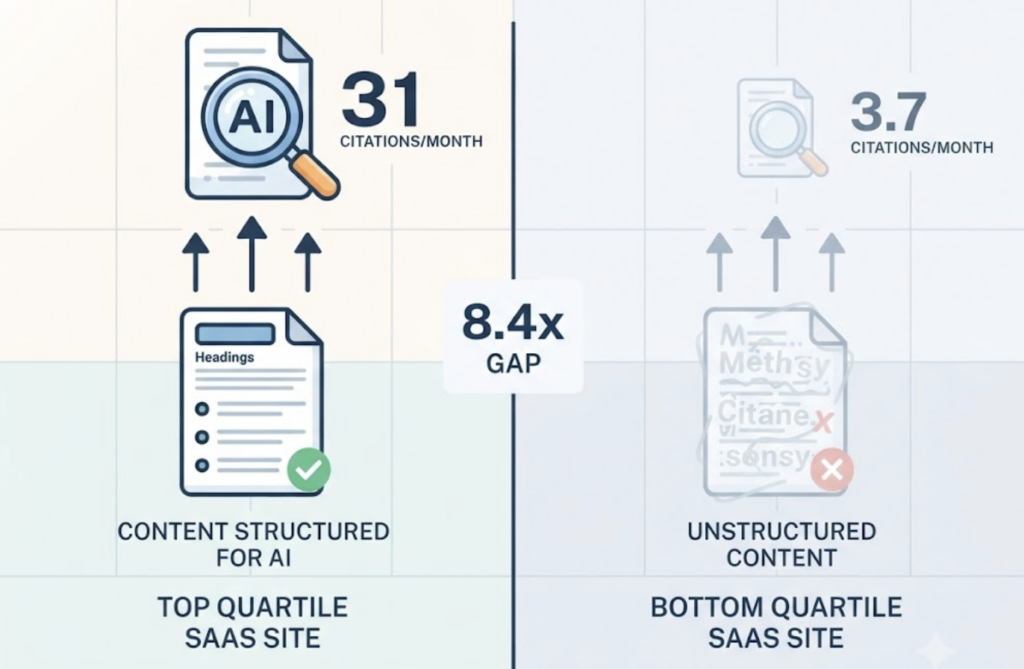
    B2B SaaS is where the AI brand citation race is fiercest. Data-Mania’s 2026 analysis found the top quartile of SaaS sites earns 31 AI citations per month across major platforms. The bottom quartile scrapes by with 3.7. That’s an 8.4x gap, and the dividing factor isn’t domain authority or backlinks. It’s how well content is structured for AI extraction.

    Roughly 17% of B2B SaaS discovery now happens through AI-generated answers, up from 4% the previous year. In categories like CRM and BI/Data, the top three brands capture 41% to 71% of all AI citations, making it nearly impossible for new entrants without a deep content moat.

    Healthcare: High AI Trigger Rates, Low Referral Traffic

    Healthcare has the highest AI Overview trigger rate of any industry at 48.7% of all Google searches, per Conductor. BrightEdge puts the broader AIO presence at 88% of healthcare queries. But there’s a catch: referral traffic from those AI answers is just 0.64%.

    The reason is straightforward. AI answers medical queries directly. Patients searching “symptoms of iron deficiency” get a complete answer in the AI Overview and rarely click through. That makes healthcare AI brand citation a zero-click game. Being cited matters for brand trust and authority, but the traffic won’t follow the way it does in other verticals.

    BrightEdge’s citation overlap data shows healthcare has the highest organic top-10 overlap at roughly 24%. Google leans heavily on already-trusted, already-ranking sources for health content. If you don’t already rank on page one, earning an AI citation in healthcare is considerably harder than in other industries.

    Finance and Ecommerce: Two Extremes of AI Brand Citation Volatility

    Finance shows the highest citation volatility of any vertical. The sources AI platforms pull from shift frequently, and the citation mix is unusual: YouTube leads at 23%, followed by Wikipedia at 7.3%, LinkedIn at 6.8%, and Investopedia at 5.7%. Educational finance content is on a trajectory that BrightEdge projects will reach 90%+ AI Overview coverage by late 2026, matching where healthcare is today.

    Ecommerce sits at the opposite end. With just 3.2% AIO trigger rate, it currently has the lowest AI Overview exposure. But it’s also the most stable. Citation patterns in ecommerce don’t swing month to month the way they do in finance. The expansion into commercial queries is accelerating, and brands building AI citation authority now will have a compounding advantage as coverage grows.

    Same Brand, Different AI Brand Citation Rates Across Platforms

    One of the most overlooked findings in the 2026 data: your brand’s AI citation rate on ChatGPT and Perplexity can be completely different. Not slightly different. Structurally different.

    Tinuiti’s Q1 2026 AI Citation Trends Report tracked citations across seven major AI platforms and nine commercial categories over four months. The headline finding: there is no universal top source. Citation patterns are shaped entirely by intent, platform, and vertical.

    ChatGPT commands 87.4% of all AI referral traffic, per Conductor. But its citation rate is among the lowest. Perplexity drives a fraction of the traffic but cites sources far more heavily, with 24% of all January 2026 citations coming from Reddit alone. Google’s own AI products tell yet another story: AI Mode cited 143% more unique domains than AI Overviews during the same period.

    The practical takeaway? Tracking your AI brand citation rate on a single platform gives you a single data point, not a strategy. A brand that looks strong on Gemini may be invisible on ChatGPT, and the benchmarks for each platform vary by industry.

    What Separates Top-Cited Brands from the Bottom

    Across every industry, the brands earning the most AI citations share a few patterns that the data supports.

    Content freshness is a gating factor. Seer Interactive’s analysis found that 65% of AI bot crawl activity targets content published within the past year. Ahrefs corroborated this: AI-cited content is 25.7% fresher on average than content ranking in traditional organic results. If your last blog update was eight months ago, AI systems are already deprioritizing it.

    Structured data outperforms narrative long-form. The Princeton GEO study (KDD 2024) tested nine content optimization tactics across 10,000 queries. Adding statistics improved AI citation visibility by up to 41%. Citing credible sources boosted visibility by 115% for lower-ranked pages. Keyword stuffing performed 10% worse than doing nothing.

    Brand mentions matter more than backlinks. Ahrefs data shows brand mentions correlate 0.664 with AI citation probability, compared to just 0.218 for backlinks. The implication: getting your brand discussed on third-party sites, industry publications, and community platforms has a stronger effect on AI citations than traditional link building.

    Reddit is growing fast, but not the way you think. Reddit’s citation share grew 73% from October 2025 to January 2026 across all tracked categories. But 99% of ChatGPT’s Reddit citations point to unique discussion threads, not brand profiles or subreddit pages. You can’t “game” Reddit citations. You can earn them by being genuinely useful in the conversations that matter.

    Why AI Brand Citations Convert at 5x the Rate of Organic Search

    The business case for tracking AI brand citation isn’t theoretical. It’s already measurable.

    Seer Interactive’s benchmark study found ChatGPT-referred visitors convert at 15.9%, compared to 1.76% for Google organic. Perplexity referrals convert at 10.5%, Claude at 5%, and Gemini at 3%. Ahrefs ran its own internal analysis and found that 0.5% of visitors from AI search drove 12.1% of total signups, a 23x conversion premium.

    The mechanism is intent. Someone clicking through from an AI citation has already been filtered by the AI’s recommendation. They’re not comparison shopping across ten blue links. They arrived because an AI system determined your brand was credible enough to name. That pre-qualification is what drives the conversion gap.

    AI referral traffic still accounts for only about 1.08% of total website traffic on average, per Conductor. But it’s growing at 340% year over year, and every citation compounds. Brands building AI citation authority now aren’t just optimizing for today’s 1%. They’re building the foundation for what that percentage looks like in 18 months.

    How to Benchmark and Track Your AI Brand Citation Performance

    Knowing the benchmarks is step one. Tracking your own brand against them is where it gets operational.

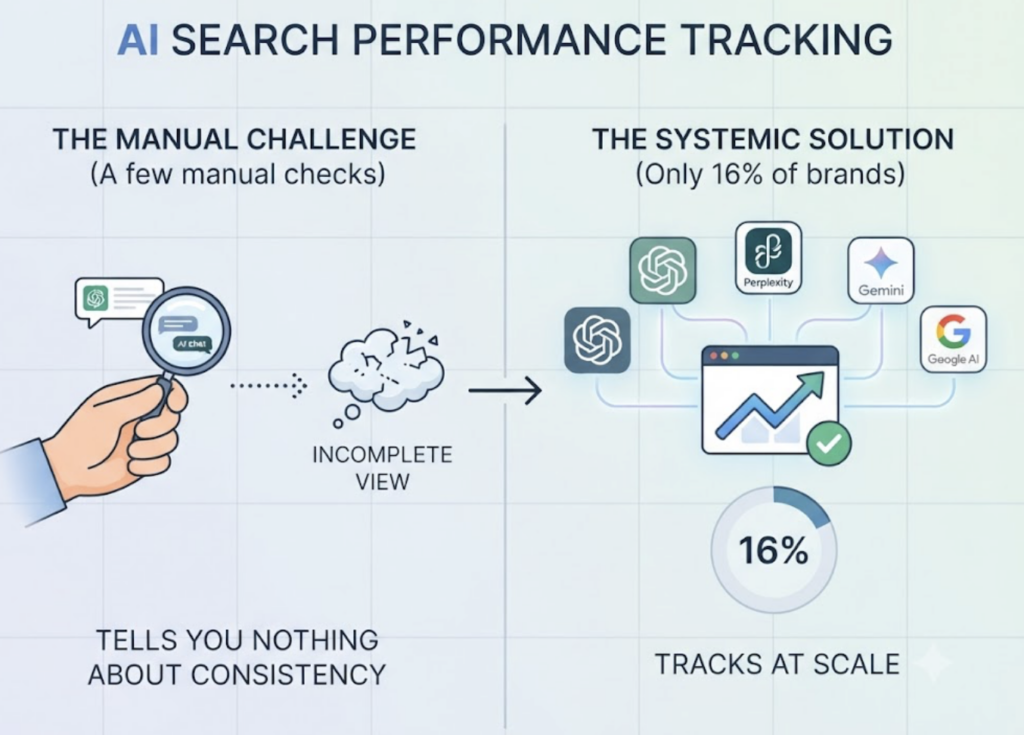
    The challenge is scale. You can manually ask ChatGPT about your brand a few times, but that tells you nothing about consistency, platform variation, or competitive positioning. Each AI engine has its own citation logic, its own source preferences, and its own update cadence. Only 16% of brands systematically track AI search performance as of late 2025.

    This is where a dedicated AI visibility platform changes the equation. Topify tracks brand citations across ChatGPT, Perplexity, Gemini, and AI Overviews through its Comprehensive GEO Analytics system. You set industry-specific prompts, monitor your AI brand citation share over time, and benchmark directly against competitors.

    The workflow maps directly to what the 2026 data says matters. Topify’s Reverse-Engineer AI Citations feature shows which domains and URLs AI platforms are actually citing in your category. If Perplexity is pulling from three competitor blog posts but not yours, you can see exactly which sources you need to match or surpass. The Dynamic Competitor Benchmarking tracks your position relative to rivals across platforms, so a strong showing on Gemini doesn’t mask a blind spot on ChatGPT.

    For teams that want to start with a quick read before committing to a full platform, Topify’s free GEO Score Checker runs an instant AI visibility scan across key dimensions. It won’t replace ongoing tracking, but it gives you a baseline to measure against your industry’s benchmarks.

    Conclusion

    AI brand citation rates vary dramatically by industry, by platform, and by the type of content you publish. A healthcare brand and a SaaS startup face fundamentally different citation landscapes, and the benchmarks that matter to each are not interchangeable.

    The data from 2026 makes one thing clear: the brands gaining ground are the ones measuring their AI citation performance against the right baselines, on the right platforms, with tools built for this specific problem. If you’re still relying on a single ChatGPT query to gauge your AI visibility, you’re seeing a fraction of the picture.

    Start with your industry’s benchmark. Measure your current position. Then close the gap.

    FAQ

    Q: What is a good AI brand citation rate?

    A: There’s no universal number. Citation rates depend heavily on your industry. In B2B SaaS, the top quartile averages around 31 citations per month across major AI platforms, while ecommerce brands operate in a lower-volume environment where even 10 to 15 consistent mentions can be strong. The best approach is to benchmark against your vertical, not an industry-agnostic average.

    Q: How do AI brand citation rates differ by industry?

    A: The differences are structural. Healthcare has the highest AI Overview trigger rate (88% of queries) but very low referral traffic because AI answers medical questions directly. B2B SaaS sees the most competitive citation landscape, with an 8.4x gap between top and bottom performers. Finance has the highest citation volatility, while ecommerce has the lowest AI Overview exposure but the most stable citation patterns.

    Q: Which AI platform has the highest brand citation rate?

    A: It varies by category. Perplexity cites sources more frequently and transparently than ChatGPT, but ChatGPT drives 87.4% of all AI referral traffic. Google AI Overviews now appear on 25% of all searches but cite organic top-10 results only 17% of the time. The most effective approach is to track citations across multiple platforms rather than optimizing for just one.

    Q: How often should I check my AI brand citation benchmarks?

    A: Monthly, at minimum. AI citation patterns shift as models update their training data and retrieval methods. Seer Interactive’s data shows 65% of AI bot activity targets content from the past year, so the freshness window is tight. Quarterly reviews may miss important shifts, especially in high-volatility verticals like finance.

    Read More

  • AI Brand Citation: How LLMs Decide Which Brands to Mention

    AI Brand Citation: How LLMs Decide Which Brands to Mention

    Your domain authority is 70. Your keyword rankings are solid. You’re on page one for every term that matters. Then a prospect asks ChatGPT, “What’s the best platform for [your category]?” and gets a list of five recommendations. Your brand isn’t on it. The competitor you outrank on Google is listed first.

    Traditional SEO metrics can’t explain why, because they weren’t built to measure what AI chooses to say. The signals that drive an AI brand citation operate on a different logic: not which page ranks highest, but which brand the model is most confident recommending. That logic is now measurable, and it’s more influenceable than most teams realize.

    What an AI Brand Citation Actually Is (and Isn’t)

    An AI brand citation happens when an LLM names your brand in a generated answer. Not as filler. Not as a hallucination. As a deliberate recommendation in response to a user’s query.

    That distinction matters. A “mention” is any appearance of your brand name in an AI response. A “citation” is when the model links to or attributes a source. They overlap, but they’re not the same. Seer Interactive’s analysis of 541,213 LLM responses across 20 brands found that a brand’s citation rate was 53.1% when the brand was already mentioned in the response, but only 10.6% when it wasn’t. The model decides which brands to name first, then goes looking for sources to back up those choices.

    That’s the key insight. Citations are the bibliography, not the brainstorm. The decision to include your brand happens before the retrieval step. Which means the signals that influence citation selection are split across two distinct layers: what the model “knows” from training, and what it can find in real time.

    The Signal Stack: How LLMs Select Brands to Cite

    LLMs don’t consult a ranked index the way Google does. They predict the most probable, useful answer from patterns learned during training, then increasingly supplement with sources retrieved at query time.

    The first layer is parametric memory. This is what the model absorbed during training: which brands appear frequently in authoritative contexts, which entities co-occur with specific product categories, and how consistently a brand’s identity holds across the training corpus. Roughly 60% of ChatGPT’s responses draw from this parametric knowledge, with the remaining 40% involving real-time web retrieval.

    The second layer is retrieval-augmented generation (RAG). When the model’s confidence in its internal knowledge drops below a threshold, it triggers a web search, retrieves relevant documents, breaks them into chunks, and scores each chunk for relevance before synthesizing an answer.

    Here’s what the 2026 data shows about which signals predict whether a brand gets through either layer:

    SignalCorrelation with AI VisibilitySource
    YouTube mentions0.737Ahrefs 75K-brand study
    Branded web mentions0.664Ahrefs 75K-brand study
    Branded anchor text0.527Ahrefs 75K-brand study
    Brand search volume0.334–0.392Multiple studies
    Backlinks0.218Ahrefs 75K-brand study
    Domain Authority (DA)0.18Wellows/Clairon 2026 analysis

    The ordering is unambiguous. Off-site brand signals predict AI citations at roughly 3x the rate of backlinks. Domain Authority, the metric that drove SEO strategy for two decades, explains about 3% of the variation in whether AI engines cite a brand.

    Why Earned Media Is the Dominant Citation Driver

    AirOps’ 2026 LLM citation research found that roughly 85% of brand mentions in AI answers come from third-party pages, not from the brand’s own domain. Muck Rack’s analysis of 25 million cited links across ChatGPT, Claude, and Gemini confirms the same pattern: 84% of all AI citations trace back to earned media sources.

    That’s not a coincidence. It’s structural.

    AI engines solve a trust problem at scale. A brand saying “we’re the best” on its own website provides one data point. The same claim reported independently by a journalist, a review site, or a Reddit thread provides corroborating data points from separate sources. The model uses that cross-source agreement as a confidence signal.

    Clearscope’s research quantified the threshold: brands mentioned positively across at least four non-affiliated sources were 2.8x more likely to appear in ChatGPT responses compared to brands mentioned only on their own websites. A controlled study from Stacker and Scrunch went further: the same article, when distributed across third-party news sites, raised AI citation rates from 8% to 34%. That’s a 325% lift from distribution alone.

    The implication is clear. If your GEO strategy stops at on-site optimization, you’re competing for roughly 15% of the citation surface. The other 85% is decided by what others say about you.

    Each AI Platform Cites Different Sources

    One of the most actionable findings from 2026 citation research: there’s no single “AI SEO.” Each platform has its own source preferences, and a strategy that works on ChatGPT may miss entirely on Perplexity.

    The 5W Citation Source Audit Q1 2026, synthesizing nine independent datasets covering hundreds of millions of citations, breaks it down:

    PlatformTop Source DomainShare of Top-10 Citations
    ChatGPTWikipedia~47.9%
    PerplexityReddit~46.7%
    Google AI OverviewsMore evenly distributedYouTube leads at ~19%

    Only about 11% of domains are cited by both ChatGPT and Perplexity. A single content strategy can’t win the full AI surface.

    And these distributions aren’t stable. Reddit’s share of ChatGPT citations collapsed from roughly 60% to 10% in just two weeks during September 2025, then stabilized at a new level. Static strategies built around one platform’s citation patterns are structurally fragile.

    This is where tools like Topify add value. Topify’s Source Analysis feature tracks exactly which domains and URLs each AI platform cites for your category. Instead of guessing which platforms matter, you can see which sources ChatGPT, Perplexity, Gemini, and AI Overviews actually reference when users ask about your market. That turns platform variance from a guessing game into a measurable input for content strategy.

    How to Reverse-Engineer Your Brand’s AI Citation Profile

    Understanding the theory is useful. But teams need a repeatable process for diagnosing where their brand stands. Here’s the framework that maps to the signal stack above.

    Step 1: Test your mention rate across high-intent prompts.

    Pick 15 to 20 prompts that represent real buyer questions in your category. Run each prompt across ChatGPT, Perplexity, Gemini, and Google AI Mode. Track whether your brand appears, in what position, and what context. The metric that matters isn’t a single rank. It’s a mention rate measured across many prompts, because LLMs are non-deterministic and the same prompt yields different answers across sessions.

    Step 2: Identify the mention-citation gap.

    Your brand might appear as a recommendation but without a source link, or with a link to a competitor’s review of your product. That gap signals that the model recognizes your brand from parametric memory but doesn’t trust your own content enough to cite it. Closing this gap requires publishing structured, authoritative content on your domain that directly answers the questions AI engines surface.

    Step 3: Map the source domains your competitors own.

    When a competitor gets cited, look at which domains the AI platform references. Those domains are your outreach targets. SE Ranking’s 129K-domain study found that earning presence on the pages AI already cites produces a compounding effect: once you appear in a cited source, the model becomes more likely to reference you in related queries.

    Topify’s Competitor Monitoring automates much of this. It continuously tracks which brands AI engines recommend for your category, benchmarks your visibility, sentiment, and position against competitors, and surfaces the specific source domains driving those recommendations. That means you can see exactly where a competitor earns citations that you don’t, and target those gaps.

    Three Things Most Brands Still Get Wrong

    Mistake 1: Assuming high Google rankings equal AI citations.

    They don’t. Almost 90% of ChatGPT citations come from pages that aren’t on the first or second Google results page. The share of AI Overview citations from Google’s organic top 10 has dropped to 38%, down from 76% in earlier analyses. SEO and GEO share some foundations, but the ranking signals diverge meaningfully.

    Mistake 2: Publishing more content on your own site and expecting citation growth.

    Volume on your own domain helps, but not as much as distribution. A brand that publishes 50 blog posts on its own site will typically see less AI citation lift than one that earns mentions across 10 independent, authoritative publications. The 325% citation lift from third-party distribution isn’t a marginal gain. It’s a structural difference in how AI systems assess trust.

    Mistake 3: Treating AI citations as untrackable.

    This was true two years ago. It’s not true in 2026. Platforms like Topify now offer Comprehensive GEO Analytics that monitor brand performance across major AI platforms through seven key metrics: visibility, sentiment, position, volume, mentions, intent, and CVR. You can track citation patterns weekly, identify which prompts drive recommendations, and measure how content changes affect AI visibility over time.

    Conclusion

    AI brand citation isn’t a black box. It’s a signal stack you can map, measure, and influence. The brands earning consistent AI recommendations in 2026 share a common profile: strong third-party mention density, consistent entity identity across the web, and presence on the specific source domains each AI platform trusts.

    The starting point isn’t producing more content. It’s understanding your current citation profile: where you appear, where you don’t, and which source domains are driving recommendations for your competitors. That diagnosis turns AI visibility from an abstract concern into a concrete optimization problem, one with measurable inputs and trackable outputs.

    FAQ

    Q: What is an AI brand citation? 

    A: An AI brand citation is when a large language model like ChatGPT, Perplexity, or Gemini explicitly names, recommends, or attributes a source to your brand within a generated answer. It’s distinct from a simple mention because it typically involves the model treating your brand as a credible recommendation in response to a user query.

    Q: How do LLMs choose which brands to recommend? 

    A: LLMs use two main pathways. First, parametric memory: patterns learned during training about which brands are frequently associated with specific categories. Second, retrieval-augmented generation (RAG): real-time web searches that pull structured, authoritative content. Off-site brand signals like third-party mentions, YouTube presence, and brand search volume predict AI citations far more strongly than backlinks or domain authority.

    Q: Can you track AI brand citations? 

    A: Yes. Tools like Topify, Ahrefs Brand Radar, and several other platforms now track which brands appear in AI-generated answers, how often, and from which source domains. Tracking should cover multiple AI platforms, because each one has different citation preferences.

    Q: What’s the difference between AI brand citation and traditional SEO ranking? 

    A: Traditional SEO rankings are based on indexed pages competing for keyword positions. AI brand citations are based on entity-level authority: how often your brand appears across trusted independent sources, how consistently your identity is described, and whether your content is structured for chunk-level extraction. A page can be cited by an LLM without ranking in Google’s top 10, and a top-10 Google ranking doesn’t guarantee AI citation.

    Read More

  • AI Brand Citation vs. Backlinks: Why Visibility Rules Changed

    AI Brand Citation vs. Backlinks: Why Visibility Rules Changed

    Your domain authority is 70. Your backlink profile is clean. Your top pages rank on the first page for every target keyword. Then a potential customer asks ChatGPT, “What’s the best platform for [your category]?” and gets a list of five recommendations. Your brand isn’t on it.

    That gap between search rankings and AI visibility isn’t a glitch. It’s the difference between backlinks and AI brand citation, two authority signals that look similar on paper but operate in entirely different systems. An Ahrefs study of 75,000 brands found that unlinked web mentions correlate with AI citation rates at 0.664, while backlinks correlate at just 0.218. That’s roughly a 3x difference in predictive power. The signal that built your Google authority isn’t the same signal that gets your brand cited in an AI answer.

    What an AI Brand Citation Actually Is, and Why It’s Not a Backlink

    A backlink is a hyperlink from one website to another. Google has counted them as votes of trust since 1998. They pass authority, anchor text context, and crawl signals. That system works well when the end result is a list of ten blue links.

    An AI brand citation is different. It’s when an AI system references your brand, product, or content inside a generated answer. The reference might include a hyperlink, or it might not. Either way, the brand appears in the answer itself, not in a list below it.

    The distinction matters because the two signals operate on different layers. Backlinks shape where a page sits in a ranked list. AI brand citations shape whether your brand appears at all when the user never sees that list.

    A page can hold a strong link profile and still be invisible inside an AI answer if its content is hard to extract. The reverse is also true: a clearly structured page can get cited even with a modest backlink count.

    The Numbers Behind the Shift: AI Brand Citation Signals Outperform Backlinks 3:1

    The Ahrefs 75,000-brand study didn’t just find a gap. It found that nearly every off-page factor above the 0.3 correlation line is produced by activity that doesn’t live on your website.

    Off-Page SignalCorrelation with AI Citation Rate
    YouTube mentions0.737
    Unlinked web mentions0.664
    Brand search volume0.334
    Total backlinks0.218

    Brand mentions now represent roughly 55% of off-page influence, while backlinks account for about 45%. In 2012, backlinks held 80% of that weight.

    That’s not speculation about the future. It’s a measurement of what’s already happened.

    On the traffic side, the shift is accelerating. AI search visits grew 42.8% year over year, rising from 15.6 billion in Q1 2025 to 27 billion in Q1 2026. Gen AI traffic is growing 165x faster than organic search traffic. And visitors arriving through AI answers convert at 14.2%, compared to 2.8% for traditional organic search.

    The marginal dollar of SEO budget now buys more AI visibility when it’s spent on earned conversations than on link placements.

    Why a Strong Backlink Profile Won’t Save Your AI Brand Citation Rate

    Here’s the uncomfortable part for teams that spent years building links: backlinks don’t decide who gets cited in AI answers. Content structure, entity recognition, and third-party context do.

    A study of 149,912 AI citations across ChatGPT, Gemini, Perplexity, Claude, and Grok found that only 2.9% pointed to a brand’s own website. The other 97% came from third-party pages: review sites, news articles, community forums, and competitor comparisons. A separate MuckRack analysis of 25 million links cited by major AI engines confirmed a similar pattern: 84% of citations came from third-party sources rather than owned brand content.

    Your own domain is the floor, not the lever.

    On top of that, Ahrefs’ overlap analysis found that roughly 80% of AI-cited URLs don’t rank anywhere in Google for the original query. Even inside Google’s own AI Overviews, top-10 pages supplied only 38% of citations, down from 76.1% seven months earlier. And only 11% of domains appear in both ChatGPT and Perplexity results simultaneously.

    Ranking and citation are different games scored by different signals.

    How AI Search Engines Decide Which Brands to Cite

    AI engines don’t crawl a link graph the way Google does. They synthesize answers by pulling from sources they’ve already ingested and weighted by a different set of criteria.

    The trust chain works like this: backlinks build domain authority, which feeds rankings, which increases the chance of being indexed by AI. But the citation decision itself depends on how well AI can extract your brand’s relevance from the content it reads. That means entity recognition, cross-source corroboration, and content extractability.

    Cross-source corroboration is the key mechanism. A brand mentioned in one source provides a single data point. The same brand mentioned consistently across hundreds of independent pages gives AI engines hundreds of corroborating signals. They interpret that pattern as higher credibility and higher citation probability.

    That’s why 37% of consumers now start their searches with AI tools instead of Google, and why AI Overviews appear on 48% of Google searches. The surface where brand visibility is decided has moved. Backlinks got you to the table. AI brand citations determine whether you’re in the conversation.

    Tracking AI Brand Citations: What Backlink Tools Can’t Show You

    Traditional SEO tools are built for the link graph. They tell you how many backlinks you have, which domains link to you, and where you rank for a set of keywords. None of that answers the question: “Is ChatGPT recommending my brand?”

    Tracking AI brand citations requires a different stack. You need to know which AI platforms mention your brand, which third-party sources AI engines are citing in your category, how your citation share compares to competitors, and whether that share is growing or shrinking.

    Topify approaches this by combining several layers of intelligence. Source Analysis shows the exact domains and URLs that AI platforms cite when generating answers about your category, so you can see whether your brand or your competitors dominate those references. Visibility Tracking monitors how often your brand appears across ChatGPT, Perplexity, Gemini, and other major AI engines. And Competitor Monitoring surfaces who AI tends to recommend alongside or instead of you, with position, sentiment, and citation share tracked over time.

    In practice, that means you can spot a drop in ChatGPT mentions and trace it back to a specific third-party source that stopped covering your brand, all within the same dashboard. That level of signal-to-action isn’t something a backlink checker can deliver.

    AI Brand Citation vs. Backlinks: A Side-by-Side Comparison

    The two signals aren’t enemies. They’re layers. But they serve different systems, and confusing them costs visibility.

    DimensionBacklinksAI Brand Citations
    What it isHyperlink from one site to anotherBrand reference inside an AI-generated answer
    Primary systemGoogle’s ranking algorithmLLM answer generation (ChatGPT, Perplexity, Gemini)
    How it builds authorityPasses PageRank and domain trustCorroborated mentions across trusted third-party sources
    What it influencesWhere a page ranks in a list of resultsWhether a brand appears in the answer at all
    Correlation with AI visibility0.2180.664 (via unlinked mentions)
    Traffic typeClick-based organic trafficPre-qualified, recommendation-driven visits
    Conversion rate benchmark~2.8%~14.2%
    Typical tracking toolAhrefs, Moz, SEMrushAI visibility platforms like Topify

    The practical takeaway: backlinks still matter for Google rankings. They contribute to domain trust, which is one input AI engines use when selecting sources. But they’re no longer the primary lever for getting your brand into AI-generated answers.

    Forrester now recommends reallocating at least 15% of content or digital spend to AI search visibility. That’s not a prediction about the future. It’s a response to where buyer discovery is already happening.

    Conclusion

    Backlinks built the internet’s authority layer. They earned your Google rankings. That hasn’t changed. What has changed is that a growing share of brand discovery now happens inside AI-generated answers, where backlinks aren’t the deciding factor.

    AI brand citations depend on a different set of signals: how often your brand is mentioned across third-party sources, how consistently those mentions corroborate your expertise, and how easily AI engines can extract your relevance from the content they read. The brands tracking both layers, link authority and citation presence, are the ones showing up where the next generation of search is heading. If you’re only watching your backlink profile, you’re measuring half the picture. Start tracking your AI brand citation performance and see where the gaps are.

    FAQ

    Q: What is an AI brand citation? 

    A: An AI brand citation occurs when an AI system like ChatGPT, Perplexity, or Gemini references your brand inside a generated answer. Unlike a backlink, it doesn’t require a hyperlink. The brand appears in the answer itself, influencing the user’s decision before they ever click through to a website.

    Q: Do backlinks still matter for AI search visibility? 

    A: Yes, but indirectly. Backlinks build domain authority, which is one signal AI engines use when deciding which sources to trust. However, unlinked brand mentions correlate with AI citation rates roughly 3x more strongly than backlinks do (0.664 vs. 0.218), based on Ahrefs’ study of 75,000 brands.

    Q: How can I track my brand’s AI citations? 

    A: Traditional SEO tools like Ahrefs and Moz don’t track AI citations. You need a platform built for AI search visibility, such as Topify, which monitors brand mentions across ChatGPT, Perplexity, Gemini, and other AI engines, and shows which sources AI platforms cite in your category.

    Q: What’s the difference between an AI citation and a brand mention? 

    A: A brand mention is any reference to your brand on the web, linked or unlinked. An AI citation is specifically when an AI engine includes your brand in a generated response. Mentions feed the citation pipeline: the more consistently your brand is mentioned across trusted third-party sources, the more likely AI engines are to cite you in their answers.

    Read More

  • What Is AI Brand Citation? The Metric Marketers Need

    What Is AI Brand Citation? The Metric Marketers Need

    Your keyword rankings are solid. Your domain authority sits at 60+. Your content calendar runs like clockwork. Then a prospect asks ChatGPT, “What’s the best platform for [your category]?” and gets a list of five brands. Yours isn’t on it.

    That disconnect has a name now: AI brand citation. It’s the metric that tells you whether AI systems treat your brand as a source worth referencing, not just a page worth indexing. And for most marketing teams, it’s the single biggest blind spot in their reporting stack.

    What Is an AI Brand Citation, and How Is It Different from a Mention?

    An AI brand citation occurs when a generative AI platform, such as ChatGPT, Perplexity, Google AI Overviews, or Claude, directly references your brand’s content as a source in its response. That reference can appear as a hyperlink, a named attribution, or a quoted data point tied to your domain.

    It’s not the same as a brand mention.

    A mention happens when an AI names your brand without linking or attributing. “Tools like Acme and Bravo help marketers track visibility” is a mention. A citation says, “According to Acme’s 2026 report, AI referral traffic converts 4.4x higher than organic,” and points back to the source. Both carry value, but they signal different things. Mentions build awareness. Citations build authority.

    The distinction matters because AI platforms treat them differently. Ahrefs’ study of 75,000 brands found that branded web mentions correlate with AI Overview visibility at 0.664, while backlinks correlate at just 0.218. That’s a 3-to-1 gap. Brands in the top quartile for web mentions earned over 10x more AI citations than brands in the next quartile.

    In traditional SEO, backlinks were the currency of trust. In AI search, citations and mentions are the new trust architecture, and the two systems have diverged.

    Why AI Brand Citations Carry More Weight Than Most Teams Realize

    The reason AI brand citations matter so much in 2026 comes down to a structural shift in how users find information.

    Zero-click searches rose from 56% to 69% within 12 months of Google’s AI Overviews launch, according to Similarweb. When an AI Overview is present, 83% of queries end without any click. In Google’s newer AI Mode, that number hits 93%. Users are getting answers inside the AI response. They’re not clicking through to your site. They’re reading whatever the AI tells them, and your brand is either in that answer or it isn’t.

    That makes citation the new front door.

    Here’s the commercial case: AI referral traffic, the visits that do come through from citations, converts at 4.4x the rate of standard organic search, according to Semrush. Ahrefs ran its own internal analysis and found that 0.5% of traffic from AI search drove 12.1% of total signups, a 23x conversion rate multiplier. The volume is still small. But the quality is disproportionately high, and the channel is growing 796% year over year.

    Citations also compound. Brands that earn both a mention and a citation in an AI response are 40% more likely to resurface in subsequent answers for the same query. That persistence effect means early movers build a visibility advantage that gets harder to displace over time.

    AI Brand Citation vs. Google Rankings: Two Systems, One Blind Spot

    If you’re tracking keyword rankings and assuming they predict AI visibility, the data says otherwise.

    Moz analyzed 40,000 queries through Google AI Mode and found that 88% of citations came from pages outside the organic top 10. SEMrush’s research tells a similar story: 90% of ChatGPT citations come from pages ranked #21 or lower in Google, or entirely unranked. Google’s own AI system is pulling away from its own rankings as a citation source. AI Overview citations from top-10 pages dropped from 76% to 38% between July 2025 and March 2026.

    The two systems have decoupled.

    A brand can own page one for 50 keywords and still be invisible to ChatGPT. That’s not a theoretical risk. It’s what happens when your measurement stack only covers one of the two discovery channels your buyers now use. The fix isn’t choosing between SEO and AI visibility. It’s measuring both, because they reward different content, different signals, and different distribution strategies.

    What Makes AI Systems Cite One Brand Over Another

    AI citation isn’t random. Research in 2026 points to three factors that consistently predict which brands get cited.

    Earned authority across the web. This is the single strongest signal. The Ahrefs correlation data confirms it: branded mentions on third-party sites, review platforms, industry roundups, Reddit threads, and news coverage collectively predict AI visibility at 3x the strength of backlinks. Muck Rack’s analysis of over one million AI-cited links found that 82% come from earned media. Your own domain helps, but it’s the chorus of independent references that tips the scale.

    Content precision. AI systems favor content that is specific and verifiable. Adding concrete statistics to content increases AI citation probability by 37%, according to research based on the Princeton GEO framework. Including expert quotations increases it by 41%. Vague, adjective-heavy copy doesn’t get cited. Data does.

    Freshness. Pages updated within the past 12 months are roughly 2x more likely to earn citations than stale content. AI platforms tend to favor recent, maintained sources over archives. Brands that publish constantly but rarely revisit core pages often lose citation share to competitors who update fewer pages more frequently.

    One more factor worth noting: 86% of AI citations come from brand-controlled or brand-influenced sources, according to Yext’s analysis of 6.8 million citations. The assets you need to optimize already exist. The gap is alignment, not access.

    How to Track AI Brand Citations at Scale

    Tracking AI brand citations requires a different infrastructure than traditional rank tracking. You’re not monitoring a static SERP position. You’re monitoring whether your brand appears, where it appears, and what the AI says about you across multiple platforms that generate different answers every time.

    That variability is the core challenge. AirOps’ 2026 State of AI Search report found that only 30% of brands stay visible from one AI answer to the next for the same query. Only 20% persist across five consecutive runs. A single spot-check tells you almost nothing. You need repeated sampling across a meaningful prompt set.

    The metrics that matter for AI brand citation tracking fall into three tiers. Citation share measures the percentage of AI answers in your category that reference your brand. Citation position tracks where your brand appears relative to competitors in each response, since first-position citations earn 2.8x the conversion rate of third-position mentions. And citation source analysis reveals which of your pages and which third-party domains AI platforms are actually pulling from.

    For marketing teams monitoring citations across ChatGPT, Perplexity, Gemini, and AI Overviews, Topify consolidates these layers into a single dashboard. Its Reverse-Engineer AI Citations feature traces exactly which domains and URLs AI platforms reference at scale, so you can see whether your brand or your competitor dominates those references. The Visibility Tracking module runs repeated prompt monitoring across major AI platforms, turning volatile snapshot data into trend lines your team can act on.

    That combination, citation sourcing plus longitudinal tracking plus competitor benchmarking, is what turns raw citation data into a reporting workflow. Without it, you’re reacting to individual AI answers instead of managing a channel.

    A Practical Playbook to Start Earning AI Brand Citations

    If you haven’t started tracking or optimizing for AI brand citations, you’re not alone. 47% of brands still have no deliberate GEO strategy, according to Digital Applied. But the window is narrowing. 94% of digital marketing leadersplan to increase GEO spending in 2026, per Conductor’s State of AEO/GEO report. The brands that move now build compound visibility. The ones that wait play catch-up against entrenched citation patterns.

    Here’s a practical starting point.

    Audit your current citation status. Before optimizing anything, find out where you stand. Run your brand through a set of buyer-intent prompts across ChatGPT, Perplexity, and Google AI Mode. Note which queries surface your brand, which surface competitors, and which cite your content versus simply mentioning your name. Topify’s Comprehensive GEO Analytics automates this across platforms and tracks changes over time.

    Strengthen entity clarity. AI systems need to understand what your brand is, what it does, and where it sits in its category. That means consistent descriptions across your website, Wikipedia, Crunchbase, business directories, and review platforms. Inconsistency confuses AI models and dilutes citation probability.

    Expand your citation surface. The Ahrefs data makes this clear: earned mentions on third-party sites predict AI visibility 3x better than backlinks. Invest in digital PR, contributed articles, expert roundups, community platforms, and industry reports that reference your brand in context. Each independent mention becomes a potential citation source.

    Update core content regularly. Fresh, data-rich pages get cited more. Revisit your highest-value landing pages, product comparisons, and research pieces on a quarterly cycle. Add current statistics, refresh examples, and remove outdated claims. AI platforms notice.

    Conclusion

    AI brand citation isn’t a nice-to-have metric. It’s the visibility layer that sits between your content investment and whether AI systems actually recommend your brand to buyers.

    The data pattern is consistent: traditional SEO rankings and AI citation share are diverging. Brands that track only one of the two are flying half-blind on the channel that converts at 4.4x the rate of organic search. The starting point is measurement. Know your citation share, know which prompts surface your brand, and know which sources AI platforms pull from. Everything else, entity optimization, earned media, content freshness, follows from that baseline.

    FAQ

    Q: What’s the difference between an AI brand citation and a brand mention?

    A: A citation is when an AI platform references your content as a source, typically with a link or named attribution. A mention is when AI names your brand in a response without attributing a specific source. Both affect visibility, but citations carry stronger authority signals and tend to compound over time.

    Q: Can I improve my AI brand citations without changing my SEO strategy?

    A: Partially. Good SEO provides a foundation, but AI citation optimization requires its own playbook. The strongest citation signals come from earned brand mentions across the web, content precision with specific data points, and entity clarity across directories and platforms. These overlap with SEO in some areas but diverge significantly in others.

    Q: How often should I track AI brand citations?

    A: At minimum, weekly for tactical content adjustments. AI answers change roughly 70% of the time for the same query, and only 30% of brands stay visible across consecutive responses. Consistent monitoring over time reveals trends that single snapshots miss.

    Q: Which AI platforms should I monitor for brand citations?

    A: At a minimum, track ChatGPT, Perplexity, Google AI Overviews, and Gemini. Each platform uses different citation logic. ChatGPT averages 6.1 citations per answer and favors structured vendor content. Perplexity leans more on community sources. Google AI Overviews increasingly pull from pages outside the organic top 10. A cross-platform view is the only way to get a complete picture.

    Read More

  • AI Brand Citation Monitoring: What to Track and How to Start

    AI Brand Citation Monitoring: What to Track and How to Start

    Your marketing team spent months building domain authority, publishing content, and earning backlinks. Then someone asked ChatGPT for a recommendation in your category. The response cited three competitors by name, linked to two industry publications, and didn’t mention your brand once. Your Google rankings are fine. Your organic traffic looks healthy. But none of that tells you whether AI is using your content as a source, or whether it’s treating your competitor’s blog as the authority in your space.

    That gap between SEO performance and AI citation performance is where brands are losing ground without realizing it. And the problem is growing: 37% of consumers now start their searches with AI tools rather than a traditional search engine.

    What AI Brand Citations Are and Why They’re Not the Same as Mentions

    There’s a distinction that most marketing teams overlook: the difference between an AI brand citation and an AI brand mention.

    A mention means your brand name appeared somewhere in an AI-generated response. A citation means the AI platform linked to your content as a source backing its answer. One gives you visibility. The other gives you authority, referral traffic, and a compounding advantage in how AI models evaluate your brand over time.

    Here’s why the difference matters in practice. Your brand might show up in a ChatGPT answer, but the citation backing the claim could link to a competitor’s blog or a third-party review site. You got the name-drop. Someone else got the authority signal and the click. The reverse is equally important: if your content is frequently cited as a source even when your brand name isn’t explicitly mentioned, you’re still building domain credibility with the AI model.

    The business impact is measurable. According to the Opollo 2026 AI Search Benchmark Report, AI-referred visitors convert at 14.2% compared to 2.8% from Google organic traffic across 312 B2B technology companies. That’s a 5x conversion premium, and it flows through citations, not mentions.

    The Scale Problem: 900 Million Weekly Users and Your Brand Might Not Be in the Answer

    The audience that never sees your brand in AI search is massive and growing fast. ChatGPT alone reached 900 million weekly active users as of February 2026, more than doubling its base from a year earlier. Google’s AI Overviews now reach roughly 2 billion monthly users. Perplexity has grown to approximately 45 million monthly active users, processing 780 million queries per month.

    That’s billions of AI-mediated interactions every month where your brand is either being cited, mentioned without a link, or ignored entirely. And here’s the part that catches most teams off guard: traditional SEO tools can’t tell you which one is happening.

    Google Analytics tracks organic clicks. Search Console tracks rankings. Neither tracks whether ChatGPT cited your pricing page, whether Perplexity linked to your competitor’s case study instead of yours, or whether Google AI Overviews pulled a definition from your blog and attributed it to someone else. The instrumentation most marketing teams rely on was built for a search model that’s quickly losing its monopoly on discovery. Gartner predicted that traditional search engine volume would drop 25% by 2026 due to AI chatbots and virtual agents, and the data from 2025 suggests that trajectory is on course.

    Only 14% of marketers currently track AI search as a separate channel. The other 86% are flying blind on the fastest-growing discovery surface in marketing.

    Why Tracking One AI Platform Gives You 11% of the Picture

    One of the most counterintuitive findings in AI citation research is how little overlap exists between platforms. An analysis of 680 million AI citations found that only 11% of domains are cited by both ChatGPT and Perplexity for the same query. 71% of all cited sources appear on just one platform.

    That means if you’re only checking your brand’s presence in ChatGPT, 89% of the citation picture is invisible to you.

    The reason is architectural. Each AI platform builds answers from a fundamentally different source pool. ChatGPT leans on parametric knowledge from training data plus selective Bing integration. Perplexity runs a real-time web search for every prompt. Google AI Overviews draw from their own search index but apply different selection criteria than organic rankings. By early 2026, only about 38% of AI Overview citations came from pages ranking in the organic top 10, down from 76% the year before.

    The citation rate structures differ too. According to Conductor’s AEO/GEO benchmarks, ChatGPT’s citation rate is just 0.7% of answers that include a clickable source URL. Perplexity’s is 13.8%. Google AI Mode’s is 9.5%. The same “AI search exposure” means completely different things depending on which platform you’re measuring.

    A brand that dominates Perplexity’s citation pool can be nearly absent from ChatGPT, and vice versa. Cross-platform monitoring isn’t a nice-to-have. It’s the minimum viable measurement for any serious AI brand citation strategy.

    Five AI Brand Citation Metrics That Actually Drive Decisions

    Not all citation data is equally useful. Here are the five metrics that separate actionable monitoring from vanity dashboards.

    Citation frequency measures how often your domain appears as a cited source across AI responses for your target prompts. This is your baseline. Without it, you can’t detect trends, measure the impact of content changes, or benchmark against competitors.

    Source match tells you which specific pages AI platforms are citing. If ChatGPT keeps citing your 2023 pricing page instead of your updated 2026 product overview, you’ve identified a content gap you can fix. If it’s citing a G2 review instead of your own case study, that’s a different kind of problem with a different solution.

    Citation position tracks where your citation appears in the response. Being cited as the first source in a Perplexity answer carries more weight than being the fifth footnote. Position data helps you understand not just whether you’re cited, but how much the AI platform trusts your content relative to alternatives.

    Cross-platform coverage maps your citation presence across ChatGPT, Perplexity, Google AI Overviews, Gemini, and other platforms your audience uses. Given the 11% overlap problem, this is where most brands discover their biggest blind spots.

    Competitor citation share compares your citation frequency against competitors for the same set of prompts. If a competitor is cited 4x more often than you for “best CRM for mid-market companies,” that tells you where to focus your content investment.

    How to Build an AI Brand Citation Monitoring Workflow

    Setting up citation monitoring doesn’t require rebuilding your analytics stack. It requires adding a new layer to it.

    Start with prompt mapping. Identify the 30 to 50 AI queries most relevant to your brand. These aren’t keywords in the traditional SEO sense. They’re the questions your buyers actually type into ChatGPT or Perplexity: “What’s the best project management tool for remote teams?” or “How does [your category] pricing typically work?” Think intent, not keywords. Think questions, not phrases.

    Establish your baseline. Run those prompts across ChatGPT, Perplexity, and Google AI Overviews. Record which brands appear, which sources get cited, and where your brand shows up (or doesn’t). This initial audit often produces surprises. Teams regularly discover that a competitor they don’t consider a threat has strong AI citation presence, or that a blog post they deprioritized is their single most-cited page.

    Set monitoring cadence. AI citation patterns shift faster than organic rankings. 50% of content cited in AI responses is less than 13 weeks old, according to research from Lily Ray and Amsive. And 76.4% of ChatGPT’s most-cited pageswere updated within 30 days. That means monthly monitoring is the floor, not the ceiling. Weekly is better for competitive categories.

    Connect citation data to content action. The point of monitoring isn’t a prettier dashboard. It’s knowing which content to create, update, or restructure. If you’re cited on Perplexity but absent from ChatGPT, the fix likely involves building third-party brand signals (reviews, earned media, community mentions) rather than just publishing more blog posts. If your content is cited but your brand isn’t mentioned in the answer text, you might need to strengthen entity signals so the AI connects your content to your brand name.

    For teams that want this workflow in a single platform, Topify combines cross-platform citation tracking with source analysis, competitive benchmarking, and sentiment monitoring. Its Source Analysis feature identifies exactly which domains and URLs AI platforms cite, letting you trace a drop in ChatGPT mentions back to a specific content gap or a competitor’s new publication. And its Competitor Monitoring automatically detects rivals and compares your citation share, position, and sentiment side by side, across ChatGPT, Perplexity, Gemini, and other major AI engines.

    Three Mistakes That Quietly Tank Your AI Brand Citation Rate

    Treating mentions and citations as the same metric. Mentions tell you AI knows your brand name exists. Citations tell you AI trusts your content enough to use it as evidence. A brand with high mentions but low citations is being talked about but not relied upon. That’s a content authority problem, not a visibility problem, and the fixes are different. Focus your content strategy on producing citable assets: original data, structured comparisons, and expert analysis that AI can extract and attribute.

    Monitoring one platform and assuming it represents the whole picture. Given that 89% of citations differ between platforms, a ChatGPT-only monitoring strategy misses most of what’s actually happening. Each platform has distinct source preferences. ChatGPT favors Wikipedia and consensus sources. Perplexity weights Reddit and real-time content heavily. Google AI Overviews lean toward structured, semantically complete pages. A comprehensive monitoring setup covers at least three platforms, ideally more.

    Collecting data without closing the loop to content strategy. Citation monitoring that doesn’t feed back into what you publish, update, and distribute is just reporting. The brands gaining citation share in 2026 are the ones running a tight cycle: monitor which prompts matter, check which sources get cited, identify gaps, produce or update content to fill them, then measure again. Topify’s Comprehensive GEO Analytics supports this cycle with seven visibility metrics in a single view: visibility, sentiment, position, volume, mentions, intent, and CVR, so the path from “we lost citation share on this prompt” to “here’s the content we need to fix” is short.

    The monitoring itself isn’t the competitive advantage. The speed at which you turn monitoring data into content action is.

    Conclusion

    AI brand citation monitoring isn’t a future priority. It’s a current blind spot. With 900 million weekly ChatGPT users, 2 billion AI Overview impressions per month, and only 11% citation overlap between platforms, the brands that don’t monitor cross-platform citations are making decisions based on incomplete data.

    The starting point is straightforward: map your target prompts, audit your citation baseline across at least three AI platforms, and set up a weekly or bi-weekly monitoring cadence. From there, connect citation gaps to content action. Every week you wait is a week your competitors have to build citation authority you’ll need to catch up to.

    Get started with Topify to track your brand’s AI citation presence across ChatGPT, Perplexity, Gemini, and more, all in one dashboard.

    FAQ

    Q: What’s the difference between AI brand citation and AI brand mention? 

    A: A citation means the AI platform linked to your content as a source in its response. A mention means your brand name appeared in the answer text but the link might point elsewhere, or nowhere. Citations carry more weight for building long-term AI authority and driving referral traffic that converts at 4 to 5x the rate of organic search.

    Q: How often should marketing teams check AI brand citations? 

    A: At minimum, monthly. For competitive categories, weekly. AI citation patterns shift faster than traditional rankings. Research shows that 50% of AI-cited content is less than 13 weeks old, meaning your citation status can change significantly within a single quarter.

    Q: Can you track AI brand citations for free? 

    A: You can do manual spot-checks by running prompts in ChatGPT, Perplexity, and Google and recording the results. That works for an initial baseline but doesn’t scale. Automated tools like Topify track citations across multiple platforms continuously, flag changes, and benchmark against competitors, which is where the real operational value sits.

    Q: Which AI platforms should I monitor for brand citations? 

    A: Start with the three highest-traffic surfaces: ChatGPT, Google AI Overviews, and Perplexity. From there, add Gemini and Claude based on where your audience skews. Given the 11% cross-platform citation overlap, covering at least three platforms is the minimum to avoid major blind spots.

    Read More