Category: Article

  • Your Competitors Are Getting Recommended by AI. Here’s How to Find Out Why.

    Your Competitors Are Getting Recommended by AI. Here’s How to Find Out Why.

    You ask ChatGPT to recommend a project management tool. It lists five names. Yours isn’t one of them.

    That’s not a coincidence. It’s a competitive gap you can measure, analyze, and close. But only if you know what to look for.

    AI search competitor analysis works differently from anything in traditional SEO. There are no keyword rankings to check, no SERP positions to screenshot. Instead, you’re tracking citation frequency, brand mention rates, and share of voice inside synthesized answers generated in real time. The brands that understand this are already pulling ahead.

    Most Brands Don’t Know They’re Losing AI Search Share Until It’s Too Late

    Traditional search volume is projected to decline 25% by 2026, and most of that volume isn’t going nowhere. It’s going to AI.

    ChatGPT alone now handles over 1 billion queries per day with 800 million weekly active users. When AI Overviews are present in a search result, zero-click rates hit 83%. For Google’s AI Mode, that number reaches 93%. If your brand isn’t being cited inside the answer, you’re not just ranking lower. You effectively don’t exist for that user.

    That’s the gap most brands still can’t see.

    Meanwhile, your competitors aren’t invisible. They’re being recommended by name, described favorably, and positioned as trusted choices. They didn’t get there by luck. Their content, their citation profile, and their prompt-level coverage created a pattern that AI models have learned to trust. AI search competitor analysis is how you reverse-engineer that pattern.

    The 4 Metrics That Reveal Your Competitor’s AI Visibility

    Competitive AI visibility isn’t a single number. It’s a combination of four dimensions that together tell you where a competitor is winning and why.

    Visibility Rate (sometimes called Answer Inclusion Rate) measures how often a competitor appears across a defined set of category-relevant prompts. If a rival shows up in 80% of “best tool for remote teams” queries while you show up in 10%, they’ve built structural authority in that topic space. You haven’t.

    Share of Voice in AI search calculates your competitor’s mentions as a percentage of all brand mentions in a category. AI engines typically limit recommendations to 3–5 brands per answer, which means share of voice in this context is genuinely zero-sum. When a competitor gains, you lose a slot.

    Recommended Position determines where in the response a brand appears. Research shows brands mentioned in the first two sentences of an AI response receive 5x more consideration than those mentioned later. Being included isn’t enough. Where you’re included changes everything.

    Sentiment tracks how the AI describes a competitor. High visibility with neutral or negative framing is a warning sign for them and an opportunity for you. An AI that describes a competitor as “a budget option with limited support” is damaging their brand equity with every recommendation.

    Across these four dimensions, a full picture of competitor AI visibility starts to emerge. The next question is: what’s driving it at the prompt level?

    How to Discover Which Prompts Trigger Competitor Brand Mentions

    When a competitor is recommended and you’re not, something specific happened at the prompt level. Understanding that mechanism is the core of AI search competitive intelligence.

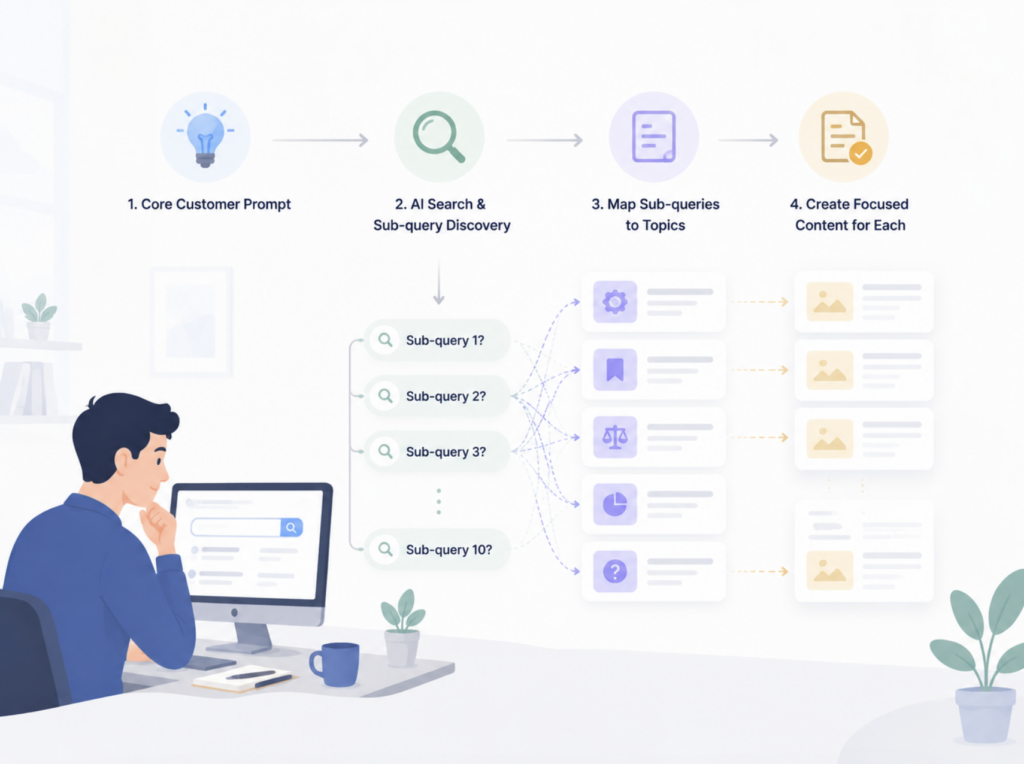
    AI systems don’t evaluate websites. They process language patterns. When a user asks a question, most major AI platforms decompose it into 8–12 parallel sub-queries to retrieve information from across the web. Many of these sub-queries carry zero traditional search volume. They’re invisible to Google Search Console. But they’re actively driving AI recommendations.

    This is where competitors often build their edge quietly. A user asks: “Which CRM works best for a five-person non-profit?” The AI fans out to sub-queries about non-profit pricing tiers, ease of use for small teams, and donor software integrations. A competitor who’s built content that answers those specific intent layers gets retrieved and cited. Even if they’ve never ranked for the original broad keyword.

    The methodology for prompt-level competitor analysis follows a clear structure: identify a broad corpus of relevant questions, categorize them by buyer journey stage, run them across multiple AI platforms, and look for where competitors appear while you don’t. That gap list is your content priority queue.

    Topify‘s High-Value Prompt Discovery automates this process, tracking between 100 and 250 prompts per plan across ChatGPT, Gemini, Perplexity, and other platforms. Instead of manually probing queries one by one, you get a real-time map of which specific triggers are favoring competitors. That turns a research task that would take weeks into a structured, repeatable workflow.

    Consider what this looks like in practice. A SaaS brand discovers a competitor is cited every time someone asks about “Agile workflows for distributed teams.” The source isn’t their homepage. It’s a comprehensive Agile Frameworks Guide the AI consistently uses as a grounding reference. An e-commerce brand finds a rival is recommended for “eco-friendly sneakers under $100” because their product pages include structured data with clear price and material definitions the AI can extract cleanly. A marketing agency notices a competitor is cited for “B2B lead generation trends 2026” because a LinkedIn thought-leadership post got picked up by the AI’s real-time retrieval system.

    None of these are accidents. They’re patterns you can identify and replicate.

    Reverse-Engineering Competitor Citation Sources in AI Platforms

    Knowing that a competitor is visible isn’t enough. You need to know where that visibility is coming from.

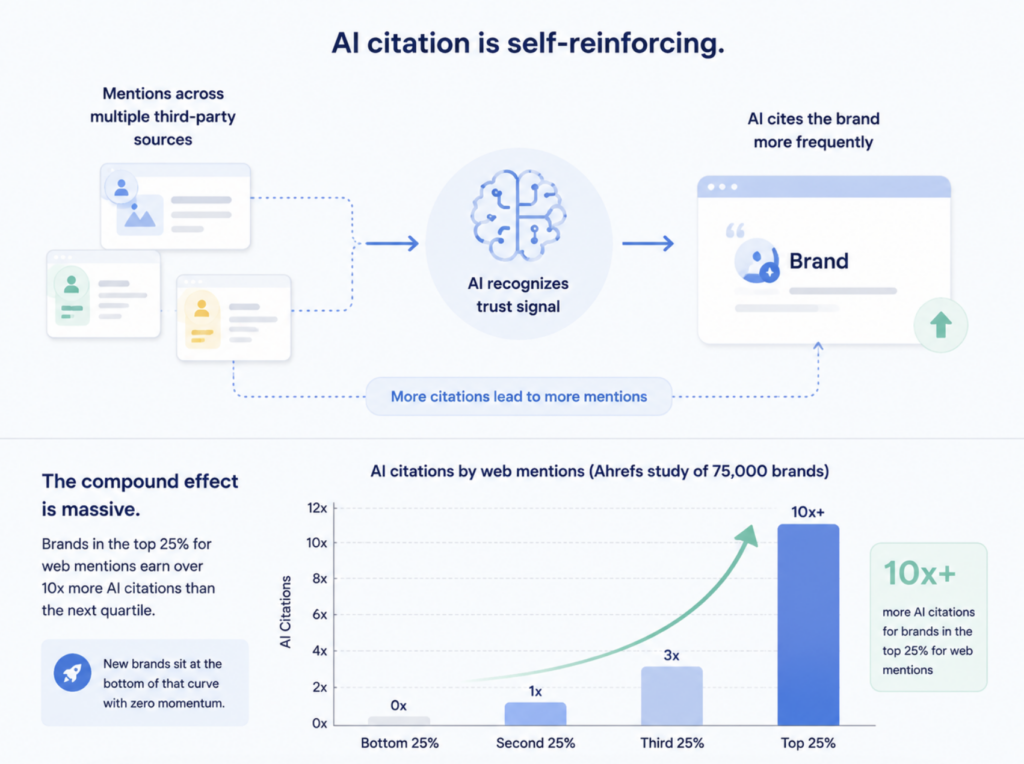
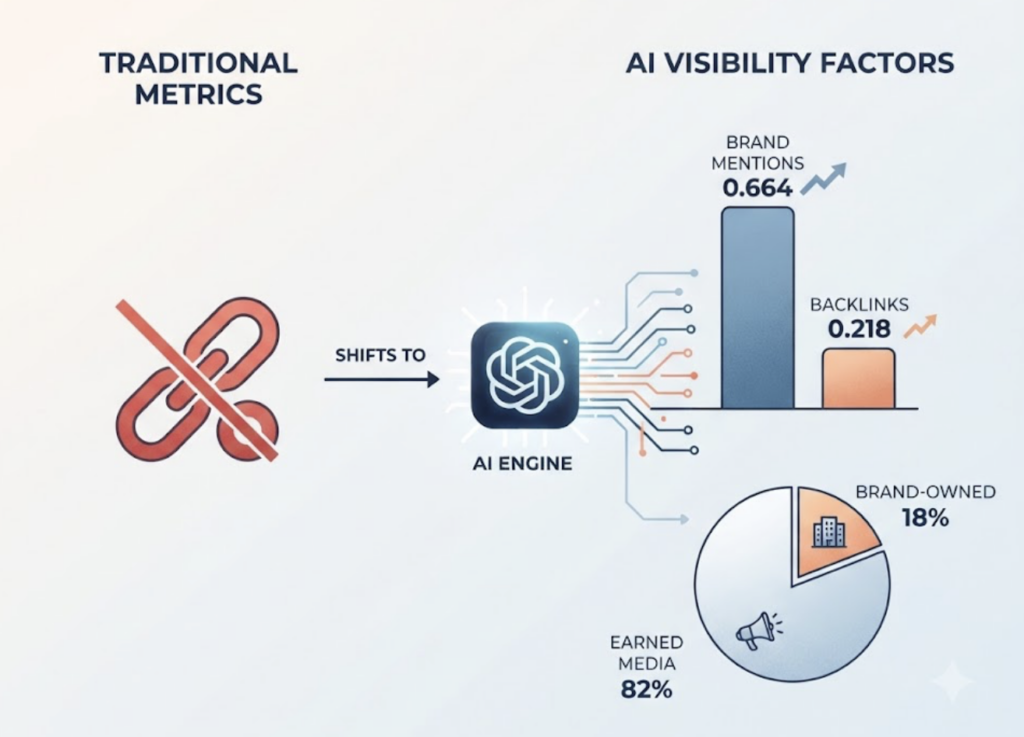
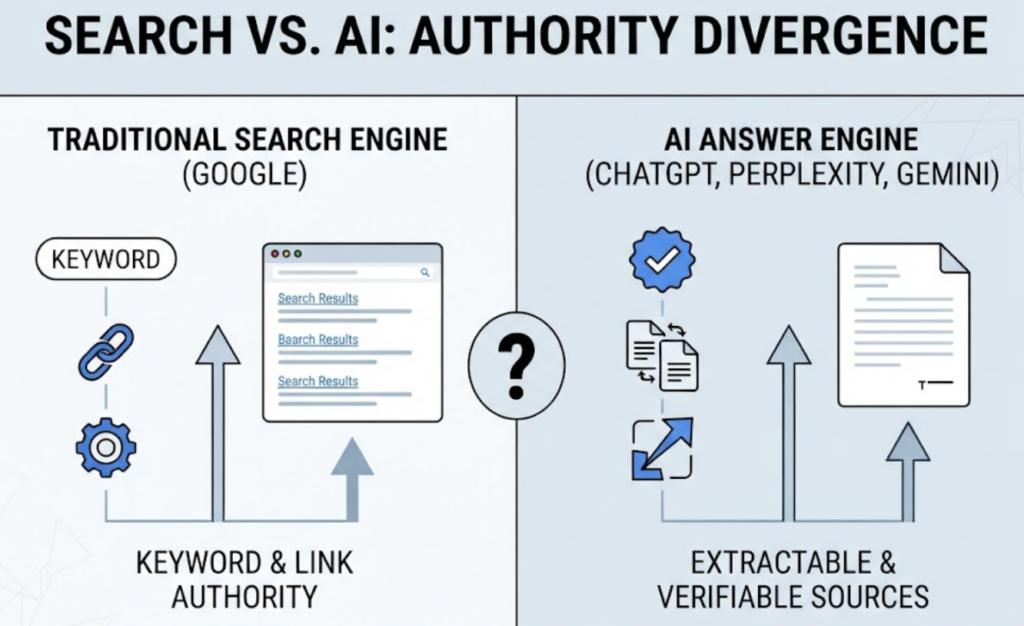
    In traditional SEO, authority flows through backlinks. In AI search, authority flows through citations. And they’re not the same thing. Research shows brand mentions across the web correlate at r=0.664 with AI visibility, while backlink quality correlates at only r=0.218. The AI isn’t primarily trusting your link profile. It’s trusting the consensus built by third-party sources that mention your brand favorably and consistently.

    The citation breakdown for most branded AI recommendations follows a predictable pattern: earned media accounts for roughly 48% of citations, commercial brand content around 30%, owned website content around 23%, and reference sites like Wikipedia or Product Hunt around 10%. Your website, in other words, is the weakest source of AI authority you own.

    This reframes the entire question of how competitors build AI visibility. If a rival is being recommended, the most likely reason isn’t that their homepage is better. It’s that industry blogs, niche publications, and forum discussions have built an independent case for them that the AI finds credible. Brands mentioned positively across at least four non-affiliated forums are 2.8x more likely to appear in ChatGPT responses.

    Topify’s Source Analysis tracks the exact domains and URLs that AI platforms are citing when they recommend a competitor. This reveals the “source gap” directly. You can see whether the AI is citing academic content, Reddit threads, YouTube reviews, or niche industry directories. Each source type points to a different content strategy. If a competitor’s visibility is anchored in Reddit and Wikipedia, the fix isn’t on-page optimization. It’s digital PR, community engagement, and unlinked brand mention acquisition.

    Competitor GEO Benchmarking Across Platforms: Why One Platform Isn’t Enough

    Here’s a structural issue that most brands miss when they start tracking competitor AI visibility: leading on one platform doesn’t mean you’re leading anywhere else.

    ChatGPT cites Wikipedia at 7.8% and tends toward nuanced, detailed brand comparisons, averaging 5.84 brands per response. Perplexity cites Reddit at 6.6% and favors fact-dense, research-backed sources, averaging 4.37 brands. Google AI Overviews prioritizes YouTube at 62.4% and pulls heavily from the Google ecosystem. These aren’t minor differences in preference. They represent fundamentally different citation architectures, which means a competitor’s visibility can vary dramatically across platforms depending on where they’ve built their content presence.

    A complete competitor GEO benchmarking program runs across at least ChatGPT, Gemini, Perplexity, and Google AI Mode simultaneously, using a standardized set of prompts to compare mention rates, share of voice, and position for each rival. The goal is to identify where the competitive gap is widest and which platforms represent the highest opportunity.

    Topify’s Dynamic Competitor Benchmarking automates this multi-platform tracking from a single dashboard. It automatically detects new competitors appearing in your category, monitors real-time shifts in visibility, and surfaces emerging rivals before they become established threats. That kind of early detection is what separates a reactive GEO strategy from a proactive one.

    Benchmarking also answers a question that’s often overlooked: is your competitor strong across all platforms, or only on one or two? A competitor who dominates in ChatGPT but barely appears in Google AI Overviews has a fragile position. That’s a specific, exploitable gap.

    Competitive benchmarking isn’t a one-time project. Model updates, new training data, and shifts in citation patterns mean that a baseline from six months ago may no longer reflect current reality. Weekly audits for high-value commercial prompts and monthly reviews for broader category trends is a reasonable cadence for most teams.

    Turning Competitive GEO Analysis Into a Content Strategy That Actually Wins

    The analysis is the map. The content strategy is how you move.

    After running a competitive AI search analysis, most brands identify three types of gaps, each requiring a different response. Understanding which gap is largest tells you where to start.

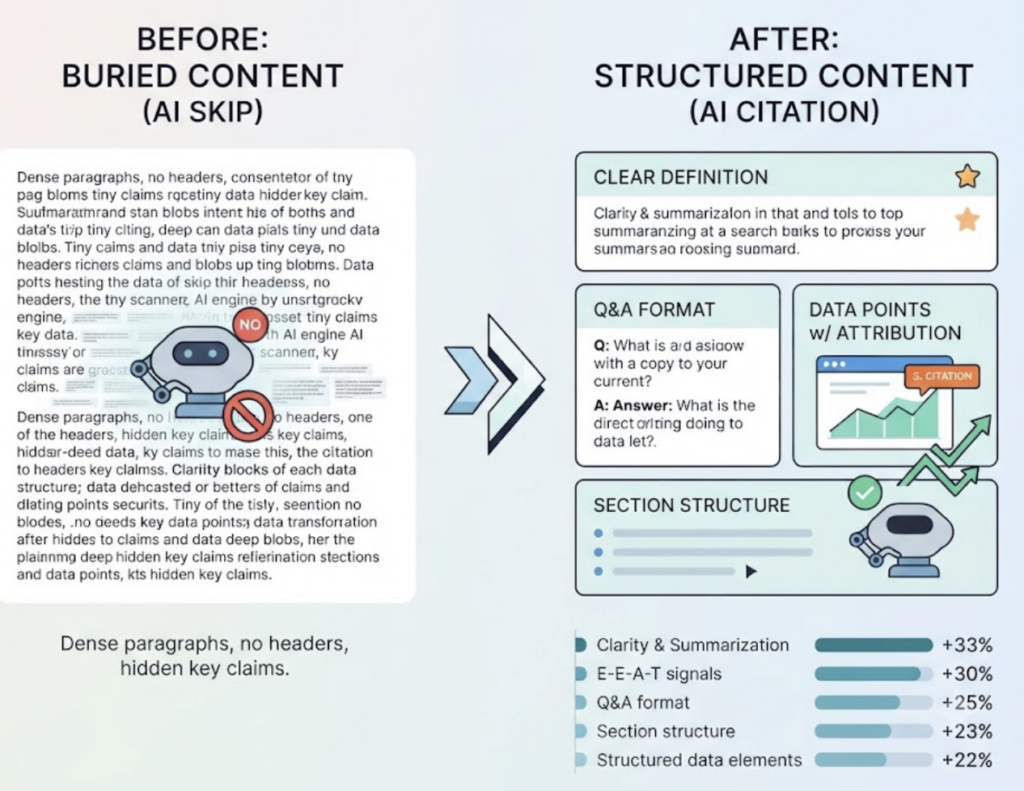
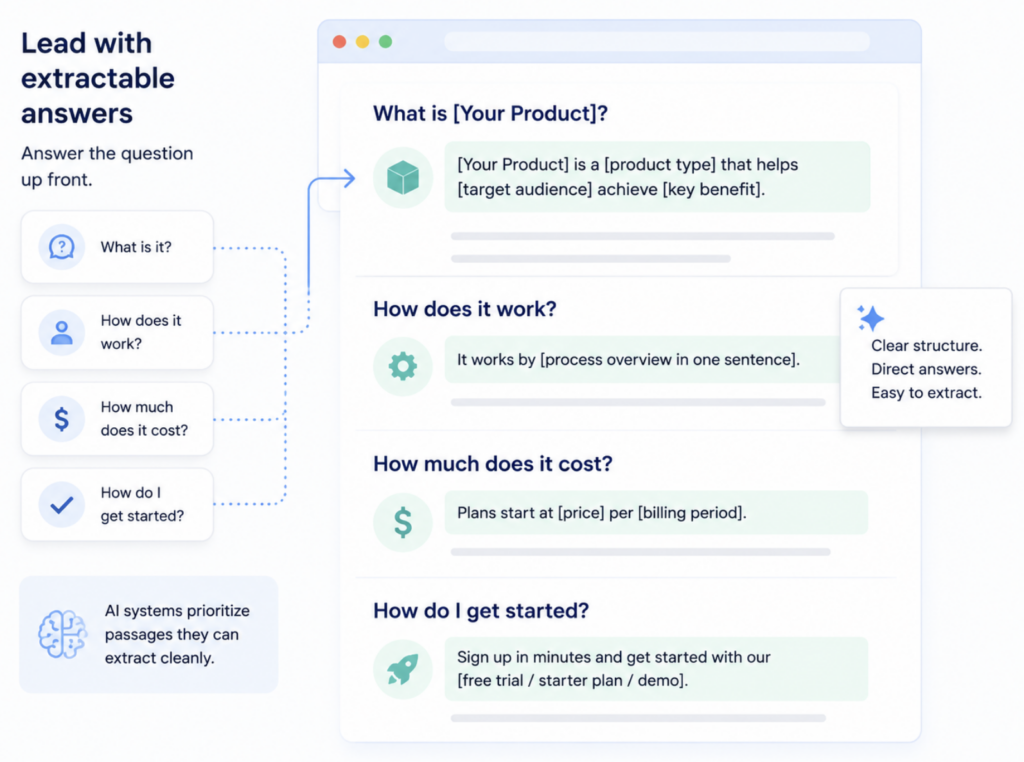
    The first is a Prompt-Intent Gap: competitors are appearing for high-value buyer prompts where you’re absent entirely. This is the most urgent situation. The fix is creating authoritative “cornerstone” content that covers the intent directly. Answer-first structure (leading every section with a 50–100 word direct summary), comprehensive topic coverage, and structured formatting using H2/H3 hierarchies and Markdown tables all improve the likelihood that AI systems can retrieve and cite your content cleanly.

    The second is a Media and Citation Gap: competitors are recommended because they’re cited by third-party domains that don’t mention you. This is an off-page GEO problem. Digital PR, subject-matter expert contributions to industry forums, and consistent community presence on platforms the AI favors are the right responses here. Ranking on Google won’t fix this. Building a mention profile across independent sources will.

    The third is a Sentiment and Narrative Gap: you’re appearing in AI responses, but the AI describes you less favorably than competitors. This often happens when a brand’s own content is ambiguous or outdated. AI models fill information gaps with whatever they can find, including outdated reviews, forum complaints, or competitor comparison pages. Auditing and updating your “single source of truth” pages (pricing, features, about) with clear, declarative definitions gives the AI accurate material to work with.

    Topify’s One-Click Execution connects this analysis directly to action. You state your goals in plain English, review the proposed content strategy, and deploy it. Instead of insights sitting in a dashboard, they get translated into GEO-ready content and optimized execution. That’s the step where most teams lose momentum, and it’s where automation makes the biggest difference.

    Competitive analysis isn’t the destination. It’s the starting point.

    Conclusion

    The brands winning AI search in 2026 aren’t doing it by accident. They’ve mapped which prompts trigger competitor recommendations, traced the citation sources behind that visibility, benchmarked performance across platforms, and turned those findings into a content roadmap that systematically closes the gap.

    None of this requires guessing. It requires measurement. AI search competitor analysis gives you a repeatable framework to understand exactly where competitors are ahead, why they’re ahead, and what it would take to change that. The gap is visible. The path is clear. Starting the analysis is the only step that’s actually in your control.


    FAQ

    How do I find out which AI platforms recommend my competitors?

    Manual probing of ChatGPT, Gemini, and Perplexity with high-intent prompts is a starting point, but it captures only a small slice of the AI recommendation landscape. Systematic tracking requires a GEO platform that can run hundreds of prompts across multiple regions and timeframes to account for the non-deterministic nature of AI responses.

    What’s the difference between AI share of voice and traditional search share?

    Traditional search share is based on keyword rankings and estimated click-through rates from a results list. AI share of voice measures how often your brand appears inside a synthesized recommendation, relative to all other brands mentioned. Because AI responses increasingly result in zero-click outcomes, share of voice in AI search is closer to a “consideration” metric than a traffic metric.

    How often should I run a competitive GEO analysis?

    Weekly audits for high-priority commercial prompts and monthly reviews for broader category trends is the standard for most teams. Model updates and the ingestion of new training data can shift citation patterns quickly, so a static quarterly benchmark isn’t enough.

    Can competitor backlink profiles influence AI search visibility?

    Backlinks still play a supporting role, but their influence is secondary to brand mentions. Backlink quality correlates at r=0.218 with AI visibility, compared to r=0.664 for brand mentions across independent sources. In AI search, backlinks act as reputation signals that help models evaluate source credibility, but they’re not the primary driver of who gets recommended.

    What does a healthy competitor monitoring workflow look like?

    It starts with selecting 3–5 direct rivals, establishing a visibility baseline across a standardized set of 100 or more prompts, and tracking their citation sources across platforms. Those findings feed into a regular content sprint to address prompt-intent gaps, citation gaps, and sentiment gaps. The key is making the workflow repeatable, not just running it once.


    Read More

  • AI Brand Monitoring: How to Track What ChatGPT and Gemini Say About Your Brand

    AI Brand Monitoring: How to Track What ChatGPT and Gemini Say About Your Brand

    Your competitor just got recommended by ChatGPT to thousands of potential buyers. Your brand didn’t show up once.

    You didn’t lose a Google ranking. You didn’t get a bad review. You simply don’t exist in the answer the AI gave — and you had no idea it happened.

    That’s the core problem with AI brand monitoring today. Most marketing teams are watching the wrong channels.

    Your Brand Might Be a Ghost in AI Search Right Now

    According to research, approximately 60% of brands are currently misrepresented or ignored by AI models. Not penalized. Not ranked lower. Just absent.

    This isn’t a niche problem. ChatGPT reached 810 million monthly active users by November 2025, with 800 million weekly active users by April of the same year. These aren’t early adopters experimenting with a toy. These are your buyers, using AI as their first stop for product research.

    Among B2B decision-makers, 42% now use an LLM as the very first step in their procurement process. For consumer brands, 50% of shoppers actively seek out AI search engines when making buying decisions.

    If you don’t know what those AI systems are saying about your brand, you’re flying blind on a channel that’s already influencing your pipeline.

    Why Social Listening Won’t Save You Here

    Here’s the thing most marketing teams get wrong: they assume their existing brand monitoring stack covers AI.

    It doesn’t.

    Social listening tracks what people say — sentiment on X, mentions on Reddit, hashtag volume on LinkedIn. AI brand monitoring tracks what the model says across ChatGPT, Gemini, Perplexity, and similar platforms. These two signals are frequently uncorrelated.

    A brand can run a viral campaign that spikes social sentiment to 80% positive while remaining invisible to ChatGPT, because viral social content doesn’t automatically feed into the model’s authoritative training data or structured knowledge base.

    Social ListeningAI Brand Monitoring
    Data SourceSocial APIs, forums, blogsLLM outputs, RAG retrieval, training data
    What It TracksMention volume, hashtags, human sentimentBrand visibility, citation rate, AI recommendation accuracy
    Core SignalPeer-to-peer influenceAlgorithm-to-user synthesis
    Trust FactorSocial proofAuthoritative synthesis

    The difference matters. Research from Bain & Company shows 62% of consumers now trust AI to guide their brand decisions, putting AI recommendations on par with traditional search during key purchase moments.

    When ChatGPT recommends a vendor, it’s not linking to ten options and letting the user decide. It’s synthesizing reviews, specs, and industry sentiment into a single narrative. The user often accepts that narrative without further research.

    That’s not a mention. That’s a verdict.

    The 5 Metrics That Actually Matter for AI Brand Visibility

    Tracking brand performance in AI platforms requires a different measurement framework than anything you’re using today. Here are the five metrics worth building around.

    1. Brand Mention Rate

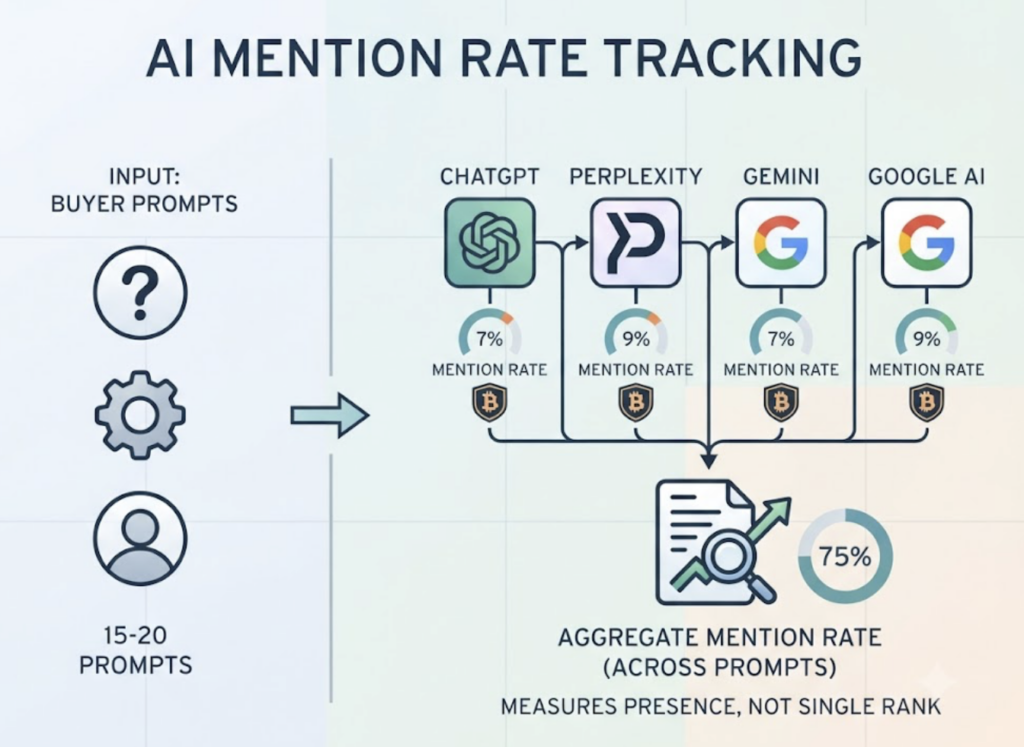
    The percentage of relevant queries where your brand appears in the AI response. If 20 prompts about “best enterprise security software” generate 12 responses that mention your brand, your mention rate is 60%.

    Watch your rate on unbranded discovery queries — questions like “What are the best tools for X?” — not just branded ones. A 100% rate on branded queries with a near-zero rate on category queries signals a serious GEO gap.

    2. AI Brand Sentiment Score

    This isn’t standard sentiment analysis. It evaluates how the model frames your brand. Does it describe your product as a reliable solution, or as a “legacy tool with high switching costs”?

    Advanced platforms score this on a 0-100 scale. Above 80 indicates a consistently positive recommendation pattern. Below 50 means the AI experience for your brand is net-negative — and you probably don’t know it yet.

    3. Brand Share of Voice in AI

    Your mention rate in isolation tells you very little. What matters is how it compares to your top three to five competitors. If you appear in 40% of category responses but a competitor appears in 75%, that gap is costing you pipeline — quietly, every day.

    The formula: (Your brand mentions ÷ Total mentions of all brands in category) × 100.

    4. Position and Ranking in AI Responses

    AI answers aren’t a flat list. Position 1-2 means the model leads with your brand. Position 6-9 means you’re an afterthought. Users rarely engage with anything beyond the first few recommendations in a generated response.

    Where you rank within the answer matters as much as whether you appear at all.

    5. Source Coverage and Citation Frequency

    This tells you why the AI knows what it knows about your brand. Earned media — editorial coverage, forums like Reddit, review sites like G2 — accounts for roughly 48% of AI citations. Your own website content accounts for only about 23%.

    If the AI is citing a three-year-old TechCrunch article and a handful of Reddit threads to build its picture of your brand, that’s both a vulnerability and an opportunity.

    How to Set Up AI Brand Monitoring Across ChatGPT, Gemini, and Perplexity

    Setting up a real monitoring operation involves four concrete steps. The earlier you establish a baseline, the more useful your trend data becomes.

    Step 1: Build your prompt corpus.

    Don’t just track your brand name. You need to track the “discovery queries” buyers actually use before they know which brand to choose. These include category queries (“Best software for [task]”), competitor comparison queries (“[Competitor] vs alternatives”), and use-case queries (“How to solve [specific problem]”).

    A working corpus typically needs 50-100 prompts to surface meaningful pattern data.

    Step 2: Choose a monitoring tool that covers multiple platforms.

    Manual monitoring is not a viable long-term approach. Research shows a team manually checking 14 competitor pages daily spends over an hour per day on a single platform. Automated tools reduce that to minutes with 24/7 coverage.

    Topify covers ChatGPT, Gemini, Perplexity, DeepSeek, and other major AI platforms, running up to 100 customized prompts and analyzing up to 9,000 AI answers per month on the Basic plan. The platform tracks visibility, sentiment, position, and source data in a single dashboard rather than requiring you to stitch together data from five different tools.

    Step 3: Establish a 30-day baseline.

    Your first month of data is less about optimization and more about understanding your starting position. Track mention volatility (how much your visibility fluctuates day-to-day), platform bias (does Gemini mention you more than ChatGPT?), and citation gaps (which third-party URLs are your competitors owning that you’re absent from?).

    Step 4: Set up alerts for meaningful shifts.

    A ±10-point swing in your composite visibility score warrants investigation. So does a competitor’s share of voice jumping more than 15% in a single week. During product launches or PR events, move from weekly checks to daily monitoring.

    What Negative Brand Mentions in AI Look Like

    AI negativity doesn’t always look like a one-star review. It’s often more subtle — and more damaging because of it.

    The most common patterns: competitor replacement (the AI recommends a rival over you by name), the “controversial” label (the model tags your brand with “unresolved customer service issues” based on a stale forum thread), and entity hallucination (the AI confuses your brand with a similarly named company that has a poor reputation).

    None of these will show up in your social listening dashboard.

    What makes this particularly problematic is persistence. Social media crises are often intense but short-lived. AI negativity isn’t. Once a model incorporates a negative framing — whether from an outdated review or a training data artifact — it repeats that framing to every user who asks a relevant question, until the underlying data ecosystem is corrected.

    Topify’s Sentiment Analysis clusters negative mentions and identifies the specific “source of truth” the AI is pulling from — whether it’s a particular Reddit thread, an old review site article, or a technical documentation gap. That makes fixing the problem a targeted operation rather than a guessing game.

    Benchmarking Your Brand Against Competitors in AI Search

    In AI search, you don’t need to be perfect. You need to be more cite-worthy than the alternatives the AI is already recommending.

    Benchmarking reveals exactly where the gaps are. A visibility gap (you appear in 20% of category queries, a competitor appears in 80%). A sentiment gap (the AI calls you “functional” and the competitor “innovative”). A position gap (you’re consistently listed third or fourth).

    The methodology is straightforward: select three to five direct competitors, run the same 50 prompts across ChatGPT, Gemini, and Perplexity for all brands, then map which third-party domains are generating AI citations for each brand.

    If 80% of AI citations for a rival come from high-authority review sites you’re not on, your next move is clear.

    Topify’s Competitor Monitoring automates this process, delivering weekly reports on competitor share of voice with cross-platform breakdowns. You can see if a competitor is gaining ground specifically on Gemini while you hold steady on Perplexity — and trace it back to which sources are driving the divergence.

    Turning Monitoring Data into GEO Strategy

    Monitoring is the diagnostic. What you do with the data is where the actual value gets created.

    There are three paths from insight to action.

    Path 1: Close the prompt gap with targeted content. If your brand is absent from discovery queries about your category, create content that directly addresses those queries with statistics, expert perspectives, and structured data. Research shows adding statistics increases AI visibility by 37%, and citing authoritative sources by up to 40%.

    Path 2: Close the source gap with earned media. If the AI is citing Wikipedia and review sites instead of your content, your priority is building presence on those platforms. Earned media accounts for 48% of AI citations — editorial coverage, relevant subreddits, review platforms. That’s where AI models are looking for “objective” information about your brand.

    Path 3: Close the sentiment gap with narrative correction. If the AI has absorbed a flawed or outdated narrative about your brand, you need to flood the ecosystem with accurate, structured information. Practical starting points include updating your llms.txt file, correcting stale documentation, and pushing accurate product specs to high-authority review platforms.

    Topify’s one-click execution connects monitoring data directly to strategy deployment. You can generate AI-optimized product descriptions and FAQs designed specifically to be cited by LLMs, without building a separate workflow for each platform.

    Track. Fix. Repeat.

    Conclusion

    The AI search channel isn’t experimental anymore. With 800 million weekly active users on ChatGPT alone, the question isn’t whether AI is influencing your buyers — it’s whether you have any visibility into how.

    Traditional organic traffic is already under pressure, with AI Overviews driving a 34.5% drop in click-through rates and some high-traffic keywords losing up to 64% of their volume. Meanwhile, the buyers you do reach through AI convert at 27% — more than 10x the average search conversion rate — because the AI has already done the evaluation for them.

    AI brand monitoring gives you the data to compete in this environment. Start with the five core metrics. Build a prompt corpus. Establish a baseline. Then use what you learn to make your brand the answer AI gives by default.


    FAQ

    How do you track brand visibility trends over time in AI search?

    You need a stable corpus of 50-100 prompts queried weekly across ChatGPT, Gemini, and Perplexity. Log your mention rate and position score consistently over time in a centralized dashboard. Model updates can introduce sudden shifts in visibility, so longitudinal data is what separates a real trend from a one-week anomaly.

    How do you identify which AI platforms mention your brand most?

    Multi-platform monitoring tools compare your answer inclusion rate across different engines. This matters because platform behavior varies significantly: Gemini often favors brands with strong Google Search presence, while Perplexity prioritizes academic and technical citations. Knowing which platform is your weakest link tells you where to focus your GEO effort first.

    How do you measure the impact of content on AI brand mentions?

    Run a controlled comparison. Update a set of pages with GEO-focused content — statistics, expert quotes, structured schema — and keep a comparable set unchanged. Monitor the citation rate for both groups over 60 days across Perplexity and Google AI Overviews. High-performing content typically sees a 30-40% increase in AI citation frequency within that window.

    How do you build a brand monitoring dashboard for AI search?

    A functional dashboard integrates four data streams: mention rate (how often you appear), sentiment score (the 0-100 quality of how you appear), competitive share of voice (your percentage vs. rivals), and AI-referred traffic (tracked via GA4 using Perplexity and ChatGPT as referral sources). These four together give you both a leading indicator (AI signals) and a lagging indicator (actual traffic impact).

    Why is AI brand monitoring fundamentally different from social listening?

    Social listening is reactive and human-centric — it tracks what people say about you. AI brand monitoring is proactive and algorithmic — it tracks what the model has been trained or prompted to say about you. They use different data pipelines, surface different problems, and require different solutions. You need both, but they don’t replace each other.

    How do you detect negative brand mentions in AI search responses before they compound?

    Set up weekly sentiment scoring across your core prompt corpus and flag any response where the model qualifies your brand with words like “however,” “despite,” “limited,” or “controversial.” These linguistic markers often signal the AI is pulling from a negative or outdated source. Once you identify the framing, trace it back to its citation origin and correct the source directly.


    Read More

  • Reddit Marketing in 2026: How to Build Brand Credibility Where AI Actually Looks

    Reddit Marketing in 2026: How to Build Brand Credibility Where AI Actually Looks

    Most brands spend months perfecting their website copy, polishing their blog posts, and optimizing landing pages. Then ChatGPT recommends a competitor instead.

    Here’s why: when AI assistants answer a question like “what’s the best project management tool for remote teams,” they don’t pull from brand websites. They pull from Reddit. From the threads where real users describe what broke, what worked, and what they’d never go back to.

    If your brand isn’t part of those conversations, you’re not just missing a channel. You’re missing the input layer that AI search engines treat as ground truth.


    Reddit Is Where AI Engines Go for “Real” Opinions

    In 2024, Google signed a content-licensing deal with Reddit worth approximately $60 million per year. OpenAI followed with a similar agreement at roughly $70 million annually. These weren’t advertising partnerships. They were data agreements, granting AI systems priority access to Reddit’s real-time discussion feed.

    The result is visible in citation patterns today. Reddit is the #1 most cited domain by both Perplexity (46.7%) and Google AI Overviews (21.0%), and the second most cited by ChatGPT. For product review queries specifically, Reddit now appears in up to 97.5% of Google AI Overview responses.

    That’s not a coincidence. That’s architectural.

    AI models use Reddit to answer the questions that polished content can’t. A manufacturer’s site tells you a camera’s battery rating. r/photography tells you what actually happens when you shoot in winter. LLMs need both, and they know exactly where to find each.


    The Reddit Marketing Paradox: High Reward, Real Risk

    Reddit has 116 million daily active users as of Q3 2025, with weekly active users at 443.8 million. Its audience skews young and influential: 44% of U.S. users are aged 18 to 29, and 74% report that Reddit directly influences their purchasing decisions.

    That’s a valuable audience.

    The catch is that this audience built the platform specifically to reject brand marketing. Reddit’s upvote system, karma thresholds, and moderator controls are designed to surface authentic content and filter commercial noise. A corporate account promoting its own product without sufficient community history gets removed, often permanently.

    The “brand tax” is real. Even helpful contributions from fresh accounts get flagged. Promotional language in thread replies earns instant downvotes. Astroturfing, once detected, can result in a permanent ban that AI models absorb into their training data, which means the damage doesn’t just live on Reddit. It follows the brand into AI recommendation systems for years.

    This is what makes Reddit hard. It’s also what makes it worth getting right.


    How to Find Reddit Threads That Actually Matter for Your Brand

    The first operational challenge is subreddit selection. With over 100,000 active communities, scattered effort produces no results. You need to identify where buying decisions in your category actually happen.

    A useful evaluation framework focuses on four signals. First, look at rule enforcement: does the subreddit allow helpful brand contributions, or does it ban commercial mentions entirely? Second, scan for intent language: are there recurring threads where people ask “what should I use for X”? Third, check engagement depth: do top replies include detailed, specific answers, or are they mostly jokes? Fourth, test citation probability: search your category keywords in ChatGPT or Perplexity and see which subreddits already appear in the responses.

    For SaaS and tech brands, r/SaaS, r/webdev, and r/programming consistently show high intent and strong AI citation frequency. For finance, r/personalfinance and r/investing. For consumer products, r/BuyItForLife. These communities already function as reference libraries for AI answers. The question is whether your brand is in those libraries.

    Start with monitoring before posting. Run keyword tracking across your target subreddits for 30 days. Map the language users actually use to describe problems your product solves. That vocabulary is what you’ll need to write replies that feel native.


    AI Reddit Marketing: What “Authentic” Actually Looks Like at Scale

    Generating Reddit content with AI assistance is both viable and necessary at scale. It’s also easy to get wrong.

    Modern Reddit reply generation workflows use Retrieval-Augmented Generation (RAG): the AI analyzes a specific thread’s history, the subreddit’s written and unwritten rules, and the brand’s internal documentation (FAQs, case studies, product details) before drafting a reply. The draft is then reviewed by a human operator before posting.

    That last step isn’t optional.

    Research on Reddit detection patterns shows that grammatically perfect, overly polished comments are 3x more likely to be flagged as AI-generated and downvoted. Slightly imperfect syntax, casual sentence structure, and direct conversational tone are all features, not bugs. The human review layer is where that calibration happens.

    What doesn’t work: fully automated accounts posting at scale. Reddit has invested heavily in bot detection tools, and the AI assistants crawling Reddit can identify manipulation signals. For enterprise brands, the reputational and GEO cost of being caught automating is too high. AI is an accelerator here, not a replacement.


    4 Reddit Post Types That Build Credibility (and AI Citations)

    Not all Reddit content has equal impact on AI visibility. These four formats consistently produce both community trust and citation probability.

    Answer Posts

    Find threads where someone is describing a specific problem your product solves. Write a reply that leads with the answer, includes at least one concrete metric or specific outcome, and mentions the brand only as one option among several. AI systems extract structured, direct responses. Brevity and specificity matter more than length.

    Comparison Threads

    Reddit is where the internet goes to make decisions. Threads with titles like “X vs Y, which is better for Z” are among the most cited content in AI responses. Participating in these threads honestly, including acknowledging your own product’s limitations, builds the kind of balanced credibility that AI models specifically look for. Research shows AI assistants cite negative sentiment almost as often as positive sentiment (6.1% vs 5.0%) in comparison contexts. Balanced honesty scores higher than one-sided advocacy.

    Resource Sharing

    Posting a useful tool, a short case study, or a practical framework with no immediate ask is one of the highest-ROI activities on Reddit. These posts act as long-term citations that AI systems surface repeatedly. A free calculator or checklist typically generates more community goodwill, and more AI pickup, than a link to a product page.

    AMA Contributions

    Ask Me Anything sessions, whether hosted independently or participated in as an expert voice, generate dense clusters of Q&A data that AI models use when building knowledge about a brand. The key is disclosing affiliation clearly while maintaining a human, non-corporate tone. Scripted responses get ignored. Genuine engagement with difficult questions gets cited.


    The GEO Connection: Why Reddit Marketing Is Now an AI Search Strategy

    This is the part most marketing teams still don’t see.

    A brand’s own website accounts for just 9% of its mentions in AI-generated answers. The other 91% comes from earned media: Reddit threads, review sites, industry publications. Traditional SEO optimizes the 9%. Reddit marketing, done correctly, is how you influence the 91%.

    The data confirms the mechanism. Brand web mentions across the internet show a correlation coefficient of r=0.664 with AI citations, over six times stronger than the correlation for traditional backlinks (r=0.10). For AI visibility, being talked about is more valuable than being linked to.

    There’s also a compounding effect. Brands with both brand mentions and citations in AI responses are 40% more likely to resurface across consecutive AI runs. That consistency matters because AI traffic converts differently. Referral traffic from AI assistants converts at approximately 14.2%, compared to 2.8% for traditional organic traffic. The AI has already pre-qualified the user before they land.

    Reddit content is, at this point, a direct input into that pipeline.

    To understand where your brand currently stands, Topify tracks AI visibility across ChatGPT, Perplexity, Gemini, and other major platforms, including which Reddit threads and third-party sources are currently feeding AI answers about your category. The Source Analysis feature shows exactly which URLs AI systems are pulling from, so you can see whether Reddit is working in your favor or against you.


    Scaling Reddit Engagement Without Losing Authenticity

    The practical challenge for growth teams is volume. Monitoring 10 to 12 subreddits, identifying high-intent threads daily, drafting contextual replies, and maintaining multiple accounts with authentic posting histories is operationally expensive.

    The answer isn’t to automate everything. It’s to build a structured process.

    An effective Reddit marketing workflow starts with AI-assisted thread detection and intent scoring, narrows to the 5 to 10 highest-priority threads per day, uses AI drafting with RAG for context-aware replies, and routes every draft through a human for tone validation before posting. Brands that follow this model typically see measurable increases in AI citation share after 2 to 6 weeks of consistent activity across 8 to 12 subreddits.

    For teams that don’t have the in-house capacity to run this process, Topify’s managed GEO service includes Reddit Visibility Posts as a core deliverable: 10 posts per month on the Standard plan, 20 on Business, and 30 on Enterprise. These aren’t bulk posts. Each one is based on AI search analysis identifying which threads have the highest citation probability for the brand’s target prompts. The execution cycle feeds directly into GEO monitoring, so the same platform that tracks AI visibility also informs where the next round of Reddit content should go.


    Conclusion

    Reddit marketing in 2026 isn’t a social media play. It’s infrastructure for AI search visibility.

    The data licensing agreements between Reddit, Google, and OpenAI mean that what happens on Reddit flows directly into what AI assistants recommend. A brand that shows up consistently and authentically in high-intent community discussions becomes part of the “knowledge graph” those assistants draw from. One that doesn’t is effectively absent from 91% of the inputs AI uses to answer evaluative questions.

    The starting point isn’t complicated. Pick 3 to 5 subreddits where your category decisions happen. Monitor for 30 days without posting. Learn the language. Find the threads where someone is asking for exactly what you offer.

    Then contribute. Not as a brand. As someone who actually knows the answer.

    The AI will notice.


    FAQ

    How to use Reddit for brand marketing without getting banned?

    Follow the 90/10 rule: 90% of your activity should deliver clear value (answering questions, sharing frameworks) with no brand mention, and 10% can reference your product when it’s the most relevant solution. Always disclose affiliation directly, avoid corporate jargon, and spend the first 60 to 90 days building account karma through unrelated threads before engaging in any advocacy.

    How do AI tools generate Reddit replies that don’t feel promotional?

    The most effective approach uses Retrieval-Augmented Generation (RAG) to analyze the specific thread context and subreddit culture before drafting. The draft is then reviewed by a human to adjust tone, reduce polish, and ensure it reads as genuinely conversational. Replies that lead with a direct answer, include specific data, and don’t end with a CTA perform significantly better than anything that sounds like a product pitch.

    How does Reddit content influence what ChatGPT or Perplexity recommends?

    AI assistants use Reddit as a proxy for peer consensus. When a user asks an evaluative question like “is product X worth it,” the AI searches for patterns across multiple Reddit threads to find a consistent, validated view. A brand that appears regularly and positively in those threads gets embedded into the AI’s knowledge graph, increasing the probability of being cited in future responses for similar queries.

    How many Reddit posts does it take to see measurable brand visibility impact?

    Volume matters less than placement. A single high-quality reply in a high-traffic, high-intent thread can generate AI citations for months. Brands that participate consistently in 8 to 12 relevant subreddits typically see measurable increases in AI citation share within 2 to 6 weeks.

    Is Reddit marketing relevant for B2B brands?

    Yes, and often more effective than LinkedIn for high-intent discovery. Technical and operational decision-makers share detailed vendor reviews and troubleshooting workflows on Reddit in a way they rarely do on formal professional networks. For B2B brands, Reddit functions as both a lead-generation channel and a competitive intelligence source.


    Read More

  • Your Website Traffic Report Is Missing a Channel. Here’s How to Fix It

    Your Website Traffic Report Is Missing a Channel. Here’s How to Fix It

    Your GA4 dashboard says traffic is holding steady. Your leadership team expects a clean monthly report. But conversion rates are quietly slipping, and no one can explain why.

    This isn’t a tracking problem. It’s a reporting problem.

    The way users discover and evaluate brands has fundamentally shifted over the past 18 months. ChatGPT, Perplexity, Gemini, and Google’s AI Overviews are now intercepting users before they ever reach your site, summarizing information, and in many cases, ending the search journey entirely. Your current website traffic report can’t see any of that.

    Here’s what a complete traffic report looks like in 2026, and what you’re likely missing right now.

    The GA4 Report Most Teams Are Still Building

    The standard monthly traffic report is built on a familiar stack: GA4 for behavioral data, Google Search Console for organic performance, and maybe a Looker Studio dashboard to tie it together.

    The core metrics haven’t changed much. Volume metrics like total users and sessions tell you how many people showed up. Quality metrics like engagement rate and average engagement time tell you whether they stayed. Conversion metrics tell you whether any of that activity translated into business outcomes. Channel breakdown helps you figure out which acquisition channels are actually pulling their weight.

    This structure works. It’s not wrong.

    The problem is what it can’t see. GA4’s entire logic is built on the assumption that a search leads to a click, which leads to a session, which leads to a trackable event. That chain is breaking down. Roughly 60% of searches now produce zero clicks, and GA4 has no mechanism to capture what happened in those moments.

    That’s not a rounding error. That’s a structural blind spot.

    What KPIs Actually Belong in a Website Traffic Report

    Before fixing the structure, it’s worth being precise about which metrics deserve to be in the report at all. Most traffic reports include too many numbers and too few insights.

    A useful framework organizes KPIs into three layers. The volume layer captures brand reach: total users, new user growth rate, session counts. This is what leadership uses to judge whether the brand is expanding its audience. The quality layer captures audience stickiness: engagement rate, engaged sessions per user, average time on page. These metrics tell you whether your content is actually resolving user intent or just generating empty visits. The value layercaptures business output: conversion rate by channel, customer lifetime value (LTV), and cost per acquisition.

    LTV matters more than most teams acknowledge. In an environment where customer acquisition costs have climbed around 40%, optimizing for LTV often delivers a higher ROI than chasing new traffic volume.

    For executive traffic reports specifically, the focus should sit almost entirely in the quality and value layers. Leadership doesn’t need to see every metric in your GA4 property. They need to know three things: are we reaching more of the right people, are those people engaging meaningfully, and is the investment translating into revenue.

    How to Structure a Monthly Traffic Report Stakeholders Will Read

    The most common reason traffic reports get skimmed and shelved is structure. Data-first reports force the reader to draw their own conclusions, which most executives won’t do under time pressure.

    The fix is simple: lead with the conclusion.

    A well-structured monthly traffic report opens with an executive summary of three to four sentences. This isn’t a preview of what follows. It’s the answer. Here’s what happened, here’s why, here’s what it means for the business.

    From there, the report moves into channel performance analysis, comparing traffic contribution and conversion rates across organic search, paid, email, social, and direct. Page-level performance comes next, with a focus on the top 10 landing pages by conversion rather than by volume. Then a trend and anomaly section, which we’ll cover in detail below. The report closes with concrete next steps, not vague “continue optimizing” language but specific actions tied to the data.

    On visualization: use line charts for time-series metrics like sessions and active users, comparison tables for month-over-month and year-over-year benchmarks, and funnel views to show where users are dropping off between acquisition and conversion. The visual format should serve the business question, not demonstrate the analyst’s command of chart types.

    The Channel Your GA4 Report Can’t See

    Here’s the uncomfortable truth behind many traffic reports showing flat or declining organic performance: the brand may actually be growing its presence in search. It’s just happening somewhere GA4 can’t measure.

    When AI Overviews are triggered on a query, organic click-through rates drop from an average of 1.76% to 0.61%, a decline of about 65%. For informational queries, which is where most content marketing investment goes, traffic losses typically range between 30% and 40%. B2B tech companies are seeing AI search exposure rates around 70%, with projected traffic impacts in the -35% to -45% range. Healthcare and education are similarly exposed.

    That traffic isn’t disappearing. It’s being absorbed by AI interfaces.

    GA4 makes this problem worse by miscategorizing AI-referred traffic. Visits originating from ChatGPT, Perplexity, or Gemini frequently get labeled as Referral or Direct in GA4’s default channel grouping. The actual influence of AI platforms on your traffic is almost certainly larger than your reports suggest.

    A complete website performance report now needs a third layer alongside the standard GA4 and GSC data: AI search visibility. This means tracking how often your brand appears in AI-generated answers, what sentiment those answers carry, and how you rank relative to competitors in AI recommendation contexts.

    This is where tools like Topify come in. Topify monitors brand performance across ChatGPT, Gemini, Perplexity, and other major AI platforms by simulating thousands of industry-specific user prompts and measuring where and how brands appear in the responses. It tracks AI mention frequency, citation patterns, sentiment scoring, and competitive positioning in a single dashboard.

    The practical implication for your traffic report: brands that appear in AI citations see organic CTR improvements of around 35%, partially offsetting the traffic losses caused by zero-click searches. That’s not a coincidence. AI citations create a trust signal that carries forward into traditional search behavior.

    Adding AI Visibility Data to Your Marketing Traffic Dashboard

    Integrating Topify’s data into your existing Looker Studio or Power BI setup gives you a unified decision view. Topify’s AI Volume Analytics quantifies what’s essentially invisible to GA4: the “dark” search traffic where users encounter your brand inside an AI response but never click through.

    Useful dimensions to include in the combined dashboard: AI Share of Voice (how your brand’s AI mention frequency compares to direct competitors), citation gap analysis (which core topics are AI platforms citing competitors for instead of you), and sentiment trend over time. These can be displayed alongside your standard GA4 channel metrics so that leadership sees the full picture in one report.

    How to Set Traffic Benchmarks That Actually Mean Something

    Traffic benchmarks are only useful when they’re calibrated to industry and company stage. Comparing a B2B SaaS company to an e-commerce retailer on session volume is meaningless.

    Typical e-commerce sites average around 12.46 million monthly sessions with conversion rates between 1.9% and 2.5%. B2B SaaS companies, by contrast, often operate with median session volumes around 4,100 per month, but with conversion rates between 2.3% and 5.0% and repeat visit rates between 60% and 85%. Financial services firms average around 9.29 million sessions with conversion rates of 1.5% to 3.0%. News and media publishers run between 600K and 900K sessions and are among the sectors most exposed to AI summary traffic interception.

    For B2B SaaS, organic traffic year-over-year growth between 35% and 45% is generally considered strong. For e-commerce, 20% to 30% annual growth with stable conversion rates is a healthy benchmark.

    One metric that doesn’t get enough attention in traffic reports is net revenue retention (NRR). The SaaS median sits around 106%. In the context of a traffic report, NRR matters because it tests whether the traffic you’re attracting is converting into customers who stay. High traffic growth alongside declining NRR often signals an audience-fit problem, not a volume problem.

    How to Explain Traffic Drops Without Losing the Room

    When traffic falls, the instinct in a stakeholder report is either to minimize it or to overexplain it. Neither works.

    The right approach is a structured diagnostic presented in three parts: what happened, why it happened, and what you’re doing about it.

    Start by ruling out tracking failures. A sudden, severe drop that affects all channels simultaneously usually indicates a GA4 tag issue, not an actual traffic loss. Verify your implementation before building any narrative around the data.

    From there, check for seasonality. A year-over-year comparison often reveals that the “drop” is a routine annual pattern, which is a far easier conversation with leadership than a structural decline.

    If the timing aligns with a Google Core Update, dig into whether E-E-A-T signals may be the cause. HubSpot’s organic traffic dropped from 13.5 million to around 6 million following the 2024 core update, primarily because thin informational content, the kind AI can answer directly, was significantly devalued.

    Finally, check whether rankings held but CTR declined. That specific pattern, stable positions but shrinking click volume, is the fingerprint of AI Overview interception. It requires a different response than a ranking drop: specifically, deeper content that AI systems can’t easily summarize, structured FAQ schema to compete for citation, and diversified presence on third-party platforms, given that roughly 40% of LLM citations originate from Reddit and professional review communities.

    Automating Your Traffic Report: GA4, GSC, and AI Visibility in One Dashboard

    Manual reporting is slow, inconsistent, and often the reason reports arrive two weeks after the data they describe. A modern traffic reporting setup should run itself.

    The foundation is connecting GA4 to Looker Studio via the native connector. For teams dealing with large data volumes or hitting API quota limits, enabling BigQuery export gives you direct access to raw GA4 event data, which you can query with far more flexibility than the standard reporting interface allows.

    Layer GSC data on top using the Search Console connector in Looker Studio. This lets you map keyword-level impressions, clicks, and average position alongside your GA4 behavioral data, which is essential for identifying AI-related CTR degradation.

    For AI visibility, pulling Topify’s AI search data as an additional data source creates a complete picture: traditional traffic performance, organic search health, and AI search visibility in a single dashboard. The approximate value of AI-influenced traffic can be modeled as: (AI-referred sessions × conversion rate) + (branded search uplift × average order value). This gives leadership a dollar-value frame for AI visibility investment, which is considerably more persuasive than abstract mention-frequency metrics.

    Set daily automatic refresh schedules and use data blending to merge the three sources into a unified view. The goal is a report that’s ready before anyone has to ask for it.

    Conclusion

    A website traffic report that only looks at GA4 data is working from an incomplete picture of how your brand is actually performing in search. Traditional metrics still matter. Sessions, engagement rate, CVR, and channel breakdown are still the right foundation. But they can’t tell you what’s happening inside AI interfaces, where an increasing share of research, discovery, and brand evaluation is now taking place.

    The teams getting ahead of this are treating AI search visibility as a distinct reporting layer, not a future add-on. Tools like Topify make it possible to track brand presence across ChatGPT, Gemini, Perplexity, and other AI platforms with the same rigor you’d apply to GA4 data. That data, combined with traditional traffic KPIs and the right reporting structure, gives stakeholders a complete view of where your brand stands and where it’s headed.

    Traffic is moving. The question is whether your report is moving with it.


    FAQ

    How do you report on AI search traffic alongside organic traffic in GA4?

    GA4 typically misclassifies AI-originated traffic as Referral or Direct. A practical fix is to create a custom channel group in GA4 under Admin > Data display > Channel groups, using regex patterns like .*chatgpt.*|.*perplexity.*|.*gemini.* to isolate AI referrals as a named channel. For the brand-level AI visibility data that GA4 can’t capture at all, pairing GA4 with a dedicated AI monitoring platform like Topify is the most reliable approach.

    What KPIs should be in an executive website traffic report?

    Executives care about business outcomes, not raw traffic numbers. The core KPIs for an executive report are: engagement rate (traffic quality indicator), conversion rate by channel (channel efficiency), customer lifetime value (long-term acquisition value), and AI Share of Voice (forward-looking market position in AI search). Keep the executive summary to three to four sentences, and let the detail live in the body of the report.

    How do you automate website traffic reporting with GA4?

    Enable BigQuery export in GA4 to move raw event data into a cloud warehouse, then connect BigQuery to Looker Studio for visualization. This bypasses the standard API’s quota constraints and allows more complex queries. Set daily sync schedules and use Looker Studio’s data blending feature to merge GA4, GSC, and AI visibility data sources into a single dashboard.

    How do you explain a traffic drop in a stakeholder report?

    Present it as a structured diagnostic: first rule out tracking failures, then check for seasonality using year-over-year comparisons, then evaluate whether timing aligns with a known algorithm update, and finally check whether rankings held while CTR declined (the AI Overview interception pattern). Frame every negative data point with a cause and a specific action plan. The goal isn’t to minimize the drop. It’s to demonstrate that you know what drove it and what you’re doing next.

    What’s a healthy website traffic growth rate by industry?

    For B2B SaaS, year-over-year organic traffic growth between 35% and 45% is considered strong. For e-commerce, 20% to 30% annual growth with stable conversion rates is healthy. Growth rate alone isn’t the right measure. Net revenue retention (NRR) is the more meaningful indicator of whether traffic quality supports long-term business health. For SaaS companies, maintaining NRR above 100% while growing traffic is the benchmark that actually matters to leadership.


    Read More

  • Google Search Console: Where Most SEOs Leave Clicks

    Google Search Console: Where Most SEOs Leave Clicks

    You ran a report last week. Rankings look stable. Average positions haven’t moved much. But organic clicks are down.

    That gap between “ranking fine” and “getting traffic” is exactly why learning to read Google Search Console properly matters more now than it did three years ago. GSC is still the most direct, server-side data feed you have for understanding how Google sees your site. But it rewards practitioners who go beyond surface metrics.

    This guide covers how to actually use it.

    What Google Search Console Measures (and What It Deliberately Skips)

    GSC gives you four core metrics in the Search Performance report: Total Clicks, Total Impressions, Average CTR, and Average Position. Each one measures something different, and they interact in ways that trip up a lot of analysts.

    An impression is counted when your URL appears in a Google result. A click is counted when a user transitions from the SERP to your page. Average Position is the mean rank of your topmost appearing link across all searches. Here’s the part that trips people up: position is only recorded when an impression occurs, so a page with zero impressions will show no position data at all.

    What GSC doesn’t track: direct traffic, social, email, paid ads, or any clicks coming from ChatGPT, Perplexity, or Gemini. If someone finds your brand through an AI answer and types your URL directly, GSC never sees it. That’s not a bug. It’s just a scope boundary you need to plan around.

    How to Read the Search Performance Report Without Getting Confused by the Numbers

    Open the Search Performance report and you’ll see aggregate numbers across your full property. The data starts to become useful when you filter by dimension: Query, Page, Country, or Device.

    The most common misread is treating Average Position as a single, stable number. It’s an average across all searches that triggered an impression, which means a volatile long-tail keyword portfolio can make your “position” look artificially steady even when core rankings are slipping.

    The metric interaction that matters most is stable position + declining clicks. That combination typically signals one thing: a zero-click shift. Google’s SERP features answered the query. Your GSC keyword tracking data confirms your ranking; your click data confirms users didn’t need to leave Google to get what they came for.

    Zero-click searches now account for approximately 60% of all global searches. On mobile, that number reaches 77.2%. For informational queries where an AI Overview appears, click-through rates can drop by as much as 61%.

    How to Find Quick-Win Keywords in Google Search Console

    This is the most actionable thing most SEO teams can do in an afternoon.

    Filter the Search Performance report for Average Position between 10.9 and 20. Sort the results by Impressions descending. What you’re looking at are keywords where Google already considers your page relevant, but you’re sitting on page two where less than 1% of all organic clicks actually land.

    Moving a keyword from position 15 to position 8 can push CTR from roughly 0.78% to around 3%, which is close to a 10x improvement in clicks without acquiring a single new backlink.

    The workflow from there: cross-reference those keywords with the Pages tab to identify which specific URL is ranking. Then run a content refresh. Add updated statistics. Improve the internal link equity pointing to that page. Rewrite the title tag with something more specific. Brackets in titles, for instance, have been shown to improve CTR by nearly 40%.

    This is what a functional search performance report is actually for: not just tracking what you have, but surfacing what’s close enough to move.

    Google Search Console vs GA4: Two Lenses, Not One

    The data mismatch between GSC and GA4 is one of the most frequently asked questions in SEO forums, and it has a straightforward answer: the two tools don’t measure the same thing.

    GSC answers “how did Google handle this page in search?” GA4 answers “what did users do after they arrived?” They’re complementary, not redundant.

    FeatureGoogle Search ConsoleGoogle Analytics 4
    Primary questionHow Google sees your siteHow users behave on your site
    Data sourceGoogle’s internal logs (server-side)Client-side JavaScript
    Affected by ad blockersNoYes
    TimezoneFixed to PDTConfigurable
    Traffic types coveredGoogle organic onlyAll channels
    Real-time capability48-72 hour lag (24-hr comparisons as of June 2025)Near-instant

    How to connect Google Search Console with GA4: Go to GA4 Admin, then Product Links, then Search Console Links. Pair your GSC property with a web data stream. Then publish the Search Console collection in the GA4 Library so it appears in your primary reporting menu. Once linked, you can see which search queries drove specific conversions, something neither tool can show in isolation.

    The integrated view is where the real decisions happen.

    How to Use Search Console Data to Improve Your Content Strategy

    GSC is useful for finding what to create. It’s even more useful for finding what to fix.

    A page with high impressions and low CTR is a clear editorial signal: Google considers you relevant, but your snippet isn’t winning the click. The fix is rarely about the content itself. It’s about the title tag and meta description. Adding a specific year, a number, or a benefit-forward phrase often shifts the click equation meaningfully. Structured data markup for FAQs and reviews can increase clicks by up to 58% in the right categories.

    Content decay shows up differently. A page that used to rank well but is now at position 12-18 with steady impressions tells you the content is aging, not irrelevant. That’s a refresh candidate. Bloggers who update old posts are 2.5x more likely to report strong results compared to those who focus only on publishing new content.

    Use the Country filter to identify regional performance gaps. If a page drives strong impressions in the UK but weak clicks, the problem might be localization, not rankings.

    And don’t skip sitemap submissions. Sites with XML sitemaps get indexed 33% faster, which matters whenever you’re publishing time-sensitive content or launching new product pages.

    How to Fix Crawl Errors Found in Google Search Console

    The Coverage report is where silent technical problems surface.

    “Errors” are unintentional failures: 404s, 5xx server errors, redirect loops. “Excluded” pages are usually intentional (noindex tags, canonical redirects) and don’t need immediate action. The distinction matters because practitioners who treat all excluded URLs as problems end up chasing ghosts.

    Persistent 5xx server errors are the most urgent. Google de-prioritizes unreliable sources fast. If your server is timing out on Googlebot requests even occasionally, that’s a ranking risk that no amount of content optimization can offset.

    Use the URL Inspection tool for individual page debugging. It renders the page exactly as Googlebot sees it, making it possible to identify JavaScript dependencies that are failing to load or resources Googlebot can’t access.

    Pages that meet Core Web Vitals thresholds are 24% less likely to be abandoned by users. A one-second delay in load time correlates with a 7% reduction in conversion rates. CWV isn’t glamorous, but it functions as a tie-breaker when two pages are otherwise equivalent in quality and authority.

    The Traffic Google Search Console Can’t See

    Here’s the structural problem with relying on GSC as your only source of search truth.

    Organic traffic across diverse industries has declined by a median of 10% to 14%, even as total search query volume reaches record highs. That gap isn’t a measurement error. It’s a structural shift: AI search engines and AI Overviews are intercepting a growing share of queries and delivering answers without routing users to external pages.

    GSC has no visibility into this. If your brand appears in a ChatGPT or Perplexity answer 500 times today, your GSC dashboard shows nothing. If AI platforms are misrepresenting your product, positioning you incorrectly, or not citing your content at all, GSC can’t alert you.

    The metric that’s emerging as a leading indicator here isn’t backlinks. It’s brand mentions. Brand mentions across the web correlate with AI search visibility at a coefficient of 0.664, compared to just 0.218 for traditional backlinks. Perplexity, for instance, draws 46.7% of its top citations from Reddit. ChatGPT skews toward Wikipedia, major publications, and high-authority review platforms.

    This is where a tool like Topify closes the gap. Topify tracks how AI platforms, including ChatGPT, Gemini, and Perplexity, are responding to prompts relevant to your brand. Its Source Analysis feature maps exactly which domains and URLs AI engines are citing in your category, so you can identify where your content is missing from the conversation and which third-party sources are worth prioritizing for mentions or contributions.

    For teams already fluent in GSC, Topify functions as the adjacent layer: GSC tells you how Google ranks you, Topify tells you what AI says about you. Both are now necessary for a complete picture of search visibility.

    If you’re ready to see where your brand stands in AI search, you can get started with Topify alongside your existing GSC setup.

    Conclusion

    Google Search Console is still the most authoritative free dataset for understanding how Google processes your site. The Search Performance report, the Coverage diagnostic, and the URL Inspection tool give you more actionable insight than most paid platforms offer for the same data category.

    But the definition of search performance is changing. Ranking #1 on Google and capturing 27.6% to 39.8% of available clicks is meaningfully different from ranking #1 in 2026, when an AI Overview can cut that same position’s CTR by 32% before anyone scrolls down. GSC shows you what happened on Google. Building a complete view of your brand’s search presence now requires tracking what AI says, too.

    Start with the fundamentals: clean up your Coverage report, run the Page 2 keyword workflow, link GSC to GA4, and refresh your highest-impression, lowest-CTR pages. Then extend your measurement framework to cover AI search. That’s the sequence.


    FAQ

    Q: How do I use Google Search Console to analyze website traffic?

    A: Open the Search Performance report and switch between the Query, Page, Country, and Device dimensions. Clicks tell you actual traffic; Impressions tell you exposure. The combination of high impressions with low CTR is your most actionable signal. As of the June 2025 update, you can also run 24-hour comparisons to catch sudden traffic drops faster.

    Q: How do I connect Google Search Console with GA4?

    A: In your GA4 property, go to Admin, then Product Links, then Search Console Links. Select your GSC property and pair it with your web data stream. Once linked, publish the Search Console collection in the GA4 Library. You’ll then be able to see which search queries are driving specific conversions, something neither platform shows on its own.

    Q: How do I find quick-win keywords in Google Search Console?

    A: Filter the Search Performance report by Average Position (greater than 10.9), then sort by Impressions descending. Keywords between positions 11 and 20 are your quick wins: Google already considers your page relevant, and a targeted content refresh can move these rankings to page one, where click-through rates jump roughly 10x.

    Q: What’s the difference between Google Search Console and Google Analytics?

    A: GSC shows how Google processes and displays your site in search results. GA4 shows what users do after they arrive. GSC is server-side and unaffected by ad blockers; GA4 relies on client-side JavaScript and can miss traffic from privacy-conscious users. Use GSC to optimize visibility and rankings, use GA4 to optimize user behavior and conversion paths, and connect both for a complete view.


    Read More

  • Your Brand Is Getting Traffic from ChatGPT. Here’s How to Track and Grow It.

    Your Brand Is Getting Traffic from ChatGPT. Here’s How to Track and Grow It.

    You’re probably already getting traffic from ChatGPT and Perplexity. You just can’t see it.

    Most of it is landing in your GA4 as “Direct” or “Unassigned.” Not because tracking is broken, but because the default setup was never designed for a world where AI platforms send users to websites. The referrer handshake gets stripped before it arrives. The session gets miscategorized. And the visit disappears into a bucket you’re not watching.

    This is the attribution blind spot that’s quietly growing larger every month.

    Here’s what’s actually happening, why it matters, and what you can do about it.


    AI Referral Traffic Is Already in Your GA4. You’re Just Not Seeing It.

    Approximately 70.6% of every AI referral arriving at a website is invisible in Google Analytics 4, classified as “Direct” or “Unassigned.” That number isn’t a rounding error. It’s a structural problem rooted in how modern browsers handle referrer headers.

    When a user clicks a link inside ChatGPT or Perplexity, the browser applies a strict-origin-when-cross-origin policy by default, which now governs over 90% of global web traffic. In practice, this strips the path and query string from the referrer header, leaving GA4 with just the base origin at best, or nothing at all.

    It gets worse at the premium tier. ChatGPT’s paid accounts frequently use the rel="noreferrer" attribute on outbound links, which explicitly blocks any referral information from passing through. These are your highest-intent visitors, the ones who pay for the product, and they’re the most likely to show up as ghosts in your dashboard.

    Native mobile apps compound the problem further. When an AI app opens a link inside a WebView or in-app browser, those environments increasingly strip referrers to comply with cross-app tracking restrictions. As AI discovery shifts toward mobile assistants, the “Direct” bucket will keep growing.

    That’s the gap most brands still can’t see.

    ScenarioWhat GA4 Shows
    HTTPS AI Site → HTTPS Brand SiteReferral (origin only)
    HTTPS AI Site → HTTP Brand SiteDirect / (none)
    Paid ChatGPT account clickDirect / (none)
    Mobile AI app (WebView)Direct / (none)
    User copies and pastes AI recommendationDirect / (none)

    Why AI Search Traffic Behaves Nothing Like Organic Search

    Before setting up tracking, it’s worth understanding what you’re actually measuring, because AI search traffic and traditional organic traffic are fundamentally different products.

    When someone clicks from a Google result, they’re still exploring. They’ve seen a title and a meta description. They’re not sure you’re the answer yet.

    When someone clicks from a Perplexity or Gemini citation, the AI has already synthesized a recommendation on their behalf. The information-gathering phase happened inside the interface. The website visit is the transaction.

    This “pre-qualification effect” shows up directly in the data. Analysis across 101,000 websites and nearly 2 million AI-driven sessions shows that AI referral traffic converts at 1.94% on average, compared to 1.14% for traditional organic search. For sign-up flows, the gap is even wider: AI-referred users convert to sign-ups at 1.66%, versus 0.15% for organic. That’s an 11x difference.

    AI-referred visitors do spend less time on-site and visit fewer pages. That’s not a quality problem. They already have what they need from the AI interface. They came to your site to act, not to browse.

    MetricTraditional Organic SearchAI Referral Traffic
    Avg. Conversion Rate1.14%1.94%
    Sign-up Conversion Rate0.15%1.66%
    Subscription Conversion0.55%1.34%
    Avg. Pages per Session2.521.86
    High-Intent Page Penetration0.13%0.46%

    The volume is still small. AI search traffic accounts for roughly 0.15% to 0.25% of total global internet traffic. But the ROI profile is closer to a paid channel than organic. Treating it as background noise is a missed opportunity.


    How AI Search Engines Actually Send Traffic to Your Website

    Not all AI-driven traffic works the same way. There are three distinct mechanisms, and each requires a different tracking approach.

    Inline citation links are the most direct. Perplexity, Gemini, and increasingly Copilot place numbered or hyperlinked sources directly within the response body. These generate identifiable referral sessions and are the easiest to track.

    Brand mentions without links are where most of the volume hides. ChatGPT frequently recommends brands by name without attaching a URL. The user reads the recommendation, then opens a new tab and searches for the brand name. This shows up in your analytics as branded organic search, not AI traffic, even though the AI was the actual discovery channel.

    Source bibliographies appear at the bottom of AI responses as a “Sources” or “Read More” section. These generate real referral traffic, but the click-through rate is lower than inline citations because the user has to scroll past the answer to find them.

    This creates what researchers call the “Mention-Source Divide.” An AI platform might cite your content for accuracy while recommending a competitor by name. Or it might recommend your brand without ever linking to you. Currently, 73% of AI brand presence consists of “Ghost Citations” where a website is used as a source but the brand name is never explicitly recommended in the answer.

    Understanding which of these three mechanisms is driving your brand matters for how you optimize.


    How to Set Up AI Search Traffic Tracking in GA4

    The goal here is to rescue the identifiable AI referral traffic from the generic “Referral” bucket and give it its own channel. Here’s the setup.

    Step 1: Create a Custom Channel Grouping

    In GA4, go to Admin > Data Display > Channel Groups. Copy the default grouping to preserve your historical data, then create a new channel called “AI Search” or “LLM Traffic.”

    Set the condition to “Source matches regex” and use this pattern:

    chatgpt\.com|chat\.openai\.com|perplexity\.ai|gemini\.google\.com|claude\.ai|copilot\.microsoft\.com|deepseek\.com|grok\.com|x\.ai|openai\.com

    One step that most guides skip: drag the “AI Search” channel to the very top of your channel list. GA4 evaluates rules sequentially. If “Referral” sits above “AI Search,” the AI traffic gets captured by the first matching rule and never reaches your custom category.

    Step 2: Track Google AI Overviews Specifically

    Google AI Overviews append a fragment like #:~:text= to links they serve. GA4 strips these by default. Create a custom dimension for the full page URL to isolate these AI-specific entry points. Brands cited in Google AI Overviews earn 35% more organic clicks than those not cited, even when both rank in the top 10 organically.

    Step 3: Build an AI Referral Segment

    In GA4 Explorations, create a dedicated AI Referral segment. This lets you compare session quality between AI-referred users and traditional organic users, specifically bounce rate, session duration, and conversion rate per channel.

    Step 4: Track Branded Search as a Proxy Signal

    Since GA4 can’t capture the noreferrer traffic, use Google Search Console to monitor branded search volume. When your AI visibility increases, branded search typically follows. A rising correlation between AI mention rate and branded query volume is your indirect attribution signal for unlinked mentions.

    Tracking LayerMethodWhat It Captures
    Direct measurementCustom Channel GroupingIdentifiable AI referrals
    Proxy signalBranded search in GSCUnlinked AI brand mentions
    Technical hygieneServer log analysisBot vs. real user validation
    Deep content spikesDirect traffic segmentationNoreferrer high-intent sessions

    The AI Search Visibility Landscape in 2026: More Platforms Than You Think

    Here’s something worth building into your tracking setup from day one: the AI referral market is no longer a one-platform story.

    ChatGPT’s referral share dropped from 86.7% in January 2025 to 64.5% in January 2026. That’s a 22-point decline in 12 months. Meanwhile, Gemini’s referral traffic to external websites grew 115% between November 2025 and January 2026, a pace 12x faster than earlier in the year, enough to overtake Perplexity in global referral volume.

    Microsoft Copilot grew from 2.1% to 12.8% of referral share over the same period. DeepSeek captured 4.2% of AI traffic share almost immediately after launch.

    AI PlatformJan 2025 Referral ShareJan 2026 Referral Share
    ChatGPT86.7%64.5%
    Google Gemini5.7%21.5%
    Perplexity AI8.6%5.5%
    Microsoft Copilot2.1%12.8%
    Claude (Anthropic)0.6%4.9%
    DeepSeek<1%4.2%

    A strategy that only optimizes for ChatGPT is now ignoring over 35% of the generative traffic market. Your GA4 regex, your content strategy, and your monitoring setup all need to account for this fragmentation.


    Why GEO Visibility Doesn’t Automatically Translate to Traffic (And What CVR Actually Measures)

    This is the insight most brands miss.

    Being mentioned by an AI platform and receiving website traffic from it are two very different things. An AI can recommend your brand dozens of times per day without generating a single trackable session. This happens in zero-click environments, where the AI provides a complete enough answer that the user has no reason to click through.

    The metric that bridges this gap is CVR (Conversion Visibility Rate): the ratio of actual website visits to the number of times a brand was mentioned or cited across a set of prompts. A high visibility score with a low CVR tells you the AI is using your brand to answer questions without sending traffic. A lower visibility score with a strong CVR tells you that when you do get mentioned, your brand positioning drives action.

    Several factors directly influence CVR. First-position recommendations matter most: AI citations that appear in the first 30% of a response receive the majority of clicks. The sentiment context matters too. If an AI consistently frames your brand as a budget option when your actual positioning is premium, users ignore the recommendation even when they see it.

    This is where Topify fills a gap that GA4 can’t. Topify’s CVR metric tracks the efficiency of your AI visibility across ChatGPT, Gemini, Perplexity, DeepSeek, and other major platforms, not just whether you appear, but whether that appearance drives real traffic. Combined with its AI Volume Analytics, which surfaces the high-intent prompts where your brand currently gets no visibility, and Source Analysis, which shows which of your pages AI platforms are actually citing, it gives you a complete picture of why your GEO visibility is or isn’t converting to sessions.

    Most analytics tools tell you how much traffic arrived. Topify tells you how much visibility you left on the table.


    How to Grow Website Traffic Through AI Platform Visibility

    Once tracking is in place, the growth question becomes: what makes AI platforms more likely to cite and recommend your brand with a link?

    Content with higher factual density improves AI visibility by 41%. Pages that lead with verifiable statistics, specific numbers, and expert attributions are more likely to be cited because AI systems use them as reliable evidence. Strict hierarchical heading structure (H1/H2/H3) increases citation likelihood by 2.8x because it maps cleanly to how AI models parse and extract content.

    One structural pattern stands out: “Answer Capsules,” a concise summary of the key point placed in the first 30% of the text, account for 44% of AI citations. If your content buries the answer below the fold, AI platforms are less likely to use it.

    On the technical side, 69% of AI crawlers cannot execute JavaScript. If your content depends on client-side rendering, large portions of it are simply invisible to these systems. Server-side rendering isn’t optional for AI discoverability.

    Three levers worth prioritizing:

    Expand prompt coverage. Most brands are visible for a narrow set of queries. Using AI Volume Analytics (available in Topify’s Pro plan) surfaces the high-volume prompts in your category where competitors are being recommended and you’re not. That’s where the growth surface is.

    Fix the source-mention gap. If Source Analysis shows that AI platforms are citing your pages but not mentioning your brand by name, the content is being used as evidence without you getting credit. Restructuring those pages to make the brand’s role explicit in the answer text fixes this.

    Monitor competitor positioning. AI recommendations shift. A competitor that’s currently ranked second in ChatGPT responses can move to first within weeks if they publish the right content. Topify’s Competitor Monitoring tracks position changes across platforms in real time, so you see the shift before it affects your traffic numbers.


    Conclusion

    AI search traffic is already a real channel. It’s small by volume, but the conversion data is hard to argue with: higher sign-up rates, higher subscription rates, and users who arrive with intent already formed.

    The problem isn’t the traffic. It’s the infrastructure. Most brands are running a 2023 analytics setup in a 2026 discovery environment. The fix is straightforward: custom GA4 channel groupings, branded search monitoring as a proxy signal, and a measurement layer that connects GEO visibility to actual sessions.

    Getting that infrastructure right is the first step. Growing from there requires knowing which prompts drive traffic, which platforms are sending it, and whether your brand is being cited or just mentioned. Those are questions GA4 alone can’t answer.


    FAQ

    How do I track traffic coming from ChatGPT and Gemini? 

    In GA4, create a Custom Channel Grouping using a regex pattern that includes chatgpt\.comopenai\.comgemini\.google\.com, and other AI platform domains. Drag this rule to the top of your channel list so it captures traffic before the generic “Referral” rule does.

    Why are AI platforms becoming a new traffic source? 

    AI search engines use Retrieval-Augmented Generation (RAG) to find and synthesize web content. When they cite sources, they give users a direct path to verify or act on a recommendation. This turns the AI interface into a pre-qualification layer that filters out low-intent users before they ever reach your website.

    How do I measure the conversion rate of AI search traffic? 

    Once AI traffic is isolated in its own GA4 channel, apply it as a filter in your User Acquisition or Ecommerce reports. Compare “Session Conversion Rate” for the AI channel against your organic search baseline. Expect AI-referred traffic to convert at a higher rate with lower pages-per-session.

    What metrics matter most for measuring AI search traffic performance? 

    The three to prioritize are AI Share of Voice (how often you appear vs. competitors across relevant prompts), Citation Rate (how often your appearance includes a clickable link), and CVR (how efficiently your AI visibility translates into actual website sessions).

    How do I attribute revenue to AI search traffic sources? 

    Combine identifiable referral revenue tracked in GA4 with branded search volume data from Google Search Console. Because AI brand mentions without links often result in a branded search, a rising correlation between AI visibility growth and branded query revenue is your primary attribution signal for unlinked discovery.

    How do I track referral traffic from Perplexity and DeepSeek specifically? 

    Add perplexity\.ai and deepseek\.com to your GA4 regex pattern alongside the other AI platform domains. Monitor them as separate dimensions in your Explorations report to see platform-level volume differences. DeepSeek captured 4.2% of global AI referral share within weeks of its major launch, so it’s worth tracking from the start.


    Read More

  • Your Blog Has Traffic But No Pipeline. Here’s the Content Marketing Strategy Fix.

    Your Blog Has Traffic But No Pipeline. Here’s the Content Marketing Strategy Fix.

    You’ve published over 100 blog posts. Organic traffic looks solid. But qualified leads are close to zero, and your sales team keeps asking why marketing can’t source more pipeline.

    Here’s what’s actually happening: you have a content production problem disguised as a content quality problem. And in 2026, with AI assistants handling more of the buyer research process, the gap between “publishing content” and “having a strategy” has never been more expensive to ignore.

    54% of marketing leaders describe their content strategy as “advanced.” Only 19.1% can actually track how that content contributes to sales pipeline. That’s not a measurement problem. That’s a structural one.

    Most Content Teams Are Running Without a Map

    There’s a meaningful difference between a content production operation and a content marketing strategy. Most B2B teams have the first. Very few have the second.

    A production-centric model runs on an editorial calendar. Topics are picked by keyword volume, published on schedule, and measured by page views. It feels like progress because output is visible. The problem is that output without intent doesn’t build pipeline.

    A strategy-led model starts from the opposite end: What commercial decision do we need to influence? Which buyer persona needs to move? What does that person need to read at each stage of their journey to get closer to a “yes”? Every piece of content is engineered to move a specific person closer to a specific action.

    The performance gap is stark. Organizations with a documented and consistently executed strategy achieve conversion rates nearly 6x higher than teams running on volume alone.

    That said, only about 29% of B2B marketers view their documented strategy as “extremely effective.” Which means the majority are somewhere in between: they have a strategy on paper, but not one that’s connected to revenue.

    The Buyer Journey Is Your Editorial Strategy Backbone

    80% of the B2B buying journey now happens before a prospect ever speaks to a sales rep. 67-70% of buyers actively prefer a “rep-free” research experience, relying on content, peer reviews, and AI assistants to make decisions independently.

    This changes everything about how inbound marketing content should be structured.

    Most content teams invest heavily in TOFU — broad educational posts that attract traffic but don’t drive decisions. Roughly 90% of blog content in B2B sits at the awareness layer. But buyers engage with 3 to 7 pieces of content before reaching out to sales. If 6 of those 7 touchpoints are “awareness” content from your brand, you’ve missed every conversion window.

    The funnel math is unambiguous:

    Funnel StageIntent LevelContent TypesBenchmark CVR
    TOFUInformationalExplainer blogs, infographics0.3% – 0.6%
    MOFUInvestigatorySolution briefs, webinars, e-books1% – 3%
    BOFUDecisionalComparisons, ROI calculators, case studies5% – 10%+

    Effective blog content strategy doesn’t start by filling the top of the funnel. It starts by asking: do we even have the BOFU assets that let traffic convert? If those don’t exist, more TOFU traffic just means more bounce rate.

    High-performing editorial strategies are built bottom-up, with BOFU assets anchoring the architecture before TOFU content is scaled.

    Topical Authority Beats Volume. Every Time.

    Ranking for isolated keywords is no longer a durable growth strategy. Both Google and generative AI engines now evaluate “topical authority” — the depth and coherence of a brand’s coverage across an interconnected knowledge network.

    The pillar-cluster model is the most effective structure for building this authority. A pillar page covers a broad core topic comprehensively. Cluster pages go deep on specific sub-topics, linked back to the pillar through a deliberate internal linking architecture. The result isn’t just better rankings — it’s a content ecosystem that signals genuine expertise.

    The numbers back this up. Content organized into clusters drives approximately 30% more organic traffic and maintains rankings 2.5x longer than standalone posts. That longevity matters for ROI: evergreen clusters compound value over time rather than fading two weeks after publication.

    For content-led growth, the strategic implication is clear. When a brand covers a subject with 10 to 15 interconnected articles, it becomes the default recommendation — for Google and for AI assistants alike. ChatGPT and Perplexity prioritize sources with “entity authority,” meaning platforms that are recognized as definitive references for specific subject matter.

    This is where content funnel strategy meets AI search optimization. Topical authority isn’t just an SEO play anymore. It’s a prerequisite for being cited at all.

    Content Marketing for B2B: The Thought Leadership Layer

    B2B purchases involve long decision cycles (typically 6 to 18 months), 6 to 10 stakeholders, and high trust costs. Standard inbound marketing content handles awareness and education. But it doesn’t build the kind of credibility that moves a skeptical VP or technical evaluator.

    That’s the job of thought leadership content.

    97% of B2B marketers agree thought leadership is critical to full-funnel success. More specifically, 95% of decision-makers report that strong thought leadership makes them more receptive to sales outreach — even before they’ve had any direct contact with the vendor.

    The mechanism is simple: thought leadership doesn’t sell a product. It frames the buyer’s problem in a way that makes the vendor’s perspective feel indispensable. When a prospect arrives at a sales conversation already aligned with your worldview, the sales cycle can be shortened by up to 30%.

    Original research is 93% more effective at driving leads and building trust than generic commentary. Proprietary data — surveys, benchmarks, original analysis — creates content that can’t be replicated or commoditized. It also happens to be the single most reliable trigger for AI citations.

    One underused application: 47% of marketers stop using thought leadership after the sale. Yet it’s a primary driver of customer retention and expansion. Post-sale content that reinforces the wisdom of the initial purchase reduces churn and accelerates upsell cycles.

    Publishing Consistency Is a Lead Generation Engine

    45% of B2B content marketers cite the inability to scale production as their primary operational challenge. The solution isn’t more headcount. It’s building a content engineering workflow: repeatable processes that integrate AI tools, repurposing frameworks, and clear ownership at every stage.

    The data on publishing frequency is hard to ignore. B2B companies that publish 16 or more blog posts per month generate 4.5x more leads than those publishing 0 to 4 times per month.

    That number isn’t an argument for publishing filler. It’s an argument for building systems that make consistent, high-quality publishing operationally achievable.

    Repurposing is the highest-leverage move for teams with limited budgets. A single well-researched pillar post can generate a LinkedIn article series, an email nurture sequence, a webinar script, and three short-form video scripts — all without starting from zero. Emails informed by published blog content improve open rates by approximately 14%.

    On the topic discovery side, 93.7% of B2B marketers now use AI in some part of their content operations. The most sophisticated teams have moved past AI drafting to AI-assisted discovery. Topify’s AI Volume Analytics surfaces “dark queries” — high-volume topics being asked in conversational AI platforms like ChatGPT and Perplexity that haven’t yet developed significant competition in traditional SERPs. Getting to these topics early means your content calendar is aligned with where buyer attention is actually moving, not where it was 18 months ago.

    Measuring Content Marketing ROI Without Vanity Metrics

    Page views don’t pay salaries. Yet many content teams still report to leadership using metrics that have no reliable connection to revenue.

    The shift to a strategy-led measurement model starts with “content-influenced pipeline” — joining content consumption data to CRM opportunity data to see which specific assets were touched by accounts that eventually closed. It’s not a trivial build, but it’s the only way to credibly demonstrate that content drives business outcomes.

    The core formula: (Closed-Won Revenue Influenced by Content – Total Content Production Cost) / Total Production Cost × 100

    For 2026, three additional metrics have become essential for brands operating in AI search environments:

    Answer Inclusion Rate (AAIR): What percentage of relevant queries result in an AI-generated answer that cites your brand?

    AI Citation Rate: How often does the AI engine link back to your content as an authoritative source — not just mention your brand?

    Conversion Visibility Rate (CVR): What’s the likelihood that an AI citation leads to a high-intent brand interaction (demo request, signup, direct visit)?

    Topify’s Source Analysis and Visibility Tracking layers are built specifically to surface these metrics across ChatGPT, Perplexity, Gemini, and other major AI platforms. The CVR metric in particular closes the loop between GEO performance and commercial outcomes — making it possible to tie AI-search visibility directly to pipeline, not just impressions.

    B2B companies that invest in advanced tracking achieve an average content ROI of 5:1, with top-performing SEO and thought leadership campaigns reaching returns of 700% or higher.

    One Content Plan for SEO Rankings and AI Search Citations

    The emergence of generative search doesn’t replace traditional SEO. It adds a new layer — and that layer has different rules.

    SEO optimizes for a click. GEO optimizes for a citation. These are meaningfully different goals, and they require different content structures.

    FeatureSEO OptimizationGEO Optimization
    GoalClicks to websiteCitations within AI answer
    Primary SignalBacklinks / KeywordsAuthoritative citations / Original data
    Content StructureLong-form, SEO-friendlyConcise, fact-level, citable sections
    Technical NeedCrawlability / SpeedStructured data (Schema.org) / RAG-friendly

    Research from Princeton and Georgia Tech demonstrates that traditional tactics like keyword density perform poorly in generative environments. AI systems prioritize “extractability” — they need content that is factually dense, clearly structured, and citable at the sentence level.

    Practical adjustments that work for both channels: answer the primary query within the first 200 words (satisfies AI’s opening-content bias), structure headers as exact questions, and include verifiable statistics and expert quotes. These changes have been shown to boost AI visibility by up to 40%. Original data points, specifically, increase AI citation likelihood by approximately 30%.

    Topify’s Visibility Tracking monitors brand performance across both Google SERPs and AI platforms simultaneously, allowing content teams to see their share of voice in real time. When a content calendar is built to satisfy both SEO and GEO requirements from the start, the effort compounds across channels rather than being siloed.

    The brands that will dominate the next search cycle aren’t the ones publishing the most. They’re the ones publishing content that’s authoritative enough to earn both a Google ranking and a ChatGPT citation.

    Conclusion

    The traffic-no-pipeline problem is structural, not tactical. Adding more content to a broken system doesn’t fix the system. What changes outcomes is a genuine content marketing strategy: one that maps to buyer stages, builds topical authority, measures pipeline influence, and now extends into AI search visibility.

    If your content is ranking but not converting, start with a full-funnel audit. Identify where MOFU and BOFU assets are missing. Build the pillar-cluster architecture that earns topical authority over time. And make sure your measurement stack can actually tell you which content is closing deals — not just attracting clicks.

    The tools and frameworks exist. The brands pulling ahead are the ones deploying them systematically.


    FAQ

    Q: How do you build a content marketing strategy from scratch?

    A: Start by defining where your brand has a genuine “right to win” — the niche topics where you have real expertise. Then: (1) Map buyer personas to their specific pain points at each funnel stage; (2) Audit existing assets to identify MOFU and BOFU gaps; (3) Build a pillar-cluster map for 3 to 5 core topics; (4) Set up a content engineering workflow for consistent production; (5) Integrate CRM data to track pipeline influence from the first publish.

    Q: What’s the difference between a content marketing strategy and an editorial strategy?

    A: A content marketing strategy is the high-level system — it aligns content effort with business goals, revenue targets, and the buyer journey. It answers “why” and “how much.” An editorial strategy is a subset: it governs topic prioritization, voice, publishing cadence, and format decisions. Think of the content strategy as the architecture, and the editorial strategy as the floor plan.

    Q: How do you measure content marketing ROI without relying on vanity metrics?

    A: Connect content consumption data to CRM opportunity data. Track content-influenced pipeline (deals that touched specific assets), SQL conversion rate by content type, and Customer Acquisition Cost (CAC) by channel. In AI search environments, also track Answer Inclusion Rate, AI Citation Rate, and Conversion Visibility Rate to capture the full picture of how content drives commercial outcomes.

    Q: How does a blog content strategy support AI search visibility (GEO)?

    A: AI engines prioritize extractable, authoritative, and factually dense content. A blog strategy that uses question-based headers, includes original data points, and structures content for “citable sections” is significantly more likely to be referenced in ChatGPT, Perplexity, and Google AI Overviews. Topical authority also matters: brands that cover a subject comprehensively are recognized as “entity authorities” and become default citations for related queries.


    Read More

  • The Blog Is Ready. It Won’t Go Live Until Someone Does 6 More Things by Hand.

    The Blog Is Ready. It Won’t Go Live Until Someone Does 6 More Things by Hand.

    Here’s what happens after your AI finishes writing:

    Format the doc. Upload to CMS. Write the meta title and description.Set the slug. Choose categories and tags. Schedule the publish date.Then someone hits publish. If they remember.

    None of these steps require a human. Most teams still do all of them by hand. That’s not an AI problem. It’s a pipeline problem, and it’s where most content teams quietly lose the productivity gains they thought they’d already captured.

    The 6 Steps Between “Draft Ready” and “Post Live” That Nobody

    The writing part is largely solved. AI can produce a 1,500-word draft
    in under 20 minutes. What comes after is where the hours go.

    Research into content workflow overhead shows that professionals spend an average of 20 minutes per post on formatting alone, converting from Markdown or Google Docs into web-ready HTML. That’s before anyone touches the CMS. And 47% of freelancers, who form the backbone of most content teams, report spending 10% to 20% of their time on unproductive administrative tasks.

    Here’s what the full sequence actually looks like:

    1. Document formatting. Markdown doesn’t translate cleanly to CMS rich text. Heading levels break. Tables malform. Image paths go missing. Someone has to fix each one manually.

    2. CMS upload and field mapping. WordPress’s Gutenberg editor
    expects content in serialized block format. Paste plain text and you
    get a single “classic” block, stripping the layout the designer intended. That means rebuilding the post structure by hand inside
    the CMS editor.

    3. Meta title and description. Meta titles cap at 60 characters, descriptions at 155. Get it wrong and the SERP truncates your brand
    before the message lands. Copy-paste errors from previous posts are a documented, recurring failure pattern.

    4. Slug configuration. Auto-generated slugs from most CMS
    platforms include stop words by default, producing URLs like
    /how-to-write-a-blog-post-that-ranks-well-in-2025. That requires manual cleanup, or you risk keyword cannibalization across similar posts.

    5. Categories, tags, and internal links. Teams without tagging
    governance average 15-20 tags per post instead of the strategic
    target of 2-5, fragmenting search authority. New content should also be linked from a hub page within 24 hours to ensure rapid crawler discovery. That internal linking step gets skipped more often than not.

    6. Scheduling and post-live validation. A post can sit in draft status for days because the responsible editor was unavailable. After it goes live, someone still needs to verify images rendered correctly and no CSS broke in the transition from editor to storefront.

    Individually, each step looks manageable. Aggregated across a content calendar, they’re the primary reason content velocity stalls after the AI does its job.

    Most “Automated” Blog Publishing Tools Only Remove Step 1

    This is the core misunderstanding most teams have about blog
    automation.

    AI writing tools accelerate Step 1. A complex 2,000-word post that
    used to take 6-8 hours of research and drafting now takes under an
    hour. That’s real productivity. But Steps 2 through 6 are untouched.

    The market currently splits into three levels of actual automation:

    Level 1 (Auto-Draft): The tool generates a draft. You handle everything else. Time-to-live: 24-48 hours.

    Level 2 (Semi-Automated): The tool can push content to WordPress or Webflow, but meta descriptions, custom slugs, and Gutenberg blocks still require manual correction after the push. Time-to-live: 12-24 hours.

    Level 3 (End-to-End): An AI agent handles research, writing, formatting, metadata, slug, categories, and scheduling. No human
    touches any publishing node. Time-to-live: under 4 hours.

    Most teams think they’re operating at Level 2 or 3.

    In practice, they’re at Level 1 with a nicer interface.

    The productivity gap is measurable. End-to-end automated blog
    publishing pipelines deliver a 45% net gain in AI answer share, compared to an 8% gain for semi-automated tools that still require
    manual steps at publishing nodes. That’s not a marginal difference. It’s a structural one.

    WordPress, Shopify, and Headless CMS Handle Auto-Publishing

    CMS architecture matters more than most teams realize when building a blog automation workflow. The same pipeline behaves differently depending on where it needs to land.

    WordPress powers over 40% of the web and has a relatively
    mature REST API. The complication is Gutenberg. To auto-publish
    correctly into WordPress, a tool needs to generate content in serialized block format, not raw HTML. Without that, posts default
    to a single classic block, breaking the intended layout entirely.
    Enterprise setups like WordPress VIP use a Block Data API that
    retrieves and manages posts as structured JSON, which is cleaner
    but requires the automation tool to be specifically calibrated for it.

    Shopify is built for commerce, not high-volume publishing. Its
    API is rate-limited to 100 GraphQL points per second on standard
    plans, which throttles batch publishing for larger stores. There’s
    also a significant constraint arriving in April 2026: new metafield
    values will be capped at 16KB, making it harder to store complex
    SEO configurations or custom layout data directly in the Shopify
    environment. For e-commerce teams running an active blog alongside their store, this constraint is worth factoring into any CMS integration for blogs setup now.

    Headless CMS platforms like Contentful, Sanity, and Strapi treat
    content as structured data from the start, which makes them
    well-suited for automation in theory. Sanity works well for teams
    needing real-time collaboration. Strapi suits regulated industries
    requiring full data sovereignty. Contentful handles multi-market
    governance at enterprise scale. The trade-off is integration complexity. Teams without engineering resources often can’t build
    the connection layer between an AI writer and a Headless API.

    The right CMS integration isn’t about picking the most popular
    platform. It’s about matching the automation tool’s output format
    to the CMS’s input requirements. Most tools don’t handle this correctly across all three architectures.

    How One-Click Blog Publishing Actually Eliminates All 6 Steps

    Let’s go back to the six steps and work through what removing them actually requires.

    A real one-click blog publishing system doesn’t just write faster.
    It needs to standardize output format for the target CMS block
    structure, auto-generate meta title and description within character limits, set a clean slug without stop words, assign categories and tags based on content classification, surface internal linking opportunities, and schedule the post for the optimal publish window.

    That’s not a writing feature. That’s an agent.

    Topify is built around this model. Its One-Click Agent Execution takes a plain-English objective and runs the full sequence autonomously: the agent scans real-time trends, generates the article, formats it for the target CMS, produces SEO metadata optimized to the 60/155-character constraints, sets the slug, assigns categories, and schedules distribution. No human touches any of the six publishing nodes.

    On the platform side, Topify’s Basic plan at $99/month includes
    50 content generations with automated publishing and SEO optimization built in. The Pro plan at $199/month expands to 100 generations across 8 projects with 10 team seats. For teams that want fully managed content output, Topify’s Standard service
    at $3,999/month delivers 60 premium articles per month through
    a complete content pipeline, from research to live post.

    There’s an additional layer most publishing tools don’t offer.
    Traffic from generative AI sources is doubling every two months.
    Content that’s technically precise in structure, schema, and
    metadata is more likely to be cited by AI engines like ChatGPT
    and Perplexity. Topify’s content is built for that from the start, which means the time saved on publishing also compounds into AI search visibility over time.

    For Agencies, Those 6 Steps Multiply by the Number of Clients

    An agency managing 10 clients, each publishing three posts per week, isn’t dealing with 6 manual steps.

    It’s dealing with 180 manual publishing nodes per week. 720 per month.

    Research into agency overhead puts manual reporting and
    administrative coordination at roughly 100 hours per month for a
    mid-sized agency. At $50/hour in labor cost, that’s $5,000 per month absorbed into work that generates no billable output. When applied specifically to the blog content pipeline, the calculation becomes harder to ignore.

    For an agency serving 15 clients, the annual comparison looks
    like this:

    ScenarioManual WorkflowAutomated (Topify)Annual Difference
    Labor hours/month105 hrs21 hrs1,008 hrs saved
    Monthly labor cost$5,250$1,050
    Software cost$0$1,000
    Total annual cost$63,000$24,600$38,400 saved

    Beyond the labor cost, there’s a second problem: multi-CMS coordination. One client is on WordPress, another on Shopify, a third just migrated to Webflow. Each has different field structures, different block requirements, different API behaviors. Managing that manually across 10+ clients requires either deep technical knowledge spread across the team or constant context-switching that degrades quality at scale.

    Topify’s Pro and Enterprise tiers support independent projects per
    client, with separate brand voices, CMS integrations, and analytics
    dashboards. A single content lead can manage output volume that
    would traditionally require a team of five editors.

    4 Tools That Cover the Blog Publishing Pipeline, Ranked by How

    Not every tool covers the same ground. Here’s where the main
    options stop:

    ToolAI WritingCMS PushMeta/Slug Auto-GenMulti-CMSGEO OptimizationStarting Price
    TopifyYesYesYesYesYes$99/mo
    Surfer SEOYesPartialNoNoNo$89/mo
    RightBloggerYesPartialNoNoNo$29.99/mo
    Zapier + CMSNoYesNoYesNoVariable

    Topify is the only platform in this group that covers all six publishing steps and adds a GEO optimization layer on top. For teams building content velocity in 2025, that combination matters more than it did a year ago.

    Surfer SEO and RightBlogger both offer WordPress integrations
    but operate at Level 2: they can push text to a CMS, but metadata,
    slug, and block structure typically require manual correction after
    the push. Useful if you only need help with Steps 1 and 2. Less useful for eliminating all six manual nodes.

    Zapier-based pipelines can automate the CMS push but require
    significant setup time, have no AI writing capability, and don’t
    handle metadata or block formatting natively. Better suited for
    engineering-resourced teams building custom workflows from scratch.

    The honest framing: if your goal is to reduce some manual steps,
    several tools can help. If your goal is to eliminate the manual publishing workflow entirely and build an auto-publish blog posts
    pipeline that runs without daily human intervention, the options
    narrow quickly.

    Conclusion

    The six manual steps between “draft ready” and “post live” aren’t
    inevitable. They exist because most tools stop at the writing layer
    and leave the deployment layer to human hands.

    That gap is measurable. End-to-end automated pipelines outperform semi-automated workflows by 45 percentage points in AI answer share. For agencies, moving from manual to automated publishing can recover over $38,000 per year in labor costs. For in-house teams, it means content that goes live in under 4 hours instead of 48.

    The question isn’t whether automated blog publishing works. It’s
    whether the tool you’re using actually automates publishing, or
    just the draft.

    Topify covers the full pipeline: from a plain-English goal to a live, CMS-formatted, SEO-optimized post, without manual intervention at any of the six nodes. And because it’s built for AI search visibility, the content it publishes is structured to be cited by the engines increasingly driving discovery.

    The draft is ready. It shouldn’t take a human to finish the job.

    FAQ

    What is end-to-end blog automation and how does it work?

    End-to-end blog automation covers the full sequence from content
    generation to live publication without human intervention at any
    step. This includes AI writing, CMS formatting, meta title and description generation, slug configuration, category assignment,
    and scheduling. Level 3 agentic platforms handle all of these steps
    autonomously, reducing time-to-live from 24-48 hours to under 4 hours.

    How do you auto-publish blog posts to WordPress with AI?

    To auto-publish to WordPress correctly, the automation tool needs
    to connect via the WordPress REST API and generate content in
    Gutenberg block format, not plain HTML. Tools that push raw text
    often default to a single “classic” block, breaking the intended
    layout. A properly configured pipeline handles block serialization,
    meta fields, slug, and taxonomy assignment programmatically without manual cleanup.

    How do you integrate AI blog generation with WordPress, Framer, or Webflow?

    Each platform requires a different integration approach. WordPress
    uses its REST API with Gutenberg-compatible block structure for
    layout fidelity. Webflow uses its CMS API with structured collection
    fields. Framer’s CMS is more limited and typically requires custom
    API work. The integration layer needs to match the output format of
    the AI tool to the field structure of each platform. Topify handles CMS synchronization natively as part of its agent execution.

    How does automated blog publishing save time for marketing teams?

    Manual publishing overhead typically runs 10-20% of total work hours. For a full-time content role, that’s 4-8 hours per week spent on formatting, uploads, metadata, and scheduling, none of which
    produces strategic value. End-to-end automation recaptures that
    time and redirects it toward ideation and performance analysis.

    How do you reduce manual steps in blog content publishing?

    Start by auditing which of the six steps your current tools actually
    cover: writing, CMS push, meta generation, slug setting, category
    assignment, and scheduling. Most teams are manually handling Steps 3-6 even when they think.

    Read More

  • AI Content Creation at Scale: The Workflow Most Marketing Teams Get Wrong

    AI Content Creation at Scale: The Workflow Most Marketing Teams Get Wrong

    Your team tripled content output last quarter. The blog pipeline is full, the social calendar is stacked, and every AI writing tool is running at capacity. Then someone asked ChatGPT for a recommendation in your category, and your brand wasn’t on the list.

    That disconnect is more common than most content teams admit. Scaling AI content creation is a solved problem. Getting that content cited by AI search engines is a fundamentally different challenge, and the gap between the two is where most content strategies quietly fail.

    More Output, Same Invisible Brand: Why AI Content Volume Isn’t the Problem

    According to industry research87% of marketing organizations now use some form of AI to assist with content creation. Yet the correlation between high-volume AI output and inclusion in AI-generated responses remains remarkably weak.

    Here’s the structural issue: AI search systems don’t read content the way humans do. They parse it for extraction signals, entity authority, and citation potential. A blog post that says exactly what ten other blog posts already say gives a model no logical reason to cite it specifically.

    Meanwhile, the search environment itself has shifted. Zero-click searches now capture 60% of user behavior, and Google AI Overviews more than doubled their appearance rate in early 2025, moving from 6.49% to over 13% across informational queries. That’s the category where most MOFU content lives. The content is being intercepted before the click ever happens.

    Volume isn’t the bottleneck. Citation architecture is.

    What AI Search Actually Looks for in AI-Generated Content

    Researchers at Princeton and Georgia Tech analyzed over 10,000 queries to identify what actually moves the needle for AI citation. The findings don’t align with traditional SEO intuition.

    Adding verified citations to authoritative sources increases AI visibility by up to 115.1%. Including expert quotations adds another 37–40%. Replacing vague claims with first-party statistics contributes a further 22–40% lift. None of these are about keyword density. All of them are about information credibility.

    The backlink-versus-brand-mention gap is equally striking. Brand mentions across trusted sites correlate with AI visibility at 0.664, roughly three times the strength of traditional backlinks at 0.218. AI systems aren’t reading the link graph; they’re reading linguistic consensus across their training and retrieval data.

    That’s the core shift in AI content writing: what made content rank on Google doesn’t automatically make it citable by an LLM.

    How to Build an AI Content Creation Workflow That Drives GEO Results

    A workflow that produces content at scale and produces content that gets cited are not the same thing. Here’s how to build one that does both.

    Step 1: Start with AI Search Demand, Not Just SEO Volume

    Most content teams begin with keyword research tools built for Google. Those tools measure search volume in traditional databases. They miss what researchers call “dark queries”: conversational prompts that users ask AI assistants but never type into a search bar.

    An AI-powered content strategy needs a separate layer of topic intelligence. Topify’s AI Volume Analytics maps which topics are being frequently requested across ChatGPT, Gemini, and Perplexity, including prompts that show zero volume in conventional keyword tools. Starting here means you’re building for where your audience actually discovers brands, not where they used to.

    Step 2: Draft with AI, Structure for Citation

    The drafting phase is where most automated content production workflows lose citability. Here’s what needs to change structurally.

    Open every article with a direct answer in 40–60 words. AI systems prioritize “answer-first” formatting because it’s easy to extract and synthesize. After that anchor, integrate at least five to eight external citations per 1,000 words. Use consistent naming conventions for your brand and its specific product categories, because entity fragmentation across platforms (inconsistent descriptions on LinkedIn, Reddit, and your site) directly weakens how AI models recognize and represent your brand.

    The research supports a clear division of labor: use AI copywriting tools to generate the structural skeleton and first draft, then have humans add the statistics and expert quotes that actually drive citation rates.

    Step 3: Apply Brand Voice Before Publishing

    Research suggests that AI-generated content with a detectable mechanical tone leads to a 14% decrease in purchase consideration. At scale, that’s not a minor quality issue; it compounds across every asset you publish.

    The fix isn’t to slow down production. It’s to systematize brand voice application. Feed your AI tools your highest-performing human-written pieces as reference examples. Build persona-specific templates so the tone shifts appropriately between a CFO and a growth marketer. And treat the final editorial pass not as a grammar check but as a voice alignment pass, which is the only layer that actually needs a human every time.

    How to Review and Approve AI Content Without Creating a Bottleneck

    Scaling content generation without scaling the review process creates a different kind of failure: a bottleneck where human editors spend two hours reviewing an article that took AI ten minutes to write, which negates the efficiency gains entirely.

    A three-tier review structure solves this. The first tier is automated: AI agents check for factual consistency, brand voice alignment, and GEO structural requirements. This alone eliminates roughly 70% of production time spent on basic corrections. The second tier is a human spot-check focused on storytelling, emotional resonance, and strategic alignment. This is where editors add judgment, not grammar fixes. The third tier is a subject matter expert sign-off, applied only to high-stakes technical claims or compliance-sensitive B2B content.

    Organizations that implement structured human-AI content collaboration report a 40% boost in content output and 67% better content performance. The efficiency gains don’t come from removing humans; they come from deploying humans only where human judgment actually changes the outcome.

    That’s the real model for content generation at scale.

    AI Content Creation for B2B Brands: What the Numbers Actually Require

    B2B content carries a different weight. Nearly 90% of B2B buyers now use generative AI at some stage of their buying process. They’re not looking for top-ten lists; they’re looking for technical authority and a clear chain of evidence.

    The trust gap is significant. Only 6% of B2B leaders trust AI with high-stakes tasks like market positioning, and 57% identify strategic thinking as its biggest weakness in marketing applications. That’s not a reason to avoid AI content creation; it’s a reason to structure the workflow so AI handles volume and humans handle positioning.

    For B2B teams, AI content creation strategy works best when applied to asset repurposing: turning a 60-minute customer interview into a blog post, a LinkedIn series, and an email nurture sequence. The strategic core stays human. The distribution and adaptation layer gets automated.

    Multilingual content is another high-return application. AI can localize content far faster than traditional translation workflows. The key distinction in 2025 is moving beyond word-for-word translation toward cultural adaptation, where regional tone and example selection are adjusted to match local market expectations, not just local language.

    For B2B brands measuring ROI: top-performing content programs driven by AI report a 748% return on high-quality, well-cited content assets. The compounding effect comes from the fact that a well-structured article continues generating inbound interest and AI citations long after it’s published, with no recurring cost.

    How AI Content Creation Impacts Your AI Search Rankings

    Here’s the thing most content teams still don’t fully understand: being cited by an AI assistant isn’t a downstream result of good content. It’s a prerequisite for being found at all.

    Research from Ahrefs’ analysis of 250 million AI responses found that traditional SEO ranking factors explain only 4–7%of AI citation outcomes. A page ranking first on Google has less than a 40% chance of being the primary source cited in a corresponding AI Overview. The ranking signal and the citation signal are largely different systems.

    AI search rankings depend on three factors working together. First, citation signal: does your content provide the data points, expert quotes, and structured summaries that retrieval-augmented generation (RAG) systems can extract cleanly? Second, brand consistency: is your brand entity clearly defined and coherent across your blog, Reddit presence, industry publications, and partner sites? Third, domain credibility: while backlinks explain less of AI visibility than they once did for SEO, they still establish a baseline of trust that influences whether an AI engine treats your content as a reliable source.

    The traffic quality argument is compelling even when raw volume drops. Visitors referred by generative AI convert at 4.4x to 5.1x the rate of traditional organic search visitors. A brand that appears in fewer AI answers but in the right ones, with high-intent users, often outperforms a brand with high organic traffic and no AI presence.

    That said, the two channels reinforce each other. Sites that rank in the top 10 on Google are 76% more likely to be cited by AI Overviews. The implication is that strong SEO and strong GEO aren’t competing strategies; they’re the same underlying bet on content quality and authority.

    Topify’s Source Analysis tracks which content domains are being cited by AI for specific prompts. This makes competitive gap analysis concrete: you can see exactly where a competitor is being recommended over your brand and trace it back to the domain or article being cited. Visibility Tracking then provides real-time data on your brand’s appearance rate across ChatGPT, Gemini, and Perplexity, which is the number you need when proving GEO impact to leadership.

    Conclusion

    The teams that scale AI content creation and see no improvement in brand visibility aren’t doing content wrong. They’re doing it for the wrong system.

    Traditional content automation builds for the Google ranking model: keyword density, link equity, and click-through rates. AI content creation for SEO and GEO requires a different output: information density, entity consistency, and citation architecture. Those are learnable, buildable, and measurable. But they require intentional workflow design, not just faster output.

    The practical starting point is simple: audit your last 20 published articles against the citation criteria above. Check whether they open with a direct answer, whether they include verified data points linked to primary sources, and whether your brand is consistently named and described. Most teams find immediate gaps. Fixing those gaps doesn’t require more content. It requires better-structured content, which is where the actual leverage is.

    Get started with Topify to track how your current content is performing in AI search, and where the gaps are before competitors fill them.


    FAQ

    Q: What is the best AI content creation process for blogs?

    A: The most effective approach is a five-step hybrid model: identify AI search demand using tools that surface conversational prompts (not just Google volume); draft with an answer-first structure and high data density; apply a brand voice layer before publishing; run a three-tier review (automated facts check, human editorial, expert sign-off on technical claims); and optimize for GEO by adding schema, expert quotes, and primary source citations. The goal isn’t just readable content; it’s citable content.

    Q: How do I integrate AI into my existing content workflow without disrupting my team?

    A: Start with the lowest-risk tasks: summarization, first-draft generation, and content repurposing from existing assets like webinars or research reports. Keep humans in the strategic roles, specifically topic selection, positioning, and the final editorial pass. Establish clear usage guidelines so the team knows which decisions AI can make and which require human judgment. Disruption typically comes from ambiguity, not from the tools themselves.

    Q: How to create consistent content at scale with AI?

    A: Consistency at scale depends on two things: centralized brand voice documentation and a repurpose-first content strategy. Build custom prompts that embed your tone, terminology, and audience expectations directly into every generation task. Then treat each high-quality human-led asset, like a customer case study or research report, as a source to be atomized into multiple AI-assisted formats. The core message stays consistent because it originates from a single authoritative source.

    Q: How does AI content creation affect organic and AI search rankings differently?

    A: Traditional SEO rankings are graduated (positions 1 through 100) and depend primarily on backlinks and keyword relevance. AI search visibility is largely binary: your brand is either cited or it isn’t. The ranking signals are different too. SEO favors external link authority; AI citation favors brand mention frequency, information density, and factual accuracy within the content itself. That said, sites in the top 10 on Google are 76% more likely to be cited by AI Overviews, so the two channels reinforce each other when both are treated as content quality investments.


    Read More

  • AI Blog Generators Are Everywhere. Here’s How to Tell Which Ones Actually Move the Needle

    AI Blog Generators Are Everywhere. Here’s How to Tell Which Ones Actually Move the Needle

    90% of content marketers now use AI to generate blog posts. Only 26% have figured out how to generate tangible value from it.

    That gap isn’t a tool problem. It’s a strategy problem.

    Most teams evaluate AI blog generators on the wrong metrics: output speed, word count, and how quickly a draft lands in Google Docs. Those things matter, but they’re table stakes. The real question is whether the content you’re generating actually gets found, read, and cited by the AI systems your audience now uses to make decisions.

    This guide breaks down the AI blog generators worth your time in 2025, how to build a workflow that produces content at scale, and the piece most teams miss entirely: making sure your content shows up in AI answers, not just search results.

    Most AI Blog Tools Produce Content. Few Produce Content That Gets Found.

    Here’s a number that should reframe how you evaluate these tools: only 12% of URLs cited by AI assistants like ChatGPT and Perplexity actually rank in Google’s top 10 results.

    That means optimizing purely for Google is no longer enough. A page can rank #1 on Google and still be invisible to the AI systems your prospects are increasingly using to research tools, compare options, and make purchasing decisions. The inverse is also true: some of the most-cited sources in AI answers have modest Google rankings.

    This doesn’t make traditional SEO irrelevant. It means the bar has shifted. Content now needs to satisfy two retrieval systems simultaneously, with different rules for each.

    What a Good AI Blog Generator Actually Does (Beyond Filling a Text Box)

    Speed is the obvious value proposition. Content marketers save an average of 11.4 to 12.2 hours per week per employee by integrating AI into their writing workflow, and teams using these tools complete writing tasks 77% faster than those that don’t.

    But the automated blog generation tools worth investing in go further than raw output speed.

    The differentiators are structural. The strongest AI blog writing tools integrate real-time SEO data so you’re not writing about topics that already peaked six months ago. They handle long-form structure coherently across 2,000 to 5,000 words, not just in the first three paragraphs. They generate metadata, suggest internal links, and flag readability issues before the draft goes to a human editor.

    The underlying technology shift driving this is the move from purely parametric knowledge to Retrieval-Augmented Generation (RAG). Early LLMs fabricated information at rates as high as 55%. Modern tools using live search indices produce outputs grounded in current data, which directly affects whether the content passes editorial review and earns citations from other AI systems.

    That’s the baseline. Here’s what the field actually looks like.

    7 AI Blog Generators Worth Using in 2025, Ranked by What Actually Matters

    ToolStarting PricePrimary StrengthIdeal For
    Jasper$69/moBrand voice & team collaborationEnterprise content governance
    Writesonic$49/moSEO + AI search visibilityContent scaling & GEO
    Copy.ai$36/moWorkflow automationSolo marketers, rapid iteration
    Surfer SEO$79/moReal-time SERP analysisTechnical on-page optimization
    Notion AI$10/mo (add-on)Internal workspace contextInternal docs, summarization
    ChatGPTFree / $20+Flexibility, research-to-draftGeneral drafting, exploration
    PerplexityFree / $20+Real-time source groundingResearch-heavy long-form

    Jasper is the choice for marketing teams that can’t afford brand inconsistency. Its Brand Voice and Knowledge Base features train the model on company-specific tone and facts, making it particularly strong for regulated industries or organizations with multiple content contributors. At $69/month for the Pro plan, it’s on the higher end for smaller teams.

    Writesonic has built a distinct edge by embedding GEO directly into its content suite. Its AI Article Writer 6.0 produces long-form posts up to 5,000 words with real-time competitor analysis, and its GEO tracking layer monitors how content surfaces across ChatGPT and Google AI Overviews. For SEO-led agencies managing multiple clients, it’s one of the more complete auto blog writer options on the market.

    Copy.ai started as a short-form copywriting tool and has evolved into a workflow automation platform. Its strength is speed and repeatability: generating landing page variants, email sequences, and blog outlines in bulk. At $36/month, it’s the most accessible entry point for solo founders and small teams.

    Surfer SEO focuses on technical optimization rather than raw generation. It scores content against live SERP data and tells you exactly what to add or restructure to compete on a given keyword. Best used alongside a generation tool rather than as a standalone AI writing assistant.

    Notion AI is a capable workspace tool, but its long-form content output is generally weaker than purpose-built platforms. It works well for summarizing internal research or drafting meeting notes, less so for publishing-quality blog posts.

    ChatGPT and Perplexity remain genuinely useful for research-to-draft workflows, especially when you need a human editor to do significant restructuring anyway. Perplexity’s source-grounded approach reduces the hallucination risk that plagued earlier generative tools.

    How to Generate SEO-Optimized Blog Posts with AI: A 5-Step Workflow

    The teams producing AI content that actually drives traffic and citations aren’t just prompting an LLM and hitting publish. They’re running a structured process.

    Step 1: Find the right prompts before you write.

    The biggest missed opportunity in AI content strategy is writing about topics people search on Google without checking what people are asking AI systems. Tools like Topify’s AI Volume Analytics surface high-value prompts that are being used in ChatGPT, Perplexity, and Gemini, including prompts with zero recorded search volume in traditional SEO tools. Research shows that 95% of the sub-queries AI models generate to answer a prompt have no search volume in SEMrush or Ahrefs. That’s a massive inventory of uncontested citation opportunities.

    Step 2: Generate a structured draft.

    Use your chosen AI blog generator to produce the initial draft. For long-form content (1,500+ words), Writesonic or Jasper typically outperform general-purpose models on structural coherence. Feed the tool your target keyword, related intents, and any specific data points you want included.

    Step 3: Apply SEO and GEO structure.

    AI-generated drafts often need structural editing. Front-load your key answer in the first 200 words. Research on 1.2 million ChatGPT answers found that 44.2% of all citations are pulled from the first third of a page’s content, while the bottom 10% earns just 2.4% to 4.4%. Break content into 200-400 word sections with clear H2/H3 headings. Add FAQ blocks: pages with FAQ schema average 4.9 citations compared to 4.4 for those without.

    Step 4: Add human signal.

    Google’s 2025 E-E-A-T updates now heavily weight the “Experience” component, favoring content that demonstrates first-hand knowledge. An AI-generated draft that goes straight to publish without original insight, real data, or a human editorial perspective is increasingly likely to underperform. Add a specific case study, a contrarian observation, or original analysis. This is the step that separates content that ranks from content that gets ignored.

    Step 5: Publish and track AI citation.

    Most teams stop at publication. The teams closing the ROI gap track what happens after. Specifically: which of your published posts are being cited by ChatGPT, Perplexity, and Gemini, and which aren’t. Topify’s Source Analysis monitors the exact domains and URLs AI platforms are citing in responses, letting you identify which content is working and which needs to be restructured or updated.

    Does AI-Generated Blog Content Actually Rank on Google and Get Cited by AI?

    These are two different questions with two different answers.

    On Google ranking: the evidence suggests AI-generated content can rank, but the bar has risen. Google’s core updates have tightened requirements for unique, non-commodity content, and the algorithm is increasingly capable of detecting the gap between surface-level coverage and genuine expertise. AI content that includes original research, first-hand experience signals, and specific data points performs comparably to human-written content. Generic AI output doesn’t.

    On AI citation: the rules are different, and most content teams don’t know them.

    AI engines evaluate sources based on domain authority (roughly 40% of the weighting), content quality (35%), and platform trust signals like Trustpilot, G2, or Wikipedia presence (25%). Content updated within the last 30 days is 3.2x more likely to be cited than older material. ChatGPT pulls approximately 6x more pages than it eventually cites, with citation heavily concentrated: around 30 domains capture 67% of citations within any given topic.

    The practical implication: most brands are fighting for Google rankings without tracking whether their content is being cited by the AI systems their prospects are increasingly using to make decisions. That’s a significant blind spot. Topify’s visibility tracking monitors brand mentions across ChatGPT, Gemini, Perplexity, and other major AI platforms, giving content teams a clear picture of where their investment is actually landing.

    Free vs. Paid AI Blog Generators: Where the Real Gap Is

    The honest answer is that free tools have gotten good enough for basic drafting. ChatGPT’s free tier can produce a usable first draft. Notion AI’s add-on handles summarization and short-form content adequately. For solo founders or teams experimenting with AI content for the first time, free is a reasonable starting point.

    The gap widens in three specific areas.

    First, long-form coherence. Free-tier tools often drift in structure and tone past the 800-word mark. Paid tools built specifically for blog generation maintain narrative consistency across 3,000+ word posts.

    Second, SEO and GEO integration. Paid platforms like Writesonic and Surfer SEO pull live search and SERP data into the drafting process, ensuring the content is calibrated to current ranking factors rather than training data from six months ago.

    Third, workflow automation. AI-produced content is estimated to be up to 4.7x less expensive than content created entirely by humans. But that cost advantage scales with automation. Paid platforms that connect keyword research, drafting, optimization, and publishing into a single workflow deliver the full productivity dividend. Free tools require manual stitching between steps, which adds back the hours you were trying to save.

    The decision framework is simple: if you’re publishing more than two posts a week and treating content as a growth channel, the ROI case for a paid AI writing assistant is straightforward. If you’re occasional, start free and upgrade when the bottleneck becomes quality rather than volume.

    The Missing Piece: Generating Blog Content That Drives AI Search Visibility

    Here’s the part most content teams don’t think about until it’s too late.

    AI referral traffic converts at 14.2%, compared to 1.76% to 2.8% for traditional organic search. That’s a 5x+ difference. Traffic arriving from a ChatGPT or Perplexity citation is arriving with higher intent and more context than a generic Google click.

    The brands capturing that traffic aren’t necessarily the ones publishing the most content. They’re the ones that know which content is being cited and why, then systematically build more of it.

    That’s the visibility gap most content marketing teams are running blind to. They can see their Google rankings. They don’t know whether their ten most recent AI-generated blog posts are showing up in any AI answers at all.

    Topify closes that gap. Its platform tracks how brands are mentioned across ChatGPT, Gemini, Perplexity, and other major AI systems, monitoring seven key metrics: visibility, sentiment, position, volume, mentions, intent, and conversion visibility rate. The Source Analysis feature shows exactly which domains and URLs AI platforms are citing in your category, letting you see whether your content is in that mix or sitting invisible.

    For content marketing teams scaling AI blog production, this is the missing feedback loop. Generating posts at 2.5x your previous frequency only compounds your advantage if you know which posts are earning citations and which aren’t.

    Topify’s Basic plan starts at $99/month, covering ChatGPT, Perplexity, and Google AI Overviews tracking across 100 prompts.

    Conclusion

    AI blog generators have made content production fast and affordable. That’s table stakes now, not a competitive advantage. The teams pulling ahead aren’t generating more content. They’re generating content that satisfies two retrieval systems at once: Google’s E-E-A-T requirements and the citation logic of AI engines like ChatGPT and Perplexity.

    The workflow is clear. Use a purpose-built AI blog writing tool that integrates real-time SEO data. Front-load your best answers for RAG extraction. Add human expertise signals that generic AI output can’t replicate. Then close the loop by tracking whether your content is actually being cited by the AI systems your audience uses.

    Most teams nail the generation step and skip the rest. That’s why 90% of content marketers use AI tools and only 26% are generating measurable value from them.

    The gap is closable. It just requires treating AI visibility as a metric, not an afterthought.

    FAQ

    How do you generate a blog post with AI step by step? 

    Start with keyword and prompt research to identify topics with both search demand and AI query volume. Use an AI blog generator to produce a structured draft. Apply GEO formatting: front-load your key answer, break content into 200-400 word sections with clear headings, and add FAQ blocks. Edit for human expertise signals, then publish and track which posts earn AI citations using a tool like Topify.

    What’s the difference between free and paid AI blog generators? 

    Free tools handle basic drafting adequately. Paid platforms add live SEO data integration, long-form structural coherence, and workflow automation that compounds productivity gains at scale. If you’re publishing more than twice a week, the economics of paid tools typically pay for themselves within the first month.

    How do you generate blog posts at scale with AI? 

    The most effective approach combines an AI writing tool for drafting, a structured editorial process for quality control, and a feedback loop that tracks which published posts earn citations from AI systems. Publishing volume alone doesn’t create compounding returns. Citability does.

    Does AI-generated content rank on Google in 2025? 

    Yes, with conditions. Google’s 2025 updates penalize generic, thin content regardless of how it was produced. AI-generated posts that include original data, first-hand expertise signals, and specific case studies perform comparably to human-written content on most queries. Surface-level AI output doesn’t.

    How do you generate blog content that shows up in AI answers? 

    Structure your content for RAG retrieval: lead with a direct answer in the first 200 words, use clear H2/H3 headings, include FAQ schema, and update content regularly (material updated within 30 days is 3.2x more likely to be cited). Track your citation performance using a platform like Topify to identify which posts are being picked up and which need restructuring.

    Read More