Category: Comparisons

  • Claude Code vs Copilot vs Cursor: Pick One

    Claude Code vs Copilot vs Cursor: Pick One

    Most developers don’t actually pick one AI coding tool. They install three, commit to two, and quietly rely on one for 80% of their work.

    That’s not indecision. It reflects how genuinely different these tools are under the hood. Claude Code, GitHub Copilot, and Cursor each made a different architectural bet in 2026. Understanding those bets is the fastest path to figuring out which one deserves the center slot in your workflow.

    Three Bets, Three Philosophies

    The race for your primary workspace isn’t just a model quality contest. It’s a fight between fundamentally different ideas about where AI belongs in the development stack.

    Claude Code bets on the terminal. It’s a CLI-native agent built for delegation: write code, run tests, execute shell commands, and manage Git operations without leaving the command line. The core thesis is that complex, multi-file refactors need an agent that can interact with the entire OS environment, not just the text editor.

    GitHub Copilot bets on ubiquity. Rather than asking developers to change anything, it layers a high-fidelity AI experience over whichever IDE you’re already using. VS Code, JetBrains, Xcode, Visual Studio, it doesn’t matter. By 2026, Copilot has evolved into a multi-model gateway, letting teams toggle between GPT-5, Claude 4.6, and Gemini 3 Pro inside a single familiar interface.

    Cursor bets on ownership. By forking VS Code entirely, Anysphere gained control over the editor’s internal state, something an extension API can never provide. That control powers Composer 2, which lets the AI manipulate the file tree, terminal, and code editor simultaneously with a coordination level that plugins simply can’t match.

    Same goal: help you ship faster. Completely different approaches.

    The 5 Metrics That Actually Determine Daily Value

    Code Completion Speed and Accuracy

    Latency kills flow. Cursor’s “Supermaven” integration and proprietary Tab models lead the market here, with an acceptance rate as high as 72% and multi-line predictions that often finish a thought before you do. Copilot uses lightweight, speed-optimized models for inline completions that remain highly competitive. Claude Code doesn’t offer traditional ghost-text autocompletion at all. It focuses on larger-scale generation through prompts, not character-by-character assistance.

    If your primary need is fast in-editor autocomplete, Cursor or Copilot wins this round. Claude Code isn’t playing the same game.

    Multi-File Context and Codebase Awareness

    This is where the real divergence shows up.

    FeatureClaude CodeGitHub CopilotCursor
    Native Context1,000,000 tokens (Opus 4.6)128K–200K (typical)200,000 tokens
    Indexing StrategySequential / Summary CachingWorkspace / Issue IndexingSemantic Vector Indexing (RAG)
    Multi-File Editing50+ files (reasoning-based)Limited (extension API)High (Composer 2)

    Claude Code leads in raw reasoning across massive codebases. Its 1M token context window with Context Compaction lets it maintain coherence across extended refactor sessions in a way the other two can’t match. Cursor compensates through local semantic indexing, vectorizing your entire codebase so the AI can locate a relevant file in a large monorepo in milliseconds, without needing every file open.

    Two different approaches to the same problem. Both are genuinely good. Which one fits depends on whether your codebase is massive-and-sprawling or large-and-well-indexed.

    Agent Mode: Can It Actually Execute End-to-End?

    Agent mode has moved from buzzword to functional requirement. All three tools have it. Only one has made it the core product.

    Claude Code’s agent runs an autonomous edit-test-fix loop until a goal is met. The “Agent Teams” feature fans out sub-tasks to parallel Claude instances, where one agent writes tests while another writes documentation, then merges everything into a single commit. It’s the most ambitious agentic architecture of the three.

    Cursor’s Cloud Agents run on remote infrastructure, which solves thermal throttling on local hardware during intensive sessions. Copilot’s Coding Agent is uniquely optimized for the GitHub issue-to-PR pipeline, the most efficient workflow specifically for teams using GitHub as their project management layer.

    For raw autonomous execution on complex engineering tasks, Claude Code is the current frontier.

    IDE Flexibility vs. Lock-in

    Copilot wins here by a wide margin. It runs inside almost every major IDE with no workflow disruption. Claude Code is also flexible, running alongside any editor in the terminal, with official VS Code and JetBrains plugins to smooth the experience. Cursor, however, is an all-or-nothing commitment. You can’t use its deepest features without switching to it as your primary editor.

    Pricing for Solo Devs vs. Teams

    TierClaude CodeGitHub CopilotCursor
    Pro (Individual)$20/month$10/month$20/month
    Power User$100–$200/month$39/month (Pro+)$60–$200/month
    Business (per seat)$100/seat$19/seat$40/seat

    Copilot is the clear price leader at $10/month for individuals. The Claude Code Max plan at $200/month is notably the most cost-efficient path for heavy API users: the subscription can be up to 93% cheaper than paying raw API costs at equivalent token volumes. For developers running agents 8+ hours a day, that math changes the decision entirely.

    Where Claude Code Actually Pulls Ahead

    Claude Code has carved out a specific niche: high-complexity reasoning tasks that break other tools.

    On the SWE-bench Verified benchmark, the industry standard for real-world software engineering, Claude Code scored 80.8%. That’s the highest recorded for any tool in its class as of 2026. Not a marginal advantage.

    The terminal-native workflow removes the UI abstractions that slow down large refactors. The “Spec-first” approach, where Claude generates a markdown plan for the developer to review before a single line changes, reduces the risk of irreversible bulk edits. For architectural migrations or bugs that require reasoning across 50+ files, the Opus 4.6 model’s reasoning capacity is the deciding factor.

    The honest weakness is the learning curve. You need to get comfortable with CLI navigation, commands like /compact/clear, and /rewind, and a text-based workflow. Developers who rely on visual UI builders or drag-and-drop IDE features will find it restrictive.

    The Copilot Workflow Nobody Talks About Enough

    Despite the momentum behind Cursor and Claude Code, Copilot maintains a genuine moat that’s easy to overlook: the issue-to-PR pipeline.

    Assign a GitHub issue to Copilot’s Coding Agent directly from the browser. It clones the repo into a secure GitHub Actions VM, implements the fix, runs the existing test suite, and opens a draft PR with a summary of changes. No IDE required. No specific developer workflow needed. For maintenance work and bug fixes on existing codebases, this hands-off automation is a significant time saver.

    There’s also a compliance angle. Microsoft’s Customer Copyright Commitment provides IP indemnity that smaller startups like Anysphere can’t yet match at enterprise scale. For legal teams signing off on procurement, that assurance is often the deciding factor, regardless of feature parity.

    What Cursor Gets Right That Others Can’t Copy

    Cursor’s differentiation isn’t the underlying model. Users can load the same Claude 4.6 or GPT-4o models in Cursor. The edge is environment control.

    Because Cursor owns the fork, it built the Autonomy Slider into Composer 2: a per-session setting that lets developers choose exactly how independently the AI operates. At low autonomy, every suggestion requires approval. At high autonomy, the AI searches the codebase, runs terminal commands, executes tests, and self-corrects until the task is done. That level of UI-level control is only possible because they own the editor.

    The local semantic indexing is also a meaningful practical advantage. Cursor builds an intelligent catalog of your project, understanding cross-file dependencies like how a change in a React component affects a CSS-in-JS utility, without needing every file open. Combined with Supermaven’s autocomplete speed, this makes Cursor the tool most likely to keep a developer in flow state during frontend and iterative UI work.

    How to Choose Based on Your Actual Workflow

    Stop asking which tool is best. Start asking which tool fits the specific work you actually do.

    ScenarioRecommended ToolWhy
    Solo dev, large monorepoClaude Code80.8% SWE-bench; handles 1M token context across 50+ files
    Enterprise team on GitHubGitHub Copilot$19/seat, IP indemnity, issue-to-PR automation
    Rapid prototyping / frontendCursorComposer 2 + Autonomy Slider, fastest path from idea to working feature
    Budget under $20/monthCopilot Pro$10/month, unlimited autocomplete, 300 premium requests
    Power user, agent-heavyClaude Code Max$200/month avoids per-token API costs for 8+ hour daily agent sessions

    No tool dominates every row. The “best” one is whichever one matches your row.

    Can You Use All Three? The Honest Answer

    Yes, and increasingly, experienced developers do.

    The emerging pattern is tool layering, not tool replacing. A practical 2026 hybrid stack looks like this: Copilot for fast single-file autocompletion, Cursor for iterative feature builds and UI work, and Claude Code when you hit a wall that the other two can’t break through. A 50-file bug trace, a race condition in a complex backend, an architectural migration with cascading dependencies — that’s where 80.8% SWE-bench accuracy starts to matter.

    The combined cost runs roughly $40–60/month. Senior engineers consistently frame that as a negligible expense against the 10–20 hours of manual work saved weekly.

    Pick your primary tool based on the work you do most. Add the others for the situations where your primary falls short.

    One Thing AI Coding Tools Don’t Solve

    These tools help you ship faster. But once you’ve shipped, a different challenge begins: making sure what you built actually gets recommended by AI systems like ChatGPT, Perplexity, and Gemini.

    That’s a separate problem from development speed. It’s about how AI search engines discover, evaluate, and recommend products. Platforms like Topify track exactly that, monitoring how AI platforms mention your brand and where you rank against competitors in AI-generated answers. It’s the layer that kicks in after the code is deployed.

    Conclusion

    The three tools in this comparison aren’t competing for the same developer. Claude Code is for the developer who needs to reason through the hardest problems in the codebase. Copilot is for the team that needs to move fast, stay compliant, and not disrupt existing workflows. Cursor is for the developer who wants the most immersive AI-native editing environment available.

    You don’t need to pick one and only one. You need to know which one leads.

    Start with the scenario table above. The tool that matches your most common work context is your primary. The others become situational. That’s the 2026 approach: not replacing, layering.


    FAQ

    Q: Is Claude Code free?

    A: No. Claude Code requires a Claude Pro ($20/month), Max ($100–$200/month), or pay-as-you-go API subscription. New API users typically receive $5 in trial credits, but there’s no permanent free tier.

    Q: Does Claude Code work inside VS Code?

    A: Yes. There’s an official VS Code extension that connects to the Claude CLI. It provides visual diffs, file-sharing, and terminal integration without leaving VS Code, though the core interaction remains text-based.

    Q: Cursor vs. Copilot: which is cheaper for teams?

    A: GitHub Copilot is significantly cheaper at $19 per user per month for the Business plan. Cursor Business runs $40 per seat. For a 10-person team, Copilot saves over $2,500 annually before considering any feature tradeoffs.

    Q: Can Claude Code replace Cursor entirely?

    A: For CLI-first developers who prioritize reasoning accuracy over in-editor autocomplete, yes. For frontend-heavy work and rapid prototyping, Cursor’s Composer 2, visual diffs, and Supermaven autocomplete provide a more integrated experience that Claude Code doesn’t replicate.


    Read More

  • AI Overviews Optimization vs GEO vs SEO in 2026

    AI Overviews Optimization vs GEO vs SEO in 2026

    A practical framework for deciding where to focus your search strategy, budget, and content in 2026.

    You’re probably still ranking. You’re just not getting the clicks.

    That’s the defining paradox of search in 2026. A twelve-month analysis of Google AI Overviews (AIO) spanning February 2025 to February 2026 found that AIOs now trigger on approximately 48% of all tracked queries, representing a 58% year-over-year increase. The average AI Overview exceeds 1,200 pixels in height on desktop and occupies more than 75% of the initial screen on mobile. For informational queries, organic CTR has dropped 61%, falling from a pre-rollout average of 1.76% to 0.61%. Even the #1 organic position has seen its CTR cut by 58% when an AI summary is present.

    Three strategies are competing for your attention and budget: traditional SEO, AI Overviews Optimization (AIOO), and Generative Engine Optimization (GEO). Each has a legitimate case. None of them is universally “right.”

    This framework helps you decide which one to prioritize first, and when to layer in the others.

    Three Strategies, Three Different Bets on AI Overviews Optimization

    The real difference between SEO, AIOO, and GEO isn’t terminology. It’s what you’re actually optimizing for.

    Traditional SEO is deterministic. You optimize content and authority signals so crawlers rank your page. In 2026, its role has shifted: SEO is no longer a primary growth driver. It’s the foundational layer that makes your site parseable by AI retrieval systems. Google’s RAG (Retrieval-Augmented Generation) infrastructure pulls from the same indexed web that traditional crawlers use. If your pages aren’t indexed, they don’t exist to AI either.

    AI Overviews Optimization (AIOO) is probabilistic. The goal isn’t to rank. It’s to be the source the AI extracts when synthesizing an answer. Research shows 76.1% of URLs cited in AI Overviews rank in Google’s top 10 organically, so traditional authority still correlates with AI selection. But being cited in the AIO is increasingly the only way to retain SERP visibility at all.

    GEO operates at the ecosystem level. It’s about getting cited across all generative engines: ChatGPT, Perplexity, Gemini, Claude, and others. GEO matters because 44% of AI-powered search users now consider AI their primary source of insight, bypassing traditional search entirely. These are users you’ll never reach through a blue link.

    Three bets. Three different timelines. Three different resource requirements.

    The 90% Overlap Nobody Talks About

    Here’s the thing most comparison articles miss: SEO, AIOO, and GEO share an estimated 90-95% of their foundational principles.

    Structured content and Schema markup are mandatory for all three. Schema.org provides what researchers call “hard-coded truth” that overrides a model’s probabilistic guesses and reduces hallucinations. FAQPage and Product schema are high-signal formats that allow AI Overviews to extract data more accurately than unstructured text.

    E-E-A-T functions as a filtering mechanism across all three disciplines. Both search algorithms and LLMs prioritize content from verified human experts. In 2026, every author bio should be wrapped in “Person” schema to validate credentials. AI models are risk-averse by design, and they use the backlink graph as a heuristic for “truth.”

    Authoritative citations boost performance across the board. Incorporating specific data points and statistics from reliable third-party sources can increase the visibility of lower-ranked websites by up to 40%. That’s not a GEO tactic or an SEO tactic. It’s a content quality signal that works everywhere.

    One action can serve all three lines. But only if you execute them in the right order.

    Where Each Strategy Actually Delivers ROI

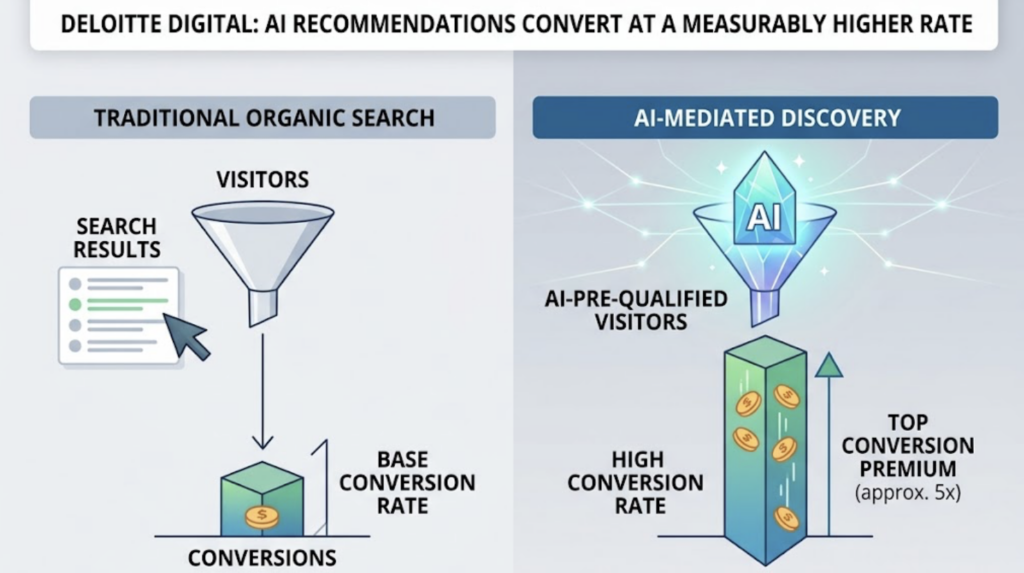
    AI search visitors convert at 23x the rate of traditional organic search visitors. That changes the ROI math significantly.

    It also changes what “success” looks like. Organic traffic volume is no longer the right primary metric. The question is whether your brand appears in the answer, not just in the index.

    MetricTraditional SEOAI Overviews OptimizationGEO
    Primary GoalRankings and ClicksInclusion and Zero-Click VisibilityCitations and Authority
    Core MetricOrganic Traffic / CTRCitation Frequency / ImpressionsCitation Rate / Sentiment
    Best Query TypeNavigational, TransactionalInformational, Complex ResearchComparison, Consideration, Brand
    Time to Results6-12 Months2 Weeks to 3 Months3-9 Months
    Resource ThresholdModerateHigh (Structure + Fact Density)High (Digital PR + Consensus)
    Conversion ImpactBaseline CVRHigh CVR (Pre-Qualified Users)Highest CVR (Trusted Recommendation)

    Industry context matters here. The Education sector saw AI Overviews coverage jump from 18% to 83% of queries in a single year. For education brands, AIOO isn’t optional. It’s survival. Conversely, eCommerce sees AIO coverage as low as 4% for transactional “buy” keywords, meaning traditional SEO and paid search still dominate there.

    In B2B Tech and Healthcare, where AIO trigger rates approach 90%, the stakes of inclusion are extreme. Brands cited in those summaries earn 35% more organic clicks and 91% more paid clicks than those that are left out.

    Your industry determines which lever matters most.

    4 Questions That Determine Your AI Overviews Optimization Priority

    Before you allocate a dollar or an hour, answer these four questions. They’ll tell you where you actually stand.

    Q1: Does your audience still click through?

    If your traffic is driven by “how-to,” “what is,” or “best of” queries, you’re already in a zero-click environment where 8 out of 10 users never leave the SERP. Your visibility problem isn’t a ranking problem. It’s an inclusion problem.

    If your core keywords are transactional (“buy,” “pricing,” “order”), Google has largely kept AIO out of those results to protect ad revenue. Traditional SEO still works there.

    Q2: Is your brand showing up in AI answers today?

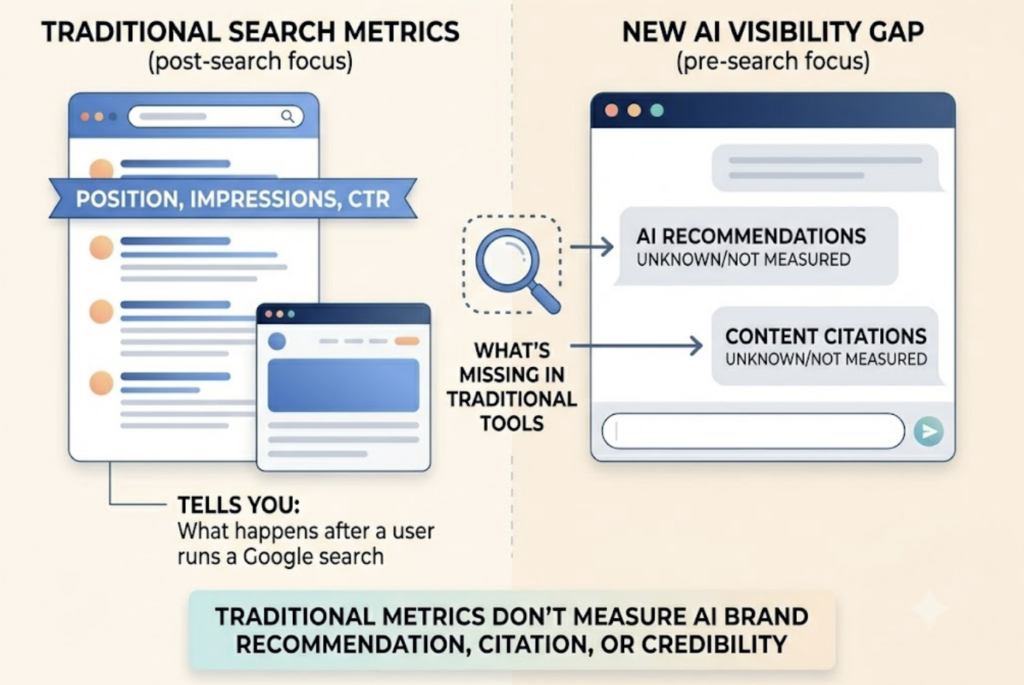
    Most brands don’t know. Traditional rank trackers don’t measure AI inclusion. Tools like Topify run what’s called “statistical multi-model probing,” querying the same prompts multiple times across AI platforms to calculate a statistically valid visibility score. That baseline audit often reveals a “Visibility Gap”: competitors being cited for your core topics while you’re absent.

    If that gap exists, it requires immediate AIOO intervention.

    Q3: Is your content authoritative enough to get cited?

    Sites with over 32,000 referring domains are 3.5x more likely to be cited by ChatGPT than lower-authority sites. That’s a significant threshold. If you’re below it, jumping straight to GEO tactics won’t work. LLMs will default to established incumbents.

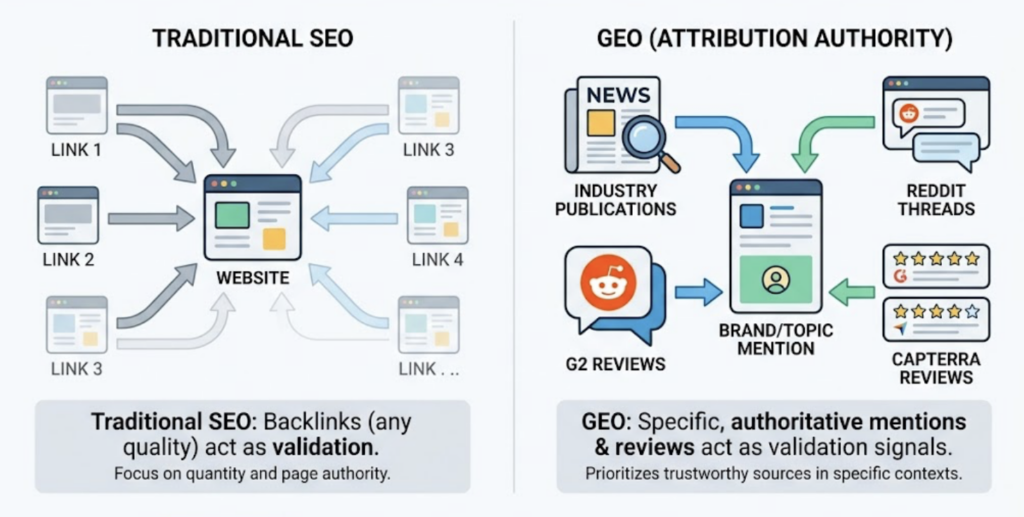
    Your focus should be on GEO tactics that build consensus: digital PR placements, mentions on Reddit and Quora, high-authority industry journals. These signals teach AI models that your brand is “safe” to cite.

    Q4: Is your team set up to measure prompts or keywords?

    Over 80% of AI prompts are phrased differently than traditional Google searches. If your team is still reporting on static keyword rankings, they’re working with a structural blind spot. AIOO and GEO require continuous, automated sampling across many sessions to produce reliable data on a probabilistic system.

    This isn’t a minor workflow update. It’s a measurement infrastructure change.

    Resource-Constrained? Here’s the Sequencing That Works

    Most teams can’t run three parallel strategies at full intensity. Here’s the phased order that builds momentum without abandoning what’s already working.

    Phase 1: Technical and Structural Baseline (The SEO Layer)

    Ensure your site is crawlable and implement robust Schema markup. Think of this as “agent-ready” technical SEO. Without it, neither AIOO nor GEO can function. AI retrieval systems depend on the same indexed web that search crawlers use.

    Phase 2: Content Engineering for AI Overviews Optimization (The AIOO Layer)

    Restructure your most important content using an “Inverted Pyramid” format. Start every H2 section with a direct, 40-60 word “Answer Block.” This format aligns with how Google’s RAG system retrieves and extracts content. You’re essentially pre-packaging the answer the AI needs.

    This is where platforms like Topify provide measurable leverage. Its Prompt Discovery feature surfaces the high-volume conversational queries where your brand is currently invisible. You’ll know exactly which pages to restructure first, rather than guessing.

    Phase 3: Authority and Sentiment Management (The GEO Layer)

    Shift your digital PR toward “Consensus Platforms”: Reddit, Quora, industry journals, and high-authority publications. The goal is to build a body of third-party evidence that AI models find when they “look” for proof of your brand’s expertise. It’s less about links and more about narrative consistency across the open web.

    Topify’s Sentiment Analysis tracks how AI systems characterize your brand on a 0-100 score, giving you an early warning system if a negative narrative is gaining traction before it solidifies into how AI answers describe you.

    What Changes if You’re Managing 10+ Clients

    For agencies, the 2026 challenge isn’t strategic. It’s operational.

    Managing AI visibility across dozens of brands requires a repeatable, templatized workflow. The probabilistic nature of LLM outputs means you can’t rely on static reports. You need live dashboards that aggregate visibility, sentiment, and CVR data per client, with automated alerts when a competitor moves ahead on specific prompts.

    That’s what makes multi-project monitoring non-negotiable at agency scale. Topify’s platform aggregates this data across accounts and includes Competitor Share of Voice tracking, which flags “Visibility Drops” the moment a competitor gains ground on a prompt your client owns.

    The strategic repositioning for agencies is clear. “Rank tracking” becomes “AI Search Visibility Management.” It’s a standalone revenue line with a defensible ROI story: connect Citation Frequency to Branded Search Lift and Assisted Conversions, and you can justify the budget even when traditional organic traffic is declining.

    The top agencies in 2026 aren’t link builders. They’re entity architects.

    Conclusion

    The decision framework distills to one judgment call:

    If your core queries are informational and already triggering AI Overviews, prioritize AI Overviews Optimization for immediate visibility, build your SEO technical layer for crawlability, and use GEO to manage brand representation across the wider LLM ecosystem.

    The ranking era optimized for clicks. The inclusion era optimizes for trust. The brands that will win are the ones AI systems consider safe, authoritative, and easy to extract.

    That transition is already underway. The question is just how far behind you want to start.

    FAQ

    Q: Is AI Overviews Optimization the same as GEO?

    No. AI Overviews Optimization (AIOO) is a specialized tactic focused specifically on Google’s on-SERP AI summaries. GEO is a broader strategy that manages your brand’s presence across all generative engines, including ChatGPT, Perplexity, and Claude. AIOO is about “winning the summary” on Google. GEO is about becoming a cited source across the entire AI web.

    Q: Should I stop doing traditional SEO in 2026?

    No. Traditional SEO is the technical foundation that makes your content findable by AI retrieval systems. Over 50% of queries still don’t trigger AI results, making SEO necessary for half of all searches. It’s no longer the primary growth lever, but skipping it means your AI optimization efforts won’t work either.

    Q: How do I know if my brand appears in AI Overviews?

    Traditional rank trackers don’t capture this. You need specialized AI visibility tools that perform statistical multi-model probing, running the same prompts multiple times to calculate a reliable visibility score. Topify provides this baseline audit as a starting point before you build your optimization strategy.

    Q: Can one tool handle all three strategies?

    Legacy tools like Ahrefs and Semrush are adding AI tracking modules, but they weren’t built for this. Pure-play platforms like Topify provide deeper cross-platform visibility, sentiment tracking, prompt discovery, and one-click GEO execution in a single workflow. The architecture difference matters more as your strategy matures.

    Read More

  • 5 Ways AI Agents Find Brands

    5 Ways AI Agents Find Brands

    Agentic SEO isn’t about ranking pages. It’s about being discoverable before a user types a single query.

    Most marketers still think brand discovery starts with a search box. It doesn’t anymore. AI agents don’t wait for a query. They crawl, reason, and synthesize across dozens of sources before a user even realizes they have a question.

    That changes everything about how brands need to show up.

    The shift from search engine to decision engine is already here. An AI agent evaluating “the best project management tool for a remote-first SaaS team” won’t just return a list of links. It’ll pull structured product data, cross-reference third-party reviews, check Reddit for consensus, and consult what it already knows from training. If your brand isn’t present across all five of these discovery layers, it doesn’t exist in that decision.

    Miss one channel, and you’re invisible to a system that never asks twice.

    AI Agents Don’t Search. They Decide.

    Traditional search engines rank pages. AI agents make recommendations. That’s not a subtle difference — it’s a complete restructuring of how brand visibility works.

    A search engine responds to a query with a list. An AI agent responds to a goal with a synthesized answer and, increasingly, a direct action. The path from “user intent” to “brand selected” has collapsed from five steps to one.

    DimensionSearch EnginesAI Decision Engines
    Starting pointUser types keywordUser states a goal or ongoing task
    OutputRanked list of linksSynthesized recommendation or direct execution
    Core logicIndex + keyword match + link authorityFetch + reasoning + multi-source synthesis
    Brand visibilityRanking on page oneBeing cited or directly recommended in the answer
    User pathSearch → Browse → Compare → ChooseAsk → Shortlist → Verify → Done

    This is the core insight behind agentic SEO. You’re not optimizing for a position on a results page. You’re optimizing for inclusion in a reasoning chain. And that reasoning chain pulls from five distinct discovery channels — each with its own logic, its own signals, and its own playbook.

    Way 1: Real-Time Web Crawling

    The first way AI agents discover brands is the most direct: they fetch your pages live.

    Agents like those powering Perplexity and ChatGPT Search use dedicated crawlers (PerplexityBot, GPTBot) to pull real-time content during a query. Unlike traditional SEO crawlers that build indexes over weeks, agent crawlers often act in the moment — triggered by a specific task, not a scheduled index run.

    That means your page has milliseconds to prove its value.

    Schema markup has moved from optional to essential. Data shows that pages using three or more Schema.org types are cited in AI answers roughly 13% more often than pages with no structured data. The reason is straightforward: structured data tells agents exactly what a piece of content means, not just what words it contains.

    Schema TypeValue for AI AgentsKey Fields
    OrganizationDefines your brand entity and official identityName, logo, social profiles, contact info
    ProductEnables precise product matching for specific queriesPrice, SKU, material, features, availability
    FAQFeeds directly into conversational answer patternsQuestion text, answer text
    HowToSupports procedural queries step-by-stepSteps, tools required, expected output
    ReviewAdds third-party validation signalsRating, review content, date, reviewer

    Freshness matters here too. Content updated in the past 30 days is cited far more often than older material, particularly in fast-moving industries like tech, finance, and SaaS. If your product pages haven’t been touched in six months, an agent treating freshness as a trust signal will deprioritize them.

    One often-overlooked issue: many AI crawlers can’t execute JavaScript. If your site relies on client-side rendering, agents may be fetching empty pages. Server-side rendering isn’t just a performance optimization — in agentic SEO, it’s a baseline requirement.

    Way 2: LLM Training Data (The Slow Channel Nobody Talks About)

    Real-time crawling gets the attention. But there’s a slower, deeper channel that shapes how agents perceive your brand before a query even runs.

    Large language models are trained on massive datasets — Common Crawl, Wikipedia, academic publications, industry media. That training data forms the model’s background assumptions. When an agent is asked which CRM has the strongest enterprise integration, its initial reasoning draws on patterns baked into its weights, not just live search results.

    If your brand doesn’t appear in that training data, or appears in the wrong context, you’re fighting an uphill battle every time.

    Wikipedia is the clearest example. Research indicates that roughly 47.9% of top citations in ChatGPT’s general knowledge queries originate from Wikipedia. A brand without a Wikipedia entry — or with an outdated one — risks being classified as an obscure or unverified entity by the model.

    The same dynamic applies to industry reports, analyst coverage, and media mentions. Gartner Magic Quadrant placements, deep-dive features in trade publications, and citations in academic research all contribute to what models “know” about your brand at a foundational level. These signals build slowly, but they compound. A brand consistently mentioned in authoritative sources trains future models to treat it as a default reference point.

    Narrative drift is the hidden risk here. If your brand was heavily associated with a specific use case three years ago, models trained on that data will reproduce that framing — even if your product has evolved. The only fix is sustained presence in authoritative, updated sources. That means maintaining Wikipedia accuracy, publishing original research that gets cited, and using Organization Schema to establish clear entity relationships that prevent models from generating hallucinated attributes.

    This is the long game. And most brands aren’t playing it.

    Way 3: RAG and AI-Native Search (The Fast Channel)

    Retrieval-Augmented Generation is the engine behind ChatGPT Search, Perplexity, and Google AI Overviews. It’s what makes these platforms feel current: instead of relying solely on trained weights, they retrieve live content and generate answers grounded in real sources.

    This is where content strategy and agentic SEO converge directly.

    In a RAG pipeline, a user’s query gets converted into a numerical vector. The system finds content chunks with the closest semantic match. The model then synthesizes an answer from those chunks. If your content isn’t structured to match the way queries are phrased — not just in keywords, but in intent — it won’t surface.

    The practical implication: content that leads with a clear, direct answer performs significantly better in RAG retrieval than content that buries the point. Think BLUF (Bottom Line Up Front) — a 50-word summary at the top of your article that directly answers the core question, followed by supporting evidence. Agents don’t read linearly. They extract.

    Each AI platform weighs sources differently:

    PlatformSource PreferenceKey Data
    ChatGPT SearchBing-indexed content, Wikipedia, local authority mediaWikipedia accounts for ~47.9% of top citations
    PerplexityHighly recency-weighted, heavy social consensus signalsReddit citations account for ~46.7% of references
    ClaudeTechnical precision, official docs, academic sourcesStrong preference for structured specs and formal citations
    Google AIODeep Google ecosystem integration, EEAT signalsFavors traditionally authoritative domains with strong backlinks

    The gap between these preferences is significant. A brand that dominates in ChatGPT’s citation pool might barely appear in Perplexity’s answers. You can’t optimize for “AI” as a category. You need to understand platform-specific logic.

    Topify’s Source Analysis lets you see exactly which domains are being cited in AI answers for the prompts that matter to your brand. That data reveals not just where you appear, but which sources your competitors are leveraging — and what content gaps you need to close.

    Way 4: Third-Party Databases and Tool Integrations

    This channel is growing fastest, and most brands aren’t paying attention to it yet.

    AI agents don’t just browse the web. Increasingly, they call external APIs and databases directly through protocols like MCP (Model Context Protocol). A purchasing agent evaluating B2B software might query G2’s API for intent scores and competitive data, check Crunchbase for funding stage, or pull Yelp ratings for local service providers — all without loading a single web page.

    In this context, your G2 profile isn’t just a review platform. It’s your brand’s identity card in the agent ecosystem.

    If that profile has incomplete integration listings, outdated feature descriptions, or no recent customer case studies, an agent reasoning through a vendor shortlist will encounter what the research calls a “data void.” Incomplete data doesn’t get a benefit of the doubt. It gets deprioritized or excluded.

    The social layer matters here too. Agents consistently use Reddit, industry forums, and community platforms to source “authentic, non-promotional” signals. Perplexity’s 46.7% Reddit citation rate isn’t accidental — it reflects a deliberate preference for peer consensus over brand-controlled content.

    Data consistency across platforms is non-negotiable. Agents perform cross-source verification. If your Crunchbase lists 50 employees, your LinkedIn shows 200, and your own site claims “global team,” the inconsistency triggers a reliability penalty in the agent’s reasoning. It treats conflicting signals the same way a diligent analyst would: with skepticism.

    The practical checklist for this channel:

    • Maintain an accurate, complete G2/Capterra profile with recent reviews and current feature parity.
    • Keep Crunchbase data updated, especially funding stage and headcount.
    • Build genuine Reddit presence in relevant communities — not promotional posts, but actual participation in category discussions.
    • Ensure all third-party data sources agree on the same core facts about your company.

    Way 5: Agent Memory and Personalization Layers

    The fifth channel is the one that creates the most durable competitive advantage — and the hardest to recover from if you’re not in it.

    Modern AI agents, including ChatGPT’s Memory feature, store interaction history across sessions. They build a layered understanding of user preferences that informs future recommendations. A brand that earns a positive first mention in an agent’s memory doesn’t just win one recommendation. It enters a compounding feedback loop.

    Agent memory operates across three cognitive layers:

    Episodic memory stores specific interactions: “User was frustrated with Brand X’s delivery speed last month.” Semantic memory accumulates preference patterns: “User consistently prioritizes sustainable materials and mid-range pricing.” Procedural memory learns interaction rules: “User always wants local suppliers considered first.”

    When an agent draws on these layers to make a recommendation, recency matters — but established positive associations carry disproportionate weight. The agent is trying to minimize the risk of a bad recommendation. A brand it already “knows” is positive is safer than a new entrant, even one with a better objective profile.

    First impression compounds.

    This is why agentic SEO front-loads so heavily on the other four channels. You need to ensure your brand is present and accurate across crawling, training data, RAG, and third-party databases — so that when an agent encounters your brand for the first time in a zero-state query, the signals are strong enough to earn memory placement.

    Brands that miss the first wave of agent recommendations don’t just fall behind. They face an exponentially higher barrier to entry as agent memories become more established.

    You Can’t Optimize What You Can’t See — Track All 5 Channels

    Here’s the practical problem: manually testing these five channels isn’t feasible. You can’t query thousands of prompts daily across ChatGPT, Perplexity, Gemini, and Google AIO to check where your brand appears, how it’s framed, and whether competitors are outpacing you.

    That’s where purpose-built agentic SEO platforms change the calculation.

    Topify provides a unified GEO (Generative Engine Optimization) dashboard that converts these five discovery channels into trackable, actionable metrics. It monitors not just whether your brand name appears, but the context and sentiment of those appearances across major AI platforms.

    Topify FeatureProblem It SolvesApplication
    Visibility TrackingEliminates the blind spot of “am I being recommended?”Daily Share of Model monitoring across ChatGPT, Perplexity, Gemini
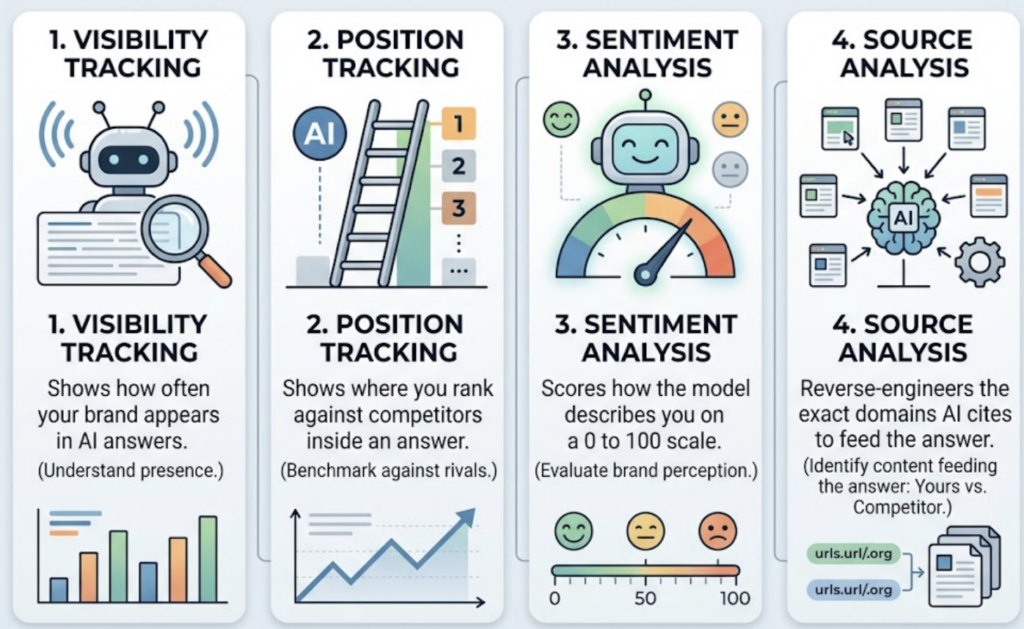
    Source AnalysisReveals which third-party domains are speaking for your brandIdentifies which media or Reddit threads competitors are leveraging for AI citations
    Sentiment AnalysisTracks shifts in how AI frames your brandIssues early warnings when AI begins generating negative framing before it hits sales
    Competitor MonitoringMaps competitor positions across AI platformsCompares AI-generated strength/weakness analysis across your competitive set

    The platform’s Source Analysis feature is particularly relevant to channels 3 and 4. When Topify detects that an AI platform is consistently citing a specific domain or URL when recommending your competitors, you can identify the exact content gap and act on it — whether that’s a piece of research, a review profile update, or a Reddit engagement strategy.

    Topify’s one-click execution layer closes the loop. When the platform surfaces a specific optimization opportunity — an outdated citation, a missing Schema type, a competitor dominating a key prompt — it doesn’t just show you the data. It proposes and deploys a targeted response.

    That’s the difference between monitoring visibility and actually moving it.

    Conclusion

    Agentic SEO isn’t an upgrade to traditional SEO. It’s a different game with different rules.

    In the search engine era, you optimized for the probability of being selected. In the agent era, you’re optimizing for the inevitability of being recommended. That means building entity clarity, not just keyword density. Cross-channel signal consistency, not just page rankings. Content structures that agents can parse at extraction speed, not just text that reads well to humans.

    The five channels — real-time crawling, training data, RAG, third-party databases, and agent memory — aren’t independent levers. They’re interconnected layers of a single discovery architecture. Strength in one amplifies the others. A gap in one creates drag across all of them.

    The brands showing up everywhere in AI recommendations aren’t lucky. They’re structured for it.

    FAQ

    What is Agentic SEO?

    Agentic SEO is the practice of optimizing brand presence across the discovery channels that AI agents use to find, evaluate, and recommend brands. It goes beyond traditional SEO (ranking on search results pages) and GEO (appearing in generative AI answers) to address the full decision-making logic of autonomous AI systems. This includes structured data, training data presence, RAG-optimized content, third-party database accuracy, and agent memory signals.

    How is Agentic SEO different from GEO?

    GEO (Generative Engine Optimization) focuses on getting your content cited in AI-generated answers. Agentic SEO is broader: it treats AI agents as autonomous decision-makers with tool access, memory, and reasoning capabilities — and optimizes for every layer those agents use. GEO is one component of agentic SEO, specifically addressing the RAG and training data channels.

    Which AI platforms should I prioritize for brand visibility?

    Start with ChatGPT Search, Perplexity, Google AI Overviews, and Gemini — these four cover the majority of AI-driven discovery today. For B2B brands, prioritize platforms with MCP integrations, as agents in enterprise workflows increasingly query G2, Crunchbase, and similar databases directly. Monitor Perplexity for social consensus signals and ChatGPT for entity authority. Visibility data across all platforms varies significantly by brand category, so tracking at the prompt level — rather than assuming platform-wide presence — gives you an accurate picture.

    Read More

  • Agentic SEO vs GEO vs Traditional SEO: What’s Different

    Agentic SEO vs GEO vs Traditional SEO: What’s Different

    Your domain authority is solid. Your keyword rankings are holding. But none of that tells you whether Perplexity is recommending your competitor instead of you right now.

    That gap isn’t a data problem. It’s a structural one. Search has quietly split into three parallel systems, each with its own logic, its own signals, and its own definition of “visible.” Running one playbook across all three doesn’t work anymore. And in 2026, the cost of that mistake is compounding fast.

    Traditional SEO Still Works — Just Not for Everyone Searching

    Traditional SEO is built on three pillars: crawling, indexing, and ranking. Backlink authority, keyword relevance, page speed, and mobile-friendliness are the signals that tell Google’s algorithm a page deserves to rank. That logic hasn’t changed in 20 years.

    What has changed is the scope of what it covers.

    Traditional SEO only captures users who go to a search engine, type a query, and click a result. That’s a shrinking slice of how people actually find information today. In 2024, 60% of US searches ended without a single click — up from just 26% in 2022. AI Overviews, featured snippets, and direct answer boxes are absorbing the query before the user ever reaches the blue links.

    That said, traditional SEO isn’t dying. It’s shifting roles.

    Most AI engines use traditional search indexes as their retrieval layer. ChatGPT pulls from Bing, Google AI Overviews rely on Google’s native index, and Claude uses Brave’s search infrastructure. A brand that’s technically invisible to crawlers — slow pages, broken schema, thin content — stays invisible in AI answers too. Traditional SEO is now less about rankings and more about making sure AI can find you in the first place.

    The floor is still the floor. The ceiling has moved.

    GEO Is About Getting Cited — Not Getting Clicked

    Generative Engine Optimization (GEO) is the second layer. Its goal isn’t a ranked position. It’s getting included in the AI-generated answer itself, as a cited source, a named brand, or a referenced data point.

    The mechanism is different from PageRank. When a user sends a prompt, the LLM retrieves “knowledge chunks” from across the web and synthesizes them into a response. AI systems favor content with high semantic density — specific statistics, clear structure, direct answers. A sentence like “our software is fast” has near-zero retrieval value. A sentence like “average processing time is 12ms, 40% faster than the industry baseline” is exactly what gets pulled.

    Citation patterns in 2025 make this concrete. Reddit accounts for 46.5% of Perplexity’s citations and 21% of Google AI Overviews references. Wikipedia holds 47.9% of ChatGPT’s citations. YouTube drives roughly 23% of citations across all major AI platforms. The pattern is clear: AI systems trust third-party voices over brand-owned content.

    Here’s the counterintuitive upside. GEO traffic converts at a different rate. Visitors arriving from AI citations convert 23x higher than traditional organic traffic. By the time a user clicks through from an AI answer, they’ve already done the research, made the comparison, and largely made the decision. You’re not at the top of the funnel. You’re at the bottom.

    That changes how you should value GEO mentions. A brand cited twice in a Perplexity answer may be worth more than ranking third on Google.

    Agentic SEO Is a Different Game Entirely

    Agentic SEO is where the model breaks from everything familiar. It’s not about ranking. It’s not about being cited. It’s about being selected by an AI agent that’s executing a task without a human in the loop.

    When someone asks an AI agent to “find the best CRM for a 50-person B2B team under $200/month with SOC 2 compliance,” the agent doesn’t browse websites. It makes API calls, reads structured data, cross-references entity records across LinkedIn, G2, government registrations, and review platforms, then builds a shortlist. There’s no search results page. There’s no article to click. There’s a decision brief — and your brand is either on it or not.

    Gartner projects that 40% of enterprise applications will embed AI agents by end of 2026. In B2B specifically, 90% of purchase decisions are expected to involve AI agent intervention by 2028, covering more than $15 trillion in global B2B spend. That’s not a future scenario. That’s a procurement shift already underway.

    Winning in agentic SEO requires three things most brands haven’t built yet.

    First, entity consistency. Every data point about your brand across your website, G2, LinkedIn, and third-party databases needs to match exactly. Conflicting information — different founding years, different headcounts, different pricing — lowers an agent’s confidence score in your brand.

    Second, API accessibility. Agents prefer structured data they can query directly over HTML they have to parse. Pricing pages, spec sheets, and compliance documentation that’s machine-readable give agents a reason to include your brand without extra effort.

    Third, schema depth. Using Schema.org @id as a global identifier connects your discrete web pages into a knowledge graph an agent can navigate logically, not just crawl.

    This is less about content and more about infrastructure.

    The Three Models, Side by Side

    DimensionTraditional SEOGEOAgentic SEO
    TriggerKeyword searchConversational promptAutonomous goal execution
    Core goalRank and earn clicksGet cited in AI answersEnter the agent’s decision brief
    Key signalsBacklinks, keyword relevance, authoritySemantic density, structured content, third-party citationsAPI compatibility, schema completeness, entity consistency
    MetricsRankings, CTR, organic trafficCitation frequency, Share of Voice, sentimentSelection rate, decision-chain participation
    Typical toolsSemrush, Ahrefs, GSCPerplexity, Topify, FraseAPI managers, LangChain, MCP
    How you winBuild authority, own the first pageBecome the source AI can’t skipBe machine-readable and directly transactable

    The three aren’t competing. They’re sequential. Without traditional SEO, AI can’t find you. Without GEO, AI agents can’t verify your authority. Without agentic SEO, you can’t complete the transaction when no human is watching.

    Which One Should You Prioritize in 2026?

    The honest answer: it depends on who’s buying from you and how they search.

    For SaaS brands, GEO and agentic SEO should take the lead. Pricing pages and solution-specific content get 4 to 9 times more AI traffic than other site sections. Buyers are already asking AI to compare tools before they book a demo. Optimizing for that moment — through third-party reviews, structured pricing, and compliance documentation — matters more than chasing one more ranking.

    For e-commerce brands, GEO is the most immediate lever. AI-driven retail recommendations grew 693% during the 2025 holiday season. Consumers are asking ChatGPT for product recommendations the same way they used to ask Google. YouTube and Reddit, which together drive close to half of retail AI citations, are your new distribution channels.

    For professional services and content-driven brands — legal, financial, medical — traditional SEO and GEO carry equal weight. These are YMYL categories where AI systems heavily reference indexed, authoritative sources. The play is structuring content for AI extractability: lead with a 40-60 word direct answer at the top of each piece, then build out the detail below.

    One thing is true across all categories: GEO is the highest-ROI opportunity most teams haven’t acted on yet. Agentic SEO is the most important thing most teams aren’t ready for.

    Start with GEO. Build toward agentic.

    You Can’t Optimize What You Can’t See

    Here’s the problem none of this solves on its own. Traditional SEO has Google Search Console. GEO and agentic SEO have almost nothing built for measurement.

    AI answers are a black box. A brand might be getting cited in Perplexity 40 times a day without knowing it. A competitor might have quietly overtaken them in ChatGPT responses while their Google rankings held steady. Without visibility into what AI is actually saying, any optimization effort is essentially guesswork.

    That’s the gap Topify was built to close.

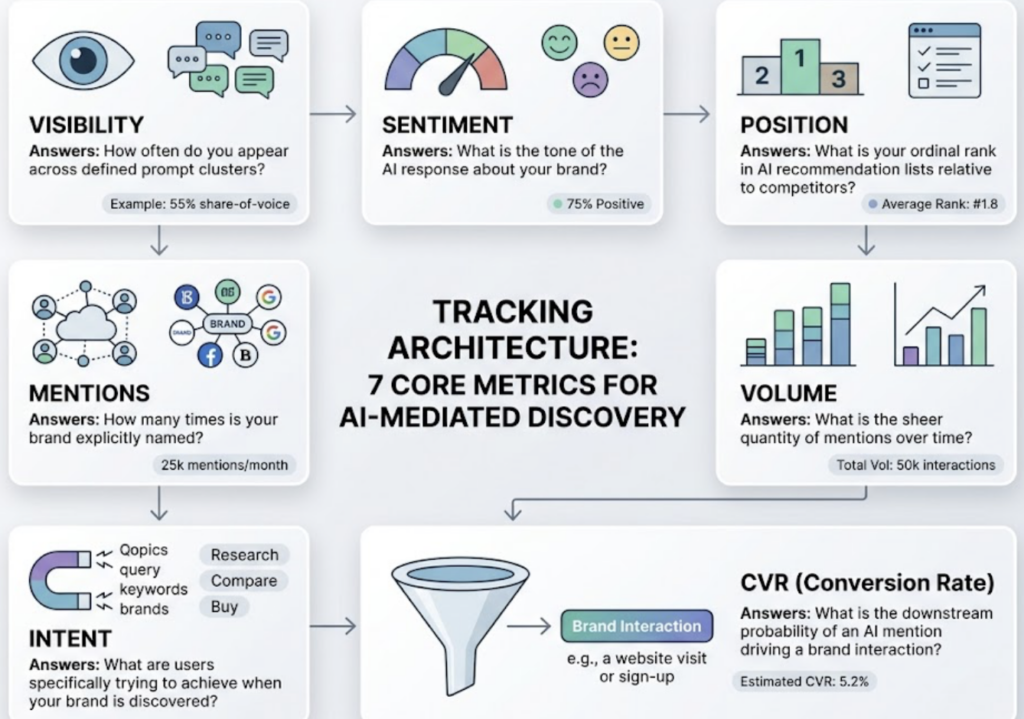
    Topify tracks brand visibility across ChatGPT, Gemini, Perplexity, and Google AI Overviews, measuring seven metrics per platform: visibility, sentiment, position, volume, mentions, intent, and CVR. In practice, this means a team can see not just whether they’re being mentioned, but whether the sentiment is positive, where they rank relative to competitors, and which types of prompts are driving those mentions.

    The Source Analysis feature is particularly useful for GEO strategy. It reverse-engineers AI citations: which third-party domains are being referenced when a competitor gets recommended? That tells you exactly where to publish, pitch, or place content next — not based on assumption, but on the actual retrieval patterns of the AI systems.

    A common scenario: a brand’s official site ranks higher than a competitor’s domain in Google. But in Perplexity, the competitor keeps appearing because a third-party review site with highly structured comparison tables is getting cited instead. Topify surfaces that gap. Without it, the brand keeps optimizing the wrong asset.

    AI Volume Analytics adds another layer. It identifies which prompt categories are growing in your space — so a content team can build for queries that are gaining traction before competitors do. It’s less about reacting to existing rankings and more about positioning for where AI search volume is heading.

    Conclusion

    Traditional SEO, GEO, and agentic SEO aren’t three versions of the same thing. They’re three separate games running simultaneously, each with different rules, different signals, and different definitions of winning.

    Traditional SEO is still the foundation — skip it and AI can’t find you at all. GEO is the highest-leverage opportunity in 2026 for most brands, with citation-driven traffic converting far beyond what organic ever did. Agentic SEO is the long game: the infrastructure decisions made now will determine whether your brand appears in automated purchasing decisions two years from now.

    The starting point for all three is knowing where you actually stand. Before you restructure content, build schema, or pitch review sites, check what AI systems are saying about your brand today. That answer tends to be more surprising than most teams expect.

    Get started with Topify to see where your brand stands across AI platforms before optimizing for any of the three models.


    FAQ

    Q: What’s the difference between GEO and Agentic SEO?

    A: GEO focuses on getting your brand cited in AI-generated answers to human prompts — someone types a question and the AI pulls your content as a source. Agentic SEO is about being selected by AI agents operating without human prompts at all. The agent has a goal, executes a multi-step research process, and makes a recommendation or decision. GEO is about citation. Agentic SEO is about selection.

    Q: Does traditional SEO still matter in 2026?

    A: Yes, but its role has shifted. Google still holds 89.6% of the global search market and handles billions of queries daily. More importantly, most AI engines — ChatGPT, Claude, Google AIO — rely on traditional search indexes to retrieve real-time content. A brand that’s technically broken or invisible to crawlers won’t appear in AI answers either. Traditional SEO is now the prerequisite layer, not the end goal.

    Q: How do AI agents discover brands?

    A: Agents don’t browse websites the way humans do. They make API calls, pull structured data, and cross-reference entity records across multiple platforms — your website, G2, LinkedIn, government registries, review databases. Brands with consistent entity data, accessible APIs, and clean schema markup are far more likely to make it into an agent’s shortlist. Inconsistent information across platforms lowers an agent’s confidence score in your brand.

    Q: What metrics should I track for Agentic SEO?

    A: Traditional metrics like rankings and CTR don’t apply. The relevant signals are entity consistency scores across platforms, API response quality, schema coverage depth, and — where trackable — selection rate in agent-driven tasks. On the monitoring side, tracking AI citation frequency, Share of Voice across AI platforms, and sentiment trends gives you a proxy for how agents are likely to perceive your brand when they do their own research.


    Read More

  • AEO Tools vs SEO Tools: The Real Difference

    AEO Tools vs SEO Tools: The Real Difference

    Your domain authority is solid. Your keyword rankings haven’t moved in months. But somewhere in the last quarter, a competitor you’ve never worried about started showing up every time a potential customer asked ChatGPT for a recommendation in your category. And your current dashboard has no idea it’s happening.

    That’s not a content problem. It’s a measurement problem. SEO tools and AEO tools are built on fundamentally different logic, and using one to answer questions only the other can ask is where most marketing teams start falling behind.

    Your SEO Tool Thinks You’re Winning. AI Doesn’t.

    Search behavior has split into two distinct tracks. On one track, users type queries into Google and click blue links. On the other, they ask AI engines direct questions and act on the synthesized answers they receive, without ever visiting a website.

    AI-driven search tools captured roughly 12-15% of global market share by end of 2025, up from 5-6% at the start of that year. In March 2025, Google’s global search market share dropped below 90% for the first time. These aren’t marginal shifts.

    The deeper problem isn’t the traffic split. It’s what happens with zero-click behavior. When Google triggers an AI Overview, the zero-click rate climbs to 83%. In Google’s AI Mode, that number reaches 93%. The organic CTR for a page that once ranked first can drop 61%, from 1.76% to 0.61%, simply because an AI summary appeared above it.

    That’s the blind spot your SEO tool can’t see.

    What SEO Tools Were Actually Built to Measure

    Traditional SEO platforms, whether Ahrefs, Semrush, or Google Search Console, were designed around a single premise: search engines index pages, rank them by authority, and users click through. That premise held for two decades. It still partially holds today.

    These tools are excellent at what they were built to do. Keyword rankings, backlink profiles, domain authority scores, crawl errors, mobile performance, SERP position history. All of it maps to a deterministic system: query in, ranked URL list out.

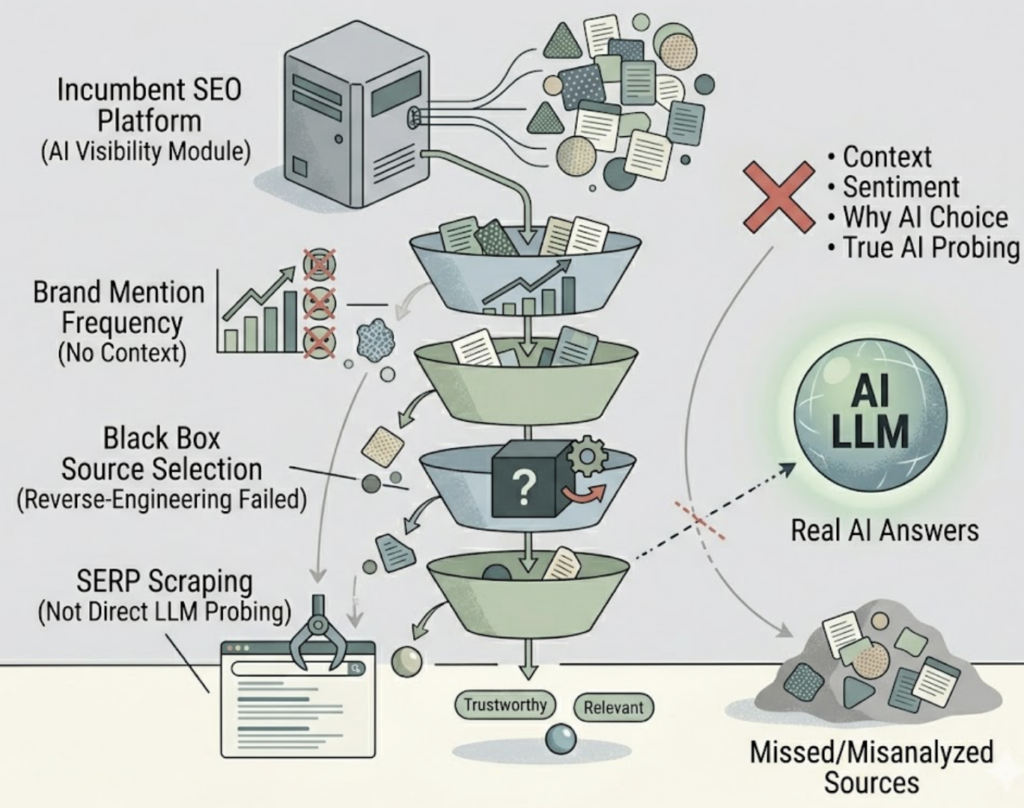
    The problem isn’t that SEO tools are broken. It’s that they’re measuring a different game. Only about 12% of URLs cited by ChatGPT and Perplexity appear in Google’s top 10 search results. If your SEO tool shows you at position one, that tells you almost nothing about whether you’re in the AI answer at all.

    AEO Tracks a Different Kind of Visibility

    Answer Engine Optimization starts from a different question: not “where does our page rank?” but “when a user asks an AI about our category, does our brand appear, and how does it appear?”

    That distinction changes everything about how you measure performance. AI engines don’t index URLs in a ranked list. They synthesize answers from multiple sources, select which brands to mention, describe those brands in their own language, and position them relative to competitors. The output is probabilistic, not deterministic.

    To track AEO visibility meaningfully, you need at least four dimensions that traditional SEO tools don’t capture:

    AI Mention Rate: how often your brand appears in AI-generated answers for relevant prompts. If a tool runs 100 simulated queries about your product category and your brand shows up in 35 of them, your mention rate is 35%.

    Sentiment Score: the quality of how AI describes your brand. An AI might mention you and call you “a budget-friendly option,” which matters if your positioning is premium. NLP-based sentiment tracking can catch this. Your SEO dashboard cannot.

    Position and Prominence: being listed first in an AI recommendation carries a different weight than being third. The framing AI uses for early mentions tends to be authoritative; later mentions get framed as alternatives.

    Source Coverage: which domains and URLs are driving AI’s opinions about your brand. If a trade publication’s review of your competitor is consistently cited by Perplexity, that’s actionable. SEO tools track your backlinks. AEO tools track what AI is reading to form its judgment.

    The Feature Gap at a Glance

    The difference between SEO and AEO tools isn’t a matter of features overlapping on a Venn diagram. It’s a structural gap in what each tool type was architecturally designed to do.

    DimensionSEO Tools (e.g., Ahrefs, Semrush)AEO Tools (e.g., Topify)
    What they trackSERP rankings (blue links)Brand mentions in synthesized AI answers
    Data collectionCrawling search result pagesSimulating real user prompts across AI platforms
    Core metricsKeyword rank, DA/DR, backlinks, CTRMention rate, sentiment, position, source coverage, CVR
    Platform coverageGoogle, BingChatGPT, Gemini, Perplexity, DeepSeek, and others
    Competitive intelCompetitor rankings and backlink sourcesHow AI describes your brand vs. competitors in the same answer
    Output“Improve keyword density, get more backlinks”“Add statistical data to this section; AI isn’t citing it because it lacks sourced evidence”

    One more architectural difference worth noting: SEO tools run daily crawls and return stable data. AEO tools have to use probabilistic sampling. Because LLM outputs vary with each query, a credible AEO platform runs the same prompts hundreds of times, across multiple regions and time windows, to produce a stable visibility distribution. That’s why the underlying infrastructure is fundamentally different, and why the data it produces tells you something your SEO tool can’t approximate.

    Do You Still Need SEO Tools?

    Yes, with an asterisk.

    Organic search still drives roughly 53% of website traffic, according to Conductor’s 2026 benchmark data. In healthcare, that share is 42.4%. In communications services, 39.6%. If your audience is still primarily finding you through traditional search, abandoning SEO infrastructure would be costly.

    The right mental model isn’t replacement. It’s stack prioritization. SEO tools handle the technical foundation: crawlability, indexing, long-tail transactional keyword coverage. AEO tools handle a layer that didn’t exist three years ago: whether you’re being recommended by the AI systems your buyers are increasingly using to make decisions.

    Here’s a practical decision framework. If your target audience is actively using AI search tools for discovery in your category, AEO tracking isn’t optional. It’s the gap in your reporting that explains traffic patterns your SEO tool can’t. In certain B2B verticals, AI-converted traffic has been shown to convert at 4.4x the rate of organic search traffic. Lower click volume, higher intent. SEO tools tend to flag this traffic as underperforming because the raw numbers look small.

    Leading marketing teams in 2026 tend to allocate roughly 30-50% of their measurement budget to SEO fundamentals, with a fast-growing slice, around 30%, dedicated to AEO tracking and content restructuring for AI extractability.

    The Best Tools for AEO Tracking in 2026

    When evaluating AEO tools, three criteria matter most: how many AI platforms are covered, how many visibility dimensions the tool tracks, and whether the platform supports competitive benchmarking in AI answers, not just your own brand’s numbers.

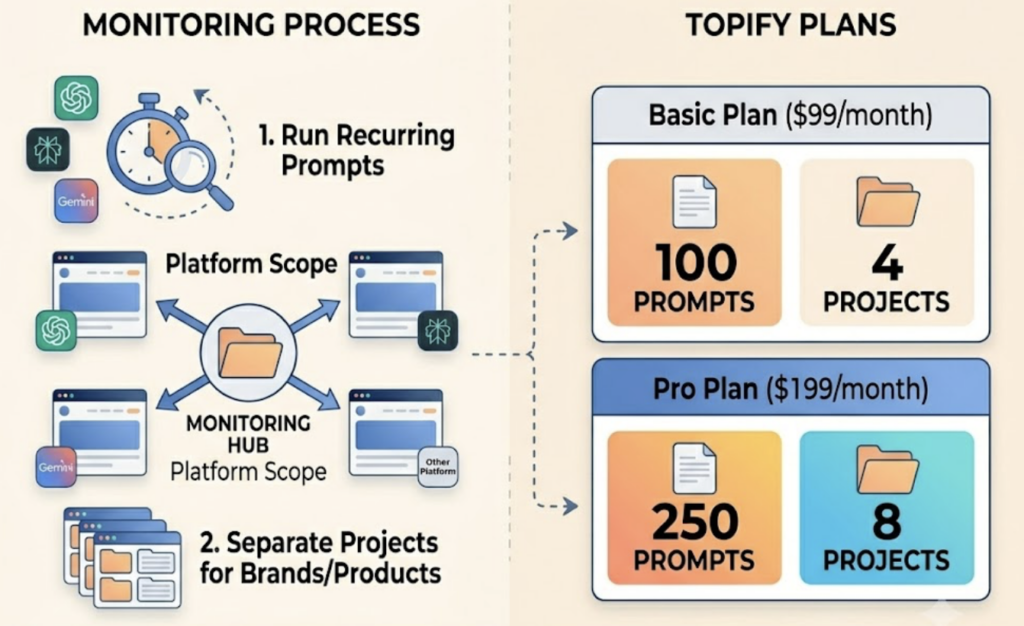
    Topify covers the full spectrum: ChatGPT, Gemini, Perplexity, DeepSeek, Doubao, Qwen, and other major platforms. It tracks seven core metrics, visibility, sentiment, position, AI volume, mentions, intent, and CVR, which is among the most complete measurement sets available. The Source Analysis feature reverses-engineers which domains are driving AI’s citations, giving content and PR teams a clear map of where to build authority. Topify’s agentic execution layer can also identify gaps automatically and suggest specific content actions, for example flagging when a page is being passed over because it lacks sourced statistics. Pricing starts at $99/month for the Basic plan (100 prompts, 4 projects) and $199/month for Pro.

    Princeton research suggests that optimized content structure alone can improve AI visibility by up to 40%. That kind of uplift only becomes measurable if you have a tool tracking it.

    Other platforms worth knowing:

    Profound offers strong “AI search volume” data, surfacing what users are actually prompting AI about. It’s particularly popular with large enterprise teams. AIclicks is useful for smaller teams that want a prioritized action checklist rather than a full analytics suite. Omnia has strong global coverage for brands tracking AI visibility across multiple languages and regions.

    None of these replace an SEO tool. All of them answer questions your SEO tool genuinely cannot.

    Conclusion

    SEO tools measure where your page sits in a list. AEO tools measure whether AI mentions your brand, how it describes you, and what sources it’s trusting to form that opinion. Those are two different questions about two different discovery channels, and conflating them is how brands end up with strong Google rankings and zero AI presence.

    The good news: you don’t have to rebuild your stack from scratch. You have to extend it. Start by understanding where your buyers are actually searching. If AI is part of that, get started with Topify and run your first visibility audit. The gap between your SEO dashboard and your AI search reality is usually bigger than teams expect.


    FAQ

    Q: Can I use SEO tools to track AEO performance?

    A: Not effectively. SEO tools track SERP rankings, which have limited correlation with AI citation behavior. Research shows only about 12% of URLs cited by ChatGPT appear in Google’s top 10 results. For AEO tracking, you need a tool that simulates real user prompts across AI platforms and measures mention rate, sentiment, and source coverage directly.

    Q: Do AEO tools replace SEO tools?

    A: No. They address different discovery channels. SEO tools remain useful for technical site health, indexing, and organic search keyword coverage. AEO tools track visibility in AI-generated answers, which SEO tools aren’t built to measure. Most teams run both in parallel, with budget allocation shifting toward AEO as AI search usage grows.

    Q: What’s the best AEO tool for small teams with limited budgets?

    A: Topify’s Basic plan at $99/month covers 100 prompts and 4 projects, making it accessible for smaller teams that want comprehensive AI visibility tracking without enterprise pricing. AIclicks is another option in the $39-59/month range for teams that primarily need a prioritized action list rather than deep analytics.

    Q: Why does my SEO tool show me ranking first, but I’m not appearing in AI answers?

    A: Ranking logic and citation logic are different systems. AI engines don’t prioritize the highest-ranked page. They prioritize content that’s easy to extract, well-structured, statistically supported, and referenced across credible third-party sources. A page ranking 50th on Google with strong cited data can appear in AI answers more frequently than the page ranking first. An AEO audit will typically reveal whether the issue is content structure, source coverage gaps, or sentiment framing.


    Read More

  • 7 Best AI Citation Tracking Tools for Brands 2026

    7 Best AI Citation Tracking Tools for Brands 2026

    AI now cites sources the way Google once ranked them. Here’s how to find out if yours is one of them.

    Your brand can rank on page one of Google and still be completely invisible to ChatGPT. That’s not a hypothetical — it’s the reality for most brands in 2026.

    AI systems don’t just generate answers. They curate them from a narrow set of sources they consider authoritative. And without a way to track which brands get cited, who gets recommended, and which third-party sites are actually shaping the AI’s opinion of you, you’re navigating blind.

    That’s what AI citation tracking tools are built to solve.

    Why Your Brand’s AI Visibility Is Harder to Track Than You Think

    The numbers tell an uncomfortable story. Traditional organic click-through rates have dropped by up to 61% as AI summaries absorb user intent before a single link gets clicked. Meanwhile, brands that do get cited by AI see conversion rates 5 to 11 times higher than visitors from traditional search — because the AI has already done the pre-qualification work.

    That’s the trade-off: fewer clicks, but dramatically higher quality.

    Here’s the thing most tracking setups miss: your own website is rarely where the AI gets its information. Brand-owned domains account for only 5% to 10% of cited sources in AI answers. The other 90% comes from Reddit threads, niche forums, G2 reviews, and industry publications. That makes traditional analytics essentially useless for understanding your actual AI visibility.

    You need a dedicated tool. The question is which one.

    5 Things That Separate a Good AI Citation Tracker from a Great One

    Before jumping to the list, it’s worth building a choosing framework. These five criteria separate the tools that give you data from the ones that help you act on it.

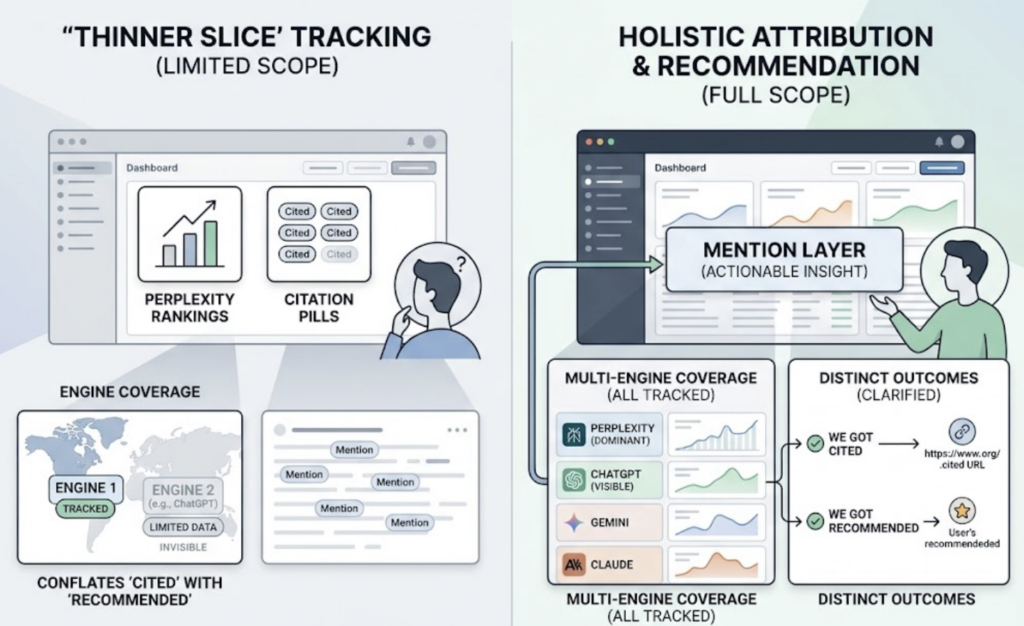
    1. Multi-platform engine coverage. Your brand’s visibility in ChatGPT can look completely different from its visibility in Perplexity or Google AI Overviews. Any tool that monitors only one platform is giving you a partial picture. Look for coverage across ChatGPT, Gemini, Perplexity, Claude, and Copilot at minimum.

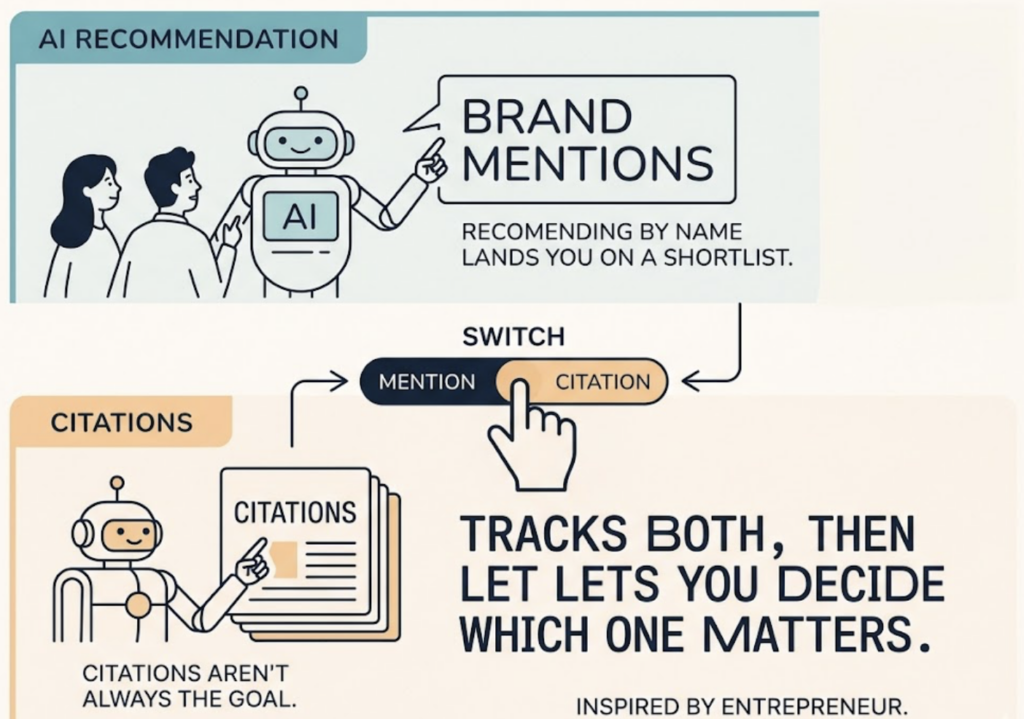
    2. Citation vs. mention distinction. A mention means your brand name appeared in text. A citation means the AI linked to a specific URL. These are fundamentally different signals, and confusing them leads to bad strategy.

    3. Source-level attribution. You need to know which domains are driving your citations — not just that citations happened. Is it your blog? A G2 review? A Reddit thread from 2022? That distinction determines where to focus your PR and content efforts.

    4. Competitive benchmarking. Knowing your own citations in isolation isn’t enough. The metric that matters is your Share of Model — the percentage of relevant AI answers where your brand appears versus your competitors. Without a comparison point, you have no way to know if you’re winning or losing ground.

    5. Actionability beyond dashboards. In 2026, data without direction is noise. The strongest tools don’t just show you what happened — they surface which prompts you’re losing, which third-party sources are helping competitors, and what you can do about it.

    The 7 Best AI Citation Tracking Tools, Ranked

    1. Topify

    Best for: Growth teams and B2B SaaS brands that want to connect AI visibility directly to revenue

    Topify stands apart because it treats AI citations as a conversion channel, not just a reporting metric. Most tools tell you whether you were cited. Topify tells you whether that citation actually mattered.

    The platform’s Source Analysis module is particularly useful for brands trying to understand the “hidden influencer” problem. Third-party sources are 6.5 times more likely to be cited than a brand’s own domain, and Topify’s Source Analysis identifies exactly which of those third-party domains are shaping the AI’s perception of your brand — and which are doing the same for your competitors.

    Topify monitors across ChatGPT, Perplexity, and Google AI Overviews, tracking seven core metrics: Visibility, Sentiment, Position, Volume, Mentions, Intent, and Conversion Visibility Rate (CVR). CVR is the most distinctive of these. It accounts for the fact that a citation in a zero-click context — where the AI fully summarizes your value proposition without leaving a knowledge gap — is a visibility win but a traffic loss.

    Pricing: Basic $99/month (100 prompts), Pro $199/month (250 prompts), Enterprise from $499/month

    2. Evertune

    Best for: Fortune 500 brands with high-volume statistical requirements

    Evertune’s core differentiator is its “Dual-Layer” methodology. It monitors not only what an AI says about your brand in real-time responses, but also what the model inherently believes based on its foundational training data. For enterprise brands where reputation management spans years of accumulated content, that distinction matters.

    The platform supports over 1 million prompts per month per brand — a level of scale that smaller tools simply can’t match. It also segments sources into “Strength URLs” (helping your visibility) and “Opportunity URLs” (sources driving competitor citations that you’re missing from).

    Pricing: Starts at $3,000/month

    3. Profound

    Best for: CMOs and enterprise marketing teams managing multi-platform brand safety

    Profound achieved unicorn status in February 2026, which reflects both its feature depth and the pace at which the GEO category is growing. The platform covers 10+ AI answer engines simultaneously, making it one of the broadest in terms of platform coverage.

    Its Agent Analytics module tracks AI crawler hits and ties GEO activities to actual revenue attribution — a capability most tools in this space haven’t built yet. Prompt Volume analysis also surfaces conversational clusters that traditional keyword tools would never catch.

    Pricing: Starter $99/month (ChatGPT only), Growth $399/month (ChatGPT, Perplexity, AIO), Enterprise custom

    4. Omnia

    Best for: Growth-stage SaaS companies that need to move fast on visibility drops

    Omnia is built for teams experiencing “data paralysis” — the condition where you have a dashboard full of numbers but no clear next action. Instead of reporting that a citation dropped, Omnia reverse-engineers successful competitor citations and produces specific content recommendations: which URL structures to use, which content formats to prioritize, which third-party placements to target.

    It also supports localized tracking across countries and regions, which matters for brands operating in multiple markets with different AI platform dominance.

    Pricing: Growth €79/month, Pro €279/month

    5. Scrunch AI

    Best for: Regulated industries where accuracy and brand safety are non-negotiable

    Scrunch AI approaches the category from a brand protection angle. Its hallucination detection capability actively monitors for AI answers that describe your product with incorrect features, outdated pricing, or misattributed comparisons — a real risk given that AI models don’t update in real time.

    The platform’s Agent Experience Platform (AXP) is designed to help marketers serve AI-readable content that actively shapes how AI agents represent the brand in real time. For healthcare, fintech, or legal-adjacent brands, that’s not a nice-to-have.

    Pricing: Starts at $250–$300/month

    6. Peec AI

    Best for: Growing B2B teams and agencies that need daily data without enterprise pricing

    Peec AI’s standout feature is its Used vs. Cited distinction. Most tools count citations. Peec AI separates instances where your content informed an AI answer (used, but not linked) from instances where your URL was explicitly mentioned(cited). That’s a technically meaningful difference with real strategic implications.

    It also segments brand positioning into four quadrants — Leaders, Niche Players, Laggers, and Controversial — giving teams a visual framework for understanding competitive standing at a glance.

    Pricing: Starts at €89/month

    7. Otterly AI

    Best for: Solo marketers and small teams entering GEO for the first time

    Otterly AI lowers the barrier to entry without sacrificing utility. Its prompt-first interface automates what many teams are still doing manually — testing AI queries one by one and noting the results. Real-time alerts notify users of sudden visibility drops or new competitors entering target prompt results, which is genuinely useful for resource-constrained teams.

    Pricing: Lite $29/month, Standard $189/month

    Side-by-Side: How These 7 Tools Compare

    PlatformBest ForEngine CoverageUnique FeatureUpdate FrequencyStarting Price
    TopifyGrowth & SaaSChatGPT, Perplexity, AIOCVR + Source AnalysisDaily$99/mo
    EvertuneEnterprise6+ PlatformsDual-Layer (base + live)Real-Time$3,000/mo
    ProfoundCMO Strategy10+ PlatformsAgent AnalyticsDaily$399/mo
    OmniaScaleupsCore EnginesActionable content briefsDaily€79/mo
    Scrunch AIRegulated industries7+ PlatformsHallucination detectionReal-Time$250/mo
    Peec AIB2B SMBs3+ (Expandable)Used vs. Cited trackingDaily€89/mo
    Otterly AISolo/Small teamsCore EnginesReal-time drop alertsDaily$29/mo

    The Citation Metric Most Tools Still Don’t Measure

    Getting cited isn’t the finish line. It’s closer to the starting line.

    When an AI cites your brand in a way that fully summarizes your value proposition — “Brand X is the best CRM for small teams at $10/user with built-in email tools” — the user has no reason to click. That’s a zero-click citation. Visibility win, traffic loss.

    Research shows that when an AI summary is present, users click through to an external link only 8% of the time. That doesn’t mean citations are worthless. It means how you’re cited matters as much as whether you’re cited.

    Topify’s CVR (Conversion Visibility Rate) metric was built specifically for this problem. It accounts for recommendation prominence, prompt intent alignment, and the AI’s level of endorsement — whether your brand is the top pick or item seven on a list. Brands optimizing for CVR typically focus on creating what practitioners call “non-summable” assets: calculators, raw datasets, downloadable templates. Content that compels a click even after an AI has described it.

    That’s the layer most dashboards don’t show you yet.

    How to Start Tracking AI Citations in 3 Steps

    You don’t need an enterprise budget to start. A systematic approach gets you meaningful data within 30 days.

    Step 1: Run a baseline audit. Start with Otterly AI or Topify Basic. Define a “Prompt Universe” of 50–100 questions your customers actually ask — especially comparison and use-case queries. Establish your current Share of Model and identify which competitors are consistently showing up in the “authoritative framing” position.

    Step 2: Find your influence sources. Use Source Analysis to identify where the AI is actually pulling information about your brand. If a specific industry forum or review platform appears repeatedly, that’s where your content and PR efforts need to shift. Remember: third-party sources are cited 6.5x more often than brand-owned pages.

    Step 3: Optimize for machine extraction. AI models are 2.8x more likely to cite content with organized headings and structured data tables. Implementing author schema and statistical fact blocks has been shown to improve AI visibility by 30–40%. Run your tracking tool for 30–60 days after changes — that’s typically how long it takes for models to re-index and adjust their citation patterns.

    Conclusion

    Team SizeRecommended ToolPrimary Goal
    Solo / Small teamOtterly AI or Topify BasicBaseline monitoring, fast experimentation
    Mid-market / GrowthTopify Pro or OmniaCVR optimization, actionable content briefs
    Enterprise / Multi-brandEvertune or ProfoundShare-of-voice, base-model reputation management
    Regulated / High-riskScrunch AIHallucination detection, brand safety

    AI citation tracking isn’t an advanced GEO tactic anymore. It’s the baseline requirement for knowing where your brand stands in the most important discovery channel of 2026.

    The gap between brands that track this and brands that don’t is widening every month. The tools above make that gap measurable. What you do with the data is the actual work.

    FAQ

    What is AI citation tracking? 

    It’s the process of monitoring how often and in what context AI platforms like ChatGPT, Perplexity, and Gemini reference your brand’s content or domain. Unlike traditional rank tracking, it focuses on narrative inclusion and URL-level attribution within synthesized AI answers.

    Does getting cited by AI actually drive traffic? 

    Yes, but the nature of that traffic has shifted. While click-through rates from AI answers are lower than traditional search, the conversion rate of AI-referred visitors is typically 5 to 11 times higher. These users arrive pre-qualified by the AI’s recommendation.

    How often should I monitor AI citations? 

    Daily monitoring is the 2026 standard. A single model update can shift your visibility by 70% or more within a 24-hour cycle. Monthly snapshots miss too much.

    Can I track competitor citations too? 

    Yes. Competitive benchmarking is a core feature of platforms like Topify, Profound, and Peec AI. You can see which competitors are recommended for your target prompts and identify the specific third-party sites giving them a citation advantage over you.

    Why does AI cite other websites more than mine? 

    AI models prioritize sources perceived as unbiased. Third-party reviews, forums, and news publications are cited 6.5x more often than brand-owned pages. That’s why tracking your Source Influence — not just your own domain mentions — is central to any GEO strategy.

    Read More

  • 6 Best LLM Visibility Tracking Tools in 2026

    6 Best LLM Visibility Tracking Tools in 2026

    You’ve been ranking on Google’s first page for three years. Traffic is steady. Conversions look normal.

    But when someone asks ChatGPT to recommend tools in your category, your brand doesn’t come up. Not once.

    That’s the gap most SEO dashboards can’t show you. Traditional rank trackers tell you where you stand in link lists. They don’t tell you whether AI systems are citing you, ignoring you, or actively recommending your competitors instead.

    This is why LLM visibility tracking has become a distinct discipline. The tools below are built specifically for this problem.


    Most Brands Are Invisible to AI Search Without Knowing It

    Here’s what’s changed: approximately 60% of Google searches now end without a click. AI Overviews appeared in 13.14% of all queries by March 2025, a 102% increase over 14 months. When an AI-generated summary is present, click-through rates drop from 15% to around 8%.

    The implication is direct. Your brand doesn’t need to lose a ranking to lose visibility. It just needs to be excluded from the AI’s synthesized answer.

    That’s the invisibility problem. And it’s compounding.

    Researchers call it the “Ghost Citation” phenomenon: AI systems use your content to support a factual claim, but name a competitor in the recommendation. You provided the proof, someone else got the mention.

    What makes it harder is that only 11% of domains are cited by both ChatGPT and Perplexity. A brand can be well-represented on one platform and completely absent from another. Without dedicated tracking, you’d never know which scenario applies to you.


    3 Things That Separate a Real LLM Tracking Tool From a Checkbox

    Not every tool in this category measures the same thing. Before comparing specific platforms, it helps to understand what actually matters.

    Platform coverage breadth. ChatGPT holds 80.49% of the chatbot market. Perplexity serves 22 million monthly users and processes 780 million queries per month. Google AI Overviews appears in roughly half of all searches. A tool that only tracks one of these platforms gives you a partial picture at best.

    Data granularity beyond mention counts. Knowing your brand appeared in an AI response is a starting point. Knowing your position relative to competitors, the sentiment of the mention, and whether that mention had any conversion intent is what drives decisions.

    Accuracy methodology. This one’s often overlooked. LLMs are non-deterministic, meaning the same prompt can produce different answers based on session history or randomization settings. Tools that use standard browser sessions often achieve accuracy scores below 60% because the AI “learns” the brand from the tracker itself. Credible tools use what’s called Swarm Probing: sending thousands of prompt variations across different geographic nodes to calculate a statistically reliable Share of Voice.


    The 6 Best LLM Visibility Tracking Tools in 2026

    ToolPlatforms CoveredStandout FeatureStarting PriceBest For
    TopifyChatGPT, Gemini, Perplexity, AI Overviews, DeepSeek, Doubao + moreFull-spectrum tracking + one-click GEO execution$99/moGrowth teams, agencies, multi-platform coverage
    ProfoundChatGPT (starter), broader on paidCDN bot log integration, SOC 2 complianceFree / $99/moEnterprise security-focused teams
    EvertuneMulti-platformFoundational vs. real-time knowledge split$3,000/moLarge enterprise, statistical rigor
    Peec AIMulti-platform + DeepSeekMultilingual, unlimited seats€89/moInternational brands, agencies
    Otterly AICore AI platformsGEO Audit (25+ on-page factors)$29/moSolo marketers, early-stage testing
    LLMClicks.ai / AkiiVariesAI hallucination detectionVariesB2B SaaS with complex product specs

    Topify: Best for Full-Spectrum LLM Visibility Tracking

    Topify is the tool most growth and SEO teams land on when they need cross-platform data with a clear path to optimization. It’s built by a team that includes founding researchers from OpenAI and Google SEO practitioners, and it’s designed around one premise: visibility data is only useful if it tells you what to do next.

    What It Actually Tracks

    Topify monitors seven dimensions of brand representation: Visibility, Sentiment, Position, Volume, Mentions, Intent, and CVR (Conversion Visibility Rate). It covers ChatGPT, Gemini, Perplexity, AI Overviews, and regional models including DeepSeek, Doubao, and Mistral.

    That range matters more than it sounds. There’s only a 13.7% overlap between citations in Google AI Overviews and Google’s AI Mode. Platform diversification isn’t optional for brands targeting multiple audiences.

    Two features stand out technically. First, URL-Level Citation Analysis: Topify maps which specific pages on your site AI crawlers are actually ingesting, so you can prioritize optimization where it’s already working. Second, Information Density Audits: the platform compares your content’s fact-to-word ratio against the sources currently winning citations, giving you a concrete improvement roadmap rather than a vague “create better content” suggestion.

    Where It Stands Out From Competitors

    Most tracking tools stop at the report. Topify includes an Action Center with one-click GEO execution, meaning teams can deploy optimization strategies, such as restructuring content for AI extraction or clarifying entity signals, directly from the dashboard without exporting to a separate workflow.

    Competitor Benchmarking is also real-time. You can see which brands AI platforms are recommending in your category right now, track position shifts over time, and reverse-engineer the citation sources your competitors are using.

    That last capability is where a lot of teams find immediate value.

    Pricing and Who It Fits

    PlanPriceCapacity
    Basic$99/mo100 prompts, 9,000 AI answer analyses, 4 projects
    Pro$199/mo250 prompts, 22,500 analyses, 10 seats
    EnterpriseFrom $499/moCustom prompts, dedicated account manager

    A 30-day trial is available on Basic. For agencies managing multiple client accounts, Topify’s Batch Workflows handle cross-account monitoring from a single dashboard, which meaningfully cuts manual tracking time.


    Tools #2–#6: Where Each One Fits

    Profound is the tool Fortune 100 companies reach for when security posture matters as much as data. Its integration with CDN providers (Cloudflare, AWS, Akamai) lets enterprise teams track how AI bots are crawling their infrastructure in real-time. It’s the only major platform in this category with SOC 2 Type II compliance and SSO at the enterprise level. The free Starter tier covers 50 prompts on ChatGPT only, which is enough to run a basic audit. Paid plans start at $99/month. The trade-off: limited optimization execution compared to Topify.

    Evertune was built by veterans from The Trade Desk, and it shows in the methodology. The platform processes over 1.25 million prompts per brand monthly, specifically to counteract the non-deterministic problem. Its defining feature is the “Dual-Layer Insight”: separating what an AI knows from its training data (foundational knowledge) versus what it retrieves in real-time. PR teams and brand strategists find this especially valuable for understanding long-term brand perception versus recency effects. Price starts at $3,000/month, so it’s positioned firmly at the enterprise end.

    Peec AI is a Belgian-founded platform built for international coverage. It tracks across multiple geographic IP locations, supports DeepSeek and other global models, and offers transparent pricing with no per-seat fees. That unlimited collaboration model makes it practical for agencies running lean. Starting at €89/month for 25 prompts and 3 competitors, it’s one of the more accessible options for teams with a global brief.

    Otterly AI earned a “Gartner Cool Vendor 2025” designation and offers the lowest entry point in the category at $29/month. Its GEO Audit analyzes 25+ on-page factors and generates a Brand SWOT Analysis covering digital PR and content structure. For solo marketers or small startups testing whether LLM tracking is worth the investment, Otterly is the lowest-friction starting point. It doesn’t offer the execution layer or deep competitor benchmarking of Topify, but for a baseline audit, it delivers.

    LLMClicks.ai / Akii takes a different approach. Rather than broad visibility tracking, these tools focus on hallucination detection: identifying when an AI is presenting incorrect pricing, outdated features, or wrong specifications for a specific product. For B2B SaaS brands with complex or frequently updated product lines, this is a real risk. A prospect asking ChatGPT about your pricing tier shouldn’t get last year’s answer.


    How to Pick the Right Tool for Your Team

    The honest answer is that there’s no single best tool for every situation. The right pick depends on what you’re trying to measure and what you plan to do with the data.

    If your priority is cross-platform coverage with a direct path to optimization, Topify is the practical choice. It handles the full cycle: tracking, competitive benchmarking, and execution. The Basic plan at $99/month is a reasonable entry point for growth teams.

    If you’re in an enterprise environment with strict data governance requirements, Profound is built for that context. The free tier lets you validate whether the data is useful before committing to a paid plan.

    If statistical rigor is non-negotiable, and you need to separate what an AI “believes” from what it’s retrieving in real-time, Evertune’s methodology is the most defensible. The $3,000/month price reflects that.

    For international brands tracking APAC markets or running multilingual campaigns, Peec AI’s geographic IP tracking and DeepSeek coverage make it worth the consideration.

    If you’re at the “is this worth exploring?” stage, Otterly at $29/month gives you a functional audit without a meaningful financial commitment.

    One thing worth noting across all of these: none of them replace the underlying work. As research from Princeton’s GEO-bench study shows, adding statistics to content improves LLM visibility by 22% to 37%, and adding authoritative citations improves it by up to 115.1%. The tracking tool shows you the gap. Closing it still requires the content work.


    Conclusion

    LLM visibility tracking isn’t a subfeature of SEO platforms. It’s a separate measurement problem that requires purpose-built tooling.

    The AI platforms your customers are using, whether that’s ChatGPT, Perplexity, or AI Overviews, have their own citation logic, their own source preferences, and their own ways of deciding which brands to recommend. Tracking your performance on one doesn’t tell you what’s happening on the others.

    For most teams starting out, the path forward is straightforward: run a baseline audit, understand where your brand currently stands across the platforms your audience actually uses, and then decide which tool’s scope matches your optimization roadmap.

    Topify covers the broadest ground for teams that need both the measurement and the execution layer in one place.


    FAQ

    What is LLM visibility tracking? It’s the practice of monitoring how AI language models, such as ChatGPT, Perplexity, and Google AI Overviews, represent your brand in their generated responses. Unlike traditional SEO rank tracking, it measures whether you’re being cited, what position you hold relative to competitors, and how the AI characterizes your brand.

    Can I track my brand in ChatGPT for free? Profound offers a free Starter tier that covers 50 prompts on ChatGPT. Otterly AI offers a paid entry point at $29/month with broader audit features. Most full-featured platforms require a paid plan for meaningful volume and multi-platform coverage.

    How is AI Overviews tracking different from standard SEO rank tracking? Traditional rank tracking measures where a link appears in a list of results. AI Overviews tracking measures whether your brand appears in a synthesized paragraph that most users read instead of clicking through. The signals that drive each are different: domain authority affects rank; citation density and content structure affect AI inclusion.

    How often do LLM visibility tools update their data? It varies by tool. Peec AI offers daily high-frequency tracking. Others update weekly or on-demand. Because LLMs are non-deterministic, credible tools average results across thousands of prompt variations rather than relying on single-point snapshots.

    Do these tools work for both Perplexity and ChatGPT at the same time? Yes, the full-featured platforms do. Topify, Peec AI, and Evertune all offer multi-platform tracking. Keep in mind that only 11% of domains are cited by both ChatGPT and Perplexity, so cross-platform data often reveals meaningful divergence in how your brand is represented.


    Read More

  • 7 Best Tools to Track AI Search Visibility in 2026

    7 Best Tools to Track AI Search Visibility in 2026

    How to measure, compare, and improve your brand’s presence across ChatGPT, Perplexity, and AI Overviews

    Your SEO dashboard is lying to you. Not because the data is wrong, but because it’s measuring the wrong thing.

    When someone asks ChatGPT “what’s the best project management tool for remote teams,” your ranking on page one of Google doesn’t matter. What matters is whether you show up in the generated answer. And right now, most brands have no idea if they do.

    That’s the gap this article addresses. Below are the 7 best AI search visibility tools available in 2026, evaluated on what actually matters: platform coverage, tracking precision, competitor benchmarking, and whether the tool can help you dosomething about what it finds.

    Most Tracking Tools Are Built for a Search Engine That’s Losing Ground

    Before picking a tool, it helps to understand why traditional SEO platforms miss this entirely.

    Organic click-through rates in queries that trigger AI summaries have dropped from 1.76% to 0.61%, a decline of over 62%. That’s not a trend. That’s a structural shift. Users get their answer directly from the AI, and they never click through.

    The deeper problem is architectural. Traditional search uses inverted indexes where the unit is a “page.” AI search uses vector retrieval where the unit is a “passage” or fragment. Around 60% of AI Overview citations come from URLs that don’t even rank in the top 20 organic results. Your backlink profile and domain authority, the things your current tools are optimized around, are increasingly less relevant to whether AI recommends you.

    That’s why a new category of tools exists. Here’s how the best ones stack up.

    The 7 Best AI Search Visibility Tools, Ranked

    1. Topify

    Best for: In-house marketing teams and agencies that need end-to-end execution

    Topify isn’t just a monitoring dashboard. It’s built around a seven-metric framework: visibility, mentions, sentiment, position, volume, intent, and CVR (Conversion Visibility Rate). Most tools give you two or three of these. Topify connects all of them and links them to downstream revenue signals.

    The feature that separates Topify from everything else is one-click GEO execution. When the platform detects a visibility gap, it doesn’t just flag it. It proposes a fix, such as restructuring your article’s opening into an “answer-first” format that’s easier for RAG systems to extract, and lets you deploy it with a single click.

    Topify’s Source Analysis is equally distinct. It reverse-engineers the exact domains and URLs that AI platforms are citing in your category, so you can see which third-party media, Reddit threads, or review platforms are driving your competitors’ recommendations. That turns a passive monitoring tool into an active competitive intelligence system.

    Platform coverage includes ChatGPT, Perplexity, Gemini, DeepSeek, and AI Overviews. The team behind it includes founding researchers from OpenAI and experienced Google SEO practitioners.

    Pricing: Basic starts at $99/mo (100 prompts, 9,000 AI answer analyses, 4 projects). A Shopify-focused entry plan is available at $9.99/mo for product-level optimization.

    Verdict: The most complete option in the market for teams that need both intelligence and execution. Worth evaluating first.

    2. Profound

    Best for: Enterprise brands in regulated industries (finance, healthcare)

    Profound is a pure intelligence platform. It processes over 5 million citation analyses per day and is built for organizations where data accuracy and compliance matter as much as the insight itself.

    Its standout feature is the Conversation Explorer, which captures real-time AI interaction data, revealing demand trends before they show up in any traditional keyword database. The sentiment analysis goes deep on how AI describes your brand, including tone, framing, and source attribution.

    The limitation is clear: Profound has no execution layer. It tells you what’s happening; it doesn’t help you fix it. Starter plans ($99/mo) only cover ChatGPT. Multi-engine monitoring across 10+ platforms requires a higher-tier plan.

    If you’re a large brand that already has a content team to act on insights, Profound is a strong data foundation. If you need a full-stack solution, you’ll need to pair it with something else.

    3. Quattr

    Best for: Mid-to-large B2B SaaS companies with high content volume

    Quattr’s GIGA agent is the most automated execution engine on this list. It reads signals from Google Search Console and LLM citation patterns simultaneously, then generates CMS-ready HTML to fix content gaps without any manual intervention.

    The predictive scoring model is genuinely useful: it estimates the probability that a piece of content will be selected as an AI answer before you publish it, allowing front-loaded optimization rather than reactive fixes.

    The downside is complexity. Quattr is designed for teams managing large-scale content operations. For smaller brands or agencies with fewer than 50 pages under active management, the feature set creates overhead rather than efficiency. Pricing is custom and typically enterprise-level.

    4. Peec AI

    Best for: Global brands and agencies managing multilingual campaigns

    Peec AI supports tracking across 115+ languages, which makes it the strongest option for brands with meaningful non-English audiences. Its technical approach is also worth noting: rather than simulating API calls, it uses UI-based scraping to capture the exact output users actually see, including regional differences and hidden citations.

    The Share of Voice benchmarking is straightforward and actionable. You can see, at a glance, how much of the AI recommendation space in your category your brand occupies versus competitors.

    Pricing starts at €89/mo with no seat limits, which is genuinely cost-efficient for agencies billing across multiple clients. The trade-off is that it’s a monitoring-only tool with lighter actionability compared to Topify or Quattr.

    5. Scrunch AI

    Best for: Enterprise brands concerned with brand safety and AI misrepresentation

    Scrunch addresses something most tools ignore: how AI agents (not just human users) perceive and represent your brand. Its Agent Experience Platform (AXP) monitors whether AI systems are misreading your content or propagating inaccurate brand information, a real risk as autonomous AI agents increasingly handle purchasing and discovery workflows.

    The persona-based monitoring is novel. You can see how a “technical expert” versus a “general consumer” asking the same question gets different AI-generated recommendations, which reveals audience-specific visibility gaps.

    At $250/mo entry pricing, Scrunch is squarely in the enterprise tier. It’s the right tool if brand consistency and AI hallucination risk are primary concerns. It’s overkill if you’re still establishing basic AI visibility.

    6. Otterly AI

    Best for: Solo founders and small teams getting started with AI visibility

    Otterly AI covers 6 major platforms, runs basic GEO audits, and automatically converts traditional SEO keywords into conversational prompts suited for AI tracking. It also flags technical visibility blockers like robots.txt blocking or missing Schema markup.

    The Lite plan at $29/mo is the lowest entry point for a professional-grade AI tracking tool on this list. For teams that need baseline data before committing to a more comprehensive platform, it’s a practical starting point.

    Don’t expect execution capabilities or deep competitive intelligence. Otterly is a monitoring foundation, not a growth platform.

    7. Semrush AI Visibility Toolkit

    Best for: SEO teams already embedded in the Semrush ecosystem

    If your team already runs Semrush, the AI Visibility Toolkit adds meaningful capability with zero additional learning curve. Its database of 200M+ prompts provides strong benchmarking for brand mentions in AI Overviews and ChatGPT.

    The most useful distinction it makes: separating “brand mentions” from “cited page” attribution. That tells you whether AI is recommending you based on brand reputation or specific content quality, which points to very different optimization strategies.

    At $99/mo per domain, it’s not cheap as a standalone product. As an extension of an existing Semrush investment, the integrated workflow justifies the cost. As an independent AI visibility solution, dedicated native platforms typically offer more depth.

    Side-by-Side: Features That Actually Matter

    ToolAI Platforms CoveredCompetitor TrackingSentiment AnalysisCitation Source AnalysisStarting Price
    TopifyChatGPT, Perplexity, Gemini, AIO, DeepSeek + moreDeep, with one-click GEO execution0-100 real-time scoringFull source URL mapping$99/mo
    Profound10+ engines (full coverage on higher plans)Real-time demand detectionDeep contextual analysisStrong attribution$99/mo
    QuattrComprehensivePredictive scoring modelIncludedInternal link optimizationCustom
    Peec AICore engines, 115+ languagesShare of Voice benchmarkingIncludedLightweight€89/mo
    Scrunch AICore engines (AXP-focused)Brand safety monitoringMisrepresentation detectionMachine-readability diagnostics$250/mo
    Otterly AI4-6 major platformsBasic monitoringBasicTechnical gap analysis$29/mo
    SemrushCore + AIOHistorical trend benchmarkingIncludedBrand vs. page citation split$99/mo

    5 Things Most AI Visibility Tools Still Can’t Fully Solve

    Knowing the limits of your tools is part of using them well.

    The persistence problem. Research shows only 30% of brands maintain consistent visibility across multiple regenerations of the same AI query. Most tools report a statistical frequency, not a guarantee of presence in any given user conversation. Treat your visibility score as a probability, not a fixed position.

    The earned media gap. Between 82% and 85% of AI citations come from third-party sources: media coverage, Reddit, G2, review platforms, industry forums. Most tools can tell you you’re not being cited. Few can help you build the external signal network that would change that. Topify’s Source Analysis gets closest by identifying exactly which third-party domains are driving competitor citations.

    Model drift. As large language models retrain and update, the way AI describes and recommends your brand can shift without warning. Current tools are better at post-hoc detection than prediction.

    The attribution gap. When AI Overviews answer a question directly, traffic falls. Tracking “mentions” is useful, but measuring the downstream behavioral impact (like branded search lift) remains difficult. You’ll need to accept that some AI influence is unmeasured by design.

    Execution without strategy. Automation tools can deploy changes at scale. They can’t tell you whether the underlying positioning is right. The best tools (Topify, Quattr) accelerate execution. Strategic judgment still sits with your team.

    Which Tool Fits Your Use Case?

    Marketing agencies: Topify handles multi-project management with one-click GEO execution across client accounts. Peec AI is a strong complement for agencies with global multilingual clients.

    In-house brand teams: Topify’s end-to-end platform, from tracking through execution, makes it the most efficient single-platform option. You don’t need a separate content team to act on what it finds.

    Enterprise and regulated industries: Profound for data depth and compliance sensitivity. Quattr for teams managing 100+ pages of content requiring systematic optimization.

    Solo founders and small teams: Otterly AI at $29/mo gives you enough baseline data to understand where you stand. Once you’ve established that AI search is a real channel for your category, upgrading to Topify’s Basic plan ($99/mo) gives you the execution layer to actually move the needle.

    Competitive intelligence specialists: Topify’s Competitor Monitoring combined with Source Analysis is the most precise way to reverse-engineer why your competitors are getting recommended and what you need to do to displace them.

    Conclusion

    AI search visibility tracking is no longer optional. If your brand appears in ChatGPT, Perplexity, or AI Overviews for high-intent queries in your category, it matters to your business. If it doesn’t appear, that also matters, and most traditional dashboards won’t tell you either way.

    The tools on this list represent different points on the spectrum from basic monitoring to full-stack optimization. For teams that want to move quickly and see results beyond a dashboard, Topify is the most complete starting point. For teams with more specific constraints (budget, language coverage, ecosystem integration), the comparison above gives you a clear framework.

    The bottom line: pick a tool, establish your baseline, and start measuring. The brands that know where they stand in AI search today will have a meaningful head start by the end of 2026.


    FAQ

    What’s the actual difference between AEO and GEO?

    AEO (Answer Engine Optimization) focuses on extraction precision, structuring content so machines can pull a specific answer directly. GEO (Generative Engine Optimization) is about synthesis, getting your brand recommended when AI models aggregate information from multiple sources to form a response. AEO is about becoming the answer. GEO is about being the recommended brand in a broader conversational context. In practice, the tactical overlap between the two is over 95%.

    Can these tools track ChatGPT and Perplexity at the same time?

    Most of the main platforms on this list (Topify, Profound, Otterly) support simultaneous multi-platform tracking. That said, each AI engine has different citation logic. Perplexity, for example, places significant weight on Reddit data and content freshness (typically within 30 days). Tracking them on the same dashboard doesn’t mean optimizing for them is the same process.

    How often should I check AI search visibility?

    Given the non-deterministic nature of AI outputs and the frequency of model updates, weekly reviews of core metrics are a reasonable baseline. For active campaigns or product launches, daily monitoring is worth it. AI outputs can shift faster than traditional rankings.

    Do I need a dedicated AI visibility tool if I already use Ahrefs or Semrush?

    Traditional SEO platforms are built around link indexes and keyword rankings. AI visibility tools are built around semantic vector spaces and citation pattern analysis. Semrush’s AI Visibility Toolkit bridges this gap for existing users, but its execution depth typically doesn’t match native platforms like Topify. If AI search is a meaningful channel for your category, a dedicated tool gives you more precise data and, in the case of platforms with execution layers, faster path to improvement.


    Read More

  • Best AEO Tools for Agencies in 2026

    Best AEO Tools for Agencies in 2026

    Most AEO platforms are built for a single brand. One dashboard, one set of competitors, one client’s problems.

    That’s fine if you’re an in-house team. It’s a friction problem if you’re running an agency.

    When you’re managing 20 clients across SaaS, healthcare, and e-commerce, the bottlenecks aren’t strategic. They’re operational: switching between accounts without losing context, pulling reports that clients actually trust, and proving that AI visibility is doing something measurable for their pipeline.

    The tools on this list were evaluated specifically through that lens. Not “does it track AI mentions?” but “does it scale across clients, survive a CMO review, and tell you what to do next?”


    Most Agencies Pick the Wrong Tool for the Same Reason

    The mistake isn’t choosing a bad platform. It’s choosing a platform built for brand teams and assuming it’ll work at agency scale.

    Here’s what that looks like in practice: a tool that charges per seat makes sense for a five-person in-house team. For an agency adding junior analysts across a dozen accounts, that pricing model quietly erodes your margin every quarter.

    The same logic applies to reporting. A dashboard designed for internal use shows raw data. Agency clients need a narrative: what changed, why it matters, what happens next. Those are two very different products.

    There are also five hard red flags worth filtering for before any trial.

    First, any tool that “guarantees” AI rankings. AI responses are stochastic by nature — context-dependent and dynamic. No platform can lock a position in ChatGPT or AI Overviews. What legitimate tools offer is visibility probability and citation share trends.

    Second, no source-level citation data. If a tool tells you your brand was “mentioned” but can’t identify which URL the AI pulled from, you can’t execute. AEO optimization happens at the content and source level. Without that, you’re guessing.

    Third, blurred terminology. Tools that use “prompt” and “keyword” interchangeably, or can’t distinguish between AEO and GEO technically, will struggle to hold up under client scrutiny.

    Fourth, no entity analysis. AI engines understand the world through entities and relationships. A platform that only tracks page performance without Schema validation or knowledge graph monitoring is leaving out half the picture.

    Fifth, per-seat pricing. If your internal team can’t grow without your tool costs spiking, the unit economics don’t work for agencies. Look for prompt-based or analysis-volume pricing, or an agency bundle with unlimited seats.


    The 7 Best AEO Tools Agencies Are Using in 2026

    Here’s the full comparison before the detail:

    ToolMulti-Client SupportAI Platform CoverageWhite-Label ReportingStarting PriceAgency Edge
    TopifyDedicated agency mode, multi-tenantAll major LLMs + regional modelsHigh, custom heatmaps and radar charts$99/moURL-level source analysis + one-click GEO execution
    ProfoundSandbox environments + sub-billing10+ engines, query fanout analysisEnterprise-grade, compliance audits$99–$399+/moHIPAA/SOC 2 compliance, identity journey simulation
    AIclicksPartner mode, revenue shareChatGPT, Gemini, Perplexity, ClaudeStandard, sentiment-focused$79/moNative AI data accuracy, citation-level sentiment
    SE RankingAgency Pack, unlimited usersCore LLMs + traditional searchMature white-label system$129+/moSEO and AEO data in one stack
    Writesonic GEOPro/Enterprise multi-accountContent-production model coverageMid, focused on content suggestions$199/moReal-time GEO scoring before publish
    VismoreGrid UI for multi-site management6+ major platformsMid, growth task progressCustomAction Center, citation gap automation
    AthenaHQAgency-specific reporting workflows8+ platforms including Grok, Meta AIHigh, ROI and attribution$295/moCross-modal optimization, GA4 conversion attribution

    Topify: The Closest Thing to an Agency Operating System

    Topify is the platform agencies reference most often when talking about full-cycle AEO management, and the reason is structural: it connects measurement to execution in a single workflow rather than requiring a separate content tool or analyst layer to bridge the gap.

    For agencies, the architecture matters. Topify supports multi-brand configurations with fast client context switching, which means your team isn’t rebuilding prompt sets and competitor lists every time they open a new account. The platform runs across all major AI platforms — ChatGPT, Gemini, Perplexity, DeepSeek, and others — which gives you a defensible cross-platform story when clients ask why their Perplexity visibility looks different from their ChatGPT numbers.

    Two capabilities stand out in agency workflows specifically.

    Source analysis at the URL level. Topify doesn’t just tell you your brand was cited — it tells you which domain the AI pulled from, whether that was a Reddit thread, a G2 review, or a third-party media piece. That’s the data you need to run a citation gap analysis and tell a client exactly where to build authority next. Most tools stop at the mention level. That’s not enough to execute.

    CVR (Conversion Visibility Rate). This is Topify’s model for estimating which AI mentions are most likely to drive downstream intent — not just awareness. For an agency trying to tie AEO work to pipeline, this is what turns a monthly report from a visibility scorecard into a revenue attribution conversation. The difference between “your brand was mentioned 45% of the time in relevant prompts” and “that mention pattern correlates with an 8% lift in assisted revenue” is the difference between an AEO line item and a retained AEO budget.

    Pricing starts at $99/month for the Basic plan, which covers 100 prompts and 4 projects. The Pro plan at $199/month scales to 250 prompts and 10 seats. Agencies running larger client portfolios typically move toward the Enterprise tier starting at $499/month.


    Profound: Built for Regulated Industries and Enterprise Scrutiny

    Profound is the default recommendation when an agency’s client base includes healthcare, financial services, or any sector where data handling needs to survive a legal review. Its SOC 2 Type II and HIPAA compliance certifications aren’t marketing copy — they’re the reason it gets approved where other tools don’t.

    Beyond compliance, Profound’s “query fanout” analysis gives agencies a structural view of how AI engines reason through a question before generating an answer. That’s useful when you’re trying to understand why a competitor is being cited and you aren’t. It covers 10+ AI engines and supports an “Agency Mode” with complex client workspace management and audit reports formatted for sales proposals. Pricing sits at the higher end at $99–$399+/month.


    AIclicks: Native AI Data and Strong Partner Economics

    AIclicks was built for the AI search era rather than adapted from traditional SEO, which shows in its data accuracy. It provides 360-degree coverage across ChatGPT, Perplexity, Gemini, and Claude with citation-level sentiment analysis — meaning it can tell you not just that a source was cited, but whether the framing around your brand was positive, neutral, or pulling in the wrong direction.

    For smaller agencies, the partner program is worth a close look. Revenue sharing and client matching arrangements make the economics work at scales where a $400/month enterprise contract would be hard to justify. Starts at $79/month.


    SE Ranking: For Agencies That Don’t Want to Abandon Their SEO Stack

    The strongest argument for SE Ranking is practical: if your team already runs traditional SEO out of it, adding AI visibility tracking through its AI Search module doesn’t require a workflow rebuild. The Agency Pack includes unlimited users and a mature white-label reporting system — two checkboxes that matter for scaling.

    The cross-analysis between historical keyword data and AI visibility data is genuinely useful for identifying where traditional search rankings and AI recommendations diverge. For clients in competitive categories, those divergence points often reveal either a threat or an opportunity that neither channel surfaces on its own. Starts at $129/month plus add-ons.


    Writesonic GEO: When Your Agency Also Produces the Content

    Writesonic’s GEO module doesn’t just generate content — it scores it against AI adoption probability before you publish. The “real-time GEO checker” estimates how likely a piece is to be cited by ChatGPT or Perplexity based on structural and semantic signals.

    For agencies running content production alongside visibility tracking, this collapses a two-step process into one. It’s less strong on deep visibility monitoring, but for the production side of AEO — getting content into a format AI engines actually extract — it’s the most focused tool in this group. Starts at $199/month.


    Vismore: Action-Oriented for Agencies Focused on Throughput

    Vismore’s “Action Center” is its core differentiator. Rather than leaving you to interpret a dashboard and decide what to optimize, it surfaces specific recommendations: which prompts need content attention this week, which competitor is gaining citation share and why.

    The grid-based UI is designed for managing hundreds of pages or clients simultaneously — closer to a spreadsheet mental model than a traditional analytics dashboard. For agencies that measure success by weekly optimization cadence rather than monthly reporting cycles, Vismore’s workflow logic fits well.


    AthenaHQ: The ROI-Focused Option for Conversion-Driven Agencies

    AthenaHQ stands apart on two dimensions. First, it covers cross-modal optimization — as AI search begins pulling video clips and images alongside text, AthenaHQ tracks visibility across formats. Second, its GA4 integration connects AI-surface click-throughs to actual on-site conversion behavior, which supports the kind of detailed attribution analysis that performance-focused clients expect. Starts at $295/month.


    How Topify Fits Into an Agency’s Day-to-Day Workflow

    The operational value of Topify isn’t one feature — it’s where it fits across the full client lifecycle.

    Within 48 hours of onboarding a new client, an agency can run an automated GEO diagnostic from a single URL input. Topify scans across 200+ high-value prompts and generates a baseline report that includes “citation blind spots” — specific prompt scenarios where a competitor is being cited and the client isn’t. That’s the kind of concrete, immediate finding that sets the tone for the engagement.

    In day-to-day operations, Topify’s dynamic competitor benchmarking runs continuously. When a new competitor appears in ChatGPT responses for a key prompt category, the platform flags it and surfaces the likely cause — whether that’s a new Reddit thread gaining traction or a schema update on a competitor’s page. That loop is what keeps citation share from eroding without anyone noticing until the quarterly review.

    At the reporting stage, the white-label output combines visibility trends, source analysis, and CVR signals in a format that can carry a client meeting without supplemental slides. When an agency can show a CMO that the brand’s recommendation rate moved from 12% to 45% in targeted prompts, and connect that to an 8% lift in assisted revenue, AEO stops being a line item and starts being a budget priority.

    Conclusion

    The agencies pulling away from the pack in 2026 aren’t the ones with the best content strategy. They’re the ones who built measurement infrastructure early and can now show clients exactly where they stand in AI-generated answers — and exactly what to do about it.

    That requires tools built for agency scale: multi-client architecture, source-level citation data, white-label reporting that holds up in a boardroom, and metrics that connect AI visibility to revenue.

    Topify covers most of that stack. Complement it with Writesonic for content production and SE Ranking for cross-channel SEO alignment, and you have a workflow that can grow with your client base without the operational overhead multiplying at the same rate.

    The shift from “SEO agency” to “AI brand visibility advisor” is already underway. The tool selection decision is less about features and more about which infrastructure you want to be building on for the next three years.


    FAQ

    What’s the difference between AEO and GEO? 

    AEO focuses on making information extractable — structured, factual answers that voice assistants or featured snippets can surface directly. GEO focuses on synthesis and trust: getting an LLM to include your brand as one of several cited sources while building positive sentiment associations. For agencies, AEO is the foundation. GEO is the brand reputation layer built on top of it.

    Can one tool handle all your clients’ AEO needs? 

    Platforms like Topify or Profound cover the majority of use cases. In practice, agencies tend to run a “1+N” model: one core visibility tracking platform paired with a content production tool like Writesonic and an existing SEO audit stack like SE Ranking. The combination gives you the broadest data coverage and execution depth without redundancy.

    How should agencies price AEO services? 

    The current range for a monthly AI visibility monitoring and reporting package is roughly $1,500 to $3,000 as an SEO add-on. Full-stack GEO strategy — covering content restructuring, schema deployment, cross-modal optimization, and citation building — typically runs $5,000 to $15,000 per month as a retainer. More sophisticated agencies are building performance bonuses tied to citation share growth or AI-referred pipeline.

    Which AI platforms should agencies be tracking in 2026? 

    At minimum: ChatGPT (highest query volume, broadest use case coverage), Perplexity (highest citation density, preferred by research-oriented users), Google AI Overviews (carries over traditional search traffic), and Claude (strong in B2B and professional services content). Vertical additions depend on client profile — Grok for social-adjacent categories, DeepSeek for regional markets.


    Read More

  • Best AEO Tools for Marketing Teams in 2026

    Best AEO Tools for Marketing Teams in 2026

    Your brand ranks #1 on Google. A user opens ChatGPT and asks which platform to use. Your competitor gets recommended. You don’t.

    That’s not a content quality problem. That’s an AEO problem, and a different category of tool is required to fix it.

    Your Brand Shows Up on Google. It Doesn’t Show Up on ChatGPT. Now What?

    Most marketing teams still measure AI search performance with SEO dashboards. The gap that creates is larger than most realize.

    Research shows the correlation between organic Google rankings and AI citation frequency sits at roughly 0.034. Essentially zero. A brand that dominates traditional search can be completely absent from the synthesized responses that AI assistants deliver to the same audience.

    By March 2026, Google’s global search market share dropped below 90% for the first time in over a decade. ChatGPT alone commands 78% of the AI search market. These aren’t niche platforms anymore.

    The users who find you through AI assistants also convert at rates 6x to 23x higher than organic search visitors, because they arrive after a deep research session, not a casual browse. Missing from that layer doesn’t just hurt awareness. It costs revenue.

    Traditional SEO tools can’t see any of this. They track blue links. AI answers are something else entirely.

    5 AEO Tools Worth Considering for Marketing Teams

    ToolPlatform CoverageKey StrengthBest ForStarting Price
    TopifyChatGPT, Gemini, Perplexity, DeepSeek + moreFull AEO cycle: track, analyze, executeMarketing teams, agencies, SaaS brands$99/mo
    Profound10+ engines incl. Grok, Meta AI, ClaudeTechnical audits + agent-level crawl trackingFortune 500, compliance-heavy enterprises$499/mo
    Peec AIMajor AI enginesUnlimited seats + optimization layerMid-market B2B SaaS teams€89/mo
    Otterly.AIMulti-engineSWOT-based GEO audit, Looker Studio connectorStartups, small agencies$29/mo
    RankscaleMulti-engineCredit-based flexible trackingFreelancers, bootstrapped startups$20/mo

    Each of these tools occupies a different part of the market. The right choice depends on whether your team needs to monitor, analyze, or actually execute, and most teams eventually need all three.

    Topify — Built for Teams That Need More Than a Dashboard

    Most AEO tools stop at data. Topify closes the loop.

    The platform covers the full cycle: discover where your brand is missing from AI answers, understand why competitors are getting cited instead, and deploy a fix without manual content workflows. Trusted by 200+ brands including Zoom, TCL, and Midea, it’s built for teams that can’t afford a dedicated AI search specialist.

    What Topify Tracks That Other Tools Miss

    Topify monitors seven core metrics that connect AI visibility to actual business outcomes.

    AI Visibility Percentage tracks how often your brand appears across target queries. A score above 80% signals category leadership. Below 20% means AI systems are effectively routing high-intent buyers to competitors.

    Answer Placement Score (APS) goes beyond “mentioned or not.” The first recommendation in an AI response gets full credit. The second gets 0.6. By position three, you’re largely irrelevant in a conversational interface. Most tools report presence. Topify reports position.

    Sentiment Polarity is what most teams overlook entirely. AI models don’t just cite brands, they describe them. A score between 81 and 100 reflects enthusiastic endorsement. Neutral descriptions (41-59) are often enough for commodity products, but insufficient for high-consideration B2B purchases. Topify flags “positioning drift” — when an AI starts characterizing your premium product as a budget alternative.

    AI Prompt Volume estimates monthly demand for specific conversational queries, which often differs significantly from traditional keyword volume. A prompt like “What’s the best CRM for remote real estate teams?” reflects higher purchase intent than the keyword “CRM software,” even if its search volume looks smaller.

    Source Analysis identifies which third-party domains AI platforms are citing when they mention your brand. AI models are 6.5 times more likely to cite a brand through external sources — Reddit, Wikipedia, G2 — than through its own website. Topify shows you exactly where your third-party coverage has gaps.

    Intent Mapping and CVR (Conversion Visibility Rate) round out the picture, connecting AI citation patterns to pipeline and lead generation rather than treating visibility as a vanity metric.

    One-Click Execution, Not Just Reports

    Topify’s AI agent handles the remediation side automatically. It identifies prompts where competitors are cited and you’re absent, reverse-engineers their citation patterns, and proposes targeted GEO strategies (specific H2 updates, FAQ blocks, schema additions). Marketing teams review and deploy with a single click. The agent then tracks how the changes affect citation frequency and refines future recommendations accordingly.

    Pricing: Basic at $99/mo (100 prompts, 9,000 AI answer analyses, 4 projects), Pro at $199/mo (250 prompts, 10 seats), Enterprise from $499/mo for agencies and large organizations.

    Other AEO Platforms Worth Knowing

    Profound is the enterprise standard for organizations with deep compliance requirements. It covers 10+ AI engines including niche models like Grok and Meta AI, and uniquely tracks which AI crawlers are visiting your site and what content they’re analyzing. At $499/mo to start, it’s a significant investment, and it lacks the automated execution workflows that Topify provides. Best suited to Fortune 500 teams with dedicated AEO analysts.

    Peec AI targets mid-market B2B SaaS companies in the $5M-$30M ARR range. Its main advantage is unlimited user seats across all plans, making it practical for large content teams that need broad access without per-seat cost concerns. Starts at €89/mo.

    Otterly.AI works well as an entry point for startups or small agencies that need basic multi-engine monitoring without a heavy investment. Its SWOT-based GEO audit and Looker Studio connector are useful for agency reporting. At $29/mo, it covers the essentials. It doesn’t offer execution capabilities.

    Rankscale offers flexible credit-based tracking starting at $20/mo. It’s the right fit for freelancers or bootstrapped teams that need multi-engine visibility without committing to a monthly seat model.

    What Marketing Teams Actually Need From an AEO Platform

    Broad feature lists are easy to produce. Four criteria actually matter for marketing teams specifically.

    Multi-platform coverage. ChatGPT holds 78% of AI search share, but Gemini, Perplexity, and DeepSeek collectively account for the rest. A tool that only tracks one engine gives an incomplete and potentially misleading picture of where your brand stands.

    Competitor benchmarking, not just self-monitoring. Knowing your own visibility score is useful. Knowing that a direct competitor is being recommended ahead of you, and understanding why, is actionable. The difference is whether the tool surfaces competitive gaps or just personal metrics.

    Content optimization guidance tied to citations. Data without a clear path to improvement creates reporting overhead, not results. The most effective AEO platforms connect visibility gaps to specific content changes — which pages to update, which FAQ blocks to add, which third-party sources to pursue.

    Team scalability. Marketing teams aren’t solo operators. Multi-seat access, project separation, and workflow integration with existing CMS platforms (WordPress, Shopify, Framer) determine whether the tool gets used daily or sits in a tab no one opens.

    How to Pick the Right AEO Tool for Your Team Size

    Lean teams and high-growth startups need automation more than analytics depth. Topify’s Basic plan delivers the full AEO cycle at $99/mo without requiring a specialist to interpret the data or execute the strategy.

    Mid-sized marketing teams managing multiple brands or product lines should look at Topify Pro ($199/mo) for expanded prompt coverage and seat access, or Peec AI if unlimited collaboration is the primary requirement.

    Agencies and enterprise teams have different requirements: client-level project separation, security certifications, and integration into internal BI systems. Topify’s Enterprise plan and Profound both serve this segment, with the key distinction being that Topify includes autonomous execution while Profound focuses on diagnostic depth.

    The bottom line: budget tools are fine for awareness. If your team needs to act on what it finds, the platform needs an execution layer.

    FAQ

    What is AEO and how is it different from SEO? SEO focuses on getting a page to rank in a list of search results. AEO focuses on getting your brand cited within the synthesized answer an AI assistant generates. SEO is measured in clicks and rankings. AEO is measured in citation frequency, sentiment, and share of voice within zero-click responses.

    Do I need a separate tool for AEO if I already use Semrush or Ahrefs? Yes. Traditional SEO platforms track blue-link rankings and keyword positions. They’re largely blind to the conversational, non-deterministic outputs of AI chatbots. Some SEO suites have added basic AEO features, but standalone platforms offer significantly deeper analytics into sentiment, citation sources, and LLM-specific query volume.

    Which AI platforms should my brand prioritize? Start with ChatGPT (78% global share), Gemini (8.65%), and Perplexity (7.07%). For technical or niche categories, tracking DeepSeek and Claude is increasingly relevant as the AI search market fragments across specialized use cases.

    How often should marketing teams check their AEO metrics? Weekly monitoring is recommended for active campaigns, since AI models update their indexes frequently and brand narrative can shift quickly based on new third-party content. Structural audits are best done every 30 to 90 days.

    Is Topify only for large enterprises? No. Topify’s Basic plan is specifically designed for startups and small marketing teams that need professional-grade AEO without agency overhead. The pricing and onboarding are built for teams without a dedicated AI search specialist.

    Conclusion

    The “Visibility Paradox” is already in effect: a #1 Google ranking delivers diminishing returns when AI assistants are routing high-intent buyers directly to competitors. AEO isn’t a future consideration. It’s a present-day gap in most marketing stacks.

    For most teams, Topify is the practical starting point. It covers multi-platform tracking, competitive benchmarking, and autonomous execution in a single environment — which means marketing teams can act on what they find rather than hand off reports and wait. The Basic plan is a reasonable entry point at $99/mo. The Pro plan scales cleanly as the team and product portfolio grow.

    Start with the prompts your highest-intent buyers are typing into ChatGPT right now. If your brand isn’t in the answer, that’s the gap worth closing first.

    Read More