Category: Knowledge

  • AI Brand Visibility: 5 Metrics That Tell You the Truth

    AI Brand Visibility: 5 Metrics That Tell You the Truth

    Your Google Analytics dashboard shows stable organic traffic. Your keyword rankings haven’t moved. Everything looks fine.

    Meanwhile, ChatGPT just recommended your competitor to 900 million weekly users. And your brand wasn’t mentioned once.

    That’s the gap. And most brands still can’t measure it.

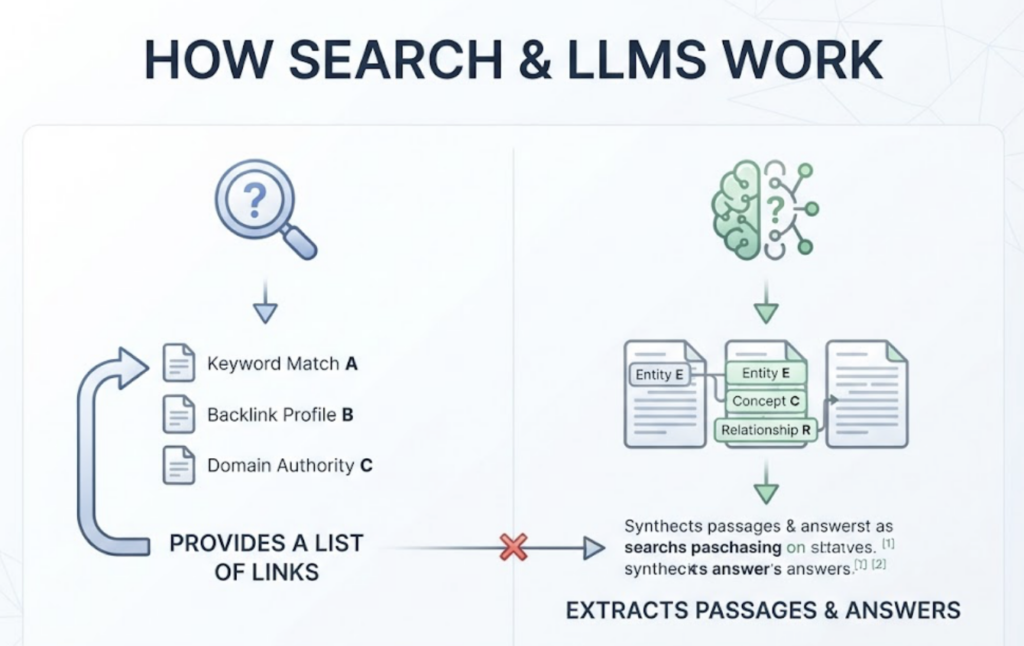
    Traditional SEO tools were built for a world where users click links. That world is shrinking fast. As of early 2026, 83% of searches that trigger an AI Overview end without a click, and Google’s dedicated “AI Mode” pushes that number to 93%. The discovery path has moved upstream, into the AI’s answer, before any link is ever touched.

    The five metrics below are what actually tell you whether AI is recommending your brand, ignoring it, or quietly pointing people elsewhere.

    Your SEO Dashboard Doesn’t See What AI Sees

    Traditional search attribution works on a simple model: user searches, user clicks, you measure. AI search breaks that model at every step.

    When a user asks Perplexity “what’s the best project management tool for remote teams” and Perplexity answers directly, no click happens. No impression is recorded in your Search Console. No session appears in Analytics. Your brand either existed in that answer or it didn’t, and you have no way of knowing which.

    This isn’t a minor reporting gap. Between January 2025 and February 2026, ChatGPT’s weekly active user base grew from 400 million to over 900 million. Google AI Overviews now reach 1.5 billion monthly users. AI-powered search tools have captured 12-15% of global search market share, up from 5-6% at the start of 2025.

    The brands that measure what’s actually happening in that space will have a structural advantage over those still optimizing for clicks that increasingly aren’t coming.

    Metric #1: AI Visibility Score — How Often AI Mentions You

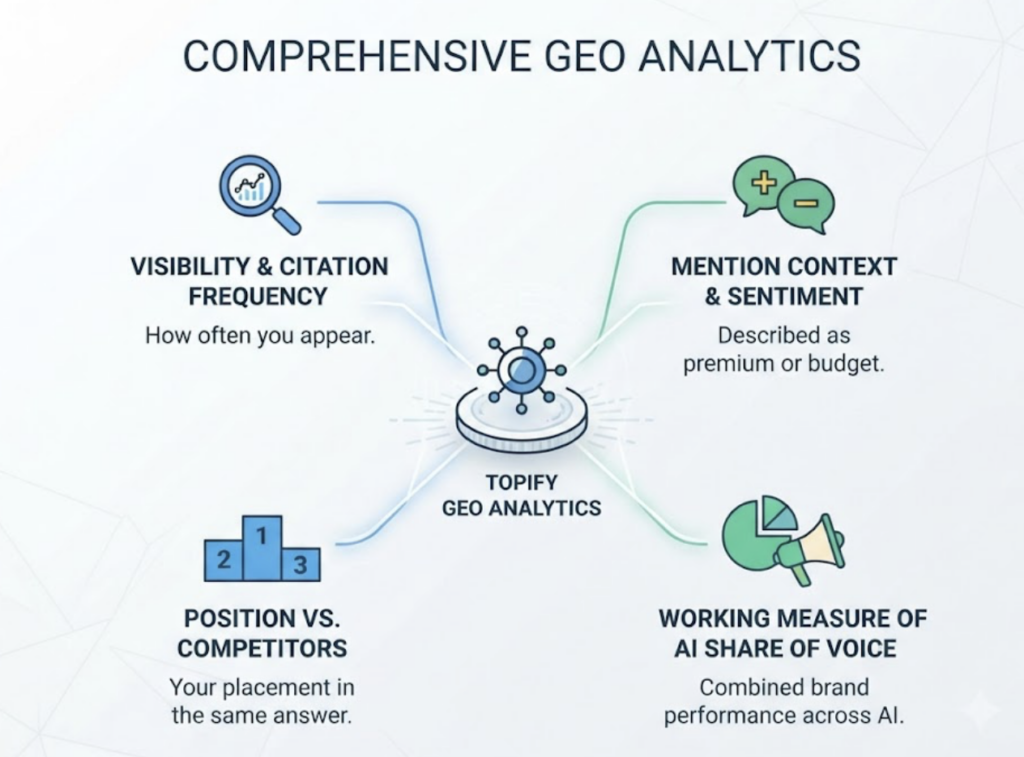
    Think of the AI Visibility Score (AVS) as your brand’s “mental share” inside the models. It answers one question: across the prompts your buyers are actually typing, how often does your brand appear?

    The standard methodology runs 20 or more structured prompts across major platforms like ChatGPT, Perplexity, Gemini, and Claude, then scores mentions by prominence:

    Prominence LevelScoreExample
    Primary recommendation, specific reasoning5 pts“For enterprise teams, [Brand] is the top choice because…”
    Included in a comparison list3 pts“[Brand], [Competitor A], and [Competitor B] are the main options”
    Passing mention without detail1 pt“Some users also mention [Brand]”
    Not mentioned0 pts

    Most brands start with an AVS between 0 and 8 out of 100. A score of 25-50 is considered “Category Presence” — AI knows you exist and mentions you in relevant contexts. Above 70 is “Category Authority” — AI actively recommends you as a leading option.

    Topify‘s Visibility Tracking automates this across seven major AI platforms, running structured prompt sets and returning a normalized visibility score broken down by topic, platform, and competitor.

    Metric #2: Sentiment Score — Being Mentioned and Being Recommended Are Two Different Things

    A brand can appear in 80% of AI answers about its category and still be losing customers to competitors. The reason: AI might be mentioning you as the “budget option,” the “legacy choice,” or worse, surfacing old negative reviews as the first thing it cites.

    Sentiment score measures the favorability of how AI talks about your brand, not just whether it talks about you.

    By early 2026, 66% of consumers said they believed AI tools provide accurate results. That trust transfers directly to whatever characterization the AI has formed about your brand. If the AI’s training data is weighted toward a period when your product had known issues, or if a competitor has built a stronger third-party review presence, the AI’s default narrative about you may not reflect where you actually are.

    A particularly costly version of this problem: brands marked as “discontinued” in AI answers because of deleted blog posts or rebranded domains. The AI inherited that signal from its training data and kept surfacing it.

    Tracking sentiment requires analyzing not just whether your brand appears, but what value-adjectives surround it and how it’s framed relative to competitors. Topify’s Sentiment Analysis assigns a 0-100 score and flags shifts in narrative tone across platforms, so you know whether a recent content change or PR mention is actually moving the needle.

    Metric #3: AI Position Ranking — First Mention Is Not the Same as Fifth Mention

    Position-based thinking isn’t obsolete in AI search. It’s just moved inside the answer.

    Research into user behavior shows that B2B buyers with high purchase intent clicked through to at least one cited source in 90% of encounters with AI-generated summaries. But which source they clicked depended heavily on where it appeared in the AI’s narrative — and whether the AI framed it as a recommendation or a footnote.

    On traditional Google, the CTR for position #1 has dropped by 58-61% when an AI Overview is present. The traffic didn’t disappear; it got absorbed by whichever brand the AI chose to present first.

    That’s the new position #1: being the brand the AI names first, with reasoning, when someone asks a relevant question.

    Topify’s Position Tracking monitors where your brand falls in AI-generated recommendation sequences, across ChatGPT, Perplexity, Gemini, and others. It tracks not just whether you’re in the answer, but whether you’re the lead recommendation or the runner-up — and how that position shifts week over week against specific competitors.

    Metric #4: Source Citation Rate — If AI Doesn’t Read You, It Can’t Recommend You

    AI recommendations don’t come from nowhere. They’re grounded in content the models have crawled, indexed, and retrieved. Your Source Citation Rate measures how much of that grounding actually includes your domain.

    A large-scale analysis of 17.2 million AI citations in late 2025 found that first-party brand websites generate 4.31 times more citation occurrences per URL than aggregators or listing sites — but only if they meet the content quality thresholds the models use for selection. Content that includes hard data is 30-40% more likely to be cited. Freshness matters too: AI-cited content tends to be 25.7% newer than what traditional SERP rankings surface.

    Platform architecture shapes this differently across engines. ChatGPT Search relies heavily on Bing’s organic index — 87% of its citations match Bing’s top 10. Perplexity prioritizes real-time retrieval and recency, often surfacing niche sources if they’re precise. Knowing which platform favors what kind of content changes how you structure your citation strategy.

    Topify’s Source Analysis reverses-engineers the domains and URLs that AI platforms are actively citing within your category, showing you where the citation share is flowing and which content gaps are costing you presence.

    Metric #5: Conversion Visibility Rate — The Metric That Connects AI Mentions to Revenue

    AI search currently drives between 0.15% and 1% of total web traffic. That sounds like a rounding error. It isn’t.

    AI search visitors arrive at your site having already read a synthesized comparison. The AI handled the research phase. The user clicking through has already narrowed their shortlist. That changes the conversion math entirely.

    Across B2B SaaS, AI search visitors convert at 12-15%, compared to 2.5-4% for traditional organic search. In retail, AI-sourced traffic converts 42% better than non-AI traffic (including paid search), with users spending 48% longer on site and browsing 13% more pages per visit.

    The Conversion Visibility Rate tracks the quality and commercial relevance of the contexts in which your brand appears — not just mention volume, but whether those mentions are occurring inside high-intent prompts where a buyer is actually making a decision.

    There’s also an AI readability problem underneath this metric. The average U.S. retail homepage is only 75% machine-readable by AI systems. Product pages drop to 66%. Roughly a third of most brands’ digital presence is effectively invisible to the agents that are guiding purchasing decisions.

    Topify’s CVR metric maps which prompt categories are driving actual downstream engagement and flags where your AI visibility is concentrated in low-intent contexts.

    Reading All Five Together

    No single metric tells the full story. In practice, each one exposes a different failure mode:

    MetricWhat High Scores MissRisk If Ignored
    AI Visibility ScoreCan be high even with negative sentimentAppears often, but as the “wrong” choice
    Sentiment ScoreDoesn’t show volumeGood reputation, but AI rarely mentions you
    Position RankingDoesn’t show conversion qualityFirst mention in low-intent contexts
    Source Citation RateDoesn’t show commercial framingCited as a source, not as a recommendation
    Conversion Visibility RateDoesn’t show reachStrong conversion rate on minimal volume

    The brands that win in AI search aren’t necessarily the ones with the highest visibility score. They’re the ones with a healthy score across all five.

    Topify tracks all of these metrics in a single dashboard, running structured prompt sets across ChatGPT, Perplexity, Gemini, DeepSeek, and others, then returning a composite view with week-over-week shifts. The Basic plan starts at $99/month and covers 100 prompts and 9,000 AI answer analyses — enough to build a meaningful baseline for most brands within the first 30 days.

    Conclusion

    SEO dashboards measure what happens after discovery. These five metrics measure discovery itself.

    Your AI Visibility Score tells you if you exist in the conversation. Your Sentiment Score tells you how AI talks about you. Your Position Ranking tells you whether you’re the recommendation or the footnote. Your Source Citation Rate tells you whether AI has the content infrastructure to cite you at all. And your CVR tells you whether those mentions are converting into anything.

    Together, they replace the guesswork about whether AI is helping or ignoring your brand with something you can actually act on.

    Start measuring. Topify covers all five metrics in one place.

    FAQ

    What’s a good AI Visibility Score for my brand? 

    Most brands start between 0 and 8 out of 100. Reaching 25-50 (Category Presence) within six weeks of active GEO effort is a realistic benchmark. Above 70 is considered Category Authority, where AI actively recommends you as a leading option in your space.

    How is AI brand visibility different from traditional SEO metrics? 

    Traditional SEO measures what happens after a user clicks a link — rankings, impressions, traffic. AI visibility measures what happens before the click: whether your brand is present in the AI’s synthesized answer, how it’s characterized, and whether it’s the option the user walks away wanting to research further. Most brands have no data on that part of the funnel at all.

    Can I track AI brand visibility across ChatGPT and Perplexity at the same time? 

    Yes, and you should — each platform has different citation logic. ChatGPT Search draws 87% of its citations from Bing’s top 10. Perplexity prioritizes freshness and real-time retrieval. A brand that’s well-cited in one may be underrepresented in the other. Cross-platform tracking surfaces those gaps.

    How often should I check these five metrics? 

    Perplexity updates citation patterns within 2-3 weeks of content changes. ChatGPT can lag by months due to its reliance on crawl cache and training data. A weekly or biweekly check is reasonable for most brands, with daily monitoring reserved for periods of active content publishing or reputational events.

    What’s the fastest way to improve my AI Visibility Score? 

    The single strongest correlation in citation research is web mentions: how often your brand is referenced on third-party, authoritative domains. Publishing data-dense content and building mentions on sites like Reddit, LinkedIn, and industry publications tends to move the AVS faster than on-site optimization alone.

    Read More

  • AI Brand Visibility 2026: The Cost of Doing Nothing

    AI Brand Visibility 2026: The Cost of Doing Nothing

    Your team spent six months building content, earning backlinks, and climbing Google rankings. Then a potential customer asked ChatGPT for a tool recommendation in your category and got a list of five brands. Yours wasn’t on it. Your analytics dashboard didn’t flag it. Your SEO report didn’t mention it. The sale went somewhere else, and you had no idea.

    That’s the real cost of ignoring AI brand visibility. Not a theoretical future risk. A transaction that already happened.

    AI Search Isn’t Coming. It’s Already Here.

    ChatGPT now has 900 million weekly active users, up 125% from the start of the year. Perplexity AI processes over 435 million searches per month. More importantly, 52% of adults actively use ChatGPT, Gemini, or Perplexity for online search and purchasing decisions.

    The shift is most concentrated where it hurts most. Among households earning over $100,000 per year, AI search adoption sits at 72–74%. That’s your highest-value customer segment, and they’re increasingly getting brand recommendations from AI, not from Google.

    These aren’t people browsing AI out of curiosity. They’re using it to make decisions.

    What “AI Brand Visibility” Actually Measures

    AI brand visibility isn’t about page rankings. It measures how often, how prominently, and with what tone your brand appears inside AI-generated answers.

    When someone asks ChatGPT “What’s the best CRM for a 50-person team?”, AI doesn’t display a list of links. It synthesizes an answer, names two or three brands, and frames them with specific context. Your visibility score reflects whether you’re one of those named brands, where you appear in the answer, and how AI describes you.

    There are seven core metrics worth tracking: visibility (mention frequency), position (where in the answer you appear), sentiment (how AI frames your brand), volume (how many distinct prompt types trigger your brand), citations (how often AI links to your domains), intent alignment (whether AI recommends you in the right context), and CVR (conversion rate from AI-referred traffic).

    CVR is where this gets concrete. AI-referred traffic converts at 3 to 5 times the rate of traditional organic traffic, because users have already completed deep research before they ever reach your website.

    Why Sentiment Scores Matter More Than You’d Expect

    In traditional SEO, if the #1 result doesn’t answer your question, you click #2. In AI search, that option often doesn’t exist. AI delivers a conclusion, and that conclusion carries a specific tone about your brand.

    Research shows that a 10% improvement in brand perception score leads to a 25% increase in user intent to choose that brand at the verification stage. Sentiment isn’t just a soft metric. It determines whether your brand makes it into the consideration set at all.

    If your training data footprint frames your brand as “a budget alternative” while your positioning is enterprise-grade, AI will keep saying the wrong thing to every user who asks, across every platform, indefinitely.

    The Brands Already Losing Customers Right Now

    The most dangerous part of AI brand invisibility is that it doesn’t show up anywhere in your existing reports.

    In B2B SaaS, the compression is severe. 94% of B2B decision-makers now use LLMs to conduct vendor due diligence. They’re not Googling anymore. They’re asking ChatGPT to compare your product against two competitors, generate a shortlist based on company size, and explain the pricing differences. If your brand isn’t extracted as a relevant entity in that answer, you’re cut from the process before the conversation even begins.

    AI typically mentions 2 to 7 brands per answer. That’s a significantly tighter shortlist than Google’s first page of 10 results. The brands that don’t make the cut don’t get a second chance in that session.

    In e-commerce, AI recommendation engines already account for 7% of traffic but 26% of revenue. For products with incomplete data, outdated inventory signals, or weak third-party validation, AI agents skip them automatically at decision time. No warning. No fallback.

    That’s the gap most brands still can’t see.

    B2B buyers now complete 70% of the decision path before they ever contact sales. And AI is shortening that overall journey by 33%. The early stage, where a buyer asks AI to narrow the field, is where invisible brands are quietly eliminated.

    Why Your SEO Rankings Don’t Protect You Here

    This is the assumption that costs brands the most time: “If we rank well on Google, AI will find us.”

    The data says otherwise. The overlap between ChatGPT’s answers and Google’s top 10 search results is only 6.5%. The two systems operate on fundamentally different logic.

    Google ranks pages based on backlinks, keyword signals, and user behavior. AI models, especially those using retrieval-augmented generation (RAG), work with semantic vector matching. They look for content that provides informational density and direct answers, not keyword coverage.

    A page ranked #50 on Google that contains structured data, precise statistics, and clear factual statements will often be cited by AI more than a page ranked #1 built for keyword density. AI measures “conversational authority”: how tightly your brand is associated with specific concepts across its training corpus and real-time index.

    The citation logic is also different. AI pulls from Wikipedia, peer-reviewed sources, industry review platforms like G2 and Capterra, and forum discussions. It prioritizes third-party consensus over brand-owned content. A backlink profile optimized for Google won’t solve the problem of weak representation on the nodes AI actually trusts.

    Content structure matters too. Pages with tables, lists, and clear conclusions see 40% higher citation rates in AI answers. Traditional long-form content built for time-on-page and keyword saturation typically has high extraction resistance for AI systems parsing content into chunks.

    5 Things That Determine Whether AI Recommends Your Brand

    Citability: structure your content so AI can extract it. Implement JSON-LD schema markup at the site level (Organization, Product, FAQ). Use a conclusion-first writing structure: the first 50 to 60 words of any article should directly answer the core question. Princeton research found that adding statistics, expert quotes, and citation references improves AI visibility by 30–40%.

    Prompt coverage: appear across the full intent spectrum. Don’t just track branded queries. Map out 500 to 1,000 natural-language prompts your target audience might ask at different stages: problem discovery, solution comparison, risk assessment. If your brand only shows up when someone types your name, you’re missing the top of the funnel entirely.

    Competitive positioning in AI answers. AI typically includes 2 to 7 brands per answer. Your goal isn’t just to appear. It’s to hold a specific label: “best for enterprise teams,” “highest reliability,” “fastest implementation.” If a competitor already owns a valuable label in AI answers across your category, unseating them requires deliberate content strategy, not more backlinks.

    Sentiment consistency across platforms. If Reddit threads describe your product differently from how LinkedIn posts frame it, AI registers the inconsistency and tends to hedge. Brands with consistent third-party sentiment across forums, review platforms, and industry media get recommended with more confidence.

    Source domain authority on AI-trusted nodes. Wikipedia coverage, G2 and Capterra reviews, Trustpilot ratings, and forum discussions carry disproportionate weight in AI citation logic. A brand with 200 mediocre blog backlinks will often lose to a brand with three strong G2 reviews and a Wikipedia mention.

    How to Start Tracking AI Brand Visibility Today

    The core problem isn’t that AI brand visibility is hard to improve. It’s that most brands have no baseline to work from.

    Start by defining a core prompt set: 50 to 100 natural-language queries that reflect how your target buyers actually search, split across discovery, comparison, and validation intent. Run those prompts across ChatGPT, Perplexity, and Gemini. Record where your brand appears, in what position, and what language AI uses to describe you.

    Each platform behaves differently. ChatGPT leans on long-term brand authority and official documentation. Perplexity prioritizes real-time forum sentiment and social signals. Gemini integrates Google ecosystem data and traditional SEO authority. A brand can look strong on one and be invisible on another.

    This is where manual auditing hits its limits fast. Tracking 100 prompts across three platforms, weekly, isn’t a sustainable workflow for most marketing teams. Topify was built specifically for this gap. Its Visibility Tracking runs your entire prompt set automatically across major AI platforms, returning mention frequency, position data, and sentiment scores in a single view.

    The Competitor Monitoring feature goes further. It surfaces not just where your competitors appear, but what content strategies are driving their AI citations, which sources are being pulled, and what sentiment labels they currently hold. That context is what turns a visibility gap into an actionable optimization plan.

    When Topify’s monitoring shows your brand trailing in “security-focused” queries, for example, the response is targeted: update FAQ pages, strengthen third-party review language on G2, and run a content gap analysis against the sources AI is currently citing. The feedback loop closes quickly.

    Get started with Topify and run your first brand visibility audit across ChatGPT, Perplexity, and Gemini.

    Conclusion

    AI brand visibility isn’t a future optimization problem. The customer journeys reshaping your pipeline are happening right now, inside AI conversations your analytics tools aren’t logging.

    The brands building AI visibility now are accumulating a compounding advantage: more citations mean stronger semantic association, which means higher mention frequency, which means more conversions at 3 to 5x the rate of organic traffic. The brands waiting are losing ground that gets harder to recover with each passing month.

    The question isn’t whether to invest in AI brand visibility. It’s whether you start with data or keep guessing.

    FAQ

    Q: What is AI brand visibility?

    A: AI brand visibility measures how often, how prominently, and with what sentiment your brand appears inside AI-generated answers across platforms like ChatGPT, Gemini, and Perplexity. Unlike traditional SEO rankings, it tracks your brand as a knowledge entity within AI reasoning, not just as a page in search results.

    Q: How is AI brand visibility different from SEO?

    A: SEO optimizes web pages for click-through from search result lists. AI brand visibility, which falls under generative engine optimization (GEO), optimizes how your brand is extracted, synthesized, and framed by AI models. SEO is driven by keywords and backlinks; AI visibility is driven by entity association, structured content, and third-party consensus.

    Q: How do I know if my brand is showing up in AI answers?

    A: Run a prompt audit. Use 50 to 100 natural-language queries that reflect your buyers’ search behavior and test them across ChatGPT, Perplexity, and Gemini. Note whether your brand appears, in what position, and how it’s described. Automated platforms like Topify can run this process at scale and track changes over time.

    Q: Can smaller brands compete with established players in AI search?

    A: Yes, often more effectively than in traditional SEO. AI systems weight domain-specific authority and factual density over general brand size. A brand with highly structured, data-rich content and strong niche community presence on platforms like Reddit or G2 can outrank much larger competitors for specific prompt categories.

    Read More

  • Why AI Ignores Your Brand

    Why AI Ignores Your Brand

    You rank on page one. Your content is technically clean. Your backlink profile took months to build.

    And when someone types “what’s the best tool for [your category]” into ChatGPT, it names three of your competitors. Not you.

    This isn’t a traffic anomaly. It’s a structural disconnect, and it’s one of the most common problems brands face in 2026. The signals that get you ranked in Google and the signals that get you recommended by AI are not just different. In several key ways, they’re almost opposite.

    Google Ranks Pages. AI Recommends Brands. That’s Not a Small Distinction.

    Google’s algorithm is built on a graph model. It crawls the web, indexes pages, and assigns authority based on who links to whom. The output is a ranked list of URLs. You compete for position.

    AI platforms like ChatGPT, Perplexity, and Gemini use a fundamentally different mechanism: Retrieval-Augmented Generation (RAG). When someone submits a prompt, the system interprets intent, retrieves relevant documents, and synthesizes them into a single conversational answer. The output isn’t a list of links. It’s a verdict.

    The user behavior shift backs this up. The average Google query is roughly 3.4 words. The average AI prompt runs about 23 words. Users aren’t just navigating the web. They’re asking for judgment calls, product picks, and vendor comparisons, and they expect a direct recommendation in return.

    Google gives options. AI gives verdicts.

    If your brand isn’t structured to earn verdicts, no amount of SEO work will fix the problem.

    The 5 Reasons AI Skips You (Even When You Rank #1)

    You’re not in the sources AI actually learns from

    AI systems don’t discover brands by crawling your website. They develop confidence about brands through a training process that weights certain sources far more than others. Wikipedia alone accounts for 47.9% of ChatGPT’s top cited sources. Authoritative “Best of” listicles influence 41% of brand recommendations in ChatGPT.

    If your brand isn’t present in those reference-grade sources, the model’s internal confidence in your brand is low regardless of your domain authority.

    You can rank #1 on Google and still be effectively unknown to an AI.

    Your brand has no story outside your own domain

    LLMs treat brands as entities in a knowledge graph, not just as URLs to index. An entity isn’t just a name. It’s a cluster of attributes: what the brand does, who it’s for, how it compares, and what independent users say about it.

    If that entity profile only exists on your website, the AI can’t build a reliable picture. Brands described consistently and positively across at least four non-affiliated forums or publications are 2.8 times more likely to appear in ChatGPT responses. Without cross-platform reinforcement, the model doesn’t have enough data to confidently surface your brand when it counts.

    Real users aren’t talking about you where AI listens

    Traditional SEO values backlinks. AI systems look for social validation through authentic community engagement. Reddit accounts for 46.7% of Perplexity’s top citations. If real users aren’t discussing your brand in relevant subreddits, comparison threads, or Q&A forums, AI registers that as an absence of endorsement.

    That absence is enough for it to name someone else.

    Your content is built for clicks, not extraction

    A lot of SEO content is designed to keep readers engaged. AI doesn’t need engagement. It needs extractable facts. Research from the Princeton GEO study, which tested 10,000 queries, found that adding statistics increases AI visibility by up to 40%. Adding citations to credible sources adds another 40% lift. Expert quotes contribute around 30%.

    Most brand content continues to publish prose-heavy, keyword-optimized text that gives AI models nothing concrete to cite or synthesize.

    If the model can’t chunk your content into verifiable claims, it won’t use it.

    Competitors are earning AI citations while you optimize title tags

    Around 41% of ChatGPT’s brand recommendations come from list mentions in “Best of” articles and industry roundups. Traditional backlinks, the metric most SEO teams track carefully, have near-zero influence on AI citation probability.

    That’s the gap most brands still can’t see.

    What AI Brand Visibility Actually Measures

    The standard SEO dashboard won’t surface any of this. AI brand visibility is a separate set of metrics, and the gap between them and your current reporting is where most brands are flying blind.

    Mention Frequency tracks what percentage of relevant queries include your brand in the AI’s response. Think of it as impressions, except it measures presence inside the answer, not on the results page.

    Sentiment Score measures how the AI describes you when it does mention you. Being named isn’t the win. If AI consistently pairs your brand with phrases like “limited integrations” or “better for smaller teams,” that framing affects user decisions downstream, even if your product outperforms the description.

    Position Index captures where you land in an AI recommendation list. First mention and fourth mention are not comparable outcomes. AI responses operate with a steeper winner-take-all dynamic than anything in traditional search.

    Entity Confidence is newer, and it’s arguably the most telling. Only 30% of brands maintain consistent visibility across multiple regenerations of the same query. If you appear in AI responses sometimes but not reliably, your brand has an entity confidence problem, not just a coverage problem.

    Together, these metrics form what’s called Share of Model: the AI-era equivalent of Share of Voice. You measure it by testing a set of relevant prompts, tracking how often your brand appears across multiple runs, and comparing that rate against competitors in your category.

    You Can’t Fix What You Can’t See

    Most brands today have no idea what their AI visibility looks like. Unlike Google Search Console, which gives you a direct feedback loop of impressions, clicks, and positions, AI platforms are black boxes. The same query can produce different answers at different times. Your brand might appear consistently in ChatGPT and be completely absent from Perplexity.

    This is the traceability gap, and it’s the reason most GEO efforts stall before they start.

    Topify addresses this directly. Its Visibility Tracking lets you run specific prompts across major AI platforms and see exactly where your brand appears, or doesn’t, across ChatGPT, Gemini, Perplexity, and others. The Source Analysis feature goes further, identifying which third-party domains are driving AI recommendations for your competitors. You can see the citation gap in concrete terms rather than hypothesizing about it.

    The starting point isn’t optimization. It’s establishing a baseline. Which prompts trigger competitor mentions? Which ones ignore your brand entirely? Which third-party sources are building the AI citations you don’t have yet?

    Track it. Map it. Then act.

    3 Moves That Actually Improve AI Brand Visibility

    Build content AI can actually cite

    The Princeton GEO study confirmed that structured, statistics-rich content consistently outperforms fluent prose for AI citations. The practical implication: restructure your cornerstone content around atomic facts. Each section should contain standalone, extractable claims backed by specific numbers. Use H2 and H3 headings framed as natural questions. Add a TL;DR at the top of long-form guides. Implement Schema.org markup so AI systems can extract your brand’s attributes, pricing, and product specs without inferring from prose.

    The bar isn’t “informative.” It’s “extractable.”

    Expand your third-party footprint

    Between 82% and 85% of AI citations come from third-party sources. Your own domain contributes less than most marketing teams expect. The brands earning AI recommendations are investing in authentic community presence on Reddit, inclusion in industry roundups and authoritative listicles, and publishing original research with verifiable data points.

    This isn’t about gaming AI. It’s about building the kind of cross-platform brand presence that AI systems interpret as consensus, not self-promotion. Those are different things, and the model can tell the difference.

    Monitor sentiment, not just mentions

    Visibility alone isn’t the goal. If an AI mentions your brand but consistently frames it with negative attributes, that’s a messaging problem dressed up as a visibility win. Topify’s Sentiment Analysis tracks how AI platforms characterize your brand compared to competitors, so you can identify where the framing is off and correct it through targeted content and external PR.

    Brands that run systematic GEO campaigns show what’s possible. A building materials supplier achieved a 540% increase in Google AI Overview mentions after restructuring content around user intent and AI-friendly structure. An e-commerce brand saw a 312% increase in organic traffic after a six-month GEO campaign. Visitors arriving from AI sources also tend to convert at significantly higher rates than standard organic traffic, with estimates ranging from 4x to 23x, because they’ve already received a recommendation before clicking.

    The opportunity is large. But only if you can measure your starting point first.

    Conclusion

    SEO built the foundation. It’s not being torn down.

    But the rules for what gets built on top of it have shifted. AI systems don’t reward the brands that optimized hardest for crawlers. They recommend the brands with the clearest entity definition, the strongest cross-platform consensus, and the most extractable content. Those are different skills, and most SEO playbooks haven’t caught up yet.

    The gap between ranking and being recommended is real, measurable, and closeable. But only if you can see it first.

    FAQ

    Is GEO replacing SEO?

    No. GEO is layered on top of traditional SEO, not replacing it. Your existing rankings and domain authority are part of the “source discovery” phase, where AI systems identify which pages to retrieve. Many AI citations still come from pages already ranking in Google’s top 10. But GEO determines whether a page, once found, gets synthesized and named in the AI’s actual response. You need both layers working.

    How long does it take to improve AI brand visibility?

    Most brands see measurable movement within three to six months. A practical starting sequence: establish your baseline in the first 10 days, implement structural content changes (statistics, schema markup, expert citations) in the following two weeks, then shift focus to third-party expansion through Reddit, media outreach, and industry publications. Some brands have reported significant AI Overview lift within six months of systematic implementation.

    Which AI platforms should I prioritize?

    It depends on your audience. B2B and enterprise brands typically get more value from prioritizing Perplexity and ChatGPT. B2C and e-commerce brands should focus on Google AI Overviews and ChatGPT. Technical audiences tend to use Claude and Perplexity for source-heavy queries. The practical answer: track all major platforms first, then allocate optimization effort based on where your target audience is actually making decisions.

    Read More

  • AI Brand Visibility: Why Your SEO Score Lies

    AI Brand Visibility: Why Your SEO Score Lies

    Your dashboard looks clean. Keyword rankings are holding. Domain authority is up. Organic traffic is steady.

    And yet, when a potential customer asks ChatGPT to recommend tools in your category, your brand doesn’t show up. Your competitors do.

    That’s not a technical glitch. That’s an AI visibility problem. And your SEO tool won’t catch it.

    SEO Measures Search Engines. AI Has Its Own Rules.

    Traditional SEO is built around one assumption: users search, Google returns links, users click. Your job is to rank high in that list. It’s a system based on keyword matching, backlink graphs, and domain authority scores.

    Generative AI doesn’t work that way. When someone asks ChatGPT a question, it doesn’t return a ranked list of URLs. It synthesizes an answer, pulls from multiple sources, and presents a conclusion. The user never has to click anywhere.

    Here’s what makes this a structural problem, not just a tactical one. Research shows the correlation between Google rankings and ChatGPT citations is approximately 0.034. That’s essentially zero. A brand that dominates Google search has no statistical guarantee of appearing in AI-generated answers.

    SEO optimizes for the index layer. AI operates on the synthesis layer. These are two different games.

    So What Exactly Is AI Brand Visibility?

    AI brand visibility is how often, how prominently, and how positively your brand appears in answers generated by AI systems like ChatGPT, Perplexity, Gemini, and DeepSeek.

    It’s not a single number. It’s a multi-dimensional signal made up of three core components.

    Mention frequency measures how often your brand appears across hundreds of relevant prompts in your category. Because AI outputs are probabilistic, one test query tells you almost nothing. You need to simulate the full range of questions your buyers actually ask.

    Sentiment measures how AI describes you when you do appear. Being mentioned as “a budget option” versus “an industry-recognized leader” are both mentions, but they produce very different buyer perceptions. A high mention rate paired with weak or negative descriptors can actively work against you.

    Position measures where in the answer your brand appears. The first recommendation in an AI response carries significantly more weight than a brand listed third with no elaboration. AI doesn’t just mention brands, it ranks them implicitly through the structure of its answer.

    Platforms like Topify formalize this into seven trackable metrics: visibility rate, total mentions, sentiment score, position index, prompt volume, intent match, and conversion visibility rate (CVR). Each one connects AI-end performance to downstream business outcomes.

    The Brands Winning in AI Aren’t Always Winning in Google

    This is where things get counterintuitive.

    Approximately 88% of AI citations come from sources that don’t appear in the top ten Google results for the same query. The brands AI chooses to recommend are often not the brands ranking highest in traditional search.

    Why? Because AI systems don’t optimize for backlinks or page authority. They optimize for entity clarity, third-party consensus, and structured, extractable information. A domain authority 40 vertical media site that was cited once by The Verge can outrank a DA 80 competitor in AI-generated answers if its content is clearer, more data-rich, and more frequently referenced across independent sources.

    There’s also what researchers call “AI consensus verification.” If your brand claims to be the fastest or most secure option but that claim only lives on your own website, AI models discount it. They’re looking for corroboration from Reddit threads, industry publications, analyst reports, and structured review platforms. Without that external validation, the claim doesn’t register as credible.

    A B2B CRM query illustrates this well. Google’s top result is typically a high-DA media site optimized for keywords. ChatGPT’s top source for the same query is often a vertical industry association’s annual report, chosen for entity accuracy and multi-source consensus. Perplexity favors content updated within the last 30 days. Three platforms, three entirely different selection logics.

    5 Signs Your Brand Has an AI Visibility Gap

    Most brands don’t know they have this problem until a sales rep mentions that prospects arrived already having eliminated them from consideration. By then, the damage is done.

    Here are the signals to watch.

    AI uses your data but not your name. If your research or statistics appear in AI answers without attribution, your content lacks identity markers. A report titled “2025 Industry Trends” gets treated as common knowledge. A report titled “Topify AI Search Report 2025” gives AI a named source to cite.

    Aggregators are standing in for you. If AI recommends your product by citing a G2 review page or a Wikipedia entry rather than your own domain, your owned content doesn’t register as authoritative enough to be a primary source.

    Your SEO share of voice is 30%. Your AI citation share is under 5%. This is the clearest signal. Content optimized heavily for traditional search algorithms tends to be too verbose, too keyword-dense, and too difficult for AI systems to extract clean “atomic facts” from.

    You rank on page one. AI still skips you. This happens when your pages are built to maximize time-on-site rather than to answer questions directly. AI prioritizes content where the core answer appears in the first 40-60 words. Long-winded introductions and buried conclusions are extraction dead ends for AI.

    Sales is hearing it before data is. When prospects tell your team they “already looked into you and moved on,” they often mean they asked an AI and your brand didn’t make the recommended list. This loss is invisible in your analytics. No click, no session, no bounce rate. Just a deal that never started.

    What Actually Drives AI Brand Visibility

    About 63% of your current AI visibility is determined by your historical brand footprint: how consistently you’ve been mentioned, cited, and referenced across the web before any AI model was trained. That part is slow to change.

    The remaining 37% can be moved in weeks, not months, through targeted content and citation strategies.

    Research from Princeton University and IIT Delhi formalized this into what they call GEO (Generative Engine Optimization). Their findings show that adding authoritative citations to a page can boost AI visibility by up to 115% for lower-authority sites. Restructuring content to place the direct answer first improves visibility by roughly 32.5%. These aren’t abstract recommendations. They’re structural changes to how you present information.

    The underlying mechanism is AI’s preference for “token efficiency.” Content that delivers a clear, fact-dense answer in the opening sentences gets extracted and cited more often than content that builds slowly toward a conclusion. If your page starts with “In today’s competitive landscape…” you’ve already lost the AI’s attention.

    Third-party consensus matters just as much. A brand that appears consistently across G2, Capterra, relevant Reddit threads, and two or three industry publications signals to AI that its authority is real, not self-declared. That cross-platform presence is what AI uses as a proxy for credibility.

    You Can’t Improve What You Can’t See

    Here’s the practical problem: none of this shows up in Google Search Console, Semrush, or Ahrefs. Those tools are measuring the index layer. AI visibility lives in the synthesis layer, and it requires a completely different measurement approach.

    Topify is built specifically for this. Rather than tracking keyword positions, it simulates hundreds of buyer prompts across ChatGPT, Perplexity, Gemini, and other platforms, then measures where and how your brand appears across all of them.

    A B2B marketing team used this approach to audit their AI presence and found their visibility for the prompt “most secure collaboration tool” was 15%. Their main competitor was at 60%. Topify’s Source Analysis revealed why: AI was pulling from a Reddit thread and two 2023 industry comparison articles, none of which mentioned the brand.

    The team didn’t respond by writing more blog posts. They updated relevant wiki entries, launched an expert Q&A program on Reddit, and restructured their core product page to front-load their security certifications. Within a month, their AI mention share had climbed to 45%, and the sentiment descriptor had shifted from “unknown” to “highly trusted.”

    That’s the operational loop: measure, identify the source gap, fix the specific content structure, remeasure.

    Conclusion

    SEO tells you how visible you are to Google’s algorithm. AI brand visibility tells you whether you exist in the answers that buyers are actually using to make decisions.

    They’re not competing priorities. They’re parallel ones. SEO is your passport to traditional search. AI visibility is your presence in the new layer of discovery that’s growing alongside it.

    The brands that win in this environment aren’t necessarily the biggest or the best-funded. They’re the ones with the clearest, most credible, most consistently cited digital footprint. That’s a game that smaller brands can compete in, if they know the rules and can measure their position.

    Right now, most brands are flying blind. That’s the actual problem. Not that AI visibility is hard to build, but that most teams don’t yet know where they stand.

    FAQ

    Is AI brand visibility the same as GEO? 

    Not exactly. AI brand visibility is the outcome, how often and how well your brand appears in AI-generated answers. GEO (Generative Engine Optimization) is the set of techniques used to improve that outcome. Think of visibility as the metric and GEO as the strategy.

    Does good SEO help with AI visibility at all? 

    It helps, but indirectly. Research suggests that 76-86% of AI citations do appear somewhere in traditional search results, so SEO gets your content into the pool AI can pull from. What SEO doesn’t do is ensure your content gets selected and synthesized into an answer. That’s where GEO-specific structure and third-party consensus matter.

    How quickly does AI visibility change? 

    Faster than most teams expect. Real-time retrieval platforms like Perplexity can shift citation sources within days based on fresh content. Core model-based visibility (in ChatGPT, for instance) changes more slowly, but remains responsive to structured content updates. The practical recommendation is to audit your top brand prompts on at least a 30-day cycle.

    Can a smaller brand compete with established players in AI answers? 

    Yes. AI systems weight content quality and third-party corroboration more than brand size. A focused brand with structured, data-rich content that’s cited across a handful of credible third-party sources can outrank a much larger competitor whose content is optimized for traditional search but poorly structured for AI extraction.

    Read More

  • Why ChatGPT Won’t Mention Your Brand

    Why ChatGPT Won’t Mention Your Brand

    You search your own brand name on ChatGPT. Then you try the category question your customers actually ask: “What’s the best tool for [your space]?” A competitor shows up. You don’t. You try it again with slightly different phrasing. Same result.

    That’s not a glitch. Nearly 26% of leading global brands are entirely absent from AI-generated recommendations, even when they dominate traditional search results. The gap isn’t closing on its own. And the longer a competitor holds that position, the harder it becomes to take it back.

    AI brand visibility isn’t accidental. Here’s what’s actually blocking you, and what fixes it.

    ChatGPT Doesn’t Work Like Google. That’s the Whole Problem.

    Most brands assume AI search works the way web search does: publish content, get indexed, get found. It doesn’t.

    ChatGPT generates answers from two sources. The first is its parametric knowledge, which is information baked into the model’s weights during training. This is the AI’s long-term memory, a static snapshot of the internet built from hundreds of gigabytes of text data. If your brand didn’t have a meaningful digital footprint before the model’s training cutoff, you effectively don’t exist in this layer.

    The second source is real-time retrieval, often called RAG (Retrieval-Augmented Generation), where ChatGPT Search pulls live web results via Bing to supplement its base knowledge. But even here, the model doesn’t cite everything it finds. Research shows ChatGPT only cites roughly 15% of the pages it pulls into its context window. The other 85% of retrieved content is processed and discarded without attribution.

    The result is a “winner-take-all” model. While Google serves ten organic results per page, a typical AI response names 3 to 7 brands at most. Getting into that shortlist is significantly harder, and once a competitor claims a spot, they benefit from a self-reinforcing cycle: more citations build more authority in the model’s internal weights, which leads to more citations.

    5 Reasons Your Brand Isn’t Showing Up in ChatGPT

    You Don’t Have Enough Third-Party Validation

    AI models are trained to recognize consensus. A brand’s own website claiming it’s the industry leader carries almost no weight. What matters is whether credible third parties are saying it.

    A striking 85% of non-paid AI citations come from earned media, not brand-owned content. Sources like Wikipedia (which accounts for approximately 27% of citations across major AI platforms), Forbes, TechCrunch, G2, and industry review sites act as “trust anchors.” They tell the model that the brand has been verified by sources it already trusts. Without that coverage, the AI has no credible chain of evidence to draw from.

    Your Content Is Structured for Google, Not for AI

    Traditional SEO encourages narrative storytelling, long introductions, and building toward a conclusion, strategies designed to keep humans engaged and reduce bounce rate. AI crawlers work differently. They’re scanning for the most direct answer as efficiently as possible.

    Content that buries its key claims in long paragraphs, lacks semantic structure, or doesn’t implement Schema markup (FAQPage, HowTo, Product) creates extraction friction. The AI moves on to a competitor’s page where the answer appears cleanly in the first 200 words after a heading. The structure of your content is not a UX concern; it’s a visibility decision.

    Competitors Have Claimed the High-Authority Nodes

    AI search citations aren’t distributed evenly across the web. Just 50 domains supply 28.9% of all AI Overview citations, and competitors who have secured placements on those domains, through “best of” lists, Reddit threads, or analyst roundups, occupy the nodes that the model returns to repeatedly.

    This is what makes the gap compound over time. Every citation a competitor earns reinforces their position in the model’s training signal. You’re not just behind; you’re watching the distance increase.

    Your Content Doesn’t Match What People Actually Ask AI

    There’s a significant gap between traditional keyword research and real AI prompt behavior. The average AI query is 23 words long, far more specific and conversational than a typical Google search.

    Someone asking ChatGPT isn’t typing “CRM software.” They’re asking something like, “What CRM works best for a 40-person B2B sales team that needs Salesforce integration and GDPR compliance?” If your content addresses the broad category but not the specific constraints, use cases, and persona-level details embedded in those prompts, the AI won’t surface you as a relevant match.

    Your Brand Postdates the Model’s Training

    New brands, recently renamed companies, or products that pivoted significantly after mid-2024 face a structural disadvantage. The AI’s internal knowledge layer simply hasn’t been trained on them. These brands must rely entirely on real-time retrieval, which is more volatile and closely tied to current Bing rankings. Research indicates that 87% of ChatGPT Search citations match the top 10 Bing results, making traditional search authority still relevant, but insufficient on its own.

    What “AI Brand Visibility” Actually Measures

    The instinct is to ask: “Does ChatGPT mention us?” That’s the wrong question, or at least an incomplete one.

    AI brand visibility is a measurable system of performance indicators that go well beyond a binary yes/no. The key metrics are:

    MetricWhat It Measures
    Brand Mention Rate% of relevant prompts where the brand appears
    Recommendation Rate% of prompts where the AI actively endorses the brand
    Share of Model (SOM)Brand mentions vs. total competitor mentions in the category
    Citation PositionAverage rank in the AI’s citation list (1st vs. 5th matters)
    Sentiment ScoreWhether the AI frames the brand positively, neutrally, or negatively

    These metrics matter because the clicks that come from AI citations are worth significantly more than average. An AI-referred visitor is reportedly worth 4.4x more than a traditional organic visitor, with session durations averaging over 5 minutes compared to roughly 1 minute 24 seconds for standard search traffic. The AI is pre-qualifying users before they ever reach your site.

    Platforms like Topify surface all of these metrics in a single dashboard, tracking brand performance across ChatGPT, Gemini, Perplexity, and other major AI engines simultaneously. The point isn’t just to know the number; it’s to have enough data granularity to know why it changed.

    The Prompts That Actually Drive Decisions for Your Brand

    Not every AI query is worth optimizing for. The highest-value prompts are the ones that reflect genuine purchase intent, the questions users ask when they’re already narrowing down their options.

    For B2B SaaS brands, these tend to be integration-specific and use-case-specific: “Which supply chain tools support SAP integration for mid-sized manufacturers?” For consumer products, community consensus matters: “What do people on Reddit recommend for [category] under $100?” For professional services, it’s about methodology and reputation.

    The challenge is that these high-value prompts aren’t always obvious from traditional keyword tools, which are built around short-form search queries, not 23-word conversational questions.

    Topify’s High-Value Prompt Discovery surfaces the actual prompts driving AI-category conversations in your space, including emerging patterns that haven’t yet appeared in keyword databases. In practice, a supply chain analytics company using this feature might discover that the queries generating the most AI citations aren’t about “supply chain visibility” at all, but about tier-2 supplier risk during regional disruptions, a specific topic their content had never addressed.

    The goal is to map your content to the prompts that actually exist, not the prompts you assumed people were asking.

    How to Actually Get ChatGPT to Mention Your Brand

    There are two tracks to improving AI brand visibility, and both need to run in parallel.

    Track 1: Structural optimization (on-site)

    The Princeton and Georgia Tech GEO research found that targeted on-page edits can increase AI visibility by up to 40%. The changes aren’t cosmetic. They’re structural:

    Place a 30-to-40-word direct answer immediately after every H2 heading. Use the “Bottom Line Up Front” principle: state the conclusion before the explanation. Add specific statistics where you have them. Research shows that incorporating concrete data points increases citation probability by 37%, and citing authoritative third-party experts increases it by 40%. LLMs are trained heavily on academic and journalistic text, so content that mirrors that density signals higher information value.

    Also use tables and bulleted lists for comparative data. AI systems extract structured formats more efficiently than prose. A table comparing your product to the category standard is far more likely to be pulled into a response verbatim than a paragraph saying the same thing.

    Track 2: Authority seeding (off-site)

    Since AI models weight third-party sources heavily, off-site authority matters as much as on-site structure.

    Prioritize editorial placements on domains with high authority ratings: Forbes, TechCrunch, industry-specific publications, and review platforms like G2 or Capterra. A single editorial placement on a domain the AI trusts outweighs hundreds of low-quality backlinks.

    Wikipedia and Wikidata are worth separate attention. Wikipedia alone appears in roughly 27% of citations across major AI platforms and represents approximately 22% of LLM training data. Not every brand qualifies for a Wikipedia page, but maintaining accurate Wikidata entries and profiles on Crunchbase or G2 helps the model verify your brand’s entity status.

    Community platforms count too. Perplexity and Google AI Overviews cite Reddit threads extensively. Authentic participation in relevant communities creates the social-proof signal that models use to nuance their recommendations.

    Topify’s Source Analysis function shows exactly which domains and URLs your category’s AI responses are currently pulling from, and at what rate. One marketing team tracking visibility in the “AI rank trackers” category discovered Perplexity was citing Reddit threads 46% of the time, while ChatGPT was citing specialized industry publications. That’s not information you can reverse-engineer from a general SEO audit. Knowing the precise sources gives your team a concrete list of where to invest.

    How Long Does It Take to Show Up in ChatGPT?

    The timeline depends heavily on which part of ChatGPT you’re targeting.

    PlatformPathwayTypical Timeframe
    Perplexity AIReal-time retrieval48 hours to 1 week
    ChatGPT SearchBing index + RAG2 to 4 weeks
    Google AI OverviewGoogle Search index4 to 8 weeks
    ChatGPT (base model)Model retraining6 months to 1 year

    Perplexity responds to content changes fastest because it relies primarily on real-time retrieval. The base ChatGPT model, which forms most users’ default experience, only reflects new information when OpenAI runs a new training cycle, which is measured in months, not days.

    That said, speed also varies by starting point. Brands with an established Wikipedia presence or editorial footprint on high-authority domains see measurable results 3.2x faster than newer brands building from scratch. The prior work isn’t wasted; it’s the head start.

    The other lever is technical. Ensuring your site is crawlable by AI scrapers (not just Googlebot) and using IndexNow to notify Bing immediately after publishing can meaningfully compress the 2-to-4-week window for ChatGPT Search. Publishing 8 to 12 structured, data-dense pieces per month builds visibility faster than occasional long-form content.

    Visibility tracking across these different platforms requires watching separate signals simultaneously. Topify’s dashboard monitors brand performance across ChatGPT, Gemini, Perplexity, and others in a single view, so a drop in one platform’s mention rate doesn’t go unnoticed for weeks. If you want to get started, the Basic plan covers ChatGPT, Perplexity, and AI Overviews tracking across 100 prompts per month.

    Conclusion

    The visibility gap between brands that appear in AI recommendations and those that don’t is structural, not random. It’s driven by how AI models retrieve information, which sources they trust, and whether your content is formatted for machine extraction. None of those factors change on their own.

    The brands closing that gap aren’t guessing at what ChatGPT wants. They’re tracking exactly which prompts mention competitors, which sources the AI is citing in their category, and where the specific holes in their content are. That’s not a manual audit you run once. It’s a continuous monitoring loop. The brands that build that loop now are the ones competitors will be trying to catch up to next year.

    FAQ

    Q: Does ChatGPT show different brands to different users?

    A: To a degree. The base model produces relatively consistent answers for standard prompts, but when users include persona-specific context, such as their company size, budget, or region, the AI pulls different subsets of its knowledge. ChatGPT’s “Memory” feature also allows it to personalize recommendations based on prior conversations over time, making early visibility in standard queries increasingly important.

    Q: Does having a Wikipedia page help with AI brand visibility?

    A: Significantly. Wikipedia appears in roughly 27% of citations across major AI platforms and represents a primary source for LLM training data. Brands that don’t meet Wikipedia’s notability standards should focus on Wikidata entries and high-authority industry publications such as G2, Crunchbase, and trade-specific review sites as the next-best alternatives.

    Q: Can I pay to get mentioned in ChatGPT?

    A: Not in the organic answer. OpenAI has begun testing labeled sponsored placements in ChatGPT for free-tier users, but these are distinct from the AI’s generated responses and don’t influence organic citations. On Perplexity, there are currently no ad placements at all, meaning organic visibility is the only path on that platform.

    Q: What’s the difference between SEO and GEO for brand visibility?

    A: Traditional SEO focuses on driving clicks from ranked URLs. GEO (Generative Engine Optimization) focuses on being part of the AI’s synthesized answer, regardless of whether the user ever clicks. The metrics are different: SEO tracks rankings and CTR, while GEO tracks mention rate, share of model, and citation position. Both matter, but they require different strategies and different types of content.

    Read More

  • Why AI Keeps Recommending Harness Engineering

    Why AI Keeps Recommending Harness Engineering

    Most CI/CD platforms don’t show up in AI answers. Not because they’re bad products, but because AI doesn’t know how to talk about them.

    Harness Engineering is different. Ask ChatGPT about reducing Kubernetes deployment failures, and Harness comes up. Ask Perplexity about progressive delivery tools, and it’s usually in the top two. That kind of consistent presence isn’t luck. It’s the result of a specific set of decisions that most SaaS dev tools haven’t made yet.

    Here’s what’s actually driving it.


    The Generative Filter Most Dev Tools Don’t Know Exists

    When an engineer asks an AI platform for “the best CI/CD tools,” the result isn’t a list of every product in the category. It’s a synthesized answer drawn from a hierarchy of trusted sources, filtered through layers of algorithmic selection.

    The research calls this the “Generative Filter.” And most dev tools never pass it.

    There are three layers of selection working against visibility. First, training data: if a tool wasn’t prominently discussed in the web crawls that trained the underlying model, it has no foundational “memory” in the system. Second, real-time retrieval: engines like Perplexity run live lookups to supplement training data. Websites blocked by robots.txt or lacking machine-readable structure are invisible during this phase. Third, authority signals: AI models cross-reference claims with third-party sources. A tool with no presence on G2, Stack Overflow, or GitHub has no way for the model to verify it’s trustworthy.

    That last layer is where most products fail. Not because their claims are wrong, but because there’s no external consensus to confirm them.


    How Harness Engineering Shows Up in AI Answers, Measured

    Harness doesn’t perform uniformly across all prompt types. Its visibility pattern reveals something more strategic than broad name recognition.

    On category-led prompts like “best CI/CD platforms for enterprises,” Harness typically lands in the third or fourth position, trailing GitHub Actions and GitLab. That’s expected. Those platforms have a decade of training-data advantage.

    But on problem-led and solution-led prompts, Harness punches well above its weight. For “how do I reduce deployment failures in Kubernetes,” it frequently surfaces as a top-two recommendation, cited specifically for its Continuous Verification feature. For “what tool offers automated rollbacks and canary releases,” it often leads.

    That specificity matters. AI models aren’t just listing Harness by name. They’re explaining why they’re recommending it, often citing specific customer outcomes. RisingWave Labs’ reported 80% reduction in build times using Harness Test Intelligence is the kind of concrete, verifiable data point that gets embedded in training data and referenced repeatedly.

    Metric-led prompts also perform well. When engineers ask which CI/CD tool helps reduce cloud costs, the Harness Cloud Cost Management module gets cited at a notably high rate. AI systems reward that kind of modular specificity.

    Harness vs. GitLab and Jenkins in AI Answers

    Jenkins stays present in AI answers because of its historical footprint, but the sentiment that follows it is usually “high-maintenance” or “legacy.” GitLab gets recommended as an all-in-one path for teams that want less complexity.

    Harness occupies a different niche. AI models consistently position it for organizations that have outgrown Jenkins but need more specialized automation and governance than GitLab provides. The “AI-native” framing, built around the Harness AI DevOps Agent and AIDA, reinforces a “modern enterprise” positioning that competitors don’t hold as clearly.

    That’s a niche AI models have learned to recognize. Which means it’s a niche that can be studied and replicated.


    Three Reasons AI Trusts Harness Engineering

    Harness’s consistent AI citations trace back to three specific content and authority patterns. None of them are accidental.

    Machine-readable documentation. Harness documentation is structured around distinct modules with clear value propositions and explicit technical schemas. The hierarchy follows H1 → H2 → H3, which has been shown to improve AI citation rates. Sections run roughly 120 to 180 words between headings, a length AI models find optimal for text extraction. Specific benchmarks are embedded throughout, giving the model citation-worthy snippets rather than marketing prose.

    High-authority third-party validation. AI models have a “verification problem.” They solve it by cross-referencing brand claims with signals from sources they trust. Harness maintains a strong presence across what researchers call the “Source Stack.” G2 and Capterra provide verified sentiment and category rankings. Stack Overflow establishes real-world utility. GitHub validates relevance to the developer toolchain. Gartner MQ reinforces enterprise positioning for procurement queries.

    The correlation is specific enough to quantify: a 10% increase in verified G2 reviews correlates with roughly a 2% increase in AI citations. G2’s standardized schema makes it one of the primary “ground truth” sources LLMs use to assess software quality.

    Linguistic alignment with buyer intent. Harness has aligned its product language with how modern buyers phrase their prompts. “AI-Native DevOps Platform,” “Developer Productivity,” “SDLC Automation” aren’t just positioning words. They’re semantic matches to the vectors AI models weight when ranking relevance to high-intent queries. The Harness AI DevOps Agent reinforces this further: users interact with it using conversational language, which creates a feedback loop that associates conversational DevOps prompts with the Harness brand over time.

    All three pillars work together. Documentation alone doesn’t create AI presence. Third-party signals alone don’t create it either. The combination is what builds what researchers call “Algorithmic Trust.”


    The Visibility Gap Most SaaS Dev Tools Still Have

    Harness built this presence deliberately. Most competitors haven’t started.

    There are three blind spots that keep technically capable tools invisible to AI systems.

    The first is not knowing your recommendation status. Most companies track keyword rankings on Google. They don’t track which prompts surface their product in ChatGPT, or what context accompanies those mentions.

    The second is no prominence tracking. Traditional SEO measures whether you’re on page one. In AI-generated answers, being the fifth tool in a five-tool list is a different outcome than being the primary recommendation. That distinction is currently invisible to most analytics setups.

    The third is source influence anonymity. AI sentiment about a product is shaped by the sources it’s been trained on. A negative Reddit thread from three years ago might be the primary driver of how ChatGPT characterizes your product’s reliability. Without dedicated source analysis, there’s no way to know.

    That’s the gap.

    Tools like Topify exist to close it. Topify’s platform tracks AI visibility across ChatGPT, Gemini, Perplexity, and other major engines, monitoring seven key metrics: visibility, sentiment, position, volume, mentions, intent, and CVR. It also traces AI citations back to their source, which is how teams identify which content is driving recommendations and which third-party nodes need more attention.


    How to Build Your Own AI Recommendation Presence

    The Harness playbook isn’t proprietary. It’s replicable with the right measurement foundation.

    Step 1: Find Out Where You Actually Stand in AI Answers

    Start by defining 20 to 30 high-intent prompts that represent how your buyers actually research. Include category-led prompts (“best DevOps platforms for mid-market teams”), problem-led prompts (“how to reduce CI pipeline failures”), and branded comparison prompts (“Harness vs. competitor X”).

    Then track your share of voice across those prompts on multiple AI platforms simultaneously. If a competitor owns the majority of citations for your primary use case, you’ve identified the exact gap to close.

    Topify’s Visibility Tracking and Competitor Monitoring do this systematically, running prompt sets across engines and returning structured data on mention frequency, position, and sentiment, without manual sampling.

    Step 2: Reverse-Engineer What Sources AI Is Citing About Your Category

    Once you know where you stand, the next question is why.

    Identify which third-party platforms are being cited most often for your category. Determine whether your brand appears in those sources at all. If a Stack Overflow thread or a G2 category page is the primary driver of AI answers about your product segment, that’s where your authority-building effort should go first.

    Topify’s Source Analysis maps AI citations back to their origin domains, surfacing exactly which content is shaping your current AI presence. Most teams find they have significant coverage gaps on the platforms that matter most to LLM reasoning.

    Step 3: Structure Content for AI Extraction, Not Just Human Reading

    This is where execution diverges from intent. Most content teams write for engagement metrics. AI-optimized content is written for extractability.

    That means question-based H2 and H3 headings, short lead paragraphs in the 40 to 60-word range, Markdown tables for data comparisons, and specific metrics in every major section. It also means implementing the llms.txt standard, a curated file that helps AI agents navigate your most authoritative content without crawling the entire site.

    Perplexity is the most tractable starting point for this work. Its citation system is transparent, and referral traffic from perplexity.ai is measurable directly in GA4. Success there builds the cross-platform authority signals that eventually shift training-data-heavy models like ChatGPT.

    Topify’s content generation and CVR tracking close the loop, connecting content optimizations to measurable changes in AI recommendation rates over time.


    What the Harness Case Tells Us About AI Recommendation Logic

    Three conclusions hold across every data point in this analysis.

    Structure matters more than volume. A well-documented product with clear module hierarchies and machine-readable schemas will outperform a competitor with ten times the blog output but no structural clarity. AI models optimize for parse-ability, not prose.

    Third-party signals are now table stakes. The era of brand-owned content as the primary authority signal is over. AI models treat brand content as inherently biased. External validation from platforms like G2, Stack Overflow, and GitHub acts as the verification layer that determines whether a model trusts what a brand says about itself.

    The “Dark Funnel” is now conversational. B2B buyers are forming shortlists inside AI prompts before they ever land on a vendor website. If a brand isn’t cited in the initial discovery prompt, it often doesn’t enter the consideration set at all. Ignoring “Share of LLM” means opting out of the first step of the modern buyer journey.


    Conclusion

    Harness Engineering isn’t the biggest name in DevOps. But it’s consistently one of the most recommended by AI. That gap between market position and AI presence is the most important insight from this case study.

    The mechanics behind it aren’t mysterious. Machine-readable documentation, high-trust external signals, and linguistically aligned content, built systematically over time, compound into Algorithmic Trust. And Algorithmic Trust is what puts a brand in the answer instead of a competitor.

    If you don’t know where your product stands in AI answers today, that’s the place to start. Topify tracks AI visibility across all major platforms, maps the sources driving your current presence, and surfaces the exact gaps between where you are and where Harness is.

    The buyer’s shortlist is being built in AI right now. The question is whether your brand is on it.


    FAQ

    Is Harness Engineering recommended by ChatGPT? 

    Yes, particularly for enterprise DevOps queries. It ranks behind GitHub Actions in broad “best tools” lists, but leads in problem-led prompts around Kubernetes automation, continuous verification, and cloud cost management.

    How do SaaS dev tools improve AI search visibility? 

    Through Generative Engine Optimization. This includes structuring technical documentation with clear H1→H2→H3 hierarchies, maintaining a presence on high-authority review platforms like G2, and implementing AI crawler standards like llms.txt.

    What metrics matter most for AI recommendation tracking? 

    AI Visibility Score (mention frequency and position across platforms), Share of LLM (brand citations vs. competitors in generated answers), and Citation Rate (how often the brand appears as a footnoted or primary recommendation).

    Can smaller dev tool companies compete with Harness in AI answers? 

    Yes. Smaller tools can win on long-tail problem-led prompts where their specialization is sharper than a general platform. High-quality structured content combined with niche presence on Stack Overflow and Reddit can bypass the authority bias that favors incumbents.


    Read More

  • Harness Engineering’s AI Search Gap: What Blogs Miss

    Harness Engineering’s AI Search Gap: What Blogs Miss

    Harness publishes more engineering content than most DevOps companies combined. Detailed breakdowns of canary deployments, AI-driven testing, pipeline governance — the blog runs deep.

    And yet, when buyers ask ChatGPT or Perplexity to recommend a CI/CD platform, Harness often shows up third. Sometimes not at all.

    That’s not a content quality problem. It’s a structural one.

    There’s a growing divergence between what a brand publishes and what AI engines actually retrieve, cite, and surface in answers. For Harness, that divergence is measurable — and it reveals a pattern that applies to almost every technical brand still running a 2022-era content strategy in 2026.

    Harness Publishes a Lot. That Doesn’t Mean AI Listens.

    Harness’s engineering blog covers topics from branch-scoped build IDs to intelligent workload modeling. The production cadence is aggressive, the depth is genuine, and the technical quality is hard to fault.

    But AI retrieval doesn’t work like Google PageRank.

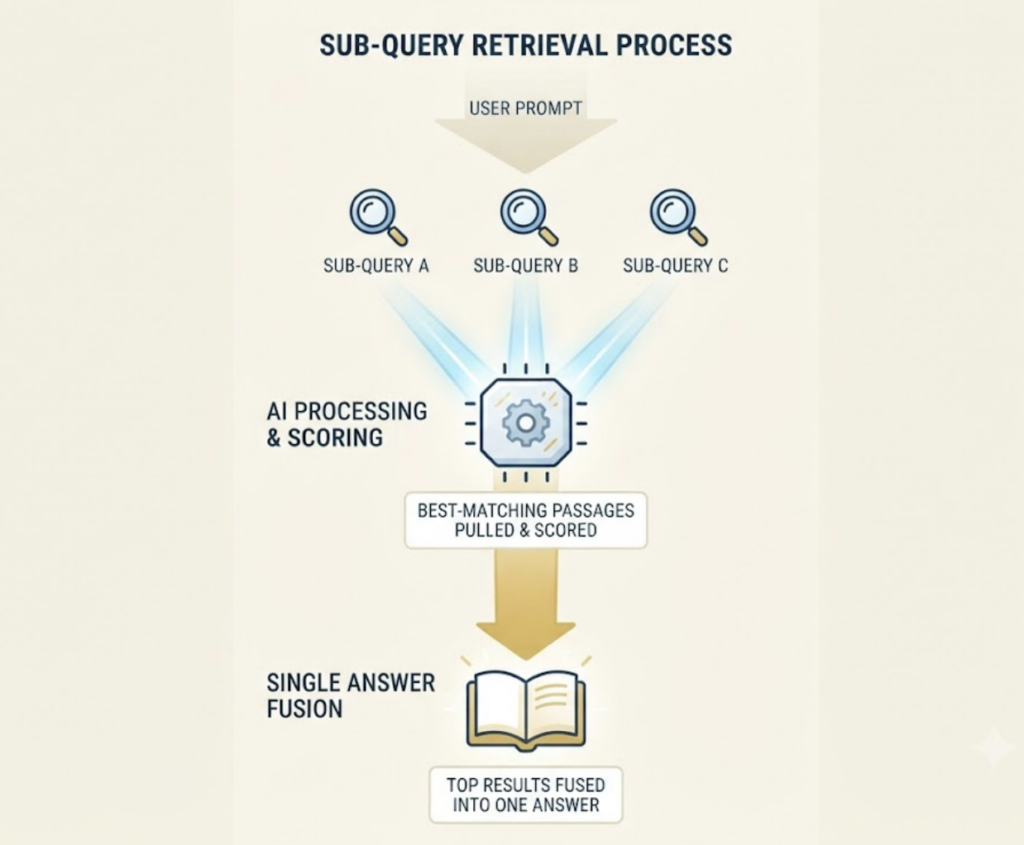
    Generative engines use Retrieval-Augmented Generation (RAG): they break a query into sub-queries, pull fragments from dozens of sources, and synthesize a final answer. What gets cited isn’t the most comprehensive piece — it’s the most extractable one. Content that leads with a direct answer in its first 40–60 words has a measurably higher chance of appearing in AI responses. Content that builds context before reaching its main point often doesn’t make the cut at all.

    Harness’s blog, while rich in detail, tends to follow a narrative structure where critical data lands after introductory context. In RAG terms, that’s a structural disadvantage.

    The result: a brand with a 76/100 AI Visibility Score that earns high sentiment (85–92/100 across major platforms) but consistently occupies secondary or tertiary positions behind GitHub Actions and GitLab in general category queries.

    High quality. Lower citation. That’s the gap.

    What AI Actually Says When Users Ask About Harness

    Run a prompt like “What’s the best CI/CD platform for enterprise deployments?” across ChatGPT, Gemini, and Perplexity. You’ll get a clear pattern.

    GitHub Actions gets framed as “The Default Engine” — easy to start, massive ecosystem, low friction. GitLab shows up as “The Integrated Suite” — unified DevSecOps, strong policy enforcement. Harness lands as “The Smart Orchestrator” — specifically recommended for mid-to-large organizations with complex, multi-environment deployment strategies.

    That’s actually a strong position. The problem is trigger rate.

    Harness earns the recommendation when users already know they have a complex deployment problem. For general discovery queries — the earlier-stage prompts where buyers are still forming their mental model of the category — Harness gets fewer mentions. AI models describe it with terms like “governed,” “reliable,” and “enterprise-ready.” Authoritative, yes. But not the first name that comes up.

    The Prompts AI Gets Asked Most

    The prompts that drive AI category recommendations aren’t the technical deep-dives. They’re conversational: “How do I reduce deployment failures?” or “What tools do DevOps teams use for AI-assisted pipelines?” These TOFU-stage queries shape brand perception before a buyer ever reaches a comparison page.

    For these prompts, Harness’s entity salience — the AI’s confidence in associating the brand with a specific problem — is weaker than its technical reputation would suggest.

    The Sources AI Actually Cites

    Here’s what makes this structural rather than accidental: AI models don’t primarily cite vendor blogs. Roughly 43% of all AI citations come from what researchers call “aristocratic domains” — Wikipedia, Reddit, YouTube, LinkedIn. News outlets account for another ~27%. Owned vendor content? Around 3%.

    Harness’s content investment is heavily concentrated in that 3% bucket.

    The 3 Gaps Hidden in Harness’s Content Strategy

    Gap 1: Topic Priority Mismatch

    Harness publishes what engineers find interesting. AI retrieves what buyers are asking. Those two lists overlap, but they’re not identical.

    Security is a clear example. Harness has a Security Testing Orchestration (STO) module, but when users run security-specific queries — SAST/DAST, AI-enhanced scanning, vulnerability remediation — Snyk and GitHub Advanced Security surface first. The content exists; the external validation connecting Harness to the security category doesn’t.

    AI models rely on what’s called “neighborhood of trust” logic: they look for multiple independent sources connecting the same brand to the same problem using consistent terminology. If only Harness is saying Harness solves AI security, the model treats it as a vendor claim. If G2, a Reddit thread, and a Gartner brief all say the same thing, it becomes a consensus fact.

    Gap 2: Format Mismatch

    FAQ sections generate 3.2x higher citation rates than standard narrative content. Original research and proprietary data increase citation likelihood by around 30%. TL;DR summaries aligned with AI’s opening-content bias consistently outperform long-form narrative for retrieval purposes.

    Harness’s blog is mostly long-form narrative. The format is built for human comprehension, not modular extraction.

    Every H2 or H3 in an AI-optimized article needs to function as a standalone unit — a complete thought that can be independently cited without surrounding context. Headers like “Branch-Scoped Build IDs Explained” require the preceding paragraphs to make sense. An AI chunking that section for RAG gets an ambiguous fragment. A competitor’s structured FAQ that leads with “Branch-scoped IDs reduce pipeline conflicts by isolating build state per branch” gets the citation.

    Gap 3: Source Authority Mismatch

    This is the most significant gap. Brands are 6.5 times more likely to be cited by AI through a third-party source than through their own website.

    Harness has strong G2 presence (4.6/5 stars), but review volume and recency matter. AI crawlers and retrieval systems weight recent, frequently updated sources. ChatGPT, in particular, shows a strong preference for content updated within the last 90 days. A blog post from 18 months ago — no matter how authoritative — may be deprioritized regardless of its historical SEO performance.

    Active community presence in places like r/devops, structured Wikipedia entity maintenance, and regular LinkedIn editorial content are what move a brand into the “aristocratic domain” tier. These aren’t soft PR activities. They’re the primary inputs to AI citation logic.

    Why This Gap Exists (It’s Not Just Harness)

    The AI narrative gap is a systemic byproduct of a content strategy built for Google in an era when buyers now route through AI.

    By 2025, roughly 60% of searches in the US and Europe are zero-click experiences — the AI answer is the touchpoint, and the user never reaches the brand’s website. More striking: over 60% of AI Overview citations come from URLs that rank outside the top 20 of traditional search results. A page at position #40 can become the primary evidence for an AI summary if it’s factually dense and structurally extractable.

    Technical brands like Harness are especially vulnerable to this shift. Engineering culture values depth and precision — exactly the qualities that make content compelling to human readers but difficult for RAG systems to parse quickly.

    Most engineering brands don’t know what AI is saying about them.

    There’s also the “AI Velocity Paradox” to consider. Organizations adopting AI coding tools without modernizing their delivery infrastructure see downstream friction increase, not decrease. Data shows that heavy AI coding tool users average 7.6-hour incident recovery times versus 6.3 hours for occasional users. The content parallel holds: more output without structural optimization creates more noise, not more signal.

    How to Spot Your Own AI Narrative Gap

    The monitoring framework for AI visibility is different from traditional SEO analytics. CTR and keyword rankings don’t capture influence at the answer level. You need three things.

    Step 1: Run the Prompts Your Buyers Actually Ask

    Build a Prompt Matrix — 25 to 100 conversational queries that simulate real buyer journeys across awareness, consideration, and decision stages. Not “Harness CI/CD” (branded). More like “How do DevOps teams handle multi-environment deployments?” or “What’s the difference between Harness and ArgoCD for Kubernetes?”

    Run these across ChatGPT, Gemini, and Perplexity. Document where your brand appears, what language surrounds it, and what sources AI cites when it mentions you.

    Step 2: Compare AI Citations Against Your Published Content

    Map the sources AI actually cites against your content inventory. You’ll typically find a mismatch: AI is pulling from a Reddit thread, a G2 review, or a third-party comparison post — not your blog.

    That mismatch is your action list. The sources AI trusts for your category are exactly where you need to build presence.

    Step 3: Measure the Gap, Not Just the Traffic

    AI Share of Voice (AI SoV) is the core metric: the percentage of category AI responses that include your brand as a cited or recommended source. Benchmarks suggest 40–70% SoV signals primary category authority; below 20% indicates a significant visibility problem.

    Pair this with a Sentiment Score (0–100) and Position Index (where in a response list your brand appears). First-position mentions drive 1.5 to 2x more clicks and trust than third-position mentions — and AI referral traffic converts at around 14.2%, roughly five times higher than Google organic traffic. Position matters more than presence.

    Topify automates this process through its AI Volume Analytics and Source Analysis modules — tracking which domains AI platforms actually cite in your category, mapping your brand’s position across platforms like ChatGPT, Gemini, and Perplexity, and surfacing the prompt clusters where competitors are gaining ground. Instead of manually running 100 prompts across four platforms, you get a structured view of where your entity salience is strong and where it’s collapsing.

    What Closing the Gap Actually Looks Like

    The fix isn’t more content. It’s structurally different content distributed to structurally different places.

    Restructure for modular extraction. Every major section needs an answer-first structure: direct response in the opening sentence, supporting data in the following two to three sentences, context last. Implement FAQ schema markup — research shows a 40–42% increase in citation likelihood for pages using it correctly.

    Seed the aristocratic domains. If Source Analysis shows AI citing G2 and Reddit for your category, those channels need active investment. For Harness, that means structured G2 review campaigns to build recency, regular participation in r/devops threads on relevant topics, and Wikipedia entity updates that connect the brand to current AI-native DevOps terminology.

    Establish original data as a recurring asset. Harness’s security analysis of the McKinsey AI incident — where an AI agent discovered over 200 API endpoints and identified 22 unauthenticated ones within minutes — is exactly the kind of factually dense, procedurally clear content that earns AI citations. It provides a specific statistic, a named organization, and a clear cause-effect chain. That’s the template. Original research with hard numbers, published consistently, builds the kind of entity authority that AI models treat as a consensus reference.

    Maintain content freshness on cornerstone pages. ChatGPT’s recency bias toward content updated within 90 days means that evergreen content needs a refresh cycle, not just a publication date. High-priority category pages should be reviewed and updated quarterly.

    Topify’s Competitor Monitoring and Visibility Tracking track these shifts in real time — so you can see when a competitor’s citation rate is climbing in a prompt cluster where you’ve historically led, and respond before the gap compounds.

    Conclusion

    Harness’s AI narrative gap isn’t a sign of weak content. It’s a sign of content built for a channel that’s no longer the primary one.

    The buyers using generative AI to research DevOps platforms aren’t reading blog posts — they’re asking questions and acting on the synthesized answers they get back. If a brand’s entity isn’t present in those answers, the content investment that produced it effectively doesn’t exist for that buyer.

    The shift from SEO to GEO isn’t about abandoning what works. It’s about extending it: restructuring content for modular extraction, seeding third-party platforms AI actually trusts, and tracking visibility at the answer level rather than the ranking level.

    The brands that figure this out first will occupy the first-position recommendation slots that drive 1.5 to 2x more referral trust. In a zero-click world, that position is the only one that pays.

    FAQ

    What is an AI narrative gap in content strategy? 

    An AI narrative gap is the misalignment between what a brand publishes and what AI engines actually retrieve and cite in generated answers. A brand can have extensive, high-quality content and still have low AI visibility if that content isn’t structured for modular extraction or distributed across the third-party sources AI models trust most.

    How do I find out what AI says about my brand? 

    Build a Prompt Matrix of 25–100 conversational queries that reflect real buyer journeys in your category. Run them across ChatGPT, Gemini, and Perplexity, and document where your brand appears, what language surrounds it, and which external sources get cited. Platforms like Topify automate this process and track AI Share of Voice over time.

    Does blog content influence AI search results? 

    Indirectly. AI retrieval systems weight third-party sources — G2, Reddit, Wikipedia, industry publications — more heavily than owned vendor content. Your blog can support AI visibility, but only if its content is also reflected in those external sources. Owned content accounts for roughly 3% of AI citations; third-party sources account for the rest.

    Is this problem specific to engineering or DevOps brands? 

    No, but technical brands are particularly exposed. Engineering content tends to be deep, narrative-driven, and context-dependent — qualities that work well for human readers but reduce extractability for RAG systems. The structural mismatch between how engineers write and how AI retrieves is more pronounced in technical verticals than in, say, e-commerce or consumer brands.

    Read More

  • ChatGPT Is Picking Dev Tools. Where Does Harness Rank?

    ChatGPT Is Picking Dev Tools. Where Does Harness Rank?

    A senior DevOps engineer needs a new deployment platform. She doesn’t open Google.

    She opens ChatGPT and types: “Best enterprise CI/CD tool for a 500-microservice setup on multi-cloud with strict compliance requirements.”

    In under 10 seconds, she gets a ranked list, a comparison table, and a recommendation tailored to her stack. She picks the top two, sends them to her team lead, and the evaluation begins.

    If Harness isn’t in that list, it doesn’t get evaluated. It’s that simple.

    This isn’t a hypothetical. It’s how engineering teams are making tool decisions in 2026 — and the brands that don’t show up in AI answers are quietly losing the decision before they ever knew there was one.

    Engineers Have Quietly Stopped Googling for Tools

    The numbers tell the story clearly. ChatGPT now handles 17.6% of global search queries, making it the biggest threat to traditional search engines in two decades. On desktop, where professionals do their deep research, that share jumps to 62%.

    In software development specifically, about 63% of engineers already use ChatGPT as a primary platform for debugging, code generation, and tool research. For high-complexity queries — the kind that involve architecture decisions and vendor evaluation — AI isn’t a shortcut. It’s the first stop.

    That’s a structural shift, not a trend.

    Google still dominates navigational searches. But when an engineer needs to understand tradeoffs between enterprise deployment platforms? They’re asking an AI. The average ChatGPT session runs over 13 minutes — nearly three times longer than a Google session. These aren’t quick lookups. They’re consultations.

    What Engineers Actually Ask ChatGPT About DevOps Tools

    The prompts engineers use aren’t simple keywords. They’re scenario-driven questions with real context:

    • “Best CI/CD tools that support GitOps and manual approval gates”
    • “Compare Harness vs GitHub Actions for large-scale Monorepo builds”
    • “Which platforms reduce build time without sacrificing rollback reliability?”

    AI responds with structured outputs: a ranked list of tools, a feature comparison table, and scenario-specific recommendations. The whole thing takes seconds.

    Here’s what matters for brands: AI’s ranking logic has nothing to do with your Google SEO position. About 76.1% of citations in Google AI Overviews come from top-10 search results — but standalone LLMs like ChatGPT weight things differently. They surface tools that appear consistently across independent, authoritative sources: GitHub Discussions, Stack Overflow, G2 reviews, technical media, and Reddit.

    Reddit, for instance, is currently Perplexity’s single largest citation source.

    If your product is mentioned across multiple credible communities with consistent associations — say, “Harness” linked to “automated rollback” or “OPA policy enforcement” — AI learns that connection and reproduces it. If those associations don’t exist in the right places, neither does your brand in the answer.

    Where Harness Shows Up — and Where It Doesn’t

    Harness has a real visibility problem. Not a universal one — a highly specific one.

    On complex enterprise prompts — multi-cloud compliance, automated rollback, deployment governance — Harness performs well. AI systems consistently position it as a full-lifecycle platform for teams moving away from fragmented toolchains.

    On lightweight queries — “easiest CI/CD to set up,” “open source alternatives to Jenkins,” “best tool for solo developers” — Harness disappears. GitHub Actions and GitLab CI absorb those searches entirely.

    DimensionHarnessGitHub ActionsCircleCIArgo CD
    AI Recommendation FrequencyMedium-High (enterprise queries)Very High (all scales)MediumHigh (K8s-specific)
    Core AI Recommendation ReasonTest Intelligence, rollback, OPAEase of use, GitHub integrationReliability, reusable OrbsPure GitOps, declarative config
    AI-Identified WeaknessHigh cost/complexity for small teamsLimited native CD for enterprisePricing at scaleK8s-only, no CI
    Primary Citation SourcesOfficial docs, enterprise case studiesCommunity, Reddit, MarketplaceDev blogs, tutorialsCNCF reports, open-source community

    The problem isn’t the product. The problem is the footprint.

    Harness’s technical strengths — Continuous Verification, Test Intelligence, AIDA — are genuinely differentiated. But if those capabilities aren’t documented in places AI can find and trust, they don’t exist from the AI’s perspective.

    Why AI Skips Certain Tools (It’s Not About Product Quality)

    This is the part most marketing teams get wrong.

    AI doesn’t skip Harness because engineers don’t like it. It skips Harness because its content doesn’t match how AI engines extract information.

    LLMs operate on a principle of multi-source verification. When an AI is building its answer about CI/CD tools, it’s not reading one blog post. It’s scanning for consensus across independent sources. A tool mentioned consistently on Stack Overflow, dev.to, InfoQ, and peer-review sites like G2 gets treated as established. A tool mostly documented in gated white papers or unstructured PDFs? It gets treated as low-confidence.

    Documents that use clear H1–H3 hierarchy, FAQ schema, and structured Q&A blocks are 40%+ more likely to be extracted as usable fact units than traditional long-form content. And content that includes specific, verifiable claims — like “RisingWave reduced build times by 50% after adopting Harness” — gets cited far more often than vague benefit statements.

    It’s not about having a great product. It’s about being cited by the right sources, in the right formats.

    Harness’s content assets have historically leaned toward enterprise documentation and gated case studies. Those assets serve sales cycles well. They don’t feed AI engines.

    3 Signals That Tell You If Harness Is Winning AI Visibility

    Traditional SEO rankings won’t tell you how visible Harness is in AI answers. You need different metrics entirely.

    Visibility Rate measures what percentage of relevant prompts include Harness in the AI’s answer. If you test 100 CI/CD-related prompts and Harness appears in 35 responses, its visibility rate is 35%. This tells you how strongly AI associates your brand with your category.

    Position tracks where Harness appears in the ranked list when AI does mention it. First-position citations carry substantially higher trust and click potential — the same way top-3 Google results dominate organic traffic. Being mentioned fifth in a ChatGPT list is very different from being mentioned first.

    Source Coverage measures how many independent domains are driving AI’s mentions of Harness. If AI only pulls from harness.io, your credibility footprint is narrow. If it’s also pulling from Stack Overflow, G2, and engineering blogs, your brand has achieved multi-source verification — the signal AI trusts most.

    SignalWhat It MeasuresWhy It Matters for Harness
    Visibility RateFrequency of appearance across prompt setShows AI category association strength
    PositionRank order in AI recommendationsIndicates how AI “grades” Harness vs. competitors
    Source CoverageNumber of independent citation domainsMeasures credibility depth across the web
    Sentiment ScoreTone AI uses when describing HarnessShapes first impressions for evaluating engineers

    Topify tracks all four dimensions across ChatGPT, Perplexity, and Gemini simultaneously — so Harness’s marketing team can see exactly where the gaps are, and which competitor is filling them.

    What Harness’s Marketing Team Can Actually Do About It

    The strategic shift is from keyword optimization to citation engineering.

    The goal isn’t to rank on page one of Google. It’s to become the source that AI quotes when engineers ask about enterprise-grade deployment platforms.

    Build citation-bait content. This means original research, benchmark reports, and technically specific comparisons — the kind of content that third-party media and communities want to cite. A well-distributed report like “2026 Enterprise Deployment Frequency Benchmark” gets picked up, linked to, discussed. Every one of those citations becomes a data point AI trusts.

    Shift distribution toward AI-indexed communities. Reddit, Stack Overflow, dev.to, GitHub Discussions — these aren’t just community channels. They’re the sources AI engines pull from most heavily. Harness’s technical content needs to live there, not just behind a login wall or inside a PDF.

    Close the prompt gaps. There are high-intent queries where engineers are actively researching — and Harness isn’t appearing in the answers. Those are recoverable. Identifying them is step one.

    That’s where Topify’s Competitor Monitoring and Prompt Discovery become practical. The platform continuously surfaces new prompts your target engineers are using, flags where competitors are being cited instead of you, and suggests the specific content moves needed to close each gap. Its One-Click Execution feature turns those insights into deployable strategies without manual coordination across teams.

    The cycle is: track where Harness is invisible → identify which sources are being cited instead → create content that earns those citations → measure the shift.

    Straightforward in theory. Hard to do without the right infrastructure.

    Conclusion

    The tool selection process has already changed. Engineering teams are consulting AI before they consult a sales rep, a review site, or a colleague. And AI’s recommendations are shaped by a content ecosystem that most B2B marketing teams weren’t built to optimize for.

    For Harness, the product quality isn’t the gap. The citation infrastructure is.

    Winning in this environment means becoming the brand that high-authority sources naturally reference when they discuss enterprise deployment, automated rollback, and cloud-native CI/CD. It means documenting real outcomes in structured, crawlable formats. And it means tracking AI visibility the same way you’d track organic search — with specific metrics, competitive benchmarks, and a feedback loop that translates data into action.

    The teams that build that infrastructure now will own the recommendation layer for the next decade. The ones that don’t will keep losing deals before the conversation even starts.

    Start by auditing where Harness stands today — which prompts trigger a recommendation, which ones don’t, and who’s filling the gap. Topify can run that audit across every major AI platform in one place.

    FAQ

    Does Harness currently appear in ChatGPT’s tool recommendations?

    Yes — but selectively. Harness performs well in complex, enterprise-specific queries involving multi-cloud compliance, automated rollback, and deployment governance. In lighter-weight queries around ease of use or open-source options, it typically gets outranked by GitHub Actions or GitLab CI.

    How is AI tool visibility different from Google SEO rankings?

    SEO gets your page into a list of links. GEO gets your brand into an AI-generated answer. The mechanisms are different: SEO depends on backlinks and keyword relevance; GEO depends on structured content, factual density, and multi-source citation across communities AI actually trusts. SEO is about being seen. GEO is about being cited as the authoritative answer.

    How long does it take to improve AI search visibility for a DevOps tool?

    Based on documented cases, targeted GEO optimization — adjusting document structure, building third-party citation coverage — typically produces measurable improvements in AI citation frequency and position within 4 to 8 weeks.

    Read More

  • What AI Actually Says About Harness Engineering

    What AI Actually Says About Harness Engineering

    A prompt-by-prompt breakdown of how DevOps tools get discovered, recommended, and ranked across ChatGPT, Perplexity, and Gemini — and what it means for any brand competing in AI search.

    Your engineering team might evaluate Harness every day. But when someone asks ChatGPT “what’s the best CI/CD platform for a fintech company,” does Harness show up? In what position? With what kind of description?

    Those answers now shape buyer perception before a single sales call happens.

    That’s the new reality of DevOps tool discovery. AI search engines have inserted themselves between the problem and the product. And for brands like Harness, understanding this layer isn’t a marketing exercise — it’s a revenue question.

    The Discovery Layer Your Team Isn’t Tracking

    The traditional DevOps tool selection journey was predictable: someone searches Google, reads a comparison article, checks G2, then gets on a demo call. That loop is breaking down.

    According to the 2025 Stack Overflow Developer Survey, 75.9% of developers now rely on AI for professional tasks, with searching for answers being the top use case for 55.8% of respondents. Engineers aren’t starting with Google anymore. They’re starting with a prompt.

    And when an AI Overview or a generative summary is present in search results, organic click-through rates can collapse by over 50% — dropping from a baseline of 1.41% to 0.64%. The AI answers the question. The link never gets clicked.

    For DevOps vendors, this means a Visibility Score in AI platforms is fast becoming as important as a first-page ranking.

    The Prompts That Actually Trigger Harness Recommendations

    Not all prompts are equal. Harness retrieval behaves very differently depending on how the question is framed.

    Category prompts — “What are the best CI/CD platforms for enterprises in 2025?” — pull from broad industry consensus. Harness typically appears, but often in the 3rd or 4th position behind GitHub Actions and GitLab. The AI cites its enterprise-grade automation and governance layer as the value driver.

    Problem prompts are where Harness punches above its weight. When a developer types “how do I reduce deployment failures in Kubernetes” or “what tool handles automated rollbacks with canary releases,” Harness frequently surfaces as a top-two recommendation. AI engines tie it directly to Continuous Verification (CV) — the feature that monitors post-deployment anomalies and triggers rollbacks automatically.

    The most cited customer metric: an 80% reduction in build times via Harness Test Intelligence, driven by call-graph analysis that skips irrelevant tests in monorepo environments. RisingWave Labs reported 50% faster builds; Qrvey saw an 8x reduction. These specific numbers appear repeatedly across AI-generated summaries because they’ve reached consensus across enough independent sources.

    Comparison prompts (“Harness vs GitHub Actions,” “ArgoCD vs Harness”) reveal how AI constructs trade-off narratives. The consistent pattern: AI describes GitHub Actions as easier to start but “requiring a decent amount of scripting,” framing that as toil. Harness gets positioned as the more automated choice for complex deployment strategies — canary, blue-green, or multi-environment. That framing didn’t come from Harness’s marketing. It came from hundreds of blog posts, Reddit threads, and G2 reviews that the AI has absorbed and synthesized.

    Where Harness Shows Up — and Where It Doesn’t

    Harness has three areas of dominant AI visibility.

    Continuous Delivery is its strongest signal. AI models consistently describe Harness as “the CD specialist” — a tool built specifically for complex, high-risk production environments. Continuous Verification and automated rollback are the features cited most often.

    Cloud cost management is the second stronghold. When queries involve FinOps or controlling AWS/GCP spend tied to delivery decisions, Harness regularly earns a top-tier recommendation. The framing is almost always around connecting infrastructure cost directly to deployment outcomes — a positioning that smaller or more generic tools can’t match.

    AI-powered DevOps is the third. In prompts specifically asking about ML-based pipelines or “AI-native” CI/CD, Harness often ranks first or second, ahead of GitHub and GitLab.

    The gaps are equally telling.

    For prompts with a simplicity or startup intent, GitHub Actions is the overwhelming default. AI models note Harness’s “steeper learning curve,” which functions as a soft disqualifier for teams that don’t need enterprise-grade governance.

    Pure GitOps queries often favor ArgoCD directly, even though Harness GitOps is built on top of it. The AI understands ArgoCD as the “focused, powerful GitOps tool” and Harness as the management layer on top — a positioning gap that may cost Harness direct retrieval in this segment.

    Security-specific queries (SAST/DAST, AI-enhanced security scanning) tend to surface Snyk or GitHub Advanced Security ahead of Harness’s Security Testing Orchestration module. Entity salience in this domain is lower than in CD, and that gap is measurable.

    What AI Says When It Does Recommend Harness

    The sentiment dimension is important — and nuanced.

    Across ChatGPT, Perplexity, Gemini, and Claude, Harness earns a Sentiment Score of 85–92 out of 100 (per Topify’s metric). The tone is consistently “positive-professional”: authoritative, technical, and scale-oriented. AI engines don’t describe Harness with the casual warmth they reserve for community-first tools like GitHub. The language is closer to “governed,” “reliable,” and “enterprise-grade.”

    That’s a strategic asset for procurement conversations. But it also comes with a recurring neutral caveat. AI models frequently note that Harness “can be more expensive” or “requires enterprise-level needs to justify the complexity.” The AI is performing trade-off analysis, not just brand promotion — and that objectivity shapes how buyers process the recommendation.

    On position: the brand that gets named first in an AI response captures approximately 70% of cognitive attention from the user, based on Position-Adjusted Word Count analysis. Harness sits at #1 or #2 in specialized queries — automated deployment verification, cloud cost tracking, canary releases. In broad “best CI/CD” prompts, it’s typically #3 or #4. That gap matters for raw discovery volume, even if the specialized rankings drive higher-intent engagement.

    The Competitive Pressure Harness Faces in AI Search

    The DevOps AI landscape has a clear hierarchy right now.

    BrandAI Visibility PersonaVisibility Score (Topify Index)
    GitHub ActionsThe Default Engine94/100
    GitLabThe Integrated Suite88/100
    ArgoCDThe GitOps Standard82/100
    HarnessThe Smart Orchestrator76/100
    CircleCIThe Speed Specialist71/100

    GitHub’s structural advantage is hard to close: AI models were trained on billions of YAML pipeline configurations hosted on GitHub. When someone asks how to build a CI/CD pipeline, GitHub Actions gets cited by default — not because it’s always the right answer, but because it’s the most represented answer in the AI’s training data.

    That’s a community advantage, not a product advantage. And it’s also the challenge Harness faces: high sentiment, high technical authority, but a lower raw mention rate than tools with deeper community-generated content.

    What Actually Drives AI Visibility for DevOps Tools

    Third-party sources account for roughly 75% of what AI engines “know” about Harness. The breakdown, per Topify’s Source Analysis:

    • Reddit and Hacker News: ~30% of citations (real-world evidence, war stories, honest comparisons)
    • G2, Gartner, and analyst content: ~25% (benchmark data, feature comparisons)
    • Technical blogs and tutorials: ~20% (instructional footprint)
    • Official documentation and site content: ~25% (fact verification)

    The bottom line: you don’t own your AI visibility. Your community does.

    This has direct implications for content strategy. AI engines look for what’s called “Extraction-Ready” content — structured blocks where the first 40–50 words of a section are a self-contained, quotable summary. Long-form posts that bury conclusions don’t get surfaced. Sections that lead with a clear technical claim followed by supporting data do.

    There’s also a consensus dynamic at play. If Harness claims a “67% reduction in MTTD,” the AI checks whether that figure appears independently across G2, case studies, and Reddit. Consistency across at least five independent sources creates a high-confidence signal that the AI will quote the number in its recommendations. Variety in phrasing matters too — identical copy across sources triggers AI coordination filters.

    Tools like Topify make this auditable. Its Visibility Tracking and Source Analysis features map exactly which domains AI platforms are pulling from when they recommend a tool — and where the gaps are. For a platform like Harness, seeing that 30% of AI retrieval comes from Reddit means that community content strategy is a core part of AI visibility, not a side project.

    “Harness Engineering” as a Brand Signal — and an Opportunity

    There’s a dimension of Harness’s AI visibility that doesn’t exist for any of its competitors.

    “Harness Engineering” has emerged as a technical term in AI systems design, coined by practitioners including Martin Fowler and Birgitta Böckeler. The concept defines the system of guides (feedforward controls) and sensors (feedback controls) that surround an AI agent to make it reliable and controllable. The formula: Agent = Model + Harness.

    This creates something unusual: an organic conceptual bridge between the brand “Harness” and the ideas of control, reliability, and automated feedback loops — exactly the traits the platform’s product suite is built around.

    AI models that encounter content on “Harness Engineering” as an architectural discipline may reinforce their association of the brand with those properties. It’s not a guaranteed effect. But it’s a rare case where a company name shares semantic space with a high-growth technical concept, and that’s worth building on.

    DORA 2025 research reinforces this angle: AI doesn’t fix a team; it amplifies what’s already there. A high-quality internal platform is the prerequisite for unlocking AI value in software delivery. Harness’s positioning as the “harness” that prevents agentic chaos in SDLC pipelines is a content narrative with both technical credibility and future-facing relevance.

    How to Apply This to Your Own DevOps Brand

    If you’re in the DevOps space — whether you’re competing with Harness or trying to understand where your own tool stands — the framework is straightforward.

    Start by building a prompt matrix. Not a keyword list. A set of 25–100 context-rich questions that simulate how your buyers actually talk to AI: persona-specific, problem-specific, and comparison-specific. Topify’s High-Value Prompt Discovery feature surfaces exactly what your target audience is asking AI platforms right now, across ChatGPT, Perplexity, Gemini, and AI Overviews.

    Then run a baseline visibility audit. Where does your brand appear? Where are competitors named instead of you? What position do you hold, and what sentiment does the AI assign? Topify’s Dynamic Competitor Benchmarking turns this into a heatmap — a clear view of where you’re functionally invisible despite having a strong product.

    Finally, close the gaps with extraction-ready content. Restructure key pages so the first paragraph of every H2 section is a self-contained, quotable summary. Build community presence in the sources AI already trusts: Reddit threads, technical tutorials, G2 reviews. Ensure that your core metrics show up consistently across independent sources — that’s what creates the consensus signals AI engines rely on.

    The Harness case illustrates both the opportunity and the challenge: strong sentiment and specialized authority don’t automatically translate to raw mention volume. Closing that gap requires a deliberate, data-driven approach to AI visibility — not a content refresh, but a structural strategy.

    Conclusion

    Harness enters 2026 as one of the most technically respected DevOps platforms in AI search. Its Sentiment Score is strong, its specialized visibility is dominant, and its brand name has an unusual conceptual alignment with a growing discipline in AI systems design.

    The work ahead is volume. Expanding from specialist recommendation to broader category presence requires more community-generated content, more extraction-ready structured pages, and a tighter feedback loop between what AI platforms are actually citing and what the content team produces.

    For any DevOps brand watching this space, the Harness example is useful precisely because the gaps are visible. AI visibility is measurable. The prompts, positions, sources, and sentiment can all be tracked. The brands that figure this out first won’t just be recommended by AI — they’ll be the ones AI reaches for by default.


    FAQ

    What is AI visibility for DevOps tools? 

    AI visibility measures how often, how accurately, and how favorably an AI search engine like ChatGPT or Perplexity represents a brand in its synthesized responses. It’s distinct from SEO because it focuses on a model’s structural understanding, not a website’s ranking on a list of links.

    How often does Harness Engineering appear in AI recommendations? 

    Harness consistently appears in top-three results for specialized queries around automated deployment verification, canary releases, and cloud cost management. On broad CI/CD queries, it typically ranks #3 or #4, behind GitHub Actions and GitLab.

    Which AI platforms matter most for DevOps tool discovery? 

    The primary platforms are ChatGPT (mass-market discovery), Perplexity (deep research and source-checking), Gemini (integrated Google ecosystem), and Google AI Overviews (traditional search displacement). Each weights sources differently, so visibility across all four matters.

    Can smaller DevOps brands compete with Harness in AI search? 

    Yes. Smaller tools can win by targeting extremely specific long-tail prompts — what’s sometimes called zero-volume keywords — and building consensus across a tighter set of authoritative sources. Becoming the default recommendation for one specific technical problem is more achievable, and more valuable, than broad category visibility.


    Read More

  • Claude Code Won’t Replace Junior Devs. Not Yet.

    Claude Code Won’t Replace Junior Devs. Not Yet.

    We ran Claude Code through 6 real junior-level tasks. Here’s exactly where it delivered, where it broke down, and what that means for engineering teams in 2026.

    Something’s shifting inside engineering orgs right now. Hiring committees are quietly asking whether they should greenlight that junior developer requisition or just expand the AI tooling budget instead. Claude Code is sitting on the table. The conversation is uncomfortable, and most teams don’t have a framework for it yet.

    Here’s the honest answer: Claude Code is genuinely impressive, genuinely limited, and genuinely changing what junior developers are supposed to do. Not replacing them. Reshaping them.

    That distinction matters enormously if you’re making headcount decisions in 2026.

    What Junior Developers Actually Do All Day

    Before you can evaluate any AI coding tool against a junior dev, you need to stop thinking of the role as “writes code.” That’s like saying a sous-chef “chops vegetables.”

    Junior developers carry two very different kinds of work. The first kind is visible. The second kind is what keeps projects from quietly falling apart.

    The Tasks That Look Like AI Territory

    Boilerplate generation. Unit test coverage. Fixing regression bugs. Writing documentation stubs. Migrating deprecated API calls. These are the tasks that show up in sprint backlogs and get counted in velocity metrics.

    They’re also the tasks where AI is eating the most ground. Industry data from 2025 puts AI-generated code at 41% of total global output, a figure that’s still climbing. For these deterministic, well-defined tasks, Claude Code doesn’t just match junior developer output — it often exceeds it in speed and consistency.

    The Tasks That Don’t Show Up in Job Postings

    Context-gathering. Translating a product manager’s offhand Slack comment into a technically coherent spec. Sitting in a retro and absorbing institutional knowledge that’s never been documented. Building enough trust with a senior engineer to ask the “dumb questions” that surface the critical constraints nobody wrote down.

    These tasks don’t appear in job descriptions. They don’t have story points. But they’re the connective tissue that keeps software projects coherent. And in 2026, no AI agent has learned how to attend a meeting and read the room.

    6 Tasks We Tested with Claude Code

    To move past speculation, we mapped Claude Code’s performance against six real junior-level engineering scenarios. Here’s what the data shows.

    TaskClaude CodeJunior Dev Advantage
    Write unit tests for existing functionStrongMinimal — AI more thorough on edge cases
    Fix regression bug in legacy codebasePartialUnderstands implicit side-effects, tribal knowledge
    Implement feature from vague specWeakCommunication, clarification, product instinct
    Review PR and leave commentsStrongMinimal — AI coverage is broader
    Onboard into unfamiliar repoPartialBuilds social network, mental model beyond docs
    Coordinate fix across 2 servicesWeakCross-team sync, dependency negotiation

    Unit tests and PR review: Claude Code is faster, more consistent, and doesn’t experience the fatigue that makes humans skim. Its 1M-token context window lets it hold an entire microservice in working memory while identifying edge cases a junior dev would need hours to find manually.

    Legacy bug fixes and onboarding: Mixed results. Claude Code can scan 400,000 files instantly, but it can’t explain why a particular architectural decision was made three years ago under deadline pressure. It also can’t ask a colleague over lunch. Teams report that the AI produces patches that are “locally correct but globally breaking” — fixes that pass unit tests while silently introducing concurrency issues downstream.

    Vague specs and cross-service coordination: This is where Claude Code reliably struggles. Faced with an instruction like “improve the checkout experience on mobile,” it produces code. Technically valid code. Code that completely misses what the product lead actually meant. The gap isn’t technical ability — it’s the absence of any mechanism for asking a follow-up question in a human context.

    Where Claude Code Is Genuinely Faster

    Let’s give credit where it’s due, because underselling this tool doesn’t help anyone plan accurately.

    For deterministic tasks at scale, Claude Code is a different category of productive. Teams using it for framework upgrades involving 50 or more files are reporting 60 to 70% time reductions compared to manual junior dev work. That’s not marginal. That’s a structural shift in how long a certain class of work takes.

    Anthropic’s own internal teams have run five or more AI agents simultaneously, producing 300 merged pull requests in a single month. That figure would require a sizable junior engineering cohort under traditional workflows.

    For solo founders and small startups, Claude Code effectively fills the role of an entry-level engineering bench. Feed it an architecture diagram. Get back a functional backend service skeleton. Let the senior engineer focus on the decisions that actually require judgment.

    The tool also provides something human reviewers can’t: 24/7 code review with no degradation. It catches known security vulnerabilities, style violations, and architectural anti-patterns at the same quality level at 2 AM on a Sunday as it does at 10 AM on a Tuesday. For teams trying to reduce technical debt accumulation, that’s a meaningful capability.

    The Gap Nobody’s Talking About: Ambiguity

    Here’s the thing that gets lost in the “AI will take all the jobs” discourse.

    Ambiguity doesn’t live in the code. It lives in the meeting before the code.

    Real software engineering isn’t a series of well-defined tasks waiting to be executed. It’s a continuous process of converting fuzzy human intentions into precise logical instructions. A product manager says “make the onboarding feel lighter.” A stakeholder says “we need to move faster on this.” A business requirement says “optimize for retention” without specifying which cohort, over what time window, at what acceptable cost to conversion.

    Claude Code takes instructions literally. That’s not a bug — it’s an architectural constraint of how large language models work in 2026. When the input is precise, the output is excellent. When the input is ambiguous, the output is confidently wrong.

    Junior developers who understand this gap and lean into it are building the most durable career moat available right now. The skill of converting organizational ambiguity into executable specifications — through conversation, observation, and judgment — is what the research literature is starting to call “intent architecture.” It’s less about writing code and more about being fluent in two languages: human and machine.

    That skill is not going to be automated in the near term. Possibly not for a long time after that.

    What This Means for Engineering Teams in 2026

    The strategic question isn’t “should we replace junior developers with Claude Code?” The right question is “what should junior developers be doing now that Claude Code exists?”

    For engineering managers: The case for continuing to hire junior talent isn’t weakened by AI tools — it’s restructured. If you stop building entry-level pipeline today, you’ll face a senior engineer shortage in five years. There’s no accelerated path to staff-level engineering that skips the foundational learning entirely. The industry term for what happens when you stop hiring juniors is “leadership vacuum,” and it tends to arrive quietly until it’s expensive.

    What changes is the job description. Junior developers in high-performing 2026 teams are increasingly functioning as AI orchestrators and output validators. They’re writing specs that Claude Code can execute cleanly. They’re reviewing AI-generated PRs for business logic correctness, not syntax. They’re building the organizational context that no AI agent can accumulate.

    For junior developers: The career move here is toward the parts of the job that feel most like communication and least like typing. Distributed systems architecture. Security fundamentals. The ability to walk into a room where nobody agrees on requirements and come out with a document that an AI agent can actually use. These capabilities compound over time in a way that syntax memorization never did.

    The employment data is sobering but not fatal. Employment rates for developers aged 22 to 25 are down roughly 20% from the 2022 peak. That contraction is real. But it’s also a market-correcting toward a different skill model, not toward zero. AI is projected to create approximately 2.3 million new jobs globally — significantly more than it displaces — as new industries find uses for software that previously couldn’t afford to build it.

    The developers who navigate this well are the ones treating Claude Code as a force multiplier and positioning themselves as the judgment layer it can’t replace.

    Conclusion

    Claude Code is not the end of junior developers. It’s the end of junior developers whose value is primarily measured in lines of code produced per week.

    One junior developer with Claude Code, a clear spec, and a solid understanding of the codebase they’re working in can now produce output that would have required a small team two years ago. That’s an extraordinary amount of leverage. But it requires a different kind of junior developer — one who’s fluent in ambiguity, comfortable with system-level thinking, and willing to spend time on the unglamorous work of building organizational context.

    The teams that figure this out first are going to have a meaningful structural advantage. Not because they replaced their junior developers. Because they retrained them for the work AI can’t do.

    That window won’t stay open forever. As multi-agent systems continue to mature past 2027, the coordination tasks that currently require human involvement will start to compress too. The strongest move, for both managers and early-career developers, is to stay ahead of where that line is moving.

    FAQ

    Is Claude Code reliable enough to use without a senior developer on the team?

    Not yet. Claude Code performs well on isolated, well-scoped tasks. In complex multi-service architectures, it can introduce subtle concurrency errors or make locally correct changes that break behavior elsewhere in the system. Without a senior engineer doing architectural oversight and final risk validation, AI-generated code can accumulate technical debt that’s significantly harder to unwind than the time saved upfront.

    Will AI replace software developers entirely in the next five years?

    The more useful framing is: the role is shifting from manual code production toward decision-making and specification. The entry-level “coding as typing” subskill is increasingly automated. But software engineering as a discipline — understanding systems, managing tradeoffs, communicating intent across teams — is expanding into industries that previously had no software at all. The net employment picture over five years is likely positive, but the transition is real and uneven.

    What’s the practical difference between Claude Code and GitHub Copilot for a dev team?

    Copilot operates inside the IDE, providing inline suggestions that accelerate moment-to-moment coding. It’s optimized for keeping you in flow while you work. Claude Code operates at the terminal and task level — you give it a goal, it reads the relevant code, plans a solution, and executes across multiple files. The most effective teams use both: Copilot for daily coding velocity, Claude Code for larger delegated tasks like refactors, migrations, and test generation.

    Read More